Cambridge A Level Thinking Skills 9694 — 2019 May/June Paper 3 · Variant 2
9694/32/M/J/19 · 4 questions · 50 marks · ≈56 min
The question paper and its mark scheme, free to read here and free to download. This is Cambridge’s own paper, exactly as it was sat.
Question paper12 pages





Mark scheme6 pages
Answers below. Sit the paper first if you are practising.
Questions as text
Q1 · An international cycling competition is held every year in Pelatonia
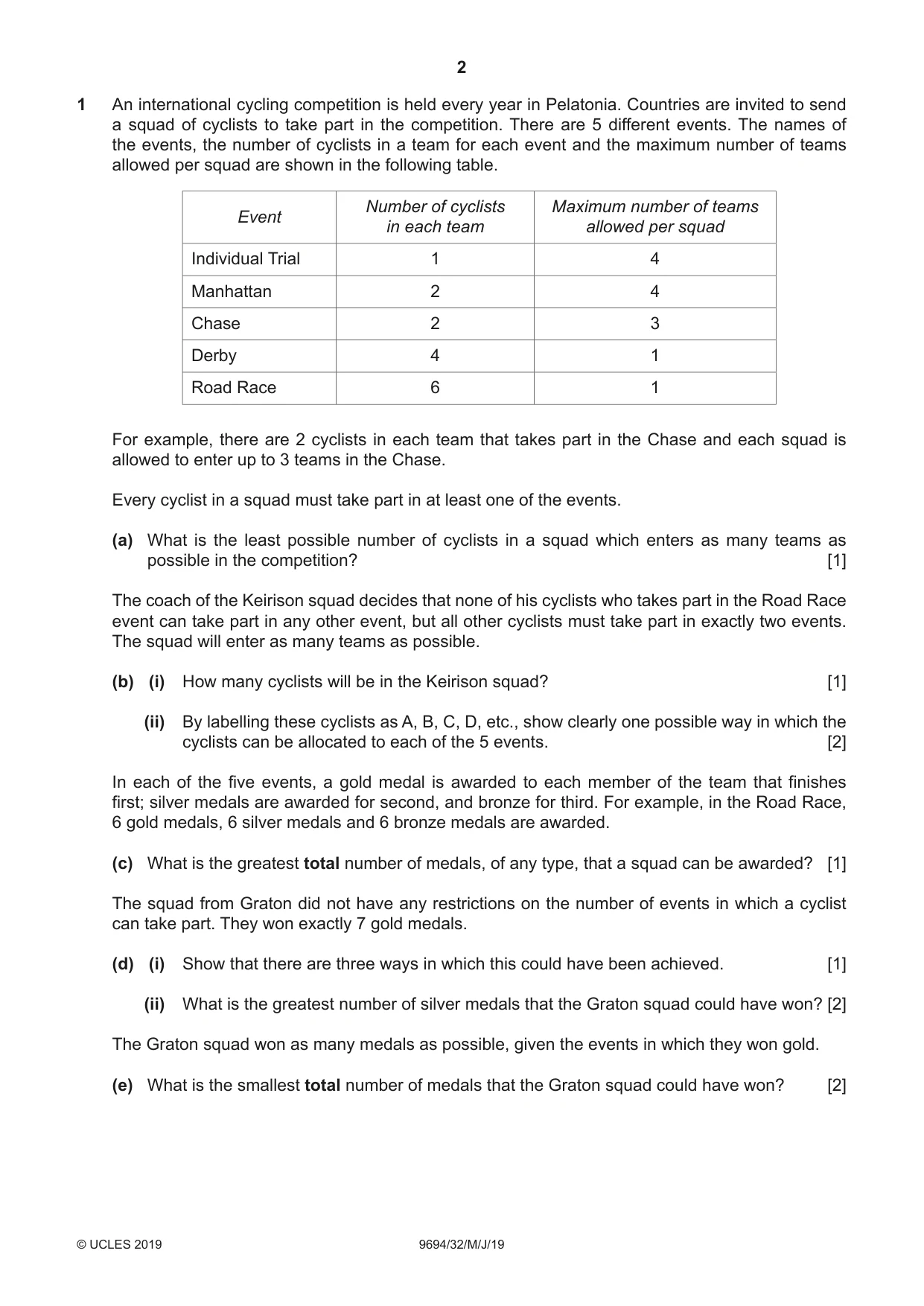
1 An international cycling competition is held every year in Pelatonia. Countries are invited to send a squad of cyclists to take part in the competition. There are 5 different events. The names of the events, the number of cyclists in a team for each event and the maximum number of teams allowed per squad are shown in the following table. Number of cyclists Maximum number of teams Event in each team allowed per squad Individual Trial 1 4 Manhattan 2 4 Chase 2 3 Derby 4 1 Road Race 6 1 For example, there are 2 cyclists in each team that takes part in the Chase and each squad is allowed to enter up to 3 teams in the Chase. Every cyclist in a squad must take part in at least one of the events. (a) What is the least possible number of cyclists in a squad which enters as many teams as possible in the competition? [1] The coach of the Keirison squad decides that none of his cyclists who takes part in the Road Race event can take part in any other event, but all other cyclists must take part in exactly two events. The squad will enter as many teams as possible. (b) (i) How many cyclists will be in the Keirison squad? [1] (ii) By labelling these cyclists as A, B, C, D, etc., show clearly one possible way in which the cyclists can be allocated to each of the 5 events. [2] In each of the five events, a gold medal is awarded to each member of the team that finishes first; silver medals are awarded for second, and bronze for third. For example, in the Road Race, 6 gold medals, 6 silver medals and 6 bronze medals are awarded. (c) What is the greatest total number of medals, of any type, that a squad can be awarded? [1] The squad from Graton did not have any restrictions on the number of events in which a cyclist can take part. They won exactly 7 gold medals. (d) (i) Show that there are three ways in which this could have been achieved. [1] (ii) What is the greatest number of silver medals that the Graton squad could have won? [2] The Graton squad won as many medals as possible, given the events in which they won gold. (e) What is the smallest total number of medals that the Graton squad could have won? [2] [Question 2 begins on the next page]
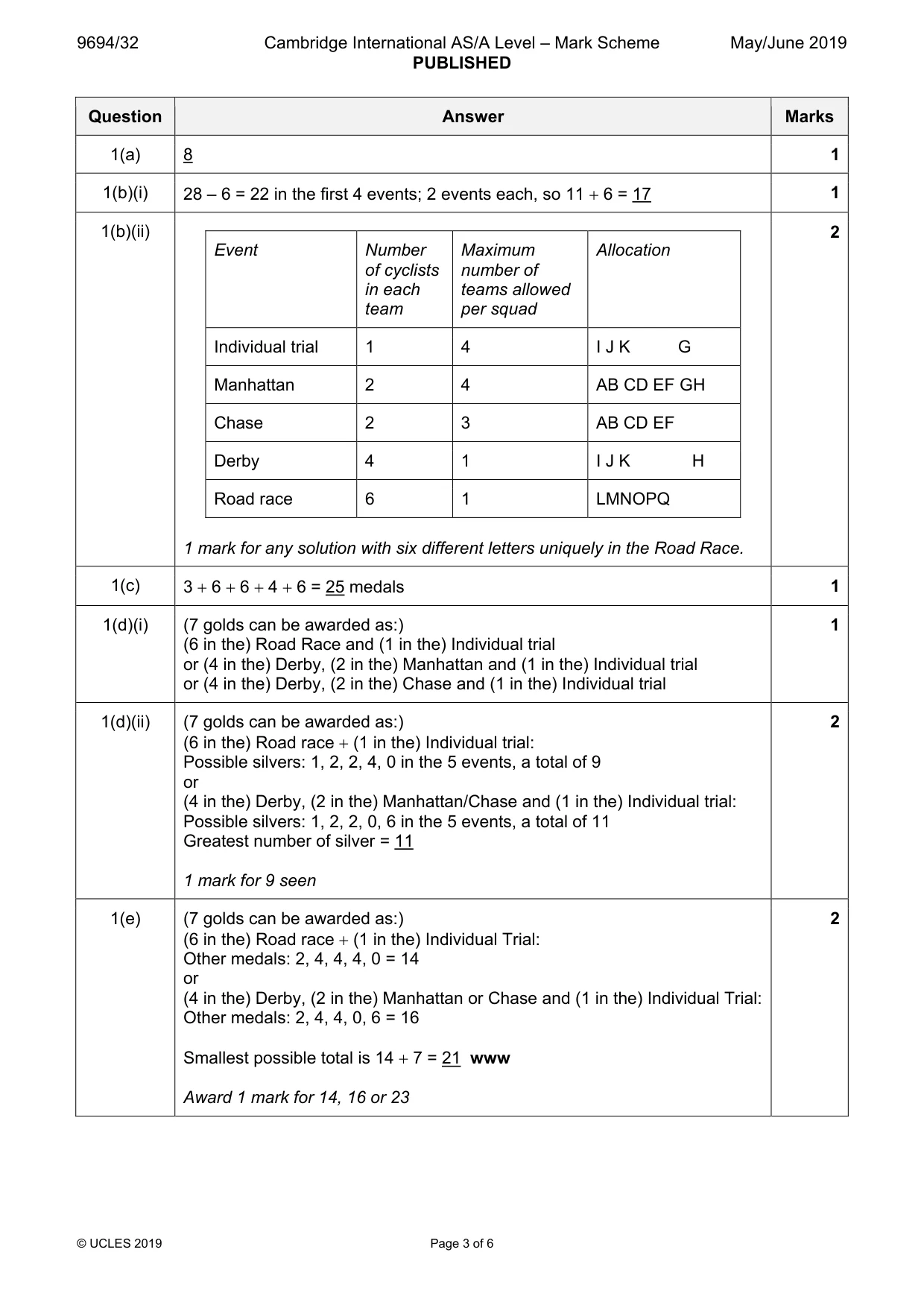
Mark scheme: Question Answer Marks 1(a) 8 1 1(b)(i) 28 – 6 = 22 in the first 4 events; 2 events each, so 11 + 6 = 17 1 1(b)(ii) 2 Event Number Maximum Allocation of cyclists number of in each teams allowed team per squad Individual trial 1 4 I J K G Manhattan 2 4 AB CD EF GH Chase 2 3 AB CD EF Derby 4 1 I J K H Road race 6 1 LMNOPQ 1 mark for any solution with six different letters uniquely in the Road Race. 1(c) 3 + 6 + 6 + 4 + 6 = 25 medals 1 1(d)(i) (7 golds can be awarded as:) 1 (6 in the) Road Race and (1 in the) Individual trial or (4 in the) Derby, (2 in the) Manhattan and (1 in the) Individual trial or (4 in the) Derby, (2 in the) Chase and (1 in the) Individual trial 1(d)(ii) (7 golds can be awarded as:) 2 (6 in the) Road race + (1 in the) Individual trial: Possible silvers: 1, 2, 2, 4, 0 in the 5 events, a total of 9 or (4 in the) Derby, (2 in the) Manhattan/Chase and (1 in the) Individual trial: Possible silvers: 1, 2, 2, 0, 6 in the 5 events, a total of 11 Greatest number of silver = 11 1 mark for 9 seen 1(e) (7 golds can be awarded as:) 2 (6 in the) Road race + (1 in the) Individual Trial: Other medals: 2, 4, 4, 4, 0 = 14 or (4 in the) Derby, (2 in the) Manhattan or Chase and (1 in the) Individual Trial: Other medals: 2, 4, 4, 0, 6 = 16 Smallest possible total is 14 + 7 = 21 www Award 1 mark for 14, 16 or 23
Q2 · The British Diplomatic staff in Bolandia are paid a tax-free cost of living allowance to…
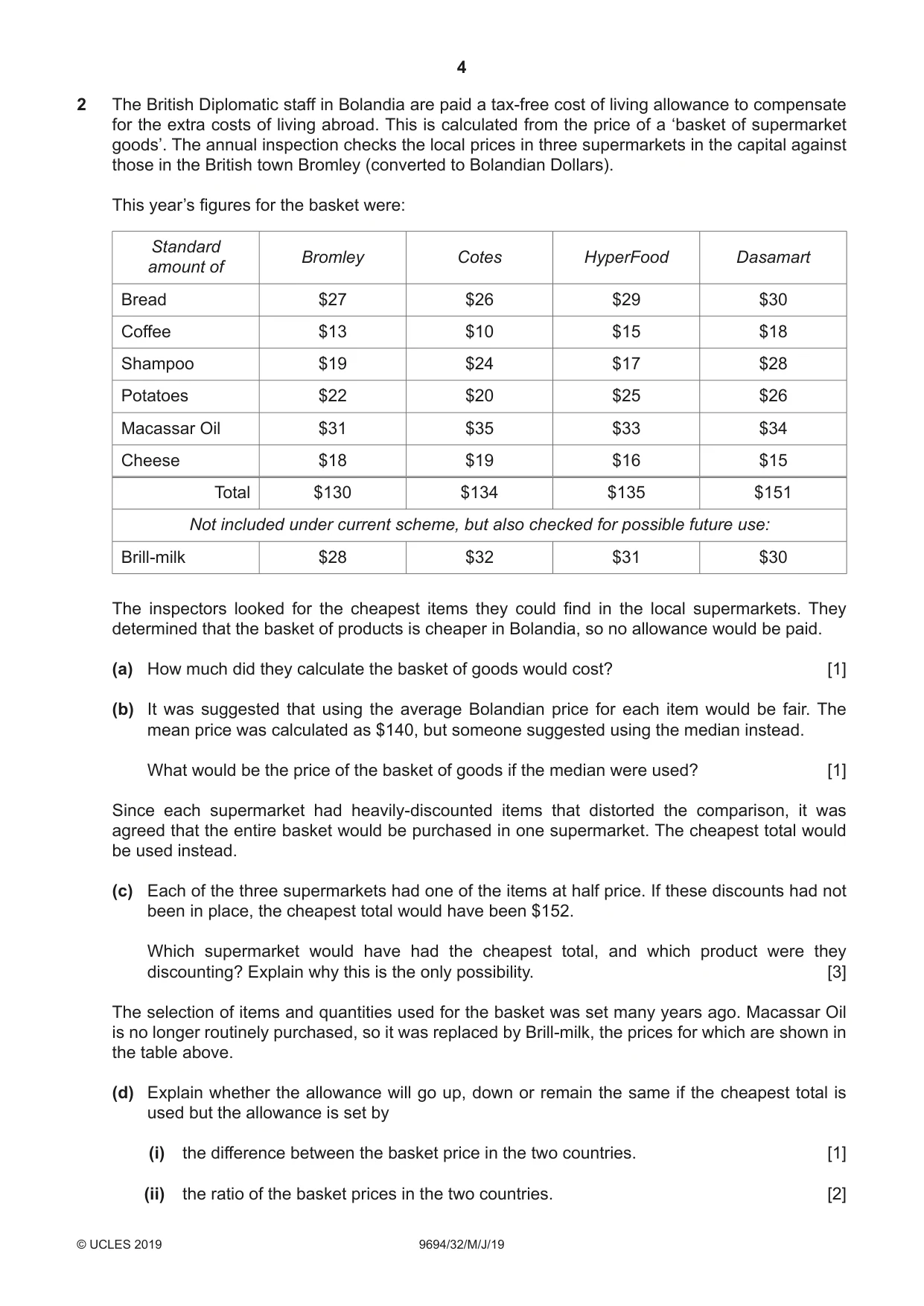
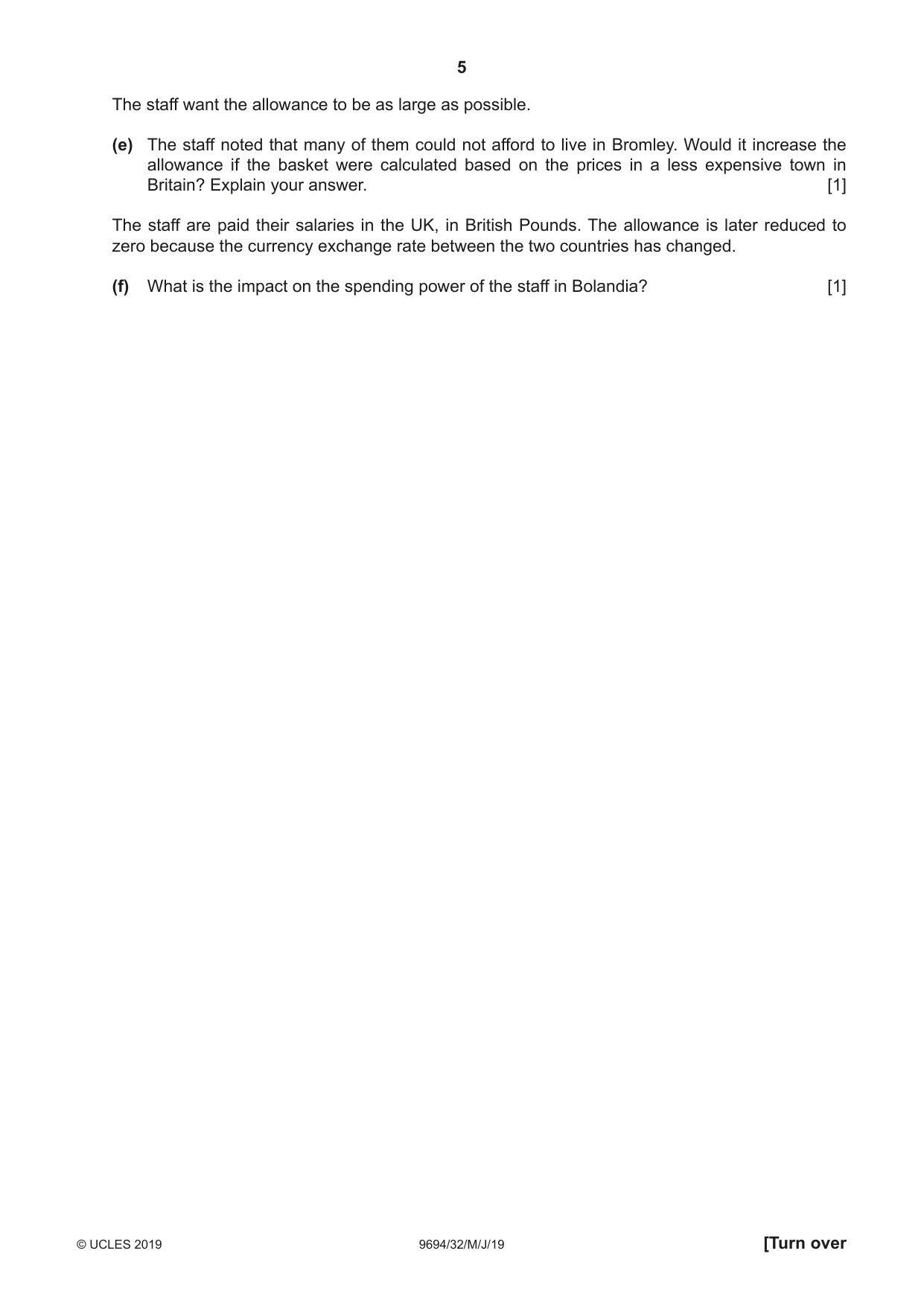
2 The British Diplomatic staff in Bolandia are paid a tax-free cost of living allowance to compensate for the extra costs of living abroad. This is calculated from the price of a ‘basket of supermarket goods’. The annual inspection checks the local prices in three supermarkets in the capital against those in the British town Bromley (converted to Bolandian Dollars). This year’s figures for the basket were: Standard Bromley Cotes HyperFood Dasamart amount of Bread $27 $26 $29 $30 Coffee $13 $10 $15 $18 Shampoo $19 $24 $17 $28 Potatoes $22 $20 $25 $26 Macassar Oil $31 $35 $33 $34 Cheese $18 $19 $16 $15 Total $130 $134 $135 $151 Not included under current scheme, but also checked for possible future use: Brill-milk $28 $32 $31 $30 The inspectors looked for the cheapest items they could find in the local supermarkets. They determined that the basket of products is cheaper in Bolandia, so no allowance would be paid. (a) How much did they calculate the basket of goods would cost? [1] (b) It was suggested that using the average Bolandian price for each item would be fair. The mean price was calculated as $140, but someone suggested using the median instead. What would be the price of the basket of goods if the median were used? [1] Since each supermarket had heavily-discounted items that distorted the comparison, it was agreed that the entire basket would be purchased in one supermarket. The cheapest total would be used instead. (c) Each of the three supermarkets had one of the items at half price. If these discounts had not been in place, the cheapest total would have been $152. Which supermarket would have had the cheapest total, and which product were they discounting? Explain why this is the only possibility. [3] The selection of items and quantities used for the basket was set many years ago. Macassar Oil is no longer routinely purchased, so it was replaced by Brill-milk, the prices for which are shown in the table above. (d) Explain whether the allowance will go up, down or remain the same if the cheapest total is used but the allowance is set by (i) the difference between the basket price in the two countries. [1] (ii) the ratio of the basket prices in the two countries. [2] The staff want the allowance to be as large as possible. (e) The staff noted that many of them could not afford to live in Bromley. Would it increase the allowance if the basket were calculated based on the prices in a less expensive town in Britain? Explain your answer. [1] The staff are paid their salaries in the UK, in British Pounds. The allowance is later reduced to zero because the currency exchange rate between the two countries has changed. (f) What is the impact on the spending power of the staff in Bolandia? [1]
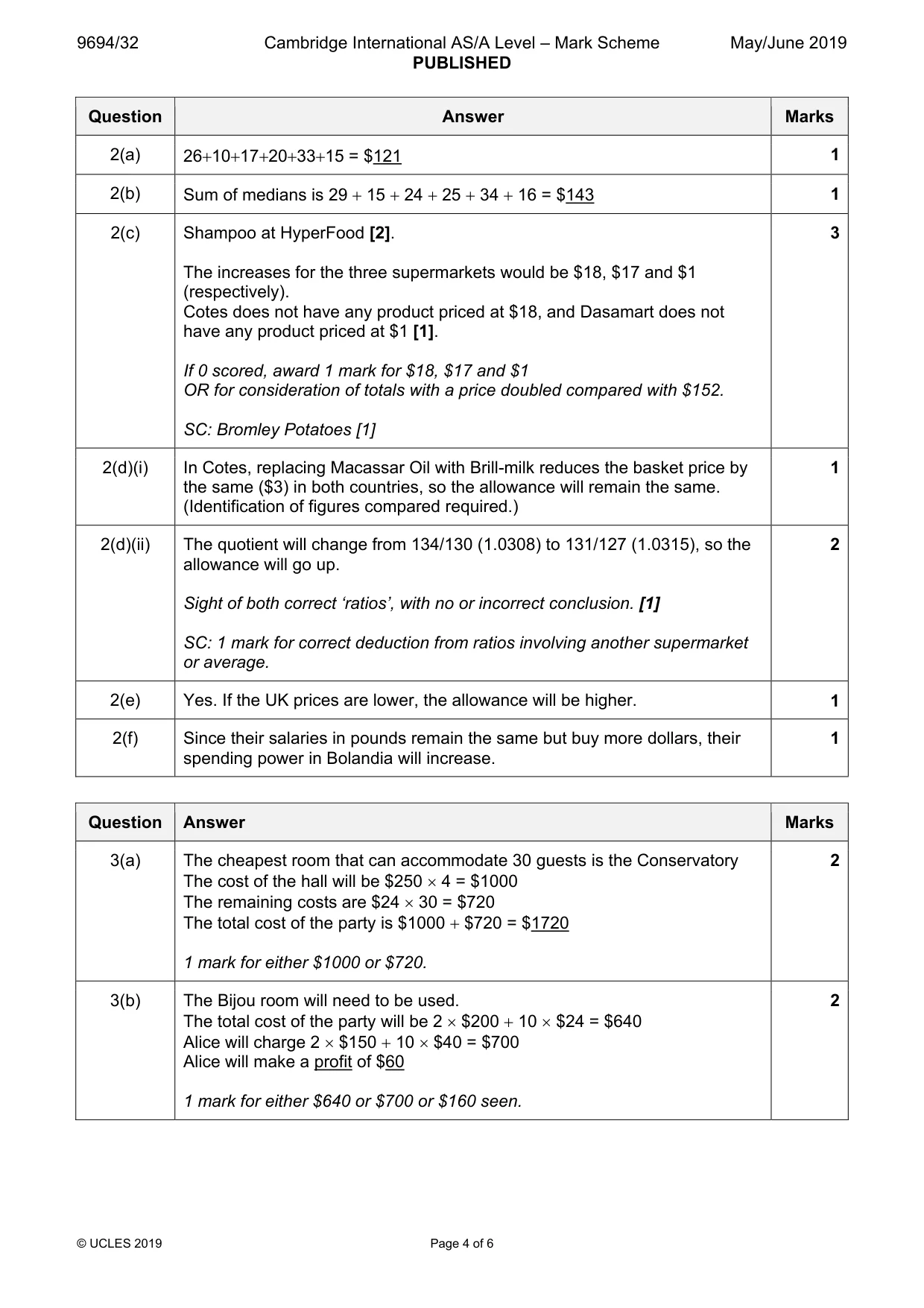
Mark scheme: 2(a) 26+10+17+20+33+15 = $121 1 2(b) Sum of medians is 29 + 15 + 24 + 25 + 34 + 16 = $143 1 2(c) Shampoo at HyperFood [2]. 3 The increases for the three supermarkets would be $18, $17 and $1 (respectively). Cotes does not have any product priced at $18, and Dasamart does not have any product priced at $1 [1]. If 0 scored, award 1 mark for $18, $17 and $1 OR for consideration of totals with a price doubled compared with $152. SC: Bromley Potatoes [1] 2(d)(i) In Cotes, replacing Macassar Oil with Brill-milk reduces the basket price by 1 the same ($3) in both countries, so the allowance will remain the same. (Identification of figures compared required.) 2(d)(ii) The quotient will change from 134/130 (1.0308) to 131/127 (1.0315), so the 2 allowance will go up. Sight of both correct ‘ratios’, with no or incorrect conclusion. [1] SC: 1 mark for correct deduction from ratios involving another supermarket or average. 2(e) Yes. If the UK prices are lower, the allowance will be higher. 1 2(f) Since their salaries in pounds remain the same but buy more dollars, their 1 spending power in Bolandia will increase.
More questions on Identify the impact of a change to a problem
Q3 · Alice runs a company that organises parties
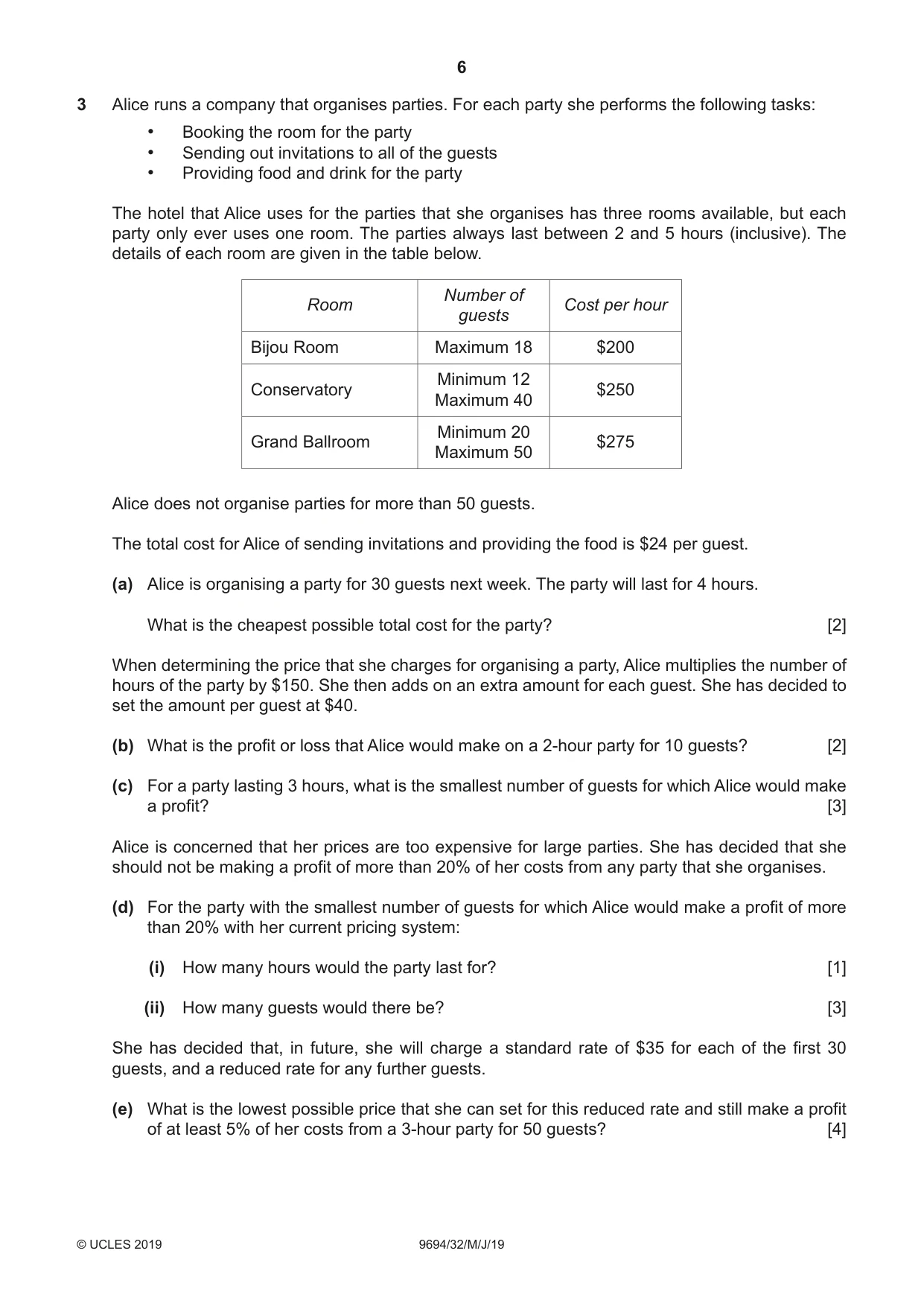
3 Alice runs a company that organises parties. For each party she performs the following tasks: • Booking the room for the party • Sending out invitations to all of the guests • Providing food and drink for the party The hotel that Alice uses for the parties that she organises has three rooms available, but each party only ever uses one room. The parties always last between 2 and 5 hours (inclusive). The details of each room are given in the table below. Number of Room Cost per hour guests Bijou Room Maximum 18 $200 Minimum 12 Conservatory $250 Maximum 40 Minimum 20 Grand Ballroom $275 Maximum 50 Alice does not organise parties for more than 50 guests. The total cost for Alice of sending invitations and providing the food is $24 per guest. (a) Alice is organising a party for 30 guests next week. The party will last for 4 hours. What is the cheapest possible total cost for the party? [2] When determining the price that she charges for organising a party, Alice multiplies the number of hours of the party by $150. She then adds on an extra amount for each guest. She has decided to set the amount per guest at $40. (b) What is the profit or loss that Alice would make on a 2-hour party for 10 guests? [2] (c) For a party lasting 3 hours, what is the smallest number of guests for which Alice would make a profit? [3] Alice is concerned that her prices are too expensive for large parties. She has decided that she should not be making a profit of more than 20% of her costs from any party that she organises. (d) For the party with the smallest number of guests for which Alice would make a profit of more than 20% with her current pricing system: (i) How many hours would the party last for? [1] (ii) How many guests would there be? [3] She has decided that, in future, she will charge a standard rate of $35 for each of the first 30 guests, and a reduced rate for any further guests. (e) What is the lowest possible price that she can set for this reduced rate and still make a profit of at least 5% of her costs from a 3-hour party for 50 guests? [4] [Question 4 begins on the next page]
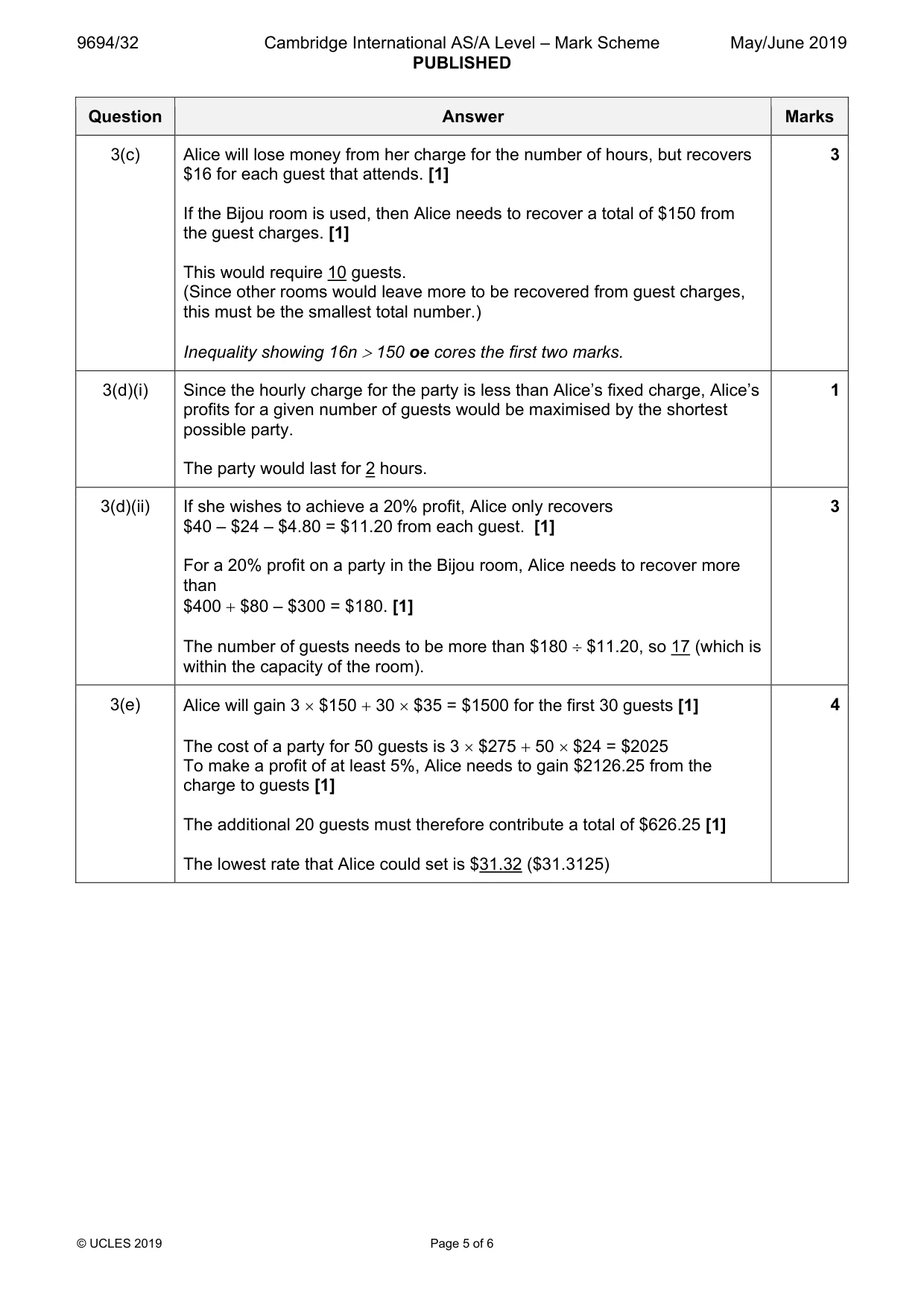
Mark scheme: 3(a) The cheapest room that can accommodate 30 guests is the Conservatory 2 The cost of the hall will be $250 × 4 = $1000 The remaining costs are $24 × 30 = $720 The total cost of the party is $1000 + $720 = $1720 1 mark for either $1000 or $720. 3(b) The Bijou room will need to be used. 2 The total cost of the party will be 2 × $200 + 10 × $24 = $640 Alice will charge 2 × $150 + 10 × $40 = $700 Alice will make a profit of $60 1 mark for either $640 or $700 or $160 seen. 3(c) Alice will lose money from her charge for the number of hours, but recovers 3 $16 for each guest that attends. [1] If the Bijou room is used, then Alice needs to recover a total of $150 from the guest charges. [1] This would require 10 guests. (Since other rooms would leave more to be recovered from guest charges, this must be the smallest total number.) Inequality showing 16n >150 oe cores the first two marks. 3(d)(i) Since the hourly charge for the party is less than Alice’s fixed charge, Alice’s 1 profits for a given number of guests would be maximised by the shortest possible party. The party would last for 2 hours. 3(d)(ii) If she wishes to achieve a 20% profit, Alice only recovers 3 $40 – $24 – $4.80 = $11.20 from each guest. [1] For a 20% profit on a party in the Bijou room, Alice needs to recover more than $400 + $80 – $300 = $180. [1] The number of guests needs to be more than $180 ÷ $11.20, so 17 (which is within the capacity of the room). 3(e) Alice will gain 3 × $150 + 30 × $35 = $1500 for the first 30 guests [1] 4 The cost of a party for 50 guests is 3 × $275 + 50 × $24 = $2025 To make a profit of at least 5%, Alice needs to gain $2126.25 from the charge to guests [1] The additional 20 guests must therefore contribute a total of $626.25 [1] The lowest rate that Alice could set is $31.32 ($31.3125)
Q4 · Twenty contestants have been taking part today in Abracadabra!, a competition for…
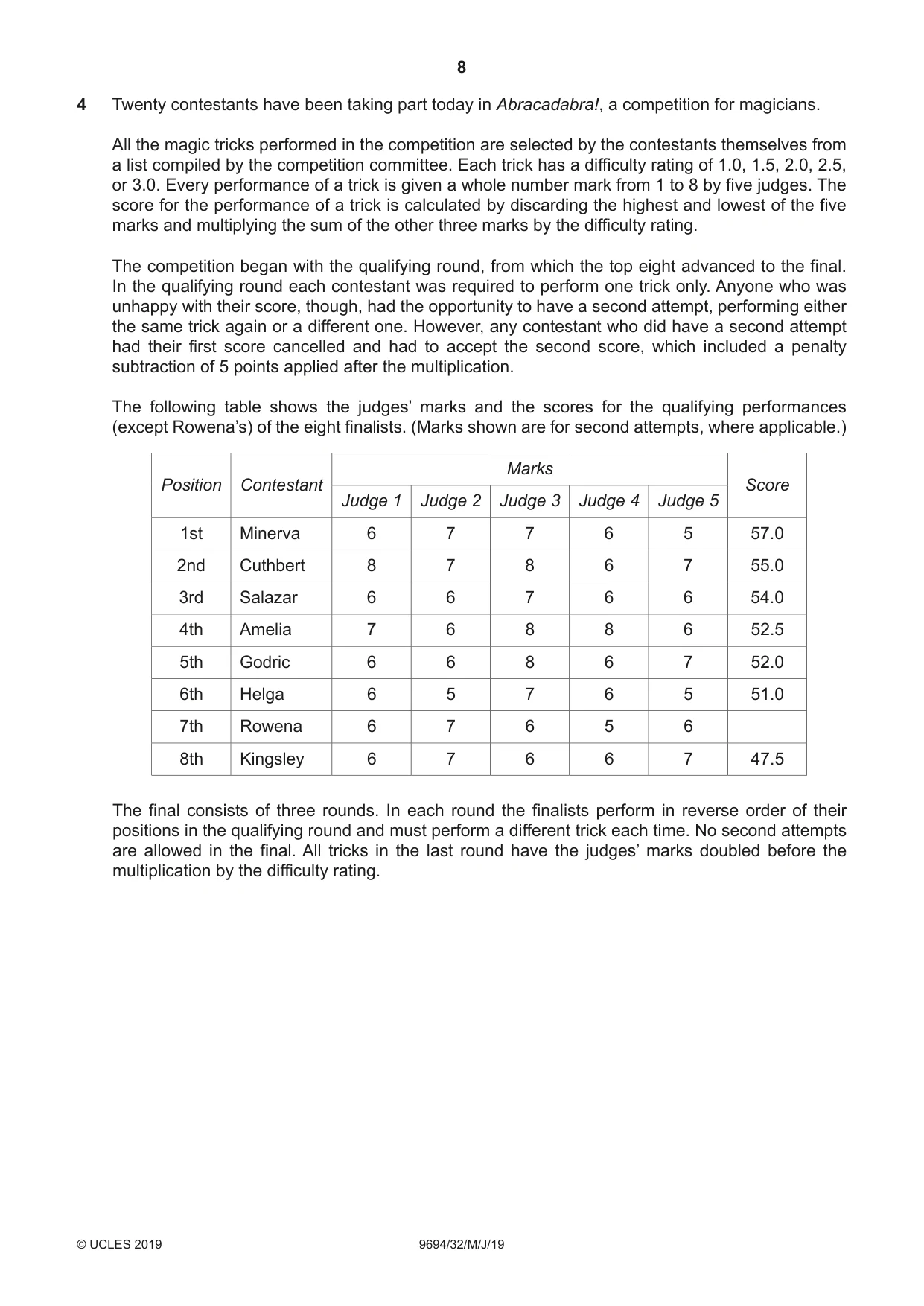
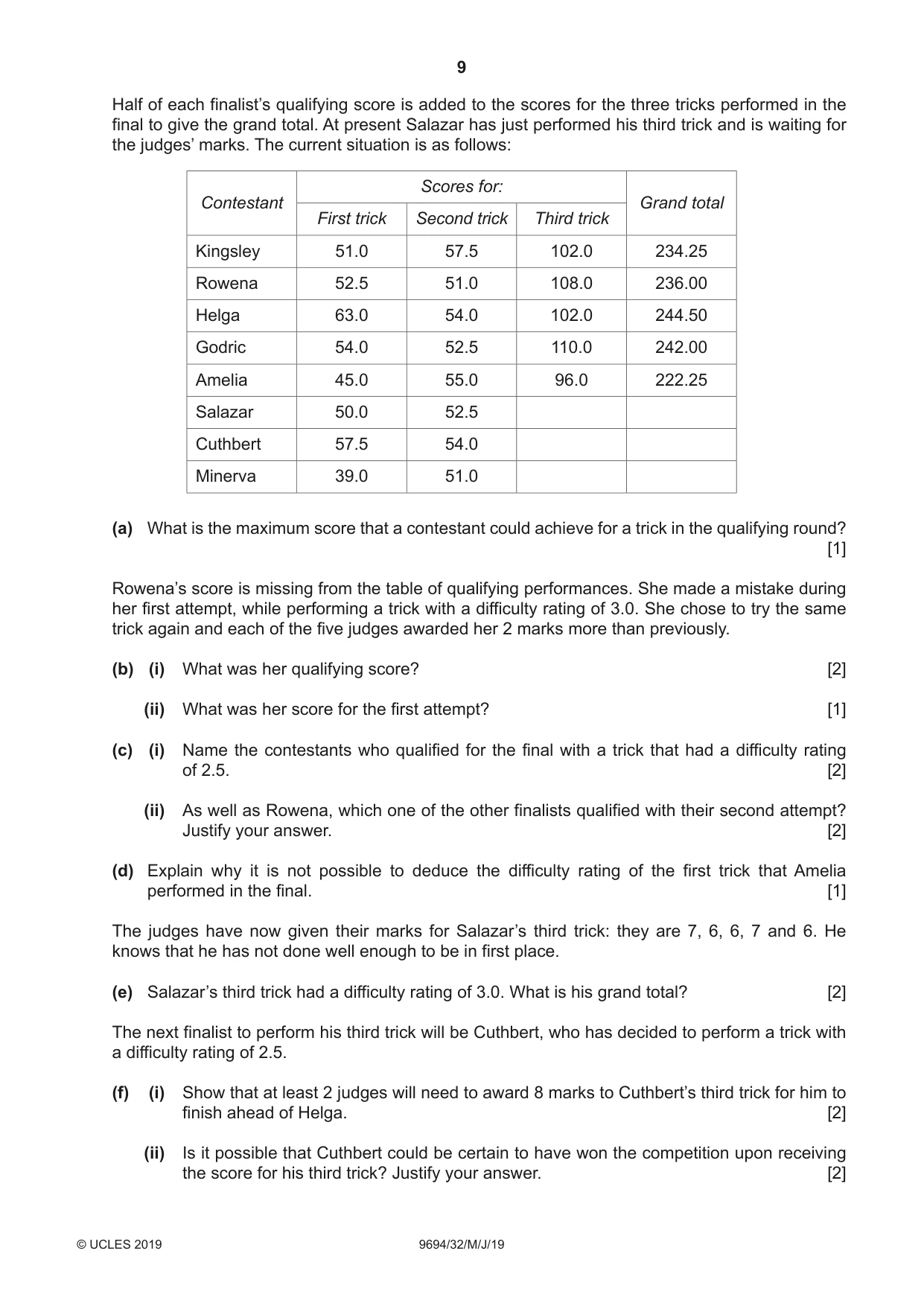
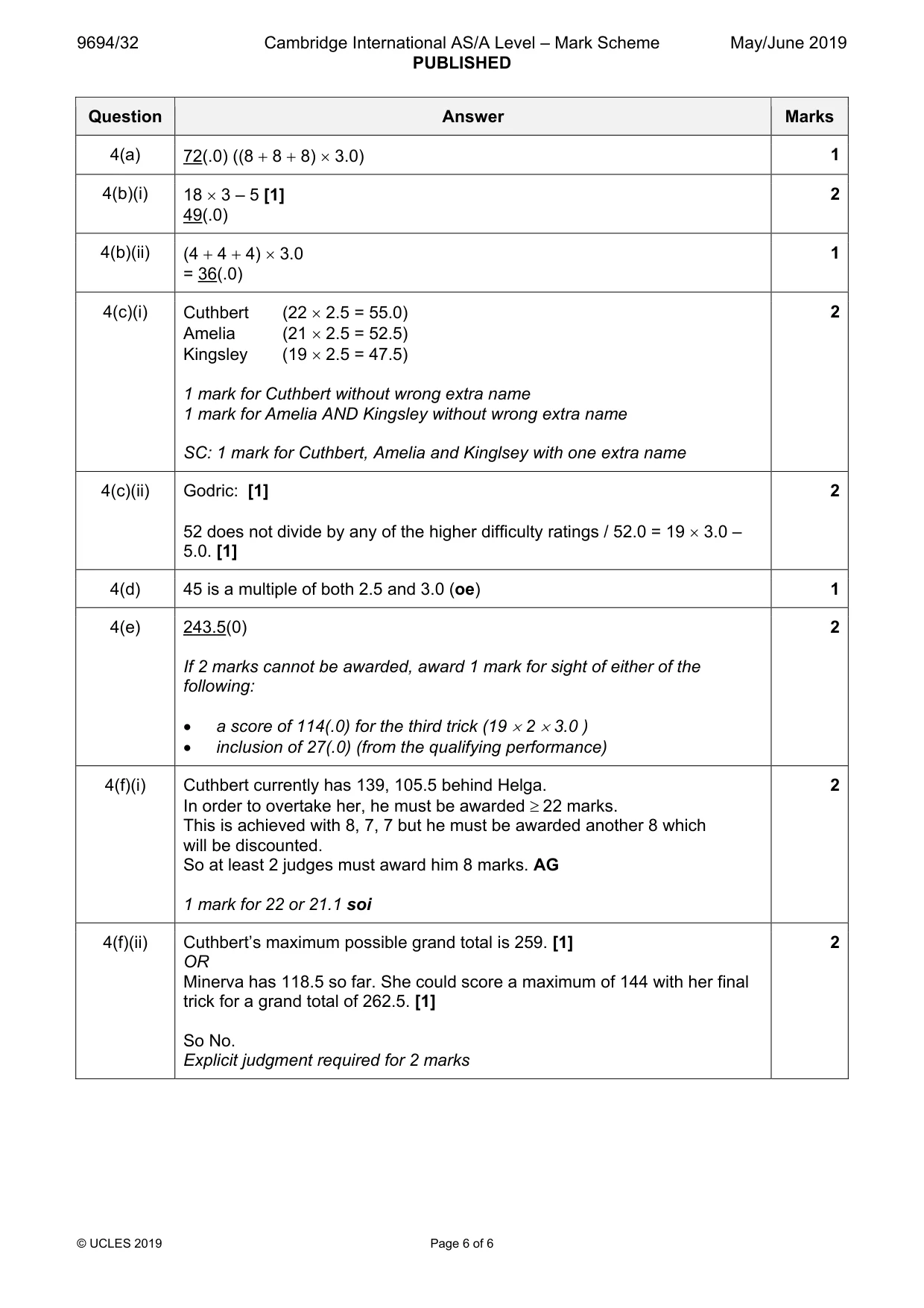
4 Twenty contestants have been taking part today in Abracadabra!, a competition for magicians. All the magic tricks performed in the competition are selected by the contestants themselves from a list compiled by the competition committee. Each trick has a difficulty rating of 1.0, 1.5, 2.0, 2.5, or 3.0. Every performance of a trick is given a whole number mark from 1 to 8 by five judges. The score for the performance of a trick is calculated by discarding the highest and lowest of the five marks and multiplying the sum of the other three marks by the difficulty rating. The competition began with the qualifying round, from which the top eight advanced to the final. In the qualifying round each contestant was required to perform one trick only. Anyone who was unhappy with their score, though, had the opportunity to have a second attempt, performing either the same trick again or a different one. However, any contestant who did have a second attempt had their first score cancelled and had to accept the second score, which included a penalty subtraction of 5 points applied after the multiplication. The following table shows the judges’ marks and the scores for the qualifying performances (except Rowena’s) of the eight finalists. (Marks shown are for second attempts, where applicable.) Marks Position Contestant Score Judge 1 Judge 2 Judge 3 Judge 4 Judge 5 1st Minerva 6 7 7 6 5 57.0 2nd Cuthbert 8 7 8 6 7 55.0 3rd Salazar 6 6 7 6 6 54.0 4th Amelia 7 6 8 8 6 52.5 5th Godric 6 6 8 6 7 52.0 6th Helga 6 5 7 6 5 51.0 7th Rowena 6 7 6 5 6 8th Kingsley 6 7 6 6 7 47.5 The final consists of three rounds. In each round the finalists perform in reverse order of their positions in the qualifying round and must perform a different trick each time. No second attempts are allowed in the final. All tricks in the last round have the judges’ marks doubled before the multiplication by the difficulty rating. Half of each finalist’s qualifying score is added to the scores for the three tricks performed in the final to give the grand total. At present Salazar has just performed his third trick and is waiting for the judges’ marks. The current situation is as follows: Scores for: Contestant Grand total First trick Second trick Third trick Kingsley 51.0 57.5 102.0 234.25 Rowena 52.5 51.0 108.0 236.00 Helga 63.0 54.0 102.0 244.50 Godric 54.0 52.5 110.0 242.00 Amelia 45.0 55.0 96.0 222.25 Salazar 50.0 52.5 Cuthbert 57.5 54.0 Minerva 39.0 51.0 (a) What is the maximum score that a contestant could achieve for a trick in the qualifying round? [1] Rowena’s score is missing from the table of qualifying performances. She made a mistake during her first attempt, while performing a trick with a difficulty rating of 3.0. She chose to try the same trick again and each of the five judges awarded her 2 marks more than previously. (b) (i) What was her qualifying score? [2] (ii) What was her score for the first attempt? [1] (c) (i) Name the contestants who qualified for the final with a trick that had a difficulty rating of 2.5. [2] (ii) As well as Rowena, which one of the other finalists qualified with their second attempt? Justify your answer. [2] (d) Explain why it is not possible to deduce the difficulty rating of the first trick that Amelia performed in the final. [1] The judges have now given their marks for Salazar’s third trick: they are 7, 6, 6, 7 and 6. He knows that he has not done well enough to be in first place. (e) Salazar’s third trick had a difficulty rating of 3.0. What is his grand total? [2] The next finalist to perform his third trick will be Cuthbert, who has decided to perform a trick with a difficulty rating of 2.5. (f) (i) Show that at least 2 judges will need to award 8 marks to Cuthbert’s third trick for him to finish ahead of Helga. [2] (ii) Is it possible that Cuthbert could be certain to have won the competition upon receiving the score for his third trick? Justify your answer. [2]
Mark scheme: 4(a) 72(.0) ((8 + 8 + 8) × 3.0) 1 4(b)(i) 18 × 3 – 5 [1] 2 49(.0) 4(b)(ii) (4 + 4 + 4) × 3.0 1 = 36(.0) 4(c)(i) Cuthbert (22 × 2.5 = 55.0) 2 Amelia (21 × 2.5 = 52.5) Kingsley (19 × 2.5 = 47.5) 1 mark for Cuthbert without wrong extra name 1 mark for Amelia AND Kingsley without wrong extra name SC: 1 mark for Cuthbert, Amelia and Kinglsey with one extra name 4(c)(ii) Godric: [1] 2 52 does not divide by any of the higher difficulty ratings / 52.0 = 19 × 3.0 – 5.0. [1] 4(d) 45 is a multiple of both 2.5 and 3.0 (oe) 1 4(e) 243.5(0) 2 If 2 marks cannot be awarded, award 1 mark for sight of either of the following: • a score of 114(.0) for the third trick (19 ×2 ×3.0 ) • inclusion of 27(.0) (from the qualifying performance) 4(f)(i) Cuthbert currently has 139, 105.5 behind Helga. 2 In order to overtake her, he must be awarded ≥ 22 marks. This is achieved with 8, 7, 7 but he must be awarded another 8 which will be discounted. So at least 2 judges must award him 8 marks. AG 1 mark for 22 or 21.1 soi 4(f)(ii) Cuthbert’s maximum possible grand total is 259. [1] 2 OR Minerva has 118.5 so far. She could score a maximum of 144 with her final trick for a grand total of 262.5. [1] So No. Explicit judgment required for 2 marks
What was in this paper
The subtopics covered by these 4 questions, and how many questions each got. Open one in a new tab to see every Cambridge question on it.
What you needed in this session
Cambridge’s own grade thresholds for 2019 May/June, Paper 3 · Variant 2. A higher threshold means an easier paper — the bar moves with how the cohort did.