Cambridge A Level Thinking Skills 9694 — 2017 May/June Paper 3 · Variant 1
9694/31/M/J/17 · 4 questions · 50 marks · ≈56 min
The question paper and its mark scheme, free to read here and free to download. This is Cambridge’s own paper, exactly as it was sat.
Question paper8 pages
Mark scheme7 pages
Answers below. Sit the paper first if you are practising.
Questions as text
Q1 · Alan is organising a business dinner for 46 people at the local hotel
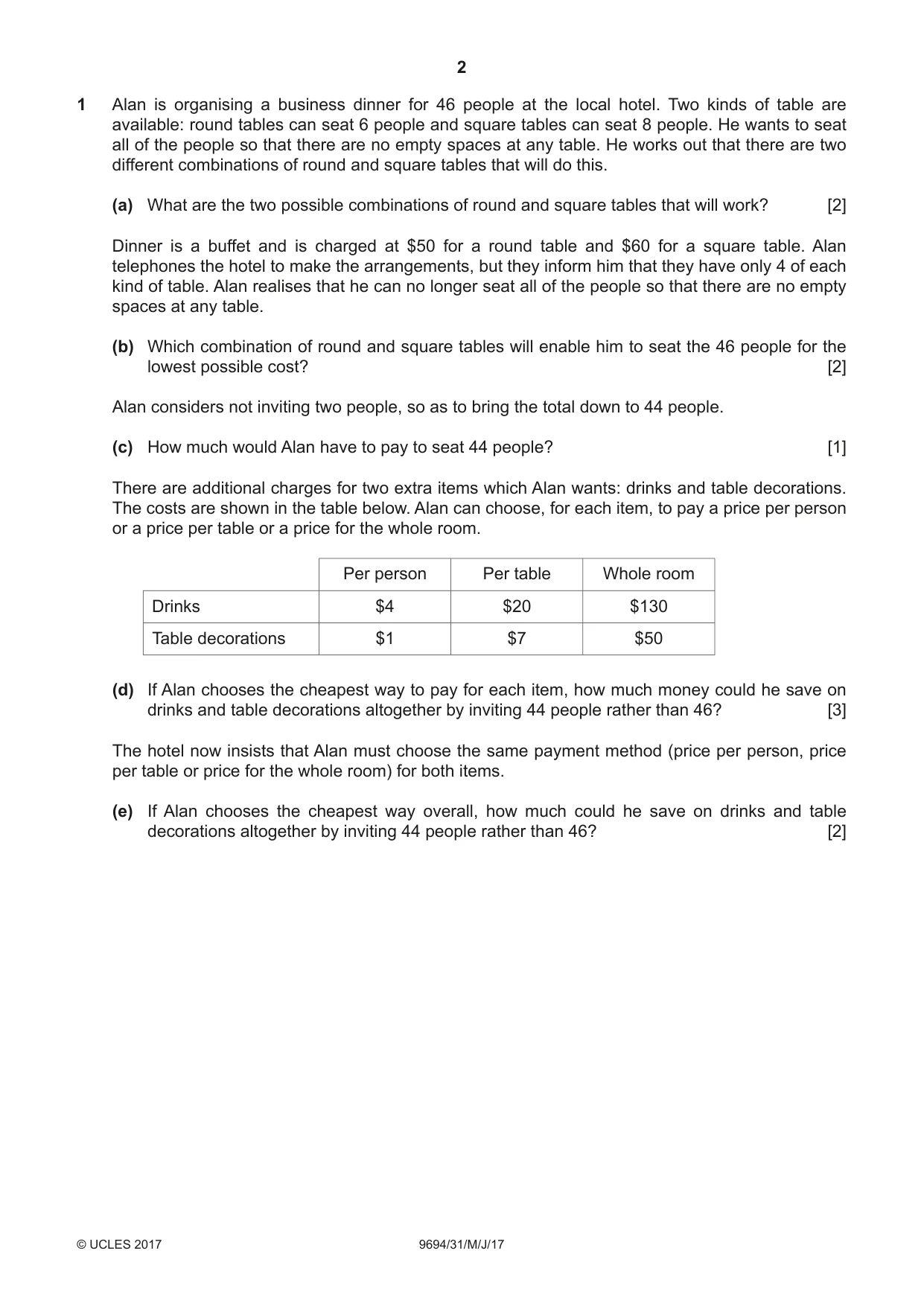
1 Alan is organising a business dinner for 46 people at the local hotel. Two kinds of table are available: round tables can seat 6 people and square tables can seat 8 people. He wants to seat all of the people so that there are no empty spaces at any table. He works out that there are two different combinations of round and square tables that will do this. (a) What are the two possible combinations of round and square tables that will work? [2] Dinner is a buffet and is charged at $50 for a round table and $60 for a square table. Alan telephones the hotel to make the arrangements, but they inform him that they have only 4 of each kind of table. Alan realises that he can no longer seat all of the people so that there are no empty spaces at any table. (b) Which combination of round and square tables will enable him to seat the 46 people for the lowest possible cost? [2] Alan considers not inviting two people, so as to bring the total down to 44 people. (c) How much would Alan have to pay to seat 44 people? [1] There are additional charges for two extra items which Alan wants: drinks and table decorations. The costs are shown in the table below. Alan can choose, for each item, to pay a price per person or a price per table or a price for the whole room. Per person Per table Whole room Drinks $4 $20 $130 Table decorations $1 $7 $50 (d) If Alan chooses the cheapest way to pay for each item, how much money could he save on drinks and table decorations altogether by inviting 44 people rather than 46? [3] The hotel now insists that Alan must choose the same payment method (price per person, price per table or price for the whole room) for both items. (e) If Alan chooses the cheapest way overall, how much could he save on drinks and table decorations altogether by inviting 44 people rather than 46? [2]
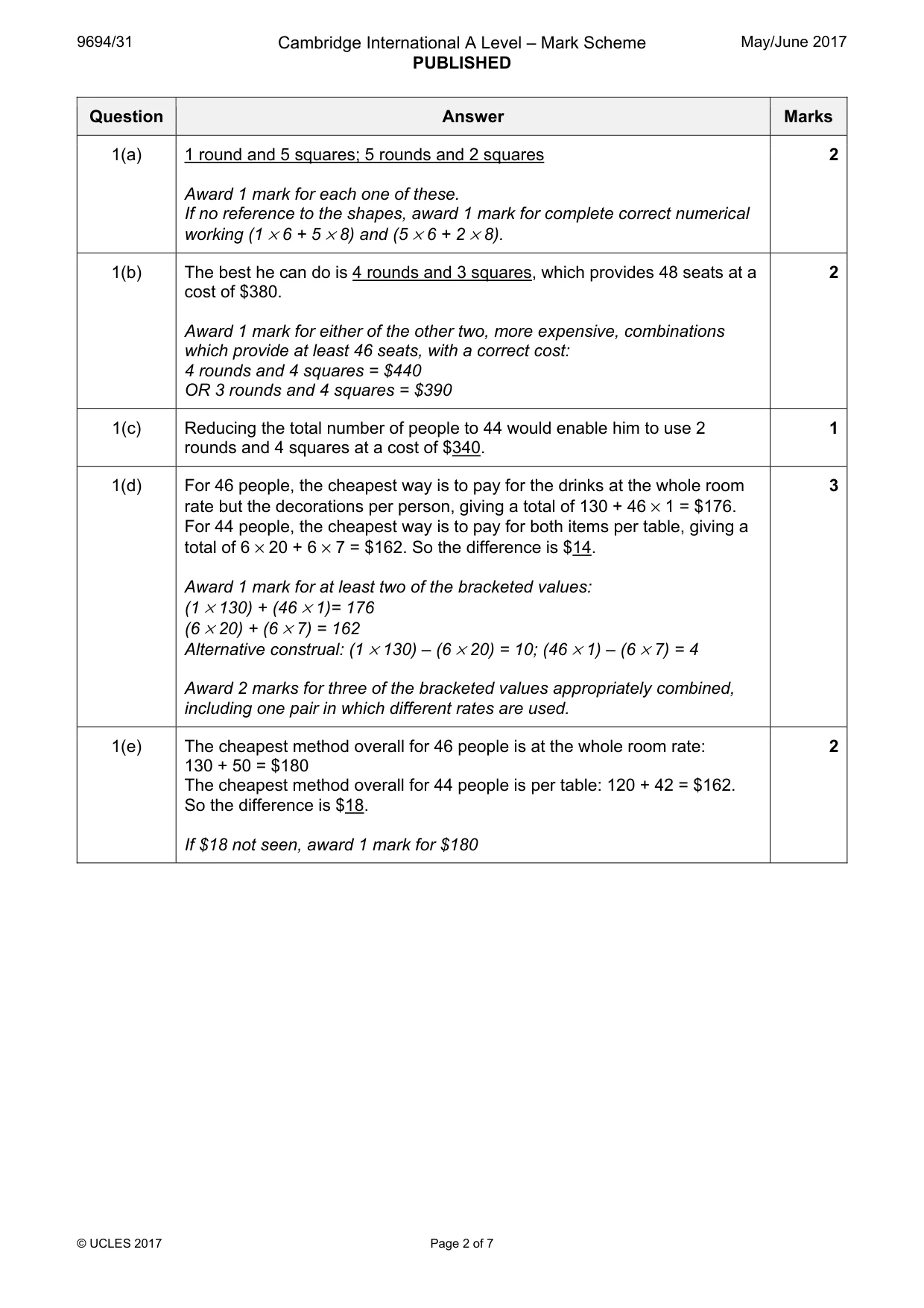
Mark scheme: Question Answer Marks 1(a) 1 round and 5 squares; 5 rounds and 2 squares 2 Award 1 mark for each one of these. If no reference to the shapes, award 1 mark for complete correct numerical working (1 ×6 + 5 ×8) and (5 ×6 + 2 ×8). 1(b) The best he can do is 4 rounds and 3 squares, which provides 48 seats at a 2 cost of $380. Award 1 mark for either of the other two, more expensive, combinations which provide at least 46 seats, with a correct cost: 4 rounds and 4 squares = $440 OR 3 rounds and 4 squares = $390 1(c) Reducing the total number of people to 44 would enable him to use 2 1 rounds and 4 squares at a cost of $340. 1(d) For 46 people, the cheapest way is to pay for the drinks at the whole room 3 rate but the decorations per person, giving a total of 130 + 46 × 1 = $176. For 44 people, the cheapest way is to pay for both items per table, giving a total of 6 × 20 + 6 × 7 = $162. So the difference is $14. Award 1 mark for at least two of the bracketed values: (1 ×130) + (46 ×1)= 176 (6 ×20) + (6 ×7) = 162 Alternative construal: (1 ×130) – (6 ×20) = 10; (46 ×1) – (6 ×7) = 4 Award 2 marks for three of the bracketed values appropriately combined, including one pair in which different rates are used. 1(e) The cheapest method overall for 46 people is at the whole room rate: 2 130 + 50 = $180 The cheapest method overall for 44 people is per table: 120 + 42 = $162. So the difference is $18. If $18 not seen, award 1 mark for $180
More questions on Perform appropriate operations with information
Q2 · Hector owns a bookshop, and decides that he can attract new customers by issuing vouchers…
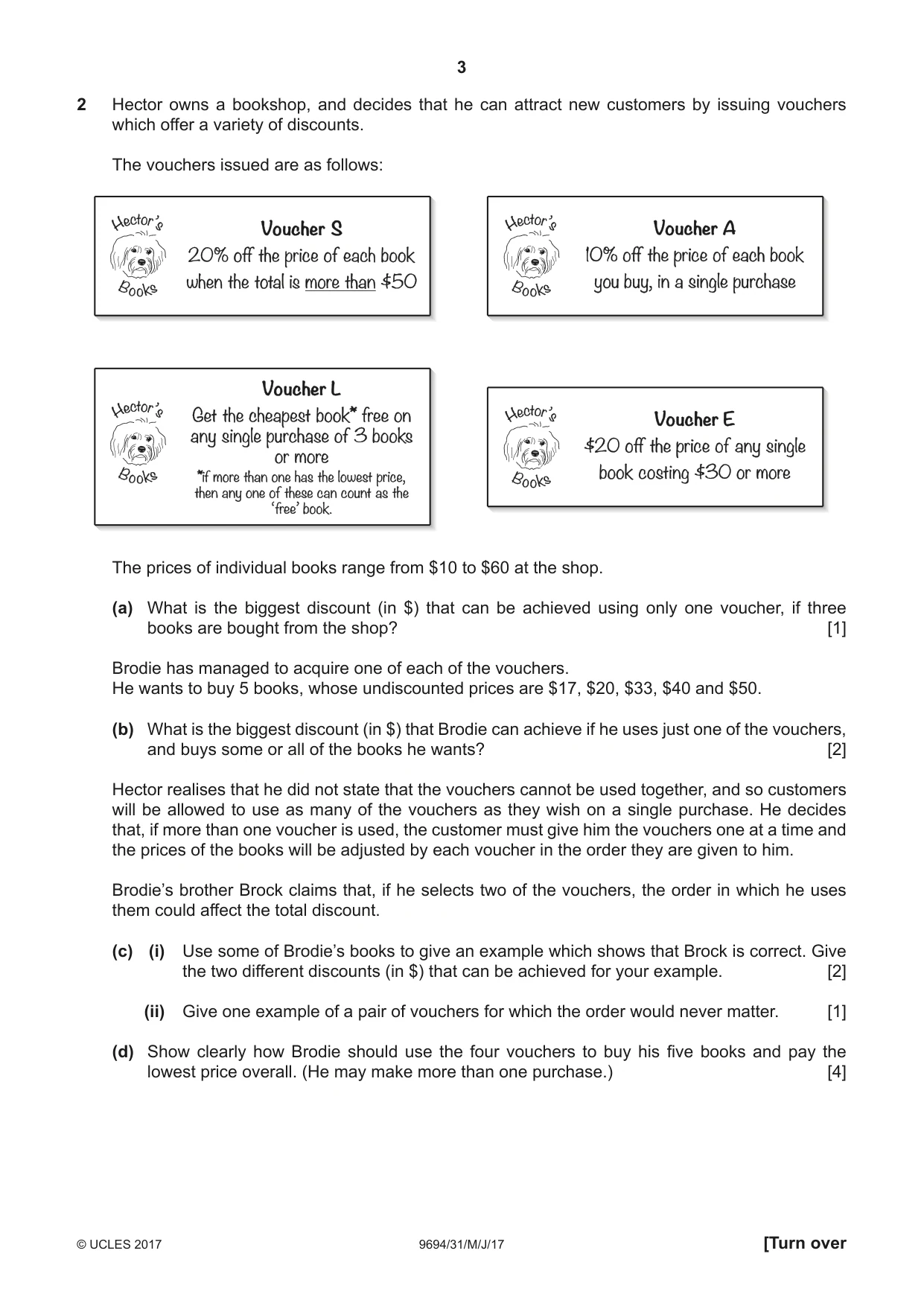
2 Hector owns a bookshop, and decides that he can attract new customers by issuing vouchers which offer a variety of discounts. The vouchers issued are as follows: The prices of individual books range from $10 to $60 at the shop. (a) What is the biggest discount (in $) that can be achieved using only one voucher, if three books are bought from the shop? [1] Brodie has managed to acquire one of each of the vouchers. He wants to buy 5 books, whose undiscounted prices are $17, $20, $33, $40 and $50. (b) What is the biggest discount (in $) that Brodie can achieve if he uses just one of the vouchers, and buys some or all of the books he wants? [2] Hector realises that he did not state that the vouchers cannot be used together, and so customers will be allowed to use as many of the vouchers as they wish on a single purchase. He decides that, if more than one voucher is used, the customer must give him the vouchers one at a time and the prices of the books will be adjusted by each voucher in the order they are given to him. Brodie’s brother Brock claims that, if he selects two of the vouchers, the order in which he uses them could affect the total discount. (c) (i) Use some of Brodie’s books to give an example which shows that Brock is correct. Give the two different discounts (in $) that can be achieved for your example. [2] (ii) Give one example of a pair of vouchers for which the order would never matter. [1] (d) Show clearly how Brodie should use the four vouchers to buy his five books and pay the lowest price overall. (He may make more than one purchase.) [4]
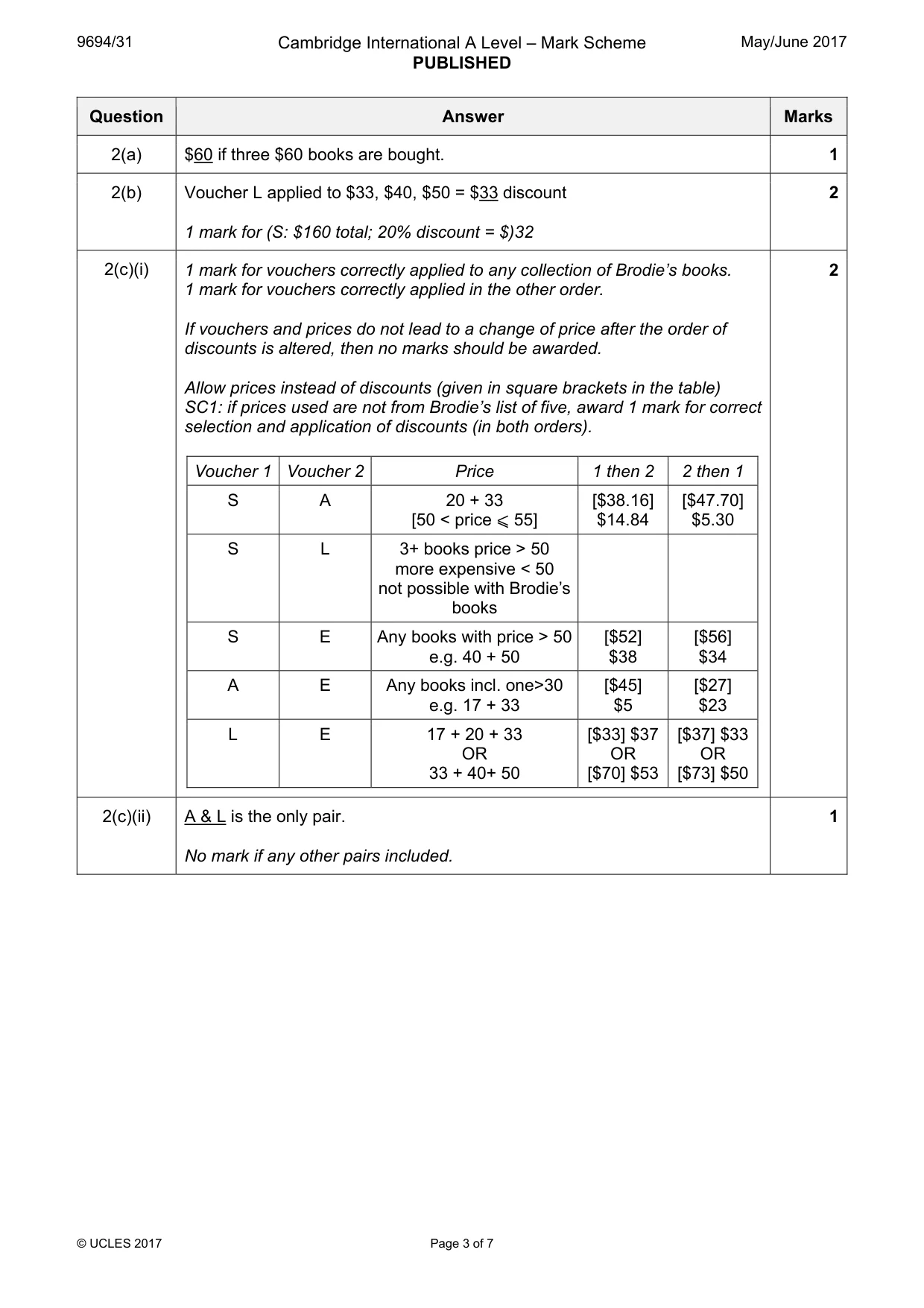
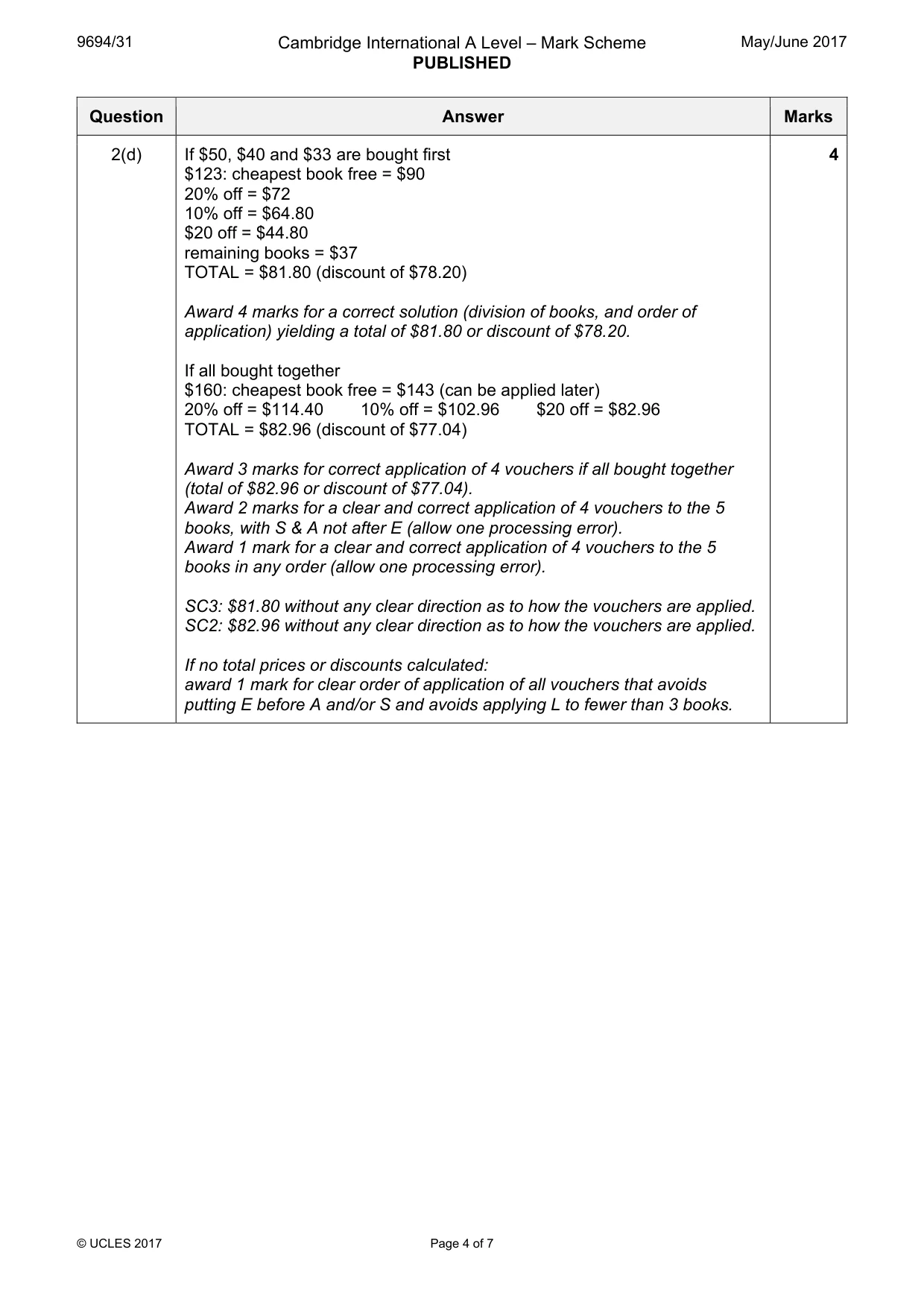
Mark scheme: 2(a) $60 if three $60 books are bought. 1 2(b) Voucher L applied to $33, $40, $50 = $33 discount 2 1 mark for (S: $160 total; 20% discount = $)32 2(c)(i) 1 mark for vouchers correctly applied to any collection of Brodie’s books. 2 1 mark for vouchers correctly applied in the other order. If vouchers and prices do not lead to a change of price after the order of discounts is altered, then no marks should be awarded. Allow prices instead of discounts (given in square brackets in the table) SC1: if prices used are not from Brodie’s list of five, award 1 mark for correct selection and application of discounts (in both orders). Voucher 1 Voucher 2 Price 1 then 2 2 then 1 S A 20 + 33 [$38.16] [$47.70] [50 < price ⩽ 55] $14.84 $5.30 S L 3+ books price > 50 more expensive < 50 not possible with Brodie’s books S E Any books with price > 50 [$52] [$56] e.g. 40 + 50 $38 $34 A E Any books incl. one>30 [$45] [$27] e.g. 17 + 33 $5 $23 L E 17 + 20 + 33 [$33] $37 [$37] $33 OR OR OR 33 + 40+ 50 [$70] $53 [$73] $50 2(c)(ii) A & L is the only pair. 1 No mark if any other pairs included. 2(d) If $50, $40 and $33 are bought first 4 $123: cheapest book free = $90 20% off = $72 10% off = $64.80 $20 off = $44.80 remaining books = $37 TOTAL = $81.80 (discount of $78.20) Award 4 marks for a correct solution (division of books, and order of application) yielding a total of $81.80 or discount of $78.20. If all bought together $160: cheapest book free = $143 (can be applied later) 20% off = $114.40 10% off = $102.96 $20 off = $82.96 TOTAL = $82.96 (discount of $77.04) Award 3 marks for correct application of 4 vouchers if all bought together (total of $82.96 or discount of $77.04). Award 2 marks for a clear and correct application of 4 vouchers to the 5 books, with S & A not after E (allow one processing error). Award 1 mark for a clear and correct application of 4 vouchers to the 5 books in any order (allow one processing error). SC3: $81.80 without any clear direction as to how the vouchers are applied. SC2: $82.96 without any clear direction as to how the vouchers are applied. If no total prices or discounts calculated: award 1 mark for clear order of application of all vouchers that avoids putting E before A and/or S and avoids applying L to fewer than 3 books.
Q3 · The Cherries sports club are moving to a new stadium
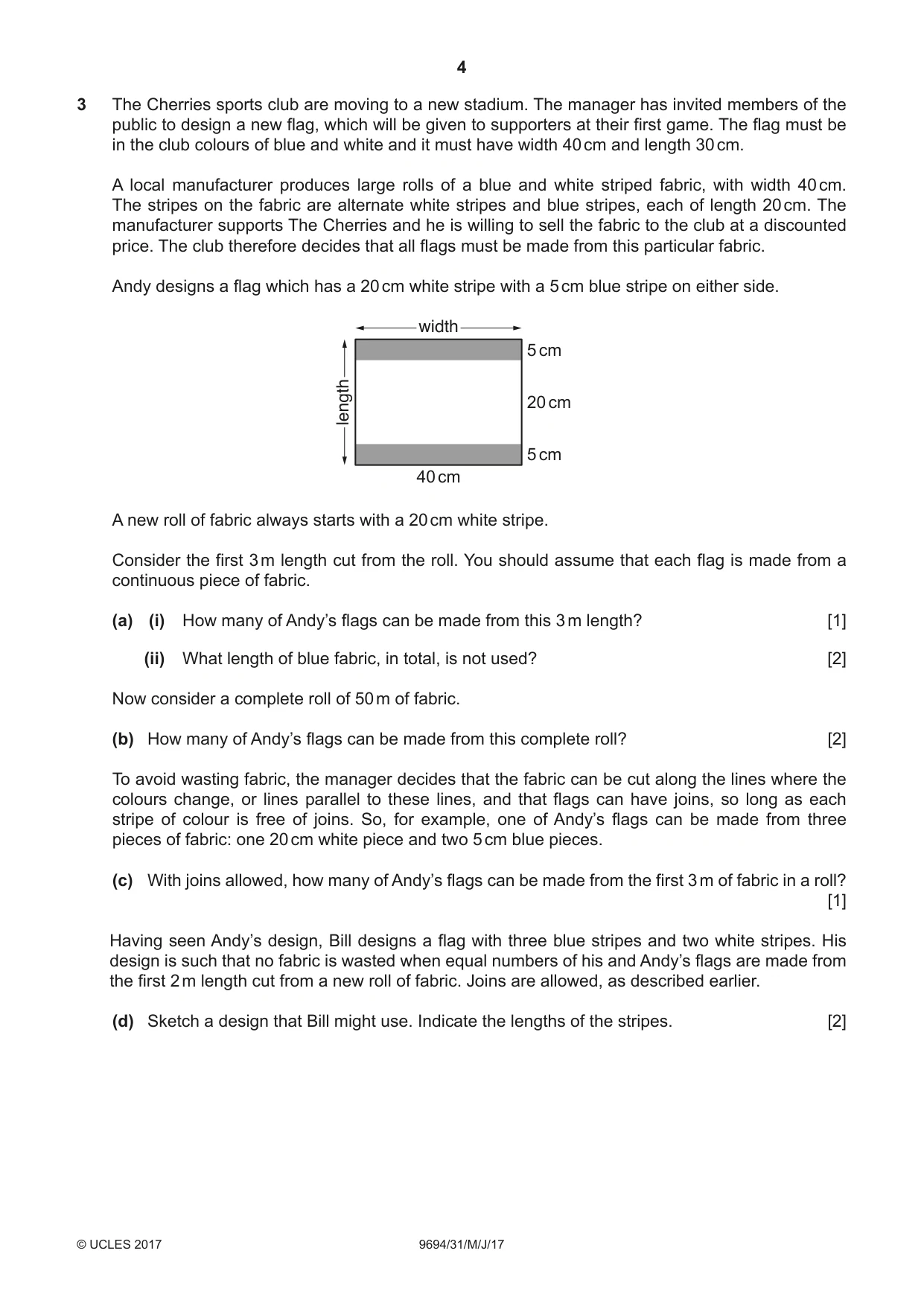
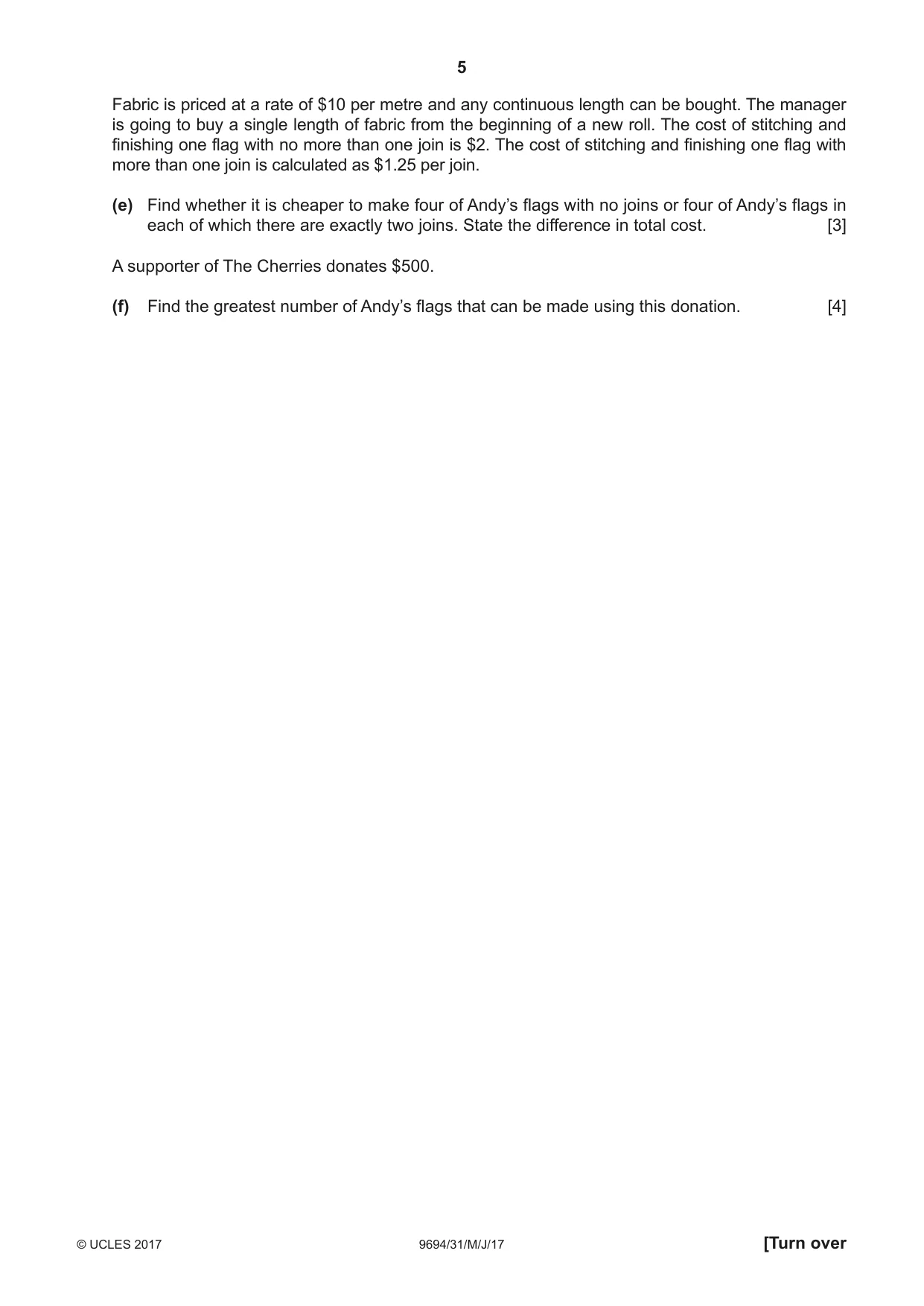
3 The Cherries sports club are moving to a new stadium. The manager has invited members of the public to design a new flag, which will be given to supporters at their first game. The flag must be in the club colours of blue and white and it must have width 40 cm and length 30 cm. A local manufacturer produces large rolls of a blue and white striped fabric, with width 40 cm. The stripes on the fabric are alternate white stripes and blue stripes, each of length 20 cm. The manufacturer supports The Cherries and he is willing to sell the fabric to the club at a discounted price. The club therefore decides that all flags must be made from this particular fabric. Andy designs a flag which has a 20 cm white stripe with a 5 cm blue stripe on either side. width 5 cm 20 cm length 5 cm 40 cm A new roll of fabric always starts with a 20 cm white stripe. Consider the first 3 m length cut from the roll. You should assume that each flag is made from a continuous piece of fabric. (a) (i) How many of Andy’s flags can be made from this 3 m length? [1] (ii) What length of blue fabric, in total, is not used? [2] Now consider a complete roll of 50 m of fabric. (b) How many of Andy’s flags can be made from this complete roll? [2] To avoid wasting fabric, the manager decides that the fabric can be cut along the lines where the colours change, or lines parallel to these lines, and that flags can have joins, so long as each stripe of colour is free of joins. So, for example, one of Andy’s flags can be made from three pieces of fabric: one 20 cm white piece and two 5 cm blue pieces. (c) With joins allowed, how many of Andy’s flags can be made from the first 3 m of fabric in a roll? [1] Having seen Andy’s design, Bill designs a flag with three blue stripes and two white stripes. His design is such that no fabric is wasted when equal numbers of his and Andy’s flags are made from the first 2 m length cut from a new roll of fabric. Joins are allowed, as described earlier. (d) Sketch a design that Bill might use. Indicate the lengths of the stripes. [2] Fabric is priced at a rate of $10 per metre and any continuous length can be bought. The manager is going to buy a single length of fabric from the beginning of a new roll. The cost of stitching and finishing one flag with no more than one join is $2. The cost of stitching and finishing one flag with more than one join is calculated as $1.25 per join. (e) Find whether it is cheaper to make four of Andy’s flags with no joins or four of Andy’s flags in each of which there are exactly two joins. State the difference in total cost. [3] A supporter of The Cherries donates $500. (f) Find the greatest number of Andy’s flags that can be made using this donation. [4]
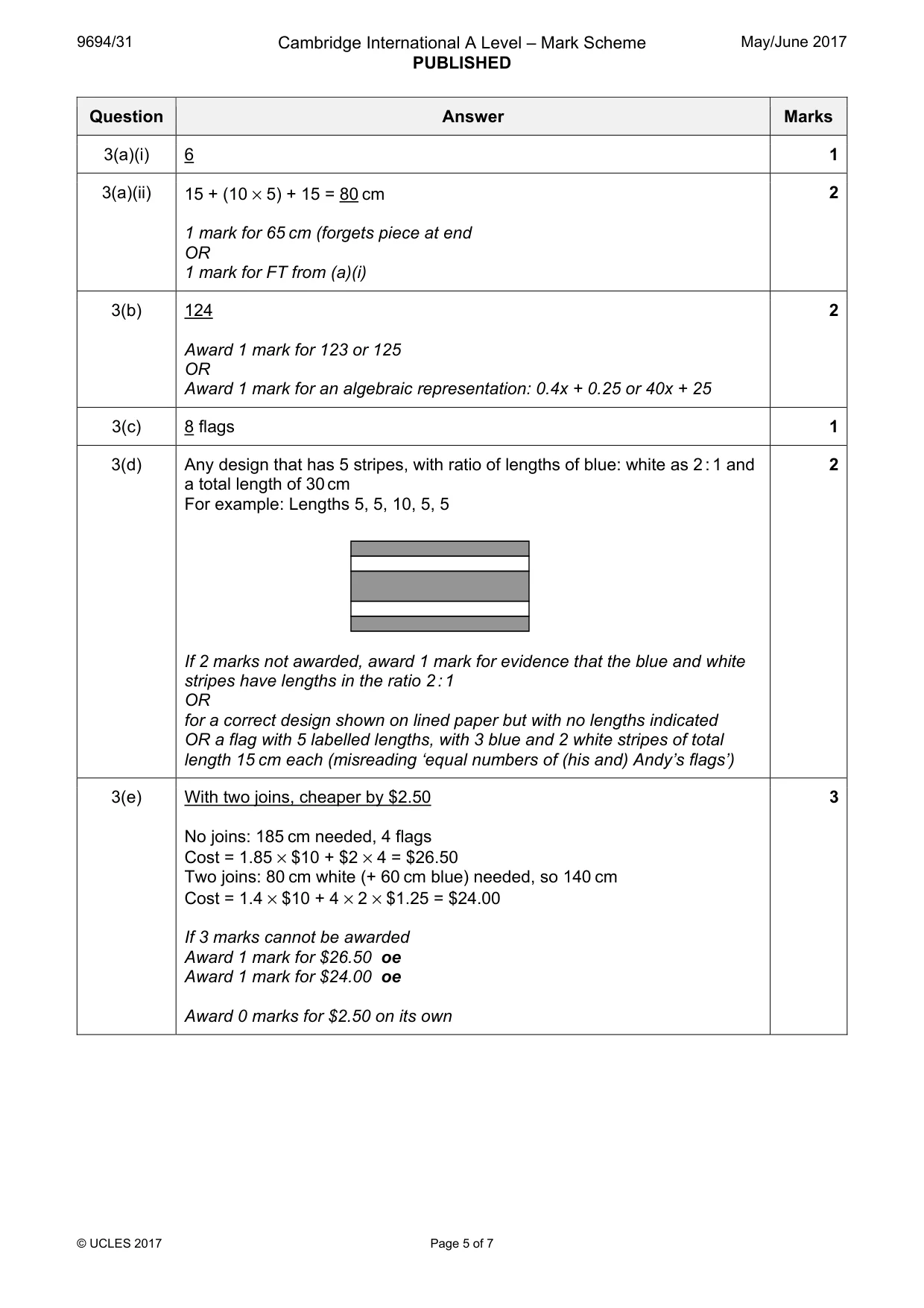
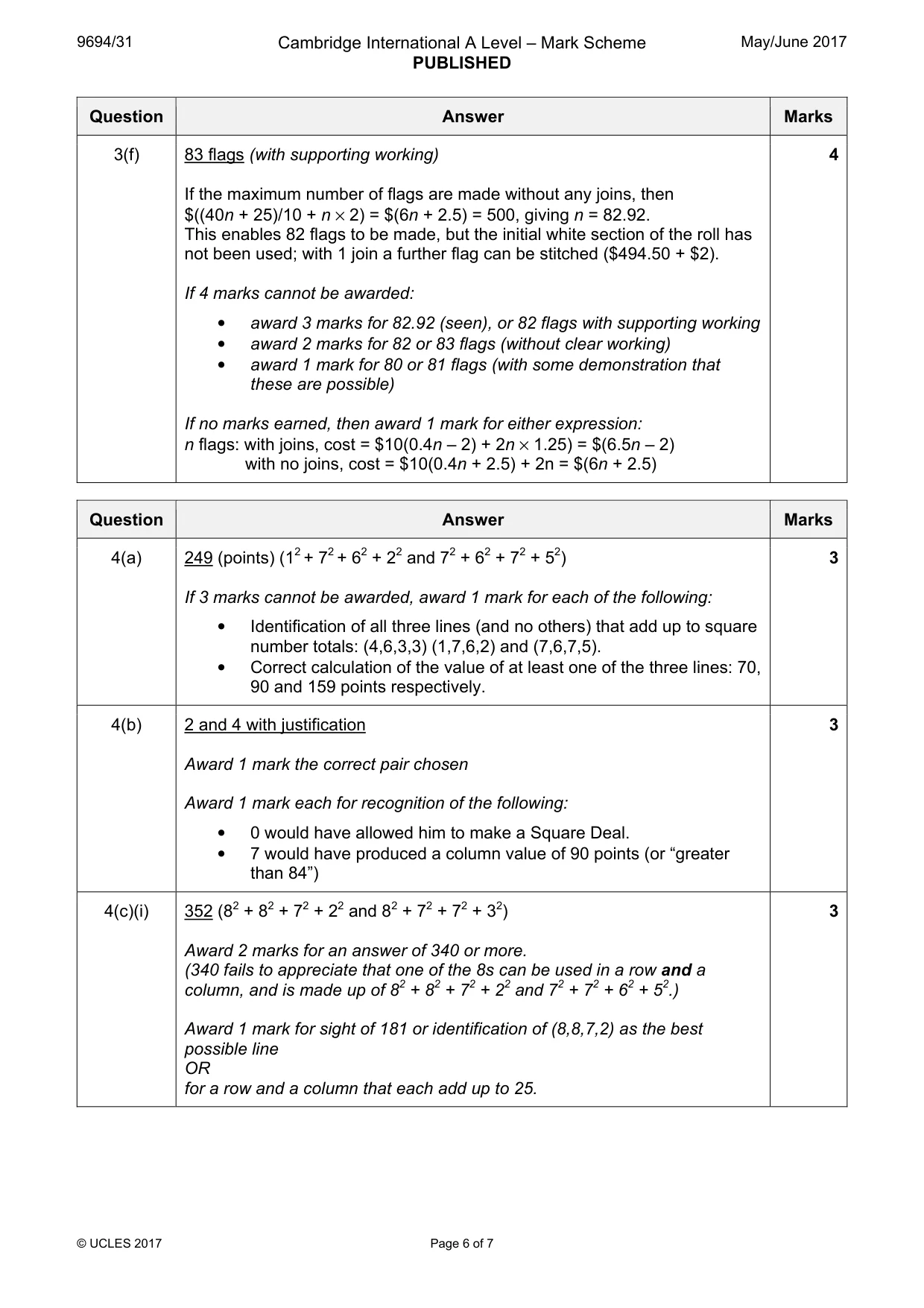
Mark scheme: 3(a)(i) 6 1 3(a)(ii) 15 + (10 × 5) + 15 = 80 cm 2 1 mark for 65 cm (forgets piece at end OR 1 mark for FT from (a)(i) 3(b) 124 2 Award 1 mark for 123 or 125 OR Award 1 mark for an algebraic representation: 0.4x + 0.25 or 40x + 25 3(c) 8 flags 1 3(d) Any design that has 5 stripes, with ratio of lengths of blue: white as 2 : 1 and 2 a total length of 30 cm For example: Lengths 5, 5, 10, 5, 5 If 2 marks not awarded, award 1 mark for evidence that the blue and white stripes have lengths in the ratio 2 : 1 OR for a correct design shown on lined paper but with no lengths indicated OR a flag with 5 labelled lengths, with 3 blue and 2 white stripes of total length 15 cm each (misreading ‘equal numbers of (his and) Andy’s flags’) 3(e) With two joins, cheaper by $2.50 3 No joins: 185 cm needed, 4 flags Cost = 1.85 × $10 + $2 × 4 = $26.50 Two joins: 80 cm white (+ 60 cm blue) needed, so 140 cm Cost = 1.4 × $10 + 4 × 2 × $1.25 = $24.00 If 3 marks cannot be awarded Award 1 mark for $26.50 oe Award 1 mark for $24.00 oe Award 0 marks for $2.50 on its own 3(f) 83 flags (with supporting working) 4 If the maximum number of flags are made without any joins, then $((40n + 25)/10 + n × 2) = $(6n + 2.5) = 500, giving n = 82.92. This enables 82 flags to be made, but the initial white section of the roll has not been used; with 1 join a further flag can be stitched ($494.50 + $2). If 4 marks cannot be awarded: • award 3 marks for 82.92 (seen), or 82 flags with supporting working • award 2 marks for 82 or 83 flags (without clear working) • award 1 mark for 80 or 81 flags (with some demonstration that these are possible) If no marks earned, then award 1 mark for either expression: n flags: with joins, cost = $10(0.4n – 2) + 2n × 1.25) = $(6.5n – 2) with no joins, cost = $10(0.4n + 2.5) + 2n = $(6n + 2.5)
More questions on Perform appropriate operations with information
Q4 · Square Deal is a game for two players, played over a number of rounds
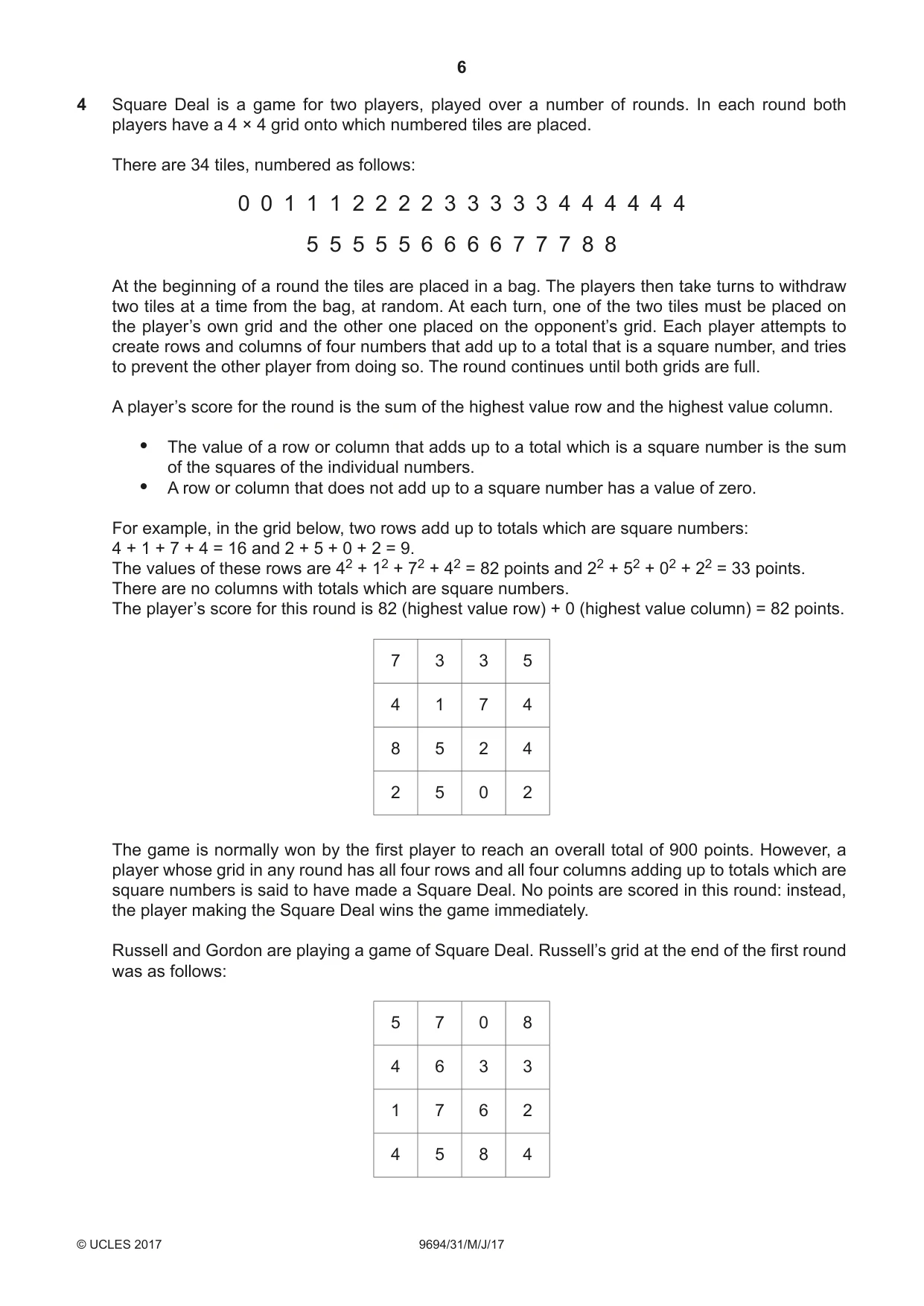
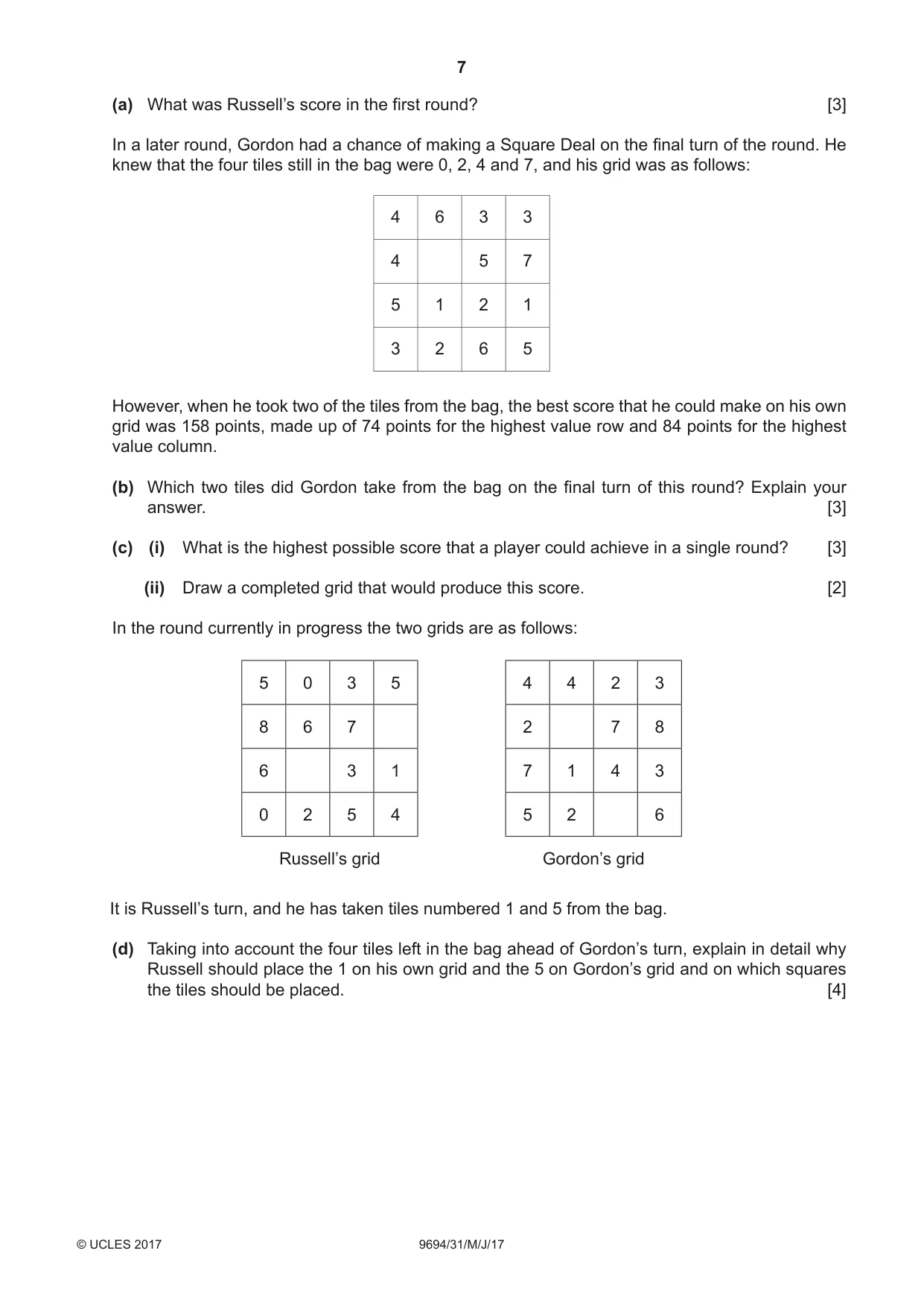
4 Square Deal is a game for two players, played over a number of rounds. In each round both players have a 4 × 4 grid onto which numbered tiles are placed. There are 34 tiles, numbered as follows: 0 0 1 1 1 2 2 2 2 3 3 3 3 3 4 4 4 4 4 4 5 5 5 5 5 6 6 6 6 7 7 7 8 8 At the beginning of a round the tiles are placed in a bag. The players then take turns to withdraw two tiles at a time from the bag, at random. At each turn, one of the two tiles must be placed on the player’s own grid and the other one placed on the opponent’s grid. Each player attempts to create rows and columns of four numbers that add up to a total that is a square number, and tries to prevent the other player from doing so. The round continues until both grids are full. A player’s score for the round is the sum of the highest value row and the highest value column. • The value of a row or column that adds up to a total which is a square number is the sum of the squares of the individual numbers. • A row or column that does not add up to a square number has a value of zero. For example, in the grid below, two rows add up to totals which are square numbers: 4 + 1 + 7 + 4 = 16 and 2 + 5 + 0 + 2 = 9. The values of these rows are 42 + 12 + 72 + 42 = 82 points and 22 + 52 + 02 + 22 = 33 points. There are no columns with totals which are square numbers. The player’s score for this round is 82 (highest value row) + 0 (highest value column) = 82 points. 7 3 3 5 4 1 7 4 8 5 2 4 2 5 0 2 The game is normally won by the first player to reach an overall total of 900 points. However, a player whose grid in any round has all four rows and all four columns adding up to totals which are square numbers is said to have made a Square Deal. No points are scored in this round: instead, the player making the Square Deal wins the game immediately. Russell and Gordon are playing a game of Square Deal. Russell’s grid at the end of the first round was as follows: 5 7 0 8 4 6 3 3 1 7 6 2 4 5 8 4 (a) What was Russell’s score in the first round? [3] In a later round, Gordon had a chance of making a Square Deal on the final turn of the round. He knew that the four tiles still in the bag were 0, 2, 4 and 7, and his grid was as follows: 4 6 3 3 4 5 7 5 1 2 1 3 2 6 5 However, when he took two of the tiles from the bag, the best score that he could make on his own grid was 158 points, made up of 74 points for the highest value row and 84 points for the highest value column. (b) Which two tiles did Gordon take from the bag on the final turn of this round? Explain your answer. [3] (c) (i) What is the highest possible score that a player could achieve in a single round? [3] (ii) Draw a completed grid that would produce this score. [2] In the round currently in progress the two grids are as follows: 5 0 3 5 4 4 2 3 8 6 7 2 7 8 6 3 1 7 1 4 3 0 2 5 4 5 2 6 Russell’s grid Gordon’s grid It is Russell’s turn, and he has taken tiles numbered 1 and 5 from the bag. (d) Taking into account the four tiles left in the bag ahead of Gordon’s turn, explain in detail why Russell should place the 1 on his own grid and the 5 on Gordon’s grid and on which squares the tiles should be placed. [4]
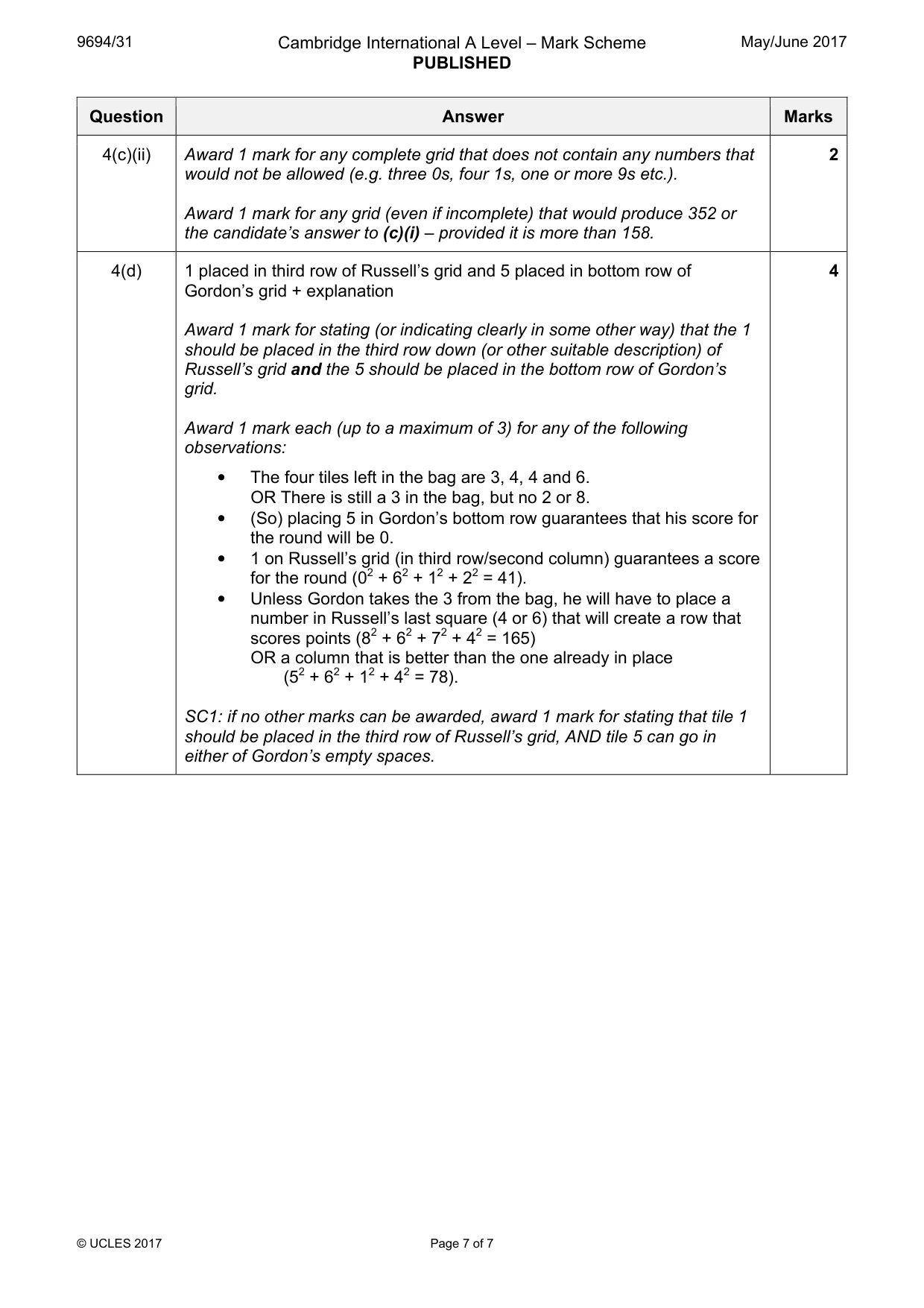
Mark scheme: 4(a) 249 (points) (12 + 72 + 62 + 22 and 72 + 62 + 72 + 52) 3 If 3 marks cannot be awarded, award 1 mark for each of the following: • Identification of all three lines (and no others) that add up to square number totals: (4,6,3,3) (1,7,6,2) and (7,6,7,5). • Correct calculation of the value of at least one of the three lines: 70, 90 and 159 points respectively. 4(b) 2 and 4 with justification 3 Award 1 mark the correct pair chosen Award 1 mark each for recognition of the following: • 0 would have allowed him to make a Square Deal. • 7 would have produced a column value of 90 points (or “greater than 84”) 4(c)(i) 352 (82 + 82 + 72 + 22 and 82 + 72 + 72 + 32) 3 Award 2 marks for an answer of 340 or more. (340 fails to appreciate that one of the 8s can be used in a row and a column, and is made up of 82 + 82 + 72 + 22 and 72 + 72 + 62 + 52.) Award 1 mark for sight of 181 or identification of (8,8,7,2) as the best possible line OR for a row and a column that each add up to 25. 4(c)(ii) Award 1 mark for any complete grid that does not contain any numbers that 2 would not be allowed (e.g. three 0s, four 1s, one or more 9s etc.). Award 1 mark for any grid (even if incomplete) that would produce 352 or the candidate’s answer to (c)(i) – provided it is more than 158. 4(d) 1 placed in third row of Russell’s grid and 5 placed in bottom row of 4 Gordon’s grid + explanation Award 1 mark for stating (or indicating clearly in some other way) that the 1 should be placed in the third row down (or other suitable description) of Russell’s grid and the 5 should be placed in the bottom row of Gordon’s grid. Award 1 mark each (up to a maximum of 3) for any of the following observations: • The four tiles left in the bag are 3, 4, 4 and 6. OR There is still a 3 in the bag, but no 2 or 8. • (So) placing 5 in Gordon’s bottom row guarantees that his score for the round will be 0. • 1 on Russell’s grid (in third row/second column) guarantees a score for the round (02 + 62 + 12 + 22 = 41). • Unless Gordon takes the 3 from the bag, he will have to place a number in Russell’s last square (4 or 6) that will create a row that scores points (82 + 62 + 72 + 42 = 165) OR a column that is better than the one already in place (52 + 62 + 12 + 42 = 78). SC1: if no other marks can be awarded, award 1 mark for stating that tile 1 should be placed in the third row of Russell’s grid, AND tile 5 can go in either of Gordon’s empty spaces.
What was in this paper
The subtopics covered by these 4 questions, and how many questions each got. Open one in a new tab to see every Cambridge question on it.
What you needed in this session
Cambridge’s own grade thresholds for 2017 May/June, Paper 3 · Variant 1. A higher threshold means an easier paper — the bar moves with how the cohort did.