Cambridge A Level Thinking Skills 9694 — 2015 May/June Paper 3 · Variant 1
9694/31/M/J/15 · 50 marks · ≈56 min
The question paper and its mark scheme, free to read here and free to download. This is Cambridge’s own paper, exactly as it was sat.
Question paper8 pages

Mark scheme8 pages
Answers below. Sit the paper first if you are practising.
Paper as text
Question paper, page 1
This document consists of 7 printed pages, 1 blank page and 1 insert. IB15 06_9694_31/2RP © UCLES 2015 [Turn over *8543141653* Cambridge International Examinations Cambridge International Advanced Level THINKING SKILLS 9694/31 Paper 3 Problem Analysis and Solution May/June 2015 2 hours Additional Materials: Electronic Calculator READ THESE INSTRUCTIONS FIRST An answer booklet is provided inside this question paper. You should follow the instructions on the front cover of the answer booklet. If you need additional answer paper ask the invigilator for a continuation booklet. Answer all the questions. Show your working. Marks may be awarded for correct steps towards a solution, even if the final answer is not correct. Marks may be lost if working needed to support an answer is not shown. Calculators should be used where appropriate. The number of marks is given in brackets [ ] at the end of each question or part question.
Question paper, page 2
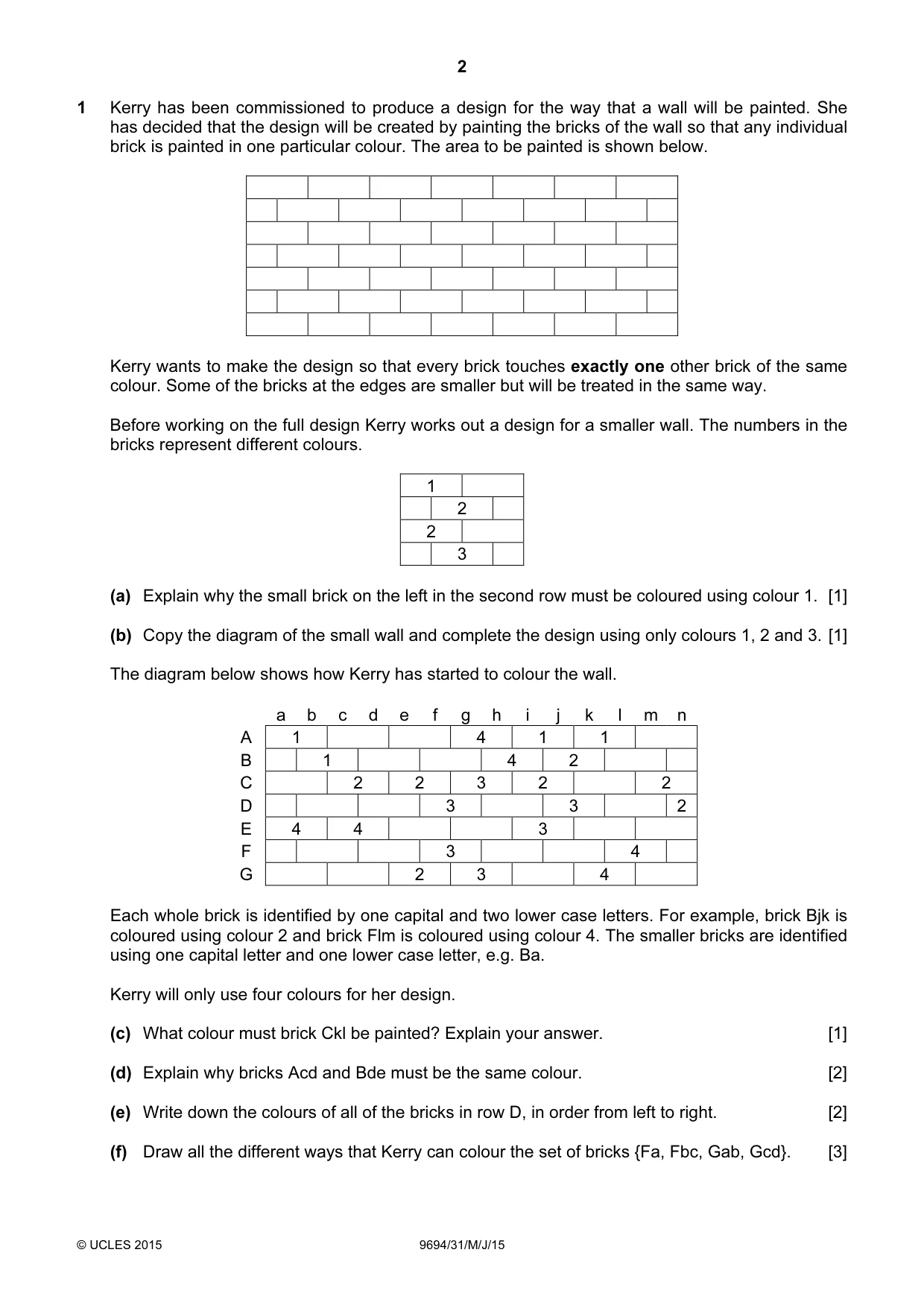
2 © UCLES 2015 9694/31/M/J/15 1 Kerry has been commissioned to produce a design for the way that a wall will be painted. She has decided that the design will be created by painting the bricks of the wall so that any individual brick is painted in one particular colour. The area to be painted is shown below. Kerry wants to make the design so that every brick touches exactly one other brick of the same colour. Some of the bricks at the edges are smaller but will be treated in the same way. Before working on the full design Kerry works out a design for a smaller wall. The numbers in the bricks represent different colours. 1 2 2 3 (a) Explain why the small brick on the left in the second row must be coloured using colour 1. [1] (b) Copy the diagram of the small wall and complete the design using only colours 1, 2 and 3. [1] The diagram below shows how Kerry has started to colour the wall. a b c d e f g h i j k l m n A 1 4 1 1 B 1 4 2 C 2 2 3 2 2 D 3 3 2 E 4 4 3 F 3 4 G 2 3 4 Each whole brick is identified by one capital and two lower case letters. For example, brick Bjk is coloured using colour 2 and brick Flm is coloured using colour 4. The smaller bricks are identified using one capital letter and one lower case letter, e.g. Ba. Kerry will only use four colours for her design. (c) What colour must brick Ckl be painted? Explain your answer. [1] (d) Explain why bricks Acd and Bde must be the same colour. [2] (e) Write down the colours of all of the bricks in row D, in order from left to right. [2] (f) Draw all the different ways that Kerry can colour the set of bricks {Fa, Fbc, Gab, Gcd}. [3]
Question paper, page 3
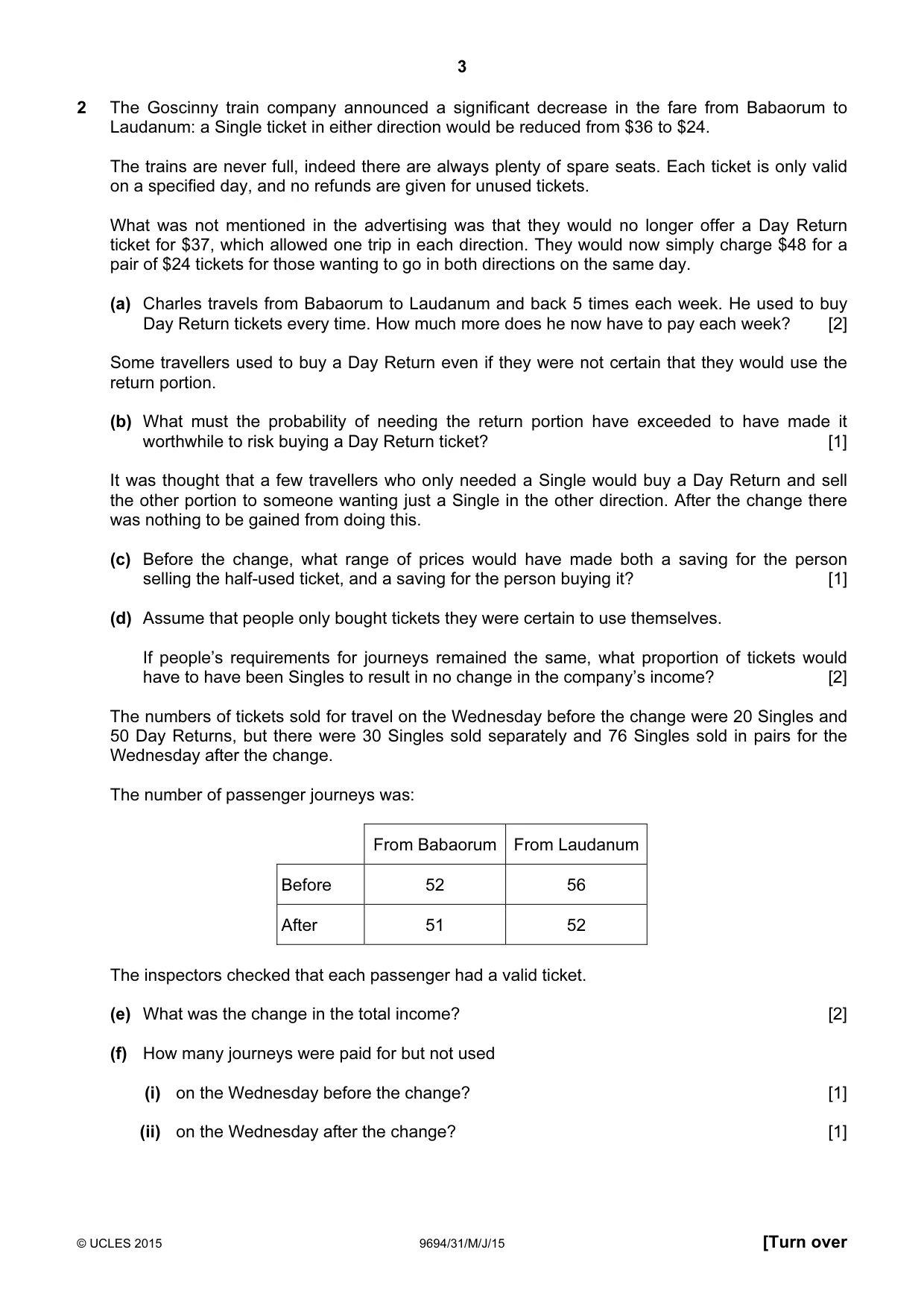
3 © UCLES 2015 9694/31/M/J/15 [Turn over 2 The Goscinny train company announced a significant decrease in the fare from Babaorum to Laudanum: a Single ticket in either direction would be reduced from $36 to $24. The trains are never full, indeed there are always plenty of spare seats. Each ticket is only valid on a specified day, and no refunds are given for unused tickets. What was not mentioned in the advertising was that they would no longer offer a Day Return ticket for $37, which allowed one trip in each direction. They would now simply charge $48 for a pair of $24 tickets for those wanting to go in both directions on the same day. (a) Charles travels from Babaorum to Laudanum and back 5 times each week. He used to buy Day Return tickets every time. How much more does he now have to pay each week? [2] Some travellers used to buy a Day Return even if they were not certain that they would use the return portion. (b) What must the probability of needing the return portion have exceeded to have made it worthwhile to risk buying a Day Return ticket? [1] It was thought that a few travellers who only needed a Single would buy a Day Return and sell the other portion to someone wanting just a Single in the other direction. After the change there was nothing to be gained from doing this. (c) Before the change, what range of prices would have made both a saving for the person selling the half-used ticket, and a saving for the person buying it? [1] (d) Assume that people only bought tickets they were certain to use themselves. If people’s requirements for journeys remained the same, what proportion of tickets would have to have been Singles to result in no change in the company’s income? [2] The numbers of tickets sold for travel on the Wednesday before the change were 20 Singles and 50 Day Returns, but there were 30 Singles sold separately and 76 Singles sold in pairs for the Wednesday after the change. The number of passenger journeys was: From Babaorum From Laudanum Before 52 56 After 51 52 The inspectors checked that each passenger had a valid ticket. (e) What was the change in the total income? [2] (f) How many journeys were paid for but not used (i) on the Wednesday before the change? [1] (ii) on the Wednesday after the change? [1]
Question paper, page 4
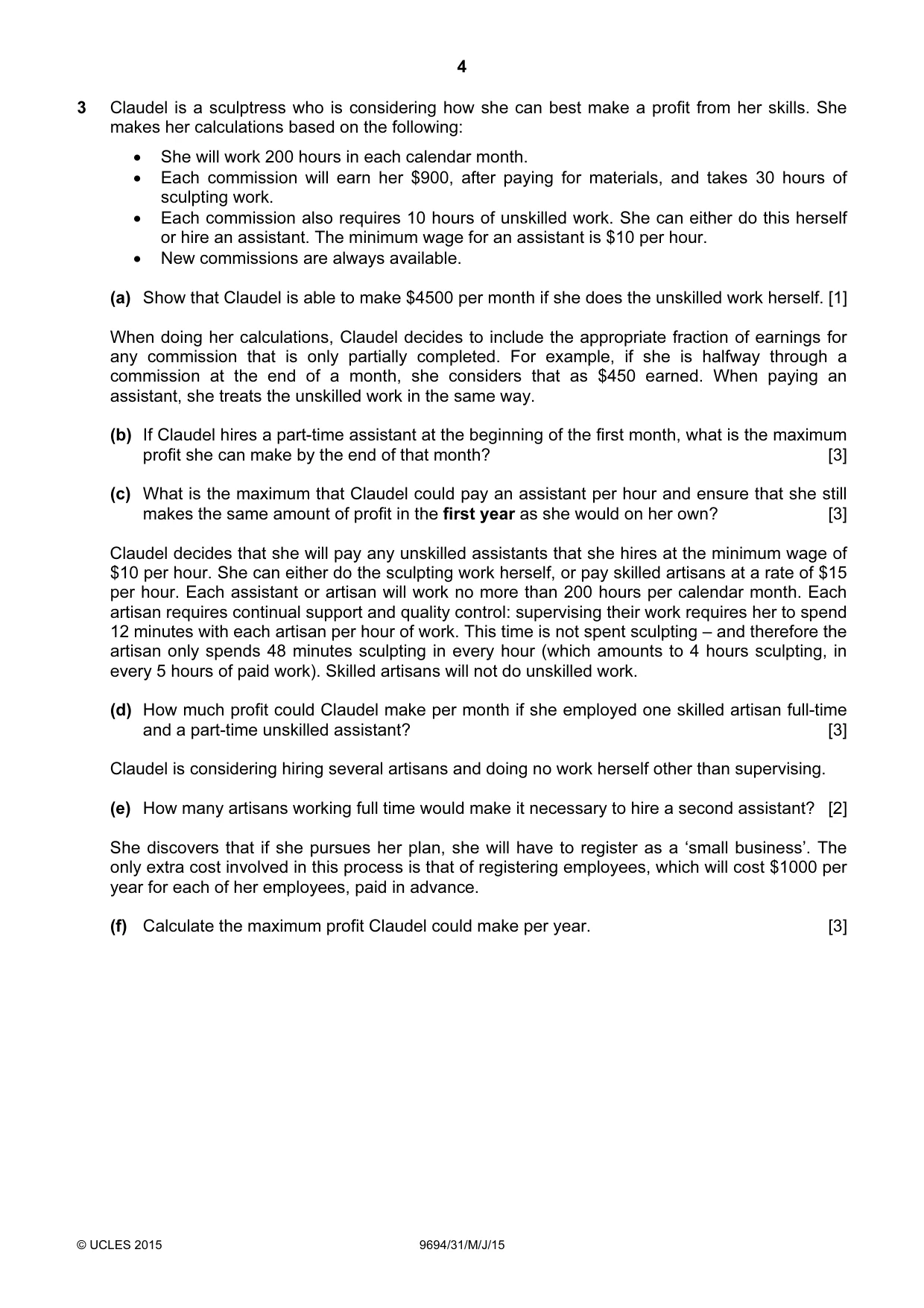
4 © UCLES 2015 9694/31/M/J/15 3 Claudel is a sculptress who is considering how she can best make a profit from her skills. She makes her calculations based on the following: • She will work 200 hours in each calendar month. • Each commission will earn her $900, after paying for materials, and takes 30 hours of sculpting work. • Each commission also requires 10 hours of unskilled work. She can either do this herself or hire an assistant. The minimum wage for an assistant is $10 per hour. • New commissions are always available. (a) Show that Claudel is able to make $4500 per month if she does the unskilled work herself. [1] When doing her calculations, Claudel decides to include the appropriate fraction of earnings for any commission that is only partially completed. For example, if she is halfway through a commission at the end of a month, she considers that as $450 earned. When paying an assistant, she treats the unskilled work in the same way. (b) If Claudel hires a part-time assistant at the beginning of the first month, what is the maximum profit she can make by the end of that month? [3] (c) What is the maximum that Claudel could pay an assistant per hour and ensure that she still makes the same amount of profit in the first year as she would on her own? [3] Claudel decides that she will pay any unskilled assistants that she hires at the minimum wage of $10 per hour. She can either do the sculpting work herself, or pay skilled artisans at a rate of $15 per hour. Each assistant or artisan will work no more than 200 hours per calendar month. Each artisan requires continual support and quality control: supervising their work requires her to spend 12 minutes with each artisan per hour of work. This time is not spent sculpting – and therefore the artisan only spends 48 minutes sculpting in every hour (which amounts to 4 hours sculpting, in every 5 hours of paid work). Skilled artisans will not do unskilled work. (d) How much profit could Claudel make per month if she employed one skilled artisan full-time and a part-time unskilled assistant? [3] Claudel is considering hiring several artisans and doing no work herself other than supervising. (e) How many artisans working full time would make it necessary to hire a second assistant? [2] She discovers that if she pursues her plan, she will have to register as a ‘small business’. The only extra cost involved in this process is that of registering employees, which will cost $1000 per year for each of her employees, paid in advance. (f) Calculate the maximum profit Claudel could make per year. [3]
Question paper, page 5
5 © UCLES 2015 9694/31/M/J/15 [Turn over [Question 4 begins on the next page]
Question paper, page 6
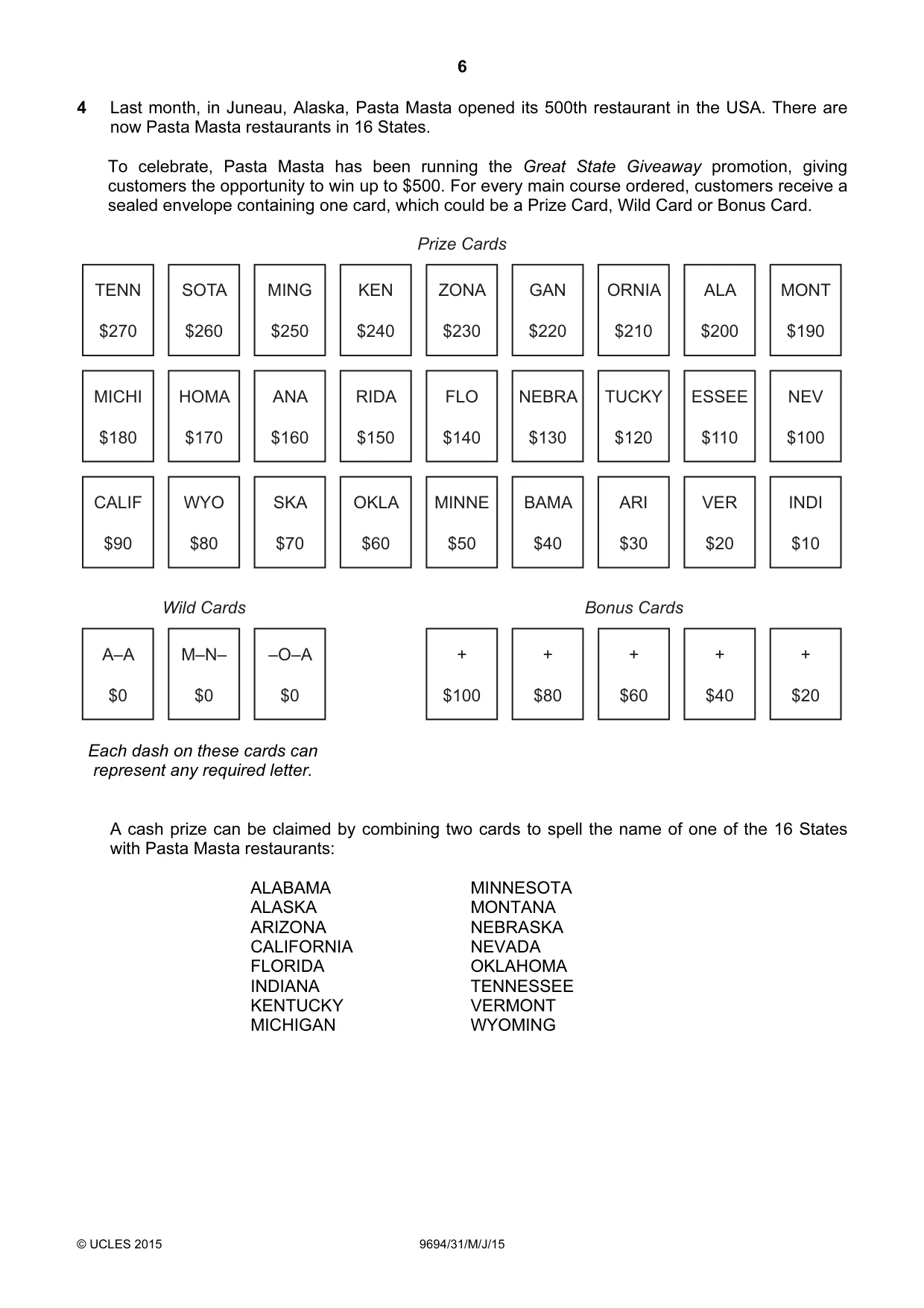
6 © UCLES 2015 9694/31/M/J/15 4 Last month, in Juneau, Alaska, Pasta Masta opened its 500th restaurant in the USA. There are now Pasta Masta restaurants in 16 States. To celebrate, Pasta Masta has been running the Great State Giveaway promotion, giving customers the opportunity to win up to $500. For every main course ordered, customers receive a sealed envelope containing one card, which could be a Prize Card, Wild Card or Bonus Card. TENN $270 SOTA $260 MING $250 KEN $240 ZONA $230 Prize Cards GAN $220 A–A $0 M–N– $0 Wild Cards –O–A $0 ORNIA $210 + $100 + $80 + $60 Bonus Cards + $40 + $20 ALA $200 MONT $190 MICHI $180 HOMA $170 ANA $160 RIDA $150 FLO $140 NEBRA $130 TUCKY $120 ESSEE $110 NEV $100 CALIF $90 WYO $80 SKA $70 OKLA $60 MINNE $50 BAMA $40 ARI $30 VER $20 INDI $10 Each dash on these cards can represent any required letter. A cash prize can be claimed by combining two cards to spell the name of one of the 16 States with Pasta Masta restaurants: ALABAMA MINNESOTA ALASKA MONTANA ARIZONA NEBRASKA CALIFORNIA NEVADA FLORIDA OKLAHOMA INDIANA TENNESSEE KENTUCKY VERMONT MICHIGAN WYOMING
Question paper, page 7
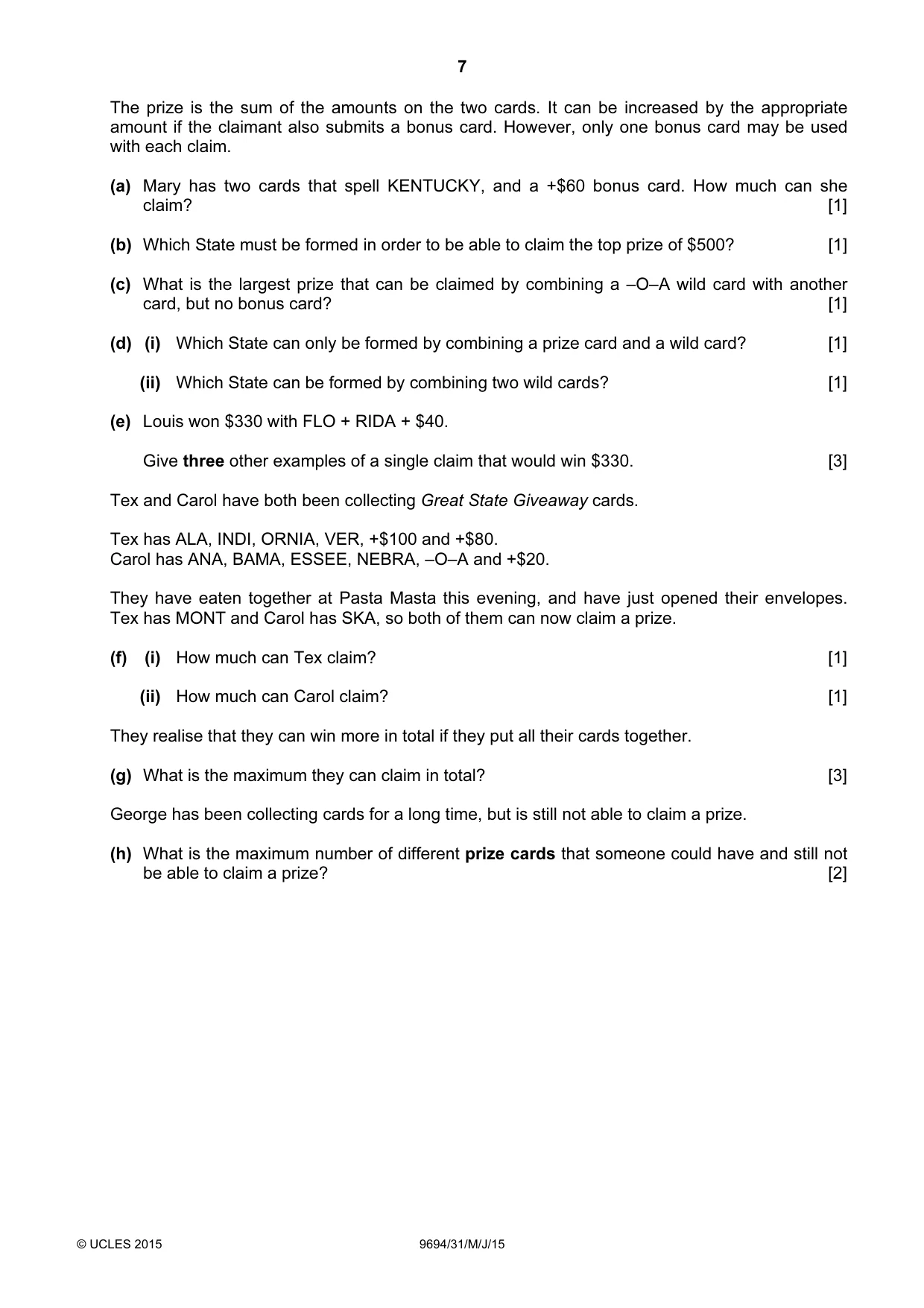
7 © UCLES 2015 9694/31/M/J/15 The prize is the sum of the amounts on the two cards. It can be increased by the appropriate amount if the claimant also submits a bonus card. However, only one bonus card may be used with each claim. (a) Mary has two cards that spell KENTUCKY, and a +$60 bonus card. How much can she claim? [1] (b) Which State must be formed in order to be able to claim the top prize of $500? [1] (c) What is the largest prize that can be claimed by combining a –O–A wild card with another card, but no bonus card? [1] (d) (i) Which State can only be formed by combining a prize card and a wild card? [1] (ii) Which State can be formed by combining two wild cards? [1] (e) Louis won $330 with FLO + RIDA + $40. Give three other examples of a single claim that would win $330. [3] Tex and Carol have both been collecting Great State Giveaway cards. Tex has ALA, INDI, ORNIA, VER, +$100 and +$80. Carol has ANA, BAMA, ESSEE, NEBRA, –O–A and +$20. They have eaten together at Pasta Masta this evening, and have just opened their envelopes. Tex has MONT and Carol has SKA, so both of them can now claim a prize. (f) (i) How much can Tex claim? [1] (ii) How much can Carol claim? [1] They realise that they can win more in total if they put all their cards together. (g) What is the maximum they can claim in total? [3] George has been collecting cards for a long time, but is still not able to claim a prize. (h) What is the maximum number of different prize cards that someone could have and still not be able to claim a prize? [2]
Question paper, page 8
8 Permission to reproduce items where third-party owned material protected by copyright is included has been sought and cleared where possible. Every reasonable effort has been made by the publisher (UCLES) to trace copyright holders, but if any items requiring clearance have unwittingly been included, the publisher will be pleased to make amends at the earliest possible opportunity. To avoid the issue of disclosure of answer-related information to candidates, all copyright acknowledgements are reproduced online in the Cambridge International Examinations Copyright Acknowledgements Booklet. This is produced for each series of examinations and is freely available to download at www.cie.org.uk after the live examination series. Cambridge International Examinations is part of the Cambridge Assessment Group. Cambridge Assessment is the brand name of University of Cambridge Local Examinations Syndicate (UCLES), which is itself a department of the University of Cambridge. © UCLES 2015 9694/31/M/J/15 BLANK PAGE
Mark scheme, page 1
® IGCSE is the registered trademark of Cambridge International Examinations. CAMBRIDGE INTERNATIONAL EXAMINATIONS Cambridge International Advanced Level MARK SCHEME for the May/June 2015 series 9694 THINKING SKILLS 9694/31 Paper 3 (Problem Analysis and Solution), maximum raw mark 50 This mark scheme is published as an aid to teachers and candidates, to indicate the requirements of the examination. It shows the basis on which Examiners were instructed to award marks. It does not indicate the details of the discussions that took place at an Examiners’ meeting before marking began, which would have considered the acceptability of alternative answers. Mark schemes should be read in conjunction with the question paper and the Principal Examiner Report for Teachers. Cambridge will not enter into discussions about these mark schemes. Cambridge is publishing the mark schemes for the May/June 2015 series for most Cambridge IGCSE®, Cambridge International A and AS Level components and some Cambridge O Level components.
Mark scheme, page 2
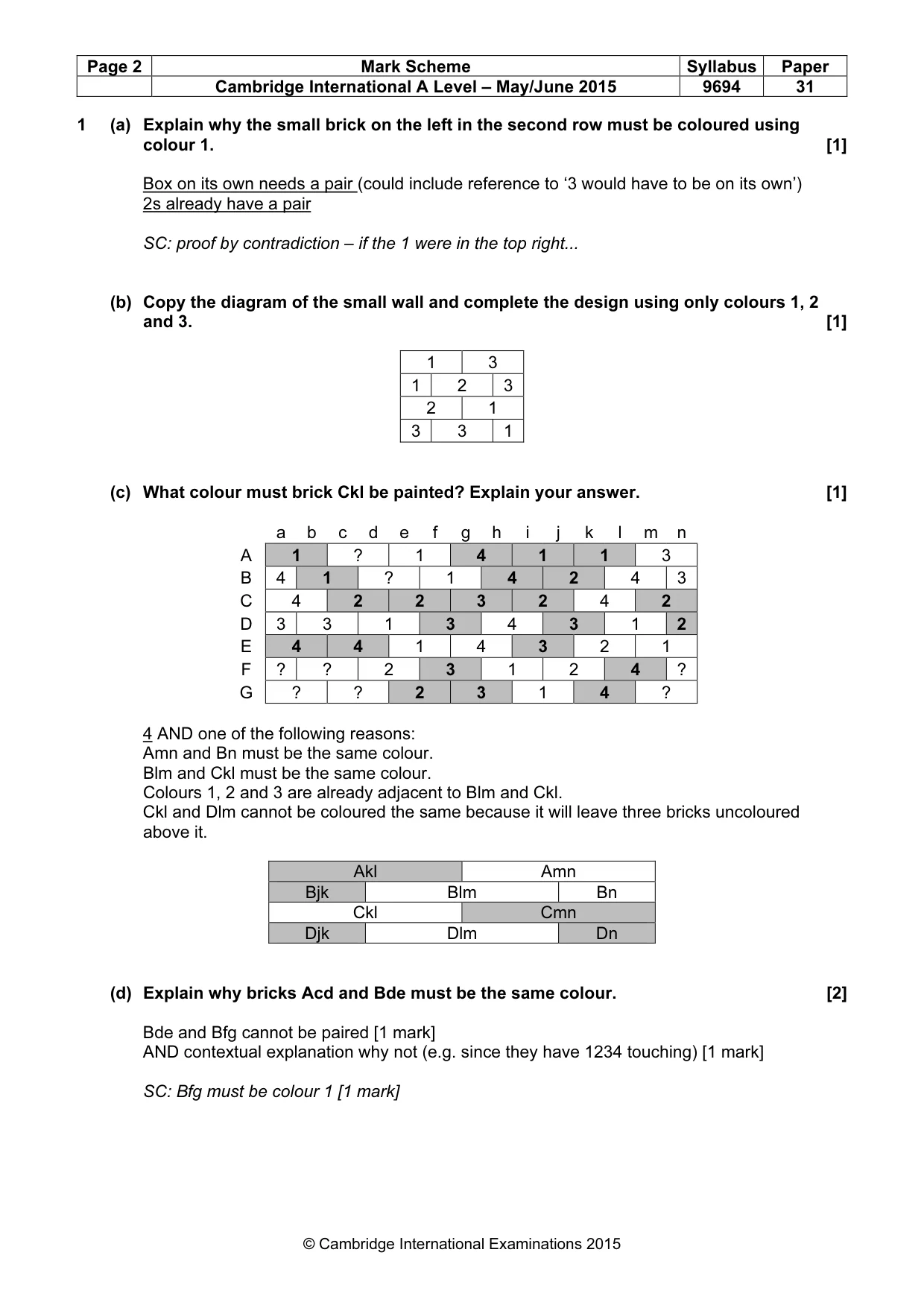
Page 2 Mark Scheme Syllabus Paper Cambridge International A Level – May/June 2015 9694 31 © Cambridge International Examinations 2015 1 (a) Explain why the small brick on the left in the second row must be coloured using colour 1. [1] Box on its own needs a pair (could include reference to ‘3 would have to be on its own’) 2s already have a pair SC: proof by contradiction – if the 1 were in the top right... (b) Copy the diagram of the small wall and complete the design using only colours 1, 2 and 3. [1] 1 3 1 2 3 2 1 3 3 1 (c) What colour must brick Ckl be painted? Explain your answer. [1] a b c d e f g h i j k l m n A 1 ? 1 4 1 1 3 B 4 1 ? 1 4 2 4 3 C 4 2 2 3 2 4 2 D 3 3 1 3 4 3 1 2 E 4 4 1 4 3 2 1 F ? ? 2 3 1 2 4 ? G ? ? 2 3 1 4 ? 4 AND one of the following reasons: Amn and Bn must be the same colour. Blm and Ckl must be the same colour. Colours 1, 2 and 3 are already adjacent to Blm and Ckl. Ckl and Dlm cannot be coloured the same because it will leave three bricks uncoloured above it. Akl Amn Bjk Blm Bn Ckl Cmn Djk Dlm Dn (d) Explain why bricks Acd and Bde must be the same colour. [2] Bde and Bfg cannot be paired [1 mark] AND contextual explanation why not (e.g. since they have 1234 touching) [1 mark] SC: Bfg must be colour 1 [1 mark]
Mark scheme, page 3
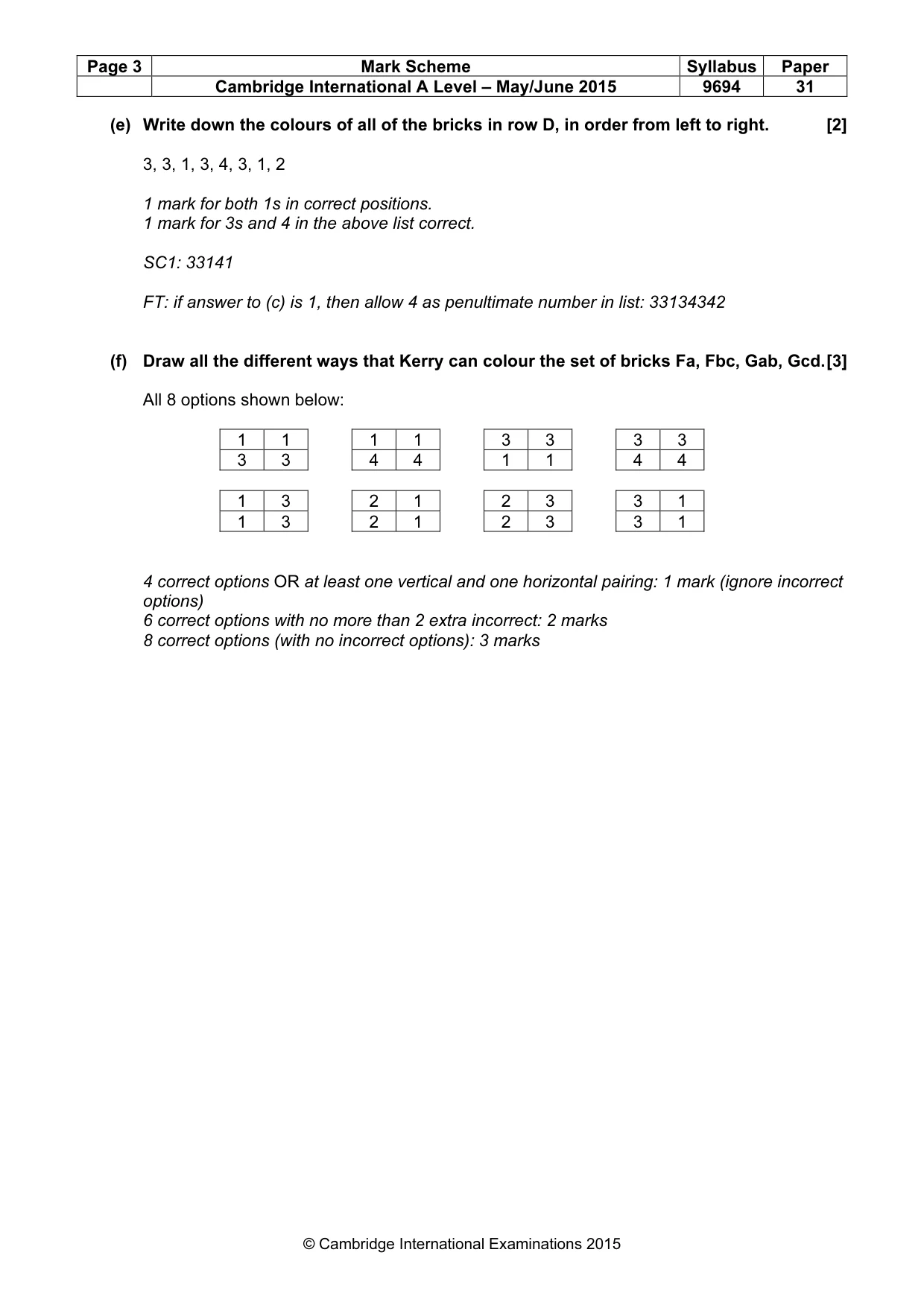
Page 3 Mark Scheme Syllabus Paper Cambridge International A Level – May/June 2015 9694 31 © Cambridge International Examinations 2015 (e) Write down the colours of all of the bricks in row D, in order from left to right. [2] 3, 3, 1, 3, 4, 3, 1, 2 1 mark for both 1s in correct positions. 1 mark for 3s and 4 in the above list correct. SC1: 33141 FT: if answer to (c) is 1, then allow 4 as penultimate number in list: 33134342 (f) Draw all the different ways that Kerry can colour the set of bricks Fa, Fbc, Gab, Gcd. [3] All 8 options shown below: 1 1 1 1 3 3 3 3 3 3 4 4 1 1 4 4 1 3 2 1 2 3 3 1 1 3 2 1 2 3 3 1 4 correct options OR at least one vertical and one horizontal pairing: 1 mark (ignore incorrect options) 6 correct options with no more than 2 extra incorrect: 2 marks 8 correct options (with no incorrect options): 3 marks
Mark scheme, page 4
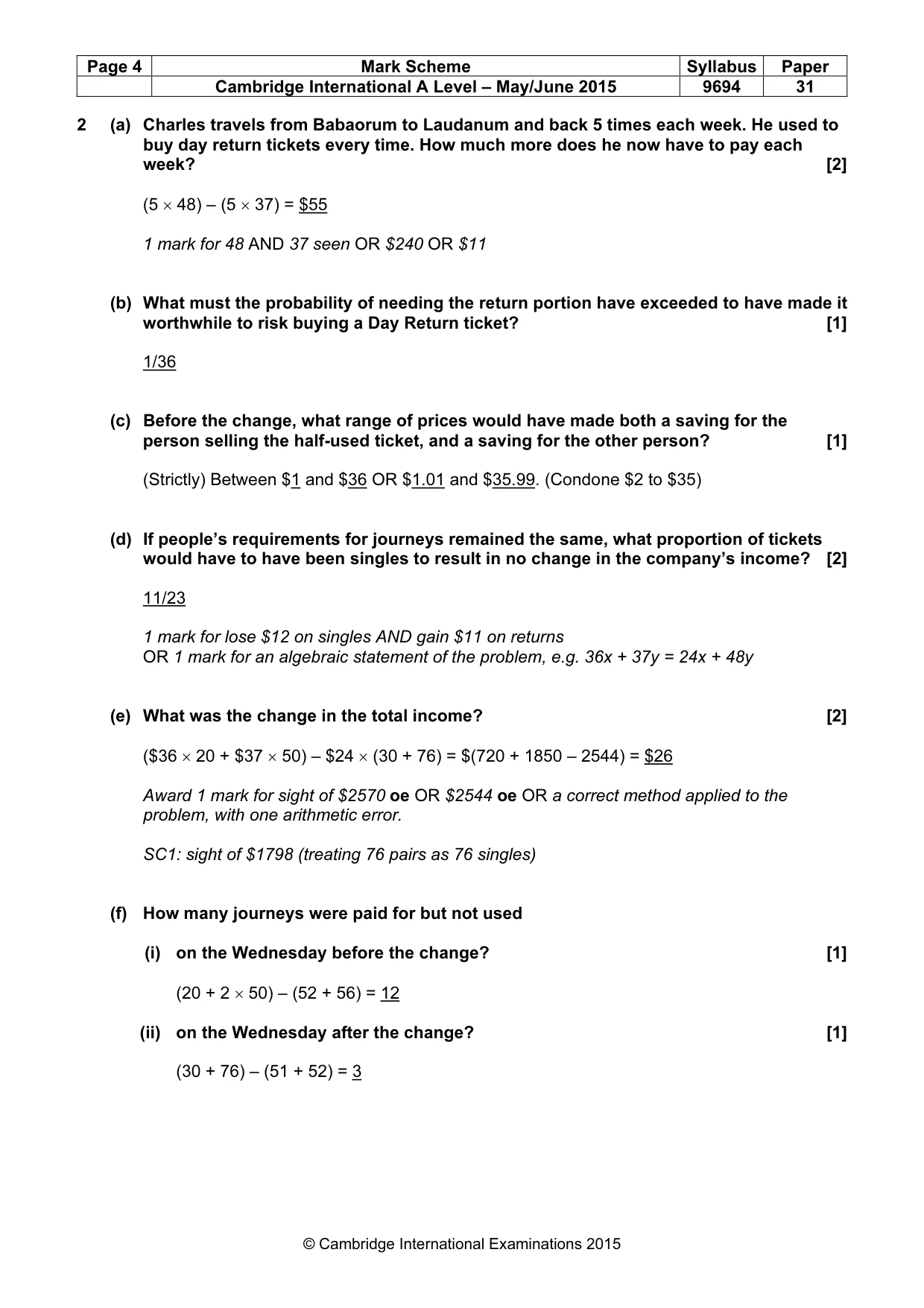
Page 4 Mark Scheme Syllabus Paper Cambridge International A Level – May/June 2015 9694 31 © Cambridge International Examinations 2015 2 (a) Charles travels from Babaorum to Laudanum and back 5 times each week. He used to buy day return tickets every time. How much more does he now have to pay each week? [2] (5 × 48) – (5 × 37) = $55 1 mark for 48 AND 37 seen OR $240 OR $11 (b) What must the probability of needing the return portion have exceeded to have made it worthwhile to risk buying a Day Return ticket? [1] 1/36 (c) Before the change, what range of prices would have made both a saving for the person selling the half-used ticket, and a saving for the other person? [1] (Strictly) Between $1 and $36 OR $1.01 and $35.99. (Condone $2 to $35) (d) If people’s requirements for journeys remained the same, what proportion of tickets would have to have been singles to result in no change in the company’s income? [2] 11/23 1 mark for lose $12 on singles AND gain $11 on returns OR 1 mark for an algebraic statement of the problem, e.g. 36x + 37y = 24x + 48y (e) What was the change in the total income? [2] ($36 × 20 + $37 × 50) – $24 × (30 + 76) = $(720 + 1850 – 2544) = $26 Award 1 mark for sight of $2570 oe OR $2544 oe OR a correct method applied to the problem, with one arithmetic error. SC1: sight of $1798 (treating 76 pairs as 76 singles) (f) How many journeys were paid for but not used (i) on the Wednesday before the change? [1] (20 + 2 × 50) – (52 + 56) = 12 (ii) on the Wednesday after the change? [1] (30 + 76) – (51 + 52) = 3
Mark scheme, page 5
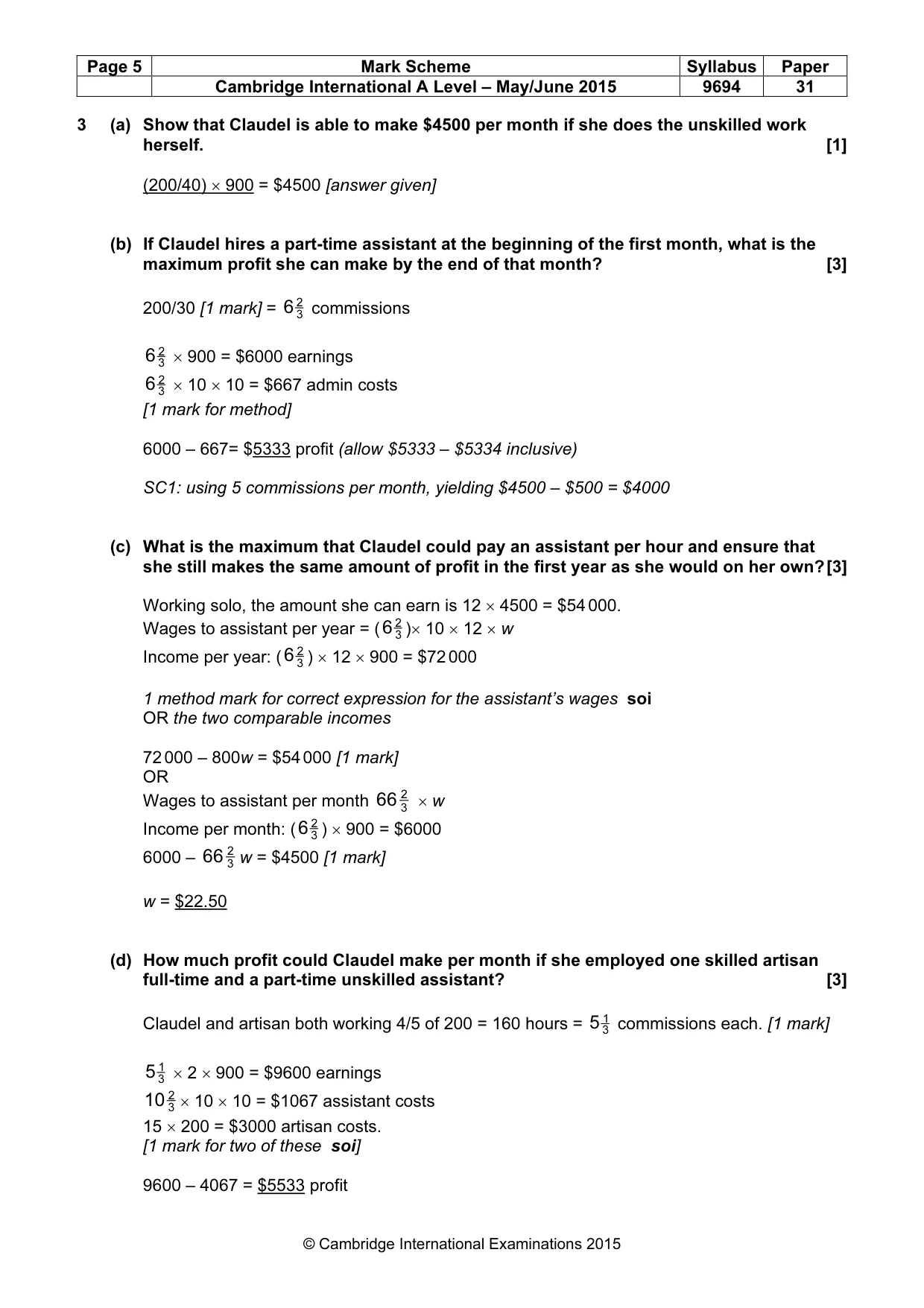
Page 5 Mark Scheme Syllabus Paper Cambridge International A Level – May/June 2015 9694 31 © Cambridge International Examinations 2015 3 (a) Show that Claudel is able to make $4500 per month if she does the unskilled work herself. [1] (200/40) × 900 = $4500 [answer given] (b) If Claudel hires a part-time assistant at the beginning of the first month, what is the maximum profit she can make by the end of that month? [3] 200/30 [1 mark] = 3 2 6 commissions 3 2 6 × 900 = $6000 earnings 3 2 6 × 10 × 10 = $667 admin costs [1 mark for method] 6000 – 667= $5333 profit (allow $5333 – $5334 inclusive) SC1: using 5 commissions per month, yielding $4500 – $500 = $4000 (c) What is the maximum that Claudel could pay an assistant per hour and ensure that she still makes the same amount of profit in the first year as she would on her own? [3] Working solo, the amount she can earn is 12 × 4500 = $54 000. Wages to assistant per year = ( 3 2 6 )× 10 × 12 × w Income per year: ( 3 2 6 ) × 12 × 900 = $72 000 1 method mark for correct expression for the assistant’s wages soi OR the two comparable incomes 72 000 – 800w = $54 000 [1 mark] OR Wages to assistant per month 3 2 66 × w Income per month: ( 3 2 6 ) × 900 = $6000 6000 – 3 2 66 w = $4500 [1 mark] w = $22.50 (d) How much profit could Claudel make per month if she employed one skilled artisan full-time and a part-time unskilled assistant? [3] Claudel and artisan both working 4/5 of 200 = 160 hours = 3 1 5 commissions each. [1 mark] 3 1 5 × 2 × 900 = $9600 earnings 3 2 10 × 10 × 10 = $1067 assistant costs 15 × 200 = $3000 artisan costs. [1 mark for two of these soi] 9600 – 4067 = $5533 profit
Mark scheme, page 6
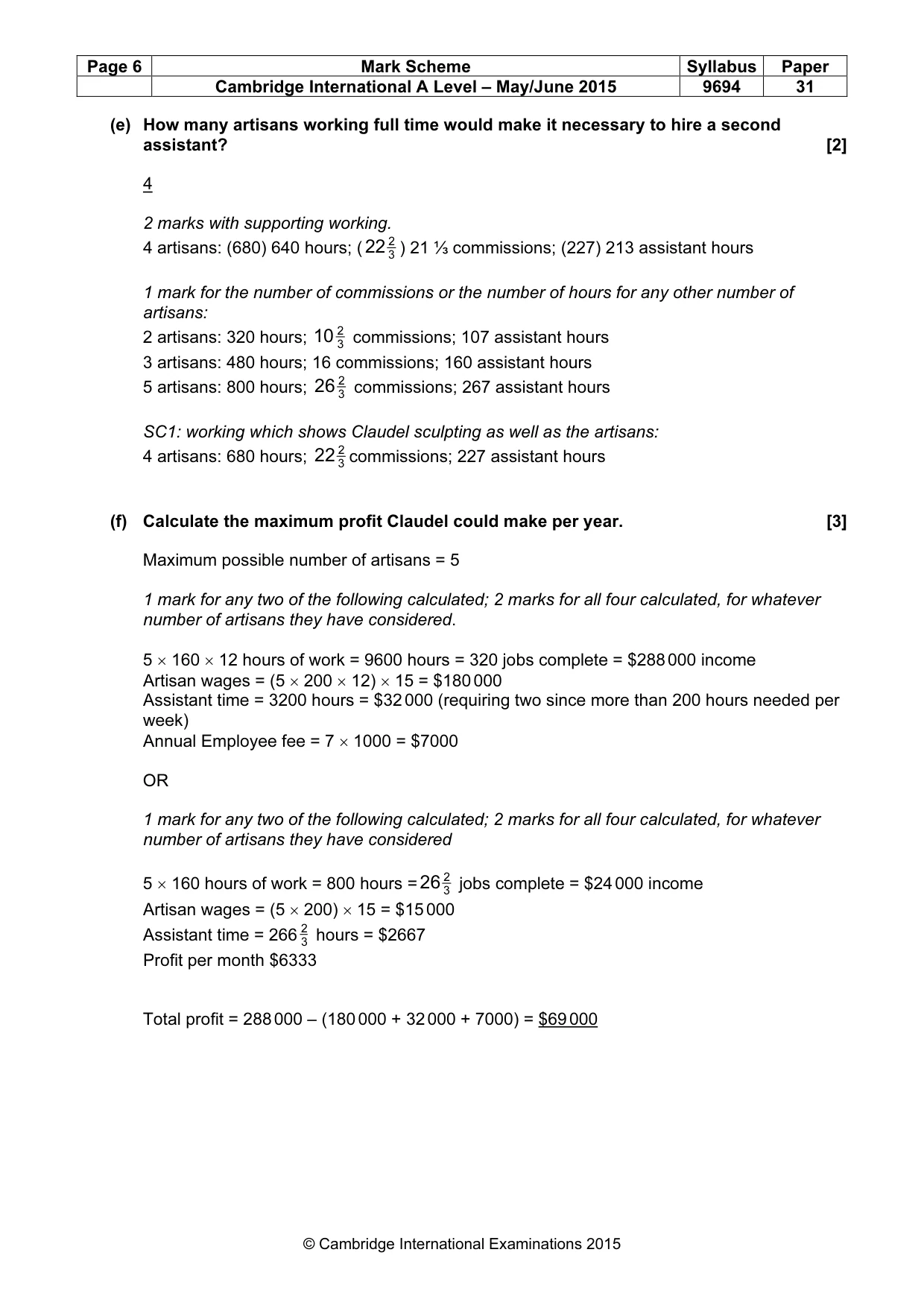
Page 6 Mark Scheme Syllabus Paper Cambridge International A Level – May/June 2015 9694 31 © Cambridge International Examinations 2015 (e) How many artisans working full time would make it necessary to hire a second assistant? [2] 4 2 marks with supporting working. 4 artisans: (680) 640 hours; ( 3 2 22 ) 21 ⅓ commissions; (227) 213 assistant hours 1 mark for the number of commissions or the number of hours for any other number of artisans: 2 artisans: 320 hours; 3 2 10 commissions; 107 assistant hours 3 artisans: 480 hours; 16 commissions; 160 assistant hours 5 artisans: 800 hours; 3 2 26 commissions; 267 assistant hours SC1: working which shows Claudel sculpting as well as the artisans: 4 artisans: 680 hours; 3 2 22 commissions; 227 assistant hours (f) Calculate the maximum profit Claudel could make per year. [3] Maximum possible number of artisans = 5 1 mark for any two of the following calculated; 2 marks for all four calculated, for whatever number of artisans they have considered. 5 × 160 × 12 hours of work = 9600 hours = 320 jobs complete = $288 000 income Artisan wages = (5 × 200 × 12) × 15 = $180 000 Assistant time = 3200 hours = $32 000 (requiring two since more than 200 hours needed per week) Annual Employee fee = 7 × 1000 = $7000 OR 1 mark for any two of the following calculated; 2 marks for all four calculated, for whatever number of artisans they have considered 5 × 160 hours of work = 800 hours = 3 2 26 jobs complete = $24 000 income Artisan wages = (5 × 200) × 15 = $15 000 Assistant time = 266 3 2 hours = $2667 Profit per month $6333 Total profit = 288 000 – (180 000 + 32 000 + 7000) = $69 000
Mark scheme, page 7
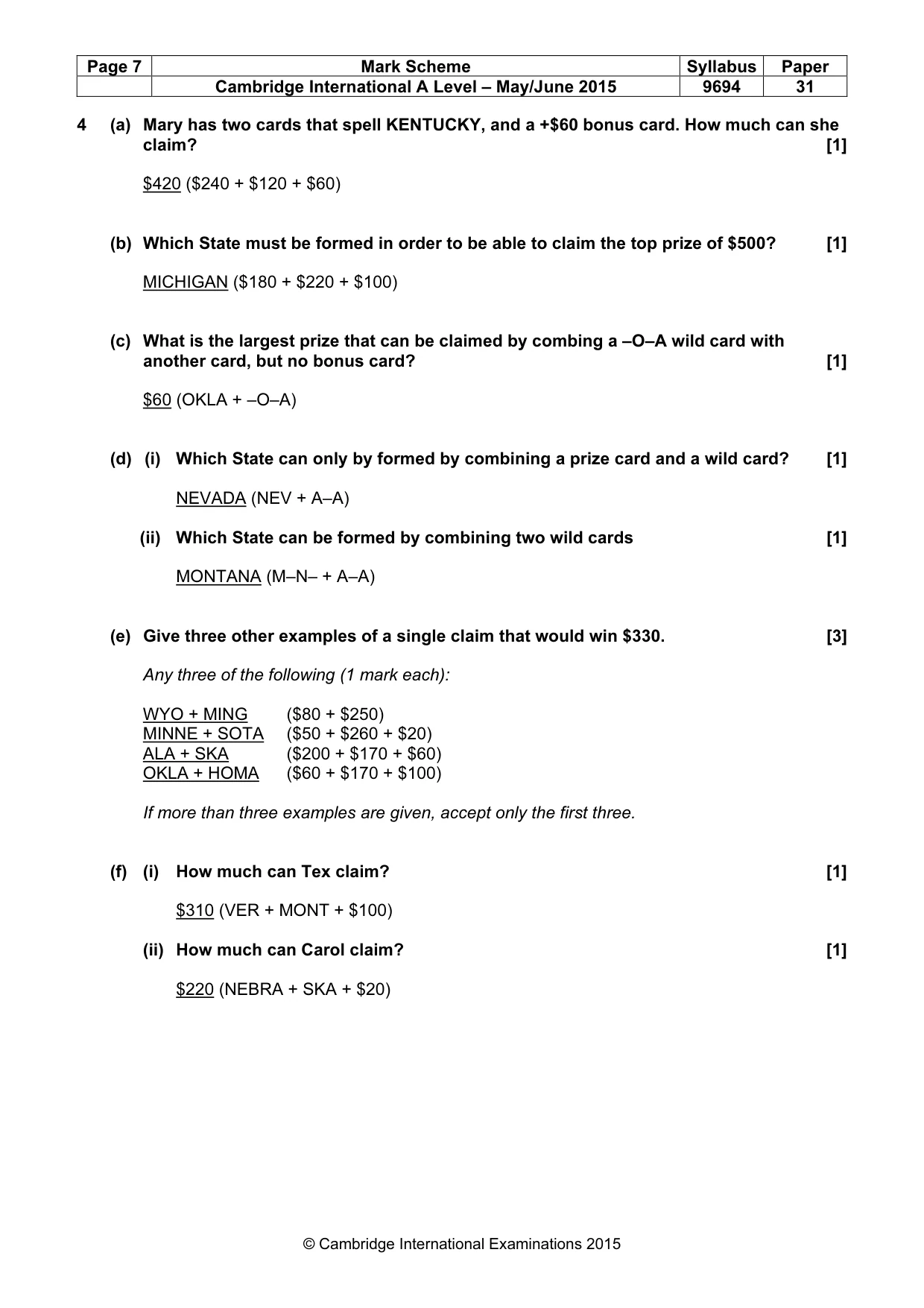
Page 7 Mark Scheme Syllabus Paper Cambridge International A Level – May/June 2015 9694 31 © Cambridge International Examinations 2015 4 (a) Mary has two cards that spell KENTUCKY, and a +$60 bonus card. How much can she claim? [1] $420 ($240 + $120 + $60) (b) Which State must be formed in order to be able to claim the top prize of $500? [1] MICHIGAN ($180 + $220 + $100) (c) What is the largest prize that can be claimed by combing a –O–A wild card with another card, but no bonus card? [1] $60 (OKLA + –O–A) (d) (i) Which State can only by formed by combining a prize card and a wild card? [1] NEVADA (NEV + A–A) (ii) Which State can be formed by combining two wild cards [1] MONTANA (M–N– + A–A) (e) Give three other examples of a single claim that would win $330. [3] Any three of the following (1 mark each): WYO + MING ($80 + $250) MINNE + SOTA ($50 + $260 + $20) ALA + SKA ($200 + $170 + $60) OKLA + HOMA ($60 + $170 + $100) If more than three examples are given, accept only the first three. (f) (i) How much can Tex claim? [1] $310 (VER + MONT + $100) (ii) How much can Carol claim? [1] $220 (NEBRA + SKA + $20)
Mark scheme, page 8
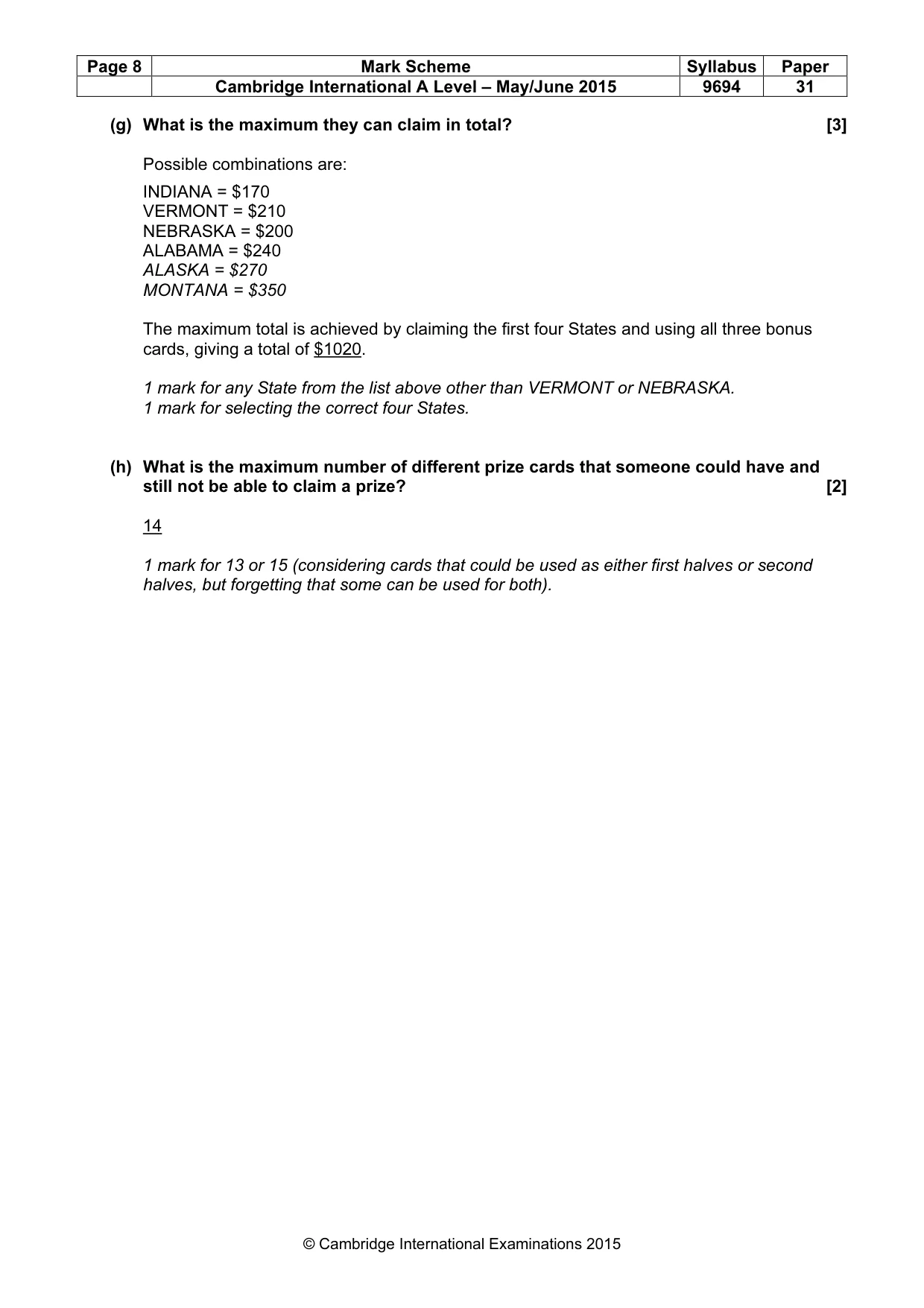
Page 8 Mark Scheme Syllabus Paper Cambridge International A Level – May/June 2015 9694 31 © Cambridge International Examinations 2015 (g) What is the maximum they can claim in total? [3] Possible combinations are: INDIANA = $170 VERMONT = $210 NEBRASKA = $200 ALABAMA = $240 ALASKA = $270 MONTANA = $350 The maximum total is achieved by claiming the first four States and using all three bonus cards, giving a total of $1020. 1 mark for any State from the list above other than VERMONT or NEBRASKA. 1 mark for selecting the correct four States. (h) What is the maximum number of different prize cards that someone could have and still not be able to claim a prize? [2] 14 1 mark for 13 or 15 (considering cards that could be used as either first halves or second halves, but forgetting that some can be used for both).
What you needed in this session
Cambridge’s own grade thresholds for 2015 May/June, Paper 3 · Variant 1. A higher threshold means an easier paper — the bar moves with how the cohort did.