Cambridge A Level Thinking Skills 9694 — 2015 May/June Paper 3 · Variant 2
9694/32/M/J/15 · 50 marks · ≈56 min
The question paper and its mark scheme, free to read here and free to download. This is Cambridge’s own paper, exactly as it was sat.
Question paper8 pages
Mark scheme8 pages
Answers below. Sit the paper first if you are practising.
Paper as text
Question paper, page 1
This document consists of 7 printed pages, 1 blank page and 1 insert. IB15 06_9694_32/3RP © UCLES 2015 [Turn over *3826991201* Cambridge International Examinations Cambridge International Advanced Level THINKING SKILLS 9694/32 Paper 3 Problem Analysis and Solution May/June 2015 2 hours Additional Materials: Electronic Calculator READ THESE INSTRUCTIONS FIRST An answer booklet is provided inside this question paper. You should follow the instructions on the front cover of the answer booklet. If you need additional answer paper ask the invigilator for a continuation booklet. Answer all the questions. Show your working. Marks may be awarded for correct steps towards a solution, even if the final answer is not correct. Marks may be lost if working needed to support an answer is not shown. Calculators should be used where appropriate. The number of marks is given in brackets [ ] at the end of each question or part question.
Question paper, page 2
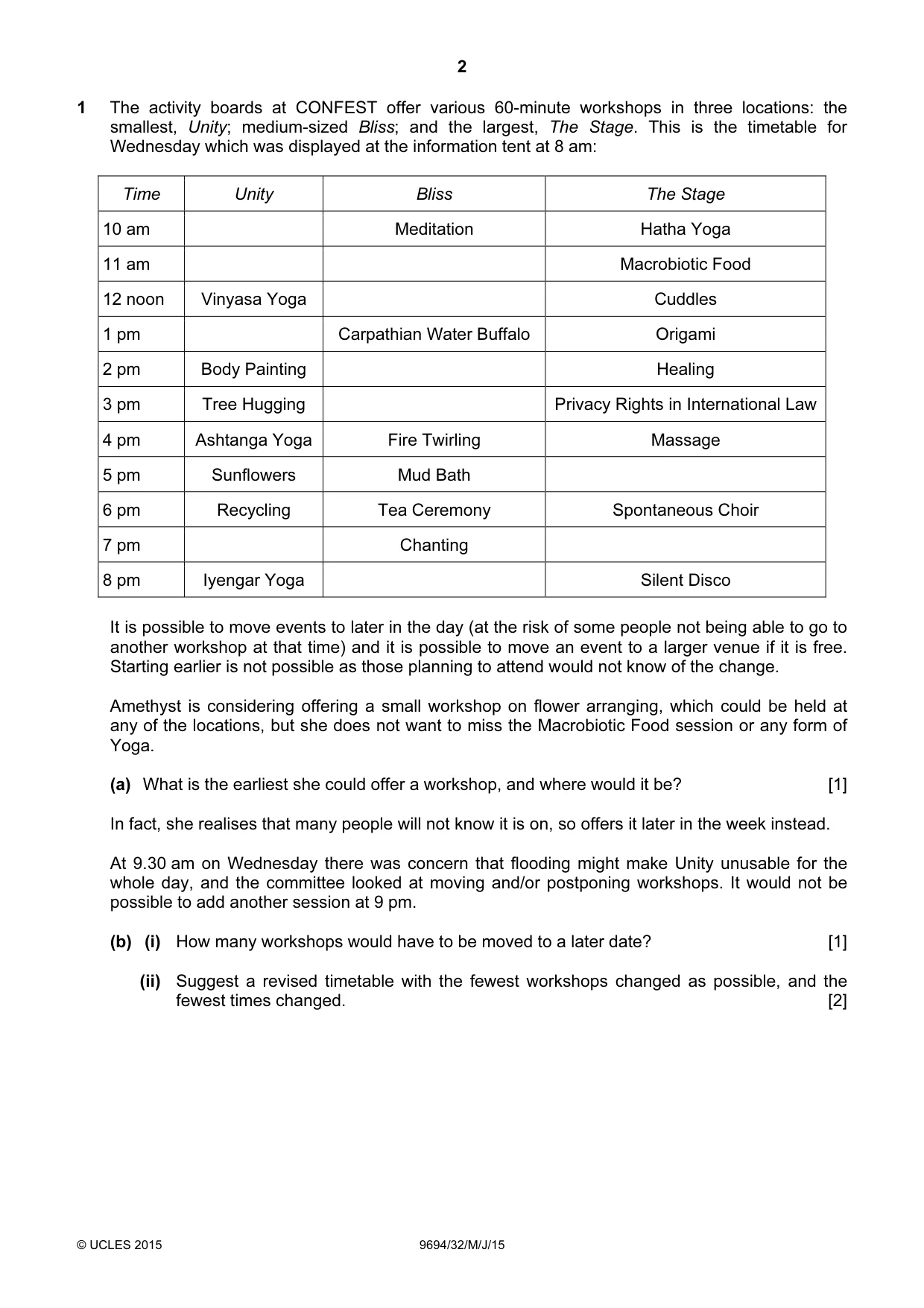
2 © UCLES 2015 9694/32/M/J/15 1 The activity boards at CONFEST offer various 60-minute workshops in three locations: the smallest, Unity; medium-sized Bliss; and the largest, The Stage. This is the timetable for Wednesday which was displayed at the information tent at 8 am: Time Unity Bliss The Stage 10 am Meditation Hatha Yoga 11 am Macrobiotic Food 12 noon Vinyasa Yoga Cuddles 1 pm Carpathian Water Buffalo Origami 2 pm Body Painting Healing 3 pm Tree Hugging Privacy Rights in International Law 4 pm Ashtanga Yoga Fire Twirling Massage 5 pm Sunflowers Mud Bath 6 pm Recycling Tea Ceremony Spontaneous Choir 7 pm Chanting 8 pm Iyengar Yoga Silent Disco It is possible to move events to later in the day (at the risk of some people not being able to go to another workshop at that time) and it is possible to move an event to a larger venue if it is free. Starting earlier is not possible as those planning to attend would not know of the change. Amethyst is considering offering a small workshop on flower arranging, which could be held at any of the locations, but she does not want to miss the Macrobiotic Food session or any form of Yoga. (a) What is the earliest she could offer a workshop, and where would it be? [1] In fact, she realises that many people will not know it is on, so offers it later in the week instead. At 9.30 am on Wednesday there was concern that flooding might make Unity unusable for the whole day, and the committee looked at moving and/or postponing workshops. It would not be possible to add another session at 9 pm. (b) (i) How many workshops would have to be moved to a later date? [1] (ii) Suggest a revised timetable with the fewest workshops changed as possible, and the fewest times changed. [2]
Question paper, page 3
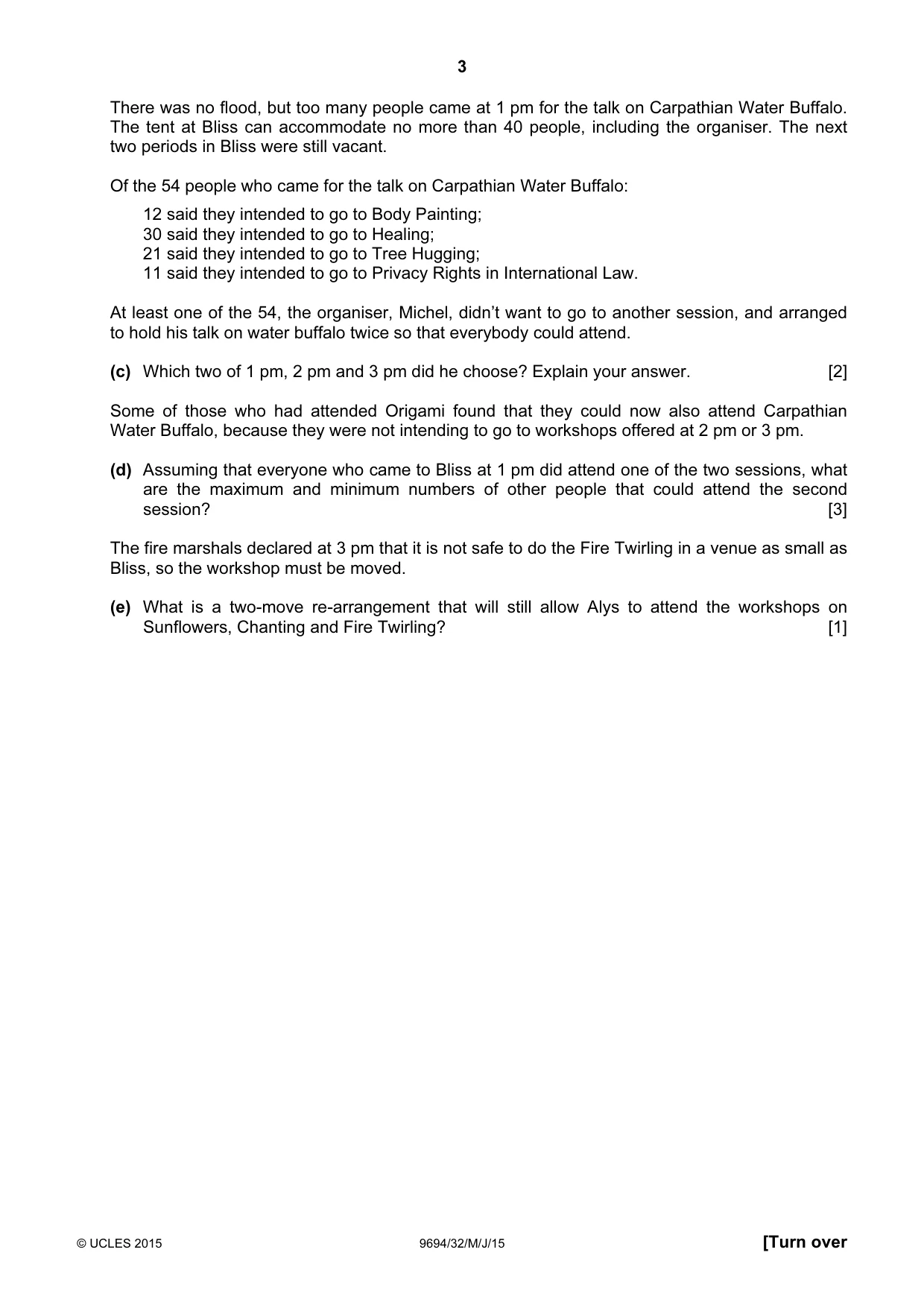
3 © UCLES 2015 9694/32/M/J/15 [Turn over There was no flood, but too many people came at 1 pm for the talk on Carpathian Water Buffalo. The tent at Bliss can accommodate no more than 40 people, including the organiser. The next two periods in Bliss were still vacant. Of the 54 people who came for the talk on Carpathian Water Buffalo: 12 said they intended to go to Body Painting; 30 said they intended to go to Healing; 21 said they intended to go to Tree Hugging; 11 said they intended to go to Privacy Rights in International Law. At least one of the 54, the organiser, Michel, didn’t want to go to another session, and arranged to hold his talk on water buffalo twice so that everybody could attend. (c) Which two of 1 pm, 2 pm and 3 pm did he choose? Explain your answer. [2] Some of those who had attended Origami found that they could now also attend Carpathian Water Buffalo, because they were not intending to go to workshops offered at 2 pm or 3 pm. (d) Assuming that everyone who came to Bliss at 1 pm did attend one of the two sessions, what are the maximum and minimum numbers of other people that could attend the second session? [3] The fire marshals declared at 3 pm that it is not safe to do the Fire Twirling in a venue as small as Bliss, so the workshop must be moved. (e) What is a two-move re-arrangement that will still allow Alys to attend the workshops on Sunflowers, Chanting and Fire Twirling? [1]
Question paper, page 4
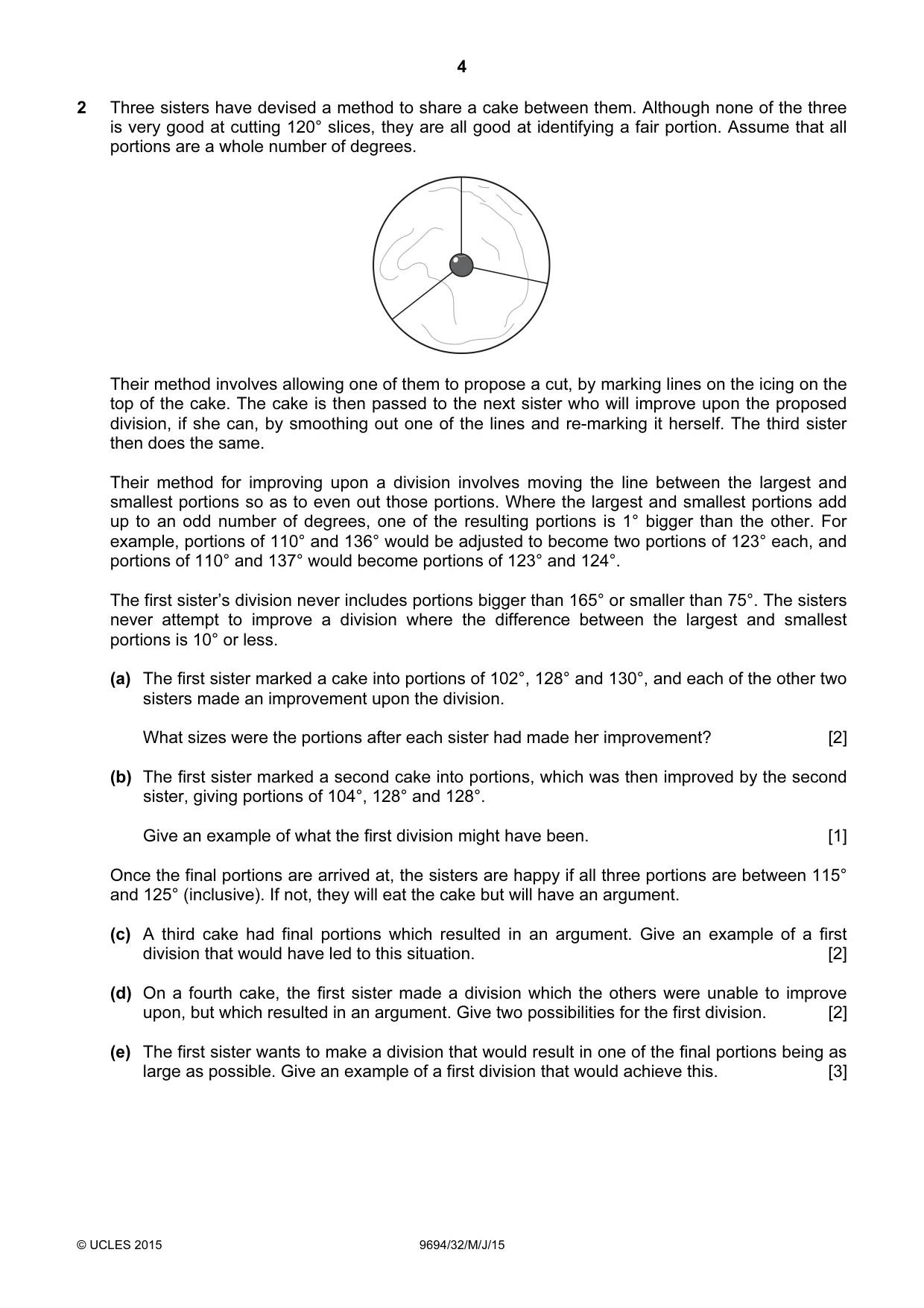
4 © UCLES 2015 9694/32/M/J/15 2 Three sisters have devised a method to share a cake between them. Although none of the three is very good at cutting 120° slices, they are all good at identifying a fair portion. Assume that all portions are a whole number of degrees. Their method involves allowing one of them to propose a cut, by marking lines on the icing on the top of the cake. The cake is then passed to the next sister who will improve upon the proposed division, if she can, by smoothing out one of the lines and re-marking it herself. The third sister then does the same. Their method for improving upon a division involves moving the line between the largest and smallest portions so as to even out those portions. Where the largest and smallest portions add up to an odd number of degrees, one of the resulting portions is 1° bigger than the other. For example, portions of 110° and 136° would be adjusted to become two portions of 123° each, and portions of 110° and 137° would become portions of 123° and 124°. The first sister’s division never includes portions bigger than 165° or smaller than 75°. The sisters never attempt to improve a division where the difference between the largest and smallest portions is 10° or less. (a) The first sister marked a cake into portions of 102°, 128° and 130°, and each of the other two sisters made an improvement upon the division. What sizes were the portions after each sister had made her improvement? [2] (b) The first sister marked a second cake into portions, which was then improved by the second sister, giving portions of 104°, 128° and 128°. Give an example of what the first division might have been. [1] Once the final portions are arrived at, the sisters are happy if all three portions are between 115° and 125° (inclusive). If not, they will eat the cake but will have an argument. (c) A third cake had final portions which resulted in an argument. Give an example of a first division that would have led to this situation. [2] (d) On a fourth cake, the first sister made a division which the others were unable to improve upon, but which resulted in an argument. Give two possibilities for the first division. [2] (e) The first sister wants to make a division that would result in one of the final portions being as large as possible. Give an example of a first division that would achieve this. [3]
Question paper, page 5
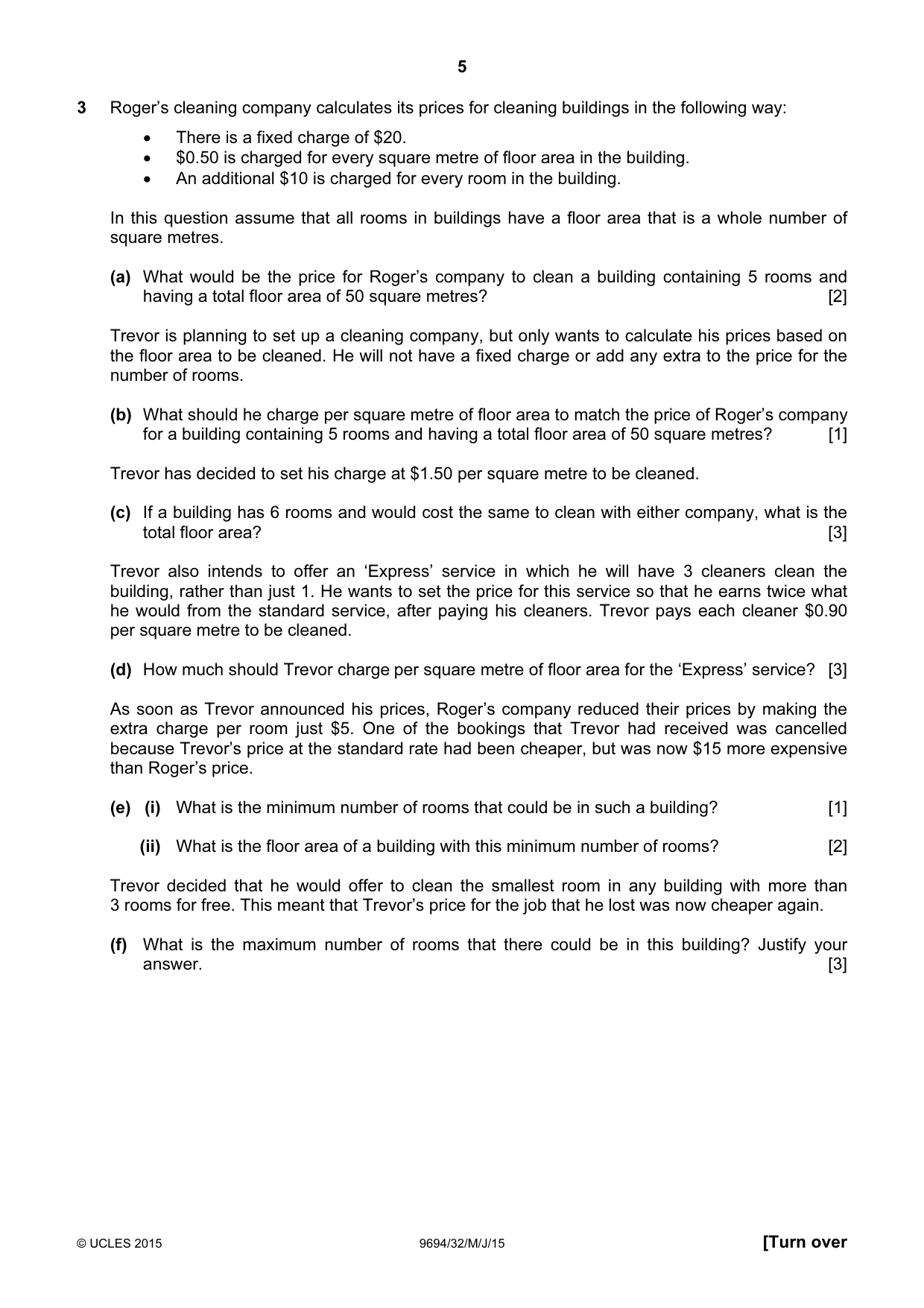
5 © UCLES 2015 9694/32/M/J/15 [Turn over 3 Roger’s cleaning company calculates its prices for cleaning buildings in the following way: • There is a fixed charge of $20. • $0.50 is charged for every square metre of floor area in the building. • An additional $10 is charged for every room in the building. In this question assume that all rooms in buildings have a floor area that is a whole number of square metres. (a) What would be the price for Roger’s company to clean a building containing 5 rooms and having a total floor area of 50 square metres? [2] Trevor is planning to set up a cleaning company, but only wants to calculate his prices based on the floor area to be cleaned. He will not have a fixed charge or add any extra to the price for the number of rooms. (b) What should he charge per square metre of floor area to match the price of Roger’s company for a building containing 5 rooms and having a total floor area of 50 square metres? [1] Trevor has decided to set his charge at $1.50 per square metre to be cleaned. (c) If a building has 6 rooms and would cost the same to clean with either company, what is the total floor area? [3] Trevor also intends to offer an ‘Express’ service in which he will have 3 cleaners clean the building, rather than just 1. He wants to set the price for this service so that he earns twice what he would from the standard service, after paying his cleaners. Trevor pays each cleaner $0.90 per square metre to be cleaned. (d) How much should Trevor charge per square metre of floor area for the ‘Express’ service? [3] As soon as Trevor announced his prices, Roger’s company reduced their prices by making the extra charge per room just $5. One of the bookings that Trevor had received was cancelled because Trevor’s price at the standard rate had been cheaper, but was now $15 more expensive than Roger’s price. (e) (i) What is the minimum number of rooms that could be in such a building? [1] (ii) What is the floor area of a building with this minimum number of rooms? [2] Trevor decided that he would offer to clean the smallest room in any building with more than 3 rooms for free. This meant that Trevor’s price for the job that he lost was now cheaper again. (f) What is the maximum number of rooms that there could be in this building? Justify your answer. [3]
Question paper, page 6
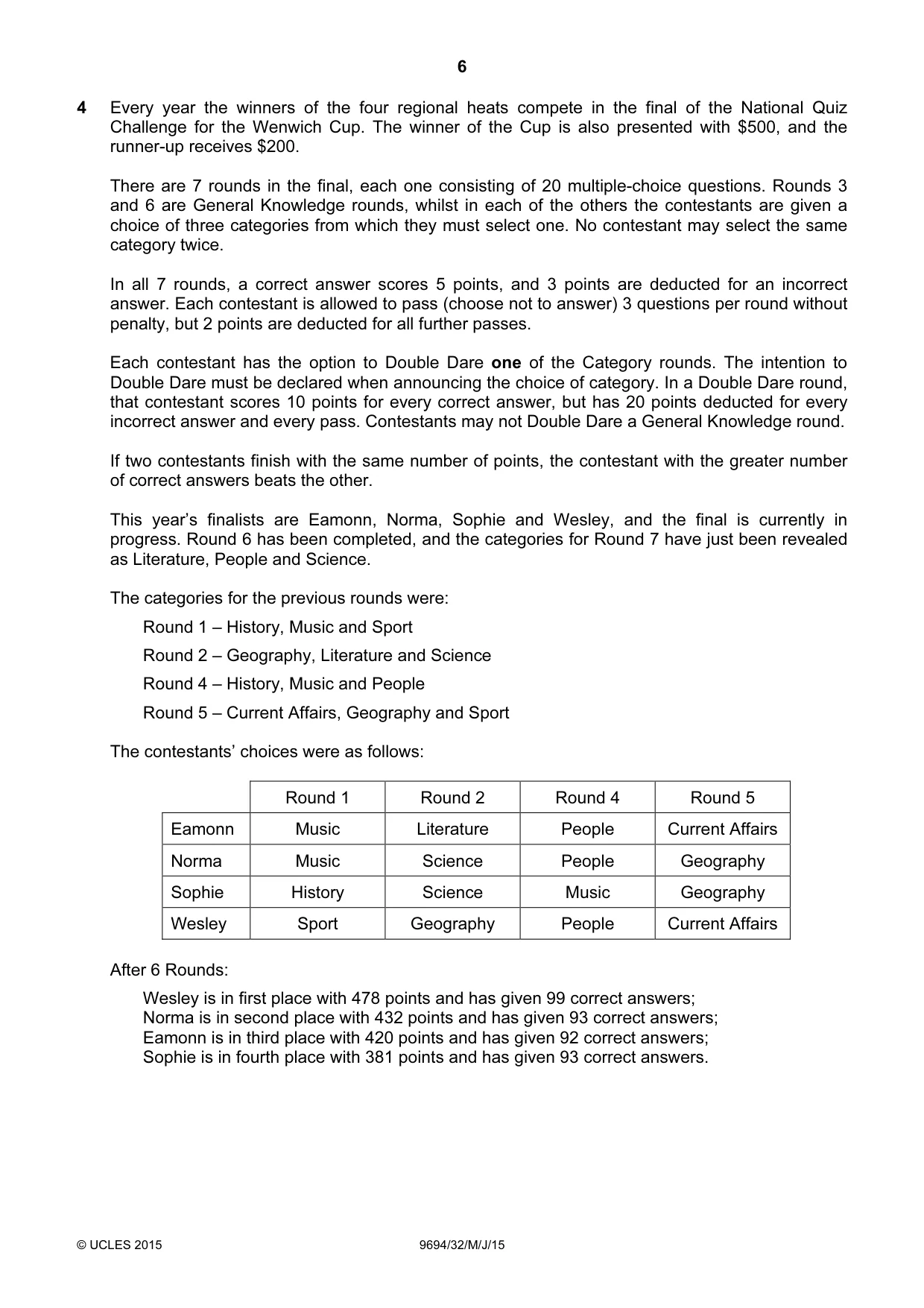
6 © UCLES 2015 9694/32/M/J/15 4 Every year the winners of the four regional heats compete in the final of the National Quiz Challenge for the Wenwich Cup. The winner of the Cup is also presented with $500, and the runner-up receives $200. There are 7 rounds in the final, each one consisting of 20 multiple-choice questions. Rounds 3 and 6 are General Knowledge rounds, whilst in each of the others the contestants are given a choice of three categories from which they must select one. No contestant may select the same category twice. In all 7 rounds, a correct answer scores 5 points, and 3 points are deducted for an incorrect answer. Each contestant is allowed to pass (choose not to answer) 3 questions per round without penalty, but 2 points are deducted for all further passes. Each contestant has the option to Double Dare one of the Category rounds. The intention to Double Dare must be declared when announcing the choice of category. In a Double Dare round, that contestant scores 10 points for every correct answer, but has 20 points deducted for every incorrect answer and every pass. Contestants may not Double Dare a General Knowledge round. If two contestants finish with the same number of points, the contestant with the greater number of correct answers beats the other. This year’s finalists are Eamonn, Norma, Sophie and Wesley, and the final is currently in progress. Round 6 has been completed, and the categories for Round 7 have just been revealed as Literature, People and Science. The categories for the previous rounds were: Round 1 – History, Music and Sport Round 2 – Geography, Literature and Science Round 4 – History, Music and People Round 5 – Current Affairs, Geography and Sport The contestants’ choices were as follows: Round 1 Round 2 Round 4 Round 5 Eamonn Music Literature People Current Affairs Norma Music Science People Geography Sophie History Science Music Geography Wesley Sport Geography People Current Affairs After 6 Rounds: Wesley is in first place with 478 points and has given 99 correct answers; Norma is in second place with 432 points and has given 93 correct answers; Eamonn is in third place with 420 points and has given 92 correct answers; Sophie is in fourth place with 381 points and has given 93 correct answers.
Question paper, page 7
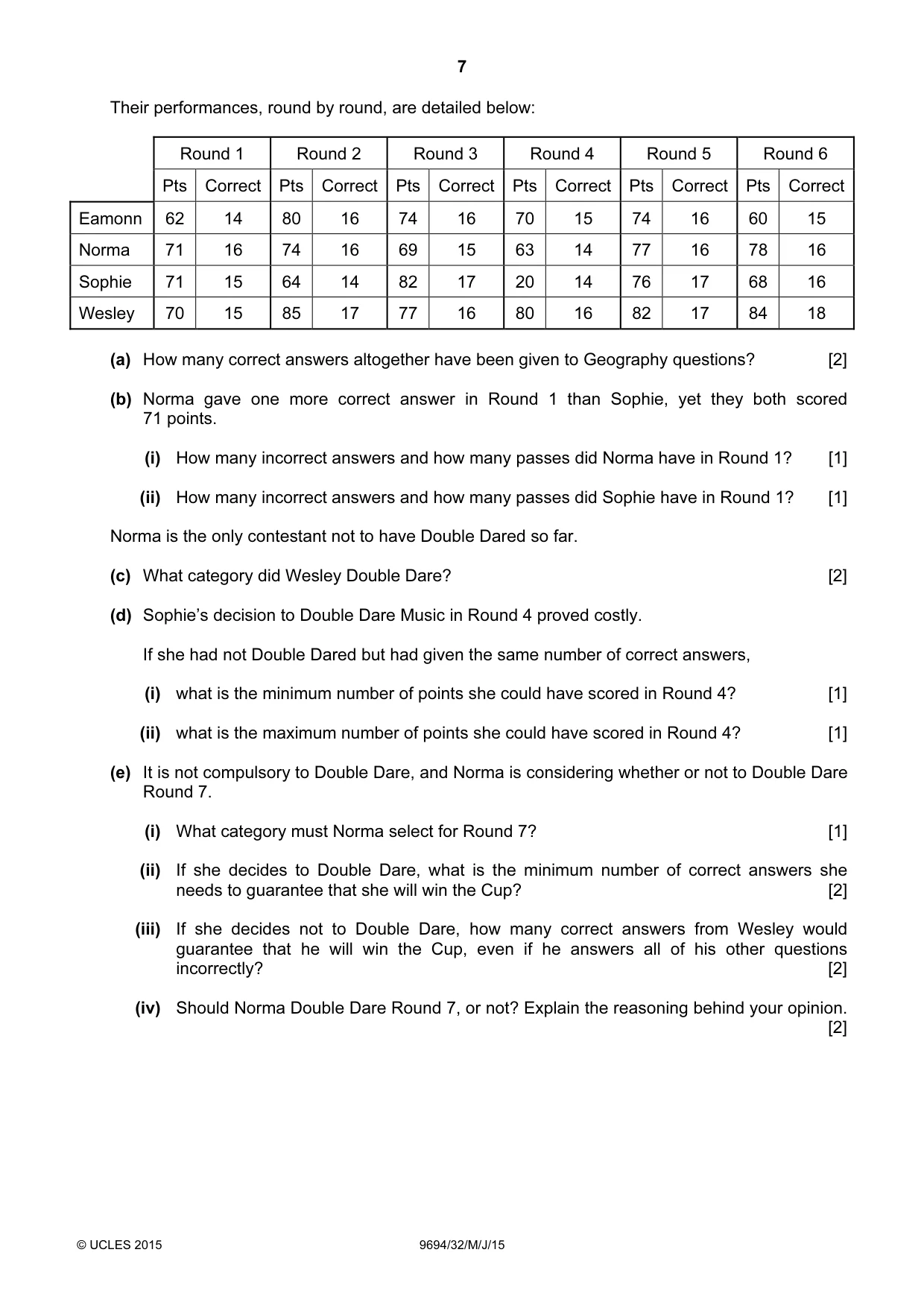
7 © UCLES 2015 9694/32/M/J/15 Their performances, round by round, are detailed below: Round 1 Round 2 Round 3 Round 4 Round 5 Round 6 Pts Correct Pts Correct Pts Correct Pts Correct Pts Correct Pts Correct Eamonn 62 14 80 16 74 16 70 15 74 16 60 15 Norma 71 16 74 16 69 15 63 14 77 16 78 16 Sophie 71 15 64 14 82 17 20 14 76 17 68 16 Wesley 70 15 85 17 77 16 80 16 82 17 84 18 (a) How many correct answers altogether have been given to Geography questions? [2] (b) Norma gave one more correct answer in Round 1 than Sophie, yet they both scored 71 points. (i) How many incorrect answers and how many passes did Norma have in Round 1? [1] (ii) How many incorrect answers and how many passes did Sophie have in Round 1? [1] Norma is the only contestant not to have Double Dared so far. (c) What category did Wesley Double Dare? [2] (d) Sophie’s decision to Double Dare Music in Round 4 proved costly. If she had not Double Dared but had given the same number of correct answers, (i) what is the minimum number of points she could have scored in Round 4? [1] (ii) what is the maximum number of points she could have scored in Round 4? [1] (e) It is not compulsory to Double Dare, and Norma is considering whether or not to Double Dare Round 7. (i) What category must Norma select for Round 7? [1] (ii) If she decides to Double Dare, what is the minimum number of correct answers she needs to guarantee that she will win the Cup? [2] (iii) If she decides not to Double Dare, how many correct answers from Wesley would guarantee that he will win the Cup, even if he answers all of his other questions incorrectly? [2] (iv) Should Norma Double Dare Round 7, or not? Explain the reasoning behind your opinion. [2]
Question paper, page 8
8 Permission to reproduce items where third-party owned material protected by copyright is included has been sought and cleared where possible. Every reasonable effort has been made by the publisher (UCLES) to trace copyright holders, but if any items requiring clearance have unwittingly been included, the publisher will be pleased to make amends at the earliest possible opportunity. To avoid the issue of disclosure of answer-related information to candidates, all copyright acknowledgements are reproduced online in the Cambridge International Examinations Copyright Acknowledgements Booklet. This is produced for each series of examinations and is freely available to download at www.cie.org.uk after the live examination series. Cambridge International Examinations is part of the Cambridge Assessment Group. Cambridge Assessment is the brand name of University of Cambridge Local Examinations Syndicate (UCLES), which is itself a department of the University of Cambridge. © UCLES 2015 9694/32/M/J/15 BLANK PAGE
Mark scheme, page 1
® IGCSE is the registered trademark of Cambridge International Examinations. CAMBRIDGE INTERNATIONAL EXAMINATIONS Cambridge International Advanced Level MARK SCHEME for the May/June 2015 series 9694 THINKING SKILLS 9694/32 Paper 3 (Problem Analysis and Solution), maximum raw mark 50 This mark scheme is published as an aid to teachers and candidates, to indicate the requirements of the examination. It shows the basis on which Examiners were instructed to award marks. It does not indicate the details of the discussions that took place at an Examiners’ meeting before marking began, which would have considered the acceptability of alternative answers. Mark schemes should be read in conjunction with the question paper and the Principal Examiner Report for Teachers. Cambridge will not enter into discussions about these mark schemes. Cambridge is publishing the mark schemes for the May/June 2015 series for most Cambridge IGCSE®, Cambridge International A and AS Level components and some Cambridge O Level components.
Mark scheme, page 2
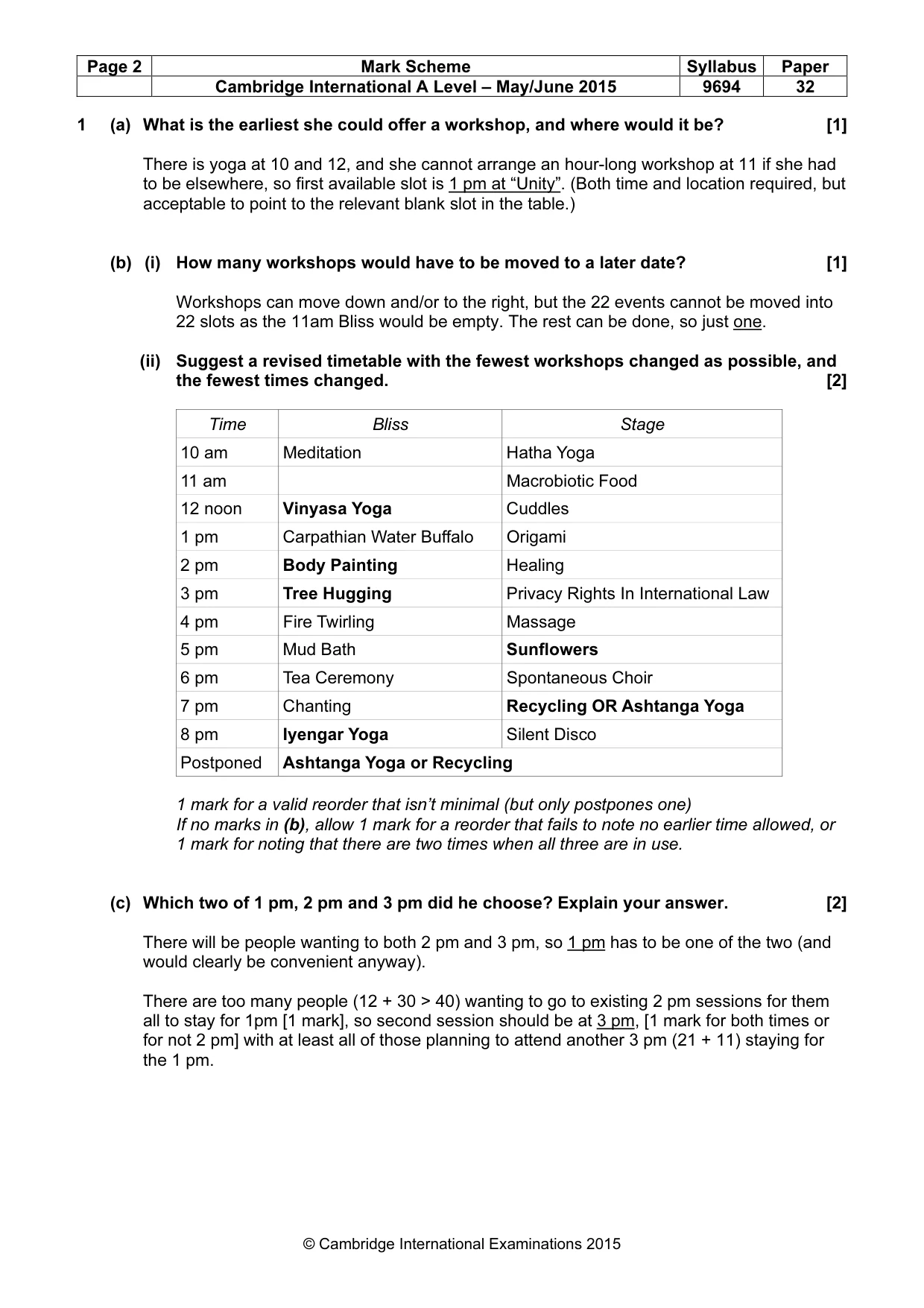
Page 2 Mark Scheme Syllabus Paper Cambridge International A Level – May/June 2015 9694 32 © Cambridge International Examinations 2015 1 (a) What is the earliest she could offer a workshop, and where would it be? [1] There is yoga at 10 and 12, and she cannot arrange an hour-long workshop at 11 if she had to be elsewhere, so first available slot is 1 pm at “Unity”. (Both time and location required, but acceptable to point to the relevant blank slot in the table.) (b) (i) How many workshops would have to be moved to a later date? [1] Workshops can move down and/or to the right, but the 22 events cannot be moved into 22 slots as the 11am Bliss would be empty. The rest can be done, so just one. (ii) Suggest a revised timetable with the fewest workshops changed as possible, and the fewest times changed. [2] Time Bliss Stage 10 am Meditation Hatha Yoga 11 am Macrobiotic Food 12 noon Vinyasa Yoga Cuddles 1 pm Carpathian Water Buffalo Origami 2 pm Body Painting Healing 3 pm Tree Hugging Privacy Rights In International Law 4 pm Fire Twirling Massage 5 pm Mud Bath Sunflowers 6 pm Tea Ceremony Spontaneous Choir 7 pm Chanting Recycling OR Ashtanga Yoga 8 pm Iyengar Yoga Silent Disco Postponed Ashtanga Yoga or Recycling 1 mark for a valid reorder that isn’t minimal (but only postpones one) If no marks in (b), allow 1 mark for a reorder that fails to note no earlier time allowed, or 1 mark for noting that there are two times when all three are in use. (c) Which two of 1 pm, 2 pm and 3 pm did he choose? Explain your answer. [2] There will be people wanting to both 2 pm and 3 pm, so 1 pm has to be one of the two (and would clearly be convenient anyway). There are too many people (12 + 30 > 40) wanting to go to existing 2 pm sessions for them all to stay for 1pm [1 mark], so second session should be at 3 pm, [1 mark for both times or for not 2 pm] with at least all of those planning to attend another 3 pm (21 + 11) staying for the 1 pm.
Mark scheme, page 3
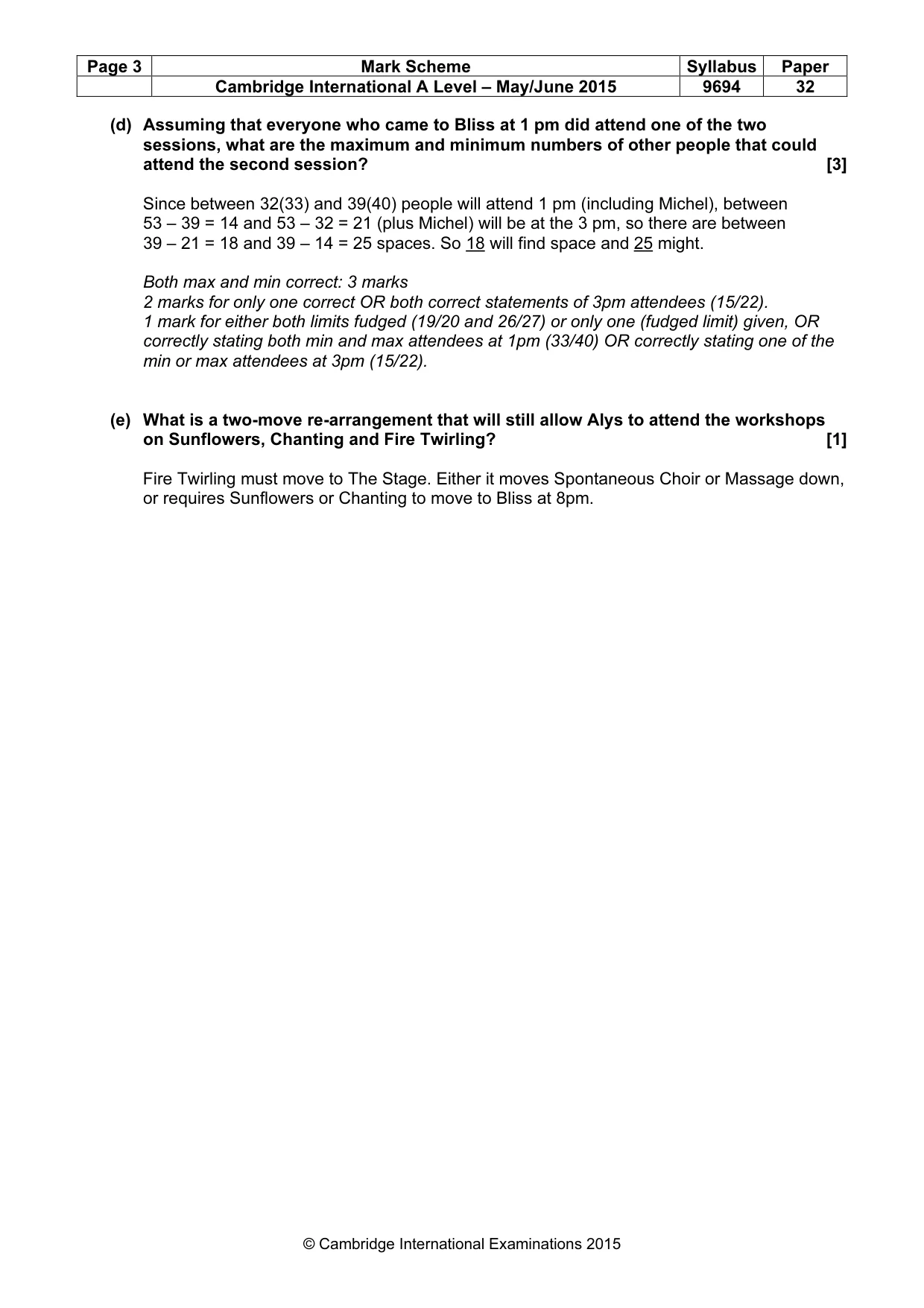
Page 3 Mark Scheme Syllabus Paper Cambridge International A Level – May/June 2015 9694 32 © Cambridge International Examinations 2015 (d) Assuming that everyone who came to Bliss at 1 pm did attend one of the two sessions, what are the maximum and minimum numbers of other people that could attend the second session? [3] Since between 32(33) and 39(40) people will attend 1 pm (including Michel), between 53 – 39 = 14 and 53 – 32 = 21 (plus Michel) will be at the 3 pm, so there are between 39 – 21 = 18 and 39 – 14 = 25 spaces. So 18 will find space and 25 might. Both max and min correct: 3 marks 2 marks for only one correct OR both correct statements of 3pm attendees (15/22). 1 mark for either both limits fudged (19/20 and 26/27) or only one (fudged limit) given, OR correctly stating both min and max attendees at 1pm (33/40) OR correctly stating one of the min or max attendees at 3pm (15/22). (e) What is a two-move re-arrangement that will still allow Alys to attend the workshops on Sunflowers, Chanting and Fire Twirling? [1] Fire Twirling must move to The Stage. Either it moves Spontaneous Choir or Massage down, or requires Sunflowers or Chanting to move to Bliss at 8pm.
Mark scheme, page 4
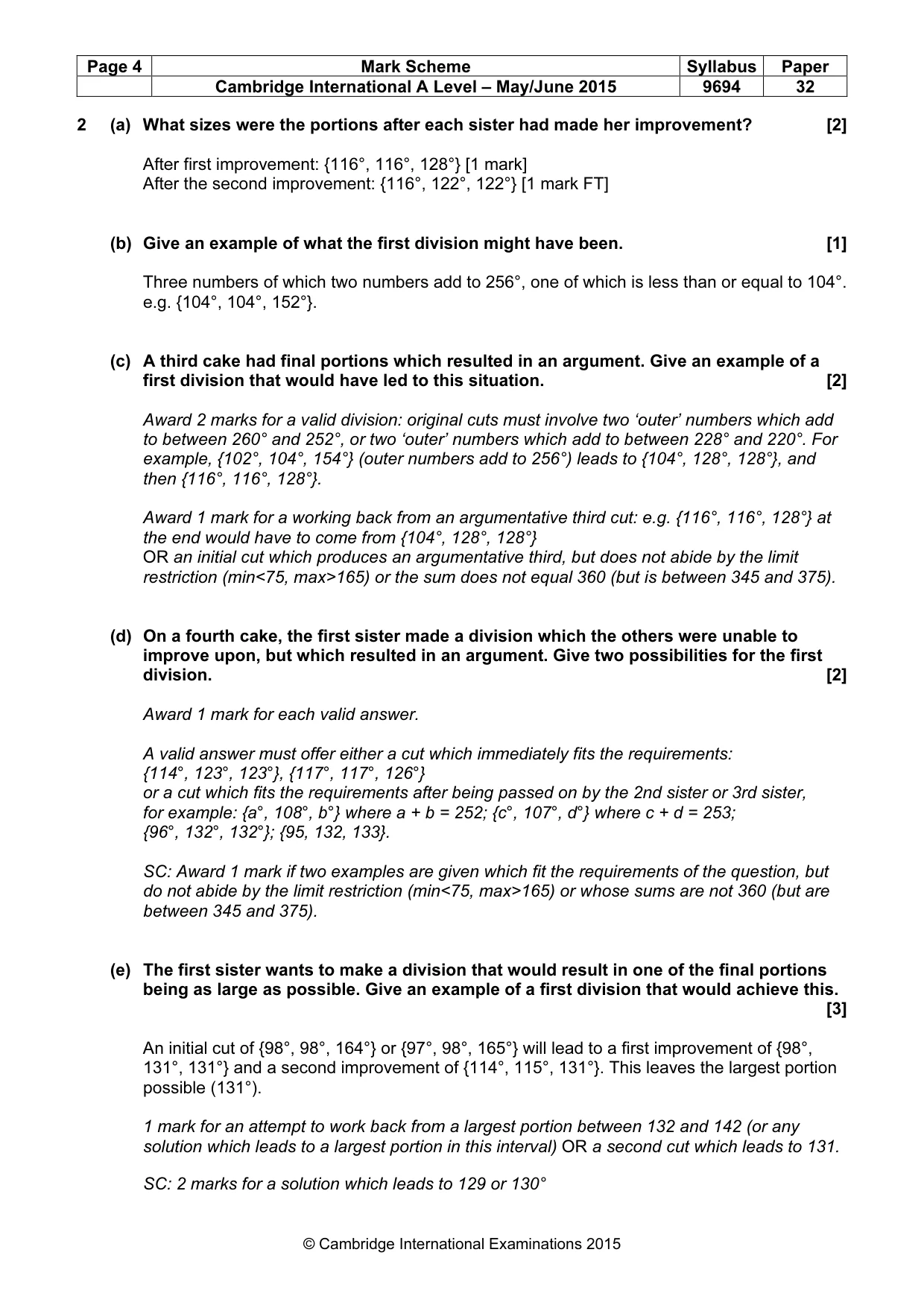
Page 4 Mark Scheme Syllabus Paper Cambridge International A Level – May/June 2015 9694 32 © Cambridge International Examinations 2015 2 (a) What sizes were the portions after each sister had made her improvement? [2] After first improvement: {116°, 116°, 128°} [1 mark] After the second improvement: {116°, 122°, 122°} [1 mark FT] (b) Give an example of what the first division might have been. [1] Three numbers of which two numbers add to 256°, one of which is less than or equal to 104°. e.g. {104°, 104°, 152°}. (c) A third cake had final portions which resulted in an argument. Give an example of a first division that would have led to this situation. [2] Award 2 marks for a valid division: original cuts must involve two ‘outer’ numbers which add to between 260° and 252°, or two ‘outer’ numbers which add to between 228° and 220°. For example, {102°, 104°, 154°} (outer numbers add to 256°) leads to {104°, 128°, 128°}, and then {116°, 116°, 128°}. Award 1 mark for a working back from an argumentative third cut: e.g. {116°, 116°, 128°} at the end would have to come from {104°, 128°, 128°} OR an initial cut which produces an argumentative third, but does not abide by the limit restriction (min<75, max>165) or the sum does not equal 360 (but is between 345 and 375). (d) On a fourth cake, the first sister made a division which the others were unable to improve upon, but which resulted in an argument. Give two possibilities for the first division. [2] Award 1 mark for each valid answer. A valid answer must offer either a cut which immediately fits the requirements: {114°, 123°, 123°}, {117°, 117°, 126°} or a cut which fits the requirements after being passed on by the 2nd sister or 3rd sister, for example: {a°, 108°, b°} where a + b = 252; {c°, 107°, d°} where c + d = 253; {96°, 132°, 132°}; {95, 132, 133}. SC: Award 1 mark if two examples are given which fit the requirements of the question, but do not abide by the limit restriction (min<75, max>165) or whose sums are not 360 (but are between 345 and 375). (e) The first sister wants to make a division that would result in one of the final portions being as large as possible. Give an example of a first division that would achieve this. [3] An initial cut of {98°, 98°, 164°} or {97°, 98°, 165°} will lead to a first improvement of {98°, 131°, 131°} and a second improvement of {114°, 115°, 131°}. This leaves the largest portion possible (131°). 1 mark for an attempt to work back from a largest portion between 132 and 142 (or any solution which leads to a largest portion in this interval) OR a second cut which leads to 131. SC: 2 marks for a solution which leads to 129 or 130°
Mark scheme, page 5
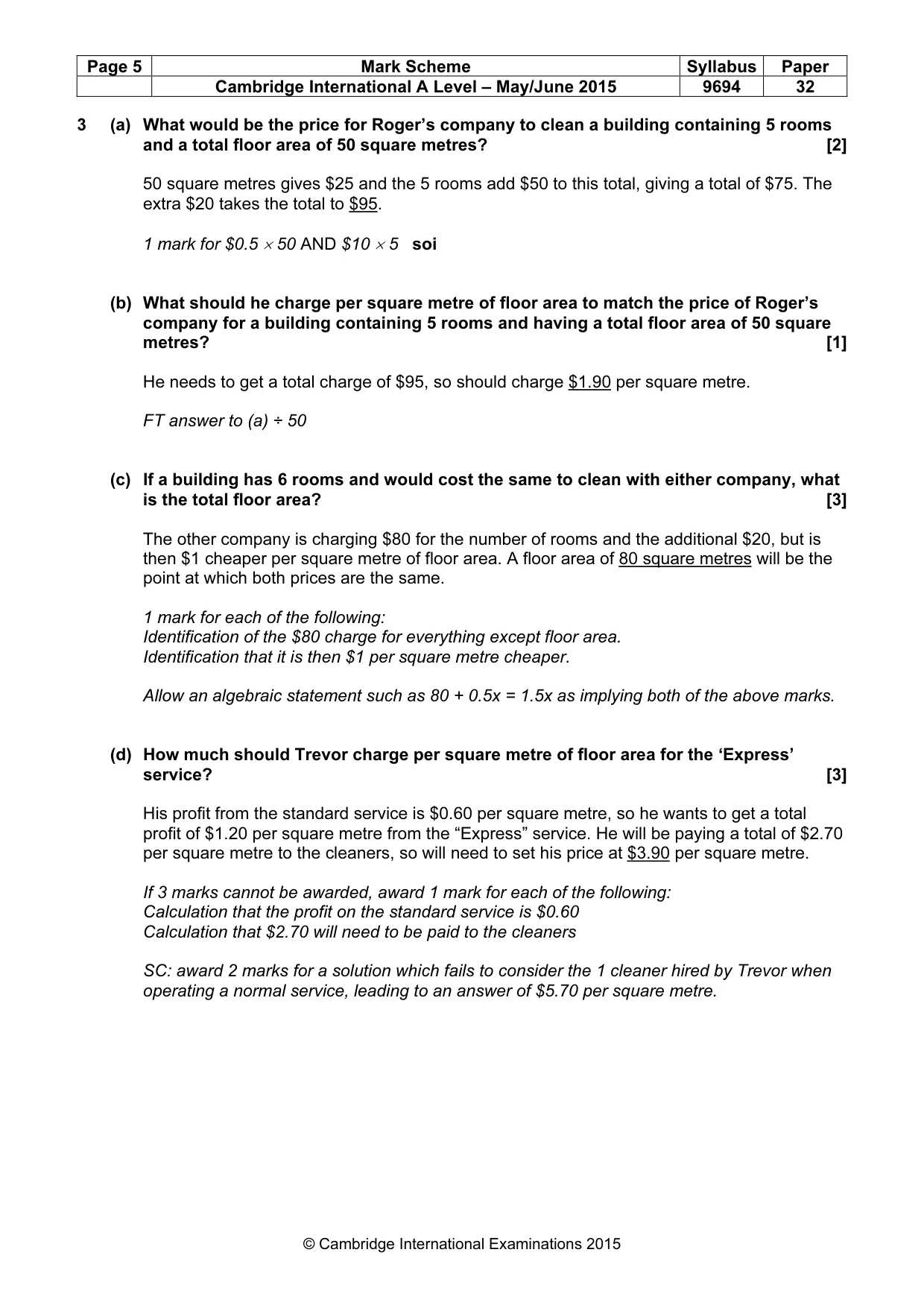
Page 5 Mark Scheme Syllabus Paper Cambridge International A Level – May/June 2015 9694 32 © Cambridge International Examinations 2015 3 (a) What would be the price for Roger’s company to clean a building containing 5 rooms and a total floor area of 50 square metres? [2] 50 square metres gives $25 and the 5 rooms add $50 to this total, giving a total of $75. The extra $20 takes the total to $95. 1 mark for $0.5 × 50 AND $10 × 5 soi (b) What should he charge per square metre of floor area to match the price of Roger’s company for a building containing 5 rooms and having a total floor area of 50 square metres? [1] He needs to get a total charge of $95, so should charge $1.90 per square metre. FT answer to (a) ÷ 50 (c) If a building has 6 rooms and would cost the same to clean with either company, what is the total floor area? [3] The other company is charging $80 for the number of rooms and the additional $20, but is then $1 cheaper per square metre of floor area. A floor area of 80 square metres will be the point at which both prices are the same. 1 mark for each of the following: Identification of the $80 charge for everything except floor area. Identification that it is then $1 per square metre cheaper. Allow an algebraic statement such as 80 + 0.5x = 1.5x as implying both of the above marks. (d) How much should Trevor charge per square metre of floor area for the ‘Express’ service? [3] His profit from the standard service is $0.60 per square metre, so he wants to get a total profit of $1.20 per square metre from the “Express” service. He will be paying a total of $2.70 per square metre to the cleaners, so will need to set his price at $3.90 per square metre. If 3 marks cannot be awarded, award 1 mark for each of the following: Calculation that the profit on the standard service is $0.60 Calculation that $2.70 will need to be paid to the cleaners SC: award 2 marks for a solution which fails to consider the 1 cleaner hired by Trevor when operating a normal service, leading to an answer of $5.70 per square metre.
Mark scheme, page 6
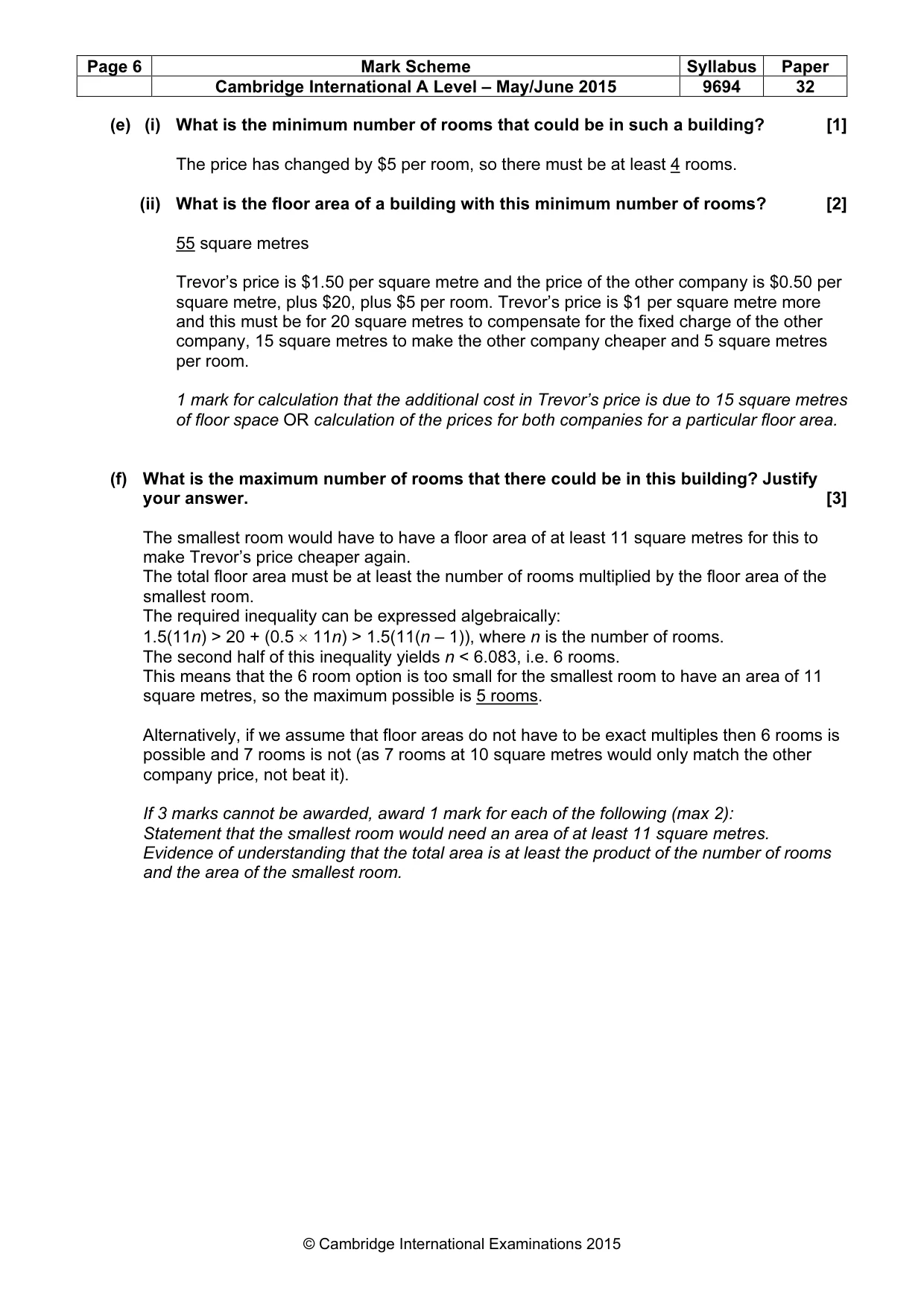
Page 6 Mark Scheme Syllabus Paper Cambridge International A Level – May/June 2015 9694 32 © Cambridge International Examinations 2015 (e) (i) What is the minimum number of rooms that could be in such a building? [1] The price has changed by $5 per room, so there must be at least 4 rooms. (ii) What is the floor area of a building with this minimum number of rooms? [2] 55 square metres Trevor’s price is $1.50 per square metre and the price of the other company is $0.50 per square metre, plus $20, plus $5 per room. Trevor’s price is $1 per square metre more and this must be for 20 square metres to compensate for the fixed charge of the other company, 15 square metres to make the other company cheaper and 5 square metres per room. 1 mark for calculation that the additional cost in Trevor’s price is due to 15 square metres of floor space OR calculation of the prices for both companies for a particular floor area. (f) What is the maximum number of rooms that there could be in this building? Justify your answer. [3] The smallest room would have to have a floor area of at least 11 square metres for this to make Trevor’s price cheaper again. The total floor area must be at least the number of rooms multiplied by the floor area of the smallest room. The required inequality can be expressed algebraically: 1.5(11n) > 20 + (0.5 × 11n) > 1.5(11(n – 1)), where n is the number of rooms. The second half of this inequality yields n < 6.083, i.e. 6 rooms. This means that the 6 room option is too small for the smallest room to have an area of 11 square metres, so the maximum possible is 5 rooms. Alternatively, if we assume that floor areas do not have to be exact multiples then 6 rooms is possible and 7 rooms is not (as 7 rooms at 10 square metres would only match the other company price, not beat it). If 3 marks cannot be awarded, award 1 mark for each of the following (max 2): Statement that the smallest room would need an area of at least 11 square metres. Evidence of understanding that the total area is at least the product of the number of rooms and the area of the smallest room.
Mark scheme, page 7
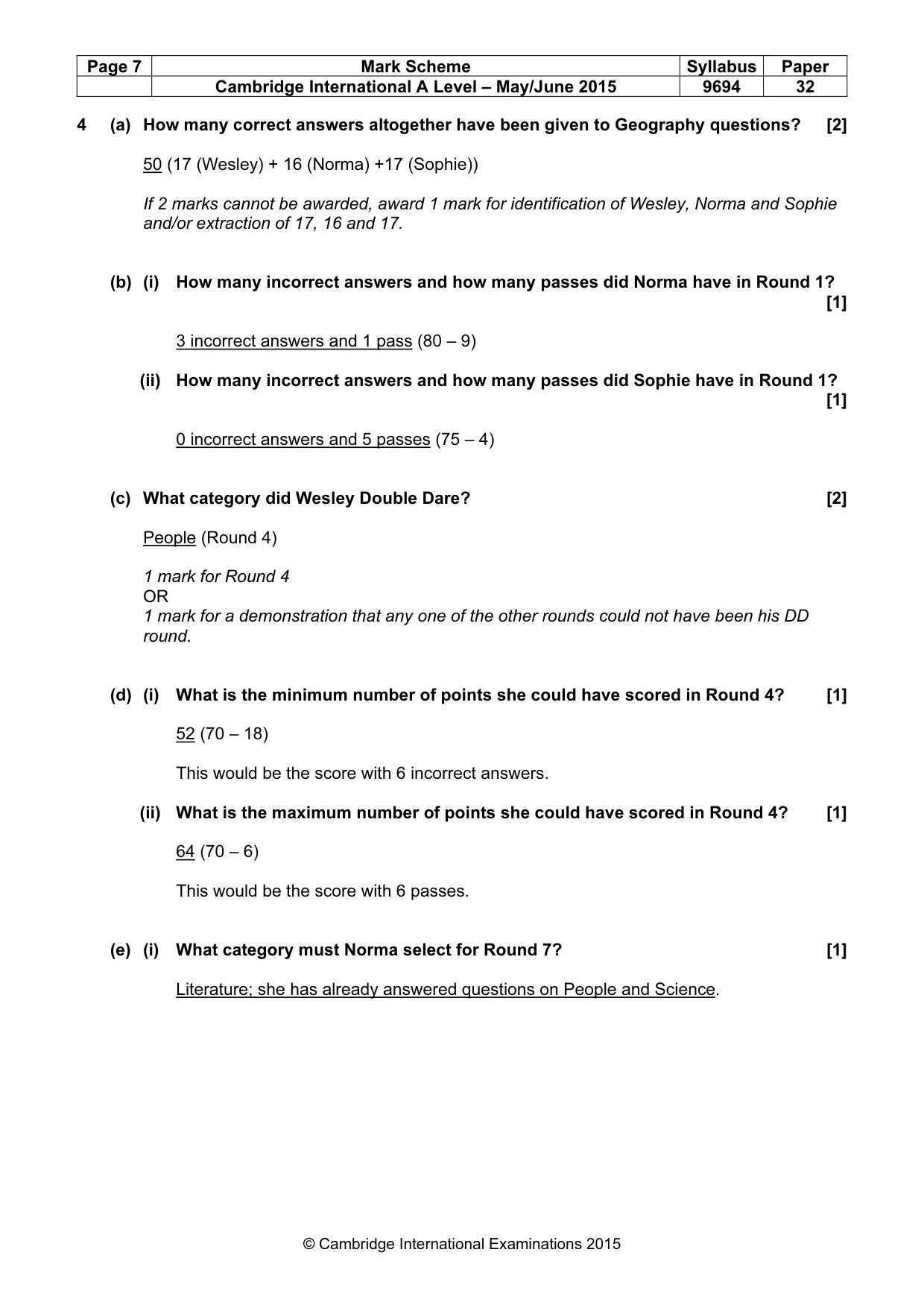
Page 7 Mark Scheme Syllabus Paper Cambridge International A Level – May/June 2015 9694 32 © Cambridge International Examinations 2015 4 (a) How many correct answers altogether have been given to Geography questions? [2] 50 (17 (Wesley) + 16 (Norma) +17 (Sophie)) If 2 marks cannot be awarded, award 1 mark for identification of Wesley, Norma and Sophie and/or extraction of 17, 16 and 17. (b) (i) How many incorrect answers and how many passes did Norma have in Round 1? [1] 3 incorrect answers and 1 pass (80 – 9) (ii) How many incorrect answers and how many passes did Sophie have in Round 1? [1] 0 incorrect answers and 5 passes (75 – 4) (c) What category did Wesley Double Dare? [2] People (Round 4) 1 mark for Round 4 OR 1 mark for a demonstration that any one of the other rounds could not have been his DD round. (d) (i) What is the minimum number of points she could have scored in Round 4? [1] 52 (70 – 18) This would be the score with 6 incorrect answers. (ii) What is the maximum number of points she could have scored in Round 4? [1] 64 (70 – 6) This would be the score with 6 passes. (e) (i) What category must Norma select for Round 7? [1] Literature; she has already answered questions on People and Science.
Mark scheme, page 8
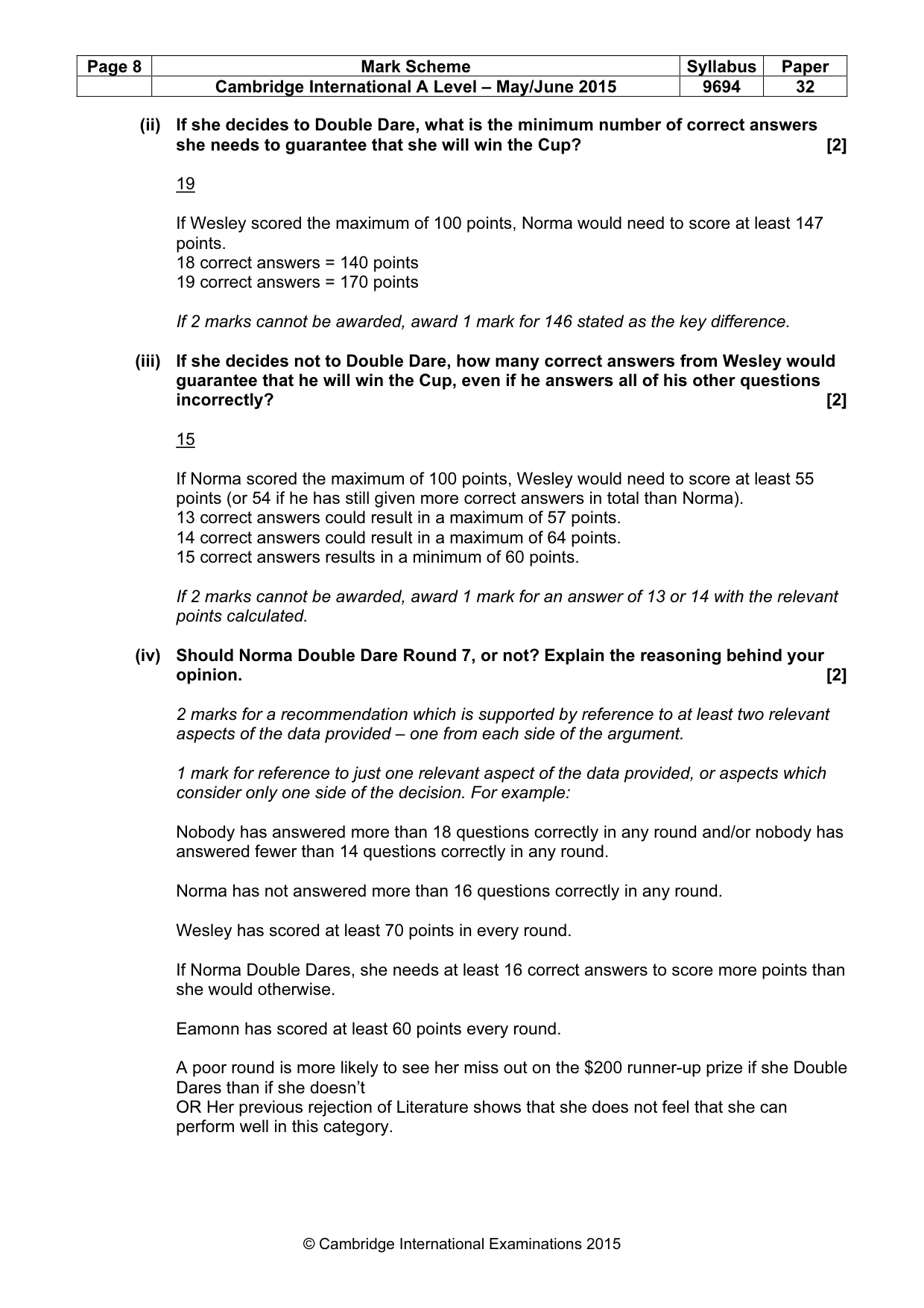
Page 8 Mark Scheme Syllabus Paper Cambridge International A Level – May/June 2015 9694 32 © Cambridge International Examinations 2015 (ii) If she decides to Double Dare, what is the minimum number of correct answers she needs to guarantee that she will win the Cup? [2] 19 If Wesley scored the maximum of 100 points, Norma would need to score at least 147 points. 18 correct answers = 140 points 19 correct answers = 170 points If 2 marks cannot be awarded, award 1 mark for 146 stated as the key difference. (iii) If she decides not to Double Dare, how many correct answers from Wesley would guarantee that he will win the Cup, even if he answers all of his other questions incorrectly? [2] 15 If Norma scored the maximum of 100 points, Wesley would need to score at least 55 points (or 54 if he has still given more correct answers in total than Norma). 13 correct answers could result in a maximum of 57 points. 14 correct answers could result in a maximum of 64 points. 15 correct answers results in a minimum of 60 points. If 2 marks cannot be awarded, award 1 mark for an answer of 13 or 14 with the relevant points calculated. (iv) Should Norma Double Dare Round 7, or not? Explain the reasoning behind your opinion. [2] 2 marks for a recommendation which is supported by reference to at least two relevant aspects of the data provided – one from each side of the argument. 1 mark for reference to just one relevant aspect of the data provided, or aspects which consider only one side of the decision. For example: Nobody has answered more than 18 questions correctly in any round and/or nobody has answered fewer than 14 questions correctly in any round. Norma has not answered more than 16 questions correctly in any round. Wesley has scored at least 70 points in every round. If Norma Double Dares, she needs at least 16 correct answers to score more points than she would otherwise. Eamonn has scored at least 60 points every round. A poor round is more likely to see her miss out on the $200 runner-up prize if she Double Dares than if she doesn’t OR Her previous rejection of Literature shows that she does not feel that she can perform well in this category.
What you needed in this session
Cambridge’s own grade thresholds for 2015 May/June, Paper 3 · Variant 2. A higher threshold means an easier paper — the bar moves with how the cohort did.