Cambridge A Level Thinking Skills 9694 — 2015 May/June Paper 2 · Variant 2
9694/22/M/J/15 · 45 marks · ≈51 min
The question paper and its mark scheme, free to read here and free to download. This is Cambridge’s own paper, exactly as it was sat.
Question paper8 pages

Mark scheme8 pages
Answers below. Sit the paper first if you are practising.
Paper as text
Question paper, page 1
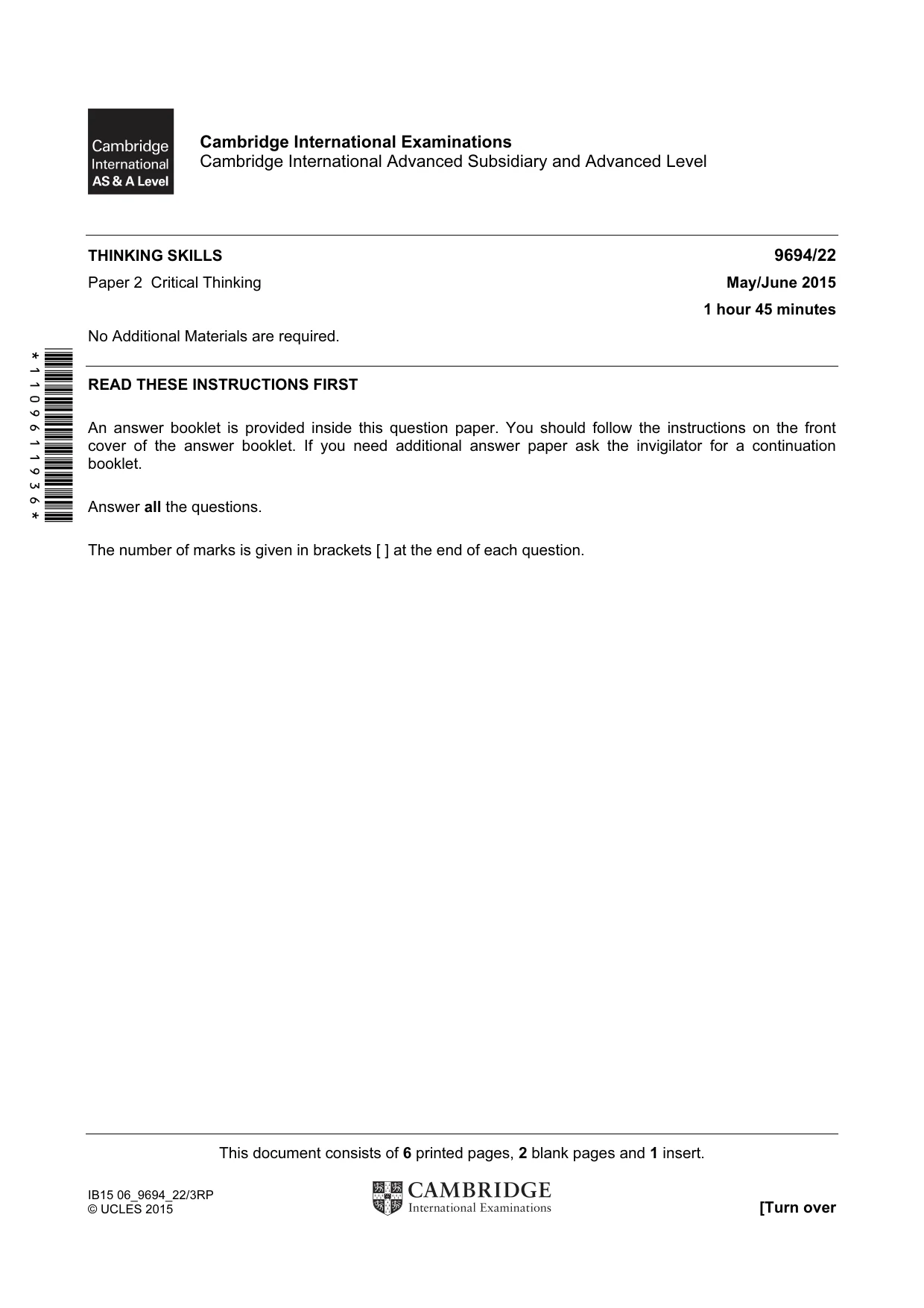
This document consists of 6 printed pages, 2 blank pages and 1 insert. IB15 06_9694_22/3RP © UCLES 2015 [Turn over *1109611936* Cambridge International Examinations Cambridge International Advanced Subsidiary and Advanced Level THINKING SKILLS 9694/22 Paper 2 Critical Thinking May/June 2015 1 hour 45 minutes No Additional Materials are required. READ THESE INSTRUCTIONS FIRST An answer booklet is provided inside this question paper. You should follow the instructions on the front cover of the answer booklet. If you need additional answer paper ask the invigilator for a continuation booklet. Answer all the questions. The number of marks is given in brackets [ ] at the end of each question.
Question paper, page 2
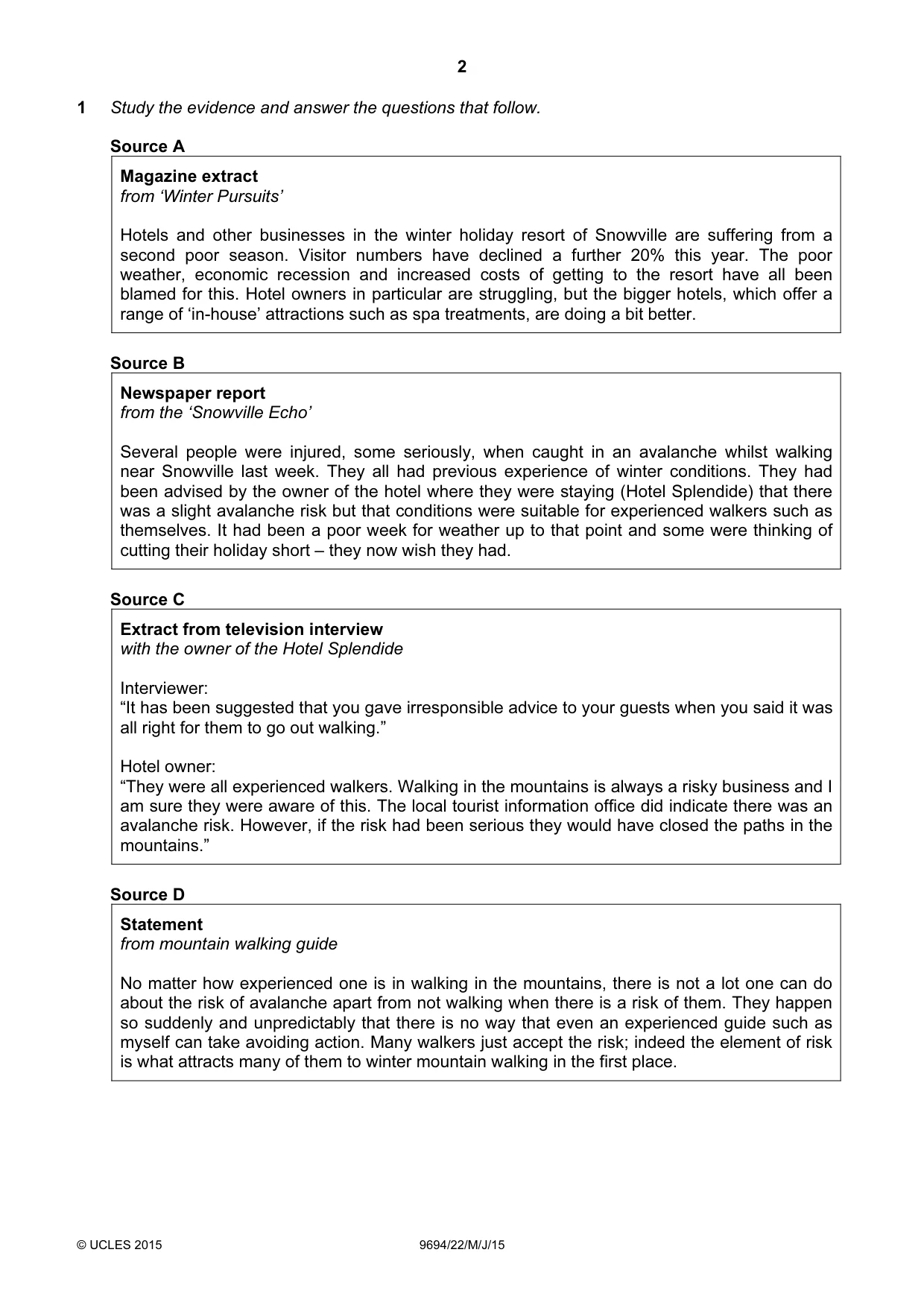
2 © UCLES 2015 9694/22/M/J/15 1 Study the evidence and answer the questions that follow. Source A Magazine extract from ‘Winter Pursuits’ Hotels and other businesses in the winter holiday resort of Snowville are suffering from a second poor season. Visitor numbers have declined a further 20% this year. The poor weather, economic recession and increased costs of getting to the resort have all been blamed for this. Hotel owners in particular are struggling, but the bigger hotels, which offer a range of ‘in-house’ attractions such as spa treatments, are doing a bit better. Source B Newspaper report from the ‘Snowville Echo’ Several people were injured, some seriously, when caught in an avalanche whilst walking near Snowville last week. They all had previous experience of winter conditions. They had been advised by the owner of the hotel where they were staying (Hotel Splendide) that there was a slight avalanche risk but that conditions were suitable for experienced walkers such as themselves. It had been a poor week for weather up to that point and some were thinking of cutting their holiday short – they now wish they had. Source C Extract from television interview with the owner of the Hotel Splendide Interviewer: “It has been suggested that you gave irresponsible advice to your guests when you said it was all right for them to go out walking.” Hotel owner: “They were all experienced walkers. Walking in the mountains is always a risky business and I am sure they were aware of this. The local tourist information office did indicate there was an avalanche risk. However, if the risk had been serious they would have closed the paths in the mountains.” Source D Statement from mountain walking guide No matter how experienced one is in walking in the mountains, there is not a lot one can do about the risk of avalanche apart from not walking when there is a risk of them. They happen so suddenly and unpredictably that there is no way that even an experienced guide such as myself can take avoiding action. Many walkers just accept the risk; indeed the element of risk is what attracts many of them to winter mountain walking in the first place.
Question paper, page 3
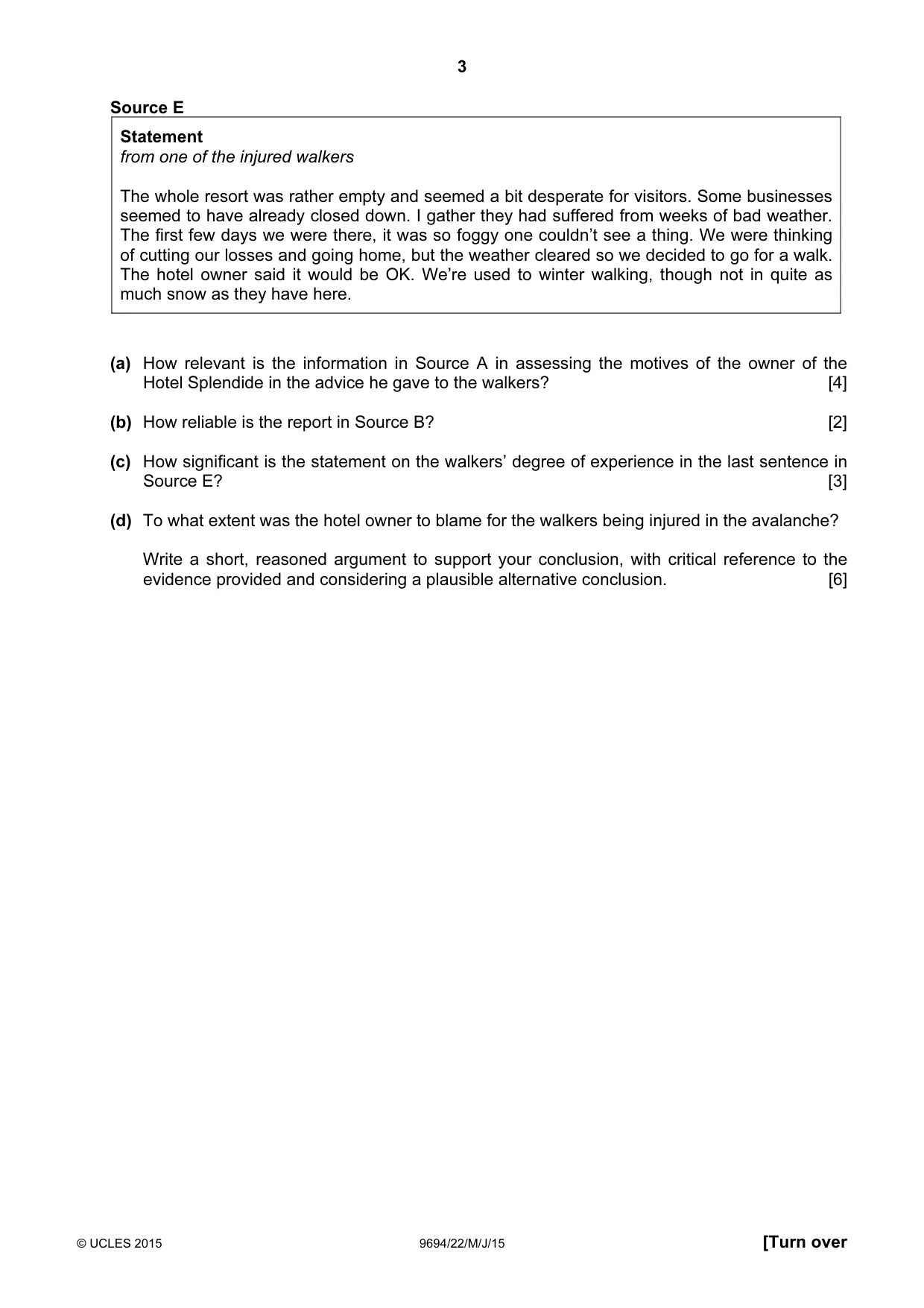
3 © UCLES 2015 9694/22/M/J/15 [Turn over Source E Statement from one of the injured walkers The whole resort was rather empty and seemed a bit desperate for visitors. Some businesses seemed to have already closed down. I gather they had suffered from weeks of bad weather. The first few days we were there, it was so foggy one couldn’t see a thing. We were thinking of cutting our losses and going home, but the weather cleared so we decided to go for a walk. The hotel owner said it would be OK. We’re used to winter walking, though not in quite as much snow as they have here. (a) How relevant is the information in Source A in assessing the motives of the owner of the Hotel Splendide in the advice he gave to the walkers? [4] (b) How reliable is the report in Source B? [2] (c) How significant is the statement on the walkers’ degree of experience in the last sentence in Source E? [3] (d) To what extent was the hotel owner to blame for the walkers being injured in the avalanche? Write a short, reasoned argument to support your conclusion, with critical reference to the evidence provided and considering a plausible alternative conclusion. [6]
Question paper, page 4
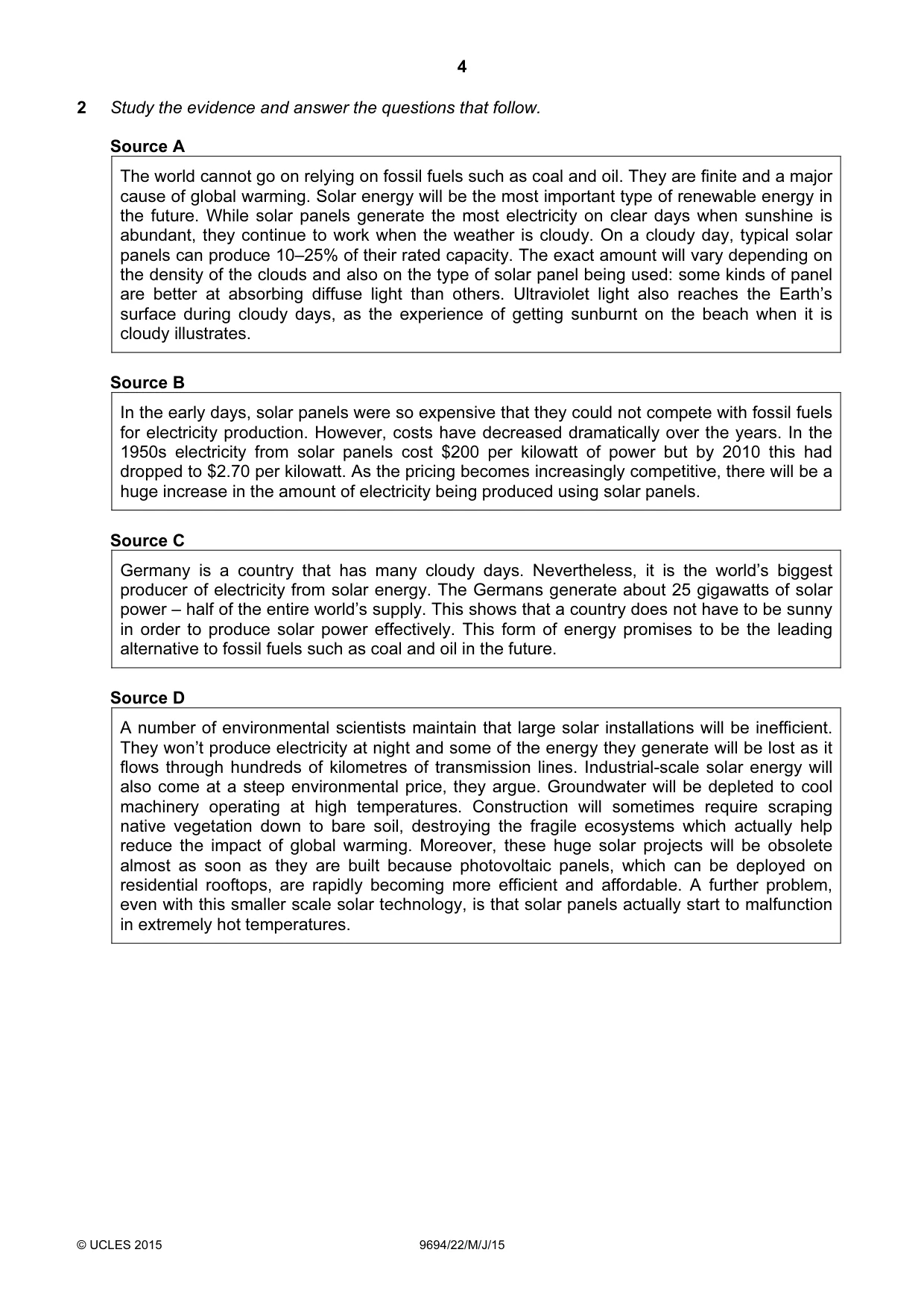
4 © UCLES 2015 9694/22/M/J/15 2 Study the evidence and answer the questions that follow. Source A The world cannot go on relying on fossil fuels such as coal and oil. They are finite and a major cause of global warming. Solar energy will be the most important type of renewable energy in the future. While solar panels generate the most electricity on clear days when sunshine is abundant, they continue to work when the weather is cloudy. On a cloudy day, typical solar panels can produce 10–25% of their rated capacity. The exact amount will vary depending on the density of the clouds and also on the type of solar panel being used: some kinds of panel are better at absorbing diffuse light than others. Ultraviolet light also reaches the Earth’s surface during cloudy days, as the experience of getting sunburnt on the beach when it is cloudy illustrates. Source B In the early days, solar panels were so expensive that they could not compete with fossil fuels for electricity production. However, costs have decreased dramatically over the years. In the 1950s electricity from solar panels cost $200 per kilowatt of power but by 2010 this had dropped to $2.70 per kilowatt. As the pricing becomes increasingly competitive, there will be a huge increase in the amount of electricity being produced using solar panels. Source C Germany is a country that has many cloudy days. Nevertheless, it is the world’s biggest producer of electricity from solar energy. The Germans generate about 25 gigawatts of solar power – half of the entire world’s supply. This shows that a country does not have to be sunny in order to produce solar power effectively. This form of energy promises to be the leading alternative to fossil fuels such as coal and oil in the future. Source D A number of environmental scientists maintain that large solar installations will be inefficient. They won’t produce electricity at night and some of the energy they generate will be lost as it flows through hundreds of kilometres of transmission lines. Industrial-scale solar energy will also come at a steep environmental price, they argue. Groundwater will be depleted to cool machinery operating at high temperatures. Construction will sometimes require scraping native vegetation down to bare soil, destroying the fragile ecosystems which actually help reduce the impact of global warming. Moreover, these huge solar projects will be obsolete almost as soon as they are built because photovoltaic panels, which can be deployed on residential rooftops, are rapidly becoming more efficient and affordable. A further problem, even with this smaller scale solar technology, is that solar panels actually start to malfunction in extremely hot temperatures.
Question paper, page 5
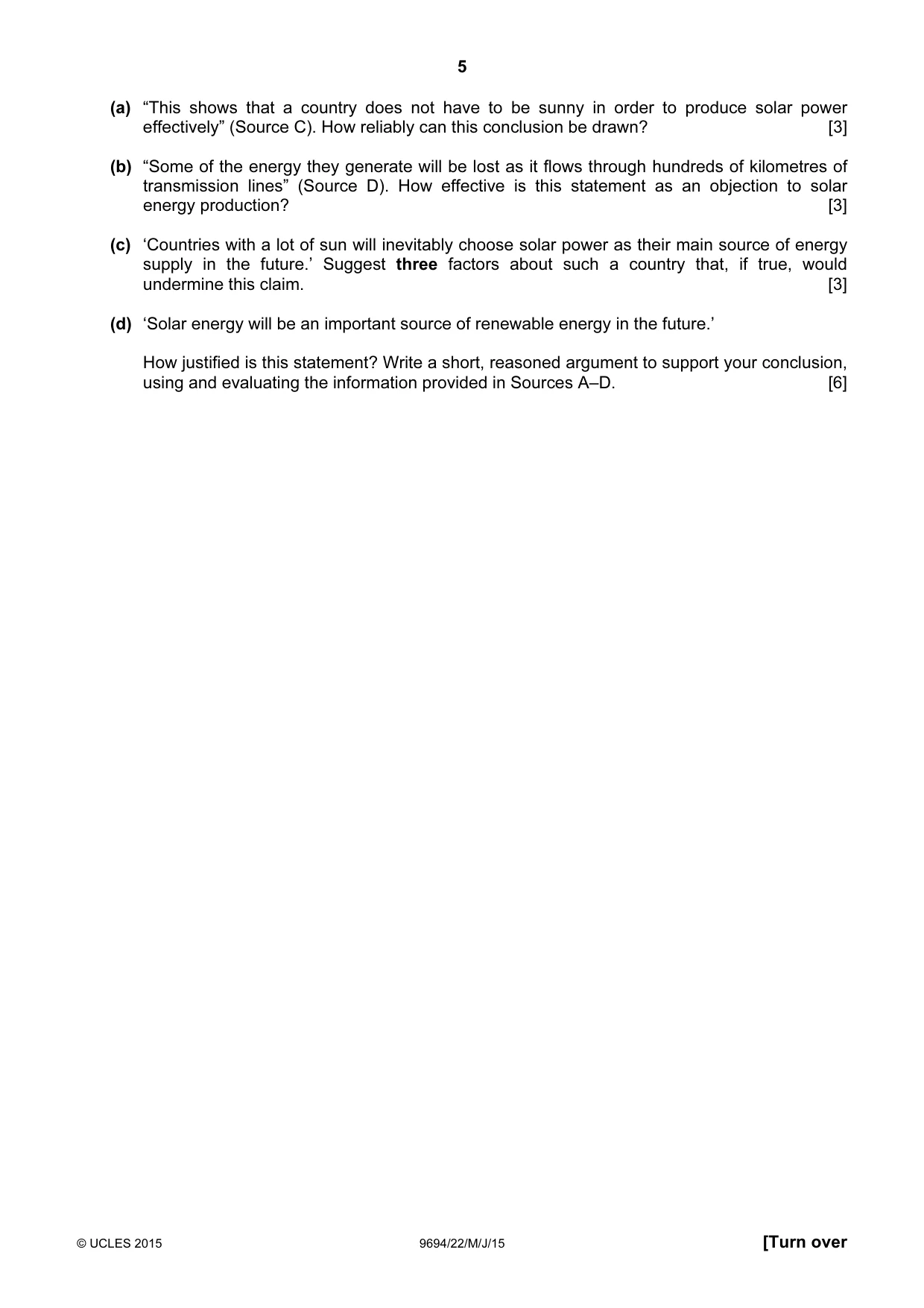
5 © UCLES 2015 9694/22/M/J/15 [Turn over (a) “This shows that a country does not have to be sunny in order to produce solar power effectively” (Source C). How reliably can this conclusion be drawn? [3] (b) “Some of the energy they generate will be lost as it flows through hundreds of kilometres of transmission lines” (Source D). How effective is this statement as an objection to solar energy production? [3] (c) ‘Countries with a lot of sun will inevitably choose solar power as their main source of energy supply in the future.’ Suggest three factors about such a country that, if true, would undermine this claim. [3] (d) ‘Solar energy will be an important source of renewable energy in the future.’ How justified is this statement? Write a short, reasoned argument to support your conclusion, using and evaluating the information provided in Sources A–D. [6]
Question paper, page 6
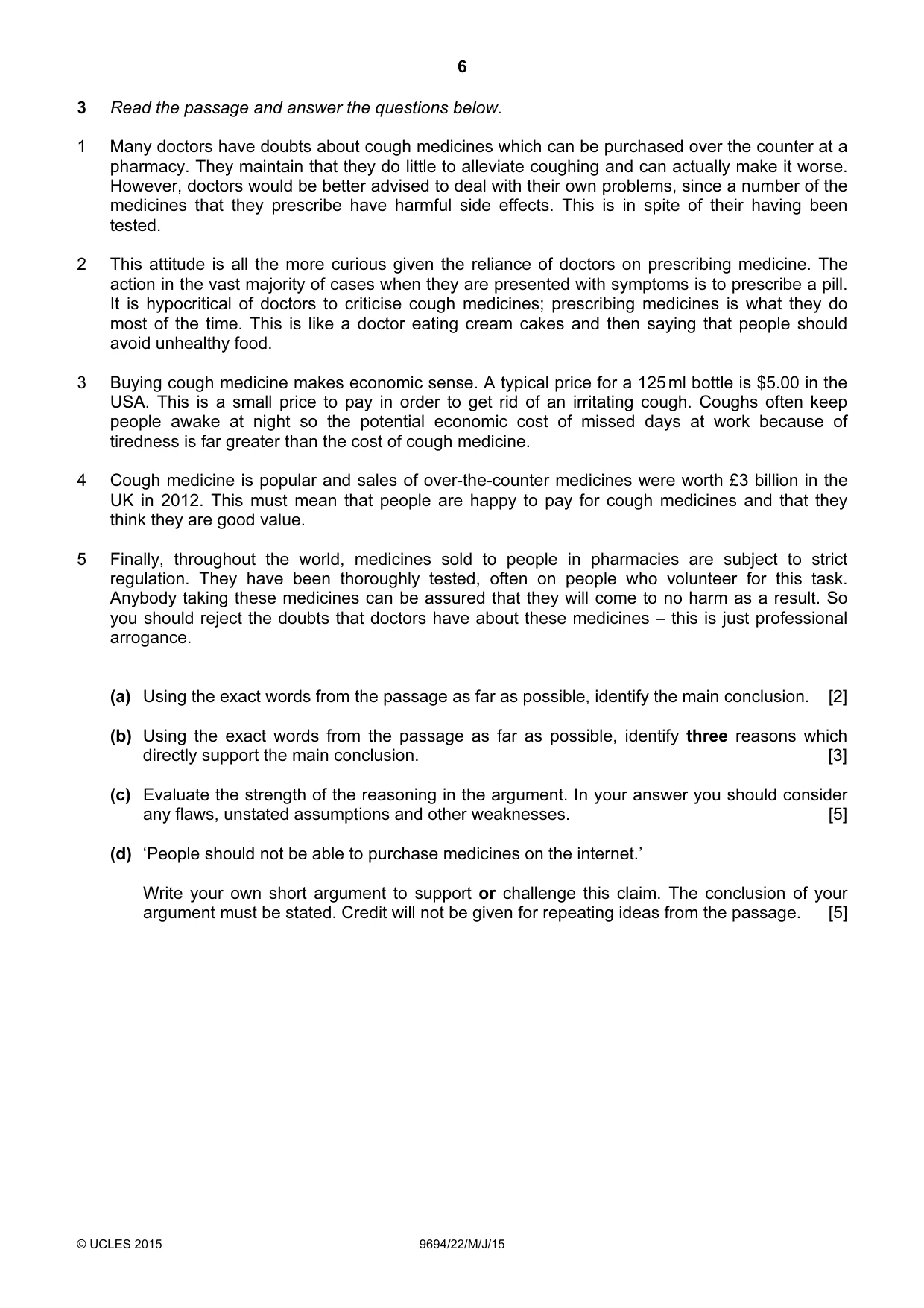
6 © UCLES 2015 9694/22/M/J/15 3 Read the passage and answer the questions below. 1 Many doctors have doubts about cough medicines which can be purchased over the counter at a pharmacy. They maintain that they do little to alleviate coughing and can actually make it worse. However, doctors would be better advised to deal with their own problems, since a number of the medicines that they prescribe have harmful side effects. This is in spite of their having been tested. 2 This attitude is all the more curious given the reliance of doctors on prescribing medicine. The action in the vast majority of cases when they are presented with symptoms is to prescribe a pill. It is hypocritical of doctors to criticise cough medicines; prescribing medicines is what they do most of the time. This is like a doctor eating cream cakes and then saying that people should avoid unhealthy food. 3 Buying cough medicine makes economic sense. A typical price for a 125 ml bottle is $5.00 in the USA. This is a small price to pay in order to get rid of an irritating cough. Coughs often keep people awake at night so the potential economic cost of missed days at work because of tiredness is far greater than the cost of cough medicine. 4 Cough medicine is popular and sales of over-the-counter medicines were worth £3 billion in the UK in 2012. This must mean that people are happy to pay for cough medicines and that they think they are good value. 5 Finally, throughout the world, medicines sold to people in pharmacies are subject to strict regulation. They have been thoroughly tested, often on people who volunteer for this task. Anybody taking these medicines can be assured that they will come to no harm as a result. So you should reject the doubts that doctors have about these medicines – this is just professional arrogance. (a) Using the exact words from the passage as far as possible, identify the main conclusion. [2] (b) Using the exact words from the passage as far as possible, identify three reasons which directly support the main conclusion. [3] (c) Evaluate the strength of the reasoning in the argument. In your answer you should consider any flaws, unstated assumptions and other weaknesses. [5] (d) ‘People should not be able to purchase medicines on the internet.’ Write your own short argument to support or challenge this claim. The conclusion of your argument must be stated. Credit will not be given for repeating ideas from the passage. [5]
Question paper, page 7
7 © UCLES 2015 9694/22/M/J/15 BLANK PAGE
Question paper, page 8
8 Permission to reproduce items where third-party owned material protected by copyright is included has been sought and cleared where possible. Every reasonable effort has been made by the publisher (UCLES) to trace copyright holders, but if any items requiring clearance have unwittingly been included, the publisher will be pleased to make amends at the earliest possible opportunity. To avoid the issue of disclosure of answer-related information to candidates, all copyright acknowledgements are reproduced online in the Cambridge International Examinations Copyright Acknowledgements Booklet. This is produced for each series of examinations and is freely available to download at www.cie.org.uk after the live examination series. Cambridge International Examinations is part of the Cambridge Assessment Group. Cambridge Assessment is the brand name of University of Cambridge Local Examinations Syndicate (UCLES), which is itself a department of the University of Cambridge. © UCLES 2015 9694/22/M/J/15 BLANK PAGE
Mark scheme, page 1
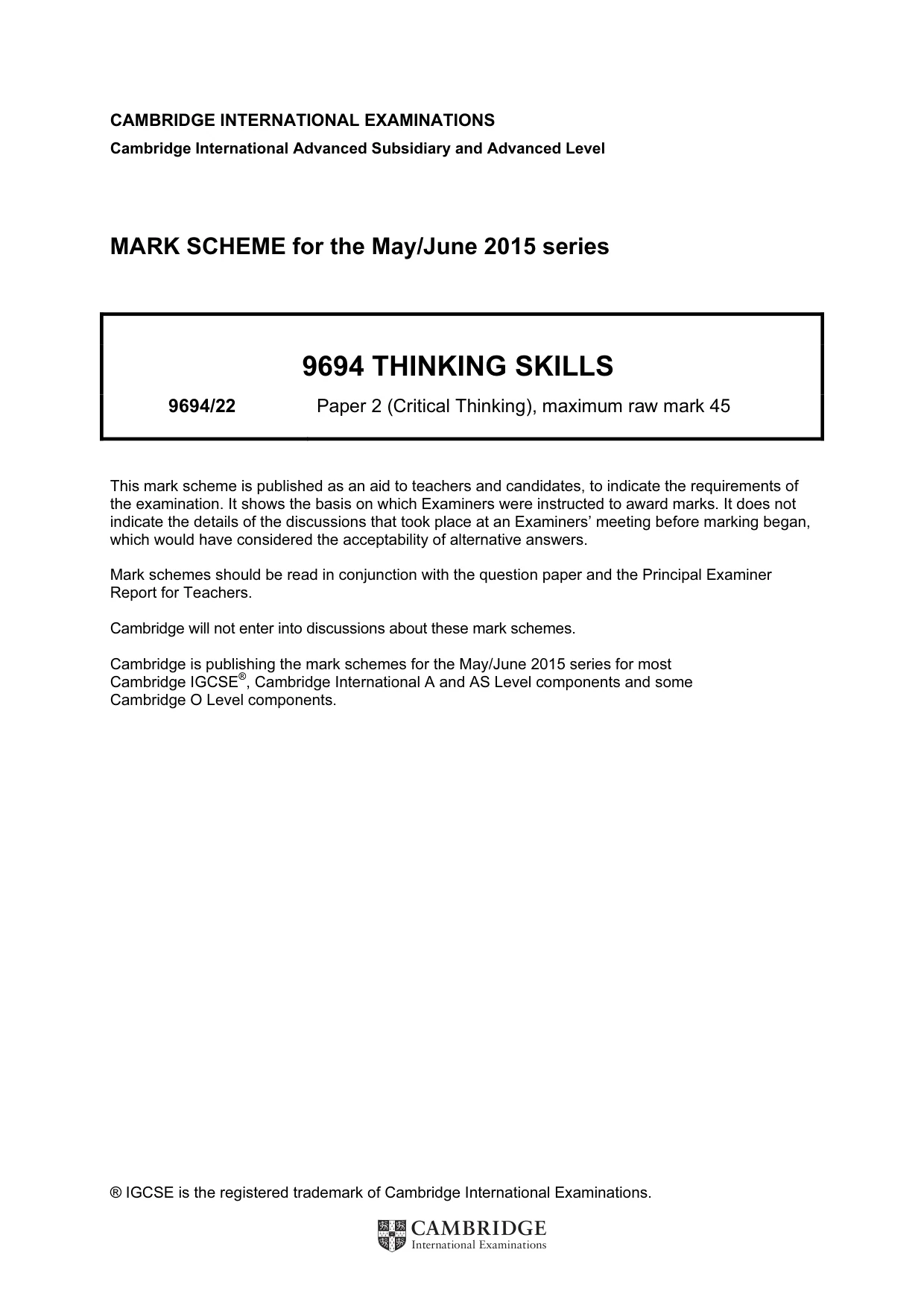
® IGCSE is the registered trademark of Cambridge International Examinations. CAMBRIDGE INTERNATIONAL EXAMINATIONS Cambridge International Advanced Subsidiary and Advanced Level MARK SCHEME for the May/June 2015 series 9694 THINKING SKILLS 9694/22 Paper 2 (Critical Thinking), maximum raw mark 45 This mark scheme is published as an aid to teachers and candidates, to indicate the requirements of the examination. It shows the basis on which Examiners were instructed to award marks. It does not indicate the details of the discussions that took place at an Examiners’ meeting before marking began, which would have considered the acceptability of alternative answers. Mark schemes should be read in conjunction with the question paper and the Principal Examiner Report for Teachers. Cambridge will not enter into discussions about these mark schemes. Cambridge is publishing the mark schemes for the May/June 2015 series for most Cambridge IGCSE®, Cambridge International A and AS Level components and some Cambridge O Level components.
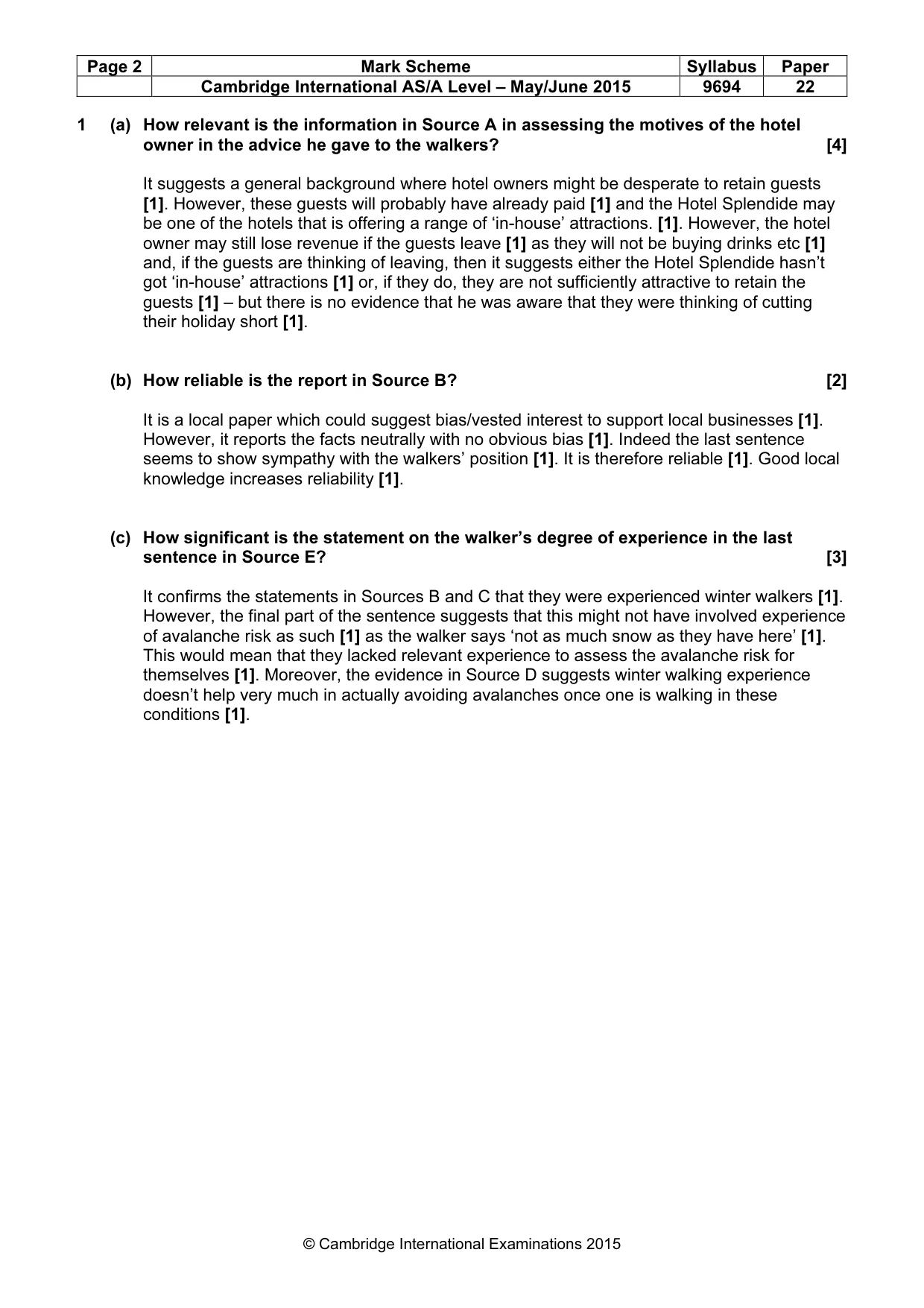
Mark scheme, page 2
Page 2 Mark Scheme Syllabus Paper Cambridge International AS/A Level – May/June 2015 9694 22 © Cambridge International Examinations 2015 1 (a) How relevant is the information in Source A in assessing the motives of the hotel owner in the advice he gave to the walkers? [4] It suggests a general background where hotel owners might be desperate to retain guests [1]. However, these guests will probably have already paid [1] and the Hotel Splendide may be one of the hotels that is offering a range of ‘in-house’ attractions. [1]. However, the hotel owner may still lose revenue if the guests leave [1] as they will not be buying drinks etc [1] and, if the guests are thinking of leaving, then it suggests either the Hotel Splendide hasn’t got ‘in-house’ attractions [1] or, if they do, they are not sufficiently attractive to retain the guests [1] – but there is no evidence that he was aware that they were thinking of cutting their holiday short [1]. (b) How reliable is the report in Source B? [2] It is a local paper which could suggest bias/vested interest to support local businesses [1]. However, it reports the facts neutrally with no obvious bias [1]. Indeed the last sentence seems to show sympathy with the walkers’ position [1]. It is therefore reliable [1]. Good local knowledge increases reliability [1]. (c) How significant is the statement on the walker’s degree of experience in the last sentence in Source E? [3] It confirms the statements in Sources B and C that they were experienced winter walkers [1]. However, the final part of the sentence suggests that this might not have involved experience of avalanche risk as such [1] as the walker says ‘not as much snow as they have here’ [1]. This would mean that they lacked relevant experience to assess the avalanche risk for themselves [1]. Moreover, the evidence in Source D suggests winter walking experience doesn’t help very much in actually avoiding avalanches once one is walking in these conditions [1].
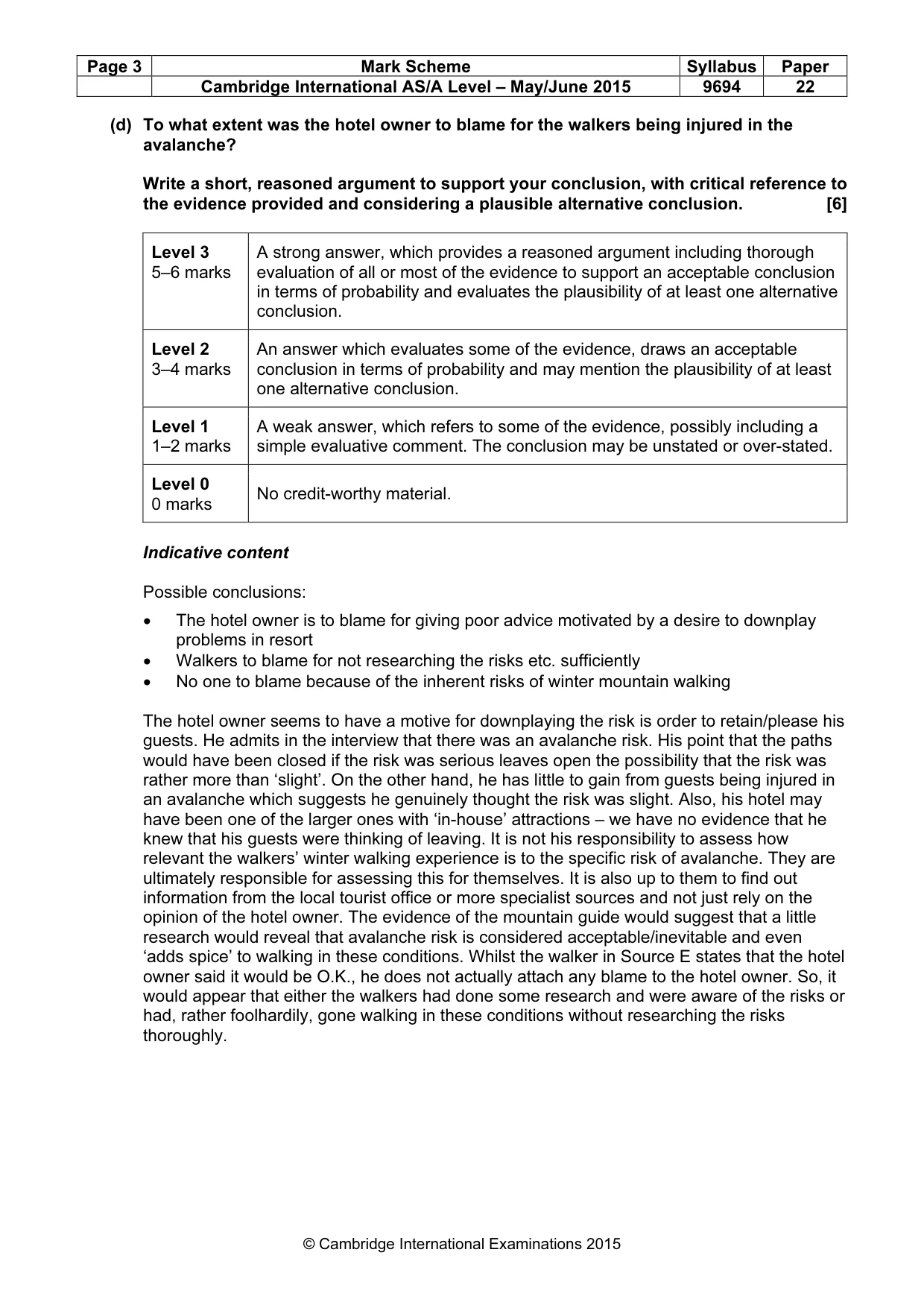
Mark scheme, page 3
Page 3 Mark Scheme Syllabus Paper Cambridge International AS/A Level – May/June 2015 9694 22 © Cambridge International Examinations 2015 (d) To what extent was the hotel owner to blame for the walkers being injured in the avalanche? Write a short, reasoned argument to support your conclusion, with critical reference to the evidence provided and considering a plausible alternative conclusion. [6] Level 3 5–6 marks A strong answer, which provides a reasoned argument including thorough evaluation of all or most of the evidence to support an acceptable conclusion in terms of probability and evaluates the plausibility of at least one alternative conclusion. Level 2 3–4 marks An answer which evaluates some of the evidence, draws an acceptable conclusion in terms of probability and may mention the plausibility of at least one alternative conclusion. Level 1 1–2 marks A weak answer, which refers to some of the evidence, possibly including a simple evaluative comment. The conclusion may be unstated or over-stated. Level 0 0 marks No credit-worthy material. Indicative content Possible conclusions: • The hotel owner is to blame for giving poor advice motivated by a desire to downplay problems in resort • Walkers to blame for not researching the risks etc. sufficiently • No one to blame because of the inherent risks of winter mountain walking The hotel owner seems to have a motive for downplaying the risk is order to retain/please his guests. He admits in the interview that there was an avalanche risk. His point that the paths would have been closed if the risk was serious leaves open the possibility that the risk was rather more than ‘slight’. On the other hand, he has little to gain from guests being injured in an avalanche which suggests he genuinely thought the risk was slight. Also, his hotel may have been one of the larger ones with ‘in-house’ attractions – we have no evidence that he knew that his guests were thinking of leaving. It is not his responsibility to assess how relevant the walkers’ winter walking experience is to the specific risk of avalanche. They are ultimately responsible for assessing this for themselves. It is also up to them to find out information from the local tourist office or more specialist sources and not just rely on the opinion of the hotel owner. The evidence of the mountain guide would suggest that a little research would reveal that avalanche risk is considered acceptable/inevitable and even ‘adds spice’ to walking in these conditions. Whilst the walker in Source E states that the hotel owner said it would be O.K., he does not actually attach any blame to the hotel owner. So, it would appear that either the walkers had done some research and were aware of the risks or had, rather foolhardily, gone walking in these conditions without researching the risks thoroughly.
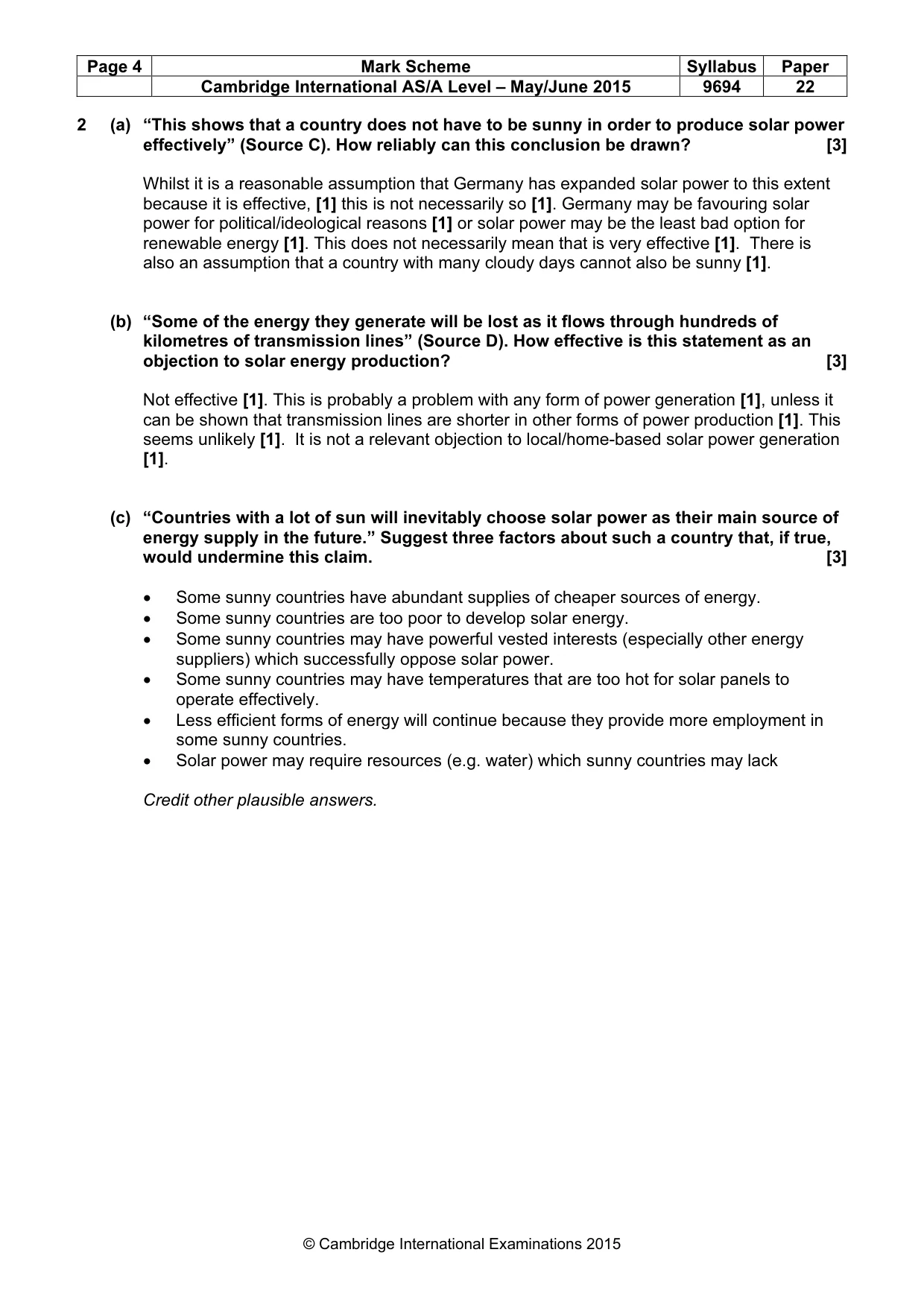
Mark scheme, page 4
Page 4 Mark Scheme Syllabus Paper Cambridge International AS/A Level – May/June 2015 9694 22 © Cambridge International Examinations 2015 2 (a) “This shows that a country does not have to be sunny in order to produce solar power effectively” (Source C). How reliably can this conclusion be drawn? [3] Whilst it is a reasonable assumption that Germany has expanded solar power to this extent because it is effective, [1] this is not necessarily so [1]. Germany may be favouring solar power for political/ideological reasons [1] or solar power may be the least bad option for renewable energy [1]. This does not necessarily mean that is very effective [1]. There is also an assumption that a country with many cloudy days cannot also be sunny [1]. (b) “Some of the energy they generate will be lost as it flows through hundreds of kilometres of transmission lines” (Source D). How effective is this statement as an objection to solar energy production? [3] Not effective [1]. This is probably a problem with any form of power generation [1], unless it can be shown that transmission lines are shorter in other forms of power production [1]. This seems unlikely [1]. It is not a relevant objection to local/home-based solar power generation [1]. (c) “Countries with a lot of sun will inevitably choose solar power as their main source of energy supply in the future.” Suggest three factors about such a country that, if true, would undermine this claim. [3] • Some sunny countries have abundant supplies of cheaper sources of energy. • Some sunny countries are too poor to develop solar energy. • Some sunny countries may have powerful vested interests (especially other energy suppliers) which successfully oppose solar power. • Some sunny countries may have temperatures that are too hot for solar panels to operate effectively. • Less efficient forms of energy will continue because they provide more employment in some sunny countries. • Solar power may require resources (e.g. water) which sunny countries may lack Credit other plausible answers.
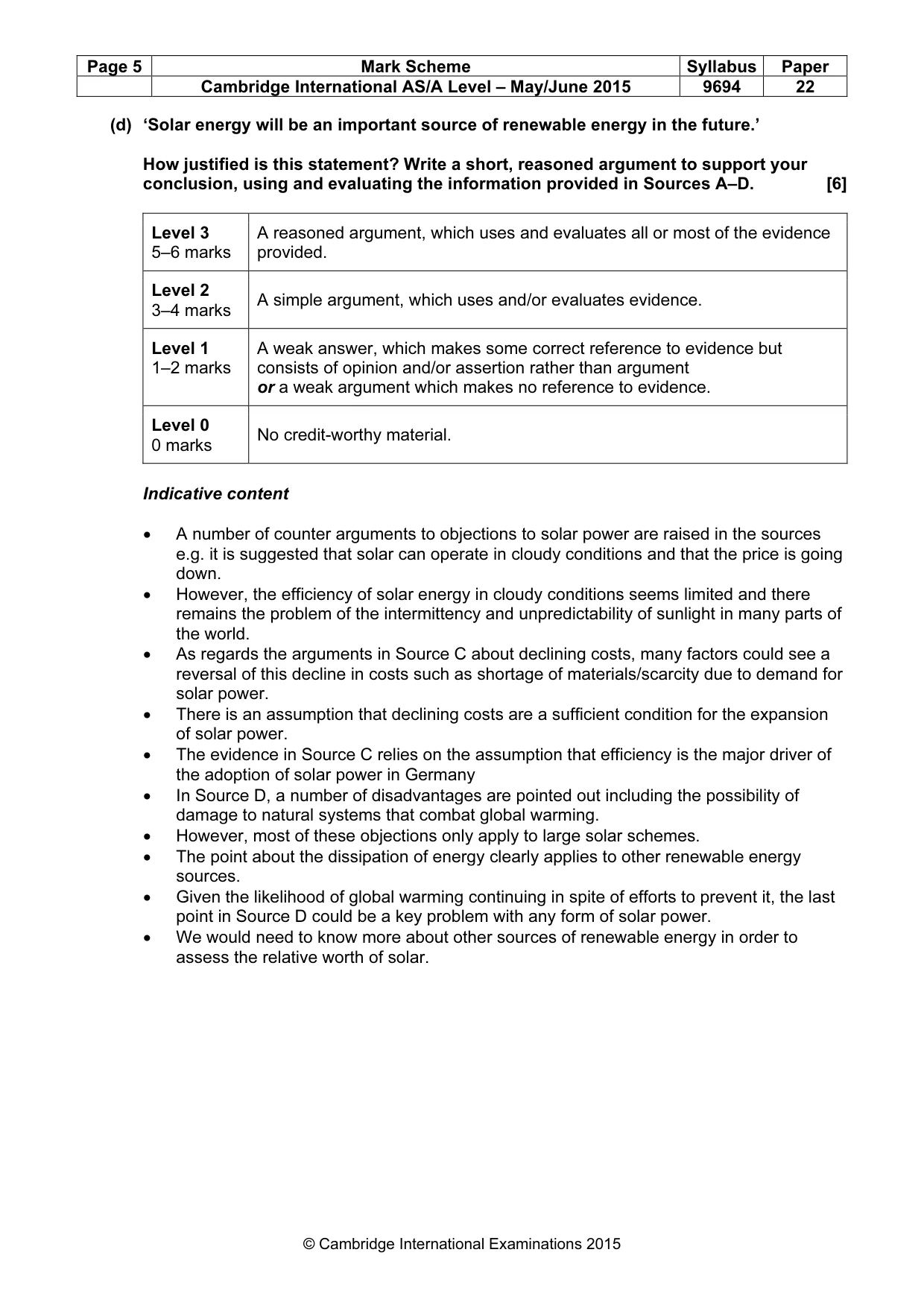
Mark scheme, page 5
Page 5 Mark Scheme Syllabus Paper Cambridge International AS/A Level – May/June 2015 9694 22 © Cambridge International Examinations 2015 (d) ‘Solar energy will be an important source of renewable energy in the future.’ How justified is this statement? Write a short, reasoned argument to support your conclusion, using and evaluating the information provided in Sources A–D. [6] Level 3 5–6 marks A reasoned argument, which uses and evaluates all or most of the evidence provided. Level 2 3–4 marks A simple argument, which uses and/or evaluates evidence. Level 1 1–2 marks A weak answer, which makes some correct reference to evidence but consists of opinion and/or assertion rather than argument or a weak argument which makes no reference to evidence. Level 0 0 marks No credit-worthy material. Indicative content • A number of counter arguments to objections to solar power are raised in the sources e.g. it is suggested that solar can operate in cloudy conditions and that the price is going down. • However, the efficiency of solar energy in cloudy conditions seems limited and there remains the problem of the intermittency and unpredictability of sunlight in many parts of the world. • As regards the arguments in Source C about declining costs, many factors could see a reversal of this decline in costs such as shortage of materials/scarcity due to demand for solar power. • There is an assumption that declining costs are a sufficient condition for the expansion of solar power. • The evidence in Source C relies on the assumption that efficiency is the major driver of the adoption of solar power in Germany • In Source D, a number of disadvantages are pointed out including the possibility of damage to natural systems that combat global warming. • However, most of these objections only apply to large solar schemes. • The point about the dissipation of energy clearly applies to other renewable energy sources. • Given the likelihood of global warming continuing in spite of efforts to prevent it, the last point in Source D could be a key problem with any form of solar power. • We would need to know more about other sources of renewable energy in order to assess the relative worth of solar.
Mark scheme, page 6
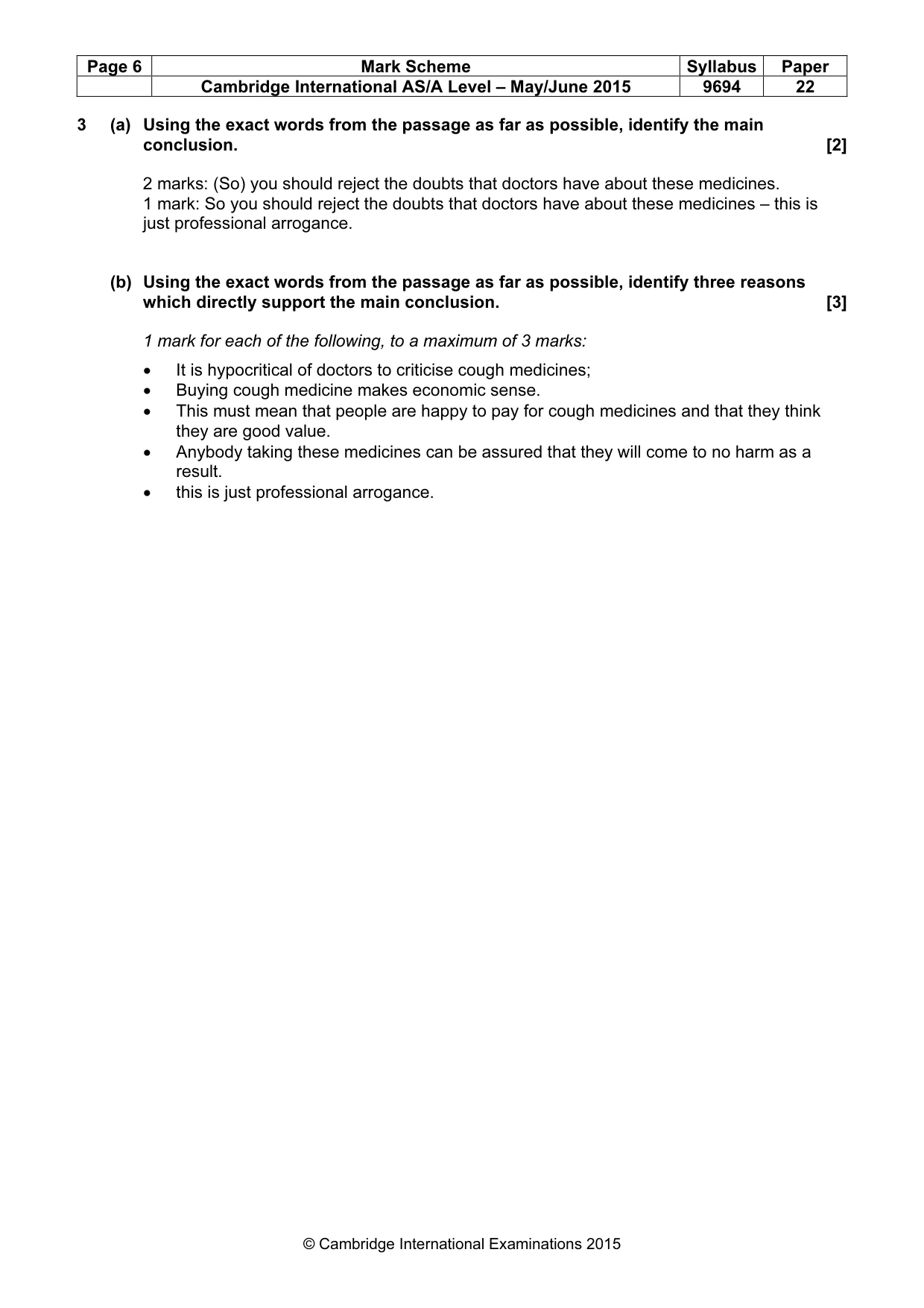
Page 6 Mark Scheme Syllabus Paper Cambridge International AS/A Level – May/June 2015 9694 22 © Cambridge International Examinations 2015 3 (a) Using the exact words from the passage as far as possible, identify the main conclusion. [2] 2 marks: (So) you should reject the doubts that doctors have about these medicines. 1 mark: So you should reject the doubts that doctors have about these medicines – this is just professional arrogance. (b) Using the exact words from the passage as far as possible, identify three reasons which directly support the main conclusion. [3] 1 mark for each of the following, to a maximum of 3 marks: • It is hypocritical of doctors to criticise cough medicines; • Buying cough medicine makes economic sense. • This must mean that people are happy to pay for cough medicines and that they think they are good value. • Anybody taking these medicines can be assured that they will come to no harm as a result. • this is just professional arrogance.
Mark scheme, page 7
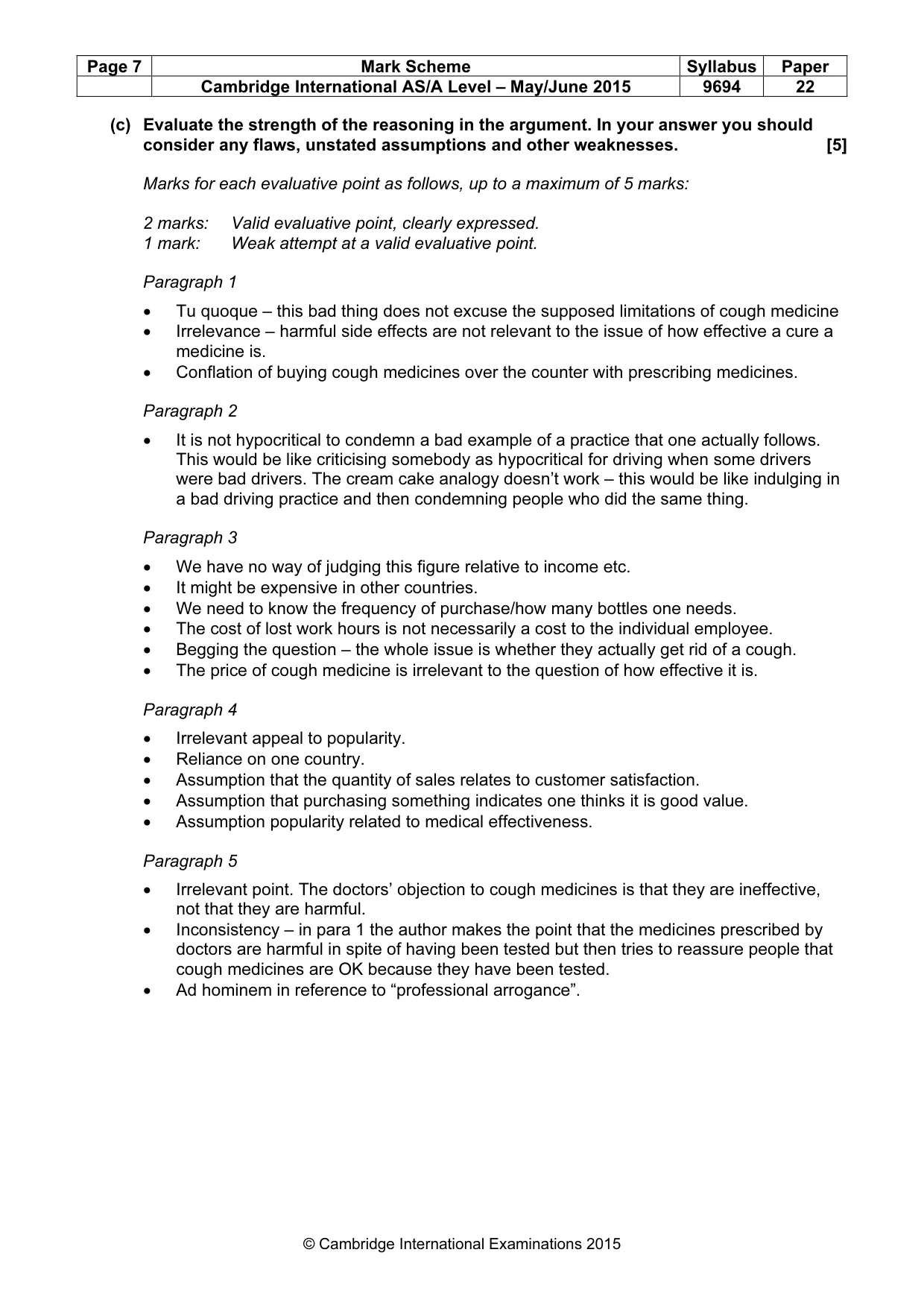
Page 7 Mark Scheme Syllabus Paper Cambridge International AS/A Level – May/June 2015 9694 22 © Cambridge International Examinations 2015 (c) Evaluate the strength of the reasoning in the argument. In your answer you should consider any flaws, unstated assumptions and other weaknesses. [5] Marks for each evaluative point as follows, up to a maximum of 5 marks: 2 marks: Valid evaluative point, clearly expressed. 1 mark: Weak attempt at a valid evaluative point. Paragraph 1 • Tu quoque – this bad thing does not excuse the supposed limitations of cough medicine • Irrelevance – harmful side effects are not relevant to the issue of how effective a cure a medicine is. • Conflation of buying cough medicines over the counter with prescribing medicines. Paragraph 2 • It is not hypocritical to condemn a bad example of a practice that one actually follows. This would be like criticising somebody as hypocritical for driving when some drivers were bad drivers. The cream cake analogy doesn’t work – this would be like indulging in a bad driving practice and then condemning people who did the same thing. Paragraph 3 • We have no way of judging this figure relative to income etc. • It might be expensive in other countries. • We need to know the frequency of purchase/how many bottles one needs. • The cost of lost work hours is not necessarily a cost to the individual employee. • Begging the question – the whole issue is whether they actually get rid of a cough. • The price of cough medicine is irrelevant to the question of how effective it is. Paragraph 4 • Irrelevant appeal to popularity. • Reliance on one country. • Assumption that the quantity of sales relates to customer satisfaction. • Assumption that purchasing something indicates one thinks it is good value. • Assumption popularity related to medical effectiveness. Paragraph 5 • Irrelevant point. The doctors’ objection to cough medicines is that they are ineffective, not that they are harmful. • Inconsistency – in para 1 the author makes the point that the medicines prescribed by doctors are harmful in spite of having been tested but then tries to reassure people that cough medicines are OK because they have been tested. • Ad hominem in reference to “professional arrogance”.
Mark scheme, page 8
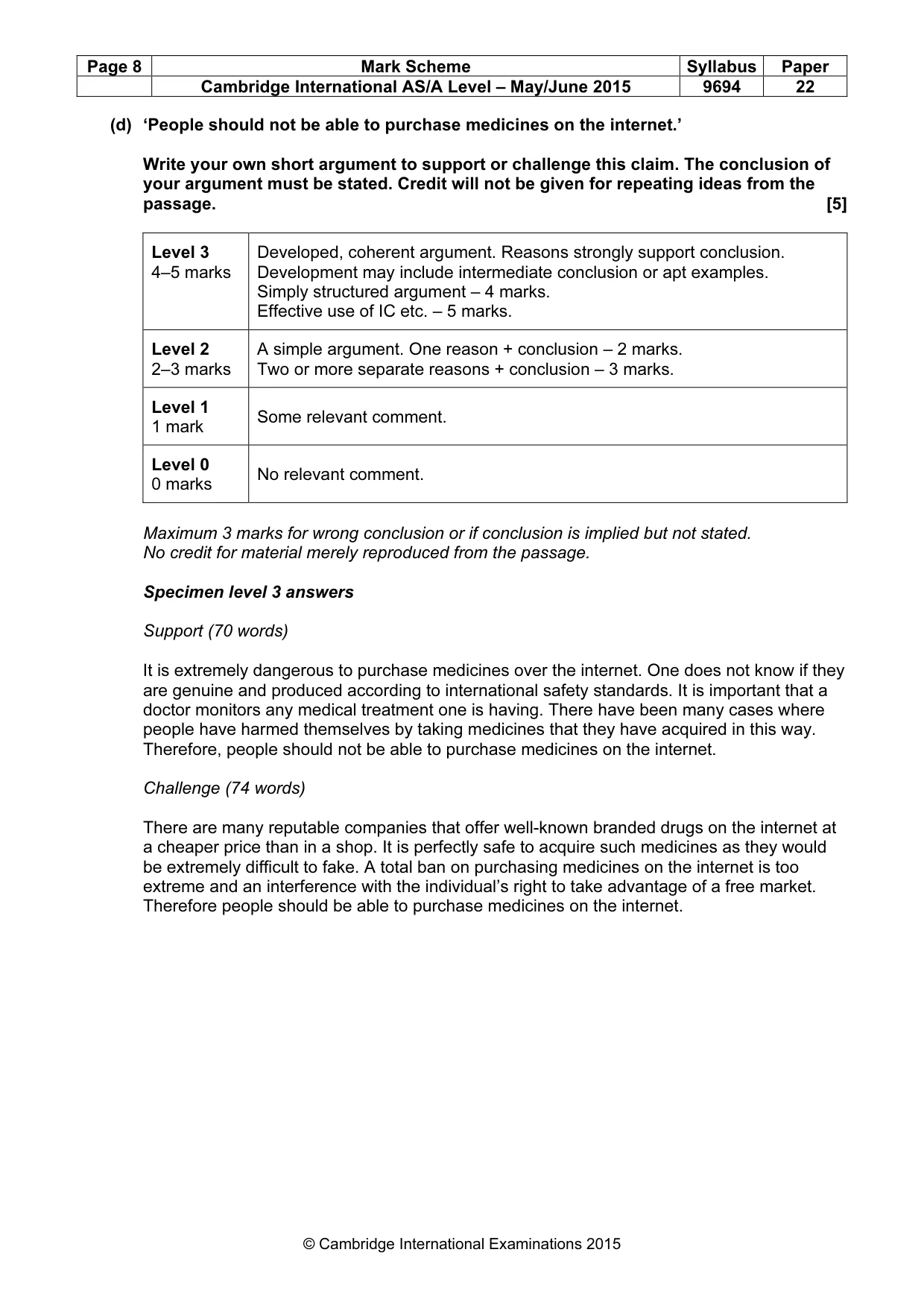
Page 8 Mark Scheme Syllabus Paper Cambridge International AS/A Level – May/June 2015 9694 22 © Cambridge International Examinations 2015 (d) ‘People should not be able to purchase medicines on the internet.’ Write your own short argument to support or challenge this claim. The conclusion of your argument must be stated. Credit will not be given for repeating ideas from the passage. [5] Level 3 4–5 marks Developed, coherent argument. Reasons strongly support conclusion. Development may include intermediate conclusion or apt examples. Simply structured argument – 4 marks. Effective use of IC etc. – 5 marks. Level 2 2–3 marks A simple argument. One reason + conclusion – 2 marks. Two or more separate reasons + conclusion – 3 marks. Level 1 1 mark Some relevant comment. Level 0 0 marks No relevant comment. Maximum 3 marks for wrong conclusion or if conclusion is implied but not stated. No credit for material merely reproduced from the passage. Specimen level 3 answers Support (70 words) It is extremely dangerous to purchase medicines over the internet. One does not know if they are genuine and produced according to international safety standards. It is important that a doctor monitors any medical treatment one is having. There have been many cases where people have harmed themselves by taking medicines that they have acquired in this way. Therefore, people should not be able to purchase medicines on the internet. Challenge (74 words) There are many reputable companies that offer well-known branded drugs on the internet at a cheaper price than in a shop. It is perfectly safe to acquire such medicines as they would be extremely difficult to fake. A total ban on purchasing medicines on the internet is too extreme and an interference with the individual’s right to take advantage of a free market. Therefore people should be able to purchase medicines on the internet.
What you needed in this session
Cambridge’s own grade thresholds for 2015 May/June, Paper 2 · Variant 2. A higher threshold means an easier paper — the bar moves with how the cohort did.