Cambridge A Level Thinking Skills 9694 — 2015 May/June Paper 2 · Variant 3
9694/23/M/J/15 · 45 marks · ≈51 min
The question paper and its mark scheme, free to read here and free to download. This is Cambridge’s own paper, exactly as it was sat.
Question paper8 pages

Mark scheme8 pages
Answers below. Sit the paper first if you are practising.
Paper as text
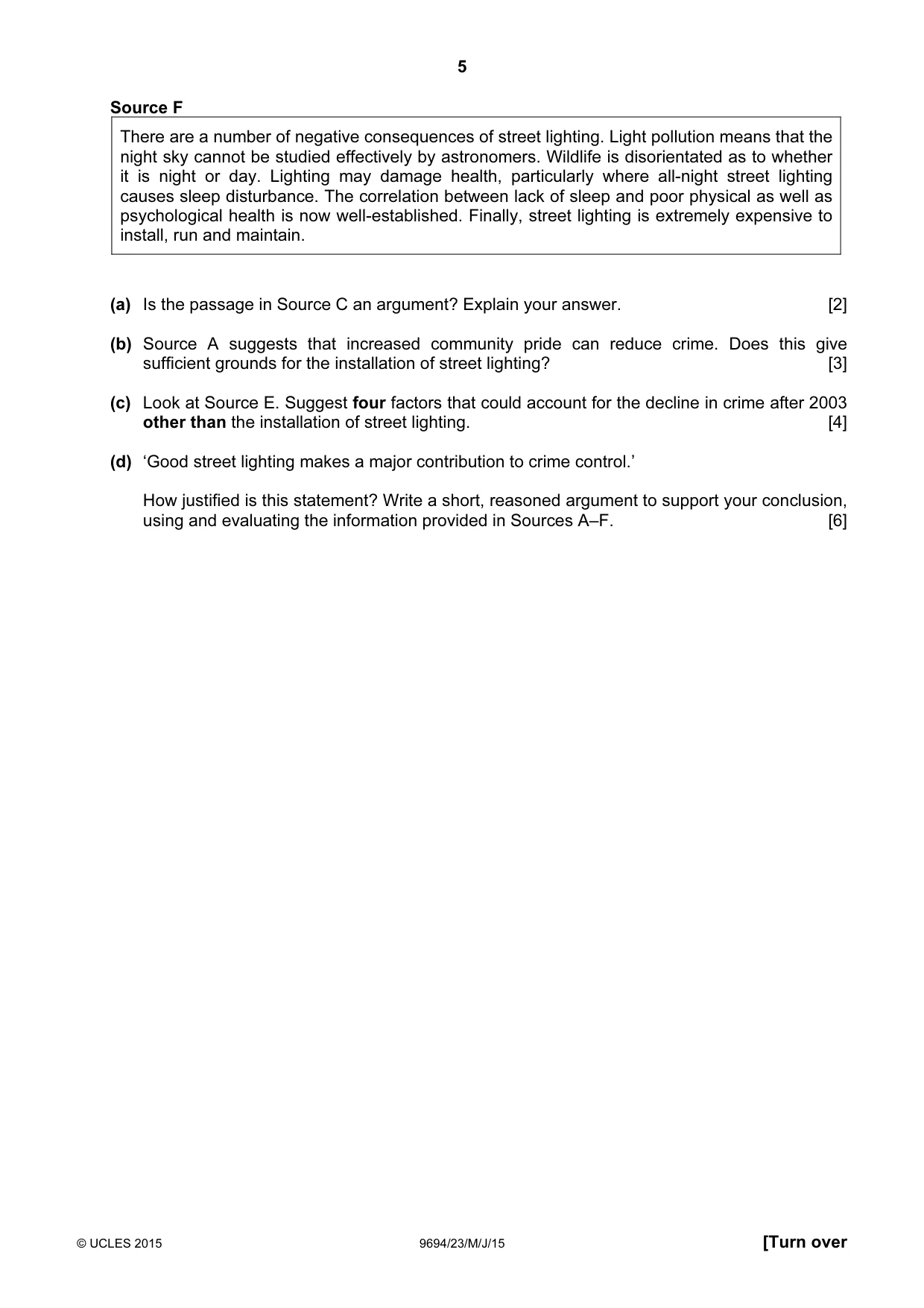
Question paper, page 1
This document consists of 6 printed pages, 2 blank pages and 1 insert. IB15 06_9694_23/3RP © UCLES 2015 [Turn over *3162771253* Cambridge International Examinations Cambridge International Advanced Subsidiary and Advanced Level THINKING SKILLS 9694/23 Paper 2 Critical Thinking May/June 2015 1 hour 45 minutes No Additional Materials are required. READ THESE INSTRUCTIONS FIRST An answer booklet is provided inside this question paper. You should follow the instructions on the front cover of the answer booklet. If you need additional answer paper ask the invigilator for a continuation booklet. Answer all the questions. The number of marks is given in brackets [ ] at the end of each question.
Question paper, page 2
2 © UCLES 2015 9694/23/M/J/15 1 Study the evidence and answer the questions that follow. Source A Newspaper report The Millennium Museum suffered a major loss yesterday when a Chinese Ming vase worth $50 000 was accidentally broken. The manager of the museum had seen the vase in its usual place in a corner at the top of some stairs at 3 pm when he was doing his rounds. At 3.30 pm a highly agitated member of staff came to him and told him that the vase had been discovered smashed to pieces. The manager told us that investigations had narrowed the field down to two key suspects. Source B Statement by Andy Jones, part-time student worker at the museum I saw a mother with a badly behaved child in the museum around the time the vase must have been damaged. The child was running around out of control and I heard the mother say that if he wasn’t careful he would knock something over like he had done in the supermarket the week before. I understand you have interviewed a Mrs Smith who claims that the mother had full control of the child. However, I observed Mrs Smith talking to the mother when they were both queuing for the toilet, so they are probably friends. Source C Statement by mother of the child I saw Andy Jones at around 3.15 pm. I understand he is a part-time worker at the museum. I recognised him because he used to go to the same school as my elder son. He was looking very flustered and I noticed his hand was bleeding. I remember my son saying he was rather clumsy and was always bumping into things. Source D Statement by Mrs Smith I understand that the finger of suspicion for the broken vase is being pointed at a mother and a child who were in the museum at the time. I observed this lady in the queue for the toilets at around 3.10 pm and remember being struck by what a good relationship she had with her child. It is typical that mothers and children immediately get the blame if something like this happens. Surely the whole point of museums is to educate children.
Question paper, page 3
3 © UCLES 2015 9694/23/M/J/15 [Turn over Source E Letter from college principal to Andy Jones received on the day of the accident You have missed three seminars and you are behind with your written work. Informal reports suggest that you are spending too much time going to parties and getting up late. You should take this letter as a final warning. A failure to change your attitude will lead to dismissal from the college. This would be regrettable as your laboratory work earlier in the course suggested you had some promise as a scientist. (a) How significant is Andy Jones’ evidence that he observed Mrs Smith talking to the mother? (Source B) [3] (b) How useful is Mrs Smith’s evidence in Source D? [3] (c) How relevant is the evidence in Source E in assessing Andy Jones’s possible guilt? [3] (d) Which of the two key suspects is more likely to have caused the vase to be smashed? Write a short, reasoned argument to support your conclusion, with critical reference to the evidence provided and considering a plausible alternative conclusion. [6]
Question paper, page 4
4 © UCLES 2015 9694/23/M/J/15 2 Study the evidence and answer the questions that follow. Source A There are two main theories of why good street lighting may discourage crime. The first suggests that better lighting leads to increased surveillance of potential offenders (both by improving visibility and by increasing the number of people on the street), which deters them. The second suggests that better lighting improves the image of an area, leading to increased community pride, community cohesiveness and informal social control. Source B A key way of conserving world energy supplies would be to limit the amount of street lighting in towns and cities. Critics of this idea argue that it would encourage crime. However, crime usually occurs when there are few (if any) witnesses, and so the lighting levels are irrelevant. Lighting can show up potential targets, security lapses and even escape routes. Lighting can help criminals see what they are doing, minimising any risk to themselves. Finally, lights can hide criminal activity with glare, providing ideal cover for a burglar by blinding potential witnesses. They can also obscure security camera images. Source C Some people disagree with the idea that street lighting discourages crime. Instead, they say that a lack of street lighting causes a fear of crime rather than an increase in actual crime. However, studies have shown that crime decreases in neighbourhoods where there is a mix of ages and social classes out on the streets. Reducing the fear of crime encourages all types of people to go out at night. Restaurants and other businesses benefit from such a night time economy where there is such a social mix. Source D The fact that so many offences take place after dark does not necessarily mean they have been caused by inadequate lighting. Street crime tends to occur in leisure-time contexts, often taking place when people – both offenders and victims – have gone out to enjoy themselves and where inhibitions are loosened. A study of 550 offences involving violence or public disruption in a city in the UK showed that almost half occurred between 6.00 pm on Friday and 6.00 pm on Sunday. This is the main time of the week when people are at leisure. Source E Numbers of crimes in an area before and after street lighting was installed in 2003 Year Burglary Assault Car theft Criminal Damage 2001 50 76 78 90 2002 45 70 68 80 2003 52 78 69 92 2004 30 35 50 45 2005 25 30 40 35 2006 22 25 35 30
Question paper, page 5
5 © UCLES 2015 9694/23/M/J/15 [Turn over Source F There are a number of negative consequences of street lighting. Light pollution means that the night sky cannot be studied effectively by astronomers. Wildlife is disorientated as to whether it is night or day. Lighting may damage health, particularly where all-night street lighting causes sleep disturbance. The correlation between lack of sleep and poor physical as well as psychological health is now well-established. Finally, street lighting is extremely expensive to install, run and maintain. (a) Is the passage in Source C an argument? Explain your answer. [2] (b) Source A suggests that increased community pride can reduce crime. Does this give sufficient grounds for the installation of street lighting? [3] (c) Look at Source E. Suggest four factors that could account for the decline in crime after 2003 other than the installation of street lighting. [4] (d) ‘Good street lighting makes a major contribution to crime control.’ How justified is this statement? Write a short, reasoned argument to support your conclusion, using and evaluating the information provided in Sources A–F. [6]
Question paper, page 6
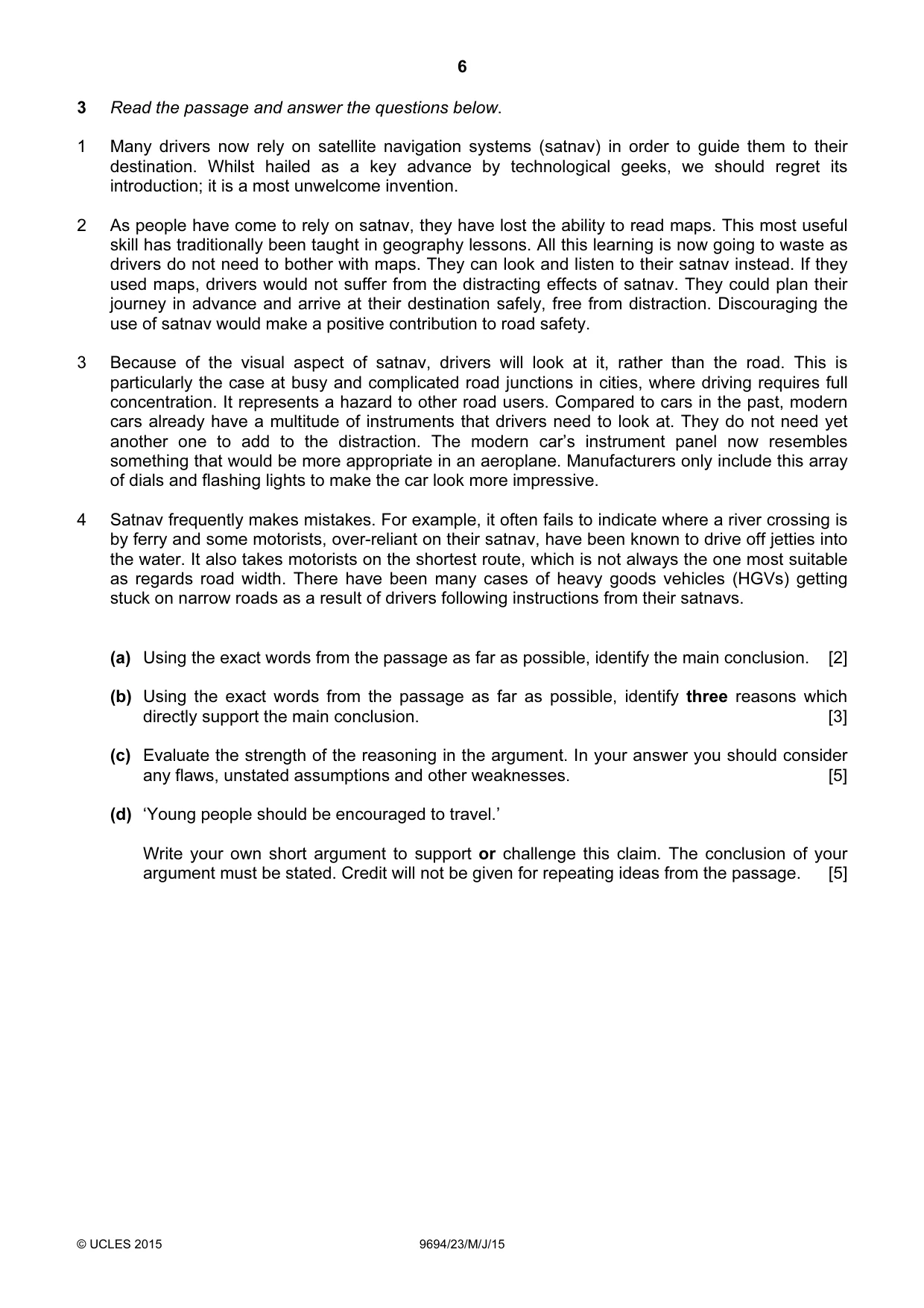
6 © UCLES 2015 9694/23/M/J/15 3 Read the passage and answer the questions below. 1 Many drivers now rely on satellite navigation systems (satnav) in order to guide them to their destination. Whilst hailed as a key advance by technological geeks, we should regret its introduction; it is a most unwelcome invention. 2 As people have come to rely on satnav, they have lost the ability to read maps. This most useful skill has traditionally been taught in geography lessons. All this learning is now going to waste as drivers do not need to bother with maps. They can look and listen to their satnav instead. If they used maps, drivers would not suffer from the distracting effects of satnav. They could plan their journey in advance and arrive at their destination safely, free from distraction. Discouraging the use of satnav would make a positive contribution to road safety. 3 Because of the visual aspect of satnav, drivers will look at it, rather than the road. This is particularly the case at busy and complicated road junctions in cities, where driving requires full concentration. It represents a hazard to other road users. Compared to cars in the past, modern cars already have a multitude of instruments that drivers need to look at. They do not need yet another one to add to the distraction. The modern car’s instrument panel now resembles something that would be more appropriate in an aeroplane. Manufacturers only include this array of dials and flashing lights to make the car look more impressive. 4 Satnav frequently makes mistakes. For example, it often fails to indicate where a river crossing is by ferry and some motorists, over-reliant on their satnav, have been known to drive off jetties into the water. It also takes motorists on the shortest route, which is not always the one most suitable as regards road width. There have been many cases of heavy goods vehicles (HGVs) getting stuck on narrow roads as a result of drivers following instructions from their satnavs. (a) Using the exact words from the passage as far as possible, identify the main conclusion. [2] (b) Using the exact words from the passage as far as possible, identify three reasons which directly support the main conclusion. [3] (c) Evaluate the strength of the reasoning in the argument. In your answer you should consider any flaws, unstated assumptions and other weaknesses. [5] (d) ‘Young people should be encouraged to travel.’ Write your own short argument to support or challenge this claim. The conclusion of your argument must be stated. Credit will not be given for repeating ideas from the passage. [5]
Question paper, page 7
7 © UCLES 2015 9694/23/M/J/15 BLANK PAGE
Question paper, page 8
8 Permission to reproduce items where third-party owned material protected by copyright is included has been sought and cleared where possible. Every reasonable effort has been made by the publisher (UCLES) to trace copyright holders, but if any items requiring clearance have unwittingly been included, the publisher will be pleased to make amends at the earliest possible opportunity. To avoid the issue of disclosure of answer-related information to candidates, all copyright acknowledgements are reproduced online in the Cambridge International Examinations Copyright Acknowledgements Booklet. This is produced for each series of examinations and is freely available to download at www.cie.org.uk after the live examination series. Cambridge International Examinations is part of the Cambridge Assessment Group. Cambridge Assessment is the brand name of University of Cambridge Local Examinations Syndicate (UCLES), which is itself a department of the University of Cambridge. © UCLES 2015 9694/23/M/J/15 BLANK PAGE
Mark scheme, page 1
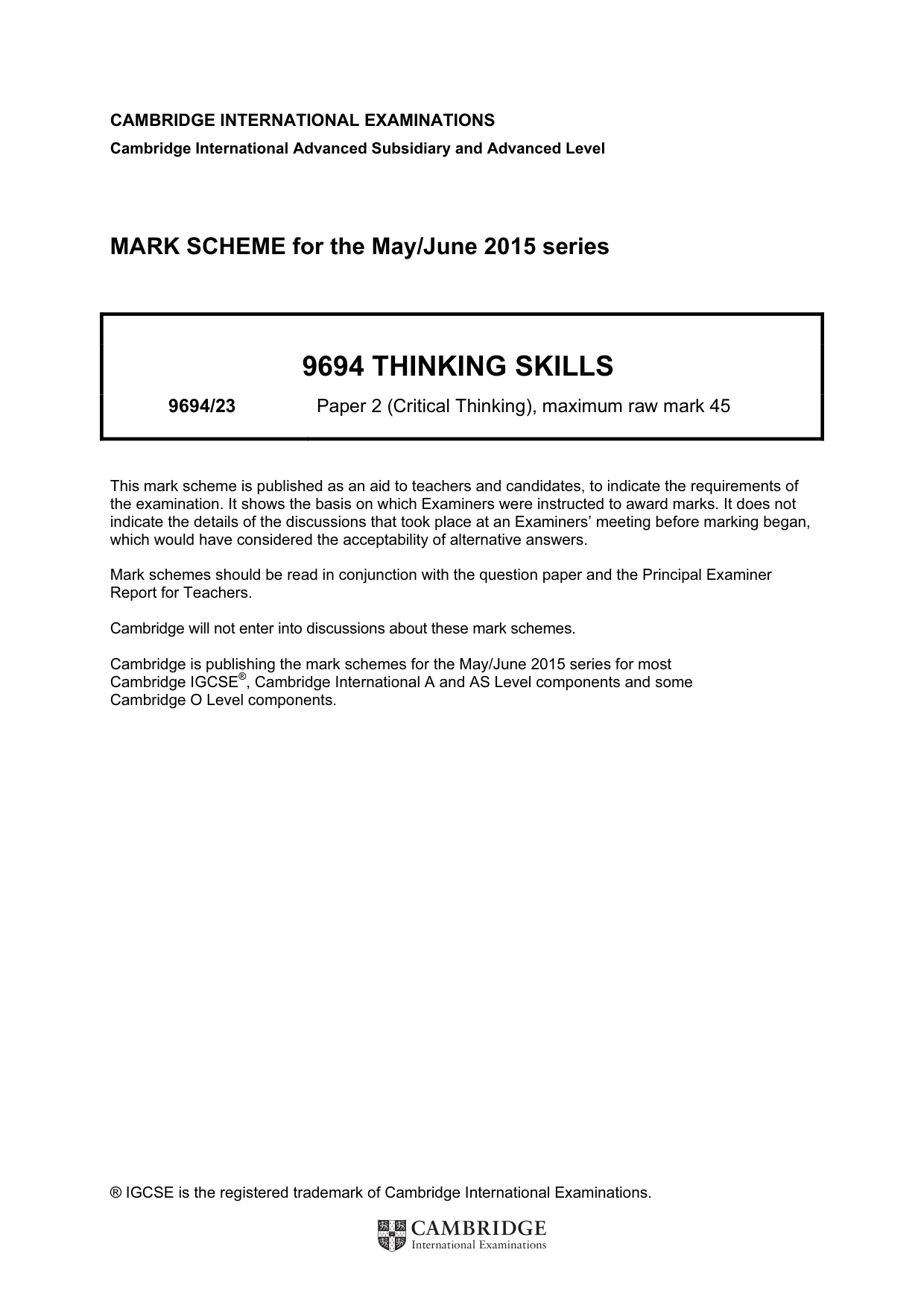
® IGCSE is the registered trademark of Cambridge International Examinations. CAMBRIDGE INTERNATIONAL EXAMINATIONS Cambridge International Advanced Subsidiary and Advanced Level MARK SCHEME for the May/June 2015 series 9694 THINKING SKILLS 9694/23 Paper 2 (Critical Thinking), maximum raw mark 45 This mark scheme is published as an aid to teachers and candidates, to indicate the requirements of the examination. It shows the basis on which Examiners were instructed to award marks. It does not indicate the details of the discussions that took place at an Examiners’ meeting before marking began, which would have considered the acceptability of alternative answers. Mark schemes should be read in conjunction with the question paper and the Principal Examiner Report for Teachers. Cambridge will not enter into discussions about these mark schemes. Cambridge is publishing the mark schemes for the May/June 2015 series for most Cambridge IGCSE®, Cambridge International A and AS Level components and some Cambridge O Level components.
Mark scheme, page 2
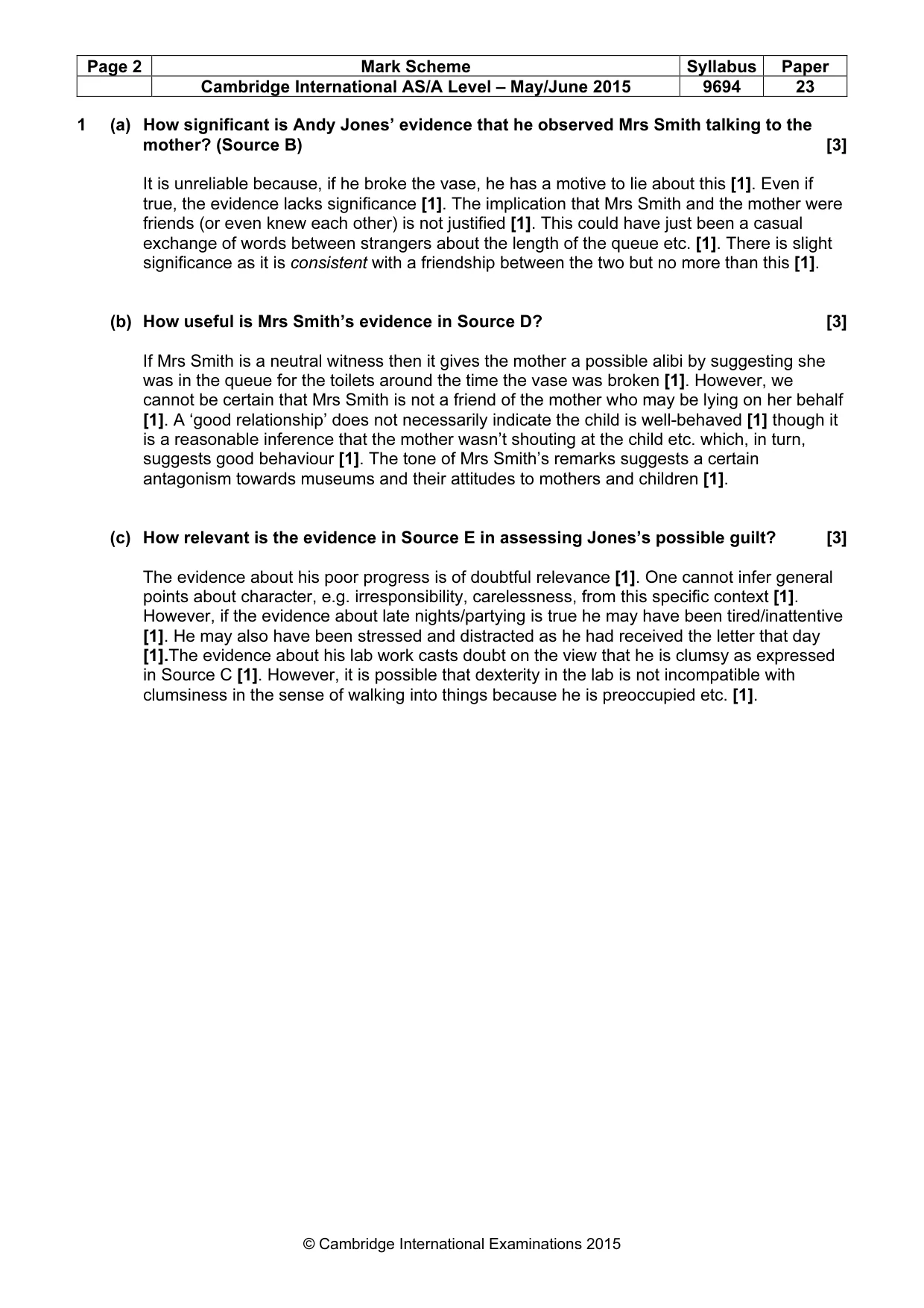
Page 2 Mark Scheme Syllabus Paper Cambridge International AS/A Level – May/June 2015 9694 23 © Cambridge International Examinations 2015 1 (a) How significant is Andy Jones’ evidence that he observed Mrs Smith talking to the mother? (Source B) [3] It is unreliable because, if he broke the vase, he has a motive to lie about this [1]. Even if true, the evidence lacks significance [1]. The implication that Mrs Smith and the mother were friends (or even knew each other) is not justified [1]. This could have just been a casual exchange of words between strangers about the length of the queue etc. [1]. There is slight significance as it is consistent with a friendship between the two but no more than this [1]. (b) How useful is Mrs Smith’s evidence in Source D? [3] If Mrs Smith is a neutral witness then it gives the mother a possible alibi by suggesting she was in the queue for the toilets around the time the vase was broken [1]. However, we cannot be certain that Mrs Smith is not a friend of the mother who may be lying on her behalf [1]. A ‘good relationship’ does not necessarily indicate the child is well-behaved [1] though it is a reasonable inference that the mother wasn’t shouting at the child etc. which, in turn, suggests good behaviour [1]. The tone of Mrs Smith’s remarks suggests a certain antagonism towards museums and their attitudes to mothers and children [1]. (c) How relevant is the evidence in Source E in assessing Jones’s possible guilt? [3] The evidence about his poor progress is of doubtful relevance [1]. One cannot infer general points about character, e.g. irresponsibility, carelessness, from this specific context [1]. However, if the evidence about late nights/partying is true he may have been tired/inattentive [1]. He may also have been stressed and distracted as he had received the letter that day [1].The evidence about his lab work casts doubt on the view that he is clumsy as expressed in Source C [1]. However, it is possible that dexterity in the lab is not incompatible with clumsiness in the sense of walking into things because he is preoccupied etc. [1].
Mark scheme, page 3
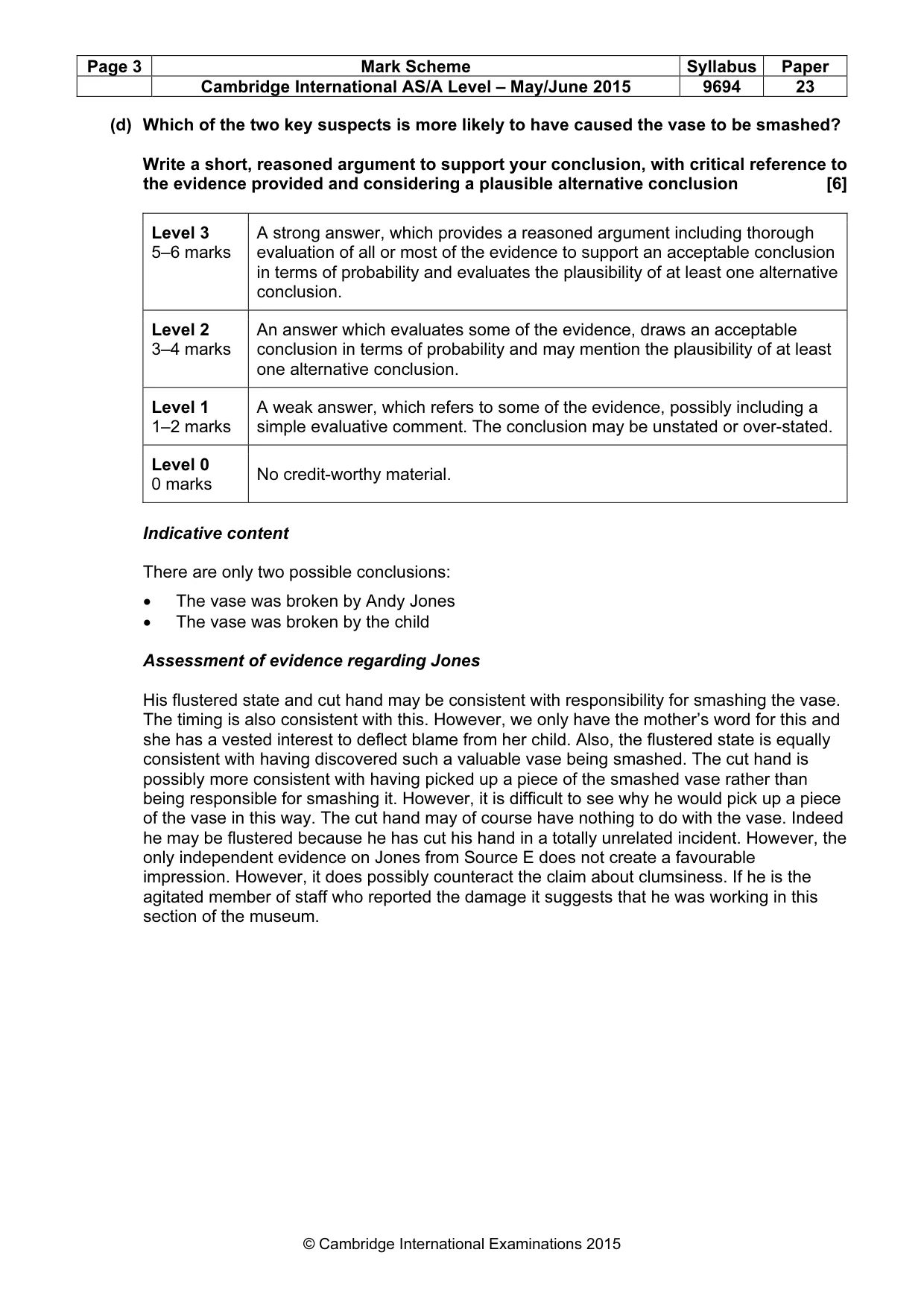
Page 3 Mark Scheme Syllabus Paper Cambridge International AS/A Level – May/June 2015 9694 23 © Cambridge International Examinations 2015 (d) Which of the two key suspects is more likely to have caused the vase to be smashed? Write a short, reasoned argument to support your conclusion, with critical reference to the evidence provided and considering a plausible alternative conclusion [6] Level 3 5–6 marks A strong answer, which provides a reasoned argument including thorough evaluation of all or most of the evidence to support an acceptable conclusion in terms of probability and evaluates the plausibility of at least one alternative conclusion. Level 2 3–4 marks An answer which evaluates some of the evidence, draws an acceptable conclusion in terms of probability and may mention the plausibility of at least one alternative conclusion. Level 1 1–2 marks A weak answer, which refers to some of the evidence, possibly including a simple evaluative comment. The conclusion may be unstated or over-stated. Level 0 0 marks No credit-worthy material. Indicative content There are only two possible conclusions: • The vase was broken by Andy Jones • The vase was broken by the child Assessment of evidence regarding Jones His flustered state and cut hand may be consistent with responsibility for smashing the vase. The timing is also consistent with this. However, we only have the mother’s word for this and she has a vested interest to deflect blame from her child. Also, the flustered state is equally consistent with having discovered such a valuable vase being smashed. The cut hand is possibly more consistent with having picked up a piece of the smashed vase rather than being responsible for smashing it. However, it is difficult to see why he would pick up a piece of the vase in this way. The cut hand may of course have nothing to do with the vase. Indeed he may be flustered because he has cut his hand in a totally unrelated incident. However, the only independent evidence on Jones from Source E does not create a favourable impression. However, it does possibly counteract the claim about clumsiness. If he is the agitated member of staff who reported the damage it suggests that he was working in this section of the museum.
Mark scheme, page 4
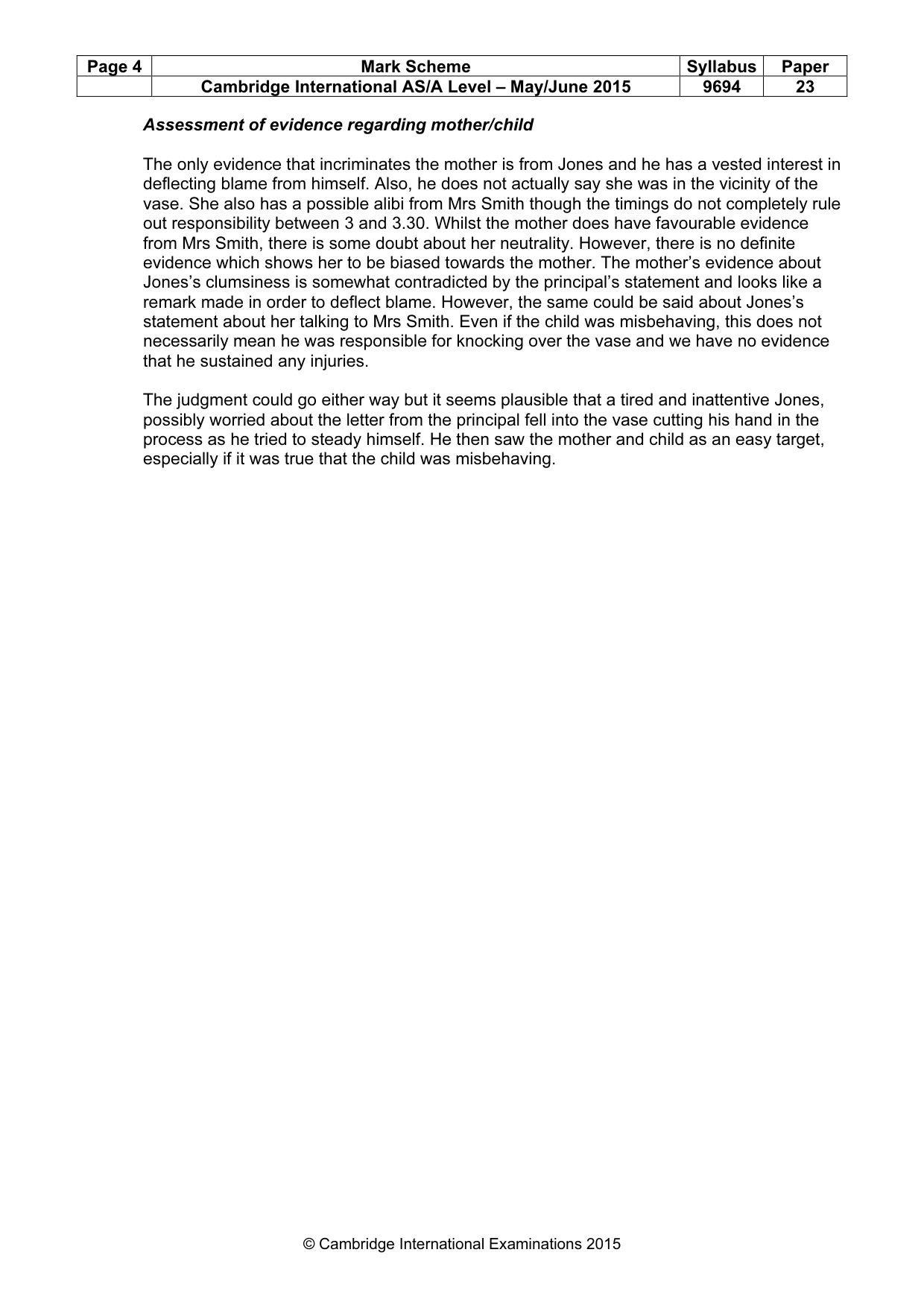
Page 4 Mark Scheme Syllabus Paper Cambridge International AS/A Level – May/June 2015 9694 23 © Cambridge International Examinations 2015 Assessment of evidence regarding mother/child The only evidence that incriminates the mother is from Jones and he has a vested interest in deflecting blame from himself. Also, he does not actually say she was in the vicinity of the vase. She also has a possible alibi from Mrs Smith though the timings do not completely rule out responsibility between 3 and 3.30. Whilst the mother does have favourable evidence from Mrs Smith, there is some doubt about her neutrality. However, there is no definite evidence which shows her to be biased towards the mother. The mother’s evidence about Jones’s clumsiness is somewhat contradicted by the principal’s statement and looks like a remark made in order to deflect blame. However, the same could be said about Jones’s statement about her talking to Mrs Smith. Even if the child was misbehaving, this does not necessarily mean he was responsible for knocking over the vase and we have no evidence that he sustained any injuries. The judgment could go either way but it seems plausible that a tired and inattentive Jones, possibly worried about the letter from the principal fell into the vase cutting his hand in the process as he tried to steady himself. He then saw the mother and child as an easy target, especially if it was true that the child was misbehaving.
Mark scheme, page 5
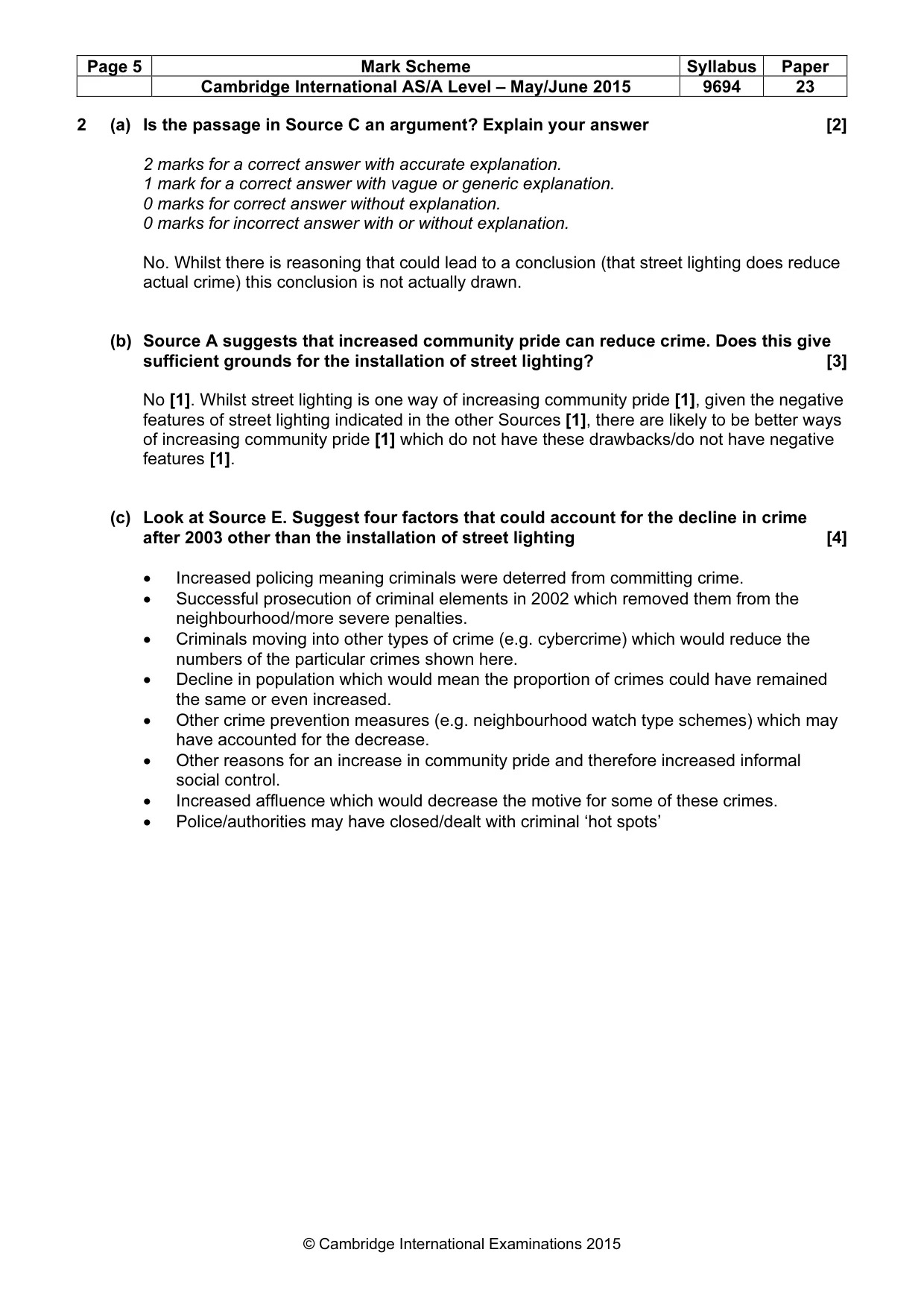
Page 5 Mark Scheme Syllabus Paper Cambridge International AS/A Level – May/June 2015 9694 23 © Cambridge International Examinations 2015 2 (a) Is the passage in Source C an argument? Explain your answer [2] 2 marks for a correct answer with accurate explanation. 1 mark for a correct answer with vague or generic explanation. 0 marks for correct answer without explanation. 0 marks for incorrect answer with or without explanation. No. Whilst there is reasoning that could lead to a conclusion (that street lighting does reduce actual crime) this conclusion is not actually drawn. (b) Source A suggests that increased community pride can reduce crime. Does this give sufficient grounds for the installation of street lighting? [3] No [1]. Whilst street lighting is one way of increasing community pride [1], given the negative features of street lighting indicated in the other Sources [1], there are likely to be better ways of increasing community pride [1] which do not have these drawbacks/do not have negative features [1]. (c) Look at Source E. Suggest four factors that could account for the decline in crime after 2003 other than the installation of street lighting [4] • Increased policing meaning criminals were deterred from committing crime. • Successful prosecution of criminal elements in 2002 which removed them from the neighbourhood/more severe penalties. • Criminals moving into other types of crime (e.g. cybercrime) which would reduce the numbers of the particular crimes shown here. • Decline in population which would mean the proportion of crimes could have remained the same or even increased. • Other crime prevention measures (e.g. neighbourhood watch type schemes) which may have accounted for the decrease. • Other reasons for an increase in community pride and therefore increased informal social control. • Increased affluence which would decrease the motive for some of these crimes. • Police/authorities may have closed/dealt with criminal ‘hot spots’
Mark scheme, page 6
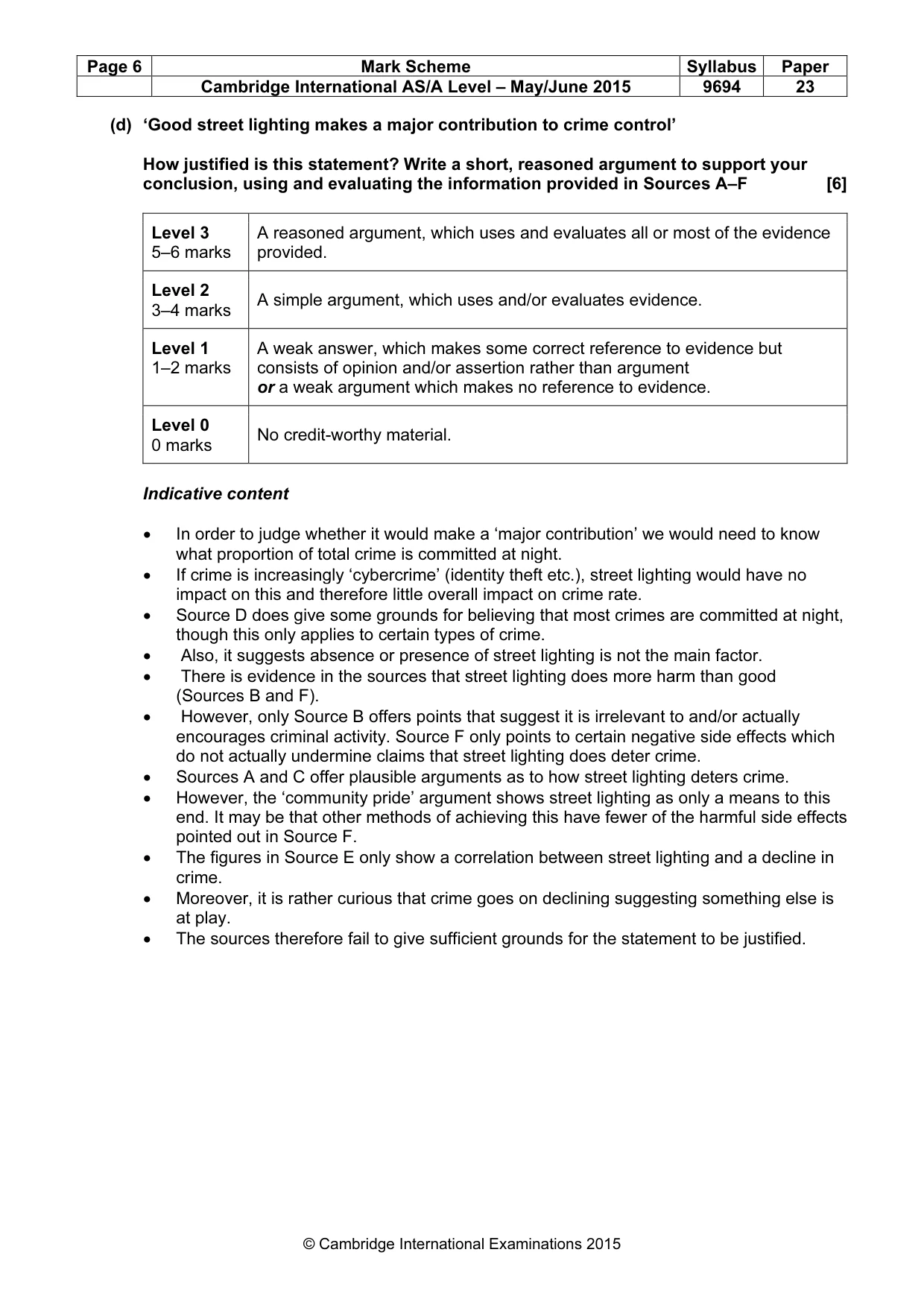
Page 6 Mark Scheme Syllabus Paper Cambridge International AS/A Level – May/June 2015 9694 23 © Cambridge International Examinations 2015 (d) ‘Good street lighting makes a major contribution to crime control’ How justified is this statement? Write a short, reasoned argument to support your conclusion, using and evaluating the information provided in Sources A–F [6] Level 3 5–6 marks A reasoned argument, which uses and evaluates all or most of the evidence provided. Level 2 3–4 marks A simple argument, which uses and/or evaluates evidence. Level 1 1–2 marks A weak answer, which makes some correct reference to evidence but consists of opinion and/or assertion rather than argument or a weak argument which makes no reference to evidence. Level 0 0 marks No credit-worthy material. Indicative content • In order to judge whether it would make a ‘major contribution’ we would need to know what proportion of total crime is committed at night. • If crime is increasingly ‘cybercrime’ (identity theft etc.), street lighting would have no impact on this and therefore little overall impact on crime rate. • Source D does give some grounds for believing that most crimes are committed at night, though this only applies to certain types of crime. • Also, it suggests absence or presence of street lighting is not the main factor. • There is evidence in the sources that street lighting does more harm than good (Sources B and F). • However, only Source B offers points that suggest it is irrelevant to and/or actually encourages criminal activity. Source F only points to certain negative side effects which do not actually undermine claims that street lighting does deter crime. • Sources A and C offer plausible arguments as to how street lighting deters crime. • However, the ‘community pride’ argument shows street lighting as only a means to this end. It may be that other methods of achieving this have fewer of the harmful side effects pointed out in Source F. • The figures in Source E only show a correlation between street lighting and a decline in crime. • Moreover, it is rather curious that crime goes on declining suggesting something else is at play. • The sources therefore fail to give sufficient grounds for the statement to be justified.
Mark scheme, page 7
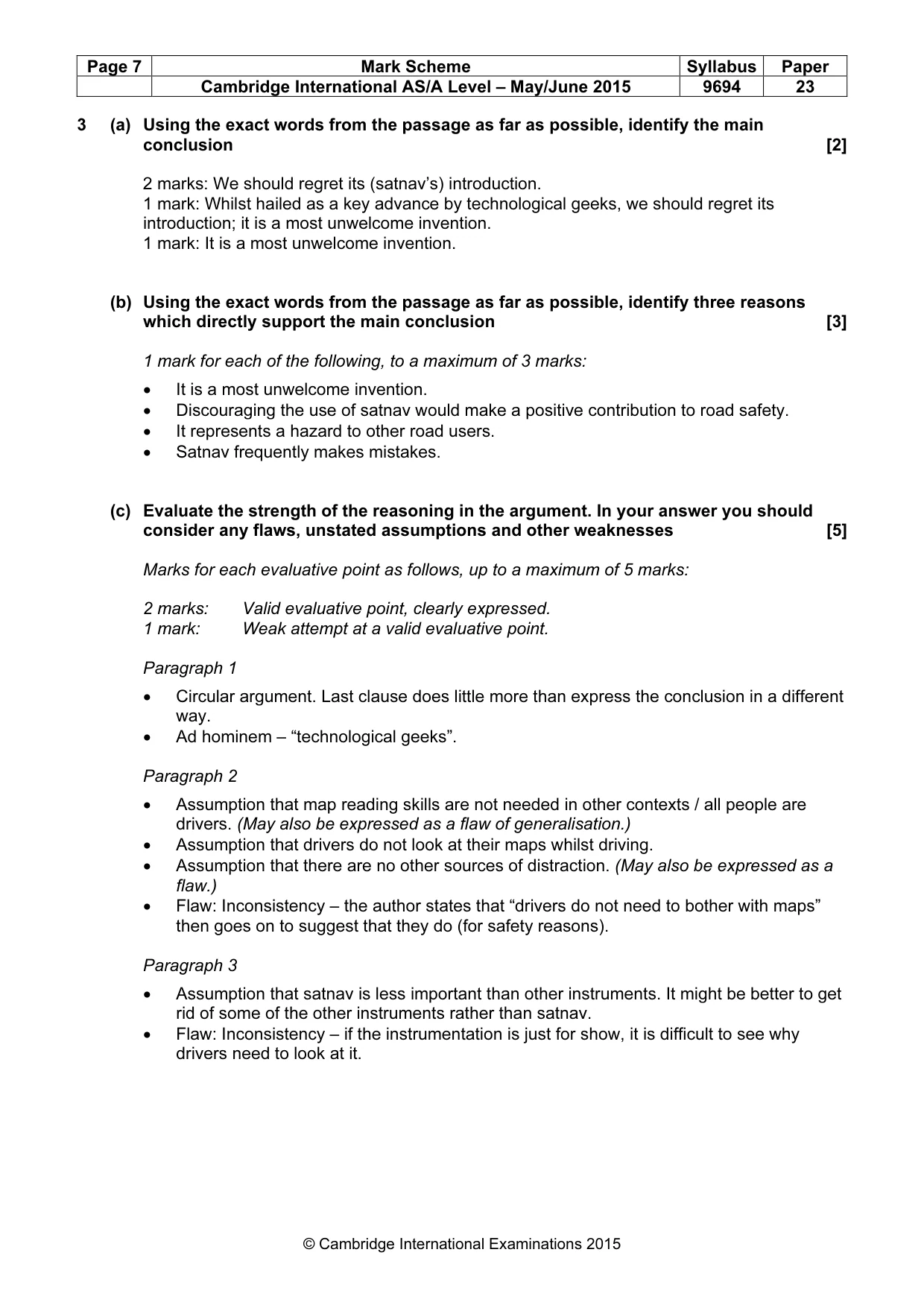
Page 7 Mark Scheme Syllabus Paper Cambridge International AS/A Level – May/June 2015 9694 23 © Cambridge International Examinations 2015 3 (a) Using the exact words from the passage as far as possible, identify the main conclusion [2] 2 marks: We should regret its (satnav’s) introduction. 1 mark: Whilst hailed as a key advance by technological geeks, we should regret its introduction; it is a most unwelcome invention. 1 mark: It is a most unwelcome invention. (b) Using the exact words from the passage as far as possible, identify three reasons which directly support the main conclusion [3] 1 mark for each of the following, to a maximum of 3 marks: • It is a most unwelcome invention. • Discouraging the use of satnav would make a positive contribution to road safety. • It represents a hazard to other road users. • Satnav frequently makes mistakes. (c) Evaluate the strength of the reasoning in the argument. In your answer you should consider any flaws, unstated assumptions and other weaknesses [5] Marks for each evaluative point as follows, up to a maximum of 5 marks: 2 marks: Valid evaluative point, clearly expressed. 1 mark: Weak attempt at a valid evaluative point. Paragraph 1 • Circular argument. Last clause does little more than express the conclusion in a different way. • Ad hominem – “technological geeks”. Paragraph 2 • Assumption that map reading skills are not needed in other contexts / all people are drivers. (May also be expressed as a flaw of generalisation.) • Assumption that drivers do not look at their maps whilst driving. • Assumption that there are no other sources of distraction. (May also be expressed as a flaw.) • Flaw: Inconsistency – the author states that “drivers do not need to bother with maps” then goes on to suggest that they do (for safety reasons). Paragraph 3 • Assumption that satnav is less important than other instruments. It might be better to get rid of some of the other instruments rather than satnav. • Flaw: Inconsistency – if the instrumentation is just for show, it is difficult to see why drivers need to look at it.
Mark scheme, page 8
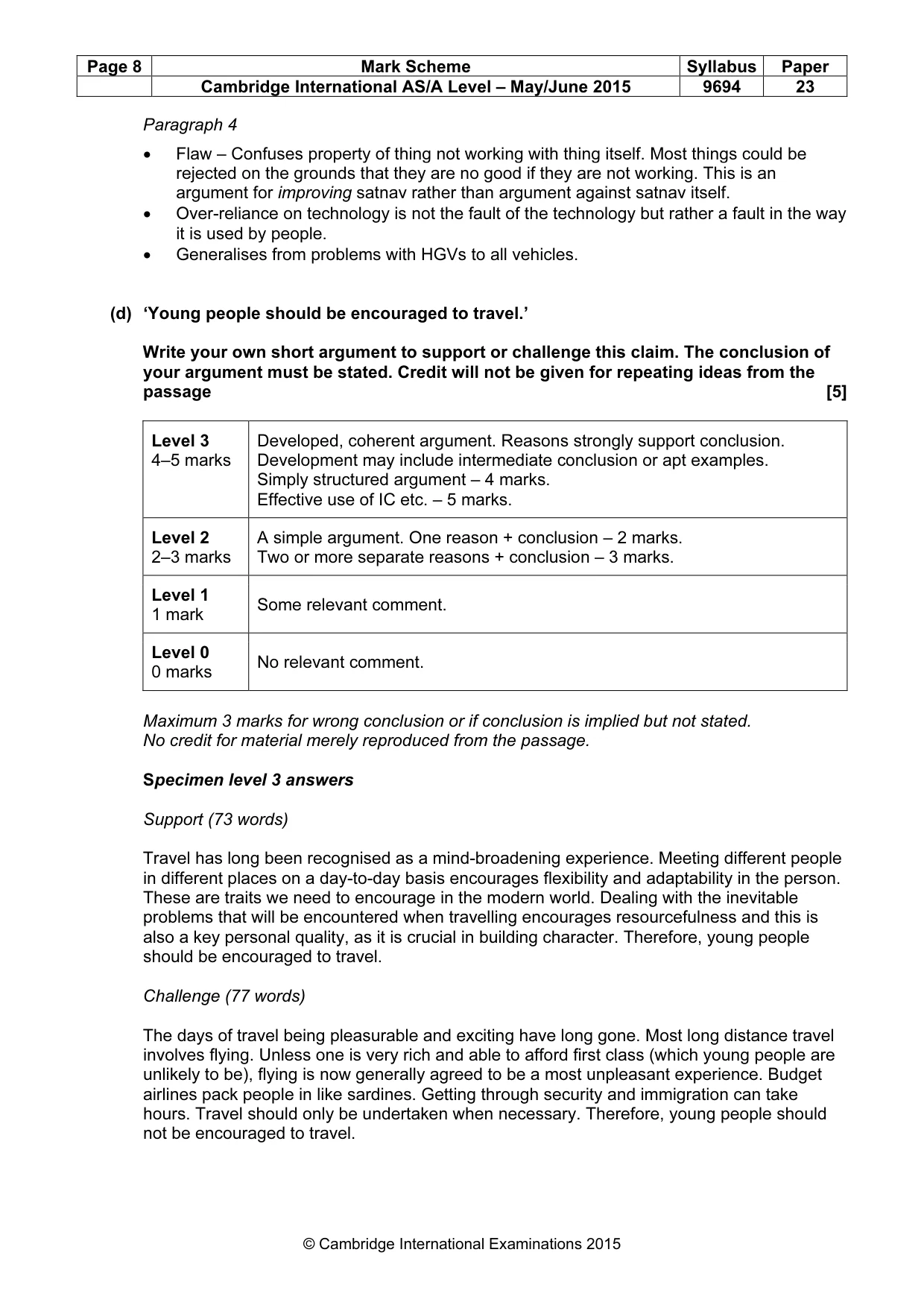
Page 8 Mark Scheme Syllabus Paper Cambridge International AS/A Level – May/June 2015 9694 23 © Cambridge International Examinations 2015 Paragraph 4 • Flaw – Confuses property of thing not working with thing itself. Most things could be rejected on the grounds that they are no good if they are not working. This is an argument for improving satnav rather than argument against satnav itself. • Over-reliance on technology is not the fault of the technology but rather a fault in the way it is used by people. • Generalises from problems with HGVs to all vehicles. (d) ‘Young people should be encouraged to travel.’ Write your own short argument to support or challenge this claim. The conclusion of your argument must be stated. Credit will not be given for repeating ideas from the passage [5] Level 3 4–5 marks Developed, coherent argument. Reasons strongly support conclusion. Development may include intermediate conclusion or apt examples. Simply structured argument – 4 marks. Effective use of IC etc. – 5 marks. Level 2 2–3 marks A simple argument. One reason + conclusion – 2 marks. Two or more separate reasons + conclusion – 3 marks. Level 1 1 mark Some relevant comment. Level 0 0 marks No relevant comment. Maximum 3 marks for wrong conclusion or if conclusion is implied but not stated. No credit for material merely reproduced from the passage. Specimen level 3 answers Support (73 words) Travel has long been recognised as a mind-broadening experience. Meeting different people in different places on a day-to-day basis encourages flexibility and adaptability in the person. These are traits we need to encourage in the modern world. Dealing with the inevitable problems that will be encountered when travelling encourages resourcefulness and this is also a key personal quality, as it is crucial in building character. Therefore, young people should be encouraged to travel. Challenge (77 words) The days of travel being pleasurable and exciting have long gone. Most long distance travel involves flying. Unless one is very rich and able to afford first class (which young people are unlikely to be), flying is now generally agreed to be a most unpleasant experience. Budget airlines pack people in like sardines. Getting through security and immigration can take hours. Travel should only be undertaken when necessary. Therefore, young people should not be encouraged to travel.
What you needed in this session
Cambridge’s own grade thresholds for 2015 May/June, Paper 2 · Variant 3. A higher threshold means an easier paper — the bar moves with how the cohort did.