Cambridge A Level Thinking Skills 9694 — 2014 Oct/Nov Paper 3 · Variant 1
9694/31/O/N/14 · 50 marks · ≈56 min
The question paper and its mark scheme, free to read here and free to download. This is Cambridge’s own paper, exactly as it was sat.
Question paper8 pages
Mark scheme8 pages
Answers below. Sit the paper first if you are practising.
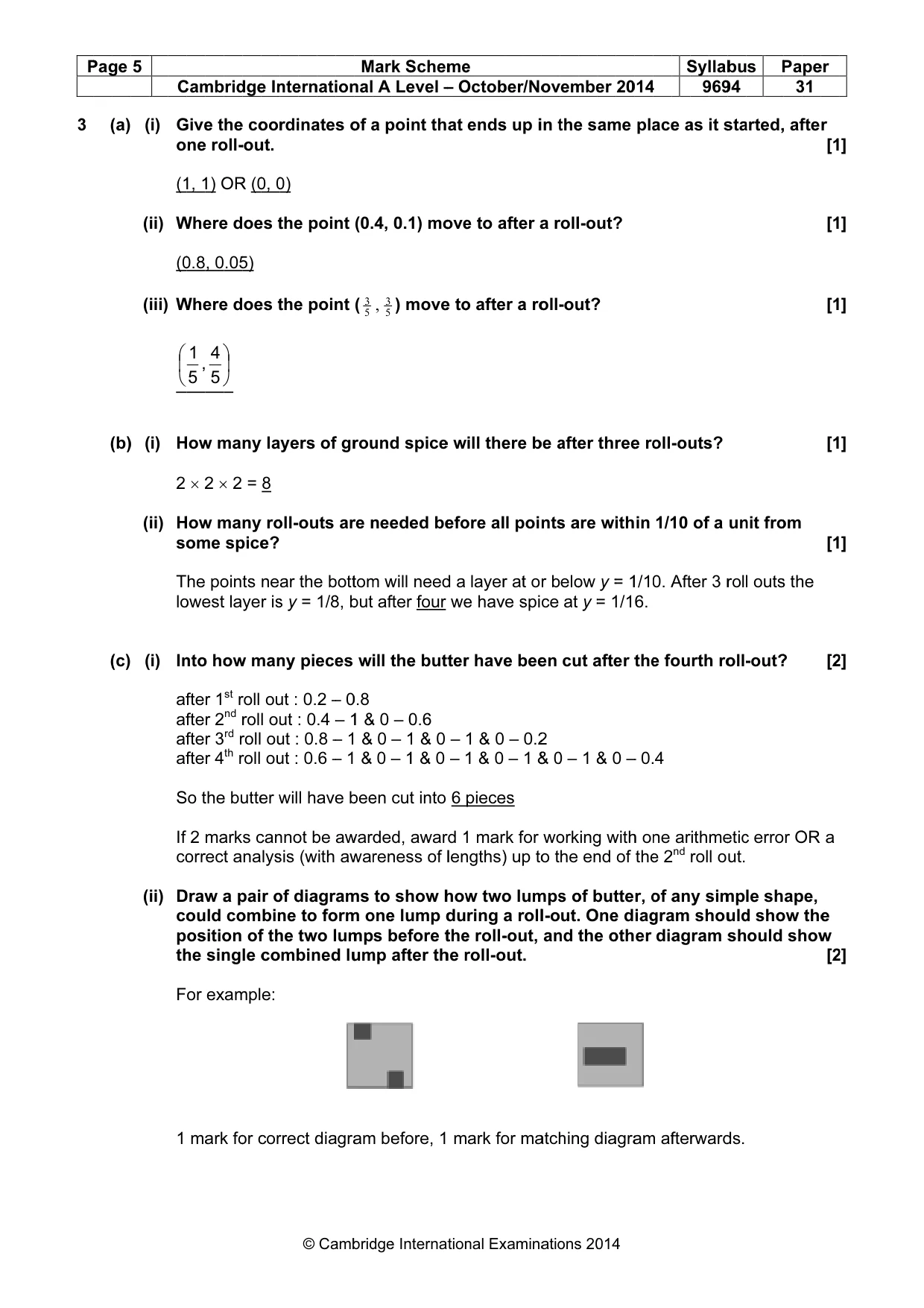
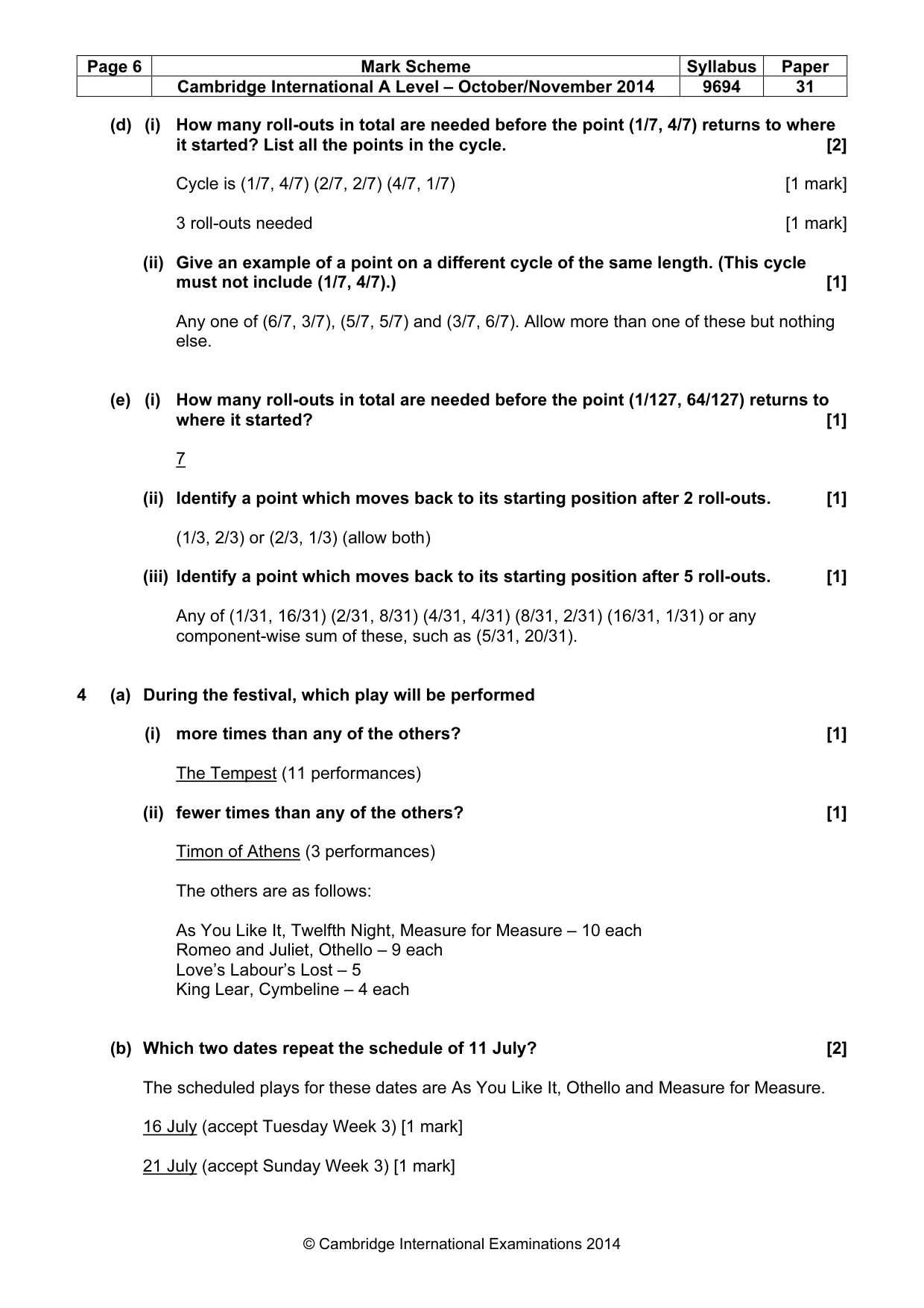
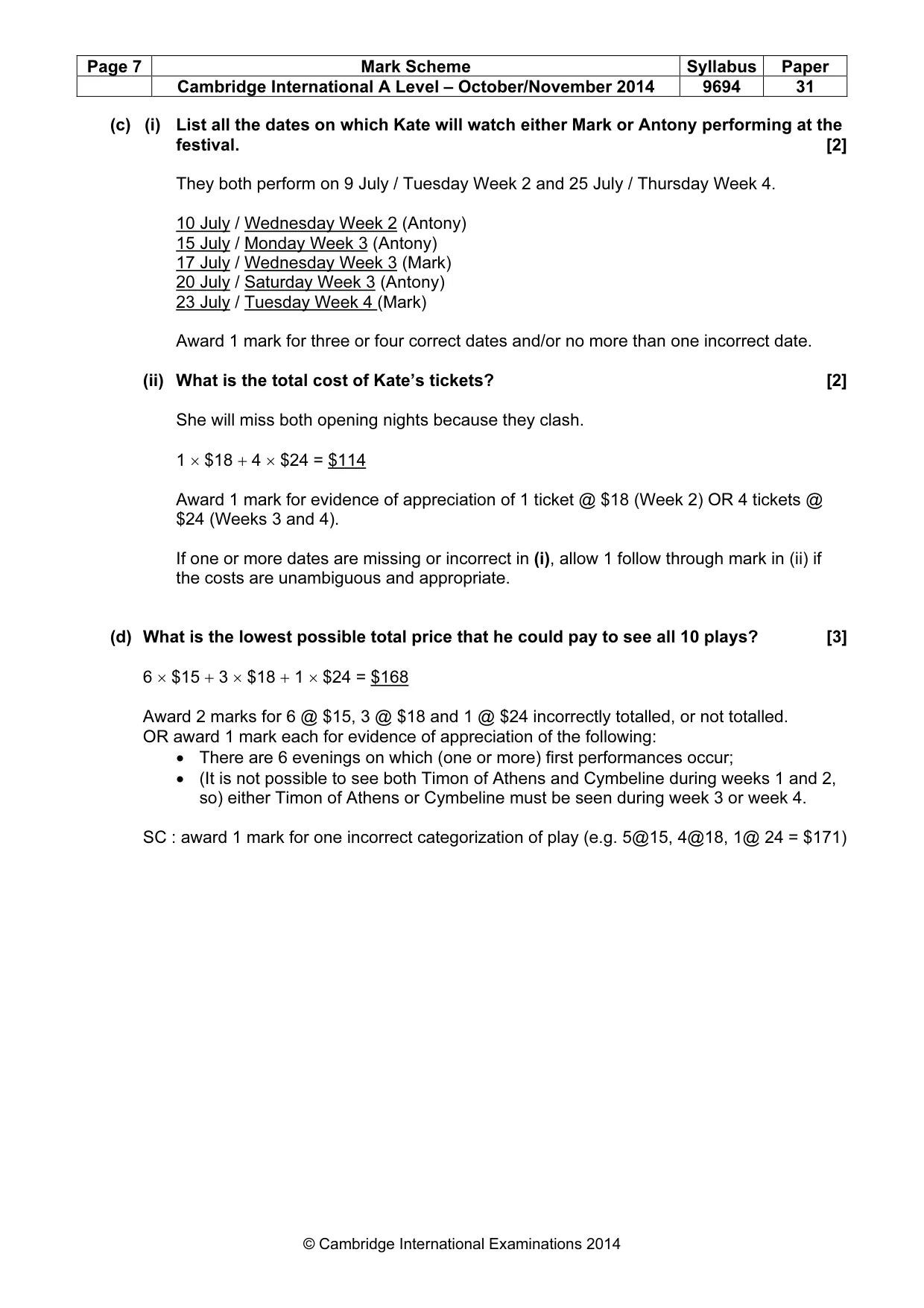
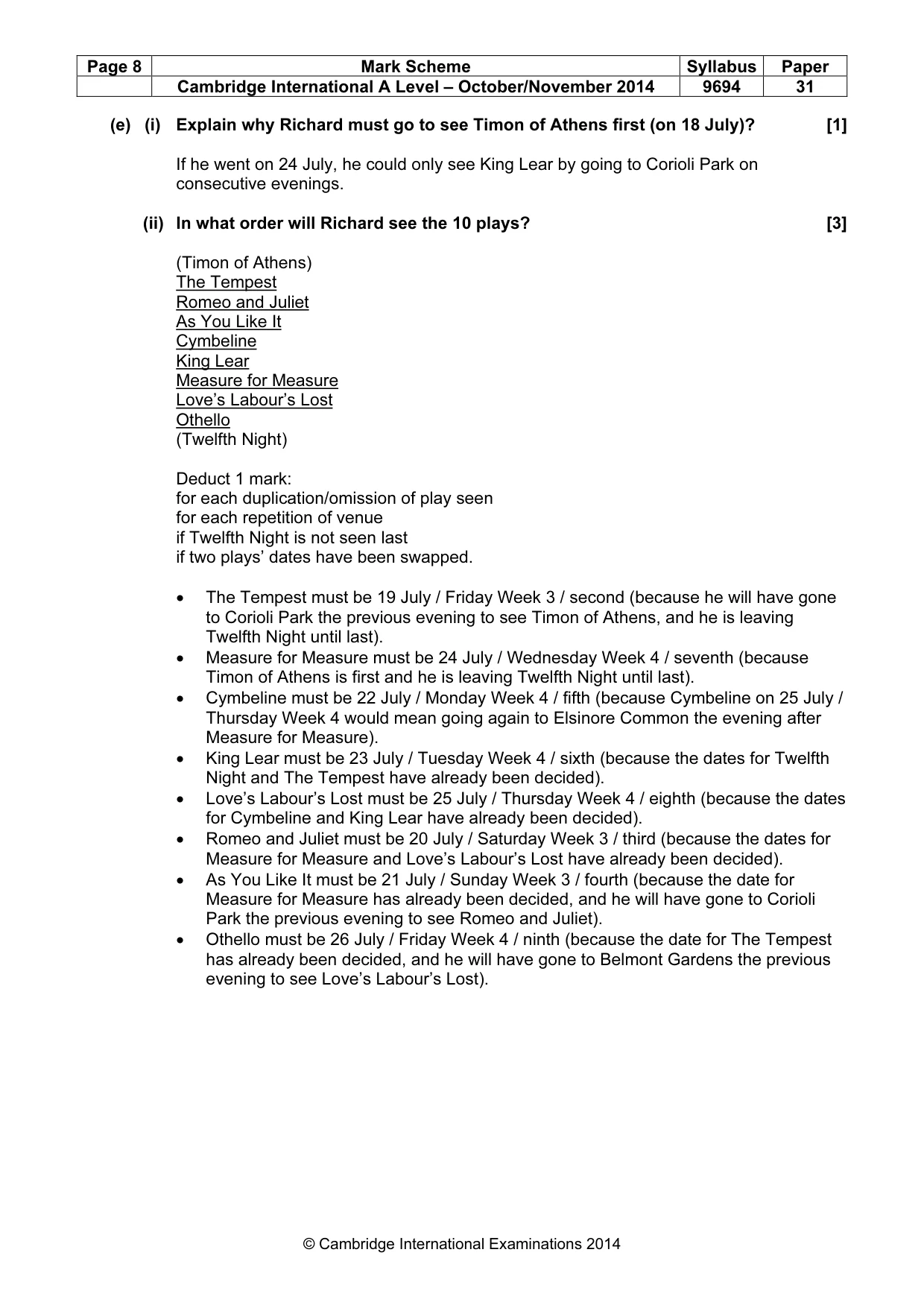
Paper as text
Question paper, page 1
This document consists of 7 printed pages, 1 blank page and 1 insert. IB14 11_9694_31/3RP © UCLES 2014 [Turn over *0850199364* Cambridge International Examinations Cambridge International Advanced Level THINKING SKILLS 9694/31 Paper 3 Problem Analysis and Solution October/November 2014 1 hour 30 minutes Additional Materials: Electronic Calculator READ THESE INSTRUCTIONS FIRST An answer booklet is provided inside this question paper. You should follow the instructions on the front cover of the answer booklet. If you need additional answer paper ask the invigilator for a continuation booklet. Answer all the questions. Calculators should be used where appropriate. The number of marks is given in brackets [ ] at the end of each question or part question.
Question paper, page 2
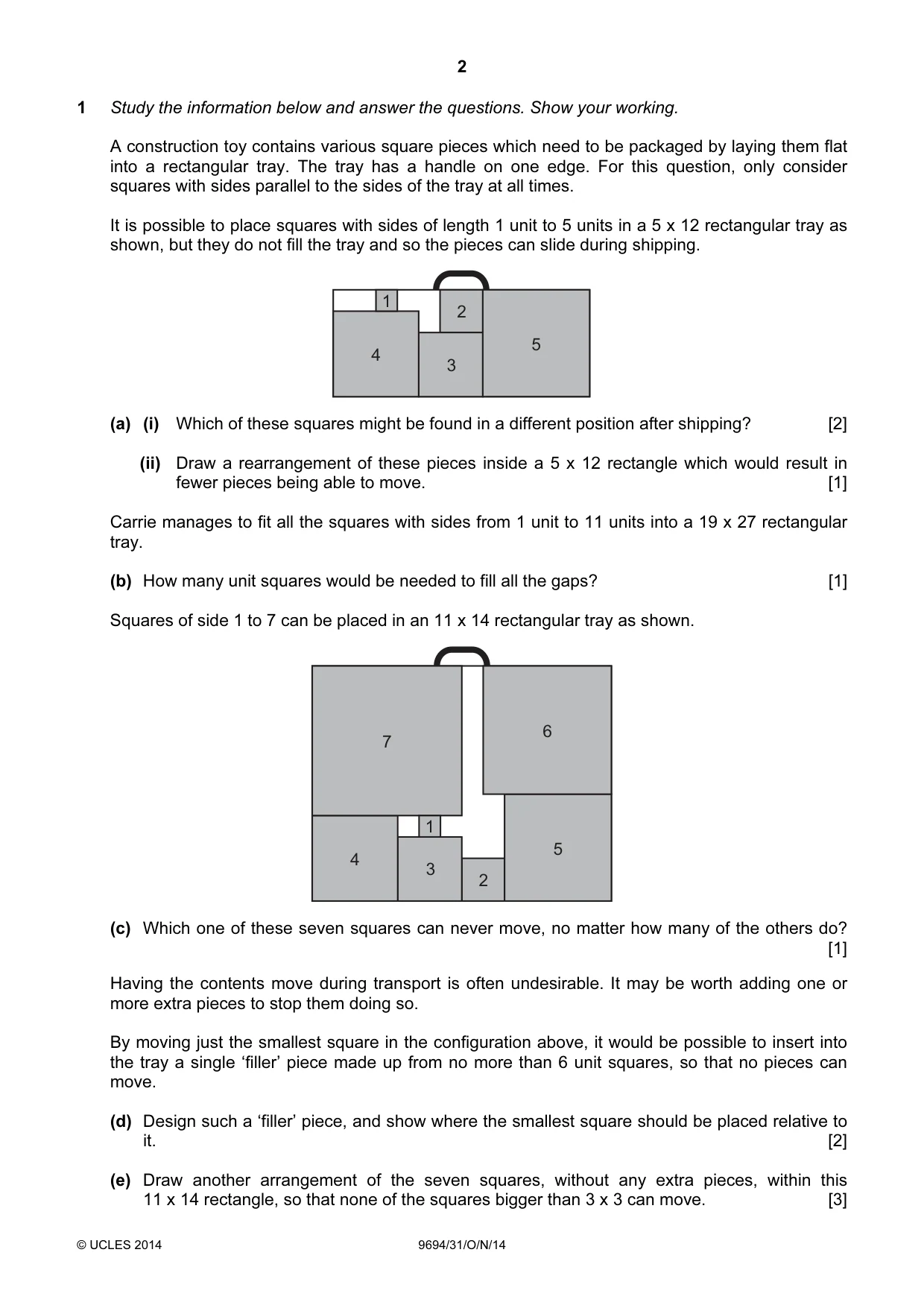
2 © UCLES 2014 9694/31/O/N/14 1 Study the information below and answer the questions. Show your working. A construction toy contains various square pieces which need to be packaged by laying them flat into a rectangular tray. The tray has a handle on one edge. For this question, only consider squares with sides parallel to the sides of the tray at all times. It is possible to place squares with sides of length 1 unit to 5 units in a 5 x 12 rectangular tray as shown, but they do not fill the tray and so the pieces can slide during shipping. 2 3 4 5 1 (a) (i) Which of these squares might be found in a different position after shipping? [2] (ii) Draw a rearrangement of these pieces inside a 5 x 12 rectangle which would result in fewer pieces being able to move. [1] Carrie manages to fit all the squares with sides from 1 unit to 11 units into a 19 x 27 rectangular tray. (b) How many unit squares would be needed to fill all the gaps? [1] Squares of side 1 to 7 can be placed in an 11 x 14 rectangular tray as shown. 2 3 4 5 1 6 7 (c) Which one of these seven squares can never move, no matter how many of the others do? [1] Having the contents move during transport is often undesirable. It may be worth adding one or more extra pieces to stop them doing so. By moving just the smallest square in the configuration above, it would be possible to insert into the tray a single ‘filler’ piece made up from no more than 6 unit squares, so that no pieces can move. (d) Design such a ‘filler’ piece, and show where the smallest square should be placed relative to it. [2] (e) Draw another arrangement of the seven squares, without any extra pieces, within this 11 x 14 rectangle, so that none of the squares bigger than 3 x 3 can move. [3]
Question paper, page 3
3 © UCLES 2014 9694/31/O/N/14 [Turn over 2 Study the information below and answer the questions. Show your working. A bank is reviewing the security PINs that customers use for internet banking, and decides that it will only allow customers to use 4-digit Personal Identification Numbers (PINs) which cannot be easily tested by a particular PIN-cracking program. This program tests PINs that follow an easily memorable rule. An example of such a rule involves choosing a first digit and then adding a constant amount to it three times. Just two digits and one symbol are required to define a rule. For example, 3 1 + would generate the sequence starting at 3, and adding 1 each time: 3 4 5 6. When such a sequence produces a number that is more than 1 digit, only the units digit is used. As an example: 5 4 + would generate the sequence 5, 9, 13, 17, which produces the PIN 5 9 3 7. (a) What 4-digit PIN would 8 7 + produce? [1] (b) How many different 4-digit PINs can be produced using two digits and an addition sign in this way? [1] The program also tests 4-digit PINs that involve successive subtractions or successive multiplications. In all these cases only the units digit is ever taken from the sequence generated. For example: the rule 3 7 – would generate the sequence 3, –4, –11, –18, which produces the PIN 3 4 1 8; the rule 9 3 would generate the sequence 9, 27, 81, 243, which produces the PIN 9 7 1 3. (c) What rule would produce the PIN 2 6 4 2? [1] (d) List all the rules that would produce the PIN 6 6 6 6. [2] (e) In this part, consider only PINs with four different digits. Give an example of such a PIN which can be produced using two different rules, both using multiplication. State the rules. [2] (f) List all of the 4-digit PINs of the form 3 1 _ _ which would not be allowed (i.e. are produced by one of the possible rules)? [2] (g) Show that at least 97% of all possible 4-digit PINs are still allowed. [1]
Question paper, page 4
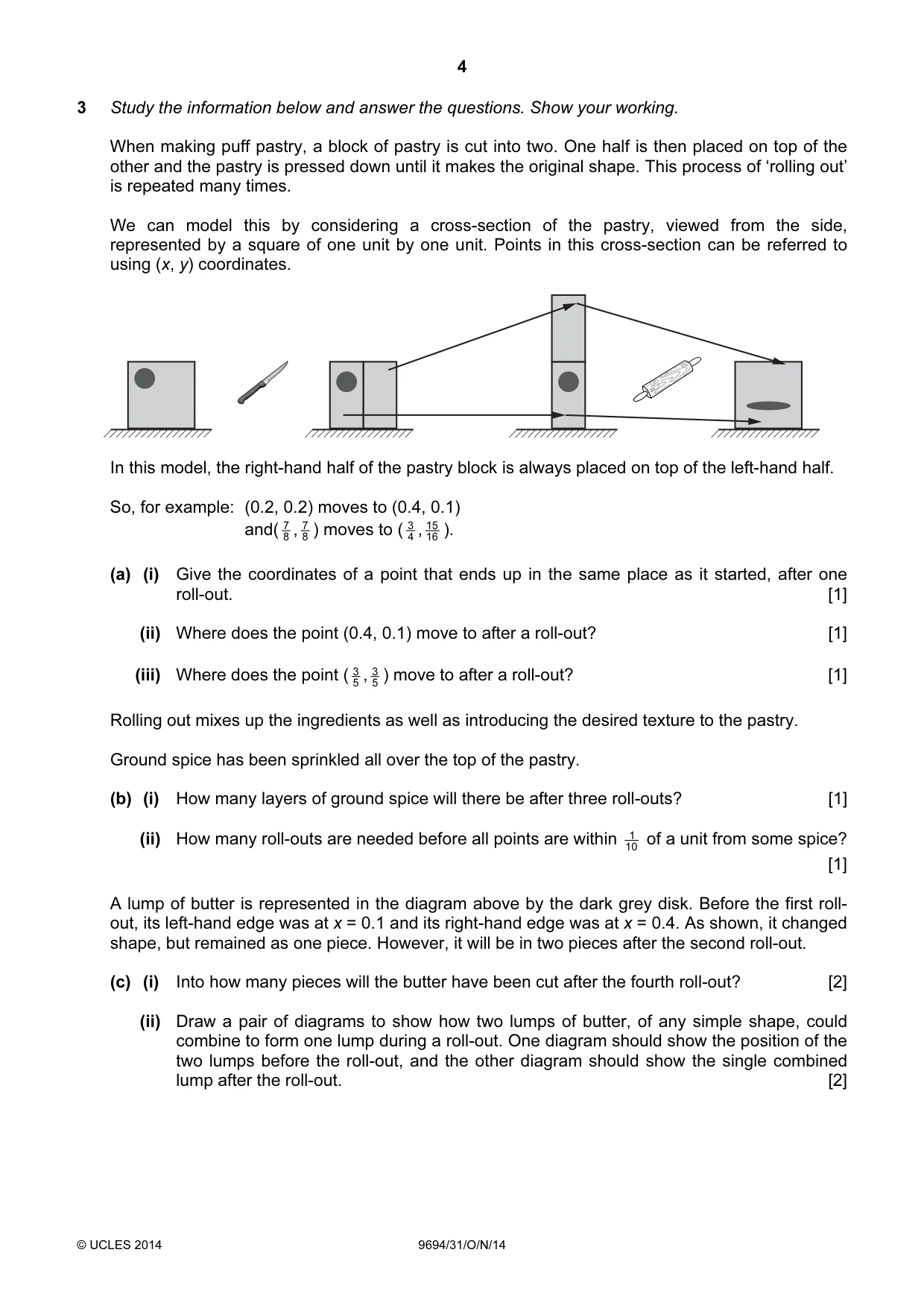
4 © UCLES 2014 9694/31/O/N/14 3 Study the information below and answer the questions. Show your working. When making puff pastry, a block of pastry is cut into two. One half is then placed on top of the other and the pastry is pressed down until it makes the original shape. This process of ‘rolling out’ is repeated many times. We can model this by considering a cross-section of the pastry, viewed from the side, represented by a square of one unit by one unit. Points in this cross-section can be referred to using (x, y) coordinates. In this model, the right-hand half of the pastry block is always placed on top of the left-hand half. So, for example: (0.2, 0.2) moves to (0.4, 0.1) and( 8 7 8 7 , ) moves to ( 16 15 4 3 , ). (a) (i) Give the coordinates of a point that ends up in the same place as it started, after one roll-out. [1] (ii) Where does the point (0.4, 0.1) move to after a roll-out? [1] (iii) Where does the point ( 5 3 5 3 , ) move to after a roll-out? [1] Rolling out mixes up the ingredients as well as introducing the desired texture to the pastry. Ground spice has been sprinkled all over the top of the pastry. (b) (i) How many layers of ground spice will there be after three roll-outs? [1] (ii) How many roll-outs are needed before all points are within 10 1 of a unit from some spice? [1] A lump of butter is represented in the diagram above by the dark grey disk. Before the first roll- out, its left-hand edge was at x = 0.1 and its right-hand edge was at x = 0.4. As shown, it changed shape, but remained as one piece. However, it will be in two pieces after the second roll-out. (c) (i) Into how many pieces will the butter have been cut after the fourth roll-out? [2] (ii) Draw a pair of diagrams to show how two lumps of butter, of any simple shape, could combine to form one lump during a roll-out. One diagram should show the position of the two lumps before the roll-out, and the other diagram should show the single combined lump after the roll-out. [2]
Question paper, page 5
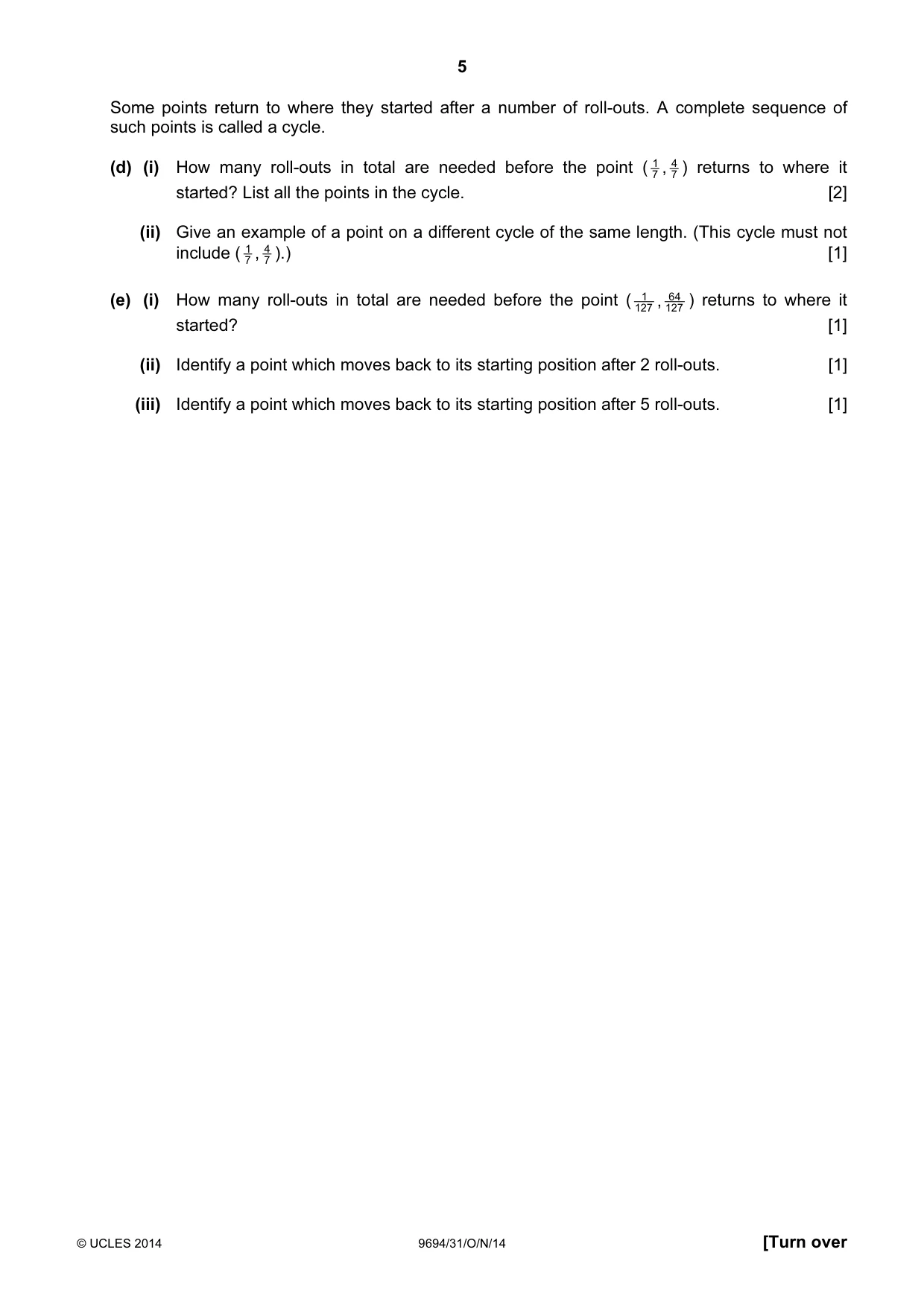
5 © UCLES 2014 9694/31/O/N/14 [Turn over Some points return to where they started after a number of roll-outs. A complete sequence of such points is called a cycle. (d) (i) How many roll-outs in total are needed before the point ( 7 4 7 1 , ) returns to where it started? List all the points in the cycle. [2] (ii) Give an example of a point on a different cycle of the same length. (This cycle must not include ( 7 4 7 1 , ).) [1] (e) (i) How many roll-outs in total are needed before the point ( 127 64 127 1 , ) returns to where it started? [1] (ii) Identify a point which moves back to its starting position after 2 roll-outs. [1] (iii) Identify a point which moves back to its starting position after 5 roll-outs. [1]
Question paper, page 6
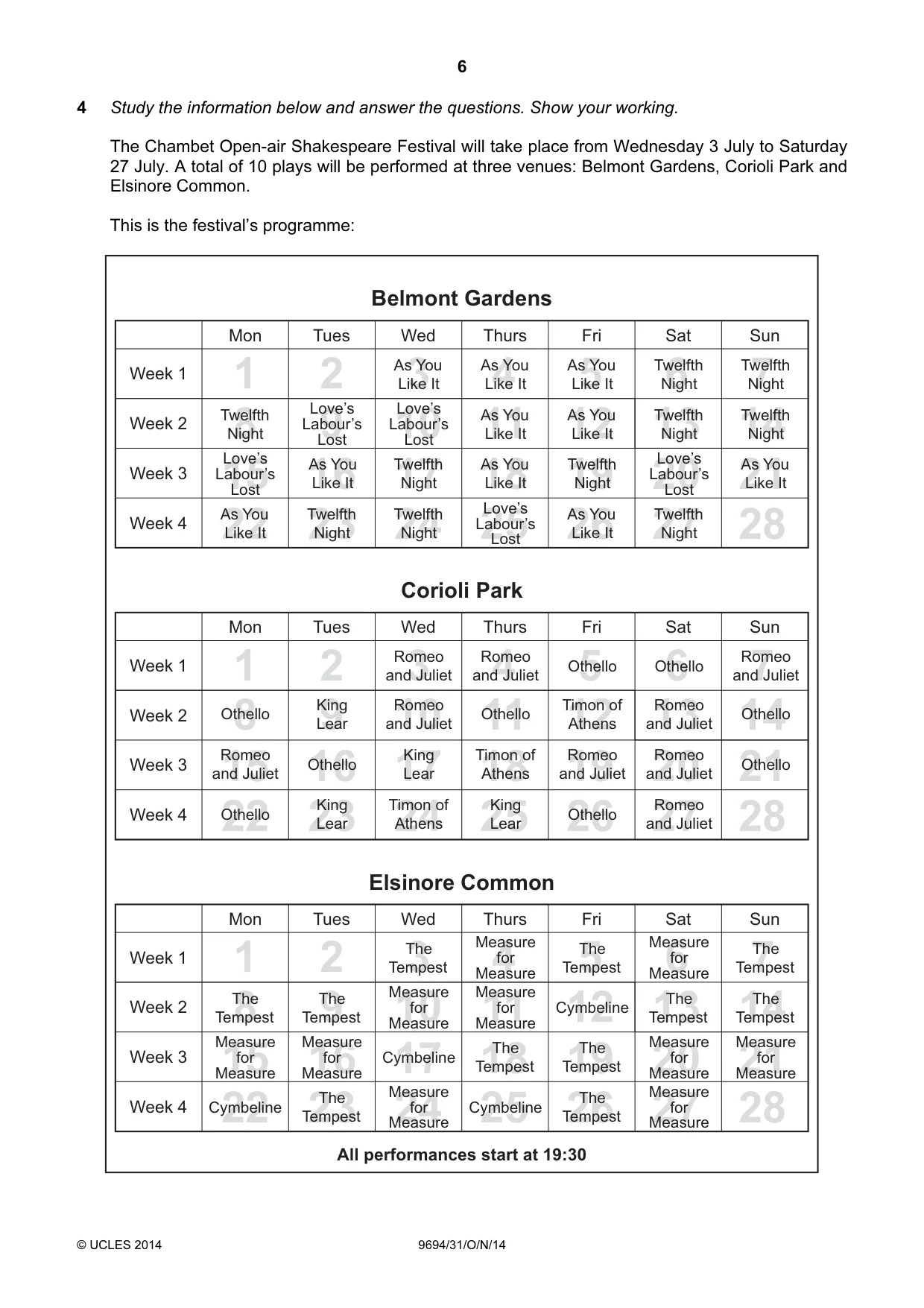
6 © UCLES 2014 9694/31/O/N/14 4 Study the information below and answer the questions. Show your working. The Chambet Open-air Shakespeare Festival will take place from Wednesday 3 July to Saturday 27 July. A total of 10 plays will be performed at three venues: Belmont Gardens, Corioli Park and Elsinore Common. This is the festival’s programme: 1 2 3 4 5 6 7 8 9 10 11 12 13 14 15 16 17 18 19 20 21 22 23 24 25 26 27 28 1 2 3 4 5 6 7 8 9 10 11 12 13 14 15 16 17 18 19 20 21 22 23 24 25 26 27 28 1 2 3 4 5 6 7 8 9 10 11 12 13 14 15 16 18 19 21 22 23 24 25 26 27 28 Belmont Gardens All performances start at 19:30 Corioli Park Elsinore Common Mon Tues Wed Thurs Fri Sat Sun Mon Tues Wed Thurs Fri Sat Sun Mon Tues Wed Thurs Fri Sat Sun 17 20 Romeo and Juliet Week 1 Week 2 Week 3 Week 4 The Tempest Measure for Measure The Tempest Measure for Measure The Tempest Week 1 Week 2 Week 3 Week 4 The Tempest Measure for Measure Cymbeline The Tempest Measure for Measure The Tempest Measure for Measure Cymbeline Measure for Measure Measure for Measure The Tempest Cymbeline Cymbeline The Tempest The Tempest The Tempest Measure for Measure Measure for Measure The Tempest Measure for Measure Romeo and Juliet Othello Othello King Lear King Lear Timon of Athens Timon of Athens King Lear Othello Romeo and Juliet Romeo and Juliet Othello As You Like It As You Like It As You Like It Twelfth Night Twelfth Night Week 1 Week 2 Week 3 Week 4 Twelfth Night Love’s Labour’s Lost As You Like It Love’s Labour’s Lost Twelfth Night Love’s Labour’s Lost Twelfth Night Twelfth Night As You Like It As You Like It As You Like It Love’s Labour’s Lost As You Like It Twelfth Night As You Like It Twelfth Night Love’s Labour’s Lost Twelfth Night Twelfth Night As You Like It Romeo and Juliet Romeo and Juliet Othello Othello Romeo and Juliet Othello King Lear Romeo and Juliet Othello Timon of Athens Romeo and Juliet Othello
Question paper, page 7
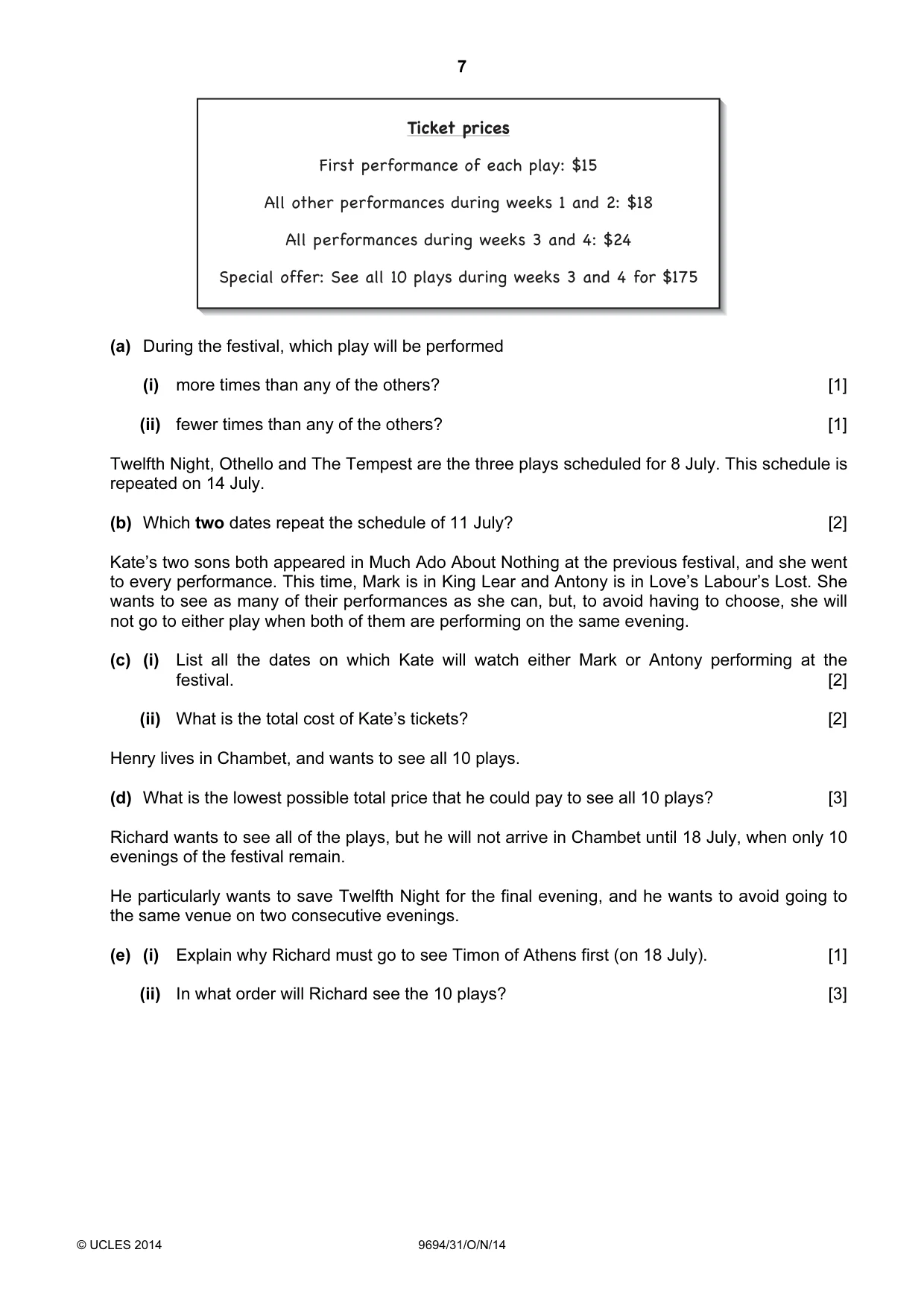
7 © UCLES 2014 9694/31/O/N/14 Ticket prices First performance of each play: $15 All other performances during weeks 1 and 2: $18 All performances during weeks 3 and 4: $24 Special offer: See all 10 plays during weeks 3 and 4 for $175 (a) During the festival, which play will be performed (i) more times than any of the others? [1] (ii) fewer times than any of the others? [1] Twelfth Night, Othello and The Tempest are the three plays scheduled for 8 July. This schedule is repeated on 14 July. (b) Which two dates repeat the schedule of 11 July? [2] Kate’s two sons both appeared in Much Ado About Nothing at the previous festival, and she went to every performance. This time, Mark is in King Lear and Antony is in Love’s Labour’s Lost. She wants to see as many of their performances as she can, but, to avoid having to choose, she will not go to either play when both of them are performing on the same evening. (c) (i) List all the dates on which Kate will watch either Mark or Antony performing at the festival. [2] (ii) What is the total cost of Kate’s tickets? [2] Henry lives in Chambet, and wants to see all 10 plays. (d) What is the lowest possible total price that he could pay to see all 10 plays? [3] Richard wants to see all of the plays, but he will not arrive in Chambet until 18 July, when only 10 evenings of the festival remain. He particularly wants to save Twelfth Night for the final evening, and he wants to avoid going to the same venue on two consecutive evenings. (e) (i) Explain why Richard must go to see Timon of Athens first (on 18 July). [1] (ii) In what order will Richard see the 10 plays? [3]
Question paper, page 8
8 Permission to reproduce items where third-party owned material protected by copyright is included has been sought and cleared where possible. Every reasonable effort has been made by the publisher (UCLES) to trace copyright holders, but if any items requiring clearance have unwittingly been included, the publisher will be pleased to make amends at the earliest possible opportunity. Cambridge International Examinations is part of the Cambridge Assessment Group. Cambridge Assessment is the brand name of University of Cambridge Local Examinations Syndicate (UCLES), which is itself a department of the University of Cambridge. © UCLES 2014 9694/31/O/N/14 BLANK PAGE
Mark scheme, page 1
® IGCSE is the registered trademark of Cambridge International Examinations. CAMBRIDGE INTERNATIONAL EXAMINATIONS Cambridge International Advanced Level MARK SCHEME for the October/November 2014 series 9694 THINKING SKILLS 9694/31 Paper 3 (Problem Analysis and Solution), maximum raw mark 50 This mark scheme is published as an aid to teachers and candidates, to indicate the requirements of the examination. It shows the basis on which Examiners were instructed to award marks. It does not indicate the details of the discussions that took place at an Examiners’ meeting before marking began, which would have considered the acceptability of alternative answers. Mark schemes should be read in conjunction with the question paper and the Principal Examiner Report for Teachers. Cambridge will not enter into discussions about these mark schemes. Cambridge is publishing the mark schemes for the October/November 2014 series for most Cambridge IGCSE®, Cambridge International A and AS Level components and some Cambridge O Level components.
Mark scheme, page 2
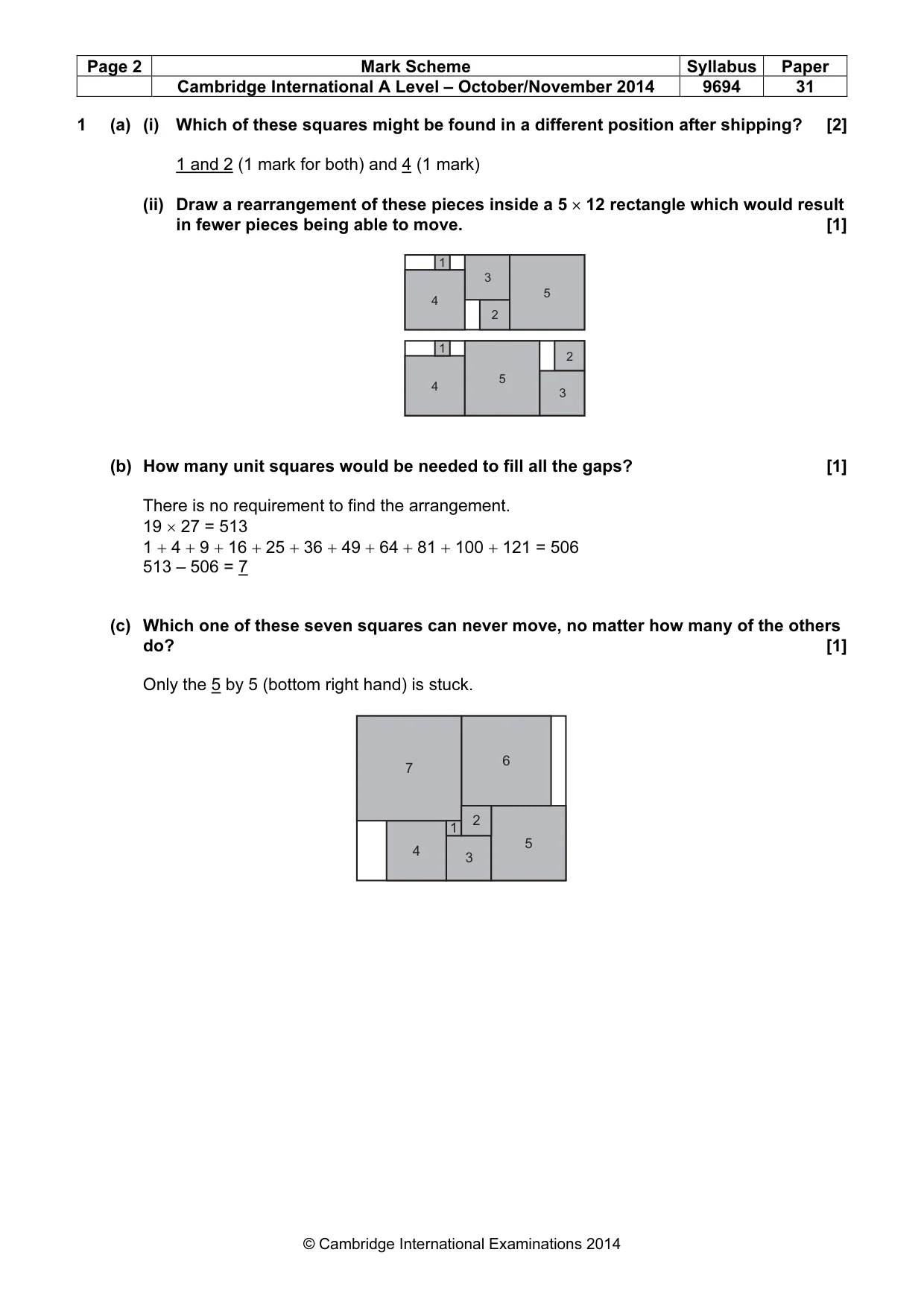
Page 2 Mark Scheme Syllabus Paper Cambridge International A Level – October/November 2014 9694 31 © Cambridge International Examinations 2014 1 (a) (i) Which of these squares might be found in a different position after shipping? [2] 1 and 2 (1 mark for both) and 4 (1 mark) (ii) Draw a rearrangement of these pieces inside a 5 × 12 rectangle which would result in fewer pieces being able to move. [1] (b) How many unit squares would be needed to fill all the gaps? [1] There is no requirement to find the arrangement. 19 × 27 = 513 1 + 4 + 9 + 16 + 25 + 36 + 49 + 64 + 81 + 100 + 121 = 506 513 – 506 = 7 (c) Which one of these seven squares can never move, no matter how many of the others do? [1] Only the 5 by 5 (bottom right hand) is stuck. 2 3 4 5 1 2 3 4 5 1 3 4 5 1 6 7 2
Mark scheme, page 3
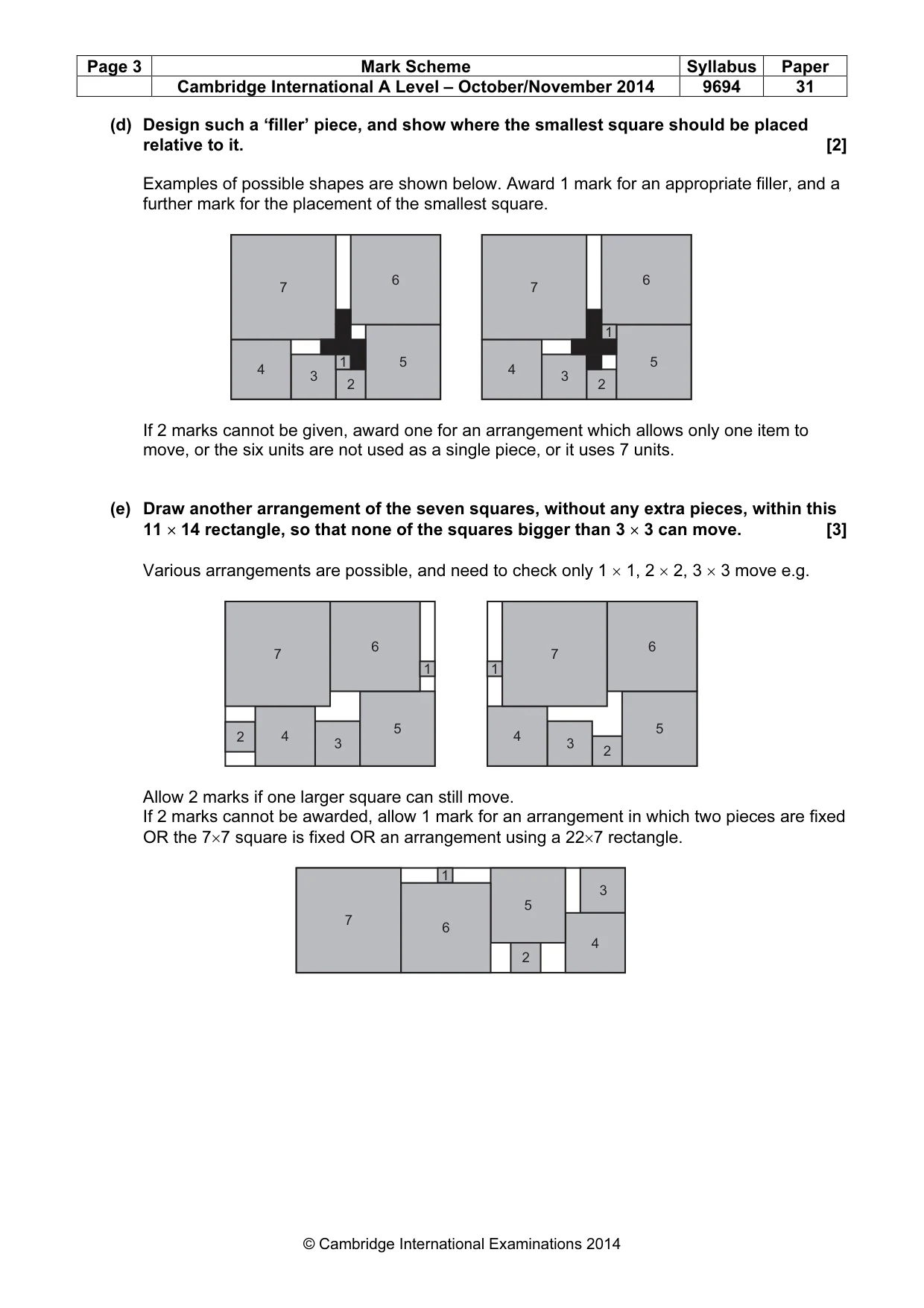
Page 3 Mark Scheme Syllabus Paper Cambridge International A Level – October/November 2014 9694 31 © Cambridge International Examinations 2014 (d) Design such a ‘filler’ piece, and show where the smallest square should be placed relative to it. [2] Examples of possible shapes are shown below. Award 1 mark for an appropriate filler, and a further mark for the placement of the smallest square. If 2 marks cannot be given, award one for an arrangement which allows only one item to move, or the six units are not used as a single piece, or it uses 7 units. (e) Draw another arrangement of the seven squares, without any extra pieces, within this 11 × 14 rectangle, so that none of the squares bigger than 3 × 3 can move. [3] Various arrangements are possible, and need to check only 1 × 1, 2 × 2, 3 × 3 move e.g. Allow 2 marks if one larger square can still move. If 2 marks cannot be awarded, allow 1 mark for an arrangement in which two pieces are fixed OR the 7×7 square is fixed OR an arrangement using a 22×7 rectangle. 2 3 4 5 1 6 7 2 3 4 5 1 6 7 2 3 4 5 1 6 7 2 3 4 5 1 6 7 2 3 4 5 1 7 6
Mark scheme, page 4
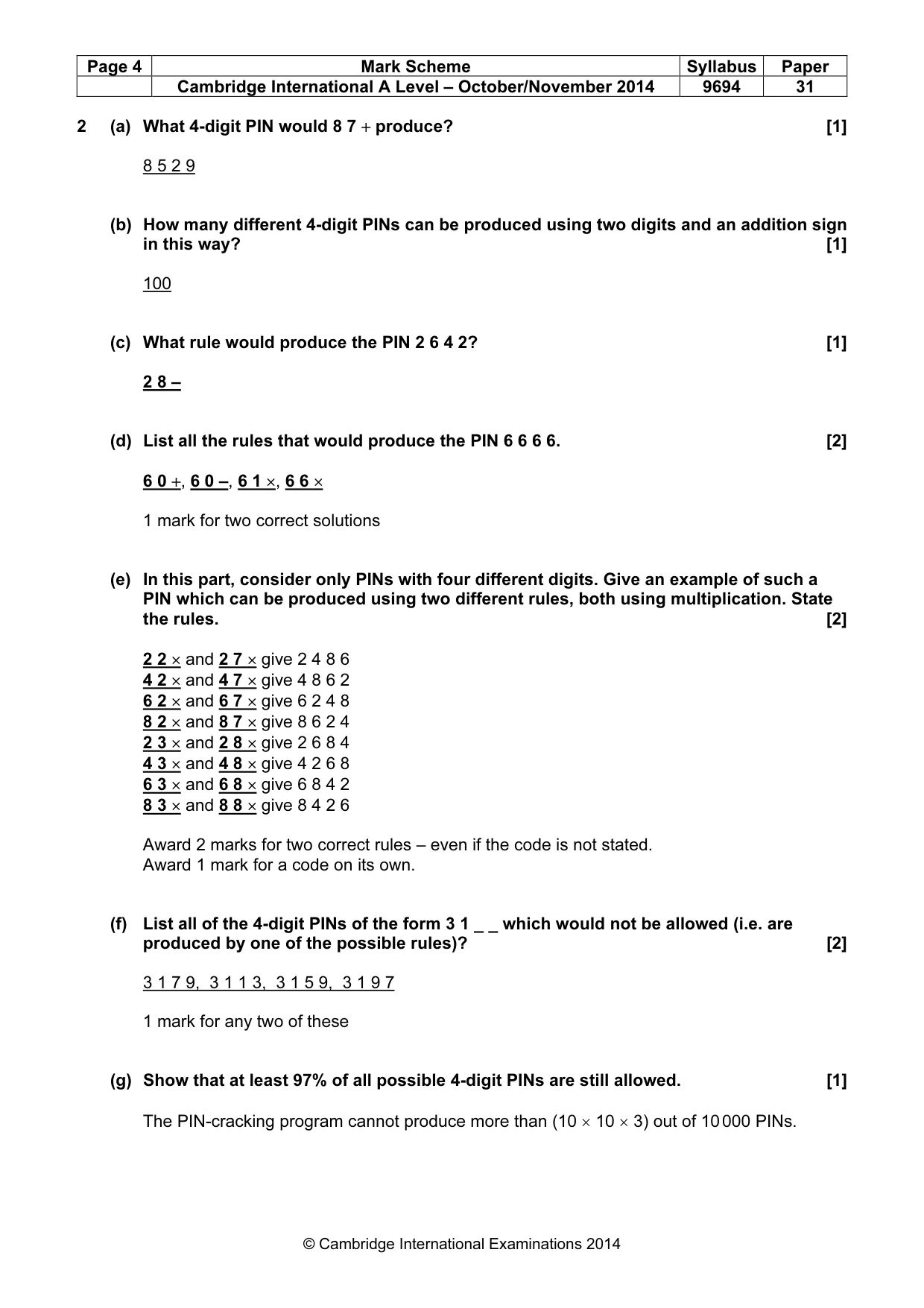
Page 4 Mark Scheme Syllabus Paper Cambridge International A Level – October/November 2014 9694 31 © Cambridge International Examinations 2014 2 (a) What 4-digit PIN would 8 7 + produce? [1] 8 5 2 9 (b) How many different 4-digit PINs can be produced using two digits and an addition sign in this way? [1] 100 (c) What rule would produce the PIN 2 6 4 2? [1] 2 8 – (d) List all the rules that would produce the PIN 6 6 6 6. [2] 6 0 +, 6 0 –, 6 1 ×, 6 6 × 1 mark for two correct solutions (e) In this part, consider only PINs with four different digits. Give an example of such a PIN which can be produced using two different rules, both using multiplication. State the rules. [2] 2 2 × and 2 7 × give 2 4 8 6 4 2 × and 4 7 × give 4 8 6 2 6 2 × and 6 7 × give 6 2 4 8 8 2 × and 8 7 × give 8 6 2 4 2 3 × and 2 8 × give 2 6 8 4 4 3 × and 4 8 × give 4 2 6 8 6 3 × and 6 8 × give 6 8 4 2 8 3 × and 8 8 × give 8 4 2 6 Award 2 marks for two correct rules – even if the code is not stated. Award 1 mark for a code on its own. (f) List all of the 4-digit PINs of the form 3 1 _ _ which would not be allowed (i.e. are produced by one of the possible rules)? [2] 3 1 7 9, 3 1 1 3, 3 1 5 9, 3 1 9 7 1 mark for any two of these (g) Show that at least 97% of all possible 4-digit PINs are still allowed. [1] The PIN-cracking program cannot produce more than (10 × 10 × 3) out of 10 000 PINs.
Mark scheme, page 5
P 3 Pag ( ( ( ge (a) (b) (c) 5 ( ( ( ) ( ( ( ( (i) ii) iii) (i) ii) (i) ii) C G o (1 W (0 W H 2 H so T lo In af af af af S If co D co p th F 1 Cam Give ne 1, 1 Whe 0.8 Whe , 5 1 How × 2 How om he owe nto fte fte fte fte o t 2 orr Draw ou os he or ma mb e t e ro 1) O ere , 0 ere 5 4 w m 2 × w m me po est o ho r 1 r 2 r 3 r 4 the ma rect w a ld sitio sin ex ark rid he oll- OR e d .05 e d ma × 2 ma sp oin t la ow st r nd r rd r th r e bu ark t a a p co on ng xam k fo dge e co -ou R (0 oe 5) oe ny = ny pice ts ye w m roll rol roll roll utte s c na pai om of le c mpl or c e In oor ut. 0, 0 es t es t y la 8 y ro e? ne r is man ou l ou ou ou er w can lys r o bin f th co e: cor nte rdi 0) the the ye oll- ar s y ny ut : ut ut : ut : wil nno sis of d ne he mb rrec ern © ina e p e p ers ou the = pie 0. : 0 0. 0. l ha ot b (w dia to tw bin ct d nati Ca ates poin poin of uts e b 1/8 ece 2 – .4 – 8 – 6 – ave be ith agr fo wo l ned dia ion amb s o nt nt f gr ar bott 8, b es – 0 – 1 – 1 – 1 e b aw aw am orm lum d lu agra M nal brid of a (0. ( 5 3 rou re n tom but wi 0.8 1 & & & bee ward war ms m o mp um am Mar A dge a p 4, 5 3 , und nee m w af ill t & 0 0 – 0 – en de ren to one s b mp m be k S Le e In poi 0.1 ) m d s ede will fter the – 0 – 1 – 1 cut d, nes sh e lu bef aft efo Sch eve nter nt 1) m mo spi ed ne r fo e b 0.6 1 & 1 & t in aw ss o how um for ter ore hem el – rnat th mo ove ce be eed our butt 6 & 0 & 0 nto war of l w h p d re t th , 1 me – O tion at ove e to e w efo d a we ter – – 1 6 d 1 len how du the he r m e Oct nal en e to o a ill ore lay e h r ha 1 & 1 & pie 1 m ngth w t rin e ro rol ark tob Ex nds o a fte the e al yer hav ave & 0 & 0 ece mar hs) two ng oll- l-o k fo ber xam s u afte er a ere ll p r at ve s e b – – es rk f ) up o l a r -ou out or m r/No mina p i er a a ro e b poi t o spi bee 0.2 1 & for p to um roll ut, . ma ov atio in t a r oll- be a nts r b ce en 2 & 0 wo o t mps l-o an atch vem ons the roll -ou afte s a elo at cu 0 – ork he s o ut. nd t hin mbe s 20 e s l-o ut? er are ow y = ut a 1 & king en of b . O the ng d er 014 am ut? ? thr wi y = = 1 afte & 0 g w nd but One e o dia 20 4 me ? ree ith = 1 1/1 er t 0 – with of tte e d oth agra 014 pla e ro in 1/10 6. the – 0. h on the r, o iag er am 4 ace oll 1/1 0. A e fo .4 ne e 2 of a gra dia m af S e a -ou 10 Aft ou ar 2nd an am ag fter Syl 9 as uts of ter rth rith rol y s sh ram rwa llab 969 it s s? f a 3 r h ro me l o sim hou m s ard bu 94 sta un roll oll- etic ut. mp uld sh ds. s arte nit f l ou -ou c er le s d s ou P ed, fro uts ut? rro sh ho uld Pa 3 , af om s th ? r O ap ow sh pe 31 fte he OR pe, the how er r [1 [1 [1 [1 [1 [2 a e w [2 ] ] ] ] ] 2] 2]
Mark scheme, page 6
Page 6 Mark Scheme Syllabus Paper Cambridge International A Level – October/November 2014 9694 31 © Cambridge International Examinations 2014 (d) (i) How many roll-outs in total are needed before the point (1/7, 4/7) returns to where it started? List all the points in the cycle. [2] Cycle is (1/7, 4/7) (2/7, 2/7) (4/7, 1/7) [1 mark] 3 roll-outs needed [1 mark] (ii) Give an example of a point on a different cycle of the same length. (This cycle must not include (1/7, 4/7).) [1] Any one of (6/7, 3/7), (5/7, 5/7) and (3/7, 6/7). Allow more than one of these but nothing else. (e) (i) How many roll-outs in total are needed before the point (1/127, 64/127) returns to where it started? [1] 7 (ii) Identify a point which moves back to its starting position after 2 roll-outs. [1] (1/3, 2/3) or (2/3, 1/3) (allow both) (iii) Identify a point which moves back to its starting position after 5 roll-outs. [1] Any of (1/31, 16/31) (2/31, 8/31) (4/31, 4/31) (8/31, 2/31) (16/31, 1/31) or any component-wise sum of these, such as (5/31, 20/31). 4 (a) During the festival, which play will be performed (i) more times than any of the others? [1] The Tempest (11 performances) (ii) fewer times than any of the others? [1] Timon of Athens (3 performances) The others are as follows: As You Like It, Twelfth Night, Measure for Measure – 10 each Romeo and Juliet, Othello – 9 each Love’s Labour’s Lost – 5 King Lear, Cymbeline – 4 each (b) Which two dates repeat the schedule of 11 July? [2] The scheduled plays for these dates are As You Like It, Othello and Measure for Measure. 16 July (accept Tuesday Week 3) [1 mark] 21 July (accept Sunday Week 3) [1 mark]
Mark scheme, page 7
Page 7 Mark Scheme Syllabus Paper Cambridge International A Level – October/November 2014 9694 31 © Cambridge International Examinations 2014 (c) (i) List all the dates on which Kate will watch either Mark or Antony performing at the festival. [2] They both perform on 9 July / Tuesday Week 2 and 25 July / Thursday Week 4. 10 July / Wednesday Week 2 (Antony) 15 July / Monday Week 3 (Antony) 17 July / Wednesday Week 3 (Mark) 20 July / Saturday Week 3 (Antony) 23 July / Tuesday Week 4 (Mark) Award 1 mark for three or four correct dates and/or no more than one incorrect date. (ii) What is the total cost of Kate’s tickets? [2] She will miss both opening nights because they clash. 1 × $18 + 4 × $24 = $114 Award 1 mark for evidence of appreciation of 1 ticket @ $18 (Week 2) OR 4 tickets @ $24 (Weeks 3 and 4). If one or more dates are missing or incorrect in (i), allow 1 follow through mark in (ii) if the costs are unambiguous and appropriate. (d) What is the lowest possible total price that he could pay to see all 10 plays? [3] 6 × $15 + 3 × $18 + 1 × $24 = $168 Award 2 marks for 6 @ $15, 3 @ $18 and 1 @ $24 incorrectly totalled, or not totalled. OR award 1 mark each for evidence of appreciation of the following: • There are 6 evenings on which (one or more) first performances occur; • (It is not possible to see both Timon of Athens and Cymbeline during weeks 1 and 2, so) either Timon of Athens or Cymbeline must be seen during week 3 or week 4. SC : award 1 mark for one incorrect categorization of play (e.g. 5@15, 4@18, 1@ 24 = $171)
Mark scheme, page 8
Page 8 Mark Scheme Syllabus Paper Cambridge International A Level – October/November 2014 9694 31 © Cambridge International Examinations 2014 (e) (i) Explain why Richard must go to see Timon of Athens first (on 18 July)? [1] If he went on 24 July, he could only see King Lear by going to Corioli Park on consecutive evenings. (ii) In what order will Richard see the 10 plays? [3] (Timon of Athens) The Tempest Romeo and Juliet As You Like It Cymbeline King Lear Measure for Measure Love’s Labour’s Lost Othello (Twelfth Night) Deduct 1 mark: for each duplication/omission of play seen for each repetition of venue if Twelfth Night is not seen last if two plays’ dates have been swapped. • The Tempest must be 19 July / Friday Week 3 / second (because he will have gone to Corioli Park the previous evening to see Timon of Athens, and he is leaving Twelfth Night until last). • Measure for Measure must be 24 July / Wednesday Week 4 / seventh (because Timon of Athens is first and he is leaving Twelfth Night until last). • Cymbeline must be 22 July / Monday Week 4 / fifth (because Cymbeline on 25 July / Thursday Week 4 would mean going again to Elsinore Common the evening after Measure for Measure). • King Lear must be 23 July / Tuesday Week 4 / sixth (because the dates for Twelfth Night and The Tempest have already been decided). • Love’s Labour’s Lost must be 25 July / Thursday Week 4 / eighth (because the dates for Cymbeline and King Lear have already been decided). • Romeo and Juliet must be 20 July / Saturday Week 3 / third (because the dates for Measure for Measure and Love’s Labour’s Lost have already been decided). • As You Like It must be 21 July / Sunday Week 3 / fourth (because the date for Measure for Measure has already been decided, and he will have gone to Corioli Park the previous evening to see Romeo and Juliet). • Othello must be 26 July / Friday Week 4 / ninth (because the date for The Tempest has already been decided, and he will have gone to Belmont Gardens the previous evening to see Love’s Labour’s Lost).
What you needed in this session
Cambridge’s own grade thresholds for 2014 Oct/Nov, Paper 3 · Variant 1. A higher threshold means an easier paper — the bar moves with how the cohort did.