Cambridge A Level Thinking Skills 9694 — 2014 Oct/Nov Paper 3 · Variant 3
9694/33/O/N/14 · 50 marks · ≈56 min
The question paper and its mark scheme, free to read here and free to download. This is Cambridge’s own paper, exactly as it was sat.
Question paper12 pages


Mark scheme7 pages
Answers below. Sit the paper first if you are practising.
Paper as text
Question paper, page 1
This document consists of 9 printed pages, 3 blank pages and 1 insert. IB14 11_9694_33/2RP © UCLES 2014 [Turn over *1198143062* Cambridge International Examinations Cambridge International Advanced Level THINKING SKILLS 9694/33 Paper 3 Problem Analysis and Solution October/November 2014 1 hour 30 minutes Additional Materials: Electronic Calculator READ THESE INSTRUCTIONS FIRST An answer booklet is provided inside this question paper. You should follow the instructions on the front cover of the answer booklet. If you need additional answer paper ask the invigilator for a continuation booklet. Answer all the questions. Calculators should be used where appropriate. The number of marks is given in brackets [ ] at the end of each question or part question.
Question paper, page 2
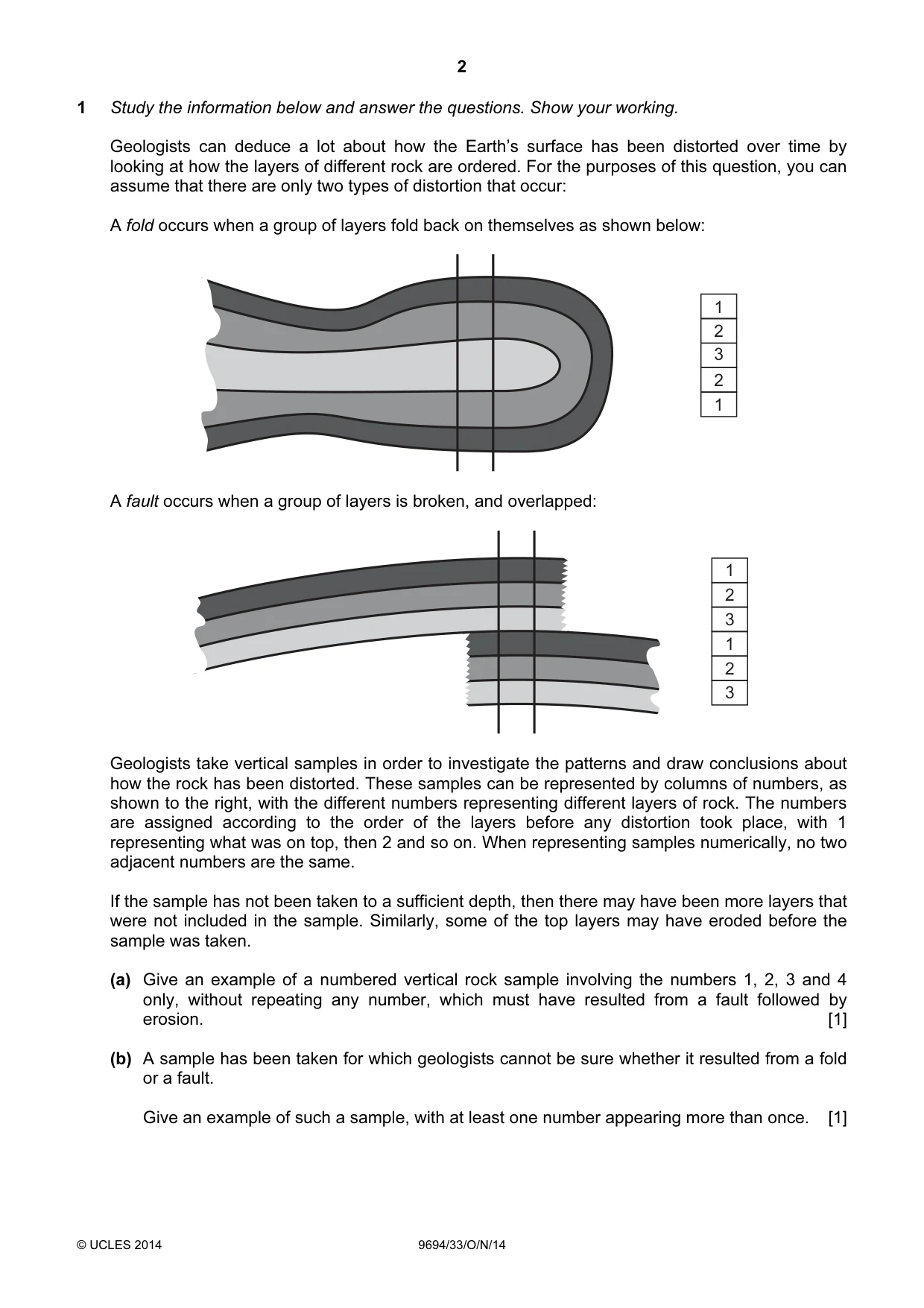
2 © UCLES 2014 9694/33/O/N/14 1 Study the information below and answer the questions. Show your working. Geologists can deduce a lot about how the Earth’s surface has been distorted over time by looking at how the layers of different rock are ordered. For the purposes of this question, you can assume that there are only two types of distortion that occur: A fold occurs when a group of layers fold back on themselves as shown below: 1 2 3 2 1 A fault occurs when a group of layers is broken, and overlapped: 1 2 3 1 2 3 Geologists take vertical samples in order to investigate the patterns and draw conclusions about how the rock has been distorted. These samples can be represented by columns of numbers, as shown to the right, with the different numbers representing different layers of rock. The numbers are assigned according to the order of the layers before any distortion took place, with 1 representing what was on top, then 2 and so on. When representing samples numerically, no two adjacent numbers are the same. If the sample has not been taken to a sufficient depth, then there may have been more layers that were not included in the sample. Similarly, some of the top layers may have eroded before the sample was taken. (a) Give an example of a numbered vertical rock sample involving the numbers 1, 2, 3 and 4 only, without repeating any number, which must have resulted from a fault followed by erosion. [1] (b) A sample has been taken for which geologists cannot be sure whether it resulted from a fold or a fault. Give an example of such a sample, with at least one number appearing more than once. [1]
Question paper, page 3
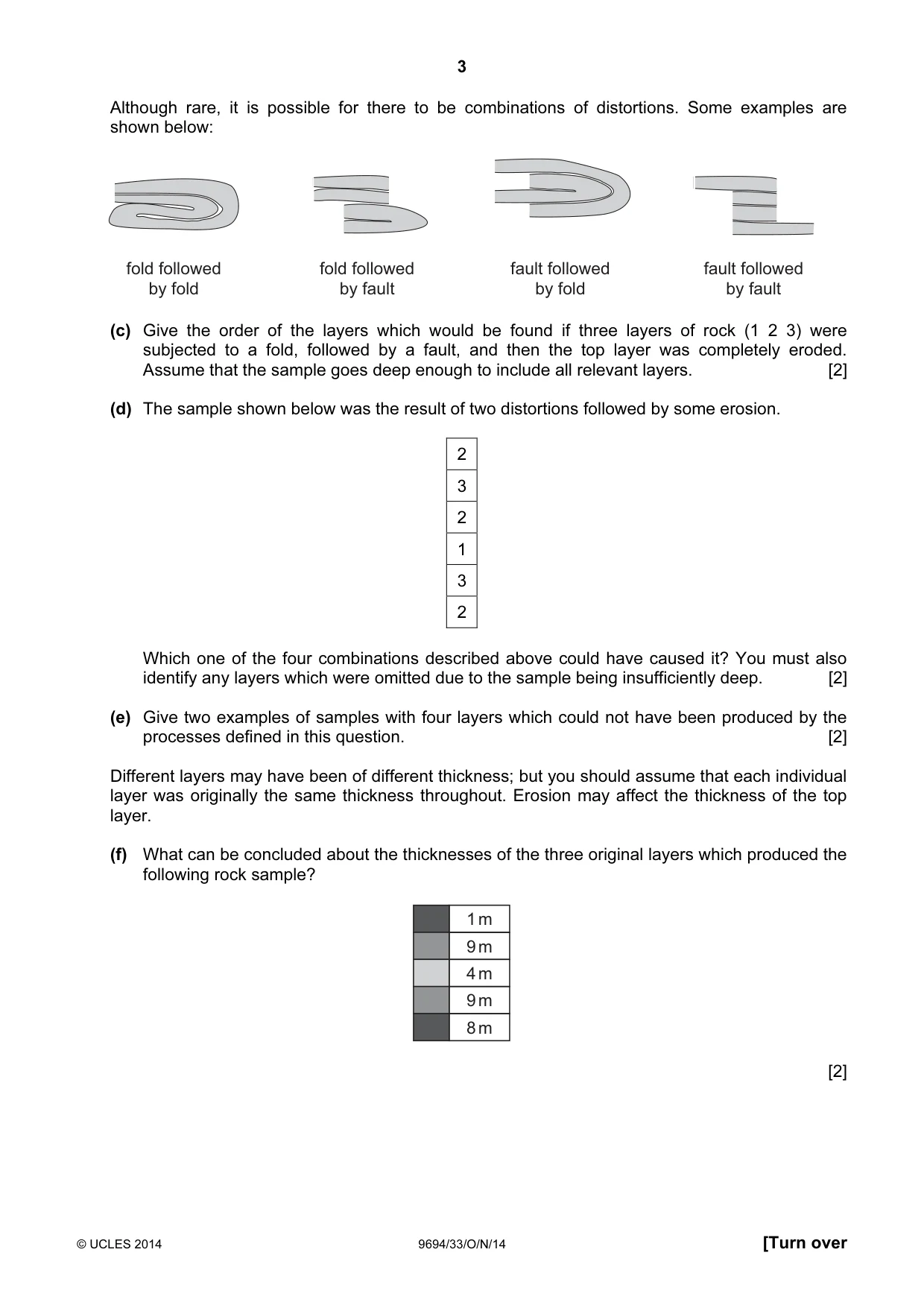
3 © UCLES 2014 9694/33/O/N/14 [Turn over Although rare, it is possible for there to be combinations of distortions. Some examples are shown below: fold followed by fold fold followed by fault fault followed by fold fault followed by fault (c) Give the order of the layers which would be found if three layers of rock (1 2 3) were subjected to a fold, followed by a fault, and then the top layer was completely eroded. Assume that the sample goes deep enough to include all relevant layers. [2] (d) The sample shown below was the result of two distortions followed by some erosion. 2 3 2 1 3 2 Which one of the four combinations described above could have caused it? You must also identify any layers which were omitted due to the sample being insufficiently deep. [2] (e) Give two examples of samples with four layers which could not have been produced by the processes defined in this question. [2] Different layers may have been of different thickness; but you should assume that each individual layer was originally the same thickness throughout. Erosion may affect the thickness of the top layer. (f) What can be concluded about the thicknesses of the three original layers which produced the following rock sample? 1 m 9 m 4 m 9 m 8 m [2]
Question paper, page 4
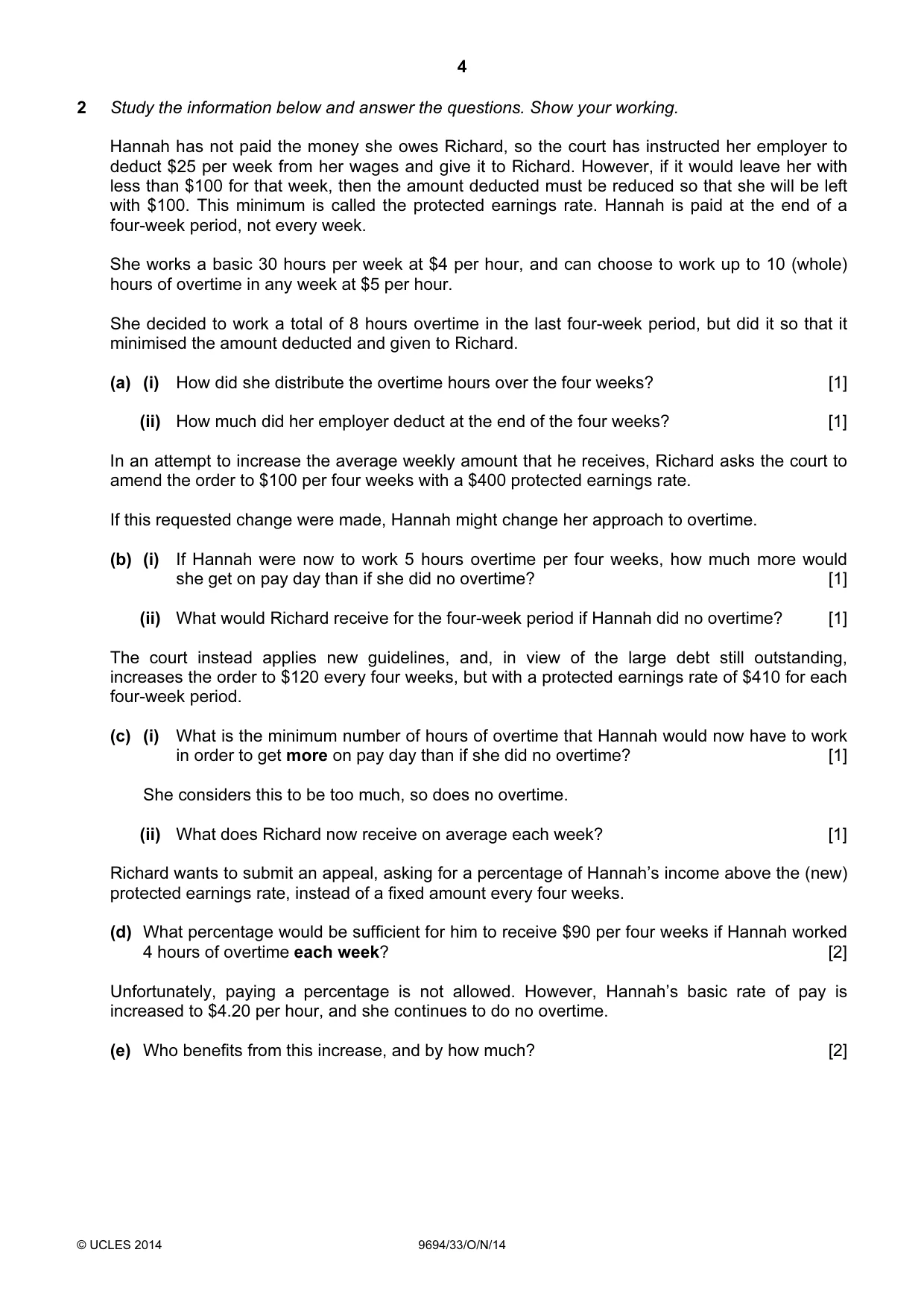
4 © UCLES 2014 9694/33/O/N/14 2 Study the information below and answer the questions. Show your working. Hannah has not paid the money she owes Richard, so the court has instructed her employer to deduct $25 per week from her wages and give it to Richard. However, if it would leave her with less than $100 for that week, then the amount deducted must be reduced so that she will be left with $100. This minimum is called the protected earnings rate. Hannah is paid at the end of a four-week period, not every week. She works a basic 30 hours per week at $4 per hour, and can choose to work up to 10 (whole) hours of overtime in any week at $5 per hour. She decided to work a total of 8 hours overtime in the last four-week period, but did it so that it minimised the amount deducted and given to Richard. (a) (i) How did she distribute the overtime hours over the four weeks? [1] (ii) How much did her employer deduct at the end of the four weeks? [1] In an attempt to increase the average weekly amount that he receives, Richard asks the court to amend the order to $100 per four weeks with a $400 protected earnings rate. If this requested change were made, Hannah might change her approach to overtime. (b) (i) If Hannah were now to work 5 hours overtime per four weeks, how much more would she get on pay day than if she did no overtime? [1] (ii) What would Richard receive for the four-week period if Hannah did no overtime? [1] The court instead applies new guidelines, and, in view of the large debt still outstanding, increases the order to $120 every four weeks, but with a protected earnings rate of $410 for each four-week period. (c) (i) What is the minimum number of hours of overtime that Hannah would now have to work in order to get more on pay day than if she did no overtime? [1] She considers this to be too much, so does no overtime. (ii) What does Richard now receive on average each week? [1] Richard wants to submit an appeal, asking for a percentage of Hannah’s income above the (new) protected earnings rate, instead of a fixed amount every four weeks. (d) What percentage would be sufficient for him to receive $90 per four weeks if Hannah worked 4 hours of overtime each week? [2] Unfortunately, paying a percentage is not allowed. However, Hannah’s basic rate of pay is increased to $4.20 per hour, and she continues to do no overtime. (e) Who benefits from this increase, and by how much? [2]
Question paper, page 5
5 © UCLES 2014 9694/33/O/N/14 [Turn over [Turn over for Question 3]
Question paper, page 6
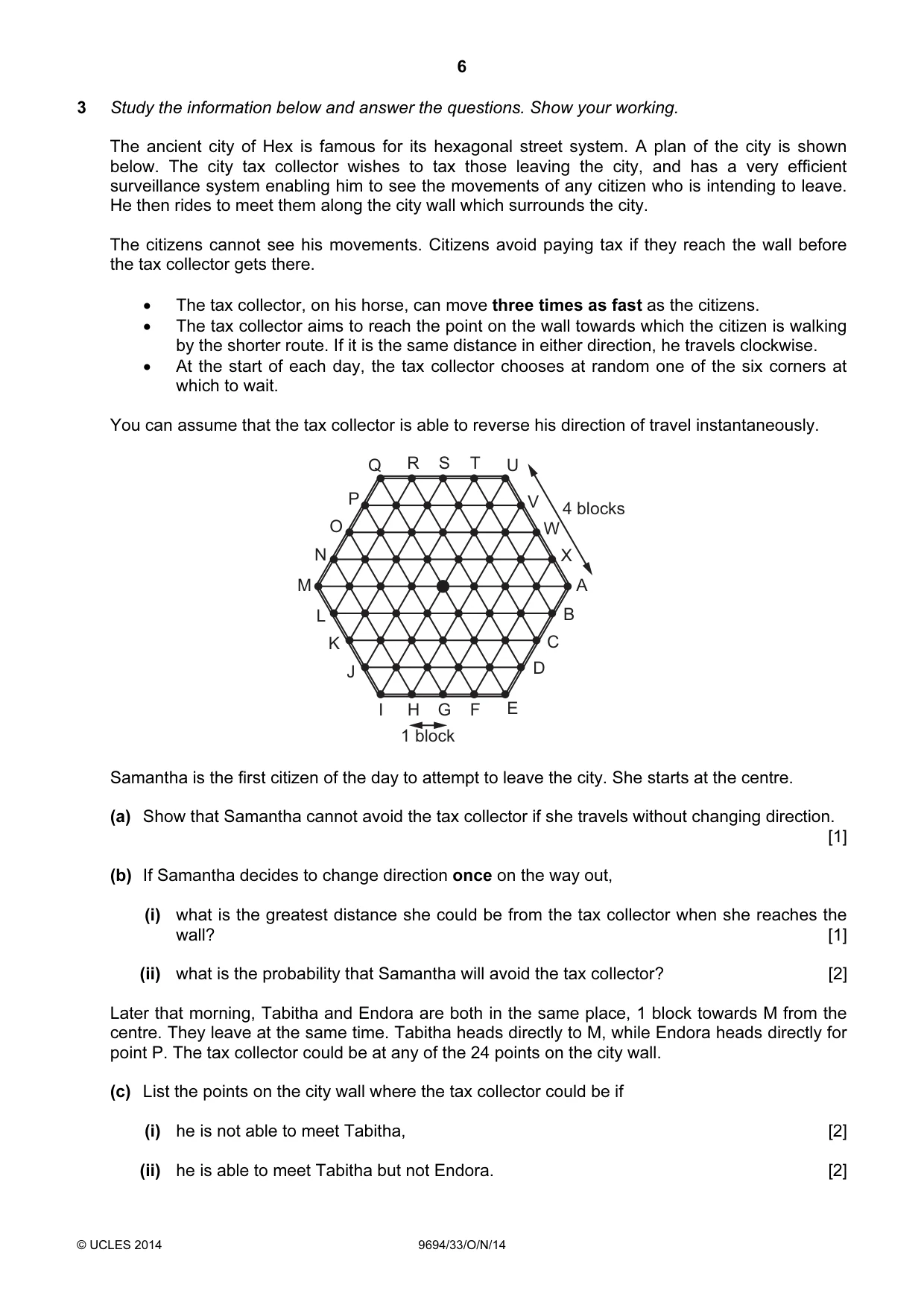
6 © UCLES 2014 9694/33/O/N/14 3 Study the information below and answer the questions. Show your working. The ancient city of Hex is famous for its hexagonal street system. A plan of the city is shown below. The city tax collector wishes to tax those leaving the city, and has a very efficient surveillance system enabling him to see the movements of any citizen who is intending to leave. He then rides to meet them along the city wall which surrounds the city. The citizens cannot see his movements. Citizens avoid paying tax if they reach the wall before the tax collector gets there. • The tax collector, on his horse, can move three times as fast as the citizens. • The tax collector aims to reach the point on the wall towards which the citizen is walking by the shorter route. If it is the same distance in either direction, he travels clockwise. • At the start of each day, the tax collector chooses at random one of the six corners at which to wait. You can assume that the tax collector is able to reverse his direction of travel instantaneously. A B C D E F G H I J K L M N O P Q R S T U V W X 4 blocks 1 block Samantha is the first citizen of the day to attempt to leave the city. She starts at the centre. (a) Show that Samantha cannot avoid the tax collector if she travels without changing direction. [1] (b) If Samantha decides to change direction once on the way out, (i) what is the greatest distance she could be from the tax collector when she reaches the wall? [1] (ii) what is the probability that Samantha will avoid the tax collector? [2] Later that morning, Tabitha and Endora are both in the same place, 1 block towards M from the centre. They leave at the same time. Tabitha heads directly to M, while Endora heads directly for point P. The tax collector could be at any of the 24 points on the city wall. (c) List the points on the city wall where the tax collector could be if (i) he is not able to meet Tabitha, [2] (ii) he is able to meet Tabitha but not Endora. [2]
Question paper, page 7
7 © UCLES 2014 9694/33/O/N/14 [Turn over (d) If the tax collector is waiting at point A, from how many of the 37 starting points within the city wall is it impossible for a citizen to avoid him, if the citizen travels without changing direction? [3] In the afternoon, the tax collector is at point A. Morgana begins at the centre and moves 1 block towards Q, then one block towards J. After these moves the tax collector will be back at point A. Morgana is attempting to reach the city wall as far from the tax collector as possible. She only has time to travel a maximum of 10 more blocks. (e) What is the greatest distance she could be from the tax collector when she reaches the wall? Describe a possible route for her to take. [4]
Question paper, page 8
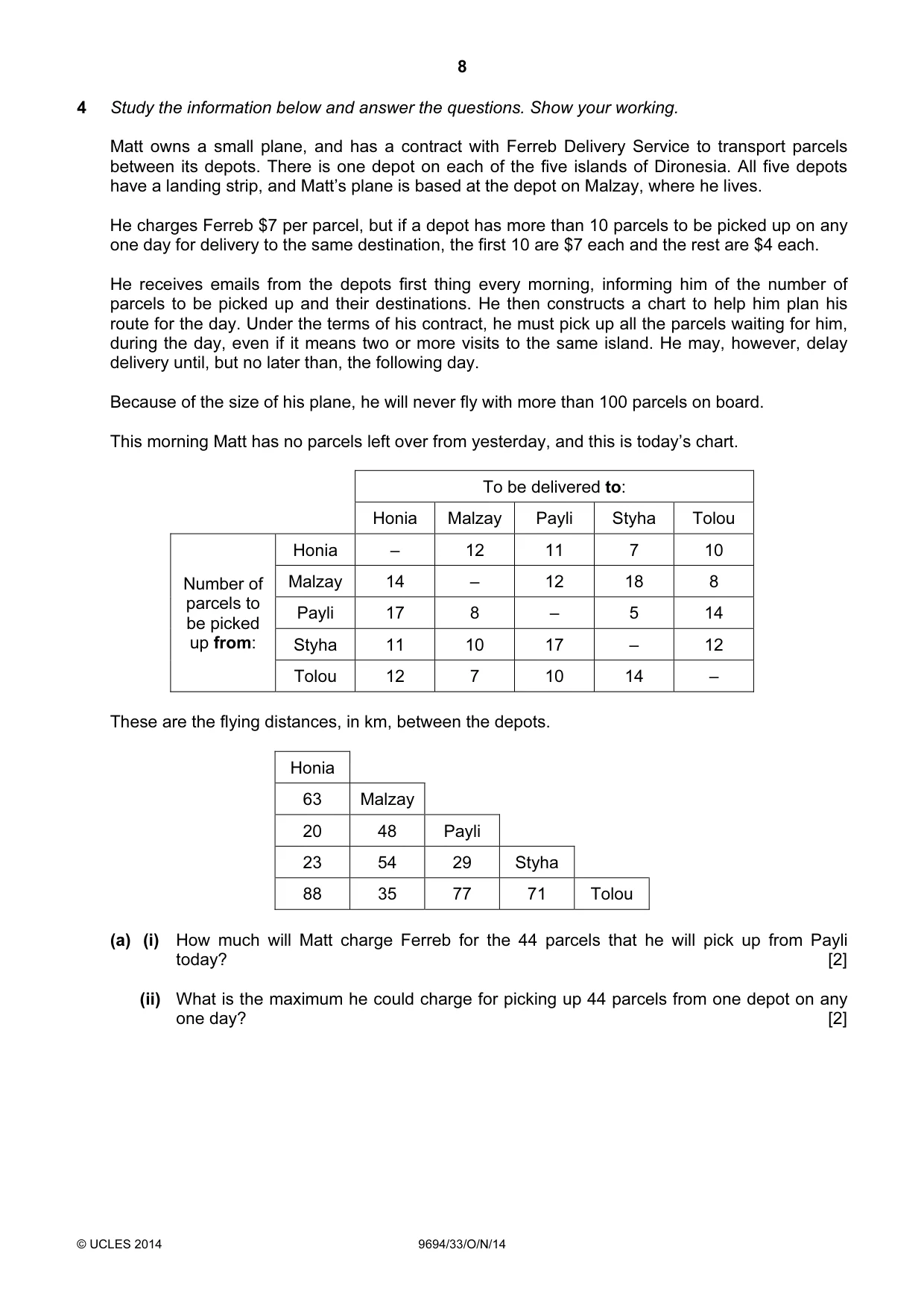
8 © UCLES 2014 9694/33/O/N/14 4 Study the information below and answer the questions. Show your working. Matt owns a small plane, and has a contract with Ferreb Delivery Service to transport parcels between its depots. There is one depot on each of the five islands of Dironesia. All five depots have a landing strip, and Matt’s plane is based at the depot on Malzay, where he lives. He charges Ferreb $7 per parcel, but if a depot has more than 10 parcels to be picked up on any one day for delivery to the same destination, the first 10 are $7 each and the rest are $4 each. He receives emails from the depots first thing every morning, informing him of the number of parcels to be picked up and their destinations. He then constructs a chart to help him plan his route for the day. Under the terms of his contract, he must pick up all the parcels waiting for him, during the day, even if it means two or more visits to the same island. He may, however, delay delivery until, but no later than, the following day. Because of the size of his plane, he will never fly with more than 100 parcels on board. This morning Matt has no parcels left over from yesterday, and this is today’s chart. To be delivered to: Honia Malzay Payli Styha Tolou Number of parcels to be picked up from: Honia – 12 11 7 10 Malzay 14 – 12 18 8 Payli 17 8 – 5 14 Styha 11 10 17 – 12 Tolou 12 7 10 14 – These are the flying distances, in km, between the depots. Honia 63 Malzay 20 48 Payli 23 54 29 Styha 88 35 77 71 Tolou (a) (i) How much will Matt charge Ferreb for the 44 parcels that he will pick up from Payli today? [2] (ii) What is the maximum he could charge for picking up 44 parcels from one depot on any one day? [2]
Question paper, page 9
9 © UCLES 2014 9694/33/O/N/14 Matt’s route today will allow him to visit each island once only, without carrying more than 100 parcels at any time. He will fly first from Malzay to Styha with all 52 parcels on board. There he will deliver the 18 parcels from Malzay and pick up the 50 parcels waiting for him, which means that he will take off from Styha with 84 parcels on board. From Styha he will fly to Payli. (b) How many parcels will Matt have on board when he leaves Payli? [2] (c) In what order must he visit the remaining islands, and how many parcels will he have on board when he returns to Malzay? Justify your answer. [4] (d) What is the total distance that Matt will fly today? [2] Matt’s charges used to be based on the flying distances between the depots, as follows: Deliveries between depots less than 30 km apart $5 per parcel Deliveries between depots from 30 km to 60 km apart $7 per parcel Deliveries between depots more than 60 km apart $9 per parcel Last Tuesday, a quarter of the parcels waiting at Payli were for delivery to Honia, a quarter for Malzay, a quarter for Styha and a quarter for Tolou. Matt calculated that he would have charged exactly the same amount for them under the old system as he did under the present system. (e) How many parcels in total did Matt pick up from Payli last Tuesday? [3]
Question paper, page 10
10 © UCLES 2014 9694/33/O/N/14 BLANK PAGE
Question paper, page 11
11 © UCLES 2014 9694/33/O/N/14 BLANK PAGE
Question paper, page 12
12 Permission to reproduce items where third-party owned material protected by copyright is included has been sought and cleared where possible. Every reasonable effort has been made by the publisher (UCLES) to trace copyright holders, but if any items requiring clearance have unwittingly been included, the publisher will be pleased to make amends at the earliest possible opportunity. Cambridge International Examinations is part of the Cambridge Assessment Group. Cambridge Assessment is the brand name of University of Cambridge Local Examinations Syndicate (UCLES), which is itself a department of the University of Cambridge. © UCLES 2014 9694/33/O/N/14 BLANK PAGE
Mark scheme, page 1
® IGCSE is the registered trademark of Cambridge International Examinations. CAMBRIDGE INTERNATIONAL EXAMINATIONS Cambridge International Advanced Level MARK SCHEME for the October/November 2014 series 9694 THINKING SKILLS 9694/33 Paper 3 (Problem Analysis and Solution), maximum raw mark 50 This mark scheme is published as an aid to teachers and candidates, to indicate the requirements of the examination. It shows the basis on which Examiners were instructed to award marks. It does not indicate the details of the discussions that took place at an Examiners’ meeting before marking began, which would have considered the acceptability of alternative answers. Mark schemes should be read in conjunction with the question paper and the Principal Examiner Report for Teachers. Cambridge will not enter into discussions about these mark schemes. Cambridge is publishing the mark schemes for the October/November 2014 series for most Cambridge IGCSE®, Cambridge International A and AS Level components and some Cambridge O Level components.
Mark scheme, page 2
Page 2 Mark Scheme Syllabus Paper Cambridge International A Level – October/November 2014 9694 33 © Cambridge International Examinations 2014 1 (a) Give an example of a numbered vertical rock sample involving the numbers 1, 2, 3 and 4 only, without repeating any number, which must have resulted from a fault followed by erosion. [1] 4, 1, 2, 3 OR 3, 4, 1, 2 OR 2, 3, 4, 1 (b) Give an example of such a sample, with at least one number appearing more than once. [1] 1, 2, 1 SC – a sample which was caused by both a fold and a fault (e.g. 1232112321) (c) Give the order of the layers which would be found if three layers of rock (1 2 3) were subjected to a fold, followed by a fault, and then the top layer was completely eroded. Assume that the sample goes deep enough to include all relevant layers. [2] 2, 3, (3), 2, 1, (1), 2, 3, (3), 2, 1 : allow repeated layers (shown in brackets) Award 1 mark if the original ‘1’ is included. (d) Which one of the four combinations described above could have caused it? You must also identify any layers which were omitted due to the sample being insufficiently deep. [2] Fault then fold; (1 mark) bottom layer [1] omitted (1 mark). 1 mark for appreciation that it required a fault then a fold. (e) Give two examples of samples with four layers which could not have been produced by the processes defined in this question. [2] For example: 1, 4, 2, 4 and 1, 3, 1, 2 . Most easily achieved by a jump of two layers not resulting from a fault (i.e. not highest to lowest) 1 mark for each impossible sample (f) What can be concluded about the thicknesses of the three original layers which produced the following rock sample? [2] Top layer = (greater than or equal to) 8 m Middle layer = 9 m Bottom layer = 2 m 2 out of 3 correct OR top layer eroded by (at least) 7m : 1 mark SC [1] : total thickness is (greater than or equal to) 19m
Mark scheme, page 3
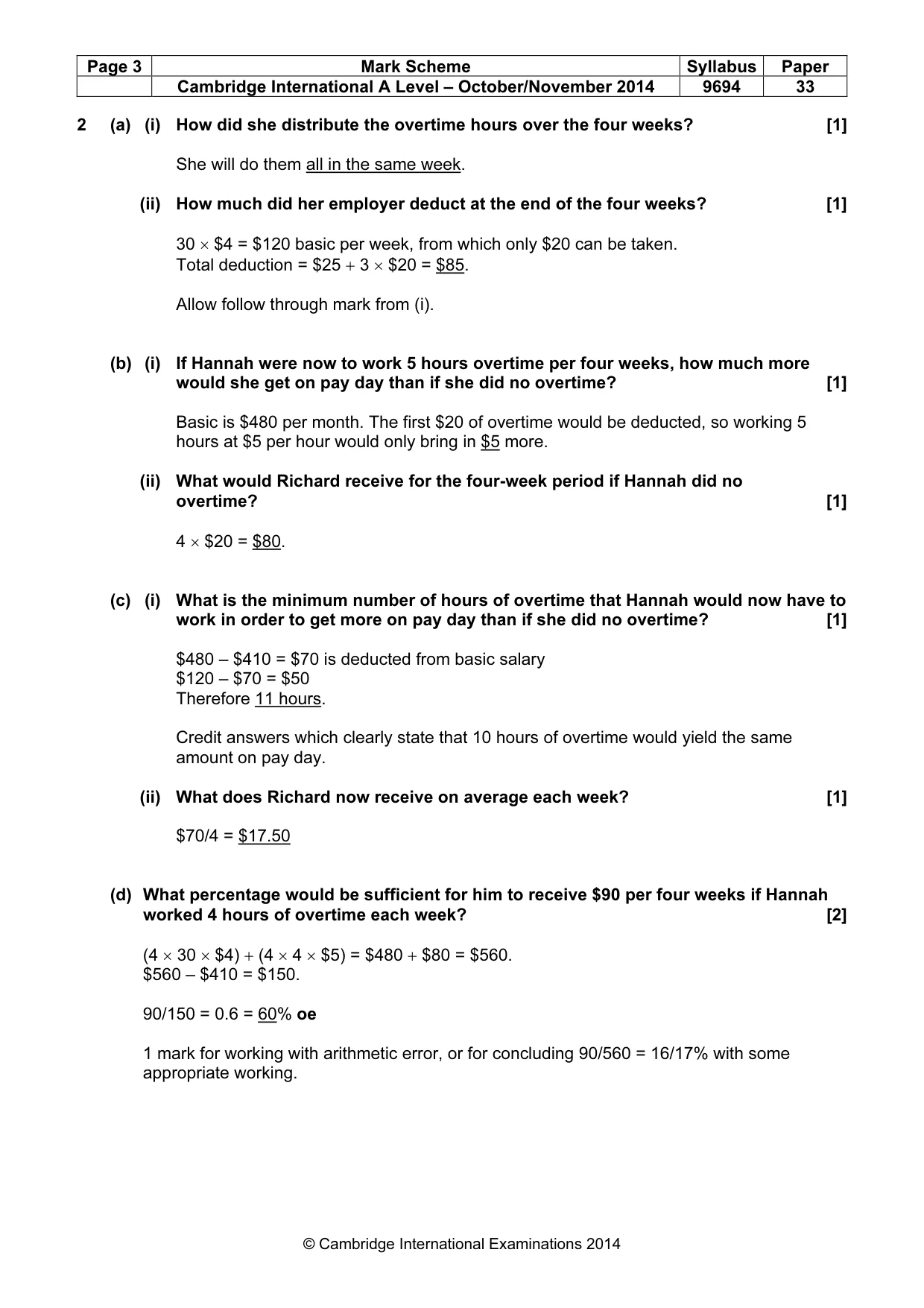
Page 3 Mark Scheme Syllabus Paper Cambridge International A Level – October/November 2014 9694 33 © Cambridge International Examinations 2014 2 (a) (i) How did she distribute the overtime hours over the four weeks? [1] She will do them all in the same week. (ii) How much did her employer deduct at the end of the four weeks? [1] 30 × $4 = $120 basic per week, from which only $20 can be taken. Total deduction = $25 + 3 × $20 = $85. Allow follow through mark from (i). (b) (i) If Hannah were now to work 5 hours overtime per four weeks, how much more would she get on pay day than if she did no overtime? [1] Basic is $480 per month. The first $20 of overtime would be deducted, so working 5 hours at $5 per hour would only bring in $5 more. (ii) What would Richard receive for the four-week period if Hannah did no overtime? [1] 4 × $20 = $80. (c) (i) What is the minimum number of hours of overtime that Hannah would now have to work in order to get more on pay day than if she did no overtime? [1] $480 – $410 = $70 is deducted from basic salary $120 – $70 = $50 Therefore 11 hours. Credit answers which clearly state that 10 hours of overtime would yield the same amount on pay day. (ii) What does Richard now receive on average each week? [1] $70/4 = $17.50 (d) What percentage would be sufficient for him to receive $90 per four weeks if Hannah worked 4 hours of overtime each week? [2] (4 × 30 × $4) + (4 × 4 × $5) = $480 + $80 = $560. $560 – $410 = $150. 90/150 = 0.6 = 60% oe 1 mark for working with arithmetic error, or for concluding 90/560 = 16/17% with some appropriate working.
Mark scheme, page 4
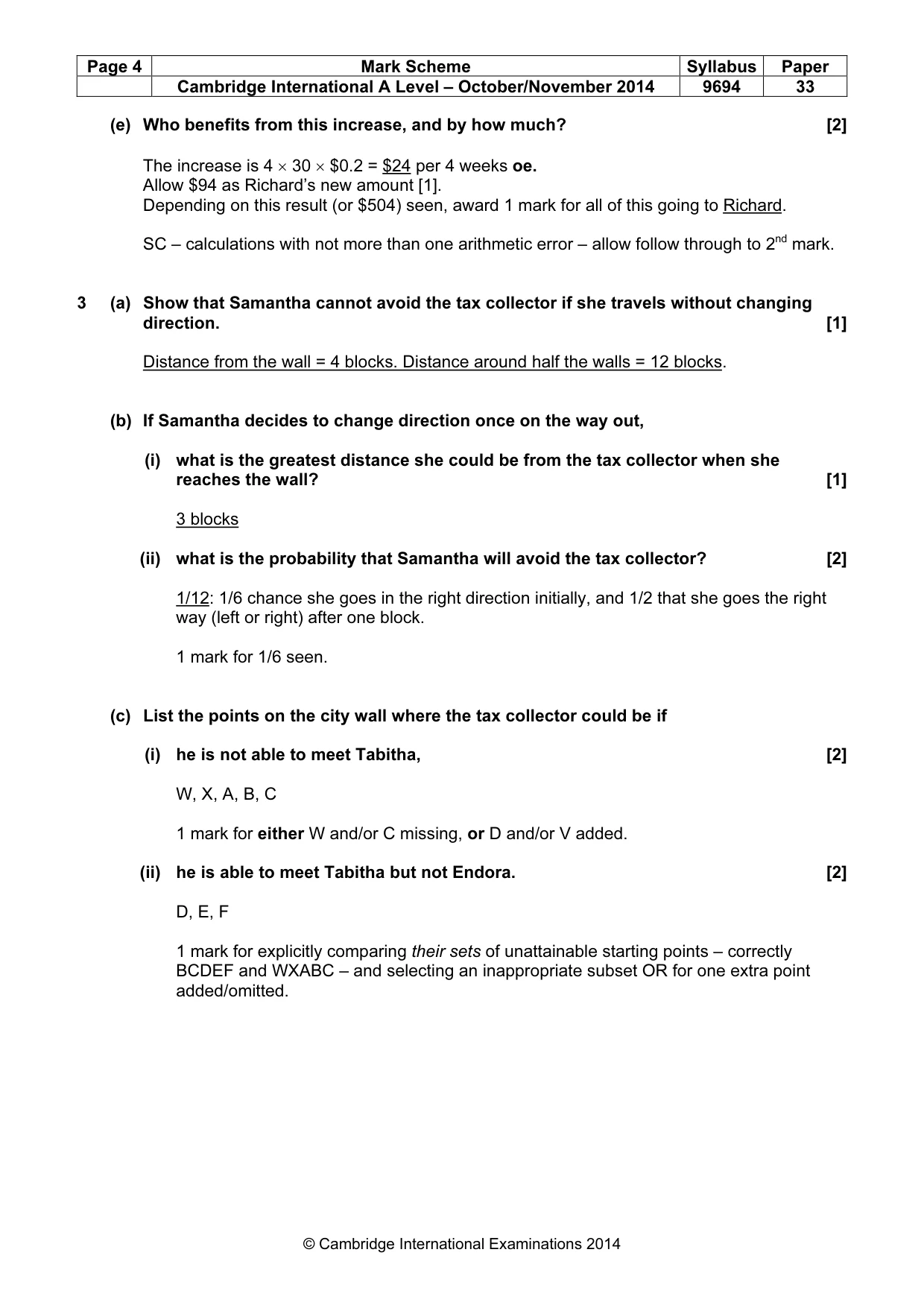
Page 4 Mark Scheme Syllabus Paper Cambridge International A Level – October/November 2014 9694 33 © Cambridge International Examinations 2014 (e) Who benefits from this increase, and by how much? [2] The increase is 4 × 30 × $0.2 = $24 per 4 weeks oe. Allow $94 as Richard’s new amount [1]. Depending on this result (or $504) seen, award 1 mark for all of this going to Richard. SC – calculations with not more than one arithmetic error – allow follow through to 2nd mark. 3 (a) Show that Samantha cannot avoid the tax collector if she travels without changing direction. [1] Distance from the wall = 4 blocks. Distance around half the walls = 12 blocks. (b) If Samantha decides to change direction once on the way out, (i) what is the greatest distance she could be from the tax collector when she reaches the wall? [1] 3 blocks (ii) what is the probability that Samantha will avoid the tax collector? [2] 1/12: 1/6 chance she goes in the right direction initially, and 1/2 that she goes the right way (left or right) after one block. 1 mark for 1/6 seen. (c) List the points on the city wall where the tax collector could be if (i) he is not able to meet Tabitha, [2] W, X, A, B, C 1 mark for either W and/or C missing, or D and/or V added. (ii) he is able to meet Tabitha but not Endora. [2] D, E, F 1 mark for explicitly comparing their sets of unattainable starting points – correctly BCDEF and WXABC – and selecting an inappropriate subset OR for one extra point added/omitted.
Mark scheme, page 5
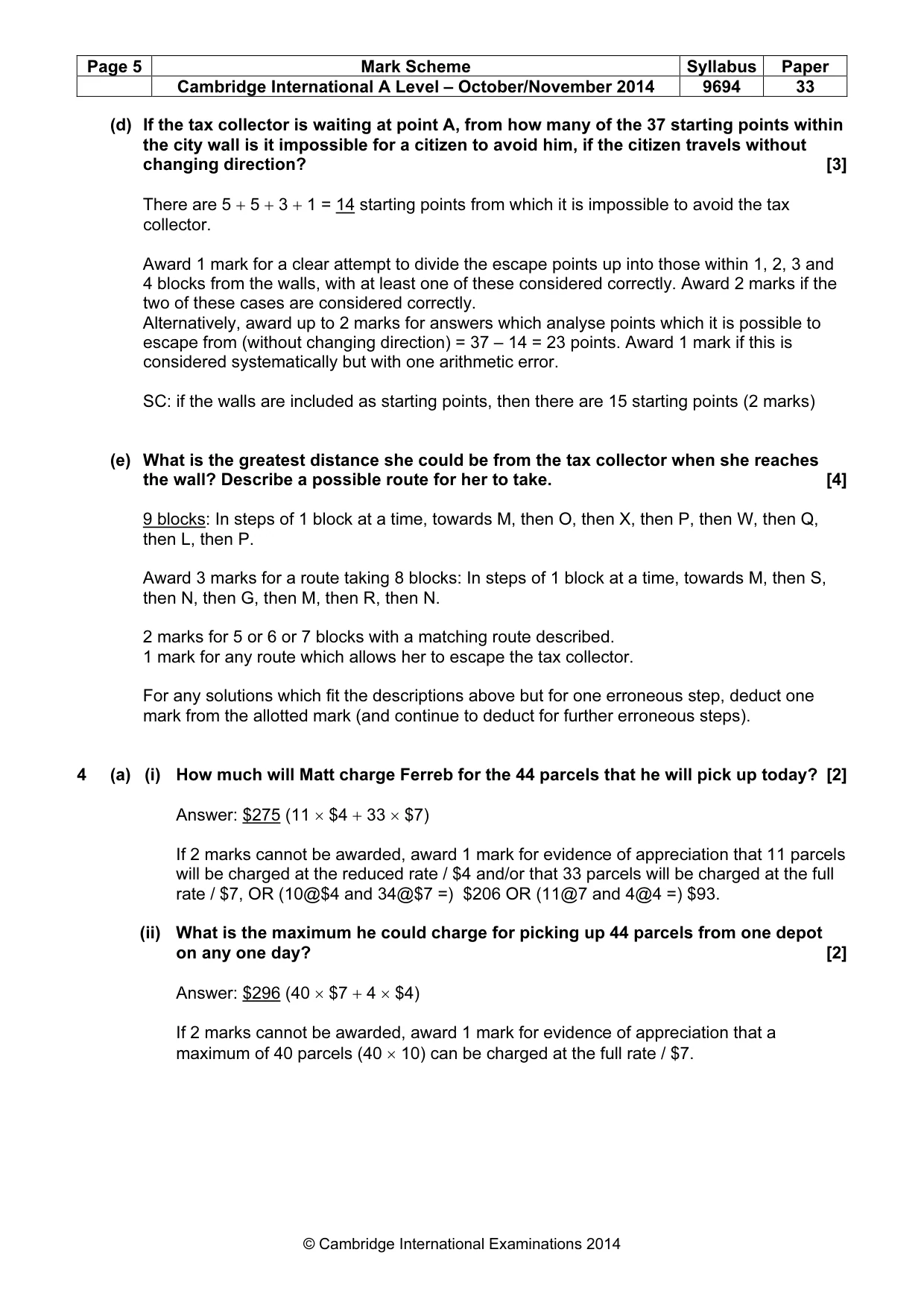
Page 5 Mark Scheme Syllabus Paper Cambridge International A Level – October/November 2014 9694 33 © Cambridge International Examinations 2014 (d) If the tax collector is waiting at point A, from how many of the 37 starting points within the city wall is it impossible for a citizen to avoid him, if the citizen travels without changing direction? [3] There are 5 + 5 + 3 + 1 = 14 starting points from which it is impossible to avoid the tax collector. Award 1 mark for a clear attempt to divide the escape points up into those within 1, 2, 3 and 4 blocks from the walls, with at least one of these considered correctly. Award 2 marks if the two of these cases are considered correctly. Alternatively, award up to 2 marks for answers which analyse points which it is possible to escape from (without changing direction) = 37 – 14 = 23 points. Award 1 mark if this is considered systematically but with one arithmetic error. SC: if the walls are included as starting points, then there are 15 starting points (2 marks) (e) What is the greatest distance she could be from the tax collector when she reaches the wall? Describe a possible route for her to take. [4] 9 blocks: In steps of 1 block at a time, towards M, then O, then X, then P, then W, then Q, then L, then P. Award 3 marks for a route taking 8 blocks: In steps of 1 block at a time, towards M, then S, then N, then G, then M, then R, then N. 2 marks for 5 or 6 or 7 blocks with a matching route described. 1 mark for any route which allows her to escape the tax collector. For any solutions which fit the descriptions above but for one erroneous step, deduct one mark from the allotted mark (and continue to deduct for further erroneous steps). 4 (a) (i) How much will Matt charge Ferreb for the 44 parcels that he will pick up today? [2] Answer: $275 (11 × $4 + 33 × $7) If 2 marks cannot be awarded, award 1 mark for evidence of appreciation that 11 parcels will be charged at the reduced rate / $4 and/or that 33 parcels will be charged at the full rate / $7, OR (10@$4 and 34@$7 =) $206 OR (11@7 and 4@4 =) $93. (ii) What is the maximum he could charge for picking up 44 parcels from one depot on any one day? [2] Answer: $296 (40 × $7 + 4 × $4) If 2 marks cannot be awarded, award 1 mark for evidence of appreciation that a maximum of 40 parcels (40 × 10) can be charged at the full rate / $7.
Mark scheme, page 6
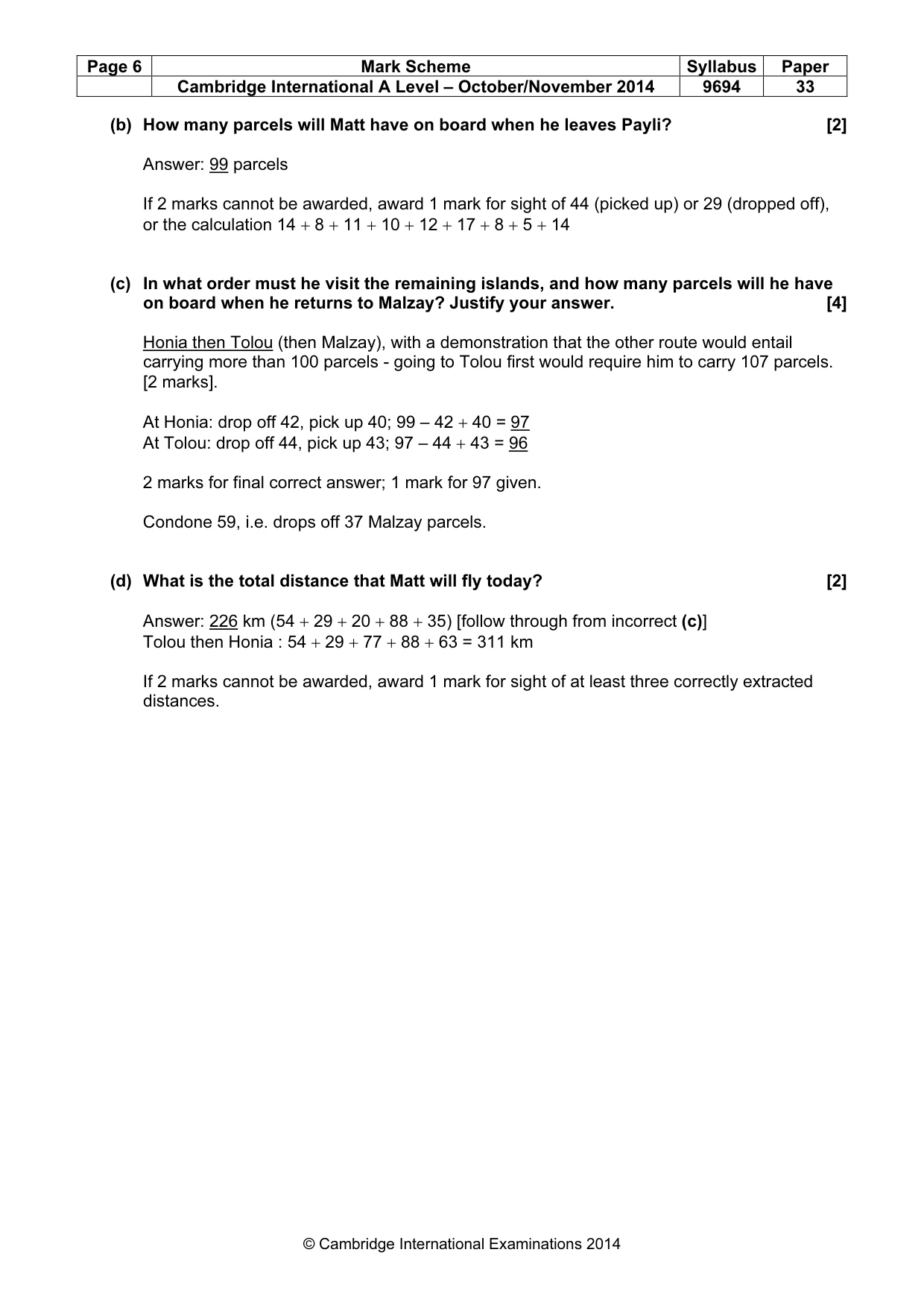
Page 6 Mark Scheme Syllabus Paper Cambridge International A Level – October/November 2014 9694 33 © Cambridge International Examinations 2014 (b) How many parcels will Matt have on board when he leaves Payli? [2] Answer: 99 parcels If 2 marks cannot be awarded, award 1 mark for sight of 44 (picked up) or 29 (dropped off), or the calculation 14 + 8 + 11 + 10 + 12 + 17 + 8 + 5 + 14 (c) In what order must he visit the remaining islands, and how many parcels will he have on board when he returns to Malzay? Justify your answer. [4] Honia then Tolou (then Malzay), with a demonstration that the other route would entail carrying more than 100 parcels - going to Tolou first would require him to carry 107 parcels. [2 marks]. At Honia: drop off 42, pick up 40; 99 – 42 + 40 = 97 At Tolou: drop off 44, pick up 43; 97 – 44 + 43 = 96 2 marks for final correct answer; 1 mark for 97 given. Condone 59, i.e. drops off 37 Malzay parcels. (d) What is the total distance that Matt will fly today? [2] Answer: 226 km (54 + 29 + 20 + 88 + 35) [follow through from incorrect (c)] Tolou then Honia : 54 + 29 + 77 + 88 + 63 = 311 km If 2 marks cannot be awarded, award 1 mark for sight of at least three correctly extracted distances.
Mark scheme, page 7
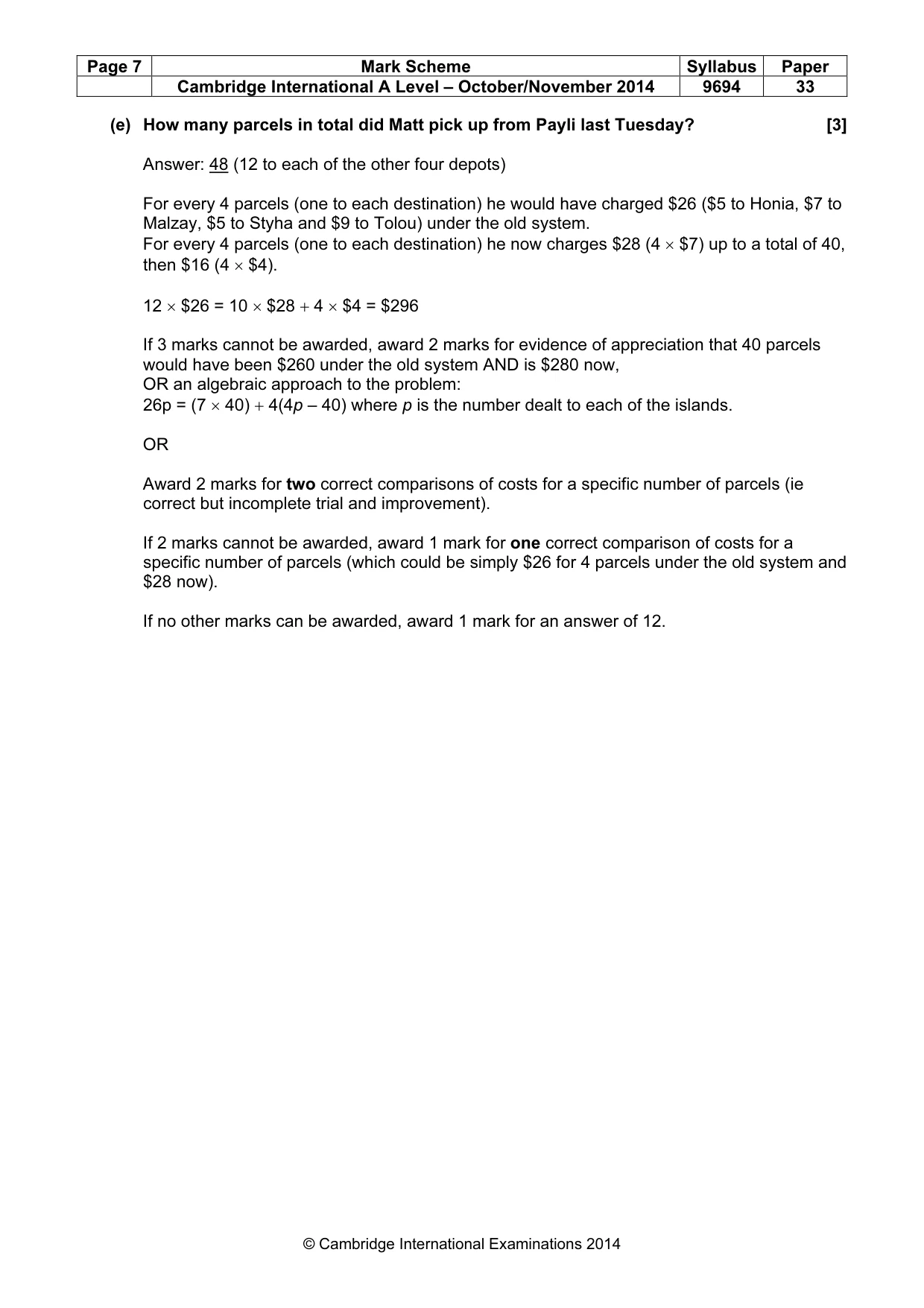
Page 7 Mark Scheme Syllabus Paper Cambridge International A Level – October/November 2014 9694 33 © Cambridge International Examinations 2014 (e) How many parcels in total did Matt pick up from Payli last Tuesday? [3] Answer: 48 (12 to each of the other four depots) For every 4 parcels (one to each destination) he would have charged $26 ($5 to Honia, $7 to Malzay, $5 to Styha and $9 to Tolou) under the old system. For every 4 parcels (one to each destination) he now charges $28 (4 × $7) up to a total of 40, then $16 (4 × $4). 12 × $26 = 10 × $28 + 4 × $4 = $296 If 3 marks cannot be awarded, award 2 marks for evidence of appreciation that 40 parcels would have been $260 under the old system AND is $280 now, OR an algebraic approach to the problem: 26p = (7 × 40) + 4(4p – 40) where p is the number dealt to each of the islands. OR Award 2 marks for two correct comparisons of costs for a specific number of parcels (ie correct but incomplete trial and improvement). If 2 marks cannot be awarded, award 1 mark for one correct comparison of costs for a specific number of parcels (which could be simply $26 for 4 parcels under the old system and $28 now). If no other marks can be awarded, award 1 mark for an answer of 12.
What you needed in this session
Cambridge’s own grade thresholds for 2014 Oct/Nov, Paper 3 · Variant 3. A higher threshold means an easier paper — the bar moves with how the cohort did.