Cambridge A Level Thinking Skills 9694 — 2013 May/June Paper 3 · Variant 1
9694/31/M/J/13 · 50 marks · ≈56 min
The question paper and its mark scheme, free to read here and free to download. This is Cambridge’s own paper, exactly as it was sat.
Question paper8 pages
Mark scheme10 pages
Answers below. Sit the paper first if you are practising.
Paper as text
Question paper, page 1
This document consists of 7 printed pages and 1 blank page. IB13 06_9694_31/4RP © UCLES 2013 [Turn over *1718381690* UNIVERSITY OF CAMBRIDGE INTERNATIONAL EXAMINATIONS General Certificate of Education Advanced Level THINKING SKILLS 9694/31 Paper 3 Problem Analysis and Solution May/June 2013 1 hour 30 minutes Additional Materials: Answer Booklet/Paper Electronic Calculator READ THESE INSTRUCTIONS FIRST If you have been given an Answer Booklet, follow the instructions on the front cover of the booklet. Write your Centre number, candidate number and name on all the work you hand in. Write in dark blue or black pen. Do not use staples, paper clips, highlighters, glue or correction fluid. DO NOT WRITE IN ANY BARCODES. Answer all the questions. Start each question on a new answer sheet. Calculators should be used where appropriate. At the end of the examination, fasten all your work securely together. The number of marks is given in brackets [ ] at the end of each question or part question.
Question paper, page 2
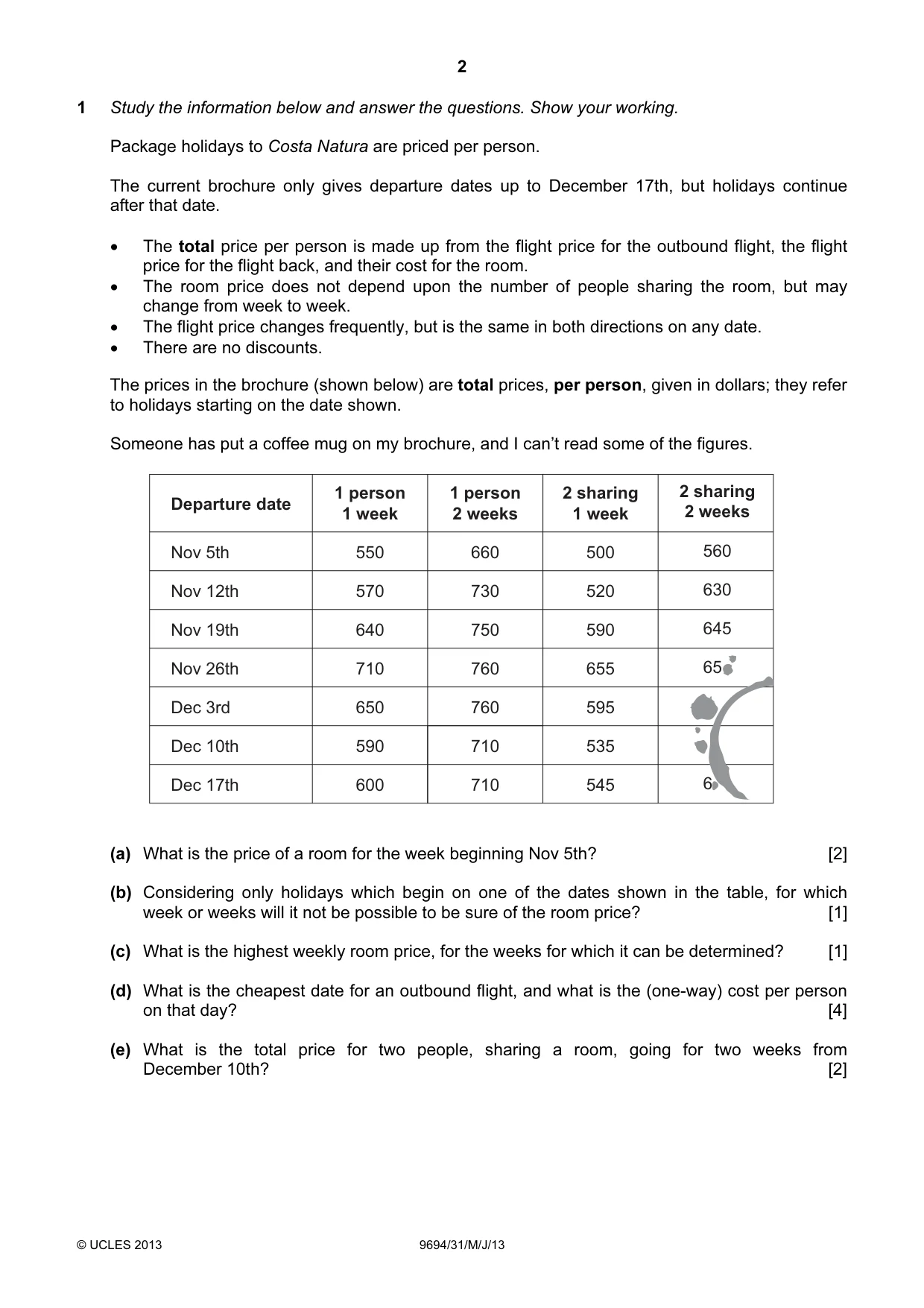
2 © UCLES 2013 9694/31/M/J/13 1 Study the information below and answer the questions. Show your working. Package holidays to Costa Natura are priced per person. The current brochure only gives departure dates up to December 17th, but holidays continue after that date. • The total price per person is made up from the flight price for the outbound flight, the flight price for the flight back, and their cost for the room. • The room price does not depend upon the number of people sharing the room, but may change from week to week. • The flight price changes frequently, but is the same in both directions on any date. • There are no discounts. The prices in the brochure (shown below) are total prices, per person, given in dollars; they refer to holidays starting on the date shown. Someone has put a coffee mug on my brochure, and I can’t read some of the figures. Departure date Nov 5th Nov 12th Nov 19th Nov 26th Dec 3rd Dec 10th Dec 17th 1 person 1 week 550 570 640 710 650 590 600 1 person 2 weeks 660 730 750 760 760 710 710 2 sharing 1 week 500 520 590 655 595 535 545 2 sharing 2 weeks 560 630 645 650 600 (a) What is the price of a room for the week beginning Nov 5th? [2] (b) Considering only holidays which begin on one of the dates shown in the table, for which week or weeks will it not be possible to be sure of the room price? [1] (c) What is the highest weekly room price, for the weeks for which it can be determined? [1] (d) What is the cheapest date for an outbound flight, and what is the (one-way) cost per person on that day? [4] (e) What is the total price for two people, sharing a room, going for two weeks from December 10th? [2]
Question paper, page 3
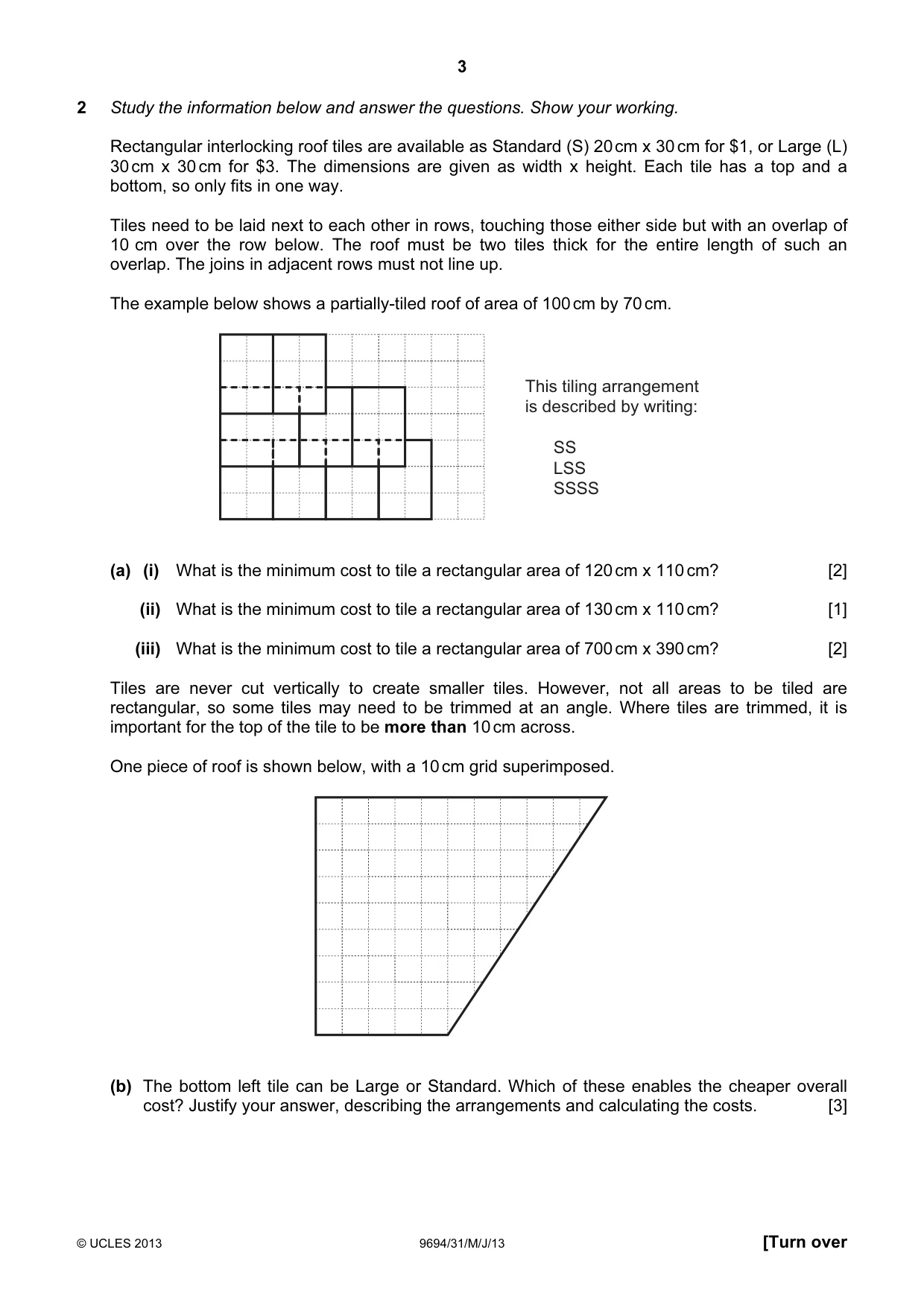
3 © UCLES 2013 9694/31/M/J/13 [Turn over 2 Study the information below and answer the questions. Show your working. Rectangular interlocking roof tiles are available as Standard (S) 20 cm x 30 cm for $1, or Large (L) 30 cm x 30 cm for $3. The dimensions are given as width x height. Each tile has a top and a bottom, so only fits in one way. Tiles need to be laid next to each other in rows, touching those either side but with an overlap of 10 cm over the row below. The roof must be two tiles thick for the entire length of such an overlap. The joins in adjacent rows must not line up. The example below shows a partially-tiled roof of area of 100 cm by 70 cm. This tiling arrangement is described by writing: SS LSS SSSS (a) (i) What is the minimum cost to tile a rectangular area of 120 cm x 110 cm? [2] (ii) What is the minimum cost to tile a rectangular area of 130 cm x 110 cm? [1] (iii) What is the minimum cost to tile a rectangular area of 700 cm x 390 cm? [2] Tiles are never cut vertically to create smaller tiles. However, not all areas to be tiled are rectangular, so some tiles may need to be trimmed at an angle. Where tiles are trimmed, it is important for the top of the tile to be more than 10 cm across. One piece of roof is shown below, with a 10 cm grid superimposed. (b) The bottom left tile can be Large or Standard. Which of these enables the cheaper overall cost? Justify your answer, describing the arrangements and calculating the costs. [3]
Question paper, page 4
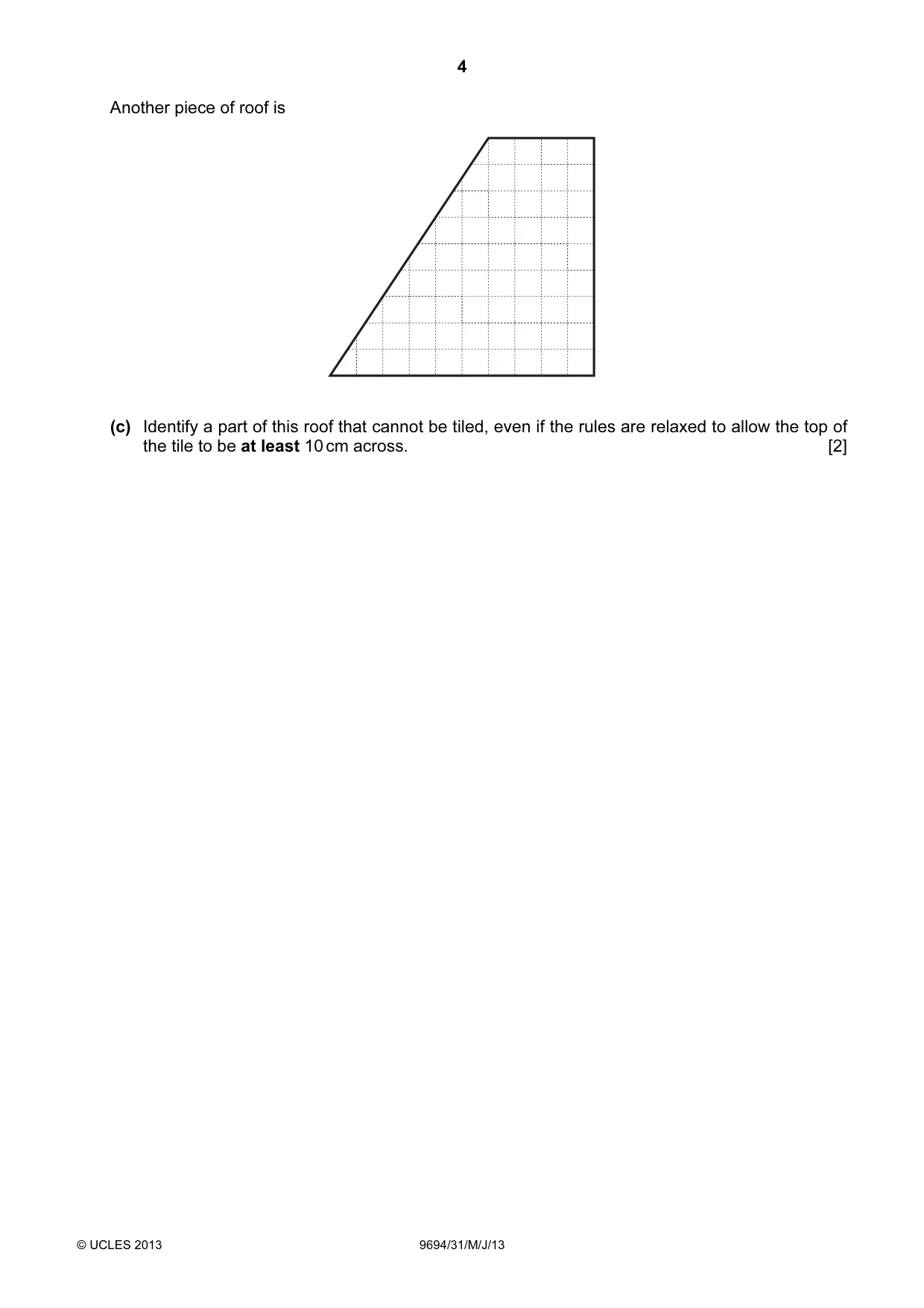
4 © UCLES 2013 9694/31/M/J/13 Another piece of roof is (c) Identify a part of this roof that cannot be tiled, even if the rules are relaxed to allow the top of the tile to be at least 10 cm across. [2]
Question paper, page 5
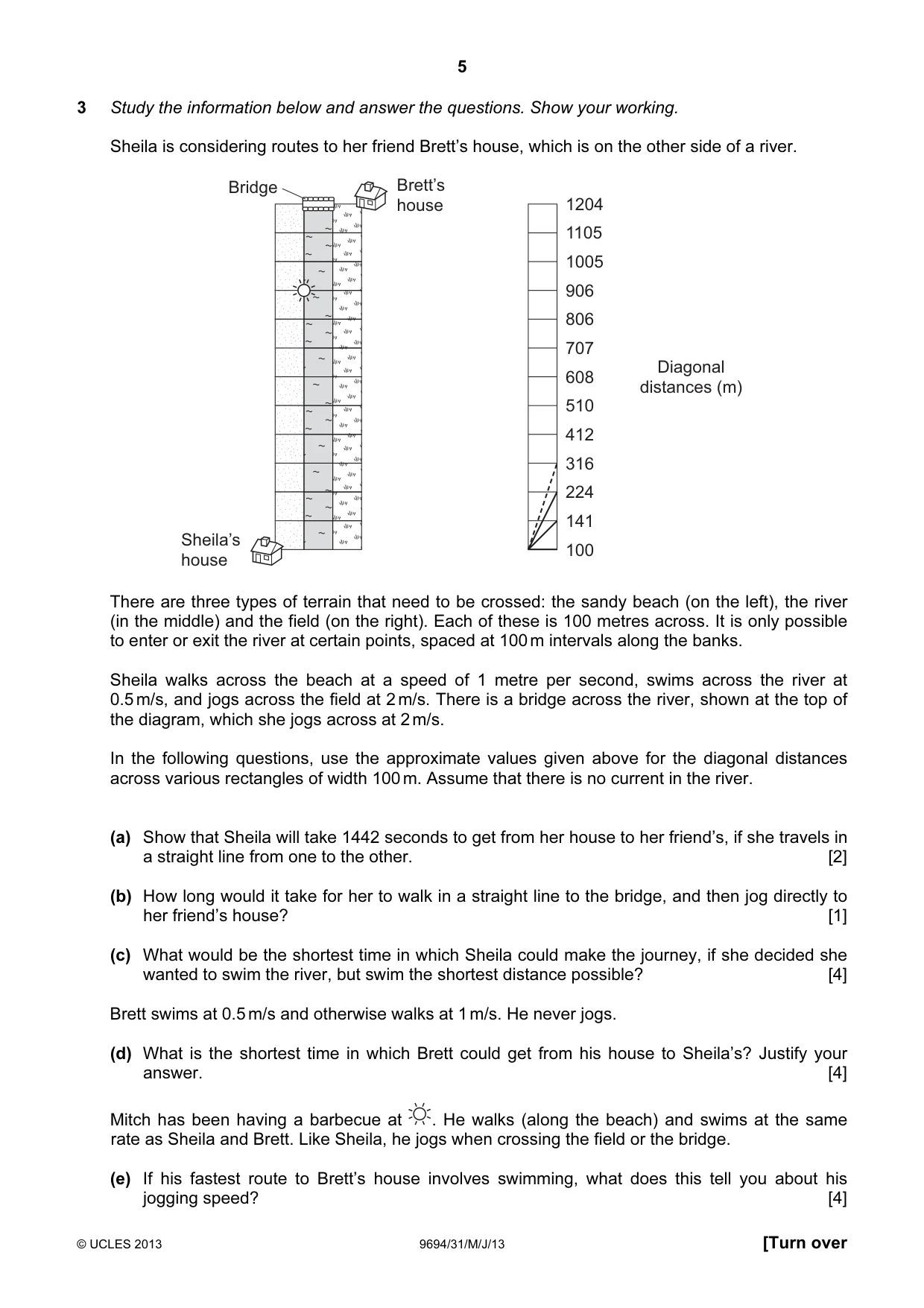
5 © UCLES 2013 9694/31/M/J/13 [Turn over 3 Study the information below and answer the questions. Show your working. Sheila is considering routes to her friend Brett’s house, which is on the other side of a river. 1204 1105 1005 906 806 707 608 510 412 316 224 141 100 Diagonal distances (m) Brett’s house Sheila’s house Bridge There are three types of terrain that need to be crossed: the sandy beach (on the left), the river (in the middle) and the field (on the right). Each of these is 100 metres across. It is only possible to enter or exit the river at certain points, spaced at 100 m intervals along the banks. Sheila walks across the beach at a speed of 1 metre per second, swims across the river at 0.5 m/s, and jogs across the field at 2 m/s. There is a bridge across the river, shown at the top of the diagram, which she jogs across at 2 m/s. In the following questions, use the approximate values given above for the diagonal distances across various rectangles of width 100 m. Assume that there is no current in the river. (a) Show that Sheila will take 1442 seconds to get from her house to her friend’s, if she travels in a straight line from one to the other. [2] (b) How long would it take for her to walk in a straight line to the bridge, and then jog directly to her friend’s house? [1] (c) What would be the shortest time in which Sheila could make the journey, if she decided she wanted to swim the river, but swim the shortest distance possible? [4] Brett swims at 0.5 m/s and otherwise walks at 1 m/s. He never jogs. (d) What is the shortest time in which Brett could get from his house to Sheila’s? Justify your answer. [4] Mitch has been having a barbecue at . He walks (along the beach) and swims at the same rate as Sheila and Brett. Like Sheila, he jogs when crossing the field or the bridge. (e) If his fastest route to Brett’s house involves swimming, what does this tell you about his jogging speed? [4]
Question paper, page 6
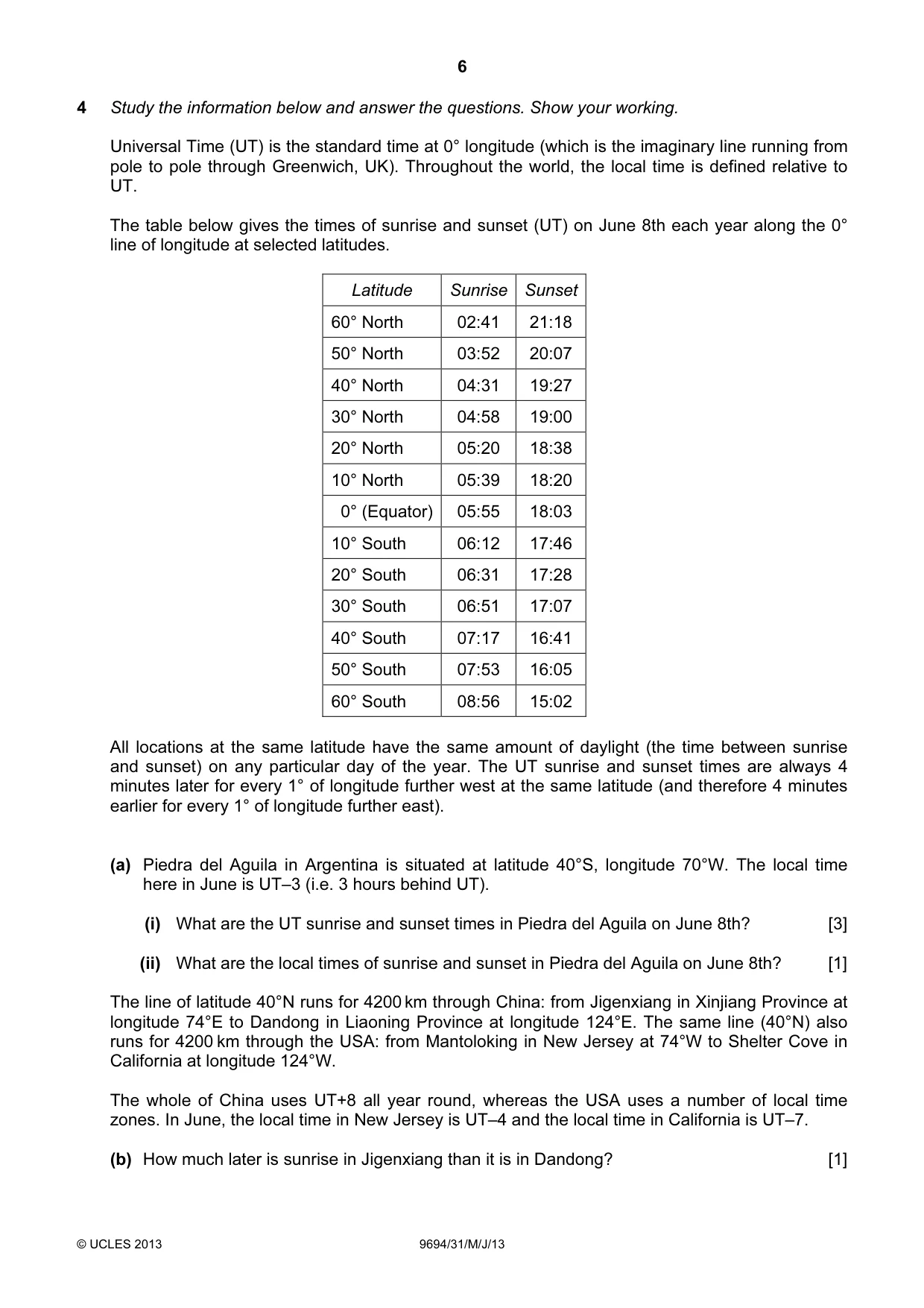
6 © UCLES 2013 9694/31/M/J/13 4 Study the information below and answer the questions. Show your working. Universal Time (UT) is the standard time at 0° longitude (which is the imaginary line running from pole to pole through Greenwich, UK). Throughout the world, the local time is defined relative to UT. The table below gives the times of sunrise and sunset (UT) on June 8th each year along the 0° line of longitude at selected latitudes. Latitude Sunrise Sunset 60° North 02:41 21:18 50° North 03:52 20:07 40° North 04:31 19:27 30° North 04:58 19:00 20° North 05:20 18:38 10° North 05:39 18:20 0° (Equator) 05:55 18:03 10° South 06:12 17:46 20° South 06:31 17:28 30° South 06:51 17:07 40° South 07:17 16:41 50° South 07:53 16:05 60° South 08:56 15:02 All locations at the same latitude have the same amount of daylight (the time between sunrise and sunset) on any particular day of the year. The UT sunrise and sunset times are always 4 minutes later for every 1° of longitude further west at the same latitude (and therefore 4 minutes earlier for every 1° of longitude further east). (a) Piedra del Aguila in Argentina is situated at latitude 40°S, longitude 70°W. The local time here in June is UT–3 (i.e. 3 hours behind UT). (i) What are the UT sunrise and sunset times in Piedra del Aguila on June 8th? [3] (ii) What are the local times of sunrise and sunset in Piedra del Aguila on June 8th? [1] The line of latitude 40°N runs for 4200 km through China: from Jigenxiang in Xinjiang Province at longitude 74°E to Dandong in Liaoning Province at longitude 124°E. The same line (40°N) also runs for 4200 km through the USA: from Mantoloking in New Jersey at 74°W to Shelter Cove in California at longitude 124°W. The whole of China uses UT+8 all year round, whereas the USA uses a number of local time zones. In June, the local time in New Jersey is UT–4 and the local time in California is UT–7. (b) How much later is sunrise in Jigenxiang than it is in Dandong? [1]
Question paper, page 7
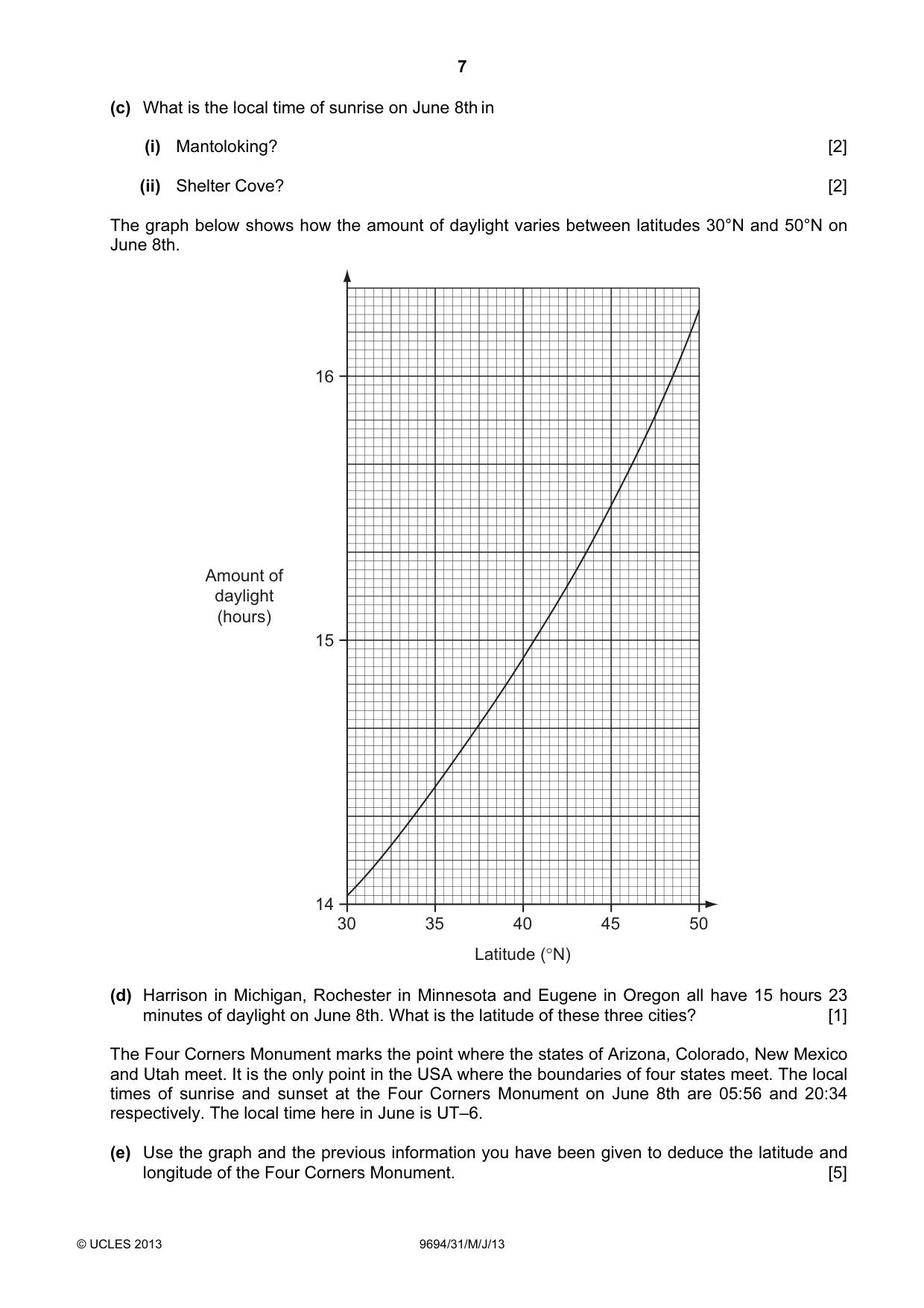
7 © UCLES 2013 9694/31/M/J/13 (c) What is the local time of sunrise on June 8th in (i) Mantoloking? [2] (ii) Shelter Cove? [2] The graph below shows how the amount of daylight varies between latitudes 30°N and 50°N on June 8th. 16 15 14 30 35 40 Latitude (°N) 45 50 Amount of daylight (hours) (d) Harrison in Michigan, Rochester in Minnesota and Eugene in Oregon all have 15 hours 23 minutes of daylight on June 8th. What is the latitude of these three cities? [1] The Four Corners Monument marks the point where the states of Arizona, Colorado, New Mexico and Utah meet. It is the only point in the USA where the boundaries of four states meet. The local times of sunrise and sunset at the Four Corners Monument on June 8th are 05:56 and 20:34 respectively. The local time here in June is UT–6. (e) Use the graph and the previous information you have been given to deduce the latitude and longitude of the Four Corners Monument. [5]
Question paper, page 8
8 Permission to reproduce items where third-party owned material protected by copyright is included has been sought and cleared where possible. Every reasonable effort has been made by the publisher (UCLES) to trace copyright holders, but if any items requiring clearance have unwittingly been included, the publisher will be pleased to make amends at the earliest possible opportunity. University of Cambridge International Examinations is part of the Cambridge Assessment Group. Cambridge Assessment is the brand name of University of Cambridge Local Examinations Syndicate (UCLES), which is itself a department of the University of Cambridge. © UCLES 2013 9694/31/M/J/13 BLANK PAGE
Mark scheme, page 1
CAMBRIDGE INTERNATIONAL EXAMINATIONS GCE Advanced Level MARK SCHEME for the May/June 2013 series 9694 THINKING SKILLS 9694/31 Paper 3 (Problem Analysis and Solution), maximum raw mark 50 This mark scheme is published as an aid to teachers and candidates, to indicate the requirements of the examination. It shows the basis on which Examiners were instructed to award marks. It does not indicate the details of the discussions that took place at an Examiners’ meeting before marking began, which would have considered the acceptability of alternative answers. Mark schemes should be read in conjunction with the question paper and the Principal Examiner Report for Teachers. Cambridge will not enter into discussions about these mark schemes. Cambridge is publishing the mark schemes for the May/June 2013 series for most IGCSE, GCE Advanced Level and Advanced Subsidiary Level components and some Ordinary Level components.
Mark scheme, page 2
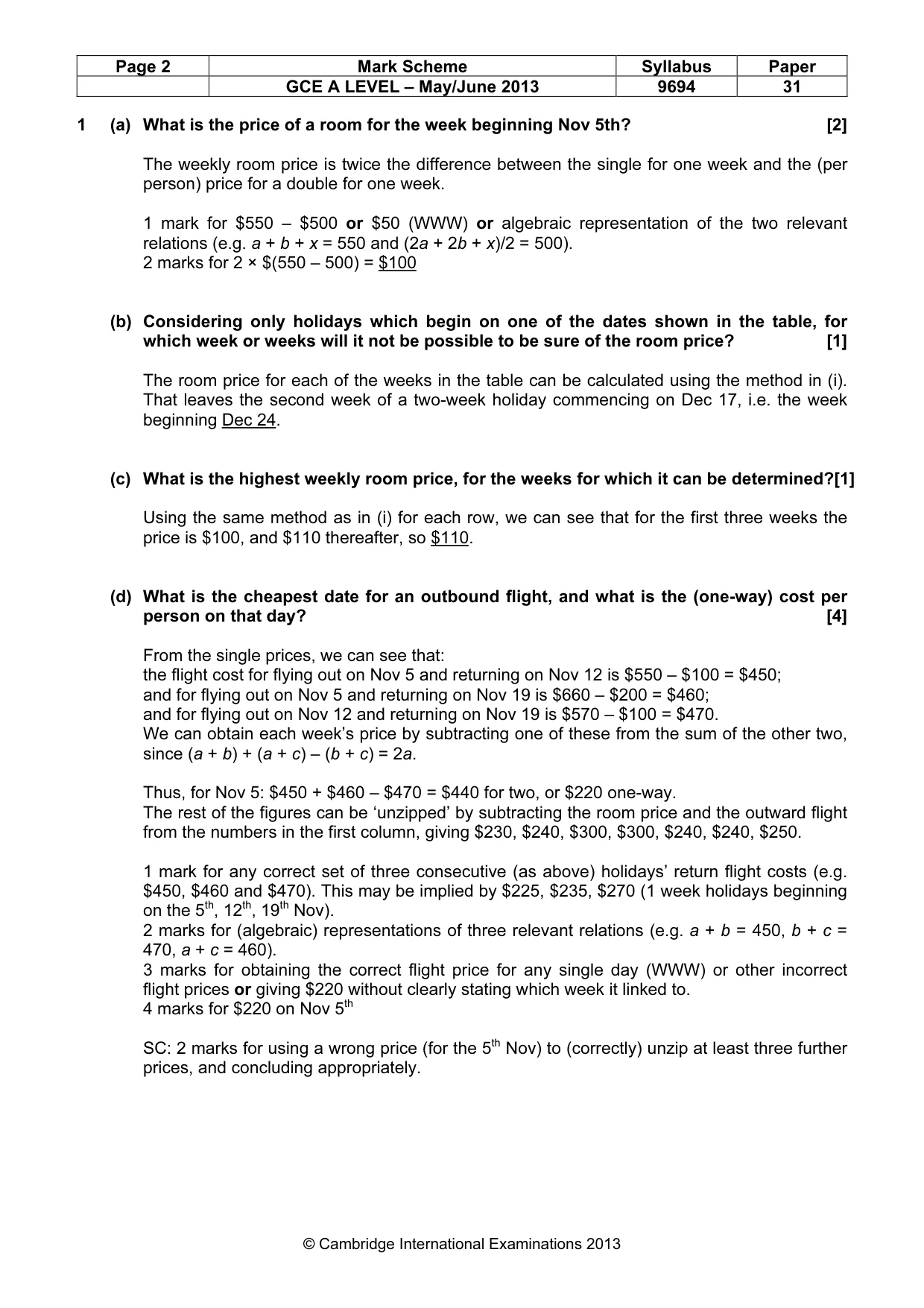
Page 2 Mark Scheme Syllabus Paper GCE A LEVEL – May/June 2013 9694 31 © Cambridge International Examinations 2013 1 (a) What is the price of a room for the week beginning Nov 5th? [2] The weekly room price is twice the difference between the single for one week and the (per person) price for a double for one week. 1 mark for $550 – $500 or $50 (WWW) or algebraic representation of the two relevant relations (e.g. a + b + x = 550 and (2a + 2b + x)/2 = 500). 2 marks for 2 × $(550 – 500) = $100 (b) Considering only holidays which begin on one of the dates shown in the table, for which week or weeks will it not be possible to be sure of the room price? [1] The room price for each of the weeks in the table can be calculated using the method in (i). That leaves the second week of a two-week holiday commencing on Dec 17, i.e. the week beginning Dec 24. (c) What is the highest weekly room price, for the weeks for which it can be determined?[1] Using the same method as in (i) for each row, we can see that for the first three weeks the price is $100, and $110 thereafter, so $110. (d) What is the cheapest date for an outbound flight, and what is the (one-way) cost per person on that day? [4] From the single prices, we can see that: the flight cost for flying out on Nov 5 and returning on Nov 12 is $550 – $100 = $450; and for flying out on Nov 5 and returning on Nov 19 is $660 – $200 = $460; and for flying out on Nov 12 and returning on Nov 19 is $570 – $100 = $470. We can obtain each week’s price by subtracting one of these from the sum of the other two, since (a + b) + (a + c) – (b + c) = 2a. Thus, for Nov 5: $450 + $460 – $470 = $440 for two, or $220 one-way. The rest of the figures can be ‘unzipped’ by subtracting the room price and the outward flight from the numbers in the first column, giving $230, $240, $300, $300, $240, $240, $250. 1 mark for any correct set of three consecutive (as above) holidays’ return flight costs (e.g. $450, $460 and $470). This may be implied by $225, $235, $270 (1 week holidays beginning on the 5th, 12th, 19th Nov). 2 marks for (algebraic) representations of three relevant relations (e.g. a + b = 450, b + c = 470, a + c = 460). 3 marks for obtaining the correct flight price for any single day (WWW) or other incorrect flight prices or giving $220 without clearly stating which week it linked to. 4 marks for $220 on Nov 5th SC: 2 marks for using a wrong price (for the 5th Nov) to (correctly) unzip at least three further prices, and concluding appropriately.
Mark scheme, page 3
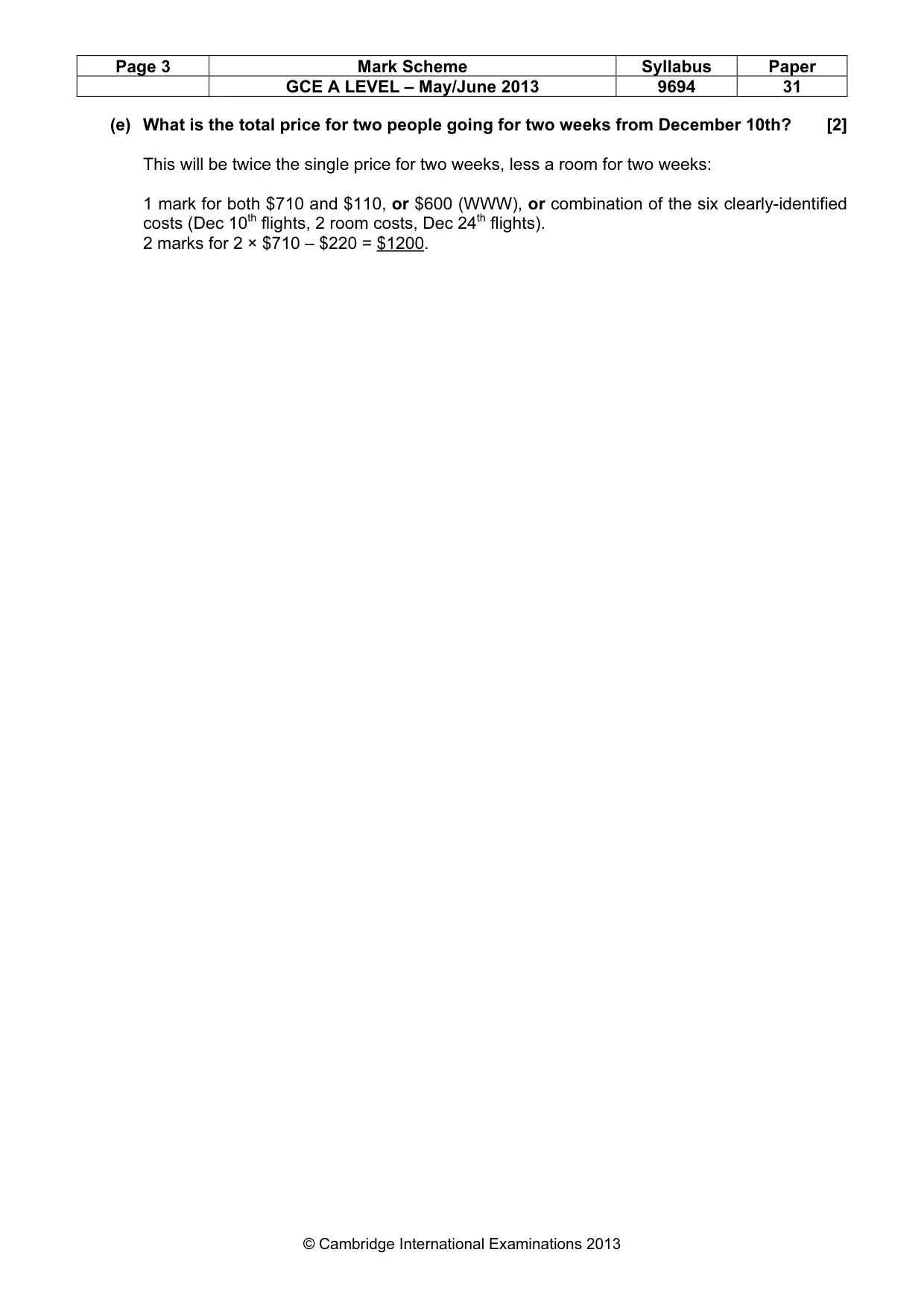
Page 3 Mark Scheme Syllabus Paper GCE A LEVEL – May/June 2013 9694 31 © Cambridge International Examinations 2013 (e) What is the total price for two people going for two weeks from December 10th? [2] This will be twice the single price for two weeks, less a room for two weeks: 1 mark for both $710 and $110, or $600 (WWW), or combination of the six clearly-identified costs (Dec 10th flights, 2 room costs, Dec 24th flights). 2 marks for 2 × $710 – $220 = $1200.
Mark scheme, page 4
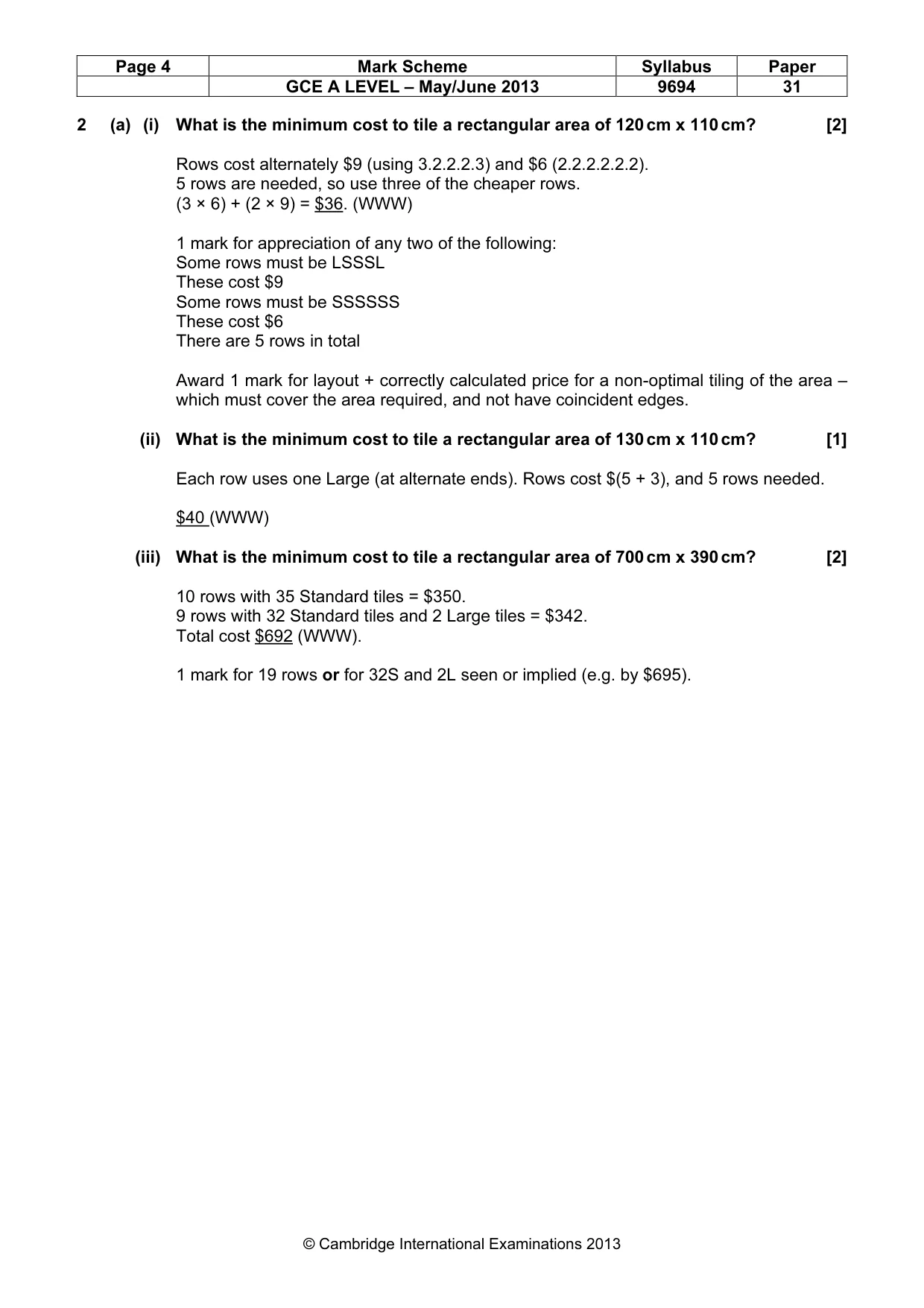
Page 4 Mark Scheme Syllabus Paper GCE A LEVEL – May/June 2013 9694 31 © Cambridge International Examinations 2013 2 (a) (i) What is the minimum cost to tile a rectangular area of 120 cm x 110 cm? [2] Rows cost alternately $9 (using 3.2.2.2.3) and $6 (2.2.2.2.2.2). 5 rows are needed, so use three of the cheaper rows. (3 × 6) + (2 × 9) = $36. (WWW) 1 mark for appreciation of any two of the following: Some rows must be LSSSL These cost $9 Some rows must be SSSSSS These cost $6 There are 5 rows in total Award 1 mark for layout + correctly calculated price for a non-optimal tiling of the area – which must cover the area required, and not have coincident edges. (ii) What is the minimum cost to tile a rectangular area of 130 cm x 110 cm? [1] Each row uses one Large (at alternate ends). Rows cost $(5 + 3), and 5 rows needed. $40 (WWW) (iii) What is the minimum cost to tile a rectangular area of 700 cm x 390 cm? [2] 10 rows with 35 Standard tiles = $350. 9 rows with 32 Standard tiles and 2 Large tiles = $342. Total cost $692 (WWW). 1 mark for 19 rows or for 32S and 2L seen or implied (e.g. by $695).
Mark scheme, page 5
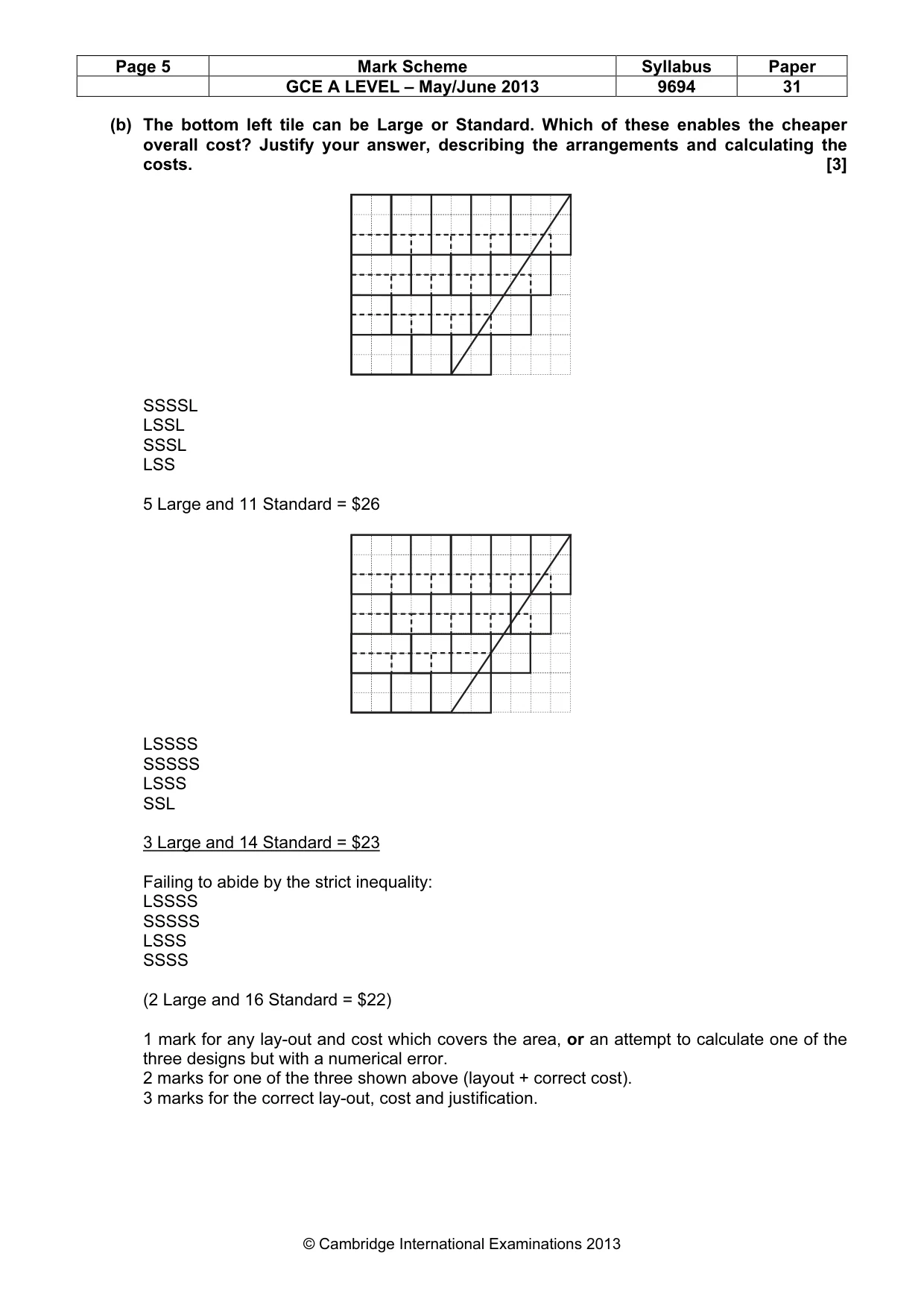
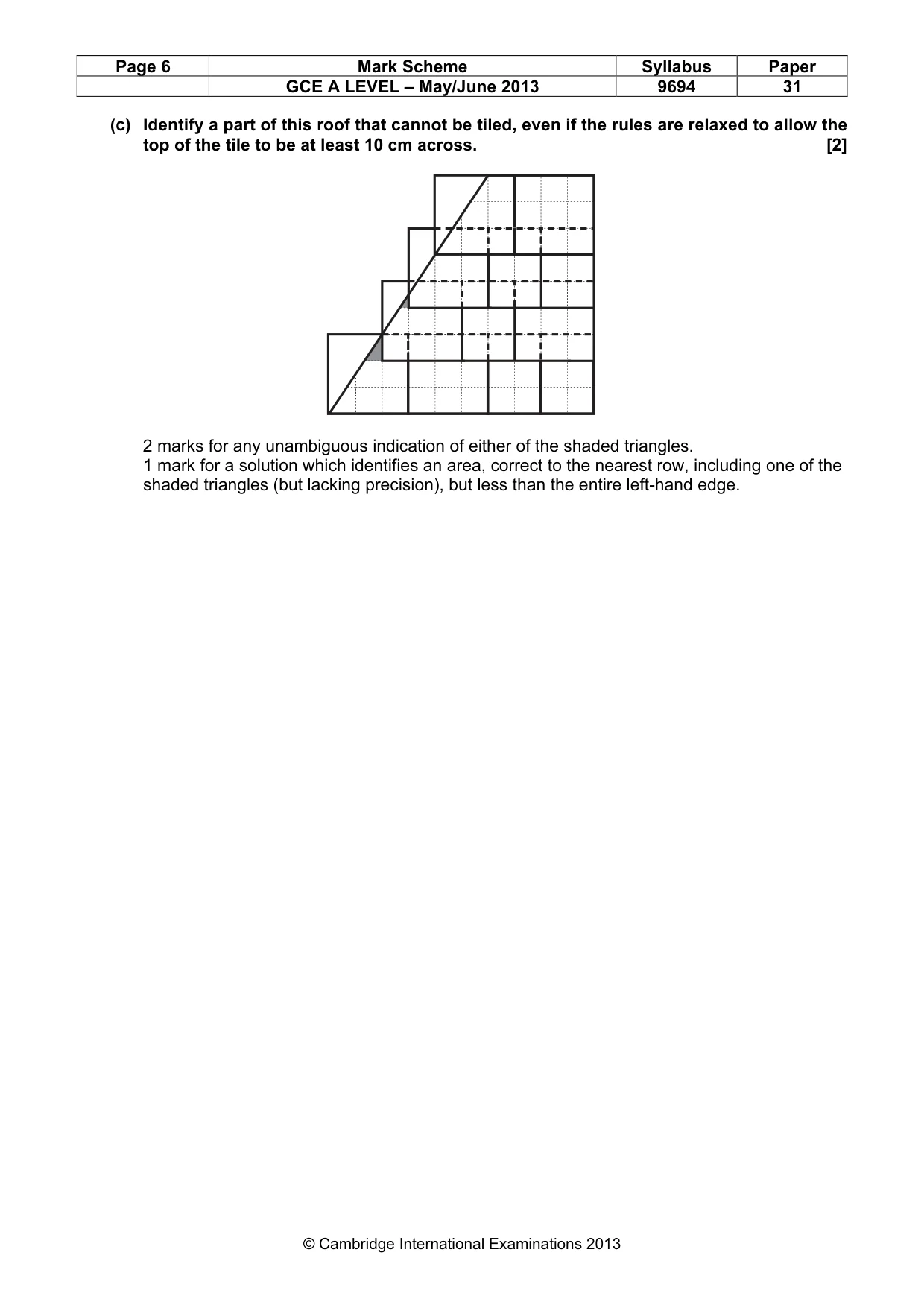
Page 5 Mark Scheme Syllabus Paper GCE A LEVEL – May/June 2013 9694 31 © Cambridge International Examinations 2013 (b) The bottom left tile can be Large or Standard. Which of these enables the cheaper overall cost? Justify your answer, describing the arrangements and calculating the costs. [3] SSSSL LSSL SSSL LSS 5 Large and 11 Standard = $26 LSSSS SSSSS LSSS SSL 3 Large and 14 Standard = $23 Failing to abide by the strict inequality: LSSSS SSSSS LSSS SSSS (2 Large and 16 Standard = $22) 1 mark for any lay-out and cost which covers the area, or an attempt to calculate one of the three designs but with a numerical error. 2 marks for one of the three shown above (layout + correct cost). 3 marks for the correct lay-out, cost and justification.
Mark scheme, page 6
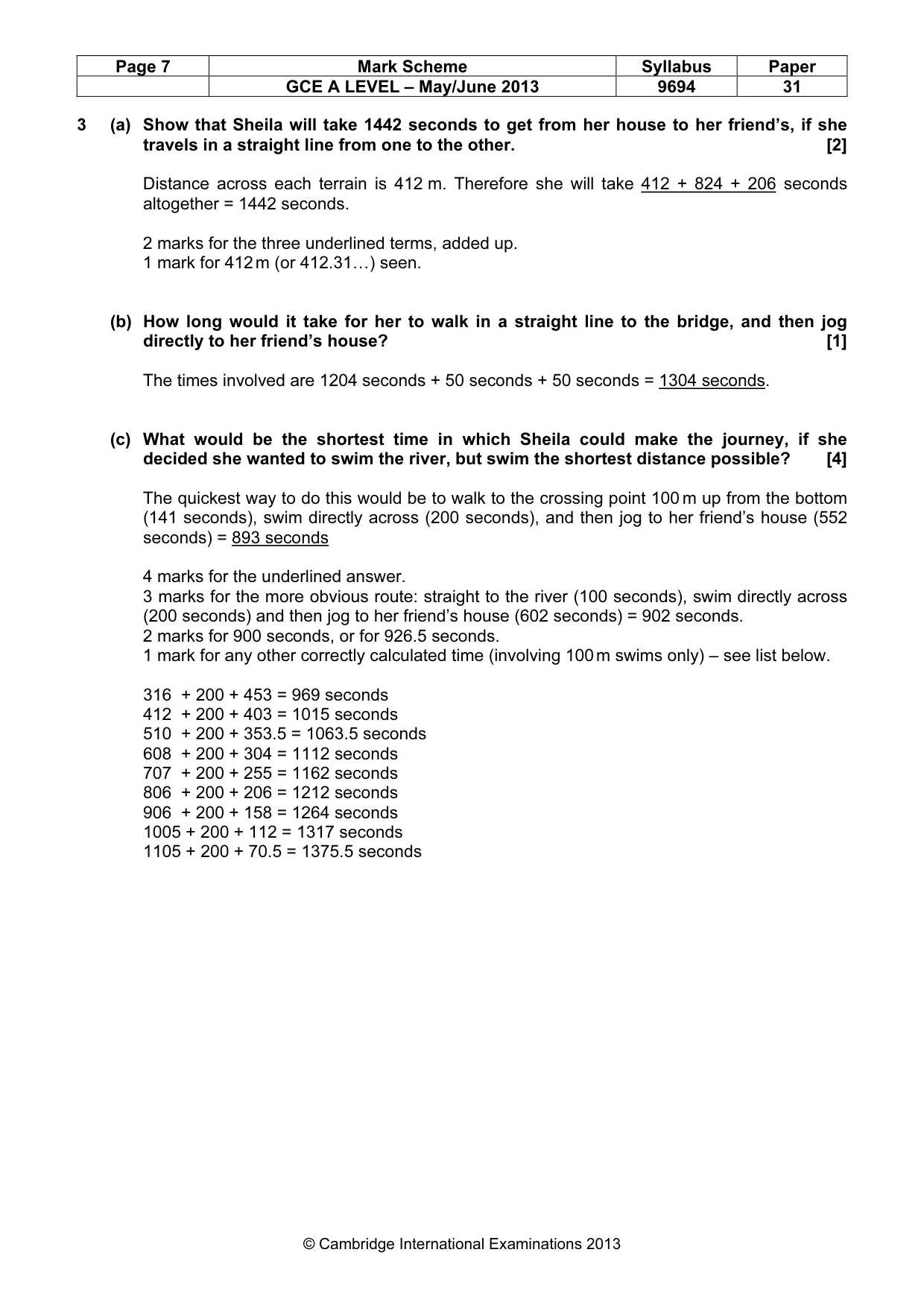
Page 6 Mark Scheme Syllabus Paper GCE A LEVEL – May/June 2013 9694 31 © Cambridge International Examinations 2013 (c) Identify a part of this roof that cannot be tiled, even if the rules are relaxed to allow the top of the tile to be at least 10 cm across. [2] 2 marks for any unambiguous indication of either of the shaded triangles. 1 mark for a solution which identifies an area, correct to the nearest row, including one of the shaded triangles (but lacking precision), but less than the entire left-hand edge.
Mark scheme, page 7
Page 7 Mark Scheme Syllabus Paper GCE A LEVEL – May/June 2013 9694 31 © Cambridge International Examinations 2013 3 (a) Show that Sheila will take 1442 seconds to get from her house to her friend’s, if she travels in a straight line from one to the other. [2] Distance across each terrain is 412 m. Therefore she will take 412 + 824 + 206 seconds altogether = 1442 seconds. 2 marks for the three underlined terms, added up. 1 mark for 412 m (or 412.31…) seen. (b) How long would it take for her to walk in a straight line to the bridge, and then jog directly to her friend’s house? [1] The times involved are 1204 seconds + 50 seconds + 50 seconds = 1304 seconds. (c) What would be the shortest time in which Sheila could make the journey, if she decided she wanted to swim the river, but swim the shortest distance possible? [4] The quickest way to do this would be to walk to the crossing point 100 m up from the bottom (141 seconds), swim directly across (200 seconds), and then jog to her friend’s house (552 seconds) = 893 seconds 4 marks for the underlined answer. 3 marks for the more obvious route: straight to the river (100 seconds), swim directly across (200 seconds) and then jog to her friend’s house (602 seconds) = 902 seconds. 2 marks for 900 seconds, or for 926.5 seconds. 1 mark for any other correctly calculated time (involving 100 m swims only) – see list below. 316 + 200 + 453 = 969 seconds 412 + 200 + 403 = 1015 seconds 510 + 200 + 353.5 = 1063.5 seconds 608 + 200 + 304 = 1112 seconds 707 + 200 + 255 = 1162 seconds 806 + 200 + 206 = 1212 seconds 906 + 200 + 158 = 1264 seconds 1005 + 200 + 112 = 1317 seconds 1105 + 200 + 70.5 = 1375.5 seconds
Mark scheme, page 8
Page 8 Mark Scheme Syllabus Paper GCE A LEVEL – May/June 2013 9694 31 © Cambridge International Examinations 2013 (d) What is the shortest time in which Brett could get from his house to Sheila’s? Justify your answer. [4] Quickest route is to enter the river 600 m from the bridge and exit the river 700 m from the bridge: 608 seconds + 282 seconds + 510 seconds = 1400 seconds. 4 marks for underlined answer and comparison with at least one other pathway. 3 marks for underlined answer with correct working (as above), but no justification. 2 marks for any two of the pathways correctly calculated. 1 mark for any pathway’s time correctly calculated. (e) If his fastest route to Brett’s house involves swimming, what does this tell you about his jogging speed? [4] 300 + 200/v > 200 + 316/v Therefore v > 1.16 m/s 3 marks for correct phrasing of inequality. 1 mark each for seeing the expressions 300 + 200/v, 200 + 316/v, 282 + 224/v, 300 + 224/v, 448 + 141/v, 400 + 141/v, 382 + 141/v (up to a maximum of 2). Award 3 marks for the ‘suboptimal answer’, found by solving the inequality in which the expression for Mitch’s journey across the bridge is compared with a slower swimming journey: 300 + 200/v > 282 + 224/v yields the solution v > 1.33. This must be accompanied by appropriate working. If candidates attempt to tackle the problem using ‘trial and improvement’: 1 mark for calculating times for routes which both cross the bridge and swim, for any given jogging speed. 2 marks for considering a second jogging speed. 3 marks for identifying an interval which includes the minimum of 1.16, and which lies between 1.1 and 1.5 (inclusive).
Mark scheme, page 9
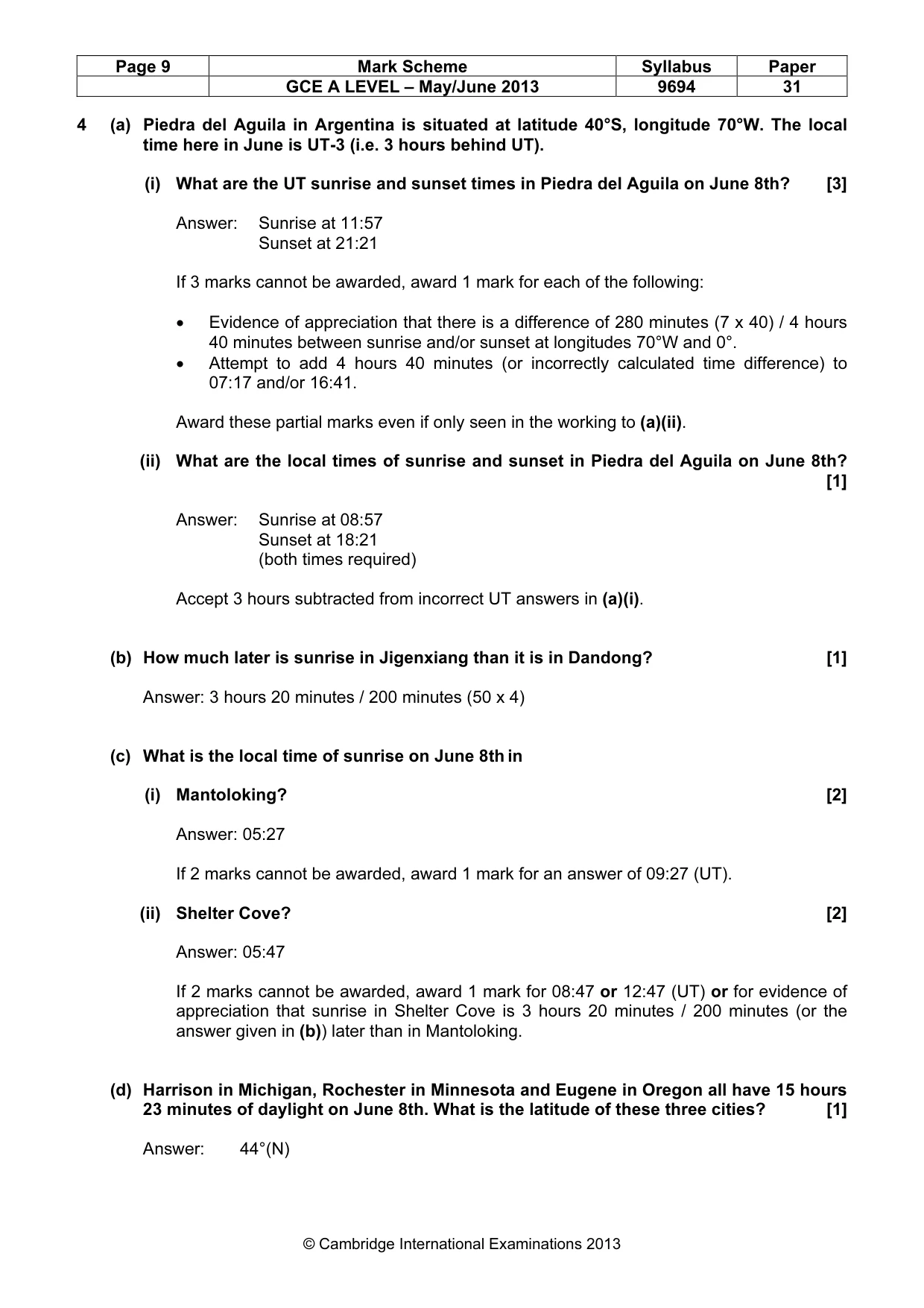
Page 9 Mark Scheme Syllabus Paper GCE A LEVEL – May/June 2013 9694 31 © Cambridge International Examinations 2013 4 (a) Piedra del Aguila in Argentina is situated at latitude 40°S, longitude 70°W. The local time here in June is UT-3 (i.e. 3 hours behind UT). (i) What are the UT sunrise and sunset times in Piedra del Aguila on June 8th? [3] Answer: Sunrise at 11:57 Sunset at 21:21 If 3 marks cannot be awarded, award 1 mark for each of the following: • Evidence of appreciation that there is a difference of 280 minutes (7 x 40) / 4 hours 40 minutes between sunrise and/or sunset at longitudes 70°W and 0°. • Attempt to add 4 hours 40 minutes (or incorrectly calculated time difference) to 07:17 and/or 16:41. Award these partial marks even if only seen in the working to (a)(ii). (ii) What are the local times of sunrise and sunset in Piedra del Aguila on June 8th? [1] Answer: Sunrise at 08:57 Sunset at 18:21 (both times required) Accept 3 hours subtracted from incorrect UT answers in (a)(i). (b) How much later is sunrise in Jigenxiang than it is in Dandong? [1] Answer: 3 hours 20 minutes / 200 minutes (50 x 4) (c) What is the local time of sunrise on June 8th in (i) Mantoloking? [2] Answer: 05:27 If 2 marks cannot be awarded, award 1 mark for an answer of 09:27 (UT). (ii) Shelter Cove? [2] Answer: 05:47 If 2 marks cannot be awarded, award 1 mark for 08:47 or 12:47 (UT) or for evidence of appreciation that sunrise in Shelter Cove is 3 hours 20 minutes / 200 minutes (or the answer given in (b)) later than in Mantoloking. (d) Harrison in Michigan, Rochester in Minnesota and Eugene in Oregon all have 15 hours 23 minutes of daylight on June 8th. What is the latitude of these three cities? [1] Answer: 44°(N)
Mark scheme, page 10
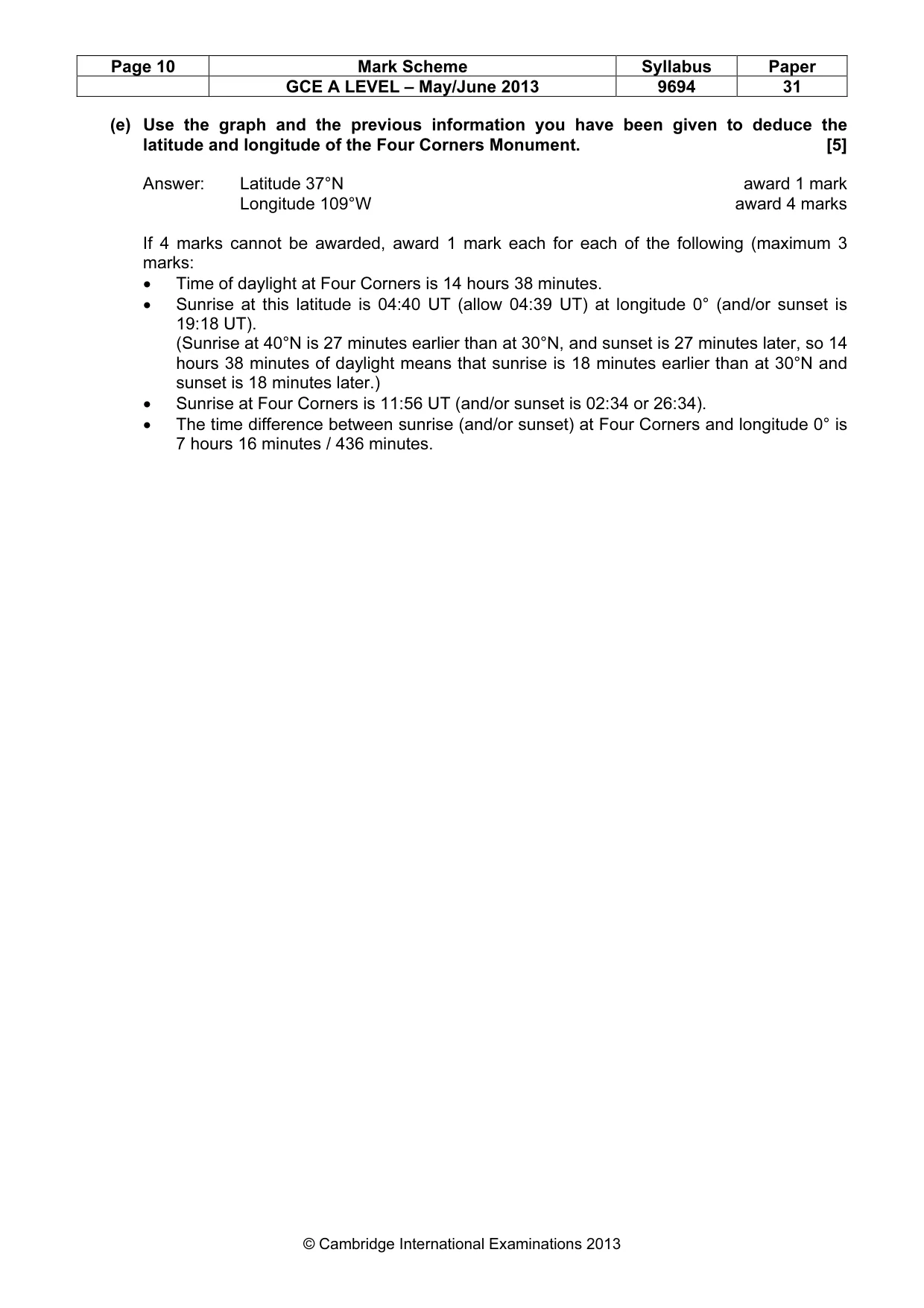
Page 10 Mark Scheme Syllabus Paper GCE A LEVEL – May/June 2013 9694 31 © Cambridge International Examinations 2013 (e) Use the graph and the previous information you have been given to deduce the latitude and longitude of the Four Corners Monument. [5] Answer: Latitude 37°N award 1 mark Longitude 109°W award 4 marks If 4 marks cannot be awarded, award 1 mark each for each of the following (maximum 3 marks: • Time of daylight at Four Corners is 14 hours 38 minutes. • Sunrise at this latitude is 04:40 UT (allow 04:39 UT) at longitude 0° (and/or sunset is 19:18 UT). (Sunrise at 40°N is 27 minutes earlier than at 30°N, and sunset is 27 minutes later, so 14 hours 38 minutes of daylight means that sunrise is 18 minutes earlier than at 30°N and sunset is 18 minutes later.) • Sunrise at Four Corners is 11:56 UT (and/or sunset is 02:34 or 26:34). • The time difference between sunrise (and/or sunset) at Four Corners and longitude 0° is 7 hours 16 minutes / 436 minutes.
What you needed in this session
Cambridge’s own grade thresholds for 2013 May/June, Paper 3 · Variant 1. A higher threshold means an easier paper — the bar moves with how the cohort did.