Cambridge A Level Thinking Skills 9694 — 2013 May/June Paper 3 · Variant 2
9694/32/M/J/13 · 50 marks · ≈56 min
The question paper and its mark scheme, free to read here and free to download. This is Cambridge’s own paper, exactly as it was sat.
Question paper8 pages
Mark scheme7 pages
Answers below. Sit the paper first if you are practising.
Paper as text
Question paper, page 1
This document consists of 8 printed pages. IB13 06_9694_32/3RP © UCLES 2013 [Turn over *2009558177* UNIVERSITY OF CAMBRIDGE INTERNATIONAL EXAMINATIONS General Certificate of Education Advanced Level THINKING SKILLS 9694/32 Paper 3 Problem Analysis and Solution May/June 2013 1 hour 30 minutes Additional Materials: Answer Booklet/Paper Electronic Calculator READ THESE INSTRUCTIONS FIRST If you have been given an Answer Booklet, follow the instructions on the front cover of the booklet. Write your Centre number, candidate number and name on all the work you hand in. Write in dark blue or black pen. Do not use staples, paper clips, highlighters, glue or correction fluid. DO NOT WRITE IN ANY BARCODES. Answer all the questions. Start each question on a new answer sheet. Calculators should be used where appropriate. At the end of the examination, fasten all your work securely together. The number of marks is given in brackets [ ] at the end of each question or part question.
Question paper, page 2
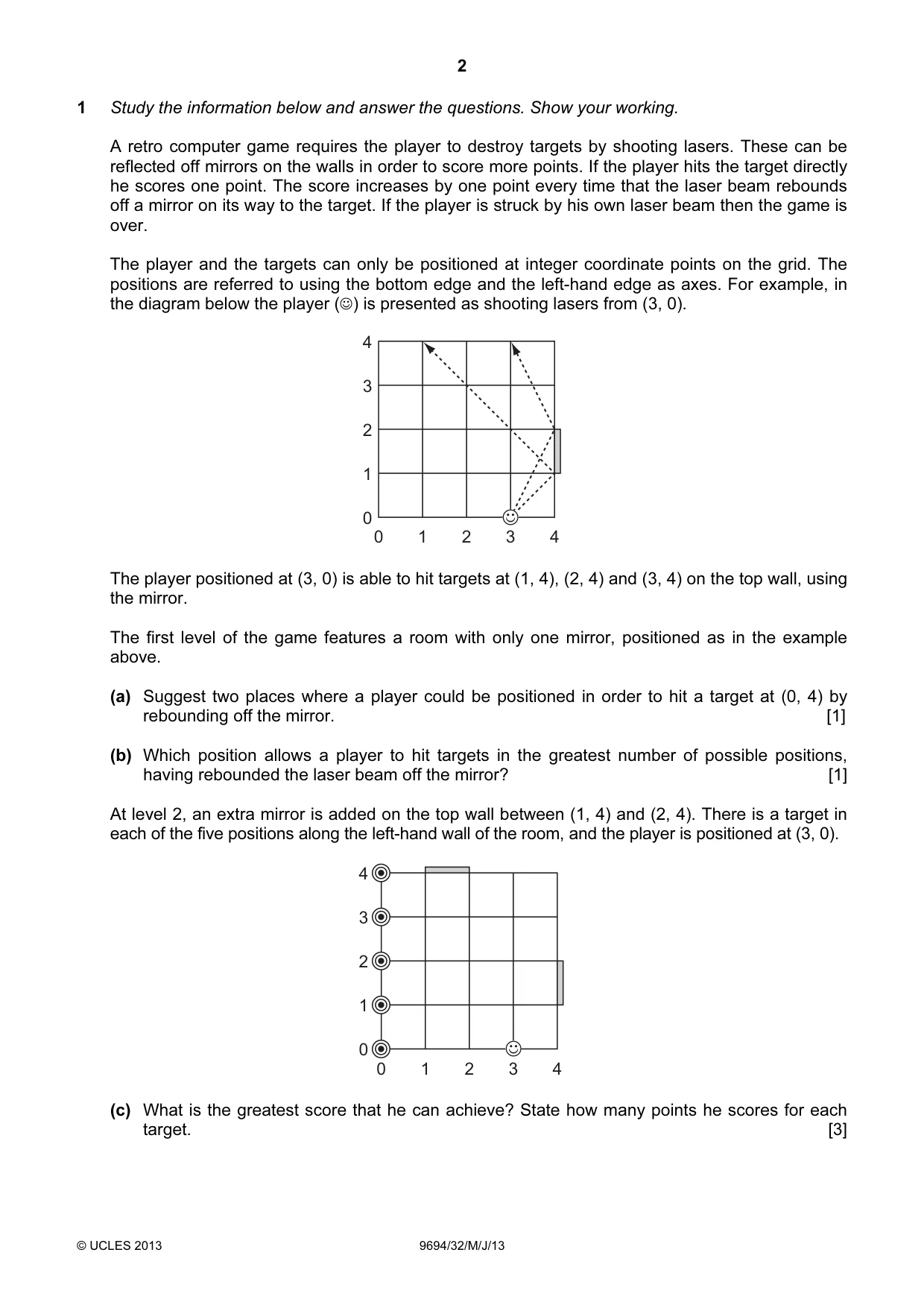
2 © UCLES 2013 9694/32/M/J/13 1 Study the information below and answer the questions. Show your working. A retro computer game requires the player to destroy targets by shooting lasers. These can be reflected off mirrors on the walls in order to score more points. If the player hits the target directly he scores one point. The score increases by one point every time that the laser beam rebounds off a mirror on its way to the target. If the player is struck by his own laser beam then the game is over. The player and the targets can only be positioned at integer coordinate points on the grid. The positions are referred to using the bottom edge and the left-hand edge as axes. For example, in the diagram below the player (☺) is presented as shooting lasers from (3, 0). 4 3 2 1 0 0 1 2 3 4 ☺ The player positioned at (3, 0) is able to hit targets at (1, 4), (2, 4) and (3, 4) on the top wall, using the mirror. The first level of the game features a room with only one mirror, positioned as in the example above. (a) Suggest two places where a player could be positioned in order to hit a target at (0, 4) by rebounding off the mirror. [1] (b) Which position allows a player to hit targets in the greatest number of possible positions, having rebounded the laser beam off the mirror? [1] At level 2, an extra mirror is added on the top wall between (1, 4) and (2, 4). There is a target in each of the five positions along the left-hand wall of the room, and the player is positioned at (3, 0). 4 3 2 1 0 0 1 2 3 4 ☺ (c) What is the greatest score that he can achieve? State how many points he scores for each target. [3]
Question paper, page 3
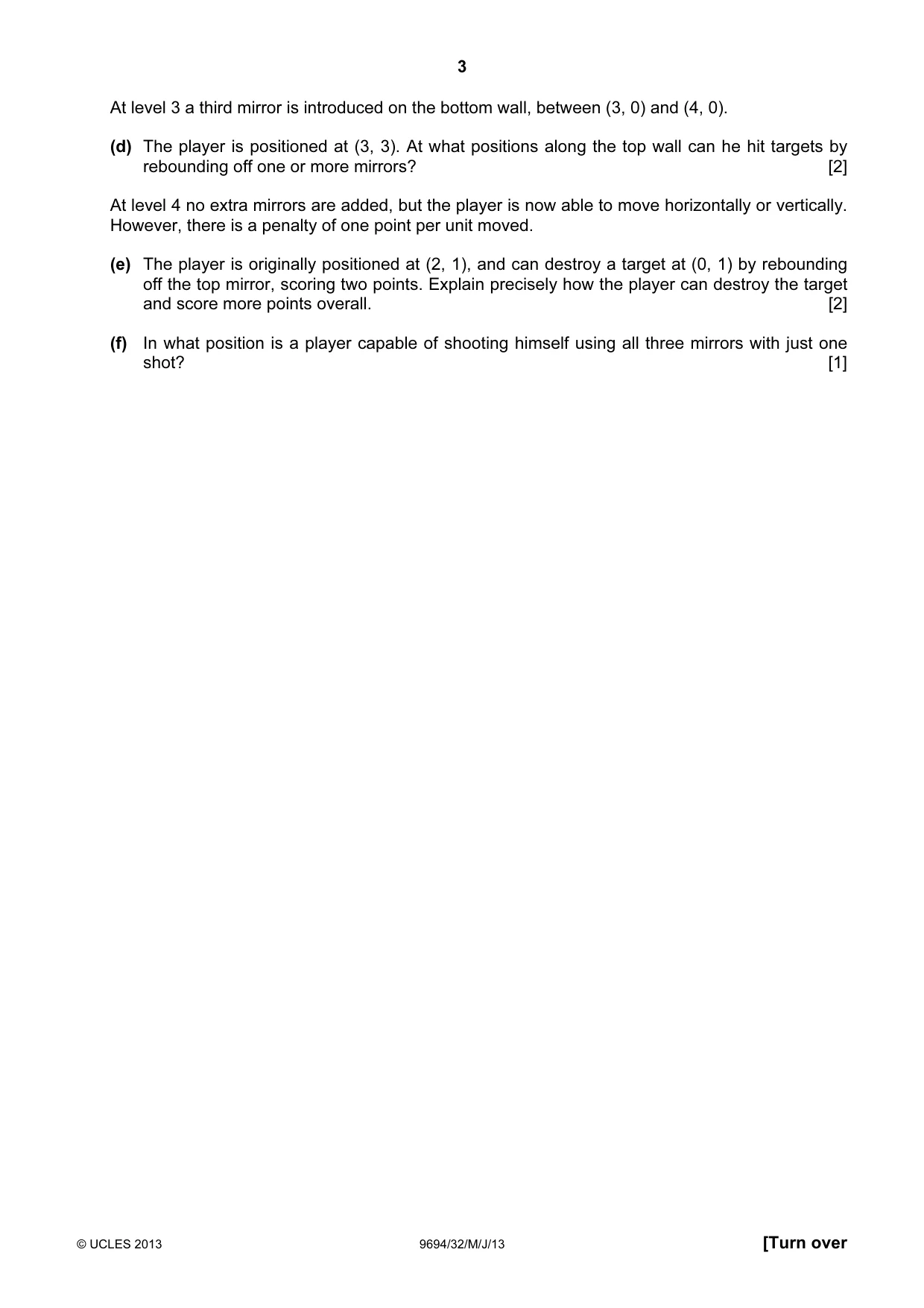
3 © UCLES 2013 9694/32/M/J/13 [Turn over At level 3 a third mirror is introduced on the bottom wall, between (3, 0) and (4, 0). (d) The player is positioned at (3, 3). At what positions along the top wall can he hit targets by rebounding off one or more mirrors? [2] At level 4 no extra mirrors are added, but the player is now able to move horizontally or vertically. However, there is a penalty of one point per unit moved. (e) The player is originally positioned at (2, 1), and can destroy a target at (0, 1) by rebounding off the top mirror, scoring two points. Explain precisely how the player can destroy the target and score more points overall. [2] (f) In what position is a player capable of shooting himself using all three mirrors with just one shot? [1]
Question paper, page 4
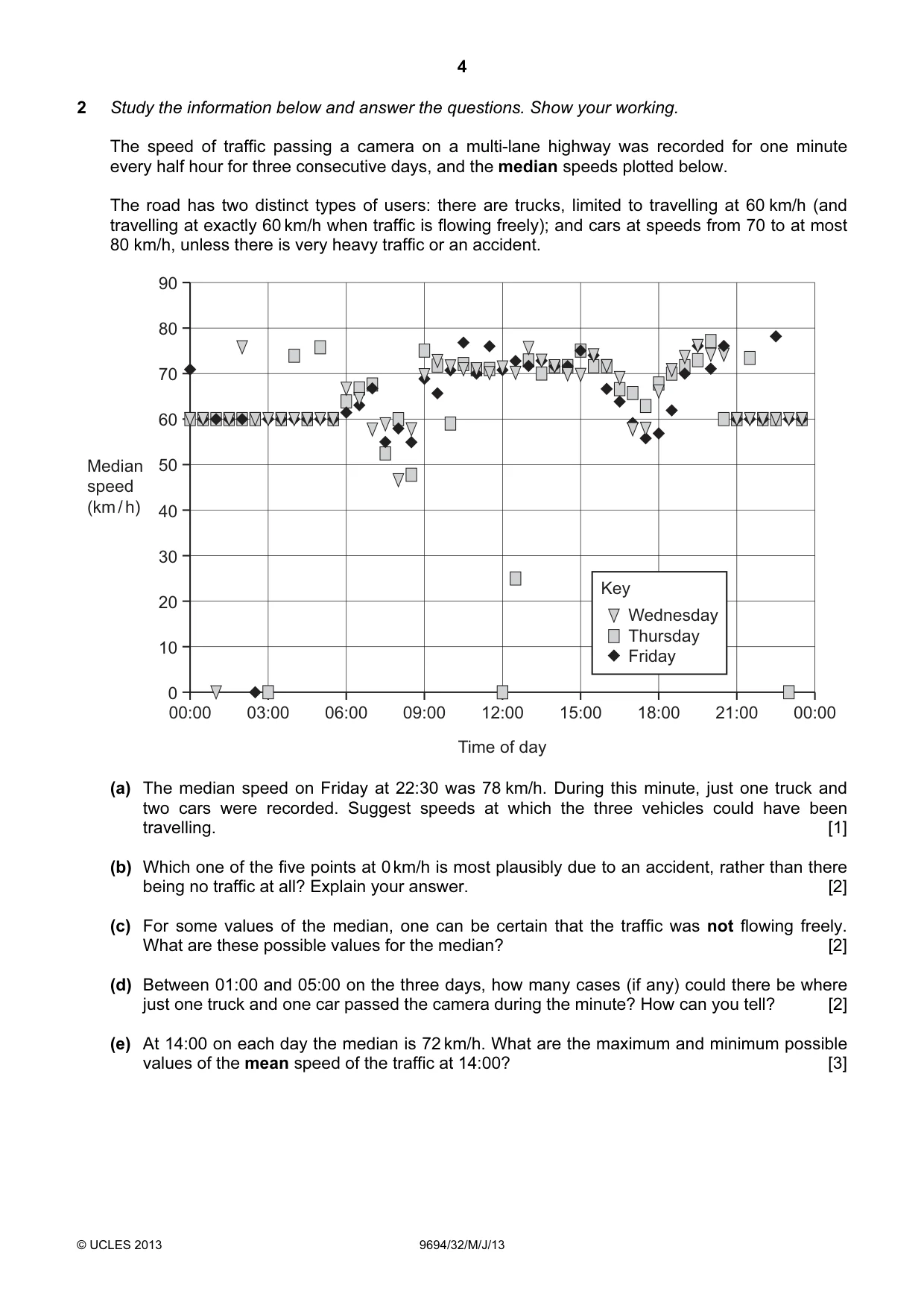
4 © UCLES 2013 9694/32/M/J/13 2 Study the information below and answer the questions. Show your working. The speed of traffic passing a camera on a multi-lane highway was recorded for one minute every half hour for three consecutive days, and the median speeds plotted below. The road has two distinct types of users: there are trucks, limited to travelling at 60 km/h (and travelling at exactly 60 km/h when traffic is flowing freely); and cars at speeds from 70 to at most 80 km/h, unless there is very heavy traffic or an accident. Median speed (km / h) Time of day 90 80 70 60 50 40 30 20 10 0 00:00 03:00 06:00 09:00 12:00 15:00 18:00 21:00 00:00 Wednesday Thursday Friday Key (a) The median speed on Friday at 22:30 was 78 km/h. During this minute, just one truck and two cars were recorded. Suggest speeds at which the three vehicles could have been travelling. [1] (b) Which one of the five points at 0 km/h is most plausibly due to an accident, rather than there being no traffic at all? Explain your answer. [2] (c) For some values of the median, one can be certain that the traffic was not flowing freely. What are these possible values for the median? [2] (d) Between 01:00 and 05:00 on the three days, how many cases (if any) could there be where just one truck and one car passed the camera during the minute? How can you tell? [2] (e) At 14:00 on each day the median is 72 km/h. What are the maximum and minimum possible values of the mean speed of the traffic at 14:00? [3]
Question paper, page 5
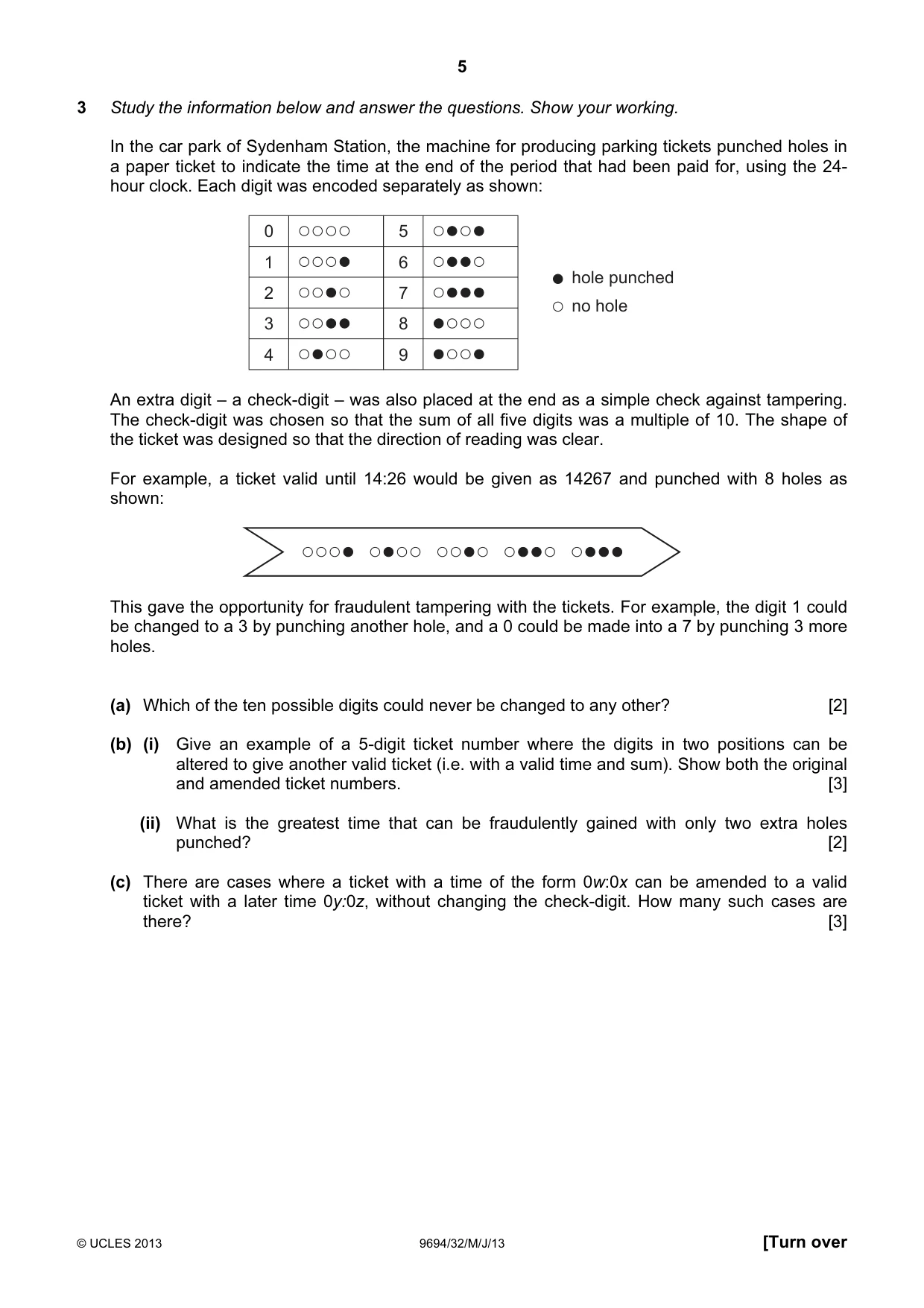
5 © UCLES 2013 9694/32/M/J/13 [Turn over 3 Study the information below and answer the questions. Show your working. In the car park of Sydenham Station, the machine for producing parking tickets punched holes in a paper ticket to indicate the time at the end of the period that had been paid for, using the 24- hour clock. Each digit was encoded separately as shown: 0 1 2 3 4 5 6 7 8 9 hole punched no hole An extra digit – a check-digit – was also placed at the end as a simple check against tampering. The check-digit was chosen so that the sum of all five digits was a multiple of 10. The shape of the ticket was designed so that the direction of reading was clear. For example, a ticket valid until 14:26 would be given as 14267 and punched with 8 holes as shown: This gave the opportunity for fraudulent tampering with the tickets. For example, the digit 1 could be changed to a 3 by punching another hole, and a 0 could be made into a 7 by punching 3 more holes. (a) Which of the ten possible digits could never be changed to any other? [2] (b) (i) Give an example of a 5-digit ticket number where the digits in two positions can be altered to give another valid ticket (i.e. with a valid time and sum). Show both the original and amended ticket numbers. [3] (ii) What is the greatest time that can be fraudulently gained with only two extra holes punched? [2] (c) There are cases where a ticket with a time of the form 0w:0x can be amended to a valid ticket with a later time 0y:0z, without changing the check-digit. How many such cases are there? [3]
Question paper, page 6
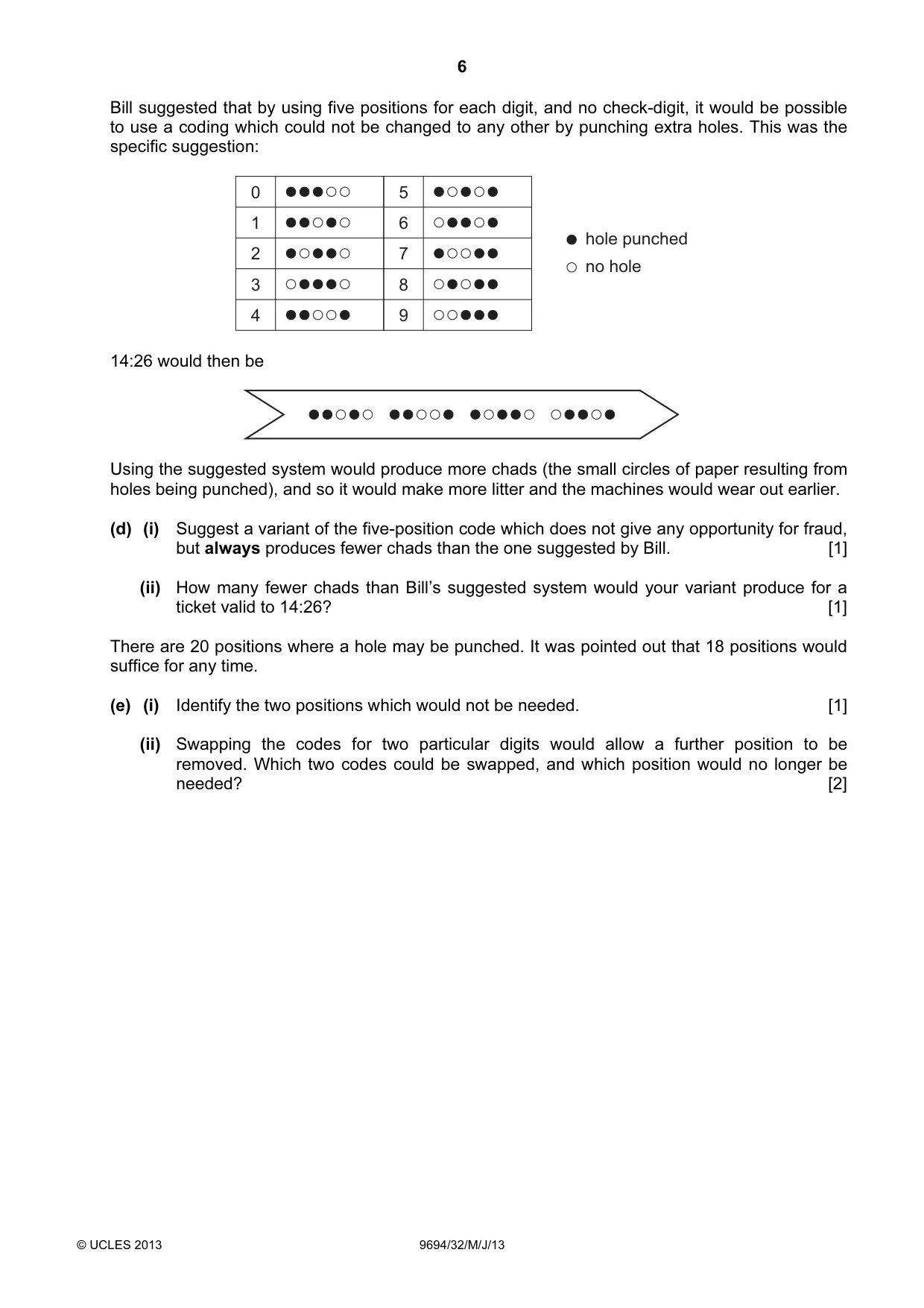
6 © UCLES 2013 9694/32/M/J/13 Bill suggested that by using five positions for each digit, and no check-digit, it would be possible to use a coding which could not be changed to any other by punching extra holes. This was the specific suggestion: 0 1 2 3 4 5 6 7 8 9 hole punched no hole 14:26 would then be Using the suggested system would produce more chads (the small circles of paper resulting from holes being punched), and so it would make more litter and the machines would wear out earlier. (d) (i) Suggest a variant of the five-position code which does not give any opportunity for fraud, but always produces fewer chads than the one suggested by Bill. [1] (ii) How many fewer chads than Bill’s suggested system would your variant produce for a ticket valid to 14:26? [1] There are 20 positions where a hole may be punched. It was pointed out that 18 positions would suffice for any time. (e) (i) Identify the two positions which would not be needed. [1] (ii) Swapping the codes for two particular digits would allow a further position to be removed. Which two codes could be swapped, and which position would no longer be needed? [2]
Question paper, page 7
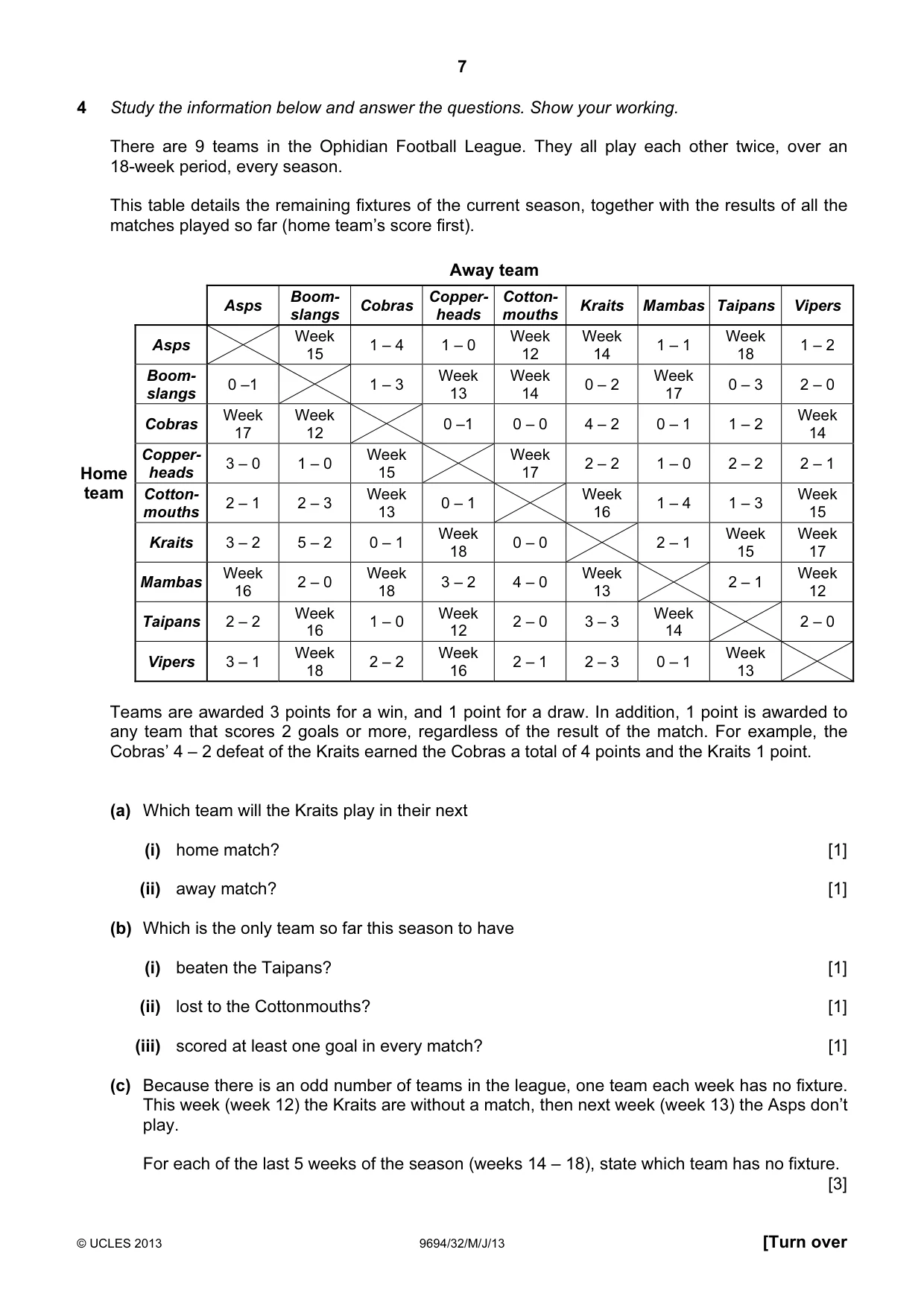
7 © UCLES 2013 9694/32/M/J/13 [Turn over 4 Study the information below and answer the questions. Show your working. There are 9 teams in the Ophidian Football League. They all play each other twice, over an 18-week period, every season. This table details the remaining fixtures of the current season, together with the results of all the matches played so far (home team’s score first). Teams are awarded 3 points for a win, and 1 point for a draw. In addition, 1 point is awarded to any team that scores 2 goals or more, regardless of the result of the match. For example, the Cobras’ 4 – 2 defeat of the Kraits earned the Cobras a total of 4 points and the Kraits 1 point. (a) Which team will the Kraits play in their next (i) home match? [1] (ii) away match? [1] (b) Which is the only team so far this season to have (i) beaten the Taipans? [1] (ii) lost to the Cottonmouths? [1] (iii) scored at least one goal in every match? [1] (c) Because there is an odd number of teams in the league, one team each week has no fixture. This week (week 12) the Kraits are without a match, then next week (week 13) the Asps don’t play. For each of the last 5 weeks of the season (weeks 14 – 18), state which team has no fixture. [3] Away team Asps Boom- slangs Cobras Copper- heads Cotton- mouths Kraits Mambas Taipans Vipers Asps Week 15 1 – 4 1 – 0 Week 12 Week 14 1 – 1 Week 18 1 – 2 Boom- slangs 0 –1 1 – 3 Week 13 Week 14 0 – 2 Week 17 0 – 3 2 – 0 Cobras Week 17 Week 12 0 –1 0 – 0 4 – 2 0 – 1 1 – 2 Week 14 Copper- heads 3 – 0 1 – 0 Week 15 Week 17 2 – 2 1 – 0 2 – 2 2 – 1 Cotton- mouths 2 – 1 2 – 3 Week 13 0 – 1 Week 16 1 – 4 1 – 3 Week 15 Kraits 3 – 2 5 – 2 0 – 1 Week 18 0 – 0 2 – 1 Week 15 Week 17 Mambas Week 16 2 – 0 Week 18 3 – 2 4 – 0 Week 13 2 – 1 Week 12 Taipans 2 – 2 Week 16 1 – 0 Week 12 2 – 0 3 – 3 Week 14 2 – 0 Home team Vipers 3 – 1 Week 18 2 – 2 Week 16 2 – 1 2 – 3 0 – 1 Week 13
Question paper, page 8
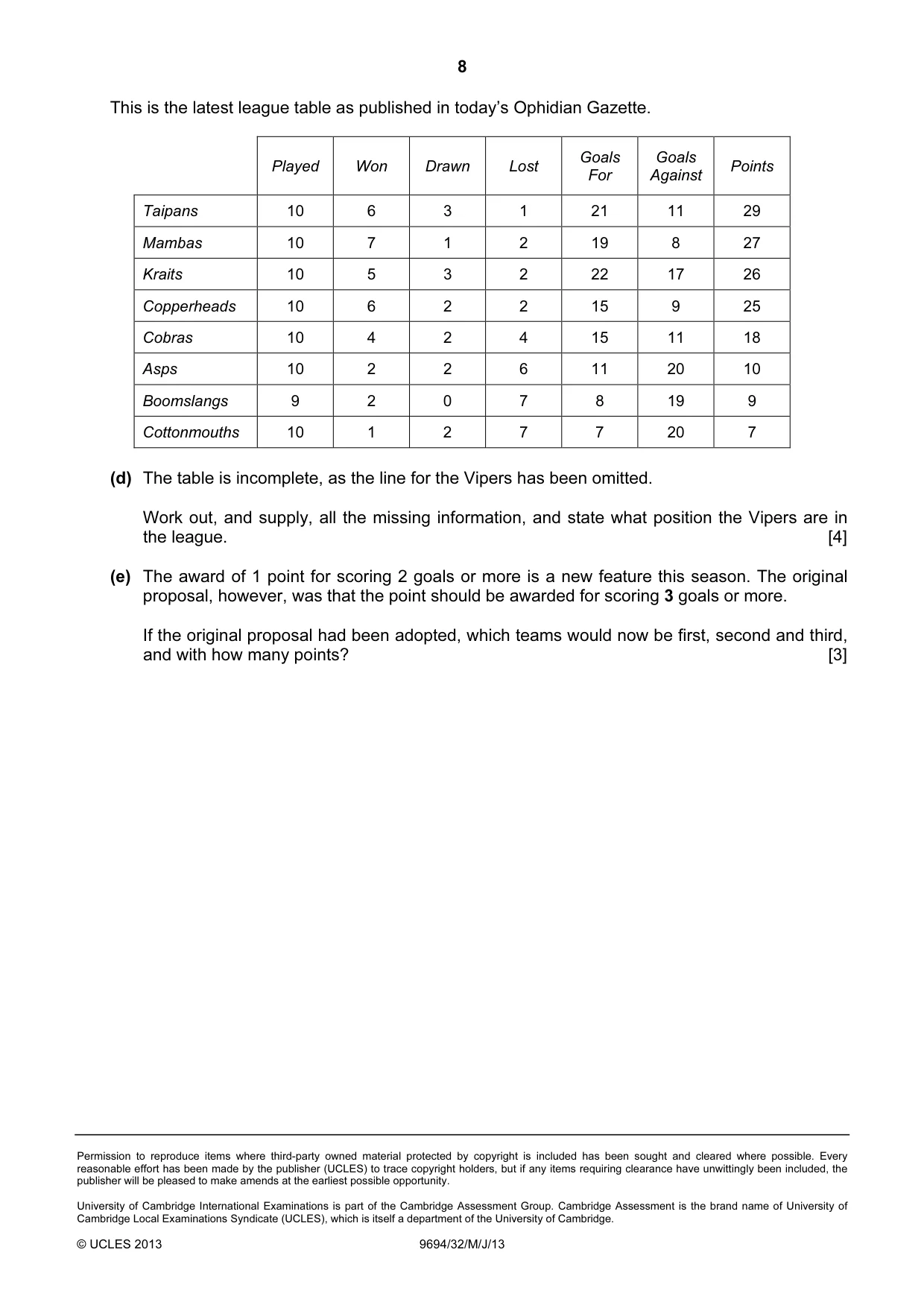
8 Permission to reproduce items where third-party owned material protected by copyright is included has been sought and cleared where possible. Every reasonable effort has been made by the publisher (UCLES) to trace copyright holders, but if any items requiring clearance have unwittingly been included, the publisher will be pleased to make amends at the earliest possible opportunity. University of Cambridge International Examinations is part of the Cambridge Assessment Group. Cambridge Assessment is the brand name of University of Cambridge Local Examinations Syndicate (UCLES), which is itself a department of the University of Cambridge. © UCLES 2013 9694/32/M/J/13 This is the latest league table as published in today’s Ophidian Gazette. Played Won Drawn Lost Goals For Goals Against Points Taipans 10 6 3 1 21 11 29 Mambas 10 7 1 2 19 8 27 Kraits 10 5 3 2 22 17 26 Copperheads 10 6 2 2 15 9 25 Cobras 10 4 2 4 15 11 18 Asps 10 2 2 6 11 20 10 Boomslangs 9 2 0 7 8 19 9 Cottonmouths 10 1 2 7 7 20 7 (d) The table is incomplete, as the line for the Vipers has been omitted. Work out, and supply, all the missing information, and state what position the Vipers are in the league. [4] (e) The award of 1 point for scoring 2 goals or more is a new feature this season. The original proposal, however, was that the point should be awarded for scoring 3 goals or more. If the original proposal had been adopted, which teams would now be first, second and third, and with how many points? [3]
Mark scheme, page 1
CAMBRIDGE INTERNATIONAL EXAMINATIONS GCE Advanced Level MARK SCHEME for the May/June 2013 series 9694 THINKING SKILLS 9694/32 Paper 3 (Problem Analysis and Solution), maximum raw mark 50 This mark scheme is published as an aid to teachers and candidates, to indicate the requirements of the examination. It shows the basis on which Examiners were instructed to award marks. It does not indicate the details of the discussions that took place at an Examiners’ meeting before marking began, which would have considered the acceptability of alternative answers. Mark schemes should be read in conjunction with the question paper and the Principal Examiner Report for Teachers. Cambridge will not enter into discussions about these mark schemes. Cambridge is publishing the mark schemes for the May/June 2013 series for most IGCSE, GCE Advanced Level and Advanced Subsidiary Level components and some Ordinary Level components.
Mark scheme, page 2
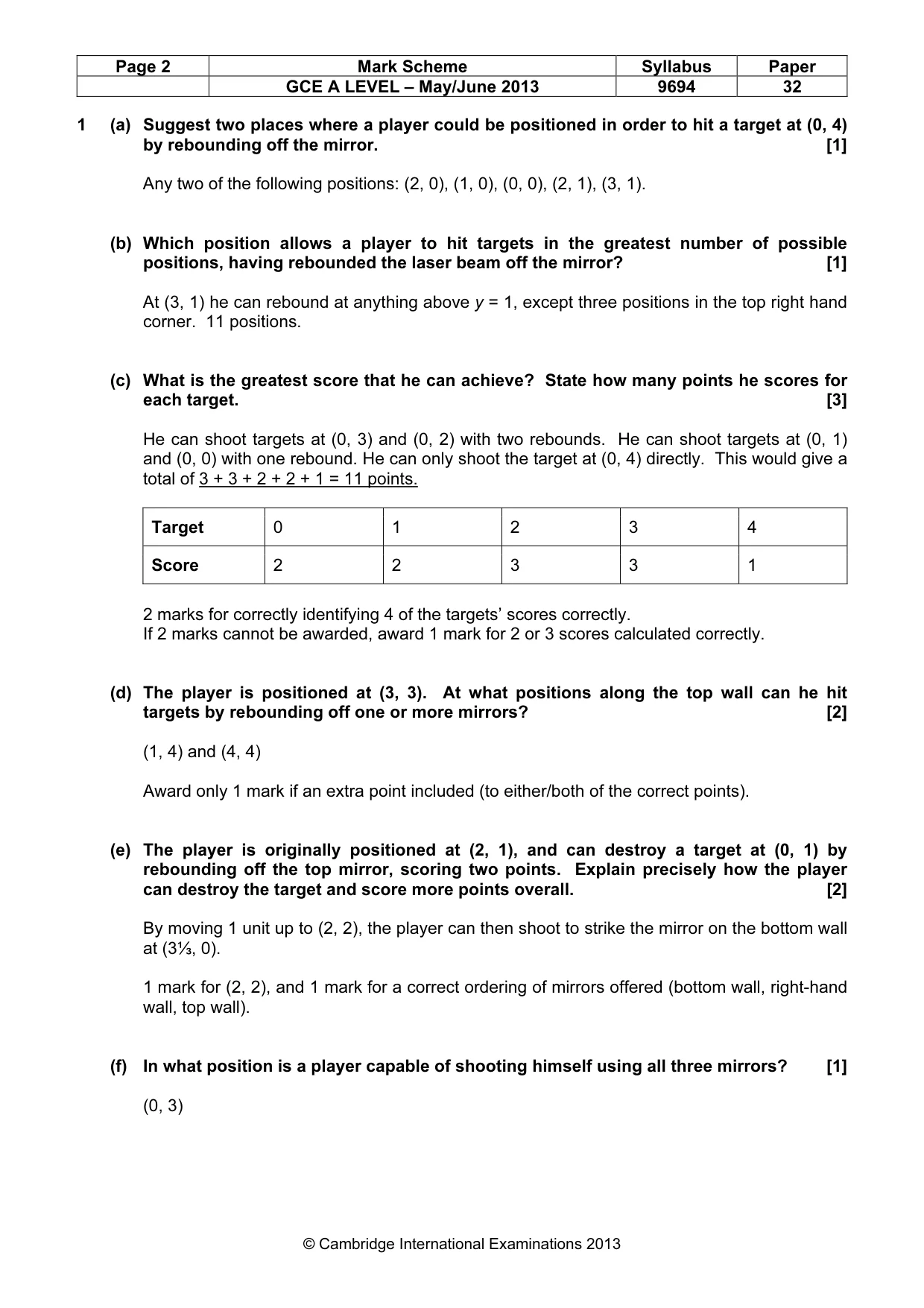
Page 2 Mark Scheme Syllabus Paper GCE A LEVEL – May/June 2013 9694 32 © Cambridge International Examinations 2013 1 (a) Suggest two places where a player could be positioned in order to hit a target at (0, 4) by rebounding off the mirror. [1] Any two of the following positions: (2, 0), (1, 0), (0, 0), (2, 1), (3, 1). (b) Which position allows a player to hit targets in the greatest number of possible positions, having rebounded the laser beam off the mirror? [1] At (3, 1) he can rebound at anything above y = 1, except three positions in the top right hand corner. 11 positions. (c) What is the greatest score that he can achieve? State how many points he scores for each target. [3] He can shoot targets at (0, 3) and (0, 2) with two rebounds. He can shoot targets at (0, 1) and (0, 0) with one rebound. He can only shoot the target at (0, 4) directly. This would give a total of 3 + 3 + 2 + 2 + 1 = 11 points. Target 0 1 2 3 4 Score 2 2 3 3 1 2 marks for correctly identifying 4 of the targets’ scores correctly. If 2 marks cannot be awarded, award 1 mark for 2 or 3 scores calculated correctly. (d) The player is positioned at (3, 3). At what positions along the top wall can he hit targets by rebounding off one or more mirrors? [2] (1, 4) and (4, 4) Award only 1 mark if an extra point included (to either/both of the correct points). (e) The player is originally positioned at (2, 1), and can destroy a target at (0, 1) by rebounding off the top mirror, scoring two points. Explain precisely how the player can destroy the target and score more points overall. [2] By moving 1 unit up to (2, 2), the player can then shoot to strike the mirror on the bottom wall at (3⅓, 0). 1 mark for (2, 2), and 1 mark for a correct ordering of mirrors offered (bottom wall, right-hand wall, top wall). (f) In what position is a player capable of shooting himself using all three mirrors? [1] (0, 3)
Mark scheme, page 3
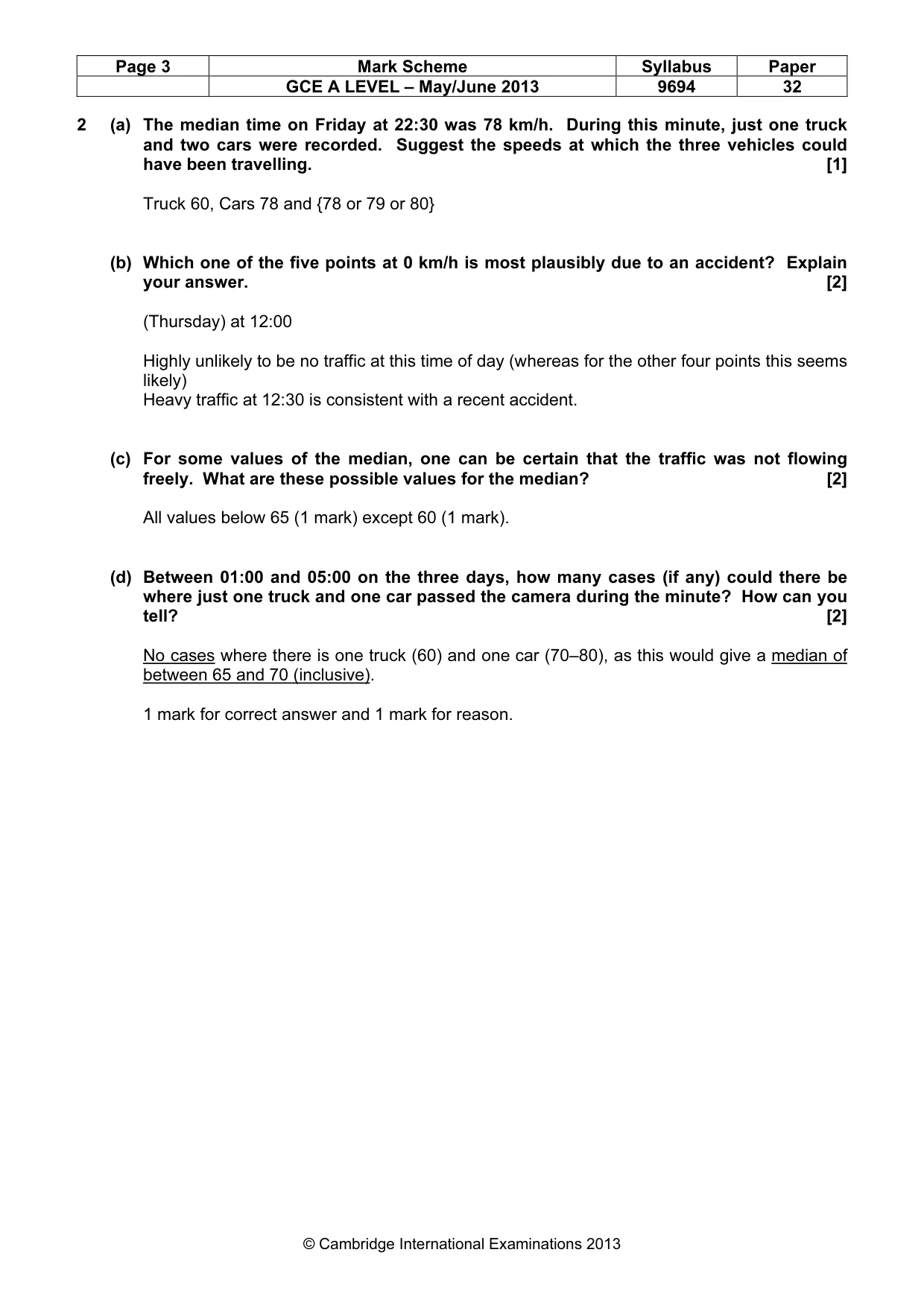
Page 3 Mark Scheme Syllabus Paper GCE A LEVEL – May/June 2013 9694 32 © Cambridge International Examinations 2013 2 (a) The median time on Friday at 22:30 was 78 km/h. During this minute, just one truck and two cars were recorded. Suggest the speeds at which the three vehicles could have been travelling. [1] Truck 60, Cars 78 and {78 or 79 or 80} (b) Which one of the five points at 0 km/h is most plausibly due to an accident? Explain your answer. [2] (Thursday) at 12:00 Highly unlikely to be no traffic at this time of day (whereas for the other four points this seems likely) Heavy traffic at 12:30 is consistent with a recent accident. (c) For some values of the median, one can be certain that the traffic was not flowing freely. What are these possible values for the median? [2] All values below 65 (1 mark) except 60 (1 mark). (d) Between 01:00 and 05:00 on the three days, how many cases (if any) could there be where just one truck and one car passed the camera during the minute? How can you tell? [2] No cases where there is one truck (60) and one car (70–80), as this would give a median of between 65 and 70 (inclusive). 1 mark for correct answer and 1 mark for reason.
Mark scheme, page 4
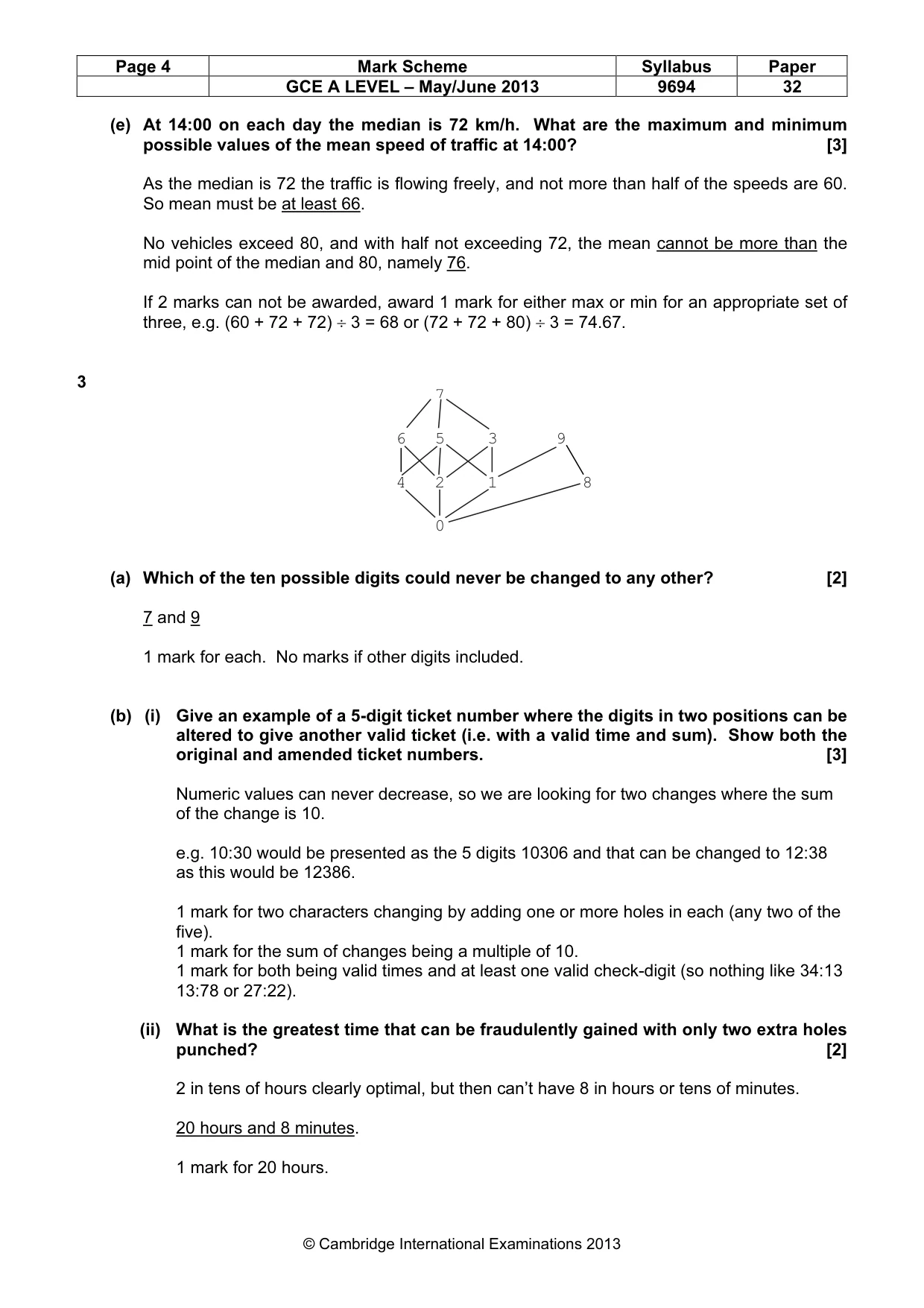
Page 4 Mark Scheme Syllabus Paper GCE A LEVEL – May/June 2013 9694 32 © Cambridge International Examinations 2013 (e) At 14:00 on each day the median is 72 km/h. What are the maximum and minimum possible values of the mean speed of traffic at 14:00? [3] As the median is 72 the traffic is flowing freely, and not more than half of the speeds are 60. So mean must be at least 66. No vehicles exceed 80, and with half not exceeding 72, the mean cannot be more than the mid point of the median and 80, namely 76. If 2 marks can not be awarded, award 1 mark for either max or min for an appropriate set of three, e.g. (60 + 72 + 72) ÷ 3 = 68 or (72 + 72 + 80) ÷ 3 = 74.67. 3 (a) Which of the ten possible digits could never be changed to any other? [2] 7 and 9 1 mark for each. No marks if other digits included. (b) (i) Give an example of a 5-digit ticket number where the digits in two positions can be altered to give another valid ticket (i.e. with a valid time and sum). Show both the original and amended ticket numbers. [3] Numeric values can never decrease, so we are looking for two changes where the sum of the change is 10. e.g. 10:30 would be presented as the 5 digits 10306 and that can be changed to 12:38 as this would be 12386. 1 mark for two characters changing by adding one or more holes in each (any two of the five). 1 mark for the sum of changes being a multiple of 10. 1 mark for both being valid times and at least one valid check-digit (so nothing like 34:13 13:78 or 27:22). (ii) What is the greatest time that can be fraudulently gained with only two extra holes punched? [2] 2 in tens of hours clearly optimal, but then can’t have 8 in hours or tens of minutes. 20 hours and 8 minutes. 1 mark for 20 hours. 6 5 3 9 4 2 1 8 0 7
Mark scheme, page 5
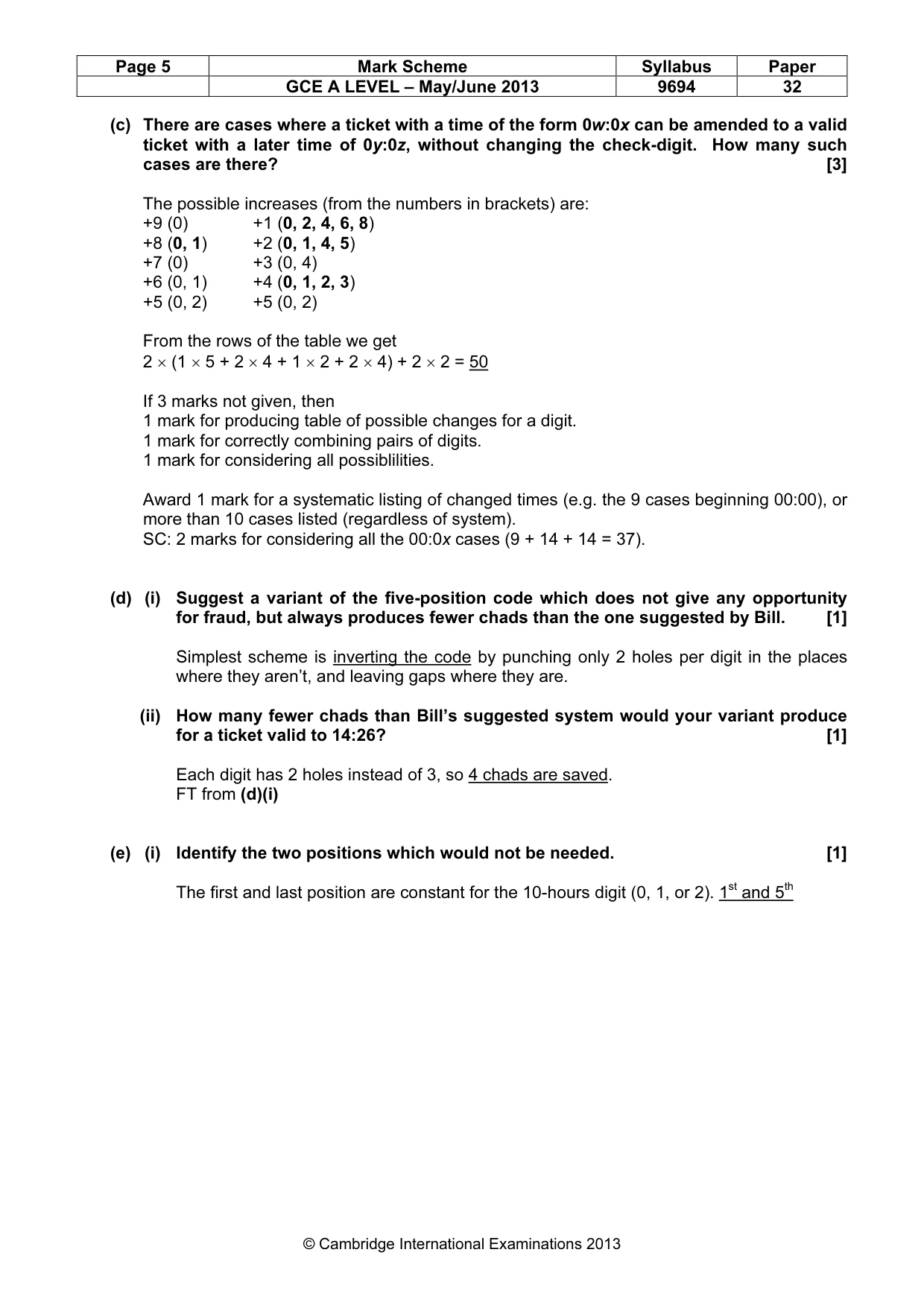
Page 5 Mark Scheme Syllabus Paper GCE A LEVEL – May/June 2013 9694 32 © Cambridge International Examinations 2013 (c) There are cases where a ticket with a time of the form 0w:0x can be amended to a valid ticket with a later time of 0y:0z, without changing the check-digit. How many such cases are there? [3] The possible increases (from the numbers in brackets) are: +9 (0) +1 (0, 2, 4, 6, 8) +8 (0, 1) +2 (0, 1, 4, 5) +7 (0) +3 (0, 4) +6 (0, 1) +4 (0, 1, 2, 3) +5 (0, 2) +5 (0, 2) From the rows of the table we get 2 × (1 × 5 + 2 × 4 + 1 × 2 + 2 × 4) + 2 × 2 = 50 If 3 marks not given, then 1 mark for producing table of possible changes for a digit. 1 mark for correctly combining pairs of digits. 1 mark for considering all possiblilities. Award 1 mark for a systematic listing of changed times (e.g. the 9 cases beginning 00:00), or more than 10 cases listed (regardless of system). SC: 2 marks for considering all the 00:0x cases (9 + 14 + 14 = 37). (d) (i) Suggest a variant of the five-position code which does not give any opportunity for fraud, but always produces fewer chads than the one suggested by Bill. [1] Simplest scheme is inverting the code by punching only 2 holes per digit in the places where they aren’t, and leaving gaps where they are. (ii) How many fewer chads than Bill’s suggested system would your variant produce for a ticket valid to 14:26? [1] Each digit has 2 holes instead of 3, so 4 chads are saved. FT from (d)(i) (e) (i) Identify the two positions which would not be needed. [1] The first and last position are constant for the 10-hours digit (0, 1, or 2). 1st and 5th
Mark scheme, page 6
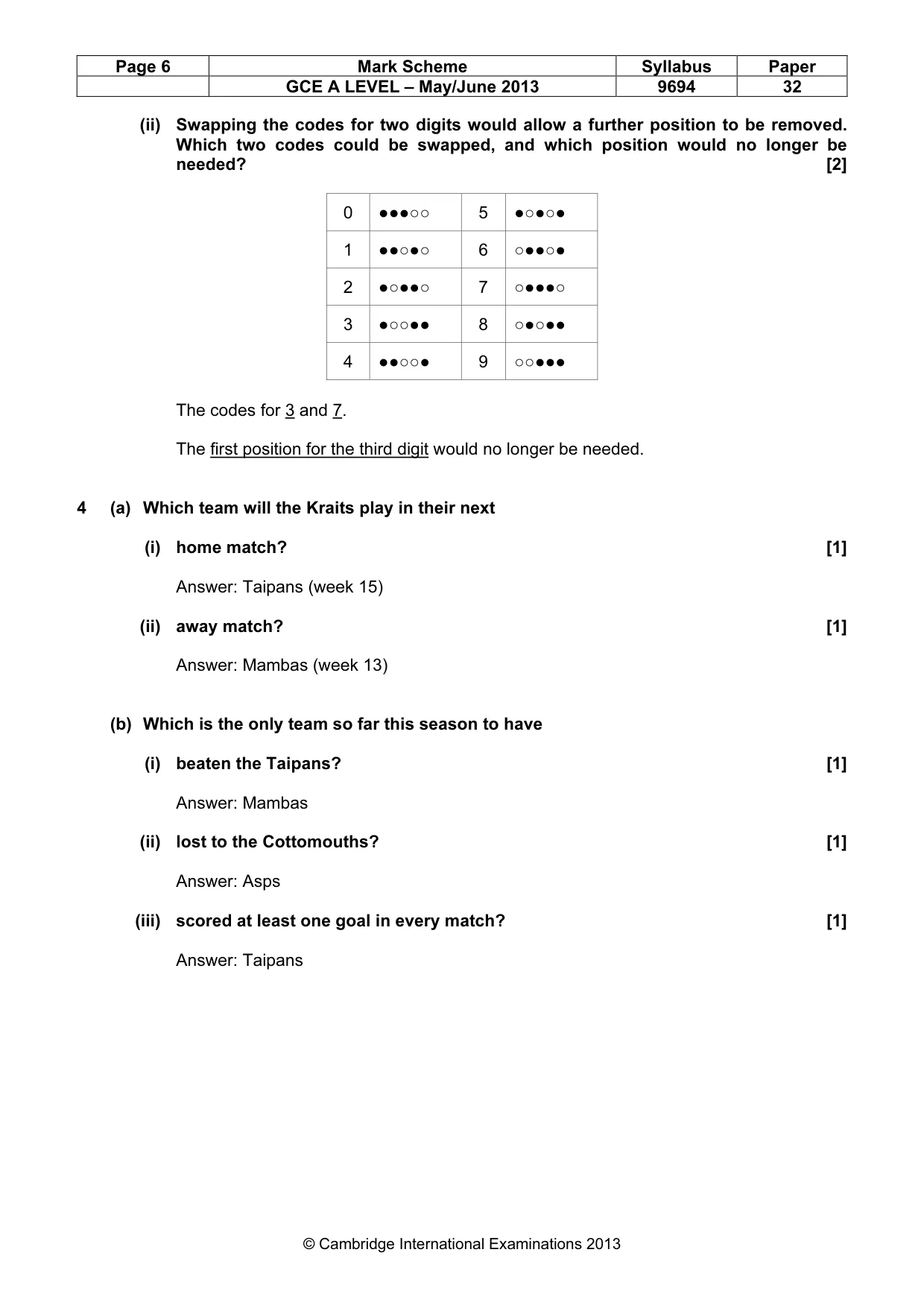
Page 6 Mark Scheme Syllabus Paper GCE A LEVEL – May/June 2013 9694 32 © Cambridge International Examinations 2013 (ii) Swapping the codes for two digits would allow a further position to be removed. Which two codes could be swapped, and which position would no longer be needed? [2] 0 ●●●○○ 5 ●○●○● 1 ●●○●○ 6 ○●●○● 2 ●○●●○ 7 ○●●●○ 3 ●○○●● 8 ○●○●● 4 ●●○○● 9 ○○●●● The codes for 3 and 7. The first position for the third digit would no longer be needed. 4 (a) Which team will the Kraits play in their next (i) home match? [1] Answer: Taipans (week 15) (ii) away match? [1] Answer: Mambas (week 13) (b) Which is the only team so far this season to have (i) beaten the Taipans? [1] Answer: Mambas (ii) lost to the Cottomouths? [1] Answer: Asps (iii) scored at least one goal in every match? [1] Answer: Taipans
Mark scheme, page 7
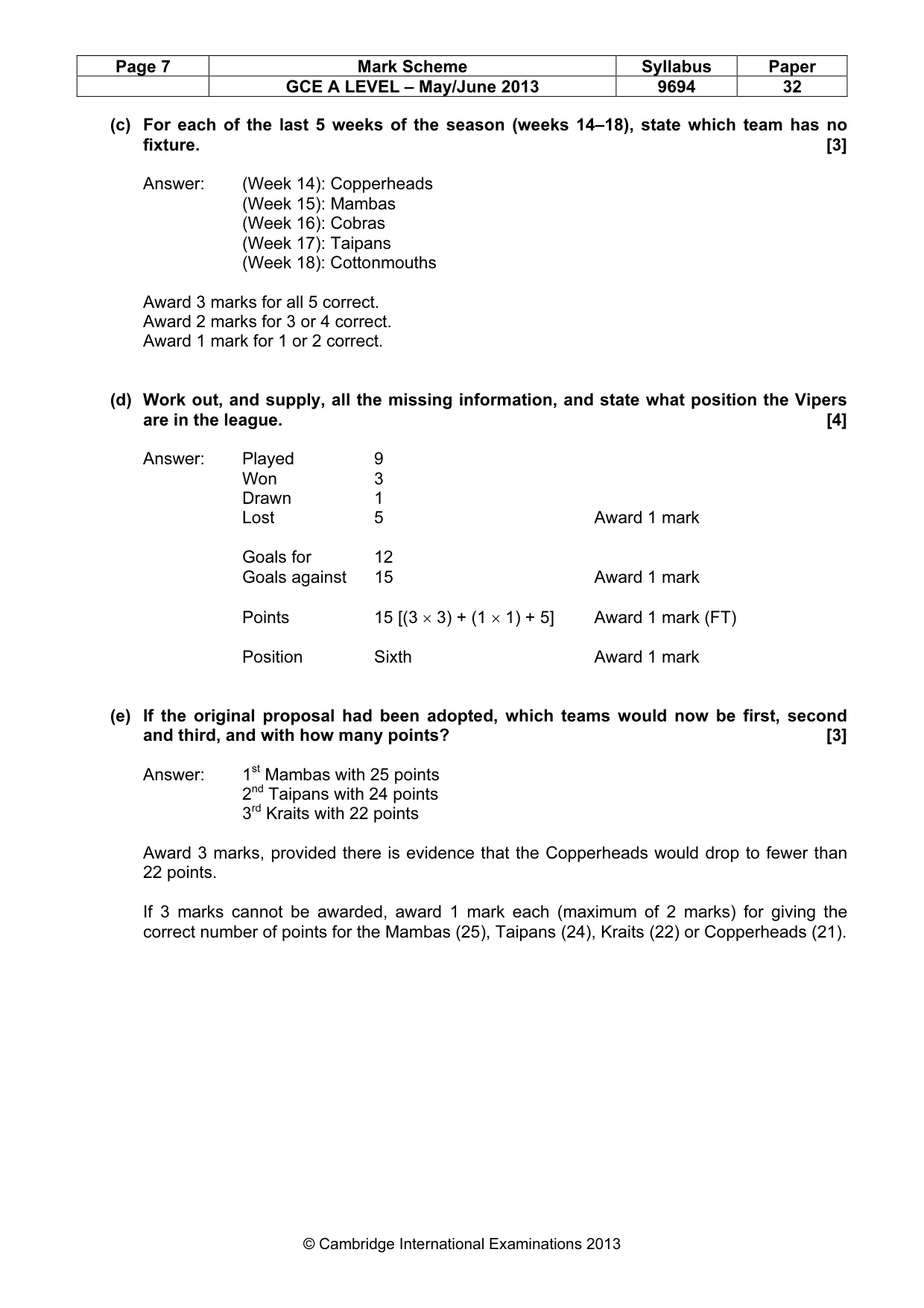
Page 7 Mark Scheme Syllabus Paper GCE A LEVEL – May/June 2013 9694 32 © Cambridge International Examinations 2013 (c) For each of the last 5 weeks of the season (weeks 14–18), state which team has no fixture. [3] Answer: (Week 14): Copperheads (Week 15): Mambas (Week 16): Cobras (Week 17): Taipans (Week 18): Cottonmouths Award 3 marks for all 5 correct. Award 2 marks for 3 or 4 correct. Award 1 mark for 1 or 2 correct. (d) Work out, and supply, all the missing information, and state what position the Vipers are in the league. [4] Answer: Played 9 Won 3 Drawn 1 Lost 5 Award 1 mark Goals for 12 Goals against 15 Award 1 mark Points 15 [(3 × 3) + (1 × 1) + 5] Award 1 mark (FT) Position Sixth Award 1 mark (e) If the original proposal had been adopted, which teams would now be first, second and third, and with how many points? [3] Answer: 1st Mambas with 25 points 2nd Taipans with 24 points 3rd Kraits with 22 points Award 3 marks, provided there is evidence that the Copperheads would drop to fewer than 22 points. If 3 marks cannot be awarded, award 1 mark each (maximum of 2 marks) for giving the correct number of points for the Mambas (25), Taipans (24), Kraits (22) or Copperheads (21).
What you needed in this session
Cambridge’s own grade thresholds for 2013 May/June, Paper 3 · Variant 2. A higher threshold means an easier paper — the bar moves with how the cohort did.