Cambridge A Level Thinking Skills 9694 — 2011 Oct/Nov Paper 2 · Variant 1
9694/21/O/N/11 · 45 marks · ≈51 min
The question paper and its mark scheme, free to read here and free to download. This is Cambridge’s own paper, exactly as it was sat.
Question paper8 pages

Mark scheme7 pages
Answers below. Sit the paper first if you are practising.
Paper as text
Question paper, page 1
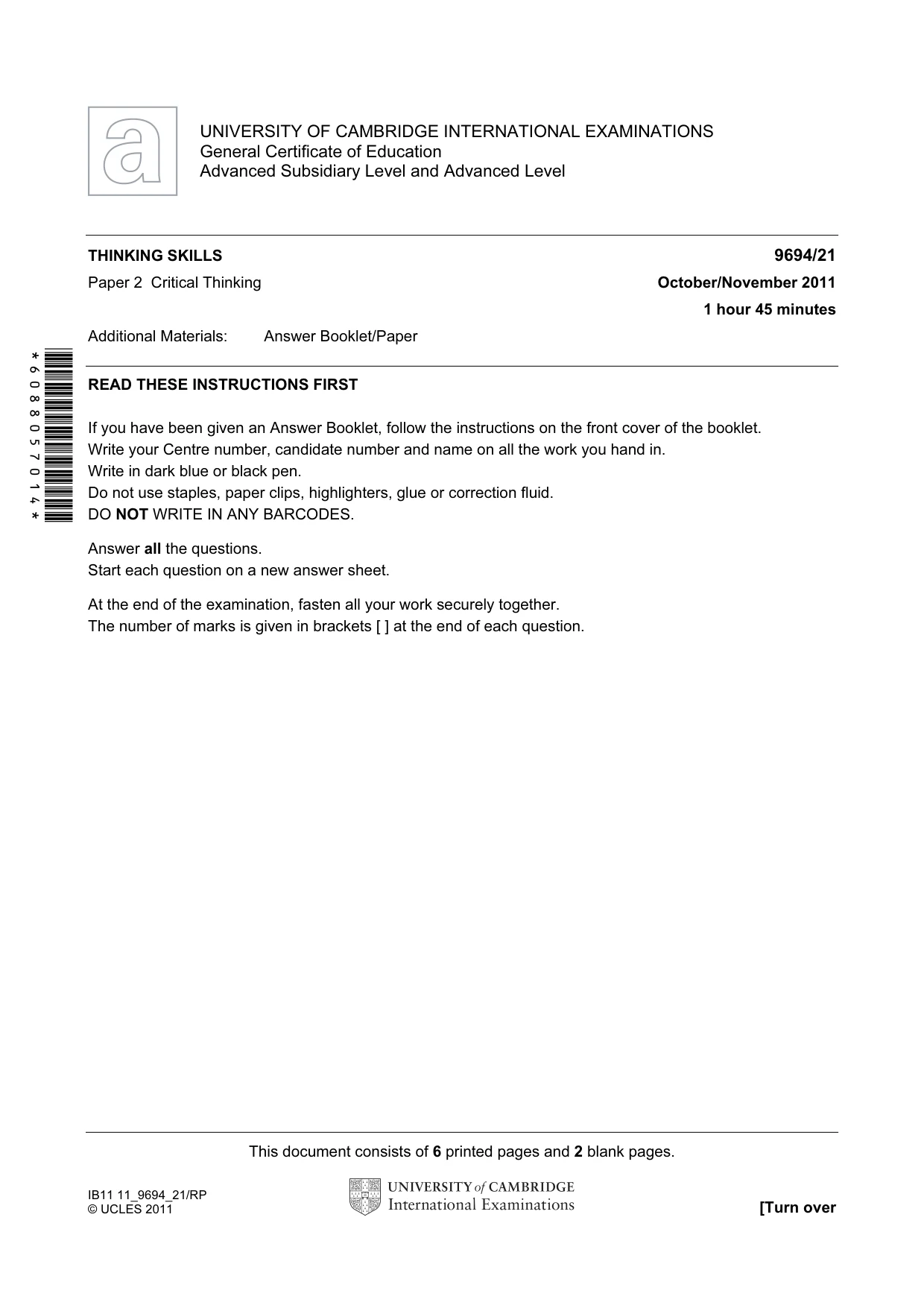
This document consists of 6 printed pages and 2 blank pages. IB11 11_9694_21/RP © UCLES 2011 [Turn over *6088057014* UNIVERSITY OF CAMBRIDGE INTERNATIONAL EXAMINATIONS General Certificate of Education Advanced Subsidiary Level and Advanced Level THINKING SKILLS 9694/21 Paper 2 Critical Thinking October/November 2011 1 hour 45 minutes Additional Materials: Answer Booklet/Paper READ THESE INSTRUCTIONS FIRST If you have been given an Answer Booklet, follow the instructions on the front cover of the booklet. Write your Centre number, candidate number and name on all the work you hand in. Write in dark blue or black pen. Do not use staples, paper clips, highlighters, glue or correction fluid. DO NOT WRITE IN ANY BARCODES. Answer all the questions. Start each question on a new answer sheet. At the end of the examination, fasten all your work securely together. The number of marks is given in brackets [ ] at the end of each question.
Question paper, page 2
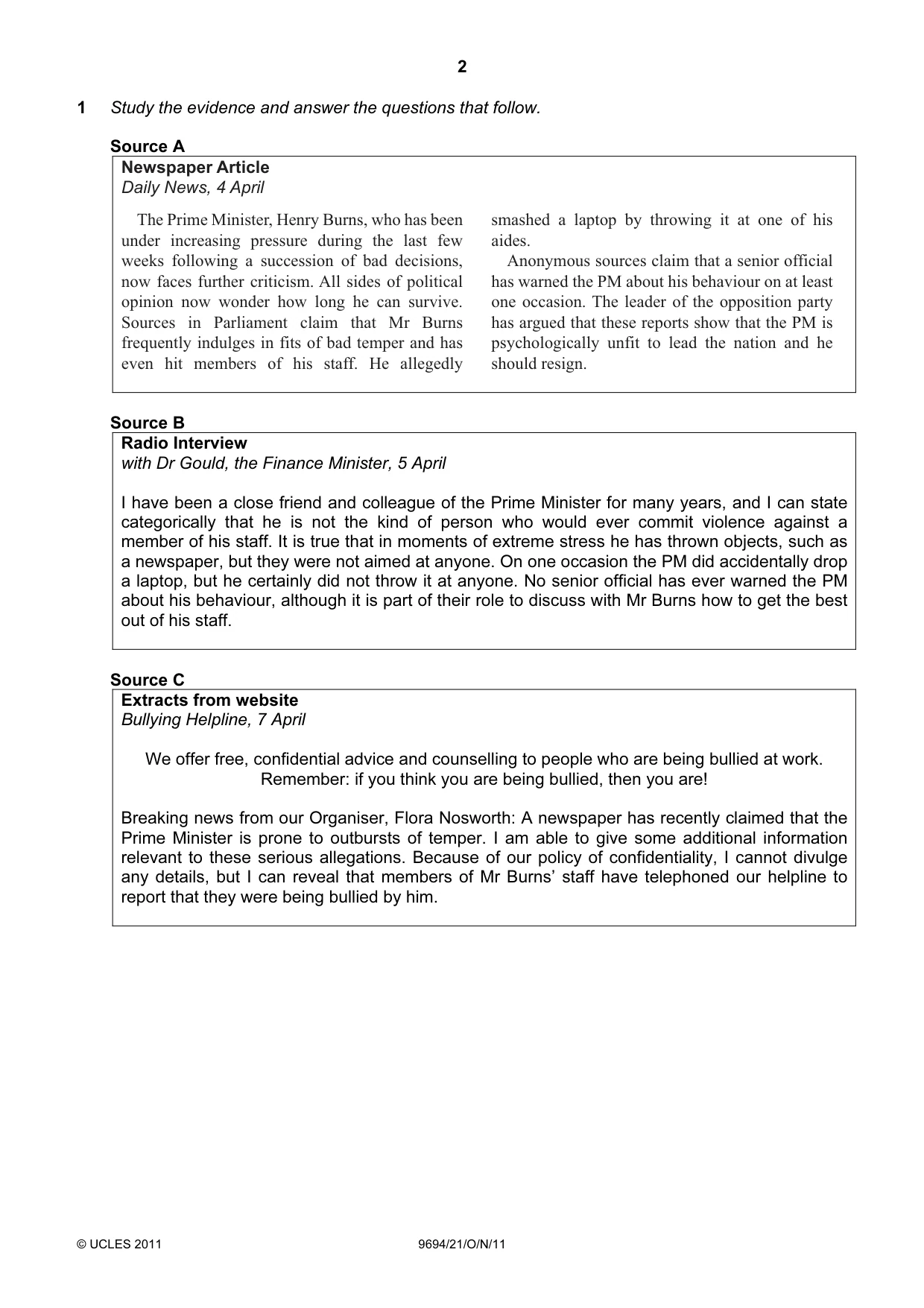
2 © UCLES 2011 9694/21/O/N/11 1 Study the evidence and answer the questions that follow. Source A The Prime Minister, Henry Burns, who has been under increasing pressure during the last few weeks following a succession of bad decisions, now faces further criticism. All sides of political opinion now wonder how long he can survive. Sources in Parliament claim that Mr Burns frequently indulges in fits of bad temper and has even hit members of his staff. He allegedly smashed a laptop by throwing it at one of his aides. Anonymous sources claim that a senior official has warned the PM about his behaviour on at least one occasion. The leader of the opposition party has argued that these reports show that the PM is psychologically unfit to lead the nation and he should resign. Newspaper Article Daily News, 4 April Source B Radio Interview with Dr Gould, the Finance Minister, 5 April I have been a close friend and colleague of the Prime Minister for many years, and I can state categorically that he is not the kind of person who would ever commit violence against a member of his staff. It is true that in moments of extreme stress he has thrown objects, such as a newspaper, but they were not aimed at anyone. On one occasion the PM did accidentally drop a laptop, but he certainly did not throw it at anyone. No senior official has ever warned the PM about his behaviour, although it is part of their role to discuss with Mr Burns how to get the best out of his staff. Source C Extracts from website Bullying Helpline, 7 April We offer free, confidential advice and counselling to people who are being bullied at work. Remember: if you think you are being bullied, then you are! Breaking news from our Organiser, Flora Nosworth: A newspaper has recently claimed that the Prime Minister is prone to outbursts of temper. I am able to give some additional information relevant to these serious allegations. Because of our policy of confidentiality, I cannot divulge any details, but I can reveal that members of Mr Burns’ staff have telephoned our helpline to report that they were being bullied by him.
Question paper, page 3
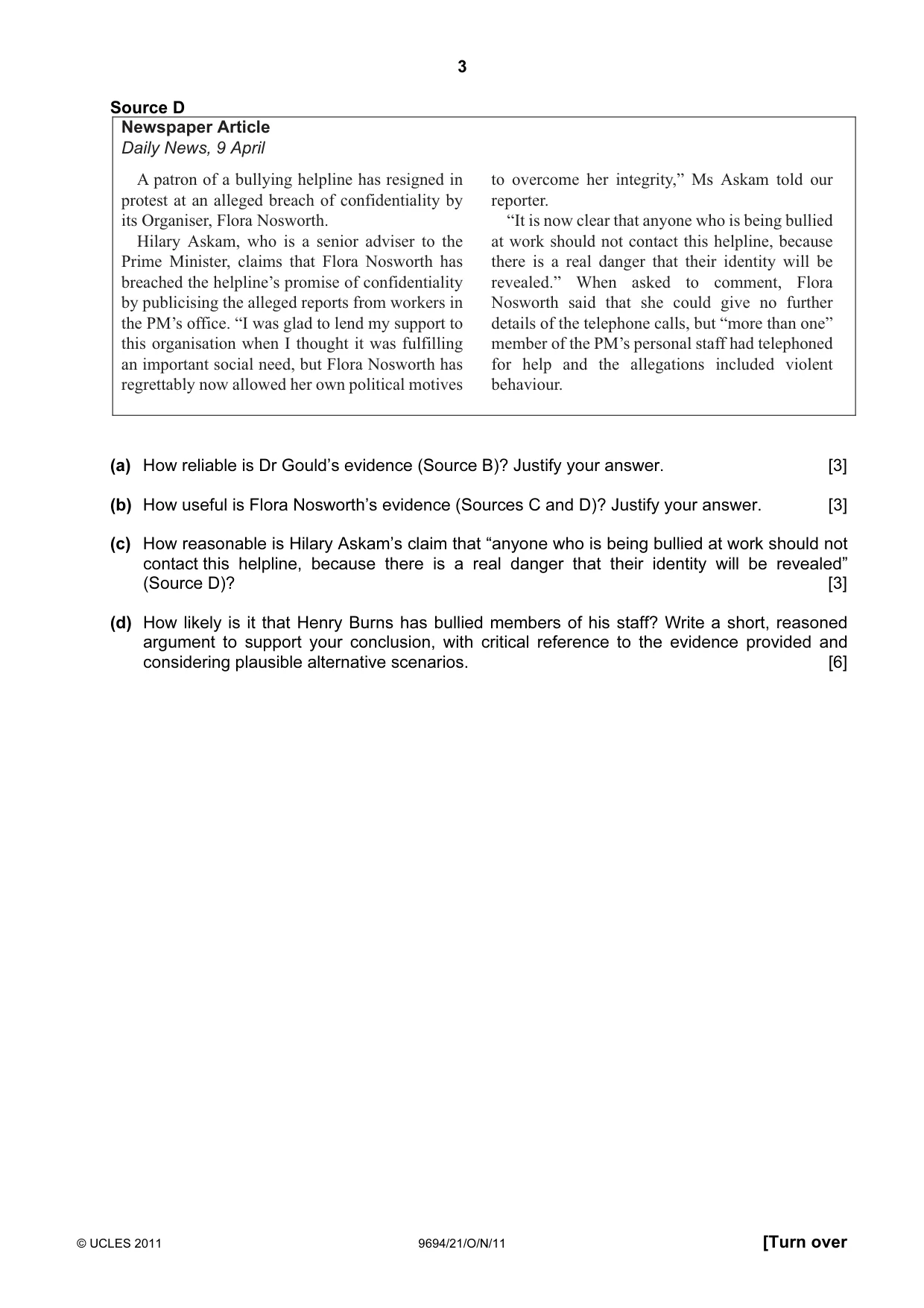
3 © UCLES 2011 9694/21/O/N/11 [Turn over Source D A patron of a bullying helpline has resigned in protest at an alleged breach of confidentiality by its Organiser, Flora Nosworth. Hilary Askam, who is a senior adviser to the Prime Minister, claims that Flora Nosworth has breached the helpline’s promise of confidentiality by publicising the alleged reports from workers in the PM’s office. “I was glad to lend my support to this organisation when I thought it was fulfilling an important social need, but Flora Nosworth has regrettably now allowed her own political motives to overcome her integrity,” Ms Askam told our reporter. “It is now clear that anyone who is being bullied at work should not contact this helpline, because there is a real danger that their identity will be revealed.” When asked to comment, Flora Nosworth said that she could give no further details of the telephone calls, but “more than one” member of the PM’s personal staff had telephoned for help and the allegations included violent behaviour. Newspaper Article Daily News, 9 April (a) How reliable is Dr Gould’s evidence (Source B)? Justify your answer. [3] (b) How useful is Flora Nosworth’s evidence (Sources C and D)? Justify your answer. [3] (c) How reasonable is Hilary Askam’s claim that “anyone who is being bullied at work should not contact this helpline, because there is a real danger that their identity will be revealed” (Source D)? [3] (d) How likely is it that Henry Burns has bullied members of his staff? Write a short, reasoned argument to support your conclusion, with critical reference to the evidence provided and considering plausible alternative scenarios. [6]
Question paper, page 4
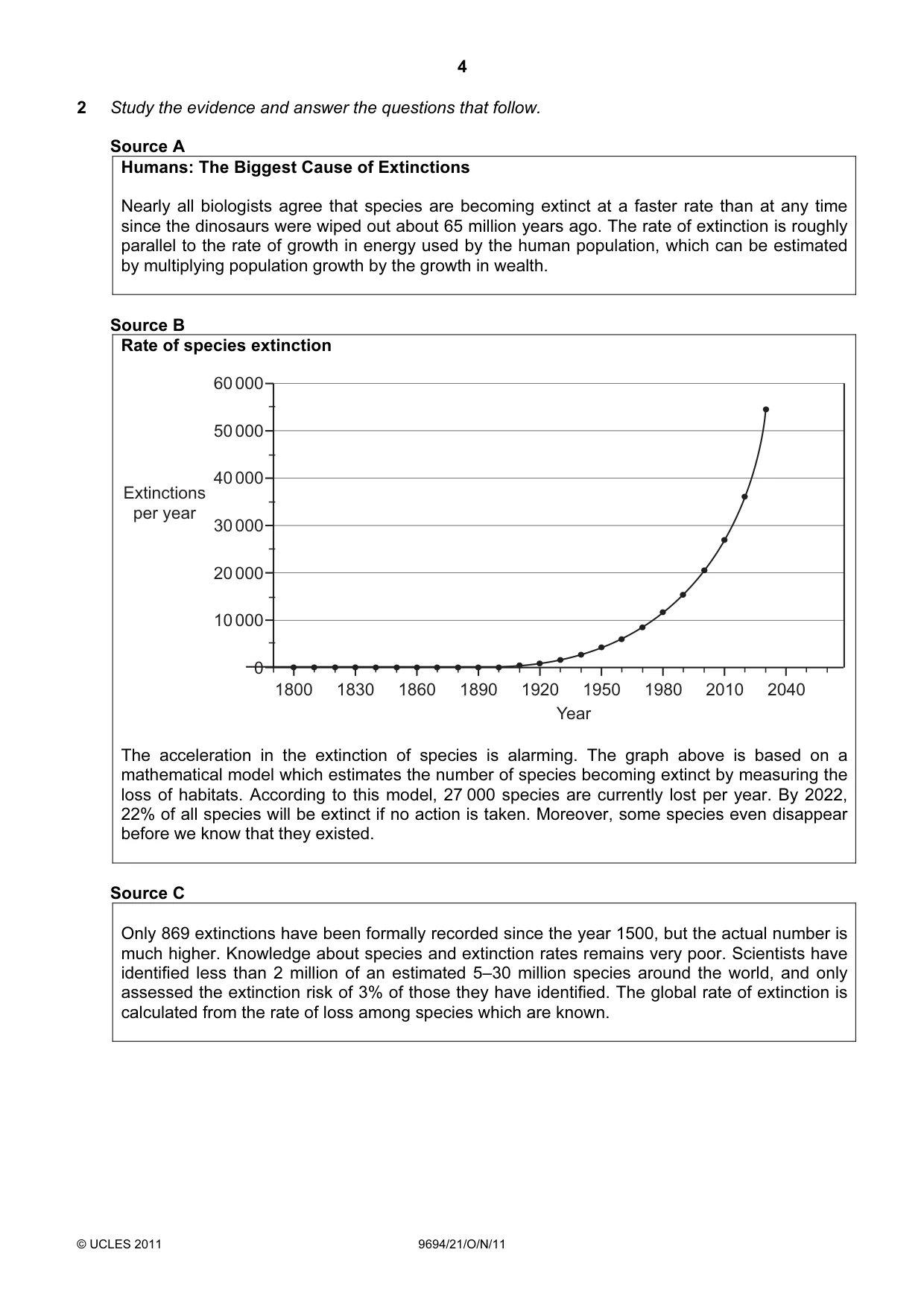
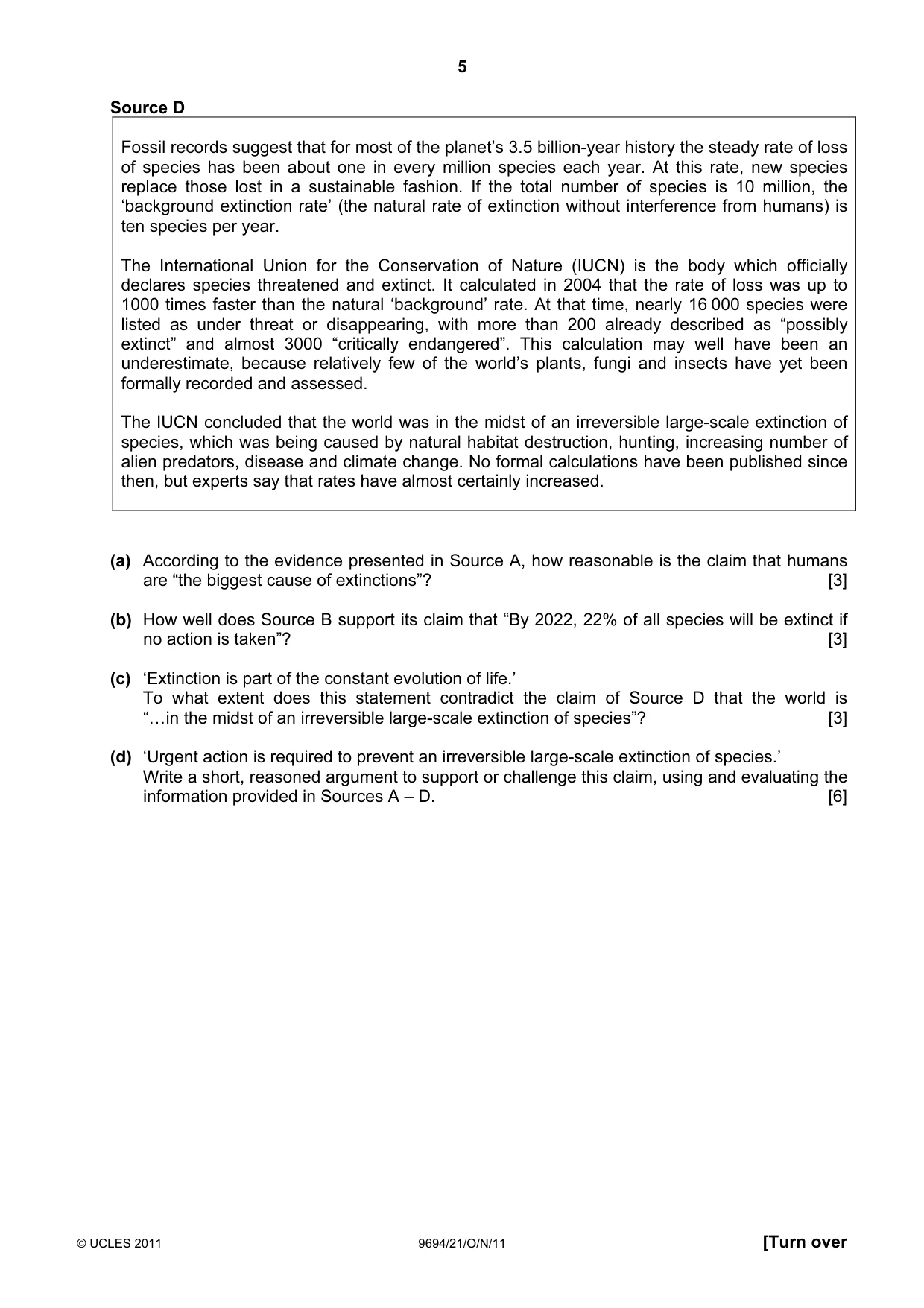
4 © UCLES 2011 9694/21/O/N/11 2 Study the evidence and answer the questions that follow. Source A Humans: The Biggest Cause of Extinctions Nearly all biologists agree that species are becoming extinct at a faster rate than at any time since the dinosaurs were wiped out about 65 million years ago. The rate of extinction is roughly parallel to the rate of growth in energy used by the human population, which can be estimated by multiplying population growth by the growth in wealth. Source B Rate of species extinction 60 000 50 000 40 000 30 000 20 000 10 000 0 1800 1830 1860 1890 1920 1950 1980 2010 2040 Year Extinctions per year The acceleration in the extinction of species is alarming. The graph above is based on a mathematical model which estimates the number of species becoming extinct by measuring the loss of habitats. According to this model, 27 000 species are currently lost per year. By 2022, 22% of all species will be extinct if no action is taken. Moreover, some species even disappear before we know that they existed. Source C Only 869 extinctions have been formally recorded since the year 1500, but the actual number is much higher. Knowledge about species and extinction rates remains very poor. Scientists have identified less than 2 million of an estimated 5–30 million species around the world, and only assessed the extinction risk of 3% of those they have identified. The global rate of extinction is calculated from the rate of loss among species which are known.
Question paper, page 5
5 © UCLES 2011 9694/21/O/N/11 [Turn over Source D Fossil records suggest that for most of the planet’s 3.5 billion-year history the steady rate of loss of species has been about one in every million species each year. At this rate, new species replace those lost in a sustainable fashion. If the total number of species is 10 million, the ‘background extinction rate’ (the natural rate of extinction without interference from humans) is ten species per year. The International Union for the Conservation of Nature (IUCN) is the body which officially declares species threatened and extinct. It calculated in 2004 that the rate of loss was up to 1000 times faster than the natural ‘background’ rate. At that time, nearly 16 000 species were listed as under threat or disappearing, with more than 200 already described as “possibly extinct” and almost 3000 “critically endangered”. This calculation may well have been an underestimate, because relatively few of the world’s plants, fungi and insects have yet been formally recorded and assessed. The IUCN concluded that the world was in the midst of an irreversible large-scale extinction of species, which was being caused by natural habitat destruction, hunting, increasing number of alien predators, disease and climate change. No formal calculations have been published since then, but experts say that rates have almost certainly increased. (a) According to the evidence presented in Source A, how reasonable is the claim that humans are “the biggest cause of extinctions”? [3] (b) How well does Source B support its claim that “By 2022, 22% of all species will be extinct if no action is taken”? [3] (c) ‘Extinction is part of the constant evolution of life.’ To what extent does this statement contradict the claim of Source D that the world is “…in the midst of an irreversible large-scale extinction of species”? [3] (d) ‘Urgent action is required to prevent an irreversible large-scale extinction of species.’ Write a short, reasoned argument to support or challenge this claim, using and evaluating the information provided in Sources A – D. [6]
Question paper, page 6
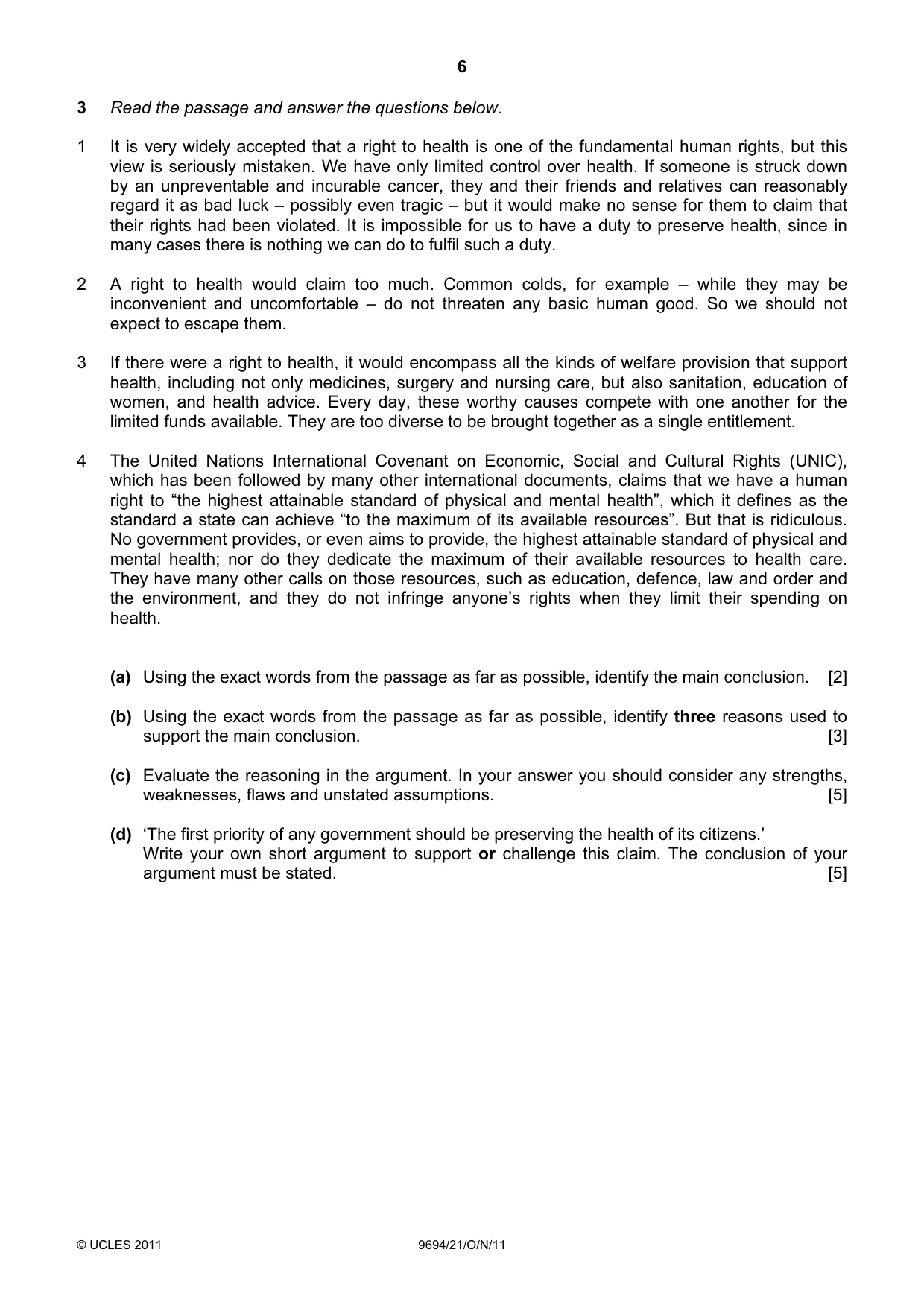
6 © UCLES 2011 9694/21/O/N/11 3 Read the passage and answer the questions below. 1 It is very widely accepted that a right to health is one of the fundamental human rights, but this view is seriously mistaken. We have only limited control over health. If someone is struck down by an unpreventable and incurable cancer, they and their friends and relatives can reasonably regard it as bad luck – possibly even tragic – but it would make no sense for them to claim that their rights had been violated. It is impossible for us to have a duty to preserve health, since in many cases there is nothing we can do to fulfil such a duty. 2 A right to health would claim too much. Common colds, for example – while they may be inconvenient and uncomfortable – do not threaten any basic human good. So we should not expect to escape them. 3 If there were a right to health, it would encompass all the kinds of welfare provision that support health, including not only medicines, surgery and nursing care, but also sanitation, education of women, and health advice. Every day, these worthy causes compete with one another for the limited funds available. They are too diverse to be brought together as a single entitlement. 4 The United Nations International Covenant on Economic, Social and Cultural Rights (UNIC), which has been followed by many other international documents, claims that we have a human right to “the highest attainable standard of physical and mental health”, which it defines as the standard a state can achieve “to the maximum of its available resources”. But that is ridiculous. No government provides, or even aims to provide, the highest attainable standard of physical and mental health; nor do they dedicate the maximum of their available resources to health care. They have many other calls on those resources, such as education, defence, law and order and the environment, and they do not infringe anyone’s rights when they limit their spending on health. (a) Using the exact words from the passage as far as possible, identify the main conclusion. [2] (b) Using the exact words from the passage as far as possible, identify three reasons used to support the main conclusion. [3] (c) Evaluate the reasoning in the argument. In your answer you should consider any strengths, weaknesses, flaws and unstated assumptions. [5] (d) ‘The first priority of any government should be preserving the health of its citizens.’ Write your own short argument to support or challenge this claim. The conclusion of your argument must be stated. [5]
Question paper, page 7
7 © UCLES 2011 9694/21/O/N/11 BLANK PAGE
Question paper, page 8
8 Copyright Acknowledgements: Question 2 Source B © http://www.whole-systems.org/extinctions.html Permission to reproduce items where third-party owned material protected by copyright is included has been sought and cleared where possible. Every reasonable effort has been made by the publisher (UCLES) to trace copyright holders, but if any items requiring clearance have unwittingly been included, the publisher will be pleased to make amends at the earliest possible opportunity. University of Cambridge International Examinations is part of the Cambridge Assessment Group. Cambridge Assessment is the brand name of University of Cambridge Local Examinations Syndicate (UCLES), which is itself a department of the University of Cambridge. © UCLES 2011 9694/21/O/N/11 BLANK PAGE
Mark scheme, page 1
UNIVERSITY OF CAMBRIDGE INTERNATIONAL EXAMINATIONS GCE Advanced Subsidiary Level and GCE Advanced Level MARK SCHEME for the October/November 2011 question paper for the guidance of teachers 9694 THINKING SKILLS 9694/21 Paper 2 (Critical Thinking), maximum raw mark 45 This mark scheme is published as an aid to teachers and candidates, to indicate the requirements of the examination. It shows the basis on which Examiners were instructed to award marks. It does not indicate the details of the discussions that took place at an Examiners’ meeting before marking began, which would have considered the acceptability of alternative answers. Mark schemes must be read in conjunction with the question papers and the report on the examination. • Cambridge will not enter into discussions or correspondence in connection with these mark schemes. Cambridge is publishing the mark schemes for the October/November 2011 question papers for most IGCSE, GCE Advanced Level and Advanced Subsidiary Level syllabuses and some Ordinary Level syllabuses.
Mark scheme, page 2
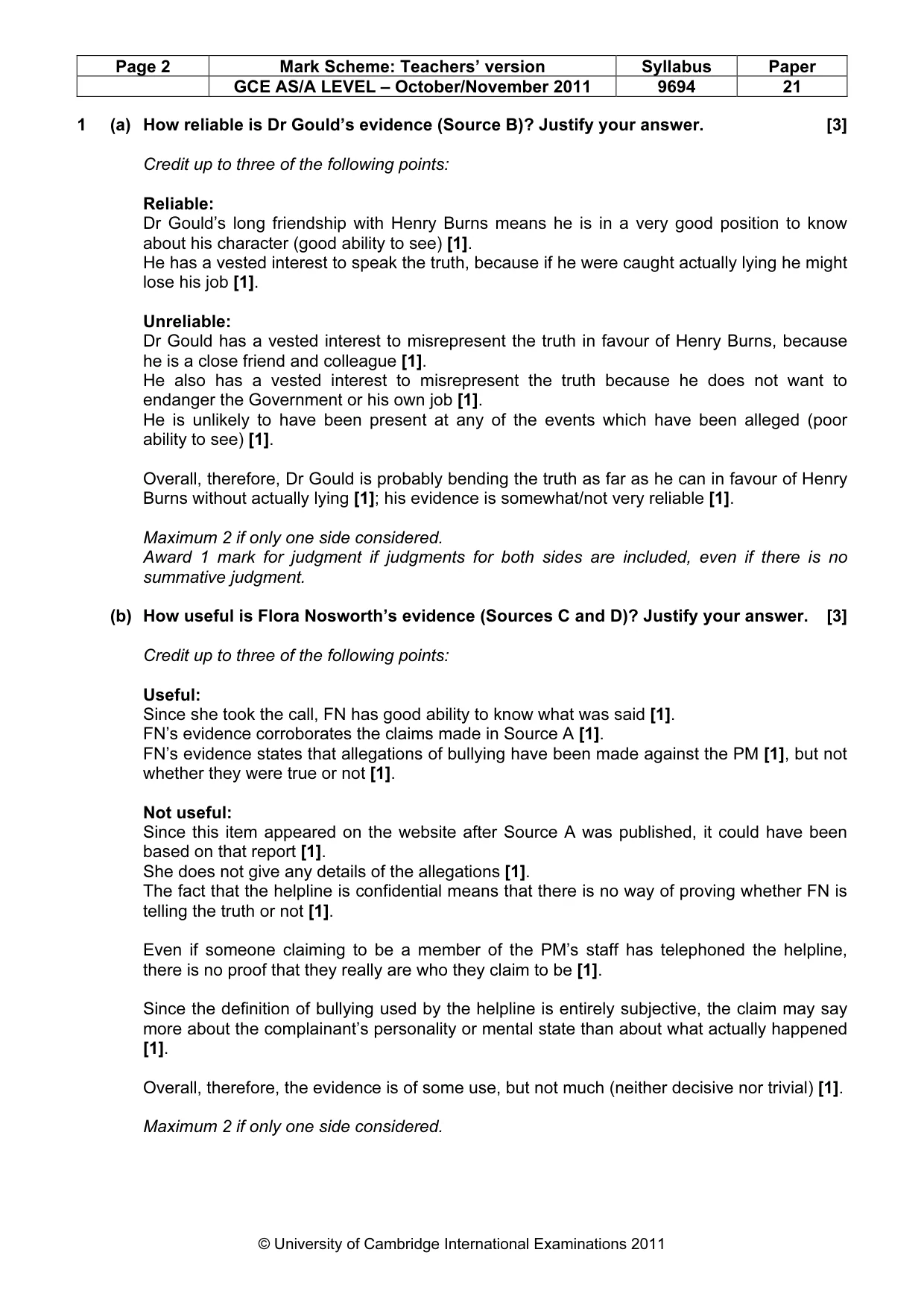
Page 2 Mark Scheme: Teachers’ version Syllabus Paper GCE AS/A LEVEL – October/November 2011 9694 21 © University of Cambridge International Examinations 2011 1 (a) How reliable is Dr Gould’s evidence (Source B)? Justify your answer. [3] Credit up to three of the following points: Reliable: Dr Gould’s long friendship with Henry Burns means he is in a very good position to know about his character (good ability to see) [1]. He has a vested interest to speak the truth, because if he were caught actually lying he might lose his job [1]. Unreliable: Dr Gould has a vested interest to misrepresent the truth in favour of Henry Burns, because he is a close friend and colleague [1]. He also has a vested interest to misrepresent the truth because he does not want to endanger the Government or his own job [1]. He is unlikely to have been present at any of the events which have been alleged (poor ability to see) [1]. Overall, therefore, Dr Gould is probably bending the truth as far as he can in favour of Henry Burns without actually lying [1]; his evidence is somewhat/not very reliable [1]. Maximum 2 if only one side considered. Award 1 mark for judgment if judgments for both sides are included, even if there is no summative judgment. (b) How useful is Flora Nosworth’s evidence (Sources C and D)? Justify your answer. [3] Credit up to three of the following points: Useful: Since she took the call, FN has good ability to know what was said [1]. FN’s evidence corroborates the claims made in Source A [1]. FN’s evidence states that allegations of bullying have been made against the PM [1], but not whether they were true or not [1]. Not useful: Since this item appeared on the website after Source A was published, it could have been based on that report [1]. She does not give any details of the allegations [1]. The fact that the helpline is confidential means that there is no way of proving whether FN is telling the truth or not [1]. Even if someone claiming to be a member of the PM’s staff has telephoned the helpline, there is no proof that they really are who they claim to be [1]. Since the definition of bullying used by the helpline is entirely subjective, the claim may say more about the complainant’s personality or mental state than about what actually happened [1]. Overall, therefore, the evidence is of some use, but not much (neither decisive nor trivial) [1]. Maximum 2 if only one side considered.
Mark scheme, page 3
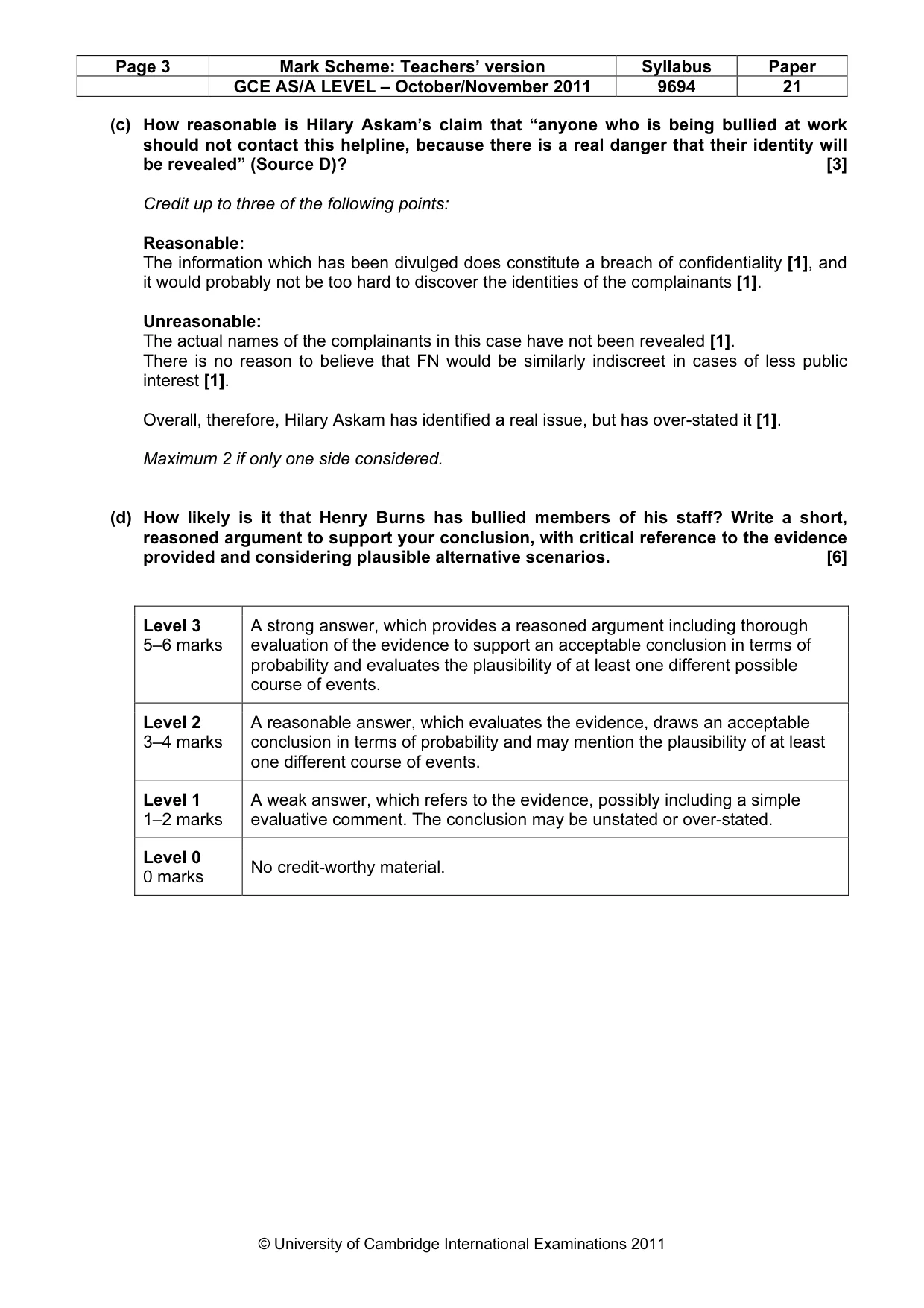
Page 3 Mark Scheme: Teachers’ version Syllabus Paper GCE AS/A LEVEL – October/November 2011 9694 21 © University of Cambridge International Examinations 2011 (c) How reasonable is Hilary Askam’s claim that “anyone who is being bullied at work should not contact this helpline, because there is a real danger that their identity will be revealed” (Source D)? [3] Credit up to three of the following points: Reasonable: The information which has been divulged does constitute a breach of confidentiality [1], and it would probably not be too hard to discover the identities of the complainants [1]. Unreasonable: The actual names of the complainants in this case have not been revealed [1]. There is no reason to believe that FN would be similarly indiscreet in cases of less public interest [1]. Overall, therefore, Hilary Askam has identified a real issue, but has over-stated it [1]. Maximum 2 if only one side considered. (d) How likely is it that Henry Burns has bullied members of his staff? Write a short, reasoned argument to support your conclusion, with critical reference to the evidence provided and considering plausible alternative scenarios. [6] Level 3 5–6 marks A strong answer, which provides a reasoned argument including thorough evaluation of the evidence to support an acceptable conclusion in terms of probability and evaluates the plausibility of at least one different possible course of events. Level 2 3–4 marks A reasonable answer, which evaluates the evidence, draws an acceptable conclusion in terms of probability and may mention the plausibility of at least one different course of events. Level 1 1–2 marks A weak answer, which refers to the evidence, possibly including a simple evaluative comment. The conclusion may be unstated or over-stated. Level 0 0 marks No credit-worthy material.
Mark scheme, page 4
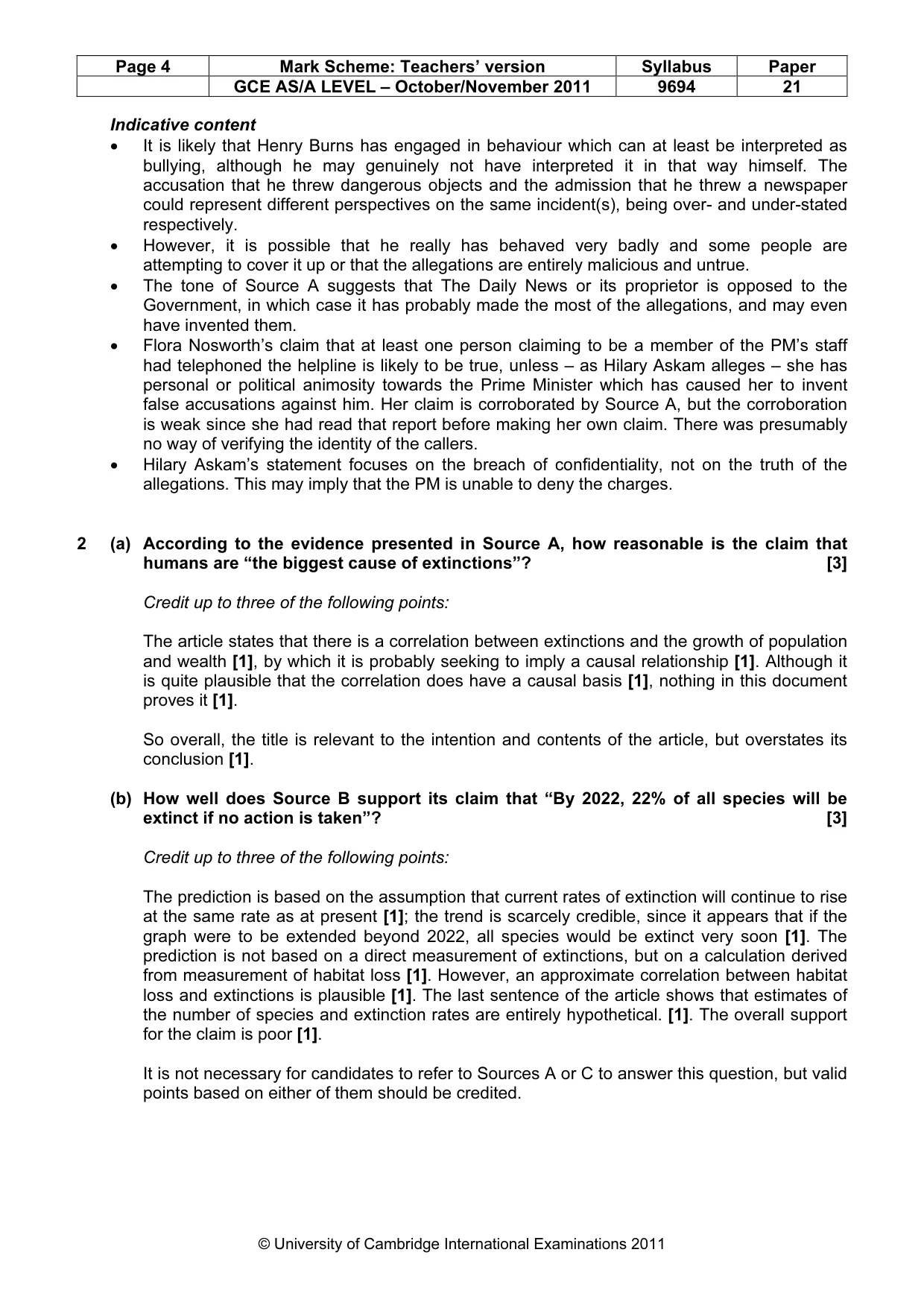
Page 4 Mark Scheme: Teachers’ version Syllabus Paper GCE AS/A LEVEL – October/November 2011 9694 21 © University of Cambridge International Examinations 2011 Indicative content • It is likely that Henry Burns has engaged in behaviour which can at least be interpreted as bullying, although he may genuinely not have interpreted it in that way himself. The accusation that he threw dangerous objects and the admission that he threw a newspaper could represent different perspectives on the same incident(s), being over- and under-stated respectively. • However, it is possible that he really has behaved very badly and some people are attempting to cover it up or that the allegations are entirely malicious and untrue. • The tone of Source A suggests that The Daily News or its proprietor is opposed to the Government, in which case it has probably made the most of the allegations, and may even have invented them. • Flora Nosworth’s claim that at least one person claiming to be a member of the PM’s staff had telephoned the helpline is likely to be true, unless – as Hilary Askam alleges – she has personal or political animosity towards the Prime Minister which has caused her to invent false accusations against him. Her claim is corroborated by Source A, but the corroboration is weak since she had read that report before making her own claim. There was presumably no way of verifying the identity of the callers. • Hilary Askam’s statement focuses on the breach of confidentiality, not on the truth of the allegations. This may imply that the PM is unable to deny the charges. 2 (a) According to the evidence presented in Source A, how reasonable is the claim that humans are “the biggest cause of extinctions”? [3] Credit up to three of the following points: The article states that there is a correlation between extinctions and the growth of population and wealth [1], by which it is probably seeking to imply a causal relationship [1]. Although it is quite plausible that the correlation does have a causal basis [1], nothing in this document proves it [1]. So overall, the title is relevant to the intention and contents of the article, but overstates its conclusion [1]. (b) How well does Source B support its claim that “By 2022, 22% of all species will be extinct if no action is taken”? [3] Credit up to three of the following points: The prediction is based on the assumption that current rates of extinction will continue to rise at the same rate as at present [1]; the trend is scarcely credible, since it appears that if the graph were to be extended beyond 2022, all species would be extinct very soon [1]. The prediction is not based on a direct measurement of extinctions, but on a calculation derived from measurement of habitat loss [1]. However, an approximate correlation between habitat loss and extinctions is plausible [1]. The last sentence of the article shows that estimates of the number of species and extinction rates are entirely hypothetical. [1]. The overall support for the claim is poor [1]. It is not necessary for candidates to refer to Sources A or C to answer this question, but valid points based on either of them should be credited.
Mark scheme, page 5
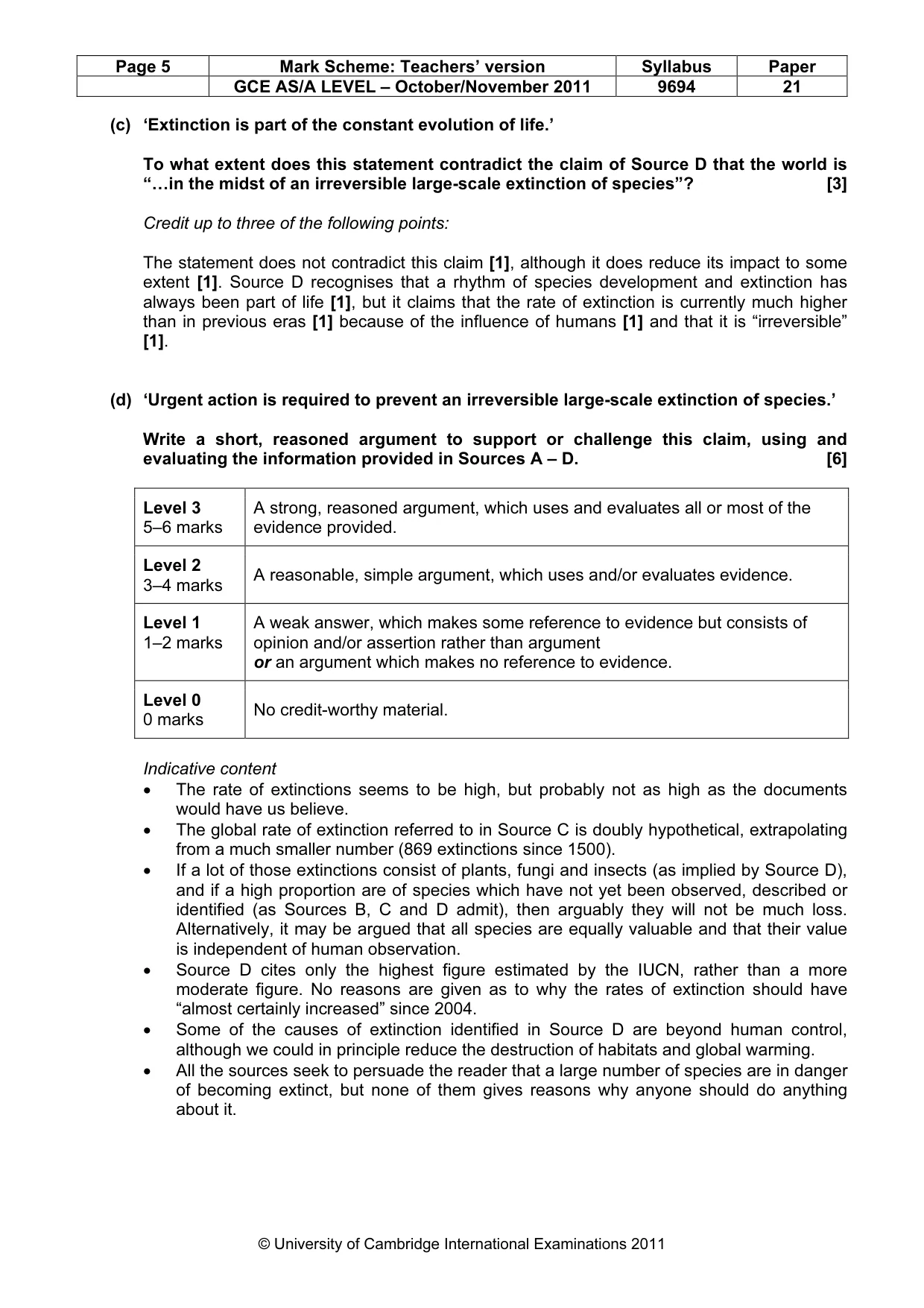
Page 5 Mark Scheme: Teachers’ version Syllabus Paper GCE AS/A LEVEL – October/November 2011 9694 21 © University of Cambridge International Examinations 2011 (c) ‘Extinction is part of the constant evolution of life.’ To what extent does this statement contradict the claim of Source D that the world is “…in the midst of an irreversible large-scale extinction of species”? [3] Credit up to three of the following points: The statement does not contradict this claim [1], although it does reduce its impact to some extent [1]. Source D recognises that a rhythm of species development and extinction has always been part of life [1], but it claims that the rate of extinction is currently much higher than in previous eras [1] because of the influence of humans [1] and that it is “irreversible” [1]. (d) ‘Urgent action is required to prevent an irreversible large-scale extinction of species.’ Write a short, reasoned argument to support or challenge this claim, using and evaluating the information provided in Sources A – D. [6] Level 3 5–6 marks A strong, reasoned argument, which uses and evaluates all or most of the evidence provided. Level 2 3–4 marks A reasonable, simple argument, which uses and/or evaluates evidence. Level 1 1–2 marks A weak answer, which makes some reference to evidence but consists of opinion and/or assertion rather than argument or an argument which makes no reference to evidence. Level 0 0 marks No credit-worthy material. Indicative content • The rate of extinctions seems to be high, but probably not as high as the documents would have us believe. • The global rate of extinction referred to in Source C is doubly hypothetical, extrapolating from a much smaller number (869 extinctions since 1500). • If a lot of those extinctions consist of plants, fungi and insects (as implied by Source D), and if a high proportion are of species which have not yet been observed, described or identified (as Sources B, C and D admit), then arguably they will not be much loss. Alternatively, it may be argued that all species are equally valuable and that their value is independent of human observation. • Source D cites only the highest figure estimated by the IUCN, rather than a more moderate figure. No reasons are given as to why the rates of extinction should have “almost certainly increased” since 2004. • Some of the causes of extinction identified in Source D are beyond human control, although we could in principle reduce the destruction of habitats and global warming. • All the sources seek to persuade the reader that a large number of species are in danger of becoming extinct, but none of them gives reasons why anyone should do anything about it.
Mark scheme, page 6
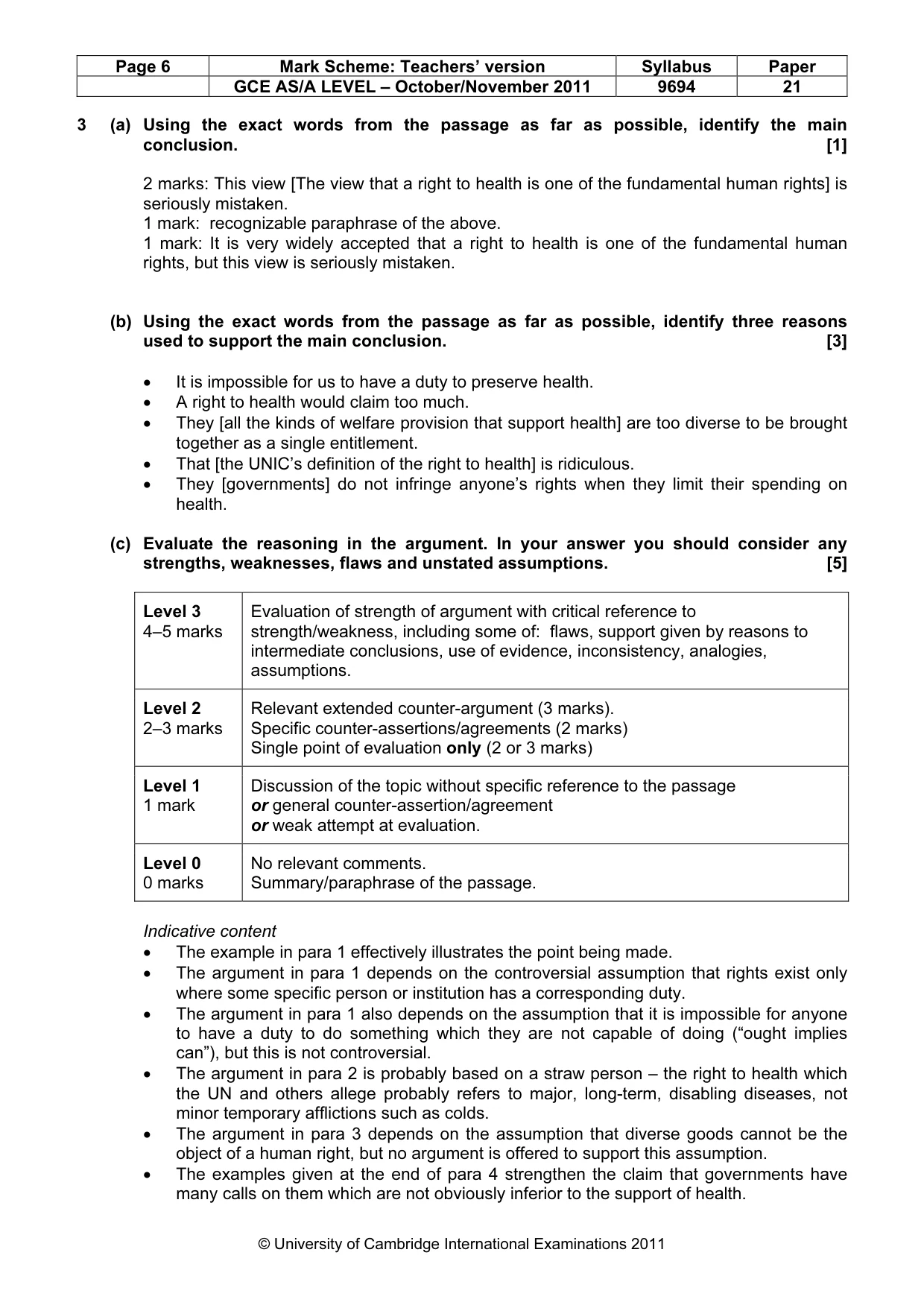
Page 6 Mark Scheme: Teachers’ version Syllabus Paper GCE AS/A LEVEL – October/November 2011 9694 21 © University of Cambridge International Examinations 2011 3 (a) Using the exact words from the passage as far as possible, identify the main conclusion. [1] 2 marks: This view [The view that a right to health is one of the fundamental human rights] is seriously mistaken. 1 mark: recognizable paraphrase of the above. 1 mark: It is very widely accepted that a right to health is one of the fundamental human rights, but this view is seriously mistaken. (b) Using the exact words from the passage as far as possible, identify three reasons used to support the main conclusion. [3] • It is impossible for us to have a duty to preserve health. • A right to health would claim too much. • They [all the kinds of welfare provision that support health] are too diverse to be brought together as a single entitlement. • That [the UNIC’s definition of the right to health] is ridiculous. • They [governments] do not infringe anyone’s rights when they limit their spending on health. (c) Evaluate the reasoning in the argument. In your answer you should consider any strengths, weaknesses, flaws and unstated assumptions. [5] Level 3 4–5 marks Evaluation of strength of argument with critical reference to strength/weakness, including some of: flaws, support given by reasons to intermediate conclusions, use of evidence, inconsistency, analogies, assumptions. Level 2 2–3 marks Relevant extended counter-argument (3 marks). Specific counter-assertions/agreements (2 marks) Single point of evaluation only (2 or 3 marks) Level 1 1 mark Discussion of the topic without specific reference to the passage or general counter-assertion/agreement or weak attempt at evaluation. Level 0 0 marks No relevant comments. Summary/paraphrase of the passage. Indicative content • The example in para 1 effectively illustrates the point being made. • The argument in para 1 depends on the controversial assumption that rights exist only where some specific person or institution has a corresponding duty. • The argument in para 1 also depends on the assumption that it is impossible for anyone to have a duty to do something which they are not capable of doing (“ought implies can”), but this is not controversial. • The argument in para 2 is probably based on a straw person – the right to health which the UN and others allege probably refers to major, long-term, disabling diseases, not minor temporary afflictions such as colds. • The argument in para 3 depends on the assumption that diverse goods cannot be the object of a human right, but no argument is offered to support this assumption. • The examples given at the end of para 4 strengthen the claim that governments have many calls on them which are not obviously inferior to the support of health.
Mark scheme, page 7
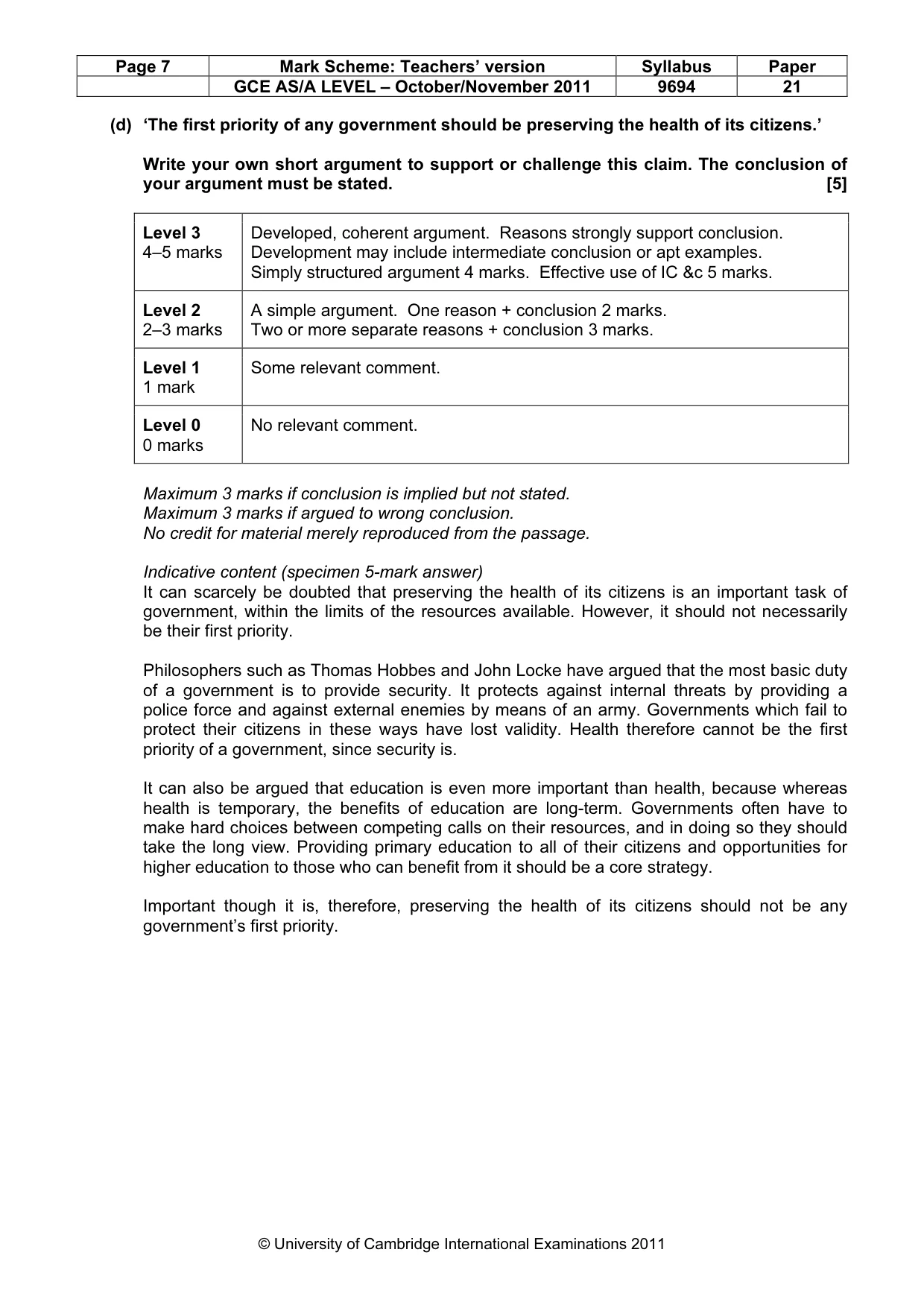
Page 7 Mark Scheme: Teachers’ version Syllabus Paper GCE AS/A LEVEL – October/November 2011 9694 21 © University of Cambridge International Examinations 2011 (d) ‘The first priority of any government should be preserving the health of its citizens.’ Write your own short argument to support or challenge this claim. The conclusion of your argument must be stated. [5] Level 3 4–5 marks Developed, coherent argument. Reasons strongly support conclusion. Development may include intermediate conclusion or apt examples. Simply structured argument 4 marks. Effective use of IC &c 5 marks. Level 2 2–3 marks A simple argument. One reason + conclusion 2 marks. Two or more separate reasons + conclusion 3 marks. Level 1 1 mark Some relevant comment. Level 0 0 marks No relevant comment. Maximum 3 marks if conclusion is implied but not stated. Maximum 3 marks if argued to wrong conclusion. No credit for material merely reproduced from the passage. Indicative content (specimen 5-mark answer) It can scarcely be doubted that preserving the health of its citizens is an important task of government, within the limits of the resources available. However, it should not necessarily be their first priority. Philosophers such as Thomas Hobbes and John Locke have argued that the most basic duty of a government is to provide security. It protects against internal threats by providing a police force and against external enemies by means of an army. Governments which fail to protect their citizens in these ways have lost validity. Health therefore cannot be the first priority of a government, since security is. It can also be argued that education is even more important than health, because whereas health is temporary, the benefits of education are long-term. Governments often have to make hard choices between competing calls on their resources, and in doing so they should take the long view. Providing primary education to all of their citizens and opportunities for higher education to those who can benefit from it should be a core strategy. Important though it is, therefore, preserving the health of its citizens should not be any government’s first priority.
What you needed in this session
Cambridge’s own grade thresholds for 2011 Oct/Nov, Paper 2 · Variant 1. A higher threshold means an easier paper — the bar moves with how the cohort did.