Cambridge A Level Thinking Skills 9694 — 2011 May/June Paper 3 · Variant 1
9694/31/M/J/11 · 50 marks · ≈56 min
The question paper and its mark scheme, free to read here and free to download. This is Cambridge’s own paper, exactly as it was sat.
Question paper12 pages




Mark scheme10 pages
Answers below. Sit the paper first if you are practising.
Paper as text
Question paper, page 1
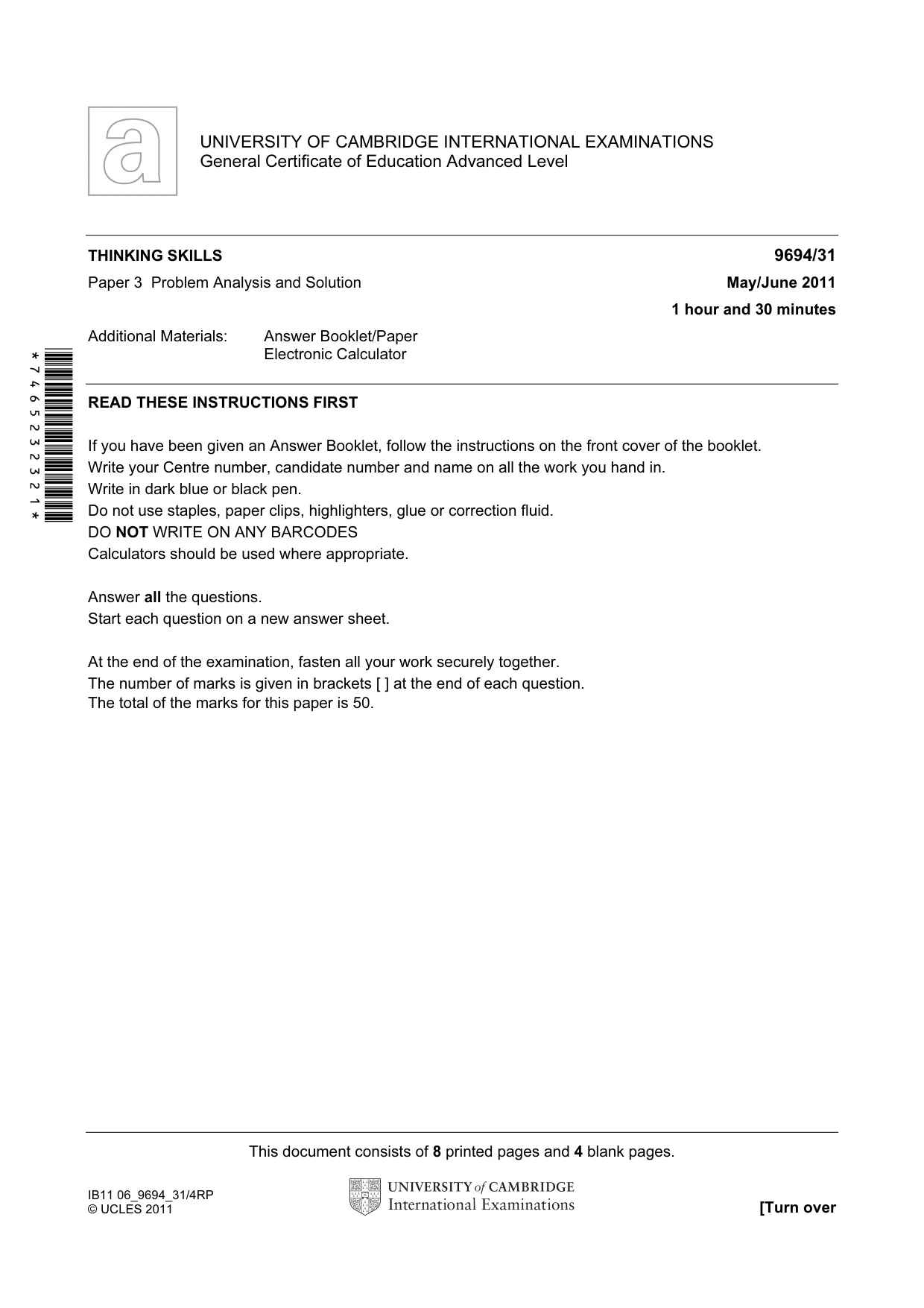
This document consists of 8 printed pages and 4 blank pages. IB11 06_9694_31/4RP © UCLES 2011 [Turn over *7465232321* UNIVERSITY OF CAMBRIDGE INTERNATIONAL EXAMINATIONS General Certificate of Education Advanced Level THINKING SKILLS 9694/31 Paper 3 Problem Analysis and Solution May/June 2011 1 hour and 30 minutes Additional Materials: Answer Booklet/Paper Electronic Calculator READ THESE INSTRUCTIONS FIRST If you have been given an Answer Booklet, follow the instructions on the front cover of the booklet. Write your Centre number, candidate number and name on all the work you hand in. Write in dark blue or black pen. Do not use staples, paper clips, highlighters, glue or correction fluid. DO NOT WRITE ON ANY BARCODES Calculators should be used where appropriate. Answer all the questions. Start each question on a new answer sheet. At the end of the examination, fasten all your work securely together. The number of marks is given in brackets [ ] at the end of each question. The total of the marks for this paper is 50.
Question paper, page 2
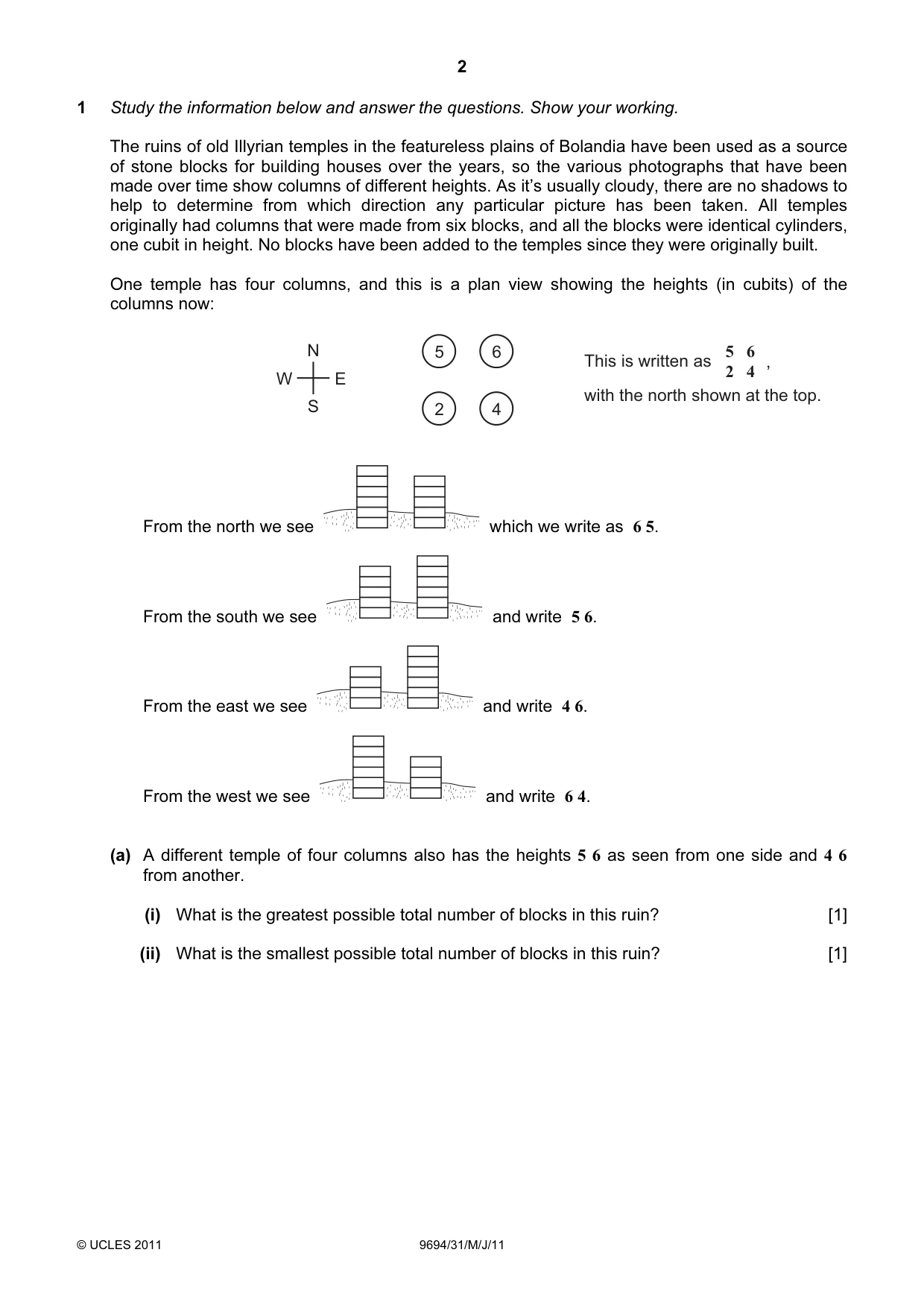
2 © UCLES 2011 9694/31/M/J/11 1 Study the information below and answer the questions. Show your working. The ruins of old Illyrian temples in the featureless plains of Bolandia have been used as a source of stone blocks for building houses over the years, so the various photographs that have been made over time show columns of different heights. As it’s usually cloudy, there are no shadows to help to determine from which direction any particular picture has been taken. All temples originally had columns that were made from six blocks, and all the blocks were identical cylinders, one cubit in height. No blocks have been added to the temples since they were originally built. One temple has four columns, and this is a plan view showing the heights (in cubits) of the columns now: 5 6 2 4 N S W E This is written as with the north shown at the top. 5 2 6 4 , From the north we see which we write as 6 5. From the south we see and write 5 6. From the east we see and write 4 6. From the west we see and write 6 4. (a) A different temple of four columns also has the heights 5 6 as seen from one side and 4 6 from another. (i) What is the greatest possible total number of blocks in this ruin? [1] (ii) What is the smallest possible total number of blocks in this ruin? [1]
Question paper, page 3
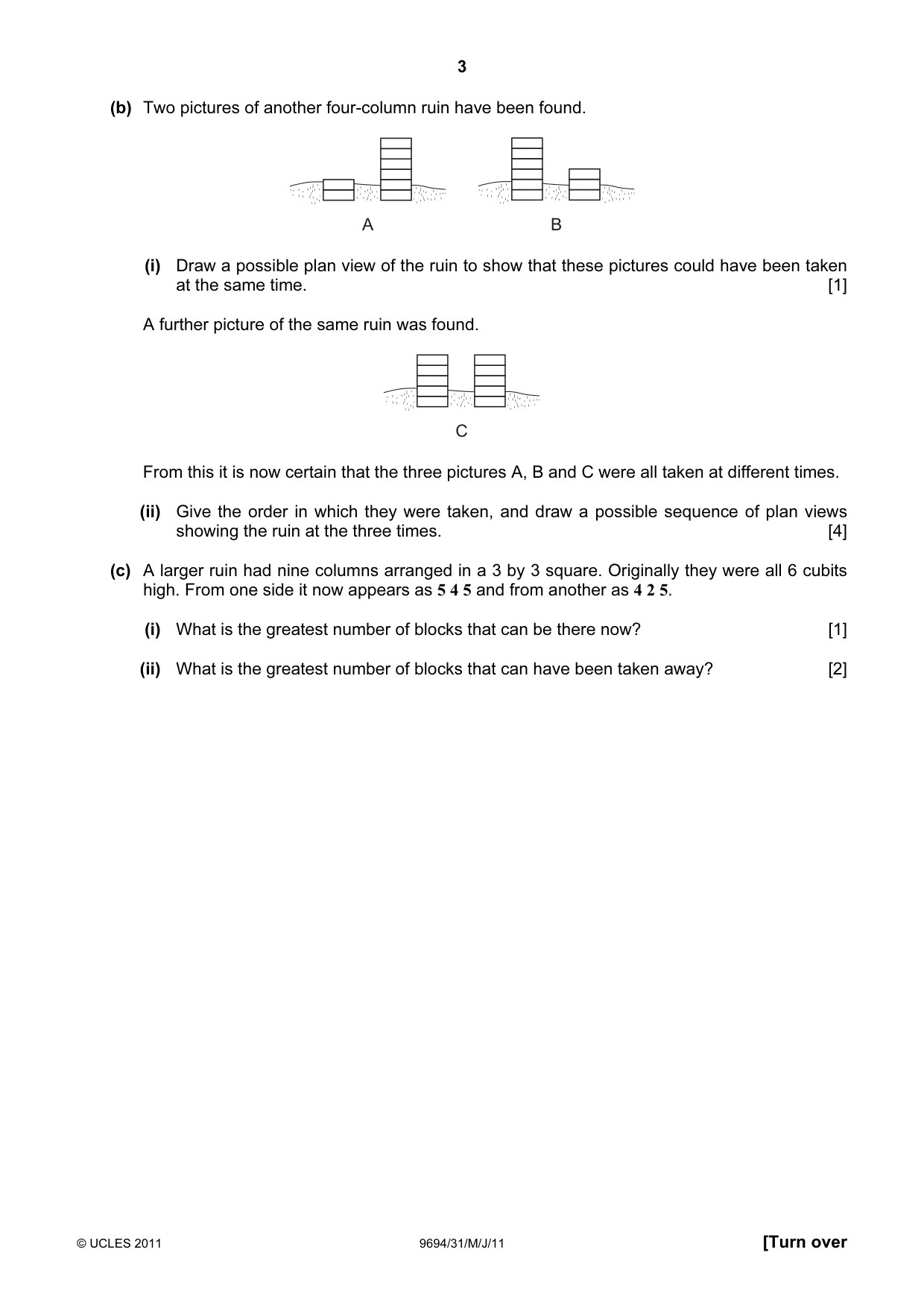
3 © UCLES 2011 9694/31/M/J/11 [Turn over (b) Two pictures of another four-column ruin have been found. A B (i) Draw a possible plan view of the ruin to show that these pictures could have been taken at the same time. [1] A further picture of the same ruin was found. C From this it is now certain that the three pictures A, B and C were all taken at different times. (ii) Give the order in which they were taken, and draw a possible sequence of plan views showing the ruin at the three times. [4] (c) A larger ruin had nine columns arranged in a 3 by 3 square. Originally they were all 6 cubits high. From one side it now appears as 5 4 5 and from another as 4 2 5. (i) What is the greatest number of blocks that can be there now? [1] (ii) What is the greatest number of blocks that can have been taken away? [2]
Question paper, page 4
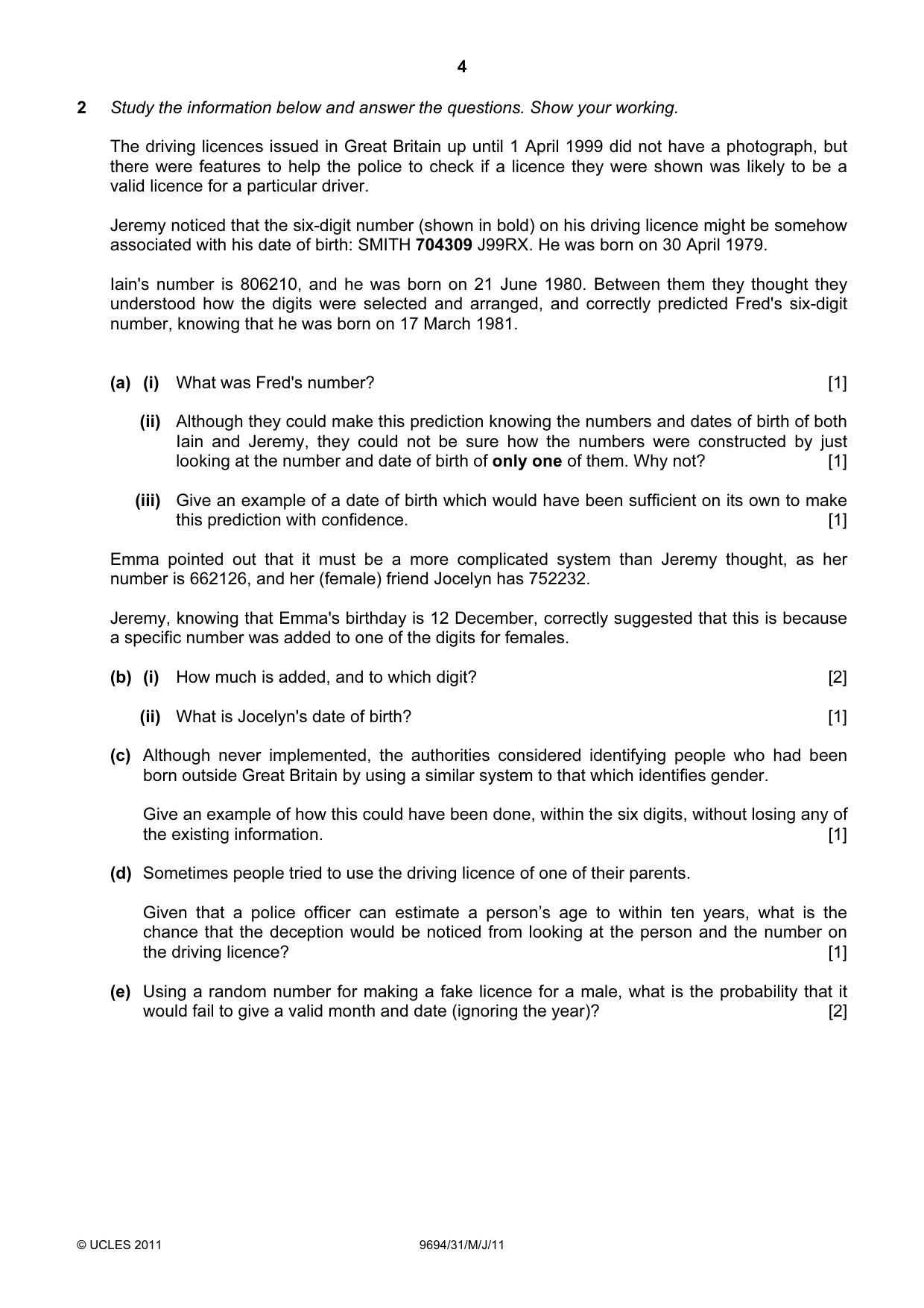
4 © UCLES 2011 9694/31/M/J/11 2 Study the information below and answer the questions. Show your working. The driving licences issued in Great Britain up until 1 April 1999 did not have a photograph, but there were features to help the police to check if a licence they were shown was likely to be a valid licence for a particular driver. Jeremy noticed that the six-digit number (shown in bold) on his driving licence might be somehow associated with his date of birth: SMITH 704309 J99RX. He was born on 30 April 1979. Iain's number is 806210, and he was born on 21 June 1980. Between them they thought they understood how the digits were selected and arranged, and correctly predicted Fred's six-digit number, knowing that he was born on 17 March 1981. (a) (i) What was Fred's number? [1] (ii) Although they could make this prediction knowing the numbers and dates of birth of both Iain and Jeremy, they could not be sure how the numbers were constructed by just looking at the number and date of birth of only one of them. Why not? [1] (iii) Give an example of a date of birth which would have been sufficient on its own to make this prediction with confidence. [1] Emma pointed out that it must be a more complicated system than Jeremy thought, as her number is 662126, and her (female) friend Jocelyn has 752232. Jeremy, knowing that Emma's birthday is 12 December, correctly suggested that this is because a specific number was added to one of the digits for females. (b) (i) How much is added, and to which digit? [2] (ii) What is Jocelyn's date of birth? [1] (c) Although never implemented, the authorities considered identifying people who had been born outside Great Britain by using a similar system to that which identifies gender. Give an example of how this could have been done, within the six digits, without losing any of the existing information. [1] (d) Sometimes people tried to use the driving licence of one of their parents. Given that a police officer can estimate a person’s age to within ten years, what is the chance that the deception would be noticed from looking at the person and the number on the driving licence? [1] (e) Using a random number for making a fake licence for a male, what is the probability that it would fail to give a valid month and date (ignoring the year)? [2]
Question paper, page 5
5 © UCLES 2011 9694/31/M/J/11 [Turn over BLANK PAGE [Question 3 is printed on the next page]
Question paper, page 6
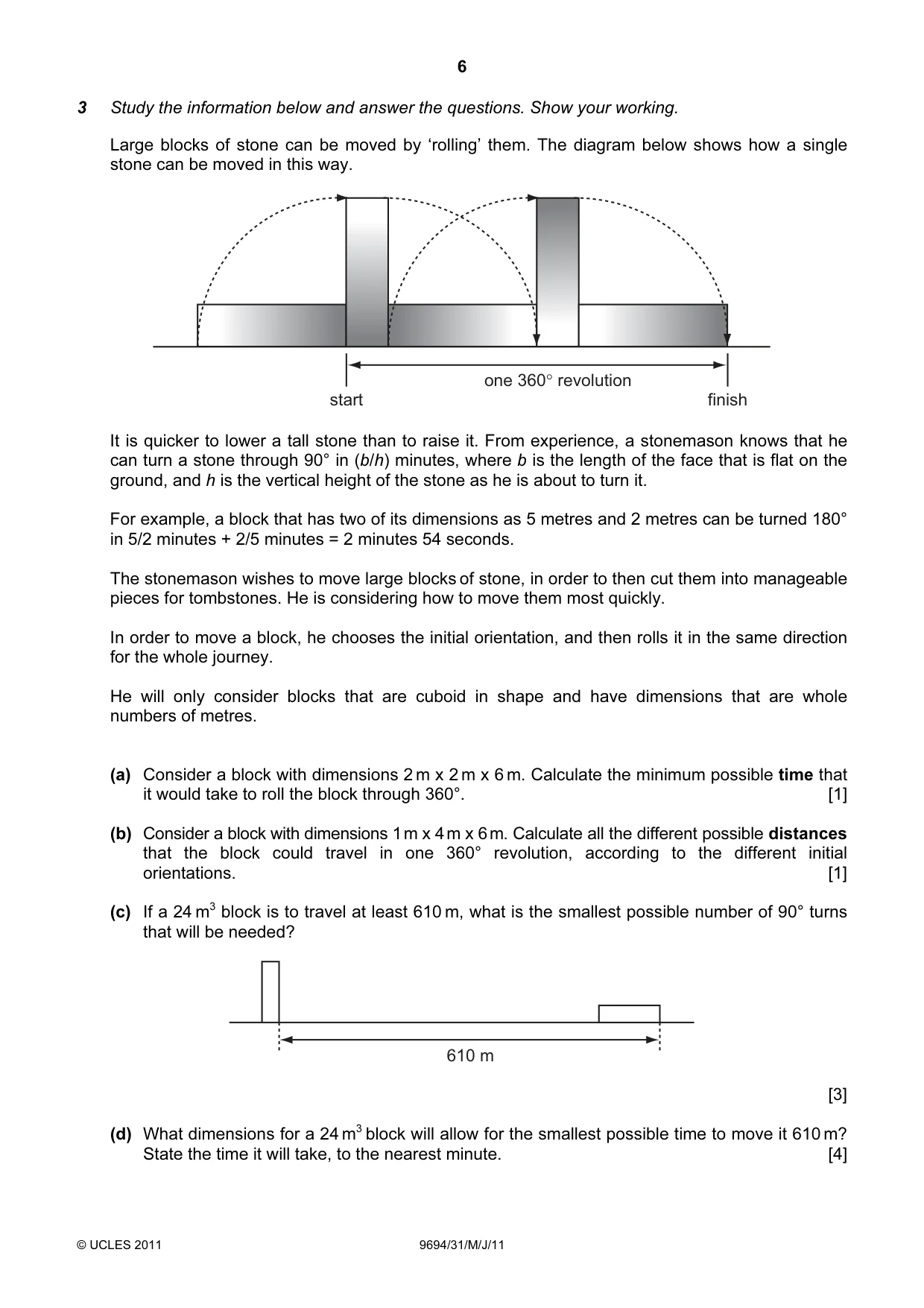
6 © UCLES 2011 9694/31/M/J/11 3 Study the information below and answer the questions. Show your working. Large blocks of stone can be moved by ‘rolling’ them. The diagram below shows how a single stone can be moved in this way. one 360° revolution start finish It is quicker to lower a tall stone than to raise it. From experience, a stonemason knows that he can turn a stone through 90° in (b/h) minutes, where b is the length of the face that is flat on the ground, and h is the vertical height of the stone as he is about to turn it. For example, a block that has two of its dimensions as 5 metres and 2 metres can be turned 180° in 5/2 minutes + 2/5 minutes = 2 minutes 54 seconds. The stonemason wishes to move large blocks of stone, in order to then cut them into manageable pieces for tombstones. He is considering how to move them most quickly. In order to move a block, he chooses the initial orientation, and then rolls it in the same direction for the whole journey. He will only consider blocks that are cuboid in shape and have dimensions that are whole numbers of metres. (a) Consider a block with dimensions 2 m x 2 m x 6 m. Calculate the minimum possible time that it would take to roll the block through 360°. [1] (b) Consider a block with dimensions 1 m x 4 m x 6 m. Calculate all the different possible distances that the block could travel in one 360° revolution, according to the different initial orientations. [1] (c) If a 24 m3 block is to travel at least 610 m, what is the smallest possible number of 90° turns that will be needed? 610 m [3] (d) What dimensions for a 24 m3 block will allow for the smallest possible time to move it 610 m? State the time it will take, to the nearest minute. [4]
Question paper, page 7
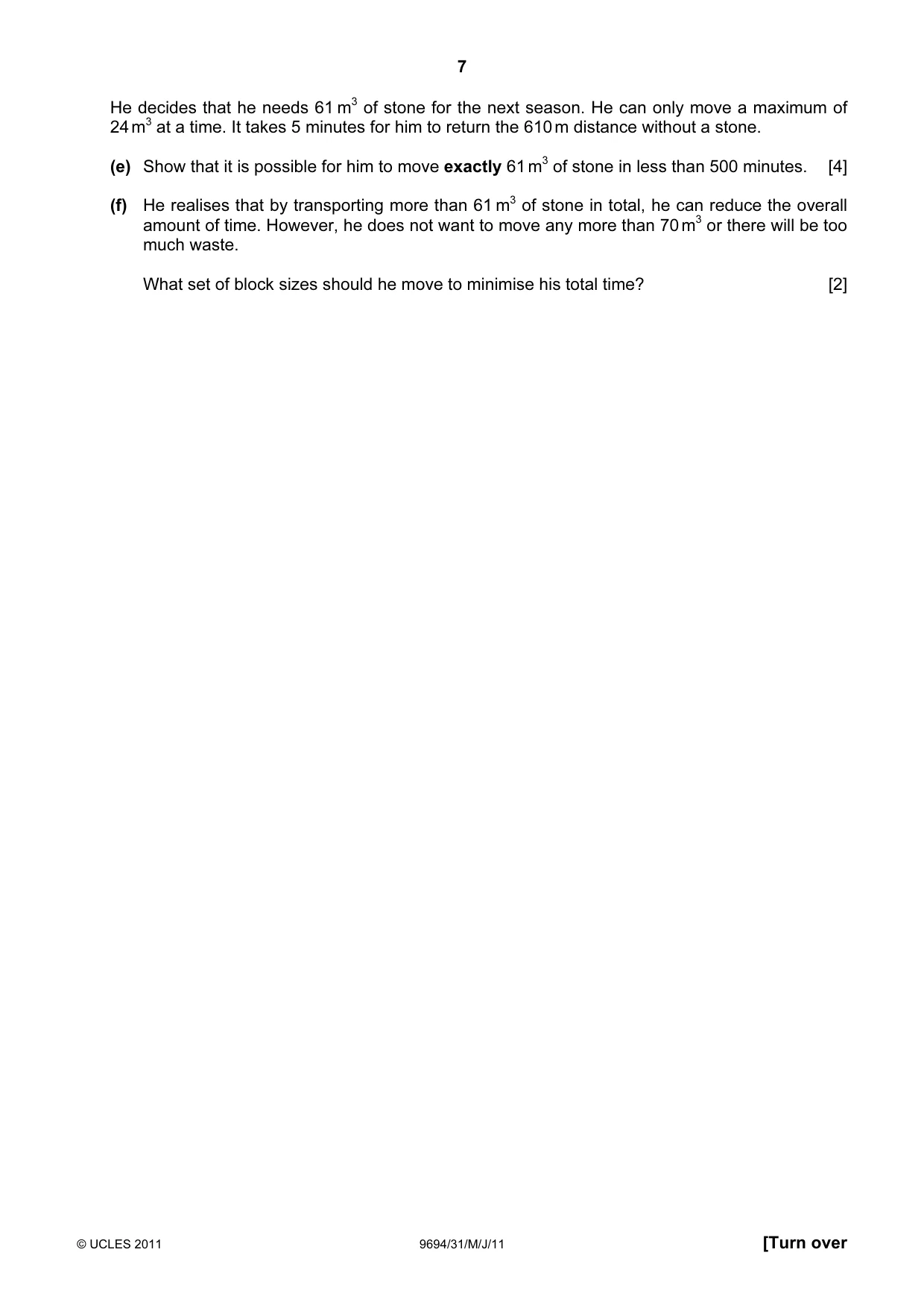
7 © UCLES 2011 9694/31/M/J/11 [Turn over He decides that he needs 61 m3 of stone for the next season. He can only move a maximum of 24 m3 at a time. It takes 5 minutes for him to return the 610 m distance without a stone. (e) Show that it is possible for him to move exactly 61 m3 of stone in less than 500 minutes. [4] (f) He realises that by transporting more than 61 m3 of stone in total, he can reduce the overall amount of time. However, he does not want to move any more than 70 m3 or there will be too much waste. What set of block sizes should he move to minimise his total time? [2]
Question paper, page 8
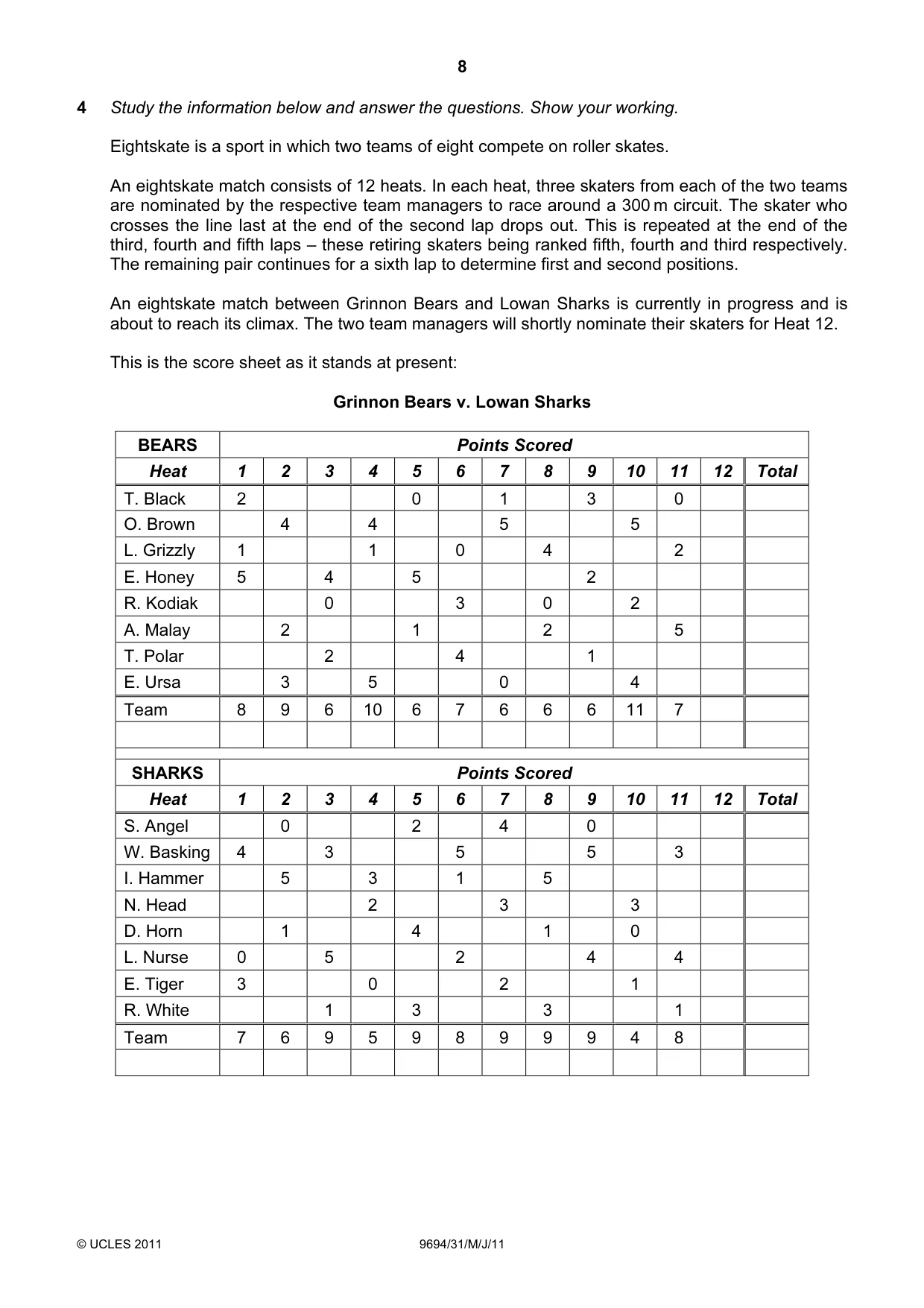
8 © UCLES 2011 9694/31/M/J/11 4 Study the information below and answer the questions. Show your working. Eightskate is a sport in which two teams of eight compete on roller skates. An eightskate match consists of 12 heats. In each heat, three skaters from each of the two teams are nominated by the respective team managers to race around a 300 m circuit. The skater who crosses the line last at the end of the second lap drops out. This is repeated at the end of the third, fourth and fifth laps – these retiring skaters being ranked fifth, fourth and third respectively. The remaining pair continues for a sixth lap to determine first and second positions. An eightskate match between Grinnon Bears and Lowan Sharks is currently in progress and is about to reach its climax. The two team managers will shortly nominate their skaters for Heat 12. This is the score sheet as it stands at present: Grinnon Bears v. Lowan Sharks BEARS Points Scored Heat 1 2 3 4 5 6 7 8 9 10 11 12 Total T. Black 2 0 1 3 0 O. Brown 4 4 5 5 L. Grizzly 1 1 0 4 2 E. Honey 5 4 5 2 R. Kodiak 0 3 0 2 A. Malay 2 1 2 5 T. Polar 2 4 1 E. Ursa 3 5 0 4 Team 8 9 6 10 6 7 6 6 6 11 7 SHARKS Points Scored Heat 1 2 3 4 5 6 7 8 9 10 11 12 Total S. Angel 0 2 4 0 W. Basking 4 3 5 5 3 I. Hammer 5 3 1 5 N. Head 2 3 3 D. Horn 1 4 1 0 L. Nurse 0 5 2 4 4 E. Tiger 3 0 2 1 R. White 1 3 3 1 Team 7 6 9 5 9 8 9 9 9 4 8
Question paper, page 9
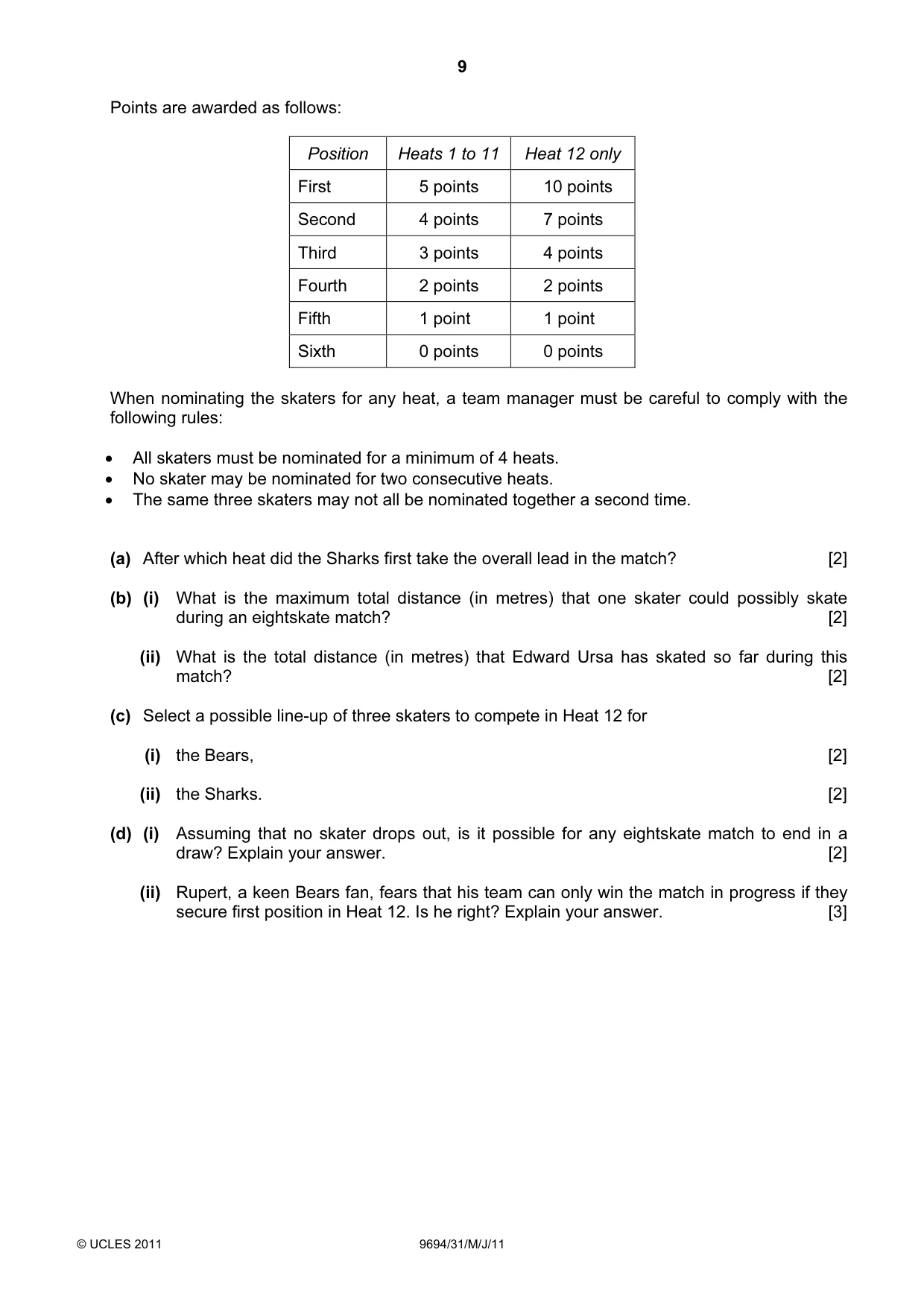
9 © UCLES 2011 9694/31/M/J/11 Points are awarded as follows: Position Heats 1 to 11 Heat 12 only First 5 points 10 points Second 4 points 7 points Third 3 points 4 points Fourth 2 points 2 points Fifth 1 point 1 point Sixth 0 points 0 points When nominating the skaters for any heat, a team manager must be careful to comply with the following rules: • All skaters must be nominated for a minimum of 4 heats. • No skater may be nominated for two consecutive heats. • The same three skaters may not all be nominated together a second time. (a) After which heat did the Sharks first take the overall lead in the match? [2] (b) (i) What is the maximum total distance (in metres) that one skater could possibly skate during an eightskate match? [2] (ii) What is the total distance (in metres) that Edward Ursa has skated so far during this match? [2] (c) Select a possible line-up of three skaters to compete in Heat 12 for (i) the Bears, [2] (ii) the Sharks. [2] (d) (i) Assuming that no skater drops out, is it possible for any eightskate match to end in a draw? Explain your answer. [2] (ii) Rupert, a keen Bears fan, fears that his team can only win the match in progress if they secure first position in Heat 12. Is he right? Explain your answer. [3]
Question paper, page 10
10 © UCLES 2011 9694/31/M/J/11 BLANK PAGE
Question paper, page 11
11 © UCLES 2011 9694/31/M/J/11 BLANK PAGE
Question paper, page 12
12 Permission to reproduce items where third-party owned material protected by copyright is included has been sought and cleared where possible. Every reasonable effort has been made by the publisher (UCLES) to trace copyright holders, but if any items requiring clearance have unwittingly been included, the publisher will be pleased to make amends at the earliest possible opportunity. University of Cambridge International Examinations is part of the Cambridge Assessment Group. Cambridge Assessment is the brand name of University of Cambridge Local Examinations Syndicate (UCLES), which is itself a department of the University of Cambridge. © UCLES 2011 9694/31/M/J/11 BLANK PAGE
Mark scheme, page 1
UNIVERSITY OF CAMBRIDGE INTERNATIONAL EXAMINATIONS GCE Advanced Level MARK SCHEME for the May/June 2011 question paper for the guidance of teachers 9694 THINKING SKILLS 9694/31 Paper 3 (Problem Analysis and Solution), maximum raw mark 50 This mark scheme is published as an aid to teachers and candidates, to indicate the requirements of the examination. It shows the basis on which Examiners were instructed to award marks. It does not indicate the details of the discussions that took place at an Examiners’ meeting before marking began, which would have considered the acceptability of alternative answers. Mark schemes must be read in conjunction with the question papers and the report on the examination. • Cambridge will not enter into discussions or correspondence in connection with these mark schemes. Cambridge is publishing the mark schemes for the May/June 2011 question papers for most IGCSE, GCE Advanced Level and Advanced Subsidiary Level syllabuses and some Ordinary Level syllabuses.
Mark scheme, page 2
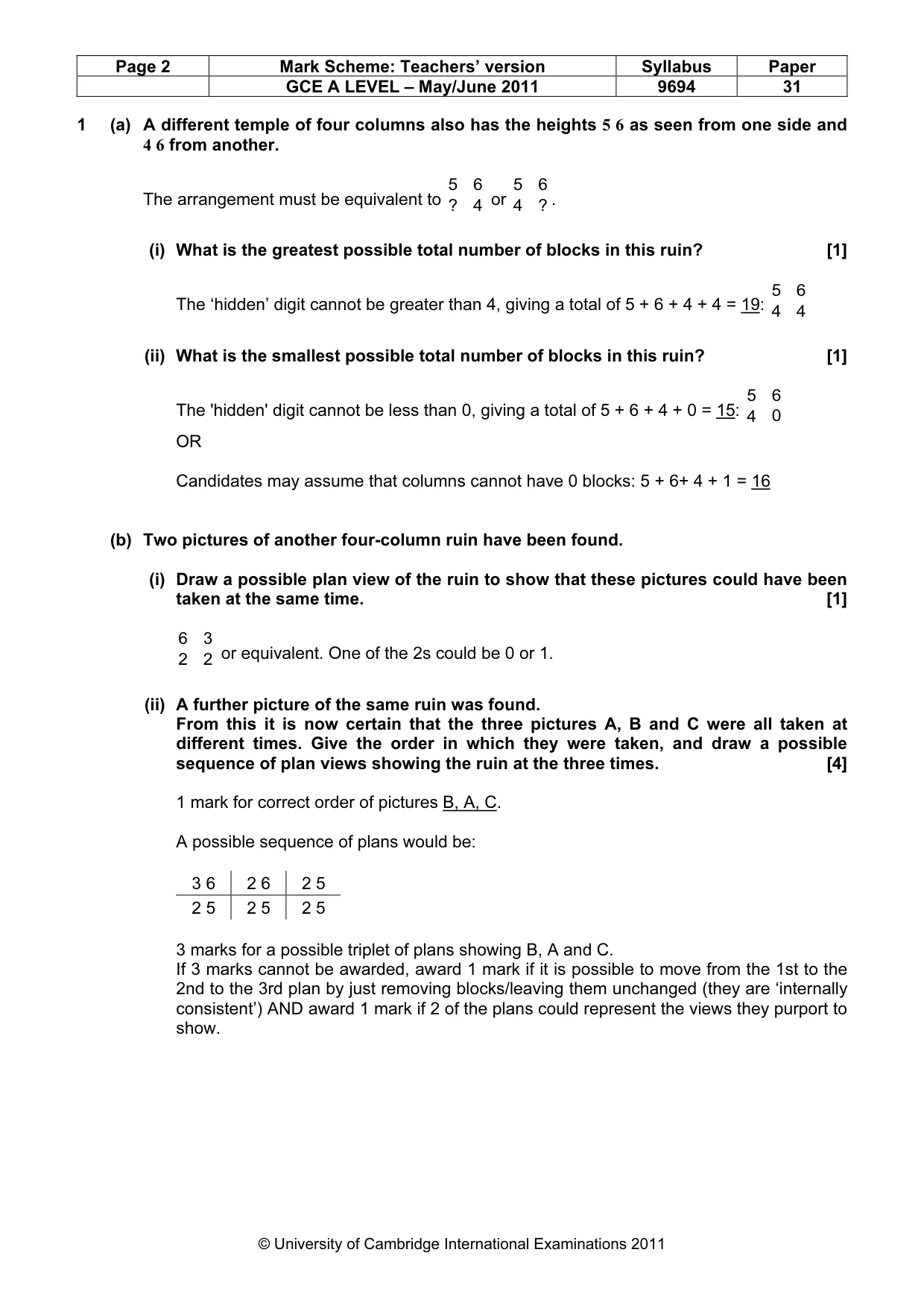
Page 2 Mark Scheme: Teachers’ version Syllabus Paper GCE A LEVEL – May/June 2011 9694 31 © University of Cambridge International Examinations 2011 1 (a) A different temple of four columns also has the heights 5 6 as seen from one side and 4 6 from another. The arrangement must be equivalent to 4 ? 6 5 or ? 4 6 5 . (i) What is the greatest possible total number of blocks in this ruin? [1] The ‘hidden’ digit cannot be greater than 4, giving a total of 5 + 6 + 4 + 4 = 19: 4 4 6 5 (ii) What is the smallest possible total number of blocks in this ruin? [1] The 'hidden' digit cannot be less than 0, giving a total of 5 + 6 + 4 + 0 = 15: 0 4 6 5 OR Candidates may assume that columns cannot have 0 blocks: 5 + 6+ 4 + 1 = 16 (b) Two pictures of another four-column ruin have been found. (i) Draw a possible plan view of the ruin to show that these pictures could have been taken at the same time. [1] 2 2 3 6 or equivalent. One of the 2s could be 0 or 1. (ii) A further picture of the same ruin was found. From this it is now certain that the three pictures A, B and C were all taken at different times. Give the order in which they were taken, and draw a possible sequence of plan views showing the ruin at the three times. [4] 1 mark for correct order of pictures B, A, C. A possible sequence of plans would be: 3 6 2 6 2 5 2 5 2 5 2 5 3 marks for a possible triplet of plans showing B, A and C. If 3 marks cannot be awarded, award 1 mark if it is possible to move from the 1st to the 2nd to the 3rd plan by just removing blocks/leaving them unchanged (they are ‘internally consistent’) AND award 1 mark if 2 of the plans could represent the views they purport to show.
Mark scheme, page 3
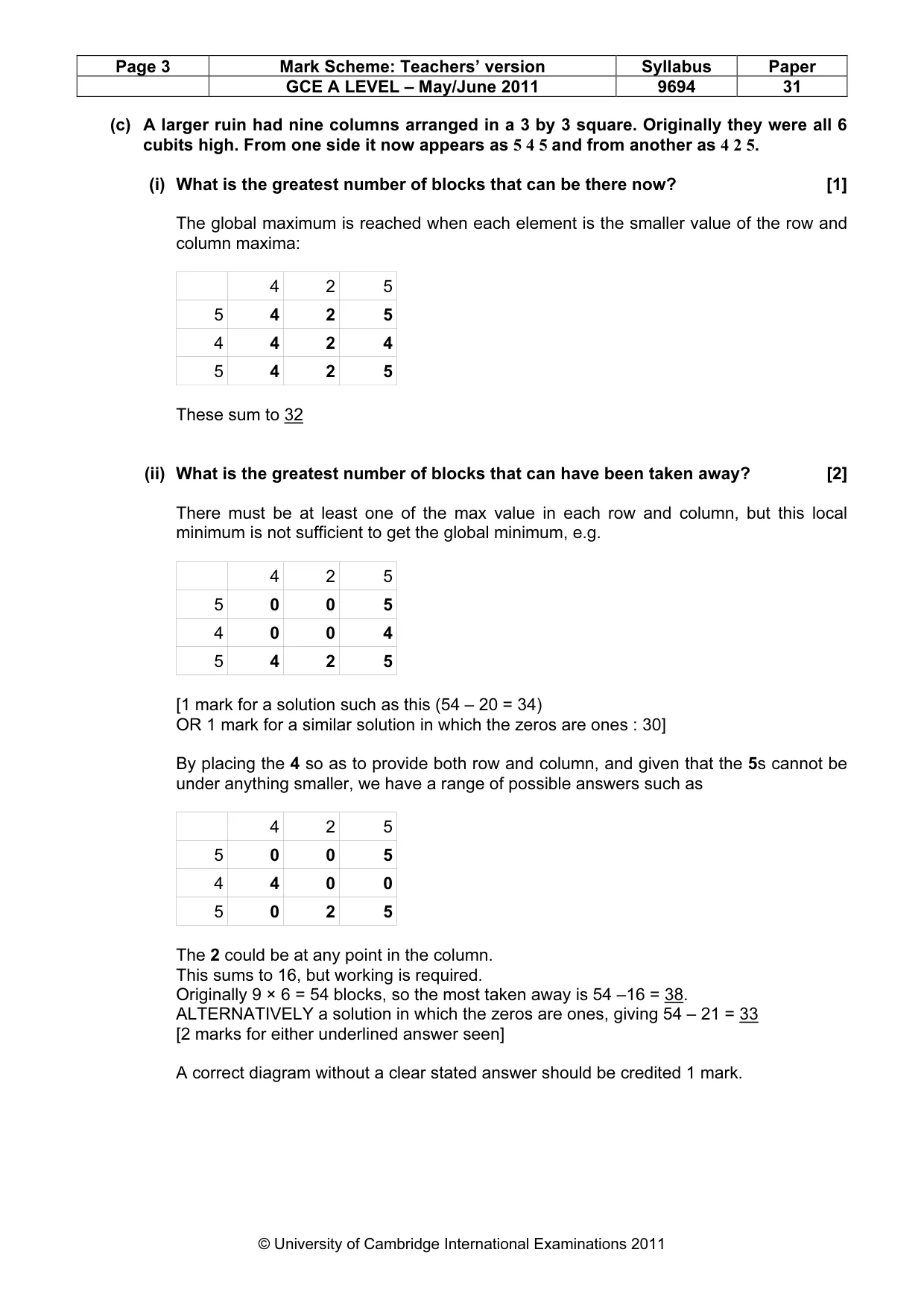
Page 3 Mark Scheme: Teachers’ version Syllabus Paper GCE A LEVEL – May/June 2011 9694 31 © University of Cambridge International Examinations 2011 (c) A larger ruin had nine columns arranged in a 3 by 3 square. Originally they were all 6 cubits high. From one side it now appears as 5 4 5 and from another as 4 2 5. (i) What is the greatest number of blocks that can be there now? [1] The global maximum is reached when each element is the smaller value of the row and column maxima: 4 2 5 5 4 2 5 4 4 2 4 5 4 2 5 These sum to 32 (ii) What is the greatest number of blocks that can have been taken away? [2] There must be at least one of the max value in each row and column, but this local minimum is not sufficient to get the global minimum, e.g. 4 2 5 5 0 0 5 4 0 0 4 5 4 2 5 [1 mark for a solution such as this (54 – 20 = 34) OR 1 mark for a similar solution in which the zeros are ones : 30] By placing the 4 so as to provide both row and column, and given that the 5s cannot be under anything smaller, we have a range of possible answers such as 4 2 5 5 0 0 5 4 4 0 0 5 0 2 5 The 2 could be at any point in the column. This sums to 16, but working is required. Originally 9 × 6 = 54 blocks, so the most taken away is 54 –16 = 38. ALTERNATIVELY a solution in which the zeros are ones, giving 54 – 21 = 33 [2 marks for either underlined answer seen] A correct diagram without a clear stated answer should be credited 1 mark.
Mark scheme, page 4
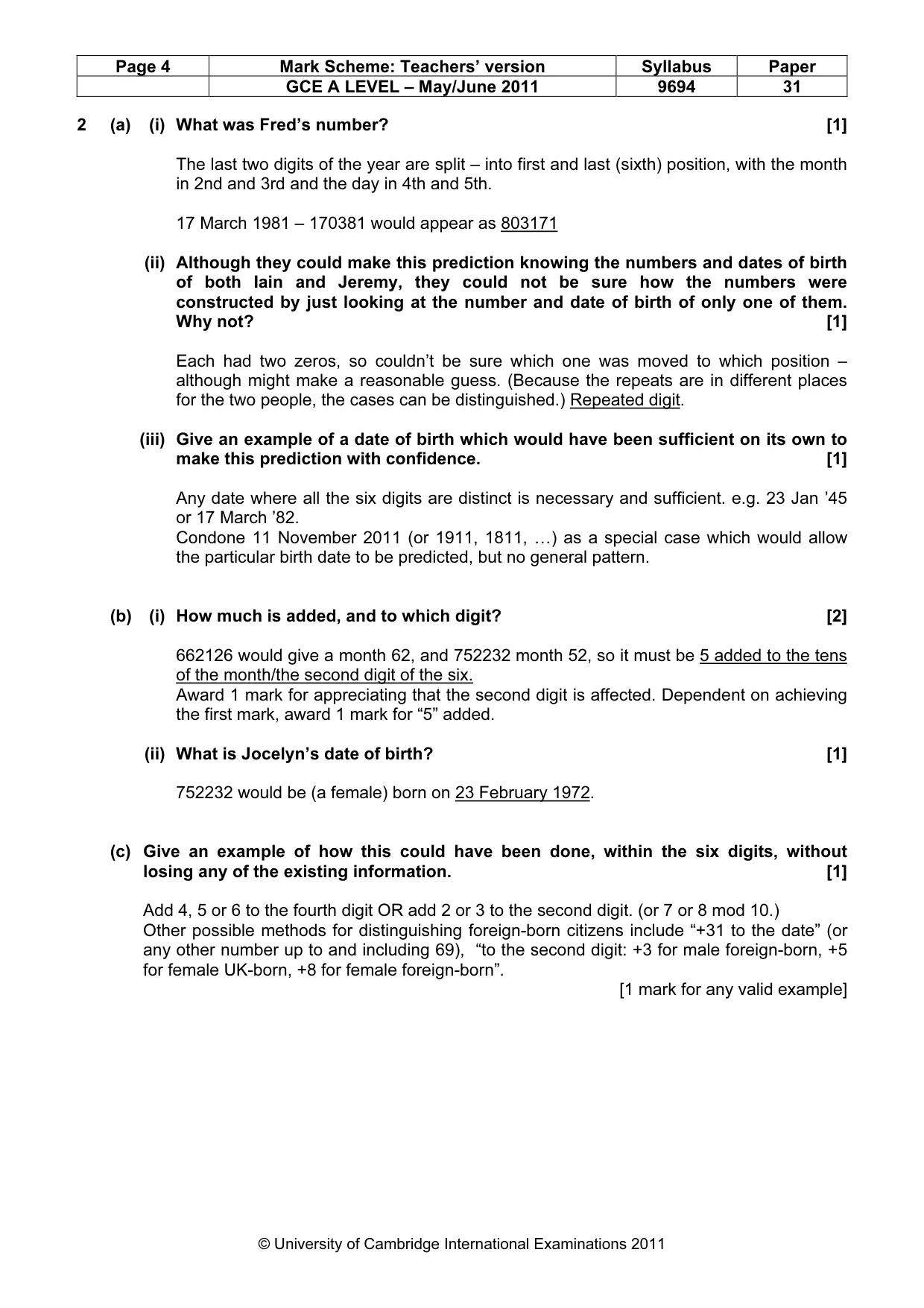
Page 4 Mark Scheme: Teachers’ version Syllabus Paper GCE A LEVEL – May/June 2011 9694 31 © University of Cambridge International Examinations 2011 2 (a) (i) What was Fred’s number? [1] The last two digits of the year are split – into first and last (sixth) position, with the month in 2nd and 3rd and the day in 4th and 5th. 17 March 1981 – 170381 would appear as 803171 (ii) Although they could make this prediction knowing the numbers and dates of birth of both Iain and Jeremy, they could not be sure how the numbers were constructed by just looking at the number and date of birth of only one of them. Why not? [1] Each had two zeros, so couldn’t be sure which one was moved to which position – although might make a reasonable guess. (Because the repeats are in different places for the two people, the cases can be distinguished.) Repeated digit. (iii) Give an example of a date of birth which would have been sufficient on its own to make this prediction with confidence. [1] Any date where all the six digits are distinct is necessary and sufficient. e.g. 23 Jan ’45 or 17 March ’82. Condone 11 November 2011 (or 1911, 1811, …) as a special case which would allow the particular birth date to be predicted, but no general pattern. (b) (i) How much is added, and to which digit? [2] 662126 would give a month 62, and 752232 month 52, so it must be 5 added to the tens of the month/the second digit of the six. Award 1 mark for appreciating that the second digit is affected. Dependent on achieving the first mark, award 1 mark for “5” added. (ii) What is Jocelyn’s date of birth? [1] 752232 would be (a female) born on 23 February 1972. (c) Give an example of how this could have been done, within the six digits, without losing any of the existing information. [1] Add 4, 5 or 6 to the fourth digit OR add 2 or 3 to the second digit. (or 7 or 8 mod 10.) Other possible methods for distinguishing foreign-born citizens include “+31 to the date” (or any other number up to and including 69), “to the second digit: +3 for male foreign-born, +5 for female UK-born, +8 for female foreign-born”. [1 mark for any valid example]
Mark scheme, page 5
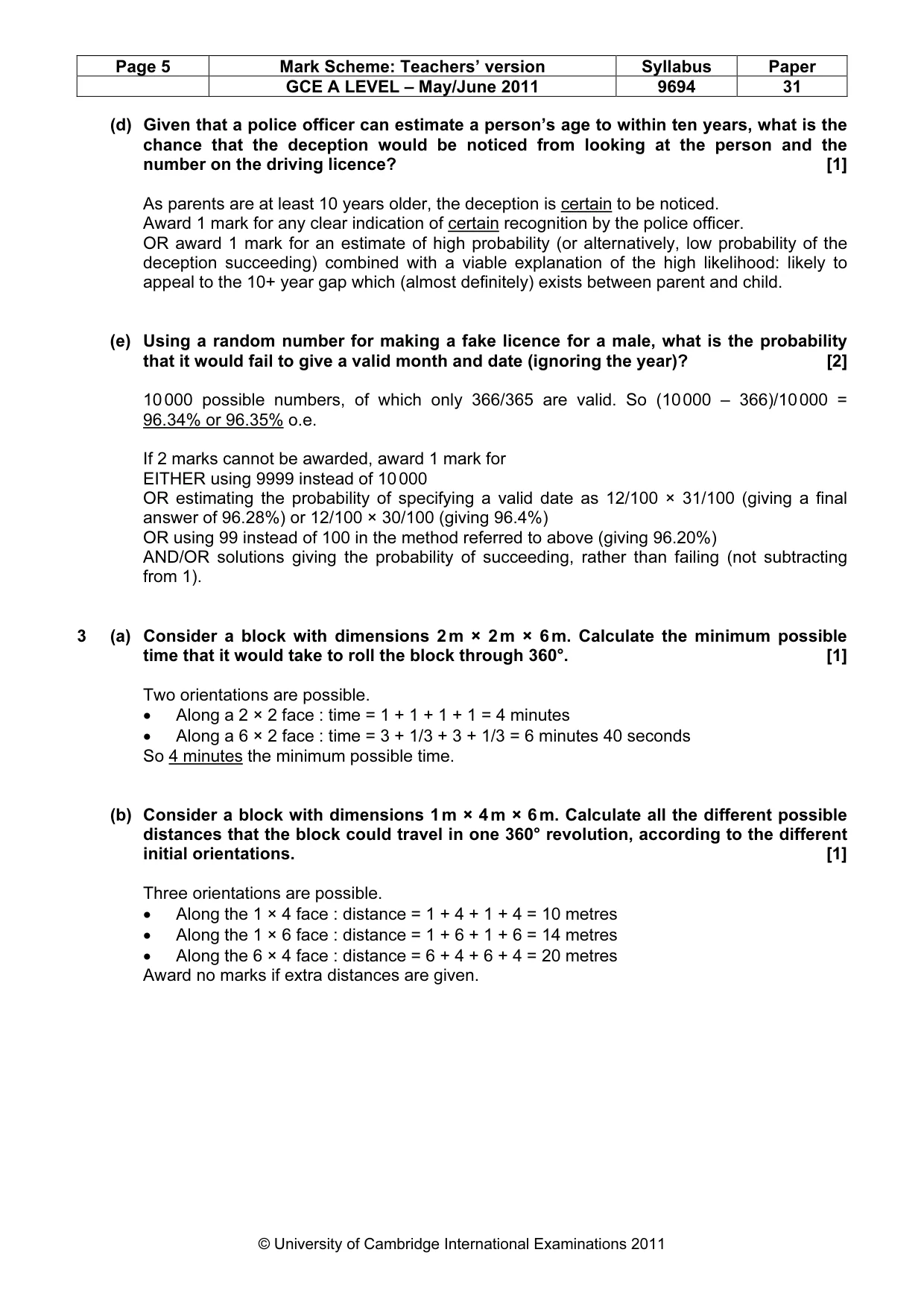
Page 5 Mark Scheme: Teachers’ version Syllabus Paper GCE A LEVEL – May/June 2011 9694 31 © University of Cambridge International Examinations 2011 (d) Given that a police officer can estimate a person’s age to within ten years, what is the chance that the deception would be noticed from looking at the person and the number on the driving licence? [1] As parents are at least 10 years older, the deception is certain to be noticed. Award 1 mark for any clear indication of certain recognition by the police officer. OR award 1 mark for an estimate of high probability (or alternatively, low probability of the deception succeeding) combined with a viable explanation of the high likelihood: likely to appeal to the 10+ year gap which (almost definitely) exists between parent and child. (e) Using a random number for making a fake licence for a male, what is the probability that it would fail to give a valid month and date (ignoring the year)? [2] 10 000 possible numbers, of which only 366/365 are valid. So (10 000 – 366)/10 000 = 96.34% or 96.35% o.e. If 2 marks cannot be awarded, award 1 mark for EITHER using 9999 instead of 10 000 OR estimating the probability of specifying a valid date as 12/100 × 31/100 (giving a final answer of 96.28%) or 12/100 × 30/100 (giving 96.4%) OR using 99 instead of 100 in the method referred to above (giving 96.20%) AND/OR solutions giving the probability of succeeding, rather than failing (not subtracting from 1). 3 (a) Consider a block with dimensions 2 m × 2 m × 6 m. Calculate the minimum possible time that it would take to roll the block through 360°. [1] Two orientations are possible. • Along a 2 × 2 face : time = 1 + 1 + 1 + 1 = 4 minutes • Along a 6 × 2 face : time = 3 + 1/3 + 3 + 1/3 = 6 minutes 40 seconds So 4 minutes the minimum possible time. (b) Consider a block with dimensions 1 m × 4 m × 6 m. Calculate all the different possible distances that the block could travel in one 360° revolution, according to the different initial orientations. [1] Three orientations are possible. • Along the 1 × 4 face : distance = 1 + 4 + 1 + 4 = 10 metres • Along the 1 × 6 face : distance = 1 + 6 + 1 + 6 = 14 metres • Along the 6 × 4 face : distance = 6 + 4 + 6 + 4 = 20 metres Award no marks if extra distances are given.
Mark scheme, page 6
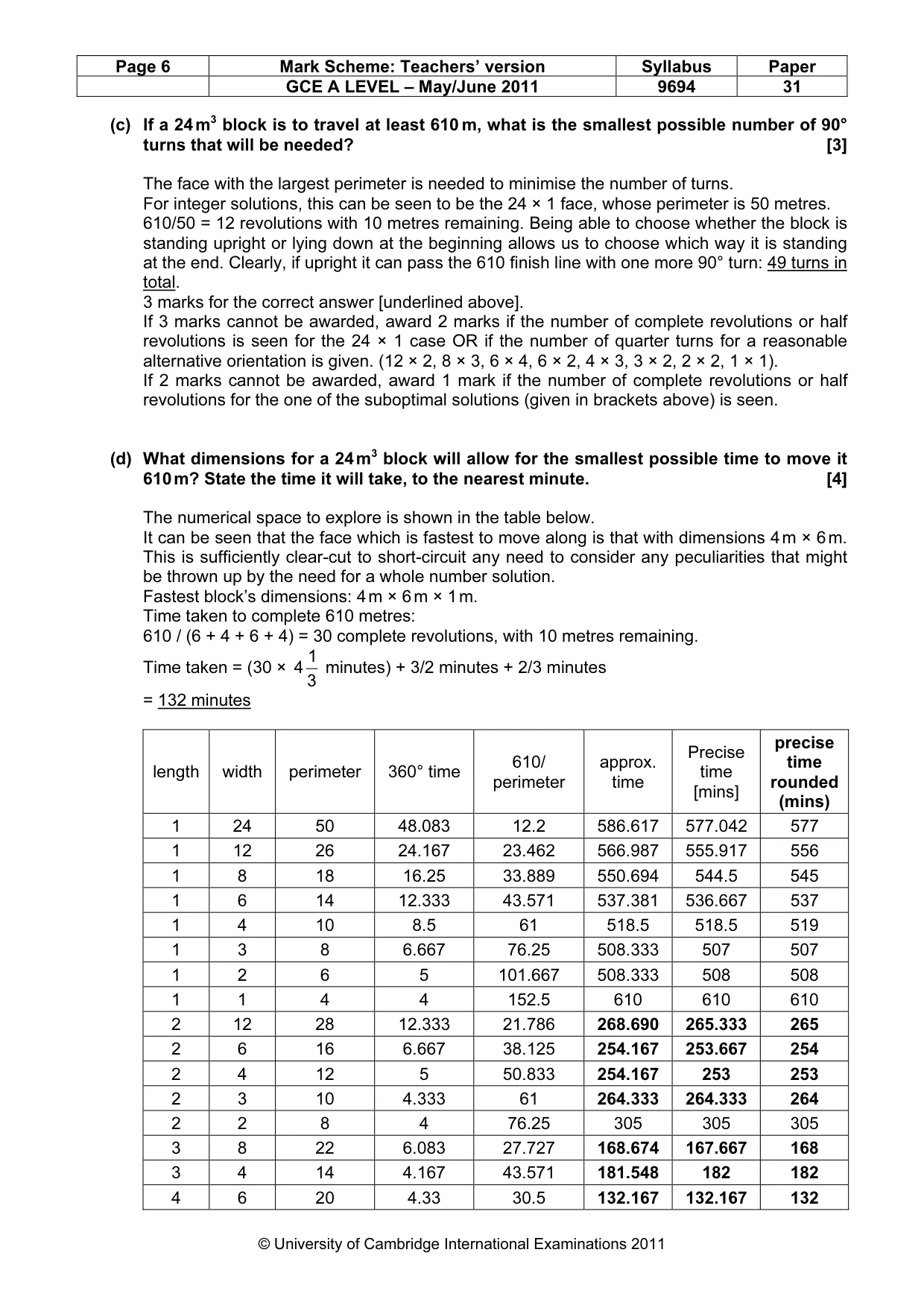
Page 6 Mark Scheme: Teachers’ version Syllabus Paper GCE A LEVEL – May/June 2011 9694 31 © University of Cambridge International Examinations 2011 (c) If a 24 m3 block is to travel at least 610 m, what is the smallest possible number of 90° turns that will be needed? [3] The face with the largest perimeter is needed to minimise the number of turns. For integer solutions, this can be seen to be the 24 × 1 face, whose perimeter is 50 metres. 610/50 = 12 revolutions with 10 metres remaining. Being able to choose whether the block is standing upright or lying down at the beginning allows us to choose which way it is standing at the end. Clearly, if upright it can pass the 610 finish line with one more 90° turn: 49 turns in total. 3 marks for the correct answer [underlined above]. If 3 marks cannot be awarded, award 2 marks if the number of complete revolutions or half revolutions is seen for the 24 × 1 case OR if the number of quarter turns for a reasonable alternative orientation is given. (12 × 2, 8 × 3, 6 × 4, 6 × 2, 4 × 3, 3 × 2, 2 × 2, 1 × 1). If 2 marks cannot be awarded, award 1 mark if the number of complete revolutions or half revolutions for the one of the suboptimal solutions (given in brackets above) is seen. (d) What dimensions for a 24 m3 block will allow for the smallest possible time to move it 610 m? State the time it will take, to the nearest minute. [4] The numerical space to explore is shown in the table below. It can be seen that the face which is fastest to move along is that with dimensions 4 m × 6 m. This is sufficiently clear-cut to short-circuit any need to consider any peculiarities that might be thrown up by the need for a whole number solution. Fastest block’s dimensions: 4 m × 6 m × 1 m. Time taken to complete 610 metres: 610 / (6 + 4 + 6 + 4) = 30 complete revolutions, with 10 metres remaining. Time taken = (30 × 3 1 4 minutes) + 3/2 minutes + 2/3 minutes = 132 minutes length width perimeter 360° time 610/ perimeter approx. time Precise time [mins] precise time rounded (mins) 1 24 50 48.083 12.2 586.617 577.042 577 1 12 26 24.167 23.462 566.987 555.917 556 1 8 18 16.25 33.889 550.694 544.5 545 1 6 14 12.333 43.571 537.381 536.667 537 1 4 10 8.5 61 518.5 518.5 519 1 3 8 6.667 76.25 508.333 507 507 1 2 6 5 101.667 508.333 508 508 1 1 4 4 152.5 610 610 610 2 12 28 12.333 21.786 268.690 265.333 265 2 6 16 6.667 38.125 254.167 253.667 254 2 4 12 5 50.833 254.167 253 253 2 3 10 4.333 61 264.333 264.333 264 2 2 8 4 76.25 305 305 305 3 8 22 6.083 27.727 168.674 167.667 168 3 4 14 4.167 43.571 181.548 182 182 4 6 20 4.33 30.5 132.167 132.167 132
Mark scheme, page 7
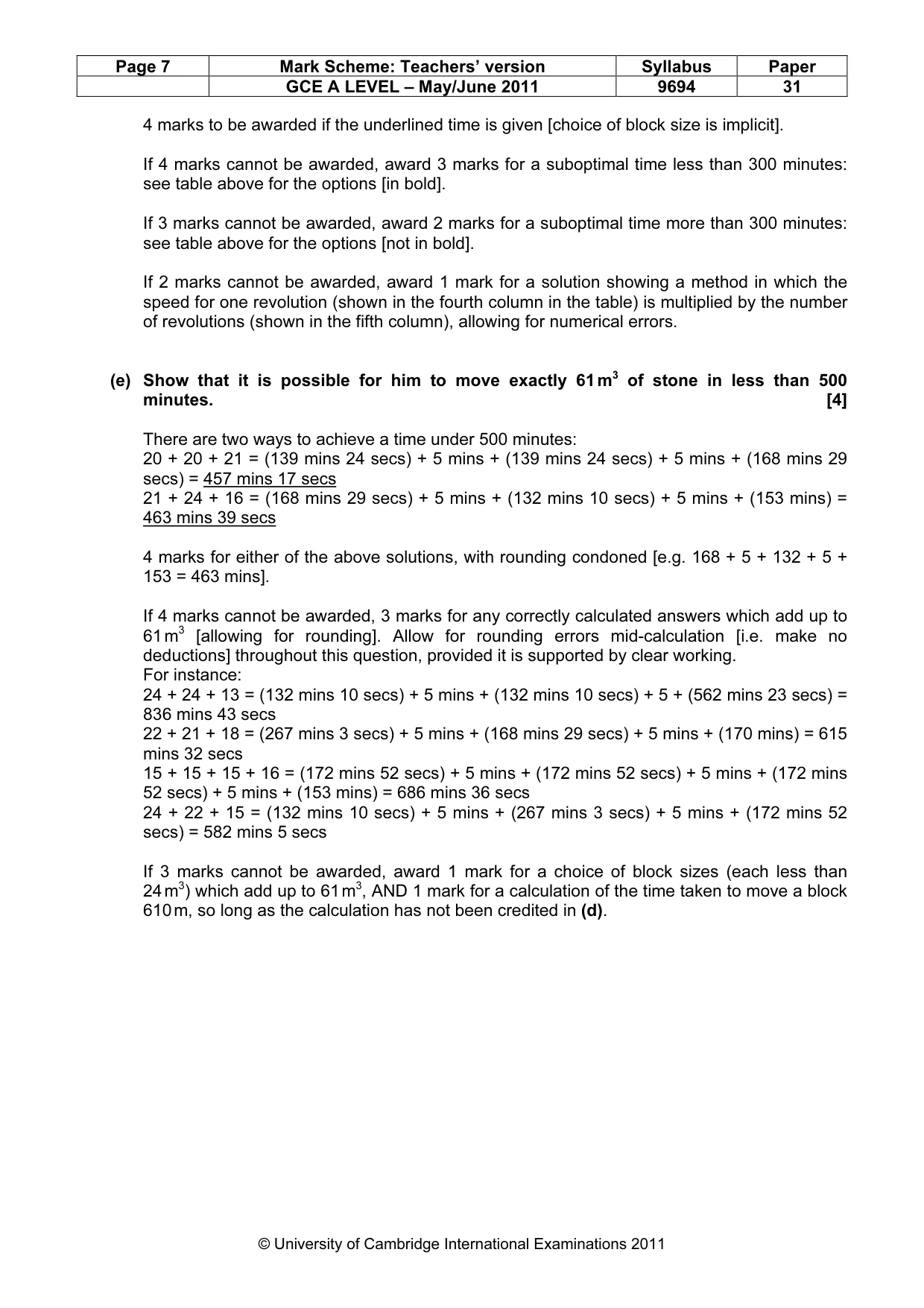
Page 7 Mark Scheme: Teachers’ version Syllabus Paper GCE A LEVEL – May/June 2011 9694 31 © University of Cambridge International Examinations 2011 4 marks to be awarded if the underlined time is given [choice of block size is implicit]. If 4 marks cannot be awarded, award 3 marks for a suboptimal time less than 300 minutes: see table above for the options [in bold]. If 3 marks cannot be awarded, award 2 marks for a suboptimal time more than 300 minutes: see table above for the options [not in bold]. If 2 marks cannot be awarded, award 1 mark for a solution showing a method in which the speed for one revolution (shown in the fourth column in the table) is multiplied by the number of revolutions (shown in the fifth column), allowing for numerical errors. (e) Show that it is possible for him to move exactly 61 m3 of stone in less than 500 minutes. [4] There are two ways to achieve a time under 500 minutes: 20 + 20 + 21 = (139 mins 24 secs) + 5 mins + (139 mins 24 secs) + 5 mins + (168 mins 29 secs) = 457 mins 17 secs 21 + 24 + 16 = (168 mins 29 secs) + 5 mins + (132 mins 10 secs) + 5 mins + (153 mins) = 463 mins 39 secs 4 marks for either of the above solutions, with rounding condoned [e.g. 168 + 5 + 132 + 5 + 153 = 463 mins]. If 4 marks cannot be awarded, 3 marks for any correctly calculated answers which add up to 61 m3 [allowing for rounding]. Allow for rounding errors mid-calculation [i.e. make no deductions] throughout this question, provided it is supported by clear working. For instance: 24 + 24 + 13 = (132 mins 10 secs) + 5 mins + (132 mins 10 secs) + 5 + (562 mins 23 secs) = 836 mins 43 secs 22 + 21 + 18 = (267 mins 3 secs) + 5 mins + (168 mins 29 secs) + 5 mins + (170 mins) = 615 mins 32 secs 15 + 15 + 15 + 16 = (172 mins 52 secs) + 5 mins + (172 mins 52 secs) + 5 mins + (172 mins 52 secs) + 5 mins + (153 mins) = 686 mins 36 secs 24 + 22 + 15 = (132 mins 10 secs) + 5 mins + (267 mins 3 secs) + 5 mins + (172 mins 52 secs) = 582 mins 5 secs If 3 marks cannot be awarded, award 1 mark for a choice of block sizes (each less than 24 m3) which add up to 61 m3, AND 1 mark for a calculation of the time taken to move a block 610 m, so long as the calculation has not been credited in (d).
Mark scheme, page 8
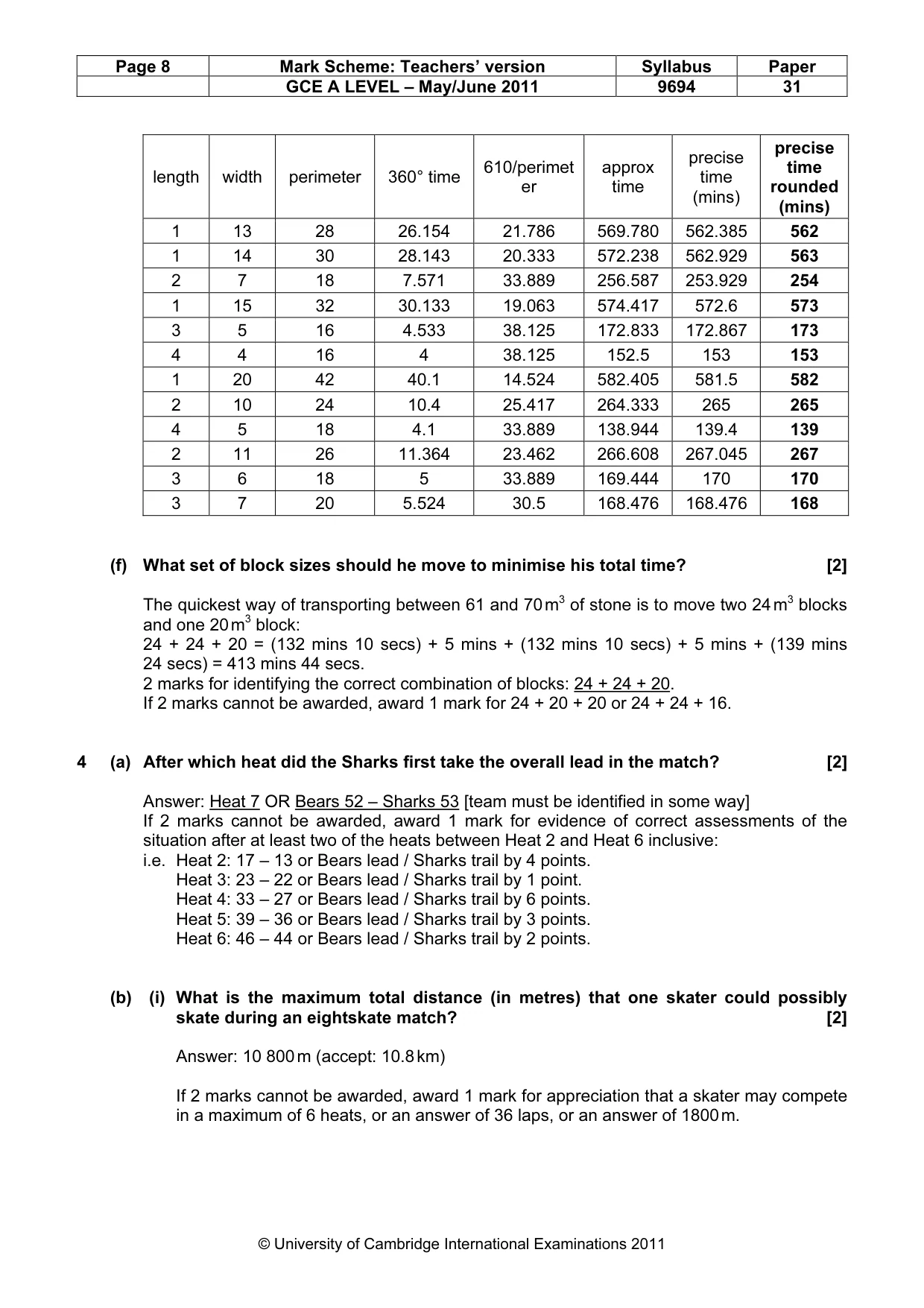
Page 8 Mark Scheme: Teachers’ version Syllabus Paper GCE A LEVEL – May/June 2011 9694 31 © University of Cambridge International Examinations 2011 length width perimeter 360° time 610/perimet er approx time precise time (mins) precise time rounded (mins) 1 13 28 26.154 21.786 569.780 562.385 562 1 14 30 28.143 20.333 572.238 562.929 563 2 7 18 7.571 33.889 256.587 253.929 254 1 15 32 30.133 19.063 574.417 572.6 573 3 5 16 4.533 38.125 172.833 172.867 173 4 4 16 4 38.125 152.5 153 153 1 20 42 40.1 14.524 582.405 581.5 582 2 10 24 10.4 25.417 264.333 265 265 4 5 18 4.1 33.889 138.944 139.4 139 2 11 26 11.364 23.462 266.608 267.045 267 3 6 18 5 33.889 169.444 170 170 3 7 20 5.524 30.5 168.476 168.476 168 (f) What set of block sizes should he move to minimise his total time? [2] The quickest way of transporting between 61 and 70 m3 of stone is to move two 24 m3 blocks and one 20 m3 block: 24 + 24 + 20 = (132 mins 10 secs) + 5 mins + (132 mins 10 secs) + 5 mins + (139 mins 24 secs) = 413 mins 44 secs. 2 marks for identifying the correct combination of blocks: 24 + 24 + 20. If 2 marks cannot be awarded, award 1 mark for 24 + 20 + 20 or 24 + 24 + 16. 4 (a) After which heat did the Sharks first take the overall lead in the match? [2] Answer: Heat 7 OR Bears 52 – Sharks 53 [team must be identified in some way] If 2 marks cannot be awarded, award 1 mark for evidence of correct assessments of the situation after at least two of the heats between Heat 2 and Heat 6 inclusive: i.e. Heat 2: 17 – 13 or Bears lead / Sharks trail by 4 points. Heat 3: 23 – 22 or Bears lead / Sharks trail by 1 point. Heat 4: 33 – 27 or Bears lead / Sharks trail by 6 points. Heat 5: 39 – 36 or Bears lead / Sharks trail by 3 points. Heat 6: 46 – 44 or Bears lead / Sharks trail by 2 points. (b) (i) What is the maximum total distance (in metres) that one skater could possibly skate during an eightskate match? [2] Answer: 10 800 m (accept: 10.8 km) If 2 marks cannot be awarded, award 1 mark for appreciation that a skater may compete in a maximum of 6 heats, or an answer of 36 laps, or an answer of 1800 m.
Mark scheme, page 9
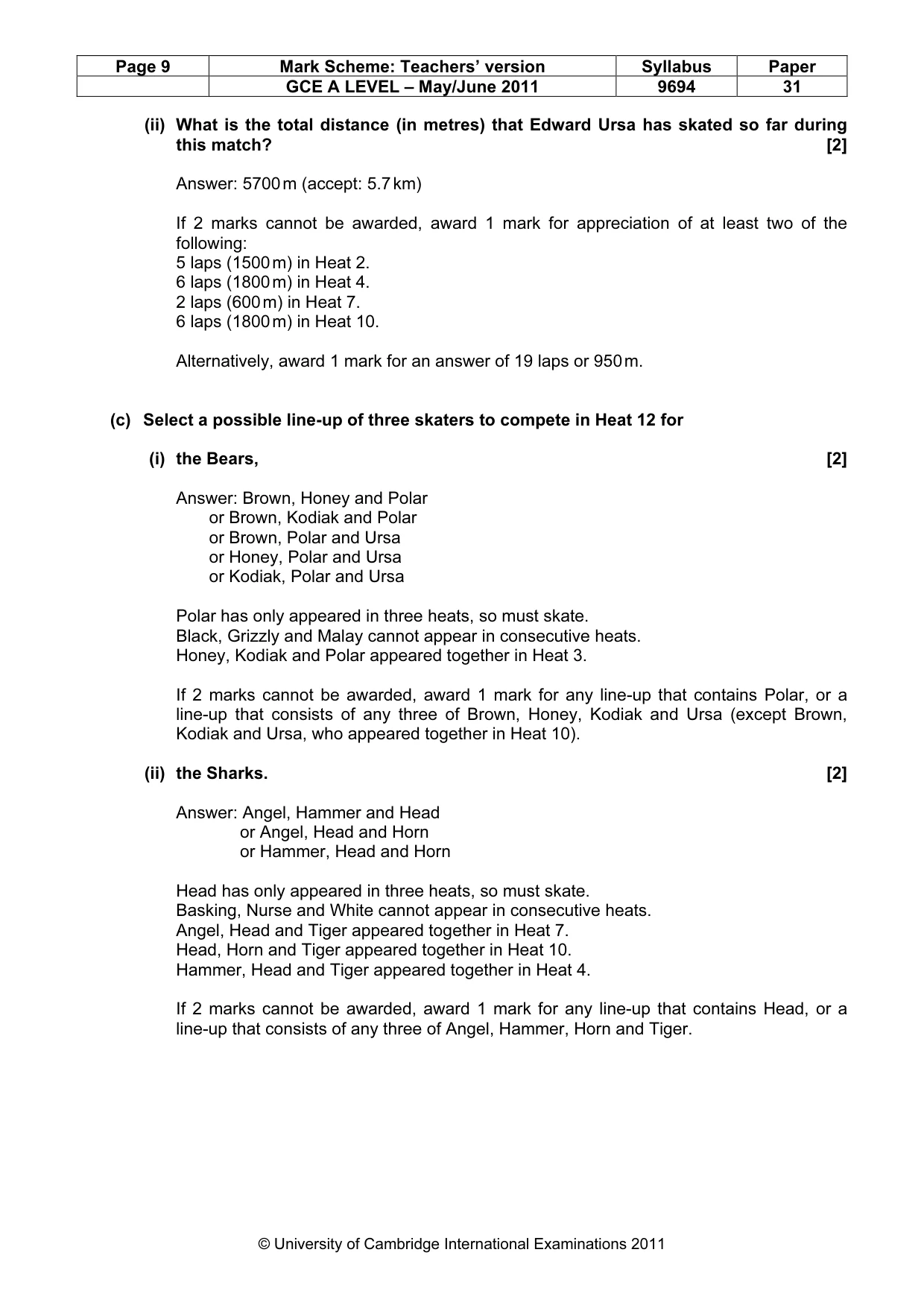
Page 9 Mark Scheme: Teachers’ version Syllabus Paper GCE A LEVEL – May/June 2011 9694 31 © University of Cambridge International Examinations 2011 (ii) What is the total distance (in metres) that Edward Ursa has skated so far during this match? [2] Answer: 5700 m (accept: 5.7 km) If 2 marks cannot be awarded, award 1 mark for appreciation of at least two of the following: 5 laps (1500 m) in Heat 2. 6 laps (1800 m) in Heat 4. 2 laps (600 m) in Heat 7. 6 laps (1800 m) in Heat 10. Alternatively, award 1 mark for an answer of 19 laps or 950 m. (c) Select a possible line-up of three skaters to compete in Heat 12 for (i) the Bears, [2] Answer: Brown, Honey and Polar or Brown, Kodiak and Polar or Brown, Polar and Ursa or Honey, Polar and Ursa or Kodiak, Polar and Ursa Polar has only appeared in three heats, so must skate. Black, Grizzly and Malay cannot appear in consecutive heats. Honey, Kodiak and Polar appeared together in Heat 3. If 2 marks cannot be awarded, award 1 mark for any line-up that contains Polar, or a line-up that consists of any three of Brown, Honey, Kodiak and Ursa (except Brown, Kodiak and Ursa, who appeared together in Heat 10). (ii) the Sharks. [2] Answer: Angel, Hammer and Head or Angel, Head and Horn or Hammer, Head and Horn Head has only appeared in three heats, so must skate. Basking, Nurse and White cannot appear in consecutive heats. Angel, Head and Tiger appeared together in Heat 7. Head, Horn and Tiger appeared together in Heat 10. Hammer, Head and Tiger appeared together in Heat 4. If 2 marks cannot be awarded, award 1 mark for any line-up that contains Head, or a line-up that consists of any three of Angel, Hammer, Horn and Tiger.
Mark scheme, page 10
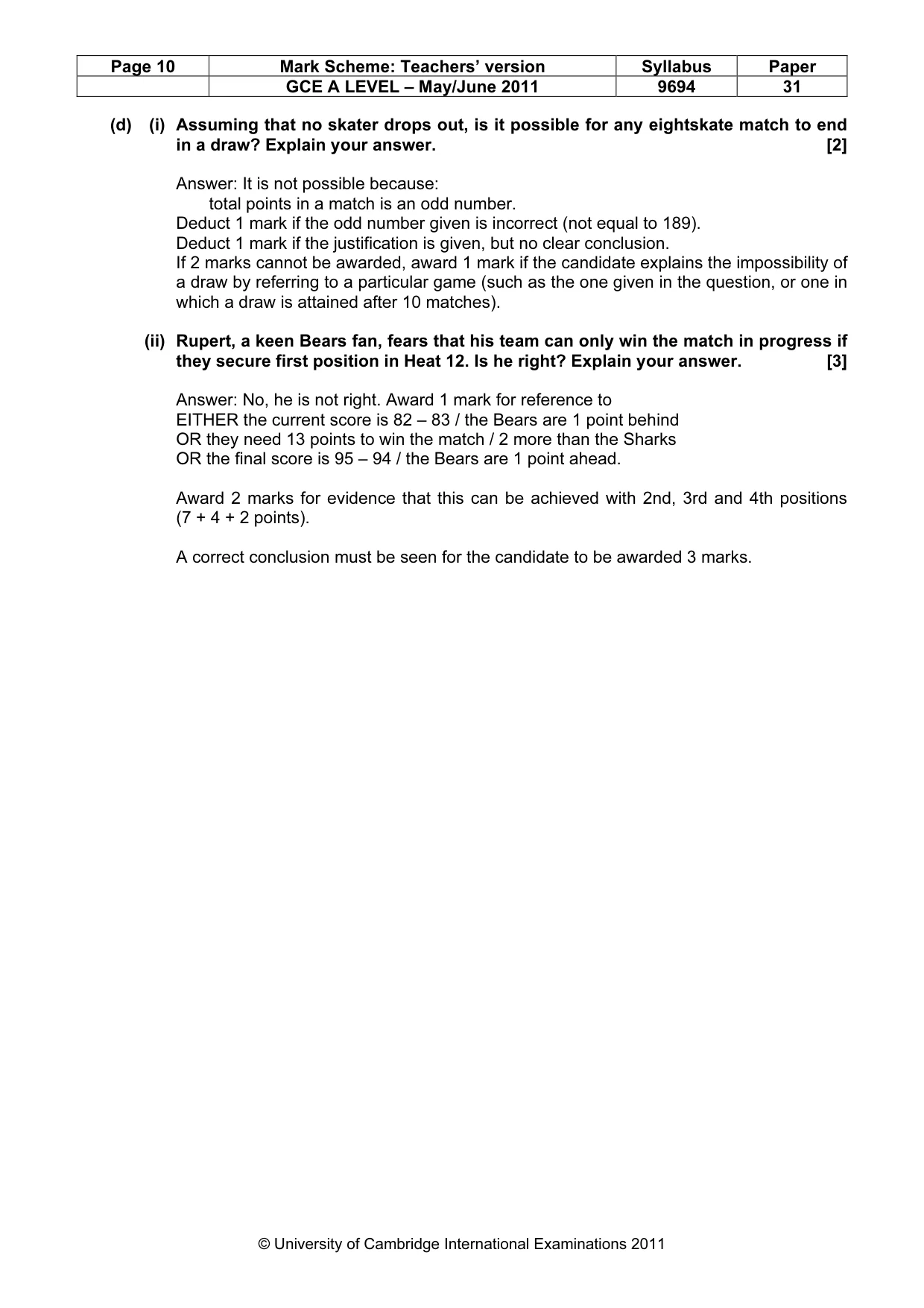
Page 10 Mark Scheme: Teachers’ version Syllabus Paper GCE A LEVEL – May/June 2011 9694 31 © University of Cambridge International Examinations 2011 (d) (i) Assuming that no skater drops out, is it possible for any eightskate match to end in a draw? Explain your answer. [2] Answer: It is not possible because: total points in a match is an odd number. Deduct 1 mark if the odd number given is incorrect (not equal to 189). Deduct 1 mark if the justification is given, but no clear conclusion. If 2 marks cannot be awarded, award 1 mark if the candidate explains the impossibility of a draw by referring to a particular game (such as the one given in the question, or one in which a draw is attained after 10 matches). (ii) Rupert, a keen Bears fan, fears that his team can only win the match in progress if they secure first position in Heat 12. Is he right? Explain your answer. [3] Answer: No, he is not right. Award 1 mark for reference to EITHER the current score is 82 – 83 / the Bears are 1 point behind OR they need 13 points to win the match / 2 more than the Sharks OR the final score is 95 – 94 / the Bears are 1 point ahead. Award 2 marks for evidence that this can be achieved with 2nd, 3rd and 4th positions (7 + 4 + 2 points). A correct conclusion must be seen for the candidate to be awarded 3 marks.
What you needed in this session
Cambridge’s own grade thresholds for 2011 May/June, Paper 3 · Variant 1. A higher threshold means an easier paper — the bar moves with how the cohort did.