Cambridge A Level Thinking Skills 9694 — 2011 May/June Paper 3 · Variant 3
9694/33/M/J/11 · 50 marks · ≈56 min
The question paper and its mark scheme, free to read here and free to download. This is Cambridge’s own paper, exactly as it was sat.
Question paper12 pages

Mark scheme7 pages
Answers below. Sit the paper first if you are practising.
Paper as text
Question paper, page 1
This document consists of 8 printed pages and 4 blank pages. IB11 06_9694_33/RP © UCLES 2011 [Turn over *9316678678* UNIVERSITY OF CAMBRIDGE INTERNATIONAL EXAMINATIONS General Certificate of Education Advanced Level THINKING SKILLS 9694/33 Paper 3 Problem Analysis and Solution May/June 2011 1 hour and 30 minutes Additional Materials: Answer Booklet/Paper Electronic Calculator READ THESE INSTRUCTIONS FIRST If you have been given an Answer Booklet, follow the instructions on the front cover of the booklet. Write your Centre number, candidate number and name on all the work you hand in. Write in dark blue or black pen. Do not use staples, paper clips, highlighters, glue or correction fluid. DO NOT WRITE ON ANY BARCODES Calculators should be used where appropriate. Answer all the questions. Start each question on a new answer sheet. At the end of the examination, fasten all your work securely together. The number of marks is given in brackets [ ] at the end of each question. The total of the marks for this paper is 50.
Question paper, page 2
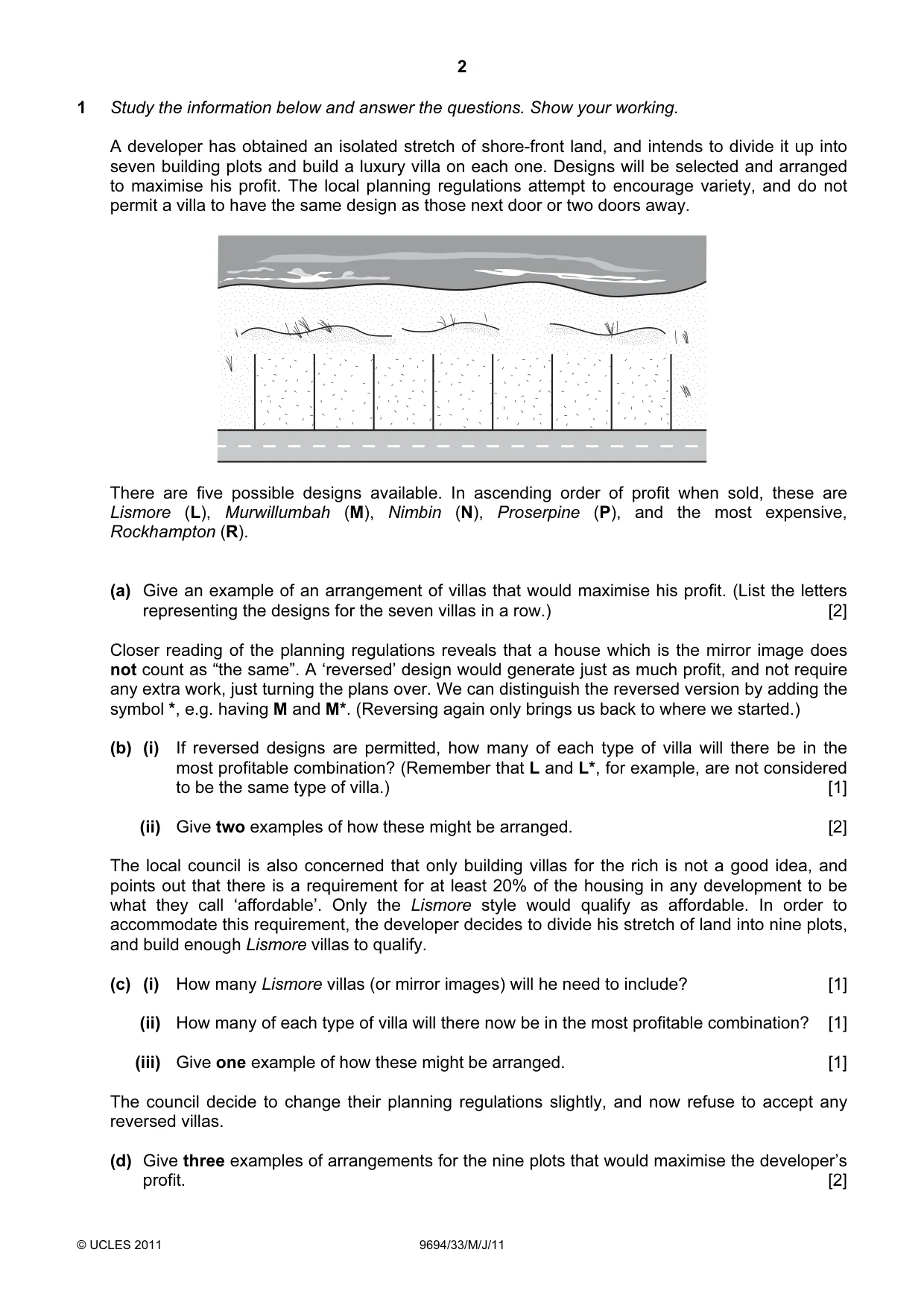
2 © UCLES 2011 9694/33/M/J/11 1 Study the information below and answer the questions. Show your working. A developer has obtained an isolated stretch of shore-front land, and intends to divide it up into seven building plots and build a luxury villa on each one. Designs will be selected and arranged to maximise his profit. The local planning regulations attempt to encourage variety, and do not permit a villa to have the same design as those next door or two doors away. There are five possible designs available. In ascending order of profit when sold, these are Lismore (L), Murwillumbah (M), Nimbin (N), Proserpine (P), and the most expensive, Rockhampton (R). (a) Give an example of an arrangement of villas that would maximise his profit. (List the letters representing the designs for the seven villas in a row.) [2] Closer reading of the planning regulations reveals that a house which is the mirror image does not count as “the same”. A ‘reversed’ design would generate just as much profit, and not require any extra work, just turning the plans over. We can distinguish the reversed version by adding the symbol *, e.g. having M and M*. (Reversing again only brings us back to where we started.) (b) (i) If reversed designs are permitted, how many of each type of villa will there be in the most profitable combination? (Remember that L and L*, for example, are not considered to be the same type of villa.) [1] (ii) Give two examples of how these might be arranged. [2] The local council is also concerned that only building villas for the rich is not a good idea, and points out that there is a requirement for at least 20% of the housing in any development to be what they call ‘affordable’. Only the Lismore style would qualify as affordable. In order to accommodate this requirement, the developer decides to divide his stretch of land into nine plots, and build enough Lismore villas to qualify. (c) (i) How many Lismore villas (or mirror images) will he need to include? [1] (ii) How many of each type of villa will there now be in the most profitable combination? [1] (iii) Give one example of how these might be arranged. [1] The council decide to change their planning regulations slightly, and now refuse to accept any reversed villas. (d) Give three examples of arrangements for the nine plots that would maximise the developer’s profit. [2]
Question paper, page 3
3 © UCLES 2011 9694/33/M/J/11 [Turn over BLANK PAGE [Question 2 is printed on the next page]
Question paper, page 4
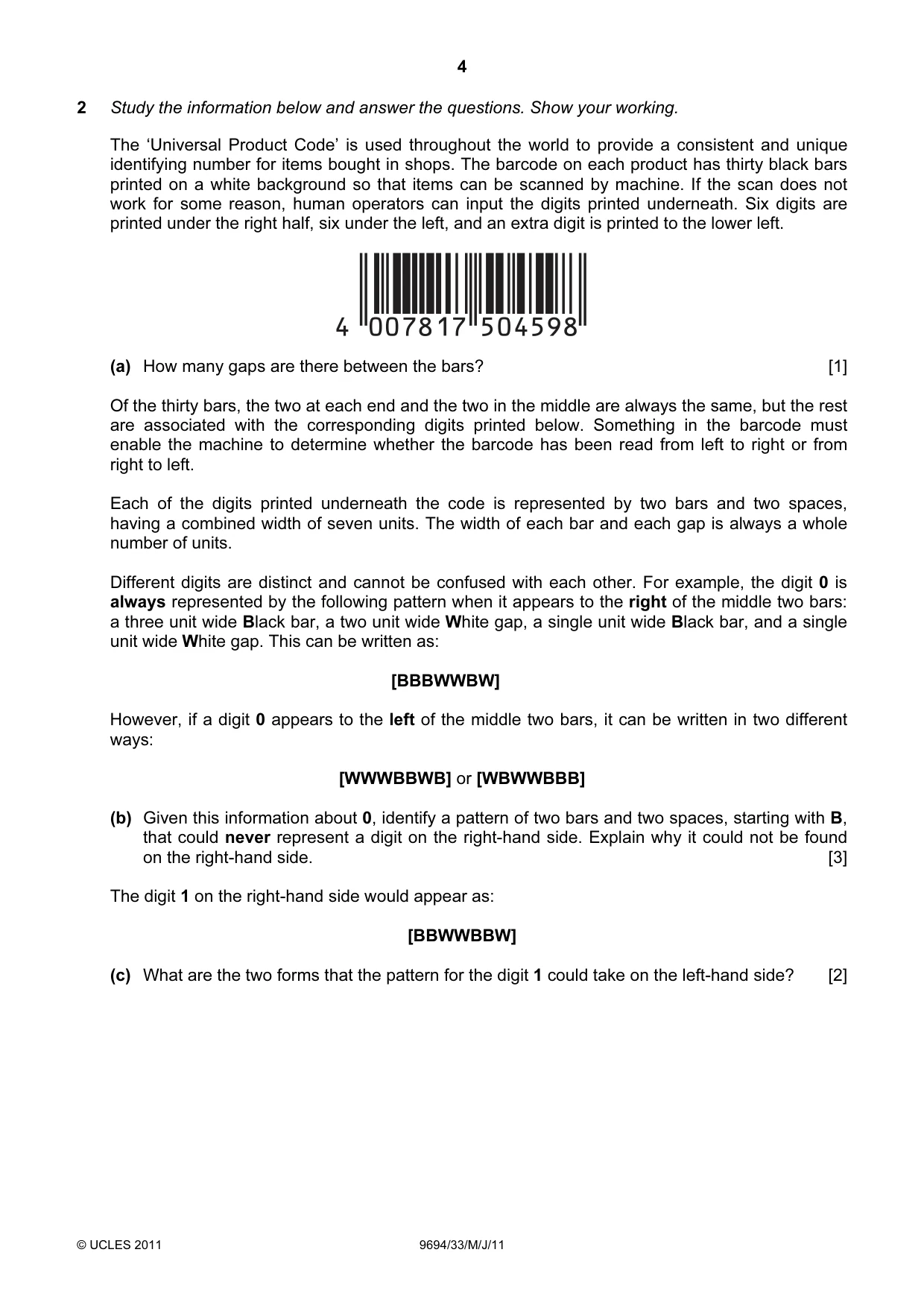
4 © UCLES 2011 9694/33/M/J/11 2 Study the information below and answer the questions. Show your working. The ‘Universal Product Code’ is used throughout the world to provide a consistent and unique identifying number for items bought in shops. The barcode on each product has thirty black bars printed on a white background so that items can be scanned by machine. If the scan does not work for some reason, human operators can input the digits printed underneath. Six digits are printed under the right half, six under the left, and an extra digit is printed to the lower left. (a) How many gaps are there between the bars? [1] Of the thirty bars, the two at each end and the two in the middle are always the same, but the rest are associated with the corresponding digits printed below. Something in the barcode must enable the machine to determine whether the barcode has been read from left to right or from right to left. Each of the digits printed underneath the code is represented by two bars and two spaces, having a combined width of seven units. The width of each bar and each gap is always a whole number of units. Different digits are distinct and cannot be confused with each other. For example, the digit 0 is always represented by the following pattern when it appears to the right of the middle two bars: a three unit wide Black bar, a two unit wide White gap, a single unit wide Black bar, and a single unit wide White gap. This can be written as: [BBBWWBW] However, if a digit 0 appears to the left of the middle two bars, it can be written in two different ways: [WWWBBWB] or [WBWWBBB] (b) Given this information about 0, identify a pattern of two bars and two spaces, starting with B, that could never represent a digit on the right-hand side. Explain why it could not be found on the right-hand side. [3] The digit 1 on the right-hand side would appear as: [BBWWBBW] (c) What are the two forms that the pattern for the digit 1 could take on the left-hand side? [2]
Question paper, page 5
5 © UCLES 2011 9694/33/M/J/11 [Turn over The reason there are two possible patterns for each of the digits on the left-hand side is to encode the extra digit (which is printed on the lower left). This extra digit is represented in the barcode by the combination of which of the two possible patterns is used for each of the six digits. Suppose that one type of pattern is called x and the other type is called y. Then, when the extra digit is 4, for example, the patterns for the six digits on the left-hand side are always used in the order xyxxyy. (This must not interfere with the ability of the machine to know which way round the barcode is read.) Currently the extra digit can only be one of the numbers from 0 to 9. In the future there may be more combinations needed on the left-hand side. (d) What is the total number of such combinations that have not yet been allocated, but would be safe to use because they would not lead to possible ambiguity in reading the barcode? [4]
Question paper, page 6
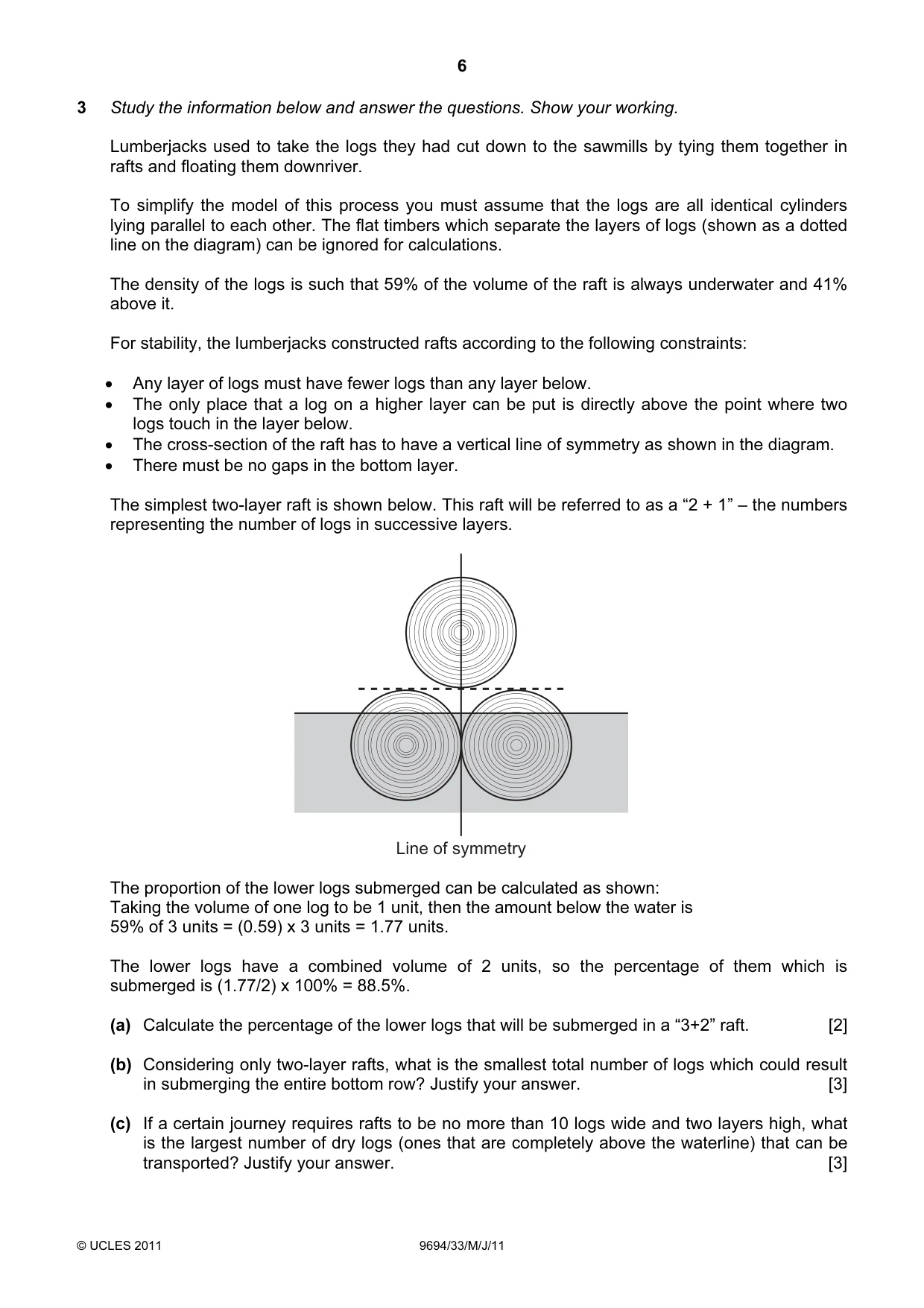
6 © UCLES 2011 9694/33/M/J/11 3 Study the information below and answer the questions. Show your working. Lumberjacks used to take the logs they had cut down to the sawmills by tying them together in rafts and floating them downriver. To simplify the model of this process you must assume that the logs are all identical cylinders lying parallel to each other. The flat timbers which separate the layers of logs (shown as a dotted line on the diagram) can be ignored for calculations. The density of the logs is such that 59% of the volume of the raft is always underwater and 41% above it. For stability, the lumberjacks constructed rafts according to the following constraints: • Any layer of logs must have fewer logs than any layer below. • The only place that a log on a higher layer can be put is directly above the point where two logs touch in the layer below. • The cross-section of the raft has to have a vertical line of symmetry as shown in the diagram. • There must be no gaps in the bottom layer. The simplest two-layer raft is shown below. This raft will be referred to as a “2 + 1” – the numbers representing the number of logs in successive layers. Line of symmetry The proportion of the lower logs submerged can be calculated as shown: Taking the volume of one log to be 1 unit, then the amount below the water is 59% of 3 units = (0.59) x 3 units = 1.77 units. The lower logs have a combined volume of 2 units, so the percentage of them which is submerged is (1.77/2) x 100% = 88.5%. (a) Calculate the percentage of the lower logs that will be submerged in a “3+2” raft. [2] (b) Considering only two-layer rafts, what is the smallest total number of logs which could result in submerging the entire bottom row? Justify your answer. [3] (c) If a certain journey requires rafts to be no more than 10 logs wide and two layers high, what is the largest number of dry logs (ones that are completely above the waterline) that can be transported? Justify your answer. [3]
Question paper, page 7
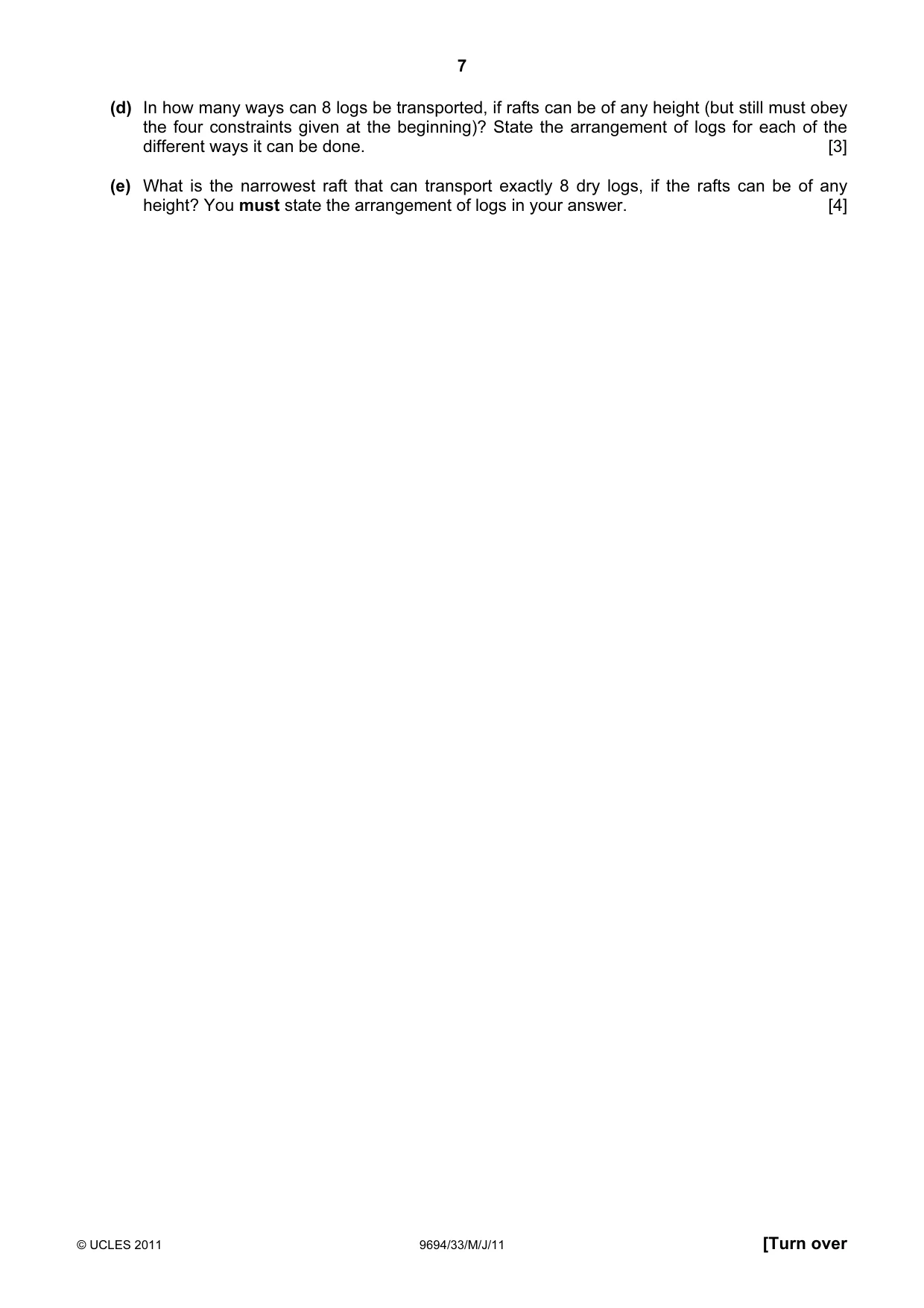
7 © UCLES 2011 9694/33/M/J/11 [Turn over (d) In how many ways can 8 logs be transported, if rafts can be of any height (but still must obey the four constraints given at the beginning)? State the arrangement of logs for each of the different ways it can be done. [3] (e) What is the narrowest raft that can transport exactly 8 dry logs, if the rafts can be of any height? You must state the arrangement of logs in your answer. [4]
Question paper, page 8
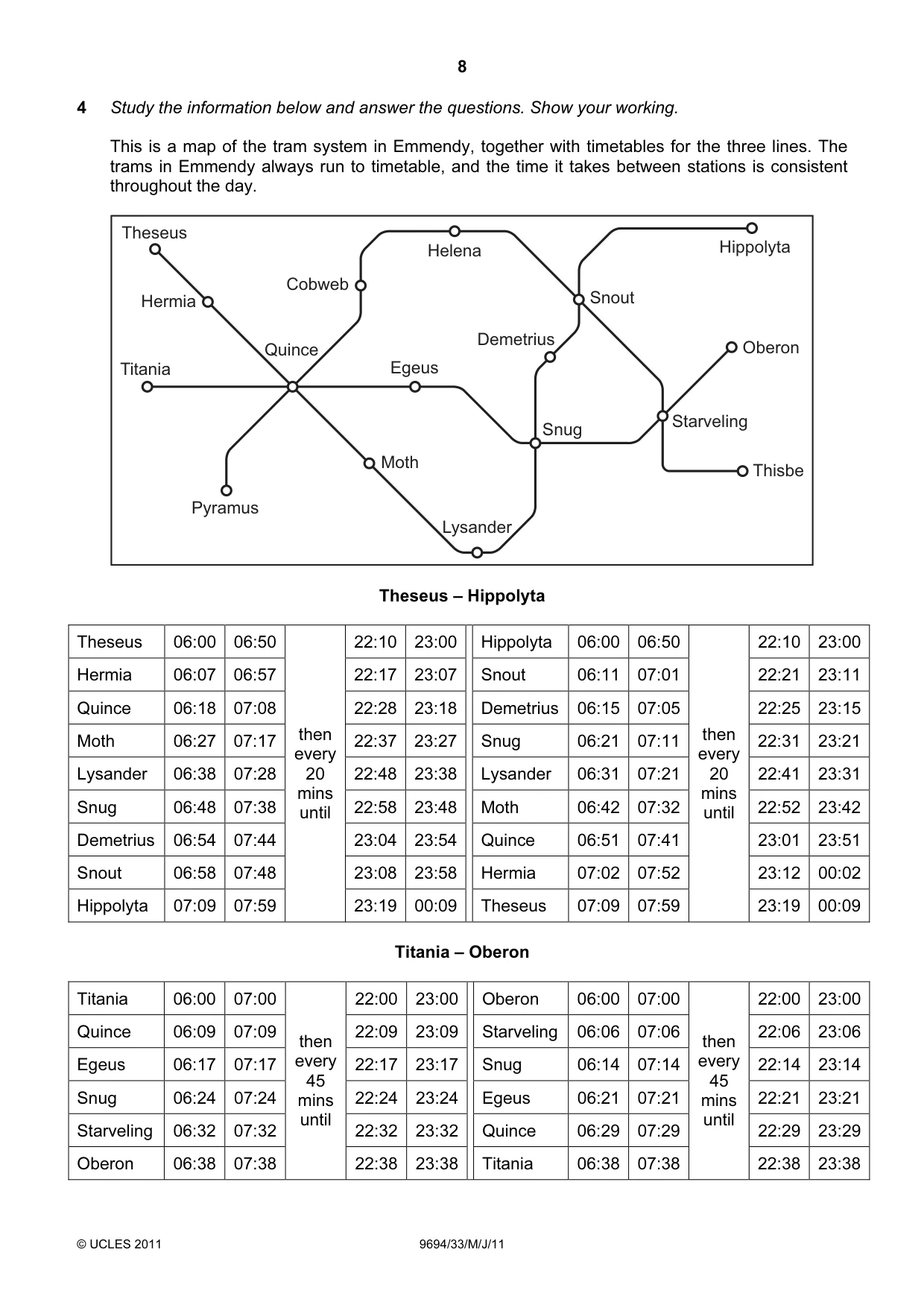
8 © UCLES 2011 9694/33/M/J/11 4 Study the information below and answer the questions. Show your working. This is a map of the tram system in Emmendy, together with timetables for the three lines. The trams in Emmendy always run to timetable, and the time it takes between stations is consistent throughout the day. Theseus Hermia Titania Pyramus Quince Cobweb Helena Egeus Snug Moth Lysander Demetrius Snout Hippolyta Oberon Starveling Thisbe Theseus – Hippolyta Theseus 06:00 06:50 22:10 23:00 Hippolyta 06:00 06:50 22:10 23:00 Hermia 06:07 06:57 22:17 23:07 Snout 06:11 07:01 22:21 23:11 Quince 06:18 07:08 22:28 23:18 Demetrius 06:15 07:05 22:25 23:15 Moth 06:27 07:17 22:37 23:27 Snug 06:21 07:11 22:31 23:21 Lysander 06:38 07:28 22:48 23:38 Lysander 06:31 07:21 22:41 23:31 Snug 06:48 07:38 22:58 23:48 Moth 06:42 07:32 22:52 23:42 Demetrius 06:54 07:44 23:04 23:54 Quince 06:51 07:41 23:01 23:51 Snout 06:58 07:48 23:08 23:58 Hermia 07:02 07:52 23:12 00:02 Hippolyta 07:09 07:59 then every 20 mins until 23:19 00:09 Theseus 07:09 07:59 then every 20 mins until 23:19 00:09 Titania – Oberon Titania 06:00 07:00 22:00 23:00 Oberon 06:00 07:00 22:00 23:00 Quince 06:09 07:09 22:09 23:09 Starveling 06:06 07:06 22:06 23:06 Egeus 06:17 07:17 22:17 23:17 Snug 06:14 07:14 22:14 23:14 Snug 06:24 07:24 22:24 23:24 Egeus 06:21 07:21 22:21 23:21 Starveling 06:32 07:32 22:32 23:32 Quince 06:29 07:29 22:29 23:29 Oberon 06:38 07:38 then every 45 mins until 22:38 23:38 Titania 06:38 07:38 then every 45 mins until 22:38 23:38
Question paper, page 9
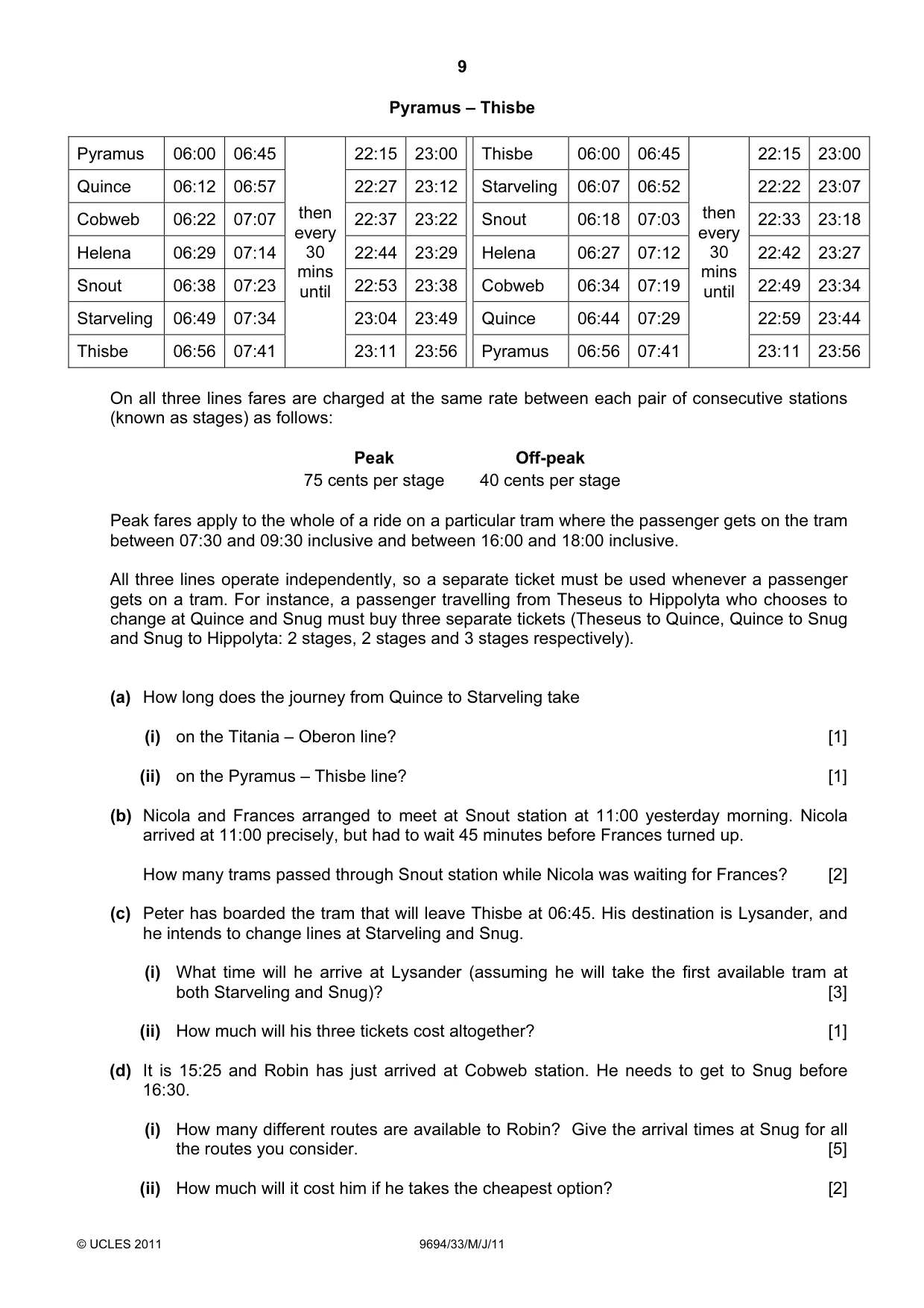
9 © UCLES 2011 9694/33/M/J/11 Pyramus – Thisbe Pyramus 06:00 06:45 22:15 23:00 Thisbe 06:00 06:45 22:15 23:00 Quince 06:12 06:57 22:27 23:12 Starveling 06:07 06:52 22:22 23:07 Cobweb 06:22 07:07 22:37 23:22 Snout 06:18 07:03 22:33 23:18 Helena 06:29 07:14 22:44 23:29 Helena 06:27 07:12 22:42 23:27 Snout 06:38 07:23 22:53 23:38 Cobweb 06:34 07:19 22:49 23:34 Starveling 06:49 07:34 23:04 23:49 Quince 06:44 07:29 22:59 23:44 Thisbe 06:56 07:41 then every 30 mins until 23:11 23:56 Pyramus 06:56 07:41 then every 30 mins until 23:11 23:56 On all three lines fares are charged at the same rate between each pair of consecutive stations (known as stages) as follows: Peak Off-peak 75 cents per stage 40 cents per stage Peak fares apply to the whole of a ride on a particular tram where the passenger gets on the tram between 07:30 and 09:30 inclusive and between 16:00 and 18:00 inclusive. All three lines operate independently, so a separate ticket must be used whenever a passenger gets on a tram. For instance, a passenger travelling from Theseus to Hippolyta who chooses to change at Quince and Snug must buy three separate tickets (Theseus to Quince, Quince to Snug and Snug to Hippolyta: 2 stages, 2 stages and 3 stages respectively). (a) How long does the journey from Quince to Starveling take (i) on the Titania – Oberon line? [1] (ii) on the Pyramus – Thisbe line? [1] (b) Nicola and Frances arranged to meet at Snout station at 11:00 yesterday morning. Nicola arrived at 11:00 precisely, but had to wait 45 minutes before Frances turned up. How many trams passed through Snout station while Nicola was waiting for Frances? [2] (c) Peter has boarded the tram that will leave Thisbe at 06:45. His destination is Lysander, and he intends to change lines at Starveling and Snug. (i) What time will he arrive at Lysander (assuming he will take the first available tram at both Starveling and Snug)? [3] (ii) How much will his three tickets cost altogether? [1] (d) It is 15:25 and Robin has just arrived at Cobweb station. He needs to get to Snug before 16:30. (i) How many different routes are available to Robin? Give the arrival times at Snug for all the routes you consider. [5] (ii) How much will it cost him if he takes the cheapest option? [2]
Question paper, page 10
10 © UCLES 2011 9694/33/M/J/11 BLANK PAGE
Question paper, page 11
11 © UCLES 2011 9694/33/M/J/11 BLANK PAGE
Question paper, page 12
12 Permission to reproduce items where third-party owned material protected by copyright is included has been sought and cleared where possible. Every reasonable effort has been made by the publisher (UCLES) to trace copyright holders, but if any items requiring clearance have unwittingly been included, the publisher will be pleased to make amends at the earliest possible opportunity. University of Cambridge International Examinations is part of the Cambridge Assessment Group. Cambridge Assessment is the brand name of University of Cambridge Local Examinations Syndicate (UCLES), which is itself a department of the University of Cambridge. © UCLES 2011 9694/33/M/J/11 BLANK PAGE
Mark scheme, page 1
UNIVERSITY OF CAMBRIDGE INTERNATIONAL EXAMINATIONS GCE Advanced Level MARK SCHEME for the May/June 2011 question paper for the guidance of teachers 9694 THINKING SKILLS 9694/33 Paper 3 (Problem Analysis and Solution), maximum raw mark 50 This mark scheme is published as an aid to teachers and candidates, to indicate the requirements of the examination. It shows the basis on which Examiners were instructed to award marks. It does not indicate the details of the discussions that took place at an Examiners’ meeting before marking began, which would have considered the acceptability of alternative answers. Mark schemes must be read in conjunction with the question papers and the report on the examination. • Cambridge will not enter into discussions or correspondence in connection with these mark schemes. Cambridge is publishing the mark schemes for the May/June 2011 question papers for most IGCSE, GCE Advanced Level and Advanced Subsidiary Level syllabuses and some Ordinary Level syllabuses.
Mark scheme, page 2
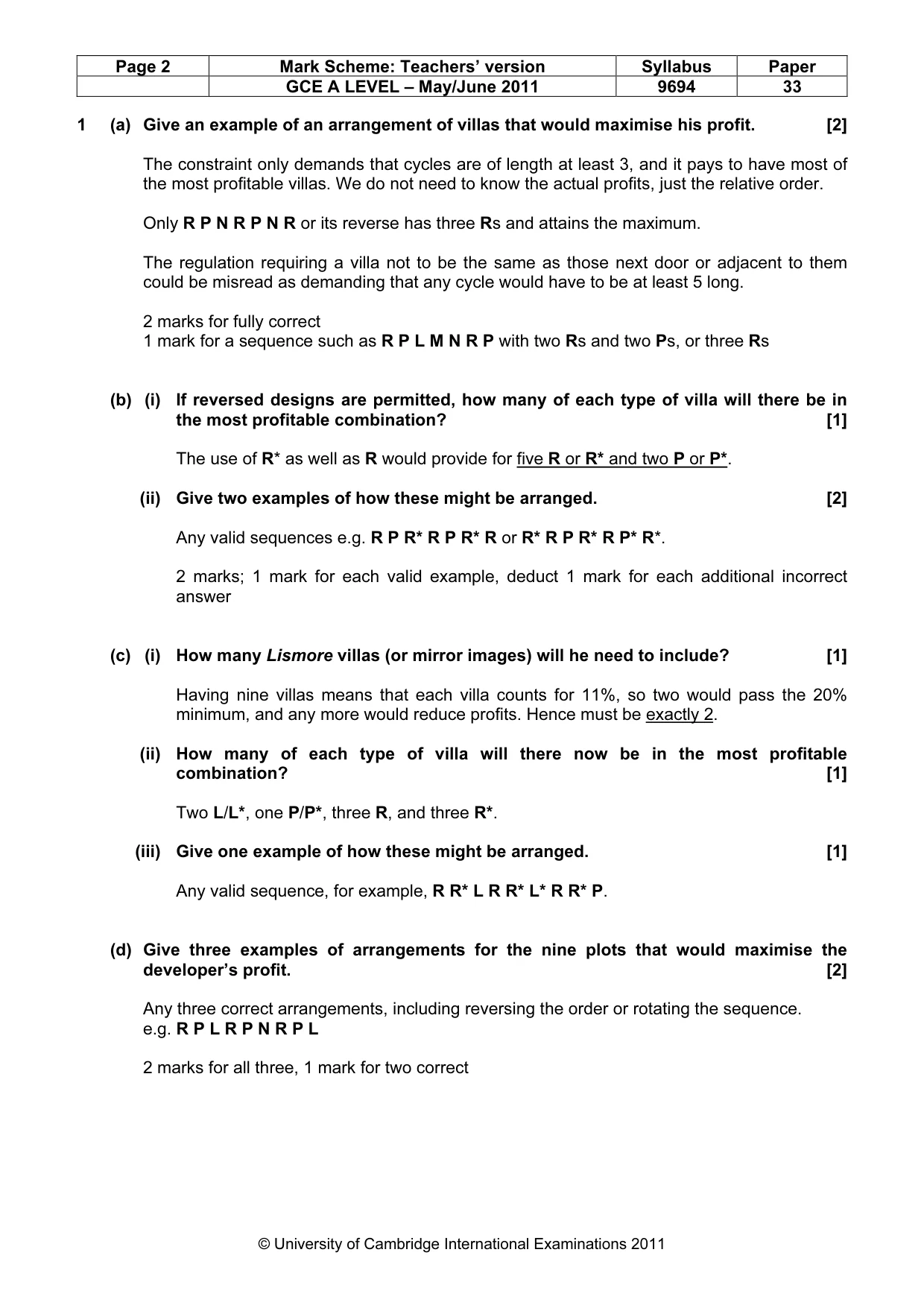
Page 2 Mark Scheme: Teachers’ version Syllabus Paper GCE A LEVEL – May/June 2011 9694 33 © University of Cambridge International Examinations 2011 1 (a) Give an example of an arrangement of villas that would maximise his profit. [2] The constraint only demands that cycles are of length at least 3, and it pays to have most of the most profitable villas. We do not need to know the actual profits, just the relative order. Only R P N R P N R or its reverse has three Rs and attains the maximum. The regulation requiring a villa not to be the same as those next door or adjacent to them could be misread as demanding that any cycle would have to be at least 5 long. 2 marks for fully correct 1 mark for a sequence such as R P L M N R P with two Rs and two Ps, or three Rs (b) (i) If reversed designs are permitted, how many of each type of villa will there be in the most profitable combination? [1] The use of R* as well as R would provide for five R or R* and two P or P*. (ii) Give two examples of how these might be arranged. [2] Any valid sequences e.g. R P R* R P R* R or R* R P R* R P* R*. 2 marks; 1 mark for each valid example, deduct 1 mark for each additional incorrect answer (c) (i) How many Lismore villas (or mirror images) will he need to include? [1] Having nine villas means that each villa counts for 11%, so two would pass the 20% minimum, and any more would reduce profits. Hence must be exactly 2. (ii) How many of each type of villa will there now be in the most profitable combination? [1] Two L/L*, one P/P*, three R, and three R*. (iii) Give one example of how these might be arranged. [1] Any valid sequence, for example, R R* L R R* L* R R* P. (d) Give three examples of arrangements for the nine plots that would maximise the developer’s profit. [2] Any three correct arrangements, including reversing the order or rotating the sequence. e.g. R P L R P N R P L 2 marks for all three, 1 mark for two correct
Mark scheme, page 3
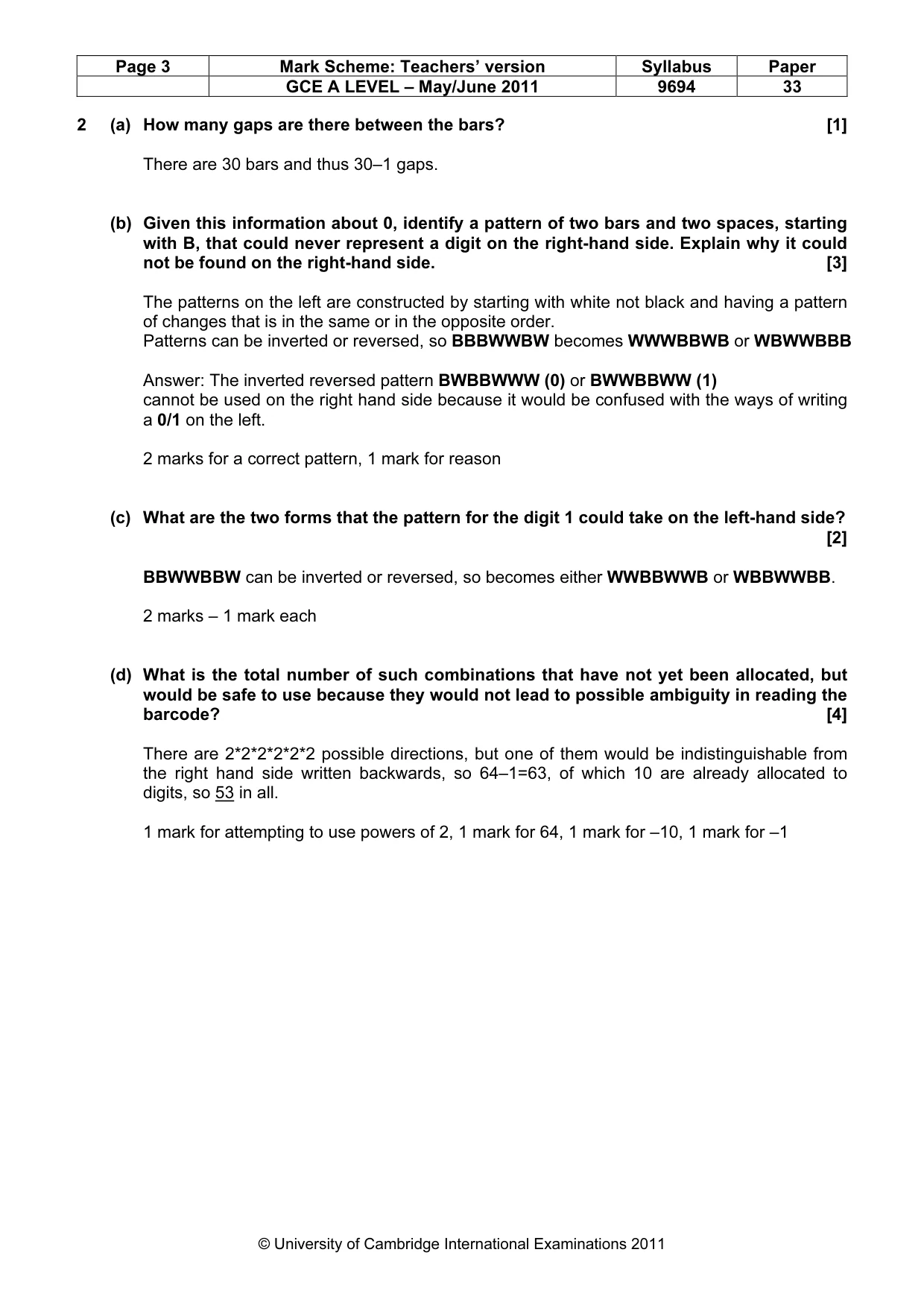
Page 3 Mark Scheme: Teachers’ version Syllabus Paper GCE A LEVEL – May/June 2011 9694 33 © University of Cambridge International Examinations 2011 2 (a) How many gaps are there between the bars? [1] There are 30 bars and thus 30–1 gaps. (b) Given this information about 0, identify a pattern of two bars and two spaces, starting with B, that could never represent a digit on the right-hand side. Explain why it could not be found on the right-hand side. [3] The patterns on the left are constructed by starting with white not black and having a pattern of changes that is in the same or in the opposite order. Patterns can be inverted or reversed, so BBBWWBW becomes WWWBBWB or WBWWBBB Answer: The inverted reversed pattern BWBBWWW (0) or BWWBBWW (1) cannot be used on the right hand side because it would be confused with the ways of writing a 0/1 on the left. 2 marks for a correct pattern, 1 mark for reason (c) What are the two forms that the pattern for the digit 1 could take on the left-hand side? [2] BBWWBBW can be inverted or reversed, so becomes either WWBBWWB or WBBWWBB. 2 marks – 1 mark each (d) What is the total number of such combinations that have not yet been allocated, but would be safe to use because they would not lead to possible ambiguity in reading the barcode? [4] There are 2*2*2*2*2*2 possible directions, but one of them would be indistinguishable from the right hand side written backwards, so 64–1=63, of which 10 are already allocated to digits, so 53 in all. 1 mark for attempting to use powers of 2, 1 mark for 64, 1 mark for –10, 1 mark for –1
Mark scheme, page 4
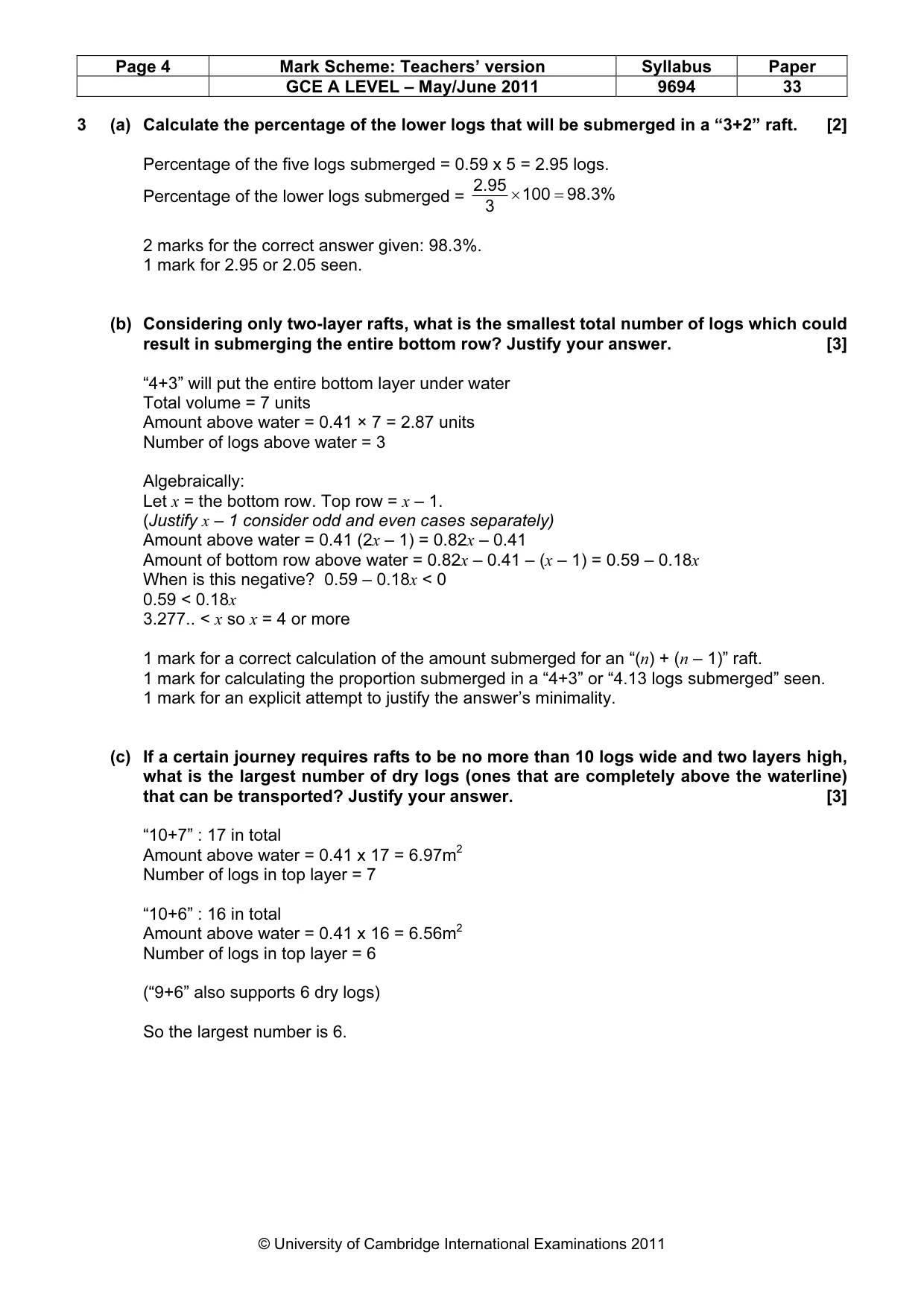
Page 4 Mark Scheme: Teachers’ version Syllabus Paper GCE A LEVEL – May/June 2011 9694 33 © University of Cambridge International Examinations 2011 3 (a) Calculate the percentage of the lower logs that will be submerged in a “3+2” raft. [2] Percentage of the five logs submerged = 0.59 x 5 = 2.95 logs. Percentage of the lower logs submerged = 98.3% 100 3 2.95 = × 2 marks for the correct answer given: 98.3%. 1 mark for 2.95 or 2.05 seen. (b) Considering only two-layer rafts, what is the smallest total number of logs which could result in submerging the entire bottom row? Justify your answer. [3] “4+3” will put the entire bottom layer under water Total volume = 7 units Amount above water = 0.41 × 7 = 2.87 units Number of logs above water = 3 Algebraically: Let x = the bottom row. Top row = x – 1. (Justify x – 1 consider odd and even cases separately) Amount above water = 0.41 (2x – 1) = 0.82x – 0.41 Amount of bottom row above water = 0.82x – 0.41 – (x – 1) = 0.59 – 0.18x When is this negative? 0.59 – 0.18x < 0 0.59 < 0.18x 3.277.. < x so x = 4 or more 1 mark for a correct calculation of the amount submerged for an “(n) + (n – 1)” raft. 1 mark for calculating the proportion submerged in a “4+3” or “4.13 logs submerged” seen. 1 mark for an explicit attempt to justify the answer’s minimality. (c) If a certain journey requires rafts to be no more than 10 logs wide and two layers high, what is the largest number of dry logs (ones that are completely above the waterline) that can be transported? Justify your answer. [3] “10+7” : 17 in total Amount above water = 0.41 x 17 = 6.97m2 Number of logs in top layer = 7 “10+6” : 16 in total Amount above water = 0.41 x 16 = 6.56m2 Number of logs in top layer = 6 (“9+6” also supports 6 dry logs) So the largest number is 6.
Mark scheme, page 5
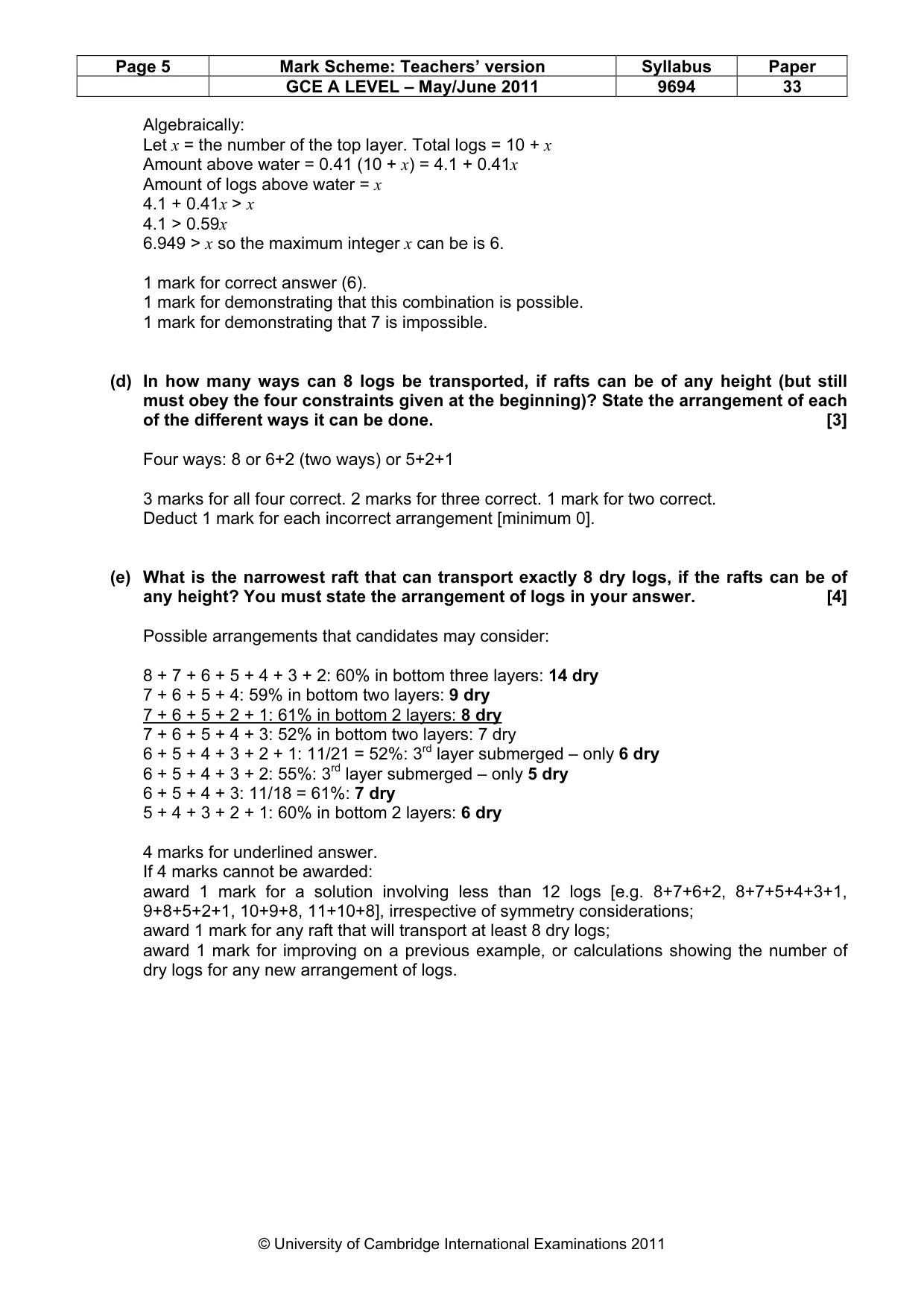
Page 5 Mark Scheme: Teachers’ version Syllabus Paper GCE A LEVEL – May/June 2011 9694 33 © University of Cambridge International Examinations 2011 Algebraically: Let x = the number of the top layer. Total logs = 10 + x Amount above water = 0.41 (10 + x) = 4.1 + 0.41x Amount of logs above water = x 4.1 + 0.41x > x 4.1 > 0.59x 6.949 > x so the maximum integer x can be is 6. 1 mark for correct answer (6). 1 mark for demonstrating that this combination is possible. 1 mark for demonstrating that 7 is impossible. (d) In how many ways can 8 logs be transported, if rafts can be of any height (but still must obey the four constraints given at the beginning)? State the arrangement of each of the different ways it can be done. [3] Four ways: 8 or 6+2 (two ways) or 5+2+1 3 marks for all four correct. 2 marks for three correct. 1 mark for two correct. Deduct 1 mark for each incorrect arrangement [minimum 0]. (e) What is the narrowest raft that can transport exactly 8 dry logs, if the rafts can be of any height? You must state the arrangement of logs in your answer. [4] Possible arrangements that candidates may consider: 8 + 7 + 6 + 5 + 4 + 3 + 2: 60% in bottom three layers: 14 dry 7 + 6 + 5 + 4: 59% in bottom two layers: 9 dry 7 + 6 + 5 + 2 + 1: 61% in bottom 2 layers: 8 dry 7 + 6 + 5 + 4 + 3: 52% in bottom two layers: 7 dry 6 + 5 + 4 + 3 + 2 + 1: 11/21 = 52%: 3rd layer submerged – only 6 dry 6 + 5 + 4 + 3 + 2: 55%: 3rd layer submerged – only 5 dry 6 + 5 + 4 + 3: 11/18 = 61%: 7 dry 5 + 4 + 3 + 2 + 1: 60% in bottom 2 layers: 6 dry 4 marks for underlined answer. If 4 marks cannot be awarded: award 1 mark for a solution involving less than 12 logs [e.g. 8+7+6+2, 8+7+5+4+3+1, 9+8+5+2+1, 10+9+8, 11+10+8], irrespective of symmetry considerations; award 1 mark for any raft that will transport at least 8 dry logs; award 1 mark for improving on a previous example, or calculations showing the number of dry logs for any new arrangement of logs.
Mark scheme, page 6
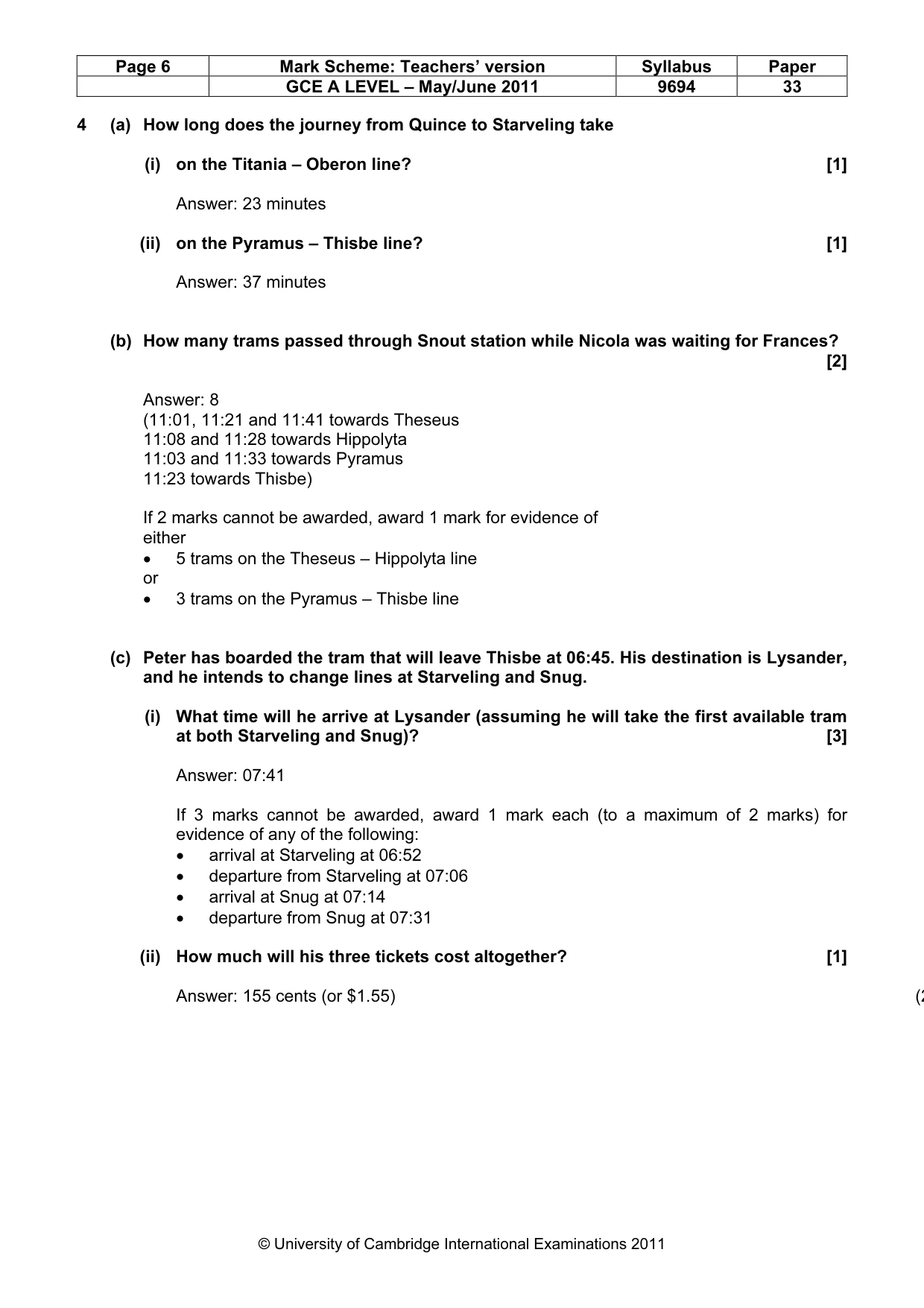
Page 6 Mark Scheme: Teachers’ version Syllabus Paper GCE A LEVEL – May/June 2011 9694 33 © University of Cambridge International Examinations 2011 4 (a) How long does the journey from Quince to Starveling take (i) on the Titania – Oberon line? [1] Answer: 23 minutes (ii) on the Pyramus – Thisbe line? [1] Answer: 37 minutes (b) How many trams passed through Snout station while Nicola was waiting for Frances? [2] Answer: 8 (11:01, 11:21 and 11:41 towards Theseus 11:08 and 11:28 towards Hippolyta 11:03 and 11:33 towards Pyramus 11:23 towards Thisbe) If 2 marks cannot be awarded, award 1 mark for evidence of either • 5 trams on the Theseus – Hippolyta line or • 3 trams on the Pyramus – Thisbe line (c) Peter has boarded the tram that will leave Thisbe at 06:45. His destination is Lysander, and he intends to change lines at Starveling and Snug. (i) What time will he arrive at Lysander (assuming he will take the first available tram at both Starveling and Snug)? [3] Answer: 07:41 If 3 marks cannot be awarded, award 1 mark each (to a maximum of 2 marks) for evidence of any of the following: • arrival at Starveling at 06:52 • departure from Starveling at 07:06 • arrival at Snug at 07:14 • departure from Snug at 07:31 (ii) How much will his three tickets cost altogether? [1] Answer: 155 cents (or $1.55) (2
Mark scheme, page 7
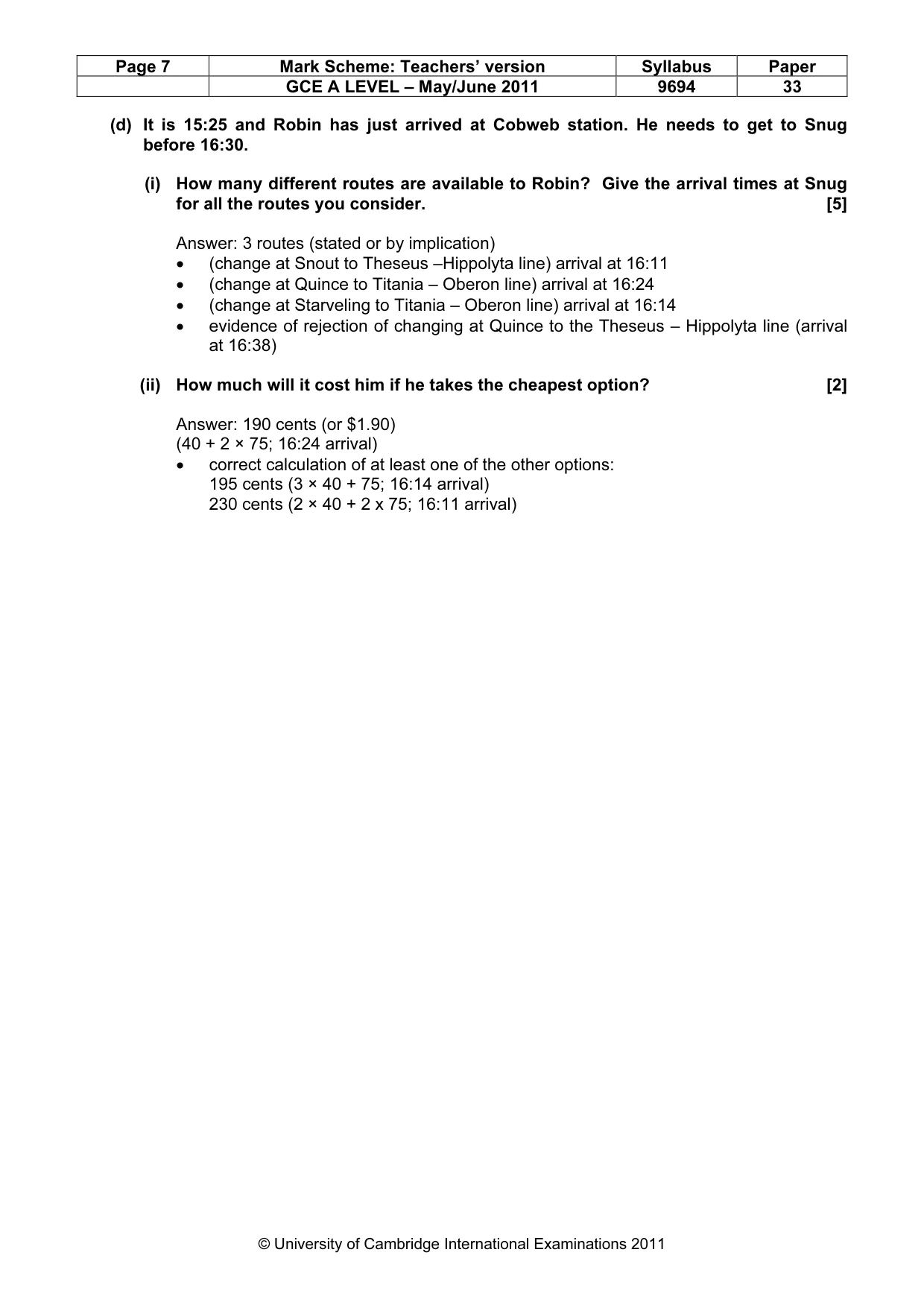
Page 7 Mark Scheme: Teachers’ version Syllabus Paper GCE A LEVEL – May/June 2011 9694 33 © University of Cambridge International Examinations 2011 (d) It is 15:25 and Robin has just arrived at Cobweb station. He needs to get to Snug before 16:30. (i) How many different routes are available to Robin? Give the arrival times at Snug for all the routes you consider. [5] Answer: 3 routes (stated or by implication) • (change at Snout to Theseus –Hippolyta line) arrival at 16:11 • (change at Quince to Titania – Oberon line) arrival at 16:24 • (change at Starveling to Titania – Oberon line) arrival at 16:14 • evidence of rejection of changing at Quince to the Theseus – Hippolyta line (arrival at 16:38) (ii) How much will it cost him if he takes the cheapest option? [2] Answer: 190 cents (or $1.90) (40 + 2 × 75; 16:24 arrival) • correct calculation of at least one of the other options: 195 cents (3 × 40 + 75; 16:14 arrival) 230 cents (2 × 40 + 2 x 75; 16:11 arrival)
What you needed in this session
Cambridge’s own grade thresholds for 2011 May/June, Paper 3 · Variant 3. A higher threshold means an easier paper — the bar moves with how the cohort did.