Cambridge A Level Psychology (from 2018) 9990 — 2022 Feb/March Paper 2 · Variant 2
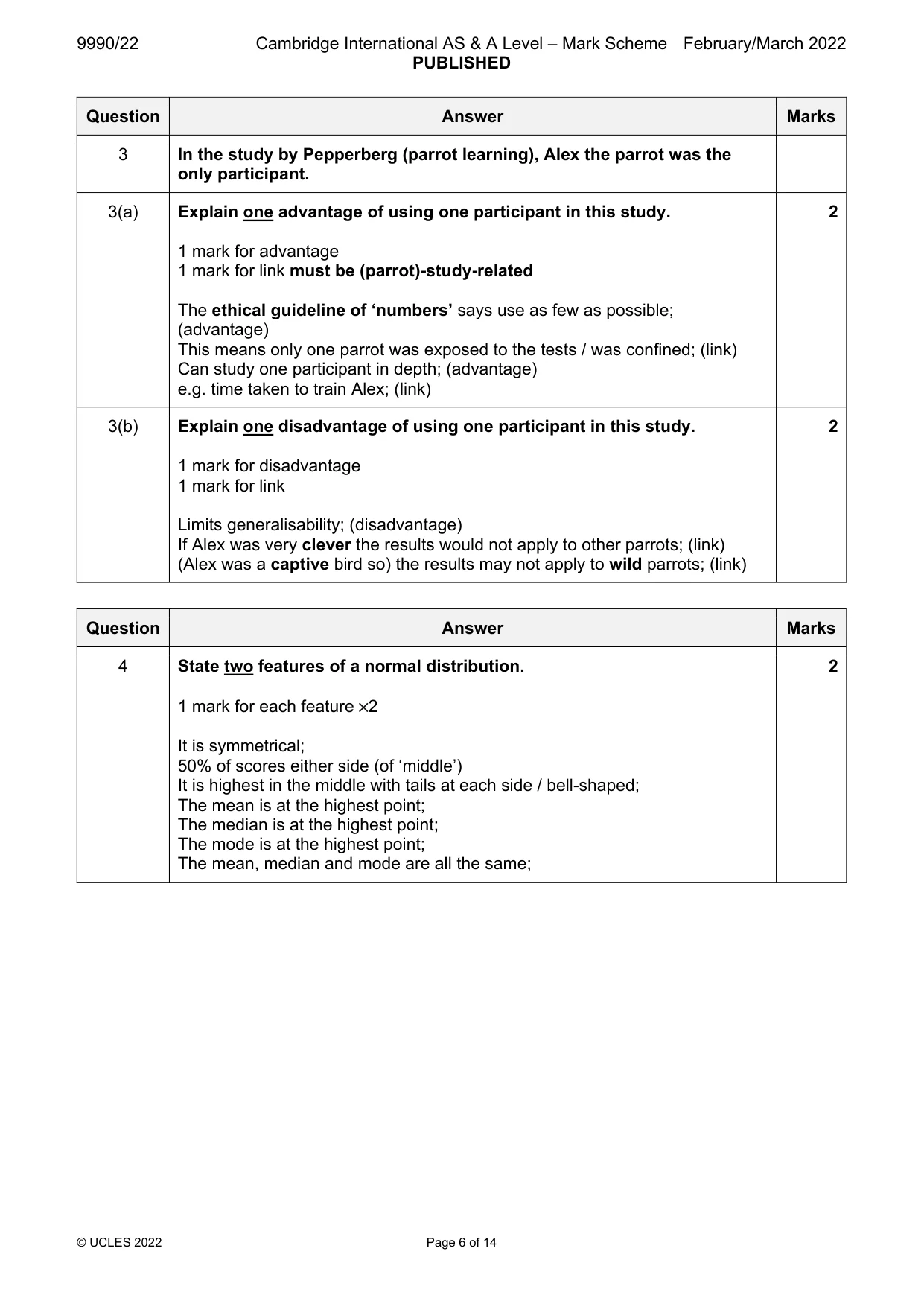
9990/22/F/M/22 · 10 questions · 60 marks · ≈68 min
The question paper and its mark scheme, free to read here and free to download. This is Cambridge’s own paper, exactly as it was sat.
Question paper12 pages


Mark scheme14 pages
Answers below. Sit the paper first if you are practising.
Questions as text
Q1 · The study by Andrade (doodling) was a laboratory experiment
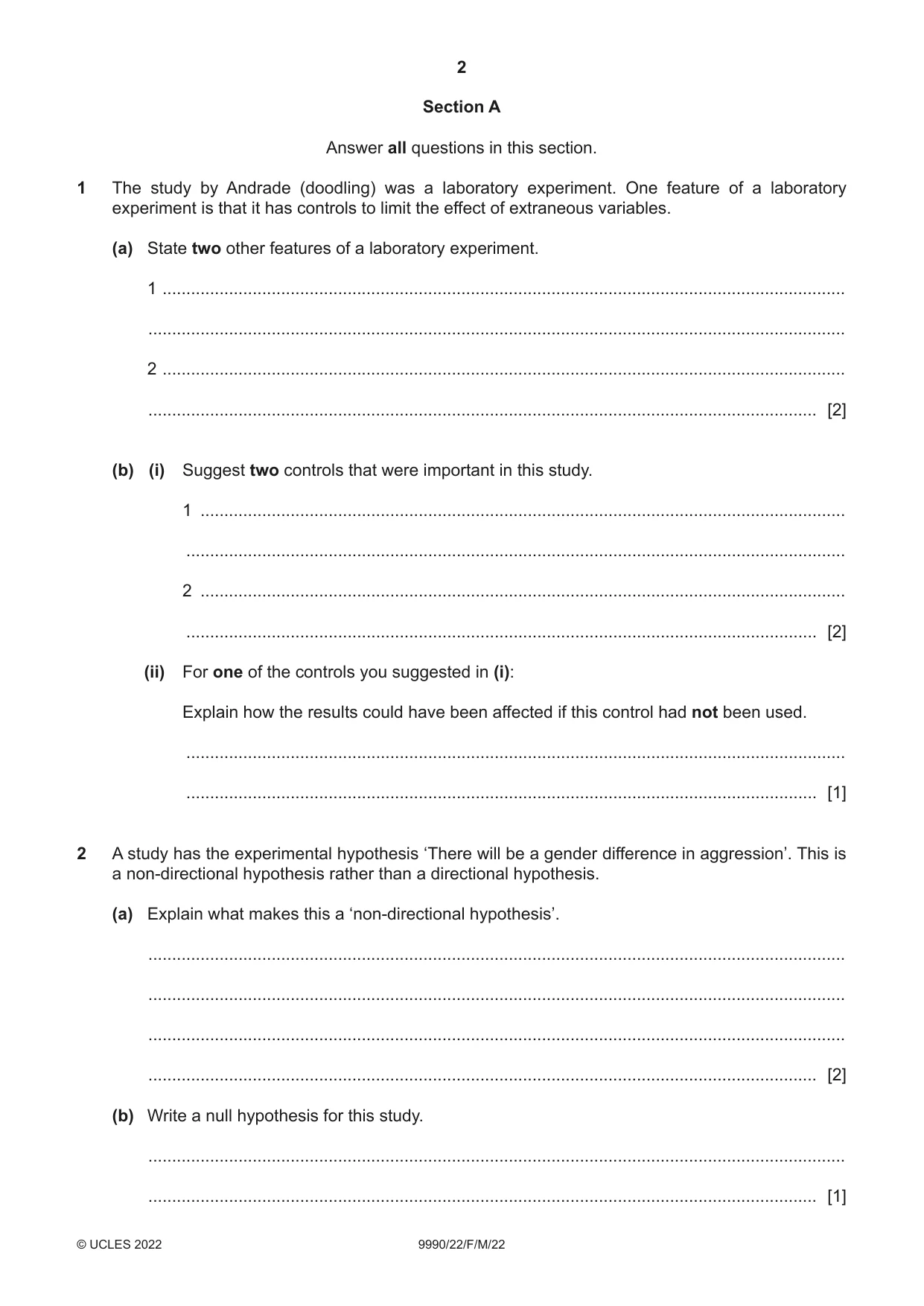
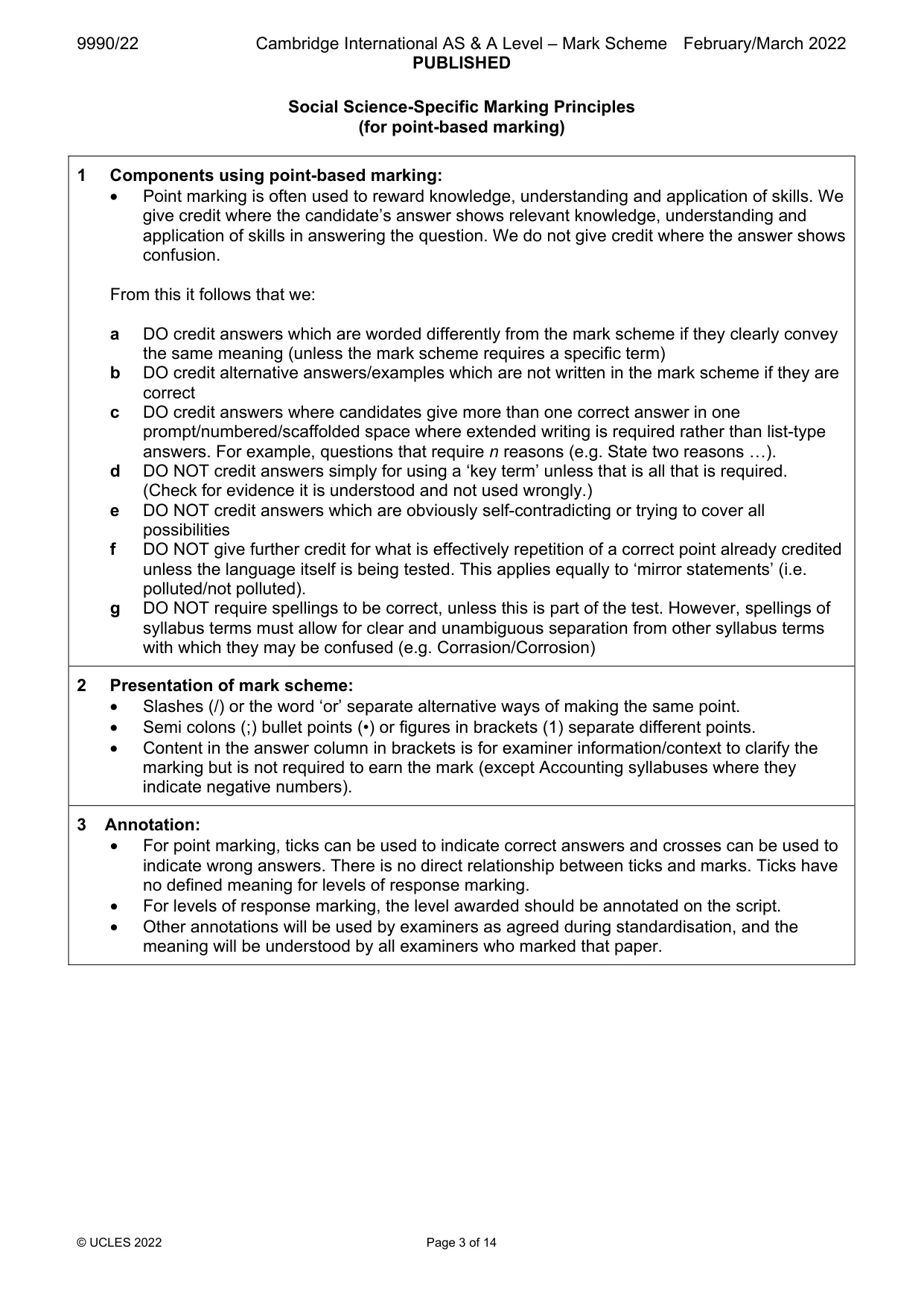
1 The study by Andrade (doodling) was a laboratory experiment. One feature of a laboratory experiment is that it has controls to limit the effect of extraneous variables. (a) State two other features of a laboratory experiment. 1 ................................................................................................................................................ ................................................................................................................................................... 2 ................................................................................................................................................ ............................................................................................................................................. [2] (b) (i) Suggest two controls that were important in this study. 1 ........................................................................................................................................ ........................................................................................................................................... 2 ........................................................................................................................................ ..................................................................................................................................... [2] (ii) For one of the controls you suggested in (i): Explain how the results could have been affected if this control had not been used. ........................................................................................................................................... ..................................................................................................................................... [1]
Mark scheme: Question Answer Marks 1 The study by Andrade (doodling) was a laboratory experiment. One feature of a laboratory experiment is that it has controls to limit the effect of extraneous variables. 1(a) State two other features of a laboratory experiment. 2 1 mark per feature ×2 Manipulated independent variable / conditions / levels; Measured dependent variable; Conducted in an artificial environment (for the behaviour being studied) / not the participant’s usual/normal/natural environment / uses (scientific) equipment; Note: consequences/strengths/weaknesses of the lab experiment as a method are not features, e.g. high validity = 0 [irrl] Closed/controlled setting = 0 [ignore] 1(b)(i) Suggest two controls that were important in this study. 2 1 mark per control identified ×2 Volume (comfortable for each participant); Message was recorded / heard same message / message same length / message 2.5 minutes long; All/both groups participants had paper; 1(b)(ii) For one of the controls you suggested in (i): 1 Explain how the results could have been affected if this control had not been used. 1 mark for reason for the effect of the control Volume (control): an unclear message would be harder to remember; (effect on results) Message was recorded (control): faster message would be harder to remember; (effect on results) Length of message (control): a shorter message could better/worse recall; (effect on results)
Q2 · A study has the experimental hypothesis ‘There will be a gender difference in aggression’
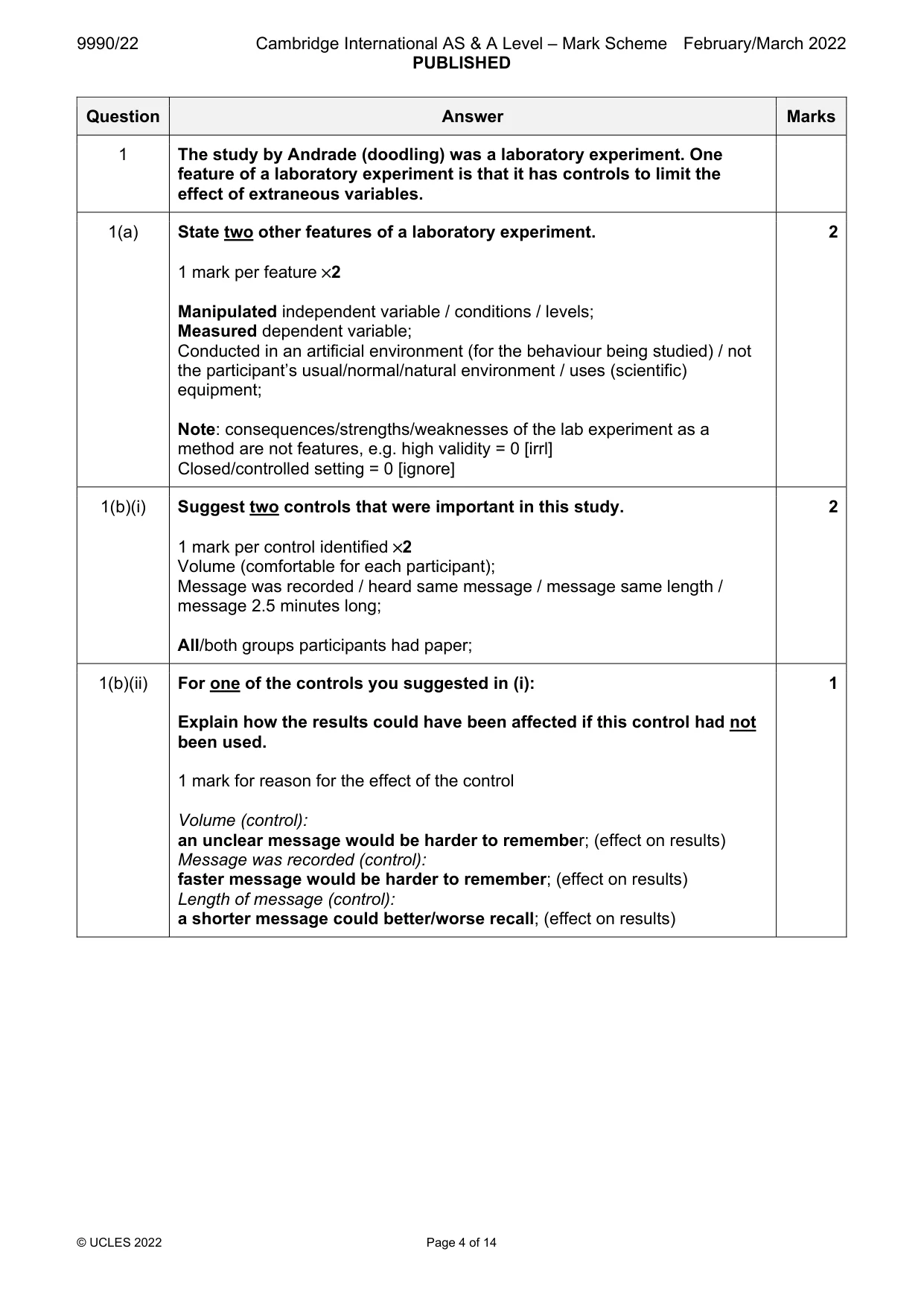
2 A study has the experimental hypothesis ‘There will be a gender difference in aggression’. This is a non-directional hypothesis rather than a directional hypothesis. (a) Explain what makes this a ‘non-directional hypothesis’. ................................................................................................................................................... ................................................................................................................................................... ................................................................................................................................................... ............................................................................................................................................. [2] (b) Write a null hypothesis for this study. ................................................................................................................................................... ............................................................................................................................................. [1]
Mark scheme: 2 A study has the experimental hypothesis ‘There will be a gender difference in aggression’. This is a non-directional hypothesis rather than a directional hypothesis. 2(a) Explain what makes this a ‘non-directional hypothesis’. 2 1st mark for definition of non-directional hypotheses 2nd mark for explaining that it says ‘gender’ not which gender/sex will be more aggressive Because it (only) says there will be a difference = 1 (definition) Because it only says that males and females will be different = 1 (definition) It should say which sex is more aggressive in order to be directional = 2 (definition and explanation) It is non-directional as it says ‘difference’ but would say men were more aggressive than women = 2 (ORA) It doesn’t state which sex would be more aggressive and would if it was directional = 2 It should say which sex is more aggressive = 0 (because not clear whether this means ‘if it were directional’) A non-directional hypothesis does not state the direction of the effect/results/difference = 0 [REP] References to correlational hypotheses are irrelevant [ignore them] 2(b) Write a null hypothesis for this study. 1 1 mark for null hypothesis (does not have to be operationalised) There will be no gender difference in aggression; Any gender difference in aggression is due to chance; There is no difference between gender and aggression = 0 Any difference between gender and aggression is due to chance = 0
Q3 · In the study by Pepperberg (parrot learning), Alex the parrot was the only participant
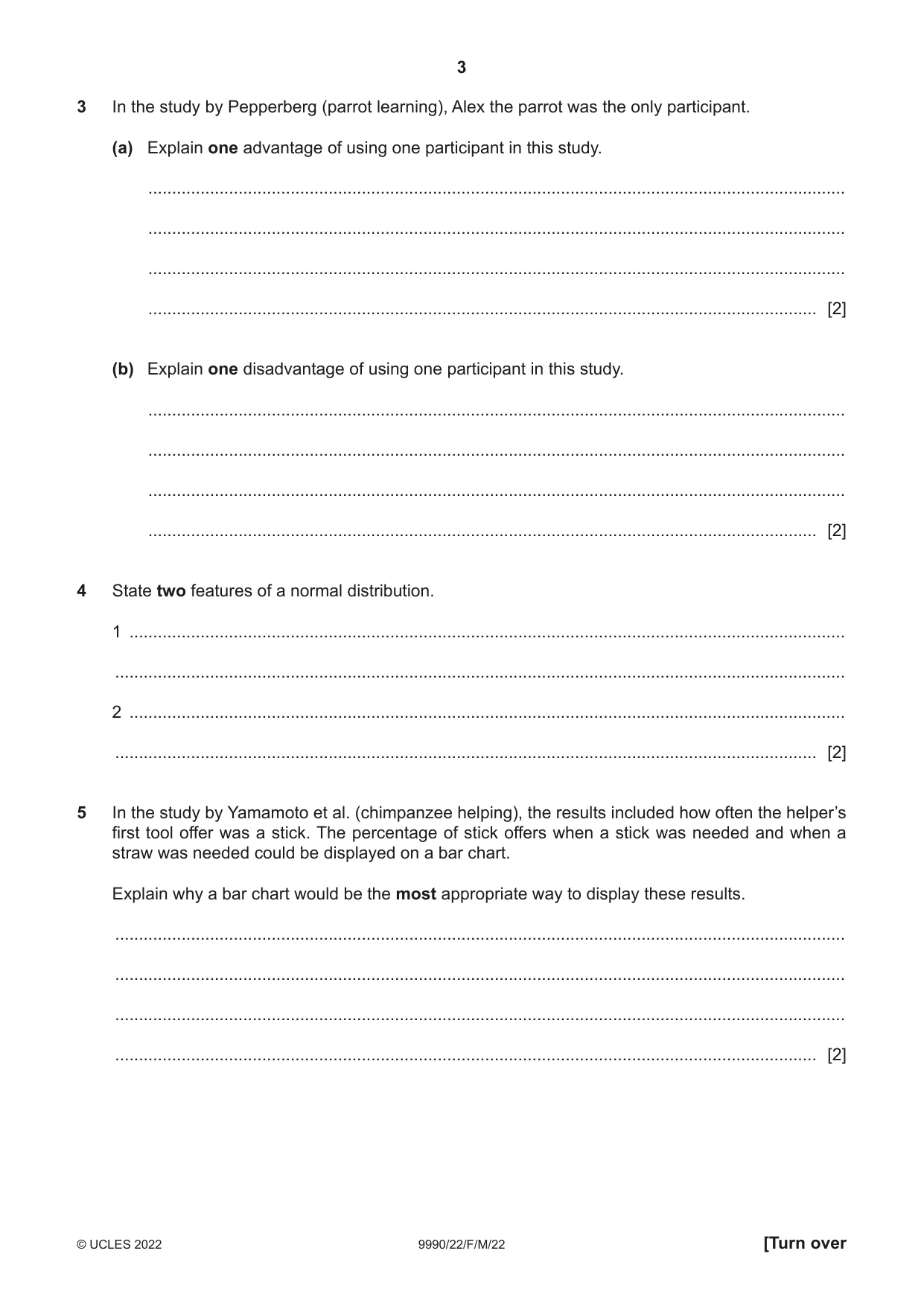
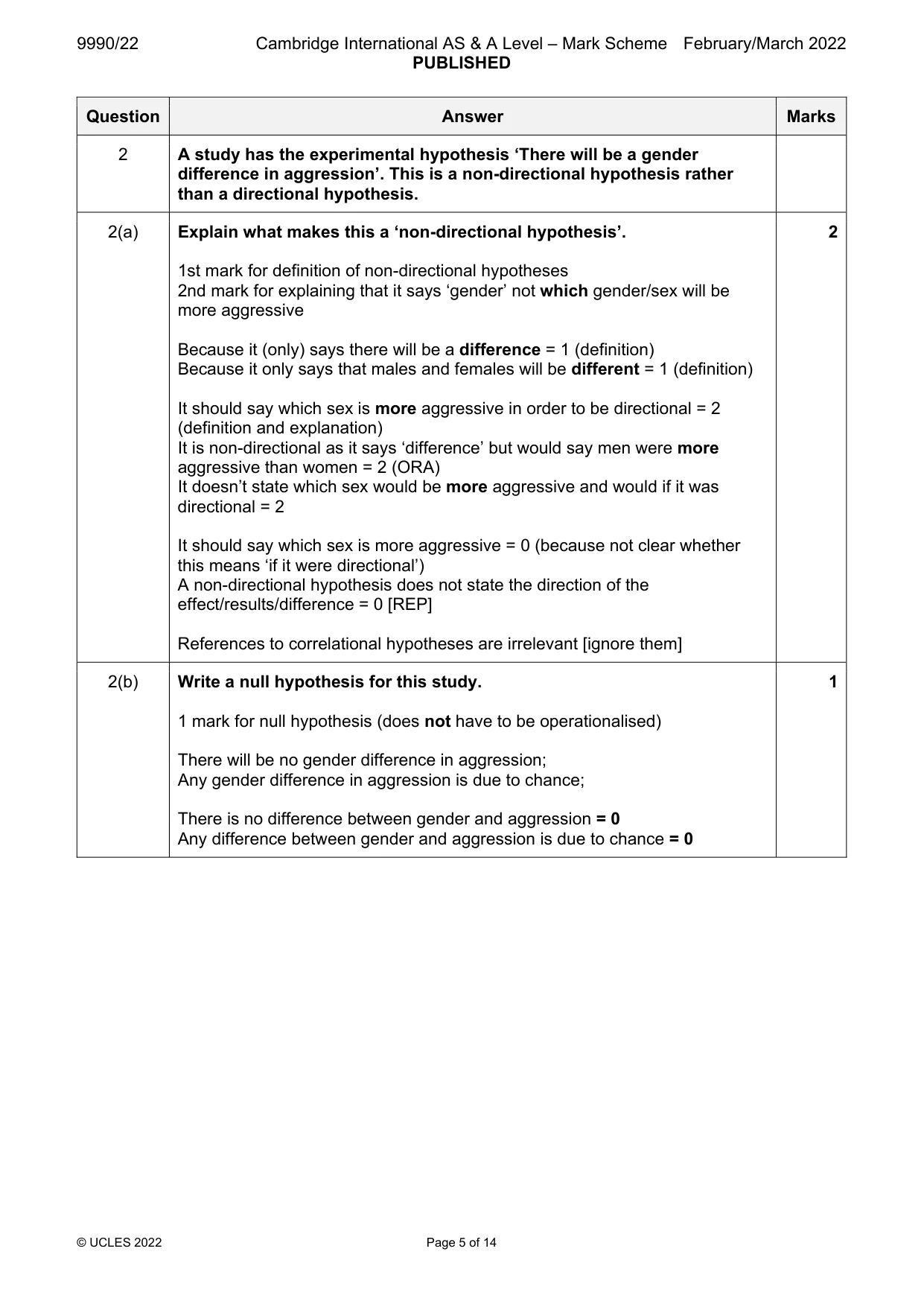
3 In the study by Pepperberg (parrot learning), Alex the parrot was the only participant. (a) Explain one advantage of using one participant in this study. ................................................................................................................................................... ................................................................................................................................................... ................................................................................................................................................... ............................................................................................................................................. [2] (b) Explain one disadvantage of using one participant in this study. ................................................................................................................................................... ................................................................................................................................................... ................................................................................................................................................... ............................................................................................................................................. [2]
Mark scheme: 3 In the study by Pepperberg (parrot learning), Alex the parrot was the only participant. 3(a) Explain one advantage of using one participant in this study. 2 1 mark for advantage 1 mark for link must be (parrot)-study-related The ethical guideline of ‘numbers’ says use as few as possible; (advantage) This means only one parrot was exposed to the tests / was confined; (link) Can study one participant in depth; (advantage) e.g. time taken to train Alex; (link) 3(b) Explain one disadvantage of using one participant in this study. 2 1 mark for disadvantage 1 mark for link Limits generalisability; (disadvantage) If Alex was very clever the results would not apply to other parrots; (link) (Alex was a captive bird so) the results may not apply to wild parrots; (link)
Q4 · State two features of a normal distribution
4 State two features of a normal distribution. 1 ....................................................................................................................................................... .......................................................................................................................................................... 2 ....................................................................................................................................................... .................................................................................................................................................... [2]
Mark scheme: 4 State two features of a normal distribution. 2 1 mark for each feature ×2 It is symmetrical; 50% of scores either side (of ‘middle’) It is highest in the middle with tails at each side / bell-shaped; The mean is at the highest point; The median is at the highest point; The mode is at the highest point; The mean, median and mode are all the same;
Q5 · In the study by Yamamoto et al
5 In the study by Yamamoto et al. (chimpanzee helping), the results included how often the helper’s first tool offer was a stick. The percentage of stick offers when a stick was needed and when a straw was needed could be displayed on a bar chart. Explain why a bar chart would be the most appropriate way to display these results. .......................................................................................................................................................... .......................................................................................................................................................... .......................................................................................................................................................... .................................................................................................................................................... [2]
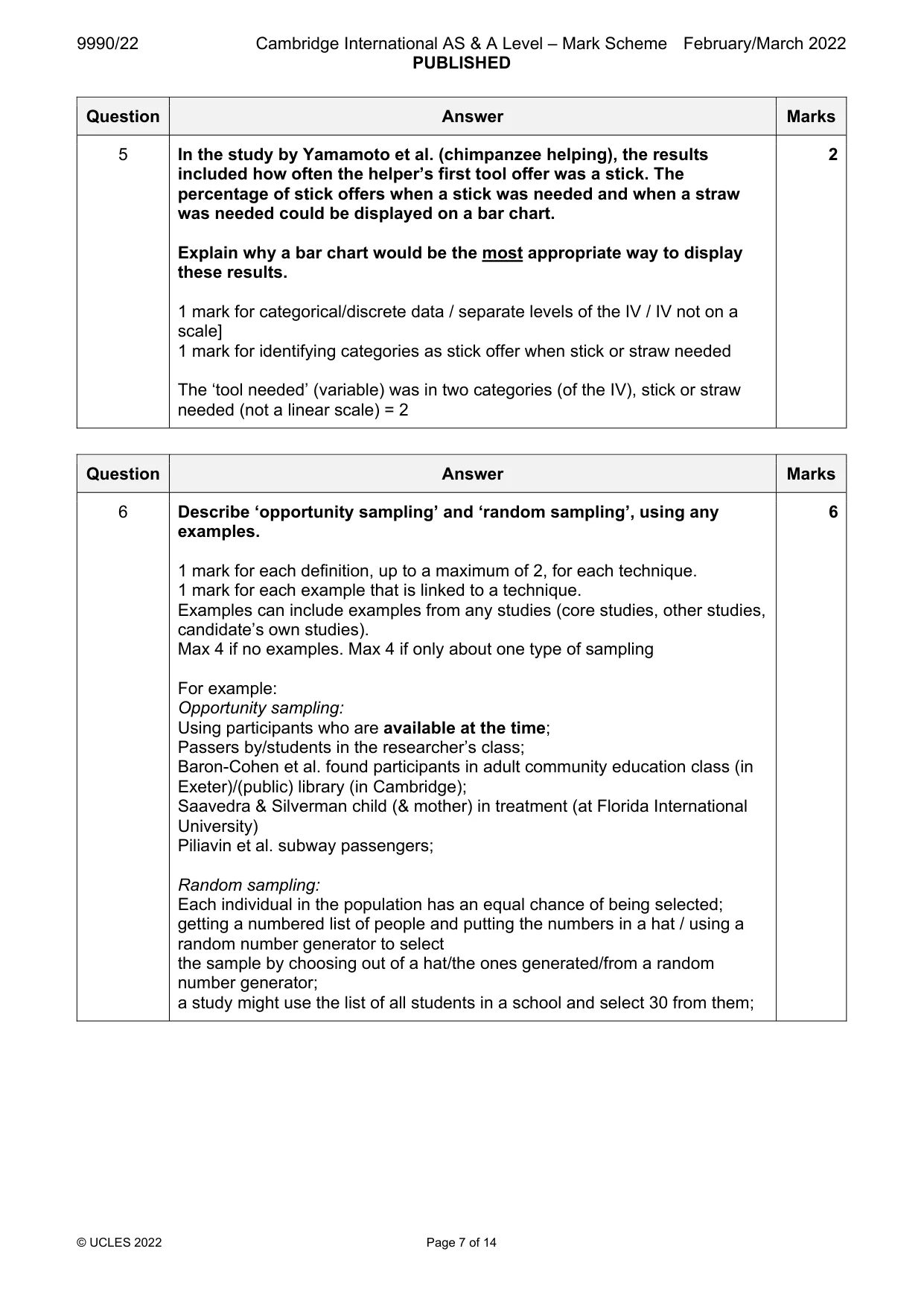
Mark scheme: 5 In the study by Yamamoto et al. (chimpanzee helping), the results 2 included how often the helper’s first tool offer was a stick. The percentage of stick offers when a stick was needed and when a straw was needed could be displayed on a bar chart. Explain why a bar chart would be the most appropriate way to display these results. 1 mark for categorical/discrete data / separate levels of the IV / IV not on a scale] 1 mark for identifying categories as stick offer when stick or straw needed The ‘tool needed’ (variable) was in two categories (of the IV), stick or straw needed (not a linear scale) = 2
Q6 · Describe ‘opportunity sampling’ and ‘random sampling’, using any examples
6 Describe ‘opportunity sampling’ and ‘random sampling’, using any examples. .......................................................................................................................................................... .......................................................................................................................................................... .......................................................................................................................................................... .......................................................................................................................................................... .......................................................................................................................................................... .......................................................................................................................................................... .......................................................................................................................................................... .......................................................................................................................................................... .......................................................................................................................................................... .......................................................................................................................................................... .......................................................................................................................................................... .................................................................................................................................................... [6]
Mark scheme: 6 Describe ‘opportunity sampling’ and ‘random sampling’, using any 6 examples. 1 mark for each definition, up to a maximum of 2, for each technique. 1 mark for each example that is linked to a technique. Examples can include examples from any studies (core studies, other studies, candidate’s own studies). Max 4 if no examples. Max 4 if only about one type of sampling For example: Opportunity sampling: Using participants who are available at the time; Passers by/students in the researcher’s class; Baron-Cohen et al. found participants in adult community education class (in Exeter)/(public) library (in Cambridge); Saavedra & Silverman child (& mother) in treatment (at Florida International University) Piliavin et al. subway passengers; Random sampling: Each individual in the population has an equal chance of being selected; getting a numbered list of people and putting the numbers in a hat / using a random number generator to select the sample by choosing out of a hat/the ones generated/from a random number generator; a study might use the list of all students in a school and select 30 from them;
Q7 · Clark is a psychologist investigating whether the behaviours people dream about can be…
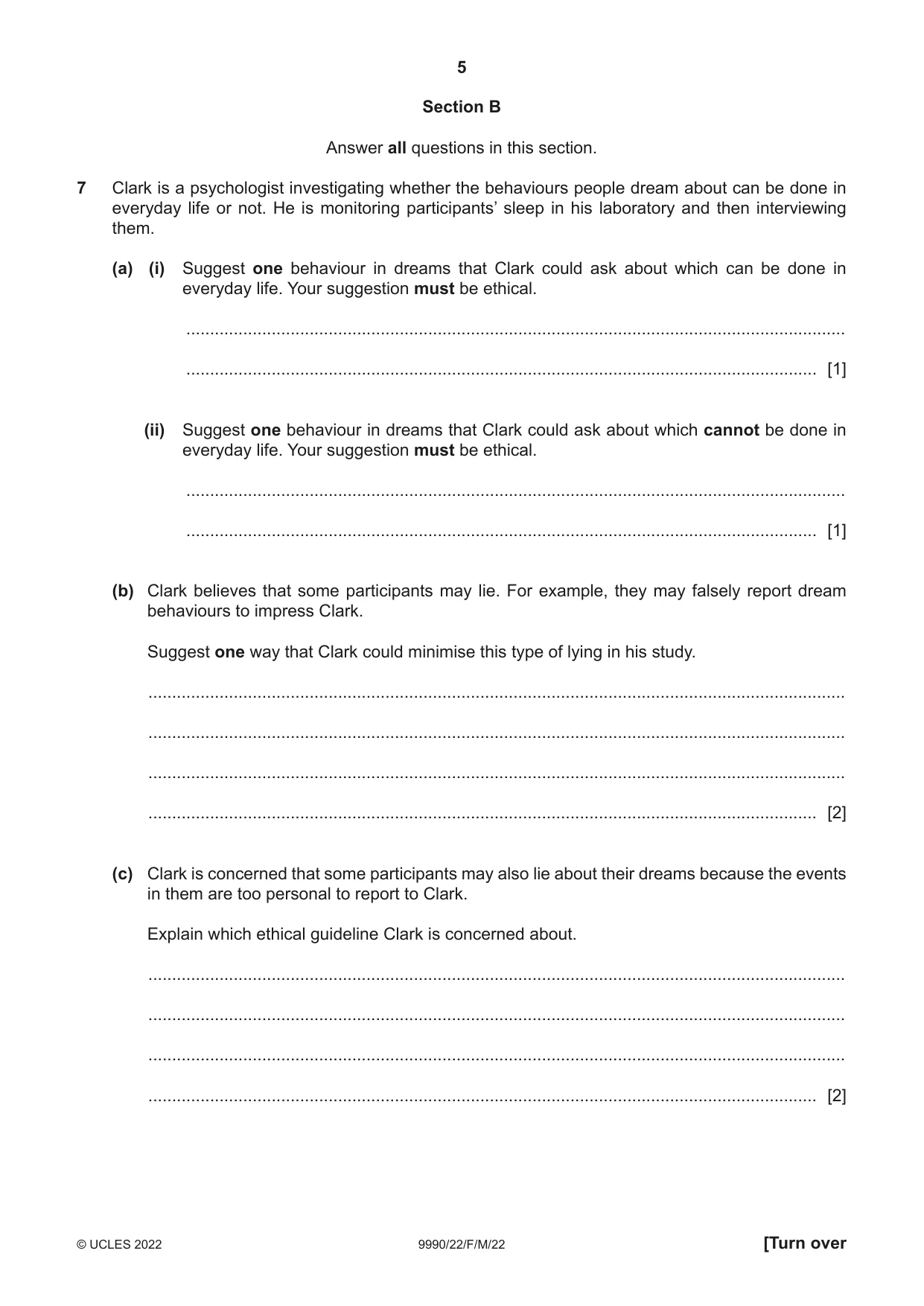
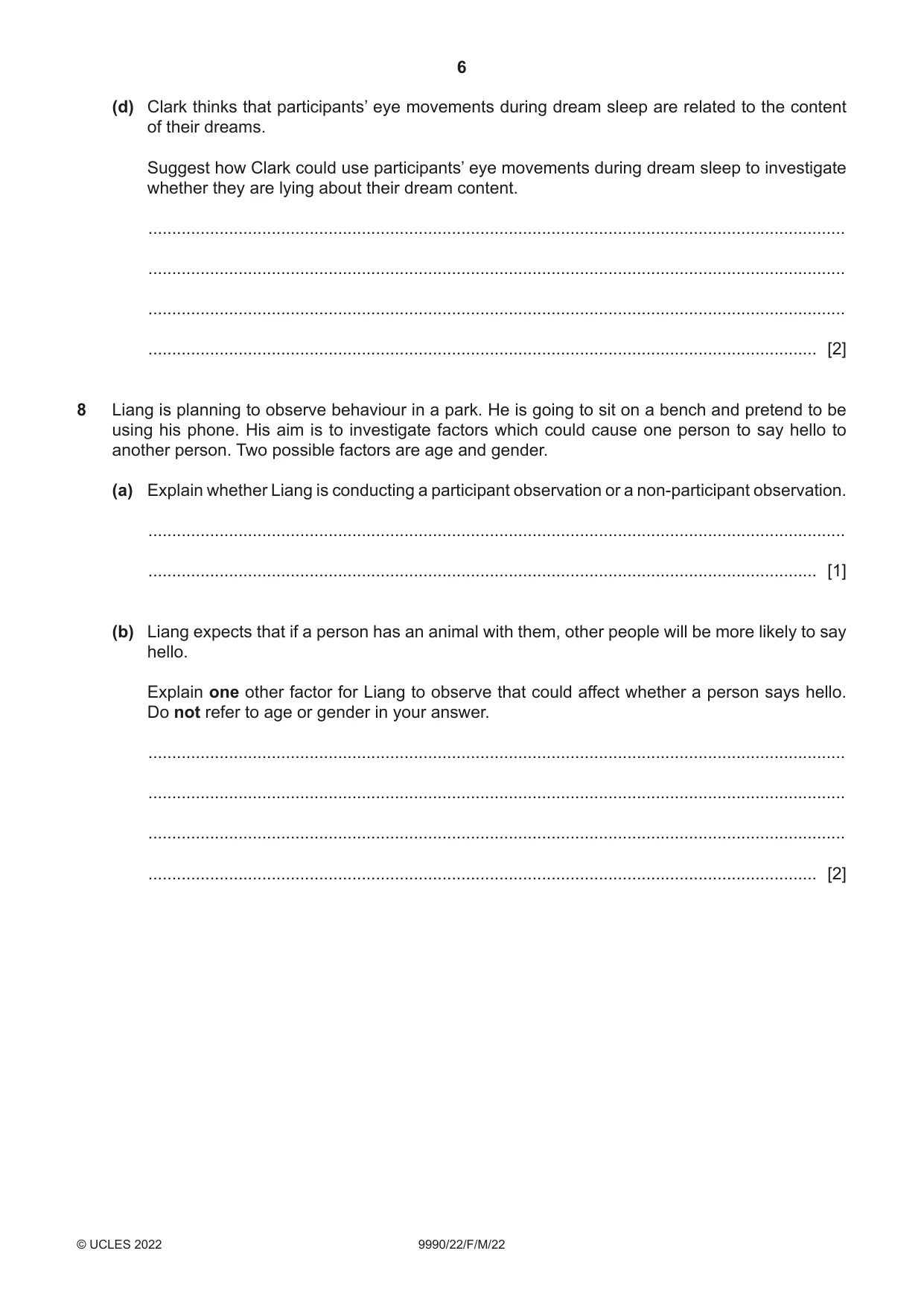
7 Clark is a psychologist investigating whether the behaviours people dream about can be done in everyday life or not. He is monitoring participants’ sleep in his laboratory and then interviewing them. (a) (i) Suggest one behaviour in dreams that Clark could ask about which can be done in everyday life. Your suggestion must be ethical. ........................................................................................................................................... ..................................................................................................................................... [1] (ii) Suggest one behaviour in dreams that Clark could ask about which cannot be done in everyday life. Your suggestion must be ethical. ........................................................................................................................................... ..................................................................................................................................... [1] (b) Clark believes that some participants may lie. For example, they may falsely report dream behaviours to impress Clark. Suggest one way that Clark could minimise this type of lying in his study. ................................................................................................................................................... ................................................................................................................................................... ................................................................................................................................................... ............................................................................................................................................. [2] (c) Clark is concerned that some participants may also lie about their dreams because the events in them are too personal to report to Clark. Explain which ethical guideline Clark is concerned about. ................................................................................................................................................... ................................................................................................................................................... ................................................................................................................................................... ............................................................................................................................................. [2] (d) Clark thinks that participants’ eye movements during dream sleep are related to the content of their dreams. Suggest how Clark could use participants’ eye movements during dream sleep to investigate whether they are lying about their dream content. ................................................................................................................................................... ................................................................................................................................................... ................................................................................................................................................... ............................................................................................................................................. [2]
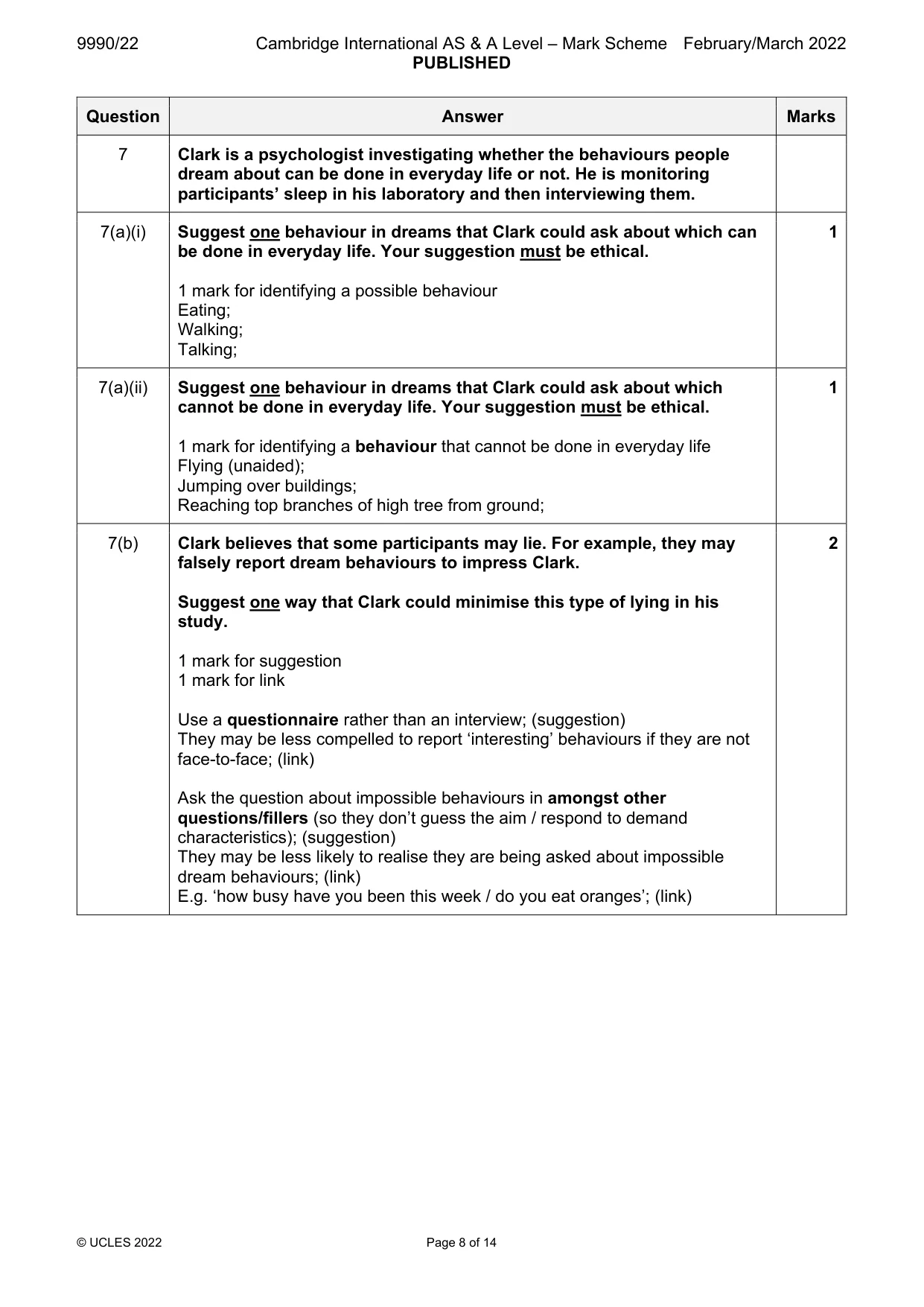
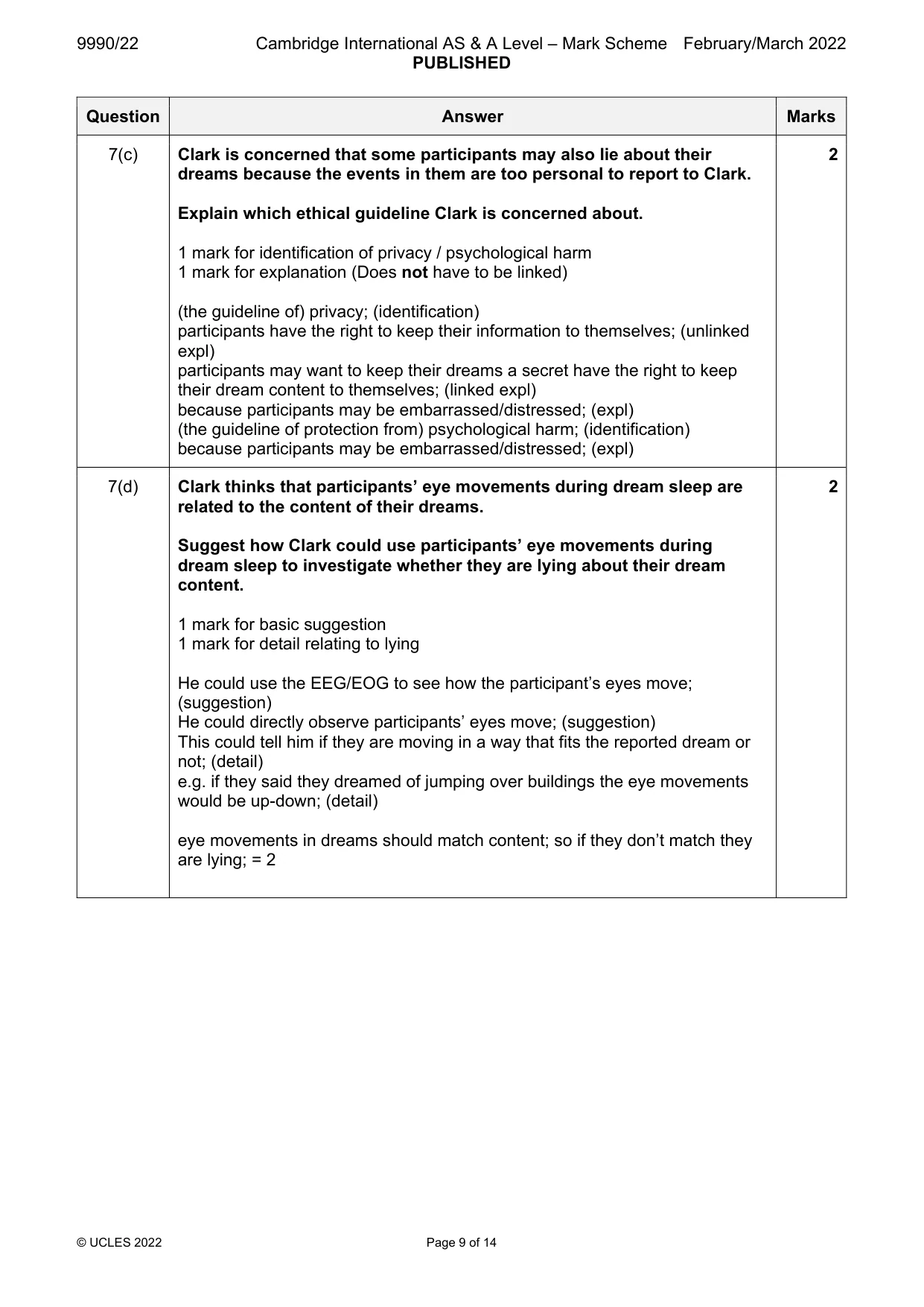
Mark scheme: 7 Clark is a psychologist investigating whether the behaviours people dream about can be done in everyday life or not. He is monitoring participants’ sleep in his laboratory and then interviewing them. 7(a)(i) Suggest one behaviour in dreams that Clark could ask about which can 1 be done in everyday life. Your suggestion must be ethical. 1 mark for identifying a possible behaviour Eating; Walking; Talking; 7(a)(ii) Suggest one behaviour in dreams that Clark could ask about which 1 cannot be done in everyday life. Your suggestion must be ethical. 1 mark for identifying a behaviour that cannot be done in everyday life Flying (unaided); Jumping over buildings; Reaching top branches of high tree from ground; 7(b) Clark believes that some participants may lie. For example, they may 2 falsely report dream behaviours to impress Clark. Suggest one way that Clark could minimise this type of lying in his study. 1 mark for suggestion 1 mark for link Use a questionnaire rather than an interview; (suggestion) They may be less compelled to report ‘interesting’ behaviours if they are not face-to-face; (link) Ask the question about impossible behaviours in amongst other questions/fillers (so they don’t guess the aim / respond to demand characteristics); (suggestion) They may be less likely to realise they are being asked about impossible dream behaviours; (link) E.g. ‘how busy have you been this week / do you eat oranges’; (link) 7(c) Clark is concerned that some participants may also lie about their 2 dreams because the events in them are too personal to report to Clark. Explain which ethical guideline Clark is concerned about. 1 mark for identification of privacy / psychological harm 1 mark for explanation (Does not have to be linked) (the guideline of) privacy; (identification) participants have the right to keep their information to themselves; (unlinked expl) participants may want to keep their dreams a secret have the right to keep their dream content to themselves; (linked expl) because participants may be embarrassed/distressed; (expl) (the guideline of protection from) psychological harm; (identification) because participants may be embarrassed/distressed; (expl) 7(d) Clark thinks that participants’ eye movements during dream sleep are 2 related to the content of their dreams. Suggest how Clark could use participants’ eye movements during dream sleep to investigate whether they are lying about their dream content. 1 mark for basic suggestion 1 mark for detail relating to lying He could use the EEG/EOG to see how the participant’s eyes move; (suggestion) He could directly observe participants’ eyes move; (suggestion) This could tell him if they are moving in a way that fits the reported dream or not; (detail) e.g. if they said they dreamed of jumping over buildings the eye movements would be up-down; (detail) eye movements in dreams should match content; so if they don’t match they are lying; = 2
Q8 · Liang is planning to observe behaviour in a park
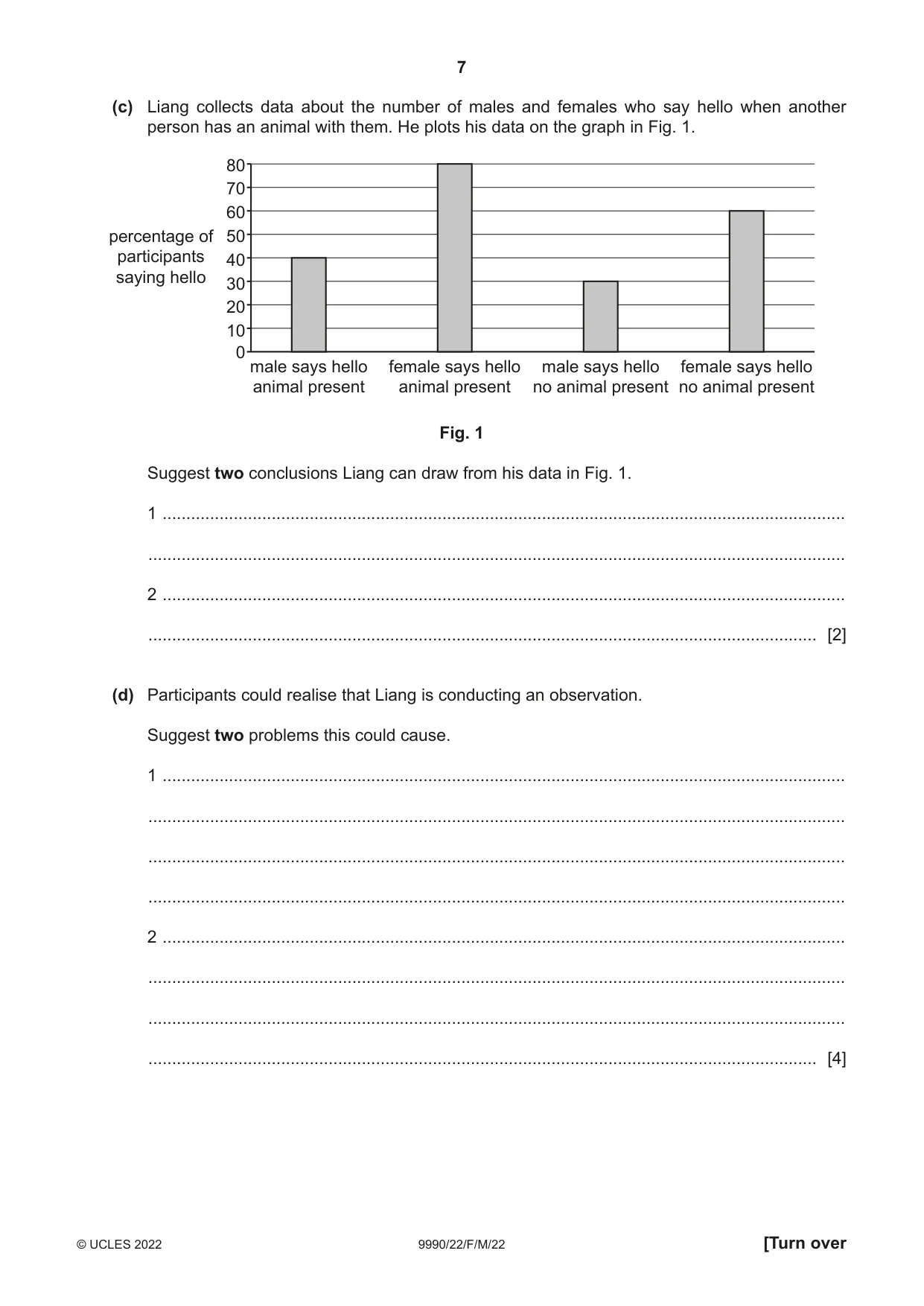
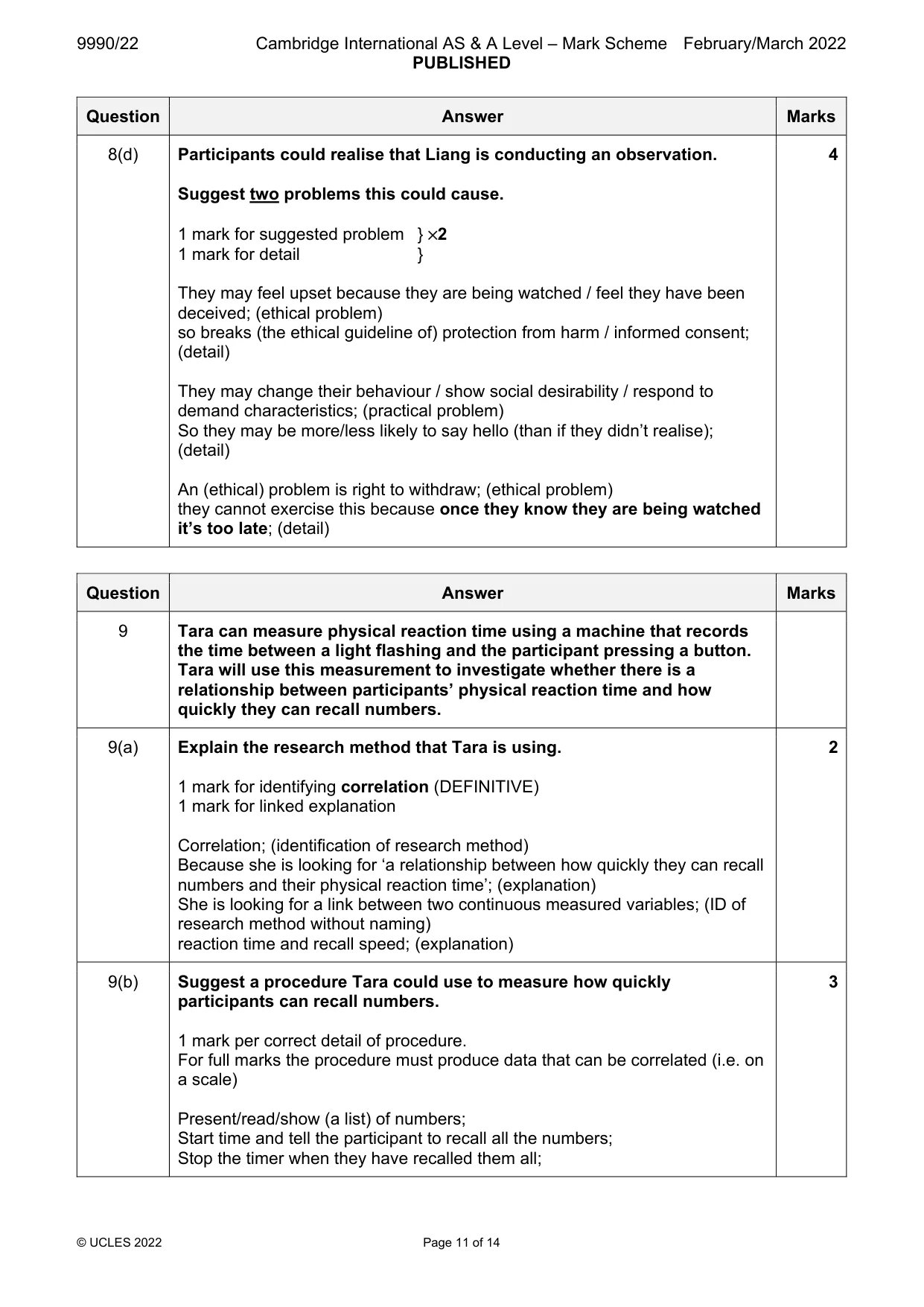
8 Liang is planning to observe behaviour in a park. He is going to sit on a bench and pretend to be using his phone. His aim is to investigate factors which could cause one person to say hello to another person. Two possible factors are age and gender. (a) Explain whether Liang is conducting a participant observation or a non-participant observation. ................................................................................................................................................... ............................................................................................................................................. [1] (b) Liang expects that if a person has an animal with them, other people will be more likely to say hello. Explain one other factor for Liang to observe that could affect whether a person says hello. Do not refer to age or gender in your answer. ................................................................................................................................................... ................................................................................................................................................... ................................................................................................................................................... ............................................................................................................................................. [2] (c) Liang collects data about the number of males and females who say hello when another person has an animal with them. He plots his data on the graph in Fig. 1. 80 70 60 percentage of 50 participants 40 saying hello 30 20 10 0 male says hello female says hello male says hello female says hello animal present animal present no animal present no animal present Fig. 1 Suggest two conclusions Liang can draw from his data in Fig. 1. 1 ................................................................................................................................................ ................................................................................................................................................... 2 ................................................................................................................................................ ............................................................................................................................................. [2] (d) Participants could realise that Liang is conducting an observation. Suggest two problems this could cause. 1 ................................................................................................................................................ ................................................................................................................................................... ................................................................................................................................................... ................................................................................................................................................... 2 ................................................................................................................................................ ................................................................................................................................................... ................................................................................................................................................... ............................................................................................................................................. [4]
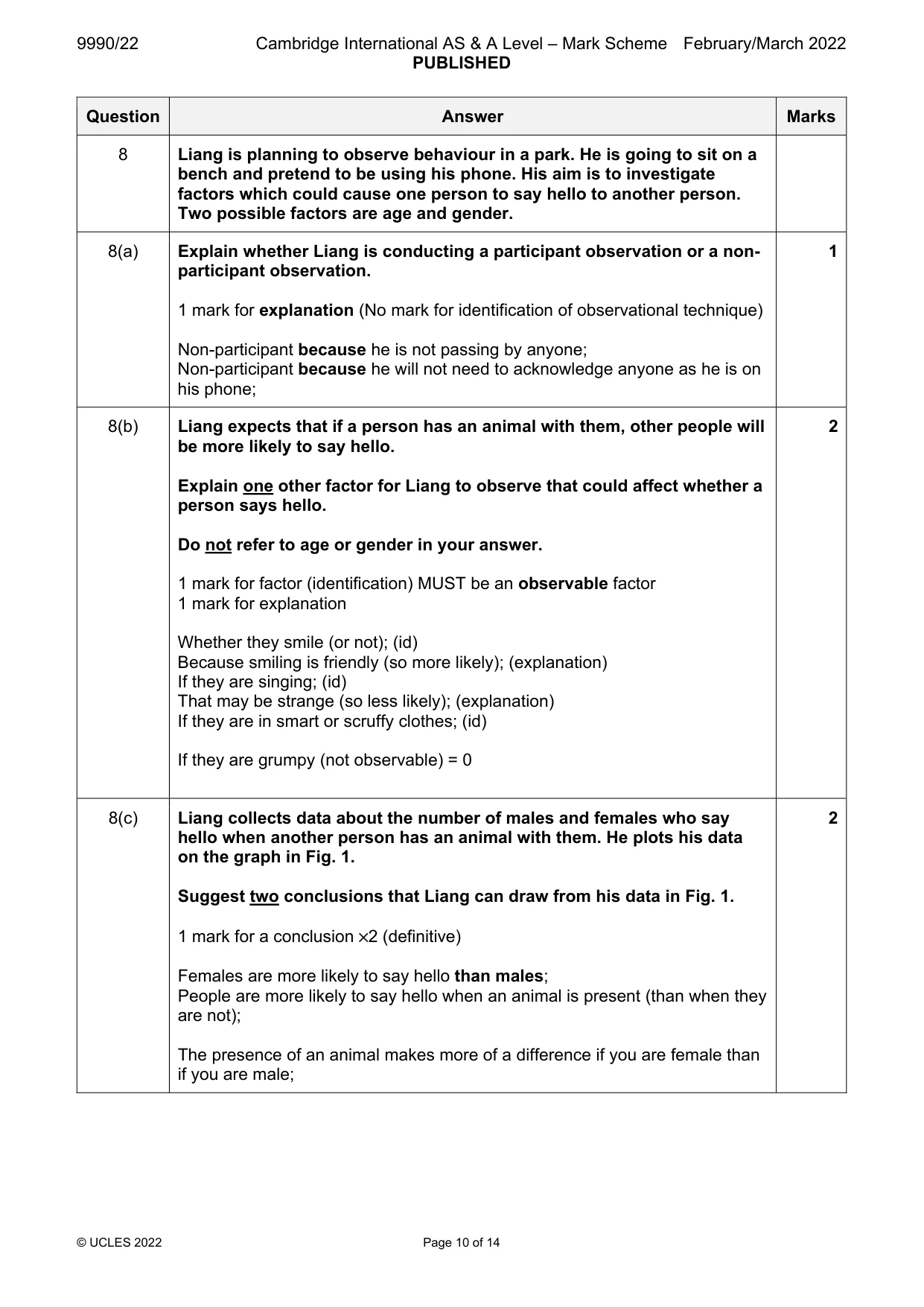
Mark scheme: 8 Liang is planning to observe behaviour in a park. He is going to sit on a bench and pretend to be using his phone. His aim is to investigate factors which could cause one person to say hello to another person. Two possible factors are age and gender. 8(a) Explain whether Liang is conducting a participant observation or a non- 1 participant observation. 1 mark for explanation (No mark for identification of observational technique) Non-participant because he is not passing by anyone; Non-participant because he will not need to acknowledge anyone as he is on his phone; 8(b) Liang expects that if a person has an animal with them, other people will 2 be more likely to say hello. Explain one other factor for Liang to observe that could affect whether a person says hello. Do not refer to age or gender in your answer. 1 mark for factor (identification) MUST be an observable factor 1 mark for explanation Whether they smile (or not); (id) Because smiling is friendly (so more likely); (explanation) If they are singing; (id) That may be strange (so less likely); (explanation) If they are in smart or scruffy clothes; (id) If they are grumpy (not observable) = 0 8(c) Liang collects data about the number of males and females who say 2 hello when another person has an animal with them. He plots his data on the graph in Fig. 1. Suggest two conclusions that Liang can draw from his data in Fig. 1. 1 mark for a conclusion ×2 (definitive) Females are more likely to say hello than males; People are more likely to say hello when an animal is present (than when they are not); The presence of an animal makes more of a difference if you are female than if you are male; 8(d) Participants could realise that Liang is conducting an observation. 4 Suggest two problems this could cause. 1 mark for suggested problem } ×2 1 mark for detail } They may feel upset because they are being watched / feel they have been deceived; (ethical problem) so breaks (the ethical guideline of) protection from harm / informed consent; (detail) They may change their behaviour / show social desirability / respond to demand characteristics; (practical problem) So they may be more/less likely to say hello (than if they didn’t realise); (detail) An (ethical) problem is right to withdraw; (ethical problem) they cannot exercise this because once they know they are being watched it’s too late; (detail)
Q9 · Tara can measure physical reaction time using a machine that records the time between a…
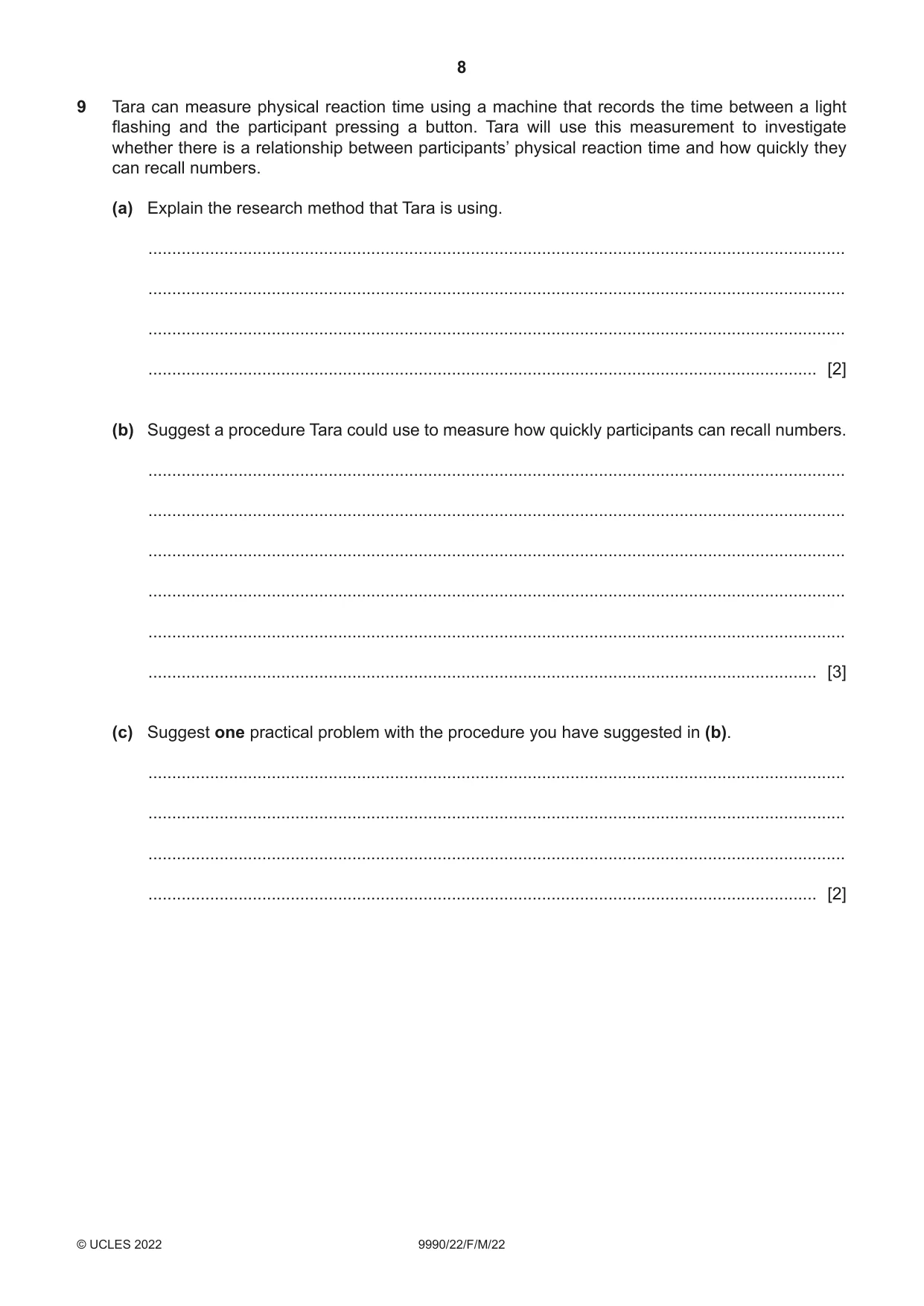
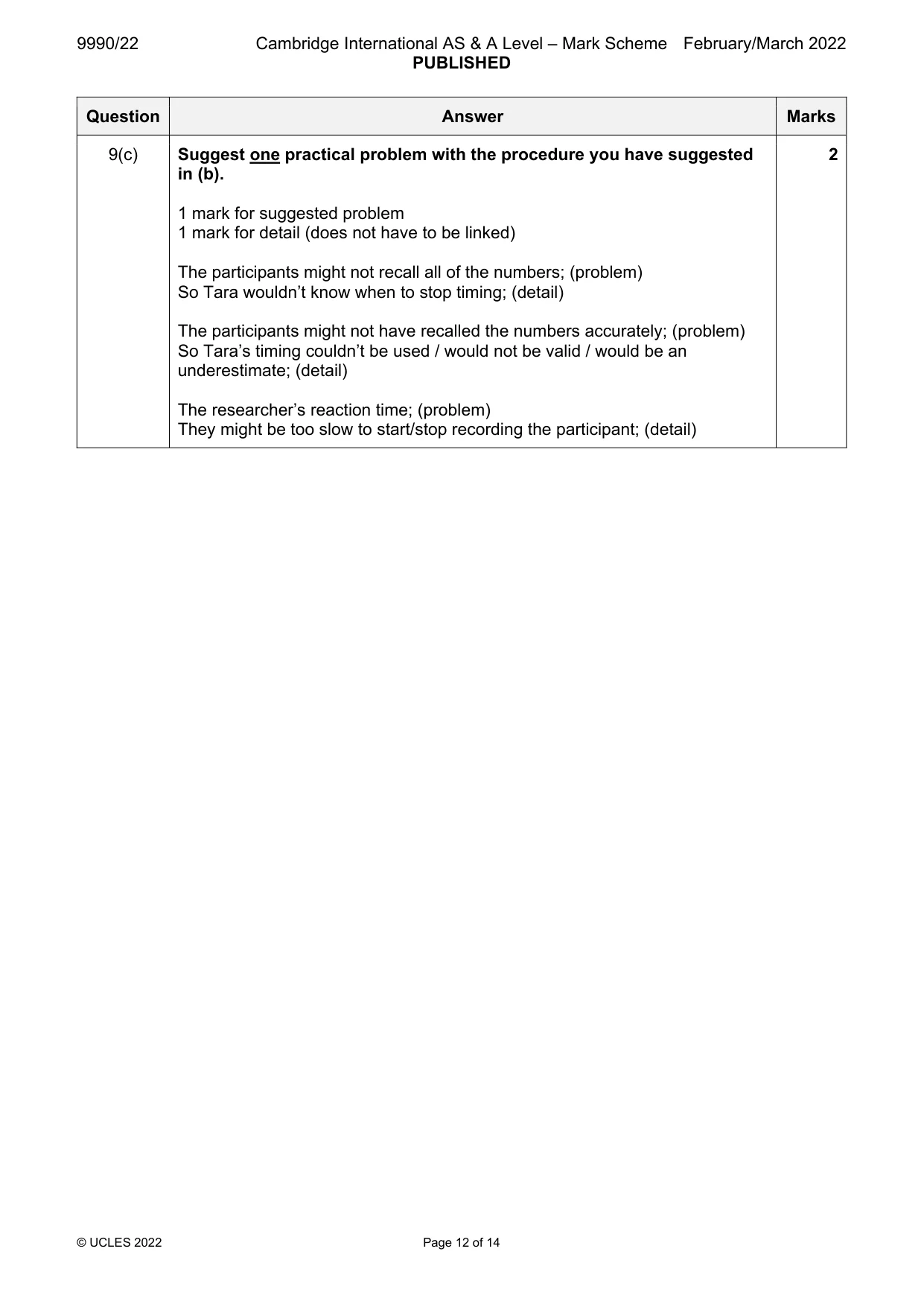
9 Tara can measure physical reaction time using a machine that records the time between a light flashing and the participant pressing a button. Tara will use this measurement to investigate whether there is a relationship between participants’ physical reaction time and how quickly they can recall numbers. (a) Explain the research method that Tara is using. ................................................................................................................................................... ................................................................................................................................................... ................................................................................................................................................... ............................................................................................................................................. [2] (b) Suggest a procedure Tara could use to measure how quickly participants can recall numbers. ................................................................................................................................................... ................................................................................................................................................... ................................................................................................................................................... ................................................................................................................................................... ................................................................................................................................................... ............................................................................................................................................. [3] (c) Suggest one practical problem with the procedure you have suggested in (b). ................................................................................................................................................... ................................................................................................................................................... ................................................................................................................................................... ............................................................................................................................................. [2] Section C Answer all questions in this section.
Mark scheme: 9 Tara can measure physical reaction time using a machine that records the time between a light flashing and the participant pressing a button. Tara will use this measurement to investigate whether there is a relationship between participants’ physical reaction time and how quickly they can recall numbers. 9(a) Explain the research method that Tara is using. 2 1 mark for identifying correlation (DEFINITIVE) 1 mark for linked explanation Correlation; (identification of research method) Because she is looking for ‘a relationship between how quickly they can recall numbers and their physical reaction time’; (explanation) She is looking for a link between two continuous measured variables; (ID of research method without naming) reaction time and recall speed; (explanation) 9(b) Suggest a procedure Tara could use to measure how quickly 3 participants can recall numbers. 1 mark per correct detail of procedure. For full marks the procedure must produce data that can be correlated (i.e. on a scale) Present/read/show (a list) of numbers; Start time and tell the participant to recall all the numbers; Stop the timer when they have recalled them all; 9(c) Suggest one practical problem with the procedure you have suggested 2 in (b). 1 mark for suggested problem 1 mark for detail (does not have to be linked) The participants might not recall all of the numbers; (problem) So Tara wouldn’t know when to stop timing; (detail) The participants might not have recalled the numbers accurately; (problem) So Tara’s timing couldn’t be used / would not be valid / would be an underestimate; (detail) The researcher’s reaction time; (problem) They might be too slow to start/stop recording the participant; (detail)
Q10 · Justin wants to investigate whether adults are happier when they play particular sports
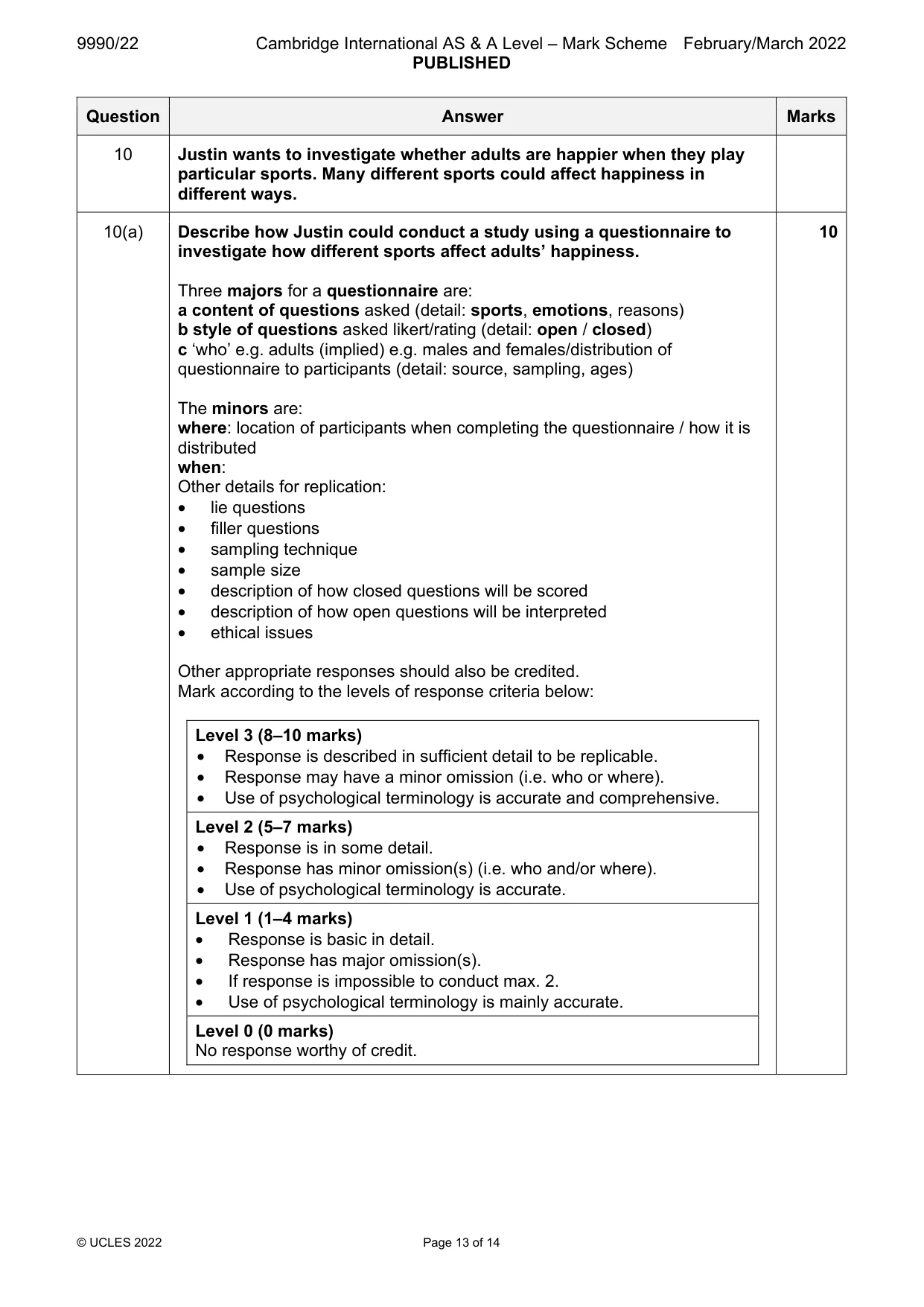
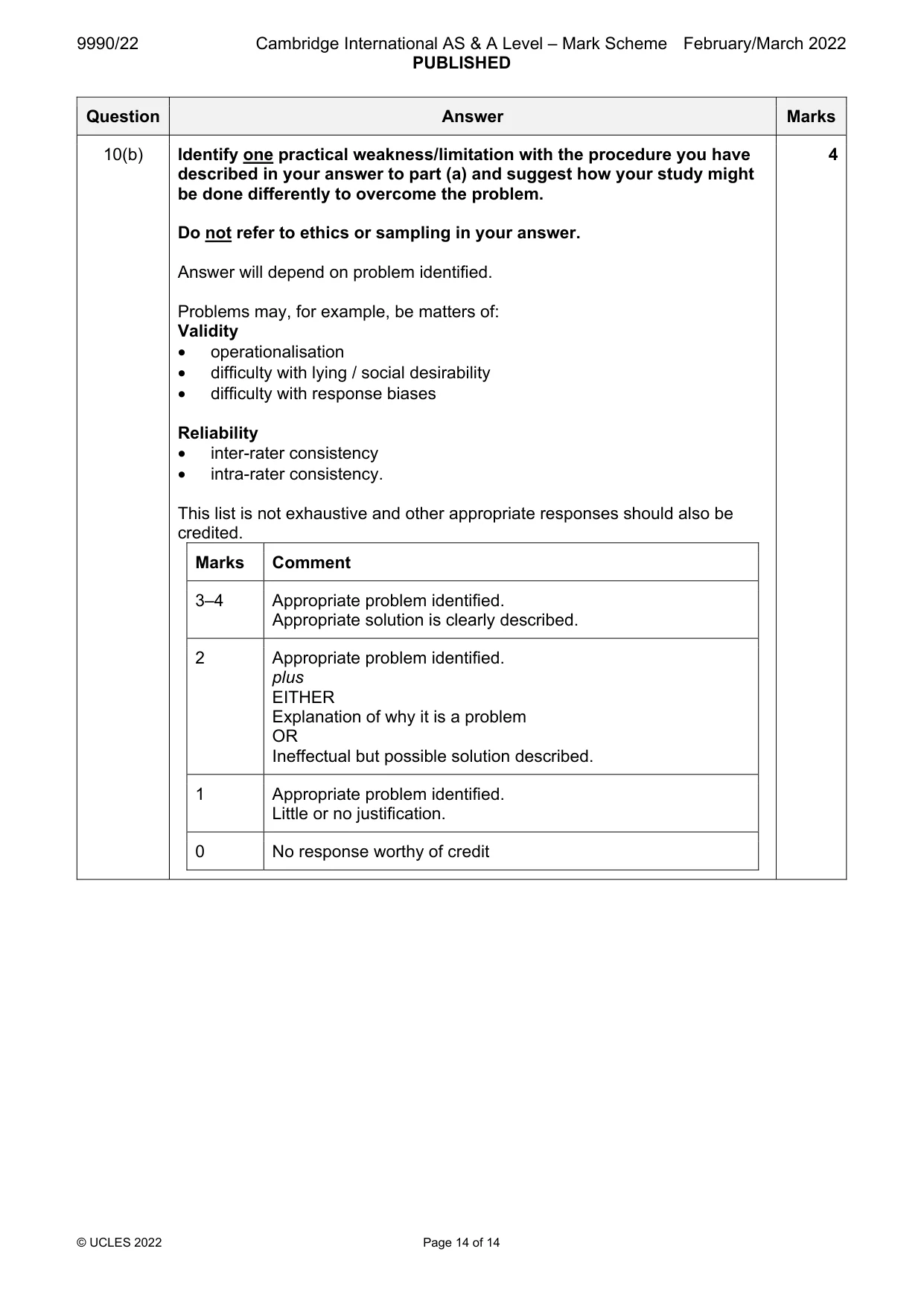
10 Justin wants to investigate whether adults are happier when they play particular sports. Many different sports could affect happiness in different ways. (a) Describe how Justin could conduct a study using a questionnaire to investigate how different sports affect adults’ happiness. ................................................................................................................................................... ................................................................................................................................................... ................................................................................................................................................... ................................................................................................................................................... ................................................................................................................................................... ................................................................................................................................................... ................................................................................................................................................... ................................................................................................................................................... ................................................................................................................................................... ................................................................................................................................................... ................................................................................................................................................... ................................................................................................................................................... ................................................................................................................................................... ................................................................................................................................................... ................................................................................................................................................... ................................................................................................................................................... ................................................................................................................................................... ................................................................................................................................................... ................................................................................................................................................... ................................................................................................................................................... ................................................................................................................................................... ................................................................................................................................................... ................................................................................................................................................... ................................................................................................................................................... ................................................................................................................................................... ................................................................................................................................................... ................................................................................................................................................... ................................................................................................................................................... ................................................................................................................................................... ................................................................................................................................................... ................................................................................................................................................... ................................................................................................................................................... ................................................................................................................................................... ........................................................................................................................................... [10] (b) Identify one practical weakness/limitation with the procedure you have described in your answer to part (a) and suggest how your study might be done differently to overcome the problem. Do not refer to ethics or sampling in your answer. ................................................................................................................................................... ................................................................................................................................................... ................................................................................................................................................... ................................................................................................................................................... ................................................................................................................................................... ................................................................................................................................................... ................................................................................................................................................... ............................................................................................................................................. [4]
Mark scheme: 10 Justin wants to investigate whether adults are happier when they play particular sports. Many different sports could affect happiness in different ways. 10(a) Describe how Justin could conduct a study using a questionnaire to 10 investigate how different sports affect adults’ happiness. Three majors for a questionnaire are: a content of questions asked (detail: sports, emotions, reasons) b style of questions asked likert/rating (detail: open / closed) c ‘who’ e.g. adults (implied) e.g. males and females/distribution of questionnaire to participants (detail: source, sampling, ages) The minors are: where: location of participants when completing the questionnaire / how it is distributed when: Other details for replication: • lie questions • filler questions • sampling technique • sample size • description of how closed questions will be scored • description of how open questions will be interpreted • ethical issues Other appropriate responses should also be credited. Mark according to the levels of response criteria below: Level 3 (8–10 marks) • Response is described in sufficient detail to be replicable. • Response may have a minor omission (i.e. who or where). • Use of psychological terminology is accurate and comprehensive. Level 2 (5–7 marks) • Response is in some detail. • Response has minor omission(s) (i.e. who and/or where). • Use of psychological terminology is accurate. Level 1 (1–4 marks) • Response is basic in detail. • Response has major omission(s). • If response is impossible to conduct max. 2. • Use of psychological terminology is mainly accurate. Level 0 (0 marks) No response worthy of credit. 10(b) Identify one practical weakness/limitation with the procedure you have 4 described in your answer to part (a) and suggest how your study might be done differently to overcome the problem. Do not refer to ethics or sampling in your answer. Answer will depend on problem identified. Problems may, for example, be matters of: Validity • operationalisation • difficulty with lying / social desirability • difficulty with response biases Reliability • inter-rater consistency • intra-rater consistency. This list is not exhaustive and other appropriate responses should also be credited. Marks Comment 3–4 Appropriate problem identified. Appropriate solution is clearly described. 2 Appropriate problem identified. plus EITHER Explanation of why it is a problem OR Ineffectual but possible solution described. 1 Appropriate problem identified. Little or no justification. 0 No response worthy of credit
What was in this paper
The subtopics covered by these 10 questions, and how many questions each got. Open one in a new tab to see every Cambridge question on it.
What you needed in this session
Cambridge’s own grade thresholds for 2022 Feb/March, Paper 2 · Variant 2. A higher threshold means an easier paper — the bar moves with how the cohort did.