Cambridge A Level Psychology (from 2018) 9990 — 2021 Feb/March Paper 2 · Variant 2
9990/22/F/M/21 · 10 questions · 60 marks · ≈68 min
The question paper and its mark scheme, free to read here and free to download. This is Cambridge’s own paper, exactly as it was sat.
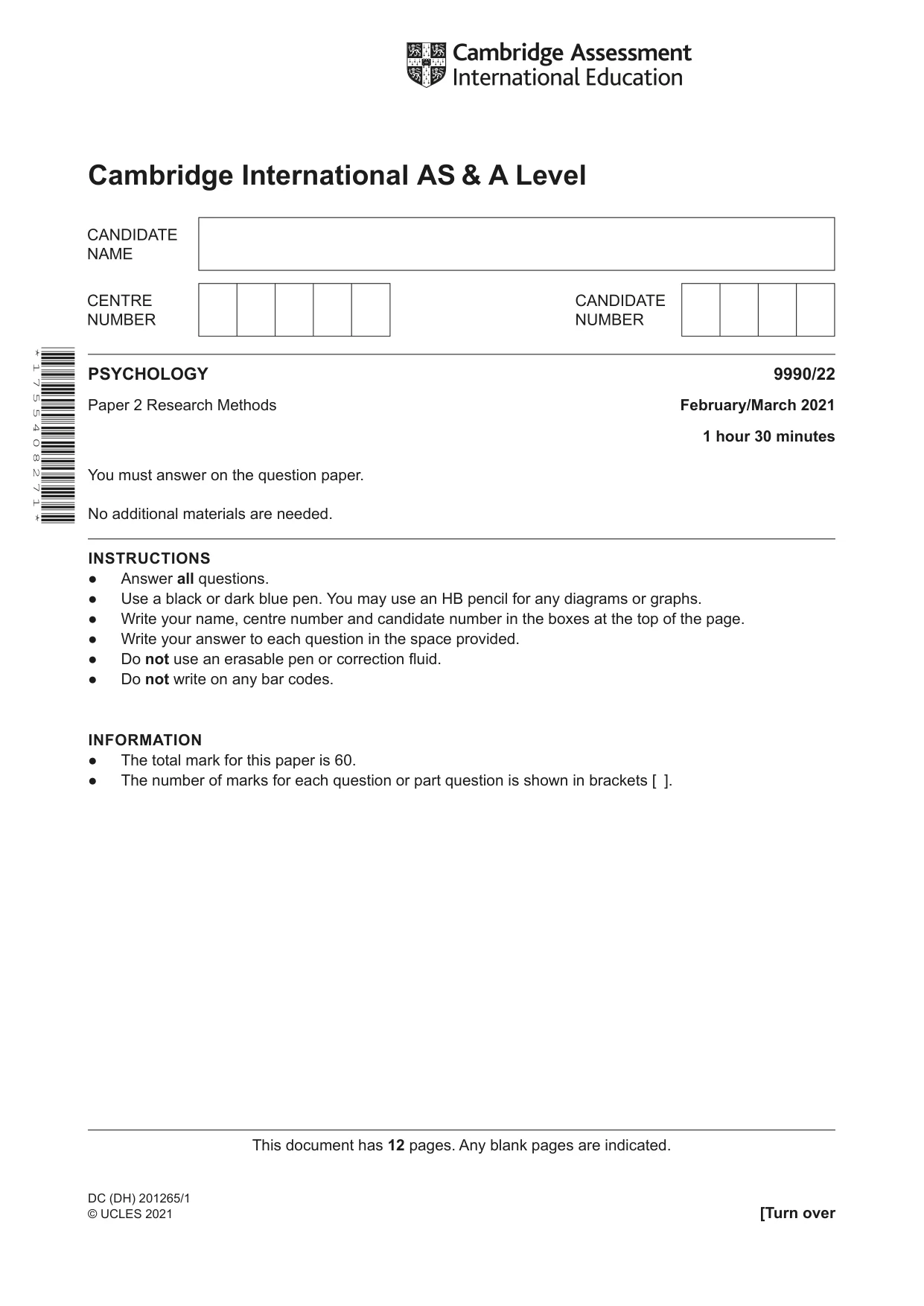
Question paper12 pages


Mark scheme13 pages
Answers below. Sit the paper first if you are practising.
Questions as text
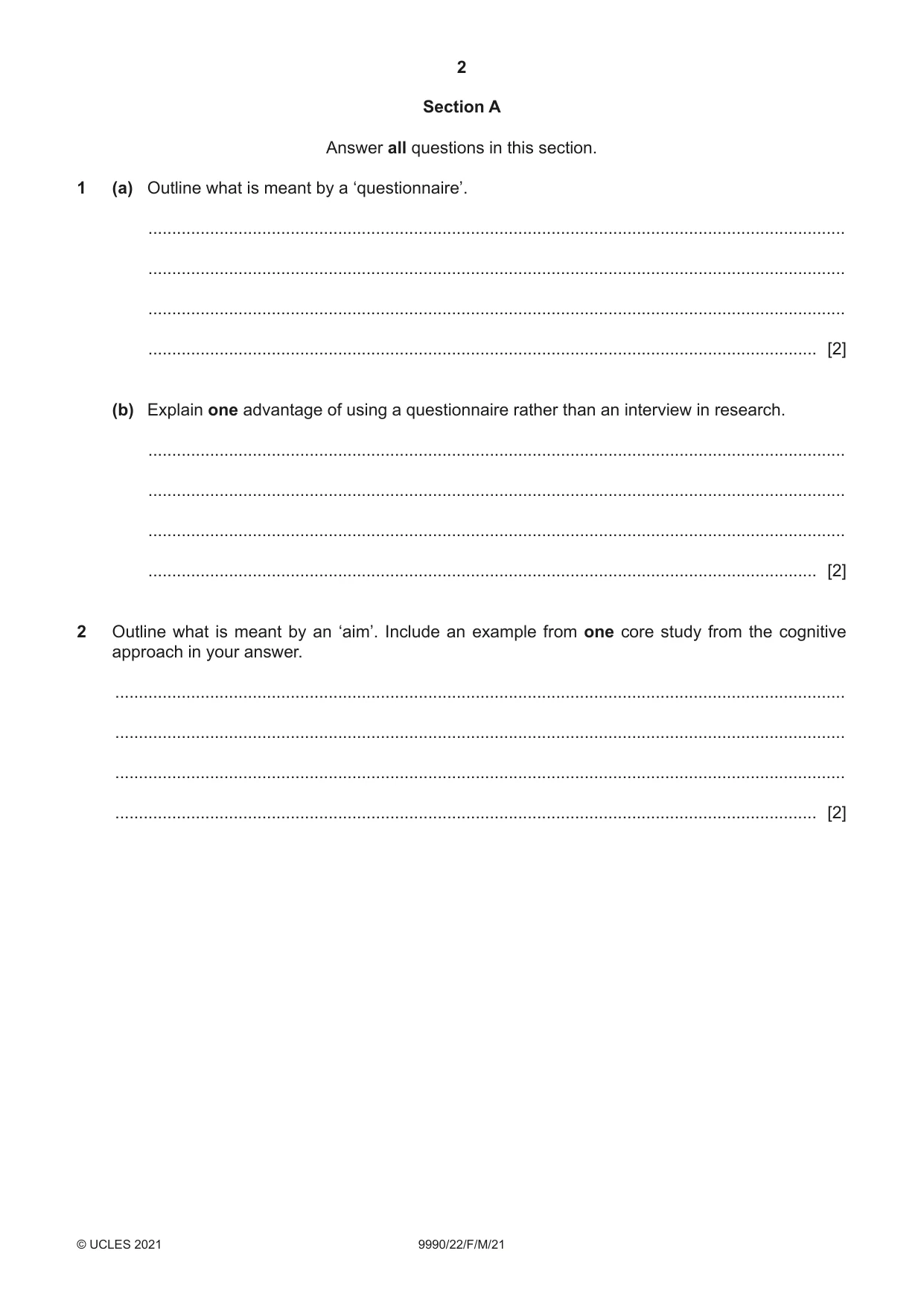
Q1 · Outline what is meant by a ‘questionnaire’
1 (a) Outline what is meant by a ‘questionnaire’. ................................................................................................................................................... ................................................................................................................................................... ................................................................................................................................................... ............................................................................................................................................. [2] (b) Explain one advantage of using a questionnaire rather than an interview in research. ................................................................................................................................................... ................................................................................................................................................... ................................................................................................................................................... ............................................................................................................................................. [2]
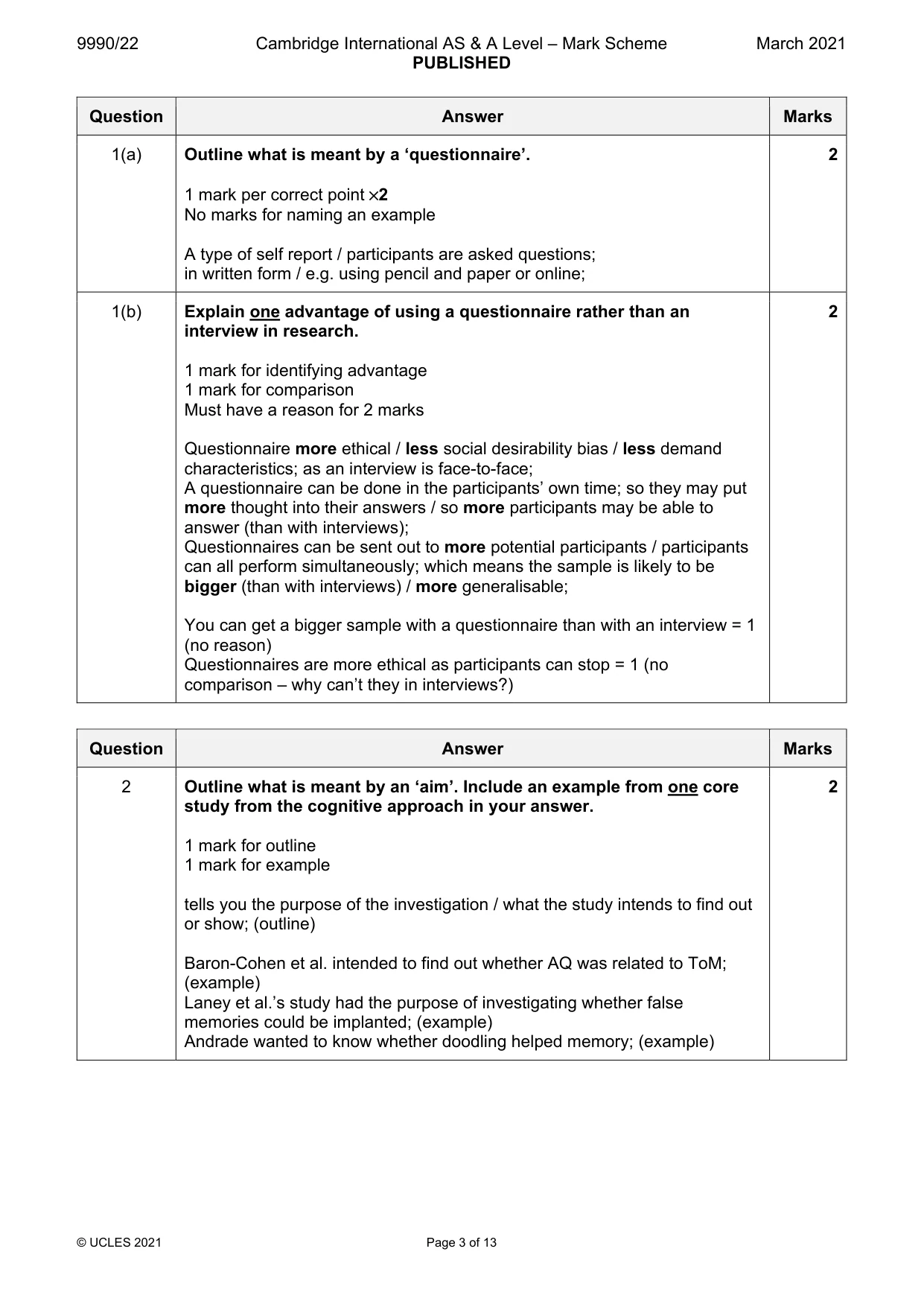
Mark scheme: Question Answer Marks 1(a) Outline what is meant by a ‘questionnaire’. 2 1 mark per correct point ×2 No marks for naming an example A type of self report / participants are asked questions; in written form / e.g. using pencil and paper or online; 1(b) Explain one advantage of using a questionnaire rather than an 2 interview in research. 1 mark for identifying advantage 1 mark for comparison Must have a reason for 2 marks Questionnaire more ethical / less social desirability bias / less demand characteristics; as an interview is face-to-face; A questionnaire can be done in the participants’ own time; so they may put more thought into their answers / so more participants may be able to answer (than with interviews); Questionnaires can be sent out to more potential participants / participants can all perform simultaneously; which means the sample is likely to be bigger (than with interviews) / more generalisable; You can get a bigger sample with a questionnaire than with an interview = 1 (no reason) Questionnaires are more ethical as participants can stop = 1 (no comparison – why can’t they in interviews?)
Q2 · Outline what is meant by an ‘aim’
2 Outline what is meant by an ‘aim’. Include an example from one core study from the cognitive approach in your answer. .......................................................................................................................................................... .......................................................................................................................................................... .......................................................................................................................................................... .................................................................................................................................................... [2]
Mark scheme: 2 Outline what is meant by an ‘aim’. Include an example from one core 2 study from the cognitive approach in your answer. 1 mark for outline 1 mark for example tells you the purpose of the investigation / what the study intends to find out or show; (outline) Baron-Cohen et al. intended to find out whether AQ was related to ToM; (example) Laney et al.’s study had the purpose of investigating whether false memories could be implanted; (example) Andrade wanted to know whether doodling helped memory; (example)
Q3 · The study by Milgram (obedience) used volunteer sampling
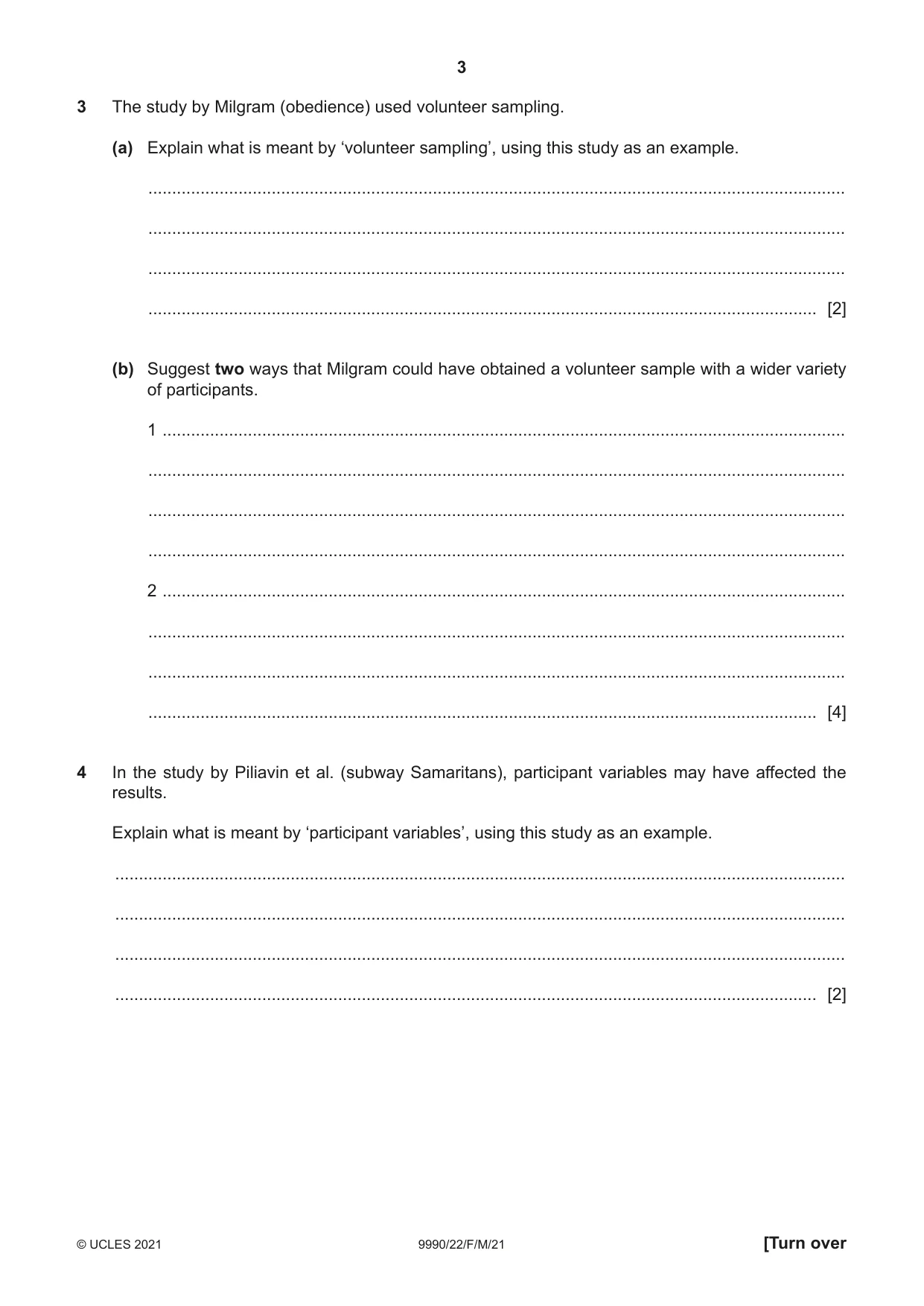
3 The study by Milgram (obedience) used volunteer sampling. (a) Explain what is meant by ‘volunteer sampling’, using this study as an example. ................................................................................................................................................... ................................................................................................................................................... ................................................................................................................................................... ............................................................................................................................................. [2] (b) Suggest two ways that Milgram could have obtained a volunteer sample with a wider variety of participants. 1 ................................................................................................................................................ ................................................................................................................................................... ................................................................................................................................................... ................................................................................................................................................... 2 ................................................................................................................................................ ................................................................................................................................................... ................................................................................................................................................... ............................................................................................................................................. [4]
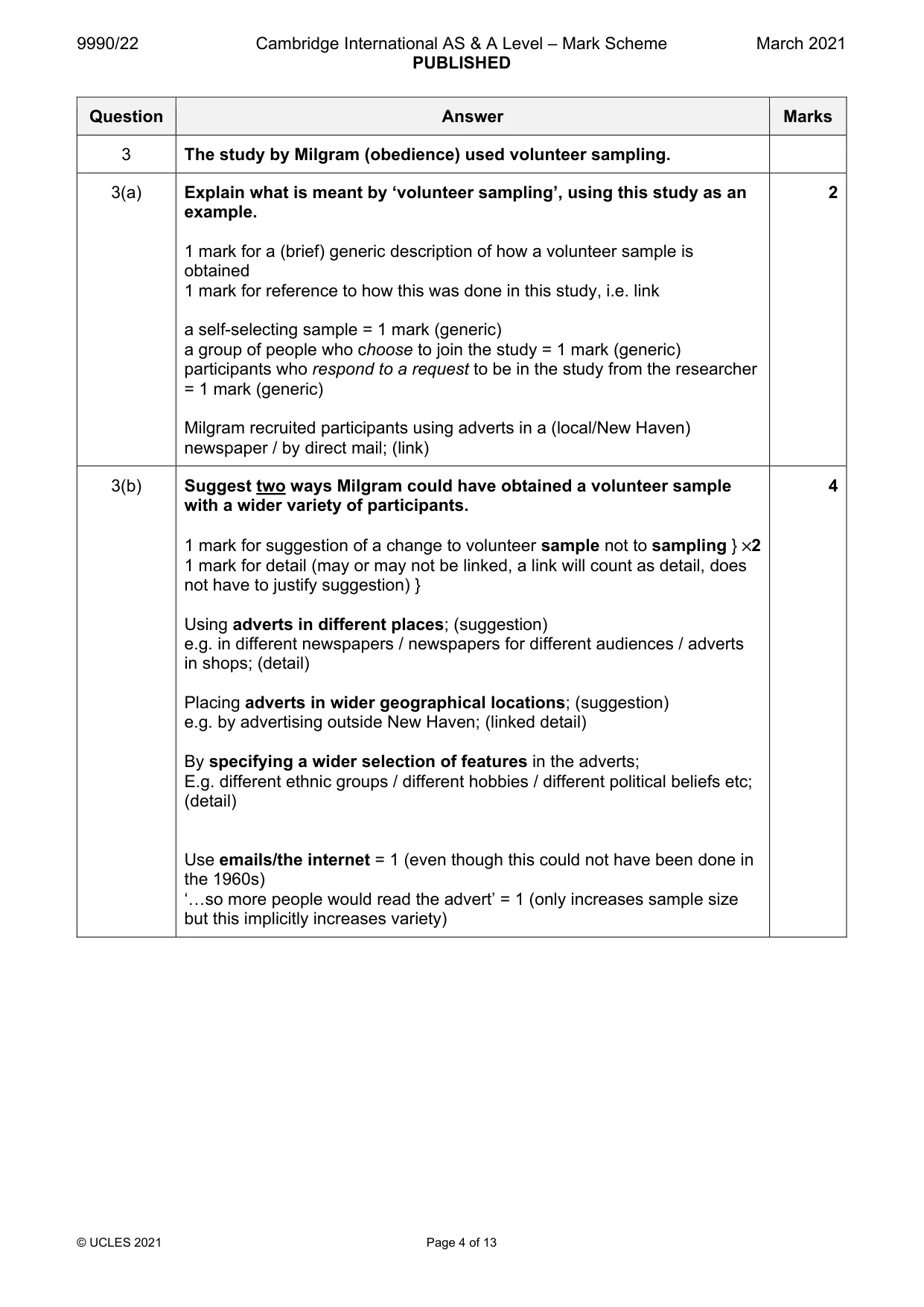
Mark scheme: 3 The study by Milgram (obedience) used volunteer sampling. 3(a) Explain what is meant by ‘volunteer sampling’, using this study as an 2 example. 1 mark for a (brief) generic description of how a volunteer sample is obtained 1 mark for reference to how this was done in this study, i.e. link a self-selecting sample = 1 mark (generic) a group of people who choose to join the study = 1 mark (generic) participants who respond to a request to be in the study from the researcher = 1 mark (generic) Milgram recruited participants using adverts in a (local/New Haven) newspaper / by direct mail; (link) 3(b) Suggest two ways Milgram could have obtained a volunteer sample 4 with a wider variety of participants. 1 mark for suggestion of a change to volunteer sample not to sampling } ×2 1 mark for detail (may or may not be linked, a link will count as detail, does not have to justify suggestion) } Using adverts in different places; (suggestion) e.g. in different newspapers / newspapers for different audiences / adverts in shops; (detail) Placing adverts in wider geographical locations; (suggestion) e.g. by advertising outside New Haven; (linked detail) By specifying a wider selection of features in the adverts; E.g. different ethnic groups / different hobbies / different political beliefs etc; (detail) Use emails/the internet = 1 (even though this could not have been done in the 1960s) ‘…so more people would read the advert’ = 1 (only increases sample size but this implicitly increases variety)
Q4 · In the study by Piliavin et al
4 In the study by Piliavin et al. (subway Samaritans), participant variables may have affected the results. Explain what is meant by ‘participant variables’, using this study as an example. .......................................................................................................................................................... .......................................................................................................................................................... .......................................................................................................................................................... .................................................................................................................................................... [2]
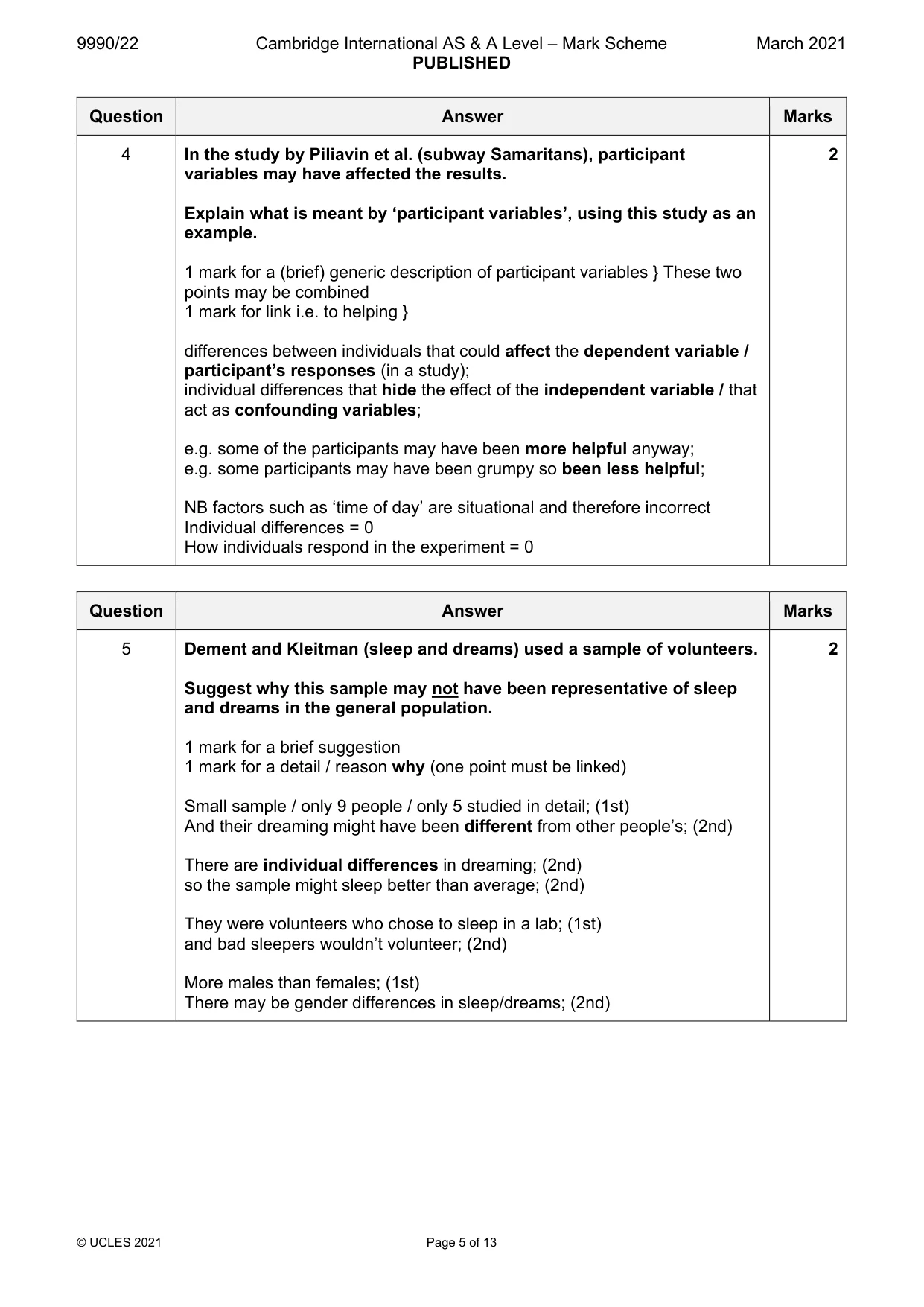
Mark scheme: 4 In the study by Piliavin et al. (subway Samaritans), participant 2 variables may have affected the results. Explain what is meant by ‘participant variables’, using this study as an example. 1 mark for a (brief) generic description of participant variables } These two points may be combined 1 mark for link i.e. to helping } differences between individuals that could affect the dependent variable / participant’s responses (in a study); individual differences that hide the effect of the independent variable / that act as confounding variables; e.g. some of the participants may have been more helpful anyway; e.g. some participants may have been grumpy so been less helpful; NB factors such as ‘time of day’ are situational and therefore incorrect Individual differences = 0 How individuals respond in the experiment = 0
Q5 · Dement and Kleitman (sleep and dreams) used a sample of volunteers
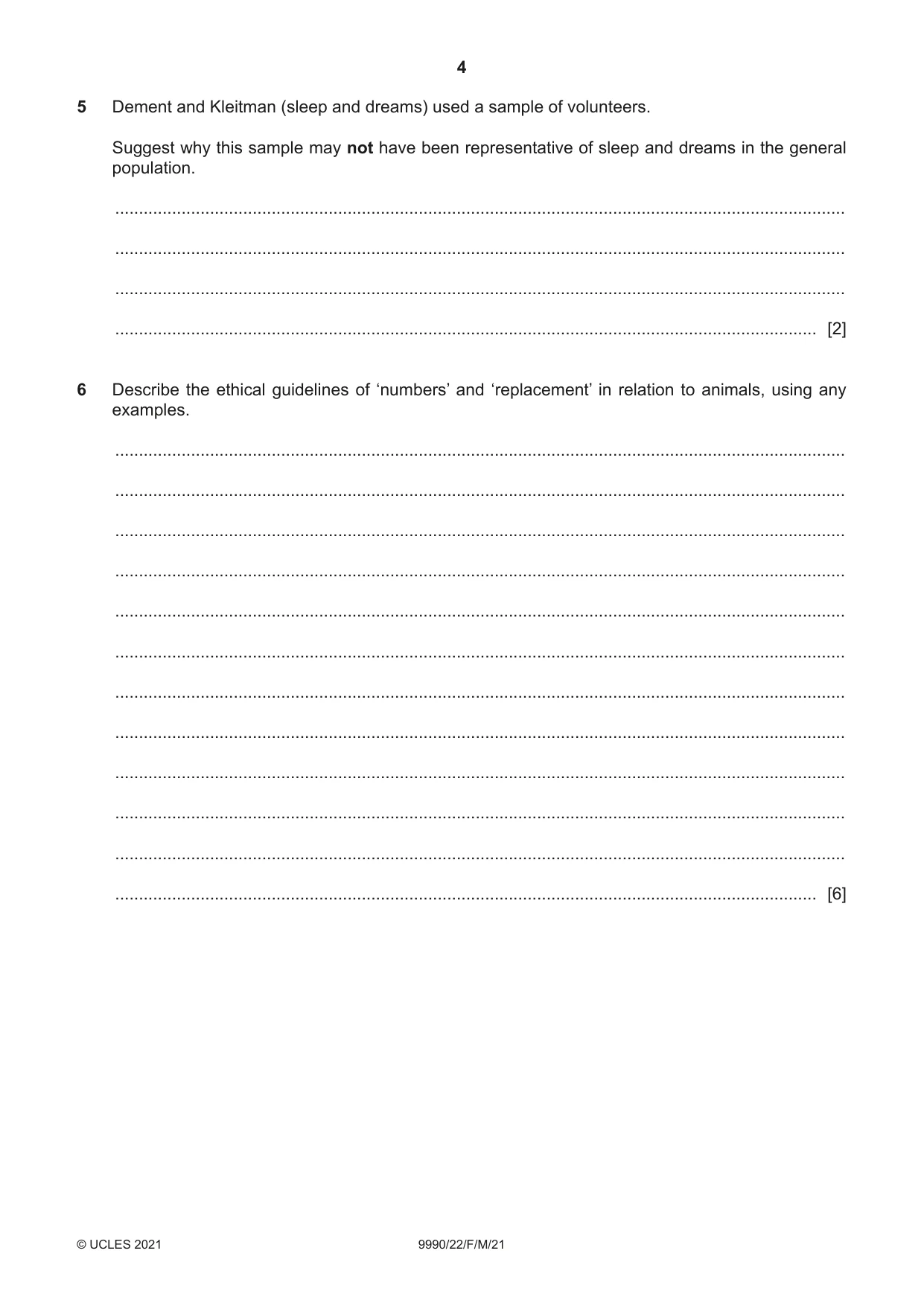
5 Dement and Kleitman (sleep and dreams) used a sample of volunteers. Suggest why this sample may not have been representative of sleep and dreams in the general population. .......................................................................................................................................................... .......................................................................................................................................................... .......................................................................................................................................................... .................................................................................................................................................... [2]
Mark scheme: 5 Dement and Kleitman (sleep and dreams) used a sample of volunteers. 2 Suggest why this sample may not have been representative of sleep and dreams in the general population. 1 mark for a brief suggestion 1 mark for a detail / reason why (one point must be linked) Small sample / only 9 people / only 5 studied in detail; (1st) And their dreaming might have been different from other people’s; (2nd) There are individual differences in dreaming; (2nd) so the sample might sleep better than average; (2nd) They were volunteers who chose to sleep in a lab; (1st) and bad sleepers wouldn’t volunteer; (2nd) More males than females; (1st) There may be gender differences in sleep/dreams; (2nd)
Q6 · Describe the ethical guidelines of ‘numbers’ and ‘replacement’ in relation to animals…
6 Describe the ethical guidelines of ‘numbers’ and ‘replacement’ in relation to animals, using any examples. .......................................................................................................................................................... .......................................................................................................................................................... .......................................................................................................................................................... .......................................................................................................................................................... .......................................................................................................................................................... .......................................................................................................................................................... .......................................................................................................................................................... .......................................................................................................................................................... .......................................................................................................................................................... .......................................................................................................................................................... .......................................................................................................................................................... .................................................................................................................................................... [6]
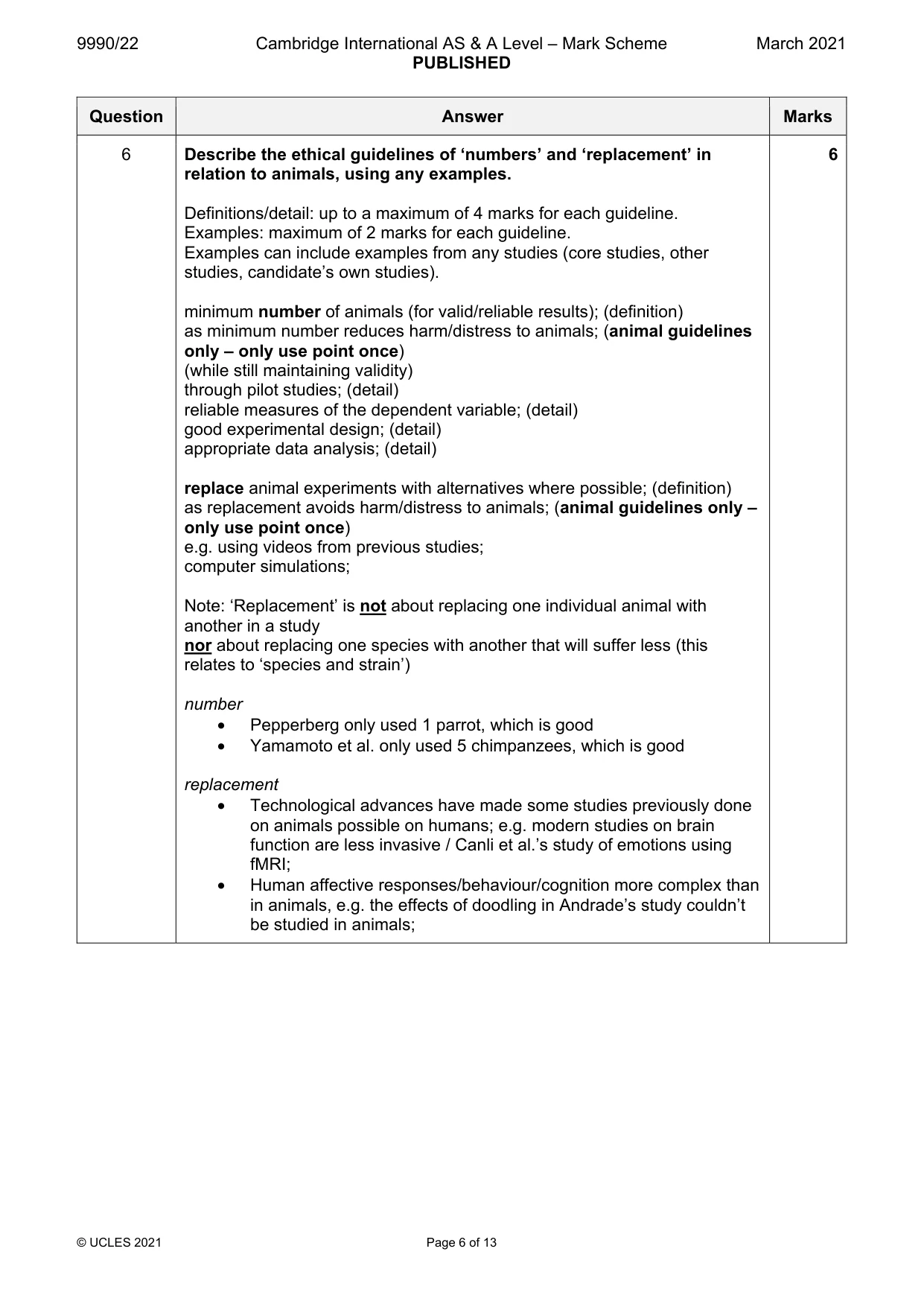
Mark scheme: 6 Describe the ethical guidelines of ‘numbers’ and ‘replacement’ in 6 relation to animals, using any examples. Definitions/detail: up to a maximum of 4 marks for each guideline. Examples: maximum of 2 marks for each guideline. Examples can include examples from any studies (core studies, other studies, candidate’s own studies). minimum number of animals (for valid/reliable results); (definition) as minimum number reduces harm/distress to animals; (animal guidelines only – only use point once) (while still maintaining validity) through pilot studies; (detail) reliable measures of the dependent variable; (detail) good experimental design; (detail) appropriate data analysis; (detail) replace animal experiments with alternatives where possible; (definition) as replacement avoids harm/distress to animals; (animal guidelines only – only use point once) e.g. using videos from previous studies; computer simulations; Note: ‘Replacement’ is not about replacing one individual animal with another in a study nor about replacing one species with another that will suffer less (this relates to ‘species and strain’) number • Pepperberg only used 1 parrot, which is good • Yamamoto et al. only used 5 chimpanzees, which is good replacement • Technological advances have made some studies previously done on animals possible on humans; e.g. modern studies on brain function are less invasive / Canli et al.’s study of emotions using fMRI; • Human affective responses/behaviour/cognition more complex than in animals, e.g. the effects of doodling in Andrade’s study couldn’t be studied in animals;
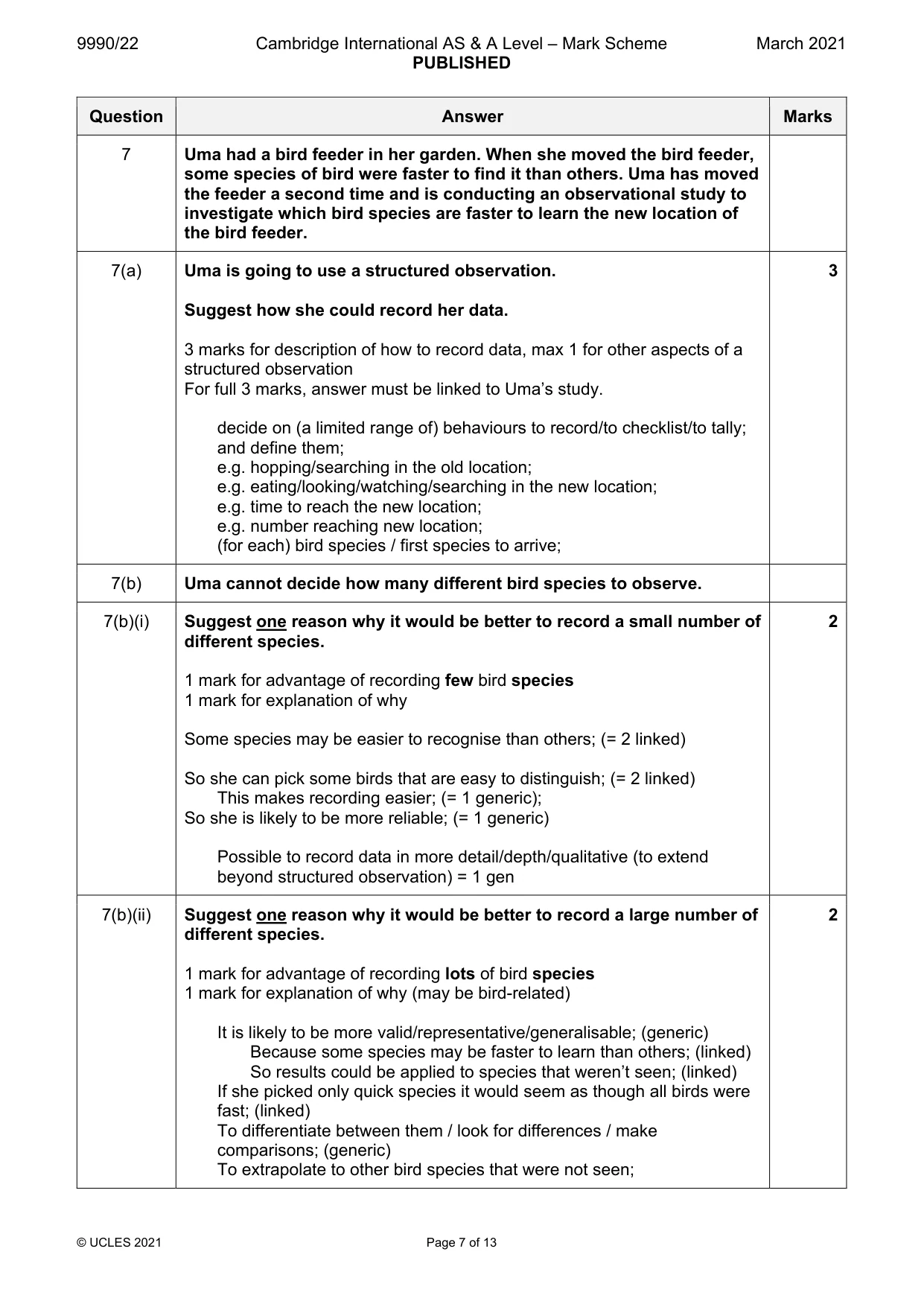
Q7 · Uma has a bird feeder in her garden
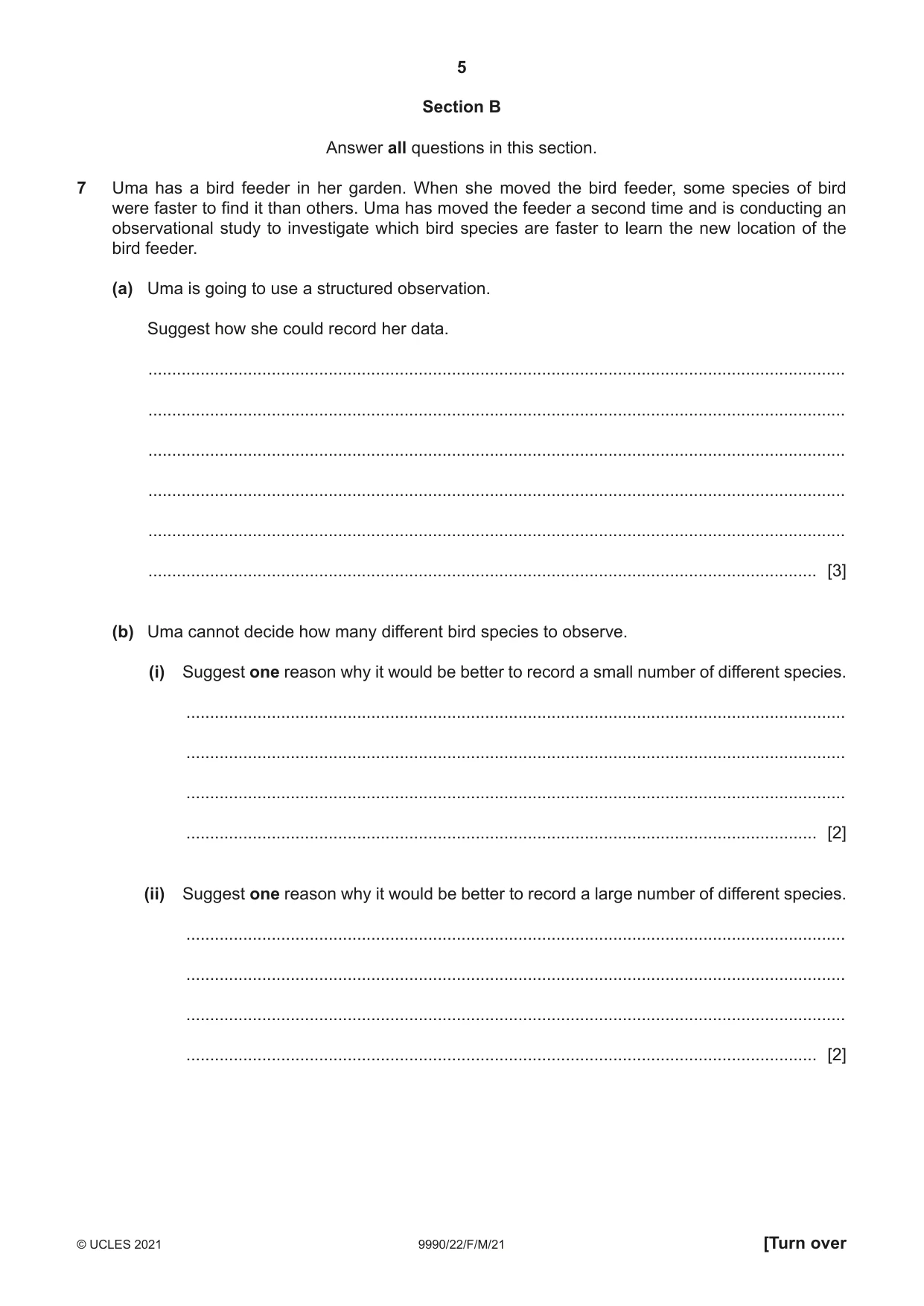
7 Uma has a bird feeder in her garden. When she moved the bird feeder, some species of bird were faster to find it than others. Uma has moved the feeder a second time and is conducting an observational study to investigate which bird species are faster to learn the new location of the bird feeder. (a) Uma is going to use a structured observation. Suggest how she could record her data. ................................................................................................................................................... ................................................................................................................................................... ................................................................................................................................................... ................................................................................................................................................... ................................................................................................................................................... ............................................................................................................................................. [3] (b) Uma cannot decide how many different bird species to observe. (i) Suggest one reason why it would be better to record a small number of different species. ........................................................................................................................................... ........................................................................................................................................... ........................................................................................................................................... ..................................................................................................................................... [2] (ii) Suggest one reason why it would be better to record a large number of different species. ........................................................................................................................................... ........................................................................................................................................... ........................................................................................................................................... ..................................................................................................................................... [2]
Mark scheme: 7 Uma had a bird feeder in her garden. When she moved the bird feeder, some species of bird were faster to find it than others. Uma has moved the feeder a second time and is conducting an observational study to investigate which bird species are faster to learn the new location of the bird feeder. 7(a) Uma is going to use a structured observation. 3 Suggest how she could record her data. 3 marks for description of how to record data, max 1 for other aspects of a structured observation For full 3 marks, answer must be linked to Uma’s study. decide on (a limited range of) behaviours to record/to checklist/to tally; and define them; e.g. hopping/searching in the old location; e.g. eating/looking/watching/searching in the new location; e.g. time to reach the new location; e.g. number reaching new location; (for each) bird species / first species to arrive; 7(b) Uma cannot decide how many different bird species to observe. 7(b)(i) Suggest one reason why it would be better to record a small number of 2 different species. 1 mark for advantage of recording few bird species 1 mark for explanation of why Some species may be easier to recognise than others; (= 2 linked) So she can pick some birds that are easy to distinguish; (= 2 linked) This makes recording easier; (= 1 generic); So she is likely to be more reliable; (= 1 generic) Possible to record data in more detail/depth/qualitative (to extend beyond structured observation) = 1 gen 7(b)(ii) Suggest one reason why it would be better to record a large number of 2 different species. 1 mark for advantage of recording lots of bird species 1 mark for explanation of why (may be bird-related) It is likely to be more valid/representative/generalisable; (generic) Because some species may be faster to learn than others; (linked) So results could be applied to species that weren’t seen; (linked) If she picked only quick species it would seem as though all birds were fast; (linked) To differentiate between them / look for differences / make comparisons; (generic) To extrapolate to other bird species that were not seen;
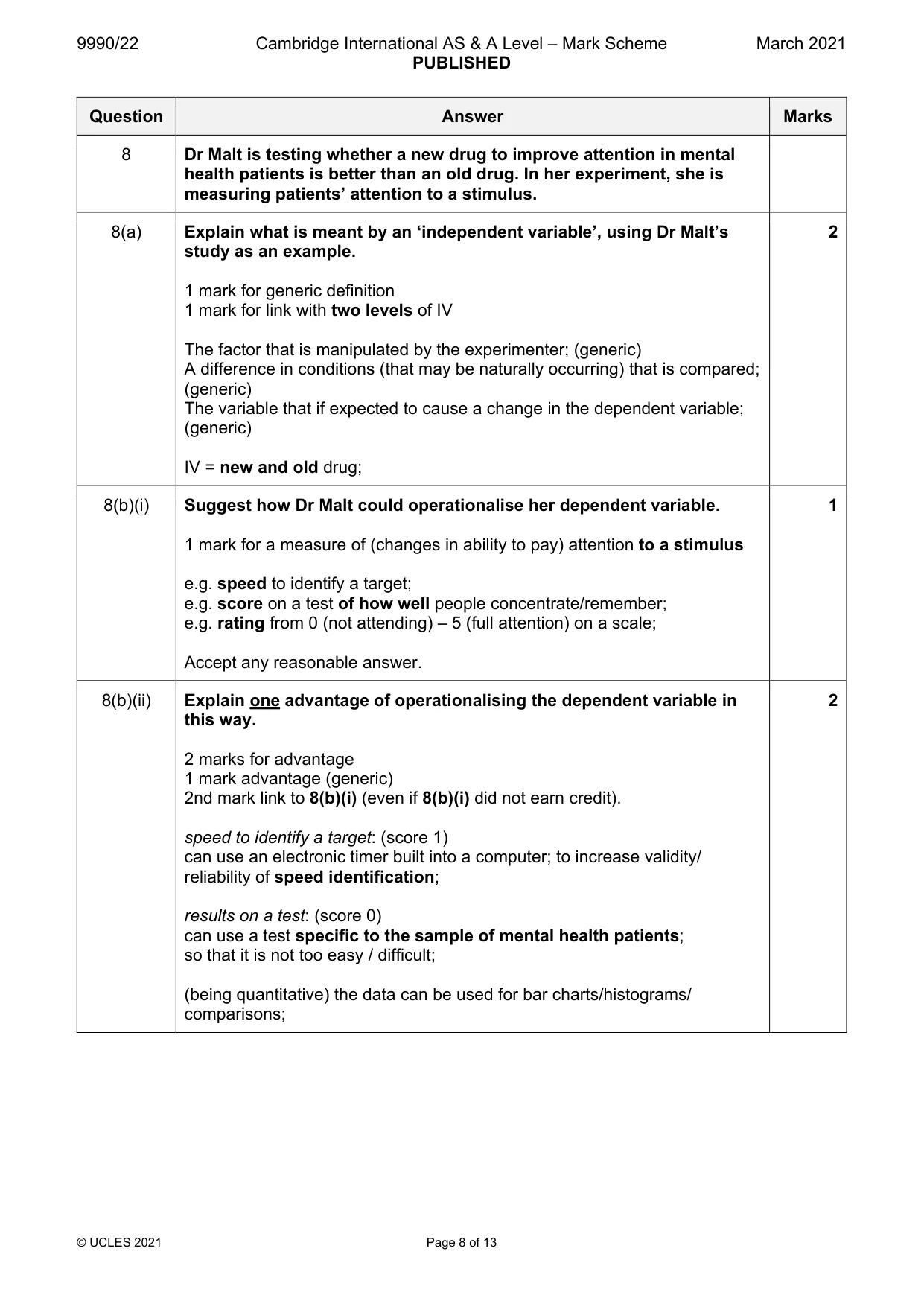
Q8 · Dr Malt is testing whether a new drug to improve attention in mental health patients is…
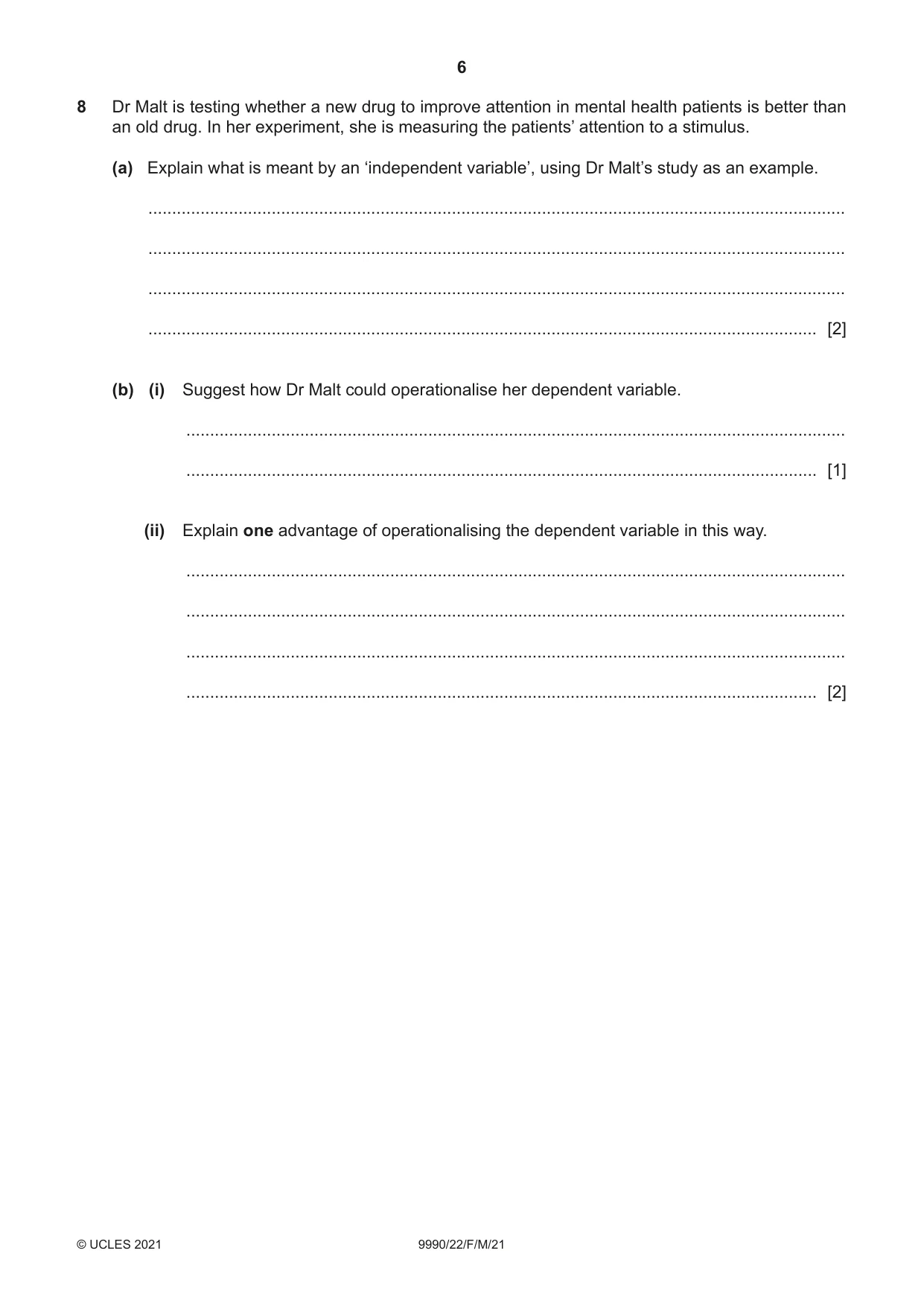
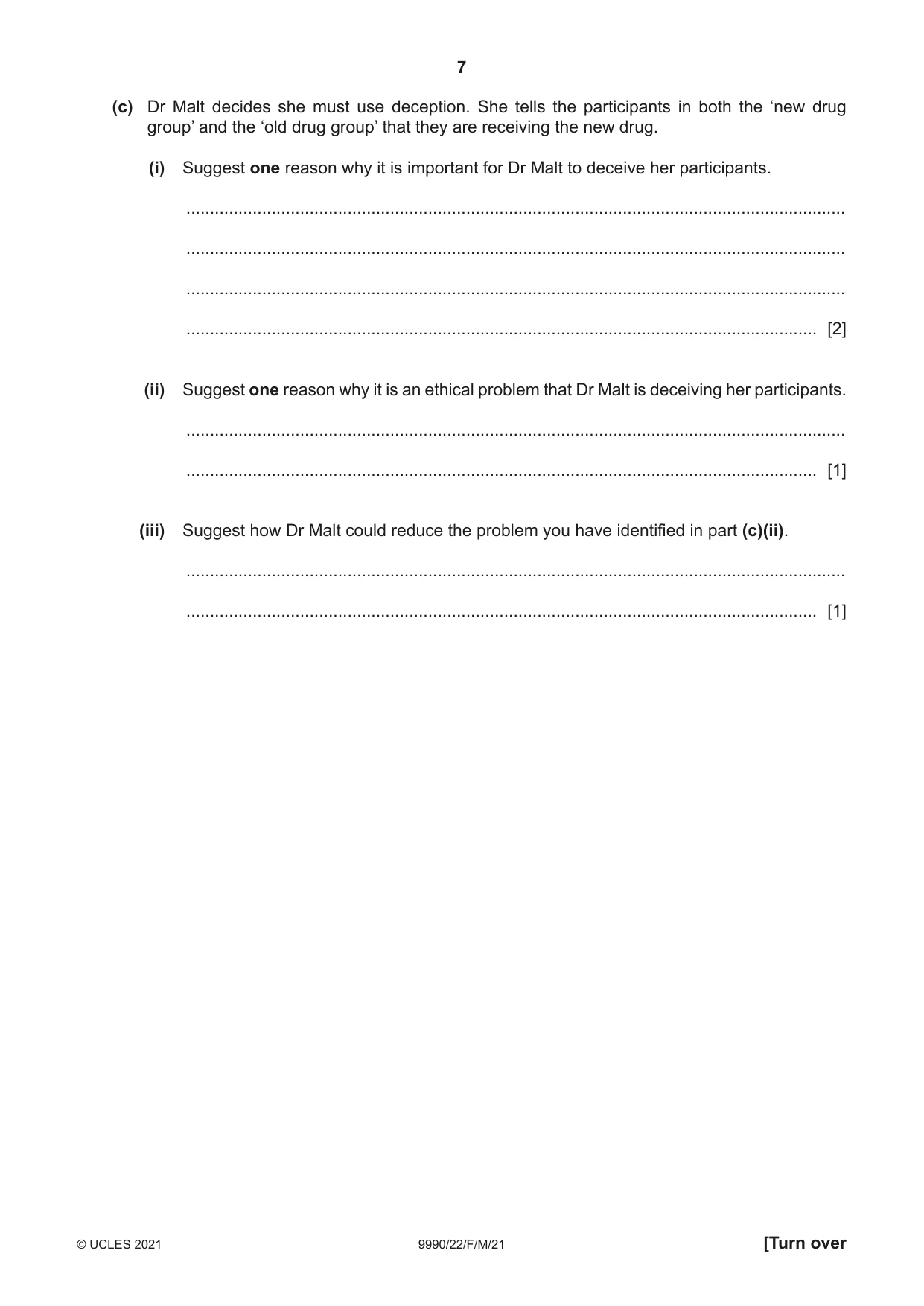
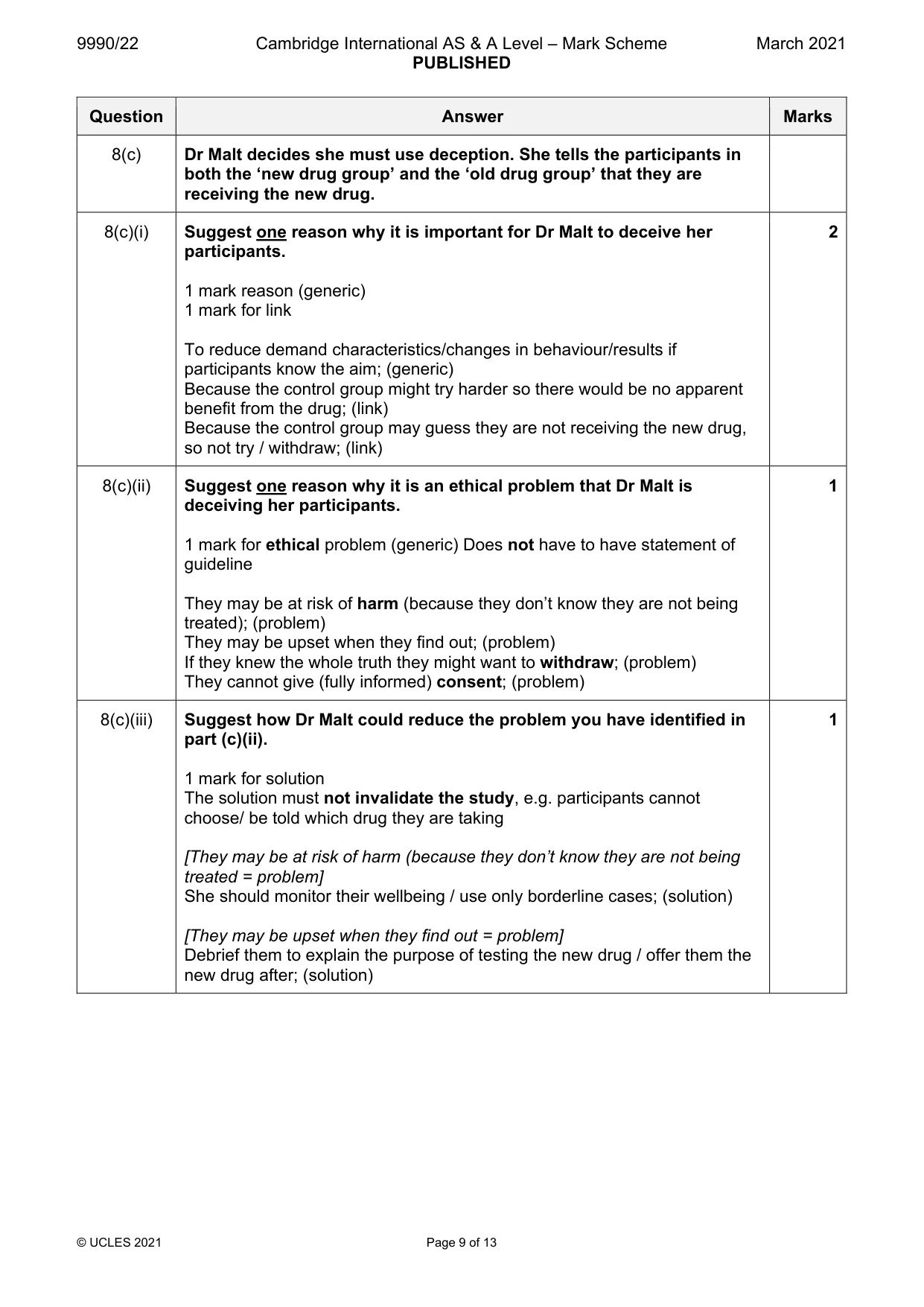
8 Dr Malt is testing whether a new drug to improve attention in mental health patients is better than an old drug. In her experiment, she is measuring the patients’ attention to a stimulus. (a) Explain what is meant by an ‘independent variable’, using Dr Malt’s study as an example. ................................................................................................................................................... ................................................................................................................................................... ................................................................................................................................................... ............................................................................................................................................. [2] (b) (i) Suggest how Dr Malt could operationalise her dependent variable. ........................................................................................................................................... ..................................................................................................................................... [1] (ii) Explain one advantage of operationalising the dependent variable in this way. ........................................................................................................................................... ........................................................................................................................................... ........................................................................................................................................... ..................................................................................................................................... [2] (c) Dr Malt decides she must use deception. She tells the participants in both the ‘new drug group’ and the ‘old drug group’ that they are receiving the new drug. (i) Suggest one reason why it is important for Dr Malt to deceive her participants. ........................................................................................................................................... ........................................................................................................................................... ........................................................................................................................................... ..................................................................................................................................... [2] (ii) Suggest one reason why it is an ethical problem that Dr Malt is deceiving her participants. ........................................................................................................................................... ..................................................................................................................................... [1] (iii) Suggest how Dr Malt could reduce the problem you have identified in part (c)(ii). ........................................................................................................................................... ..................................................................................................................................... [1]
Mark scheme: 8 Dr Malt is testing whether a new drug to improve attention in mental health patients is better than an old drug. In her experiment, she is measuring patients’ attention to a stimulus. 8(a) Explain what is meant by an ‘independent variable’, using Dr Malt’s 2 study as an example. 1 mark for generic definition 1 mark for link with two levels of IV The factor that is manipulated by the experimenter; (generic) A difference in conditions (that may be naturally occurring) that is compared; (generic) The variable that if expected to cause a change in the dependent variable; (generic) IV = new and old drug; 8(b)(i) Suggest how Dr Malt could operationalise her dependent variable. 1 1 mark for a measure of (changes in ability to pay) attention to a stimulus e.g. speed to identify a target; e.g. score on a test of how well people concentrate/remember; e.g. rating from 0 (not attending) – 5 (full attention) on a scale; Accept any reasonable answer. 8(b)(ii) Explain one advantage of operationalising the dependent variable in 2 this way. 2 marks for advantage 1 mark advantage (generic) 2nd mark link to 8(b)(i) (even if 8(b)(i) did not earn credit). speed to identify a target: (score 1) can use an electronic timer built into a computer; to increase validity/ reliability of speed identification; results on a test: (score 0) can use a test specific to the sample of mental health patients; so that it is not too easy / difficult; (being quantitative) the data can be used for bar charts/histograms/ comparisons; 8(c) Dr Malt decides she must use deception. She tells the participants in both the ‘new drug group’ and the ‘old drug group’ that they are receiving the new drug. 8(c)(i) Suggest one reason why it is important for Dr Malt to deceive her 2 participants. 1 mark reason (generic) 1 mark for link To reduce demand characteristics/changes in behaviour/results if participants know the aim; (generic) Because the control group might try harder so there would be no apparent benefit from the drug; (link) Because the control group may guess they are not receiving the new drug, so not try / withdraw; (link) 8(c)(ii) Suggest one reason why it is an ethical problem that Dr Malt is 1 deceiving her participants. 1 mark for ethical problem (generic) Does not have to have statement of guideline They may be at risk of harm (because they don’t know they are not being treated); (problem) They may be upset when they find out; (problem) If they knew the whole truth they might want to withdraw; (problem) They cannot give (fully informed) consent; (problem) 8(c)(iii) Suggest how Dr Malt could reduce the problem you have identified in 1 part (c)(ii). 1 mark for solution The solution must not invalidate the study, e.g. participants cannot choose/ be told which drug they are taking [They may be at risk of harm (because they don’t know they are not being treated = problem] She should monitor their wellbeing / use only borderline cases; (solution) [They may be upset when they find out = problem] Debrief them to explain the purpose of testing the new drug / offer them the new drug after; (solution)
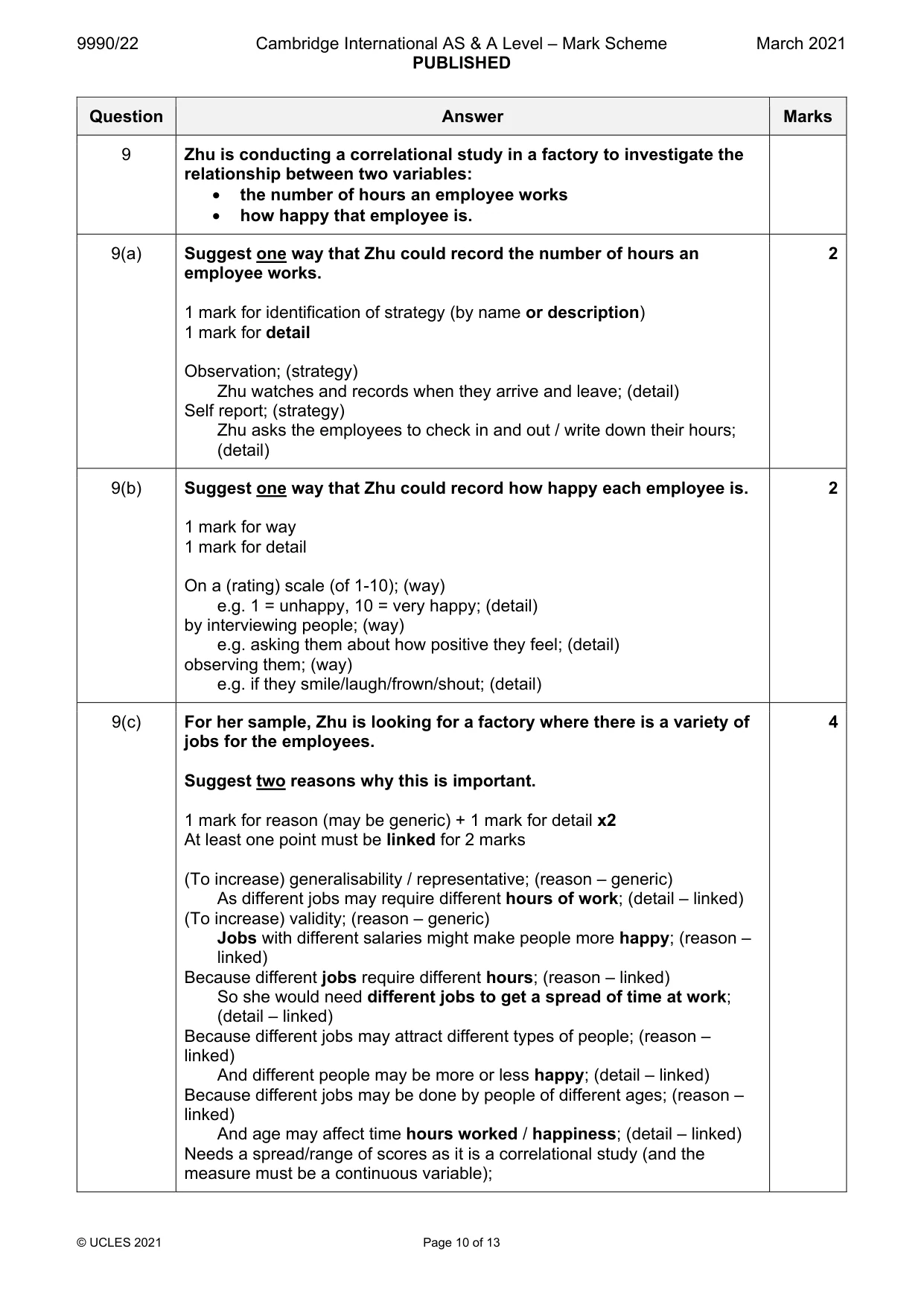
Q9 · Zhu is conducting a correlational study in a factory to investigate the relationship…
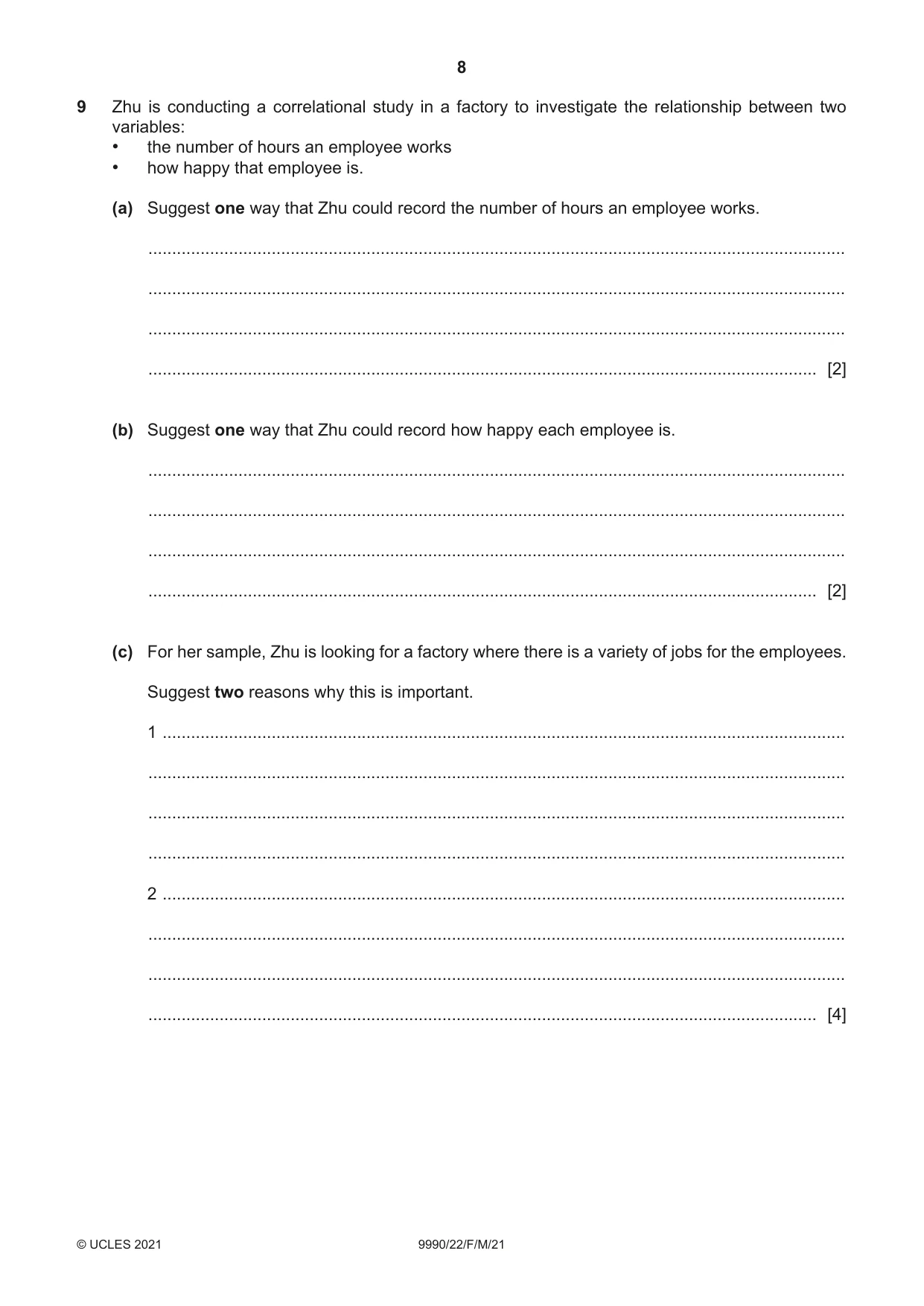
9 Zhu is conducting a correlational study in a factory to investigate the relationship between two variables: • the number of hours an employee works • how happy that employee is. (a) Suggest one way that Zhu could record the number of hours an employee works. ................................................................................................................................................... ................................................................................................................................................... ................................................................................................................................................... ............................................................................................................................................. [2] (b) Suggest one way that Zhu could record how happy each employee is. ................................................................................................................................................... ................................................................................................................................................... ................................................................................................................................................... ............................................................................................................................................. [2] (c) For her sample, Zhu is looking for a factory where there is a variety of jobs for the employees. Suggest two reasons why this is important. 1 ................................................................................................................................................ ................................................................................................................................................... ................................................................................................................................................... ................................................................................................................................................... 2 ................................................................................................................................................ ................................................................................................................................................... ................................................................................................................................................... ............................................................................................................................................. [4] Section C Answer all questions in this section.
Mark scheme: 9 Zhu is conducting a correlational study in a factory to investigate the relationship between two variables: • the number of hours an employee works • how happy that employee is. 9(a) Suggest one way that Zhu could record the number of hours an 2 employee works. 1 mark for identification of strategy (by name or description) 1 mark for detail Observation; (strategy) Zhu watches and records when they arrive and leave; (detail) Self report; (strategy) Zhu asks the employees to check in and out / write down their hours; (detail) 9(b) Suggest one way that Zhu could record how happy each employee is. 2 1 mark for way 1 mark for detail On a (rating) scale (of 1-10); (way) e.g. 1 = unhappy, 10 = very happy; (detail) by interviewing people; (way) e.g. asking them about how positive they feel; (detail) observing them; (way) e.g. if they smile/laugh/frown/shout; (detail) 9(c) For her sample, Zhu is looking for a factory where there is a variety of 4 jobs for the employees. Suggest two reasons why this is important. 1 mark for reason (may be generic) + 1 mark for detail x2 At least one point must be linked for 2 marks (To increase) generalisability / representative; (reason – generic) As different jobs may require different hours of work; (detail – linked) (To increase) validity; (reason – generic) Jobs with different salaries might make people more happy; (reason – linked) Because different jobs require different hours; (reason – linked) So she would need different jobs to get a spread of time at work; (detail – linked) Because different jobs may attract different types of people; (reason – linked) And different people may be more or less happy; (detail – linked) Because different jobs may be done by people of different ages; (reason – linked) And age may affect time hours worked / happiness; (detail – linked) Needs a spread/range of scores as it is a correlational study (and the measure must be a continuous variable);
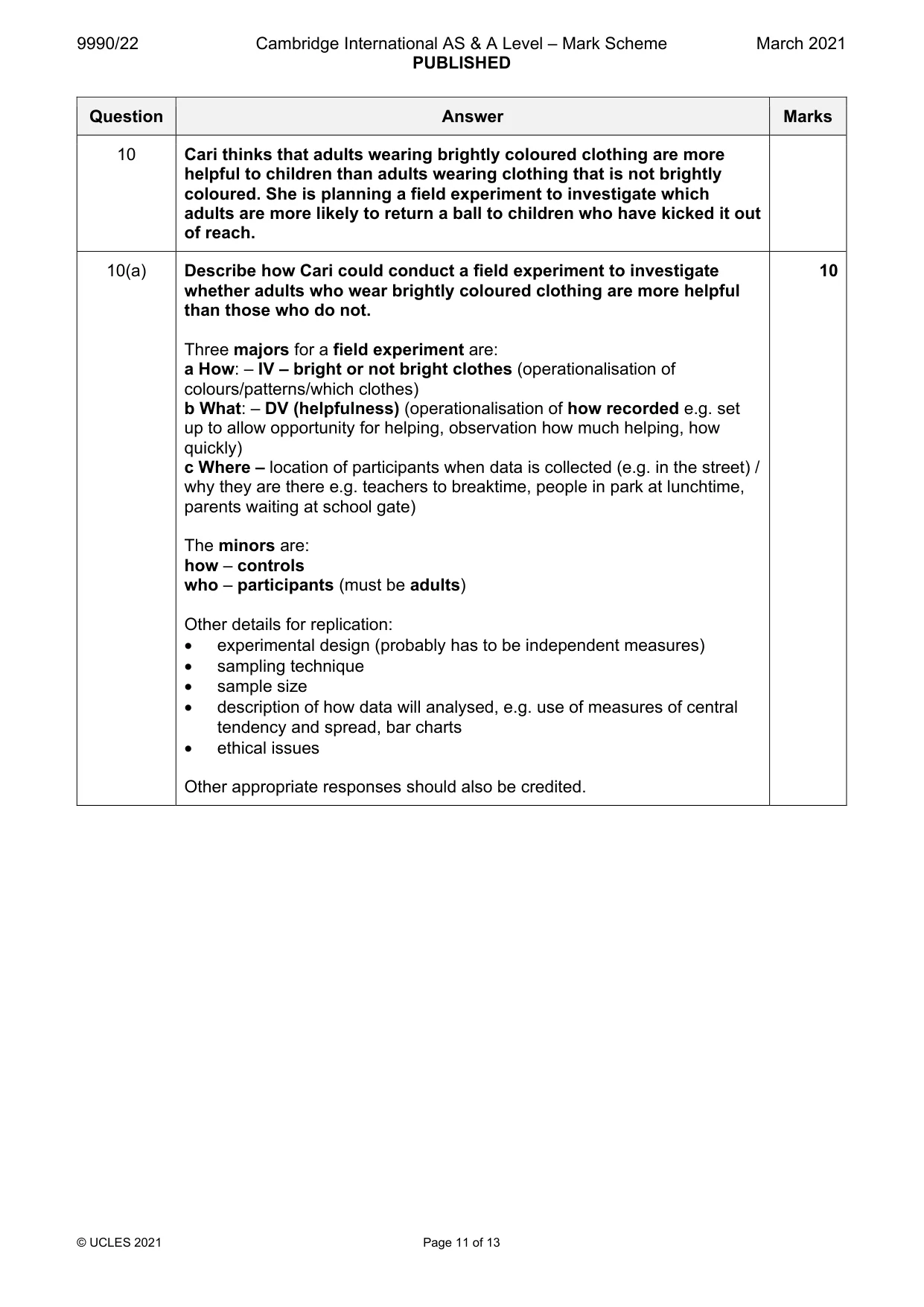
Q10 · Cari thinks that adults wearing brightly coloured clothing are more helpful to children…
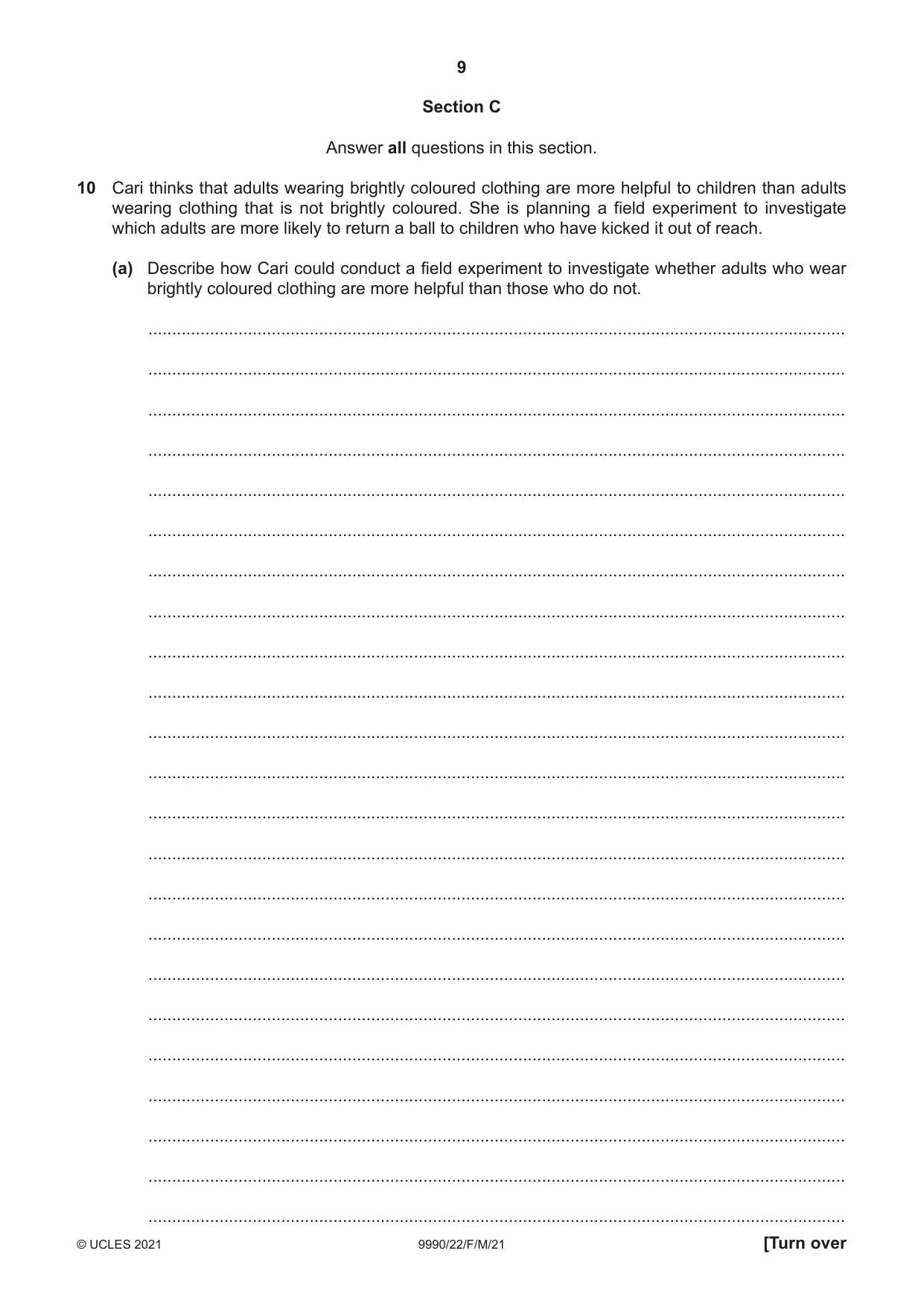
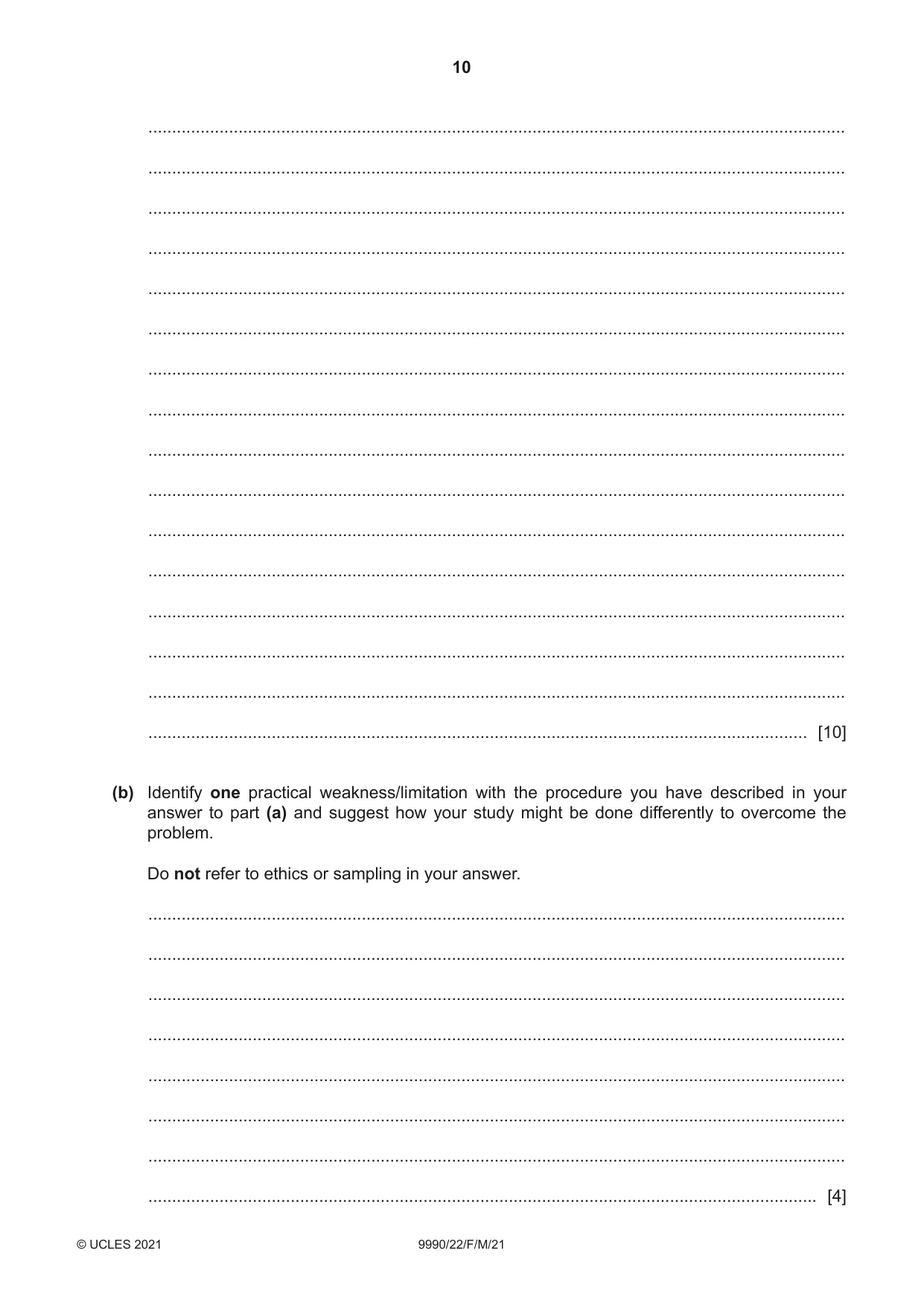
10 Cari thinks that adults wearing brightly coloured clothing are more helpful to children than adults wearing clothing that is not brightly coloured. She is planning a field experiment to investigate which adults are more likely to return a ball to children who have kicked it out of reach. (a) Describe how Cari could conduct a field experiment to investigate whether adults who wear brightly coloured clothing are more helpful than those who do not. ................................................................................................................................................... ................................................................................................................................................... ................................................................................................................................................... ................................................................................................................................................... ................................................................................................................................................... ................................................................................................................................................... ................................................................................................................................................... ................................................................................................................................................... ................................................................................................................................................... ................................................................................................................................................... ................................................................................................................................................... ................................................................................................................................................... ................................................................................................................................................... ................................................................................................................................................... ................................................................................................................................................... ................................................................................................................................................... ................................................................................................................................................... ................................................................................................................................................... ................................................................................................................................................... ................................................................................................................................................... ................................................................................................................................................... ................................................................................................................................................... ................................................................................................................................................... ................................................................................................................................................... ................................................................................................................................................... ................................................................................................................................................... ................................................................................................................................................... ................................................................................................................................................... ................................................................................................................................................... ................................................................................................................................................... ................................................................................................................................................... ................................................................................................................................................... ................................................................................................................................................... ................................................................................................................................................... ................................................................................................................................................... ................................................................................................................................................... ................................................................................................................................................... ................................................................................................................................................... ........................................................................................................................................... [10] (b) Identify one practical weakness/limitation with the procedure you have described in your answer to part (a) and suggest how your study might be done differently to overcome the problem. Do not refer to ethics or sampling in your answer. ................................................................................................................................................... ................................................................................................................................................... ................................................................................................................................................... ................................................................................................................................................... ................................................................................................................................................... ................................................................................................................................................... ................................................................................................................................................... ............................................................................................................................................. [4]
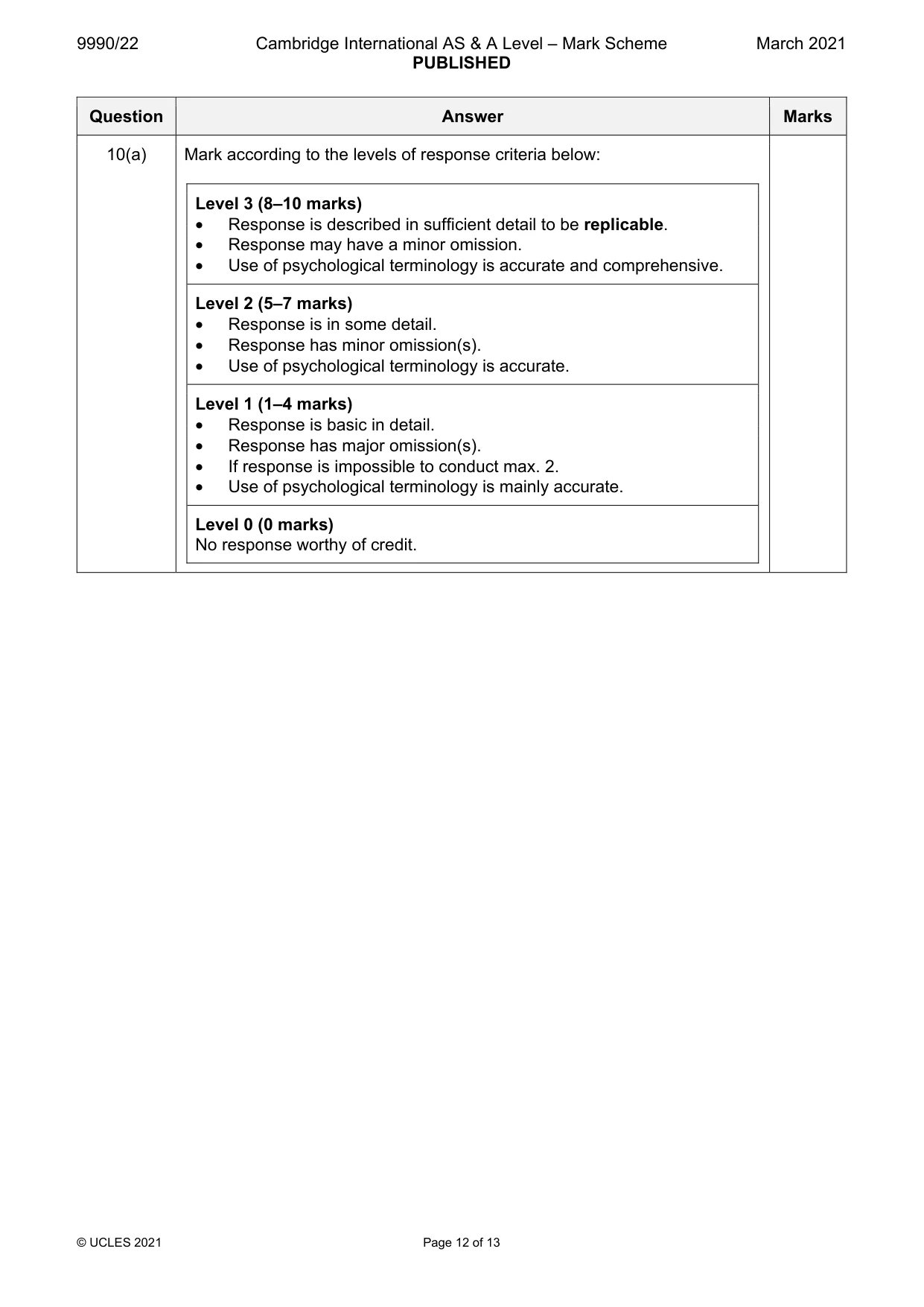
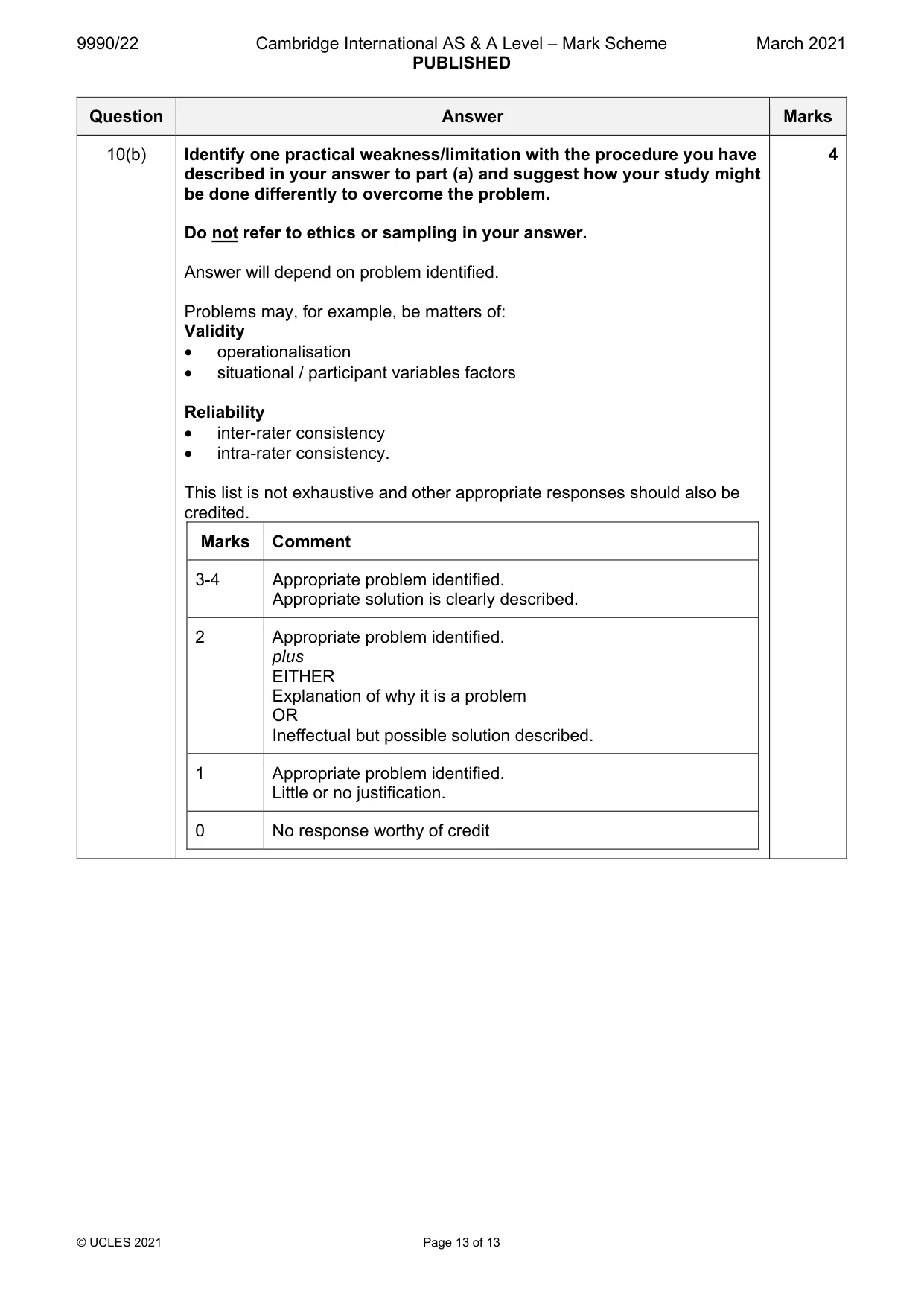
Mark scheme: 10 Cari thinks that adults wearing brightly coloured clothing are more helpful to children than adults wearing clothing that is not brightly coloured. She is planning a field experiment to investigate which adults are more likely to return a ball to children who have kicked it out of reach. 10(a) Describe how Cari could conduct a field experiment to investigate 10 whether adults who wear brightly coloured clothing are more helpful than those who do not. Three majors for a field experiment are: a How: – IV – bright or not bright clothes (operationalisation of colours/patterns/which clothes) b What: – DV (helpfulness) (operationalisation of how recorded e.g. set up to allow opportunity for helping, observation how much helping, how quickly) c Where – location of participants when data is collected (e.g. in the street) / why they are there e.g. teachers to breaktime, people in park at lunchtime, parents waiting at school gate) The minors are: how – controls who – participants (must be adults) Other details for replication: • experimental design (probably has to be independent measures) • sampling technique • sample size • description of how data will analysed, e.g. use of measures of central tendency and spread, bar charts • ethical issues Other appropriate responses should also be credited. 10(a) Mark according to the levels of response criteria below: Level 3 (8–10 marks) • Response is described in sufficient detail to be replicable. • Response may have a minor omission. • Use of psychological terminology is accurate and comprehensive. Level 2 (5–7 marks) • Response is in some detail. • Response has minor omission(s). • Use of psychological terminology is accurate. Level 1 (1–4 marks) • Response is basic in detail. • Response has major omission(s). • If response is impossible to conduct max. 2. • Use of psychological terminology is mainly accurate. Level 0 (0 marks) No response worthy of credit. 10(b) Identify one practical weakness/limitation with the procedure you have 4 described in your answer to part (a) and suggest how your study might be done differently to overcome the problem. Do not refer to ethics or sampling in your answer. Answer will depend on problem identified. Problems may, for example, be matters of: Validity • operationalisation • situational / participant variables factors Reliability • inter-rater consistency • intra-rater consistency. This list is not exhaustive and other appropriate responses should also be credited. Marks Comment 3-4 Appropriate problem identified. Appropriate solution is clearly described. 2 Appropriate problem identified. plus EITHER Explanation of why it is a problem OR Ineffectual but possible solution described. 1 Appropriate problem identified. Little or no justification. 0 No response worthy of credit
What was in this paper
The subtopics covered by these 10 questions, and how many questions each got. Open one in a new tab to see every Cambridge question on it.
What you needed in this session
Cambridge’s own grade thresholds for 2021 Feb/March, Paper 2 · Variant 2. A higher threshold means an easier paper — the bar moves with how the cohort did.