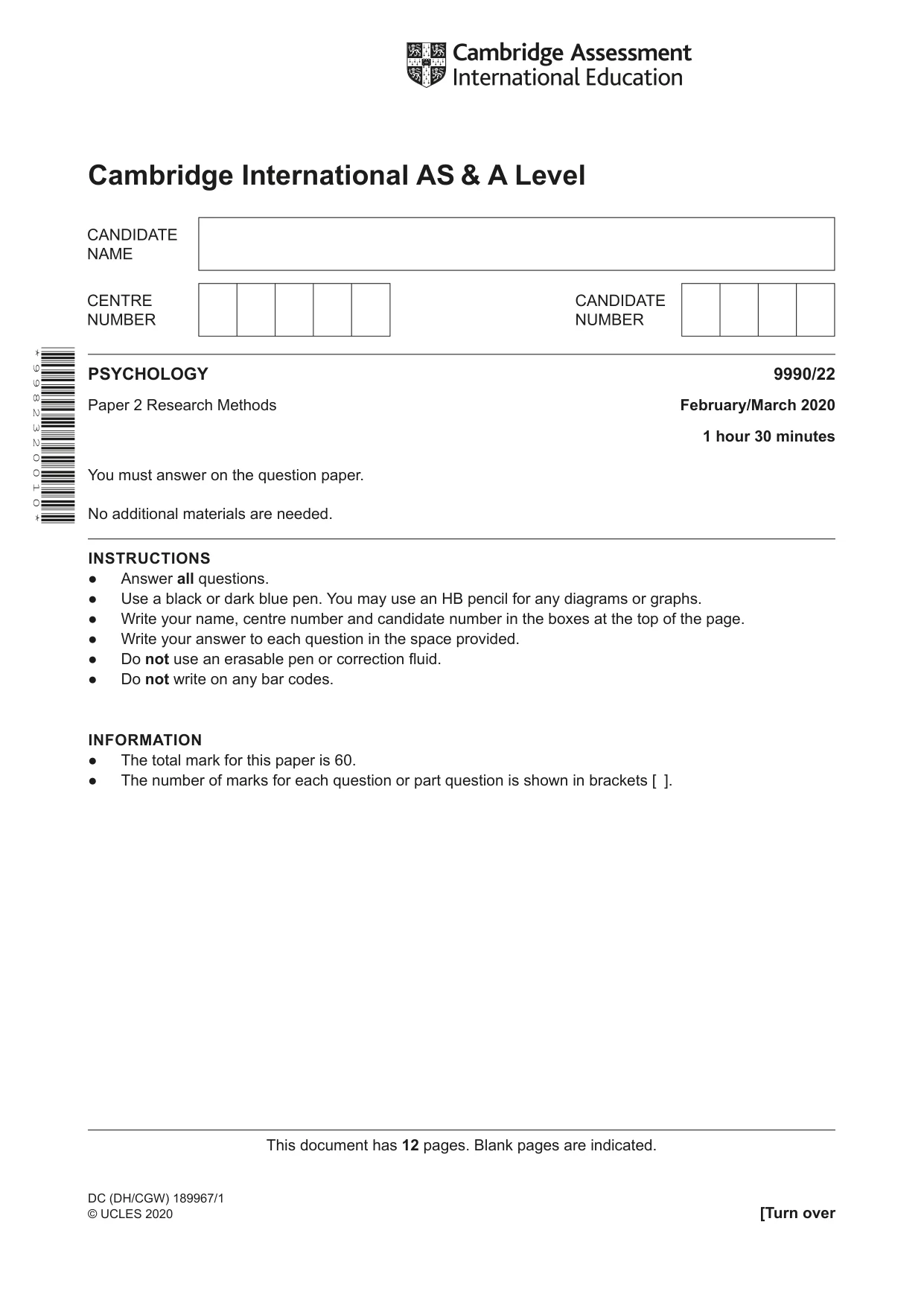
Cambridge A Level Psychology (from 2018) 9990 — 2020 Feb/March Paper 2 · Variant 2
9990/22/F/M/20 · 10 questions · 60 marks · ≈68 min
The question paper and its mark scheme, free to read here and free to download. This is Cambridge’s own paper, exactly as it was sat.
Question paper12 pages

Mark scheme12 pages
Answers below. Sit the paper first if you are practising.

Questions as text
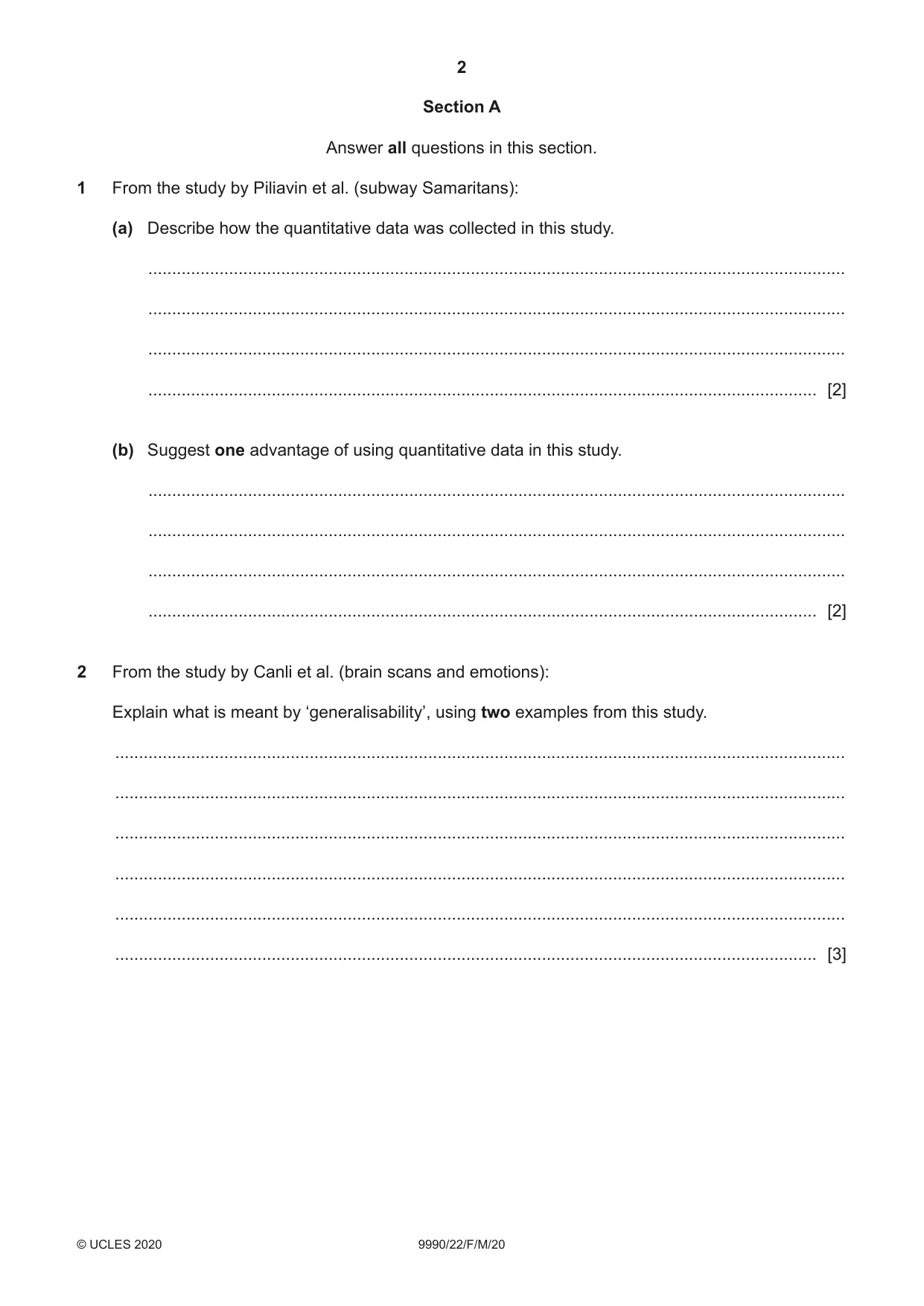
Q1 · From the study by Piliavin et al
1 From the study by Piliavin et al. (subway Samaritans): (a) Describe how the quantitative data was collected in this study. ................................................................................................................................................... ................................................................................................................................................... ................................................................................................................................................... ............................................................................................................................................. [2] (b) Suggest one advantage of using quantitative data in this study. ................................................................................................................................................... ................................................................................................................................................... ................................................................................................................................................... ............................................................................................................................................. [2]
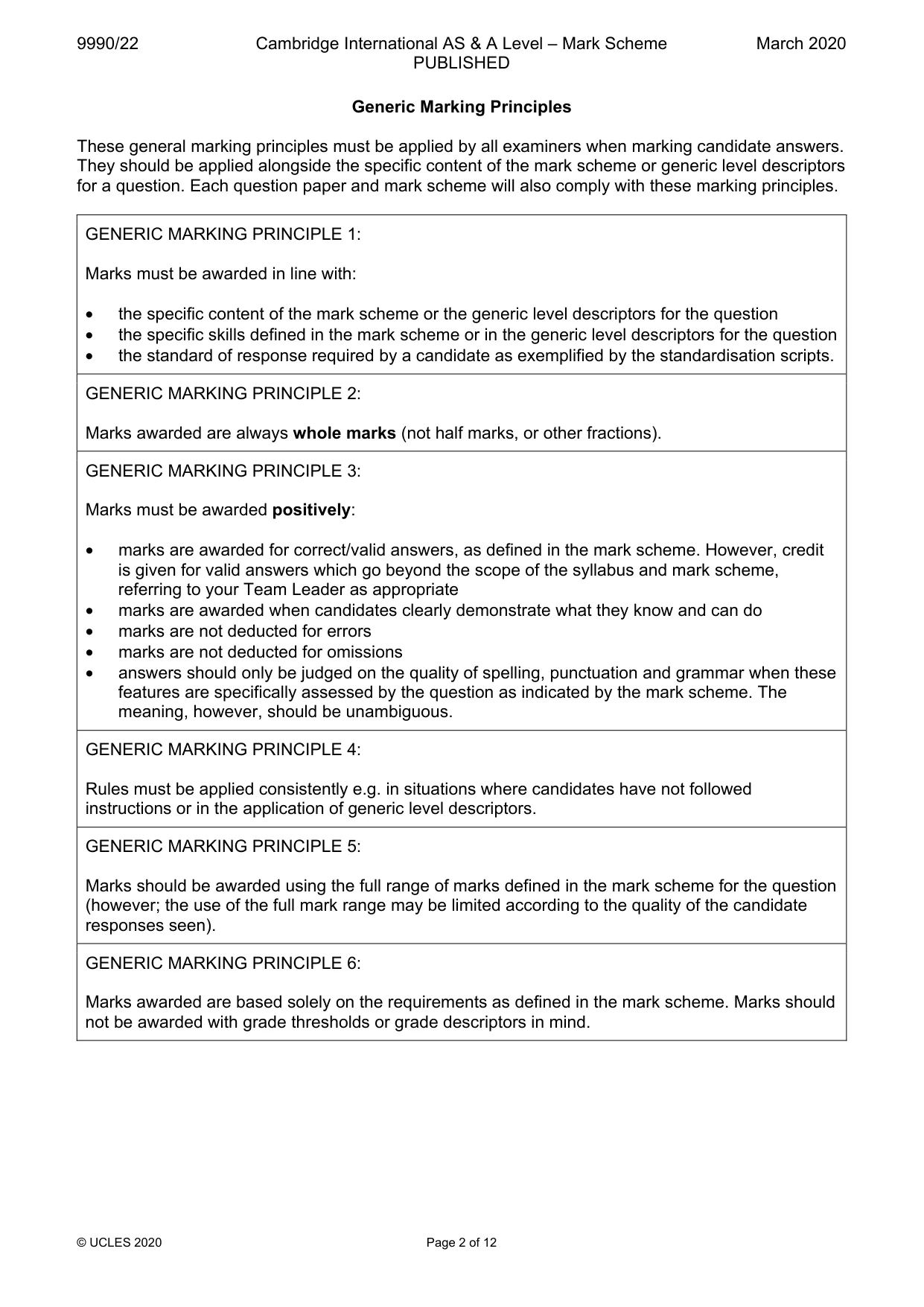
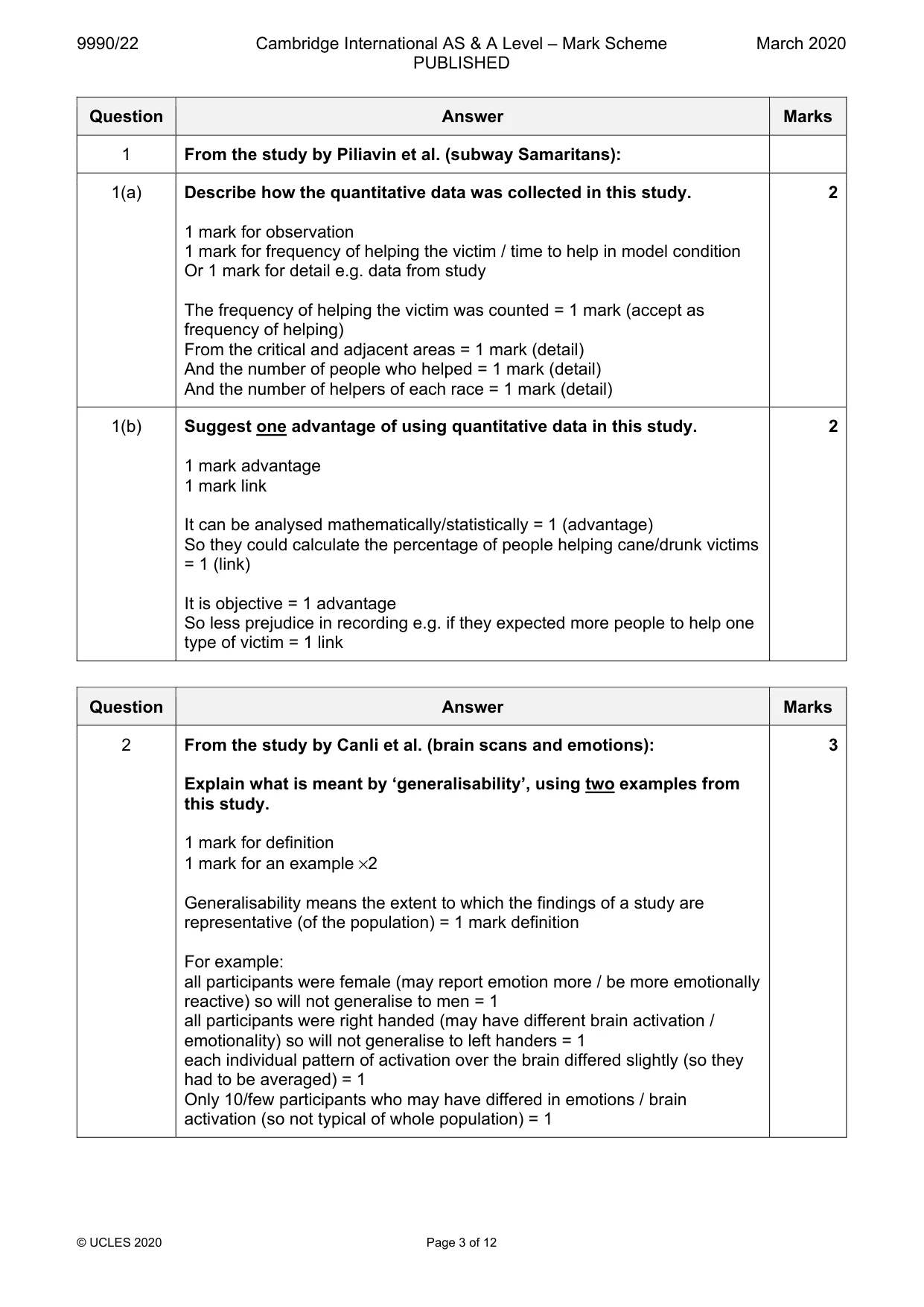
Mark scheme: Question Answer Marks 1 From the study by Piliavin et al. (subway Samaritans): 1(a) Describe how the quantitative data was collected in this study. 2 1 mark for observation 1 mark for frequency of helping the victim / time to help in model condition Or 1 mark for detail e.g. data from study The frequency of helping the victim was counted = 1 mark (accept as frequency of helping) From the critical and adjacent areas = 1 mark (detail) And the number of people who helped = 1 mark (detail) And the number of helpers of each race = 1 mark (detail) 1(b) Suggest one advantage of using quantitative data in this study. 2 1 mark advantage 1 mark link It can be analysed mathematically/statistically = 1 (advantage) So they could calculate the percentage of people helping cane/drunk victims = 1 (link) It is objective = 1 advantage So less prejudice in recording e.g. if they expected more people to help one type of victim = 1 link
Q2 · From the study by Canli et al
2 From the study by Canli et al. (brain scans and emotions): Explain what is meant by ‘generalisability’, using two examples from this study. .......................................................................................................................................................... .......................................................................................................................................................... .......................................................................................................................................................... .......................................................................................................................................................... .......................................................................................................................................................... .................................................................................................................................................... [3]
Mark scheme: 2 From the study by Canli et al. (brain scans and emotions): 3 Explain what is meant by ‘generalisability’, using two examples from this study. 1 mark for definition 1 mark for an example ×2 Generalisability means the extent to which the findings of a study are representative (of the population) = 1 mark definition For example: all participants were female (may report emotion more / be more emotionally reactive) so will not generalise to men = 1 all participants were right handed (may have different brain activation / emotionality) so will not generalise to left handers = 1 each individual pattern of activation over the brain differed slightly (so they had to be averaged) = 1 Only 10/few participants who may have differed in emotions / brain activation (so not typical of whole population) = 1
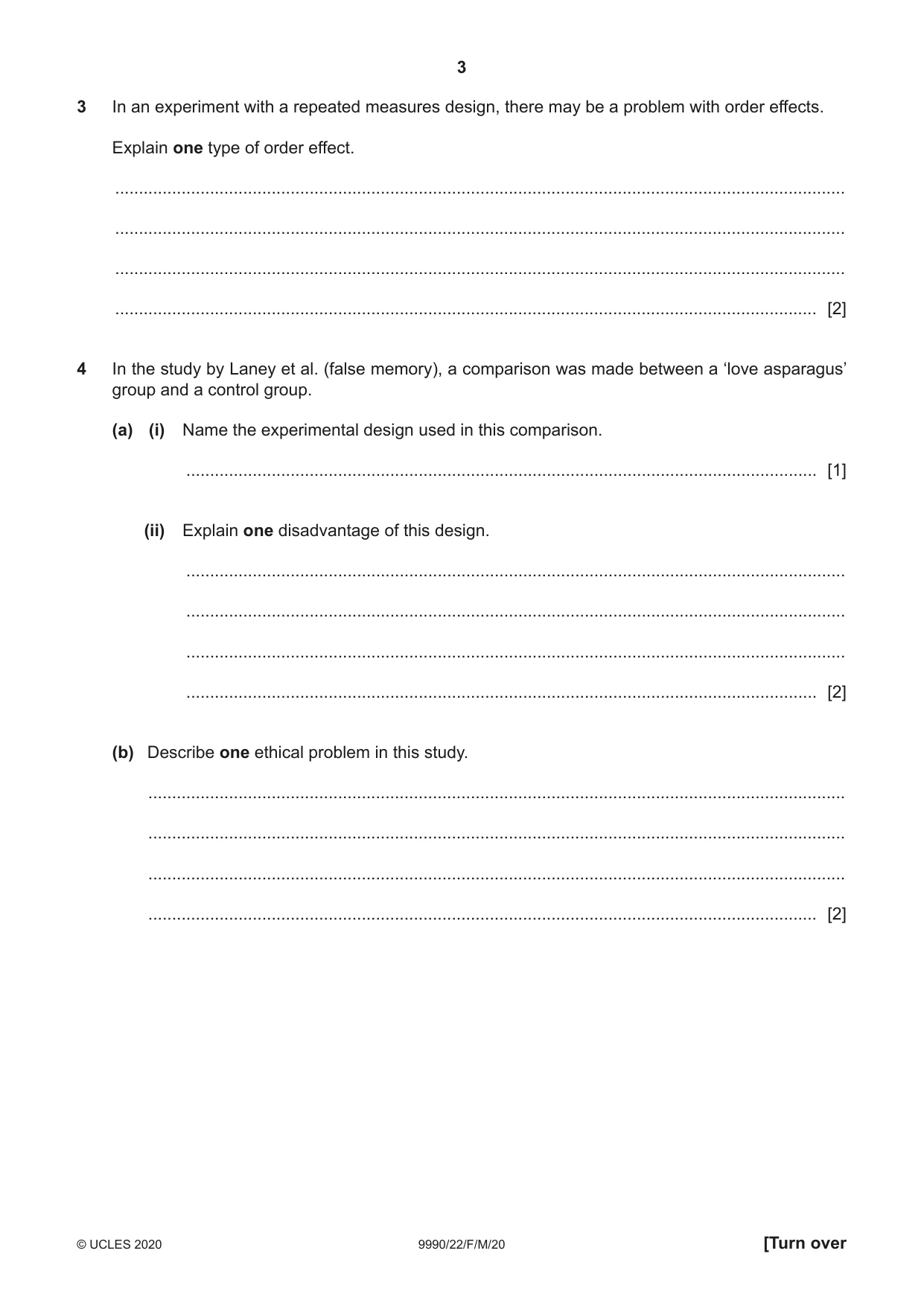
Q3 · In an experiment with a repeated measures design, there may be a problem with order…
3 In an experiment with a repeated measures design, there may be a problem with order effects. Explain one type of order effect. .......................................................................................................................................................... .......................................................................................................................................................... .......................................................................................................................................................... .................................................................................................................................................... [2]
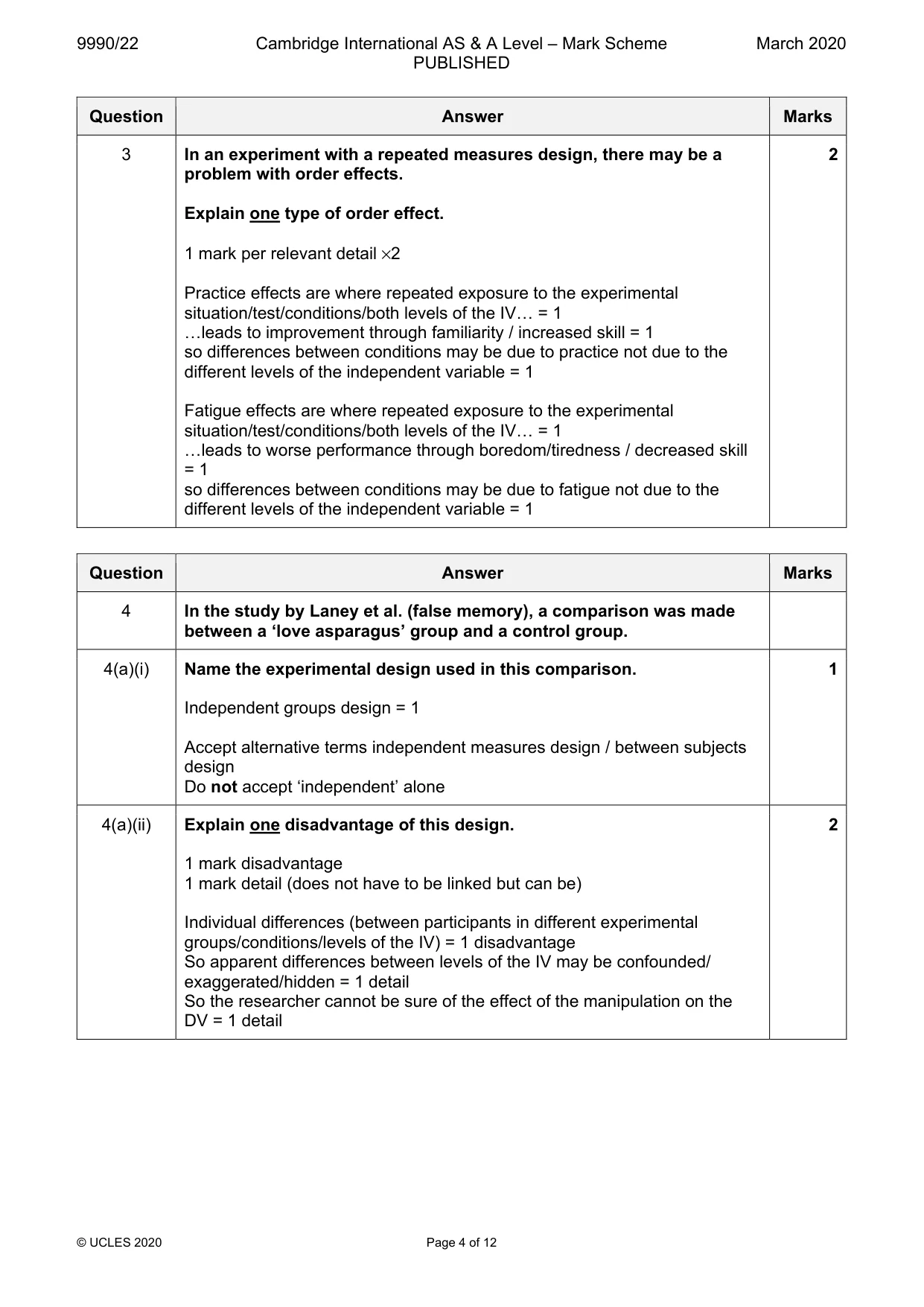
Mark scheme: 3 In an experiment with a repeated measures design, there may be a 2 problem with order effects. Explain one type of order effect. 1 mark per relevant detail ×2 Practice effects are where repeated exposure to the experimental situation/test/conditions/both levels of the IV… = 1 …leads to improvement through familiarity / increased skill = 1 so differences between conditions may be due to practice not due to the different levels of the independent variable = 1 Fatigue effects are where repeated exposure to the experimental situation/test/conditions/both levels of the IV… = 1 …leads to worse performance through boredom/tiredness / decreased skill = 1 so differences between conditions may be due to fatigue not due to the different levels of the independent variable = 1
Q4 · In the study by Laney et al
4 In the study by Laney et al. (false memory), a comparison was made between a ‘love asparagus’ group and a control group. (a) (i) Name the experimental design used in this comparison. ..................................................................................................................................... [1] (ii) Explain one disadvantage of this design. ........................................................................................................................................... ........................................................................................................................................... ........................................................................................................................................... ..................................................................................................................................... [2] (b) Describe one ethical problem in this study. ................................................................................................................................................... ................................................................................................................................................... ................................................................................................................................................... ............................................................................................................................................. [2]
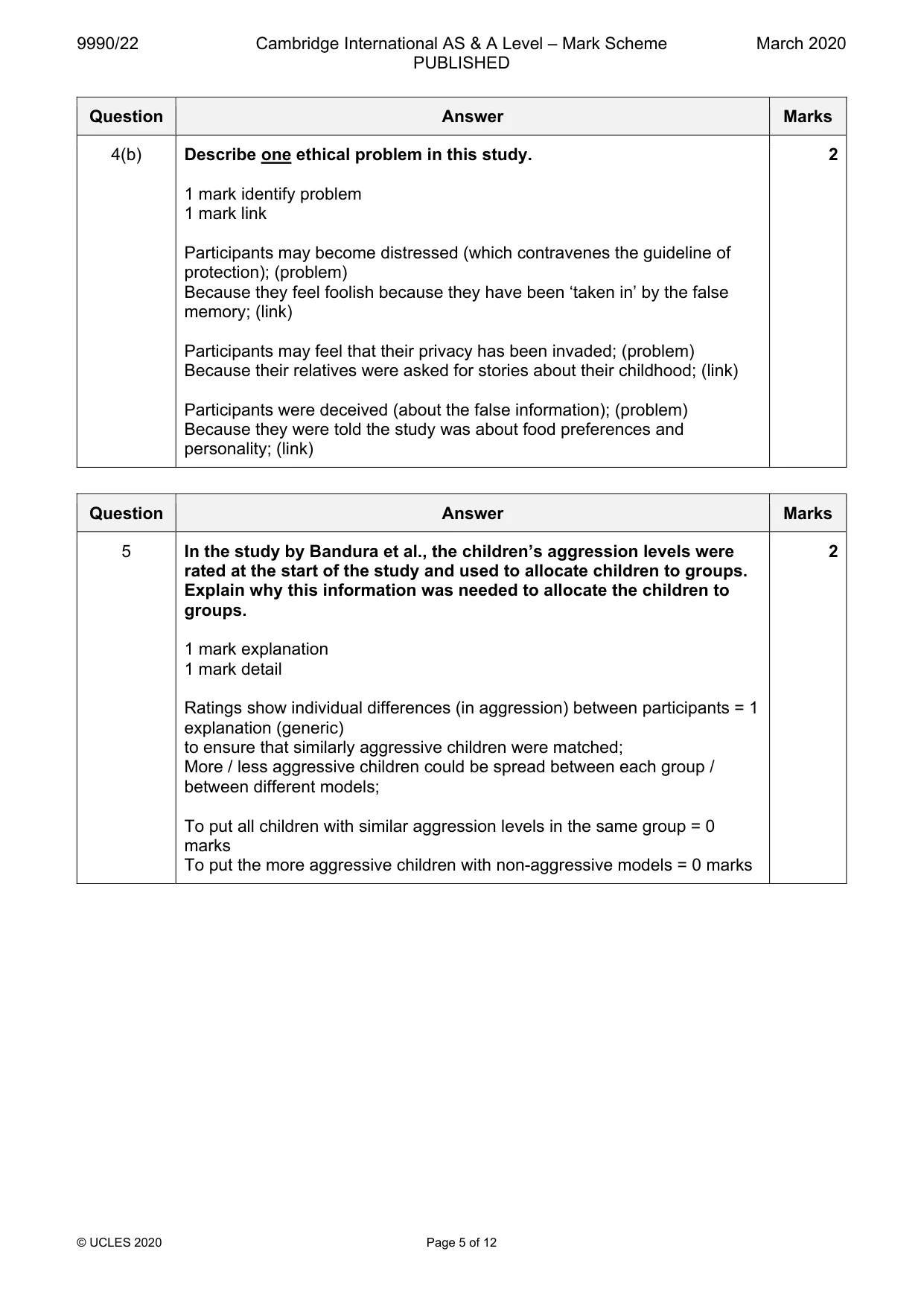
Mark scheme: 4 In the study by Laney et al. (false memory), a comparison was made between a ‘love asparagus’ group and a control group. 4(a)(i) Name the experimental design used in this comparison. 1 Independent groups design = 1 Accept alternative terms independent measures design / between subjects design Do not accept ‘independent’ alone 4(a)(ii) Explain one disadvantage of this design. 2 1 mark disadvantage 1 mark detail (does not have to be linked but can be) Individual differences (between participants in different experimental groups/conditions/levels of the IV) = 1 disadvantage So apparent differences between levels of the IV may be confounded/ exaggerated/hidden = 1 detail So the researcher cannot be sure of the effect of the manipulation on the DV = 1 detail 4(b) Describe one ethical problem in this study. 2 1 mark identify problem 1 mark link Participants may become distressed (which contravenes the guideline of protection); (problem) Because they feel foolish because they have been ‘taken in’ by the false memory; (link) Participants may feel that their privacy has been invaded; (problem) Because their relatives were asked for stories about their childhood; (link) Participants were deceived (about the false information); (problem) Because they were told the study was about food preferences and personality; (link)
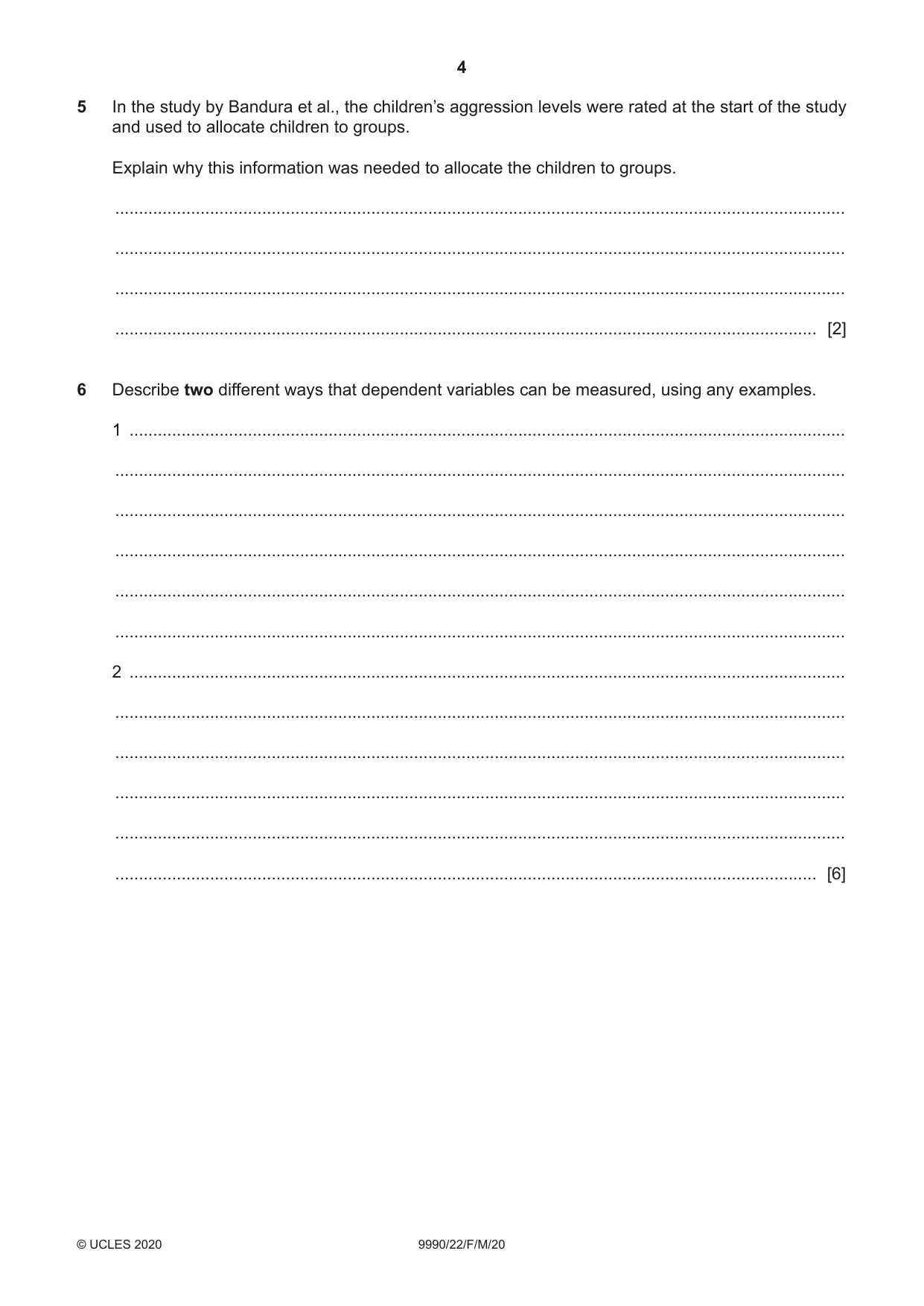
Q5 · In the study by Bandura et al., the children’s aggression levels were rated at the start…
5 In the study by Bandura et al., the children’s aggression levels were rated at the start of the study and used to allocate children to groups. Explain why this information was needed to allocate the children to groups. .......................................................................................................................................................... .......................................................................................................................................................... .......................................................................................................................................................... .................................................................................................................................................... [2]
Mark scheme: 5 In the study by Bandura et al., the children’s aggression levels were 2 rated at the start of the study and used to allocate children to groups. Explain why this information was needed to allocate the children to groups. 1 mark explanation 1 mark detail Ratings show individual differences (in aggression) between participants = 1 explanation (generic) to ensure that similarly aggressive children were matched; More / less aggressive children could be spread between each group / between different models; To put all children with similar aggression levels in the same group = 0 marks To put the more aggressive children with non-aggressive models = 0 marks
Q6 · Describe two different ways that dependent variables can be measured, using any examples
6 Describe two different ways that dependent variables can be measured, using any examples. 1 ....................................................................................................................................................... .......................................................................................................................................................... .......................................................................................................................................................... .......................................................................................................................................................... .......................................................................................................................................................... .......................................................................................................................................................... 2 ....................................................................................................................................................... .......................................................................................................................................................... .......................................................................................................................................................... .......................................................................................................................................................... .......................................................................................................................................................... .................................................................................................................................................... [6]
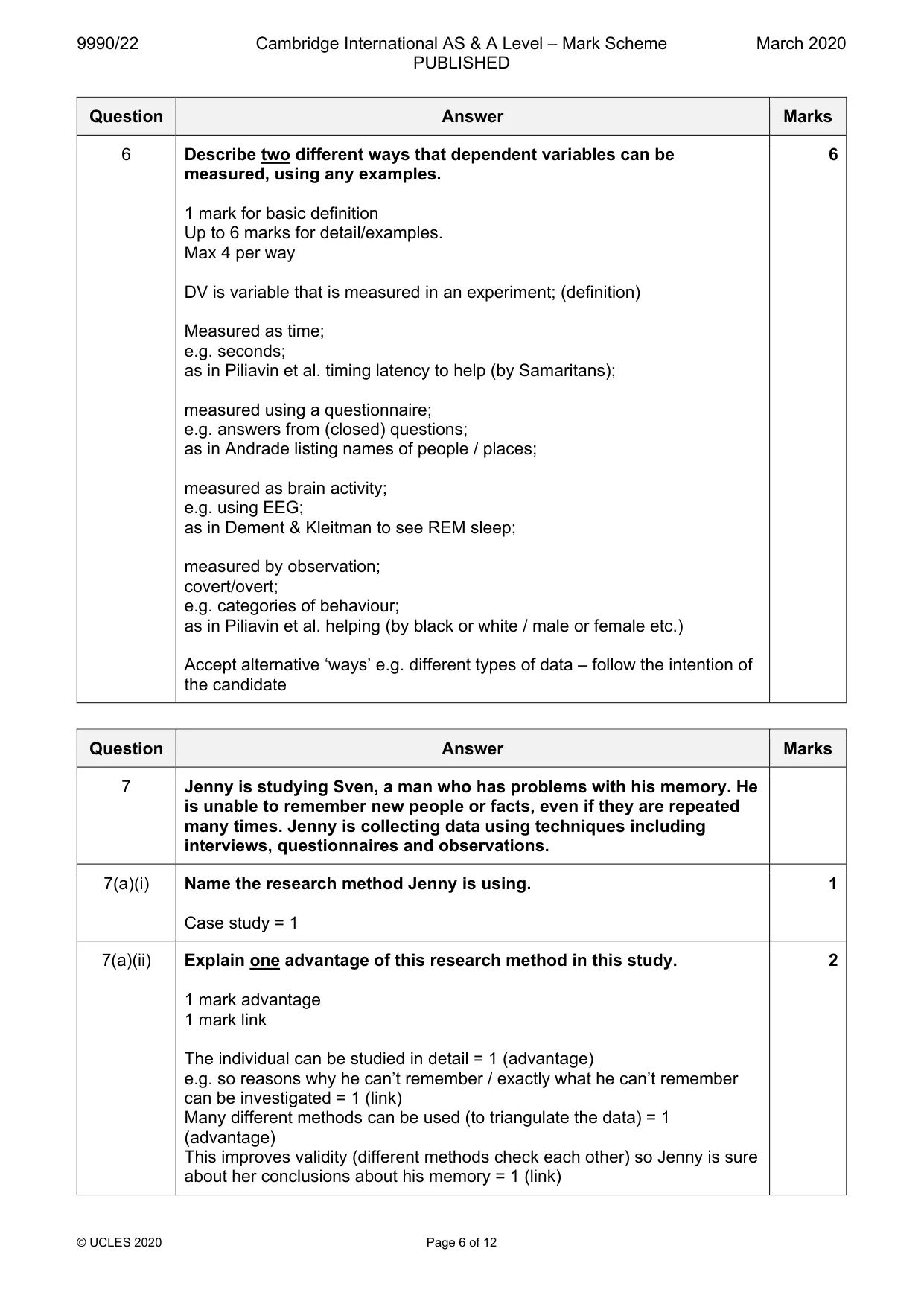
Mark scheme: 6 Describe two different ways that dependent variables can be 6 measured, using any examples. 1 mark for basic definition Up to 6 marks for detail/examples. Max 4 per way DV is variable that is measured in an experiment; (definition) Measured as time; e.g. seconds; as in Piliavin et al. timing latency to help (by Samaritans); measured using a questionnaire; e.g. answers from (closed) questions; as in Andrade listing names of people / places; measured as brain activity; e.g. using EEG; as in Dement & Kleitman to see REM sleep; measured by observation; covert/overt; e.g. categories of behaviour; as in Piliavin et al. helping (by black or white / male or female etc.) Accept alternative ‘ways’ e.g. different types of data – follow the intention of the candidate
Q7 · Jenny is studying Sven, a man who has problems with his memory
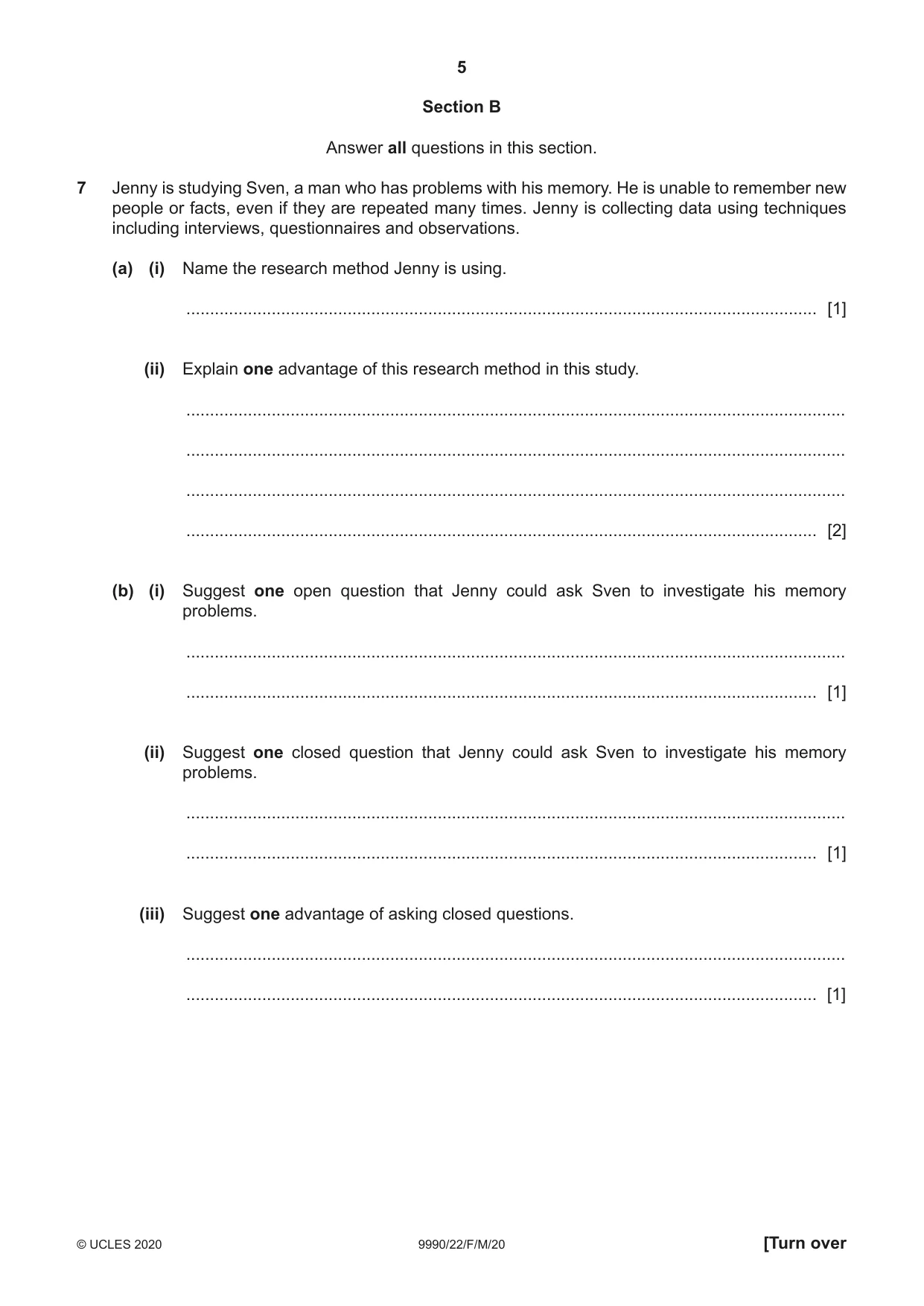
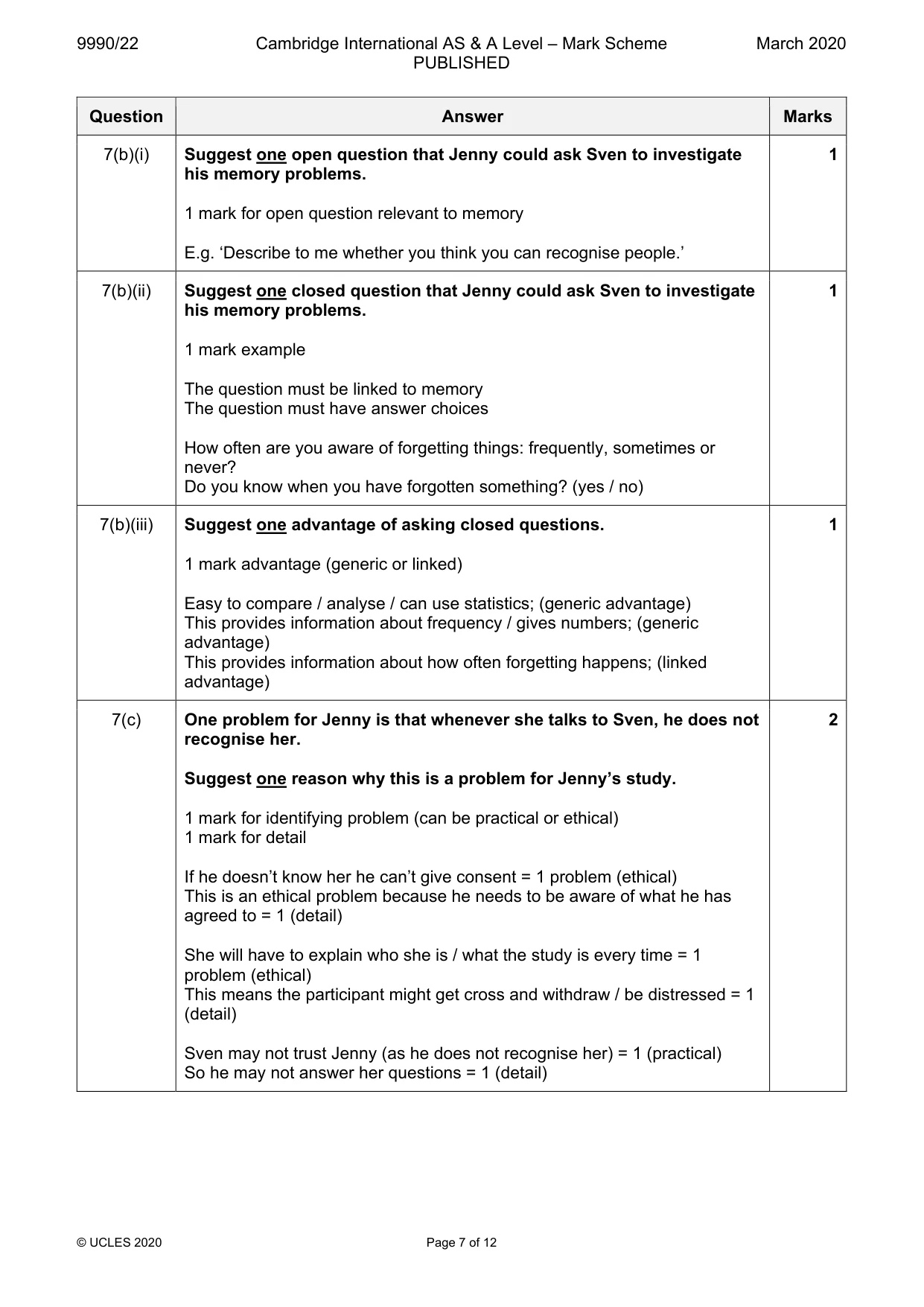
7 Jenny is studying Sven, a man who has problems with his memory. He is unable to remember new people or facts, even if they are repeated many times. Jenny is collecting data using techniques including interviews, questionnaires and observations. (a) (i) Name the research method Jenny is using. ..................................................................................................................................... [1] (ii) Explain one advantage of this research method in this study. ........................................................................................................................................... ........................................................................................................................................... ........................................................................................................................................... ..................................................................................................................................... [2] (b) (i) Suggest one open question that Jenny could ask Sven to investigate his memory problems. ........................................................................................................................................... ..................................................................................................................................... [1] (ii) Suggest one closed question that Jenny could ask Sven to investigate his memory problems. ........................................................................................................................................... ..................................................................................................................................... [1] (iii) Suggest one advantage of asking closed questions. ........................................................................................................................................... ..................................................................................................................................... [1] (c) One problem for Jenny is that whenever she talks to Sven, he does not recognise her. Suggest one reason why this is a problem for Jenny’s study. ................................................................................................................................................... ................................................................................................................................................... ................................................................................................................................................... ............................................................................................................................................. [2]
Mark scheme: 7 Jenny is studying Sven, a man who has problems with his memory. He is unable to remember new people or facts, even if they are repeated many times. Jenny is collecting data using techniques including interviews, questionnaires and observations. 7(a)(i) Name the research method Jenny is using. 1 Case study = 1 7(a)(ii) Explain one advantage of this research method in this study. 2 1 mark advantage 1 mark link The individual can be studied in detail = 1 (advantage) e.g. so reasons why he can’t remember / exactly what he can’t remember can be investigated = 1 (link) Many different methods can be used (to triangulate the data) = 1 (advantage) This improves validity (different methods check each other) so Jenny is sure about her conclusions about his memory = 1 (link) 7(b)(i) Suggest one open question that Jenny could ask Sven to investigate 1 his memory problems. 1 mark for open question relevant to memory E.g. ‘Describe to me whether you think you can recognise people.’ 7(b)(ii) Suggest one closed question that Jenny could ask Sven to investigate 1 his memory problems. 1 mark example The question must be linked to memory The question must have answer choices How often are you aware of forgetting things: frequently, sometimes or never? Do you know when you have forgotten something? (yes / no) 7(b)(iii) Suggest one advantage of asking closed questions. 1 1 mark advantage (generic or linked) Easy to compare / analyse / can use statistics; (generic advantage) This provides information about frequency / gives numbers; (generic advantage) This provides information about how often forgetting happens; (linked advantage) 7(c) One problem for Jenny is that whenever she talks to Sven, he does not 2 recognise her. Suggest one reason why this is a problem for Jenny’s study. 1 mark for identifying problem (can be practical or ethical) 1 mark for detail If he doesn’t know her he can’t give consent = 1 problem (ethical) This is an ethical problem because he needs to be aware of what he has agreed to = 1 (detail) She will have to explain who she is / what the study is every time = 1 problem (ethical) This means the participant might get cross and withdraw / be distressed = 1 (detail) Sven may not trust Jenny (as he does not recognise her) = 1 (practical) So he may not answer her questions = 1 (detail)
Q8 · Janet is investigating attitudes to healthy eating
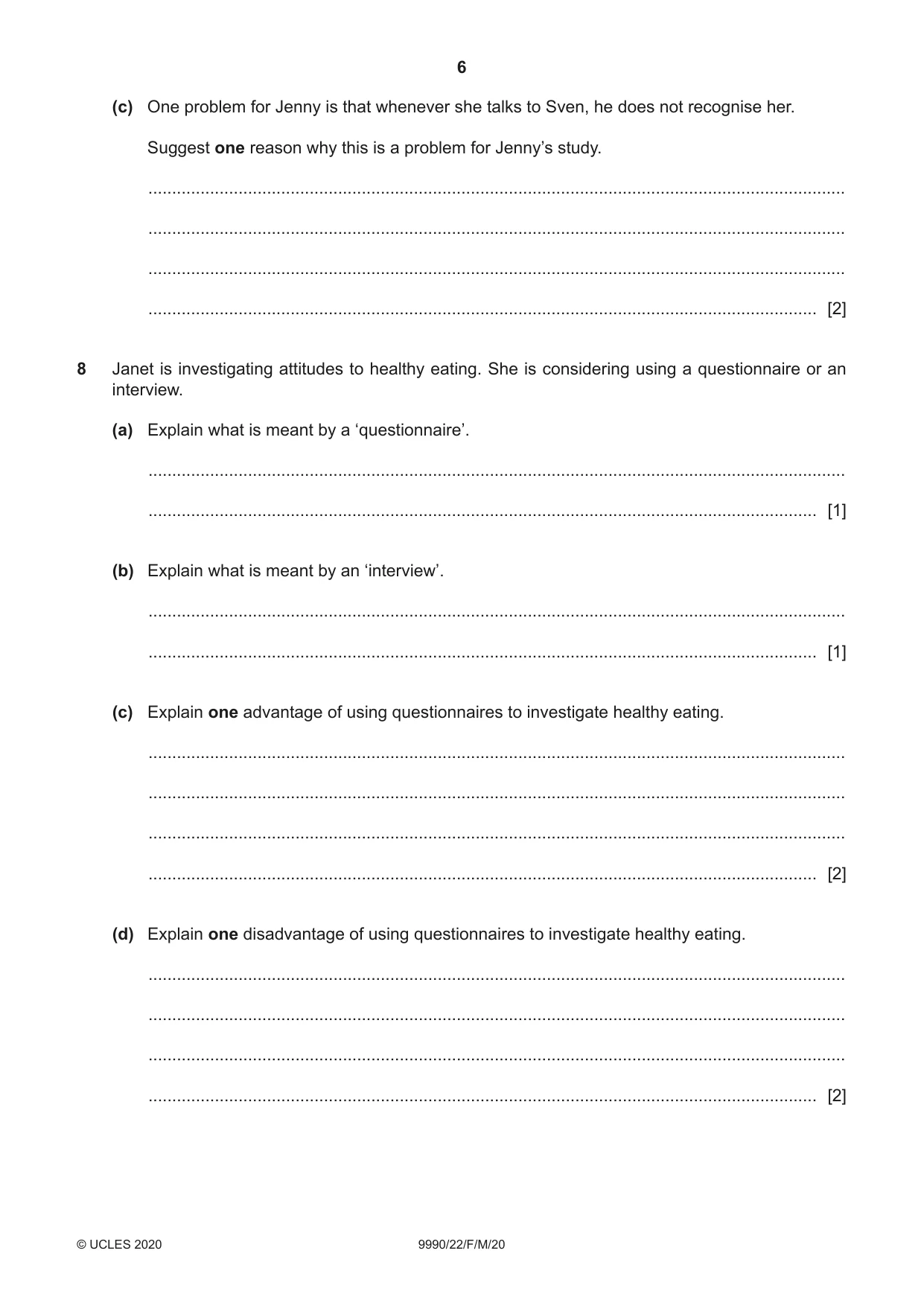
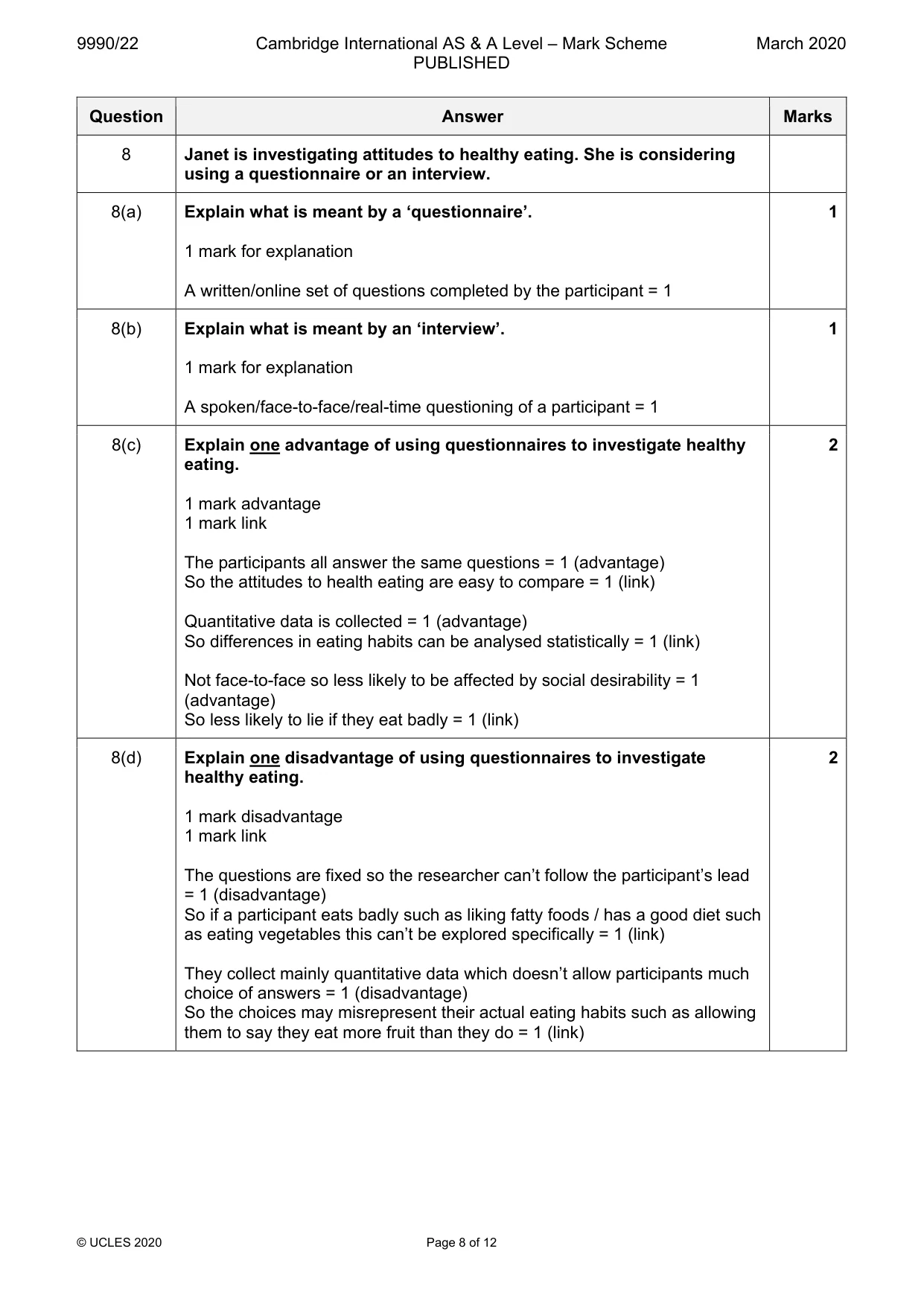
8 Janet is investigating attitudes to healthy eating. She is considering using a questionnaire or an interview. (a) Explain what is meant by a ‘questionnaire’. ................................................................................................................................................... ............................................................................................................................................. [1] (b) Explain what is meant by an ‘interview’. ................................................................................................................................................... ............................................................................................................................................. [1] (c) Explain one advantage of using questionnaires to investigate healthy eating. ................................................................................................................................................... ................................................................................................................................................... ................................................................................................................................................... ............................................................................................................................................. [2] (d) Explain one disadvantage of using questionnaires to investigate healthy eating. ................................................................................................................................................... ................................................................................................................................................... ................................................................................................................................................... ............................................................................................................................................. [2] Question 9 appears on the following page
Mark scheme: 8 Janet is investigating attitudes to healthy eating. She is considering using a questionnaire or an interview. 8(a) Explain what is meant by a ‘questionnaire’. 1 1 mark for explanation A written/online set of questions completed by the participant = 1 8(b) Explain what is meant by an ‘interview’. 1 1 mark for explanation A spoken/face-to-face/real-time questioning of a participant = 1 8(c) Explain one advantage of using questionnaires to investigate healthy 2 eating. 1 mark advantage 1 mark link The participants all answer the same questions = 1 (advantage) So the attitudes to health eating are easy to compare = 1 (link) Quantitative data is collected = 1 (advantage) So differences in eating habits can be analysed statistically = 1 (link) Not face-to-face so less likely to be affected by social desirability = 1 (advantage) So less likely to lie if they eat badly = 1 (link) 8(d) Explain one disadvantage of using questionnaires to investigate 2 healthy eating. 1 mark disadvantage 1 mark link The questions are fixed so the researcher can’t follow the participant’s lead = 1 (disadvantage) So if a participant eats badly such as liking fatty foods / has a good diet such as eating vegetables this can’t be explored specifically = 1 (link) They collect mainly quantitative data which doesn’t allow participants much choice of answers = 1 (disadvantage) So the choices may misrepresent their actual eating habits such as allowing them to say they eat more fruit than they do = 1 (link)
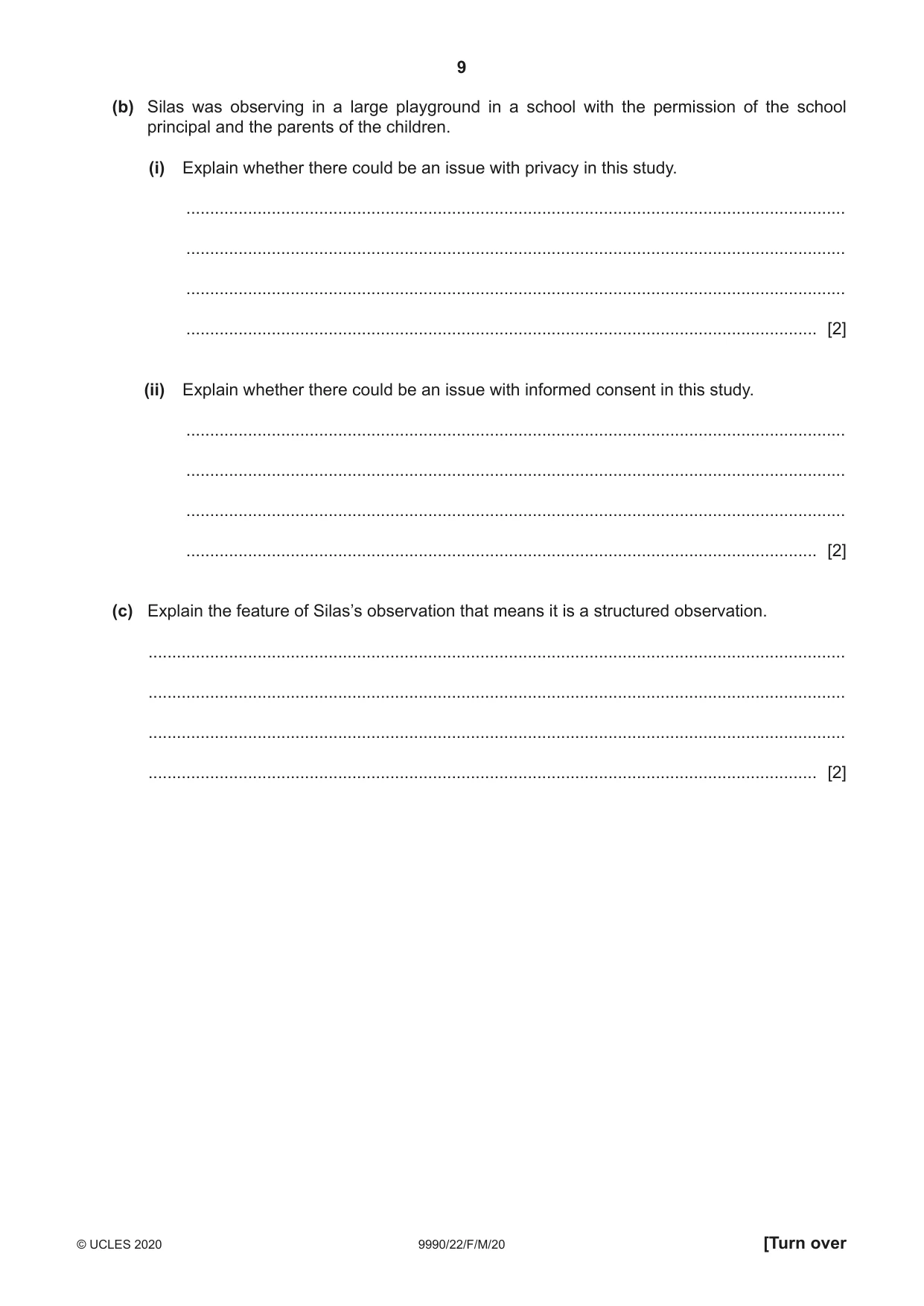
Q9 · Silas conducted an observational study about discrimination and counted examples of…
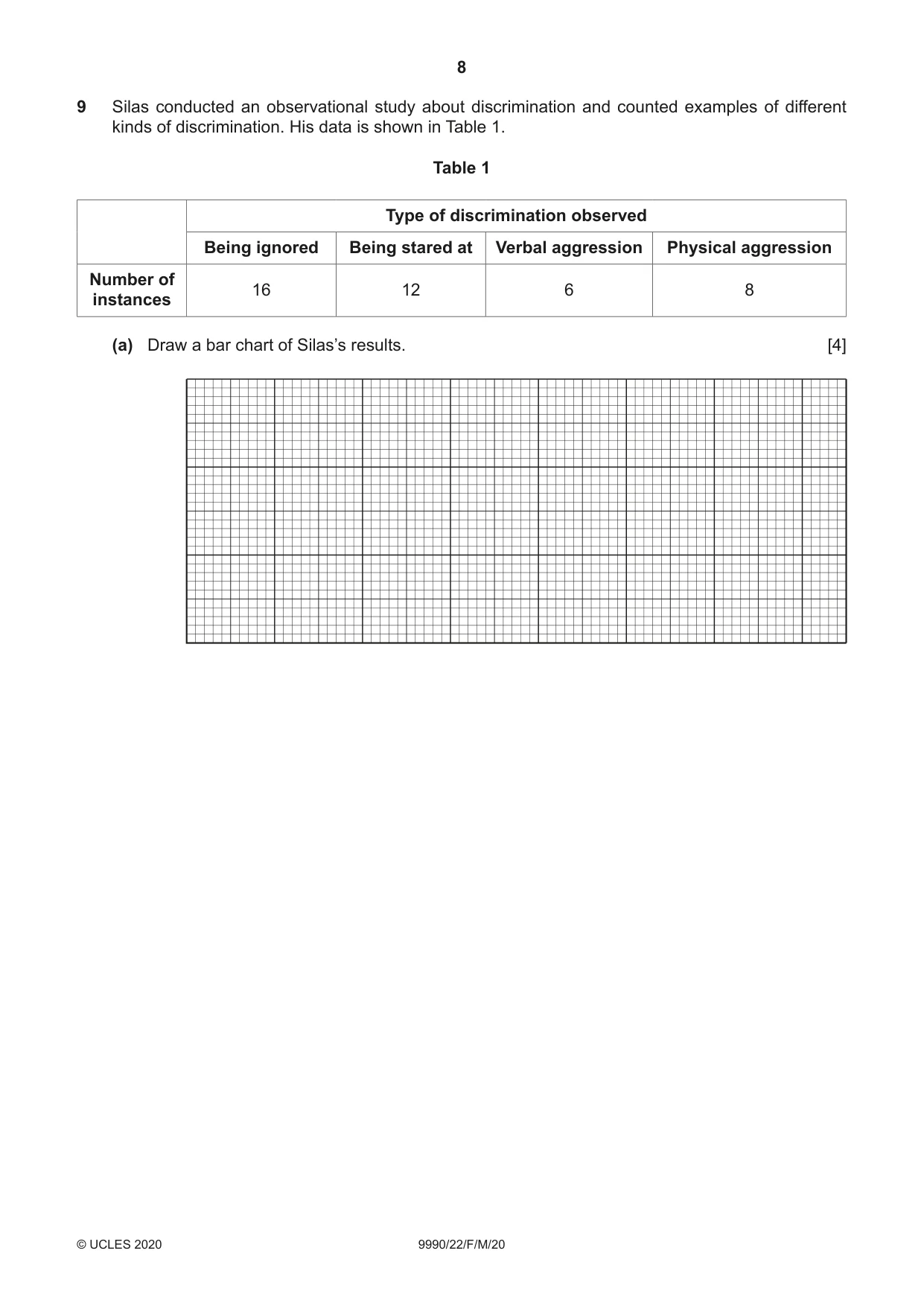
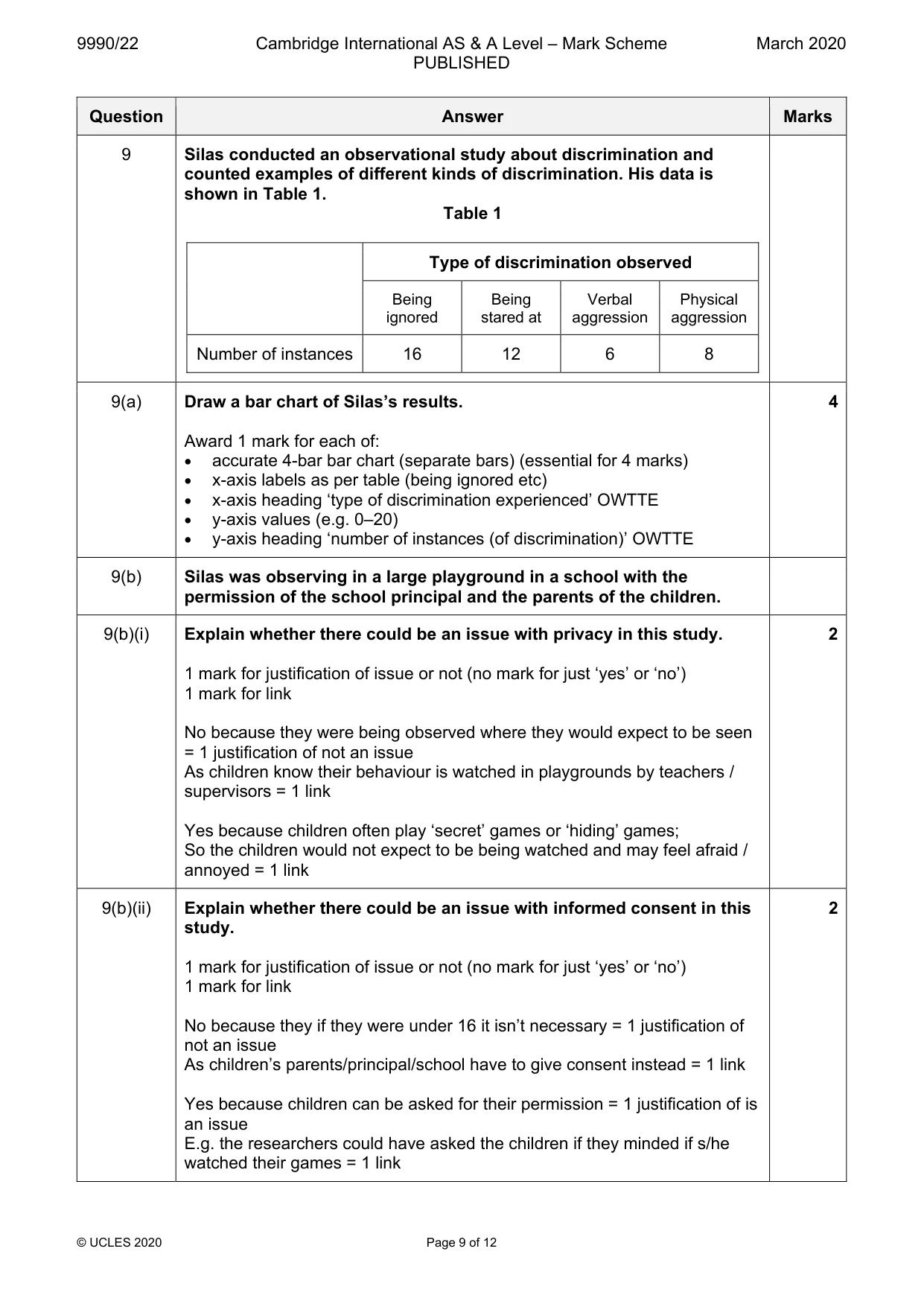
9 Silas conducted an observational study about discrimination and counted examples of different kinds of discrimination. His data is shown in Table 1. Table 1 Type of discrimination observed Being ignored Being stared at Verbal aggression Physical aggression Number of 16 12 6 8 instances (a) Draw a bar chart of Silas’s results. [4] (b) Silas was observing in a large playground in a school with the permission of the school principal and the parents of the children. (i) Explain whether there could be an issue with privacy in this study. ........................................................................................................................................... ........................................................................................................................................... ........................................................................................................................................... ..................................................................................................................................... [2] (ii) Explain whether there could be an issue with informed consent in this study. ........................................................................................................................................... ........................................................................................................................................... ........................................................................................................................................... ..................................................................................................................................... [2] (c) Explain the feature of Silas’s observation that means it is a structured observation. ................................................................................................................................................... ................................................................................................................................................... ................................................................................................................................................... ............................................................................................................................................. [2] Section C Answer all questions in this section.
Mark scheme: 9 Silas conducted an observational study about discrimination and counted examples of different kinds of discrimination. His data is shown in Table 1. Table 1 Type of discrimination observed Being Being Verbal Physical ignored stared at aggression aggression Number of instances 16 12 6 8 9(a) Draw a bar chart of Silas’s results. 4 Award 1 mark for each of: • accurate 4-bar bar chart (separate bars) (essential for 4 marks) • x-axis labels as per table (being ignored etc) • x-axis heading ‘type of discrimination experienced’ OWTTE • y-axis values (e.g. 0–20) • y-axis heading ‘number of instances (of discrimination)’ OWTTE 9(b) Silas was observing in a large playground in a school with the permission of the school principal and the parents of the children. 9(b)(i) Explain whether there could be an issue with privacy in this study. 2 1 mark for justification of issue or not (no mark for just ‘yes’ or ‘no’) 1 mark for link No because they were being observed where they would expect to be seen = 1 justification of not an issue As children know their behaviour is watched in playgrounds by teachers / supervisors = 1 link Yes because children often play ‘secret’ games or ‘hiding’ games; So the children would not expect to be being watched and may feel afraid / annoyed = 1 link 9(b)(ii) Explain whether there could be an issue with informed consent in this 2 study. 1 mark for justification of issue or not (no mark for just ‘yes’ or ‘no’) 1 mark for link No because they if they were under 16 it isn’t necessary = 1 justification of not an issue As children’s parents/principal/school have to give consent instead = 1 link Yes because children can be asked for their permission = 1 justification of is an issue E.g. the researchers could have asked the children if they minded if s/he watched their games = 1 link 9(c) Explain the feature of Silas’s observation that means it is a structured 2 observation. 1 mark for identifying feature of a structured observation 1 mark for link Structured observations collect data in specified categories/behavioural checklist = 1 feature of structured observations (gen) So Silas would need to decide before he started which of the children’s behaviours he was going to record = 1 link i.e. ‘being ignored’, ‘being stared at’ etc = 1 link
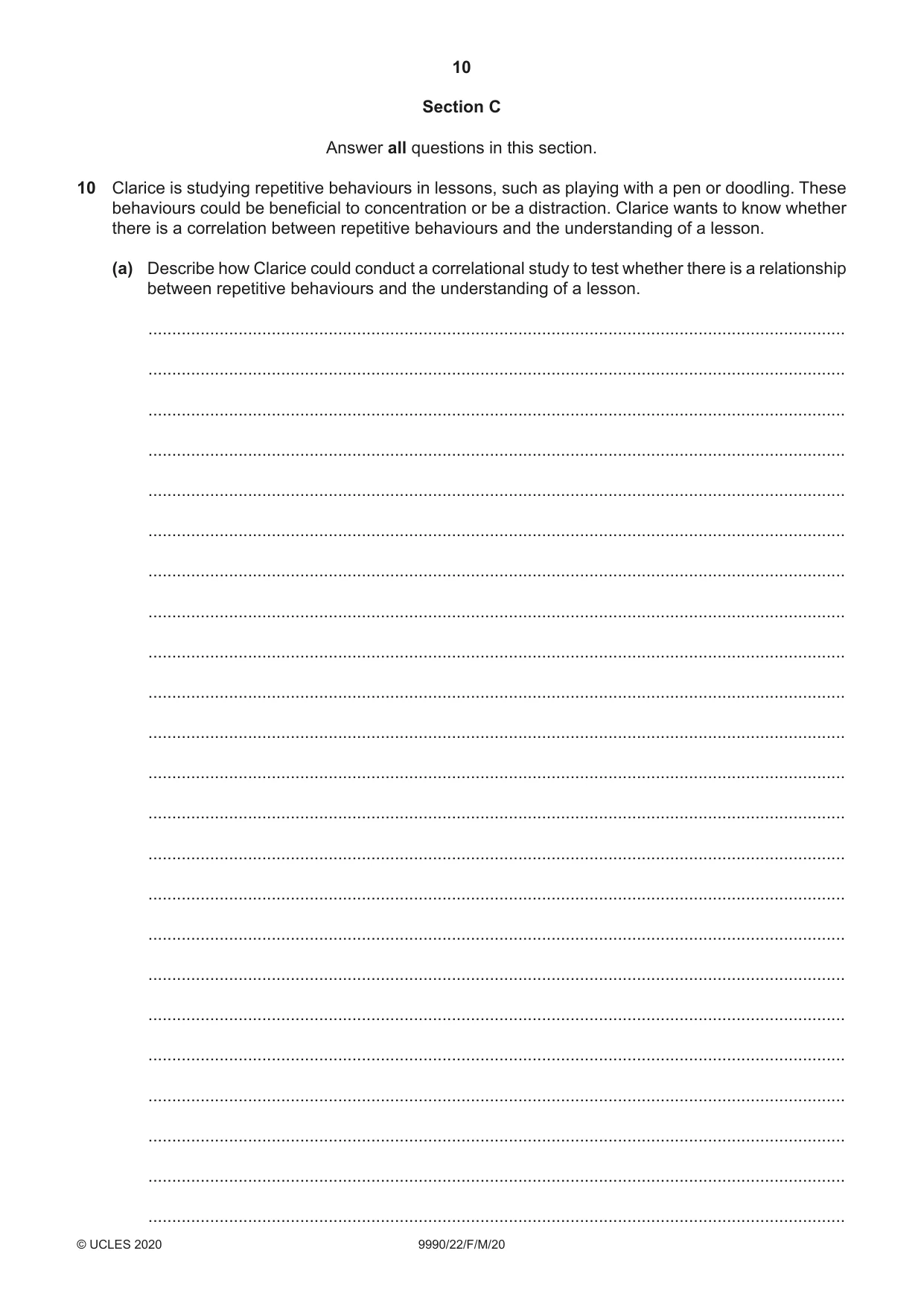
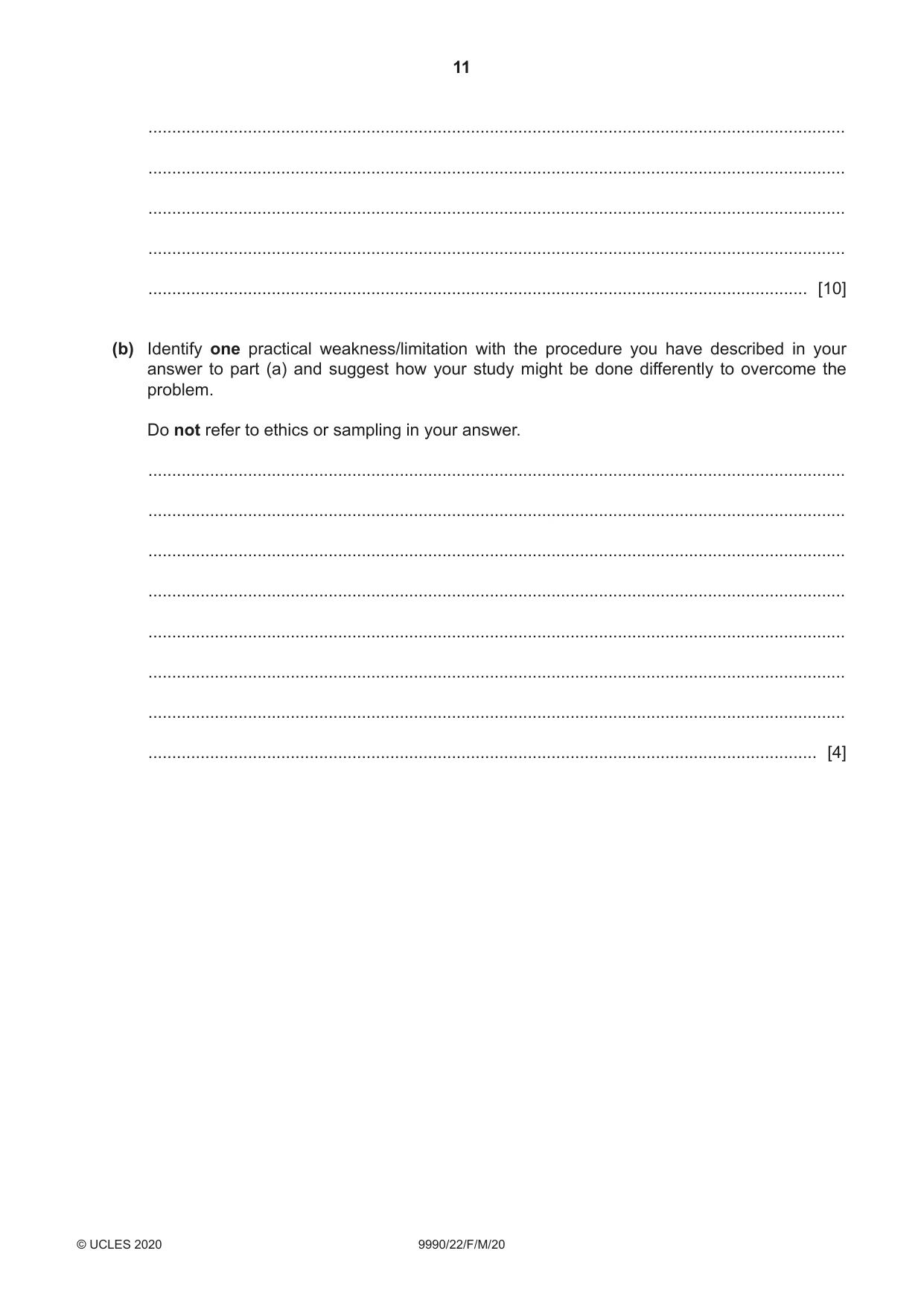
Q10 · Clarice is studying repetitive behaviours in lessons, such as playing with a pen or…
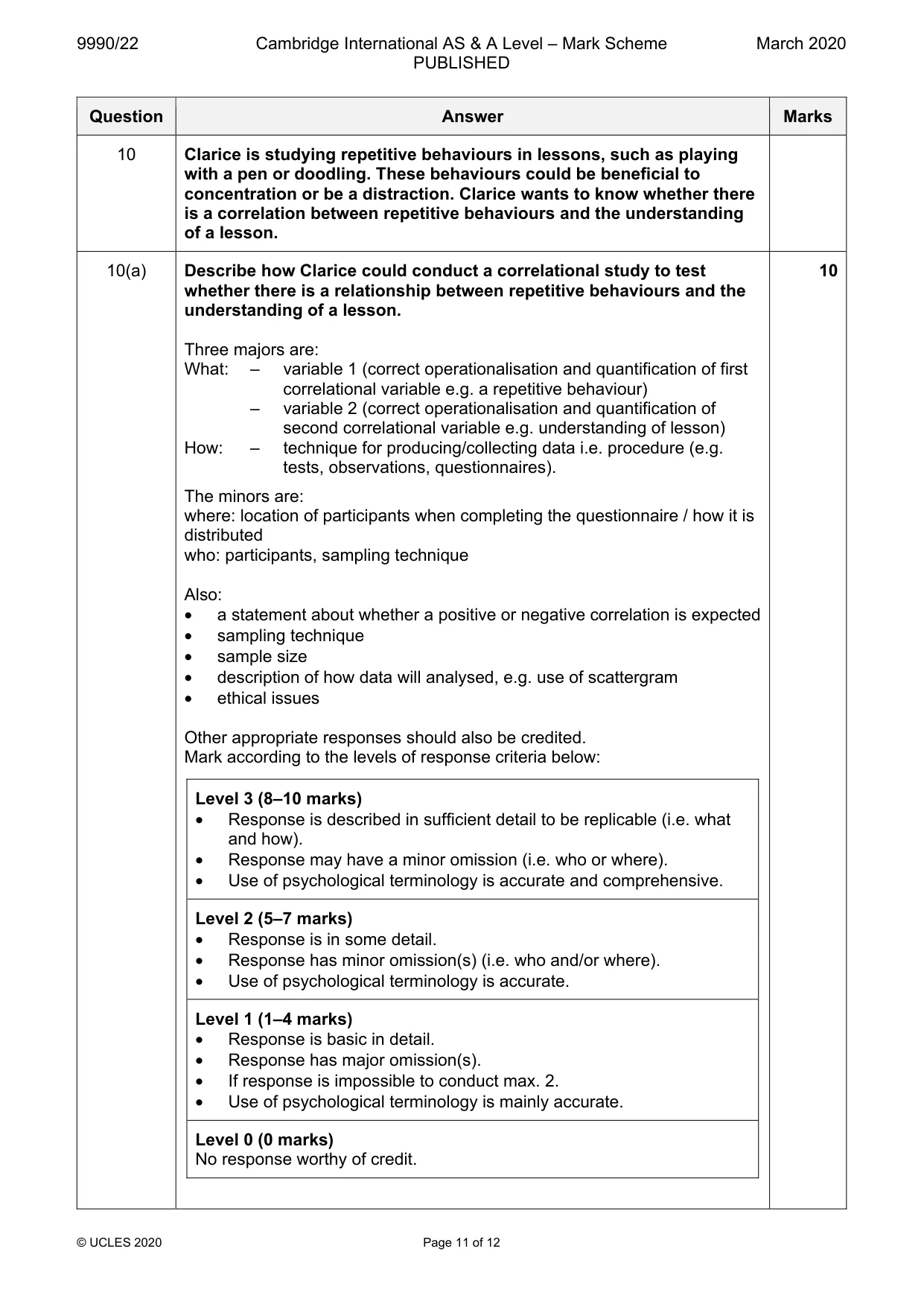
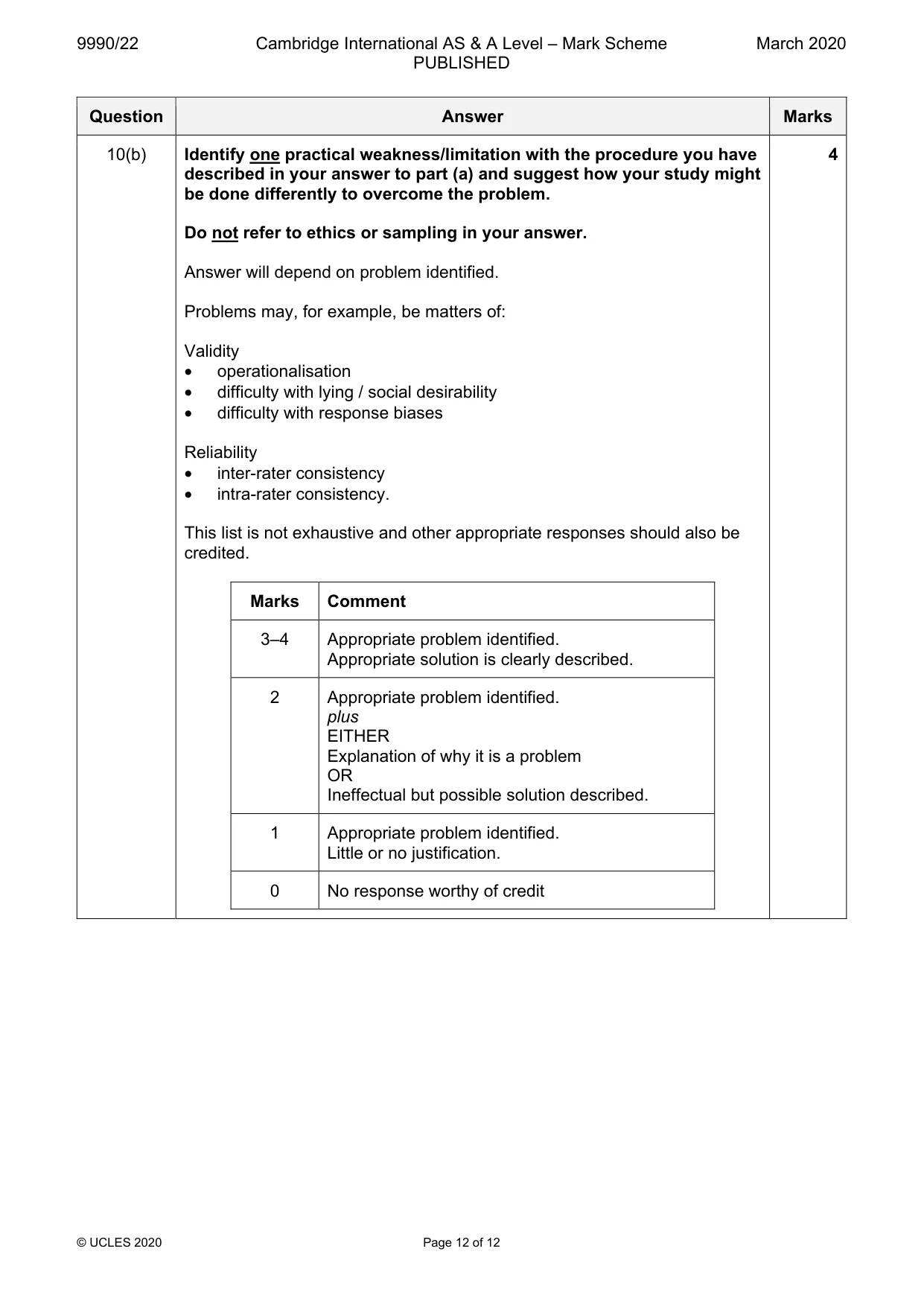
10 Clarice is studying repetitive behaviours in lessons, such as playing with a pen or doodling. These behaviours could be beneficial to concentration or be a distraction. Clarice wants to know whether there is a correlation between repetitive behaviours and the understanding of a lesson. (a) Describe how Clarice could conduct a correlational study to test whether there is a relationship between repetitive behaviours and the understanding of a lesson. ................................................................................................................................................... ................................................................................................................................................... ................................................................................................................................................... ................................................................................................................................................... ................................................................................................................................................... ................................................................................................................................................... ................................................................................................................................................... ................................................................................................................................................... ................................................................................................................................................... ................................................................................................................................................... ................................................................................................................................................... ................................................................................................................................................... ................................................................................................................................................... ................................................................................................................................................... ................................................................................................................................................... ................................................................................................................................................... ................................................................................................................................................... ................................................................................................................................................... ................................................................................................................................................... ................................................................................................................................................... ................................................................................................................................................... ................................................................................................................................................... ................................................................................................................................................... ................................................................................................................................................... ................................................................................................................................................... ................................................................................................................................................... ................................................................................................................................................... ........................................................................................................................................... [10] (b) Identify one practical weakness/limitation with the procedure you have described in your answer to part (a) and suggest how your study might be done differently to overcome the problem. Do not refer to ethics or sampling in your answer. ................................................................................................................................................... ................................................................................................................................................... ................................................................................................................................................... ................................................................................................................................................... ................................................................................................................................................... ................................................................................................................................................... ................................................................................................................................................... ............................................................................................................................................. [4]
Mark scheme: 10 Clarice is studying repetitive behaviours in lessons, such as playing with a pen or doodling. These behaviours could be beneficial to concentration or be a distraction. Clarice wants to know whether there is a correlation between repetitive behaviours and the understanding of a lesson. 10(a) Describe how Clarice could conduct a correlational study to test 10 whether there is a relationship between repetitive behaviours and the understanding of a lesson. Three majors are: What: – variable 1 (correct operationalisation and quantification of first correlational variable e.g. a repetitive behaviour) – variable 2 (correct operationalisation and quantification of second correlational variable e.g. understanding of lesson) How: – technique for producing/collecting data i.e. procedure (e.g. tests, observations, questionnaires). The minors are: where: location of participants when completing the questionnaire / how it is distributed who: participants, sampling technique Also: • a statement about whether a positive or negative correlation is expected • sampling technique • sample size • description of how data will analysed, e.g. use of scattergram • ethical issues Other appropriate responses should also be credited. Mark according to the levels of response criteria below: Level 3 (8–10 marks) • Response is described in sufficient detail to be replicable (i.e. what and how). • Response may have a minor omission (i.e. who or where). • Use of psychological terminology is accurate and comprehensive. Level 2 (5–7 marks) • Response is in some detail. • Response has minor omission(s) (i.e. who and/or where). • Use of psychological terminology is accurate. Level 1 (1–4 marks) • Response is basic in detail. • Response has major omission(s). • If response is impossible to conduct max. 2. • Use of psychological terminology is mainly accurate. Level 0 (0 marks) No response worthy of credit. 10(b) Identify one practical weakness/limitation with the procedure you have 4 described in your answer to part (a) and suggest how your study might be done differently to overcome the problem. Do not refer to ethics or sampling in your answer. Answer will depend on problem identified. Problems may, for example, be matters of: Validity • operationalisation • difficulty with lying / social desirability • difficulty with response biases Reliability • inter-rater consistency • intra-rater consistency. This list is not exhaustive and other appropriate responses should also be credited. Marks Comment 3–4 Appropriate problem identified. Appropriate solution is clearly described. 2 Appropriate problem identified. plus EITHER Explanation of why it is a problem OR Ineffectual but possible solution described. 1 Appropriate problem identified. Little or no justification. 0 No response worthy of credit
What was in this paper
The subtopics covered by these 10 questions, and how many questions each got. Open one in a new tab to see every Cambridge question on it.
What you needed in this session
Cambridge’s own grade thresholds for 2020 Feb/March, Paper 2 · Variant 2. A higher threshold means an easier paper — the bar moves with how the cohort did.