Cambridge A Level Psychology (from 2018) 9990 — 2019 Feb/March Paper 3 · Variant 2
9990/32/F/M/19 · 8 questions · 60 marks · ≈68 min
The question paper and its mark scheme, free to read here and free to download. This is Cambridge’s own paper, exactly as it was sat.
Question paper4 pages
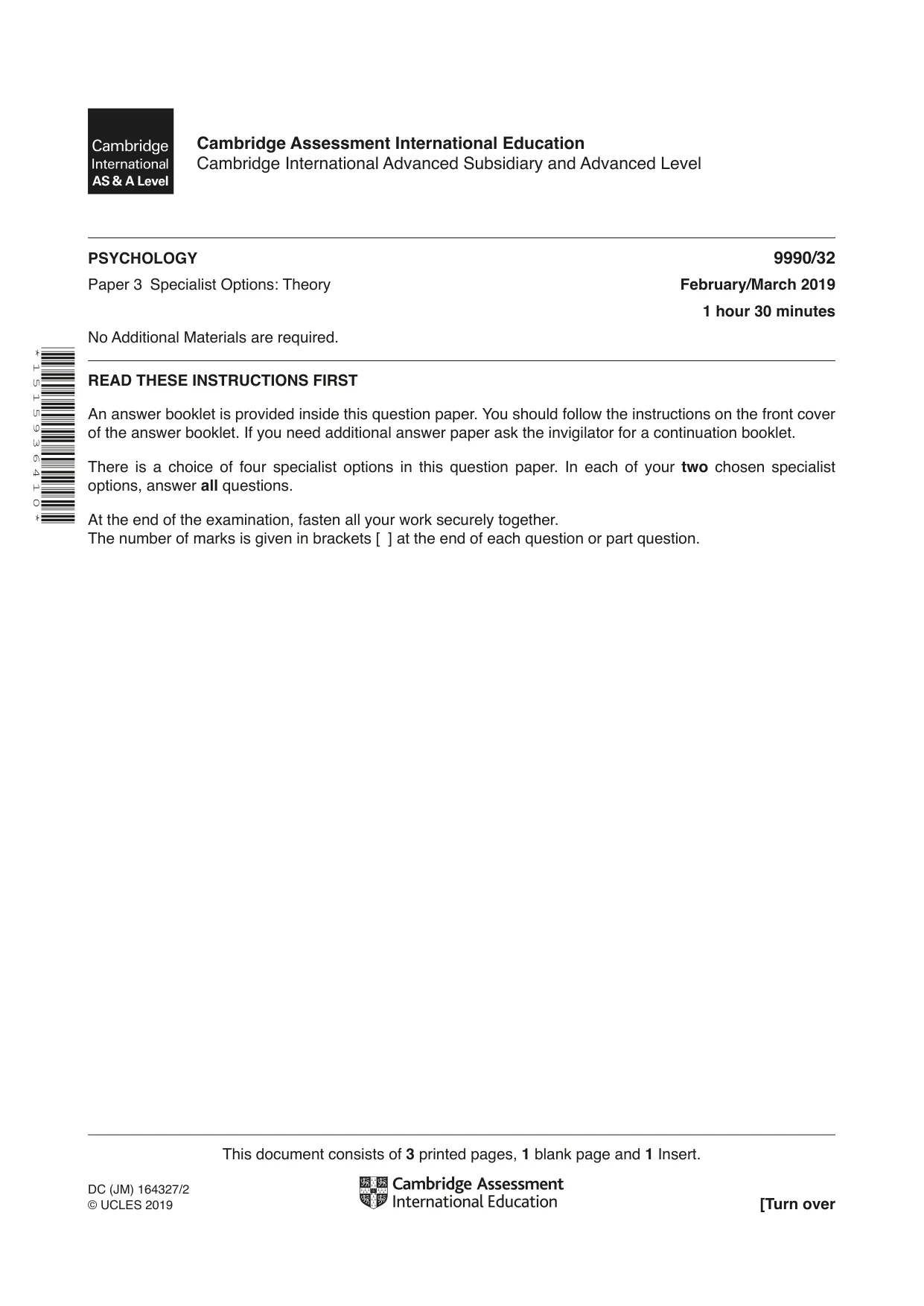
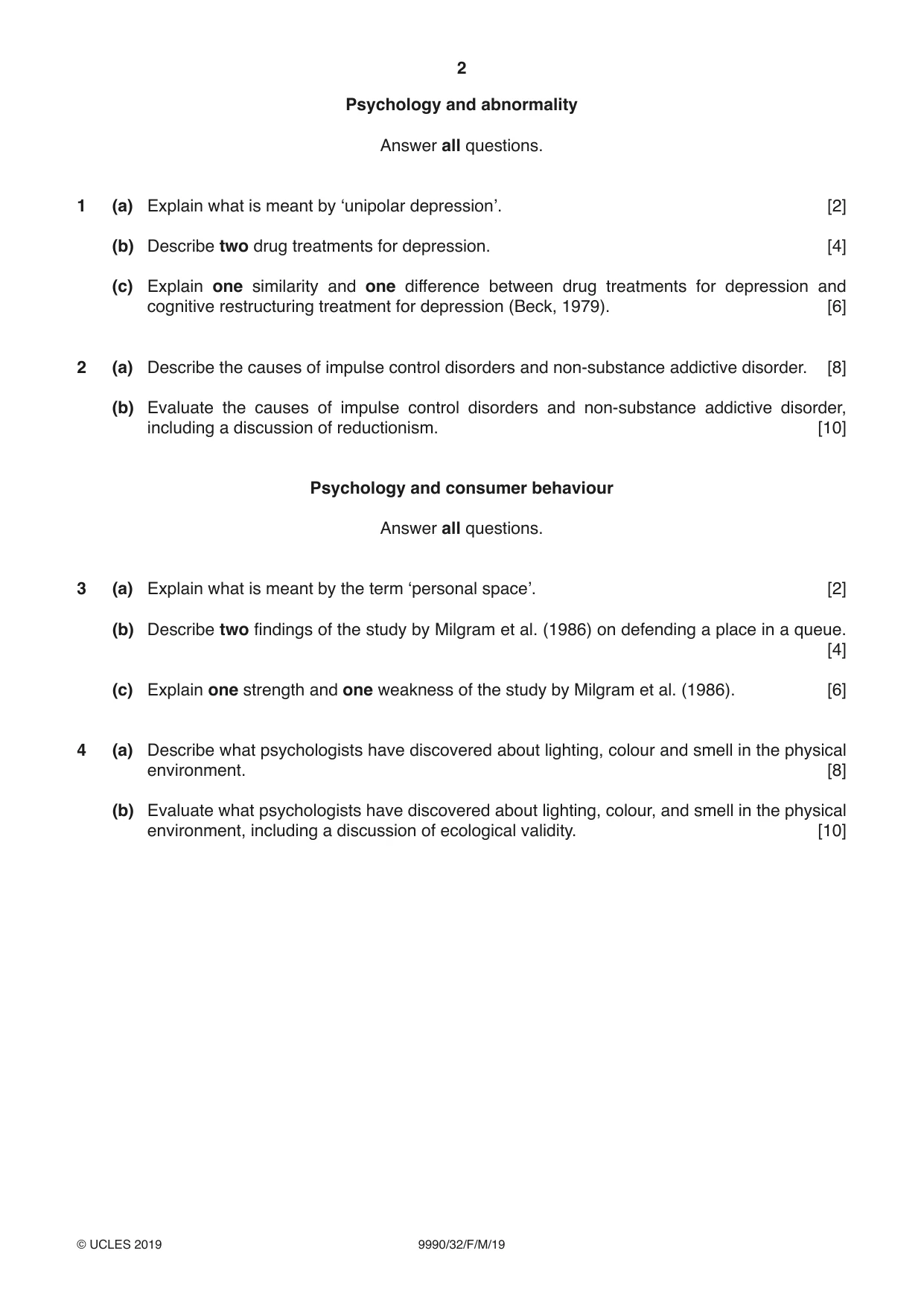
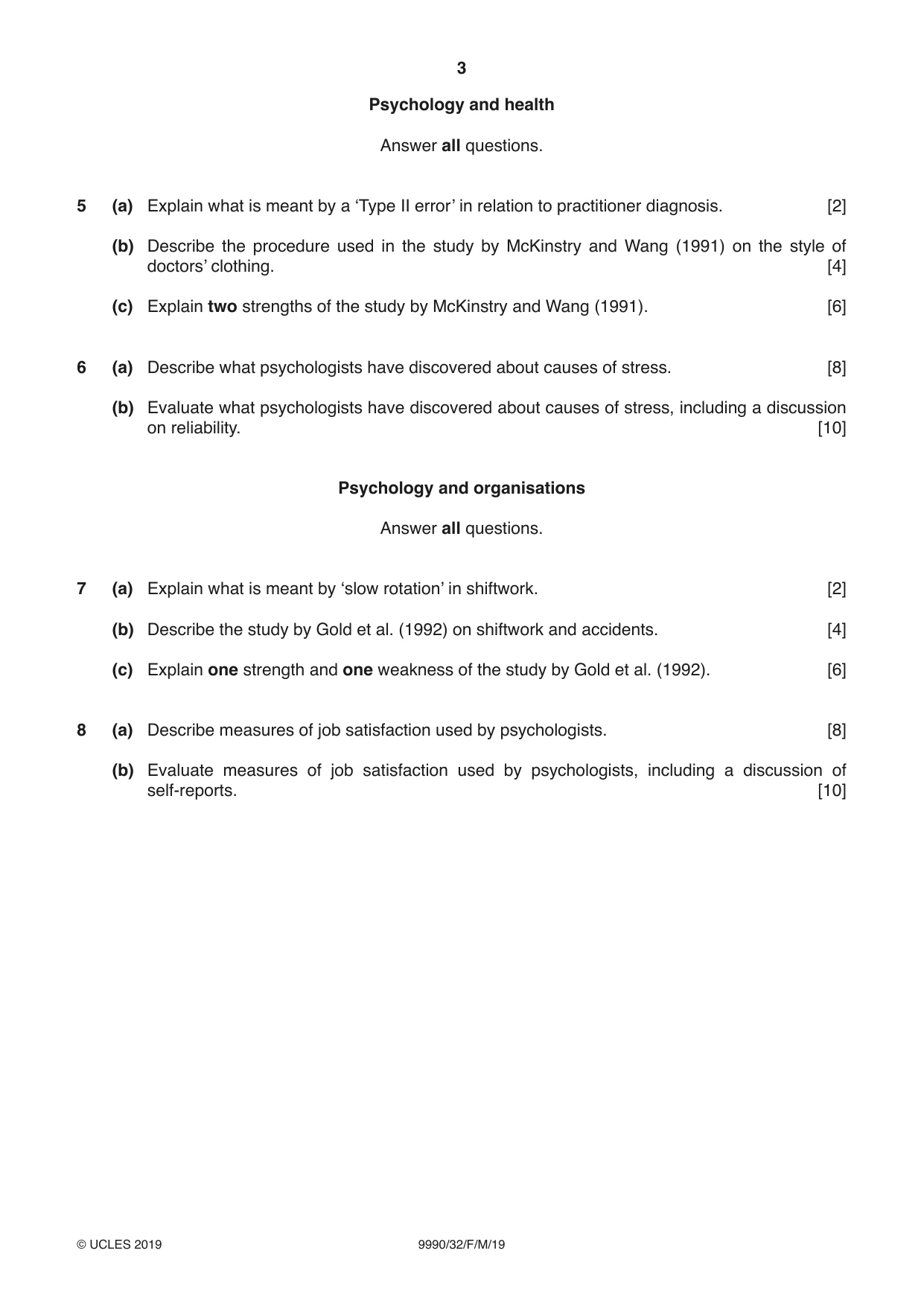

Mark scheme20 pages
Answers below. Sit the paper first if you are practising.
Questions as text
Q1 · Explain what is meant by ‘unipolar depression’
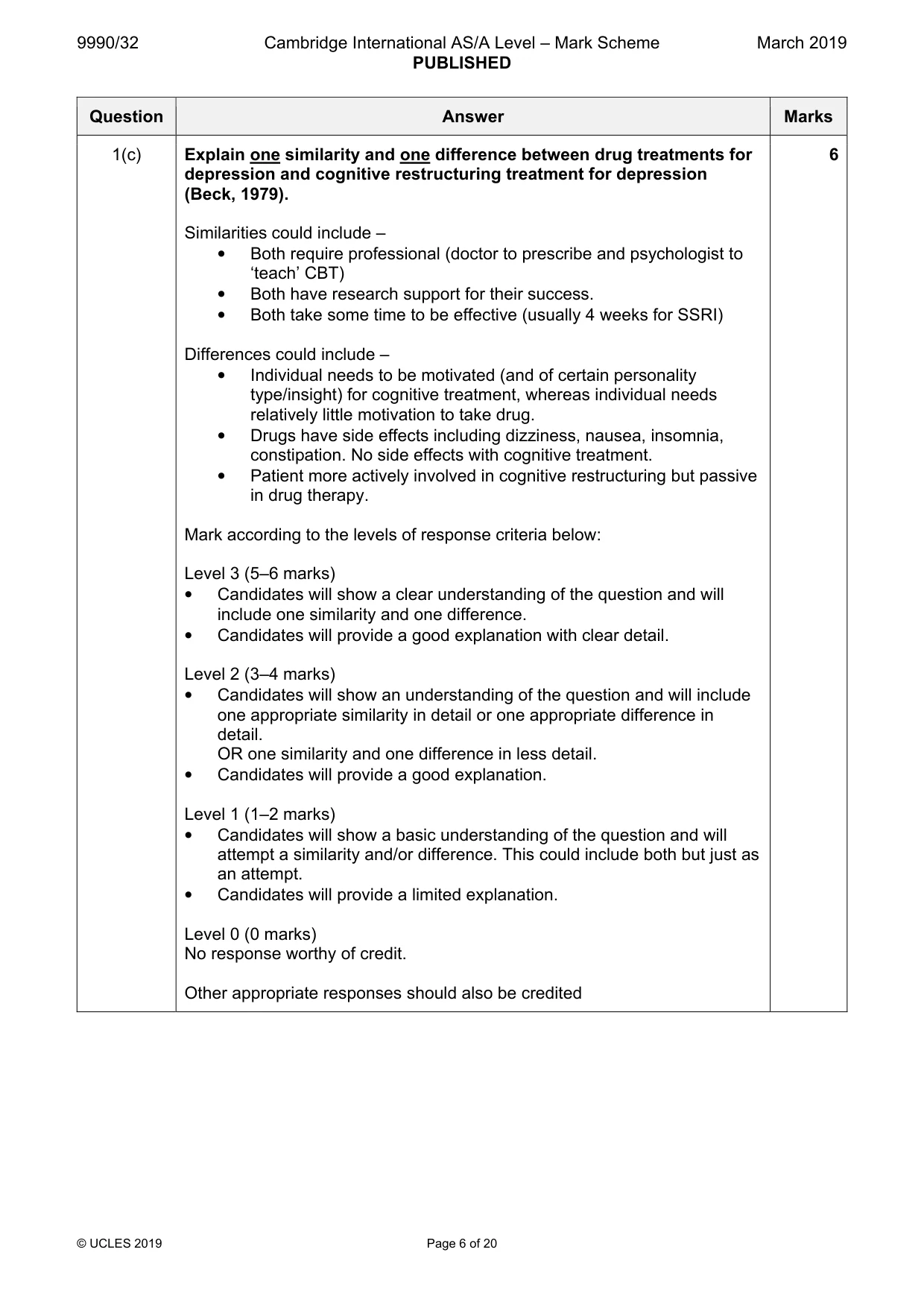
1 (a) Explain what is meant by ‘unipolar depression’. [2] (b) Describe two drug treatments for depression. [4] (c) Explain one similarity and one difference between drug treatments for depression and cognitive restructuring treatment for depression (Beck, 1979). [6]
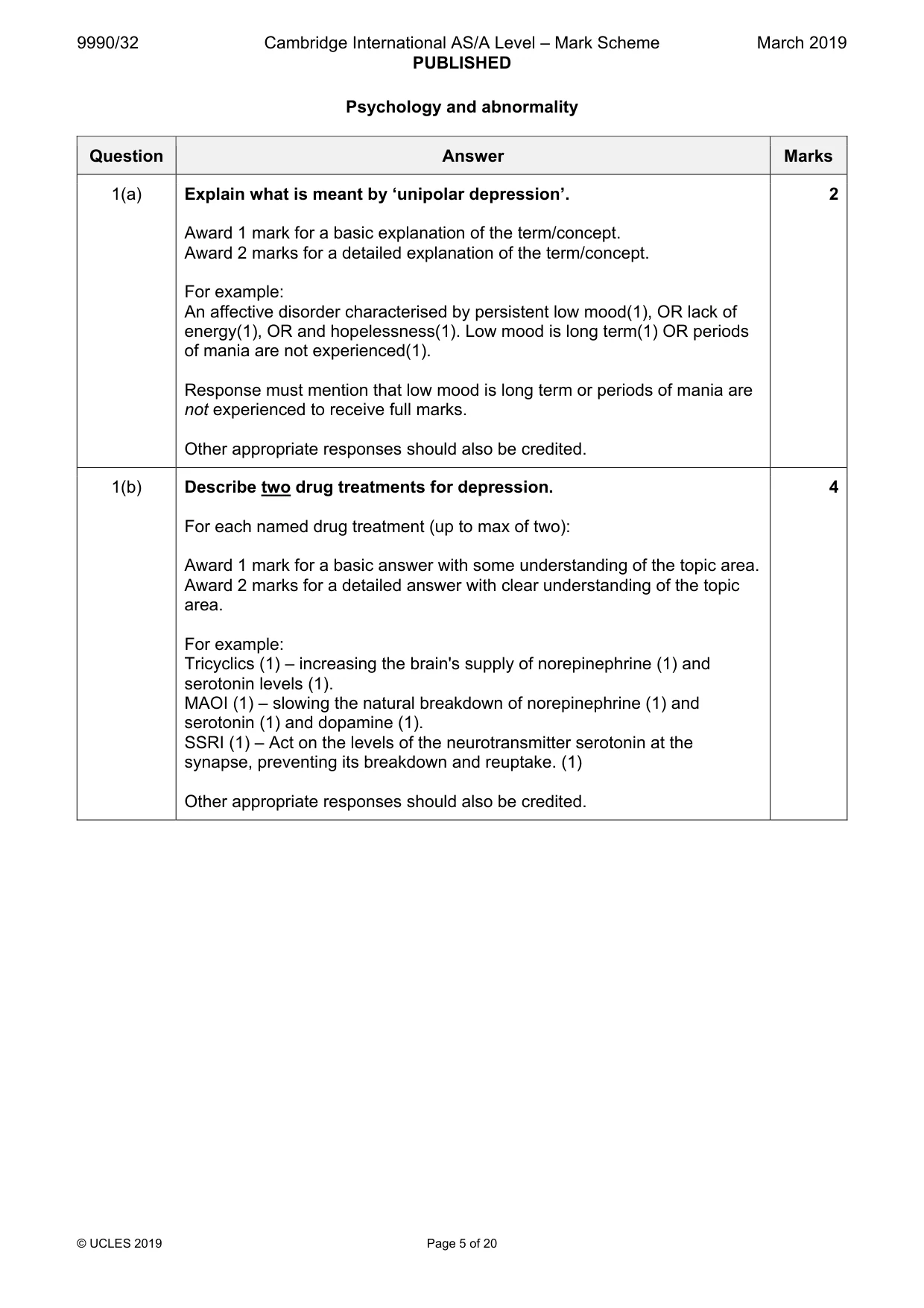
Mark scheme: Question Answer Marks 1(a) Explain what is meant by ‘unipolar depression’. 2 Award 1 mark for a basic explanation of the term/concept. Award 2 marks for a detailed explanation of the term/concept. For example: An affective disorder characterised by persistent low mood(1), OR lack of energy(1), OR and hopelessness(1). Low mood is long term(1) OR periods of mania are not experienced(1). Response must mention that low mood is long term or periods of mania are not experienced to receive full marks. Other appropriate responses should also be credited. 1(b) Describe two drug treatments for depression. 4 For each named drug treatment (up to max of two): Award 1 mark for a basic answer with some understanding of the topic area. Award 2 marks for a detailed answer with clear understanding of the topic area. For example: Tricyclics (1) – increasing the brain's supply of norepinephrine (1) and serotonin levels (1). MAOI (1) – slowing the natural breakdown of norepinephrine (1) and serotonin (1) and dopamine (1). SSRI (1) – Act on the levels of the neurotransmitter serotonin at the synapse, preventing its breakdown and reuptake. (1) Other appropriate responses should also be credited. 1(c) Explain one similarity and one difference between drug treatments for 6 depression and cognitive restructuring treatment for depression (Beck, 1979). Similarities could include – • Both require professional (doctor to prescribe and psychologist to ‘teach’ CBT) • Both have research support for their success. • Both take some time to be effective (usually 4 weeks for SSRI) Differences could include – • Individual needs to be motivated (and of certain personality type/insight) for cognitive treatment, whereas individual needs relatively little motivation to take drug. • Drugs have side effects including dizziness, nausea, insomnia, constipation. No side effects with cognitive treatment. • Patient more actively involved in cognitive restructuring but passive in drug therapy. Mark according to the levels of response criteria below: Level 3 (5–6 marks) • Candidates will show a clear understanding of the question and will include one similarity and one difference. • Candidates will provide a good explanation with clear detail. Level 2 (3–4 marks) • Candidates will show an understanding of the question and will include one appropriate similarity in detail or one appropriate difference in detail. OR one similarity and one difference in less detail. • Candidates will provide a good explanation. Level 1 (1–2 marks) • Candidates will show a basic understanding of the question and will attempt a similarity and/or difference. This could include both but just as an attempt. • Candidates will provide a limited explanation. Level 0 (0 marks) No response worthy of credit. Other appropriate responses should also be credited
More questions on Mood (affective) disorders: depressive disorder (unipolar) and bipolar disorder
Q2 · Describe the causes of impulse control disorders and non-substance addictive disorder
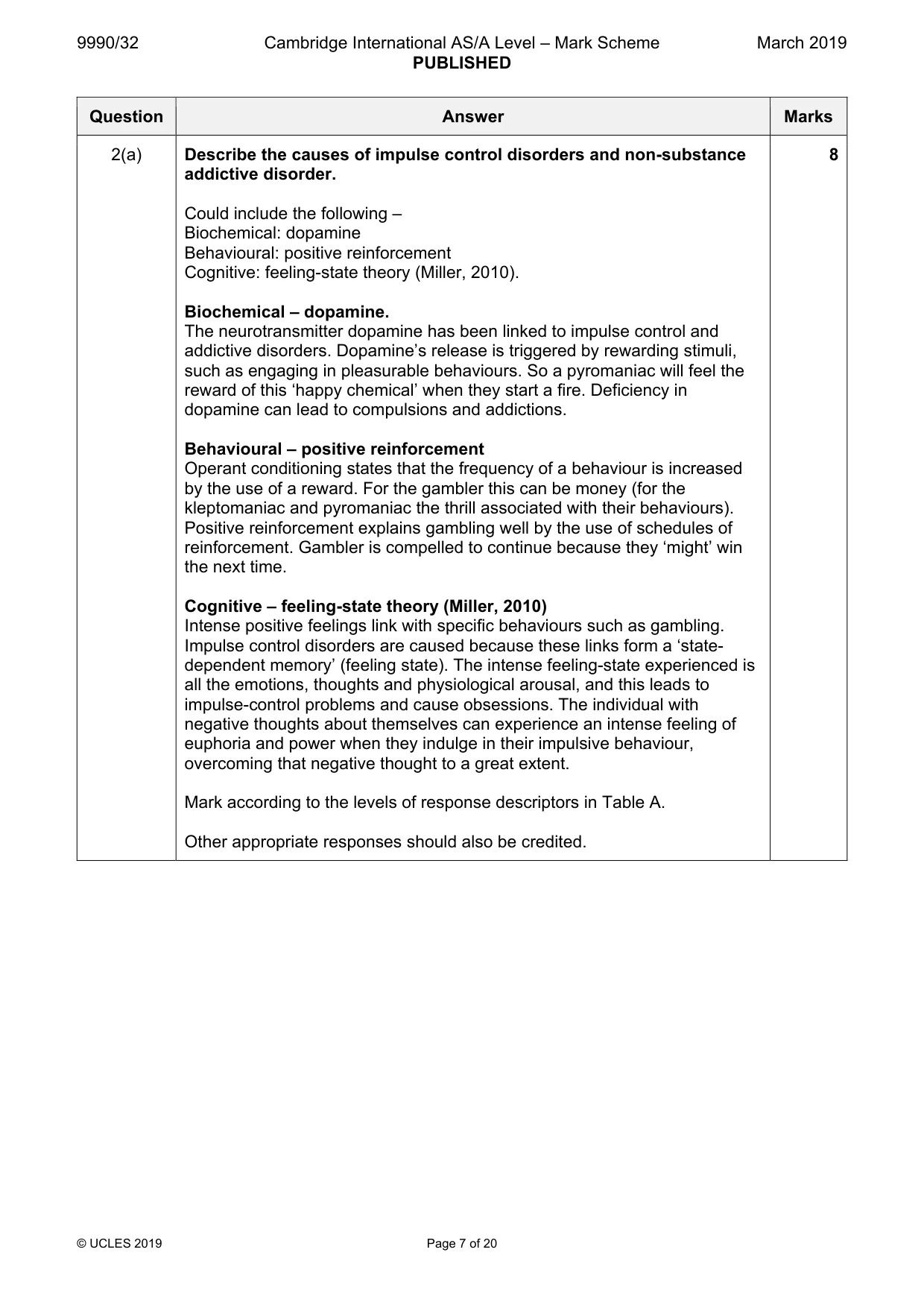
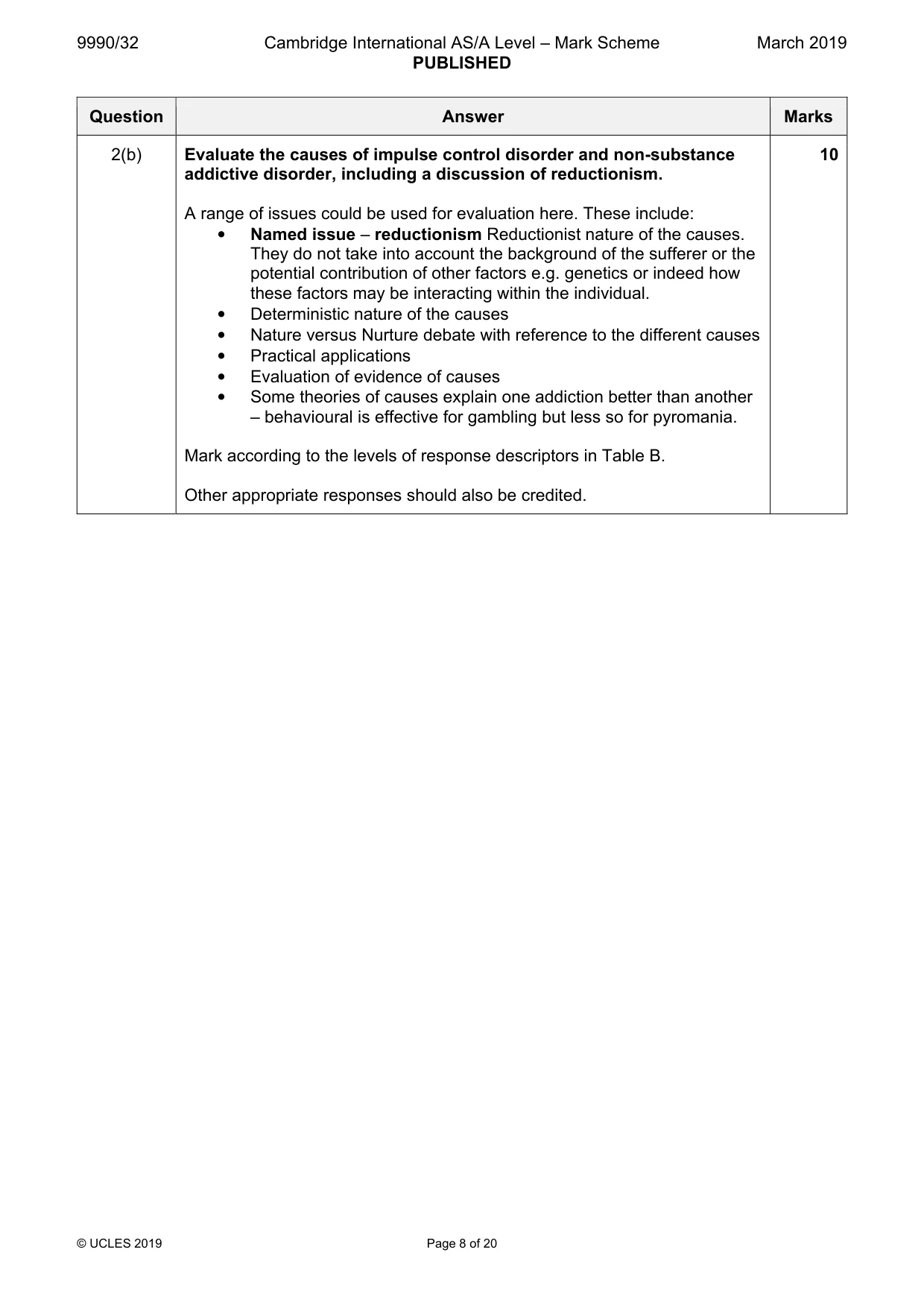
2 (a) Describe the causes of impulse control disorders and non-substance addictive disorder. [8] (b) Evaluate the causes of impulse control disorders and non-substance addictive disorder, including a discussion of reductionism. [10] Psychology and consumer behaviour Answer all questions.
Mark scheme: 2(a) Describe the causes of impulse control disorders and non-substance 8 addictive disorder. Could include the following – Biochemical: dopamine Behavioural: positive reinforcement Cognitive: feeling-state theory (Miller, 2010). Biochemical – dopamine. The neurotransmitter dopamine has been linked to impulse control and addictive disorders. Dopamine’s release is triggered by rewarding stimuli, such as engaging in pleasurable behaviours. So a pyromaniac will feel the reward of this ‘happy chemical’ when they start a fire. Deficiency in dopamine can lead to compulsions and addictions. Behavioural – positive reinforcement Operant conditioning states that the frequency of a behaviour is increased by the use of a reward. For the gambler this can be money (for the kleptomaniac and pyromaniac the thrill associated with their behaviours). Positive reinforcement explains gambling well by the use of schedules of reinforcement. Gambler is compelled to continue because they ‘might’ win the next time. Cognitive – feeling-state theory (Miller, 2010) Intense positive feelings link with specific behaviours such as gambling. Impulse control disorders are caused because these links form a ‘state- dependent memory’ (feeling state). The intense feeling-state experienced is all the emotions, thoughts and physiological arousal, and this leads to impulse-control problems and cause obsessions. The individual with negative thoughts about themselves can experience an intense feeling of euphoria and power when they indulge in their impulsive behaviour, overcoming that negative thought to a great extent. Mark according to the levels of response descriptors in Table A. Other appropriate responses should also be credited. 2(b) Evaluate the causes of impulse control disorder and non-substance 10 addictive disorder, including a discussion of reductionism. A range of issues could be used for evaluation here. These include: • Named issue – reductionism Reductionist nature of the causes. They do not take into account the background of the sufferer or the potential contribution of other factors e.g. genetics or indeed how these factors may be interacting within the individual. • Deterministic nature of the causes • Nature versus Nurture debate with reference to the different causes • Practical applications • Evaluation of evidence of causes • Some theories of causes explain one addiction better than another – behavioural is effective for gambling but less so for pyromania. Mark according to the levels of response descriptors in Table B. Other appropriate responses should also be credited. Psychology and consumer behaviour
Q3 · Explain what is meant by the term ‘personal space’
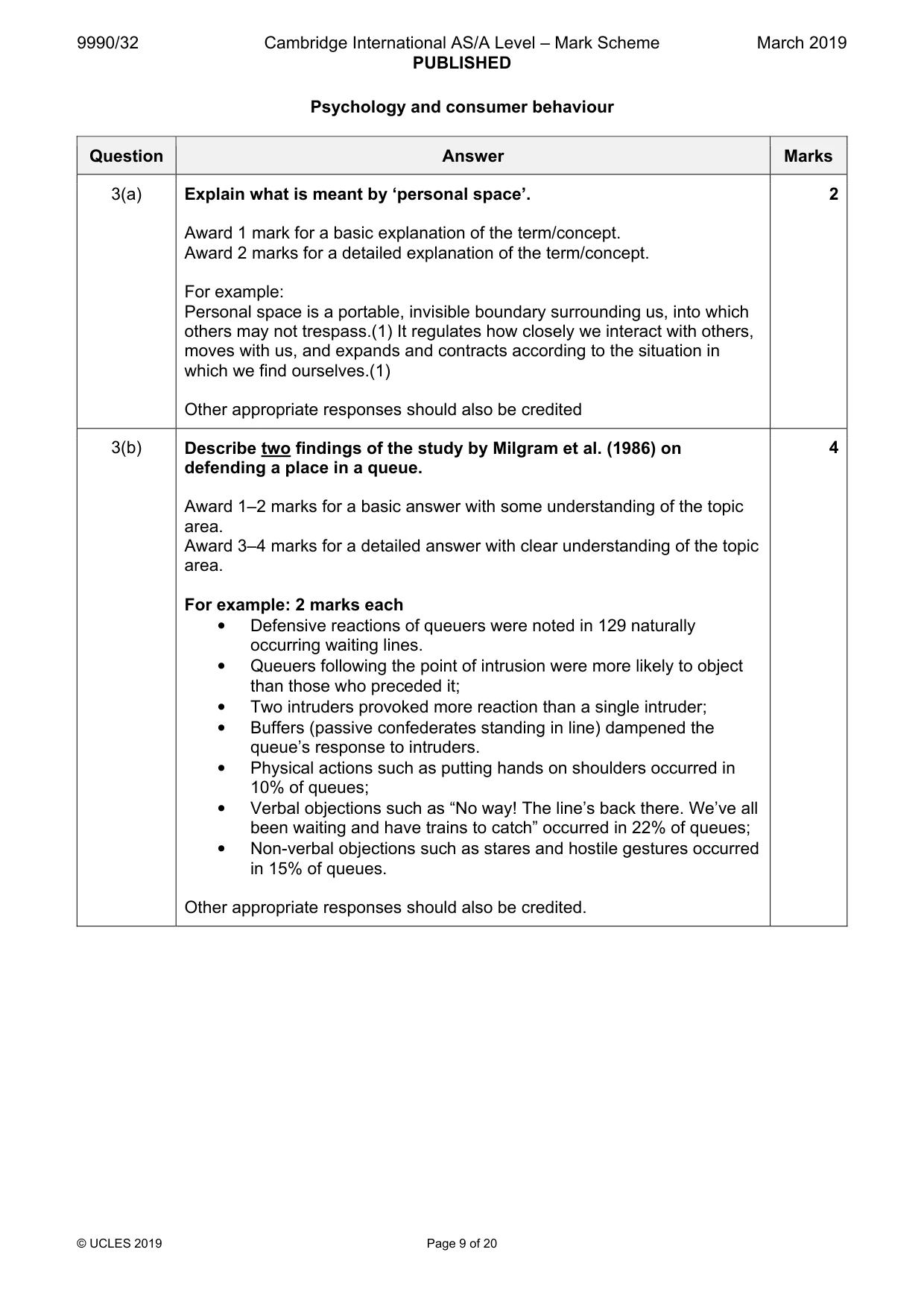
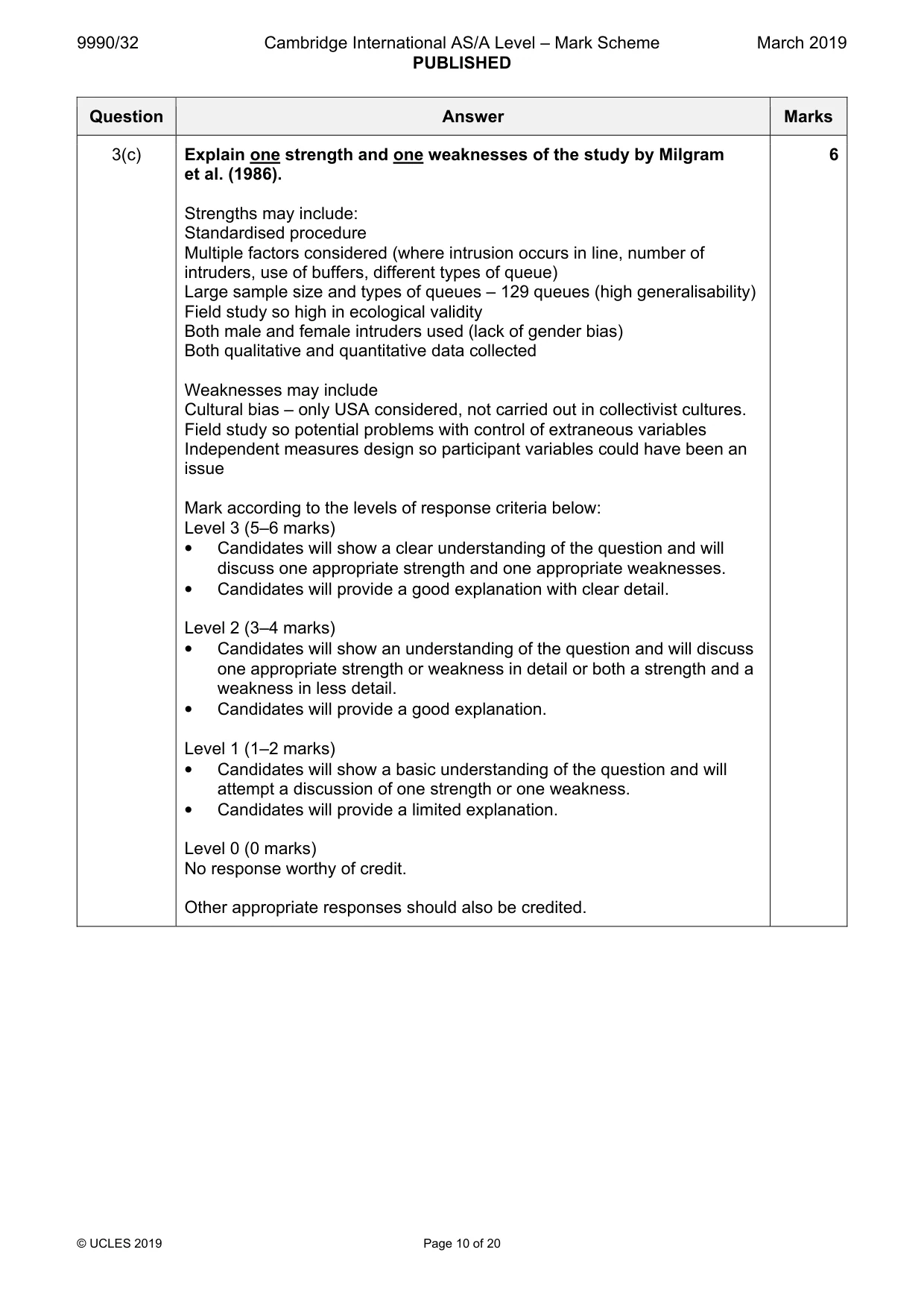
3 (a) Explain what is meant by the term ‘personal space’. [2] (b) Describe two findings of the study by Milgram et al. (1986) on defending a place in a queue. [4] (c) Explain one strength and one weakness of the study by Milgram et al. (1986). [6]
Mark scheme: 3(a) Explain what is meant by ‘personal space’. 2 Award 1 mark for a basic explanation of the term/concept. Award 2 marks for a detailed explanation of the term/concept. For example: Personal space is a portable, invisible boundary surrounding us, into which others may not trespass.(1) It regulates how closely we interact with others, moves with us, and expands and contracts according to the situation in which we find ourselves.(1) Other appropriate responses should also be credited 3(b) Describe two findings of the study by Milgram et al. (1986) on 4 defending a place in a queue. Award 1–2 marks for a basic answer with some understanding of the topic area. Award 3–4 marks for a detailed answer with clear understanding of the topic area. For example: 2 marks each • Defensive reactions of queuers were noted in 129 naturally occurring waiting lines. • Queuers following the point of intrusion were more likely to object than those who preceded it; • Two intruders provoked more reaction than a single intruder; • Buffers (passive confederates standing in line) dampened the queue’s response to intruders. • Physical actions such as putting hands on shoulders occurred in 10% of queues; • Verbal objections such as “No way! The line’s back there. We’ve all been waiting and have trains to catch” occurred in 22% of queues; • Non-verbal objections such as stares and hostile gestures occurred in 15% of queues. Other appropriate responses should also be credited. 3(c) Explain one strength and one weaknesses of the study by Milgram 6 et al. (1986). Strengths may include: Standardised procedure Multiple factors considered (where intrusion occurs in line, number of intruders, use of buffers, different types of queue) Large sample size and types of queues – 129 queues (high generalisability) Field study so high in ecological validity Both male and female intruders used (lack of gender bias) Both qualitative and quantitative data collected Weaknesses may include Cultural bias – only USA considered, not carried out in collectivist cultures. Field study so potential problems with control of extraneous variables Independent measures design so participant variables could have been an issue Mark according to the levels of response criteria below: Level 3 (5–6 marks) • Candidates will show a clear understanding of the question and will discuss one appropriate strength and one appropriate weaknesses. • Candidates will provide a good explanation with clear detail. Level 2 (3–4 marks) • Candidates will show an understanding of the question and will discuss one appropriate strength or weakness in detail or both a strength and a weakness in less detail. • Candidates will provide a good explanation. Level 1 (1–2 marks) • Candidates will show a basic understanding of the question and will attempt a discussion of one strength or one weakness. • Candidates will provide a limited explanation. Level 0 (0 marks) No response worthy of credit. Other appropriate responses should also be credited.
Q4 · Describe what psychologists have discovered about lighting, colour and smell in the…
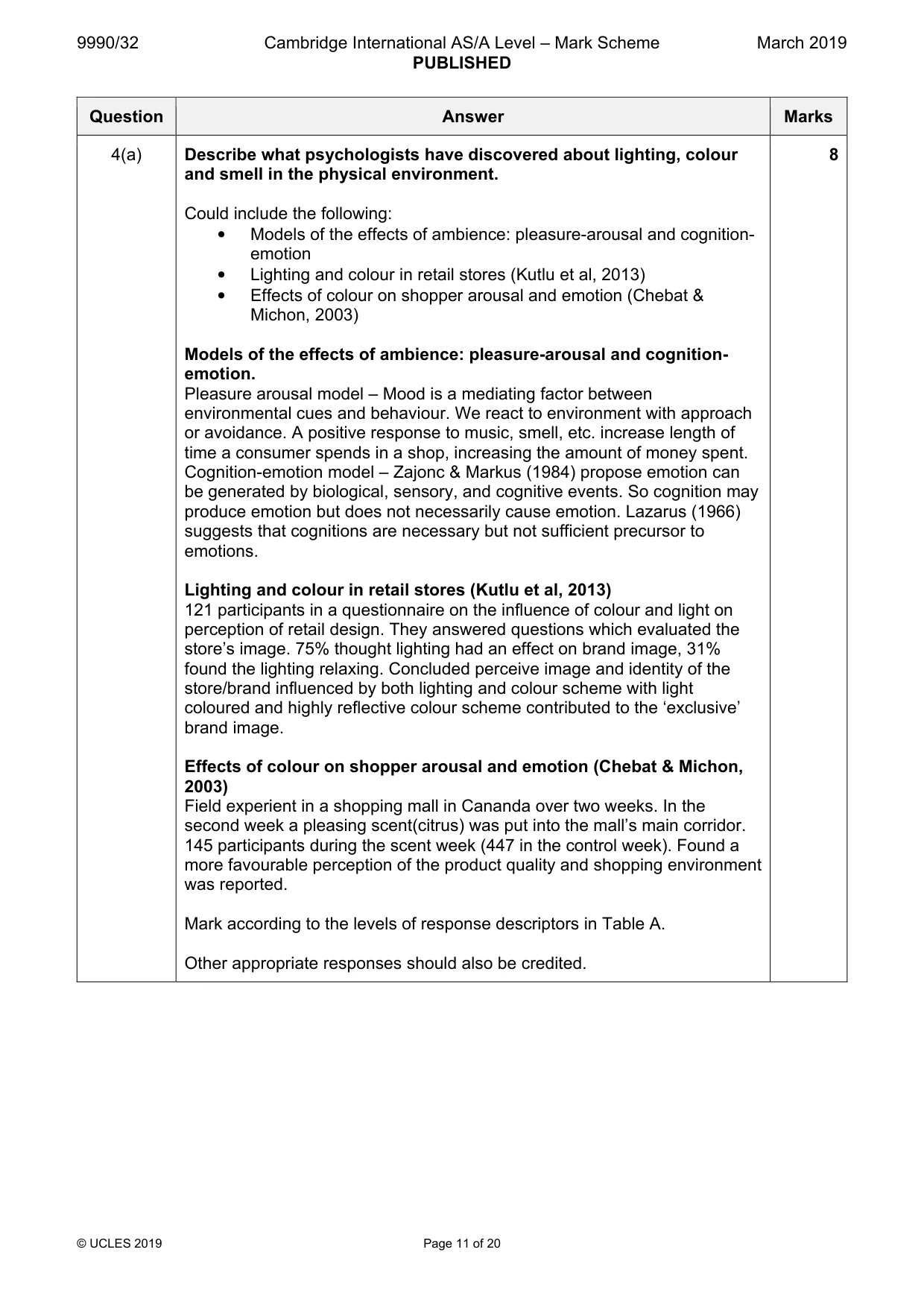
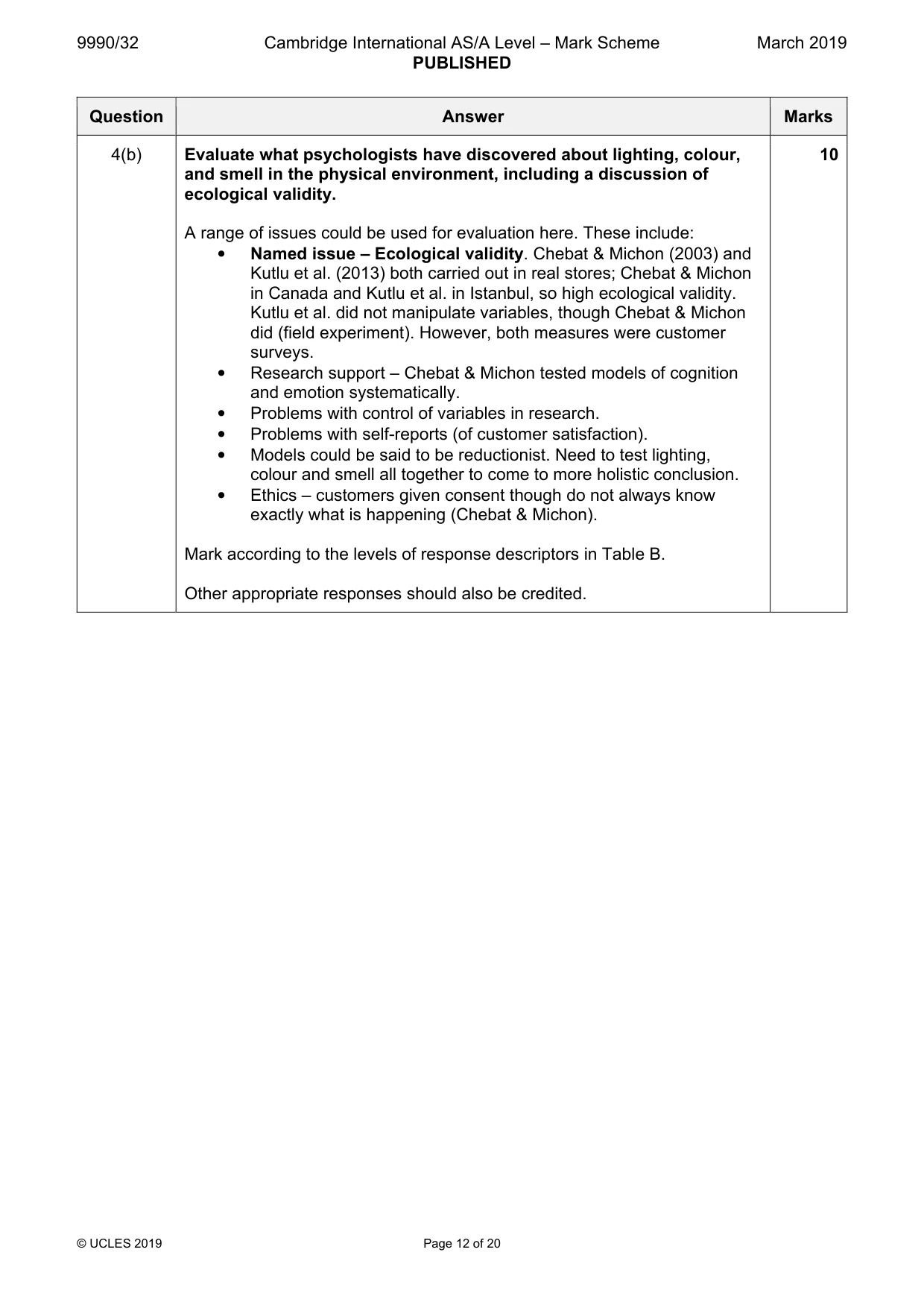
4 (a) Describe what psychologists have discovered about lighting, colour and smell in the physical environment. [8] (b) Evaluate what psychologists have discovered about lighting, colour, and smell in the physical environment, including a discussion of ecological validity. [10] Psychology and health Answer all questions.
Mark scheme: 4(a) Describe what psychologists have discovered about lighting, colour 8 and smell in the physical environment. Could include the following: • Models of the effects of ambience: pleasure-arousal and cognition- emotion • Lighting and colour in retail stores (Kutlu et al, 2013) • Effects of colour on shopper arousal and emotion (Chebat & Michon, 2003) Models of the effects of ambience: pleasure-arousal and cognition- emotion. Pleasure arousal model – Mood is a mediating factor between environmental cues and behaviour. We react to environment with approach or avoidance. A positive response to music, smell, etc. increase length of time a consumer spends in a shop, increasing the amount of money spent. Cognition-emotion model – Zajonc & Markus (1984) propose emotion can be generated by biological, sensory, and cognitive events. So cognition may produce emotion but does not necessarily cause emotion. Lazarus (1966) suggests that cognitions are necessary but not sufficient precursor to emotions. Lighting and colour in retail stores (Kutlu et al, 2013) 121 participants in a questionnaire on the influence of colour and light on perception of retail design. They answered questions which evaluated the store’s image. 75% thought lighting had an effect on brand image, 31% found the lighting relaxing. Concluded perceive image and identity of the store/brand influenced by both lighting and colour scheme with light coloured and highly reflective colour scheme contributed to the ‘exclusive’ brand image. Effects of colour on shopper arousal and emotion (Chebat & Michon, 2003) Field experient in a shopping mall in Cananda over two weeks. In the second week a pleasing scent(citrus) was put into the mall’s main corridor. 145 participants during the scent week (447 in the control week). Found a more favourable perception of the product quality and shopping environment was reported. Mark according to the levels of response descriptors in Table A. Other appropriate responses should also be credited. 4(b) Evaluate what psychologists have discovered about lighting, colour, 10 and smell in the physical environment, including a discussion of ecological validity. A range of issues could be used for evaluation here. These include: • Named issue – Ecological validity. Chebat & Michon (2003) and Kutlu et al. (2013) both carried out in real stores; Chebat & Michon in Canada and Kutlu et al. in Istanbul, so high ecological validity. Kutlu et al. did not manipulate variables, though Chebat & Michon did (field experiment). However, both measures were customer surveys. • Research support – Chebat & Michon tested models of cognition and emotion systematically. • Problems with control of variables in research. • Problems with self-reports (of customer satisfaction). • Models could be said to be reductionist. Need to test lighting, colour and smell all together to come to more holistic conclusion. • Ethics – customers given consent though do not always know exactly what is happening (Chebat & Michon). Mark according to the levels of response descriptors in Table B. Other appropriate responses should also be credited. Psychology and health
Q5 · Explain what is meant by a ‘Type II error’ in relation to practitioner diagnosis
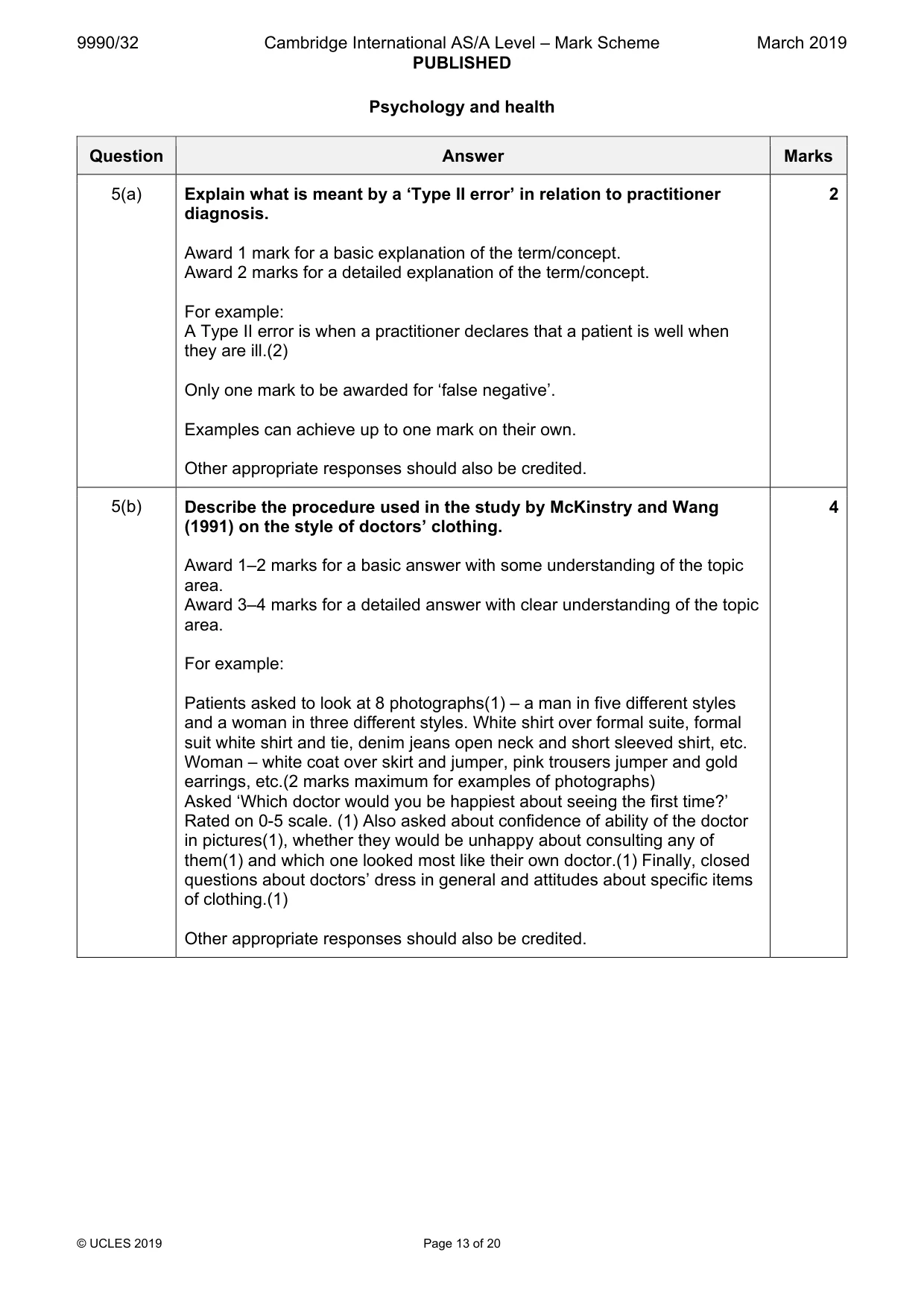
5 (a) Explain what is meant by a ‘Type II error’ in relation to practitioner diagnosis. [2] (b) Describe the procedure used in the study by McKinstry and Wang (1991) on the style of doctors’ clothing. [4] (c) Explain two strengths of the study by McKinstry and Wang (1991). [6]
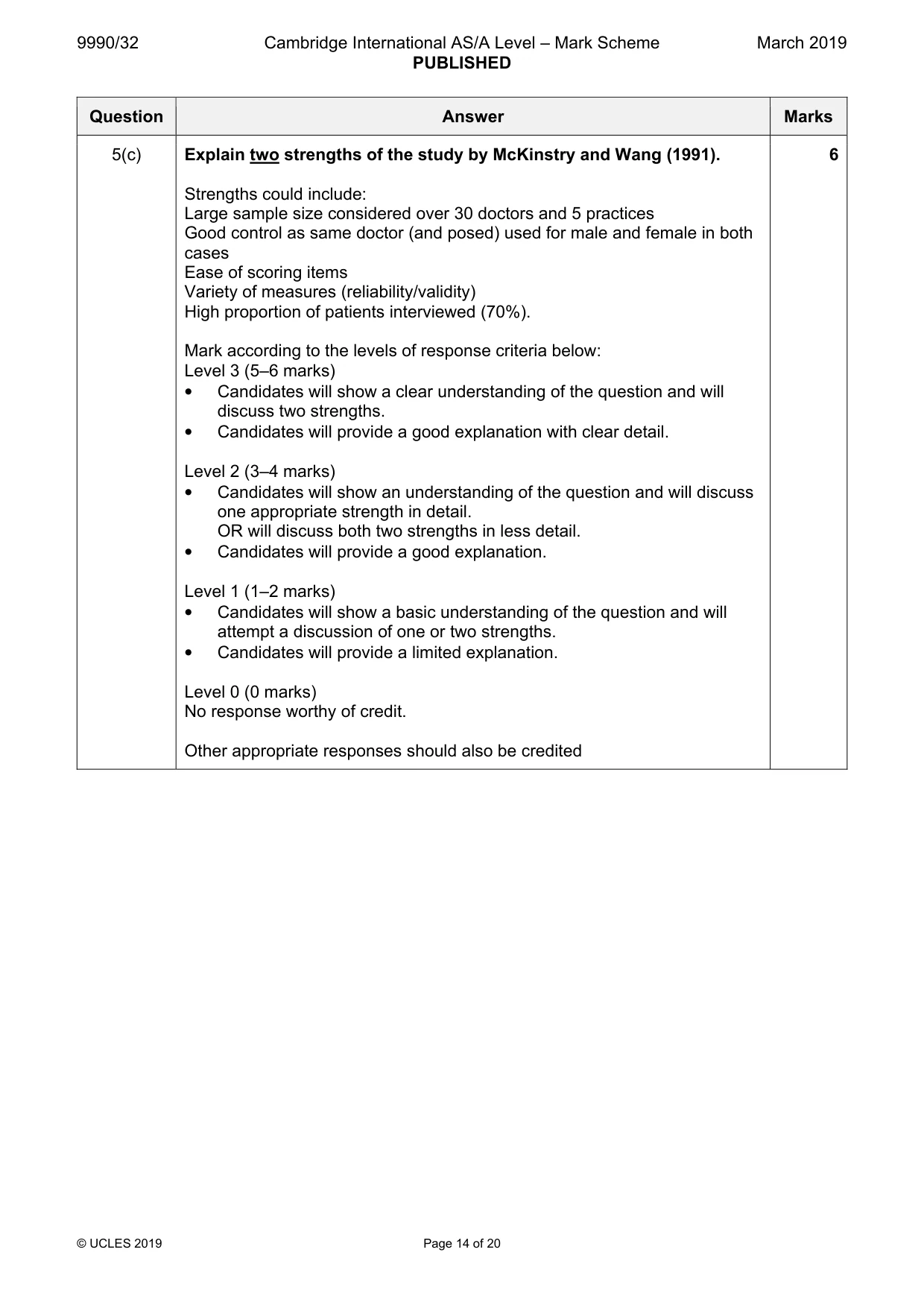
Mark scheme: 5(a) Explain what is meant by a ‘Type II error’ in relation to practitioner 2 diagnosis. Award 1 mark for a basic explanation of the term/concept. Award 2 marks for a detailed explanation of the term/concept. For example: A Type II error is when a practitioner declares that a patient is well when they are ill.(2) Only one mark to be awarded for ‘false negative’. Examples can achieve up to one mark on their own. Other appropriate responses should also be credited. 5(b) Describe the procedure used in the study by McKinstry and Wang 4 (1991) on the style of doctors’ clothing. Award 1–2 marks for a basic answer with some understanding of the topic area. Award 3–4 marks for a detailed answer with clear understanding of the topic area. For example: Patients asked to look at 8 photographs(1) – a man in five different styles and a woman in three different styles. White shirt over formal suite, formal suit white shirt and tie, denim jeans open neck and short sleeved shirt, etc. Woman – white coat over skirt and jumper, pink trousers jumper and gold earrings, etc.(2 marks maximum for examples of photographs) Asked ‘Which doctor would you be happiest about seeing the first time?’ Rated on 0-5 scale. (1) Also asked about confidence of ability of the doctor in pictures(1), whether they would be unhappy about consulting any of them(1) and which one looked most like their own doctor.(1) Finally, closed questions about doctors’ dress in general and attitudes about specific items of clothing.(1) Other appropriate responses should also be credited. 5(c) Explain two strengths of the study by McKinstry and Wang (1991). 6 Strengths could include: Large sample size considered over 30 doctors and 5 practices Good control as same doctor (and posed) used for male and female in both cases Ease of scoring items Variety of measures (reliability/validity) High proportion of patients interviewed (70%). Mark according to the levels of response criteria below: Level 3 (5–6 marks) • Candidates will show a clear understanding of the question and will discuss two strengths. • Candidates will provide a good explanation with clear detail. Level 2 (3–4 marks) • Candidates will show an understanding of the question and will discuss one appropriate strength in detail. OR will discuss both two strengths in less detail. • Candidates will provide a good explanation. Level 1 (1–2 marks) • Candidates will show a basic understanding of the question and will attempt a discussion of one or two strengths. • Candidates will provide a limited explanation. Level 0 (0 marks) No response worthy of credit. Other appropriate responses should also be credited
Q6 · Describe what psychologists have discovered about causes of stress
6 (a) Describe what psychologists have discovered about causes of stress. [8] (b) Evaluate what psychologists have discovered about causes of stress, including a discussion on reliability. [10] Psychology and organisations Answer all questions.
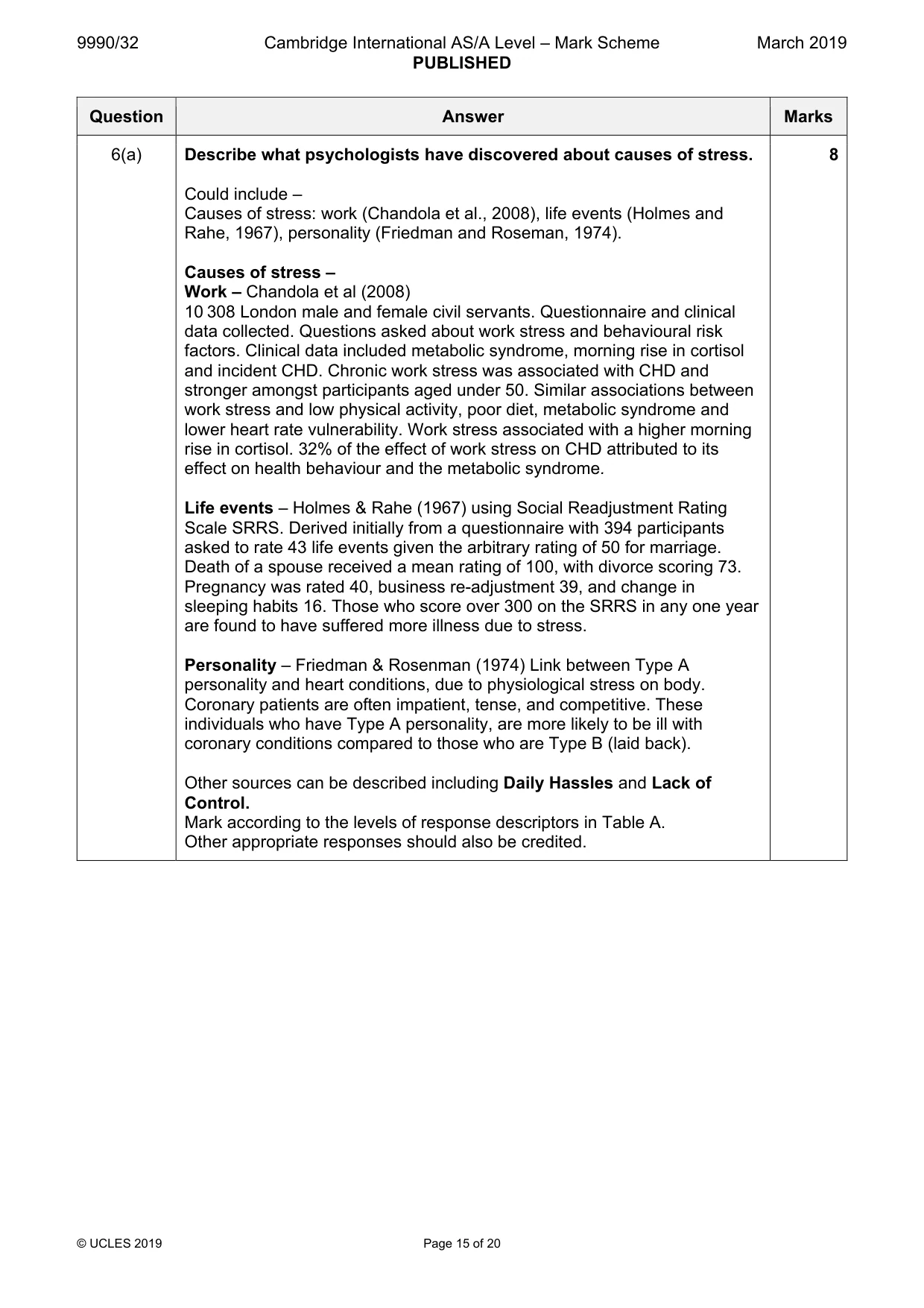
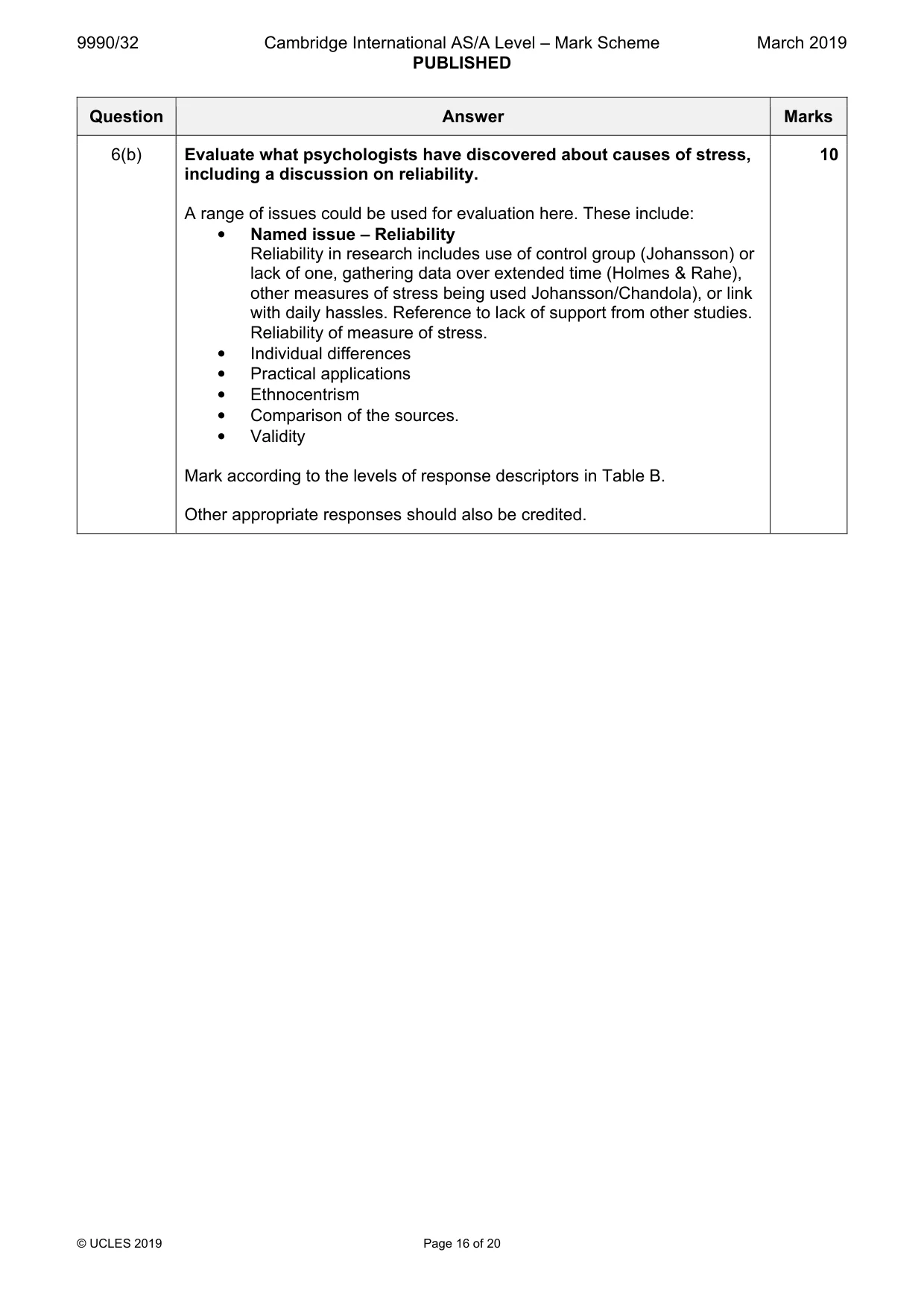
Mark scheme: 6(a) Describe what psychologists have discovered about causes of stress. 8 Could include – Causes of stress: work (Chandola et al., 2008), life events (Holmes and Rahe, 1967), personality (Friedman and Roseman, 1974). Causes of stress – Work – Chandola et al (2008) 10 308 London male and female civil servants. Questionnaire and clinical data collected. Questions asked about work stress and behavioural risk factors. Clinical data included metabolic syndrome, morning rise in cortisol and incident CHD. Chronic work stress was associated with CHD and stronger amongst participants aged under 50. Similar associations between work stress and low physical activity, poor diet, metabolic syndrome and lower heart rate vulnerability. Work stress associated with a higher morning rise in cortisol. 32% of the effect of work stress on CHD attributed to its effect on health behaviour and the metabolic syndrome. Life events – Holmes & Rahe (1967) using Social Readjustment Rating Scale SRRS. Derived initially from a questionnaire with 394 participants asked to rate 43 life events given the arbitrary rating of 50 for marriage. Death of a spouse received a mean rating of 100, with divorce scoring 73. Pregnancy was rated 40, business re-adjustment 39, and change in sleeping habits 16. Those who score over 300 on the SRRS in any one year are found to have suffered more illness due to stress. Personality – Friedman & Rosenman (1974) Link between Type A personality and heart conditions, due to physiological stress on body. Coronary patients are often impatient, tense, and competitive. These individuals who have Type A personality, are more likely to be ill with coronary conditions compared to those who are Type B (laid back). Other sources can be described including Daily Hassles and Lack of Control. Mark according to the levels of response descriptors in Table A. Other appropriate responses should also be credited. 6(b) Evaluate what psychologists have discovered about causes of stress, 10 including a discussion on reliability. A range of issues could be used for evaluation here. These include: • Named issue – Reliability Reliability in research includes use of control group (Johansson) or lack of one, gathering data over extended time (Holmes & Rahe), other measures of stress being used Johansson/Chandola), or link with daily hassles. Reference to lack of support from other studies. Reliability of measure of stress. • Individual differences • Practical applications • Ethnocentrism • Comparison of the sources. • Validity Mark according to the levels of response descriptors in Table B. Other appropriate responses should also be credited. Psychology and organisations
Q7 · Explain what is meant by ‘slow rotation’ in shiftwork
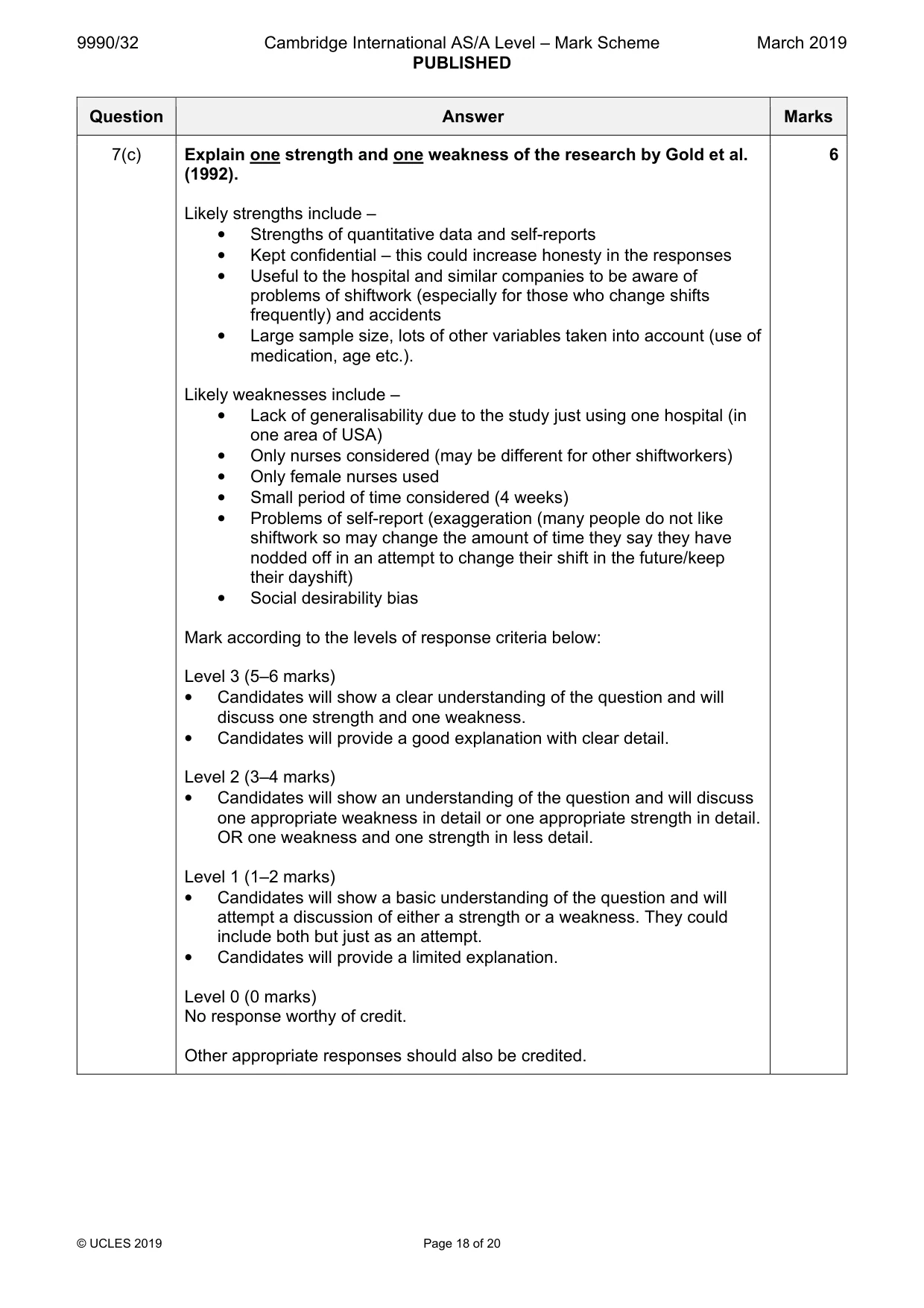
7 (a) Explain what is meant by ‘slow rotation’ in shiftwork. [2] (b) Describe the study by Gold et al. (1992) on shiftwork and accidents. [4] (c) Explain one strength and one weakness of the study by Gold et al. (1992). [6]
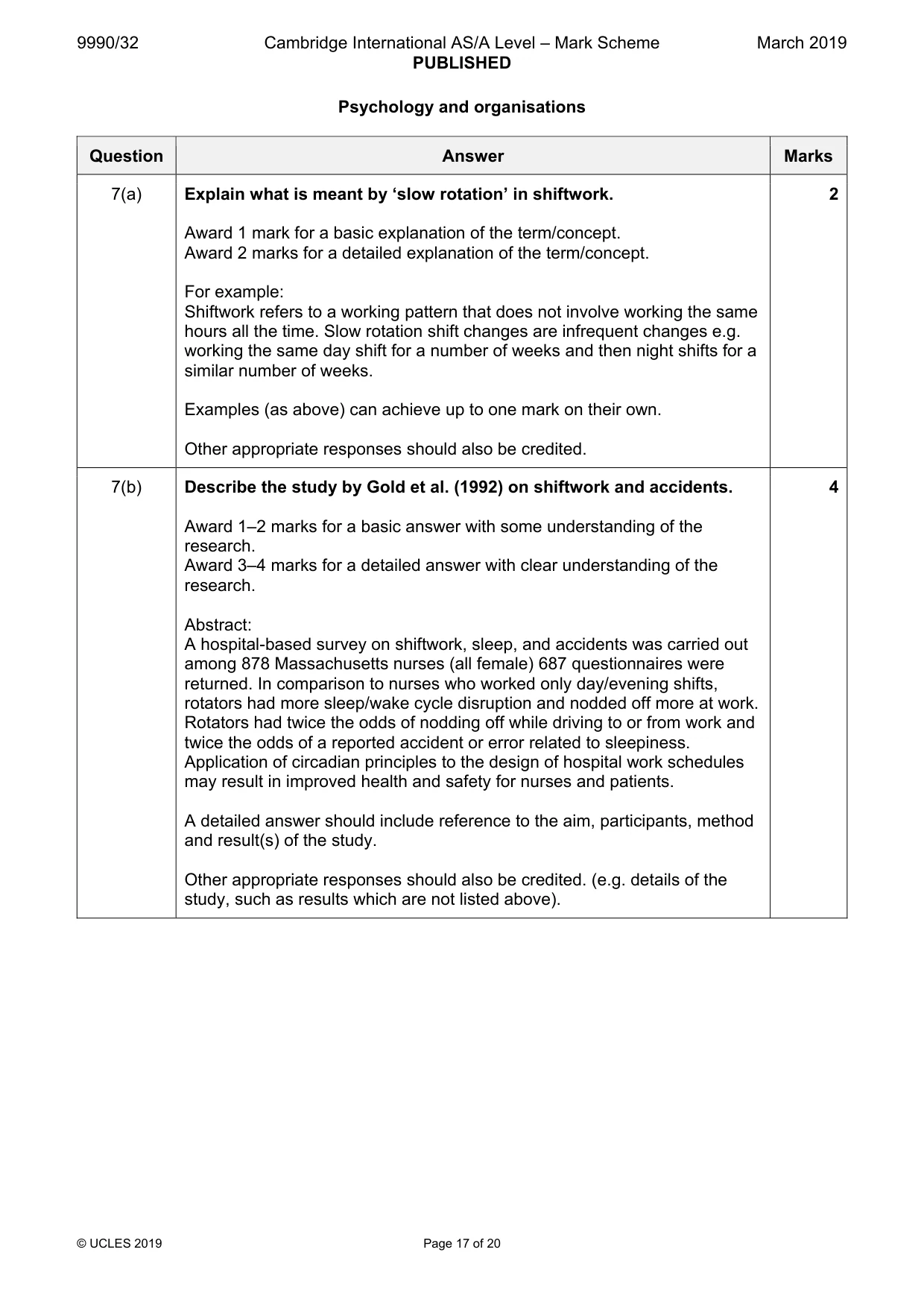
Mark scheme: 7(a) Explain what is meant by ‘slow rotation’ in shiftwork. 2 Award 1 mark for a basic explanation of the term/concept. Award 2 marks for a detailed explanation of the term/concept. For example: Shiftwork refers to a working pattern that does not involve working the same hours all the time. Slow rotation shift changes are infrequent changes e.g. working the same day shift for a number of weeks and then night shifts for a similar number of weeks. Examples (as above) can achieve up to one mark on their own. Other appropriate responses should also be credited. 7(b) Describe the study by Gold et al. (1992) on shiftwork and accidents. 4 Award 1–2 marks for a basic answer with some understanding of the research. Award 3–4 marks for a detailed answer with clear understanding of the research. Abstract: A hospital-based survey on shiftwork, sleep, and accidents was carried out among 878 Massachusetts nurses (all female) 687 questionnaires were returned. In comparison to nurses who worked only day/evening shifts, rotators had more sleep/wake cycle disruption and nodded off more at work. Rotators had twice the odds of nodding off while driving to or from work and twice the odds of a reported accident or error related to sleepiness. Application of circadian principles to the design of hospital work schedules may result in improved health and safety for nurses and patients. A detailed answer should include reference to the aim, participants, method and result(s) of the study. Other appropriate responses should also be credited. (e.g. details of the study, such as results which are not listed above). 7(c) Explain one strength and one weakness of the research by Gold et al. 6 (1992). Likely strengths include – • Strengths of quantitative data and self-reports • Kept confidential – this could increase honesty in the responses • Useful to the hospital and similar companies to be aware of problems of shiftwork (especially for those who change shifts frequently) and accidents • Large sample size, lots of other variables taken into account (use of medication, age etc.). Likely weaknesses include – • Lack of generalisability due to the study just using one hospital (in one area of USA) • Only nurses considered (may be different for other shiftworkers) • Only female nurses used • Small period of time considered (4 weeks) • Problems of self-report (exaggeration (many people do not like shiftwork so may change the amount of time they say they have nodded off in an attempt to change their shift in the future/keep their dayshift) • Social desirability bias Mark according to the levels of response criteria below: Level 3 (5–6 marks) • Candidates will show a clear understanding of the question and will discuss one strength and one weakness. • Candidates will provide a good explanation with clear detail. Level 2 (3–4 marks) • Candidates will show an understanding of the question and will discuss one appropriate weakness in detail or one appropriate strength in detail. OR one weakness and one strength in less detail. Level 1 (1–2 marks) • Candidates will show a basic understanding of the question and will attempt a discussion of either a strength or a weakness. They could include both but just as an attempt. • Candidates will provide a limited explanation. Level 0 (0 marks) No response worthy of credit. Other appropriate responses should also be credited.
Q8 · Describe measures of job satisfaction used by psychologists
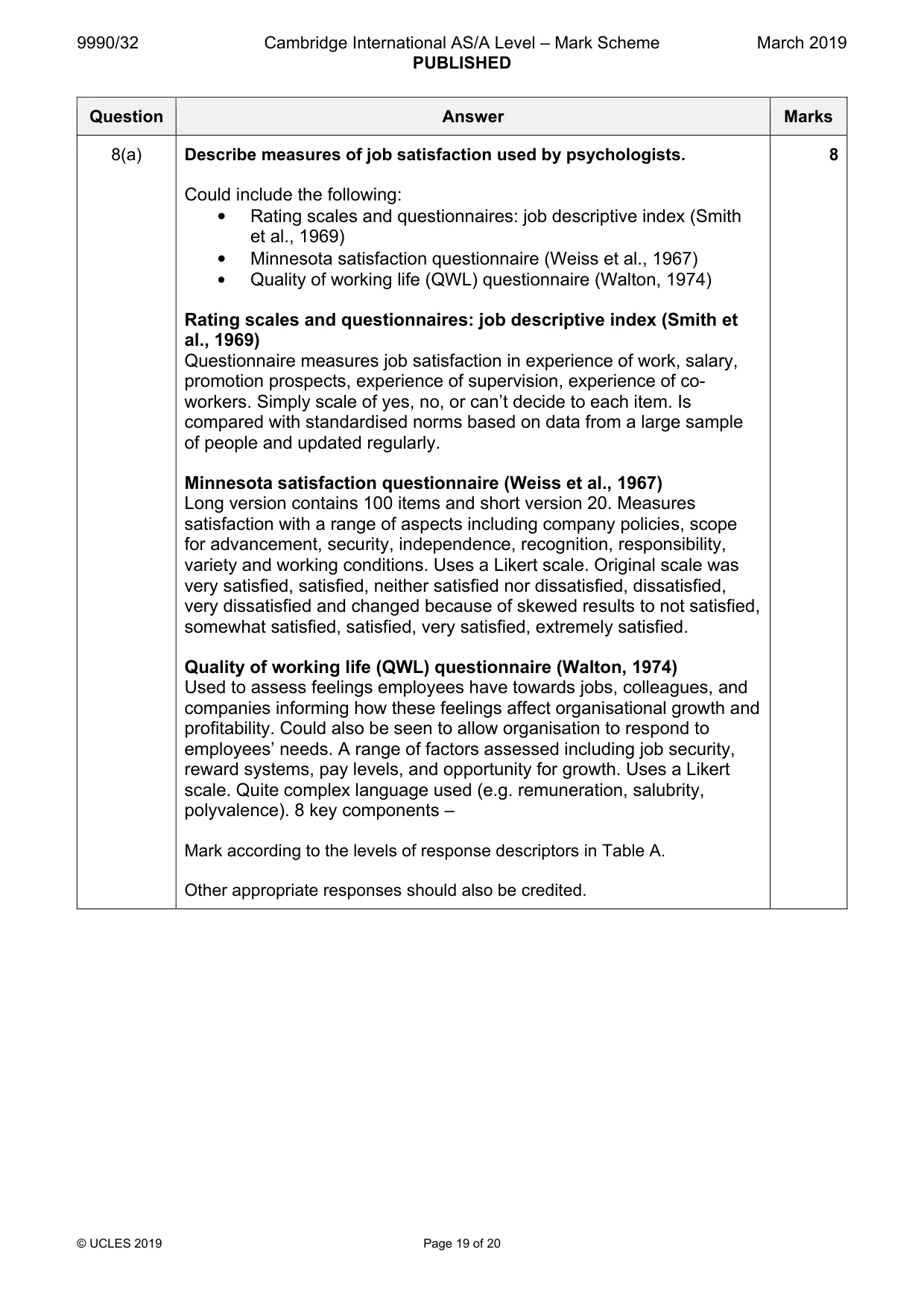
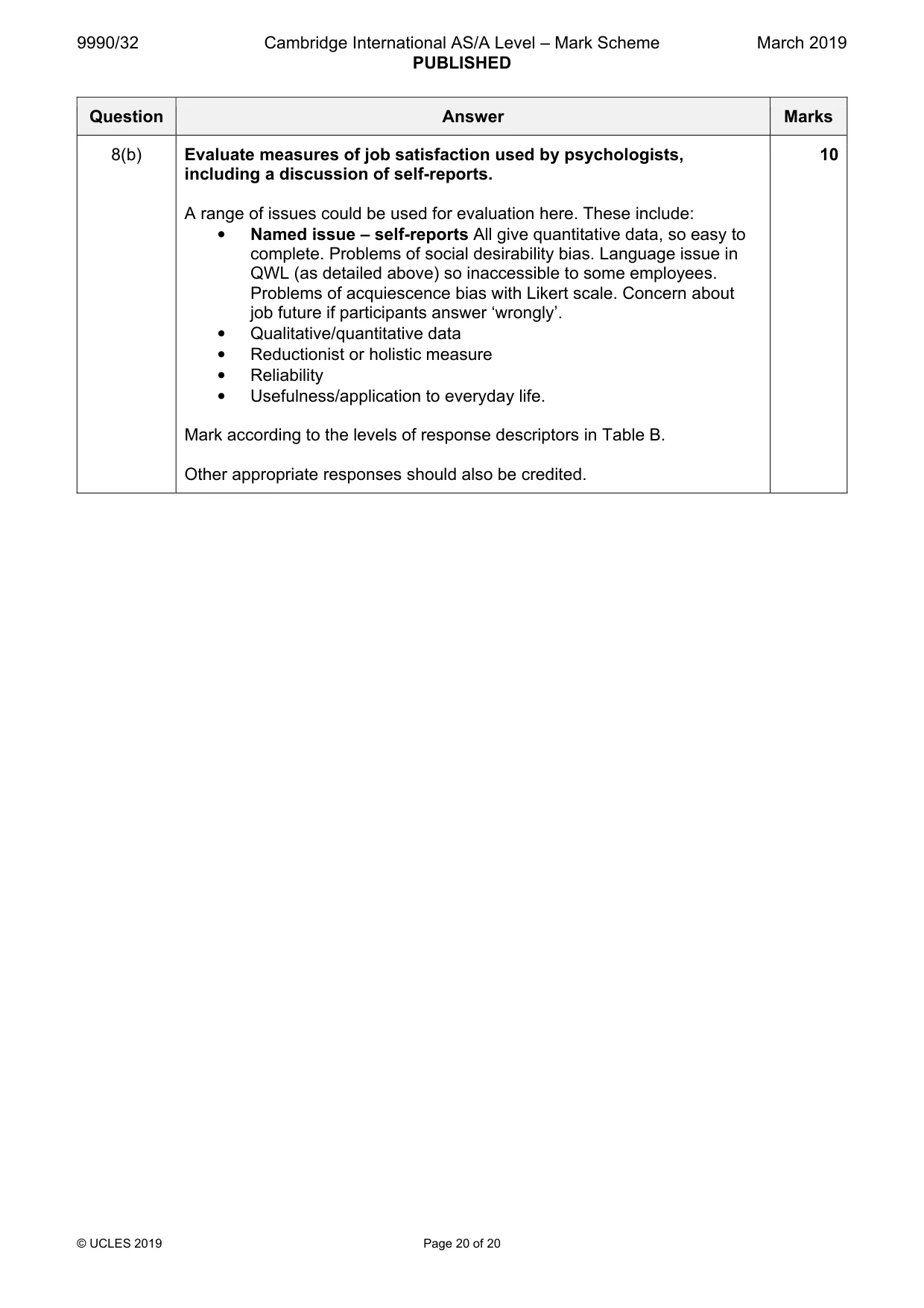
8 (a) Describe measures of job satisfaction used by psychologists. [8] (b) Evaluate measures of job satisfaction used by psychologists, including a discussion of self-reports. [10]
Mark scheme: 8(a) Describe measures of job satisfaction used by psychologists. 8 Could include the following: • Rating scales and questionnaires: job descriptive index (Smith et al., 1969) • Minnesota satisfaction questionnaire (Weiss et al., 1967) • Quality of working life (QWL) questionnaire (Walton, 1974) Rating scales and questionnaires: job descriptive index (Smith et al., 1969) Questionnaire measures job satisfaction in experience of work, salary, promotion prospects, experience of supervision, experience of co- workers. Simply scale of yes, no, or can’t decide to each item. Is compared with standardised norms based on data from a large sample of people and updated regularly. Minnesota satisfaction questionnaire (Weiss et al., 1967) Long version contains 100 items and short version 20. Measures satisfaction with a range of aspects including company policies, scope for advancement, security, independence, recognition, responsibility, variety and working conditions. Uses a Likert scale. Original scale was very satisfied, satisfied, neither satisfied nor dissatisfied, dissatisfied, very dissatisfied and changed because of skewed results to not satisfied, somewhat satisfied, satisfied, very satisfied, extremely satisfied. Quality of working life (QWL) questionnaire (Walton, 1974) Used to assess feelings employees have towards jobs, colleagues, and companies informing how these feelings affect organisational growth and profitability. Could also be seen to allow organisation to respond to employees’ needs. A range of factors assessed including job security, reward systems, pay levels, and opportunity for growth. Uses a Likert scale. Quite complex language used (e.g. remuneration, salubrity, polyvalence). 8 key components – Mark according to the levels of response descriptors in Table A. Other appropriate responses should also be credited. 8(b) Evaluate measures of job satisfaction used by psychologists, 10 including a discussion of self-reports. A range of issues could be used for evaluation here. These include: • Named issue – self-reports All give quantitative data, so easy to complete. Problems of social desirability bias. Language issue in QWL (as detailed above) so inaccessible to some employees. Problems of acquiescence bias with Likert scale. Concern about job future if participants answer ‘wrongly’. • Qualitative/quantitative data • Reductionist or holistic measure • Reliability • Usefulness/application to everyday life. Mark according to the levels of response descriptors in Table B. Other appropriate responses should also be credited.
What was in this paper
The subtopics covered by these 8 questions, and how many questions each got. Open one in a new tab to see every Cambridge question on it.
What you needed in this session
Cambridge’s own grade thresholds for 2019 Feb/March, Paper 3 · Variant 2. A higher threshold means an easier paper — the bar moves with how the cohort did.