Cambridge A Level Psychology 9698 — 2018 Oct/Nov Paper 1 · Variant 2
9698/12/O/N/18 · 80 marks · ≈90 min
The question paper and its mark scheme, free to read here and free to download. This is Cambridge’s own paper, exactly as it was sat.
Question paper4 pages
Mark scheme15 pages
Answers below. Sit the paper first if you are practising.
Paper as text
Question paper, page 1
* 6 3 6 0 0 2 4 9 4 9 * This document consists of 4 printed pages and 1 Insert. DC (SR) 146393/1 © UCLES 2018 [Turn over Cambridge International Examinations Cambridge International Advanced Subsidiary and Advanced Level PSYCHOLOGY 9698/12 Paper 1 Core Studies 1 October/November 2018 1 hour 30 minutes No Additional Materials are required. READ THESE INSTRUCTIONS FIRST An answer booklet is provided inside this question paper. You should follow the instructions on the front cover of the answer booklet. If you need additional answer paper ask the invigilator for a continuation booklet. Answer all questions. The number of marks is given in brackets [ ] at the end of each question or part question.
Question paper, page 2
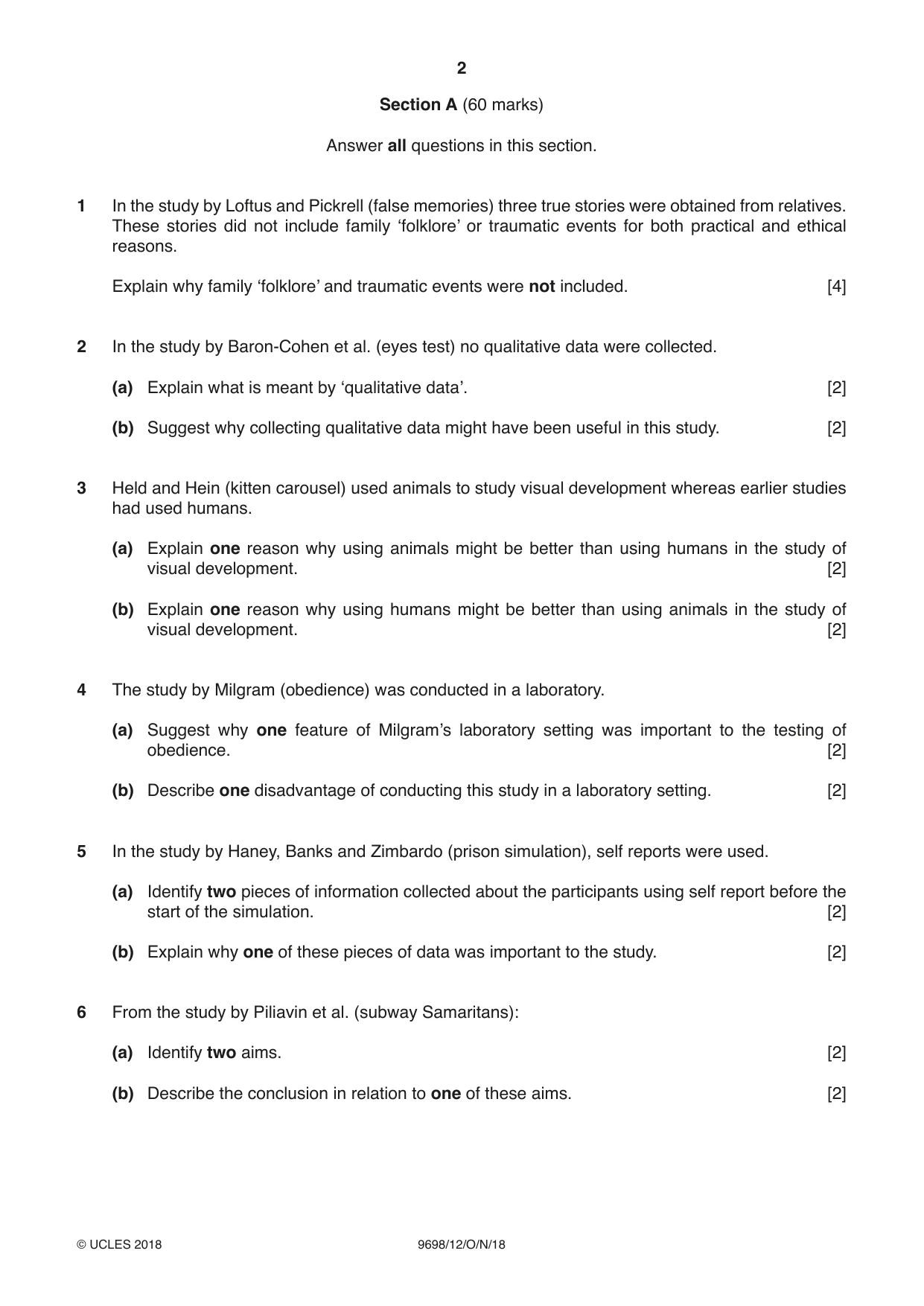
2 9698/12/O/N/18 © UCLES 2018 Section A (60 marks) Answer all questions in this section. 1 In the study by Loftus and Pickrell (false memories) three true stories were obtained from relatives. These stories did not include family ‘folklore’ or traumatic events for both practical and ethical reasons. Explain why family ‘folklore’ and traumatic events were not included. [4] 2 In the study by Baron-Cohen et al. (eyes test) no qualitative data were collected. (a) Explain what is meant by ‘qualitative data’. [2] (b) Suggest why collecting qualitative data might have been useful in this study. [2] 3 Held and Hein (kitten carousel) used animals to study visual development whereas earlier studies had used humans. (a) Explain one reason why using animals might be better than using humans in the study of visual development. [2] (b) Explain one reason why using humans might be better than using animals in the study of visual development. [2] 4 The study by Milgram (obedience) was conducted in a laboratory. (a) Suggest why one feature of Milgram’s laboratory setting was important to the testing of obedience. [2] (b) Describe one disadvantage of conducting this study in a laboratory setting. [2] 5 In the study by Haney, Banks and Zimbardo (prison simulation), self reports were used. (a) Identify two pieces of information collected about the participants using self report before the start of the simulation. [2] (b) Explain why one of these pieces of data was important to the study. [2] 6 From the study by Piliavin et al. (subway Samaritans): (a) Identify two aims. [2] (b) Describe the conclusion in relation to one of these aims. [2]
Question paper, page 3
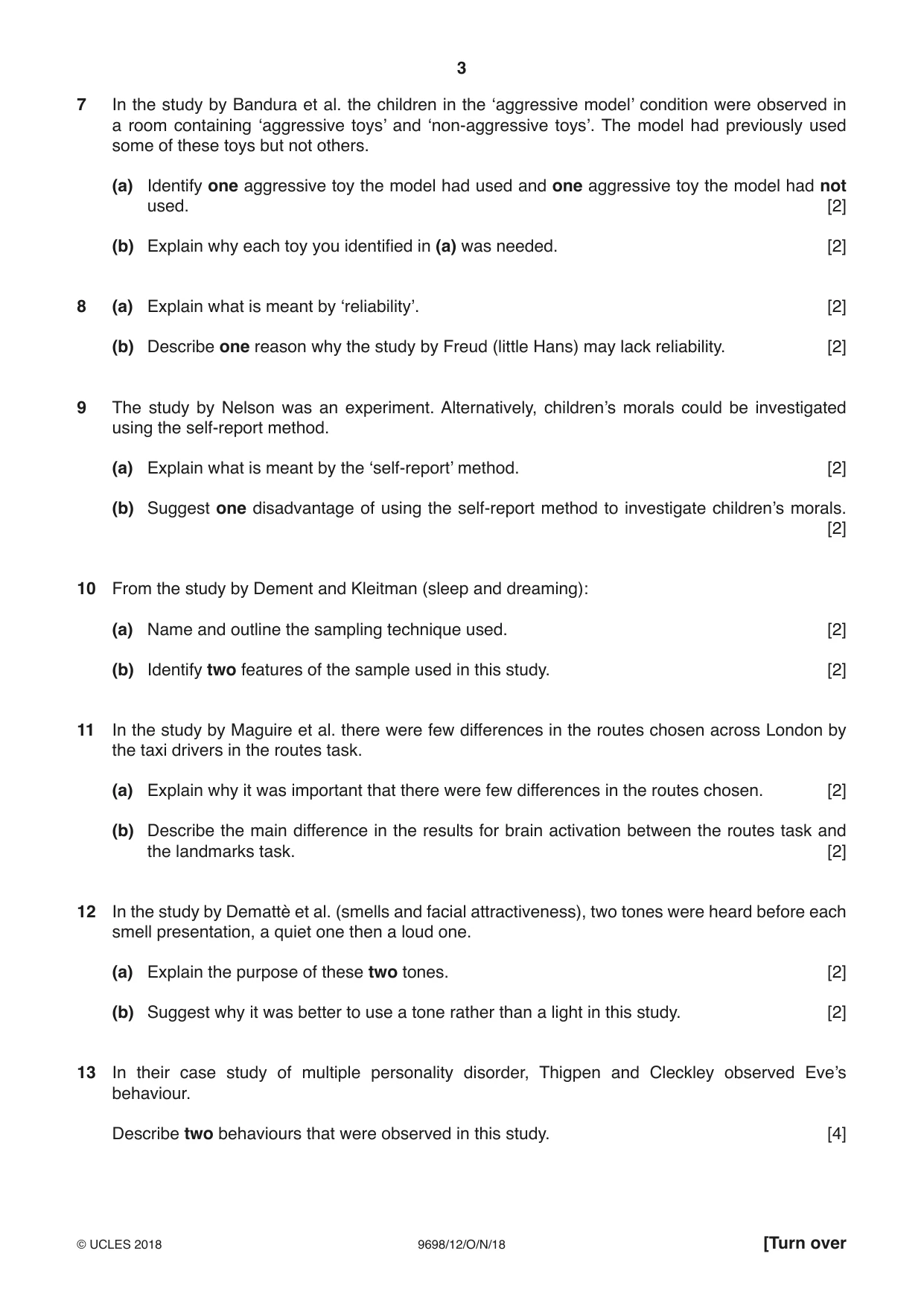
3 9698/12/O/N/18 © UCLES 2018 [Turn over 7 In the study by Bandura et al. the children in the ‘aggressive model’ condition were observed in a room containing ‘aggressive toys’ and ‘non-aggressive toys’. The model had previously used some of these toys but not others. (a) Identify one aggressive toy the model had used and one aggressive toy the model had not used. [2] (b) Explain why each toy you identified in (a) was needed. [2] 8 (a) Explain what is meant by ‘reliability’. [2] (b) Describe one reason why the study by Freud (little Hans) may lack reliability. [2] 9 The study by Nelson was an experiment. Alternatively, children’s morals could be investigated using the self-report method. (a) Explain what is meant by the ‘self-report’ method. [2] (b) Suggest one disadvantage of using the self-report method to investigate children’s morals. [2] 10 From the study by Dement and Kleitman (sleep and dreaming): (a) Name and outline the sampling technique used. [2] (b) Identify two features of the sample used in this study. [2] 11 In the study by Maguire et al. there were few differences in the routes chosen across London by the taxi drivers in the routes task. (a) Explain why it was important that there were few differences in the routes chosen. [2] (b) Describe the main difference in the results for brain activation between the routes task and the landmarks task. [2] 12 In the study by Demattè et al. (smells and facial attractiveness), two tones were heard before each smell presentation, a quiet one then a loud one. (a) Explain the purpose of these two tones. [2] (b) Suggest why it was better to use a tone rather than a light in this study. [2] 13 In their case study of multiple personality disorder, Thigpen and Cleckley observed Eve’s behaviour. Describe two behaviours that were observed in this study. [4]
Question paper, page 4
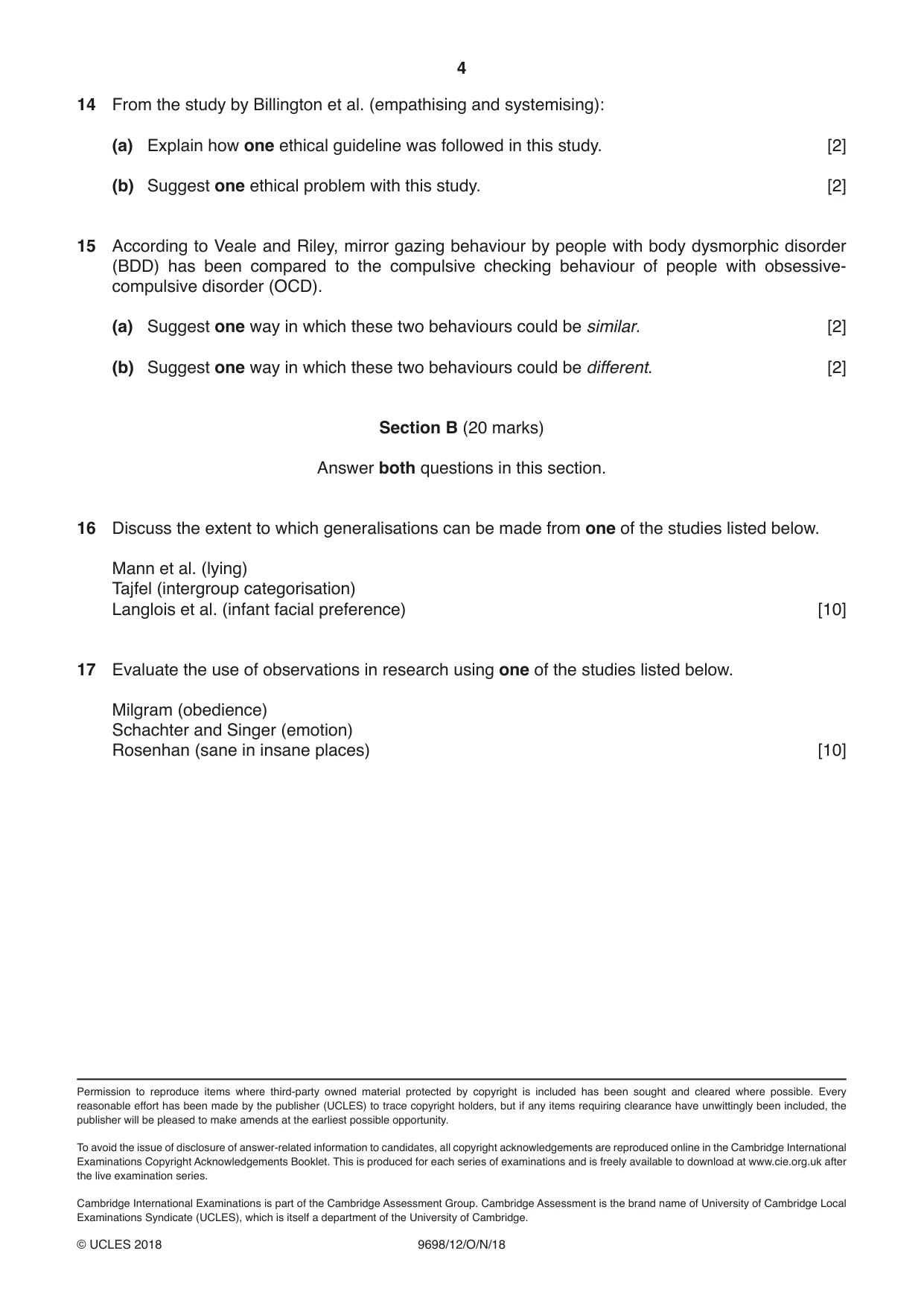
4 9698/12/O/N/18 © UCLES 2018 Permission to reproduce items where third-party owned material protected by copyright is included has been sought and cleared where possible. Every reasonable effort has been made by the publisher (UCLES) to trace copyright holders, but if any items requiring clearance have unwittingly been included, the publisher will be pleased to make amends at the earliest possible opportunity. To avoid the issue of disclosure of answer-related information to candidates, all copyright acknowledgements are reproduced online in the Cambridge International Examinations Copyright Acknowledgements Booklet. This is produced for each series of examinations and is freely available to download at www.cie.org.uk after the live examination series. Cambridge International Examinations is part of the Cambridge Assessment Group. Cambridge Assessment is the brand name of University of Cambridge Local Examinations Syndicate (UCLES), which is itself a department of the University of Cambridge. 14 From the study by Billington et al. (empathising and systemising): (a) Explain how one ethical guideline was followed in this study. [2] (b) Suggest one ethical problem with this study. [2] 15 According to Veale and Riley, mirror gazing behaviour by people with body dysmorphic disorder (BDD) has been compared to the compulsive checking behaviour of people with obsessive- compulsive disorder (OCD). (a) Suggest one way in which these two behaviours could be similar. [2] (b) Suggest one way in which these two behaviours could be different. [2] Section B (20 marks) Answer both questions in this section. 16 Discuss the extent to which generalisations can be made from one of the studies listed below. Mann et al. (lying) Tajfel (intergroup categorisation) Langlois et al. (infant facial preference) [10] 17 Evaluate the use of observations in research using one of the studies listed below. Milgram (obedience) Schachter and Singer (emotion) Rosenhan (sane in insane places) [10]
Mark scheme, page 1
This document consists of 15 printed pages. © UCLES 2018 [Turn over Cambridge Assessment International Education Cambridge International Advanced Subsidiary and Advanced Level PSYCHOLOGY 9698/12 Paper 1 Core Studies October/November 2018 MARK SCHEME Maximum Mark: 80 Published This mark scheme is published as an aid to teachers and candidates, to indicate the requirements of the examination. It shows the basis on which Examiners were instructed to award marks. It does not indicate the details of the discussions that took place at an Examiners’ meeting before marking began, which would have considered the acceptability of alternative answers. Mark schemes should be read in conjunction with the question paper and the Principal Examiner Report for Teachers. Cambridge International will not enter into discussions about these mark schemes. Cambridge International is publishing the mark schemes for the October/November 2018 series for most Cambridge IGCSE™, Cambridge International A and AS Level components and some Cambridge O Level components.
Mark scheme, page 2
9698/12 Cambridge International AS/A Level – Mark Scheme PUBLISHED October/November 2018 © UCLES 2018 Page 2 of 15 Generic Marking Principles These general marking principles must be applied by all examiners when marking candidate answers. They should be applied alongside the specific content of the mark scheme or generic level descriptors for a question. Each question paper and mark scheme will also comply with these marking principles. GENERIC MARKING PRINCIPLE 1: Marks must be awarded in line with: • the specific content of the mark scheme or the generic level descriptors for the question • the specific skills defined in the mark scheme or in the generic level descriptors for the question • the standard of response required by a candidate as exemplified by the standardisation scripts. GENERIC MARKING PRINCIPLE 2: Marks awarded are always whole marks (not half marks, or other fractions). GENERIC MARKING PRINCIPLE 3: Marks must be awarded positively: • marks are awarded for correct/valid answers, as defined in the mark scheme. However, credit is given for valid answers which go beyond the scope of the syllabus and mark scheme, referring to your Team Leader as appropriate • marks are awarded when candidates clearly demonstrate what they know and can do • marks are not deducted for errors • marks are not deducted for omissions • answers should only be judged on the quality of spelling, punctuation and grammar when these features are specifically assessed by the question as indicated by the mark scheme. The meaning, however, should be unambiguous. GENERIC MARKING PRINCIPLE 4: Rules must be applied consistently e.g. in situations where candidates have not followed instructions or in the application of generic level descriptors. GENERIC MARKING PRINCIPLE 5: Marks should be awarded using the full range of marks defined in the mark scheme for the question (however; the use of the full mark range may be limited according to the quality of the candidate responses seen). GENERIC MARKING PRINCIPLE 6: Marks awarded are based solely on the requirements as defined in the mark scheme. Marks should not be awarded with grade thresholds or grade descriptors in mind.
Mark scheme, page 3
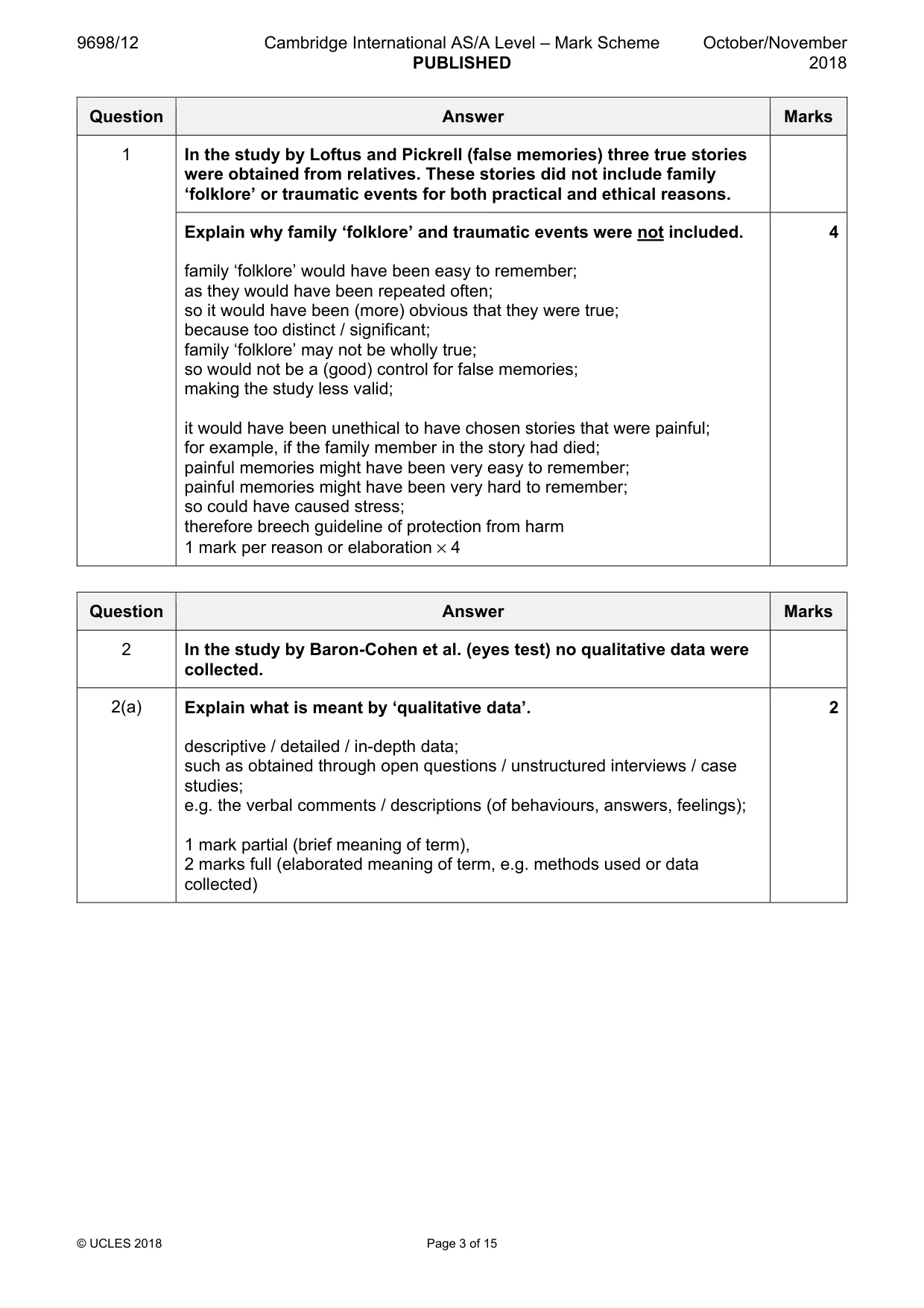
9698/12 Cambridge International AS/A Level – Mark Scheme PUBLISHED October/November 2018 © UCLES 2018 Page 3 of 15 Question Answer Marks 1 In the study by Loftus and Pickrell (false memories) three true stories were obtained from relatives. These stories did not include family ‘folklore’ or traumatic events for both practical and ethical reasons. Explain why family ‘folklore’ and traumatic events were not included. family ‘folklore’ would have been easy to remember; as they would have been repeated often; so it would have been (more) obvious that they were true; because too distinct / significant; family ‘folklore’ may not be wholly true; so would not be a (good) control for false memories; making the study less valid; it would have been unethical to have chosen stories that were painful; for example, if the family member in the story had died; painful memories might have been very easy to remember; painful memories might have been very hard to remember; so could have caused stress; therefore breech guideline of protection from harm 1 mark per reason or elaboration × 4 4 Question Answer Marks 2 In the study by Baron-Cohen et al. (eyes test) no qualitative data were collected. 2(a) Explain what is meant by ‘qualitative data’. descriptive / detailed / in-depth data; such as obtained through open questions / unstructured interviews / case studies; e.g. the verbal comments / descriptions (of behaviours, answers, feelings); 1 mark partial (brief meaning of term), 2 marks full (elaborated meaning of term, e.g. methods used or data collected) 2
Mark scheme, page 4
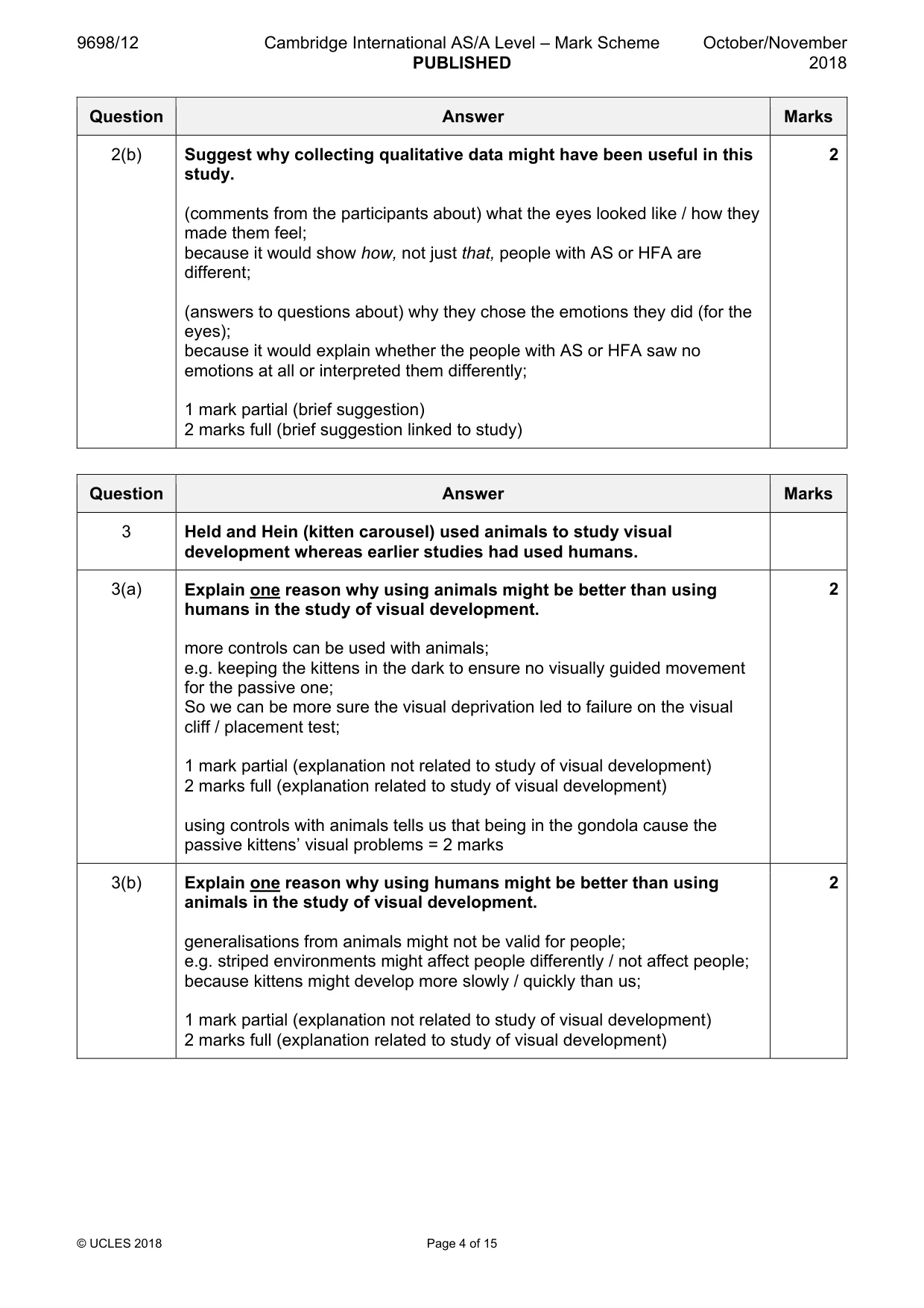
9698/12 Cambridge International AS/A Level – Mark Scheme PUBLISHED October/November 2018 © UCLES 2018 Page 4 of 15 Question Answer Marks 2(b) Suggest why collecting qualitative data might have been useful in this study. (comments from the participants about) what the eyes looked like / how they made them feel; because it would show how, not just that, people with AS or HFA are different; (answers to questions about) why they chose the emotions they did (for the eyes); because it would explain whether the people with AS or HFA saw no emotions at all or interpreted them differently; 1 mark partial (brief suggestion) 2 marks full (brief suggestion linked to study) 2 Question Answer Marks 3 Held and Hein (kitten carousel) used animals to study visual development whereas earlier studies had used humans. 3(a) Explain one reason why using animals might be better than using humans in the study of visual development. more controls can be used with animals; e.g. keeping the kittens in the dark to ensure no visually guided movement for the passive one; So we can be more sure the visual deprivation led to failure on the visual cliff / placement test; 1 mark partial (explanation not related to study of visual development) 2 marks full (explanation related to study of visual development) using controls with animals tells us that being in the gondola cause the passive kittens’ visual problems = 2 marks 2 3(b) Explain one reason why using humans might be better than using animals in the study of visual development. generalisations from animals might not be valid for people; e.g. striped environments might affect people differently / not affect people; because kittens might develop more slowly / quickly than us; 1 mark partial (explanation not related to study of visual development) 2 marks full (explanation related to study of visual development) 2
Mark scheme, page 5
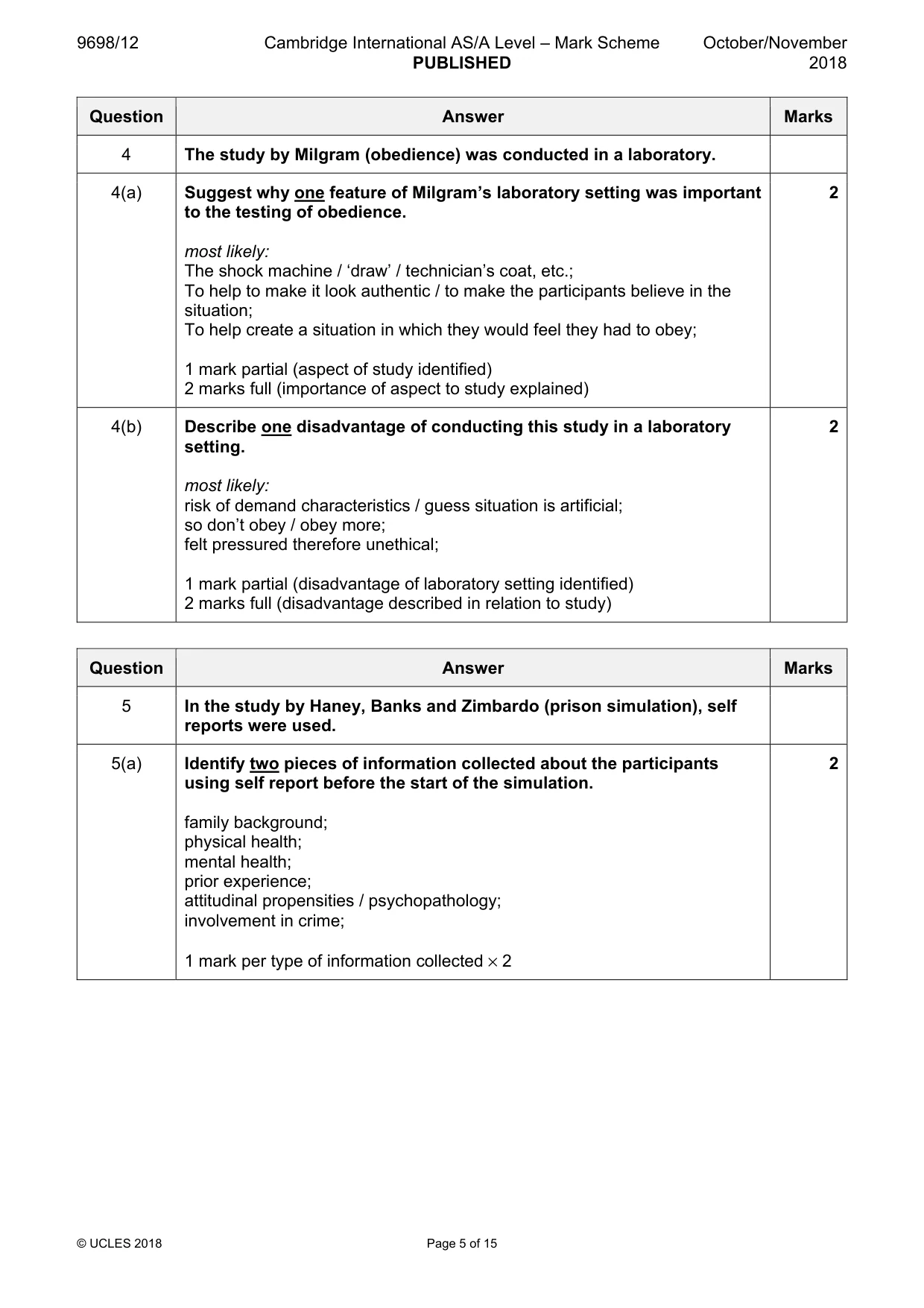
9698/12 Cambridge International AS/A Level – Mark Scheme PUBLISHED October/November 2018 © UCLES 2018 Page 5 of 15 Question Answer Marks 4 The study by Milgram (obedience) was conducted in a laboratory. 4(a) Suggest why one feature of Milgram’s laboratory setting was important to the testing of obedience. most likely: The shock machine / ‘draw’ / technician’s coat, etc.; To help to make it look authentic / to make the participants believe in the situation; To help create a situation in which they would feel they had to obey; 1 mark partial (aspect of study identified) 2 marks full (importance of aspect to study explained) 2 4(b) Describe one disadvantage of conducting this study in a laboratory setting. most likely: risk of demand characteristics / guess situation is artificial; so don’t obey / obey more; felt pressured therefore unethical; 1 mark partial (disadvantage of laboratory setting identified) 2 marks full (disadvantage described in relation to study) 2 Question Answer Marks 5 In the study by Haney, Banks and Zimbardo (prison simulation), self reports were used. 5(a) Identify two pieces of information collected about the participants using self report before the start of the simulation. family background; physical health; mental health; prior experience; attitudinal propensities / psychopathology; involvement in crime; 1 mark per type of information collected × 2 2
Mark scheme, page 6
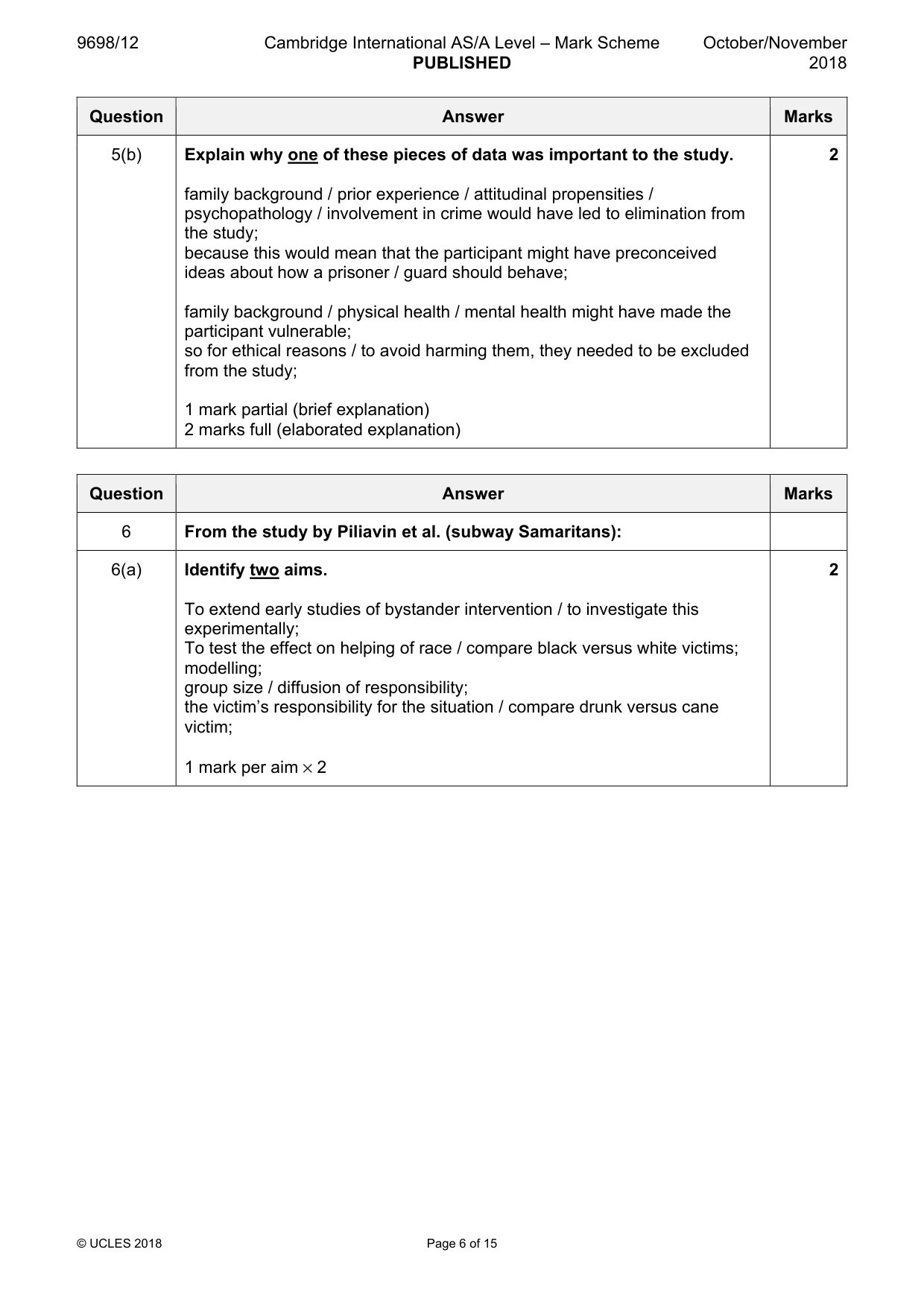
9698/12 Cambridge International AS/A Level – Mark Scheme PUBLISHED October/November 2018 © UCLES 2018 Page 6 of 15 Question Answer Marks 5(b) Explain why one of these pieces of data was important to the study. family background / prior experience / attitudinal propensities / psychopathology / involvement in crime would have led to elimination from the study; because this would mean that the participant might have preconceived ideas about how a prisoner / guard should behave; family background / physical health / mental health might have made the participant vulnerable; so for ethical reasons / to avoid harming them, they needed to be excluded from the study; 1 mark partial (brief explanation) 2 marks full (elaborated explanation) 2 Question Answer Marks 6 From the study by Piliavin et al. (subway Samaritans): 6(a) Identify two aims. To extend early studies of bystander intervention / to investigate this experimentally; To test the effect on helping of race / compare black versus white victims; modelling; group size / diffusion of responsibility; the victim’s responsibility for the situation / compare drunk versus cane victim; 1 mark per aim × 2 2
Mark scheme, page 7
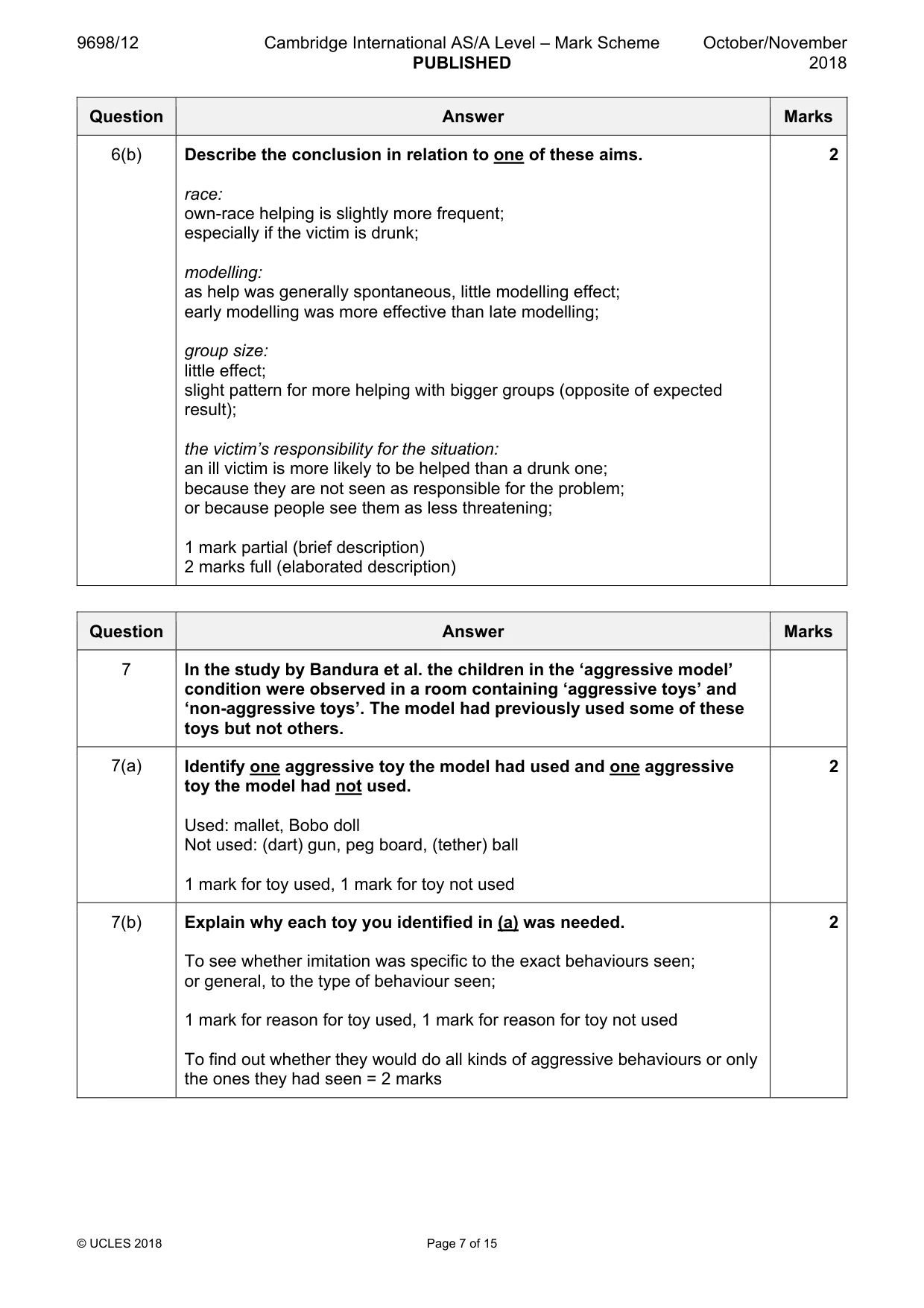
9698/12 Cambridge International AS/A Level – Mark Scheme PUBLISHED October/November 2018 © UCLES 2018 Page 7 of 15 Question Answer Marks 6(b) Describe the conclusion in relation to one of these aims. race: own-race helping is slightly more frequent; especially if the victim is drunk; modelling: as help was generally spontaneous, little modelling effect; early modelling was more effective than late modelling; group size: little effect; slight pattern for more helping with bigger groups (opposite of expected result); the victim’s responsibility for the situation: an ill victim is more likely to be helped than a drunk one; because they are not seen as responsible for the problem; or because people see them as less threatening; 1 mark partial (brief description) 2 marks full (elaborated description) 2 Question Answer Marks 7 In the study by Bandura et al. the children in the ‘aggressive model’ condition were observed in a room containing ‘aggressive toys’ and ‘non-aggressive toys’. The model had previously used some of these toys but not others. 7(a) Identify one aggressive toy the model had used and one aggressive toy the model had not used. Used: mallet, Bobo doll Not used: (dart) gun, peg board, (tether) ball 1 mark for toy used, 1 mark for toy not used 2 7(b) Explain why each toy you identified in (a) was needed. To see whether imitation was specific to the exact behaviours seen; or general, to the type of behaviour seen; 1 mark for reason for toy used, 1 mark for reason for toy not used To find out whether they would do all kinds of aggressive behaviours or only the ones they had seen = 2 marks 2
Mark scheme, page 8
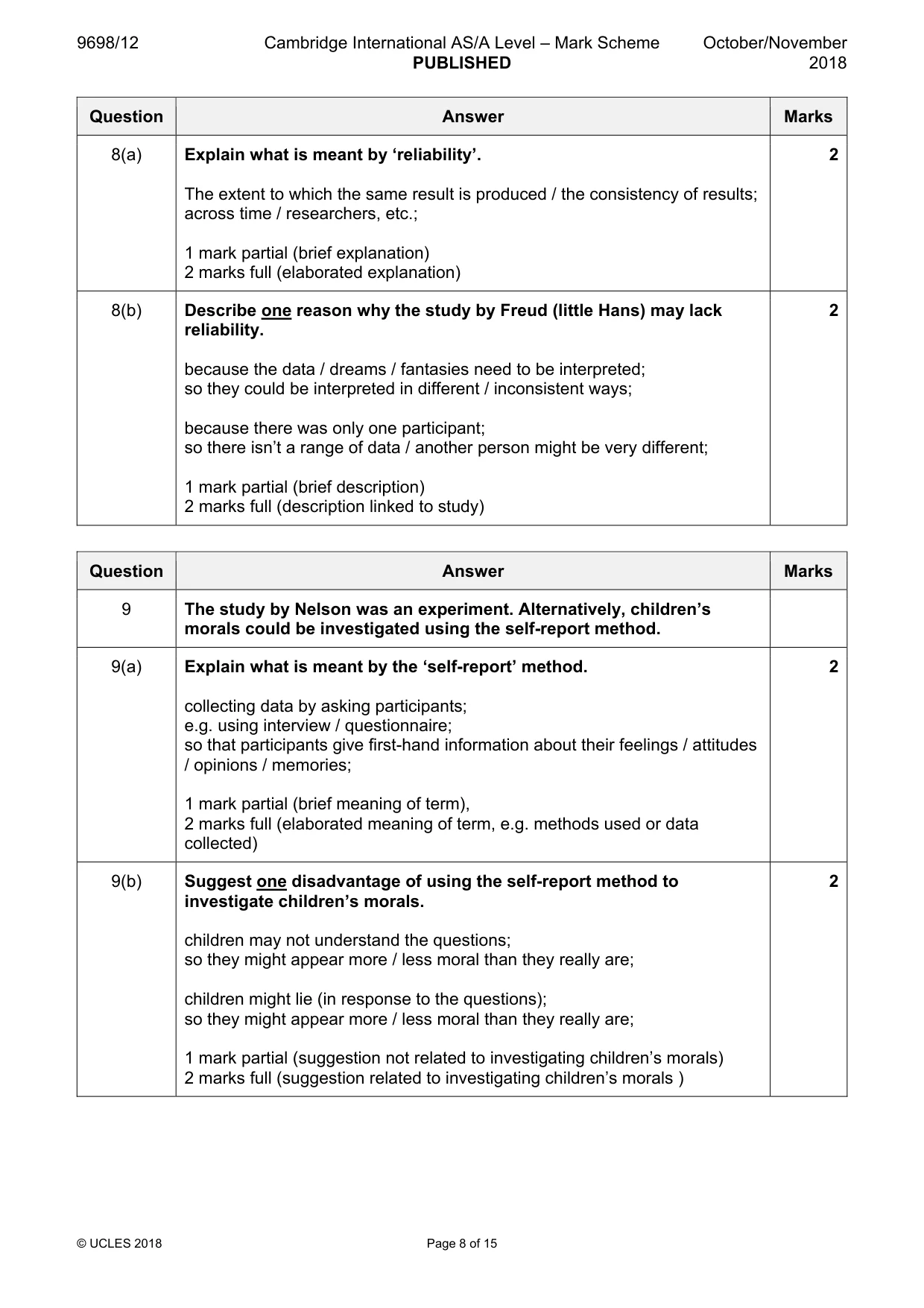
9698/12 Cambridge International AS/A Level – Mark Scheme PUBLISHED October/November 2018 © UCLES 2018 Page 8 of 15 Question Answer Marks 8(a) Explain what is meant by ‘reliability’. The extent to which the same result is produced / the consistency of results; across time / researchers, etc.; 1 mark partial (brief explanation) 2 marks full (elaborated explanation) 2 8(b) Describe one reason why the study by Freud (little Hans) may lack reliability. because the data / dreams / fantasies need to be interpreted; so they could be interpreted in different / inconsistent ways; because there was only one participant; so there isn’t a range of data / another person might be very different; 1 mark partial (brief description) 2 marks full (description linked to study) 2 Question Answer Marks 9 The study by Nelson was an experiment. Alternatively, children’s morals could be investigated using the self-report method. 9(a) Explain what is meant by the ‘self-report’ method. collecting data by asking participants; e.g. using interview / questionnaire; so that participants give first-hand information about their feelings / attitudes / opinions / memories; 1 mark partial (brief meaning of term), 2 marks full (elaborated meaning of term, e.g. methods used or data collected) 2 9(b) Suggest one disadvantage of using the self-report method to investigate children’s morals. children may not understand the questions; so they might appear more / less moral than they really are; children might lie (in response to the questions); so they might appear more / less moral than they really are; 1 mark partial (suggestion not related to investigating children’s morals) 2 marks full (suggestion related to investigating children’s morals ) 2
Mark scheme, page 9
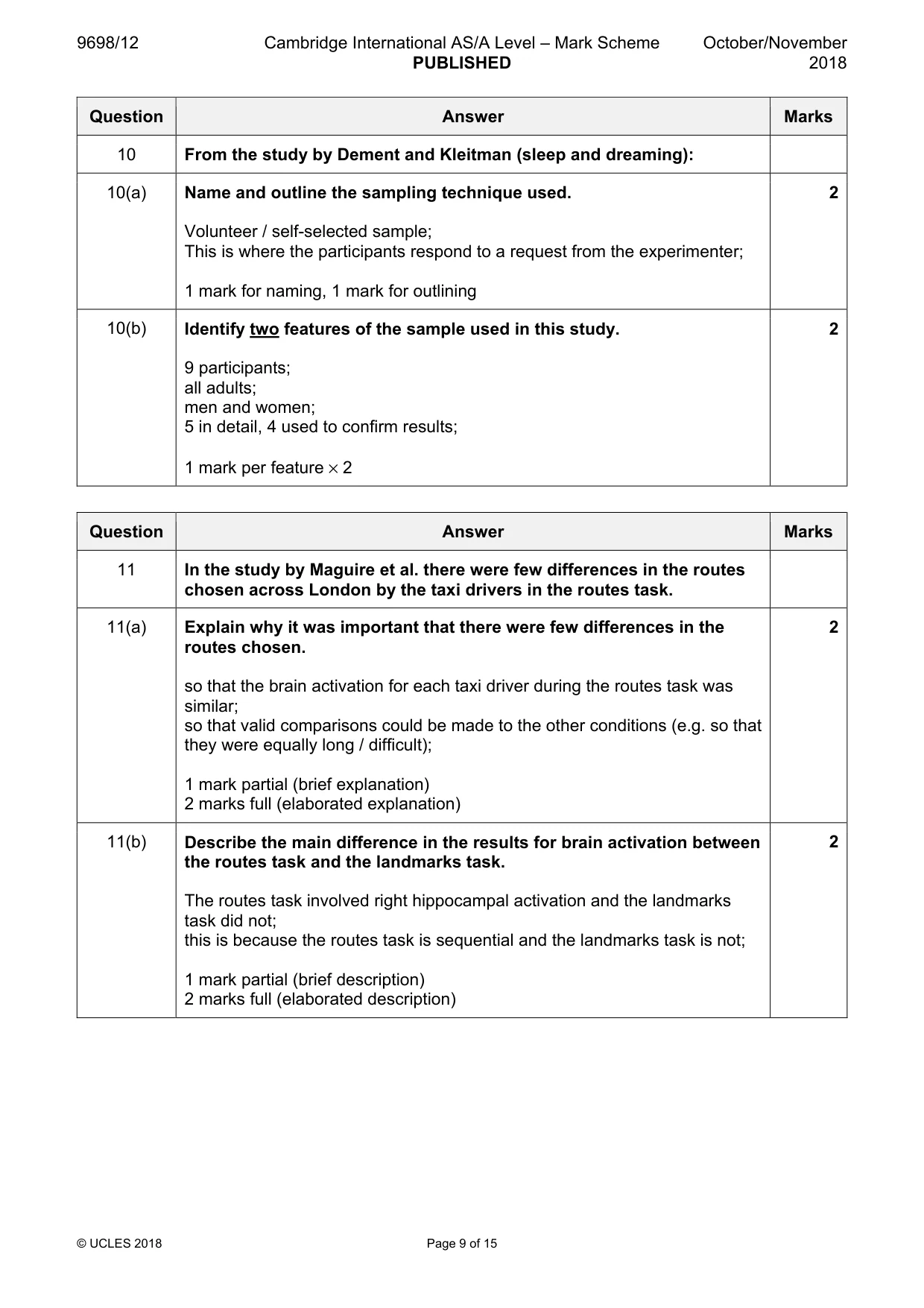
9698/12 Cambridge International AS/A Level – Mark Scheme PUBLISHED October/November 2018 © UCLES 2018 Page 9 of 15 Question Answer Marks 10 From the study by Dement and Kleitman (sleep and dreaming): 10(a) Name and outline the sampling technique used. Volunteer / self-selected sample; This is where the participants respond to a request from the experimenter; 1 mark for naming, 1 mark for outlining 2 10(b) Identify two features of the sample used in this study. 9 participants; all adults; men and women; 5 in detail, 4 used to confirm results; 1 mark per feature × 2 2 Question Answer Marks 11 In the study by Maguire et al. there were few differences in the routes chosen across London by the taxi drivers in the routes task. 11(a) Explain why it was important that there were few differences in the routes chosen. so that the brain activation for each taxi driver during the routes task was similar; so that valid comparisons could be made to the other conditions (e.g. so that they were equally long / difficult); 1 mark partial (brief explanation) 2 marks full (elaborated explanation) 2 11(b) Describe the main difference in the results for brain activation between the routes task and the landmarks task. The routes task involved right hippocampal activation and the landmarks task did not; this is because the routes task is sequential and the landmarks task is not; 1 mark partial (brief description) 2 marks full (elaborated description) 2
Mark scheme, page 10
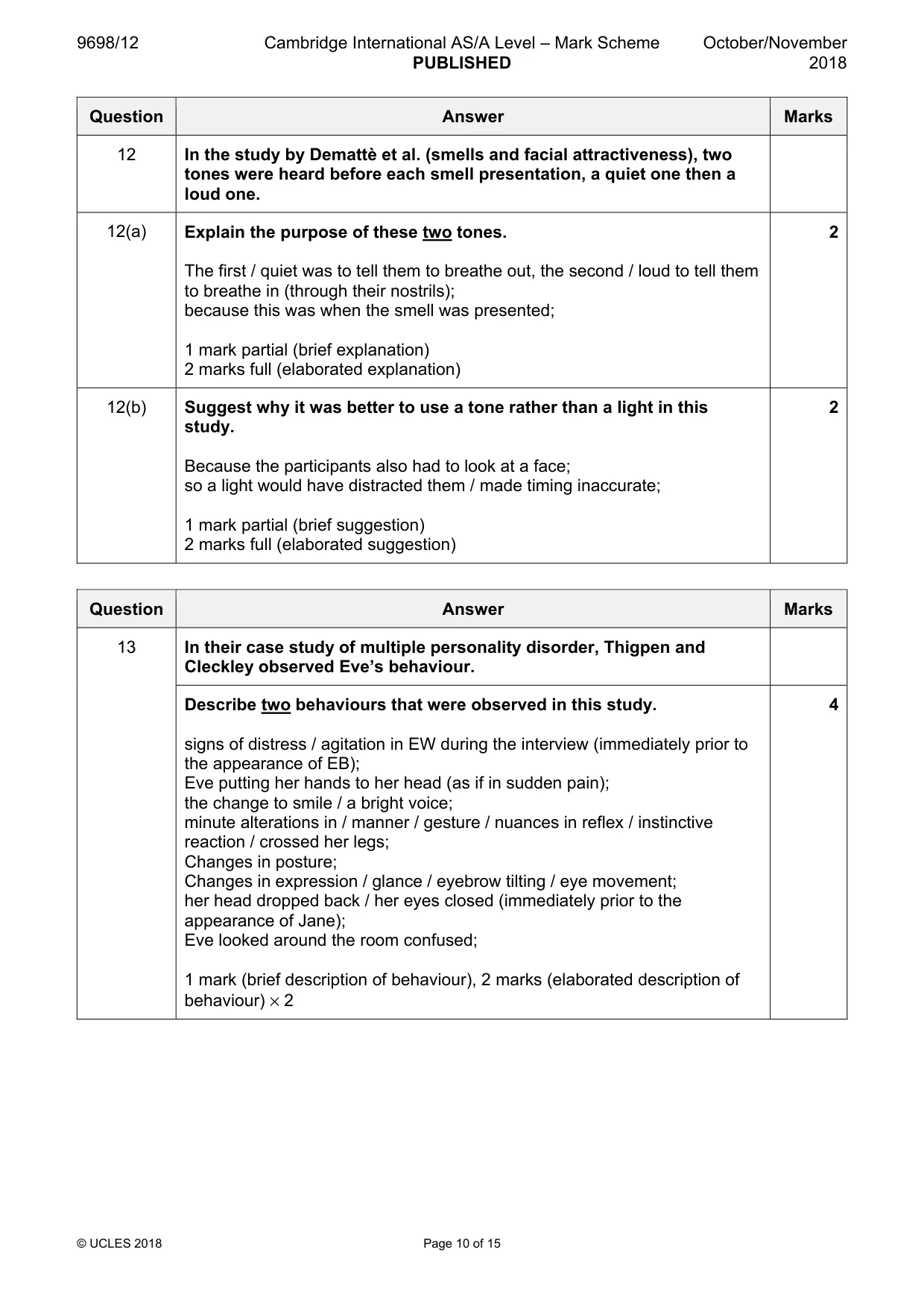
9698/12 Cambridge International AS/A Level – Mark Scheme PUBLISHED October/November 2018 © UCLES 2018 Page 10 of 15 Question Answer Marks 12 In the study by Demattè et al. (smells and facial attractiveness), two tones were heard before each smell presentation, a quiet one then a loud one. 12(a) Explain the purpose of these two tones. The first / quiet was to tell them to breathe out, the second / loud to tell them to breathe in (through their nostrils); because this was when the smell was presented; 1 mark partial (brief explanation) 2 marks full (elaborated explanation) 2 12(b) Suggest why it was better to use a tone rather than a light in this study. Because the participants also had to look at a face; so a light would have distracted them / made timing inaccurate; 1 mark partial (brief suggestion) 2 marks full (elaborated suggestion) 2 Question Answer Marks 13 In their case study of multiple personality disorder, Thigpen and Cleckley observed Eve’s behaviour. Describe two behaviours that were observed in this study. signs of distress / agitation in EW during the interview (immediately prior to the appearance of EB); Eve putting her hands to her head (as if in sudden pain); the change to smile / a bright voice; minute alterations in / manner / gesture / nuances in reflex / instinctive reaction / crossed her legs; Changes in posture; Changes in expression / glance / eyebrow tilting / eye movement; her head dropped back / her eyes closed (immediately prior to the appearance of Jane); Eve looked around the room confused; 1 mark (brief description of behaviour), 2 marks (elaborated description of behaviour) × 2 4
Mark scheme, page 11
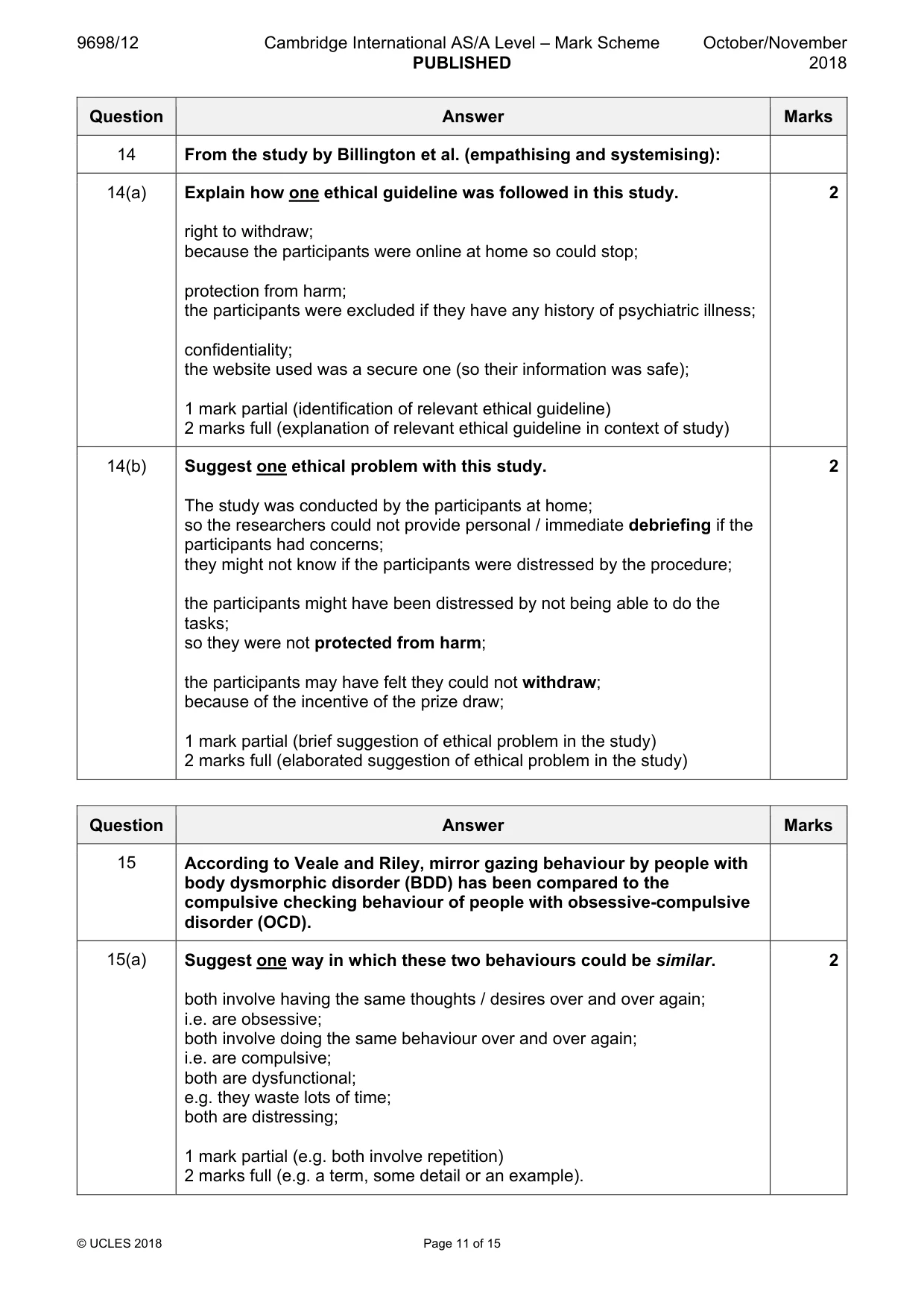
9698/12 Cambridge International AS/A Level – Mark Scheme PUBLISHED October/November 2018 © UCLES 2018 Page 11 of 15 Question Answer Marks 14 From the study by Billington et al. (empathising and systemising): 14(a) Explain how one ethical guideline was followed in this study. right to withdraw; because the participants were online at home so could stop; protection from harm; the participants were excluded if they have any history of psychiatric illness; confidentiality; the website used was a secure one (so their information was safe); 1 mark partial (identification of relevant ethical guideline) 2 marks full (explanation of relevant ethical guideline in context of study) 2 14(b) Suggest one ethical problem with this study. The study was conducted by the participants at home; so the researchers could not provide personal / immediate debriefing if the participants had concerns; they might not know if the participants were distressed by the procedure; the participants might have been distressed by not being able to do the tasks; so they were not protected from harm; the participants may have felt they could not withdraw; because of the incentive of the prize draw; 1 mark partial (brief suggestion of ethical problem in the study) 2 marks full (elaborated suggestion of ethical problem in the study) 2 Question Answer Marks 15 According to Veale and Riley, mirror gazing behaviour by people with body dysmorphic disorder (BDD) has been compared to the compulsive checking behaviour of people with obsessive-compulsive disorder (OCD). 15(a) Suggest one way in which these two behaviours could be similar. both involve having the same thoughts / desires over and over again; i.e. are obsessive; both involve doing the same behaviour over and over again; i.e. are compulsive; both are dysfunctional; e.g. they waste lots of time; both are distressing; 1 mark partial (e.g. both involve repetition) 2 marks full (e.g. a term, some detail or an example). 2
Mark scheme, page 12
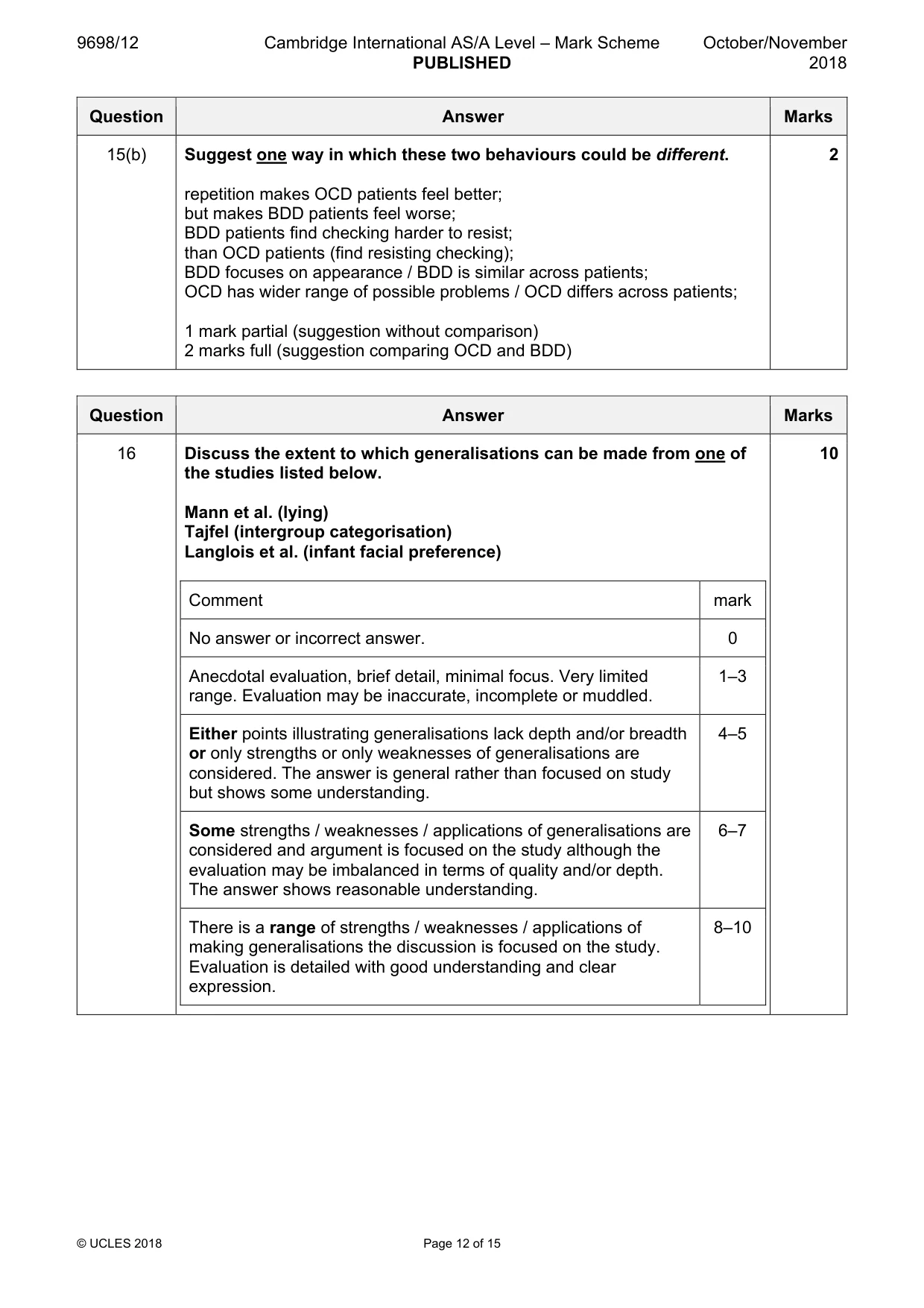
9698/12 Cambridge International AS/A Level – Mark Scheme PUBLISHED October/November 2018 © UCLES 2018 Page 12 of 15 Question Answer Marks 15(b) Suggest one way in which these two behaviours could be different. repetition makes OCD patients feel better; but makes BDD patients feel worse; BDD patients find checking harder to resist; than OCD patients (find resisting checking); BDD focuses on appearance / BDD is similar across patients; OCD has wider range of possible problems / OCD differs across patients; 1 mark partial (suggestion without comparison) 2 marks full (suggestion comparing OCD and BDD) 2 Question Answer Marks 16 Discuss the extent to which generalisations can be made from one of the studies listed below. Mann et al. (lying) Tajfel (intergroup categorisation) Langlois et al. (infant facial preference) Comment mark No answer or incorrect answer. 0 Anecdotal evaluation, brief detail, minimal focus. Very limited range. Evaluation may be inaccurate, incomplete or muddled. 1–3 Either points illustrating generalisations lack depth and/or breadth or only strengths or only weaknesses of generalisations are considered. The answer is general rather than focused on study but shows some understanding. 4–5 Some strengths / weaknesses / applications of generalisations are considered and argument is focused on the study although the evaluation may be imbalanced in terms of quality and/or depth. The answer shows reasonable understanding. 6–7 There is a range of strengths / weaknesses / applications of making generalisations the discussion is focused on the study. Evaluation is detailed with good understanding and clear expression. 8–10 10
Mark scheme, page 13
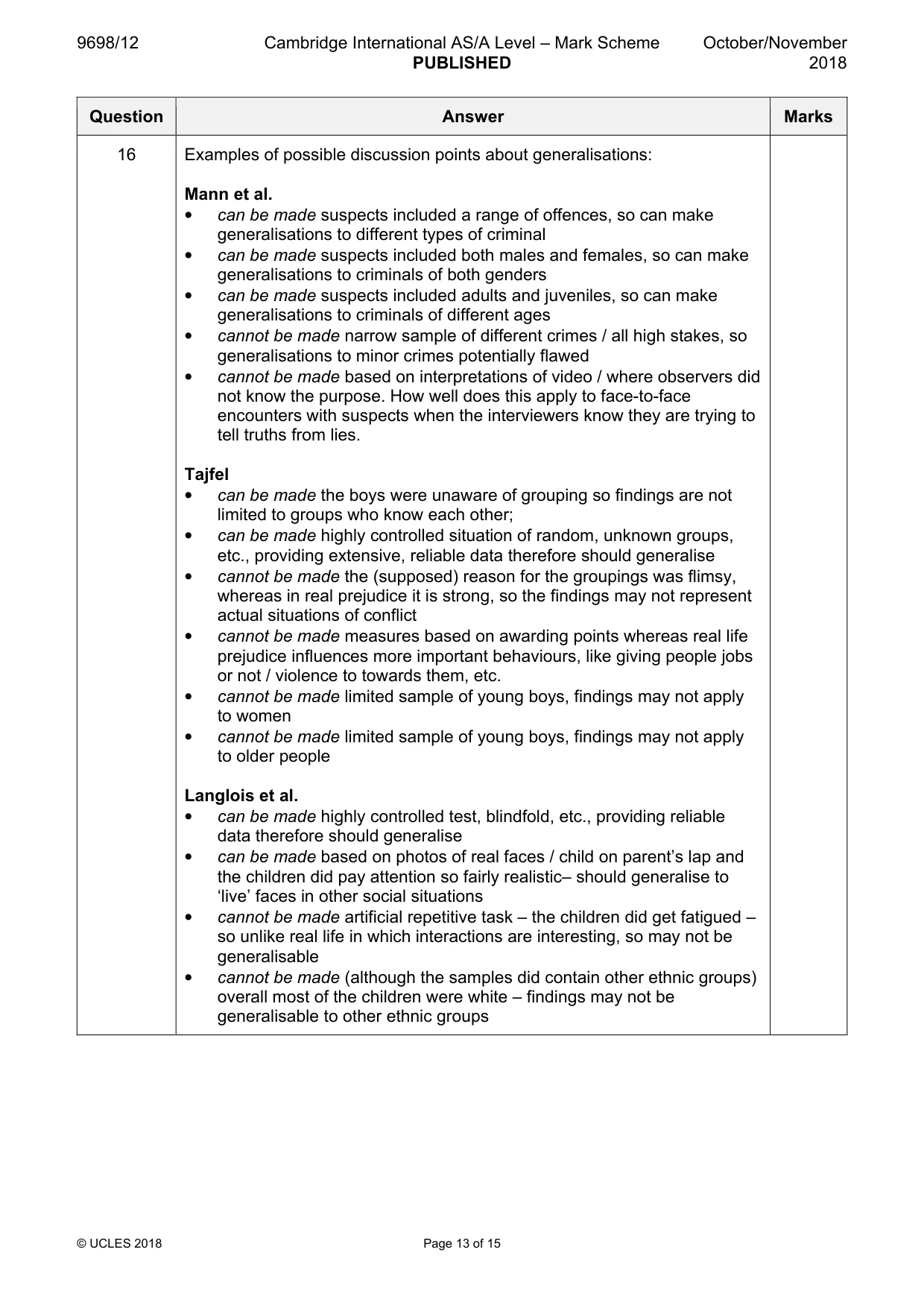
9698/12 Cambridge International AS/A Level – Mark Scheme PUBLISHED October/November 2018 © UCLES 2018 Page 13 of 15 Question Answer Marks 16 Examples of possible discussion points about generalisations: Mann et al. • can be made suspects included a range of offences, so can make generalisations to different types of criminal • can be made suspects included both males and females, so can make generalisations to criminals of both genders • can be made suspects included adults and juveniles, so can make generalisations to criminals of different ages • cannot be made narrow sample of different crimes / all high stakes, so generalisations to minor crimes potentially flawed • cannot be made based on interpretations of video / where observers did not know the purpose. How well does this apply to face-to-face encounters with suspects when the interviewers know they are trying to tell truths from lies. Tajfel • can be made the boys were unaware of grouping so findings are not limited to groups who know each other; • can be made highly controlled situation of random, unknown groups, etc., providing extensive, reliable data therefore should generalise • cannot be made the (supposed) reason for the groupings was flimsy, whereas in real prejudice it is strong, so the findings may not represent actual situations of conflict • cannot be made measures based on awarding points whereas real life prejudice influences more important behaviours, like giving people jobs or not / violence to towards them, etc. • cannot be made limited sample of young boys, findings may not apply to women • cannot be made limited sample of young boys, findings may not apply to older people Langlois et al. • can be made highly controlled test, blindfold, etc., providing reliable data therefore should generalise • can be made based on photos of real faces / child on parent’s lap and the children did pay attention so fairly realistic– should generalise to ‘live’ faces in other social situations • cannot be made artificial repetitive task – the children did get fatigued – so unlike real life in which interactions are interesting, so may not be generalisable • cannot be made (although the samples did contain other ethnic groups) overall most of the children were white – findings may not be generalisable to other ethnic groups
Mark scheme, page 14
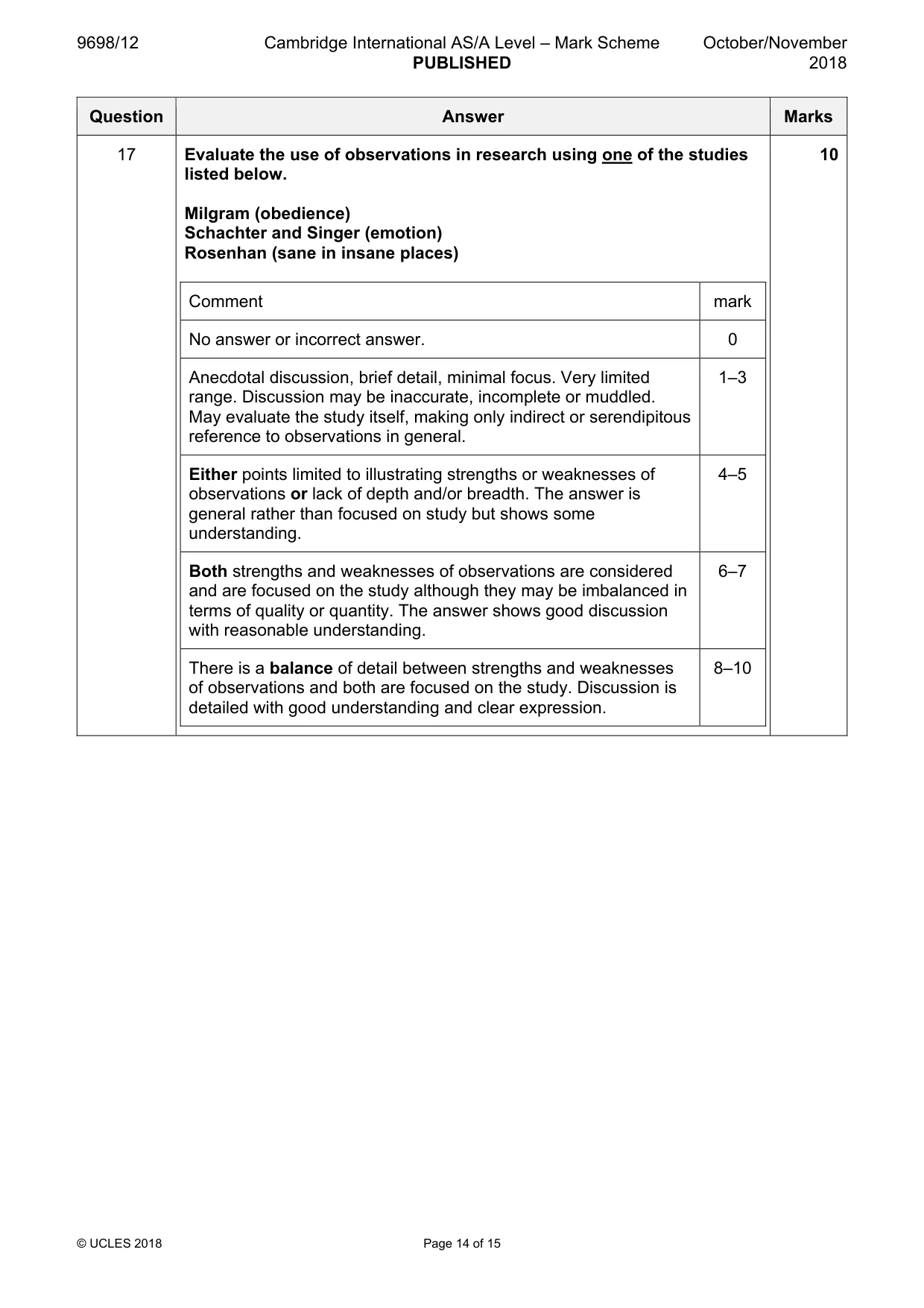
9698/12 Cambridge International AS/A Level – Mark Scheme PUBLISHED October/November 2018 © UCLES 2018 Page 14 of 15 Question Answer Marks 17 Evaluate the use of observations in research using one of the studies listed below. Milgram (obedience) Schachter and Singer (emotion) Rosenhan (sane in insane places) Comment mark No answer or incorrect answer. 0 Anecdotal discussion, brief detail, minimal focus. Very limited range. Discussion may be inaccurate, incomplete or muddled. May evaluate the study itself, making only indirect or serendipitous reference to observations in general. 1–3 Either points limited to illustrating strengths or weaknesses of observations or lack of depth and/or breadth. The answer is general rather than focused on study but shows some understanding. 4–5 Both strengths and weaknesses of observations are considered and are focused on the study although they may be imbalanced in terms of quality or quantity. The answer shows good discussion with reasonable understanding. 6–7 There is a balance of detail between strengths and weaknesses of observations and both are focused on the study. Discussion is detailed with good understanding and clear expression. 8–10 10
Mark scheme, page 15
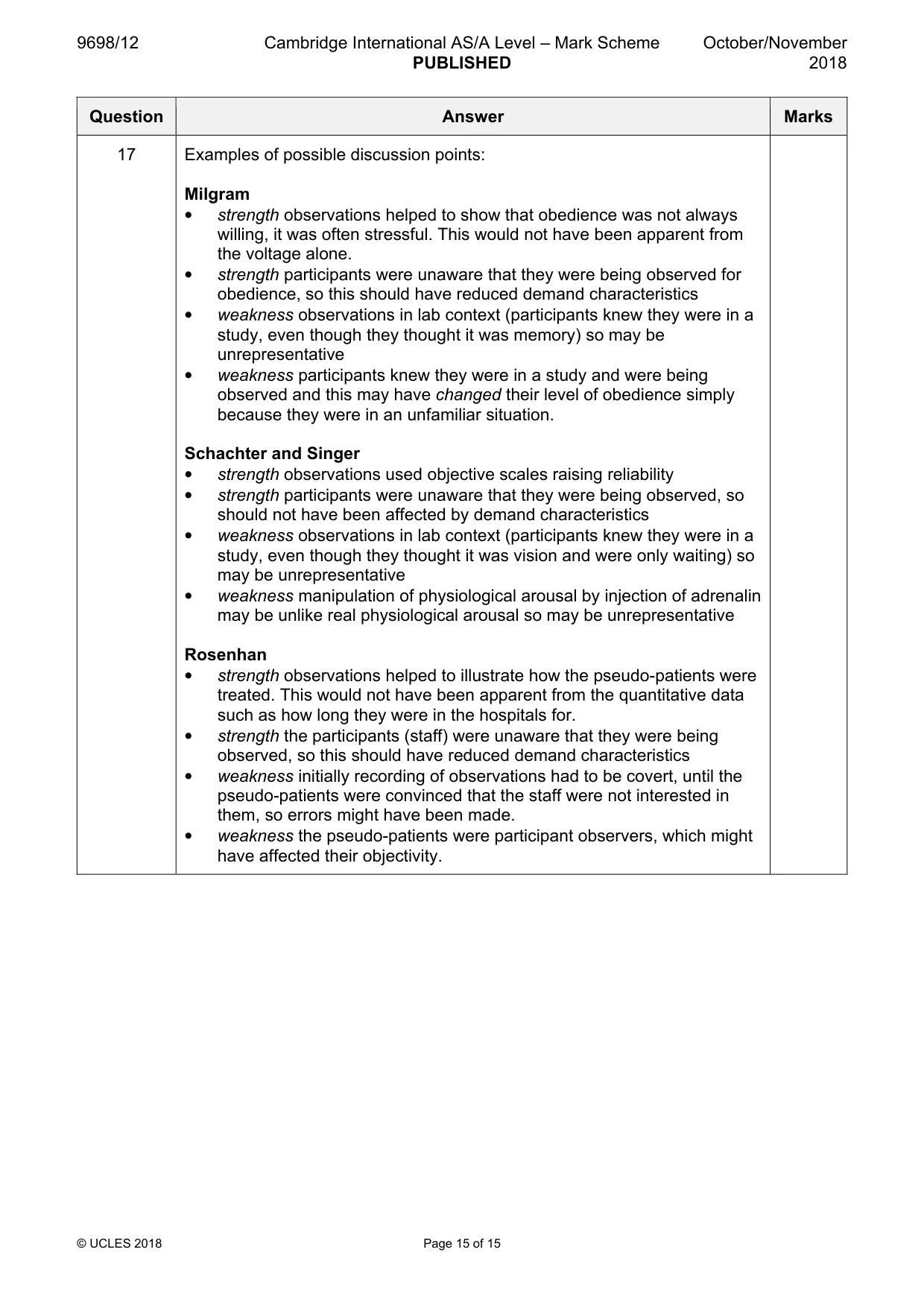
9698/12 Cambridge International AS/A Level – Mark Scheme PUBLISHED October/November 2018 © UCLES 2018 Page 15 of 15 Question Answer Marks 17 Examples of possible discussion points: Milgram • strength observations helped to show that obedience was not always willing, it was often stressful. This would not have been apparent from the voltage alone. • strength participants were unaware that they were being observed for obedience, so this should have reduced demand characteristics • weakness observations in lab context (participants knew they were in a study, even though they thought it was memory) so may be unrepresentative • weakness participants knew they were in a study and were being observed and this may have changed their level of obedience simply because they were in an unfamiliar situation. Schachter and Singer • strength observations used objective scales raising reliability • strength participants were unaware that they were being observed, so should not have been affected by demand characteristics • weakness observations in lab context (participants knew they were in a study, even though they thought it was vision and were only waiting) so may be unrepresentative • weakness manipulation of physiological arousal by injection of adrenalin may be unlike real physiological arousal so may be unrepresentative Rosenhan • strength observations helped to illustrate how the pseudo-patients were treated. This would not have been apparent from the quantitative data such as how long they were in the hospitals for. • strength the participants (staff) were unaware that they were being observed, so this should have reduced demand characteristics • weakness initially recording of observations had to be covert, until the pseudo-patients were convinced that the staff were not interested in them, so errors might have been made. • weakness the pseudo-patients were participant observers, which might have affected their objectivity.
What you needed in this session
Cambridge’s own grade thresholds for 2018 Oct/Nov, Paper 1 · Variant 2. A higher threshold means an easier paper — the bar moves with how the cohort did.