Cambridge A Level Psychology 9698 — 2018 Oct/Nov Paper 1 · Variant 3
9698/13/O/N/18 · 80 marks · ≈90 min
The question paper and its mark scheme, free to read here and free to download. This is Cambridge’s own paper, exactly as it was sat.
Question paper4 pages
Mark scheme15 pages
Answers below. Sit the paper first if you are practising.
Paper as text
Question paper, page 1
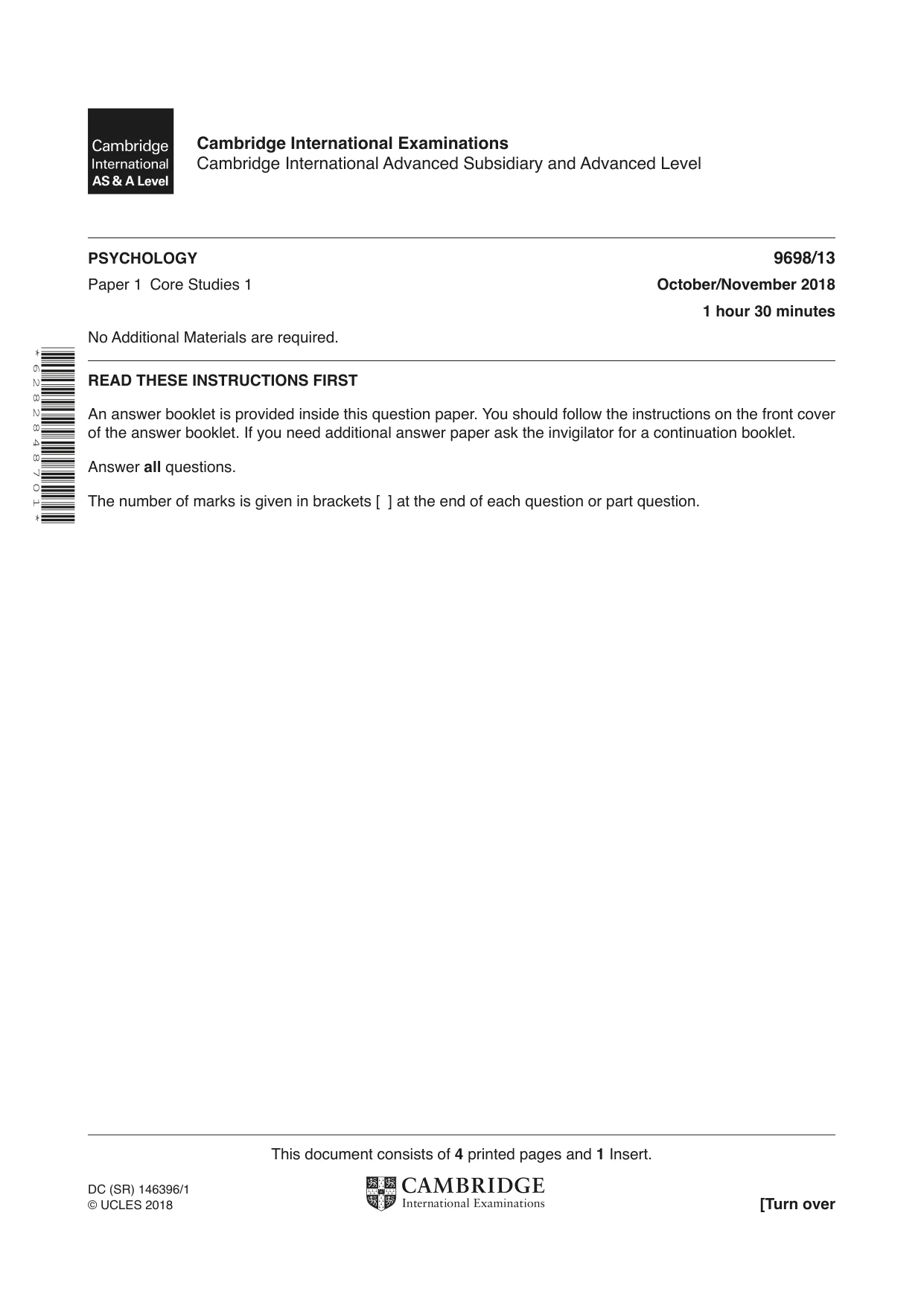
* 6 2 8 2 8 4 8 7 0 1 * This document consists of 4 printed pages and 1 Insert. DC (SR) 146396/1 © UCLES 2018 [Turn over Cambridge International Examinations Cambridge International Advanced Subsidiary and Advanced Level PSYCHOLOGY 9698/13 Paper 1 Core Studies 1 October/November 2018 1 hour 30 minutes No Additional Materials are required. READ THESE INSTRUCTIONS FIRST An answer booklet is provided inside this question paper. You should follow the instructions on the front cover of the answer booklet. If you need additional answer paper ask the invigilator for a continuation booklet. Answer all questions. The number of marks is given in brackets [ ] at the end of each question or part question.
Question paper, page 2
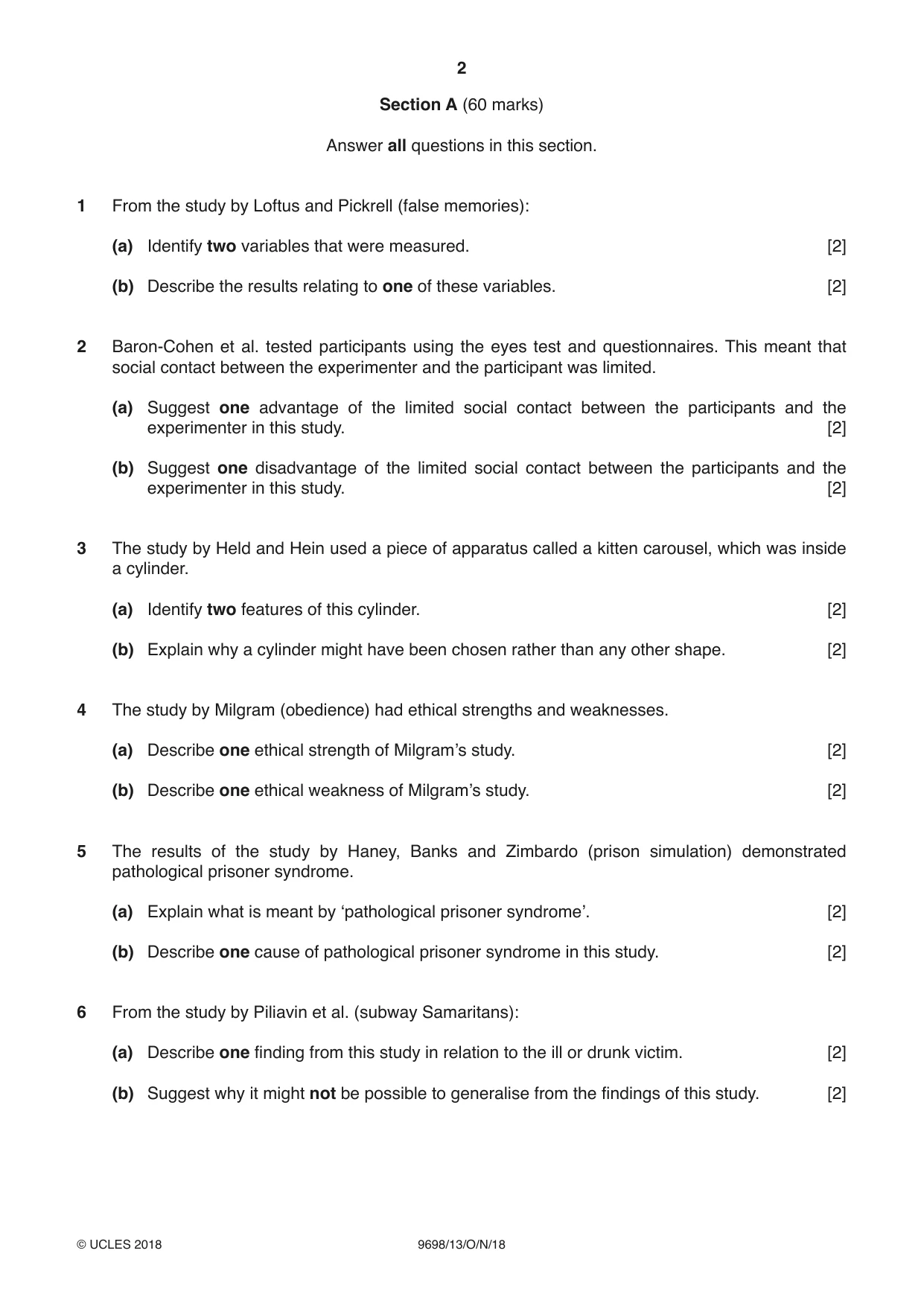
2 9698/13/O/N/18 © UCLES 2018 Section A (60 marks) Answer all questions in this section. 1 From the study by Loftus and Pickrell (false memories): (a) Identify two variables that were measured. [2] (b) Describe the results relating to one of these variables. [2] 2 Baron-Cohen et al. tested participants using the eyes test and questionnaires. This meant that social contact between the experimenter and the participant was limited. (a) Suggest one advantage of the limited social contact between the participants and the experimenter in this study. [2] (b) Suggest one disadvantage of the limited social contact between the participants and the experimenter in this study. [2] 3 The study by Held and Hein used a piece of apparatus called a kitten carousel, which was inside a cylinder. (a) Identify two features of this cylinder. [2] (b) Explain why a cylinder might have been chosen rather than any other shape. [2] 4 The study by Milgram (obedience) had ethical strengths and weaknesses. (a) Describe one ethical strength of Milgram’s study. [2] (b) Describe one ethical weakness of Milgram’s study. [2] 5 The results of the study by Haney, Banks and Zimbardo (prison simulation) demonstrated pathological prisoner syndrome. (a) Explain what is meant by ‘pathological prisoner syndrome’. [2] (b) Describe one cause of pathological prisoner syndrome in this study. [2] 6 From the study by Piliavin et al. (subway Samaritans): (a) Describe one finding from this study in relation to the ill or drunk victim. [2] (b) Suggest why it might not be possible to generalise from the findings of this study. [2]
Question paper, page 3
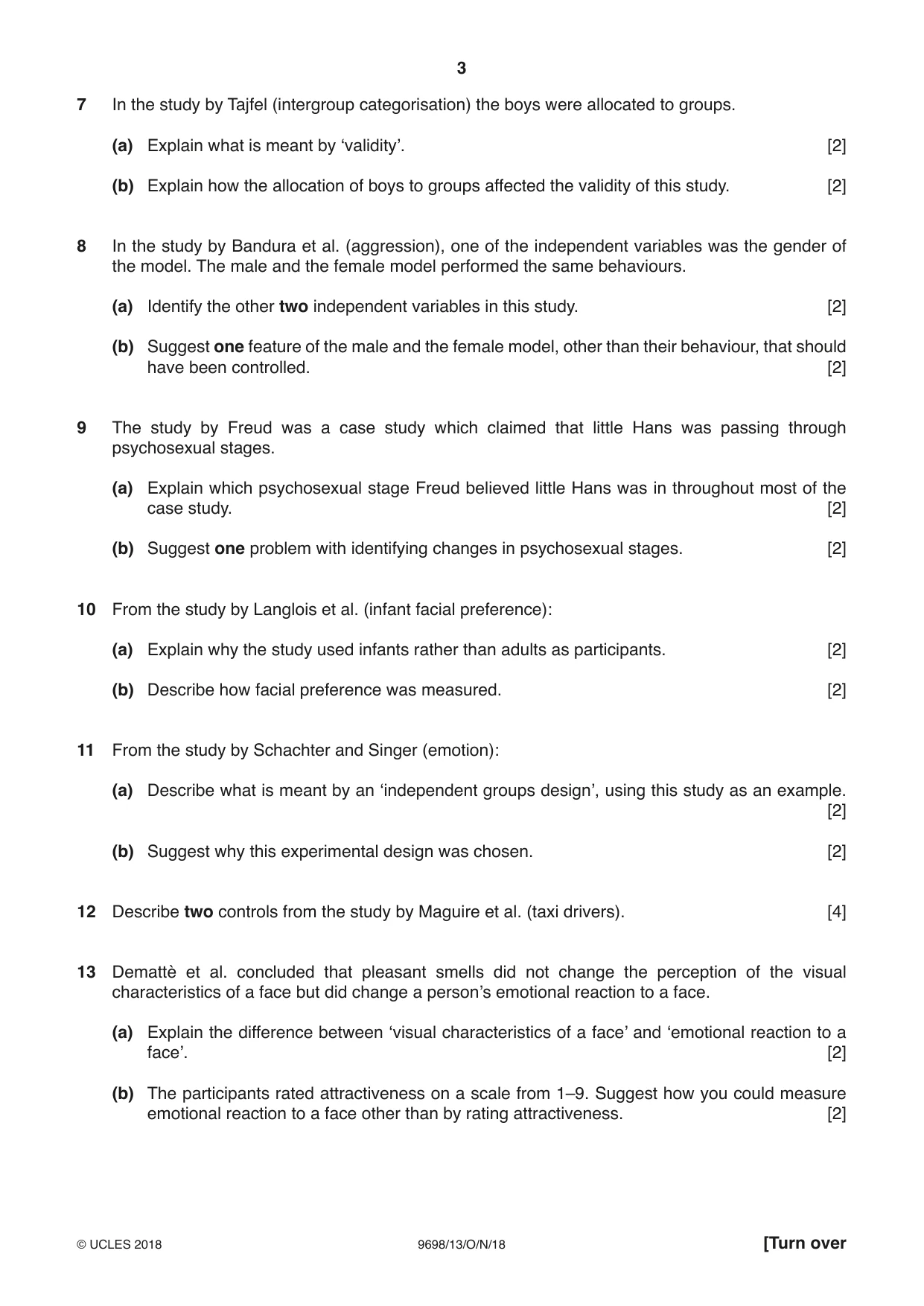
3 9698/13/O/N/18 © UCLES 2018 [Turn over 7 In the study by Tajfel (intergroup categorisation) the boys were allocated to groups. (a) Explain what is meant by ‘validity’. [2] (b) Explain how the allocation of boys to groups affected the validity of this study. [2] 8 In the study by Bandura et al. (aggression), one of the independent variables was the gender of the model. The male and the female model performed the same behaviours. (a) Identify the other two independent variables in this study. [2] (b) Suggest one feature of the male and the female model, other than their behaviour, that should have been controlled. [2] 9 The study by Freud was a case study which claimed that little Hans was passing through psychosexual stages. (a) Explain which psychosexual stage Freud believed little Hans was in throughout most of the case study. [2] (b) Suggest one problem with identifying changes in psychosexual stages. [2] 10 From the study by Langlois et al. (infant facial preference): (a) Explain why the study used infants rather than adults as participants. [2] (b) Describe how facial preference was measured. [2] 11 From the study by Schachter and Singer (emotion): (a) Describe what is meant by an ‘independent groups design’, using this study as an example. [2] (b) Suggest why this experimental design was chosen. [2] 12 Describe two controls from the study by Maguire et al. (taxi drivers). [4] 13 Demattè et al. concluded that pleasant smells did not change the perception of the visual characteristics of a face but did change a person’s emotional reaction to a face. (a) Explain the difference between ‘visual characteristics of a face’ and ‘emotional reaction to a face’. [2] (b) The participants rated attractiveness on a scale from 1–9. Suggest how you could measure emotional reaction to a face other than by rating attractiveness. [2]
Question paper, page 4
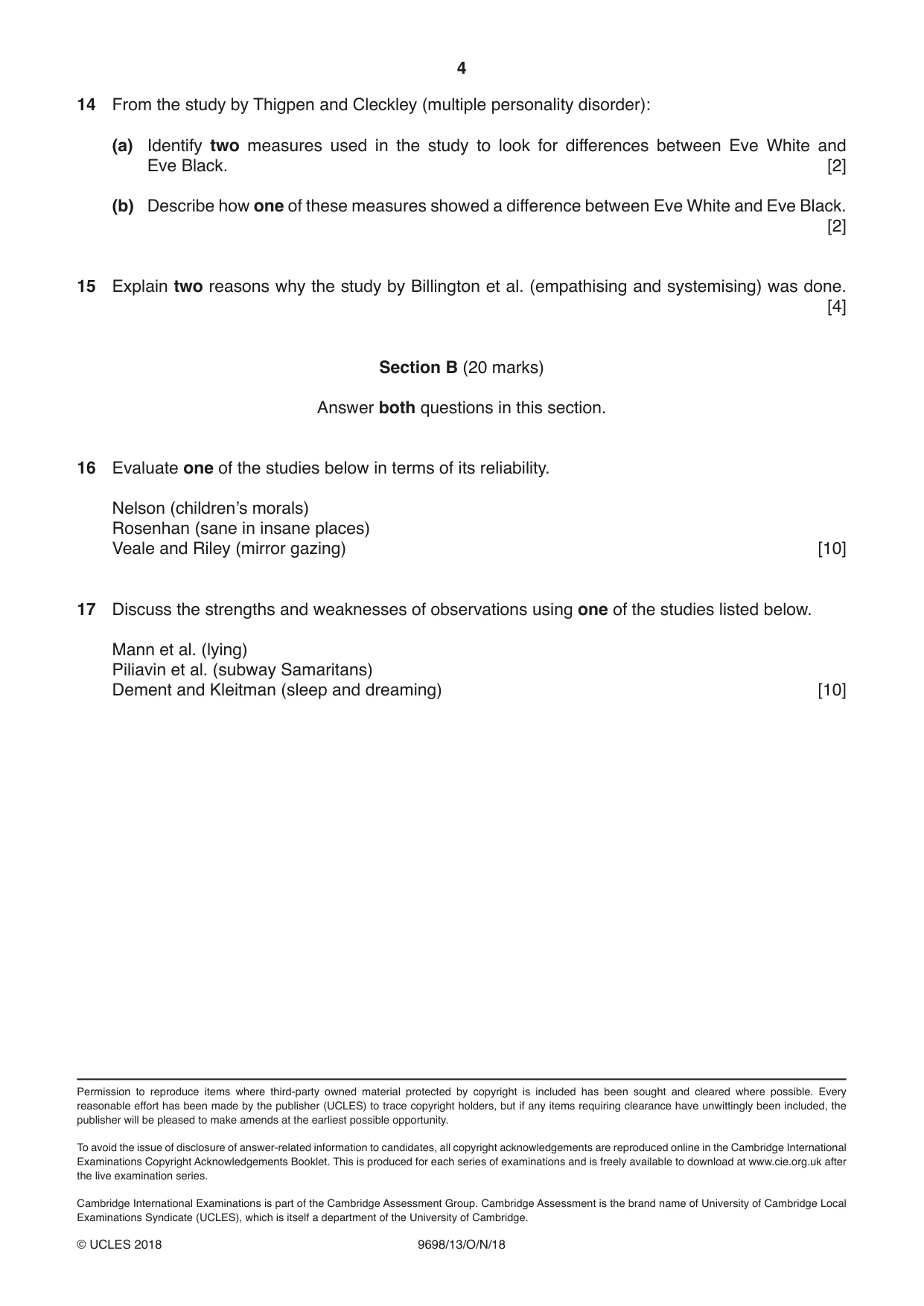
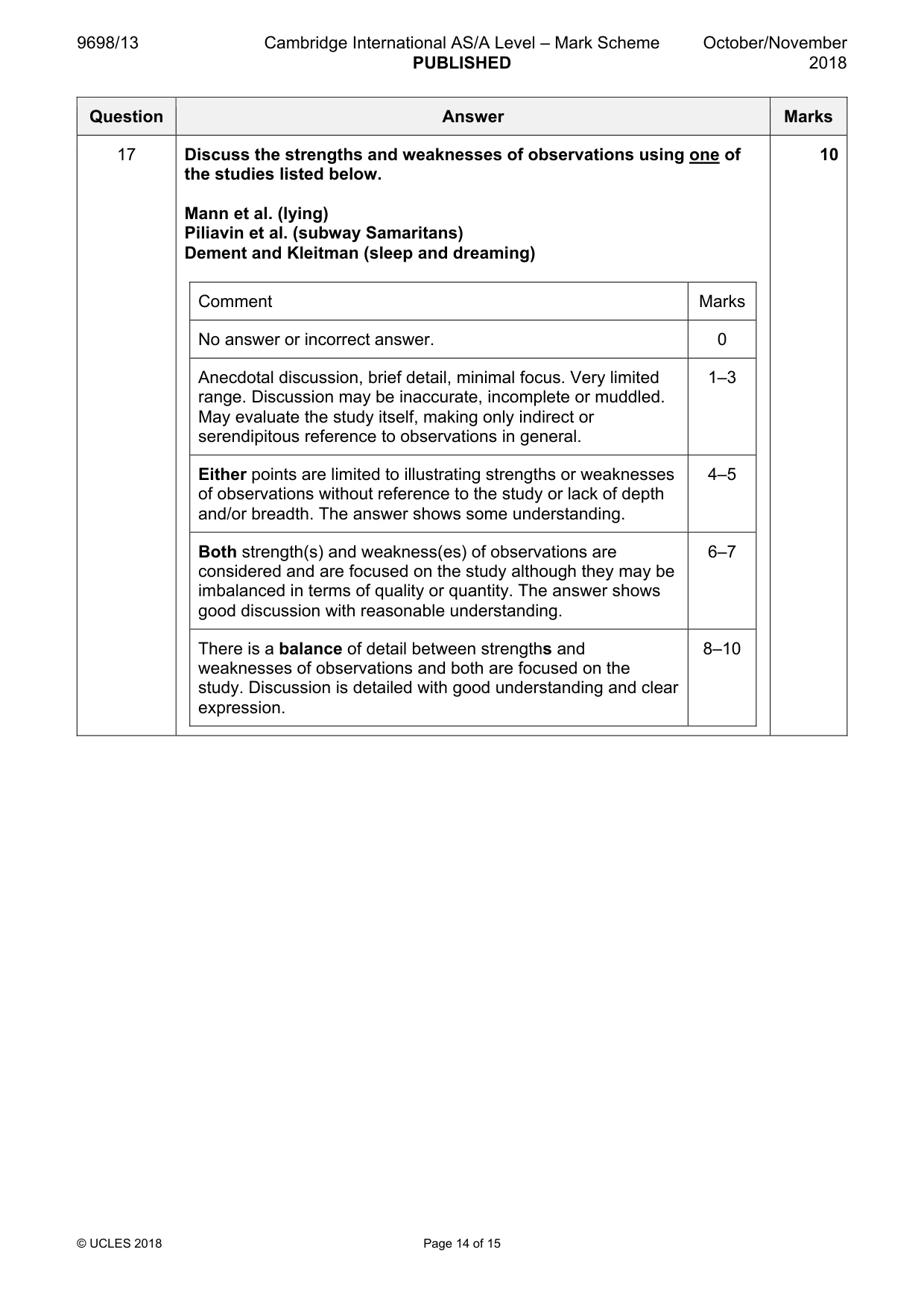
4 9698/13/O/N/18 © UCLES 2018 Permission to reproduce items where third-party owned material protected by copyright is included has been sought and cleared where possible. Every reasonable effort has been made by the publisher (UCLES) to trace copyright holders, but if any items requiring clearance have unwittingly been included, the publisher will be pleased to make amends at the earliest possible opportunity. To avoid the issue of disclosure of answer-related information to candidates, all copyright acknowledgements are reproduced online in the Cambridge International Examinations Copyright Acknowledgements Booklet. This is produced for each series of examinations and is freely available to download at www.cie.org.uk after the live examination series. Cambridge International Examinations is part of the Cambridge Assessment Group. Cambridge Assessment is the brand name of University of Cambridge Local Examinations Syndicate (UCLES), which is itself a department of the University of Cambridge. 14 From the study by Thigpen and Cleckley (multiple personality disorder): (a) Identify two measures used in the study to look for differences between Eve White and Eve Black. [2] (b) Describe how one of these measures showed a difference between Eve White and Eve Black. [2] 15 Explain two reasons why the study by Billington et al. (empathising and systemising) was done. [4] Section B (20 marks) Answer both questions in this section. 16 Evaluate one of the studies below in terms of its reliability. Nelson (children’s morals) Rosenhan (sane in insane places) Veale and Riley (mirror gazing) [10] 17 Discuss the strengths and weaknesses of observations using one of the studies listed below. Mann et al. (lying) Piliavin et al. (subway Samaritans) Dement and Kleitman (sleep and dreaming) [10]
Mark scheme, page 1
This document consists of 15 printed pages. © UCLES 2018 [Turn over Cambridge Assessment International Education Cambridge International Advanced Subsidiary and Advanced Level PSYCHOLOGY 9698/13 Paper 1 Core Studies 1 October/November 2018 MARK SCHEME Maximum Mark: 80 Published This mark scheme is published as an aid to teachers and candidates, to indicate the requirements of the examination. It shows the basis on which Examiners were instructed to award marks. It does not indicate the details of the discussions that took place at an Examiners’ meeting before marking began, which would have considered the acceptability of alternative answers. Mark schemes should be read in conjunction with the question paper and the Principal Examiner Report for Teachers. Cambridge International will not enter into discussions about these mark schemes. Cambridge International is publishing the mark schemes for the October/November 2018 series for most Cambridge IGCSE™, Cambridge International A and AS Level components and some Cambridge O Level components.
Mark scheme, page 2
9698/13 Cambridge International AS/A Level – Mark Scheme PUBLISHED October/November 2018 © UCLES 2018 Page 2 of 15 Generic Marking Principles These general marking principles must be applied by all examiners when marking candidate answers. They should be applied alongside the specific content of the mark scheme or generic level descriptors for a question. Each question paper and mark scheme will also comply with these marking principles. GENERIC MARKING PRINCIPLE 1: Marks must be awarded in line with: • the specific content of the mark scheme or the generic level descriptors for the question • the specific skills defined in the mark scheme or in the generic level descriptors for the question • the standard of response required by a candidate as exemplified by the standardisation scripts. GENERIC MARKING PRINCIPLE 2: Marks awarded are always whole marks (not half marks, or other fractions). GENERIC MARKING PRINCIPLE 3: Marks must be awarded positively: • marks are awarded for correct/valid answers, as defined in the mark scheme. However, credit is given for valid answers which go beyond the scope of the syllabus and mark scheme, referring to your Team Leader as appropriate • marks are awarded when candidates clearly demonstrate what they know and can do • marks are not deducted for errors • marks are not deducted for omissions • answers should only be judged on the quality of spelling, punctuation and grammar when these features are specifically assessed by the question as indicated by the mark scheme. The meaning, however, should be unambiguous. GENERIC MARKING PRINCIPLE 4: Rules must be applied consistently e.g. in situations where candidates have not followed instructions or in the application of generic level descriptors. GENERIC MARKING PRINCIPLE 5: Marks should be awarded using the full range of marks defined in the mark scheme for the question (however; the use of the full mark range may be limited according to the quality of the candidate responses seen). GENERIC MARKING PRINCIPLE 6: Marks awarded are based solely on the requirements as defined in the mark scheme. Marks should not be awarded with grade thresholds or grade descriptors in mind.
Mark scheme, page 3
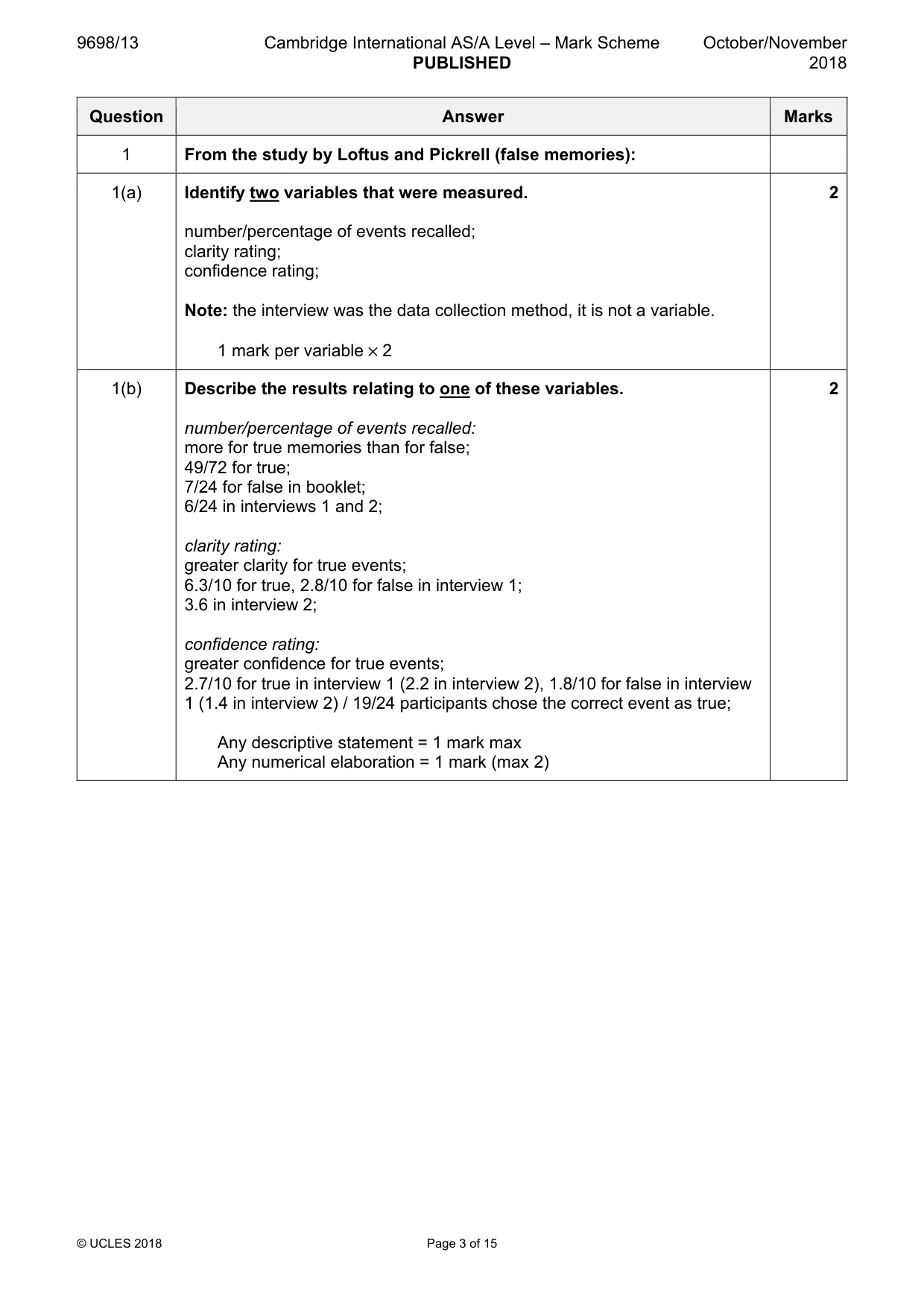
9698/13 Cambridge International AS/A Level – Mark Scheme PUBLISHED October/November 2018 © UCLES 2018 Page 3 of 15 Question Answer Marks 1 From the study by Loftus and Pickrell (false memories): 1(a) Identify two variables that were measured. number/percentage of events recalled; clarity rating; confidence rating; Note: the interview was the data collection method, it is not a variable. 1 mark per variable × 2 2 1(b) Describe the results relating to one of these variables. number/percentage of events recalled: more for true memories than for false; 49/72 for true; 7/24 for false in booklet; 6/24 in interviews 1 and 2; clarity rating: greater clarity for true events; 6.3/10 for true, 2.8/10 for false in interview 1; 3.6 in interview 2; confidence rating: greater confidence for true events; 2.7/10 for true in interview 1 (2.2 in interview 2), 1.8/10 for false in interview 1 (1.4 in interview 2) / 19/24 participants chose the correct event as true; Any descriptive statement = 1 mark max Any numerical elaboration = 1 mark (max 2) 2
Mark scheme, page 4
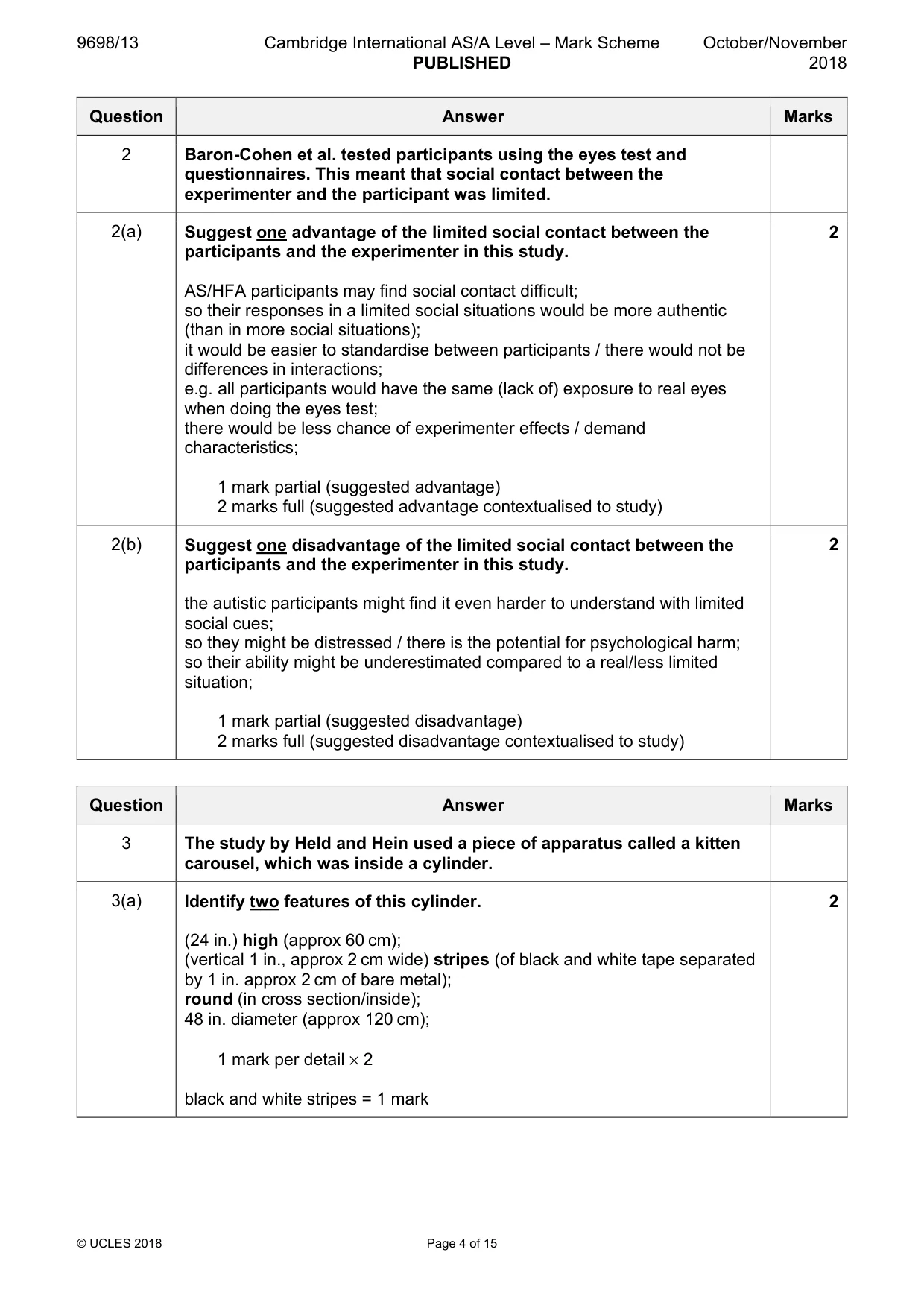
9698/13 Cambridge International AS/A Level – Mark Scheme PUBLISHED October/November 2018 © UCLES 2018 Page 4 of 15 Question Answer Marks 2 Baron-Cohen et al. tested participants using the eyes test and questionnaires. This meant that social contact between the experimenter and the participant was limited. 2(a) Suggest one advantage of the limited social contact between the participants and the experimenter in this study. AS/HFA participants may find social contact difficult; so their responses in a limited social situations would be more authentic (than in more social situations); it would be easier to standardise between participants / there would not be differences in interactions; e.g. all participants would have the same (lack of) exposure to real eyes when doing the eyes test; there would be less chance of experimenter effects / demand characteristics; 1 mark partial (suggested advantage) 2 marks full (suggested advantage contextualised to study) 2 2(b) Suggest one disadvantage of the limited social contact between the participants and the experimenter in this study. the autistic participants might find it even harder to understand with limited social cues; so they might be distressed / there is the potential for psychological harm; so their ability might be underestimated compared to a real/less limited situation; 1 mark partial (suggested disadvantage) 2 marks full (suggested disadvantage contextualised to study) 2 Question Answer Marks 3 The study by Held and Hein used a piece of apparatus called a kitten carousel, which was inside a cylinder. 3(a) Identify two features of this cylinder. (24 in.) high (approx 60 cm); (vertical 1 in., approx 2 cm wide) stripes (of black and white tape separated by 1 in. approx 2 cm of bare metal); round (in cross section/inside); 48 in. diameter (approx 120 cm); 1 mark per detail × 2 black and white stripes = 1 mark 2
Mark scheme, page 5
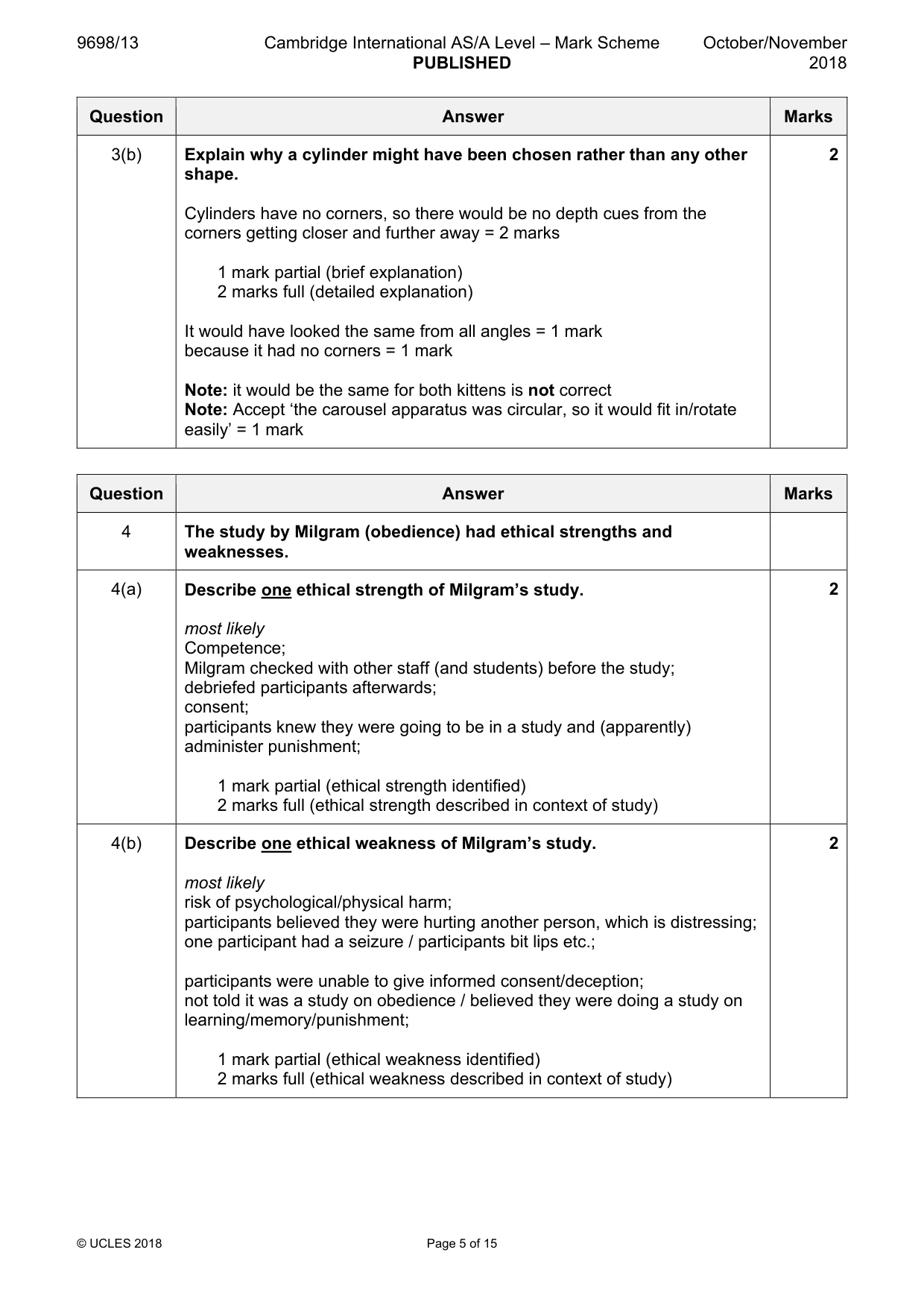
9698/13 Cambridge International AS/A Level – Mark Scheme PUBLISHED October/November 2018 © UCLES 2018 Page 5 of 15 Question Answer Marks 3(b) Explain why a cylinder might have been chosen rather than any other shape. Cylinders have no corners, so there would be no depth cues from the corners getting closer and further away = 2 marks 1 mark partial (brief explanation) 2 marks full (detailed explanation) It would have looked the same from all angles = 1 mark because it had no corners = 1 mark Note: it would be the same for both kittens is not correct Note: Accept ‘the carousel apparatus was circular, so it would fit in/rotate easily’ = 1 mark 2 Question Answer Marks 4 The study by Milgram (obedience) had ethical strengths and weaknesses. 4(a) Describe one ethical strength of Milgram’s study. most likely Competence; Milgram checked with other staff (and students) before the study; debriefed participants afterwards; consent; participants knew they were going to be in a study and (apparently) administer punishment; 1 mark partial (ethical strength identified) 2 marks full (ethical strength described in context of study) 2 4(b) Describe one ethical weakness of Milgram’s study. most likely risk of psychological/physical harm; participants believed they were hurting another person, which is distressing; one participant had a seizure / participants bit lips etc.; participants were unable to give informed consent/deception; not told it was a study on obedience / believed they were doing a study on learning/memory/punishment; 1 mark partial (ethical weakness identified) 2 marks full (ethical weakness described in context of study) 2
Mark scheme, page 6
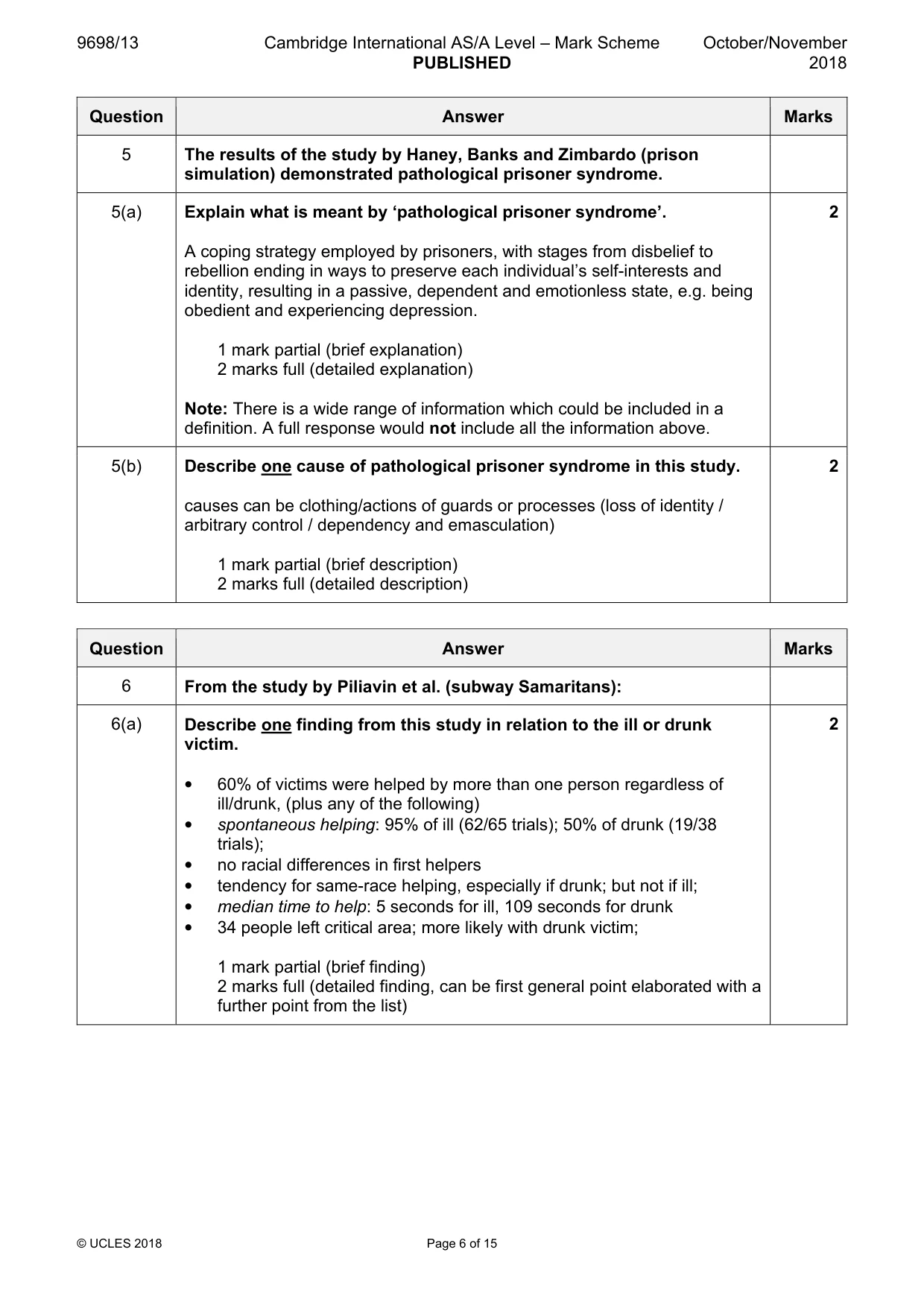
9698/13 Cambridge International AS/A Level – Mark Scheme PUBLISHED October/November 2018 © UCLES 2018 Page 6 of 15 Question Answer Marks 5 The results of the study by Haney, Banks and Zimbardo (prison simulation) demonstrated pathological prisoner syndrome. 5(a) Explain what is meant by ‘pathological prisoner syndrome’. A coping strategy employed by prisoners, with stages from disbelief to rebellion ending in ways to preserve each individual’s self-interests and identity, resulting in a passive, dependent and emotionless state, e.g. being obedient and experiencing depression. 1 mark partial (brief explanation) 2 marks full (detailed explanation) Note: There is a wide range of information which could be included in a definition. A full response would not include all the information above. 2 5(b) Describe one cause of pathological prisoner syndrome in this study. causes can be clothing/actions of guards or processes (loss of identity / arbitrary control / dependency and emasculation) 1 mark partial (brief description) 2 marks full (detailed description) 2 Question Answer Marks 6 From the study by Piliavin et al. (subway Samaritans): 6(a) Describe one finding from this study in relation to the ill or drunk victim. • 60% of victims were helped by more than one person regardless of ill/drunk, (plus any of the following) • spontaneous helping: 95% of ill (62/65 trials); 50% of drunk (19/38 trials); • no racial differences in first helpers • tendency for same-race helping, especially if drunk; but not if ill; • median time to help: 5 seconds for ill, 109 seconds for drunk • 34 people left critical area; more likely with drunk victim; 1 mark partial (brief finding) 2 marks full (detailed finding, can be first general point elaborated with a further point from the list) 2
Mark scheme, page 7
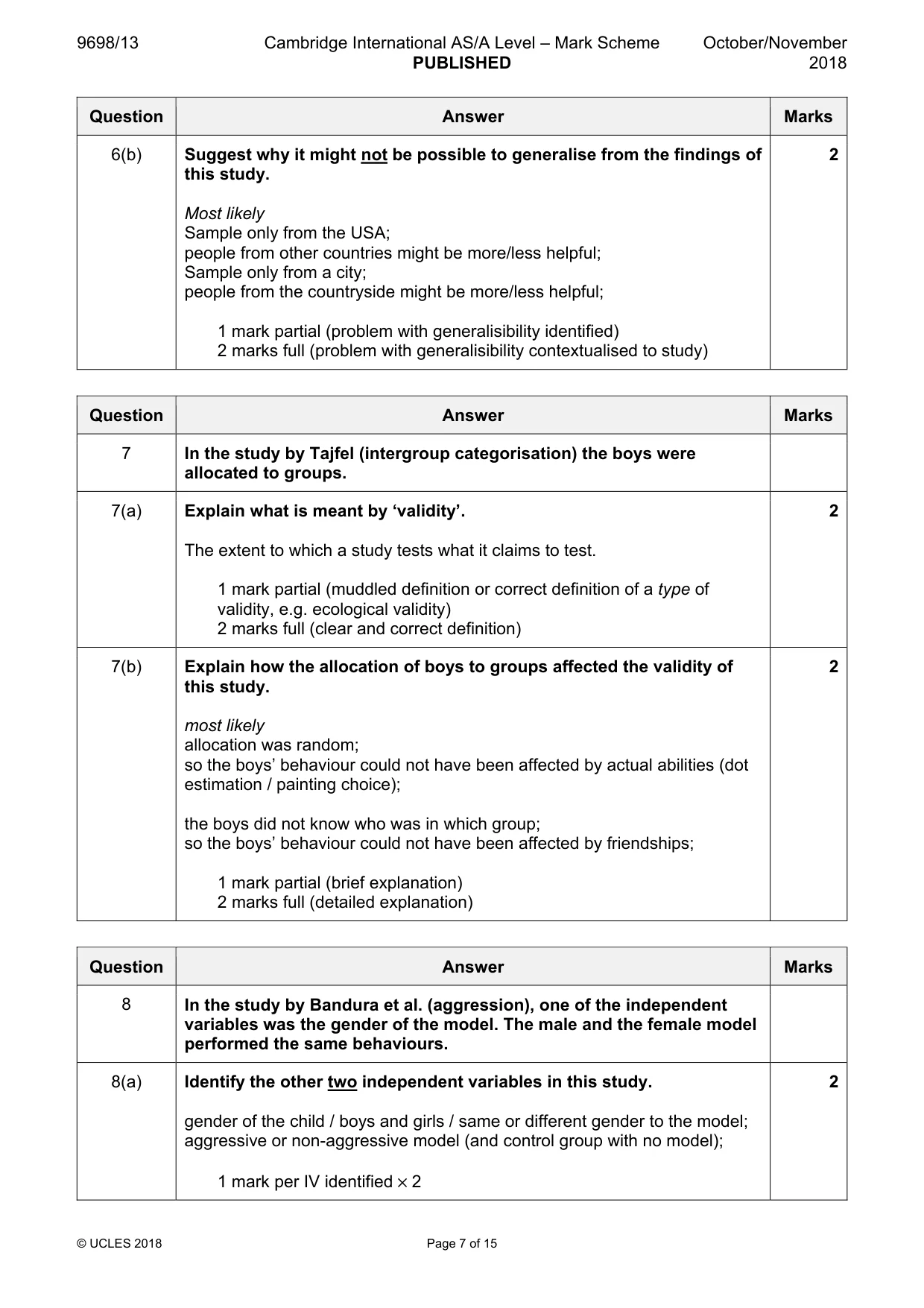
9698/13 Cambridge International AS/A Level – Mark Scheme PUBLISHED October/November 2018 © UCLES 2018 Page 7 of 15 Question Answer Marks 6(b) Suggest why it might not be possible to generalise from the findings of this study. Most likely Sample only from the USA; people from other countries might be more/less helpful; Sample only from a city; people from the countryside might be more/less helpful; 1 mark partial (problem with generalisibility identified) 2 marks full (problem with generalisibility contextualised to study) 2 Question Answer Marks 7 In the study by Tajfel (intergroup categorisation) the boys were allocated to groups. 7(a) Explain what is meant by ‘validity’. The extent to which a study tests what it claims to test. 1 mark partial (muddled definition or correct definition of a type of validity, e.g. ecological validity) 2 marks full (clear and correct definition) 2 7(b) Explain how the allocation of boys to groups affected the validity of this study. most likely allocation was random; so the boys’ behaviour could not have been affected by actual abilities (dot estimation / painting choice); the boys did not know who was in which group; so the boys’ behaviour could not have been affected by friendships; 1 mark partial (brief explanation) 2 marks full (detailed explanation) 2 Question Answer Marks 8 In the study by Bandura et al. (aggression), one of the independent variables was the gender of the model. The male and the female model performed the same behaviours. 8(a) Identify the other two independent variables in this study. gender of the child / boys and girls / same or different gender to the model; aggressive or non-aggressive model (and control group with no model); 1 mark per IV identified × 2 2
Mark scheme, page 8
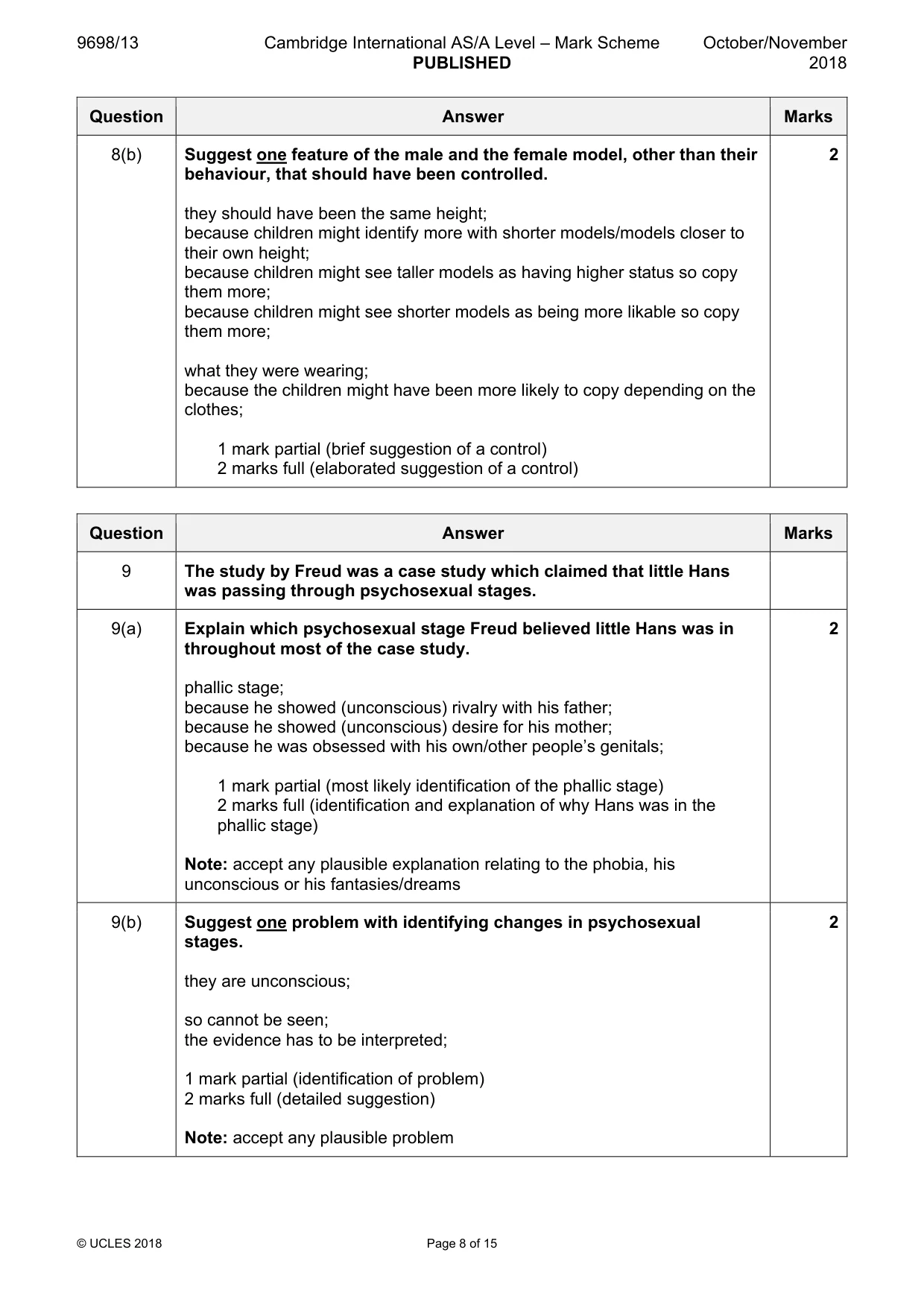
9698/13 Cambridge International AS/A Level – Mark Scheme PUBLISHED October/November 2018 © UCLES 2018 Page 8 of 15 Question Answer Marks 8(b) Suggest one feature of the male and the female model, other than their behaviour, that should have been controlled. they should have been the same height; because children might identify more with shorter models/models closer to their own height; because children might see taller models as having higher status so copy them more; because children might see shorter models as being more likable so copy them more; what they were wearing; because the children might have been more likely to copy depending on the clothes; 1 mark partial (brief suggestion of a control) 2 marks full (elaborated suggestion of a control) 2 Question Answer Marks 9 The study by Freud was a case study which claimed that little Hans was passing through psychosexual stages. 9(a) Explain which psychosexual stage Freud believed little Hans was in throughout most of the case study. phallic stage; because he showed (unconscious) rivalry with his father; because he showed (unconscious) desire for his mother; because he was obsessed with his own/other people’s genitals; 1 mark partial (most likely identification of the phallic stage) 2 marks full (identification and explanation of why Hans was in the phallic stage) Note: accept any plausible explanation relating to the phobia, his unconscious or his fantasies/dreams 2 9(b) Suggest one problem with identifying changes in psychosexual stages. they are unconscious; so cannot be seen; the evidence has to be interpreted; 1 mark partial (identification of problem) 2 marks full (detailed suggestion) Note: accept any plausible problem 2
Mark scheme, page 9
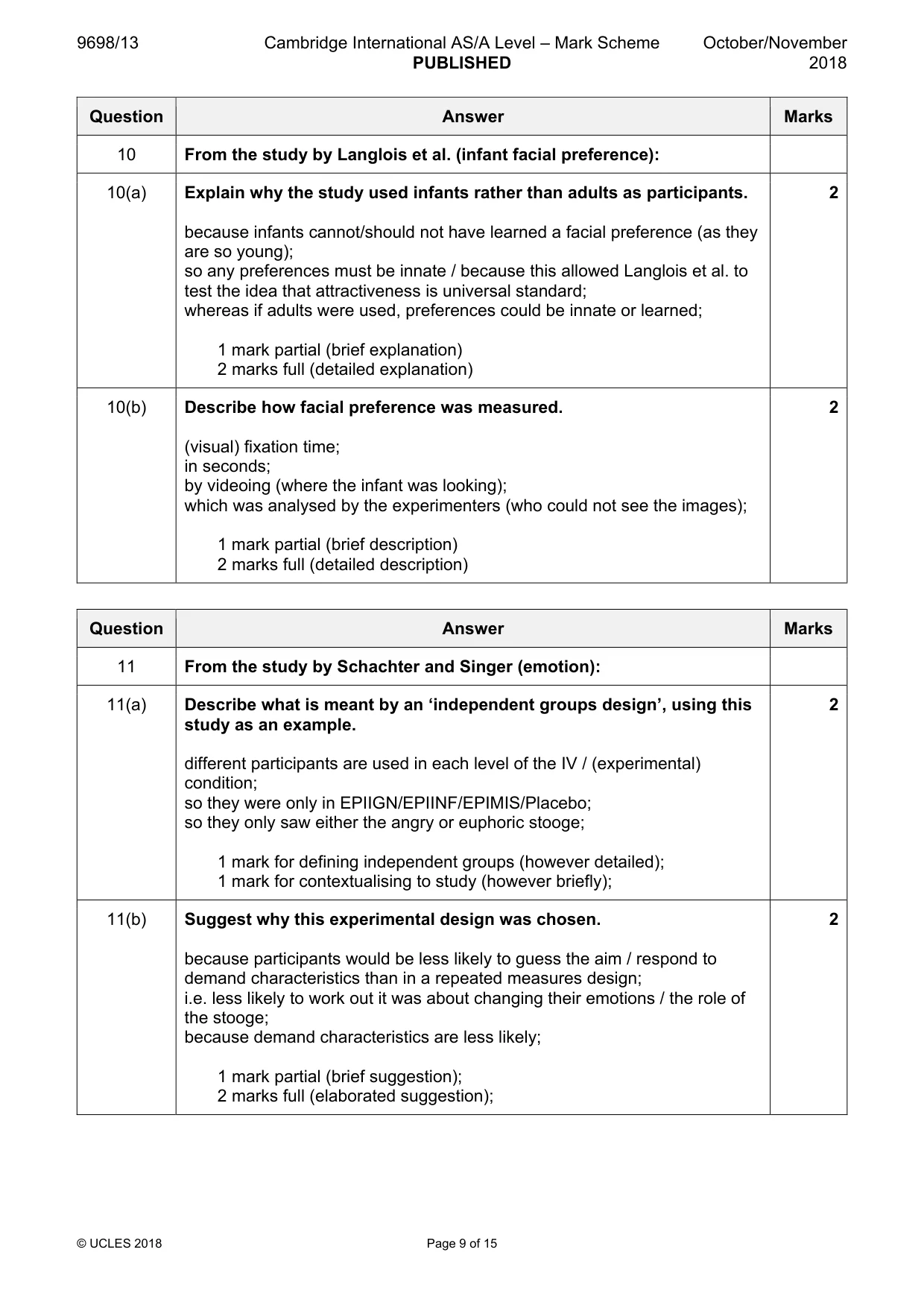
9698/13 Cambridge International AS/A Level – Mark Scheme PUBLISHED October/November 2018 © UCLES 2018 Page 9 of 15 Question Answer Marks 10 From the study by Langlois et al. (infant facial preference): 10(a) Explain why the study used infants rather than adults as participants. because infants cannot/should not have learned a facial preference (as they are so young); so any preferences must be innate / because this allowed Langlois et al. to test the idea that attractiveness is universal standard; whereas if adults were used, preferences could be innate or learned; 1 mark partial (brief explanation) 2 marks full (detailed explanation) 2 10(b) Describe how facial preference was measured. (visual) fixation time; in seconds; by videoing (where the infant was looking); which was analysed by the experimenters (who could not see the images); 1 mark partial (brief description) 2 marks full (detailed description) 2 Question Answer Marks 11 From the study by Schachter and Singer (emotion): 11(a) Describe what is meant by an ‘independent groups design’, using this study as an example. different participants are used in each level of the IV / (experimental) condition; so they were only in EPIIGN/EPIINF/EPIMIS/Placebo; so they only saw either the angry or euphoric stooge; 1 mark for defining independent groups (however detailed); 1 mark for contextualising to study (however briefly); 2 11(b) Suggest why this experimental design was chosen. because participants would be less likely to guess the aim / respond to demand characteristics than in a repeated measures design; i.e. less likely to work out it was about changing their emotions / the role of the stooge; because demand characteristics are less likely; 1 mark partial (brief suggestion); 2 marks full (elaborated suggestion); 2
Mark scheme, page 10
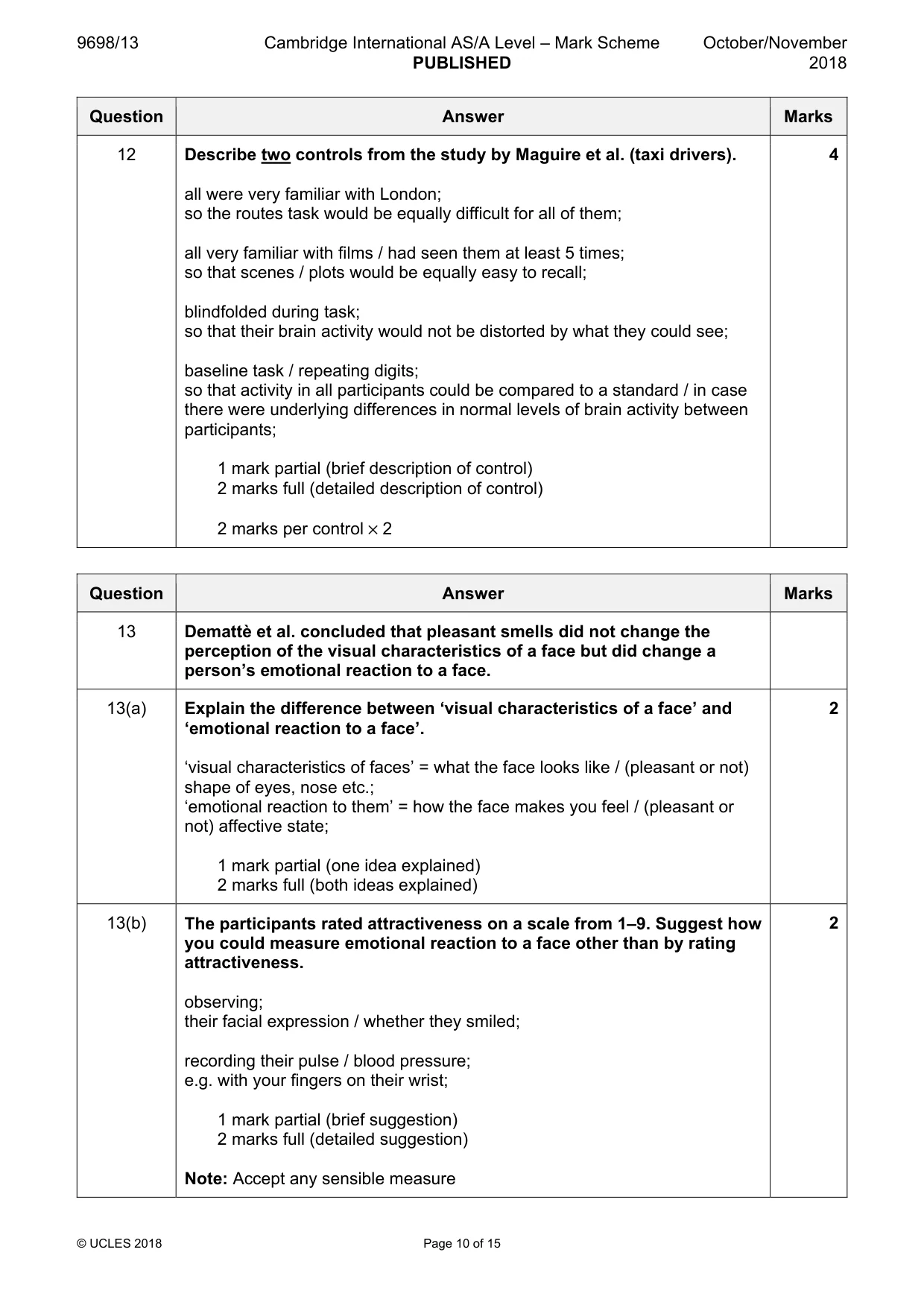
9698/13 Cambridge International AS/A Level – Mark Scheme PUBLISHED October/November 2018 © UCLES 2018 Page 10 of 15 Question Answer Marks 12 Describe two controls from the study by Maguire et al. (taxi drivers). all were very familiar with London; so the routes task would be equally difficult for all of them; all very familiar with films / had seen them at least 5 times; so that scenes / plots would be equally easy to recall; blindfolded during task; so that their brain activity would not be distorted by what they could see; baseline task / repeating digits; so that activity in all participants could be compared to a standard / in case there were underlying differences in normal levels of brain activity between participants; 1 mark partial (brief description of control) 2 marks full (detailed description of control) 2 marks per control × 2 4 Question Answer Marks 13 Demattè et al. concluded that pleasant smells did not change the perception of the visual characteristics of a face but did change a person’s emotional reaction to a face. 13(a) Explain the difference between ‘visual characteristics of a face’ and ‘emotional reaction to a face’. ‘visual characteristics of faces’ = what the face looks like / (pleasant or not) shape of eyes, nose etc.; ‘emotional reaction to them’ = how the face makes you feel / (pleasant or not) affective state; 1 mark partial (one idea explained) 2 marks full (both ideas explained) 2 13(b) The participants rated attractiveness on a scale from 1–9. Suggest how you could measure emotional reaction to a face other than by rating attractiveness. observing; their facial expression / whether they smiled; recording their pulse / blood pressure; e.g. with your fingers on their wrist; 1 mark partial (brief suggestion) 2 marks full (detailed suggestion) Note: Accept any sensible measure 2
Mark scheme, page 11
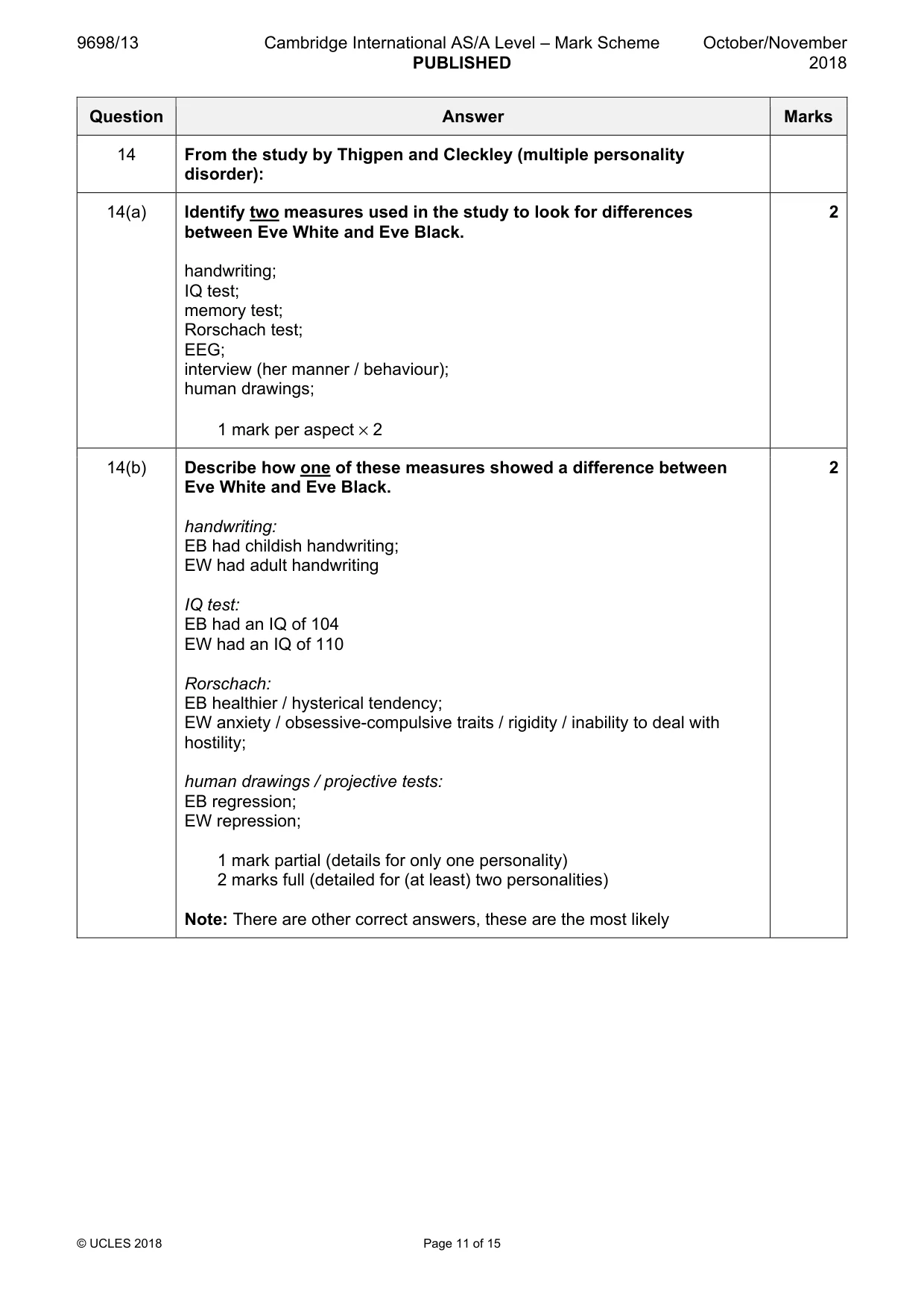
9698/13 Cambridge International AS/A Level – Mark Scheme PUBLISHED October/November 2018 © UCLES 2018 Page 11 of 15 Question Answer Marks 14 From the study by Thigpen and Cleckley (multiple personality disorder): 14(a) Identify two measures used in the study to look for differences between Eve White and Eve Black. handwriting; IQ test; memory test; Rorschach test; EEG; interview (her manner / behaviour); human drawings; 1 mark per aspect × 2 2 14(b) Describe how one of these measures showed a difference between Eve White and Eve Black. handwriting: EB had childish handwriting; EW had adult handwriting IQ test: EB had an IQ of 104 EW had an IQ of 110 Rorschach: EB healthier / hysterical tendency; EW anxiety / obsessive-compulsive traits / rigidity / inability to deal with hostility; human drawings / projective tests: EB regression; EW repression; 1 mark partial (details for only one personality) 2 marks full (detailed for (at least) two personalities) Note: There are other correct answers, these are the most likely 2
Mark scheme, page 12
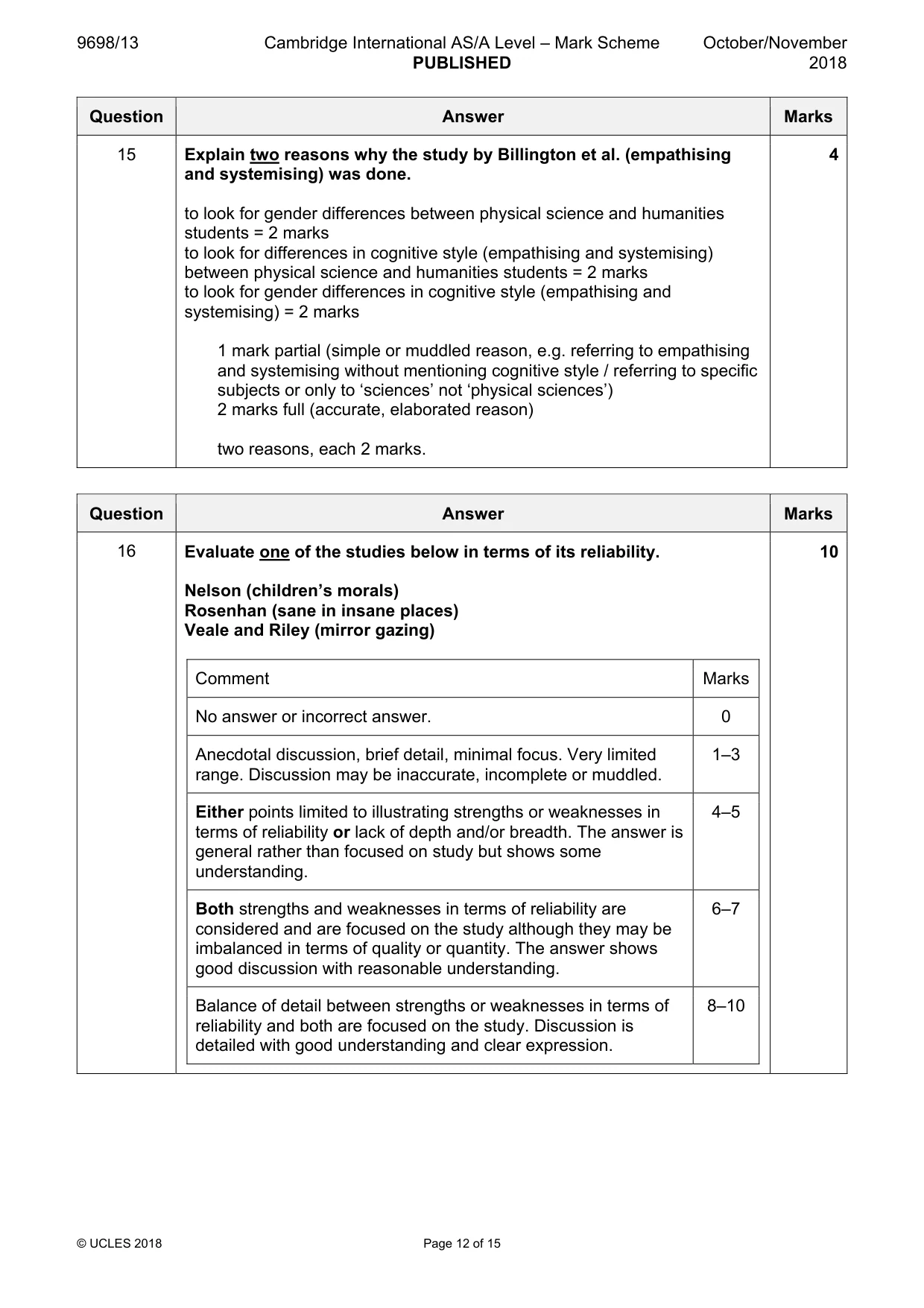
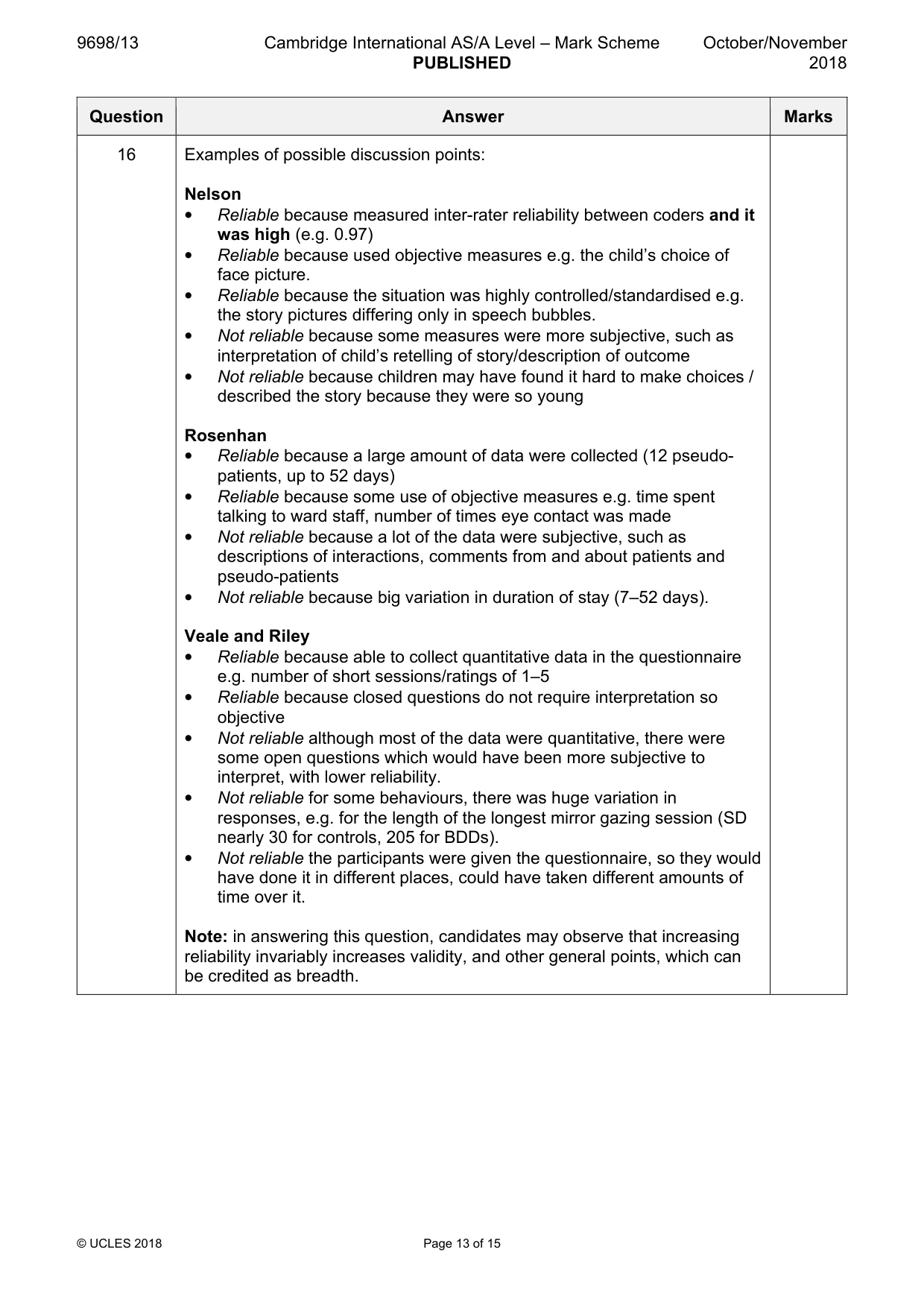
9698/13 Cambridge International AS/A Level – Mark Scheme PUBLISHED October/November 2018 © UCLES 2018 Page 12 of 15 Question Answer Marks 15 Explain two reasons why the study by Billington et al. (empathising and systemising) was done. to look for gender differences between physical science and humanities students = 2 marks to look for differences in cognitive style (empathising and systemising) between physical science and humanities students = 2 marks to look for gender differences in cognitive style (empathising and systemising) = 2 marks 1 mark partial (simple or muddled reason, e.g. referring to empathising and systemising without mentioning cognitive style / referring to specific subjects or only to ‘sciences’ not ‘physical sciences’) 2 marks full (accurate, elaborated reason) two reasons, each 2 marks. 4 Question Answer Marks 16 Evaluate one of the studies below in terms of its reliability. Nelson (children’s morals) Rosenhan (sane in insane places) Veale and Riley (mirror gazing) Comment Marks No answer or incorrect answer. 0 Anecdotal discussion, brief detail, minimal focus. Very limited range. Discussion may be inaccurate, incomplete or muddled. 1–3 Either points limited to illustrating strengths or weaknesses in terms of reliability or lack of depth and/or breadth. The answer is general rather than focused on study but shows some understanding. 4–5 Both strengths and weaknesses in terms of reliability are considered and are focused on the study although they may be imbalanced in terms of quality or quantity. The answer shows good discussion with reasonable understanding. 6–7 Balance of detail between strengths or weaknesses in terms of reliability and both are focused on the study. Discussion is detailed with good understanding and clear expression. 8–10 10
Mark scheme, page 13
9698/13 Cambridge International AS/A Level – Mark Scheme PUBLISHED October/November 2018 © UCLES 2018 Page 13 of 15 Question Answer Marks 16 Examples of possible discussion points: Nelson • Reliable because measured inter-rater reliability between coders and it was high (e.g. 0.97) • Reliable because used objective measures e.g. the child’s choice of face picture. • Reliable because the situation was highly controlled/standardised e.g. the story pictures differing only in speech bubbles. • Not reliable because some measures were more subjective, such as interpretation of child’s retelling of story/description of outcome • Not reliable because children may have found it hard to make choices / described the story because they were so young Rosenhan • Reliable because a large amount of data were collected (12 pseudo- patients, up to 52 days) • Reliable because some use of objective measures e.g. time spent talking to ward staff, number of times eye contact was made • Not reliable because a lot of the data were subjective, such as descriptions of interactions, comments from and about patients and pseudo-patients • Not reliable because big variation in duration of stay (7–52 days). Veale and Riley • Reliable because able to collect quantitative data in the questionnaire e.g. number of short sessions/ratings of 1–5 • Reliable because closed questions do not require interpretation so objective • Not reliable although most of the data were quantitative, there were some open questions which would have been more subjective to interpret, with lower reliability. • Not reliable for some behaviours, there was huge variation in responses, e.g. for the length of the longest mirror gazing session (SD nearly 30 for controls, 205 for BDDs). • Not reliable the participants were given the questionnaire, so they would have done it in different places, could have taken different amounts of time over it. Note: in answering this question, candidates may observe that increasing reliability invariably increases validity, and other general points, which can be credited as breadth.
Mark scheme, page 14
9698/13 Cambridge International AS/A Level – Mark Scheme PUBLISHED October/November 2018 © UCLES 2018 Page 14 of 15 Question Answer Marks 17 Discuss the strengths and weaknesses of observations using one of the studies listed below. Mann et al. (lying) Piliavin et al. (subway Samaritans) Dement and Kleitman (sleep and dreaming) Comment Marks No answer or incorrect answer. 0 Anecdotal discussion, brief detail, minimal focus. Very limited range. Discussion may be inaccurate, incomplete or muddled. May evaluate the study itself, making only indirect or serendipitous reference to observations in general. 1–3 Either points are limited to illustrating strengths or weaknesses of observations without reference to the study or lack of depth and/or breadth. The answer shows some understanding. 4–5 Both strength(s) and weakness(es) of observations are considered and are focused on the study although they may be imbalanced in terms of quality or quantity. The answer shows good discussion with reasonable understanding. 6–7 There is a balance of detail between strengths and weaknesses of observations and both are focused on the study. Discussion is detailed with good understanding and clear expression. 8–10 10
Mark scheme, page 15
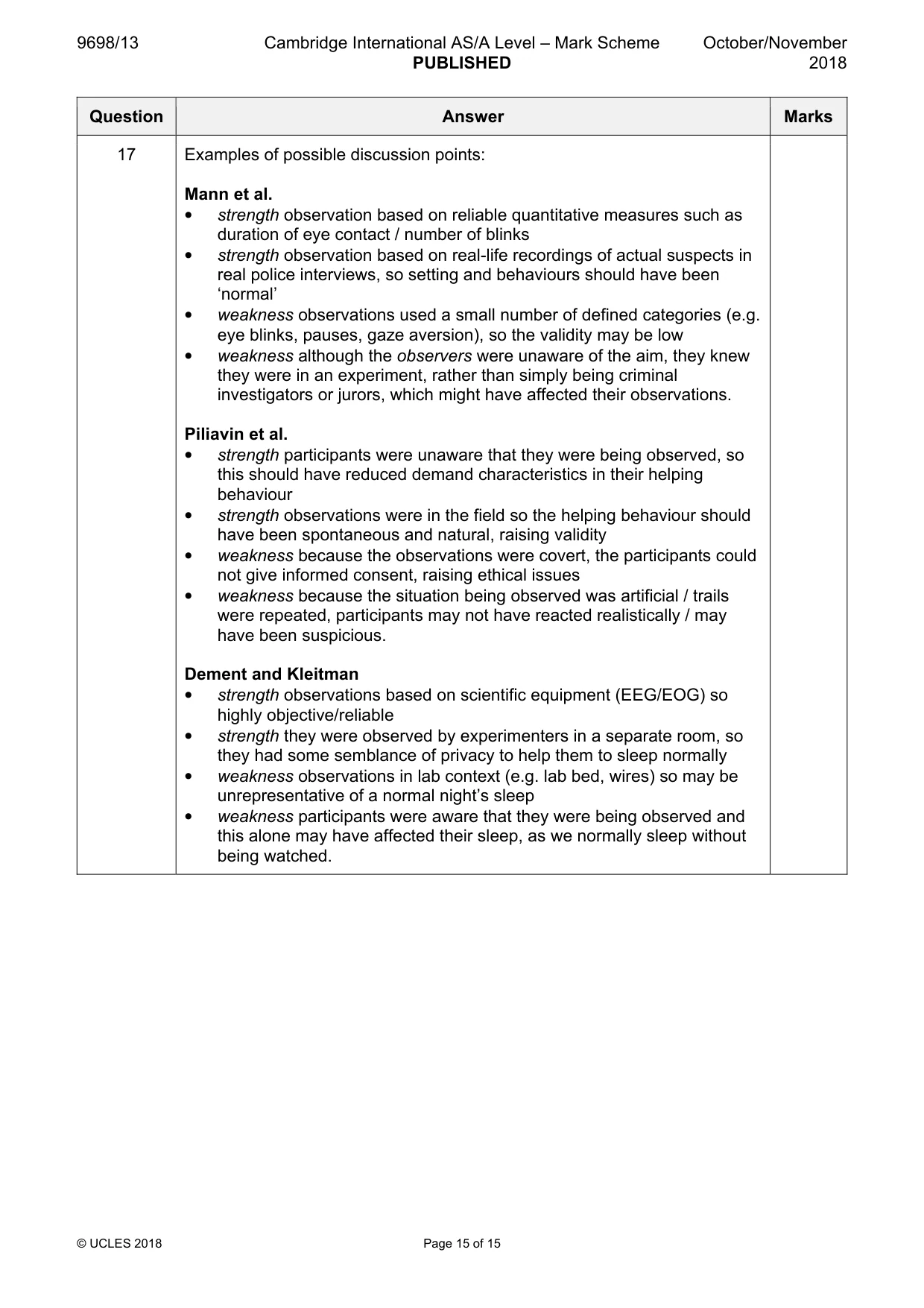
9698/13 Cambridge International AS/A Level – Mark Scheme PUBLISHED October/November 2018 © UCLES 2018 Page 15 of 15 Question Answer Marks 17 Examples of possible discussion points: Mann et al. • strength observation based on reliable quantitative measures such as duration of eye contact / number of blinks • strength observation based on real-life recordings of actual suspects in real police interviews, so setting and behaviours should have been ‘normal’ • weakness observations used a small number of defined categories (e.g. eye blinks, pauses, gaze aversion), so the validity may be low • weakness although the observers were unaware of the aim, they knew they were in an experiment, rather than simply being criminal investigators or jurors, which might have affected their observations. Piliavin et al. • strength participants were unaware that they were being observed, so this should have reduced demand characteristics in their helping behaviour • strength observations were in the field so the helping behaviour should have been spontaneous and natural, raising validity • weakness because the observations were covert, the participants could not give informed consent, raising ethical issues • weakness because the situation being observed was artificial / trails were repeated, participants may not have reacted realistically / may have been suspicious. Dement and Kleitman • strength observations based on scientific equipment (EEG/EOG) so highly objective/reliable • strength they were observed by experimenters in a separate room, so they had some semblance of privacy to help them to sleep normally • weakness observations in lab context (e.g. lab bed, wires) so may be unrepresentative of a normal night’s sleep • weakness participants were aware that they were being observed and this alone may have affected their sleep, as we normally sleep without being watched.
What you needed in this session
Cambridge’s own grade thresholds for 2018 Oct/Nov, Paper 1 · Variant 3. A higher threshold means an easier paper — the bar moves with how the cohort did.