Cambridge A Level Psychology 9698 — 2018 May/June Paper 2 · Variant 3
9698/23/M/J/18 · 4 questions · 70 marks · ≈79 min
The question paper and its mark scheme, free to read here and free to download. This is Cambridge’s own paper, exactly as it was sat.
Question paper4 pages
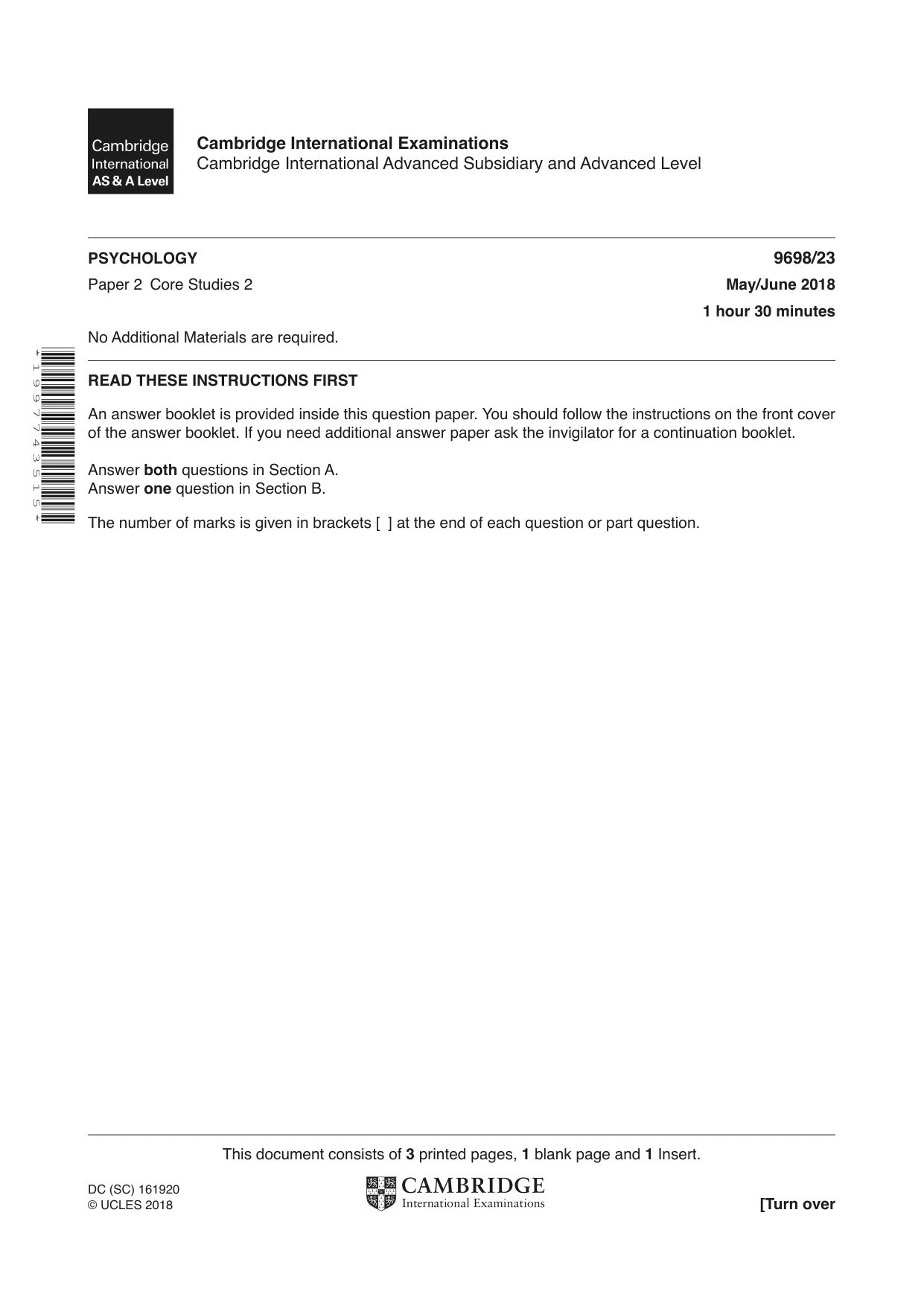
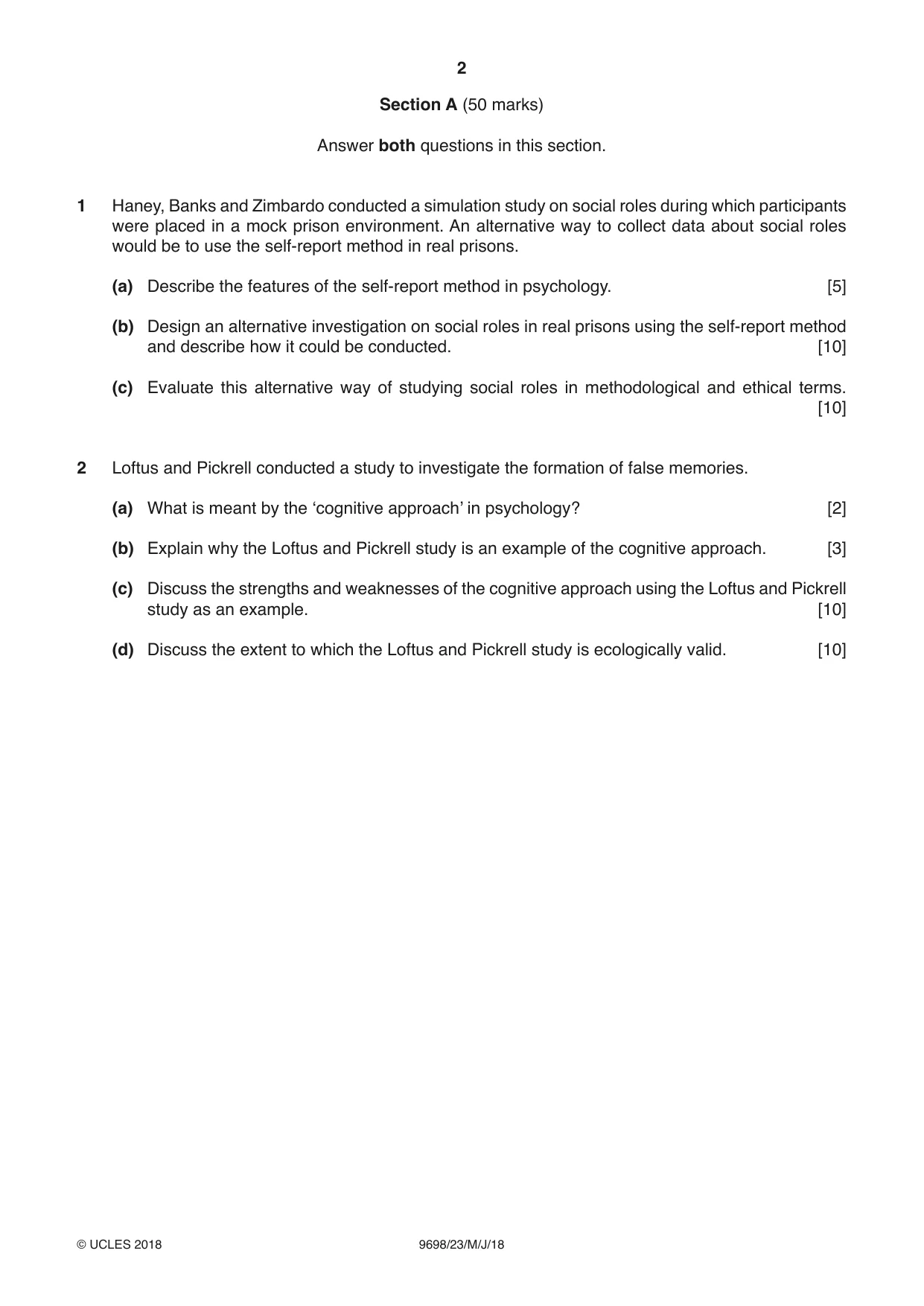
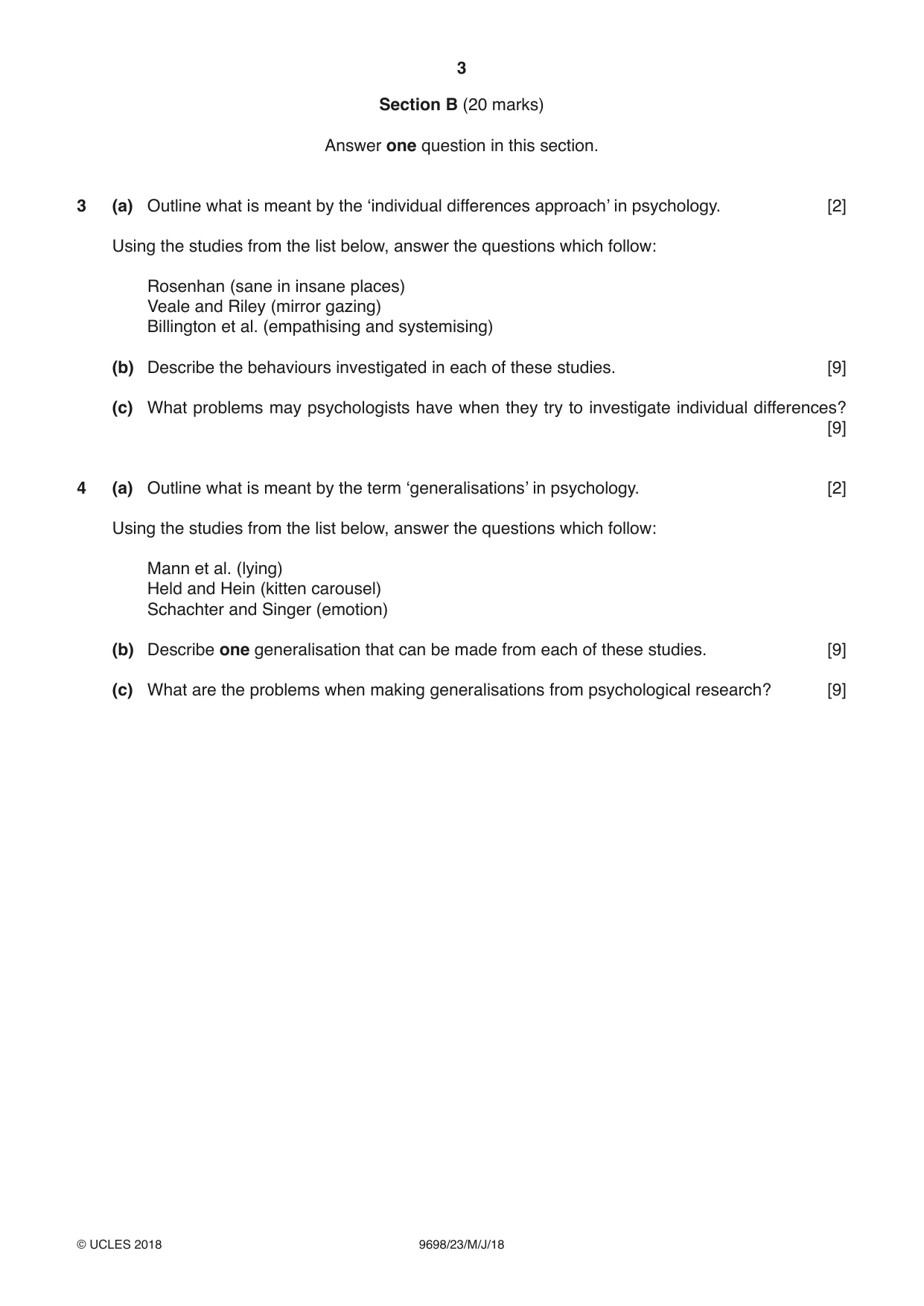

Mark scheme14 pages
Answers below. Sit the paper first if you are practising.

Questions as text
Q1 · Haney, Banks and Zimbardo conducted a simulation study on social roles during which…
1 Haney, Banks and Zimbardo conducted a simulation study on social roles during which participants were placed in a mock prison environment. An alternative way to collect data about social roles would be to use the self-report method in real prisons. (a) Describe the features of the self-report method in psychology. [5] (b) Design an alternative investigation on social roles in real prisons using the self-report method and describe how it could be conducted. [10] (c) Evaluate this alternative way of studying social roles in methodological and ethical terms. [10]
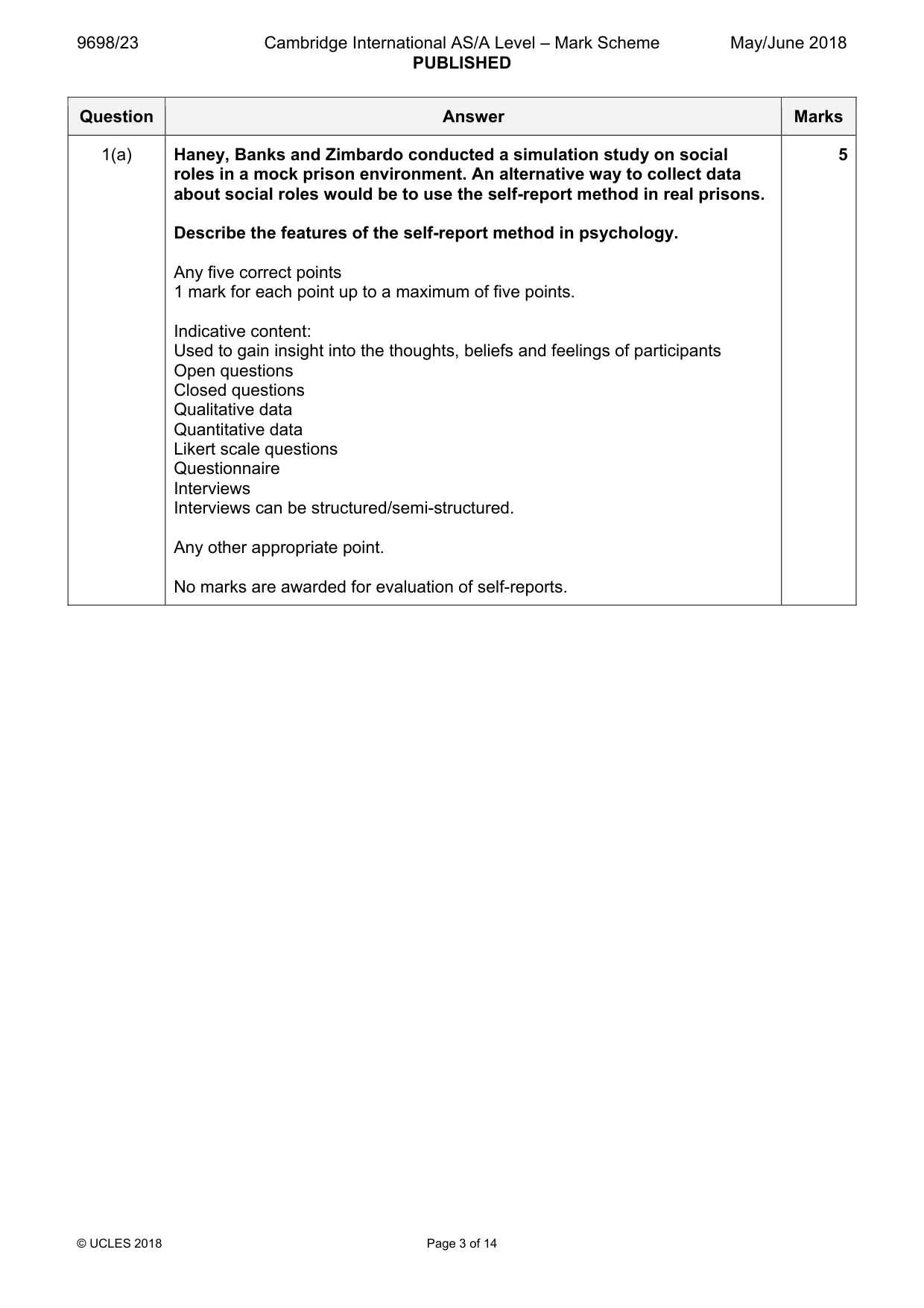
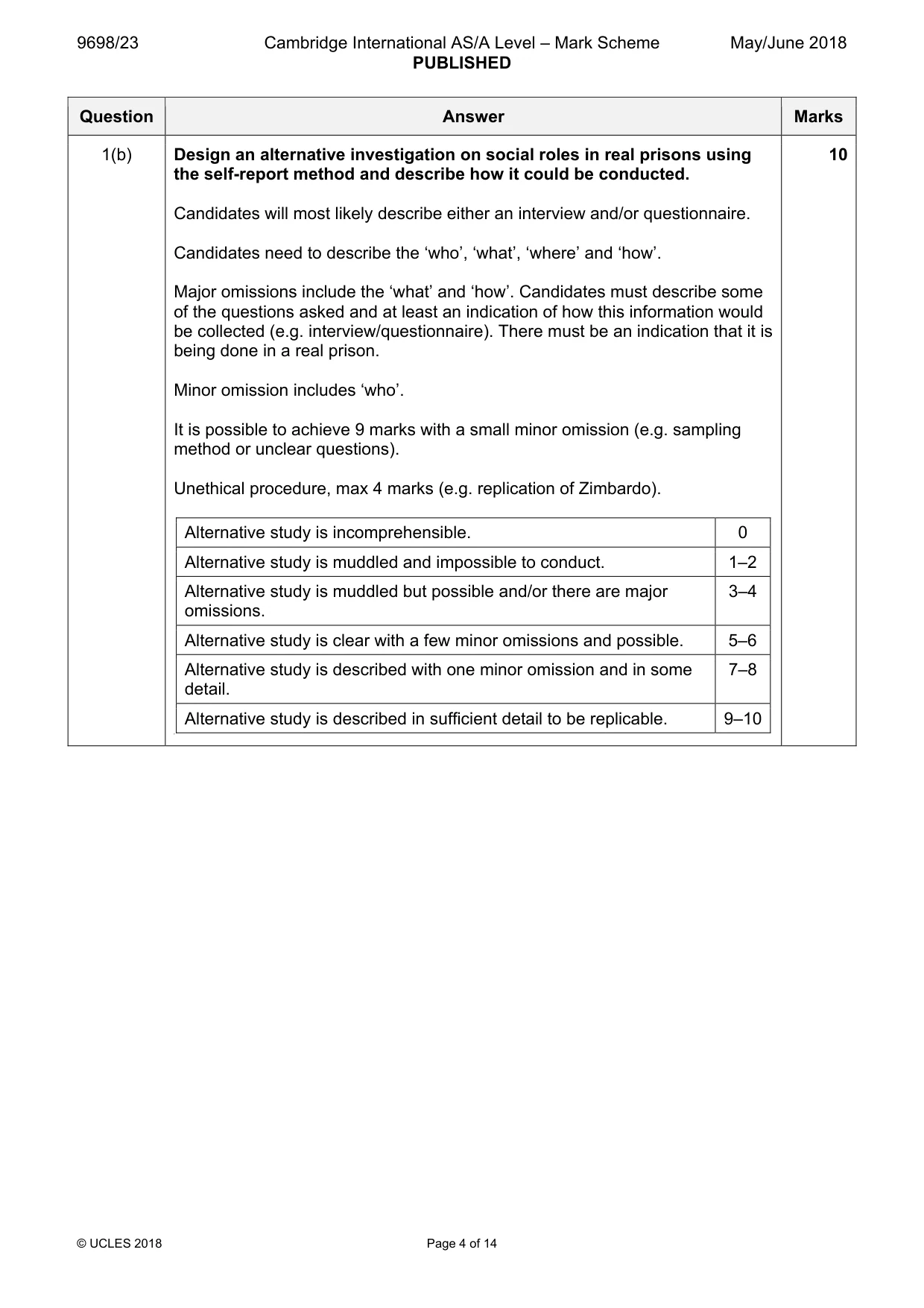
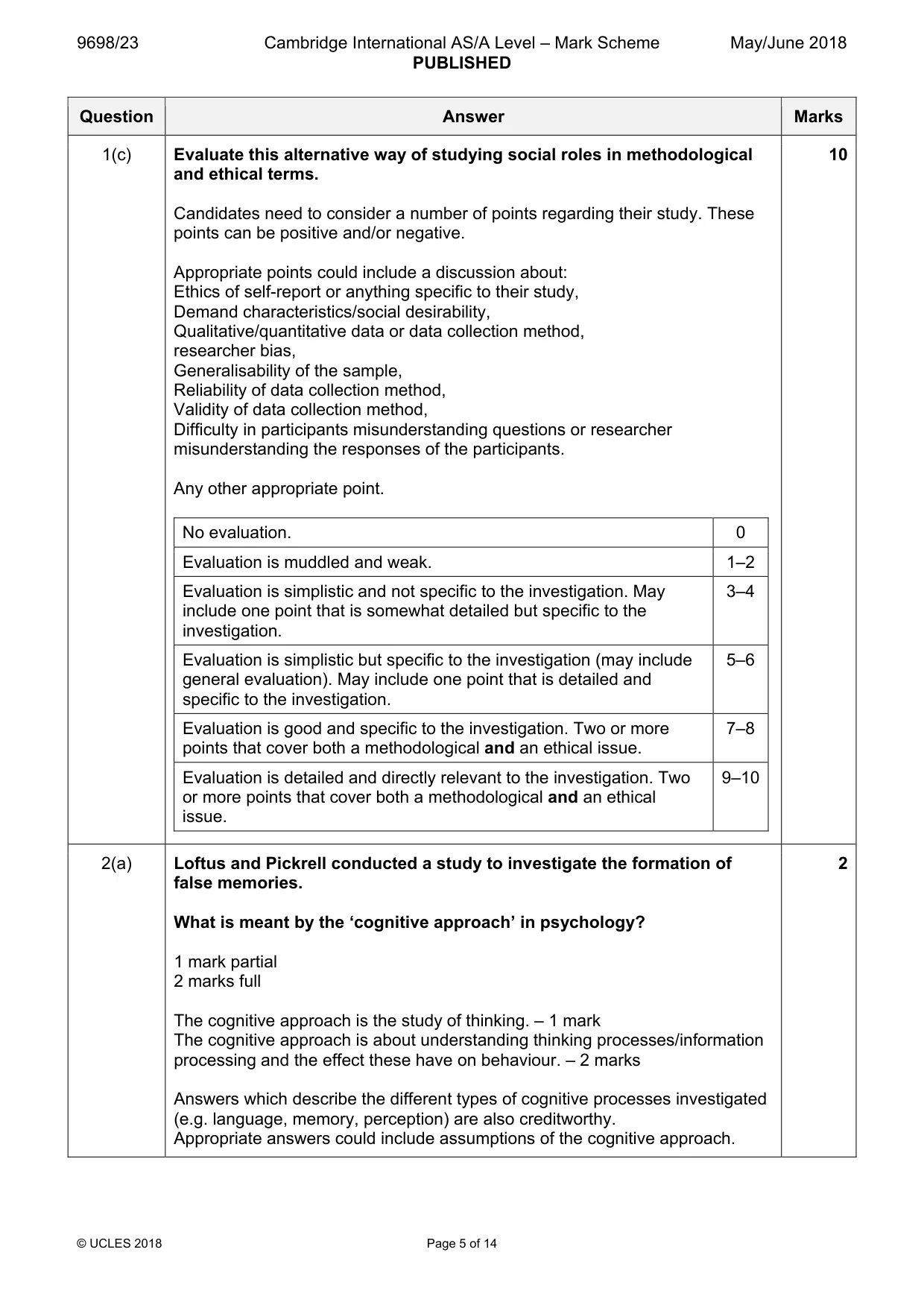
Mark scheme: Question Answer Marks 1(a) Haney, Banks and Zimbardo conducted a simulation study on social 5 roles in a mock prison environment. An alternative way to collect data about social roles would be to use the self-report method in real prisons. Describe the features of the self-report method in psychology. Any five correct points 1 mark for each point up to a maximum of five points. Indicative content: Used to gain insight into the thoughts, beliefs and feelings of participants Open questions Closed questions Qualitative data Quantitative data Likert scale questions Questionnaire Interviews Interviews can be structured/semi-structured. Any other appropriate point. No marks are awarded for evaluation of self-reports. 1(b) Design an alternative investigation on social roles in real prisons using 10 the self-report method and describe how it could be conducted. Candidates will most likely describe either an interview and/or questionnaire. Candidates need to describe the ‘who’, ‘what’, ‘where’ and ‘how’. Major omissions include the ‘what’ and ‘how’. Candidates must describe some of the questions asked and at least an indication of how this information would be collected (e.g. interview/questionnaire). There must be an indication that it is being done in a real prison. Minor omission includes ‘who’. It is possible to achieve 9 marks with a small minor omission (e.g. sampling method or unclear questions). Unethical procedure, max 4 marks (e.g. replication of Zimbardo). Alternative study is incomprehensible. 0 Alternative study is muddled and impossible to conduct. 1–2 Alternative study is muddled but possible and/or there are major 3–4 omissions. Alternative study is clear with a few minor omissions and possible. 5–6 Alternative study is described with one minor omission and in some 7–8 detail. Alternative study is described in sufficient detail to be replicable. 9–10 0 1(c) Evaluate this alternative way of studying social roles in methodological 10 and ethical terms. Candidates need to consider a number of points regarding their study. These points can be positive and/or negative. Appropriate points could include a discussion about: Ethics of self-report or anything specific to their study, Demand characteristics/social desirability, Qualitative/quantitative data or data collection method, researcher bias, Generalisability of the sample, Reliability of data collection method, Validity of data collection method, Difficulty in participants misunderstanding questions or researcher misunderstanding the responses of the participants. Any other appropriate point. No evaluation. 0 Evaluation is muddled and weak. 1–2 Evaluation is simplistic and not specific to the investigation. May 3–4 include one point that is somewhat detailed but specific to the investigation. Evaluation is simplistic but specific to the investigation (may include 5–6 general evaluation). May include one point that is detailed and specific to the investigation. Evaluation is good and specific to the investigation. Two or more 7–8 points that cover both a methodological and an ethical issue. Evaluation is detailed and directly relevant to the investigation. Two 9–10 or more points that cover both a methodological and an ethical issue.
Q2 · Loftus and Pickrell conducted a study to investigate the formation of false memories
2 Loftus and Pickrell conducted a study to investigate the formation of false memories. (a) What is meant by the ‘cognitive approach’ in psychology? [2] (b) Explain why the Loftus and Pickrell study is an example of the cognitive approach. [3] (c) Discuss the strengths and weaknesses of the cognitive approach using the Loftus and Pickrell study as an example. [10] (d) Discuss the extent to which the Loftus and Pickrell study is ecologically valid. [10]
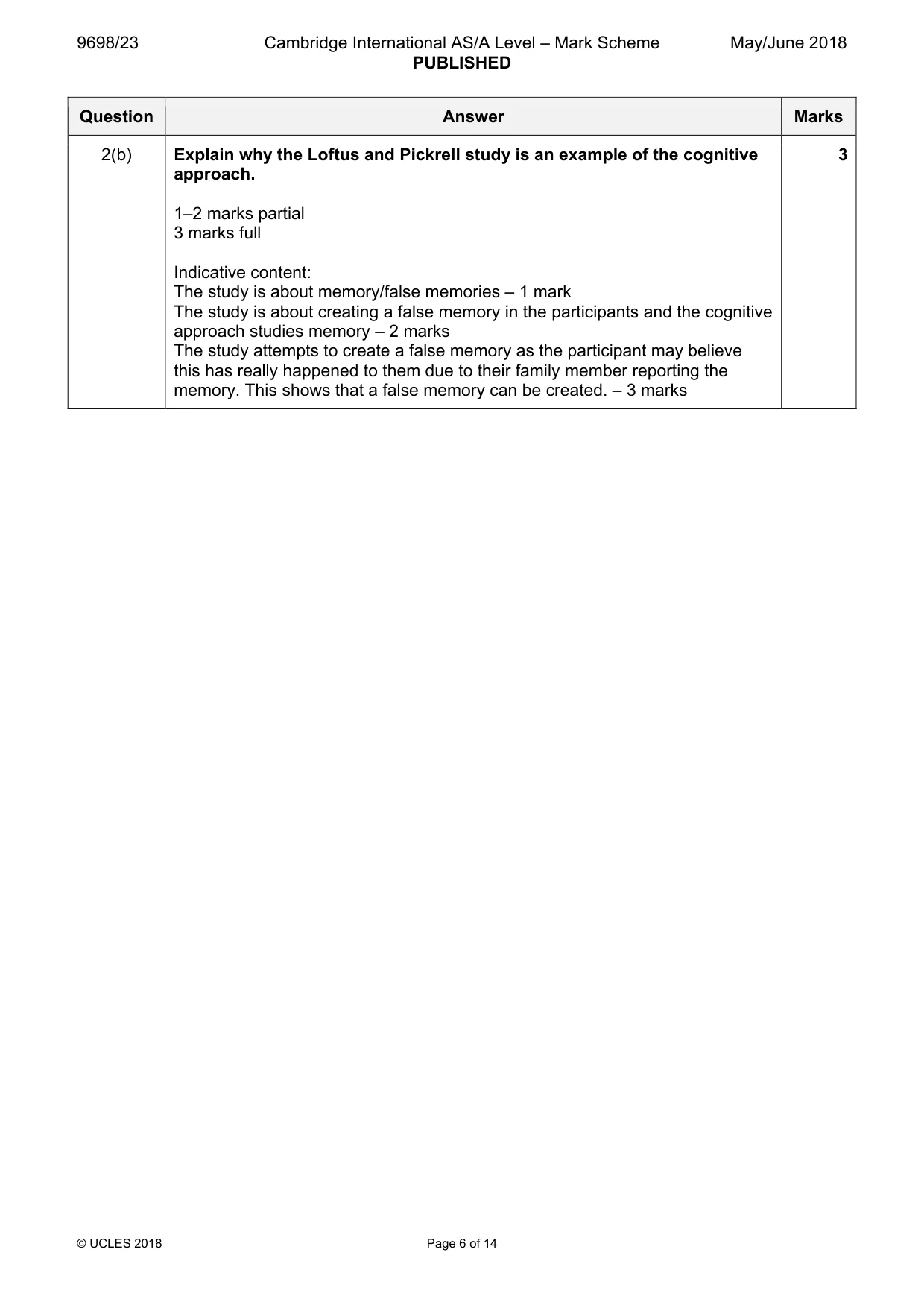
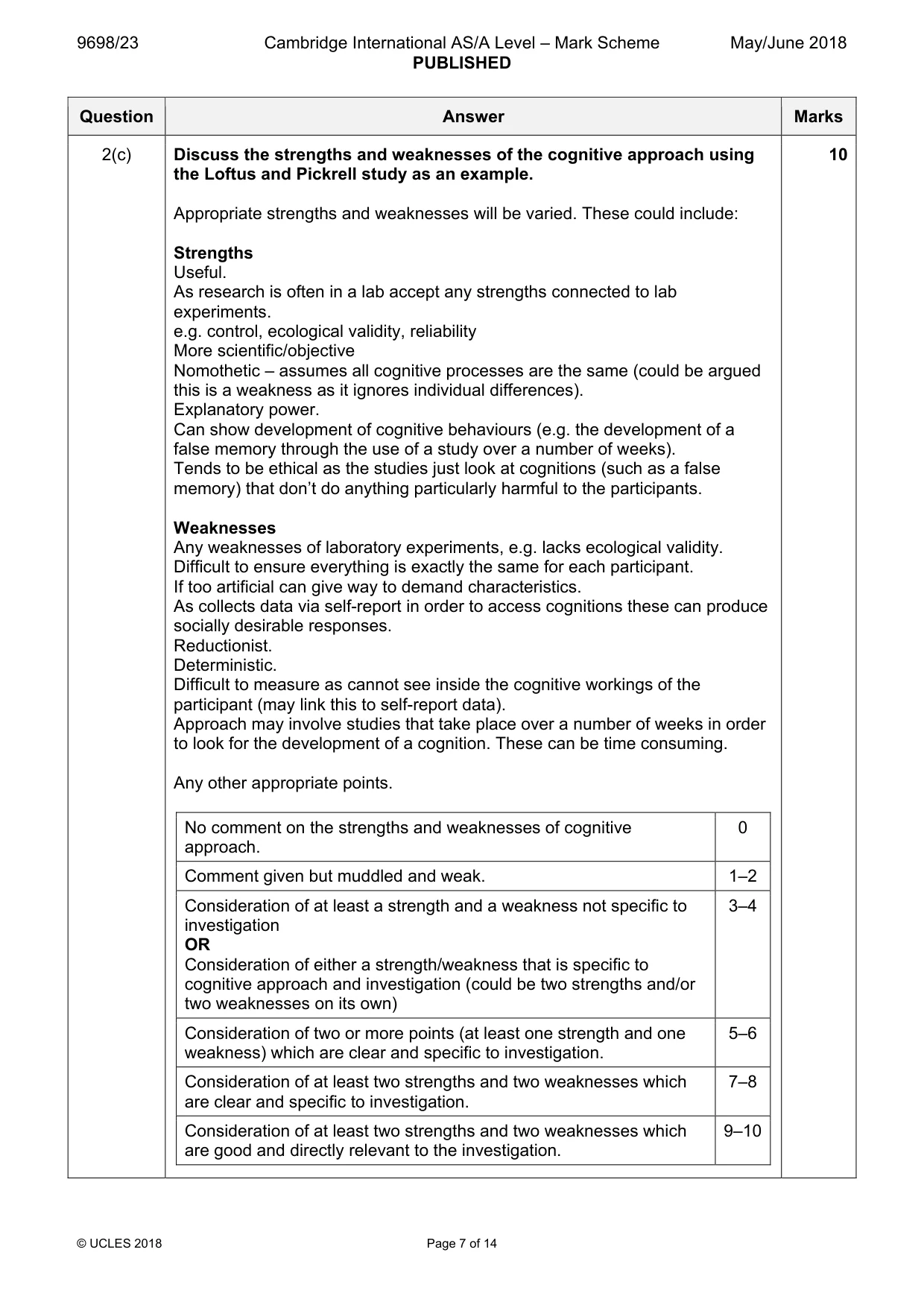
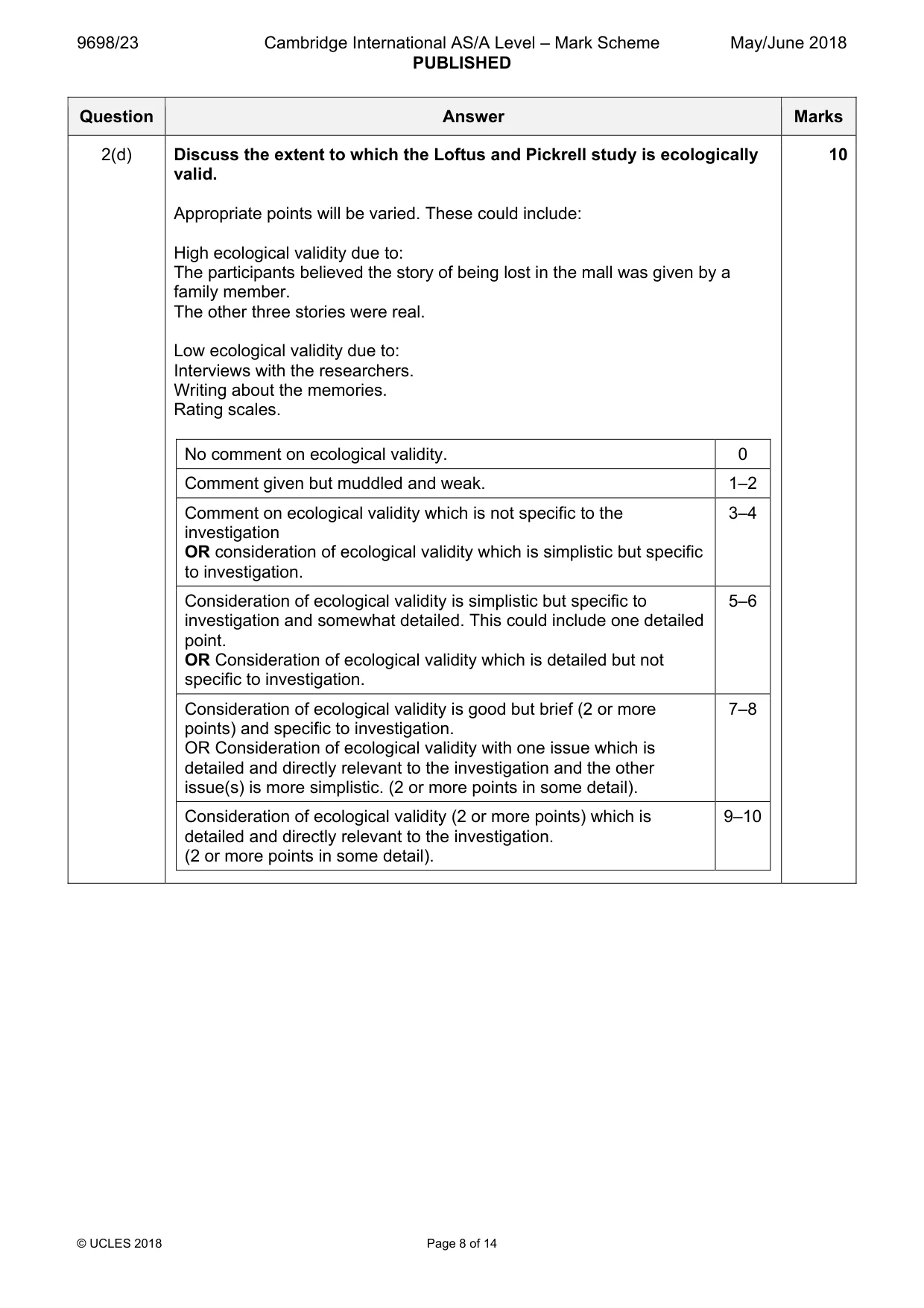
Mark scheme: 2(a) Loftus and Pickrell conducted a study to investigate the formation of 2 false memories. What is meant by the ‘cognitive approach’ in psychology? 1 mark partial 2 marks full The cognitive approach is the study of thinking. – 1 mark The cognitive approach is about understanding thinking processes/information processing and the effect these have on behaviour. – 2 marks Answers which describe the different types of cognitive processes investigated (e.g. language, memory, perception) are also creditworthy. Appropriate answers could include assumptions of the cognitive approach. 2(b) Explain why the Loftus and Pickrell study is an example of the cognitive 3 approach. 1–2 marks partial 3 marks full Indicative content: The study is about memory/false memories – 1 mark The study is about creating a false memory in the participants and the cognitive approach studies memory – 2 marks The study attempts to create a false memory as the participant may believe this has really happened to them due to their family member reporting the memory. This shows that a false memory can be created. – 3 marks 2(c) Discuss the strengths and weaknesses of the cognitive approach using 10 the Loftus and Pickrell study as an example. Appropriate strengths and weaknesses will be varied. These could include: Strengths Useful. As research is often in a lab accept any strengths connected to lab experiments. e.g. control, ecological validity, reliability More scientific/objective Nomothetic – assumes all cognitive processes are the same (could be argued this is a weakness as it ignores individual differences). Explanatory power. Can show development of cognitive behaviours (e.g. the development of a false memory through the use of a study over a number of weeks). Tends to be ethical as the studies just look at cognitions (such as a false memory) that don’t do anything particularly harmful to the participants. Weaknesses Any weaknesses of laboratory experiments, e.g. lacks ecological validity. Difficult to ensure everything is exactly the same for each participant. If too artificial can give way to demand characteristics. As collects data via self-report in order to access cognitions these can produce socially desirable responses. Reductionist. Deterministic. Difficult to measure as cannot see inside the cognitive workings of the participant (may link this to self-report data). Approach may involve studies that take place over a number of weeks in order to look for the development of a cognition. These can be time consuming. Any other appropriate points. No comment on the strengths and weaknesses of cognitive 0 approach. Comment given but muddled and weak. 1–2 Consideration of at least a strength and a weakness not specific to 3–4 investigation OR Consideration of either a strength/weakness that is specific to cognitive approach and investigation (could be two strengths and/or two weaknesses on its own) Consideration of two or more points (at least one strength and one 5–6 weakness) which are clear and specific to investigation. Consideration of at least two strengths and two weaknesses which 7–8 are clear and specific to investigation. Consideration of at least two strengths and two weaknesses which 9–10 are good and directly relevant to the investigation. 2(d) Discuss the extent to which the Loftus and Pickrell study is ecologically 10 valid. Appropriate points will be varied. These could include: High ecological validity due to: The participants believed the story of being lost in the mall was given by a family member. The other three stories were real. Low ecological validity due to: Interviews with the researchers. Writing about the memories. Rating scales. No comment on ecological validity. 0 Comment given but muddled and weak. 1–2 Comment on ecological validity which is not specific to the 3–4 investigation OR consideration of ecological validity which is simplistic but specific to investigation. Consideration of ecological validity is simplistic but specific to 5–6 investigation and somewhat detailed. This could include one detailed point. OR Consideration of ecological validity which is detailed but not specific to investigation. Consideration of ecological validity is good but brief (2 or more 7–8 points) and specific to investigation. OR Consideration of ecological validity with one issue which is detailed and directly relevant to the investigation and the other issue(s) is more simplistic. (2 or more points in some detail). Consideration of ecological validity (2 or more points) which is 9–10 detailed and directly relevant to the investigation. (2 or more points in some detail).
Q3 · Outline what is meant by the ‘individual differences approach’ in psychology
3 (a) Outline what is meant by the ‘individual differences approach’ in psychology. [2] Using the studies from the list below, answer the questions which follow: Rosenhan (sane in insane places) Veale and Riley (mirror gazing) Billington et al. (empathising and systemising) (b) Describe the behaviours investigated in each of these studies. [9] (c) What problems may psychologists have when they try to investigate individual differences? [9]
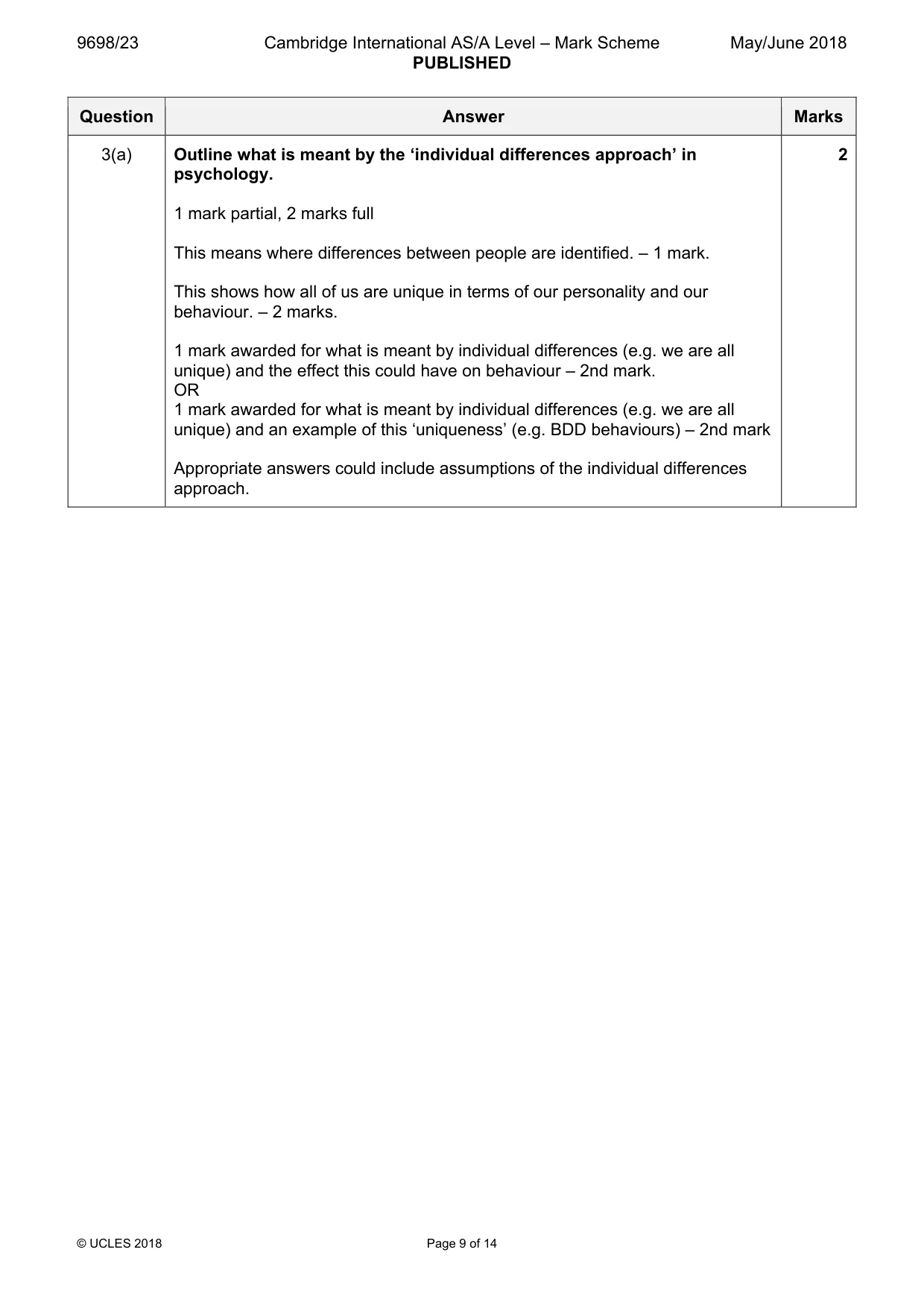
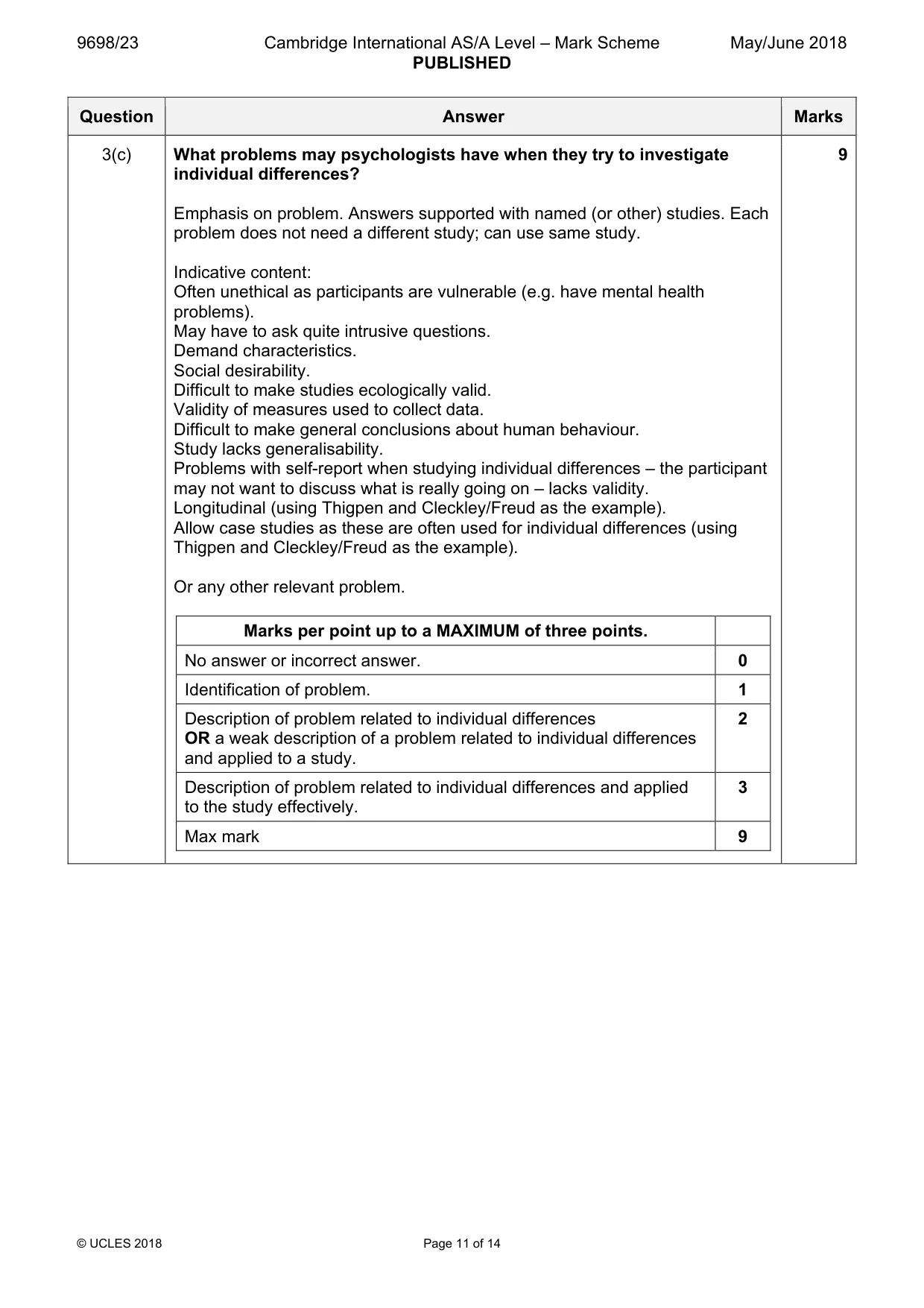
Mark scheme: 3(a) Outline what is meant by the ‘individual differences approach’ in 2 psychology. 1 mark partial, 2 marks full This means where differences between people are identified. – 1 mark. This shows how all of us are unique in terms of our personality and our behaviour. – 2 marks. 1 mark awarded for what is meant by individual differences (e.g. we are all unique) and the effect this could have on behaviour – 2nd mark. OR 1 mark awarded for what is meant by individual differences (e.g. we are all unique) and an example of this ‘uniqueness’ (e.g. BDD behaviours) – 2nd mark Appropriate answers could include assumptions of the individual differences approach. Using the studies from the list below, answer the questions which follow: Rosenhan (sane in insane places) Veale and Riley (mirror gazing) Billington et al. (empathising and systemising) 3(b) Describe the behaviours investigated in each of these studies. 9 Rosenhan: Investigated diagnosis of mental health. Diagnoses of the pseudopatients were recorded. While in the hospitals pseudopatients wrote in their diaries about the behaviour witnessed of both staff and patients in the hospitals. They recorded the behaviour of the staff and patients. Accept any appropriate behaviour described such as the treatment of other patients by staff, the comments made to the pseudopatients during their stay, description of events that led up to the diagnosis of oral acquisitive syndrome, number of pills given and discarded, results of request to be released, etc. Veale and Riley: Investigated BDD. Investigated beliefs and behaviours in front of the mirror e.g. types of surfaces used, gazing time, thoughts during gazing, etc. Billington et al: Subject choice at university, empathising and systemising were measured via the SQ and EQ. Intelligence was measured as well autism/AS features via IQ test and eyes test. Also used FC-EFT. For each study No answer or incorrect answer. 0 Identification of point relevant to question but not related to study or 1 comment from study but no point about behaviours investigated. The description may be very brief or muddled. Description of point about behaviours investigated. (Comment with 2 lack of understanding). A clear description that may lack some detail. As above but with analysis (comment with comprehension) about 3 behaviours investigated from the study. A clear description that is in sufficient detail. Max mark 9 3(c) What problems may psychologists have when they try to investigate 9 individual differences? Emphasis on problem. Answers supported with named (or other) studies. Each problem does not need a different study; can use same study. Indicative content: Often unethical as participants are vulnerable (e.g. have mental health problems). May have to ask quite intrusive questions. Demand characteristics. Social desirability. Difficult to make studies ecologically valid. Validity of measures used to collect data. Difficult to make general conclusions about human behaviour. Study lacks generalisability. Problems with self-report when studying individual differences – the participant may not want to discuss what is really going on – lacks validity. Longitudinal (using Thigpen and Cleckley/Freud as the example). Allow case studies as these are often used for individual differences (using Thigpen and Cleckley/Freud as the example). Or any other relevant problem. Marks per point up to a MAXIMUM of three points. No answer or incorrect answer. 0 Identification of problem. 1 Description of problem related to individual differences 2 OR a weak description of a problem related to individual differences and applied to a study. Description of problem related to individual differences and applied 3 to the study effectively. Max mark 9
Q4 · Outline what is meant by the term ‘generalisations’ in psychology
4 (a) Outline what is meant by the term ‘generalisations’ in psychology. [2] Using the studies from the list below, answer the questions which follow: Mann et al. (lying) Held and Hein (kitten carousel) Schachter and Singer (emotion) (b) Describe one generalisation that can be made from each of these studies. [9] (c) What are the problems when making generalisations from psychological research? [9]
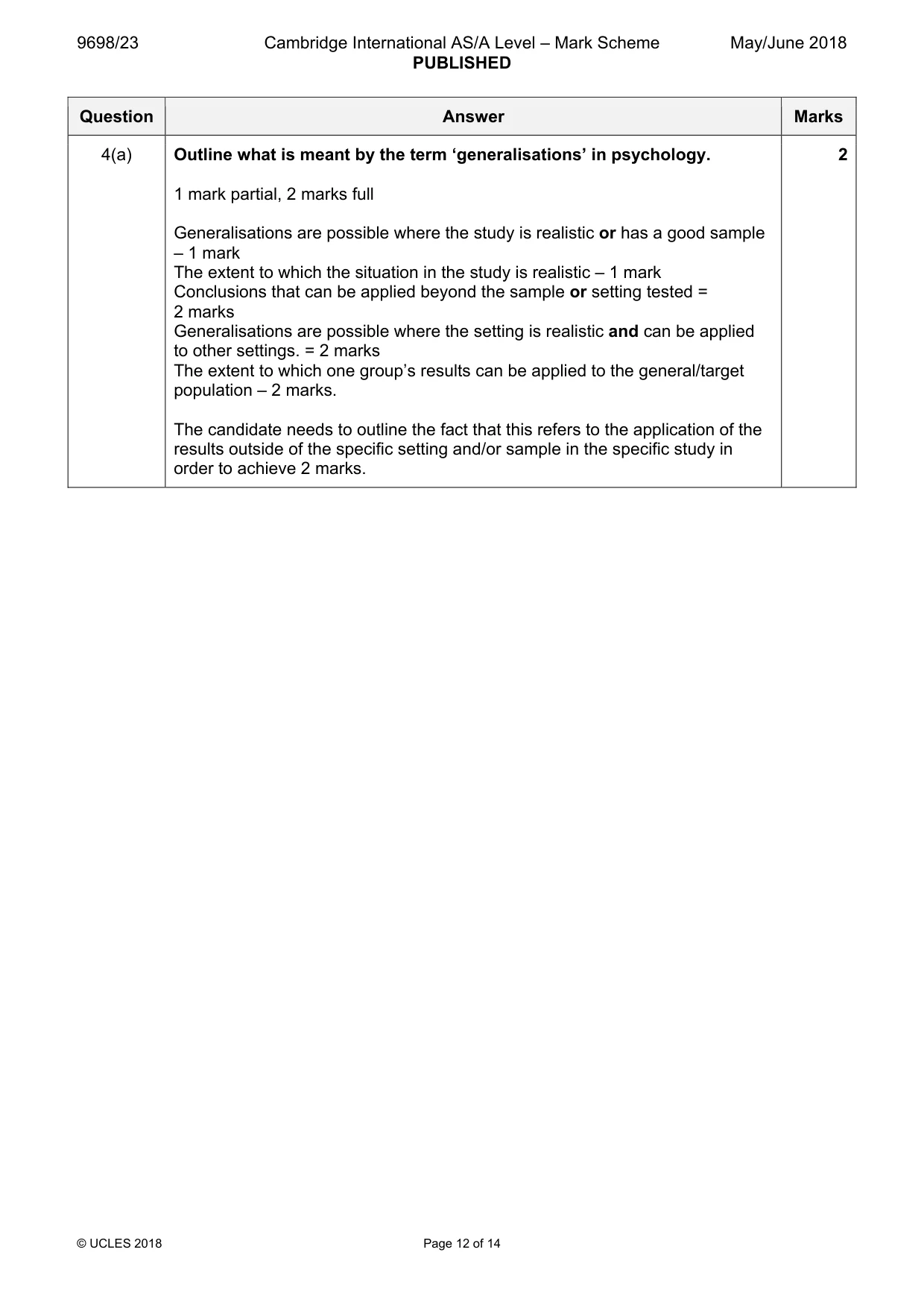
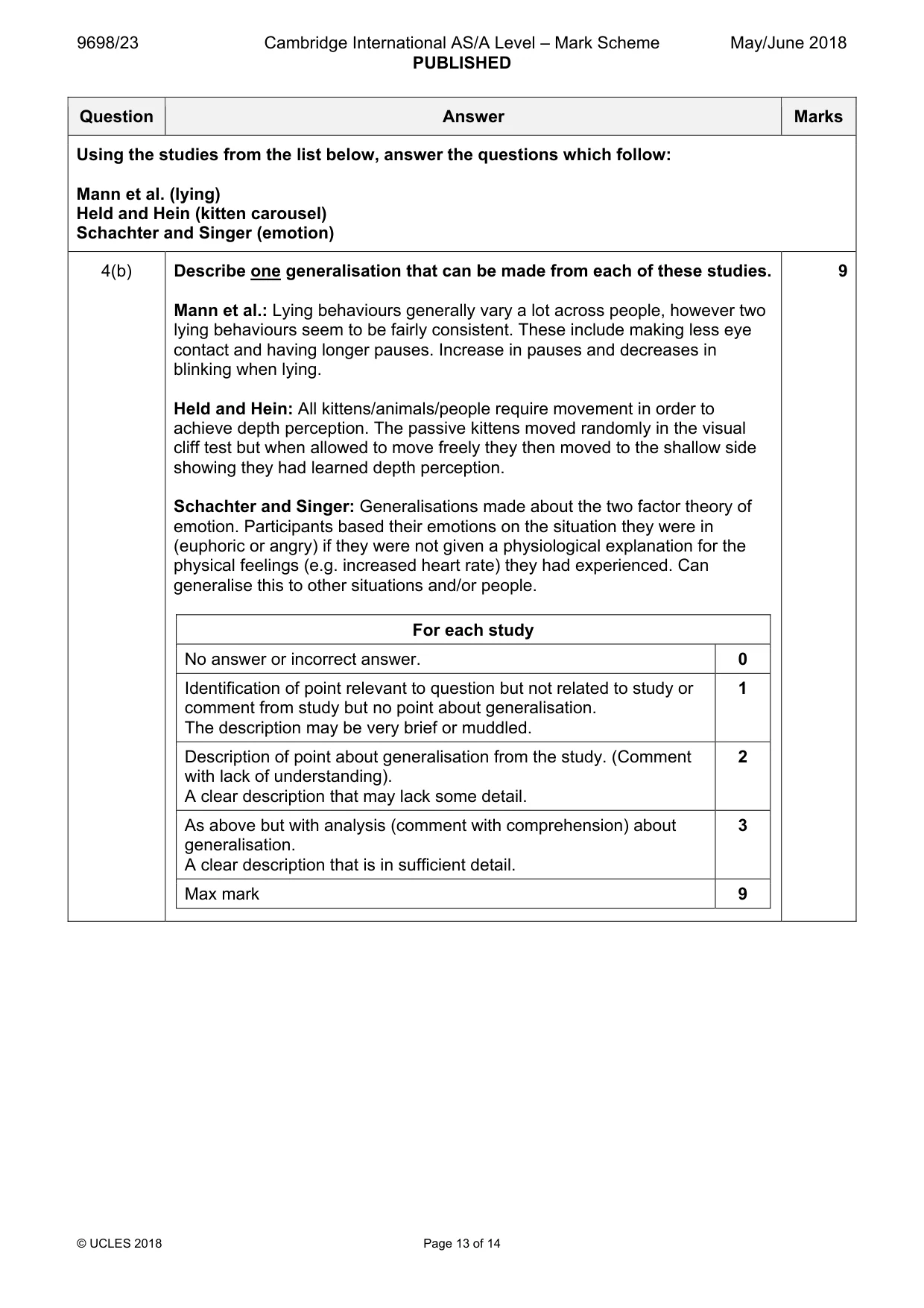
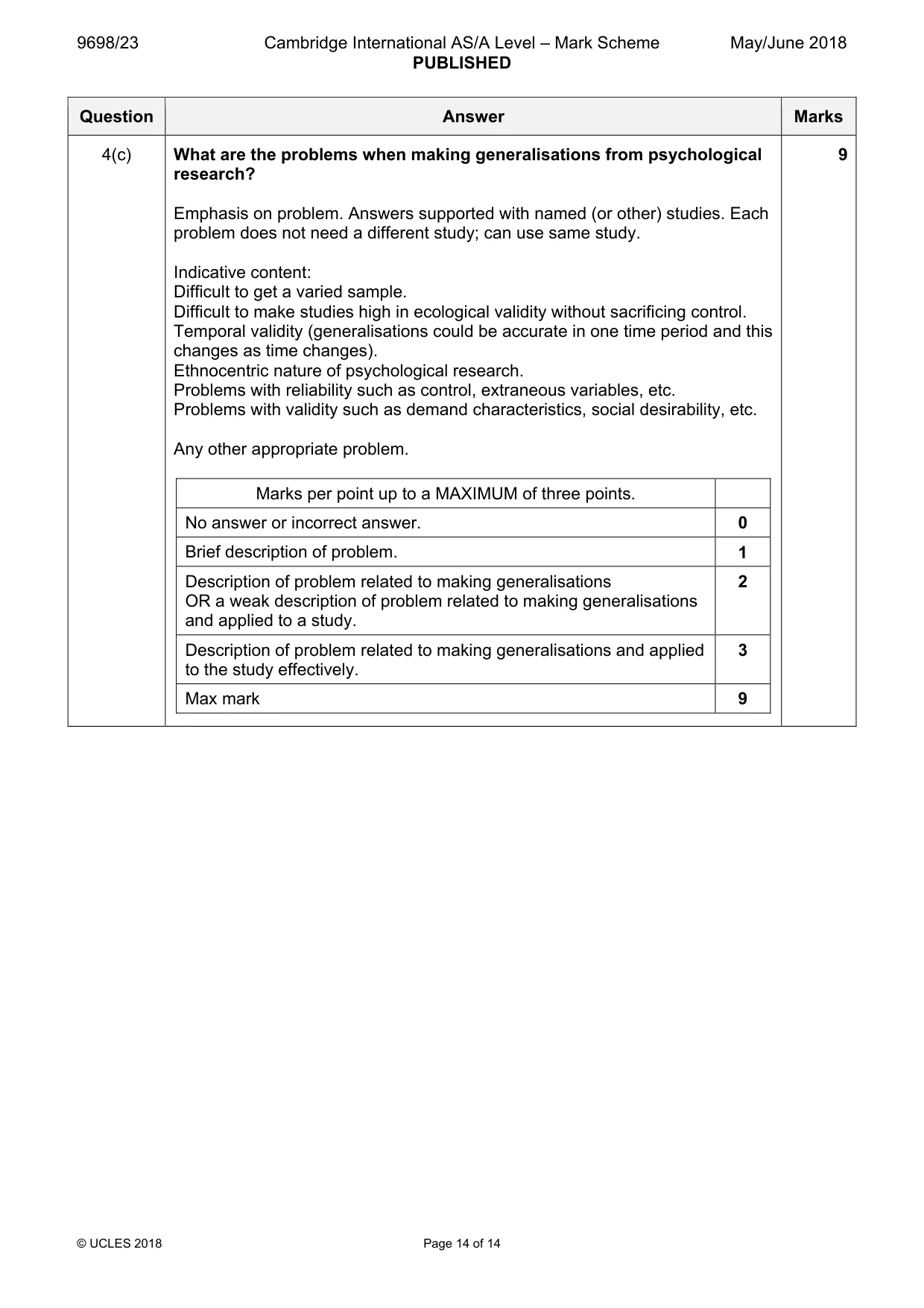
Mark scheme: 4(a) Outline what is meant by the term ‘generalisations’ in psychology. 2 1 mark partial, 2 marks full Generalisations are possible where the study is realistic or has a good sample – 1 mark The extent to which the situation in the study is realistic – 1 mark Conclusions that can be applied beyond the sample or setting tested = 2 marks Generalisations are possible where the setting is realistic and can be applied to other settings. = 2 marks The extent to which one group’s results can be applied to the general/target population – 2 marks. The candidate needs to outline the fact that this refers to the application of the results outside of the specific setting and/or sample in the specific study in order to achieve 2 marks. Using the studies from the list below, answer the questions which follow: Mann et al. (lying) Held and Hein (kitten carousel) Schachter and Singer (emotion) 4(b) Describe one generalisation that can be made from each of these studies. 9 Mann et al.: Lying behaviours generally vary a lot across people, however two lying behaviours seem to be fairly consistent. These include making less eye contact and having longer pauses. Increase in pauses and decreases in blinking when lying. Held and Hein: All kittens/animals/people require movement in order to achieve depth perception. The passive kittens moved randomly in the visual cliff test but when allowed to move freely they then moved to the shallow side showing they had learned depth perception. Schachter and Singer: Generalisations made about the two factor theory of emotion. Participants based their emotions on the situation they were in (euphoric or angry) if they were not given a physiological explanation for the physical feelings (e.g. increased heart rate) they had experienced. Can generalise this to other situations and/or people. For each study No answer or incorrect answer. 0 Identification of point relevant to question but not related to study or 1 comment from study but no point about generalisation. The description may be very brief or muddled. Description of point about generalisation from the study. (Comment 2 with lack of understanding). A clear description that may lack some detail. As above but with analysis (comment with comprehension) about 3 generalisation. A clear description that is in sufficient detail. Max mark 9 4(c) What are the problems when making generalisations from psychological 9 research? Emphasis on problem. Answers supported with named (or other) studies. Each problem does not need a different study; can use same study. Indicative content: Difficult to get a varied sample. Difficult to make studies high in ecological validity without sacrificing control. Temporal validity (generalisations could be accurate in one time period and this changes as time changes). Ethnocentric nature of psychological research. Problems with reliability such as control, extraneous variables, etc. Problems with validity such as demand characteristics, social desirability, etc. Any other appropriate problem. Marks per point up to a MAXIMUM of three points. No answer or incorrect answer. 0 Brief description of problem. 1 Description of problem related to making generalisations 2 OR a weak description of problem related to making generalisations and applied to a study. Description of problem related to making generalisations and applied 3 to the study effectively. Max mark 9
What you needed in this session
Cambridge’s own grade thresholds for 2018 May/June, Paper 2 · Variant 3. A higher threshold means an easier paper — the bar moves with how the cohort did.