Cambridge A Level Psychology 9698 — 2017 Oct/Nov Paper 1 · Variant 3
9698/13/O/N/17 · 80 marks · ≈90 min
The question paper and its mark scheme, free to read here and free to download. This is Cambridge’s own paper, exactly as it was sat.
Question paper4 pages
Mark scheme14 pages
Answers below. Sit the paper first if you are practising.
Paper as text
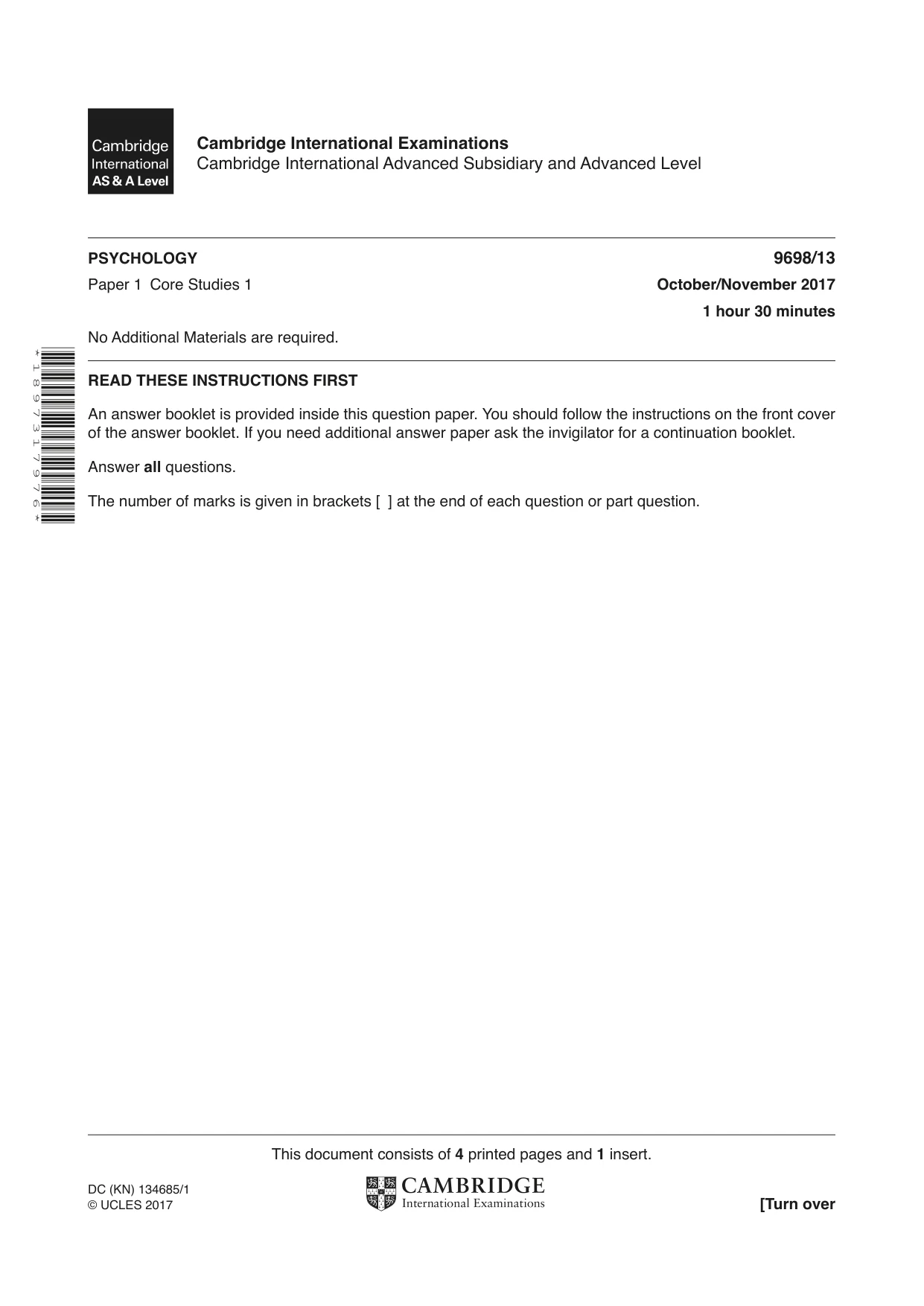
Question paper, page 1
This document consists of 4 printed pages and 1 insert. DC (KN) 134685/1 © UCLES 2017 [Turn over Cambridge International Examinations Cambridge International Advanced Subsidiary and Advanced Level * 1 8 9 7 3 1 7 9 7 6 * PSYCHOLOGY 9698/13 Paper 1 Core Studies 1 October/November 2017 1 hour 30 minutes No Additional Materials are required. READ THESE INSTRUCTIONS FIRST An answer booklet is provided inside this question paper. You should follow the instructions on the front cover of the answer booklet. If you need additional answer paper ask the invigilator for a continuation booklet. Answer all questions. The number of marks is given in brackets [ ] at the end of each question or part question.
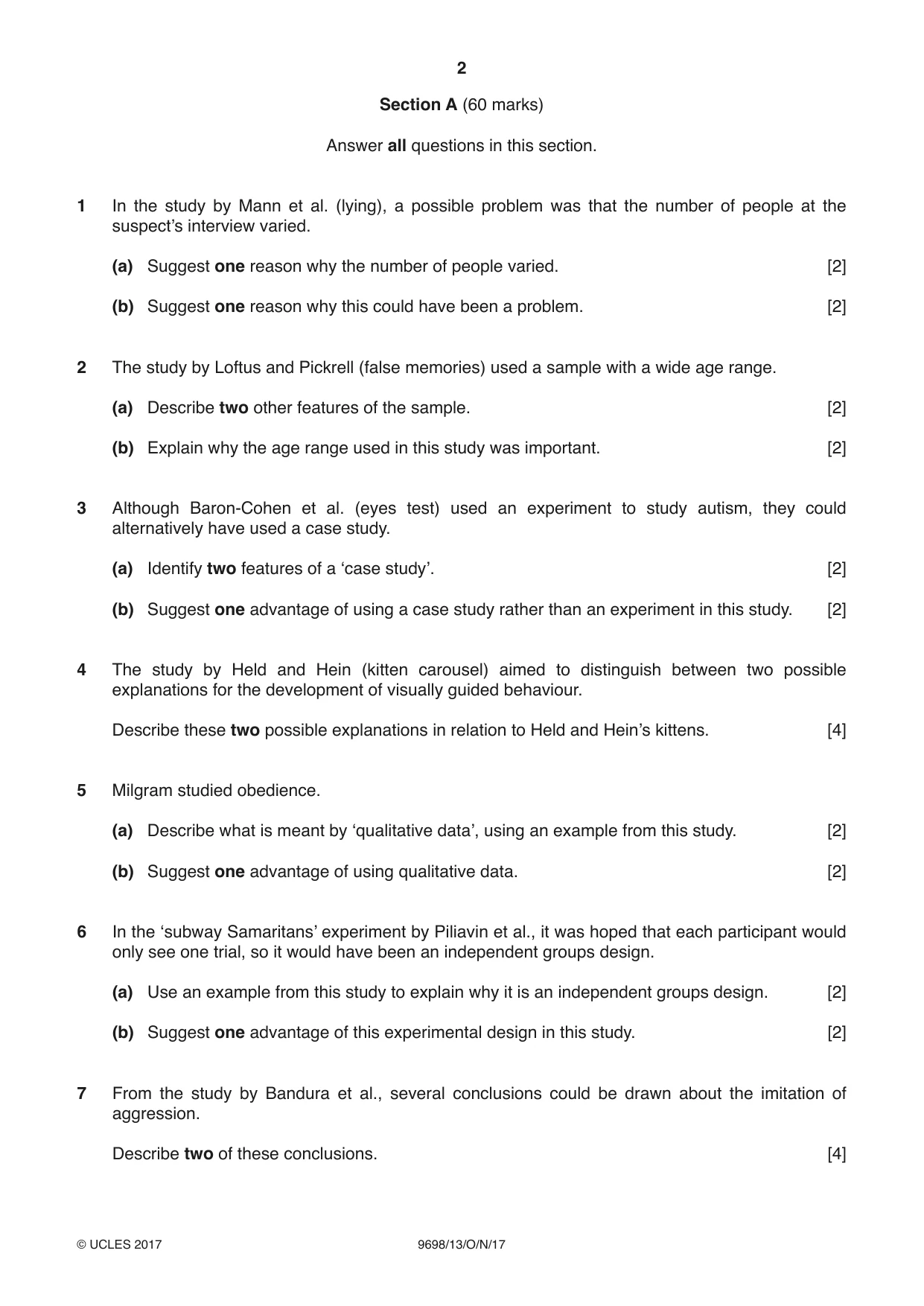
Question paper, page 2
2 9698/13/O/N/17 © UCLES 2017 Section A (60 marks) Answer all questions in this section. 1 In the study by Mann et al. (lying), a possible problem was that the number of people at the suspect’s interview varied. (a) Suggest one reason why the number of people varied. [2] (b) Suggest one reason why this could have been a problem. [2] 2 The study by Loftus and Pickrell (false memories) used a sample with a wide age range. (a) Describe two other features of the sample. [2] (b) Explain why the age range used in this study was important. [2] 3 Although Baron-Cohen et al. (eyes test) used an experiment to study autism, they could alternatively have used a case study. (a) Identify two features of a ‘case study’. [2] (b) Suggest one advantage of using a case study rather than an experiment in this study. [2] 4 The study by Held and Hein (kitten carousel) aimed to distinguish between two possible explanations for the development of visually guided behaviour. Describe these two possible explanations in relation to Held and Hein’s kittens. [4] 5 Milgram studied obedience. (a) Describe what is meant by ‘qualitative data’, using an example from this study. [2] (b) Suggest one advantage of using qualitative data. [2] 6 In the ‘subway Samaritans’ experiment by Piliavin et al., it was hoped that each participant would only see one trial, so it would have been an independent groups design. (a) Use an example from this study to explain why it is an independent groups design. [2] (b) Suggest one advantage of this experimental design in this study. [2] 7 From the study by Bandura et al., several conclusions could be drawn about the imitation of aggression. Describe two of these conclusions. [4]
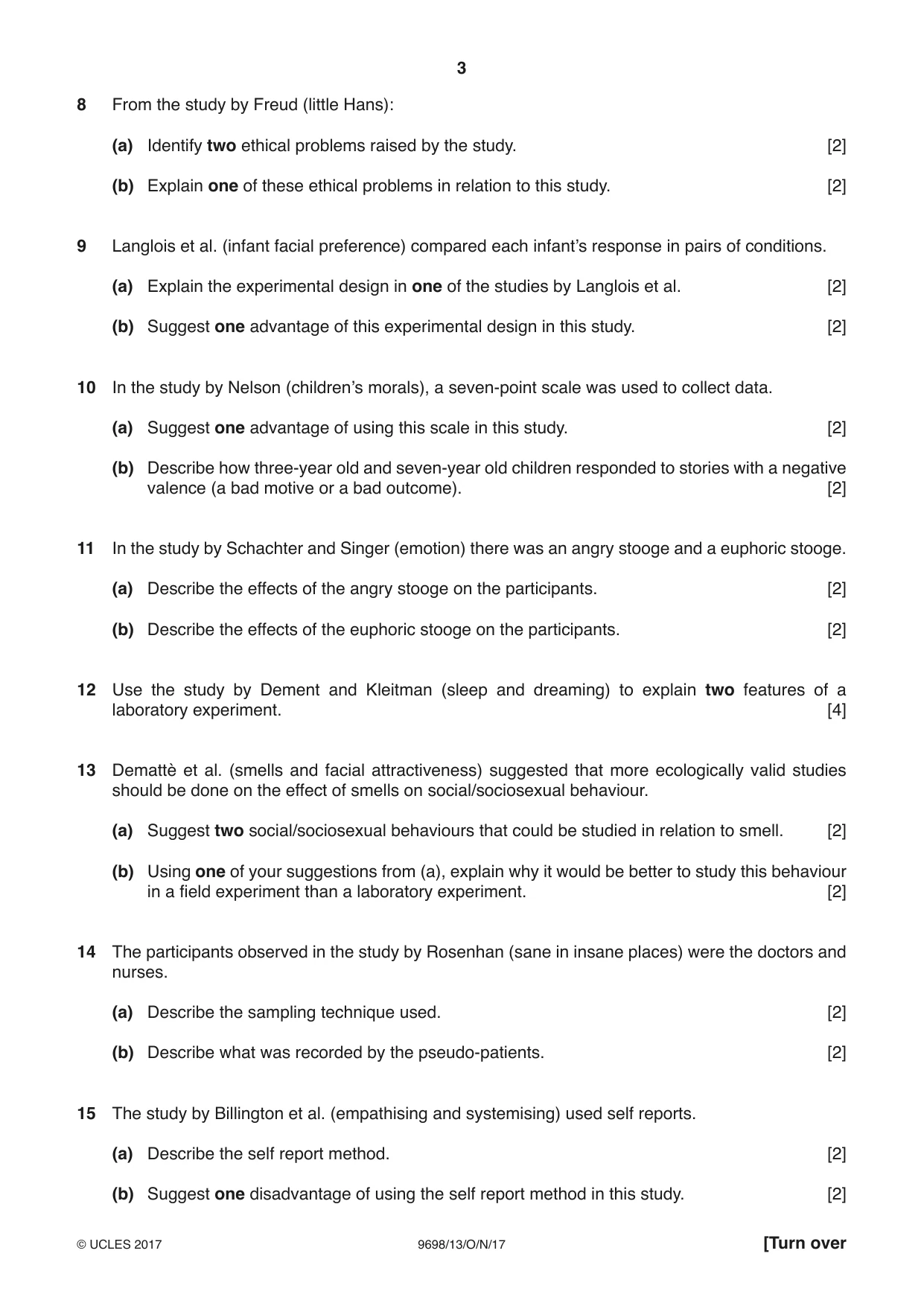
Question paper, page 3
3 9698/13/O/N/17 © UCLES 2017 [Turn over 8 From the study by Freud (little Hans): (a) Identify two ethical problems raised by the study. [2] (b) Explain one of these ethical problems in relation to this study. [2] 9 Langlois et al. (infant facial preference) compared each infant’s response in pairs of conditions. (a) Explain the experimental design in one of the studies by Langlois et al. [2] (b) Suggest one advantage of this experimental design in this study. [2] 10 In the study by Nelson (children’s morals), a seven-point scale was used to collect data. (a) Suggest one advantage of using this scale in this study. [2] (b) Describe how three-year old and seven-year old children responded to stories with a negative valence (a bad motive or a bad outcome). [2] 11 In the study by Schachter and Singer (emotion) there was an angry stooge and a euphoric stooge. (a) Describe the effects of the angry stooge on the participants. [2] (b) Describe the effects of the euphoric stooge on the participants. [2] 12 Use the study by Dement and Kleitman (sleep and dreaming) to explain two features of a laboratory experiment. [4] 13 Demattè et al. (smells and facial attractiveness) suggested that more ecologically valid studies should be done on the effect of smells on social/sociosexual behaviour. (a) Suggest two social/sociosexual behaviours that could be studied in relation to smell. [2] (b) Using one of your suggestions from (a), explain why it would be better to study this behaviour in a field experiment than a laboratory experiment. [2] 14 The participants observed in the study by Rosenhan (sane in insane places) were the doctors and nurses. (a) Describe the sampling technique used. [2] (b) Describe what was recorded by the pseudo-patients. [2] 15 The study by Billington et al. (empathising and systemising) used self reports. (a) Describe the self report method. [2] (b) Suggest one disadvantage of using the self report method in this study. [2]
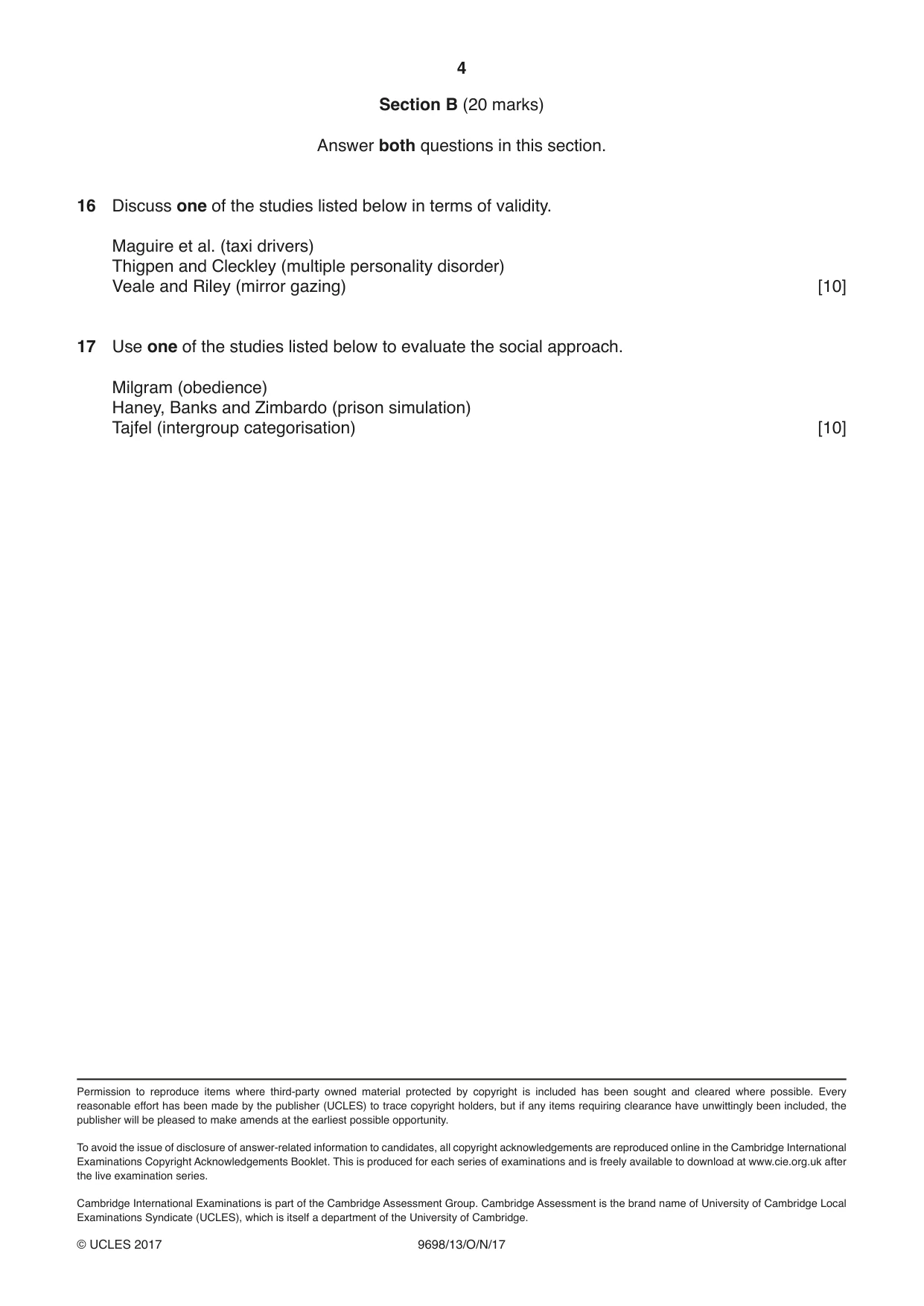
Question paper, page 4
4 9698/13/O/N/17 © UCLES 2017 Section B (20 marks) Answer both questions in this section. 16 Discuss one of the studies listed below in terms of validity. Maguire et al. (taxi drivers) Thigpen and Cleckley (multiple personality disorder) Veale and Riley (mirror gazing) [10] 17 Use one of the studies listed below to evaluate the social approach. Milgram (obedience) Haney, Banks and Zimbardo (prison simulation) Tajfel (intergroup categorisation) [10] Permission to reproduce items where third-party owned material protected by copyright is included has been sought and cleared where possible. Every reasonable effort has been made by the publisher (UCLES) to trace copyright holders, but if any items requiring clearance have unwittingly been included, the publisher will be pleased to make amends at the earliest possible opportunity. To avoid the issue of disclosure of answer-related information to candidates, all copyright acknowledgements are reproduced online in the Cambridge International Examinations Copyright Acknowledgements Booklet. This is produced for each series of examinations and is freely available to download at www.cie.org.uk after the live examination series. Cambridge International Examinations is part of the Cambridge Assessment Group. Cambridge Assessment is the brand name of University of Cambridge Local Examinations Syndicate (UCLES), which is itself a department of the University of Cambridge.
Mark scheme, page 1
® IGCSE is a registered trademark. This document consists of 14 printed pages. © UCLES 2017 [Turn over Cambridge Assessment International Education Cambridge International Advanced Subsidiary and Advanced Level PSYCHOLOGY 9698/13 Paper 1 Core Studies 1 October/November 2017 MARK SCHEME Maximum Mark: 80 Published This mark scheme is published as an aid to teachers and candidates, to indicate the requirements of the examination. It shows the basis on which Examiners were instructed to award marks. It does not indicate the details of the discussions that took place at an Examiners’ meeting before marking began, which would have considered the acceptability of alternative answers. Mark schemes should be read in conjunction with the question paper and the Principal Examiner Report for Teachers. Cambridge International will not enter into discussions about these mark schemes. Cambridge International is publishing the mark schemes for the October/November 2017 series for most Cambridge IGCSE®, Cambridge International A and AS Level components and some Cambridge O Level components.
Mark scheme, page 2
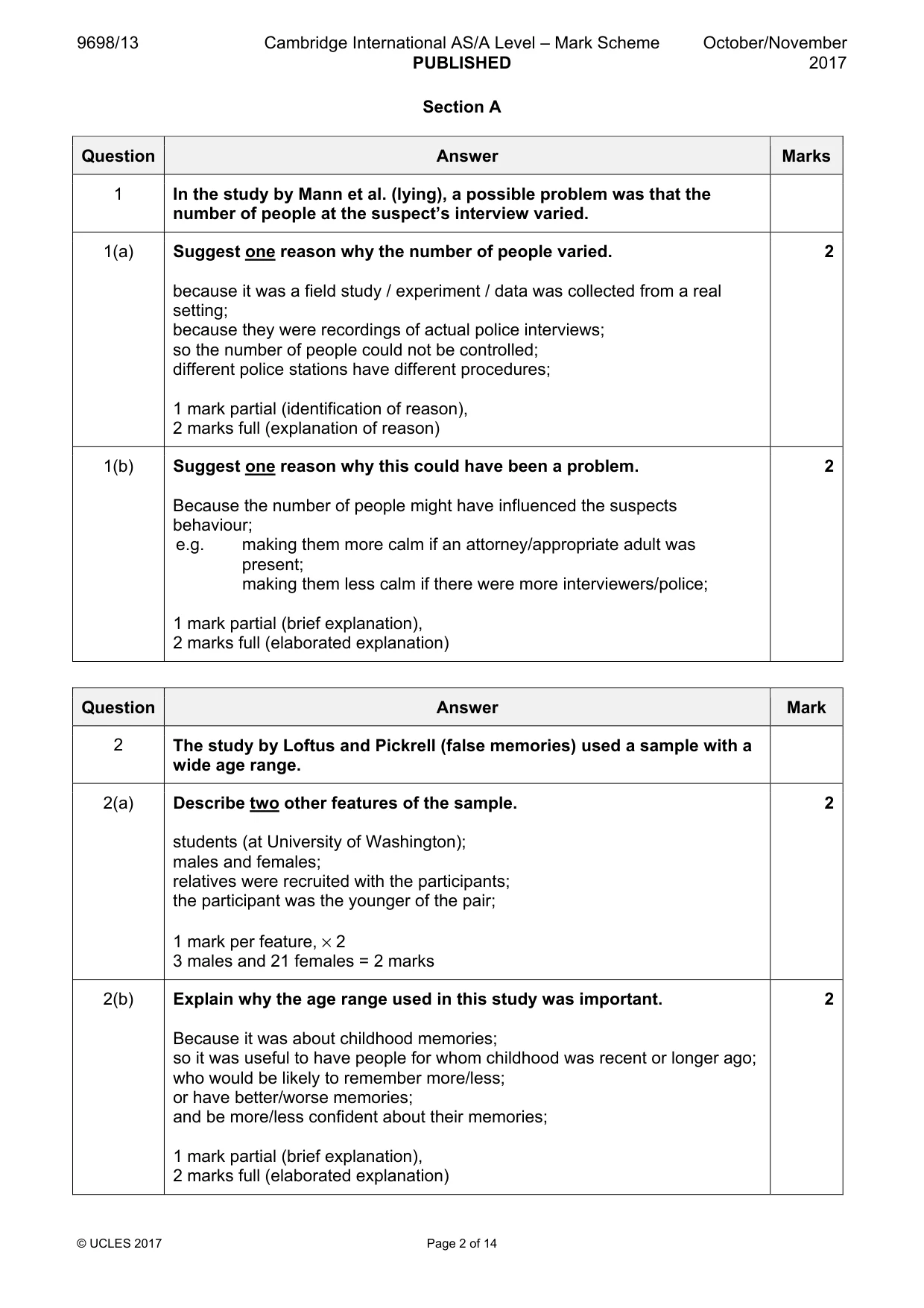
9698/13 Cambridge International AS/A Level – Mark Scheme PUBLISHED October/November 2017 © UCLES 2017 Page 2 of 14 Section A Question Answer Marks 1 In the study by Mann et al. (lying), a possible problem was that the number of people at the suspect’s interview varied. 1(a) Suggest one reason why the number of people varied. because it was a field study / experiment / data was collected from a real setting; because they were recordings of actual police interviews; so the number of people could not be controlled; different police stations have different procedures; 1 mark partial (identification of reason), 2 marks full (explanation of reason) 2 1(b) Suggest one reason why this could have been a problem. Because the number of people might have influenced the suspects behaviour; e.g. making them more calm if an attorney/appropriate adult was present; making them less calm if there were more interviewers/police; 1 mark partial (brief explanation), 2 marks full (elaborated explanation) 2 Question Answer Mark 2 The study by Loftus and Pickrell (false memories) used a sample with a wide age range. 2(a) Describe two other features of the sample. students (at University of Washington); males and females; relatives were recruited with the participants; the participant was the younger of the pair; 1 mark per feature, × 2 3 males and 21 females = 2 marks 2 2(b) Explain why the age range used in this study was important. Because it was about childhood memories; so it was useful to have people for whom childhood was recent or longer ago; who would be likely to remember more/less; or have better/worse memories; and be more/less confident about their memories; 1 mark partial (brief explanation), 2 marks full (elaborated explanation) 2
Mark scheme, page 3
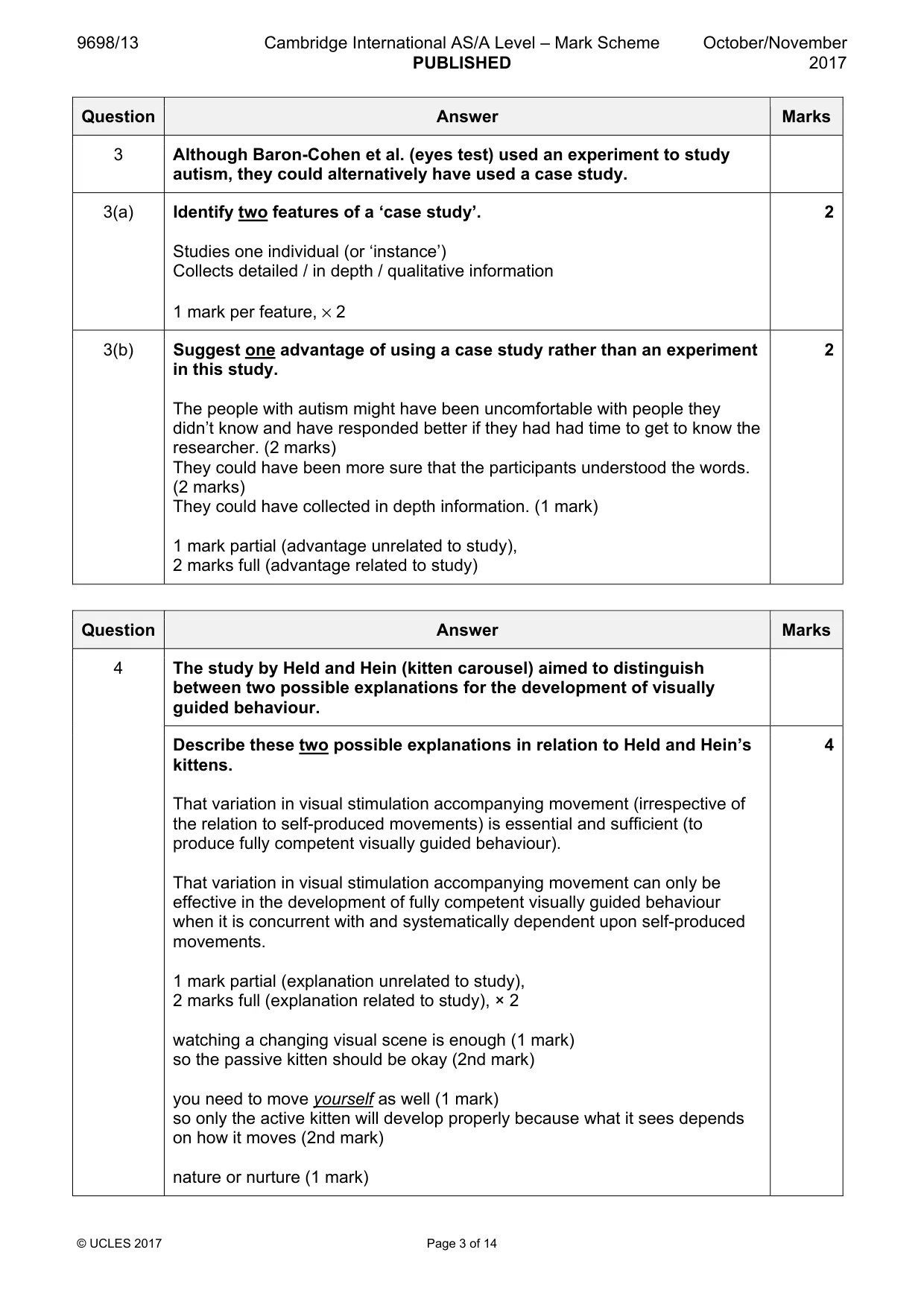
9698/13 Cambridge International AS/A Level – Mark Scheme PUBLISHED October/November 2017 © UCLES 2017 Page 3 of 14 Question Answer Marks 3 Although Baron-Cohen et al. (eyes test) used an experiment to study autism, they could alternatively have used a case study. 3(a) Identify two features of a ‘case study’. Studies one individual (or ‘instance’) Collects detailed / in depth / qualitative information 1 mark per feature, × 2 2 3(b) Suggest one advantage of using a case study rather than an experiment in this study. The people with autism might have been uncomfortable with people they didn’t know and have responded better if they had had time to get to know the researcher. (2 marks) They could have been more sure that the participants understood the words. (2 marks) They could have collected in depth information. (1 mark) 1 mark partial (advantage unrelated to study), 2 marks full (advantage related to study) 2 Question Answer Marks 4 The study by Held and Hein (kitten carousel) aimed to distinguish between two possible explanations for the development of visually guided behaviour. Describe these two possible explanations in relation to Held and Hein’s kittens. That variation in visual stimulation accompanying movement (irrespective of the relation to self-produced movements) is essential and sufficient (to produce fully competent visually guided behaviour). That variation in visual stimulation accompanying movement can only be effective in the development of fully competent visually guided behaviour when it is concurrent with and systematically dependent upon self-produced movements. 1 mark partial (explanation unrelated to study), 2 marks full (explanation related to study), × 2 watching a changing visual scene is enough (1 mark) so the passive kitten should be okay (2nd mark) you need to move yourself as well (1 mark) so only the active kitten will develop properly because what it sees depends on how it moves (2nd mark) nature or nurture (1 mark) 4
Mark scheme, page 4
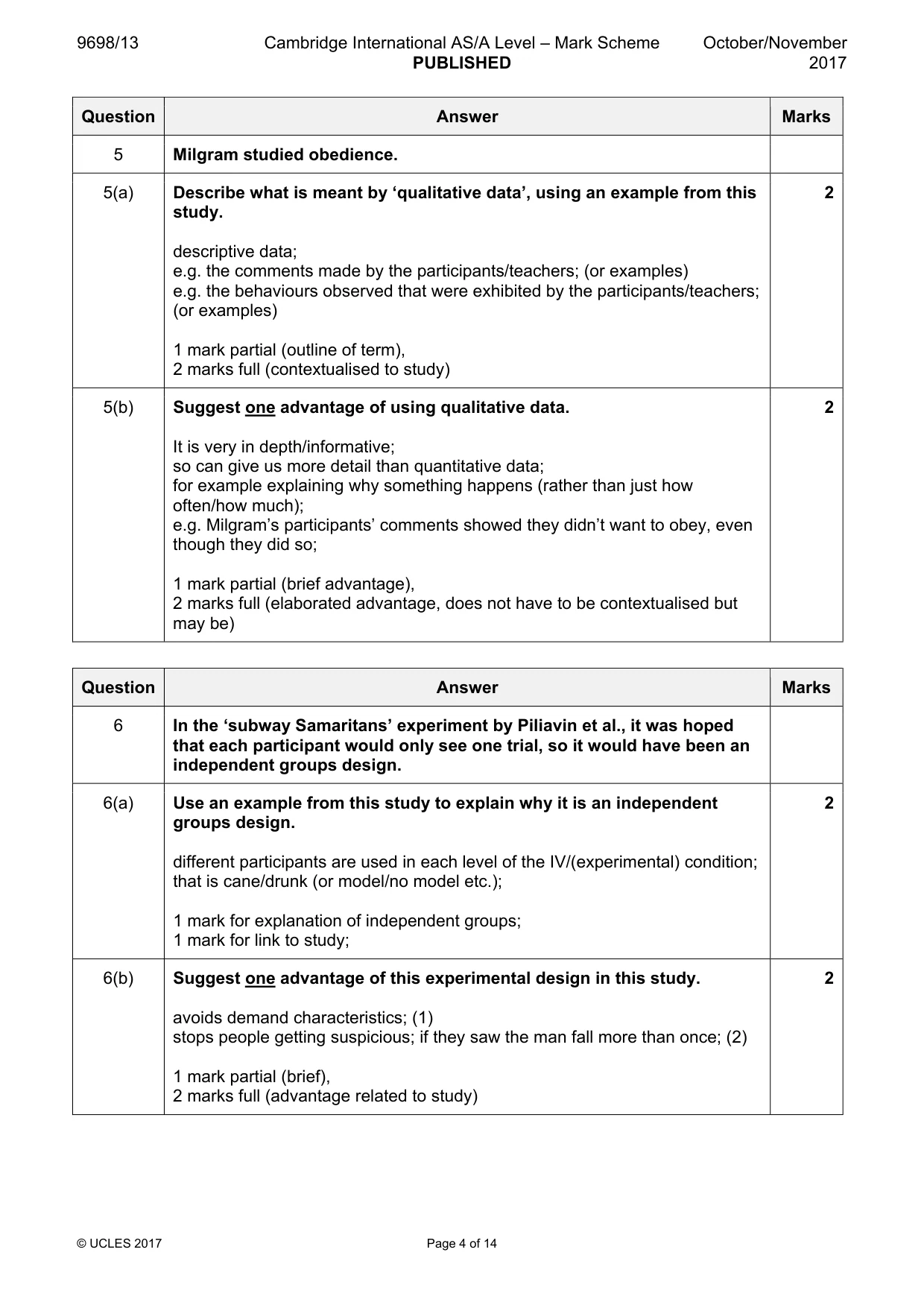
9698/13 Cambridge International AS/A Level – Mark Scheme PUBLISHED October/November 2017 © UCLES 2017 Page 4 of 14 Question Answer Marks 5 Milgram studied obedience. 5(a) Describe what is meant by ‘qualitative data’, using an example from this study. descriptive data; e.g. the comments made by the participants/teachers; (or examples) e.g. the behaviours observed that were exhibited by the participants/teachers; (or examples) 1 mark partial (outline of term), 2 marks full (contextualised to study) 2 5(b) Suggest one advantage of using qualitative data. It is very in depth/informative; so can give us more detail than quantitative data; for example explaining why something happens (rather than just how often/how much); e.g. Milgram’s participants’ comments showed they didn’t want to obey, even though they did so; 1 mark partial (brief advantage), 2 marks full (elaborated advantage, does not have to be contextualised but may be) 2 Question Answer Marks 6 In the ‘subway Samaritans’ experiment by Piliavin et al., it was hoped that each participant would only see one trial, so it would have been an independent groups design. 6(a) Use an example from this study to explain why it is an independent groups design. different participants are used in each level of the IV/(experimental) condition; that is cane/drunk (or model/no model etc.); 1 mark for explanation of independent groups; 1 mark for link to study; 2 6(b) Suggest one advantage of this experimental design in this study. avoids demand characteristics; (1) stops people getting suspicious; if they saw the man fall more than once; (2) 1 mark partial (brief), 2 marks full (advantage related to study) 2
Mark scheme, page 5
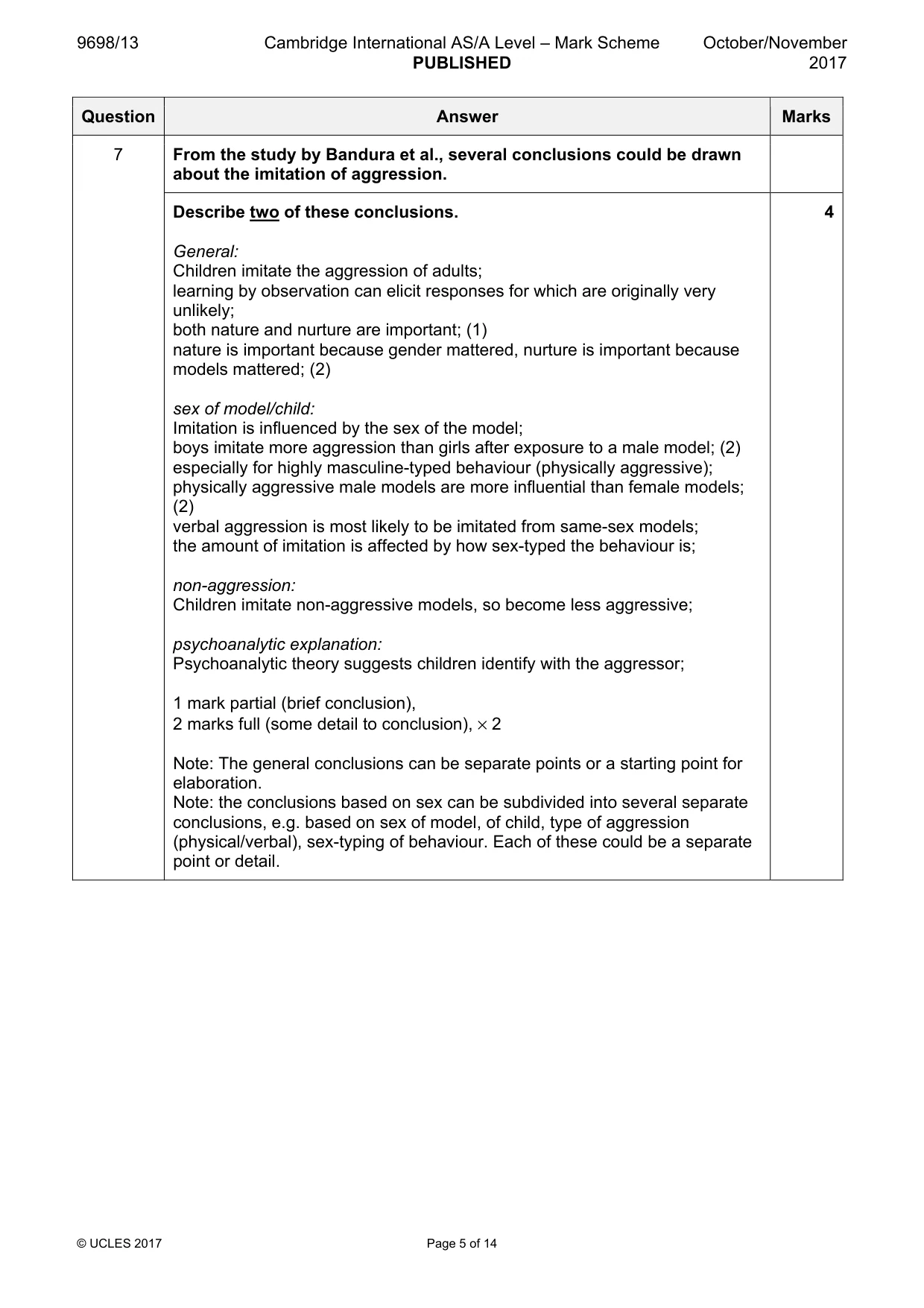
9698/13 Cambridge International AS/A Level – Mark Scheme PUBLISHED October/November 2017 © UCLES 2017 Page 5 of 14 Question Answer Marks 7 From the study by Bandura et al., several conclusions could be drawn about the imitation of aggression. Describe two of these conclusions. General: Children imitate the aggression of adults; learning by observation can elicit responses for which are originally very unlikely; both nature and nurture are important; (1) nature is important because gender mattered, nurture is important because models mattered; (2) sex of model/child: Imitation is influenced by the sex of the model; boys imitate more aggression than girls after exposure to a male model; (2) especially for highly masculine-typed behaviour (physically aggressive); physically aggressive male models are more influential than female models; (2) verbal aggression is most likely to be imitated from same-sex models; the amount of imitation is affected by how sex-typed the behaviour is; non-aggression: Children imitate non-aggressive models, so become less aggressive; psychoanalytic explanation: Psychoanalytic theory suggests children identify with the aggressor; 1 mark partial (brief conclusion), 2 marks full (some detail to conclusion), × 2 Note: The general conclusions can be separate points or a starting point for elaboration. Note: the conclusions based on sex can be subdivided into several separate conclusions, e.g. based on sex of model, of child, type of aggression (physical/verbal), sex-typing of behaviour. Each of these could be a separate point or detail. 4
Mark scheme, page 6
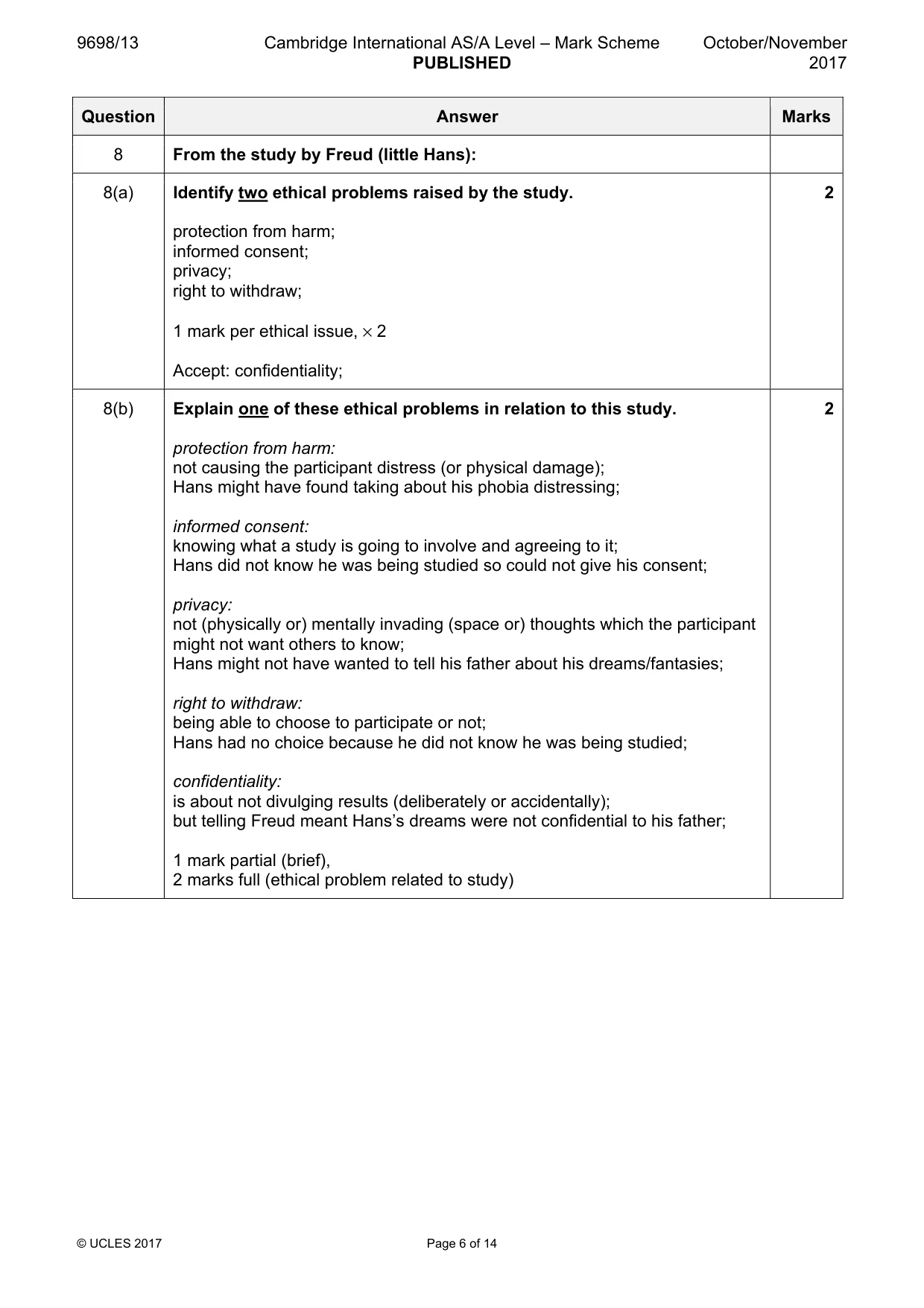
9698/13 Cambridge International AS/A Level – Mark Scheme PUBLISHED October/November 2017 © UCLES 2017 Page 6 of 14 Question Answer Marks 8 From the study by Freud (little Hans): 8(a) Identify two ethical problems raised by the study. protection from harm; informed consent; privacy; right to withdraw; 1 mark per ethical issue, × 2 Accept: confidentiality; 2 8(b) Explain one of these ethical problems in relation to this study. protection from harm: not causing the participant distress (or physical damage); Hans might have found taking about his phobia distressing; informed consent: knowing what a study is going to involve and agreeing to it; Hans did not know he was being studied so could not give his consent; privacy: not (physically or) mentally invading (space or) thoughts which the participant might not want others to know; Hans might not have wanted to tell his father about his dreams/fantasies; right to withdraw: being able to choose to participate or not; Hans had no choice because he did not know he was being studied; confidentiality: is about not divulging results (deliberately or accidentally); but telling Freud meant Hans’s dreams were not confidential to his father; 1 mark partial (brief), 2 marks full (ethical problem related to study) 2
Mark scheme, page 7
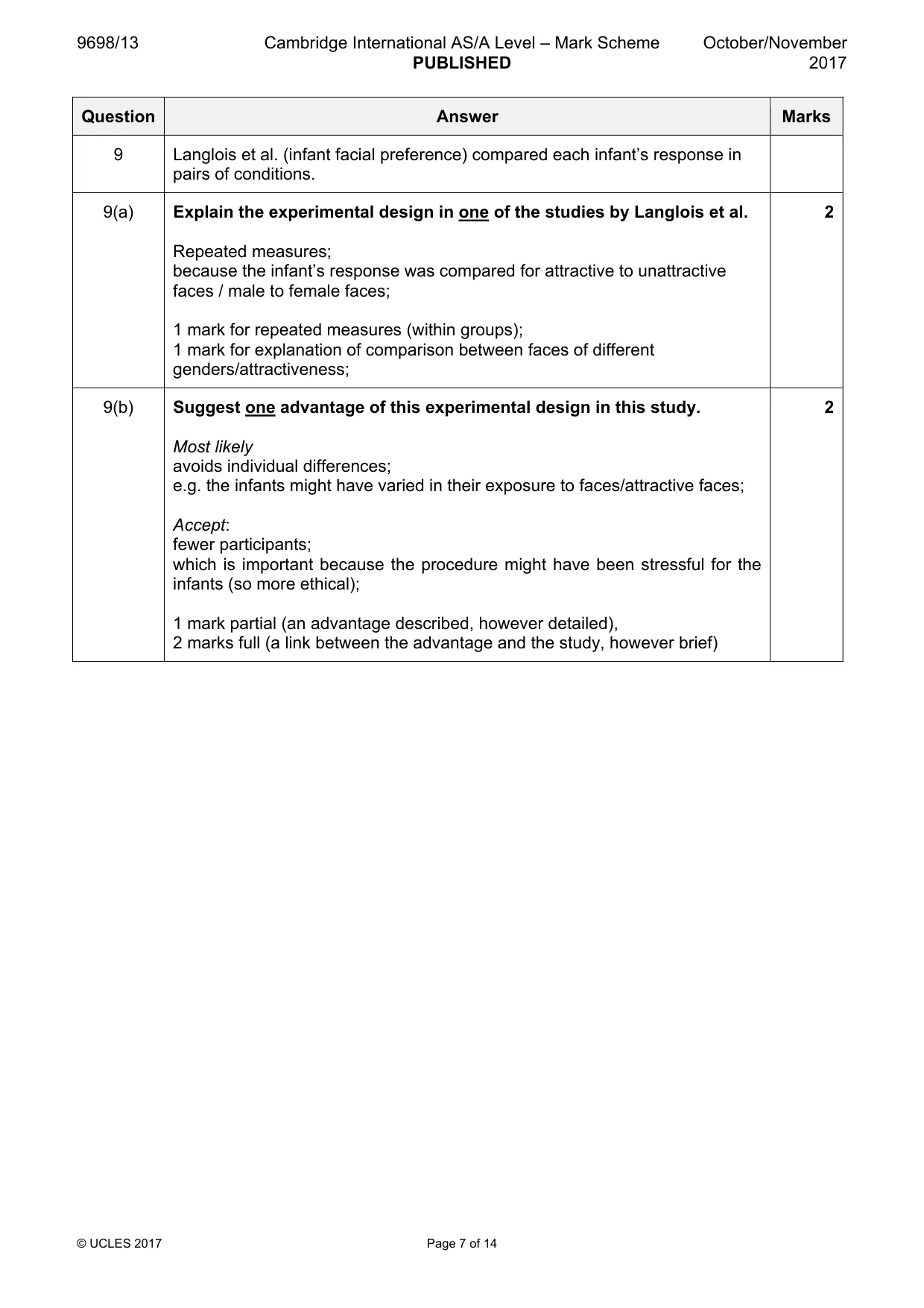
9698/13 Cambridge International AS/A Level – Mark Scheme PUBLISHED October/November 2017 © UCLES 2017 Page 7 of 14 Question Answer Marks 9 Langlois et al. (infant facial preference) compared each infant’s response in pairs of conditions. 9(a) Explain the experimental design in one of the studies by Langlois et al. Repeated measures; because the infant’s response was compared for attractive to unattractive faces / male to female faces; 1 mark for repeated measures (within groups); 1 mark for explanation of comparison between faces of different genders/attractiveness; 2 9(b) Suggest one advantage of this experimental design in this study. Most likely avoids individual differences; e.g. the infants might have varied in their exposure to faces/attractive faces; Accept: fewer participants; which is important because the procedure might have been stressful for the infants (so more ethical); 1 mark partial (an advantage described, however detailed), 2 marks full (a link between the advantage and the study, however brief) 2
Mark scheme, page 8
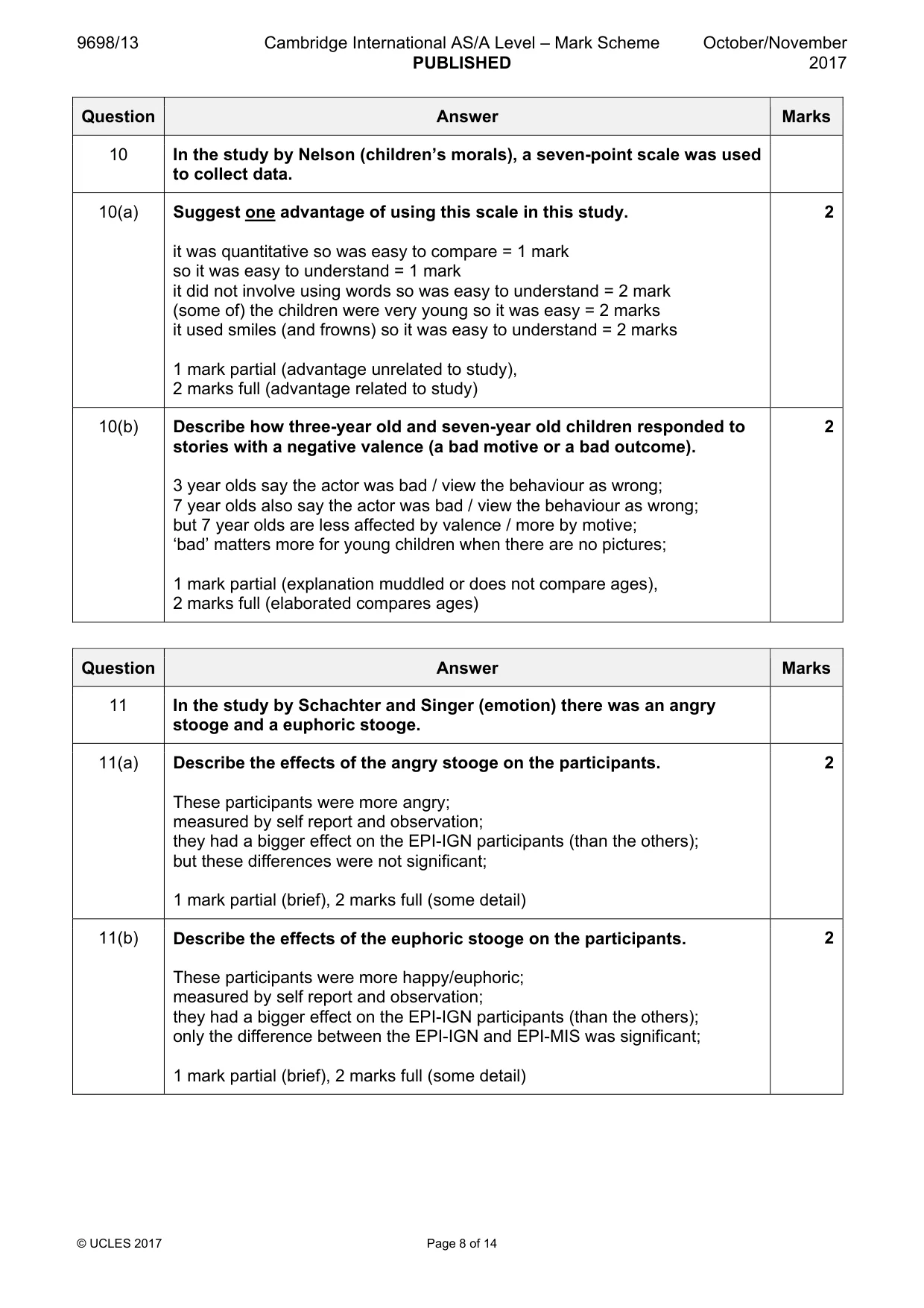
9698/13 Cambridge International AS/A Level – Mark Scheme PUBLISHED October/November 2017 © UCLES 2017 Page 8 of 14 Question Answer Marks 10 In the study by Nelson (children’s morals), a seven-point scale was used to collect data. 10(a) Suggest one advantage of using this scale in this study. it was quantitative so was easy to compare = 1 mark so it was easy to understand = 1 mark it did not involve using words so was easy to understand = 2 mark (some of) the children were very young so it was easy = 2 marks it used smiles (and frowns) so it was easy to understand = 2 marks 1 mark partial (advantage unrelated to study), 2 marks full (advantage related to study) 2 10(b) Describe how three-year old and seven-year old children responded to stories with a negative valence (a bad motive or a bad outcome). 3 year olds say the actor was bad / view the behaviour as wrong; 7 year olds also say the actor was bad / view the behaviour as wrong; but 7 year olds are less affected by valence / more by motive; ‘bad’ matters more for young children when there are no pictures; 1 mark partial (explanation muddled or does not compare ages), 2 marks full (elaborated compares ages) 2 Question Answer Marks 11 In the study by Schachter and Singer (emotion) there was an angry stooge and a euphoric stooge. 11(a) Describe the effects of the angry stooge on the participants. These participants were more angry; measured by self report and observation; they had a bigger effect on the EPI-IGN participants (than the others); but these differences were not significant; 1 mark partial (brief), 2 marks full (some detail) 2 11(b) Describe the effects of the euphoric stooge on the participants. These participants were more happy/euphoric; measured by self report and observation; they had a bigger effect on the EPI-IGN participants (than the others); only the difference between the EPI-IGN and EPI-MIS was significant; 1 mark partial (brief), 2 marks full (some detail) 2
Mark scheme, page 9
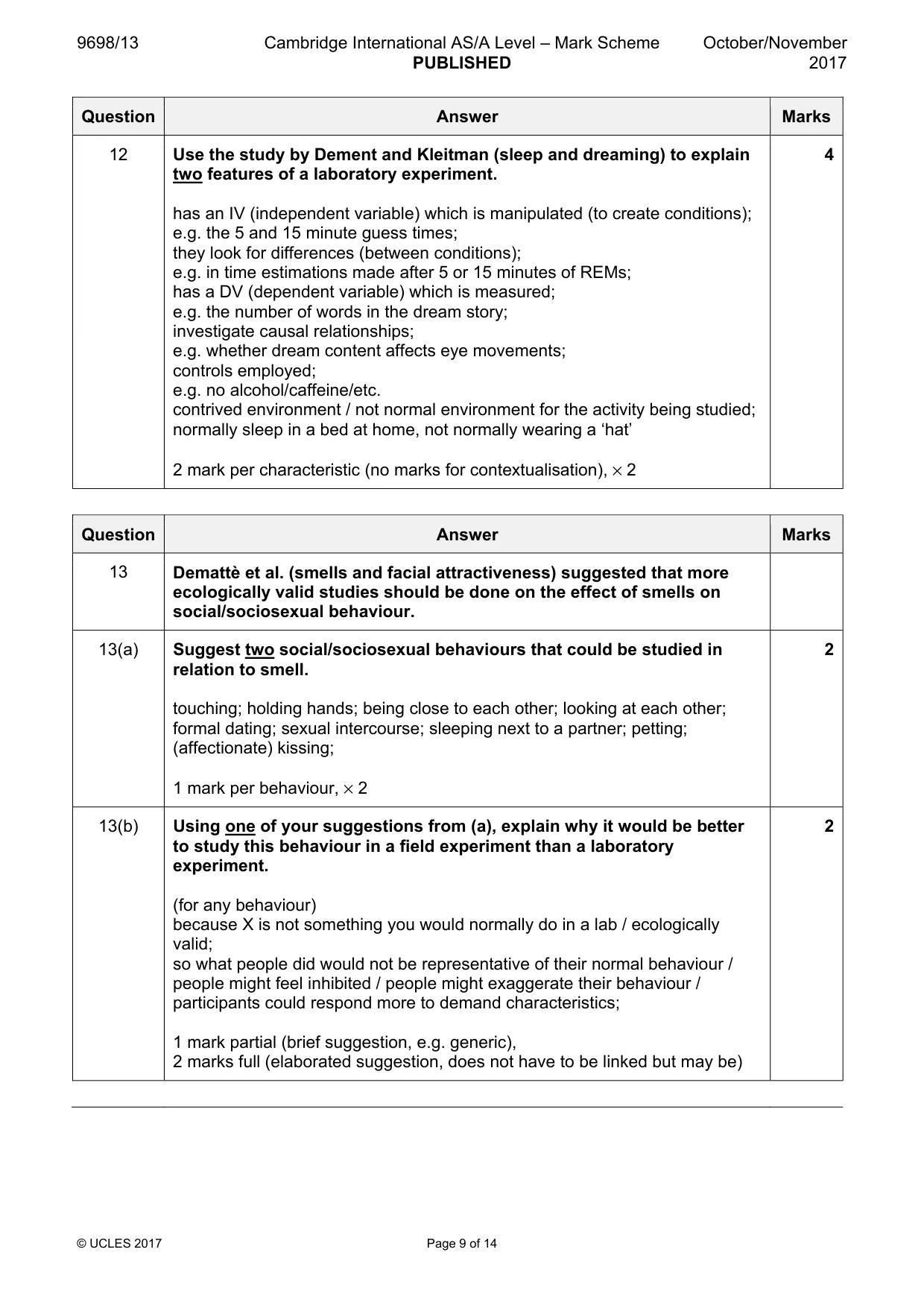
9698/13 Cambridge International AS/A Level – Mark Scheme PUBLISHED October/November 2017 © UCLES 2017 Page 9 of 14 Question Answer Marks 12 Use the study by Dement and Kleitman (sleep and dreaming) to explain two features of a laboratory experiment. has an IV (independent variable) which is manipulated (to create conditions); e.g. the 5 and 15 minute guess times; they look for differences (between conditions); e.g. in time estimations made after 5 or 15 minutes of REMs; has a DV (dependent variable) which is measured; e.g. the number of words in the dream story; investigate causal relationships; e.g. whether dream content affects eye movements; controls employed; e.g. no alcohol/caffeine/etc. contrived environment / not normal environment for the activity being studied; normally sleep in a bed at home, not normally wearing a ‘hat’ 2 mark per characteristic (no marks for contextualisation), × 2 4 Question Answer Marks 13 Demattè et al. (smells and facial attractiveness) suggested that more ecologically valid studies should be done on the effect of smells on social/sociosexual behaviour. 13(a) Suggest two social/sociosexual behaviours that could be studied in relation to smell. touching; holding hands; being close to each other; looking at each other; formal dating; sexual intercourse; sleeping next to a partner; petting; (affectionate) kissing; 1 mark per behaviour, × 2 2 13(b) Using one of your suggestions from (a), explain why it would be better to study this behaviour in a field experiment than a laboratory experiment. (for any behaviour) because X is not something you would normally do in a lab / ecologically valid; so what people did would not be representative of their normal behaviour / people might feel inhibited / people might exaggerate their behaviour / participants could respond more to demand characteristics; 1 mark partial (brief suggestion, e.g. generic), 2 marks full (elaborated suggestion, does not have to be linked but may be) 2
Mark scheme, page 10
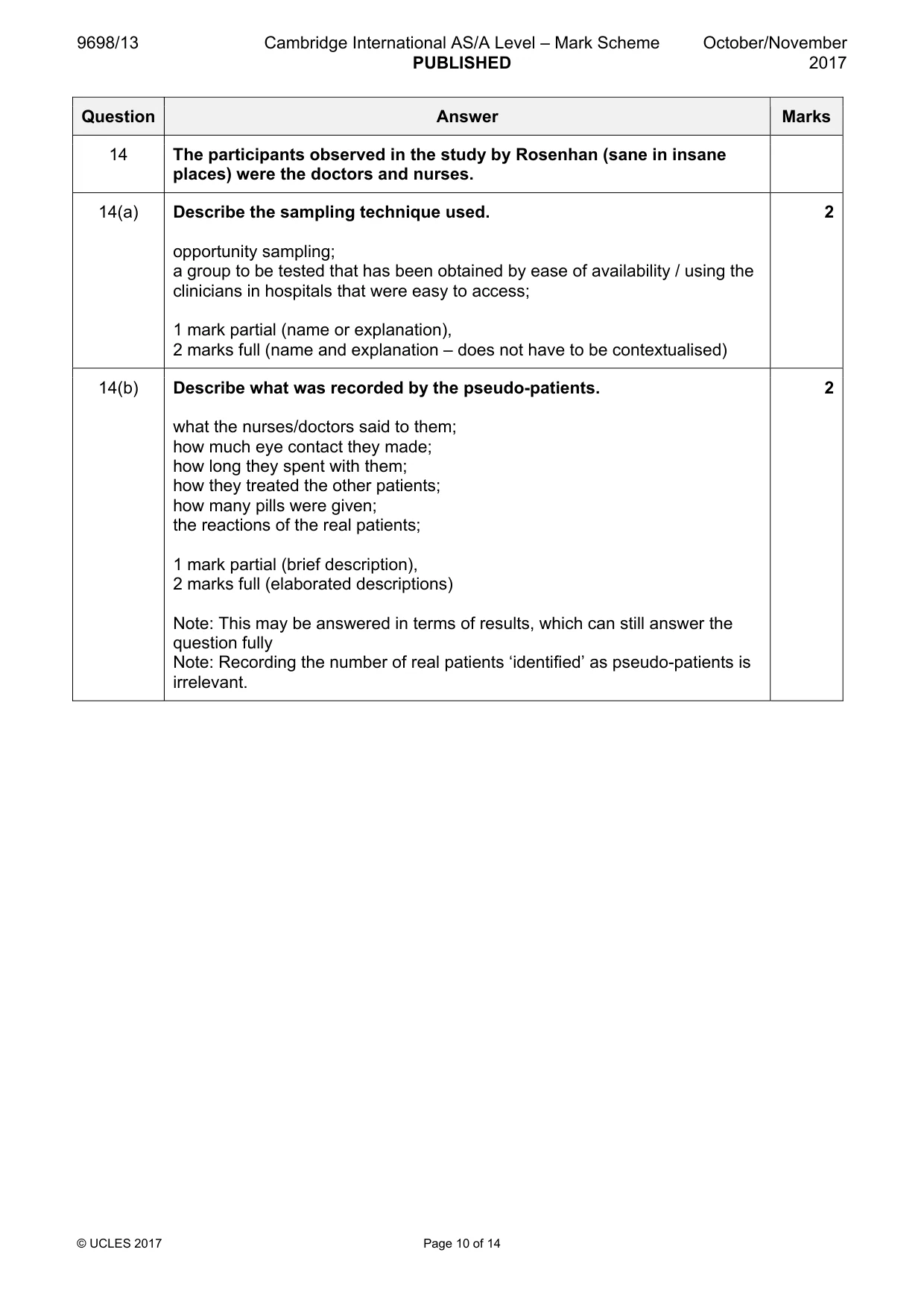
9698/13 Cambridge International AS/A Level – Mark Scheme PUBLISHED October/November 2017 © UCLES 2017 Page 10 of 14 Question Answer Marks 14 The participants observed in the study by Rosenhan (sane in insane places) were the doctors and nurses. 14(a) Describe the sampling technique used. opportunity sampling; a group to be tested that has been obtained by ease of availability / using the clinicians in hospitals that were easy to access; 1 mark partial (name or explanation), 2 marks full (name and explanation – does not have to be contextualised) 2 14(b) Describe what was recorded by the pseudo-patients. what the nurses/doctors said to them; how much eye contact they made; how long they spent with them; how they treated the other patients; how many pills were given; the reactions of the real patients; 1 mark partial (brief description), 2 marks full (elaborated descriptions) Note: This may be answered in terms of results, which can still answer the question fully Note: Recording the number of real patients ‘identified’ as pseudo-patients is irrelevant. 2
Mark scheme, page 11
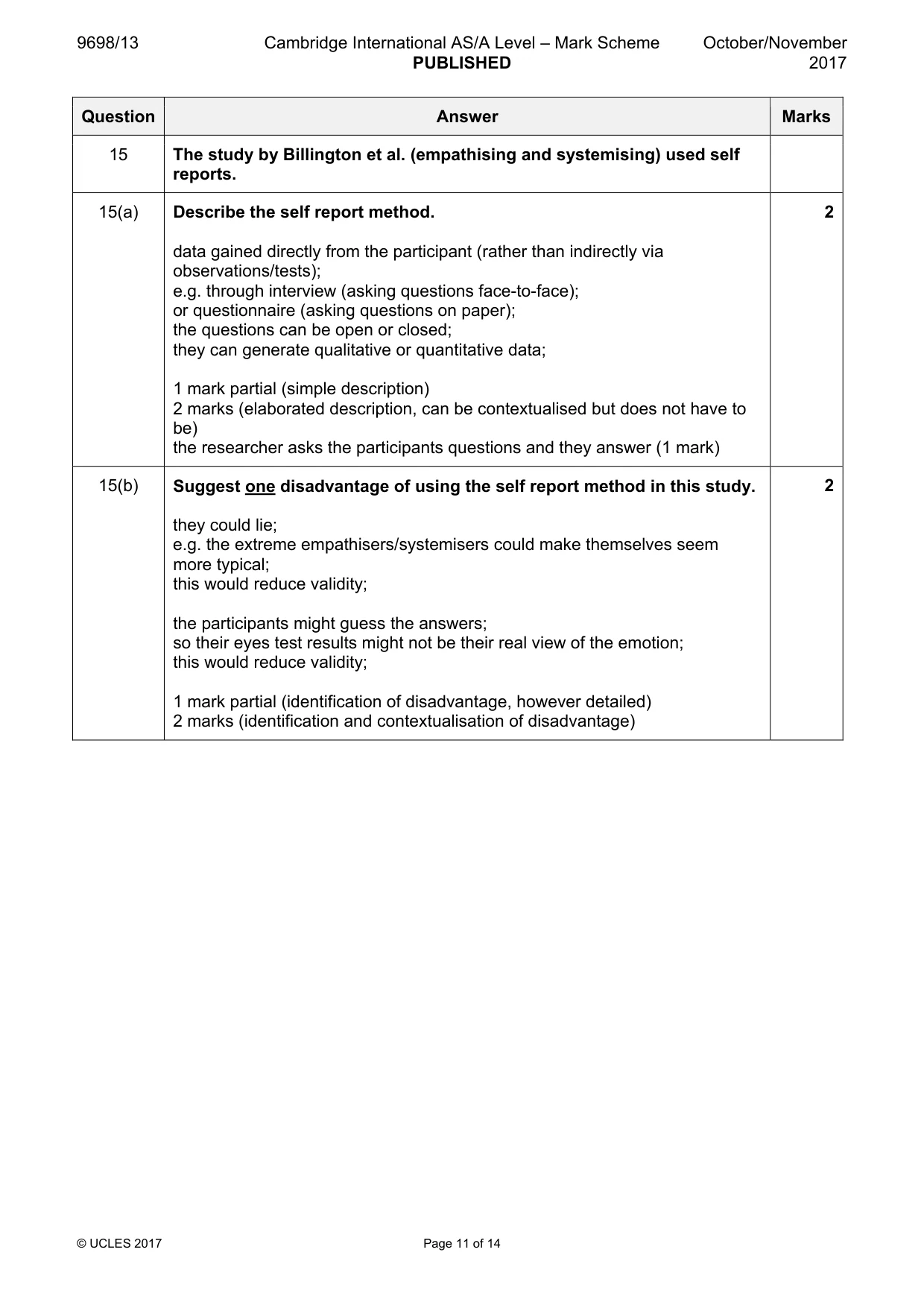
9698/13 Cambridge International AS/A Level – Mark Scheme PUBLISHED October/November 2017 © UCLES 2017 Page 11 of 14 Question Answer Marks 15 The study by Billington et al. (empathising and systemising) used self reports. 15(a) Describe the self report method. data gained directly from the participant (rather than indirectly via observations/tests); e.g. through interview (asking questions face-to-face); or questionnaire (asking questions on paper); the questions can be open or closed; they can generate qualitative or quantitative data; 1 mark partial (simple description) 2 marks (elaborated description, can be contextualised but does not have to be) the researcher asks the participants questions and they answer (1 mark) 2 15(b) Suggest one disadvantage of using the self report method in this study. they could lie; e.g. the extreme empathisers/systemisers could make themselves seem more typical; this would reduce validity; the participants might guess the answers; so their eyes test results might not be their real view of the emotion; this would reduce validity; 1 mark partial (identification of disadvantage, however detailed) 2 marks (identification and contextualisation of disadvantage) 2
Mark scheme, page 12
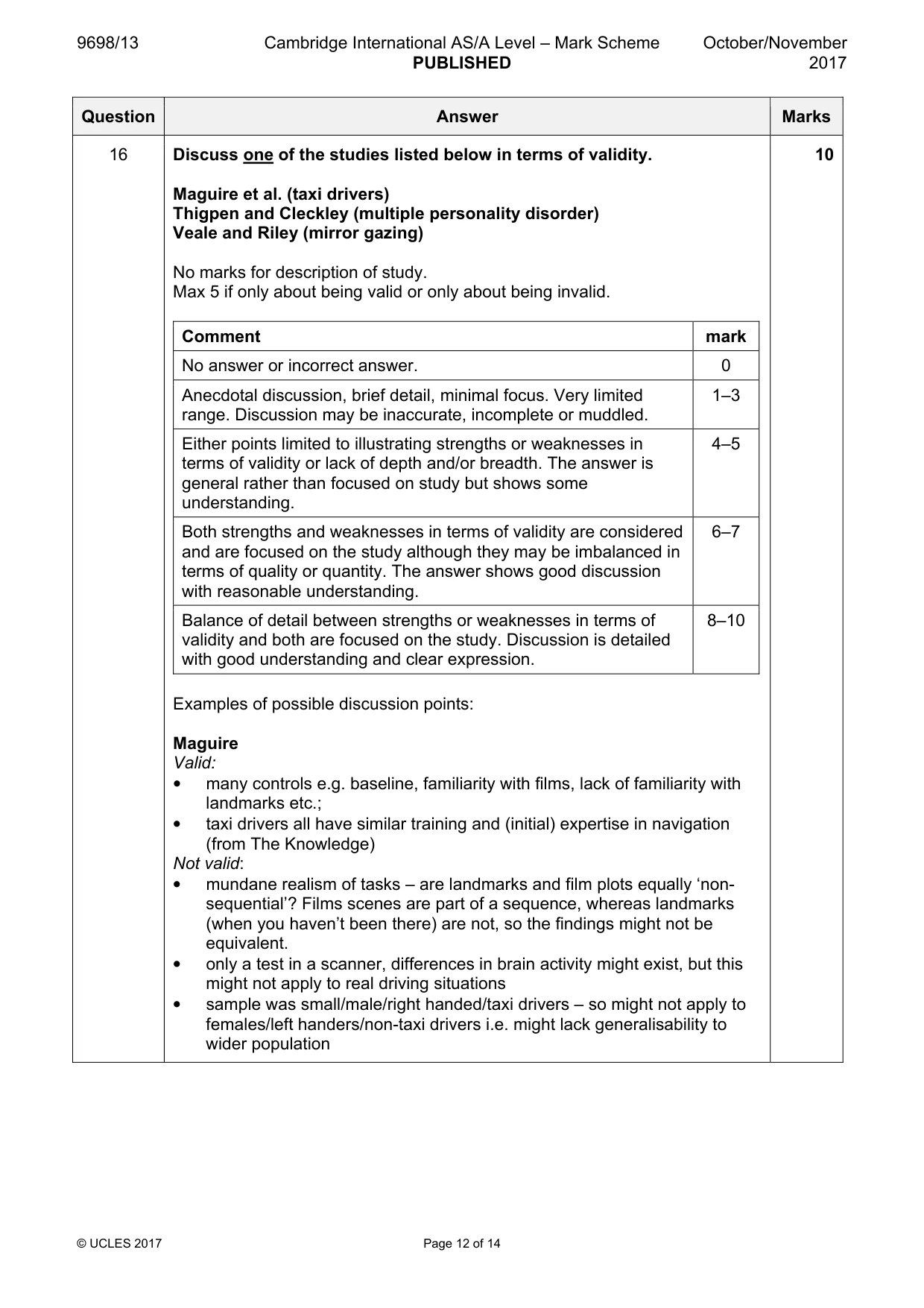
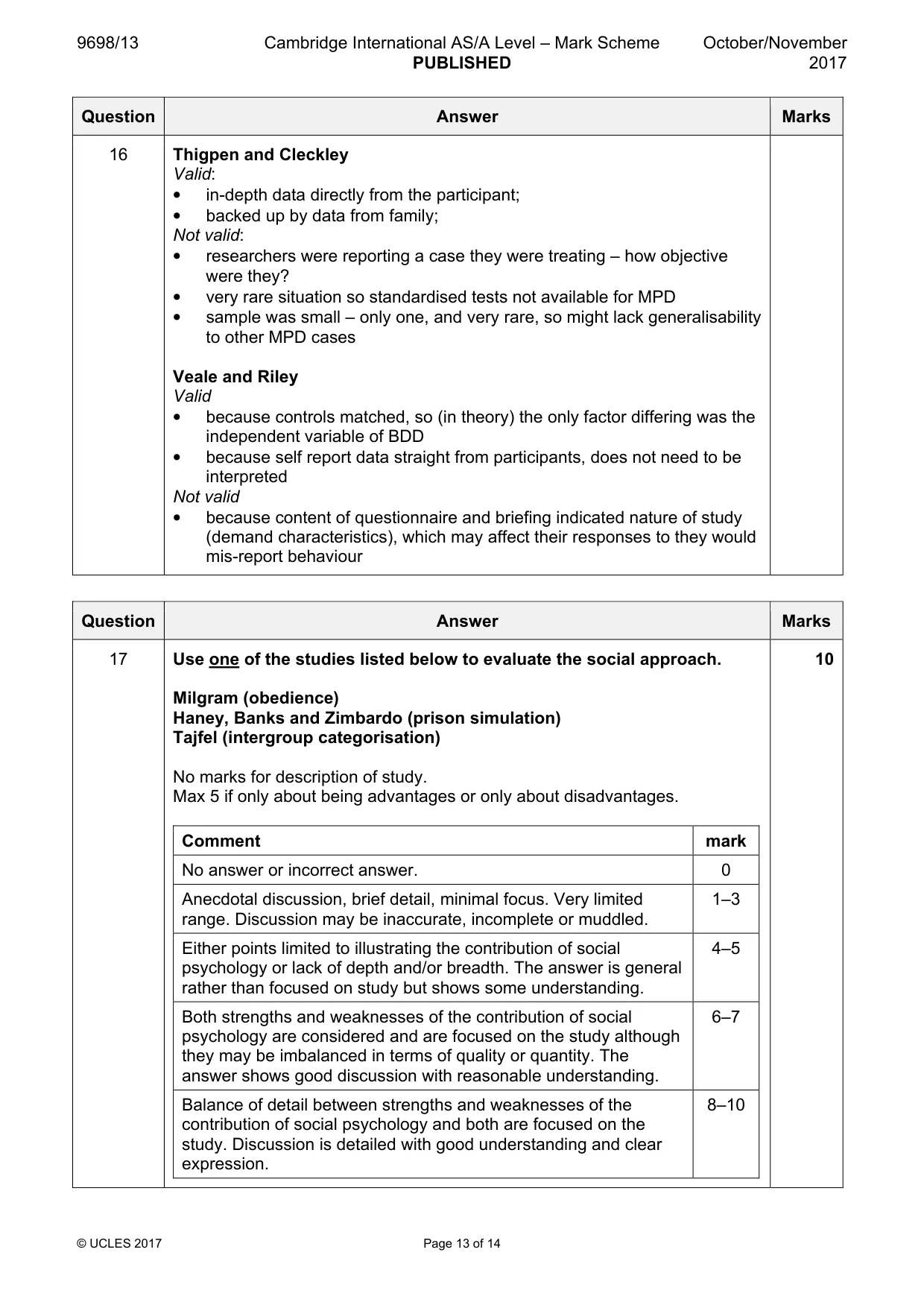
9698/13 Cambridge International AS/A Level – Mark Scheme PUBLISHED October/November 2017 © UCLES 2017 Page 12 of 14 Question Answer Marks 16 Discuss one of the studies listed below in terms of validity. Maguire et al. (taxi drivers) Thigpen and Cleckley (multiple personality disorder) Veale and Riley (mirror gazing) No marks for description of study. Max 5 if only about being valid or only about being invalid. Comment mark No answer or incorrect answer. 0 Anecdotal discussion, brief detail, minimal focus. Very limited range. Discussion may be inaccurate, incomplete or muddled. 1–3 Either points limited to illustrating strengths or weaknesses in terms of validity or lack of depth and/or breadth. The answer is general rather than focused on study but shows some understanding. 4–5 Both strengths and weaknesses in terms of validity are considered and are focused on the study although they may be imbalanced in terms of quality or quantity. The answer shows good discussion with reasonable understanding. 6–7 Balance of detail between strengths or weaknesses in terms of validity and both are focused on the study. Discussion is detailed with good understanding and clear expression. 8–10 Examples of possible discussion points: Maguire Valid: • many controls e.g. baseline, familiarity with films, lack of familiarity with landmarks etc.; • taxi drivers all have similar training and (initial) expertise in navigation (from The Knowledge) Not valid: • mundane realism of tasks – are landmarks and film plots equally ‘non- sequential’? Films scenes are part of a sequence, whereas landmarks (when you haven’t been there) are not, so the findings might not be equivalent. • only a test in a scanner, differences in brain activity might exist, but this might not apply to real driving situations • sample was small/male/right handed/taxi drivers – so might not apply to females/left handers/non-taxi drivers i.e. might lack generalisability to wider population 10
Mark scheme, page 13
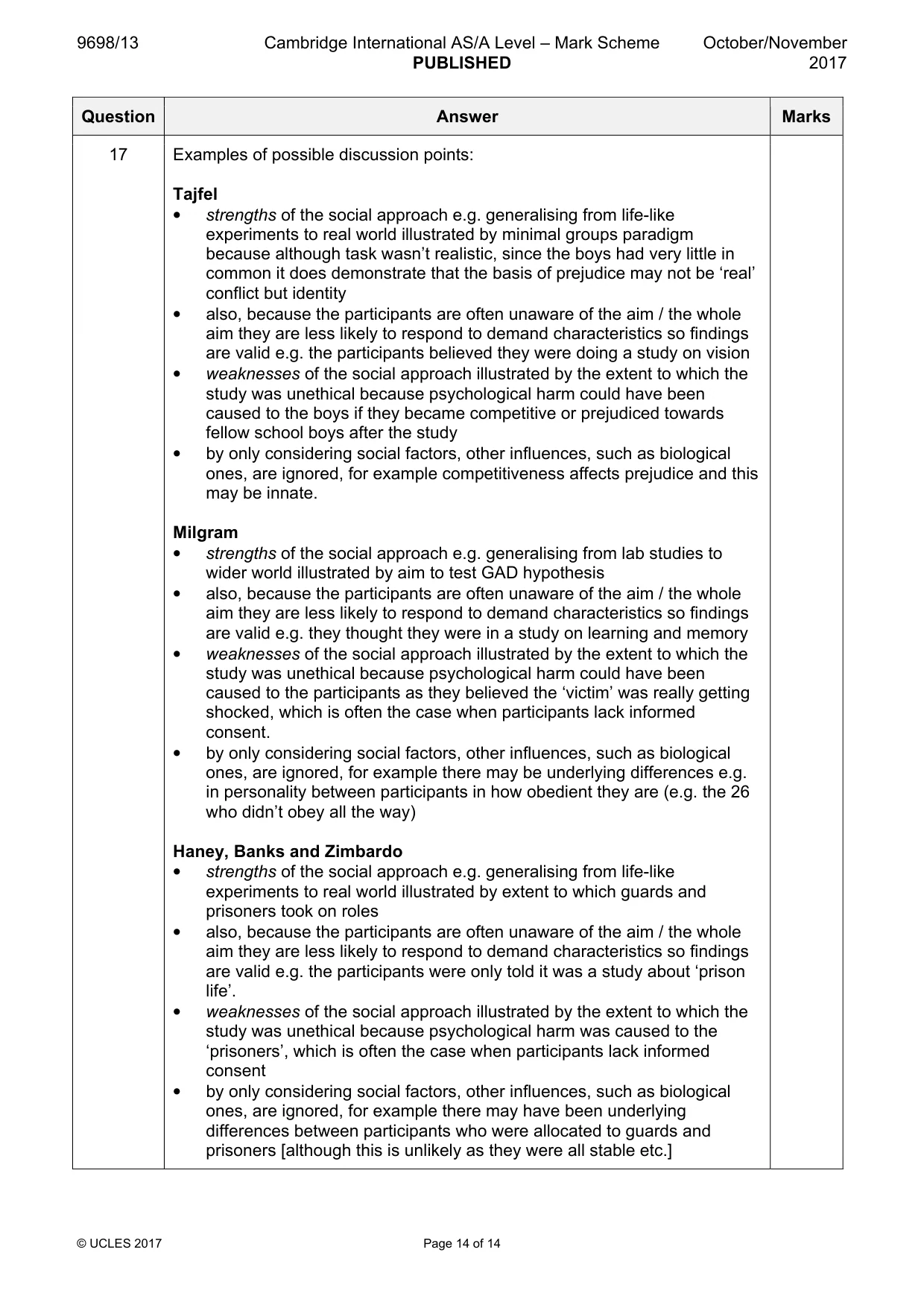
9698/13 Cambridge International AS/A Level – Mark Scheme PUBLISHED October/November 2017 © UCLES 2017 Page 13 of 14 Question Answer Marks 16 Thigpen and Cleckley Valid: • in-depth data directly from the participant; • backed up by data from family; Not valid: • researchers were reporting a case they were treating – how objective were they? • very rare situation so standardised tests not available for MPD • sample was small – only one, and very rare, so might lack generalisability to other MPD cases Veale and Riley Valid • because controls matched, so (in theory) the only factor differing was the independent variable of BDD • because self report data straight from participants, does not need to be interpreted Not valid • because content of questionnaire and briefing indicated nature of study (demand characteristics), which may affect their responses to they would mis-report behaviour Question Answer Marks 17 Use one of the studies listed below to evaluate the social approach. Milgram (obedience) Haney, Banks and Zimbardo (prison simulation) Tajfel (intergroup categorisation) No marks for description of study. Max 5 if only about being advantages or only about disadvantages. Comment mark No answer or incorrect answer. 0 Anecdotal discussion, brief detail, minimal focus. Very limited range. Discussion may be inaccurate, incomplete or muddled. 1–3 Either points limited to illustrating the contribution of social psychology or lack of depth and/or breadth. The answer is general rather than focused on study but shows some understanding. 4–5 Both strengths and weaknesses of the contribution of social psychology are considered and are focused on the study although they may be imbalanced in terms of quality or quantity. The answer shows good discussion with reasonable understanding. 6–7 Balance of detail between strengths and weaknesses of the contribution of social psychology and both are focused on the study. Discussion is detailed with good understanding and clear expression. 8–10 10
Mark scheme, page 14
9698/13 Cambridge International AS/A Level – Mark Scheme PUBLISHED October/November 2017 © UCLES 2017 Page 14 of 14 Question Answer Marks 17 Examples of possible discussion points: Tajfel • strengths of the social approach e.g. generalising from life-like experiments to real world illustrated by minimal groups paradigm because although task wasn’t realistic, since the boys had very little in common it does demonstrate that the basis of prejudice may not be ‘real’ conflict but identity • also, because the participants are often unaware of the aim / the whole aim they are less likely to respond to demand characteristics so findings are valid e.g. the participants believed they were doing a study on vision • weaknesses of the social approach illustrated by the extent to which the study was unethical because psychological harm could have been caused to the boys if they became competitive or prejudiced towards fellow school boys after the study • by only considering social factors, other influences, such as biological ones, are ignored, for example competitiveness affects prejudice and this may be innate. Milgram • strengths of the social approach e.g. generalising from lab studies to wider world illustrated by aim to test GAD hypothesis • also, because the participants are often unaware of the aim / the whole aim they are less likely to respond to demand characteristics so findings are valid e.g. they thought they were in a study on learning and memory • weaknesses of the social approach illustrated by the extent to which the study was unethical because psychological harm could have been caused to the participants as they believed the ‘victim’ was really getting shocked, which is often the case when participants lack informed consent. • by only considering social factors, other influences, such as biological ones, are ignored, for example there may be underlying differences e.g. in personality between participants in how obedient they are (e.g. the 26 who didn’t obey all the way) Haney, Banks and Zimbardo • strengths of the social approach e.g. generalising from life-like experiments to real world illustrated by extent to which guards and prisoners took on roles • also, because the participants are often unaware of the aim / the whole aim they are less likely to respond to demand characteristics so findings are valid e.g. the participants were only told it was a study about ‘prison life’. • weaknesses of the social approach illustrated by the extent to which the study was unethical because psychological harm was caused to the ‘prisoners’, which is often the case when participants lack informed consent • by only considering social factors, other influences, such as biological ones, are ignored, for example there may have been underlying differences between participants who were allocated to guards and prisoners [although this is unlikely as they were all stable etc.]
What you needed in this session
Cambridge’s own grade thresholds for 2017 Oct/Nov, Paper 1 · Variant 3. A higher threshold means an easier paper — the bar moves with how the cohort did.