Cambridge A Level Psychology 9698 — 2017 Oct/Nov Paper 1 · Variant 2
9698/12/O/N/17 · 80 marks · ≈90 min
The question paper and its mark scheme, free to read here and free to download. This is Cambridge’s own paper, exactly as it was sat.
Question paper4 pages
Mark scheme22 pages
Answers below. Sit the paper first if you are practising.
Paper as text
Question paper, page 1
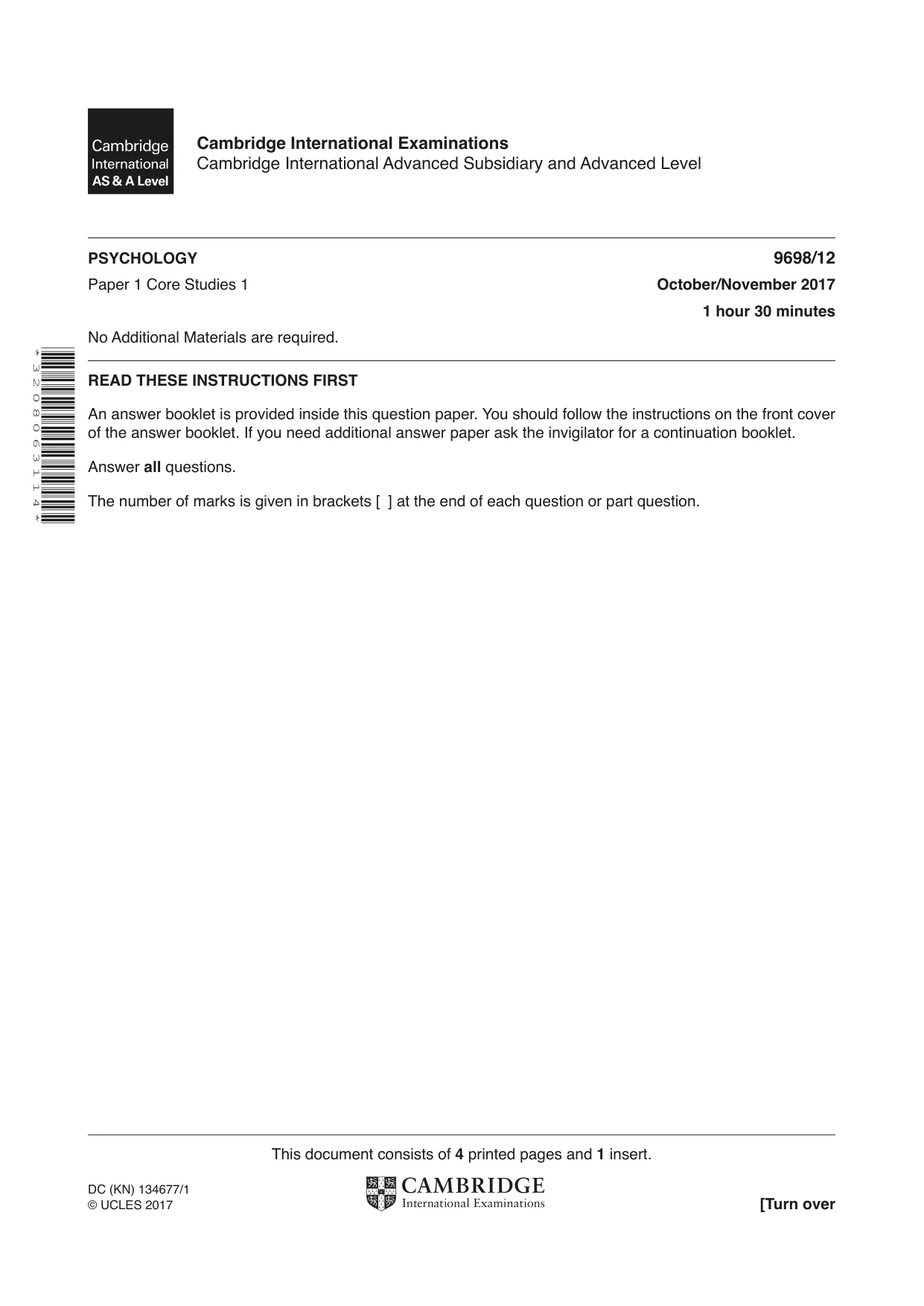
This document consists of 4 printed pages and 1 insert. DC (KN) 134677/1 © UCLES 2017 [Turn over Cambridge International Examinations Cambridge International Advanced Subsidiary and Advanced Level * 3 2 0 8 0 6 3 1 1 4 * PSYCHOLOGY 9698/12 Paper 1 Core Studies 1 October/November 2017 1 hour 30 minutes No Additional Materials are required. READ THESE INSTRUCTIONS FIRST An answer booklet is provided inside this question paper. You should follow the instructions on the front cover of the answer booklet. If you need additional answer paper ask the invigilator for a continuation booklet. Answer all questions. The number of marks is given in brackets [ ] at the end of each question or part question.
Question paper, page 2
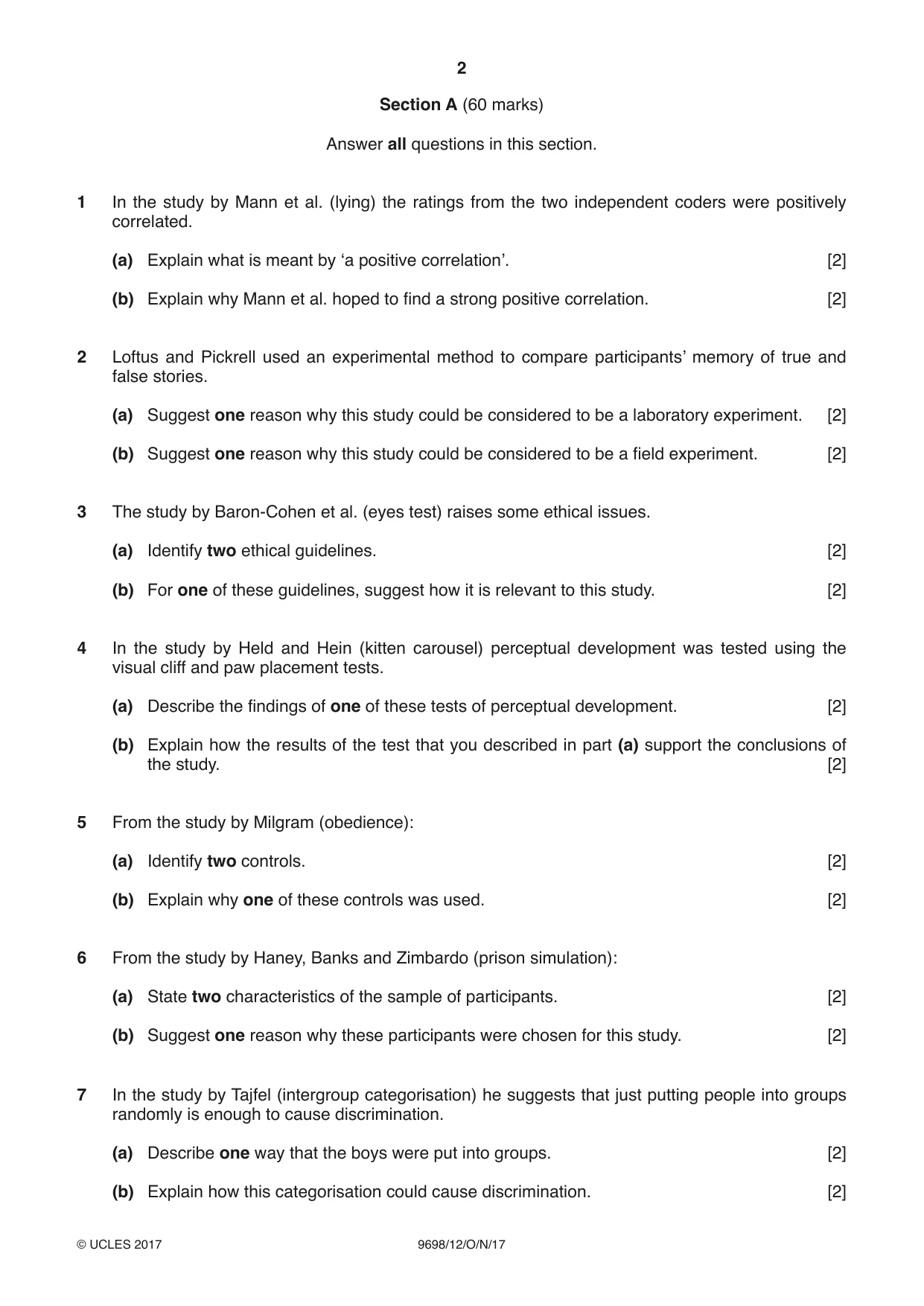
2 9698/12/O/N/17 © UCLES 2017 Section A (60 marks) Answer all questions in this section. 1 In the study by Mann et al. (lying) the ratings from the two independent coders were positively correlated. (a) Explain what is meant by ‘a positive correlation’. [2] (b) Explain why Mann et al. hoped to find a strong positive correlation. [2] 2 Loftus and Pickrell used an experimental method to compare participants’ memory of true and false stories. (a) Suggest one reason why this study could be considered to be a laboratory experiment. [2] (b) Suggest one reason why this study could be considered to be a field experiment. [2] 3 The study by Baron-Cohen et al. (eyes test) raises some ethical issues. (a) Identify two ethical guidelines. [2] (b) For one of these guidelines, suggest how it is relevant to this study. [2] 4 In the study by Held and Hein (kitten carousel) perceptual development was tested using the visual cliff and paw placement tests. (a) Describe the findings of one of these tests of perceptual development. [2] (b) Explain how the results of the test that you described in part (a) support the conclusions of the study. [2] 5 From the study by Milgram (obedience): (a) Identify two controls. [2] (b) Explain why one of these controls was used. [2] 6 From the study by Haney, Banks and Zimbardo (prison simulation): (a) State two characteristics of the sample of participants. [2] (b) Suggest one reason why these participants were chosen for this study. [2] 7 In the study by Tajfel (intergroup categorisation) he suggests that just putting people into groups randomly is enough to cause discrimination. (a) Describe one way that the boys were put into groups. [2] (b) Explain how this categorisation could cause discrimination. [2]
Question paper, page 3
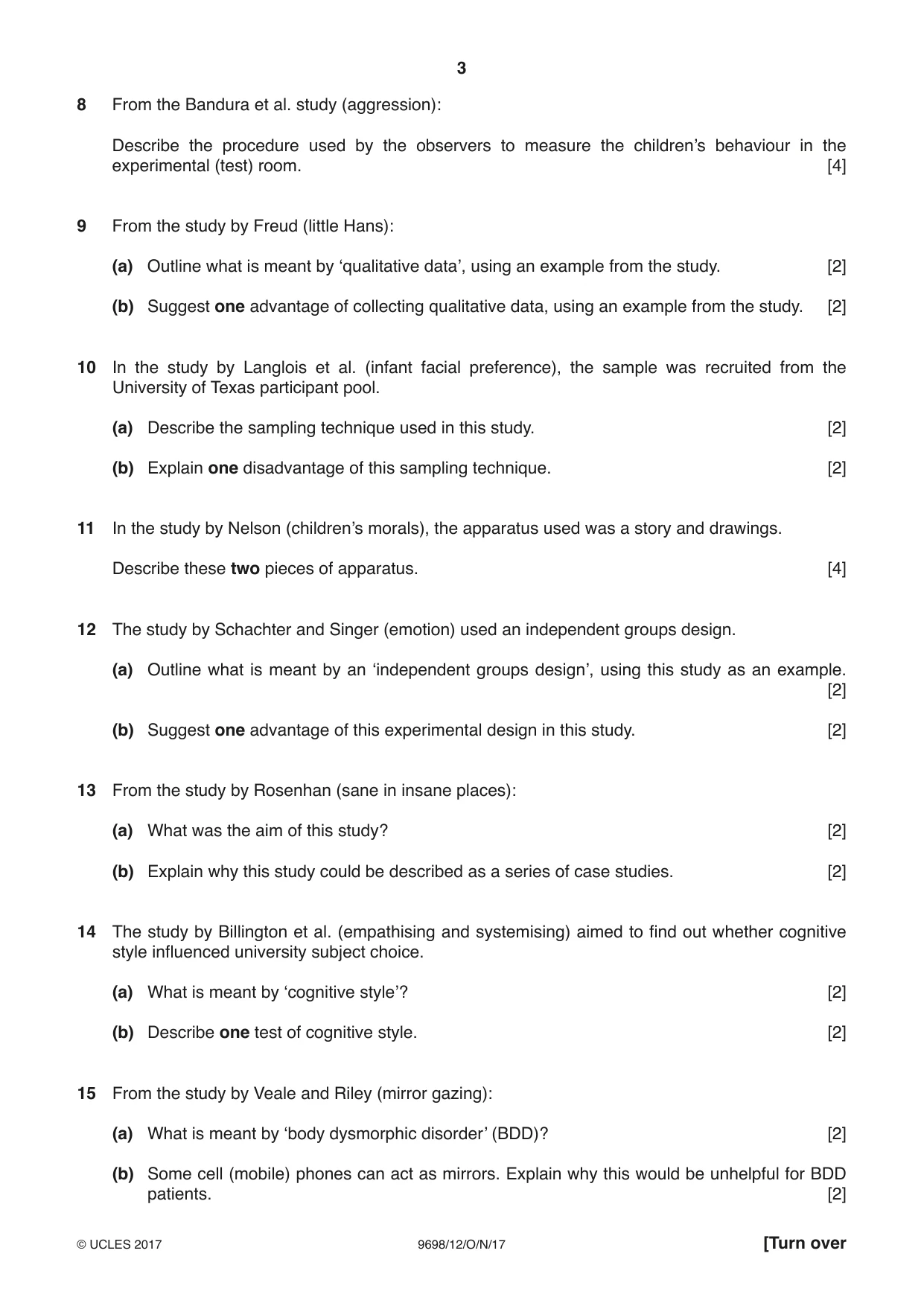
3 9698/12/O/N/17 © UCLES 2017 [Turn over 8 From the Bandura et al. study (aggression): Describe the procedure used by the observers to measure the children’s behaviour in the experimental (test) room. [4] 9 From the study by Freud (little Hans): (a) Outline what is meant by ‘qualitative data’, using an example from the study. [2] (b) Suggest one advantage of collecting qualitative data, using an example from the study. [2] 10 In the study by Langlois et al. (infant facial preference), the sample was recruited from the University of Texas participant pool. (a) Describe the sampling technique used in this study. [2] (b) Explain one disadvantage of this sampling technique. [2] 11 In the study by Nelson (children’s morals), the apparatus used was a story and drawings. Describe these two pieces of apparatus. [4] 12 The study by Schachter and Singer (emotion) used an independent groups design. (a) Outline what is meant by an ‘independent groups design’, using this study as an example. [2] (b) Suggest one advantage of this experimental design in this study. [2] 13 From the study by Rosenhan (sane in insane places): (a) What was the aim of this study? [2] (b) Explain why this study could be described as a series of case studies. [2] 14 The study by Billington et al. (empathising and systemising) aimed to find out whether cognitive style influenced university subject choice. (a) What is meant by ‘cognitive style’? [2] (b) Describe one test of cognitive style. [2] 15 From the study by Veale and Riley (mirror gazing): (a) What is meant by ‘body dysmorphic disorder’ (BDD)? [2] (b) Some cell (mobile) phones can act as mirrors. Explain why this would be unhelpful for BDD patients. [2]
Question paper, page 4
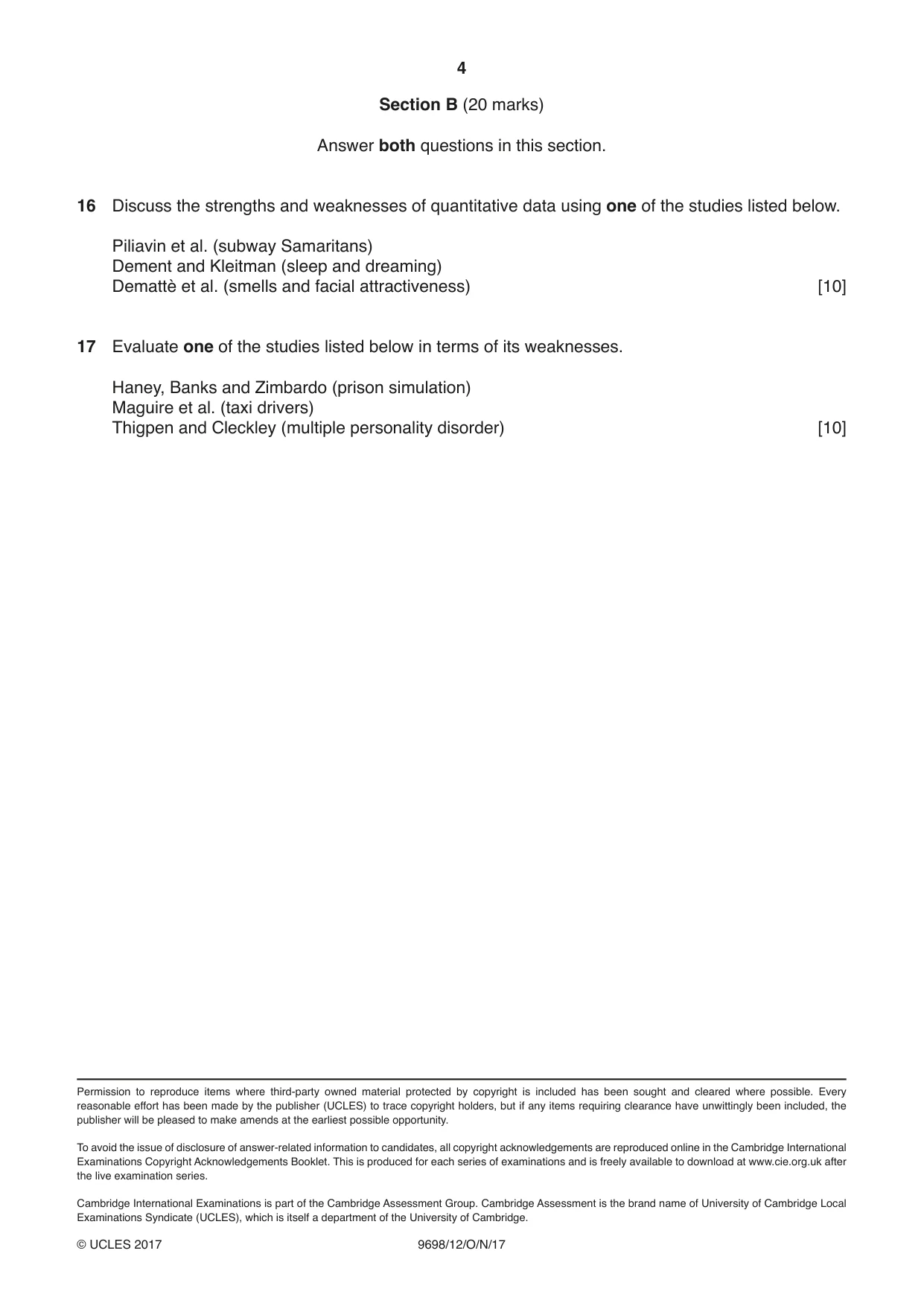
4 9698/12/O/N/17 © UCLES 2017 Permission to reproduce items where third-party owned material protected by copyright is included has been sought and cleared where possible. Every reasonable effort has been made by the publisher (UCLES) to trace copyright holders, but if any items requiring clearance have unwittingly been included, the publisher will be pleased to make amends at the earliest possible opportunity. To avoid the issue of disclosure of answer-related information to candidates, all copyright acknowledgements are reproduced online in the Cambridge International Examinations Copyright Acknowledgements Booklet. This is produced for each series of examinations and is freely available to download at www.cie.org.uk after the live examination series. Cambridge International Examinations is part of the Cambridge Assessment Group. Cambridge Assessment is the brand name of University of Cambridge Local Examinations Syndicate (UCLES), which is itself a department of the University of Cambridge. Section B (20 marks) Answer both questions in this section. 16 Discuss the strengths and weaknesses of quantitative data using one of the studies listed below. Piliavin et al. (subway Samaritans) Dement and Kleitman (sleep and dreaming) Demattè et al. (smells and facial attractiveness) [10] 17 Evaluate one of the studies listed below in terms of its weaknesses. Haney, Banks and Zimbardo (prison simulation) Maguire et al. (taxi drivers) Thigpen and Cleckley (multiple personality disorder) [10]
Mark scheme, page 1
Cambridge Assessment International Education Cambridge International Advanced Subsidiary and Advanced Level PSYCHOLOGY 9698/12 Paper 1 Core Studies 1 October/November 2017 MARK SCHEME Maximum Mark: 80 This mark scheme is published as an aid to teachers and candidates, to indicate the requirements of the examination. It shows the basis on which Examiners were instructed to award marks. It does not indicate the details of the discussions that took place at an Examiners’ meeting before marking began, which would have considered the acceptability of alternative answers. Mark schemes should be read in conjunction with the question paper and the Principal Examiner Report for Teachers. Cambridge International will not enter into discussions about these mark schemes. Cambridge International is publishing the mark schemes for the October/November 2017 series for most Cambridge IGCSE®, Cambridge International A and AS Level components and some Cambridge O Level components. Published
Mark scheme, page 2
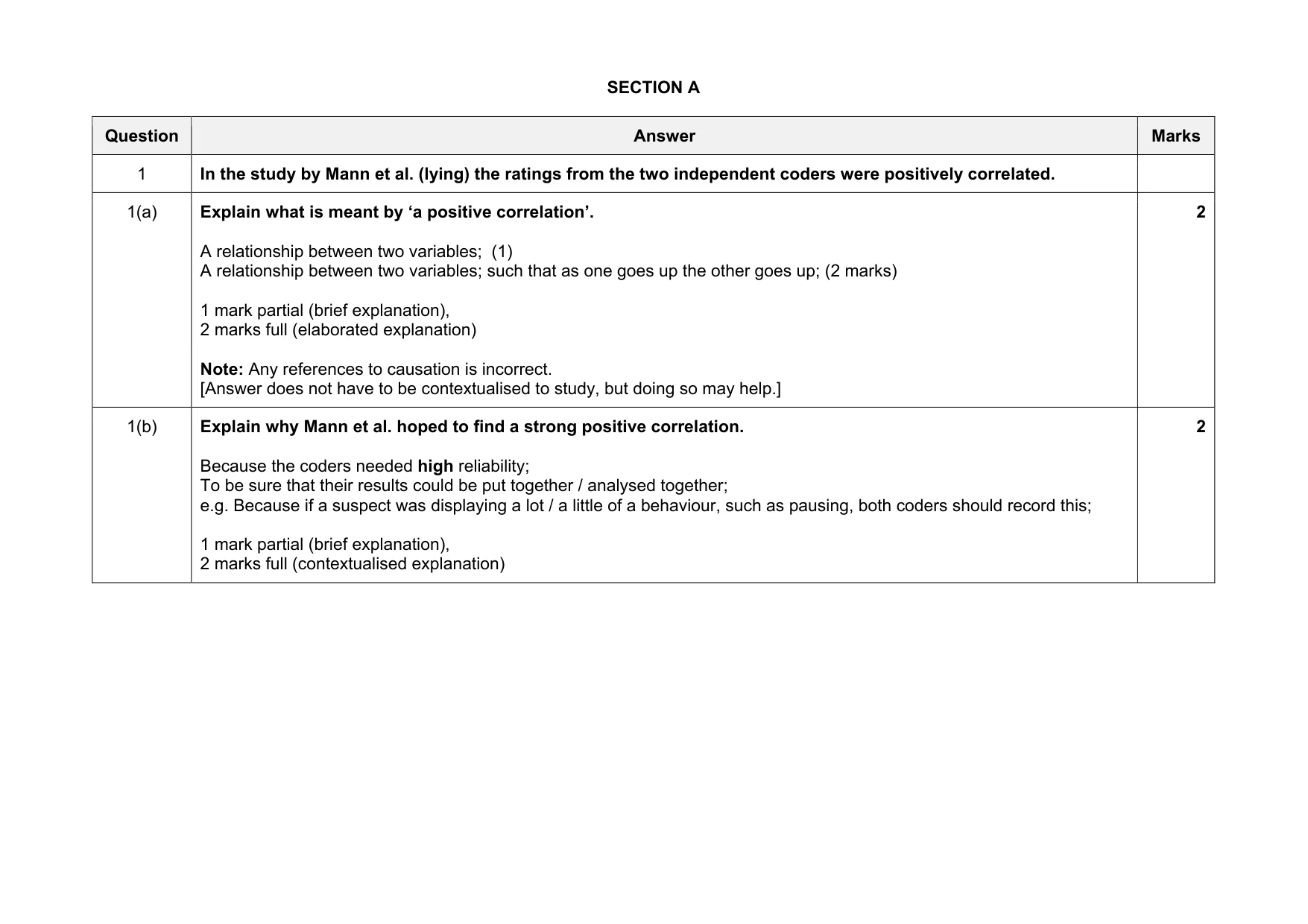
SECTION A Question Answer Marks 1 In the study by Mann et al. (lying) the ratings from the two independent coders were positively correlated. 1(a) Explain what is meant by ‘a positive correlation’. A relationship between two variables; (1) A relationship between two variables; such that as one goes up the other goes up; (2 marks) 1 mark partial (brief explanation), 2 marks full (elaborated explanation) Note: Any references to causation is incorrect. [Answer does not have to be contextualised to study, but doing so may help.] 2 1(b) Explain why Mann et al. hoped to find a strong positive correlation. Because the coders needed high reliability; To be sure that their results could be put together / analysed together; e.g. Because if a suspect was displaying a lot / a little of a behaviour, such as pausing, both coders should record this; 1 mark partial (brief explanation), 2 marks full (contextualised explanation) 2
Mark scheme, page 3
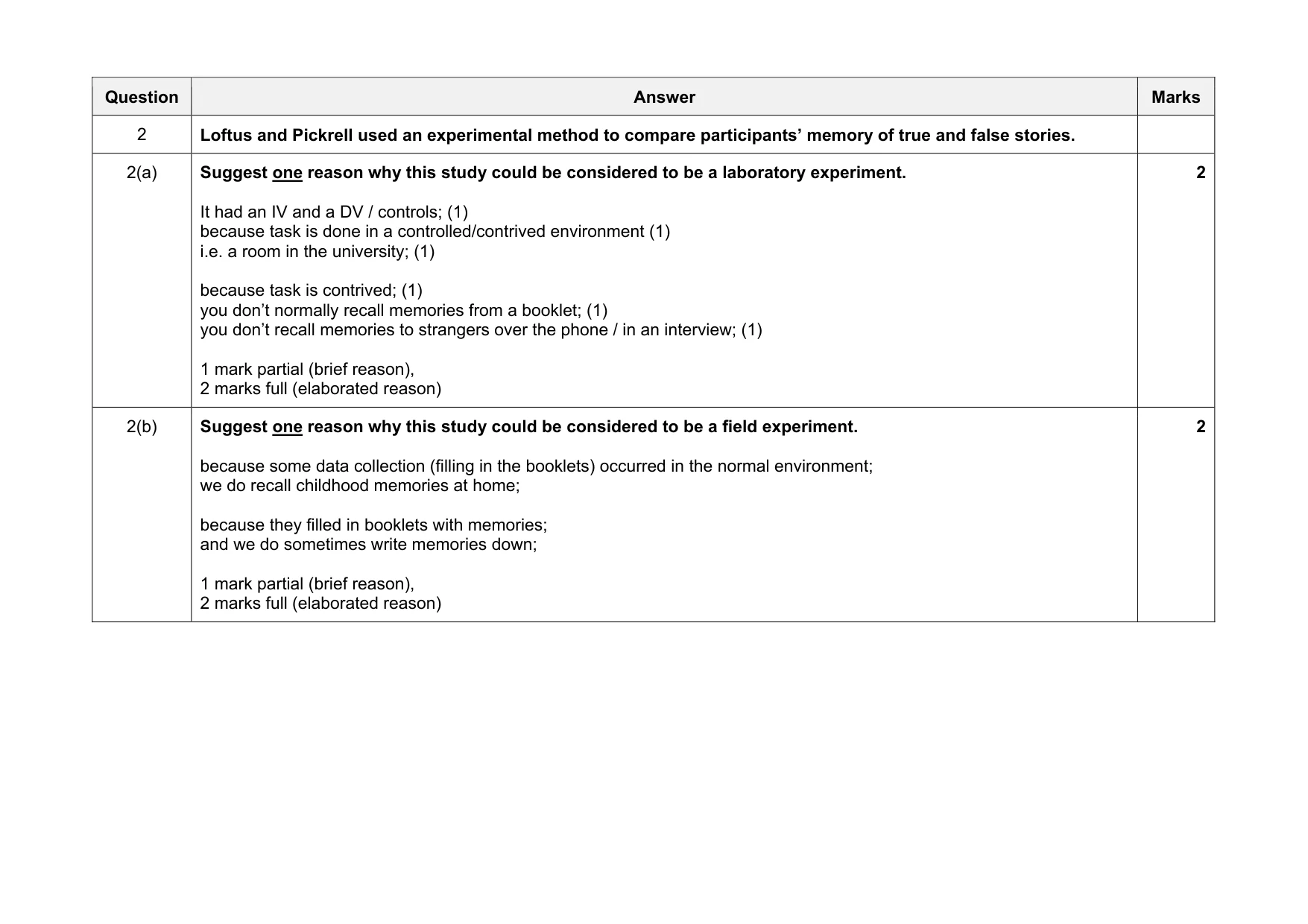
Question Answer Marks 2 Loftus and Pickrell used an experimental method to compare participants’ memory of true and false stories. 2(a) Suggest one reason why this study could be considered to be a laboratory experiment. It had an IV and a DV / controls; (1) because task is done in a controlled/contrived environment (1) i.e. a room in the university; (1) because task is contrived; (1) you don’t normally recall memories from a booklet; (1) you don’t recall memories to strangers over the phone / in an interview; (1) 1 mark partial (brief reason), 2 marks full (elaborated reason) 2 2(b) Suggest one reason why this study could be considered to be a field experiment. because some data collection (filling in the booklets) occurred in the normal environment; we do recall childhood memories at home; because they filled in booklets with memories; and we do sometimes write memories down; 1 mark partial (brief reason), 2 marks full (elaborated reason) 2
Mark scheme, page 4
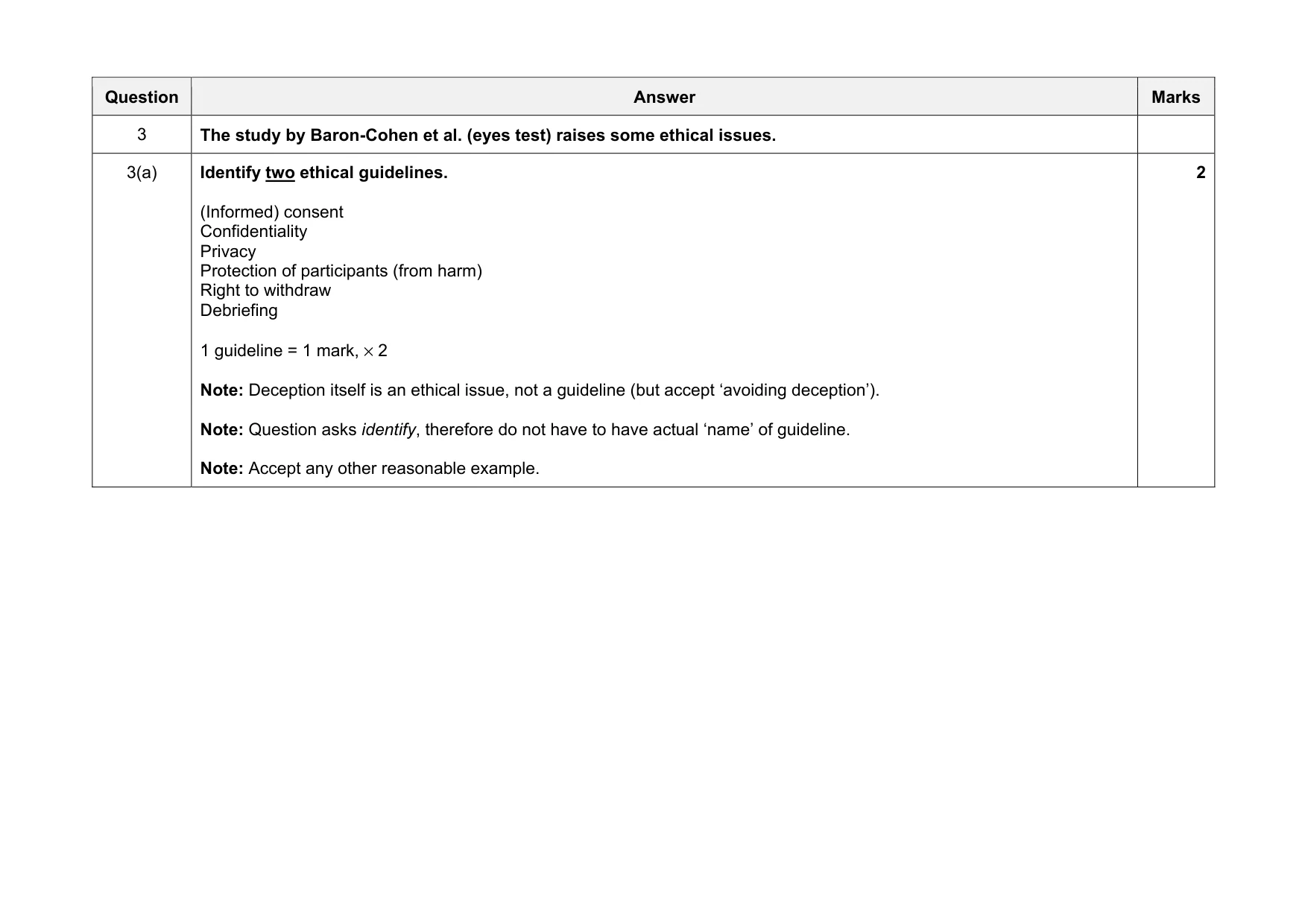
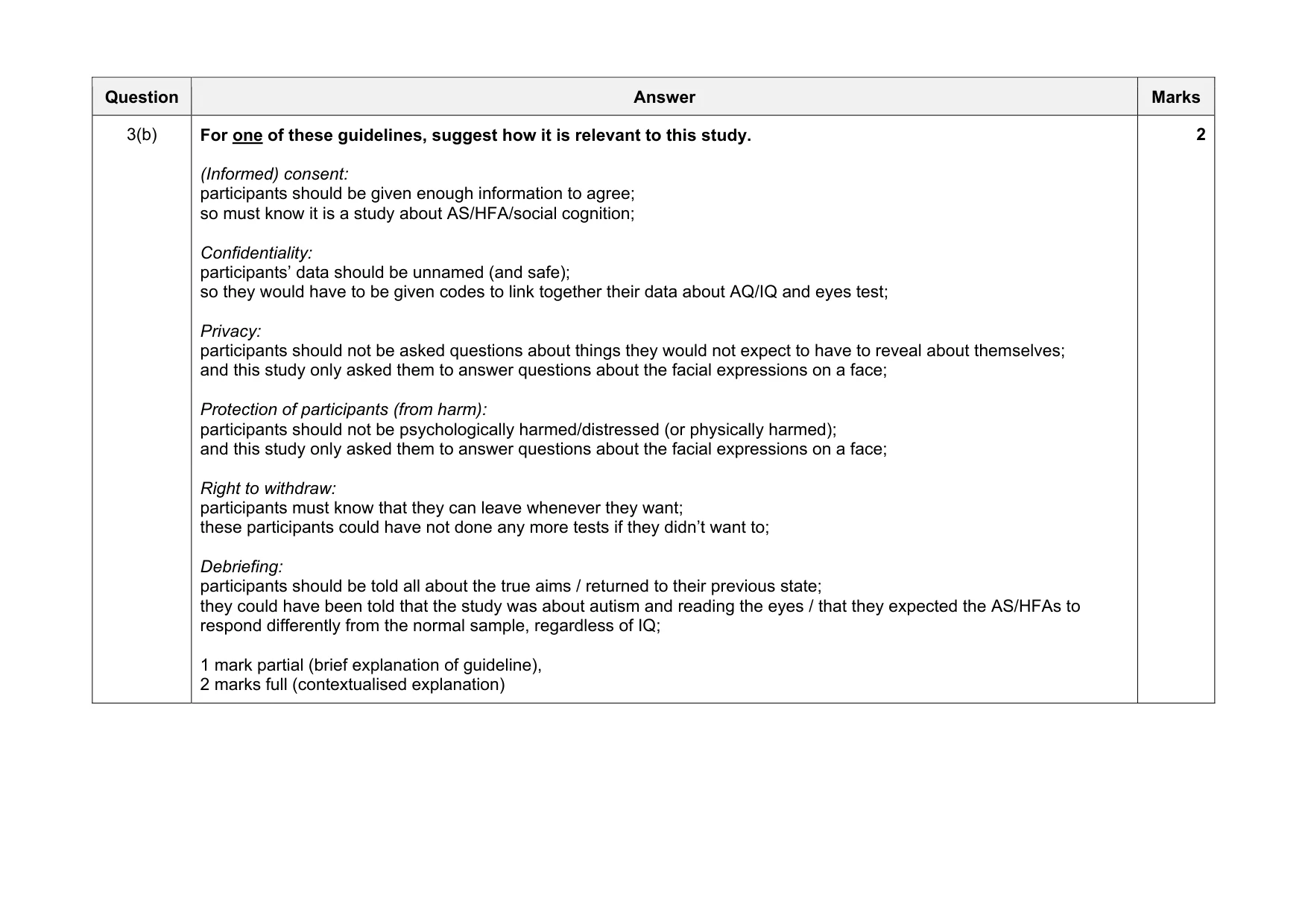
Question Answer Marks 3 The study by Baron-Cohen et al. (eyes test) raises some ethical issues. 3(a) Identify two ethical guidelines. (Informed) consent Confidentiality Privacy Protection of participants (from harm) Right to withdraw Debriefing 1 guideline = 1 mark, × 2 Note: Deception itself is an ethical issue, not a guideline (but accept ‘avoiding deception’). Note: Question asks identify, therefore do not have to have actual ‘name’ of guideline. Note: Accept any other reasonable example. 2
Mark scheme, page 5
Question Answer Marks 3(b) For one of these guidelines, suggest how it is relevant to this study. (Informed) consent: participants should be given enough information to agree; so must know it is a study about AS/HFA/social cognition; Confidentiality: participants’ data should be unnamed (and safe); so they would have to be given codes to link together their data about AQ/IQ and eyes test; Privacy: participants should not be asked questions about things they would not expect to have to reveal about themselves; and this study only asked them to answer questions about the facial expressions on a face; Protection of participants (from harm): participants should not be psychologically harmed/distressed (or physically harmed); and this study only asked them to answer questions about the facial expressions on a face; Right to withdraw: participants must know that they can leave whenever they want; these participants could have not done any more tests if they didn’t want to; Debriefing: participants should be told all about the true aims / returned to their previous state; they could have been told that the study was about autism and reading the eyes / that they expected the AS/HFAs to respond differently from the normal sample, regardless of IQ; 1 mark partial (brief explanation of guideline), 2 marks full (contextualised explanation) 2
Mark scheme, page 6
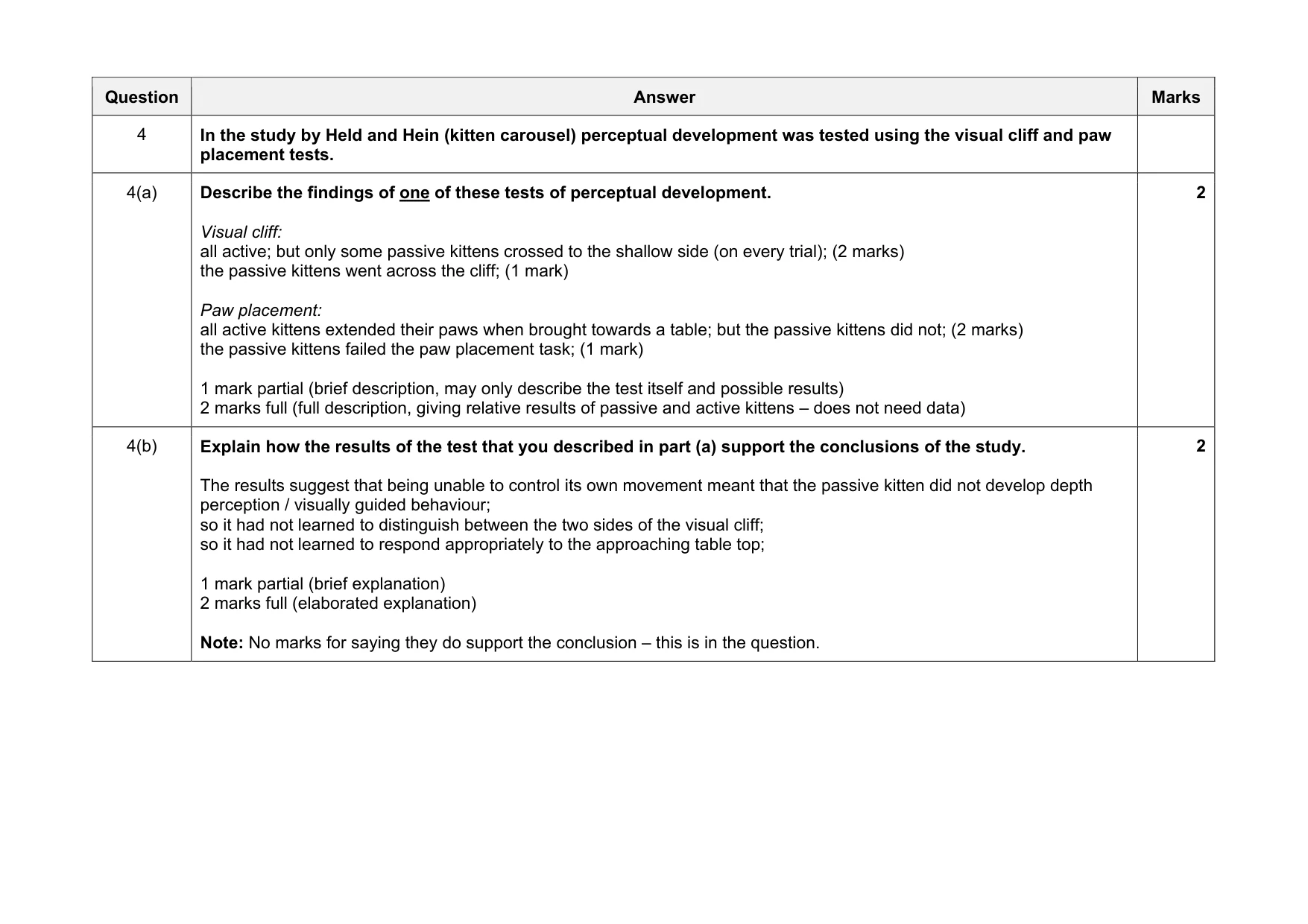
Question Answer Marks 4 In the study by Held and Hein (kitten carousel) perceptual development was tested using the visual cliff and paw placement tests. 4(a) Describe the findings of one of these tests of perceptual development. Visual cliff: all active; but only some passive kittens crossed to the shallow side (on every trial); (2 marks) the passive kittens went across the cliff; (1 mark) Paw placement: all active kittens extended their paws when brought towards a table; but the passive kittens did not; (2 marks) the passive kittens failed the paw placement task; (1 mark) 1 mark partial (brief description, may only describe the test itself and possible results) 2 marks full (full description, giving relative results of passive and active kittens – does not need data) 2 4(b) Explain how the results of the test that you described in part (a) support the conclusions of the study. The results suggest that being unable to control its own movement meant that the passive kitten did not develop depth perception / visually guided behaviour; so it had not learned to distinguish between the two sides of the visual cliff; so it had not learned to respond appropriately to the approaching table top; 1 mark partial (brief explanation) 2 marks full (elaborated explanation) Note: No marks for saying they do support the conclusion – this is in the question. 2
Mark scheme, page 7
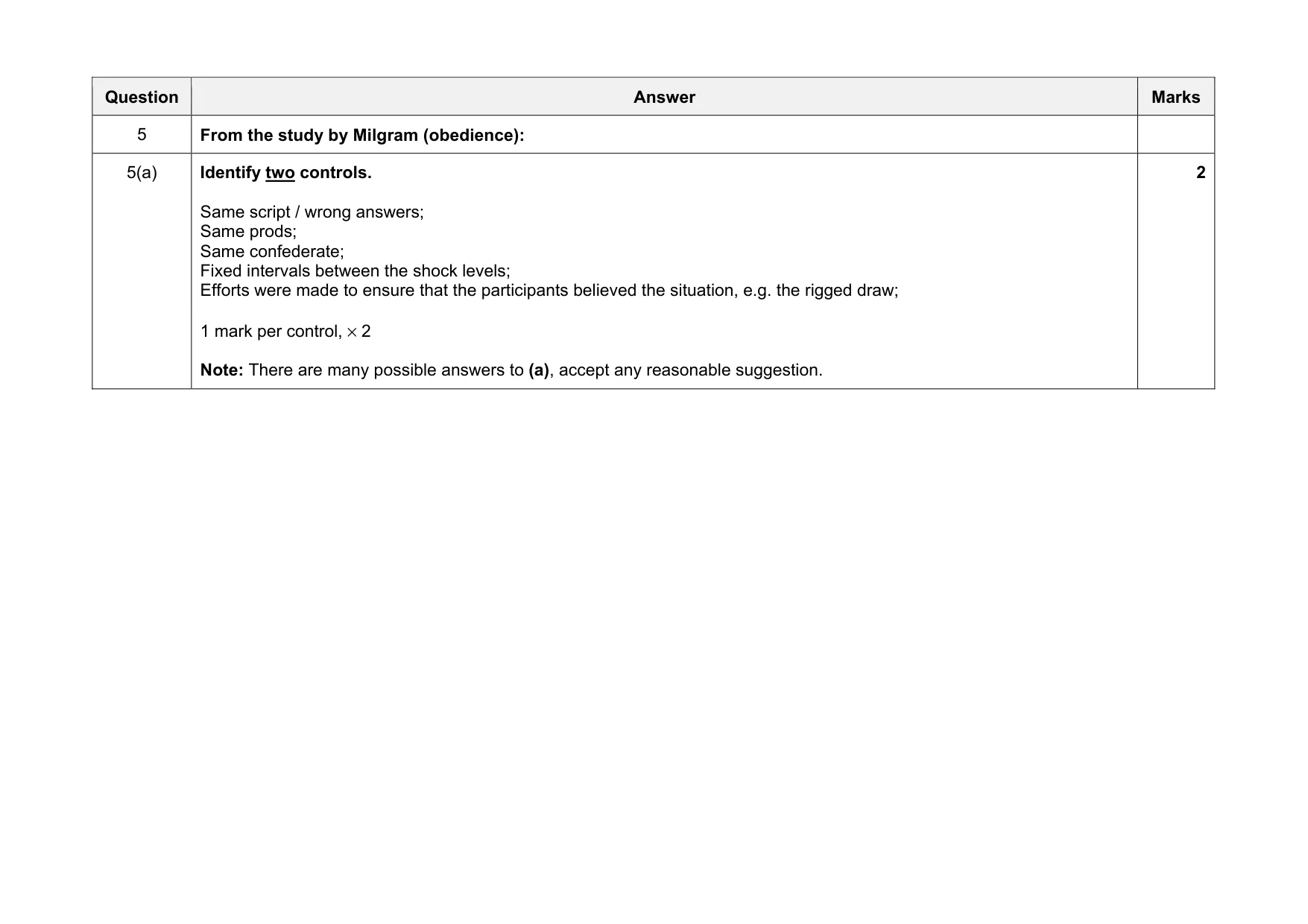
Question Answer Marks 5 From the study by Milgram (obedience): 5(a) Identify two controls. Same script / wrong answers; Same prods; Same confederate; Fixed intervals between the shock levels; Efforts were made to ensure that the participants believed the situation, e.g. the rigged draw; 1 mark per control, × 2 Note: There are many possible answers to (a), accept any reasonable suggestion. 2
Mark scheme, page 8
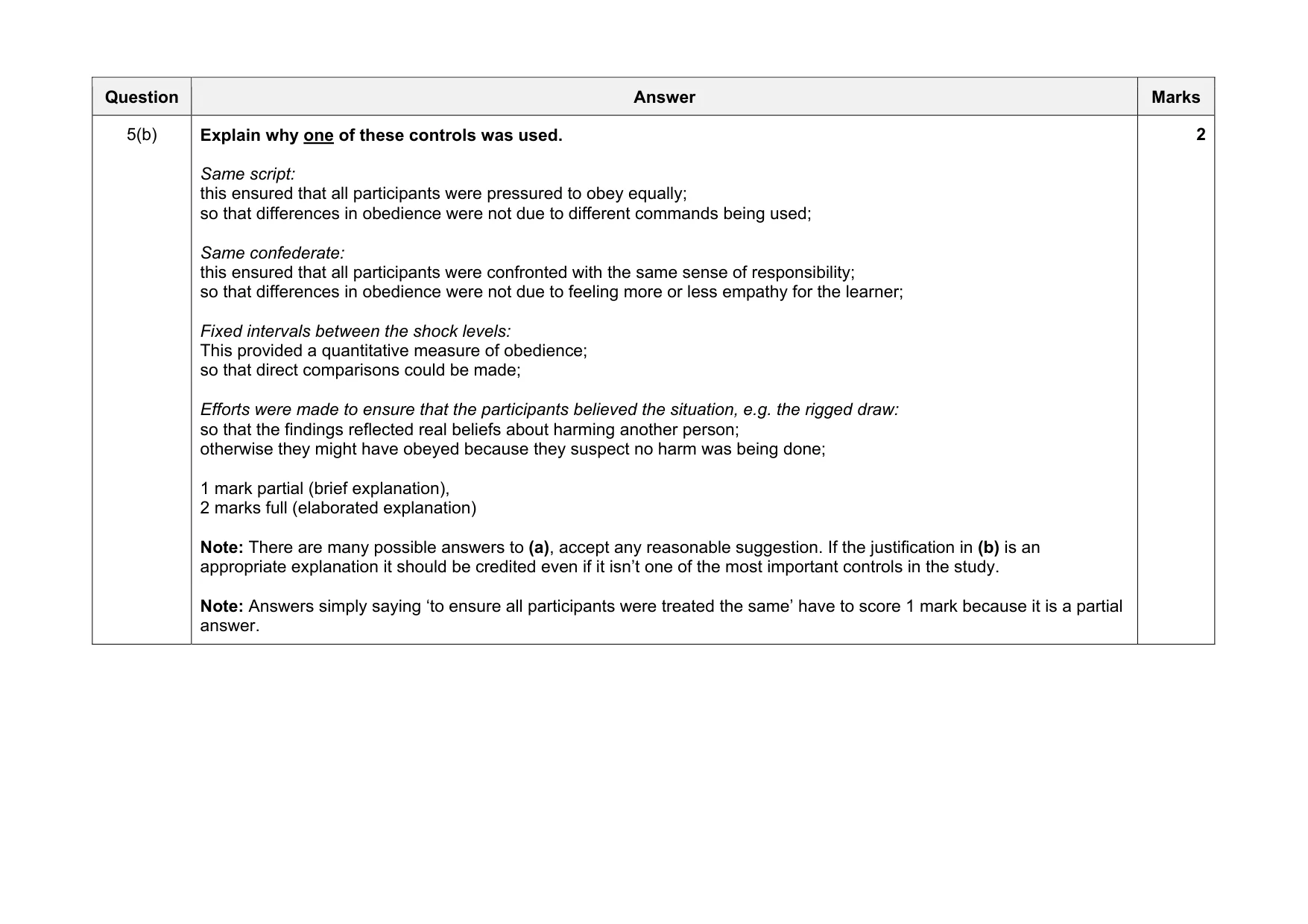
Question Answer Marks 5(b) Explain why one of these controls was used. Same script: this ensured that all participants were pressured to obey equally; so that differences in obedience were not due to different commands being used; Same confederate: this ensured that all participants were confronted with the same sense of responsibility; so that differences in obedience were not due to feeling more or less empathy for the learner; Fixed intervals between the shock levels: This provided a quantitative measure of obedience; so that direct comparisons could be made; Efforts were made to ensure that the participants believed the situation, e.g. the rigged draw: so that the findings reflected real beliefs about harming another person; otherwise they might have obeyed because they suspect no harm was being done; 1 mark partial (brief explanation), 2 marks full (elaborated explanation) Note: There are many possible answers to (a), accept any reasonable suggestion. If the justification in (b) is an appropriate explanation it should be credited even if it isn’t one of the most important controls in the study. Note: Answers simply saying ‘to ensure all participants were treated the same’ have to score 1 mark because it is a partial answer. 2
Mark scheme, page 9
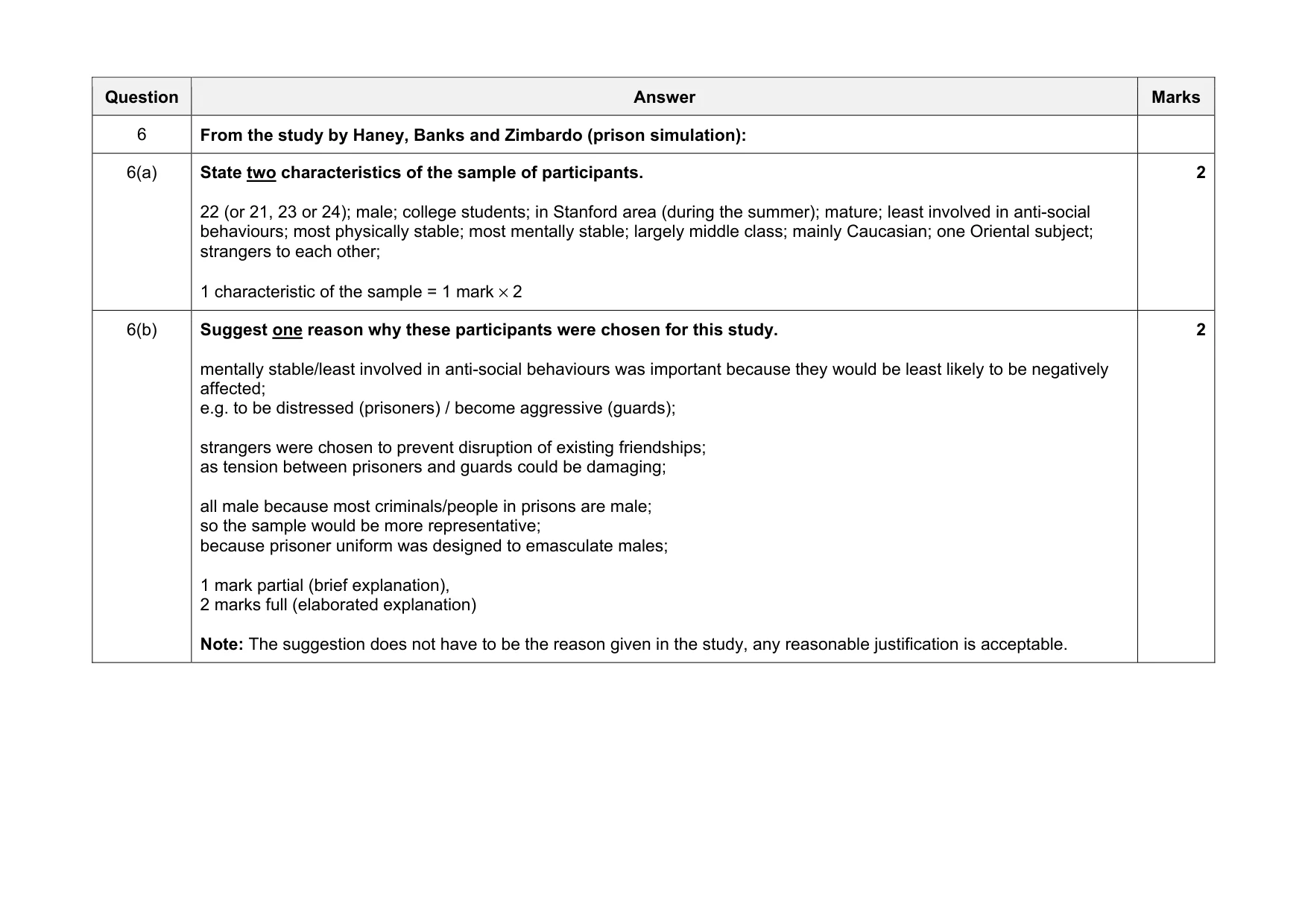
Question Answer Marks 6 From the study by Haney, Banks and Zimbardo (prison simulation): 6(a) State two characteristics of the sample of participants. 22 (or 21, 23 or 24); male; college students; in Stanford area (during the summer); mature; least involved in anti-social behaviours; most physically stable; most mentally stable; largely middle class; mainly Caucasian; one Oriental subject; strangers to each other; 1 characteristic of the sample = 1 mark × 2 2 6(b) Suggest one reason why these participants were chosen for this study. mentally stable/least involved in anti-social behaviours was important because they would be least likely to be negatively affected; e.g. to be distressed (prisoners) / become aggressive (guards); strangers were chosen to prevent disruption of existing friendships; as tension between prisoners and guards could be damaging; all male because most criminals/people in prisons are male; so the sample would be more representative; because prisoner uniform was designed to emasculate males; 1 mark partial (brief explanation), 2 marks full (elaborated explanation) Note: The suggestion does not have to be the reason given in the study, any reasonable justification is acceptable. 2
Mark scheme, page 10
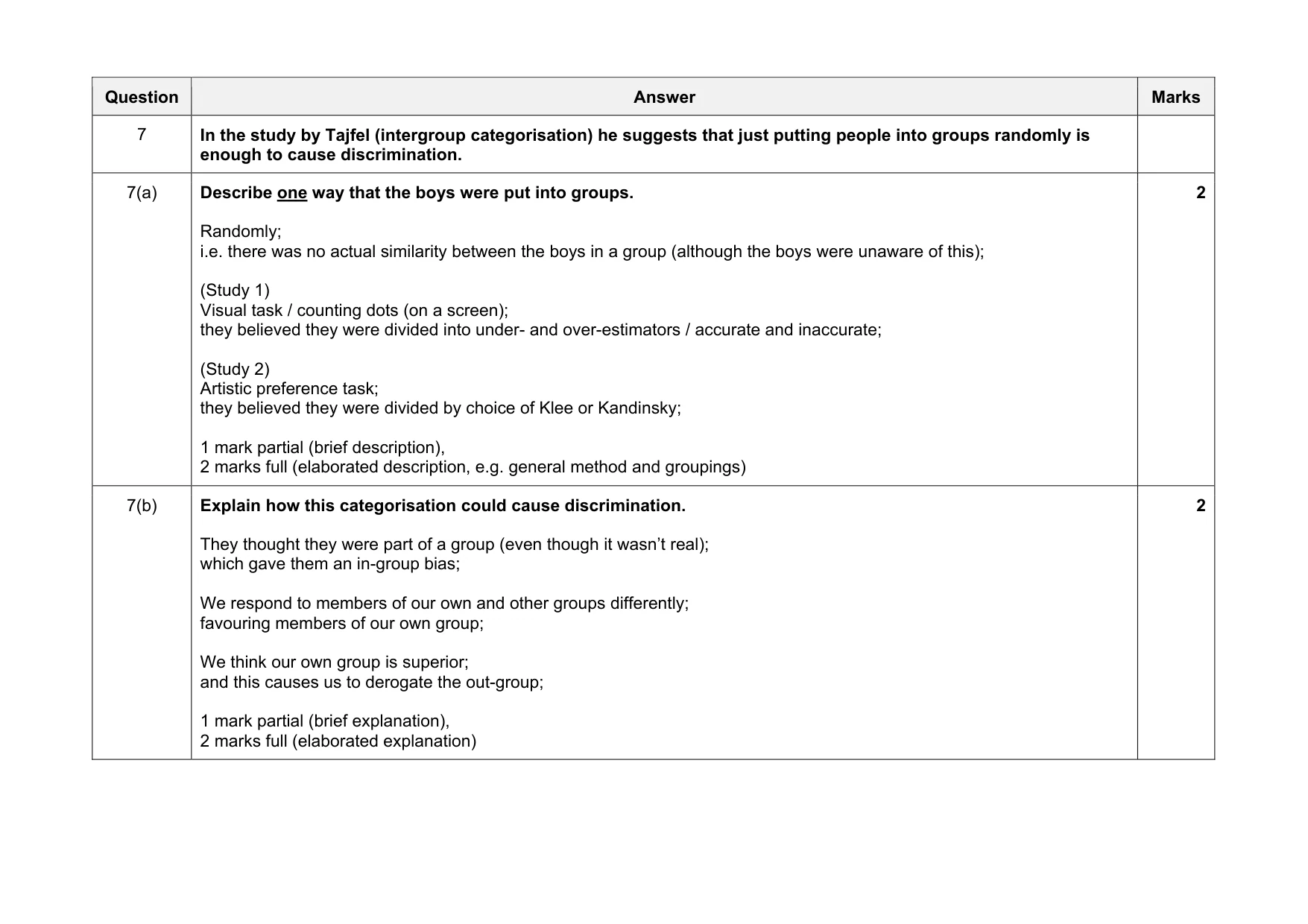
Question Answer Marks 7 In the study by Tajfel (intergroup categorisation) he suggests that just putting people into groups randomly is enough to cause discrimination. 7(a) Describe one way that the boys were put into groups. Randomly; i.e. there was no actual similarity between the boys in a group (although the boys were unaware of this); (Study 1) Visual task / counting dots (on a screen); they believed they were divided into under- and over-estimators / accurate and inaccurate; (Study 2) Artistic preference task; they believed they were divided by choice of Klee or Kandinsky; 1 mark partial (brief description), 2 marks full (elaborated description, e.g. general method and groupings) 2 7(b) Explain how this categorisation could cause discrimination. They thought they were part of a group (even though it wasn’t real); which gave them an in-group bias; We respond to members of our own and other groups differently; favouring members of our own group; We think our own group is superior; and this causes us to derogate the out-group; 1 mark partial (brief explanation), 2 marks full (elaborated explanation) 2
Mark scheme, page 11
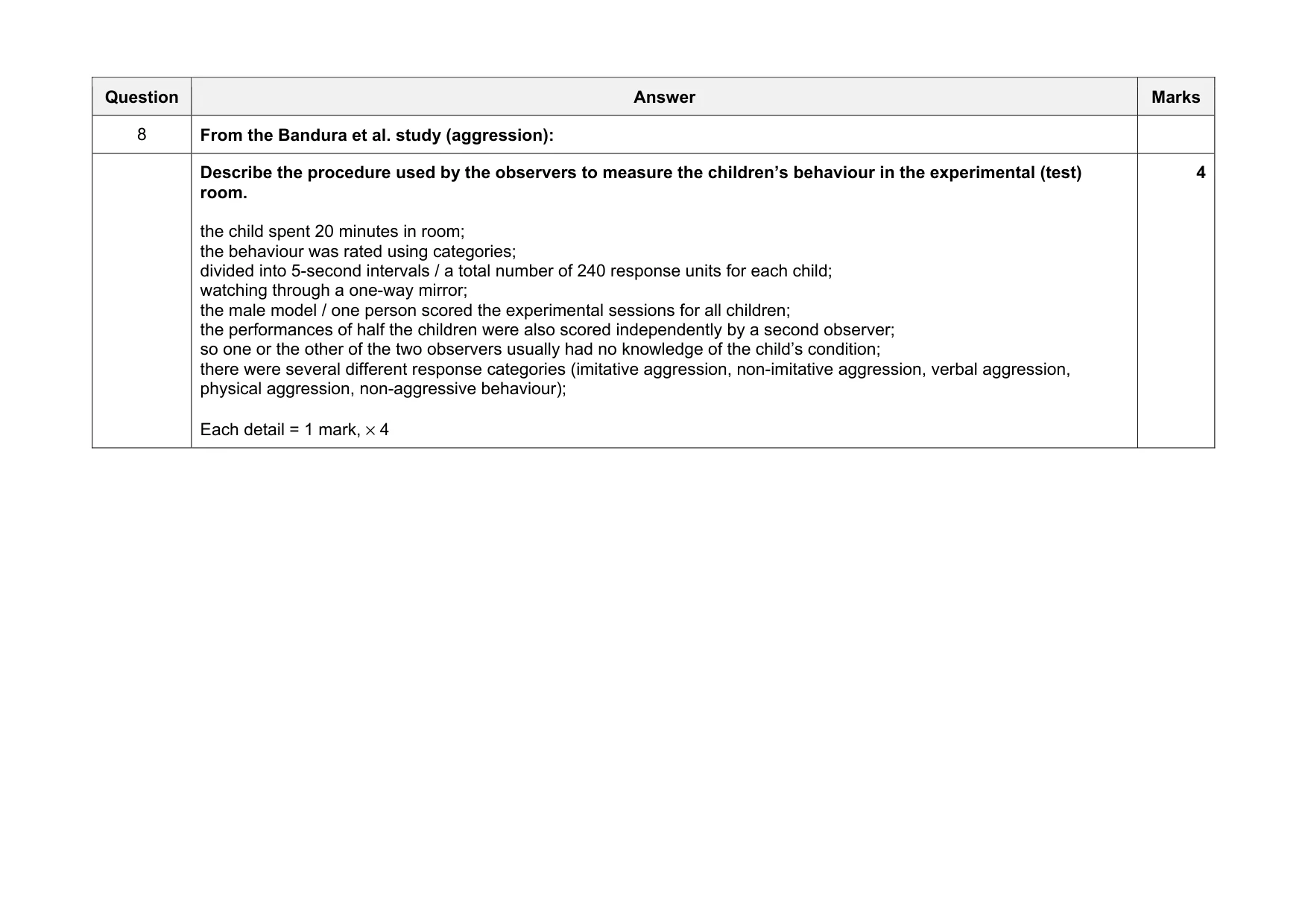
Question Answer Marks 8 From the Bandura et al. study (aggression): Describe the procedure used by the observers to measure the children’s behaviour in the experimental (test) room. the child spent 20 minutes in room; the behaviour was rated using categories; divided into 5-second intervals / a total number of 240 response units for each child; watching through a one-way mirror; the male model / one person scored the experimental sessions for all children; the performances of half the children were also scored independently by a second observer; so one or the other of the two observers usually had no knowledge of the child’s condition; there were several different response categories (imitative aggression, non-imitative aggression, verbal aggression, physical aggression, non-aggressive behaviour); Each detail = 1 mark, × 4 4
Mark scheme, page 12
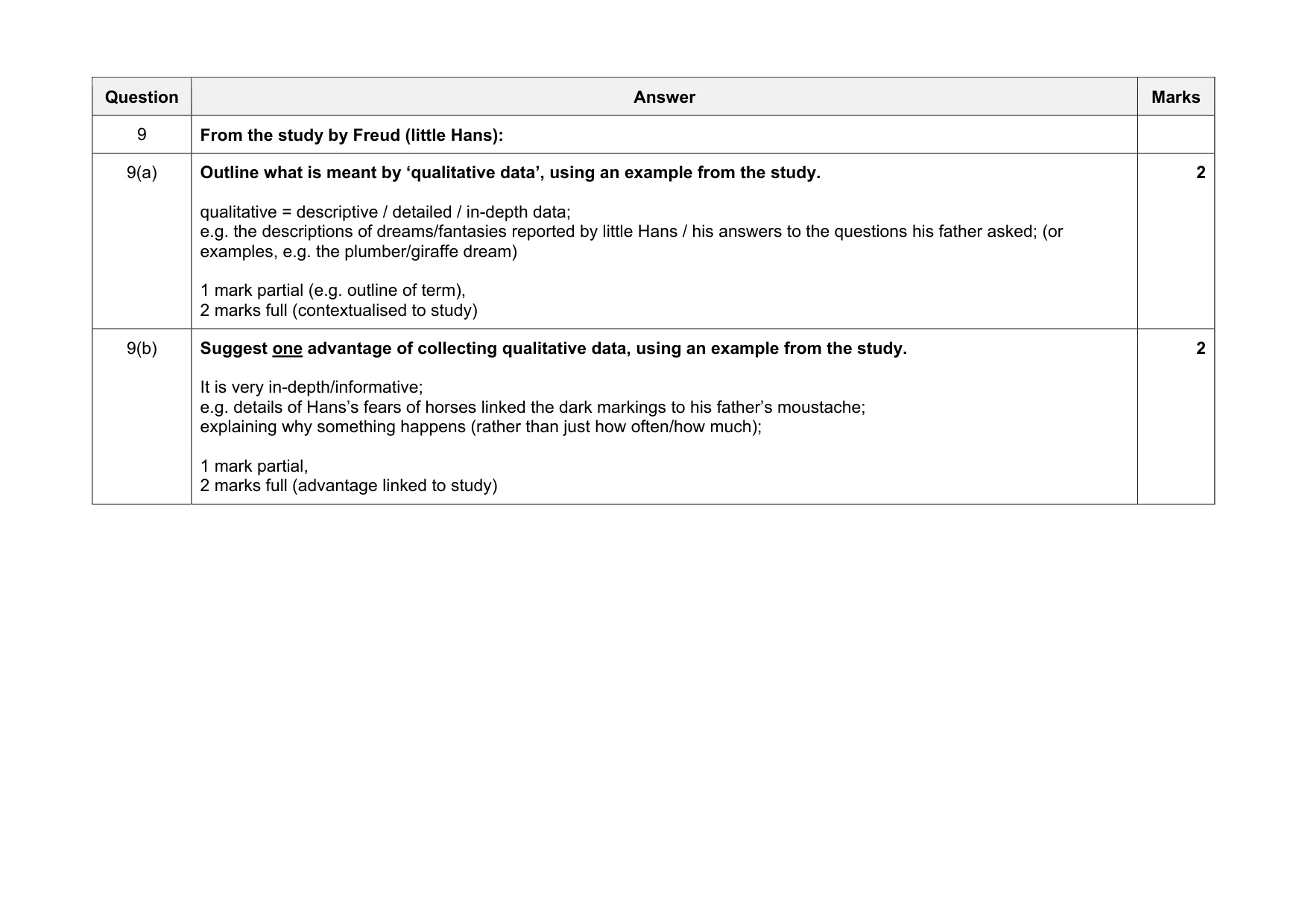
Question Answer Marks 9 From the study by Freud (little Hans): 9(a) Outline what is meant by ‘qualitative data’, using an example from the study. qualitative = descriptive / detailed / in-depth data; e.g. the descriptions of dreams/fantasies reported by little Hans / his answers to the questions his father asked; (or examples, e.g. the plumber/giraffe dream) 1 mark partial (e.g. outline of term), 2 marks full (contextualised to study) 2 9(b) Suggest one advantage of collecting qualitative data, using an example from the study. It is very in-depth/informative; e.g. details of Hans’s fears of horses linked the dark markings to his father’s moustache; explaining why something happens (rather than just how often/how much); 1 mark partial, 2 marks full (advantage linked to study) 2
Mark scheme, page 13
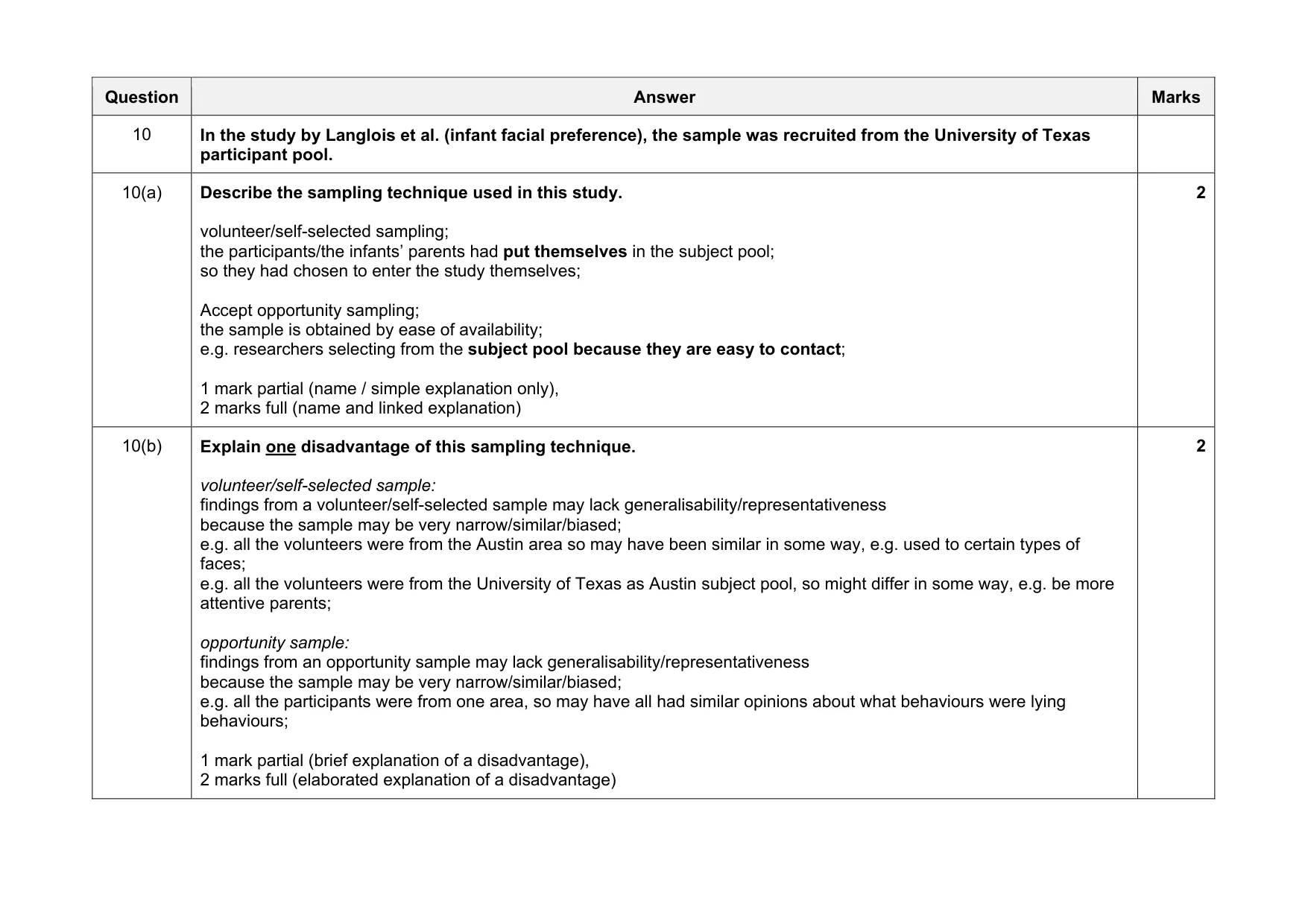
Question Answer Marks 10 In the study by Langlois et al. (infant facial preference), the sample was recruited from the University of Texas participant pool. 10(a) Describe the sampling technique used in this study. volunteer/self-selected sampling; the participants/the infants’ parents had put themselves in the subject pool; so they had chosen to enter the study themselves; Accept opportunity sampling; the sample is obtained by ease of availability; e.g. researchers selecting from the subject pool because they are easy to contact; 1 mark partial (name / simple explanation only), 2 marks full (name and linked explanation) 2 10(b) Explain one disadvantage of this sampling technique. volunteer/self-selected sample: findings from a volunteer/self-selected sample may lack generalisability/representativeness because the sample may be very narrow/similar/biased; e.g. all the volunteers were from the Austin area so may have been similar in some way, e.g. used to certain types of faces; e.g. all the volunteers were from the University of Texas as Austin subject pool, so might differ in some way, e.g. be more attentive parents; opportunity sample: findings from an opportunity sample may lack generalisability/representativeness because the sample may be very narrow/similar/biased; e.g. all the participants were from one area, so may have all had similar opinions about what behaviours were lying behaviours; 1 mark partial (brief explanation of a disadvantage), 2 marks full (elaborated explanation of a disadvantage) 2
Mark scheme, page 14
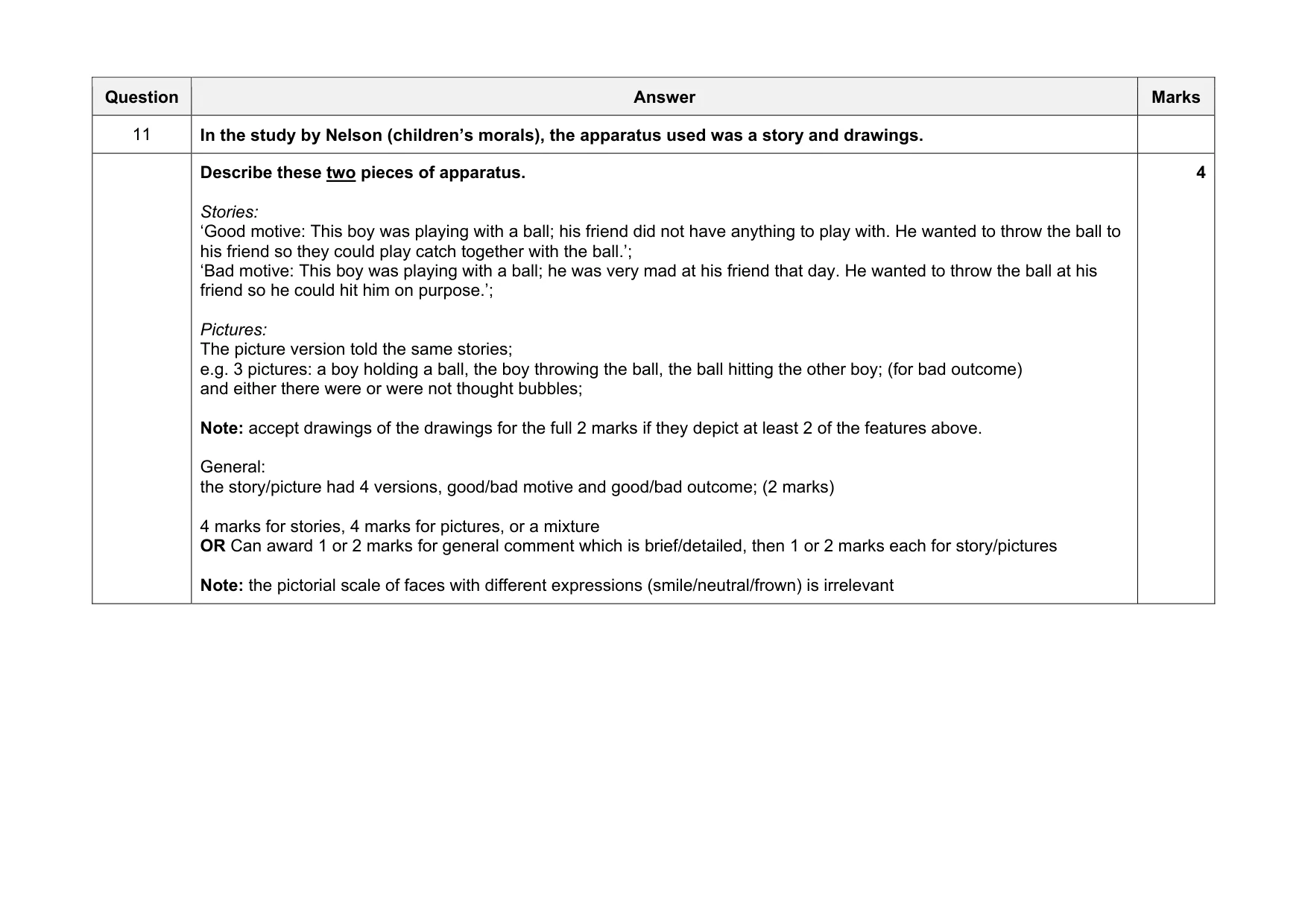
Question Answer Marks 11 In the study by Nelson (children’s morals), the apparatus used was a story and drawings. Describe these two pieces of apparatus. Stories: ‘Good motive: This boy was playing with a ball; his friend did not have anything to play with. He wanted to throw the ball to his friend so they could play catch together with the ball.’; ‘Bad motive: This boy was playing with a ball; he was very mad at his friend that day. He wanted to throw the ball at his friend so he could hit him on purpose.’; Pictures: The picture version told the same stories; e.g. 3 pictures: a boy holding a ball, the boy throwing the ball, the ball hitting the other boy; (for bad outcome) and either there were or were not thought bubbles; Note: accept drawings of the drawings for the full 2 marks if they depict at least 2 of the features above. General: the story/picture had 4 versions, good/bad motive and good/bad outcome; (2 marks) 4 marks for stories, 4 marks for pictures, or a mixture OR Can award 1 or 2 marks for general comment which is brief/detailed, then 1 or 2 marks each for story/pictures Note: the pictorial scale of faces with different expressions (smile/neutral/frown) is irrelevant 4
Mark scheme, page 15
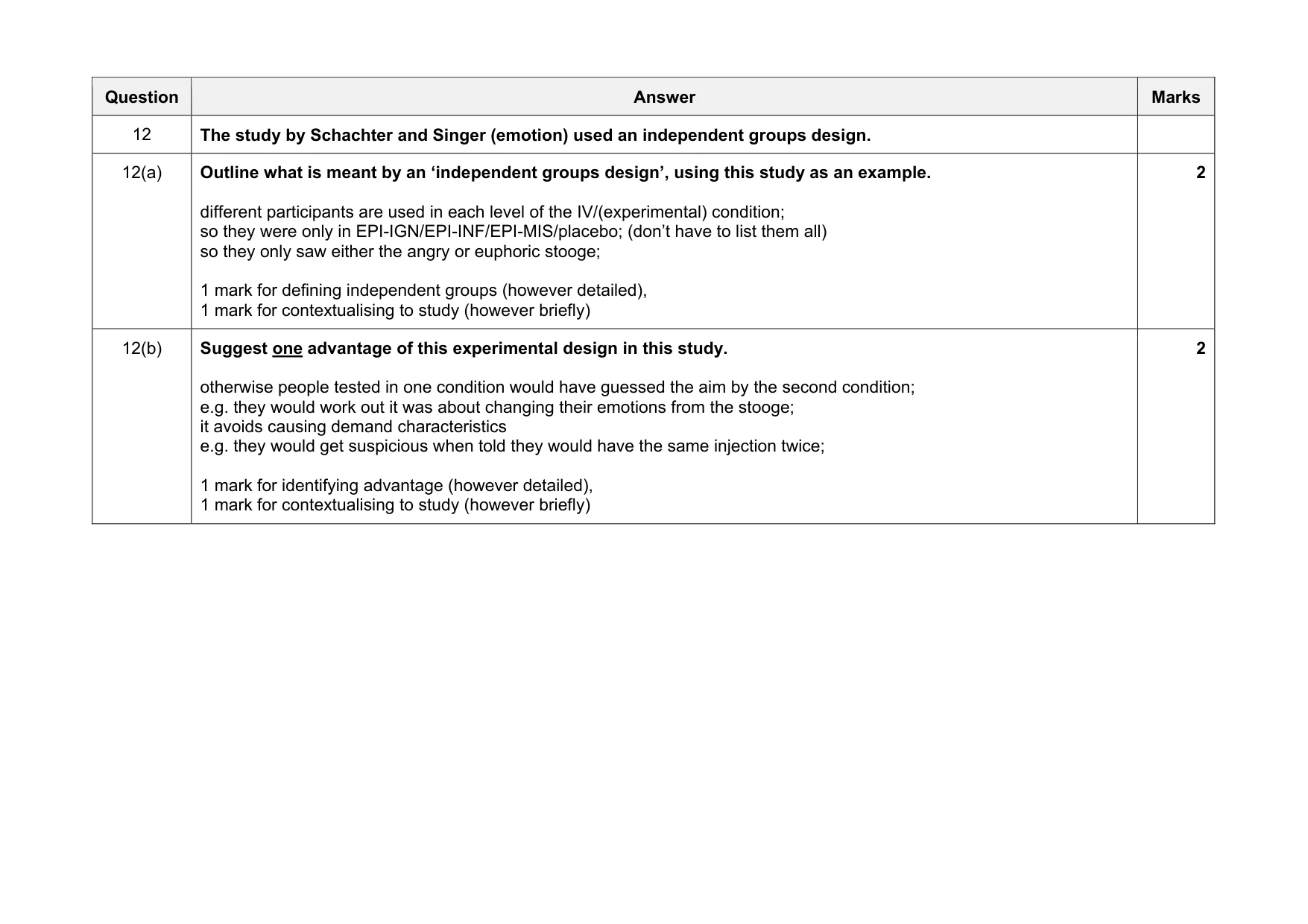
Question Answer Marks 12 The study by Schachter and Singer (emotion) used an independent groups design. 12(a) Outline what is meant by an ‘independent groups design’, using this study as an example. different participants are used in each level of the IV/(experimental) condition; so they were only in EPI-IGN/EPI-INF/EPI-MIS/placebo; (don’t have to list them all) so they only saw either the angry or euphoric stooge; 1 mark for defining independent groups (however detailed), 1 mark for contextualising to study (however briefly) 2 12(b) Suggest one advantage of this experimental design in this study. otherwise people tested in one condition would have guessed the aim by the second condition; e.g. they would work out it was about changing their emotions from the stooge; it avoids causing demand characteristics e.g. they would get suspicious when told they would have the same injection twice; 1 mark for identifying advantage (however detailed), 1 mark for contextualising to study (however briefly) 2
Mark scheme, page 16
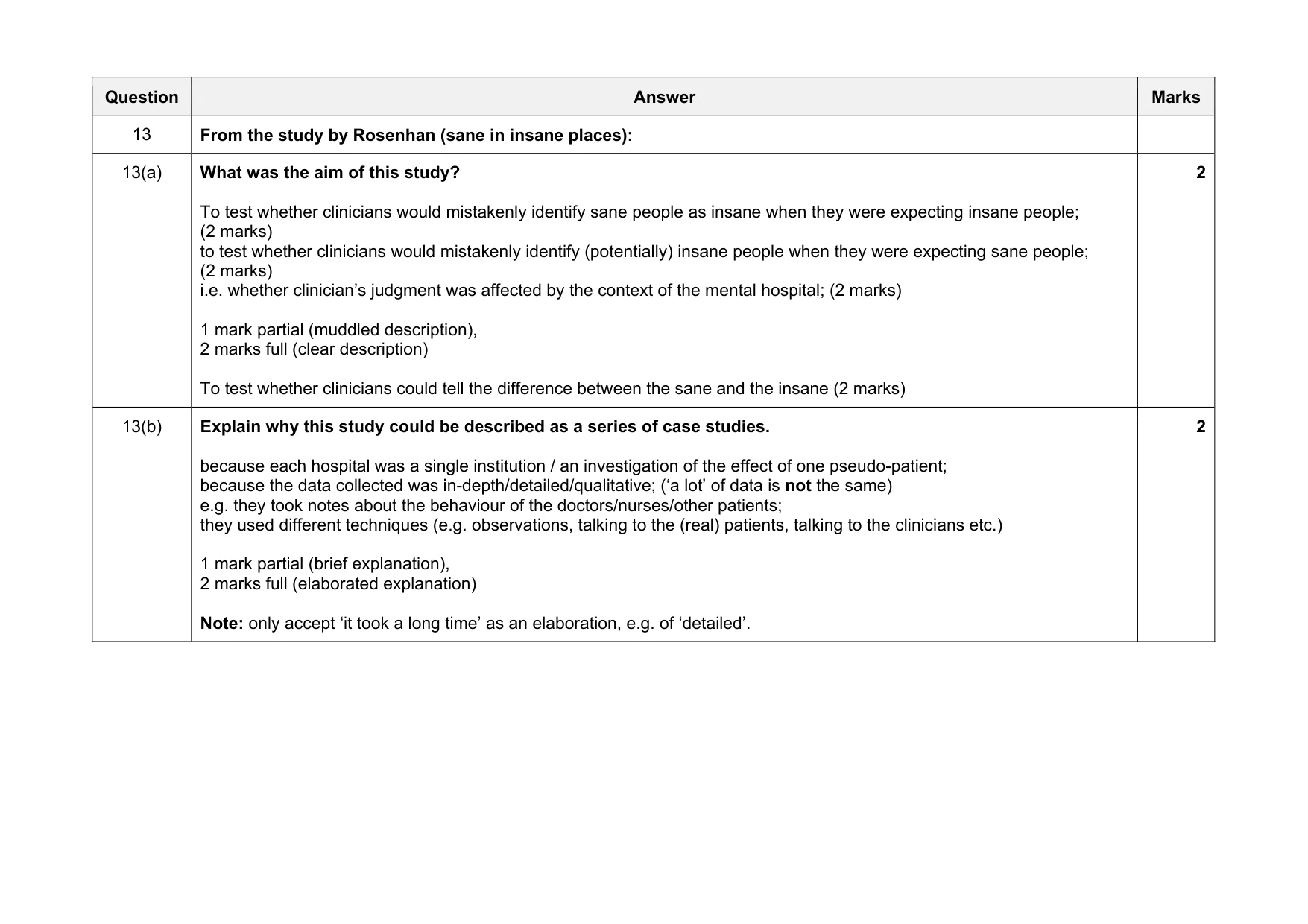
Question Answer Marks 13 From the study by Rosenhan (sane in insane places): 13(a) What was the aim of this study? To test whether clinicians would mistakenly identify sane people as insane when they were expecting insane people; (2 marks) to test whether clinicians would mistakenly identify (potentially) insane people when they were expecting sane people; (2 marks) i.e. whether clinician’s judgment was affected by the context of the mental hospital; (2 marks) 1 mark partial (muddled description), 2 marks full (clear description) To test whether clinicians could tell the difference between the sane and the insane (2 marks) 2 13(b) Explain why this study could be described as a series of case studies. because each hospital was a single institution / an investigation of the effect of one pseudo-patient; because the data collected was in-depth/detailed/qualitative; (‘a lot’ of data is not the same) e.g. they took notes about the behaviour of the doctors/nurses/other patients; they used different techniques (e.g. observations, talking to the (real) patients, talking to the clinicians etc.) 1 mark partial (brief explanation), 2 marks full (elaborated explanation) Note: only accept ‘it took a long time’ as an elaboration, e.g. of ‘detailed’. 2
Mark scheme, page 17
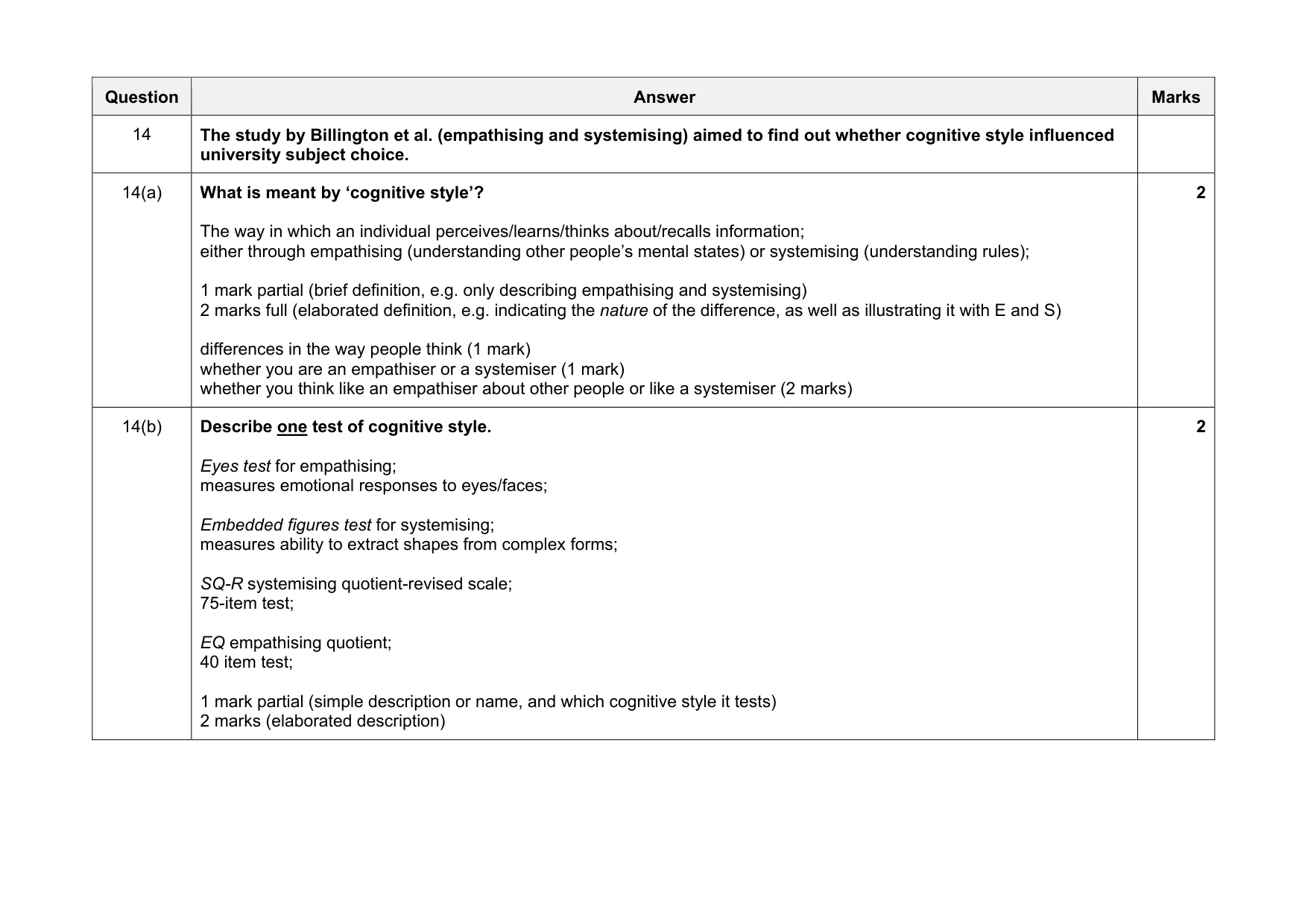
Question Answer Marks 14 The study by Billington et al. (empathising and systemising) aimed to find out whether cognitive style influenced university subject choice. 14(a) What is meant by ‘cognitive style’? The way in which an individual perceives/learns/thinks about/recalls information; either through empathising (understanding other people’s mental states) or systemising (understanding rules); 1 mark partial (brief definition, e.g. only describing empathising and systemising) 2 marks full (elaborated definition, e.g. indicating the nature of the difference, as well as illustrating it with E and S) differences in the way people think (1 mark) whether you are an empathiser or a systemiser (1 mark) whether you think like an empathiser about other people or like a systemiser (2 marks) 2 14(b) Describe one test of cognitive style. Eyes test for empathising; measures emotional responses to eyes/faces; Embedded figures test for systemising; measures ability to extract shapes from complex forms; SQ-R systemising quotient-revised scale; 75-item test; EQ empathising quotient; 40 item test; 1 mark partial (simple description or name, and which cognitive style it tests) 2 marks (elaborated description) 2
Mark scheme, page 18
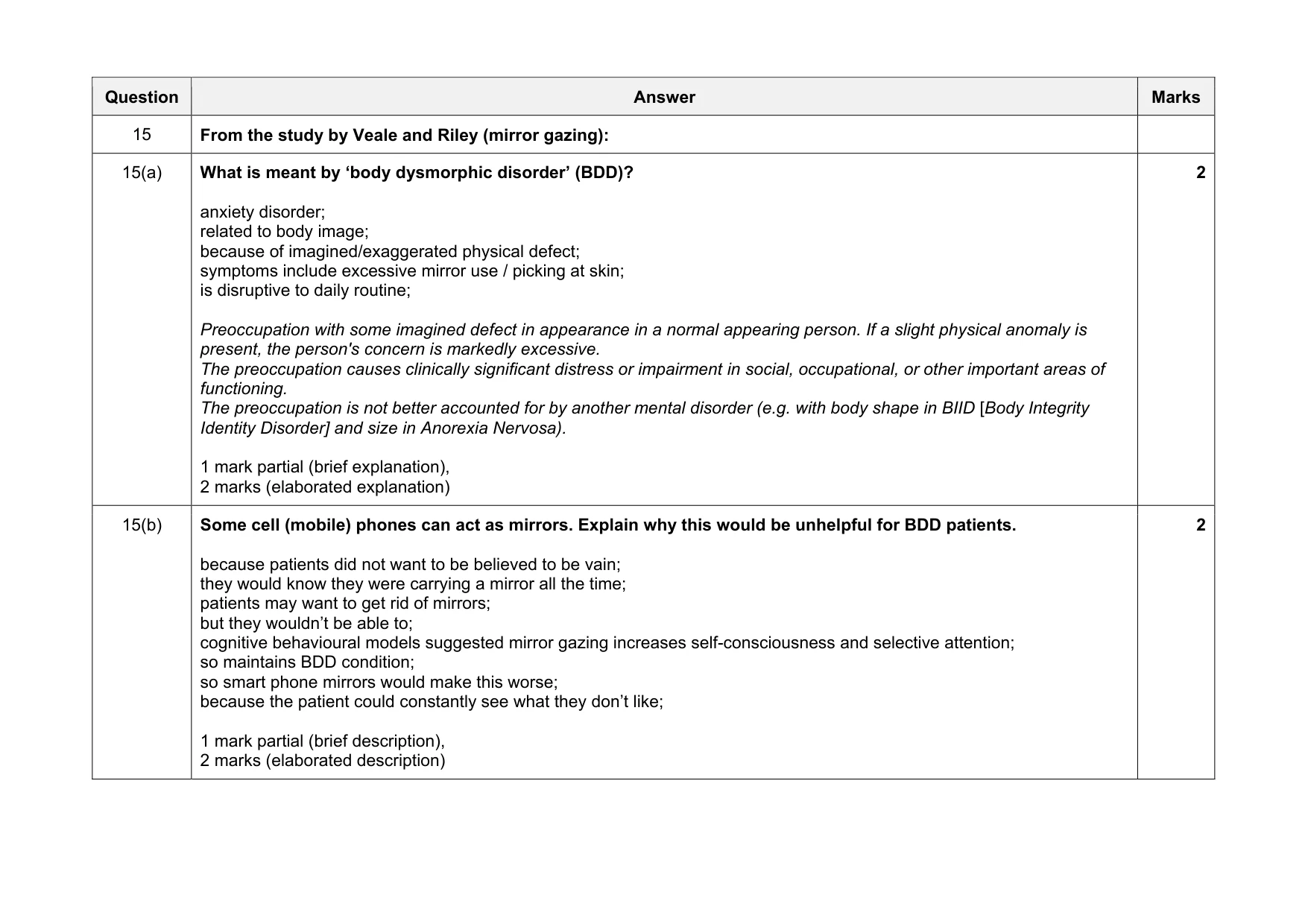
Question Answer Marks 15 From the study by Veale and Riley (mirror gazing): 15(a) What is meant by ‘body dysmorphic disorder’ (BDD)? anxiety disorder; related to body image; because of imagined/exaggerated physical defect; symptoms include excessive mirror use / picking at skin; is disruptive to daily routine; Preoccupation with some imagined defect in appearance in a normal appearing person. If a slight physical anomaly is present, the person's concern is markedly excessive. The preoccupation causes clinically significant distress or impairment in social, occupational, or other important areas of functioning. The preoccupation is not better accounted for by another mental disorder (e.g. with body shape in BIID [Body Integrity Identity Disorder] and size in Anorexia Nervosa). 1 mark partial (brief explanation), 2 marks (elaborated explanation) 2 15(b) Some cell (mobile) phones can act as mirrors. Explain why this would be unhelpful for BDD patients. because patients did not want to be believed to be vain; they would know they were carrying a mirror all the time; patients may want to get rid of mirrors; but they wouldn’t be able to; cognitive behavioural models suggested mirror gazing increases self-consciousness and selective attention; so maintains BDD condition; so smart phone mirrors would make this worse; because the patient could constantly see what they don’t like; 1 mark partial (brief description), 2 marks (elaborated description) 2
Mark scheme, page 19
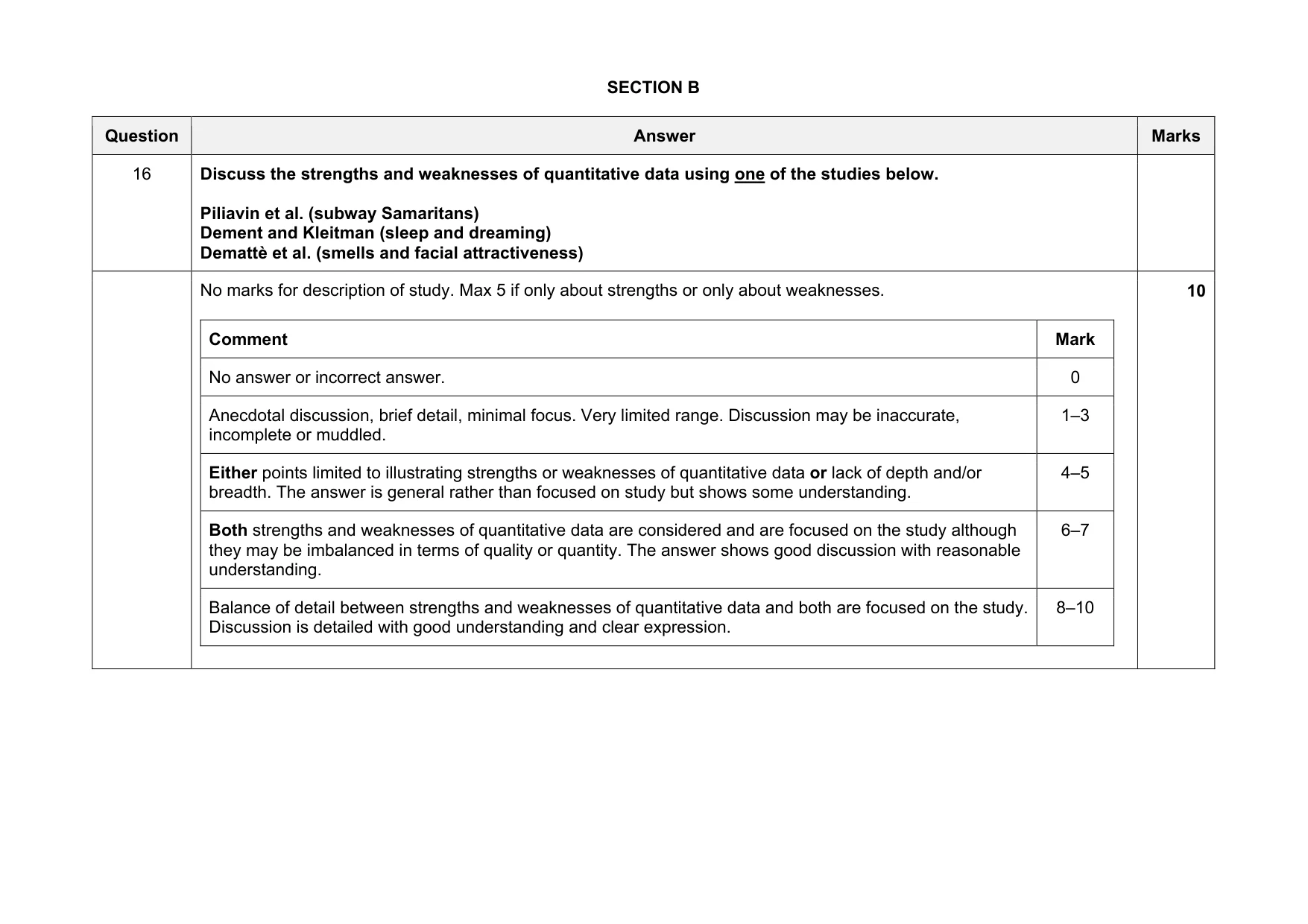
SECTION B Question Answer Marks 16 Discuss the strengths and weaknesses of quantitative data using one of the studies below. Piliavin et al. (subway Samaritans) Dement and Kleitman (sleep and dreaming) Demattè et al. (smells and facial attractiveness) No marks for description of study. Max 5 if only about strengths or only about weaknesses. Comment Mark No answer or incorrect answer. 0 Anecdotal discussion, brief detail, minimal focus. Very limited range. Discussion may be inaccurate, incomplete or muddled. 1–3 Either points limited to illustrating strengths or weaknesses of quantitative data or lack of depth and/or breadth. The answer is general rather than focused on study but shows some understanding. 4–5 Both strengths and weaknesses of quantitative data are considered and are focused on the study although they may be imbalanced in terms of quality or quantity. The answer shows good discussion with reasonable understanding. 6–7 Balance of detail between strengths and weaknesses of quantitative data and both are focused on the study. Discussion is detailed with good understanding and clear expression. 8–10 10
Mark scheme, page 20
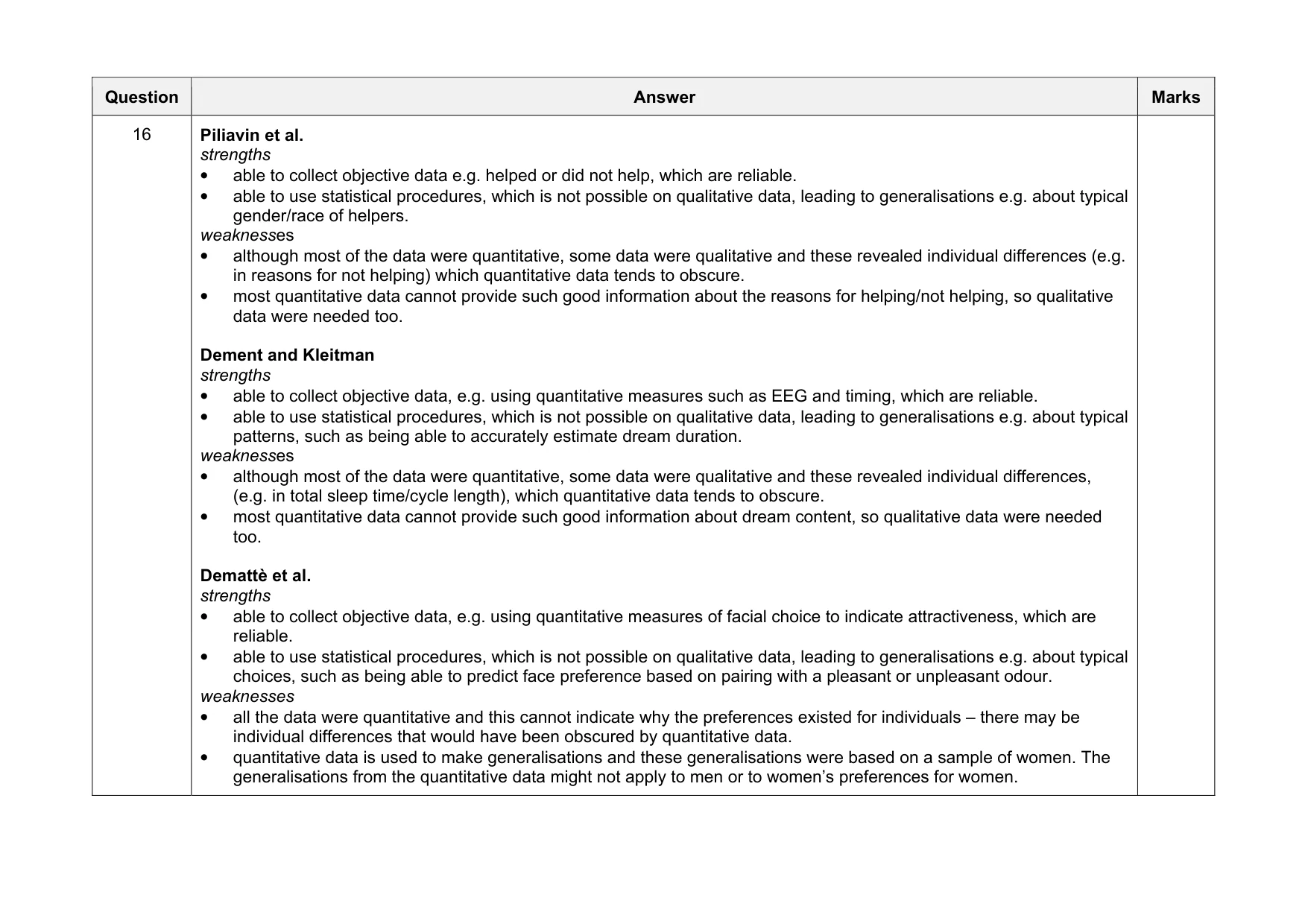
Question Answer Marks 16 Piliavin et al. strengths • able to collect objective data e.g. helped or did not help, which are reliable. • able to use statistical procedures, which is not possible on qualitative data, leading to generalisations e.g. about typical gender/race of helpers. weaknesses • although most of the data were quantitative, some data were qualitative and these revealed individual differences (e.g. in reasons for not helping) which quantitative data tends to obscure. • most quantitative data cannot provide such good information about the reasons for helping/not helping, so qualitative data were needed too. Dement and Kleitman strengths • able to collect objective data, e.g. using quantitative measures such as EEG and timing, which are reliable. • able to use statistical procedures, which is not possible on qualitative data, leading to generalisations e.g. about typical patterns, such as being able to accurately estimate dream duration. weaknesses • although most of the data were quantitative, some data were qualitative and these revealed individual differences, (e.g. in total sleep time/cycle length), which quantitative data tends to obscure. • most quantitative data cannot provide such good information about dream content, so qualitative data were needed too. Demattè et al. strengths • able to collect objective data, e.g. using quantitative measures of facial choice to indicate attractiveness, which are reliable. • able to use statistical procedures, which is not possible on qualitative data, leading to generalisations e.g. about typical choices, such as being able to predict face preference based on pairing with a pleasant or unpleasant odour. weaknesses • all the data were quantitative and this cannot indicate why the preferences existed for individuals – there may be individual differences that would have been obscured by quantitative data. • quantitative data is used to make generalisations and these generalisations were based on a sample of women. The generalisations from the quantitative data might not apply to men or to women’s preferences for women.
Mark scheme, page 21
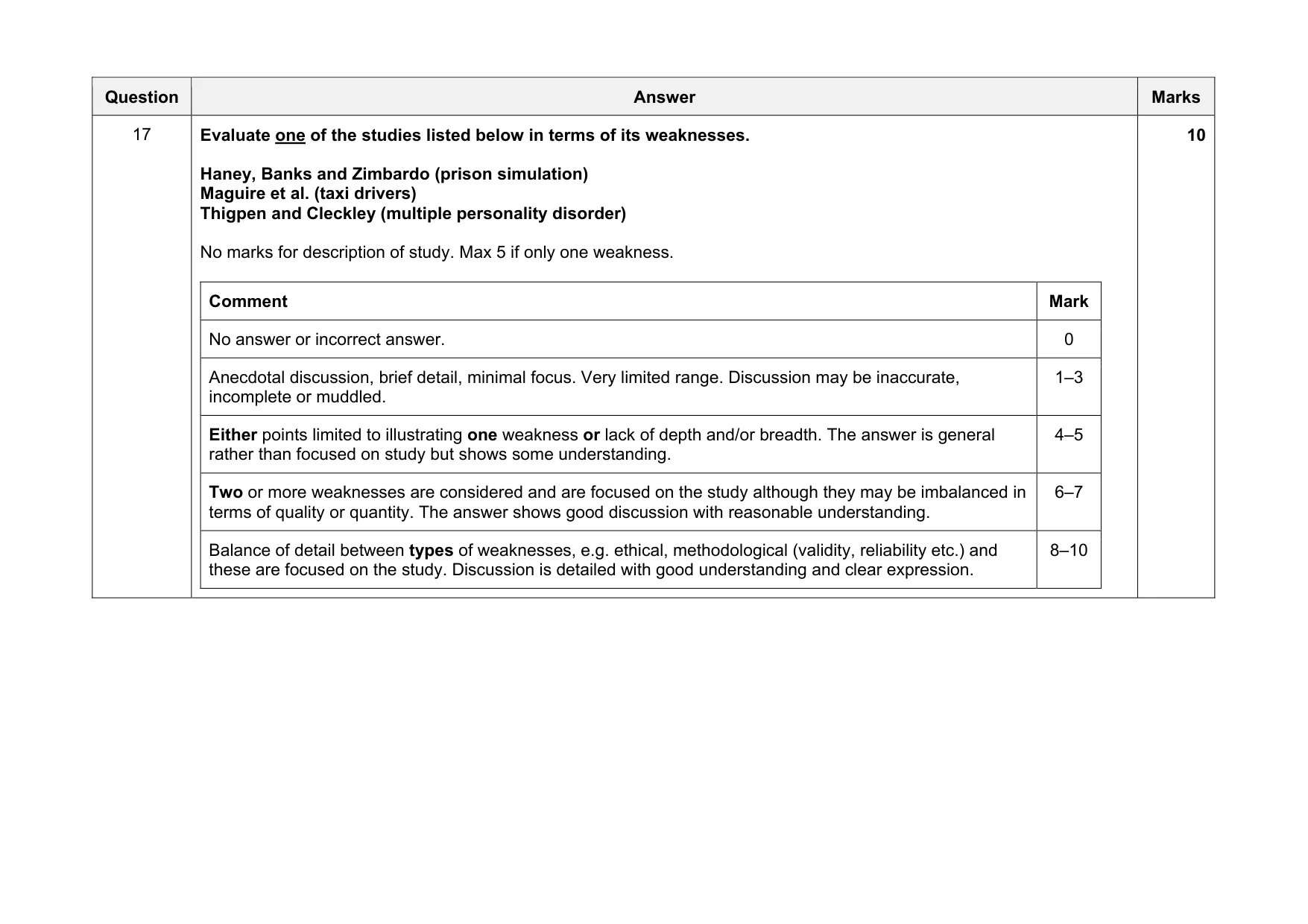
Question Answer Marks 17 Evaluate one of the studies listed below in terms of its weaknesses. Haney, Banks and Zimbardo (prison simulation) Maguire et al. (taxi drivers) Thigpen and Cleckley (multiple personality disorder) No marks for description of study. Max 5 if only one weakness. Comment Mark No answer or incorrect answer. 0 Anecdotal discussion, brief detail, minimal focus. Very limited range. Discussion may be inaccurate, incomplete or muddled. 1–3 Either points limited to illustrating one weakness or lack of depth and/or breadth. The answer is general rather than focused on study but shows some understanding. 4–5 Two or more weaknesses are considered and are focused on the study although they may be imbalanced in terms of quality or quantity. The answer shows good discussion with reasonable understanding. 6–7 Balance of detail between types of weaknesses, e.g. ethical, methodological (validity, reliability etc.) and these are focused on the study. Discussion is detailed with good understanding and clear expression. 8–10 10
Mark scheme, page 22
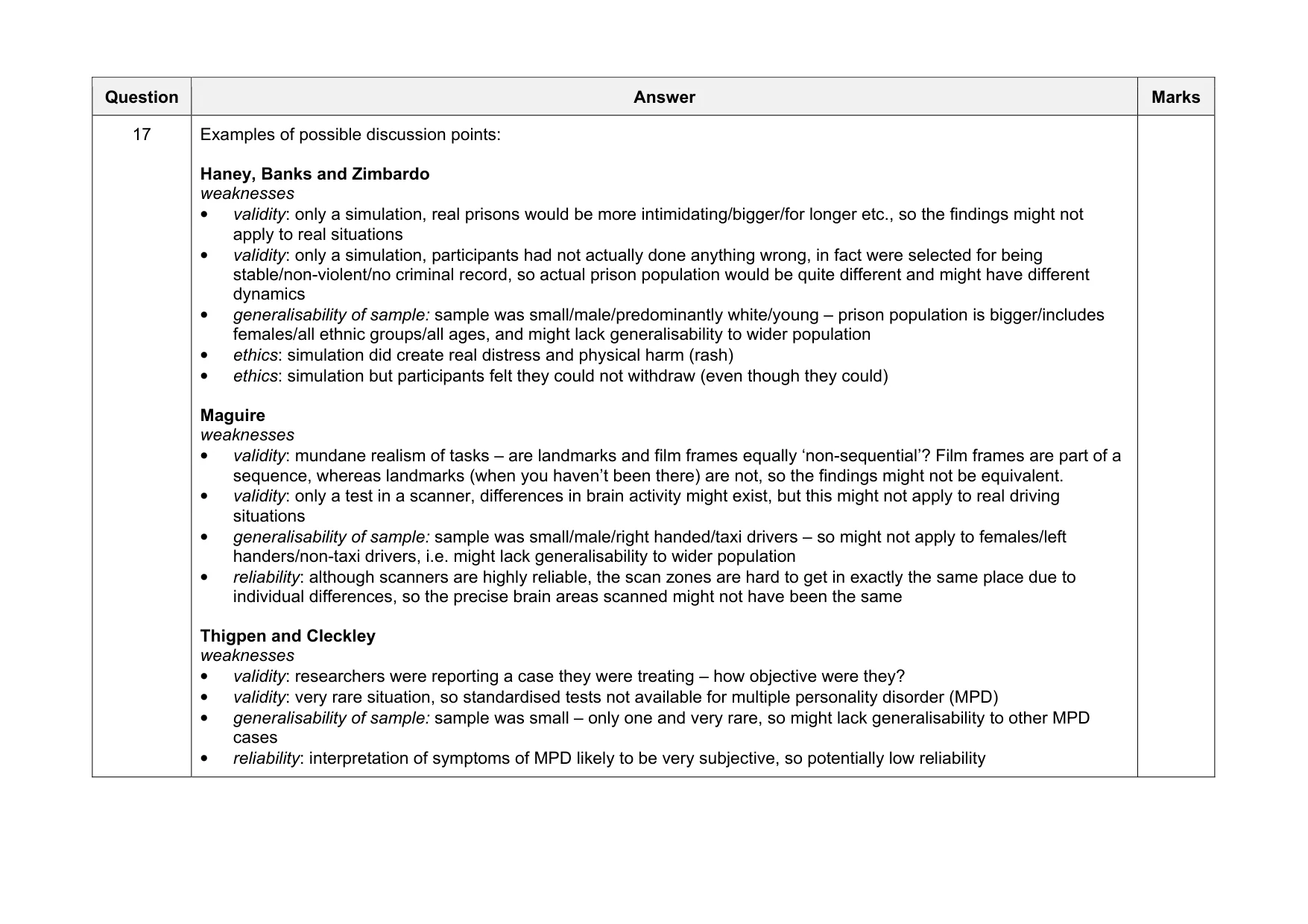
Question Answer Marks 17 Examples of possible discussion points: Haney, Banks and Zimbardo weaknesses • validity: only a simulation, real prisons would be more intimidating/bigger/for longer etc., so the findings might not apply to real situations • validity: only a simulation, participants had not actually done anything wrong, in fact were selected for being stable/non-violent/no criminal record, so actual prison population would be quite different and might have different dynamics • generalisability of sample: sample was small/male/predominantly white/young – prison population is bigger/includes females/all ethnic groups/all ages, and might lack generalisability to wider population • ethics: simulation did create real distress and physical harm (rash) • ethics: simulation but participants felt they could not withdraw (even though they could) Maguire weaknesses • validity: mundane realism of tasks – are landmarks and film frames equally ‘non-sequential’? Film frames are part of a sequence, whereas landmarks (when you haven’t been there) are not, so the findings might not be equivalent. • validity: only a test in a scanner, differences in brain activity might exist, but this might not apply to real driving situations • generalisability of sample: sample was small/male/right handed/taxi drivers – so might not apply to females/left handers/non-taxi drivers, i.e. might lack generalisability to wider population • reliability: although scanners are highly reliable, the scan zones are hard to get in exactly the same place due to individual differences, so the precise brain areas scanned might not have been the same Thigpen and Cleckley weaknesses • validity: researchers were reporting a case they were treating – how objective were they? • validity: very rare situation, so standardised tests not available for multiple personality disorder (MPD) • generalisability of sample: sample was small – only one and very rare, so might lack generalisability to other MPD cases • reliability: interpretation of symptoms of MPD likely to be very subjective, so potentially low reliability
What you needed in this session
Cambridge’s own grade thresholds for 2017 Oct/Nov, Paper 1 · Variant 2. A higher threshold means an easier paper — the bar moves with how the cohort did.