Cambridge A Level Psychology 9698 — 2017 May/June Paper 2 · Variant 2
9698/22/M/J/17 · 4 questions · 70 marks · ≈79 min
The question paper and its mark scheme, free to read here and free to download. This is Cambridge’s own paper, exactly as it was sat.
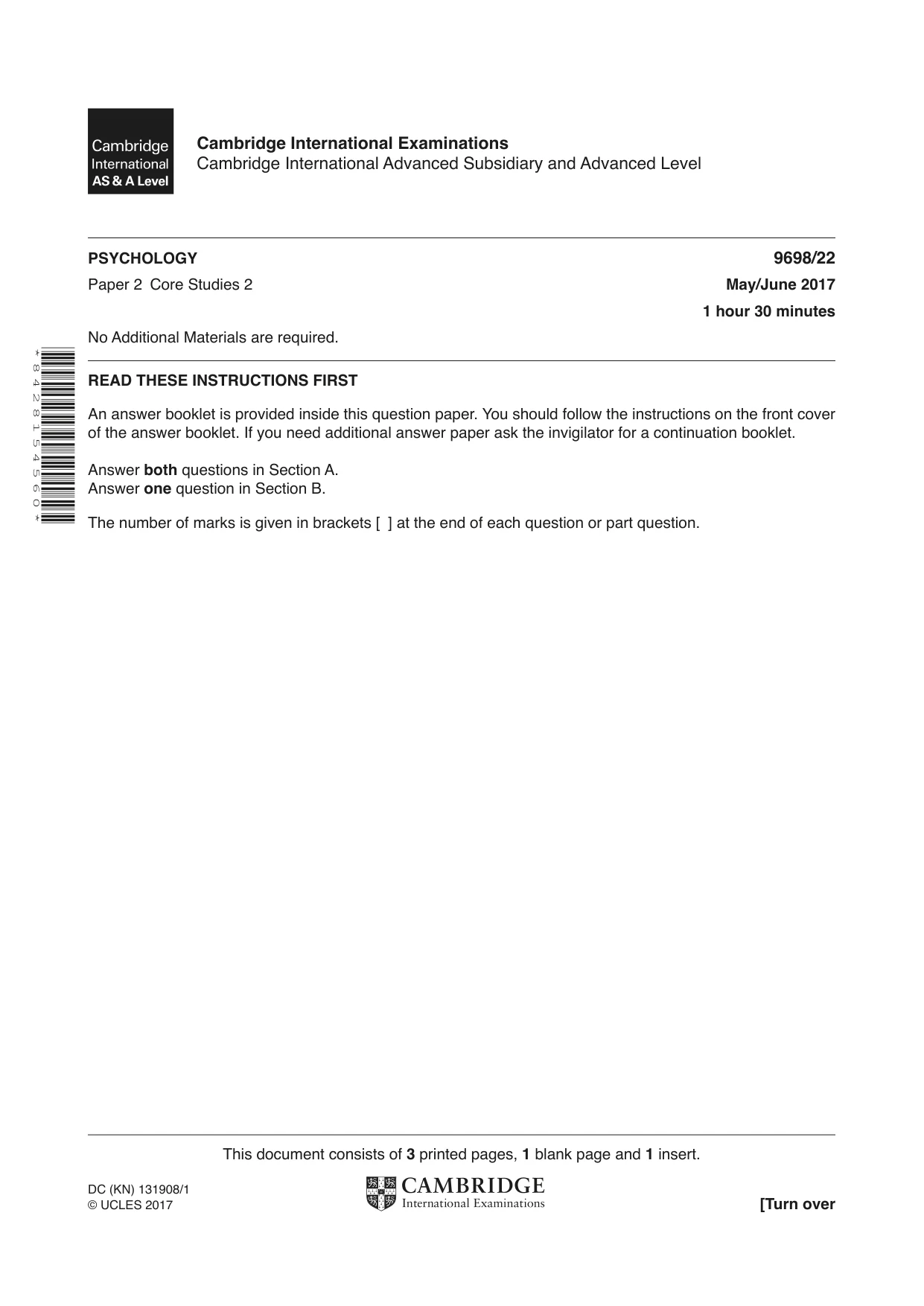
Question paper4 pages

Mark scheme10 pages
Answers below. Sit the paper first if you are practising.
Questions as text
Q1 · Dement and Kleitman used the experimental method to investigate sleep and dreaming
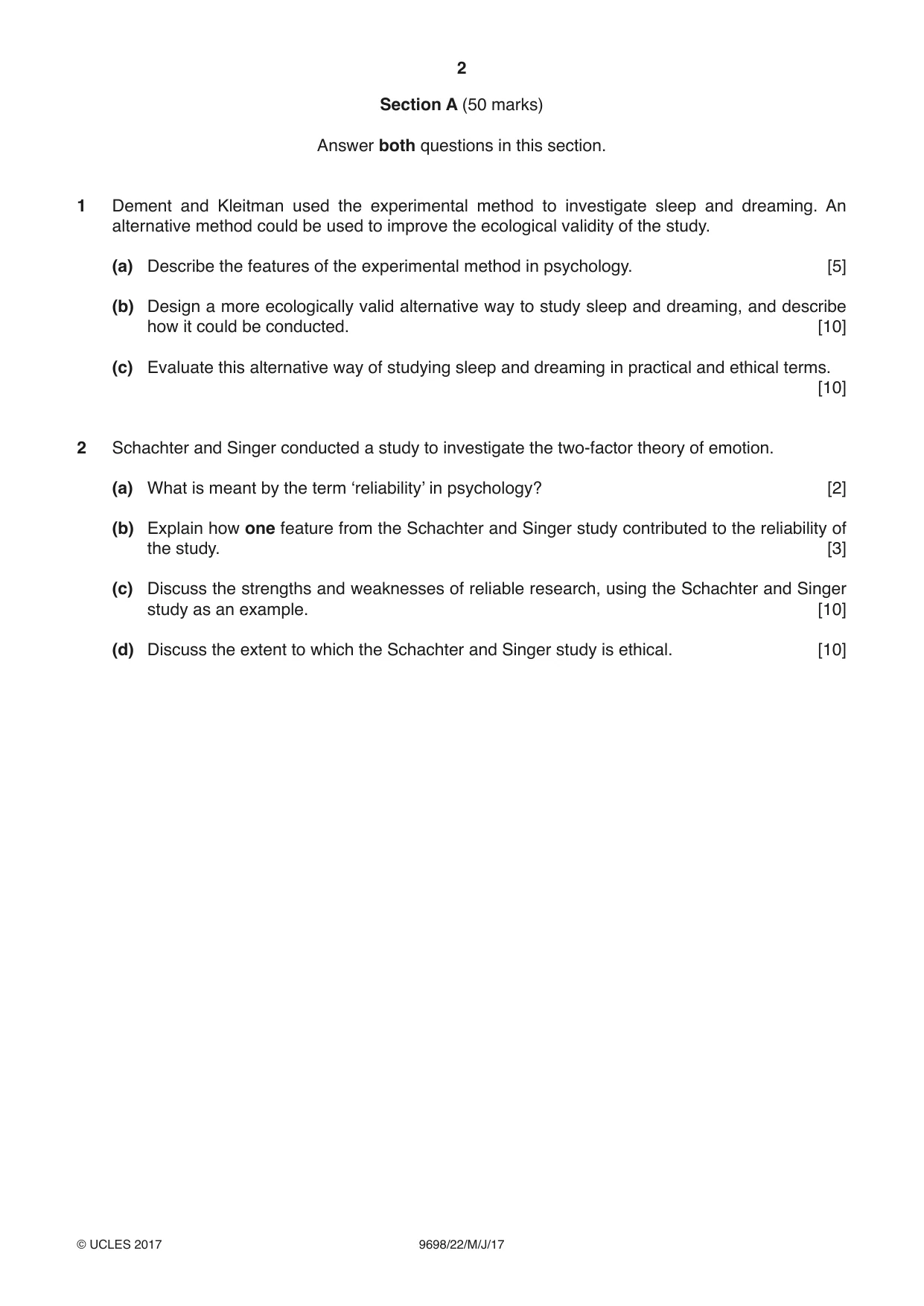
1 Dement and Kleitman used the experimental method to investigate sleep and dreaming. An alternative method could be used to improve the ecological validity of the study. (a) Describe the features of the experimental method in psychology. [5] (b) Design a more ecologically valid alternative way to study sleep and dreaming, and describe how it could be conducted. [10] (c) Evaluate this alternative way of studying sleep and dreaming in practical and ethical terms. [10]
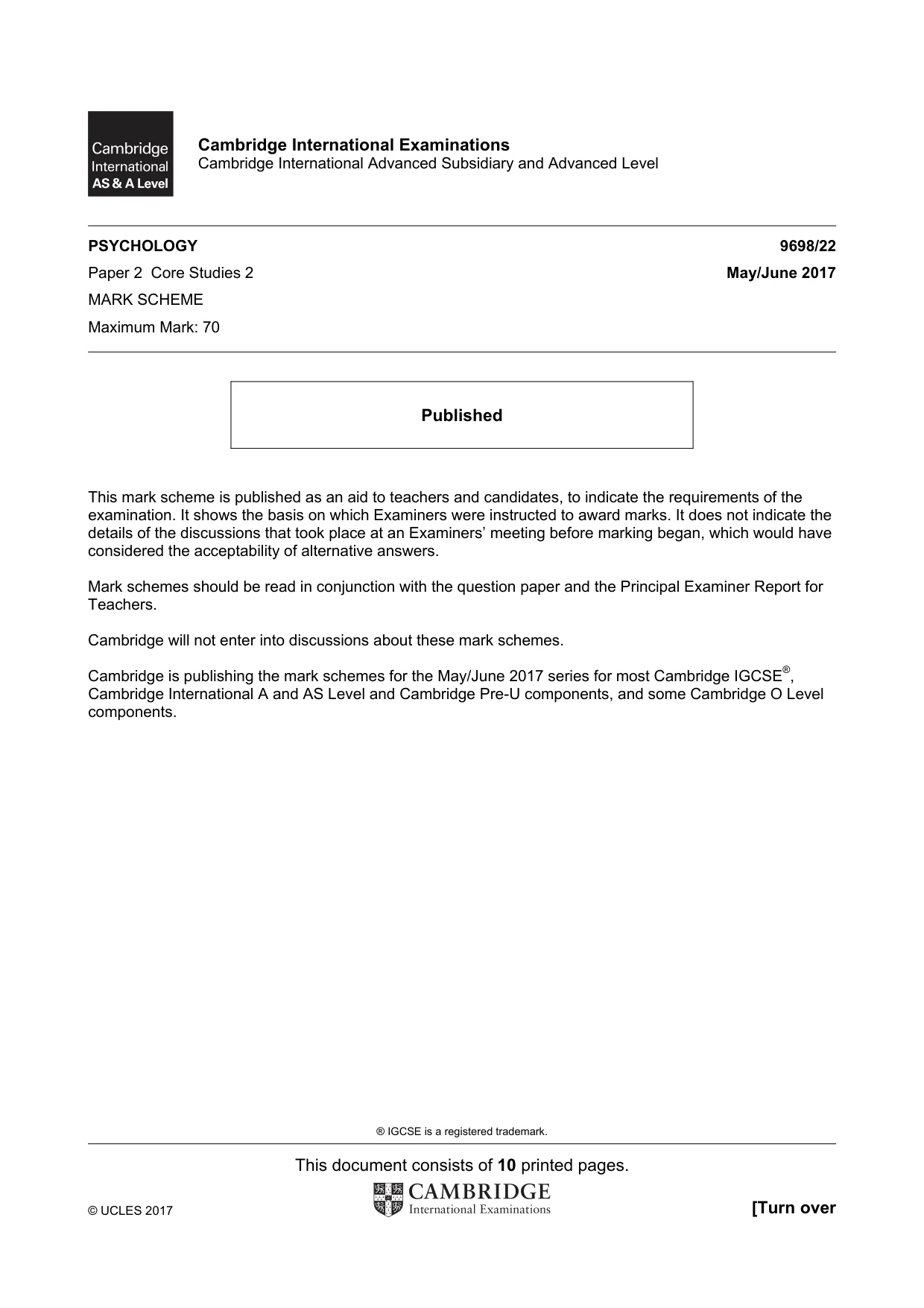
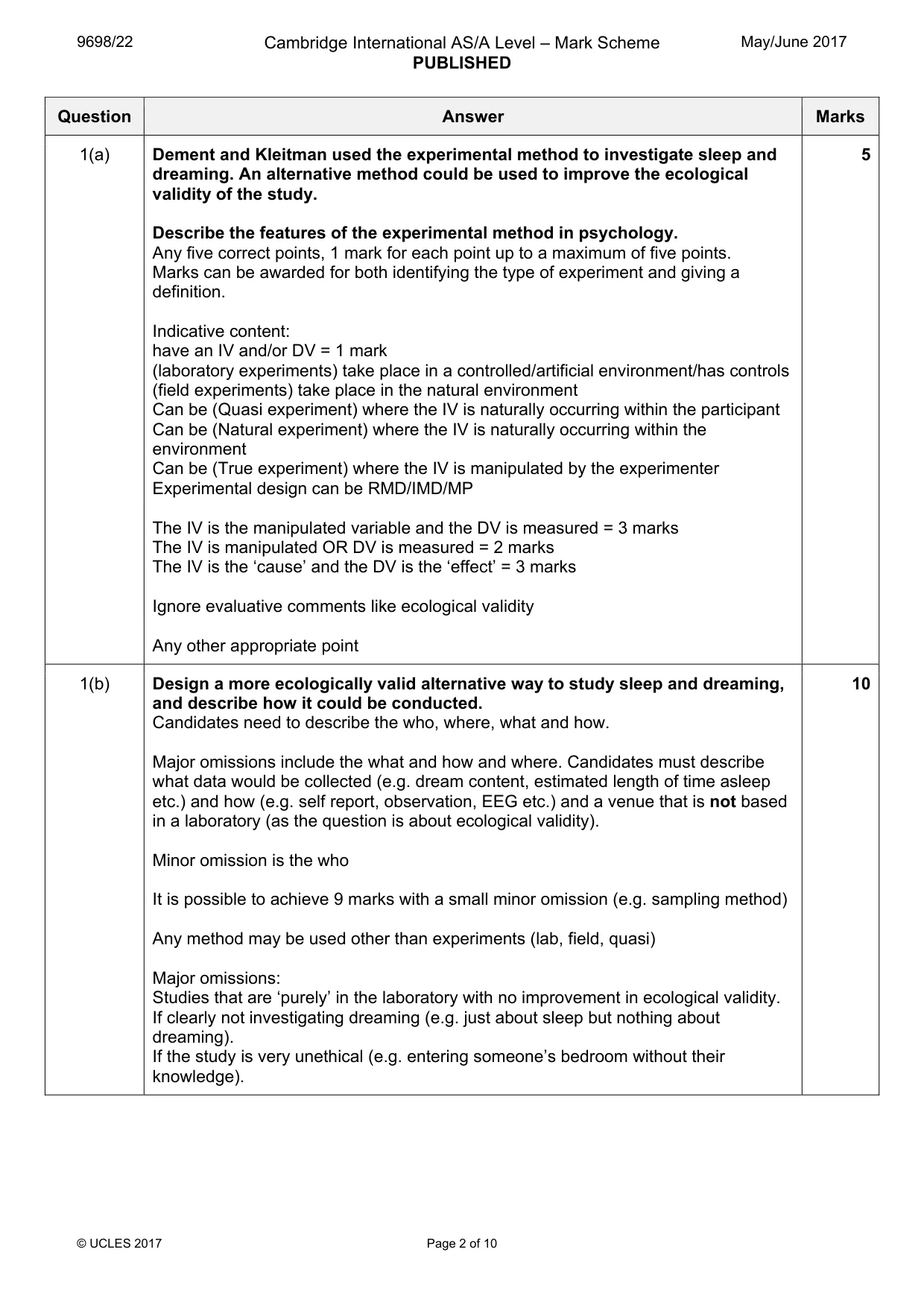
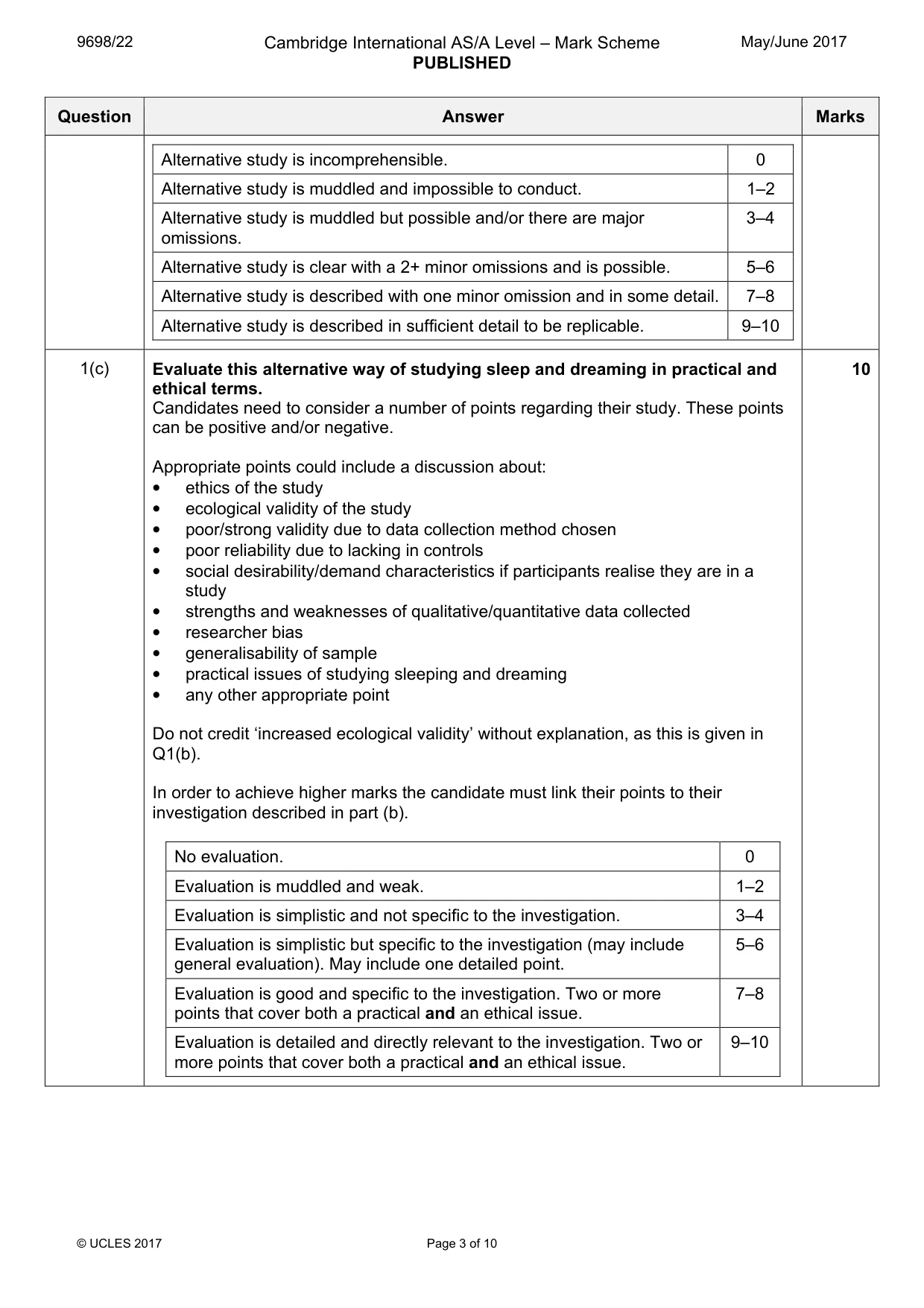
Mark scheme: Question Answer Marks 1(a) Dement and Kleitman used the experimental method to investigate sleep and 5 dreaming. An alternative method could be used to improve the ecological validity of the study. Describe the features of the experimental method in psychology. Any five correct points, 1 mark for each point up to a maximum of five points. Marks can be awarded for both identifying the type of experiment and giving a definition. Indicative content: have an IV and/or DV = 1 mark (laboratory experiments) take place in a controlled/artificial environment/has controls (field experiments) take place in the natural environment Can be (Quasi experiment) where the IV is naturally occurring within the participant Can be (Natural experiment) where the IV is naturally occurring within the environment Can be (True experiment) where the IV is manipulated by the experimenter Experimental design can be RMD/IMD/MP The IV is the manipulated variable and the DV is measured = 3 marks The IV is manipulated OR DV is measured = 2 marks The IV is the ‘cause’ and the DV is the ‘effect’ = 3 marks Ignore evaluative comments like ecological validity Any other appropriate point 1(b) Design a more ecologically valid alternative way to study sleep and dreaming, 10 and describe how it could be conducted. Candidates need to describe the who, where, what and how. Major omissions include the what and how and where. Candidates must describe what data would be collected (e.g. dream content, estimated length of time asleep etc.) and how (e.g. self report, observation, EEG etc.) and a venue that is not based in a laboratory (as the question is about ecological validity). Minor omission is the who It is possible to achieve 9 marks with a small minor omission (e.g. sampling method) Any method may be used other than experiments (lab, field, quasi) Major omissions: Studies that are ‘purely’ in the laboratory with no improvement in ecological validity. If clearly not investigating dreaming (e.g. just about sleep but nothing about dreaming). If the study is very unethical (e.g. entering someone’s bedroom without their knowledge). Alternative study is incomprehensible. 0 Alternative study is muddled and impossible to conduct. 1–2 Alternative study is muddled but possible and/or there are major 3–4 omissions. Alternative study is clear with a 2+ minor omissions and is possible. 5–6 Alternative study is described with one minor omission and in some detail. 7–8 Alternative study is described in sufficient detail to be replicable. 9–10 1(c) Evaluate this alternative way of studying sleep and dreaming in practical and 10 ethical terms. Candidates need to consider a number of points regarding their study. These points can be positive and/or negative. Appropriate points could include a discussion about: • ethics of the study • ecological validity of the study • poor/strong validity due to data collection method chosen • poor reliability due to lacking in controls • social desirability/demand characteristics if participants realise they are in a study • strengths and weaknesses of qualitative/quantitative data collected • researcher bias • generalisability of sample • practical issues of studying sleeping and dreaming • any other appropriate point Do not credit ‘increased ecological validity’ without explanation, as this is given in Q1(b). In order to achieve higher marks the candidate must link their points to their investigation described in part (b). No evaluation. 0 Evaluation is muddled and weak. 1–2 Evaluation is simplistic and not specific to the investigation. 3–4 Evaluation is simplistic but specific to the investigation (may include 5–6 general evaluation). May include one detailed point. Evaluation is good and specific to the investigation. Two or more 7–8 points that cover both a practical and an ethical issue. Evaluation is detailed and directly relevant to the investigation. Two or 9–10 more points that cover both a practical and an ethical issue.
Q2 · Schachter and Singer conducted a study to investigate the two-factor theory of emotion
2 Schachter and Singer conducted a study to investigate the two-factor theory of emotion. (a) What is meant by the term ‘reliability’ in psychology? [2] (b) Explain how one feature from the Schachter and Singer study contributed to the reliability of the study. [3] (c) Discuss the strengths and weaknesses of reliable research, using the Schachter and Singer study as an example. [10] (d) Discuss the extent to which the Schachter and Singer study is ethical. [10]
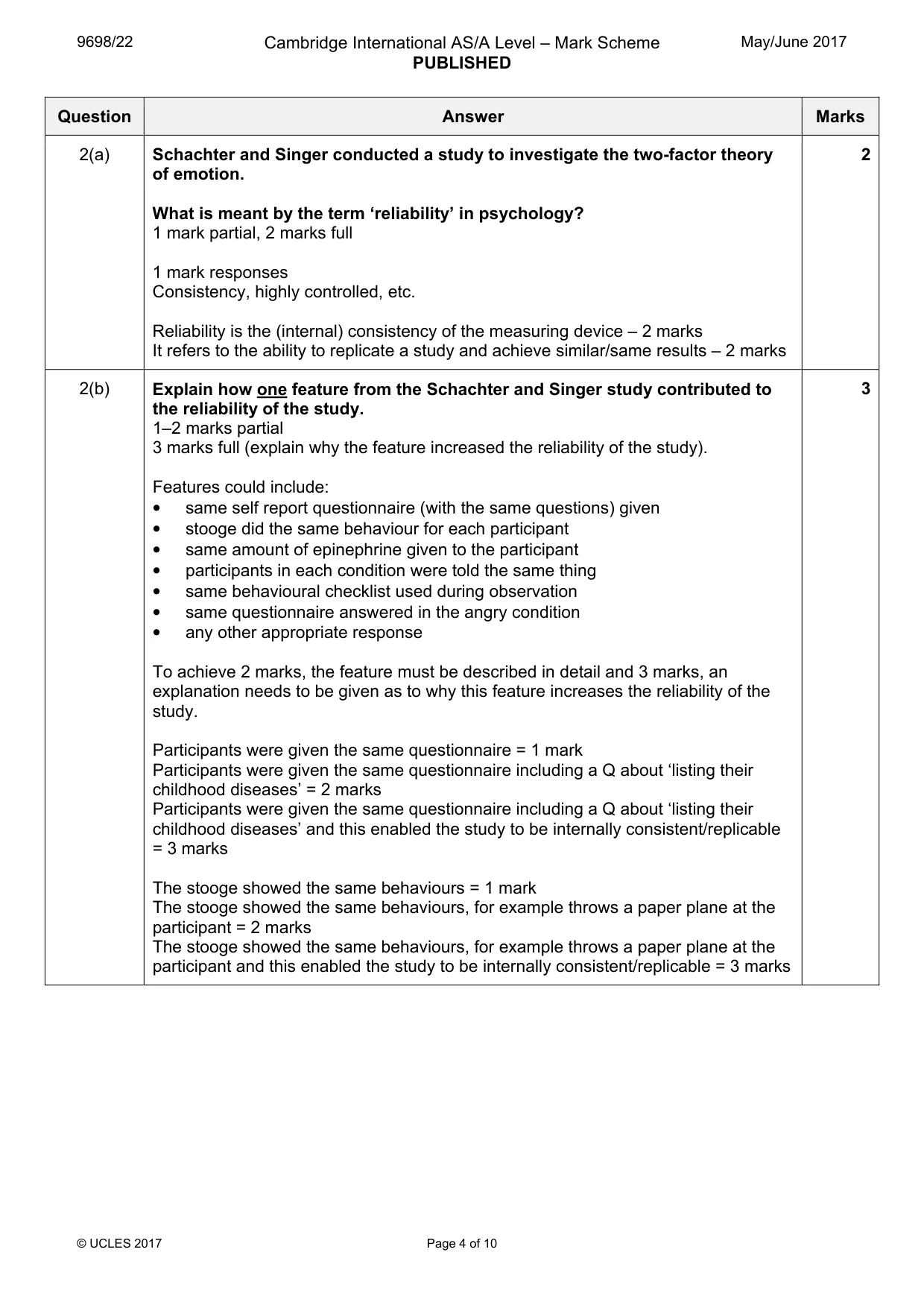
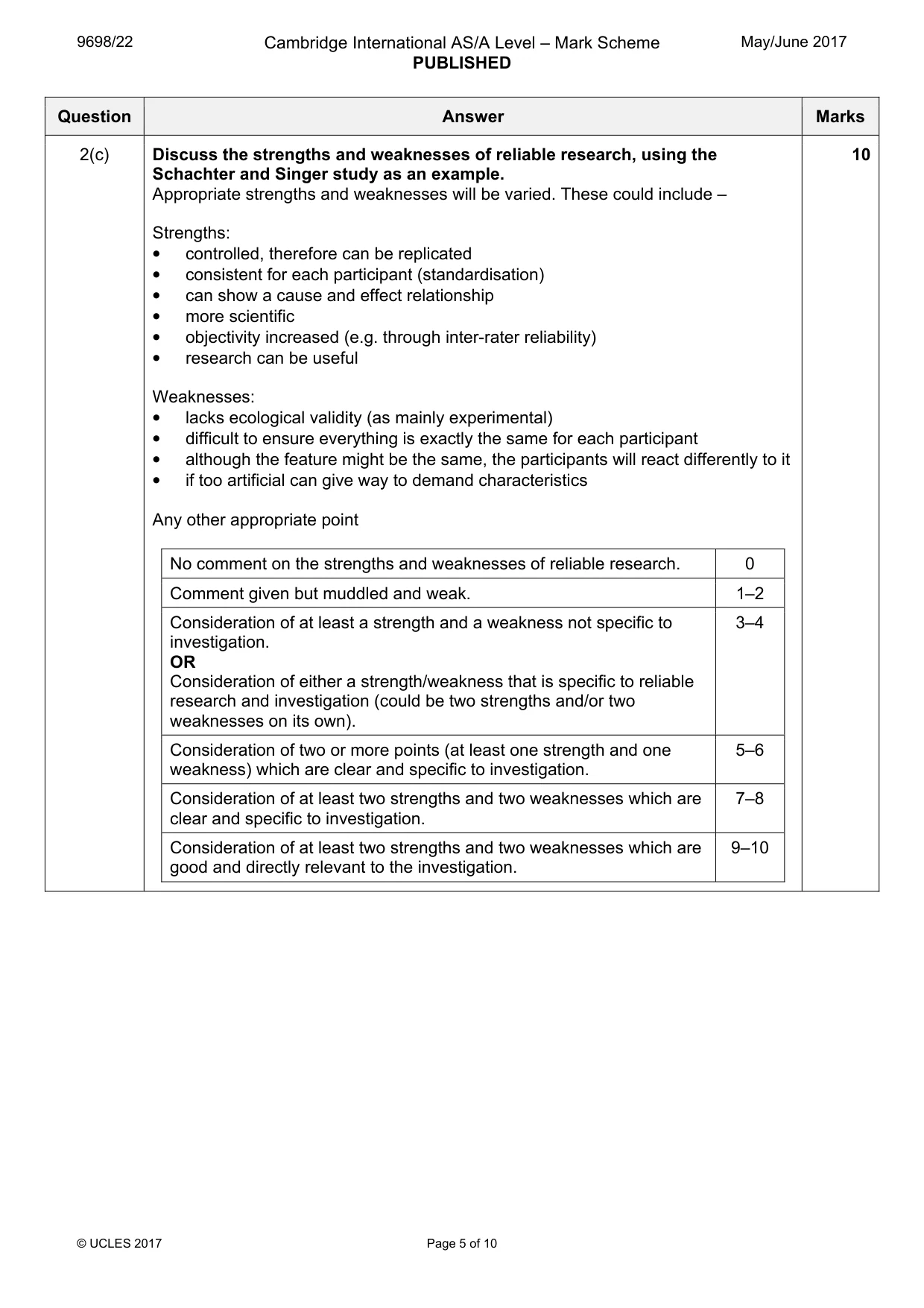
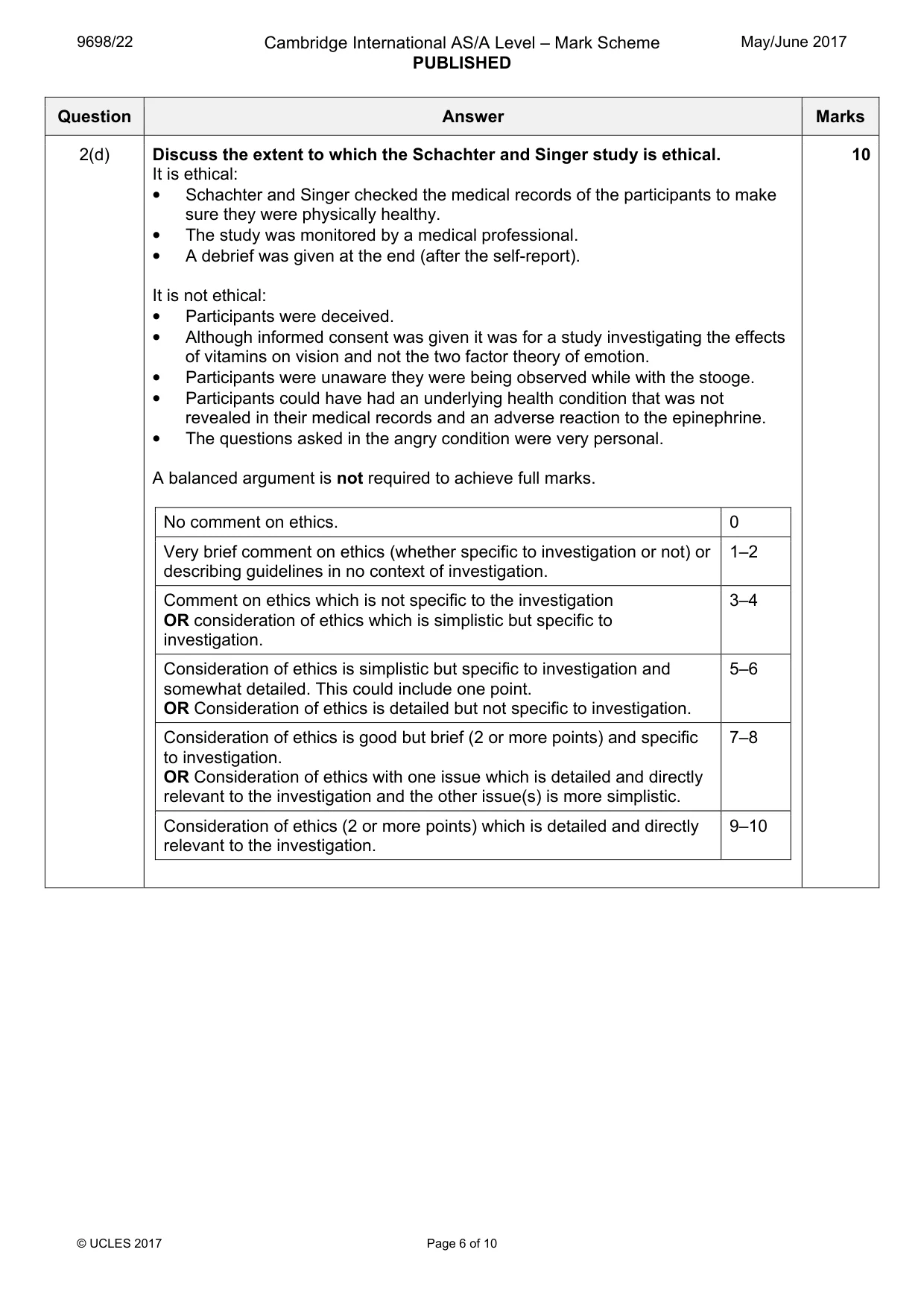
Mark scheme: 2(a) Schachter and Singer conducted a study to investigate the two-factor theory 2 of emotion. What is meant by the term ‘reliability’ in psychology? 1 mark partial, 2 marks full 1 mark responses Consistency, highly controlled, etc. Reliability is the (internal) consistency of the measuring device – 2 marks It refers to the ability to replicate a study and achieve similar/same results – 2 marks 2(b) Explain how one feature from the Schachter and Singer study contributed to 3 the reliability of the study. 1–2 marks partial 3 marks full (explain why the feature increased the reliability of the study). Features could include: • same self report questionnaire (with the same questions) given • stooge did the same behaviour for each participant • same amount of epinephrine given to the participant • participants in each condition were told the same thing • same behavioural checklist used during observation • same questionnaire answered in the angry condition • any other appropriate response To achieve 2 marks, the feature must be described in detail and 3 marks, an explanation needs to be given as to why this feature increases the reliability of the study. Participants were given the same questionnaire = 1 mark Participants were given the same questionnaire including a Q about ‘listing their childhood diseases’ = 2 marks Participants were given the same questionnaire including a Q about ‘listing their childhood diseases’ and this enabled the study to be internally consistent/replicable = 3 marks The stooge showed the same behaviours = 1 mark The stooge showed the same behaviours, for example throws a paper plane at the participant = 2 marks The stooge showed the same behaviours, for example throws a paper plane at the participant and this enabled the study to be internally consistent/replicable = 3 marks 2(c) Discuss the strengths and weaknesses of reliable research, using the 10 Schachter and Singer study as an example. Appropriate strengths and weaknesses will be varied. These could include – Strengths: • controlled, therefore can be replicated • consistent for each participant (standardisation) • can show a cause and effect relationship • more scientific • objectivity increased (e.g. through inter-rater reliability) • research can be useful Weaknesses: • lacks ecological validity (as mainly experimental) • difficult to ensure everything is exactly the same for each participant • although the feature might be the same, the participants will react differently to it • if too artificial can give way to demand characteristics Any other appropriate point No comment on the strengths and weaknesses of reliable research. 0 Comment given but muddled and weak. 1–2 Consideration of at least a strength and a weakness not specific to 3–4 investigation. OR Consideration of either a strength/weakness that is specific to reliable research and investigation (could be two strengths and/or two weaknesses on its own). Consideration of two or more points (at least one strength and one 5–6 weakness) which are clear and specific to investigation. Consideration of at least two strengths and two weaknesses which are 7–8 clear and specific to investigation. Consideration of at least two strengths and two weaknesses which are 9–10 good and directly relevant to the investigation. 2(d) Discuss the extent to which the Schachter and Singer study is ethical. 10 It is ethical: • Schachter and Singer checked the medical records of the participants to make sure they were physically healthy. • The study was monitored by a medical professional. • A debrief was given at the end (after the self-report). It is not ethical: • Participants were deceived. • Although informed consent was given it was for a study investigating the effects of vitamins on vision and not the two factor theory of emotion. • Participants were unaware they were being observed while with the stooge. • Participants could have had an underlying health condition that was not revealed in their medical records and an adverse reaction to the epinephrine. • The questions asked in the angry condition were very personal. A balanced argument is not required to achieve full marks. No comment on ethics. 0 Very brief comment on ethics (whether specific to investigation or not) or 1–2 describing guidelines in no context of investigation. Comment on ethics which is not specific to the investigation 3–4 OR consideration of ethics which is simplistic but specific to investigation. Consideration of ethics is simplistic but specific to investigation and 5–6 somewhat detailed. This could include one point. OR Consideration of ethics is detailed but not specific to investigation. Consideration of ethics is good but brief (2 or more points) and specific 7–8 to investigation. OR Consideration of ethics with one issue which is detailed and directly relevant to the investigation and the other issue(s) is more simplistic. Consideration of ethics (2 or more points) which is detailed and directly 9–10 relevant to the investigation.
Q3 · Outline what is meant by ‘application to everyday life’ in psychology
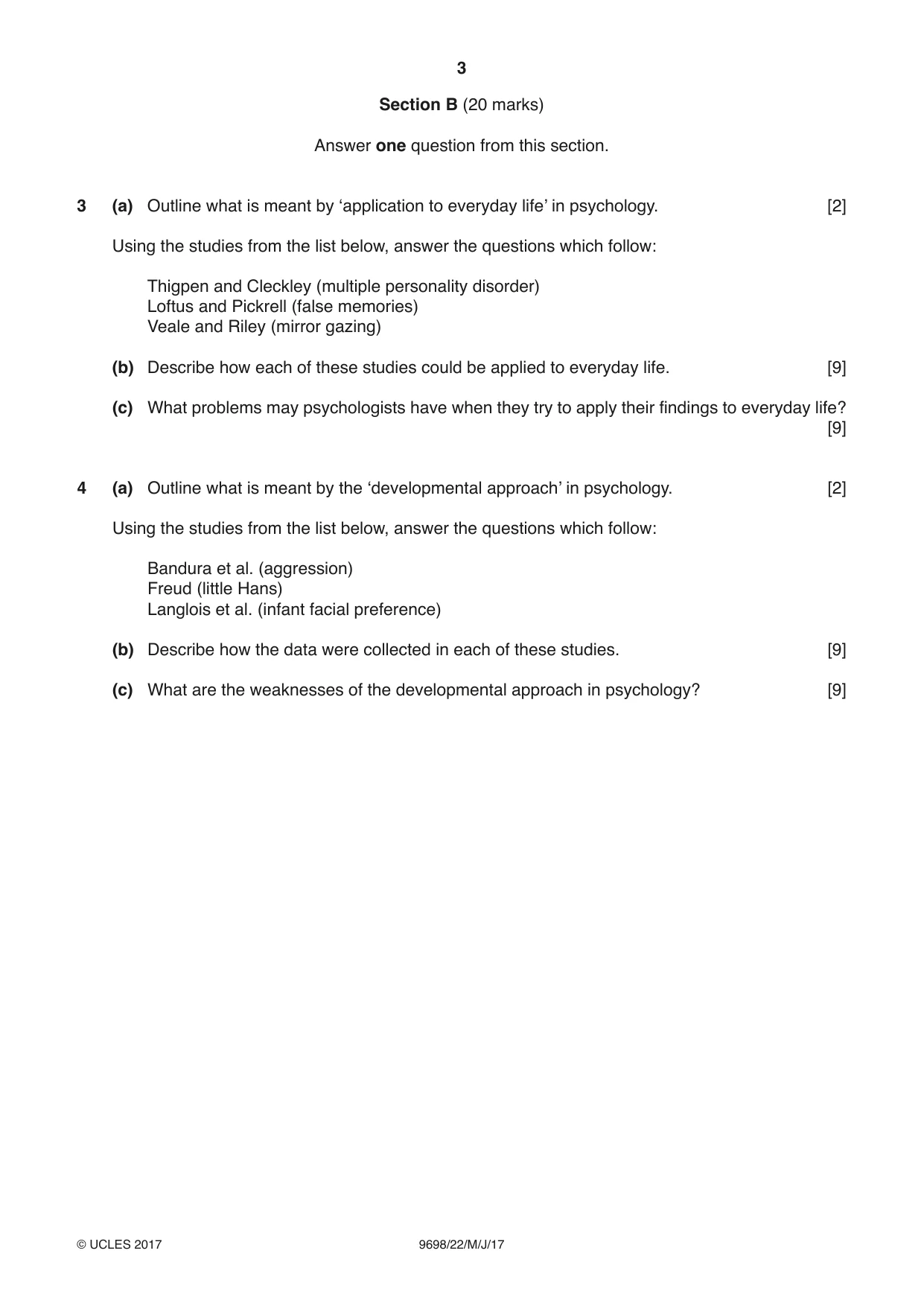
3 (a) Outline what is meant by ‘application to everyday life’ in psychology. [2] Using the studies from the list below, answer the questions which follow: Thigpen and Cleckley (multiple personality disorder) Loftus and Pickrell (false memories) Veale and Riley (mirror gazing) (b) Describe how each of these studies could be applied to everyday life. [9] (c) What problems may psychologists have when they try to apply their findings to everyday life? [9]
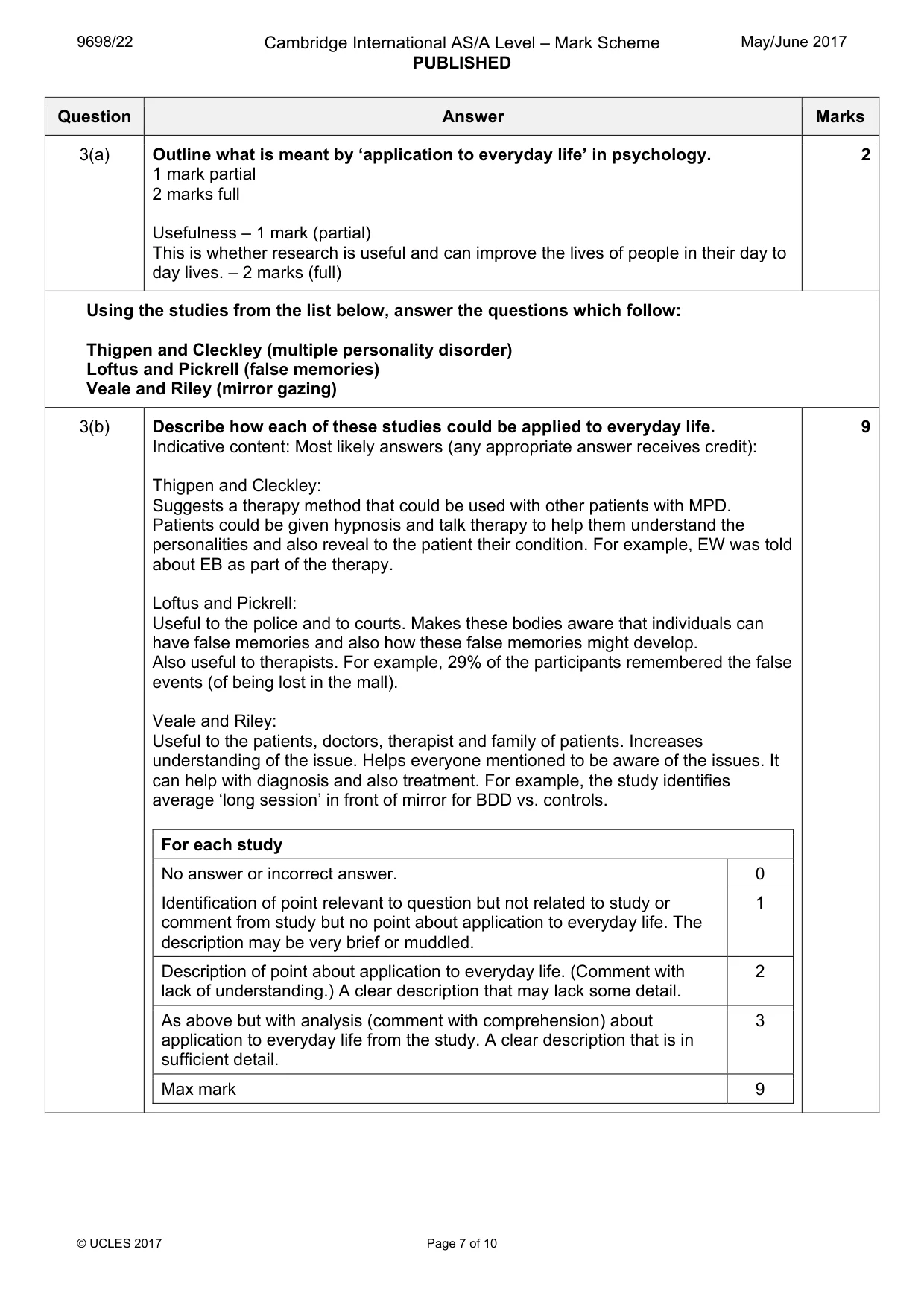
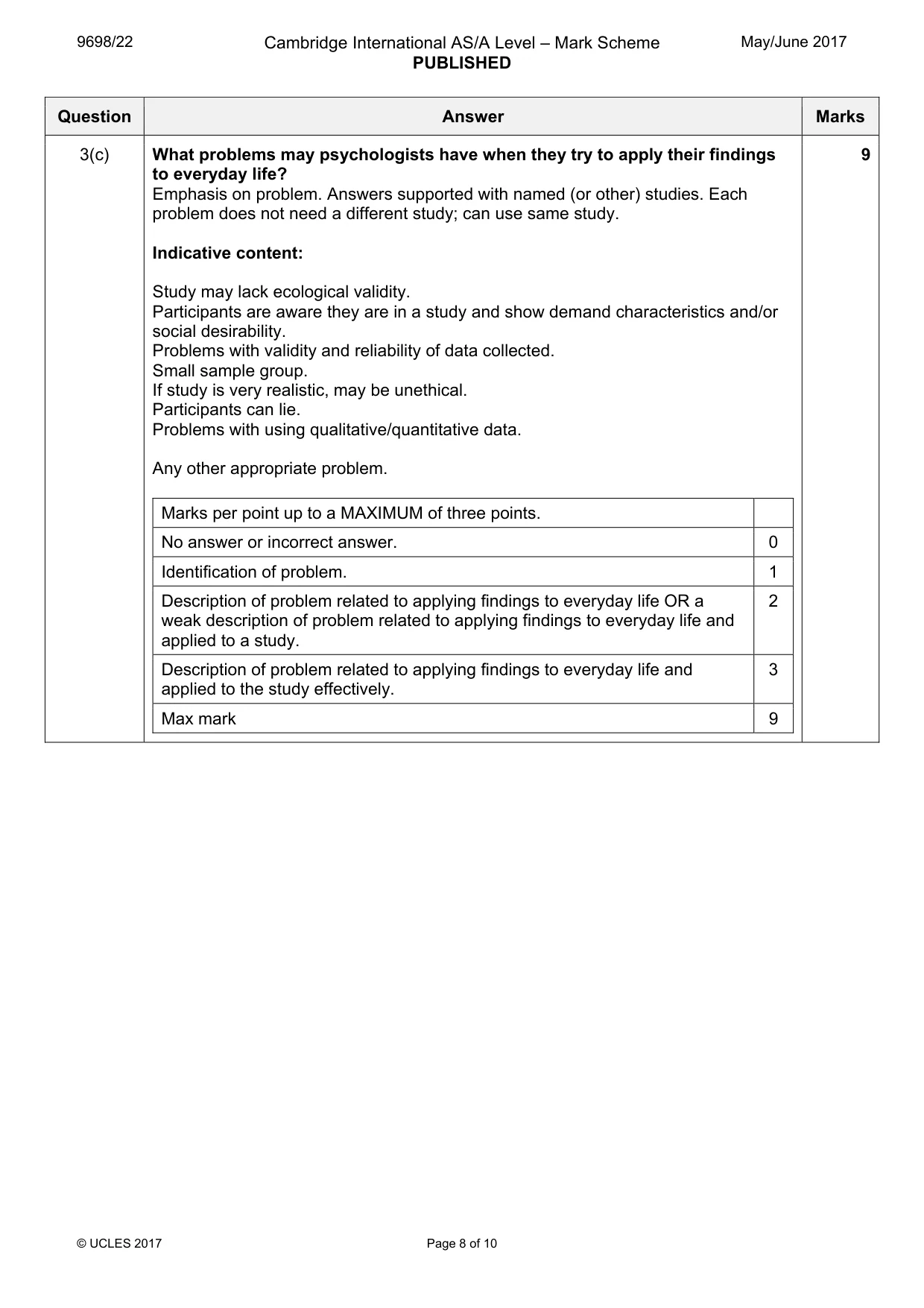
Mark scheme: 3(a) Outline what is meant by ‘application to everyday life’ in psychology. 2 1 mark partial 2 marks full Usefulness – 1 mark (partial) This is whether research is useful and can improve the lives of people in their day to day lives. – 2 marks (full) Using the studies from the list below, answer the questions which follow: Thigpen and Cleckley (multiple personality disorder) Loftus and Pickrell (false memories) Veale and Riley (mirror gazing) 3(b) Describe how each of these studies could be applied to everyday life. 9 Indicative content: Most likely answers (any appropriate answer receives credit): Thigpen and Cleckley: Suggests a therapy method that could be used with other patients with MPD. Patients could be given hypnosis and talk therapy to help them understand the personalities and also reveal to the patient their condition. For example, EW was told about EB as part of the therapy. Loftus and Pickrell: Useful to the police and to courts. Makes these bodies aware that individuals can have false memories and also how these false memories might develop. Also useful to therapists. For example, 29% of the participants remembered the false events (of being lost in the mall). Veale and Riley: Useful to the patients, doctors, therapist and family of patients. Increases understanding of the issue. Helps everyone mentioned to be aware of the issues. It can help with diagnosis and also treatment. For example, the study identifies average ‘long session’ in front of mirror for BDD vs. controls. For each study No answer or incorrect answer. 0 Identification of point relevant to question but not related to study or 1 comment from study but no point about application to everyday life. The description may be very brief or muddled. Description of point about application to everyday life. (Comment with 2 lack of understanding.) A clear description that may lack some detail. As above but with analysis (comment with comprehension) about 3 application to everyday life from the study. A clear description that is in sufficient detail. Max mark 9 3(c) What problems may psychologists have when they try to apply their findings 9 to everyday life? Emphasis on problem. Answers supported with named (or other) studies. Each problem does not need a different study; can use same study. Indicative content: Study may lack ecological validity. Participants are aware they are in a study and show demand characteristics and/or social desirability. Problems with validity and reliability of data collected. Small sample group. If study is very realistic, may be unethical. Participants can lie. Problems with using qualitative/quantitative data. Any other appropriate problem. Marks per point up to a MAXIMUM of three points. No answer or incorrect answer. 0 Identification of problem. 1 Description of problem related to applying findings to everyday life OR a 2 weak description of problem related to applying findings to everyday life and applied to a study. Description of problem related to applying findings to everyday life and 3 applied to the study effectively. Max mark 9
Q4 · Outline what is meant by the ‘developmental approach’ in psychology
4 (a) Outline what is meant by the ‘developmental approach’ in psychology. [2] Using the studies from the list below, answer the questions which follow: Bandura et al. (aggression) Freud (little Hans) Langlois et al. (infant facial preference) (b) Describe how the data were collected in each of these studies. [9] (c) What are the weaknesses of the developmental approach in psychology? [9]
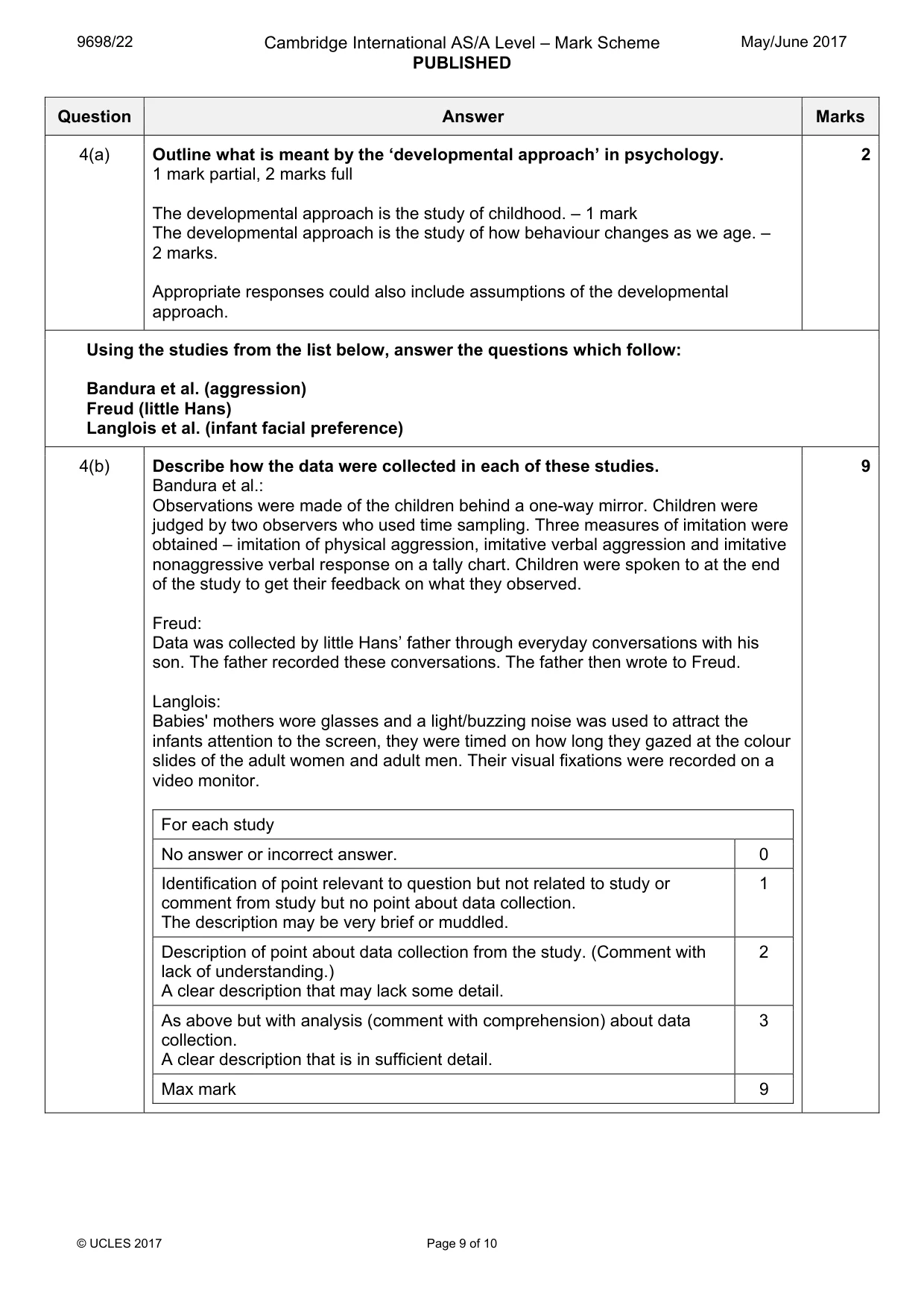
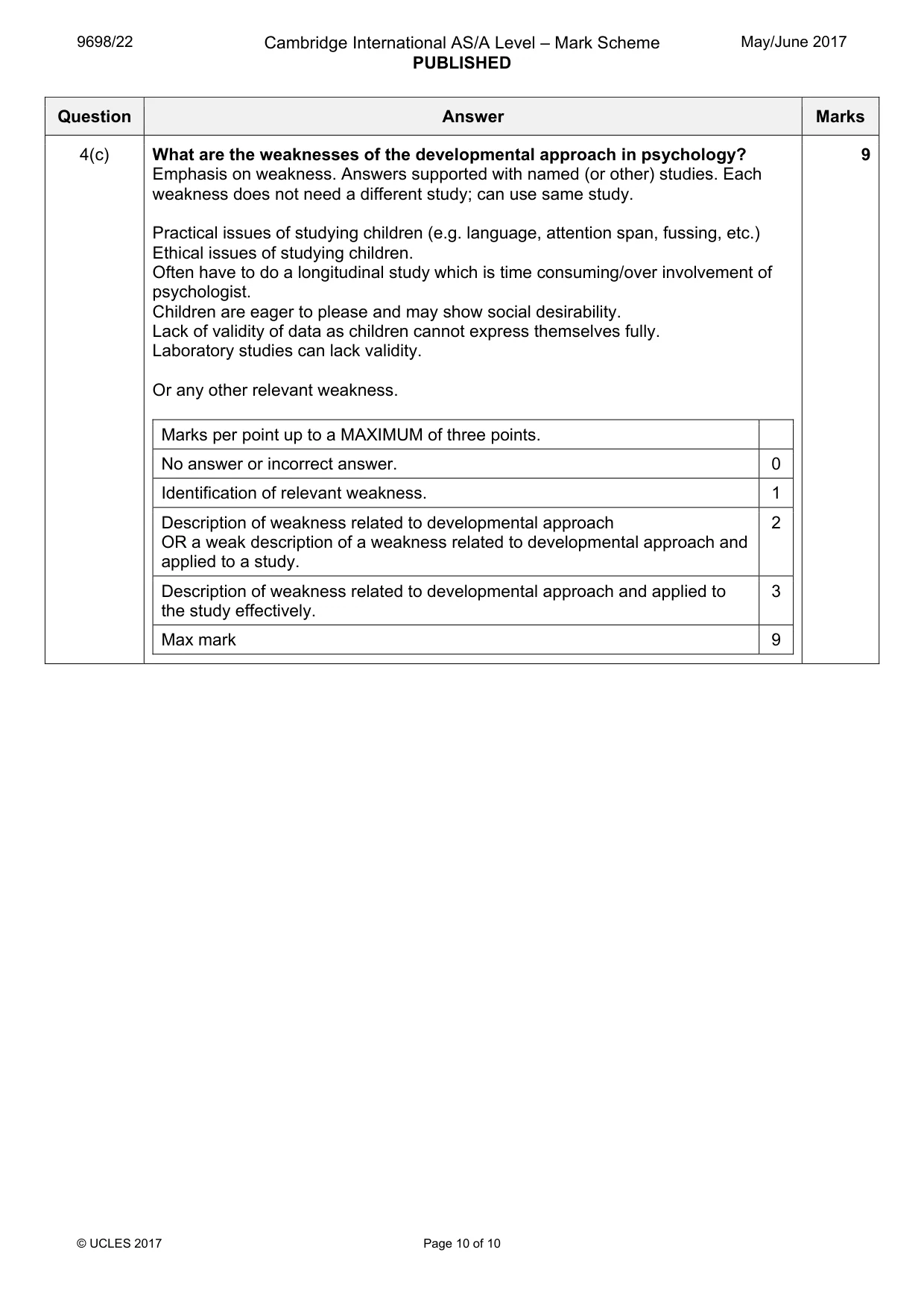
Mark scheme: 4(a) Outline what is meant by the ‘developmental approach’ in psychology. 2 1 mark partial, 2 marks full The developmental approach is the study of childhood. – 1 mark The developmental approach is the study of how behaviour changes as we age. – 2 marks. Appropriate responses could also include assumptions of the developmental approach. Using the studies from the list below, answer the questions which follow: Bandura et al. (aggression) Freud (little Hans) Langlois et al. (infant facial preference) 4(b) Describe how the data were collected in each of these studies. 9 Bandura et al.: Observations were made of the children behind a one-way mirror. Children were judged by two observers who used time sampling. Three measures of imitation were obtained – imitation of physical aggression, imitative verbal aggression and imitative nonaggressive verbal response on a tally chart. Children were spoken to at the end of the study to get their feedback on what they observed. Freud: Data was collected by little Hans’ father through everyday conversations with his son. The father recorded these conversations. The father then wrote to Freud. Langlois: Babies' mothers wore glasses and a light/buzzing noise was used to attract the infants attention to the screen, they were timed on how long they gazed at the colour slides of the adult women and adult men. Their visual fixations were recorded on a video monitor. For each study No answer or incorrect answer. 0 Identification of point relevant to question but not related to study or 1 comment from study but no point about data collection. The description may be very brief or muddled. Description of point about data collection from the study. (Comment with 2 lack of understanding.) A clear description that may lack some detail. As above but with analysis (comment with comprehension) about data 3 collection. A clear description that is in sufficient detail. Max mark 9 4(c) What are the weaknesses of the developmental approach in psychology? 9 Emphasis on weakness. Answers supported with named (or other) studies. Each weakness does not need a different study; can use same study. Practical issues of studying children (e.g. language, attention span, fussing, etc.) Ethical issues of studying children. Often have to do a longitudinal study which is time consuming/over involvement of psychologist. Children are eager to please and may show social desirability. Lack of validity of data as children cannot express themselves fully. Laboratory studies can lack validity. Or any other relevant weakness. Marks per point up to a MAXIMUM of three points. No answer or incorrect answer. 0 Identification of relevant weakness. 1 Description of weakness related to developmental approach 2 OR a weak description of a weakness related to developmental approach and applied to a study. Description of weakness related to developmental approach and applied to 3 the study effectively. Max mark 9
What you needed in this session
Cambridge’s own grade thresholds for 2017 May/June, Paper 2 · Variant 2. A higher threshold means an easier paper — the bar moves with how the cohort did.