Cambridge A Level Psychology 9698 — 2016 Oct/Nov Paper 2 · Variant 2
9698/22/O/N/16 · 70 marks · ≈79 min
The question paper and its mark scheme, free to read here and free to download. This is Cambridge’s own paper, exactly as it was sat.
Question paper4 pages

Mark scheme10 pages
Answers below. Sit the paper first if you are practising.
Paper as text
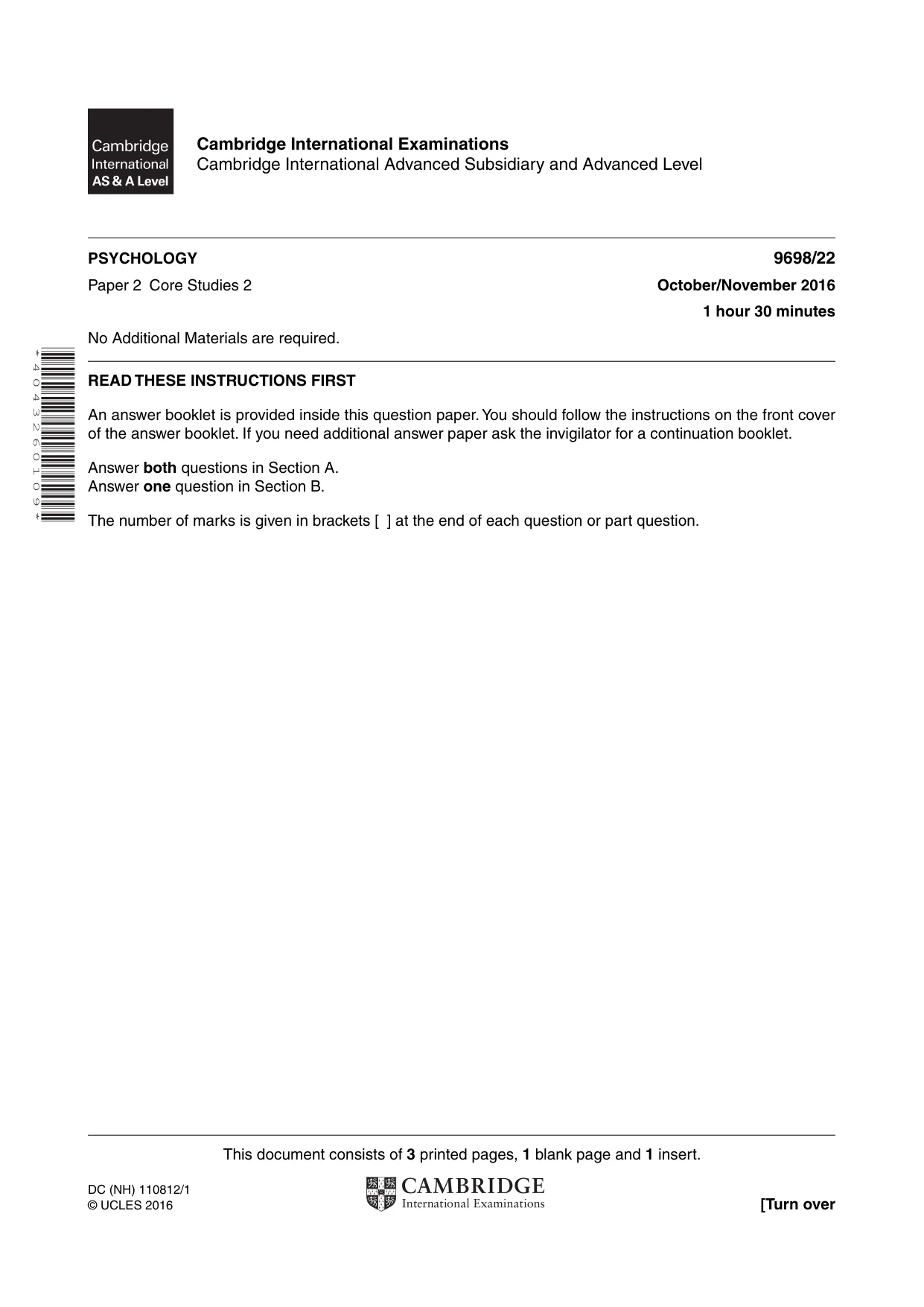
Question paper, page 1
This document consists of 3 printed pages, 1 blank page and 1 insert. DC (NH) 110812/1 © UCLES 2016 [Turn over * 4 0 4 3 2 6 0 1 0 9 * PSYCHOLOGY 9698/22 Paper 2 Core Studies 2 October/November 2016 1 hour 30 minutes No Additional Materials are required. READ THESE INSTRUCTIONS FIRST An answer booklet is provided inside this question paper. You should follow the instructions on the front cover of the answer booklet. If you need additional answer paper ask the invigilator for a continuation booklet. Answer both questions in Section A. Answer one question in Section B. The number of marks is given in brackets [ ] at the end of each question or part question. Cambridge International Examinations Cambridge International Advanced Subsidiary and Advanced Level
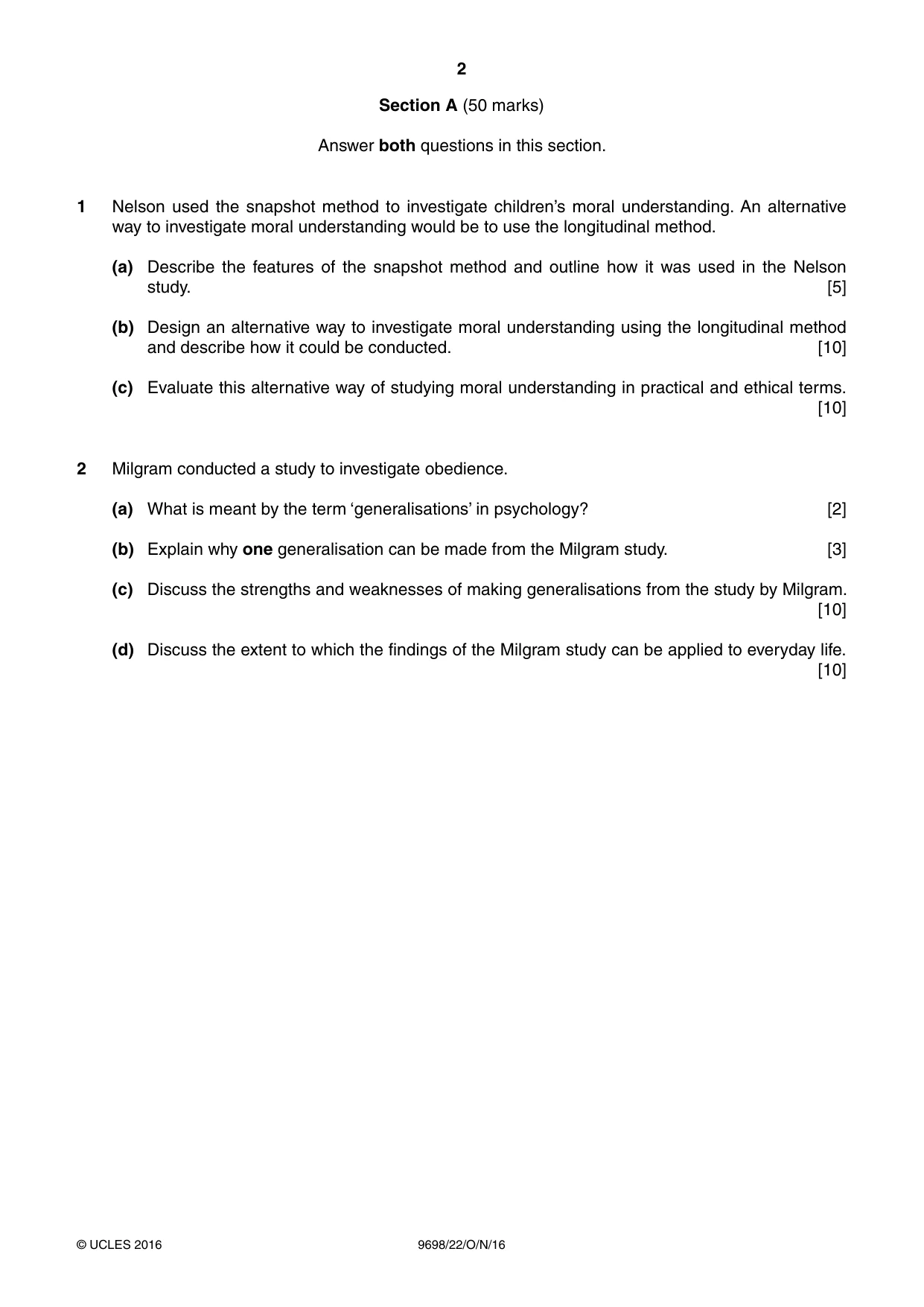
Question paper, page 2
2 9698/22/O/N/16 © UCLES 2016 Section A (50 marks) Answer both questions in this section. 1 Nelson used the snapshot method to investigate children’s moral understanding. An alternative way to investigate moral understanding would be to use the longitudinal method. (a) Describe the features of the snapshot method and outline how it was used in the Nelson study. [5] (b) Design an alternative way to investigate moral understanding using the longitudinal method and describe how it could be conducted. [10] (c) Evaluate this alternative way of studying moral understanding in practical and ethical terms. [10] 2 Milgram conducted a study to investigate obedience. (a) What is meant by the term ‘generalisations’ in psychology? [2] (b) Explain why one generalisation can be made from the Milgram study. [3] (c) Discuss the strengths and weaknesses of making generalisations from the study by Milgram. [10] (d) Discuss the extent to which the findings of the Milgram study can be applied to everyday life. [10]
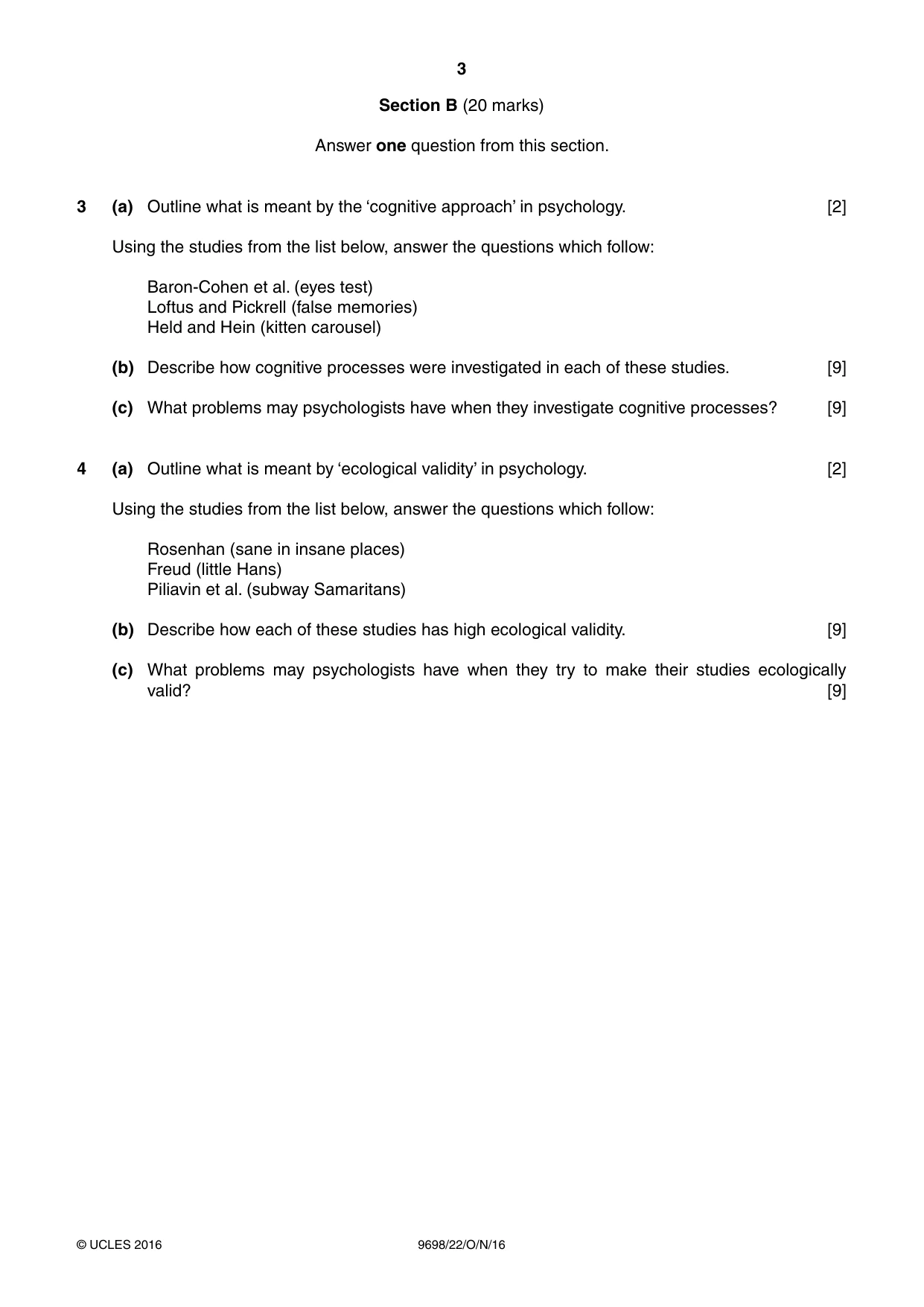
Question paper, page 3
3 9698/22/O/N/16 © UCLES 2016 Section B (20 marks) Answer one question from this section. 3 (a) Outline what is meant by the ‘cognitive approach’ in psychology. [2] Using the studies from the list below, answer the questions which follow: Baron-Cohen et al. (eyes test) Loftus and Pickrell (false memories) Held and Hein (kitten carousel) (b) Describe how cognitive processes were investigated in each of these studies. [9] (c) What problems may psychologists have when they investigate cognitive processes? [9] 4 (a) Outline what is meant by ‘ecological validity’ in psychology. [2] Using the studies from the list below, answer the questions which follow: Rosenhan (sane in insane places) Freud (little Hans) Piliavin et al. (subway Samaritans) (b) Describe how each of these studies has high ecological validity. [9] (c) What problems may psychologists have when they try to make their studies ecologically valid? [9]
Question paper, page 4
4 9698/22/O/N/16 © UCLES 2016 BLANK PAGE Permission to reproduce items where third-party owned material protected by copyright is included has been sought and cleared where possible. Every reasonable effort has been made by the publisher (UCLES) to trace copyright holders, but if any items requiring clearance have unwittingly been included, the publisher will be pleased to make amends at the earliest possible opportunity. To avoid the issue of disclosure of answer-related information to candidates, all copyright acknowledgements are reproduced online in the Cambridge International Examinations Copyright Acknowledgements Booklet. This is produced for each series of examinations and is freely available to download at www.cie.org.uk after the live examination series. Cambridge International Examinations is part of the Cambridge Assessment Group. Cambridge Assessment is the brand name of University of Cambridge Local Examinations Syndicate (UCLES), which is itself a department of the University of Cambridge.
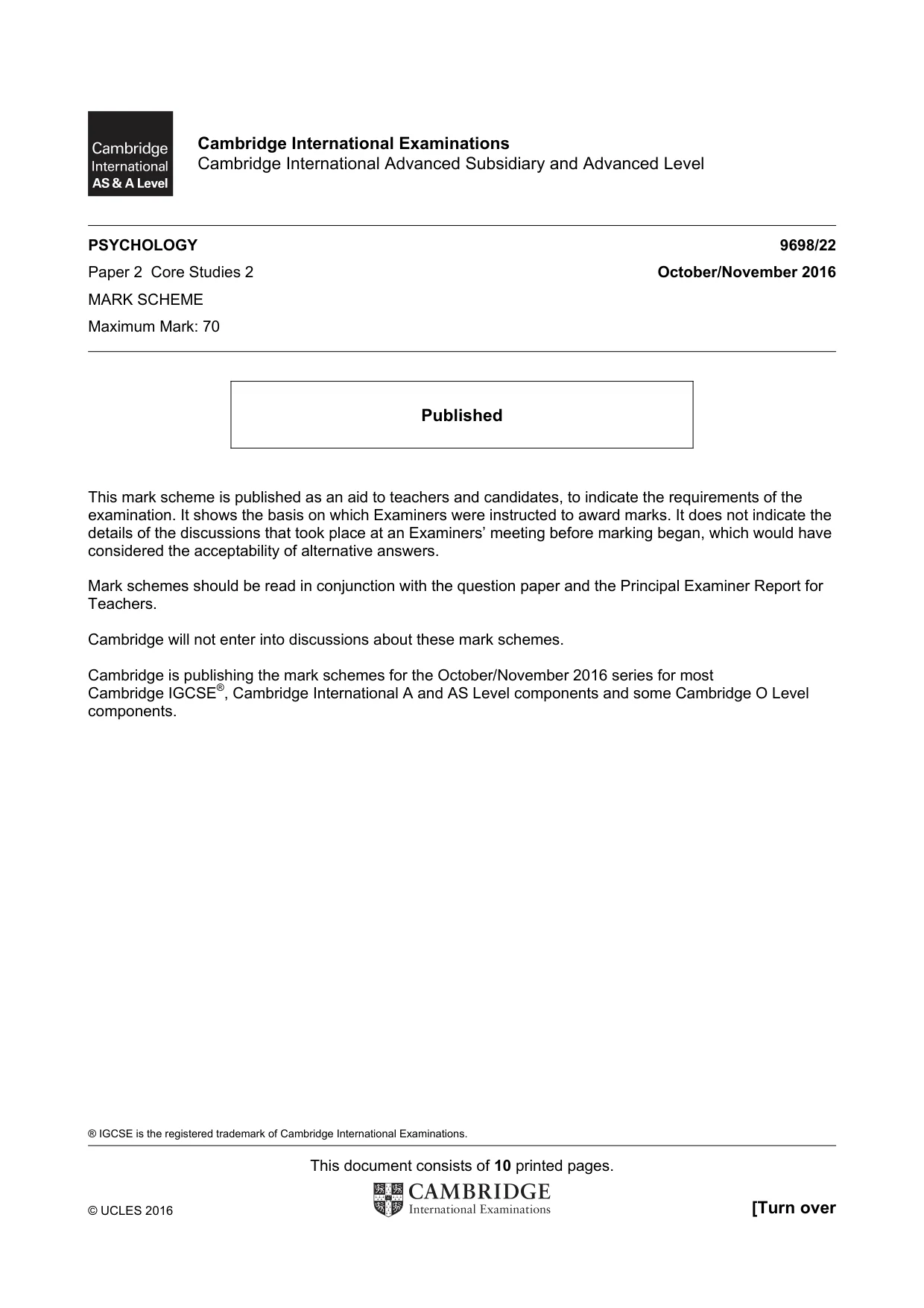
Mark scheme, page 1
® IGCSE is the registered trademark of Cambridge International Examinations. This document consists of 10 printed pages. © UCLES 2016 [Turn over Cambridge International Examinations Cambridge International Advanced Subsidiary and Advanced Level PSYCHOLOGY 9698/22 Paper 2 Core Studies 2 October/November 2016 MARK SCHEME Maximum Mark: 70 Published This mark scheme is published as an aid to teachers and candidates, to indicate the requirements of the examination. It shows the basis on which Examiners were instructed to award marks. It does not indicate the details of the discussions that took place at an Examiners’ meeting before marking began, which would have considered the acceptability of alternative answers. Mark schemes should be read in conjunction with the question paper and the Principal Examiner Report for Teachers. Cambridge will not enter into discussions about these mark schemes. Cambridge is publishing the mark schemes for the October/November 2016 series for most Cambridge IGCSE®, Cambridge International A and AS Level components and some Cambridge O Level components.
Mark scheme, page 2
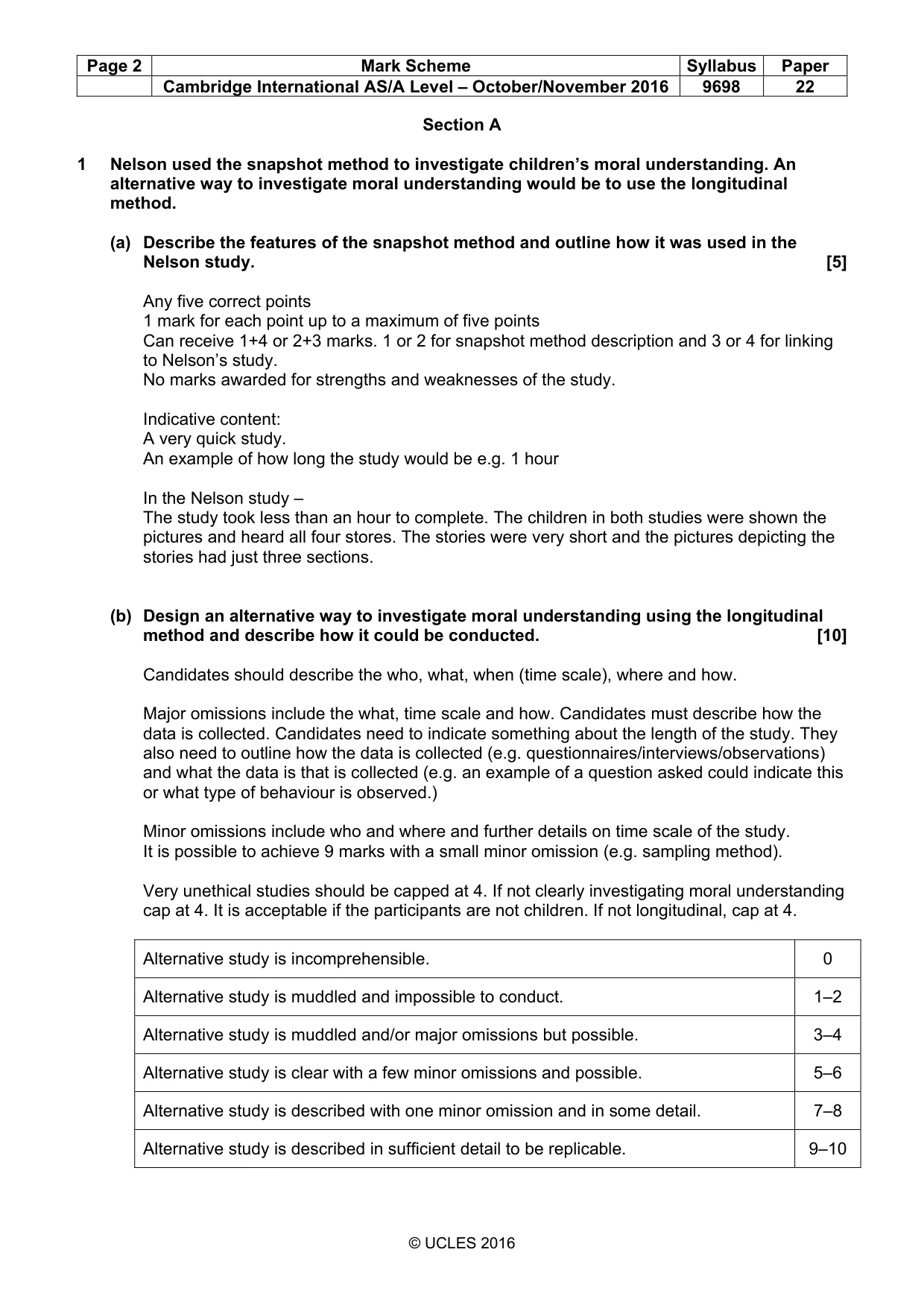
Page 2 Mark Scheme Syllabus Paper Cambridge International AS/A Level – October/November 2016 9698 22 © UCLES 2016 Section A 1 Nelson used the snapshot method to investigate children’s moral understanding. An alternative way to investigate moral understanding would be to use the longitudinal method. (a) Describe the features of the snapshot method and outline how it was used in the Nelson study. [5] Any five correct points 1 mark for each point up to a maximum of five points Can receive 1+4 or 2+3 marks. 1 or 2 for snapshot method description and 3 or 4 for linking to Nelson’s study. No marks awarded for strengths and weaknesses of the study. Indicative content: A very quick study. An example of how long the study would be e.g. 1 hour In the Nelson study – The study took less than an hour to complete. The children in both studies were shown the pictures and heard all four stores. The stories were very short and the pictures depicting the stories had just three sections. (b) Design an alternative way to investigate moral understanding using the longitudinal method and describe how it could be conducted. [10] Candidates should describe the who, what, when (time scale), where and how. Major omissions include the what, time scale and how. Candidates must describe how the data is collected. Candidates need to indicate something about the length of the study. They also need to outline how the data is collected (e.g. questionnaires/interviews/observations) and what the data is that is collected (e.g. an example of a question asked could indicate this or what type of behaviour is observed.) Minor omissions include who and where and further details on time scale of the study. It is possible to achieve 9 marks with a small minor omission (e.g. sampling method). Very unethical studies should be capped at 4. If not clearly investigating moral understanding cap at 4. It is acceptable if the participants are not children. If not longitudinal, cap at 4. Alternative study is incomprehensible. 0 Alternative study is muddled and impossible to conduct. 1–2 Alternative study is muddled and/or major omissions but possible. 3–4 Alternative study is clear with a few minor omissions and possible. 5–6 Alternative study is described with one minor omission and in some detail. 7–8 Alternative study is described in sufficient detail to be replicable. 9–10
Mark scheme, page 3
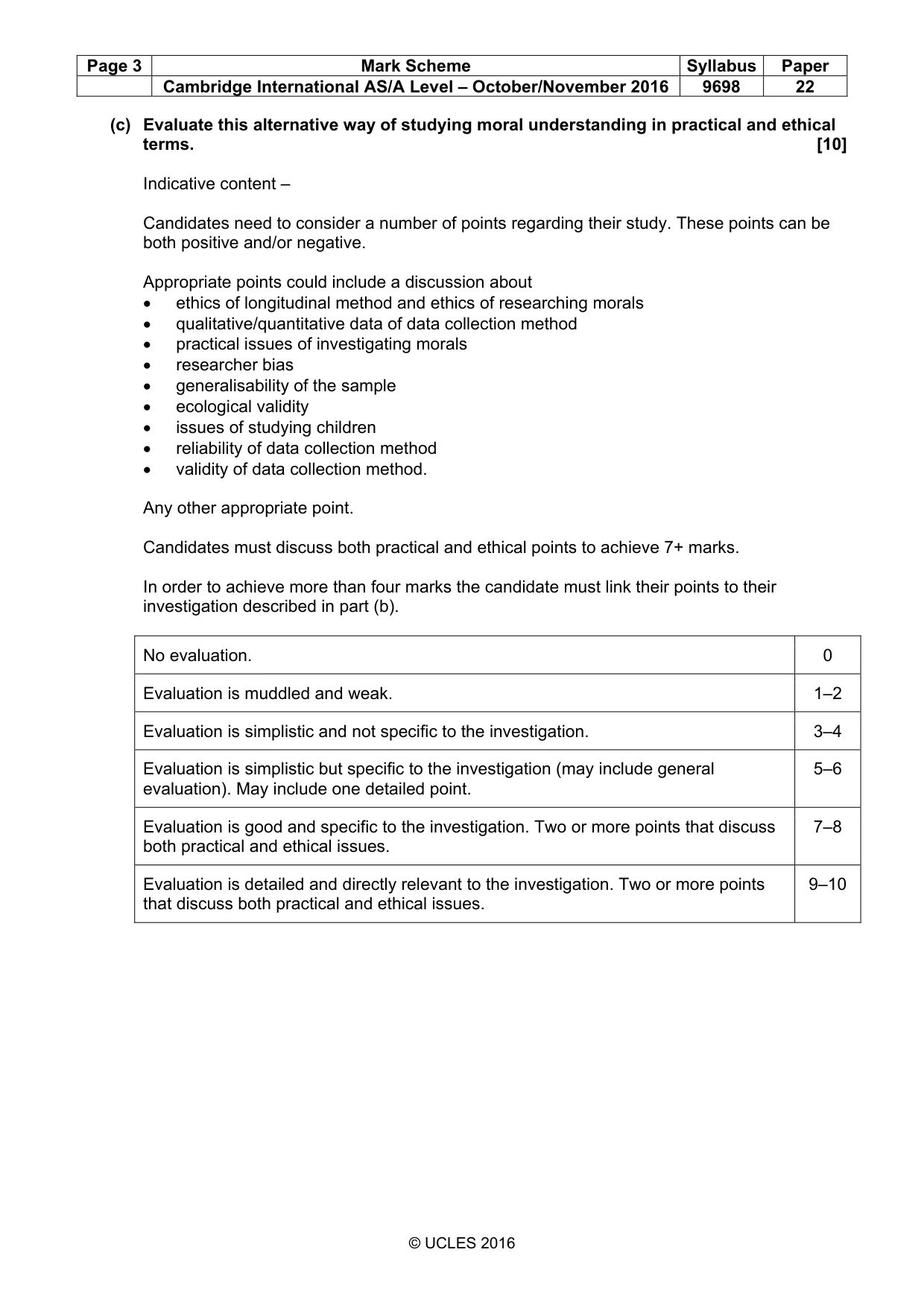
Page 3 Mark Scheme Syllabus Paper Cambridge International AS/A Level – October/November 2016 9698 22 © UCLES 2016 (c) Evaluate this alternative way of studying moral understanding in practical and ethical terms. [10] Indicative content – Candidates need to consider a number of points regarding their study. These points can be both positive and/or negative. Appropriate points could include a discussion about • ethics of longitudinal method and ethics of researching morals • qualitative/quantitative data of data collection method • practical issues of investigating morals • researcher bias • generalisability of the sample • ecological validity • issues of studying children • reliability of data collection method • validity of data collection method. Any other appropriate point. Candidates must discuss both practical and ethical points to achieve 7+ marks. In order to achieve more than four marks the candidate must link their points to their investigation described in part (b). No evaluation. 0 Evaluation is muddled and weak. 1–2 Evaluation is simplistic and not specific to the investigation. 3–4 Evaluation is simplistic but specific to the investigation (may include general evaluation). May include one detailed point. 5–6 Evaluation is good and specific to the investigation. Two or more points that discuss both practical and ethical issues. 7–8 Evaluation is detailed and directly relevant to the investigation. Two or more points that discuss both practical and ethical issues. 9–10
Mark scheme, page 4
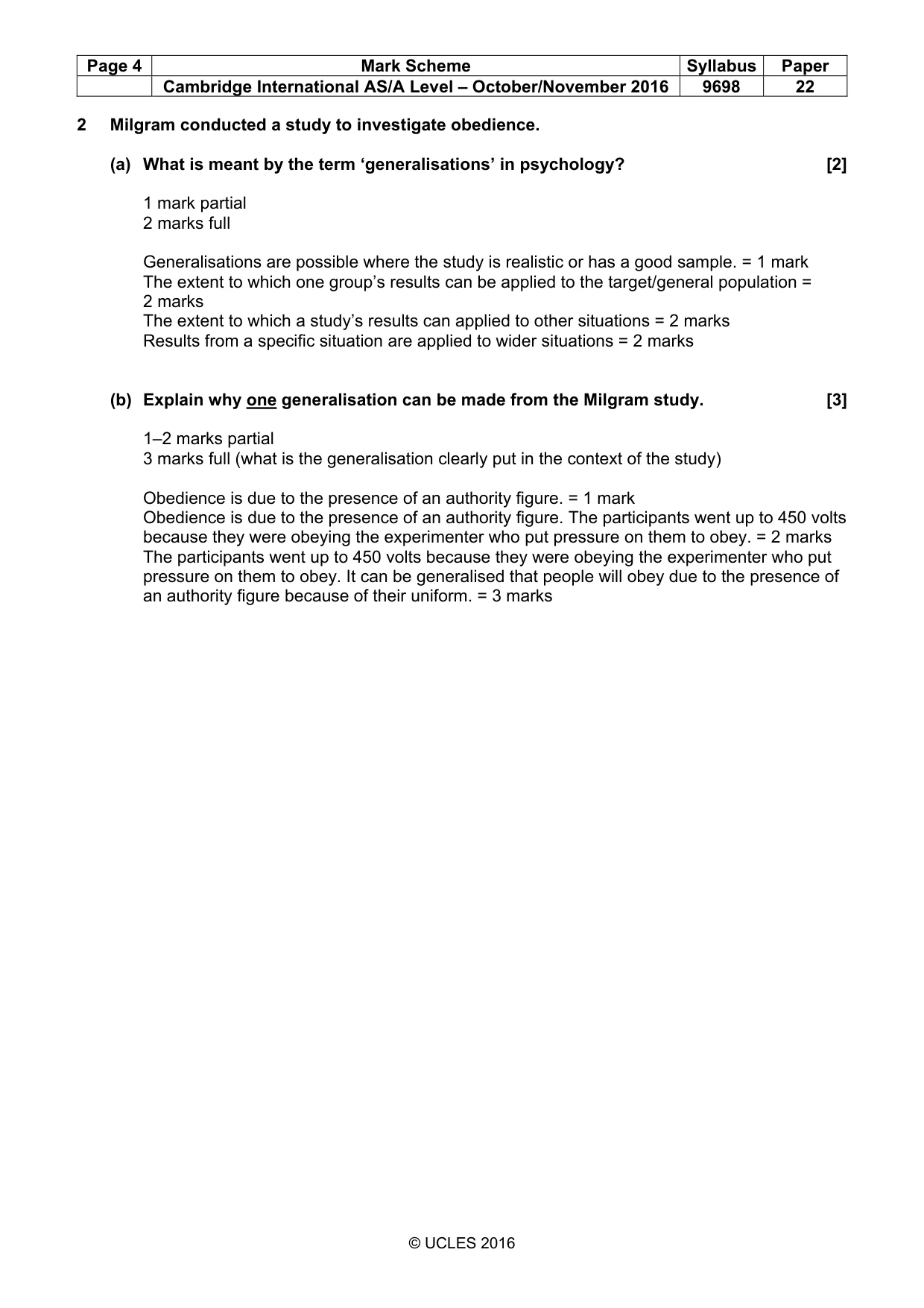
Page 4 Mark Scheme Syllabus Paper Cambridge International AS/A Level – October/November 2016 9698 22 © UCLES 2016 2 Milgram conducted a study to investigate obedience. (a) What is meant by the term ‘generalisations’ in psychology? [2] 1 mark partial 2 marks full Generalisations are possible where the study is realistic or has a good sample. = 1 mark The extent to which one group’s results can be applied to the target/general population = 2 marks The extent to which a study’s results can applied to other situations = 2 marks Results from a specific situation are applied to wider situations = 2 marks (b) Explain why one generalisation can be made from the Milgram study. [3] 1–2 marks partial 3 marks full (what is the generalisation clearly put in the context of the study) Obedience is due to the presence of an authority figure. = 1 mark Obedience is due to the presence of an authority figure. The participants went up to 450 volts because they were obeying the experimenter who put pressure on them to obey. = 2 marks The participants went up to 450 volts because they were obeying the experimenter who put pressure on them to obey. It can be generalised that people will obey due to the presence of an authority figure because of their uniform. = 3 marks
Mark scheme, page 5
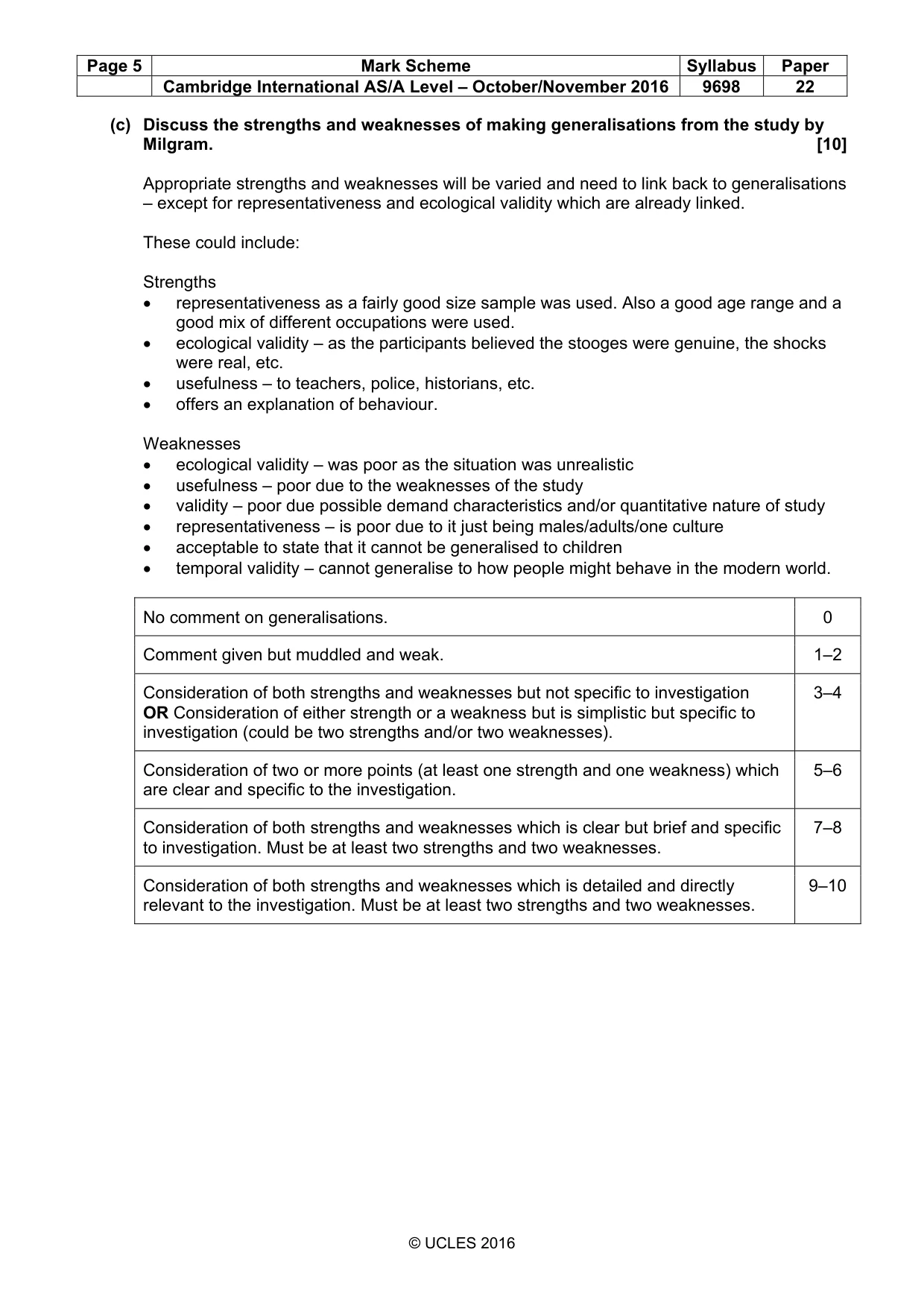
Page 5 Mark Scheme Syllabus Paper Cambridge International AS/A Level – October/November 2016 9698 22 © UCLES 2016 (c) Discuss the strengths and weaknesses of making generalisations from the study by Milgram. [10] Appropriate strengths and weaknesses will be varied and need to link back to generalisations – except for representativeness and ecological validity which are already linked. These could include: Strengths • representativeness as a fairly good size sample was used. Also a good age range and a good mix of different occupations were used. • ecological validity – as the participants believed the stooges were genuine, the shocks were real, etc. • usefulness – to teachers, police, historians, etc. • offers an explanation of behaviour. Weaknesses • ecological validity – was poor as the situation was unrealistic • usefulness – poor due to the weaknesses of the study • validity – poor due possible demand characteristics and/or quantitative nature of study • representativeness – is poor due to it just being males/adults/one culture • acceptable to state that it cannot be generalised to children • temporal validity – cannot generalise to how people might behave in the modern world. No comment on generalisations. 0 Comment given but muddled and weak. 1–2 Consideration of both strengths and weaknesses but not specific to investigation OR Consideration of either strength or a weakness but is simplistic but specific to investigation (could be two strengths and/or two weaknesses). 3–4 Consideration of two or more points (at least one strength and one weakness) which are clear and specific to the investigation. 5–6 Consideration of both strengths and weaknesses which is clear but brief and specific to investigation. Must be at least two strengths and two weaknesses. 7–8 Consideration of both strengths and weaknesses which is detailed and directly relevant to the investigation. Must be at least two strengths and two weaknesses. 9–10
Mark scheme, page 6
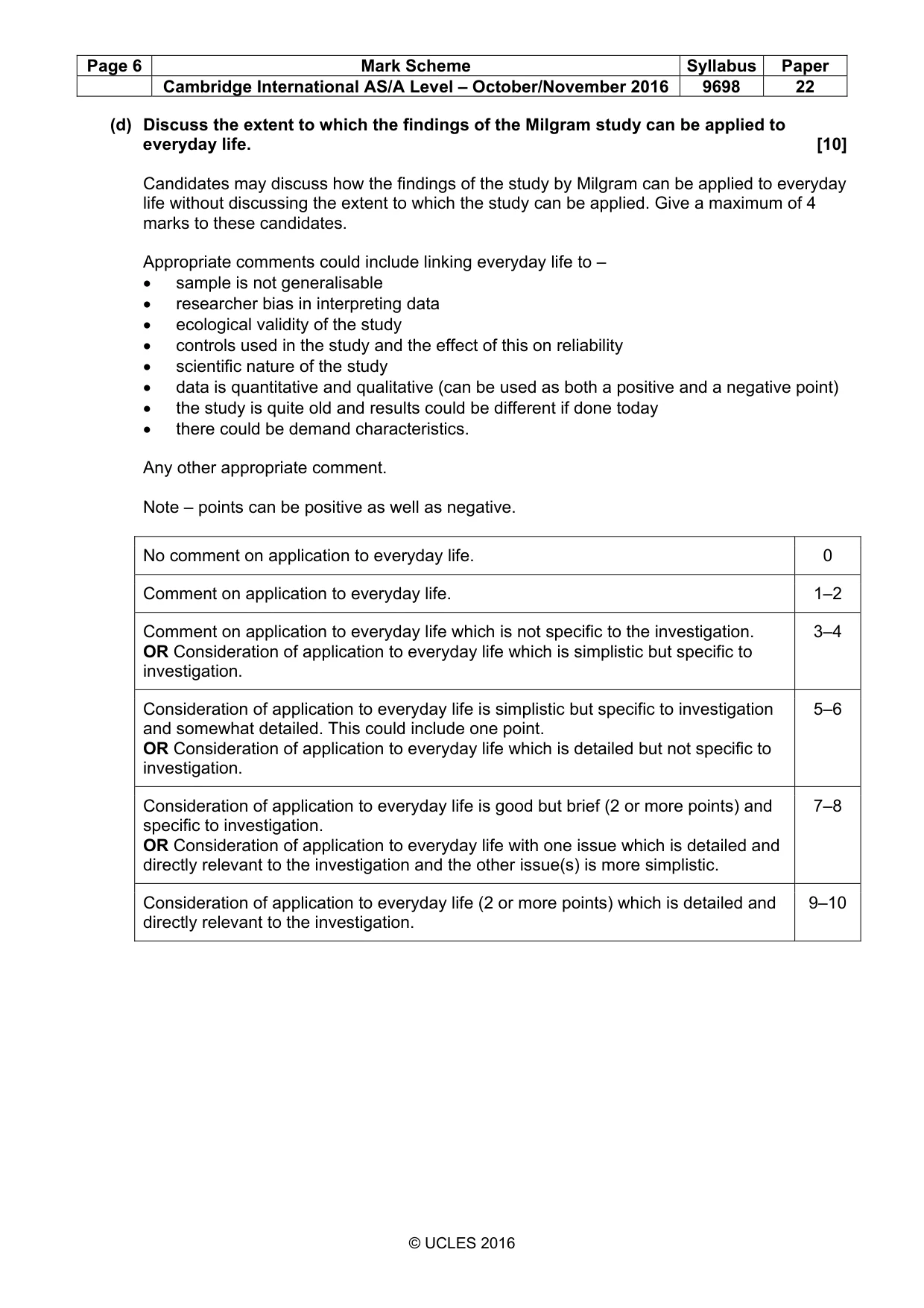
Page 6 Mark Scheme Syllabus Paper Cambridge International AS/A Level – October/November 2016 9698 22 © UCLES 2016 (d) Discuss the extent to which the findings of the Milgram study can be applied to everyday life. [10] Candidates may discuss how the findings of the study by Milgram can be applied to everyday life without discussing the extent to which the study can be applied. Give a maximum of 4 marks to these candidates. Appropriate comments could include linking everyday life to – • sample is not generalisable • researcher bias in interpreting data • ecological validity of the study • controls used in the study and the effect of this on reliability • scientific nature of the study • data is quantitative and qualitative (can be used as both a positive and a negative point) • the study is quite old and results could be different if done today • there could be demand characteristics. Any other appropriate comment. Note – points can be positive as well as negative. No comment on application to everyday life. 0 Comment on application to everyday life. 1–2 Comment on application to everyday life which is not specific to the investigation. OR Consideration of application to everyday life which is simplistic but specific to investigation. 3–4 Consideration of application to everyday life is simplistic but specific to investigation and somewhat detailed. This could include one point. OR Consideration of application to everyday life which is detailed but not specific to investigation. 5–6 Consideration of application to everyday life is good but brief (2 or more points) and specific to investigation. OR Consideration of application to everyday life with one issue which is detailed and directly relevant to the investigation and the other issue(s) is more simplistic. 7–8 Consideration of application to everyday life (2 or more points) which is detailed and directly relevant to the investigation. 9–10
Mark scheme, page 7
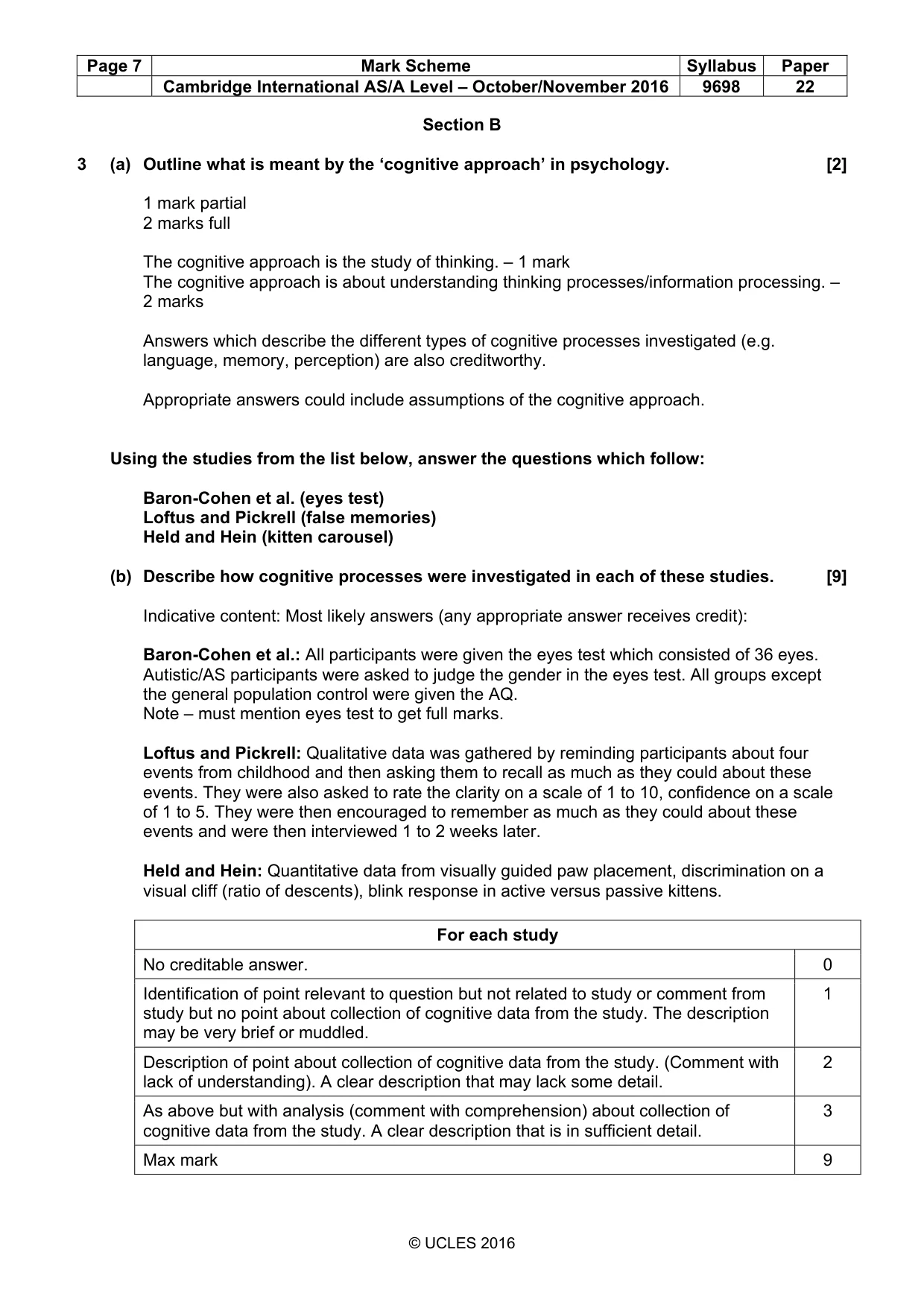
Page 7 Mark Scheme Syllabus Paper Cambridge International AS/A Level – October/November 2016 9698 22 © UCLES 2016 Section B 3 (a) Outline what is meant by the ‘cognitive approach’ in psychology. [2] 1 mark partial 2 marks full The cognitive approach is the study of thinking. – 1 mark The cognitive approach is about understanding thinking processes/information processing. – 2 marks Answers which describe the different types of cognitive processes investigated (e.g. language, memory, perception) are also creditworthy. Appropriate answers could include assumptions of the cognitive approach. Using the studies from the list below, answer the questions which follow: Baron-Cohen et al. (eyes test) Loftus and Pickrell (false memories) Held and Hein (kitten carousel) (b) Describe how cognitive processes were investigated in each of these studies. [9] Indicative content: Most likely answers (any appropriate answer receives credit): Baron-Cohen et al.: All participants were given the eyes test which consisted of 36 eyes. Autistic/AS participants were asked to judge the gender in the eyes test. All groups except the general population control were given the AQ. Note – must mention eyes test to get full marks. Loftus and Pickrell: Qualitative data was gathered by reminding participants about four events from childhood and then asking them to recall as much as they could about these events. They were also asked to rate the clarity on a scale of 1 to 10, confidence on a scale of 1 to 5. They were then encouraged to remember as much as they could about these events and were then interviewed 1 to 2 weeks later. Held and Hein: Quantitative data from visually guided paw placement, discrimination on a visual cliff (ratio of descents), blink response in active versus passive kittens. For each study No creditable answer. 0 Identification of point relevant to question but not related to study or comment from study but no point about collection of cognitive data from the study. The description may be very brief or muddled. 1 Description of point about collection of cognitive data from the study. (Comment with lack of understanding). A clear description that may lack some detail. 2 As above but with analysis (comment with comprehension) about collection of cognitive data from the study. A clear description that is in sufficient detail. 3 Max mark 9
Mark scheme, page 8
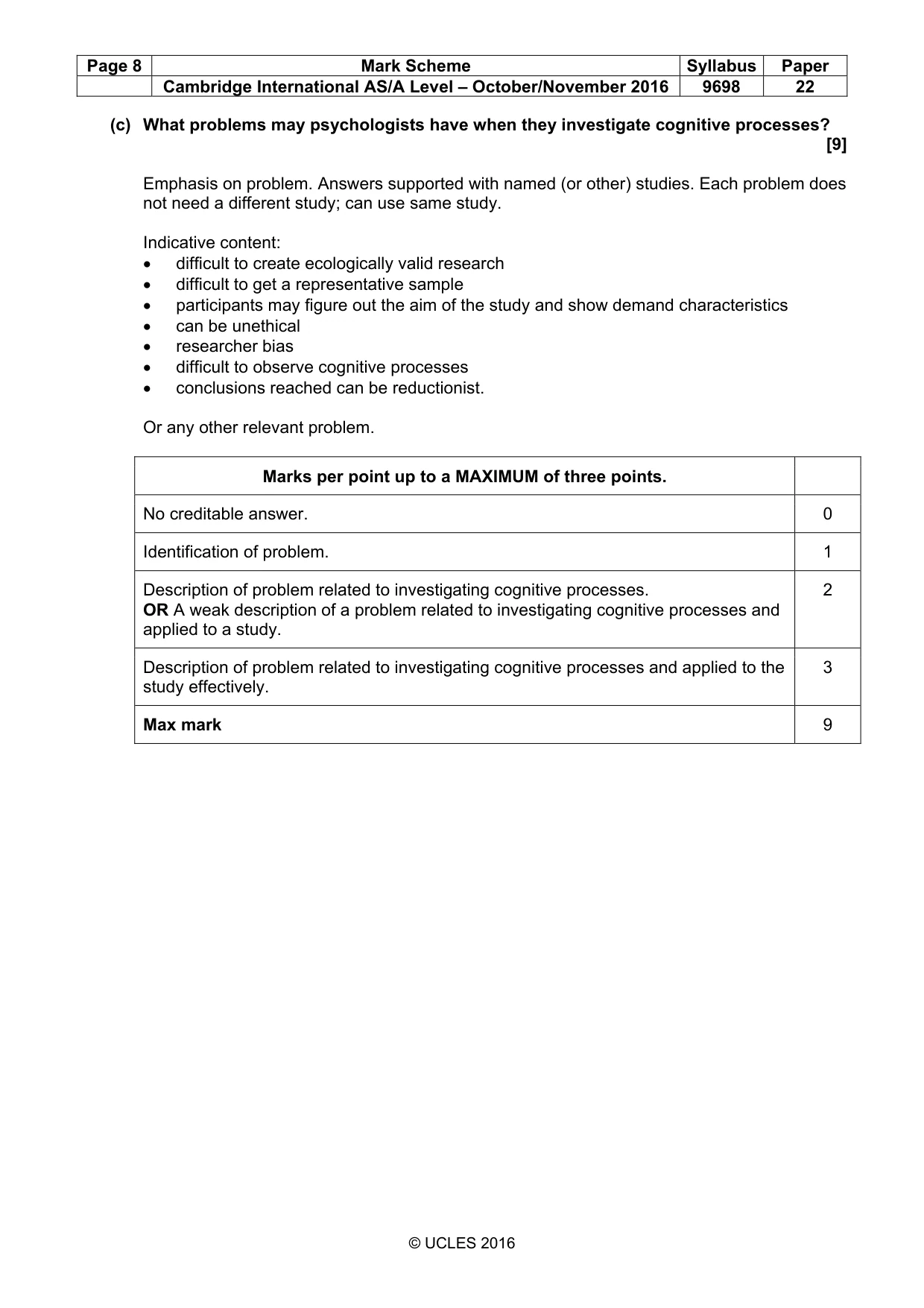
Page 8 Mark Scheme Syllabus Paper Cambridge International AS/A Level – October/November 2016 9698 22 © UCLES 2016 (c) What problems may psychologists have when they investigate cognitive processes? [9] Emphasis on problem. Answers supported with named (or other) studies. Each problem does not need a different study; can use same study. Indicative content: • difficult to create ecologically valid research • difficult to get a representative sample • participants may figure out the aim of the study and show demand characteristics • can be unethical • researcher bias • difficult to observe cognitive processes • conclusions reached can be reductionist. Or any other relevant problem. Marks per point up to a MAXIMUM of three points. No creditable answer. 0 Identification of problem. 1 Description of problem related to investigating cognitive processes. OR A weak description of a problem related to investigating cognitive processes and applied to a study. 2 Description of problem related to investigating cognitive processes and applied to the study effectively. 3 Max mark 9
Mark scheme, page 9
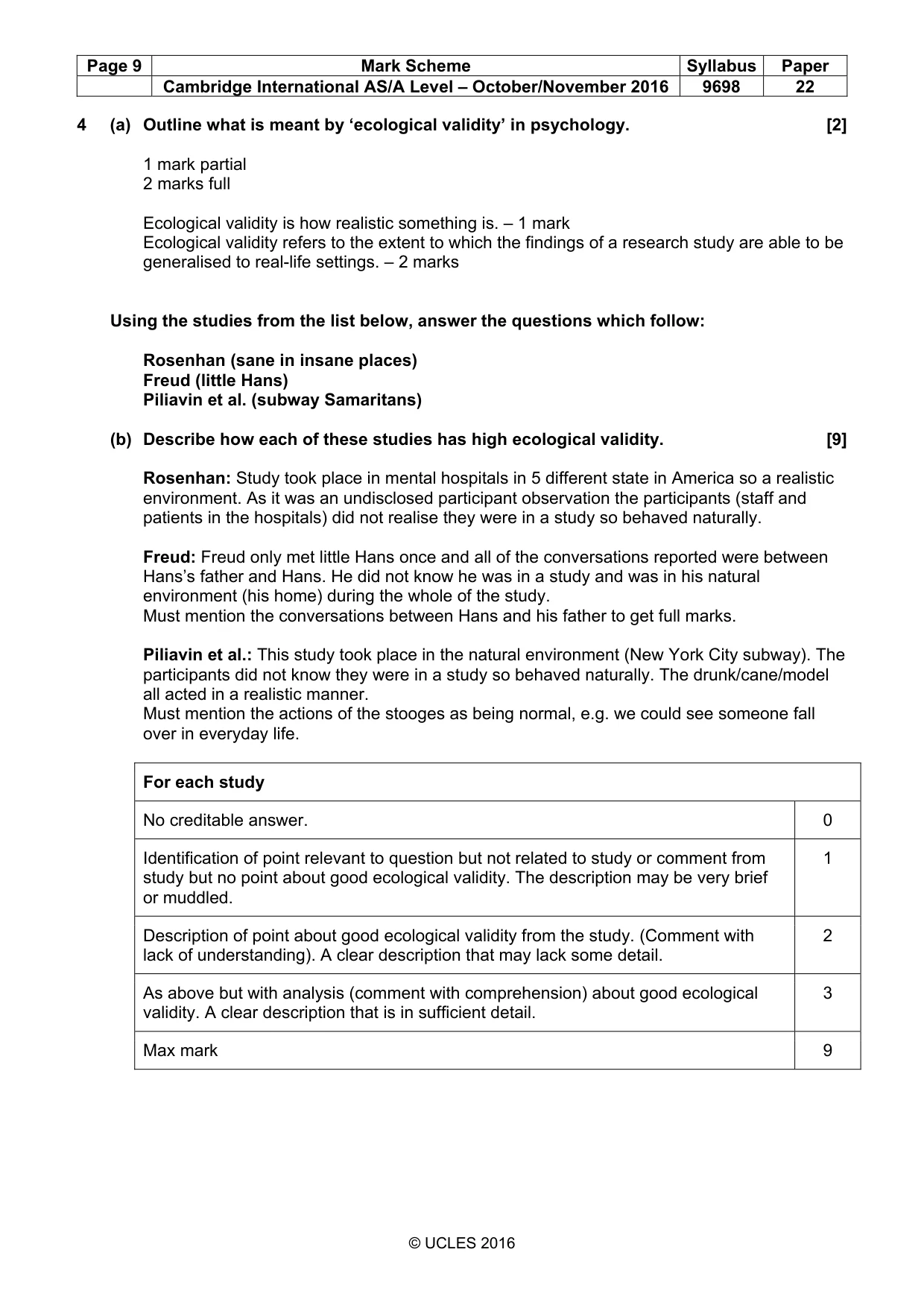
Page 9 Mark Scheme Syllabus Paper Cambridge International AS/A Level – October/November 2016 9698 22 © UCLES 2016 4 (a) Outline what is meant by ‘ecological validity’ in psychology. [2] 1 mark partial 2 marks full Ecological validity is how realistic something is. – 1 mark Ecological validity refers to the extent to which the findings of a research study are able to be generalised to real-life settings. – 2 marks Using the studies from the list below, answer the questions which follow: Rosenhan (sane in insane places) Freud (little Hans) Piliavin et al. (subway Samaritans) (b) Describe how each of these studies has high ecological validity. [9] Rosenhan: Study took place in mental hospitals in 5 different state in America so a realistic environment. As it was an undisclosed participant observation the participants (staff and patients in the hospitals) did not realise they were in a study so behaved naturally. Freud: Freud only met little Hans once and all of the conversations reported were between Hans’s father and Hans. He did not know he was in a study and was in his natural environment (his home) during the whole of the study. Must mention the conversations between Hans and his father to get full marks. Piliavin et al.: This study took place in the natural environment (New York City subway). The participants did not know they were in a study so behaved naturally. The drunk/cane/model all acted in a realistic manner. Must mention the actions of the stooges as being normal, e.g. we could see someone fall over in everyday life. For each study No creditable answer. 0 Identification of point relevant to question but not related to study or comment from study but no point about good ecological validity. The description may be very brief or muddled. 1 Description of point about good ecological validity from the study. (Comment with lack of understanding). A clear description that may lack some detail. 2 As above but with analysis (comment with comprehension) about good ecological validity. A clear description that is in sufficient detail. 3 Max mark 9
Mark scheme, page 10
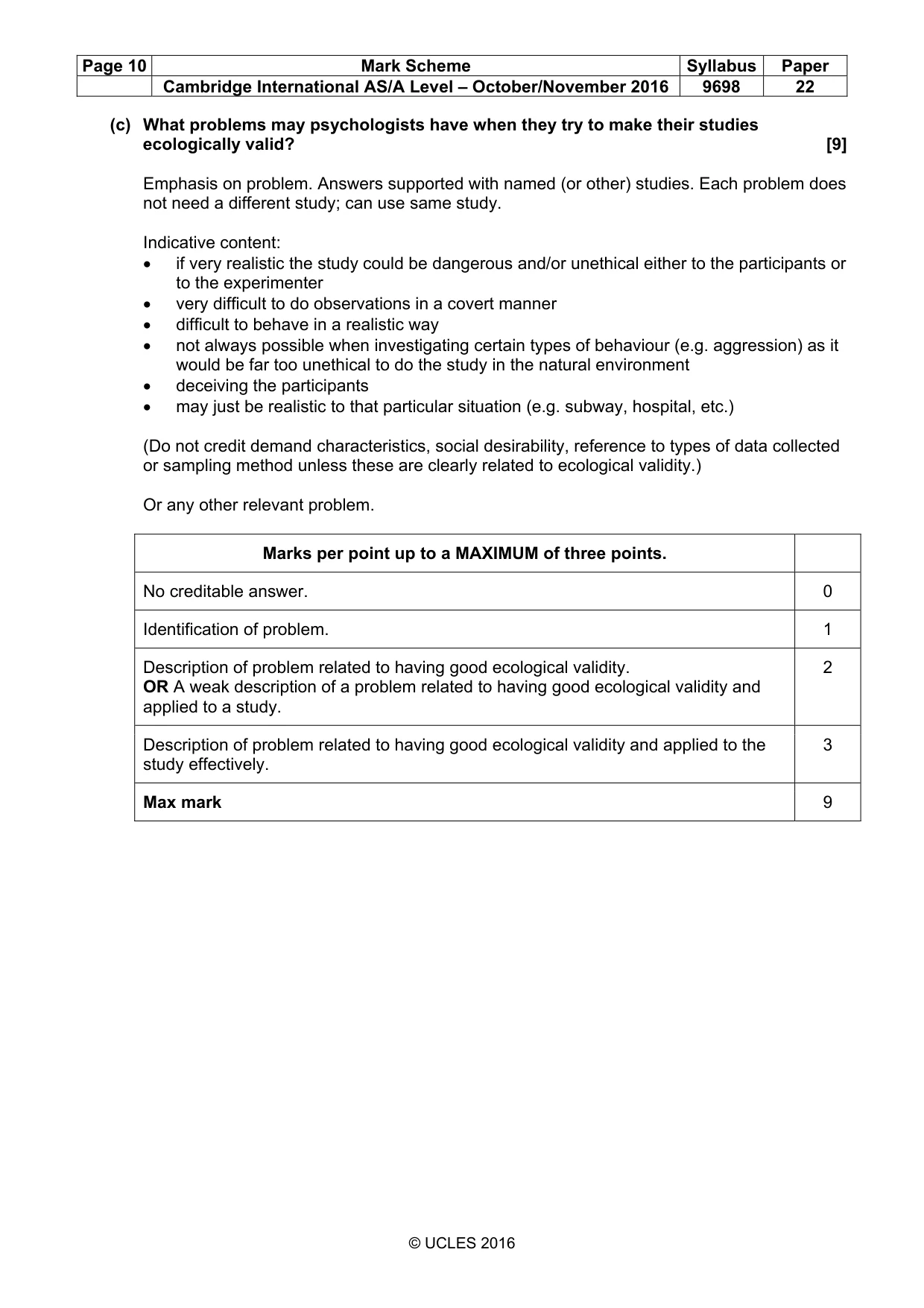
Page 10 Mark Scheme Syllabus Paper Cambridge International AS/A Level – October/November 2016 9698 22 © UCLES 2016 (c) What problems may psychologists have when they try to make their studies ecologically valid? [9] Emphasis on problem. Answers supported with named (or other) studies. Each problem does not need a different study; can use same study. Indicative content: • if very realistic the study could be dangerous and/or unethical either to the participants or to the experimenter • very difficult to do observations in a covert manner • difficult to behave in a realistic way • not always possible when investigating certain types of behaviour (e.g. aggression) as it would be far too unethical to do the study in the natural environment • deceiving the participants • may just be realistic to that particular situation (e.g. subway, hospital, etc.) (Do not credit demand characteristics, social desirability, reference to types of data collected or sampling method unless these are clearly related to ecological validity.) Or any other relevant problem. Marks per point up to a MAXIMUM of three points. No creditable answer. 0 Identification of problem. 1 Description of problem related to having good ecological validity. OR A weak description of a problem related to having good ecological validity and applied to a study. 2 Description of problem related to having good ecological validity and applied to the study effectively. 3 Max mark 9
What you needed in this session
Cambridge’s own grade thresholds for 2016 Oct/Nov, Paper 2 · Variant 2. A higher threshold means an easier paper — the bar moves with how the cohort did.