Cambridge A Level Psychology 9698 — 2016 May/June Paper 1 · Variant 3
9698/13/M/J/16 · 80 marks · ≈90 min
The question paper and its mark scheme, free to read here and free to download. This is Cambridge’s own paper, exactly as it was sat.
Question paper4 pages
Mark scheme13 pages
Answers below. Sit the paper first if you are practising.
Paper as text
Question paper, page 1
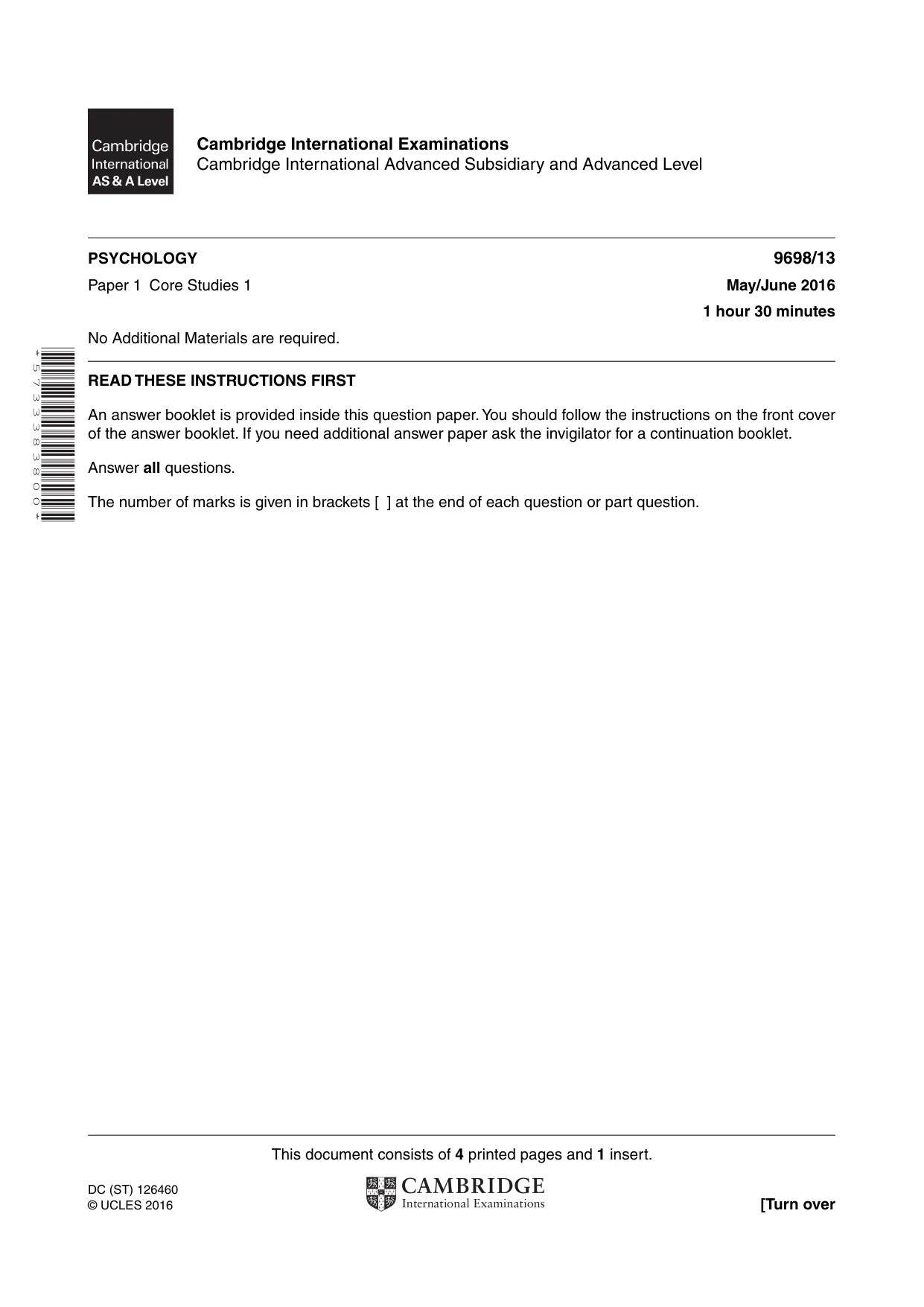
This document consists of 4 printed pages and 1 insert. DC (ST) 126460 © UCLES 2016 [Turn over * 5 7 3 3 3 8 3 8 0 0 * PSYCHOLOGY 9698/13 Paper 1 Core Studies 1 May/June 2016 1 hour 30 minutes No Additional Materials are required. READ THESE INSTRUCTIONS FIRST An answer booklet is provided inside this question paper. You should follow the instructions on the front cover of the answer booklet. If you need additional answer paper ask the invigilator for a continuation booklet. Answer all questions. The number of marks is given in brackets [ ] at the end of each question or part question. Cambridge International Examinations Cambridge International Advanced Subsidiary and Advanced Level
Question paper, page 2
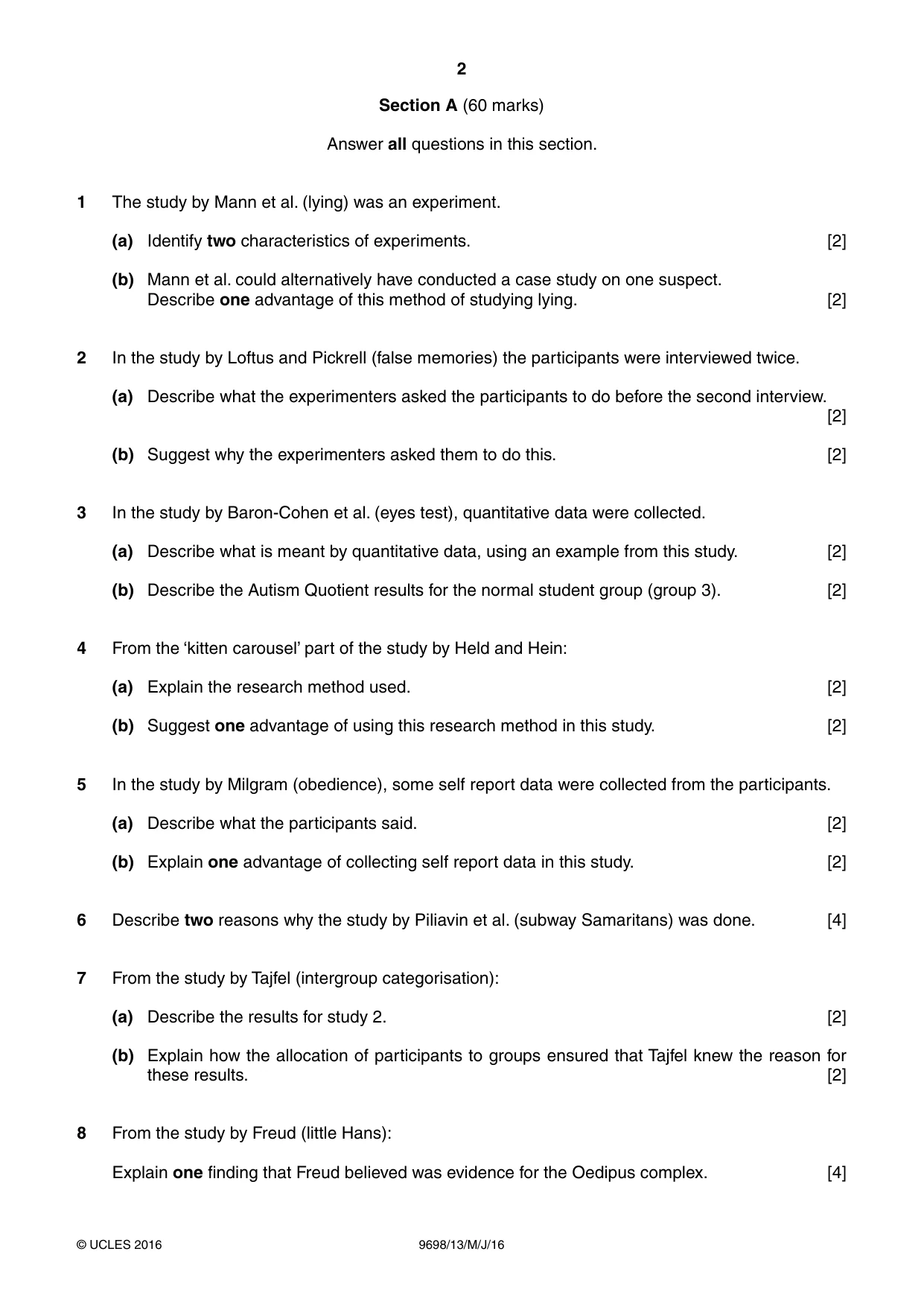
2 9698/13/M/J/16 © UCLES 2016 Section A (60 marks) Answer all questions in this section. 1 The study by Mann et al. (lying) was an experiment. (a) Identify two characteristics of experiments. [2] (b) Mann et al. could alternatively have conducted a case study on one suspect. Describe one advantage of this method of studying lying. [2] 2 In the study by Loftus and Pickrell (false memories) the participants were interviewed twice. (a) Describe what the experimenters asked the participants to do before the second interview. [2] (b) Suggest why the experimenters asked them to do this. [2] 3 In the study by Baron-Cohen et al. (eyes test), quantitative data were collected. (a) Describe what is meant by quantitative data, using an example from this study. [2] (b) Describe the Autism Quotient results for the normal student group (group 3). [2] 4 From the ‘kitten carousel’ part of the study by Held and Hein: (a) Explain the research method used. [2] (b) Suggest one advantage of using this research method in this study. [2] 5 In the study by Milgram (obedience), some self report data were collected from the participants. (a) Describe what the participants said. [2] (b) Explain one advantage of collecting self report data in this study. [2] 6 Describe two reasons why the study by Piliavin et al. (subway Samaritans) was done. [4] 7 From the study by Tajfel (intergroup categorisation): (a) Describe the results for study 2. [2] (b) Explain how the allocation of participants to groups ensured that Tajfel knew the reason for these results. [2] 8 From the study by Freud (little Hans): Explain one finding that Freud believed was evidence for the Oedipus complex. [4]
Question paper, page 3
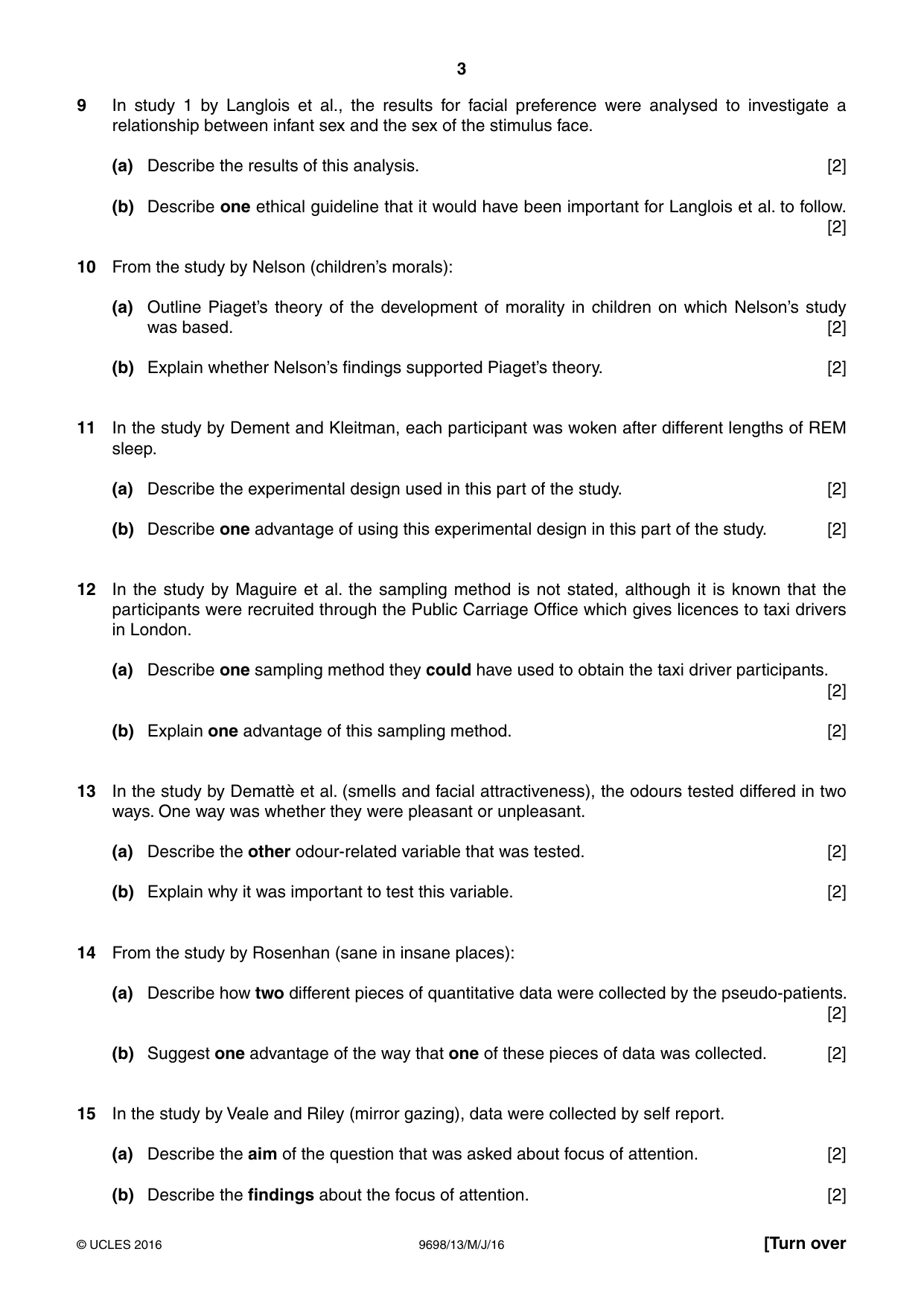
3 9698/13/M/J/16 © UCLES 2016 [Turn over 9 In study 1 by Langlois et al., the results for facial preference were analysed to investigate a relationship between infant sex and the sex of the stimulus face. (a) Describe the results of this analysis. [2] (b) Describe one ethical guideline that it would have been important for Langlois et al. to follow. [2] 10 From the study by Nelson (children’s morals): (a) Outline Piaget’s theory of the development of morality in children on which Nelson’s study was based. [2] (b) Explain whether Nelson’s findings supported Piaget’s theory. [2] 11 In the study by Dement and Kleitman, each participant was woken after different lengths of REM sleep. (a) Describe the experimental design used in this part of the study. [2] (b) Describe one advantage of using this experimental design in this part of the study. [2] 12 In the study by Maguire et al. the sampling method is not stated, although it is known that the participants were recruited through the Public Carriage Office which gives licences to taxi drivers in London. (a) Describe one sampling method they could have used to obtain the taxi driver participants. [2] (b) Explain one advantage of this sampling method. [2] 13 In the study by Demattè et al. (smells and facial attractiveness), the odours tested differed in two ways. One way was whether they were pleasant or unpleasant. (a) Describe the other odour-related variable that was tested. [2] (b) Explain why it was important to test this variable. [2] 14 From the study by Rosenhan (sane in insane places): (a) Describe how two different pieces of quantitative data were collected by the pseudo-patients. [2] (b) Suggest one advantage of the way that one of these pieces of data was collected. [2] 15 In the study by Veale and Riley (mirror gazing), data were collected by self report. (a) Describe the aim of the question that was asked about focus of attention. [2] (b) Describe the findings about the focus of attention. [2]
Question paper, page 4
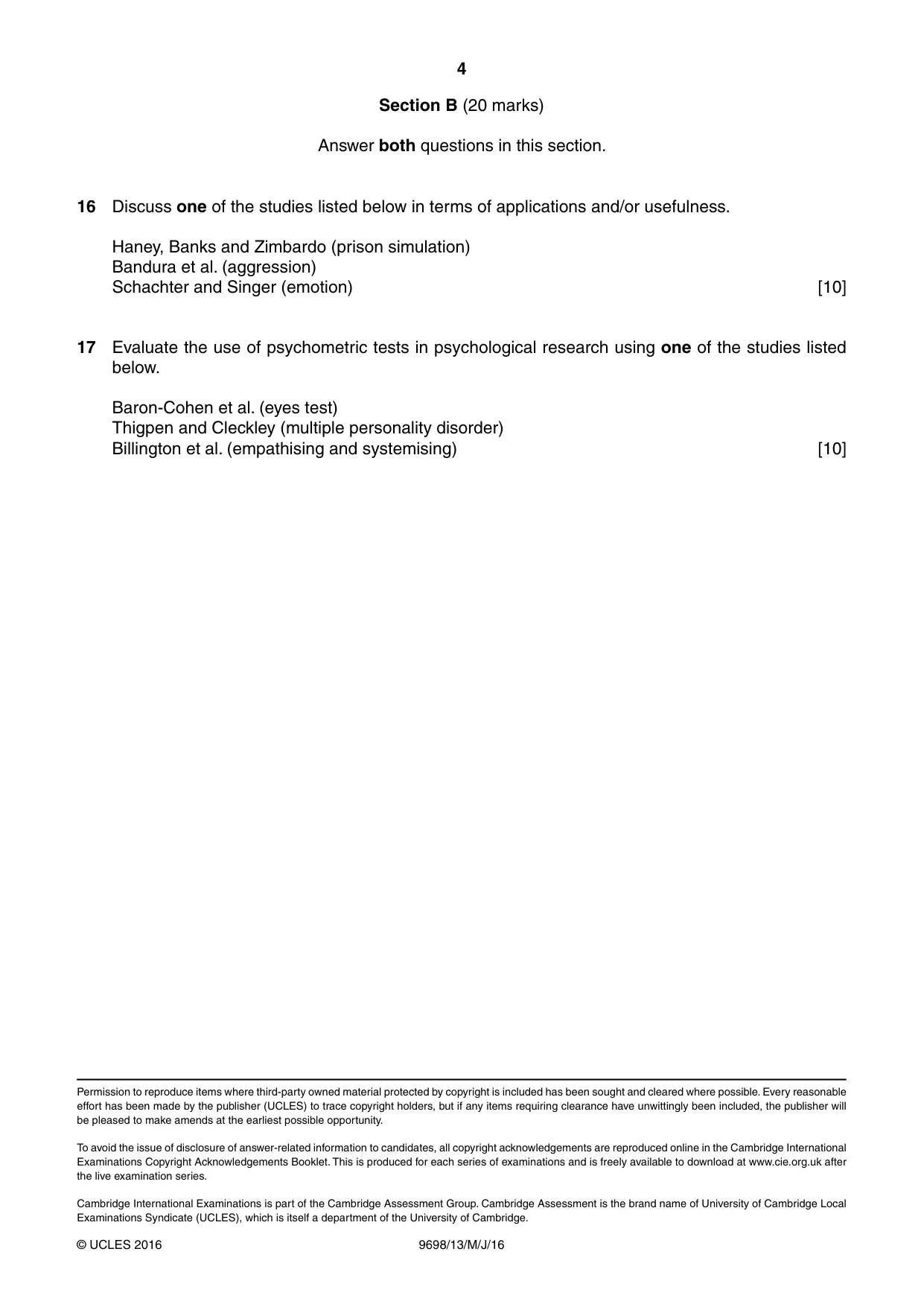
4 9698/13/M/J/16 © UCLES 2016 Permission to reproduce items where third-party owned material protected by copyright is included has been sought and cleared where possible. Every reasonable effort has been made by the publisher (UCLES) to trace copyright holders, but if any items requiring clearance have unwittingly been included, the publisher will be pleased to make amends at the earliest possible opportunity. To avoid the issue of disclosure of answer-related information to candidates, all copyright acknowledgements are reproduced online in the Cambridge International Examinations Copyright Acknowledgements Booklet. This is produced for each series of examinations and is freely available to download at www.cie.org.uk after the live examination series. Cambridge International Examinations is part of the Cambridge Assessment Group. Cambridge Assessment is the brand name of University of Cambridge Local Examinations Syndicate (UCLES), which is itself a department of the University of Cambridge. Section B (20 marks) Answer both questions in this section. 16 Discuss one of the studies listed below in terms of applications and/or usefulness. Haney, Banks and Zimbardo (prison simulation) Bandura et al. (aggression) Schachter and Singer (emotion) [10] 17 Evaluate the use of psychometric tests in psychological research using one of the studies listed below. Baro n-Cohen et al. (eyes test) Thigpen and Cleckley (multiple personality disorder) Billington et al. (empathising and systemising) [10]
Mark scheme, page 1
® IGCSE is the registered trademark of Cambridge International Examinations. This document consists of 13 printed pages. © UCLES 2016 [Turn over Cambridge International Examinations Cambridge International Advanced Subsidiary and Advanced Level PSYCHOLOGY 9698/13 Paper 1 Core Studies 1 May/June 2016 MARK SCHEME Maximum Mark: 80 Published This mark scheme is published as an aid to teachers and candidates, to indicate the requirements of the examination. It shows the basis on which Examiners were instructed to award marks. It does not indicate the details of the discussions that took place at an Examiners’ meeting before marking began, which would have considered the acceptability of alternative answers. Mark schemes should be read in conjunction with the question paper and the Principal Examiner Report for Teachers. Cambridge will not enter into discussions about these mark schemes. Cambridge is publishing the mark schemes for the May/June 2016 series for most Cambridge IGCSE®, Cambridge International A and AS Level components and some Cambridge O Level components.
Mark scheme, page 2
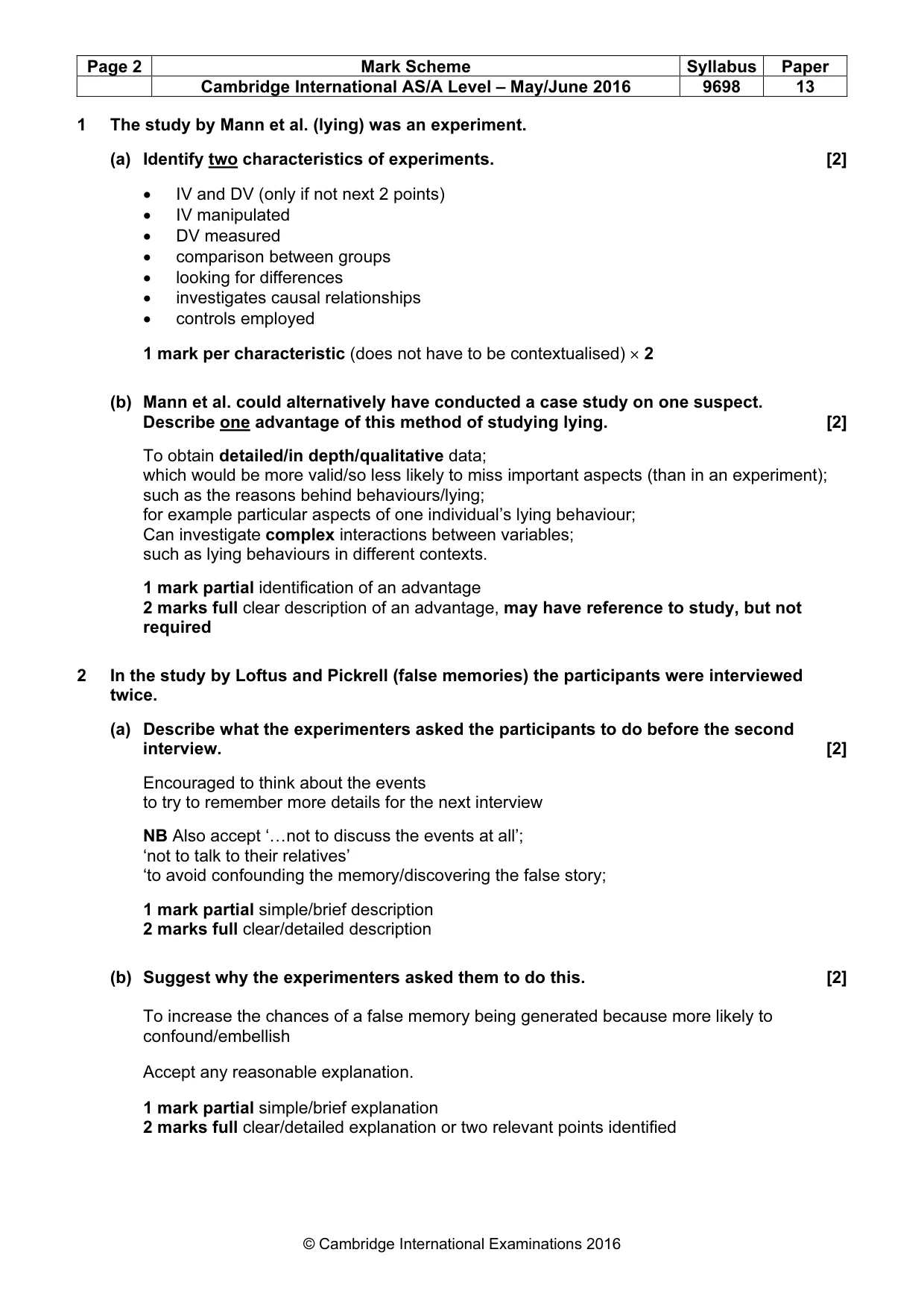
Page 2 Mark Scheme Syllabus Paper Cambridge International AS/A Level – May/June 2016 9698 13 © Cambridge International Examinations 2016 1 The study by Mann et al. (lying) was an experiment. (a) Identify two characteristics of experiments. [2] • IV and DV (only if not next 2 points) • IV manipulated • DV measured • comparison between groups • looking for differences • investigates causal relationships • controls employed 1 mark per characteristic (does not have to be contextualised) × 2 (b) Mann et al. could alternatively have conducted a case study on one suspect. Describe one advantage of this method of studying lying. [2] To obtain detailed/in depth/qualitative data; which would be more valid/so less likely to miss important aspects (than in an experiment); such as the reasons behind behaviours/lying; for example particular aspects of one individual’s lying behaviour; Can investigate complex interactions between variables; such as lying behaviours in different contexts. 1 mark partial identification of an advantage 2 marks full clear description of an advantage, may have reference to study, but not required 2 In the study by Loftus and Pickrell (false memories) the participants were interviewed twice. (a) Describe what the experimenters asked the participants to do before the second interview. [2] Encouraged to think about the events to try to remember more details for the next interview NB Also accept ‘…not to discuss the events at all’; ‘not to talk to their relatives’ ‘to avoid confounding the memory/discovering the false story; 1 mark partial simple/brief description 2 marks full clear/detailed description (b) Suggest why the experimenters asked them to do this. [2] To increase the chances of a false memory being generated because more likely to confound/embellish Accept any reasonable explanation. 1 mark partial simple/brief explanation 2 marks full clear/detailed explanation or two relevant points identified
Mark scheme, page 3
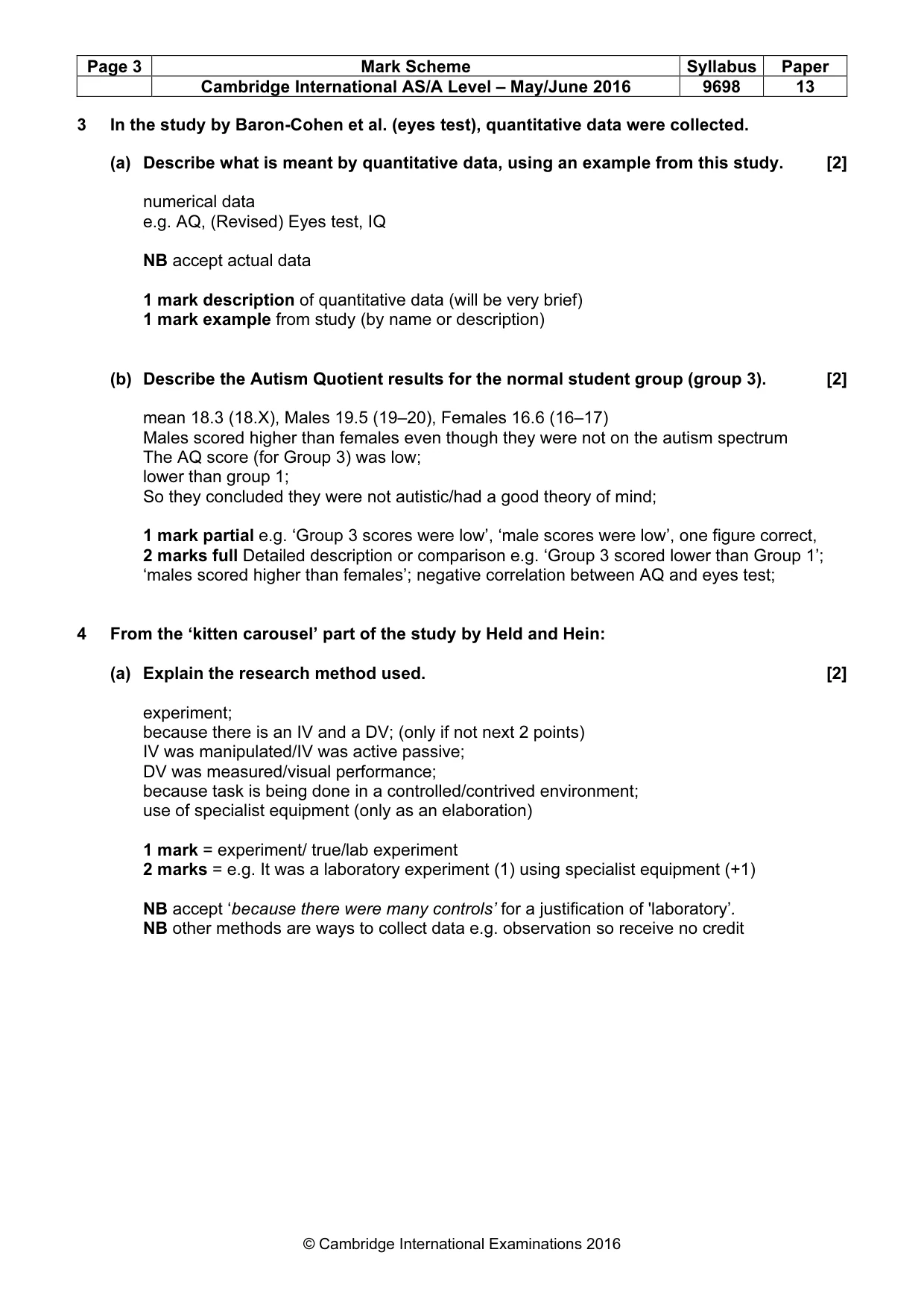
Page 3 Mark Scheme Syllabus Paper Cambridge International AS/A Level – May/June 2016 9698 13 © Cambridge International Examinations 2016 3 In the study by Baron-Cohen et al. (eyes test), quantitative data were collected. (a) Describe what is meant by quantitative data, using an example from this study. [2] numerical data e.g. AQ, (Revised) Eyes test, IQ NB accept actual data 1 mark description of quantitative data (will be very brief) 1 mark example from study (by name or description) (b) Describe the Autism Quotient results for the normal student group (group 3). [2] mean 18.3 (18.X), Males 19.5 (19–20), Females 16.6 (16–17) Males scored higher than females even though they were not on the autism spectrum The AQ score (for Group 3) was low; lower than group 1; So they concluded they were not autistic/had a good theory of mind; 1 mark partial e.g. ‘Group 3 scores were low’, ‘male scores were low’, one figure correct, 2 marks full Detailed description or comparison e.g. ‘Group 3 scored lower than Group 1’; ‘males scored higher than females’; negative correlation between AQ and eyes test; 4 From the ‘kitten carousel’ part of the study by Held and Hein: (a) Explain the research method used. [2] experiment; because there is an IV and a DV; (only if not next 2 points) IV was manipulated/IV was active passive; DV was measured/visual performance; because task is being done in a controlled/contrived environment; use of specialist equipment (only as an elaboration) 1 mark = experiment/ true/lab experiment 2 marks = e.g. It was a laboratory experiment (1) using specialist equipment (+1) NB accept ‘because there were many controls’ for a justification of 'laboratory’. NB other methods are ways to collect data e.g. observation so receive no credit
Mark scheme, page 4
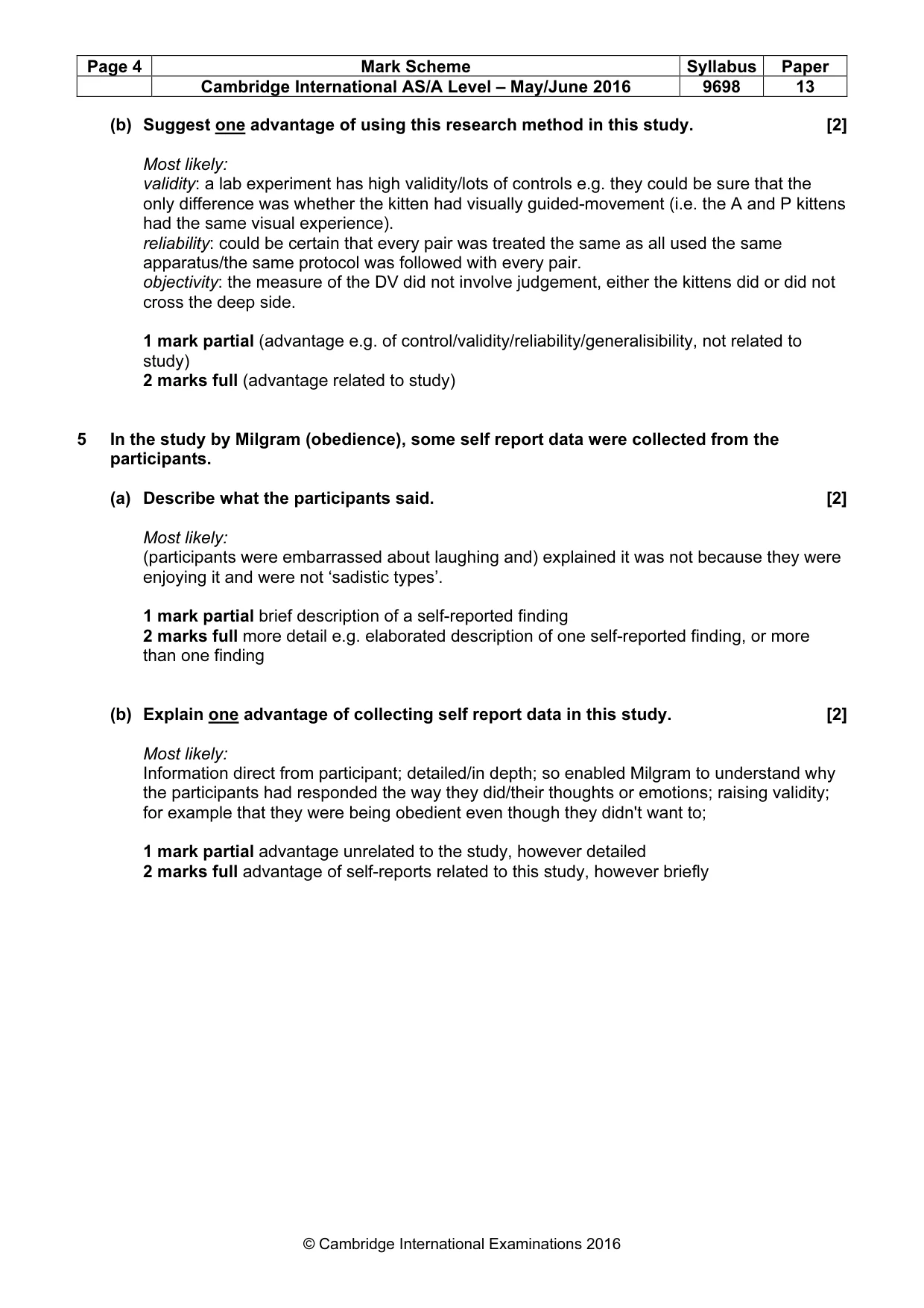
Page 4 Mark Scheme Syllabus Paper Cambridge International AS/A Level – May/June 2016 9698 13 © Cambridge International Examinations 2016 (b) Suggest one advantage of using this research method in this study. [2] Most likely: validity: a lab experiment has high validity/lots of controls e.g. they could be sure that the only difference was whether the kitten had visually guided-movement (i.e. the A and P kittens had the same visual experience). reliability: could be certain that every pair was treated the same as all used the same apparatus/the same protocol was followed with every pair. objectivity: the measure of the DV did not involve judgement, either the kittens did or did not cross the deep side. 1 mark partial (advantage e.g. of control/validity/reliability/generalisibility, not related to study) 2 marks full (advantage related to study) 5 In the study by Milgram (obedience), some self report data were collected from the participants. (a) Describe what the participants said. [2] Most likely: (participants were embarrassed about laughing and) explained it was not because they were enjoying it and were not ‘sadistic types’. 1 mark partial brief description of a self-reported finding 2 marks full more detail e.g. elaborated description of one self-reported finding, or more than one finding (b) Explain one advantage of collecting self report data in this study. [2] Most likely: Information direct from participant; detailed/in depth; so enabled Milgram to understand why the participants had responded the way they did/their thoughts or emotions; raising validity; for example that they were being obedient even though they didn't want to; 1 mark partial advantage unrelated to the study, however detailed 2 marks full advantage of self-reports related to this study, however briefly
Mark scheme, page 5
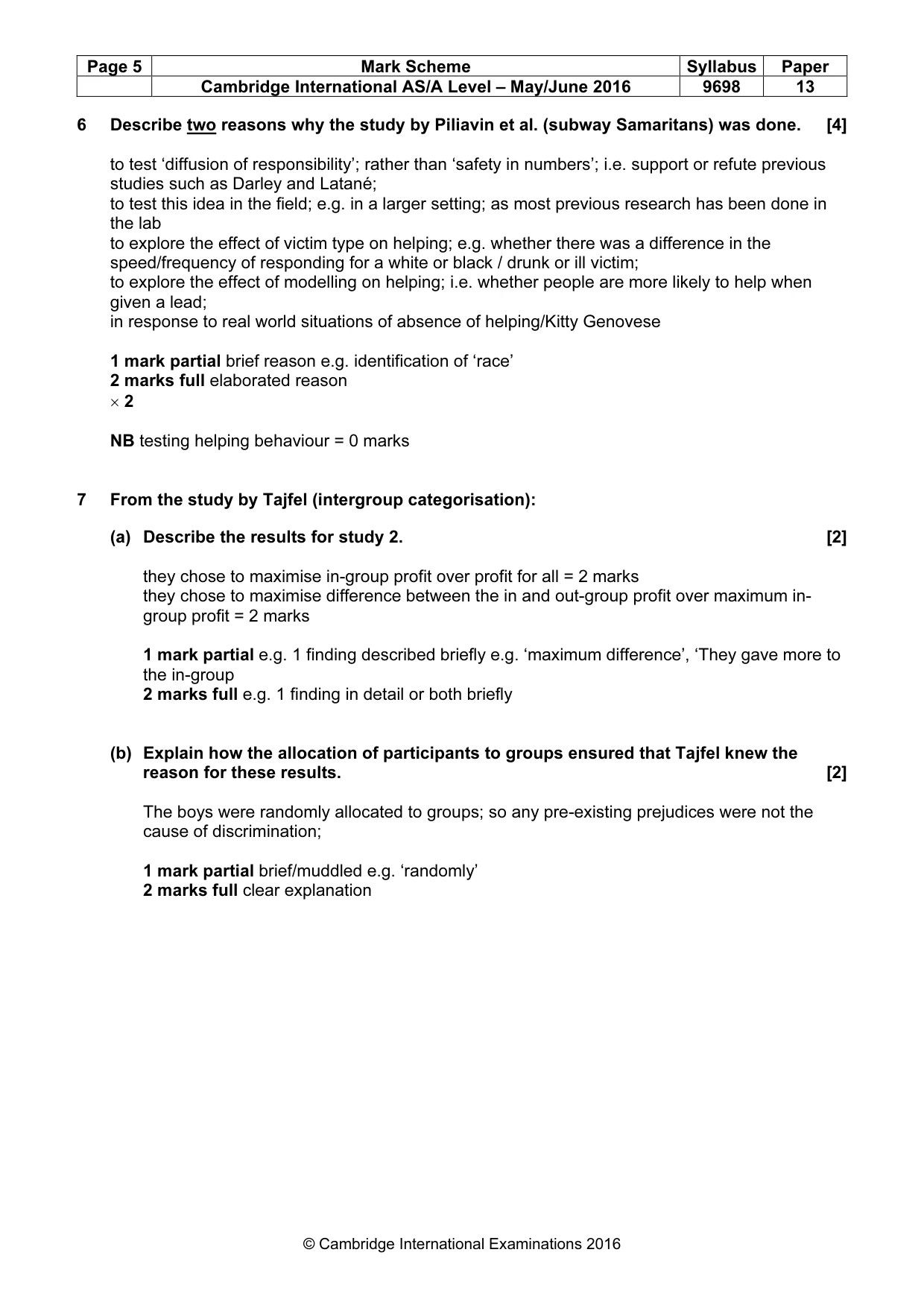
Page 5 Mark Scheme Syllabus Paper Cambridge International AS/A Level – May/June 2016 9698 13 © Cambridge International Examinations 2016 6 Describe two reasons why the study by Piliavin et al. (subway Samaritans) was done. [4] to test ‘diffusion of responsibility’; rather than ‘safety in numbers’; i.e. support or refute previous studies such as Darley and Latané; to test this idea in the field; e.g. in a larger setting; as most previous research has been done in the lab to explore the effect of victim type on helping; e.g. whether there was a difference in the speed/frequency of responding for a white or black / drunk or ill victim; to explore the effect of modelling on helping; i.e. whether people are more likely to help when given a lead; in response to real world situations of absence of helping/Kitty Genovese 1 mark partial brief reason e.g. identification of ‘race’ 2 marks full elaborated reason × 2 NB testing helping behaviour = 0 marks 7 From the study by Tajfel (intergroup categorisation): (a) Describe the results for study 2. [2] they chose to maximise in-group profit over profit for all = 2 marks they chose to maximise difference between the in and out-group profit over maximum in- group profit = 2 marks 1 mark partial e.g. 1 finding described briefly e.g. ‘maximum difference’, ‘They gave more to the in-group 2 marks full e.g. 1 finding in detail or both briefly (b) Explain how the allocation of participants to groups ensured that Tajfel knew the reason for these results. [2] The boys were randomly allocated to groups; so any pre-existing prejudices were not the cause of discrimination; 1 mark partial brief/muddled e.g. ‘randomly’ 2 marks full clear explanation
Mark scheme, page 6
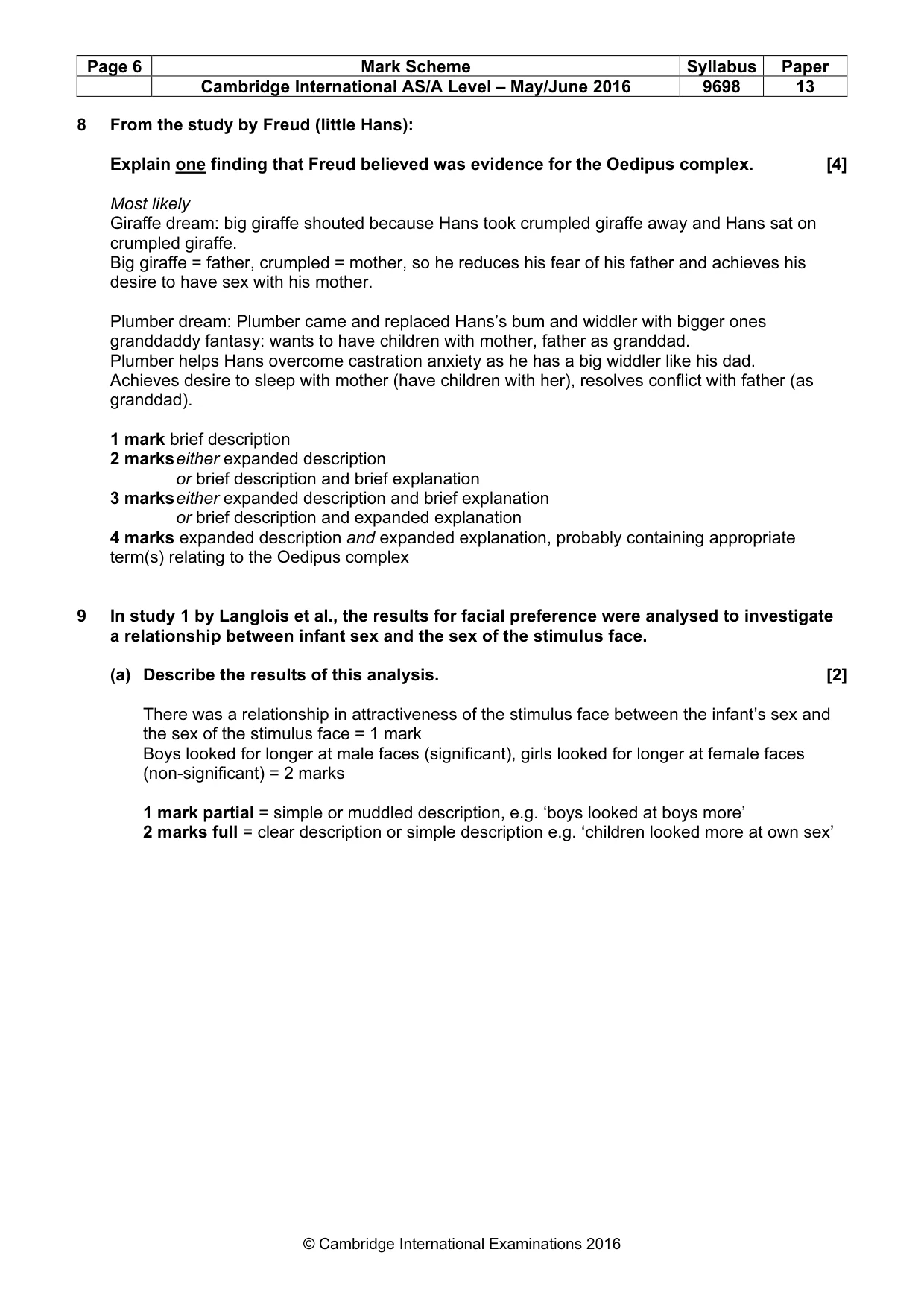
Page 6 Mark Scheme Syllabus Paper Cambridge International AS/A Level – May/June 2016 9698 13 © Cambridge International Examinations 2016 8 From the study by Freud (little Hans): Explain one finding that Freud believed was evidence for the Oedipus complex. [4] Most likely Giraffe dream: big giraffe shouted because Hans took crumpled giraffe away and Hans sat on crumpled giraffe. Big giraffe = father, crumpled = mother, so he reduces his fear of his father and achieves his desire to have sex with his mother. Plumber dream: Plumber came and replaced Hans’s bum and widdler with bigger ones granddaddy fantasy: wants to have children with mother, father as granddad. Plumber helps Hans overcome castration anxiety as he has a big widdler like his dad. Achieves desire to sleep with mother (have children with her), resolves conflict with father (as granddad). 1 mark brief description 2 marks either expanded description or brief description and brief explanation 3 marks either expanded description and brief explanation or brief description and expanded explanation 4 marks expanded description and expanded explanation, probably containing appropriate term(s) relating to the Oedipus complex 9 In study 1 by Langlois et al., the results for facial preference were analysed to investigate a relationship between infant sex and the sex of the stimulus face. (a) Describe the results of this analysis. [2] There was a relationship in attractiveness of the stimulus face between the infant’s sex and the sex of the stimulus face = 1 mark Boys looked for longer at male faces (significant), girls looked for longer at female faces (non-significant) = 2 marks 1 mark partial = simple or muddled description, e.g. ‘boys looked at boys more’ 2 marks full = clear description or simple description e.g. ‘children looked more at own sex’
Mark scheme, page 7
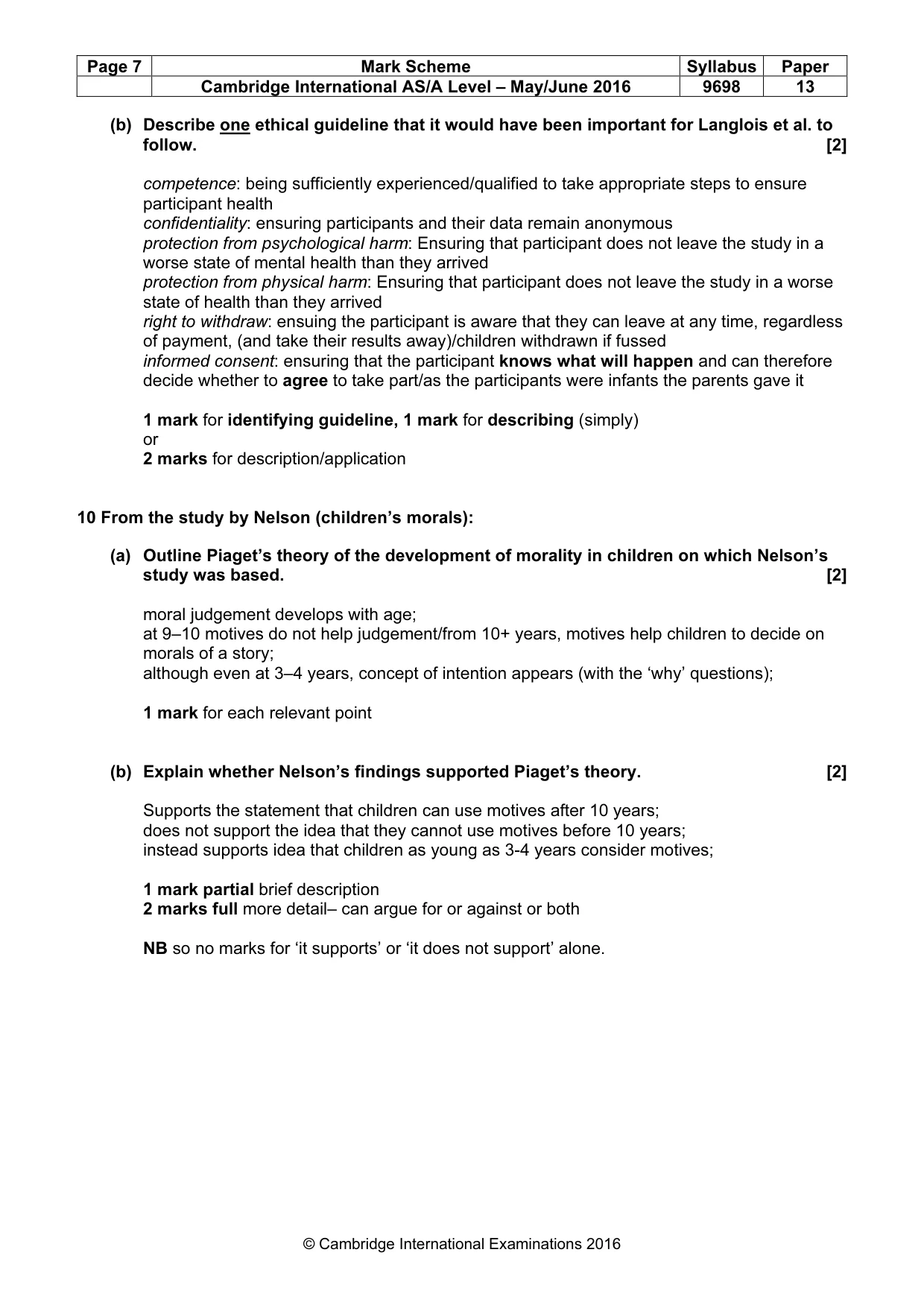
Page 7 Mark Scheme Syllabus Paper Cambridge International AS/A Level – May/June 2016 9698 13 © Cambridge International Examinations 2016 (b) Describe one ethical guideline that it would have been important for Langlois et al. to follow. [2] competence: being sufficiently experienced/qualified to take appropriate steps to ensure participant health confidentiality: ensuring participants and their data remain anonymous protection from psychological harm: Ensuring that participant does not leave the study in a worse state of mental health than they arrived protection from physical harm: Ensuring that participant does not leave the study in a worse state of health than they arrived right to withdraw: ensuing the participant is aware that they can leave at any time, regardless of payment, (and take their results away)/children withdrawn if fussed informed consent: ensuring that the participant knows what will happen and can therefore decide whether to agree to take part/as the participants were infants the parents gave it 1 mark for identifying guideline, 1 mark for describing (simply) or 2 marks for description/application 10 From the study by Nelson (children’s morals): (a) Outline Piaget’s theory of the development of morality in children on which Nelson’s study was based. [2] moral judgement develops with age; at 9–10 motives do not help judgement/from 10+ years, motives help children to decide on morals of a story; although even at 3–4 years, concept of intention appears (with the ‘why’ questions); 1 mark for each relevant point (b) Explain whether Nelson’s findings supported Piaget’s theory. [2] Supports the statement that children can use motives after 10 years; does not support the idea that they cannot use motives before 10 years; instead supports idea that children as young as 3-4 years consider motives; 1 mark partial brief description 2 marks full more detail– can argue for or against or both NB so no marks for ‘it supports’ or ‘it does not support’ alone.
Mark scheme, page 8
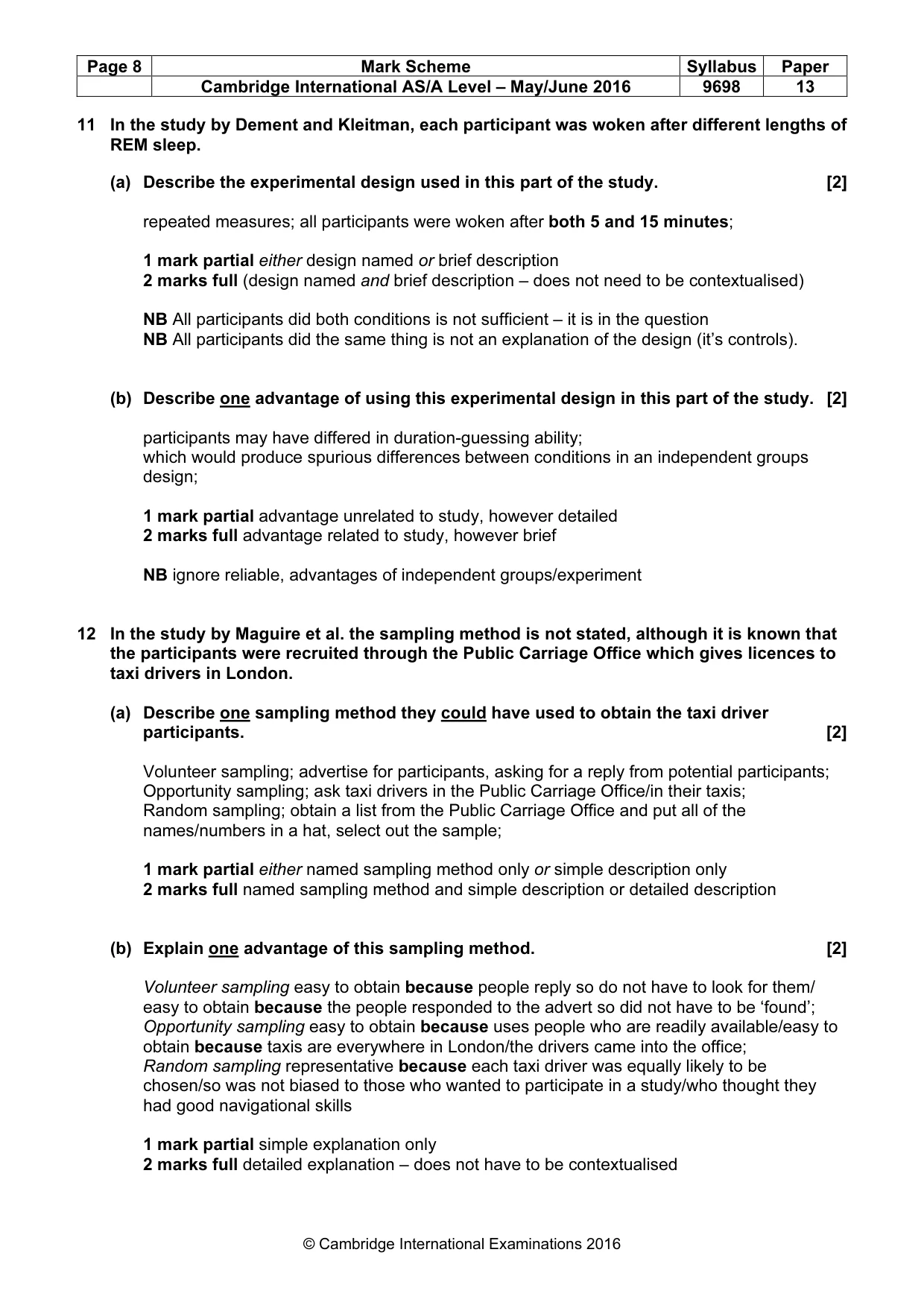
Page 8 Mark Scheme Syllabus Paper Cambridge International AS/A Level – May/June 2016 9698 13 © Cambridge International Examinations 2016 11 In the study by Dement and Kleitman, each participant was woken after different lengths of REM sleep. (a) Describe the experimental design used in this part of the study. [2] repeated measures; all participants were woken after both 5 and 15 minutes; 1 mark partial either design named or brief description 2 marks full (design named and brief description – does not need to be contextualised) NB All participants did both conditions is not sufficient – it is in the question NB All participants did the same thing is not an explanation of the design (it’s controls). (b) Describe one advantage of using this experimental design in this part of the study. [2] participants may have differed in duration-guessing ability; which would produce spurious differences between conditions in an independent groups design; 1 mark partial advantage unrelated to study, however detailed 2 marks full advantage related to study, however brief NB ignore reliable, advantages of independent groups/experiment 12 In the study by Maguire et al. the sampling method is not stated, although it is known that the participants were recruited through the Public Carriage Office which gives licences to taxi drivers in London. (a) Describe one sampling method they could have used to obtain the taxi driver participants. [2] Volunteer sampling; advertise for participants, asking for a reply from potential participants; Opportunity sampling; ask taxi drivers in the Public Carriage Office/in their taxis; Random sampling; obtain a list from the Public Carriage Office and put all of the names/numbers in a hat, select out the sample; 1 mark partial either named sampling method only or simple description only 2 marks full named sampling method and simple description or detailed description (b) Explain one advantage of this sampling method. [2] Volunteer sampling easy to obtain because people reply so do not have to look for them/ easy to obtain because the people responded to the advert so did not have to be ‘found’; Opportunity sampling easy to obtain because uses people who are readily available/easy to obtain because taxis are everywhere in London/the drivers came into the office; Random sampling representative because each taxi driver was equally likely to be chosen/so was not biased to those who wanted to participate in a study/who thought they had good navigational skills 1 mark partial simple explanation only 2 marks full detailed explanation – does not have to be contextualised
Mark scheme, page 9
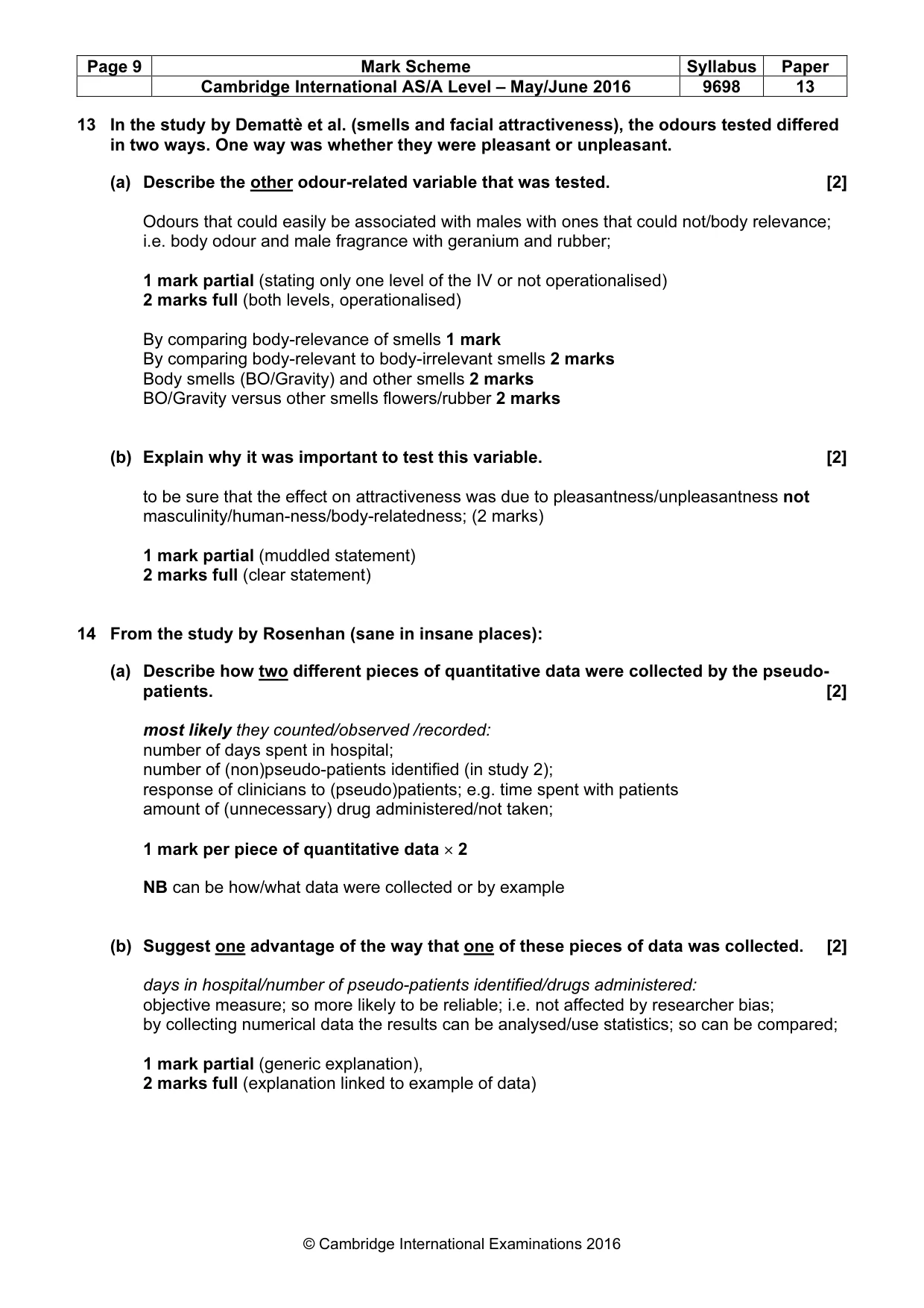
Page 9 Mark Scheme Syllabus Paper Cambridge International AS/A Level – May/June 2016 9698 13 © Cambridge International Examinations 2016 13 In the study by Demattè et al. (smells and facial attractiveness), the odours tested differed in two ways. One way was whether they were pleasant or unpleasant. (a) Describe the other odour-related variable that was tested. [2] Odours that could easily be associated with males with ones that could not/body relevance; i.e. body odour and male fragrance with geranium and rubber; 1 mark partial (stating only one level of the IV or not operationalised) 2 marks full (both levels, operationalised) By comparing body-relevance of smells 1 mark By comparing body-relevant to body-irrelevant smells 2 marks Body smells (BO/Gravity) and other smells 2 marks BO/Gravity versus other smells flowers/rubber 2 marks (b) Explain why it was important to test this variable. [2] to be sure that the effect on attractiveness was due to pleasantness/unpleasantness not masculinity/human-ness/body-relatedness; (2 marks) 1 mark partial (muddled statement) 2 marks full (clear statement) 14 From the study by Rosenhan (sane in insane places): (a) Describe how two different pieces of quantitative data were collected by the pseudo- patients. [2] most likely they counted/observed /recorded: number of days spent in hospital; number of (non)pseudo-patients identified (in study 2); response of clinicians to (pseudo)patients; e.g. time spent with patients amount of (unnecessary) drug administered/not taken; 1 mark per piece of quantitative data × 2 NB can be how/what data were collected or by example (b) Suggest one advantage of the way that one of these pieces of data was collected. [2] days in hospital/number of pseudo-patients identified/drugs administered: objective measure; so more likely to be reliable; i.e. not affected by researcher bias; by collecting numerical data the results can be analysed/use statistics; so can be compared; 1 mark partial (generic explanation), 2 marks full (explanation linked to example of data)
Mark scheme, page 10
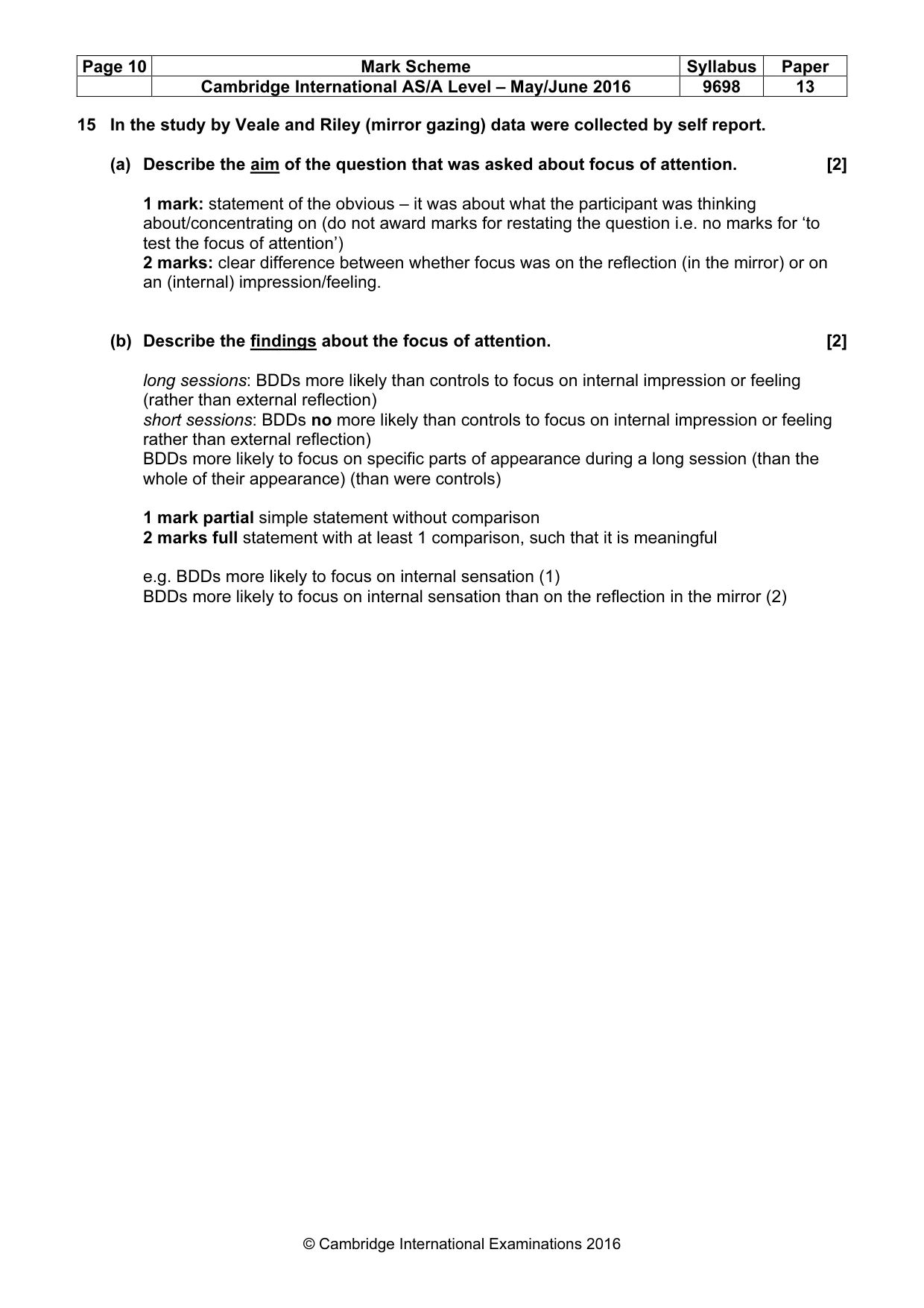
Page 10 Mark Scheme Syllabus Paper Cambridge International AS/A Level – May/June 2016 9698 13 © Cambridge International Examinations 2016 15 In the study by Veale and Riley (mirror gazing) data were collected by self report. (a) Describe the aim of the question that was asked about focus of attention. [2] 1 mark: statement of the obvious – it was about what the participant was thinking about/concentrating on (do not award marks for restating the question i.e. no marks for ‘to test the focus of attention’) 2 marks: clear difference between whether focus was on the reflection (in the mirror) or on an (internal) impression/feeling. (b) Describe the findings about the focus of attention. [2] long sessions: BDDs more likely than controls to focus on internal impression or feeling (rather than external reflection) short sessions: BDDs no more likely than controls to focus on internal impression or feeling rather than external reflection) BDDs more likely to focus on specific parts of appearance during a long session (than the whole of their appearance) (than were controls) 1 mark partial simple statement without comparison 2 marks full statement with at least 1 comparison, such that it is meaningful e.g. BDDs more likely to focus on internal sensation (1) BDDs more likely to focus on internal sensation than on the reflection in the mirror (2)
Mark scheme, page 11
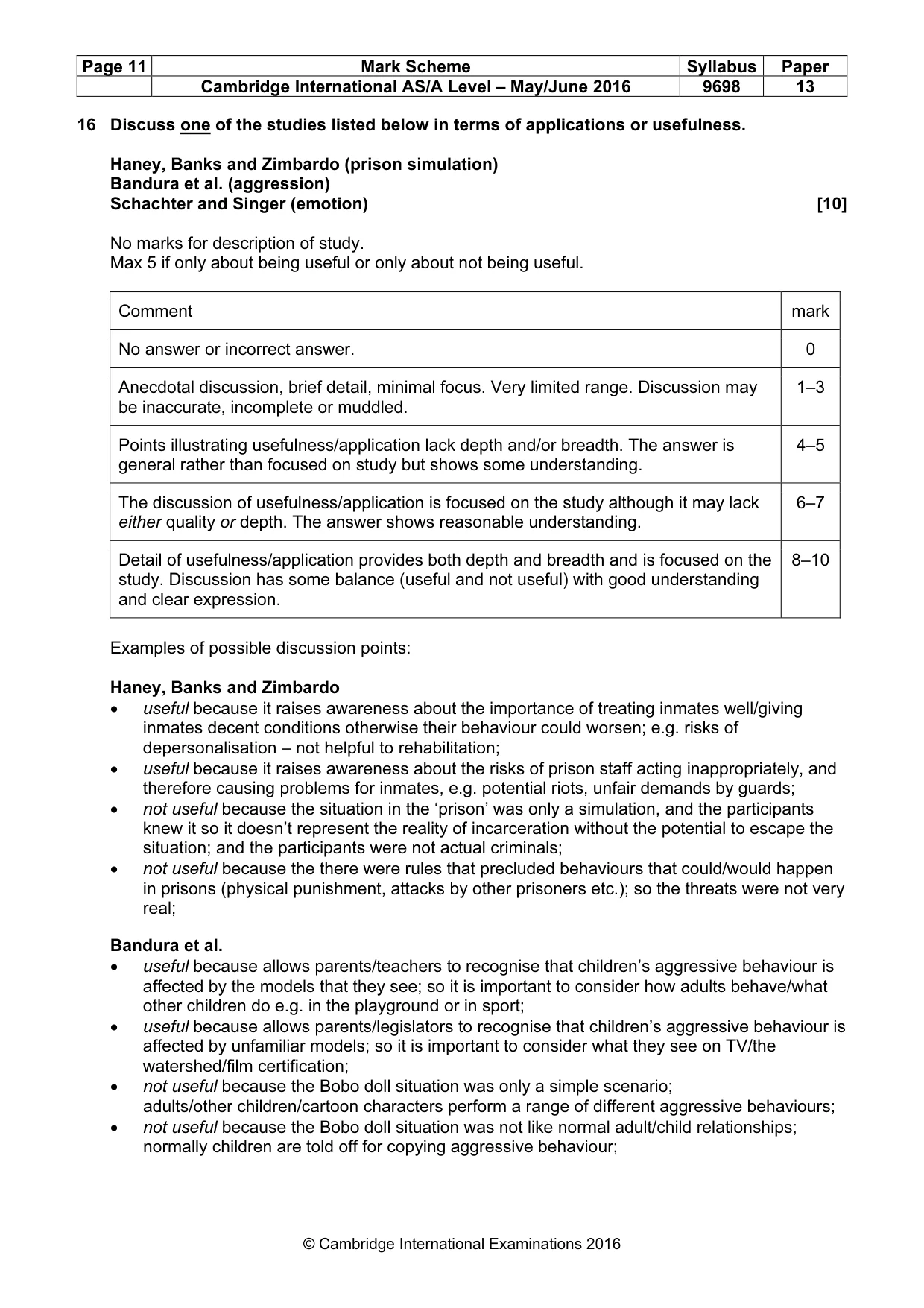
Page 11 Mark Scheme Syllabus Paper Cambridge International AS/A Level – May/June 2016 9698 13 © Cambridge International Examinations 2016 16 Discuss one of the studies listed below in terms of applications or usefulness. Haney, Banks and Zimbardo (prison simulation) Bandura et al. (aggression) Schachter and Singer (emotion) [10] No marks for description of study. Max 5 if only about being useful or only about not being useful. Comment mark No answer or incorrect answer. 0 Anecdotal discussion, brief detail, minimal focus. Very limited range. Discussion may be inaccurate, incomplete or muddled. 1–3 Points illustrating usefulness/application lack depth and/or breadth. The answer is general rather than focused on study but shows some understanding. 4–5 The discussion of usefulness/application is focused on the study although it may lack either quality or depth. The answer shows reasonable understanding. 6–7 Detail of usefulness/application provides both depth and breadth and is focused on the study. Discussion has some balance (useful and not useful) with good understanding and clear expression. 8–10 Examples of possible discussion points: Haney, Banks and Zimbardo • useful because it raises awareness about the importance of treating inmates well/giving inmates decent conditions otherwise their behaviour could worsen; e.g. risks of depersonalisation – not helpful to rehabilitation; • useful because it raises awareness about the risks of prison staff acting inappropriately, and therefore causing problems for inmates, e.g. potential riots, unfair demands by guards; • not useful because the situation in the ‘prison’ was only a simulation, and the participants knew it so it doesn’t represent the reality of incarceration without the potential to escape the situation; and the participants were not actual criminals; • not useful because the there were rules that precluded behaviours that could/would happen in prisons (physical punishment, attacks by other prisoners etc.); so the threats were not very real; Bandura et al. • useful because allows parents/teachers to recognise that children’s aggressive behaviour is affected by the models that they see; so it is important to consider how adults behave/what other children do e.g. in the playground or in sport; • useful because allows parents/legislators to recognise that children’s aggressive behaviour is affected by unfamiliar models; so it is important to consider what they see on TV/the watershed/film certification; • not useful because the Bobo doll situation was only a simple scenario; adults/other children/cartoon characters perform a range of different aggressive behaviours; • not useful because the Bobo doll situation was not like normal adult/child relationships; normally children are told off for copying aggressive behaviour;
Mark scheme, page 12
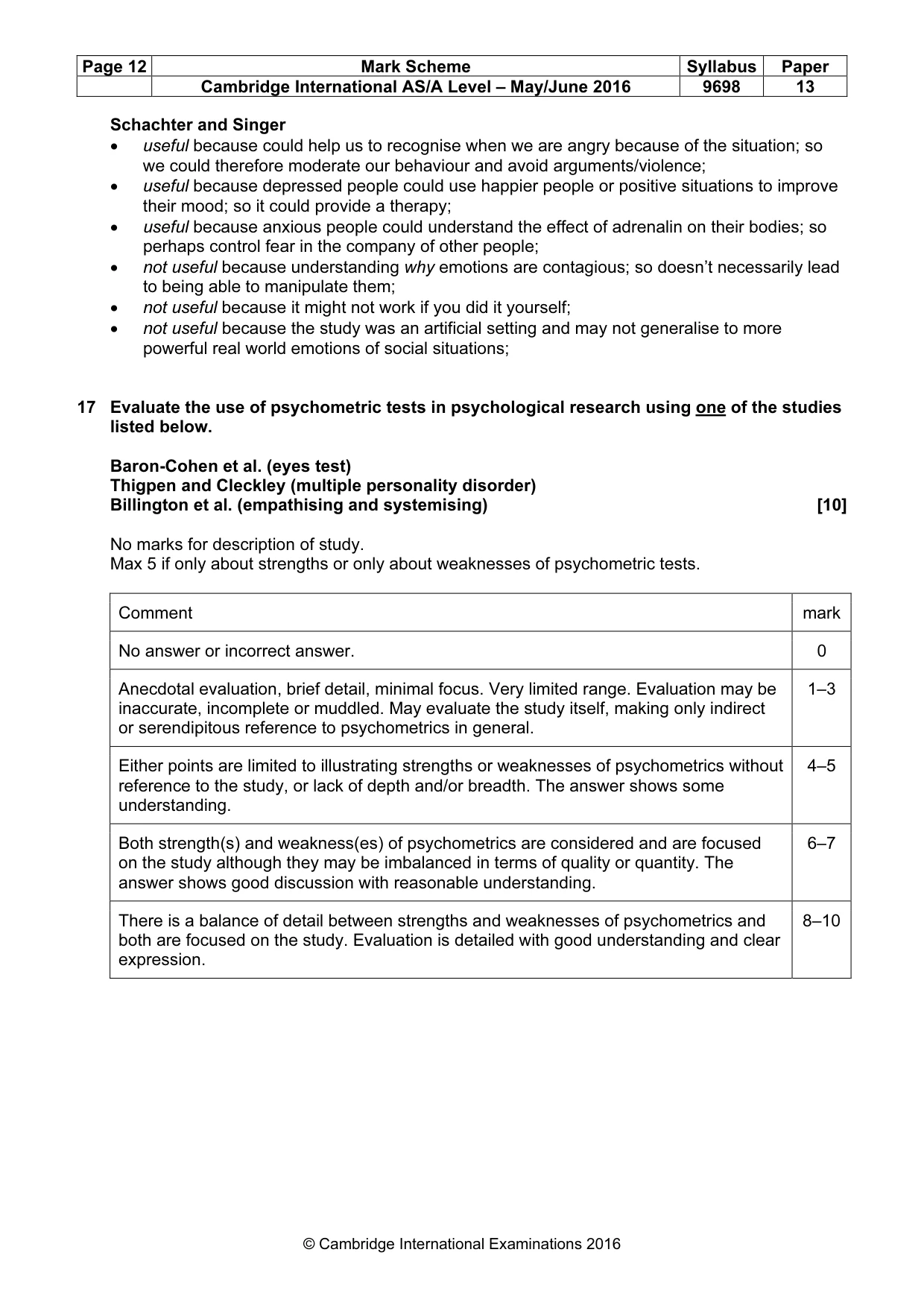
Page 12 Mark Scheme Syllabus Paper Cambridge International AS/A Level – May/June 2016 9698 13 © Cambridge International Examinations 2016 Schachter and Singer • useful because could help us to recognise when we are angry because of the situation; so we could therefore moderate our behaviour and avoid arguments/violence; • useful because depressed people could use happier people or positive situations to improve their mood; so it could provide a therapy; • useful because anxious people could understand the effect of adrenalin on their bodies; so perhaps control fear in the company of other people; • not useful because understanding why emotions are contagious; so doesn’t necessarily lead to being able to manipulate them; • not useful because it might not work if you did it yourself; • not useful because the study was an artificial setting and may not generalise to more powerful real world emotions of social situations; 17 Evaluate the use of psychometric tests in psychological research using one of the studies listed below. Baron-Cohen et al. (eyes test) Thigpen and Cleckley (multiple personality disorder) Billington et al. (empathising and systemising) [10] No marks for description of study. Max 5 if only about strengths or only about weaknesses of psychometric tests. Comment mark No answer or incorrect answer. 0 Anecdotal evaluation, brief detail, minimal focus. Very limited range. Evaluation may be inaccurate, incomplete or muddled. May evaluate the study itself, making only indirect or serendipitous reference to psychometrics in general. 1–3 Either points are limited to illustrating strengths or weaknesses of psychometrics without reference to the study, or lack of depth and/or breadth. The answer shows some understanding. 4–5 Both strength(s) and weakness(es) of psychometrics are considered and are focused on the study although they may be imbalanced in terms of quality or quantity. The answer shows good discussion with reasonable understanding. 6–7 There is a balance of detail between strengths and weaknesses of psychometrics and both are focused on the study. Evaluation is detailed with good understanding and clear expression. 8–10
Mark scheme, page 13
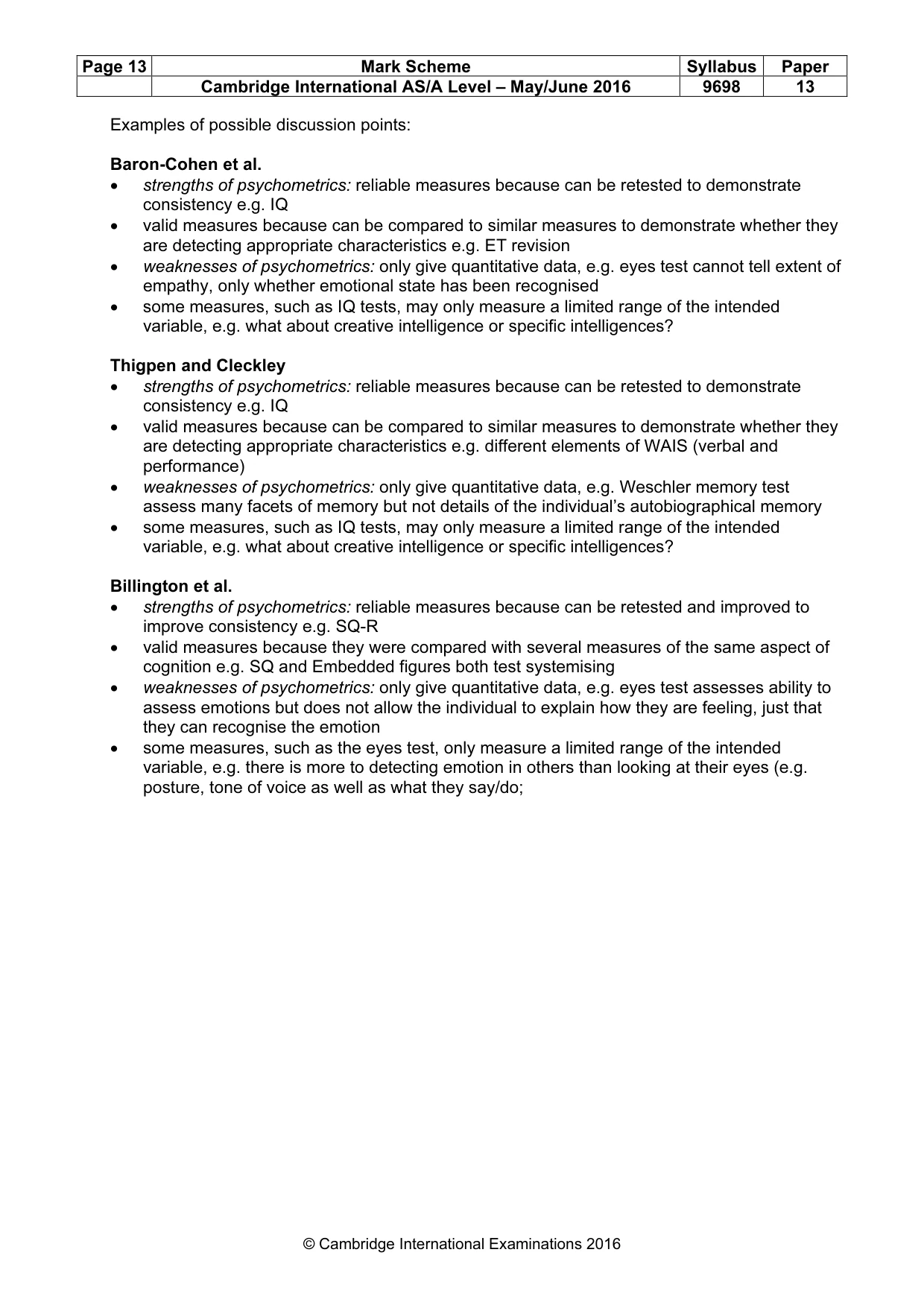
Page 13 Mark Scheme Syllabus Paper Cambridge International AS/A Level – May/June 2016 9698 13 © Cambridge International Examinations 2016 Examples of possible discussion points: Baron-Cohen et al. • strengths of psychometrics: reliable measures because can be retested to demonstrate consistency e.g. IQ • valid measures because can be compared to similar measures to demonstrate whether they are detecting appropriate characteristics e.g. ET revision • weaknesses of psychometrics: only give quantitative data, e.g. eyes test cannot tell extent of empathy, only whether emotional state has been recognised • some measures, such as IQ tests, may only measure a limited range of the intended variable, e.g. what about creative intelligence or specific intelligences? Thigpen and Cleckley • strengths of psychometrics: reliable measures because can be retested to demonstrate consistency e.g. IQ • valid measures because can be compared to similar measures to demonstrate whether they are detecting appropriate characteristics e.g. different elements of WAIS (verbal and performance) • weaknesses of psychometrics: only give quantitative data, e.g. Weschler memory test assess many facets of memory but not details of the individual’s autobiographical memory • some measures, such as IQ tests, may only measure a limited range of the intended variable, e.g. what about creative intelligence or specific intelligences? Billington et al. • strengths of psychometrics: reliable measures because can be retested and improved to improve consistency e.g. SQ-R • valid measures because they were compared with several measures of the same aspect of cognition e.g. SQ and Embedded figures both test systemising • weaknesses of psychometrics: only give quantitative data, e.g. eyes test assesses ability to assess emotions but does not allow the individual to explain how they are feeling, just that they can recognise the emotion • some measures, such as the eyes test, only measure a limited range of the intended variable, e.g. there is more to detecting emotion in others than looking at their eyes (e.g. posture, tone of voice as well as what they say/do;
What you needed in this session
Cambridge’s own grade thresholds for 2016 May/June, Paper 1 · Variant 3. A higher threshold means an easier paper — the bar moves with how the cohort did.