Cambridge A Level Psychology 9698 — 2016 Oct/Nov Paper 1 · Variant 3
9698/13/O/N/16 · 80 marks · ≈90 min
The question paper and its mark scheme, free to read here and free to download. This is Cambridge’s own paper, exactly as it was sat.
Question paper4 pages
Mark scheme14 pages
Answers below. Sit the paper first if you are practising.
Paper as text
Question paper, page 1
This document consists of 4 printed pages and 1 insert. DC (NF/JG) 110818/2 © UCLES 2016 [Turn over Cambridge International Examinations Cambridge International Advanced Subsidiary and Advanced Level * 5 2 1 3 0 4 3 2 9 3 * PSYCHOLOGY 9698/13 Paper 1 Core Studies 1 October/November 2016 1 hour 30 minutes No Additional Materials are required. READ THESE INSTRUCTIONS FIRST An answer booklet is provided inside this question paper. You should follow the instructions on the front cover of the answer booklet. If you need additional answer paper ask the invigilator for a continuation booklet. Answer all questions. The number of marks is given in brackets [ ] at the end of each question or part question.
Question paper, page 2
2 9698/13/O/N/16 © UCLES 2016 Section A (60 marks) Answer all questions in this section. 1 The study by Mann et al. looked for differences between behaviours in clips of suspects telling truths and lies. (a) Identify two behaviours that did not show a difference between truths and lies. [2] (b) Explain what can be concluded from these results. [2] 2 From the study by Held and Hein (kitten carousel): (a) Describe the research method used in the study comparing the active and passive kittens. [2] (b) Suggest one advantage of this research method in this study. [2] 3 From the study by Baron-Cohen et al. (eyes test): (a) Describe one control used in the study. [2] (b) Explain the importance of this control in the study. [2] 4 From the study by Milgram (obedience): (a) Describe one quantitative finding. [2] (b) Describe one qualitative finding. [2] 5 Describe how the prisoners in the study by Haney, Banks and Zimbardo responded when offered parole. [4] 6 The study by Piliavin et al. (subway Samaritans) raised ethical issues. (a) Outline two ethical guidelines that apply to this study. [2] (b) Explain how one of these guidelines was followed, or not followed, in the study. [2] 7 From the study by Tajfel (intergroup categorisation): (a) Describe the matrices used to collect quantitative data. [2] (b) Explain one advantage of collecting quantitative data. [2]
Question paper, page 3
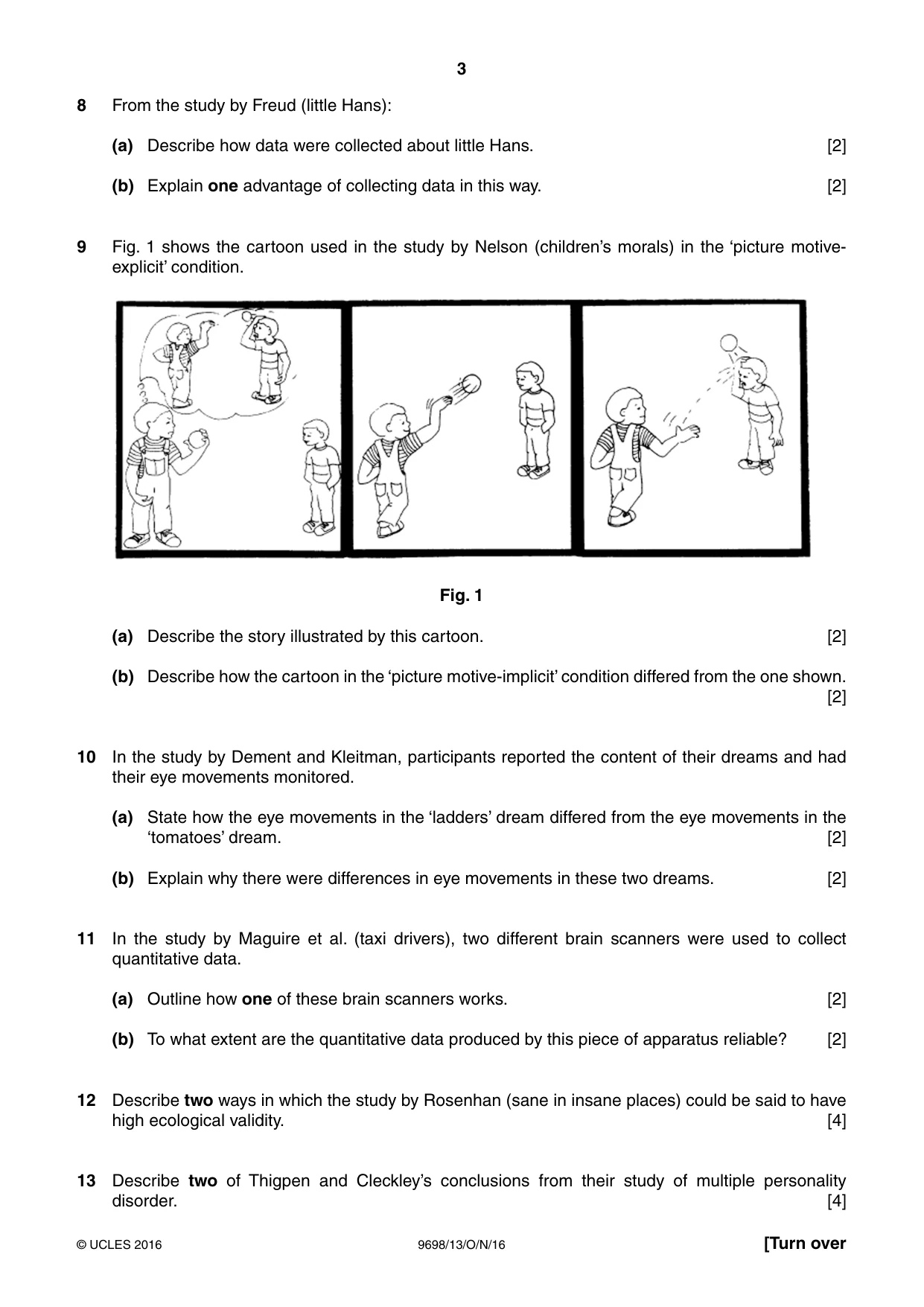
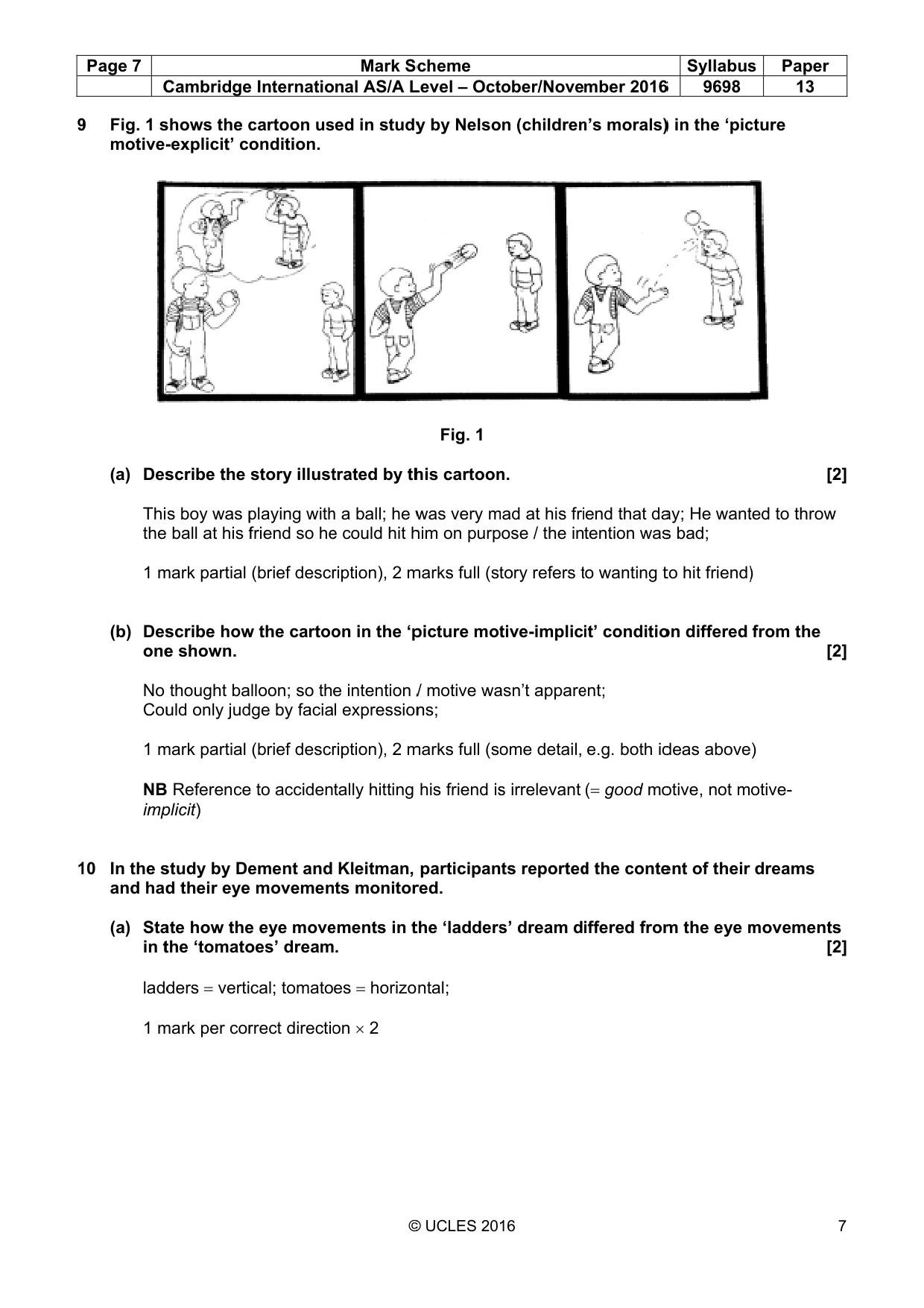
3 9698/13/O/N/16 © UCLES 2016 [Turn over 8 From the study by Freud (little Hans): (a) Describe how data were collected about little Hans. [2] (b) Explain one advantage of collecting data in this way. [2] 9 Fig. 1 shows the cartoon used in the study by Nelson (children’s morals) in the ‘picture motive- explicit’ condition. Fig. 1 (a) Describe the story illustrated by this cartoon. [2] (b) Describe how the cartoon in the ‘picture motive-implicit’ condition differed from the one shown. [2] 10 In the study by Dement and Kleitman, participants reported the content of their dreams and had their eye movements monitored. (a) State how the eye movements in the ‘ladders’ dream differed from the eye movements in the ‘tomatoes’ dream. [2] (b) Explain why there were differences in eye movements in these two dreams. [2] 11 In the study by Maguire et al. (taxi drivers), two different brain scanners were used to collect quantitative data. (a) Outline how one of these brain scanners works. [2] (b) To what extent are the quantitative data produced by this piece of apparatus reliable? [2] 12 Describe two ways in which the study by Rosenhan (sane in insane places) could be said to have high ecological validity. [4] 13 Describe two of Thigpen and Cleckley’s conclusions from their study of multiple personality disorder. [4]
Question paper, page 4
4 9698/13/O/N/16 © UCLES 2016 14 The study by Billington et al. (empathising and systemising) used self report questionnaires to collect data. (a) Describe one advantage of using self reports in this study. [2] (b) Describe one disadvantage of using self reports in this study. [2] 15 From the study by Veale and Riley (mirror gazing): (a) Describe how the use of different types of reflective surfaces was investigated. [2] (b) Describe the results about the use of different types of reflective surfaces. [2] Section B (20 marks) Answer both questions in this section. 16 Evaluate one of the studies listed below in terms of its weaknesses. Loftus and Pickrell (false memories) Nelson (children’s morals) Schachter and Singer (emotion) [10] 1 7 The same aim may sometimes be tested using humans and animals. Evaluate the extent to which humans and animals could be used effectively using one of the studies listed below. Bandura et al. (aggression) Langlois et al. (infant facial preference) Demattè et al. (smells and facial attractiveness) [10] Permission to reproduce items where third-party owned material protected by copyright is included has been sought and cleared where possible. Every reasonable effort has been made by the publisher (UCLES) to trace copyright holders, but if any items requiring clearance have unwittingly been included, the publisher will be pleased to make amends at the earliest possible opportunity. To avoid the issue of disclosure of answer-related information to candidates, all copyright acknowledgements are reproduced online in the Cambridge International Examinations Copyright Acknowledgements Booklet. This is produced for each series of examinations and is freely available to download at www.cie.org.uk after the live examination series. Cambridge International Examinations is part of the Cambridge Assessment Group. Cambridge Assessment is the brand name of University of Cambridge Local Examinations Syndicate (UCLES), which is itself a department of the University of Cambridge.
Mark scheme, page 1
® IGCSE is the registered trademark of Cambridge International Examinations. This document consists of 14 printed pages. © UCLES 2016 [Turn over Cambridge International Examinations Cambridge International Advanced Subsidiary and Advanced Level PSYCHOLOGY 9698/13 Paper 1 Core Studies 1 October/November 2016 MARK SCHEME Maximum Mark: 80 Published This mark scheme is published as an aid to teachers and candidates, to indicate the requirements of the examination. It shows the basis on which Examiners were instructed to award marks. It does not indicate the details of the discussions that took place at an Examiners’ meeting before marking began, which would have considered the acceptability of alternative answers. Mark schemes should be read in conjunction with the question paper and the Principal Examiner Report for Teachers. Cambridge will not enter into discussions about these mark schemes. Cambridge is publishing the mark schemes for the October/November 2016 series for most Cambridge IGCSE®, Cambridge International A and AS Level components and some Cambridge O Level components.
Mark scheme, page 2
Page 2 Mark Scheme Syllabus Paper Cambridge International AS/A Level – October/November 2016 9698 13 © UCLES 2016 2 Section A 1 The study by Mann et al. looked for differences between behaviours in clips of suspects telling truths and lies. (a) Identify two behaviours that did not show a difference between truths and lies. [2] Gaze aversion; head movements; hand / arm movements (I.e. illustrators, self manipulations, and hand / finger movements); speech disturbances; 1 mark per behaviour × 2 NB Do not accept ‘fidgeting’ but accept descriptions of behaviours. (b) Explain what can be concluded from these results. [2] That liars have individual differences; so there is not a particular set of behaviours associated with lying; we should be cautious about believing that we ‘know’ when someone is lying from their body language; 1 mark partial (brief explanation) 2 marks full (detailed explanation) 2 From the study by Held and Hein (kitten carousel): (a) Describe the research method used in the study comparing the active and passive kittens. [2] • Experiment / laboratory experiment / true experiment; • IV and DV or • IV manipulated • DV measured • looking for differences • investigates causal relationships • controls employed 1 mark partial (identifying experiment only) 2 marks full (some detail – two or more points above) NB Answer does not have to be contexualised. (b) Suggest one advantage of this research method in this study. [2] Controls; e.g. the apparatus ensured the passive kitten had exactly the same visual experience as the active one; the pairs of kittens were litter mates (so were genetically similar / so differences between them must have been due to the apparatus) 1 mark partial (identifying an advantage) 2 marks full (advantage related to study)
Mark scheme, page 3
Page 3 Mark Scheme Syllabus Paper Cambridge International AS/A Level – October/November 2016 9698 13 © UCLES 2016 3 3 From the study by Baron-Cohen et al. (eyes test): (a) Describe one control used in the study. [2] Provision of a glossary; explaining what each target word and foil in the eyes test meant; eyes test stimuli excluded if less than 50% of participants chose the target word; or if more than 25% selected any one of the foils; Allow: matching of IQ in groups 1 and 4 (AS and general pop) Allow: Eyes test figures showed only the eye area; not the whole face / clothes 2 marks for one control. 1 mark for identifying the control, second mark for description. NB Award 1 mark max for stating the obvious e.g. ‘they all did the same eyes test’ NB No marks for control condition (e.g. group 3 / normal adults / students) (b) Explain the importance of this control in the study. [2] Most likely: Glossary to ensure that all participants understood the words in the eyes test, so each had an equal chance of correctly identifying the target emotion. stimuli excluded to be sure that the eyes clearly represented the target emotion; i.e. there was a consensus about the underlying mental state from the expression Allow: IQ matching to ensure that differences were not due to underlying differences in intelligence; but must have been due to differences in mind blindness So more of the face e.g. mouth could not be used to judge emotion 2 marks for explanation (i.e. saying what it is controlling for and/or how)
Mark scheme, page 4
Page 4 Mark Scheme Syllabus Paper Cambridge International AS/A Level – October/November 2016 9698 13 © UCLES 2016 4 4 From the study by Milgram (obedience): (a) Describe one quantitative finding. [2] Answer needs figures and units for full marks. 1 mark partial: ‘all went to 300V’, ‘26/40 went to max’ 2 marks: ‘all 40 went to 300V’, ‘26/40 went to the max voltage’) NB Must be a finding, not a description of how the quantitative data were obtained. (b) Describe one qualitative finding. [2] Most likely nervous smiling / laughing; which participants were embarrassed about / explained was not because they were enjoying it. seizure: uncontrollable / violent convulsions. 1 mark partial (identifying a described finding) 2 marks full (detail about a described finding) NB both marks must be about one finding 5 Describe how the prisoners in the study by Haney, Banks and Zimbardo responded when offered parole. [4] 3 said yes / 2 said no; after only 4 days; even though they would lose the money they had earned; which had been the original motive for participation; but when told this would have to be discussed with the ‘staff’ they quietly went back to their cells; because the power of the guards seemed real to them; 1 mark for each detail identified × 4
Mark scheme, page 5
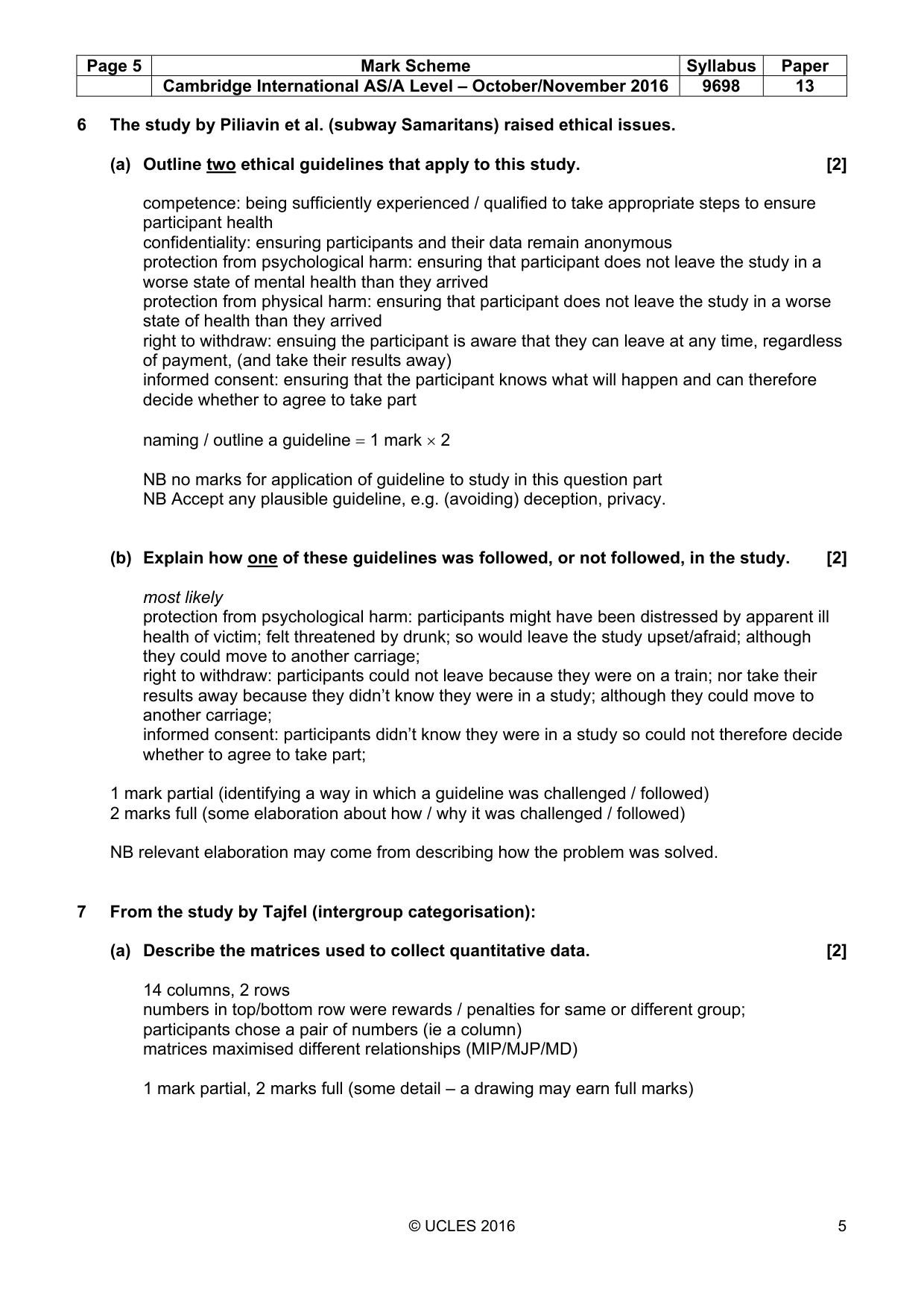
Page 5 Mark Scheme Syllabus Paper Cambridge International AS/A Level – October/November 2016 9698 13 © UCLES 2016 5 6 The study by Piliavin et al. (subway Samaritans) raised ethical issues. (a) Outline two ethical guidelines that apply to this study. [2] competence: being sufficiently experienced / qualified to take appropriate steps to ensure participant health confidentiality: ensuring participants and their data remain anonymous protection from psychological harm: ensuring that participant does not leave the study in a worse state of mental health than they arrived protection from physical harm: ensuring that participant does not leave the study in a worse state of health than they arrived right to withdraw: ensuing the participant is aware that they can leave at any time, regardless of payment, (and take their results away) informed consent: ensuring that the participant knows what will happen and can therefore decide whether to agree to take part naming / outline a guideline = 1 mark × 2 NB no marks for application of guideline to study in this question part NB Accept any plausible guideline, e.g. (avoiding) deception, privacy. (b) Explain how one of these guidelines was followed, or not followed, in the study. [2] most likely protection from psychological harm: participants might have been distressed by apparent ill health of victim; felt threatened by drunk; so would leave the study upset/afraid; although they could move to another carriage; right to withdraw: participants could not leave because they were on a train; nor take their results away because they didn’t know they were in a study; although they could move to another carriage; informed consent: participants didn’t know they were in a study so could not therefore decide whether to agree to take part; 1 mark partial (identifying a way in which a guideline was challenged / followed) 2 marks full (some elaboration about how / why it was challenged / followed) NB relevant elaboration may come from describing how the problem was solved. 7 From the study by Tajfel (intergroup categorisation): (a) Describe the matrices used to collect quantitative data. [2] 14 columns, 2 rows numbers in top/bottom row were rewards / penalties for same or different group; participants chose a pair of numbers (ie a column) matrices maximised different relationships (MIP/MJP/MD) 1 mark partial, 2 marks full (some detail – a drawing may earn full marks)
Mark scheme, page 6
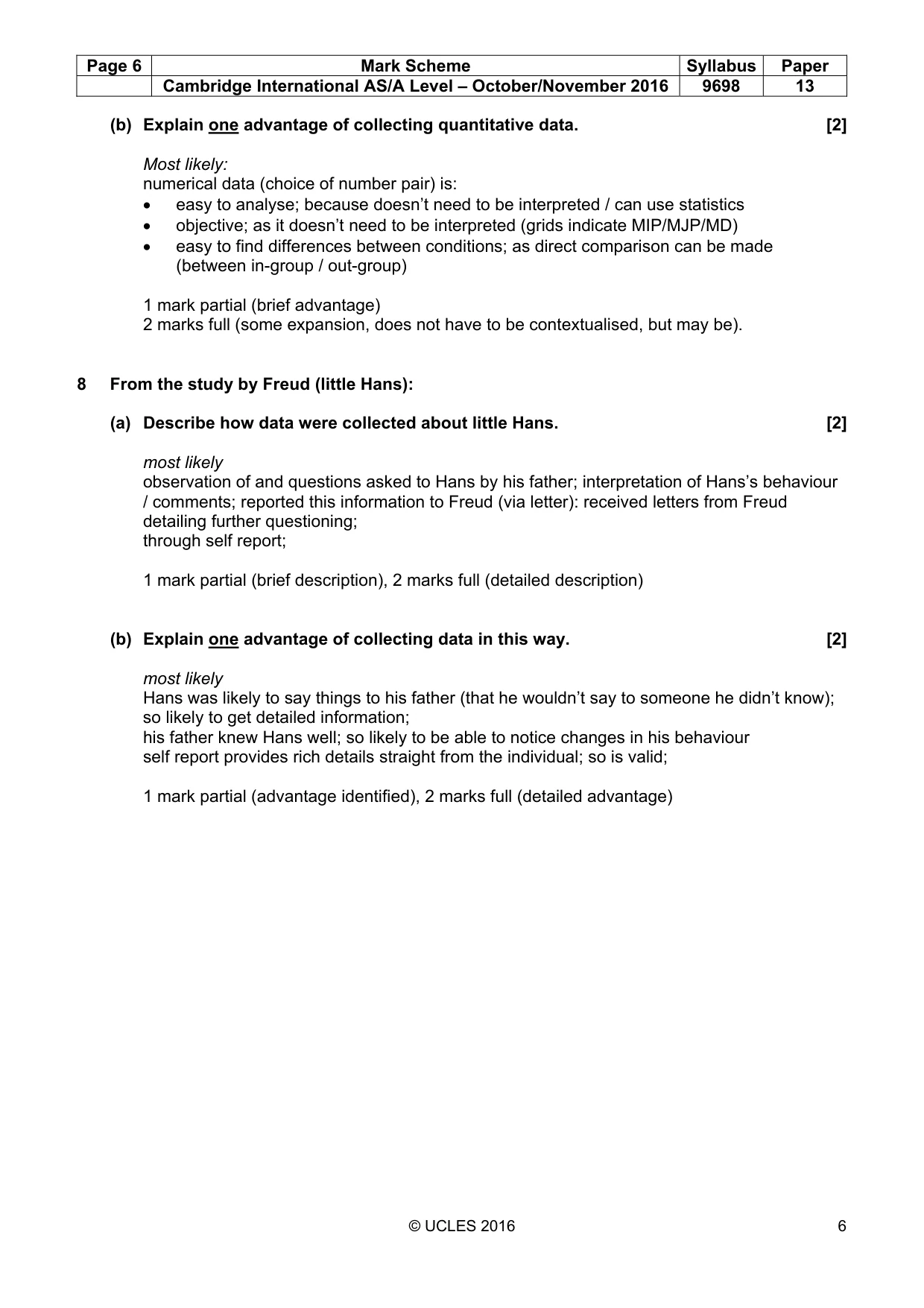
Page 6 Mark Scheme Syllabus Paper Cambridge International AS/A Level – October/November 2016 9698 13 © UCLES 2016 6 (b) Explain one advantage of collecting quantitative data. [2] Most likely: numerical data (choice of number pair) is: • easy to analyse; because doesn’t need to be interpreted / can use statistics • objective; as it doesn’t need to be interpreted (grids indicate MIP/MJP/MD) • easy to find differences between conditions; as direct comparison can be made (between in-group / out-group) 1 mark partial (brief advantage) 2 marks full (some expansion, does not have to be contextualised, but may be). 8 From the study by Freud (little Hans): (a) Describe how data were collected about little Hans. [2] most likely observation of and questions asked to Hans by his father; interpretation of Hans’s behaviour / comments; reported this information to Freud (via letter): received letters from Freud detailing further questioning; through self report; 1 mark partial (brief description), 2 marks full (detailed description) (b) Explain one advantage of collecting data in this way. [2] most likely Hans was likely to say things to his father (that he wouldn’t say to someone he didn’t know); so likely to get detailed information; his father knew Hans well; so likely to be able to notice changes in his behaviour self report provides rich details straight from the individual; so is valid; 1 mark partial (advantage identified), 2 marks full (detailed advantage)
Mark scheme, page 7
9 1 Page 7 C 9 Fig. 1 s motive- (a) Des Thi the 1 m (b) Des one No Cou 1 m NB imp 10 In the s and had (a) Sta in t ladd 1 m Cambridge shows the c -explicit’ co scribe the s boy was p ball at his f mark partial scribe how e shown. thought ba uld only jud mark partial Reference plicit) study by De d their eye ate how the the ‘tomato ders = verti mark per cor e Internatio cartoon us ondition. story illust playing with friend so he (brief descr w the cartoo lloon; so the ge by facia (brief descr e to acciden ement and movemen e eye move oes’ dream cal; tomato rrect directio Mark Sc nal AS/A L © ed in study trated by th h a ball; he w e could hit h ription), 2 m on in the ‘p e intention / l expression ription), 2 m tally hitting Kleitman, ts monitor ements in t . es = horizo on × 2 cheme Level – Oct © UCLES 201 y by Nelso Fig. 1 his cartoon was very m him on purp marks full (st picture mot / motive wa ns; marks full (so his friend is participan red. the ‘ladders ntal; ober/Nove 16 n (children n. mad at his fri ose / the in tory refers t tive-implic asn’t appare ome detail, s irrelevant ts reported s’ dream d mber 2016 n’s morals) end that da tention was to wanting t it’ conditio ent; e.g. both id (= good mo d the conte iffered from Syllabus 6 9698 ) in the ‘pic ay; He want s bad; to hit friend) on differed deas above otive, not m ent of their m the eye m s Paper 13 cture [2 ted to throw ) from the [2 ) otive- dreams movements [2 7 2] w 2] s 2]
Mark scheme, page 8
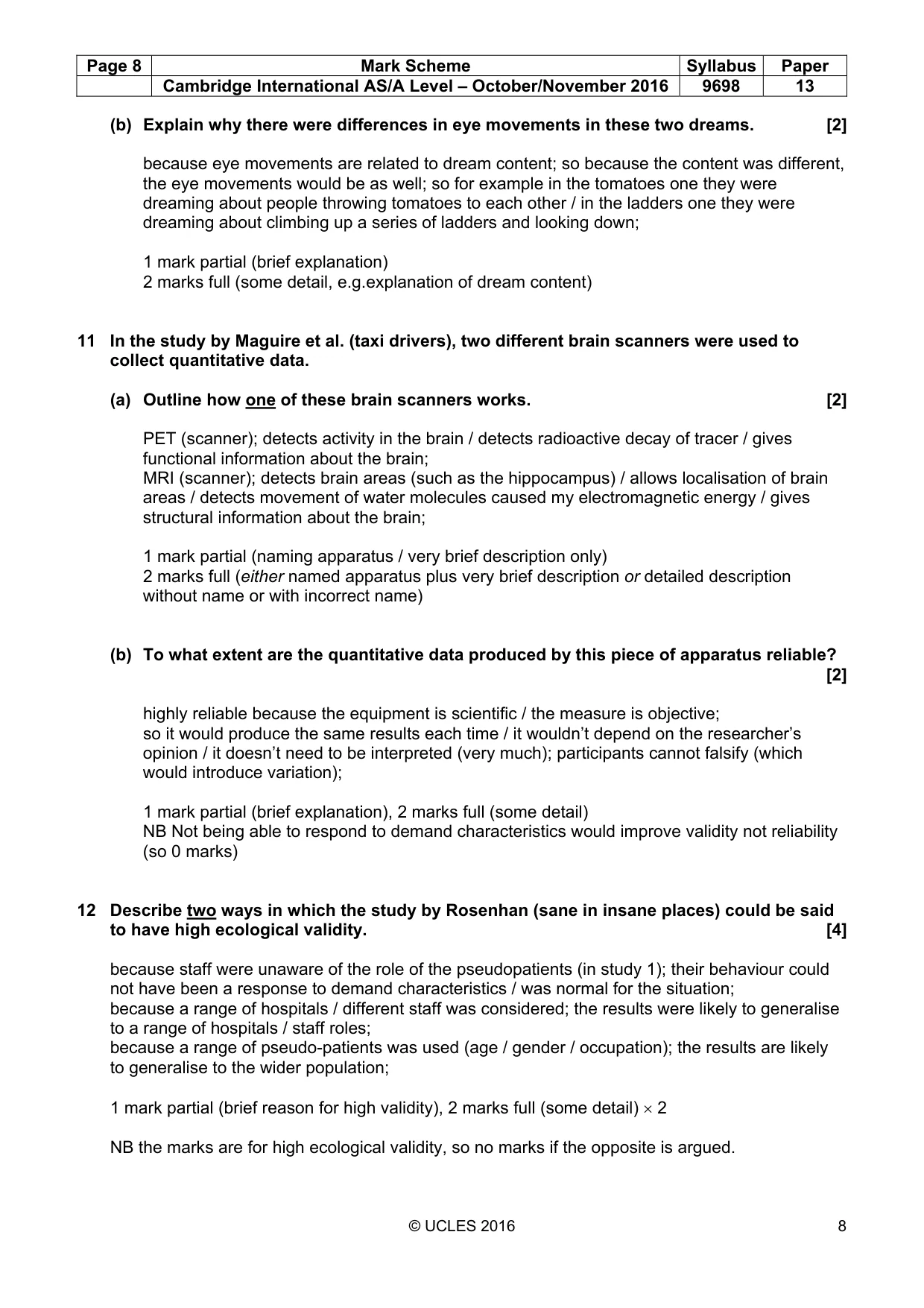
Page 8 Mark Scheme Syllabus Paper Cambridge International AS/A Level – October/November 2016 9698 13 © UCLES 2016 8 (b) Explain why there were differences in eye movements in these two dreams. [2] because eye movements are related to dream content; so because the content was different, the eye movements would be as well; so for example in the tomatoes one they were dreaming about people throwing tomatoes to each other / in the ladders one they were dreaming about climbing up a series of ladders and looking down; 1 mark partial (brief explanation) 2 marks full (some detail, e.g.explanation of dream content) 11 In the study by Maguire et al. (taxi drivers), two different brain scanners were used to collect quantitative data. (a) Outline how one of these brain scanners works. [2] PET (scanner); detects activity in the brain / detects radioactive decay of tracer / gives functional information about the brain; MRI (scanner); detects brain areas (such as the hippocampus) / allows localisation of brain areas / detects movement of water molecules caused my electromagnetic energy / gives structural information about the brain; 1 mark partial (naming apparatus / very brief description only) 2 marks full (either named apparatus plus very brief description or detailed description without name or with incorrect name) (b) To what extent are the quantitative data produced by this piece of apparatus reliable? [2] highly reliable because the equipment is scientific / the measure is objective; so it would produce the same results each time / it wouldn’t depend on the researcher’s opinion / it doesn’t need to be interpreted (very much); participants cannot falsify (which would introduce variation); 1 mark partial (brief explanation), 2 marks full (some detail) NB Not being able to respond to demand characteristics would improve validity not reliability (so 0 marks) 12 Describe two ways in which the study by Rosenhan (sane in insane places) could be said to have high ecological validity. [4] because staff were unaware of the role of the pseudopatients (in study 1); their behaviour could not have been a response to demand characteristics / was normal for the situation; because a range of hospitals / different staff was considered; the results were likely to generalise to a range of hospitals / staff roles; because a range of pseudo-patients was used (age / gender / occupation); the results are likely to generalise to the wider population; 1 mark partial (brief reason for high validity), 2 marks full (some detail) × 2 NB the marks are for high ecological validity, so no marks if the opposite is argued.
Mark scheme, page 9
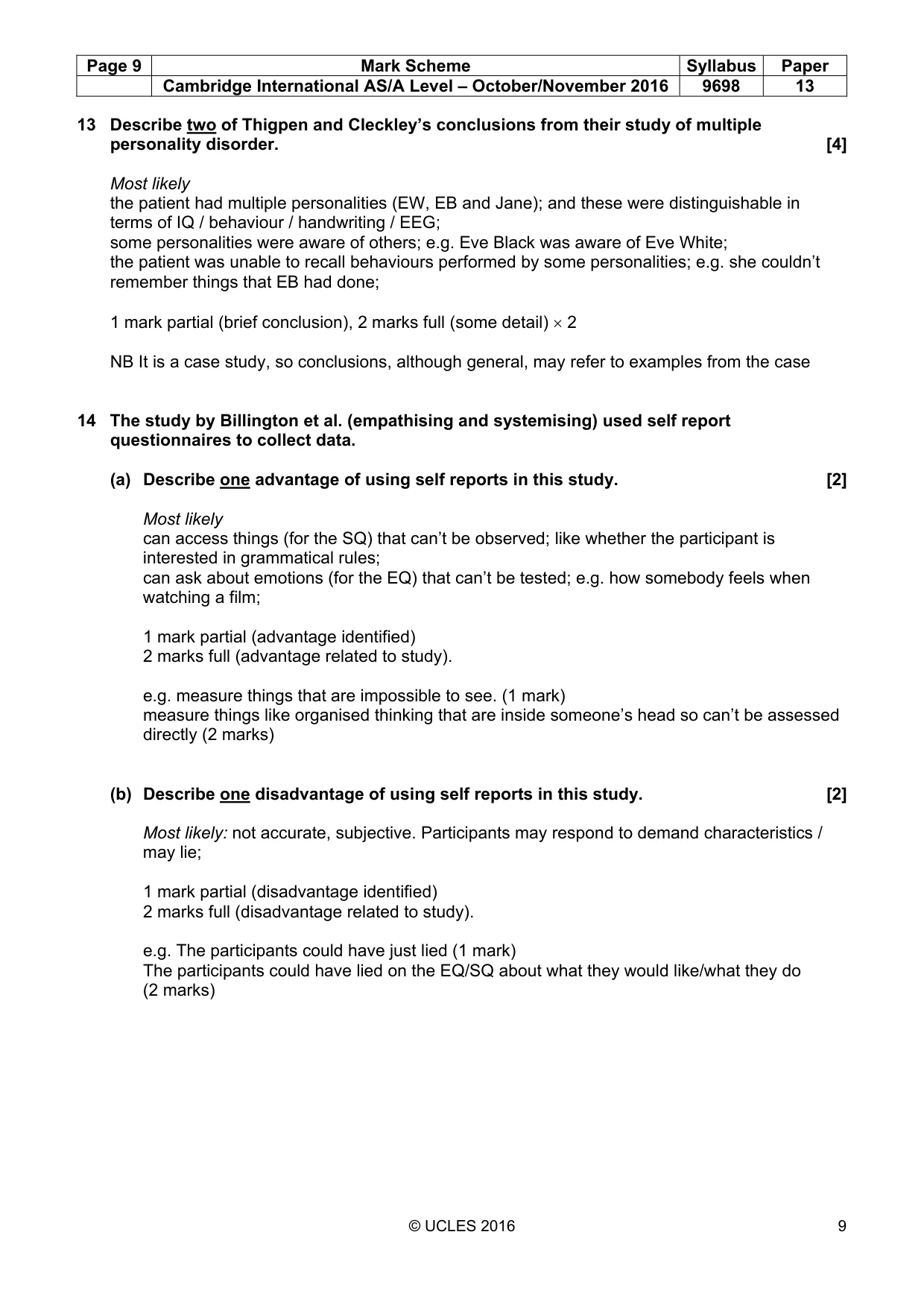
Page 9 Mark Scheme Syllabus Paper Cambridge International AS/A Level – October/November 2016 9698 13 © UCLES 2016 9 13 Describe two of Thigpen and Cleckley’s conclusions from their study of multiple personality disorder. [4] Most likely the patient had multiple personalities (EW, EB and Jane); and these were distinguishable in terms of IQ / behaviour / handwriting / EEG; some personalities were aware of others; e.g. Eve Black was aware of Eve White; the patient was unable to recall behaviours performed by some personalities; e.g. she couldn’t remember things that EB had done; 1 mark partial (brief conclusion), 2 marks full (some detail) × 2 NB It is a case study, so conclusions, although general, may refer to examples from the case 14 The study by Billington et al. (empathising and systemising) used self report questionnaires to collect data. (a) Describe one advantage of using self reports in this study. [2] Most likely can access things (for the SQ) that can’t be observed; like whether the participant is interested in grammatical rules; can ask about emotions (for the EQ) that can’t be tested; e.g. how somebody feels when watching a film; 1 mark partial (advantage identified) 2 marks full (advantage related to study). e.g. measure things that are impossible to see. (1 mark) measure things like organised thinking that are inside someone’s head so can’t be assessed directly (2 marks) (b) Describe one disadvantage of using self reports in this study. [2] Most likely: not accurate, subjective. Participants may respond to demand characteristics / may lie; 1 mark partial (disadvantage identified) 2 marks full (disadvantage related to study). e.g. The participants could have just lied (1 mark) The participants could have lied on the EQ/SQ about what they would like/what they do (2 marks)
Mark scheme, page 10
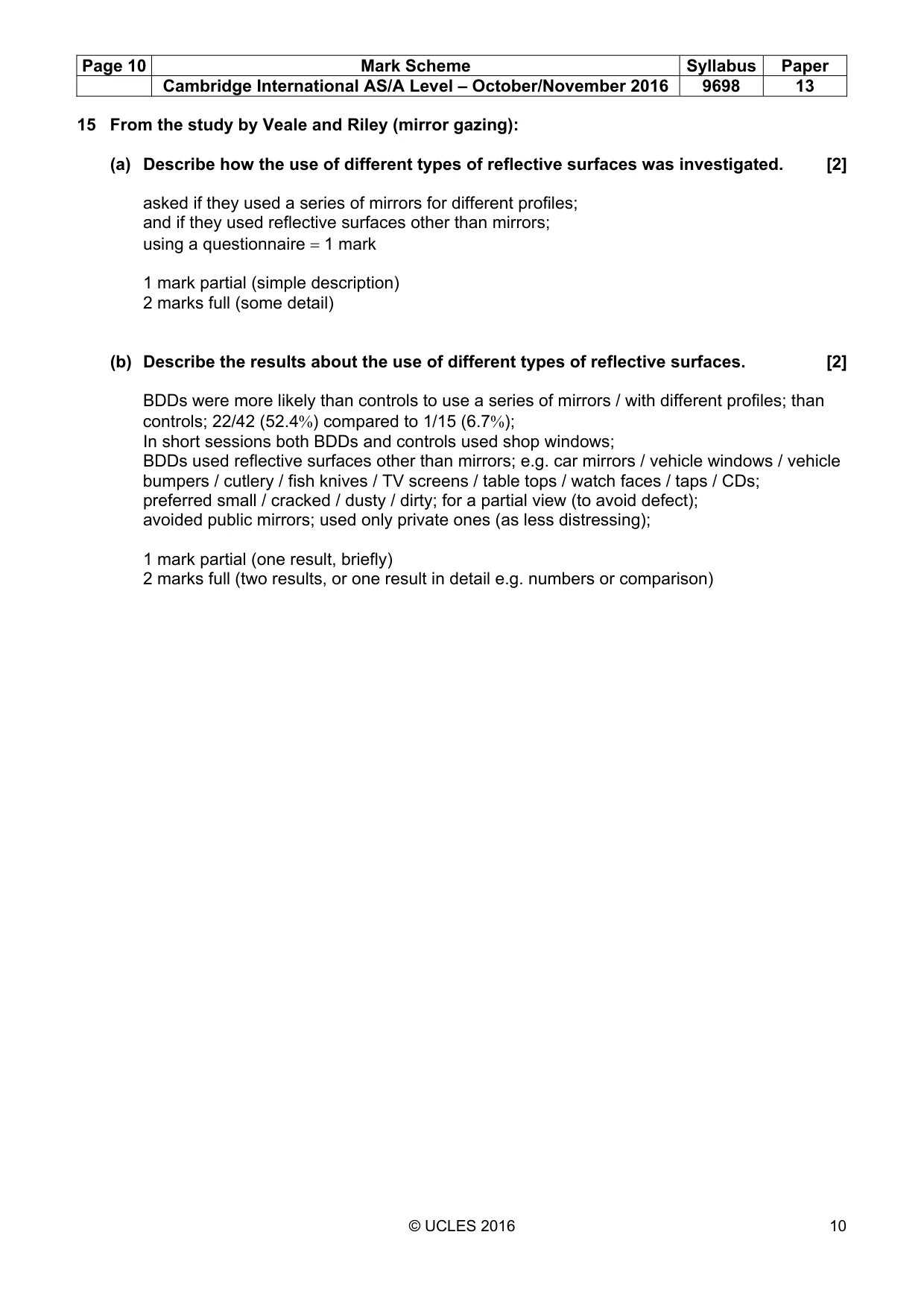
Page 10 Mark Scheme Syllabus Paper Cambridge International AS/A Level – October/November 2016 9698 13 © UCLES 2016 10 15 From the study by Veale and Riley (mirror gazing): (a) Describe how the use of different types of reflective surfaces was investigated. [2] asked if they used a series of mirrors for different profiles; and if they used reflective surfaces other than mirrors; using a questionnaire = 1 mark 1 mark partial (simple description) 2 marks full (some detail) (b) Describe the results about the use of different types of reflective surfaces. [2] BDDs were more likely than controls to use a series of mirrors / with different profiles; than controls; 22/42 (52.4%) compared to 1/15 (6.7%); In short sessions both BDDs and controls used shop windows; BDDs used reflective surfaces other than mirrors; e.g. car mirrors / vehicle windows / vehicle bumpers / cutlery / fish knives / TV screens / table tops / watch faces / taps / CDs; preferred small / cracked / dusty / dirty; for a partial view (to avoid defect); avoided public mirrors; used only private ones (as less distressing); 1 mark partial (one result, briefly) 2 marks full (two results, or one result in detail e.g. numbers or comparison)
Mark scheme, page 11
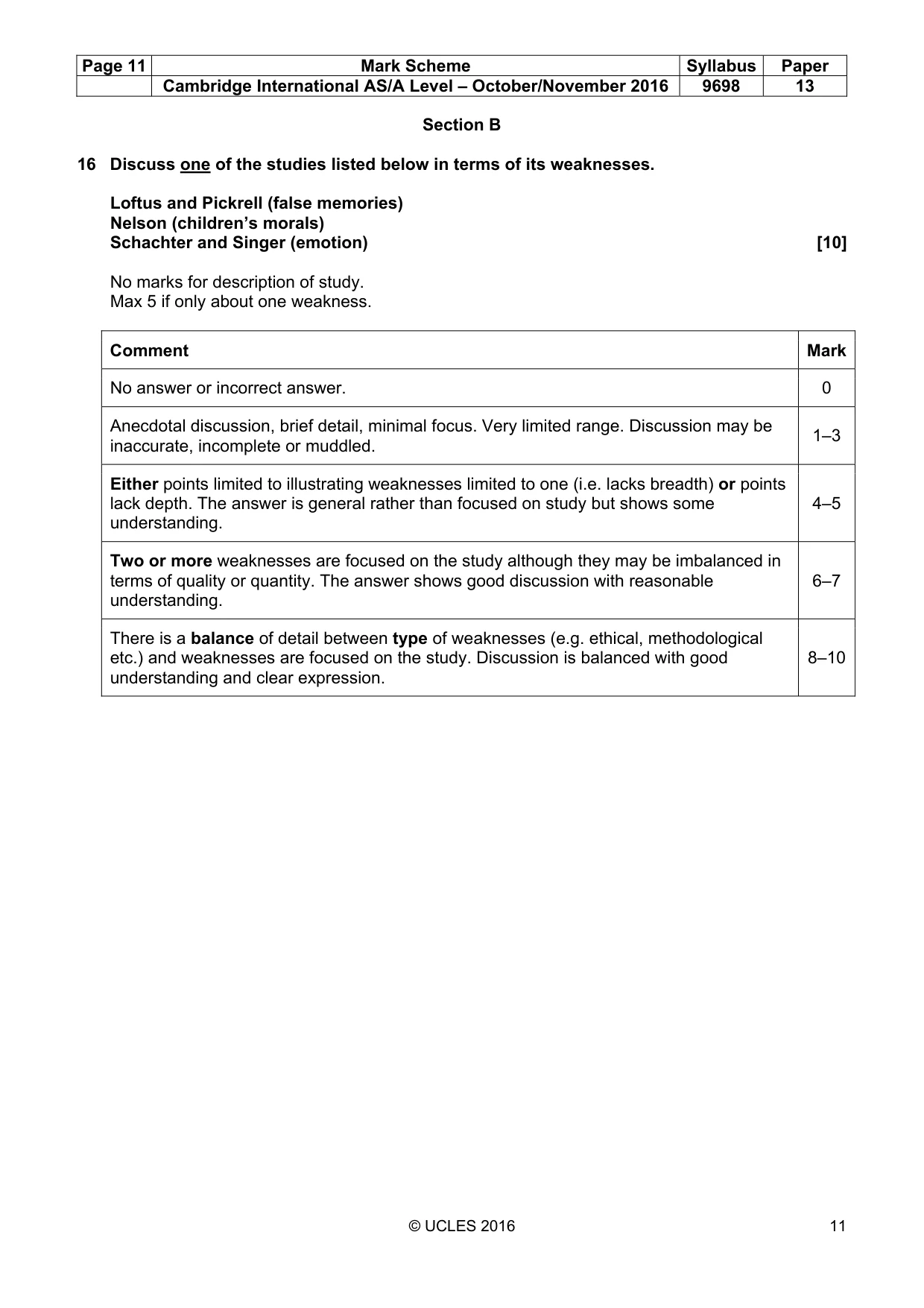
Page 11 Mark Scheme Syllabus Paper Cambridge International AS/A Level – October/November 2016 9698 13 © UCLES 2016 11 Section B 16 Discuss one of the studies listed below in terms of its weaknesses. Loftus and Pickrell (false memories) Nelson (children’s morals) Schachter and Singer (emotion) [10] No marks for description of study. Max 5 if only about one weakness. Comment Mark No answer or incorrect answer. 0 Anecdotal discussion, brief detail, minimal focus. Very limited range. Discussion may be inaccurate, incomplete or muddled. 1–3 Either points limited to illustrating weaknesses limited to one (i.e. lacks breadth) or points lack depth. The answer is general rather than focused on study but shows some understanding. 4–5 Two or more weaknesses are focused on the study although they may be imbalanced in terms of quality or quantity. The answer shows good discussion with reasonable understanding. 6–7 There is a balance of detail between type of weaknesses (e.g. ethical, methodological etc.) and weaknesses are focused on the study. Discussion is balanced with good understanding and clear expression. 8–10
Mark scheme, page 12
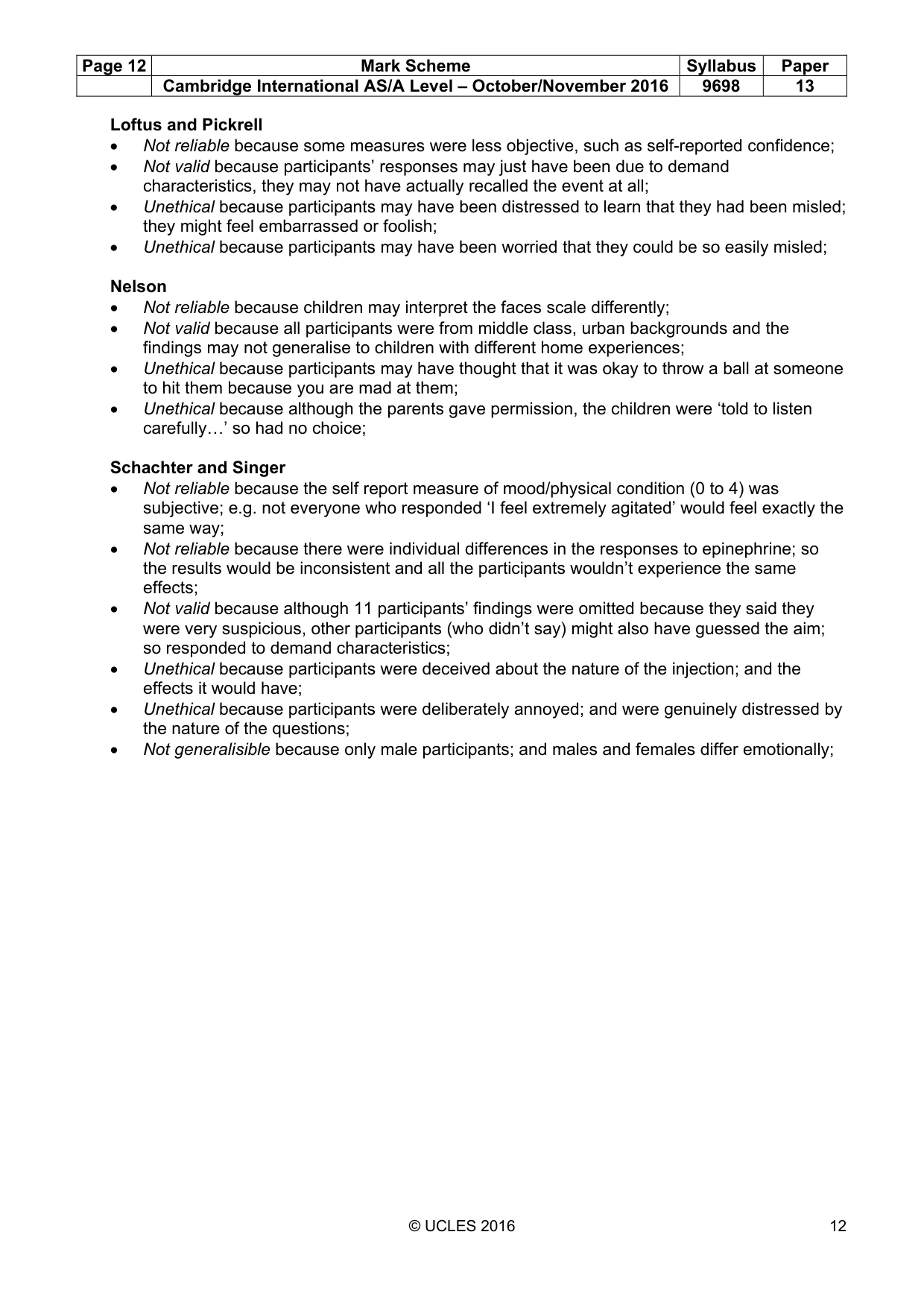
Page 12 Mark Scheme Syllabus Paper Cambridge International AS/A Level – October/November 2016 9698 13 © UCLES 2016 12 Loftus and Pickrell • Not reliable because some measures were less objective, such as self-reported confidence; • Not valid because participants’ responses may just have been due to demand characteristics, they may not have actually recalled the event at all; • Unethical because participants may have been distressed to learn that they had been misled; they might feel embarrassed or foolish; • Unethical because participants may have been worried that they could be so easily misled; Nelson • Not reliable because children may interpret the faces scale differently; • Not valid because all participants were from middle class, urban backgrounds and the findings may not generalise to children with different home experiences; • Unethical because participants may have thought that it was okay to throw a ball at someone to hit them because you are mad at them; • Unethical because although the parents gave permission, the children were ‘told to listen carefully…’ so had no choice; Schachter and Singer • Not reliable because the self report measure of mood/physical condition (0 to 4) was subjective; e.g. not everyone who responded ‘I feel extremely agitated’ would feel exactly the same way; • Not reliable because there were individual differences in the responses to epinephrine; so the results would be inconsistent and all the participants wouldn’t experience the same effects; • Not valid because although 11 participants’ findings were omitted because they said they were very suspicious, other participants (who didn’t say) might also have guessed the aim; so responded to demand characteristics; • Unethical because participants were deceived about the nature of the injection; and the effects it would have; • Unethical because participants were deliberately annoyed; and were genuinely distressed by the nature of the questions; • Not generalisible because only male participants; and males and females differ emotionally;
Mark scheme, page 13
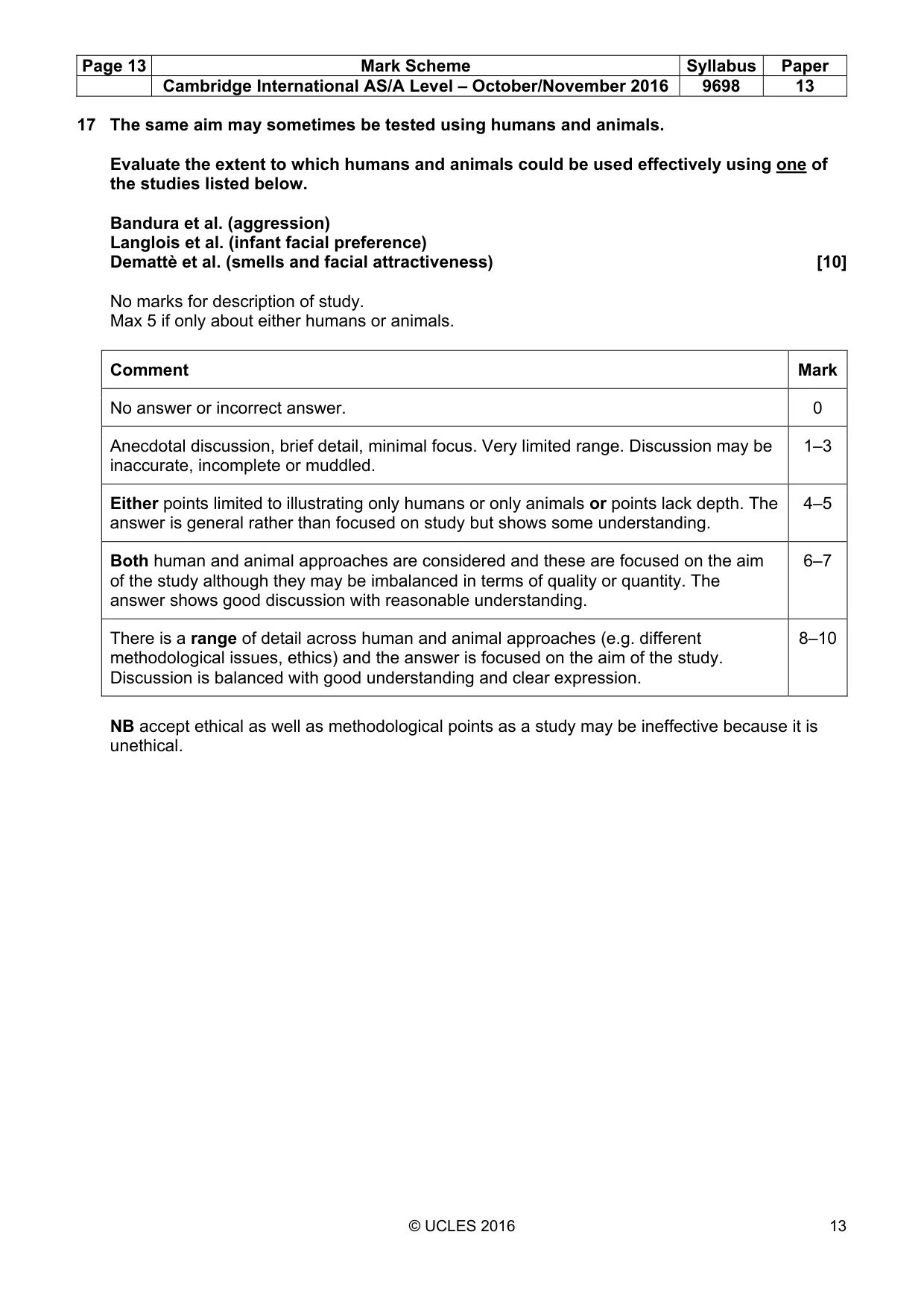
Page 13 Mark Scheme Syllabus Paper Cambridge International AS/A Level – October/November 2016 9698 13 © UCLES 2016 13 17 The same aim may sometimes be tested using humans and animals. Evaluate the extent to which humans and animals could be used effectively using one of the studies listed below. Bandura et al. (aggression) Langlois et al. (infant facial preference) Demattè et al. (smells and facial attractiveness) [10] No marks for description of study. Max 5 if only about either humans or animals. Comment Mark No answer or incorrect answer. 0 Anecdotal discussion, brief detail, minimal focus. Very limited range. Discussion may be inaccurate, incomplete or muddled. 1–3 Either points limited to illustrating only humans or only animals or points lack depth. The answer is general rather than focused on study but shows some understanding. 4–5 Both human and animal approaches are considered and these are focused on the aim of the study although they may be imbalanced in terms of quality or quantity. The answer shows good discussion with reasonable understanding. 6–7 There is a range of detail across human and animal approaches (e.g. different methodological issues, ethics) and the answer is focused on the aim of the study. Discussion is balanced with good understanding and clear expression. 8–10 NB accept ethical as well as methodological points as a study may be ineffective because it is unethical.
Mark scheme, page 14
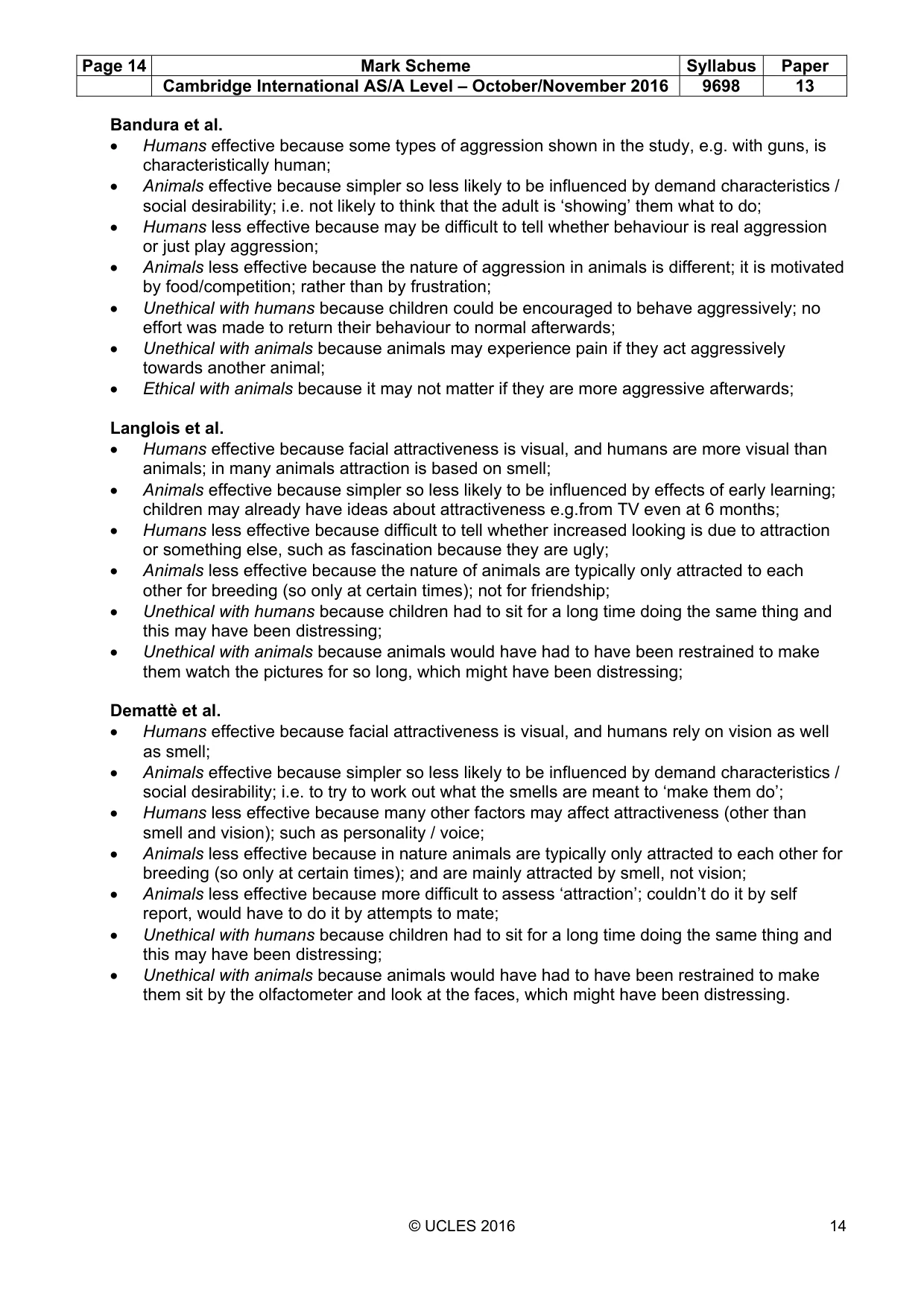
Page 14 Mark Scheme Syllabus Paper Cambridge International AS/A Level – October/November 2016 9698 13 © UCLES 2016 14 Bandura et al. • Humans effective because some types of aggression shown in the study, e.g. with guns, is characteristically human; • Animals effective because simpler so less likely to be influenced by demand characteristics / social desirability; i.e. not likely to think that the adult is ‘showing’ them what to do; • Humans less effective because may be difficult to tell whether behaviour is real aggression or just play aggression; • Animals less effective because the nature of aggression in animals is different; it is motivated by food/competition; rather than by frustration; • Unethical with humans because children could be encouraged to behave aggressively; no effort was made to return their behaviour to normal afterwards; • Unethical with animals because animals may experience pain if they act aggressively towards another animal; • Ethical with animals because it may not matter if they are more aggressive afterwards; Langlois et al. • Humans effective because facial attractiveness is visual, and humans are more visual than animals; in many animals attraction is based on smell; • Animals effective because simpler so less likely to be influenced by effects of early learning; children may already have ideas about attractiveness e.g.from TV even at 6 months; • Humans less effective because difficult to tell whether increased looking is due to attraction or something else, such as fascination because they are ugly; • Animals less effective because the nature of animals are typically only attracted to each other for breeding (so only at certain times); not for friendship; • Unethical with humans because children had to sit for a long time doing the same thing and this may have been distressing; • Unethical with animals because animals would have had to have been restrained to make them watch the pictures for so long, which might have been distressing; Demattè et al. • Humans effective because facial attractiveness is visual, and humans rely on vision as well as smell; • Animals effective because simpler so less likely to be influenced by demand characteristics / social desirability; i.e. to try to work out what the smells are meant to ‘make them do’; • Humans less effective because many other factors may affect attractiveness (other than smell and vision); such as personality / voice; • Animals less effective because in nature animals are typically only attracted to each other for breeding (so only at certain times); and are mainly attracted by smell, not vision; • Animals less effective because more difficult to assess ‘attraction’; couldn’t do it by self report, would have to do it by attempts to mate; • Unethical with humans because children had to sit for a long time doing the same thing and this may have been distressing; • Unethical with animals because animals would have had to have been restrained to make them sit by the olfactometer and look at the faces, which might have been distressing.
What you needed in this session
Cambridge’s own grade thresholds for 2016 Oct/Nov, Paper 1 · Variant 3. A higher threshold means an easier paper — the bar moves with how the cohort did.