Cambridge A Level Psychology 9698 — 2018 May/June Paper 1 · Variant 2
9698/12/M/J/18 · 80 marks · ≈90 min
The question paper and its mark scheme, free to read here and free to download. This is Cambridge’s own paper, exactly as it was sat.
Question paper4 pages
Mark scheme16 pages
Answers below. Sit the paper first if you are practising.
Paper as text
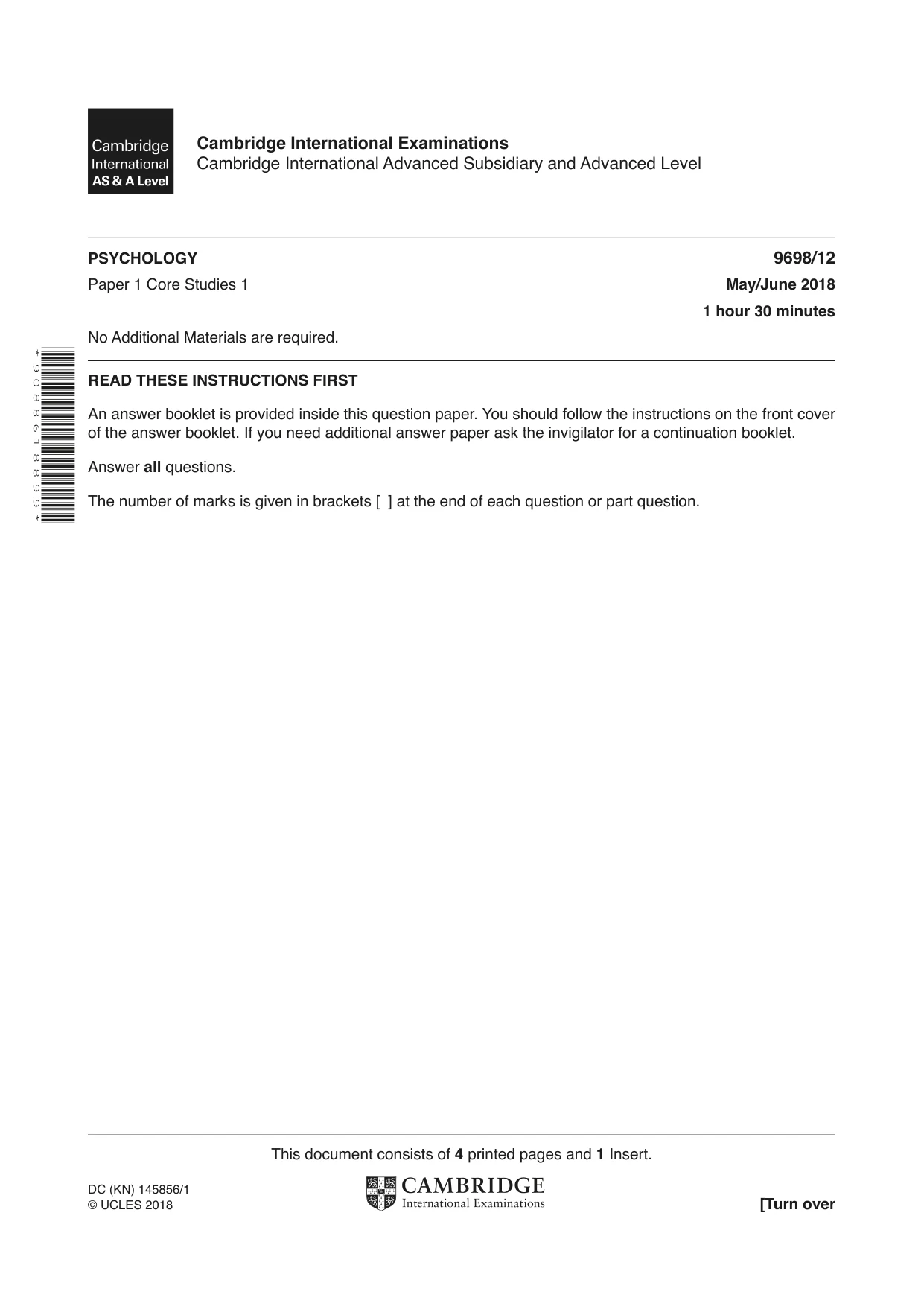
Question paper, page 1
* 9 0 8 8 6 1 8 8 9 9 * This document consists of 4 printed pages and 1 Insert. DC (KN) 145856/1 © UCLES 2018 [Turn over Cambridge International Examinations Cambridge International Advanced Subsidiary and Advanced Level PSYCHOLOGY 9698/12 Paper 1 Core Studies 1 May/June 2018 1 hour 30 minutes No Additional Materials are required. READ THESE INSTRUCTIONS FIRST An answer booklet is provided inside this question paper. You should follow the instructions on the front cover of the answer booklet. If you need additional answer paper ask the invigilator for a continuation booklet. Answer all questions. The number of marks is given in brackets [ ] at the end of each question or part question.
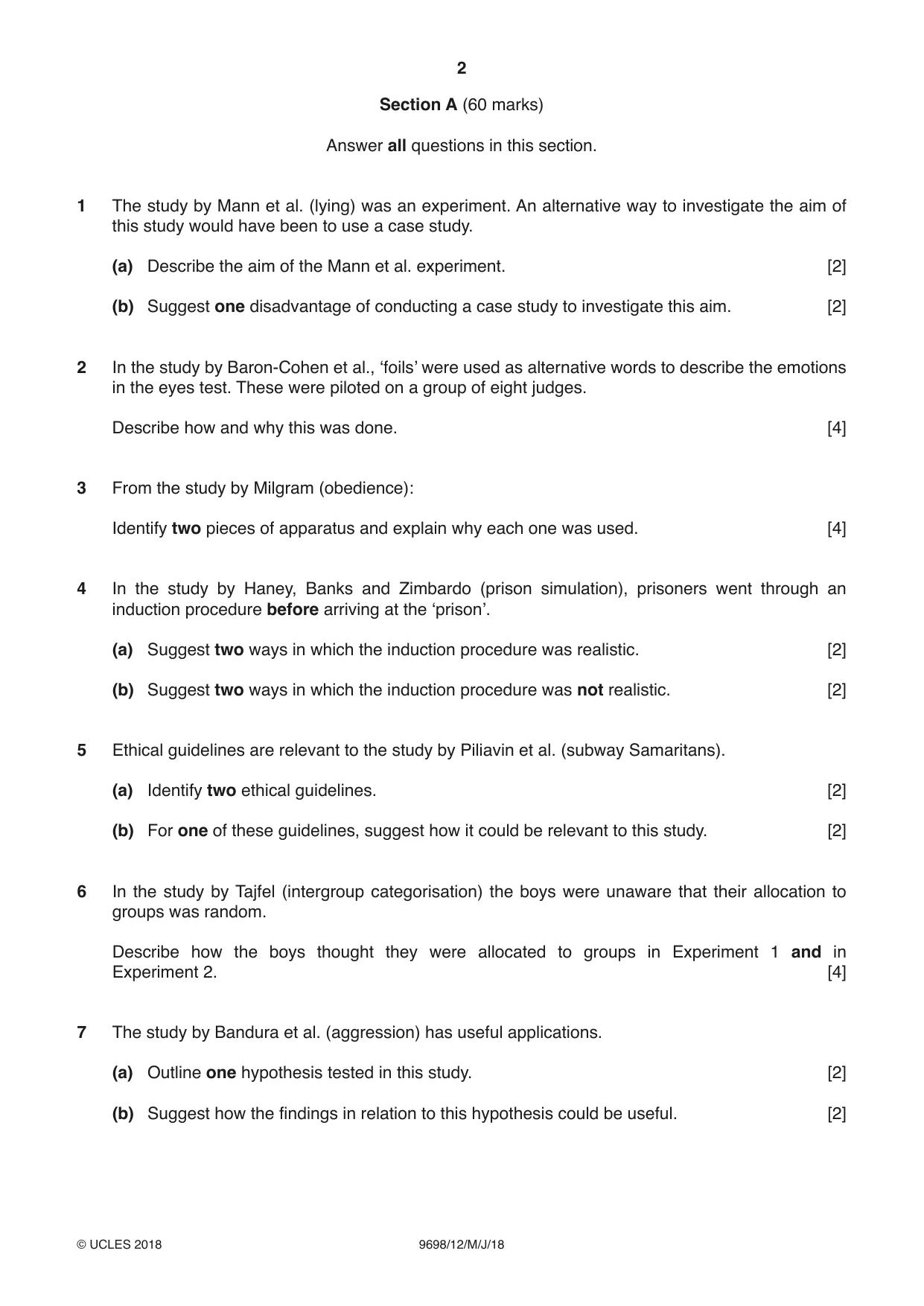
Question paper, page 2
2 9698/12/M/J/18 © UCLES 2018 Section A (60 marks) Answer all questions in this section. 1 The study by Mann et al. (lying) was an experiment. An alternative way to investigate the aim of this study would have been to use a case study. (a) Describe the aim of the Mann et al. experiment. [2] (b) Suggest one disadvantage of conducting a case study to investigate this aim. [2] 2 In the study by Baron-Cohen et al., ‘foils’ were used as alternative words to describe the emotions in the eyes test. These were piloted on a group of eight judges. Describe how and why this was done. [4] 3 From the study by Milgram (obedience): Identify two pieces of apparatus and explain why each one was used. [4] 4 In the study by Haney, Banks and Zimbardo (prison simulation), prisoners went through an induction procedure before arriving at the ‘prison’. (a) Suggest two ways in which the induction procedure was realistic. [2] (b) Suggest two ways in which the induction procedure was not realistic. [2] 5 Ethical guidelines are relevant to the study by Piliavin et al. (subway Samaritans). (a) Identify two ethical guidelines. [2] (b) For one of these guidelines, suggest how it could be relevant to this study. [2] 6 In the study by Tajfel (intergroup categorisation) the boys were unaware that their allocation to groups was random. Describe how the boys thought they were allocated to groups in Experiment 1 and in Experiment 2. [4] 7 The study by Bandura et al. (aggression) has useful applications. (a) Outline one hypothesis tested in this study. [2] (b) Suggest how the findings in relation to this hypothesis could be useful. [2]
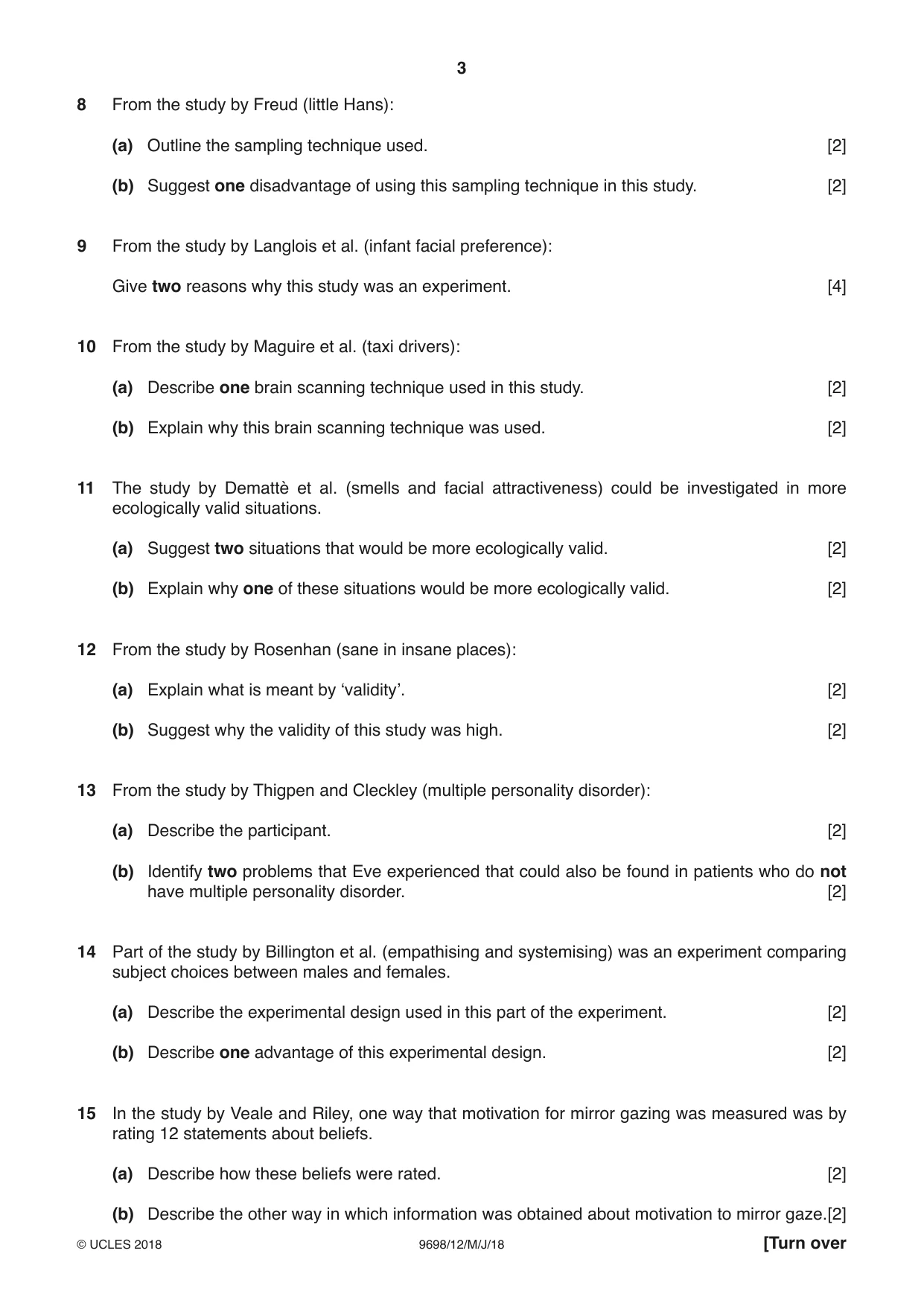
Question paper, page 3
3 9698/12/M/J/18 © UCLES 2018 [Turn over 8 From the study by Freud (little Hans): (a) Outline the sampling technique used. [2] (b) Suggest one disadvantage of using this sampling technique in this study. [2] 9 From the study by Langlois et al. (infant facial preference): Give two reasons why this study was an experiment. [4] 10 From the study by Maguire et al. (taxi drivers): (a) Describe one brain scanning technique used in this study. [2] (b) Explain why this brain scanning technique was used. [2] 11 The study by Demattè et al. (smells and facial attractiveness) could be investigated in more ecologically valid situations. (a) Suggest two situations that would be more ecologically valid. [2] (b) Explain why one of these situations would be more ecologically valid. [2] 12 From the study by Rosenhan (sane in insane places): (a) Explain what is meant by ‘validity’. [2] (b) Suggest why the validity of this study was high. [2] 13 From the study by Thigpen and Cleckley (multiple personality disorder): (a) Describe the participant. [2] (b) Identify two problems that Eve experienced that could also be found in patients who do not have multiple personality disorder. [2] 14 Part of the study by Billington et al. (empathising and systemising) was an experiment comparing subject choices between males and females. (a) Describe the experimental design used in this part of the experiment. [2] (b) Describe one advantage of this experimental design. [2] 15 In the study by Veale and Riley, one way that motivation for mirror gazing was measured was by rating 12 statements about beliefs. (a) Describe how these beliefs were rated. [2] (b) Describe the other way in which information was obtained about motivation to mirror gaze. [2]
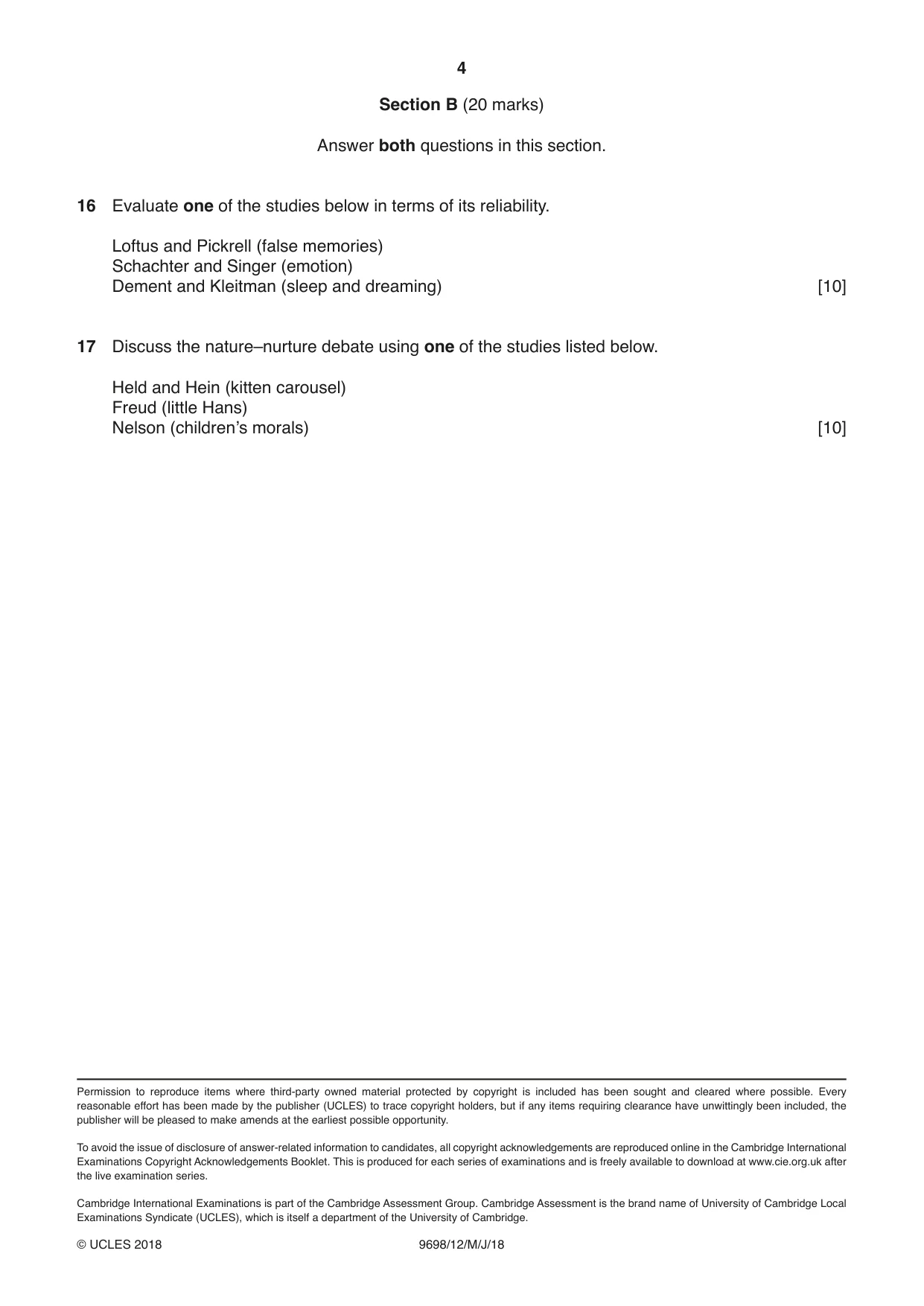
Question paper, page 4
4 9698/12/M/J/18 © UCLES 2018 Section B (20 marks) Answer both questions in this section. 16 Evaluate one of the studies below in terms of its reliability. Loftus and Pickrell (false memories) Schachter and Singer (emotion) Dement and Kleitman (sleep and dreaming) [10] 17 Discuss the nature–nurture debate using one of the studies listed below. Held and Hein (kitten carousel) Freud (little Hans) Nelson (children’s morals) [10] Permission to reproduce items where third-party owned material protected by copyright is included has been sought and cleared where possible. Every reasonable effort has been made by the publisher (UCLES) to trace copyright holders, but if any items requiring clearance have unwittingly been included, the publisher will be pleased to make amends at the earliest possible opportunity. To avoid the issue of disclosure of answer-related information to candidates, all copyright acknowledgements are reproduced online in the Cambridge International Examinations Copyright Acknowledgements Booklet. This is produced for each series of examinations and is freely available to download at www.cie.org.uk after the live examination series. Cambridge International Examinations is part of the Cambridge Assessment Group. Cambridge Assessment is the brand name of University of Cambridge Local Examinations Syndicate (UCLES), which is itself a department of the University of Cambridge.
Mark scheme, page 1
IGCSE™ is a registered trademark. This document consists of 16 printed pages. © UCLES 2018 [Turn over Cambridge Assessment International Education Cambridge International Advanced Subsidiary and Advanced Level PSYCHOLOGY 9698/12 Paper 1 Core Studies 1 May/June 2018 MARK SCHEME Maximum Mark: 80 Published This mark scheme is published as an aid to teachers and candidates, to indicate the requirements of the examination. It shows the basis on which Examiners were instructed to award marks. It does not indicate the details of the discussions that took place at an Examiners’ meeting before marking began, which would have considered the acceptability of alternative answers. Mark schemes should be read in conjunction with the question paper and the Principal Examiner Report for Teachers. Cambridge International will not enter into discussions about these mark schemes. Cambridge International is publishing the mark schemes for the May/June 2018 series for most Cambridge IGCSE™, Cambridge International A and AS Level and Cambridge Pre-U components, and some Cambridge O Level components.
Mark scheme, page 2
9698/12 Cambridge International AS/A Level – Mark Scheme PUBLISHED May/June 2018 © UCLES 2018 Page 2 of 16 Generic Marking Principles These general marking principles must be applied by all examiners when marking candidate answers. They should be applied alongside the specific content of the mark scheme or generic level descriptors for a question. Each question paper and mark scheme will also comply with these marking principles. GENERIC MARKING PRINCIPLE 1: Marks must be awarded in line with: • the specific content of the mark scheme or the generic level descriptors for the question • the specific skills defined in the mark scheme or in the generic level descriptors for the question • the standard of response required by a candidate as exemplified by the standardisation scripts. GENERIC MARKING PRINCIPLE 2: Marks awarded are always whole marks (not half marks, or other fractions). GENERIC MARKING PRINCIPLE 3: Marks must be awarded positively: • marks are awarded for correct/valid answers, as defined in the mark scheme. However, credit is given for valid answers which go beyond the scope of the syllabus and mark scheme, referring to your Team Leader as appropriate • marks are awarded when candidates clearly demonstrate what they know and can do • marks are not deducted for errors • marks are not deducted for omissions • answers should only be judged on the quality of spelling, punctuation and grammar when these features are specifically assessed by the question as indicated by the mark scheme. The meaning, however, should be unambiguous. GENERIC MARKING PRINCIPLE 4: Rules must be applied consistently e.g. in situations where candidates have not followed instructions or in the application of generic level descriptors. GENERIC MARKING PRINCIPLE 5: Marks should be awarded using the full range of marks defined in the mark scheme for the question (however; the use of the full mark range may be limited according to the quality of the candidate responses seen). GENERIC MARKING PRINCIPLE 6: Marks awarded are based solely on the requirements as defined in the mark scheme. Marks should not be awarded with grade thresholds or grade descriptors in mind.
Mark scheme, page 3
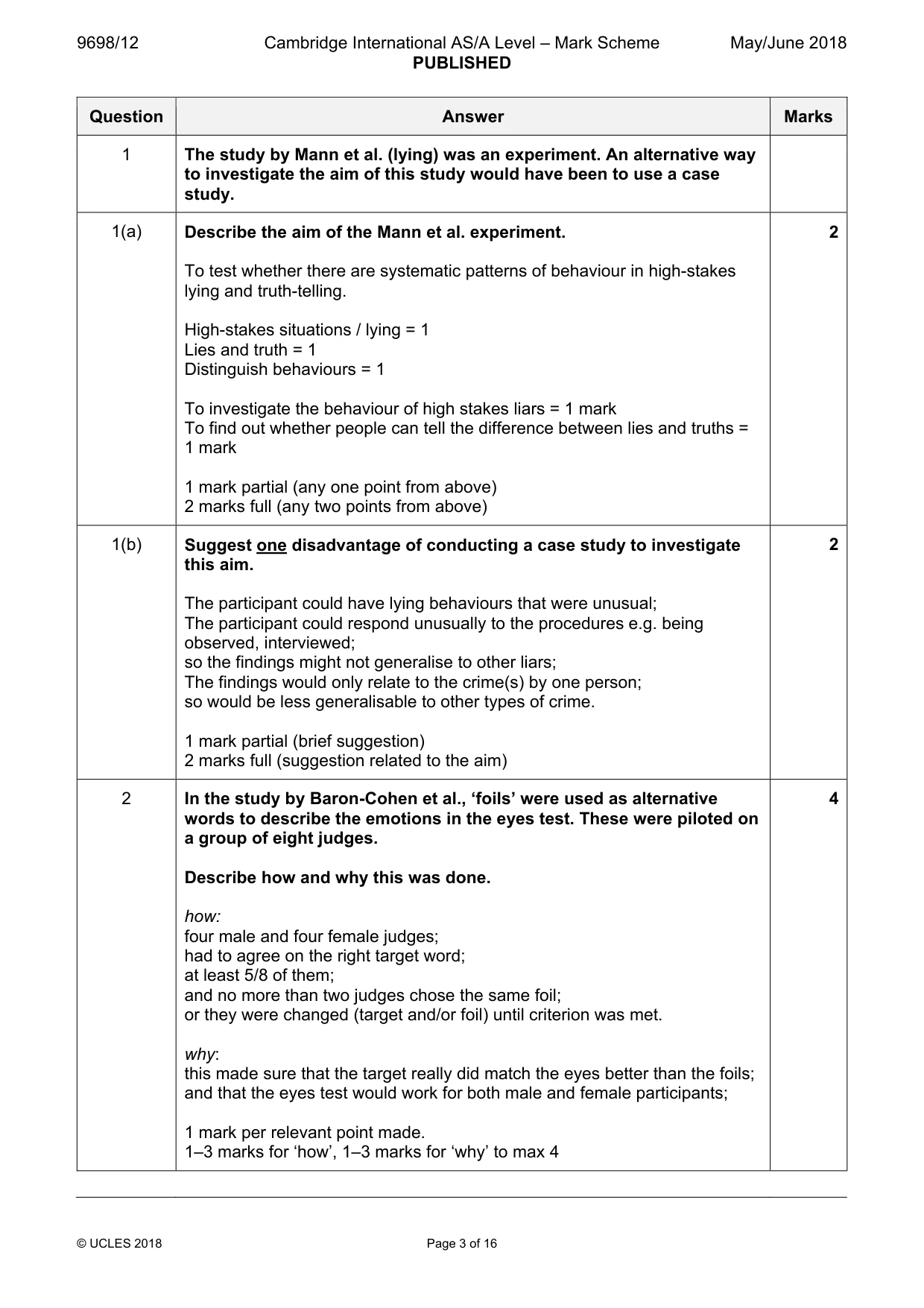
9698/12 Cambridge International AS/A Level – Mark Scheme PUBLISHED May/June 2018 © UCLES 2018 Page 3 of 16 Question Answer Marks 1 The study by Mann et al. (lying) was an experiment. An alternative way to investigate the aim of this study would have been to use a case study. 1(a) Describe the aim of the Mann et al. experiment. To test whether there are systematic patterns of behaviour in high-stakes lying and truth-telling. High-stakes situations / lying = 1 Lies and truth = 1 Distinguish behaviours = 1 To investigate the behaviour of high stakes liars = 1 mark To find out whether people can tell the difference between lies and truths = 1 mark 1 mark partial (any one point from above) 2 marks full (any two points from above) 2 1(b) Suggest one disadvantage of conducting a case study to investigate this aim. The participant could have lying behaviours that were unusual; The participant could respond unusually to the procedures e.g. being observed, interviewed; so the findings might not generalise to other liars; The findings would only relate to the crime(s) by one person; so would be less generalisable to other types of crime. 1 mark partial (brief suggestion) 2 marks full (suggestion related to the aim) 2 2 In the study by Baron-Cohen et al., ‘foils’ were used as alternative words to describe the emotions in the eyes test. These were piloted on a group of eight judges. Describe how and why this was done. how: four male and four female judges; had to agree on the right target word; at least 5/8 of them; and no more than two judges chose the same foil; or they were changed (target and/or foil) until criterion was met. why: this made sure that the target really did match the eyes better than the foils; and that the eyes test would work for both male and female participants; 1 mark per relevant point made. 1–3 marks for ‘how’, 1–3 marks for ‘why’ to max 4 4
Mark scheme, page 4
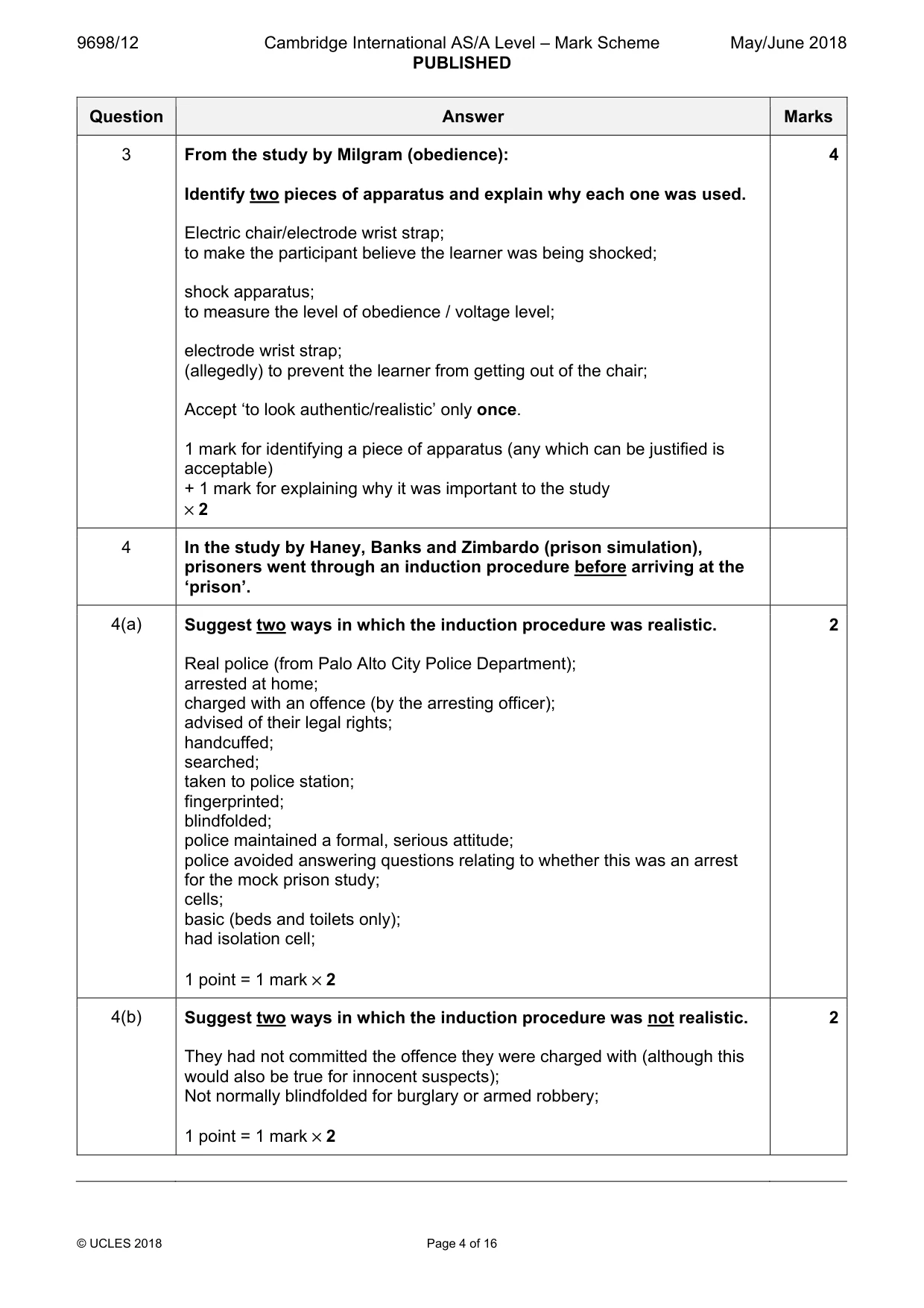
9698/12 Cambridge International AS/A Level – Mark Scheme PUBLISHED May/June 2018 © UCLES 2018 Page 4 of 16 Question Answer Marks 3 From the study by Milgram (obedience): Identify two pieces of apparatus and explain why each one was used. Electric chair/electrode wrist strap; to make the participant believe the learner was being shocked; shock apparatus; to measure the level of obedience / voltage level; electrode wrist strap; (allegedly) to prevent the learner from getting out of the chair; Accept ‘to look authentic/realistic’ only once. 1 mark for identifying a piece of apparatus (any which can be justified is acceptable) + 1 mark for explaining why it was important to the study × 2 4 4 In the study by Haney, Banks and Zimbardo (prison simulation), prisoners went through an induction procedure before arriving at the ‘prison’. 4(a) Suggest two ways in which the induction procedure was realistic. Real police (from Palo Alto City Police Department); arrested at home; charged with an offence (by the arresting officer); advised of their legal rights; handcuffed; searched; taken to police station; fingerprinted; blindfolded; police maintained a formal, serious attitude; police avoided answering questions relating to whether this was an arrest for the mock prison study; cells; basic (beds and toilets only); had isolation cell; 1 point = 1 mark × 2 2 4(b) Suggest two ways in which the induction procedure was not realistic. They had not committed the offence they were charged with (although this would also be true for innocent suspects); Not normally blindfolded for burglary or armed robbery; 1 point = 1 mark × 2 2
Mark scheme, page 5
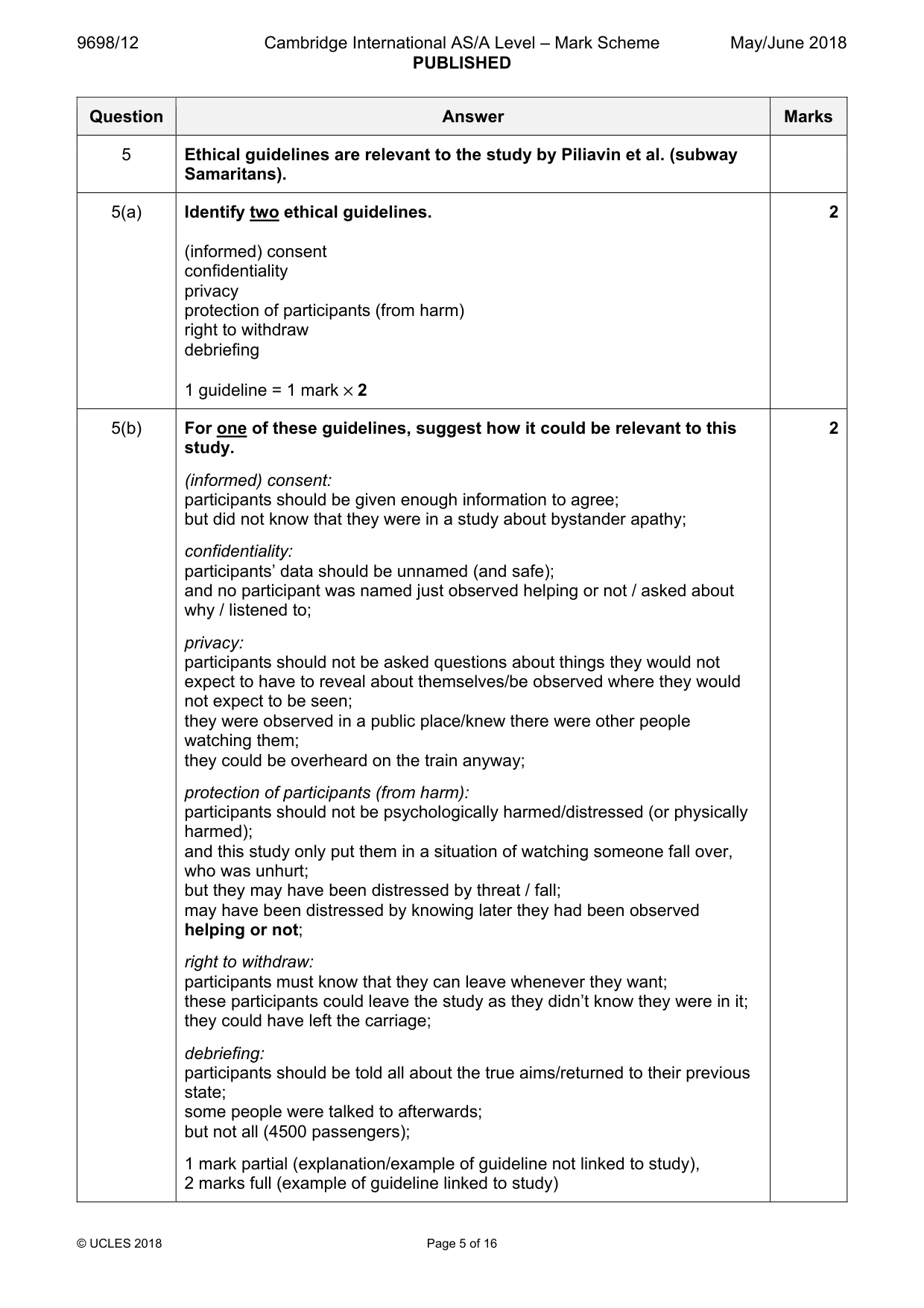
9698/12 Cambridge International AS/A Level – Mark Scheme PUBLISHED May/June 2018 © UCLES 2018 Page 5 of 16 Question Answer Marks 5 Ethical guidelines are relevant to the study by Piliavin et al. (subway Samaritans). 5(a) Identify two ethical guidelines. (informed) consent confidentiality privacy protection of participants (from harm) right to withdraw debriefing 1 guideline = 1 mark × 2 2 5(b) For one of these guidelines, suggest how it could be relevant to this study. (informed) consent: participants should be given enough information to agree; but did not know that they were in a study about bystander apathy; confidentiality: participants’ data should be unnamed (and safe); and no participant was named just observed helping or not / asked about why / listened to; privacy: participants should not be asked questions about things they would not expect to have to reveal about themselves/be observed where they would not expect to be seen; they were observed in a public place/knew there were other people watching them; they could be overheard on the train anyway; protection of participants (from harm): participants should not be psychologically harmed/distressed (or physically harmed); and this study only put them in a situation of watching someone fall over, who was unhurt; but they may have been distressed by threat / fall; may have been distressed by knowing later they had been observed helping or not; right to withdraw: participants must know that they can leave whenever they want; these participants could leave the study as they didn’t know they were in it; they could have left the carriage; debriefing: participants should be told all about the true aims/returned to their previous state; some people were talked to afterwards; but not all (4500 passengers); 1 mark partial (explanation/example of guideline not linked to study), 2 marks full (example of guideline linked to study) 2
Mark scheme, page 6
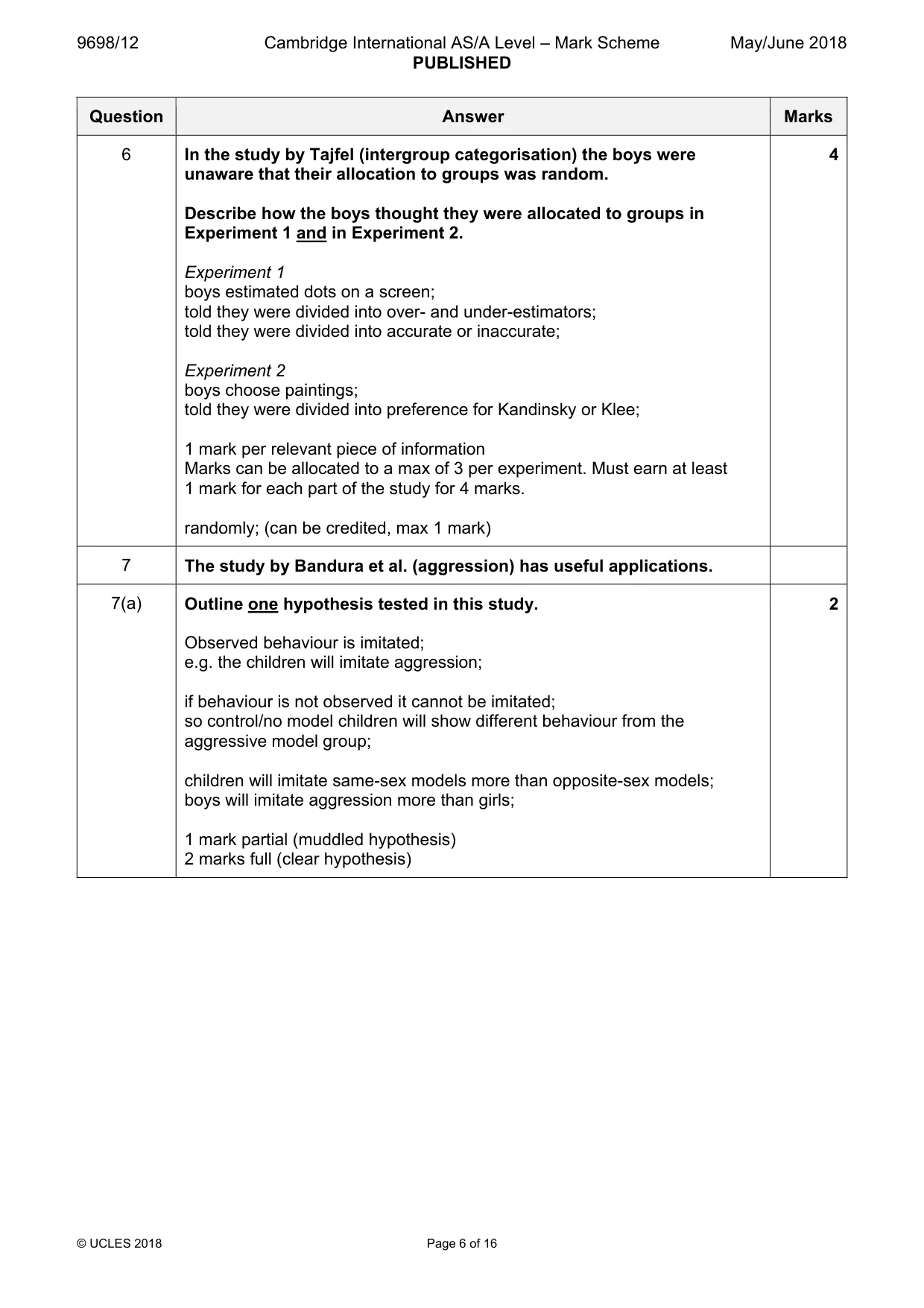
9698/12 Cambridge International AS/A Level – Mark Scheme PUBLISHED May/June 2018 © UCLES 2018 Page 6 of 16 Question Answer Marks 6 In the study by Tajfel (intergroup categorisation) the boys were unaware that their allocation to groups was random. Describe how the boys thought they were allocated to groups in Experiment 1 and in Experiment 2. Experiment 1 boys estimated dots on a screen; told they were divided into over- and under-estimators; told they were divided into accurate or inaccurate; Experiment 2 boys choose paintings; told they were divided into preference for Kandinsky or Klee; 1 mark per relevant piece of information Marks can be allocated to a max of 3 per experiment. Must earn at least 1 mark for each part of the study for 4 marks. randomly; (can be credited, max 1 mark) 4 7 The study by Bandura et al. (aggression) has useful applications. 7(a) Outline one hypothesis tested in this study. Observed behaviour is imitated; e.g. the children will imitate aggression; if behaviour is not observed it cannot be imitated; so control/no model children will show different behaviour from the aggressive model group; children will imitate same-sex models more than opposite-sex models; boys will imitate aggression more than girls; 1 mark partial (muddled hypothesis) 2 marks full (clear hypothesis) 2
Mark scheme, page 7
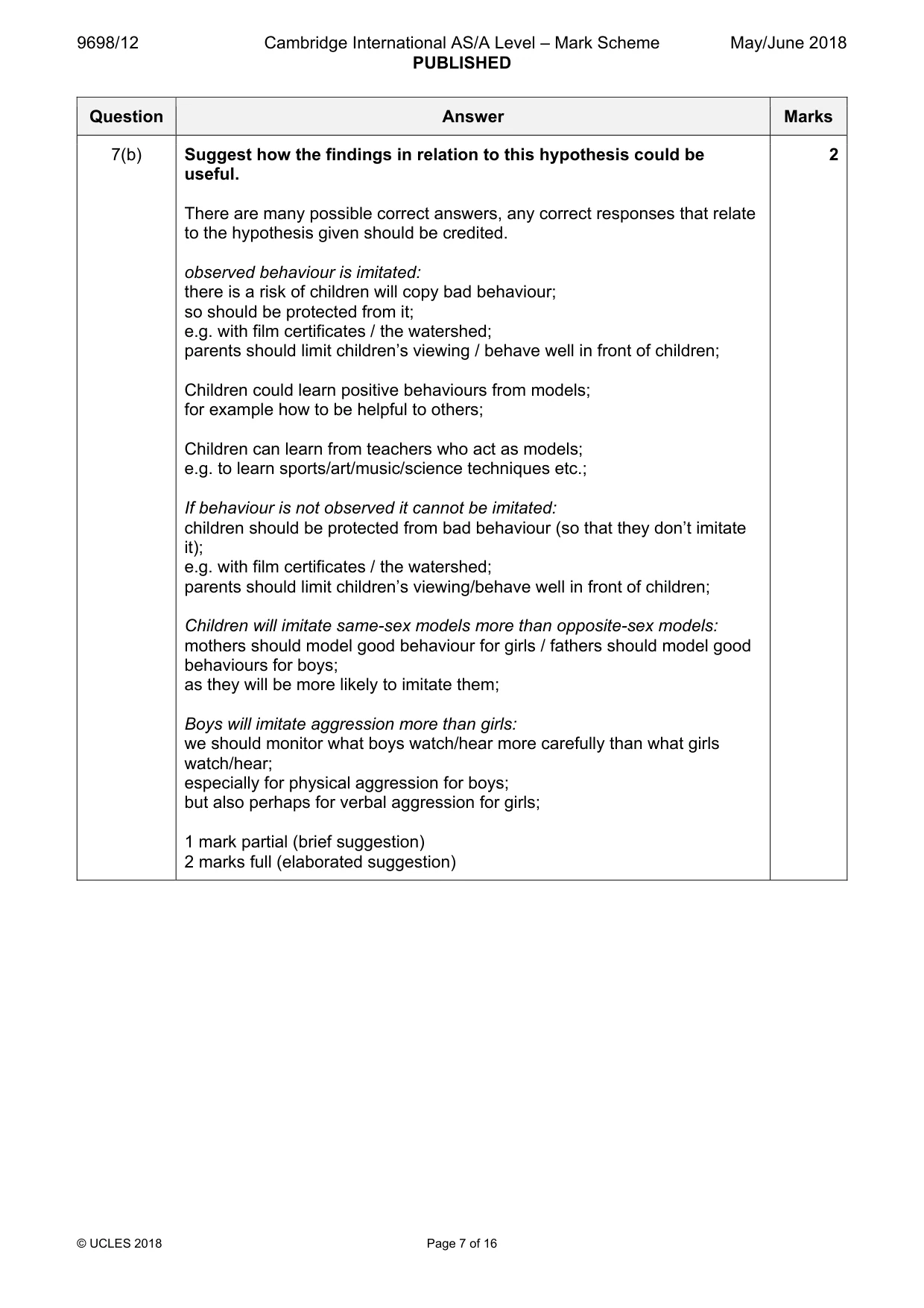
9698/12 Cambridge International AS/A Level – Mark Scheme PUBLISHED May/June 2018 © UCLES 2018 Page 7 of 16 Question Answer Marks 7(b) Suggest how the findings in relation to this hypothesis could be useful. There are many possible correct answers, any correct responses that relate to the hypothesis given should be credited. observed behaviour is imitated: there is a risk of children will copy bad behaviour; so should be protected from it; e.g. with film certificates / the watershed; parents should limit children’s viewing / behave well in front of children; Children could learn positive behaviours from models; for example how to be helpful to others; Children can learn from teachers who act as models; e.g. to learn sports/art/music/science techniques etc.; If behaviour is not observed it cannot be imitated: children should be protected from bad behaviour (so that they don’t imitate it); e.g. with film certificates / the watershed; parents should limit children’s viewing/behave well in front of children; Children will imitate same-sex models more than opposite-sex models: mothers should model good behaviour for girls / fathers should model good behaviours for boys; as they will be more likely to imitate them; Boys will imitate aggression more than girls: we should monitor what boys watch/hear more carefully than what girls watch/hear; especially for physical aggression for boys; but also perhaps for verbal aggression for girls; 1 mark partial (brief suggestion) 2 marks full (elaborated suggestion) 2
Mark scheme, page 8
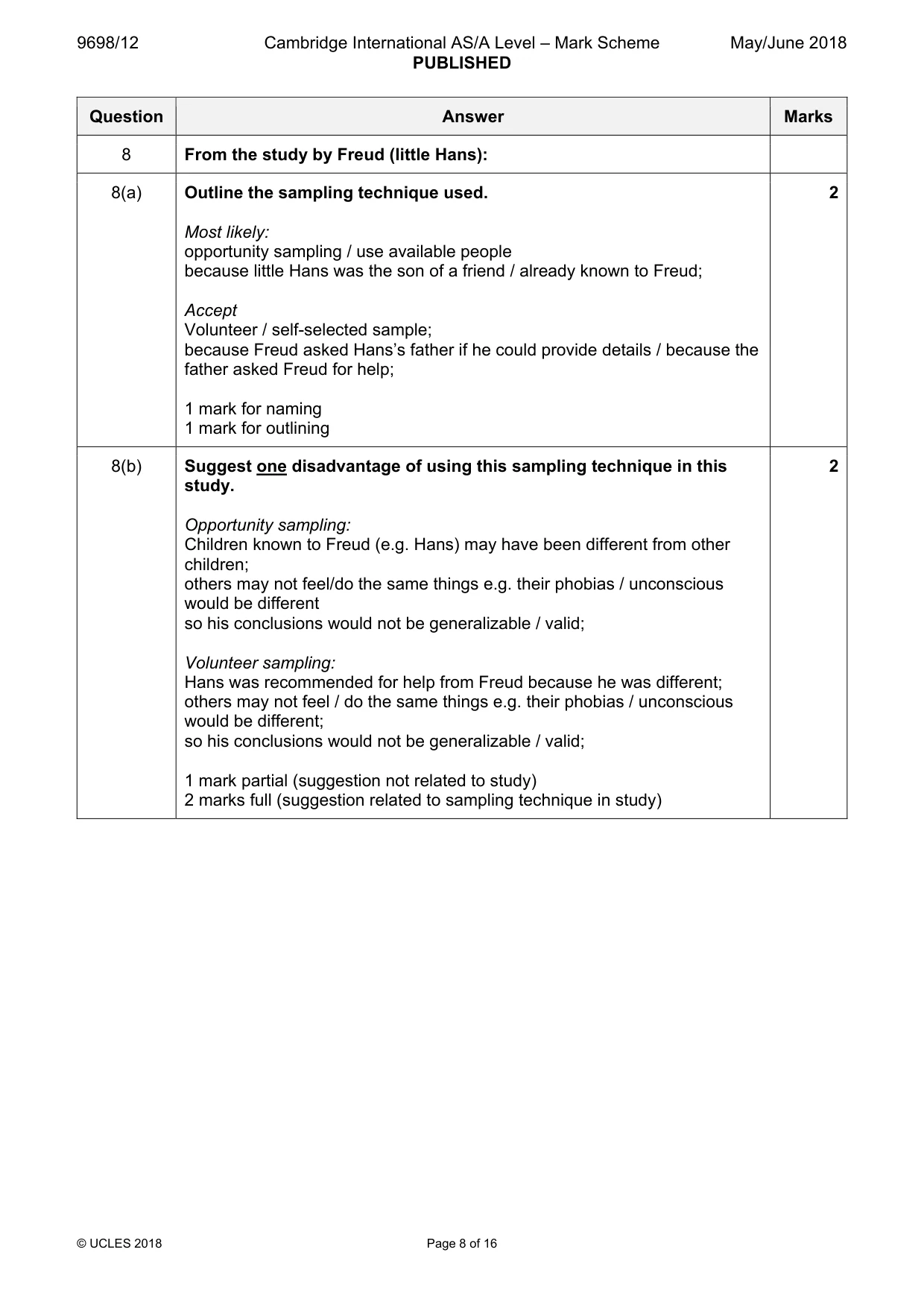
9698/12 Cambridge International AS/A Level – Mark Scheme PUBLISHED May/June 2018 © UCLES 2018 Page 8 of 16 Question Answer Marks 8 From the study by Freud (little Hans): 8(a) Outline the sampling technique used. Most likely: opportunity sampling / use available people because little Hans was the son of a friend / already known to Freud; Accept Volunteer / self-selected sample; because Freud asked Hans’s father if he could provide details / because the father asked Freud for help; 1 mark for naming 1 mark for outlining 2 8(b) Suggest one disadvantage of using this sampling technique in this study. Opportunity sampling: Children known to Freud (e.g. Hans) may have been different from other children; others may not feel/do the same things e.g. their phobias / unconscious would be different so his conclusions would not be generalizable / valid; Volunteer sampling: Hans was recommended for help from Freud because he was different; others may not feel / do the same things e.g. their phobias / unconscious would be different; so his conclusions would not be generalizable / valid; 1 mark partial (suggestion not related to study) 2 marks full (suggestion related to sampling technique in study) 2
Mark scheme, page 9
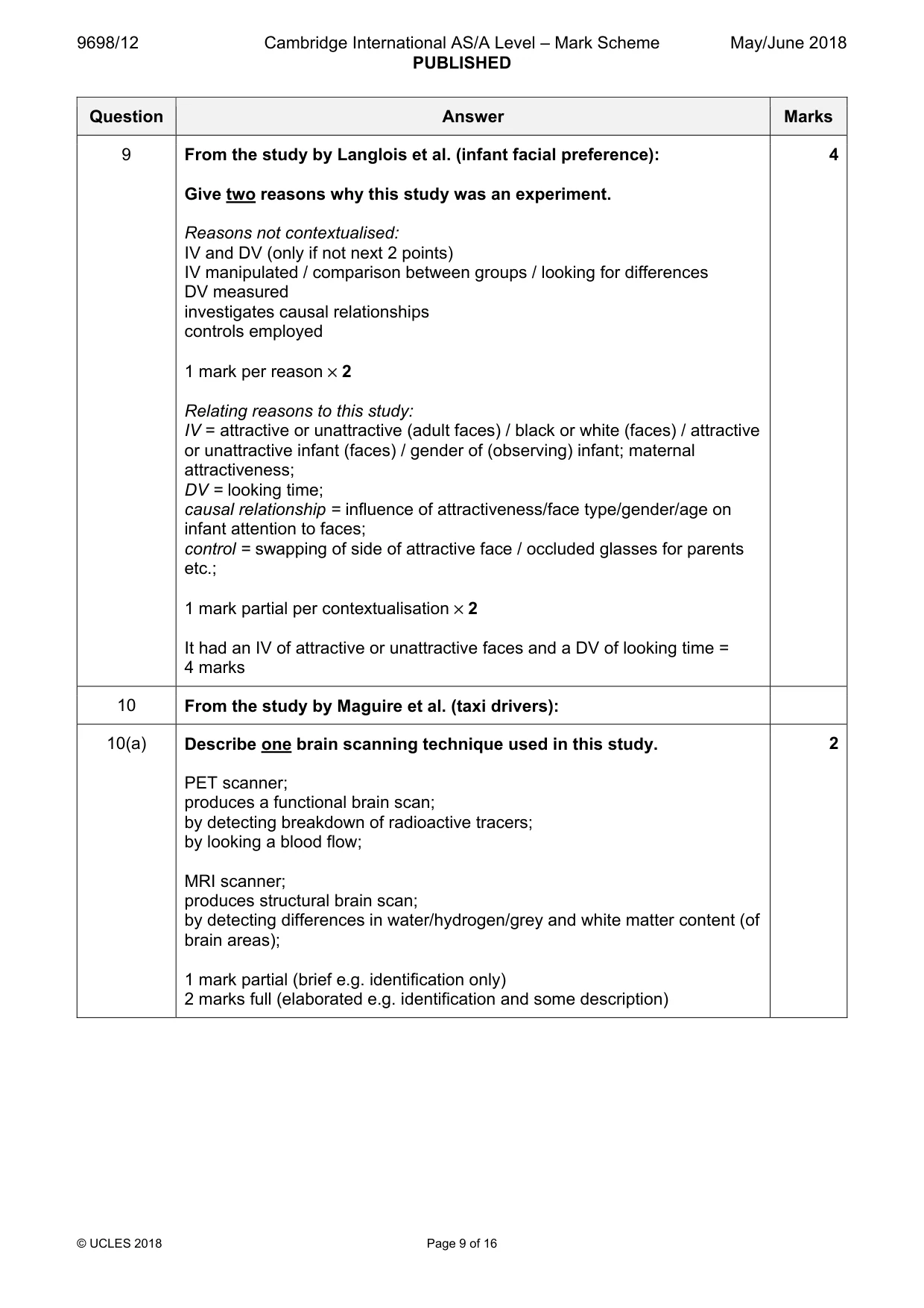
9698/12 Cambridge International AS/A Level – Mark Scheme PUBLISHED May/June 2018 © UCLES 2018 Page 9 of 16 Question Answer Marks 9 From the study by Langlois et al. (infant facial preference): Give two reasons why this study was an experiment. Reasons not contextualised: IV and DV (only if not next 2 points) IV manipulated / comparison between groups / looking for differences DV measured investigates causal relationships controls employed 1 mark per reason × 2 Relating reasons to this study: IV = attractive or unattractive (adult faces) / black or white (faces) / attractive or unattractive infant (faces) / gender of (observing) infant; maternal attractiveness; DV = looking time; causal relationship = influence of attractiveness/face type/gender/age on infant attention to faces; control = swapping of side of attractive face / occluded glasses for parents etc.; 1 mark partial per contextualisation × 2 It had an IV of attractive or unattractive faces and a DV of looking time = 4 marks 4 10 From the study by Maguire et al. (taxi drivers): 10(a) Describe one brain scanning technique used in this study. PET scanner; produces a functional brain scan; by detecting breakdown of radioactive tracers; by looking a blood flow; MRI scanner; produces structural brain scan; by detecting differences in water/hydrogen/grey and white matter content (of brain areas); 1 mark partial (brief e.g. identification only) 2 marks full (elaborated e.g. identification and some description) 2
Mark scheme, page 10
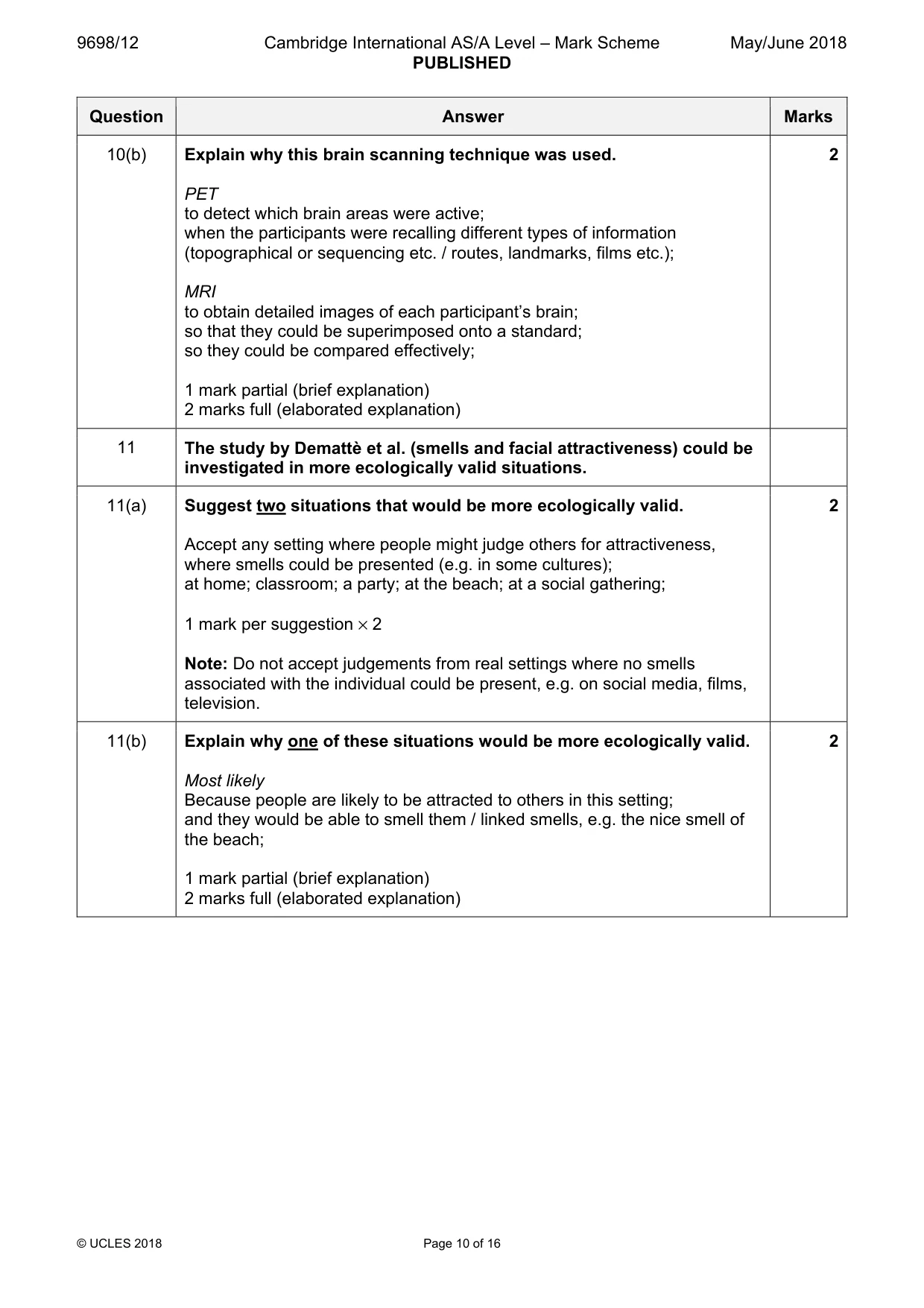
9698/12 Cambridge International AS/A Level – Mark Scheme PUBLISHED May/June 2018 © UCLES 2018 Page 10 of 16 Question Answer Marks 10(b) Explain why this brain scanning technique was used. PET to detect which brain areas were active; when the participants were recalling different types of information (topographical or sequencing etc. / routes, landmarks, films etc.); MRI to obtain detailed images of each participant’s brain; so that they could be superimposed onto a standard; so they could be compared effectively; 1 mark partial (brief explanation) 2 marks full (elaborated explanation) 2 11 The study by Demattè et al. (smells and facial attractiveness) could be investigated in more ecologically valid situations. 11(a) Suggest two situations that would be more ecologically valid. Accept any setting where people might judge others for attractiveness, where smells could be presented (e.g. in some cultures); at home; classroom; a party; at the beach; at a social gathering; 1 mark per suggestion × 2 Note: Do not accept judgements from real settings where no smells associated with the individual could be present, e.g. on social media, films, television. 2 11(b) Explain why one of these situations would be more ecologically valid. Most likely Because people are likely to be attracted to others in this setting; and they would be able to smell them / linked smells, e.g. the nice smell of the beach; 1 mark partial (brief explanation) 2 marks full (elaborated explanation) 2
Mark scheme, page 11
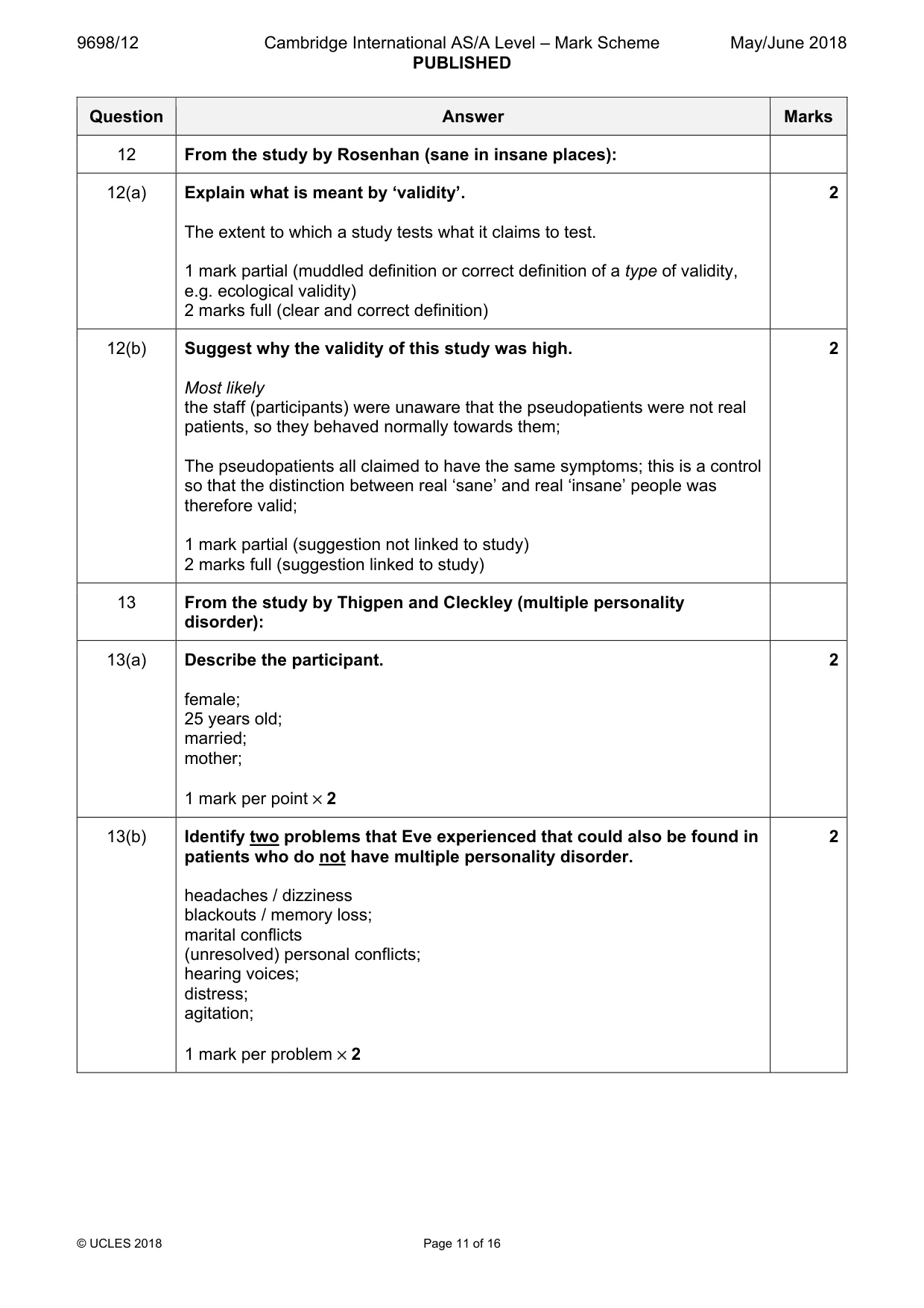
9698/12 Cambridge International AS/A Level – Mark Scheme PUBLISHED May/June 2018 © UCLES 2018 Page 11 of 16 Question Answer Marks 12 From the study by Rosenhan (sane in insane places): 12(a) Explain what is meant by ‘validity’. The extent to which a study tests what it claims to test. 1 mark partial (muddled definition or correct definition of a type of validity, e.g. ecological validity) 2 marks full (clear and correct definition) 2 12(b) Suggest why the validity of this study was high. Most likely the staff (participants) were unaware that the pseudopatients were not real patients, so they behaved normally towards them; The pseudopatients all claimed to have the same symptoms; this is a control so that the distinction between real ‘sane’ and real ‘insane’ people was therefore valid; 1 mark partial (suggestion not linked to study) 2 marks full (suggestion linked to study) 2 13 From the study by Thigpen and Cleckley (multiple personality disorder): 13(a) Describe the participant. female; 25 years old; married; mother; 1 mark per point × 2 2 13(b) Identify two problems that Eve experienced that could also be found in patients who do not have multiple personality disorder. headaches / dizziness blackouts / memory loss; marital conflicts (unresolved) personal conflicts; hearing voices; distress; agitation; 1 mark per problem × 2 2
Mark scheme, page 12
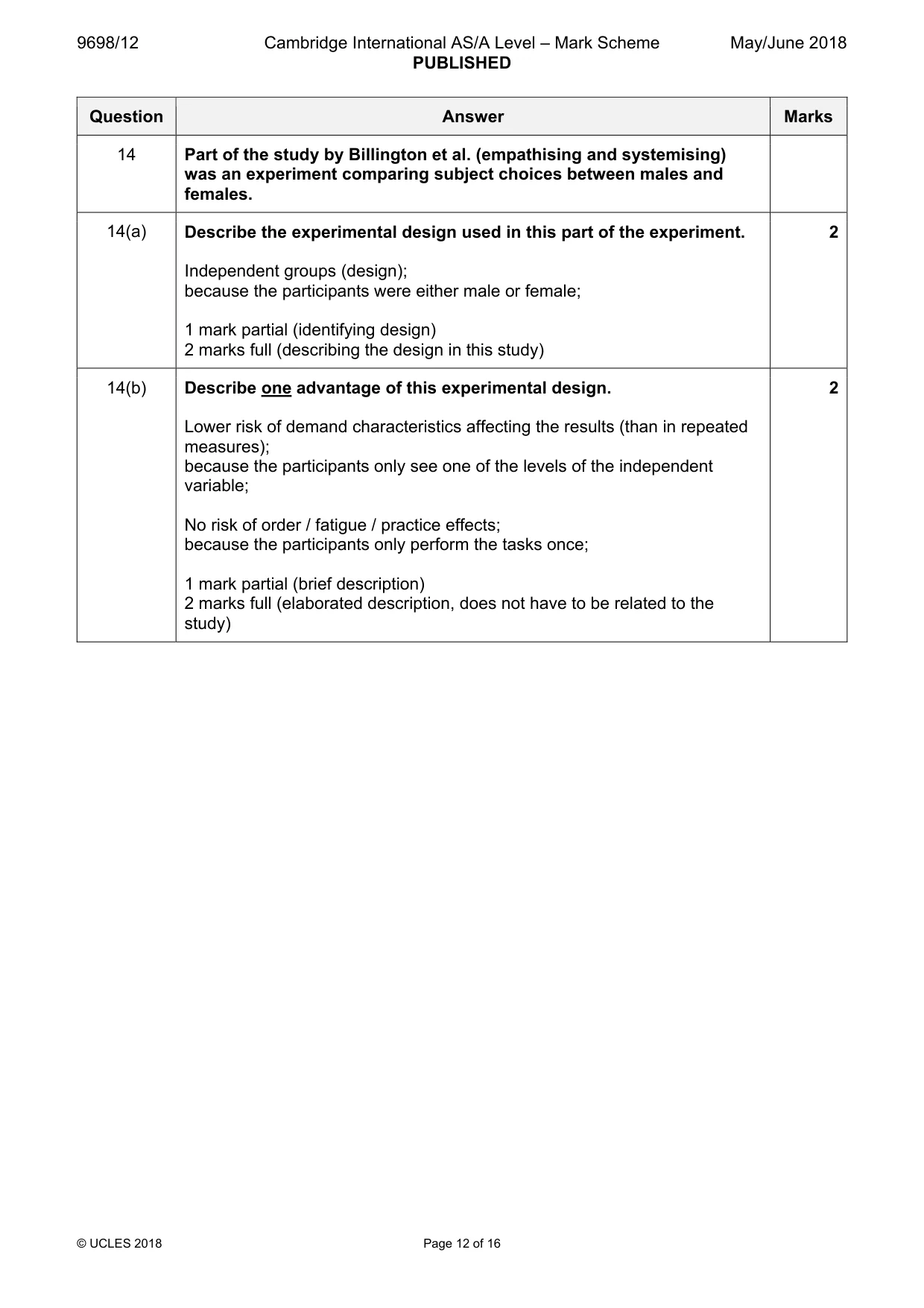
9698/12 Cambridge International AS/A Level – Mark Scheme PUBLISHED May/June 2018 © UCLES 2018 Page 12 of 16 Question Answer Marks 14 Part of the study by Billington et al. (empathising and systemising) was an experiment comparing subject choices between males and females. 14(a) Describe the experimental design used in this part of the experiment. Independent groups (design); because the participants were either male or female; 1 mark partial (identifying design) 2 marks full (describing the design in this study) 2 14(b) Describe one advantage of this experimental design. Lower risk of demand characteristics affecting the results (than in repeated measures); because the participants only see one of the levels of the independent variable; No risk of order / fatigue / practice effects; because the participants only perform the tasks once; 1 mark partial (brief description) 2 marks full (elaborated description, does not have to be related to the study) 2
Mark scheme, page 13
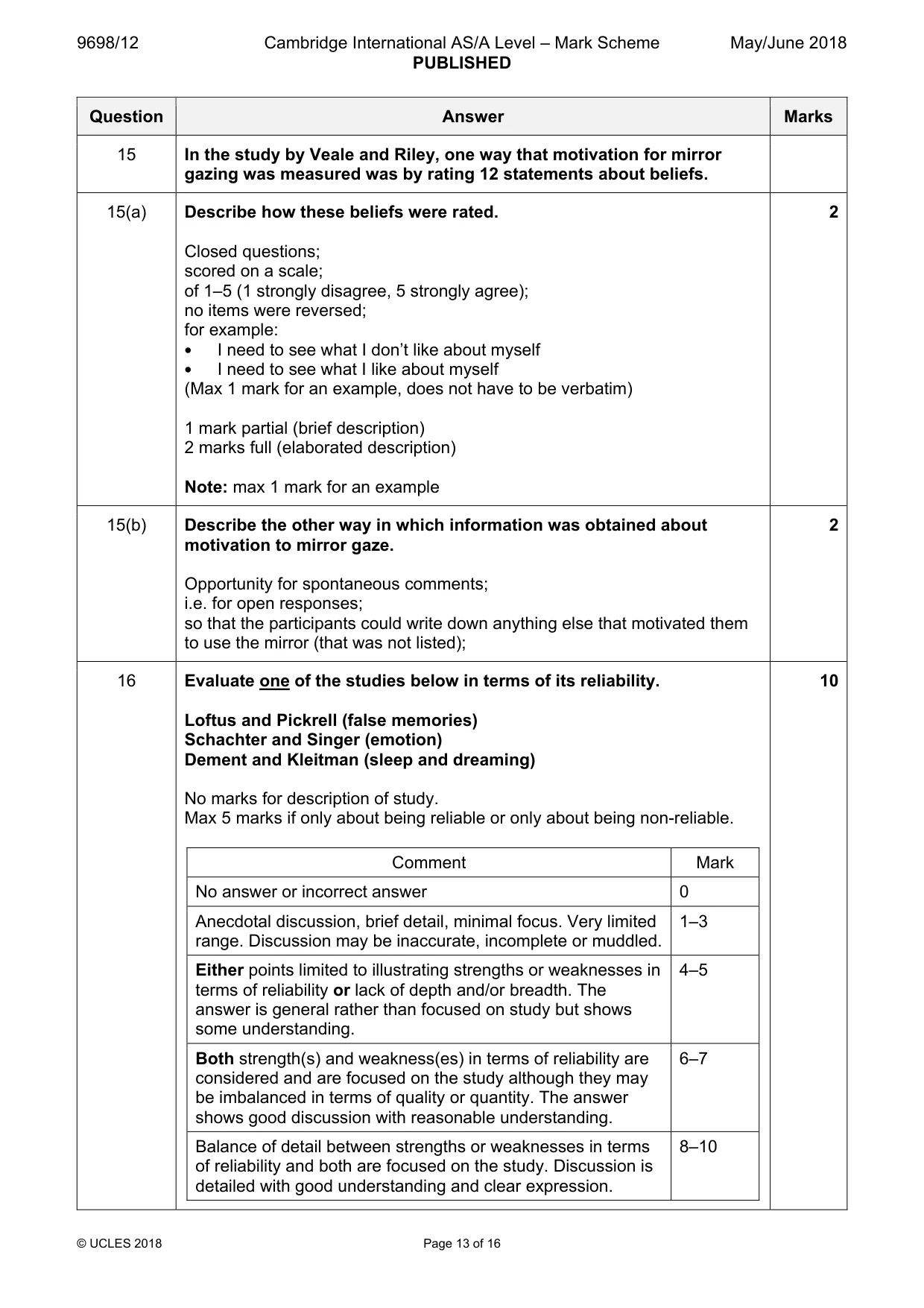
9698/12 Cambridge International AS/A Level – Mark Scheme PUBLISHED May/June 2018 © UCLES 2018 Page 13 of 16 Question Answer Marks 15 In the study by Veale and Riley, one way that motivation for mirror gazing was measured was by rating 12 statements about beliefs. 15(a) Describe how these beliefs were rated. Closed questions; scored on a scale; of 1–5 (1 strongly disagree, 5 strongly agree); no items were reversed; for example: • I need to see what I don’t like about myself • I need to see what I like about myself (Max 1 mark for an example, does not have to be verbatim) 1 mark partial (brief description) 2 marks full (elaborated description) Note: max 1 mark for an example 2 15(b) Describe the other way in which information was obtained about motivation to mirror gaze. Opportunity for spontaneous comments; i.e. for open responses; so that the participants could write down anything else that motivated them to use the mirror (that was not listed); 2 16 Evaluate one of the studies below in terms of its reliability. Loftus and Pickrell (false memories) Schachter and Singer (emotion) Dement and Kleitman (sleep and dreaming) No marks for description of study. Max 5 marks if only about being reliable or only about being non-reliable. Comment Mark No answer or incorrect answer 0 Anecdotal discussion, brief detail, minimal focus. Very limited range. Discussion may be inaccurate, incomplete or muddled. 1–3 Either points limited to illustrating strengths or weaknesses in terms of reliability or lack of depth and/or breadth. The answer is general rather than focused on study but shows some understanding. 4–5 Both strength(s) and weakness(es) in terms of reliability are considered and are focused on the study although they may be imbalanced in terms of quality or quantity. The answer shows good discussion with reasonable understanding. 6–7 Balance of detail between strengths or weaknesses in terms of reliability and both are focused on the study. Discussion is detailed with good understanding and clear expression. 8–10 10
Mark scheme, page 14
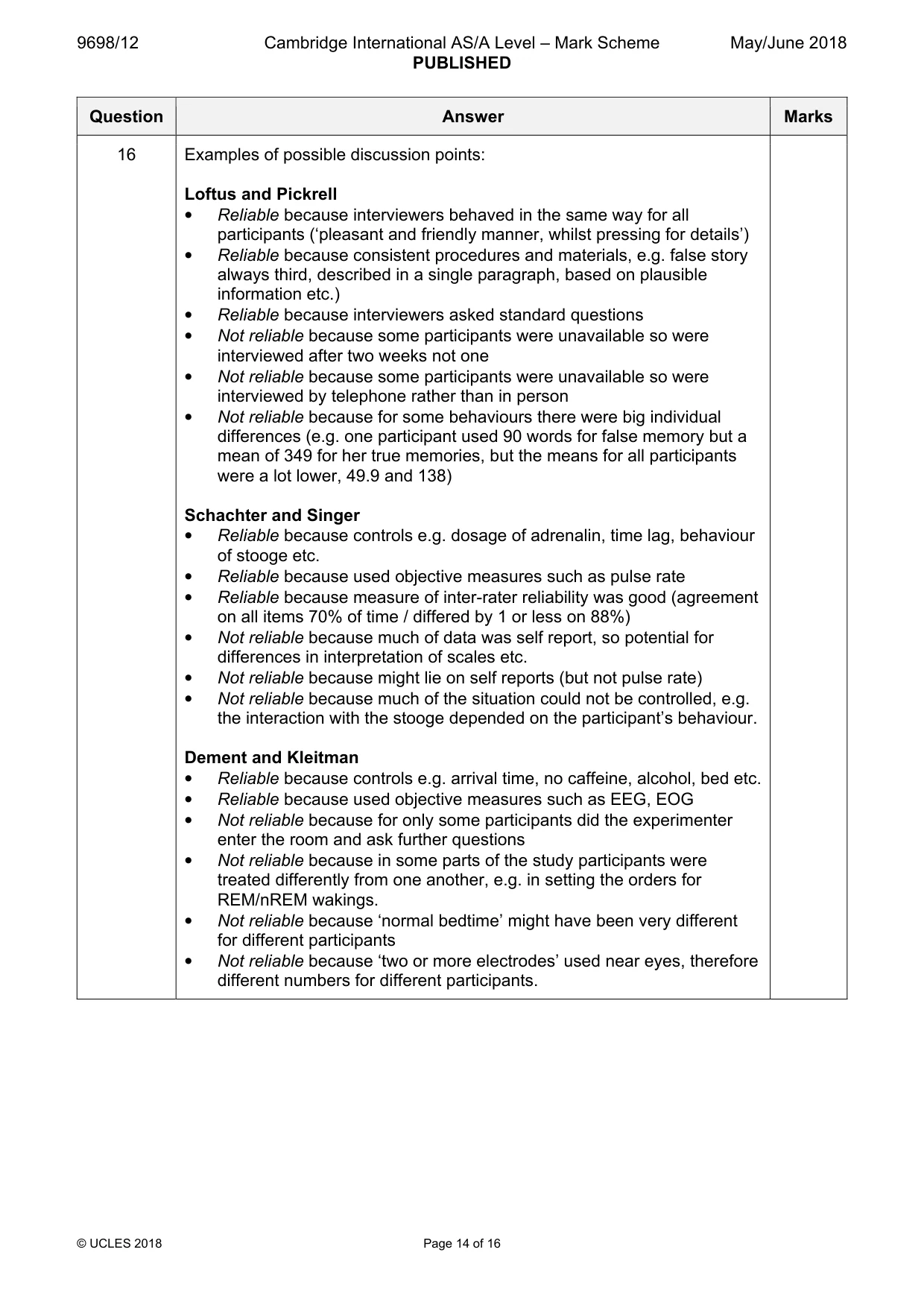
9698/12 Cambridge International AS/A Level – Mark Scheme PUBLISHED May/June 2018 © UCLES 2018 Page 14 of 16 Question Answer Marks 16 Examples of possible discussion points: Loftus and Pickrell • Reliable because interviewers behaved in the same way for all participants (‘pleasant and friendly manner, whilst pressing for details’) • Reliable because consistent procedures and materials, e.g. false story always third, described in a single paragraph, based on plausible information etc.) • Reliable because interviewers asked standard questions • Not reliable because some participants were unavailable so were interviewed after two weeks not one • Not reliable because some participants were unavailable so were interviewed by telephone rather than in person • Not reliable because for some behaviours there were big individual differences (e.g. one participant used 90 words for false memory but a mean of 349 for her true memories, but the means for all participants were a lot lower, 49.9 and 138) Schachter and Singer • Reliable because controls e.g. dosage of adrenalin, time lag, behaviour of stooge etc. • Reliable because used objective measures such as pulse rate • Reliable because measure of inter-rater reliability was good (agreement on all items 70% of time / differed by 1 or less on 88%) • Not reliable because much of data was self report, so potential for differences in interpretation of scales etc. • Not reliable because might lie on self reports (but not pulse rate) • Not reliable because much of the situation could not be controlled, e.g. the interaction with the stooge depended on the participant’s behaviour. Dement and Kleitman • Reliable because controls e.g. arrival time, no caffeine, alcohol, bed etc. • Reliable because used objective measures such as EEG, EOG • Not reliable because for only some participants did the experimenter enter the room and ask further questions • Not reliable because in some parts of the study participants were treated differently from one another, e.g. in setting the orders for REM/nREM wakings. • Not reliable because ‘normal bedtime’ might have been very different for different participants • Not reliable because ‘two or more electrodes’ used near eyes, therefore different numbers for different participants.
Mark scheme, page 15
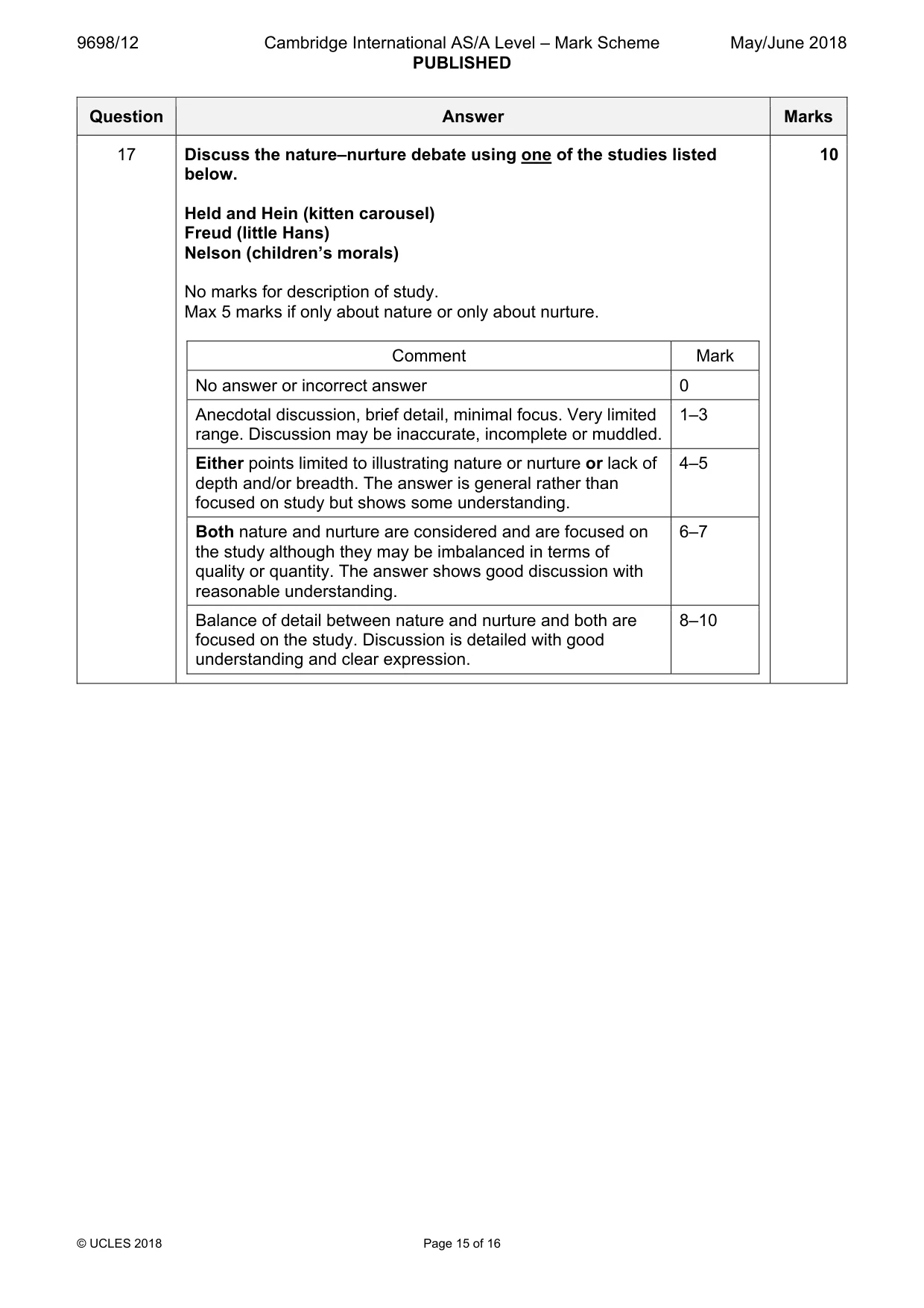
9698/12 Cambridge International AS/A Level – Mark Scheme PUBLISHED May/June 2018 © UCLES 2018 Page 15 of 16 Question Answer Marks 17 Discuss the nature–nurture debate using one of the studies listed below. Held and Hein (kitten carousel) Freud (little Hans) Nelson (children’s morals) No marks for description of study. Max 5 marks if only about nature or only about nurture. Comment Mark No answer or incorrect answer 0 Anecdotal discussion, brief detail, minimal focus. Very limited range. Discussion may be inaccurate, incomplete or muddled. 1–3 Either points limited to illustrating nature or nurture or lack of depth and/or breadth. The answer is general rather than focused on study but shows some understanding. 4–5 Both nature and nurture are considered and are focused on the study although they may be imbalanced in terms of quality or quantity. The answer shows good discussion with reasonable understanding. 6–7 Balance of detail between nature and nurture and both are focused on the study. Discussion is detailed with good understanding and clear expression. 8–10 10
Mark scheme, page 16
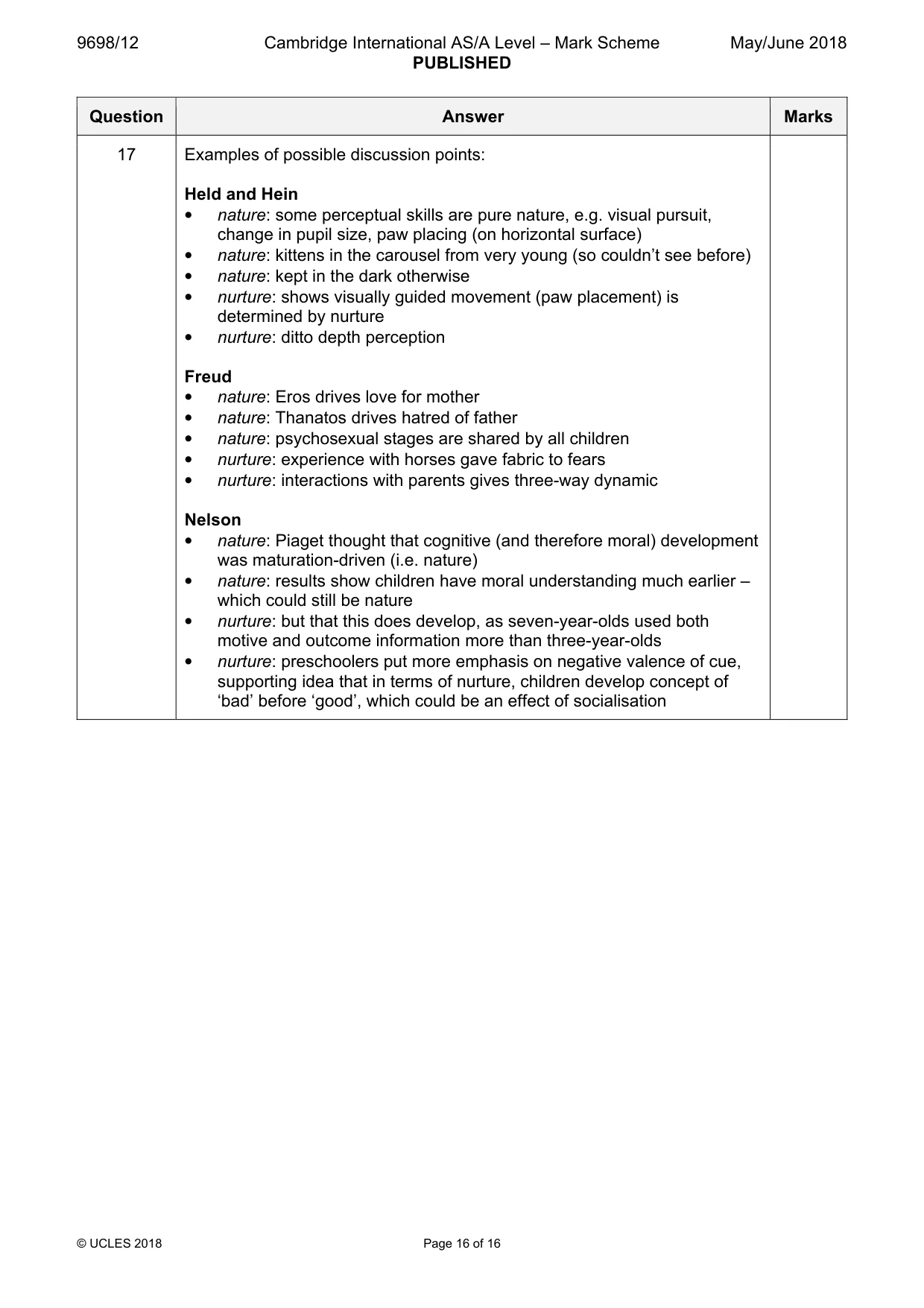
9698/12 Cambridge International AS/A Level – Mark Scheme PUBLISHED May/June 2018 © UCLES 2018 Page 16 of 16 Question Answer Marks 17 Examples of possible discussion points: Held and Hein • nature: some perceptual skills are pure nature, e.g. visual pursuit, change in pupil size, paw placing (on horizontal surface) • nature: kittens in the carousel from very young (so couldn’t see before) • nature: kept in the dark otherwise • nurture: shows visually guided movement (paw placement) is determined by nurture • nurture: ditto depth perception Freud • nature: Eros drives love for mother • nature: Thanatos drives hatred of father • nature: psychosexual stages are shared by all children • nurture: experience with horses gave fabric to fears • nurture: interactions with parents gives three-way dynamic Nelson • nature: Piaget thought that cognitive (and therefore moral) development was maturation-driven (i.e. nature) • nature: results show children have moral understanding much earlier – which could still be nature • nurture: but that this does develop, as seven-year-olds used both motive and outcome information more than three-year-olds • nurture: preschoolers put more emphasis on negative valence of cue, supporting idea that in terms of nurture, children develop concept of ‘bad’ before ‘good’, which could be an effect of socialisation
What you needed in this session
Cambridge’s own grade thresholds for 2018 May/June, Paper 1 · Variant 2. A higher threshold means an easier paper — the bar moves with how the cohort did.