Cambridge A Level Psychology 9698 — 2017 May/June Paper 1 · Variant 2
9698/12/M/J/17 · 80 marks · ≈90 min
The question paper and its mark scheme, free to read here and free to download. This is Cambridge’s own paper, exactly as it was sat.
Question paper4 pages
Mark scheme19 pages
Answers below. Sit the paper first if you are practising.
Paper as text
Question paper, page 1
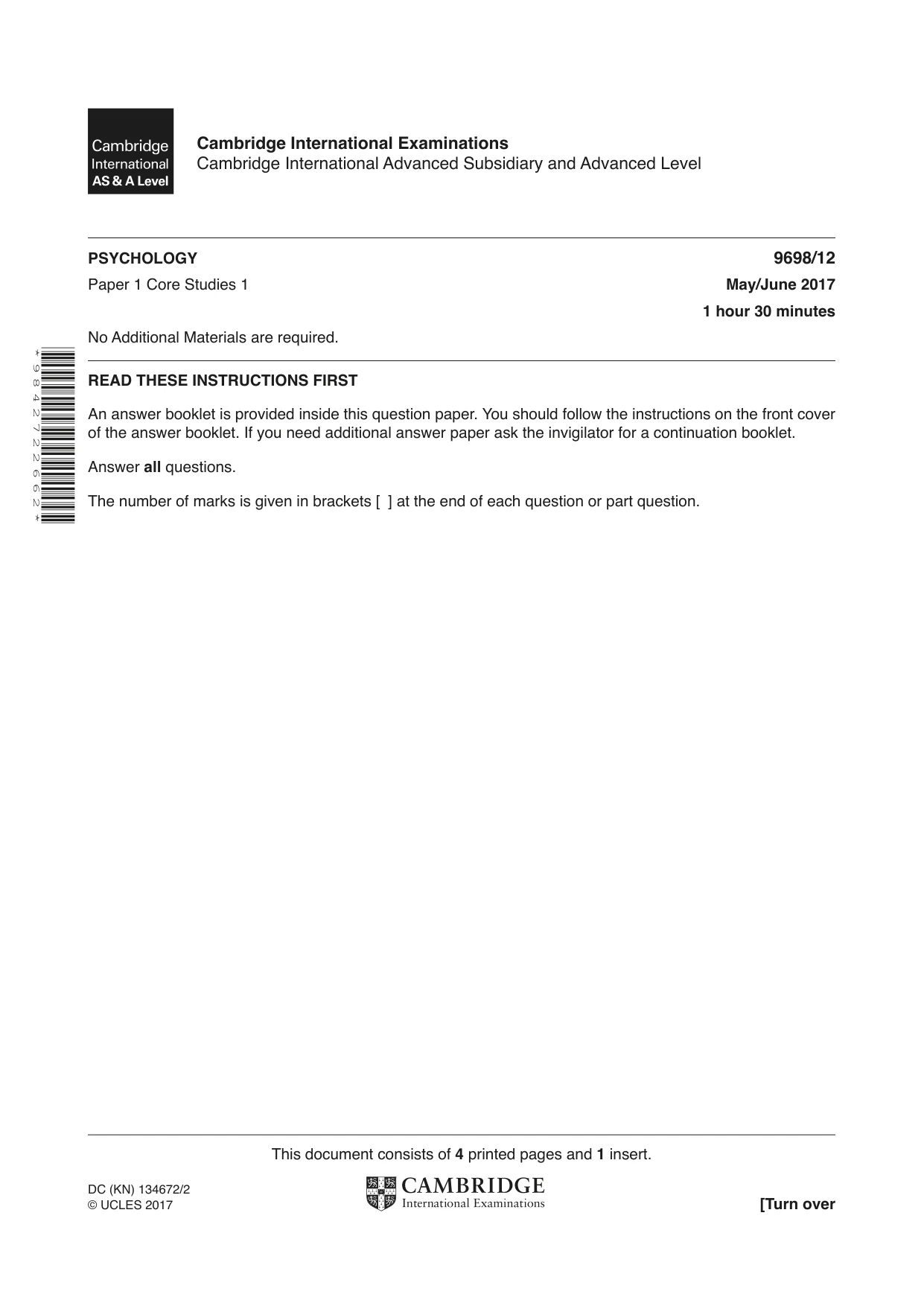
This document consists of 4 printed pages and 1 insert. DC (KN) 134672/2 © UCLES 2017 [Turn over Cambridge International Examinations Cambridge International Advanced Subsidiary and Advanced Level * 9 8 4 2 7 2 2 6 6 2 * PSYCHOLOGY 9698/12 Paper 1 Core Studies 1 May/June 2017 1 hour 30 minutes No Additional Materials are required. READ THESE INSTRUCTIONS FIRST An answer booklet is provided inside this question paper. You should follow the instructions on the front cover of the answer booklet. If you need additional answer paper ask the invigilator for a continuation booklet. Answer all questions. The number of marks is given in brackets [ ] at the end of each question or part question.
Question paper, page 2
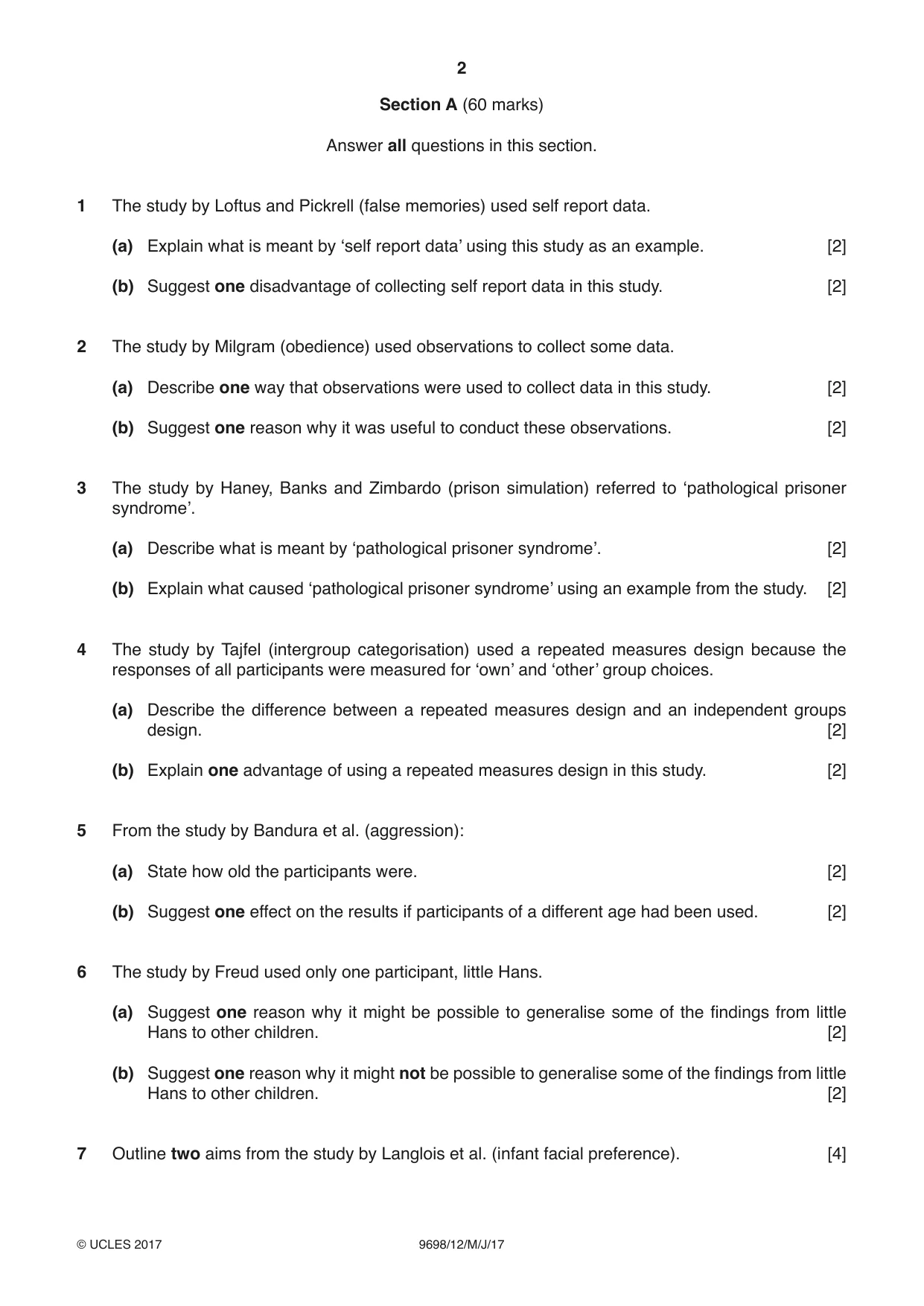
2 9698/12/M/J/17 © UCLES 2017 Section A (60 marks) Answer all questions in this section. 1 The study by Loftus and Pickrell (false memories) used self report data. (a) Explain what is meant by ‘self report data’ using this study as an example. [2] (b) Suggest one disadvantage of collecting self report data in this study. [2] 2 The study by Milgram (obedience) used observations to collect some data. (a) Describe one way that observations were used to collect data in this study. [2] (b) Suggest one reason why it was useful to conduct these observations. [2] 3 The study by Haney, Banks and Zimbardo (prison simulation) referred to ‘pathological prisoner syndrome’. (a) Describe what is meant by ‘pathological prisoner syndrome’. [2] (b) Explain what caused ‘pathological prisoner syndrome’ using an example from the study. [2] 4 The study by Tajfel (intergroup categorisation) used a repeated measures design because the responses of all participants were measured for ‘own’ and ‘other’ group choices. (a) Describe the difference between a repeated measures design and an independent groups design. [2] (b) Explain one advantage of using a repeated measures design in this study. [2] 5 From the study by Bandura et al. (aggression): (a) State how old the participants were. [2] (b) Suggest one effect on the results if participants of a different age had been used. [2] 6 The study by Freud used only one participant, little Hans. (a) Suggest one reason why it might be possible to generalise some of the findings from little Hans to other children. [2] (b) Suggest one reason why it might not be possible to generalise some of the findings from little Hans to other children. [2] 7 Outline two aims from the study by Langlois et al. (infant facial preference). [4]
Question paper, page 3
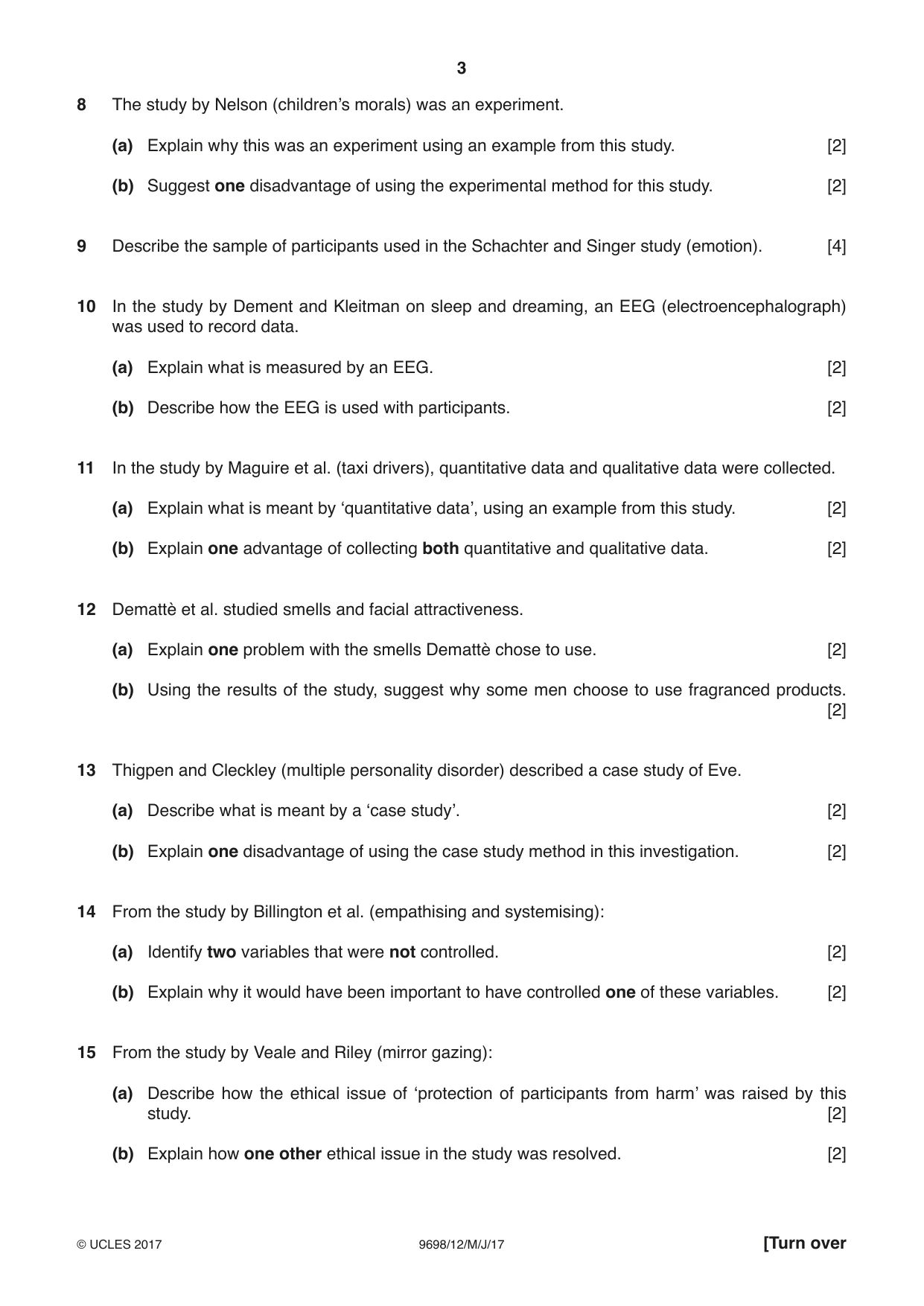
3 9698/12/M/J/17 © UCLES 2017 [Turn over 8 The study by Nelson (children’s morals) was an experiment. (a) Explain why this was an experiment using an example from this study. [2] (b) Suggest one disadvantage of using the experimental method for this study. [2] 9 Describe the sample of participants used in the Schachter and Singer study (emotion). [4] 10 In the study by Dement and Kleitman on sleep and dreaming, an EEG (electroencephalograph) was used to record data. (a) Explain what is measured by an EEG. [2] (b) Describe how the EEG is used with participants. [2] 11 In the study by Maguire et al. (taxi drivers), quantitative data and qualitative data were collected. (a) Explain what is meant by ‘quantitative data’, using an example from this study. [2] (b) Explain one advantage of collecting both quantitative and qualitative data. [2] 12 Demattè et al. studied smells and facial attractiveness. (a) Explain one problem with the smells Demattè chose to use. [2] (b) Using the results of the study, suggest why some men choose to use fragranced products. [2] 13 Thigpen and Cleckley (multiple personality disorder) described a case study of Eve. (a) Describe what is meant by a ‘case study’. [2] (b) Explain one disadvantage of using the case study method in this investigation. [2] 14 From the study by Billington et al. (empathising and systemising): (a) Identify two variables that were not controlled. [2] (b) Explain why it would have been important to have controlled one of these variables. [2] 15 From the study by Veale and Riley (mirror gazing): (a) Describe how the ethical issue of ‘protection of participants from harm’ was raised by this study. [2] (b) Explain how one other ethical issue in the study was resolved. [2]
Question paper, page 4
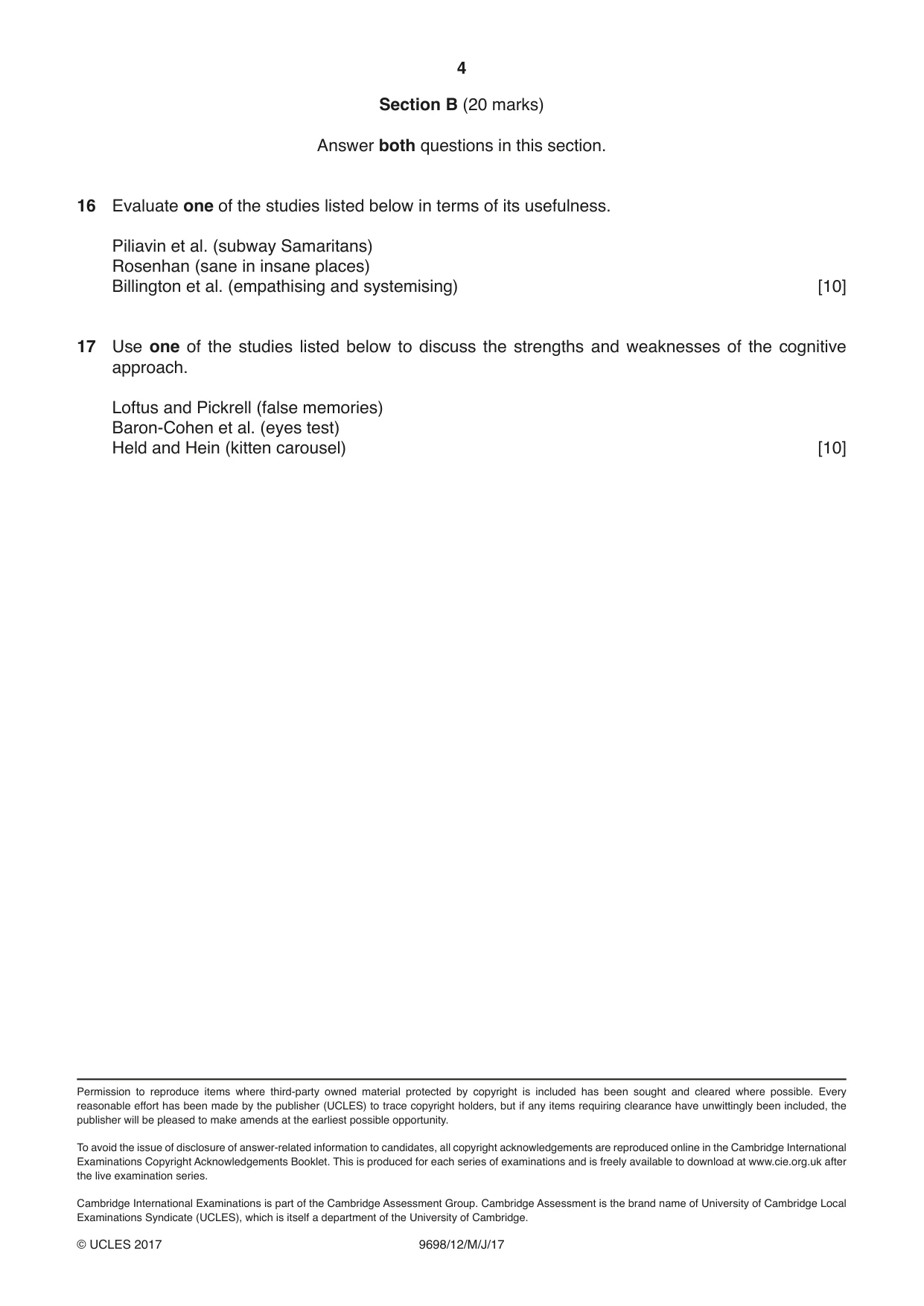
4 9698/12/M/J/17 © UCLES 2017 Permission to reproduce items where third-party owned material protected by copyright is included has been sought and cleared where possible. Every reasonable effort has been made by the publisher (UCLES) to trace copyright holders, but if any items requiring clearance have unwittingly been included, the publisher will be pleased to make amends at the earliest possible opportunity. To avoid the issue of disclosure of answer-related information to candidates, all copyright acknowledgements are reproduced online in the Cambridge International Examinations Copyright Acknowledgements Booklet. This is produced for each series of examinations and is freely available to download at www.cie.org.uk after the live examination series. Cambridge International Examinations is part of the Cambridge Assessment Group. Cambridge Assessment is the brand name of University of Cambridge Local Examinations Syndicate (UCLES), which is itself a department of the University of Cambridge. Section B (20 marks) Answer both questions in this section. 16 Evaluate one of the studies listed below in terms of its usefulness. Piliavin et al. (subway Samaritans) Rosenhan (sane in insane places) Billington et al. (empathising and systemising) [10] 17 Use one of the studies listed below to discuss the strengths and weaknesses of the cognitive approach. Loftus and Pickrell (false memories) Baron-Cohen et al. (eyes test) Held and Hein (kitten carousel) [10]
Mark scheme, page 1
® IGCSE is a registered trademark. This document consists of 19 printed pages. © UCLES 2017 [Turn over Cambridge International Examinations Cambridge International Advanced Subsidiary and Advanced Level PSYCHOLOGY 9698/12 Paper 1 Core Studies 1 May/June 2017 MARK SCHEME Maximum Mark: 80 Published This mark scheme is published as an aid to teachers and candidates, to indicate the requirements of the examination. It shows the basis on which Examiners were instructed to award marks. It does not indicate the details of the discussions that took place at an Examiners’ meeting before marking began, which would have considered the acceptability of alternative answers. Mark schemes should be read in conjunction with the question paper and the Principal Examiner Report for Teachers. Cambridge will not enter into discussions about these mark schemes. Cambridge is publishing the mark schemes for the May/June 2017 series for most Cambridge IGCSE®, Cambridge International A and AS Level and Cambridge Pre-U components, and some Cambridge O Level components.
Mark scheme, page 2
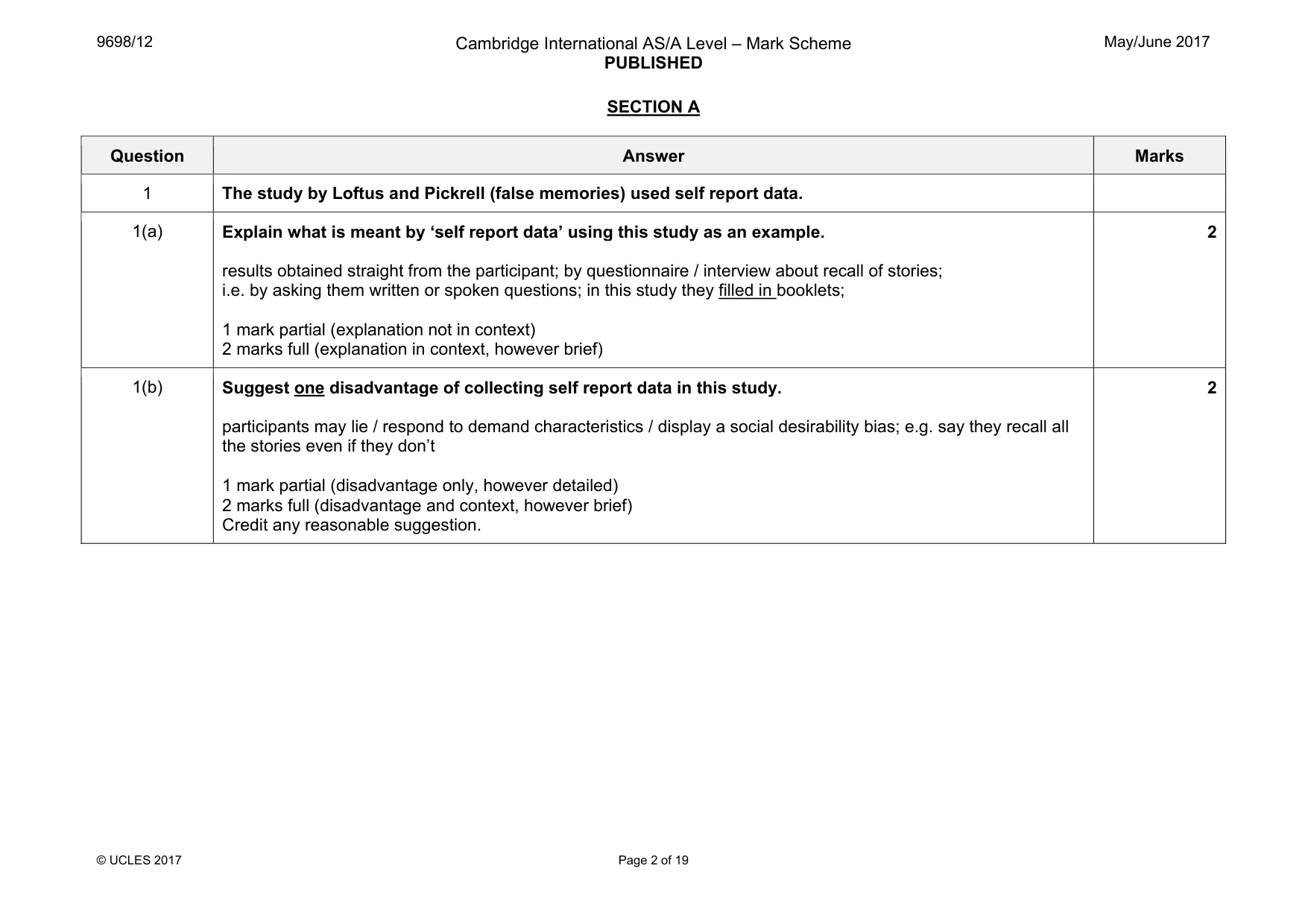
9698/12 Cambridge International AS/A Level – Mark Scheme PUBLISHED May/June 2017 © UCLES 2017 Page 2 of 19 SECTION A Question Answer Marks 1 The study by Loftus and Pickrell (false memories) used self report data. 1(a) Explain what is meant by ‘self report data’ using this study as an example. results obtained straight from the participant; by questionnaire / interview about recall of stories; i.e. by asking them written or spoken questions; in this study they filled in booklets; 1 mark partial (explanation not in context) 2 marks full (explanation in context, however brief) 2 1(b) Suggest one disadvantage of collecting self report data in this study. participants may lie / respond to demand characteristics / display a social desirability bias; e.g. say they recall all the stories even if they don’t 1 mark partial (disadvantage only, however detailed) 2 marks full (disadvantage and context, however brief) Credit any reasonable suggestion. 2
Mark scheme, page 3
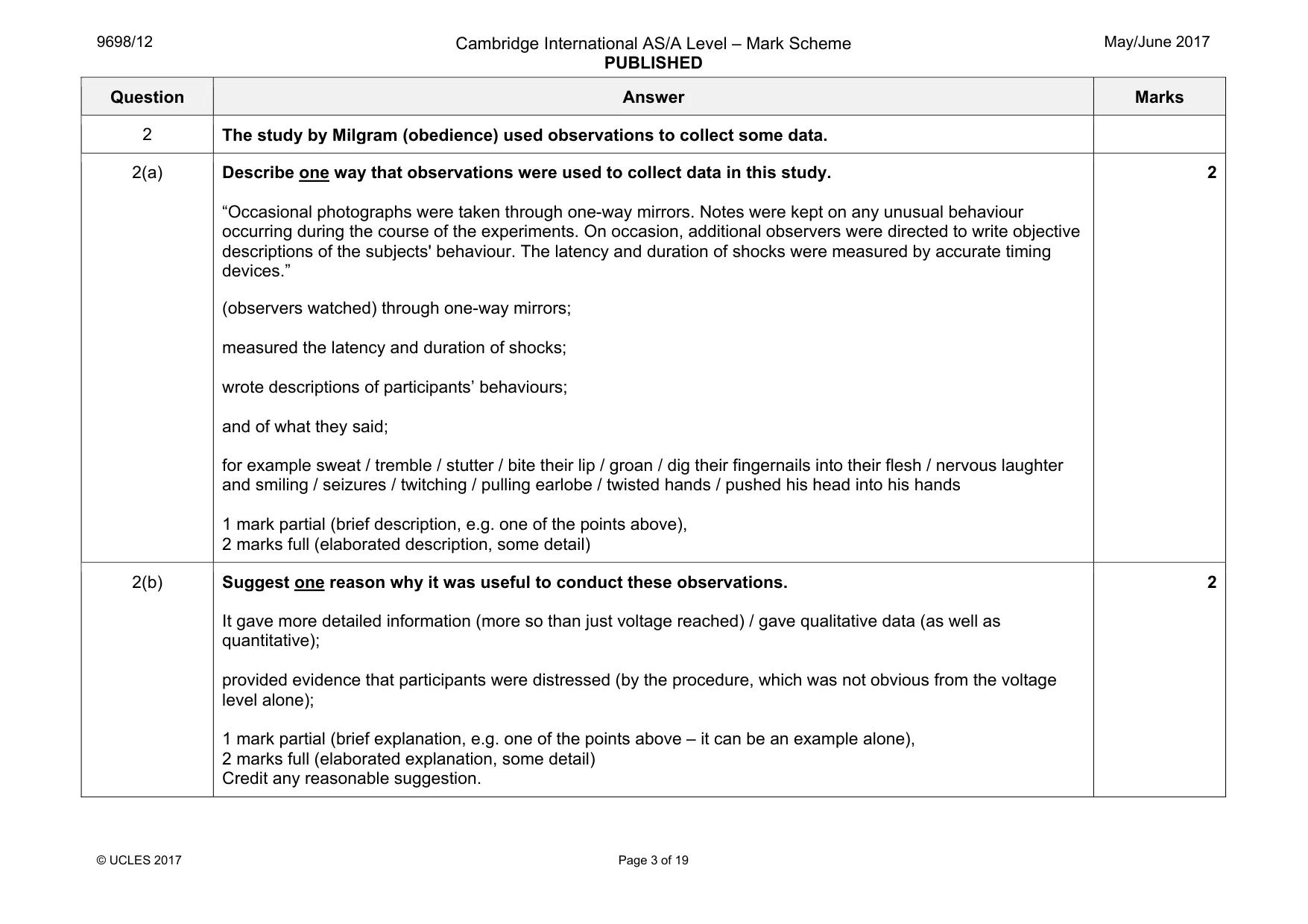
9698/12 Cambridge International AS/A Level – Mark Scheme PUBLISHED May/June 2017 © UCLES 2017 Page 3 of 19 Question Answer Marks 2 The study by Milgram (obedience) used observations to collect some data. 2(a) Describe one way that observations were used to collect data in this study. “Occasional photographs were taken through one-way mirrors. Notes were kept on any unusual behaviour occurring during the course of the experiments. On occasion, additional observers were directed to write objective descriptions of the subjects' behaviour. The latency and duration of shocks were measured by accurate timing devices.” (observers watched) through one-way mirrors; measured the latency and duration of shocks; wrote descriptions of participants’ behaviours; and of what they said; for example sweat / tremble / stutter / bite their lip / groan / dig their fingernails into their flesh / nervous laughter and smiling / seizures / twitching / pulling earlobe / twisted hands / pushed his head into his hands 1 mark partial (brief description, e.g. one of the points above), 2 marks full (elaborated description, some detail) 2 2(b) Suggest one reason why it was useful to conduct these observations. It gave more detailed information (more so than just voltage reached) / gave qualitative data (as well as quantitative); provided evidence that participants were distressed (by the procedure, which was not obvious from the voltage level alone); 1 mark partial (brief explanation, e.g. one of the points above – it can be an example alone), 2 marks full (elaborated explanation, some detail) Credit any reasonable suggestion. 2
Mark scheme, page 4
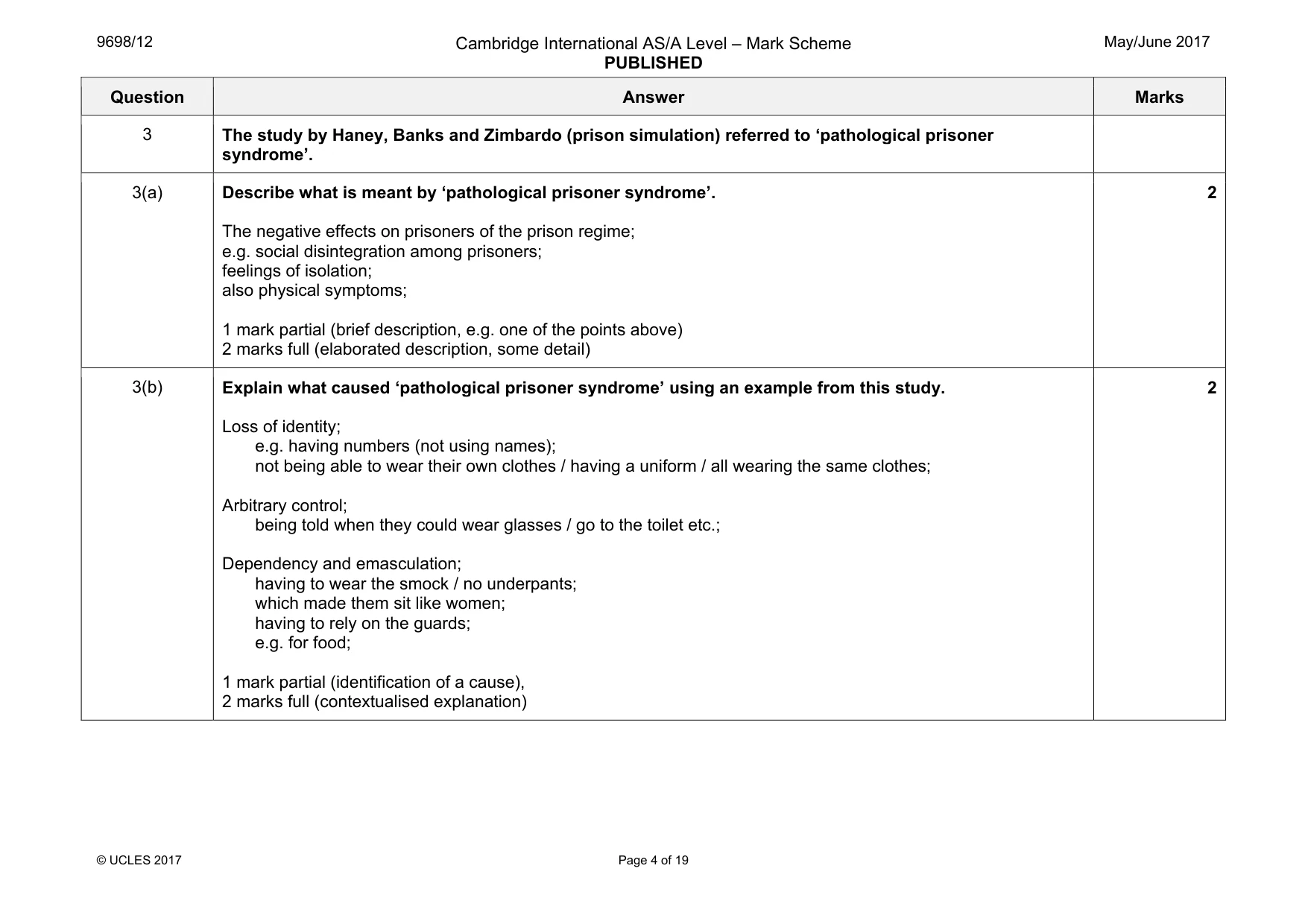
9698/12 Cambridge International AS/A Level – Mark Scheme PUBLISHED May/June 2017 © UCLES 2017 Page 4 of 19 Question Answer Marks 3 The study by Haney, Banks and Zimbardo (prison simulation) referred to ‘pathological prisoner syndrome’. 3(a) Describe what is meant by ‘pathological prisoner syndrome’. The negative effects on prisoners of the prison regime; e.g. social disintegration among prisoners; feelings of isolation; also physical symptoms; 1 mark partial (brief description, e.g. one of the points above) 2 marks full (elaborated description, some detail) 2 3(b) Explain what caused ‘pathological prisoner syndrome’ using an example from this study. Loss of identity; e.g. having numbers (not using names); not being able to wear their own clothes / having a uniform / all wearing the same clothes; Arbitrary control; being told when they could wear glasses / go to the toilet etc.; Dependency and emasculation; having to wear the smock / no underpants; which made them sit like women; having to rely on the guards; e.g. for food; 1 mark partial (identification of a cause), 2 marks full (contextualised explanation) 2
Mark scheme, page 5
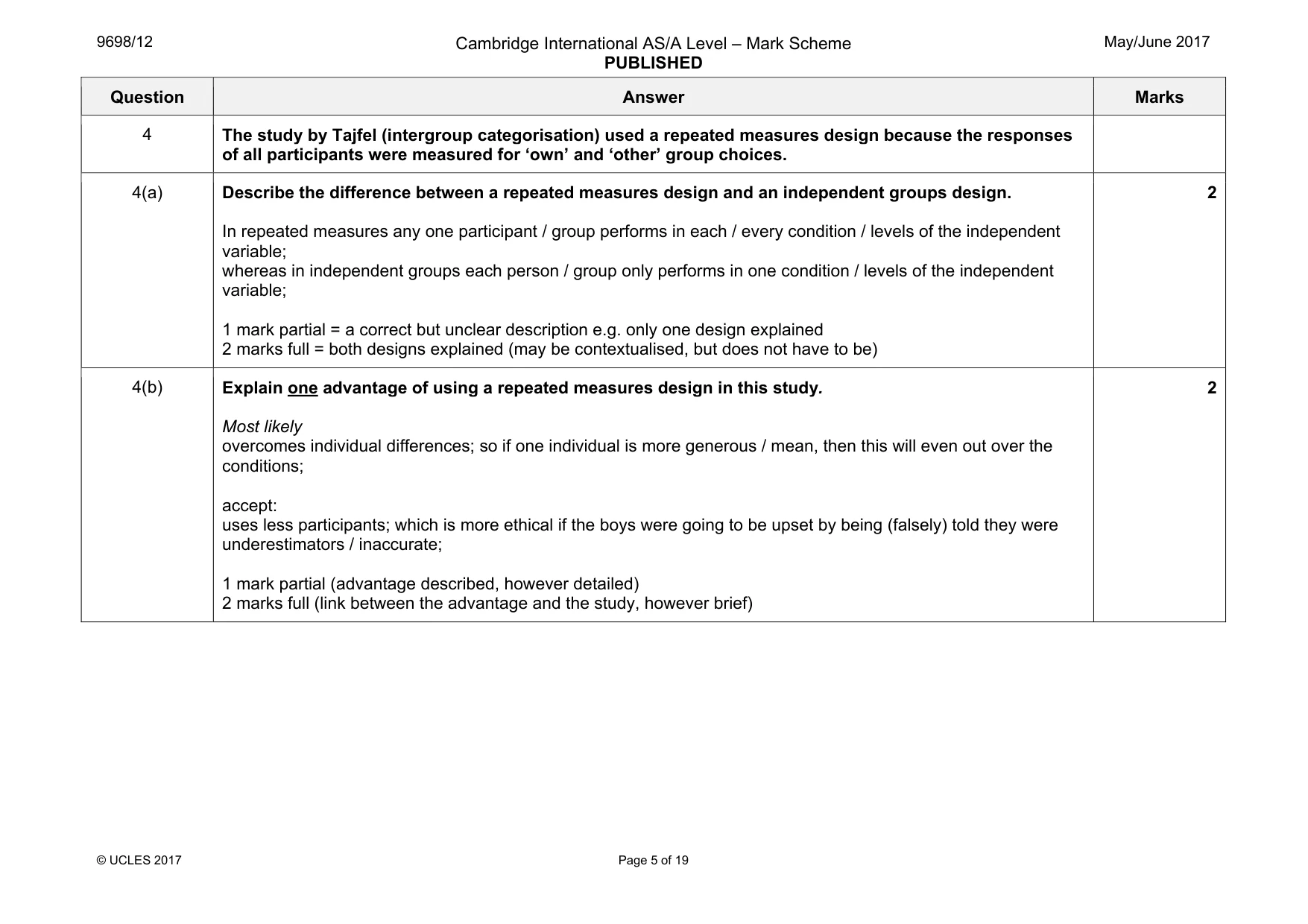
9698/12 Cambridge International AS/A Level – Mark Scheme PUBLISHED May/June 2017 © UCLES 2017 Page 5 of 19 Question Answer Marks 4 The study by Tajfel (intergroup categorisation) used a repeated measures design because the responses of all participants were measured for ‘own’ and ‘other’ group choices. 4(a) Describe the difference between a repeated measures design and an independent groups design. In repeated measures any one participant / group performs in each / every condition / levels of the independent variable; whereas in independent groups each person / group only performs in one condition / levels of the independent variable; 1 mark partial = a correct but unclear description e.g. only one design explained 2 marks full = both designs explained (may be contextualised, but does not have to be) 2 4(b) Explain one advantage of using a repeated measures design in this study. Most likely overcomes individual differences; so if one individual is more generous / mean, then this will even out over the conditions; accept: uses less participants; which is more ethical if the boys were going to be upset by being (falsely) told they were underestimators / inaccurate; 1 mark partial (advantage described, however detailed) 2 marks full (link between the advantage and the study, however brief) 2
Mark scheme, page 6
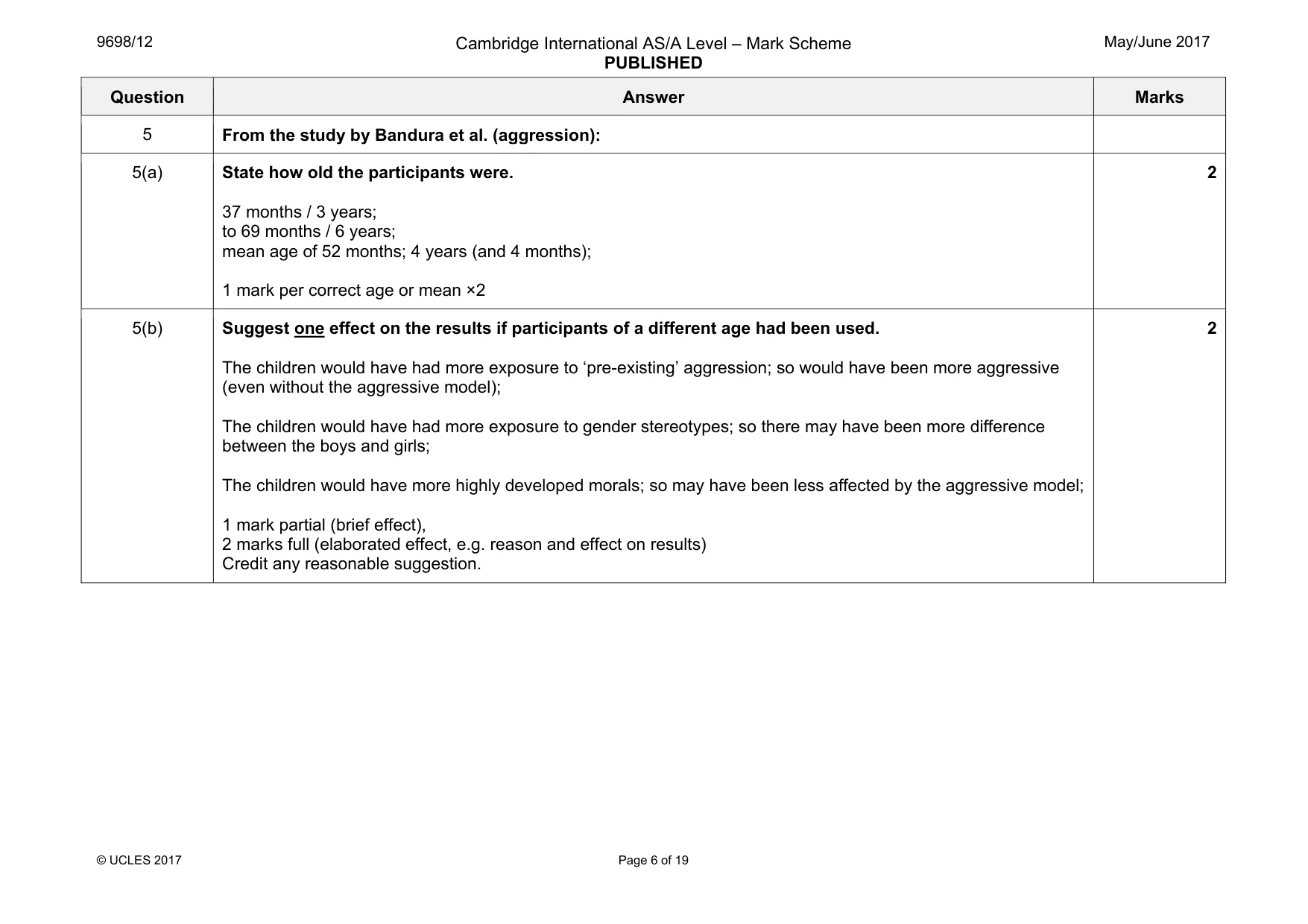
9698/12 Cambridge International AS/A Level – Mark Scheme PUBLISHED May/June 2017 © UCLES 2017 Page 6 of 19 Question Answer Marks 5 From the study by Bandura et al. (aggression): 5(a) State how old the participants were. 37 months / 3 years; to 69 months / 6 years; mean age of 52 months; 4 years (and 4 months); 1 mark per correct age or mean ×2 2 5(b) Suggest one effect on the results if participants of a different age had been used. The children would have had more exposure to ‘pre-existing’ aggression; so would have been more aggressive (even without the aggressive model); The children would have had more exposure to gender stereotypes; so there may have been more difference between the boys and girls; The children would have more highly developed morals; so may have been less affected by the aggressive model; 1 mark partial (brief effect), 2 marks full (elaborated effect, e.g. reason and effect on results) Credit any reasonable suggestion. 2
Mark scheme, page 7
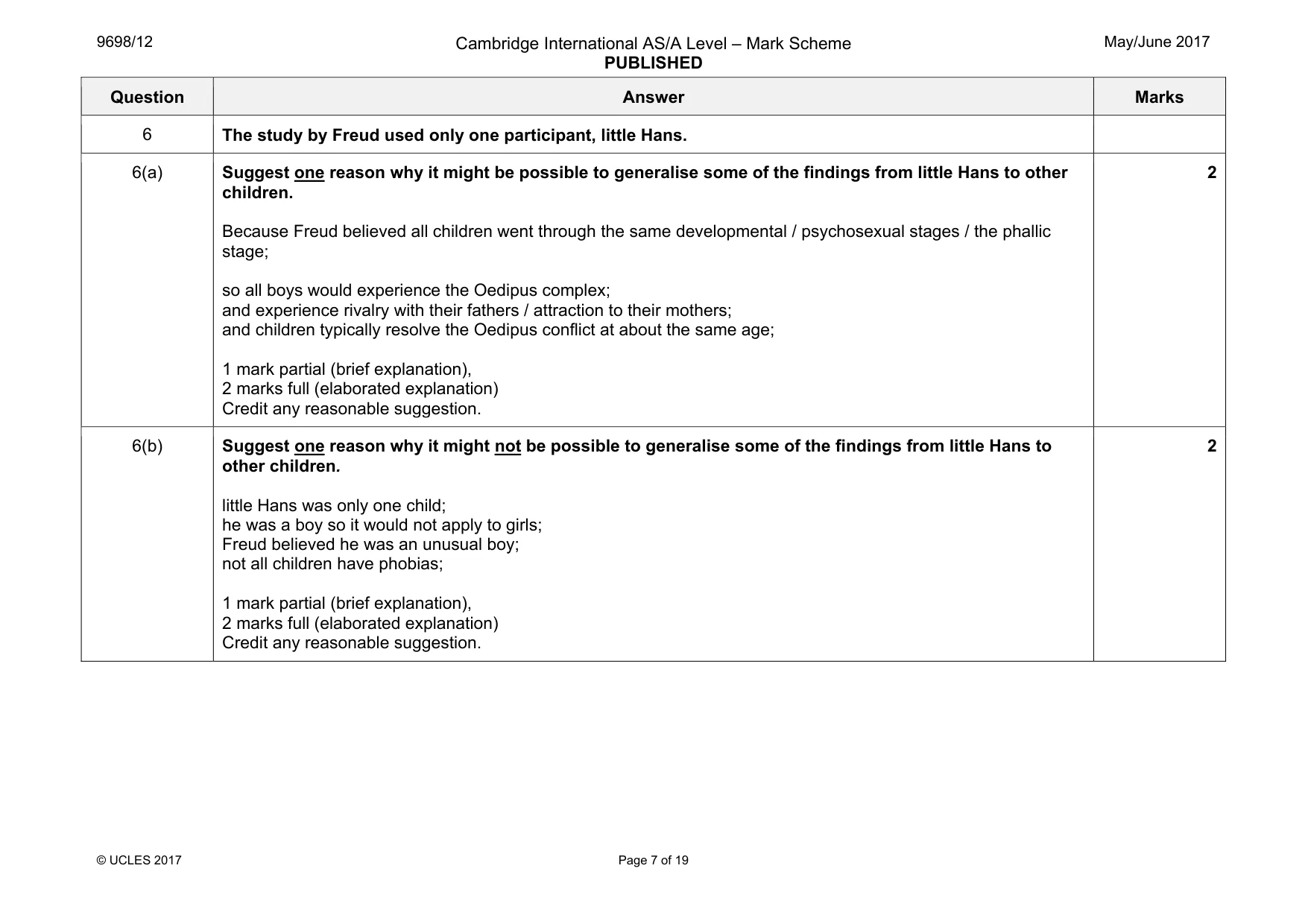
9698/12 Cambridge International AS/A Level – Mark Scheme PUBLISHED May/June 2017 © UCLES 2017 Page 7 of 19 Question Answer Marks 6 The study by Freud used only one participant, little Hans. 6(a) Suggest one reason why it might be possible to generalise some of the findings from little Hans to other children. Because Freud believed all children went through the same developmental / psychosexual stages / the phallic stage; so all boys would experience the Oedipus complex; and experience rivalry with their fathers / attraction to their mothers; and children typically resolve the Oedipus conflict at about the same age; 1 mark partial (brief explanation), 2 marks full (elaborated explanation) Credit any reasonable suggestion. 2 6(b) Suggest one reason why it might not be possible to generalise some of the findings from little Hans to other children. little Hans was only one child; he was a boy so it would not apply to girls; Freud believed he was an unusual boy; not all children have phobias; 1 mark partial (brief explanation), 2 marks full (elaborated explanation) Credit any reasonable suggestion. 2
Mark scheme, page 8
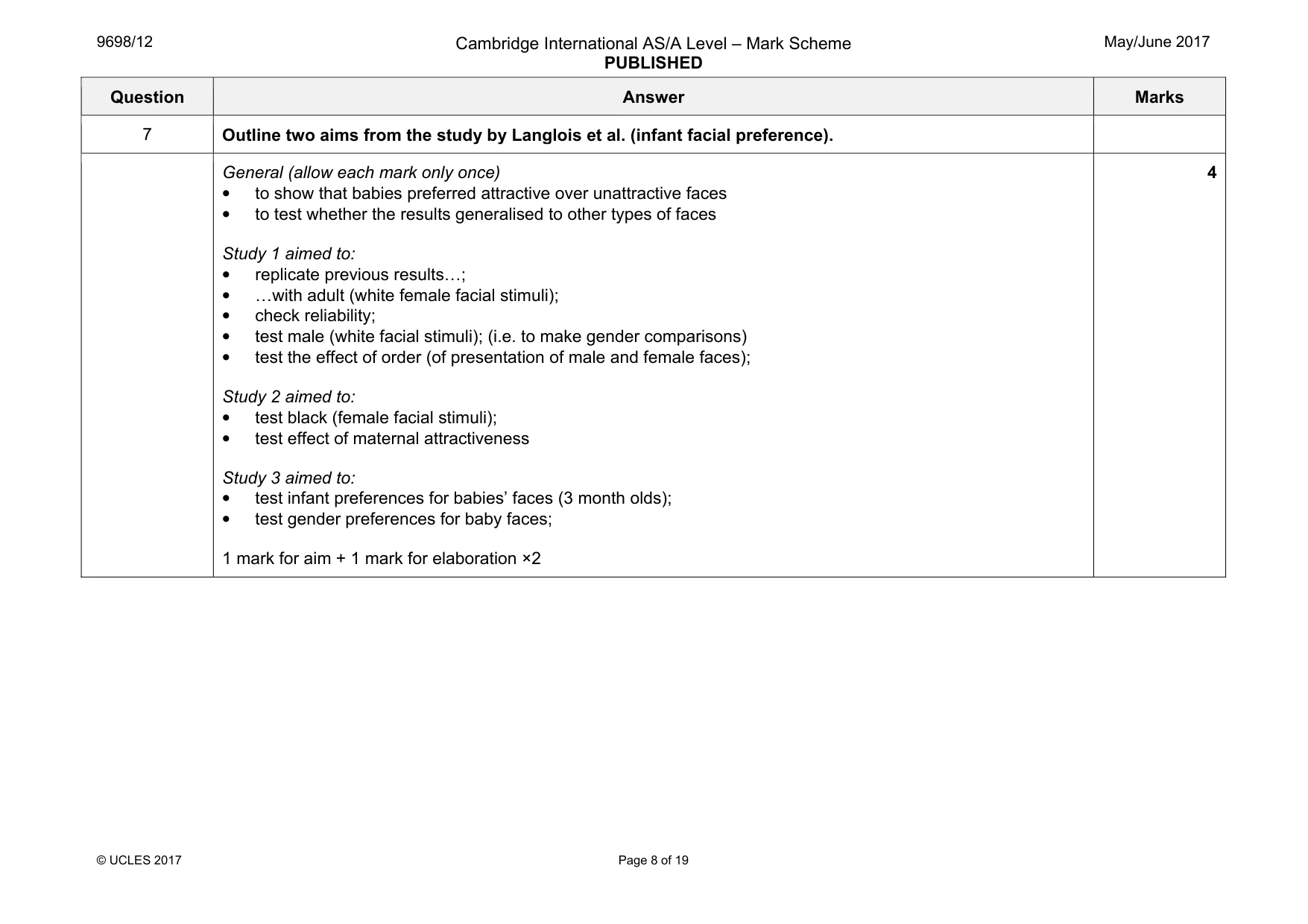
9698/12 Cambridge International AS/A Level – Mark Scheme PUBLISHED May/June 2017 © UCLES 2017 Page 8 of 19 Question Answer Marks 7 Outline two aims from the study by Langlois et al. (infant facial preference). General (allow each mark only once) • to show that babies preferred attractive over unattractive faces • to test whether the results generalised to other types of faces Study 1 aimed to: • replicate previous results«; • «with adult (white female facial stimuli); • check reliability; • test male (white facial stimuli); (i.e. to make gender comparisons) • test the effect of order (of presentation of male and female faces); Study 2 aimed to: • test black (female facial stimuli); • test effect of maternal attractiveness Study 3 aimed to: • test infant preferences for babies’ faces (3 month olds); • test gender preferences for baby faces; 1 mark for aim + 1 mark for elaboration ×2 4
Mark scheme, page 9
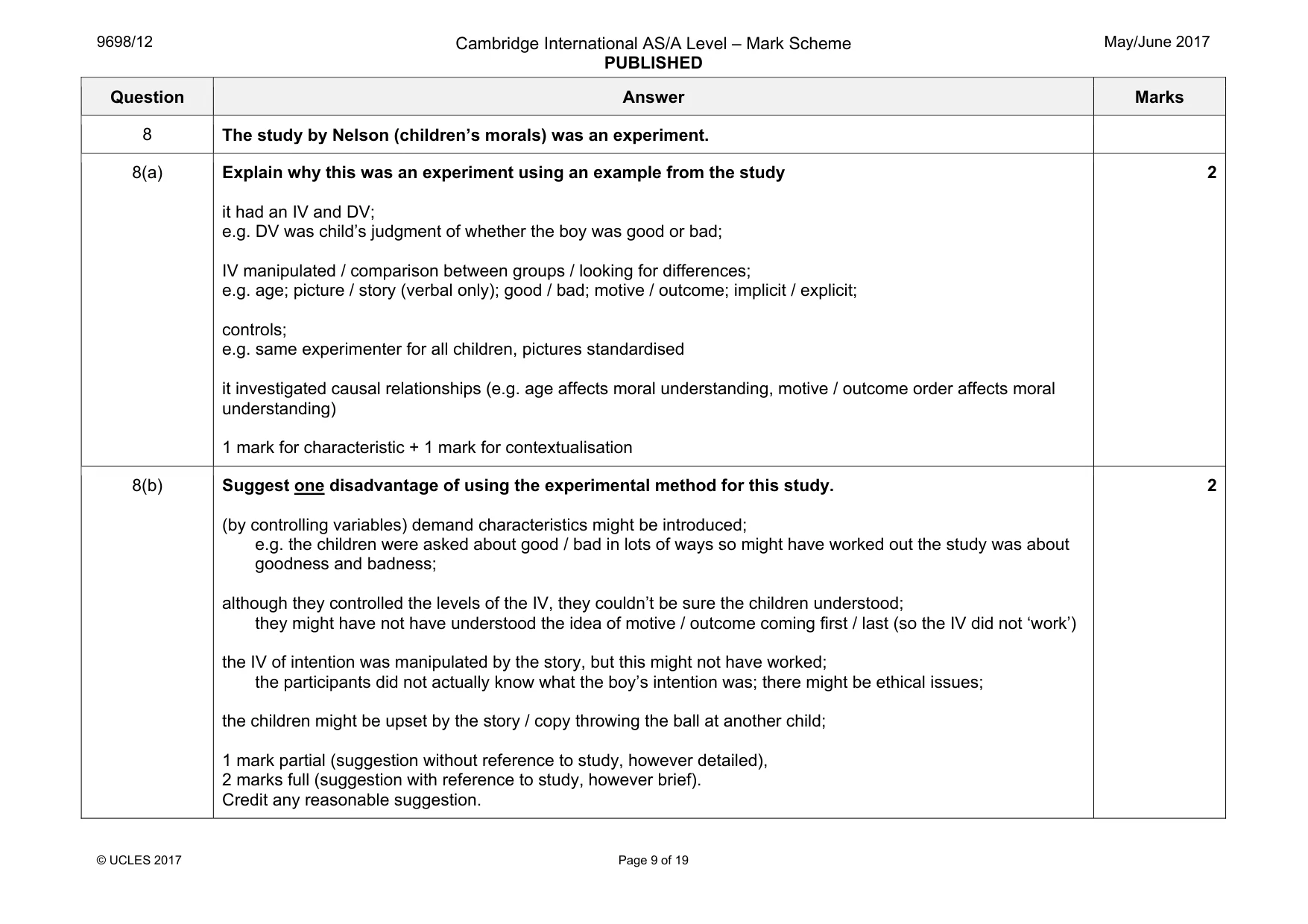
9698/12 Cambridge International AS/A Level – Mark Scheme PUBLISHED May/June 2017 © UCLES 2017 Page 9 of 19 Question Answer Marks 8 The study by Nelson (children’s morals) was an experiment. 8(a) Explain why this was an experiment using an example from the study it had an IV and DV; e.g. DV was child’s judgment of whether the boy was good or bad; IV manipulated / comparison between groups / looking for differences; e.g. age; picture / story (verbal only); good / bad; motive / outcome; implicit / explicit; controls; e.g. same experimenter for all children, pictures standardised it investigated causal relationships (e.g. age affects moral understanding, motive / outcome order affects moral understanding) 1 mark for characteristic + 1 mark for contextualisation 2 8(b) Suggest one disadvantage of using the experimental method for this study. (by controlling variables) demand characteristics might be introduced; e.g. the children were asked about good / bad in lots of ways so might have worked out the study was about goodness and badness; although they controlled the levels of the IV, they couldn’t be sure the children understood; they might have not have understood the idea of motive / outcome coming first / last (so the IV did not ‘work’) the IV of intention was manipulated by the story, but this might not have worked; the participants did not actually know what the boy’s intention was; there might be ethical issues; the children might be upset by the story / copy throwing the ball at another child; 1 mark partial (suggestion without reference to study, however detailed), 2 marks full (suggestion with reference to study, however brief). Credit any reasonable suggestion. 2
Mark scheme, page 10
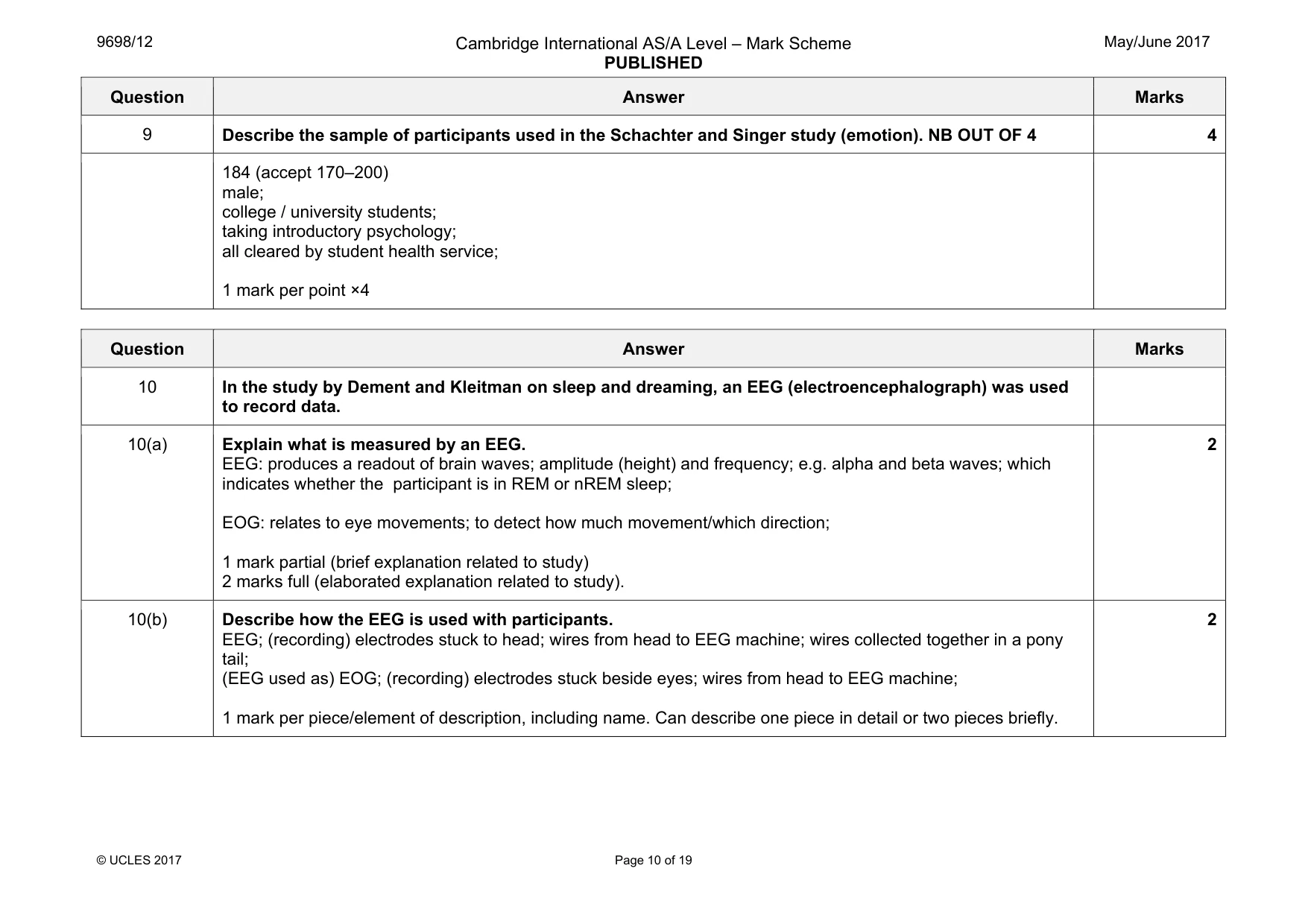
9698/12 Cambridge International AS/A Level – Mark Scheme PUBLISHED May/June 2017 © UCLES 2017 Page 10 of 19 Question Answer Marks 9 Describe the sample of participants used in the Schachter and Singer study (emotion). NB OUT OF 4 4 184 (accept 170–200) male; college / university students; taking introductory psychology; all cleared by student health service; 1 mark per point ×4 Question Answer Marks 10 In the study by Dement and Kleitman on sleep and dreaming, an EEG (electroencephalograph) was used to record data. 10(a) Explain what is measured by an EEG. EEG: produces a readout of brain waves; amplitude (height) and frequency; e.g. alpha and beta waves; which indicates whether the participant is in REM or nREM sleep; EOG: relates to eye movements; to detect how much movement/which direction; 1 mark partial (brief explanation related to study) 2 marks full (elaborated explanation related to study). 2 10(b) Describe how the EEG is used with participants. EEG; (recording) electrodes stuck to head; wires from head to EEG machine; wires collected together in a pony tail; (EEG used as) EOG; (recording) electrodes stuck beside eyes; wires from head to EEG machine; 1 mark per piece/element of description, including name. Can describe one piece in detail or two pieces briefly. 2
Mark scheme, page 11
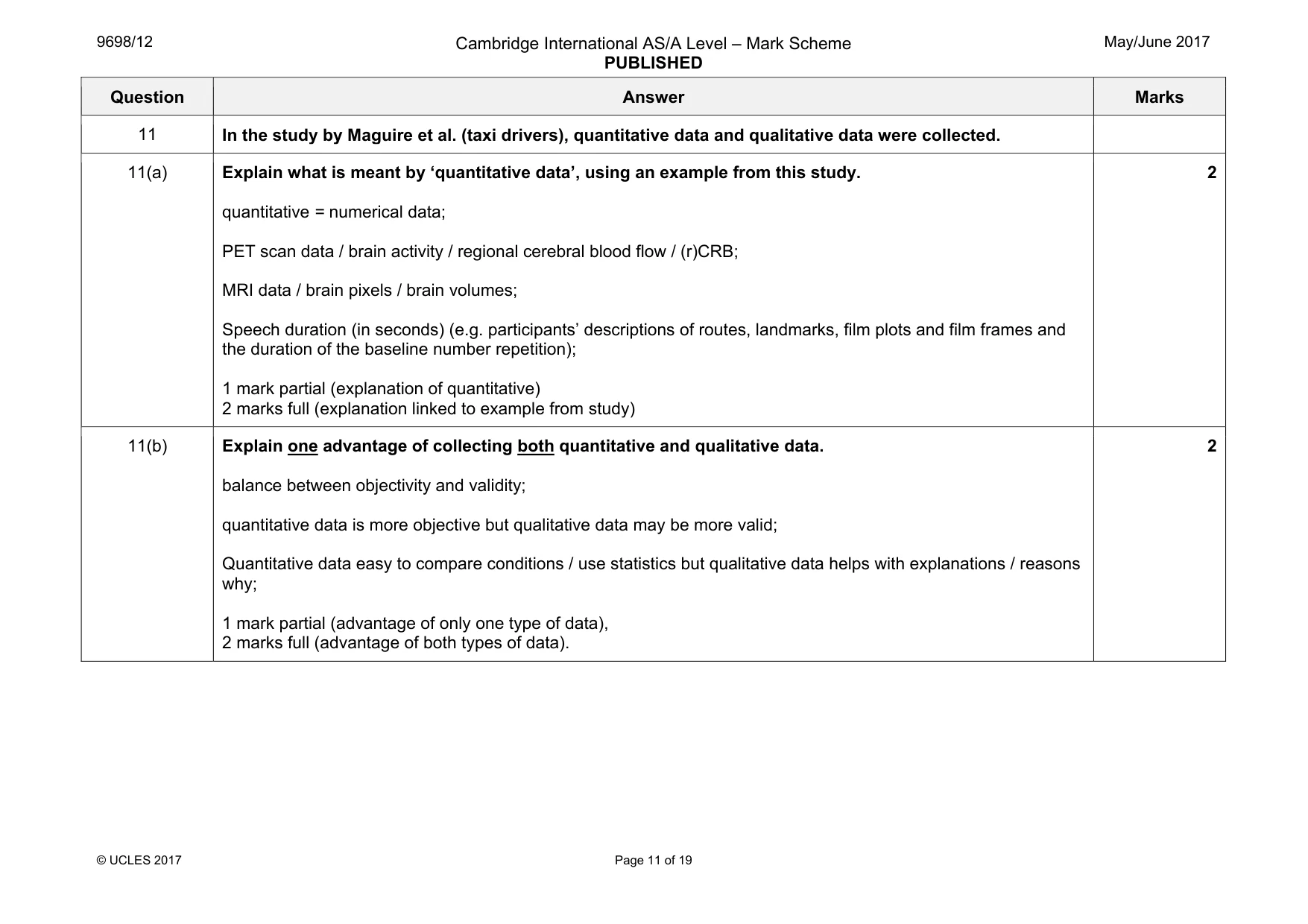
9698/12 Cambridge International AS/A Level – Mark Scheme PUBLISHED May/June 2017 © UCLES 2017 Page 11 of 19 Question Answer Marks 11 In the study by Maguire et al. (taxi drivers), quantitative data and qualitative data were collected. 11(a) Explain what is meant by ‘quantitative data’, using an example from this study. quantitative = numerical data; PET scan data / brain activity / regional cerebral blood flow / (r)CRB; MRI data / brain pixels / brain volumes; Speech duration (in seconds) (e.g. participants’ descriptions of routes, landmarks, film plots and film frames and the duration of the baseline number repetition); 1 mark partial (explanation of quantitative) 2 marks full (explanation linked to example from study) 2 11(b) Explain one advantage of collecting both quantitative and qualitative data. balance between objectivity and validity; quantitative data is more objective but qualitative data may be more valid; Quantitative data easy to compare conditions / use statistics but qualitative data helps with explanations / reasons why; 1 mark partial (advantage of only one type of data), 2 marks full (advantage of both types of data). 2
Mark scheme, page 12
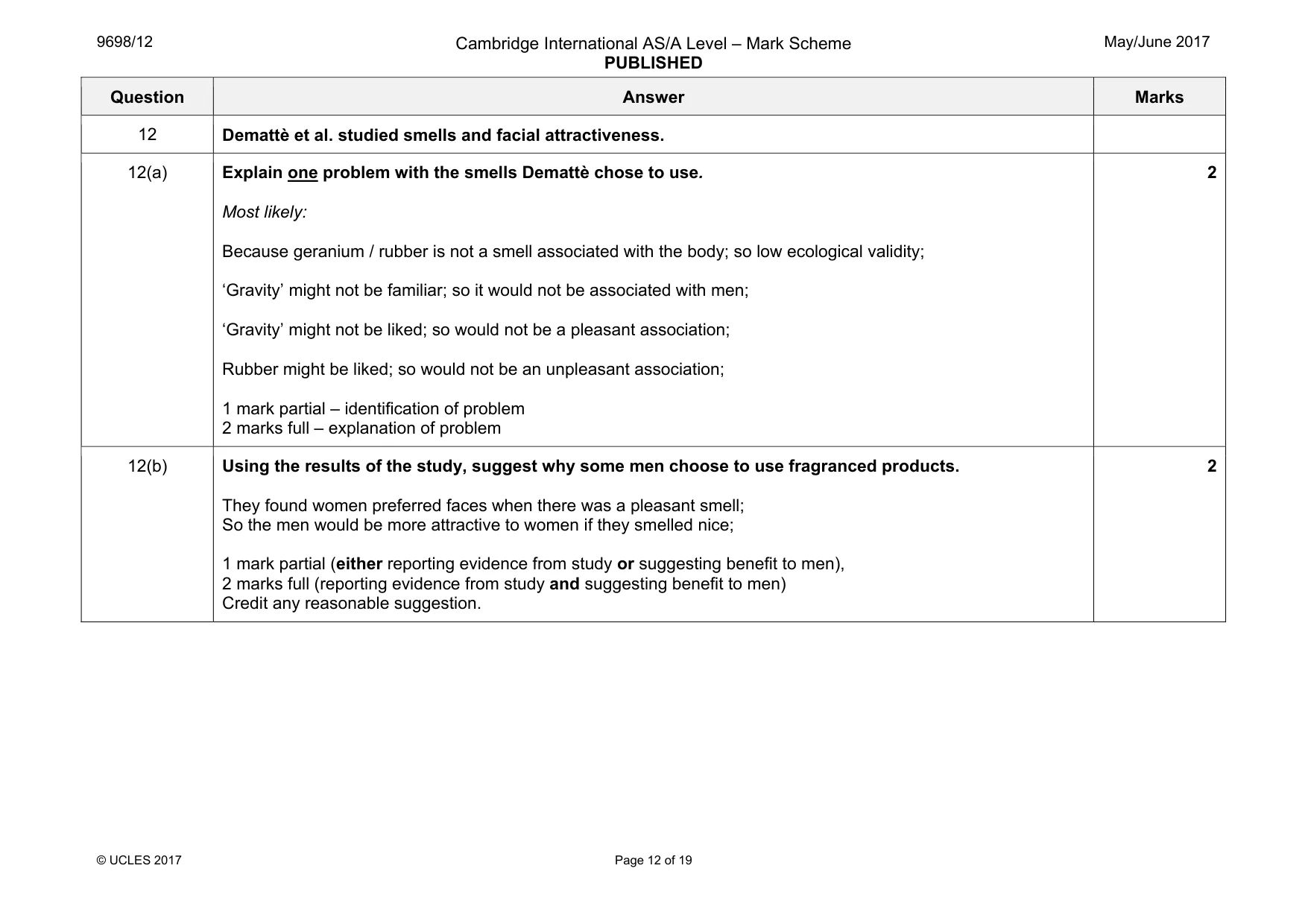
9698/12 Cambridge International AS/A Level – Mark Scheme PUBLISHED May/June 2017 © UCLES 2017 Page 12 of 19 Question Answer Marks 12 Demattè et al. studied smells and facial attractiveness. 12(a) Explain one problem with the smells Demattè chose to use. Most likely: Because geranium / rubber is not a smell associated with the body; so low ecological validity; ‘Gravity’ might not be familiar; so it would not be associated with men; ‘Gravity’ might not be liked; so would not be a pleasant association; Rubber might be liked; so would not be an unpleasant association; 1 mark partial – identification of problem 2 marks full – explanation of problem 2 12(b) Using the results of the study, suggest why some men choose to use fragranced products. They found women preferred faces when there was a pleasant smell; So the men would be more attractive to women if they smelled nice; 1 mark partial (either reporting evidence from study or suggesting benefit to men), 2 marks full (reporting evidence from study and suggesting benefit to men) Credit any reasonable suggestion. 2
Mark scheme, page 13
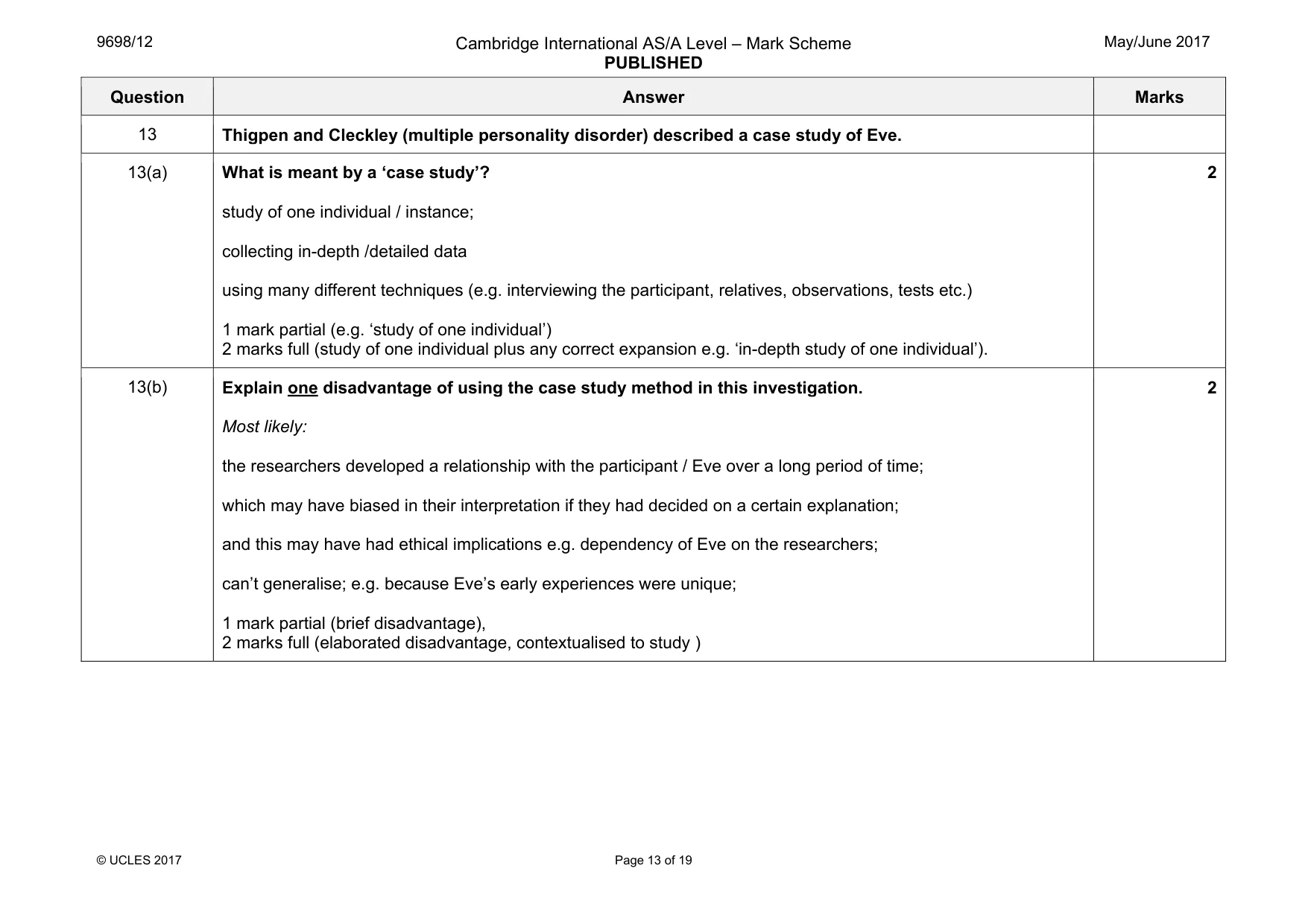
9698/12 Cambridge International AS/A Level – Mark Scheme PUBLISHED May/June 2017 © UCLES 2017 Page 13 of 19 Question Answer Marks 13 Thigpen and Cleckley (multiple personality disorder) described a case study of Eve. 13(a) What is meant by a ‘case study’? study of one individual / instance; collecting in-depth /detailed data using many different techniques (e.g. interviewing the participant, relatives, observations, tests etc.) 1 mark partial (e.g. ‘study of one individual’) 2 marks full (study of one individual plus any correct expansion e.g. ‘in-depth study of one individual’). 2 13(b) Explain one disadvantage of using the case study method in this investigation. Most likely: the researchers developed a relationship with the participant / Eve over a long period of time; which may have biased in their interpretation if they had decided on a certain explanation; and this may have had ethical implications e.g. dependency of Eve on the researchers; can’t generalise; e.g. because Eve’s early experiences were unique; 1 mark partial (brief disadvantage), 2 marks full (elaborated disadvantage, contextualised to study ) 2
Mark scheme, page 14
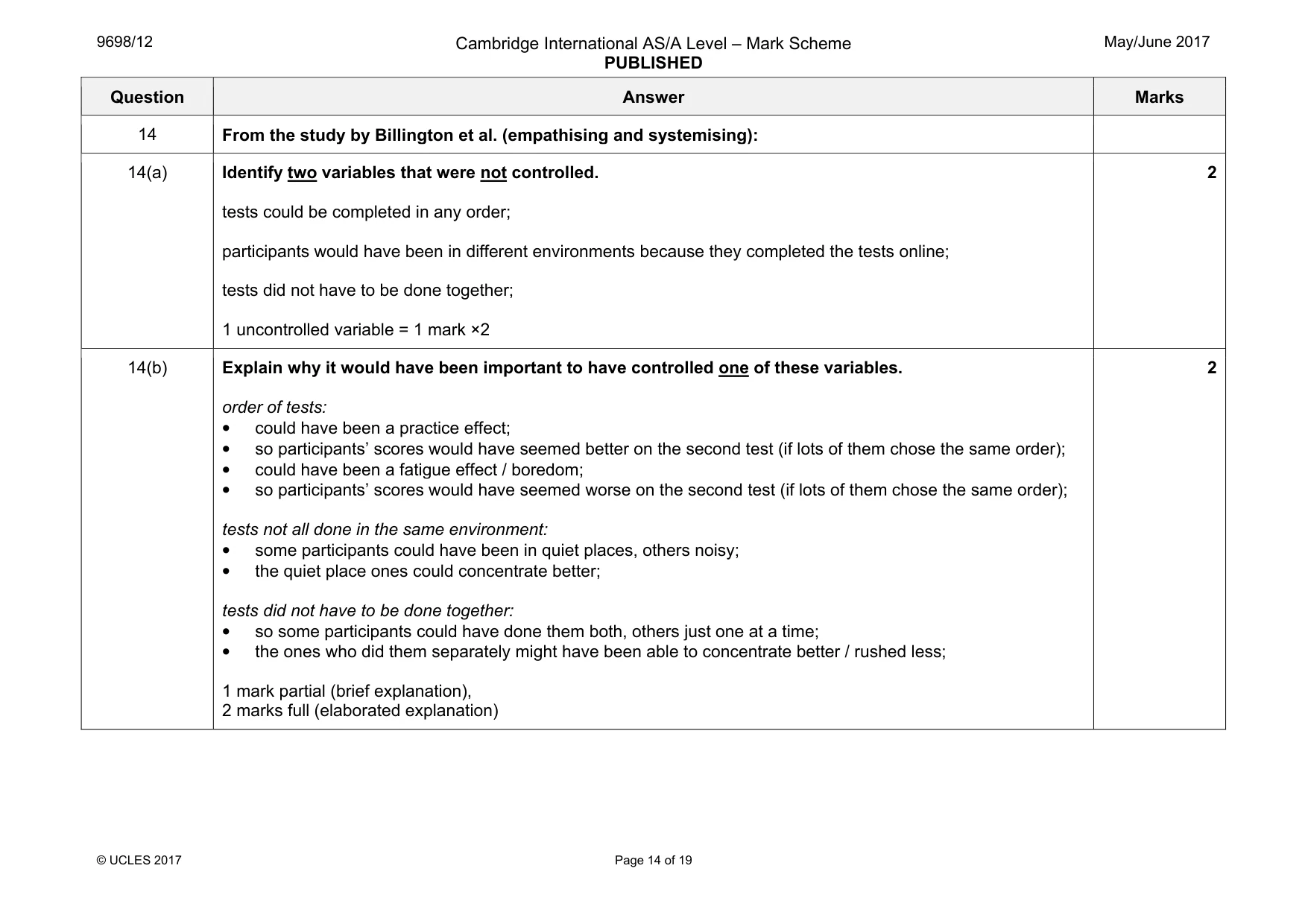
9698/12 Cambridge International AS/A Level – Mark Scheme PUBLISHED May/June 2017 © UCLES 2017 Page 14 of 19 Question Answer Marks 14 From the study by Billington et al. (empathising and systemising): 14(a) Identify two variables that were not controlled. tests could be completed in any order; participants would have been in different environments because they completed the tests online; tests did not have to be done together; 1 uncontrolled variable = 1 mark ×2 2 14(b) Explain why it would have been important to have controlled one of these variables. order of tests: • could have been a practice effect; • so participants’ scores would have seemed better on the second test (if lots of them chose the same order); • could have been a fatigue effect / boredom; • so participants’ scores would have seemed worse on the second test (if lots of them chose the same order); tests not all done in the same environment: • some participants could have been in quiet places, others noisy; • the quiet place ones could concentrate better; tests did not have to be done together: • so some participants could have done them both, others just one at a time; • the ones who did them separately might have been able to concentrate better / rushed less; 1 mark partial (brief explanation), 2 marks full (elaborated explanation) 2
Mark scheme, page 15
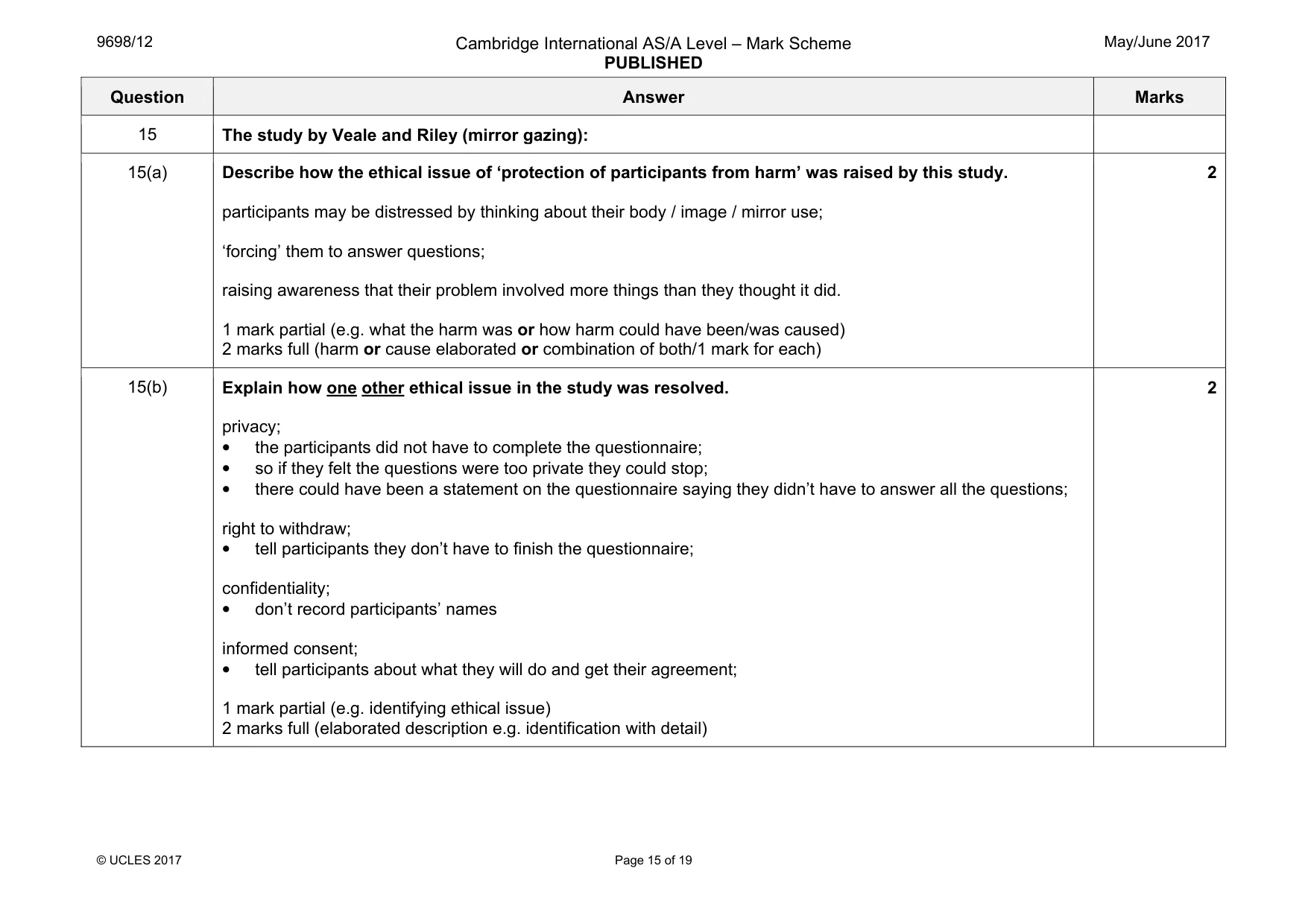
9698/12 Cambridge International AS/A Level – Mark Scheme PUBLISHED May/June 2017 © UCLES 2017 Page 15 of 19 Question Answer Marks 15 The study by Veale and Riley (mirror gazing): 15(a) Describe how the ethical issue of ‘protection of participants from harm’ was raised by this study. participants may be distressed by thinking about their body / image / mirror use; ‘forcing’ them to answer questions; raising awareness that their problem involved more things than they thought it did. 1 mark partial (e.g. what the harm was or how harm could have been/was caused) 2 marks full (harm or cause elaborated or combination of both/1 mark for each) 2 15(b) Explain how one other ethical issue in the study was resolved. privacy; • the participants did not have to complete the questionnaire; • so if they felt the questions were too private they could stop; • there could have been a statement on the questionnaire saying they didn’t have to answer all the questions; right to withdraw; • tell participants they don’t have to finish the questionnaire; confidentiality; • don’t record participants’ names informed consent; • tell participants about what they will do and get their agreement; 1 mark partial (e.g. identifying ethical issue) 2 marks full (elaborated description e.g. identification with detail) 2
Mark scheme, page 16
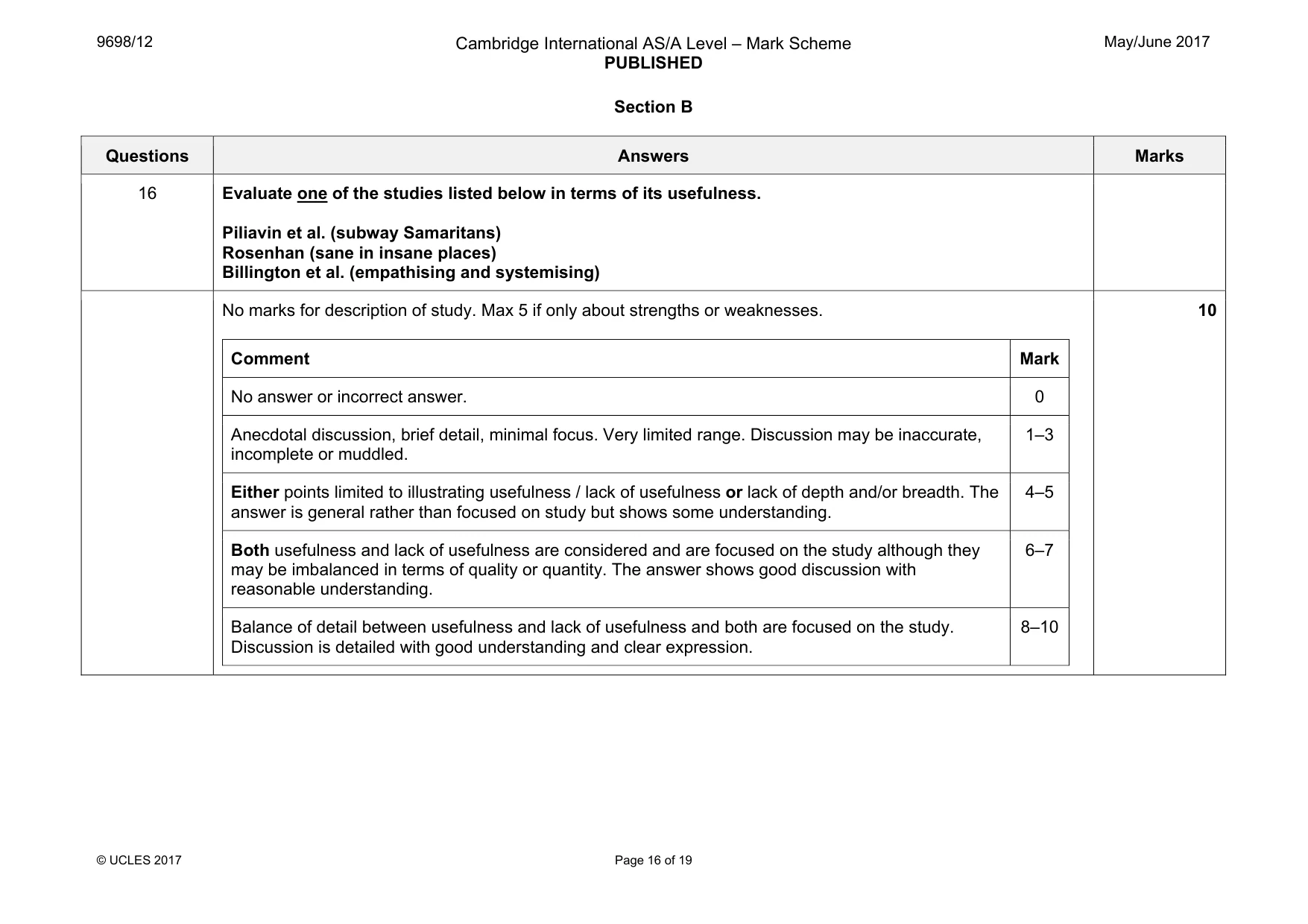
9698/12 Cambridge International AS/A Level – Mark Scheme PUBLISHED May/June 2017 © UCLES 2017 Page 16 of 19 Section B Questions Answers Marks 16 Evaluate one of the studies listed below in terms of its usefulness. Piliavin et al. (subway Samaritans) Rosenhan (sane in insane places) Billington et al. (empathising and systemising) No marks for description of study. Max 5 if only about strengths or weaknesses. Comment Mark No answer or incorrect answer. 0 Anecdotal discussion, brief detail, minimal focus. Very limited range. Discussion may be inaccurate, incomplete or muddled. 1–3 Either points limited to illustrating usefulness / lack of usefulness or lack of depth and/or breadth. The answer is general rather than focused on study but shows some understanding. 4–5 Both usefulness and lack of usefulness are considered and are focused on the study although they may be imbalanced in terms of quality or quantity. The answer shows good discussion with reasonable understanding. 6–7 Balance of detail between usefulness and lack of usefulness and both are focused on the study. Discussion is detailed with good understanding and clear expression. 8–10 10
Mark scheme, page 17
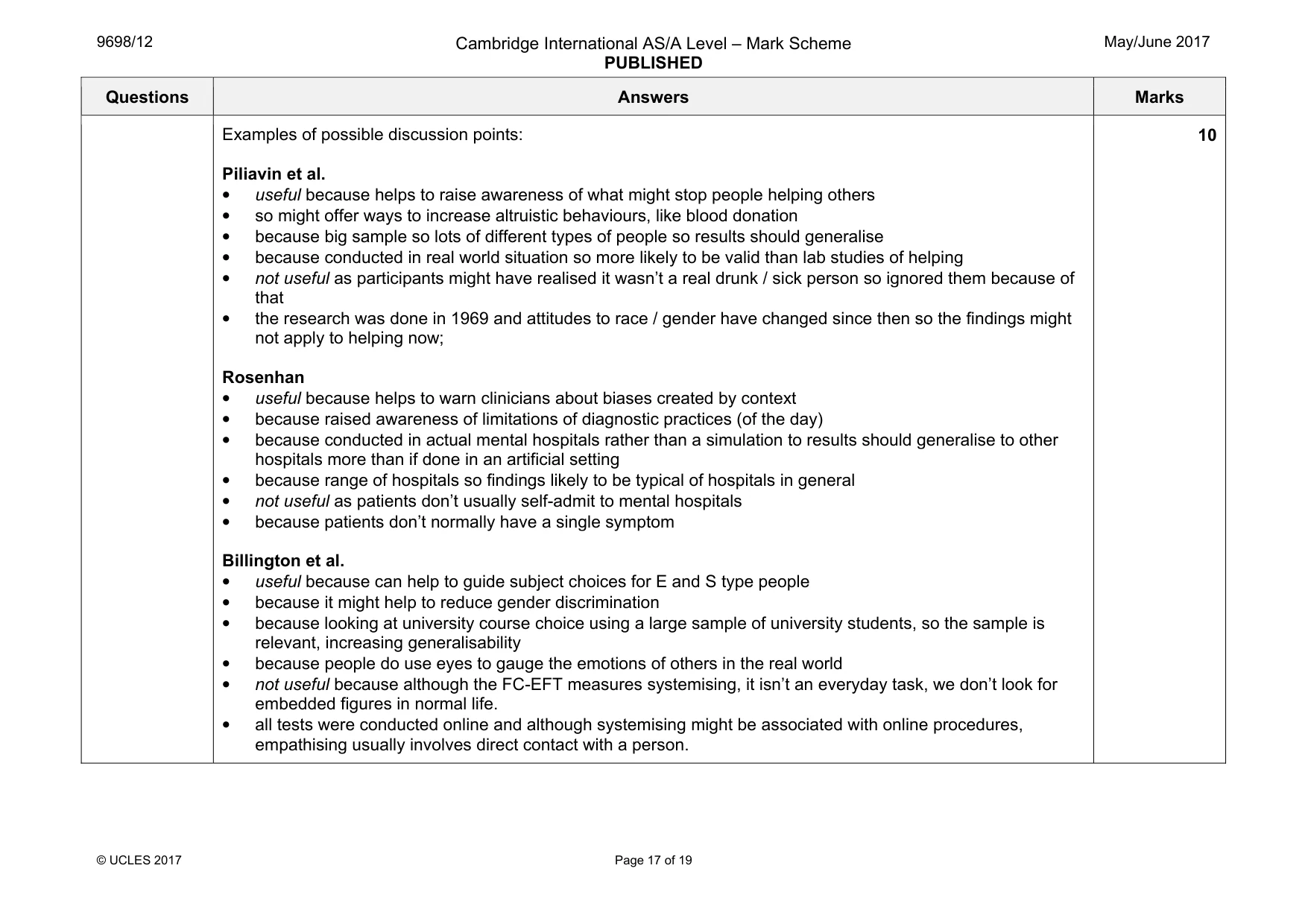
9698/12 Cambridge International AS/A Level – Mark Scheme PUBLISHED May/June 2017 © UCLES 2017 Page 17 of 19 Questions Answers Marks Examples of possible discussion points: Piliavin et al. • useful because helps to raise awareness of what might stop people helping others • so might offer ways to increase altruistic behaviours, like blood donation • because big sample so lots of different types of people so results should generalise • because conducted in real world situation so more likely to be valid than lab studies of helping • not useful as participants might have realised it wasn’t a real drunk / sick person so ignored them because of that • the research was done in 1969 and attitudes to race / gender have changed since then so the findings might not apply to helping now; Rosenhan • useful because helps to warn clinicians about biases created by context • because raised awareness of limitations of diagnostic practices (of the day) • because conducted in actual mental hospitals rather than a simulation to results should generalise to other hospitals more than if done in an artificial setting • because range of hospitals so findings likely to be typical of hospitals in general • not useful as patients don’t usually self-admit to mental hospitals • because patients don’t normally have a single symptom Billington et al. • useful because can help to guide subject choices for E and S type people • because it might help to reduce gender discrimination • because looking at university course choice using a large sample of university students, so the sample is relevant, increasing generalisability • because people do use eyes to gauge the emotions of others in the real world • not useful because although the FC-EFT measures systemising, it isn’t an everyday task, we don’t look for embedded figures in normal life. • all tests were conducted online and although systemising might be associated with online procedures, empathising usually involves direct contact with a person. 10
Mark scheme, page 18
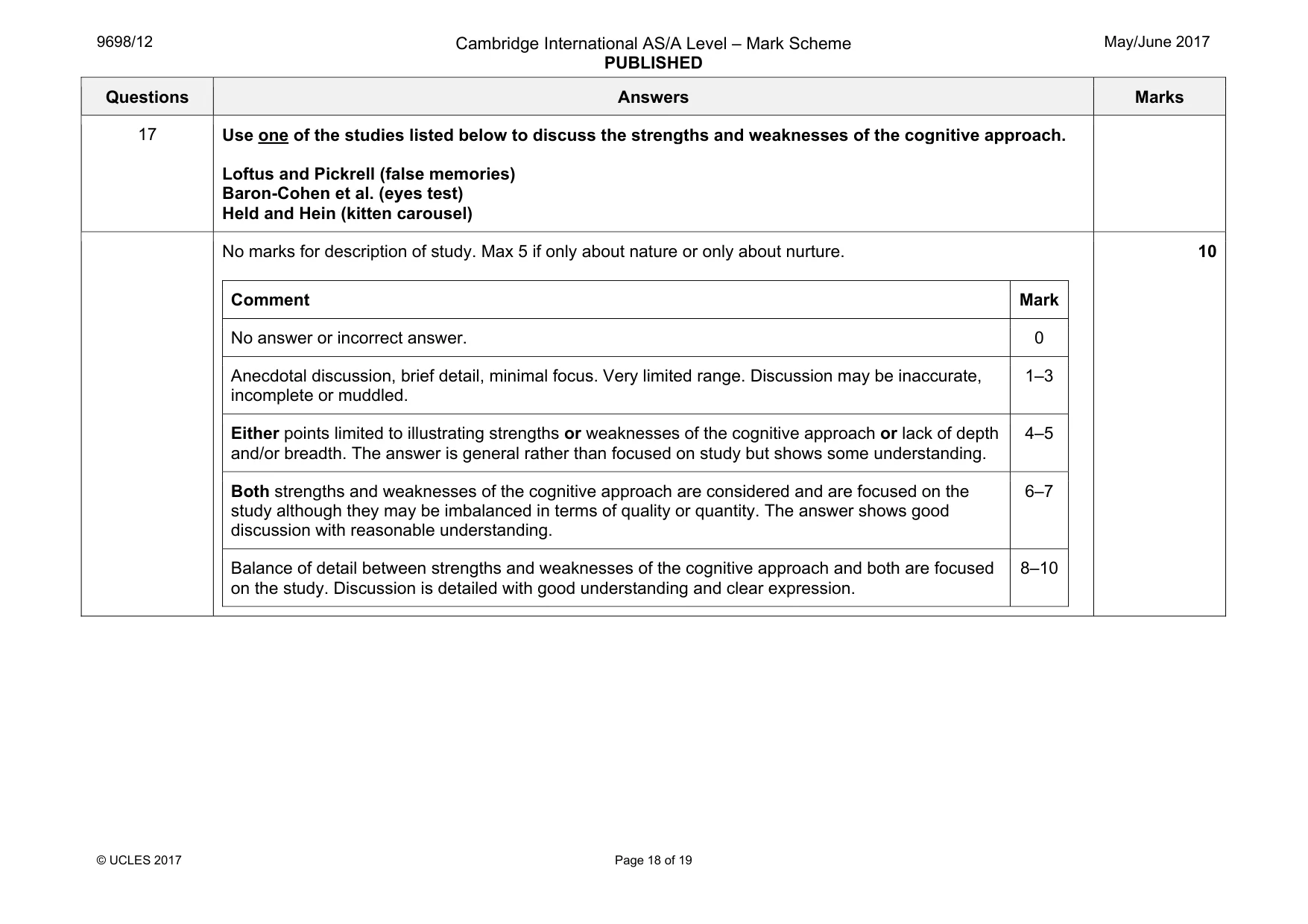
9698/12 Cambridge International AS/A Level – Mark Scheme PUBLISHED May/June 2017 © UCLES 2017 Page 18 of 19 Questions Answers Marks 17 Use one of the studies listed below to discuss the strengths and weaknesses of the cognitive approach. Loftus and Pickrell (false memories) Baron-Cohen et al. (eyes test) Held and Hein (kitten carousel) No marks for description of study. Max 5 if only about nature or only about nurture. Comment Mark No answer or incorrect answer. 0 Anecdotal discussion, brief detail, minimal focus. Very limited range. Discussion may be inaccurate, incomplete or muddled. 1–3 Either points limited to illustrating strengths or weaknesses of the cognitive approach or lack of depth and/or breadth. The answer is general rather than focused on study but shows some understanding. 4–5 Both strengths and weaknesses of the cognitive approach are considered and are focused on the study although they may be imbalanced in terms of quality or quantity. The answer shows good discussion with reasonable understanding. 6–7 Balance of detail between strengths and weaknesses of the cognitive approach and both are focused on the study. Discussion is detailed with good understanding and clear expression. 8–10 10
Mark scheme, page 19
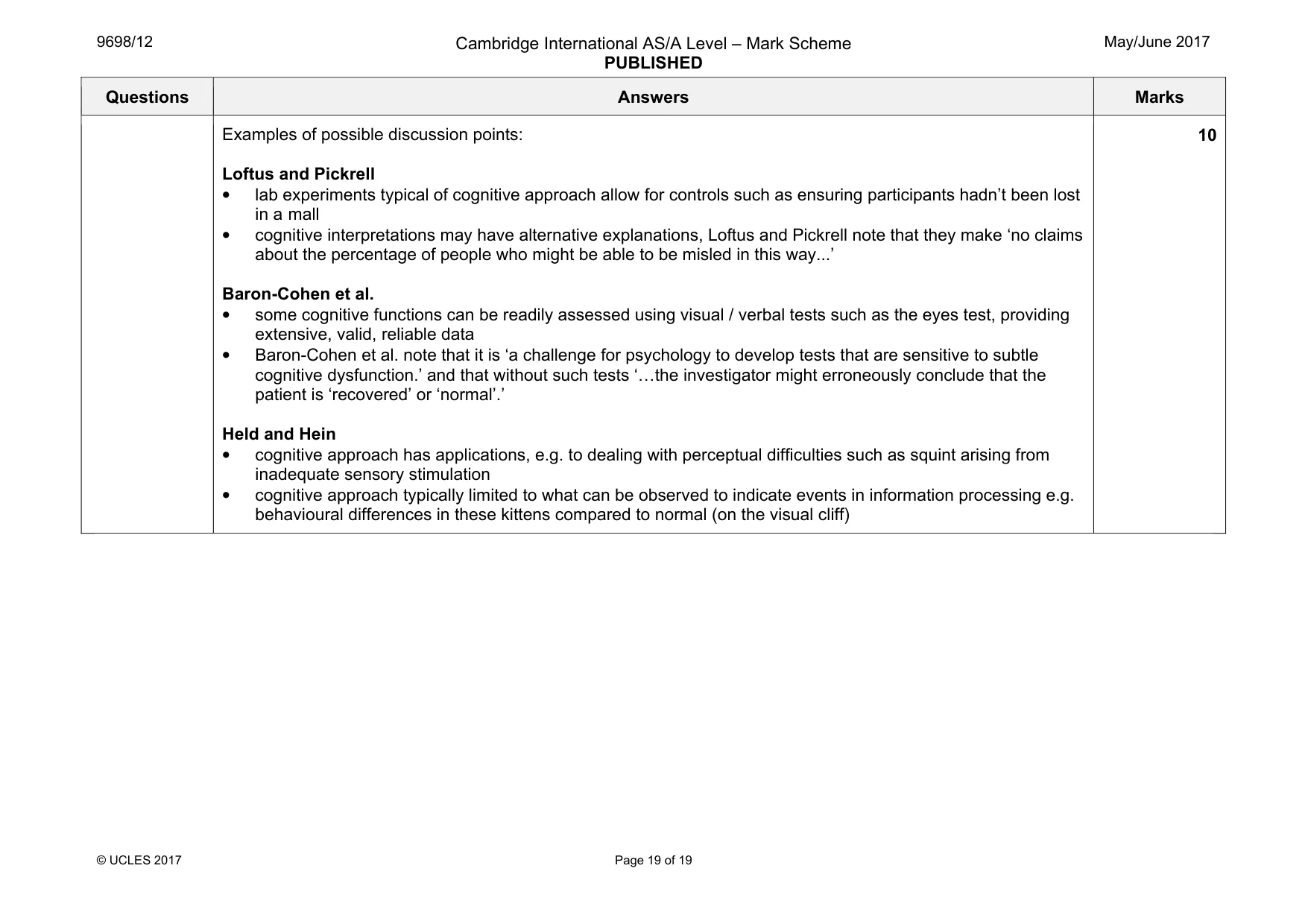
9698/12 Cambridge International AS/A Level – Mark Scheme PUBLISHED May/June 2017 © UCLES 2017 Page 19 of 19 Questions Answers Marks Examples of possible discussion points: Loftus and Pickrell • lab experiments typical of cognitive approach allow for controls such as ensuring participants hadn’t been lost in a mall • cognitive interpretations may have alternative explanations, Loftus and Pickrell note that they make ‘no claims about the percentage of people who might be able to be misled in this way...’ Baron-Cohen et al. • some cognitive functions can be readily assessed using visual / verbal tests such as the eyes test, providing extensive, valid, reliable data • Baron-Cohen et al. note that it is ‘a challenge for psychology to develop tests that are sensitive to subtle cognitive dysfunction.’ and that without such tests ‘«the investigator might erroneously conclude that the patient is ‘recovered’ or ‘normal’.’ Held and Hein • cognitive approach has applications, e.g. to dealing with perceptual difficulties such as squint arising from inadequate sensory stimulation • cognitive approach typically limited to what can be observed to indicate events in information processing e.g. behavioural differences in these kittens compared to normal (on the visual cliff) 10
What you needed in this session
Cambridge’s own grade thresholds for 2017 May/June, Paper 1 · Variant 2. A higher threshold means an easier paper — the bar moves with how the cohort did.