Questions as text
Q1 · A diffraction grating is used to determine the wavelength of light 9702/23 May/June 2017
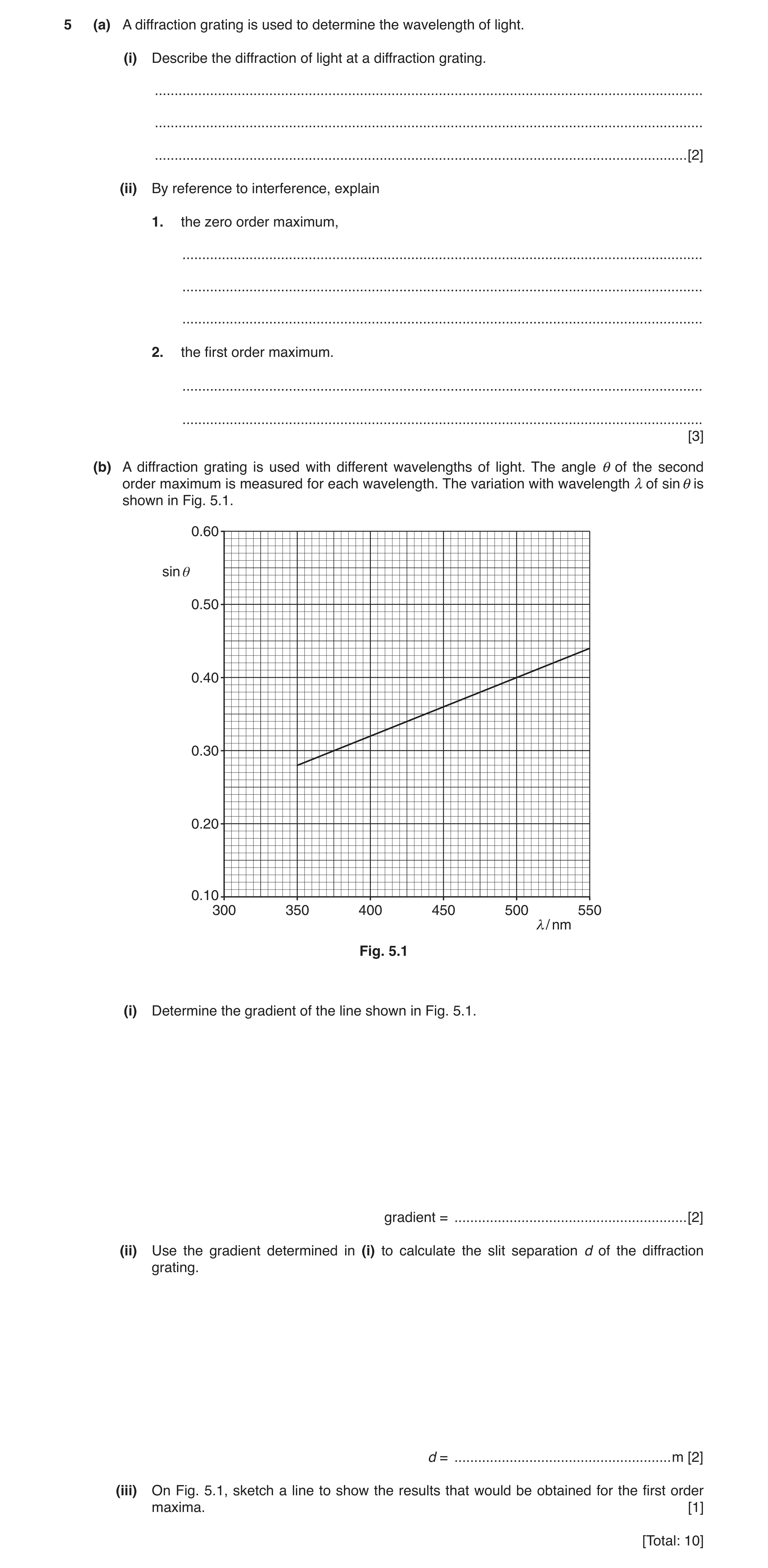
5 (a) A diffraction grating is used to determine the wavelength of light. (i) Describe the diffraction of light at a diffraction grating. … … … [2] (ii) By reference to interference, explain 1. the zero order maximum, … … … 2. the first order maximum. … … [3] (b) A diffraction grating is used with different wavelengths of light. The angle θ of the second order maximum is measured for each wavelength. The variation with wavelength λ of sin θ is shown in Fig. 5.1. 0.60 sinθ 0.50 0.40 0.30 0.20 0.10 300 350 400 450 500 550 λ/ nm Fig. 5.1 (i) Determine the gradient of the line shown in Fig. 5.1. gradient = … [2] (ii) Use the gradient determined in (i) to calculate the slit separation d of the diffraction grating. d = … m [2] (iii) On Fig. 5.1, sketch a line to show the results that would be obtained for the first order maxima. [1] [Total: 10]
10 marks
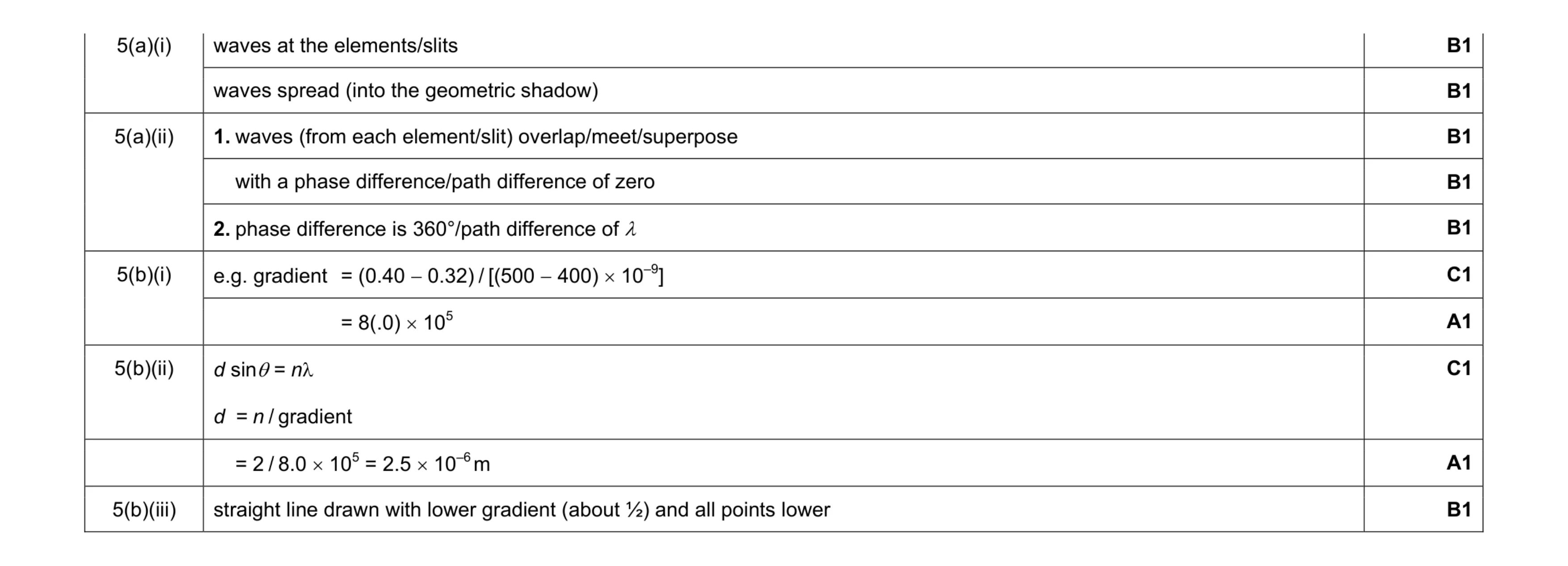
Mark scheme: 5(a)(i) waves at the elements/slits B1 waves spread (into the geometric shadow) B1 5(a)(ii) 1. waves (from each element/slit) overlap/meet/superpose B1 with a phase difference/path difference of zero B1 2. phase difference is 360°/path difference of λ B1 5(b)(i) e.g. gradient = (0.40 − 0.32) / [(500 − 400) × 10–9] C1 = 8(.0) × 105 A1 5(b)(ii) d sinθ = nλ d = n / gradient C1 = 2 / 8.0 × 105 = 2.5 × 10⁻⁶m A1 5(b)(iii) straight line drawn with lower gradient (about ½) and all points lower B1
This question in 9702/23 May/June 2017
Q2 · When monochromatic light is incident normally on a diffraction grating, the emergent… 9702/21 May/June 2018
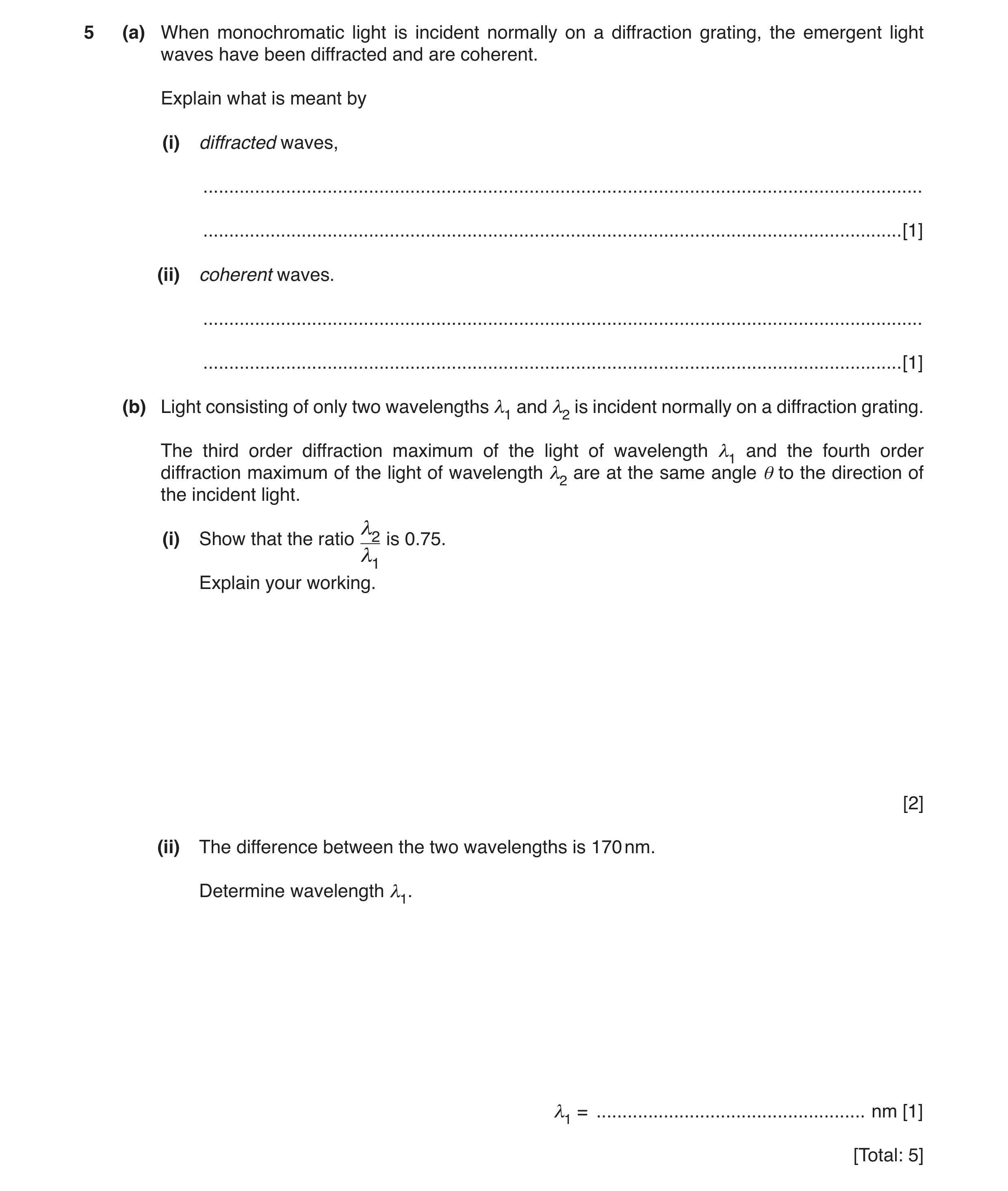
5 (a) When monochromatic light is incident normally on a diffraction grating, the emergent light waves have been diffracted and are coherent. Explain what is meant by (i) diffracted waves, … … [1] (ii) coherent waves. … … [1] (b) Light consisting of only two wavelengths λ1 and λ2 is incident normally on a diffraction grating. The third order diffraction maximum of the light of wavelength λ1 and the fourth order θ to the direction of diffraction maximum of the light of wavelength λ2 are at the same angle the incident light. (i) Show that the ratio λ2 is 0.75. λ1 Explain your working. [2] (ii) The difference between the two wavelengths is 170 nm. Determine wavelength λ1. λ1 = … nm [1] [Total: 5]
5 marks
Mark scheme: 5(a)(i) waves spread at (each) slit/gap B1 5(a)(ii) constant phase difference (between (each of) the waves) B1 5(b)(i) nλ = d sin θ B1 d sin θ is the same and 3λ1 = 4λ2 so λ2 / λ1 = 0.75 A1 5(b)(ii) λ2 / λ1 = 0.75 and λ1 – λ2 = 170 λ1 = 680 nm A1
This question in 9702/21 May/June 2018
Q3 · Red light of wavelength 640 nm is incident normally on a diffraction grating having a… 9702/22 Oct/Nov 2018
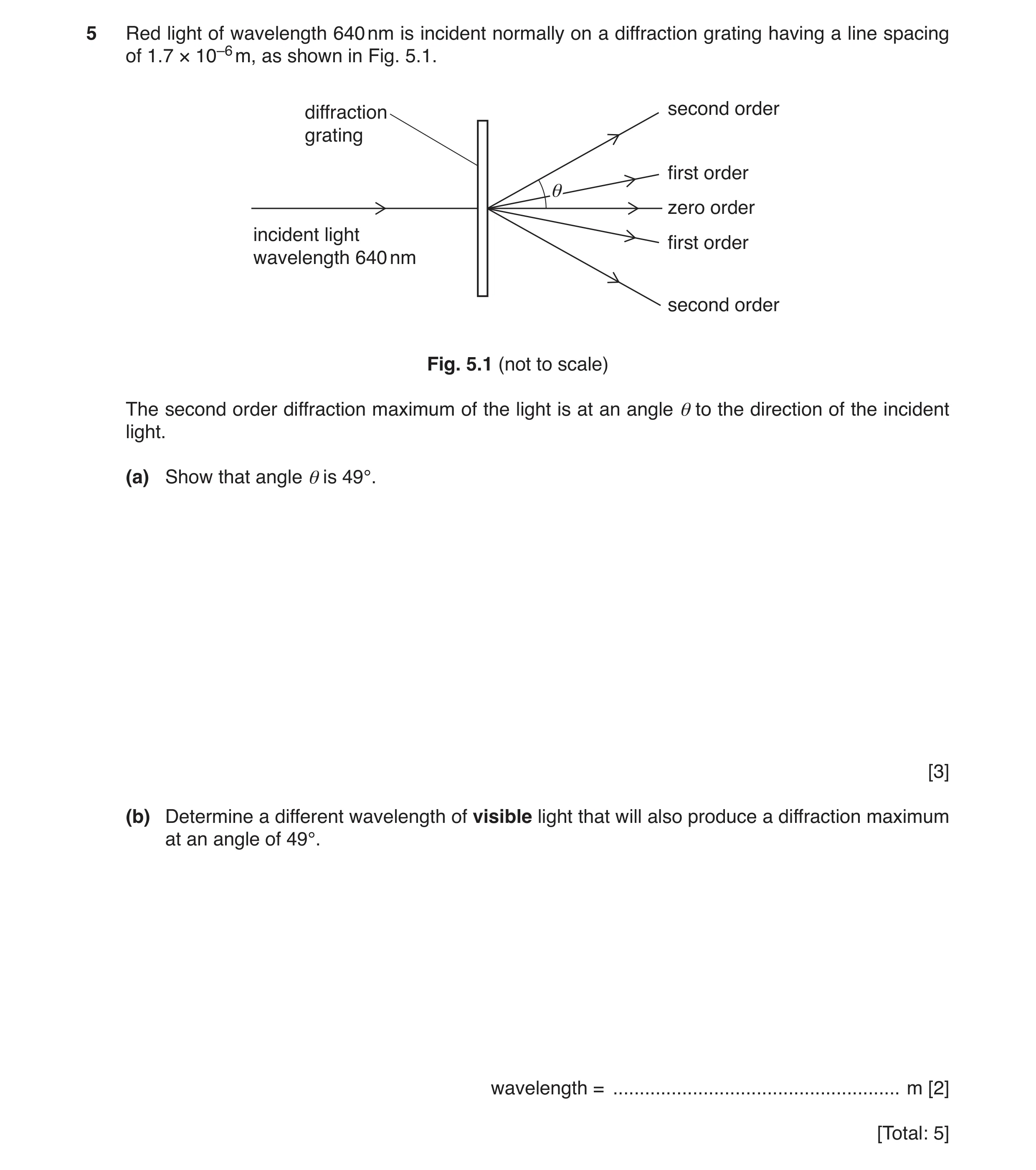
5 Red light of wavelength 640 nm is incident normally on a diffraction grating having a line spacing of 1.7 × 10⁻⁶ m, as shown in Fig. 5.1. diffraction second order grating first order θ zero order incident light first order wavelength 640 nm second order Fig. 5.1 (not to scale) The second order diffraction maximum of the light is at an angle θ to the direction of the incident light. (a) Show that angle θ is 49°. [3] (b) Determine a different wavelength of visible light that will also produce a diffraction maximum at an angle of 49°. wavelength = … m [2] [Total: 5]
5 marks
Mark scheme: 5(a) C1 λ = 640 × 10–9 (m) C1 2 × 640 × 10–9 = 1.7 × 10⁻⁶ × sinθ so θ = 49(°) A1 5(b) 2 × 640 × 10–9 = 3 × λ or 1.7 × 10⁻⁶ × sin 49° = 3 × λ C1 λ = 4.3 × 10⁻⁷ m A1
This question in 9702/22 Oct/Nov 2018
Q4 · For a progressive water wave, state what is meant by: (i) displacement … … [1] (ii)… 9702/22 May/June 2019
4 (a) For a progressive water wave, state what is meant by: (i) displacement … … [1] (ii) amplitude. … … [1] (b) Two coherent waves X and Y meet at a point and superpose. The phase difference between the waves at the point is 180°. Wave X has an amplitude of 1.2 cm and intensity I. Wave Y has an amplitude of 3.6 cm. Calculate, in terms of I, the resultant intensity at the meeting point. intensity = … [2] (c) (i) Monochromatic light is incident on a diffraction grating. Describe the diffraction of the light waves as they pass through the grating. … … … [2] (ii) A parallel beam of light consists of two wavelengths 540 nm and 630 nm. The light is incident normally on a diffraction grating. Third-order diffraction maxima are produced for each of the two wavelengths. No higher orders are produced for either wavelength. Determine the smallest possible line spacing d of the diffraction grating. d = … m [3] (iii) The beam of light in (c)(ii) is replaced by a beam of blue light incident on the same diffraction grating. State and explain whether a third-order diffraction maximum is produced for this blue light. … … … [2] [Total: 11]
11 marks
Mark scheme: 4(a)(i) distance (in a specified direction of particle/point on wave) from the equilibrium position B1 4(a)(ii) the maximum distance (of particle/point on wave) from the equilibrium position or the maximum displacement (of particle/point on wave) B1 4(b) I ∝ A2 C1 IR / I = (3.6 – 1.2)2 / (1.2)2 resultant intensity = 4.0I A1 4(c)(i) as wave(s) pass through the slit(s) B1 wave(s) spread (into geometric shadow) B1 4(c)(ii) nλ = d sin θ C1 3λ = d sin 90° or 3λ = d C1 d = 3 × 630 × 10–9 = 1.9 × 10⁻⁶ m A1 4(c)(iii) wavelength of blue light is shorter (than 540 nm/630 nm/wavelengths of original light) M1 (so) third order diffraction maximum is produced A1
This question in 9702/22 May/June 2019
Q5 · Light waves emerging from the slits of a diffraction grating are coherent and produce an… 9702/23 Oct/Nov 2019
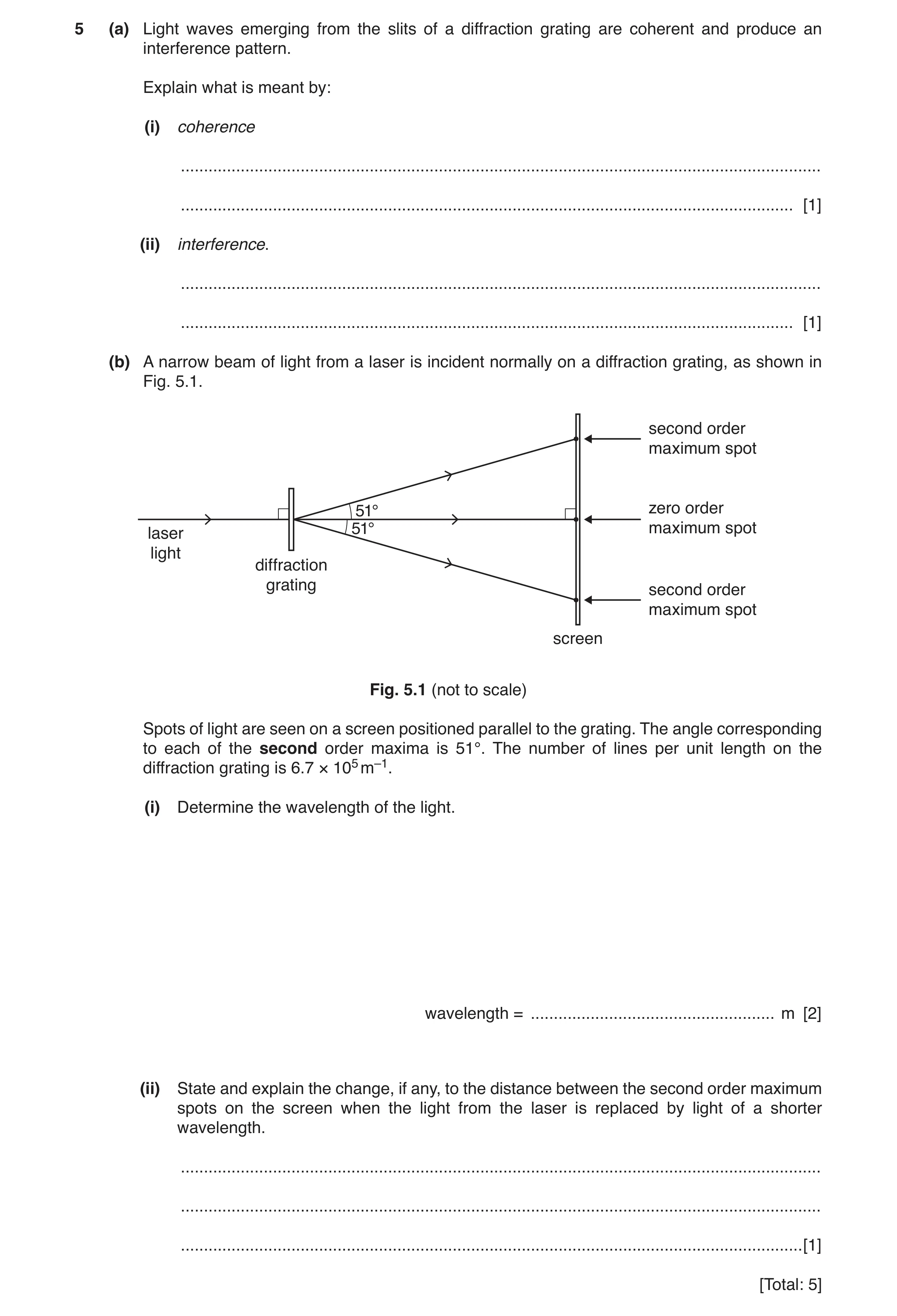
5 (a) Light waves emerging from the slits of a diffraction grating are coherent and produce an interference pattern. Explain what is meant by: (i) coherence … … [1] (ii) interference. … … [1] (b) A narrow beam of light from a laser is incident normally on a diffraction grating, as shown in Fig. 5.1. second order maximum spot 51° zero order 51° maximum spot laser light diffraction grating second order maximum spot screen Fig. 5.1 (not to scale) Spots of light are seen on a screen positioned parallel to the grating. The angle corresponding to each of the second order maxima is 51°. The number of lines per unit length on the diffraction grating is 6.7 × 10⁵ m–1. (i) Determine the wavelength of the light. wavelength = … m [2] (ii) State and explain the change, if any, to the distance between the second order maximum spots on the screen when the light from the laser is replaced by light of a shorter wavelength. … … … [1] [Total: 5]
5 marks
Mark scheme: 5(a)(i) (coherence means) constant phase difference (between waves) B1 5(a)(ii) (interference is) the sum/addition/combination of the displacements of overlapping/meeting waves B1 5(b)(i) nλ = d sinθ C1 λ = sin 51° / (2 × 6.7 × 105) = 5.8 × 10⁻⁷ m A1 5(b)(ii) smaller angle (corresponding to second order maxima and so) shorter distance (between second order maxima spots) B1
This question in 9702/23 Oct/Nov 2019
Q6 · For a progressive wave, state what is meant by: (i) the wavelength … … [1] (ii) the… 9702/22 Feb/March 2020
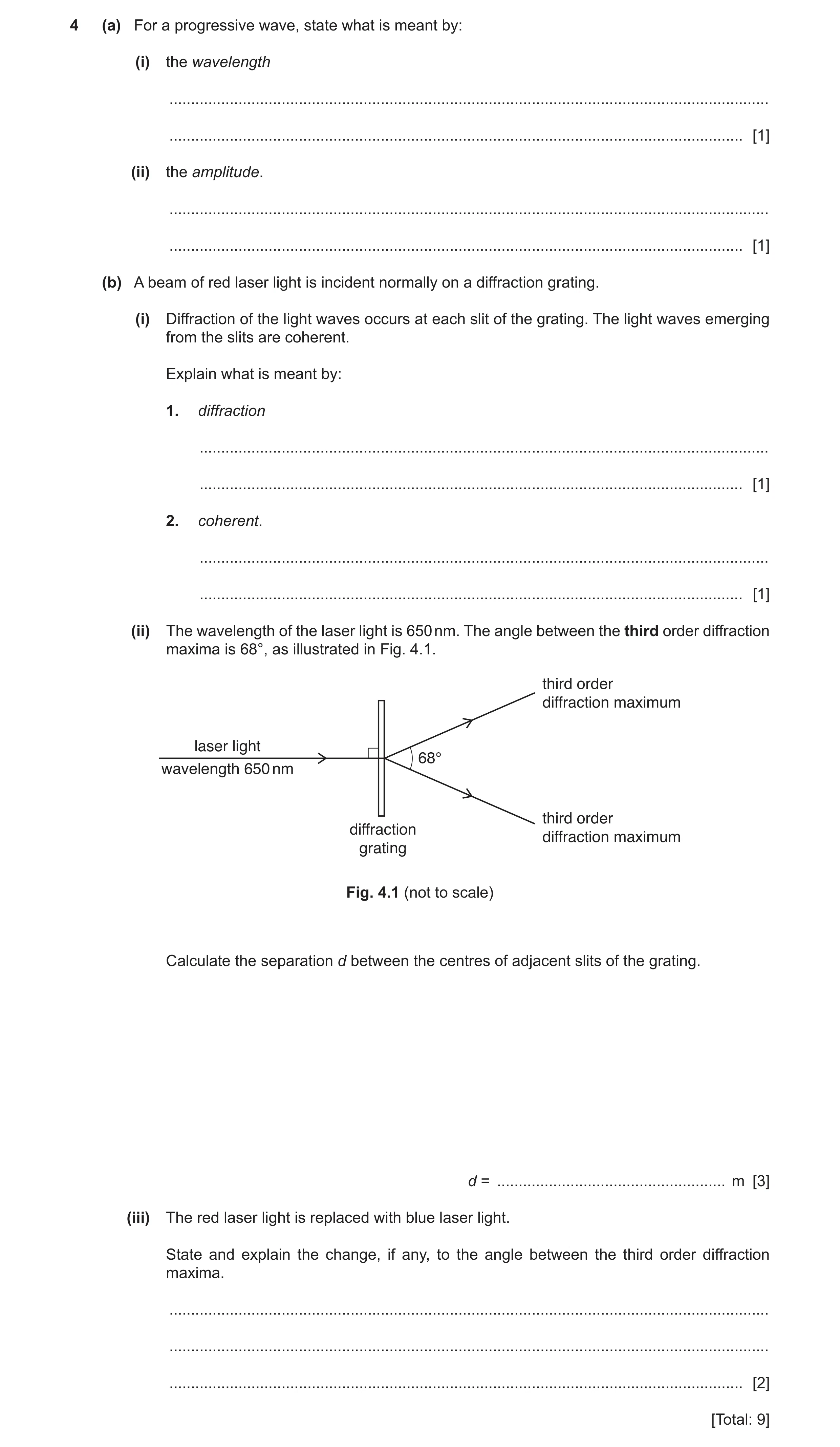
4 (a) For a progressive wave, state what is meant by: (i) the wavelength … … [1] (ii) the amplitude. … … [1] (b) A beam of red laser light is incident normally on a diffraction grating. (i) Diffraction of the light waves occurs at each slit of the grating. The light waves emerging from the slits are coherent. Explain what is meant by: 1. diffraction … … [1] 2. coherent. … … [1] (ii) The wavelength of the laser light is 650 nm. The angle between the third order diffraction maxima is 68°, as illustrated in Fig. 4.1. third order diffraction maximum laser light 68° wavelength 650 nm third order diffraction diffraction maximum grating Fig. 4.1 (not to scale) Calculate the separation d between the centres of adjacent slits of the grating. d = … m [3] (iii) The red laser light is replaced with blue laser light. State and explain the change, if any, to the angle between the third order diffraction maxima. … … … [2] [Total: 9]
9 marks
Mark scheme: 4(a)(i) distance moved by wavefront / energy during one cycle / vibration / oscillation / period (of source) or minimum distance between two wavefronts or distance between two adjacent wavefronts B1 4(a)(ii) maximum displacement (of particle / point on wave) B1 4(b)(i) 1 light / waves spread (at each slit) B1 2 constant phase difference (between light / waves) B1 4(b)(ii) nλ = d sinθ C1 d = 3 × 650 × 10–9 / sin34° C1 d = 3.5 × 10⁻⁶ m A1 4(b)(iii) wavelength of blue light is shorter (than 650 nm / red light) M1 so angle (between third order diffraction maxima) decreases A1
This question in 9702/22 Feb/March 2020
Q7 · A sound wave is detected by a microphone that is connected to a cathode-ray oscilloscope… 9702/23 Oct/Nov 2020
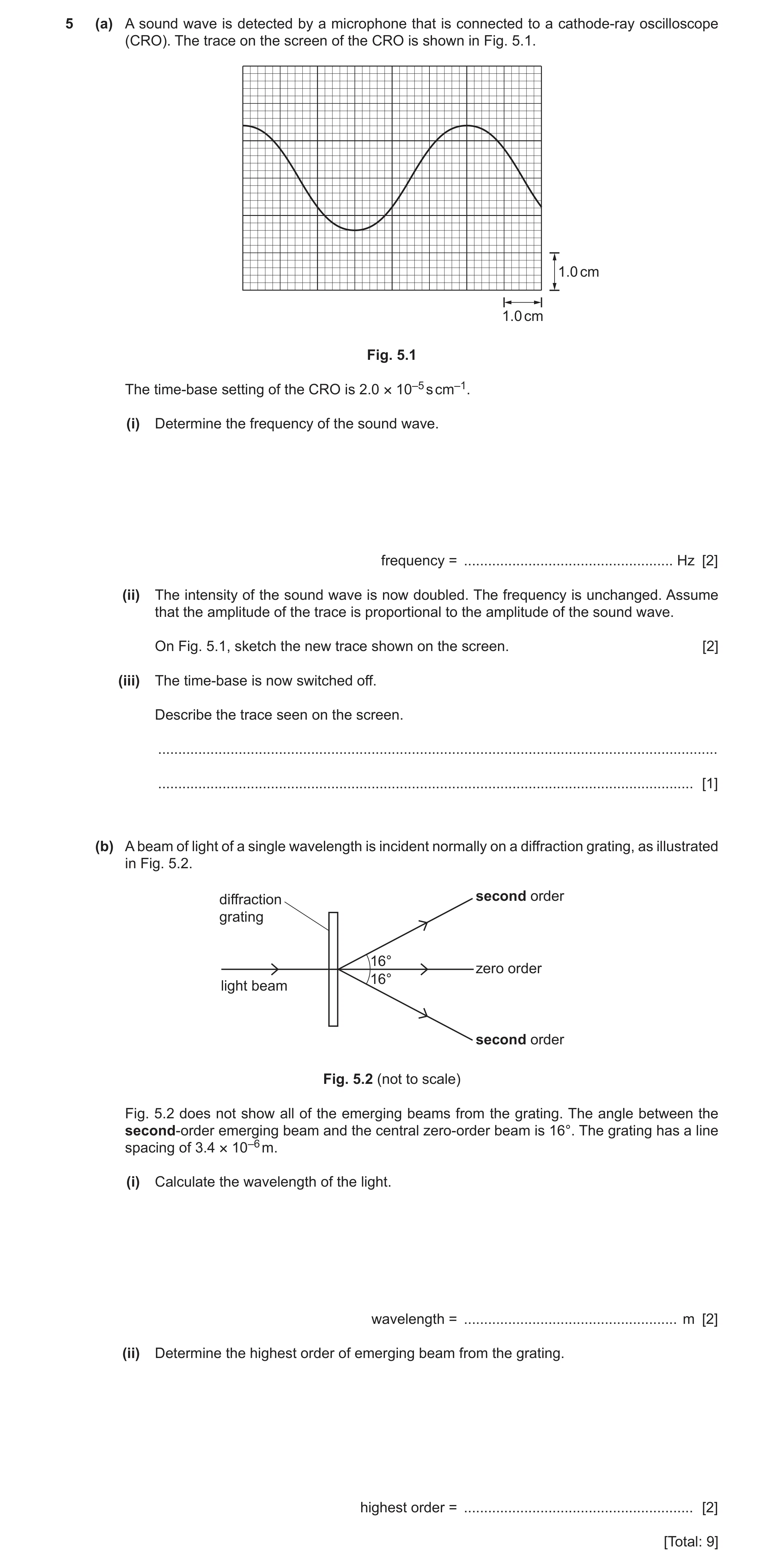
5 (a) A sound wave is detected by a microphone that is connected to a cathode-ray oscilloscope (CRO). The trace on the screen of the CRO is shown in Fig. 5.1. 1.0 cm 1.0 cm Fig. 5.1 The time-base setting of the CRO is 2.0 × 10⁻⁵ s cm–1. (i) Determine the frequency of the sound wave. frequency = … Hz [2] (ii) The intensity of the sound wave is now doubled. The frequency is unchanged. Assume that the amplitude of the trace is proportional to the amplitude of the sound wave. On Fig. 5.1, sketch the new trace shown on the screen. [2] (iii) The time-base is now switched off. Describe the trace seen on the screen. … … [1] (b) A beam of light of a single wavelength is incident normally on a diffraction grating, as illustrated in Fig. 5.2. diffraction second order grating 16° zero order 16° light beam second order Fig. 5.2 (not to scale) Fig. 5.2 does not show all of the emerging beams from the grating. The angle between the second-order emerging beam and the central zero-order beam is 16°. The grating has a line spacing of 3.4 × 10⁻⁶ m. (i) Calculate the wavelength of the light. wavelength = … m [2] (ii) Determine the highest order of emerging beam from the grating. highest order = … [2] [Total: 9]
9 marks
Mark scheme: 5(a)(i) T = 2.0 × 10–5 × 6.0 (= 1.2 × 10⁻⁴ s) C1 f = 1 / (2.0 × 10–5 × 6.0) = 8300 Hz A1 5(a)(ii) new trace shows the same period B1 new trace shows amplitude of 10 small squares B1 5(a)(iii) (trace is a) vertical line B1 5(b)(i) nλ = d sin θ C1 λ = (3.4 × 10⁻⁶ × sin 16°) / 2 = 4.7 × 10⁻⁷ m A1 5(b)(ii) n = 3.4 × 10⁻⁶ (× sin 90°) / 4.7 × 10⁻⁷ or 2 (× sin 90°) / sin 16° (= 7.2 or 7.3) C1 highest order = 7 A1
This question in 9702/23 Oct/Nov 2020
Q8 · Light of a single frequency is incident normally on a diffraction grating 9702/22 May/June 2024
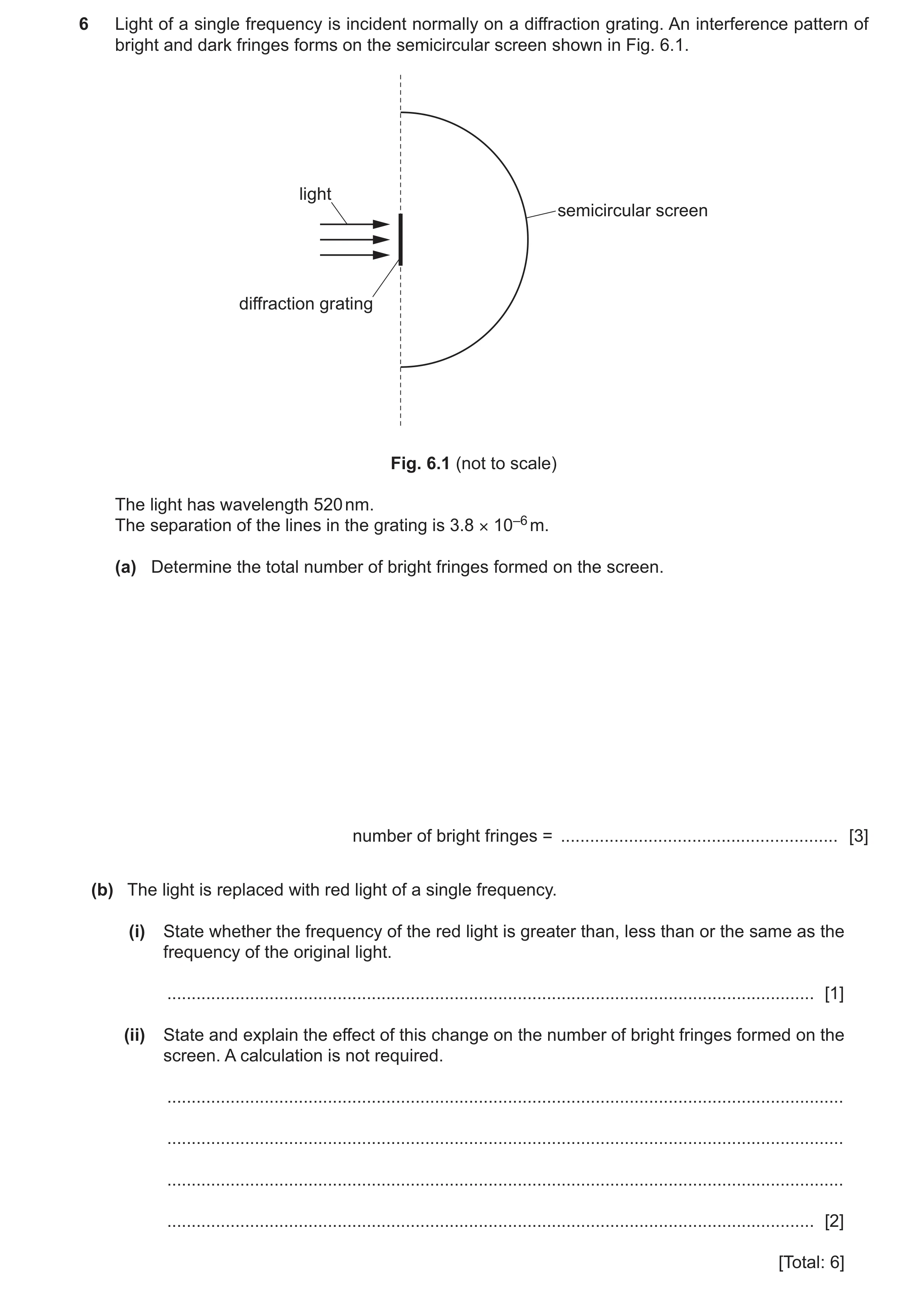
6 Light of a single frequency is incident normally on a diffraction grating. An interference pattern of bright and dark fringes forms on the semicircular screen shown in Fig. 6.1. light semicircular screen diffraction grating Fig. 6.1 (not to scale) The light has wavelength 520 nm. The separation of the lines in the grating is 3.8 × 10⁻⁶ m. (a) Determine the total number of bright fringes formed on the screen. number of bright fringes = … [3] (b) The light is replaced with red light of a single frequency. (i) State whether the frequency of the red light is greater than, less than or the same as the frequency of the original light. … [1] (ii) State and explain the effect of this change on the number of bright fringes formed on the screen. A calculation is not required. … … … … [2] [Total: 6]
6 marks
Mark scheme: 6(a) C1 n = (3.8 10–6 sin 90°) / (520 10–9) ( = 7.3) C1 number of bright fringes formed = 15 (given as an integer) A1 6(b)(i) (frequency of red light is) less (than frequency of original light) B1 6(b)(ii) (red light has) longer wavelength M1 (so) number (of bright fringes formed) is less / fewer (bright fringes are formed) A1
This question in 9702/22 May/June 2024
Q9 · State what is meant by diffraction 9702/23 May/June 2025
6 (a) State what is meant by diffraction. … … [1] (b) Light of wavelength 720 nm in a vacuum is incident normally on a diffraction grating as shown in Fig. 6.1. second-order maxima light, wavelength 720 nm 52° diffraction grating screen Fig. 6.1 (not to scale) A screen is parallel to the grating. An interference pattern is seen on the screen and the angle between the second-order maxima is 52°. (i) Calculate the frequency of the light. frequency = … Hz [2] (ii) Calculate the number of lines per unit length in the diffraction grating. number per unit length = … m−1 [3] (iii) The light in Fig. 6.1 is now replaced with light of a different wavelength λ. It is observed that the third-order maxima of this light are at the same positions as the second-order maxima of the light in Fig. 6.1. Calculate, in nm, the wavelength λ. λ = … nm [2] [Total: 8]
8 marks
Mark scheme: 6(a) wave passes (through) an aperture and spreads B1 or wave passes (by / through / around) an edge and spreads 6(b)(i) v = f C1 f = 3.00 108 / 720 10−9 A1 = 4.2 1014 Hz 6(b)(ii) d = nλ / sin θ C1 d = (2 720 10−9) / sin 26 C1 (= 3.3 10−6 m) A1 number of lines per m = 1 / (3.3 10−6) = 3.0 105 m−1 6(b)(iii) 1 C1 3 = 720 2 or sin 26 = 3 3.0 105 = 480 nm A1
This question in 9702/23 May/June 2025
Q10 · State what is meant by diffraction of a wave 9702/23 Oct/Nov 2025
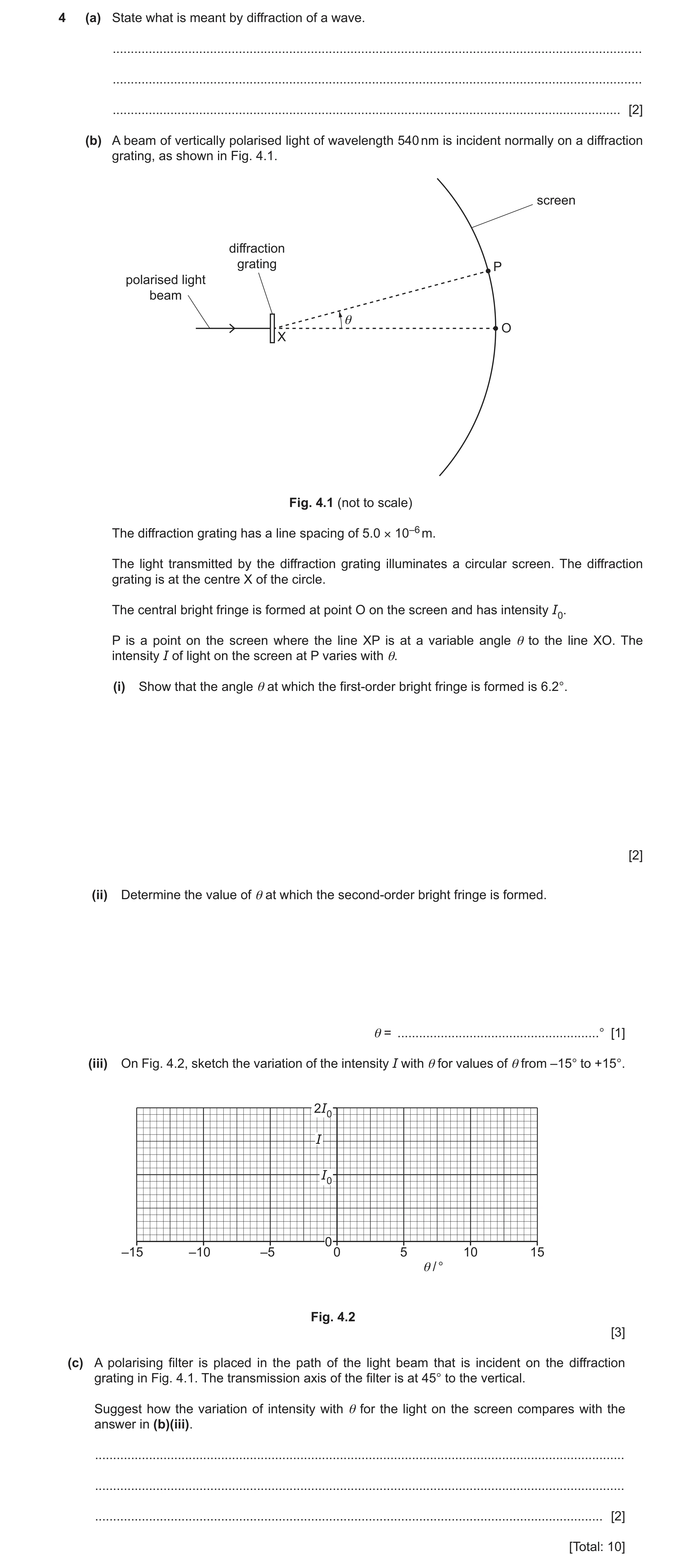
4 (a) State what is meant by diffraction of a wave. … … … [2] (b) A beam of vertically polarised light of wavelength 540 nm is incident normally on a diffraction grating, as shown in Fig. 4.1. screen diffraction grating P polarised light beam θ O X Fig. 4.1 (not to scale) The diffraction grating has a line spacing of 5.0 × 10⁻⁶ m. The light transmitted by the diffraction grating illuminates a circular screen. The diffraction grating is at the centre X of the circle. The central bright fringe is formed at point O on the screen and has intensity I0. P is a point on the screen where the line XP is at a variable angle θ to the line XO. The intensity I of light on the screen at P varies with θ. (i) Show that the angle θ at which the first-order bright fringe is formed is 6.2°. [2] (ii) Determine the value of θ at which the second-order bright fringe is formed. θ = … ° [1] (iii) On Fig. 4.2, sketch the variation of the intensity I with θ for values of θ from –15° to +15°. 2I0 I I0 0 –15 –10 –5 0 5 10 15 θ / ° Fig. 4.2 [3] (c) A polarising filter is placed in the path of the light beam that is incident on the diffraction grating in Fig. 4.1. The transmission axis of the filter is at 45° to the vertical. Suggest how the variation of intensity with θ for the light on the screen compares with the answer in (b)(iii). … … … [2] [Total: 10]
10 marks
Mark scheme: 4(a) wave passing through gap / aperture B1 (wave) spreads (out) B1 4(b)(i) n = d sin C1 = sin–1 [(540 10–9) / (5.0 10–6)] = 6.2° A1 4(b)(ii) = 12° A1 4(b)(iii) peaks / maxima shown at = 0, ±6° and ±12° B1 peaks / maxima and zero intensity in between B1 central peak / maxima at intensity I0 and the other peaks all equal to or less than I0 B1 4(c) peaks / maxima all at the same angles (as before) B1 intensity (of all peaks / maxima) halved B1
This question in 9702/23 Oct/Nov 2025
 3 / 15
 4 / 15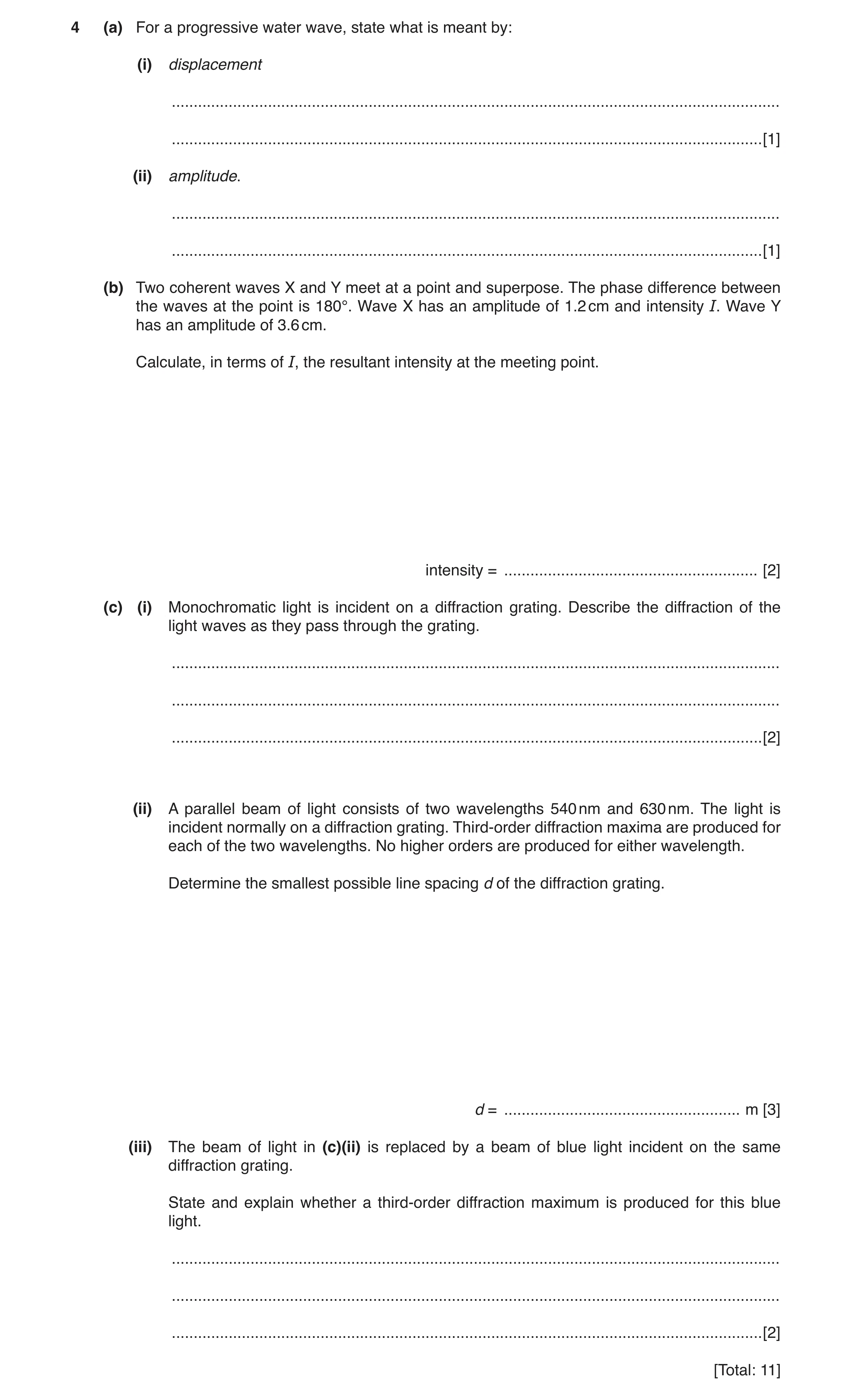
 11 / 15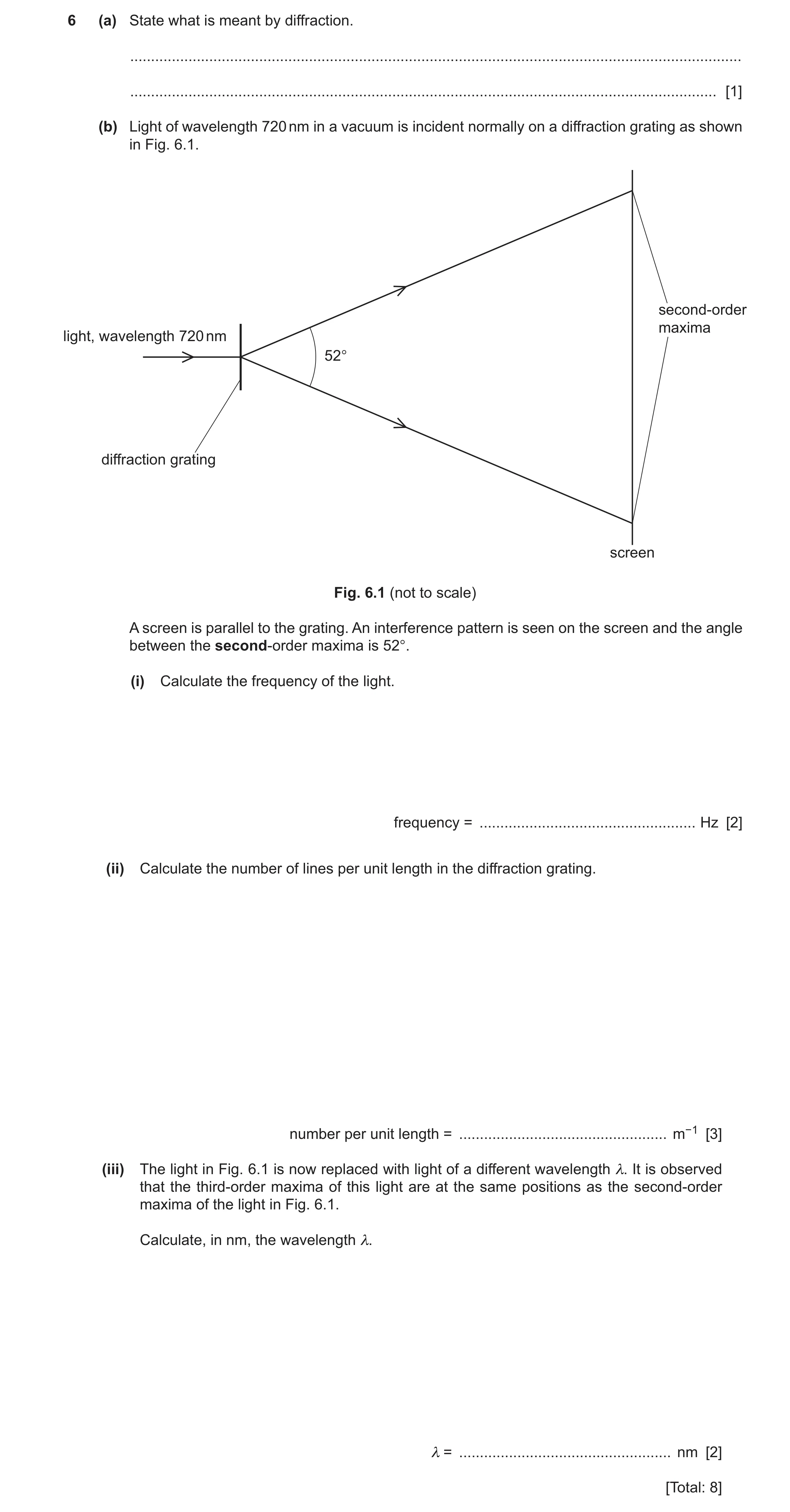
 10
10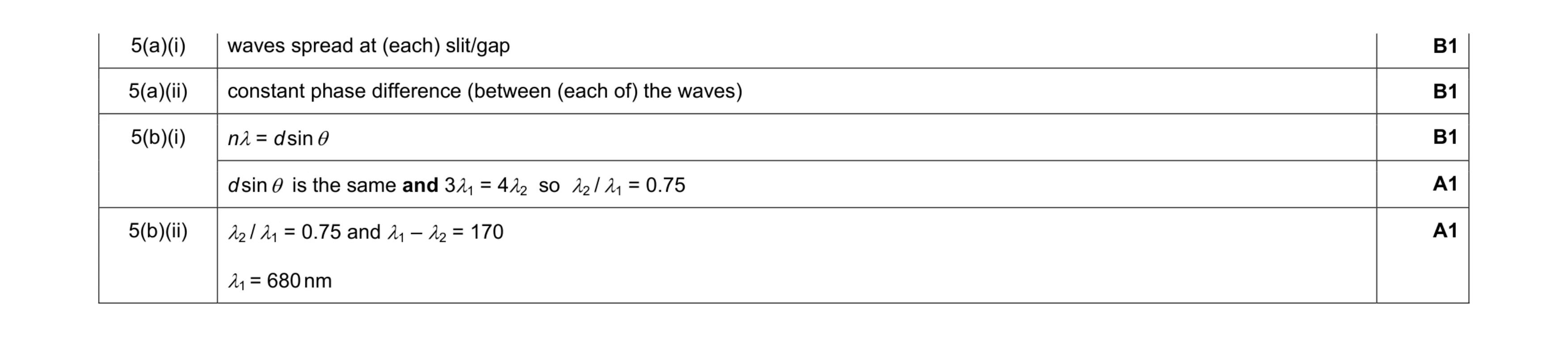 5
5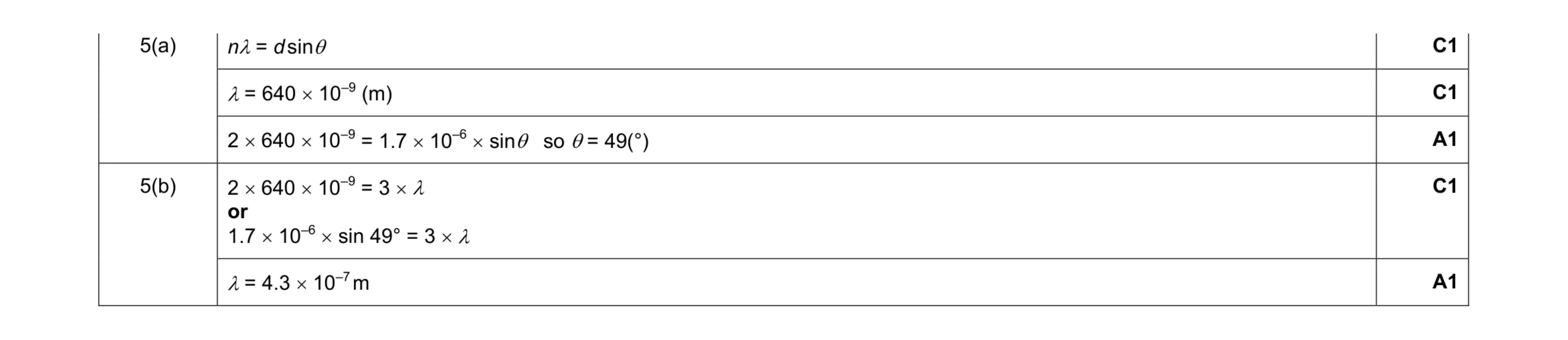 5
5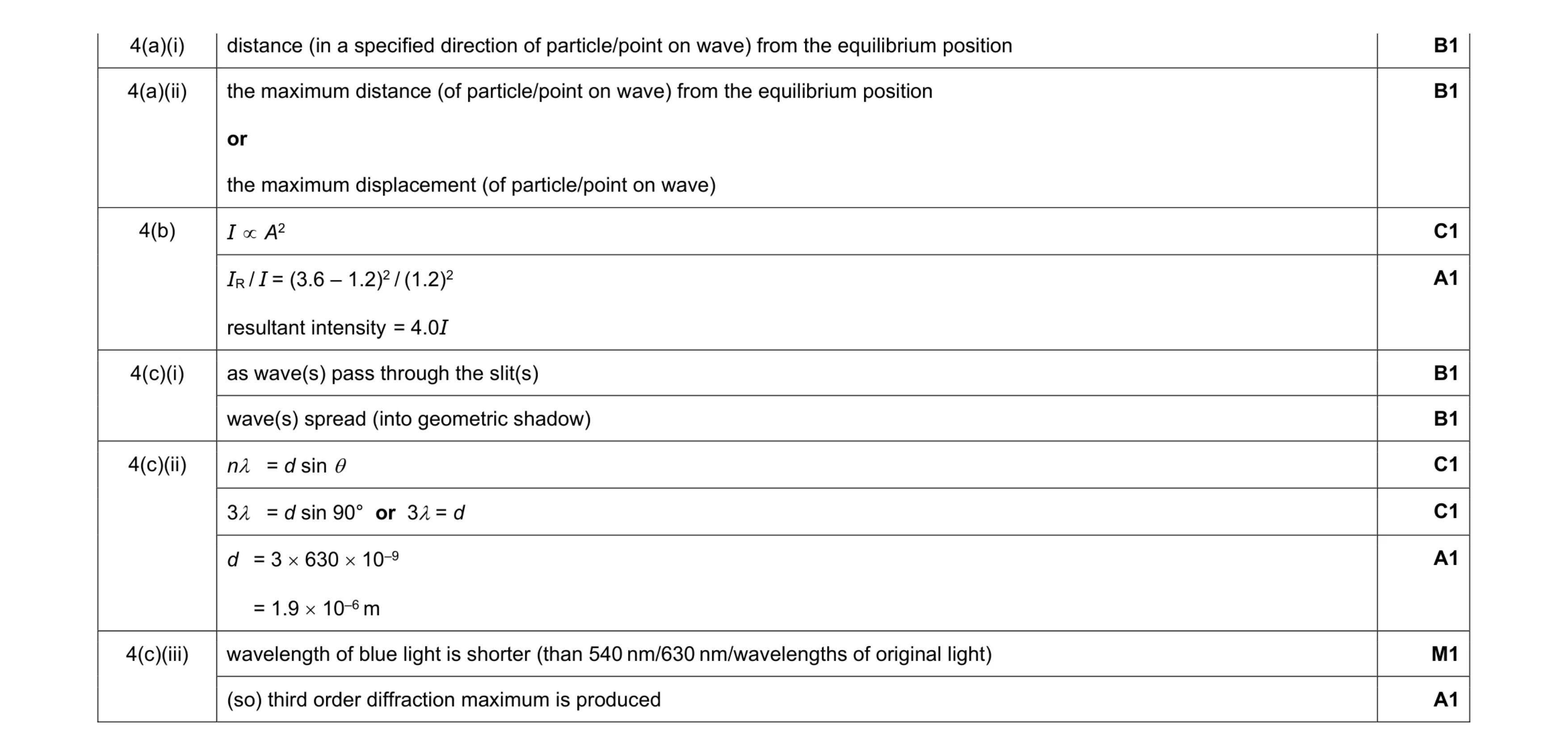 11
11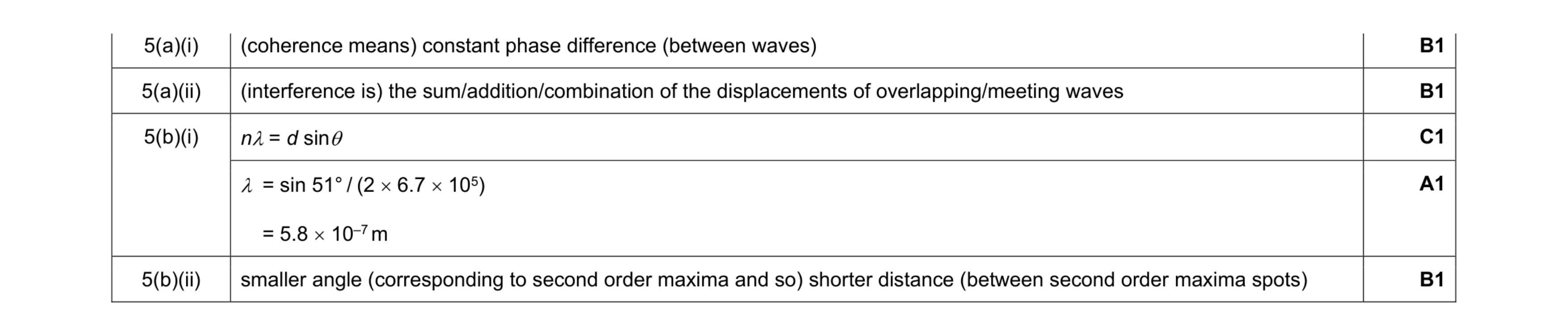 5
5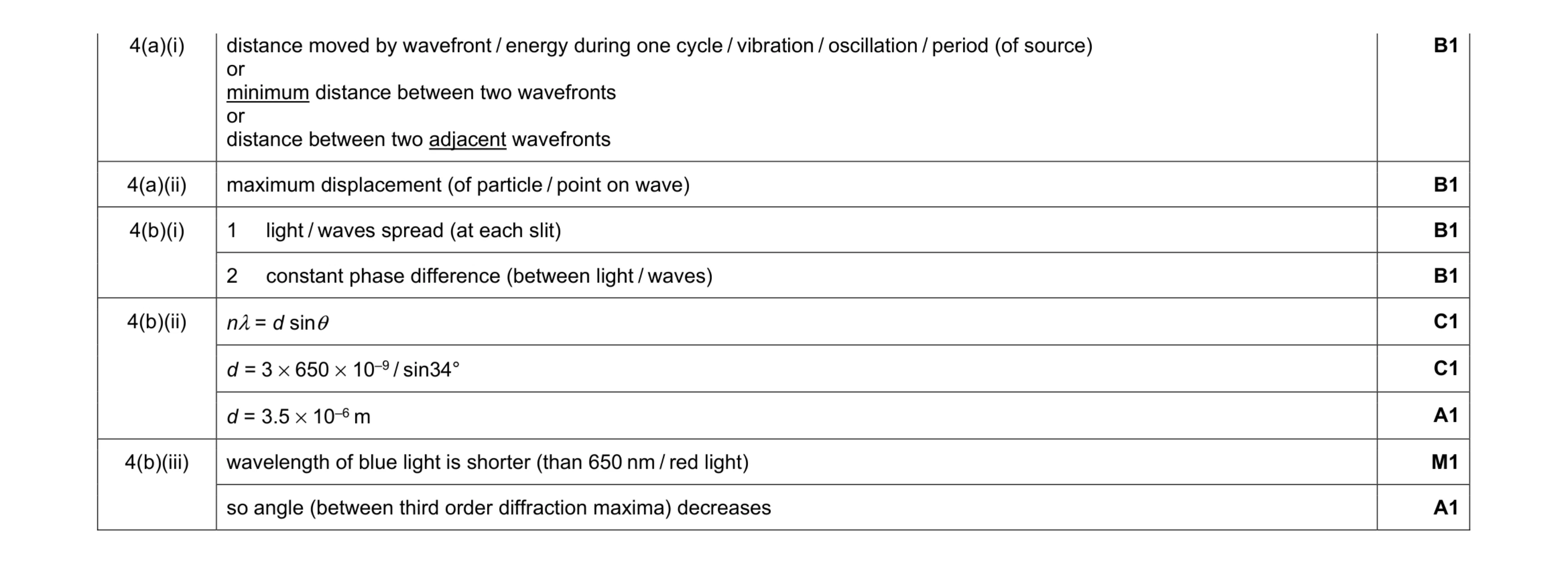 9
9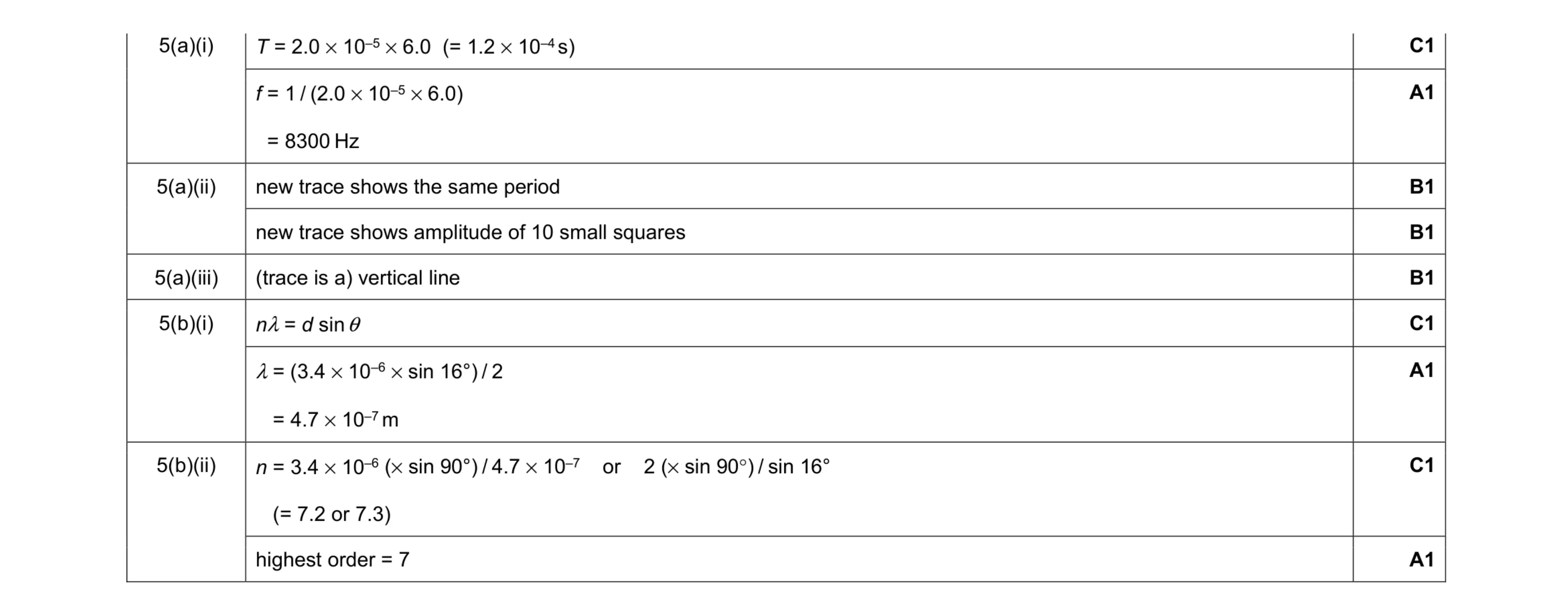 9
9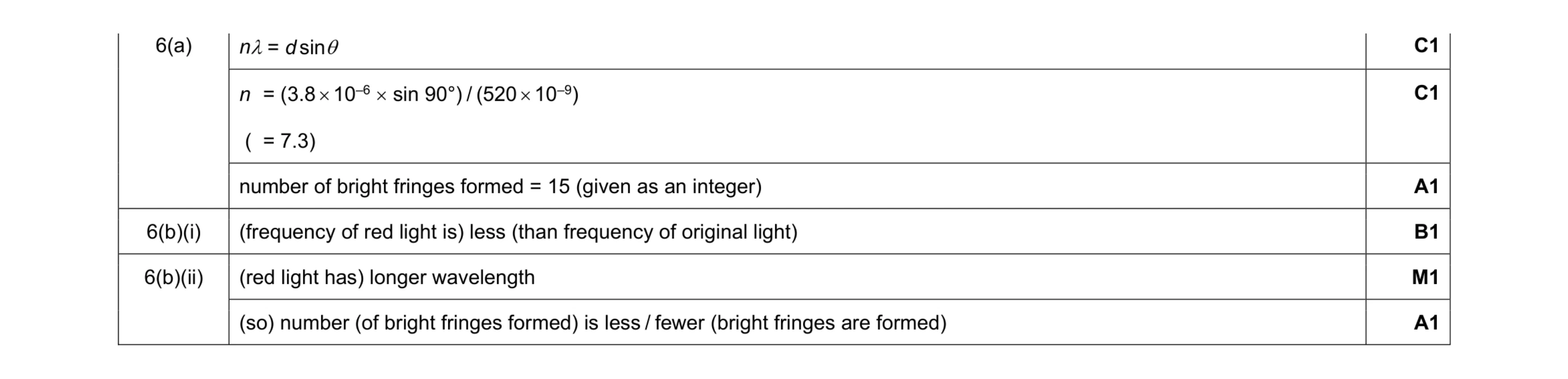 6
6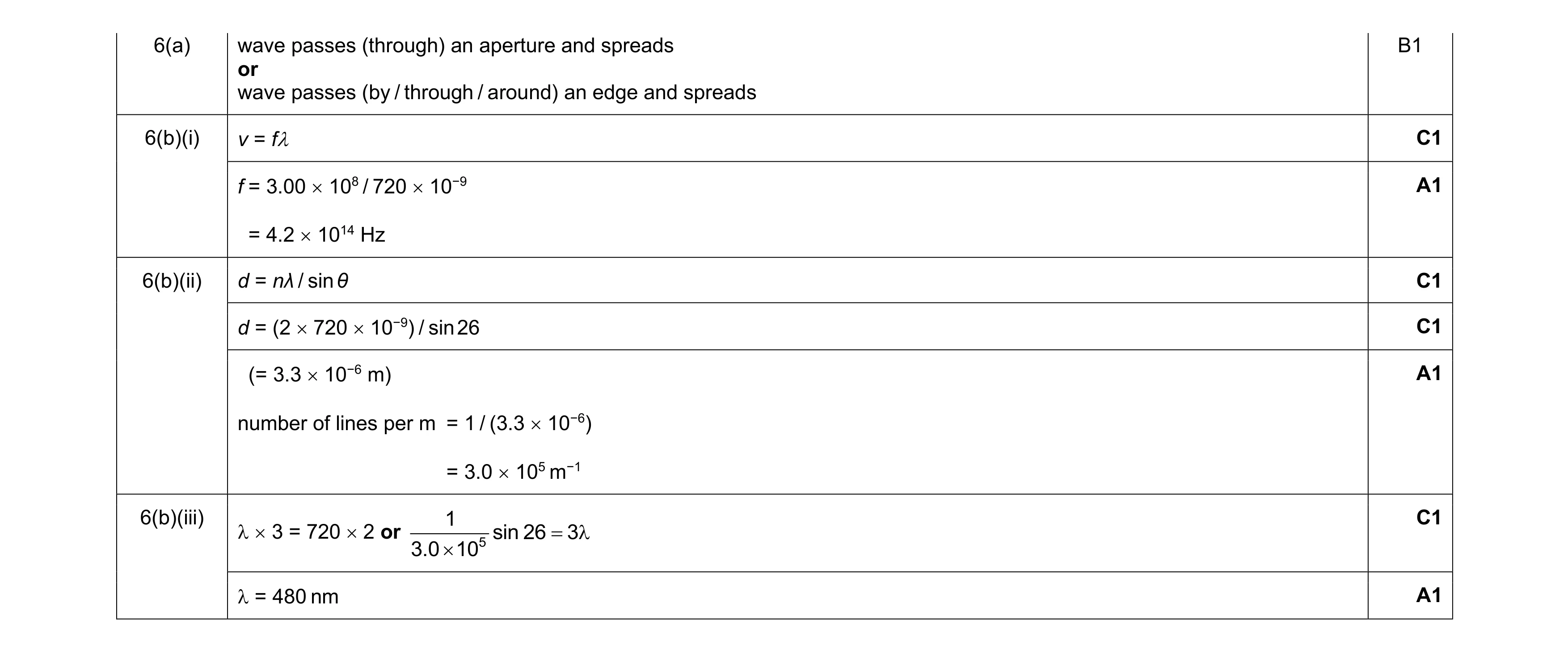 8
8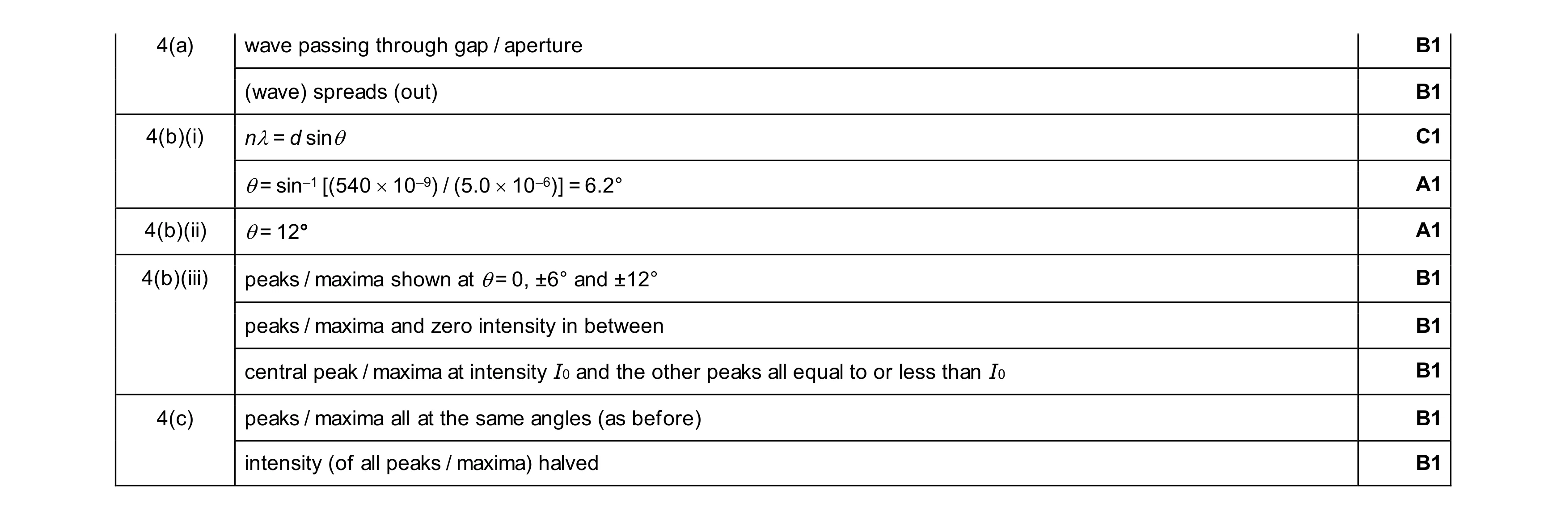 10
10