Questions as text
Q1 · State what is meant by the internal energy of a system 9702/41 May/June 2018
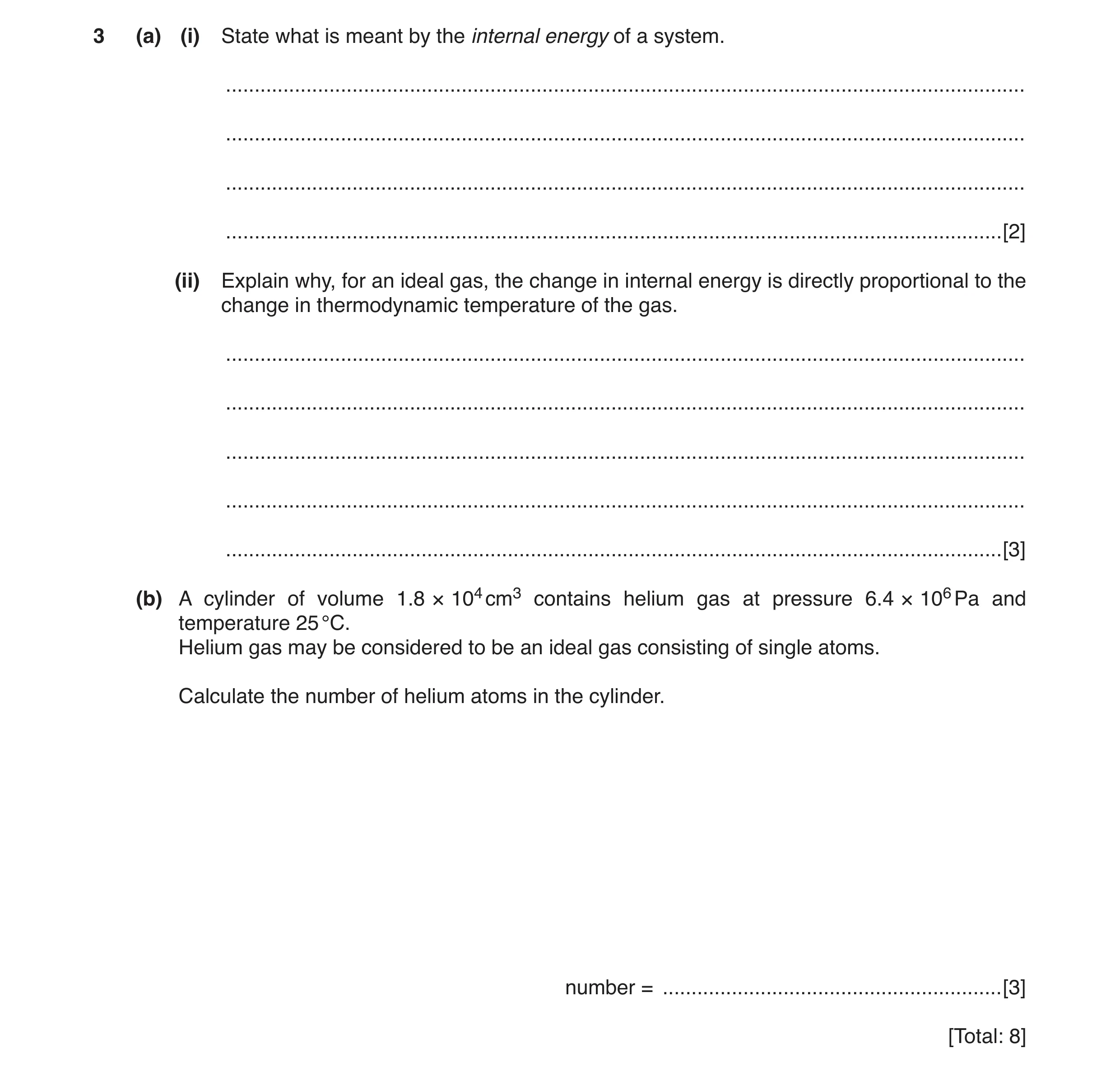
3 (a) (i) State what is meant by the internal energy of a system. … … … … [2] (ii) Explain why, for an ideal gas, the change in internal energy is directly proportional to the change in thermodynamic temperature of the gas. … … … … … [3] (b) A cylinder of volume 1.8 × 104 cm3 contains helium gas at pressure 6.4 × 10⁶ Pa and temperature 25 °C. Helium gas may be considered to be an ideal gas consisting of single atoms. Calculate the number of helium atoms in the cylinder. number = … [3] [Total: 8]
8 marks
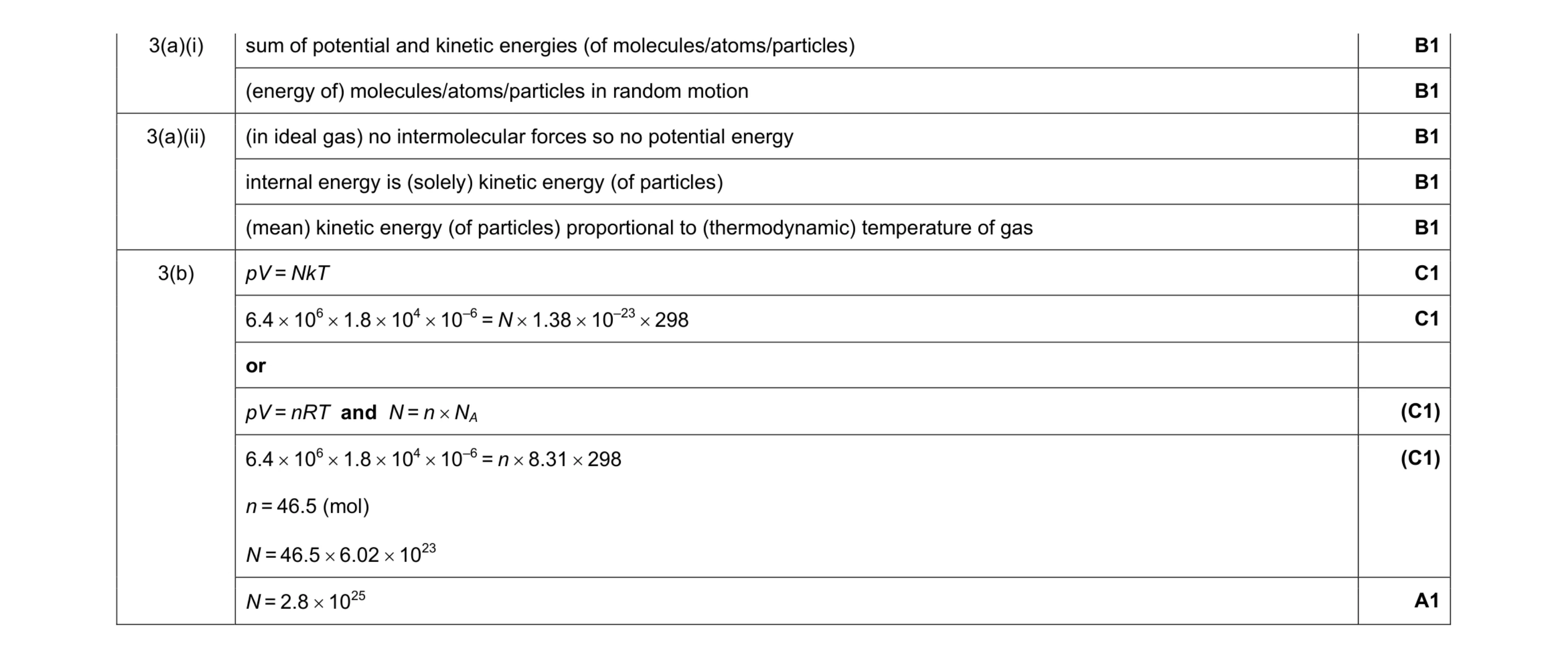
Mark scheme: 3(a)(i) sum of potential and kinetic energies (of molecules/atoms/particles) B1 (energy of) molecules/atoms/particles in random motion B1 3(a)(ii) (in ideal gas) no intermolecular forces so no potential energy B1 internal energy is (solely) kinetic energy (of particles) B1 (mean) kinetic energy (of particles) proportional to (thermodynamic) temperature of gas B1 3(b) pV = NkT C1 6.4 × 106 × 1.8 × 104 × 10–6 = N × 1.38 × 10–23 × 298 C1 or pV = nRT and N = n × NA (C1) 6.4 × 106 × 1.8 × 104 × 10–6 = n × 8.31 × 298 n = 46.5 (mol) N = 46.5 × 6.02 × 1023 (C1) N = 2.8 × 1025 A1
This question in 9702/41 May/June 2018
Q2 · State what is meant by the internal energy of a system 9702/43 May/June 2018
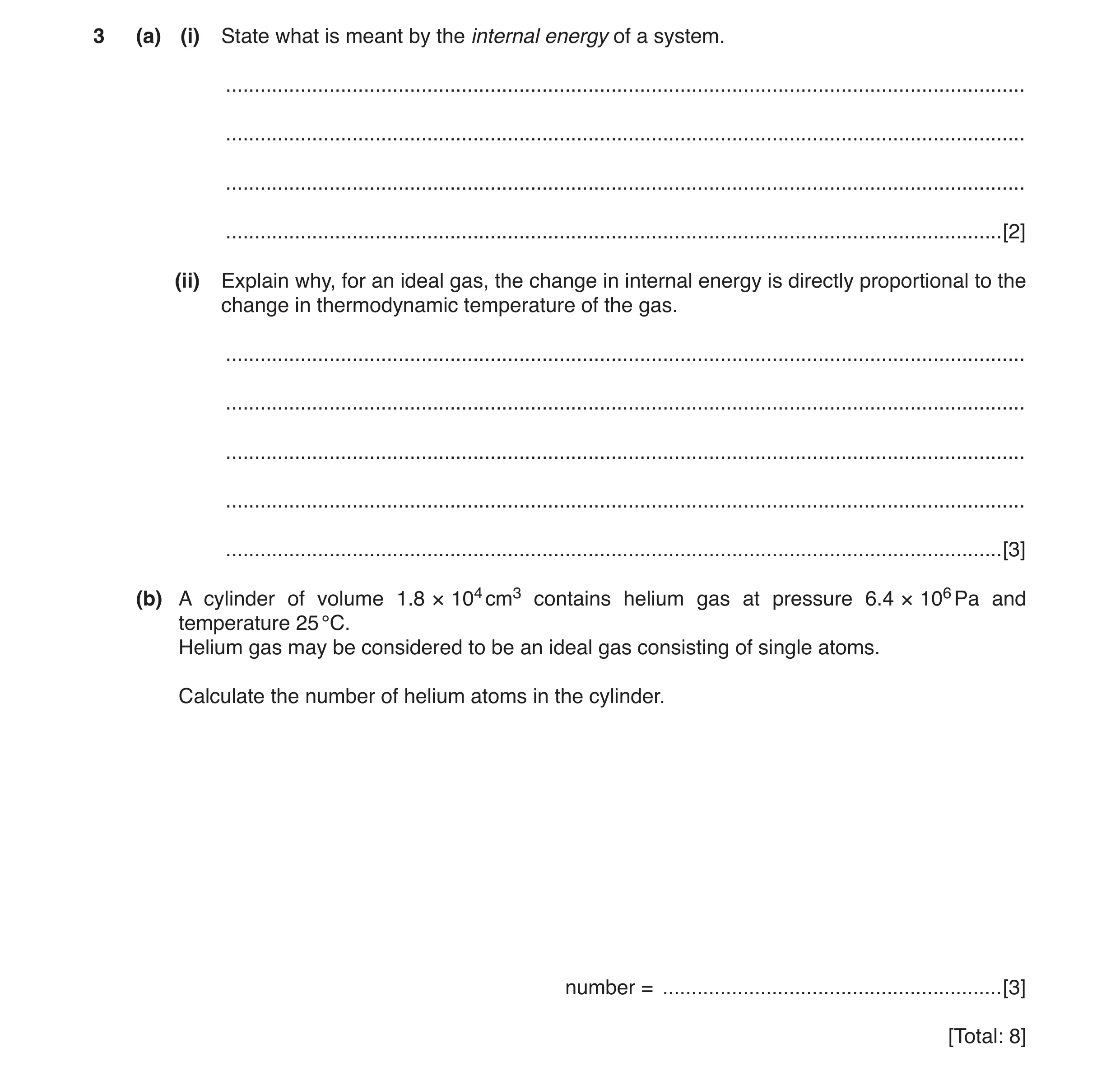
3 (a) (i) State what is meant by the internal energy of a system. … … … … [2] (ii) Explain why, for an ideal gas, the change in internal energy is directly proportional to the change in thermodynamic temperature of the gas. … … … … … [3] (b) A cylinder of volume 1.8 × 104 cm3 contains helium gas at pressure 6.4 × 10⁶ Pa and temperature 25 °C. Helium gas may be considered to be an ideal gas consisting of single atoms. Calculate the number of helium atoms in the cylinder. number = … [3] [Total: 8]
8 marks
Mark scheme: 3(a)(i) sum of potential and kinetic energies (of molecules/atoms/particles) B1 (energy of) molecules/atoms/particles in random motion B1 3(a)(ii) (in ideal gas) no intermolecular forces so no potential energy B1 internal energy is (solely) kinetic energy (of particles) B1 (mean) kinetic energy (of particles) proportional to (thermodynamic) temperature of gas B1 3(b) pV = NkT C1 6.4 × 106 × 1.8 × 104 × 10–6 = N × 1.38 × 10–23 × 298 C1 or pV = nRT and N = n × NA (C1) 6.4 × 106 × 1.8 × 104 × 10–6 = n × 8.31 × 298 n = 46.5 (mol) N = 46.5 × 6.02 × 1023 (C1) N = 2.8 × 1025 A1
This question in 9702/43 May/June 2018
Q3 · State what is meant by the internal energy of a system 9702/41 Oct/Nov 2018
2 (a) State what is meant by the internal energy of a system. … … … … [2] (b) An ideal gas undergoes a cycle of changes as shown in Fig. 2.1. 3.00 2.80 Q 372 K pressure / 105 Pa 2.60 97.0 J 2.40 2.20 280 K P R 332 K 2.00 900 950 1000 1050 1100 1150 volume / cm3 Fig. 2.1 At point P, the gas has volume 950 cm3, pressure 2.10 × 10⁵ Pa and temperature 280 K. The gas is heated at constant volume and 97.0 J of thermal energy is transferred to the gas. Its pressure and temperature change so that the gas is at point Q on Fig. 2.1. The gas then undergoes the change from point Q to point R and then from point R back to point P, as shown on Fig. 2.1. Some energy changes that take place during the cycle PQRP are shown in Fig. 2.2. change P → Q change Q → R change R → P thermal energy transferred to gas / J +97.0 0 … work done on gas / J … –42.5 +37.0 increase in internal energy of gas / J … … … Fig. 2.2 (i) State the total change in internal energy of the gas during the complete cycle PQRP. Explain your answer. … … … [2] (ii) On Fig. 2.2, complete the energy changes for the gas during 1. the change P → Q, 2. the change Q → R, 3. the change R → P. [5] [Total: 9]
9 marks
Mark scheme: 2(a) sum of potential and kinetic energies (of molecules/atoms/particles) B1 (energy of) molecules/atoms/particles in random motion B1 2(b)(i) final temperature = initial temperature B1 no change in internal energy B1 2(b)(ii) 1. work done on gas (P→Q): 0 A1 increase in internal energy (P→Q): (+)97.0 J A1 2. increase in internal energy (Q→R): –42.5 J A1 3. increase in internal energy (R→P): –54.5 J A1 thermal energy supplied (R→P): –91.5 J A1
This question in 9702/41 Oct/Nov 2018
Q4 · State what is meant by the internal energy of a system 9702/43 Oct/Nov 2018
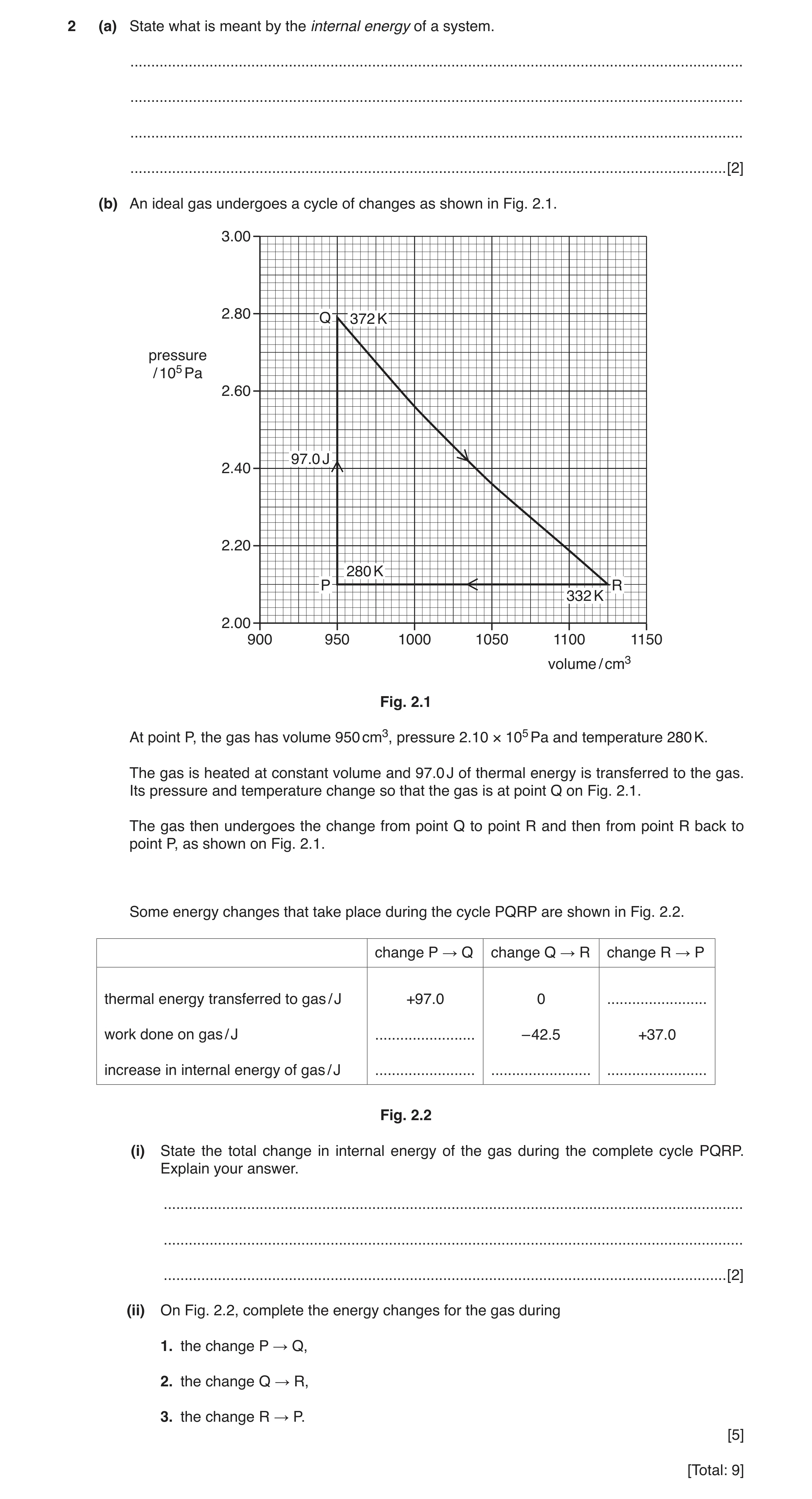
2 (a) State what is meant by the internal energy of a system. … … … … [2] (b) An ideal gas undergoes a cycle of changes as shown in Fig. 2.1. 3.00 2.80 Q 372 K pressure / 105 Pa 2.60 97.0 J 2.40 2.20 280 K P R 332 K 2.00 900 950 1000 1050 1100 1150 volume / cm3 Fig. 2.1 At point P, the gas has volume 950 cm3, pressure 2.10 × 10⁵ Pa and temperature 280 K. The gas is heated at constant volume and 97.0 J of thermal energy is transferred to the gas. Its pressure and temperature change so that the gas is at point Q on Fig. 2.1. The gas then undergoes the change from point Q to point R and then from point R back to point P, as shown on Fig. 2.1. Some energy changes that take place during the cycle PQRP are shown in Fig. 2.2. change P → Q change Q → R change R → P thermal energy transferred to gas / J +97.0 0 … work done on gas / J … –42.5 +37.0 increase in internal energy of gas / J … … … Fig. 2.2 (i) State the total change in internal energy of the gas during the complete cycle PQRP. Explain your answer. … … … [2] (ii) On Fig. 2.2, complete the energy changes for the gas during 1. the change P → Q, 2. the change Q → R, 3. the change R → P. [5] [Total: 9]
9 marks
Mark scheme: 2(a) sum of potential and kinetic energies (of molecules/atoms/particles) B1 (energy of) molecules/atoms/particles in random motion B1 2(b)(i) final temperature = initial temperature B1 no change in internal energy B1 2(b)(ii) 1. work done on gas (P→Q): 0 A1 increase in internal energy (P→Q): (+)97.0 J A1 2. increase in internal energy (Q→R): –42.5 J A1 3. increase in internal energy (R→P): –54.5 J A1 thermal energy supplied (R→P): –91.5 J A1
This question in 9702/43 Oct/Nov 2018
Q5 · State what is meant by the internal energy of a system 9702/41 May/June 2020
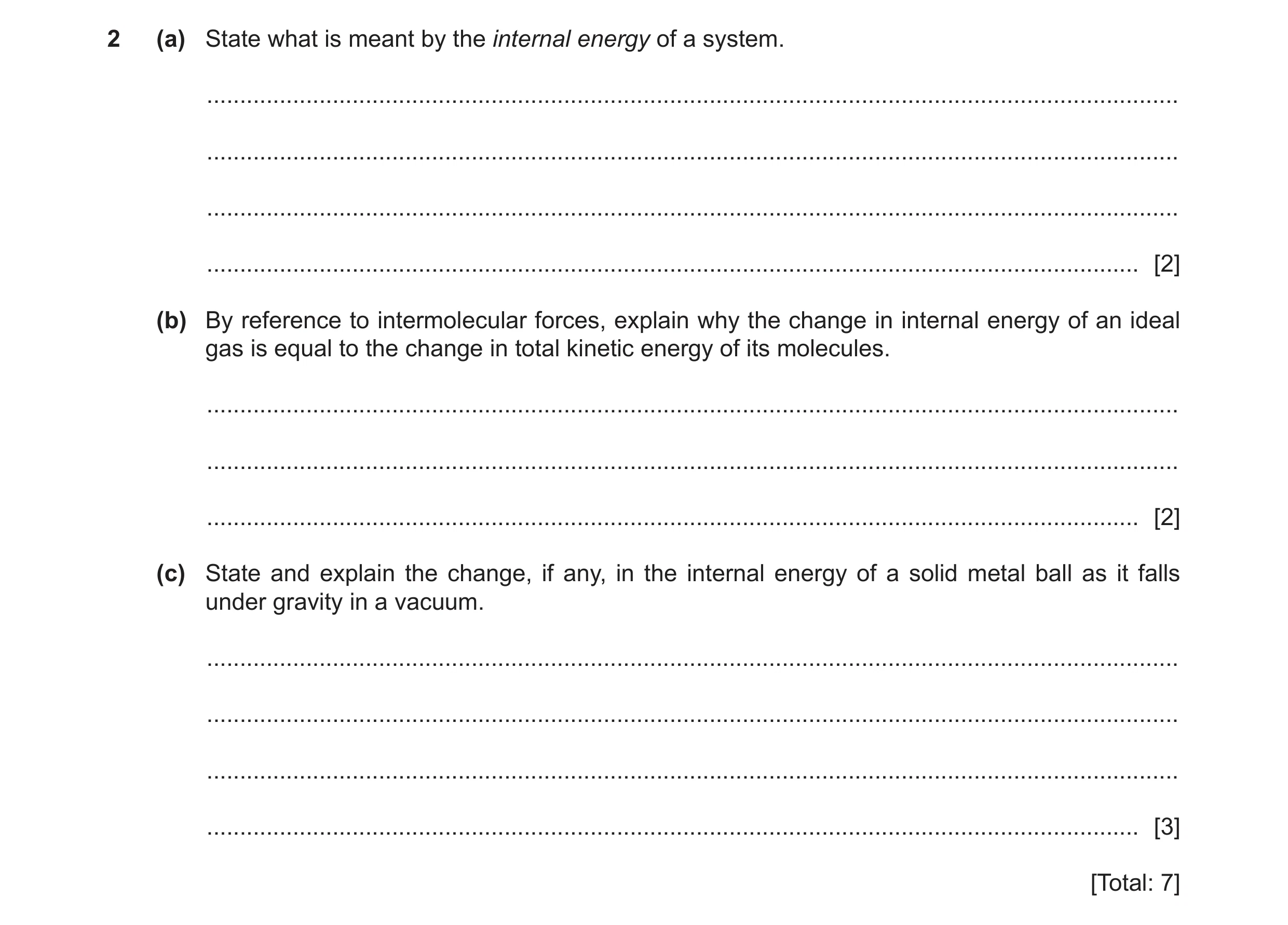
2 (a) State what is meant by the internal energy of a system. … … … … [2] (b) By reference to intermolecular forces, explain why the change in internal energy of an ideal gas is equal to the change in total kinetic energy of its molecules. … … … [2] (c) State and explain the change, if any, in the internal energy of a solid metal ball as it falls under gravity in a vacuum. … … … … [3] [Total: 7]
7 marks
Mark scheme: 2(a) total potential energy and kinetic energy (of molecules/atoms) M1 reference to random motion of molecules/atoms A1 2(b) (in ideal gas,) no intermolecular forces B1 no potential energy (so change in kinetic energy is change in internal energy) B1 2(c) (random) potential energy of molecules does not change M1 (random) kinetic energy of molecules does not change M1 so internal energy does not change A1 or decrease in total potential energy = gain in total kinetic energy (M1) no external energy supplied (M1) so internal energy does not change (A1) or no compression (of ball) so no work done on the ball (M1) no resistive forces so no heating of the ball (M1) so internal energy does not change (A1) Question Answer Marks 2(c) or no change of state so potential energy (of molecules) unchanged (M1) no temperature rise so kinetic energy (of molecules) unchanged (M1) so internal energy does not change (A1)
This question in 9702/41 May/June 2020
Q6 · State what is meant by the internal energy of a system 9702/43 May/June 2020
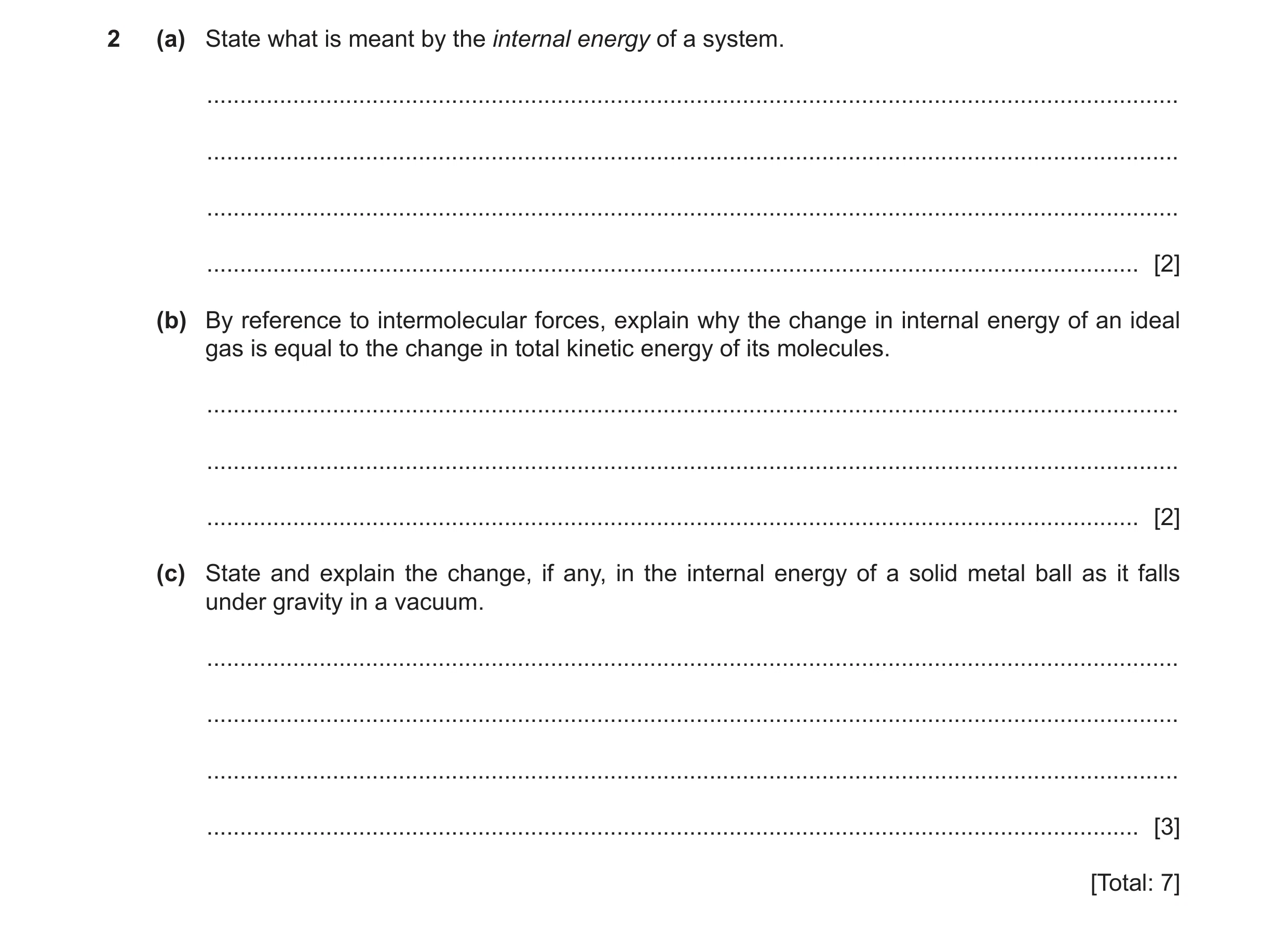
2 (a) State what is meant by the internal energy of a system. … … … … [2] (b) By reference to intermolecular forces, explain why the change in internal energy of an ideal gas is equal to the change in total kinetic energy of its molecules. … … … [2] (c) State and explain the change, if any, in the internal energy of a solid metal ball as it falls under gravity in a vacuum. … … … … [3] [Total: 7]
7 marks
Mark scheme: 2(a) total potential energy and kinetic energy (of molecules/atoms) M1 reference to random motion of molecules/atoms A1 2(b) (in ideal gas,) no intermolecular forces B1 no potential energy (so change in kinetic energy is change in internal energy) B1 2(c) (random) potential energy of molecules does not change M1 (random) kinetic energy of molecules does not change M1 so internal energy does not change A1 or decrease in total potential energy = gain in total kinetic energy (M1) no external energy supplied (M1) so internal energy does not change (A1) or no compression (of ball) so no work done on the ball (M1) no resistive forces so no heating of the ball (M1) so internal energy does not change (A1) Question Answer Marks 2(c) or no change of state so potential energy (of molecules) unchanged (M1) no temperature rise so kinetic energy (of molecules) unchanged (M1) so internal energy does not change (A1)
This question in 9702/43 May/June 2020
Q7 · State what is meant by the internal energy of a system 9702/42 Oct/Nov 2020
2 (a) State what is meant by the internal energy of a system. … … … [2] (b) The atoms of an ideal gas occupy a container of volume 2.30 × 10⁻³ m3 at pressure 2.60 × 10⁵ Pa and temperature 180 K, as illustrated in Fig. 2.1. 2.30 × 10⁻³ m3 3.80 × 10⁻³ m3 2.60 × 10⁵ Pa 2.60 × 10⁵ Pa 180 K T 980 J Fig. 2.1 The gas is heated at constant pressure so that its volume becomes 3.80 × 10⁻³ m3 at a temperature T. For the fixed mass of gas, calculate: (i) the amount of substance, in mol amount = … mol [2] (ii) the temperature T, in K. T = … K [2] (c) During the change in (b), the thermal energy supplied to the gas is 980 J. (i) Determine the work done on the gas during this change. Explain your working. work done = … J [3] (ii) Determine the change ΔU in internal energy of the gas. ΔU = … J [1] [Total: 10]
10 marks
Mark scheme: 2(a) sum of potential energy and kinetic energy (of particles) B1 (total) energy of random motion of particles B1 2(b)(i) pV = nRT C1 2.60 × 105 × 2.30 × 10–3 = n × 8.31 × 180 n = 0.400 mol A1 2(b)(ii) (2.30 × 10⁻³) / 180 = (3.80 × 10⁻³) / T or 2.60 × 105 × 3.80 × 10–3 = 0.400 × 8.31 × T C1 T = 297 K A1 2(c)(i) ΔW = pΔV = 2.60 × 105 × (2.30 – 3.80) × 10–3 C1 = (–)390 J A1 negative because work is done by gas or negative because work is done against atmospheric pressure or negative because volume of gas increases B1 2(c)(ii) ΔU = (980 – 390) = 590 J A1
This question in 9702/42 Oct/Nov 2020
Q8 · A fixed mass of an ideal gas has a volume V and a pressure p 9702/42 Feb/March 2022
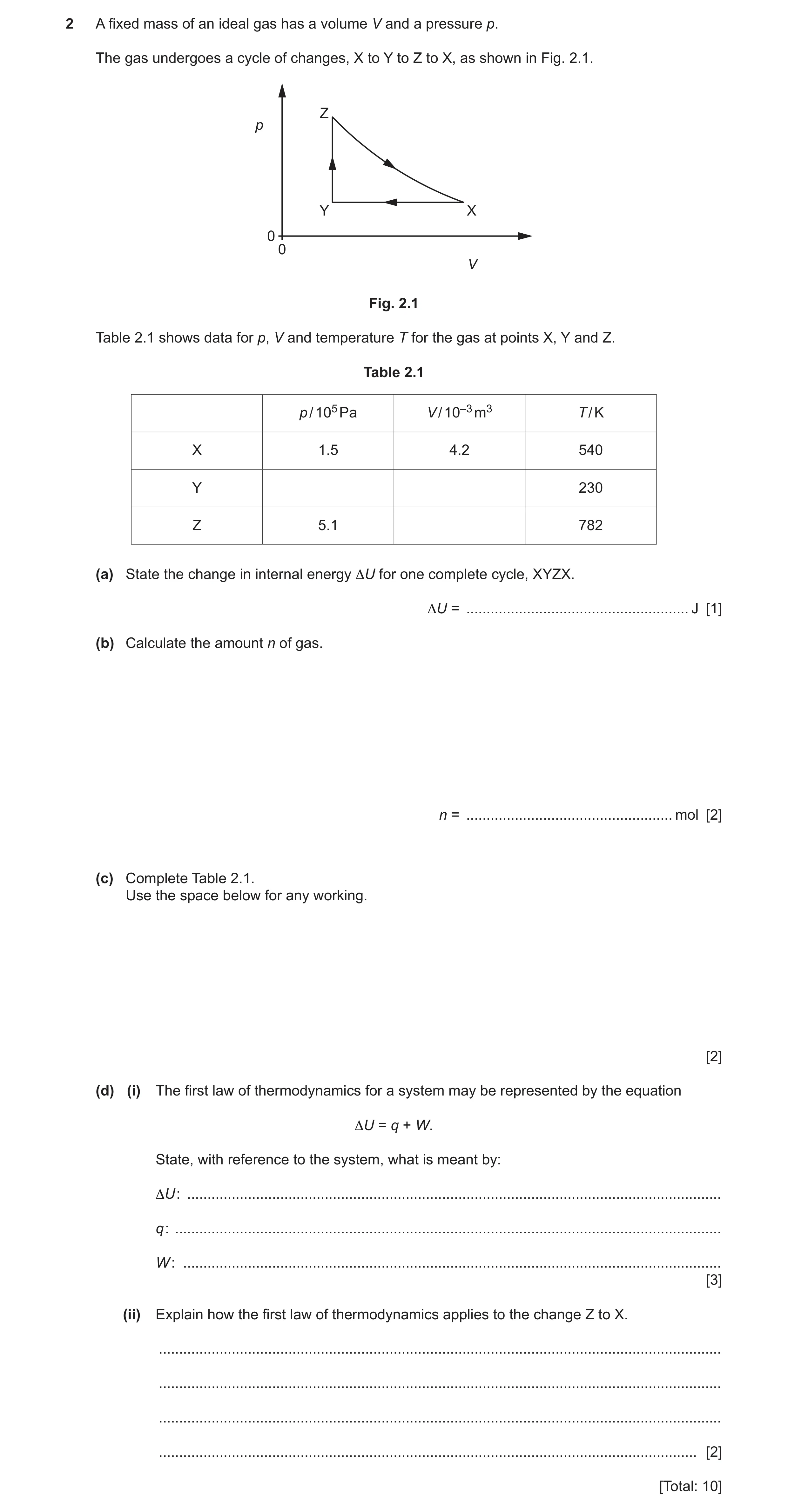
2 A fixed mass of an ideal gas has a volume V and a pressure p. The gas undergoes a cycle of changes, X to Y to Z to X, as shown in Fig. 2.1. Z p Y X 0 0 V Fig. 2.1 Table 2.1 shows data for p, V and temperature T for the gas at points X, Y and Z. Table 2.1 p / 105 Pa V / 10–3 m3 T / K X 1.5 4.2 540 Y 230 Z 5.1 782 (a) State the change in internal energy ΔU for one complete cycle, XYZX. ΔU = … J [1] (b) Calculate the amount n of gas. n = … mol [2] (c) Complete Table 2.1. Use the space below for any working. [2] (d) (i) The first law of thermodynamics for a system may be represented by the equation ΔU = q + W. State, with reference to the system, what is meant by: ΔU : … q : … W : … [3] (ii) Explain how the first law of thermodynamics applies to the change Z to X. … … … … [2] [Total: 10]
10 marks
Mark scheme: 2(a) 0 B1 2(b) pV = nRT (n =) 1.5 × 105 × 4.2 × 10–3 / 8.31 × 540 C1 = 0.14 mol A1 2(c) missing pressure 1.5 (× 105) B1 both missing volumes 1.8 (× 10–3) B1 2(d)(i) (ΔU:) increase in internal energy (of the system) B1 (q:) thermal energy supplied to the system B1 (W:) work done on system B1 Question Answer Marks 2(d)(ii) volume increases and work is done by the gas B1 temperature decreases and internal energy decreases B1
This question in 9702/42 Feb/March 2022
Q9 · State what is meant by the internal energy of a system 9702/42 Oct/Nov 2023
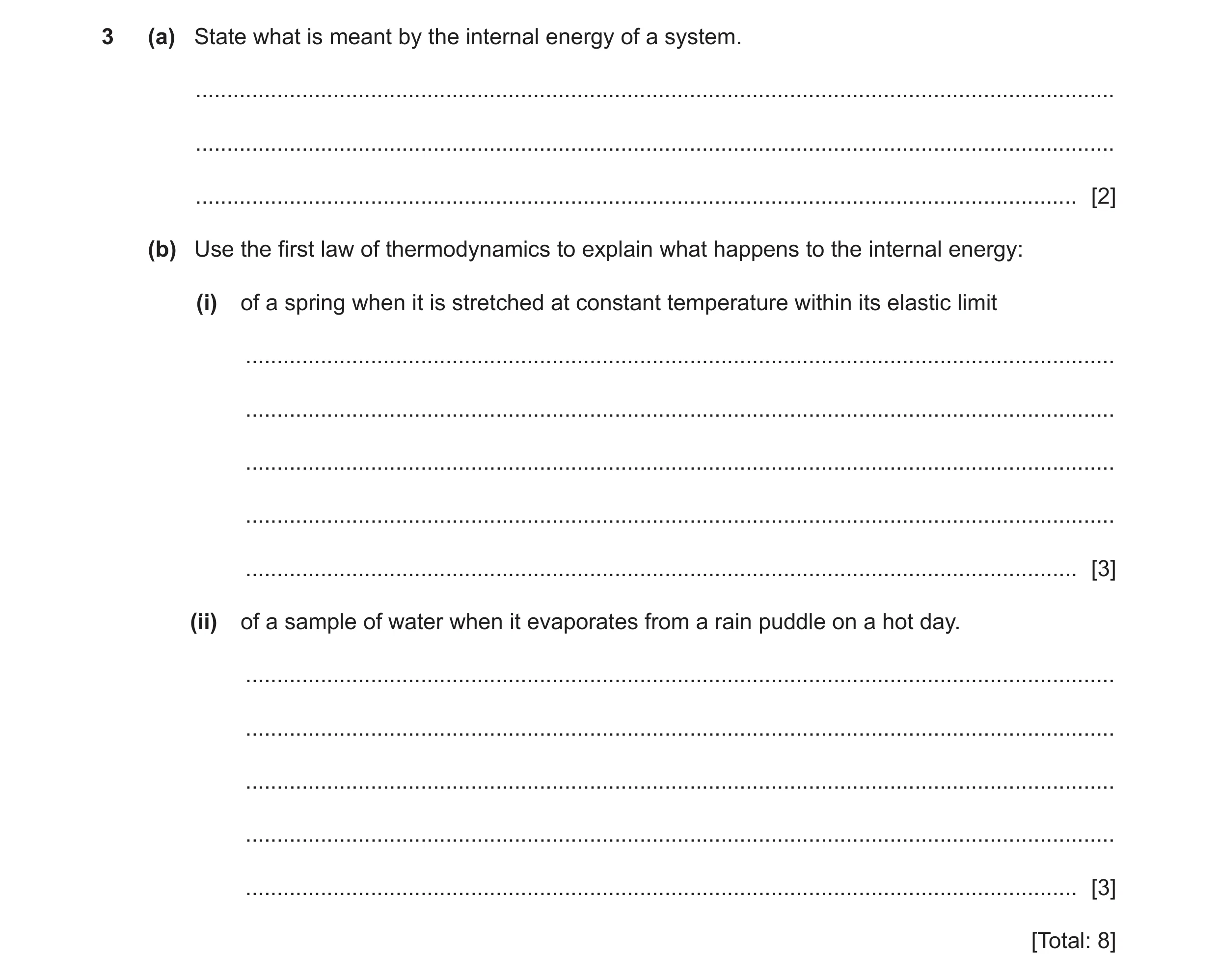
3 (a) State what is meant by the internal energy of a system. … … … [2] (b) Use the first law of thermodynamics to explain what happens to the internal energy: (i) of a spring when it is stretched at constant temperature within its elastic limit … … … … … [3] (ii) of a sample of water when it evaporates from a rain puddle on a hot day. … … … … … [3] [Total: 8]
8 marks
Mark scheme: 3(a) sum of potential energy and kinetic energy (of particles) B1 (total) energy of random motion of particles B1 3(b)(i) no thermal energy transferred B1 work is done on the spring (increasing the potential energy of particles) M1 so internal energy increases A1 3(b)(ii) thermal energy transferred to water B1 work is done by water (expanding against atmosphere as it vaporises) B1 more thermal energy transferred than work done so internal energy increases B1
This question in 9702/42 Oct/Nov 2023
Q10 · State what is meant by an ideal gas 9702/41 May/June 2024
3 (a) (i) State what is meant by an ideal gas. … … … [2] (ii) Use one of the basic assumptions of the kinetic theory to explain what can be deduced about the potential energy associated with the random motion of molecules in an ideal gas. … … … [2] (b) A sample of 0.26 m3 of an ideal gas is at pressure 2.0 × 10⁵ Pa and temperature 290 K. Determine: (i) the number N of molecules of the gas N = … [2] (ii) the average translational kinetic energy EK of one molecule of the gas EK = … J [2] (iii) the internal energy of the gas. Explain your reasoning. internal energy = … J [2] (c) The volume V of the gas in (b) is now varied, keeping its pressure constant. On Fig. 3.1, sketch the variation with V of the internal energy U of the gas. U 0 0 V Fig. 3.1 [2] [Total: 12]
12 marks
Mark scheme: 3(a)(i) M1 where T is thermodynamic temperature A1 3(a)(ii) no intermolecular forces B1 (so) potential energy is zero B1 3(b)(i) pV = NkT C1 N = (2.0 105 0.26) / (1.38 10–23 290) = 1.3 1025 A1 3(b)(ii) EK = (3/2) kT C1 EK = (3/2) 1.38 10–23 290 = 6.0 10–21 J A1 3(b)(iii) internal energy = total KE + PE of molecules or PE = 0 so internal energy = total KE of molecules B1 internal energy = 1.3 1025 6.0 10–21 = 7.8 104 J A1 3(c) straight line with positive gradient B1 line passing through the origin B1
This question in 9702/41 May/June 2024
Q11 · State what is meant by the internal energy of a system 9702/42 May/June 2024
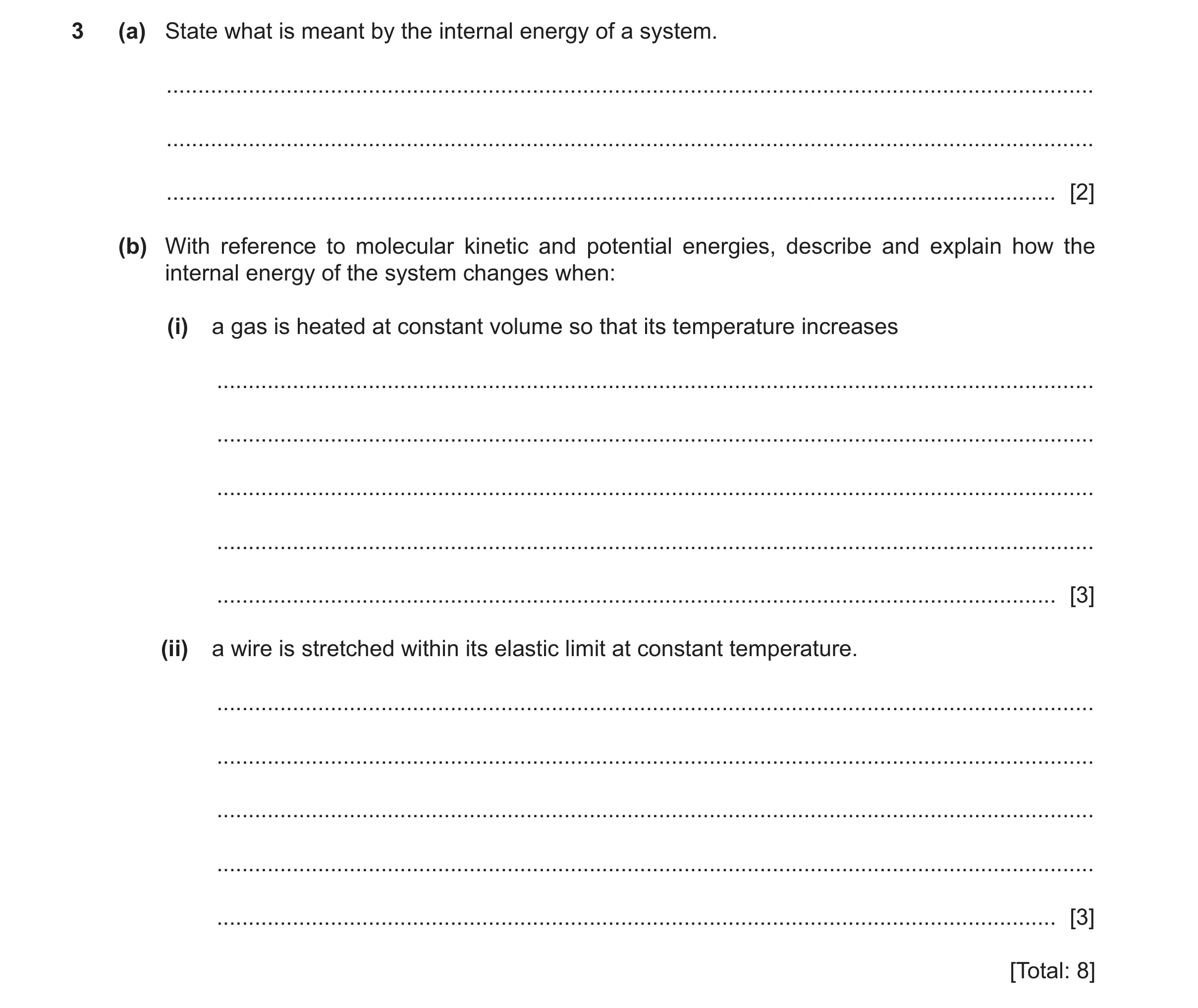
3 (a) State what is meant by the internal energy of a system. … … … [2] (b) With reference to molecular kinetic and potential energies, describe and explain how the internal energy of the system changes when: (i) a gas is heated at constant volume so that its temperature increases … … … … … [3] (ii) a wire is stretched within its elastic limit at constant temperature. … … … … … [3] [Total: 8]
8 marks
Mark scheme: 3(a) sum of potential energy and kinetic energy B1 (total) energy of random motion of particles B1 3(b)(i) no change in separation so no change in (molecular) potential energy B1 temperature increases so kinetic energy (of molecules) increases B1 kinetic energy increases and potential energy unchanged, so internal energy increases B1 3(b)(ii) temperature constant so no change in (molecular) kinetic energy B1 separation increases so potential energy (of molecules) increases B1 potential energy increases and kinetic energy unchanged, so internal energy increases B1
This question in 9702/42 May/June 2024
Q12 · State what is meant by an ideal gas 9702/43 May/June 2024
3 (a) (i) State what is meant by an ideal gas. … … … [2] (ii) Use one of the basic assumptions of the kinetic theory to explain what can be deduced about the potential energy associated with the random motion of molecules in an ideal gas. … … … [2] (b) A sample of 0.26 m3 of an ideal gas is at pressure 2.0 × 10⁵ Pa and temperature 290 K. Determine: (i) the number N of molecules of the gas N = … [2] (ii) the average translational kinetic energy EK of one molecule of the gas EK = … J [2] (iii) the internal energy of the gas. Explain your reasoning. internal energy = … J [2] (c) The volume V of the gas in (b) is now varied, keeping its pressure constant. On Fig. 3.1, sketch the variation with V of the internal energy U of the gas. U 0 0 V Fig. 3.1 [2] [Total: 12]
12 marks
Mark scheme: 3(a)(i) M1 where T is thermodynamic temperature A1 3(a)(ii) no intermolecular forces B1 (so) potential energy is zero B1 3(b)(i) pV = NkT C1 N = (2.0 105 0.26) / (1.38 10–23 290) = 1.3 1025 A1 3(b)(ii) EK = (3/2) kT C1 EK = (3/2) 1.38 10–23 290 = 6.0 10–21 J A1 3(b)(iii) internal energy = total KE + PE of molecules or PE = 0 so internal energy = total KE of molecules B1 internal energy = 1.3 1025 6.0 10–21 = 7.8 104 J A1 3(c) straight line with positive gradient B1 line passing through the origin B1
This question in 9702/43 May/June 2024
Q13 · State what is meant by the internal energy of a system 9702/41 May/June 2025
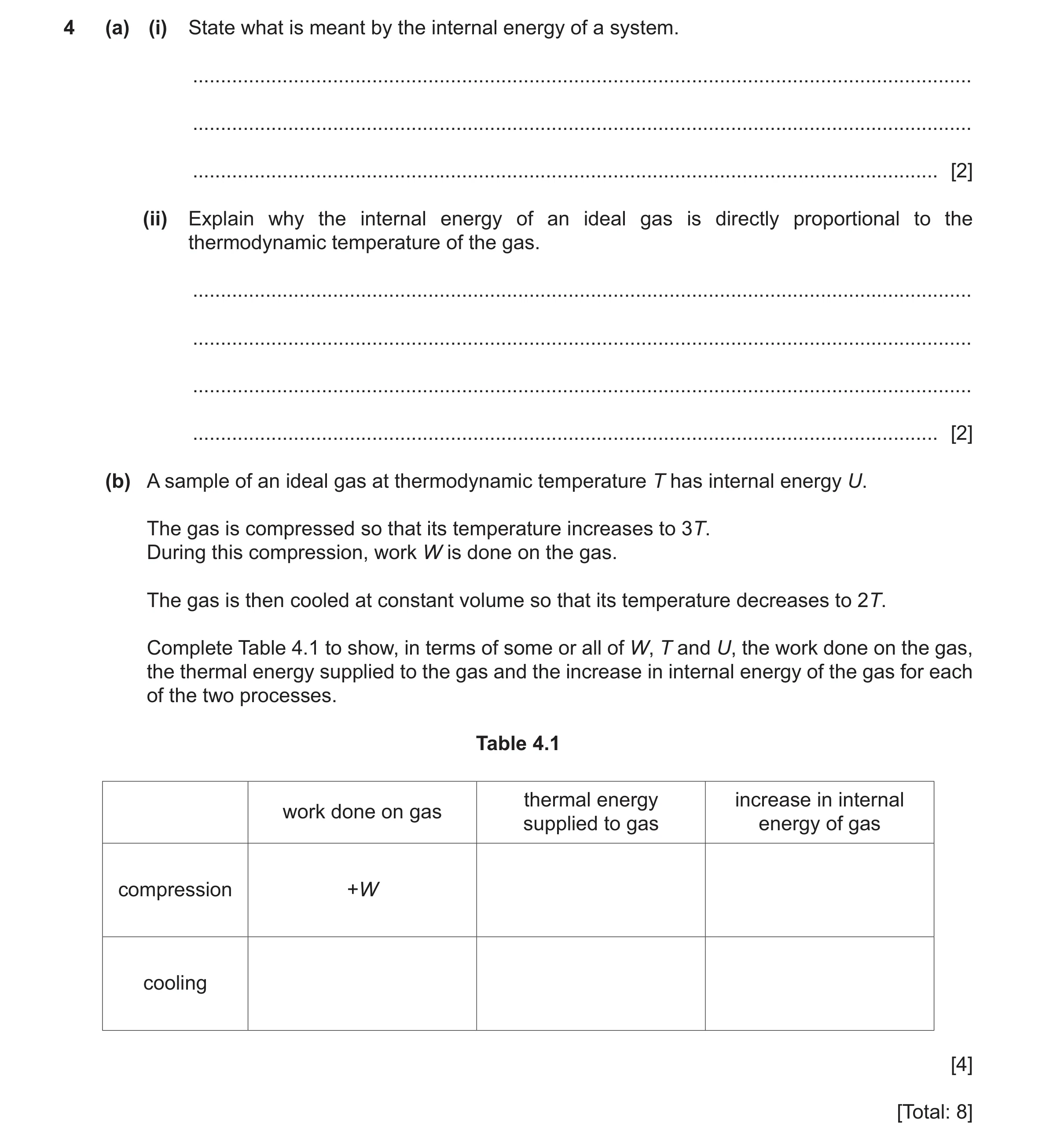
4 (a) (i) State what is meant by the internal energy of a system. … … … [2] (ii) Explain why the internal energy of an ideal gas is directly proportional to the thermodynamic temperature of the gas. … … … … [2] (b) A sample of an ideal gas at thermodynamic temperature T has internal energy U. The gas is compressed so that its temperature increases to 3T. During this compression, work W is done on the gas. The gas is then cooled at constant volume so that its temperature decreases to 2T. Complete Table 4.1 to show, in terms of some or all of W, T and U, the work done on the gas, the thermal energy supplied to the gas and the increase in internal energy of the gas for each of the two processes. Table 4.1 thermal energy increase in internal work done on gas supplied to gas energy of gas compression +W cooling [4] [Total: 8]
8 marks
Mark scheme: 4(a)(i) sum of potential energy and kinetic energy B1 (total) energy of random motion of particles B1 4(a)(ii) potential energy (of molecules) (in an ideal gas) is zero, so the internal energy of the gas is equal to the total kinetic energy B1 (of molecules) kinetic energy of molecules is proportional to (thermodynamic) temperature (so internal energy is proportional to B1 (thermodynamic) temperature)) 4(b) cooling work done = 0 B1 compression increase in internal energy = +2U B1 cooling change in internal energy = –U B1 both rows: thermal energy adds to work to give increase in internal energy in terms of U and/or W B1 (if fully correct, thermal energy for compression = 2U – W and thermal energy for cooling = –U: compression +W 2U – W +2U cooling 0 –U –U )
This question in 9702/41 May/June 2025
Q14 · State what is meant by the internal energy of a system 9702/43 May/June 2025
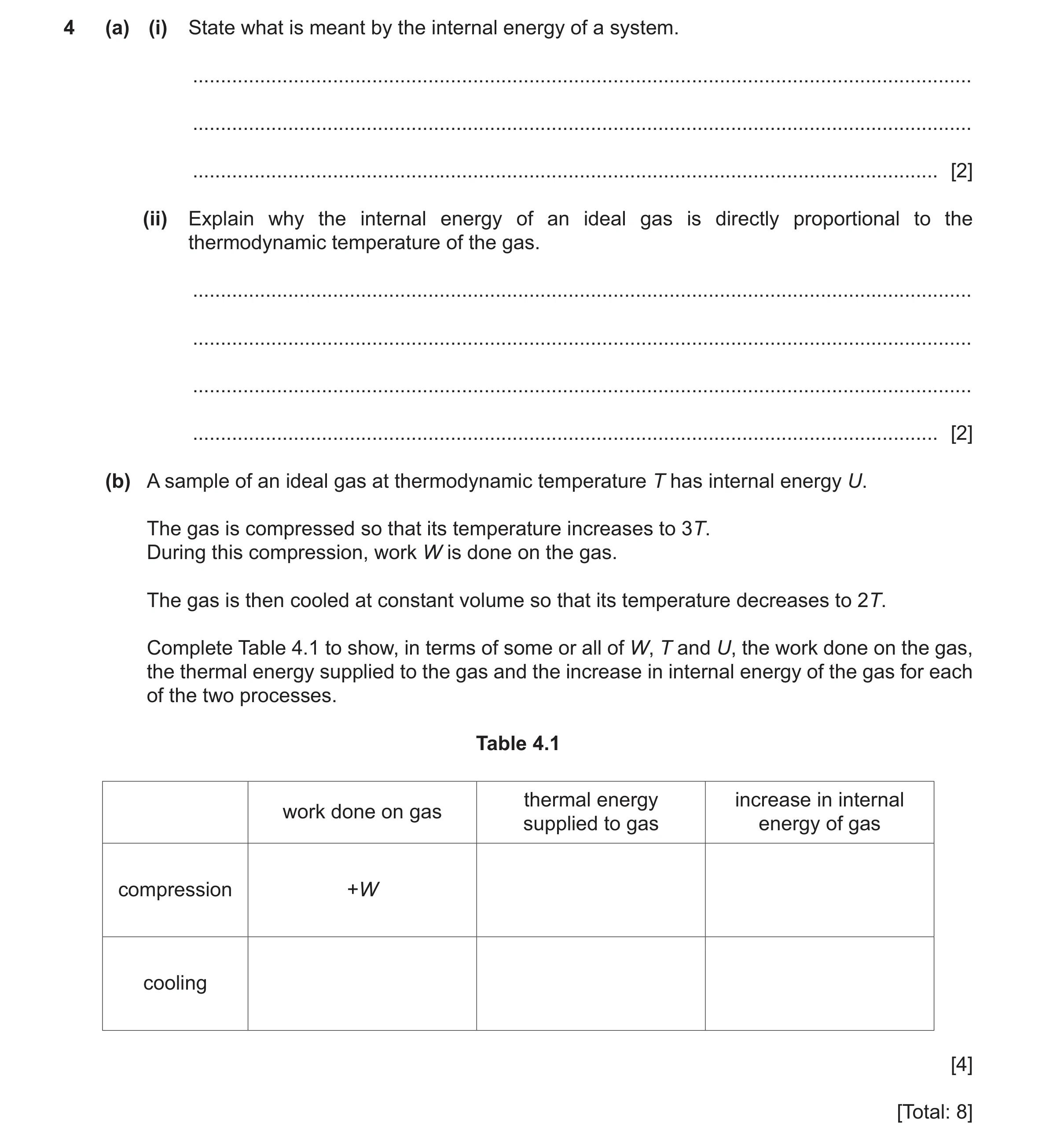
4 (a) (i) State what is meant by the internal energy of a system. … … … [2] (ii) Explain why the internal energy of an ideal gas is directly proportional to the thermodynamic temperature of the gas. … … … … [2] (b) A sample of an ideal gas at thermodynamic temperature T has internal energy U. The gas is compressed so that its temperature increases to 3T. During this compression, work W is done on the gas. The gas is then cooled at constant volume so that its temperature decreases to 2T. Complete Table 4.1 to show, in terms of some or all of W, T and U, the work done on the gas, the thermal energy supplied to the gas and the increase in internal energy of the gas for each of the two processes. Table 4.1 thermal energy increase in internal work done on gas supplied to gas energy of gas compression +W cooling [4] [Total: 8]
8 marks
Mark scheme: 4(a)(i) sum of potential energy and kinetic energy B1 (total) energy of random motion of particles B1 4(a)(ii) potential energy (of molecules) (in an ideal gas) is zero, so the internal energy of the gas is equal to the total kinetic energy B1 (of molecules) kinetic energy of molecules is proportional to (thermodynamic) temperature (so internal energy is proportional to B1 (thermodynamic) temperature)) 4(b) cooling work done = 0 B1 compression increase in internal energy = +2U B1 cooling change in internal energy = –U B1 both rows: thermal energy adds to work to give increase in internal energy in terms of U and/or W B1 (if fully correct, thermal energy for compression = 2U – W and thermal energy for cooling = –U: compression +W 2U – W +2U cooling 0 –U –U )
This question in 9702/43 May/June 2025
Q15 · State what is meant by an ideal gas 9702/44 May/June 2025
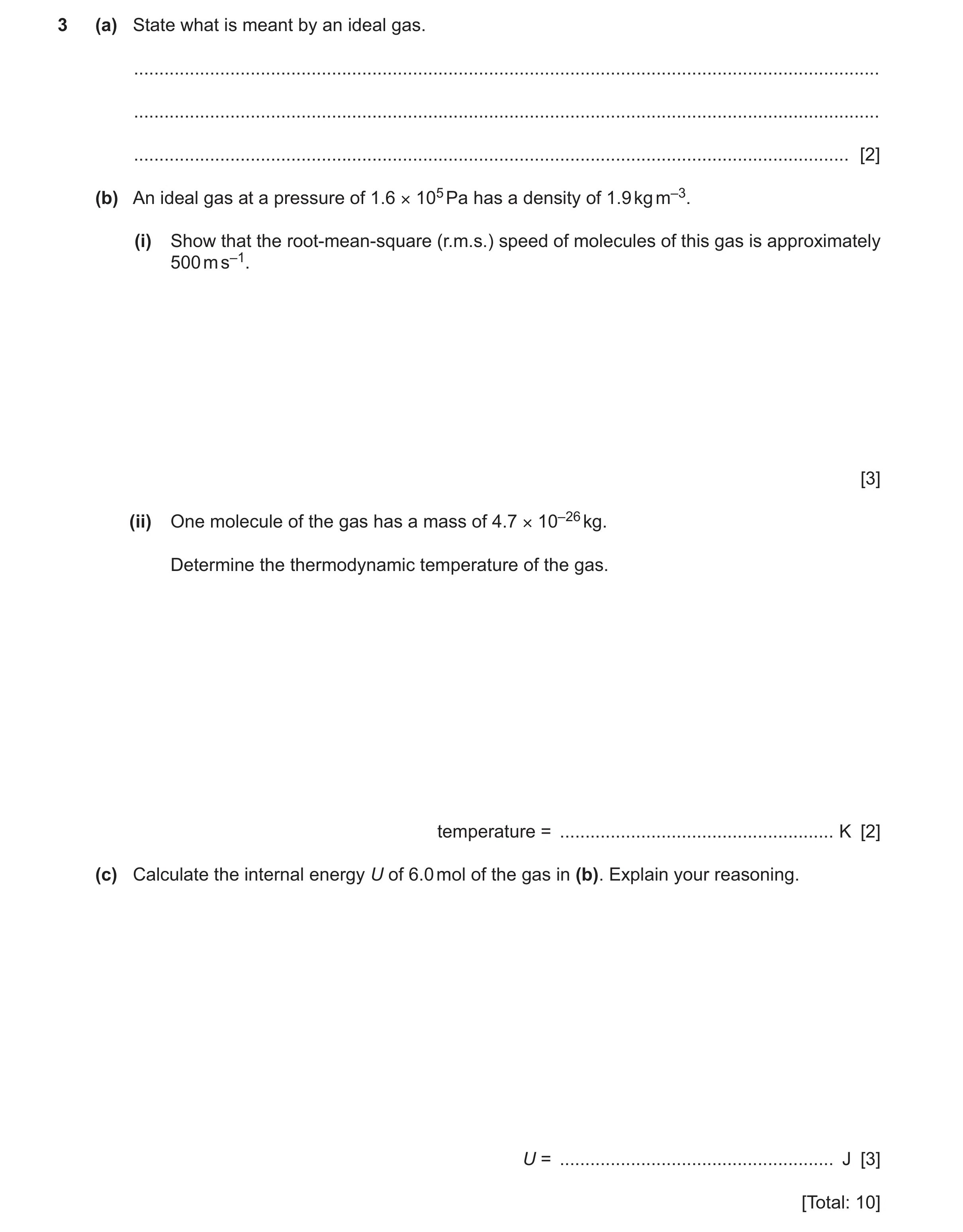
3 (a) State what is meant by an ideal gas. … … … [2] (b) An ideal gas at a pressure of 1.6 × 10⁵ Pa has a density of 1.9 kg m–3. (i) Show that the root-mean-square (r.m.s.) speed of molecules of this gas is approximately 500 m s–1. [3] (ii) One molecule of the gas has a mass of 4.7 × 10⁻²⁶ kg. Determine the thermodynamic temperature of the gas. temperature = … K [2] (c) Calculate the internal energy U of 6.0 mol of the gas in (b). Explain your reasoning. U = … J [3] [Total: 10]
10 marks
Mark scheme: 3(a) (gas that obeys) pV T (at all values of p, V and T) M1 where T is thermodynamic temperature A1 3(b)(i) pV = ⅓ Nm〈c2〉 and Nm / V = C1 (p = ⅓ 〈c2〉 ) r.m.s. speed = √〈c2〉 C1 1.6 105 = ⅓ 1.9 × 〈c2〉 leading to r.m.s. speed = 500 m s–1 A1 or r.m.s. speed = √(3 1.6 105 / 1.9) = 500 m s–1 3(b)(ii) (pV =) ⅓ Nm〈c2〉 = NkT C1 (so) ½ m〈c2〉 = (3 / 2) kT ½ 4.7 10–26 5032 = (3 / 2) 1.38 10–23 T A1 T = 290 K or pV = NkT and Nm / V = (C1) (so) T = pm / k T = 1.6 105 4.7 10–26 / (1.9 1.38 10–23) (A1) = 290 K 3(c) potential energy (of molecules) is zero B1 U = N ½ m〈c2〉 = 6.0 6.02 1023 ½ 4.7 10–26 5032 C1 or U = N (3 / 2) kT = 6.0 6.02 1023 (3 / 2) 1.38 10–23 287 or U = n (3 / 2) RT = 6.0 (3 / 2) 8.31 287 U = 21000 J A1
This question in 9702/44 May/June 2025
Q16 · With reference to molecular kinetic energy and molecular potential energy, explain what… 9702/44 Oct/Nov 2025
3 (a) With reference to molecular kinetic energy and molecular potential energy, explain what is meant by the internal energy of an ideal gas. … … … [2] (b) A sample of an ideal gas is initially in state A, at a pressure of 2.0 × 10⁵ Pa and with a volume of 0.016 m3, as shown in Fig. 3.1. 6 pressure / 105 Pa 4 2 A 0 0 0.01 0.02 0.03 0.04 volume / m3 Fig. 3.1 In state A, the temperature of the gas is 400 K. The gas undergoes two successive changes X and Y. In change X, it is heated at constant volume to a pressure of 4.0 × 10⁵ Pa. At the end of change X, the gas is in state B. In change Y, it is then allowed to expand at constant temperature back to its original pressure. At the end of change Y, the gas is in state C. (i) Determine the internal energy of the gas in state A. internal energy = … J [2] (ii) Determine the temperature of the gas in state B. temperature = … K [1] (iii) Determine the volume of the gas in state C. volume = … m3 [1] (iv) On Fig. 3.1, draw two lines, one to represent change X and one to represent change Y. Label your lines X and Y respectively. [3] [Total: 9]
9 marks
Mark scheme: 3(a) total kinetic energy associated with random motion of molecules B1 potential energy (of molecules) is zero B1 3(b)(i) pV = NkT and U = (3 / 2)NkT C1 U = (3 / 2)pV A1 = (3 / 2) 2.0 105 0.016 = 4800 J 3(b)(ii) temperature = 800 K A1 3(b)(iii) volume = 0.032 m3 A1 3(b)(iv) straight vertical line labelled X between A and (0.016, 4.0) B1 curve from B with continuously decreasing negative gradient, labelled Y B1 line labelled Y between (0.016, 4.0) and (0.032, 2.0) B1
This question in 9702/44 Oct/Nov 2025
 1 / 19
 2 / 19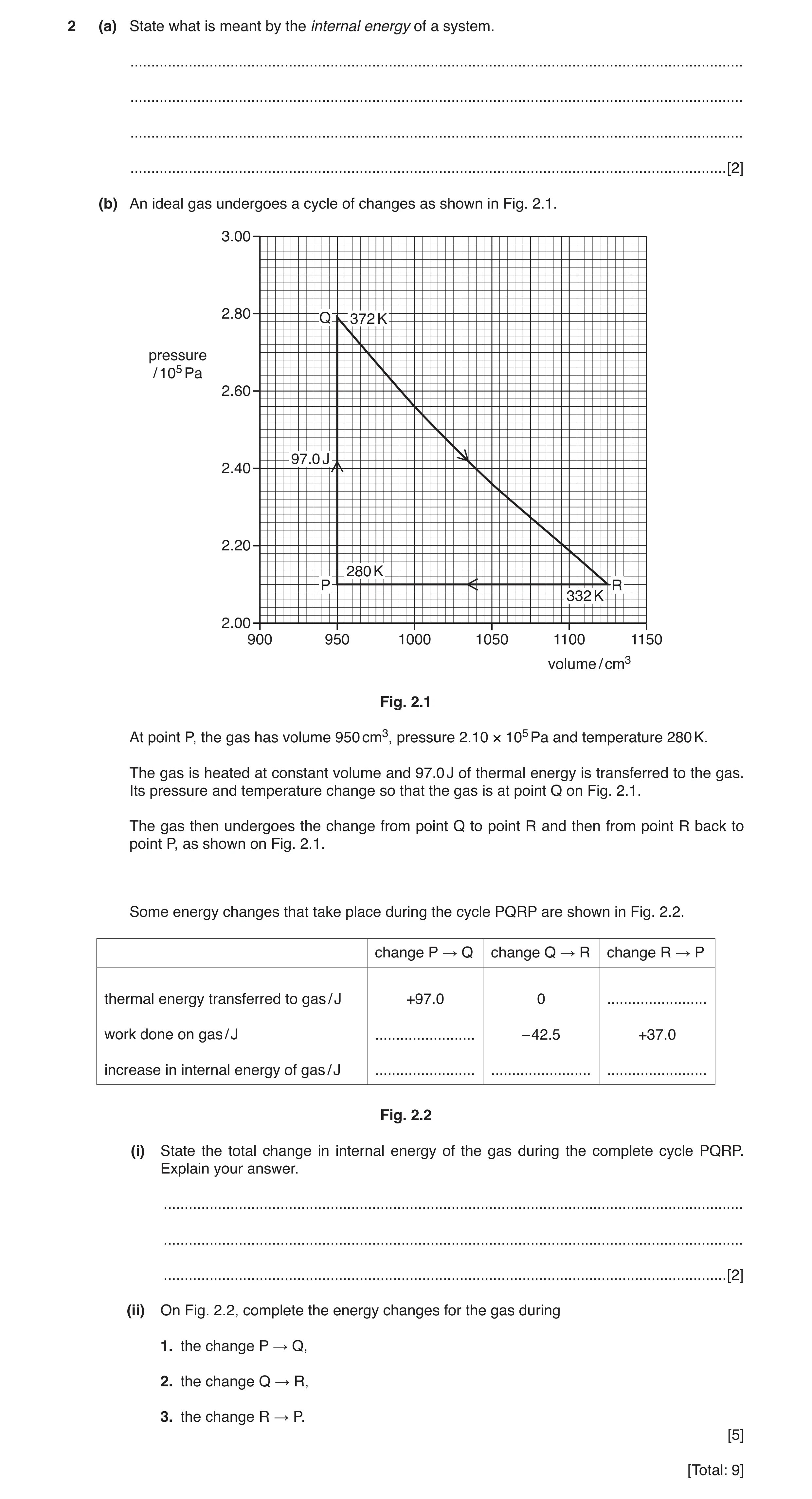
 6 / 19
 7 / 19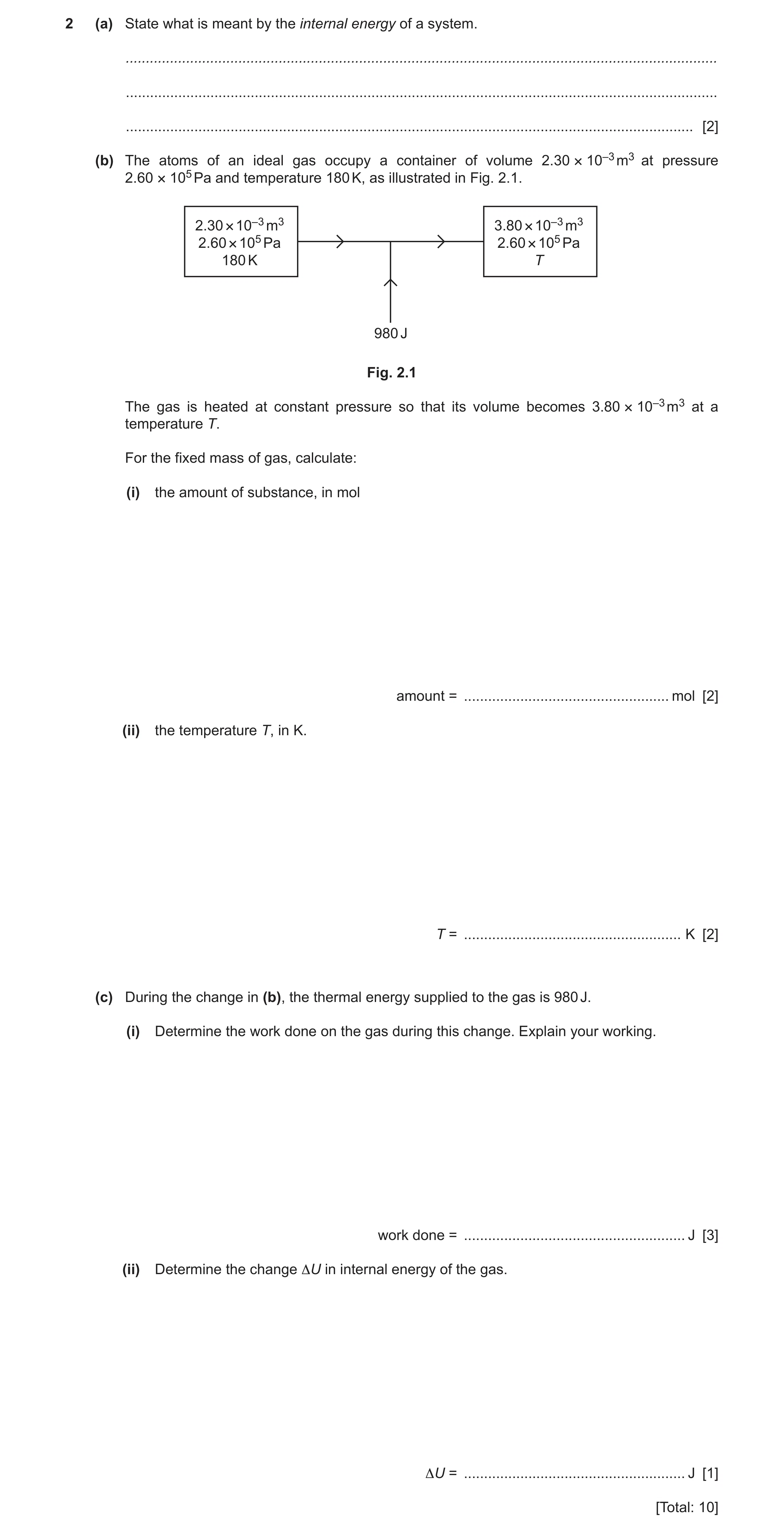
 10 / 19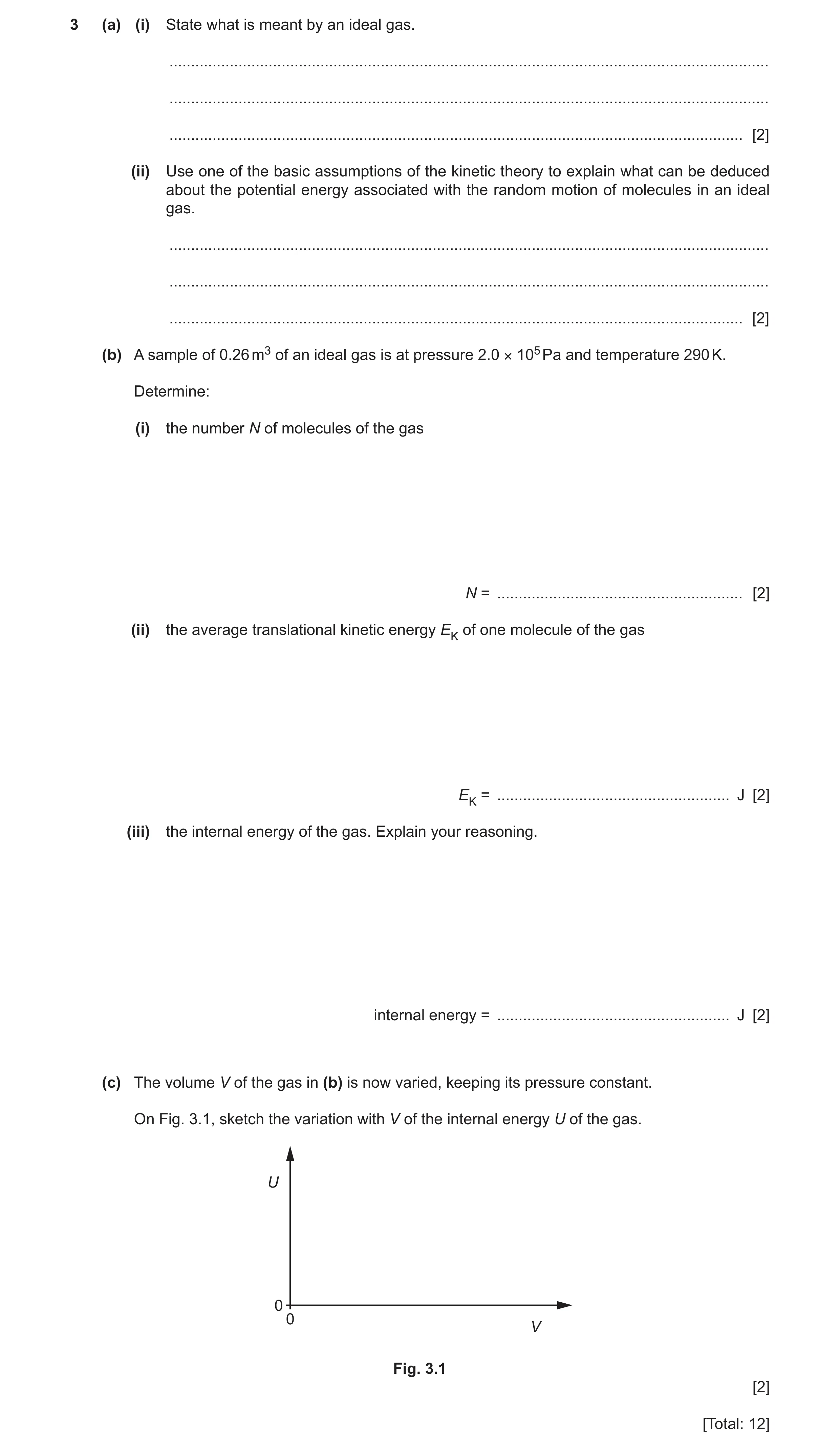
 12 / 19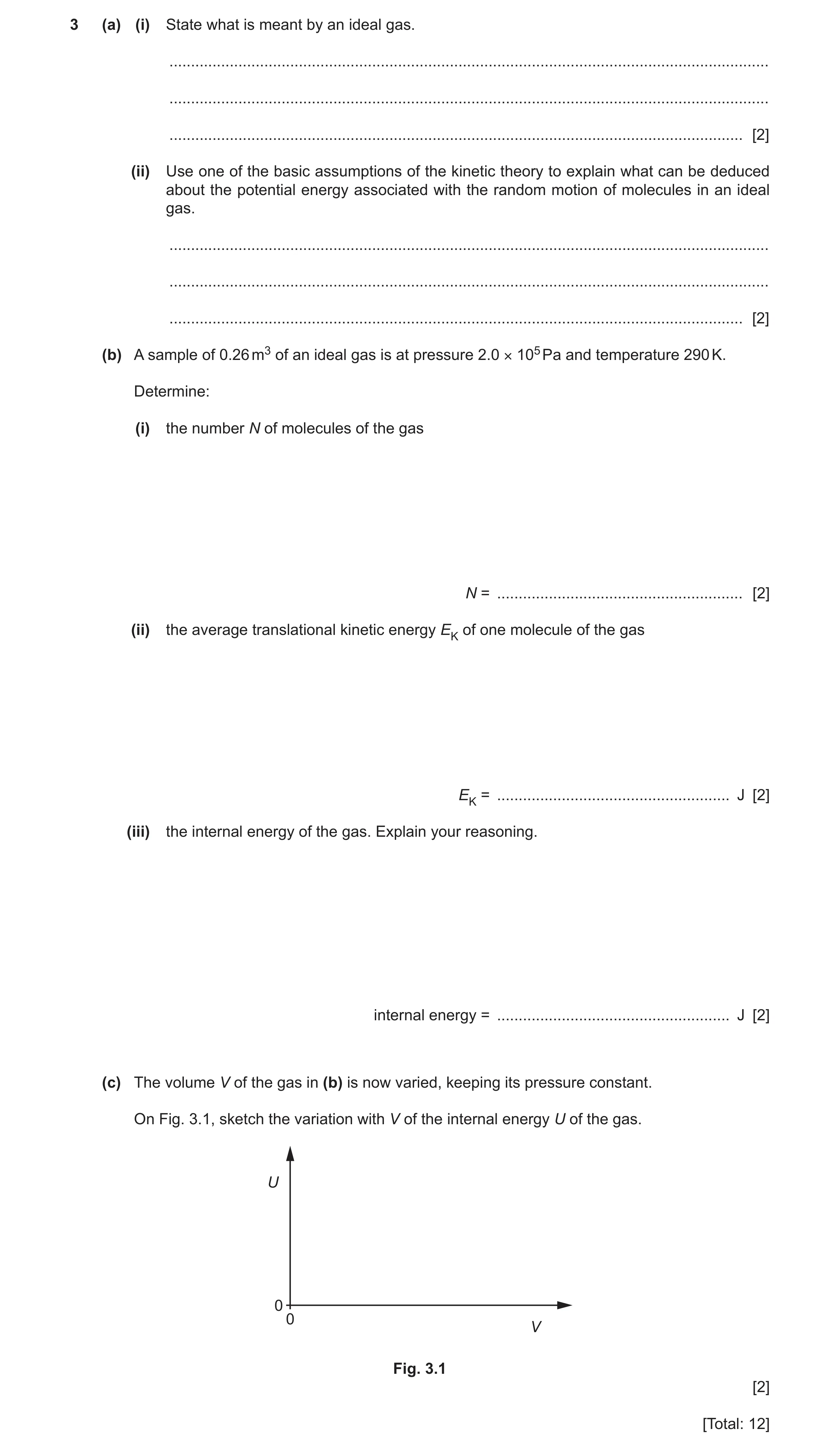
 15 / 19
 16 / 19
 17 / 19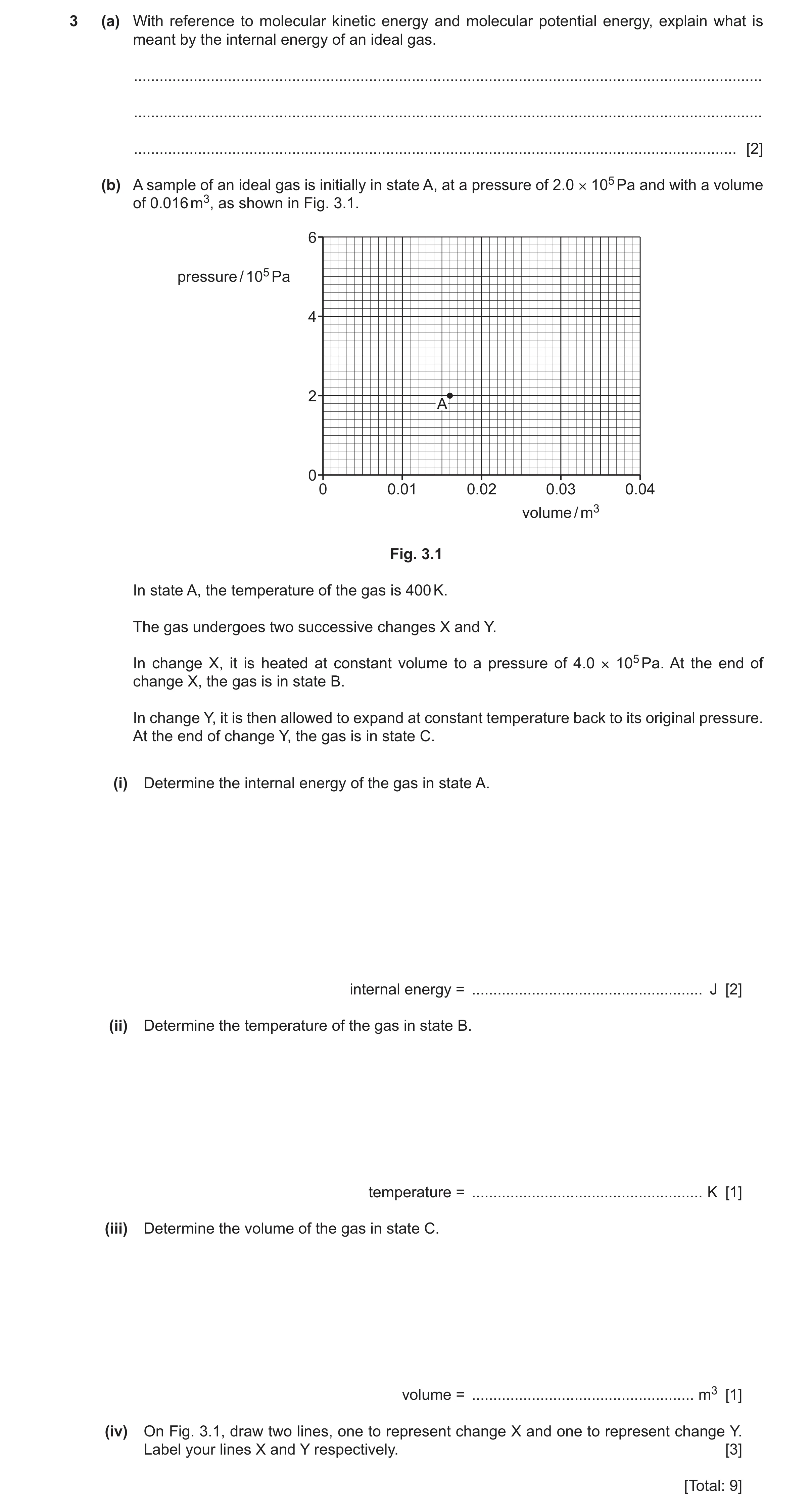
 8
8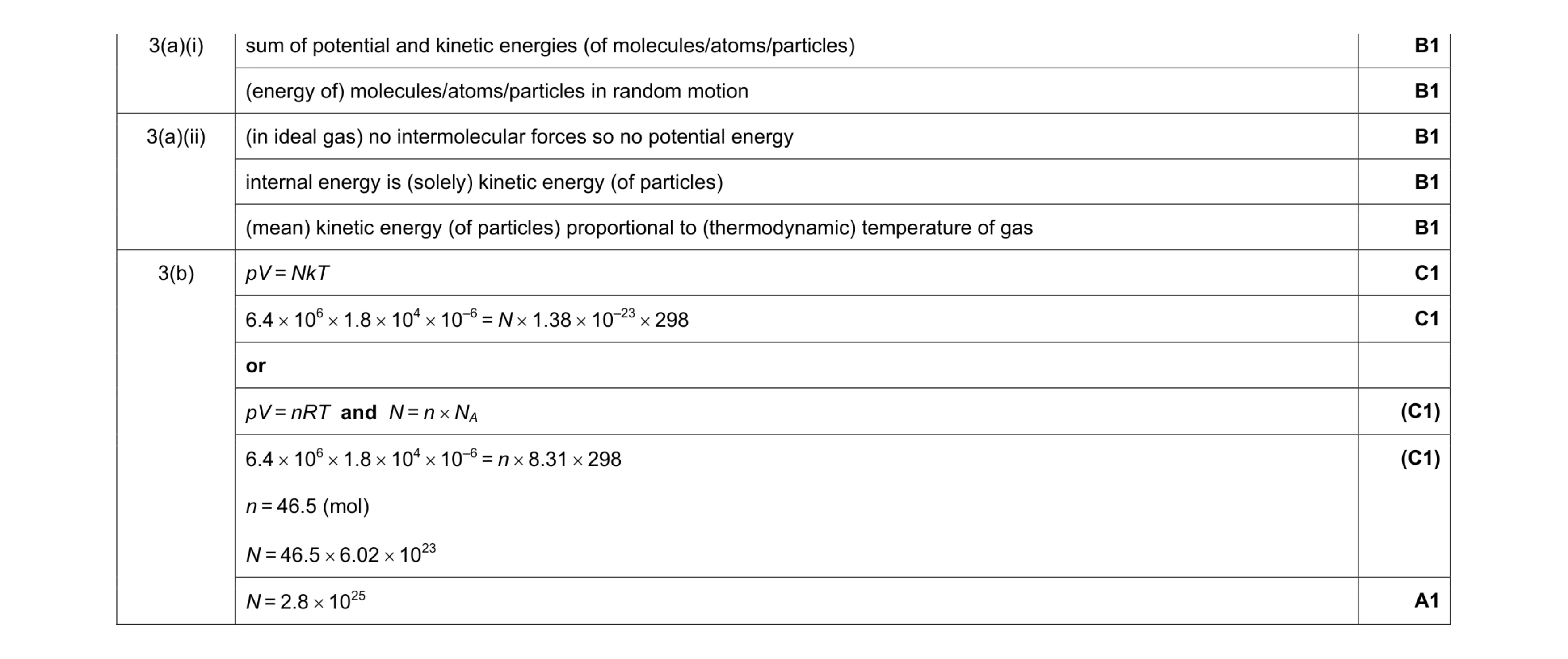 8
8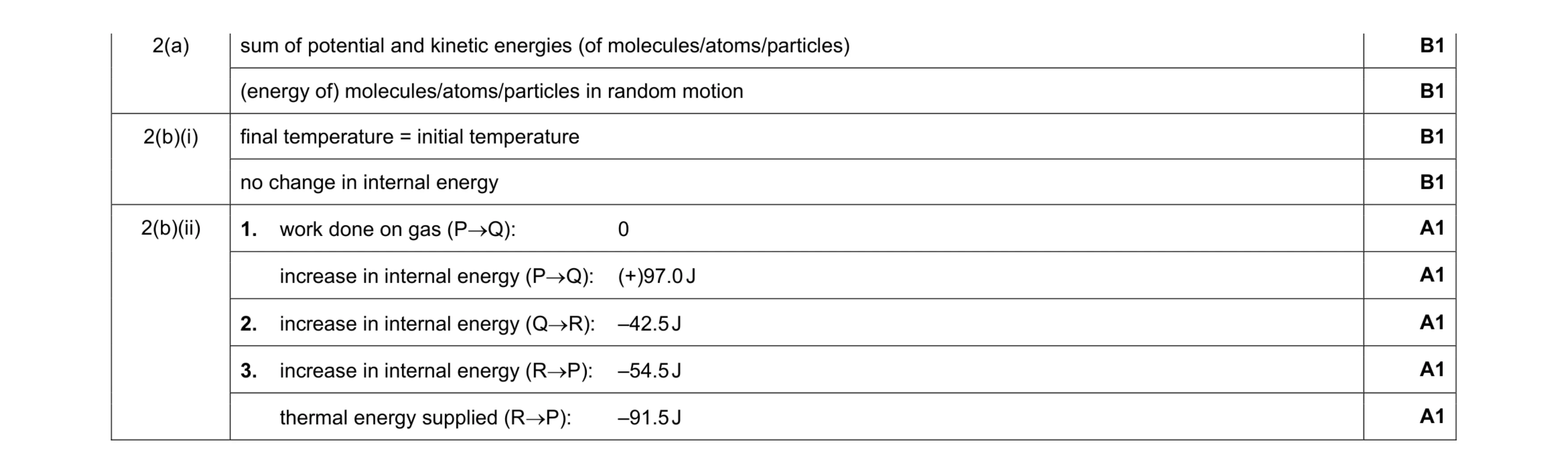 9
9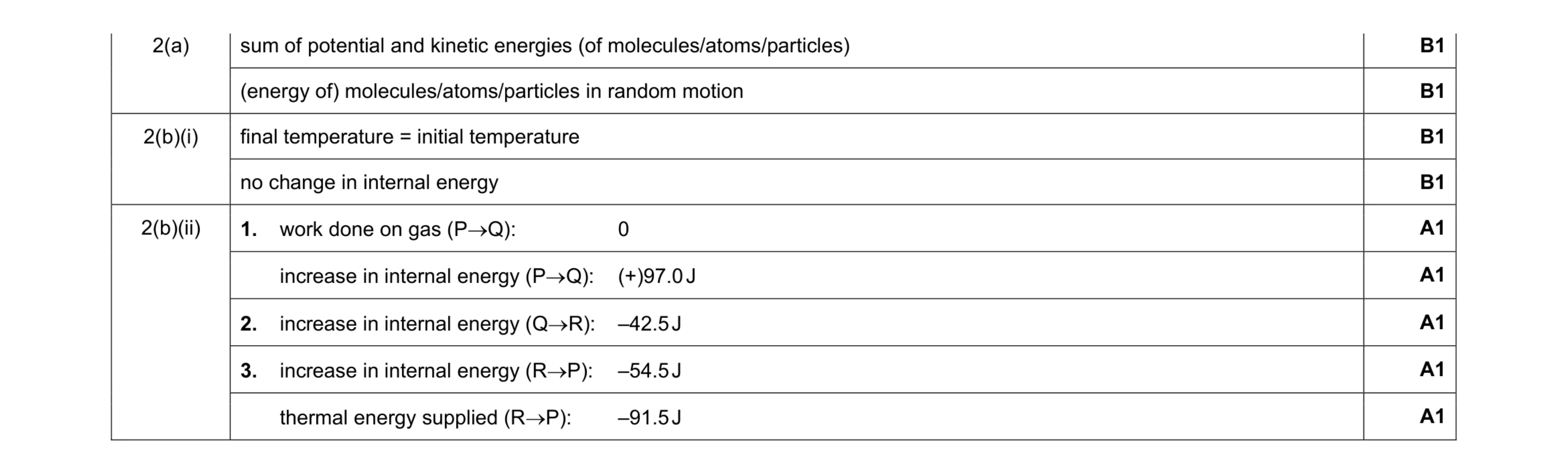 9
9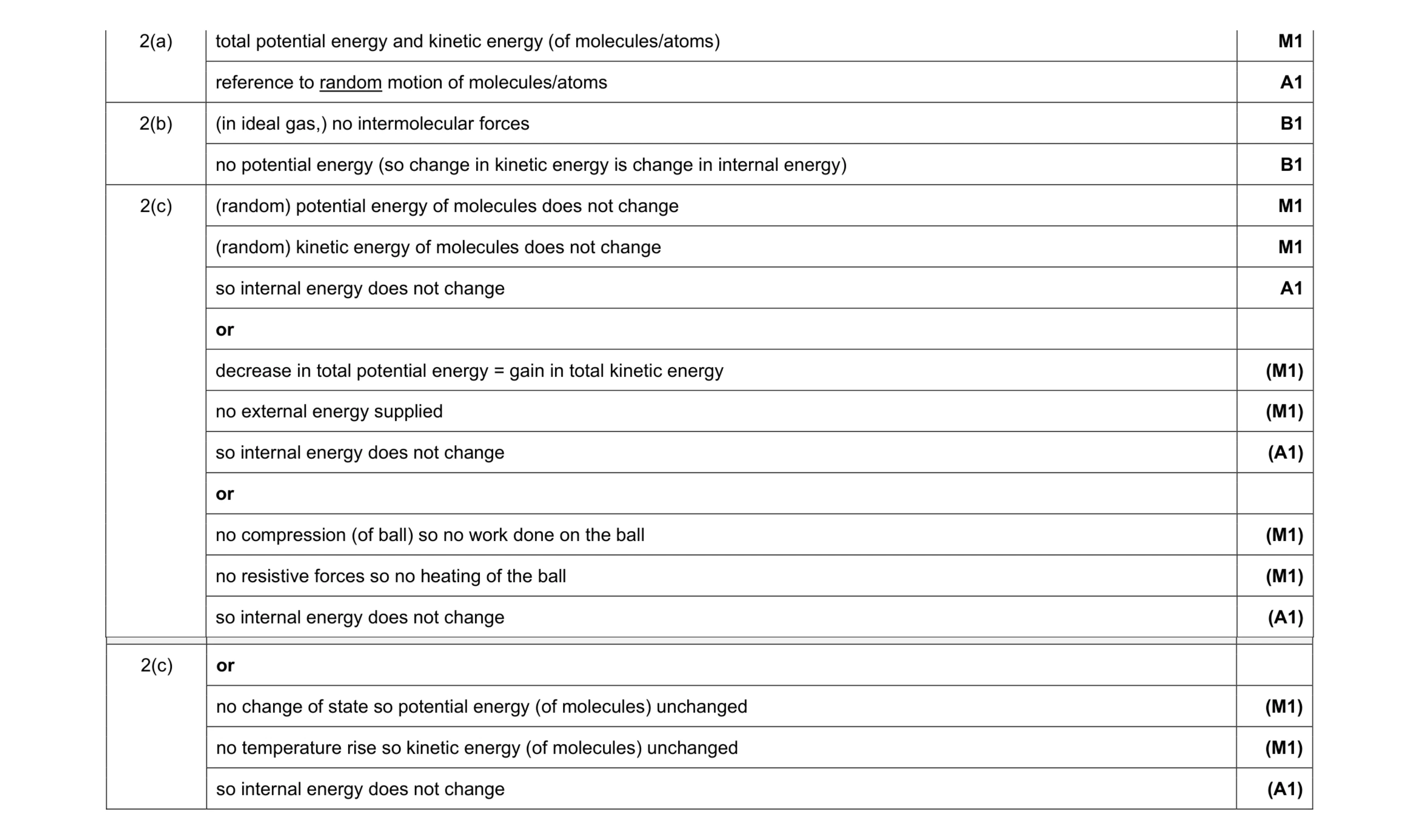 7
7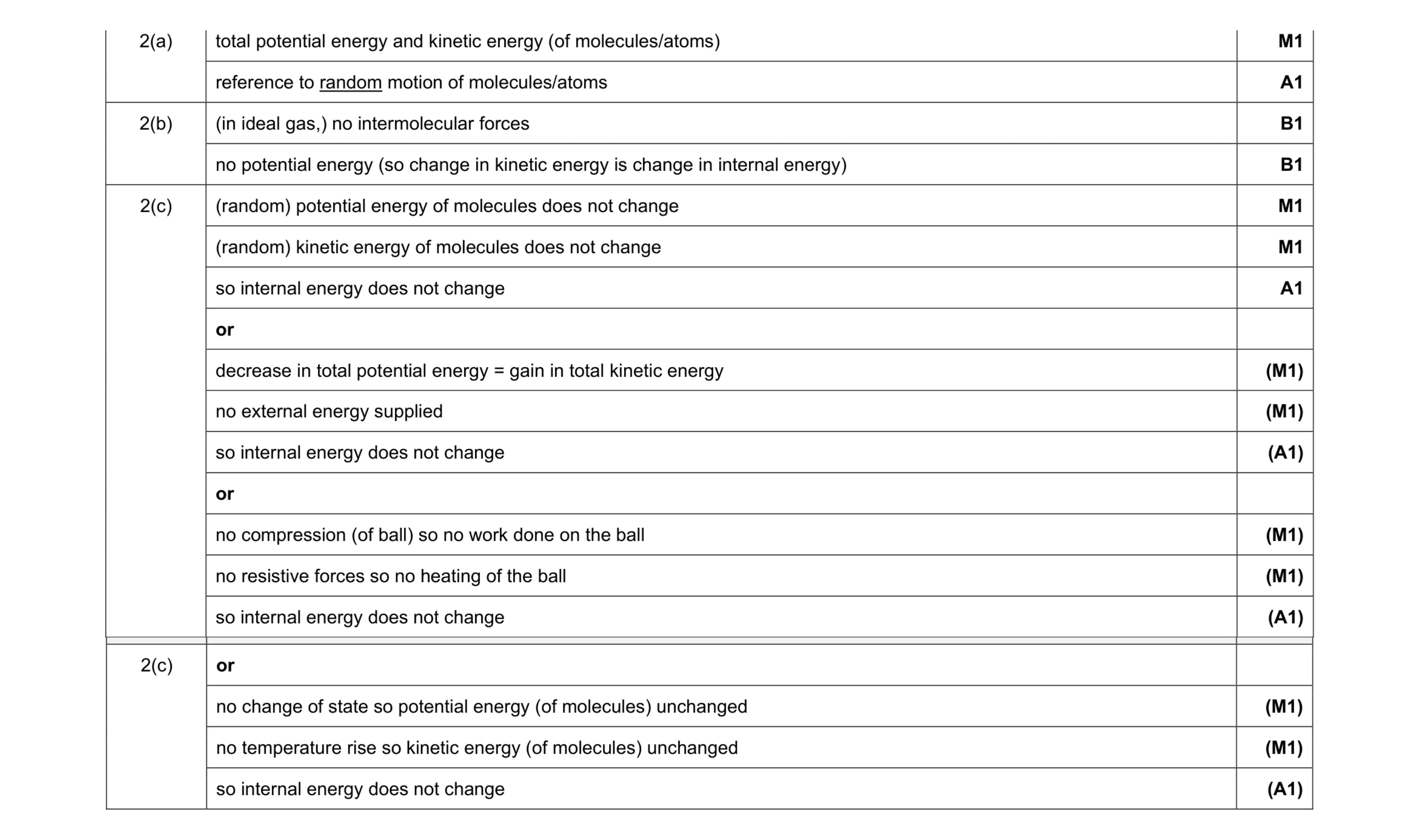 7
7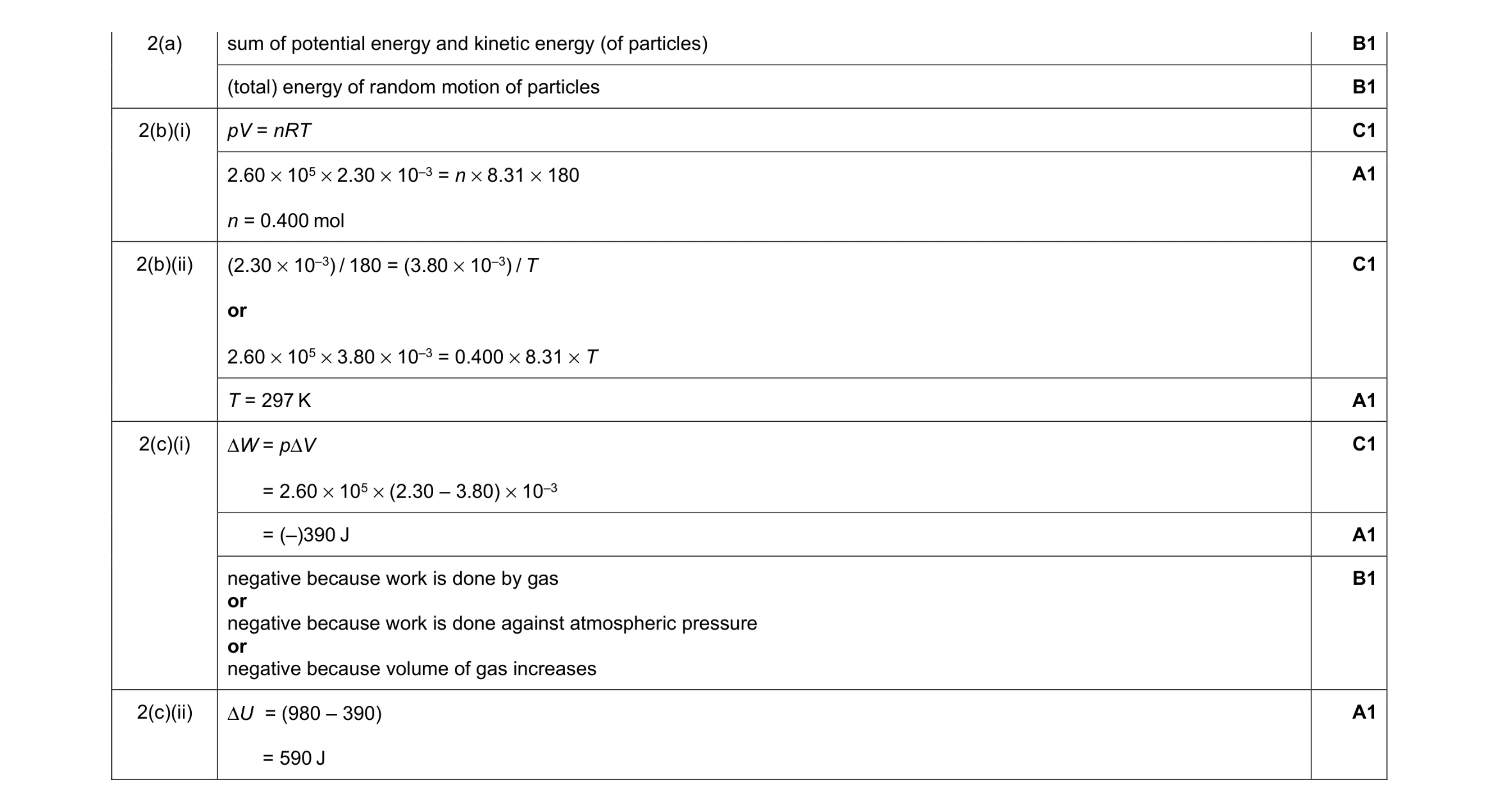 10
10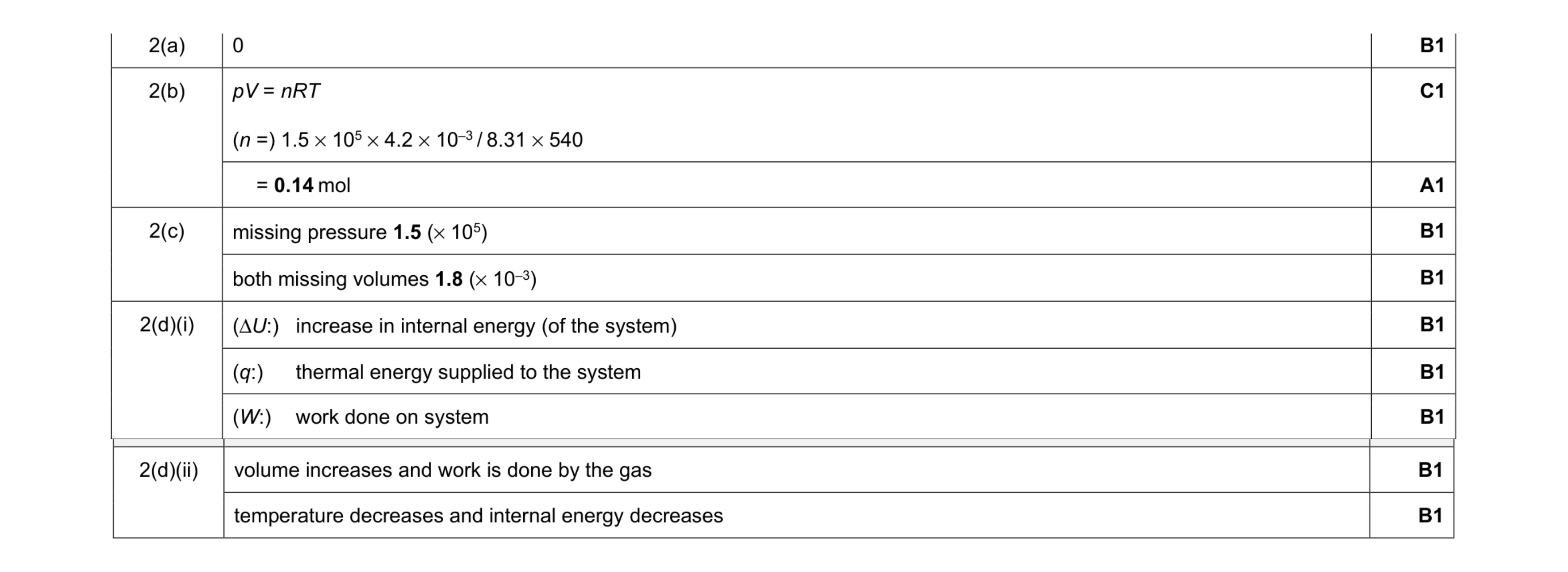 10
10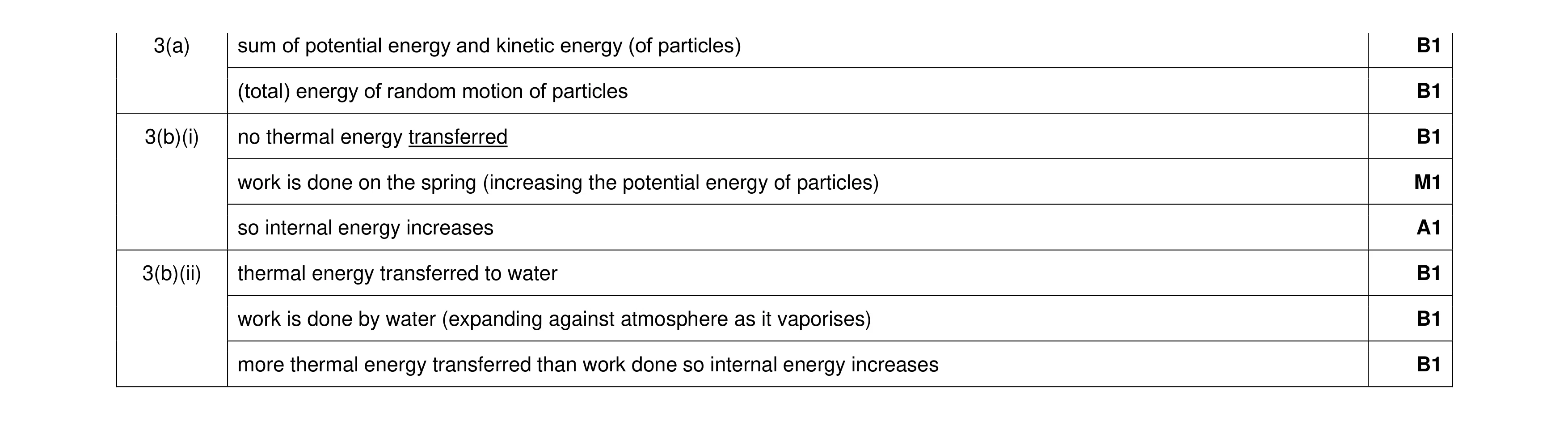 8
8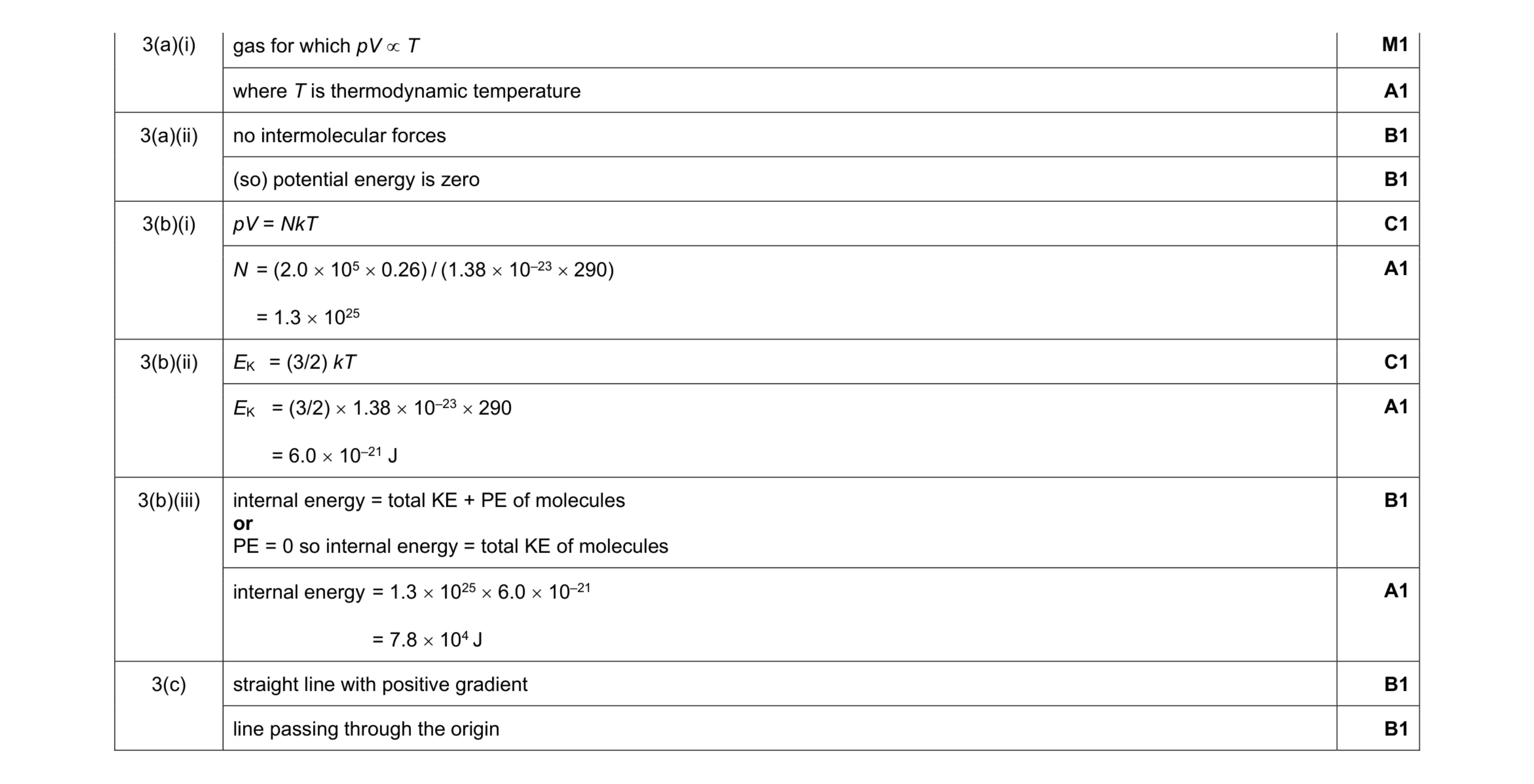 12
12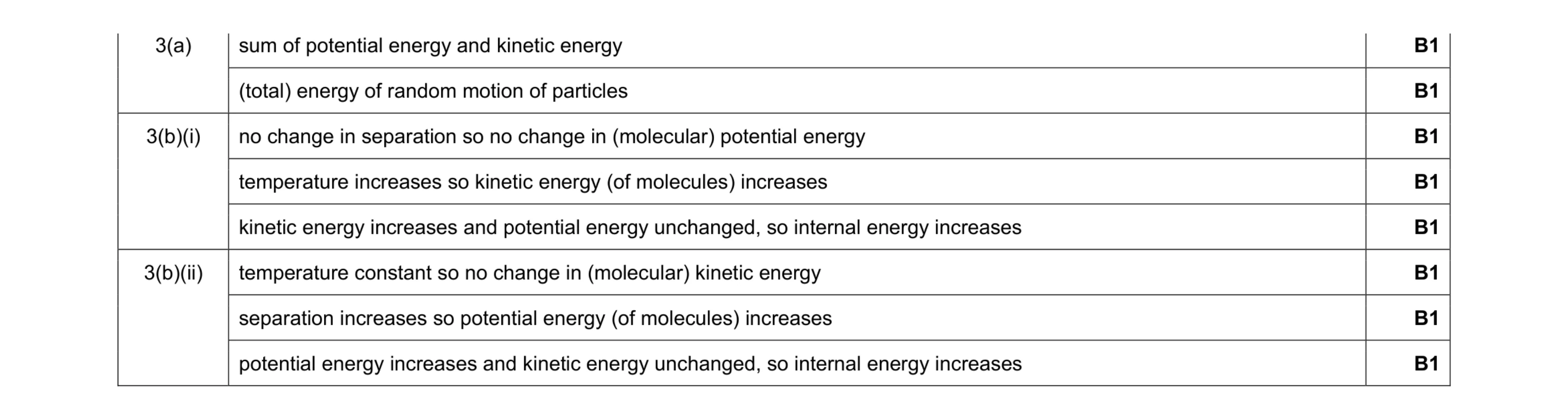 8
8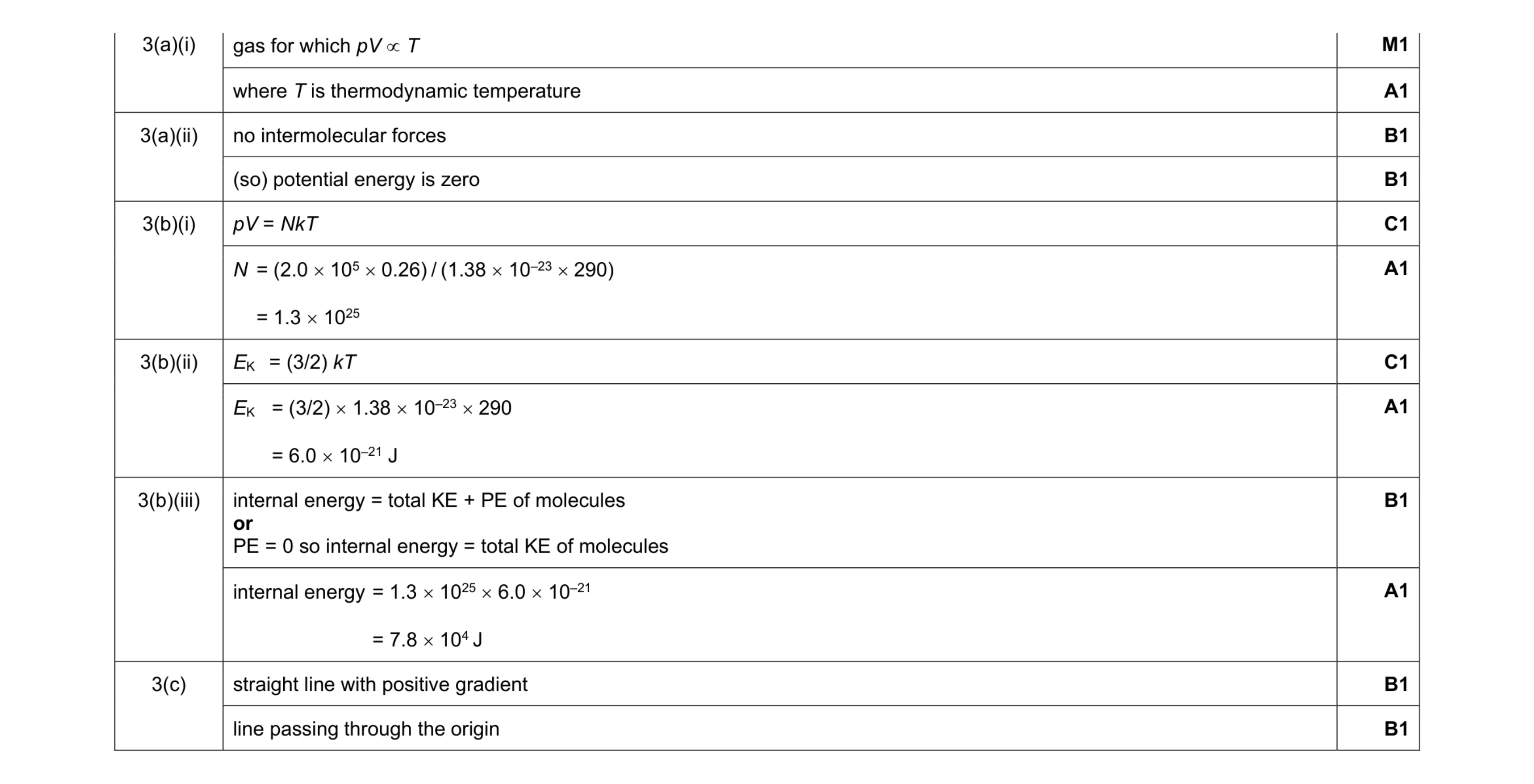 12
12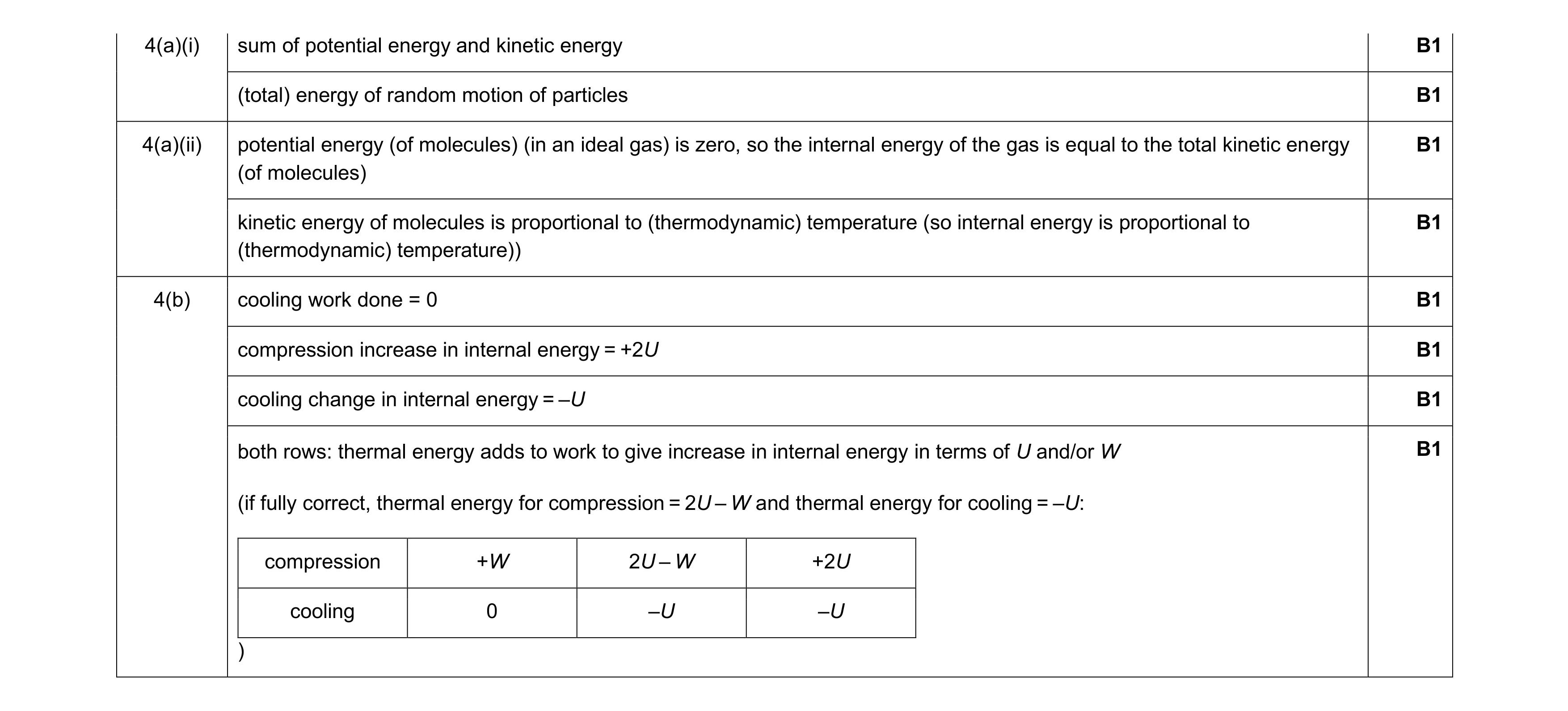 8
8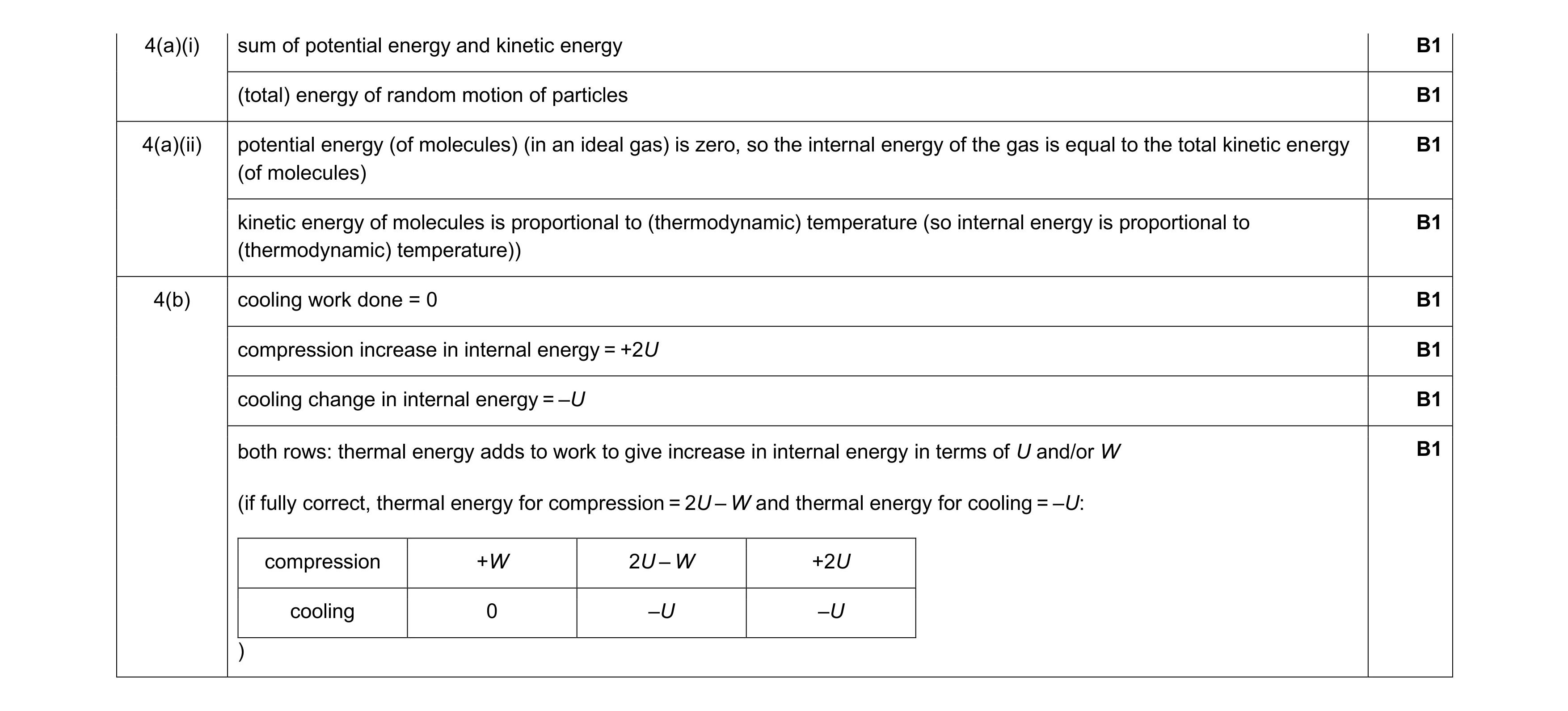 8
8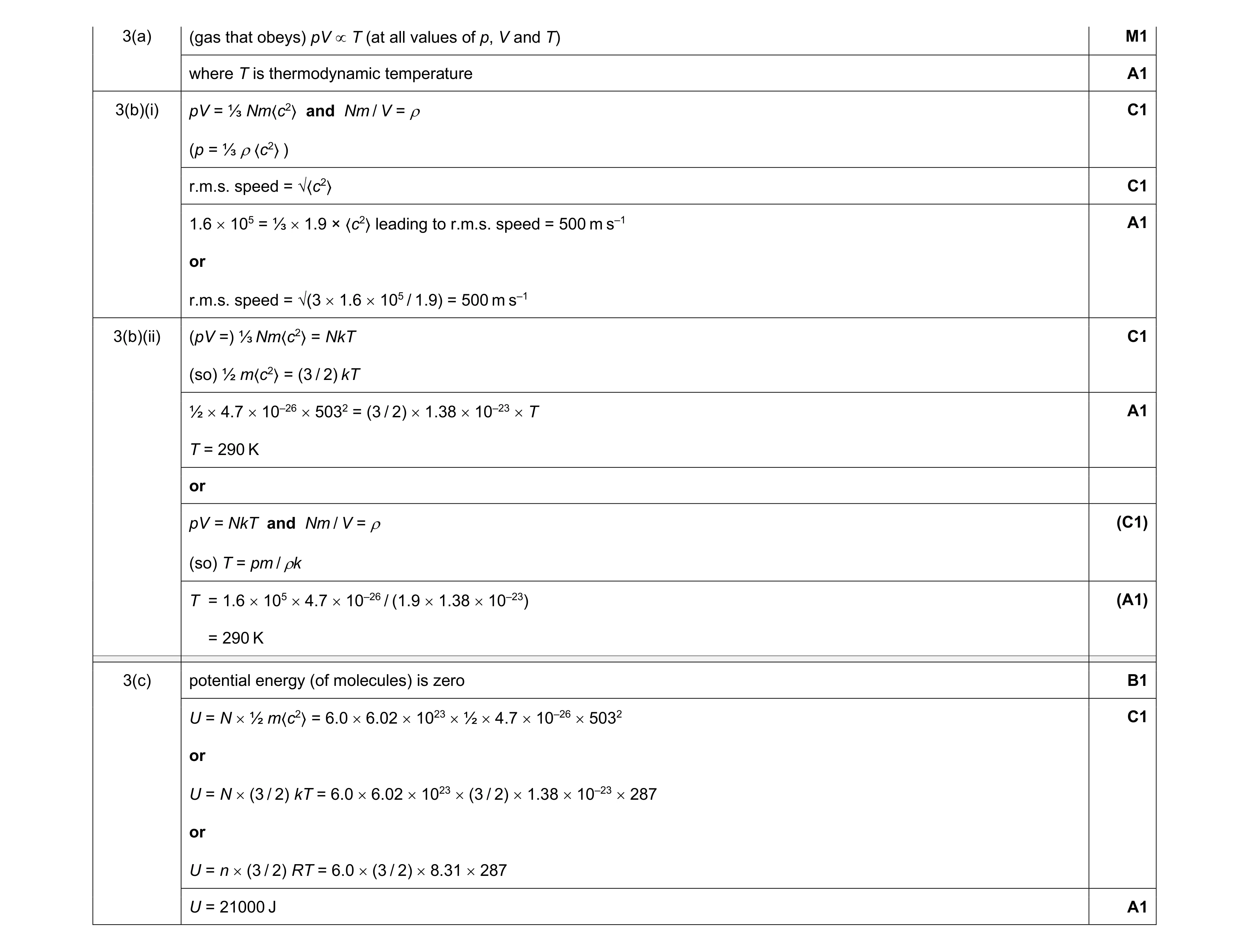 10
10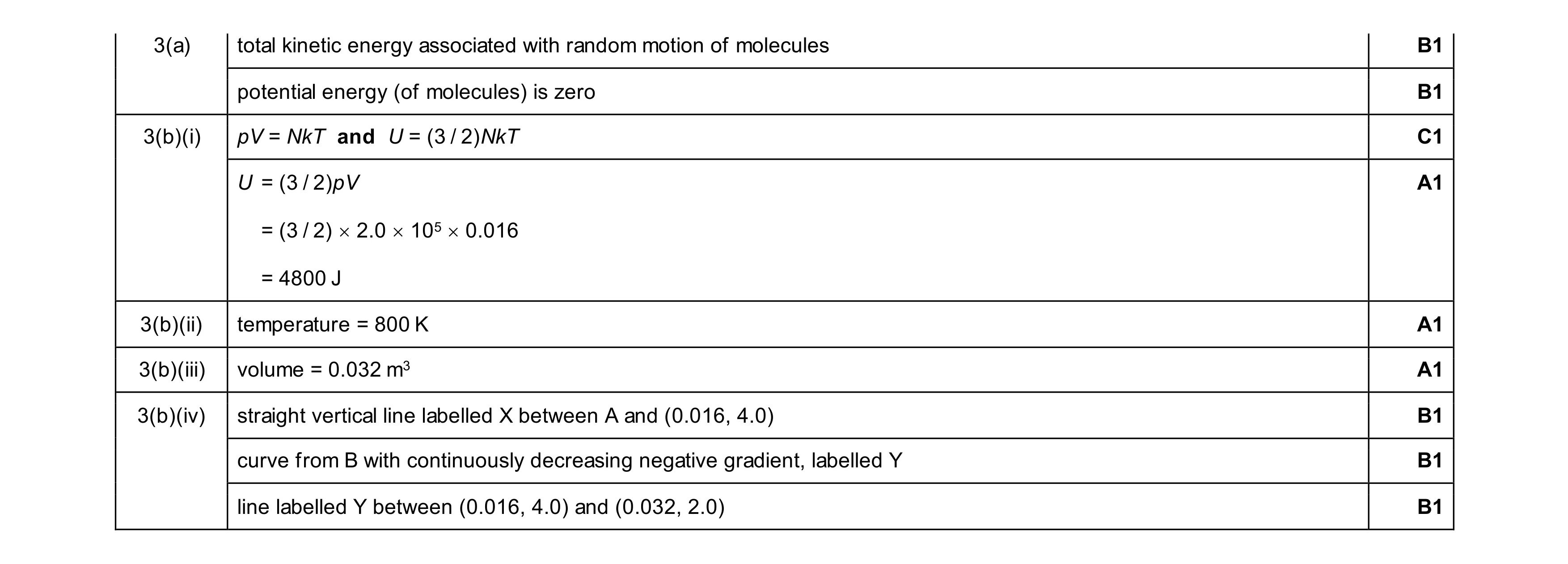 9
9