Cambridge A Level Physics 9702 — 2014 May/June Paper 2 · Variant 2
9702/22/M/J/14 · 7 questions · 60 marks · ≈68 min
The question paper and its mark scheme, free to read here and free to download. This is Cambridge’s own paper, exactly as it was sat.
Question paper16 pages

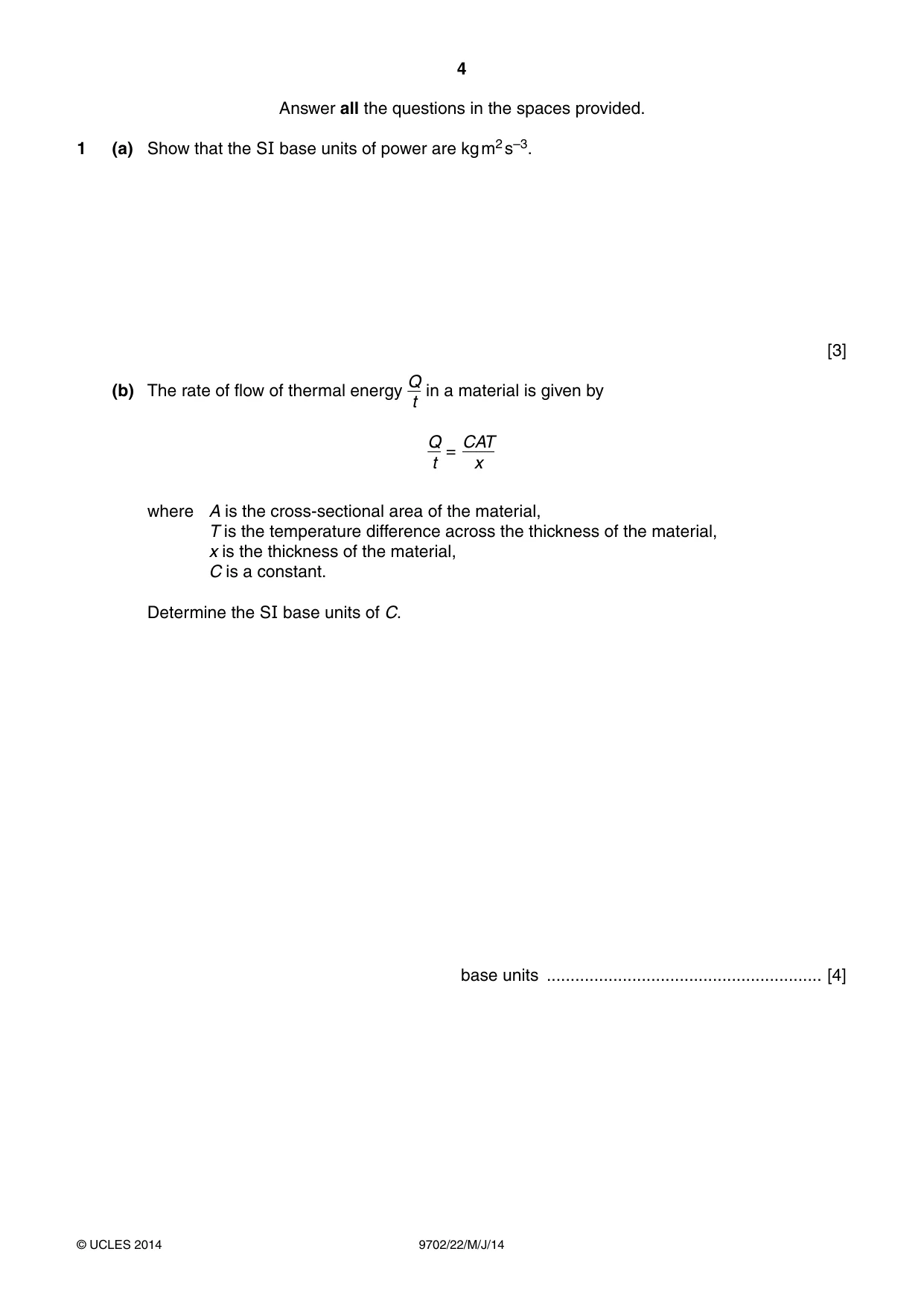

Mark scheme4 pages
Answers below. Sit the paper first if you are practising.
Questions as text
Q1 · Show that the SІ base units of power are kg m2 s–3
1 (a) Show that the SІ base units of power are kg m2 s–3. [3] Q (b) The rate of flow of thermal energy in a material is given by t Q CAT = t x where A is the cross-sectional area of the material, T is the temperature difference across the thickness of the material, x is the thickness of the material, C is a constant. Determine the SІ base units of C. base units .......................................................... [4]
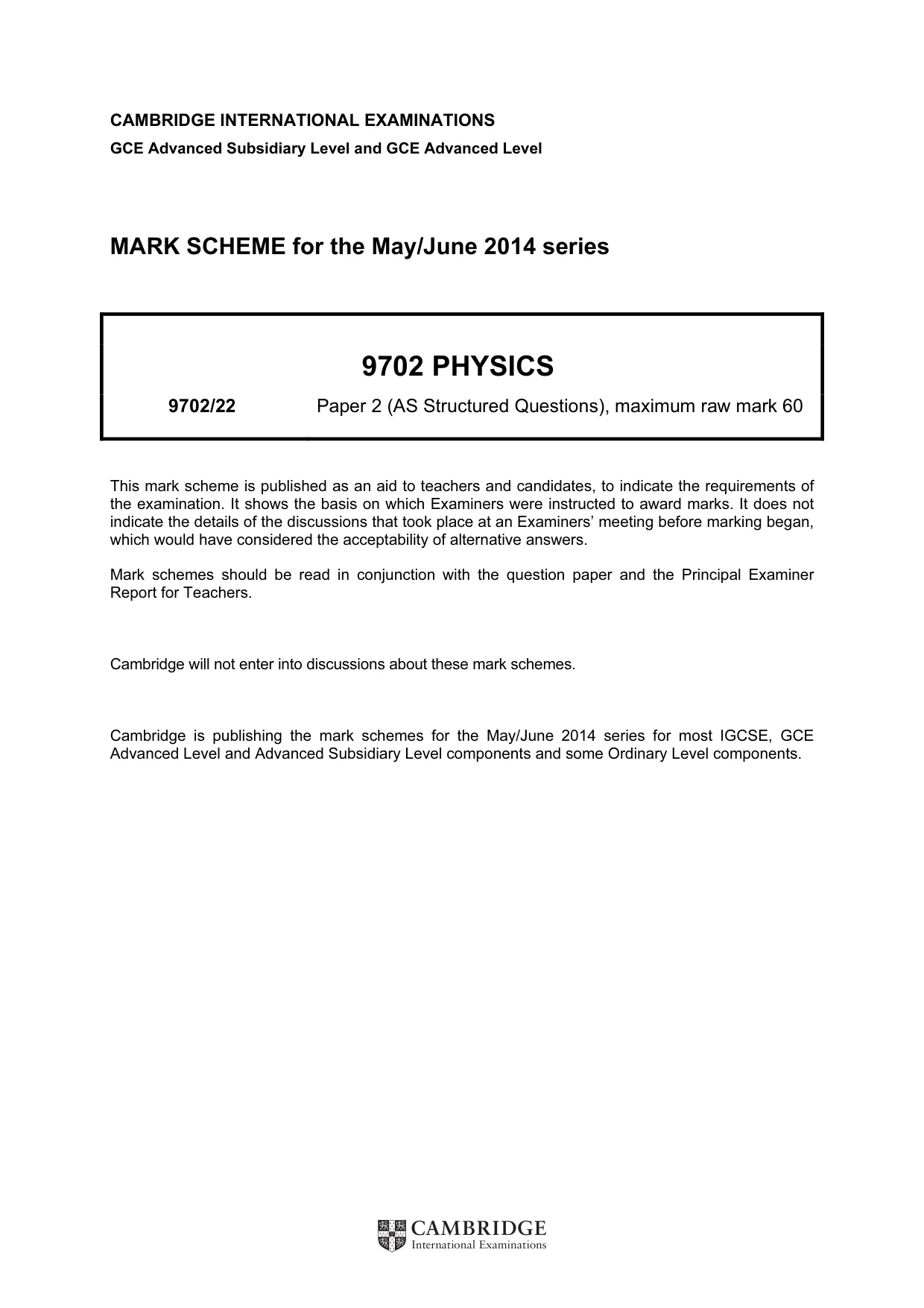
Mark scheme: 1 (a) power = energy / time or work done / time B1 force: kg m s–2 (including from mg in mgh or Fv) 1 or kinetic energy ( mv2): kg (m s–1)2 B1 2 (distance: m and (time) –1: s–1) and hence power: kg m s–2 m s–1 = kg m2 s–3 B1 [3] (b) Q / t : kg m2 s–3 C1 A: m2 and x: m and T: K C1 correct substitution into C = (Qx) / tAT or equivalent, or with cancellation C1 units of C : kg m s–3 K–1 A1 [4]
Q2 · A coin is made in the shape of a thin cylinder, as shown in Fig
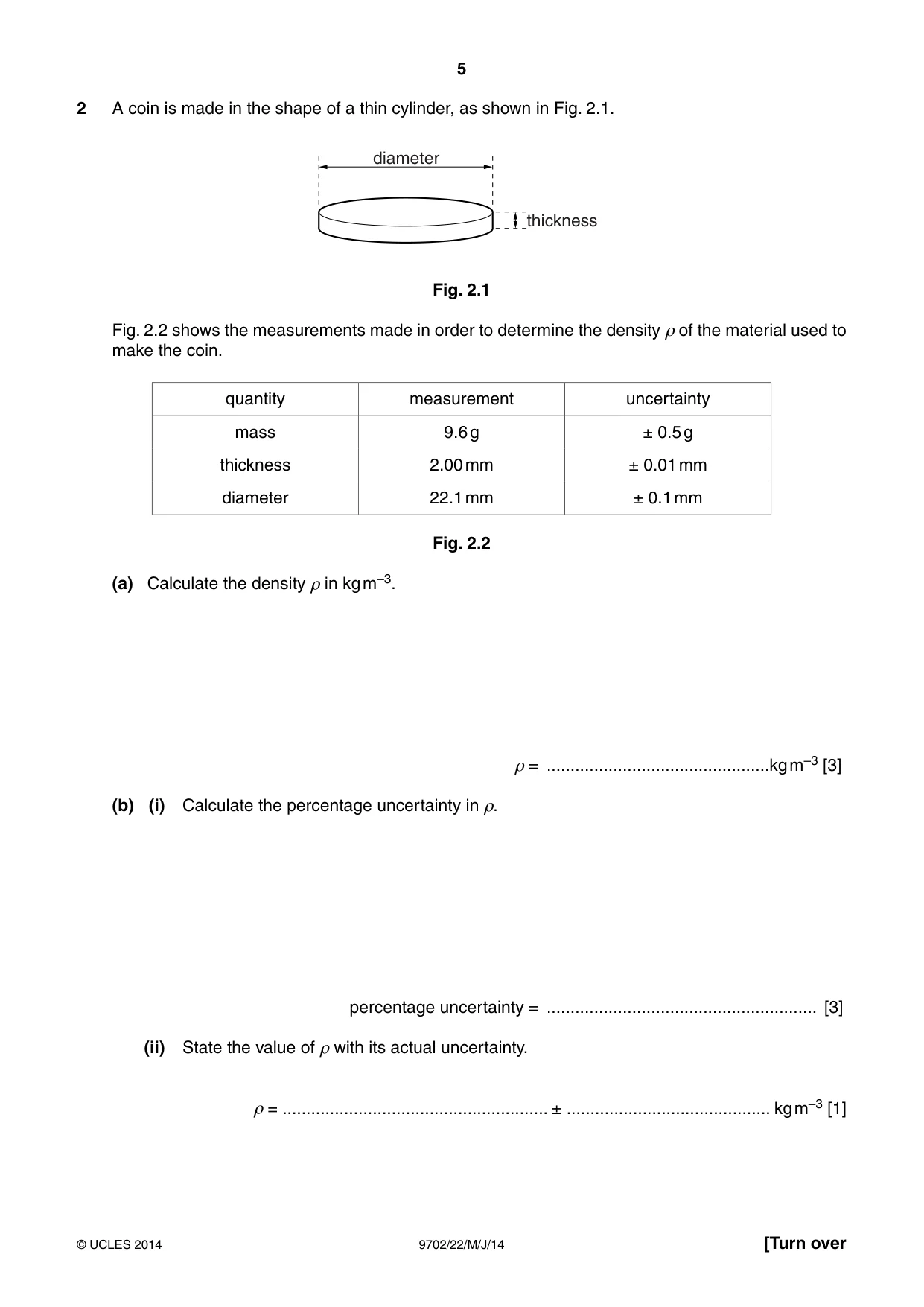
2 A coin is made in the shape of a thin cylinder, as shown in Fig. 2.1. diameter thickness Fig. 2.1 Fig. 2.2 shows the measurements made in order to determine the density ρ of the material used to make the coin. quantity measurement uncertainty mass 9.6 g ± 0.5 g thickness 2.00 mm ± 0.01 mm diameter 22.1 mm ± 0.1 mm Fig. 2.2 (a) Calculate the density ρ in kg m–3. ρ = ...............................................kg m–3 [3] (b) (i) Calculate the percentage uncertainty in ρ. percentage uncertainty = ......................................................... [3] (ii) State the value of ρ with its actual uncertainty. ρ = ........................................................ ± ........................................... kg m–3 [1]
Mark scheme: 2 (a) ρ = m / V C1 V = (π d 2 / 4) × t = 7.67 × 10⁻⁷ m3 ρ = (9.6 × 10⁻³) / [π(22.1/2 × 10–3)2 × 2.00 × 10–3] C1 ρ = 12513 kg m–3 (allow 2 or more s.f.) A1 [3] (b) (i) ∆ρ / ρ = ∆m / m + ∆t / t + 2∆d / d C1 = 5.21% + 0.50% + 0.905% [or correct fractional uncertainties] C1 = 6.6% (6.61%) A1 [3] (ii) ρ = 12 500 ± 800 kg m–3 A1 [1]
Q3 · State Newton’s first law of motion
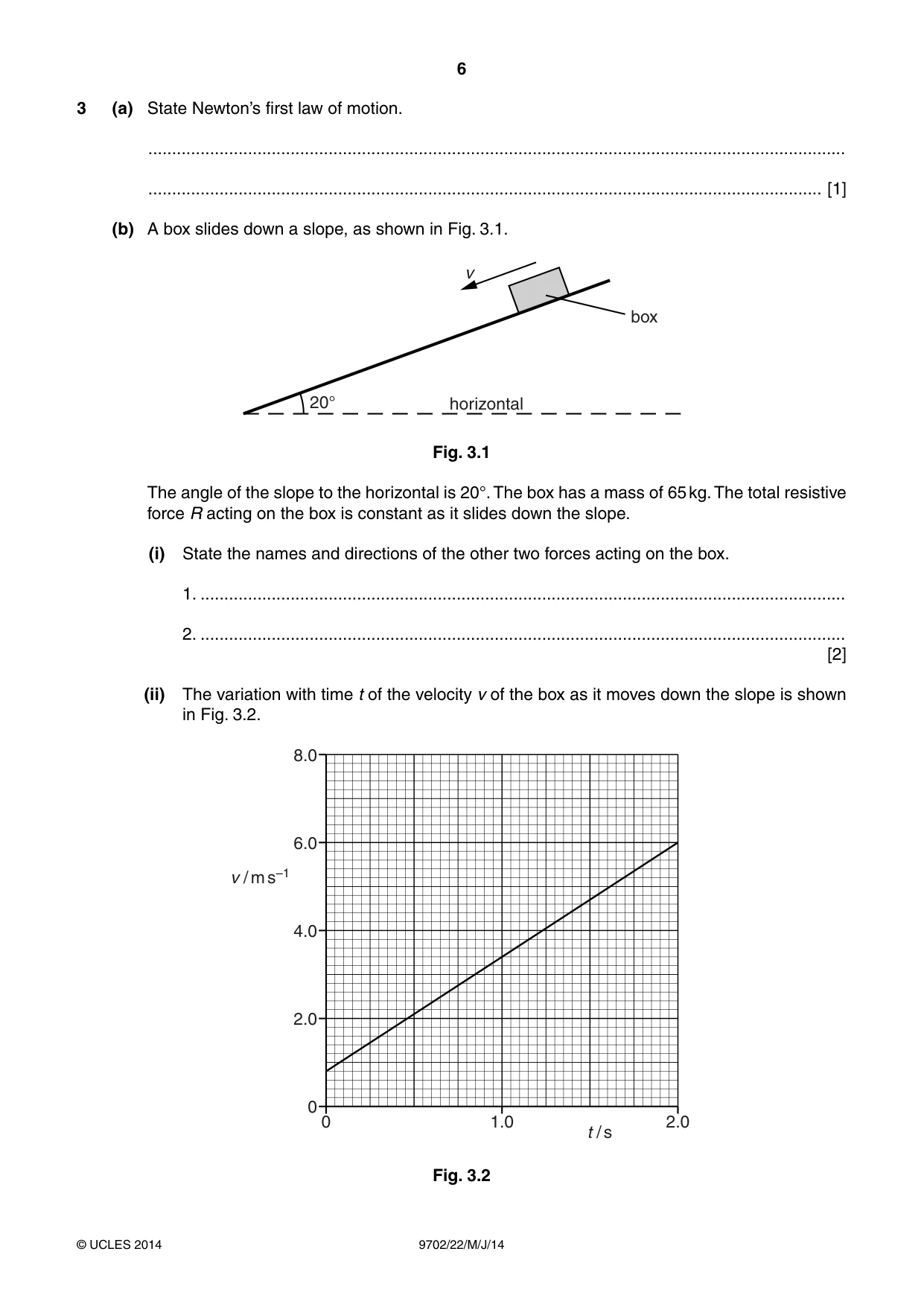
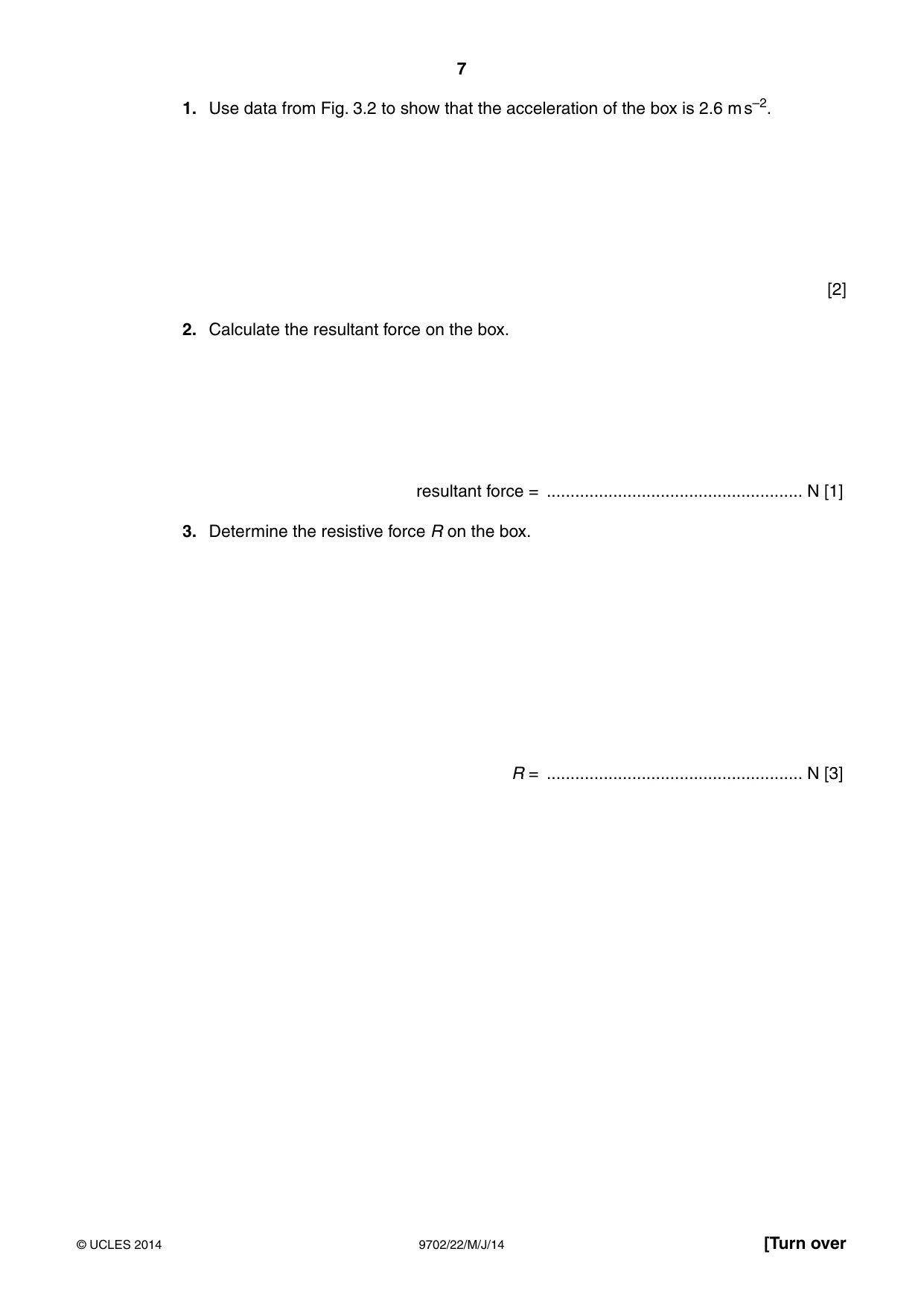
3 (a) State Newton’s first law of motion. ................................................................................................................................................... .............................................................................................................................................. [1] (b) A box slides down a slope, as shown in Fig. 3.1. v box 20° horizontal Fig. 3.1 The angle of the slope to the horizontal is 20°. The box has a mass of 65 kg. The total resistive force R acting on the box is constant as it slides down the slope. (i) State the names and directions of the other two forces acting on the box. 1. ........................................................................................................................................ 2. ........................................................................................................................................ [2] (ii) The variation with time t of the velocity v of the box as it moves down the slope is shown in Fig. 3.2. 8.0 6.0 v / m s–1 4.0 2.0 0 0 1.0 2.0 t / s Fig. 3.2 1. Use data from Fig. 3.2 to show that the acceleration of the box is 2.6 m s–2. [2] 2. Calculate the resultant force on the box. resultant force = ...................................................... N [1] 3. Determine the resistive force R on the box. R = ...................................................... N [3]
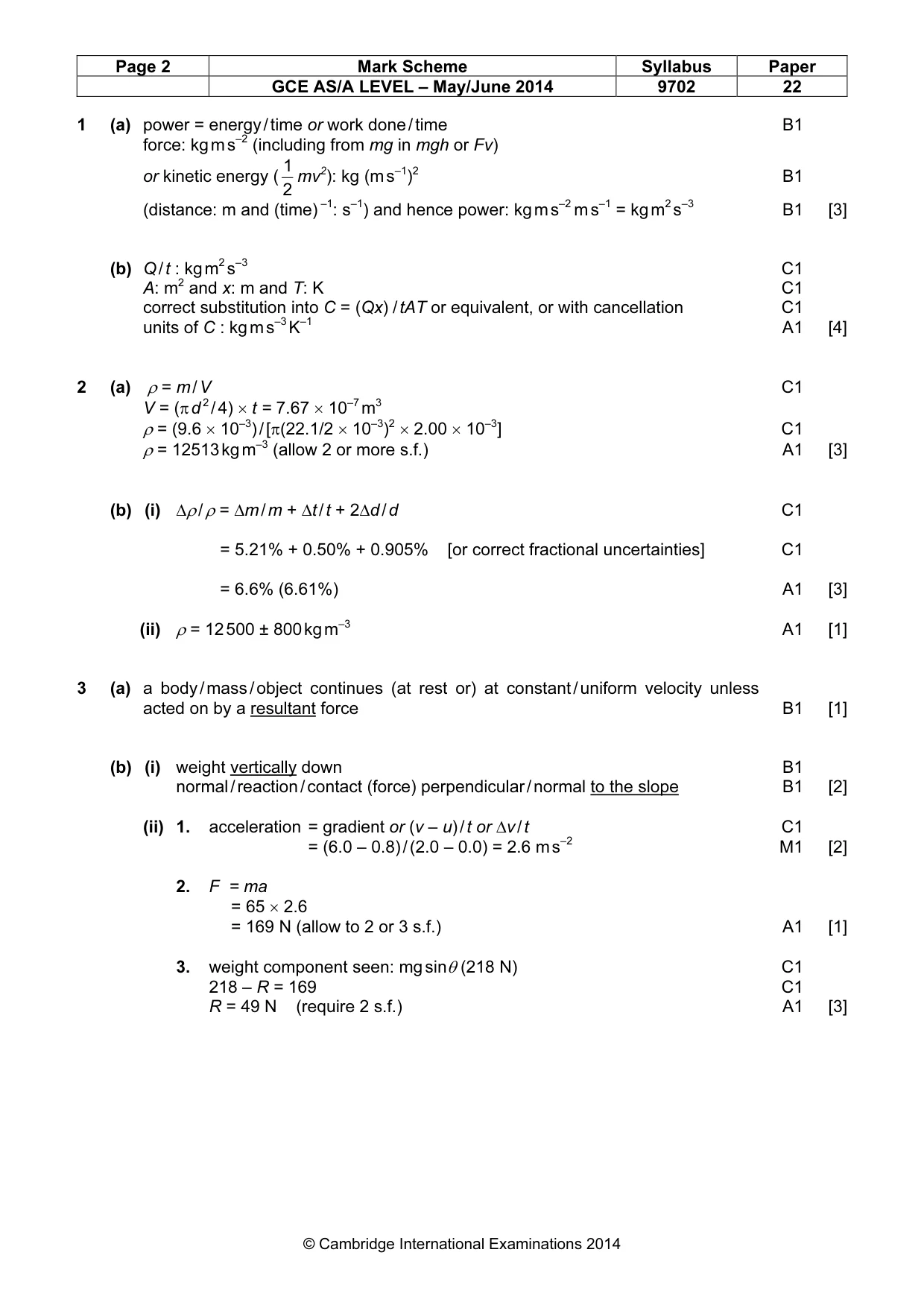
Mark scheme: 3 (a) a body / mass / object continues (at rest or) at constant / uniform velocity unless acted on by a resultant force B1 [1] (b) (i) weight vertically down B1 normal / reaction / contact (force) perpendicular / normal to the slope B1 [2] (ii) 1. acceleration = gradient or (v – u) / t or ∆v / t C1 = (6.0 – 0.8) / (2.0 – 0.0) = 2.6 m s–2 M1 [2] 2. F = ma = 65 × 2.6 = 169 N (allow to 2 or 3 s.f.) A1 [1] 3. weight component seen: mg sinθ (218 N) C1 218 – R = 169 C1 R = 49 N (require 2 s.f.) A1 [3] GCE AS/A LEVEL – May/June 2014 9702 22
Q4 · Explain what is meant by gravitational potential energy and kinetic energy
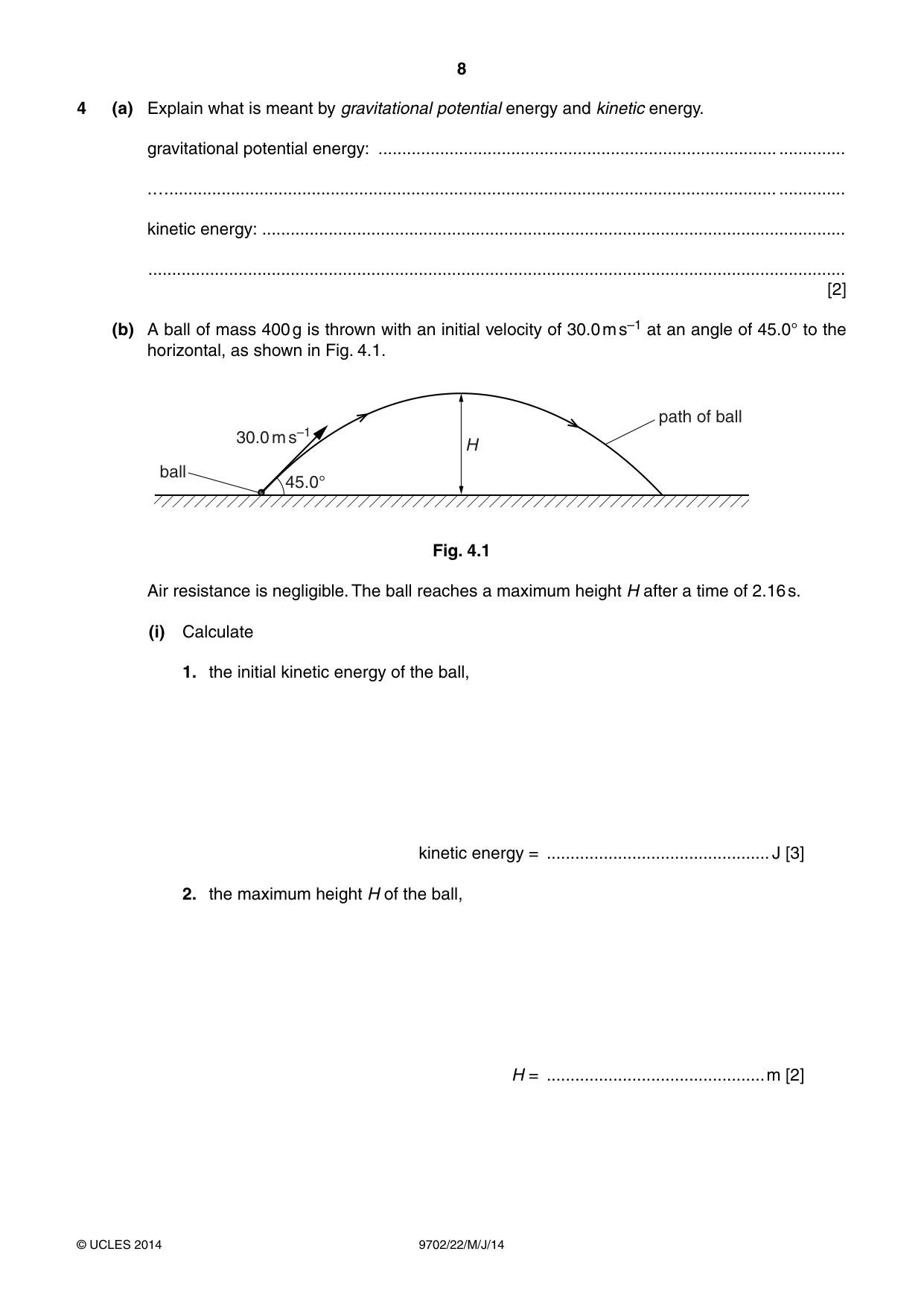
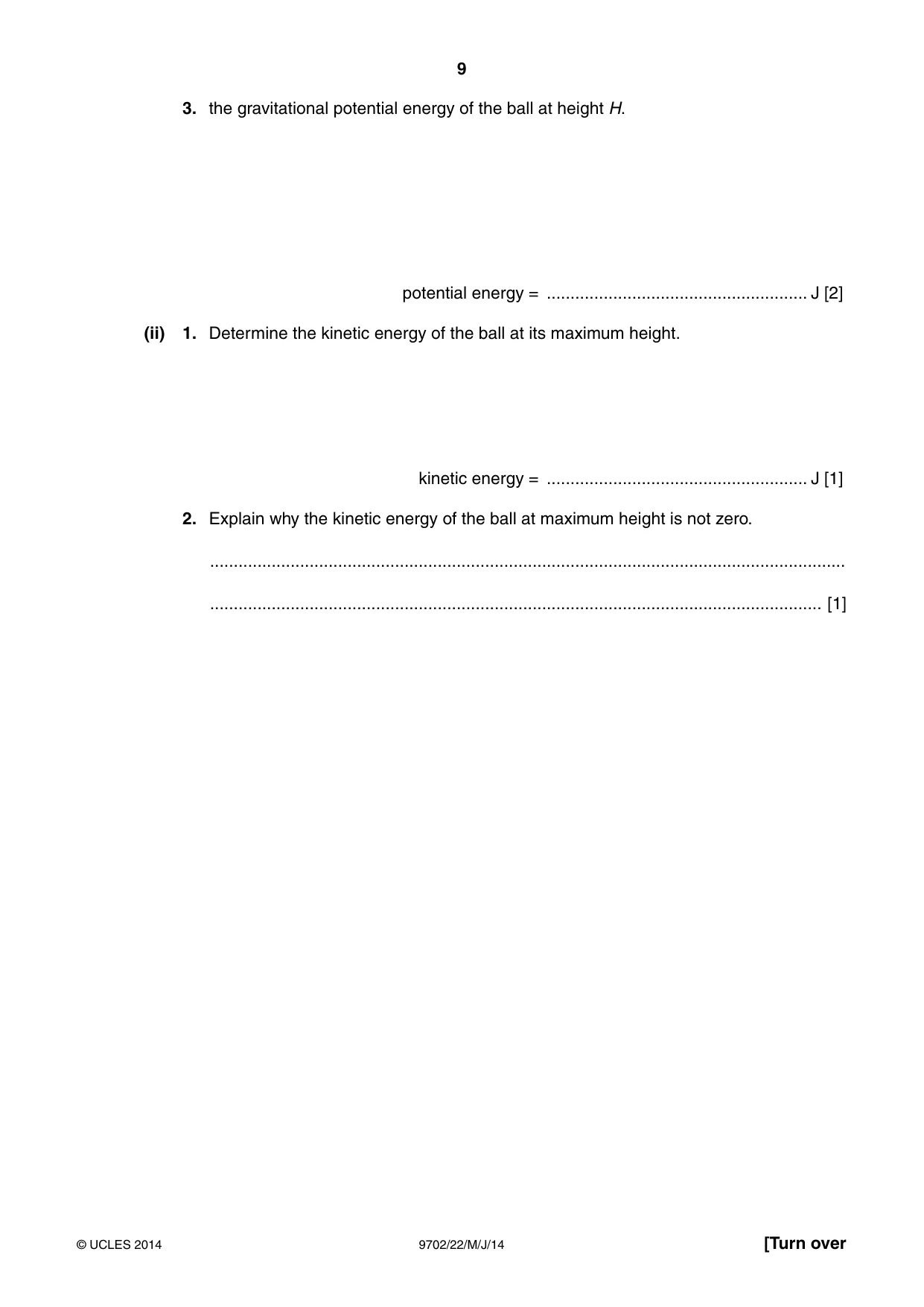
4 (a) Explain what is meant by gravitational potential energy and kinetic energy. gravitational potential energy: .................................................................................... .............. .…................................................................................................................................ .............. kinetic energy: ........................................................................................................................... ................................................................................................................................................... [2] (b) A ball of mass 400 g is thrown with an initial velocity of 30.0 m s–1 at an angle of 45.0° to the horizontal, as shown in Fig. 4.1. path of ball 30.0 m s–1 H ball 45.0° Fig. 4.1 Air resistance is negligible. The ball reaches a maximum height H after a time of 2.16 s. (i) Calculate 1. the initial kinetic energy of the ball, kinetic energy = ............................................... J [3] 2. the maximum height H of the ball, H = ..............................................m [2] 3. the gravitational potential energy of the ball at height H. potential energy = ....................................................... J [2] (ii) 1. Determine the kinetic energy of the ball at its maximum height. kinetic energy = ....................................................... J [1] 2. Explain why the kinetic energy of the ball at maximum height is not zero. ...................................................................................................................................... ................................................................................................................................. [1]
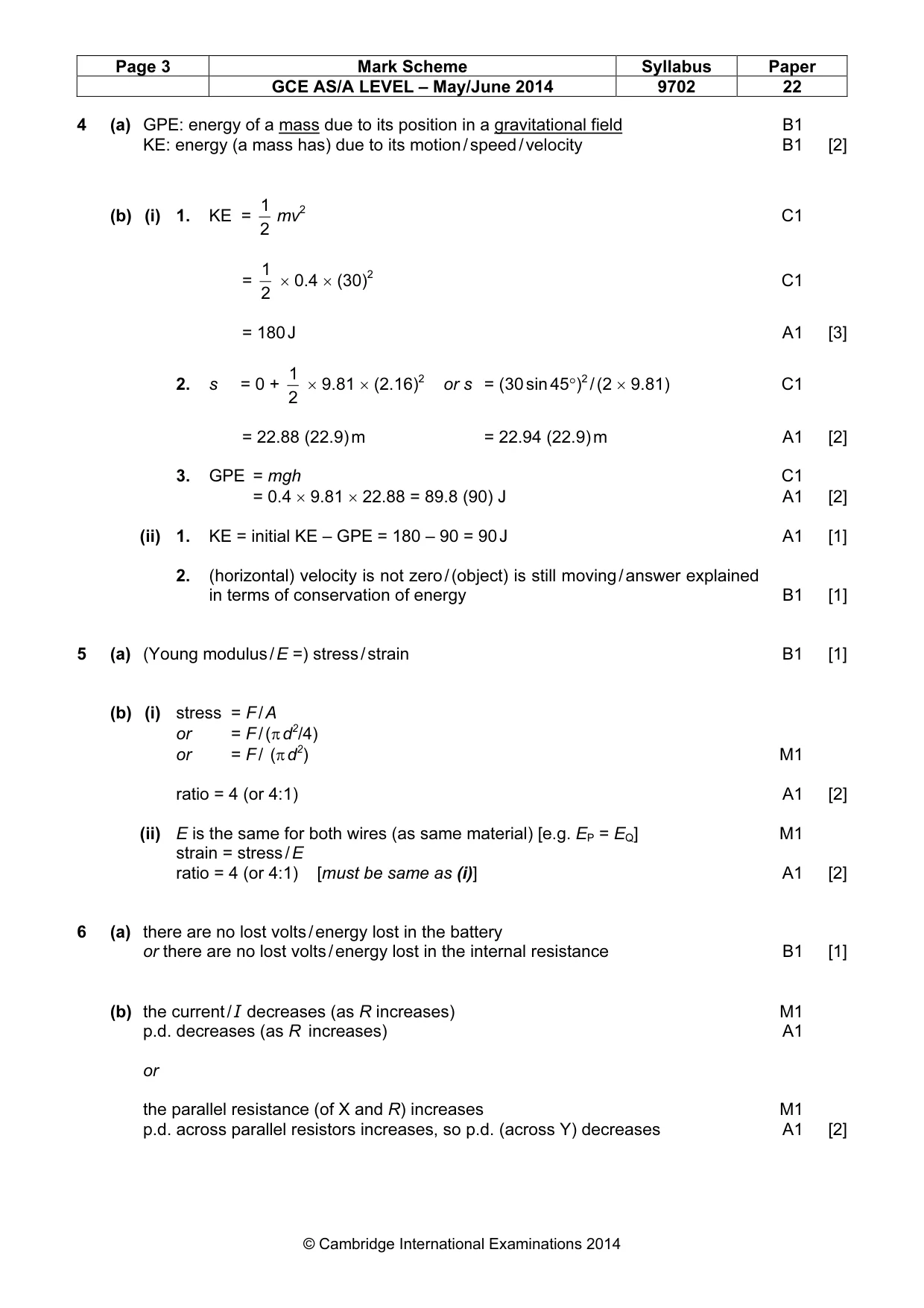
Mark scheme: 4 (a) GPE: energy of a mass due to its position in a gravitational field B1 KE: energy (a mass has) due to its motion / speed / velocity B1 [2] 1 (b) (i) 1. KE = mv2 C1 2 1 = × 0.4 × (30)2 C1 2 = 180 J A1 [3] 1 2. s = 0 + × 9.81 × (2.16)2 or s = (30 sin 45°)2 / (2 × 9.81) C1 2 = 22.88 (22.9) m = 22.94 (22.9) m A1 [2] 3. GPE = mgh C1 = 0.4 × 9.81 × 22.88 = 89.8 (90) J A1 [2] (ii) 1. KE = initial KE – GPE = 180 – 90 = 90 J A1 [1] 2. (horizontal) velocity is not zero / (object) is still moving / answer explained in terms of conservation of energy B1 [1]
More questions on Gravitational potential energy and kinetic energy
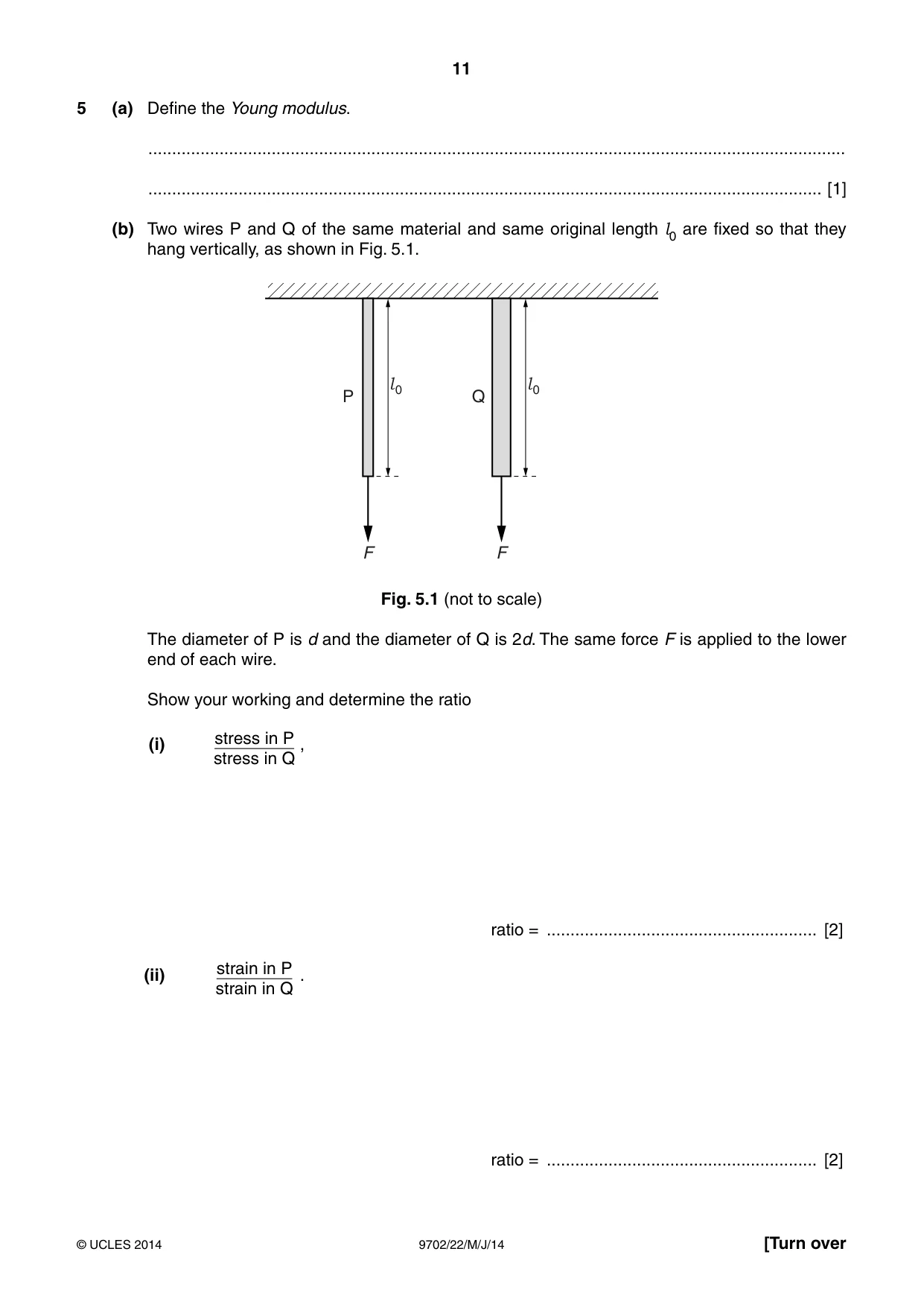
Q5 · Define the Young modulus
5 (a) Define the Young modulus. ................................................................................................................................................... .............................................................................................................................................. [1] (b) Two wires P and Q of the same material and same original length l0 are fixed so that they hang vertically, as shown in Fig. 5.1. l 0 l 0 P Q F F Fig. 5.1 (not to scale) The diameter of P is d and the diameter of Q is 2d. The same force F is applied to the lower end of each wire. Show your working and determine the ratio stress in P (i) , stress in Q ratio = ......................................................... [2] strain in P (ii) . strain in Q ratio = ......................................................... [2]
Mark scheme: 5 (a) (Young modulus / E =) stress / strain B1 [1] (b) (i) stress = F / A or = F / (π d2/4) or = F / (π d2) M1 ratio = 4 (or 4:1) A1 [2] (ii) E is the same for both wires (as same material) [e.g. EP = EQ] M1 strain = stress / E ratio = 4 (or 4:1) [must be same as (i)] A1 [2]
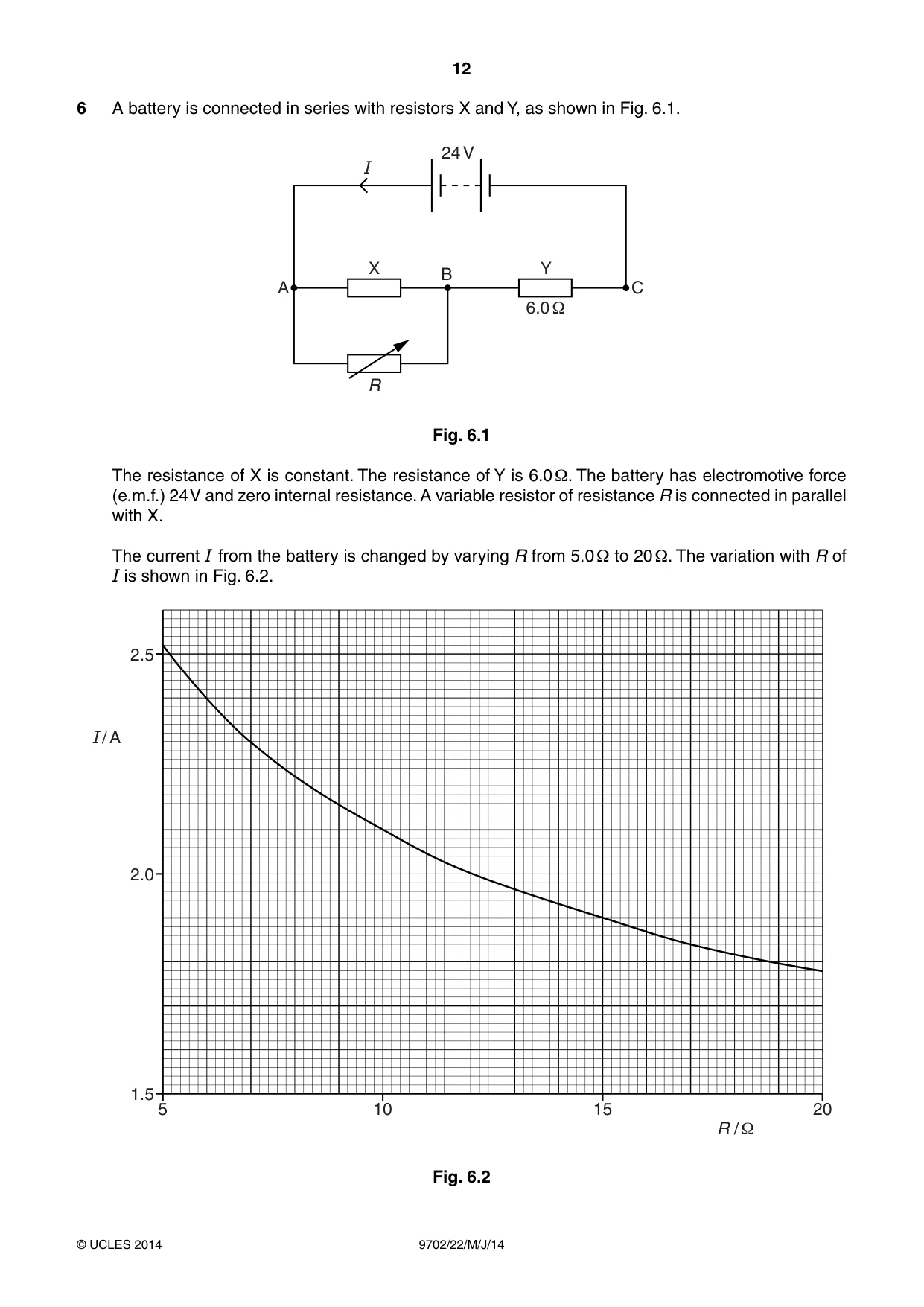
Q6 · A battery is connected in series with resistors X and Y, as shown in Fig
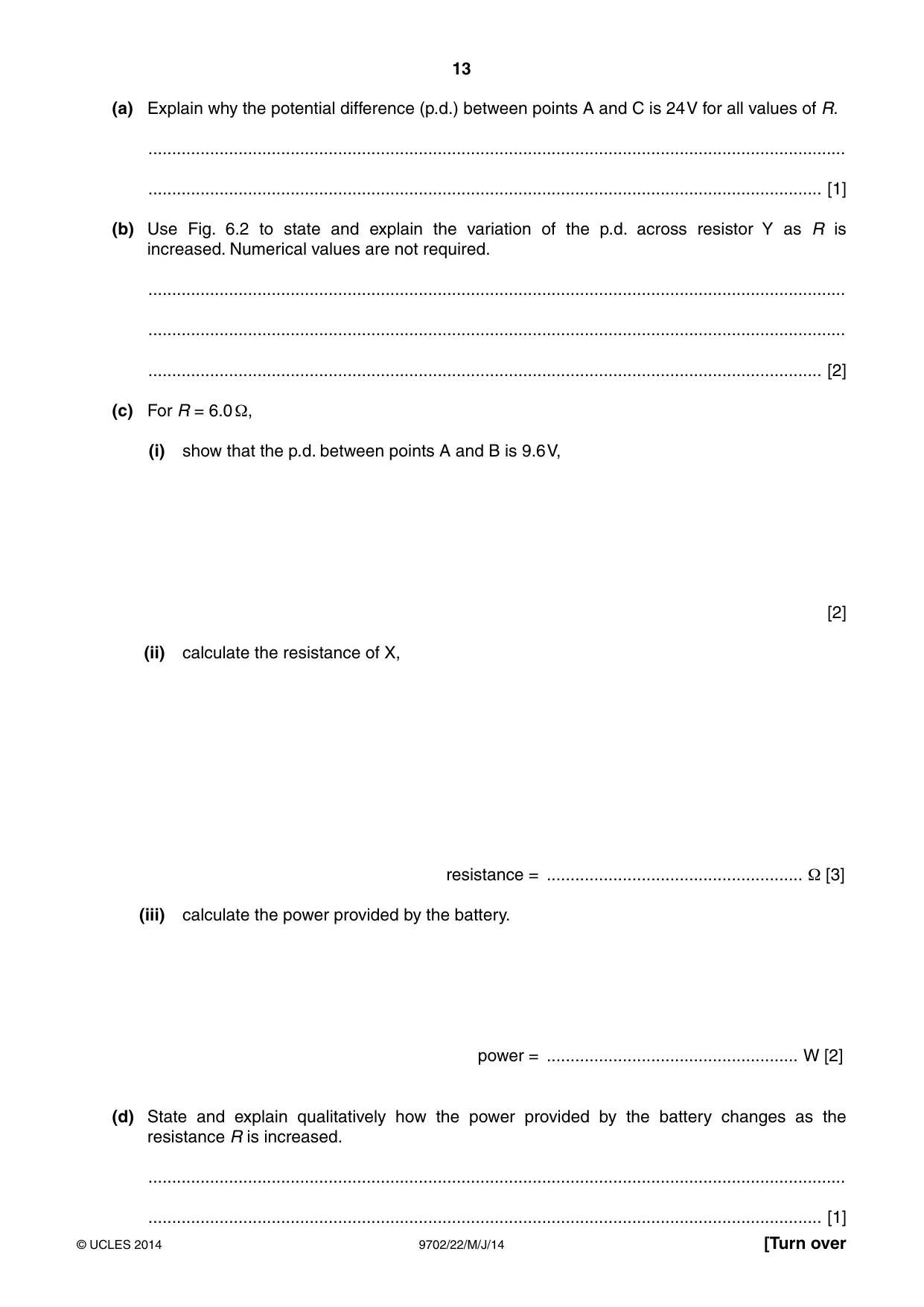
6 A battery is connected in series with resistors X and Y, as shown in Fig. 6.1. 24 V I X Y B A C 6.0 1 R Fig. 6.1 The resistance of X is constant. The resistance of Y is 6.0 Ω. The battery has electromotive force (e.m.f.) 24 V and zero internal resistance. A variable resistor of resistance R is connected in parallel with X. The current І from the battery is changed by varying R from 5.0 Ω to 20 Ω. The variation with R of І is shown in Fig. 6.2. 2.5 I / A 2.0 1.5 5 10 15 20 R / 1 Fig. 6.2 (a) Explain why the potential difference (p.d.) between points A and C is 24 V for all values of R. ................................................................................................................................................... .............................................................................................................................................. [1] (b) Use Fig. 6.2 to state and explain the variation of the p.d. across resistor Y as R is increased. Numerical values are not required. ................................................................................................................................................... ................................................................................................................................................... .............................................................................................................................................. [2] (c) For R = 6.0 Ω, (i) show that the p.d. between points A and B is 9.6 V, [2] (ii) calculate the resistance of X, resistance = ...................................................... Ω [3] (iii) calculate the power provided by the battery. power = ..................................................... W [2] (d) State and explain qualitatively how the power provided by the battery changes as the resistance R is increased. ................................................................................................................................................... .............................................................................................................................................. [1]
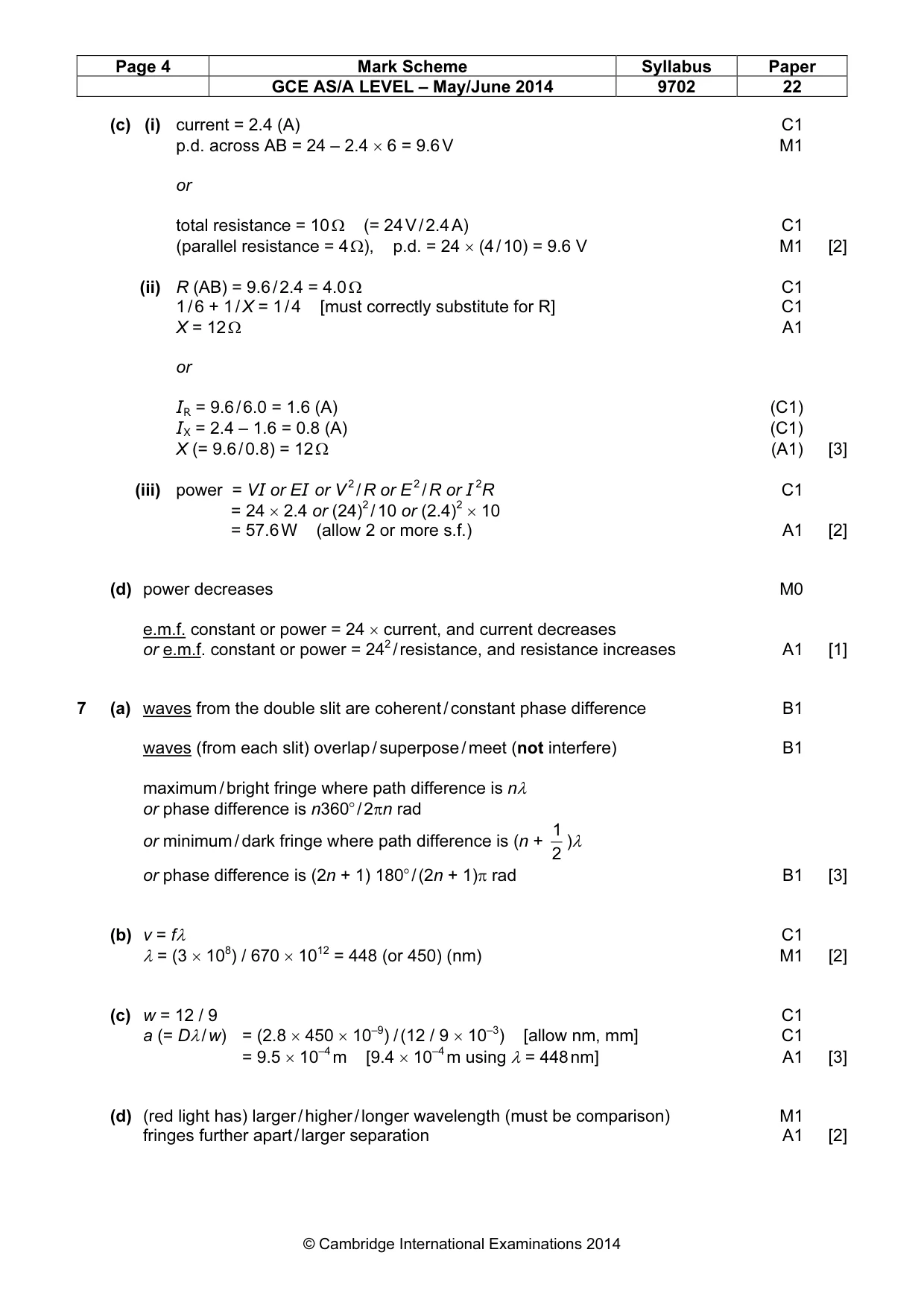
Mark scheme: 6 (a) there are no lost volts / energy lost in the battery or there are no lost volts / energy lost in the internal resistance B1 [1] (b) the current / I decreases (as R increases) M1 p.d. decreases (as R increases) A1 or the parallel resistance (of X and R) increases M1 p.d. across parallel resistors increases, so p.d. (across Y) decreases A1 [2] GCE AS/A LEVEL – May/June 2014 9702 22 (c) (i) current = 2.4 (A) C1 p.d. across AB = 24 – 2.4 × 6 = 9.6 V M1 or total resistance = 10 Ω (= 24 V / 2.4 A) C1 (parallel resistance = 4 Ω), p.d. = 24 × (4 / 10) = 9.6 V M1 [2] (ii) R (AB) = 9.6 / 2.4 = 4.0 Ω C1 1 / 6 + 1 / X = 1 / 4 [must correctly substitute for R] C1 X = 12 Ω A1 or IR = 9.6 / 6.0 = 1.6 (A) (C1) IX = 2.4 – 1.6 = 0.8 (A) (C1) X (= 9.6 / 0.8) = 12 Ω (A1) [3] (iii) power = VI or EI or V 2 / R or E 2 / R or І 2R C1 = 24 × 2.4 or (24)2 / 10 or (2.4)2 × 10 = 57.6 W (allow 2 or more s.f.) A1 [2] (d) power decreases M0 e.m.f. constant or power = 24 × current, and current decreases or e.m.f. constant or power = 242 / resistance, and resistance increases A1 [1]
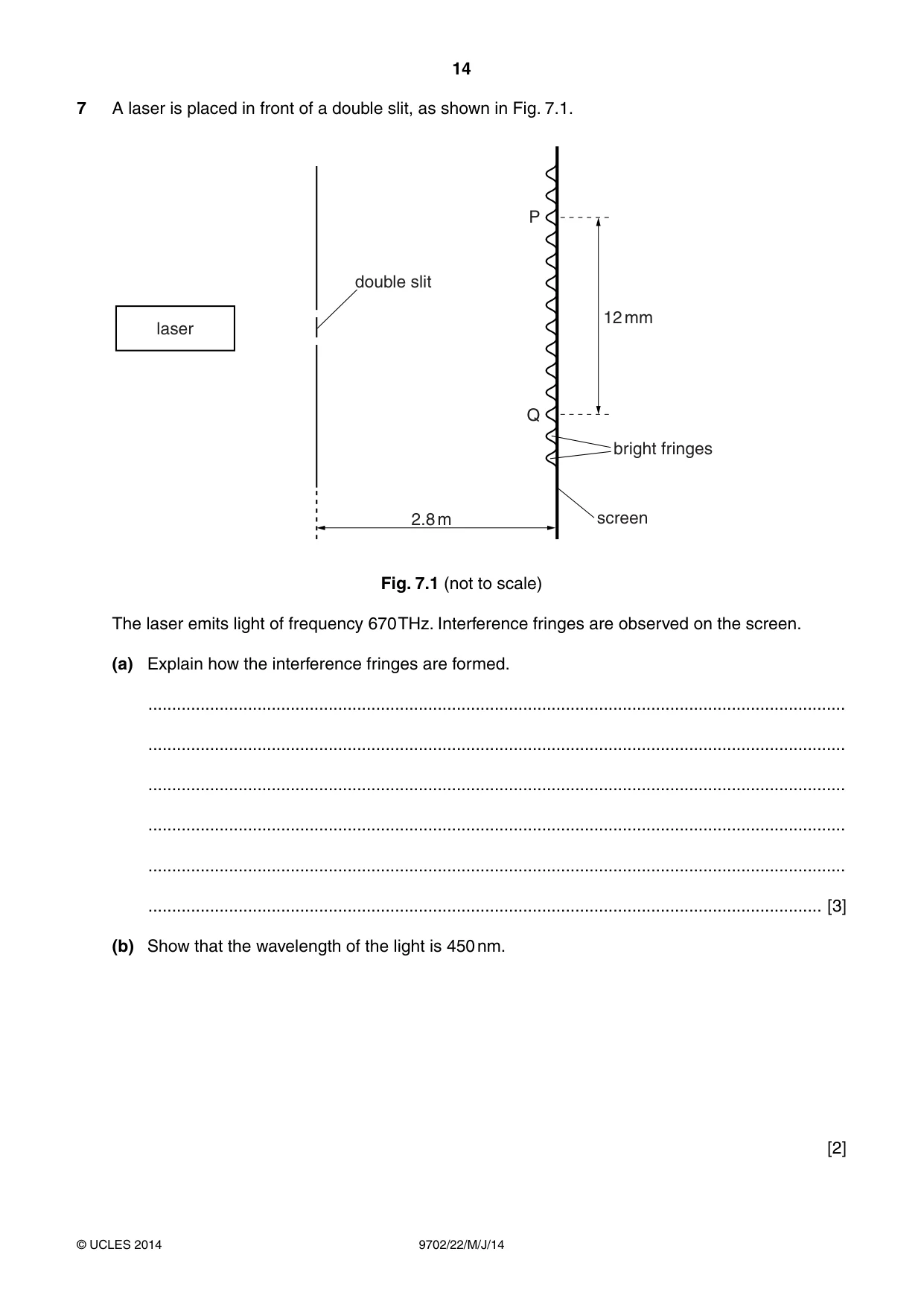
Q7 · A laser is placed in front of a double slit, as shown in Fig
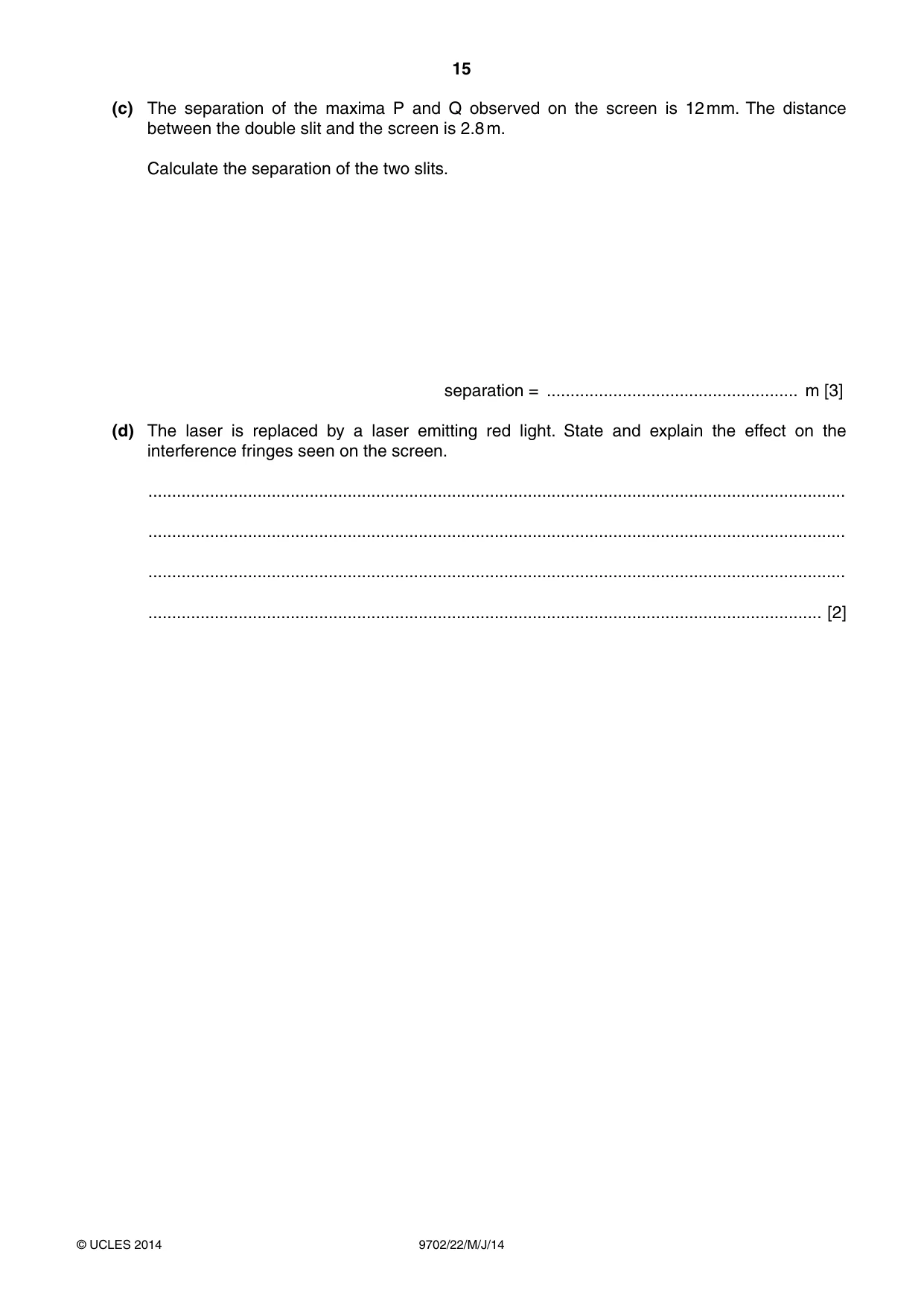
7 A laser is placed in front of a double slit, as shown in Fig. 7.1. P double slit 12 mm laser Q bright fringes 2.8 m screen Fig. 7.1 (not to scale) The laser emits light of frequency 670 THz. Interference fringes are observed on the screen. (a) Explain how the interference fringes are formed. ................................................................................................................................................... ................................................................................................................................................... ................................................................................................................................................... ................................................................................................................................................... ................................................................................................................................................... .............................................................................................................................................. [3] (b) Show that the wavelength of the light is 450 nm. [2] (c) The separation of the maxima P and Q observed on the screen is 12 mm. The distance between the double slit and the screen is 2.8 m. Calculate the separation of the two slits. separation = ..................................................... m [3] (d) The laser is replaced by a laser emitting red light. State and explain the effect on the interference fringes seen on the screen. ................................................................................................................................................... ................................................................................................................................................... ................................................................................................................................................... .............................................................................................................................................. [2]
Mark scheme: 7 (a) waves from the double slit are coherent / constant phase difference B1 waves (from each slit) overlap / superpose / meet (not interfere) B1 maximum / bright fringe where path difference is nλ or phase difference is n360U / 2πn rad 1 or minimum / dark fringe where path difference is (n + )λ 2 or phase difference is (2n + 1) 180U / (2n + 1)π rad B1 [3] (b) v = fλ C1 λ = (3 × 10⁸) / 670 × 1012 = 448 (or 450) (nm) M1 [2] (c) w = 12 / 9 C1 a (= Dλ / w) = (2.8 × 450 × 10–9) / (12 / 9 × 10⁻³) [allow nm, mm] C1 = 9.5 × 10⁻⁴ m [9.4 × 10⁻⁴ m using λ = 448 nm] A1 [3] (d) (red light has) larger / higher / longer wavelength (must be comparison) M1 fringes further apart / larger separation A1 [2]
What was in this paper
The subtopics covered by these 7 questions, and how many questions each got. Open one in a new tab to see every Cambridge question on it.
What you needed in this session
Cambridge’s own grade thresholds for 2014 May/June, Paper 2 · Variant 2. A higher threshold means an easier paper — the bar moves with how the cohort did.