Cambridge A Level Physical Science 8780 — 2017 Oct/Nov Paper 3 · Variant 1
8780/31/O/N/17 · 12 questions · 80 marks · ≈90 min
The question paper and its mark scheme, free to read here and free to download. This is Cambridge’s own paper, exactly as it was sat.
Question paper20 pages
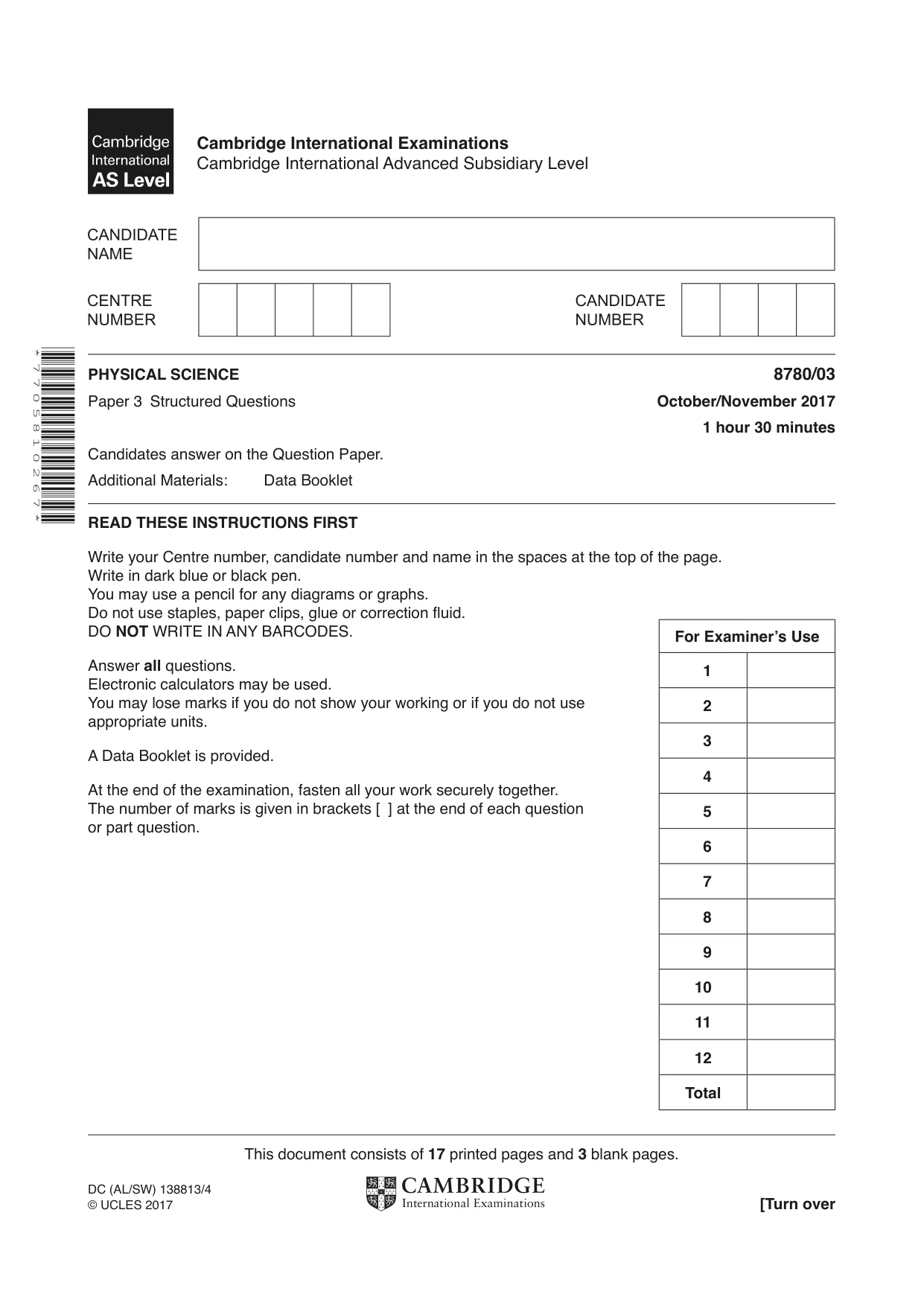


Mark scheme8 pages
Answers below. Sit the paper first if you are practising.
Questions as text
Q1 · A racing car travels along a straight horizontal track
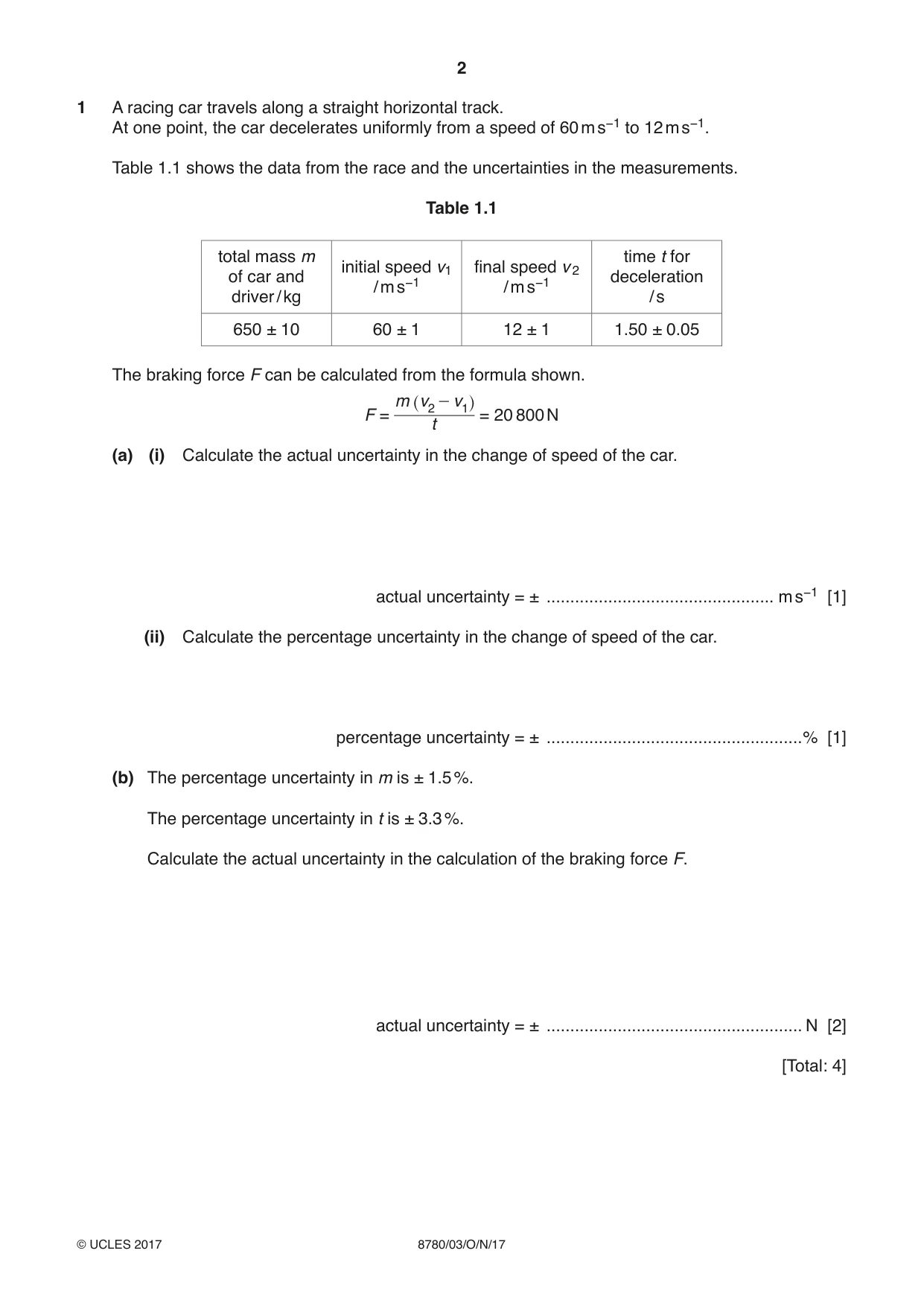
1 A racing car travels along a straight horizontal track. At one point, the car decelerates uniformly from a speed of 60 m s−1 to 12 m s−1. Table 1.1 shows the data from the race and the uncertainties in the measurements. Table 1.1 total mass m time t for initial speed v1 final speed v 2 of car and deceleration / m s−1 / m s−1 driver / kg / s 650 ± 10 60 ± 1 12 ± 1 1.50 ± 0.05 The braking force F can be calculated from the formula shown. - m v2 v1 F = ^ h = 20 800N t (a) (i) Calculate the actual uncertainty in the change of speed of the car. actual uncertainty = ± ................................................ m s−1 [1] (ii) Calculate the percentage uncertainty in the change of speed of the car. percentage uncertainty = ± ......................................................% [1] (b) The percentage uncertainty in m is ± 1.5 %. The percentage uncertainty in t is ± 3.3 %. Calculate the actual uncertainty in the calculation of the braking force F. actual uncertainty = ± ...................................................... N [2] [Total: 4]
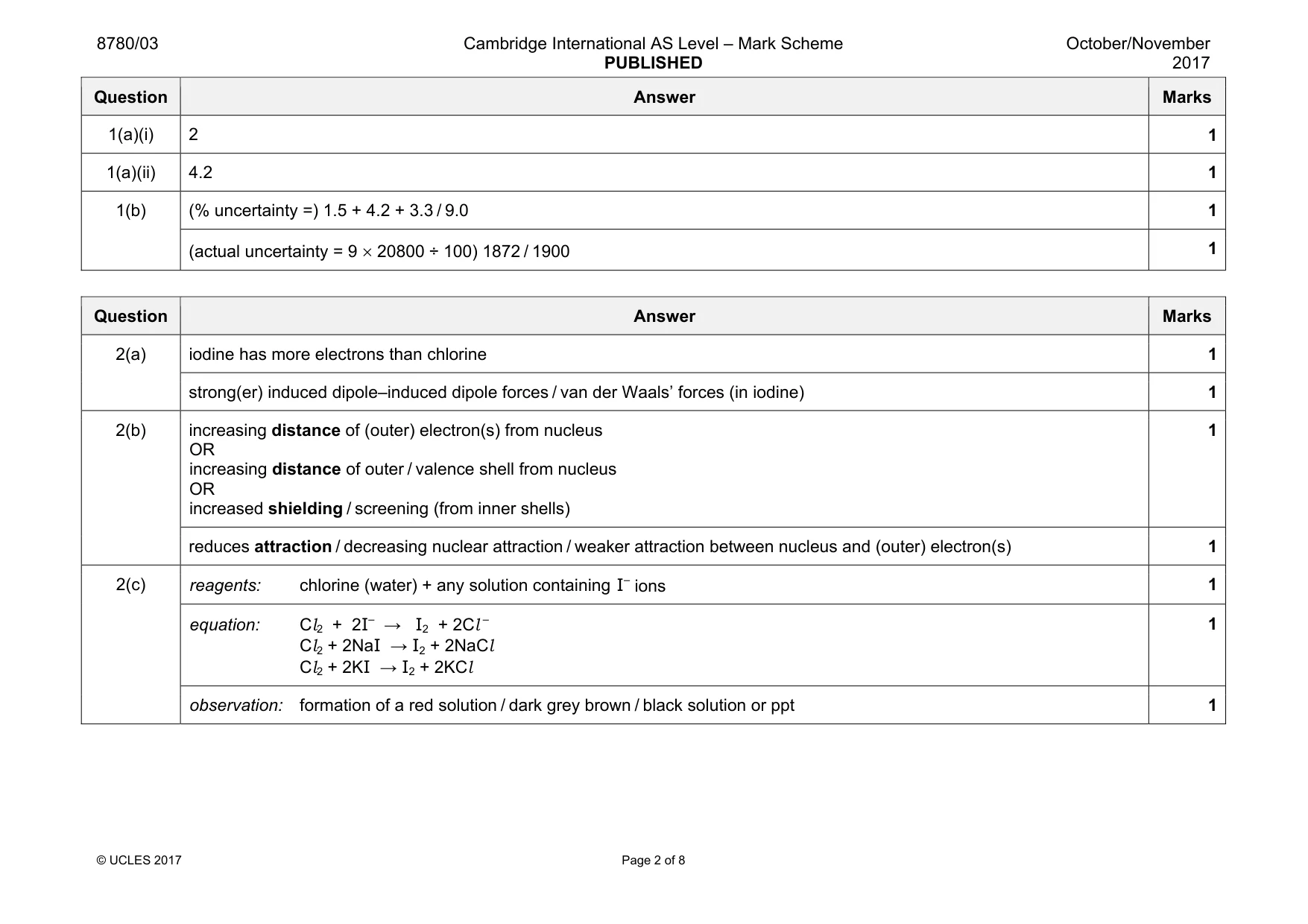
Mark scheme: 1(a)(i) 2 1 1(a)(ii) 4.2 1 1(b) (% uncertainty =) 1.5 + 4.2 + 3.3 / 9.0 1 (actual uncertainty = 9 × 20800 ÷ 100) 1872 / 1900 1
Q2 · There are trends in the physical and in the chemical properties of the halogens fluorine…
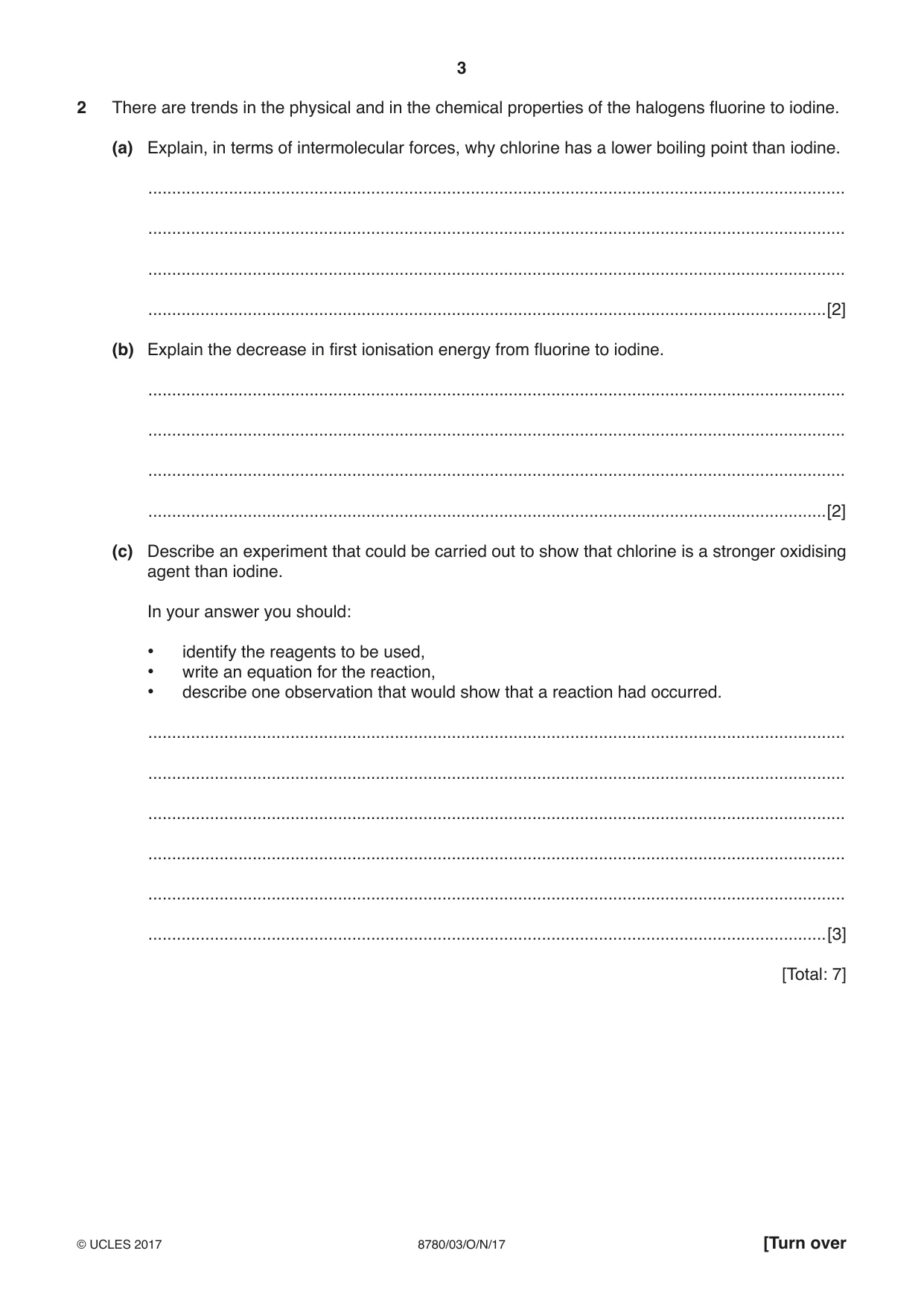
2 There are trends in the physical and in the chemical properties of the halogens fluorine to iodine. (a) Explain, in terms of intermolecular forces, why chlorine has a lower boiling point than iodine. ................................................................................................................................................... ................................................................................................................................................... ................................................................................................................................................... ...............................................................................................................................................[2] (b) Explain the decrease in first ionisation energy from fluorine to iodine. ................................................................................................................................................... ................................................................................................................................................... ................................................................................................................................................... ...............................................................................................................................................[2] (c) Describe an experiment that could be carried out to show that chlorine is a stronger oxidising agent than iodine. In your answer you should: • identify the reagents to be used, • write an equation for the reaction, • describe one observation that would show that a reaction had occurred. ................................................................................................................................................... ................................................................................................................................................... ................................................................................................................................................... ................................................................................................................................................... ................................................................................................................................................... ...............................................................................................................................................[3] [Total: 7]
Mark scheme: 2(a) iodine has more electrons than chlorine 1 strong(er) induced dipole–induced dipole forces / van der Waals’ forces (in iodine) 1 2(b) increasing distance of (outer) electron(s) from nucleus OR increasing distance of outer / valence shell from nucleus OR increased shielding / screening (from inner shells) 1 reduces attraction / decreasing nuclear attraction / weaker attraction between nucleus and (outer) electron(s) 1 2(c) reagents: chlorine (water) + any solution containing I– ions 1 equation: Cl2 + 2I– → I2 + 2Cl – Cl2 + 2NaI → I2 + 2NaCl Cl2 + 2KI → I2 + 2KCl 1 observation: formation of a red solution / dark grey brown / black solution or ppt 1
Q3 · State what is meant by the term work done
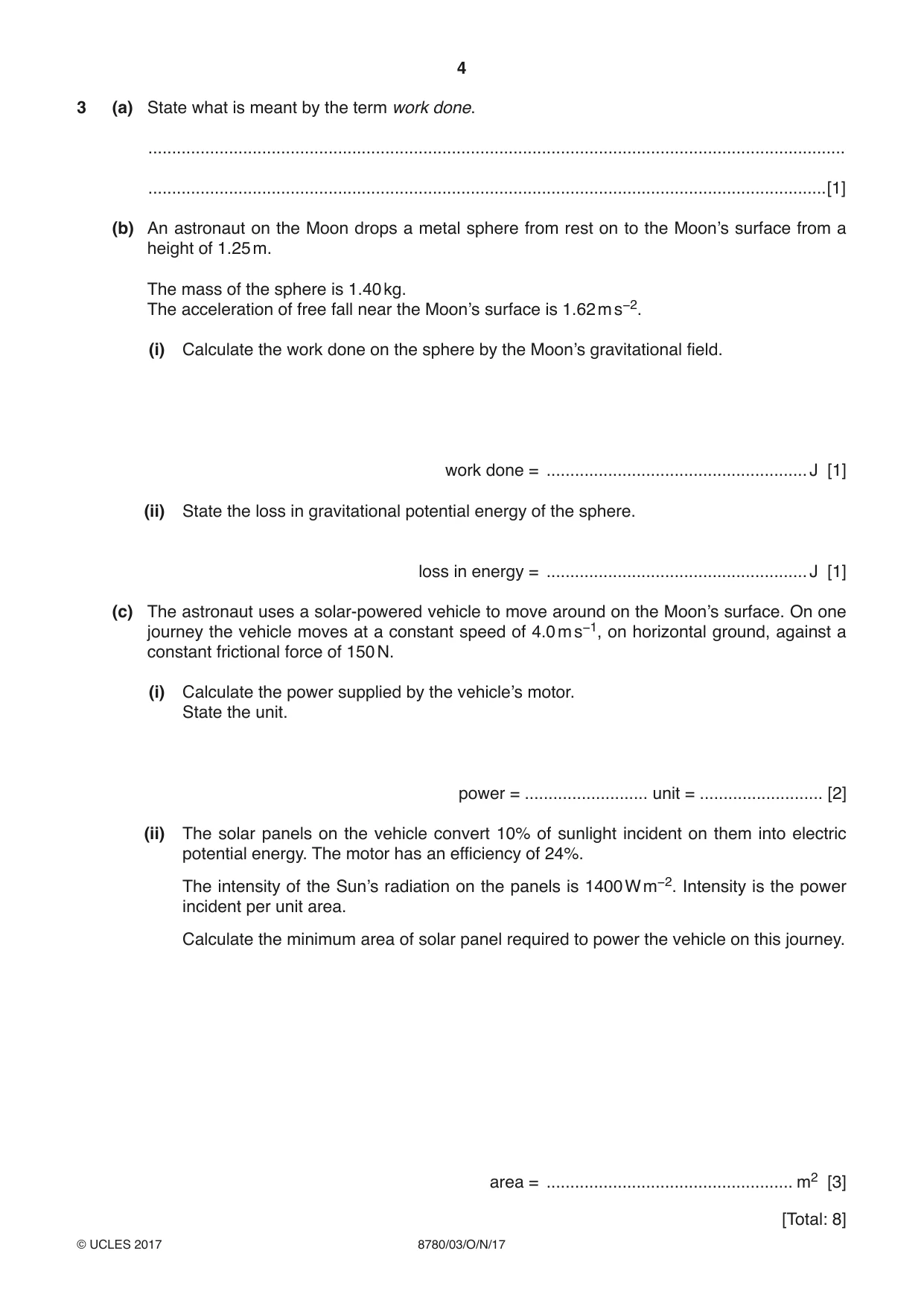
3 (a) State what is meant by the term work done. ................................................................................................................................................... ...............................................................................................................................................[1] (b) An astronaut on the Moon drops a metal sphere from rest on to the Moon’s surface from a height of 1.25 m. The mass of the sphere is 1.40 kg. The acceleration of free fall near the Moon’s surface is 1.62 m s−2. (i) Calculate the work done on the sphere by the Moon’s gravitational field. work done = ....................................................... J [1] (ii) State the loss in gravitational potential energy of the sphere. loss in energy = ....................................................... J [1] (c) The astronaut uses a solar-powered vehicle to move around on the Moon’s surface. On one journey the vehicle moves at a constant speed of 4.0 m s−1, on horizontal ground, against a constant frictional force of 150 N. (i) Calculate the power supplied by the vehicle’s motor. State the unit. power = .......................... unit = .......................... [2] (ii) The solar panels on the vehicle convert 10% of sunlight incident on them into electric potential energy. The motor has an efficiency of 24%. The intensity of the Sun’s radiation on the panels is 1400 W m−2. Intensity is the power incident per unit area. Calculate the minimum area of solar panel required to power the vehicle on this journey. area = .................................................... m2 [3] [Total: 8]
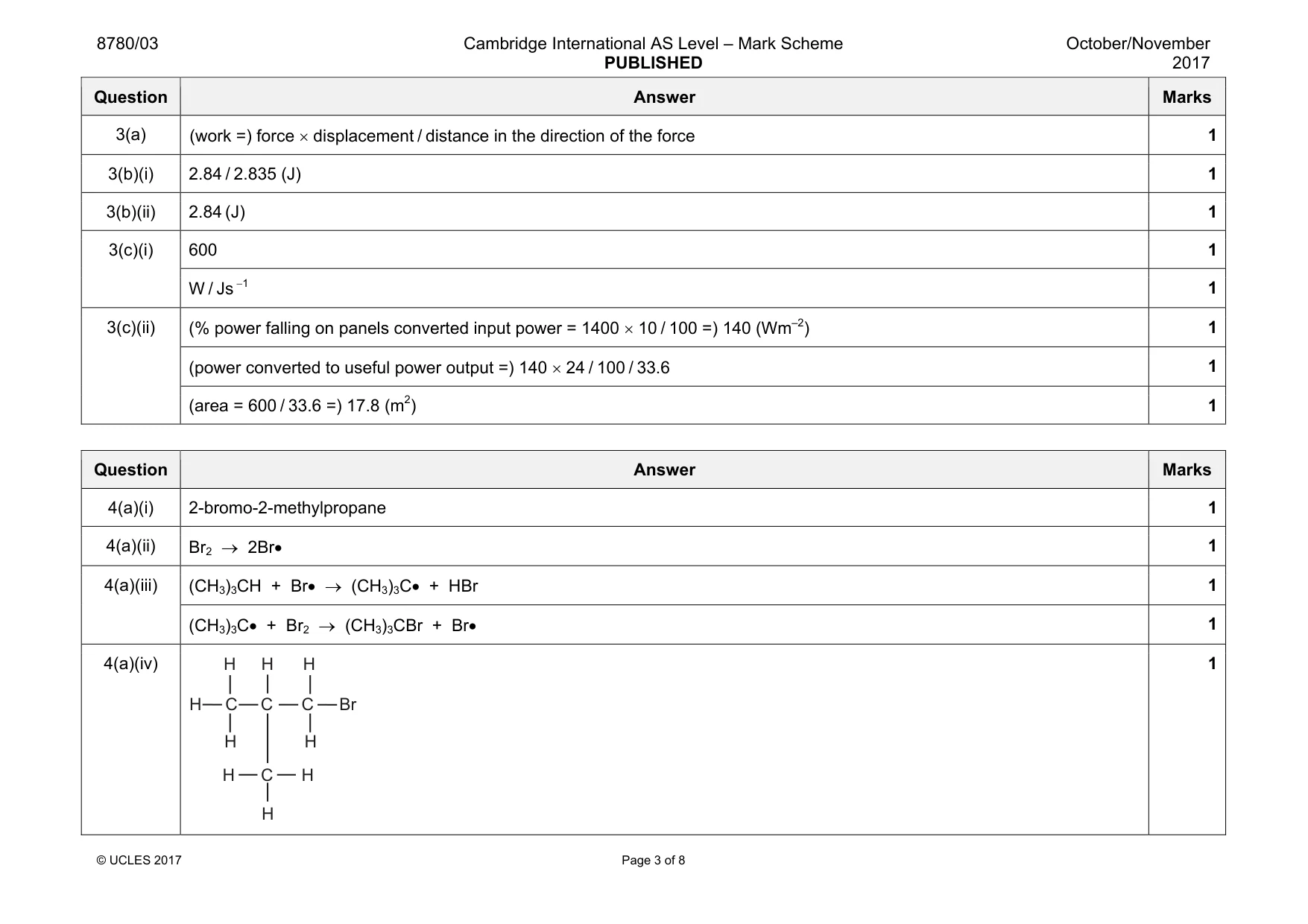
Mark scheme: 3(a) 1 3(b)(i) 2.84 / 2.835 (J) 1 3(b)(ii) 2.84 (J) 1 3(c)(i) 600 1 W / Js −1 1 3(c)(ii) (% power falling on panels converted input power = 1400 × 10 / 100 =) 140 (Wm–2) 1 (power converted to useful power output =) 140 × 24 / 100 / 33.6 1 (area = 600 / 33.6 =) 17.8 (m2) 1
Q4 · Compound Y can be prepared by exposing a gaseous mixture of compound X and bromine to…
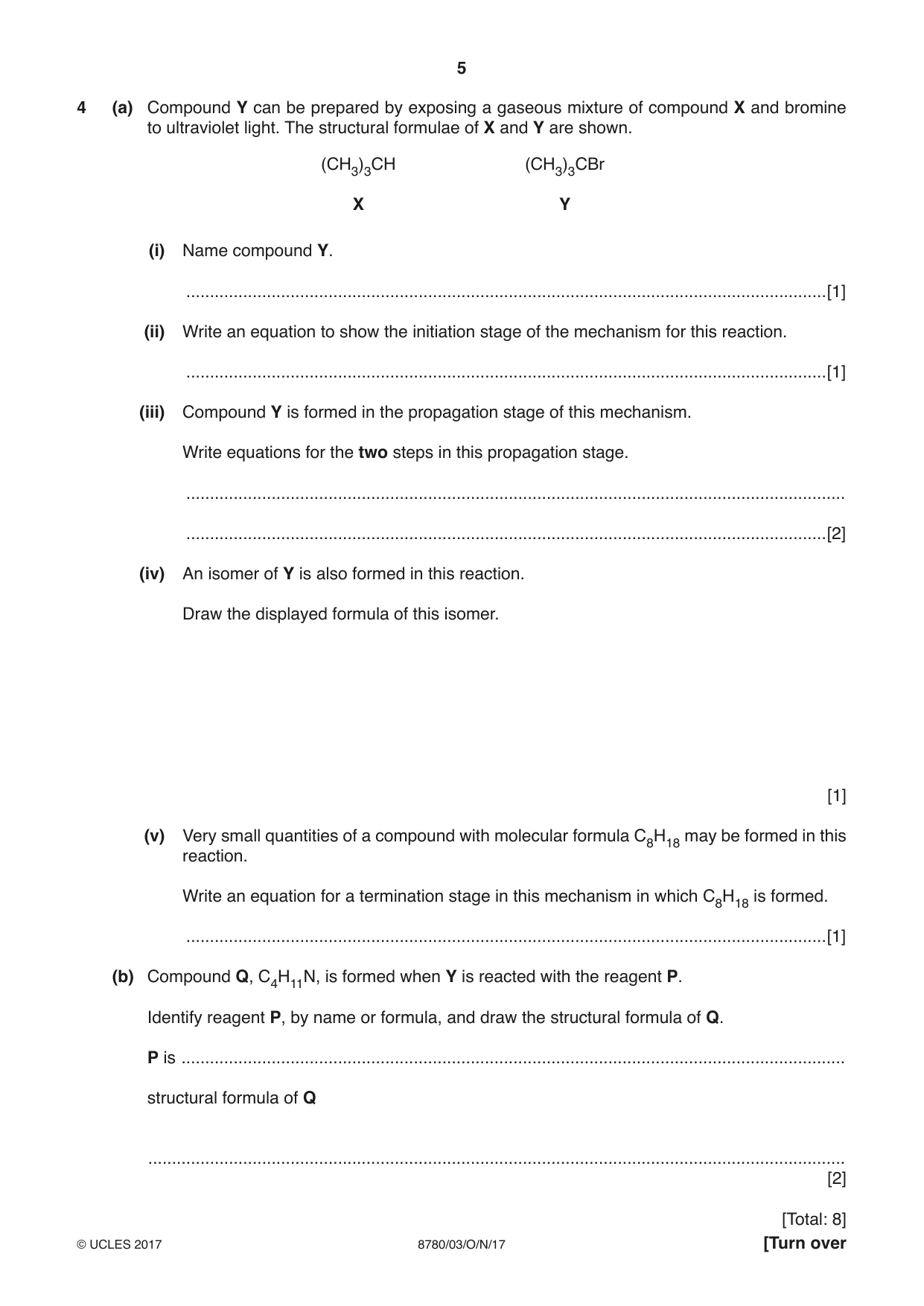
4 (a) Compound Y can be prepared by exposing a gaseous mixture of compound X and bromine to ultraviolet light. The structural formulae of X and Y are shown. (CH3)3CH (CH3)3CBr X Y (i) Name compound Y. .......................................................................................................................................[1] (ii) Write an equation to show the initiation stage of the mechanism for this reaction. .......................................................................................................................................[1] (iii) Compound Y is formed in the propagation stage of this mechanism. Write equations for the two steps in this propagation stage. ........................................................................................................................................... .......................................................................................................................................[2] (iv) An isomer of Y is also formed in this reaction. Draw the displayed formula of this isomer. [1] (v) Very small quantities of a compound with molecular formula C8H18 may be formed in this reaction. Write an equation for a termination stage in this mechanism in which C8H18 is formed. .......................................................................................................................................[1] (b) Compound Q, C4H11N, is formed when Y is reacted with the reagent P. Identify reagent P, by name or formula, and draw the structural formula of Q. P is ............................................................................................................................................ structural formula of Q ................................................................................................................................................... [2]
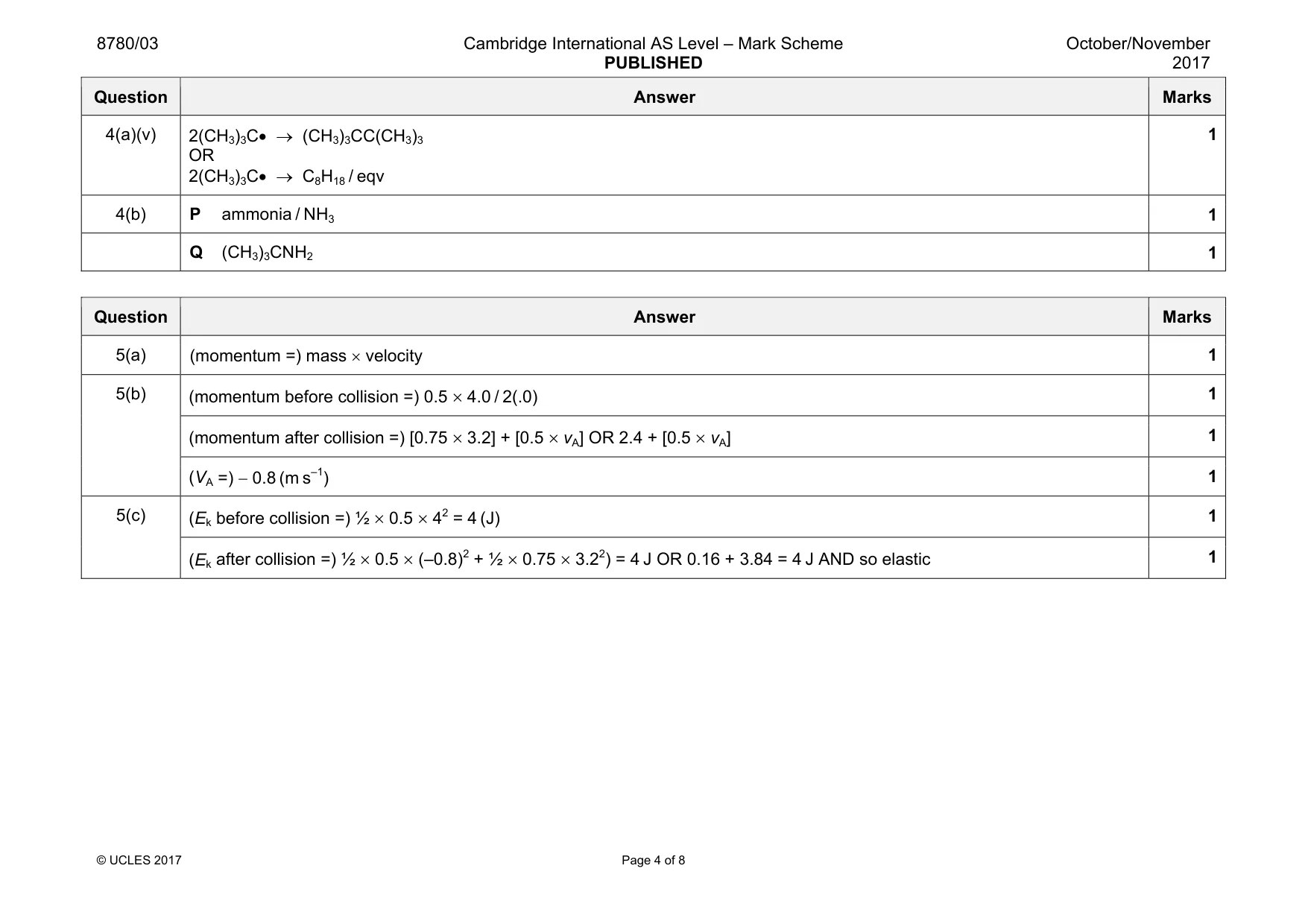
Mark scheme: 4(a)(i) 2-bromo-2-methylpropane 1 4(a)(ii) Br2 → 2Br• 1 4(a)(iii) (CH3)3CH + Br• → (CH3)3C• + HBr 1 (CH3)3C• + Br2 → (CH3)3CBr + Br• 1 4(a)(iv) 1 H H H H C H C C Br H H H C H Question Answer Marks 4(a)(v) 2(CH3)3C• → (CH3)3CC(CH3)3 OR 2(CH3)3C• → C8H18 / eqv 1 4(b) P ammonia / NH3 1 Q (CH3)3CNH2 1
Q5 · State what is meant by the term momentum
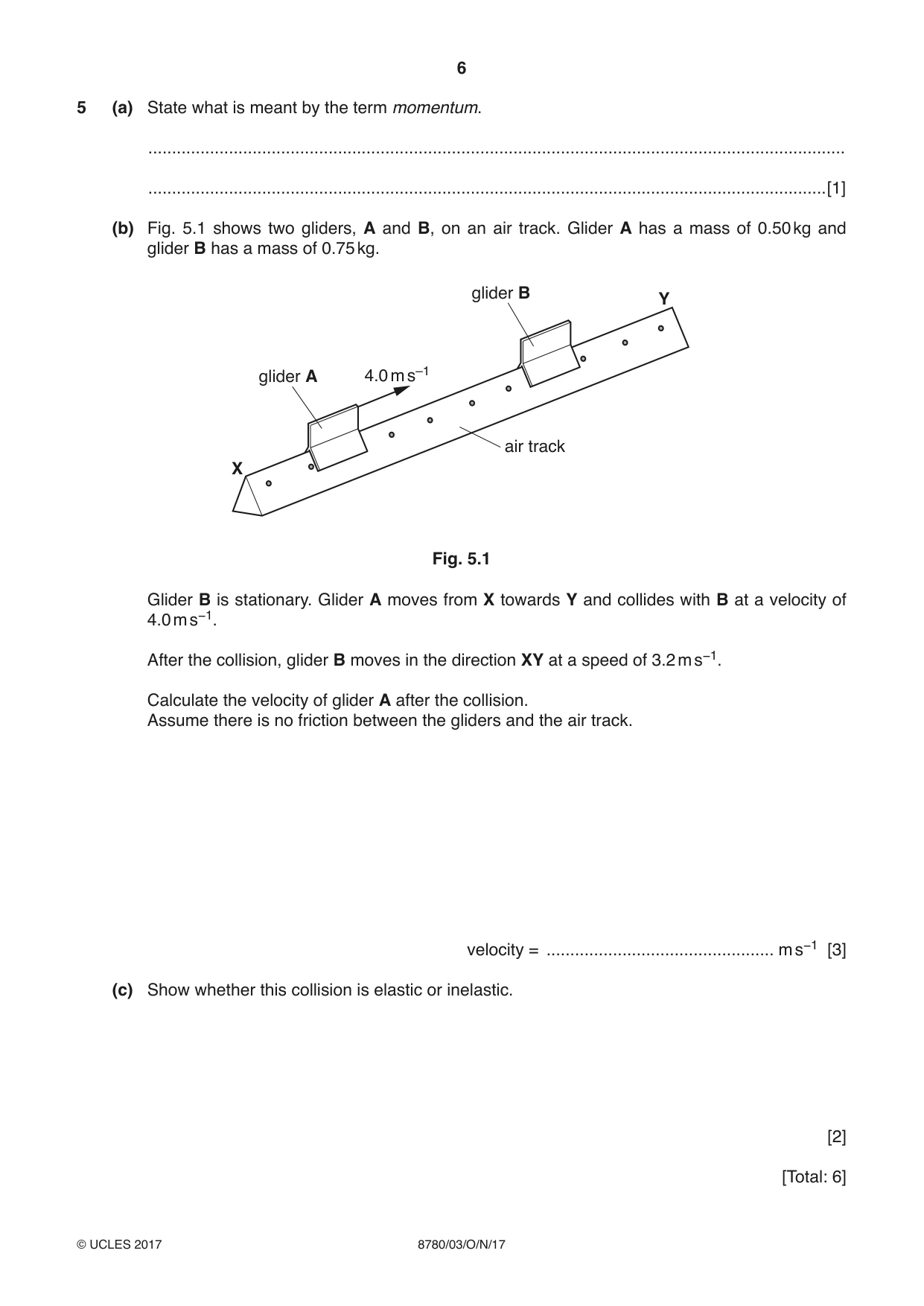
5 (a) State what is meant by the term momentum. ................................................................................................................................................... ...............................................................................................................................................[1] (b) Fig. 5.1 shows two gliders, A and B, on an air track. Glider A has a mass of 0.50 kg and glider B has a mass of 0.75 kg. glider B Y glider A 4.0 m s–1 air track X Fig. 5.1 Glider B is stationary. Glider A moves from X towards Y and collides with B at a velocity of 4.0 m s−1. After the collision, glider B moves in the direction XY at a speed of 3.2 m s−1. Calculate the velocity of glider A after the collision. Assume there is no friction between the gliders and the air track. velocity = ................................................ m s−1 [3] (c) Show whether this collision is elastic or inelastic. [2] [Total: 6]
Mark scheme: 5(a) 1 5(b) (momentum before collision =) 0.5 × 4.0 / 2(.0) 1 (momentum after collision =) [0.75 × 3.2] + [0.5 × vA] OR 2.4 + [0.5 × vA] 1 (VA =) − 0.8 (m s–1) 1 5(c) (Ek before collision =) ½ × 0.5 × 42 = 4 (J) 1 (Ek after collision =) ½ × 0.5 × (–0.8)2 + ½ × 0.75 × 3.22) = 4 J OR 0.16 + 3.84 = 4 J AND so elastic 1
Q6 · Ammonia is manufactured in the Haber process
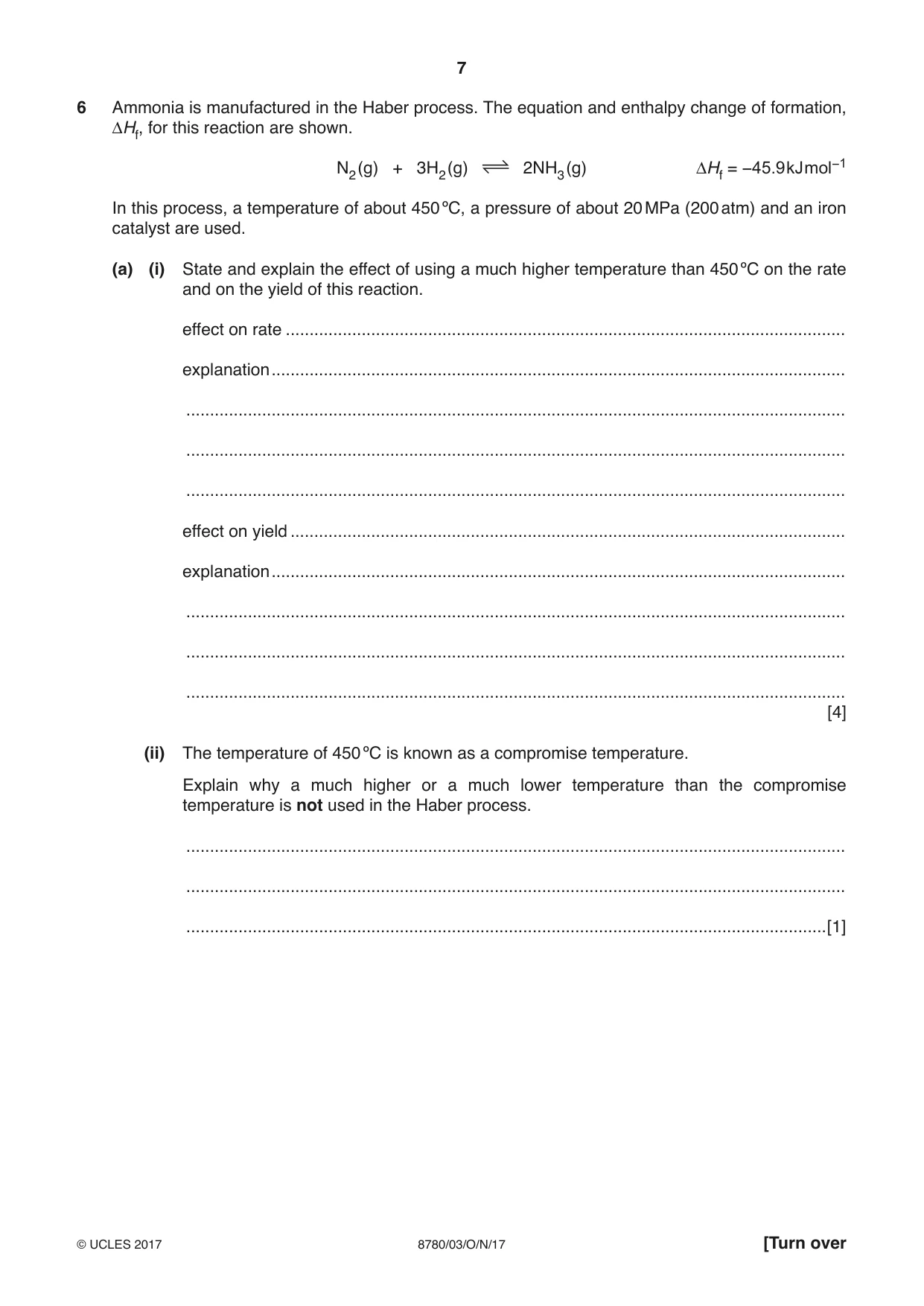
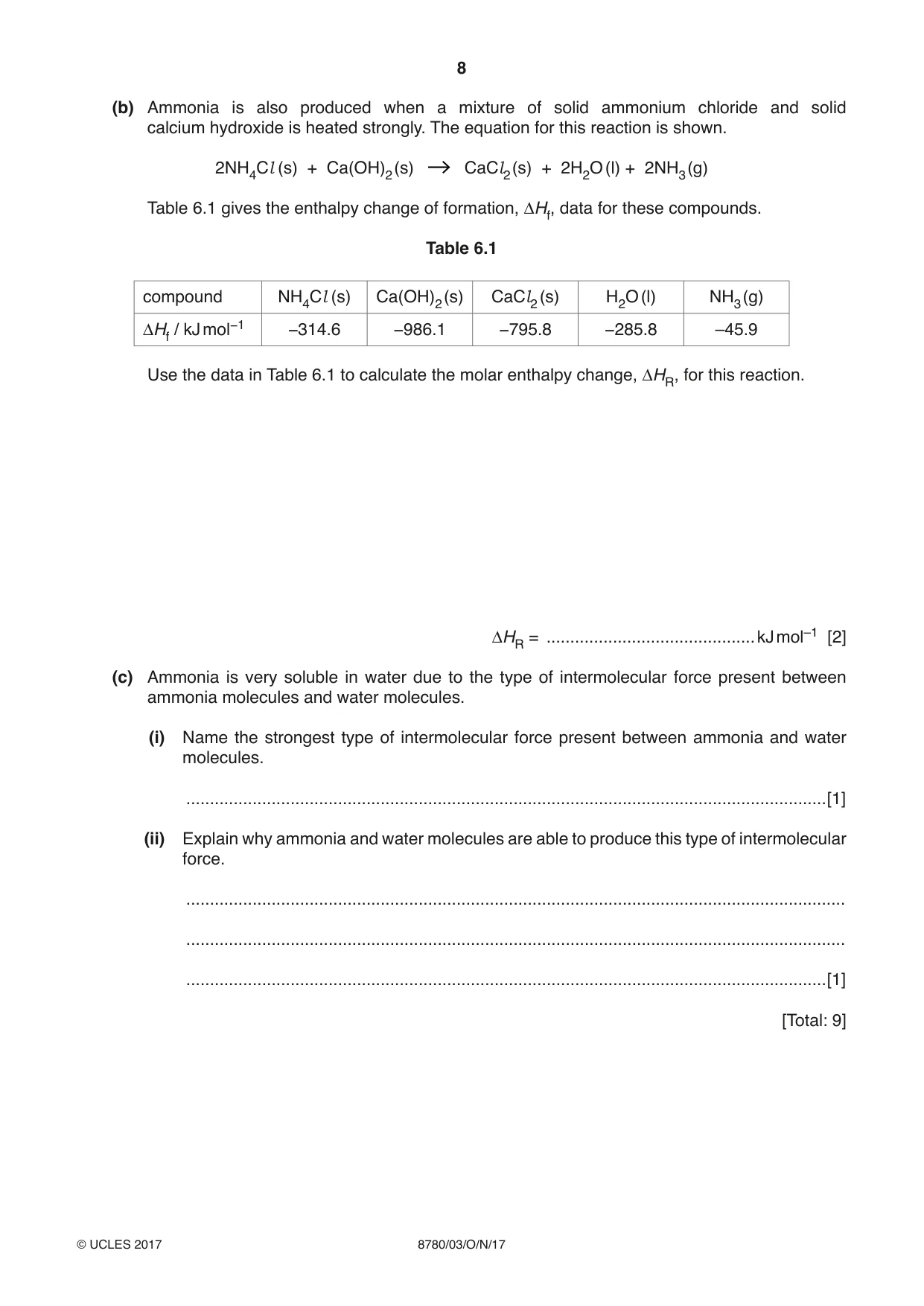
6 Ammonia is manufactured in the Haber process. The equation and enthalpy change of formation, ∆Hf, for this reaction are shown. N2 (g) + 3H2 (g) 2NH3 (g) ∆Hf = −45.9 kJ mol−1 In this process, a temperature of about 450 ºC, a pressure of about 20 MPa (200 atm) and an iron catalyst are used. (a) (i) State and explain the effect of using a much higher temperature than 450 ºC on the rate and on the yield of this reaction. effect on rate ...................................................................................................................... explanation ......................................................................................................................... ........................................................................................................................................... ........................................................................................................................................... ........................................................................................................................................... effect on yield ..................................................................................................................... explanation ......................................................................................................................... ........................................................................................................................................... ........................................................................................................................................... ........................................................................................................................................... [4] (ii) The temperature of 450 ºC is known as a compromise temperature. Explain why a much higher or a much lower temperature than the compromise temperature is not used in the Haber process. ........................................................................................................................................... ........................................................................................................................................... .......................................................................................................................................[1] (b) Ammonia is also produced when a mixture of solid ammonium chloride and solid calcium hydroxide is heated strongly. The equation for this reaction is shown. 2NH4Cl (s) + Ca(OH)2 (s) CaCl2 (s) + 2H2O (l) + 2NH3 (g) Table 6.1 gives the enthalpy change of formation, ∆Hf, data for these compounds. Table 6.1 compound NH4Cl (s) Ca(OH)2 (s) CaCl2 (s) H2O (l) NH3 (g) ∆Hf / kJ mol−1 −314.6 −986.1 −795.8 −285.8 –45.9 Use the data in Table 6.1 to calculate the molar enthalpy change, ∆HR, for this reaction. ∆HR = ............................................kJ mol–1 [2] (c) Ammonia is very soluble in water due to the type of intermolecular force present between ammonia molecules and water molecules. (i) Name the strongest type of intermolecular force present between ammonia and water molecules. .......................................................................................................................................[1] (ii) Explain why ammonia and water molecules are able to produce this type of intermolecular force. ........................................................................................................................................... ........................................................................................................................................... .......................................................................................................................................[1] [Total: 9]
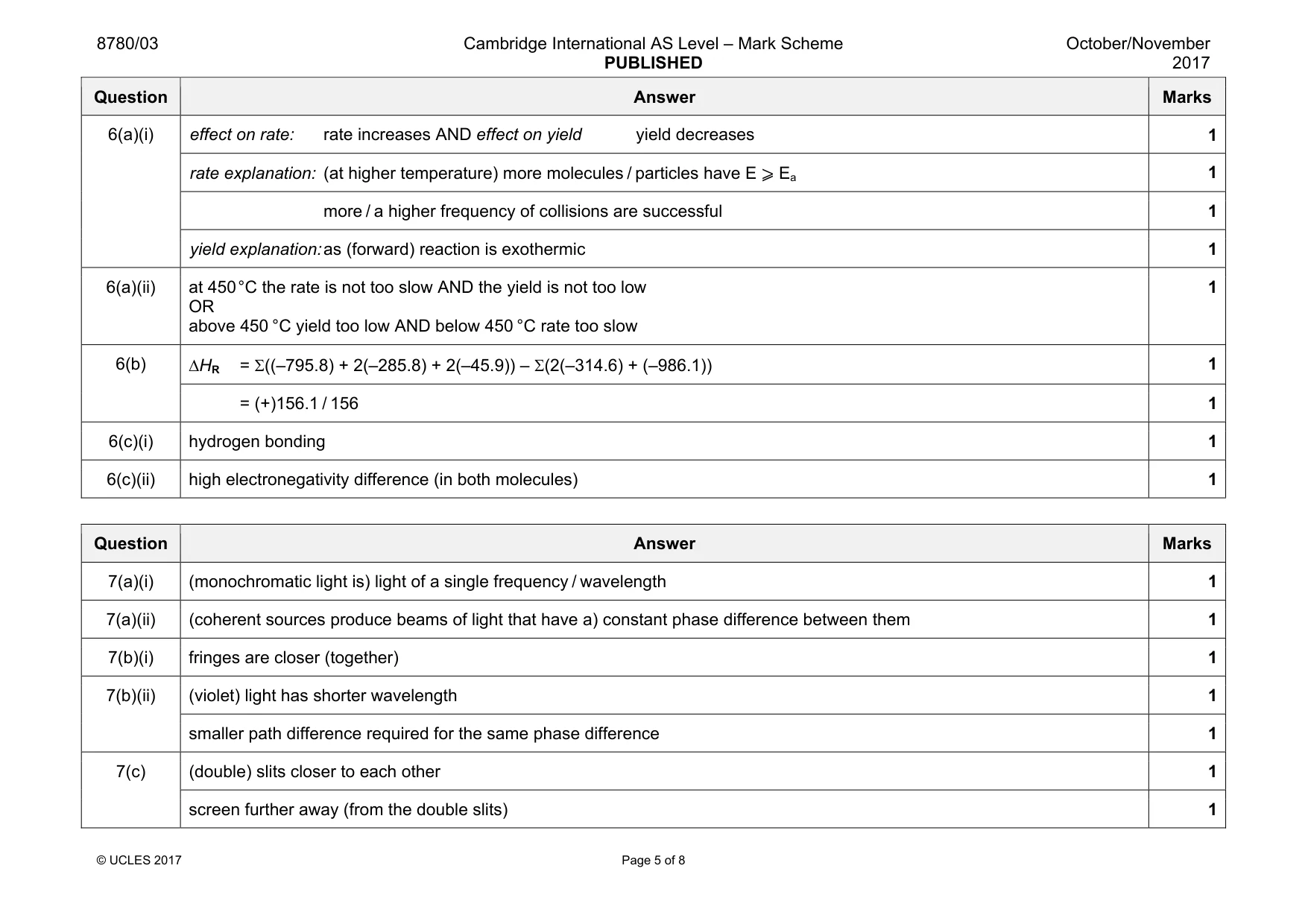
Mark scheme: 6(a)(i) effect on rate: rate increases AND effect on yield yield decreases 1 rate explanation: (at higher temperature) more molecules / particles have E ⩾ Ea 1 more / a higher frequency of collisions are successful 1 yield explanation: as (forward) reaction is exothermic 1 6(a)(ii) at 450 °C the rate is not too slow AND the yield is not too low OR above 450 °C yield too low AND below 450 °C rate too slow 1 6(b) ∆HR = Σ((–795.8) + 2(–285.8) + 2(–45.9)) – Σ(2(–314.6) + (–986.1)) 1 = (+)156.1 / 156 1 6(c)(i) hydrogen bonding 1 6(c)(ii) high electronegativity difference (in both molecules) 1
Q7 · An experiment used to demonstrate interference of visible light
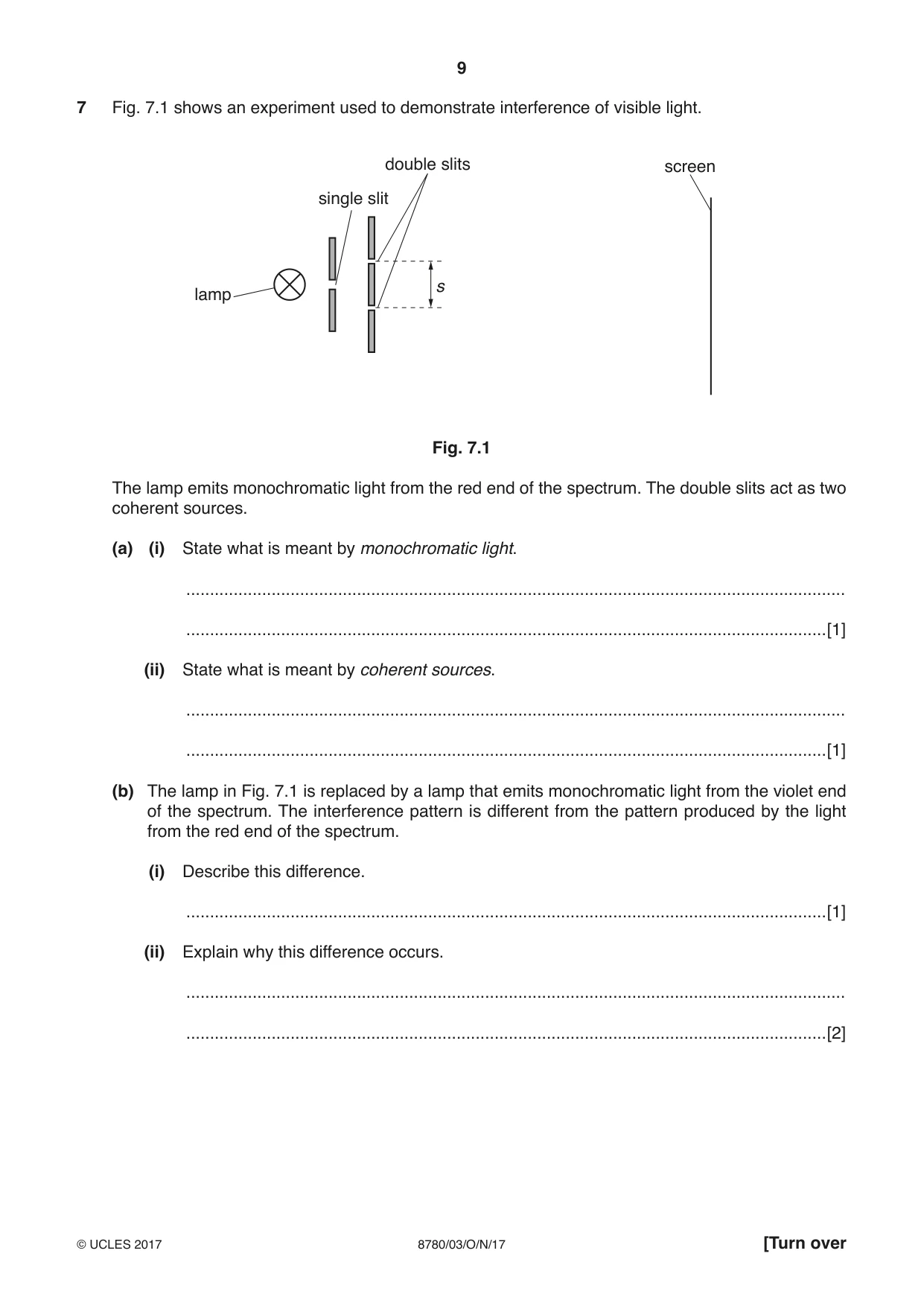
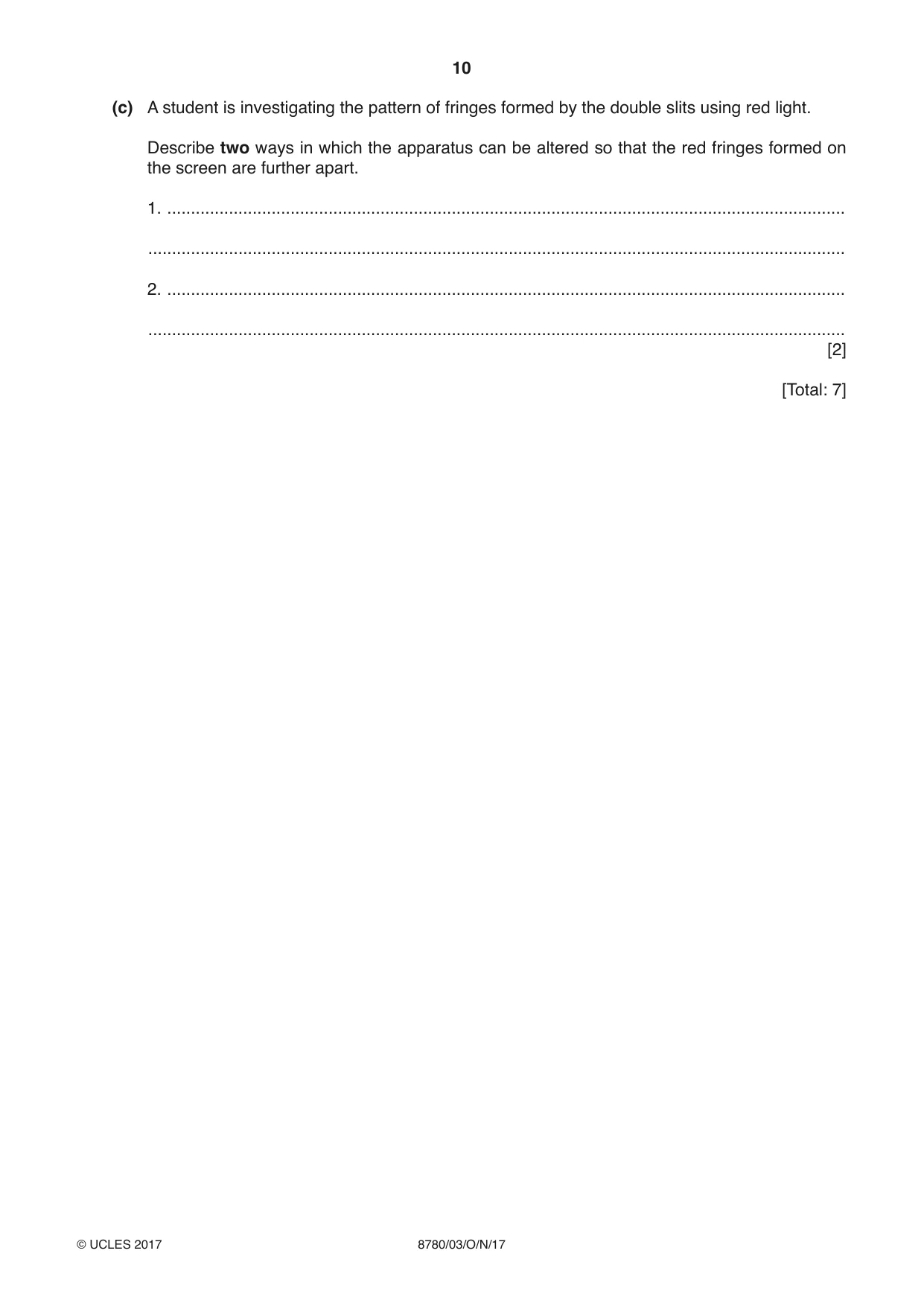
7 Fig. 7.1 shows an experiment used to demonstrate interference of visible light. double slits screen single slit s lamp Fig. 7.1 The lamp emits monochromatic light from the red end of the spectrum. The double slits act as two coherent sources. (a) (i) State what is meant by monochromatic light. ........................................................................................................................................... .......................................................................................................................................[1] (ii) State what is meant by coherent sources. ........................................................................................................................................... .......................................................................................................................................[1] (b) The lamp in Fig. 7.1 is replaced by a lamp that emits monochromatic light from the violet end of the spectrum. The interference pattern is different from the pattern produced by the light from the red end of the spectrum. (i) Describe this difference. .......................................................................................................................................[1] (ii) Explain why this difference occurs. ........................................................................................................................................... .......................................................................................................................................[2] (c) A student is investigating the pattern of fringes formed by the double slits using red light. Describe two ways in which the apparatus can be altered so that the red fringes formed on the screen are further apart. 1. ............................................................................................................................................... ................................................................................................................................................... 2. ............................................................................................................................................... ................................................................................................................................................... [2] [Total: 7]
Mark scheme: 7(a)(i) (monochromatic light is) light of a single frequency / wavelength 1 7(a)(ii) (coherent sources produce beams of light that have a) constant phase difference between them 1 7(b)(i) fringes are closer (together) 1 7(b)(ii) (violet) light has shorter wavelength 1 smaller path difference required for the same phase difference 1 7(c) (double) slits closer to each other 1 screen further away (from the double slits) 1
Q8 · Magnesium nitrate, Mg(NO3)2, can be prepared by the reaction of magnesium hydroxide…
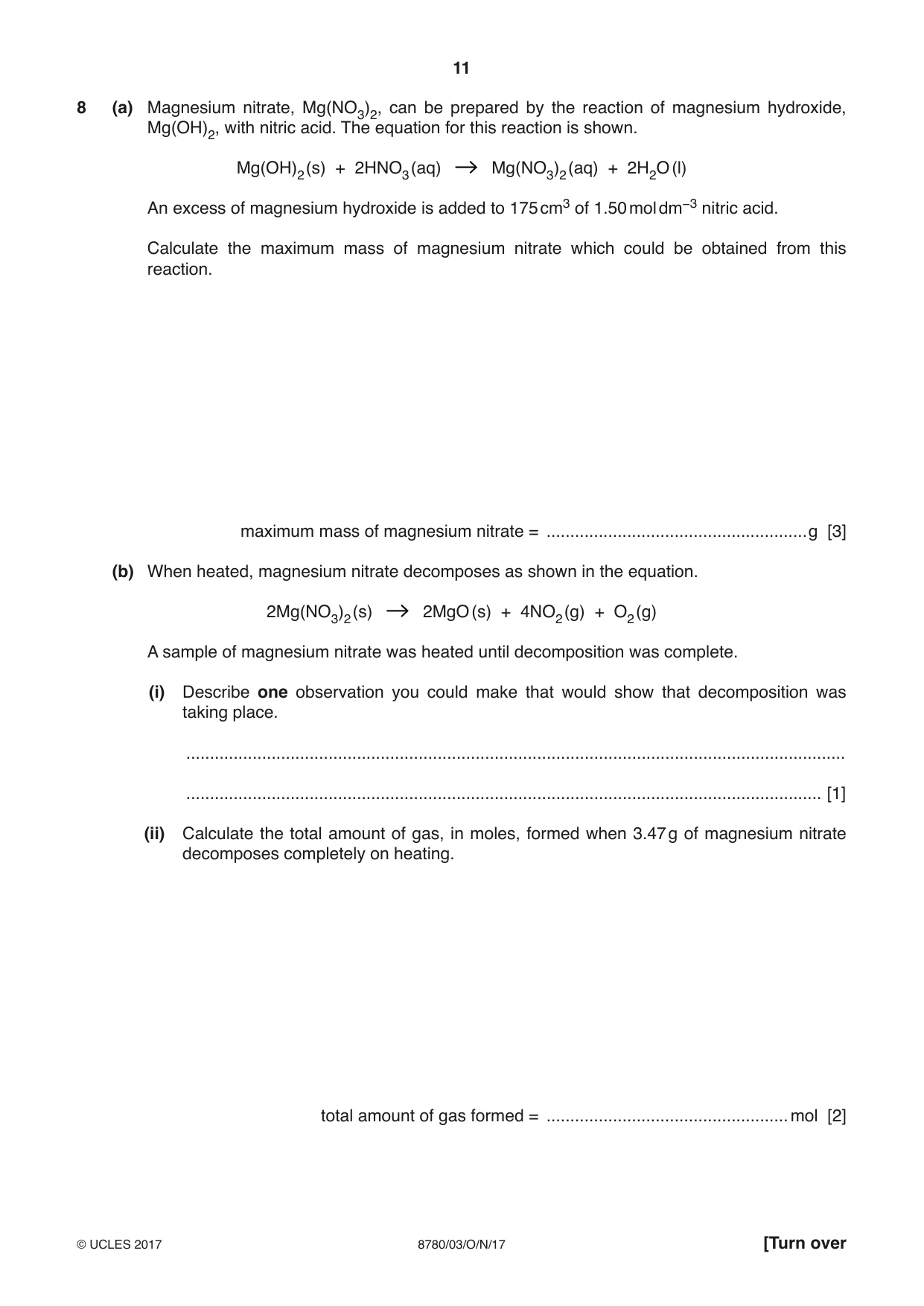
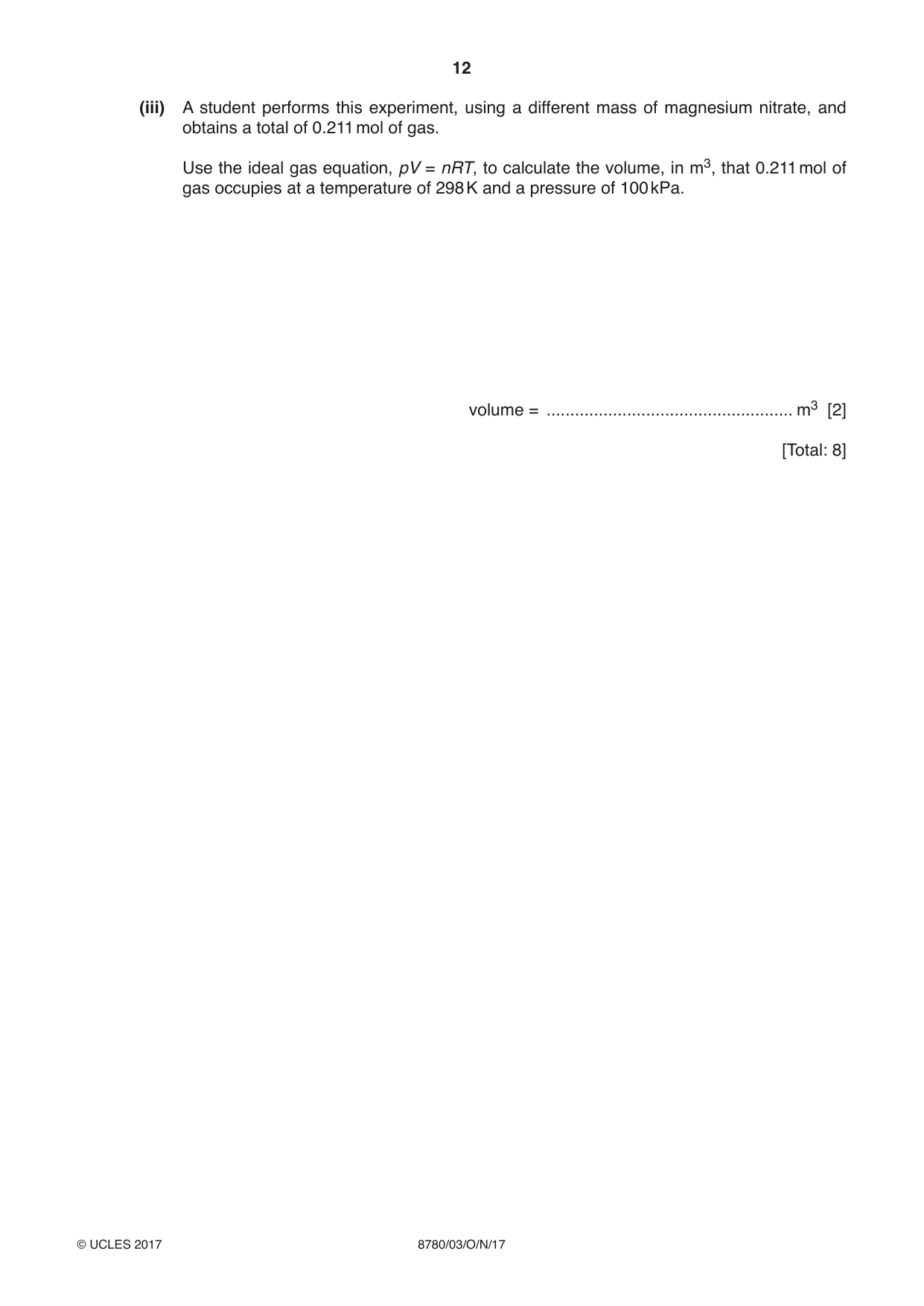
8 (a) Magnesium nitrate, Mg(NO3)2, can be prepared by the reaction of magnesium hydroxide, Mg(OH)2, with nitric acid. The equation for this reaction is shown. Mg(OH)2 (s) + 2HNO3 (aq) Mg(NO3)2 (aq) + 2H2O (l) An excess of magnesium hydroxide is added to 175 cm3 of 1.50 mol dm−3 nitric acid. Calculate the maximum mass of magnesium nitrate which could be obtained from this reaction. maximum mass of magnesium nitrate = .......................................................g [3] (b) When heated, magnesium nitrate decomposes as shown in the equation. 2Mg(NO3)2 (s) 2MgO (s) + 4NO2 (g) + O2 (g) A sample of magnesium nitrate was heated until decomposition was complete. (i) Describe one observation you could make that would show that decomposition was taking place. ........................................................................................................................................... ...................................................................................................................................... [1] (ii) Calculate the total amount of gas, in moles, formed when 3.47 g of magnesium nitrate decomposes completely on heating. total amount of gas formed = ...................................................mol [2] (iii) A student performs this experiment, using a different mass of magnesium nitrate, and obtains a total of 0.211 mol of gas. Use the ideal gas equation, pV = nRT, to calculate the volume, in m3, that 0.211 mol of gas occupies at a temperature of 298 K and a pressure of 100 kPa. volume = .................................................... m3 [2] [Total: 8]
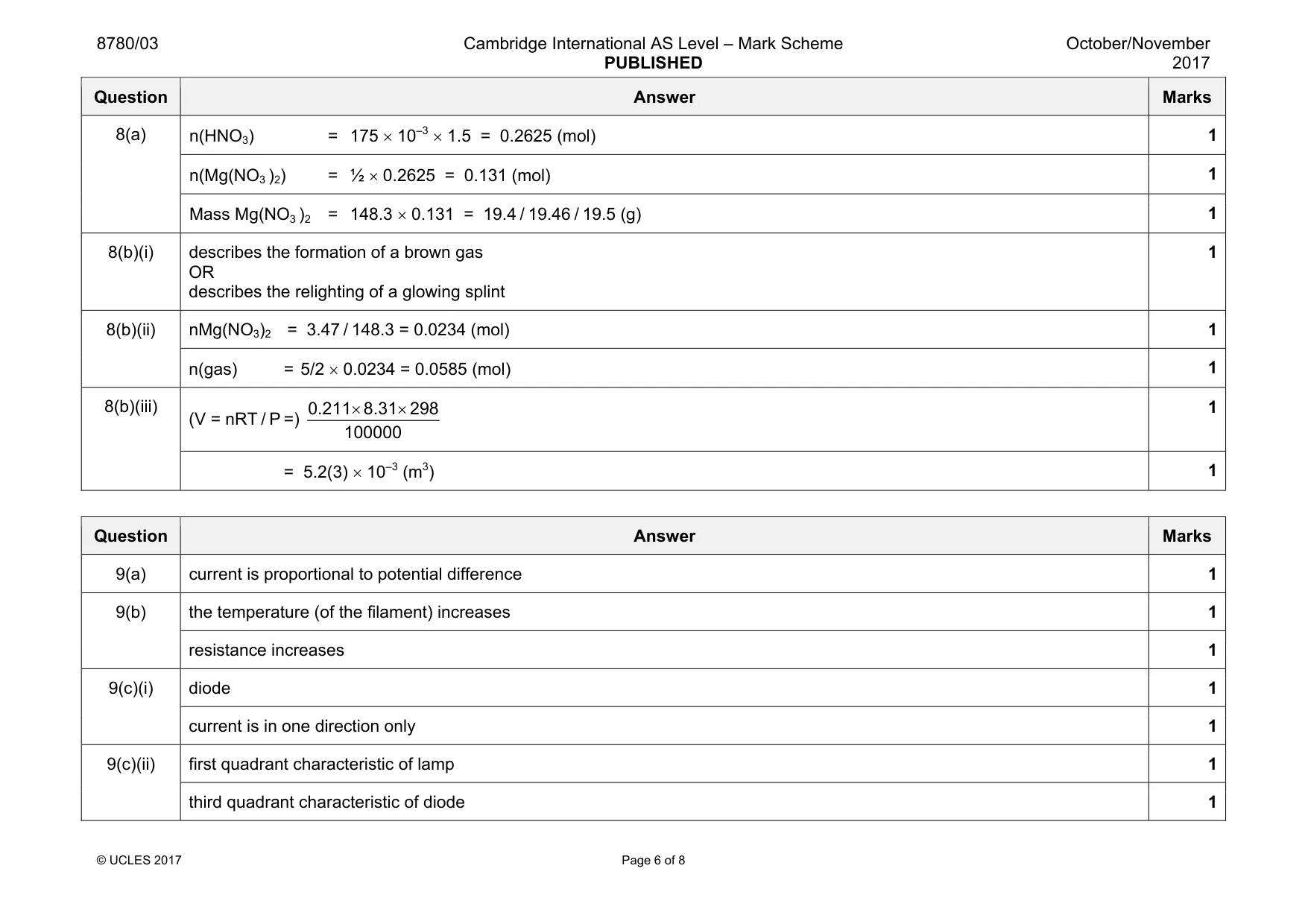
Mark scheme: 8(a) n(HNO3) 1 n(Mg(NO3 )2) = ½ × 0.2625 = 0.131 (mol) 1 Mass Mg(NO3 )2 = 148.3 × 0.131 = 19.4 / 19.46 / 19.5 (g) 1 8(b)(i) describes the formation of a brown gas OR describes the relighting of a glowing splint 1 8(b)(ii) nMg(NO3)2 = 3.47 / 148.3 = 0.0234 (mol) 1 n(gas) = 5/2 × 0.0234 = 0.0585 (mol) 1 8(b)(iii) (V = nRT / P =) 0.211 8.31 298 100000 × × 1 = 5.2(3) × 10–3 (m3) 1
Q9 · A student investigates the I-V characteristic of different electrical components
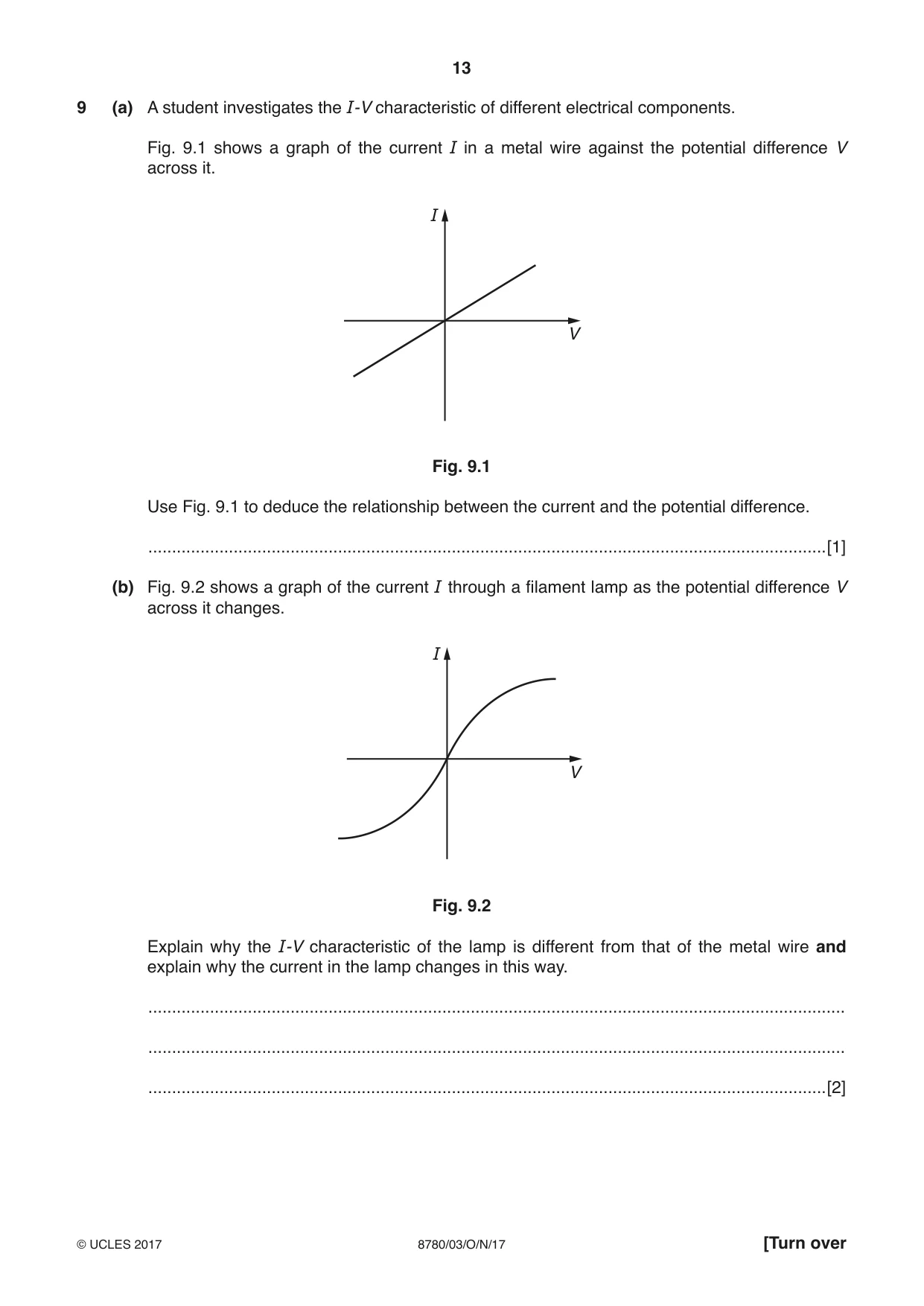
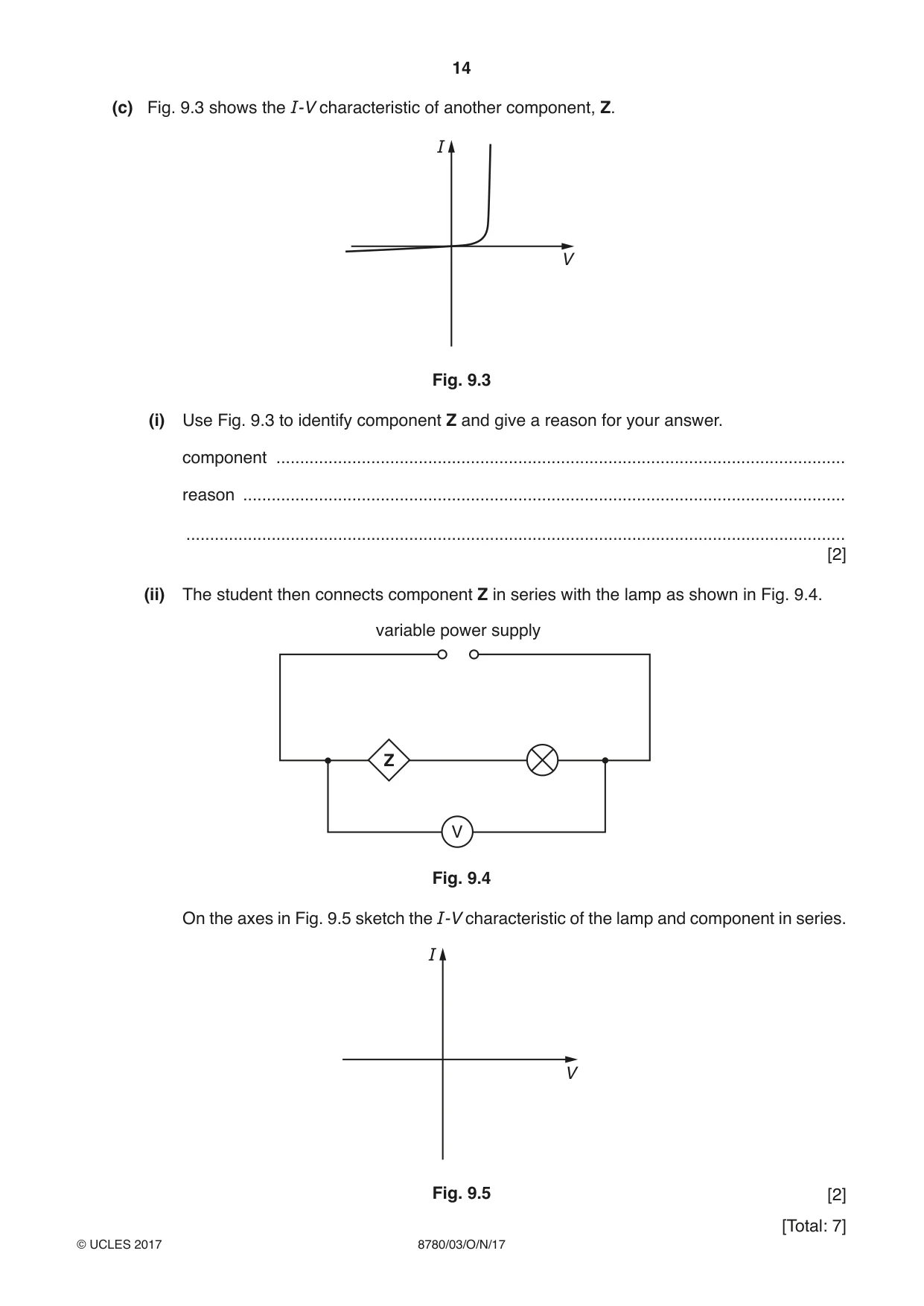
9 (a) A student investigates the I-V characteristic of different electrical components. Fig. 9.1 shows a graph of the current I in a metal wire against the potential difference V across it. I V Fig. 9.1 Use Fig. 9.1 to deduce the relationship between the current and the potential difference. ...............................................................................................................................................[1] (b) Fig. 9.2 shows a graph of the current I through a filament lamp as the potential difference V across it changes. I V Fig. 9.2 Explain why the I-V characteristic of the lamp is different from that of the metal wire and explain why the current in the lamp changes in this way. ................................................................................................................................................... ................................................................................................................................................... ...............................................................................................................................................[2] (c) Fig. 9.3 shows the I-V characteristic of another component, Z. I V Fig. 9.3 (i) Use Fig. 9.3 to identify component Z and give a reason for your answer. component ........................................................................................................................ reason ............................................................................................................................... ........................................................................................................................................... [2] (ii) The student then connects component Z in series with the lamp as shown in Fig. 9.4. variable power supply Z V Fig. 9.4 On the axes in Fig. 9.5 sketch the I-V characteristic of the lamp and component in series. I V Fig. 9.5 [2]
Mark scheme: 9(a) current is proportional to potential difference 1 9(b) the temperature (of the filament) increases 1 resistance increases 1 9(c)(i) diode 1 current is in one direction only 1 9(c)(ii) first quadrant characteristic of lamp 1 third quadrant characteristic of diode 1
Q10 · Covellite is copper(II) sulfide, CuS, and occurs naturally as a mineral
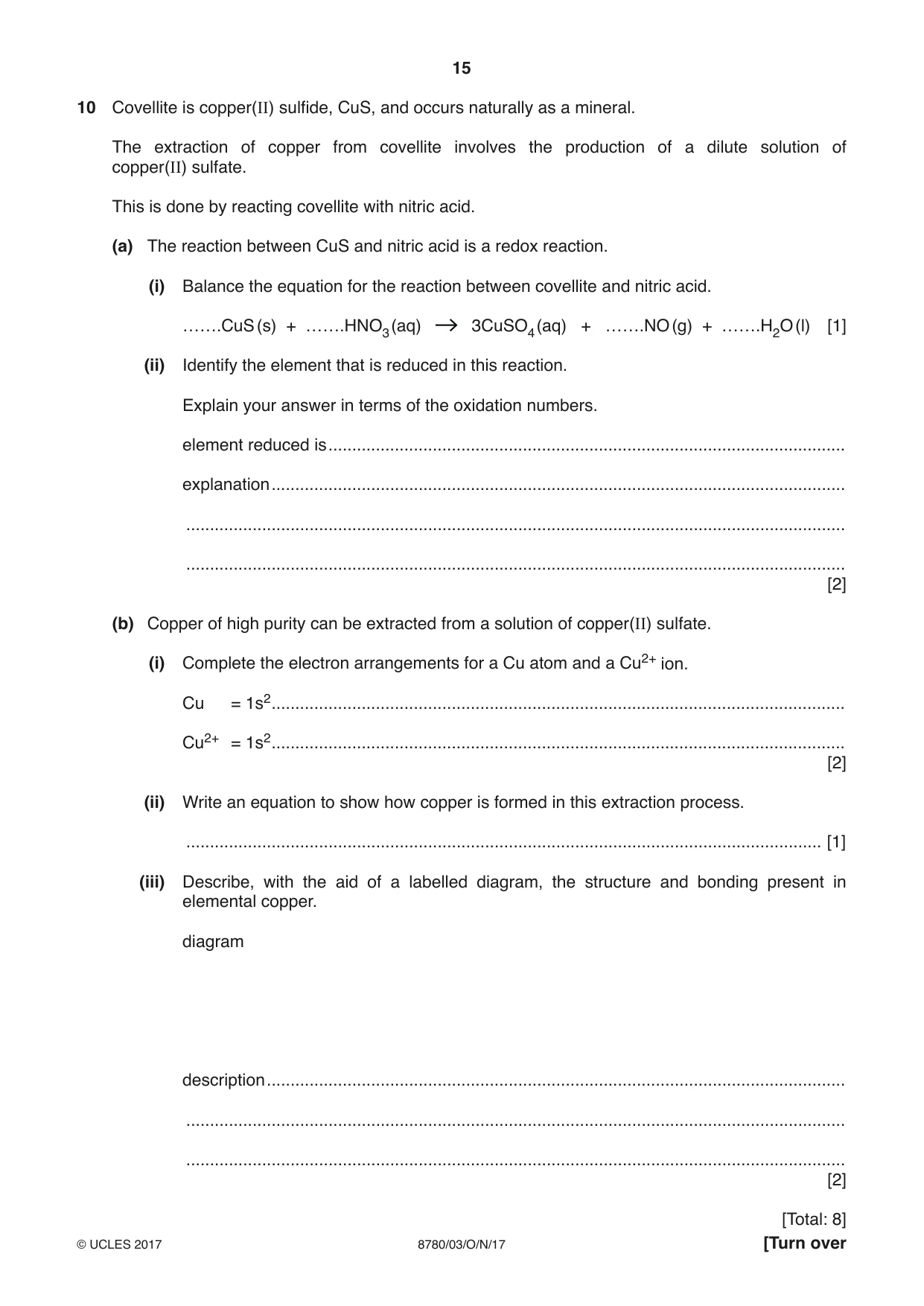
10 Covellite is copper(II) sulfide, CuS, and occurs naturally as a mineral. The extraction of copper from covellite involves the production of a dilute solution of copper(II) sulfate. This is done by reacting covellite with nitric acid. (a) The reaction between CuS and nitric acid is a redox reaction. (i) Balance the equation for the reaction between covellite and nitric acid. …….CuS (s) + …….HNO3 (aq) 3CuSO4 (aq) + …….NO (g) + …….H2O (l) [1] (ii) Identify the element that is reduced in this reaction. Explain your answer in terms of the oxidation numbers. element reduced is ............................................................................................................. explanation ......................................................................................................................... ........................................................................................................................................... ........................................................................................................................................... [2] (b) Copper of high purity can be extracted from a solution of copper(II) sulfate. (i) Complete the electron arrangements for a Cu atom and a Cu2+ ion. Cu = 1s2 ......................................................................................................................... Cu2+ = 1s2 ......................................................................................................................... [2] (ii) Write an equation to show how copper is formed in this extraction process. ...................................................................................................................................... [1] (iii) Describe, with the aid of a labelled diagram, the structure and bonding present in elemental copper. diagram description .......................................................................................................................... ........................................................................................................................................... ........................................................................................................................................... [2]
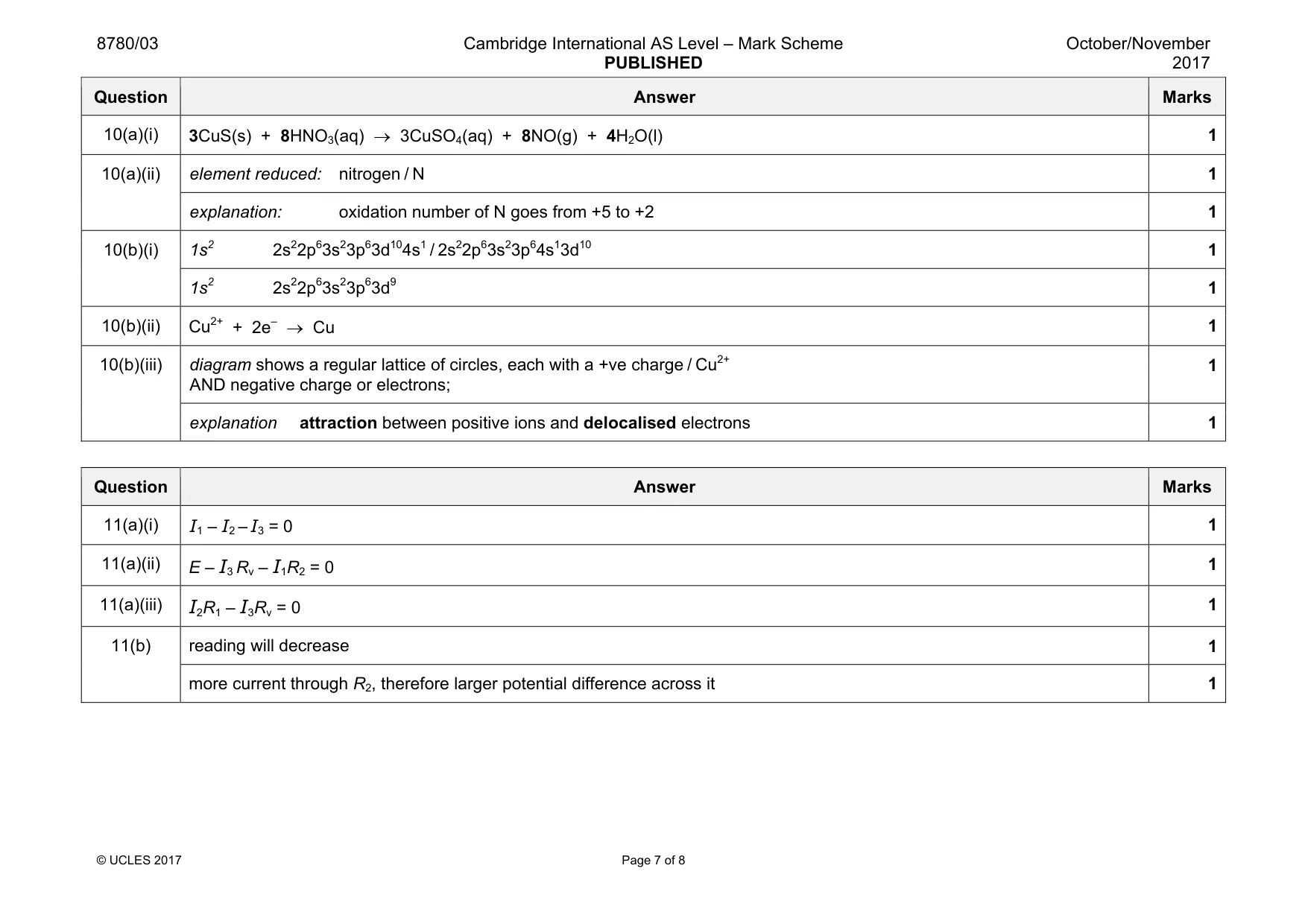
Mark scheme: 10(a)(i) 1 10(a)(ii) element reduced: nitrogen / N 1 explanation: oxidation number of N goes from +5 to +2 1 10(b)(i) 1s2 2s22p63s23p63d104s1 / 2s22p63s23p64s13d10 1 1s2 2s22p63s23p63d9 1 10(b)(ii) Cu2+ + 2e– → Cu 1 10(b)(iii) diagram shows a regular lattice of circles, each with a +ve charge / Cu2+ AND negative charge or electrons; 1 explanation attraction between positive ions and delocalised electrons 1
Q11 · A potential divider circuit
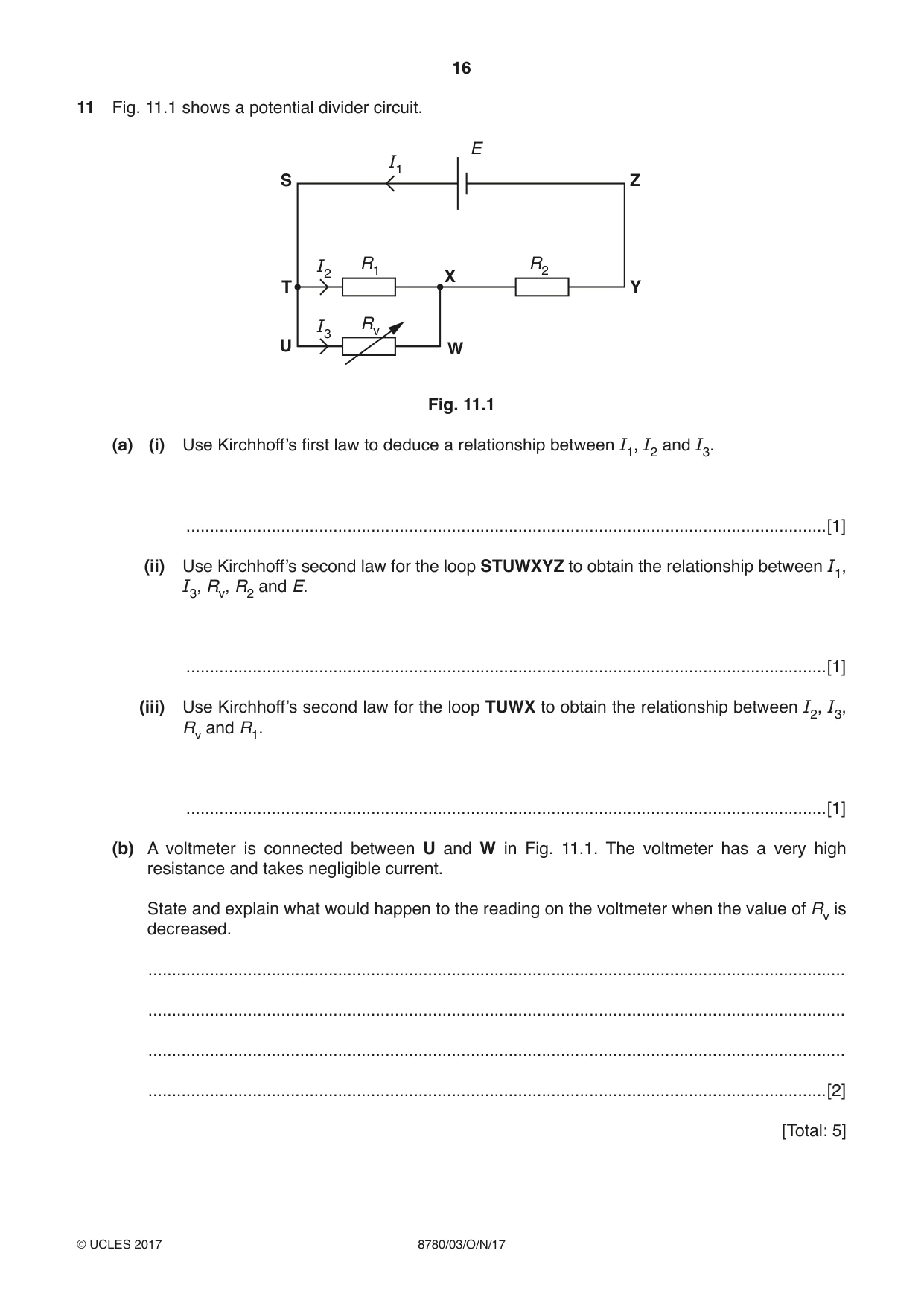
11 Fig. 11.1 shows a potential divider circuit. E I1 S Z I2 R1 R2 X T Y I3 Rv U W Fig. 11.1 (a) (i) Use Kirchhoff’s first law to deduce a relationship between I1, I2 and I3. .......................................................................................................................................[1] (ii) Use Kirchhoff’s second law for the loop STUWXYZ to obtain the relationship between I1, I3, Rv, R2 and E. .......................................................................................................................................[1] (iii) Use Kirchhoff’s second law for the loop TUWX to obtain the relationship between I2, I3, Rv and R1. .......................................................................................................................................[1] (b) A voltmeter is connected between U and W in Fig. 11.1. The voltmeter has a very high resistance and takes negligible current. State and explain what would happen to the reading on the voltmeter when the value of Rv is decreased. ................................................................................................................................................... ................................................................................................................................................... ................................................................................................................................................... ...............................................................................................................................................[2] [Total: 5]
Mark scheme: 11(a)(i) 1 11(a)(ii) E – I3 Rv – I1R2 = 0 1 11(a)(iii) I2R1 – I3Rv = 0 1 11(b) reading will decrease 1 more current through R2, therefore larger potential difference across it 1
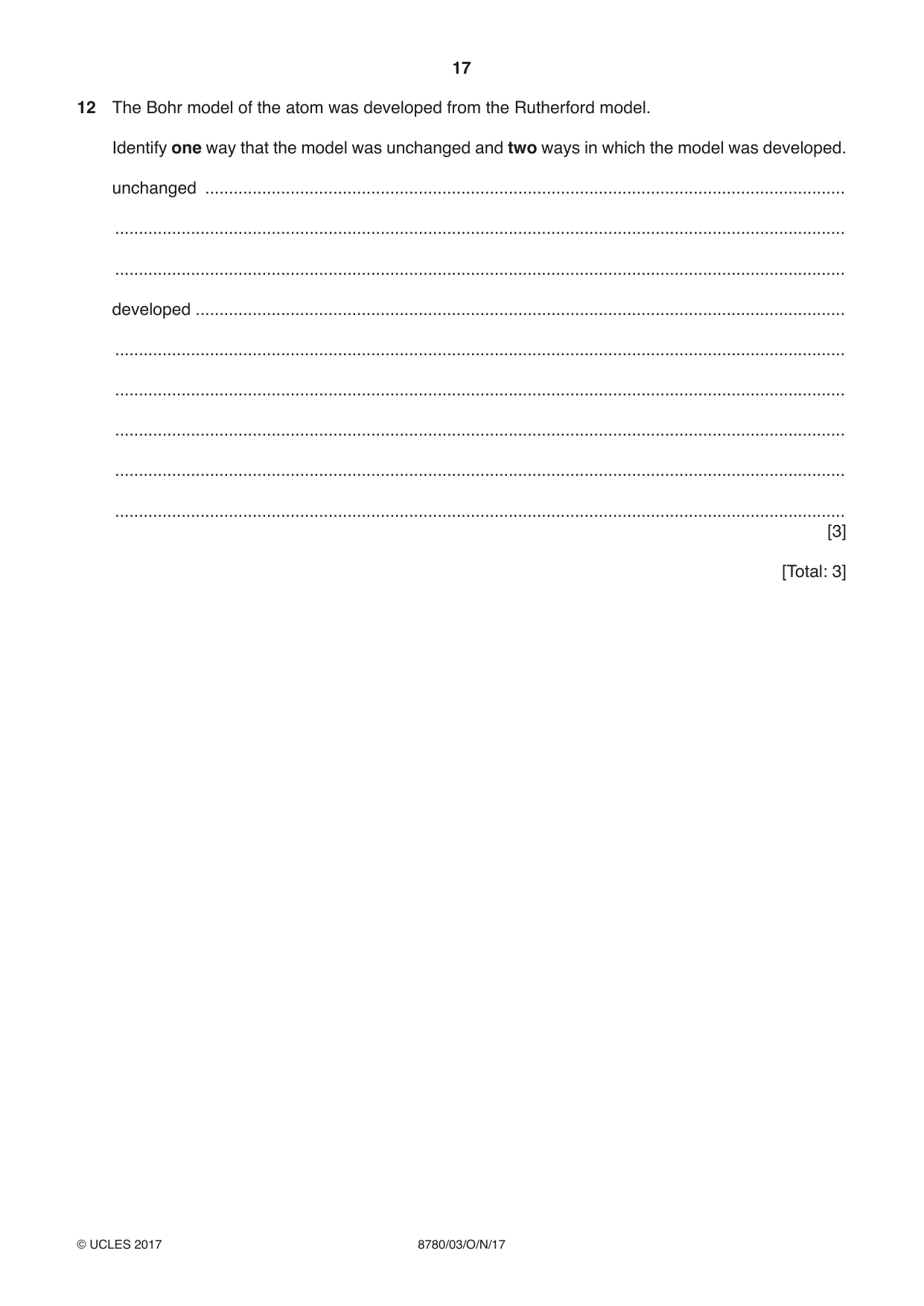
Q12 · The Bohr model of the atom was developed from the Rutherford model
12 The Bohr model of the atom was developed from the Rutherford model. Identify one way that the model was unchanged and two ways in which the model was developed. unchanged ....................................................................................................................................... .......................................................................................................................................................... .......................................................................................................................................................... developed ......................................................................................................................................... .......................................................................................................................................................... .......................................................................................................................................................... .......................................................................................................................................................... .......................................................................................................................................................... .......................................................................................................................................................... [3] [Total: 3]
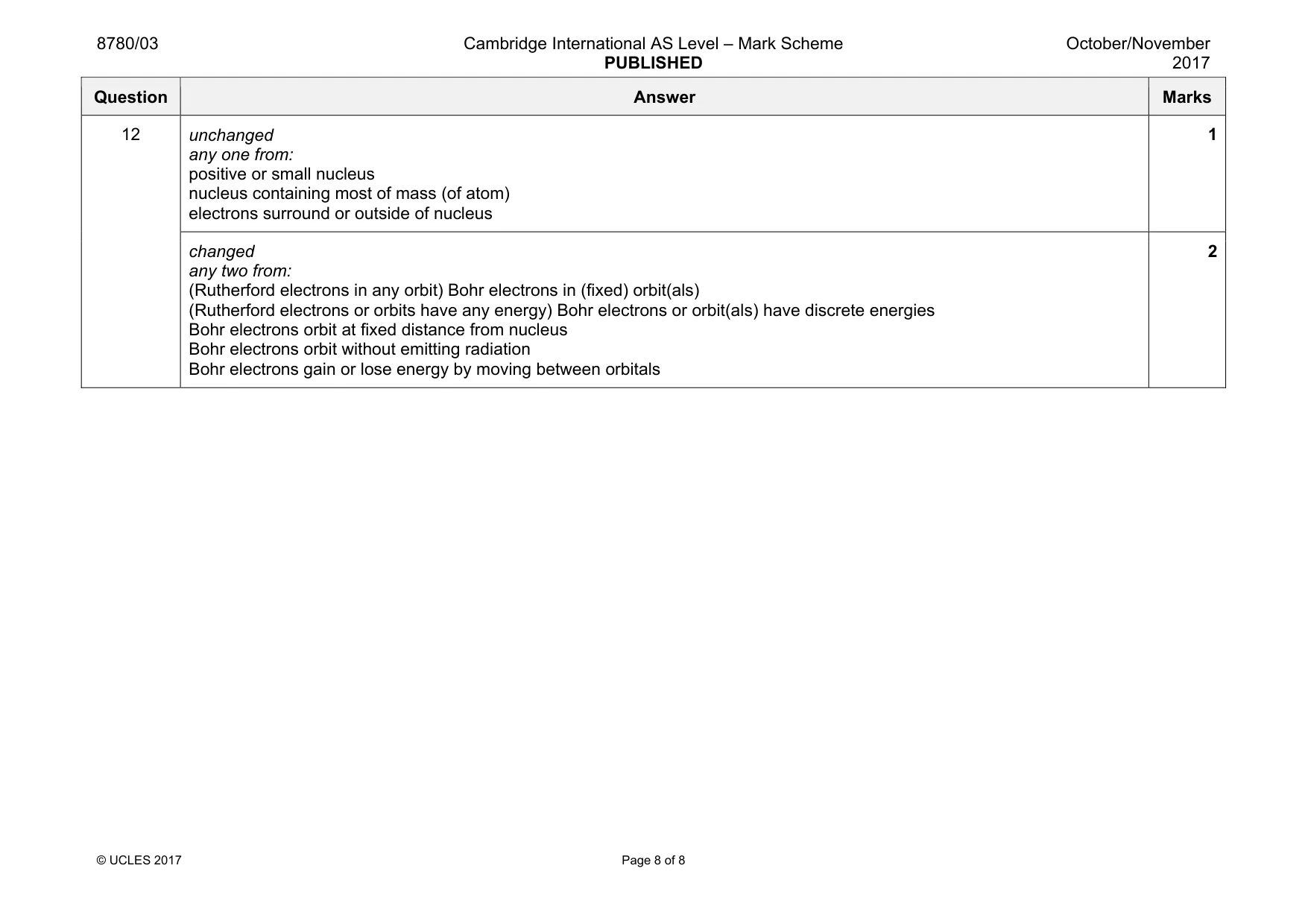
Mark scheme: 12 unchanged any one from: positive or small nucleus nucleus containing most of mass (of atom) electrons surround or outside of nucleus 1 changed any two from: (Rutherford electrons in any orbit) Bohr electrons in (fixed) orbit(als) (Rutherford electrons or orbits have any energy) Bohr electrons or orbit(als) have discrete energies Bohr electrons orbit at fixed distance from nucleus Bohr electrons orbit without emitting radiation Bohr electrons gain or lose energy by moving between orbitals 2
What you needed in this session
Cambridge’s own grade thresholds for 2017 Oct/Nov, Paper 3 · Variant 1. A higher threshold means an easier paper — the bar moves with how the cohort did.