Cambridge A Level Physical Science 8780 — 2014 Oct/Nov Paper 3 · Variant 1
8780/31/O/N/14 · 9 questions · 80 marks · ≈90 min
The question paper and its mark scheme, free to read here and free to download. This is Cambridge’s own paper, exactly as it was sat.
Question paper20 pages

Mark scheme6 pages
Answers below. Sit the paper first if you are practising.
Questions as text
Q1 · At room temperature, both sodium metal and sodium chloride are crystalline solids which…
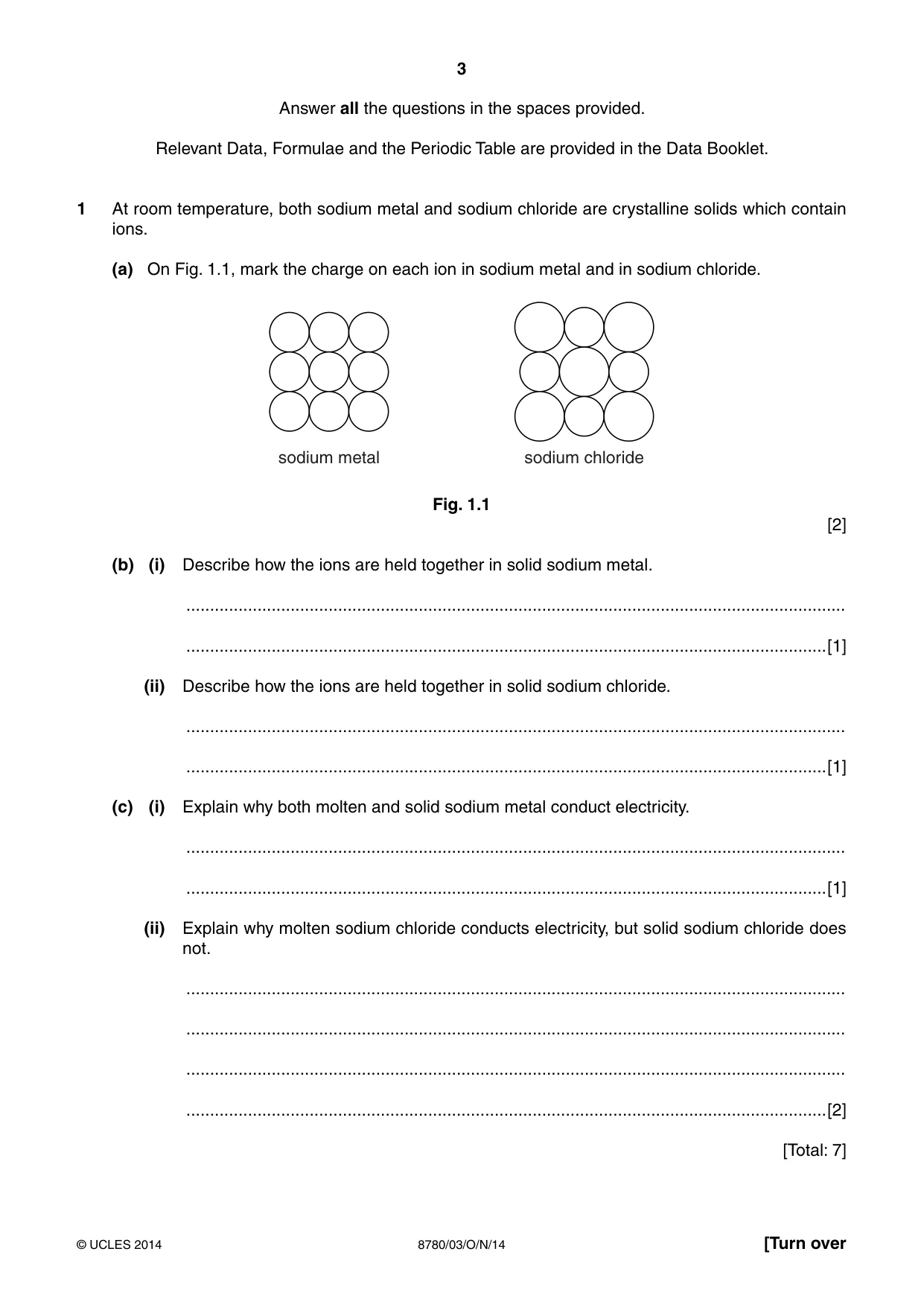
1 At room temperature, both sodium metal and sodium chloride are crystalline solids which contain ions. (a) On Fig. 1.1, mark the charge on each ion in sodium metal and in sodium chloride. sodium metal sodium chloride Fig. 1.1 [2] (b) (i) Describe how the ions are held together in solid sodium metal. ........................................................................................................................................... .......................................................................................................................................[1] (ii) Describe how the ions are held together in solid sodium chloride. ........................................................................................................................................... .......................................................................................................................................[1] (c) (i) Explain why both molten and solid sodium metal conduct electricity. ........................................................................................................................................... .......................................................................................................................................[1] (ii) Explain why molten sodium chloride conducts electricity, but solid sodium chloride does not. ........................................................................................................................................... ........................................................................................................................................... ........................................................................................................................................... .......................................................................................................................................[2] [Total: 7]
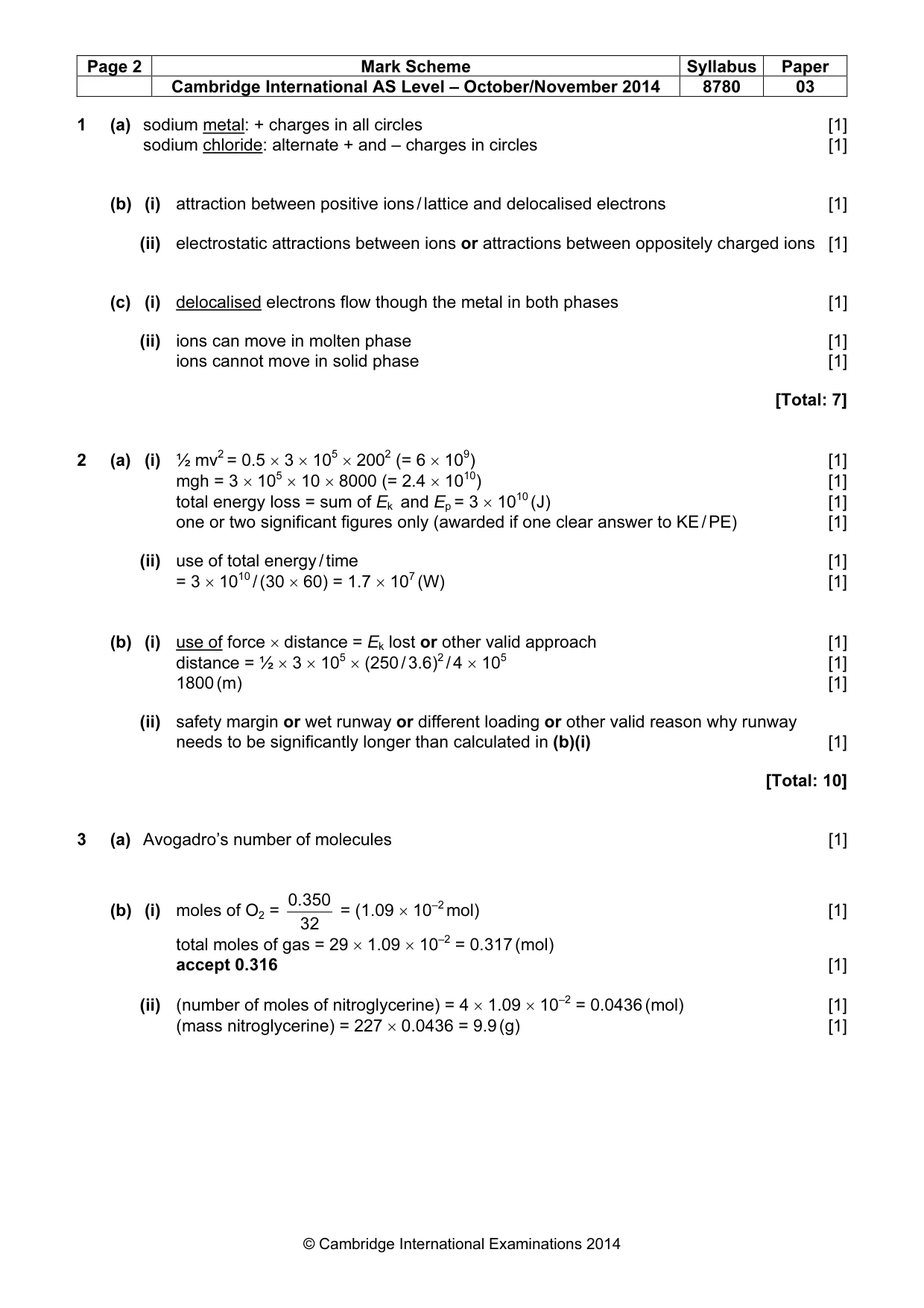
Mark scheme: 1 (a) sodium metal: + charges in all circles [1] sodium chloride: alternate + and – charges in circles [1] (b) (i) attraction between positive ions / lattice and delocalised electrons [1] (ii) electrostatic attractions between ions or attractions between oppositely charged ions [1] (c) (i) delocalised electrons flow though the metal in both phases [1] (ii) ions can move in molten phase [1] ions cannot move in solid phase [1] [Total: 7] 2 5 2 9
Q2 · In this question you are to estimate the average rate of energy loss as an airliner…
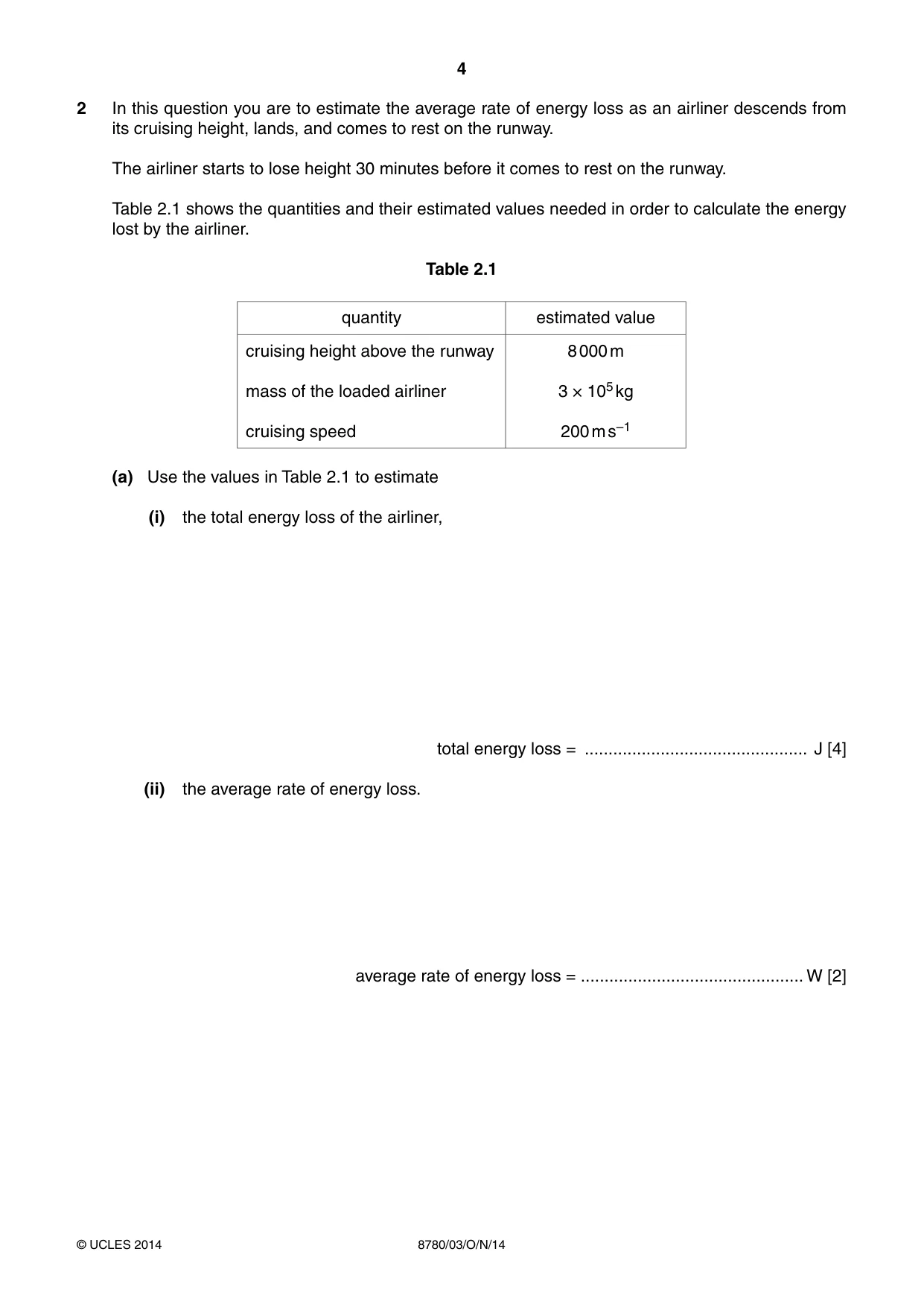
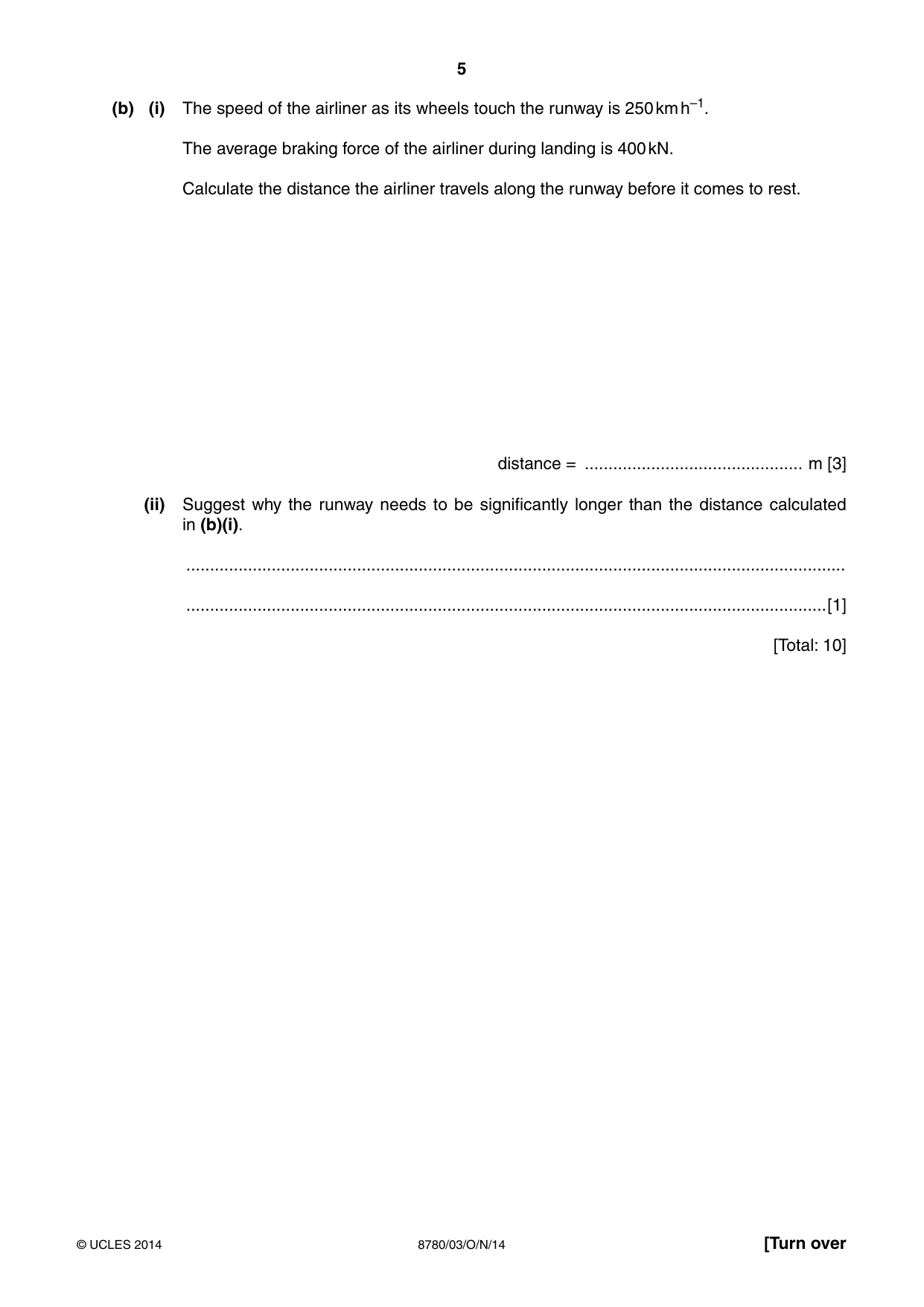
2 In this question you are to estimate the average rate of energy loss as an airliner descends from its cruising height, lands, and comes to rest on the runway. The airliner starts to lose height 30 minutes before it comes to rest on the runway. Table 2.1 shows the quantities and their estimated values needed in order to calculate the energy lost by the airliner. Table 2.1 quantity estimated value cruising height above the runway 8 000 m mass of the loaded airliner 3 × 10⁵ kg cruising speed 200 m s–1 (a) Use the values in Table 2.1 to estimate (i) the total energy loss of the airliner, total energy loss = ............................................... J [4] (ii) the average rate of energy loss. average rate of energy loss = ............................................... W [2] (b) (i) The speed of the airliner as its wheels touch the runway is 250 km h–1. The average braking force of the airliner during landing is 400 kN. Calculate the distance the airliner travels along the runway before it comes to rest. distance = .............................................. m [3] (ii) Suggest why the runway needs to be significantly longer than the distance calculated in (b)(i). ........................................................................................................................................... .......................................................................................................................................[1] [Total: 10]
Mark scheme: 2 (a) (i) ½ mv2 = 0.5 × 3 × 105 × 2002 (= 6 × 10⁹) [1] mgh = 3 × 105 × 10 × 8000 (= 2.4 × 10¹⁰) [1] total energy loss = sum of Ek and Ep = 3 × 10¹⁰ (J) [1] one or two significant figures only (awarded if one clear answer to KE / PE) [1] (ii) use of total energy / time [1] = 3 × 10¹⁰ / (30 × 60) = 1.7 × 10⁷ (W) [1] (b) (i) use of force × distance = Ek lost or other valid approach [1] distance = ½ × 3 × 105 × (250 / 3.6)2 / 4 × 10⁵ [1] 1800 (m) [1] (ii) safety margin or wet runway or different loading or other valid reason why runway needs to be significantly longer than calculated in (b)(i) [1] [Total: 10]
Q3 · Nitroglycerine, C3H5N3O9, is an explosive
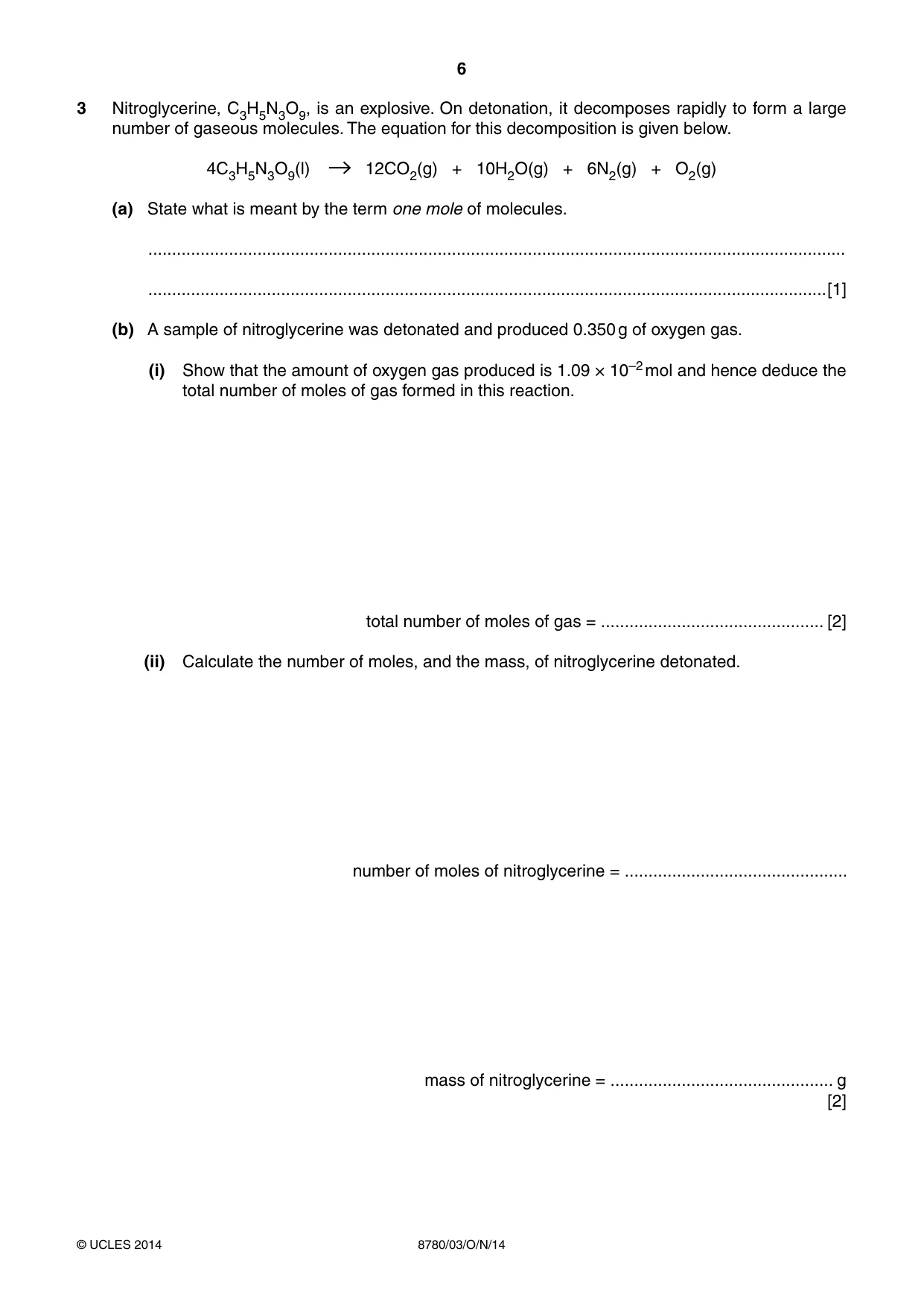
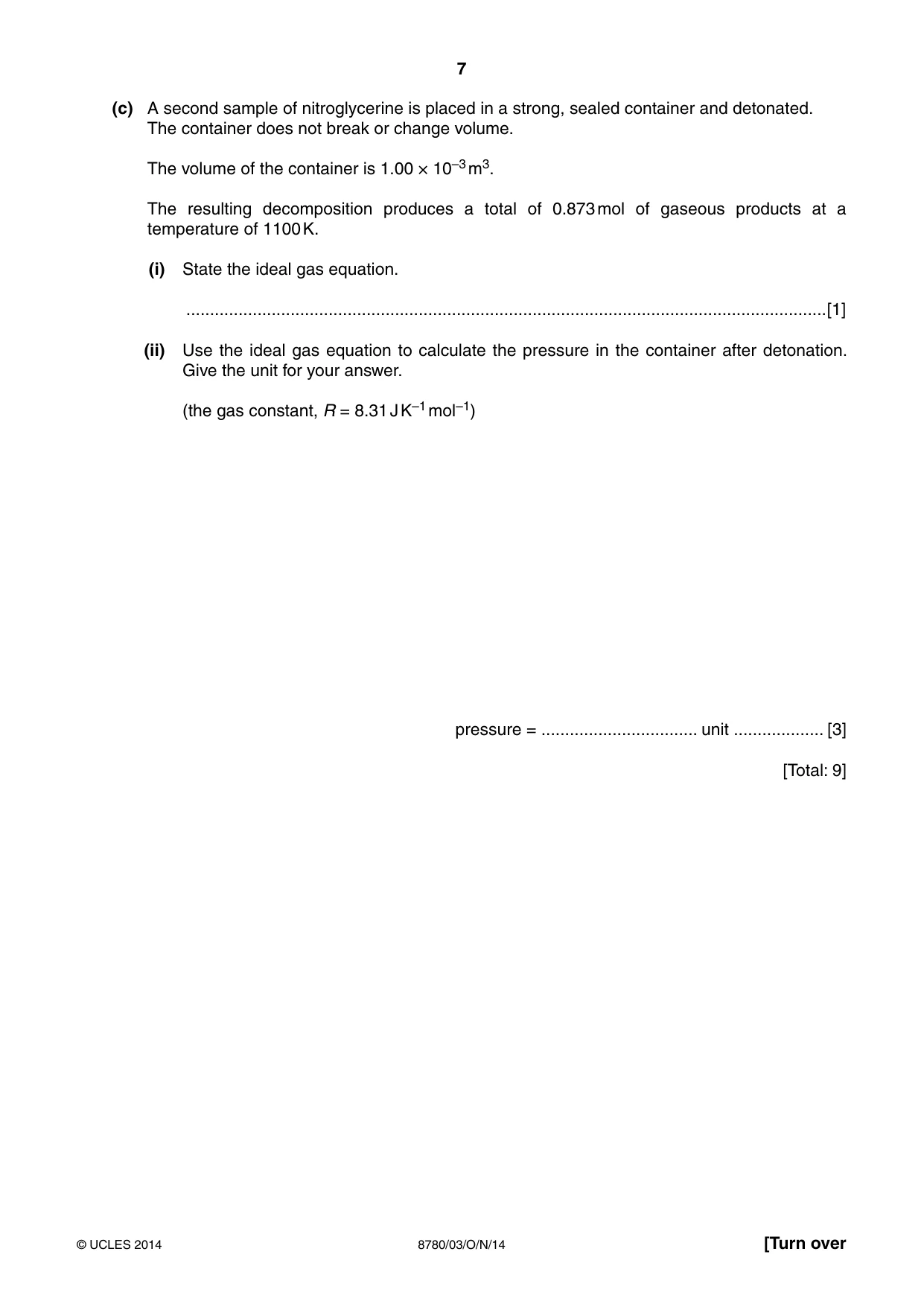
3 Nitroglycerine, C3H5N3O9, is an explosive. On detonation, it decomposes rapidly to form a large number of gaseous molecules. The equation for this decomposition is given below. 4C3H5N3O9(l) 12CO2(g) + 10H2O(g) + 6N2(g) + O2(g) (a) State what is meant by the term one mole of molecules. ................................................................................................................................................... ...............................................................................................................................................[1] (b) A sample of nitroglycerine was detonated and produced 0.350 g of oxygen gas. (i) Show that the amount of oxygen gas produced is 1.09 × 10⁻² mol and hence deduce the total number of moles of gas formed in this reaction. total number of moles of gas = ............................................... [2] (ii) Calculate the number of moles, and the mass, of nitroglycerine detonated. number of moles of nitroglycerine = ............................................... mass of nitroglycerine = ............................................... g [2] (c) A second sample of nitroglycerine is placed in a strong, sealed container and detonated. The container does not break or change volume. The volume of the container is 1.00 × 10⁻³ m3. The resulting decomposition produces a total of 0.873 mol of gaseous products at a temperature of 1100 K. (i) State the ideal gas equation. .......................................................................................................................................[1] (ii) Use the ideal gas equation to calculate the pressure in the container after detonation. Give the unit for your answer. (the gas constant, R = 8.31 J K–1 mol–1) pressure = ................................. unit ................... [3] [Total: 9]
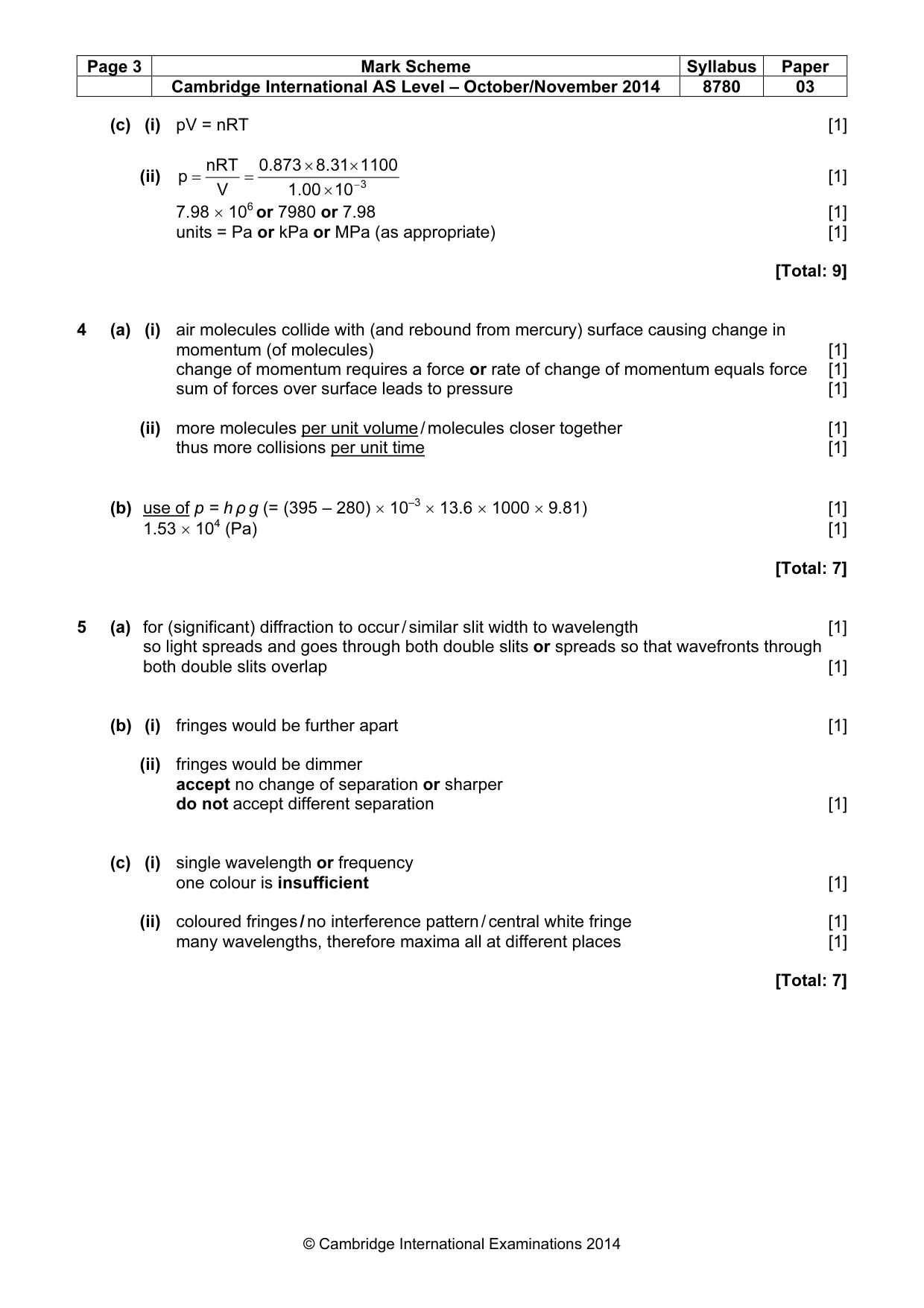
Mark scheme: 3 (a) Avogadro’s number of molecules [1] 0.350 (b) (i) moles of O2 = = (1.09 × 10⁻² mol) [1] 32 total moles of gas = 29 × 1.09 × 10–2 = 0.317 (mol) accept 0.316 [1] (ii) (number of moles of nitroglycerine) = 4 × 1.09 × 10–2 = 0.0436 (mol) [1] (mass nitroglycerine) = 227 × 0.0436 = 9.9 (g) [1] (c) (i) pV = nRT [1] nRT 0.873 × 8.31 × 1100 (ii) p = = − 3 [1] V 1.00 × 10 7.98 × 10⁶ or 7980 or 7.98 [1] units = Pa or kPa or MPa (as appropriate) [1] [Total: 9]
Q4 · Blood pressure is defined as the excess pressure in a person’s arteries compared to…
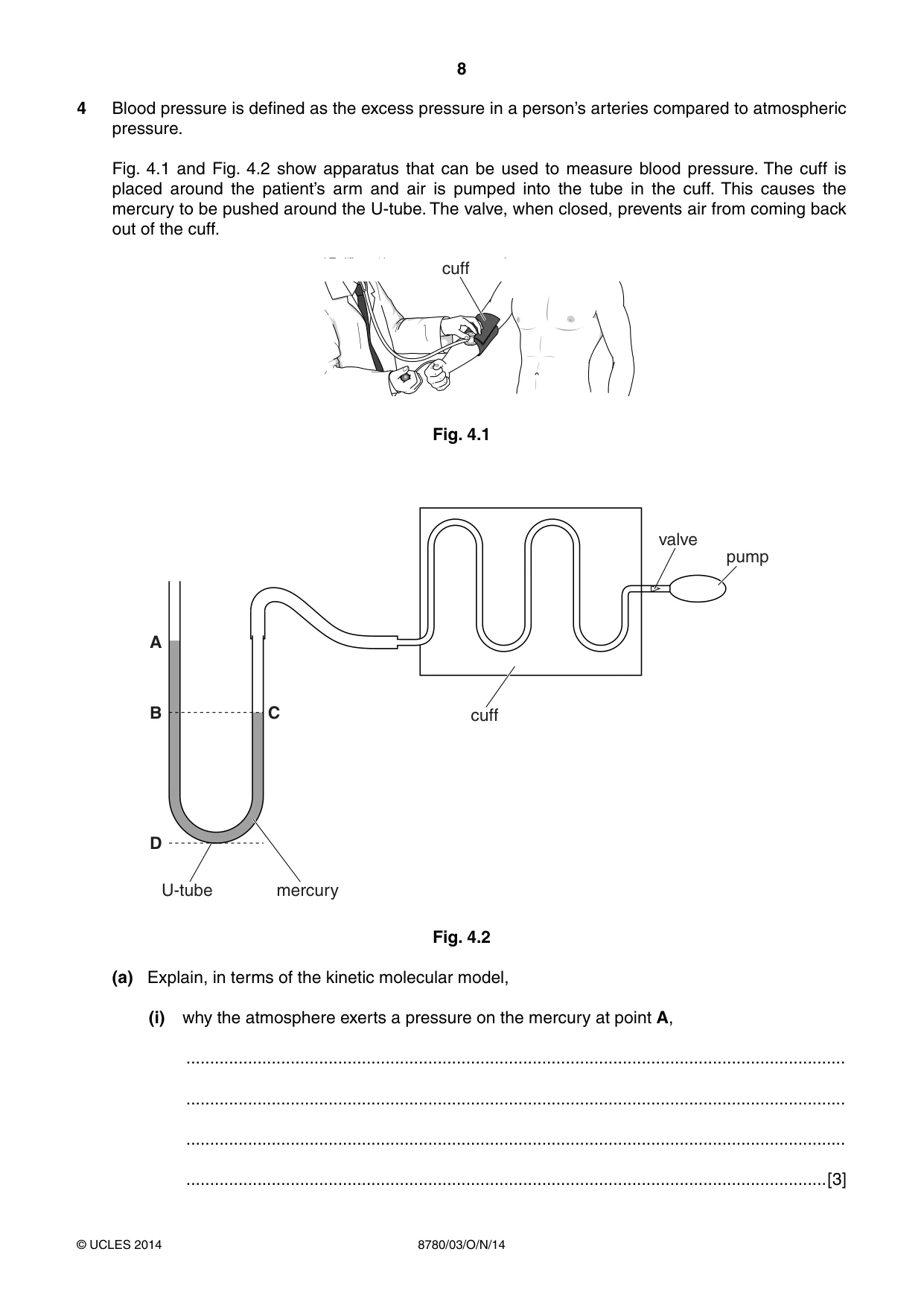
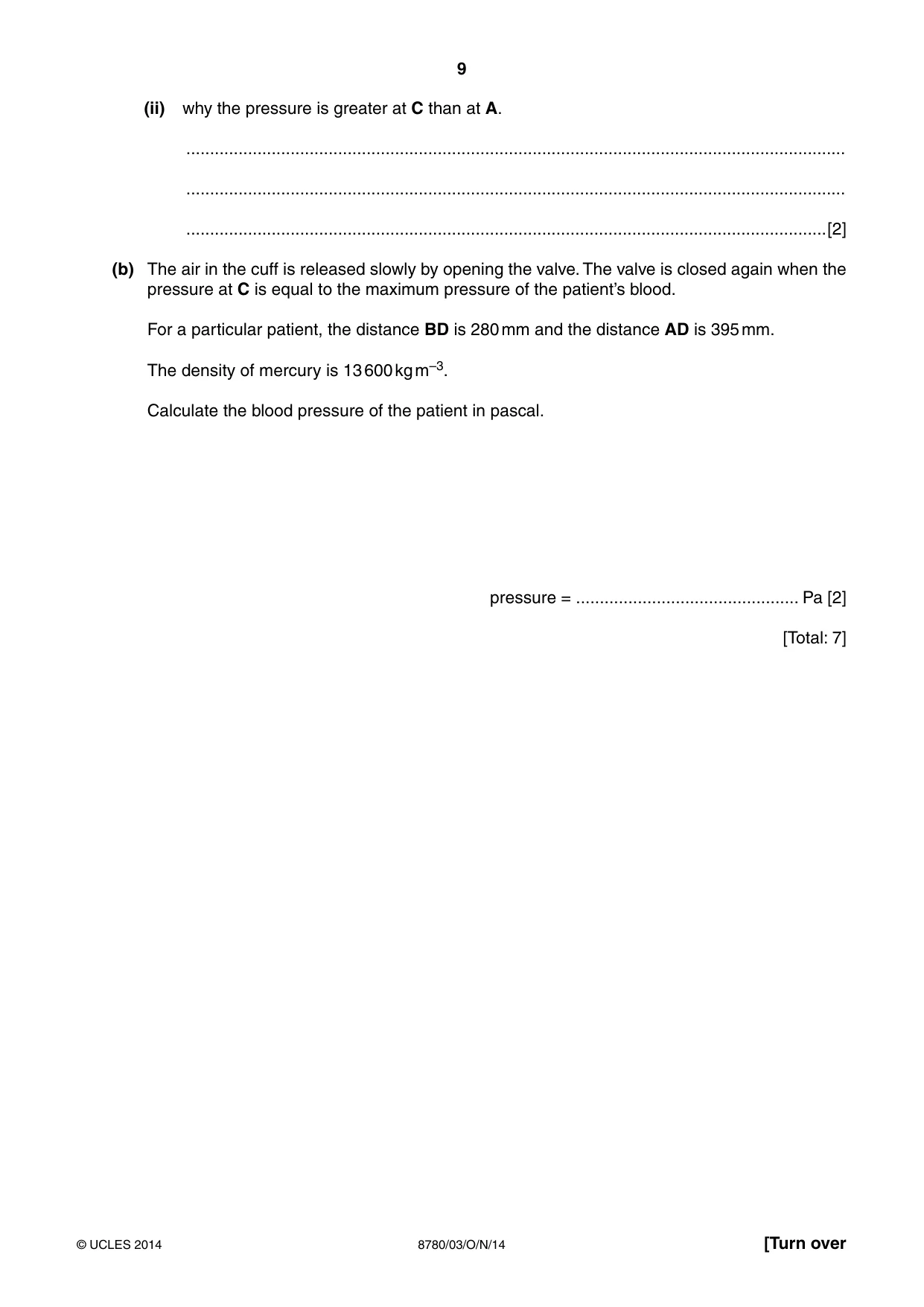
4 Blood pressure is defined as the excess pressure in a person’s arteries compared to atmospheric pressure. Fig. 4.1 and Fig. 4.2 show apparatus that can be used to measure blood pressure. The cuff is placed around the patient’s arm and air is pumped into the tube in the cuff. This causes the mercury to be pushed around the U-tube. The valve, when closed, prevents air from coming back out of the cuff. cuff Fig. 4.1 valve pump A B C cuff D U-tube mercury Fig. 4.2 (a) Explain, in terms of the kinetic molecular model, (i) why the atmosphere exerts a pressure on the mercury at point A, ........................................................................................................................................... ........................................................................................................................................... ........................................................................................................................................... .......................................................................................................................................[3] (ii) why the pressure is greater at C than at A. ........................................................................................................................................... ........................................................................................................................................... .......................................................................................................................................[2] (b) The air in the cuff is released slowly by opening the valve. The valve is closed again when the pressure at C is equal to the maximum pressure of the patient’s blood. For a particular patient, the distance BD is 280 mm and the distance AD is 395 mm. The density of mercury is 13 600 kg m–3. Calculate the blood pressure of the patient in pascal. pressure = ............................................... Pa [2] [Total: 7]
Mark scheme: 4 (a) (i) air molecules collide with (and rebound from mercury) surface causing change in momentum (of molecules) [1] change of momentum requires a force or rate of change of momentum equals force [1] sum of forces over surface leads to pressure [1] (ii) more molecules per unit volume / molecules closer together [1] thus more collisions per unit time [1] (b) use of p = h ρ g (= (395 – 280) × 10–3 × 13.6 × 1000 × 9.81) [1] 1.53 × 10⁴ (Pa) [1] [Total: 7]
Q5 · An experiment designed to demonstrate interference of visible light
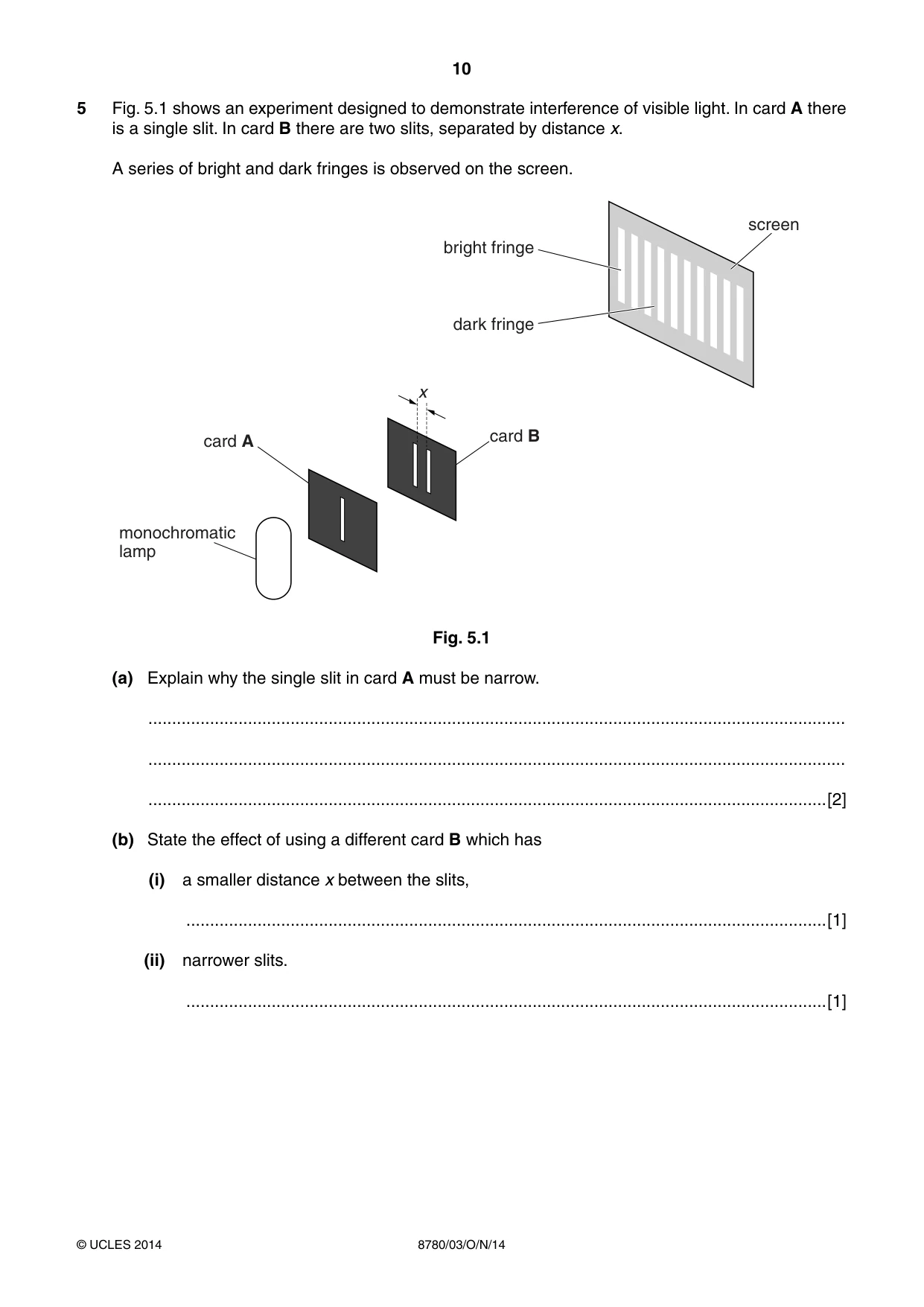
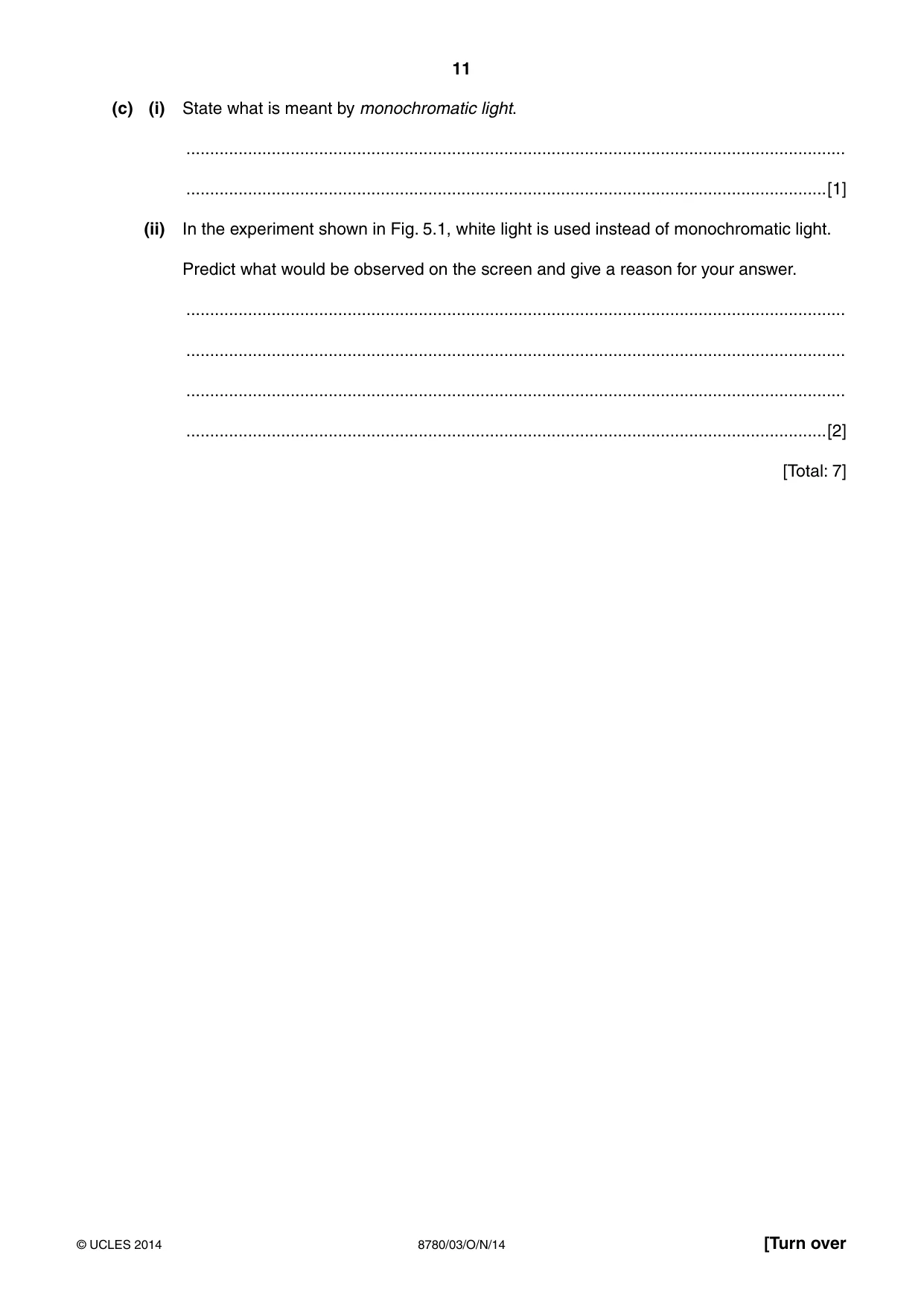
5 Fig. 5.1 shows an experiment designed to demonstrate interference of visible light. In card A there is a single slit. In card B there are two slits, separated by distance x. A series of bright and dark fringes is observed on the screen. screen bright fringe dark fringe x card B card A monochromatic lamp Fig. 5.1 (a) Explain why the single slit in card A must be narrow. ................................................................................................................................................... ................................................................................................................................................... ...............................................................................................................................................[2] (b) State the effect of using a different card B which has (i) a smaller distance x between the slits, .......................................................................................................................................[1] (ii) narrower slits. .......................................................................................................................................[1] (c) (i) State what is meant by monochromatic light. ........................................................................................................................................... .......................................................................................................................................[1] (ii) In the experiment shown in Fig. 5.1, white light is used instead of monochromatic light. Predict what would be observed on the screen and give a reason for your answer. ........................................................................................................................................... ........................................................................................................................................... ........................................................................................................................................... .......................................................................................................................................[2] [Total: 7]
Mark scheme: 5 (a) for (significant) diffraction to occur / similar slit width to wavelength [1] so light spreads and goes through both double slits or spreads so that wavefronts through both double slits overlap [1] (b) (i) fringes would be further apart [1] (ii) fringes would be dimmer accept no change of separation or sharper do not accept different separation [1] (c) (i) single wavelength or frequency one colour is insufficient [1] (ii) coloured fringes / no interference pattern / central white fringe [1] many wavelengths, therefore maxima all at different places [1] [Total: 7]
Q6 · The dimerisation of nitrogen dioxide, NO2, to form dinitrogen tetroxide, N2O4, is…
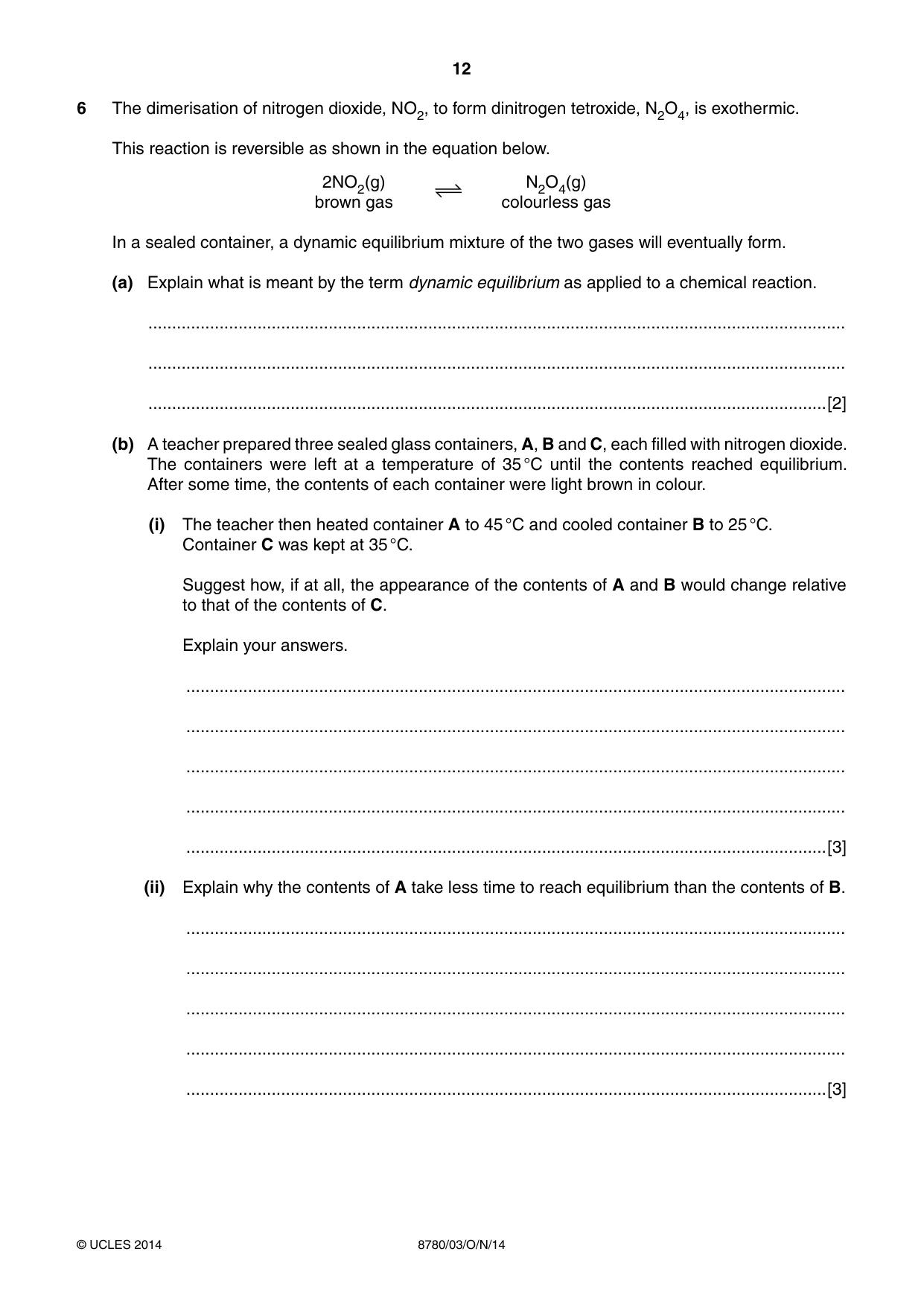
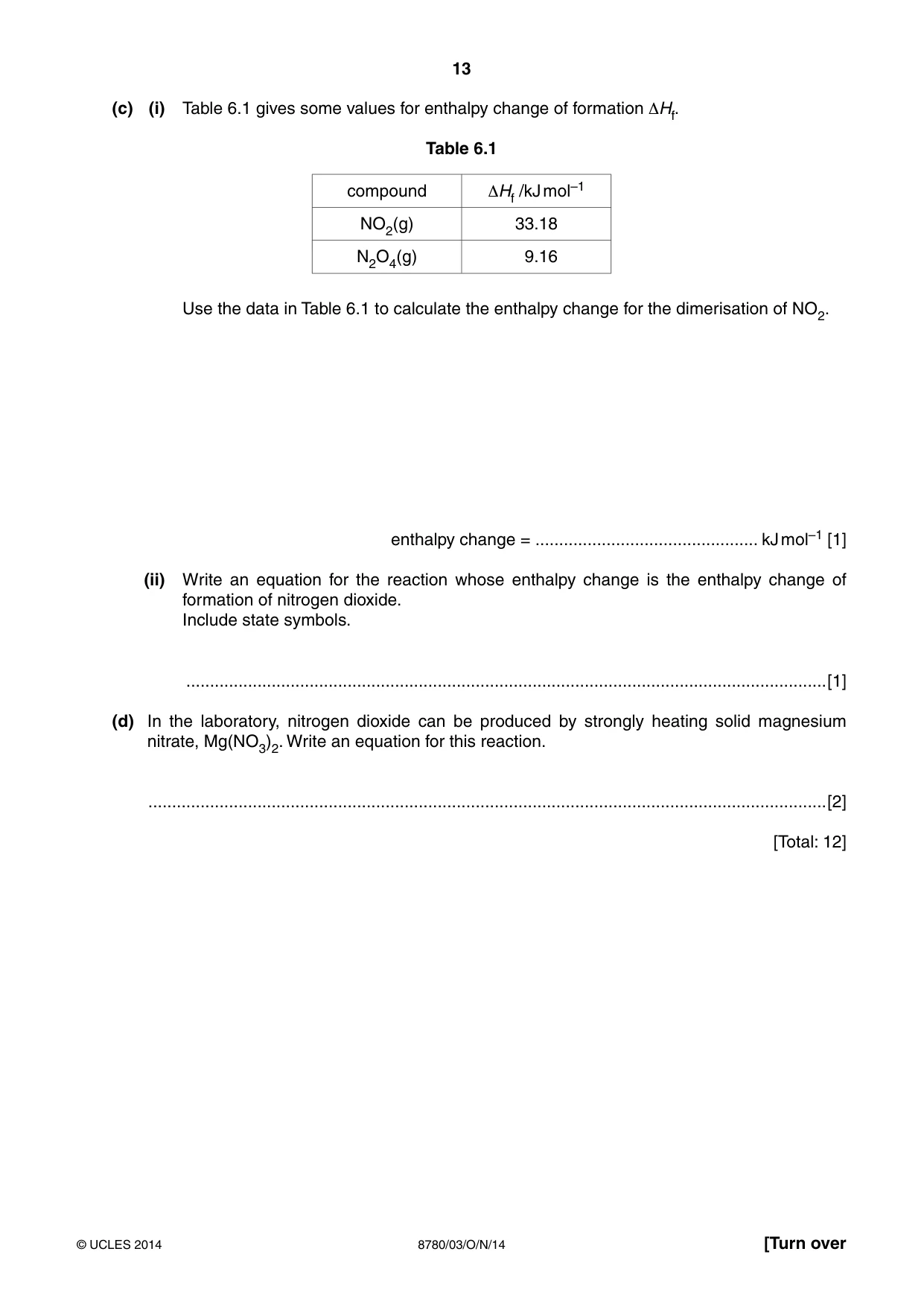
6 The dimerisation of nitrogen dioxide, NO2, to form dinitrogen tetroxide, N2O4, is exothermic. This reaction is reversible as shown in the equation below. 2NO2(g) N2O4(g) brown gas colourless gas In a sealed container, a dynamic equilibrium mixture of the two gases will eventually form. (a) Explain what is meant by the term dynamic equilibrium as applied to a chemical reaction. ................................................................................................................................................... ................................................................................................................................................... ...............................................................................................................................................[2] (b) A teacher prepared three sealed glass containers, A, B and C, each filled with nitrogen dioxide. The containers were left at a temperature of 35 °C until the contents reached equilibrium. After some time, the contents of each container were light brown in colour. (i) The teacher then heated container A to 45 °C and cooled container B to 25 °C. Container C was kept at 35 °C. Suggest how, if at all, the appearance of the contents of A and B would change relative to that of the contents of C. Explain your answers. ........................................................................................................................................... ........................................................................................................................................... ........................................................................................................................................... ........................................................................................................................................... .......................................................................................................................................[3] (ii) Explain why the contents of A take less time to reach equilibrium than the contents of B. ........................................................................................................................................... ........................................................................................................................................... ........................................................................................................................................... ........................................................................................................................................... .......................................................................................................................................[3] (c) (i) Table 6.1 gives some values for enthalpy change of formation ΔHf. Table 6.1 compound ΔHf /kJ mol–1 NO2(g) 33.18 N2O4(g) 9.16 Use the data in Table 6.1 to calculate the enthalpy change for the dimerisation of NO2. enthalpy change = ............................................... kJ mol–1 [1] (ii) Write an equation for the reaction whose enthalpy change is the enthalpy change of formation of nitrogen dioxide. Include state symbols. .......................................................................................................................................[1] (d) In the laboratory, nitrogen dioxide can be produced by strongly heating solid magnesium nitrate, Mg(NO3)2. Write an equation for this reaction. ...............................................................................................................................................[2] [Total: 12]
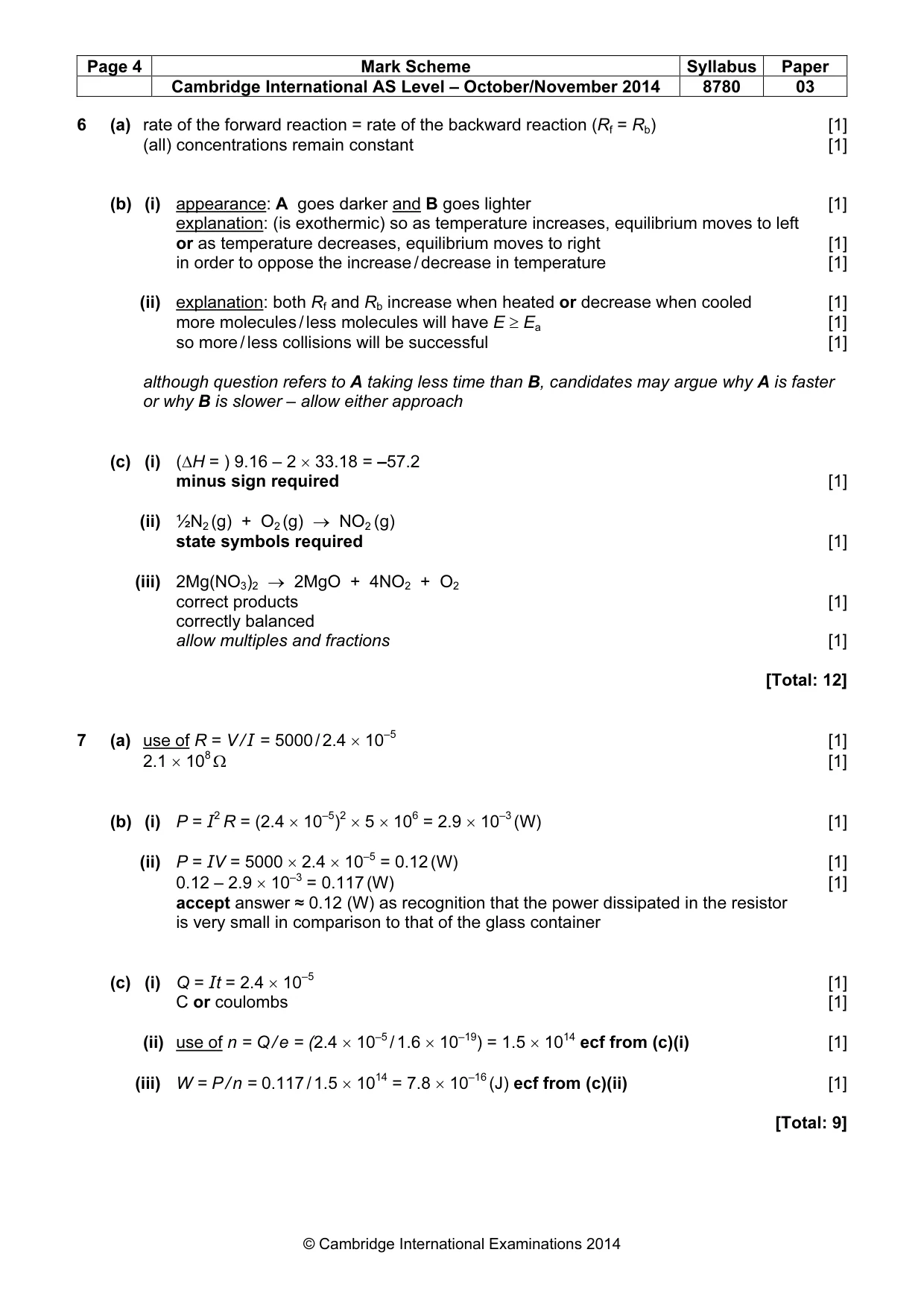
Mark scheme: 6 (a) rate of the forward reaction = rate of the backward reaction (Rf = Rb) [1] (all) concentrations remain constant [1] (b) (i) appearance: A goes darker and B goes lighter [1] explanation: (is exothermic) so as temperature increases, equilibrium moves to left or as temperature decreases, equilibrium moves to right [1] in order to oppose the increase / decrease in temperature [1] (ii) explanation: both Rf and Rb increase when heated or decrease when cooled [1] more molecules / less molecules will have E ≥ Ea [1] so more / less collisions will be successful [1] although question refers to A taking less time than B, candidates may argue why A is faster or why B is slower – allow either approach (c) (i) (∆H = ) 9.16 – 2 × 33.18 = –57.2 minus sign required [1] (ii) ½N2 (g) + O2 (g) → NO2 (g) state symbols required [1] (iii) 2Mg(NO3)2 → 2MgO + 4NO2 + O2 correct products [1] correctly balanced allow multiples and fractions [1] [Total: 12] 5
Q7 · In the apparatus shown in Fig
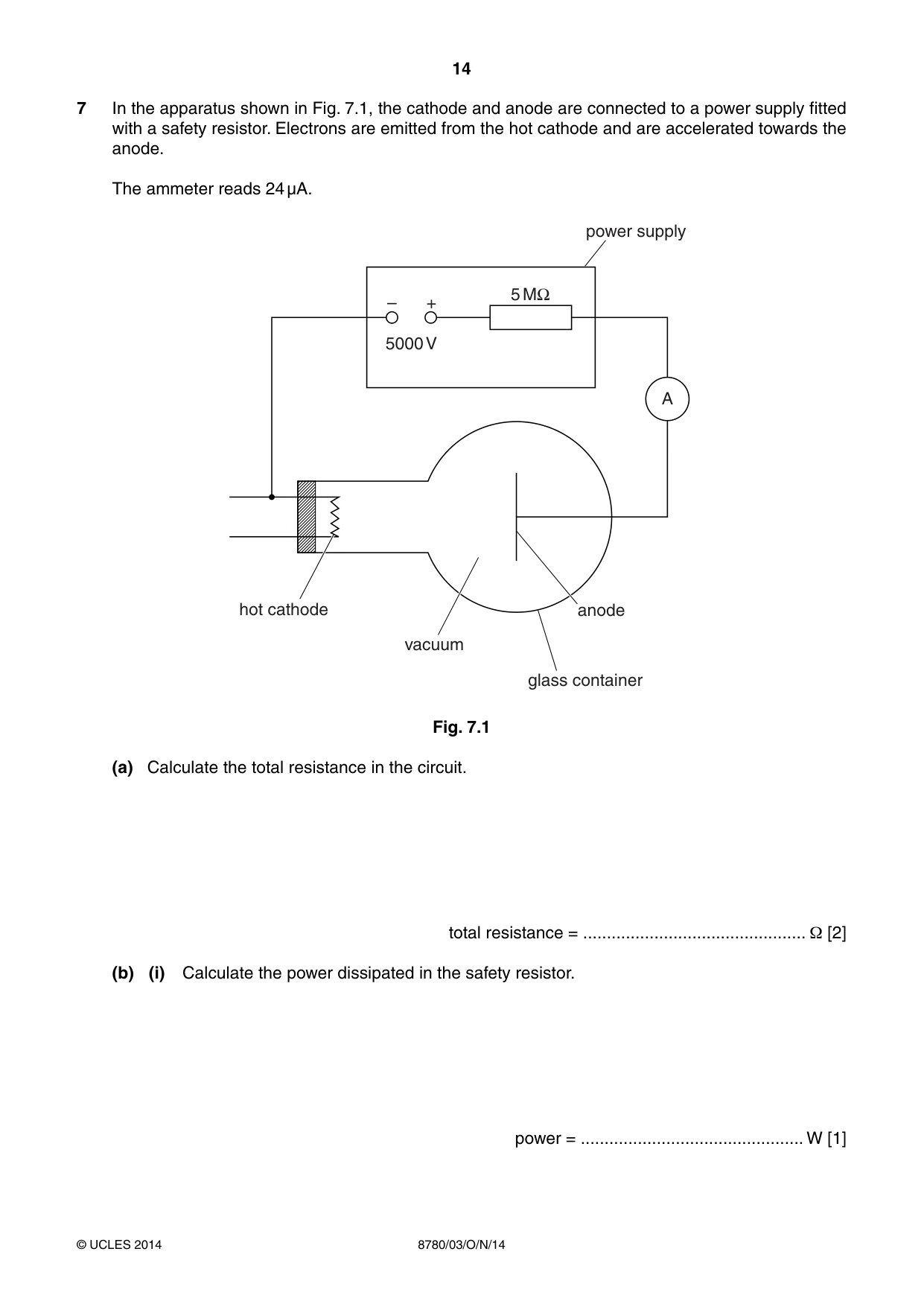
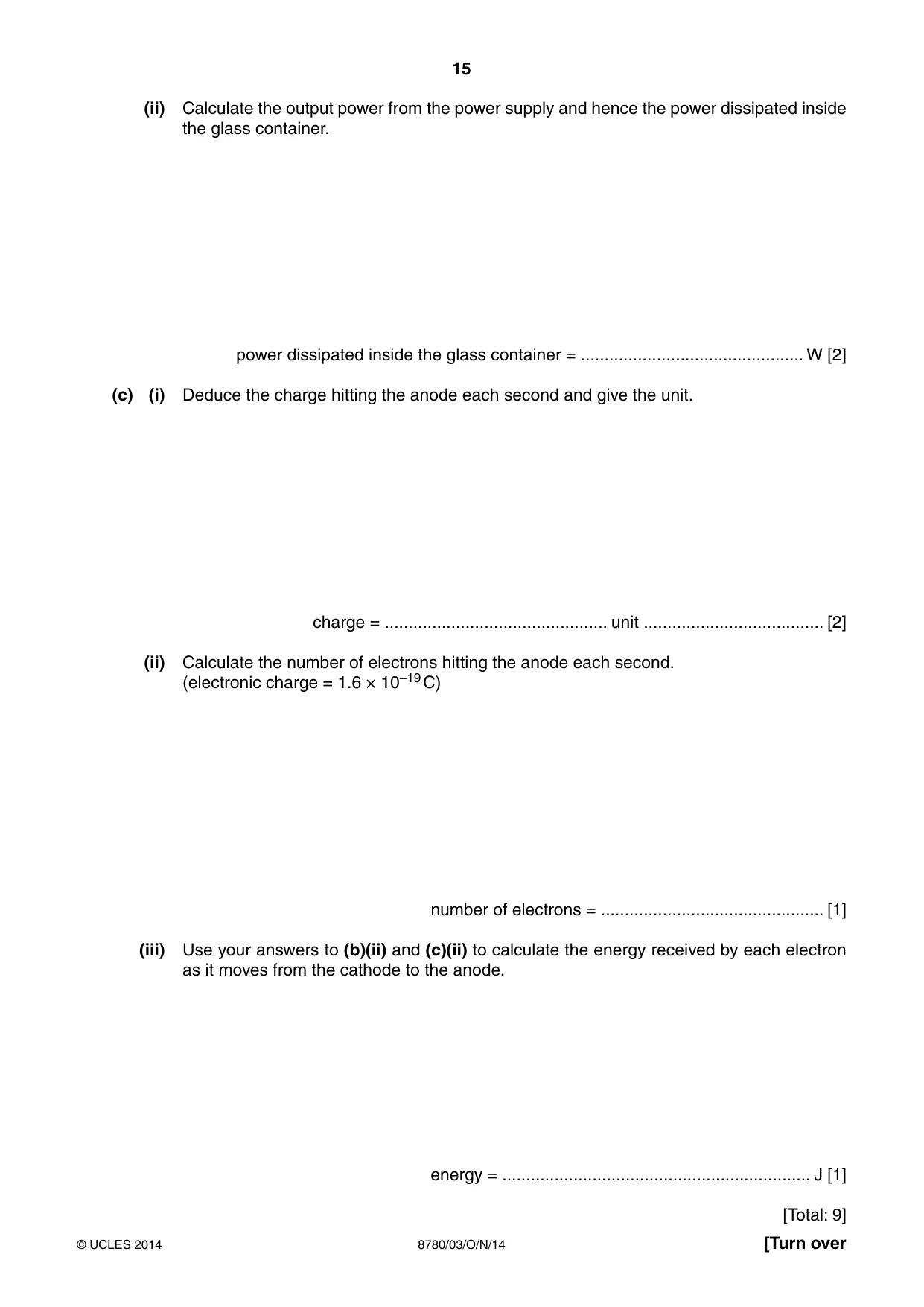
7 In the apparatus shown in Fig. 7.1, the cathode and anode are connected to a power supply fitted with a safety resistor. Electrons are emitted from the hot cathode and are accelerated towards the anode. The ammeter reads 24 µA. power supply 5 M – + 5000 V A hot cathode anode vacuum glass container Fig. 7.1 (a) Calculate the total resistance in the circuit. total resistance = ............................................... Ω [2] (b) (i) Calculate the power dissipated in the safety resistor. power = ............................................... W [1] (ii) Calculate the output power from the power supply and hence the power dissipated inside the glass container. power dissipated inside the glass container = ............................................... W [2] (c) (i) Deduce the charge hitting the anode each second and give the unit. charge = ............................................... unit ...................................... [2] (ii) Calculate the number of electrons hitting the anode each second. (electronic charge = 1.6 × 10⁻¹⁹ C) number of electrons = ............................................... [1] (iii) Use your answers to (b)(ii) and (c)(ii) to calculate the energy received by each electron as it moves from the cathode to the anode. energy = ................................................................. J [1] [Total: 9]
Mark scheme: 7 (a) use of R = V / I = 5000 / 2.4 × 10⁻⁵ [1] 2.1 × 10⁸ Ω [1] (b) (i) P = I2 R = (2.4 × 10⁻⁵)2 × 5 × 106 = 2.9 × 10⁻³ (W) [1] (ii) P = IV = 5000 × 2.4 × 10–5 = 0.12 (W) [1] 0.12 – 2.9 × 10–3 = 0.117 (W) [1] accept answer ≈ 0.12 (W) as recognition that the power dissipated in the resistor is very small in comparison to that of the glass container (c) (i) Q = It = 2.4 × 10⁻⁵ [1] C or coulombs [1] (ii) use of n = Q / e = (2.4 × 10⁻⁵ / 1.6 × 10⁻¹⁹) = 1.5 × 10¹⁴ ecf from (c)(i) [1] (iii) W = P / n = 0.117 / 1.5 × 1014 = 7.8 × 10⁻¹⁶ (J) ecf from (c)(ii) [1] [Total: 9]
Q8 · The structural and displayed formulae of compound P are shown below
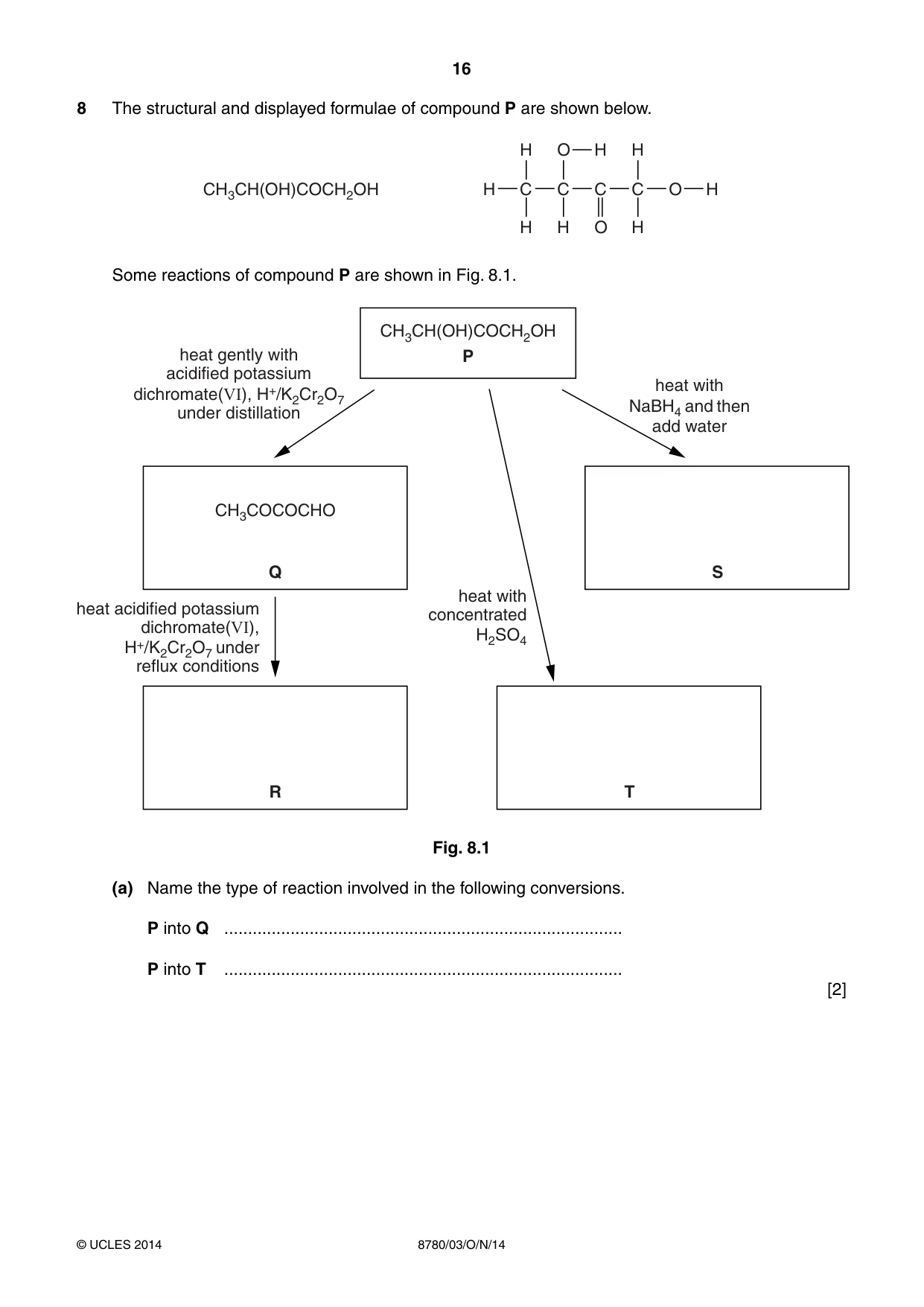
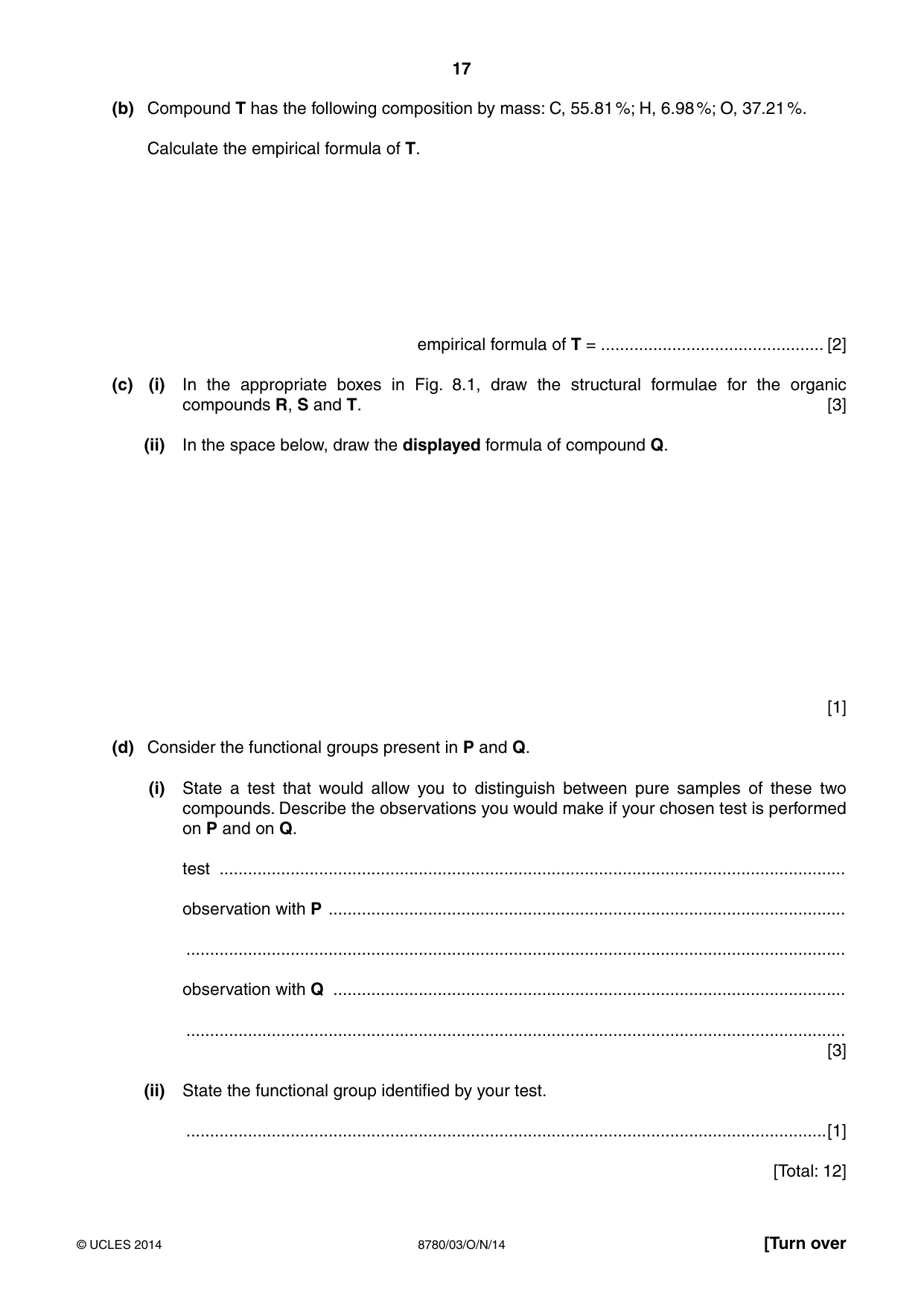
8 The structural and displayed formulae of compound P are shown below. H O H H CH3CH(OH)COCH2OH H C C C C O H H H O H Some reactions of compound P are shown in Fig. 8.1. CH3CH(OH)COCH2OH heat gently with P acidified potassium heat with dichromate(VI), H+/K2Cr2O7 under distillation NaBH4 and then add water CH3COCOCHO Q S heat with heat acidified potassium concentrated dichromate(VI), H2SO4 H+/K2Cr2O7 under reflux conditions R T Fig. 8.1 (a) Name the type of reaction involved in the following conversions. P into Q .................................................................................... P into T .................................................................................... [2] (b) Compound T has the following composition by mass: C, 55.81 %; H, 6.98 %; O, 37.21 %. Calculate the empirical formula of T. empirical formula of T = ............................................... [2] (c) (i) In the appropriate boxes in Fig. 8.1, draw the structural formulae for the organic compounds R, S and T. [3] (ii) In the space below, draw the displayed formula of compound Q. [1] (d) Consider the functional groups present in P and Q. (i) State a test that would allow you to distinguish between pure samples of these two compounds. Describe the observations you would make if your chosen test is performed on P and on Q. test .................................................................................................................................... observation with P ............................................................................................................. ........................................................................................................................................... observation with Q ............................................................................................................ ........................................................................................................................................... [3] (ii) State the functional group identified by your test. .......................................................................................................................................[1] [Total: 12]
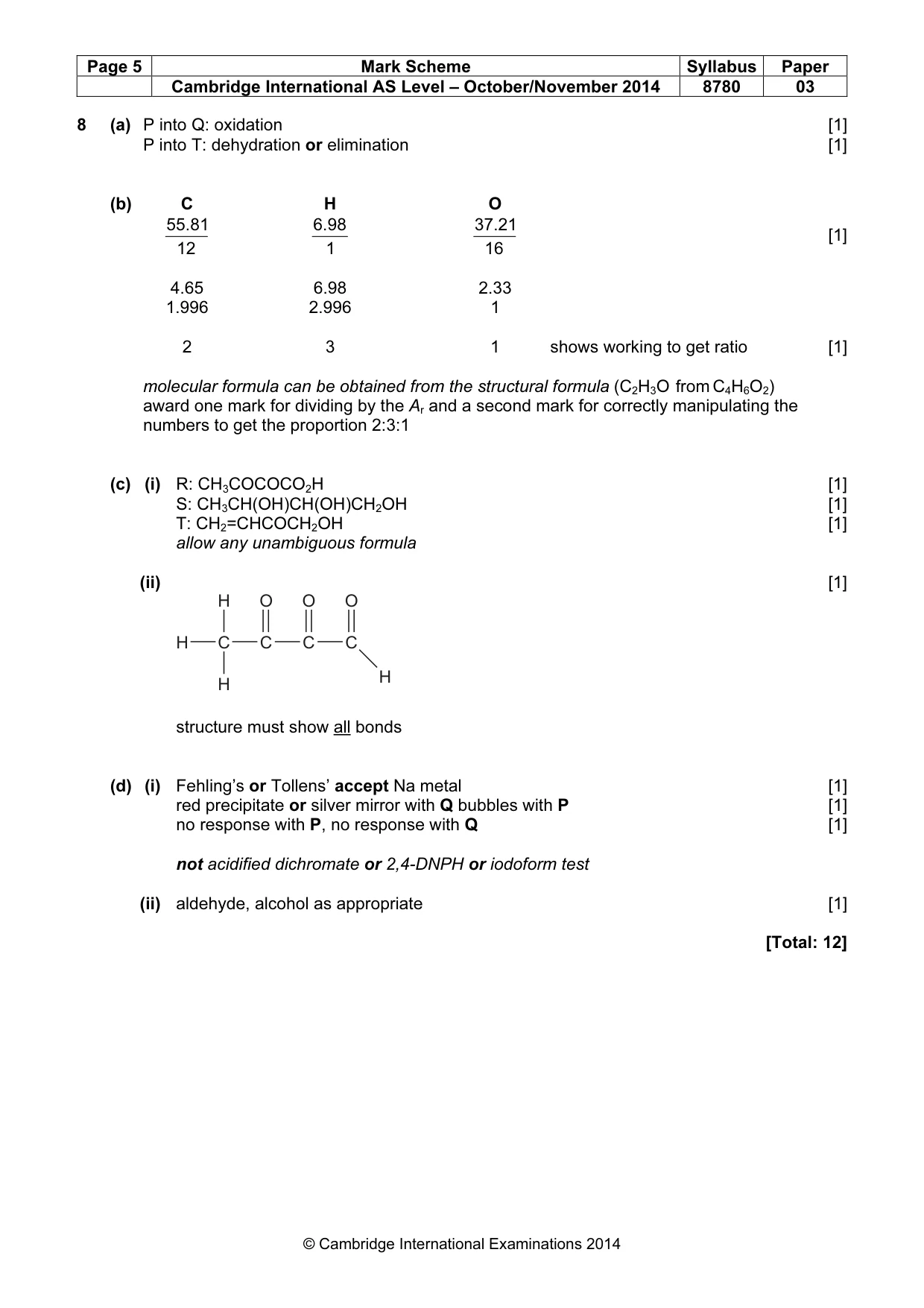
Mark scheme: 8 (a) P into Q: oxidation [1] P into T: dehydration or elimination [1] (b) C H O 55.81 6.98 37.21 [1] 12 1 16 4.65 6.98 2.33 1.996 2.996 1 2 3 1 shows working to get ratio [1] molecular formula can be obtained from the structural formula (C2H3O from C4H6O2) award one mark for dividing by the Ar and a second mark for correctly manipulating the numbers to get the proportion 2:3:1 (c) (i) R: CH3COCOCO2H [1] S: CH3CH(OH)CH(OH)CH2OH [1] T: CH2=CHCOCH2OH [1] allow any unambiguous formula (ii) [1] H O O O H C C C C H H structure must show all bonds (d) (i) Fehling’s or Tollens’ accept Na metal [1] red precipitate or silver mirror with Q bubbles with P [1] no response with P, no response with Q [1] not acidified dichromate or 2,4-DNPH or iodoform test (ii) aldehyde, alcohol as appropriate [1] [Total: 12]
Q9 · State Kirchhoff’s second law
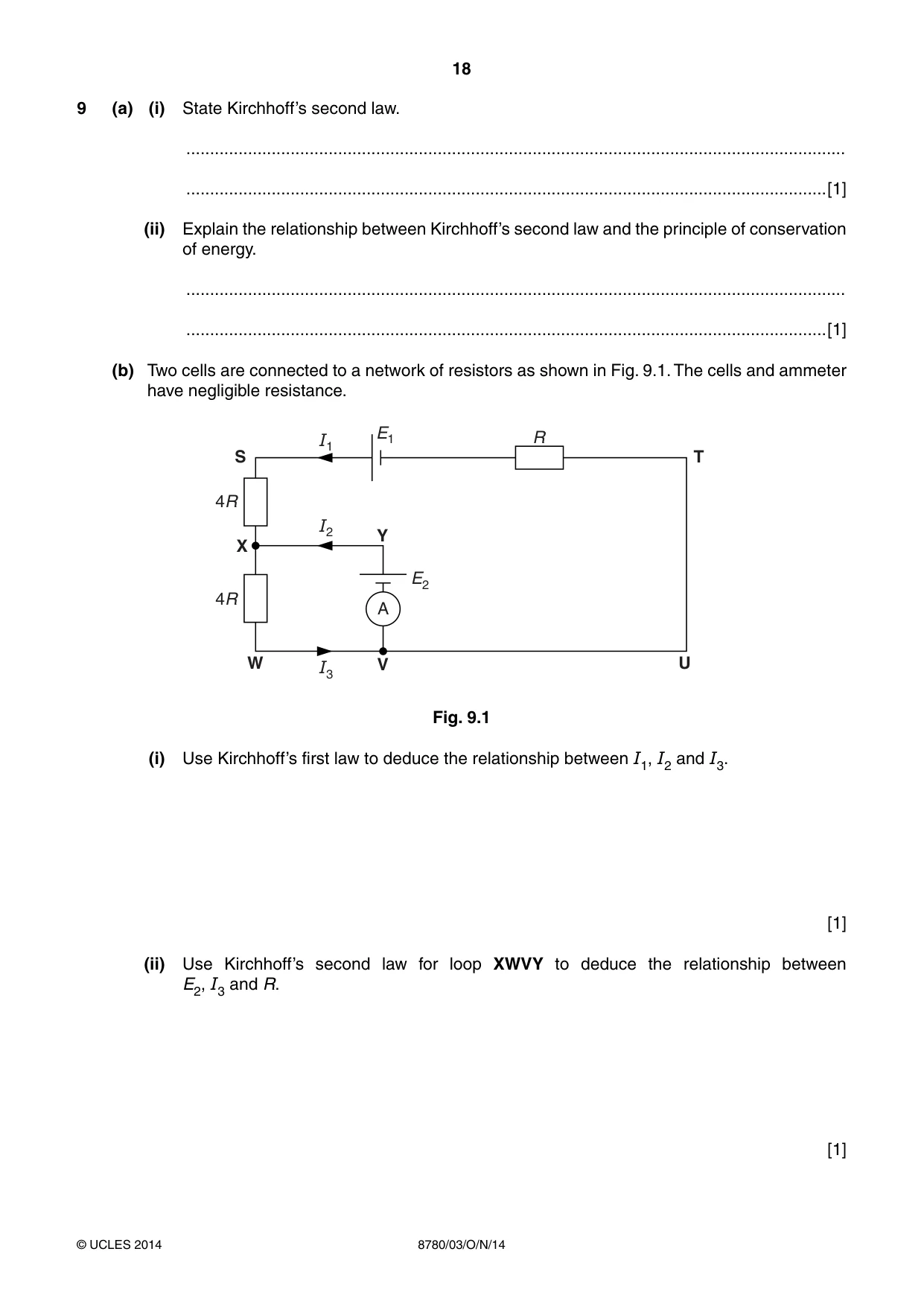
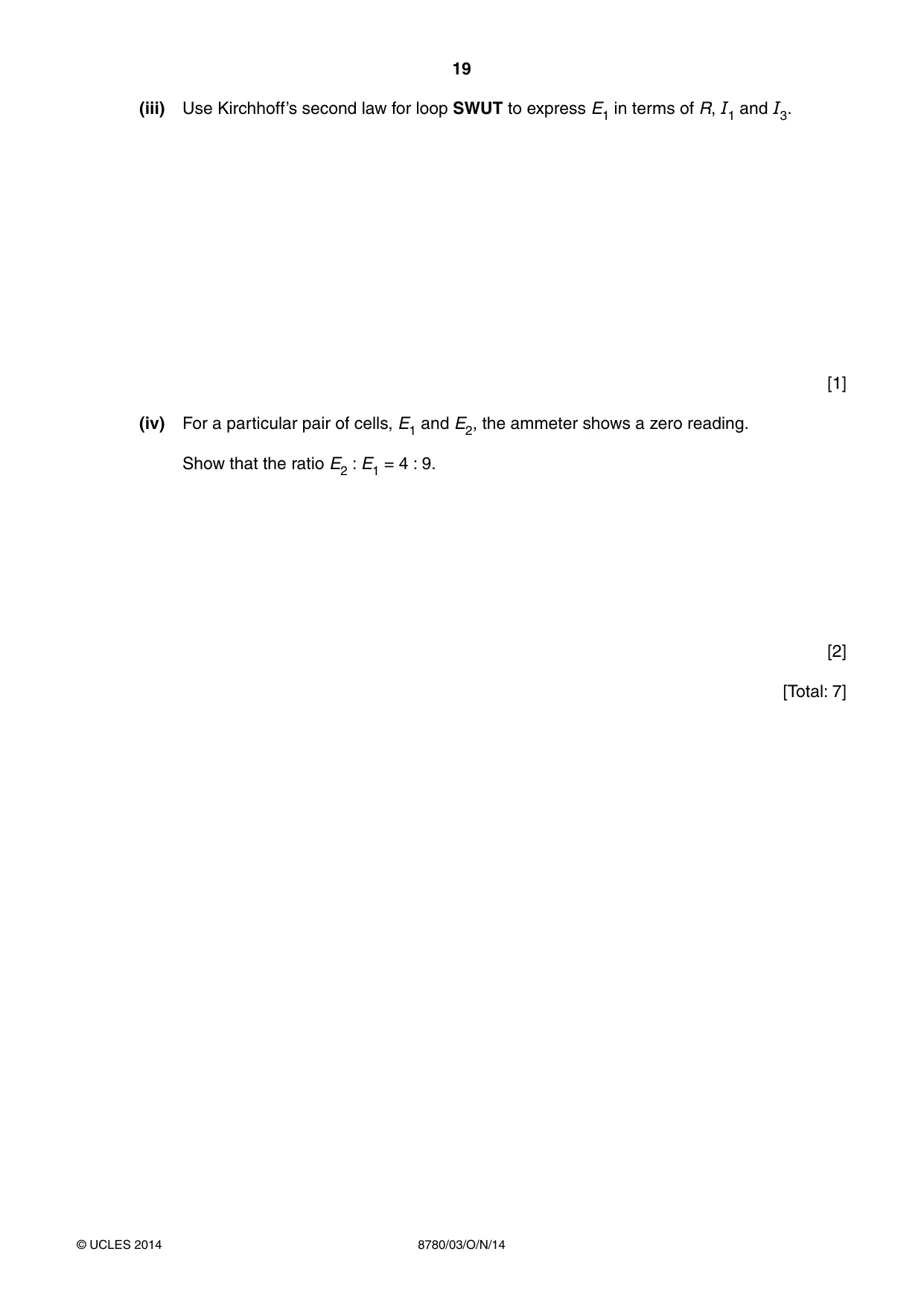
9 (a) (i) State Kirchhoff’s second law. ........................................................................................................................................... .......................................................................................................................................[1] (ii) Explain the relationship between Kirchhoff’s second law and the principle of conservation of energy. ........................................................................................................................................... .......................................................................................................................................[1] (b) Two cells are connected to a network of resistors as shown in Fig. 9.1. The cells and ammeter have negligible resistance. I1 E1 R S T 4R I2 Y X E2 4R A W I3 V U Fig. 9.1 (i) Use Kirchhoff’s first law to deduce the relationship between I1, I2 and I3. [1] (ii) Use Kirchhoff’s second law for loop XWVY to deduce the relationship between E2, I3 and R. [1] (iii) Use Kirchhoff’s second law for loop SWUT to express E1 in terms of R, I1 and I3. [1] (iv) For a particular pair of cells, E1 and E2, the ammeter shows a zero reading. Show that the ratio E2 : E1 = 4 : 9. [2] [Total: 7]
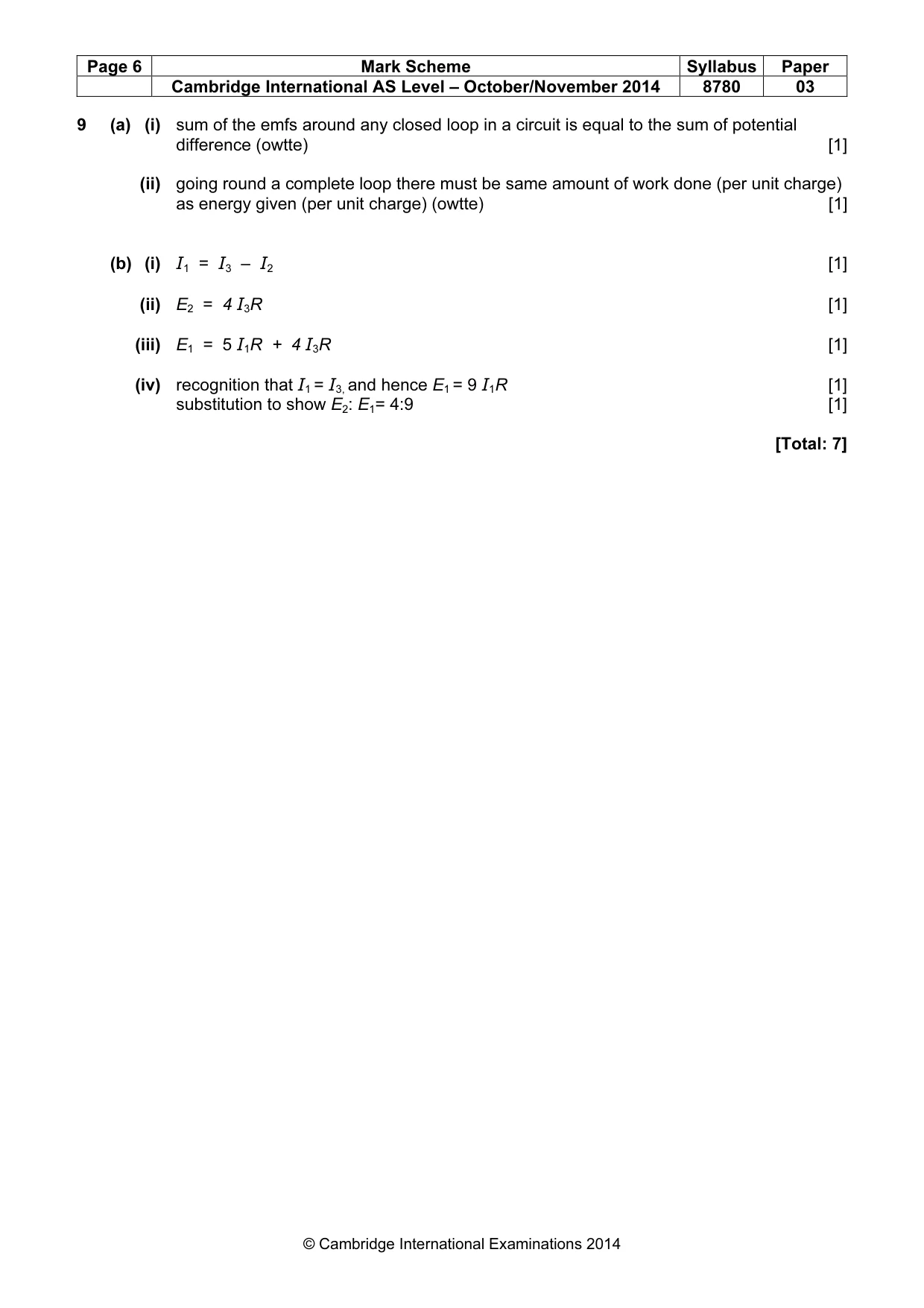
Mark scheme: 9 (a) (i) sum of the emfs around any closed loop in a circuit is equal to the sum of potential difference (owtte) [1] (ii) going round a complete loop there must be same amount of work done (per unit charge) as energy given (per unit charge) (owtte) [1] (b) (i) I1 = I3 – I2 [1] (ii) E2 = 4 I3R [1] (iii) E1 = 5 I1R + 4 I3R [1] (iv) recognition that I1 = I3, and hence E1 = 9 I1R [1] substitution to show E2: E1= 4:9 [1] [Total: 7]
What you needed in this session
Cambridge’s own grade thresholds for 2014 Oct/Nov, Paper 3 · Variant 1. A higher threshold means an easier paper — the bar moves with how the cohort did.