Cambridge A Level Physical Science 8780 — 2013 Oct/Nov Paper 3 · Variant 1
8780/31/O/N/13 · 11 questions · 80 marks · ≈90 min
The question paper and its mark scheme, free to read here and free to download. This is Cambridge’s own paper, exactly as it was sat.
Question paper20 pages
Mark scheme6 pages
Answers below. Sit the paper first if you are practising.
Questions as text
Q1 · Strontium, Sr, is a Group II element
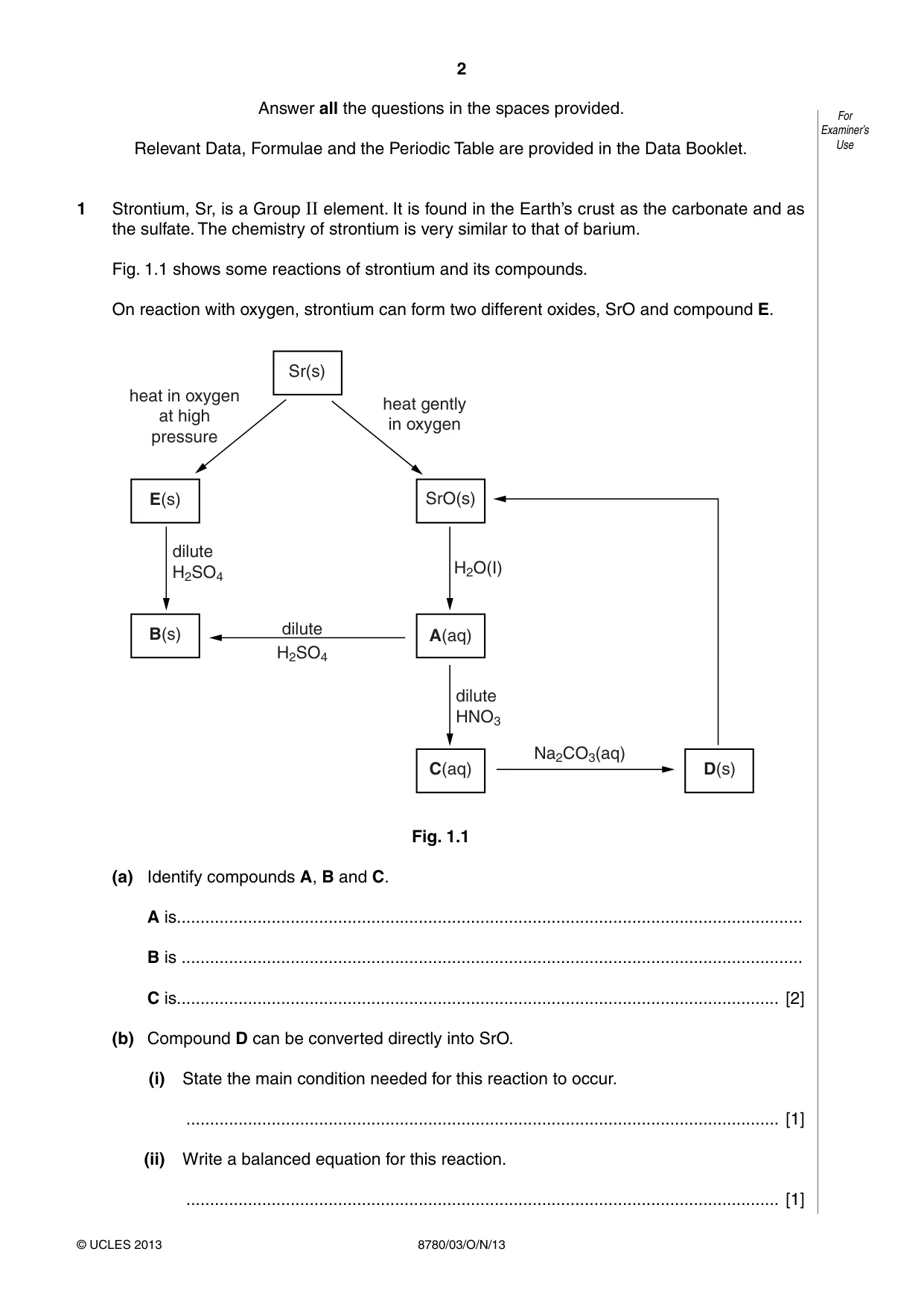
1 Strontium, Sr, is a Group II element. It is found in the Earth’s crust as the carbonate and as the sulfate. The chemistry of strontium is very similar to that of barium. Fig. 1.1 shows some reactions of strontium and its compounds. On reaction with oxygen, strontium can form two different oxides, SrO and compound E. Sr(s) heat in oxygen heat gently at high in oxygen pressure E(s) SrO(s) dilute H2SO4 H2O(I) dilute B(s) A(aq) H2SO4 dilute HNO3 Na2CO3(aq) C(aq) D(s) Fig. 1.1 (a) Identify compounds A, B and C. A is.................................................................................................................................... B is ................................................................................................................................... C is............................................................................................................................... [2] (b) Compound D can be converted directly into SrO. (i) State the main condition needed for this reaction to occur. ............................................................................................................................. [1] (ii) Write a balanced equation for this reaction. ............................................................................................................................. [1] (c) The strontium oxide, compound E contains 26.76% by mass of oxygen. Compound E reacts with dilute sulfuric acid in a 1:1 ratio to form compound B plus one other product, X. (i) Define the term empirical formula. .................................................................................................................................. ............................................................................................................................. [1] (ii) Calculate the empirical formula of compound E. empirical formula of compound E = .................................................. [2] (iii) Suggest a formula for the soluble product, X. ............................................................................................................................. [1] [Total: 8]
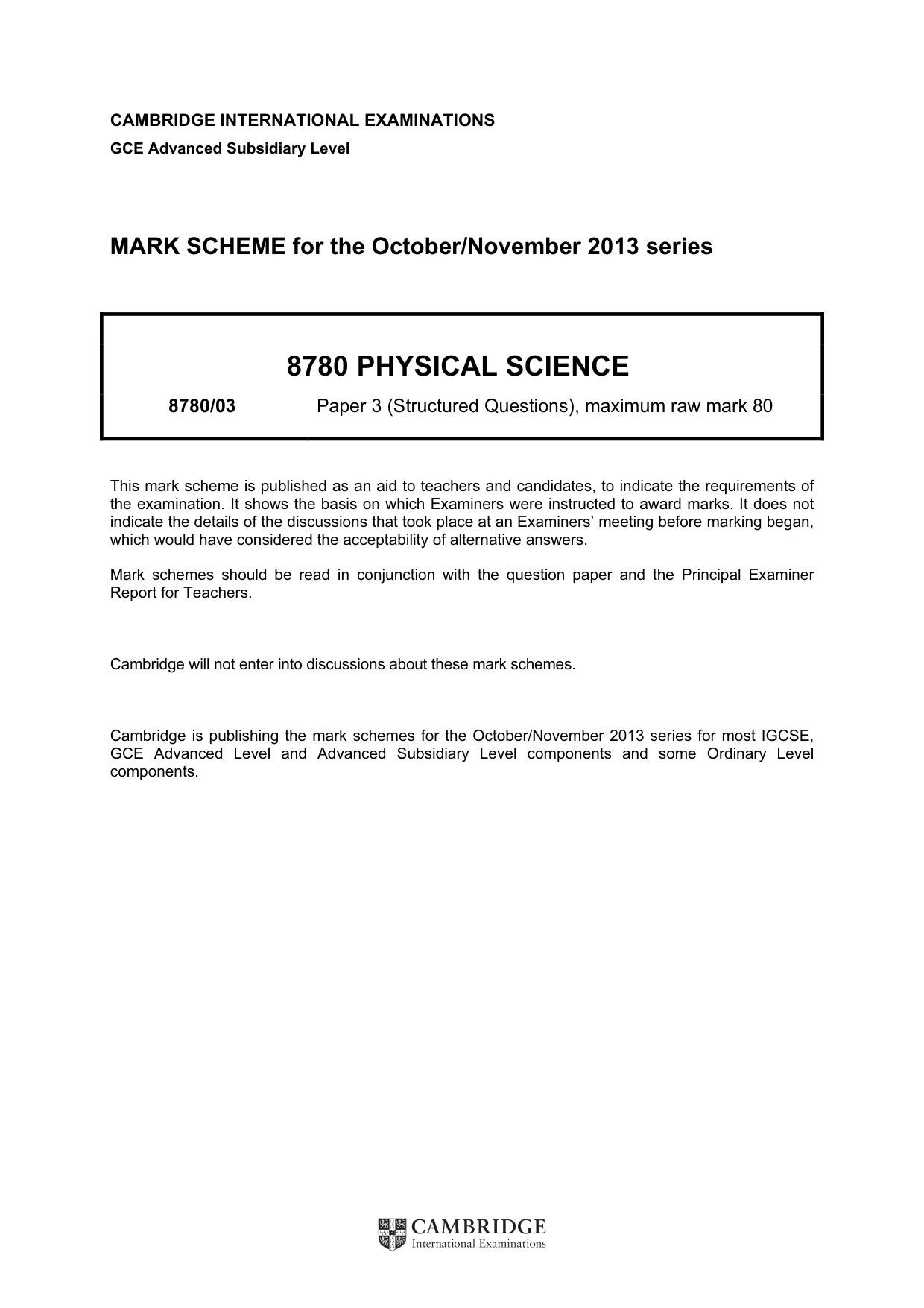
Mark scheme: 1 (a) A: Sr (OH)2 B: SrSO4 C: Sr(NO3)2 any two correct for one mark all three correct for two marks [2] (b) (i) strong heating [1] (ii) SrCO3 → SrO + CO2 [1] (c) (i) simplest whole-number ratio of atoms of each element present in the compound [1] (ii) percentage Sr = (100 – 26.76) = 73.24% Sr O 73.24 26.76 [1] 87.6 16.0 0.836 1.673 1 2 SrO2 [1] (iii) H2O2 [1] [Total: 8]
Q2 · Frictionless motion can be demonstrated using an air track, as shown in Fig
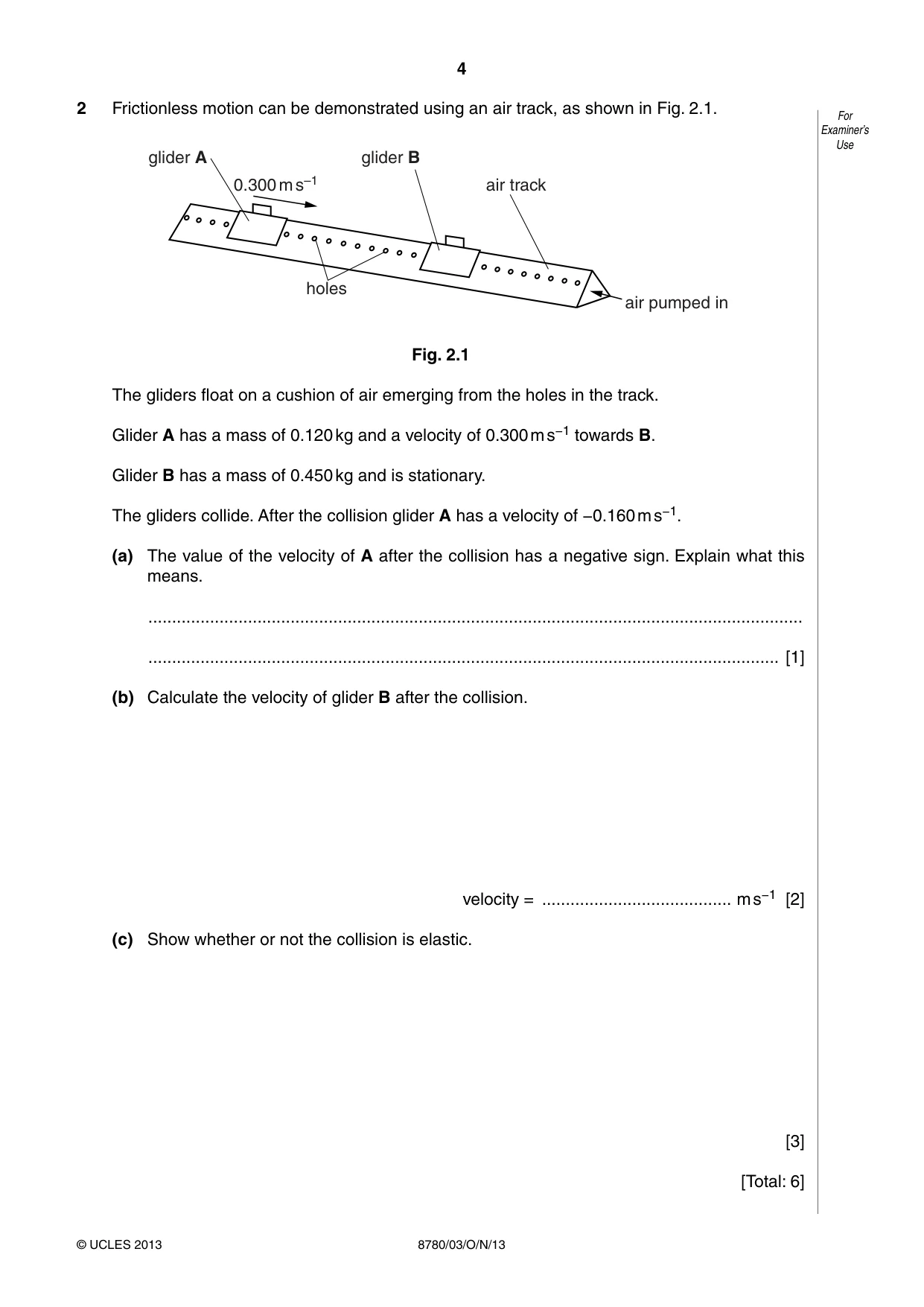
2 Frictionless motion can be demonstrated using an air track, as shown in Fig. 2.1. glider A glider B 0.300 m s–1 air track holes air pumped in Fig. 2.1 The gliders float on a cushion of air emerging from the holes in the track. Glider A has a mass of 0.120 kg and a velocity of 0.300 m s−1 towards B. Glider B has a mass of 0.450 kg and is stationary. The gliders collide. After the collision glider A has a velocity of −0.160 m s−1. (a) The value of the velocity of A after the collision has a negative sign. Explain what this means. .......................................................................................................................................... ..................................................................................................................................... [1] (b) Calculate the velocity of glider B after the collision. velocity = ........................................ m s−1 [2] (c) Show whether or not the collision is elastic. [3] [Total: 6]
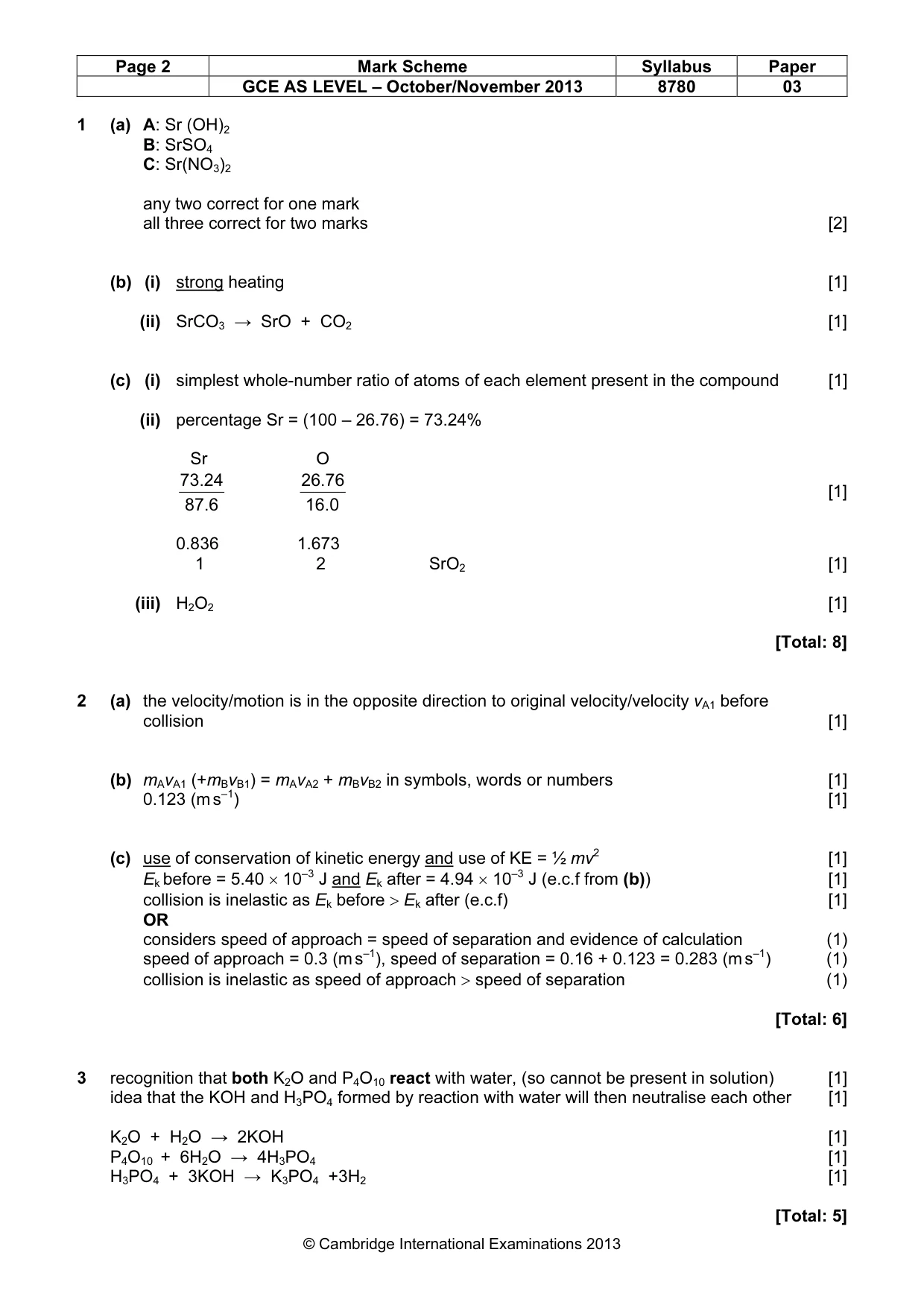
Mark scheme: 2 (a) the velocity/motion is in the opposite direction to original velocity/velocity vA1 before collision [1] (b) mAvA1 (+mBvB1) = mAvA2 + mBvB2 in symbols, words or numbers [1] 0.123 (m s–1) [1] (c) use of conservation of kinetic energy and use of KE = ½ mv2 [1] Ek before = 5.40 × 10⁻³ J and Ek after = 4.94 × 10⁻³ J (e.c.f from (b)) [1] collision is inelastic as Ek before > Ek after (e.c.f) [1] OR considers speed of approach = speed of separation and evidence of calculation (1) speed of approach = 0.3 (m s–1), speed of separation = 0.16 + 0.123 = 0.283 (m s–1) (1) collision is inelastic as speed of approach > speed of separation (1) [Total: 6]
Q3 · The label on a bottle of liquid plant food states that the aqueous solution in the bottle…
3 The label on a bottle of liquid plant food states that the aqueous solution in the bottle contains both potassium oxide, K2O, and phosphorus pentoxide, P4O10. A chemist realises that these two oxides cannot exist in water. Explain what the bottle does contain, assuming that these two oxides are added to water to make the plant food. Use your understanding of the trends across Period 3 and support your explanation with appropriate equations. ................................................................................................................................................. ................................................................................................................................................. ................................................................................................................................................. ................................................................................................................................................. ................................................................................................................................................. ................................................................................................................................................. ............................................................................................................................................ [5] [Total: 5]
Mark scheme: 3 recognition that both K2O and P4O10 react with water, (so cannot be present in solution) [1] idea that the KOH and H3PO4 formed by reaction with water will then neutralise each other [1] K2O + H2O → 2KOH [1] P4O10 + 6H2O → 4H3PO4 [1] H3PO4 + 3KOH → K3PO4 +3H2 [1] [Total: 5] GCE AS LEVEL – October/November 2013 8780 03
Q4 · A uniform beam hinged at one end
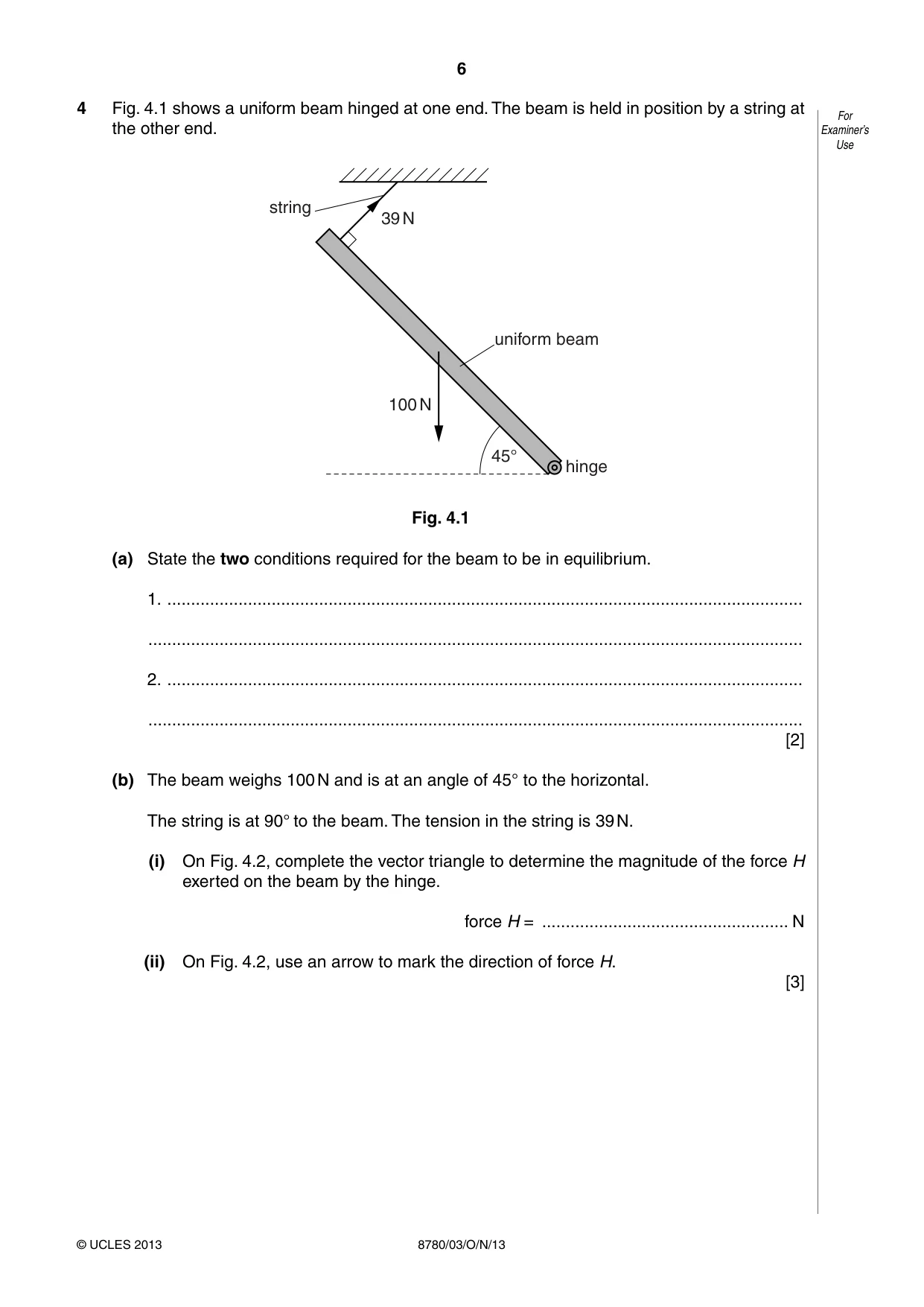
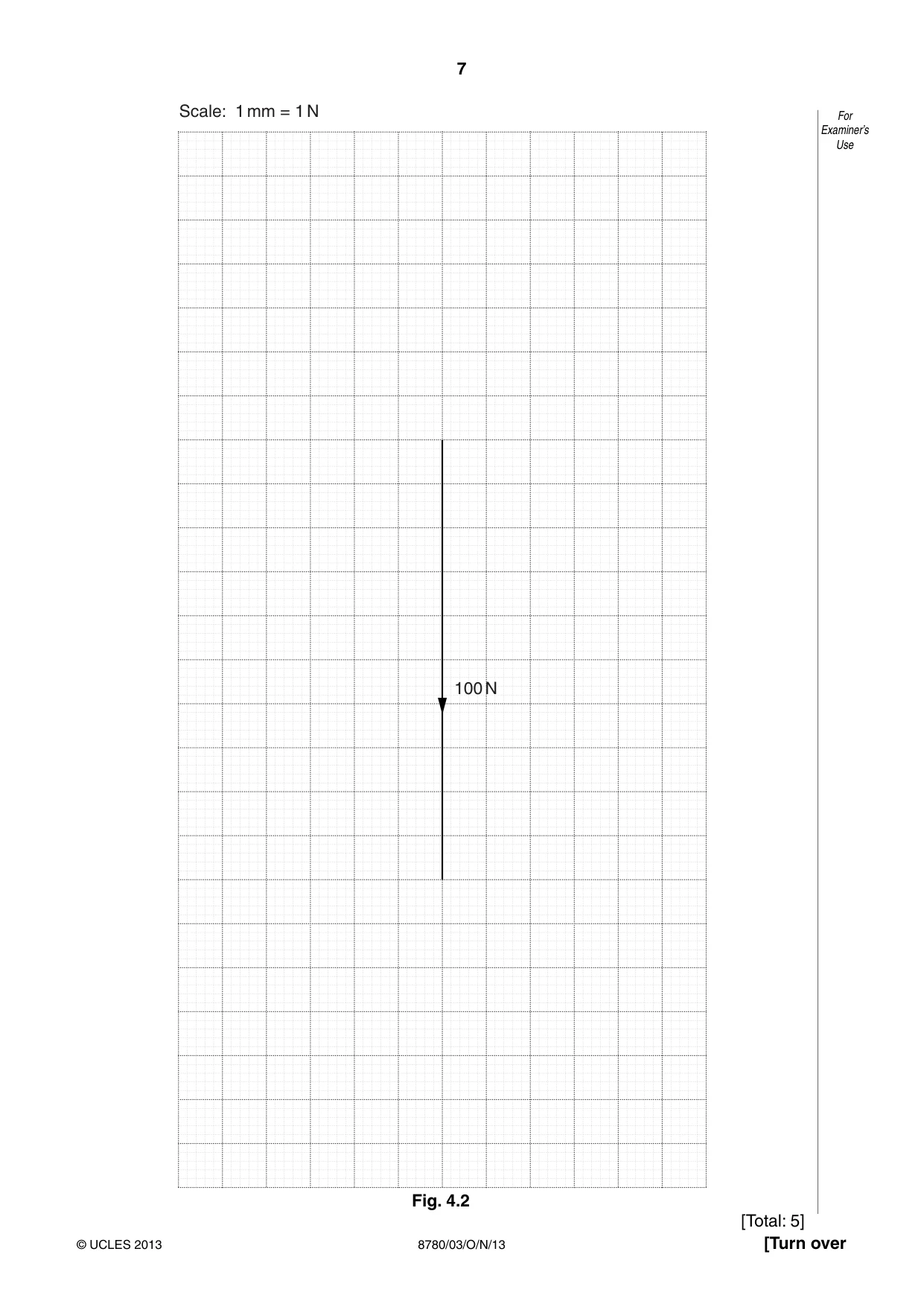
4 Fig. 4.1 shows a uniform beam hinged at one end. The beam is held in position by a string at the other end. string 39 N uniform beam 100 N 45° hinge Fig. 4.1 (a) State the two conditions required for the beam to be in equilibrium. 1. ...................................................................................................................................... .......................................................................................................................................... 2. ...................................................................................................................................... .......................................................................................................................................... [2] (b) The beam weighs 100 N and is at an angle of 45° to the horizontal. The string is at 90° to the beam. The tension in the string is 39 N. (i) On Fig. 4.2, complete the vector triangle to determine the magnitude of the force H exerted on the beam by the hinge. force H = .................................................... N (ii) On Fig. 4.2, use an arrow to mark the direction of force H. [3] 1 mm = 1 N 100 N Fig. 4.2 [Total: 5]
Mark scheme: 4 (a) the resultant force (in any direction) on the beam is zero [1] the resultant moment on the beam/about any point is zero [1] (accept the sum of the clockwise moments = the sum of the anticlockwise moments) (b) (i) (ii) vector diagram drawn with one side 3.9 cm in correct direction [1] triangle completed correctly and correct arrows [1] force H = 77.5 ± 2.5 (N) [1] [Total: 5]
Q5 · State the principle of superposition
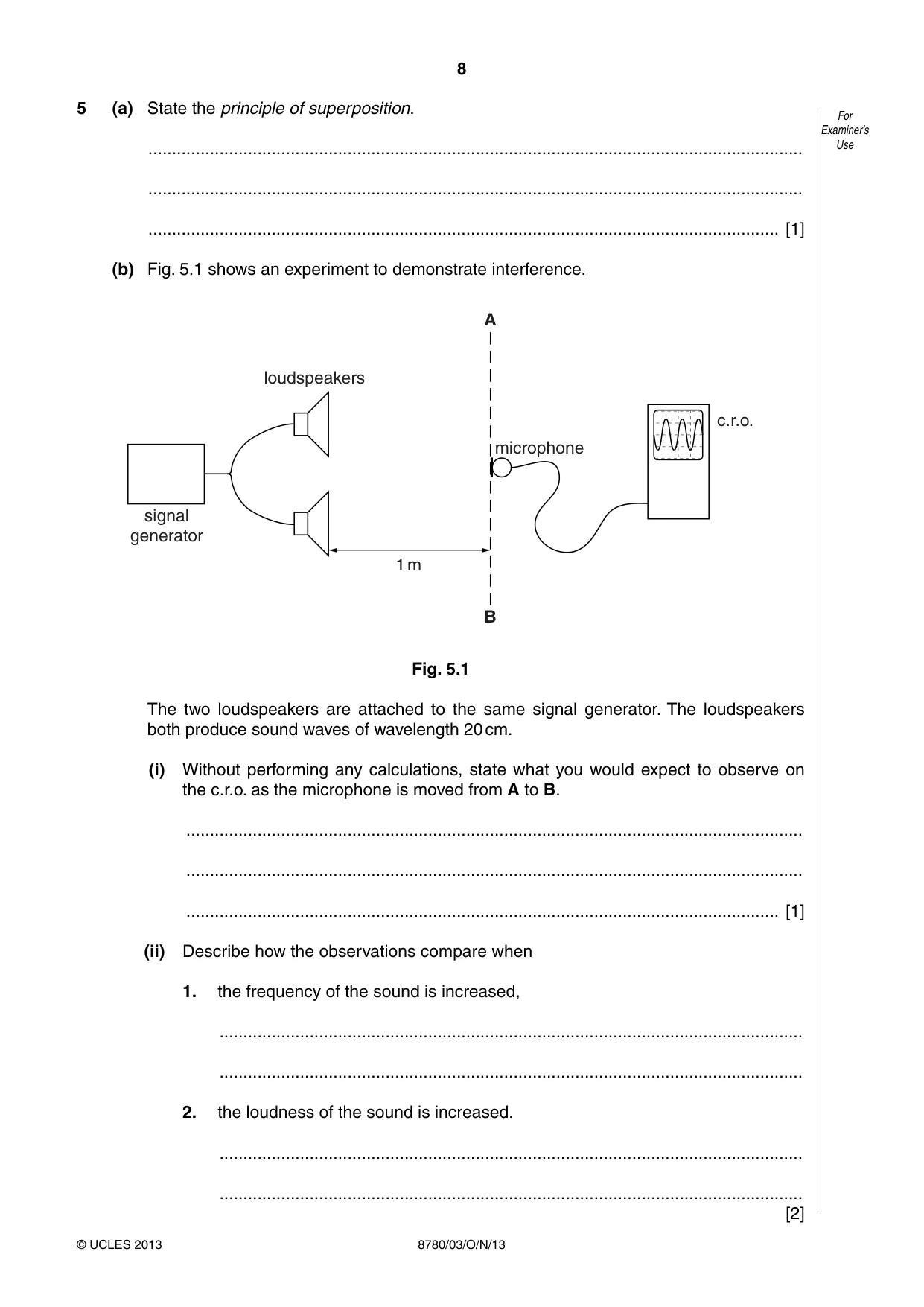
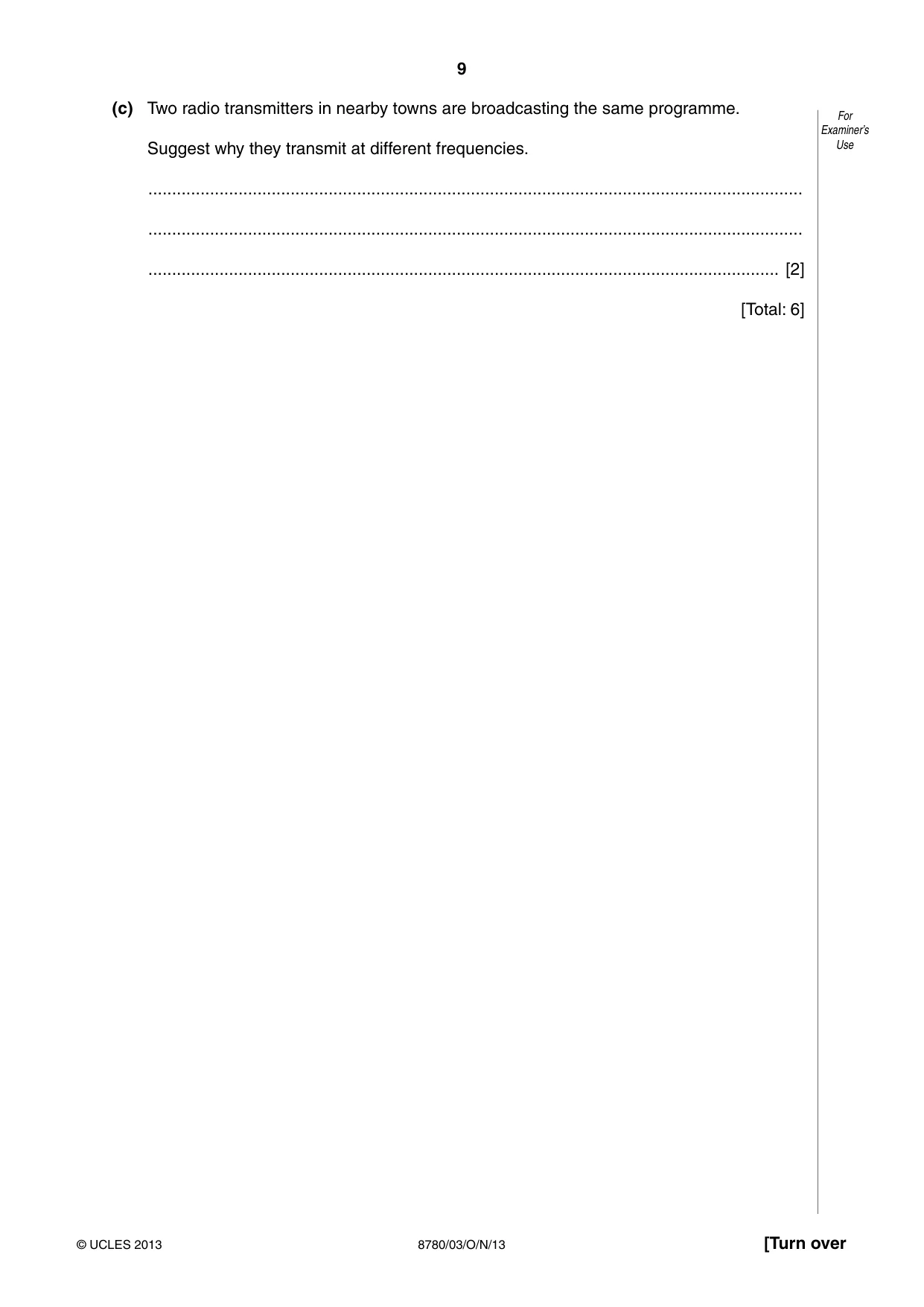
5 (a) State the principle of superposition. .......................................................................................................................................... .......................................................................................................................................... ..................................................................................................................................... [1] (b) Fig. 5.1 shows an experiment to demonstrate interference. A loudspeakers c.r.o. microphone signal generator 1 m B Fig. 5.1 The two loudspeakers are attached to the same signal generator. The loudspeakers both produce sound waves of wavelength 20 cm. (i) Without performing any calculations, state what you would expect to observe on the c.r.o. as the microphone is moved from A to B. .................................................................................................................................. .................................................................................................................................. ............................................................................................................................. [1] (ii) Describe how the observations compare when 1. the frequency of the sound is increased, ........................................................................................................................... ........................................................................................................................... 2. the loudness of the sound is increased. ........................................................................................................................... ........................................................................................................................... [2] (c) Two radio transmitters in nearby towns are broadcasting the same programme. Suggest why they transmit at different frequencies. .......................................................................................................................................... .......................................................................................................................................... ..................................................................................................................................... [2] [Total: 6]
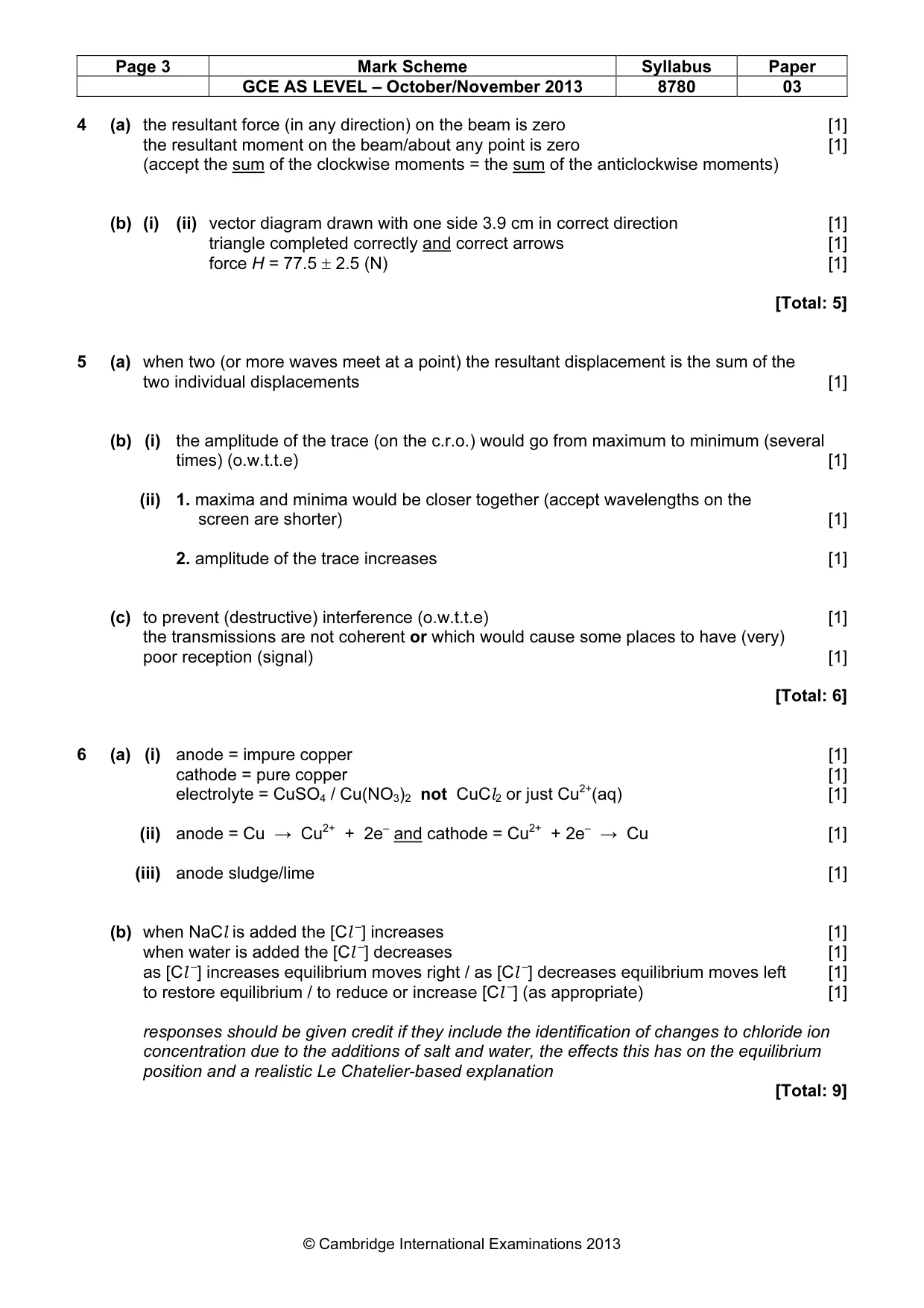
Mark scheme: 5 (a) when two (or more waves meet at a point) the resultant displacement is the sum of the two individual displacements [1] (b) (i) the amplitude of the trace (on the c.r.o.) would go from maximum to minimum (several times) (o.w.t.t.e) [1] (ii) 1. maxima and minima would be closer together (accept wavelengths on the screen are shorter) [1] 2. amplitude of the trace increases [1] (c) to prevent (destructive) interference (o.w.t.t.e) [1] the transmissions are not coherent or which would cause some places to have (very) poor reception (signal) [1] [Total: 6]
Q6 · Copper is a transition metal with a wide range of uses
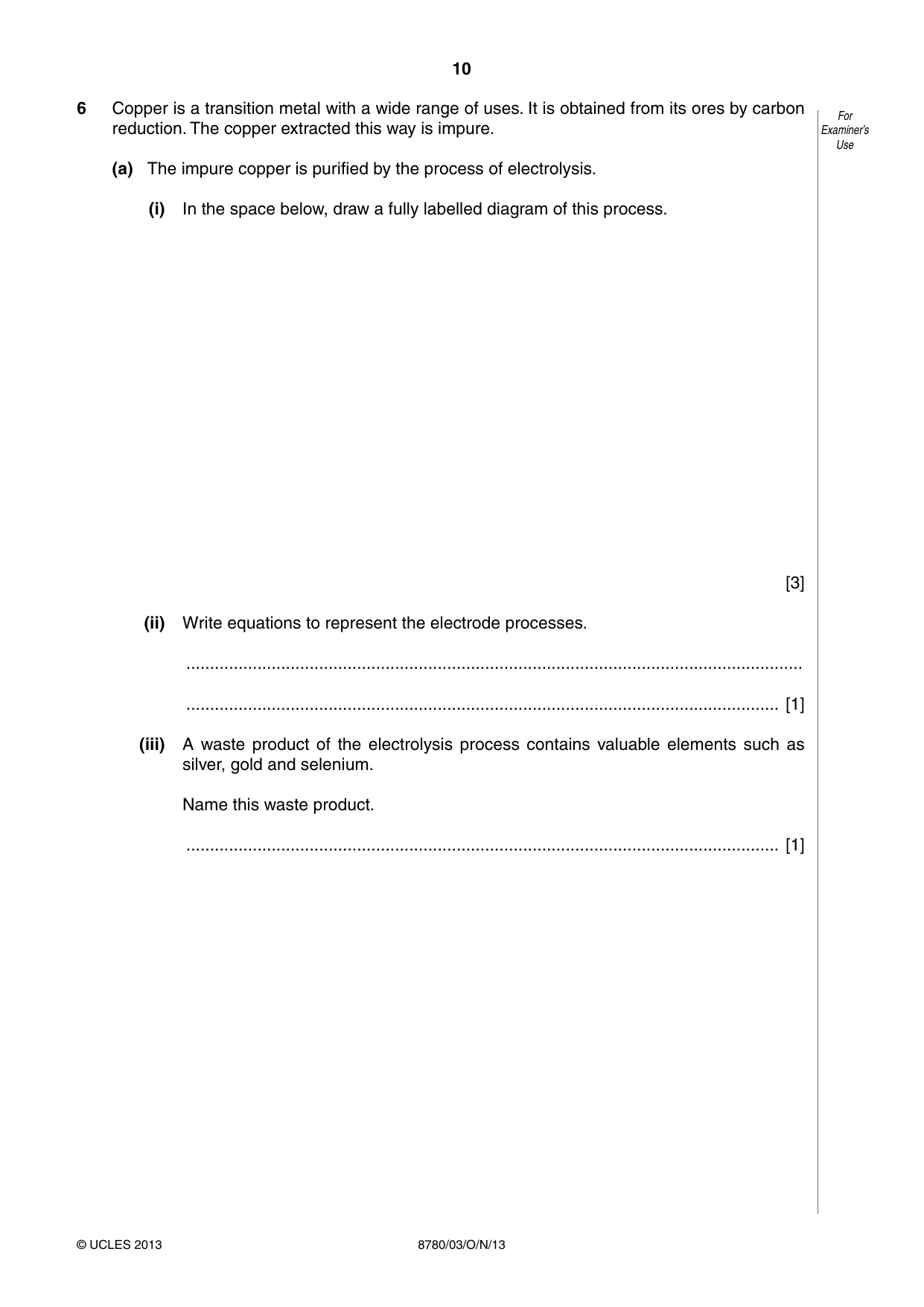
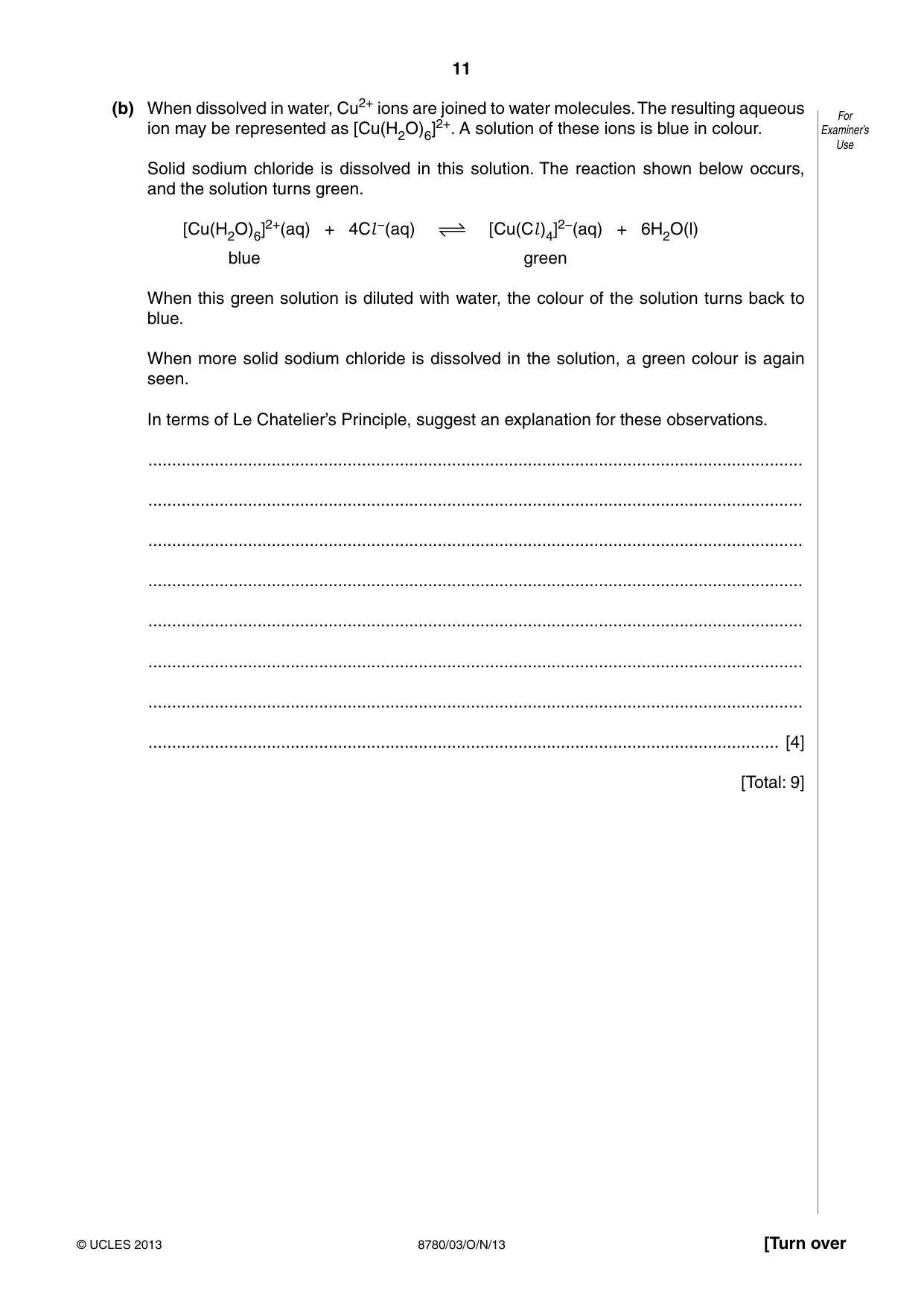
6 Copper is a transition metal with a wide range of uses. It is obtained from its ores by carbon reduction. The copper extracted this way is impure. (a) The impure copper is purified by the process of electrolysis. (i) In the space below, draw a fully labelled diagram of this process. [3] (ii) Write equations to represent the electrode processes. .................................................................................................................................. ............................................................................................................................. [1] (iii) A waste product of the electrolysis process contains valuable elements such as silver, gold and selenium. Name this waste product. ............................................................................................................................. [1] (b) When dissolved in water, Cu2+ ions are joined to water molecules. The resulting aqueous ion may be represented as [Cu(H2O)6]2+. A solution of these ions is blue in colour. Solid sodium chloride is dissolved in this solution. The reaction shown below occurs, and the solution turns green. [Cu(H2O)6]2+(aq) + 4Cl−(aq) [Cu(Cl)4]2−(aq) + 6H2O(l) blue green When this green solution is diluted with water, the colour of the solution turns back to blue. When more solid sodium chloride is dissolved in the solution, a green colour is again seen. In terms of Le Chatelier’s Principle, suggest an explanation for these observations. .......................................................................................................................................... .......................................................................................................................................... .......................................................................................................................................... .......................................................................................................................................... .......................................................................................................................................... .......................................................................................................................................... .......................................................................................................................................... ..................................................................................................................................... [4] [Total: 9]
Mark scheme: 6 (a) (i) anode = impure copper [1] cathode = pure copper [1] electrolyte = CuSO4 / Cu(NO3)2 not CuCl2 or just Cu2+(aq) [1] (ii) anode = Cu → Cu2+ + 2e– and cathode = Cu2+ + 2e– → Cu [1] (iii) anode sludge/lime [1] (b) when NaCl is added the [Cl –] increases [1] when water is added the [Cl –] decreases [1] as [Cl –] increases equilibrium moves right / as [Cl –] decreases equilibrium moves left [1] to restore equilibrium / to reduce or increase [Cl –] (as appropriate) [1] responses should be given credit if they include the identification of changes to chloride ion concentration due to the additions of salt and water, the effects this has on the equilibrium position and a realistic Le Chatelier-based explanation [Total: 9] GCE AS LEVEL – October/November 2013 8780 03 6 9
Q7 · You will need to use the Data Booklet to answer this question
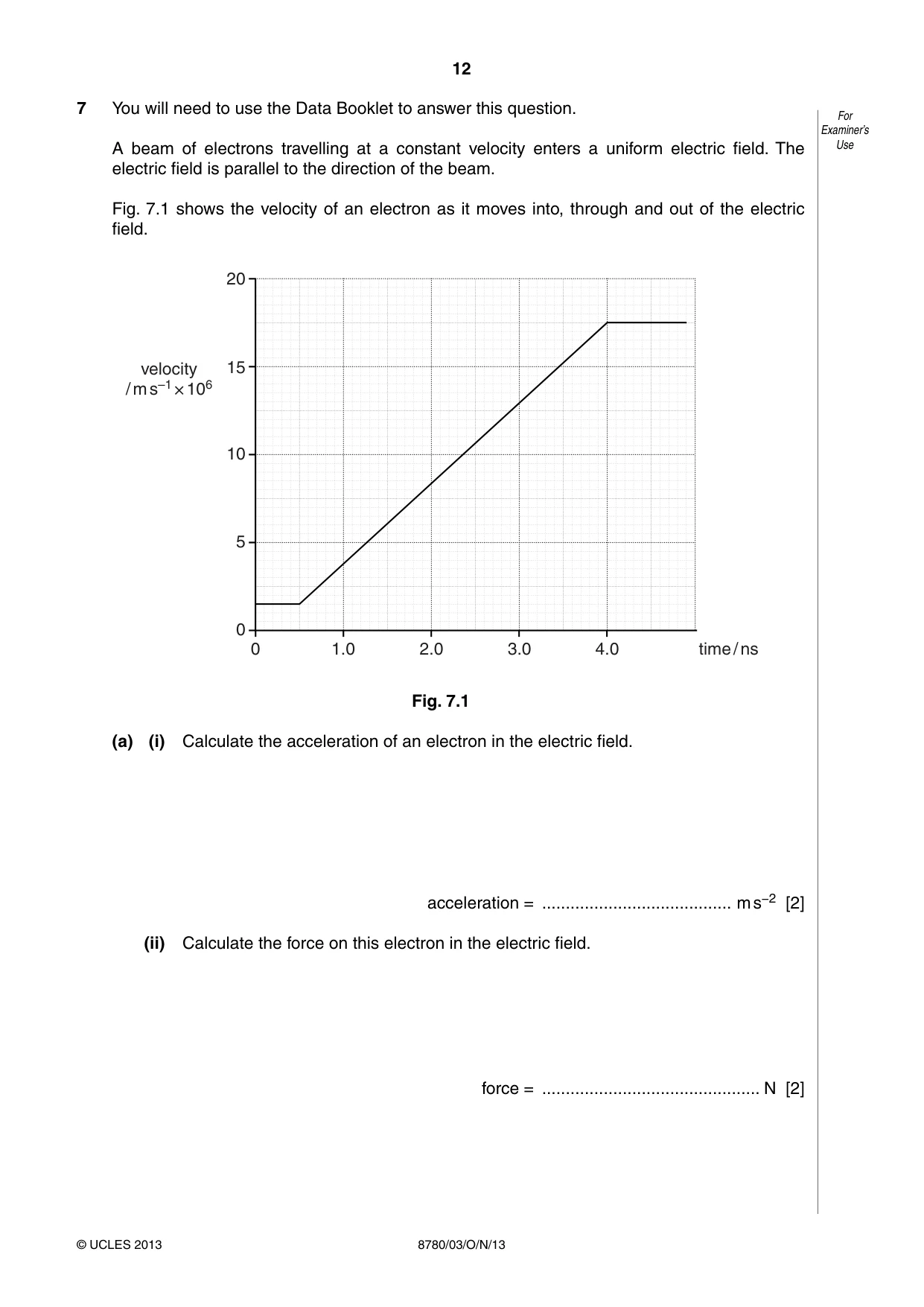
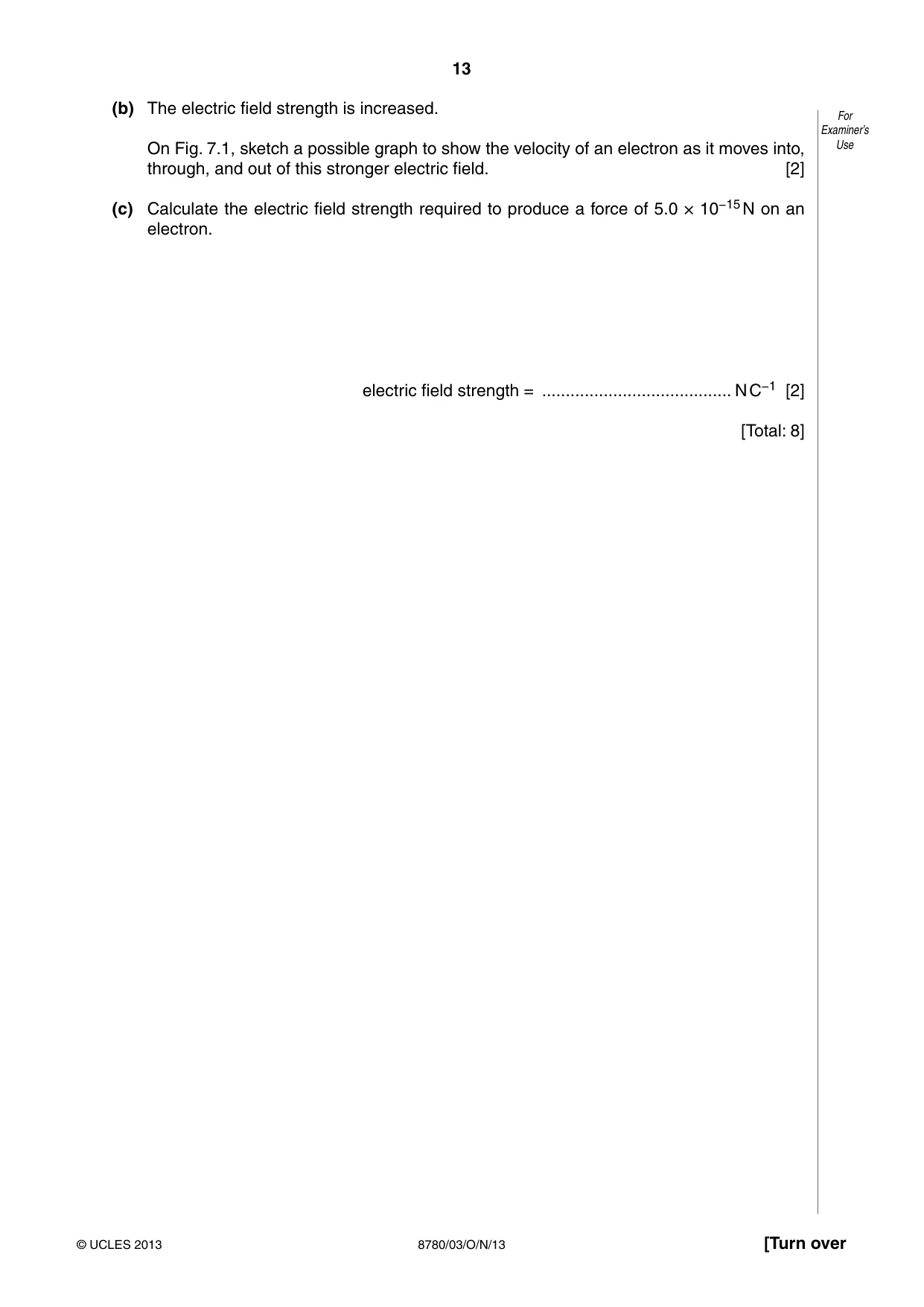
7 You will need to use the Data Booklet to answer this question. A beam of electrons travelling at a constant velocity enters a uniform electric field. The electric field is parallel to the direction of the beam. Fig. 7.1 shows the velocity of an electron as it moves into, through and out of the electric field. 20 velocity 15 / m s–1 × 10⁶ 10 5 0 0 1.0 2.0 3.0 4.0 time / ns Fig. 7.1 (a) (i) Calculate the acceleration of an electron in the electric field. acceleration = ........................................ m s−2 [2] (ii) Calculate the force on this electron in the electric field. force = .............................................. N [2] (b) The electric field strength is increased. On Fig. 7.1, sketch a possible graph to show the velocity of an electron as it moves into, through, and out of this stronger electric field. [2] (c) Calculate the electric field strength required to produce a force of 5.0 × 10⁻¹⁵ N on an electron. electric field strength = ........................................ N C−1 [2] [Total: 8]
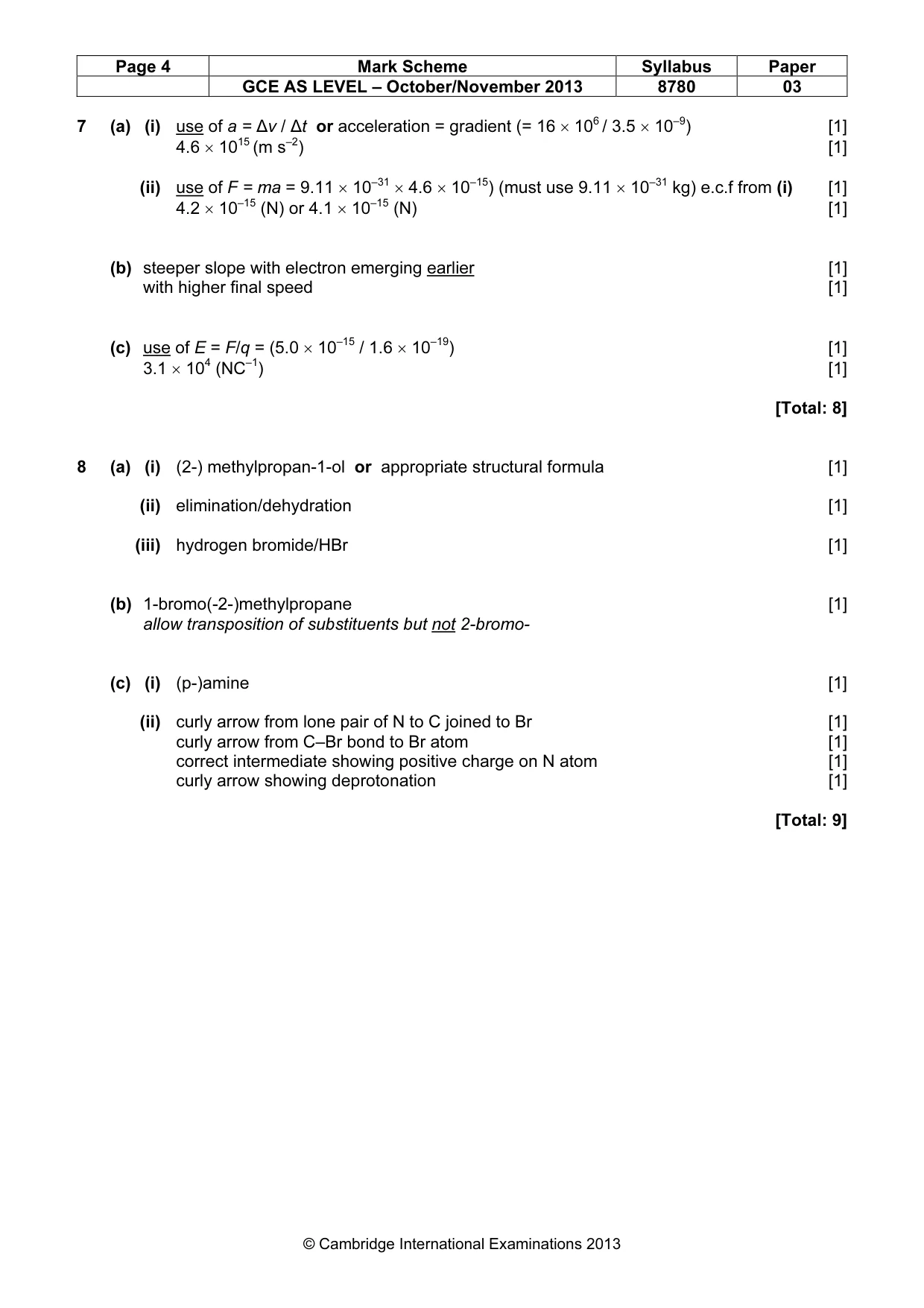
Mark scheme: 7 (a) (i) use of a = ∆v / ∆t or acceleration = gradient (= 16 × 106 / 3.5 × 10⁻⁹) [1] 4.6 × 10¹⁵ (m s–2) [1] (ii) use of F = ma = 9.11 × 10–31 × 4.6 × 10–15) (must use 9.11 × 10⁻³¹ kg) e.c.f from (i) [1] 4.2 × 10⁻¹⁵ (N) or 4.1 × 10⁻¹⁵ (N) [1] (b) steeper slope with electron emerging earlier [1] with higher final speed [1] (c) use of E = F/q = (5.0 × 10⁻¹⁵ / 1.6 × 10⁻¹⁹) [1] 3.1 × 10⁴ (NC–1) [1] [Total: 8]
Q8 · Consider the reaction scheme below
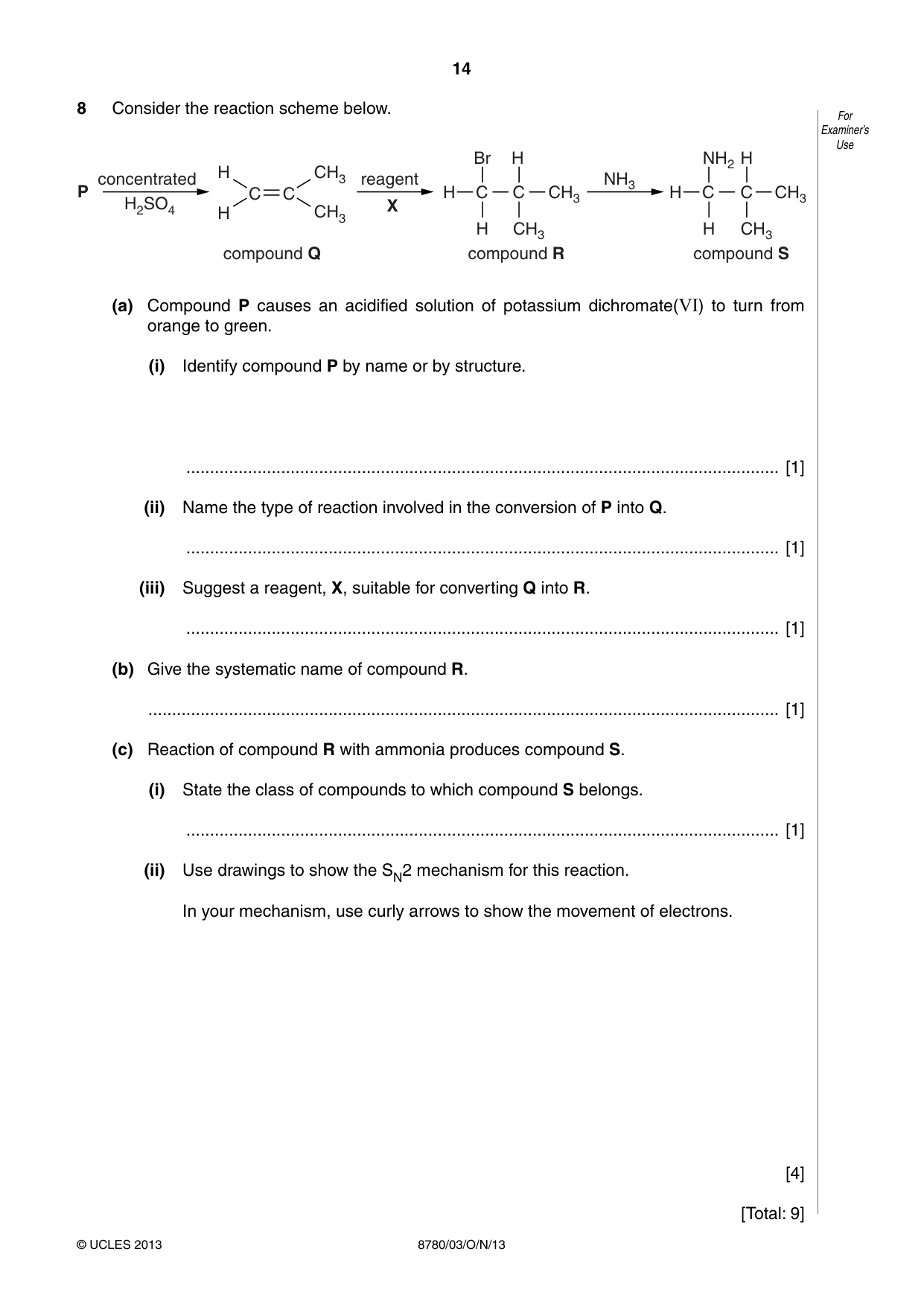
8 Consider the reaction scheme below. Br H NH2 H concentrated H CH3 reagent NH3 P C C H C C CH3 H C C CH3 H2SO4 X H CH3 H CH3 H CH3 compound Q compound R compound S (a) Compound P causes an acidified solution of potassium dichromate(VI) to turn from orange to green. (i) Identify compound P by name or by structure. ............................................................................................................................. [1] (ii) Name the type of reaction involved in the conversion of P into Q. ............................................................................................................................. [1] (iii) Suggest a reagent, X, suitable for converting Q into R. ............................................................................................................................. [1] (b) Give the systematic name of compound R. ..................................................................................................................................... [1] (c) Reaction of compound R with ammonia produces compound S. (i) State the class of compounds to which compound S belongs. ............................................................................................................................. [1] (ii) Use drawings to show the SN2 mechanism for this reaction. In your mechanism, use curly arrows to show the movement of electrons. [4] [Total: 9]
Mark scheme: 8 (a) (i) (2-) methylpropan-1-ol or appropriate structural formula [1] (ii) elimination/dehydration [1] (iii) hydrogen bromide/HBr [1] (b) 1-bromo(-2-)methylpropane [1] allow transposition of substituents but not 2-bromo- (c) (i) (p-)amine [1] (ii) curly arrow from lone pair of N to C joined to Br [1] curly arrow from C–Br bond to Br atom [1] correct intermediate showing positive charge on N atom [1] curly arrow showing deprotonation [1] [Total: 9] GCE AS LEVEL – October/November 2013 8780 03
Question 9
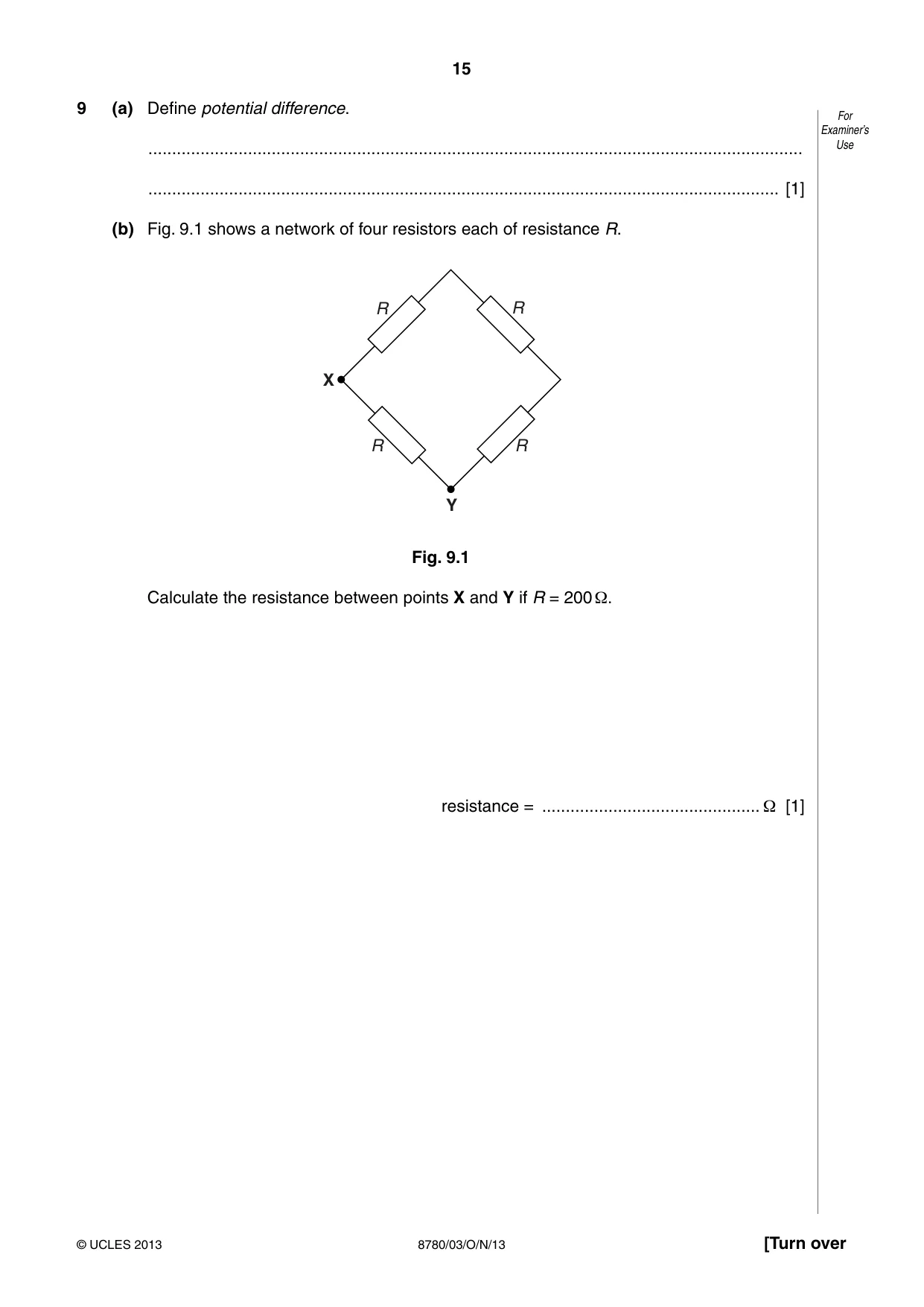
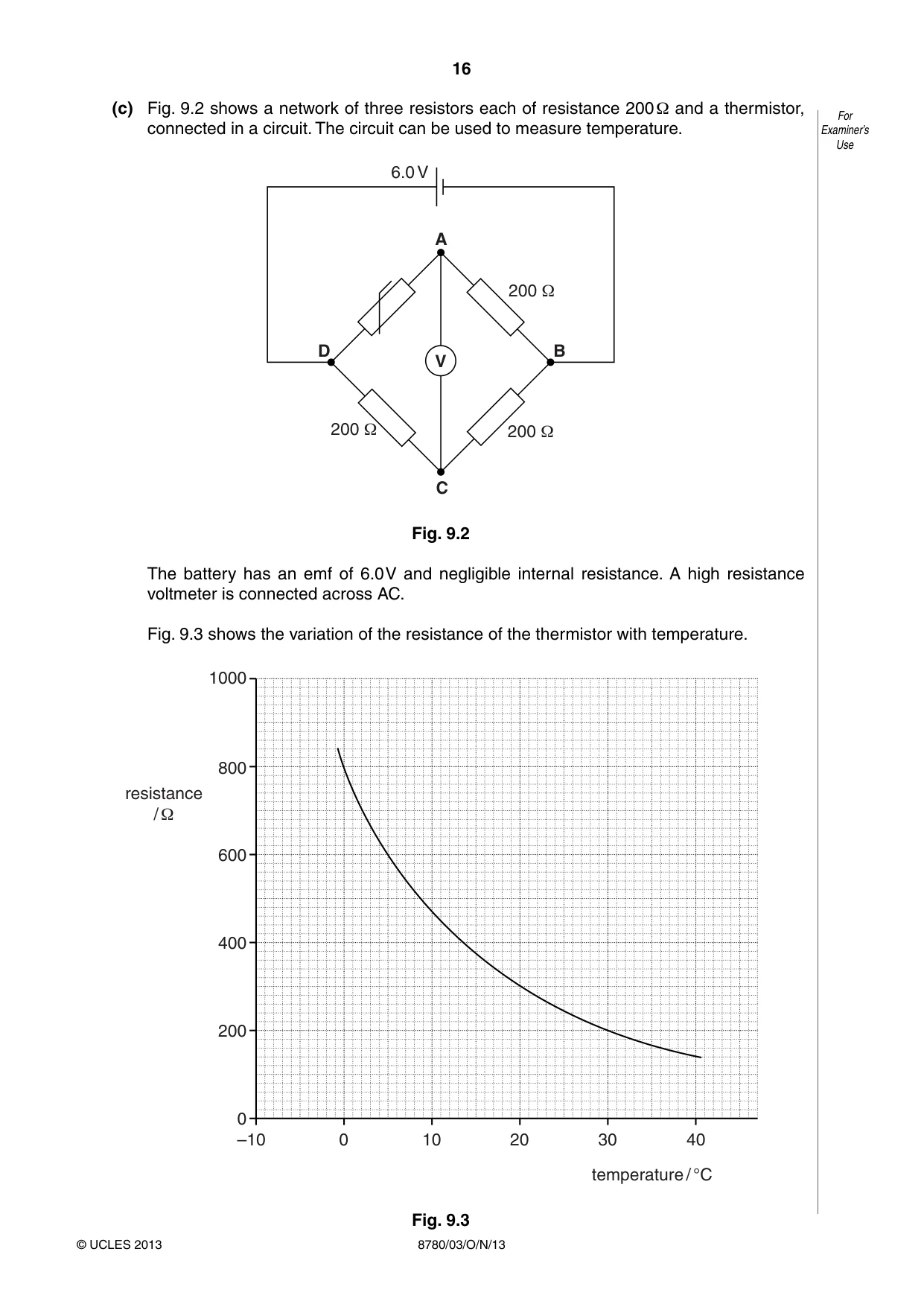
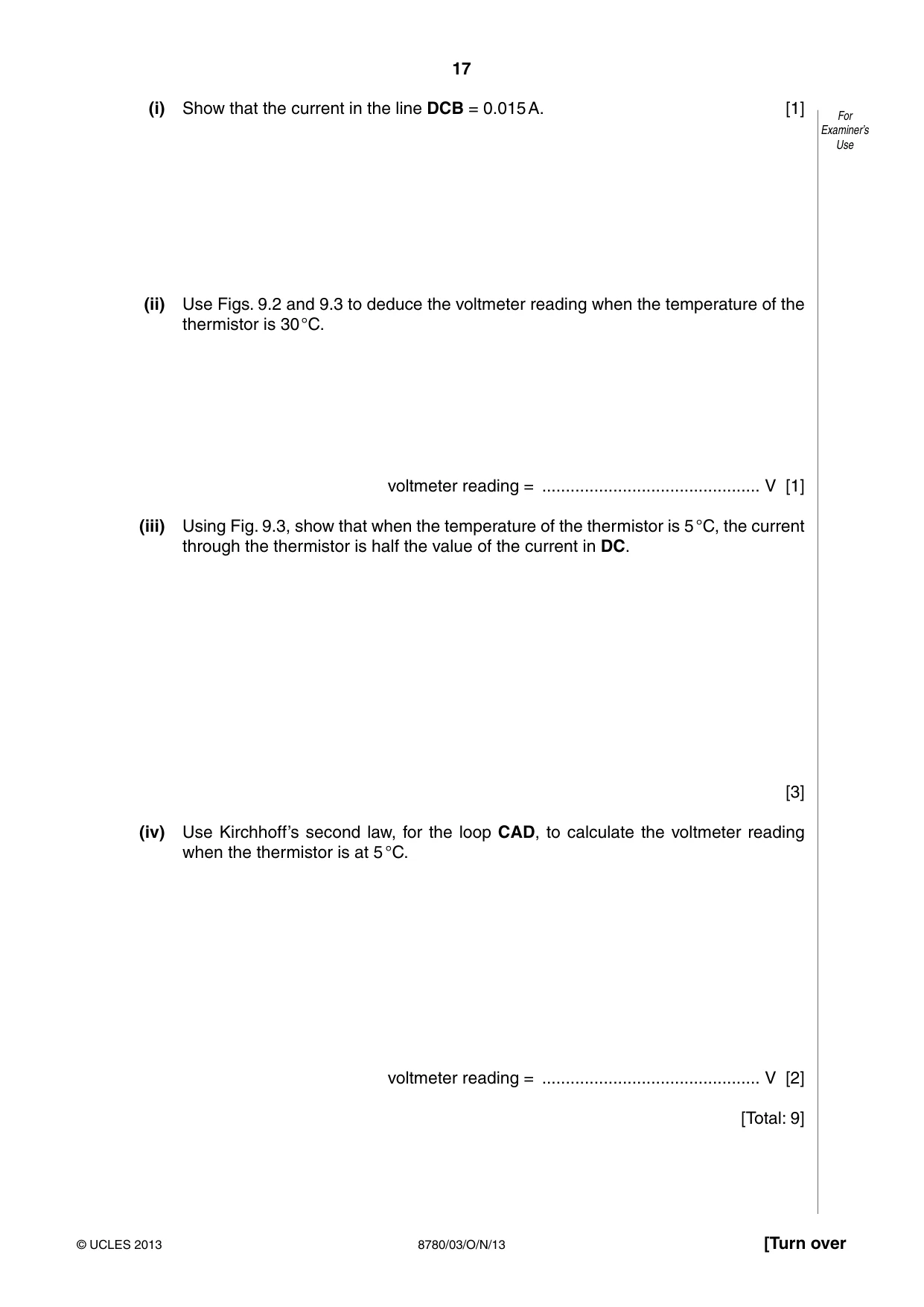
9 (a) Define potential difference. .......................................................................................................................................... ..................................................................................................................................... [1] (b) Fig. 9.1 shows a network of four resistors each of resistance R. R R X R R Y Fig. 9.1 Calculate the resistance between points X and Y if R = 200 Ω. resistance = .............................................. Ω [1] (c) Fig. 9.2 shows a network of three resistors each of resistance 200 Ω and a thermistor, connected in a circuit. The circuit can be used to measure temperature. 6.0 V A 200 1 D B V 200 1 200 1 C Fig. 9.2 The battery has an emf of 6.0 V and negligible internal resistance. A high resistance voltmeter is connected across AC. Fig. 9.3 shows the variation of the resistance of the thermistor with temperature. 1000 800 resistance / 1 600 400 200 0 –10 0 10 20 30 40 temperature / °C Fig. 9.3 (i) Show that the current in the line DCB = 0.015 A. [1] (ii) Use Figs. 9.2 and 9.3 to deduce the voltmeter reading when the temperature of the thermistor is 30 °C. voltmeter reading = .............................................. V [1] (iii) Using Fig. 9.3, show that when the temperature of the thermistor is 5 °C, the current through the thermistor is half the value of the current in DC. [3] (iv) Use Kirchhoff’s second law, for the loop CAD, to calculate the voltmeter reading when the thermistor is at 5 °C. voltmeter reading = .............................................. V [2] [Total: 9]
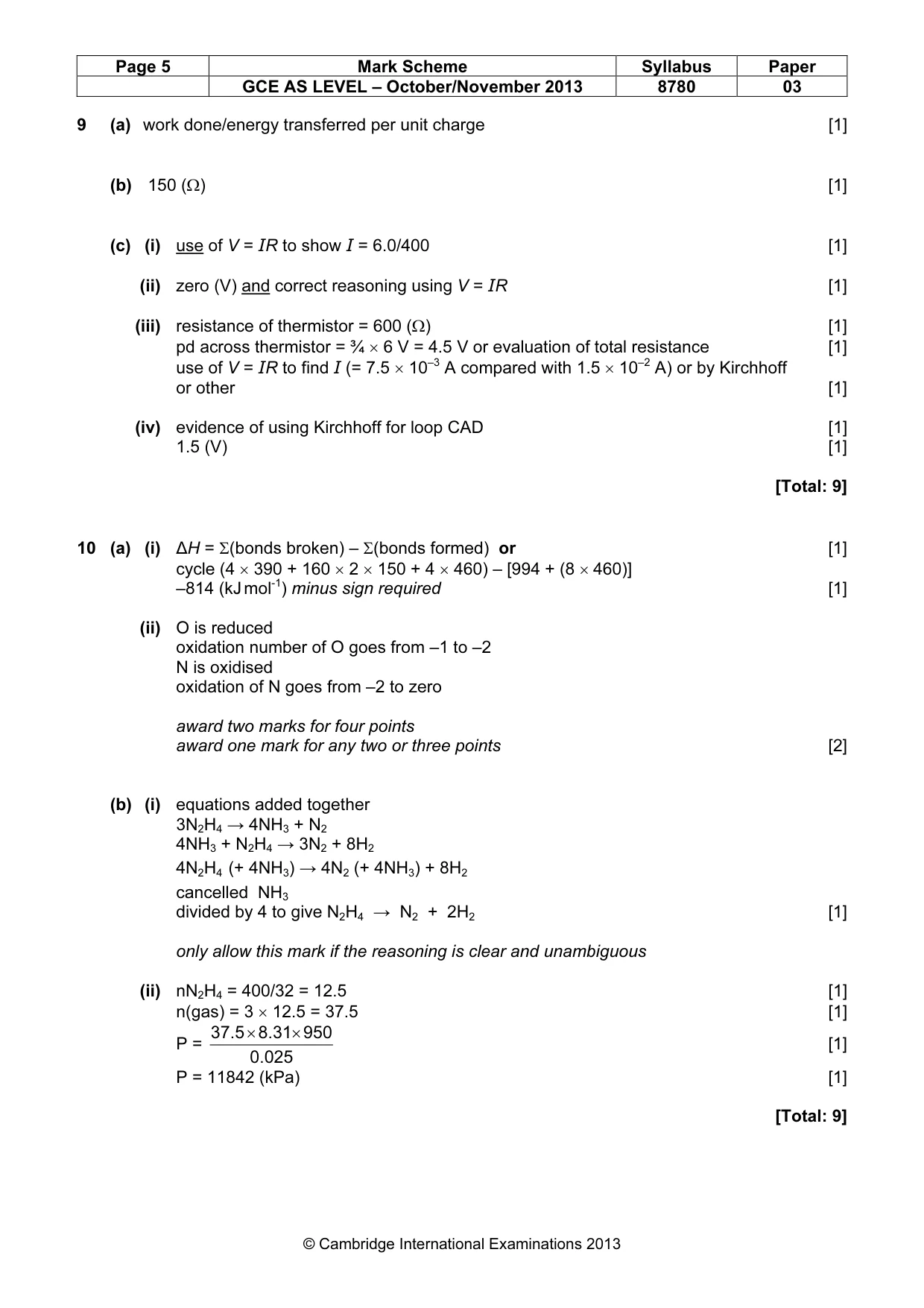
Mark scheme: 9 (a) work done/energy transferred per unit charge [1] (b) 150 (Ω) [1] (c) (i) use of V = IR to show I = 6.0/400 [1] (ii) zero (V) and correct reasoning using V = IR [1] (iii) resistance of thermistor = 600 (Ω) [1] pd across thermistor = ¾ × 6 V = 4.5 V or evaluation of total resistance [1] use of V = IR to find I (= 7.5 × 10⁻³ A compared with 1.5 × 10⁻² A) or by Kirchhoff or other [1] (iv) evidence of using Kirchhoff for loop CAD [1] 1.5 (V) [1] [Total: 9]
Q10 · Hydrazine, N2H4, is highly reactive and is used as a fuel in rocket engines
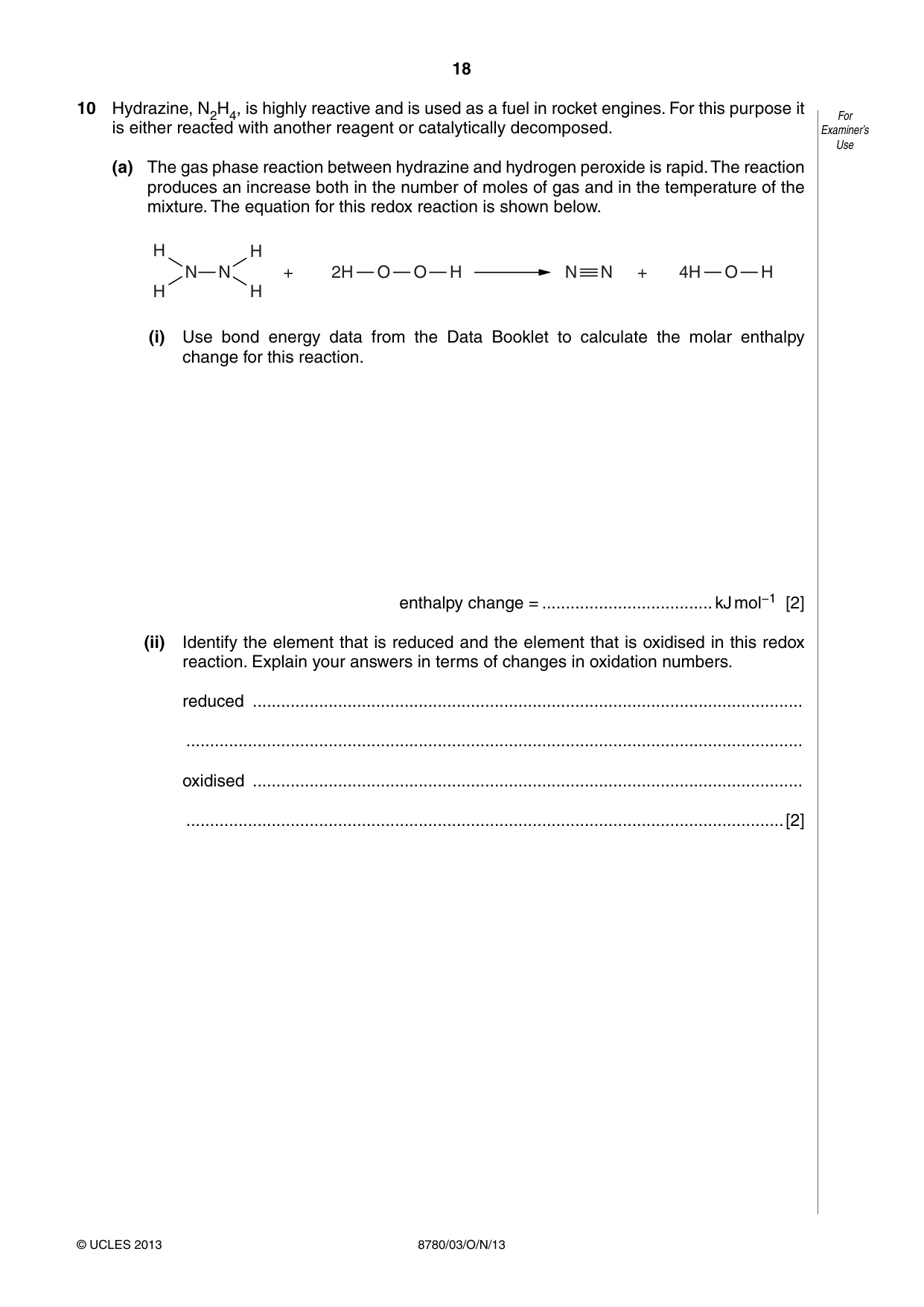
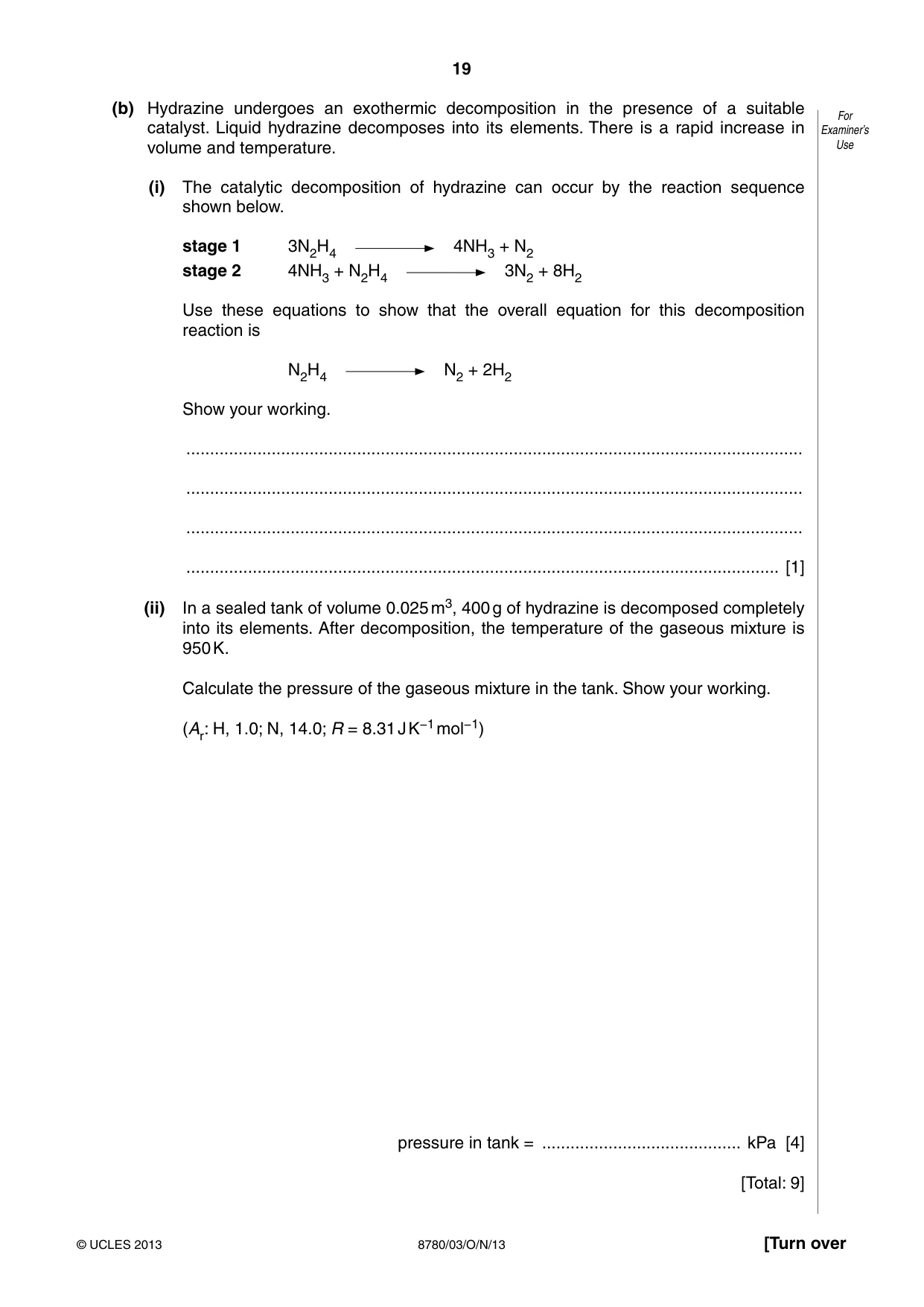
10 Hydrazine, N2H4, is highly reactive and is used as a fuel in rocket engines. For this purpose it is either reacted with another reagent or catalytically decomposed. (a) The gas phase reaction between hydrazine and hydrogen peroxide is rapid. The reaction produces an increase both in the number of moles of gas and in the temperature of the mixture. The equation for this redox reaction is shown below. H H N N + 2H O O H N N + 4H O H H H (i) Use bond energy data from the Data Booklet to calculate the molar enthalpy change for this reaction. enthalpy change = .................................... kJ mol−1 [2] (ii) Identify the element that is reduced and the element that is oxidised in this redox reaction. Explain your answers in terms of changes in oxidation numbers. reduced .................................................................................................................... .................................................................................................................................. oxidised .................................................................................................................... ..............................................................................................................................[2] (b) Hydrazine undergoes an exothermic decomposition in the presence of a suitable catalyst. Liquid hydrazine decomposes into its elements. There is a rapid increase in volume and temperature. (i) The catalytic decomposition of hydrazine can occur by the reaction sequence shown below. stage 1 3N2H4 4NH3 + N2 stage 2 4NH3 + N2H4 3N2 + 8H2 Use these equations to show that the overall equation for this decomposition reaction is N2H4 N2 + 2H2 Show your working. .................................................................................................................................. .................................................................................................................................. .................................................................................................................................. ............................................................................................................................. [1] (ii) In a sealed tank of volume 0.025 m3, 400 g of hydrazine is decomposed completely into its elements. After decomposition, the temperature of the gaseous mixture is 950 K. Calculate the pressure of the gaseous mixture in the tank. Show your working. (Ar: H, 1.0; N, 14.0; R = 8.31 J K−1 mol−1) pressure in tank = .......................................... kPa [4] [Total: 9]
Mark scheme: 10 (a) (i) ∆H = Σ(bonds broken) – Σ(bonds formed) or [1] cycle (4 × 390 + 160 × 2 × 150 + 4 × 460) – [994 + (8 × 460)] –814 (kJ mol-1) minus sign required [1] (ii) O is reduced oxidation number of O goes from –1 to –2 N is oxidised oxidation of N goes from –2 to zero award two marks for four points award one mark for any two or three points [2] (b) (i) equations added together 3N2H4 → 4NH3 + N2 4NH3 + N2H4 → 3N2 + 8H2 4N2H4 (+ 4NH3) → 4N2 (+ 4NH3) + 8H2 cancelled NH3 divided by 4 to give N2H4 → N2 + 2H2 [1] only allow this mark if the reasoning is clear and unambiguous (ii) nN2H4 = 400/32 = 12.5 [1] n(gas) = 3 × 12.5 = 37.5 [1] 37.5 × 8.31× 950 P = [1] 0.025 P = 11842 (kPa) [1] [Total: 9] GCE AS LEVEL – October/November 2013 8780 03
Q11 · The Rutherford model of the atom was developed from the evidence of α-particle scattering
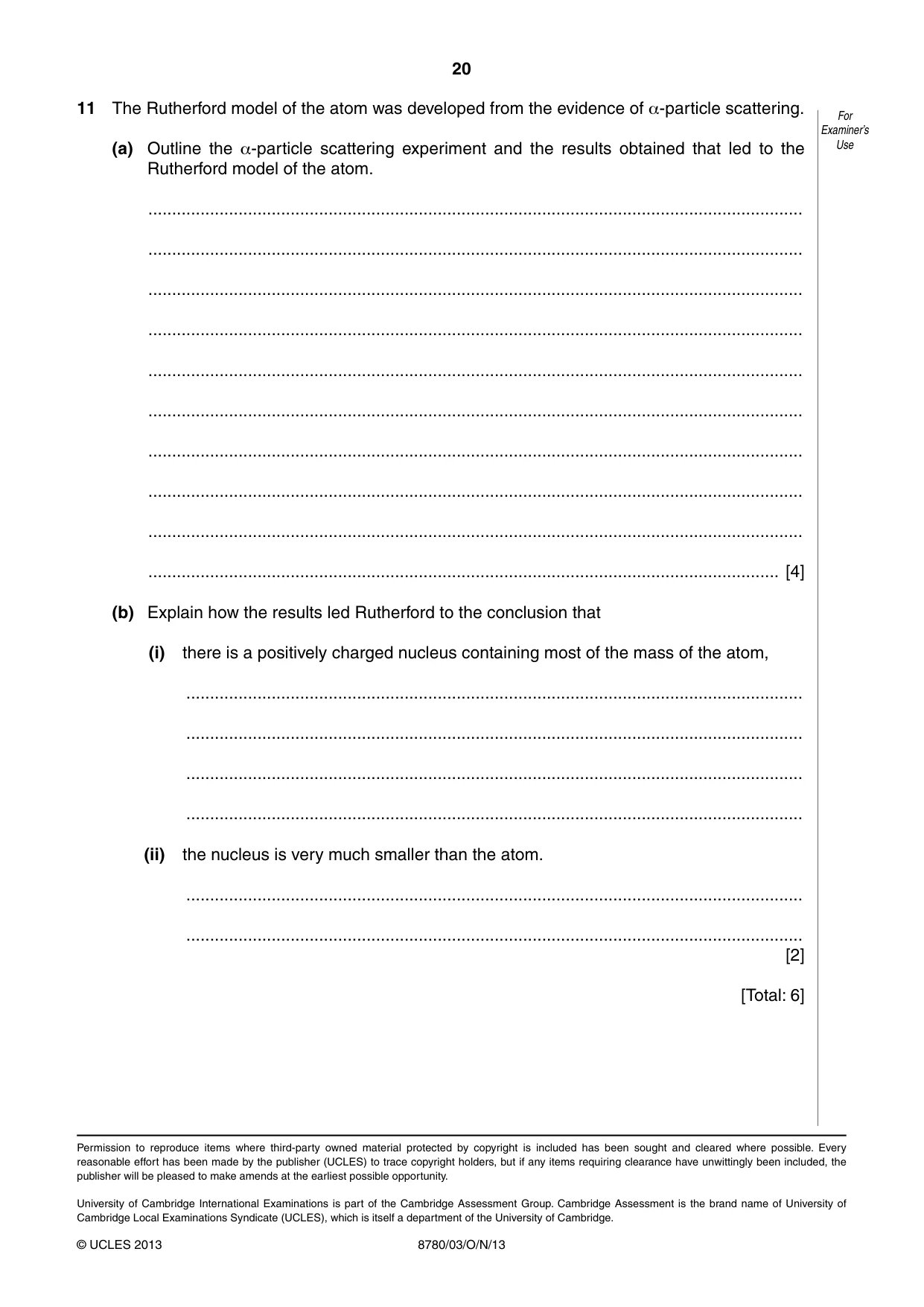
11 The Rutherford model of the atom was developed from the evidence of α-particle scattering. (a) Outline the α-particle scattering experiment and the results obtained that led to the Rutherford model of the atom. .......................................................................................................................................... .......................................................................................................................................... .......................................................................................................................................... .......................................................................................................................................... .......................................................................................................................................... .......................................................................................................................................... .......................................................................................................................................... .......................................................................................................................................... .......................................................................................................................................... ..................................................................................................................................... [4] (b) Explain how the results led Rutherford to the conclusion that (i) there is a positively charged nucleus containing most of the mass of the atom, .................................................................................................................................. .................................................................................................................................. .................................................................................................................................. .................................................................................................................................. (ii) the nucleus is very much smaller than the atom. .................................................................................................................................. .................................................................................................................................. [2] [Total: 6]
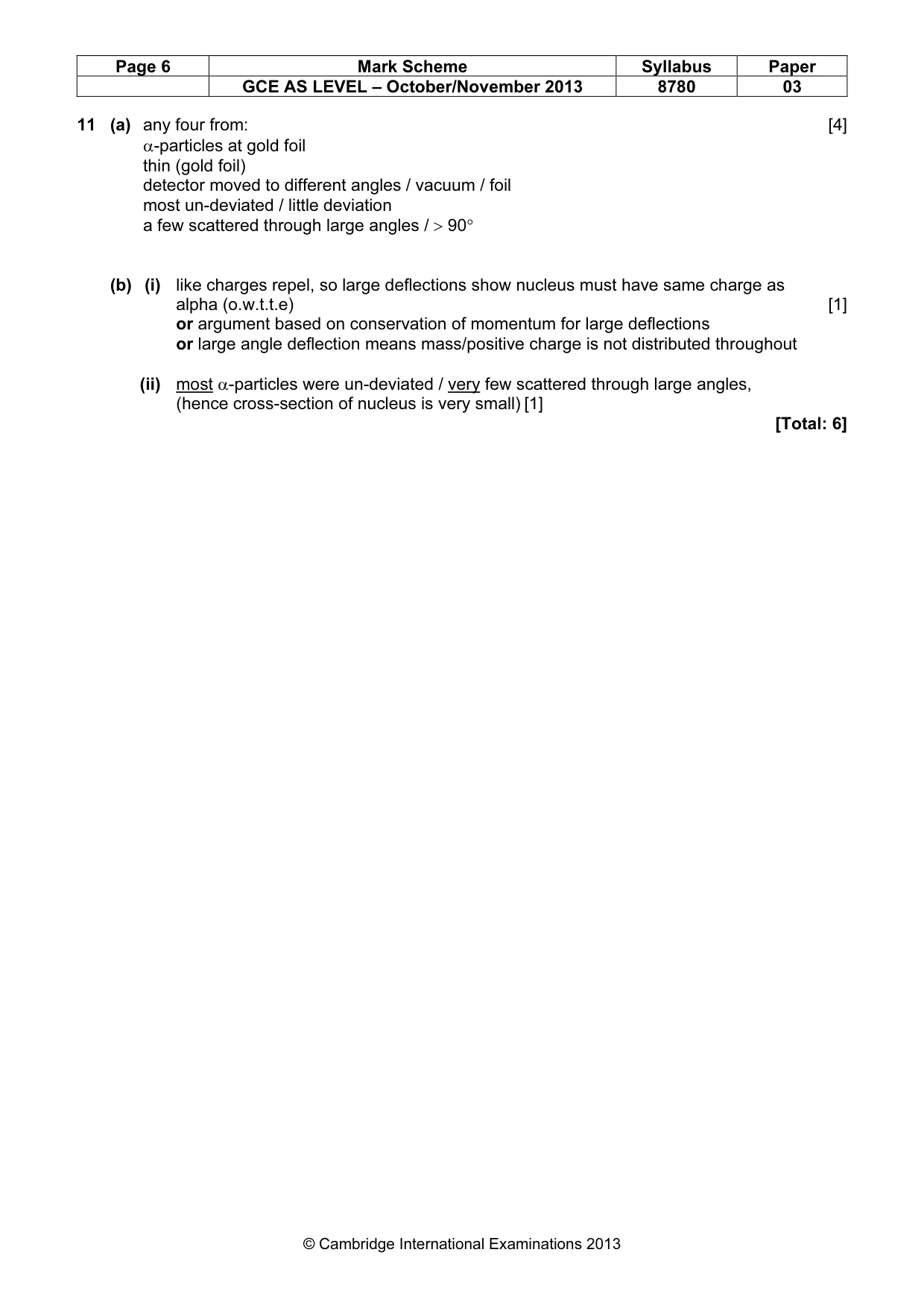
Mark scheme: 11 (a) any four from: [4] α-particles at gold foil thin (gold foil) detector moved to different angles / vacuum / foil most un-deviated / little deviation a few scattered through large angles / > 90° (b) (i) like charges repel, so large deflections show nucleus must have same charge as alpha (o.w.t.t.e) [1] or argument based on conservation of momentum for large deflections or large angle deflection means mass/positive charge is not distributed throughout (ii) most α-particles were un-deviated / very few scattered through large angles, (hence cross-section of nucleus is very small) [1] [Total: 6]
What you needed in this session
Cambridge’s own grade thresholds for 2013 Oct/Nov, Paper 3 · Variant 1. A higher threshold means an easier paper — the bar moves with how the cohort did.