Cambridge A Level Physical Science 8780 — 2012 Oct/Nov Paper 3 · Variant 1
8780/31/O/N/12 · 15 questions · 80 marks · ≈90 min
The question paper and its mark scheme, free to read here and free to download. This is Cambridge’s own paper, exactly as it was sat.
Question paper24 pages
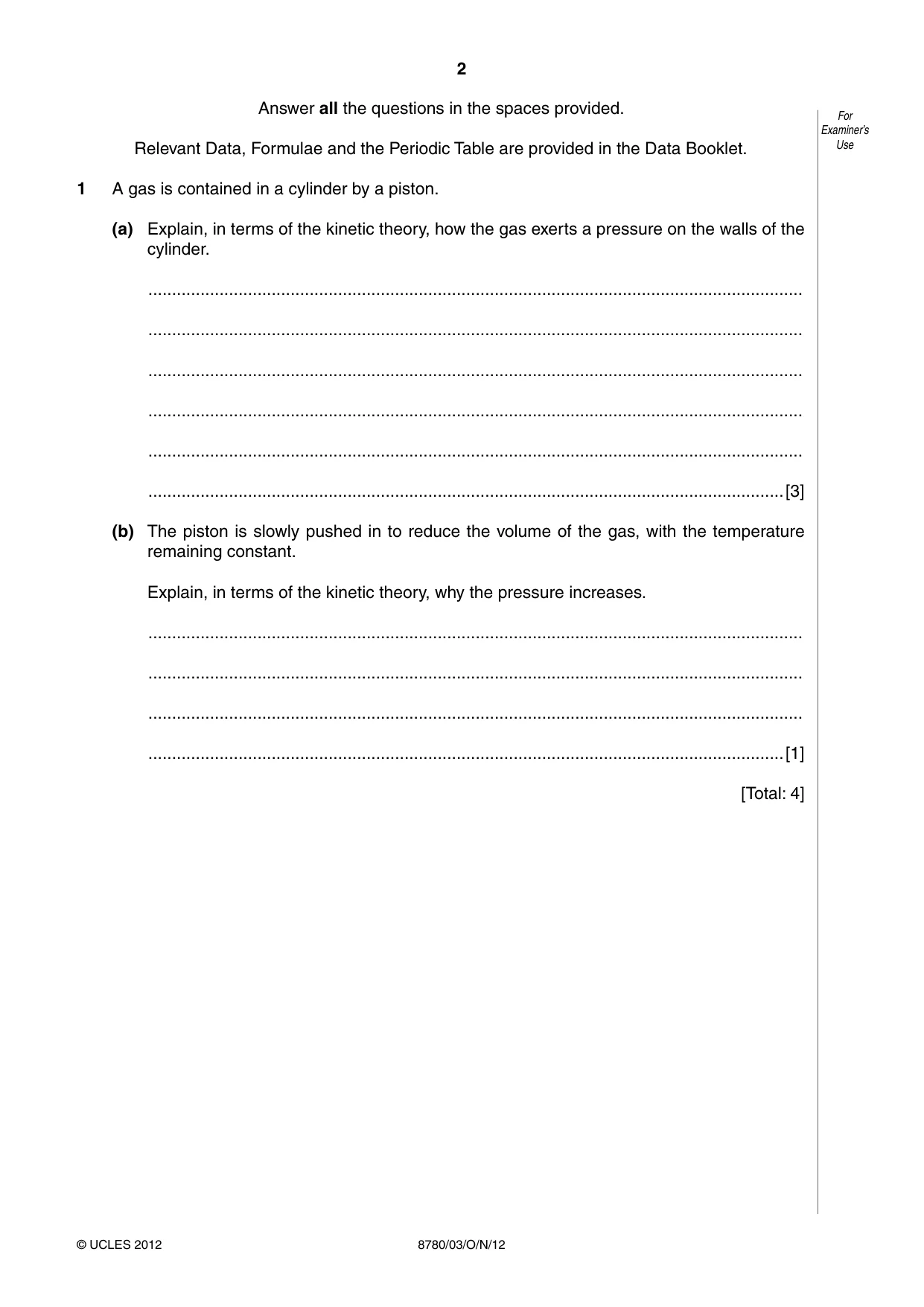
Mark scheme6 pages
Answers below. Sit the paper first if you are practising.
Questions as text
Q1 · A gas is contained in a cylinder by a piston
1 A gas is contained in a cylinder by a piston. (a) Explain, in terms of the kinetic theory, how the gas exerts a pressure on the walls of the cylinder. .......................................................................................................................................... .......................................................................................................................................... .......................................................................................................................................... .......................................................................................................................................... .......................................................................................................................................... ......................................................................................................................................[3] (b) The piston is slowly pushed in to reduce the volume of the gas, with the temperature remaining constant. Explain, in terms of the kinetic theory, why the pressure increases. .......................................................................................................................................... .......................................................................................................................................... .......................................................................................................................................... ......................................................................................................................................[1] [Total: 4]
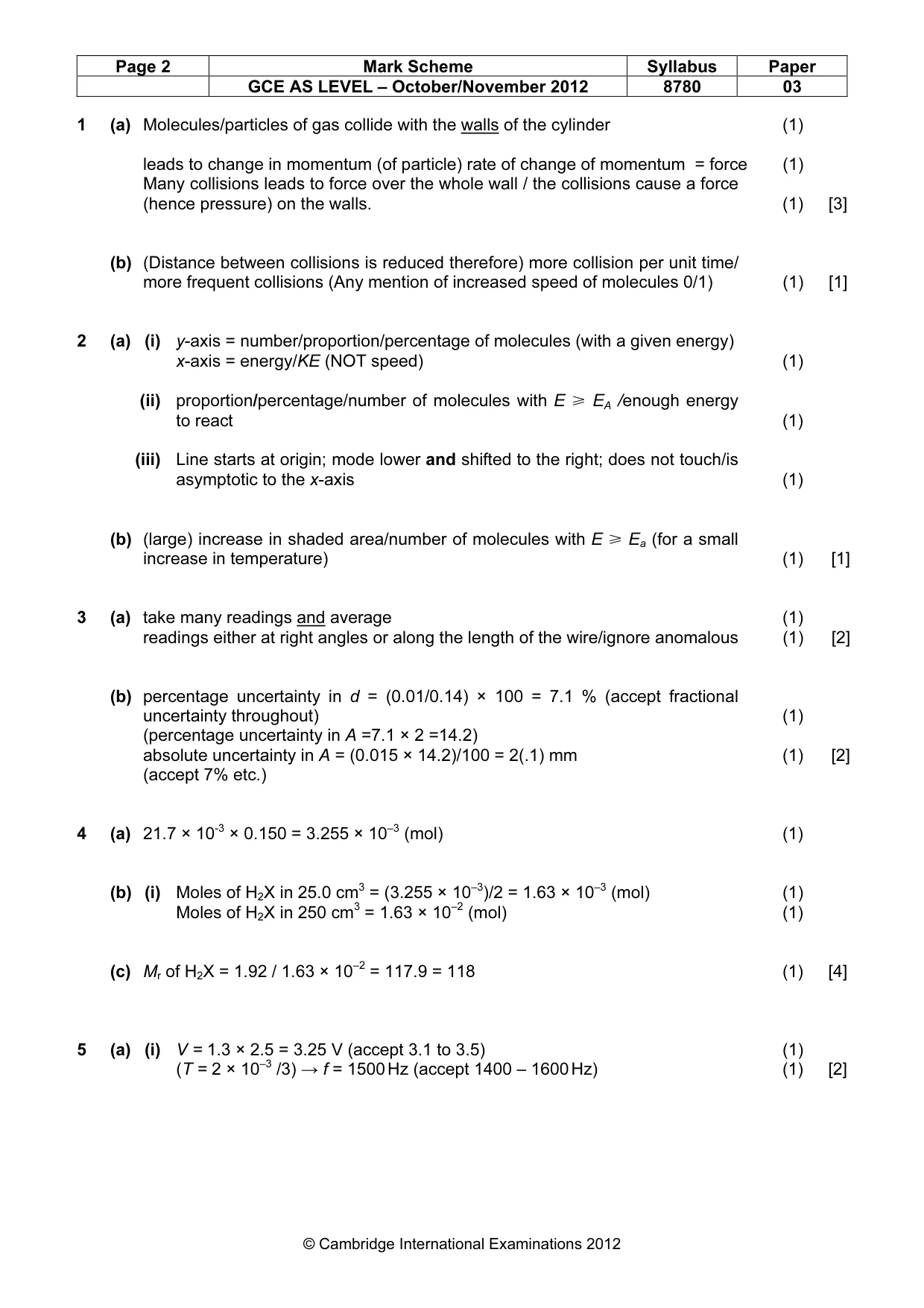
Mark scheme: 1 (a) Molecules/particles of gas collide with the walls of the cylinder (1) leads to change in momentum (of particle) rate of change of momentum = force (1) Many collisions leads to force over the whole wall / the collisions cause a force (hence pressure) on the walls. (1) [3] (b) (Distance between collisions is reduced therefore) more collision per unit time/ more frequent collisions (Any mention of increased speed of molecules 0/1) (1) [1]
Q2 · The distribution of molecular energies for an uncatalysed mixture of reactants
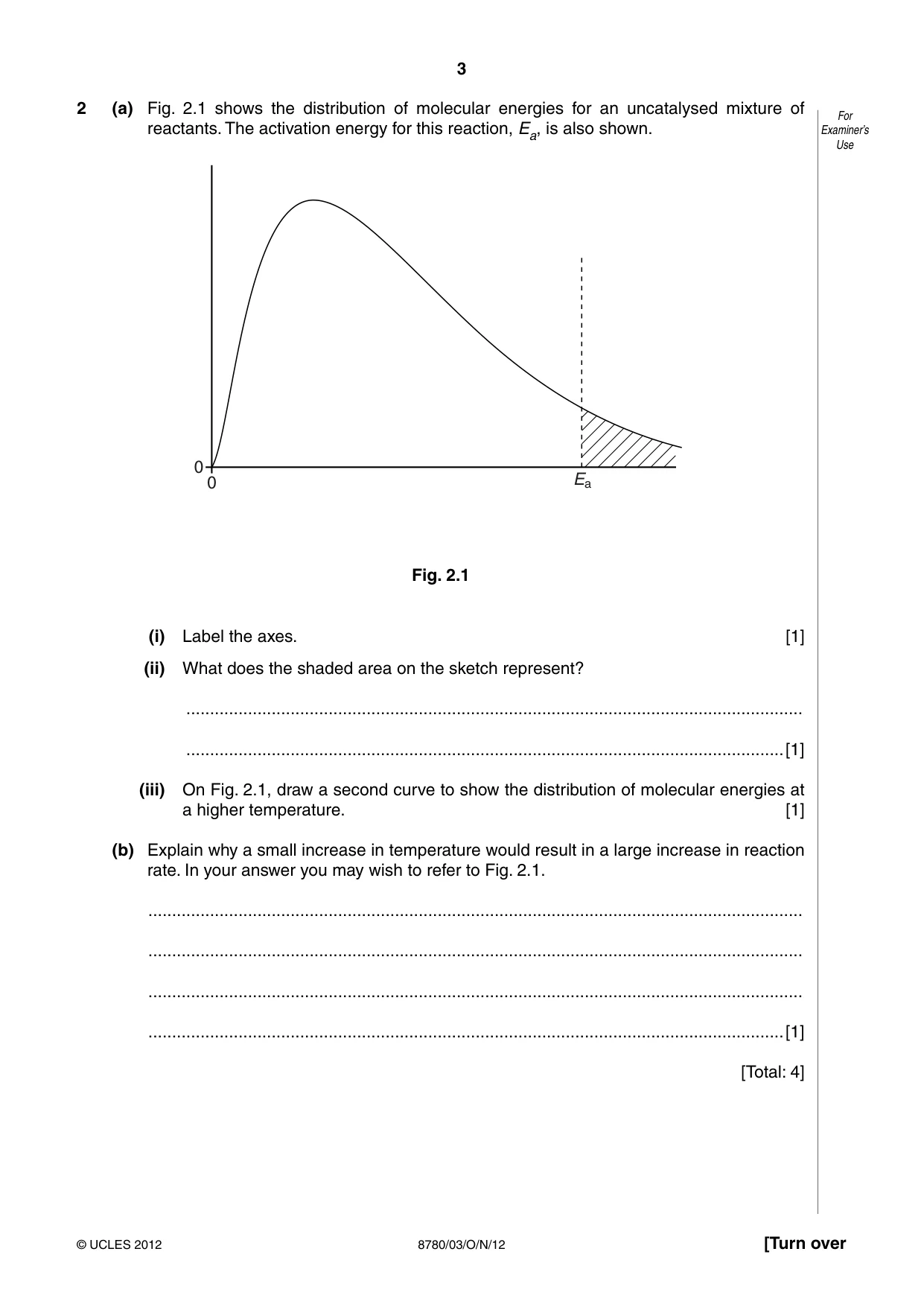
2 (a) Fig. 2.1 shows the distribution of molecular energies for an uncatalysed mixture of reactants. The activation energy for this reaction, Ea, is also shown. 0 0 Ea Fig. 2.1 (i) Label the axes. [1] (ii) What does the shaded area on the sketch represent? .................................................................................................................................. ..............................................................................................................................[1] (iii) On Fig. 2.1, draw a second curve to show the distribution of molecular energies at a higher temperature. [1] (b) Explain why a small increase in temperature would result in a large increase in reaction rate. In your answer you may wish to refer to Fig. 2.1. .......................................................................................................................................... .......................................................................................................................................... .......................................................................................................................................... ......................................................................................................................................[1] [Total: 4]
Mark scheme: 2 (a) (i) y-axis = number/proportion/percentage of molecules (with a given energy) x-axis = energy/KE (NOT speed) (1) (ii) proportion/percentage/number of molecules with E [ EA /enough energy to react (1) (iii) Line starts at origin; mode lower and shifted to the right; does not touch/is asymptotic to the x-axis (1) (b) (large) increase in shaded area/number of molecules with E [ Ea (for a small increase in temperature) (1) [1]
Q3 · A student uses a suitable measuring instrument to measure the diameter of a wire
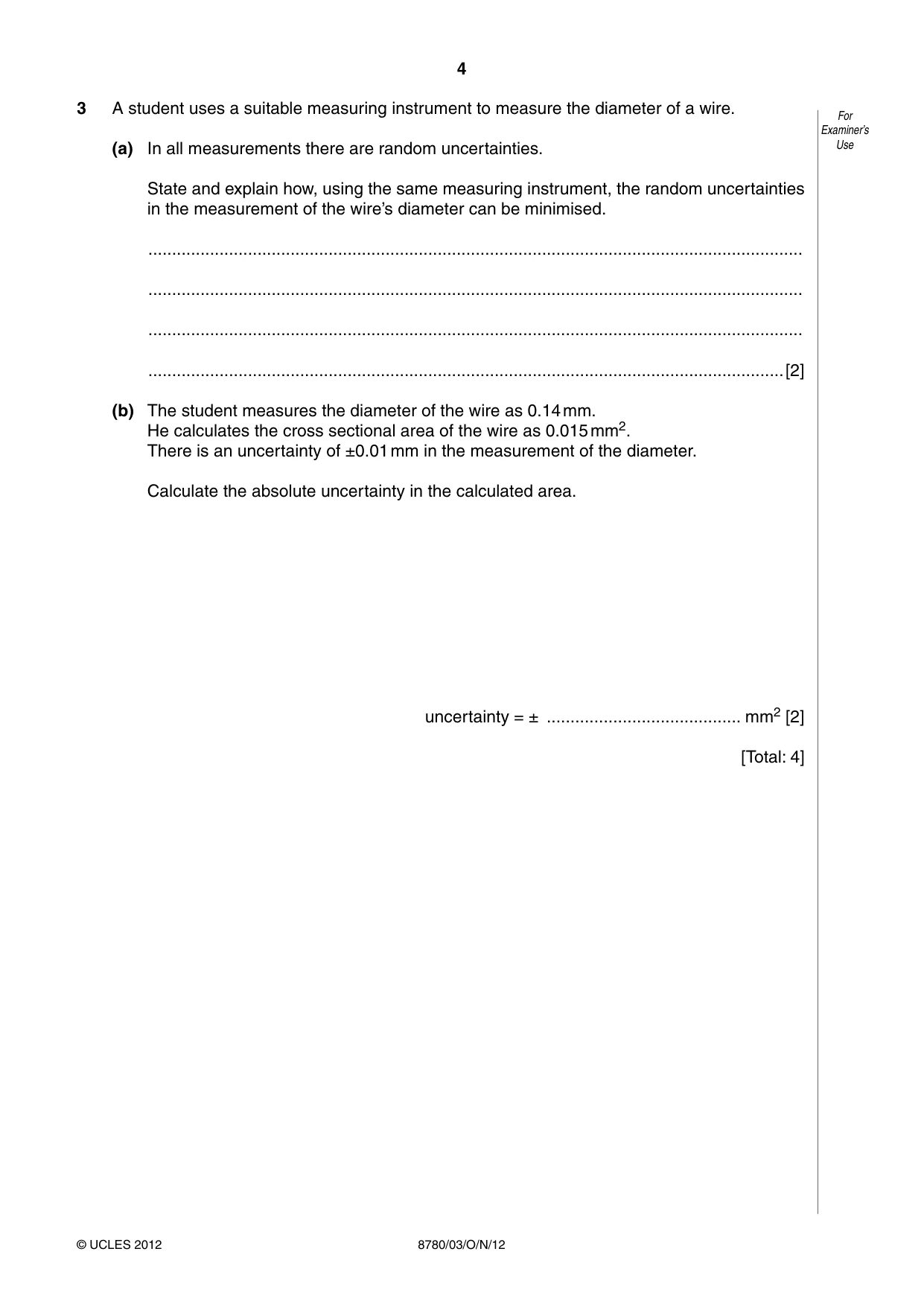
3 A student uses a suitable measuring instrument to measure the diameter of a wire. (a) In all measurements there are random uncertainties. State and explain how, using the same measuring instrument, the random uncertainties in the measurement of the wire’s diameter can be minimised. .......................................................................................................................................... .......................................................................................................................................... .......................................................................................................................................... ......................................................................................................................................[2] (b) The student measures the diameter of the wire as 0.14 mm. He calculates the cross sectional area of the wire as 0.015 mm2. There is an uncertainty of ±0.01 mm in the measurement of the diameter. Calculate the absolute uncertainty in the calculated area. uncertainty = ± ......................................... mm2 [2] [Total: 4]
Mark scheme: 3 (a) take many readings and average (1) readings either at right angles or along the length of the wire/ignore anomalous (1) [2] (b) percentage uncertainty in d = (0.01/0.14) × 100 = 7.1 % (accept fractional uncertainty throughout) (1) (percentage uncertainty in A =7.1 × 2 =14.2) absolute uncertainty in A = (0.015 × 14.2)/100 = 2(.1) mm (1) [2] (accept 7% etc.) 3 3
Q4 · An acid, H2X, reacts with sodium hydroxide, NaOH, as shown in the equation below
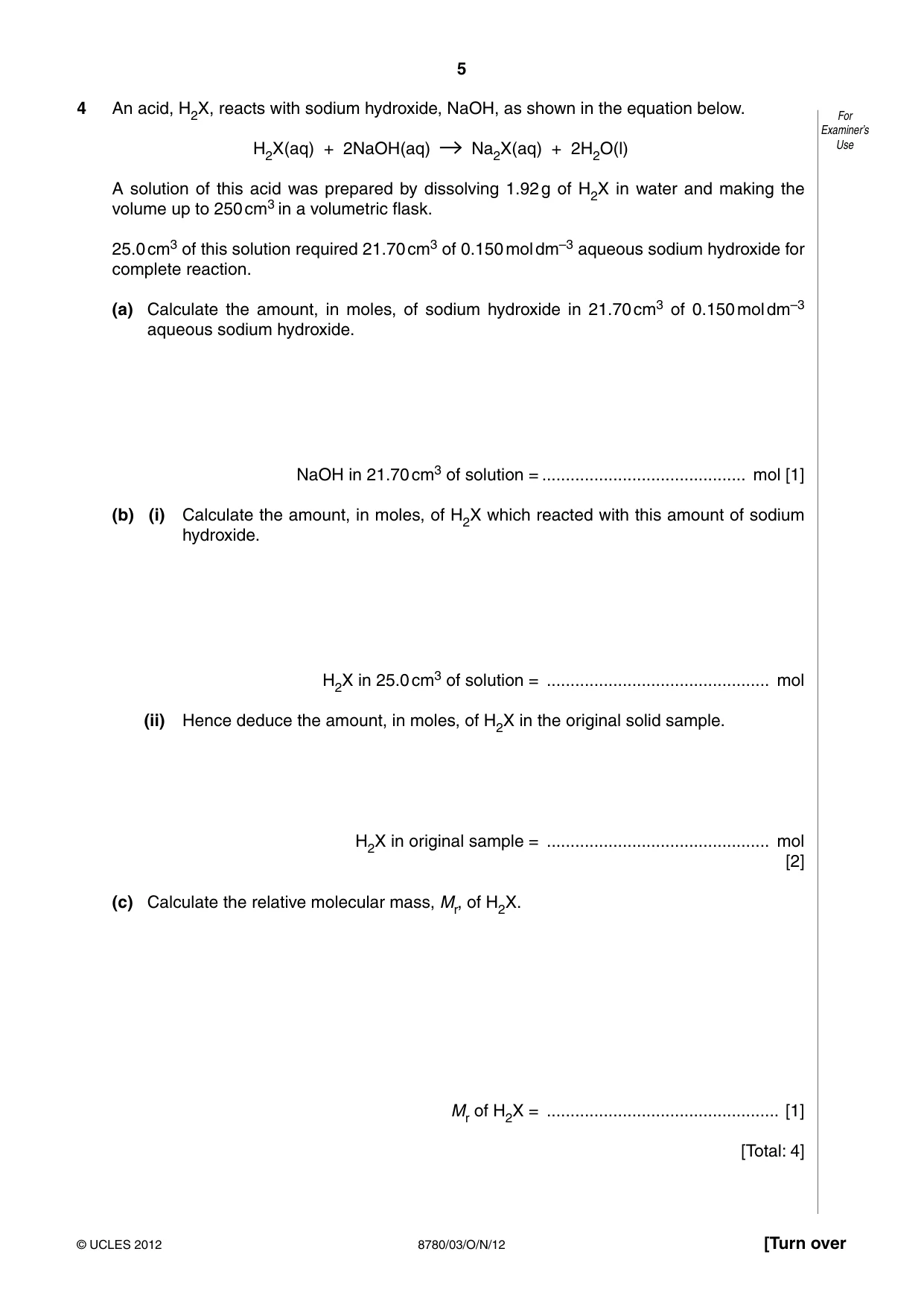
4 An acid, H2X, reacts with sodium hydroxide, NaOH, as shown in the equation below. H2X(aq) + 2NaOH(aq) Na2X(aq) + 2H2O(l) A solution of this acid was prepared by dissolving 1.92 g of H2X in water and making the volume up to 250 cm3 in a volumetric flask. 25.0 cm3 of this solution required 21.70 cm3 of 0.150 mol dm–3 aqueous sodium hydroxide for complete reaction. (a) Calculate the amount, in moles, of sodium hydroxide in 21.70 cm3 of 0.150 mol dm–3 aqueous sodium hydroxide. NaOH in 21.70 cm3 of solution = ........................................... mol [1] (b) (i) Calculate the amount, in moles, of H2X which reacted with this amount of sodium hydroxide. H2X in 25.0 cm3 of solution = ............................................... mol (ii) Hence deduce the amount, in moles, of H2X in the original solid sample. H2X in original sample = ............................................... mol [2] (c) Calculate the relative molecular mass, Mr, of H2X. Mr of H2X = ................................................. [1] [Total: 4]
Mark scheme: 4 (a) 21.7 × 10-3 × 0.150 = 3.255 × 10⁻³ (mol) (1) (b) (i) Moles of H2X in 25.0 cm3 = (3.255 × 10⁻³)/2 = 1.63 × 10⁻³ (mol) (1) Moles of H2X in 250 cm3 = 1.63 × 10⁻² (mol) (1) (c) Mr of H2X = 1.92 / 1.63 × 10–2 = 117.9 = 118 (1) [4]
Q5 · A signal generator connected to a cathode ray oscilloscope (c.r.o.)
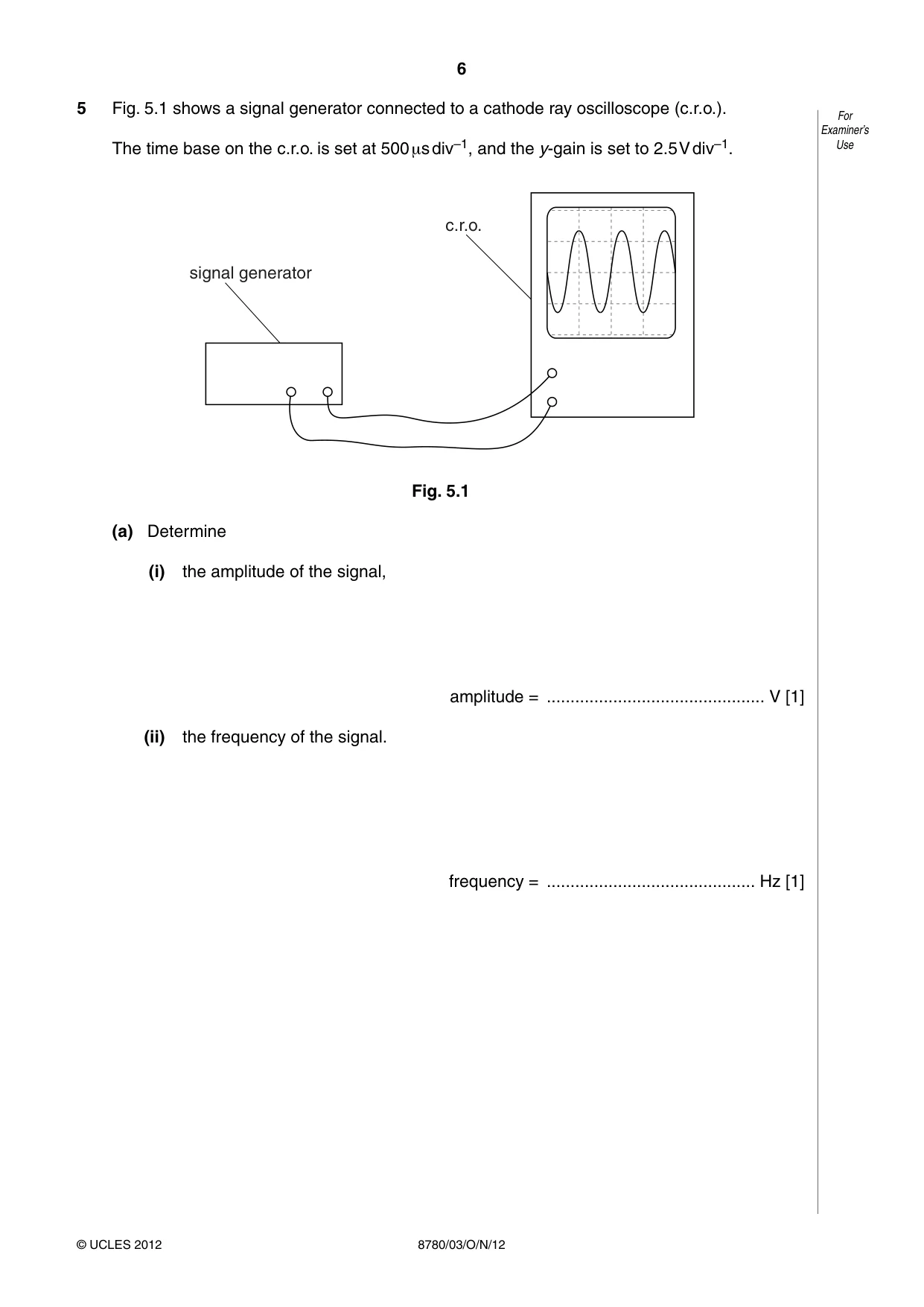
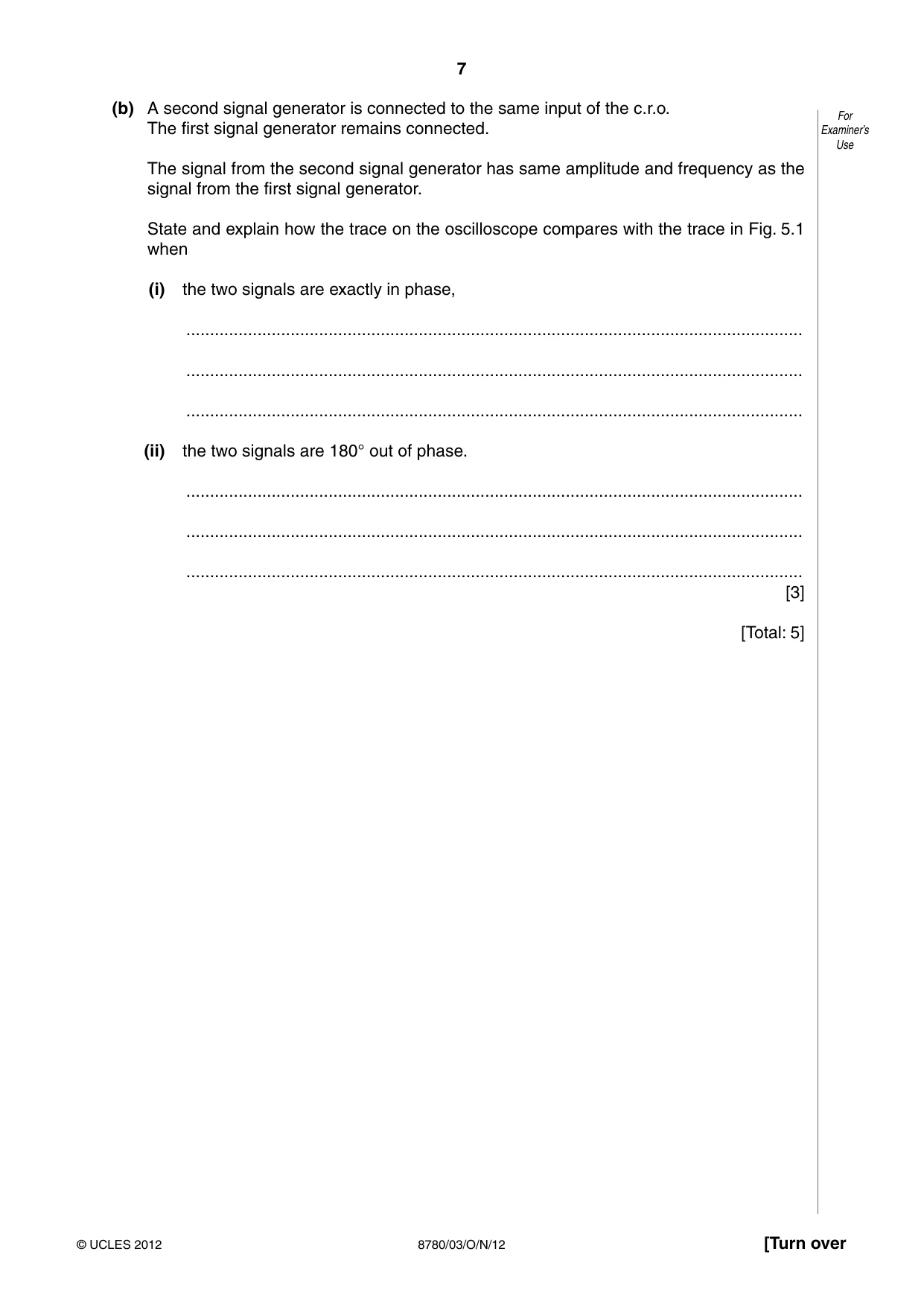
5 Fig. 5.1 shows a signal generator connected to a cathode ray oscilloscope (c.r.o.). The time base on the c.r.o. is set at 500 μs div–1, and the y-gain is set to 2.5 V div–1. c.r.o. signal generator Fig. 5.1 (a) Determine (i) the amplitude of the signal, amplitude = .............................................. V [1] (ii) the frequency of the signal. frequency = ............................................ Hz [1] (b) A second signal generator is connected to the same input of the c.r.o. The first signal generator remains connected. The signal from the second signal generator has same amplitude and frequency as the signal from the first signal generator. State and explain how the trace on the oscilloscope compares with the trace in Fig. 5.1 when (i) the two signals are exactly in phase, .................................................................................................................................. .................................................................................................................................. .................................................................................................................................. (ii) the two signals are 180° out of phase. .................................................................................................................................. .................................................................................................................................. .................................................................................................................................. [3] [Total: 5]
Mark scheme: 5 (a) (i) V = 1.3 × 2.5 = 3.25 V (accept 3.1 to 3.5) (1) (T = 2 × 10⁻³ /3) → f = 1500 Hz (accept 1400 – 1600 Hz) (1) [2] GCE AS LEVEL – October/November 2012 8780 03 (b) (i) Amplitude doubled, frequency unchanged (1) (ii) zero amplitude (1) mention of addition or subtraction (accept cancel for (ii)) or correct mention of constructive/destructive interference of signals in (i) or (ii) [to score this mark at least one of the marks in (i) or (ii) must be scored or it is clear the amplitude increased in (i) / decreased in (ii)] (1) [3]
Q6 · A student determines a value for the enthalpy change of combustion of propan-1-ol…
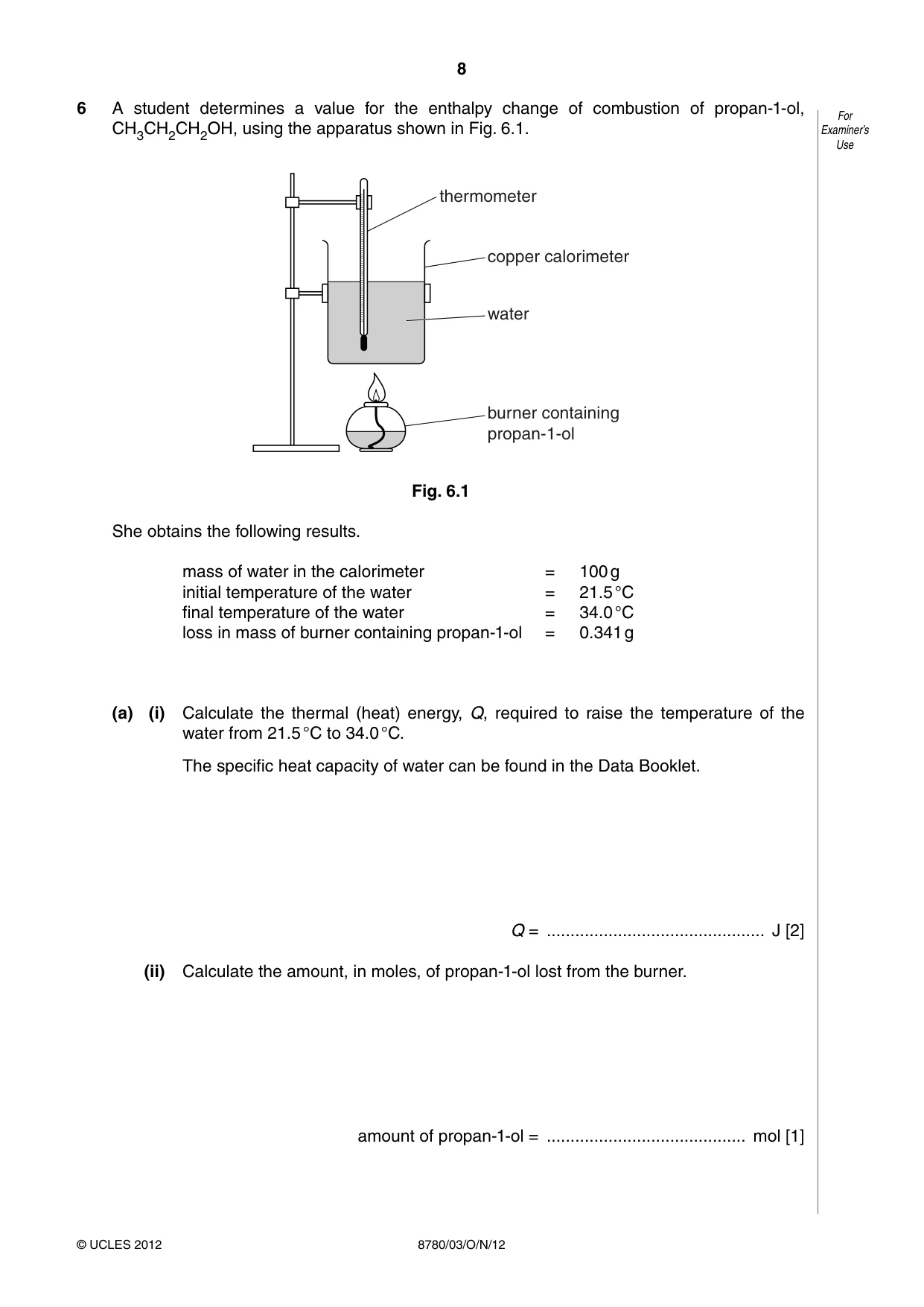
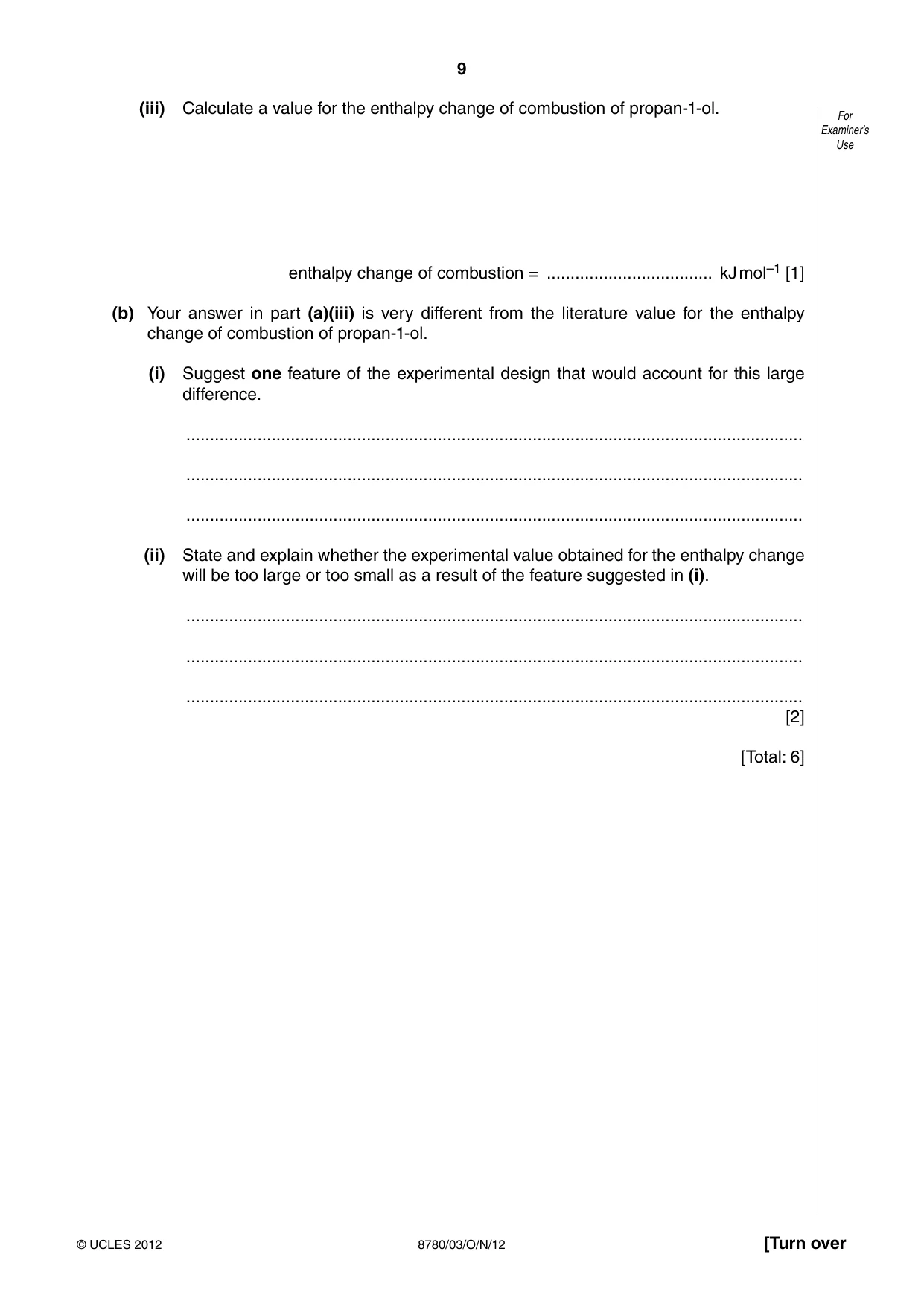
6 A student determines a value for the enthalpy change of combustion of propan-1-ol, CH3CH2CH2OH, using the apparatus shown in Fig. 6.1. thermometer copper calorimeter water burner containing propan-1-ol Fig. 6.1 She obtains the following results. mass of water in the calorimeter = 100 g initial temperature of the water = 21.5 °C final temperature of the water = 34.0 °C loss in mass of burner containing propan-1-ol = 0.341 g (a) (i) Calculate the thermal (heat) energy, Q, required to raise the temperature of the water from 21.5 °C to 34.0 °C. The specific heat capacity of water can be found in the Data Booklet. Q = .............................................. J [2] (ii) Calculate the amount, in moles, of propan-1-ol lost from the burner. amount of propan-1-ol = .......................................... mol [1] (iii) Calculate a value for the enthalpy change of combustion of propan-1-ol. enthalpy change of combustion = ................................... kJ mol–1 [1] (b) Your answer in part (a)(iii) is very different from the literature value for the enthalpy change of combustion of propan-1-ol. (i) Suggest one feature of the experimental design that would account for this large difference. .................................................................................................................................. .................................................................................................................................. .................................................................................................................................. (ii) State and explain whether the experimental value obtained for the enthalpy change will be too large or too small as a result of the feature suggested in (i). .................................................................................................................................. .................................................................................................................................. .................................................................................................................................. [2] [Total: 6]
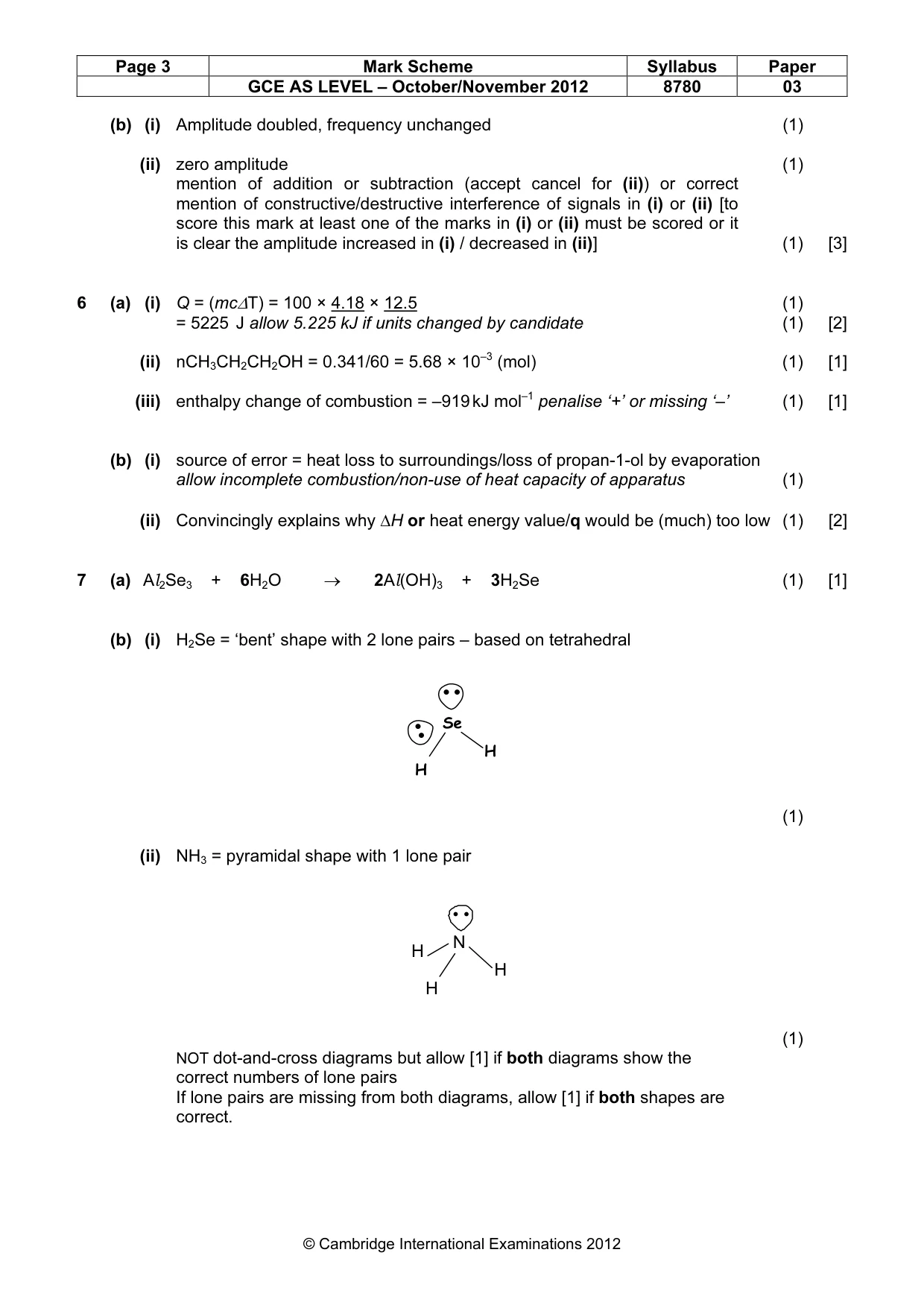
Mark scheme: 6 (a) (i) Q = (mc∆T) = 100 × 4.18 × 12.5 (1) = 5225 J allow 5.225 kJ if units changed by candidate (1) [2] (ii) nCH3CH2CH2OH = 0.341/60 = 5.68 × 10⁻³ (mol) (1) [1] (iii) enthalpy change of combustion = –919 kJ mol–1 penalise ‘+’ or missing ‘–’ (1) [1] (b) (i) source of error = heat loss to surroundings/loss of propan-1-ol by evaporation allow incomplete combustion/non-use of heat capacity of apparatus (1) (ii) Convincingly explains why ∆H or heat energy value/q would be (much) too low (1) [2]
Q7 · Selenium is an element in Group VI
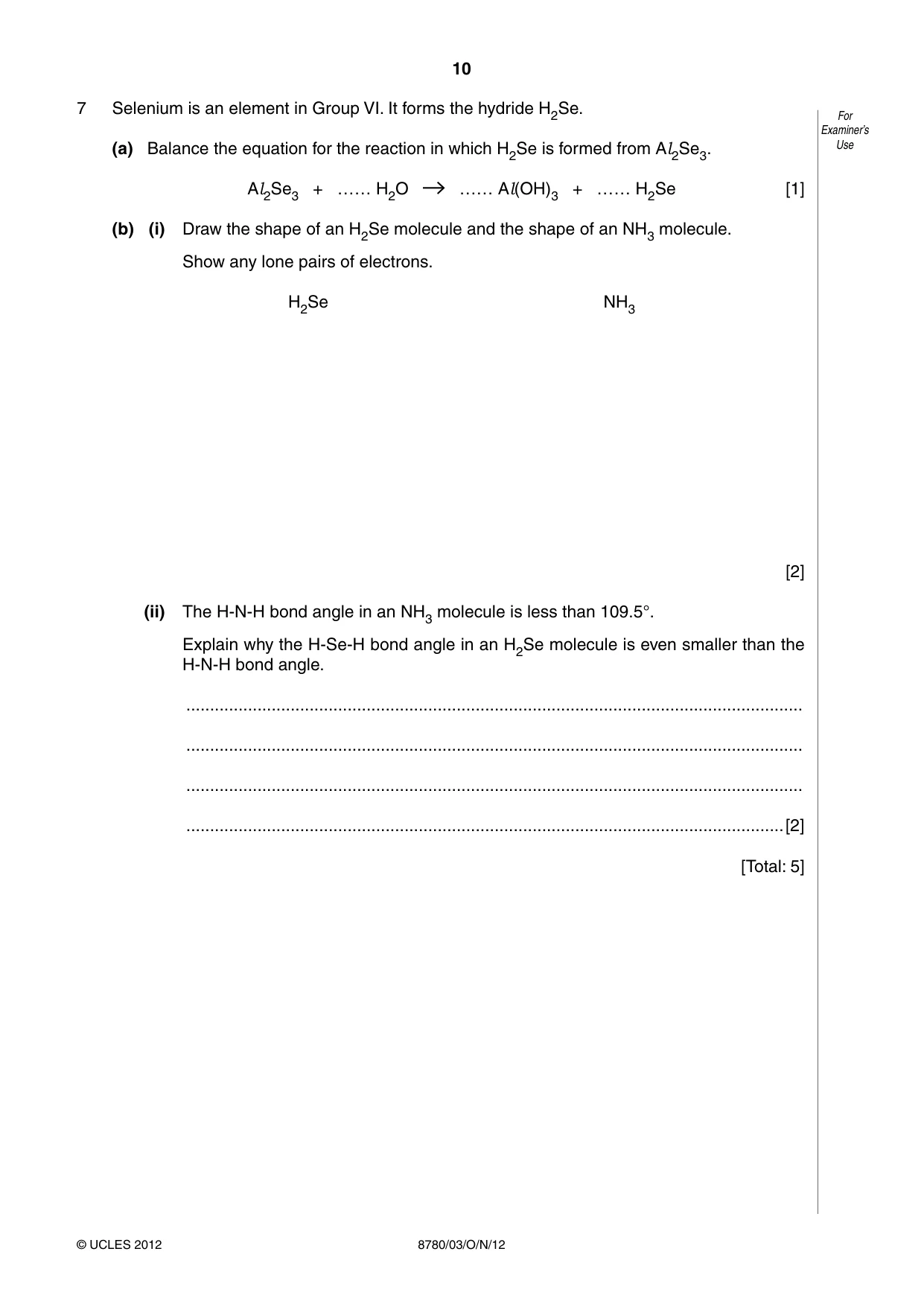
7 Selenium is an element in Group VI. It forms the hydride H2Se. (a) Balance the equation for the reaction in which H2Se is formed from Al2Se3. Al2Se3 + …… H2O …… Al(OH)3 + …… H2Se [1] (b) (i) Draw the shape of an H2Se molecule and the shape of an NH3 molecule. Show any lone pairs of electrons. H2Se NH3 [2] (ii) The H-N-H bond angle in an NH3 molecule is less than 109.5°. Explain why the H-Se-H bond angle in an H2Se molecule is even smaller than the H-N-H bond angle. .................................................................................................................................. .................................................................................................................................. .................................................................................................................................. ..............................................................................................................................[2] [Total: 5]
Mark scheme: 7 (a) Al2Se3 + 6H2O → 2Al(OH)3 + 3H2Se (1) [1] (b) (i) H2Se = ‘bent’ shape with 2 lone pairs – based on tetrahedral • • • Se • H H (1) (ii) NH3 = pyramidal shape with 1 lone pair • • N H H H (1) NOT dot-and-cross diagrams but allow [1] if both diagrams show the correct numbers of lone pairs If lone pairs are missing from both diagrams, allow [1] if both shapes are correct. GCE AS LEVEL – October/November 2012 8780 03 (iii) Se has 2 lone pairs but N has only 1 lone pair /allow Se has more lone pairs than N (1) Lone pairs repel more strongly than bonding pairs / etc. reference to repulsion of atoms negates (1) [4]
Q8 · Carbon has several isotopes
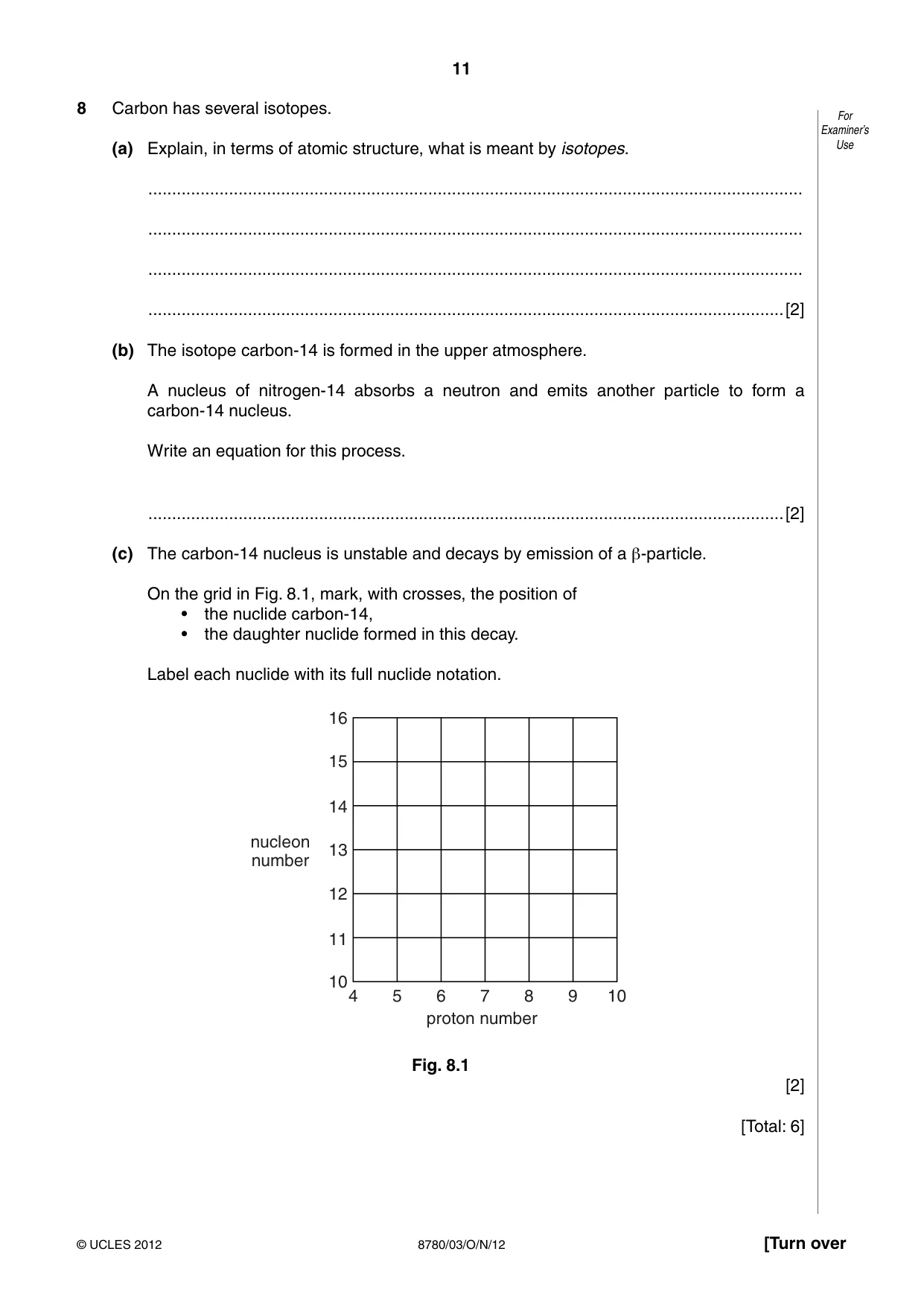
8 Carbon has several isotopes. (a) Explain, in terms of atomic structure, what is meant by isotopes. .......................................................................................................................................... .......................................................................................................................................... .......................................................................................................................................... ......................................................................................................................................[2] (b) The isotope carbon-14 is formed in the upper atmosphere. A nucleus of nitrogen-14 absorbs a neutron and emits another particle to form a carbon-14 nucleus. Write an equation for this process. ......................................................................................................................................[2] (c) The carbon-14 nucleus is unstable and decays by emission of a β-particle. On the grid in Fig. 8.1, mark, with crosses, the position of • the nuclide carbon-14, • the daughter nuclide formed in this decay. Label each nuclide with its full nuclide notation. 16 15 14 nucleon 13 number 12 11 10 4 5 6 7 8 9 10 proton number Fig. 8.1 [2] [Total: 6]
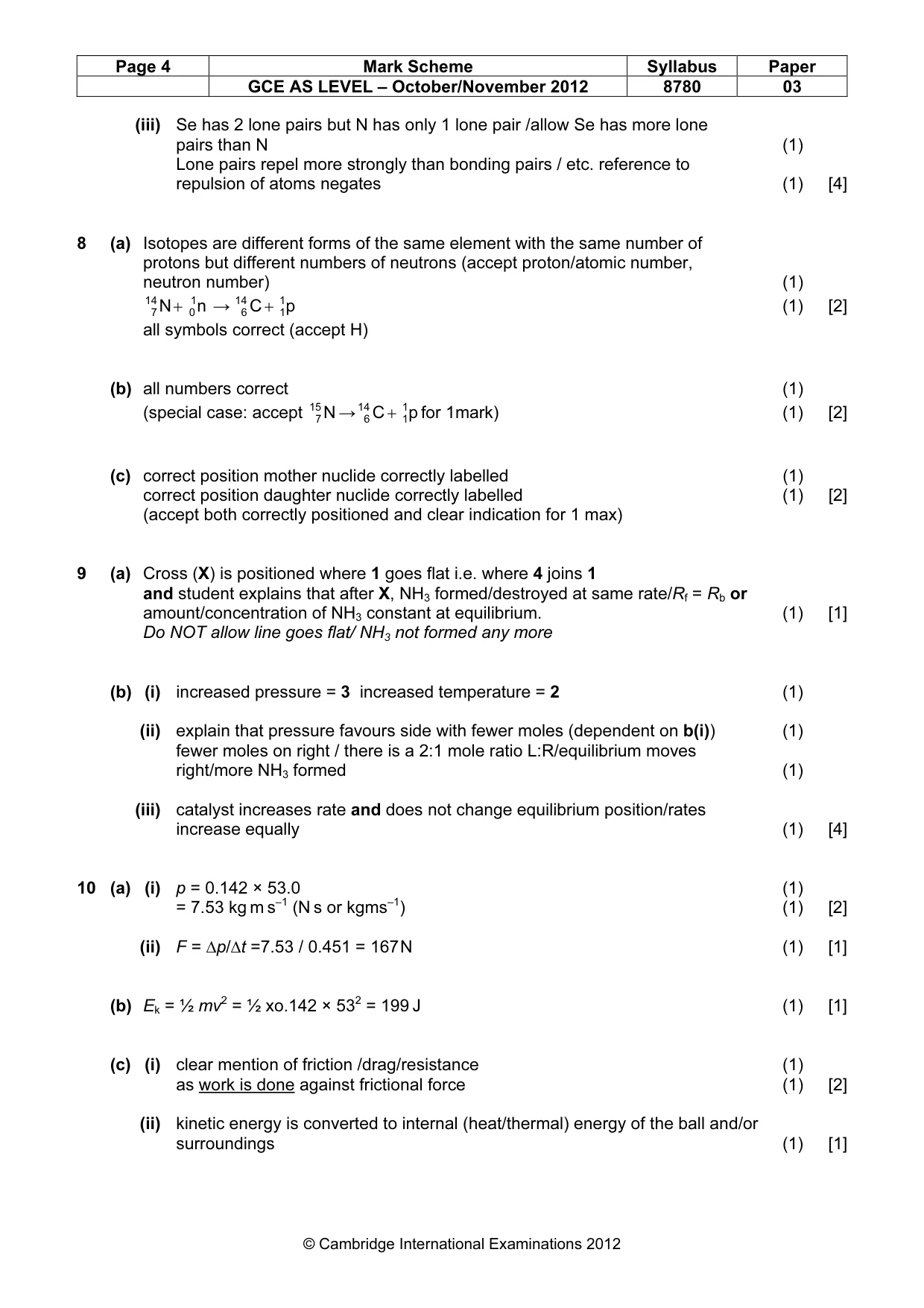
Mark scheme: 8 (a) Isotopes are different forms of the same element with the same number of protons but different numbers of neutrons (accept proton/atomic number, neutron number) (1) 14 7 N + 01 n → 146 C + 11 p (1) [2] all symbols correct (accept H) (b) all numbers correct (1) (special case: accept 157 N → 146 C + 11 p for 1mark) (1) [2] (c) correct position mother nuclide correctly labelled (1) correct position daughter nuclide correctly labelled (1) [2] (accept both correctly positioned and clear indication for 1 max)
Q9 · In the gas phase, hydrogen reacts with nitrogen to form ammonia
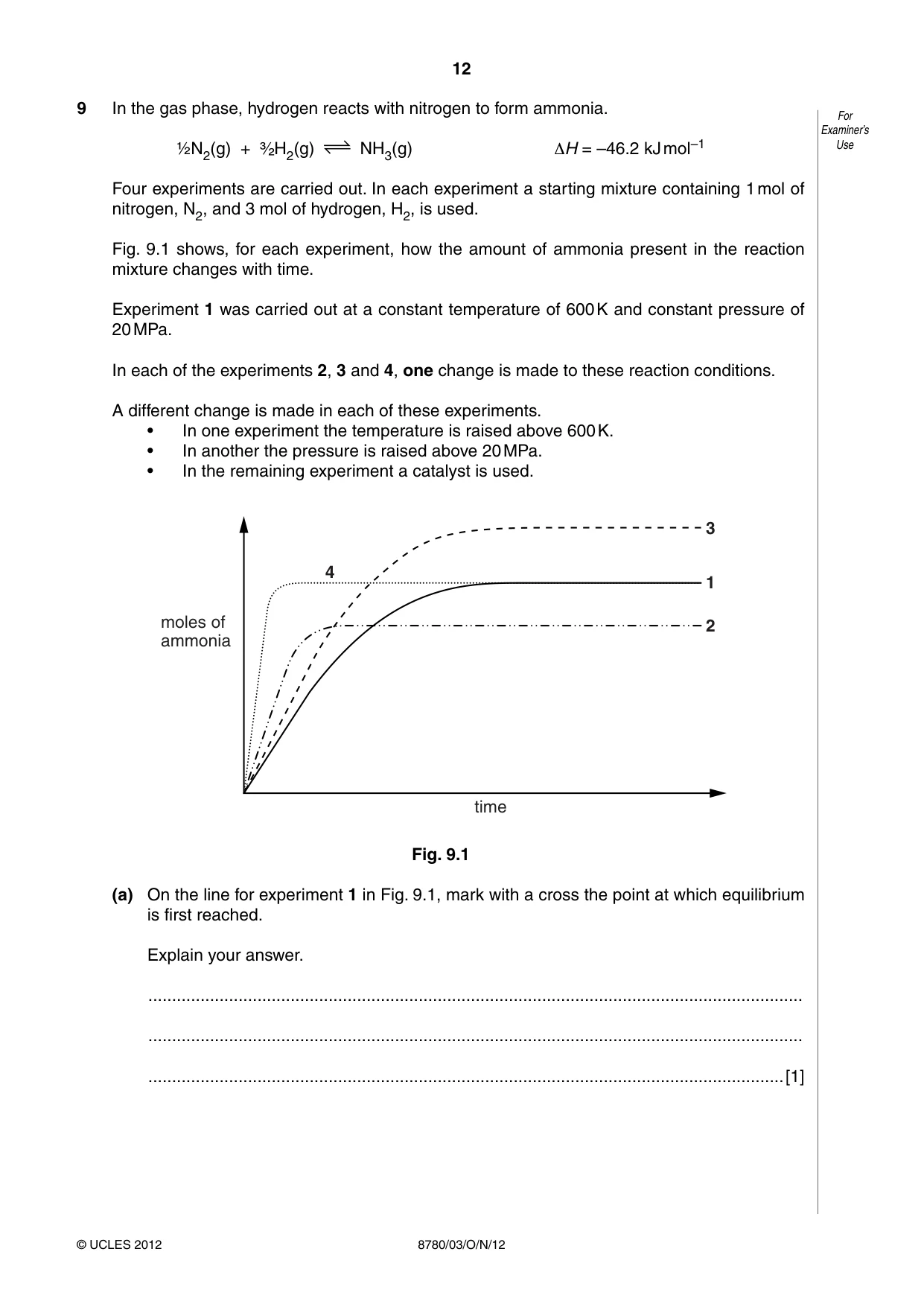
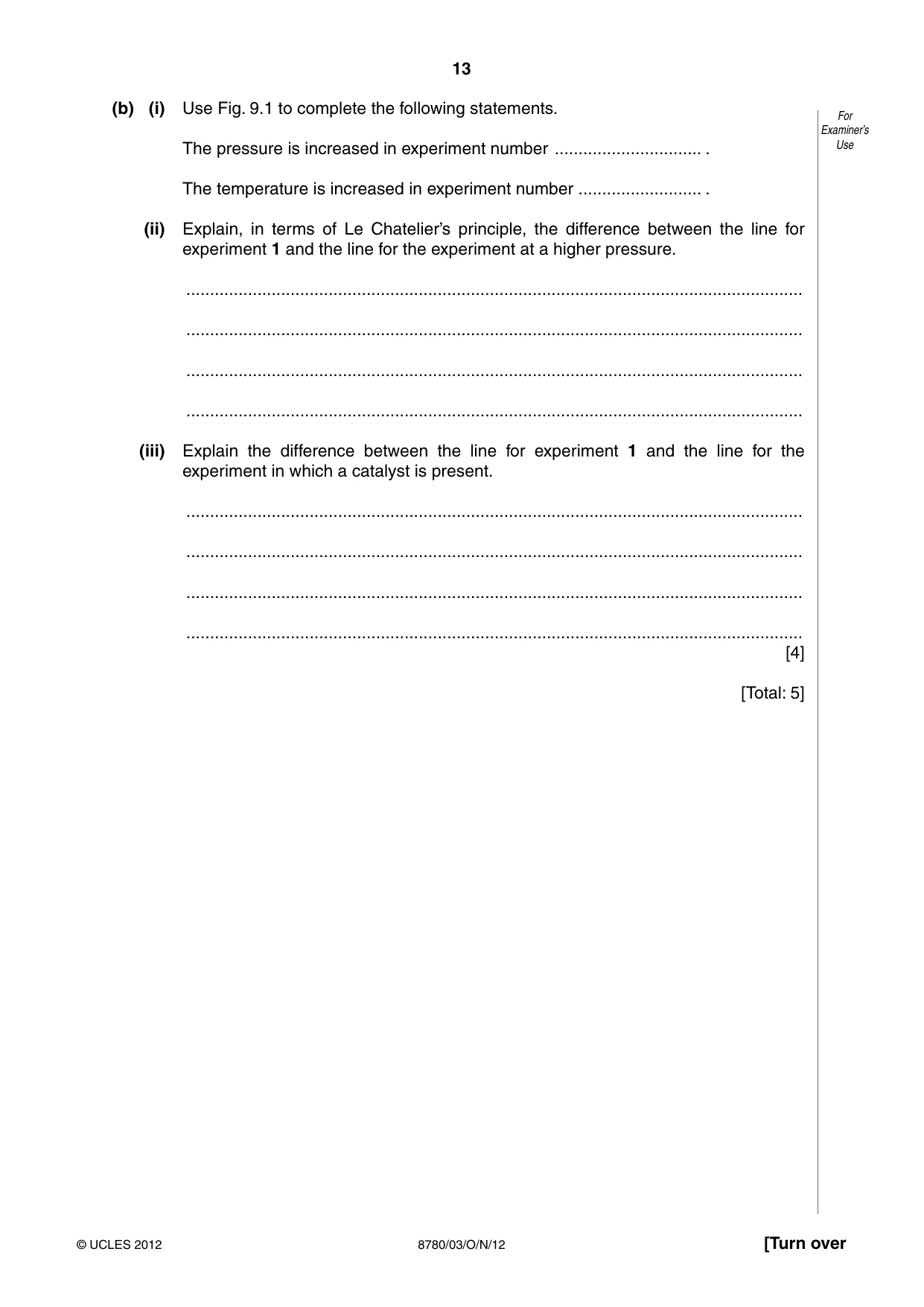
9 In the gas phase, hydrogen reacts with nitrogen to form ammonia. ½N2(g) + ³⁄²H2(g) NH3(g) ΔH = –46.2 kJ mol–1 Four experiments are carried out. In each experiment a starting mixture containing 1 mol of nitrogen, N2, and 3 mol of hydrogen, H2, is used. Fig. 9.1 shows, for each experiment, how the amount of ammonia present in the reaction mixture changes with time. Experiment 1 was carried out at a constant temperature of 600 K and constant pressure of 20 MPa. In each of the experiments 2, 3 and 4, one change is made to these reaction conditions. A different change is made in each of these experiments. • In one experiment the temperature is raised above 600 K. • In another the pressure is raised above 20 MPa. • In the remaining experiment a catalyst is used. 3 4 1 moles of 2 ammonia time Fig. 9.1 (a) On the line for experiment 1 in Fig. 9.1, mark with a cross the point at which equilibrium is first reached. Explain your answer. .......................................................................................................................................... .......................................................................................................................................... ......................................................................................................................................[1] (b) (i) Use Fig. 9.1 to complete the following statements. The pressure is increased in experiment number ............................... . The temperature is increased in experiment number .......................... . (ii) Explain, in terms of Le Chatelier’s principle, the difference between the line for experiment 1 and the line for the experiment at a higher pressure. .................................................................................................................................. .................................................................................................................................. .................................................................................................................................. .................................................................................................................................. (iii) Explain the difference between the line for experiment 1 and the line for the experiment in which a catalyst is present. .................................................................................................................................. .................................................................................................................................. .................................................................................................................................. .................................................................................................................................. [4] [Total: 5]
Mark scheme: 9 (a) Cross (X) is positioned where 1 goes flat i.e. where 4 joins 1 and student explains that after X, NH3 formed/destroyed at same rate/Rf = Rb or amount/concentration of NH3 constant at equilibrium. (1) [1] Do NOT allow line goes flat/ NH3 not formed any more (b) (i) increased pressure = 3 increased temperature = 2 (1) (ii) explain that pressure favours side with fewer moles (dependent on b(i)) (1) fewer moles on right / there is a 2:1 mole ratio L:R/equilibrium moves right/more NH3 formed (1) (iii) catalyst increases rate and does not change equilibrium position/rates increase equally (1) [4]
Q10 · A tennis player serving
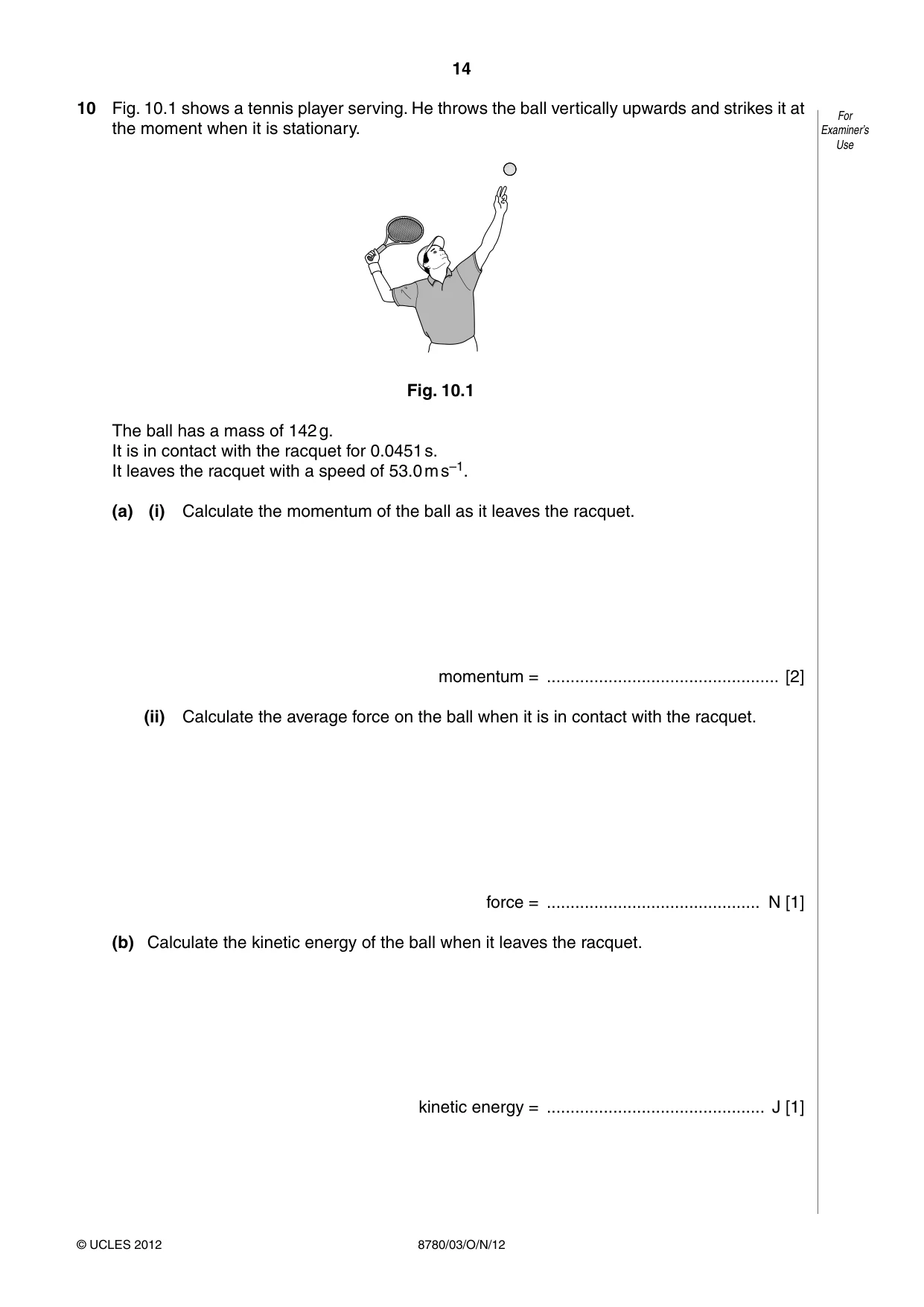
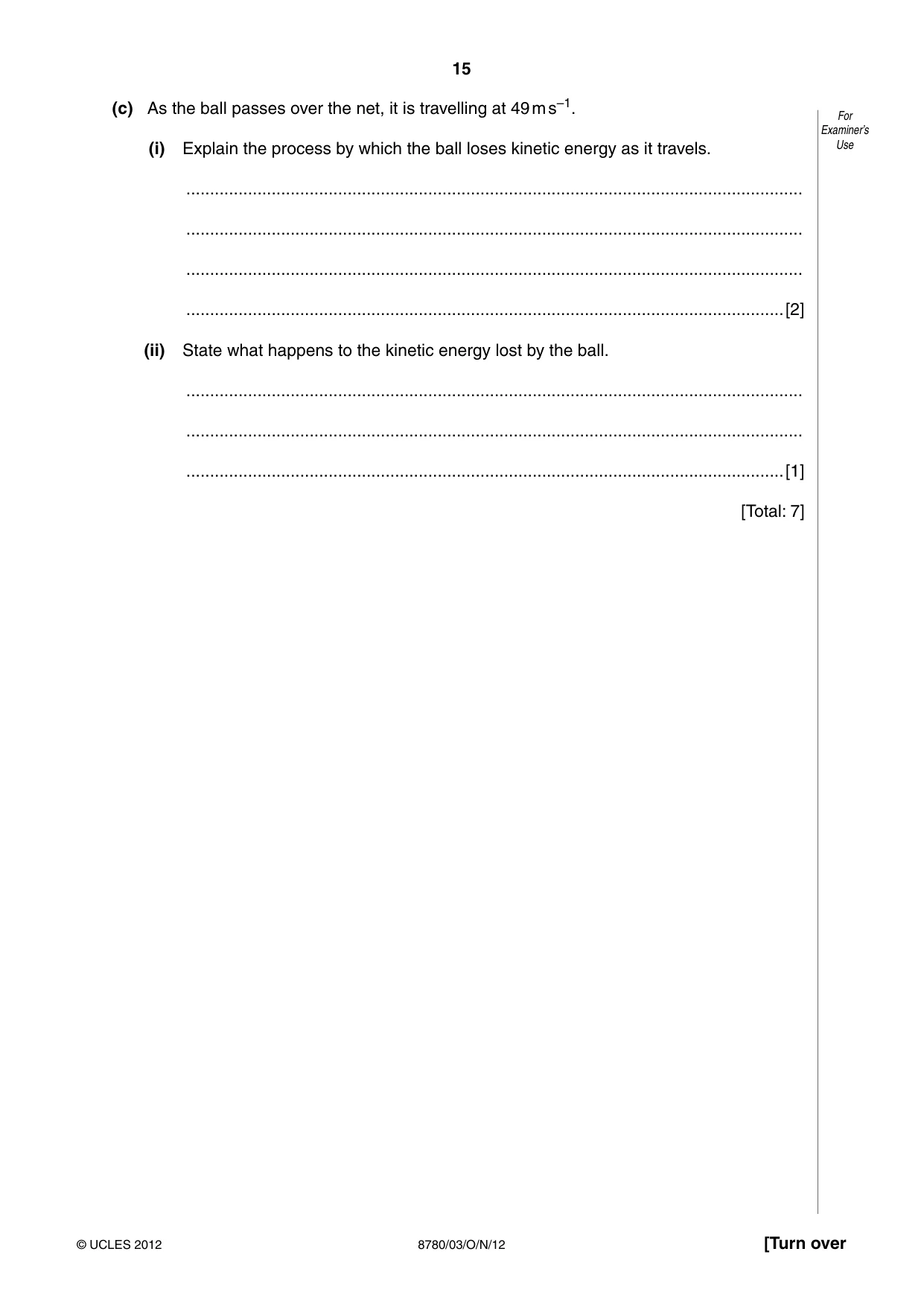
10 Fig. 10.1 shows a tennis player serving. He throws the ball vertically upwards and strikes it at the moment when it is stationary. Fig. 10.1 The ball has a mass of 142 g. It is in contact with the racquet for 0.0451 s. It leaves the racquet with a speed of 53.0 m s–1. (a) (i) Calculate the momentum of the ball as it leaves the racquet. momentum = ................................................. [2] (ii) Calculate the average force on the ball when it is in contact with the racquet. force = ............................................. N [1] (b) Calculate the kinetic energy of the ball when it leaves the racquet. kinetic energy = .............................................. J [1] (c) As the ball passes over the net, it is travelling at 49 m s–1. (i) Explain the process by which the ball loses kinetic energy as it travels. .................................................................................................................................. .................................................................................................................................. .................................................................................................................................. ..............................................................................................................................[2] (ii) State what happens to the kinetic energy lost by the ball. .................................................................................................................................. .................................................................................................................................. ..............................................................................................................................[1] [Total: 7]
Mark scheme: 10 (a) (i) p = 0.142 × 53.0 (1) = 7.53 kg m s–1 (N s or kgms–1) (1) [2] (ii) F = ∆p/∆t =7.53 / 0.451 = 167 N (1) [1] (b) Ek = ½ mv2 = ½ xo.142 × 532 = 199 J (1) [1] (c) (i) clear mention of friction /drag/resistance (1) as work is done against frictional force (1) [2] (ii) kinetic energy is converted to internal (heat/thermal) energy of the ball and/or surroundings (1) [1] GCE AS LEVEL – October/November 2012 8780 03
Q11 · A pair of parallel metal plates 5.0 cm apart in an evacuated tube
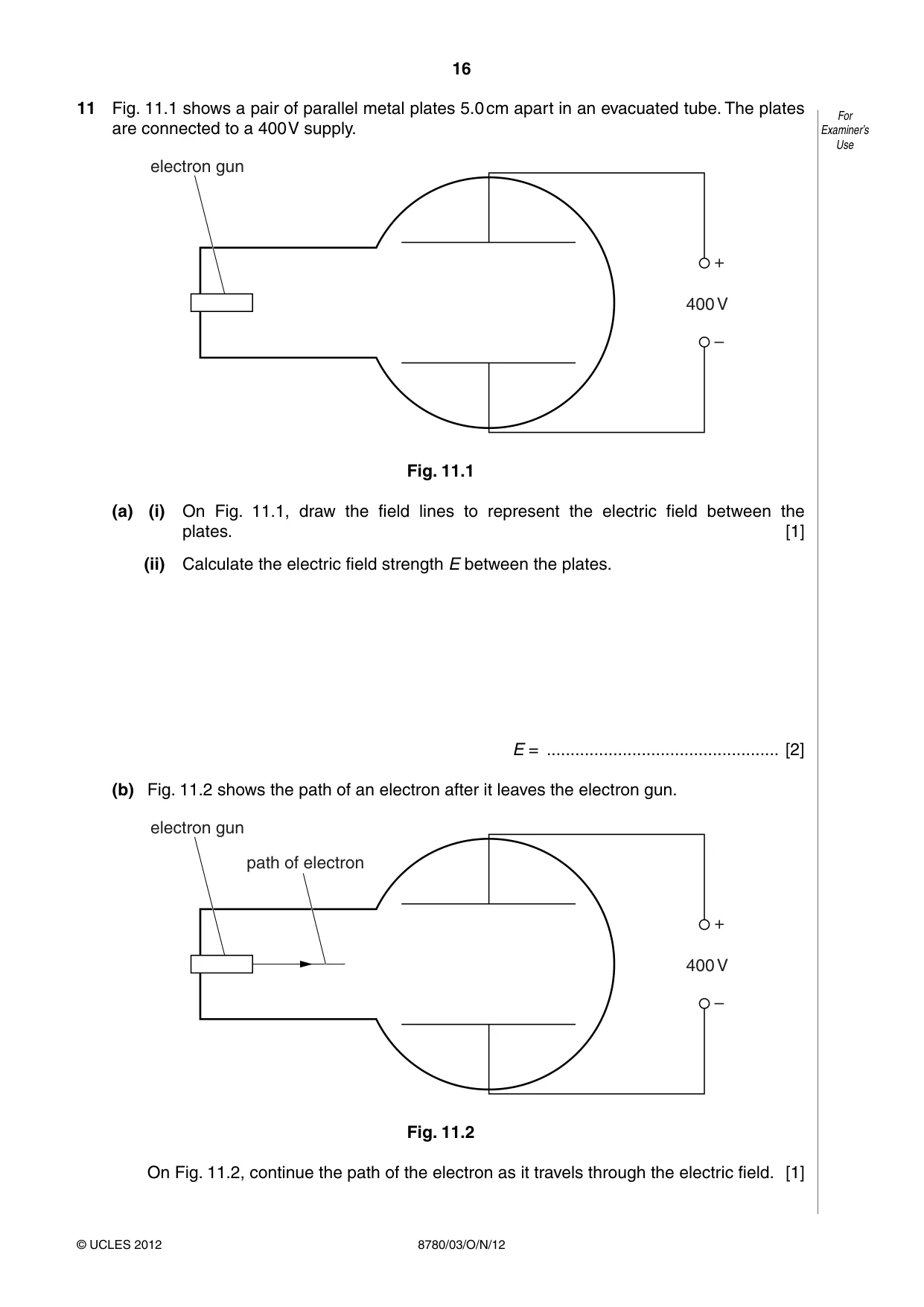
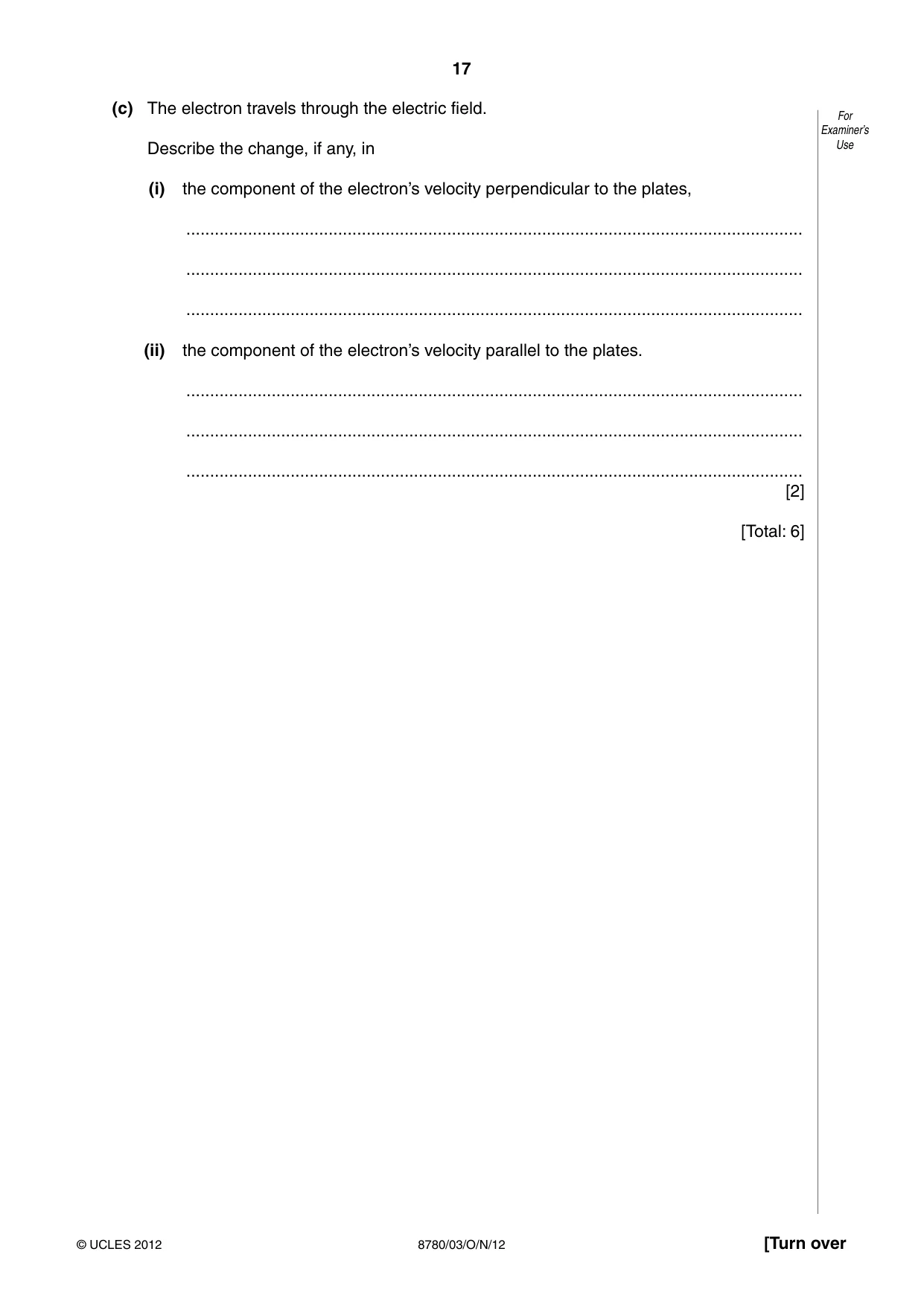
11 Fig. 11.1 shows a pair of parallel metal plates 5.0 cm apart in an evacuated tube. The plates are connected to a 400 V supply. electron gun + 400 V – Fig. 11.1 (a) (i) On Fig. 11.1, draw the field lines to represent the electric field between the plates. [1] (ii) Calculate the electric field strength E between the plates. E = ................................................. [2] (b) Fig. 11.2 shows the path of an electron after it leaves the electron gun. electron gun path of electron + 400 V – Fig. 11.2 On Fig. 11.2, continue the path of the electron as it travels through the electric field. [1] (c) The electron travels through the electric field. Describe the change, if any, in (i) the component of the electron’s velocity perpendicular to the plates, .................................................................................................................................. .................................................................................................................................. .................................................................................................................................. (ii) the component of the electron’s velocity parallel to the plates. .................................................................................................................................. .................................................................................................................................. .................................................................................................................................. [2] [Total: 6]
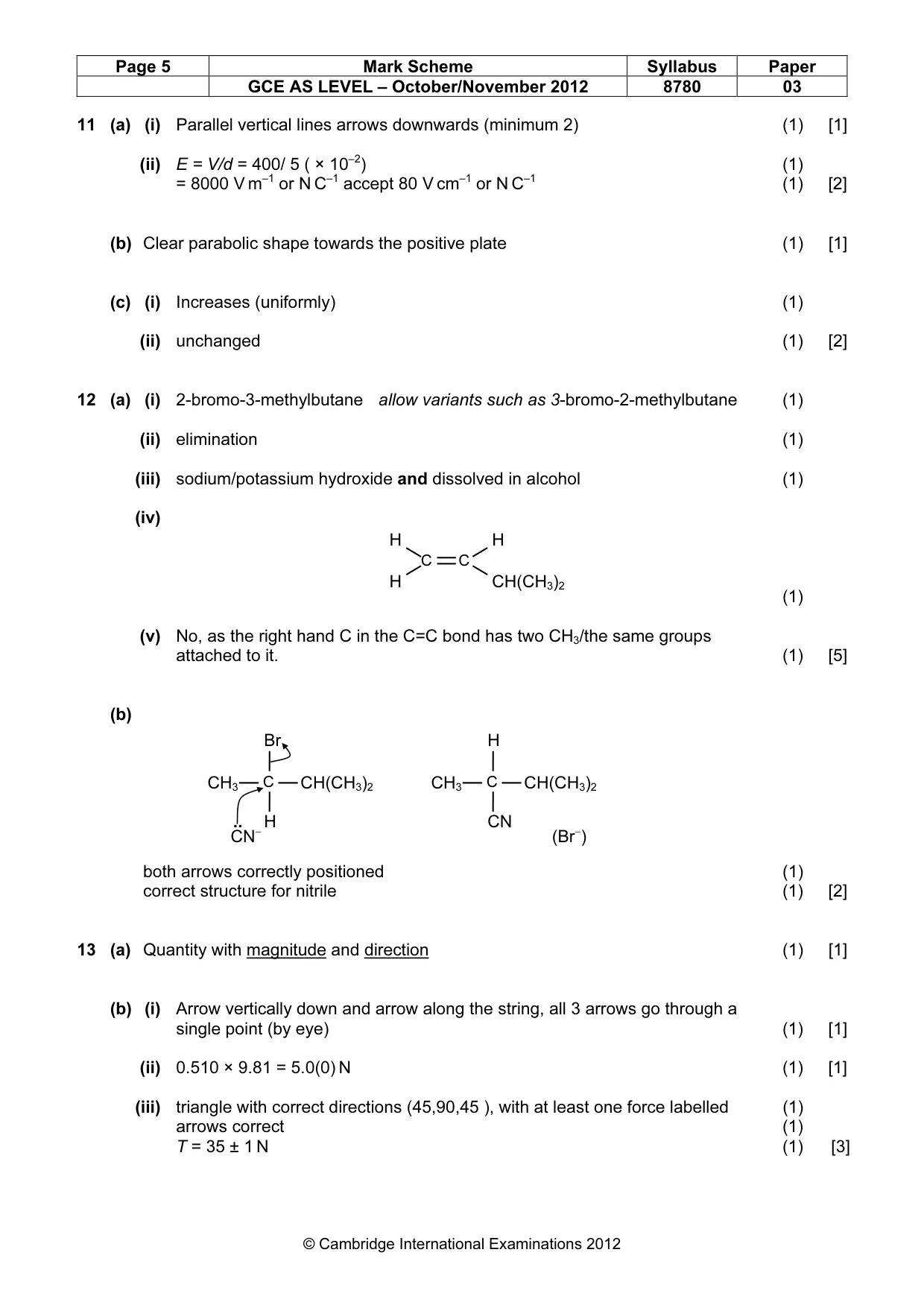
Mark scheme: 11 (a) (i) Parallel vertical lines arrows downwards (minimum 2) (1) [1] (ii) E = V/d = 400/ 5 ( × 10–2) (1) = 8000 V m–1 or N C–1 accept 80 V cm–1 or N C–1 (1) [2] (b) Clear parabolic shape towards the positive plate (1) [1] (c) (i) Increases (uniformly) (1) (ii) unchanged (1) [2]
Q12 · Compound A undergoes a reaction to form two isomeric alkenes, B and C
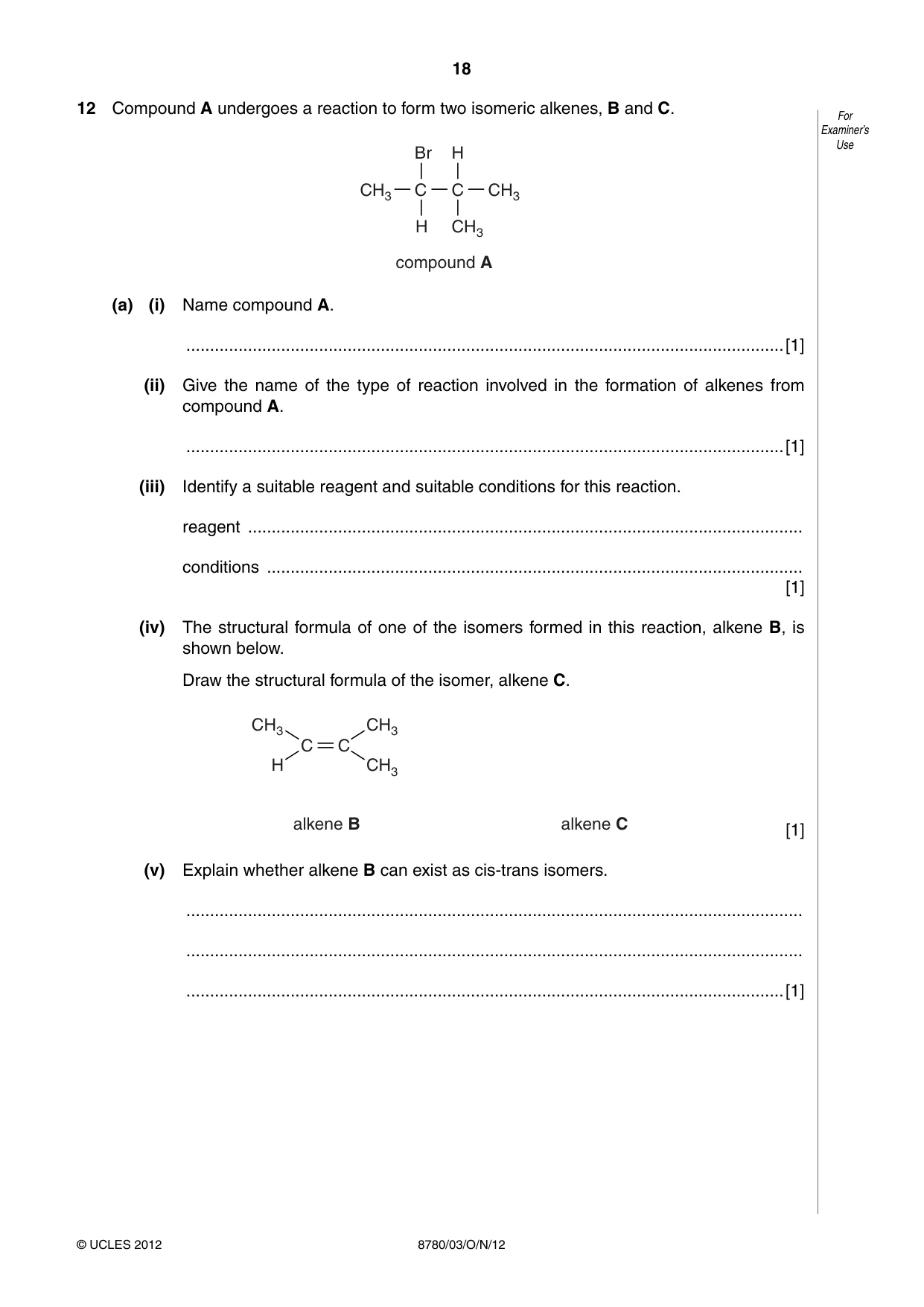
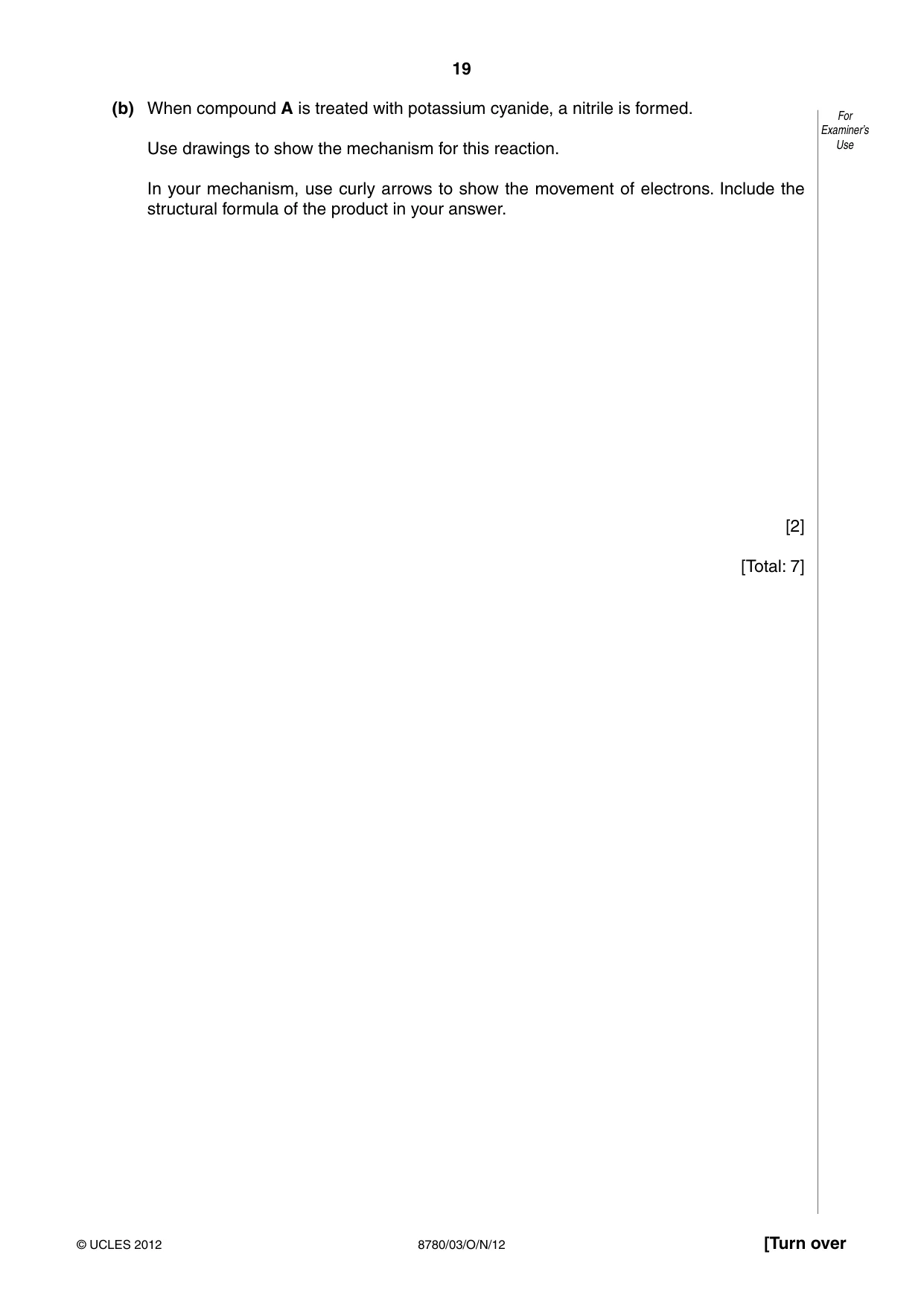
12 Compound A undergoes a reaction to form two isomeric alkenes, B and C. Br H CH3 C C CH3 H CH3 compound A (a) (i) Name compound A. ..............................................................................................................................[1] (ii) Give the name of the type of reaction involved in the formation of alkenes from compound A. ..............................................................................................................................[1] (iii) Identify a suitable reagent and suitable conditions for this reaction. reagent ..................................................................................................................... conditions ................................................................................................................. [1] (iv) The structural formula of one of the isomers formed in this reaction, alkene B, is shown below. Draw the structural formula of the isomer, alkene C. CH3 CH3 C C H CH3 alkene B alkene C [1] (v) Explain whether alkene B can exist as cis-trans isomers. .................................................................................................................................. .................................................................................................................................. ..............................................................................................................................[1] (b) When compound A is treated with potassium cyanide, a nitrile is formed. Use drawings to show the mechanism for this reaction. In your mechanism, use curly arrows to show the movement of electrons. Include the structural formula of the product in your answer. [2] [Total: 7]
Mark scheme: 12 (a) (i) 2-bromo-3-methylbutane allow variants such as 3-bromo-2-methylbutane (1) (ii) elimination (1) (iii) sodium/potassium hydroxide and dissolved in alcohol (1) (iv) H H C C H CH(CH3)2 (1) (v) No, as the right hand C in the C=C bond has two CH3/the same groups attached to it. (1) [5] (b) Br H CH3 C CH(CH3)2 CH3 C CH(CH3)2 .. H CN CN− (Br−) both arrows correctly positioned (1) correct structure for nitrile (1) [2]
Q13 · Explain what is meant by a vector quantity
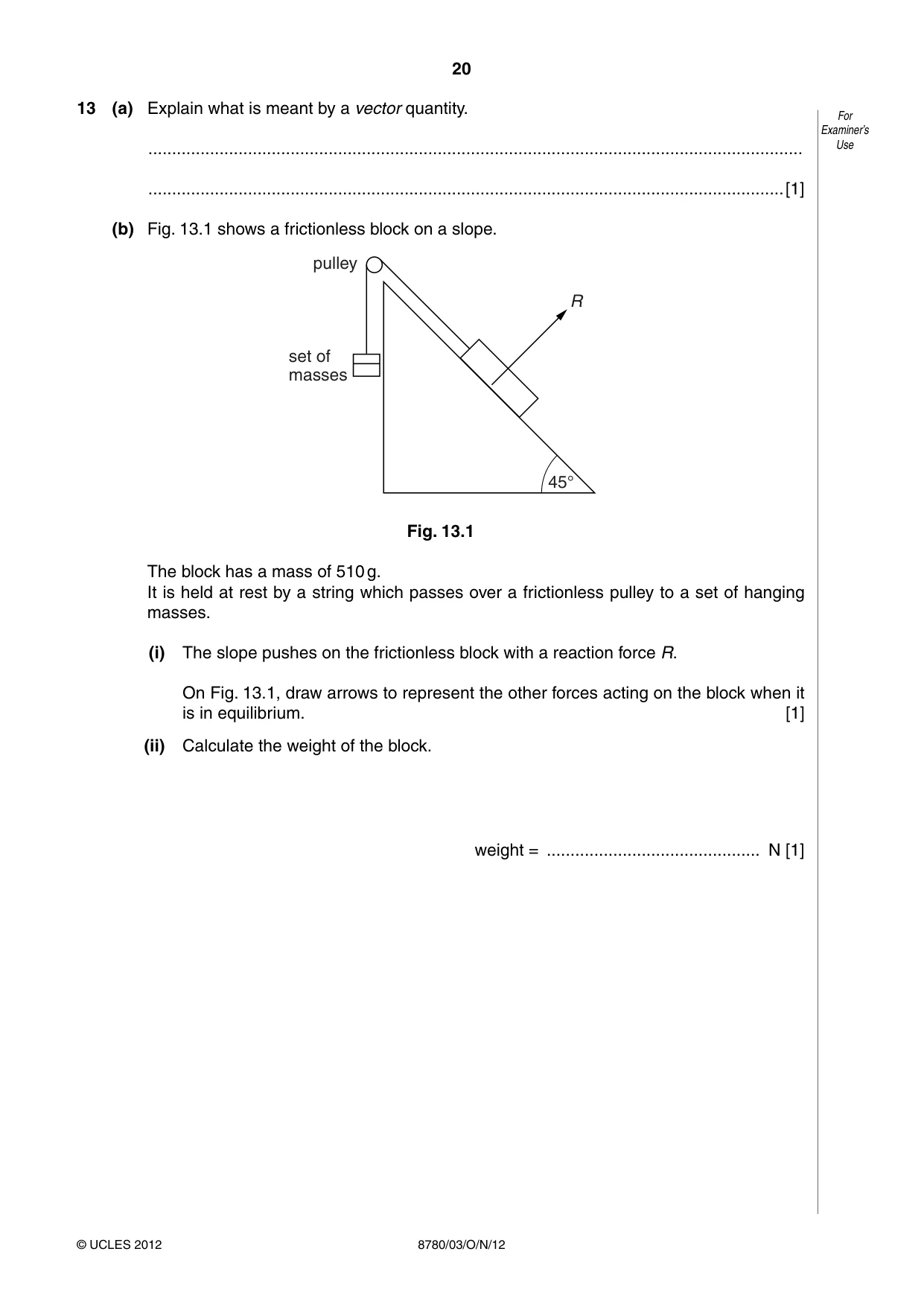
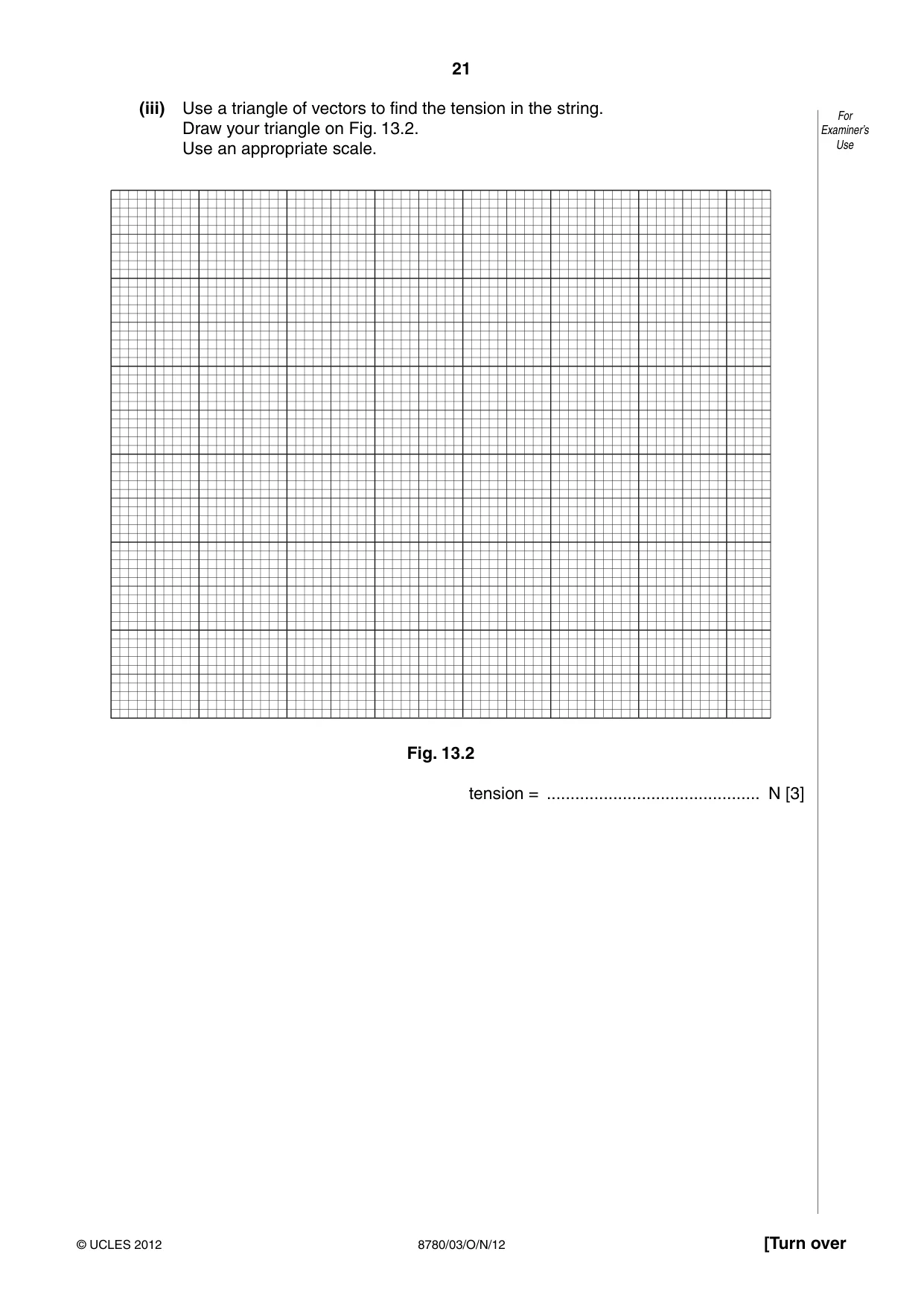
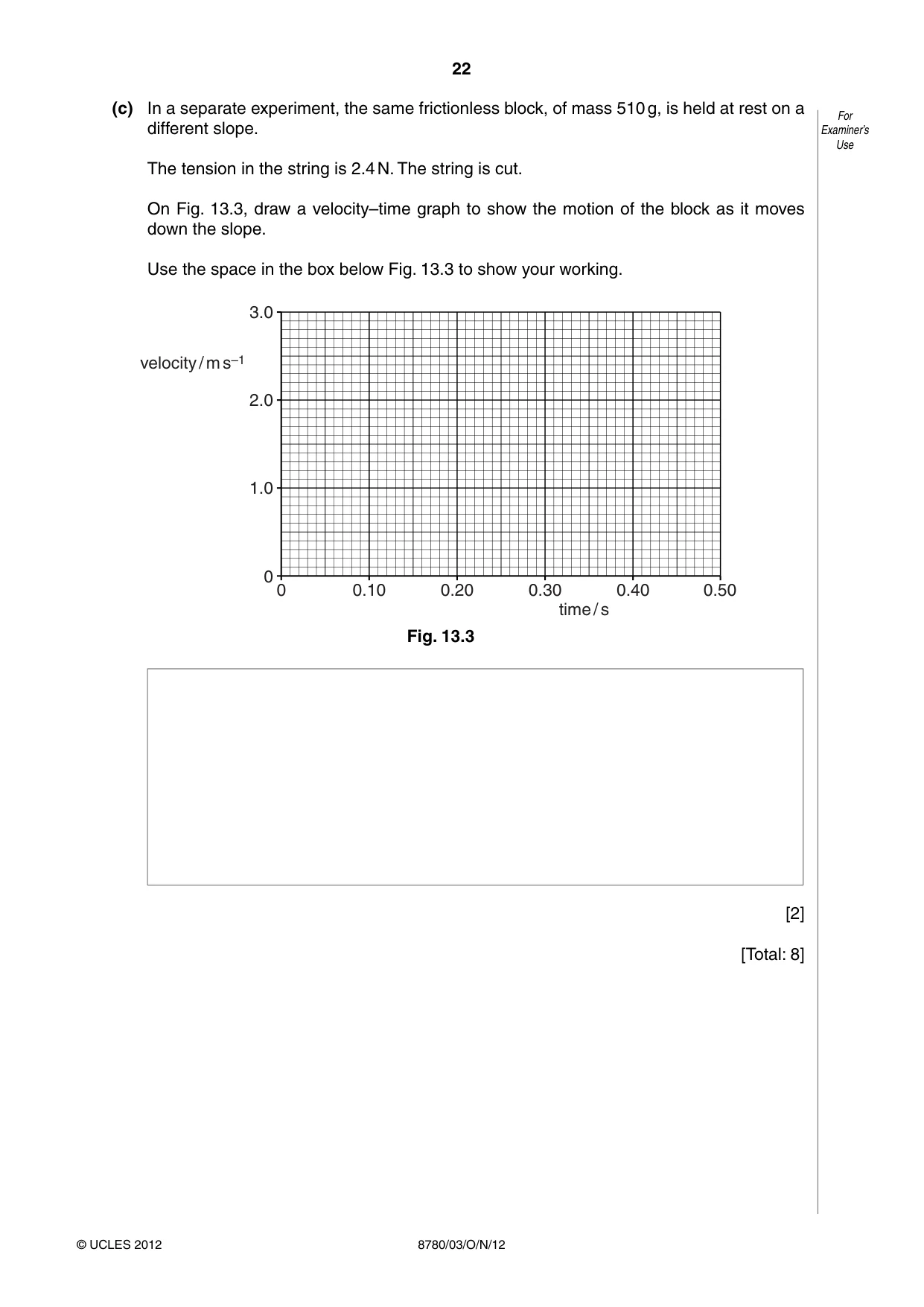
13 (a) Explain what is meant by a vector quantity. .......................................................................................................................................... ......................................................................................................................................[1] (b) Fig. 13.1 shows a frictionless block on a slope. pulley R set of masses 45° Fig. 13.1 The block has a mass of 510 g. It is held at rest by a string which passes over a frictionless pulley to a set of hanging masses. (i) The slope pushes on the frictionless block with a reaction force R. On Fig. 13.1, draw arrows to represent the other forces acting on the block when it is in equilibrium. [1] (ii) Calculate the weight of the block. weight = ............................................. N [1] (iii) Use a triangle of vectors to find the tension in the string. Draw your triangle on Fig. 13.2. Use an appropriate scale. Fig. 13.2 tension = ............................................. N [3] (c) In a separate experiment, the same frictionless block, of mass 510 g, is held at rest on a different slope. The tension in the string is 2.4 N. The string is cut. On Fig. 13.3, draw a velocity–time graph to show the motion of the block as it moves down the slope. Use the space in the box below Fig. 13.3 to show your working. 3.0 velocity / m s–1 2.0 1.0 0 0 0.10 0.20 0.30 0.40 0.50 time / s Fig. 13.3 [2] [Total: 8]
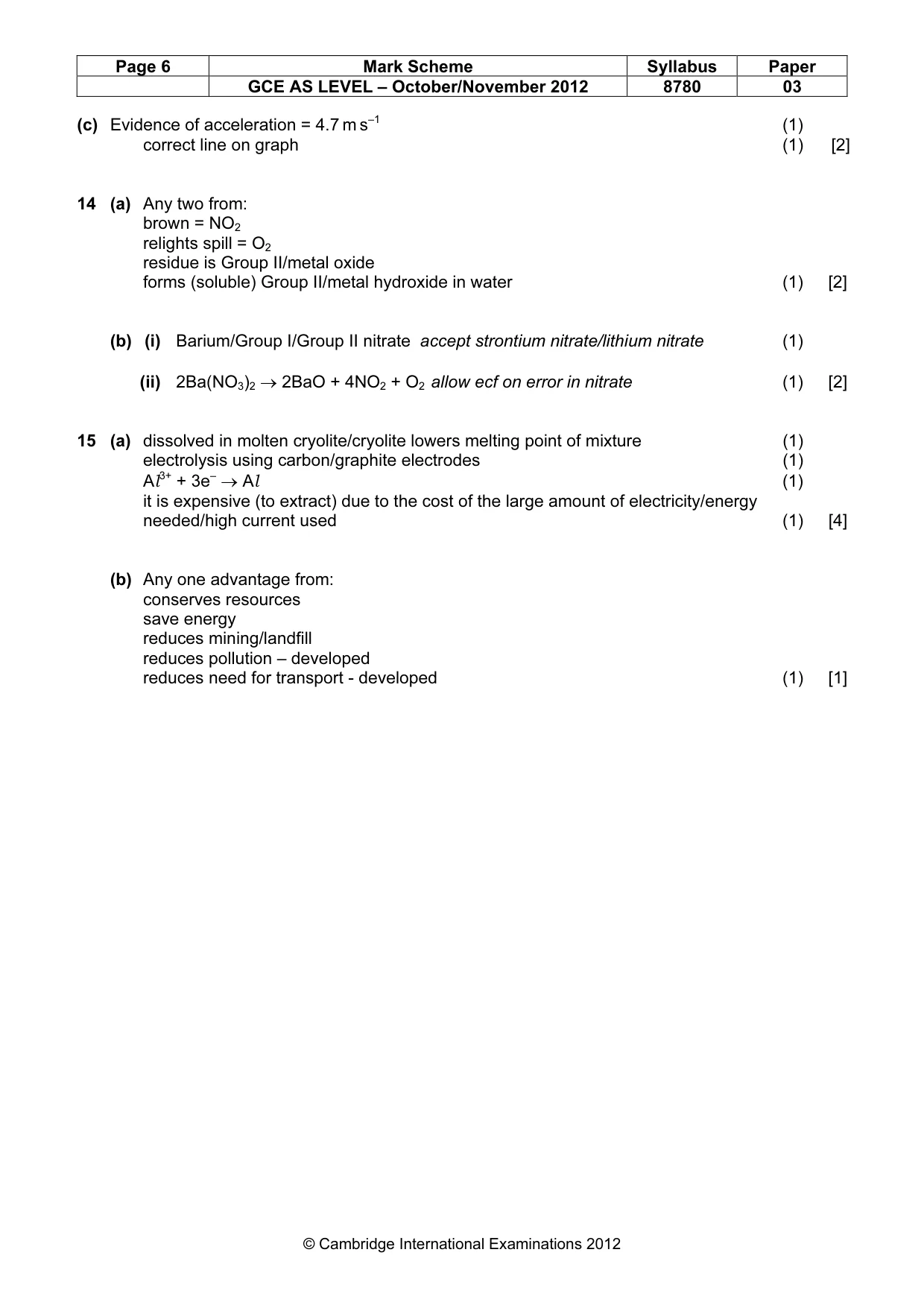
Mark scheme: 13 (a) Quantity with magnitude and direction (1) [1] (b) (i) Arrow vertically down and arrow along the string, all 3 arrows go through a single point (by eye) (1) [1] (ii) 0.510 × 9.81 = 5.0(0) N (1) [1] (iii) triangle with correct directions (45,90,45 ), with at least one force labelled (1) arrows correct (1) T = 35 ± 1 N (1) [3] GCE AS LEVEL – October/November 2012 8780 03 (c) Evidence of acceleration = 4.7 m s–1 (1) correct line on graph (1) [2]
Q14 · Compound X is a metal salt
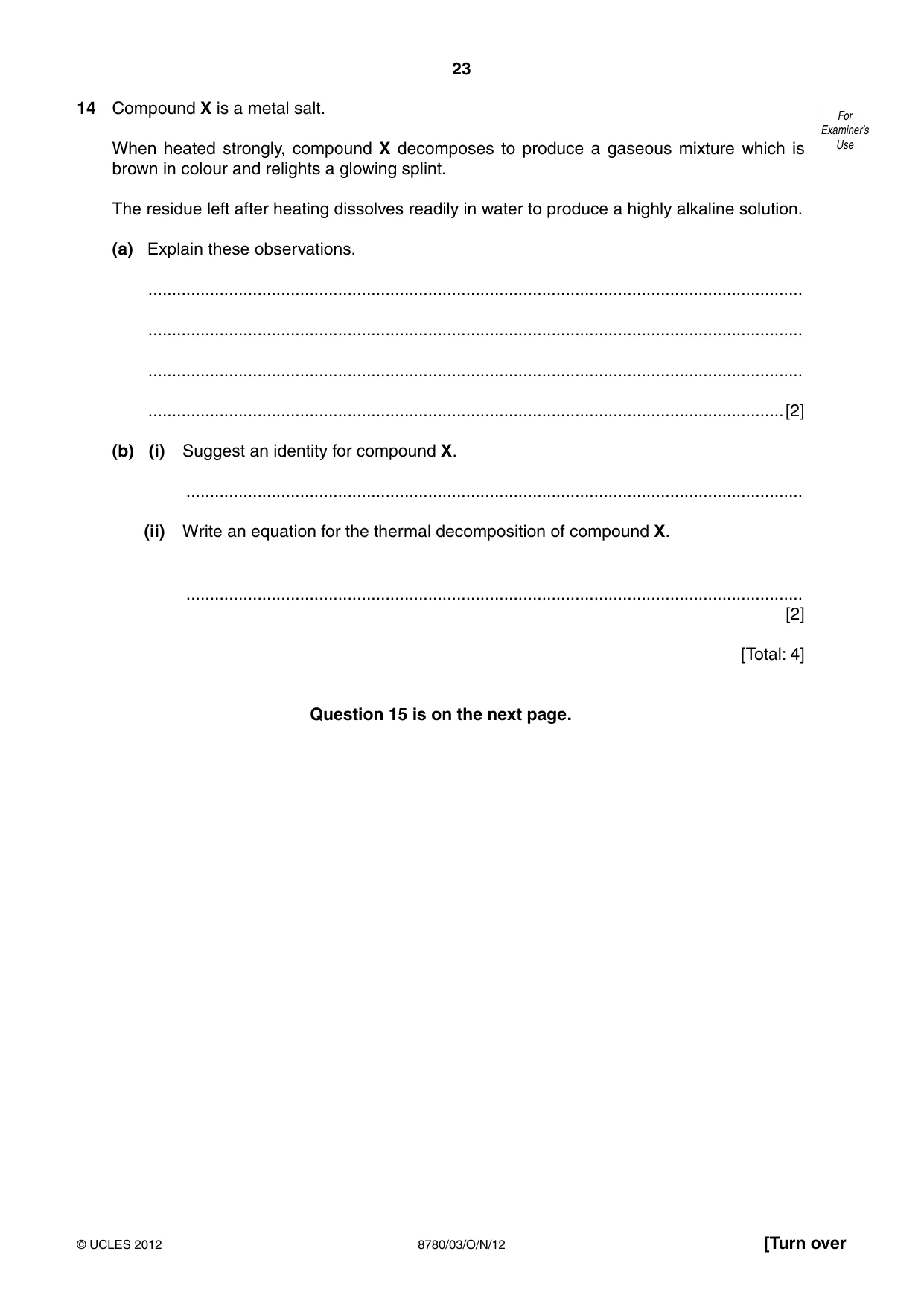
14 Compound X is a metal salt. When heated strongly, compound X decomposes to produce a gaseous mixture which is brown in colour and relights a glowing splint. The residue left after heating dissolves readily in water to produce a highly alkaline solution. (a) Explain these observations. .......................................................................................................................................... .......................................................................................................................................... .......................................................................................................................................... ......................................................................................................................................[2] (b) (i) Suggest an identity for compound X. .................................................................................................................................. (ii) Write an equation for the thermal decomposition of compound X. .................................................................................................................................. [2] [Total: 4] Question 15 is on the next page.
Mark scheme: 14 (a) Any two from: brown = NO2 relights spill = O2 residue is Group II/metal oxide forms (soluble) Group II/metal hydroxide in water (1) [2] (b) (i) Barium/Group I/Group II nitrate accept strontium nitrate/lithium nitrate (1) (ii) 2Ba(NO3)2 → 2BaO + 4NO2 + O2 allow ecf on error in nitrate (1) [2]
Q15 · Aluminium is the most abundant metal in the Earth’s crust
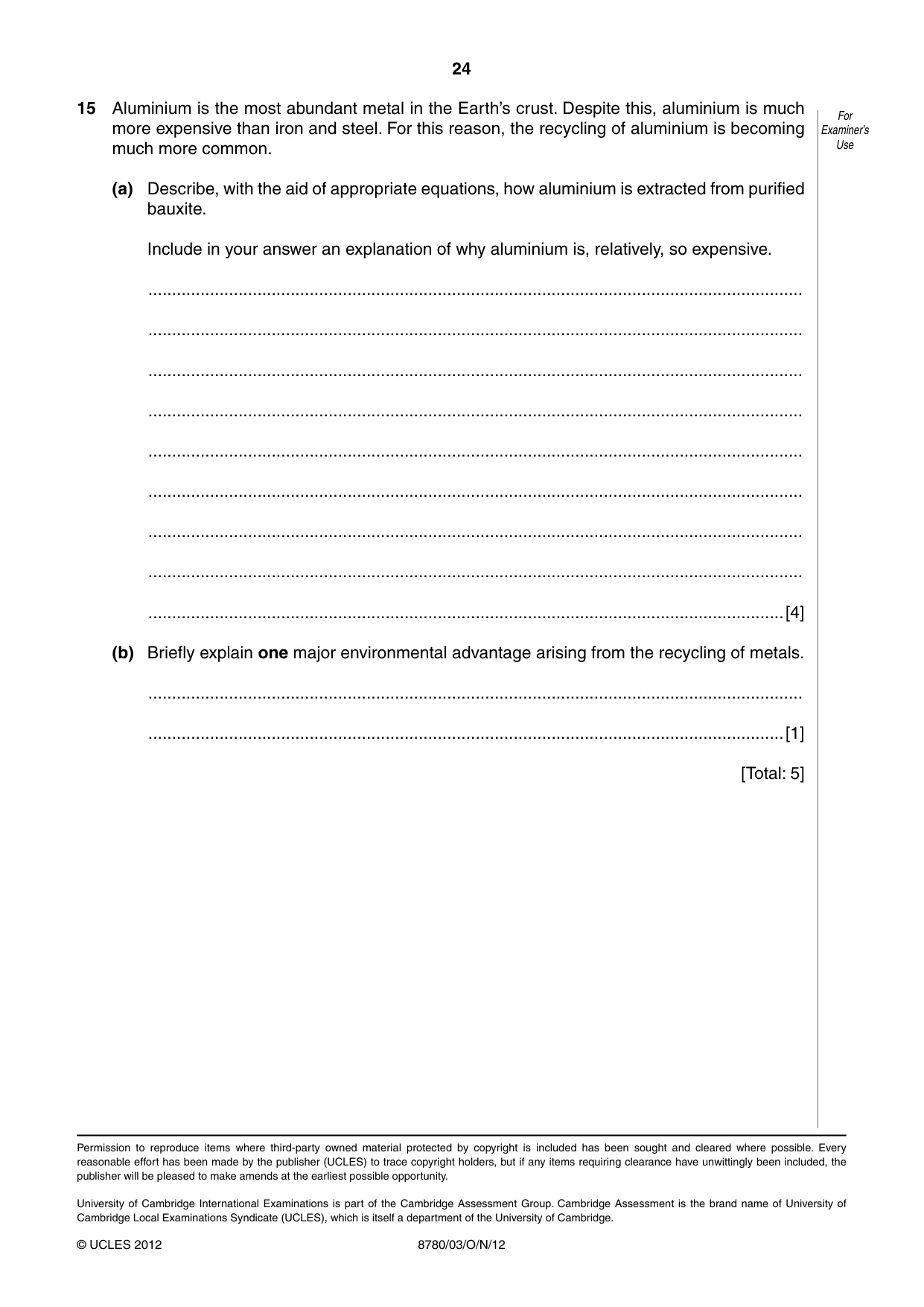
15 Aluminium is the most abundant metal in the Earth’s crust. Despite this, aluminium is much more expensive than iron and steel. For this reason, the recycling of aluminium is becoming much more common. (a) Describe, with the aid of appropriate equations, how aluminium is extracted from purified bauxite. Include in your answer an explanation of why aluminium is, relatively, so expensive. .......................................................................................................................................... .......................................................................................................................................... .......................................................................................................................................... .......................................................................................................................................... .......................................................................................................................................... .......................................................................................................................................... .......................................................................................................................................... .......................................................................................................................................... ......................................................................................................................................[4] (b) Briefly explain one major environmental advantage arising from the recycling of metals. .......................................................................................................................................... ......................................................................................................................................[1] [Total: 5]
Mark scheme: 15 (a) dissolved in molten cryolite/cryolite lowers melting point of mixture (1) electrolysis using carbon/graphite electrodes (1) Al3+ + 3e– → Al (1) it is expensive (to extract) due to the cost of the large amount of electricity/energy needed/high current used (1) [4] (b) Any one advantage from: conserves resources save energy reduces mining/landfill reduces pollution – developed reduces need for transport - developed (1) [1]
What you needed in this session
Cambridge’s own grade thresholds for 2012 Oct/Nov, Paper 3 · Variant 1. A higher threshold means an easier paper — the bar moves with how the cohort did.