Cambridge A Level Physical Science 8780 — 2015 Oct/Nov Paper 3 · Variant 1
8780/31/O/N/15 · 8 questions · 80 marks · ≈90 min
The question paper and its mark scheme, free to read here and free to download. This is Cambridge’s own paper, exactly as it was sat.
Question paper20 pages





Mark scheme5 pages
Answers below. Sit the paper first if you are practising.
Questions as text
Q1 · One of the early models of the atom was the Thomson 'plum-pudding' model
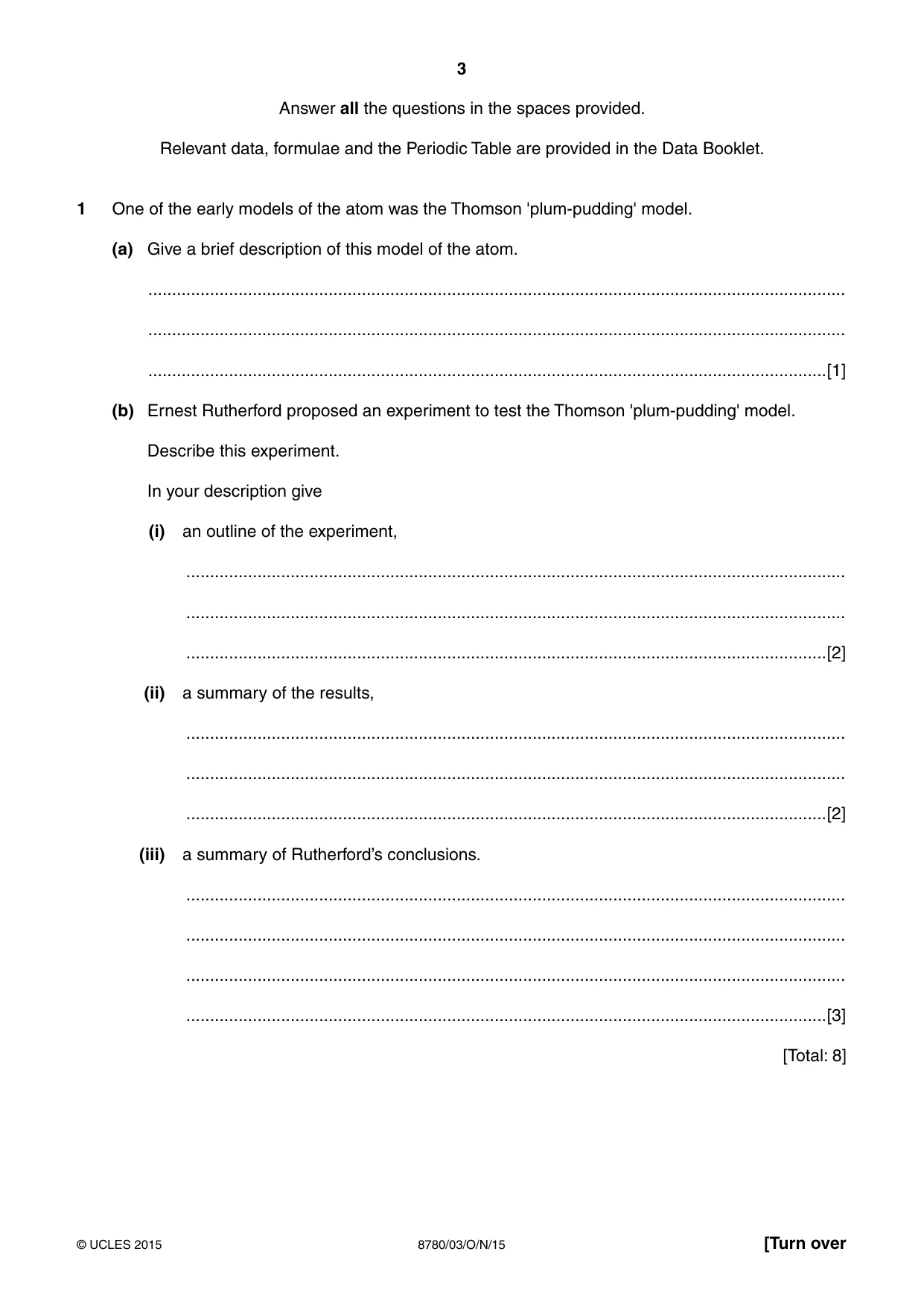
1 One of the early models of the atom was the Thomson 'plum-pudding' model. (a) Give a brief description of this model of the atom. ................................................................................................................................................... ................................................................................................................................................... ...............................................................................................................................................[1] (b) Ernest Rutherford proposed an experiment to test the Thomson 'plum-pudding' model. Describe this experiment. In your description give (i) an outline of the experiment, ........................................................................................................................................... ........................................................................................................................................... .......................................................................................................................................[2] (ii) a summary of the results, ........................................................................................................................................... ........................................................................................................................................... .......................................................................................................................................[2] (iii) a summary of Rutherford’s conclusions. ........................................................................................................................................... ........................................................................................................................................... ........................................................................................................................................... .......................................................................................................................................[3] [Total: 8]
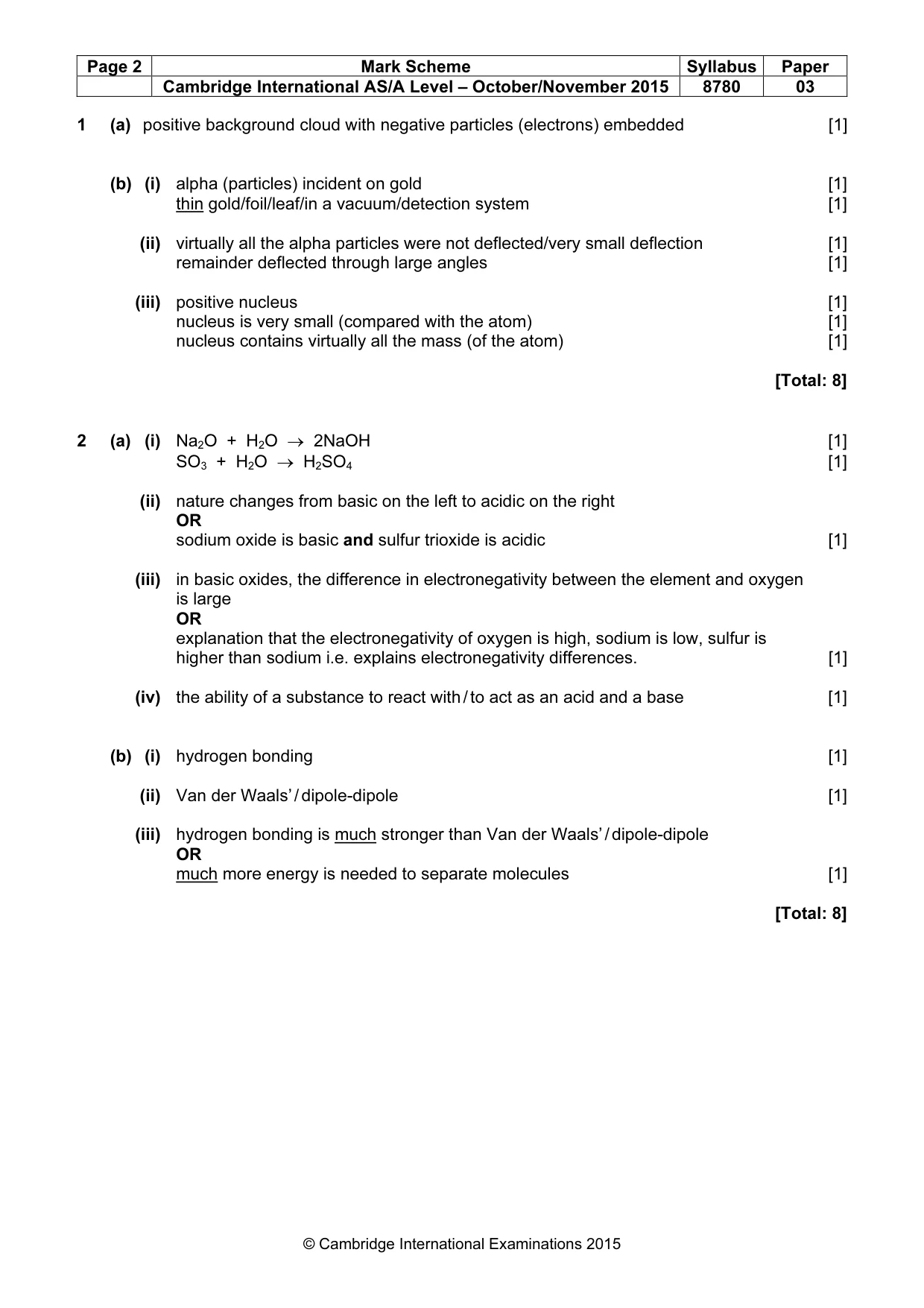
Mark scheme: 1 (a) positive background cloud with negative particles (electrons) embedded [1] (b) (i) alpha (particles) incident on gold [1] thin gold/foil/leaf/in a vacuum/detection system [1] (ii) virtually all the alpha particles were not deflected/very small deflection [1] remainder deflected through large angles [1] (iii) positive nucleus [1] nucleus is very small (compared with the atom) [1] nucleus contains virtually all the mass (of the atom) [1] [Total: 8]
Q2 · Sodium, aluminium and sulfur are some of the elements in Period 3
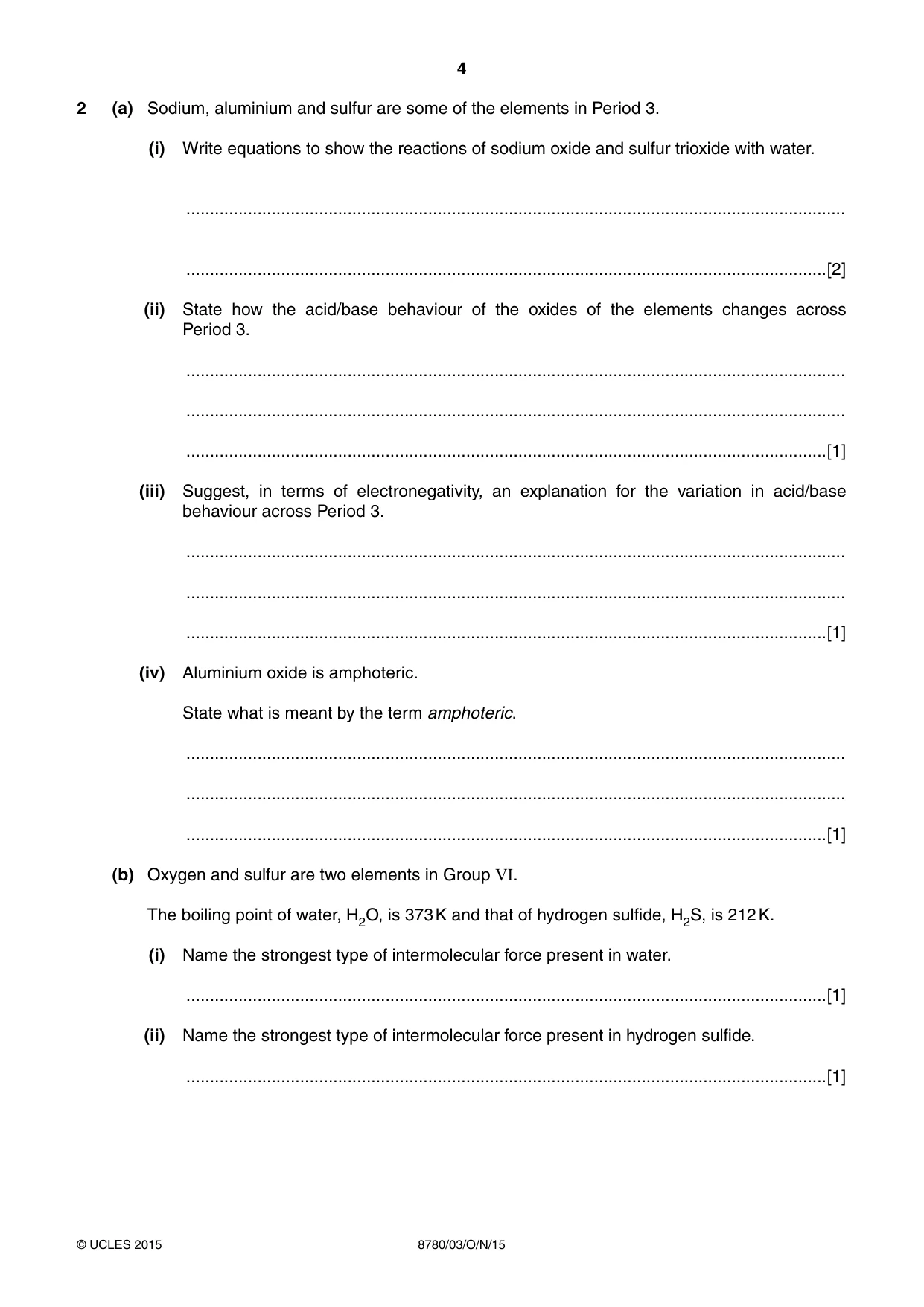
2 (a) Sodium, aluminium and sulfur are some of the elements in Period 3. (i) Write equations to show the reactions of sodium oxide and sulfur trioxide with water. ........................................................................................................................................... .......................................................................................................................................[2] (ii) State how the acid/base behaviour of the oxides of the elements changes across Period 3. ........................................................................................................................................... ........................................................................................................................................... .......................................................................................................................................[1] (iii) Suggest, in terms of electronegativity, an explanation for the variation in acid/base behaviour across Period 3. ........................................................................................................................................... ........................................................................................................................................... .......................................................................................................................................[1] (iv) Aluminium oxide is amphoteric. State what is meant by the term amphoteric. ........................................................................................................................................... ........................................................................................................................................... .......................................................................................................................................[1] (b) Oxygen and sulfur are two elements in Group VI. The boiling point of water, H2O, is 373 K and that of hydrogen sulfide, H2S, is 212 K. (i) Name the strongest type of intermolecular force present in water. .......................................................................................................................................[1] (ii) Name the strongest type of intermolecular force present in hydrogen sulfide. .......................................................................................................................................[1] (iii) Use ideas from (b)(i) and (b)(ii) to explain why the boiling point of water is so much higher than that of hydrogen sulfide. ........................................................................................................................................... ........................................................................................................................................... .......................................................................................................................................[1] [Total: 8]
Mark scheme: 2 (a) (i) Na2O + H2O → 2NaOH [1] SO3 + H2O → H2SO4 [1] (ii) nature changes from basic on the left to acidic on the right OR sodium oxide is basic and sulfur trioxide is acidic [1] (iii) in basic oxides, the difference in electronegativity between the element and oxygen is large OR explanation that the electronegativity of oxygen is high, sodium is low, sulfur is higher than sodium i.e. explains electronegativity differences. [1] (iv) the ability of a substance to react with / to act as an acid and a base [1] (b) (i) hydrogen bonding [1] (ii) Van der Waals’ / dipole-dipole [1] (iii) hydrogen bonding is much stronger than Van der Waals’ / dipole-dipole OR much more energy is needed to separate molecules [1] [Total: 8]
Q3 · A source of sound of constant frequency
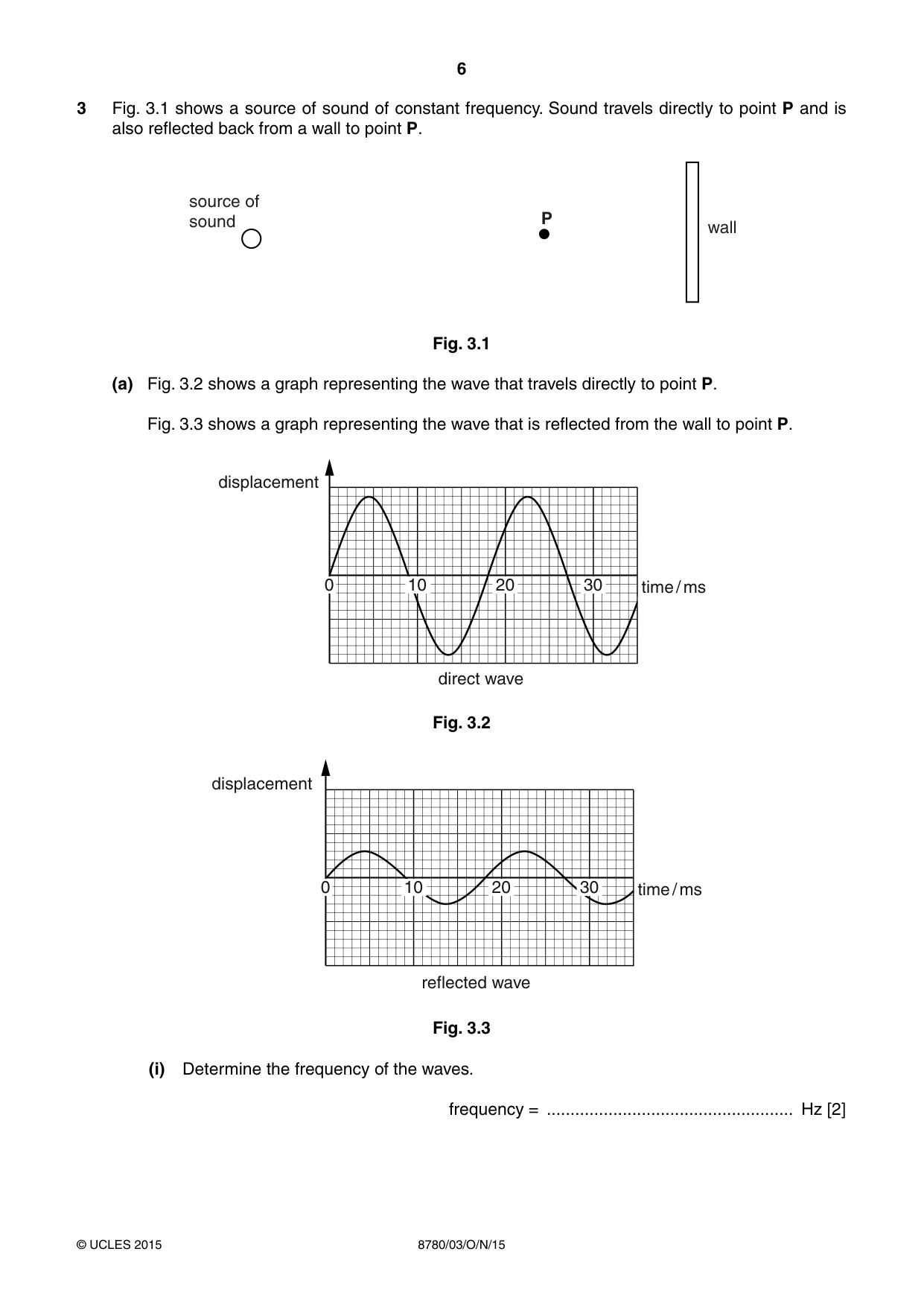
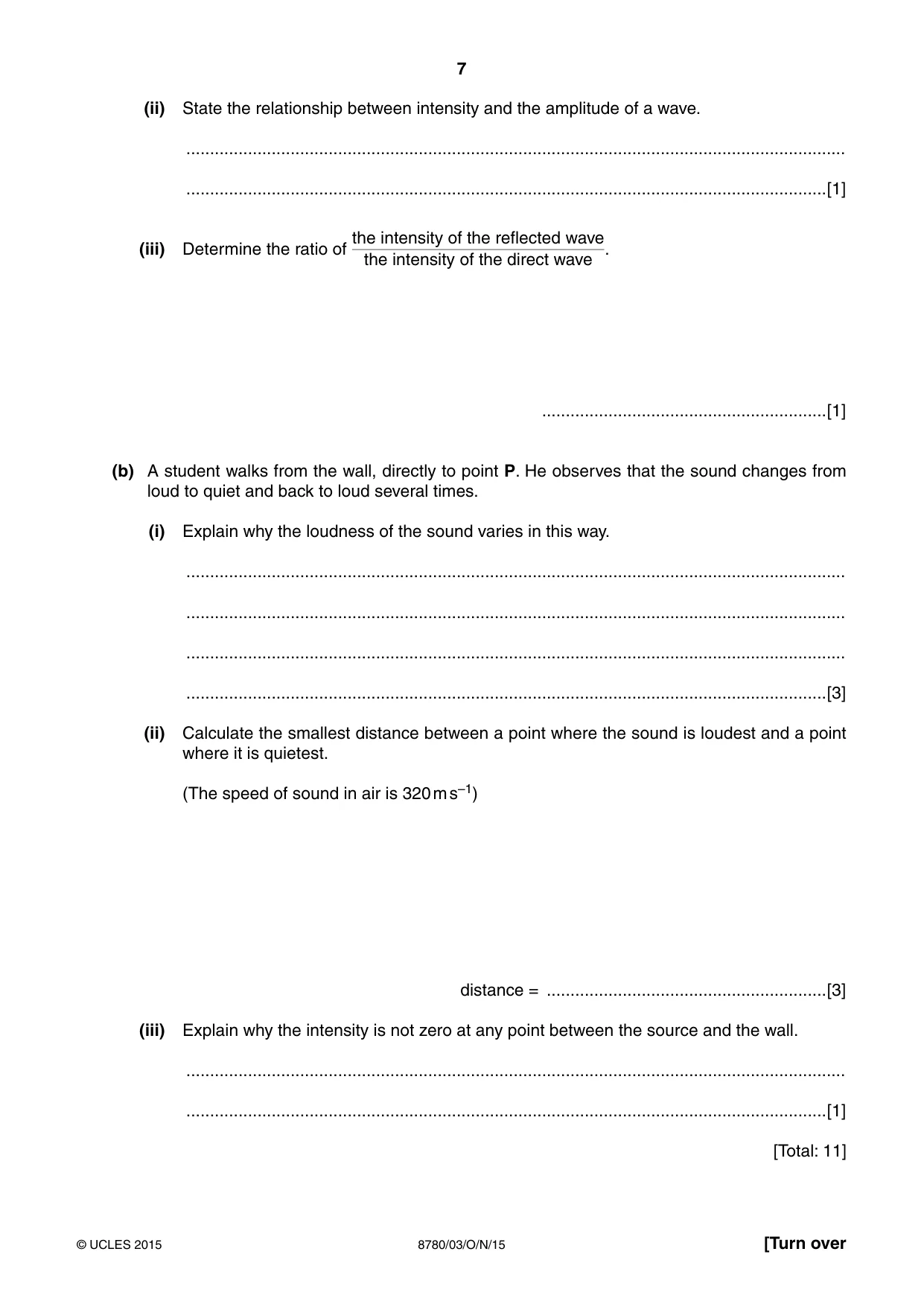
3 Fig. 3.1 shows a source of sound of constant frequency. Sound travels directly to point P and is also reflected back from a wall to point P. source of sound P wall Fig. 3.1 (a) Fig. 3.2 shows a graph representing the wave that travels directly to point P. Fig. 3.3 shows a graph representing the wave that is reflected from the wall to point P. displacement 0 10 20 30 time / ms direct wave Fig. 3.2 displacement 0 10 20 30 time / ms reflected wave Fig. 3.3 (i) Determine the frequency of the waves. frequency = .................................................... Hz [2] (ii) State the relationship between intensity and the amplitude of a wave. ........................................................................................................................................... .......................................................................................................................................[1] the intensity of the reflected wave (iii) Determine the ratio of . the intensity of the direct wave ............................................................[1] (b) A student walks from the wall, directly to point P. He observes that the sound changes from loud to quiet and back to loud several times. (i) Explain why the loudness of the sound varies in this way. ........................................................................................................................................... ........................................................................................................................................... ........................................................................................................................................... .......................................................................................................................................[3] (ii) Calculate the smallest distance between a point where the sound is loudest and a point where it is quietest. (The speed of sound in air is 320 m s–1) distance = ...........................................................[3] (iii) Explain why the intensity is not zero at any point between the source and the wall. ........................................................................................................................................... .......................................................................................................................................[1] [Total: 11]
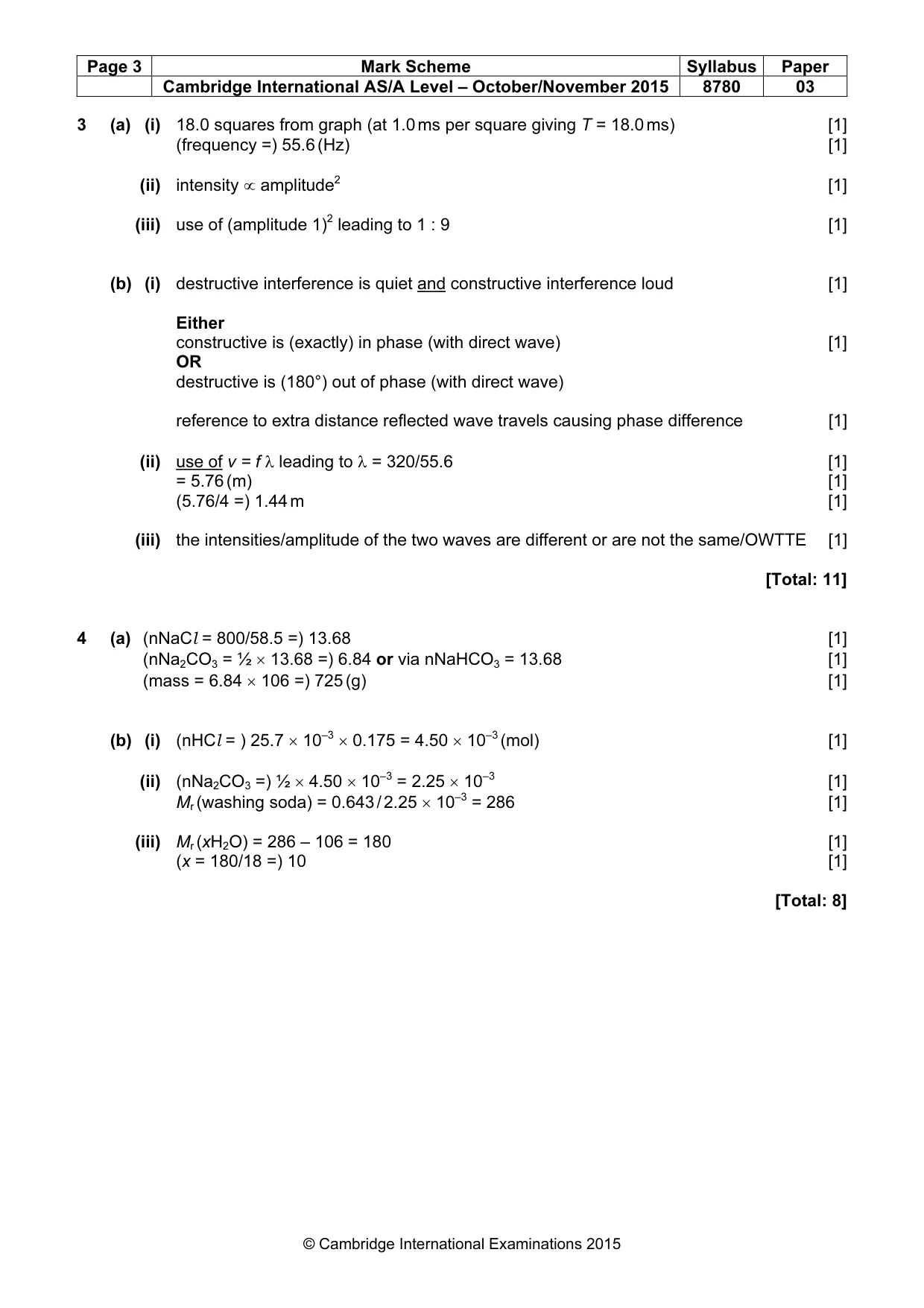
Mark scheme: 3 (a) (i) 18.0 squares from graph (at 1.0 ms per square giving T = 18.0 ms) [1] (frequency =) 55.6 (Hz) [1] (ii) intensity ∝ amplitude2 [1] (iii) use of (amplitude 1)2 leading to 1 : 9 [1] (b) (i) destructive interference is quiet and constructive interference loud [1] Either constructive is (exactly) in phase (with direct wave) [1] OR destructive is (180°) out of phase (with direct wave) reference to extra distance reflected wave travels causing phase difference [1] (ii) use of v = f λ leading to λ = 320/55.6 [1] = 5.76 (m) [1] (5.76/4 =) 1.44 m [1] (iii) the intensities/amplitude of the two waves are different or are not the same/OWTTE [1] [Total: 11]
Q4 · Sodium carbonate, Na2CO3, is manufactured in a two-stage process as shown by the…
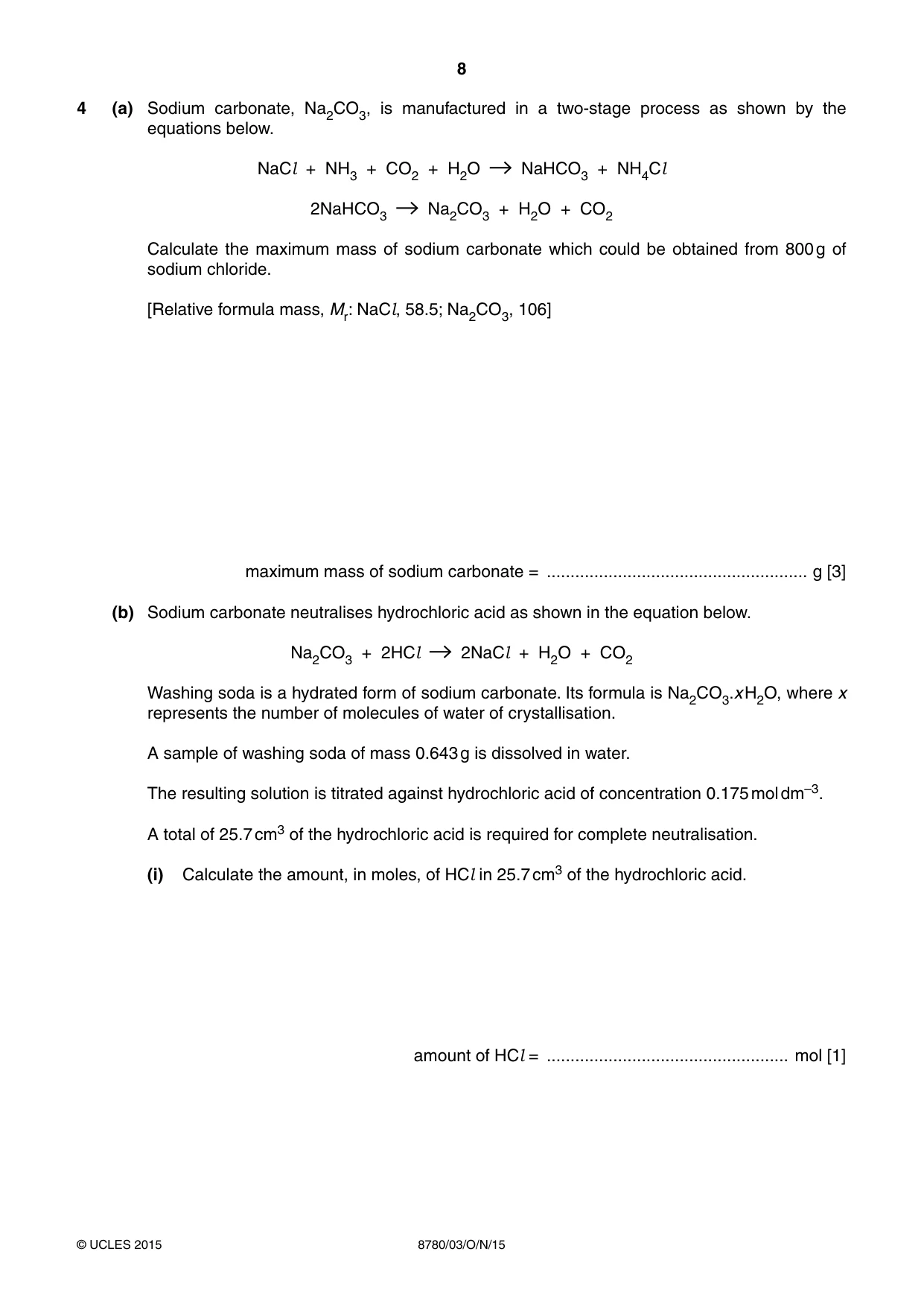
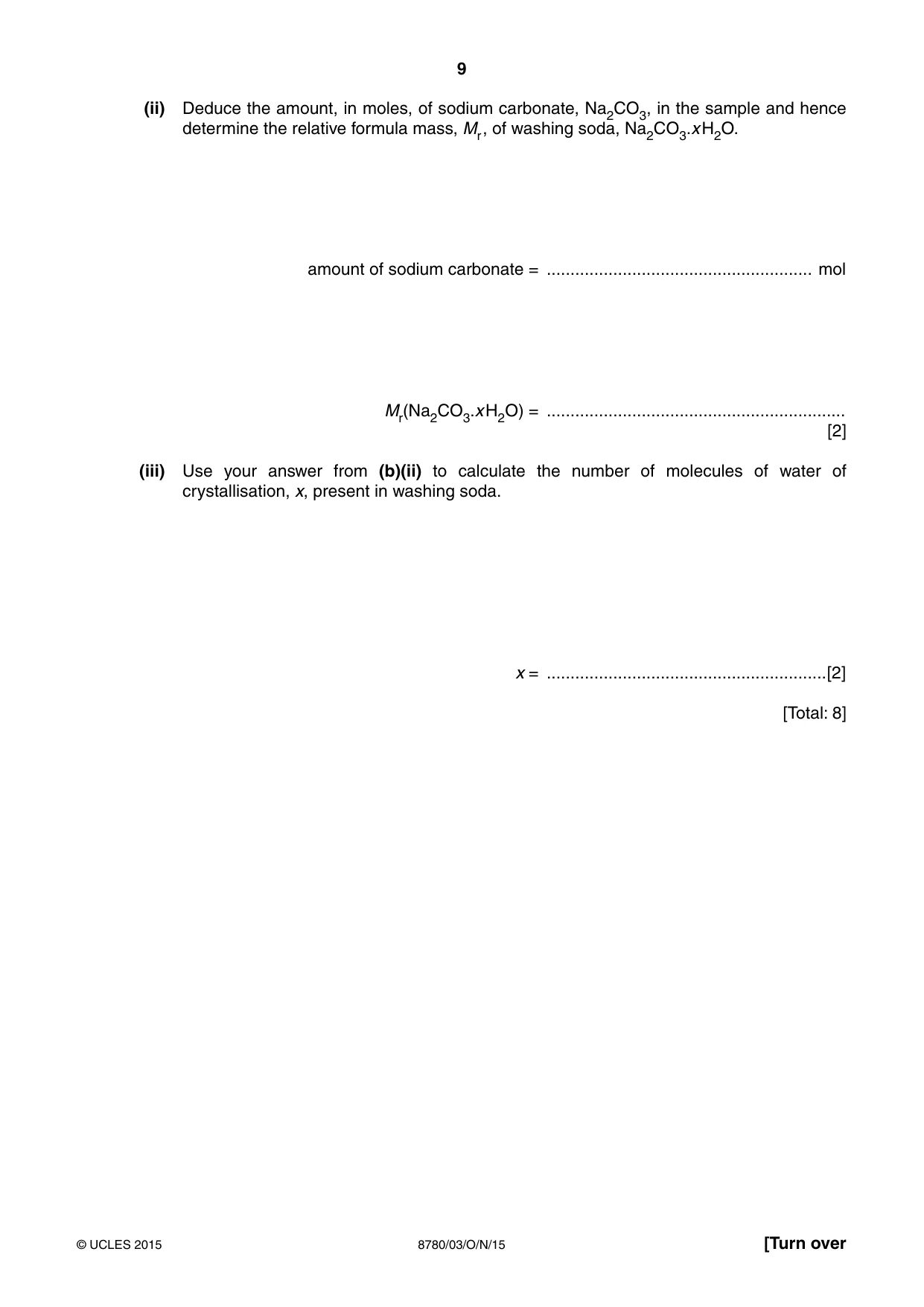
4 (a) Sodium carbonate, Na2CO3, is manufactured in a two-stage process as shown by the equations below. NaCl + NH3 + CO2 + H2O NaHCO3 + NH4Cl 2NaHCO3 Na2CO3 + H2O + CO2 Calculate the maximum mass of sodium carbonate which could be obtained from 800 g of sodium chloride. [Relative formula mass, Mr: NaCl, 58.5; Na2CO3, 106] maximum mass of sodium carbonate = ....................................................... g [3] (b) Sodium carbonate neutralises hydrochloric acid as shown in the equation below. Na2CO3 + 2HCl 2NaCl + H2O + CO2 Washing soda is a hydrated form of sodium carbonate. Its formula is Na2CO3.x H2O, where x represents the number of molecules of water of crystallisation. A sample of washing soda of mass 0.643 g is dissolved in water. The resulting solution is titrated against hydrochloric acid of concentration 0.175 mol dm–3. A total of 25.7 cm3 of the hydrochloric acid is required for complete neutralisation. (i) Calculate the amount, in moles, of HCl in 25.7 cm3 of the hydrochloric acid. amount of HCl = ................................................... mol [1] (ii) Deduce the amount, in moles, of sodium carbonate, Na2CO3, in the sample and hence determine the relative formula mass, Mr , of washing soda, Na2CO3.x H2O. amount of sodium carbonate = ........................................................ mol Mr(Na2CO3.x H2O) = ............................................................... [2] (iii) Use your answer from (b)(ii) to calculate the number of molecules of water of crystallisation, x, present in washing soda. x = ...........................................................[2] [Total: 8]
Mark scheme: 4 (a) (nNaCl = 800/58.5 =) 13.68 [1] (nNa2CO3 = ½ × 13.68 =) 6.84 or via nNaHCO3 = 13.68 [1] (mass = 6.84 × 106 =) 725 (g) [1] (b) (i) (nHCl = ) 25.7 × 10–3 × 0.175 = 4.50 × 10⁻³ (mol) [1] (ii) (nNa2CO3 =) ½ × 4.50 × 10–3 = 2.25 × 10⁻³ [1] Mr (washing soda) = 0.643 / 2.25 × 10–3 = 286 [1] (iii) Mr (xH2O) = 286 – 106 = 180 [1] (x = 180/18 =) 10 [1] [Total: 8]
Question 5
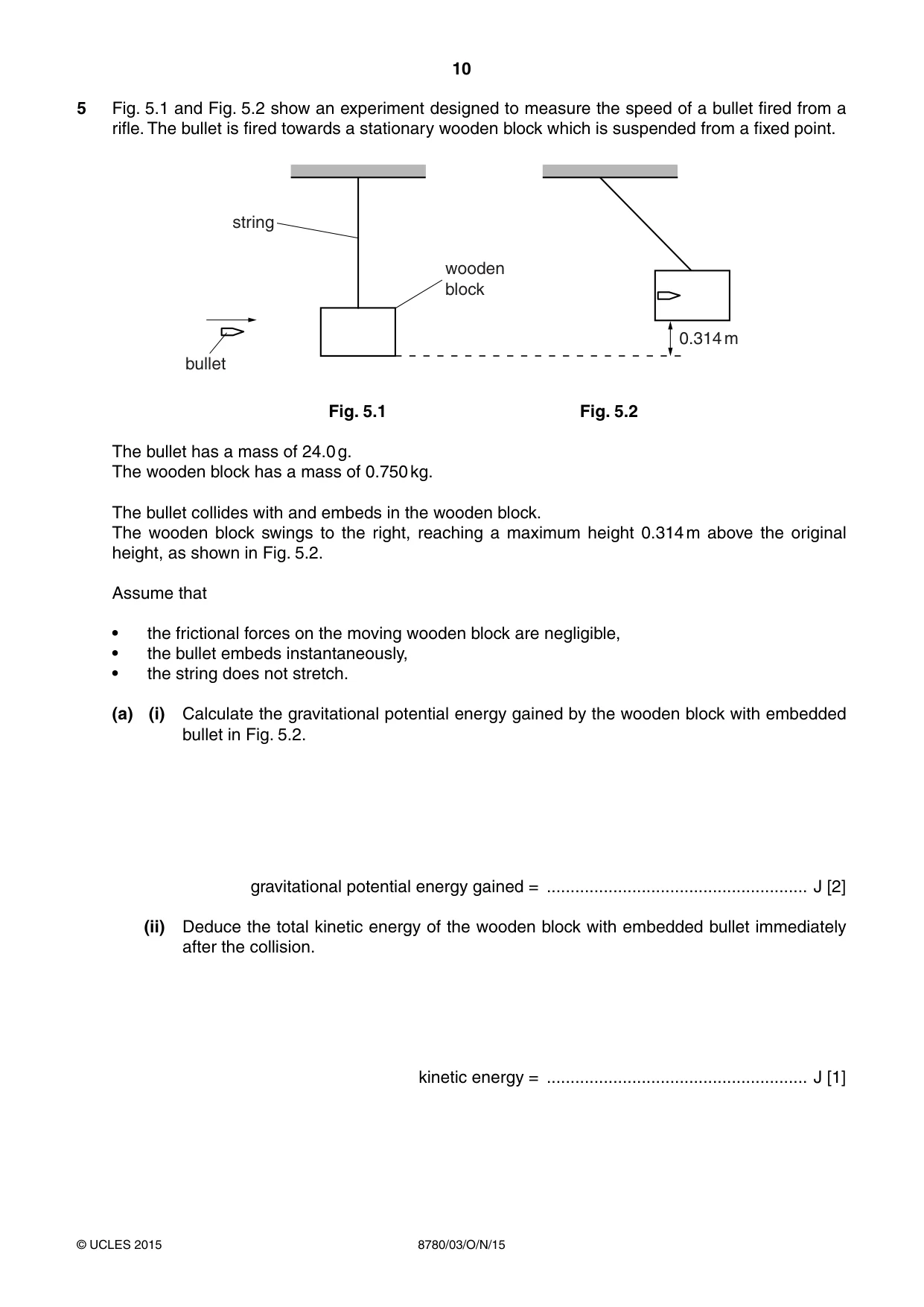
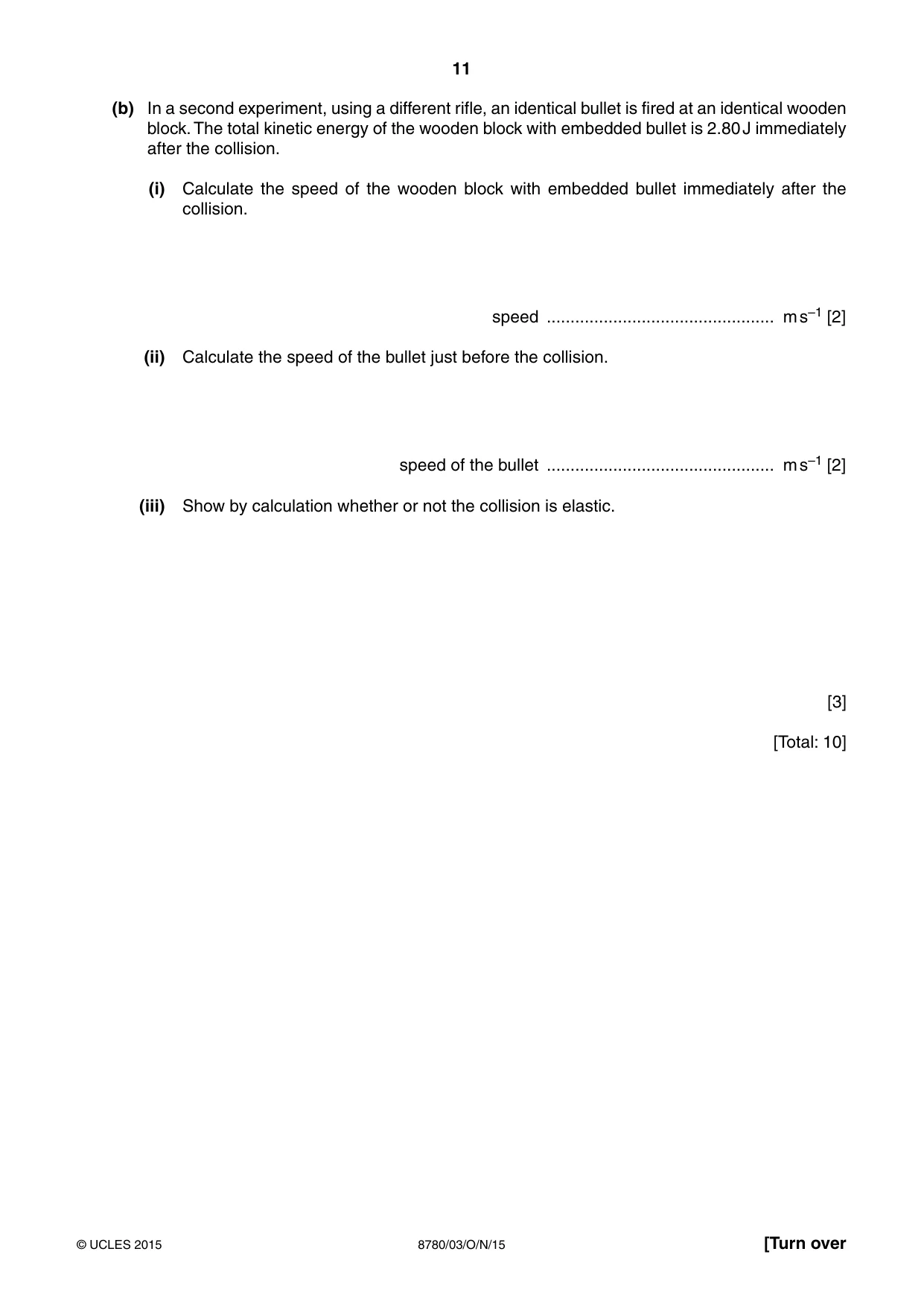
5 Fig. 5.1 and Fig. 5.2 show an experiment designed to measure the speed of a bullet fired from a rifle. The bullet is fired towards a stationary wooden block which is suspended from a fixed point. string wooden block 0.314 m bullet Fig. 5.1 Fig. 5.2 The bullet has a mass of 24.0 g. The wooden block has a mass of 0.750 kg. The bullet collides with and embeds in the wooden block. The wooden block swings to the right, reaching a maximum height 0.314 m above the original height, as shown in Fig. 5.2. Assume that • the frictional forces on the moving wooden block are negligible, • the bullet embeds instantaneously, • the string does not stretch. (a) (i) Calculate the gravitational potential energy gained by the wooden block with embedded bullet in Fig. 5.2. gravitational potential energy gained = ....................................................... J [2] (ii) Deduce the total kinetic energy of the wooden block with embedded bullet immediately after the collision. kinetic energy = ....................................................... J [1] (b) In a second experiment, using a different rifle, an identical bullet is fired at an identical wooden block. The total kinetic energy of the wooden block with embedded bullet is 2.80 J immediately after the collision. (i) Calculate the speed of the wooden block with embedded bullet immediately after the collision. speed ................................................ m s–1 [2] (ii) Calculate the speed of the bullet just before the collision. speed of the bullet ................................................ m s–1 [2] (iii) Show by calculation whether or not the collision is elastic. [3] [Total: 10]
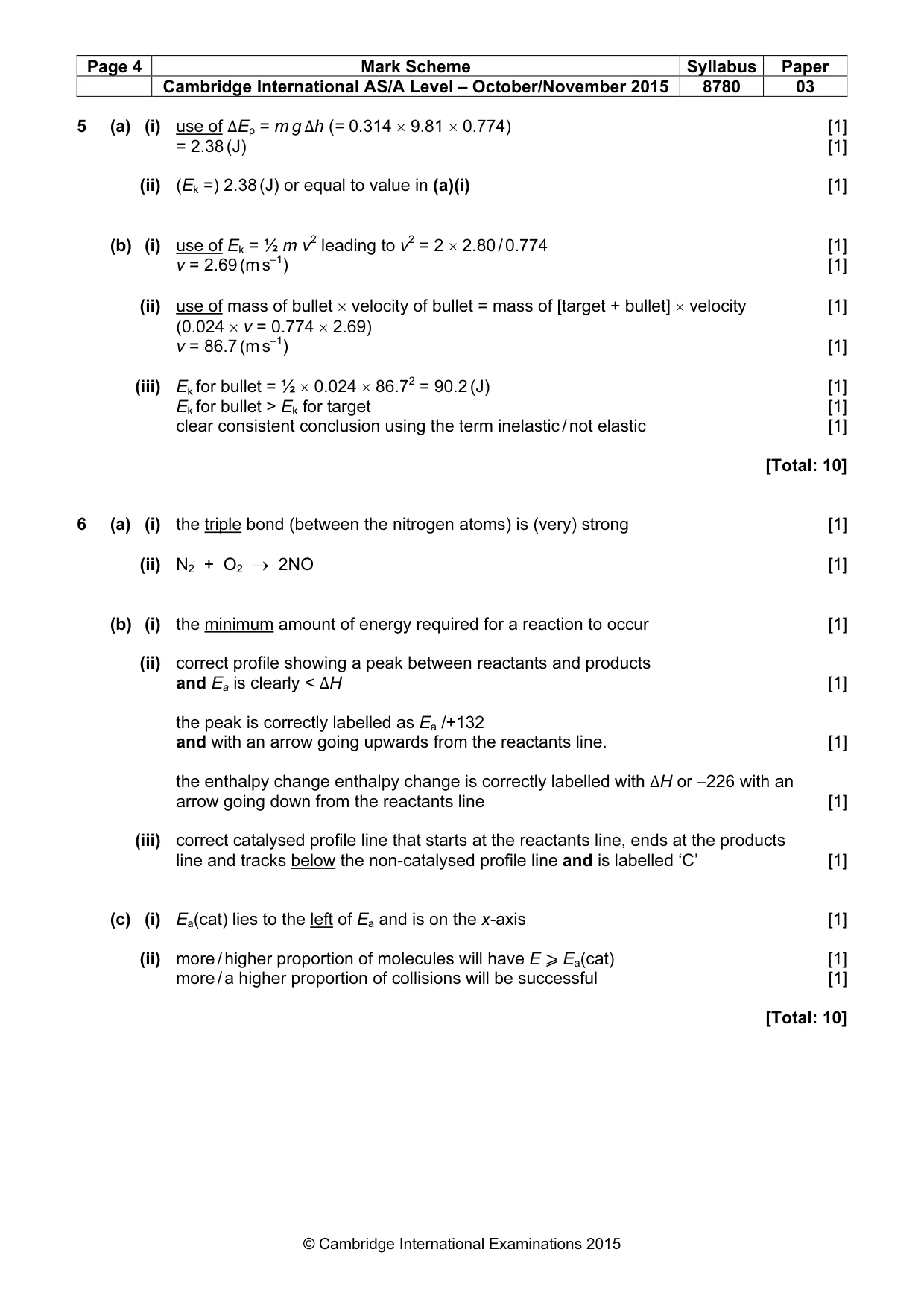
Mark scheme: 5 (a) (i) use of ΔEp = m g Δh (= 0.314 × 9.81 × 0.774) [1] = 2.38 (J) [1] (ii) (Ek =) 2.38 (J) or equal to value in (a)(i) [1] (b) (i) use of Ek = ½ m v2 leading to v2 = 2 × 2.80 / 0.774 [1] v = 2.69 (m s–1) [1] (ii) use of mass of bullet × velocity of bullet = mass of [target + bullet] × velocity [1] (0.024 × v = 0.774 × 2.69) v = 86.7 (m s–1) [1] (iii) Ek for bullet = ½ × 0.024 × 86.72 = 90.2 (J) [1] Ek for bullet > Ek for target [1] clear consistent conclusion using the term inelastic / not elastic [1] [Total: 10]
Q6 · Nitrogen is very unreactive, so the formation of nitrogen monoxide in air requires a very…
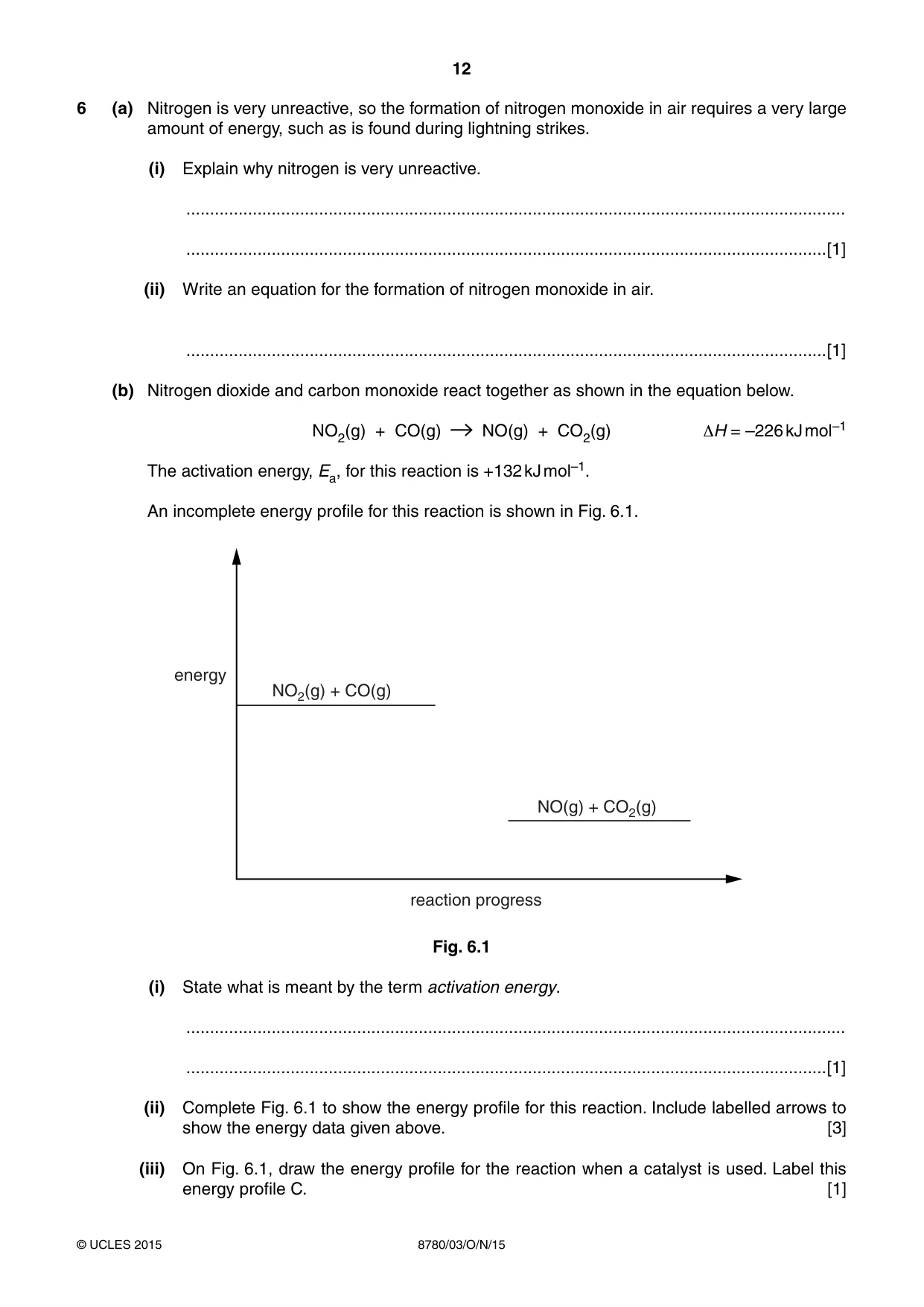
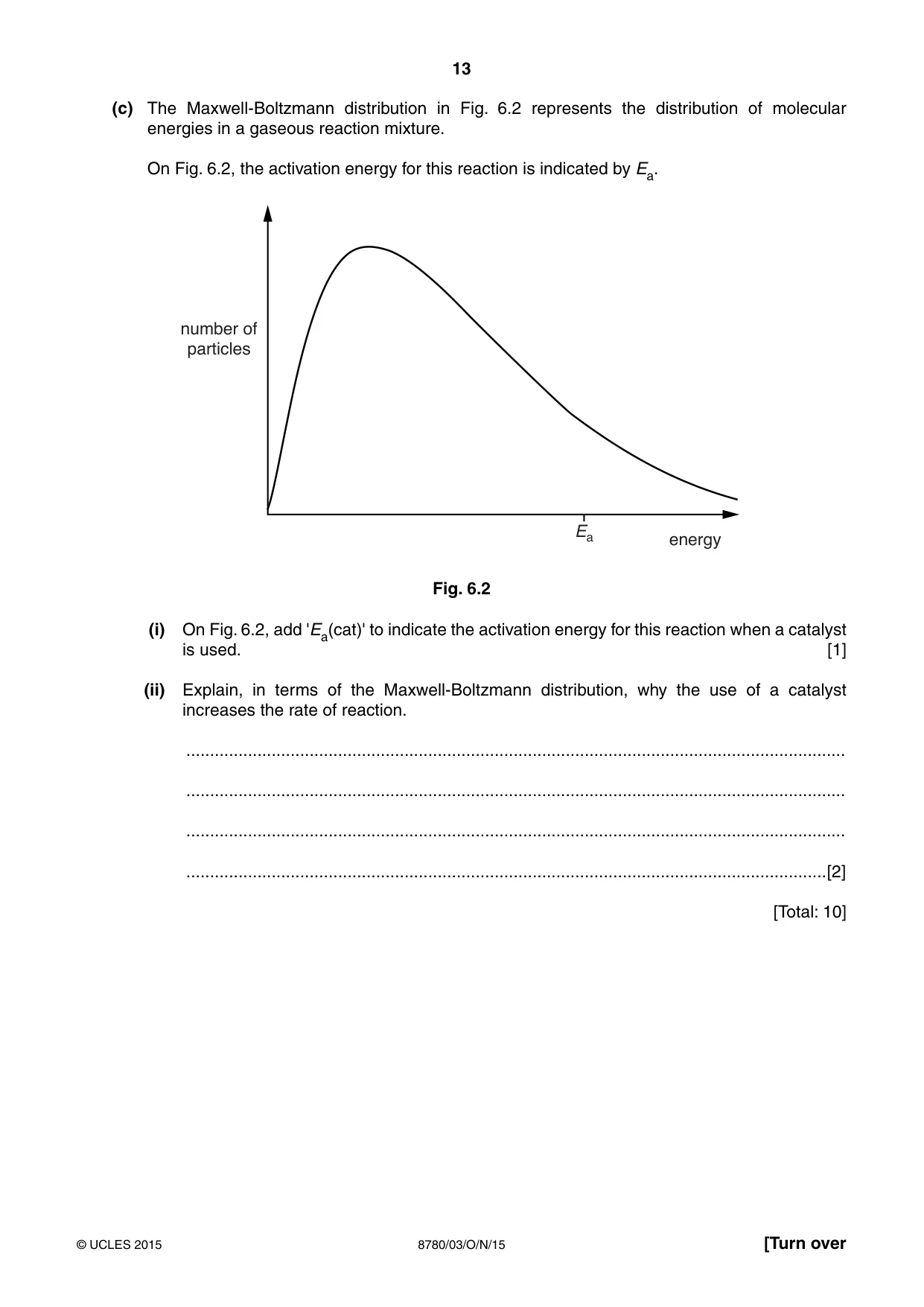
6 (a) Nitrogen is very unreactive, so the formation of nitrogen monoxide in air requires a very large amount of energy, such as is found during lightning strikes. (i) Explain why nitrogen is very unreactive. ........................................................................................................................................... .......................................................................................................................................[1] (ii) Write an equation for the formation of nitrogen monoxide in air. .......................................................................................................................................[1] (b) Nitrogen dioxide and carbon monoxide react together as shown in the equation below. NO2(g) + CO(g) NO(g) + CO2(g) ΔH = –226 kJ mol–1 The activation energy, Ea, for this reaction is +132 kJ mol–1. An incomplete energy profile for this reaction is shown in Fig. 6.1. energy NO2(g) + CO(g) NO(g) + CO2(g) reaction progress Fig. 6.1 (i) State what is meant by the term activation energy. ........................................................................................................................................... .......................................................................................................................................[1] (ii) Complete Fig. 6.1 to show the energy profile for this reaction. Include labelled arrows to show the energy data given above. [3] (iii) On Fig. 6.1, draw the energy profile for the reaction when a catalyst is used. Label this energy profile C. [1] (c) The Maxwell-Boltzmann distribution in Fig. 6.2 represents the distribution of molecular energies in a gaseous reaction mixture. On Fig. 6.2, the activation energy for this reaction is indicated by Ea. QXPEHU RI SDUWLFOHV (D HQHUJ\ Fig. 6.2 (i) On Fig. 6.2, add 'Ea(cat)' to indicate the activation energy for this reaction when a catalyst is used. [1] (ii) Explain, in terms of the Maxwell-Boltzmann distribution, why the use of a catalyst increases the rate of reaction. ........................................................................................................................................... ........................................................................................................................................... ........................................................................................................................................... .......................................................................................................................................[2] [Total: 10]
Mark scheme: 6 (a) (i) the triple bond (between the nitrogen atoms) is (very) strong [1] (ii) N2 + O2 → 2NO [1] (b) (i) the minimum amount of energy required for a reaction to occur [1] (ii) correct profile showing a peak between reactants and products and Ea is clearly < ΔH [1] the peak is correctly labelled as Ea /+132 and with an arrow going upwards from the reactants line. [1] the enthalpy change enthalpy change is correctly labelled with ΔH or –226 with an arrow going down from the reactants line [1] (iii) correct catalysed profile line that starts at the reactants line, ends at the products line and tracks below the non-catalysed profile line and is labelled ‘C’ [1] (c) (i) Ea(cat) lies to the left of Ea and is on the x-axis [1] (ii) more / higher proportion of molecules will have E ⩾ Ea(cat) [1] more / a higher proportion of collisions will be successful [1] [Total: 10]
Q7 · A pair of parallel metal plates connected to a variable power supply
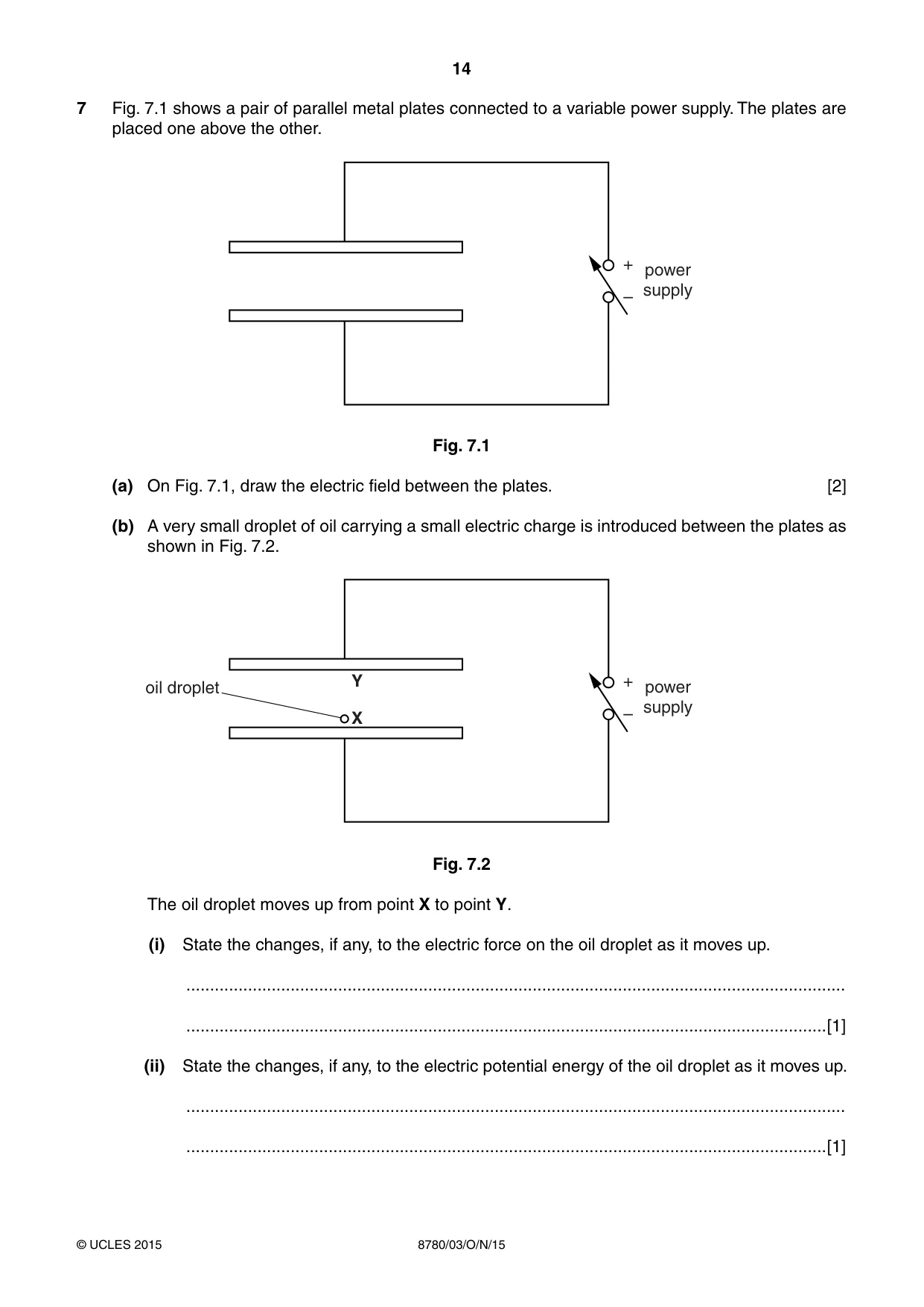
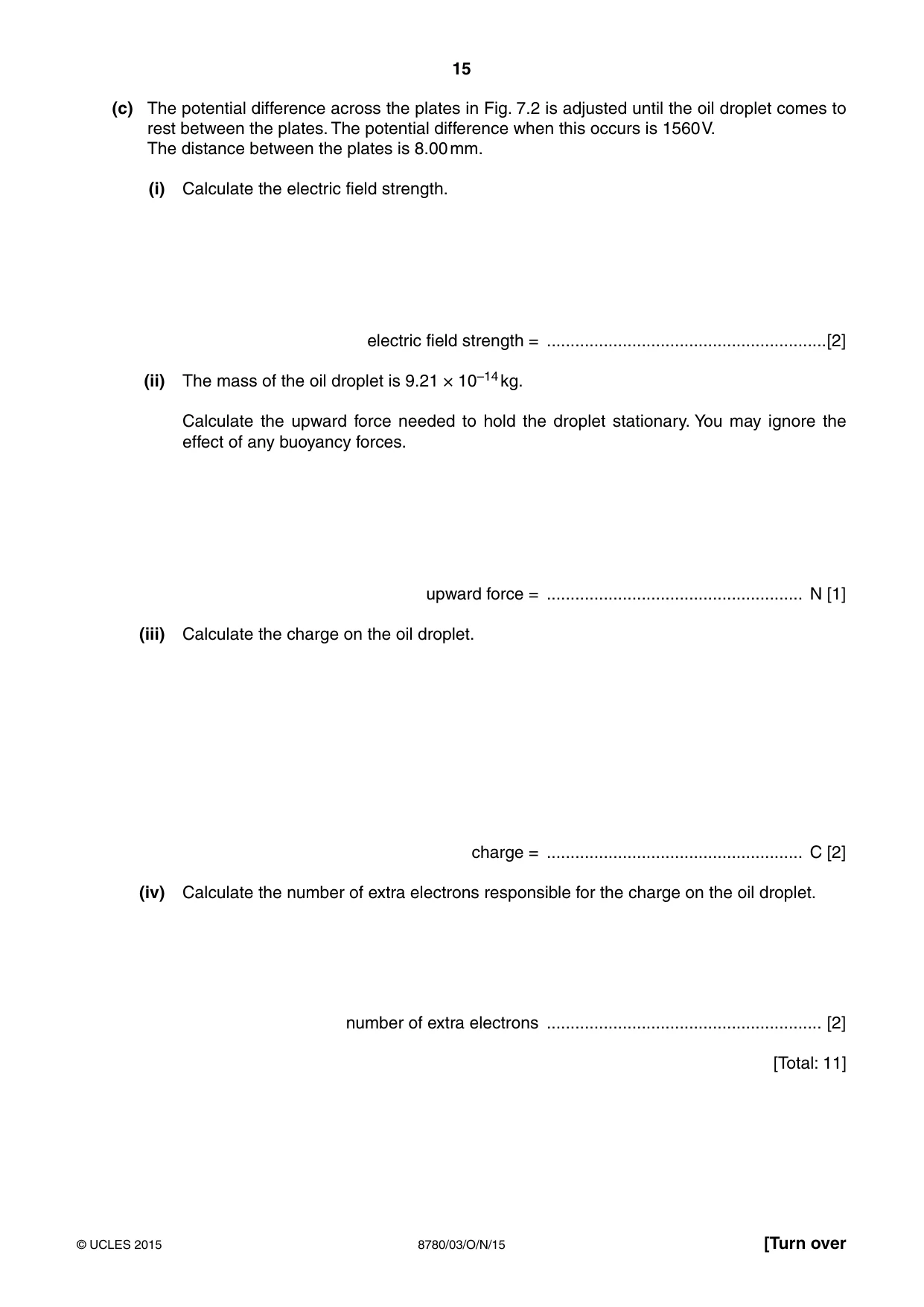
7 Fig. 7.1 shows a pair of parallel metal plates connected to a variable power supply. The plates are placed one above the other. + power supply – Fig. 7.1 (a) On Fig. 7.1, draw the electric field between the plates. [2] (b) A very small droplet of oil carrying a small electric charge is introduced between the plates as shown in Fig. 7.2. Y + oil droplet power supply X – Fig. 7.2 The oil droplet moves up from point X to point Y. (i) State the changes, if any, to the electric force on the oil droplet as it moves up. ........................................................................................................................................... .......................................................................................................................................[1] (ii) State the changes, if any, to the electric potential energy of the oil droplet as it moves up. ........................................................................................................................................... .......................................................................................................................................[1] (c) The potential difference across the plates in Fig. 7.2 is adjusted until the oil droplet comes to rest between the plates. The potential difference when this occurs is 1560 V. The distance between the plates is 8.00 mm. (i) Calculate the electric field strength. electric field strength = ...........................................................[2] (ii) The mass of the oil droplet is 9.21 × 10⁻¹⁴ kg. Calculate the upward force needed to hold the droplet stationary. You may ignore the effect of any buoyancy forces. upward force = ...................................................... N [1] (iii) Calculate the charge on the oil droplet. charge = ...................................................... C [2] (iv) Calculate the number of extra electrons responsible for the charge on the oil droplet. number of extra electrons .......................................................... [2] [Total: 11]
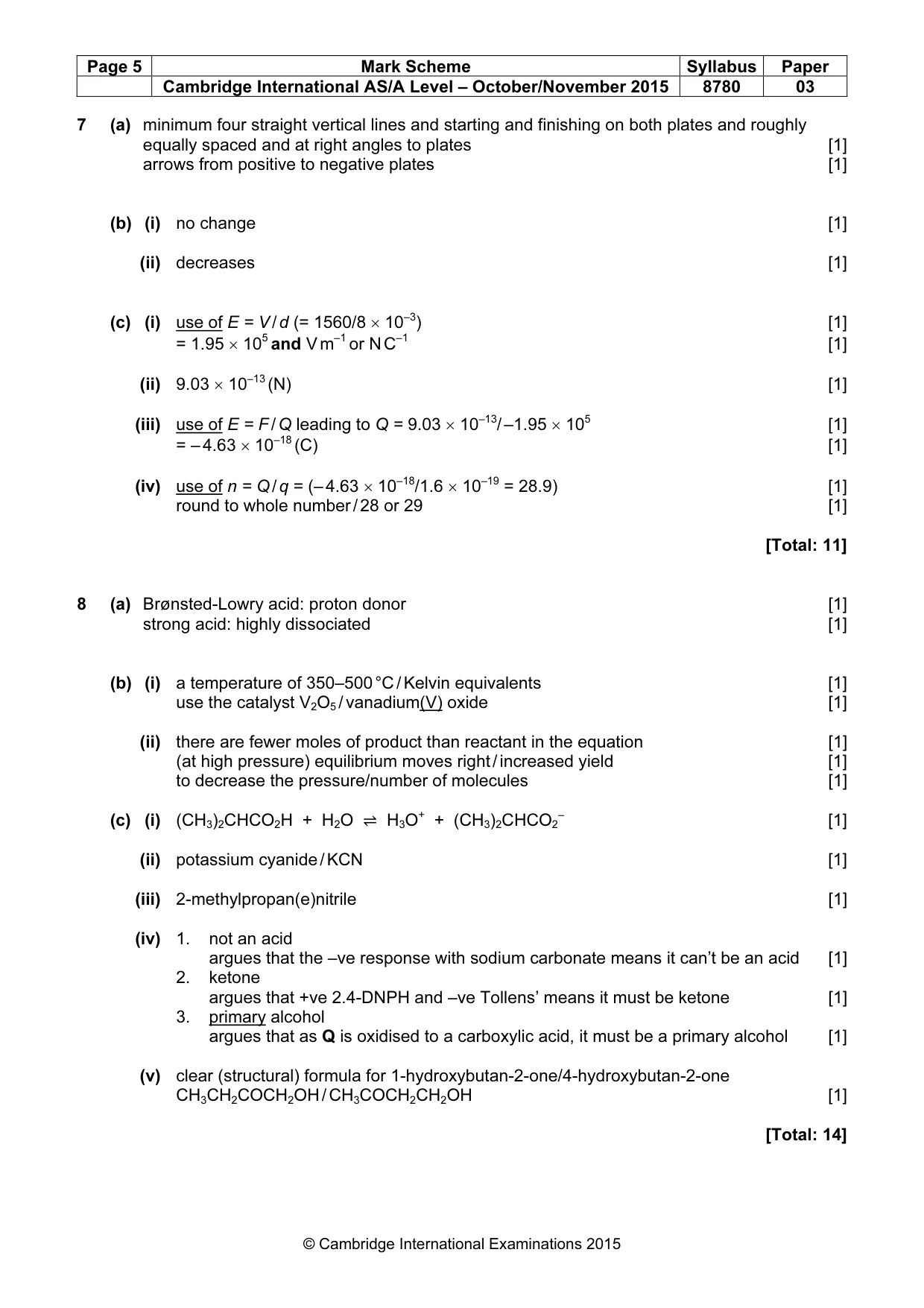
Mark scheme: 7 (a) minimum four straight vertical lines and starting and finishing on both plates and roughly equally spaced and at right angles to plates [1] arrows from positive to negative plates [1] (b) (i) no change [1] (ii) decreases [1] (c) (i) use of E = V / d (= 1560/8 × 10–3) [1] = 1.95 × 10⁵ and V m–1 or N C–1 [1] (ii) 9.03 × 10⁻¹³ (N) [1] (iii) use of E = F / Q leading to Q = 9.03 × 10⁻¹³/ –1.95 × 10⁵ [1] = – 4.63 × 10⁻¹⁸ (C) [1] (iv) use of n = Q / q = (– 4.63 × 10⁻¹⁸/1.6 × 10–19 = 28.9) [1] round to whole number / 28 or 29 [1] [Total: 11]
Q8 · Ethanoic acid is a weak acid and sulfuric acid is a strong acid
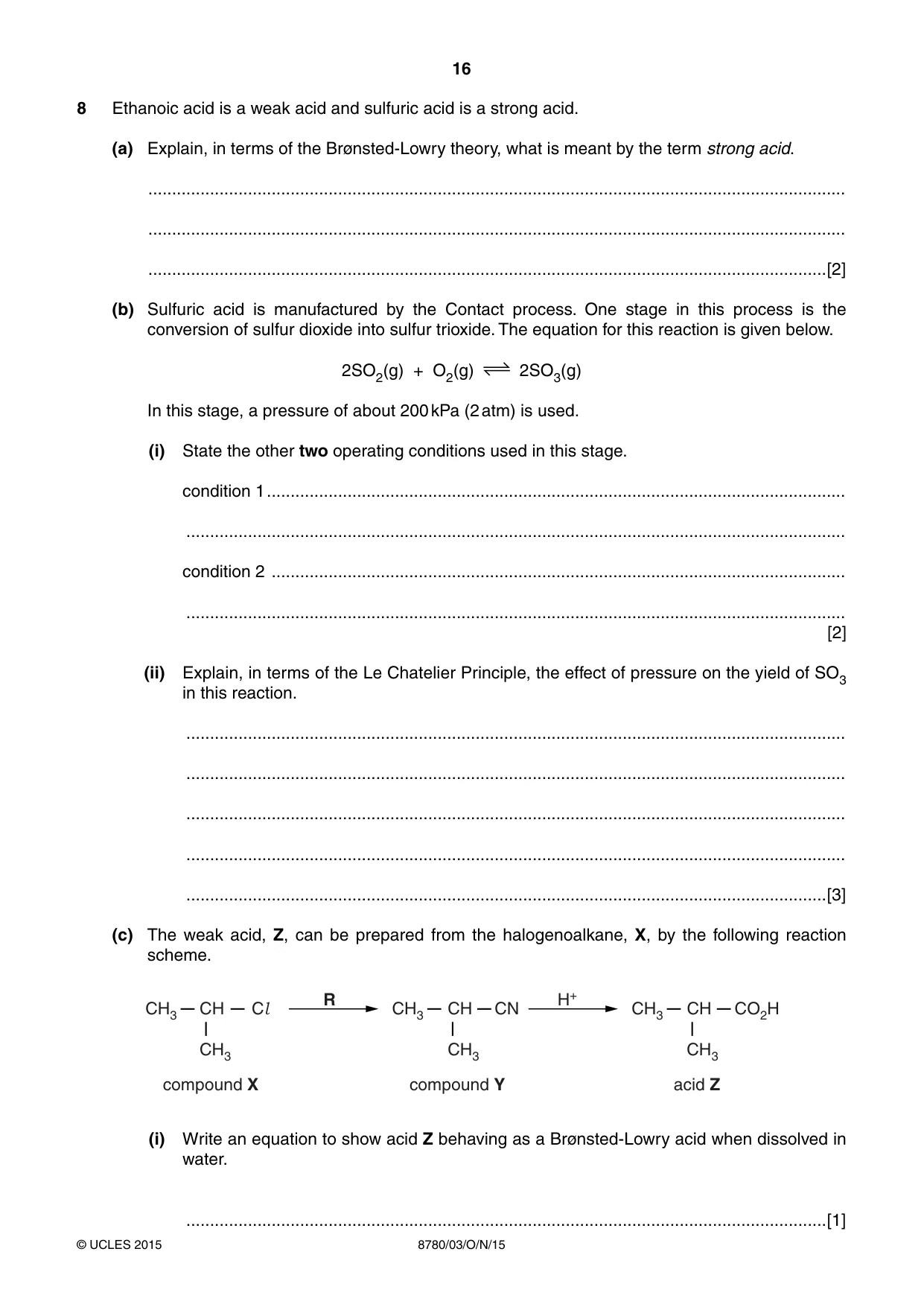
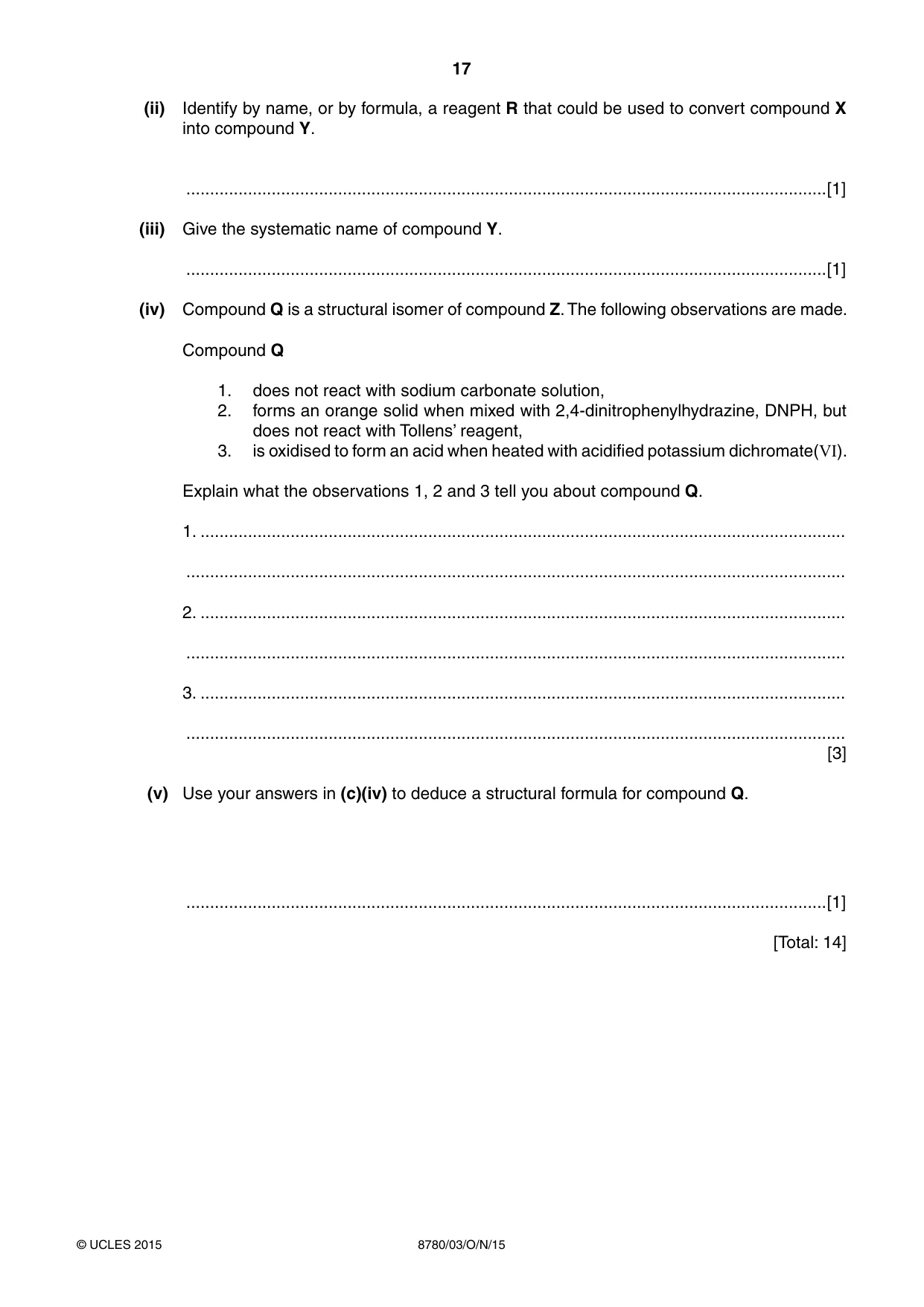
8 Ethanoic acid is a weak acid and sulfuric acid is a strong acid. (a) Explain, in terms of the Brønsted-Lowry theory, what is meant by the term strong acid. ................................................................................................................................................... ................................................................................................................................................... ...............................................................................................................................................[2] (b) Sulfuric acid is manufactured by the Contact process. One stage in this process is the conversion of sulfur dioxide into sulfur trioxide. The equation for this reaction is given below. 2SO2(g) + O2(g) 2SO3(g) In this stage, a pressure of about 200 kPa (2 atm) is used. (i) State the other two operating conditions used in this stage. condition 1 .......................................................................................................................... ........................................................................................................................................... condition 2 ......................................................................................................................... ........................................................................................................................................... [2] (ii) Explain, in terms of the Le Chatelier Principle, the effect of pressure on the yield of SO3 in this reaction. ........................................................................................................................................... ........................................................................................................................................... ........................................................................................................................................... ........................................................................................................................................... .......................................................................................................................................[3] (c) The weak acid, Z, can be prepared from the halogenoalkane, X, by the following reaction scheme. R H+ CH3 CH Cl CH3 CH CN CH3 CH CO2H CH3 CH3 CH3 compound X compound Y acid Z (i) Write an equation to show acid Z behaving as a Brønsted-Lowry acid when dissolved in water. .......................................................................................................................................[1] (ii) Identify by name, or by formula, a reagent R that could be used to convert compound X into compound Y. .......................................................................................................................................[1] (iii) Give the systematic name of compound Y. .......................................................................................................................................[1] (iv) Compound Q is a structural isomer of compound Z. The following observations are made. Compound Q 1. does not react with sodium carbonate solution, 2. forms an orange solid when mixed with 2,4-dinitrophenylhydrazine, DNPH, but does not react with Tollens’ reagent, 3. is oxidised to form an acid when heated with acidified potassium dichromate(VI). Explain what the observations 1, 2 and 3 tell you about compound Q. 1. ........................................................................................................................................ ........................................................................................................................................... 2. ........................................................................................................................................ ........................................................................................................................................... 3. ........................................................................................................................................ ........................................................................................................................................... [3] (v) Use your answers in (c)(iv) to deduce a structural formula for compound Q. .......................................................................................................................................[1] [Total: 14]
Mark scheme: 8 (a) Brønsted-Lowry acid: proton donor [1] strong acid: highly dissociated [1] (b) (i) a temperature of 350–500 °C / Kelvin equivalents [1] use the catalyst V2O5 / vanadium(V) oxide [1] (ii) there are fewer moles of product than reactant in the equation [1] (at high pressure) equilibrium moves right / increased yield [1] to decrease the pressure/number of molecules [1] (c) (i) (CH3)2CHCO2H + H2O ⇌ H3O+ + (CH3)2CHCO2– [1] (ii) potassium cyanide / KCN [1] (iii) 2-methylpropan(e)nitrile [1] (iv) 1. not an acid argues that the –ve response with sodium carbonate means it can’t be an acid [1] 2. ketone argues that +ve 2.4-DNPH and –ve Tollens’ means it must be ketone [1] 3. primary alcohol argues that as Q is oxidised to a carboxylic acid, it must be a primary alcohol [1] (v) clear (structural) formula for 1-hydroxybutan-2-one/4-hydroxybutan-2-one CH3CH2COCH2OH / CH3COCH2CH2OH [1] [Total: 14]