Cambridge A Level Physical Science 8780 — 2011 Oct/Nov Paper 3 · Variant 1
8780/31/O/N/11 · 11 questions · 80 marks · ≈90 min
The question paper and its mark scheme, free to read here and free to download. This is Cambridge’s own paper, exactly as it was sat.
Question paper20 pages
Mark scheme7 pages
Answers below. Sit the paper first if you are practising.
Questions as text
Q1 · A student is using a thermistor as a thermometer
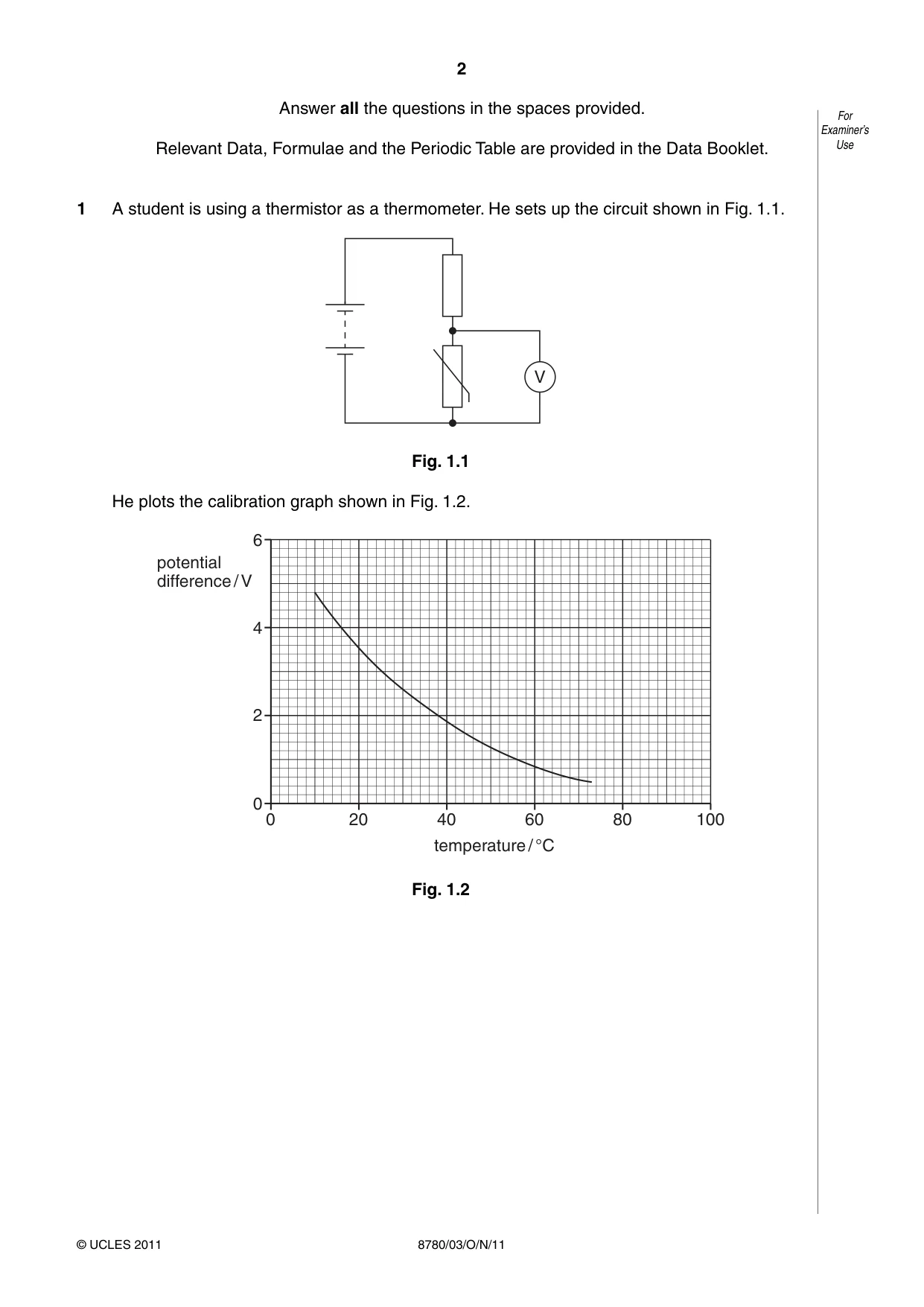
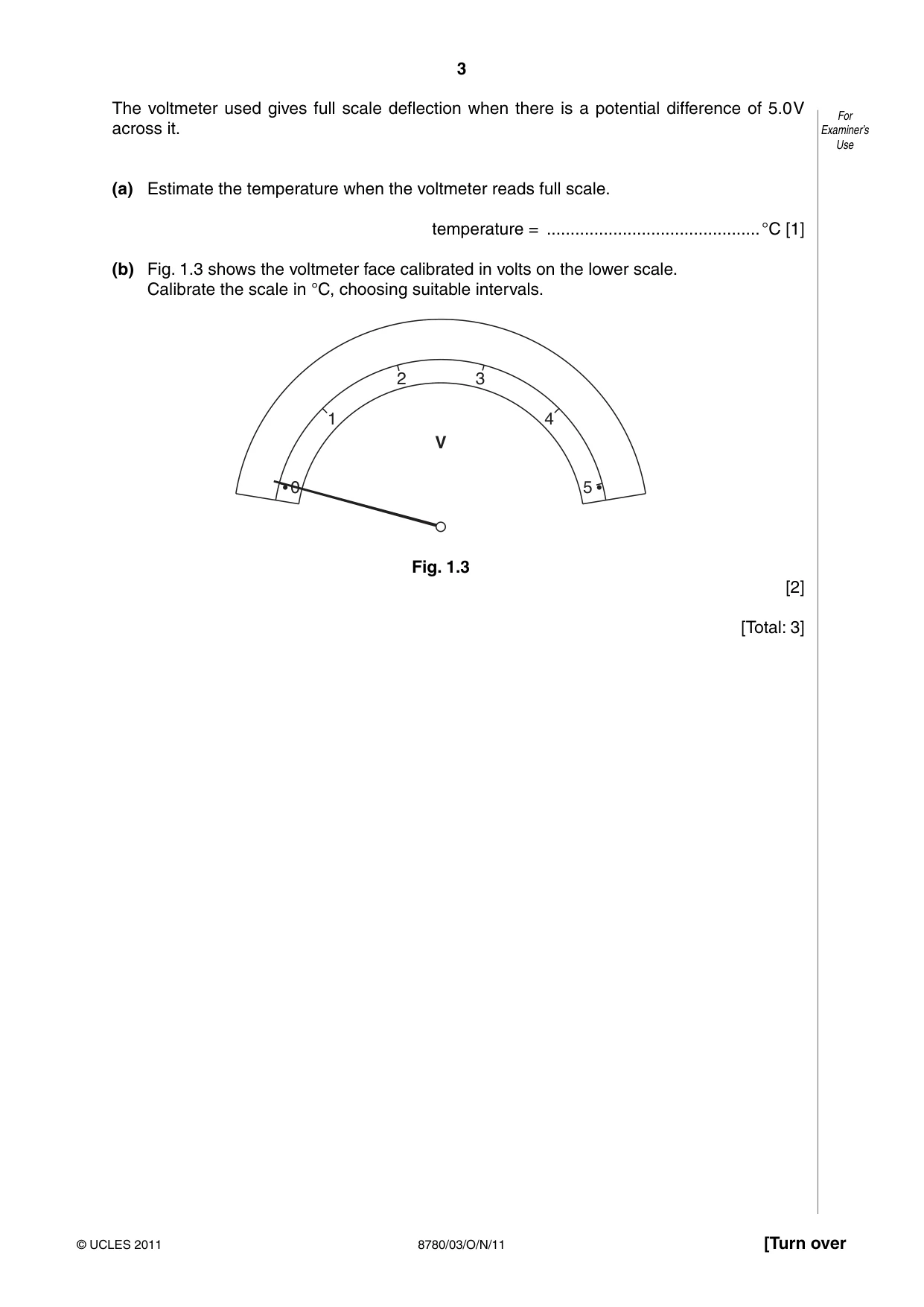
1 A student is using a thermistor as a thermometer. He sets up the circuit shown in Fig. 1.1. V Fig. 1.1 He plots the calibration graph shown in Fig. 1.2. 6 potential difference / V 4 2 0 0 20 40 60 80 100 temperature / °C Fig. 1.2 The voltmeter used gives full scale deflection when there is a potential difference of 5.0 V across it. (a) Estimate the temperature when the voltmeter reads full scale. temperature = .............................................°C [1] (b) Fig. 1.3 shows the voltmeter face calibrated in volts on the lower scale. Calibrate the scale in °C, choosing suitable intervals. 2 3 1 4 V 0 5 Fig. 1.3 [2] [Total: 3]
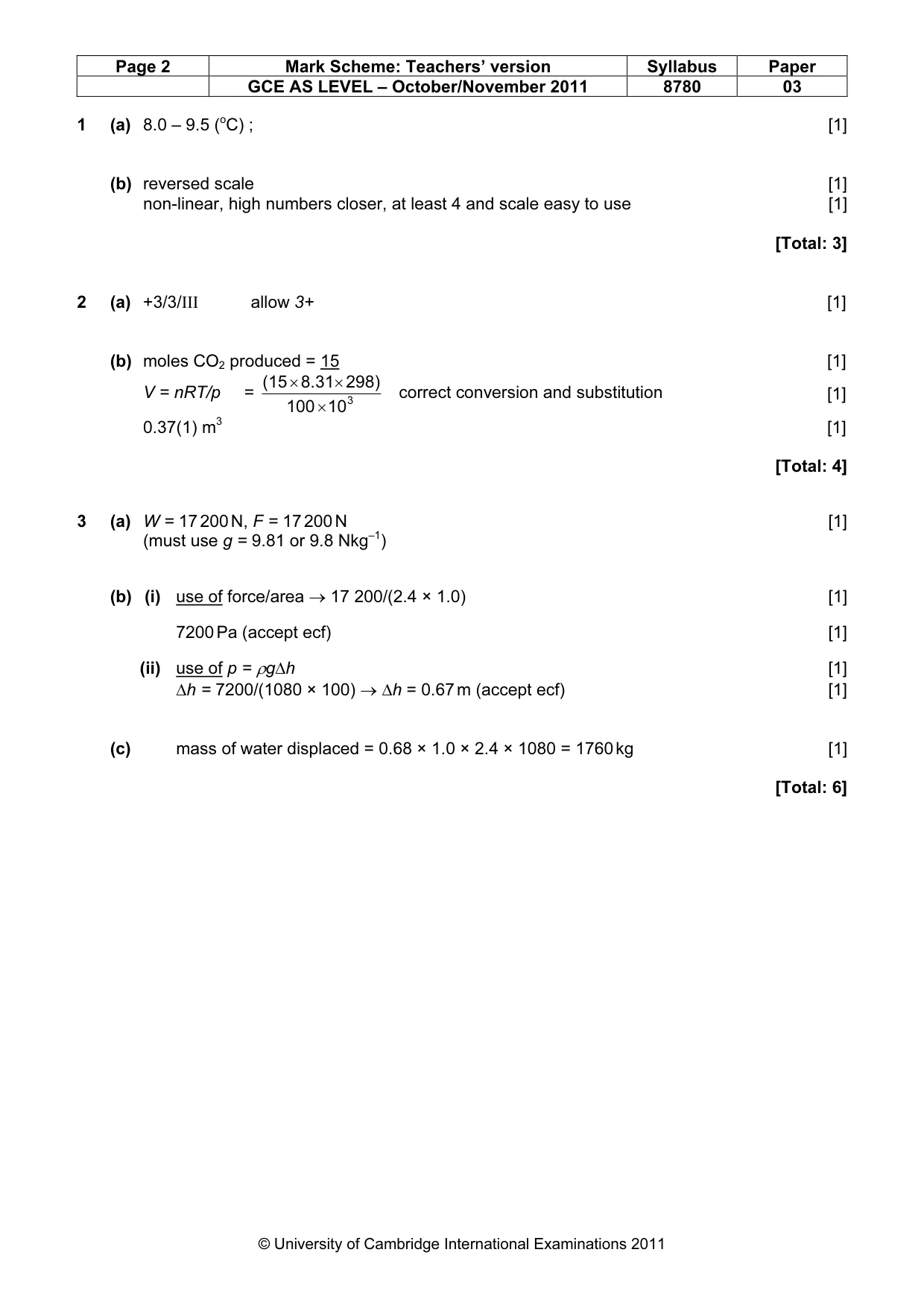
Mark scheme: 1 (a) 8.0 – 9.5 (oC) ; [1] (b) reversed scale [1] non-linear, high numbers closer, at least 4 and scale easy to use [1] [Total: 3]
Q2 · Antimony, Sb, has been known for many thousands of years and is often used to strengthen…
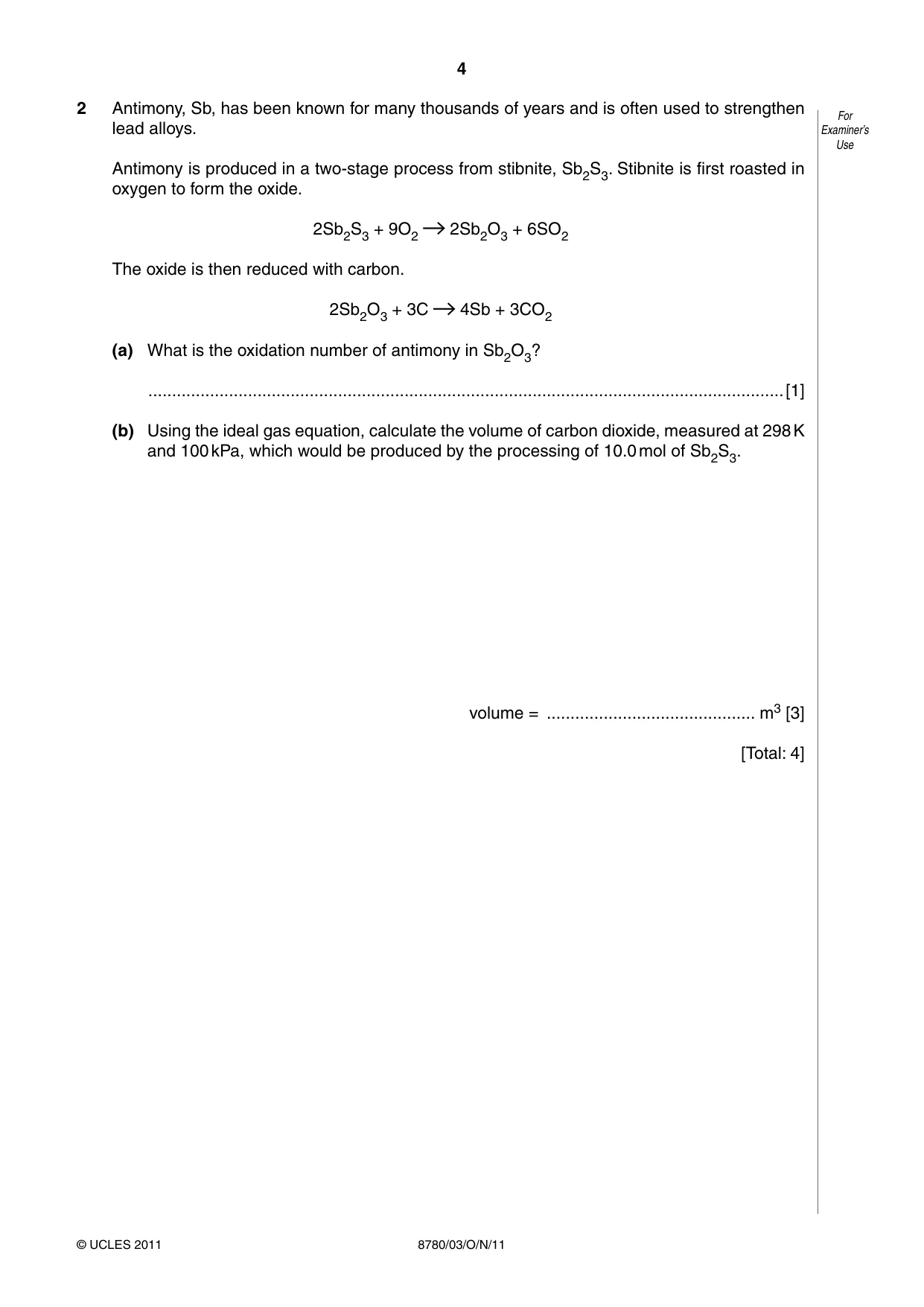
2 Antimony, Sb, has been known for many thousands of years and is often used to strengthen lead alloys. Antimony is produced in a two-stage process from stibnite, Sb2S3. Stibnite is first roasted in oxygen to form the oxide. 2Sb2S3 + 9O2 2Sb2O3 + 6SO2 The oxide is then reduced with carbon. 2Sb2O3 + 3C 4Sb + 3CO2 (a) What is the oxidation number of antimony in Sb2O3? ......................................................................................................................................[1] (b) Using the ideal gas equation, calculate the volume of carbon dioxide, measured at 298 K and 100 kPa, which would be produced by the processing of 10.0 mol of Sb2S3. volume = ............................................ m3 [3] [Total: 4]
Mark scheme: 2 (a) +3/3/III allow 3+ [1] (b) moles CO2 produced = 15 [1] (15 × 8.31 × 298) V = nRT/p = 3 correct conversion and substitution [1] 100 × 10 0.37(1) m3 [1] [Total: 4]
Q3 · A rectangular block of ice of mass 1760 kg floating in sea water of density 1080 kg m–3
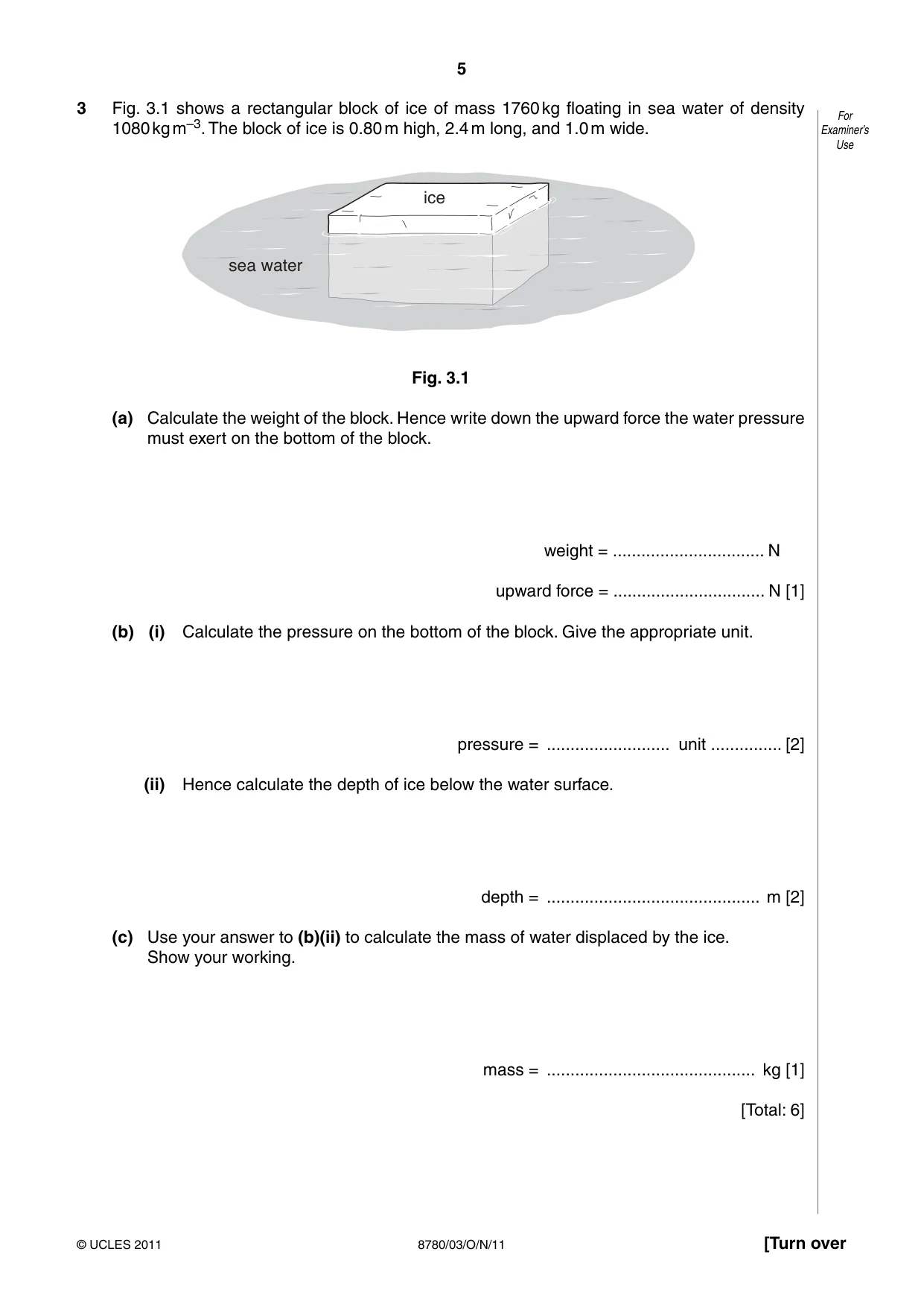
3 Fig. 3.1 shows a rectangular block of ice of mass 1760 kg floating in sea water of density 1080 kg m–3. The block of ice is 0.80 m high, 2.4 m long, and 1.0 m wide. ice sea water Fig. 3.1 (a) Calculate the weight of the block. Hence write down the upward force the water pressure must exert on the bottom of the block. weight = ................................ N upward force = ................................ N [1] (b) (i) Calculate the pressure on the bottom of the block. Give the appropriate unit. pressure = .......................... unit ............... [2] (ii) Hence calculate the depth of ice below the water surface. depth = ............................................. m [2] (c) Use your answer to (b)(ii) to calculate the mass of water displaced by the ice. Show your working. mass = ............................................ kg [1] [Total: 6]
Mark scheme: 3 (a) W = 17 200 N, F = 17 200 N [1] (must use g = 9.81 or 9.8 Nkg–1) (b) (i) use of force/area → 17 200/(2.4 × 1.0) [1] 7200 Pa (accept ecf) [1] (ii) use of p = ρg∆h [1] ∆h = 7200/(1080 × 100) → ∆h = 0.67 m (accept ecf) [1] (c) mass of water displaced = 0.68 × 1.0 × 2.4 × 1080 = 1760 kg [1] [Total: 6] GCE AS LEVEL – October/November 2011 8780 03
Q4 · The equation below shows the reaction between boron trifluoride and a fluoride ion to…
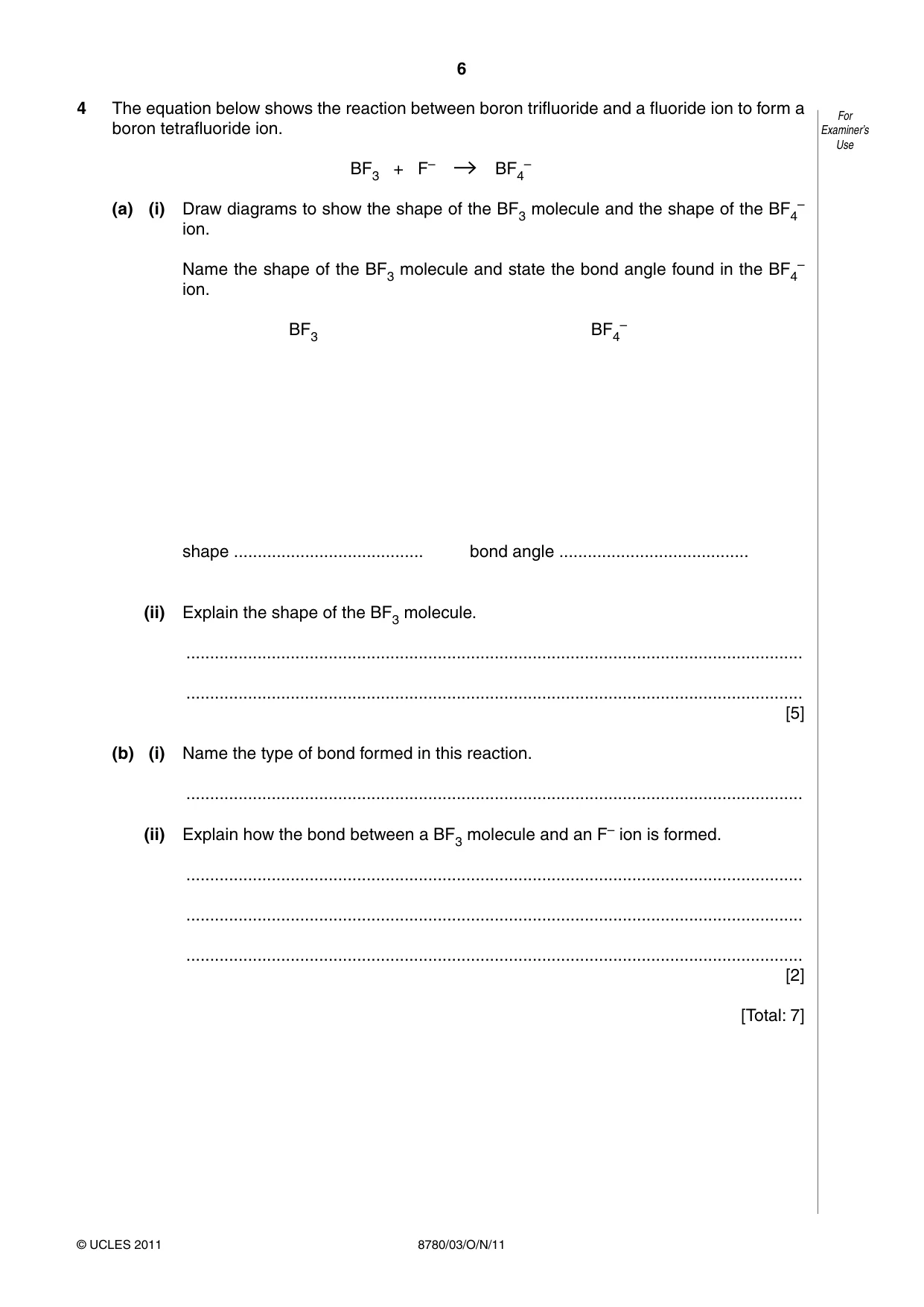
4 The equation below shows the reaction between boron trifluoride and a fluoride ion to form a boron tetrafluoride ion. BF3 + F– BF4– (a) (i) Draw diagrams to show the shape of the BF3 molecule and the shape of the BF4– ion. Name the shape of the BF3 molecule and state the bond angle found in the BF4– ion. BF3 BF4– shape ........................................ bond angle ........................................ (ii) Explain the shape of the BF3 molecule. .................................................................................................................................. .................................................................................................................................. [5] (b) (i) Name the type of bond formed in this reaction. .................................................................................................................................. (ii) Explain how the bond between a BF3 molecule and an F– ion is formed. .................................................................................................................................. .................................................................................................................................. .................................................................................................................................. [2] [Total: 7]
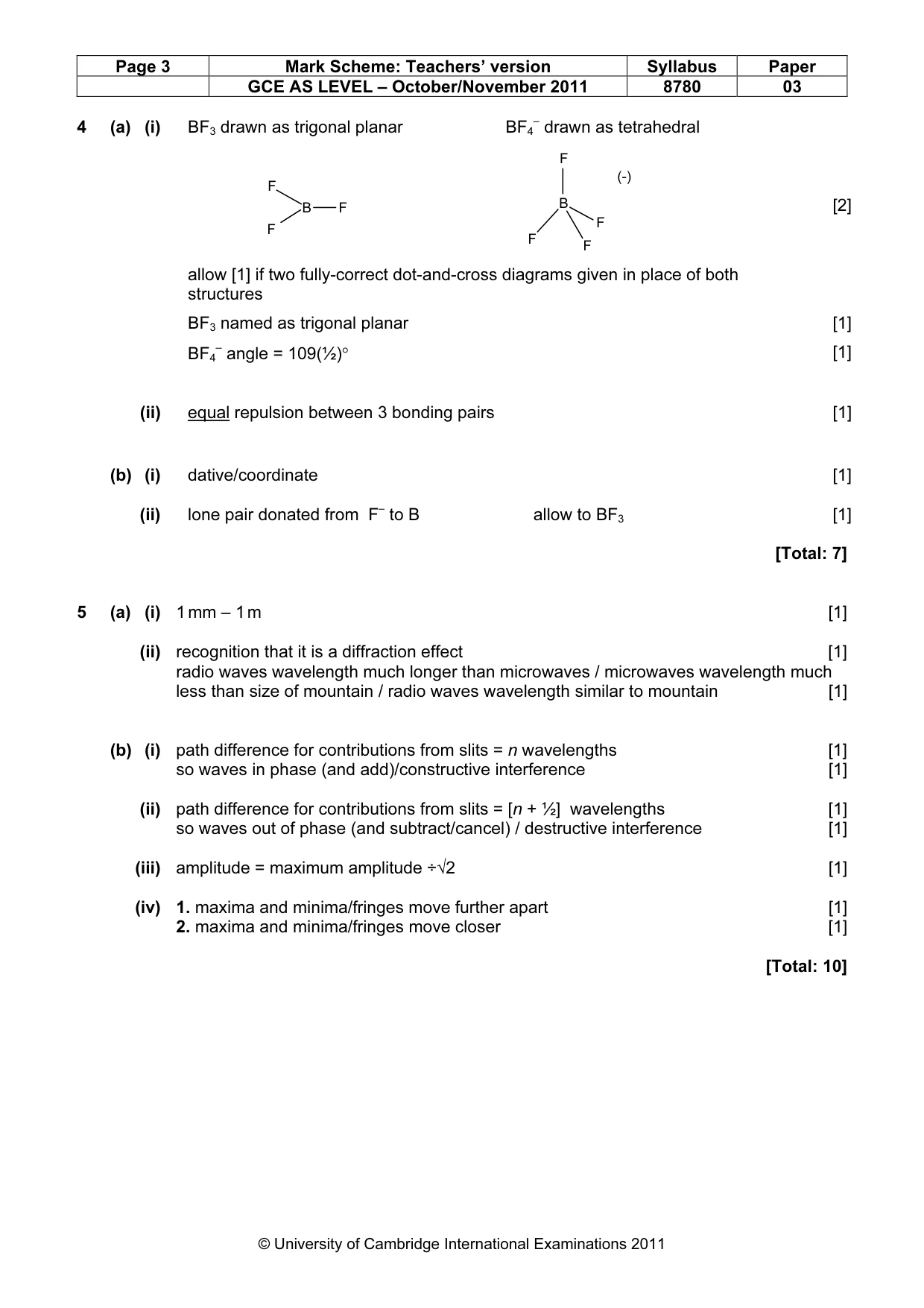
Mark scheme: – 4 (a) (i) BF3 drawn as trigonal planar BF4 drawn as tetrahedral F (-) F B [2] B F F F F F allow [1] if two fully-correct dot-and-cross diagrams given in place of both structures BF3 named as trigonal planar [1] – angle = 109(½)° [1] BF4 (ii) equal repulsion between 3 bonding pairs [1] (b) (i) dative/coordinate [1] (ii) lone pair donated from F– to B allow to BF3 [1] [Total: 7]
Q5 · Microwaves are a form of electromagnetic radiation
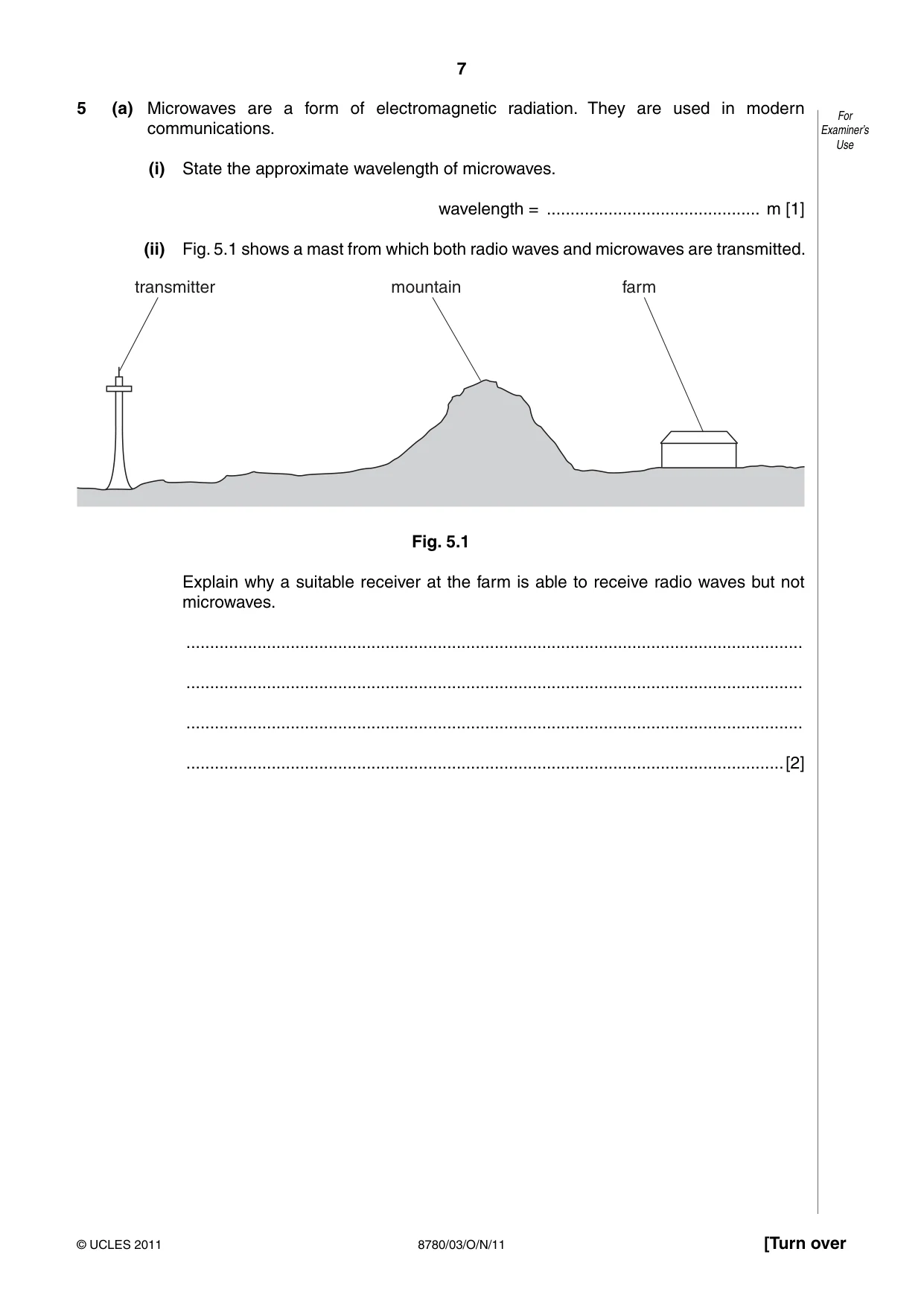
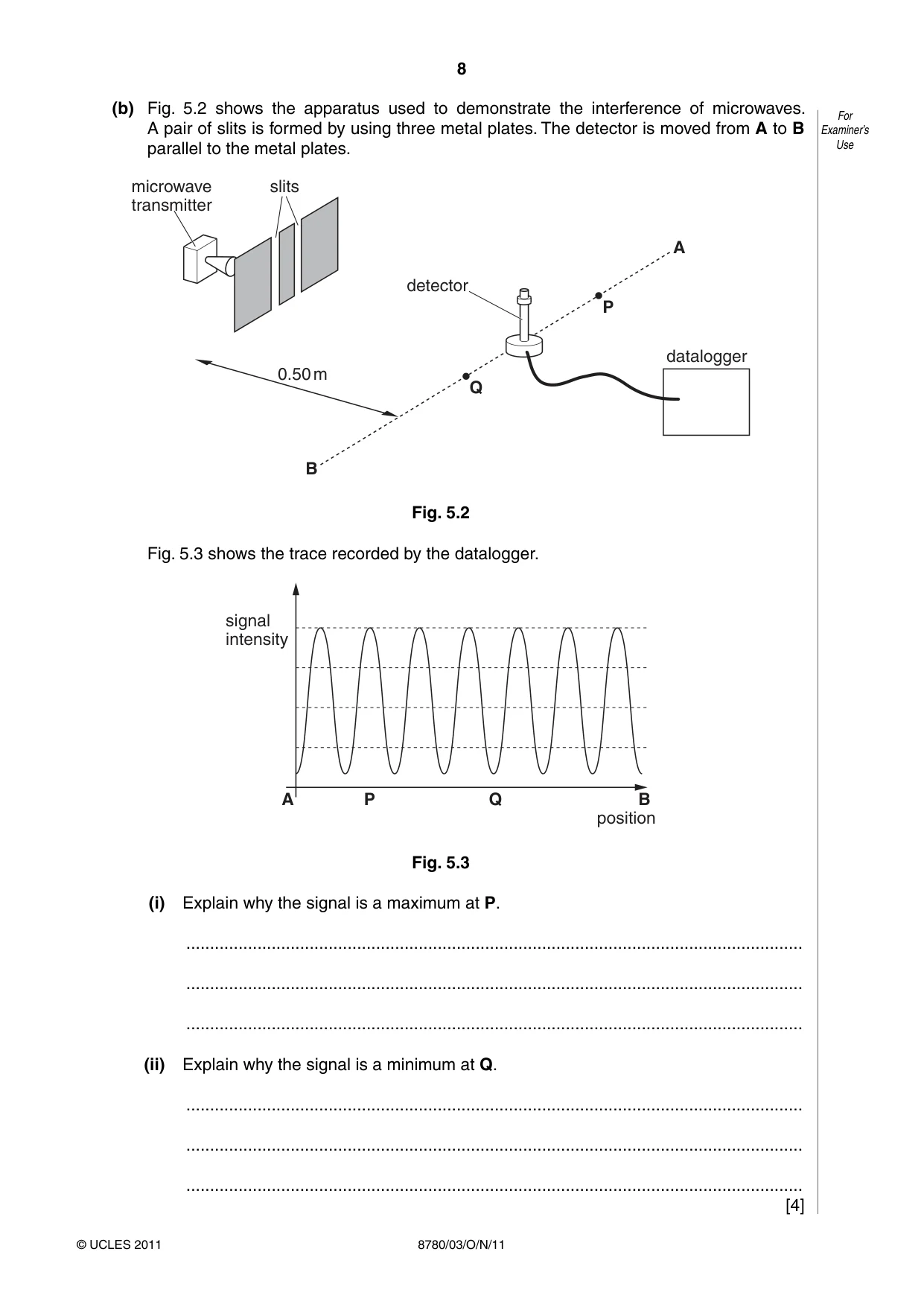
5 (a) Microwaves are a form of electromagnetic radiation. They are used in modern communications. (i) State the approximate wavelength of microwaves. wavelength = ............................................. m [1] (ii) Fig. 5.1 shows a mast from which both radio waves and microwaves are transmitted. transmitter mountain farm Fig. 5.1 Explain why a suitable receiver at the farm is able to receive radio waves but not microwaves. .................................................................................................................................. .................................................................................................................................. .................................................................................................................................. ..............................................................................................................................[2] (b) Fig. 5.2 shows the apparatus used to demonstrate the interference of microwaves. A pair of slits is formed by using three metal plates. The detector is moved from A to B parallel to the metal plates. microwave slits transmitter A detector P datalogger 0.50 m Q B Fig. 5.2 Fig. 5.3 shows the trace recorded by the datalogger. signal intensity A P Q B position Fig. 5.3 (i) Explain why the signal is a maximum at P. .................................................................................................................................. .................................................................................................................................. .................................................................................................................................. (ii) Explain why the signal is a minimum at Q. .................................................................................................................................. .................................................................................................................................. .................................................................................................................................. [4] (iii) When the detector is at the position shown in Fig. 5.2 the intensity of the signal is exactly one half the intensity of the maximum signal detected. Deduce how the amplitude at this position compares with the maximum amplitude. .................................................................................................................................. ..............................................................................................................................[1] (iv) State how the trace would change if 1. the slits are closer together, ........................................................................................................................... ........................................................................................................................... 2. shorter wavelength microwaves are used. ........................................................................................................................... ........................................................................................................................... [2] [Total: 10]
Mark scheme: 5 (a) (i) 1 mm – 1 m [1] (ii) recognition that it is a diffraction effect [1] radio waves wavelength much longer than microwaves / microwaves wavelength much less than size of mountain / radio waves wavelength similar to mountain [1] (b) (i) path difference for contributions from slits = n wavelengths [1] so waves in phase (and add)/constructive interference [1] (ii) path difference for contributions from slits = [n + ½] wavelengths [1] so waves out of phase (and subtract/cancel) / destructive interference [1] (iii) amplitude = maximum amplitude ÷√2 [1] (iv) 1. maxima and minima/fringes move further apart [1] 2. maxima and minima/fringes move closer [1] [Total: 10] GCE AS LEVEL – October/November 2011 8780 03 [1]
Q6 · Ammonia is manufactured by passing a mixture of hydrogen and nitrogen over an iron…
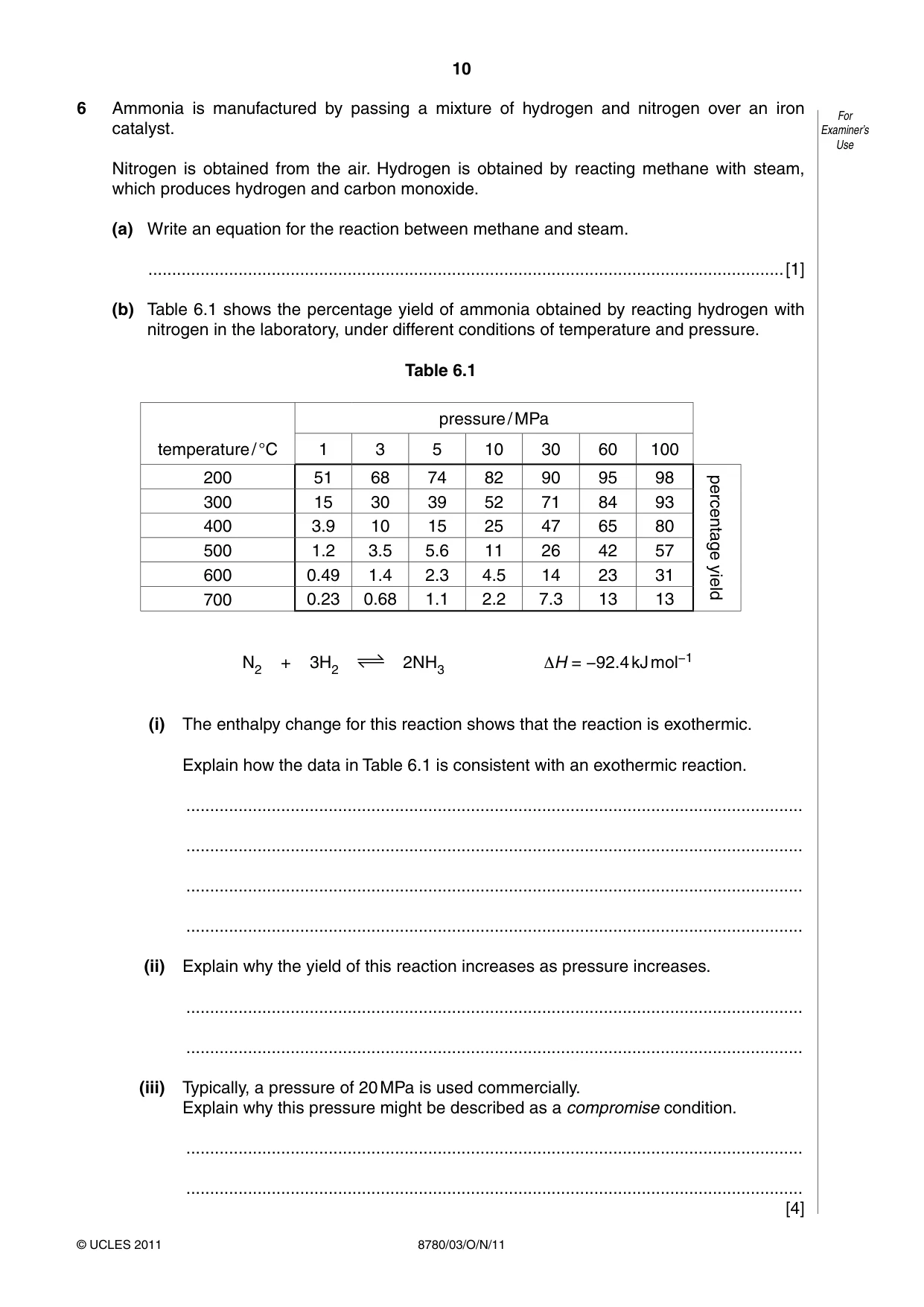
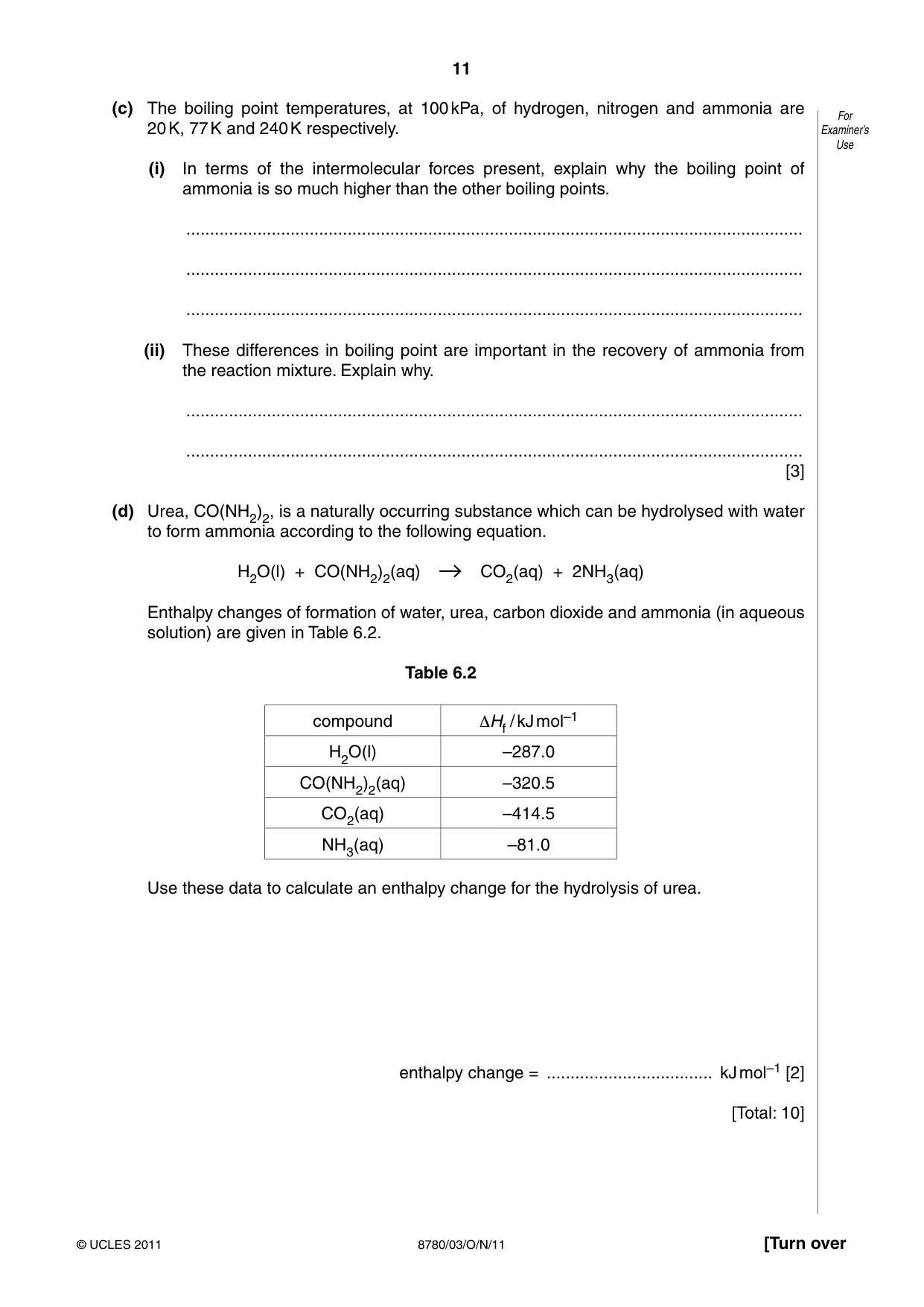
6 Ammonia is manufactured by passing a mixture of hydrogen and nitrogen over an iron catalyst. Nitrogen is obtained from the air. Hydrogen is obtained by reacting methane with steam, which produces hydrogen and carbon monoxide. (a) Write an equation for the reaction between methane and steam. ......................................................................................................................................[1] (b) Table 6.1 shows the percentage yield of ammonia obtained by reacting hydrogen with nitrogen in the laboratory, under different conditions of temperature and pressure. Table 6.1 pressure / MPa temperature / °C 1 3 5 10 30 60 100 200 51 68 74 82 90 95 98 300 15 30 39 52 71 84 93 400 3.9 10 15 25 47 65 80 500 1.2 3.5 5.6 11 26 42 57 percentage 600 0.49 1.4 2.3 4.5 14 23 31 yield 700 0.23 0.68 1.1 2.2 7.3 13 13 N2 + 3H2 2NH3 ΔH = −92.4 kJ mol−1 (i) The enthalpy change for this reaction shows that the reaction is exothermic. Explain how the data in Table 6.1 is consistent with an exothermic reaction. .................................................................................................................................. .................................................................................................................................. .................................................................................................................................. .................................................................................................................................. (ii) Explain why the yield of this reaction increases as pressure increases. .................................................................................................................................. .................................................................................................................................. (iii) Typically, a pressure of 20 MPa is used commercially. Explain why this pressure might be described as a compromise condition. .................................................................................................................................. .................................................................................................................................. [4] (c) The boiling point temperatures, at 100 kPa, of hydrogen, nitrogen and ammonia are 20 K, 77 K and 240 K respectively. (i) In terms of the intermolecular forces present, explain why the boiling point of ammonia is so much higher than the other boiling points. .................................................................................................................................. .................................................................................................................................. .................................................................................................................................. (ii) These differences in boiling point are important in the recovery of ammonia from the reaction mixture. Explain why. .................................................................................................................................. .................................................................................................................................. [3] (d) Urea, CO(NH2)2, is a naturally occurring substance which can be hydrolysed with water to form ammonia according to the following equation. H2O(l) + CO(NH2)2(aq) CO2(aq) + 2NH3(aq) Enthalpy changes of formation of water, urea, carbon dioxide and ammonia (in aqueous solution) are given in Table 6.2. Table 6.2 compound ΔHf / kJ mol–1 H2O(l) –287.0 CO(NH2)2(aq) –320.5 CO2(aq) –414.5 NH3(aq) –81.0 Use these data to calculate an enthalpy change for the hydrolysis of urea. enthalpy change = ................................... kJ mol–1 [2] [Total: 10]
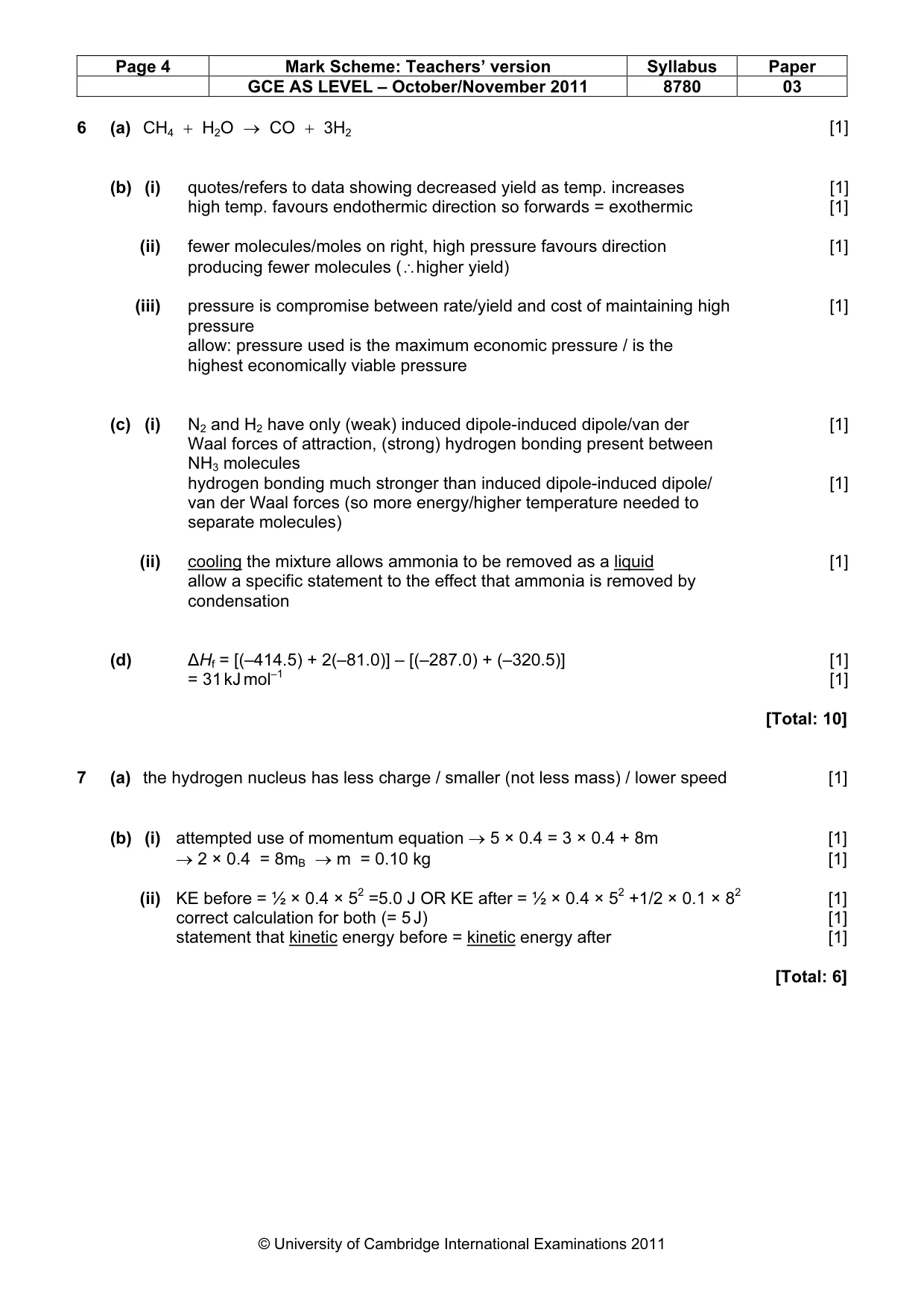
Mark scheme: 6 (a) CH4 + H2O → CO + 3H2 [1] (b) (i) quotes/refers to data showing decreased yield as temp. increases [1] high temp. favours endothermic direction so forwards = exothermic [1] (ii) fewer molecules/moles on right, high pressure favours direction [1] producing fewer molecules (∴higher yield) (iii) pressure is compromise between rate/yield and cost of maintaining high [1] pressure allow: pressure used is the maximum economic pressure / is the highest economically viable pressure (c) (i) N2 and H2 have only (weak) induced dipole-induced dipole/van der [1] Waal forces of attraction, (strong) hydrogen bonding present between NH3 molecules hydrogen bonding much stronger than induced dipole-induced dipole/ [1] van der Waal forces (so more energy/higher temperature needed to separate molecules) (ii) cooling the mixture allows ammonia to be removed as a liquid [1] allow a specific statement to the effect that ammonia is removed by condensation (d) ∆Hf = [(–414.5) + 2(–81.0)] – [(–287.0) + (–320.5)] [1] = 31 kJ mol–1 [1] [Total: 10]
Q7 · When a radioactive particle passes through a cloud chamber it ionises the air
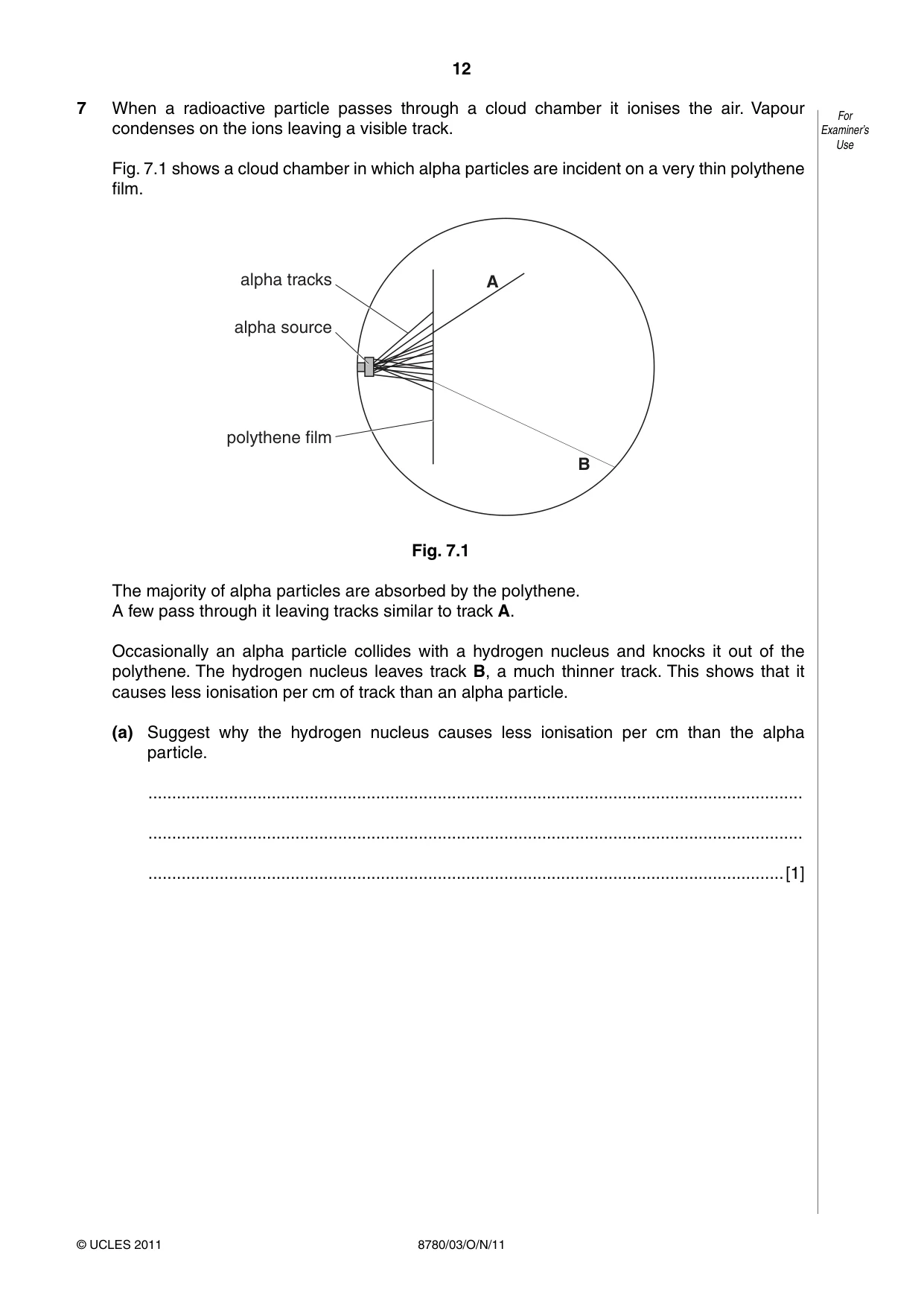
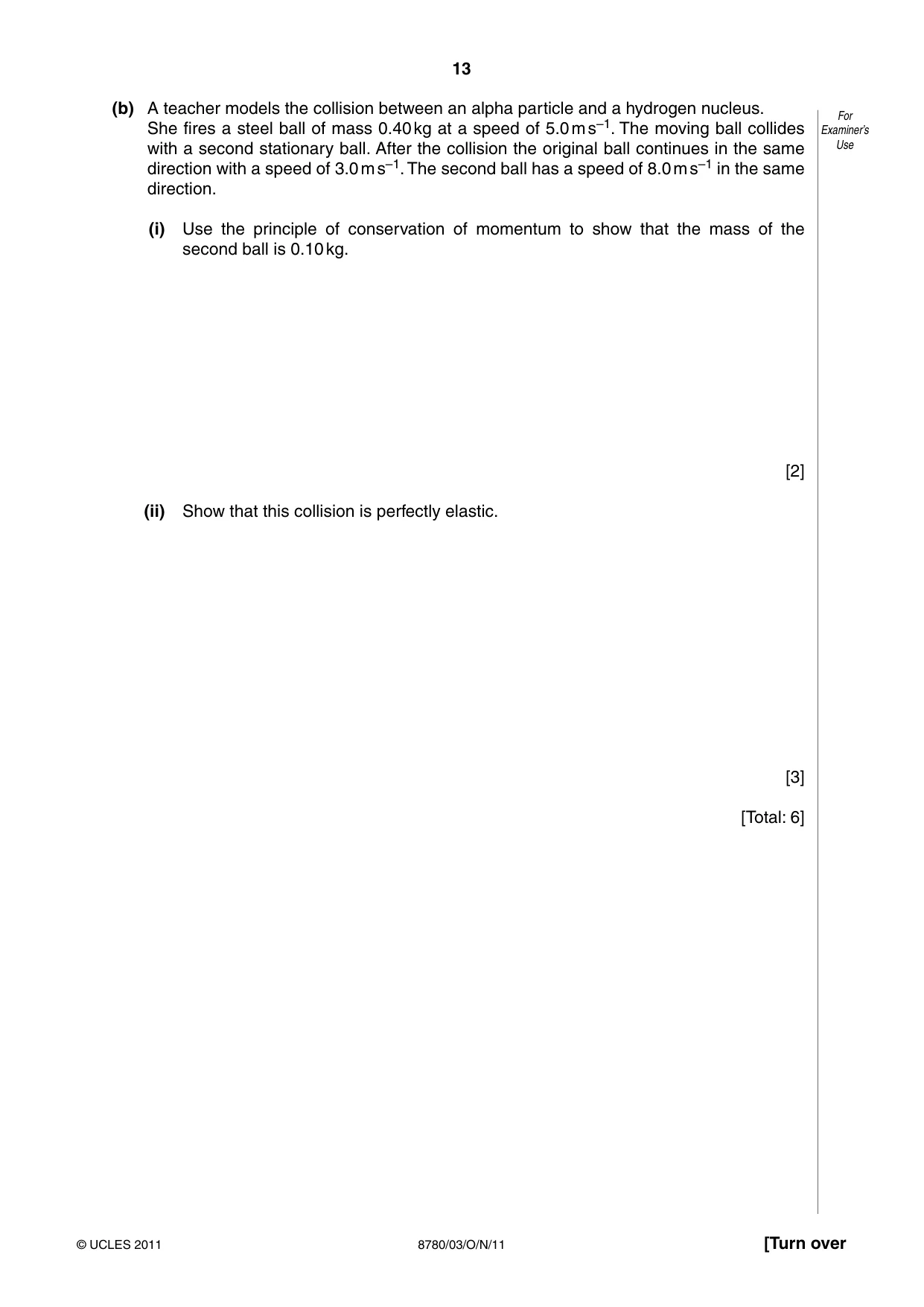
7 When a radioactive particle passes through a cloud chamber it ionises the air. Vapour condenses on the ions leaving a visible track. Fig. 7.1 shows a cloud chamber in which alpha particles are incident on a very thin polythene film. alpha tracks A alpha source polythene film B Fig. 7.1 The majority of alpha particles are absorbed by the polythene. A few pass through it leaving tracks similar to track A. Occasionally an alpha particle collides with a hydrogen nucleus and knocks it out of the polythene. The hydrogen nucleus leaves track B, a much thinner track. This shows that it causes less ionisation per cm of track than an alpha particle. (a) Suggest why the hydrogen nucleus causes less ionisation per cm than the alpha particle. .......................................................................................................................................... .......................................................................................................................................... ......................................................................................................................................[1] (b) A teacher models the collision between an alpha particle and a hydrogen nucleus. She fires a steel ball of mass 0.40 kg at a speed of 5.0 m s–1. The moving ball collides with a second stationary ball. After the collision the original ball continues in the same direction with a speed of 3.0 m s–1. The second ball has a speed of 8.0 m s–1 in the same direction. (i) Use the principle of conservation of momentum to show that the mass of the second ball is 0.10 kg. [2] (ii) Show that this collision is perfectly elastic. [3] [Total: 6]
Mark scheme: 7 (a) the hydrogen nucleus has less charge / smaller (not less mass) / lower speed [1] (b) (i) attempted use of momentum equation → 5 × 0.4 = 3 × 0.4 + 8m [1] → 2 × 0.4 = 8mB → m = 0.10 kg [1] (ii) KE before = ½ × 0.4 × 52 =5.0 J OR KE after = ½ × 0.4 × 52 +1/2 × 0.1 × 82 [1] correct calculation for both (= 5 J) [1] statement that kinetic energy before = kinetic energy after [1] [Total: 6] GCE AS LEVEL – October/November 2011 8780 03
Q8 · The ethene molecule, C2H4, has both σ and π bonding
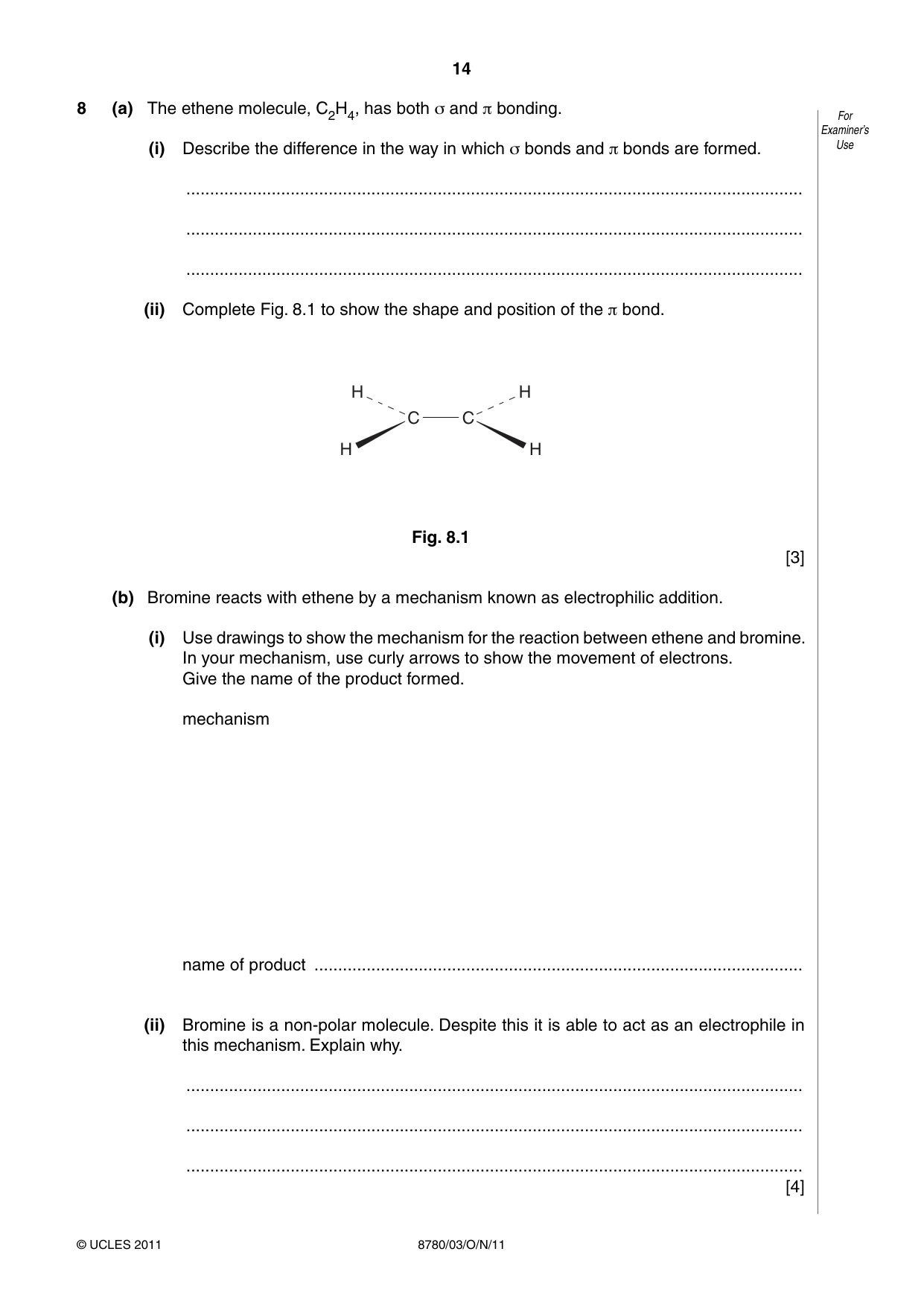
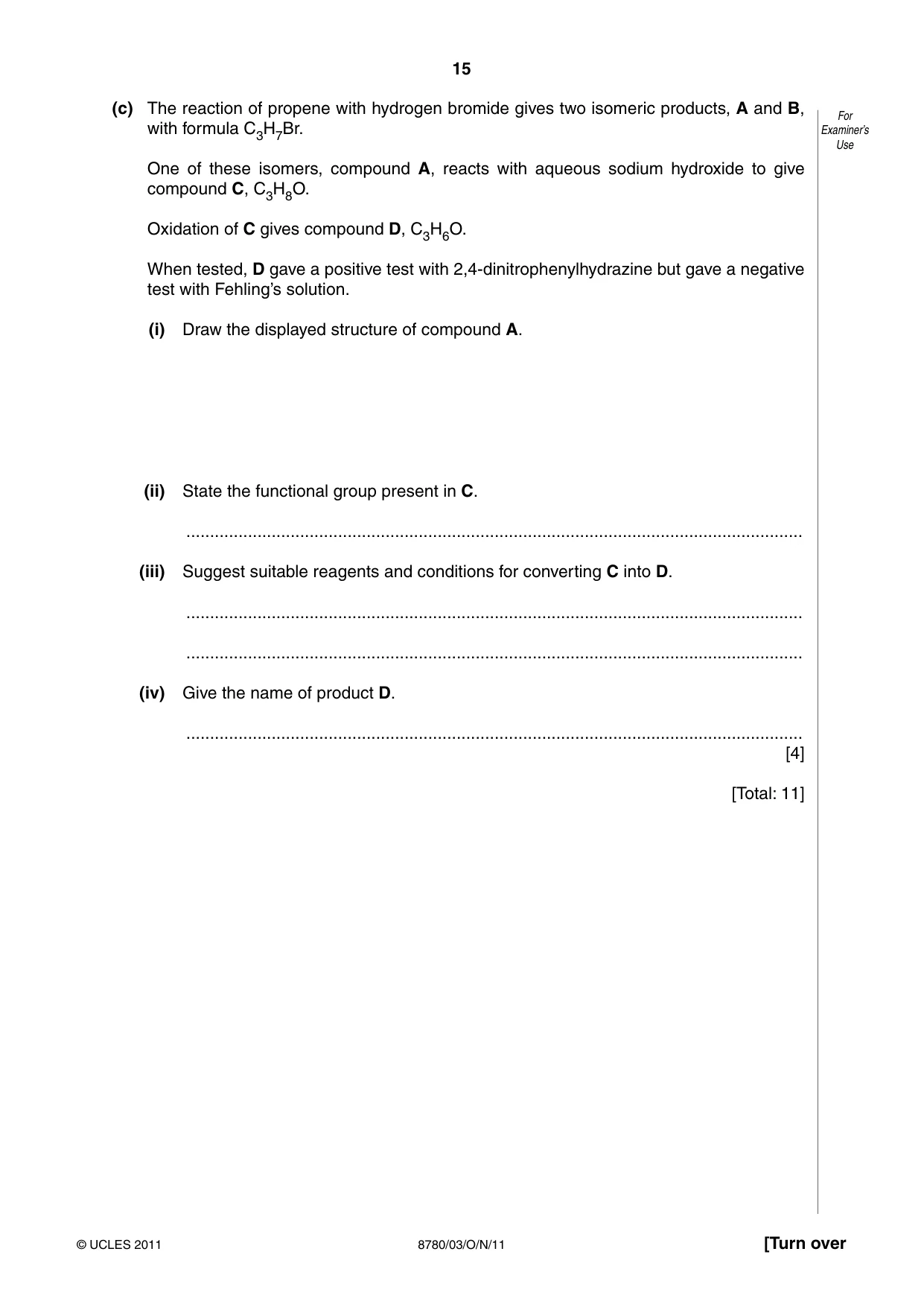
8 (a) The ethene molecule, C2H4, has both σ and π bonding. (i) Describe the difference in the way in which σ bonds and π bonds are formed. .................................................................................................................................. .................................................................................................................................. .................................................................................................................................. (ii) Complete Fig. 8.1 to show the shape and position of the π bond. H H C C H H Fig. 8.1 [3] (b) Bromine reacts with ethene by a mechanism known as electrophilic addition. (i) Use drawings to show the mechanism for the reaction between ethene and bromine. In your mechanism, use curly arrows to show the movement of electrons. Give the name of the product formed. mechanism name of product ....................................................................................................... (ii) Bromine is a non-polar molecule. Despite this it is able to act as an electrophile in this mechanism. Explain why. .................................................................................................................................. .................................................................................................................................. .................................................................................................................................. [4] (c) The reaction of propene with hydrogen bromide gives two isomeric products, A and B, with formula C3H7Br. One of these isomers, compound A, reacts with aqueous sodium hydroxide to give compound C, C3H8O. Oxidation of C gives compound D, C3H6O. When tested, D gave a positive test with 2,4-dinitrophenylhydrazine but gave a negative test with Fehling’s solution. (i) Draw the displayed structure of compound A. (ii) State the functional group present in C. .................................................................................................................................. (iii) Suggest suitable reagents and conditions for converting C into D. .................................................................................................................................. .................................................................................................................................. (iv) Give the name of product D. .................................................................................................................................. [4] [Total: 11]
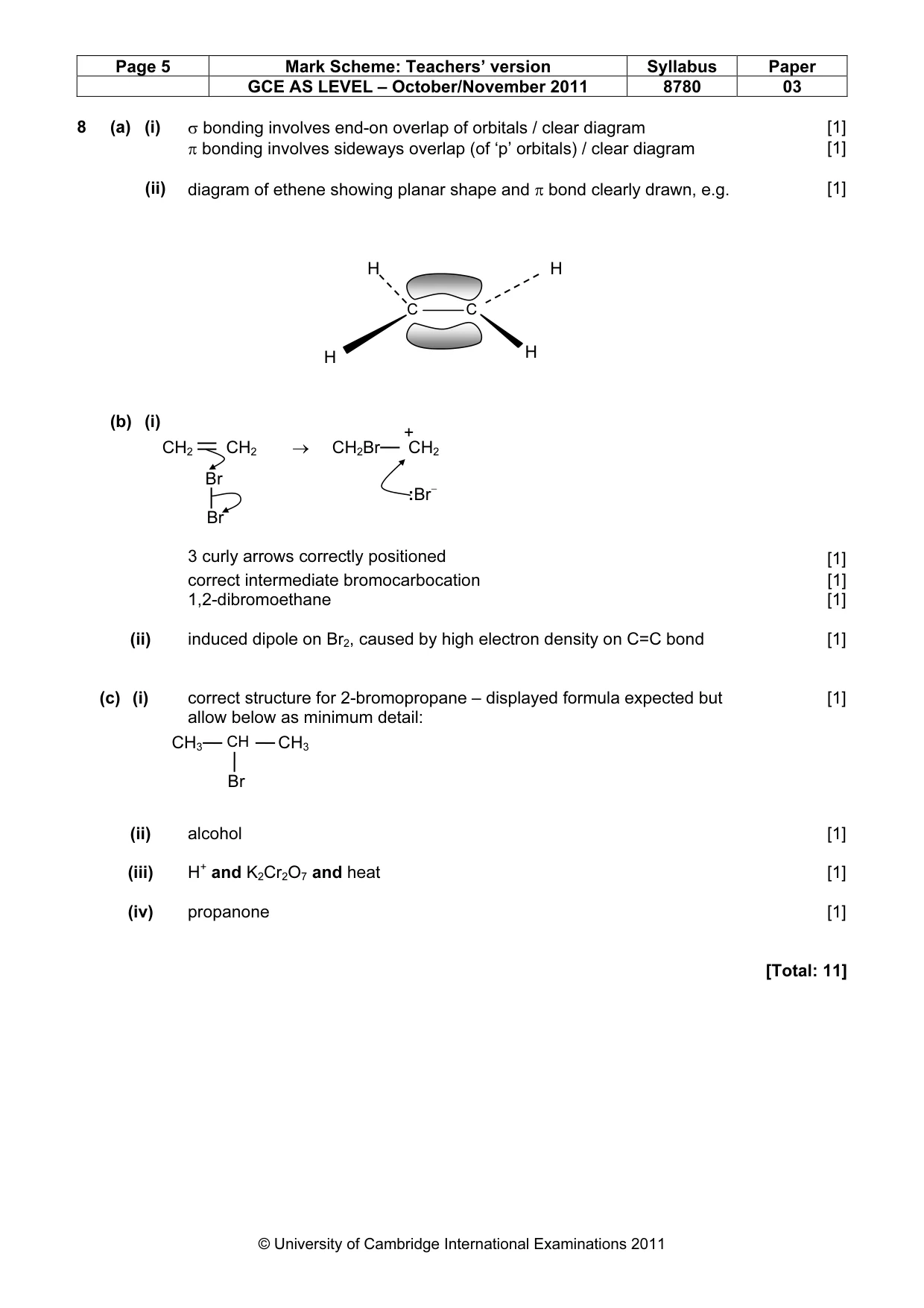
Mark scheme: 8 (a) (i) σ bonding involves end-on overlap of orbitals / clear diagram [1] π bonding involves sideways overlap (of ‘p’ orbitals) / clear diagram [1] (ii) diagram of ethene showing planar shape and π bond clearly drawn, e.g. [1] H H C C H H (b) (i) + CH2 CH2 → CH2Br CH2 Br :Br− Br 3 curly arrows correctly positioned [1] correct intermediate bromocarbocation [1] 1,2-dibromoethane [1] (ii) induced dipole on Br2, caused by high electron density on C=C bond [1] (c) (i) correct structure for 2-bromopropane – displayed formula expected but [1] allow below as minimum detail: CH3 CH CH3 Br (ii) alcohol [1] (iii) H+ and K2Cr2O7 and heat [1] (iv) propanone [1] [Total: 11] GCE AS LEVEL – October/November 2011 8780 03
Q9 · After the discovery of the electron in 1897, J
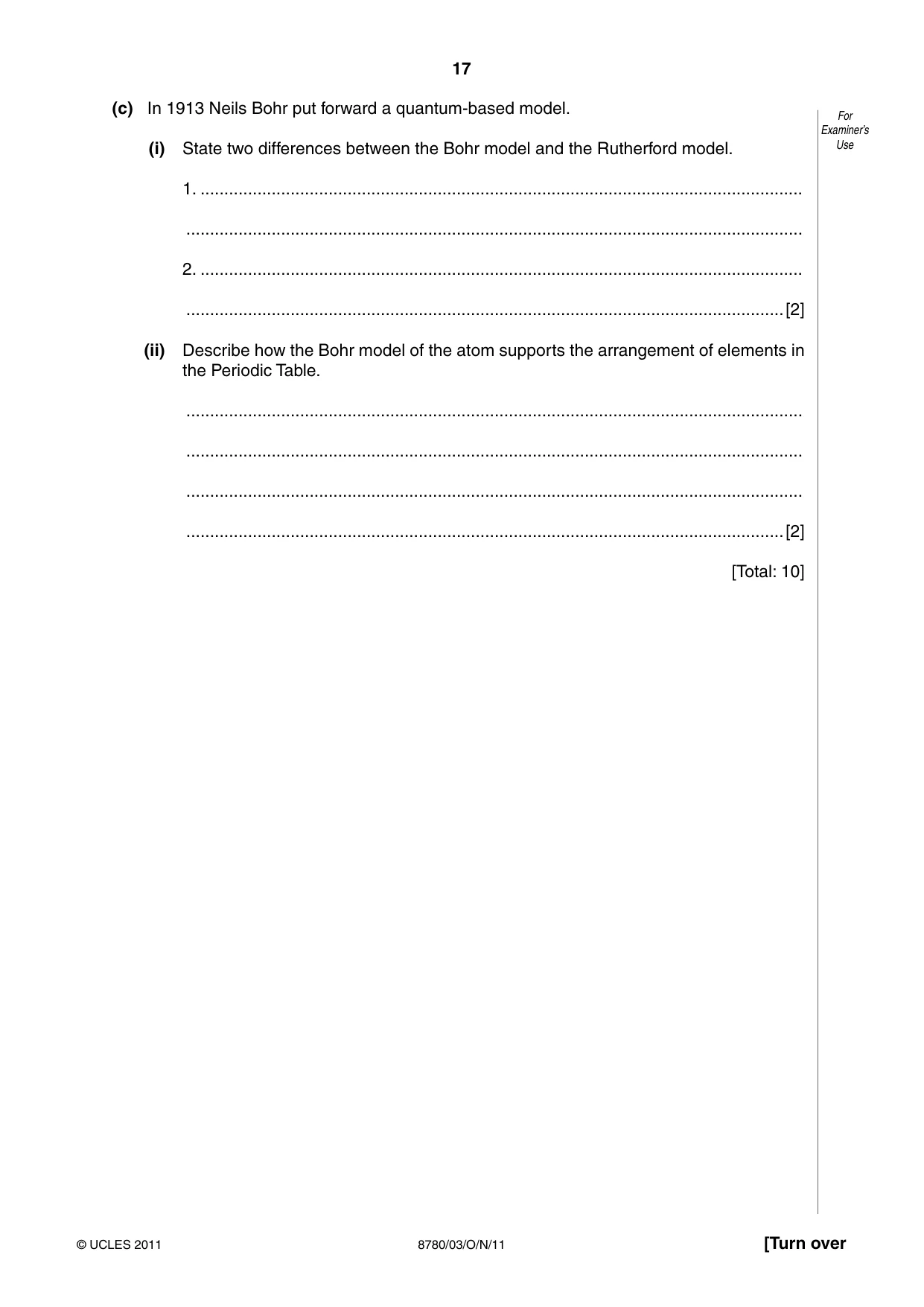
9 (a) After the discovery of the electron in 1897, J. J. Thomson proposed the ‘plum-pudding’ model of the atom. Briefly describe this model of the atom. .......................................................................................................................................... .......................................................................................................................................... .......................................................................................................................................... ......................................................................................................................................[2] (b) In 1911 Rutherford proposed a nuclear model for the atom. (i) Briefly outline the experiment which led Rutherford to propose this new model. .................................................................................................................................. .................................................................................................................................. .................................................................................................................................. .................................................................................................................................. (ii) Explain how the results of this experiment led to this new model. .................................................................................................................................. .................................................................................................................................. .................................................................................................................................. .................................................................................................................................. .................................................................................................................................. [4] (c) In 1913 Neils Bohr put forward a quantum-based model. (i) State two differences between the Bohr model and the Rutherford model. 1. ............................................................................................................................... .................................................................................................................................. 2. ............................................................................................................................... ..............................................................................................................................[2] (ii) Describe how the Bohr model of the atom supports the arrangement of elements in the Periodic Table. .................................................................................................................................. .................................................................................................................................. .................................................................................................................................. ..............................................................................................................................[2] [Total: 10]
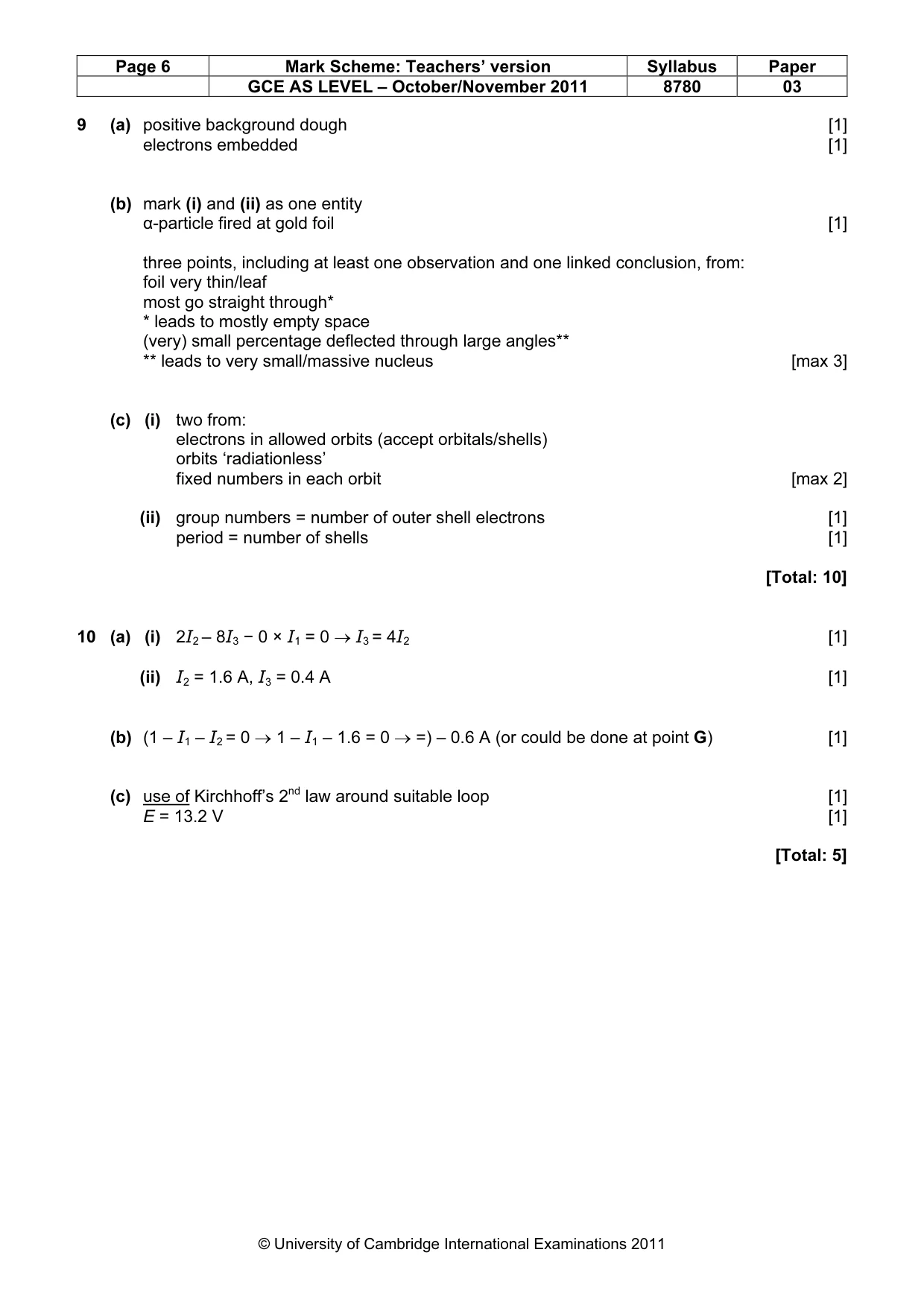
Mark scheme: 9 (a) positive background dough [1] electrons embedded [1] (b) mark (i) and (ii) as one entity α-particle fired at gold foil [1] three points, including at least one observation and one linked conclusion, from: foil very thin/leaf most go straight through* * leads to mostly empty space (very) small percentage deflected through large angles** ** leads to very small/massive nucleus [max 3] (c) (i) two from: electrons in allowed orbits (accept orbitals/shells) orbits ‘radiationless’ fixed numbers in each orbit [max 2] (ii) group numbers = number of outer shell electrons [1] period = number of shells [1] [Total: 10]
Q10 · A network of resistors connected to a battery of negligible internal resistance
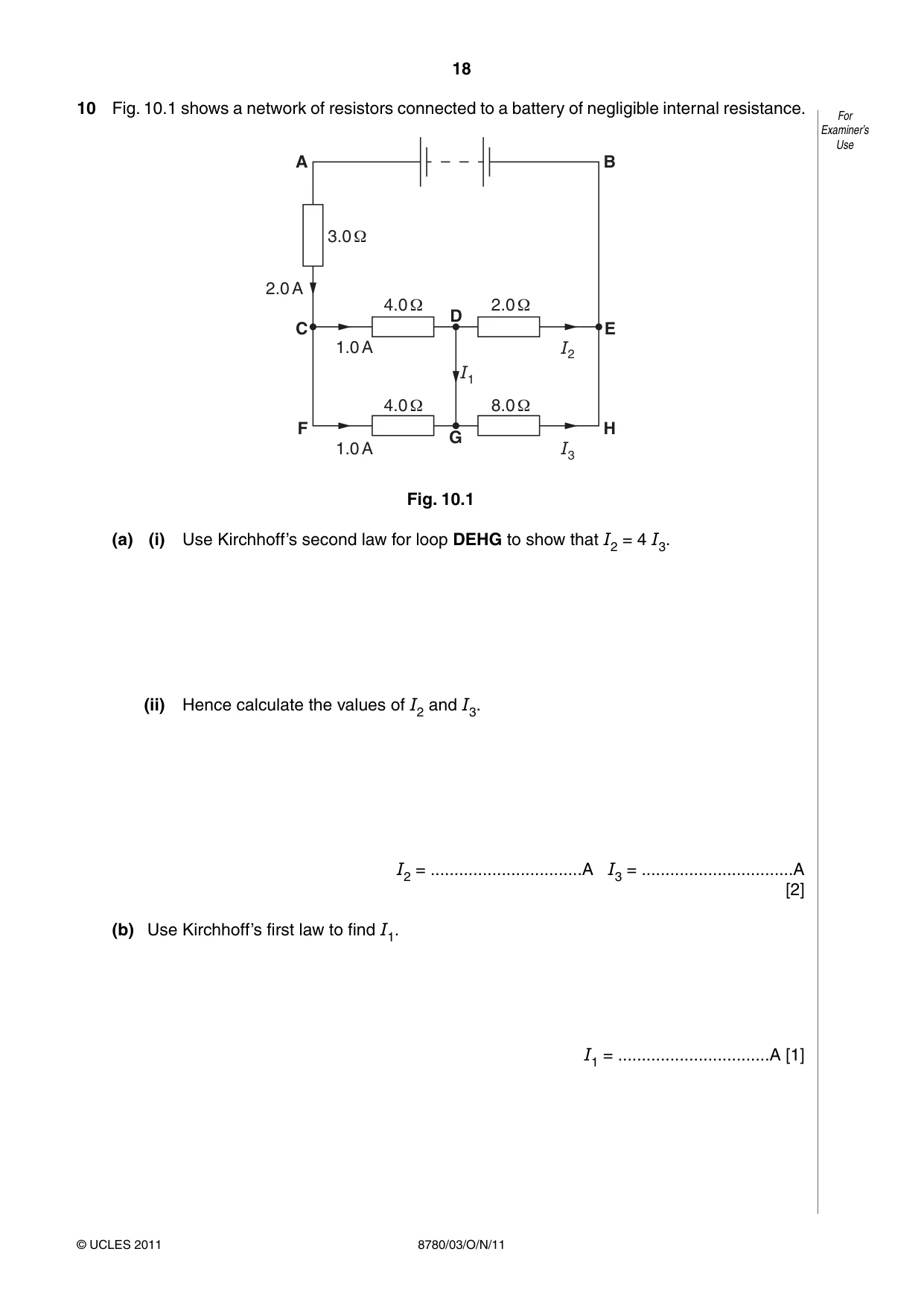
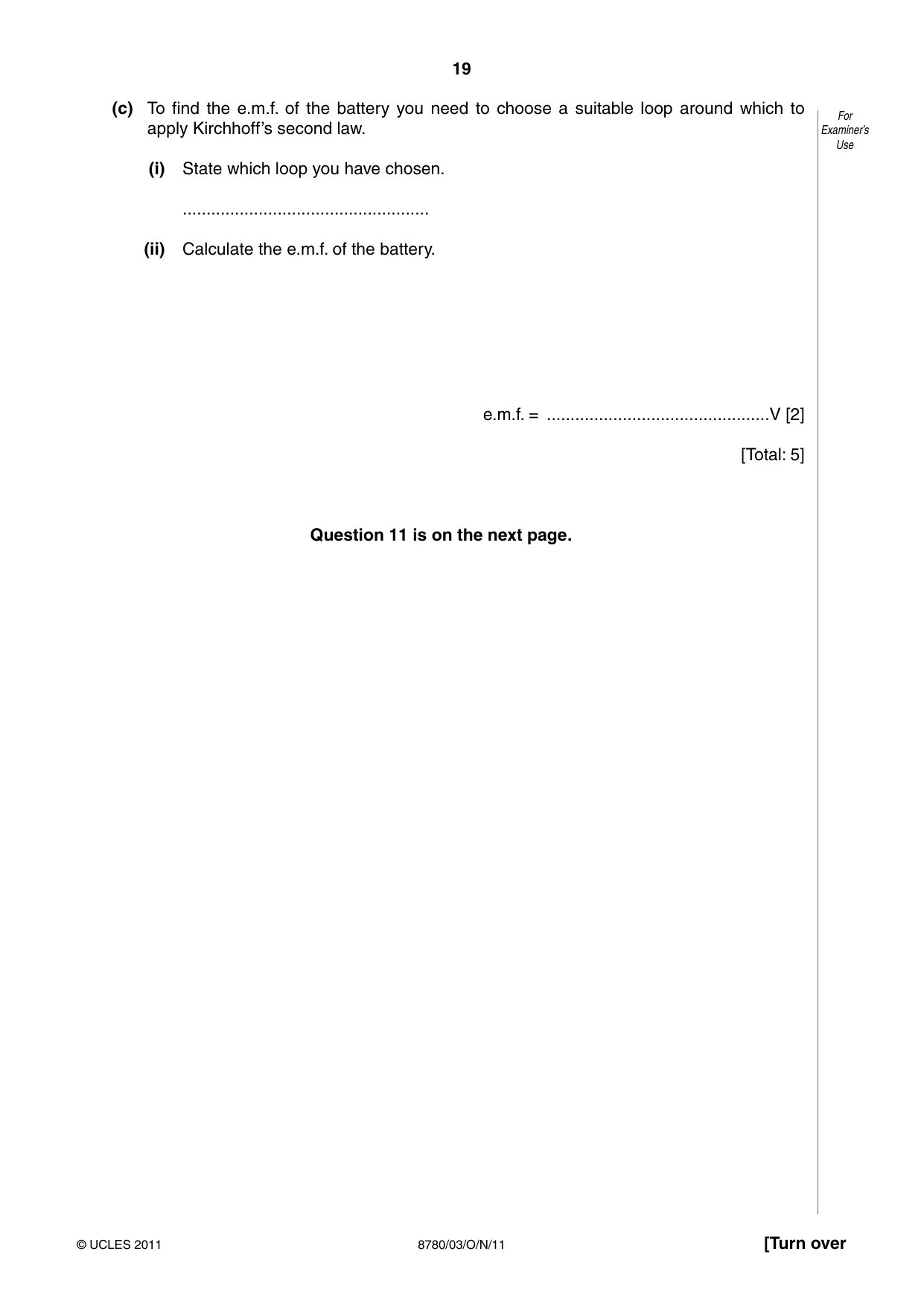
10 Fig. 10.1 shows a network of resistors connected to a battery of negligible internal resistance. A B 3.0 Ω 2.0 A 4.0 Ω 2.0 Ω D C E 1.0 A I2 I1 4.0 Ω 8.0 Ω F H G 1.0 A I3 Fig. 10.1 (a) (i) Use Kirchhoff’s second law for loop DEHG to show that I2 = 4 I3. (ii) Hence calculate the values of I2 and I3. I2 = ................................A I3 = ................................A [2] (b) Use Kirchhoff’s first law to find I1. I1 = ................................A [1] (c) To find the e.m.f. of the battery you need to choose a suitable loop around which to apply Kirchhoff’s second law. (i) State which loop you have chosen. .................................................... (ii) Calculate the e.m.f. of the battery. e.m.f. = ...............................................V [2] [Total: 5] Question 11 is on the next page.
Mark scheme: 10 (a) (i) 2I2 – 8I3 − 0 × I1 = 0 → I3 = 4I2 [1] (ii) I2 = 1.6 A, I3 = 0.4 A [1] (b) (1 – I1 – I2 = 0 → 1 – I1 – 1.6 = 0 → =) – 0.6 A (or could be done at point G) [1] (c) use of Kirchhoff’s 2nd law around suitable loop [1] E = 13.2 V [1] [Total: 5] GCE AS LEVEL – October/November 2011 8780 03
Q11 · A sodium salt contains 21.6% of sodium, 33.3% of chlorine and 45.1% of oxygen, by mass
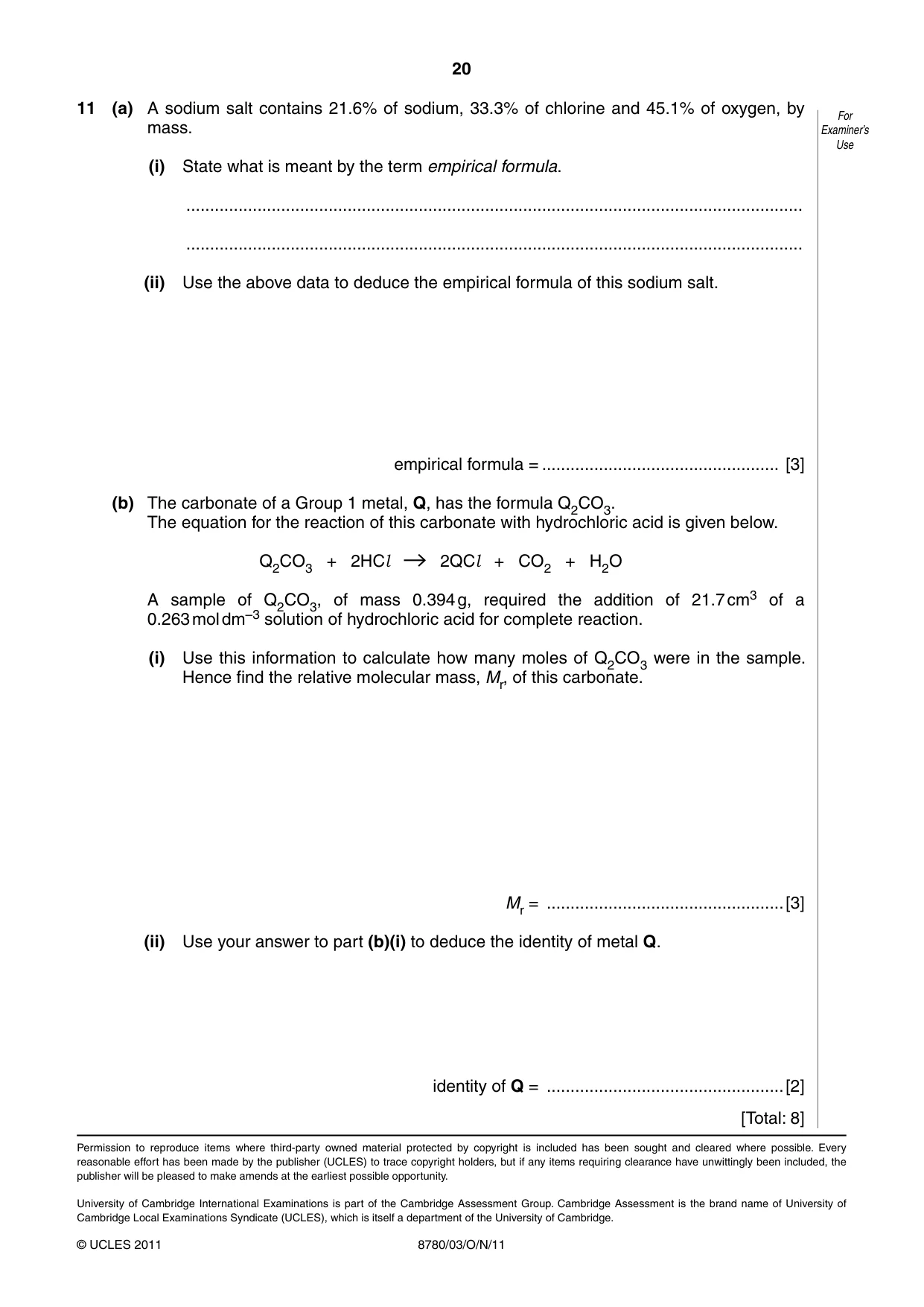
11 (a) A sodium salt contains 21.6% of sodium, 33.3% of chlorine and 45.1% of oxygen, by mass. (i) State what is meant by the term empirical formula. .................................................................................................................................. .................................................................................................................................. (ii) Use the above data to deduce the empirical formula of this sodium salt. empirical formula = .................................................. [3] (b) The carbonate of a Group 1 metal, Q, has the formula Q2CO3. The equation for the reaction of this carbonate with hydrochloric acid is given below. Q2CO3 + 2HCl 2QCl + CO2 + H2O A sample of Q2CO3, of mass 0.394 g, required the addition of 21.7 cm3 of a 0.263 mol dm–3 solution of hydrochloric acid for complete reaction. (i) Use this information to calculate how many moles of Q2CO3 were in the sample. Hence find the relative molecular mass, Mr, of this carbonate. Mr = ..................................................[3] (ii) Use your answer to part (b)(i) to deduce the identity of metal Q. identity of Q = ..................................................[2] [Total: 8]
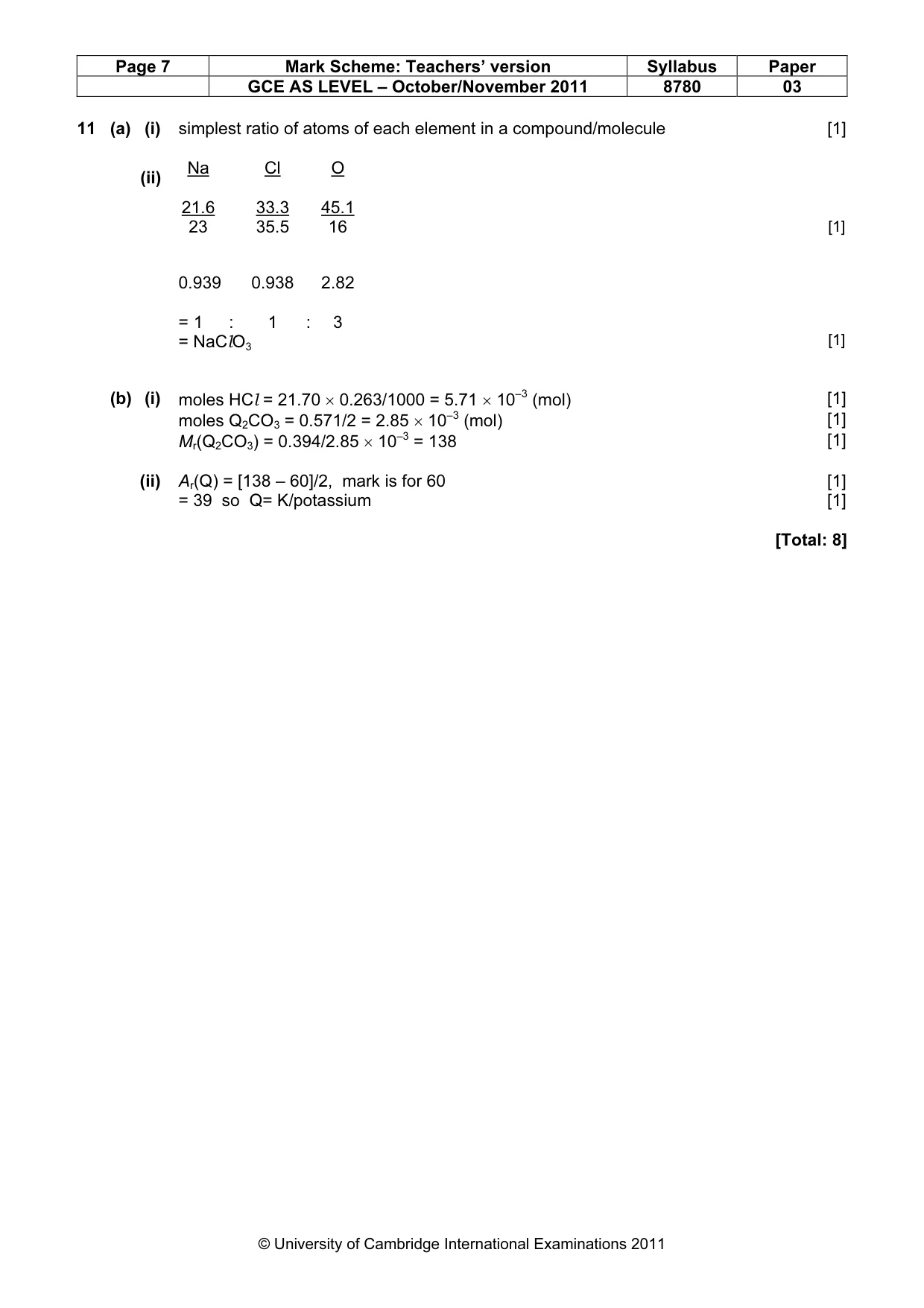
Mark scheme: 11 (a) (i) simplest ratio of atoms of each element in a compound/molecule [1] Na Cl O (ii) 21.6 33.3 45.1 23 35.5 16 [1] 0.939 0.938 2.82 = 1 : 1 : 3 = NaClO3 [1] (b) (i) moles HCl = 21.70 × 0.263/1000 = 5.71 × 10⁻³ (mol) [1] moles Q2CO3 = 0.571/2 = 2.85 × 10⁻³ (mol) [1] Mr(Q2CO3) = 0.394/2.85 × 10–3 = 138 [1] (ii) Ar(Q) = [138 – 60]/2, mark is for 60 [1] = 39 so Q= K/potassium [1] [Total: 8]
What you needed in this session
Cambridge’s own grade thresholds for 2011 Oct/Nov, Paper 3 · Variant 1. A higher threshold means an easier paper — the bar moves with how the cohort did.