Cambridge A Level Physical Science 8780 — 2016 Oct/Nov Paper 3 · Variant 1
8780/31/O/N/16 · 11 questions · 80 marks · ≈90 min
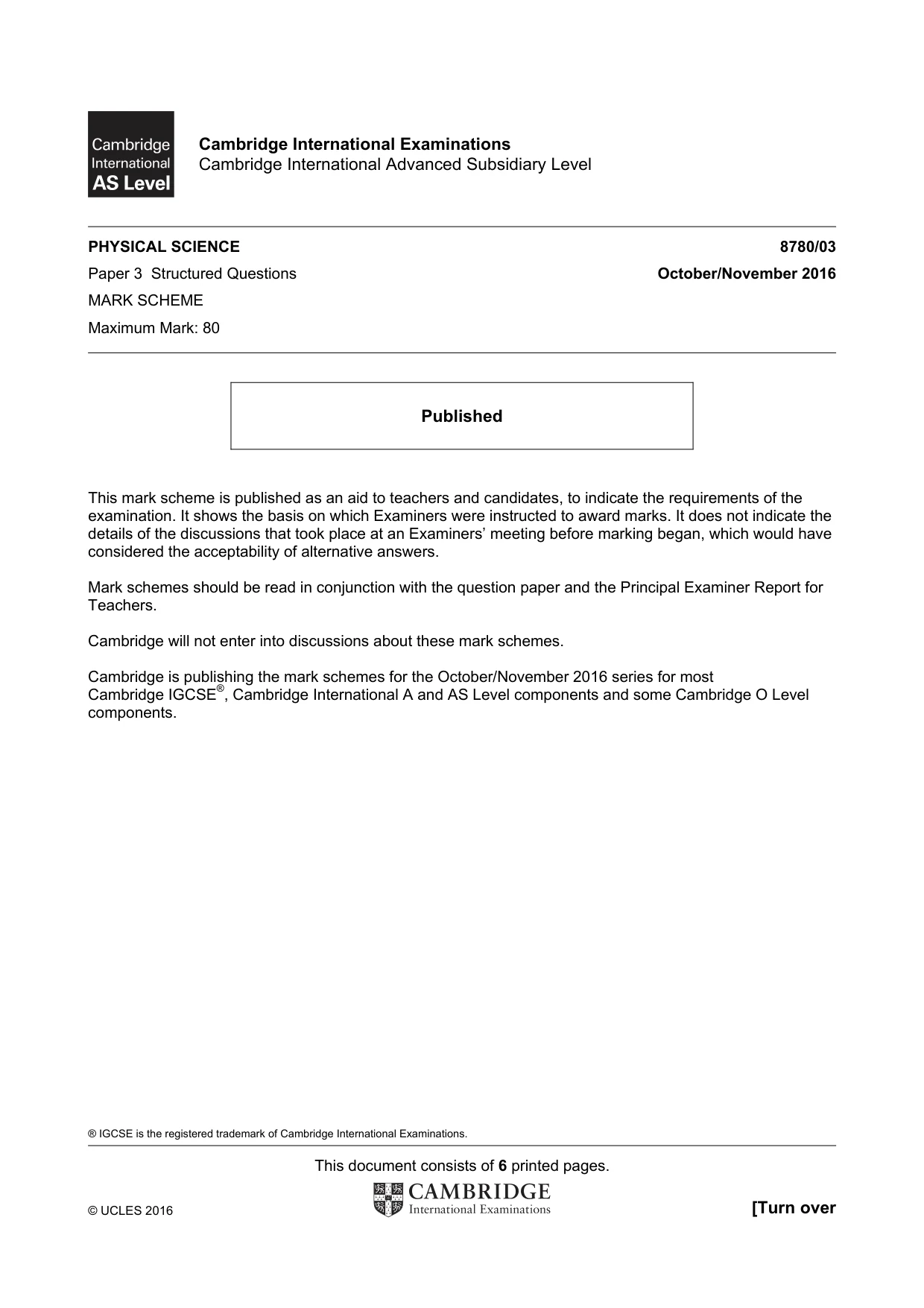
The question paper and its mark scheme, free to read here and free to download. This is Cambridge’s own paper, exactly as it was sat.
Question paper16 pages
Mark scheme6 pages
Answers below. Sit the paper first if you are practising.
Questions as text
Q1 · The graph in Fig
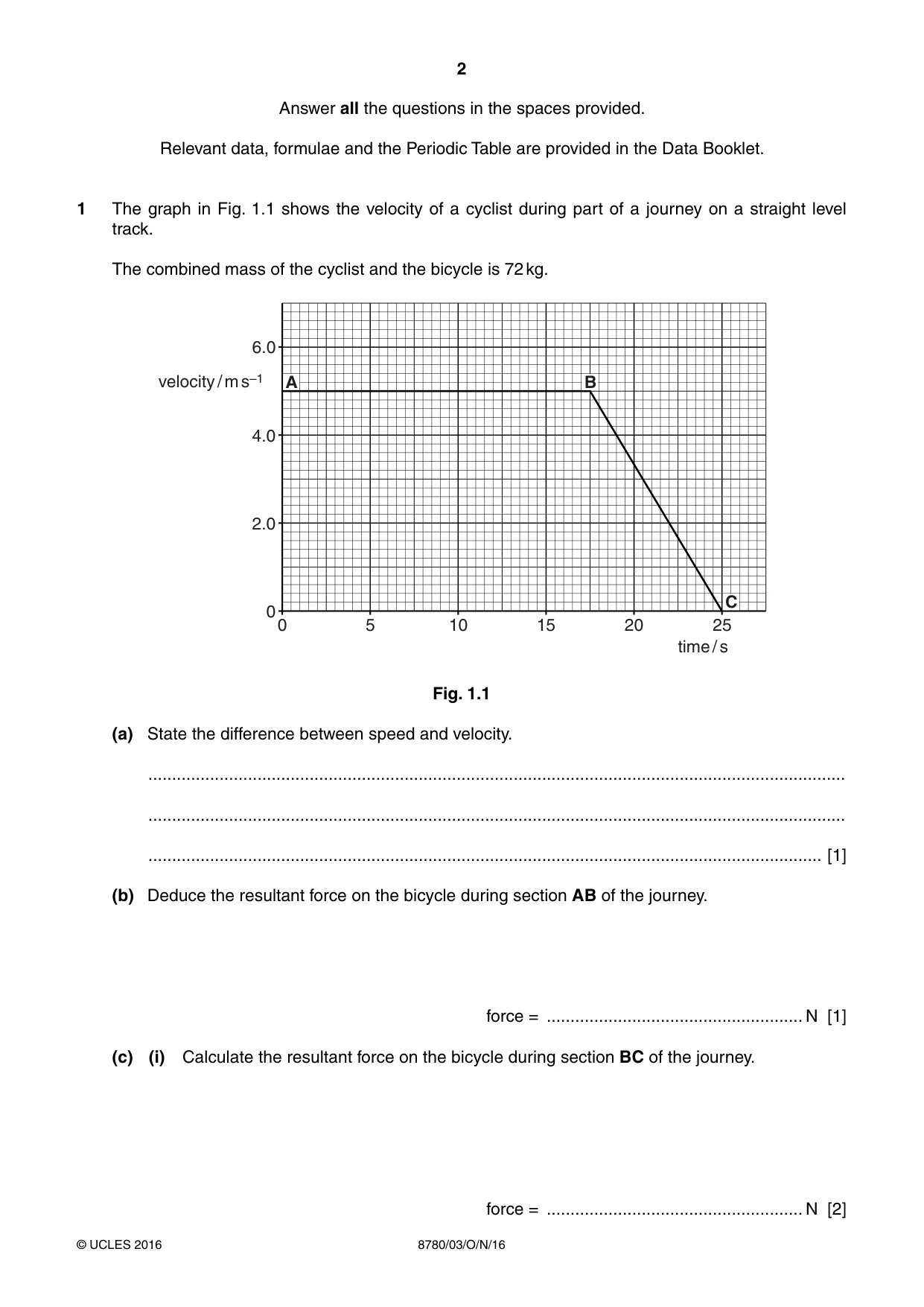
1 The graph in Fig. 1.1 shows the velocity of a cyclist during part of a journey on a straight level track. The combined mass of the cyclist and the bicycle is 72 kg. 6.0 velocity / m s–1 $ % 4.0 2.0 & 0 0 5 10 15 20 25 time / s Fig. 1.1 (a) State the difference between speed and velocity. ................................................................................................................................................... ................................................................................................................................................... .............................................................................................................................................. [1] (b) Deduce the resultant force on the bicycle during section AB of the journey. force = ...................................................... N [1] (c) (i) Calculate the resultant force on the bicycle during section BC of the journey. force = ...................................................... N [2] (ii) State the direction in which the resultant force acts in (c)(i). ........................................................................................................................................... ...................................................................................................................................... [1] [Total: 5]
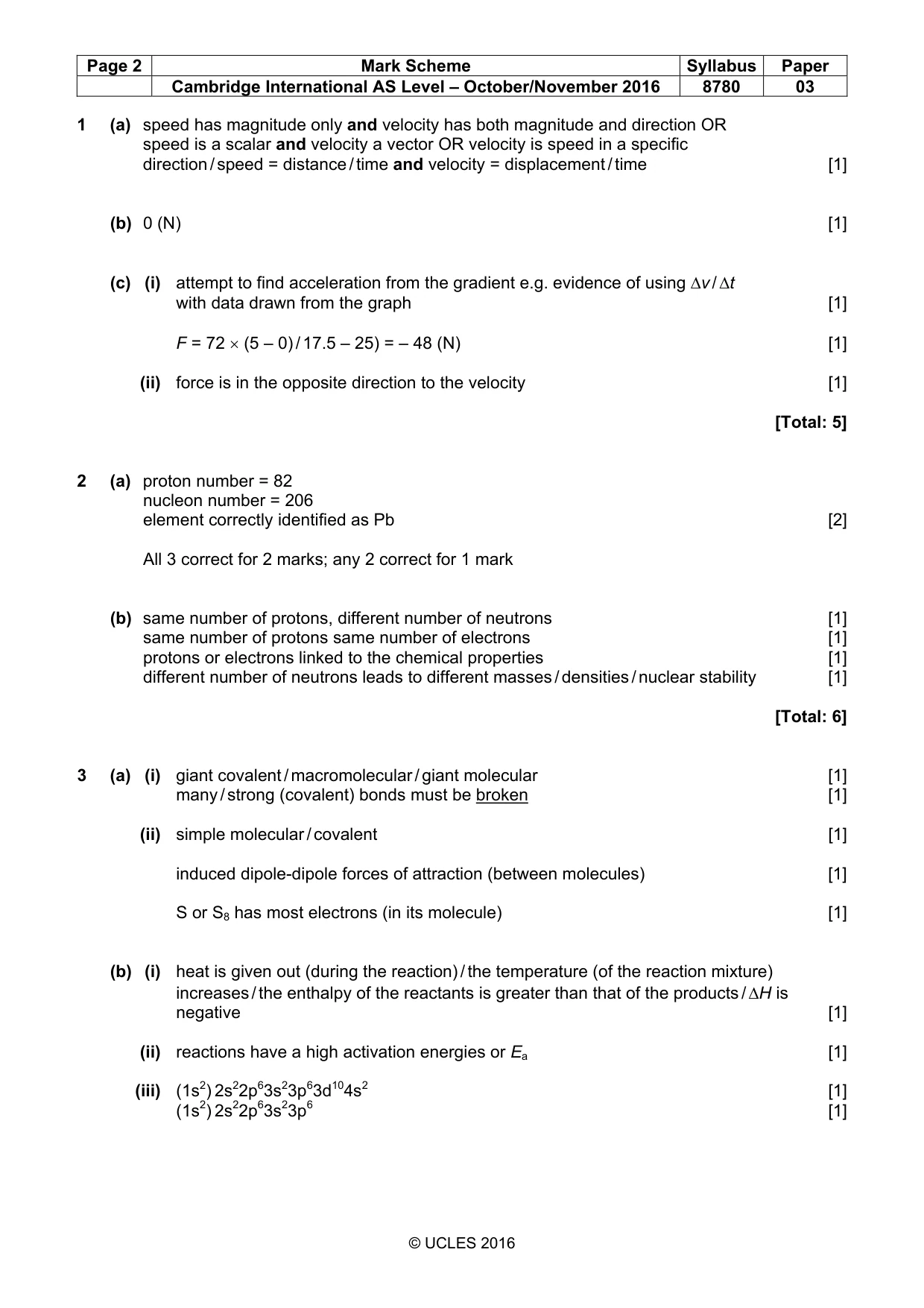
Mark scheme: 1 (a) speed has magnitude only and velocity has both magnitude and direction OR speed is a scalar and velocity a vector OR velocity is speed in a specific direction / speed = distance / time and velocity = displacement / time [1] (b) 0 (N) [1] (c) (i) attempt to find acceleration from the gradient e.g. evidence of using ∆v / ∆t with data drawn from the graph [1] F = 72 × (5 – 0) / 17.5 – 25) = – 48 (N) [1] (ii) force is in the opposite direction to the velocity [1] [Total: 5]
Q2 · The radioactive decay chain of 23892U consists of 8 alpha decays and 6 beta decays, to…
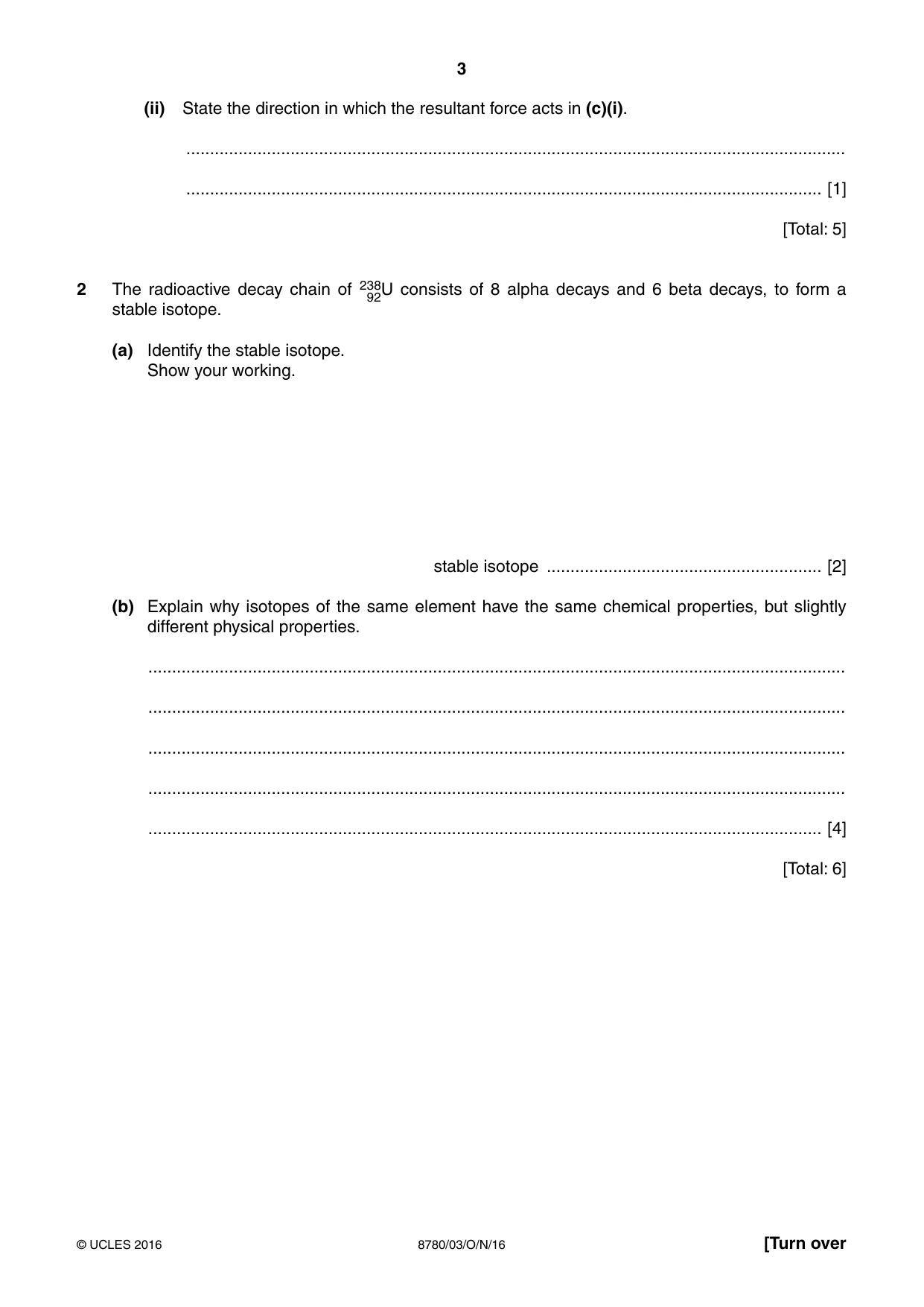
2 The radioactive decay chain of 23892U consists of 8 alpha decays and 6 beta decays, to form a stable isotope. (a) Identify the stable isotope. Show your working. stable isotope .......................................................... [2] (b) Explain why isotopes of the same element have the same chemical properties, but slightly different physical properties. ................................................................................................................................................... ................................................................................................................................................... ................................................................................................................................................... ................................................................................................................................................... .............................................................................................................................................. [4] [Total: 6]
Mark scheme: 2 (a) proton number = 82 nucleon number = 206 element correctly identified as Pb [2] All 3 correct for 2 marks; any 2 correct for 1 mark (b) same number of protons, different number of neutrons [1] same number of protons same number of electrons [1] protons or electrons linked to the chemical properties [1] different number of neutrons leads to different masses / densities / nuclear stability [1] [Total: 6]
Q3 · Silicon is in Period 3 of the Periodic Table
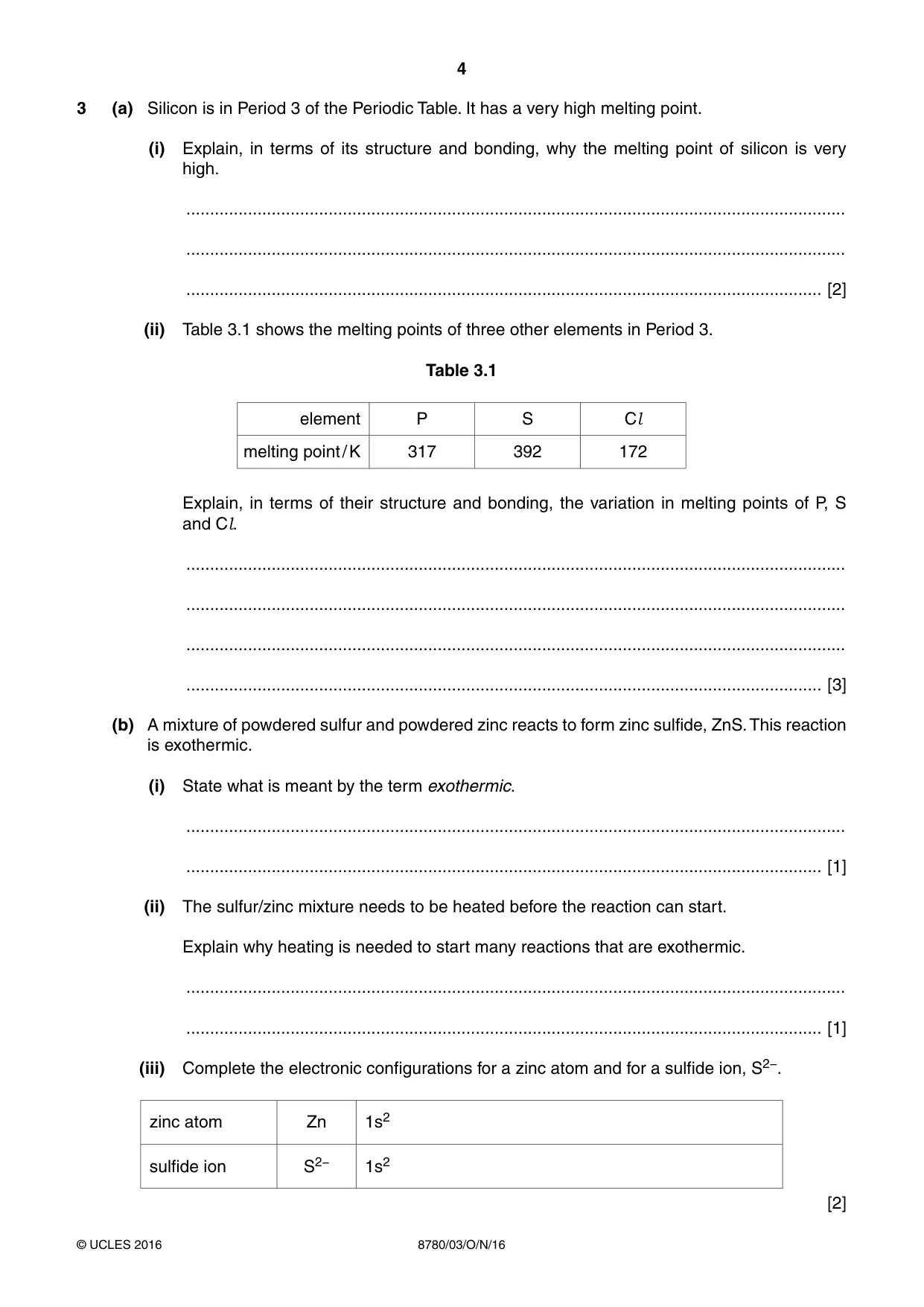
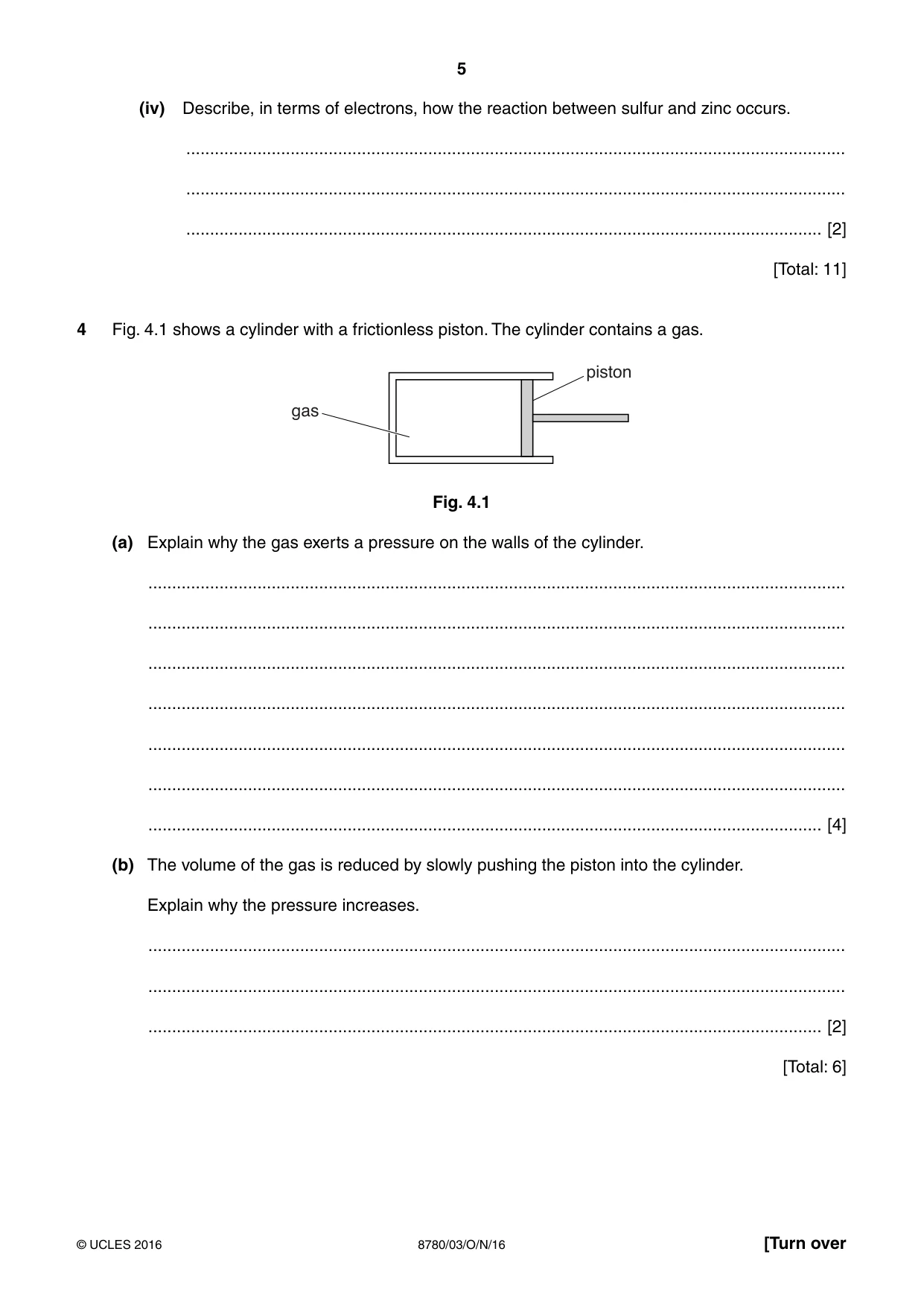
3 (a) Silicon is in Period 3 of the Periodic Table. It has a very high melting point. (i) Explain, in terms of its structure and bonding, why the melting point of silicon is very high. ........................................................................................................................................... ........................................................................................................................................... ...................................................................................................................................... [2] (ii) Table 3.1 shows the melting points of three other elements in Period 3. Table 3.1 element P S Cl melting point / K 317 392 172 Explain, in terms of their structure and bonding, the variation in melting points of P, S and Cl. ........................................................................................................................................... ........................................................................................................................................... ........................................................................................................................................... ...................................................................................................................................... [3] (b) A mixture of powdered sulfur and powdered zinc reacts to form zinc sulfide, ZnS. This reaction is exothermic. (i) State what is meant by the term exothermic. ........................................................................................................................................... ...................................................................................................................................... [1] (ii) The sulfur/zinc mixture needs to be heated before the reaction can start. Explain why heating is needed to start many reactions that are exothermic. ........................................................................................................................................... ...................................................................................................................................... [1] (iii) Complete the electronic configurations for a zinc atom and for a sulfide ion, S2−. zinc atom Zn 1s2 sulfide ion S2− 1s2 [2] (iv) Describe, in terms of electrons, how the reaction between sulfur and zinc occurs. ........................................................................................................................................... ........................................................................................................................................... ...................................................................................................................................... [2] [Total: 11]
Mark scheme: 3 (a) (i) giant covalent / macromolecular / giant molecular [1] many / strong (covalent) bonds must be broken [1] (ii) simple molecular / covalent [1] induced dipole-dipole forces of attraction (between molecules) [1] S or S8 has most electrons (in its molecule) [1] (b) (i) heat is given out (during the reaction) / the temperature (of the reaction mixture) increases / the enthalpy of the reactants is greater than that of the products / ∆H is negative [1] (ii) reactions have a high activation energies or Ea [1] (iii) (1s2) 2s22p63s23p63d104s2 [1] (1s2) 2s22p63s23p6 [1] (iv) electrons are transferred from zinc to sulfur [1] (transfer of) two electrons [1] [Total: 11]
Q4 · A cylinder with a frictionless piston
4 Fig. 4.1 shows a cylinder with a frictionless piston. The cylinder contains a gas. piston gas Fig. 4.1 (a) Explain why the gas exerts a pressure on the walls of the cylinder. ................................................................................................................................................... ................................................................................................................................................... ................................................................................................................................................... ................................................................................................................................................... ................................................................................................................................................... ................................................................................................................................................... .............................................................................................................................................. [4] (b) The volume of the gas is reduced by slowly pushing the piston into the cylinder. Explain why the pressure increases. ................................................................................................................................................... ................................................................................................................................................... .............................................................................................................................................. [2] [Total: 6]
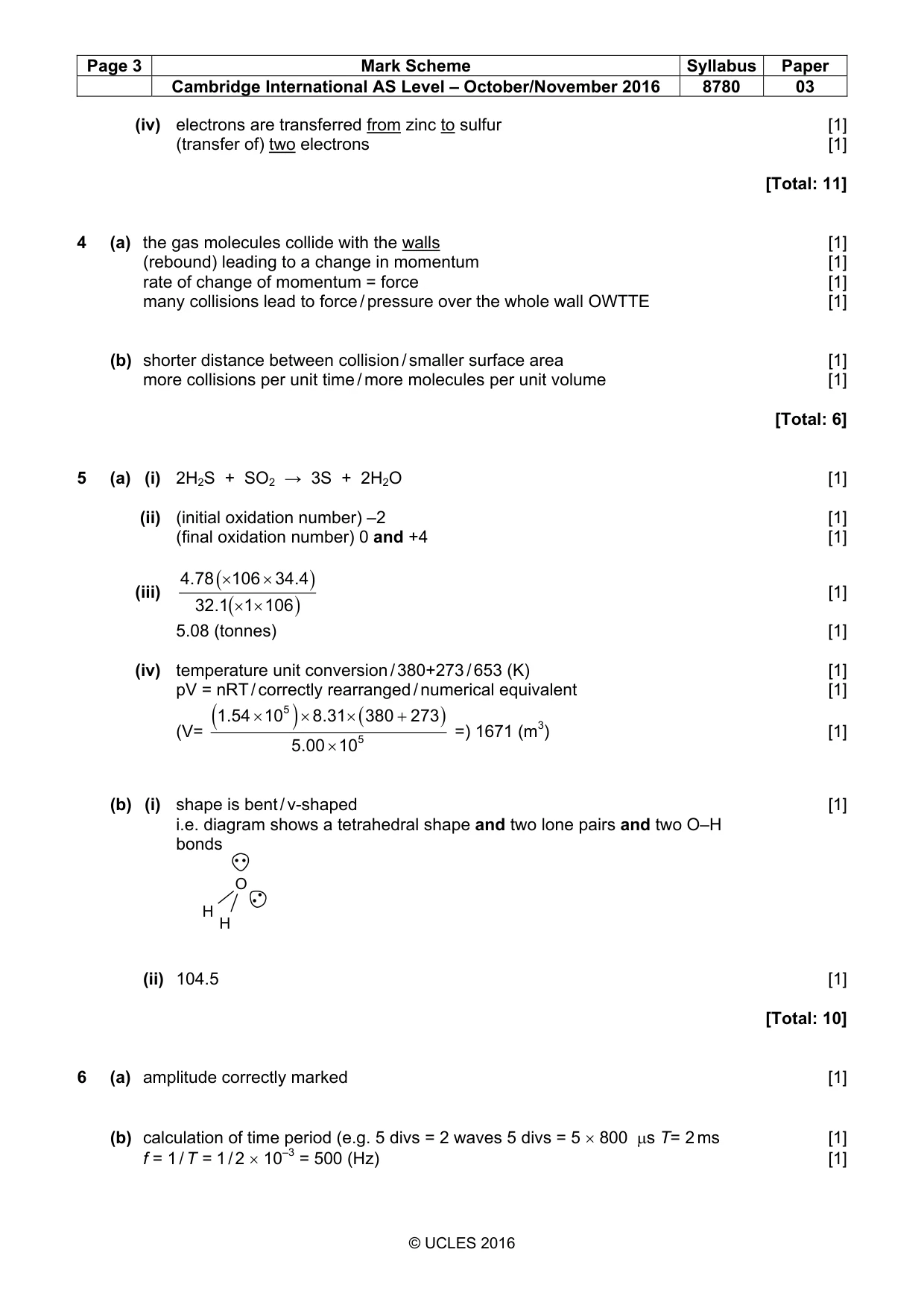
Mark scheme: 4 (a) the gas molecules collide with the walls [1] (rebound) leading to a change in momentum [1] rate of change of momentum = force [1] many collisions lead to force / pressure over the whole wall OWTTE [1] (b) shorter distance between collision / smaller surface area [1] more collisions per unit time / more molecules per unit volume [1] [Total: 6]
Q5 · The sulfur impurity in crude oil can be removed by a process known as hydrotreating
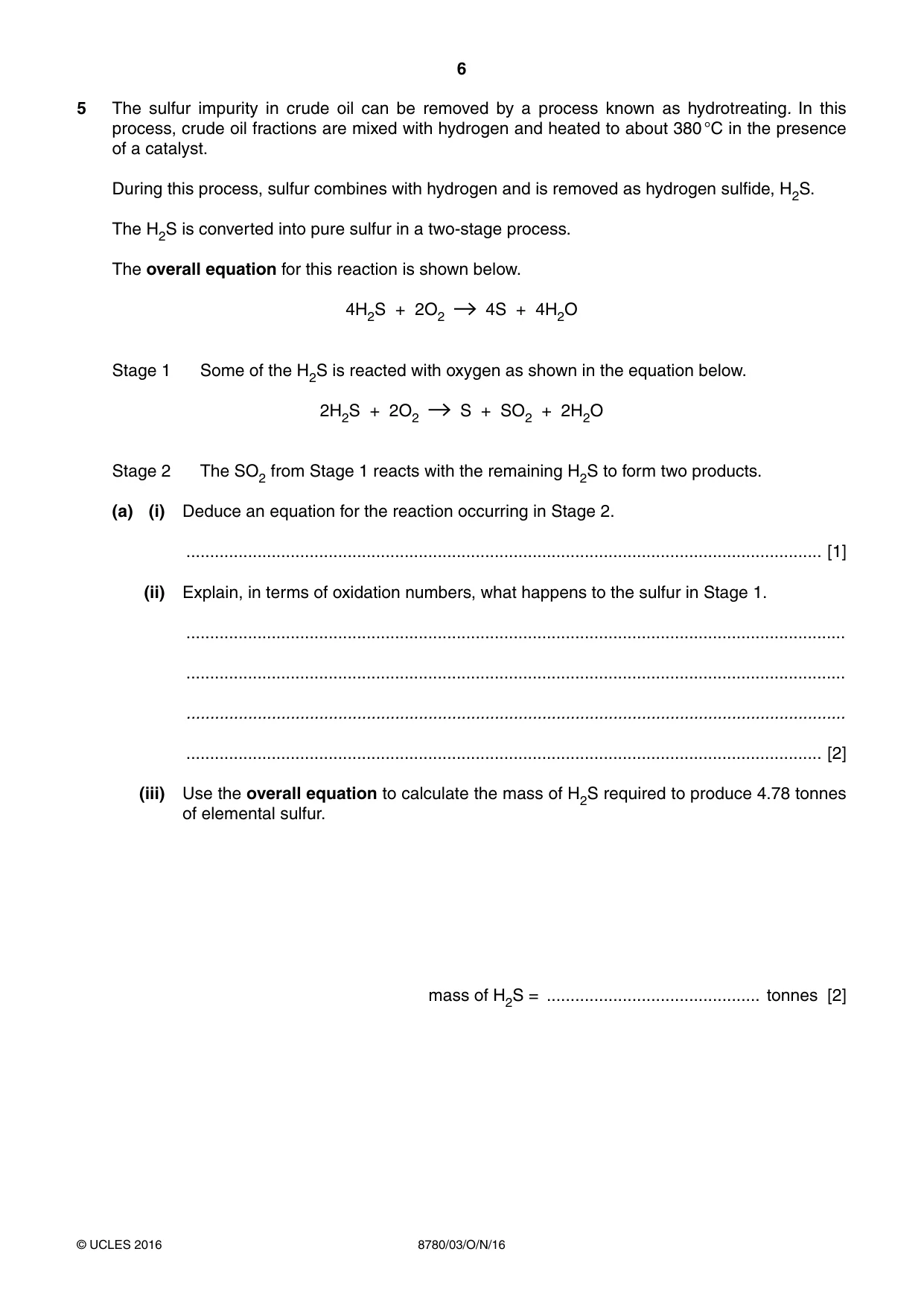
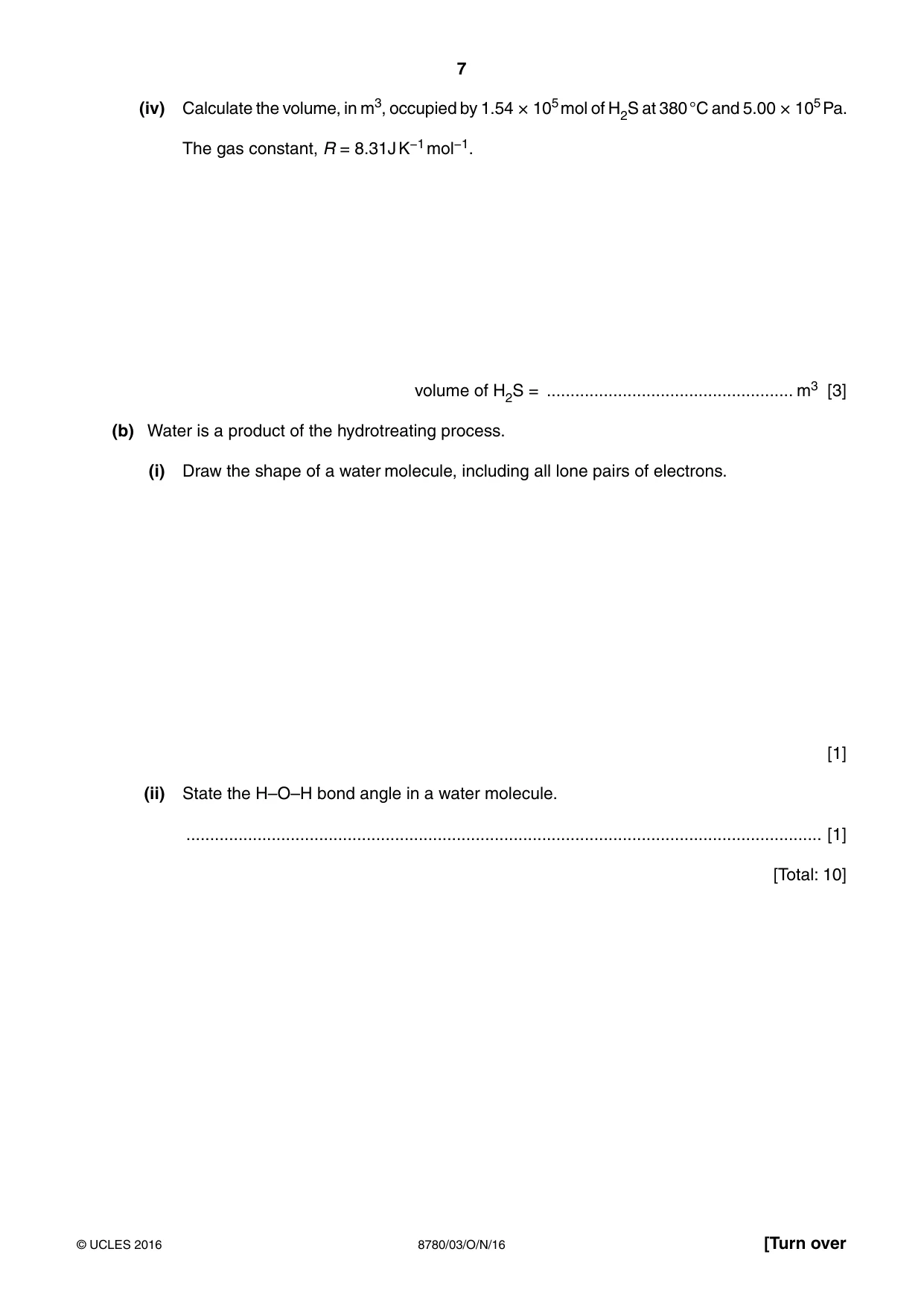
5 The sulfur impurity in crude oil can be removed by a process known as hydrotreating. In this process, crude oil fractions are mixed with hydrogen and heated to about 380 °C in the presence of a catalyst. During this process, sulfur combines with hydrogen and is removed as hydrogen sulfide, H2S. The H2S is converted into pure sulfur in a two-stage process. The overall equation for this reaction is shown below. 4H2S + 2O2 4S + 4H2O Stage 1 Some of the H2S is reacted with oxygen as shown in the equation below. 2H2S + 2O2 S + SO2 + 2H2O Stage 2 The SO2 from Stage 1 reacts with the remaining H2S to form two products. (a) (i) Deduce an equation for the reaction occurring in Stage 2. ...................................................................................................................................... [1] (ii) Explain, in terms of oxidation numbers, what happens to the sulfur in Stage 1. ........................................................................................................................................... ........................................................................................................................................... ........................................................................................................................................... ...................................................................................................................................... [2] (iii) Use the overall equation to calculate the mass of H2S required to produce 4.78 tonnes of elemental sulfur. mass of H2S = ............................................. tonnes [2] (iv) Calculate the volume, in m3, occupied by 1.54 × 10⁵ mol of H2S at 380 °C and 5.00 × 10⁵ Pa. The gas constant, R = 8.31J K−1 mol−1. volume of H2S = .................................................... m3 [3] (b) Water is a product of the hydrotreating process. (i) Draw the shape of a water molecule, including all lone pairs of electrons. [1] (ii) State the H–O–H bond angle in a water molecule. ...................................................................................................................................... [1] [Total: 10]
Mark scheme: 5 (a) (i) 2H2S + SO2 → 3S + 2H2O [1] (ii) (initial oxidation number) –2 [1] (final oxidation number) 0 and +4 [1] 4.78 ( × 106 × 34.4 ) (iii) [1] 32.1( × 1 × 10⁶ ) 5.08 (tonnes) [1] (iv) temperature unit conversion / 380+273 / 653 (K) [1] pV = nRT / correctly rearranged / numerical equivalent [1] 1.54 × 10 5 × 8.31 × ( 380 + 273 ) ( ) (V= =) 1671 (m3) [1] 5.00 × 10 5 (b) (i) shape is bent / v-shaped [1] i.e. diagram shows a tetrahedral shape and two lone pairs and two O–H bonds • • O • • H H (ii) 104.5 [1] [Total: 10]
Q6 · A microphone is connected to a cathode ray oscilloscope (c.r.o.)
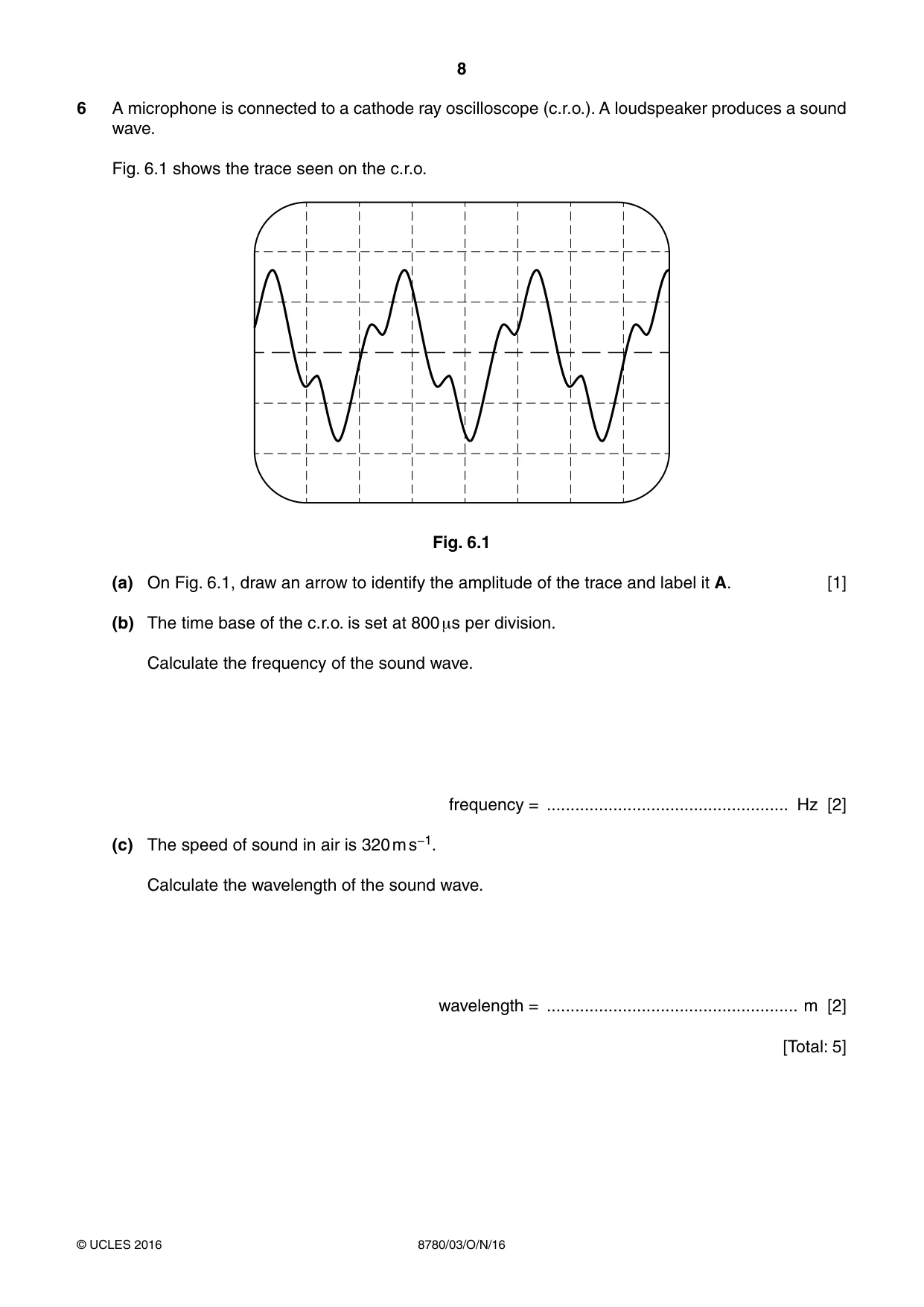
6 A microphone is connected to a cathode ray oscilloscope (c.r.o.). A loudspeaker produces a sound wave. Fig. 6.1 shows the trace seen on the c.r.o. Fig. 6.1 (a) On Fig. 6.1, draw an arrow to identify the amplitude of the trace and label it A. [1] (b) The time base of the c.r.o. is set at 800 μs per division. Calculate the frequency of the sound wave. frequency = ................................................... Hz [2] (c) The speed of sound in air is 320 m s−1. Calculate the wavelength of the sound wave. wavelength = ..................................................... m [2] [Total: 5]
Mark scheme: 6 (a) amplitude correctly marked [1] (b) calculation of time period (e.g. 5 divs = 2 waves 5 divs = 5 × 800 µs T= 2 ms [1] f = 1 / T = 1 / 2 × 10–3 = 500 (Hz) [1] (c) use of v = f λleading to f = 320 / 500 [1] = 0.64 (m) [1] [Total: 5]
Q7 · A ray diagram of an experiment to demonstrate superposition of microwaves
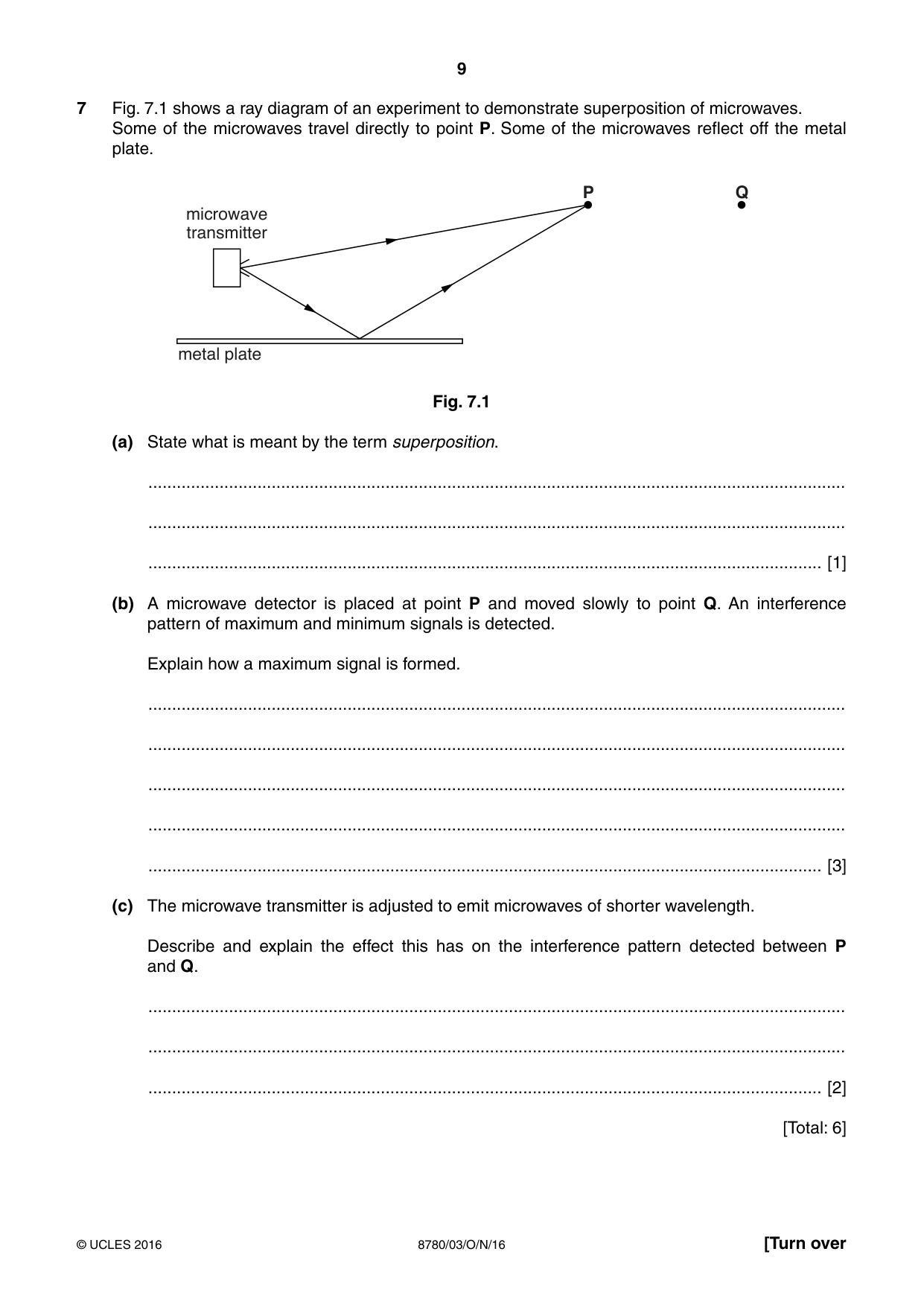
7 Fig. 7.1 shows a ray diagram of an experiment to demonstrate superposition of microwaves. Some of the microwaves travel directly to point P. Some of the microwaves reflect off the metal plate. P Q microwave transmitter metal plate Fig. 7.1 (a) State what is meant by the term superposition. ................................................................................................................................................... ................................................................................................................................................... .............................................................................................................................................. [1] (b) A microwave detector is placed at point P and moved slowly to point Q. An interference pattern of maximum and minimum signals is detected. Explain how a maximum signal is formed. ................................................................................................................................................... ................................................................................................................................................... ................................................................................................................................................... ................................................................................................................................................... .............................................................................................................................................. [3] (c) The microwave transmitter is adjusted to emit microwaves of shorter wavelength. Describe and explain the effect this has on the interference pattern detected between P and Q. ................................................................................................................................................... ................................................................................................................................................... .............................................................................................................................................. [2] [Total: 6]
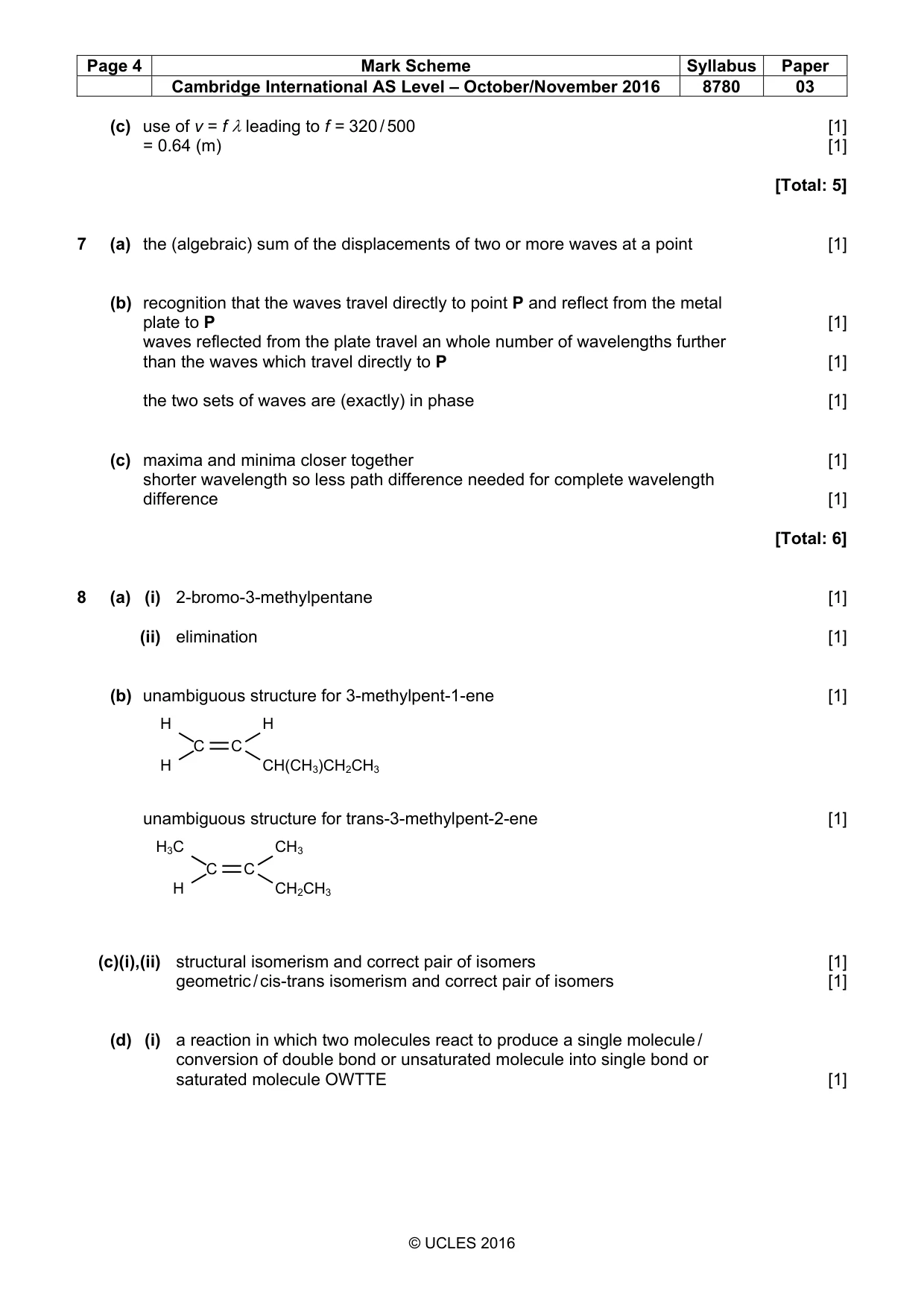
Mark scheme: 7 (a) the (algebraic) sum of the displacements of two or more waves at a point [1] (b) recognition that the waves travel directly to point P and reflect from the metal plate to P [1] waves reflected from the plate travel an whole number of wavelengths further than the waves which travel directly to P [1] the two sets of waves are (exactly) in phase [1] (c) maxima and minima closer together [1] shorter wavelength so less path difference needed for complete wavelength difference [1] [Total: 6]
Q8 · Compound A is heated with a solution of potassium hydroxide dissolved in ethanol
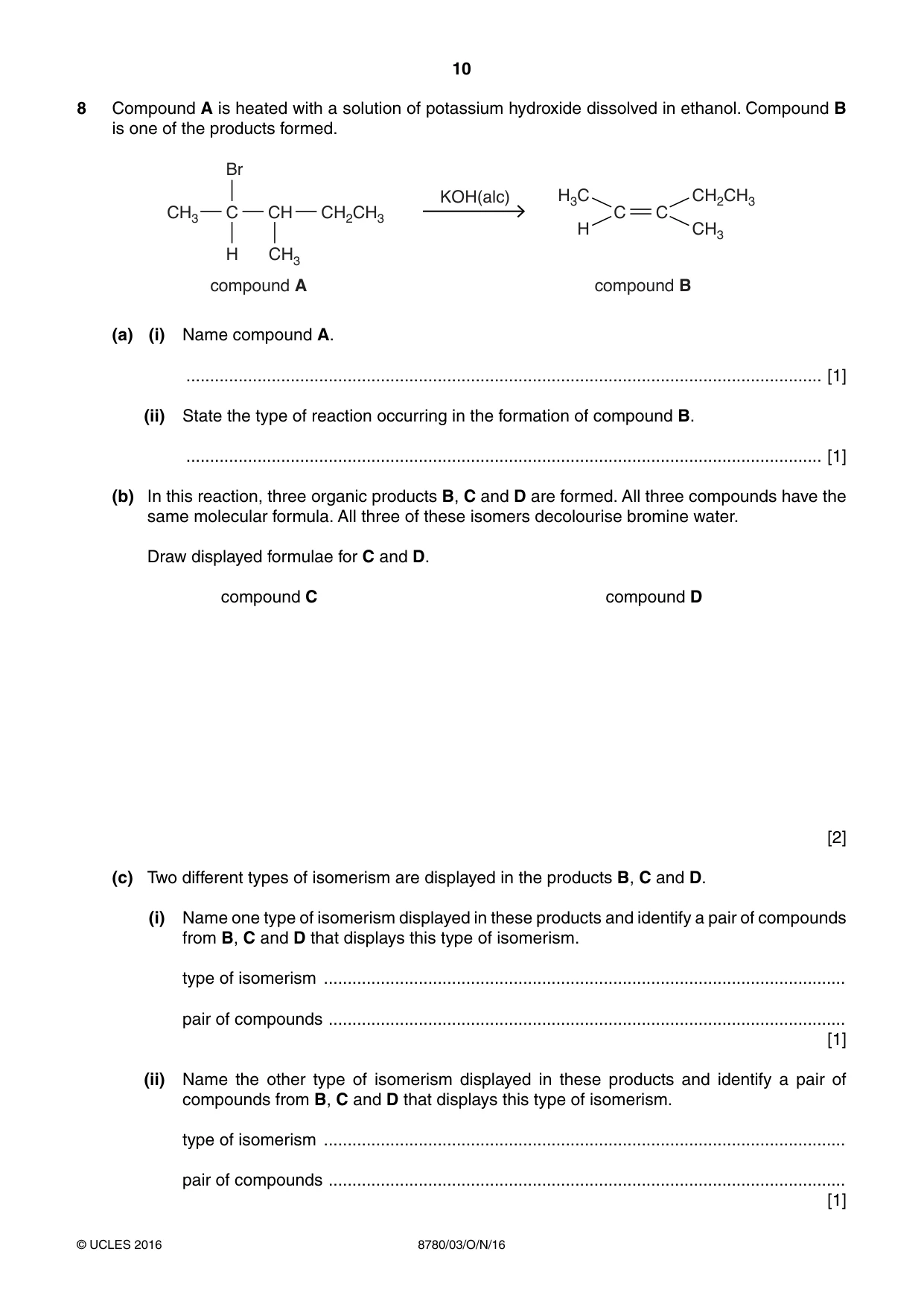
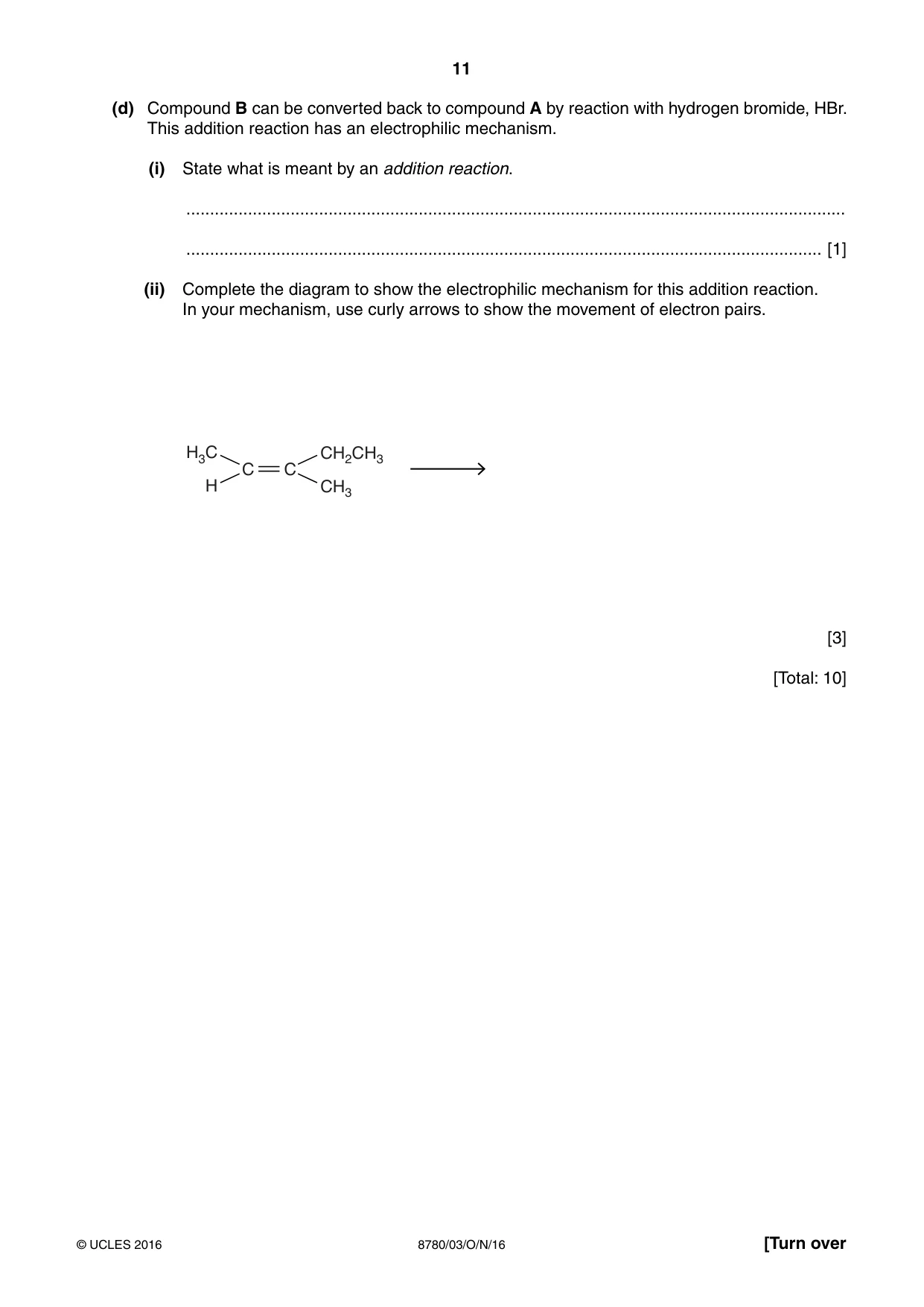
8 Compound A is heated with a solution of potassium hydroxide dissolved in ethanol. Compound B is one of the products formed. Br KOH(alc) H3C CH2CH3 CH3 C CH CH2CH3 C C H CH3 H CH3 compound A compound B (a) (i) Name compound A. ...................................................................................................................................... [1] (ii) State the type of reaction occurring in the formation of compound B. ...................................................................................................................................... [1] (b) In this reaction, three organic products B, C and D are formed. All three compounds have the same molecular formula. All three of these isomers decolourise bromine water. Draw displayed formulae for C and D. compound C compound D [2] (c) Two different types of isomerism are displayed in the products B, C and D. (i) Name one type of isomerism displayed in these products and identify a pair of compounds from B, C and D that displays this type of isomerism. type of isomerism .............................................................................................................. pair of compounds ............................................................................................................. [1] (ii) Name the other type of isomerism displayed in these products and identify a pair of compounds from B, C and D that displays this type of isomerism. type of isomerism .............................................................................................................. pair of compounds ............................................................................................................. [1] (d) Compound B can be converted back to compound A by reaction with hydrogen bromide, HBr. This addition reaction has an electrophilic mechanism. (i) State what is meant by an addition reaction. ........................................................................................................................................... ...................................................................................................................................... [1] (ii) Complete the diagram to show the electrophilic mechanism for this addition reaction. In your mechanism, use curly arrows to show the movement of electron pairs. H3C CH2CH3 C C H CH3 [3] [Total: 10]
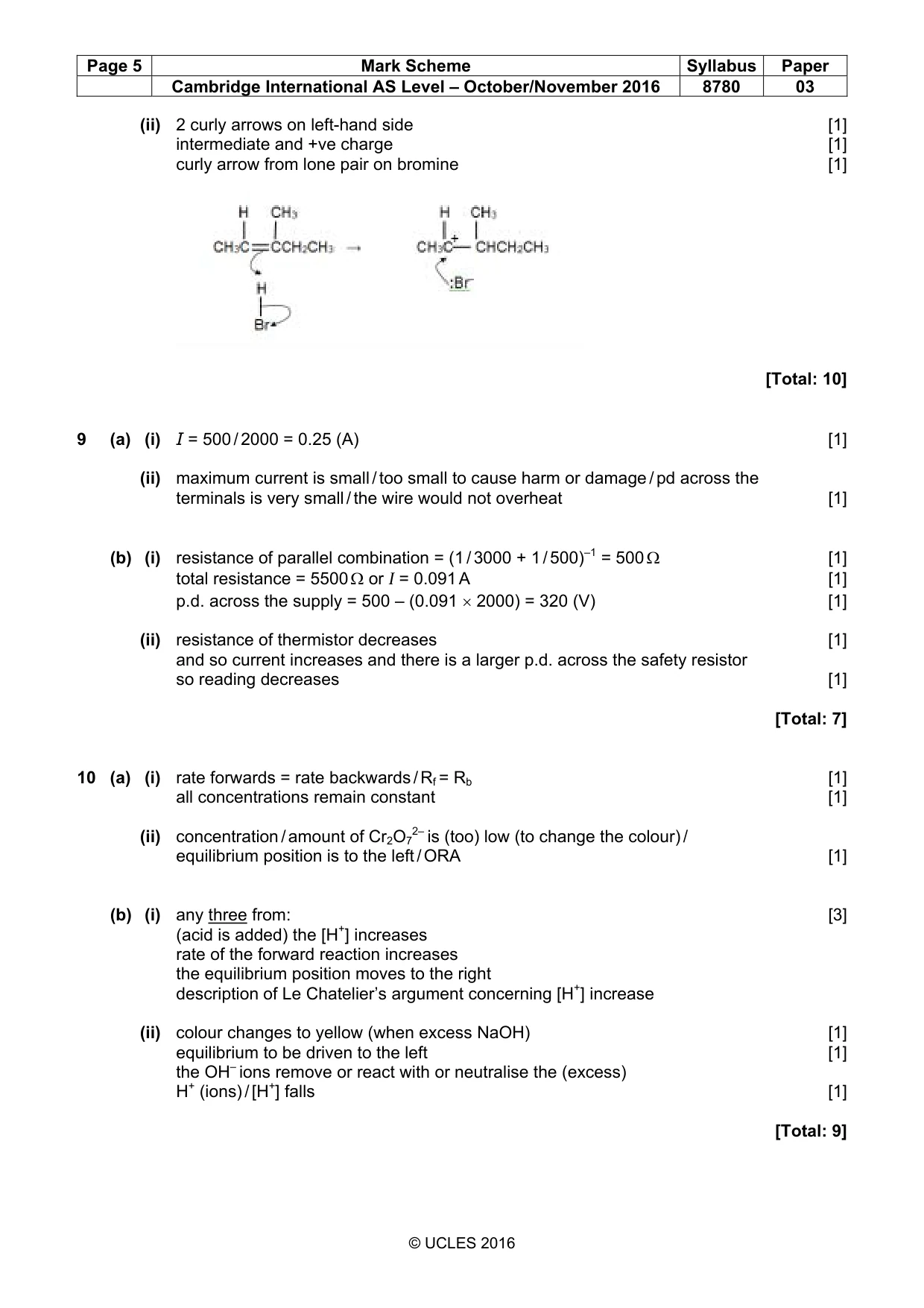
Mark scheme: 8 (a) (i) 2-bromo-3-methylpentane [1] (ii) elimination [1] (b) unambiguous structure for 3-methylpent-1-ene [1] H H C C H CH(CH3)CH2CH3 unambiguous structure for trans-3-methylpent-2-ene [1] H3C CH3 C C H CH2CH3 (c)(i),(ii) structural isomerism and correct pair of isomers [1] geometric / cis-trans isomerism and correct pair of isomers [1] (d) (i) a reaction in which two molecules react to produce a single molecule / conversion of double bond or unsaturated molecule into single bond or saturated molecule OWTTE [1] (ii) 2 curly arrows on left-hand side [1] intermediate and +ve charge [1] curly arrow from lone pair on bromine [1] [Total: 10]
Q9 · A high voltage power supply of e.m.f
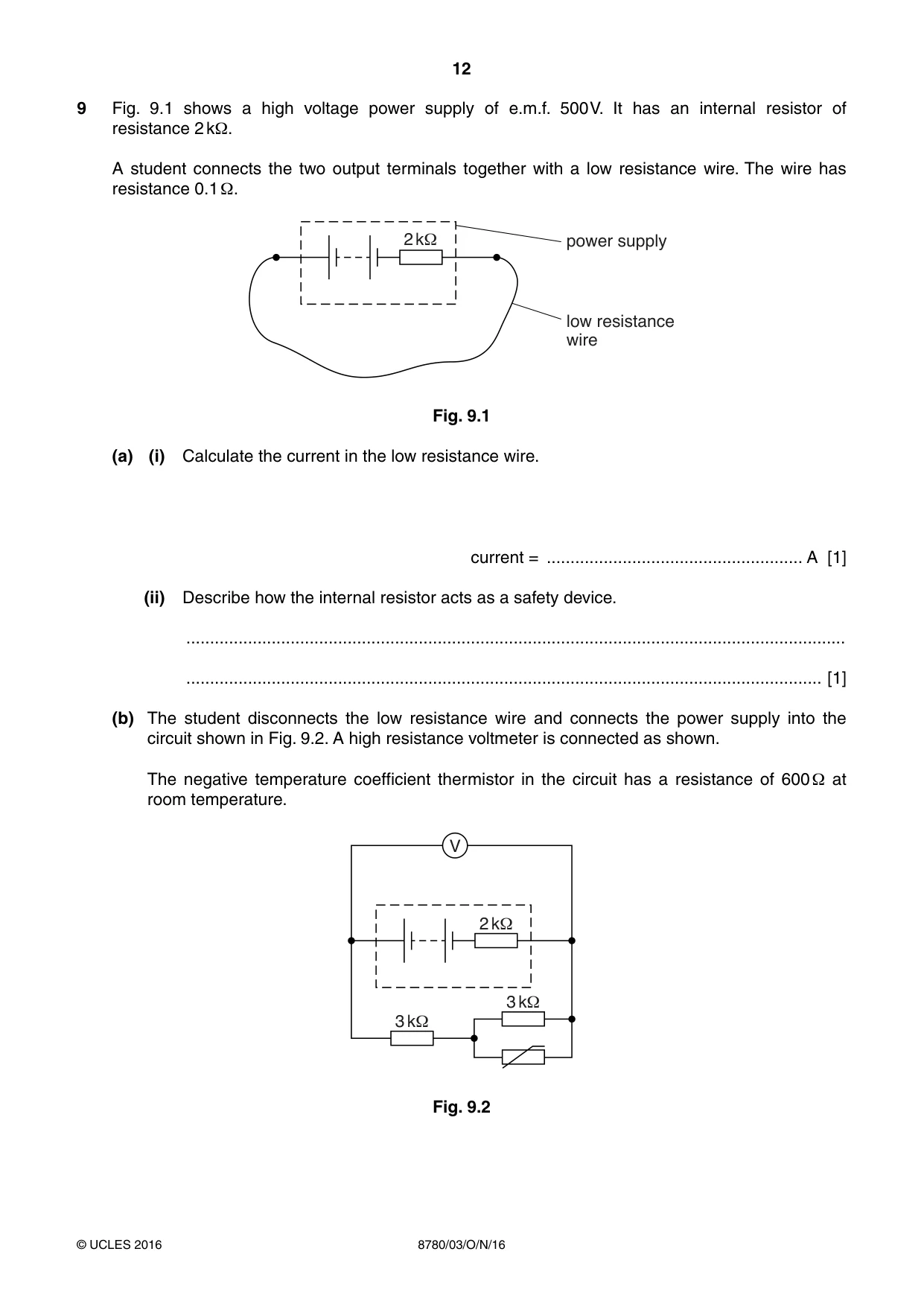
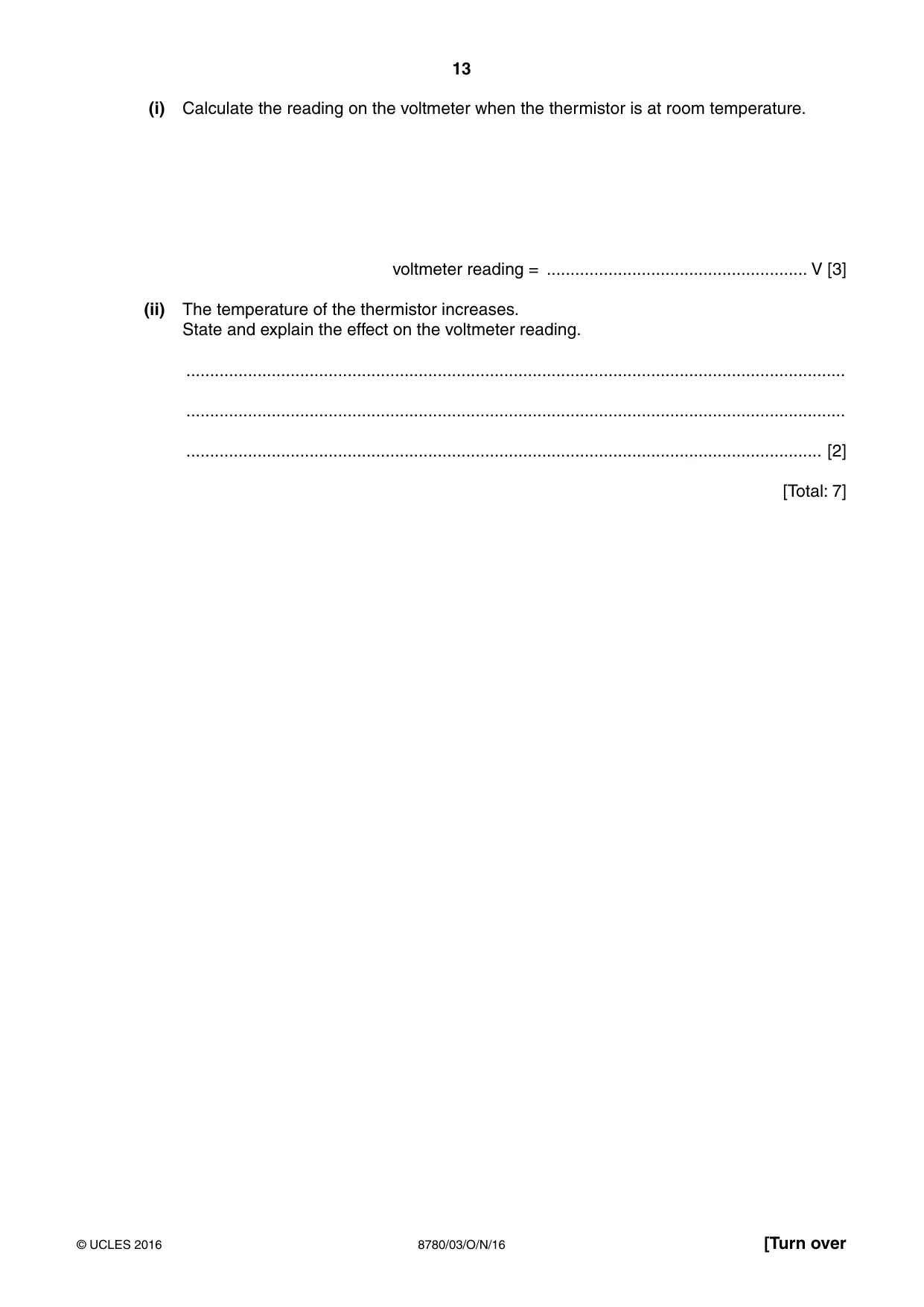
9 Fig. 9.1 shows a high voltage power supply of e.m.f. 500 V. It has an internal resistor of resistance 2 kΩ. A student connects the two output terminals together with a low resistance wire. The wire has resistance 0.1 Ω. 2 k1 power supply low resistance wire Fig. 9.1 (a) (i) Calculate the current in the low resistance wire. current = ...................................................... A [1] (ii) Describe how the internal resistor acts as a safety device. ........................................................................................................................................... ...................................................................................................................................... [1] (b) The student disconnects the low resistance wire and connects the power supply into the circuit shown in Fig. 9.2. A high resistance voltmeter is connected as shown. The negative temperature coefficient thermistor in the circuit has a resistance of 600 Ω at room temperature. V 2 k1 3 k1 3 k1 Fig. 9.2 (i) Calculate the reading on the voltmeter when the thermistor is at room temperature. voltmeter reading = ....................................................... V [3] (ii) The temperature of the thermistor increases. State and explain the effect on the voltmeter reading. ........................................................................................................................................... ........................................................................................................................................... ...................................................................................................................................... [2] [Total: 7]
Mark scheme: 9 (a) (i) I = 500 / 2000 = 0.25 (A) [1] (ii) maximum current is small / too small to cause harm or damage / pd across the terminals is very small / the wire would not overheat [1] (b) (i) resistance of parallel combination = (1 / 3000 + 1 / 500)–1 = 500 Ω [1] total resistance = 5500 Ω or I = 0.091 A [1] p.d. across the supply = 500 – (0.091 × 2000) = 320 (V) [1] (ii) resistance of thermistor decreases [1] and so current increases and there is a larger p.d. across the safety resistor so reading decreases [1] [Total: 7]
Q10 · Solid sodium chromate(VI), Na2CrO4, is yellow due to the presence of chromate(VI) ions…
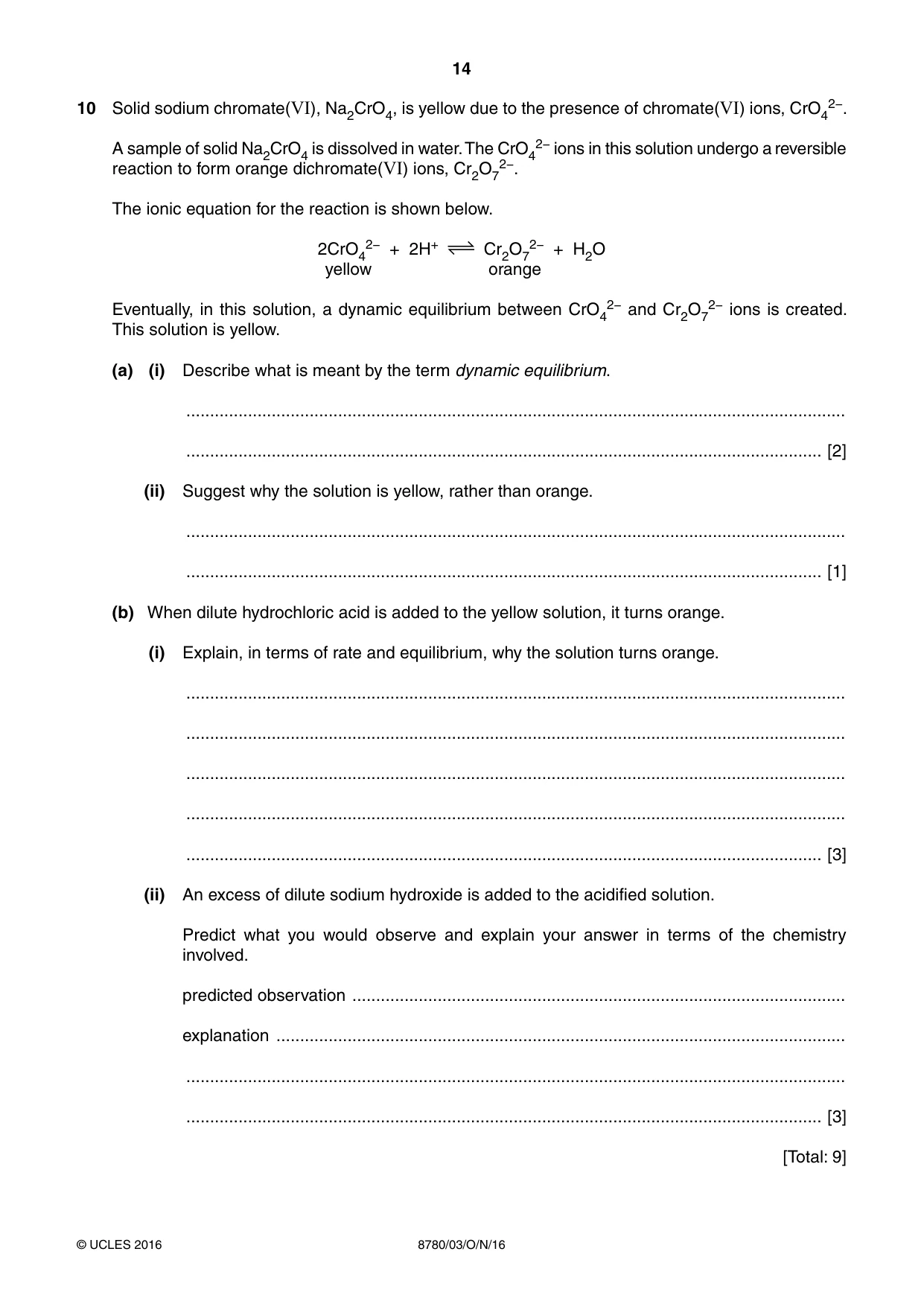
10 Solid sodium chromate(VI), Na2CrO4, is yellow due to the presence of chromate(VI) ions, CrO42−. A sample of solid Na2CrO4 is dissolved in water. The CrO42− ions in this solution undergo a reversible reaction to form orange dichromate(VI) ions, Cr2O72−. The ionic equation for the reaction is shown below. 2CrO42− + 2H+ Cr2O72− + H2O yellow orange Eventually, in this solution, a dynamic equilibrium between CrO42− and Cr2O72− ions is created. This solution is yellow. (a) (i) Describe what is meant by the term dynamic equilibrium. ........................................................................................................................................... ...................................................................................................................................... [2] (ii) Suggest why the solution is yellow, rather than orange. ........................................................................................................................................... ...................................................................................................................................... [1] (b) When dilute hydrochloric acid is added to the yellow solution, it turns orange. (i) Explain, in terms of rate and equilibrium, why the solution turns orange. ........................................................................................................................................... ........................................................................................................................................... ........................................................................................................................................... ........................................................................................................................................... ...................................................................................................................................... [3] (ii) An excess of dilute sodium hydroxide is added to the acidified solution. Predict what you would observe and explain your answer in terms of the chemistry involved. predicted observation ........................................................................................................ explanation ........................................................................................................................ ........................................................................................................................................... ...................................................................................................................................... [3] [Total: 9]
Mark scheme: 10 (a) (i) rate forwards = rate backwards / Rf = Rb [1] all concentrations remain constant [1] (ii) concentration / amount of Cr2O72– is (too) low (to change the colour) / equilibrium position is to the left / ORA [1] (b) (i) any three from: [3] (acid is added) the [H+] increases rate of the forward reaction increases the equilibrium position moves to the right description of Le Chatelier’s argument concerning [H+] increase (ii) colour changes to yellow (when excess NaOH) [1] equilibrium to be driven to the left [1] the OH– ions remove or react with or neutralise the (excess) H+ (ions) / [H+] falls [1] [Total: 9]
Q11 · A small solid ball falling at its terminal velocity through a liquid
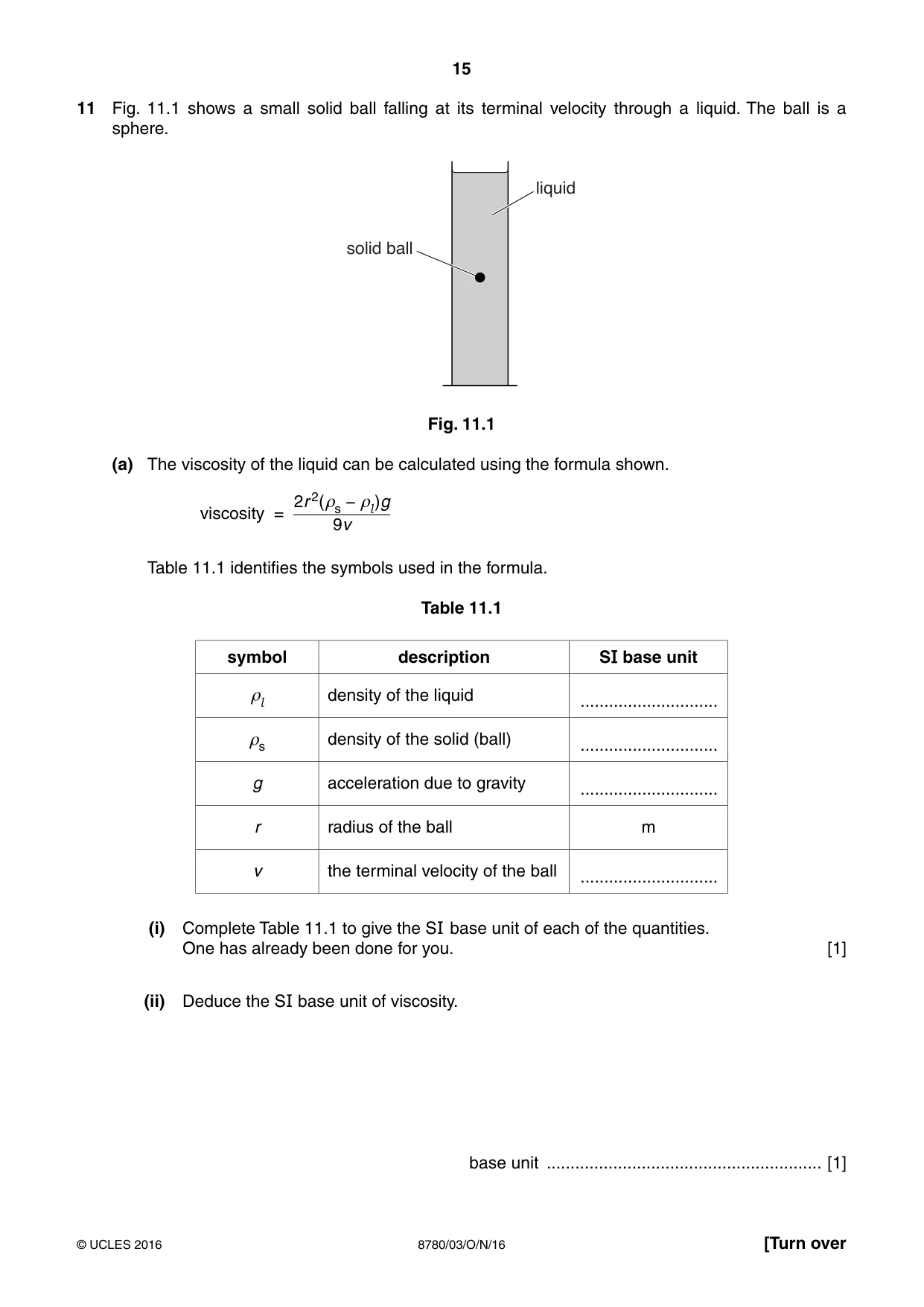
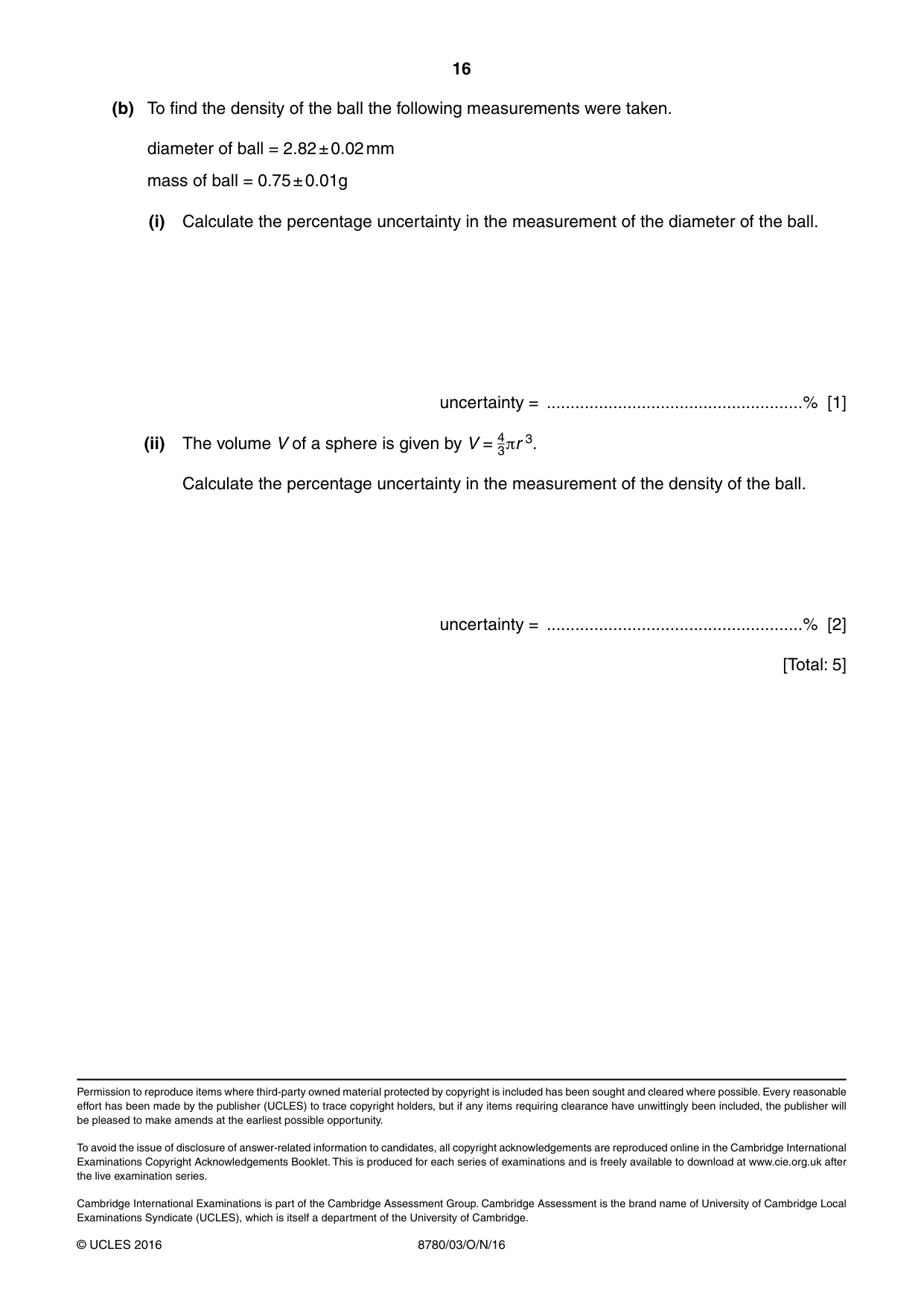
11 Fig. 11.1 shows a small solid ball falling at its terminal velocity through a liquid. The ball is a sphere. liquid solid ball Fig. 11.1 (a) The viscosity of the liquid can be calculated using the formula shown. 2r 2(ρs − ρl)g viscosity = 9v Table 11.1 identifies the symbols used in the formula. Table 11.1 symbol description SI base unit ρl density of the liquid ............................. ρs density of the solid (ball) ............................. g acceleration due to gravity ............................. r radius of the ball m v the terminal velocity of the ball ............................. (i) Complete Table 11.1 to give the SI base unit of each of the quantities. One has already been done for you. [1] (ii) Deduce the SI base unit of viscosity. base unit .......................................................... [1] (b) To find the density of the ball the following measurements were taken. diameter of ball = 2.82 ± 0.02 mm mass of ball = 0.75 ± 0.01g (i) Calculate the percentage uncertainty in the measurement of the diameter of the ball. uncertainty = ......................................................% [1] (ii) The volume V of a sphere is given by V = 43πr 3. Calculate the percentage uncertainty in the measurement of the density of the ball. uncertainty = ......................................................% [2] [Total: 5]
Mark scheme: 11 (a) (i) correct units (base) units for all quantities: kg m–3, m s–2, m, m s–1 [1] (ii) kg m–1 s–1 [1] (b) (i) 0.71(%) [1] (ii) multiplication of (b)(i) by 3 (for r3) [1] calculation of uncertainty in mass leading to uncertainty in density of 3.5(%) [1] [Total: 5]
What you needed in this session
Cambridge’s own grade thresholds for 2016 Oct/Nov, Paper 3 · Variant 1. A higher threshold means an easier paper — the bar moves with how the cohort did.