Cambridge A Level Physical Science 8780 — 2017 Oct/Nov Paper 2 · Variant 1
8780/21/O/N/17 · 11 questions · 30 marks · ≈34 min
The question paper and its mark scheme, free to read here and free to download. This is Cambridge’s own paper, exactly as it was sat.
Question paper8 pages

Mark scheme5 pages
Answers below. Sit the paper first if you are practising.
Questions as text
Q1 · In liquids and gases, molecules are in constant motion
1 In liquids and gases, molecules are in constant motion. Describe, in terms of the kinetic model, two differences between liquids and gases. .......................................................................................................................................................... ......................................................................................................................................................[2]
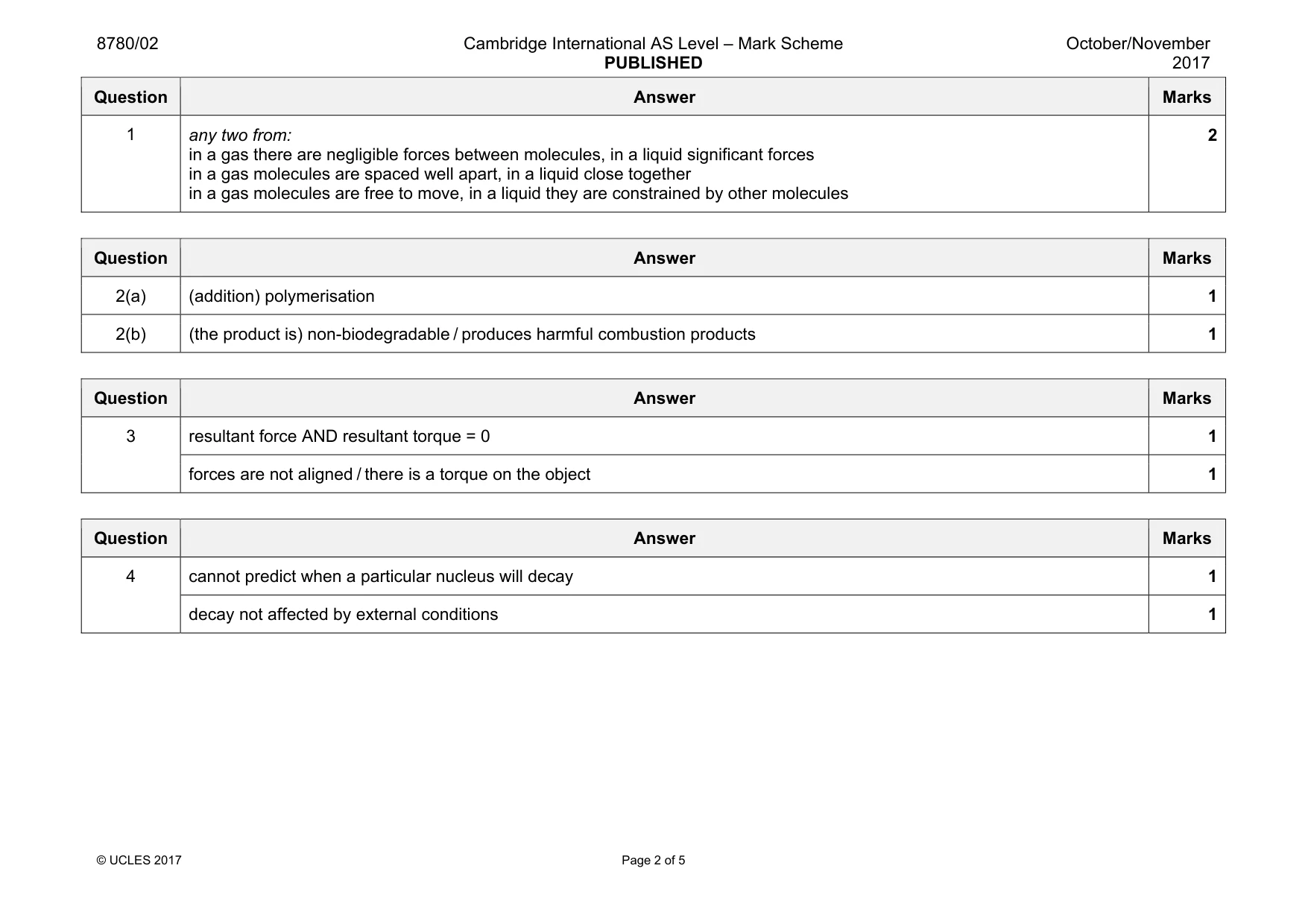
Mark scheme: 1 any two from: in a gas there are negligible forces between molecules, in a liquid significant forces in a gas molecules are spaced well apart, in a liquid close together in a gas molecules are free to move, in a liquid they are constrained by other molecules 2
Q2 · Ethene can react as shown in the equation
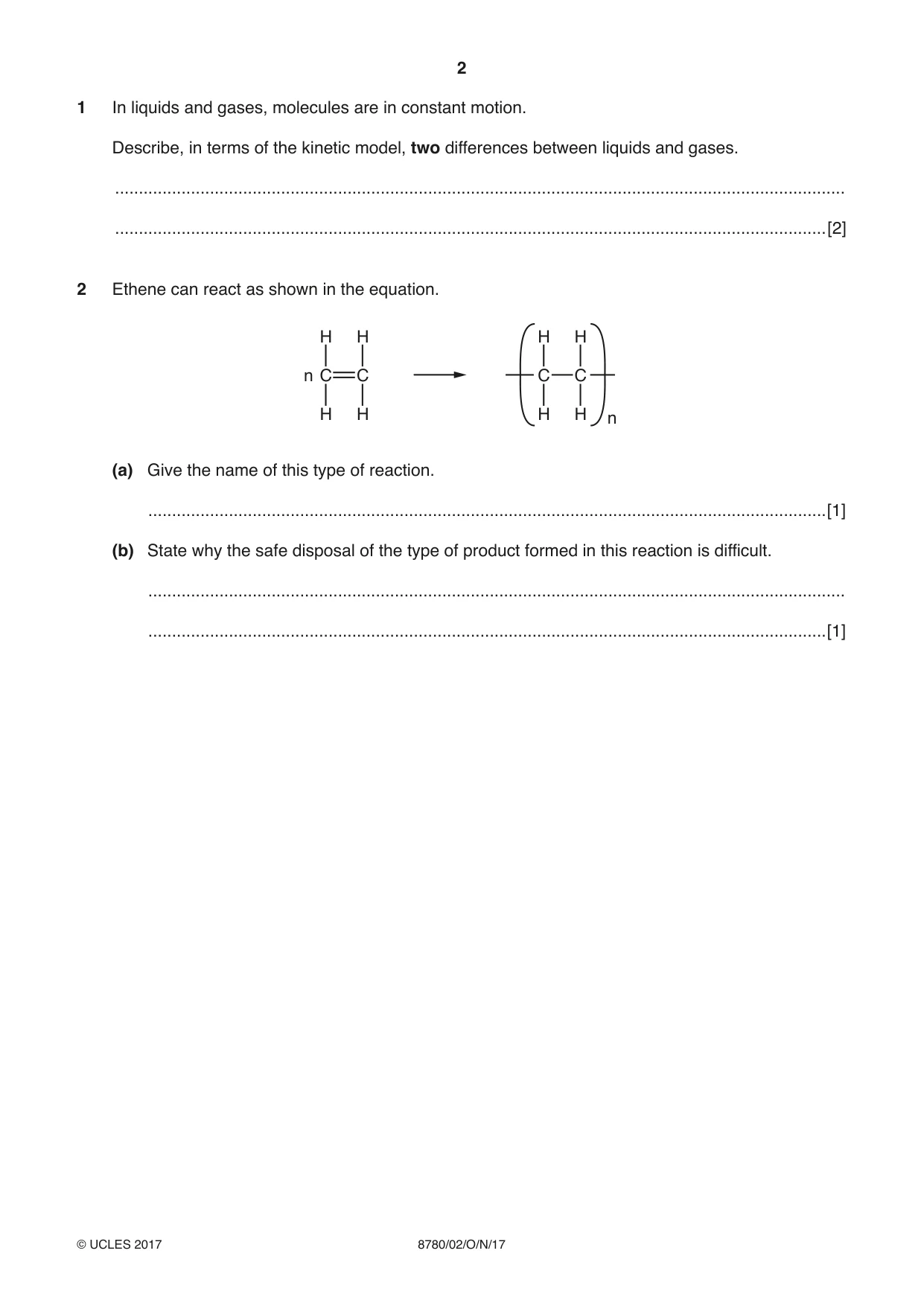
2 Ethene can react as shown in the equation. H H H H n C C C C H H H H n (a) Give the name of this type of reaction. ...............................................................................................................................................[1] (b) State why the safe disposal of the type of product formed in this reaction is difficult. ................................................................................................................................................... ...............................................................................................................................................[1]
Mark scheme: 2(a) (addition) polymerisation 1 2(b) (the product is) non-biodegradable / produces harmful combustion products 1
Q3 · An object that has only two forces acting on it
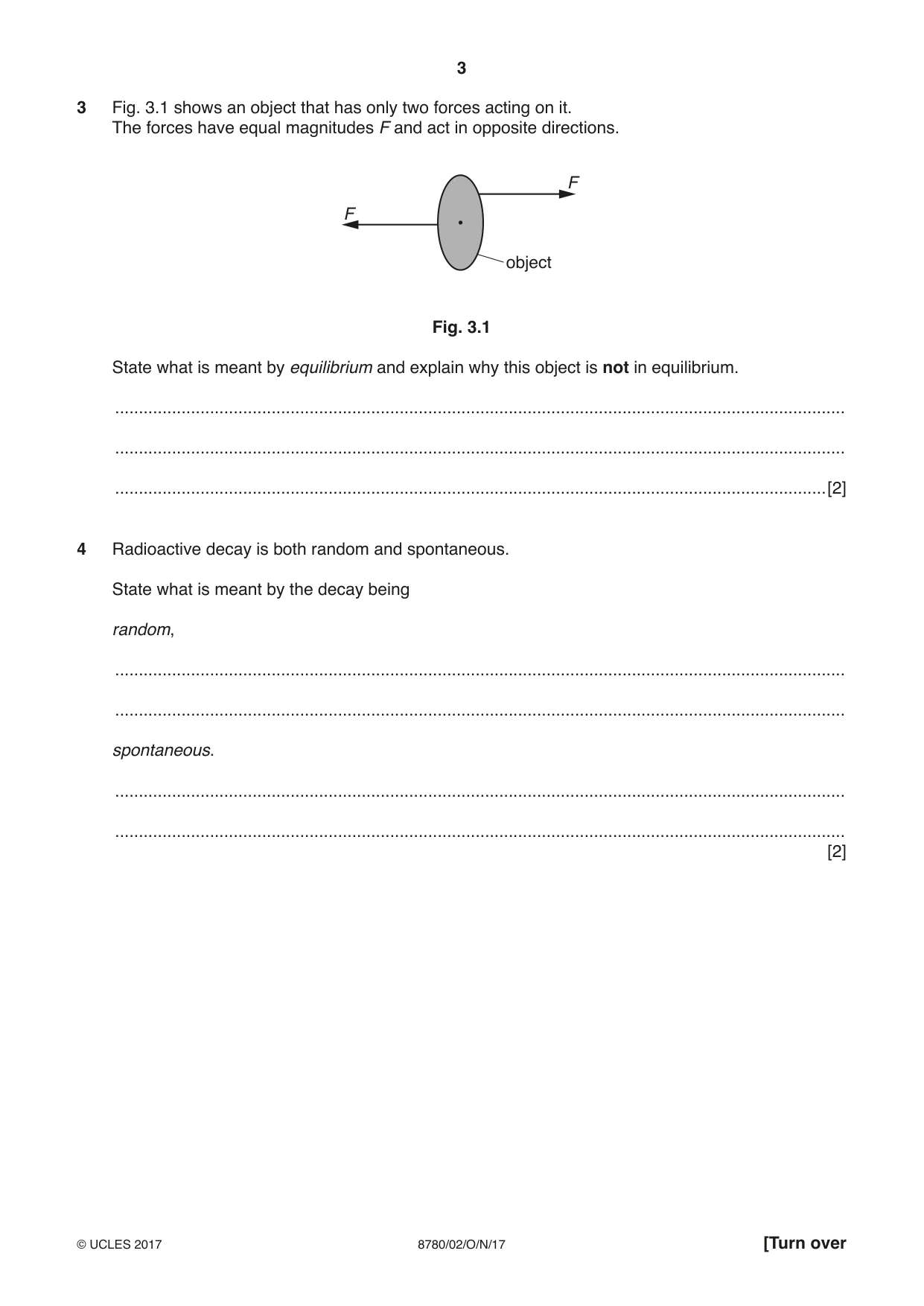
3 Fig. 3.1 shows an object that has only two forces acting on it. The forces have equal magnitudes F and act in opposite directions. F F object Fig. 3.1 State what is meant by equilibrium and explain why this object is not in equilibrium. .......................................................................................................................................................... .......................................................................................................................................................... ......................................................................................................................................................[2]
Mark scheme: 3 resultant force AND resultant torque = 0 1 forces are not aligned / there is a torque on the object 1
Q4 · Radioactive decay is both random and spontaneous
4 Radioactive decay is both random and spontaneous. State what is meant by the decay being random, .......................................................................................................................................................... .......................................................................................................................................................... spontaneous. .......................................................................................................................................................... .......................................................................................................................................................... [2]
Mark scheme: 4 cannot predict when a particular nucleus will decay 1 decay not affected by external conditions 1
Q5 · Nitrogen monoxide and carbon monoxide are both formed in internal combustion engines
5 Nitrogen monoxide and carbon monoxide are both formed in internal combustion engines. These pollutants are removed from the exhaust gases using a catalyst. (a) State what is meant by the term catalyst. ................................................................................................................................................... ...............................................................................................................................................[1] (b) Name a suitable catalyst for removing nitrogen monoxide and carbon monoxide from exhaust gases. ...............................................................................................................................................[1] (c) Write an equation to show how nitrogen monoxide and carbon monoxide react together in the presence of a catalyst. ...............................................................................................................................................[1]
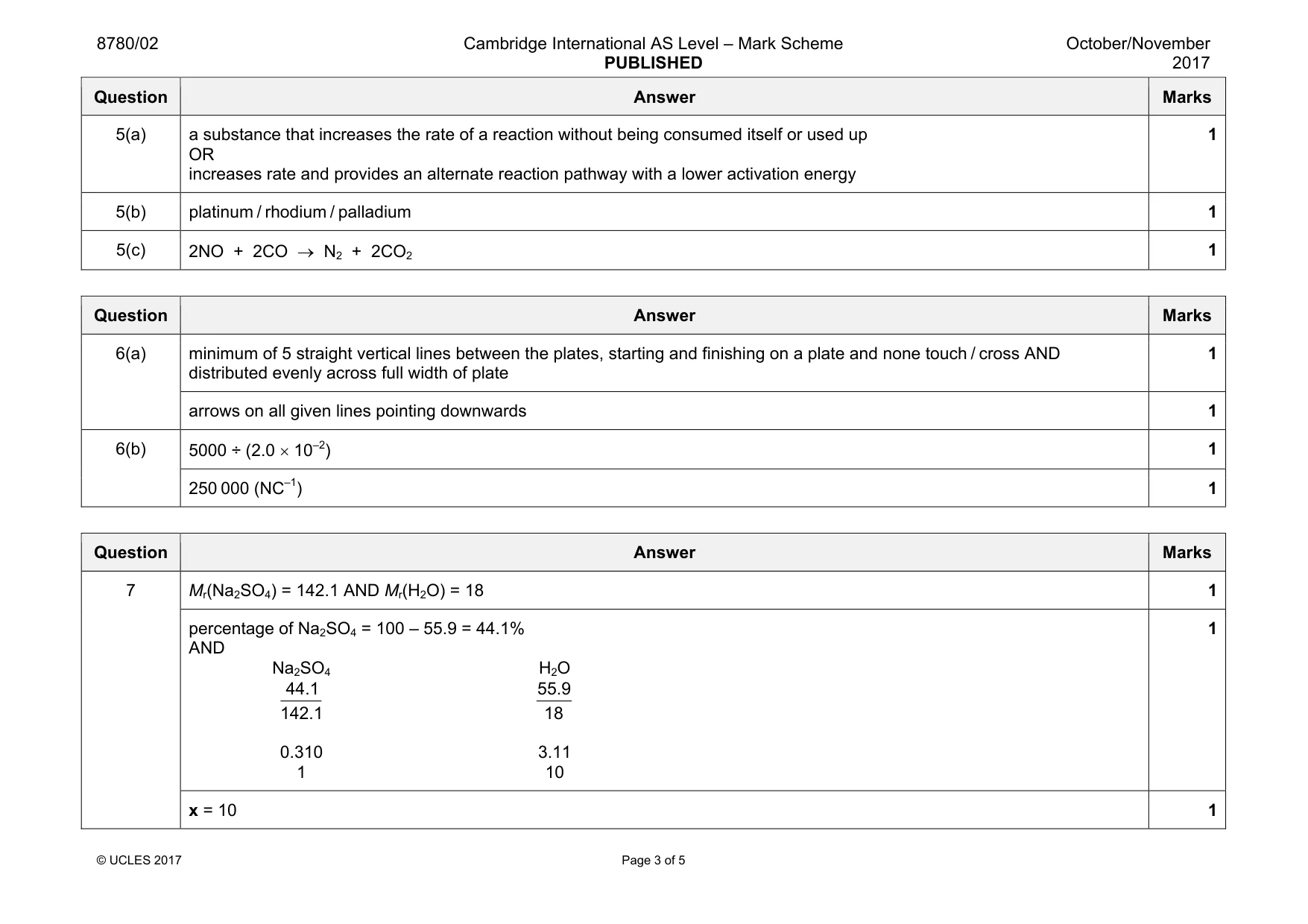
Mark scheme: 5(a) a substance that increases the rate of a reaction without being consumed itself or used up OR increases rate and provides an alternate reaction pathway with a lower activation energy 1 5(b) platinum / rhodium / palladium 1 5(c) 2NO + 2CO → N2 + 2CO2 1
Q6 · Two parallel metal plates with a potential difference (p.d.) of 5000 V across them
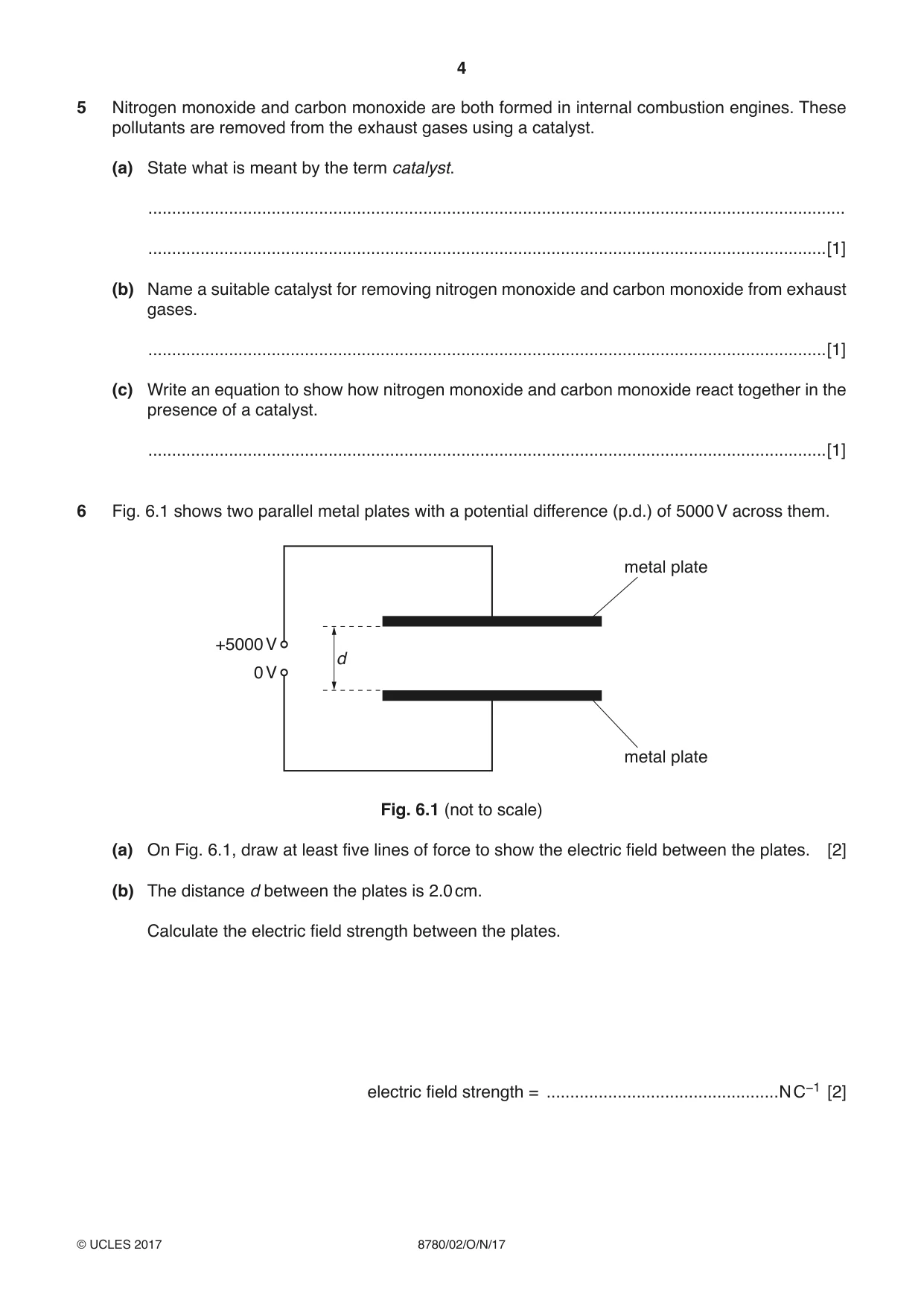
6 Fig. 6.1 shows two parallel metal plates with a potential difference (p.d.) of 5000 V across them. metal plate +5000 V d 0 V metal plate Fig. 6.1 (not to scale) (a) On Fig. 6.1, draw at least five lines of force to show the electric field between the plates. [2] (b) The distance d between the plates is 2.0 cm. Calculate the electric field strength between the plates. electric field strength = .................................................N C−1 [2]
Mark scheme: 6(a) minimum of 5 straight vertical lines between the plates, starting and finishing on a plate and none touch / cross AND distributed evenly across full width of plate 1 arrows on all given lines pointing downwards 1 6(b) 5000 ÷ (2.0 × 10⁻²) 1 250 000 (NC–1) 1
Q7 · Mirabilite is a mineral
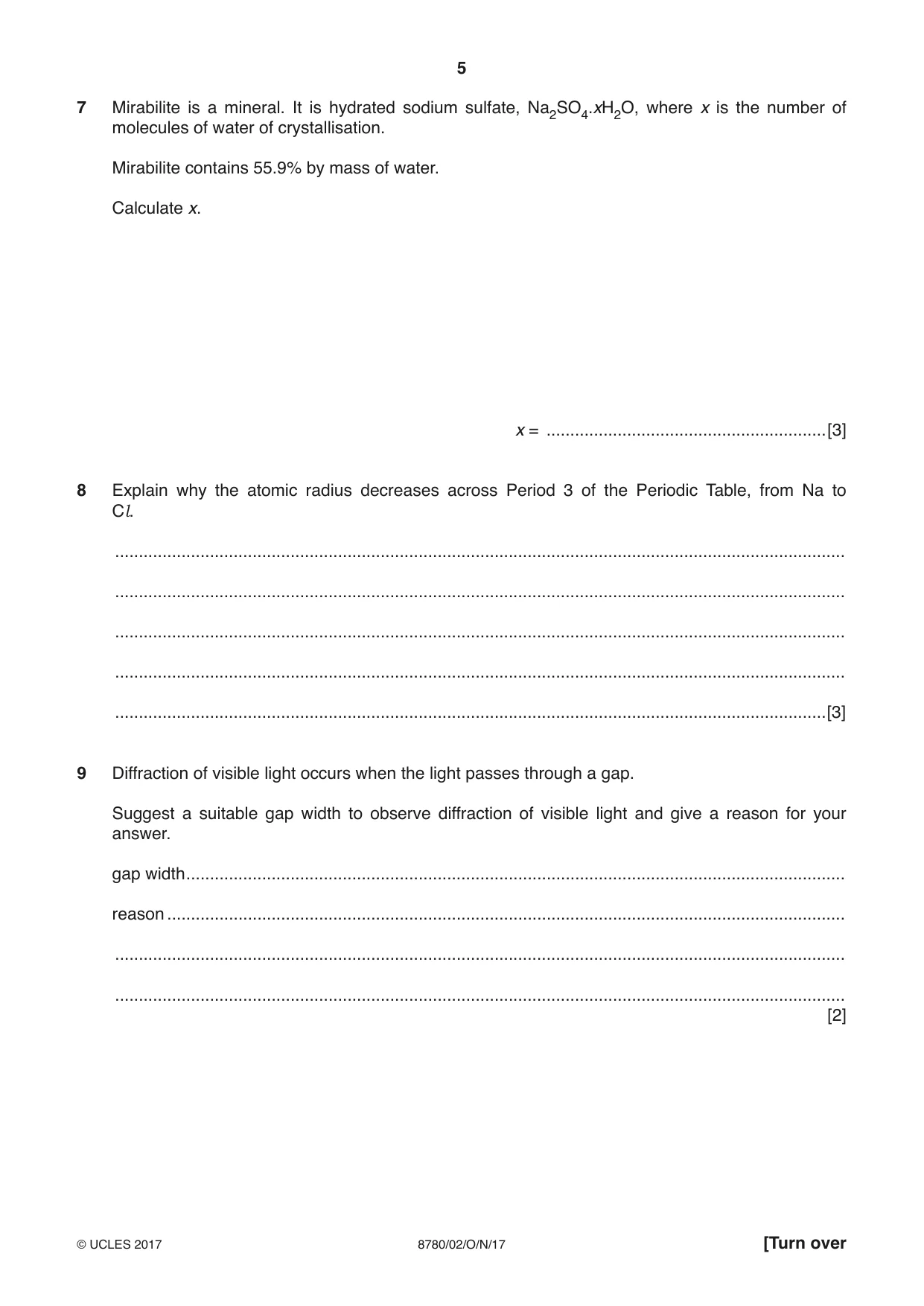
7 Mirabilite is a mineral. It is hydrated sodium sulfate, Na2SO4.xH2O, where x is the number of molecules of water of crystallisation. Mirabilite contains 55.9% by mass of water. Calculate x. x = ...........................................................[3]
Mark scheme: 7 Mr(Na2SO4) = 142.1 AND Mr(H2O) = 18 1 percentage of Na2SO4 = 100 – 55.9 = 44.1% AND Na2SO4 H2O 44.1 142.1 55.9 18 0.310 3.11 1 10 1 x = 10 1
Q8 · Explain why the atomic radius decreases across Period 3 of the Periodic Table, from Na to…
8 Explain why the atomic radius decreases across Period 3 of the Periodic Table, from Na to Cl. .......................................................................................................................................................... .......................................................................................................................................................... .......................................................................................................................................................... .......................................................................................................................................................... ......................................................................................................................................................[3]
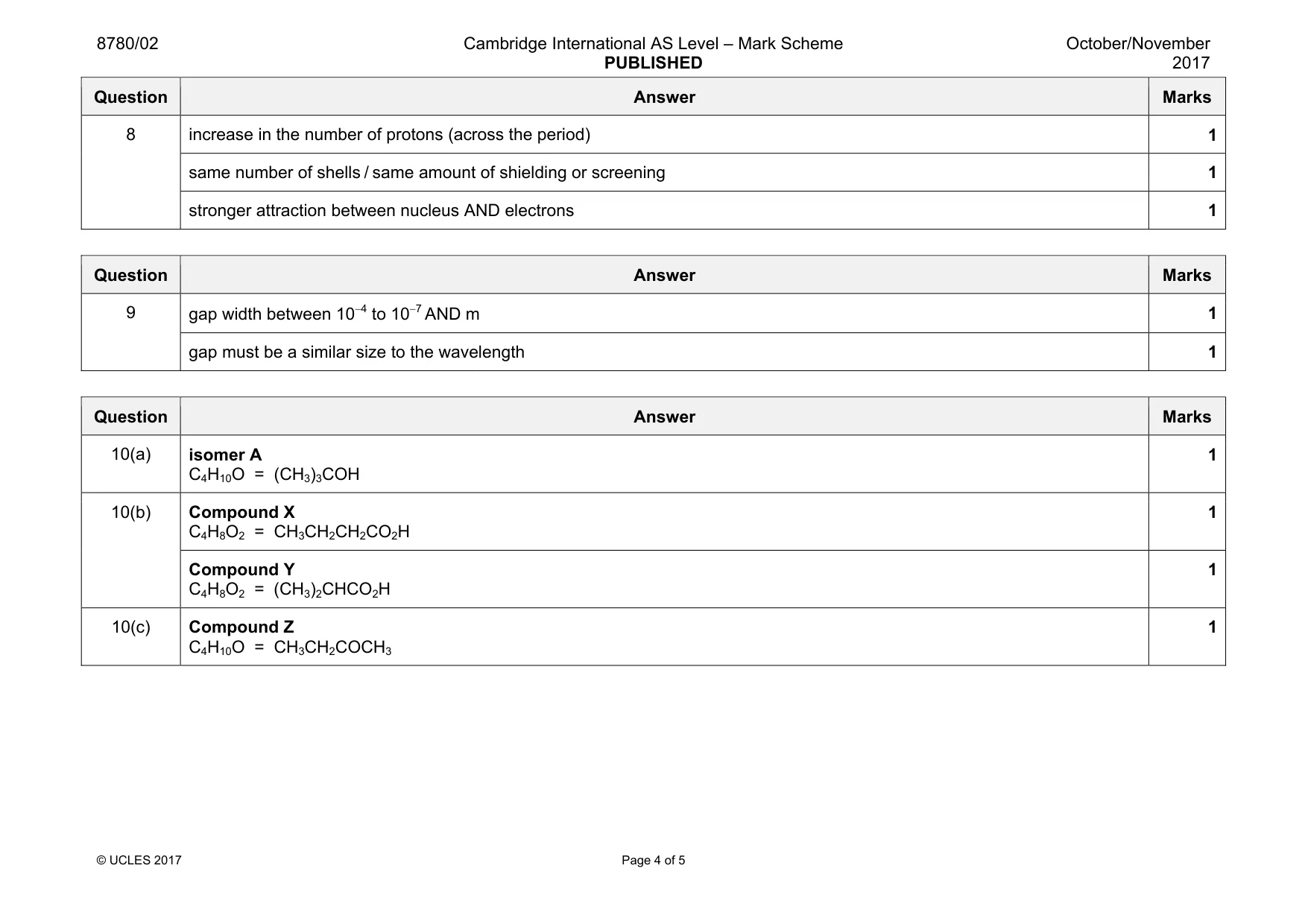
Mark scheme: 8 increase in the number of protons (across the period) 1 same number of shells / same amount of shielding or screening 1 stronger attraction between nucleus AND electrons 1
Q9 · Diffraction of visible light occurs when the light passes through a gap
9 Diffraction of visible light occurs when the light passes through a gap. Suggest a suitable gap width to observe diffraction of visible light and give a reason for your answer. gap width ........................................................................................................................................... reason ............................................................................................................................................... .......................................................................................................................................................... .......................................................................................................................................................... [2]
Mark scheme: 9 1 gap must be a similar size to the wavelength 1
Q10 · There are four isomeric alcohols with molecular formula C4H10O
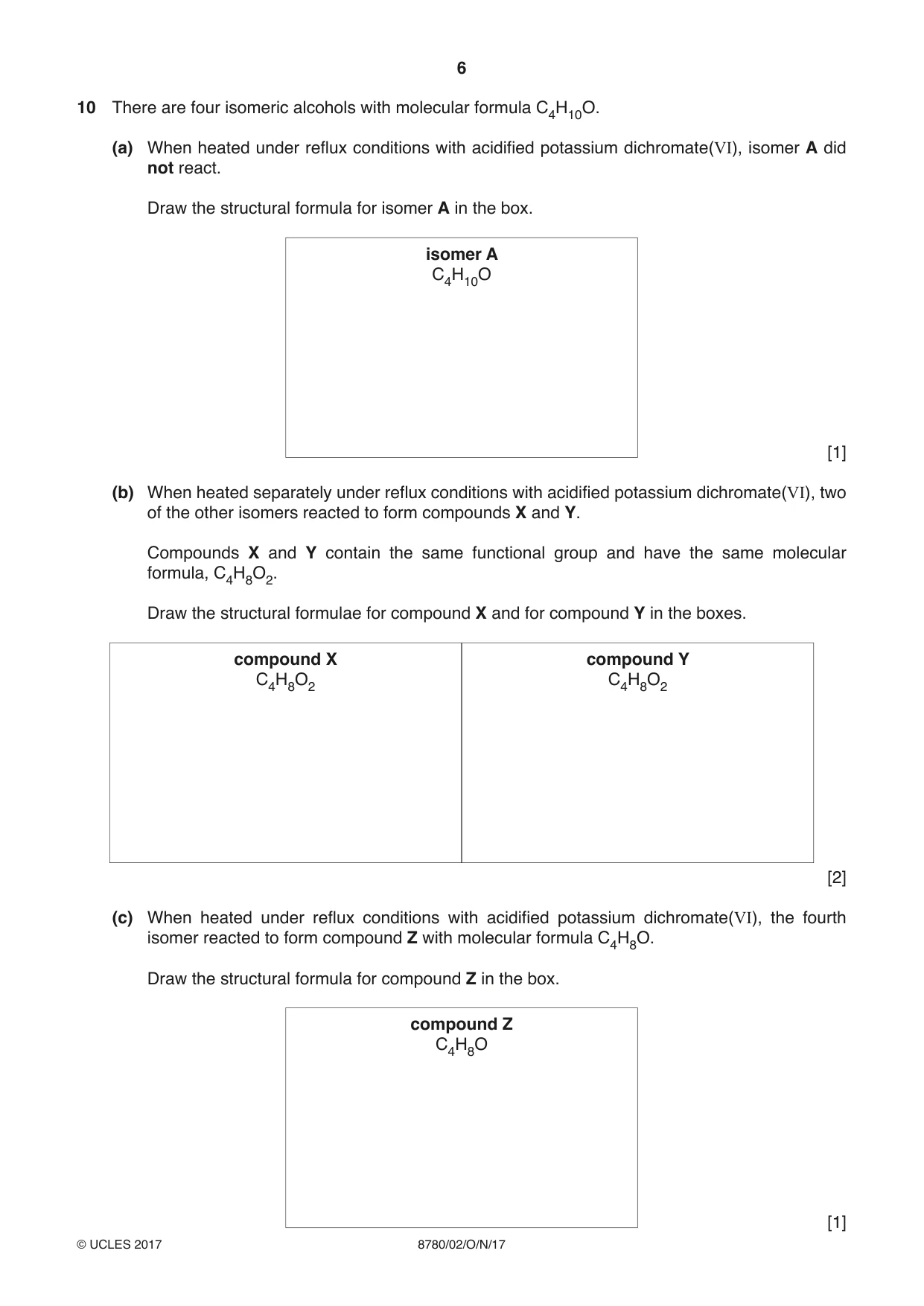
10 There are four isomeric alcohols with molecular formula C4H10O. (a) When heated under reflux conditions with acidified potassium dichromate(VI), isomer A did not react. Draw the structural formula for isomer A in the box. isomer A C4H10O [1] (b) When heated separately under reflux conditions with acidified potassium dichromate(VI), two of the other isomers reacted to form compounds X and Y. Compounds X and Y contain the same functional group and have the same molecular formula, C4H8O2. Draw the structural formulae for compound X and for compound Y in the boxes. compound X compound Y C4H8O2 C4H8O2 [2] (c) When heated under reflux conditions with acidified potassium dichromate(VI), the fourth isomer reacted to form compound Z with molecular formula C4H8O. Draw the structural formula for compound Z in the box. compound Z C4H8O [1]
Mark scheme: 10(a) isomer A C4H10O = (CH3)3COH 1 10(b) Compound X C4H8O2 = CH3CH2CH2CO2H 1 Compound Y C4H8O2 = (CH3)2CHCO2H 1 10(c) Compound Z C4H10O = CH3CH2COCH3 1
Q11 · An electric heater is rated at 2.4 kW, 230 V
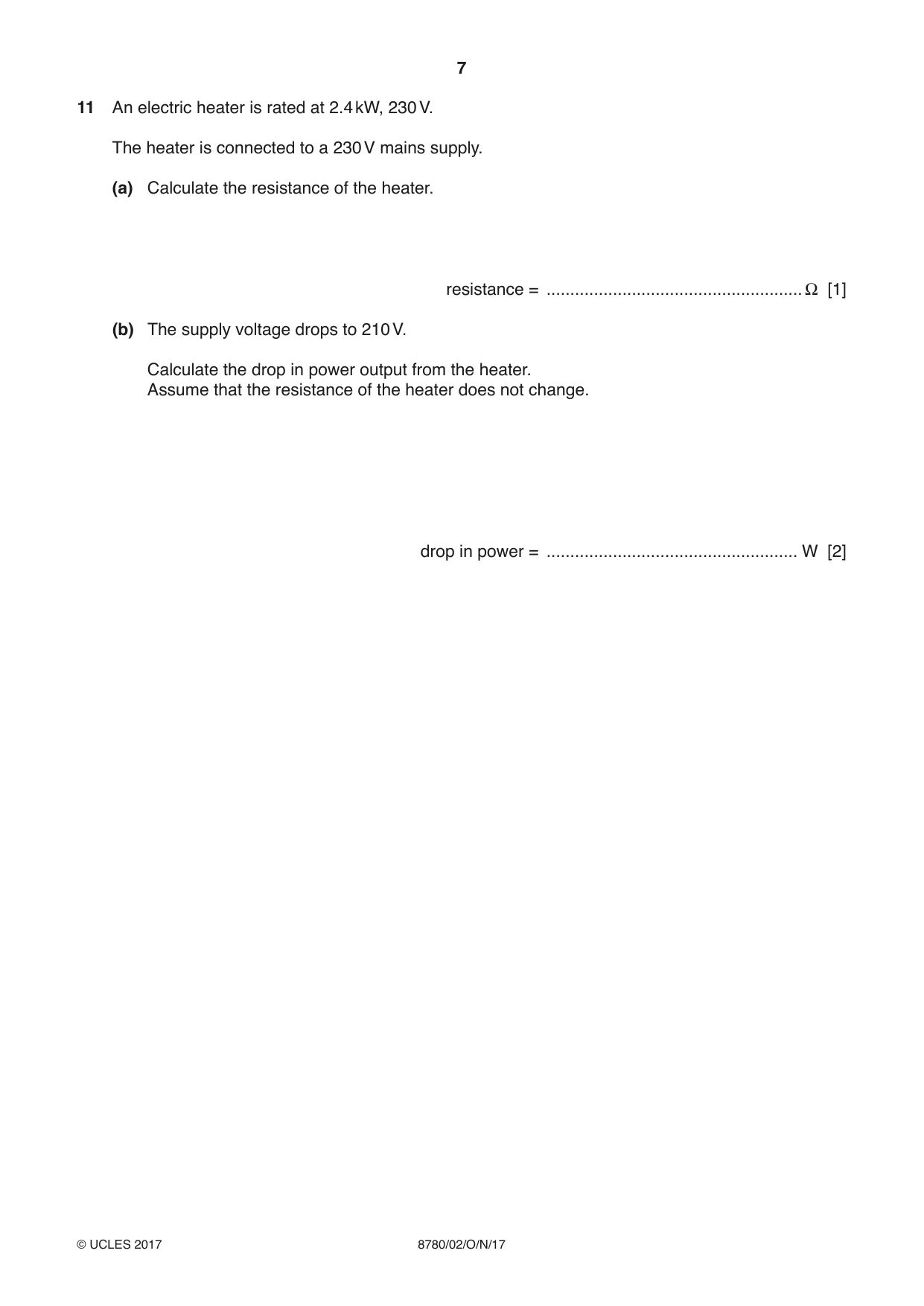
11 An electric heater is rated at 2.4 kW, 230 V. The heater is connected to a 230 V mains supply. (a) Calculate the resistance of the heater. resistance = ......................................................Ω [1] (b) The supply voltage drops to 210 V. Calculate the drop in power output from the heater. Assume that the resistance of the heater does not change. drop in power = ..................................................... W [2]
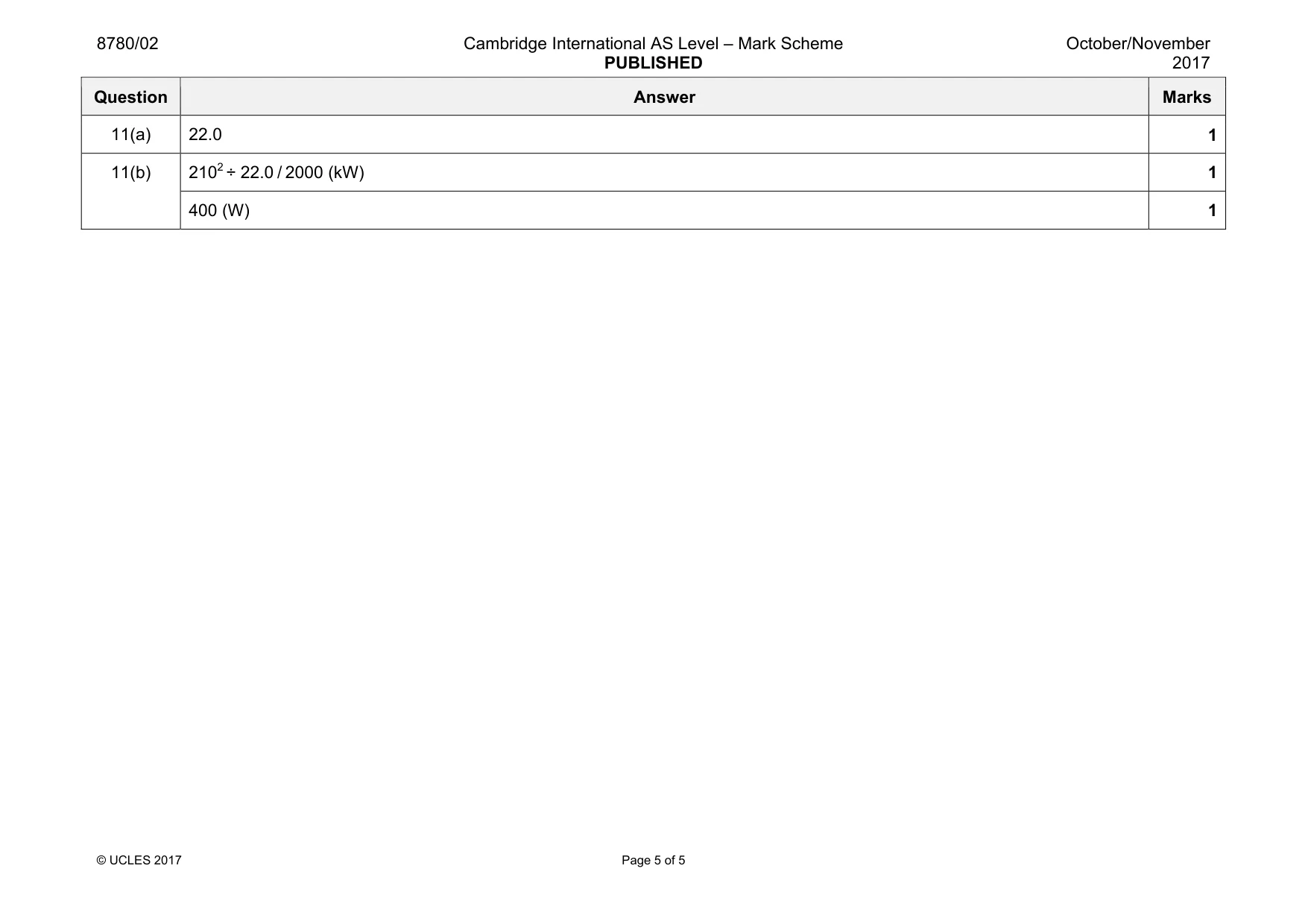
Mark scheme: 11(a) 22.0 1 11(b) 2102 ÷ 22.0 / 2000 (kW) 1 400 (W) 1
What you needed in this session
Cambridge’s own grade thresholds for 2017 Oct/Nov, Paper 2 · Variant 1. A higher threshold means an easier paper — the bar moves with how the cohort did.