Cambridge A Level Physical Science 8780 — 2014 Oct/Nov Paper 2 · Variant 1
8780/21/O/N/14 · 10 questions · 30 marks · ≈34 min
The question paper and its mark scheme, free to read here and free to download. This is Cambridge’s own paper, exactly as it was sat.
Question paper12 pages


Mark scheme3 pages
Answers below. Sit the paper first if you are practising.
Questions as text
Q1 · Units can be expressed with a prefix which changes the size of the unit
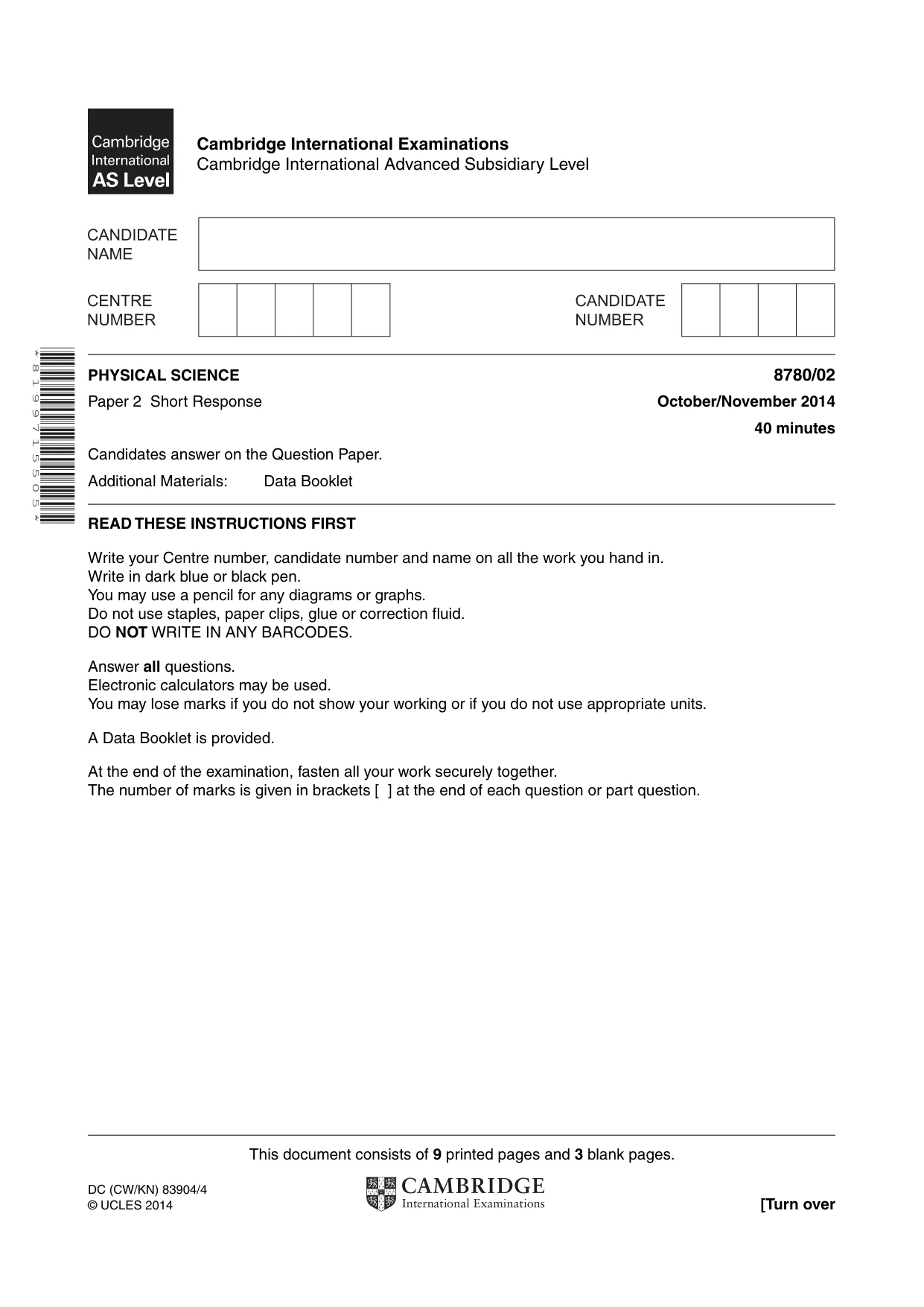
1 Units can be expressed with a prefix which changes the size of the unit. Table 1.1 gives some examples. Table 1.1 prefix symbol power of ten centi c 10–2 10–6 M giga Complete the table. [3]
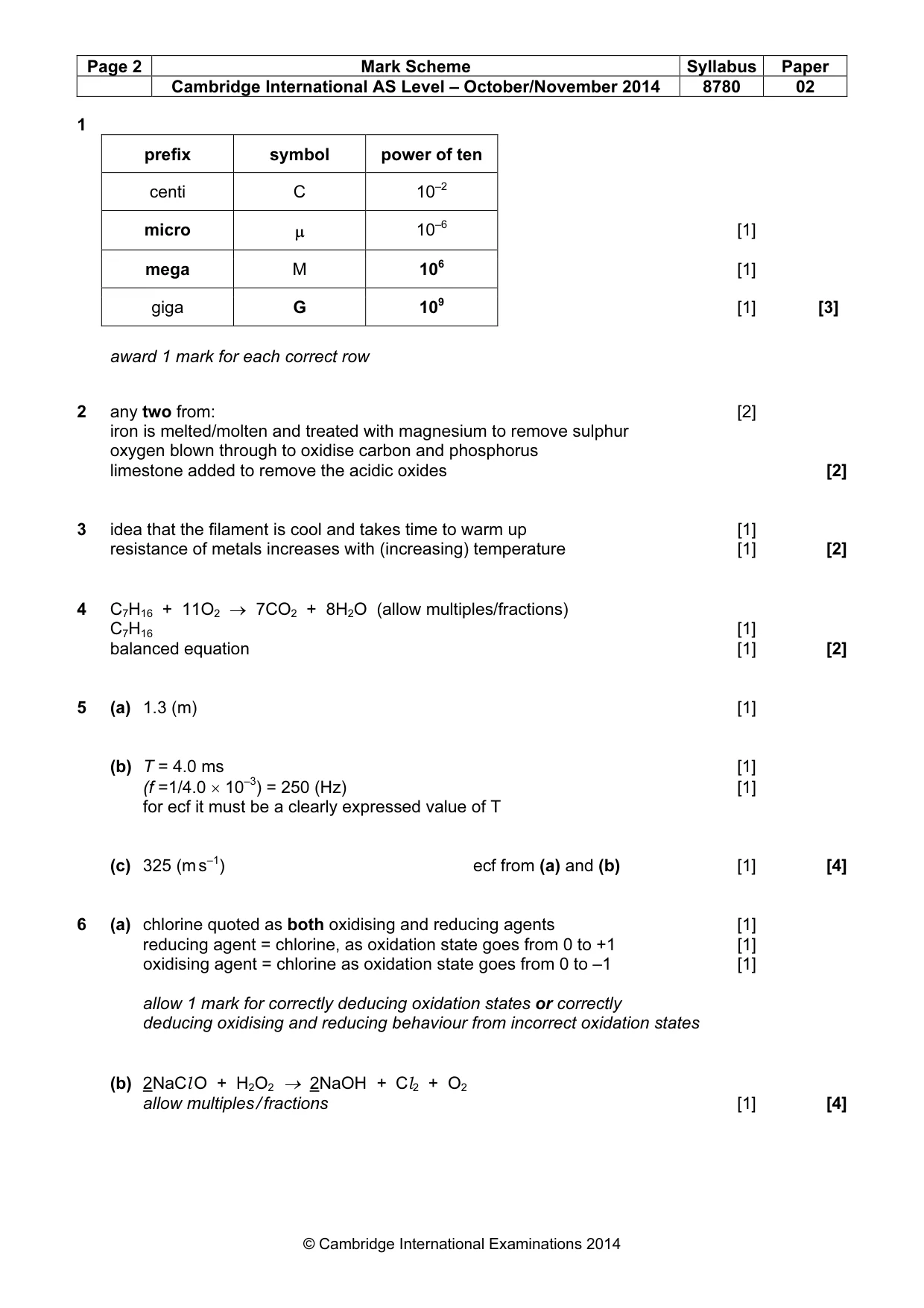
Mark scheme: 1 prefix symbol power of ten centi C 10–2 micro µ 10–6 [1] mega M 106 [1] giga G 109 [1] [3] award 1 mark for each correct row
Q2 · Briefly describe how iron obtained from a blast furnace is purified before it is made…
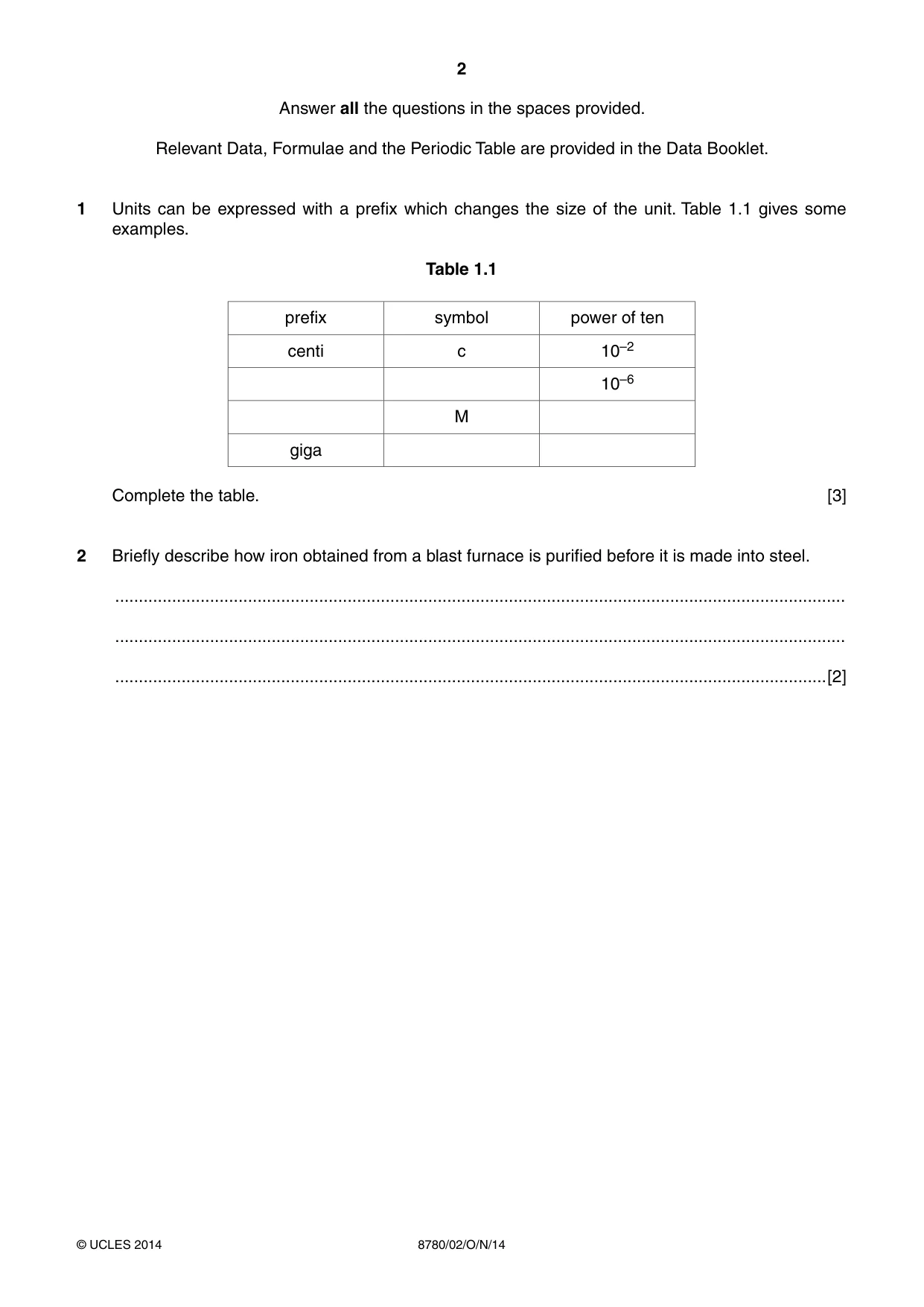
2 Briefly describe how iron obtained from a blast furnace is purified before it is made into steel. .......................................................................................................................................................... .......................................................................................................................................................... ......................................................................................................................................................[2]
Mark scheme: 2 any two from: [2] iron is melted/molten and treated with magnesium to remove sulphur oxygen blown through to oxidise carbon and phosphorus limestone added to remove the acidic oxides [2]
Question 3
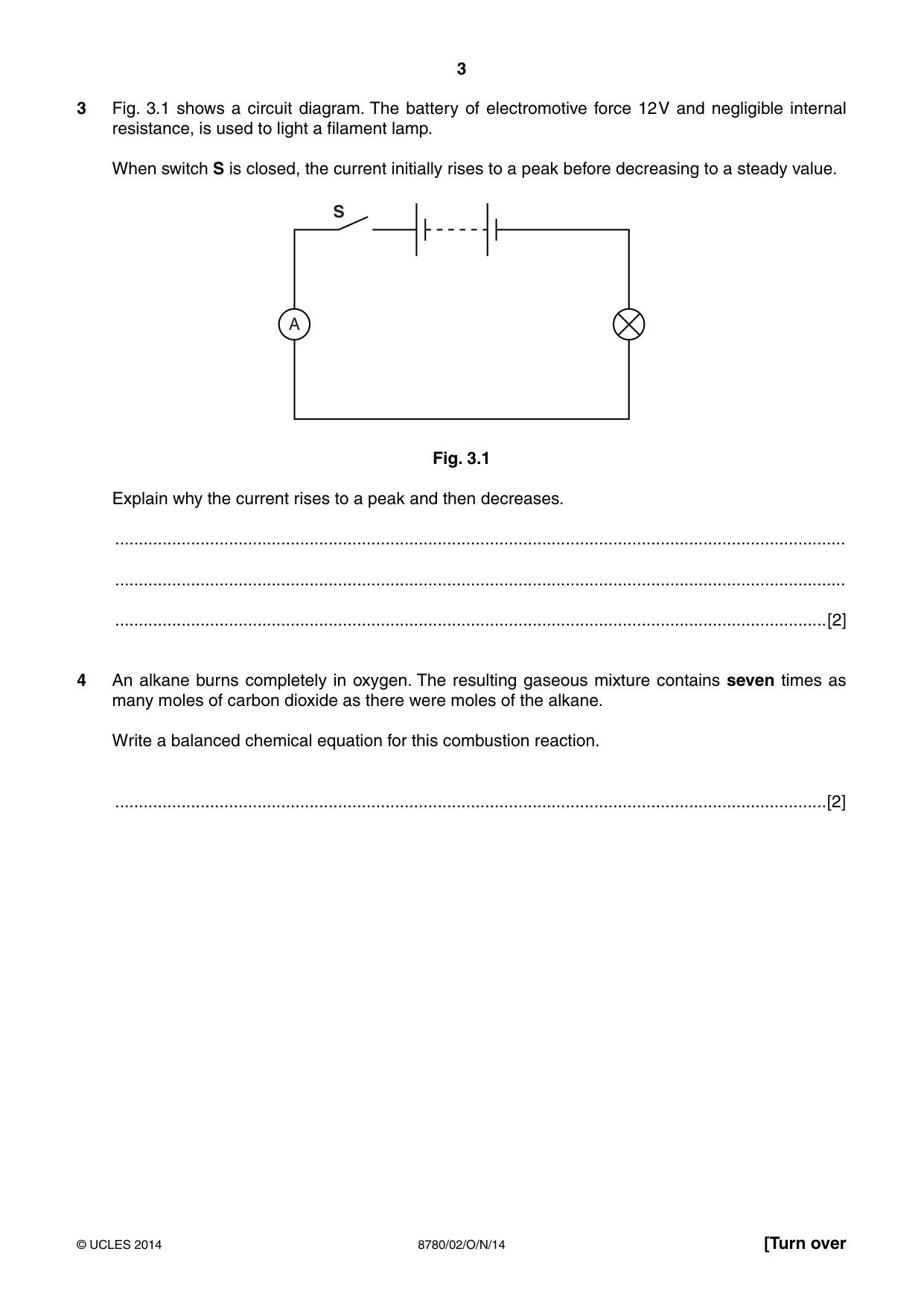
3 Fig. 3.1 shows a circuit diagram. The battery of electromotive force 12 V and negligible internal resistance, is used to light a filament lamp. When switch S is closed, the current initially rises to a peak before decreasing to a steady value. S A Fig. 3.1 Explain why the current rises to a peak and then decreases. .......................................................................................................................................................... .......................................................................................................................................................... ......................................................................................................................................................[2]
Mark scheme: 3 idea that the filament is cool and takes time to warm up [1] resistance of metals increases with (increasing) temperature [1] [2]
Q4 · An alkane burns completely in oxygen
4 An alkane burns completely in oxygen. The resulting gaseous mixture contains seven times as many moles of carbon dioxide as there were moles of the alkane. Write a balanced chemical equation for this combustion reaction. ......................................................................................................................................................[2]
Mark scheme: 4 C7H16 + 11O2 → 7CO2 + 8H2O (allow multiples/fractions) C7H16 [1] balanced equation [1] [2]
Q5 · A sound wave passes through a medium
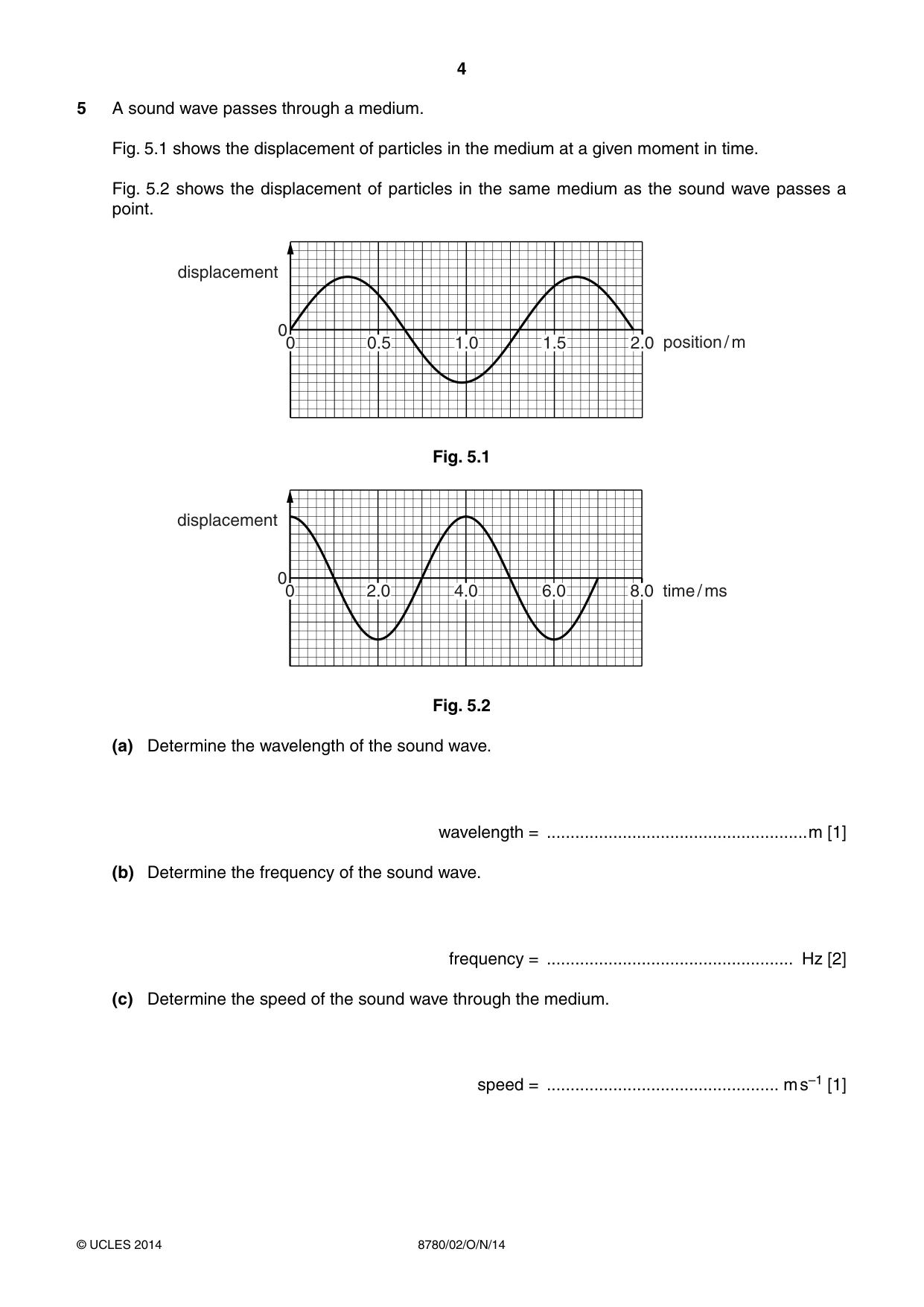
5 A sound wave passes through a medium. Fig. 5.1 shows the displacement of particles in the medium at a given moment in time. Fig. 5.2 shows the displacement of particles in the same medium as the sound wave passes a point. displacement 0 0 0.5 1.0 1.5 2.0 position / m Fig. 5.1 displacement 0 0 2.0 4.0 6.0 8.0 time / ms Fig. 5.2 (a) Determine the wavelength of the sound wave. wavelength = .......................................................m [1] (b) Determine the frequency of the sound wave. frequency = .................................................... Hz [2] (c) Determine the speed of the sound wave through the medium. speed = ................................................. m s–1 [1]
Mark scheme: 5 (a) 1.3 (m) [1] (b) T = 4.0 ms [1] (f =1/4.0 × 10–3) = 250 (Hz) [1] for ecf it must be a clearly expressed value of T (c) 325 (m s–1) ecf from (a) and (b) [1] [4]
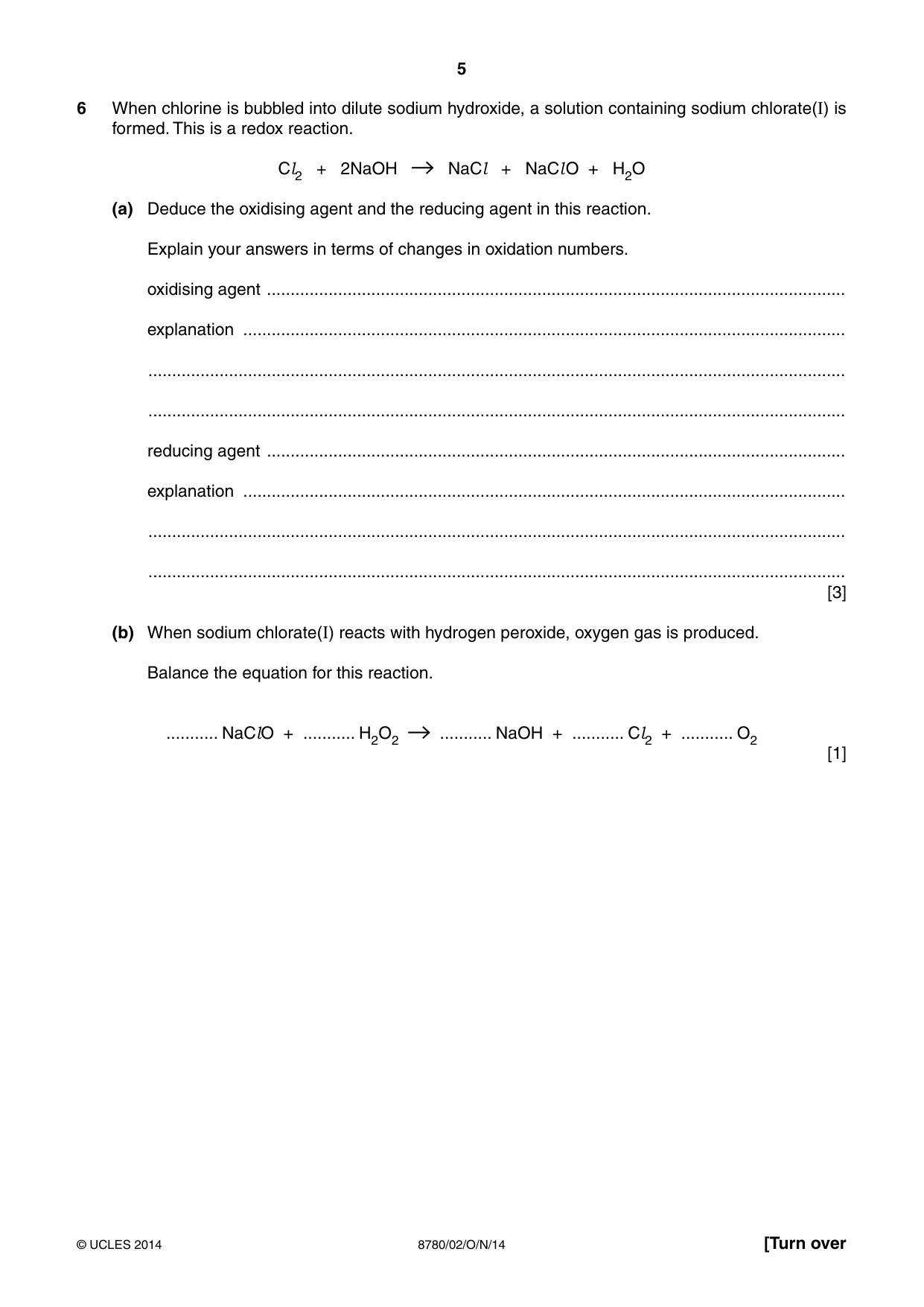
Q6 · When chlorine is bubbled into dilute sodium hydroxide, a solution containing sodium…
6 When chlorine is bubbled into dilute sodium hydroxide, a solution containing sodium chlorate(I) is formed. This is a redox reaction. Cl2 + 2NaOH NaCl + NaCl O + H2O (a) Deduce the oxidising agent and the reducing agent in this reaction. Explain your answers in terms of changes in oxidation numbers. oxidising agent .......................................................................................................................... explanation ............................................................................................................................... ................................................................................................................................................... ................................................................................................................................................... reducing agent .......................................................................................................................... explanation ............................................................................................................................... ................................................................................................................................................... ................................................................................................................................................... [3] (b) When sodium chlorate(I) reacts with hydrogen peroxide, oxygen gas is produced. Balance the equation for this reaction. ........... NaClO + ........... H2O2 ........... NaOH + ........... Cl2 + ........... O2 [1]
Mark scheme: 6 (a) chlorine quoted as both oxidising and reducing agents [1] reducing agent = chlorine, as oxidation state goes from 0 to +1 [1] oxidising agent = chlorine as oxidation state goes from 0 to –1 [1] allow 1 mark for correctly deducing oxidation states or correctly deducing oxidising and reducing behaviour from incorrect oxidation states (b) 2NaCl O + H2O2 → 2NaOH + Cl2 + O2 allow multiples / fractions [1] [4]
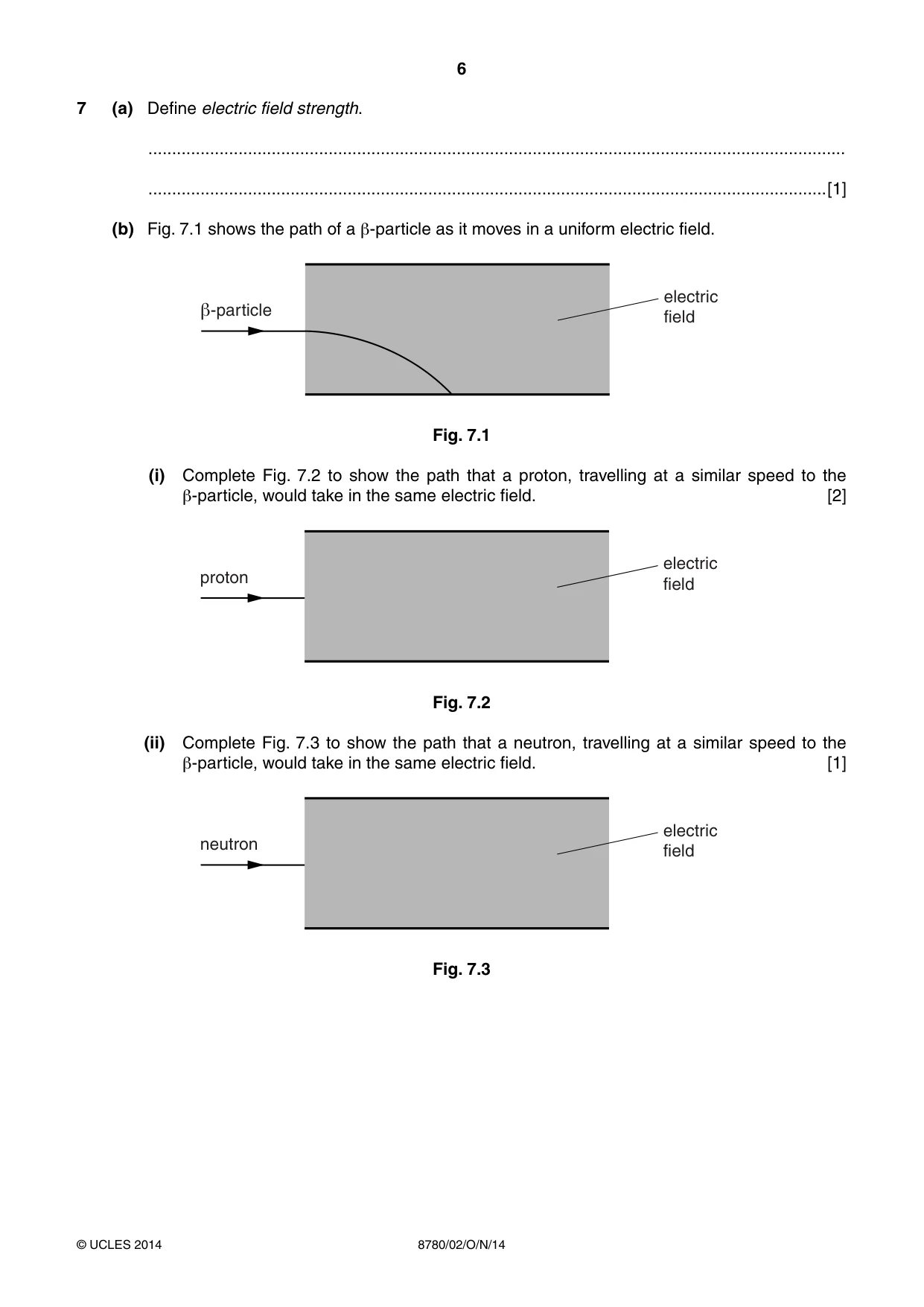
Q7 · Define electric field strength
7 (a) Define electric field strength. ................................................................................................................................................... ...............................................................................................................................................[1] (b) Fig. 7.1 shows the path of a β-particle as it moves in a uniform electric field. electric `-particle field Fig. 7.1 (i) Complete Fig. 7.2 to show the path that a proton, travelling at a similar speed to the β-particle, would take in the same electric field. [2] electric proton field Fig. 7.2 (ii) Complete Fig. 7.3 to show the path that a neutron, travelling at a similar speed to the β-particle, would take in the same electric field. [1] electric neutron field Fig. 7.3
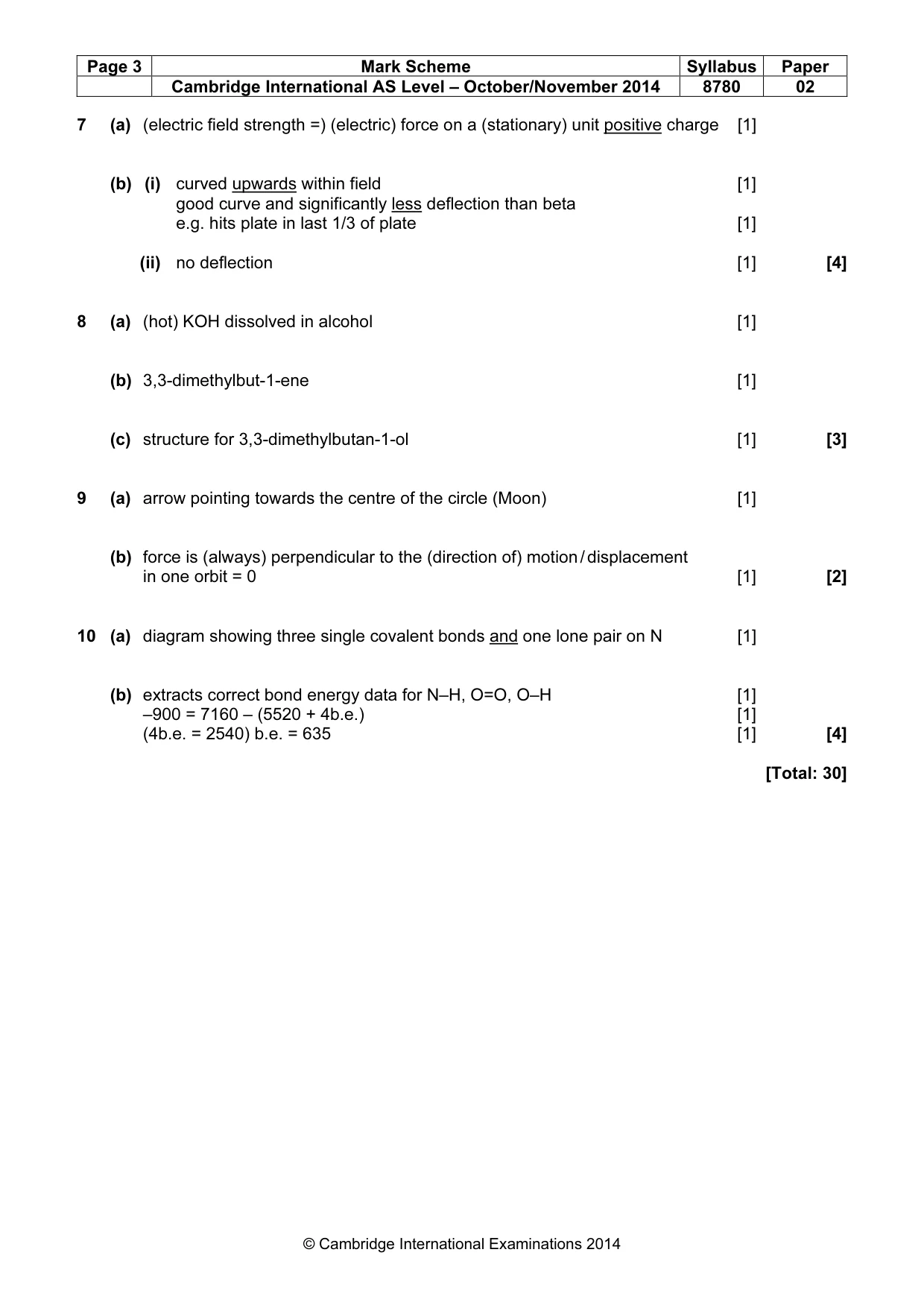
Mark scheme: 7 (a) (electric field strength =) (electric) force on a (stationary) unit positive charge [1] (b) (i) curved upwards within field [1] good curve and significantly less deflection than beta e.g. hits plate in last 1/3 of plate [1] (ii) no deflection [1] [4]
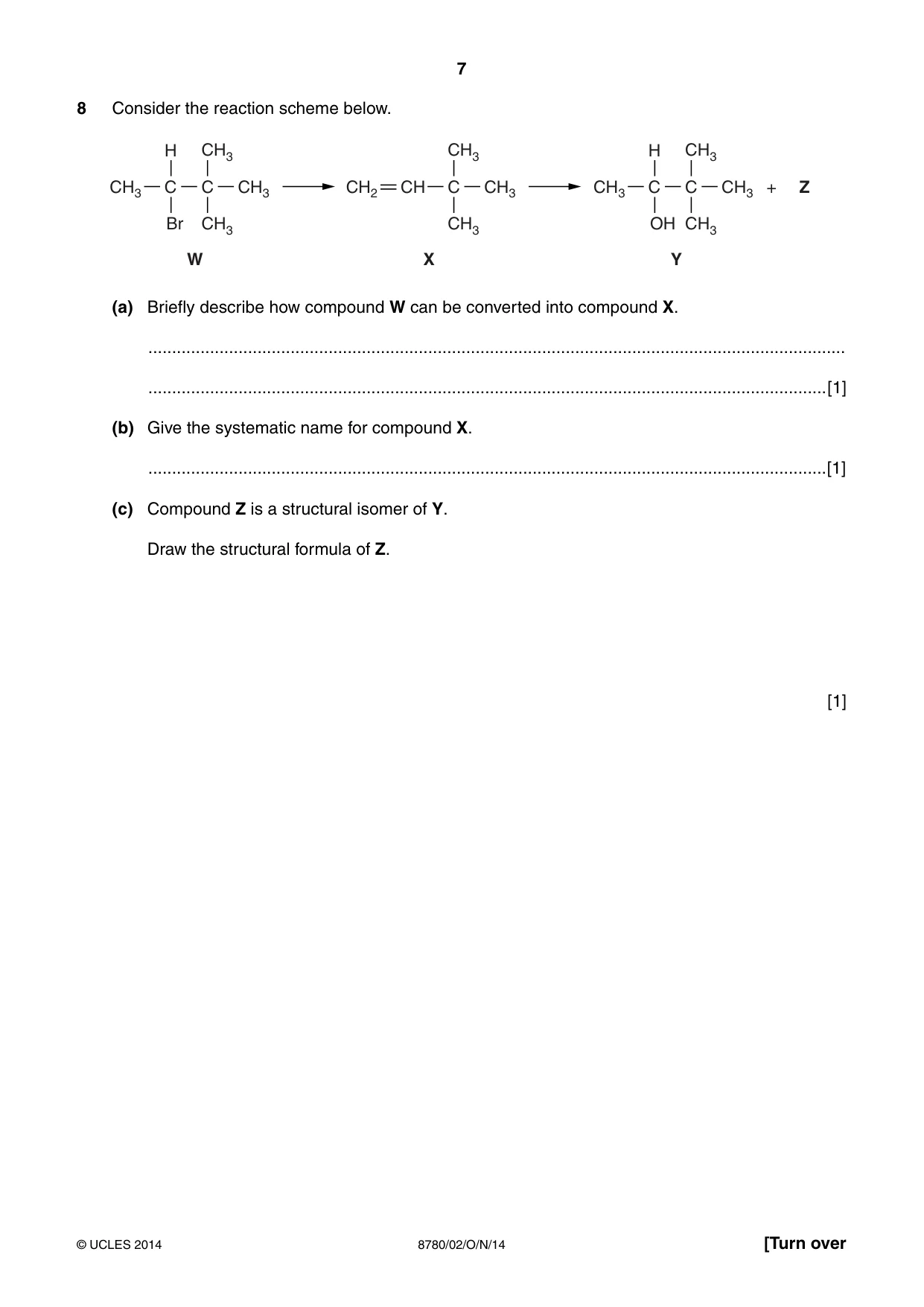
Q8 · Consider the reaction scheme below
8 Consider the reaction scheme below. H CH3 CH3 H CH3 CH3 C C CH3 CH2 CH C CH3 CH3 C C CH3 + Z Br CH3 CH3 OH CH3 W X Y (a) Briefly describe how compound W can be converted into compound X. ................................................................................................................................................... ...............................................................................................................................................[1] (b) Give the systematic name for compound X. ...............................................................................................................................................[1] (c) Compound Z is a structural isomer of Y. Draw the structural formula of Z. [1]
Mark scheme: 8 (a) (hot) KOH dissolved in alcohol [1] (b) 3,3-dimethylbut-1-ene [1] (c) structure for 3,3-dimethylbutan-1-ol [1] [3]
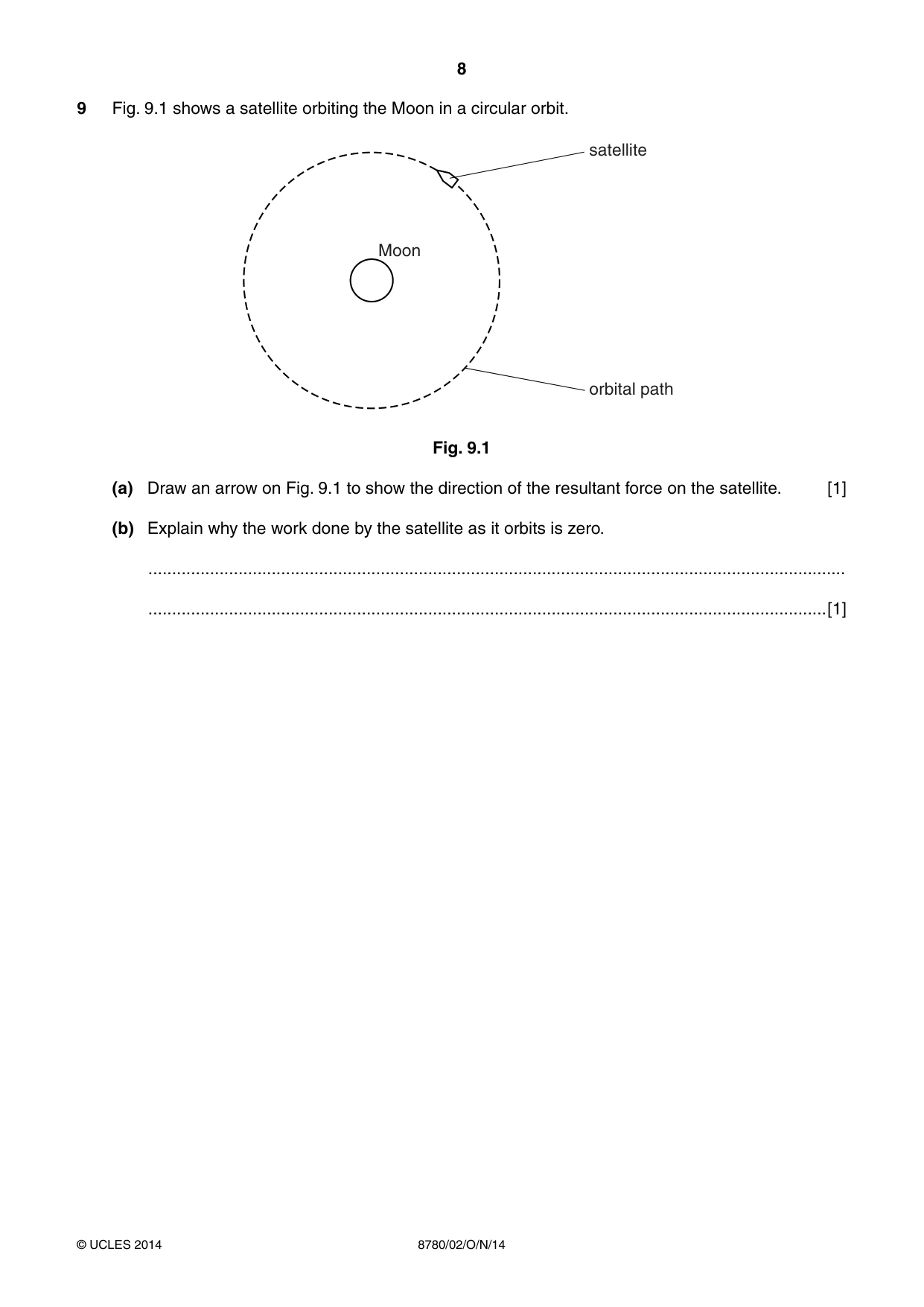
Q9 · A satellite orbiting the Moon in a circular orbit
9 Fig. 9.1 shows a satellite orbiting the Moon in a circular orbit. satellite Moon orbital path Fig. 9.1 (a) Draw an arrow on Fig. 9.1 to show the direction of the resultant force on the satellite. [1] (b) Explain why the work done by the satellite as it orbits is zero. ................................................................................................................................................... ...............................................................................................................................................[1]
Mark scheme: 9 (a) arrow pointing towards the centre of the circle (Moon) [1] (b) force is (always) perpendicular to the (direction of) motion / displacement in one orbit = 0 [1] [2]
Q10 · Draw a dot-and-cross diagram to show the outer electrons in a molecule of NH3
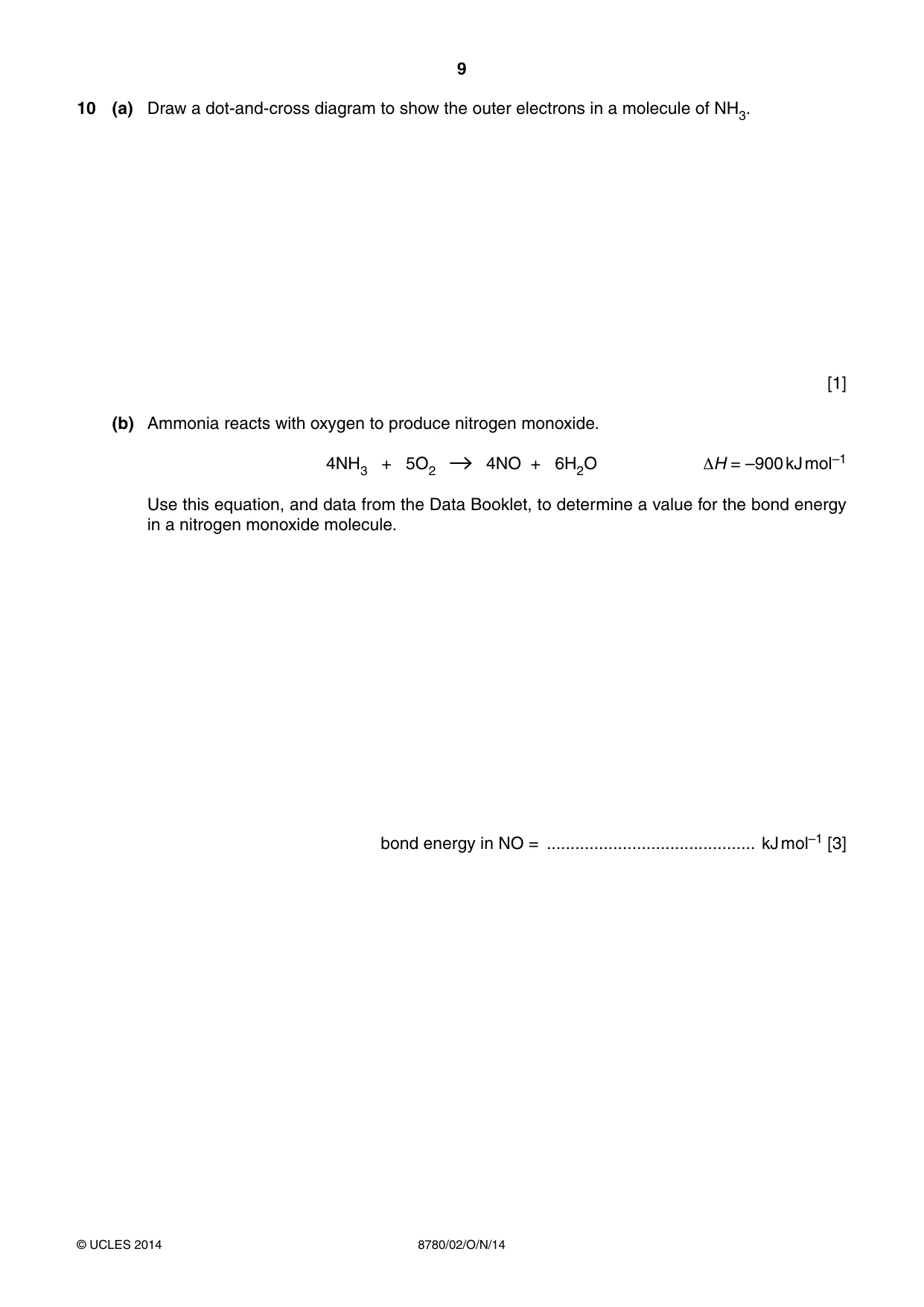
10 (a) Draw a dot-and-cross diagram to show the outer electrons in a molecule of NH3. [1] (b) Ammonia reacts with oxygen to produce nitrogen monoxide. 4NH3 + 5O2 4NO + 6H2O ΔH = –900 kJ mol–1 Use this equation, and data from the Data Booklet, to determine a value for the bond energy in a nitrogen monoxide molecule. bond energy in NO = ............................................ kJ mol–1 [3]
Mark scheme: 10 (a) diagram showing three single covalent bonds and one lone pair on N [1] (b) extracts correct bond energy data for N–H, O=O, O–H [1] –900 = 7160 – (5520 + 4b.e.) [1] (4b.e. = 2540) b.e. = 635 [1] [4] [Total: 30]
What you needed in this session
Cambridge’s own grade thresholds for 2014 Oct/Nov, Paper 2 · Variant 1. A higher threshold means an easier paper — the bar moves with how the cohort did.