Cambridge A Level Physical Science 8780 — 2011 Oct/Nov Paper 2 · Variant 1
8780/21/O/N/11 · 14 questions · 30 marks · ≈34 min
The question paper and its mark scheme, free to read here and free to download. This is Cambridge’s own paper, exactly as it was sat.
Question paper8 pages
Mark scheme4 pages
Answers below. Sit the paper first if you are practising.
Questions as text
Q1 · At a school sports day, a runner’s time for one lap of an 800 m race is measured using a…
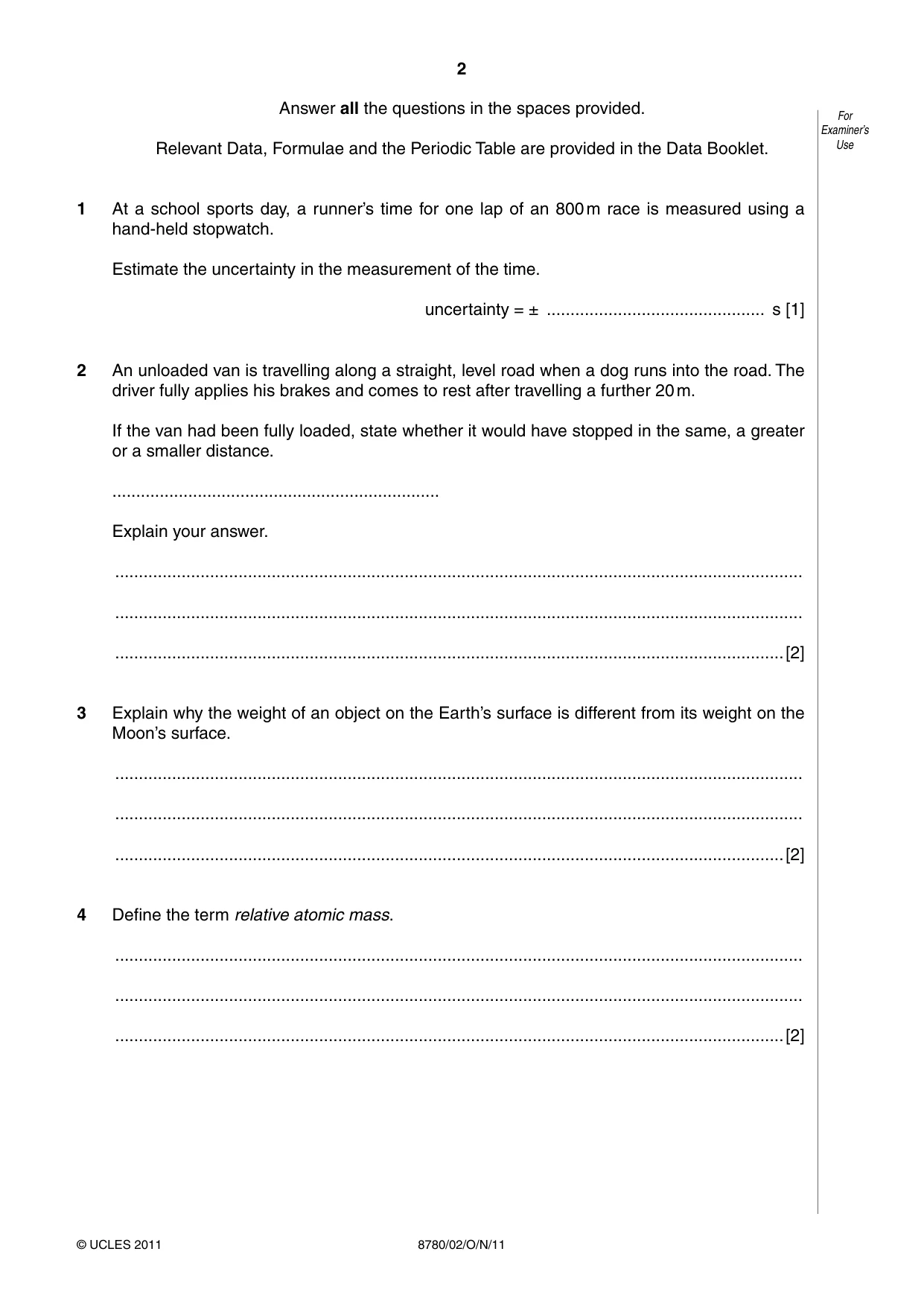
1 At a school sports day, a runner’s time for one lap of an 800 m race is measured using a hand-held stopwatch. Estimate the uncertainty in the measurement of the time. uncertainty = ± .............................................. s [1]
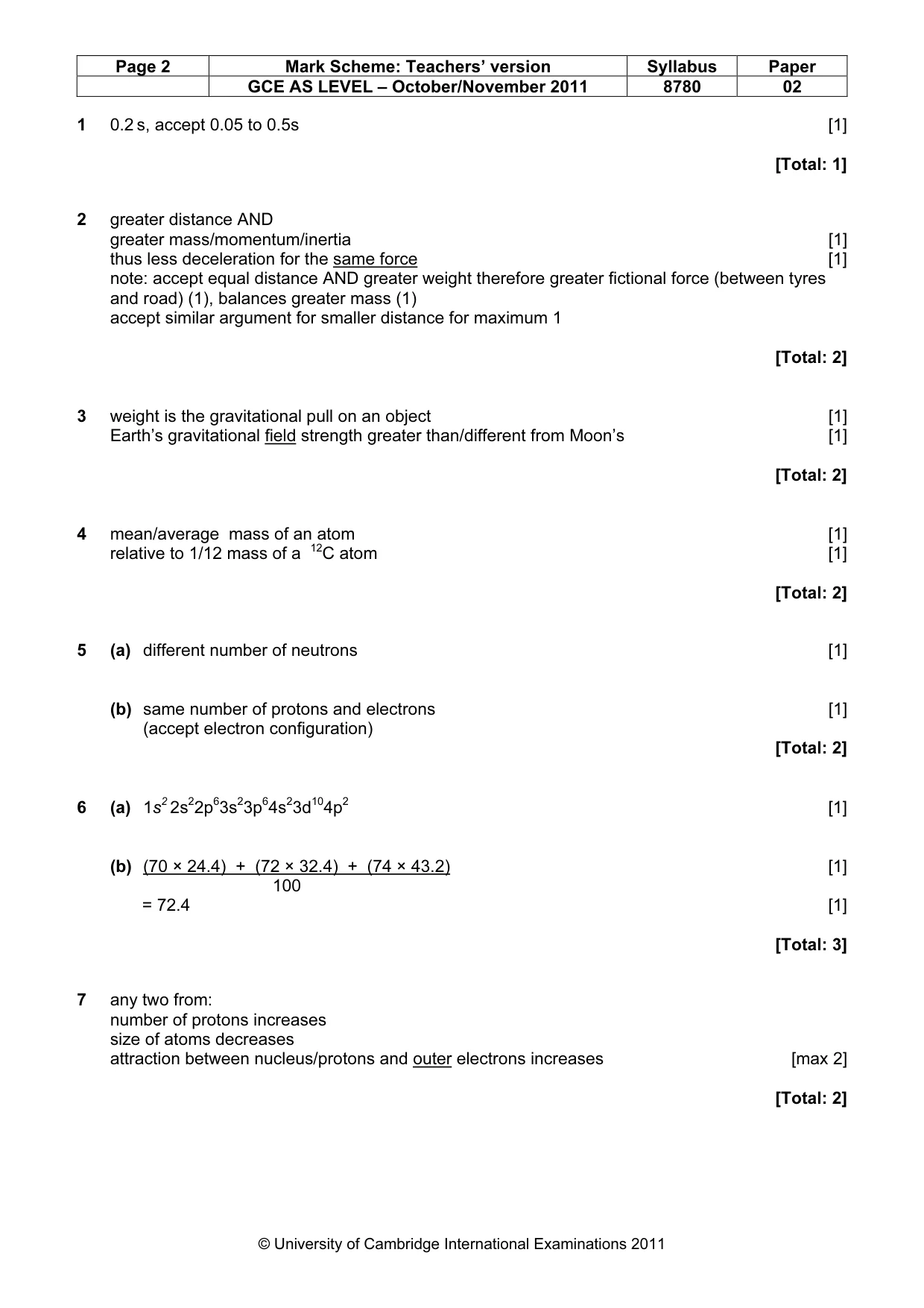
Mark scheme: 1 0.2 s, accept 0.05 to 0.5s [1] [Total: 1]
Q2 · An unloaded van is travelling along a straight, level road when a dog runs into the road
2 An unloaded van is travelling along a straight, level road when a dog runs into the road. The driver fully applies his brakes and comes to rest after travelling a further 20 m. If the van had been fully loaded, state whether it would have stopped in the same, a greater or a smaller distance. ..................................................................... Explain your answer. ................................................................................................................................................. ................................................................................................................................................. .............................................................................................................................................[2]
Mark scheme: 2 greater distance AND greater mass/momentum/inertia [1] thus less deceleration for the same force [1] note: accept equal distance AND greater weight therefore greater fictional force (between tyres and road) (1), balances greater mass (1) accept similar argument for smaller distance for maximum 1 [Total: 2]
Q3 · Explain why the weight of an object on the Earth’s surface is different from its weight…
3 Explain why the weight of an object on the Earth’s surface is different from its weight on the Moon’s surface. ................................................................................................................................................. ................................................................................................................................................. .............................................................................................................................................[2]
Mark scheme: 3 weight is the gravitational pull on an object [1] Earth’s gravitational field strength greater than/different from Moon’s [1] [Total: 2]
Q4 · Define the term relative atomic mass
4 Define the term relative atomic mass. ................................................................................................................................................. ................................................................................................................................................. .............................................................................................................................................[2]
Mark scheme: 4 mean/average mass of an atom [1] relative to 1/12 mass of a 12C atom [1] [Total: 2]
Q5 · The two isotopes 12C and 13C are found in a sample of carbon
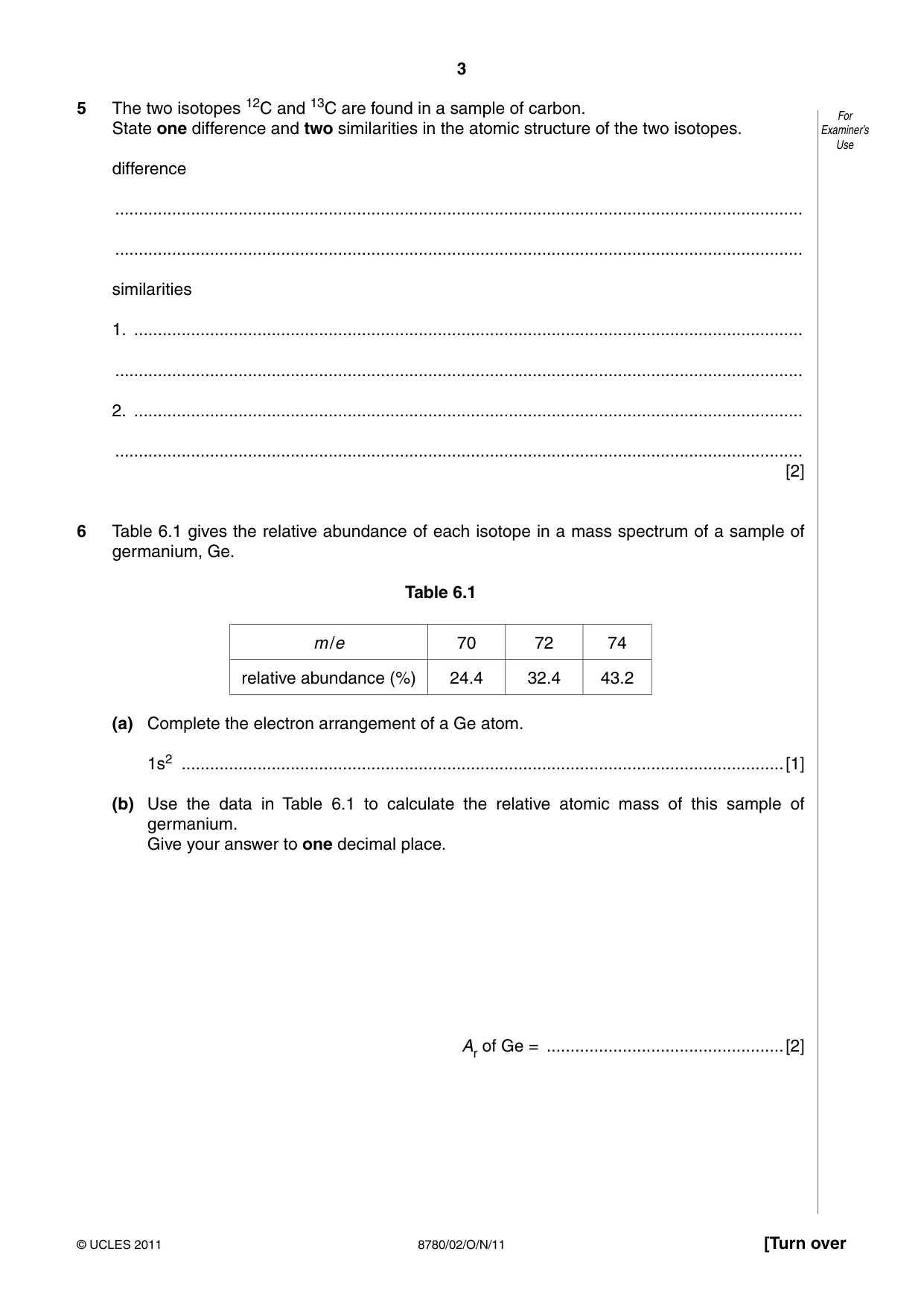
5 The two isotopes 12C and 13C are found in a sample of carbon. State one difference and two similarities in the atomic structure of the two isotopes. difference ................................................................................................................................................. ................................................................................................................................................. similarities 1. ............................................................................................................................................. ................................................................................................................................................. 2. ............................................................................................................................................. ................................................................................................................................................. [2]
Mark scheme: 5 (a) different number of neutrons [1] (b) same number of protons and electrons [1] (accept electron configuration) [Total: 2] 2 2 6 2 6 2 10 2
Q6 · The relative abundance of each isotope in a mass spectrum of a sample of germanium, Ge
6 Table 6.1 gives the relative abundance of each isotope in a mass spectrum of a sample of germanium, Ge. Table 6.1 m /e 70 72 74 relative abundance (%) 24.4 32.4 43.2 (a) Complete the electron arrangement of a Ge atom. 1s2 ...............................................................................................................................[1] (b) Use the data in Table 6.1 to calculate the relative atomic mass of this sample of germanium. Give your answer to one decimal place. Ar of Ge = ..................................................[2]
Mark scheme: 6 (a) 1s2 2s22p63s23p64s23d104p2 [1] (b) (70 × 24.4) + (72 × 32.4) + (74 × 43.2) [1] 100 = 72.4 [1] [Total: 3]
Q7 · In general, the first ionisation energies of the elements increase across Period 3
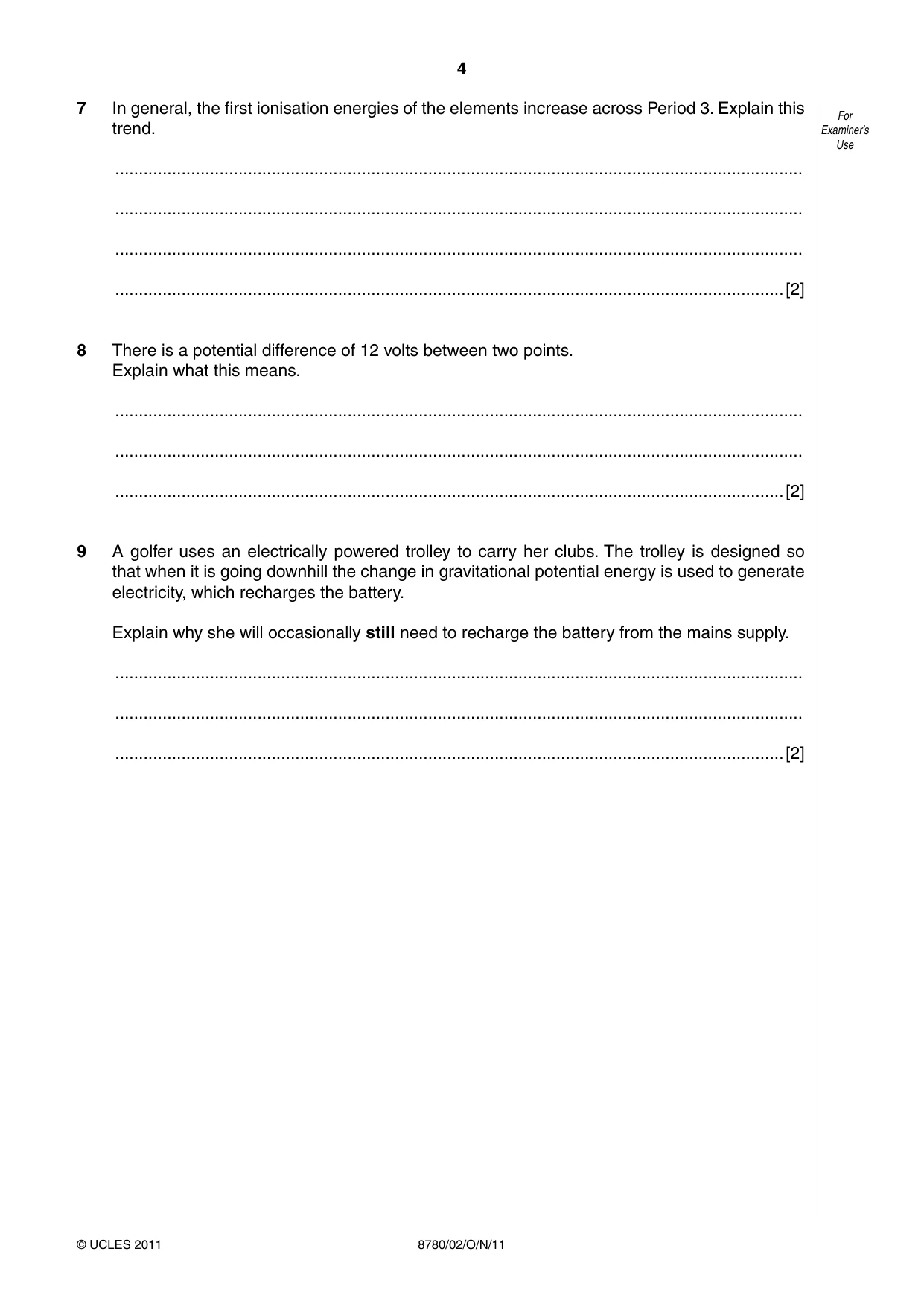
7 In general, the first ionisation energies of the elements increase across Period 3. Explain this trend. ................................................................................................................................................. ................................................................................................................................................. ................................................................................................................................................. .............................................................................................................................................[2]
Mark scheme: 7 any two from: number of protons increases size of atoms decreases attraction between nucleus/protons and outer electrons increases [max 2] [Total: 2] GCE AS LEVEL – October/November 2011 8780 02
Q8 · There is a potential difference of 12 volts between two points
8 There is a potential difference of 12 volts between two points. Explain what this means. ................................................................................................................................................. ................................................................................................................................................. .............................................................................................................................................[2]
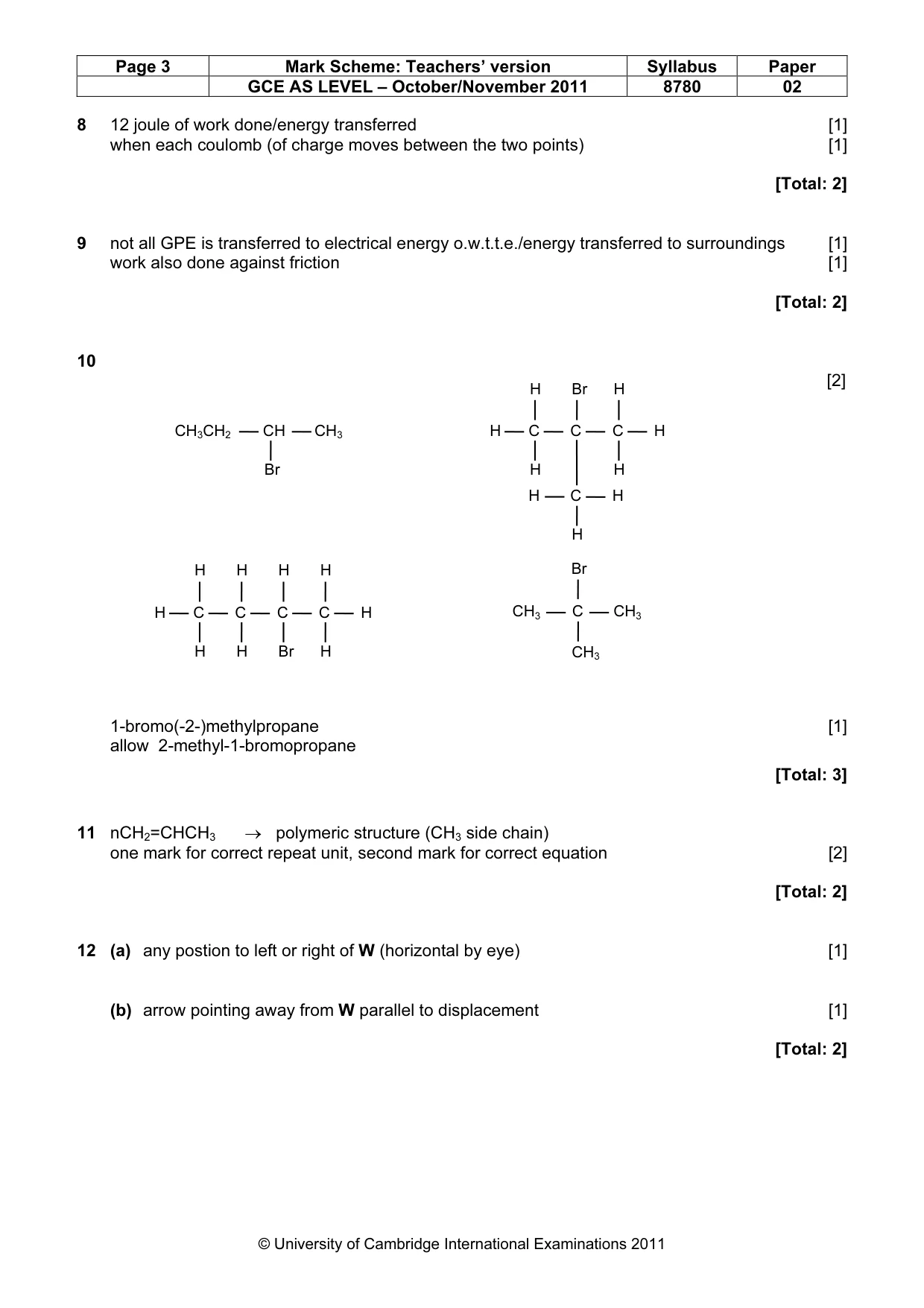
Mark scheme: 8 12 joule of work done/energy transferred [1] when each coulomb (of charge moves between the two points) [1] [Total: 2]
Q9 · A golfer uses an electrically powered trolley to carry her clubs
9 A golfer uses an electrically powered trolley to carry her clubs. The trolley is designed so that when it is going downhill the change in gravitational potential energy is used to generate electricity, which recharges the battery. Explain why she will occasionally still need to recharge the battery from the mains supply. ................................................................................................................................................. ................................................................................................................................................. .............................................................................................................................................[2]
Mark scheme: 9 not all GPE is transferred to electrical energy o.w.t.t.e./energy transferred to surroundings [1] work also done against friction [1] [Total: 2]
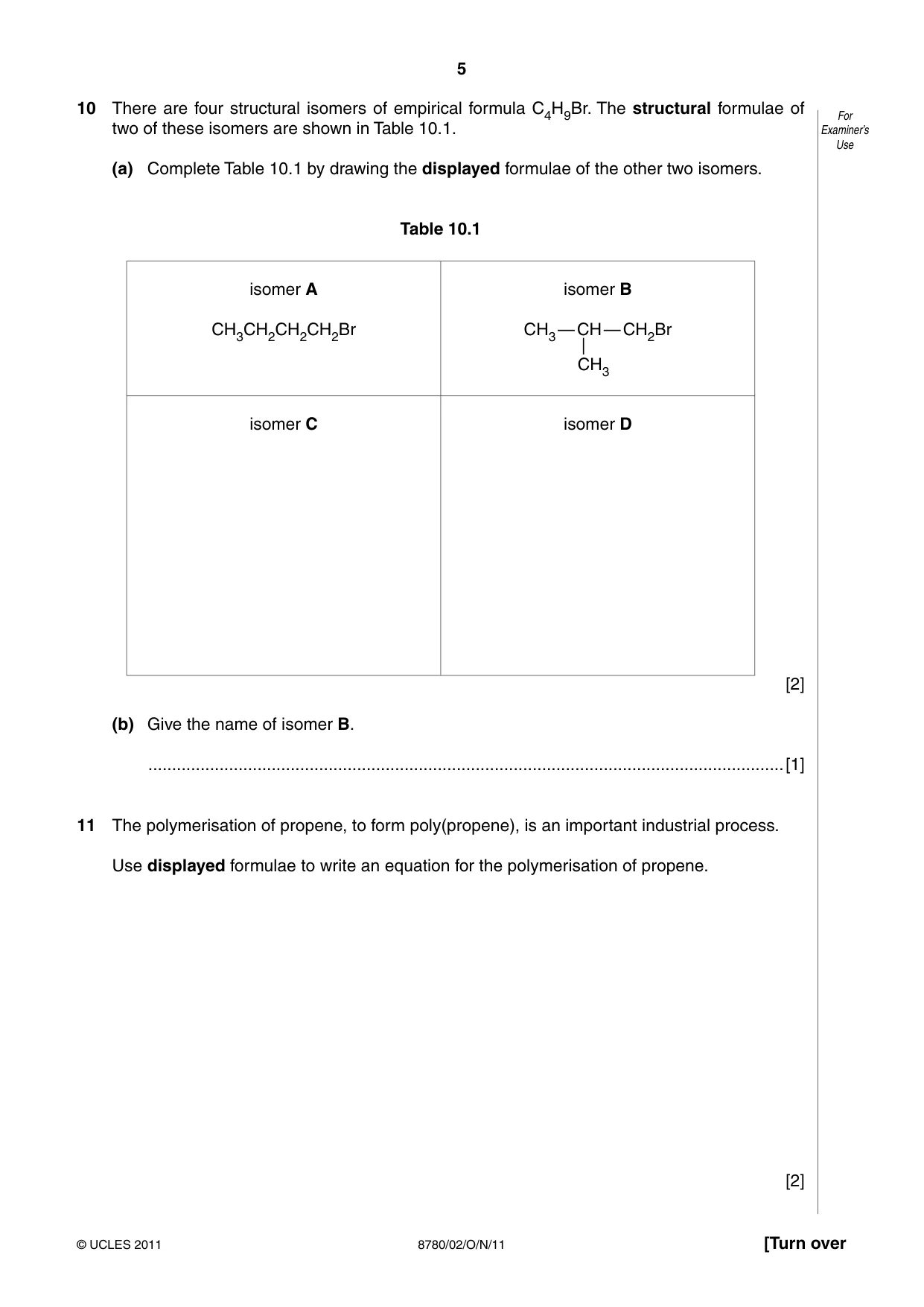
Q10 · There are four structural isomers of empirical formula C4H9Br
10 There are four structural isomers of empirical formula C4H9Br. The structural formulae of two of these isomers are shown in Table 10.1. (a) Complete Table 10.1 by drawing the displayed formulae of the other two isomers. Table 10.1 isomer A isomer B CH3CH2CH2CH2Br CH3 — CH — CH2Br CH3 isomer C isomer D [2] (b) Give the name of isomer B. ......................................................................................................................................[1]
Mark scheme: 10 [2] H Br H CH3CH2 CH CH3 H C C C H Br H H H C H H H H H H Br H C C C C H CH3 C CH3 H H Br H CH3 1-bromo(-2-)methylpropane [1] allow 2-methyl-1-bromopropane [Total: 3]
Q11 · The polymerisation of propene, to form poly(propene), is an important industrial process
11 The polymerisation of propene, to form poly(propene), is an important industrial process. Use displayed formulae to write an equation for the polymerisation of propene. [2]
Mark scheme: 11 nCH2=CHCH3 → polymeric structure (CH3 side chain) one mark for correct repeat unit, second mark for correct equation [2] [Total: 2]
Q12 · The graph in Fig
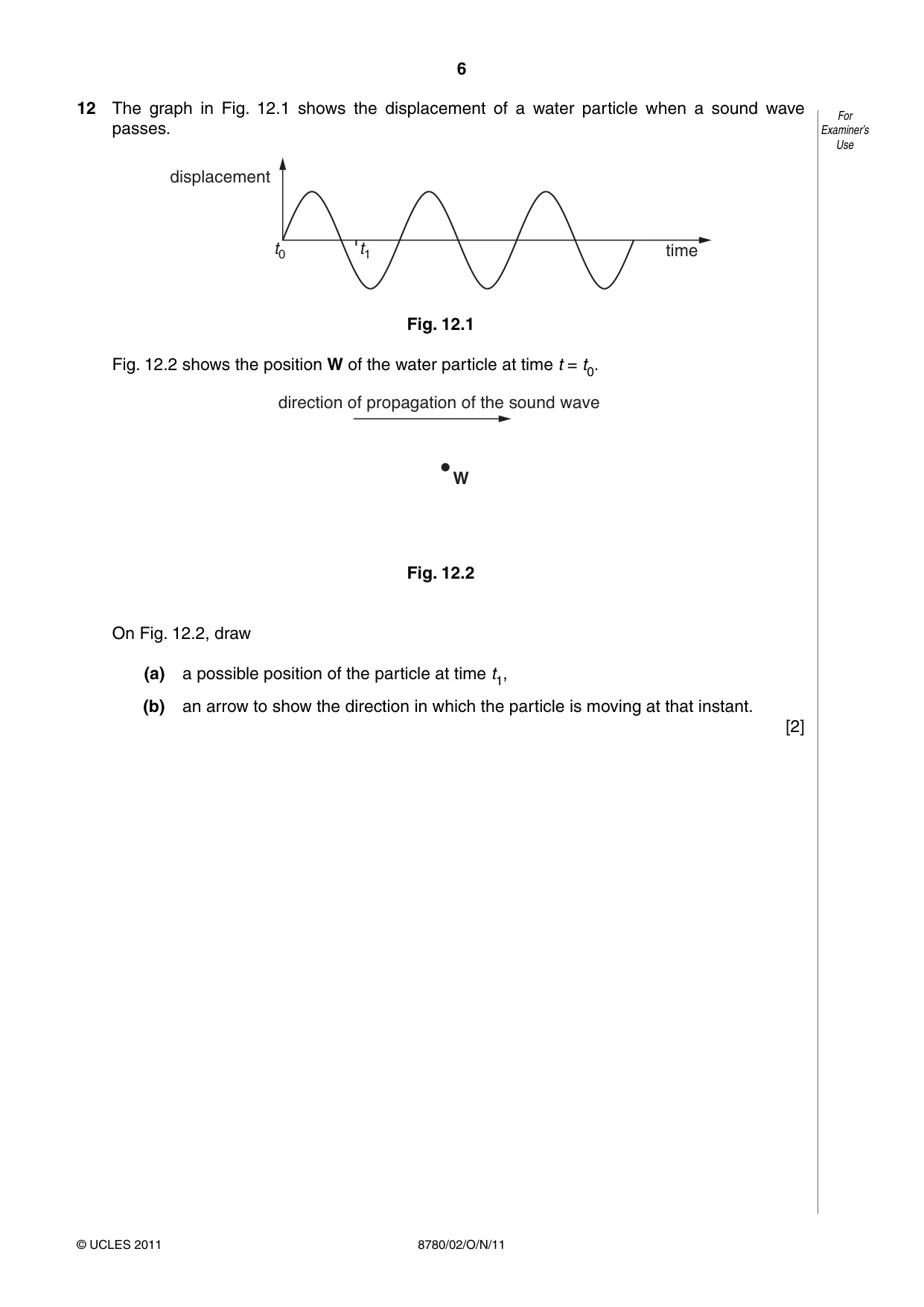
12 The graph in Fig. 12.1 shows the displacement of a water particle when a sound wave passes. displacement t0 t1 time Fig. 12.1 Fig. 12.2 shows the position W of the water particle at time t = t0. direction of propagation of the sound wave W Fig. 12.2 On Fig. 12.2, draw (a) a possible position of the particle at time t1, (b) an arrow to show the direction in which the particle is moving at that instant. [2]
Mark scheme: 12 (a) any postion to left or right of W (horizontal by eye) [1] (b) arrow pointing away from W parallel to displacement [1] [Total: 2] GCE AS LEVEL – October/November 2011 8780 02
Question 13
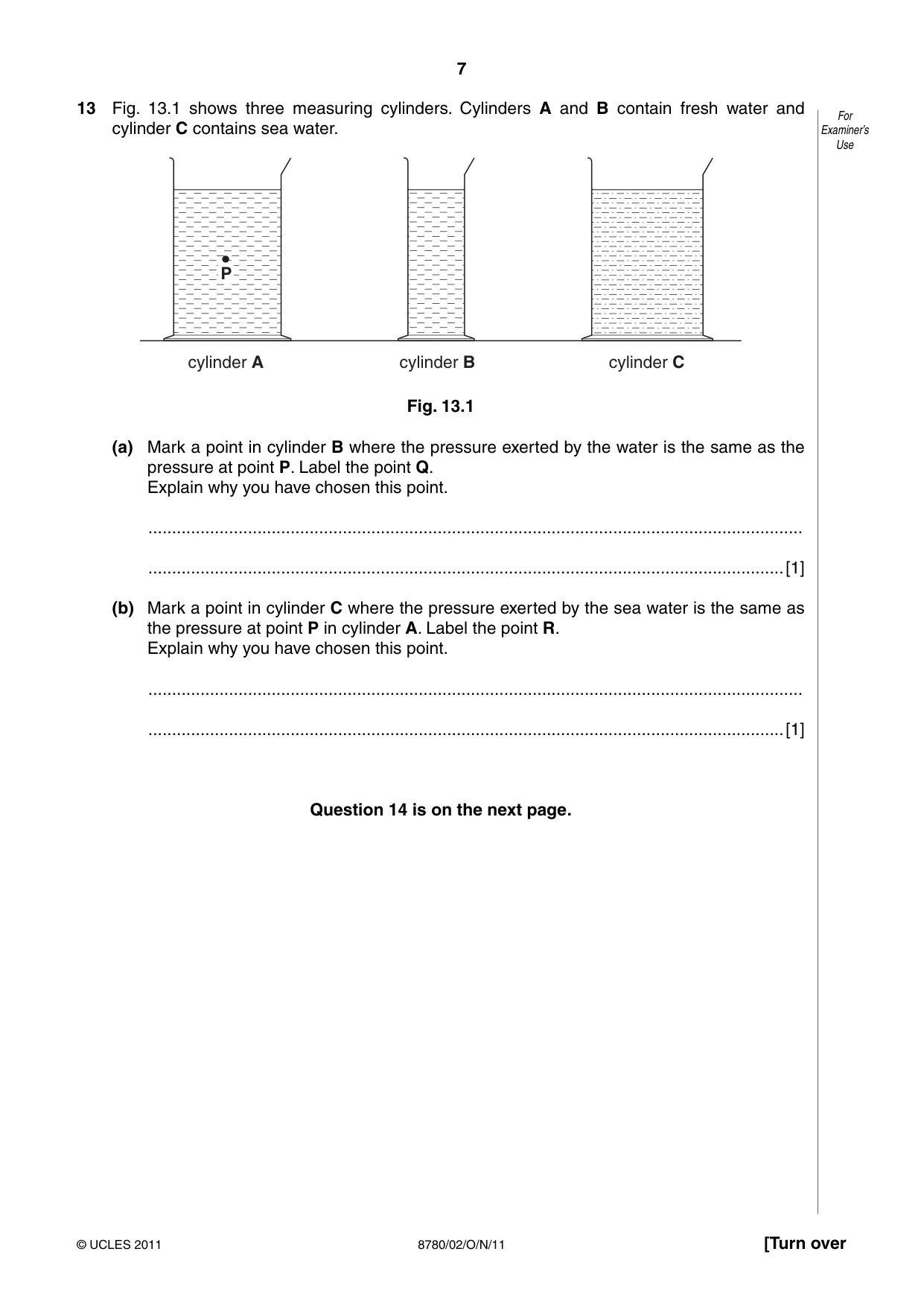
13 Fig. 13.1 shows three measuring cylinders. Cylinders A and B contain fresh water and cylinder C contains sea water. P cylinder A cylinder B cylinder C Fig. 13.1 (a) Mark a point in cylinder B where the pressure exerted by the water is the same as the pressure at point P. Label the point Q. Explain why you have chosen this point. .......................................................................................................................................... ......................................................................................................................................[1] (b) Mark a point in cylinder C where the pressure exerted by the sea water is the same as the pressure at point P in cylinder A. Label the point R. Explain why you have chosen this point. .......................................................................................................................................... ......................................................................................................................................[1] Question 14 is on the next page.
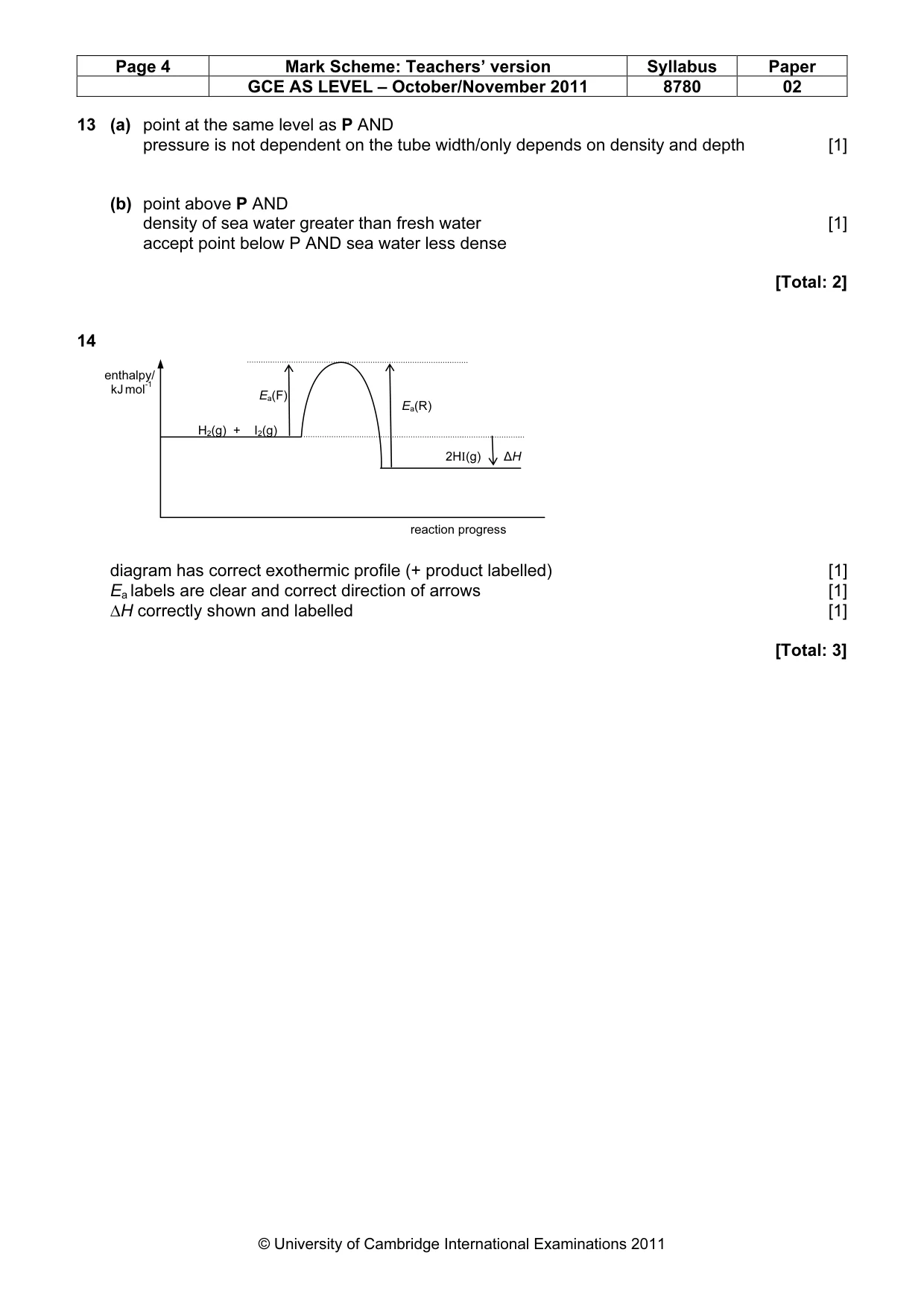
Mark scheme: 13 (a) point at the same level as P AND pressure is not dependent on the tube width/only depends on density and depth [1] (b) point above P AND density of sea water greater than fresh water [1] accept point below P AND sea water less dense [Total: 2]
Q14 · The reaction between hydrogen gas and iodine vapour to form hydrogen iodide is reversible
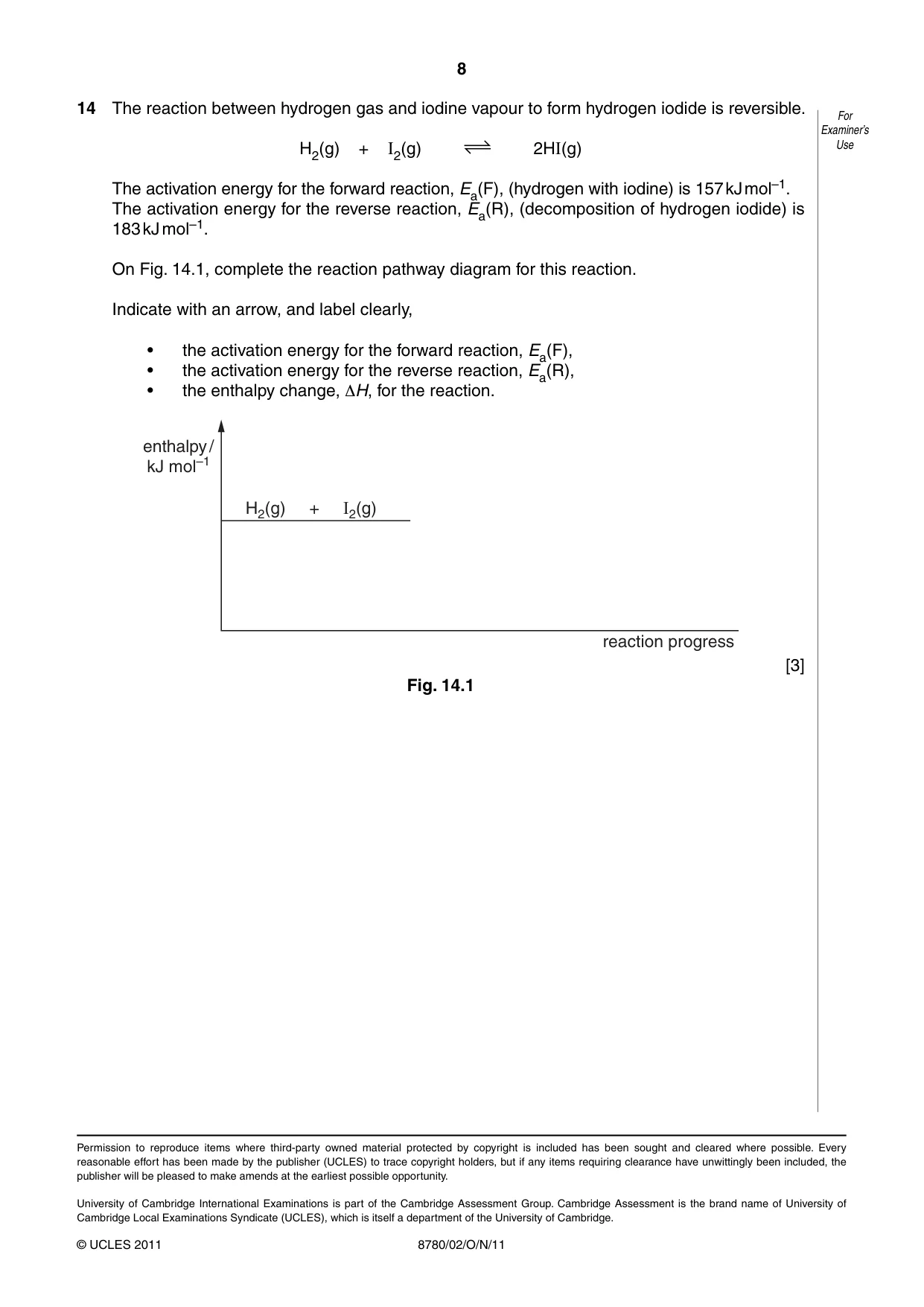
14 The reaction between hydrogen gas and iodine vapour to form hydrogen iodide is reversible. H2(g) + I2(g) 2HI(g) The activation energy for the forward reaction, Ea(F), (hydrogen with iodine) is 157 kJ mol–1. The activation energy for the reverse reaction, Ea(R), (decomposition of hydrogen iodide) is 183 kJ mol–1. On Fig. 14.1, complete the reaction pathway diagram for this reaction. Indicate with an arrow, and label clearly, • the activation energy for the forward reaction, Ea(F), • the activation energy for the reverse reaction, Ea(R), • the enthalpy change, ΔH, for the reaction. enthalpy / kJ mol–1 H2(g) + I2(g) reaction progress [3] Fig. 14.1
Mark scheme: 14 enthalpy/ kJ mol-1 Ea(F) Ea(R) H2(g) + I2(g) 2HI(g) ∆H reaction progress diagram has correct exothermic profile (+ product labelled) [1] Ea labels are clear and correct direction of arrows [1] ∆H correctly shown and labelled [1] [Total: 3]
What you needed in this session
Cambridge’s own grade thresholds for 2011 Oct/Nov, Paper 2 · Variant 1. A higher threshold means an easier paper — the bar moves with how the cohort did.