Cambridge A Level Physical Science 8780 — 2012 Oct/Nov Paper 2 · Variant 1
8780/21/O/N/12 · 15 questions · 30 marks · ≈34 min
The question paper and its mark scheme, free to read here and free to download. This is Cambridge’s own paper, exactly as it was sat.
Question paper8 pages
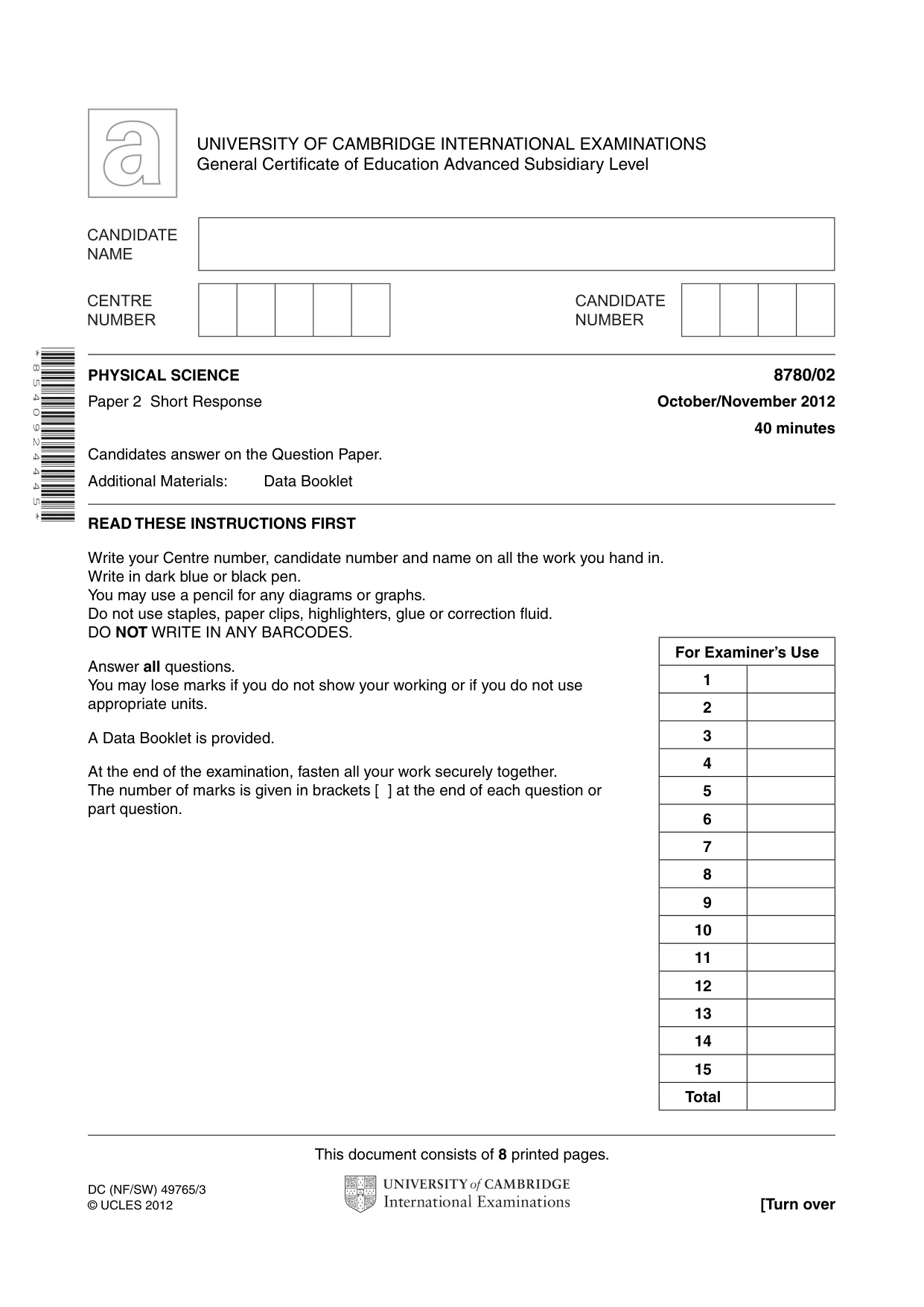
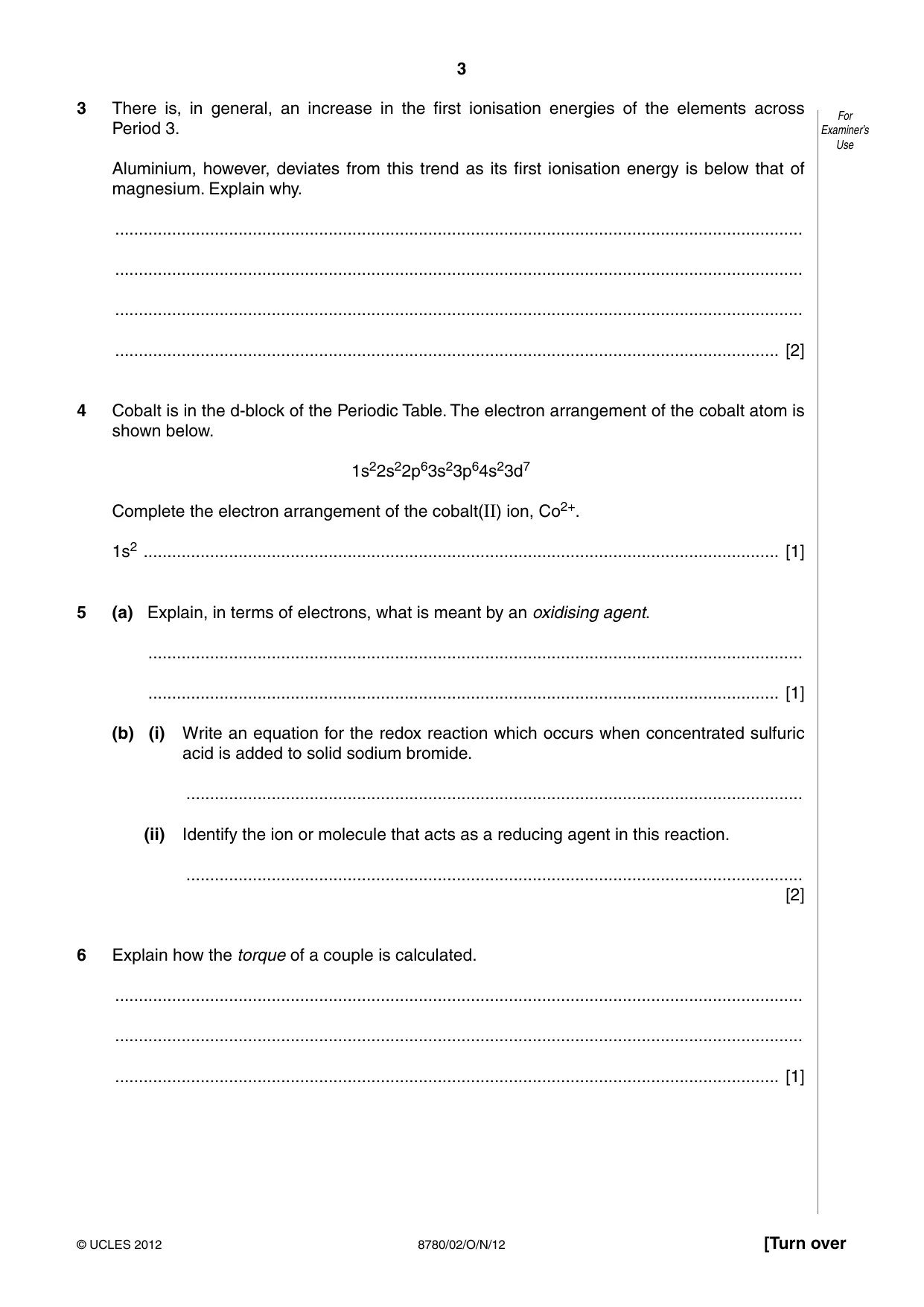
Mark scheme4 pages
Answers below. Sit the paper first if you are practising.
Questions as text
Q1 · When a sphere moves through air it experiences a resistive force F
1 When a sphere moves through air it experiences a resistive force F. F is related to the radius of the sphere r and its velocity v by the equation F = krv2 where k is the constant of proportionality. Derive the base unit of k. base unit of k = ................................................. [2]
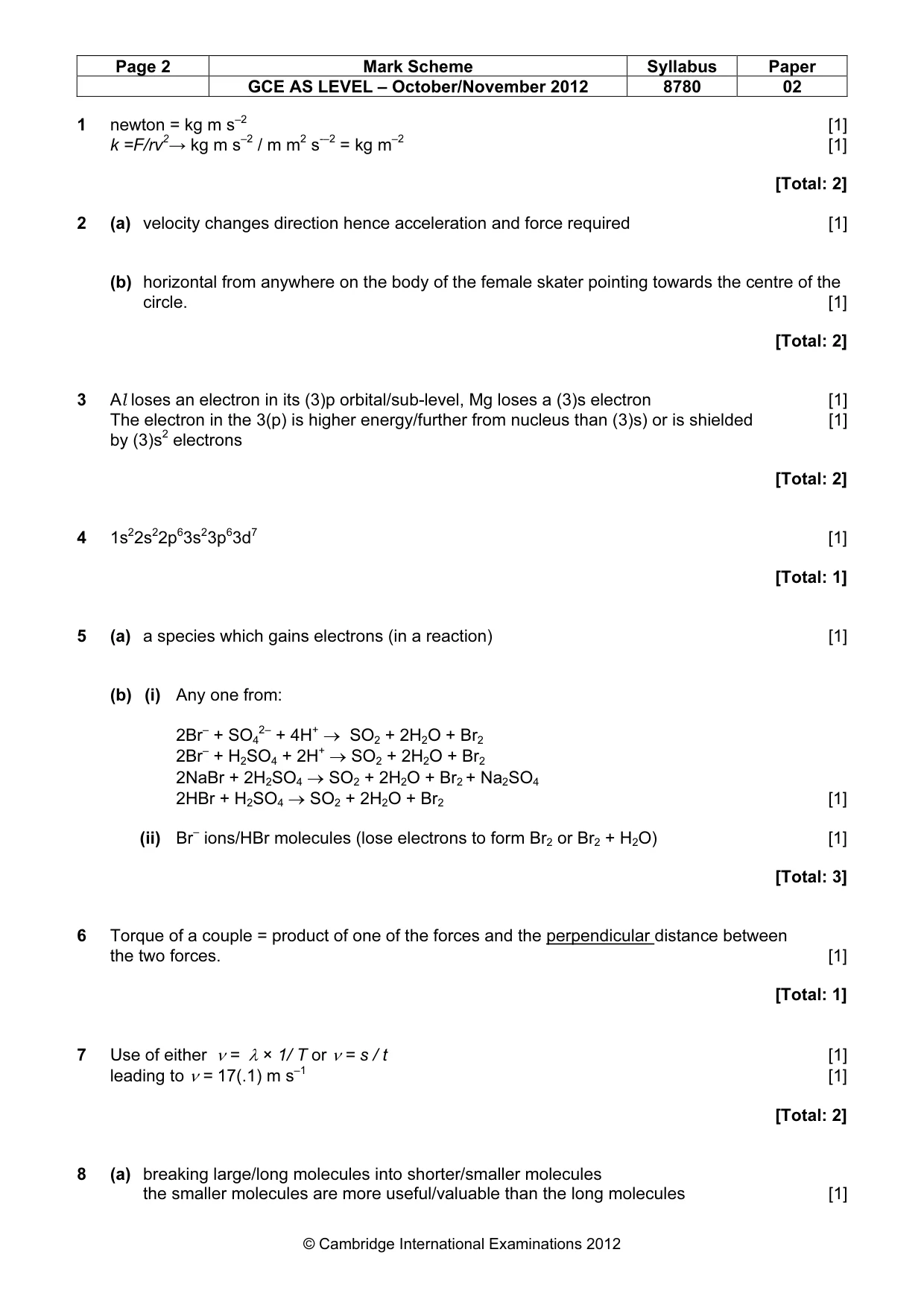
Mark scheme: 1 newton = kg m s–2 [1] k =F/rv2→ kg m s–2 / m m2 s-–2 = kg m–2 [1] [Total: 2]
Q2 · An ice skater being spun by her partner
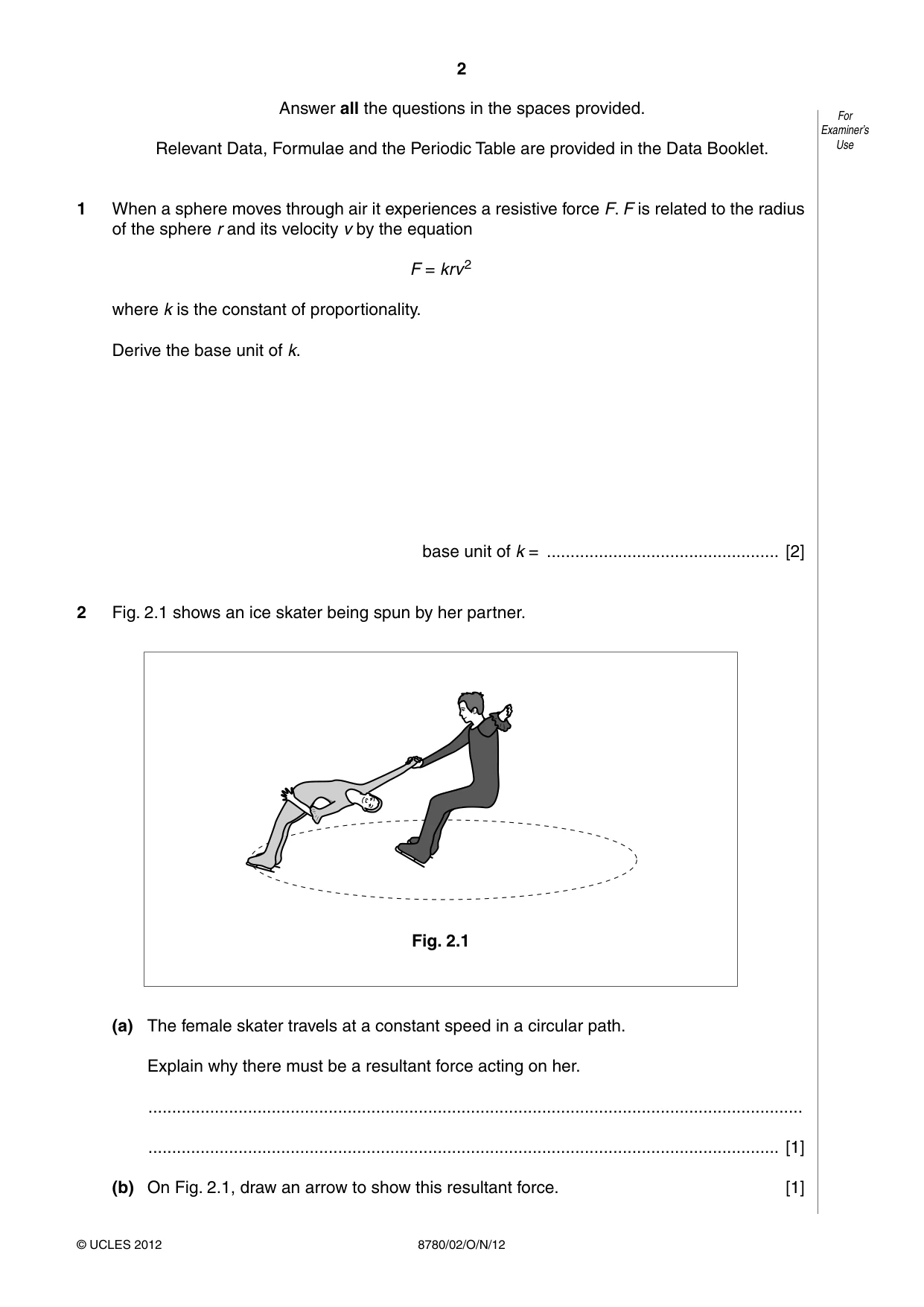
2 Fig. 2.1 shows an ice skater being spun by her partner. Fig. 2.1 (a) The female skater travels at a constant speed in a circular path. Explain why there must be a resultant force acting on her. .......................................................................................................................................... ..................................................................................................................................... [1] (b) On Fig. 2.1, draw an arrow to show this resultant force. [1]
Mark scheme: 2 (a) velocity changes direction hence acceleration and force required [1] (b) horizontal from anywhere on the body of the female skater pointing towards the centre of the circle. [1] [Total: 2]
Q3 · There is, in general, an increase in the first ionisation energies of the elements across…
3 There is, in general, an increase in the first ionisation energies of the elements across Period 3. Aluminium, however, deviates from this trend as its first ionisation energy is below that of magnesium. Explain why. ................................................................................................................................................. ................................................................................................................................................. ................................................................................................................................................. ............................................................................................................................................ [2]
Mark scheme: 3 Al loses an electron in its (3)p orbital/sub-level, Mg loses a (3)s electron [1] The electron in the 3(p) is higher energy/further from nucleus than (3)s) or is shielded [1] by (3)s2 electrons [Total: 2] 2 2 6 2 6 7
Q4 · Cobalt is in the d-block of the Periodic Table
4 Cobalt is in the d-block of the Periodic Table. The electron arrangement of the cobalt atom is shown below. 1s22s22p63s23p64s23d7 Complete the electron arrangement of the cobalt(II) ion, Co2+. 1s2 ...................................................................................................................................... [1]
Mark scheme: 4 1s22s22p63s23p63d7 [1] [Total: 1]
Q5 · Explain, in terms of electrons, what is meant by an oxidising agent
5 (a) Explain, in terms of electrons, what is meant by an oxidising agent. .......................................................................................................................................... ..................................................................................................................................... [1] (b) (i) Write an equation for the redox reaction which occurs when concentrated sulfuric acid is added to solid sodium bromide. .................................................................................................................................. (ii) Identify the ion or molecule that acts as a reducing agent in this reaction. .................................................................................................................................. [2]
Mark scheme: 5 (a) a species which gains electrons (in a reaction) [1] (b) (i) Any one from: 2Br– + SO42– + 4H+ → SO2 + 2H2O + Br2 2Br– + H2SO4 + 2H+ → SO2 + 2H2O + Br2 2NaBr + 2H2SO4 → SO2 + 2H2O + Br2 + Na2SO4 2HBr + H2SO4 → SO2 + 2H2O + Br2 [1] (ii) Br– ions/HBr molecules (lose electrons to form Br2 or Br2 + H2O) [1] [Total: 3]
Q6 · Explain how the torque of a couple is calculated
6 Explain how the torque of a couple is calculated. ................................................................................................................................................. ................................................................................................................................................. ............................................................................................................................................ [1]
Mark scheme: 6 Torque of a couple = product of one of the forces and the perpendicular distance between the two forces. [1] [Total: 1]
Q7 · A wave moves along a spring
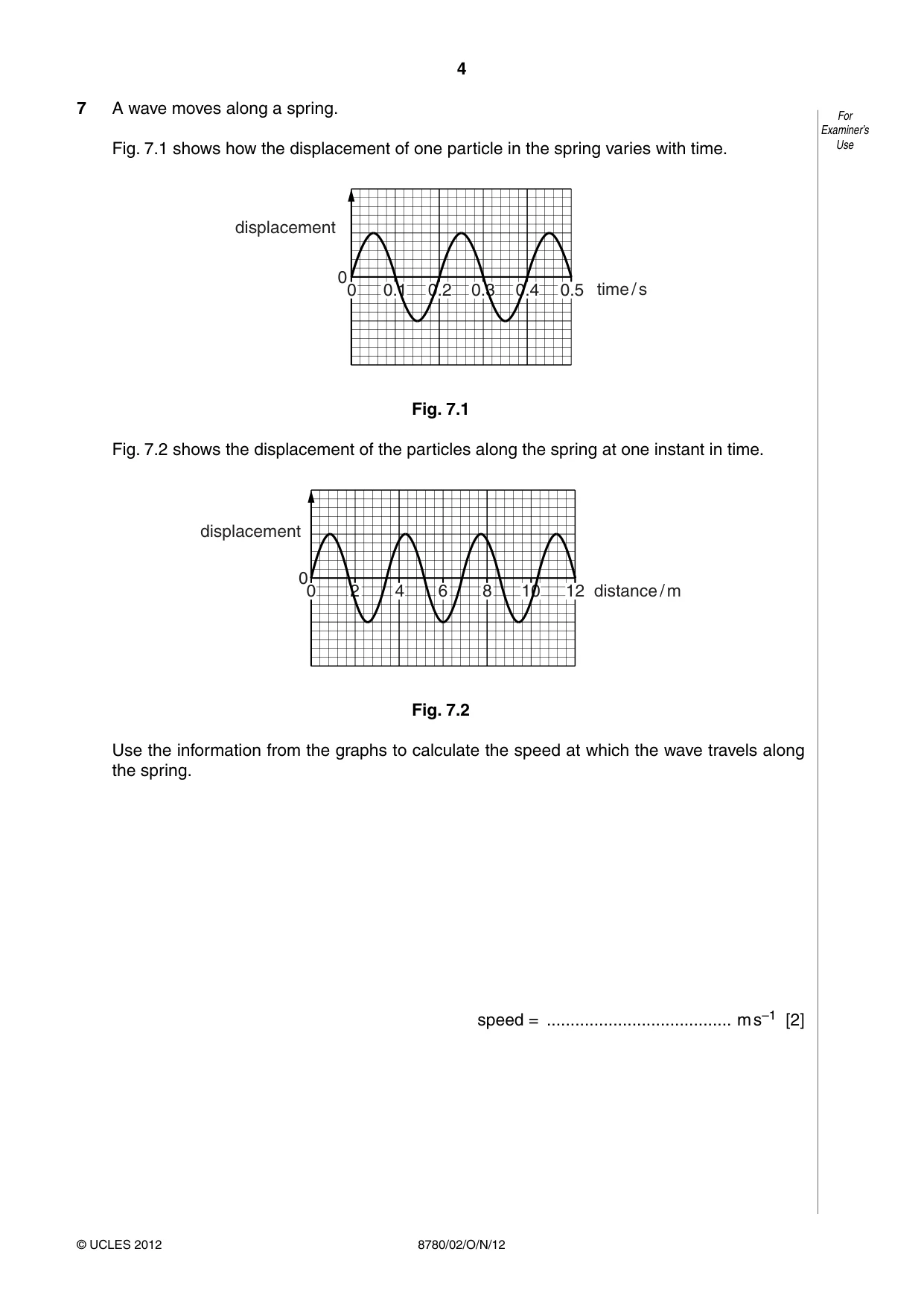
7 A wave moves along a spring. Fig. 7.1 shows how the displacement of one particle in the spring varies with time. displacement 0 0 0.1 0.2 0.3 0.4 0.5 time / s Fig. 7.1 Fig. 7.2 shows the displacement of the particles along the spring at one instant in time. displacement 0 0 2 4 6 8 10 12 distance / m Fig. 7.2 Use the information from the graphs to calculate the speed at which the wave travels along the spring. speed = ....................................... m s–1 [2]
Mark scheme: 7 Use of either ν = λ × 1/ T or ν = s / t [1] leading to ν = 17(.1) m s–1 [1] [Total: 2]
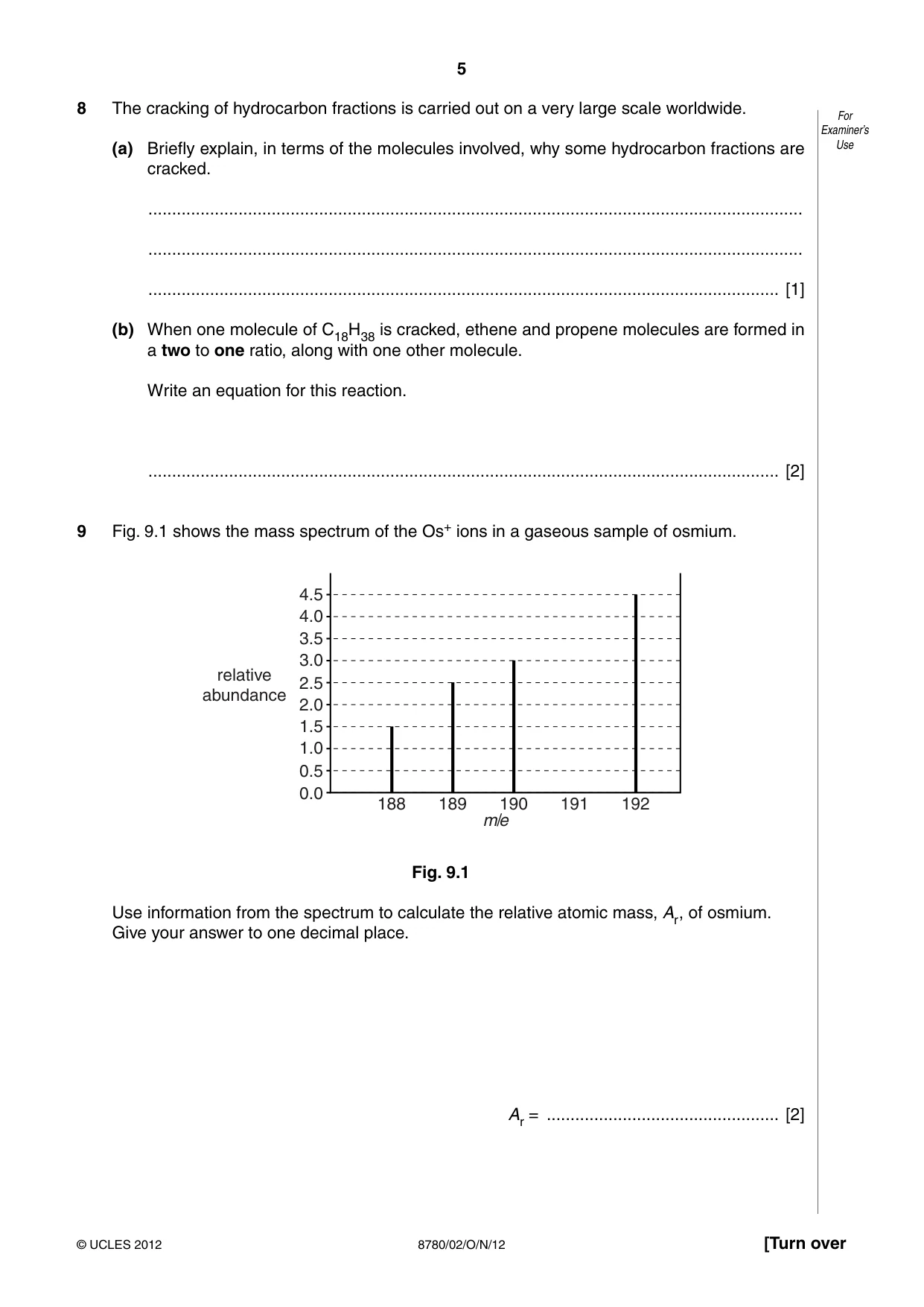
Q8 · The cracking of hydrocarbon fractions is carried out on a very large scale worldwide
8 The cracking of hydrocarbon fractions is carried out on a very large scale worldwide. (a) Briefly explain, in terms of the molecules involved, why some hydrocarbon fractions are cracked. .......................................................................................................................................... .......................................................................................................................................... ..................................................................................................................................... [1] (b) When one molecule of C18H38 is cracked, ethene and propene molecules are formed in a two to one ratio, along with one other molecule. Write an equation for this reaction. ..................................................................................................................................... [2]
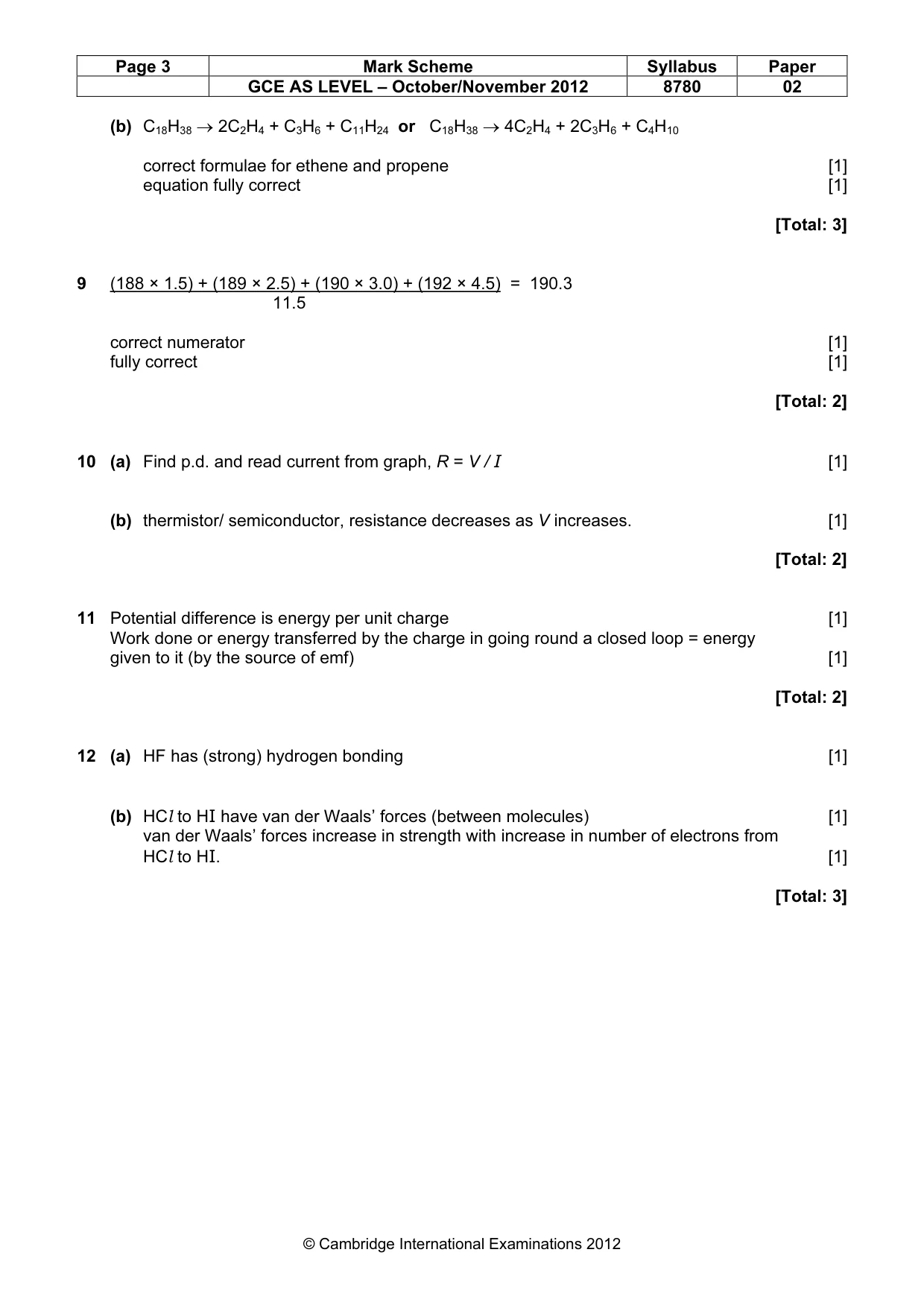
Mark scheme: 8 (a) breaking large/long molecules into shorter/smaller molecules the smaller molecules are more useful/valuable than the long molecules [1] GCE AS LEVEL – October/November 2012 8780 02 (b) C18H38 → 2C2H4 + C3H6 + C11H24 or C18H38 → 4C2H4 + 2C3H6 + C4H10 correct formulae for ethene and propene [1] equation fully correct [1] [Total: 3]
Q9 · The mass spectrum of the Os+ ions in a gaseous sample of osmium
9 Fig. 9.1 shows the mass spectrum of the Os+ ions in a gaseous sample of osmium. 4.5 4.0 3.5 3.0 relative 2.5 abundance 2.0 1.5 1.0 0.5 0.0 188 189 190 191 192 m/e Fig. 9.1 Use information from the spectrum to calculate the relative atomic mass, Ar, of osmium. Give your answer to one decimal place. Ar = ................................................. [2]
Mark scheme: 9 (188 × 1.5) + (189 × 2.5) + (190 × 3.0) + (192 × 4.5) = 190.3 11.5 correct numerator [1] fully correct [1] [Total: 2]
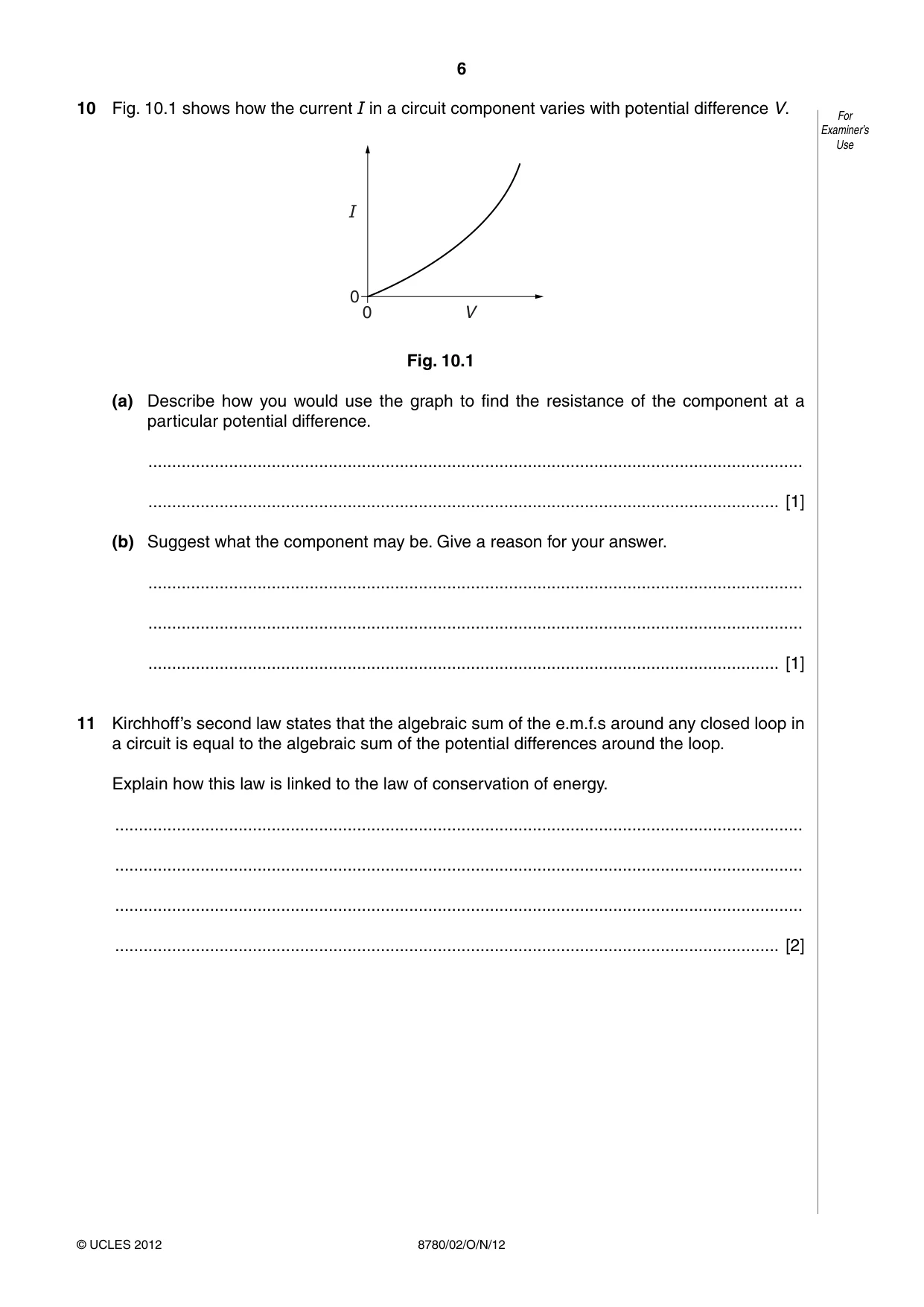
Q10 · How the current I in a circuit component varies with potential difference V
10 Fig. 10.1 shows how the current I in a circuit component varies with potential difference V. I 0 0 V Fig. 10.1 (a) Describe how you would use the graph to find the resistance of the component at a particular potential difference. .......................................................................................................................................... ..................................................................................................................................... [1] (b) Suggest what the component may be. Give a reason for your answer. .......................................................................................................................................... .......................................................................................................................................... ..................................................................................................................................... [1]
Mark scheme: 10 (a) Find p.d. and read current from graph, R = V / I [1] (b) thermistor/ semiconductor, resistance decreases as V increases. [1] [Total: 2]
Q11 · Kirchhoff’s second law states that the algebraic sum of the e.m.f.s around any closed…
11 Kirchhoff’s second law states that the algebraic sum of the e.m.f.s around any closed loop in a circuit is equal to the algebraic sum of the potential differences around the loop. Explain how this law is linked to the law of conservation of energy. ................................................................................................................................................. ................................................................................................................................................. ................................................................................................................................................. ............................................................................................................................................ [2]
Mark scheme: 11 Potential difference is energy per unit charge [1] Work done or energy transferred by the charge in going round a closed loop = energy given to it (by the source of emf) [1] [Total: 2]
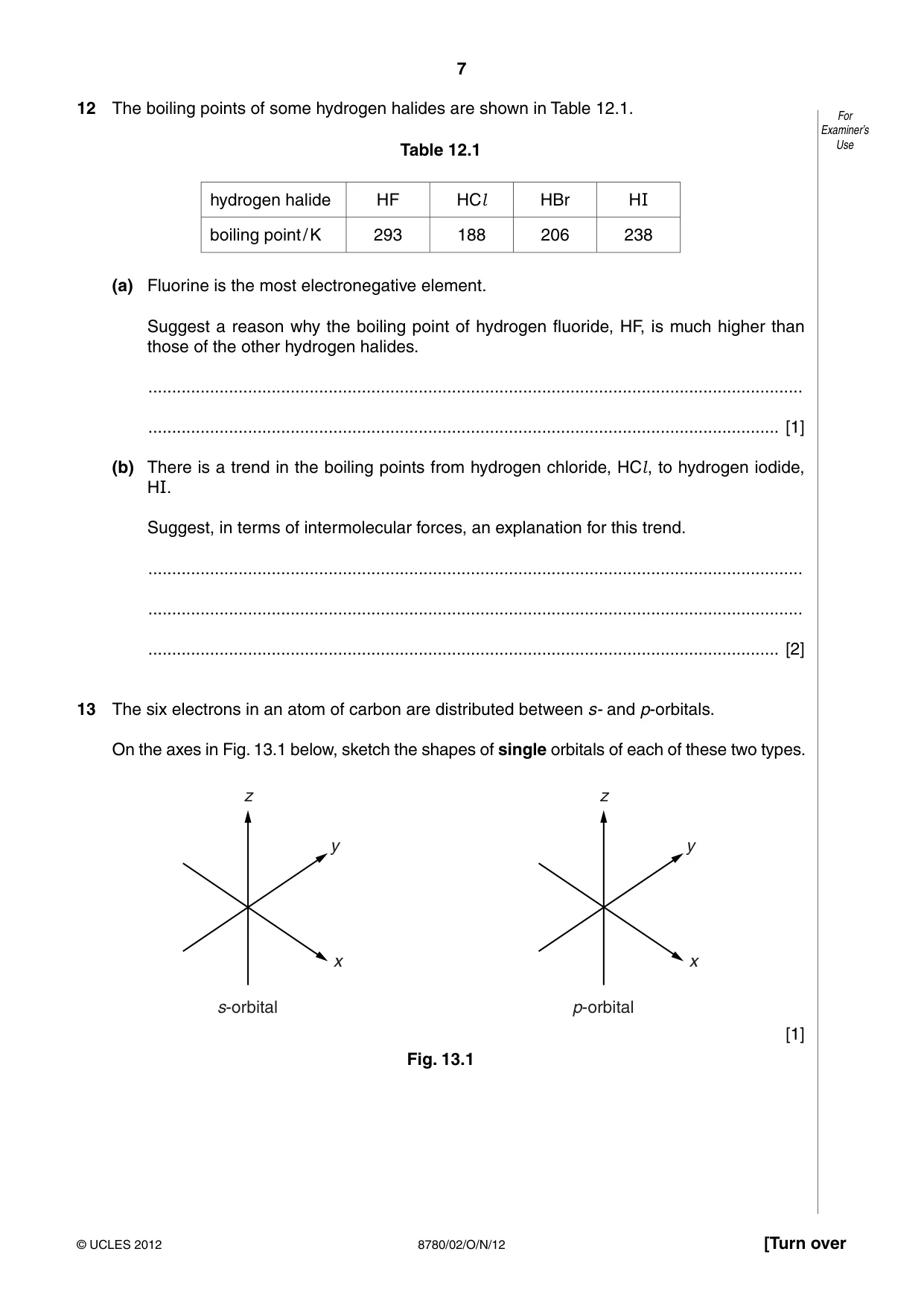
Q12 · The boiling points of some hydrogen halides are shown in Table 12.1
12 The boiling points of some hydrogen halides are shown in Table 12.1. Table 12.1 hydrogen halide HF HCl HBr HI boiling point / K 293 188 206 238 (a) Fluorine is the most electronegative element. Suggest a reason why the boiling point of hydrogen fluoride, HF, is much higher than those of the other hydrogen halides. .......................................................................................................................................... ..................................................................................................................................... [1] (b) There is a trend in the boiling points from hydrogen chloride, HCl, to hydrogen iodide, HI. Suggest, in terms of intermolecular forces, an explanation for this trend. .......................................................................................................................................... .......................................................................................................................................... ..................................................................................................................................... [2]
Mark scheme: 12 (a) HF has (strong) hydrogen bonding [1] (b) HCl to HI have van der Waals’ forces (between molecules) [1] van der Waals’ forces increase in strength with increase in number of electrons from HCl to HI. [1] [Total: 3] GCE AS LEVEL – October/November 2012 8780 02
Q13 · The six electrons in an atom of carbon are distributed between s- and p-orbitals
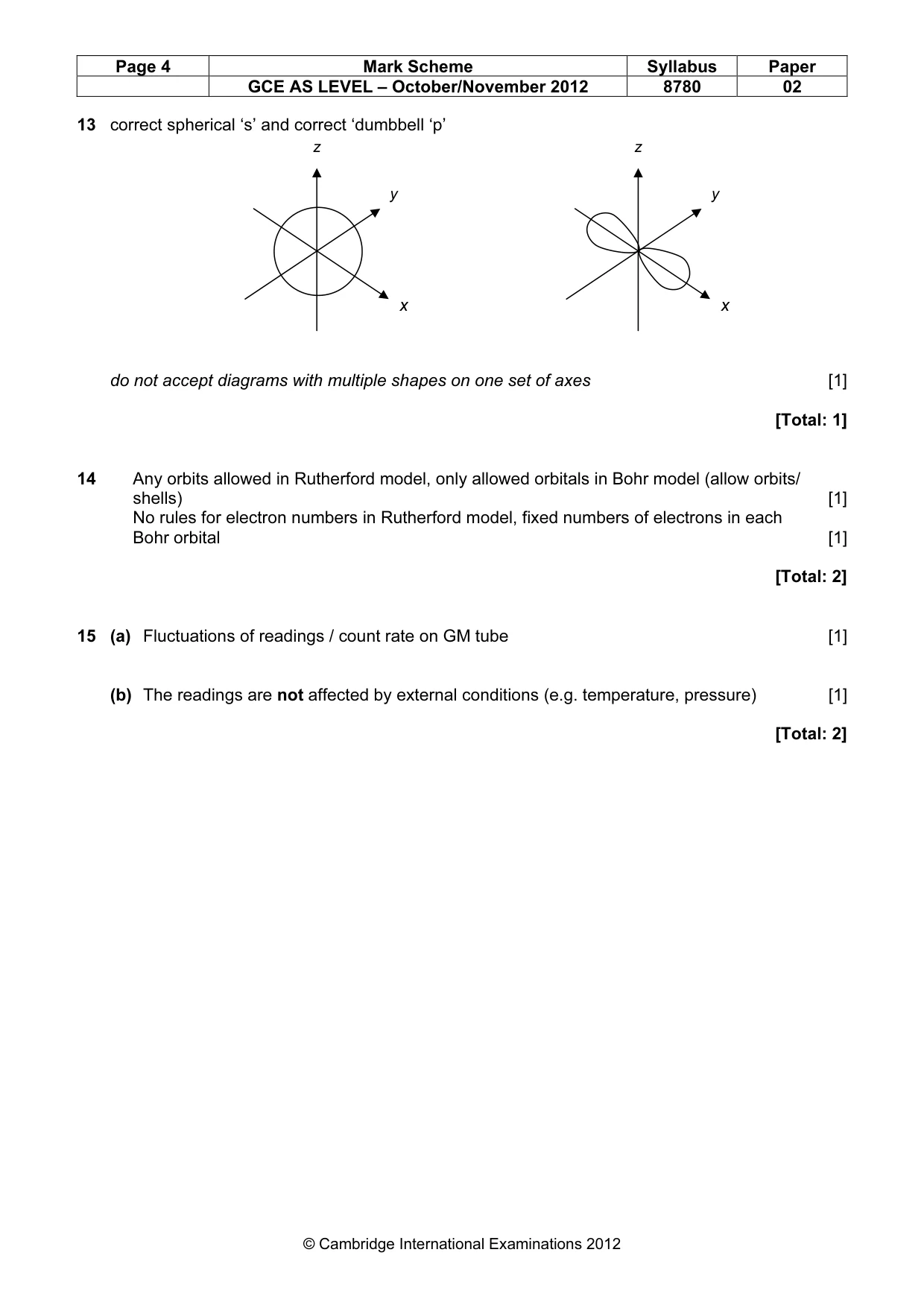
13 The six electrons in an atom of carbon are distributed between s- and p-orbitals. On the axes in Fig. 13.1 below, sketch the shapes of single orbitals of each of these two types. z z y y x x s-orbital p-orbital [1] Fig. 13.1
Mark scheme: 13 correct spherical ‘s’ and correct ‘dumbbell ‘p’ z z y y x x do not accept diagrams with multiple shapes on one set of axes [1] [Total: 1]
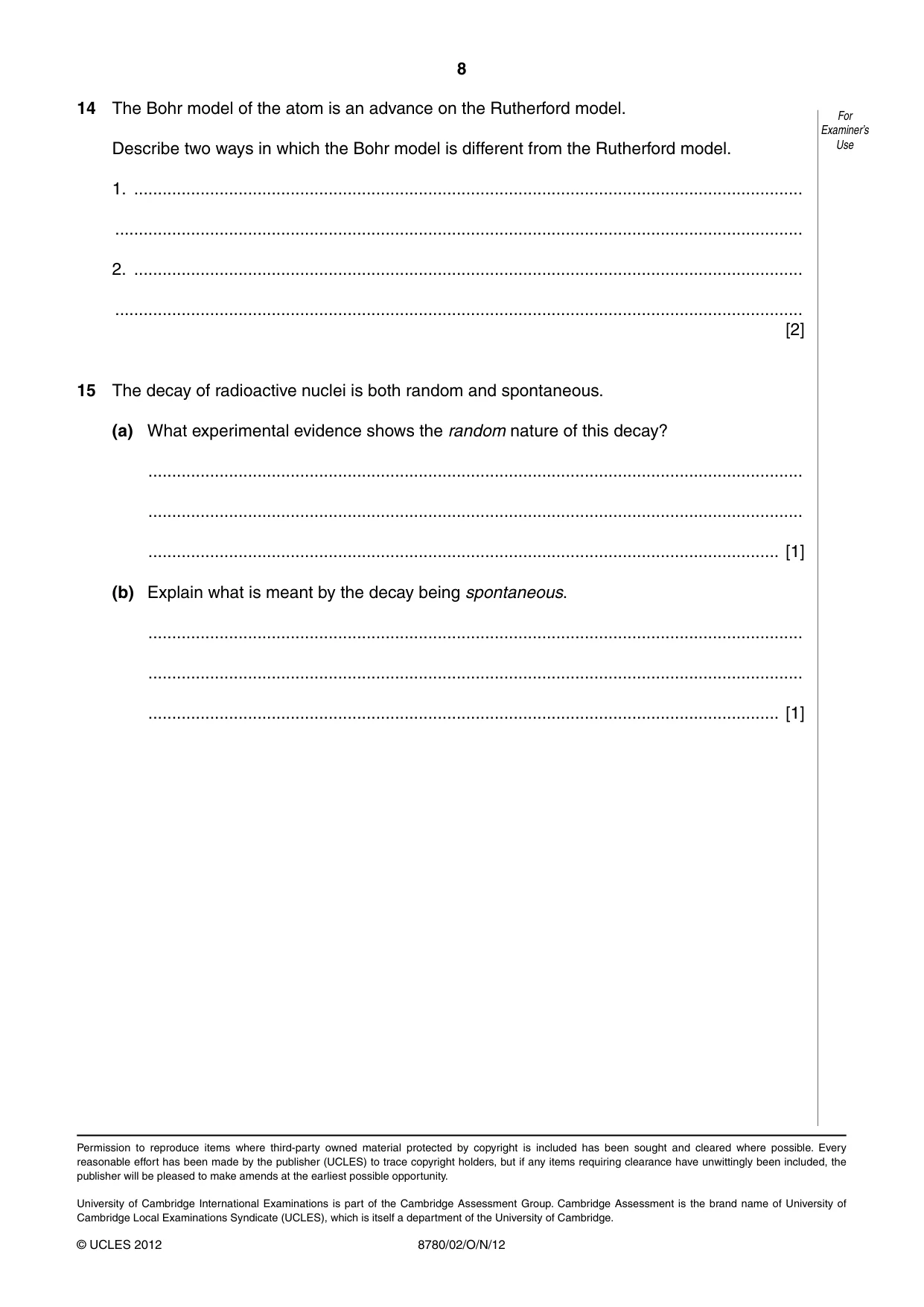
Q14 · The Bohr model of the atom is an advance on the Rutherford model
14 The Bohr model of the atom is an advance on the Rutherford model. Describe two ways in which the Bohr model is different from the Rutherford model. 1. ............................................................................................................................................. ................................................................................................................................................. 2. ............................................................................................................................................. ................................................................................................................................................. [2]
Mark scheme: 14 Any orbits allowed in Rutherford model, only allowed orbitals in Bohr model (allow orbits/ shells) [1] No rules for electron numbers in Rutherford model, fixed numbers of electrons in each Bohr orbital [1] [Total: 2]
Q15 · The decay of radioactive nuclei is both random and spontaneous
15 The decay of radioactive nuclei is both random and spontaneous. (a) What experimental evidence shows the random nature of this decay? .......................................................................................................................................... .......................................................................................................................................... ..................................................................................................................................... [1] (b) Explain what is meant by the decay being spontaneous. .......................................................................................................................................... .......................................................................................................................................... ..................................................................................................................................... [1]
Mark scheme: 15 (a) Fluctuations of readings / count rate on GM tube [1] (b) The readings are not affected by external conditions (e.g. temperature, pressure) [1] [Total: 2]
What you needed in this session
Cambridge’s own grade thresholds for 2012 Oct/Nov, Paper 2 · Variant 1. A higher threshold means an easier paper — the bar moves with how the cohort did.