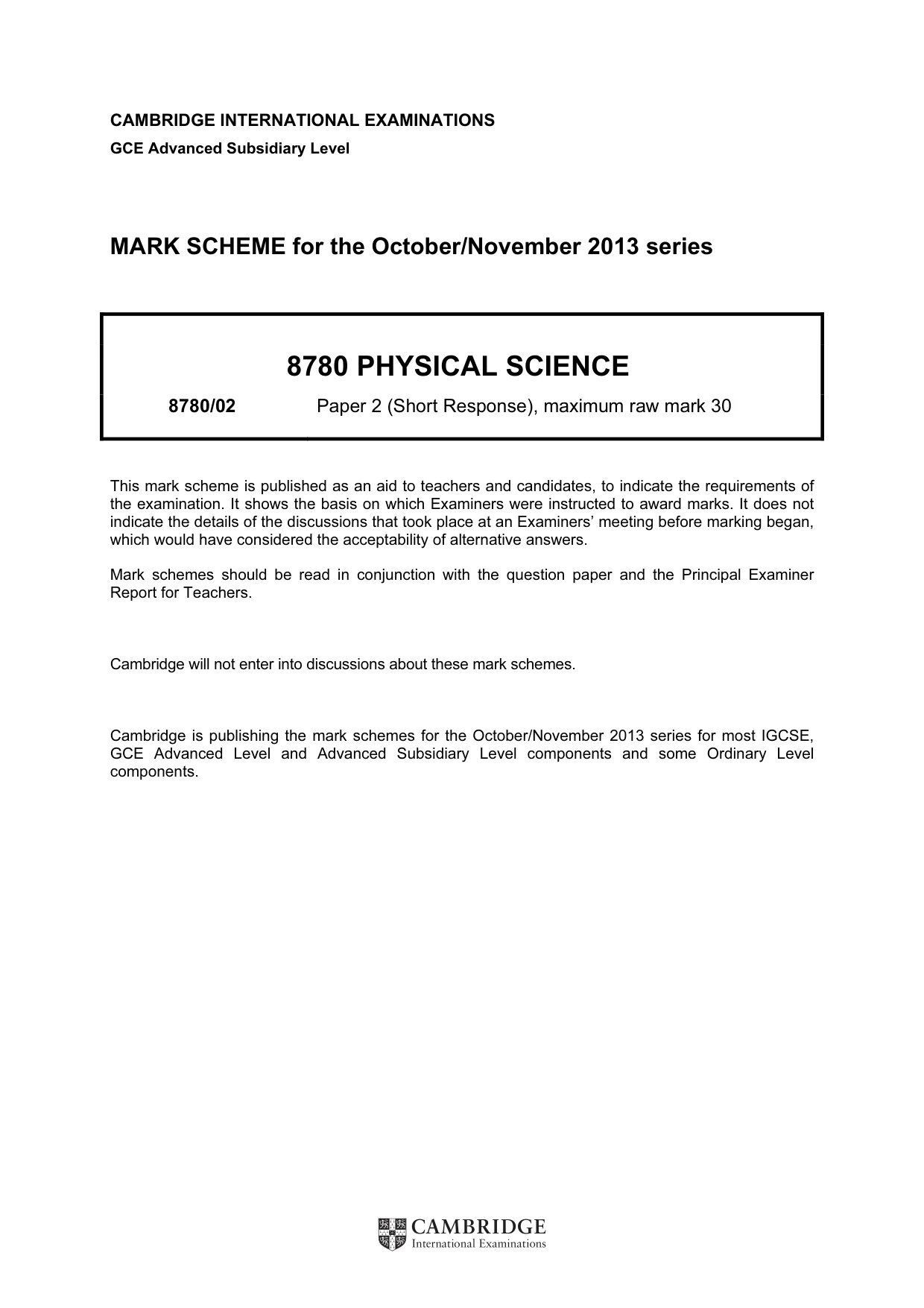
Cambridge A Level Physical Science 8780 — 2013 Oct/Nov Paper 2 · Variant 1
8780/21/O/N/13 · 11 questions · 30 marks · ≈34 min
The question paper and its mark scheme, free to read here and free to download. This is Cambridge’s own paper, exactly as it was sat.
Question paper8 pages
Mark scheme3 pages
Answers below. Sit the paper first if you are practising.
Questions as text
Q1 · Parallax can cause systematic errors or random errors
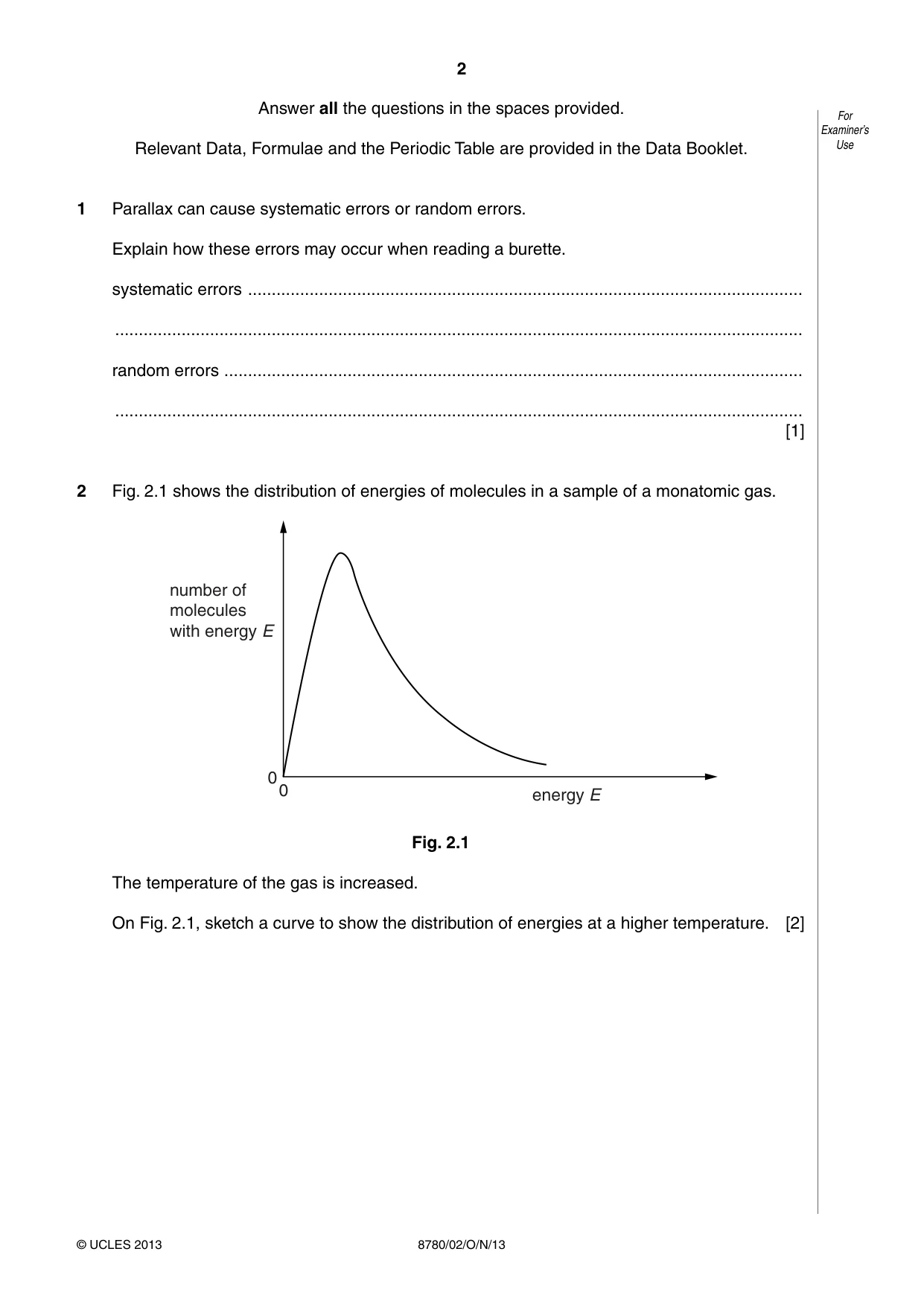
1 Parallax can cause systematic errors or random errors. Explain how these errors may occur when reading a burette. systematic errors ..................................................................................................................... ................................................................................................................................................. random errors .......................................................................................................................... ................................................................................................................................................. [1]
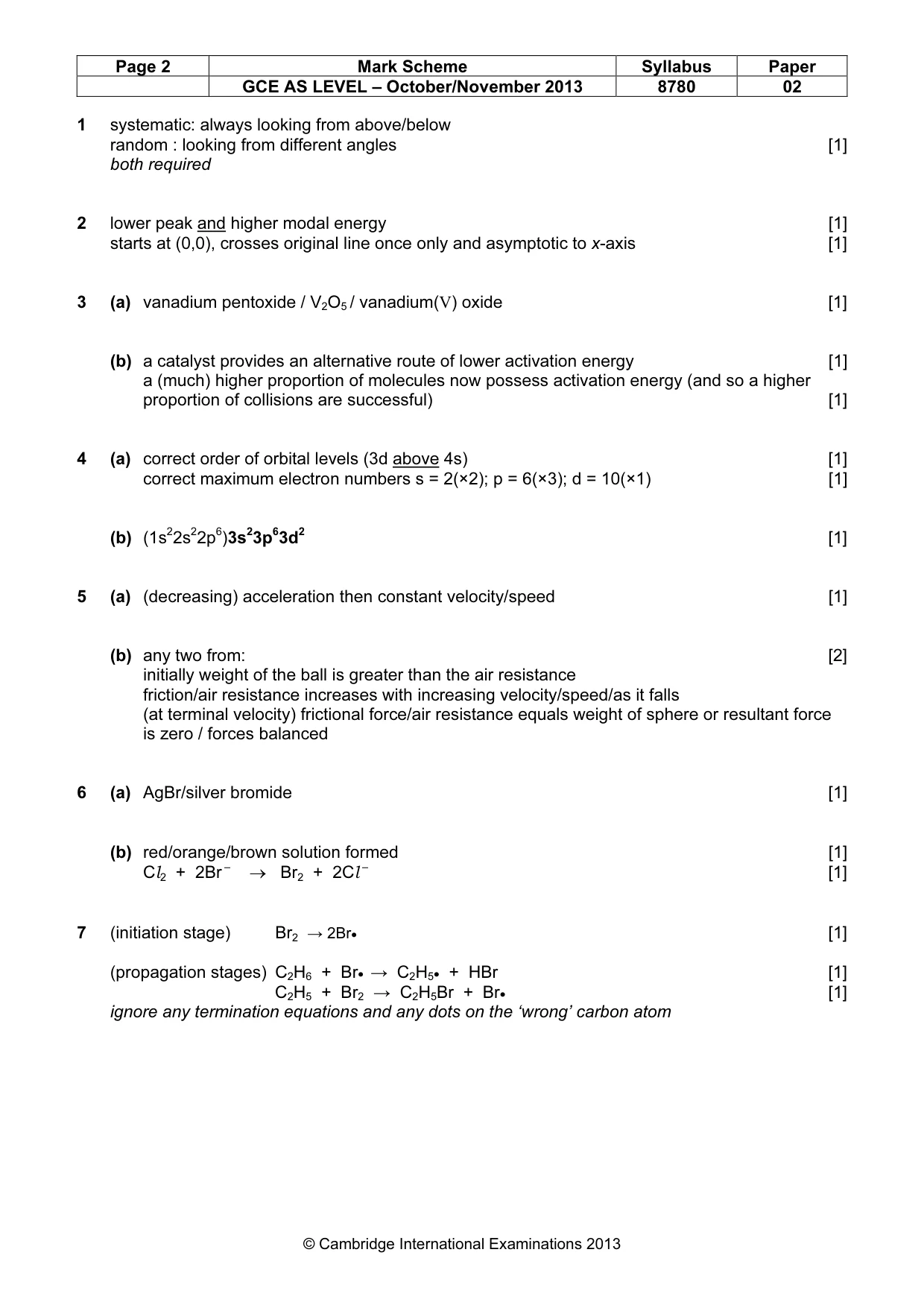
Mark scheme: 1 systematic: always looking from above/below random : looking from different angles [1] both required
Q2 · The distribution of energies of molecules in a sample of a monatomic gas
2 Fig. 2.1 shows the distribution of energies of molecules in a sample of a monatomic gas. number of molecules with energy E 00 energy E Fig. 2.1 The temperature of the gas is increased. On Fig. 2.1, sketch a curve to show the distribution of energies at a higher temperature. [2]
Mark scheme: 2 lower peak and higher modal energy [1] starts at (0,0), crosses original line once only and asymptotic to x-axis [1]
Q3 · A solid catalyst is used in the Contact process
3 A solid catalyst is used in the Contact process. (a) Name this solid catalyst. ......................................................................................................................................[1] (b) The use of a catalyst greatly increases the rate of a reaction. Explain, in terms of the Boltzmann distribution, why this occurs. .......................................................................................................................................... .......................................................................................................................................... .......................................................................................................................................... ......................................................................................................................................[2]
Mark scheme: 3 (a) vanadium pentoxide / V2O5 / vanadium(V) oxide [1] (b) a catalyst provides an alternative route of lower activation energy [1] a (much) higher proportion of molecules now possess activation energy (and so a higher proportion of collisions are successful) [1]
Question 4
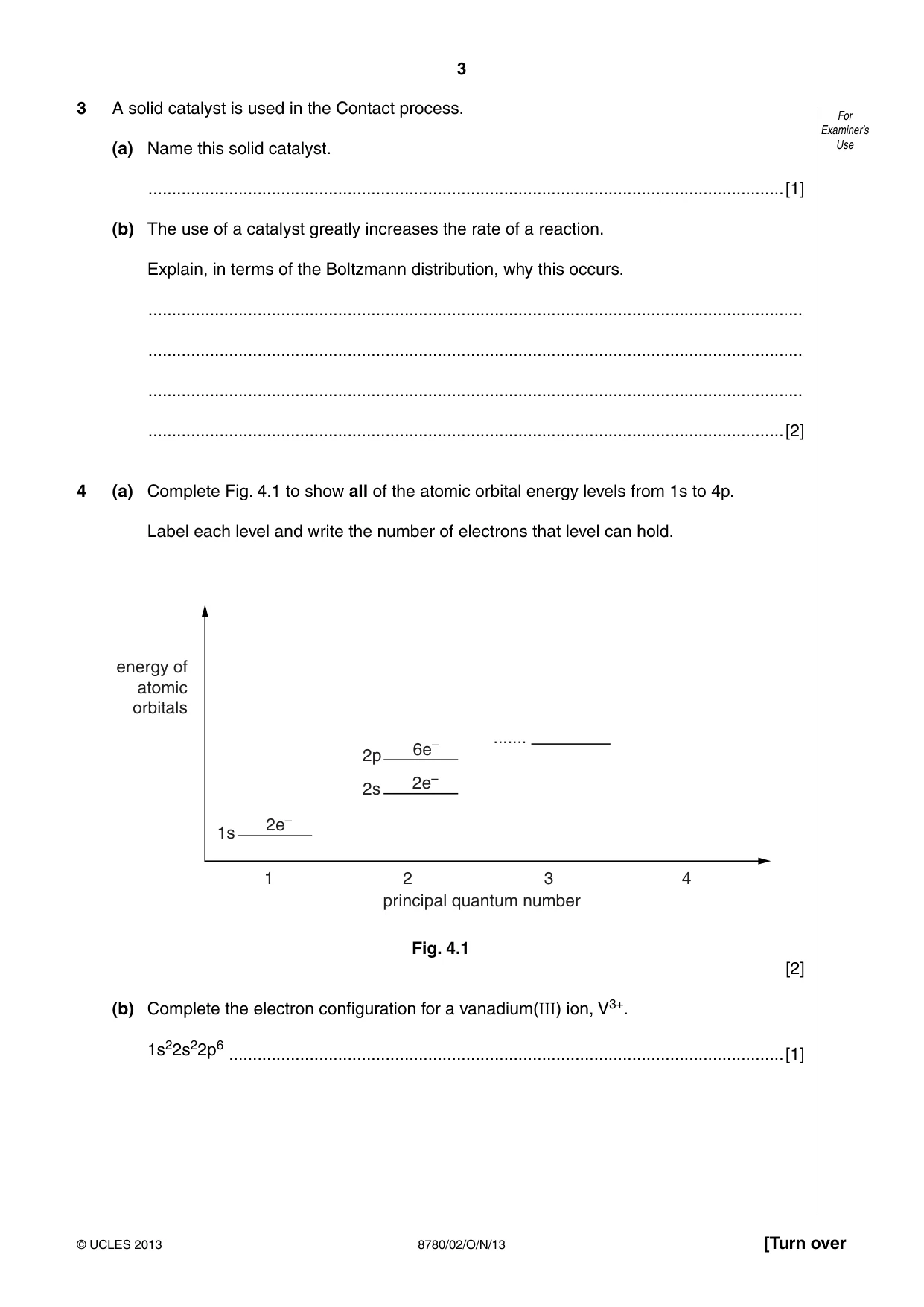
4 (a) Complete Fig. 4.1 to show all of the atomic orbital energy levels from 1s to 4p. Label each level and write the number of electrons that level can hold. energy of atomic orbitals ....... 6e– 2p 2e– 2s 2e– 1s 1 2 3 4 principal quantum number Fig. 4.1 [2] (b) Complete the electron configuration for a vanadium(III) ion, V3+. 1s22s22p6 .....................................................................................................................[1]
Mark scheme: 4 (a) correct order of orbital levels (3d above 4s) [1] correct maximum electron numbers s = 2(×2); p = 6(×3); d = 10(×1) [1] (b) (1s22s22p6)3s23p63d2 [1]
Q5 · A polystyrene ball is dropped from rest at a height of 10 m
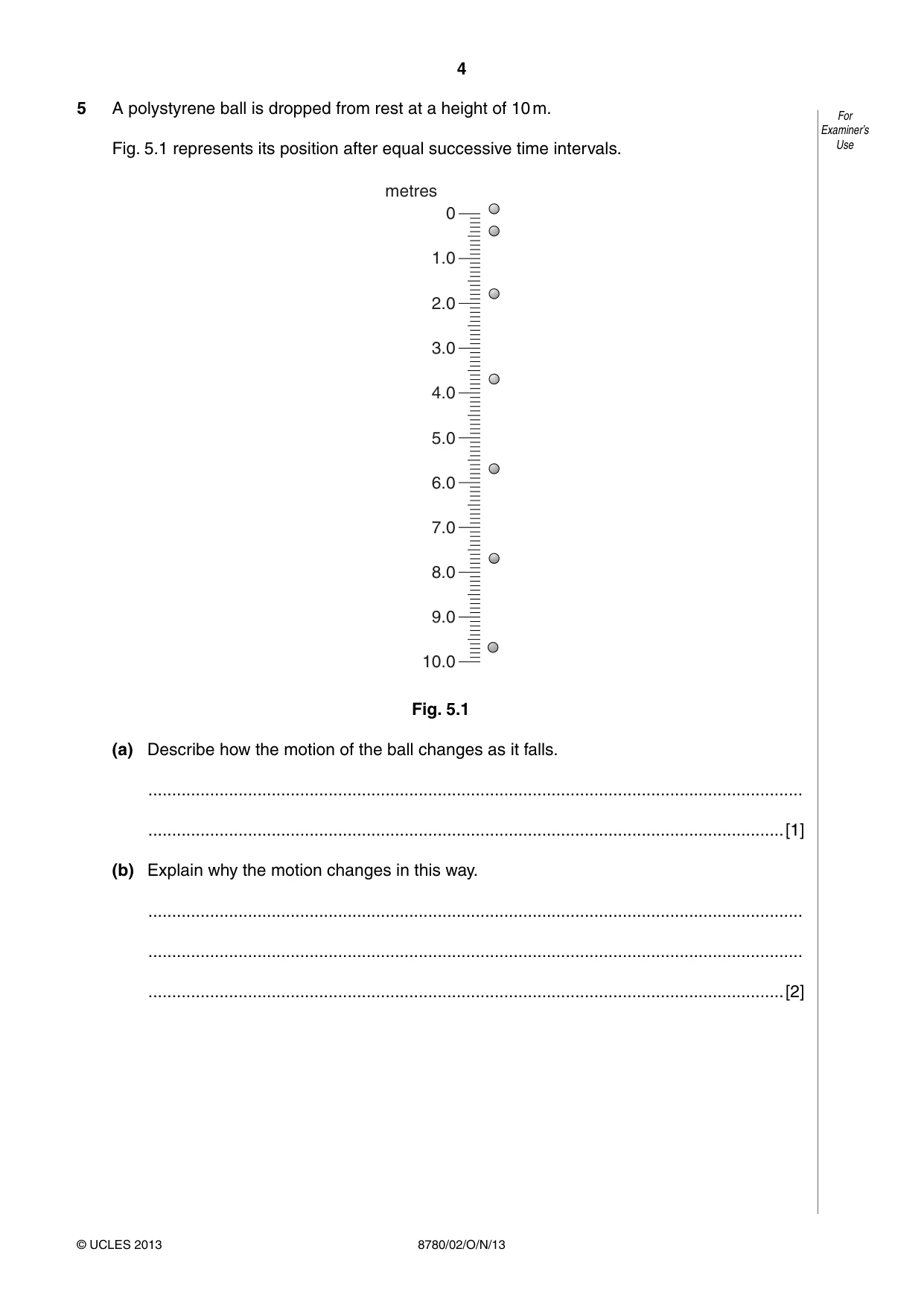
5 A polystyrene ball is dropped from rest at a height of 10 m. Fig. 5.1 represents its position after equal successive time intervals. metres 0 1.0 2.0 3.0 4.0 5.0 6.0 7.0 8.0 9.0 10.0 Fig. 5.1 (a) Describe how the motion of the ball changes as it falls. .......................................................................................................................................... ......................................................................................................................................[1] (b) Explain why the motion changes in this way. .......................................................................................................................................... .......................................................................................................................................... ......................................................................................................................................[2]
Mark scheme: 5 (a) (decreasing) acceleration then constant velocity/speed [1] (b) any two from: [2] initially weight of the ball is greater than the air resistance friction/air resistance increases with increasing velocity/speed/as it falls (at terminal velocity) frictional force/air resistance equals weight of sphere or resultant force is zero / forces balanced
Q6 · Dilute nitric acid, followed by aqueous silver nitrate, is added to a sample of an…
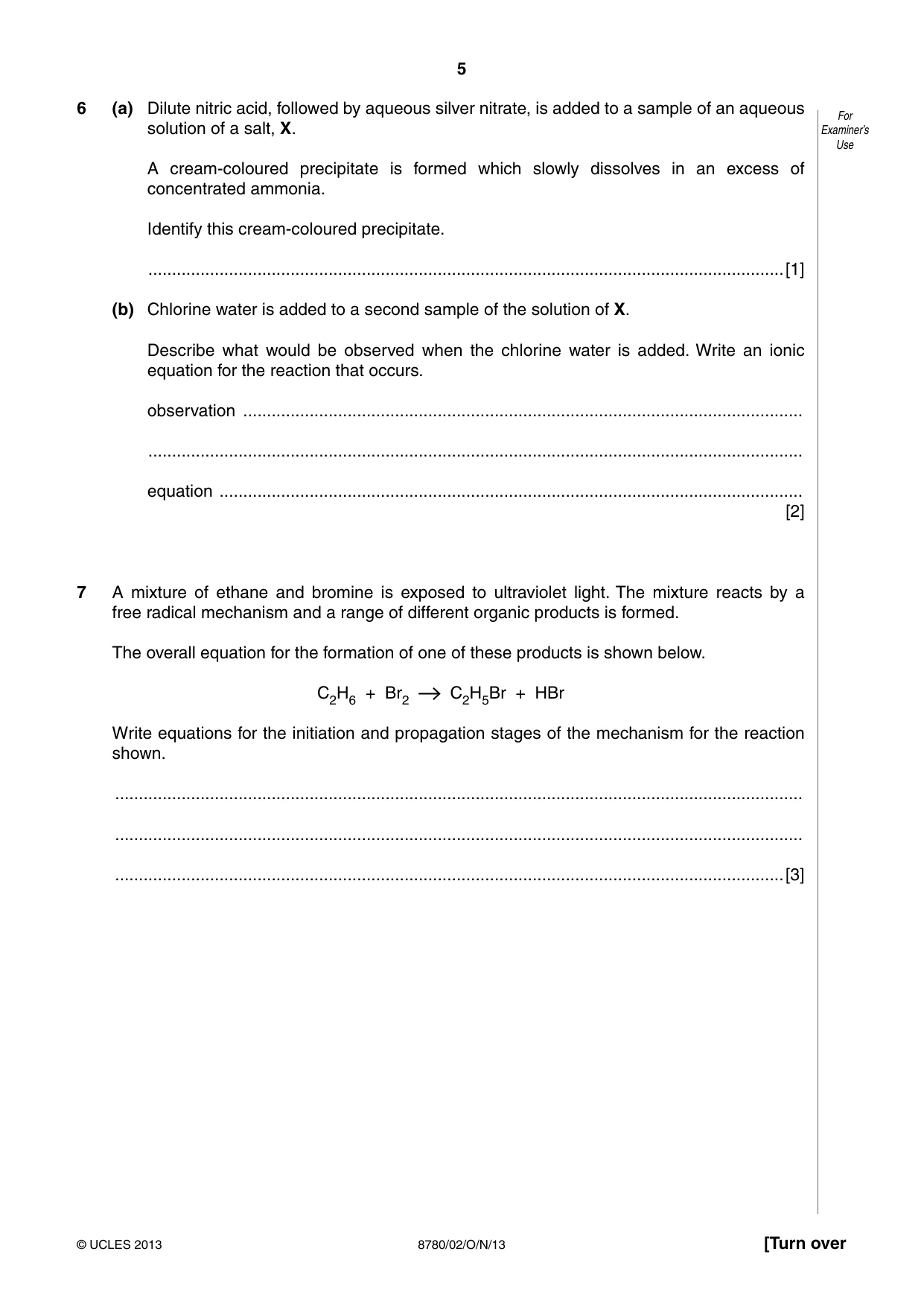
6 (a) Dilute nitric acid, followed by aqueous silver nitrate, is added to a sample of an aqueous solution of a salt, X. A cream-coloured precipitate is formed which slowly dissolves in an excess of concentrated ammonia. Identify this cream-coloured precipitate. ......................................................................................................................................[1] (b) Chlorine water is added to a second sample of the solution of X. Describe what would be observed when the chlorine water is added. Write an ionic equation for the reaction that occurs. observation ...................................................................................................................... .......................................................................................................................................... equation ........................................................................................................................... [2]
Mark scheme: 6 (a) AgBr/silver bromide [1] (b) red/orange/brown solution formed [1] Cl2 + 2Br – → Br2 + 2Cl – [1]
Q7 · A mixture of ethane and bromine is exposed to ultraviolet light
7 A mixture of ethane and bromine is exposed to ultraviolet light. The mixture reacts by a free radical mechanism and a range of different organic products is formed. The overall equation for the formation of one of these products is shown below. C2H6 + Br2 C2H5Br + HBr Write equations for the initiation and propagation stages of the mechanism for the reaction shown. ................................................................................................................................................. ................................................................................................................................................. .............................................................................................................................................[3]
Mark scheme: 7 (initiation stage) Br2 → 2Br• [1] (propagation stages) C2H6 + Br• → C2H5• + HBr [1] C2H5 + Br2 → C2H5Br + Br• [1] ignore any termination equations and any dots on the ‘wrong’ carbon atom GCE AS LEVEL – October/November 2013 8780 02 8 9
Q8 · Red light of wavelength 720 nm travels from the Sun to the Earth
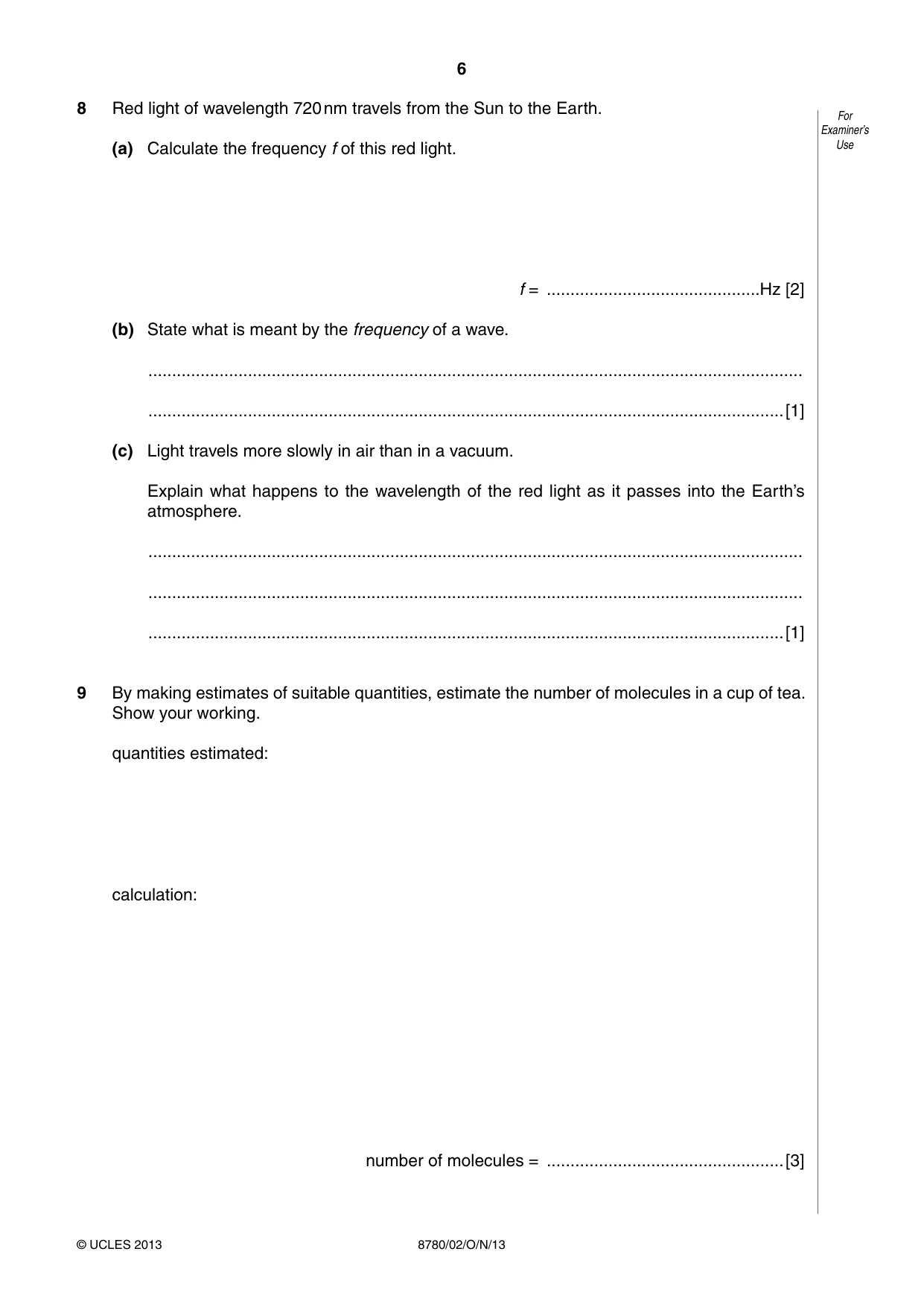
8 Red light of wavelength 720 nm travels from the Sun to the Earth. (a) Calculate the frequency f of this red light. f = .............................................Hz [2] (b) State what is meant by the frequency of a wave. .......................................................................................................................................... ......................................................................................................................................[1] (c) Light travels more slowly in air than in a vacuum. Explain what happens to the wavelength of the red light as it passes into the Earth’s atmosphere. .......................................................................................................................................... .......................................................................................................................................... ......................................................................................................................................[1]
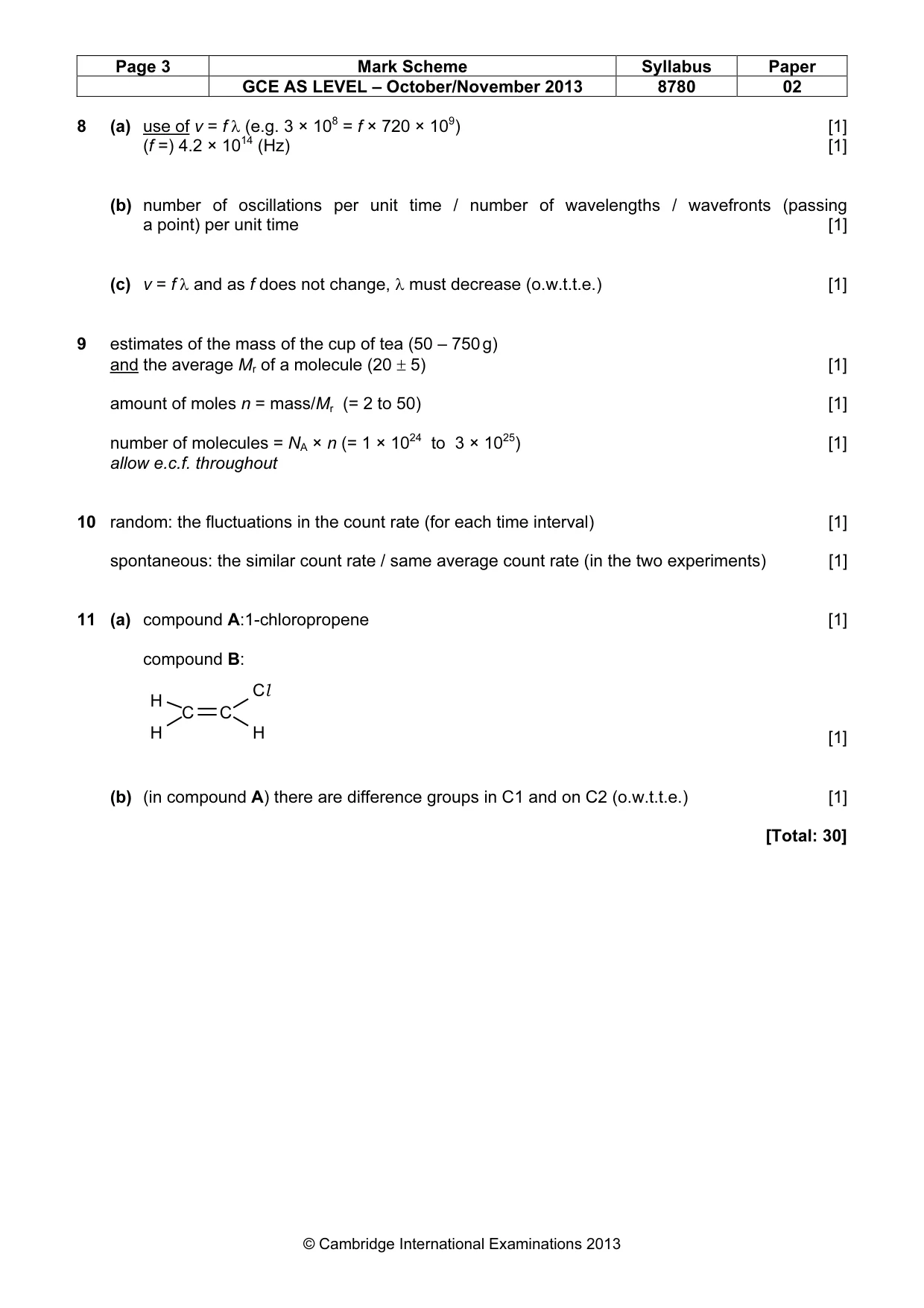
Mark scheme: 8 (a) use of v = f λ (e.g. 3 × 108 = f × 720 × 109) [1] (f =) 4.2 × 10¹⁴ (Hz) [1] (b) number of oscillations per unit time / number of wavelengths / wavefronts (passing a point) per unit time [1] (c) v = f λ and as f does not change, λ must decrease (o.w.t.t.e.) [1]
Q9 · By making estimates of suitable quantities, estimate the number of molecules in a cup of…
9 By making estimates of suitable quantities, estimate the number of molecules in a cup of tea. Show your working. quantities estimated: calculation: number of molecules = ..................................................[3]
Mark scheme: 9 estimates of the mass of the cup of tea (50 – 750 g) and the average Mr of a molecule (20 ± 5) [1] amount of moles n = mass/Mr (= 2 to 50) [1] number of molecules = NA × n (= 1 × 1024 to 3 × 1025) [1] allow e.c.f. throughout
Q10 · A radioactive gas has a long half-life
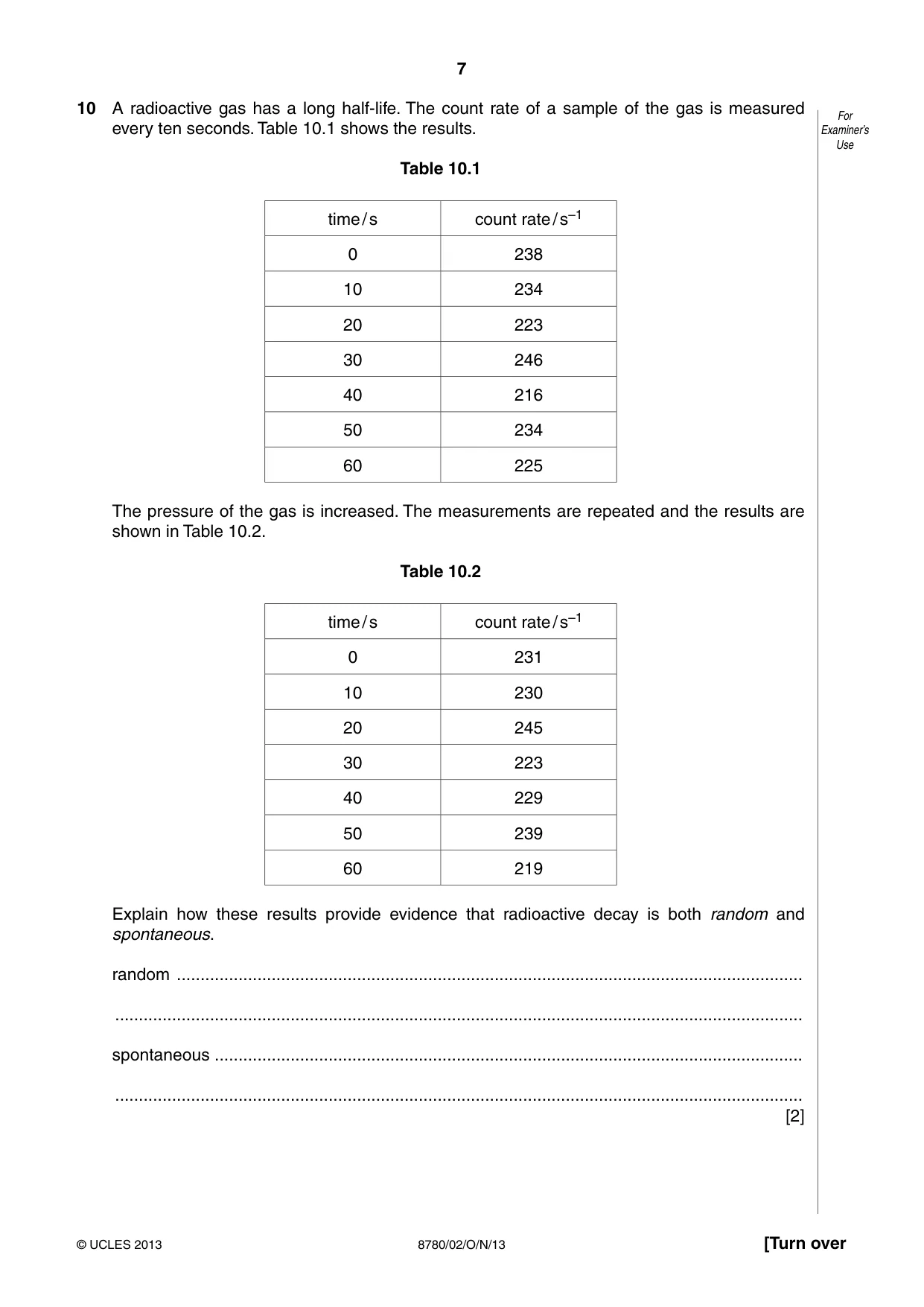
10 A radioactive gas has a long half-life. The count rate of a sample of the gas is measured every ten seconds. Table 10.1 shows the results. Table 10.1 time / s count rate / s–1 0 238 10 234 20 223 30 246 40 216 50 234 60 225 The pressure of the gas is increased. The measurements are repeated and the results are shown in Table 10.2. Table 10.2 time / s count rate / s–1 0 231 10 230 20 245 30 223 40 229 50 239 60 219 Explain how these results provide evidence that radioactive decay is both random and spontaneous. random .................................................................................................................................... ................................................................................................................................................. spontaneous ............................................................................................................................ ................................................................................................................................................. [2]
Mark scheme: 10 random: the fluctuations in the count rate (for each time interval) [1] spontaneous: the similar count rate / same average count rate (in the two experiments) [1]
Q11 · A fragment of a polymeric chain is shown below
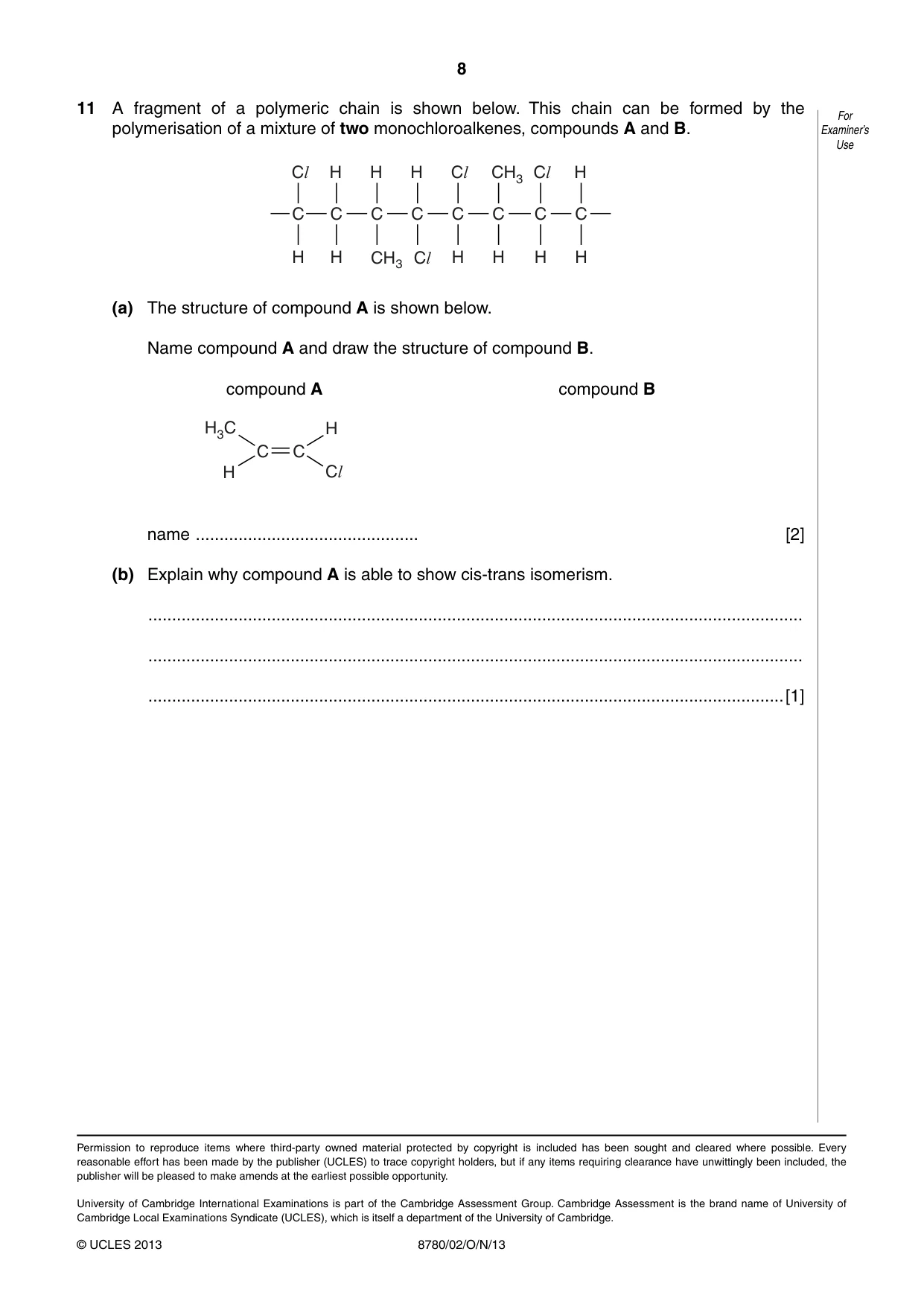
11 A fragment of a polymeric chain is shown below. This chain can be formed by the polymerisation of a mixture of two monochloroalkenes, compounds A and B. Cl H H H Cl CH3 Cl H C C C C C C C C H H CH3 Cl H H H H (a) The structure of compound A is shown below. Name compound A and draw the structure of compound B. compound A compound B H3C H C C H Cl name ............................................... [2] (b) Explain why compound A is able to show cis-trans isomerism. .......................................................................................................................................... .......................................................................................................................................... ......................................................................................................................................[1]
Mark scheme: 11 (a) compound A:1-chloropropene [1] compound B: Cl H C C H H [1] (b) (in compound A) there are difference groups in C1 and on C2 (o.w.t.t.e.) [1] [Total: 30]
What you needed in this session
Cambridge’s own grade thresholds for 2013 Oct/Nov, Paper 2 · Variant 1. A higher threshold means an easier paper — the bar moves with how the cohort did.