Cambridge A Level Physical Science 8780 — 2015 Oct/Nov Paper 2 · Variant 1
8780/21/O/N/15
The question paper and its mark scheme, free to read here and free to download. This is Cambridge’s own paper, exactly as it was sat.
Question paper12 pages
Mark scheme3 pages
Answers below. Sit the paper first if you are practising.
Paper as text
Question paper, page 1
This document consists of 10 printed pages and 2 blank pages. DC (ST/FD) 104121/5 © UCLES 2015 [Turn over Cambridge International Examinations Cambridge International Advanced Subsidiary Level * 6 6 9 8 0 9 8 2 9 4 * PHYSICAL SCIENCE 8780/02 Paper 2 Short Response October/November 2015 40 minutes Candidates answer on the Question Paper. Additional Materials: Data Booklet READ THESE INSTRUCTIONS FIRST Write your Centre number, candidate number and name on all the work you hand in. Write in dark blue or black pen. You may use a pencil for any diagrams or graphs. Do not use staples, paper clips, glue or correction fluid. DO NOT WRITE IN ANY BARCODES. Answer all questions. Electronic calculators may be used. You may lose marks if you do not show your working or if you do not use appropriate units. A Data Booklet is provided. At the end of the examination, fasten all your work securely together. The number of marks is given in brackets [ ] at the end of each question or part question. For Examiner’s Use 1 2 3 4 5 6 7 8 9 10 11 12 Total
Question paper, page 2
2 8780/02/O/N/15 © UCLES 2015 BLANK PAGE
Question paper, page 3
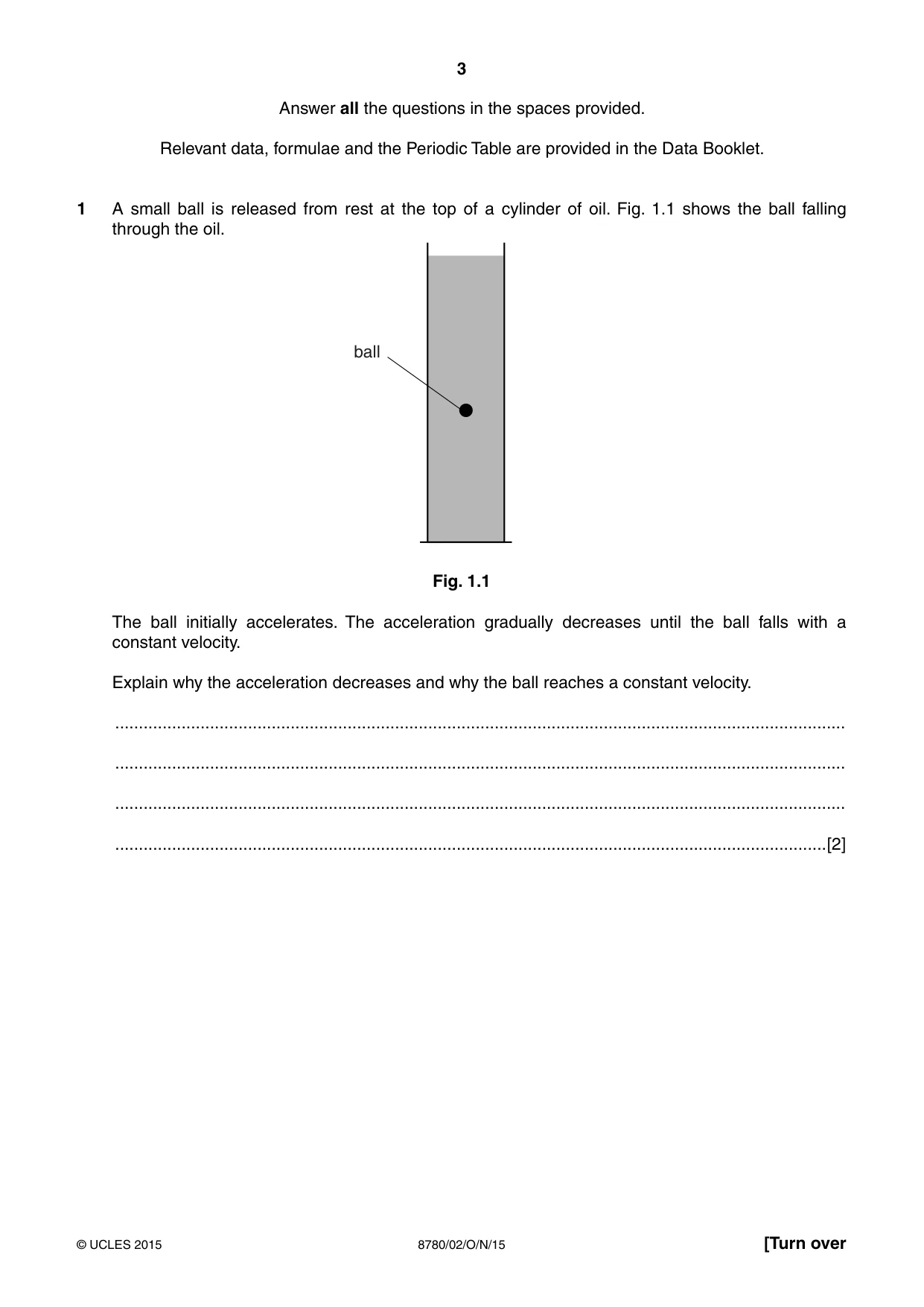
3 8780/02/O/N/15 © UCLES 2015 [Turn over Answer all the questions in the spaces provided. Relevant data, formulae and the Periodic Table are provided in the Data Booklet. 1 A small ball is released from rest at the top of a cylinder of oil. Fig. 1.1 shows the ball falling through the oil. ball Fig. 1.1 The ball initially accelerates. The acceleration gradually decreases until the ball falls with a constant velocity. Explain why the acceleration decreases and why the ball reaches a constant velocity. … … … …[2]
Question paper, page 4
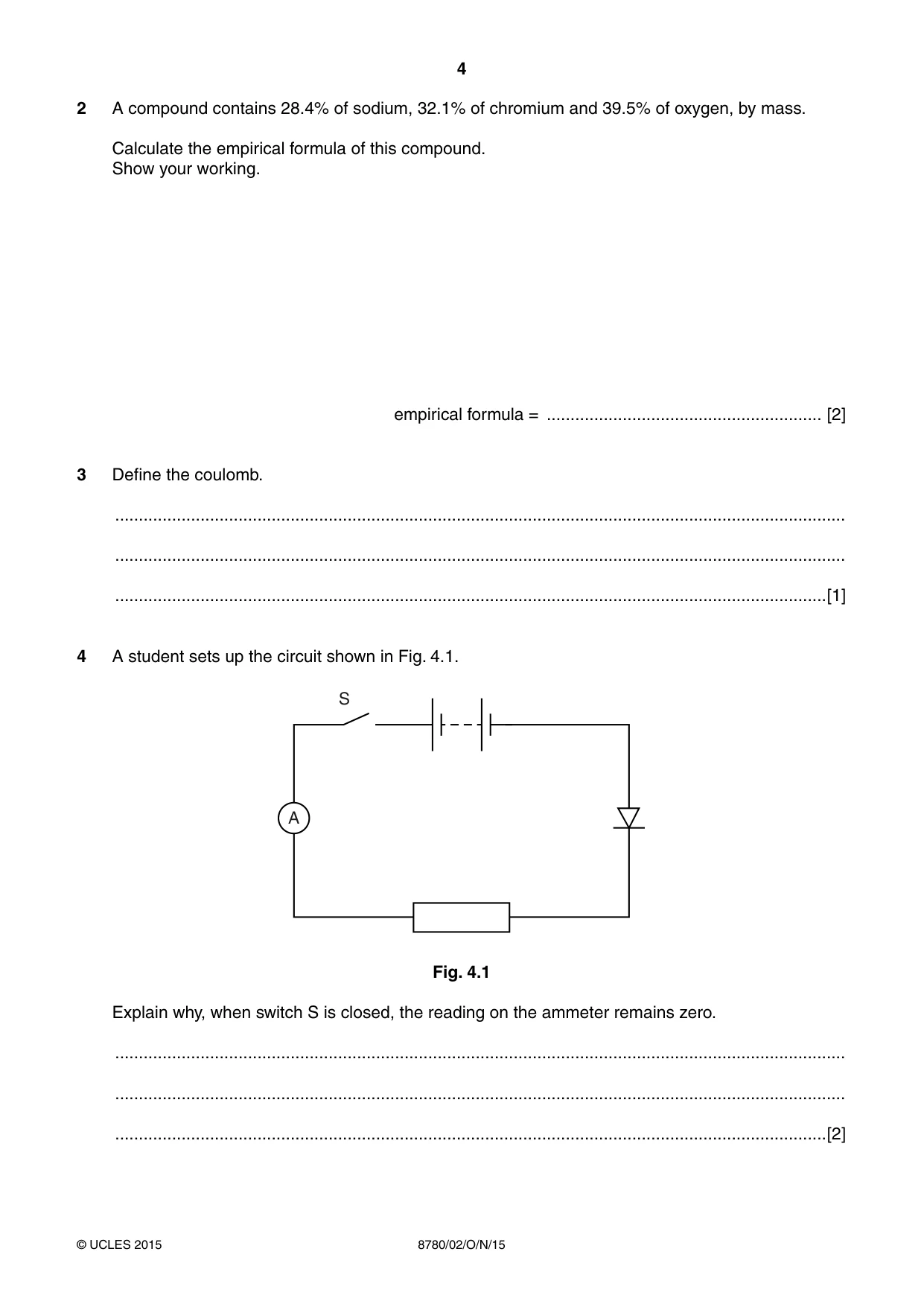
4 8780/02/O/N/15 © UCLES 2015 2 A compound contains 28.4% of sodium, 32.1% of chromium and 39.5% of oxygen, by mass. Calculate the empirical formula of this compound. Show your working. empirical formula = … [2] 3 Define the coulomb. … … …[1] 4 A student sets up the circuit shown in Fig. 4.1. A S Fig. 4.1 Explain why, when switch S is closed, the reading on the ammeter remains zero. … … …[2]
Question paper, page 5
5 8780/02/O/N/15 © UCLES 2015 [Turn over 5 (a) (i) Draw the shape of a PCl 5 molecule. [1] (ii) Name the shape of a PCl 5 molecule. …[1] (b) Draw the shape of a PCl 4 + ion. [1]
Question paper, page 6
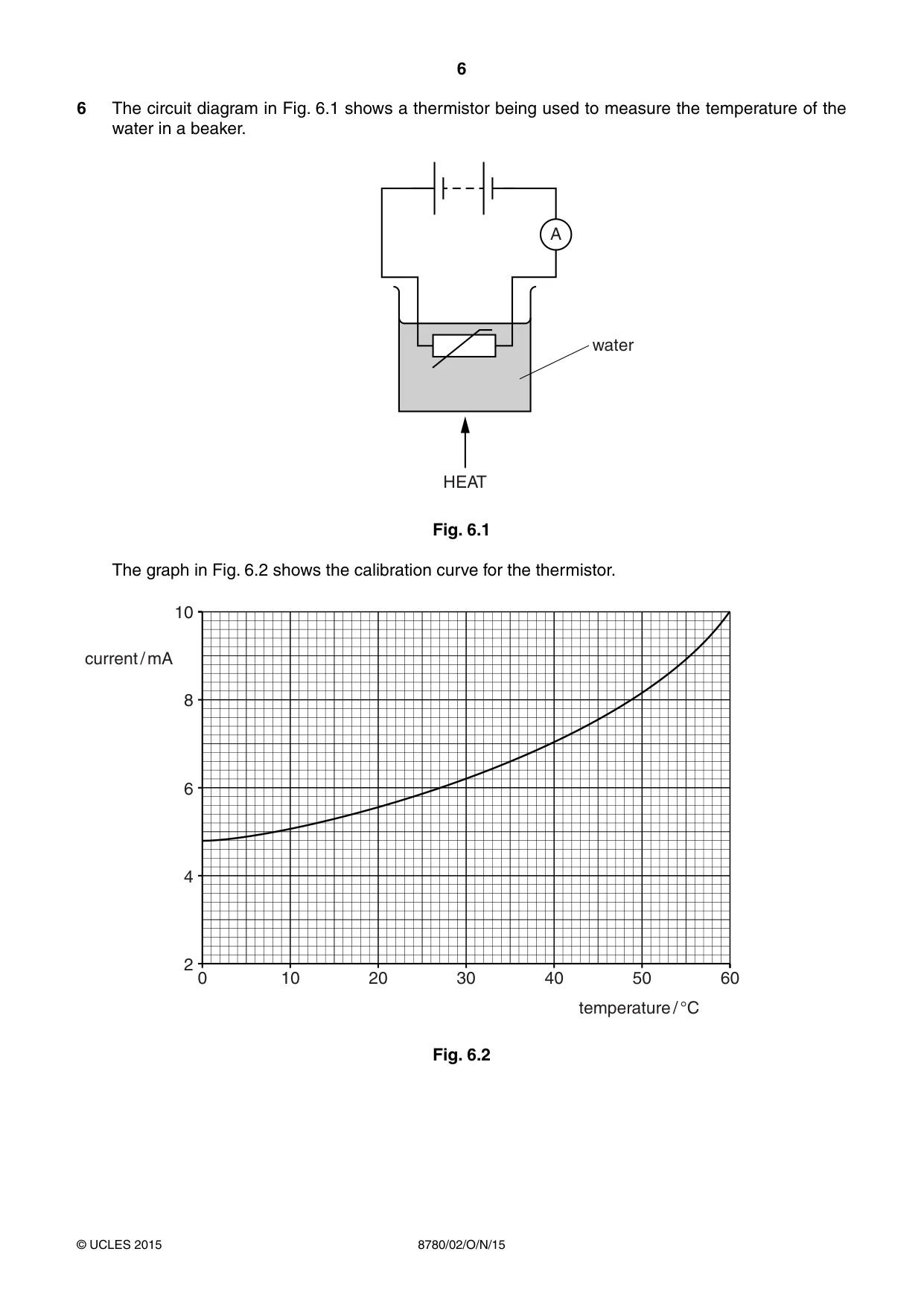
6 8780/02/O/N/15 © UCLES 2015 6 The circuit diagram in Fig. 6.1 shows a thermistor being used to measure the temperature of the water in a beaker. A water HEAT Fig. 6.1 The graph in Fig. 6.2 shows the calibration curve for the thermistor. 0 2 4 6 8 10 10 20 30 temperature / °C current / mA 40 50 60 Fig. 6.2
Question paper, page 7
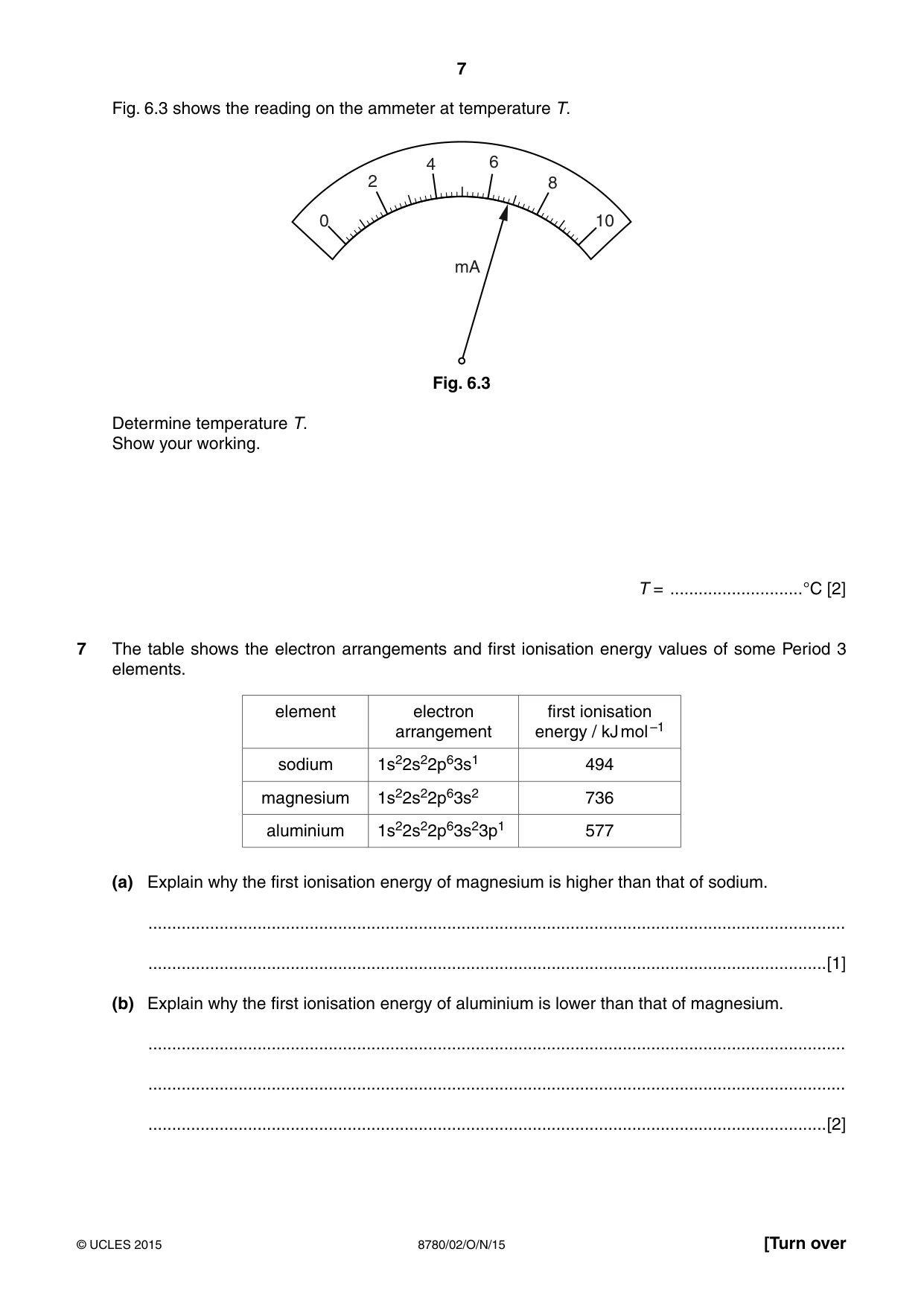
7 8780/02/O/N/15 © UCLES 2015 [Turn over Fig. 6.3 shows the reading on the ammeter at temperature T. 0 2 4 6 8 10 mA Fig. 6.3 Determine temperature T. Show your working. T = …°C [2] 7 The table shows the electron arrangements and first ionisation energy values of some Period 3 elements. element electron arrangement first ionisation energy / kJ mol –1 sodium 1s22s22p63s1 494 magnesium 1s22s22p63s2 736 aluminium 1s22s22p63s23p1 577 (a) Explain why the first ionisation energy of magnesium is higher than that of sodium. … …[1] (b) Explain why the first ionisation energy of aluminium is lower than that of magnesium. … … …[2]
Question paper, page 8
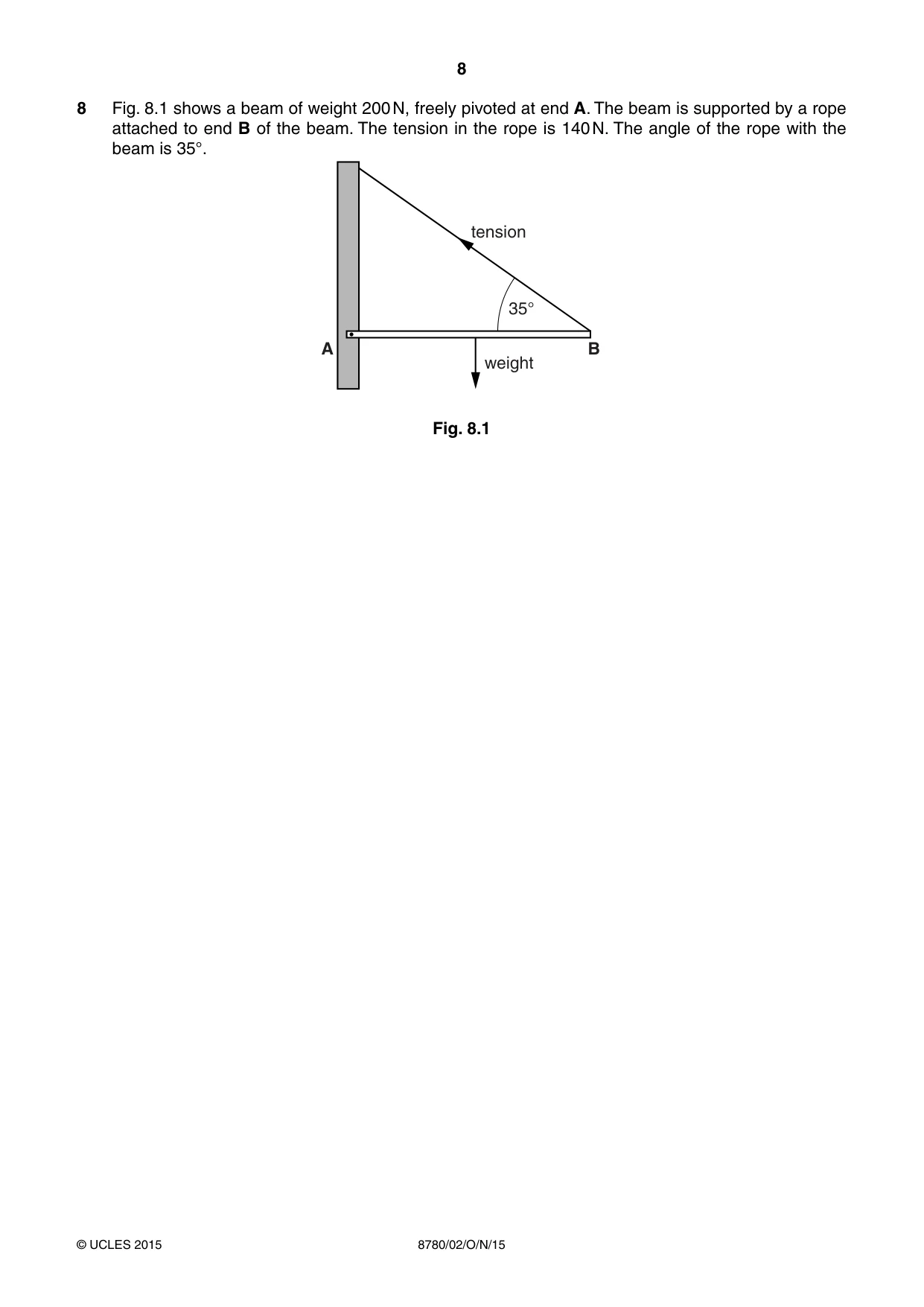
8 8780/02/O/N/15 © UCLES 2015 8 Fig. 8.1 shows a beam of weight 200 N, freely pivoted at end A. The beam is supported by a rope attached to end B of the beam. The tension in the rope is 140 N. The angle of the rope with the beam is 35°. weight 35° A B tension Fig. 8.1
Question paper, page 9
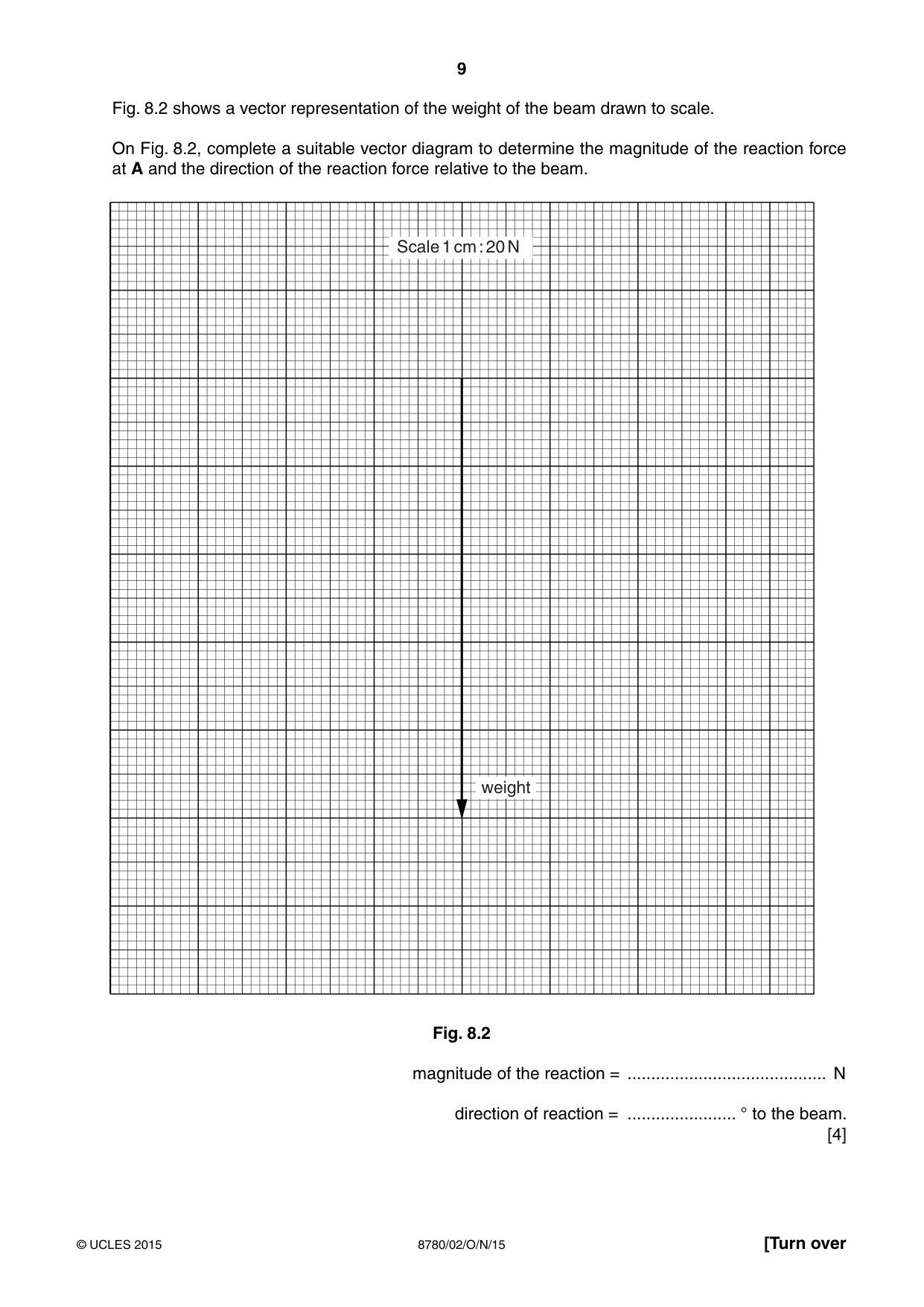
9 8780/02/O/N/15 © UCLES 2015 [Turn over Fig. 8.2 shows a vector representation of the weight of the beam drawn to scale. On Fig. 8.2, complete a suitable vector diagram to determine the magnitude of the reaction force at A and the direction of the reaction force relative to the beam. weight Scale 1 cm : 20 N Fig. 8.2 magnitude of the reaction = … N direction of reaction = … ° to the beam. [4]
Question paper, page 10
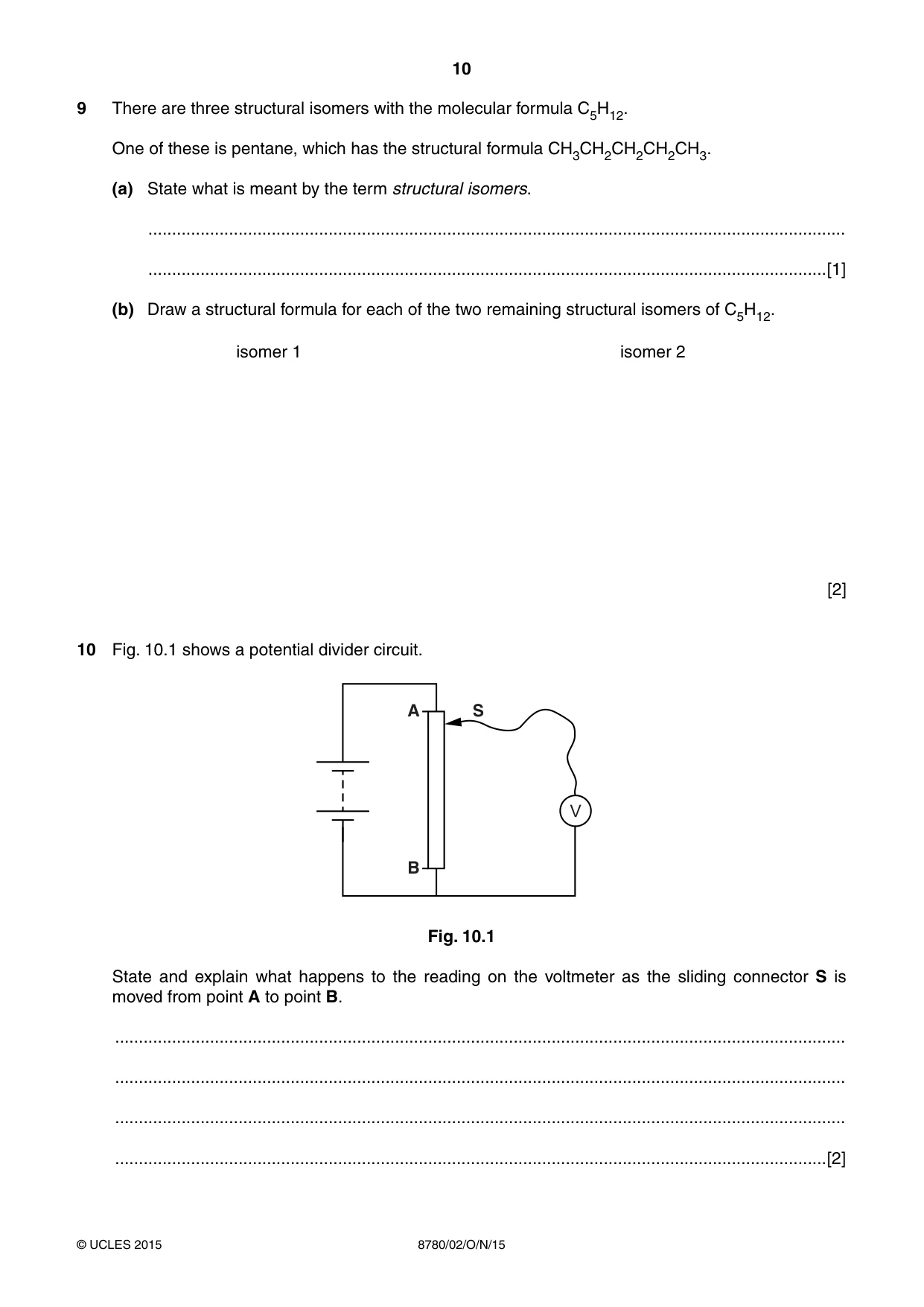
10 8780/02/O/N/15 © UCLES 2015 9 There are three structural isomers with the molecular formula C5H12. One of these is pentane, which has the structural formula CH3CH2CH2CH2CH3. (a) State what is meant by the term structural isomers. … …[1] (b) Draw a structural formula for each of the two remaining structural isomers of C5H12. isomer 1 isomer 2 [2] 10 Fig. 10.1 shows a potential divider circuit. V A S B Fig. 10.1 State and explain what happens to the reading on the voltmeter as the sliding connector S is moved from point A to point B. … … … …[2]
Question paper, page 11
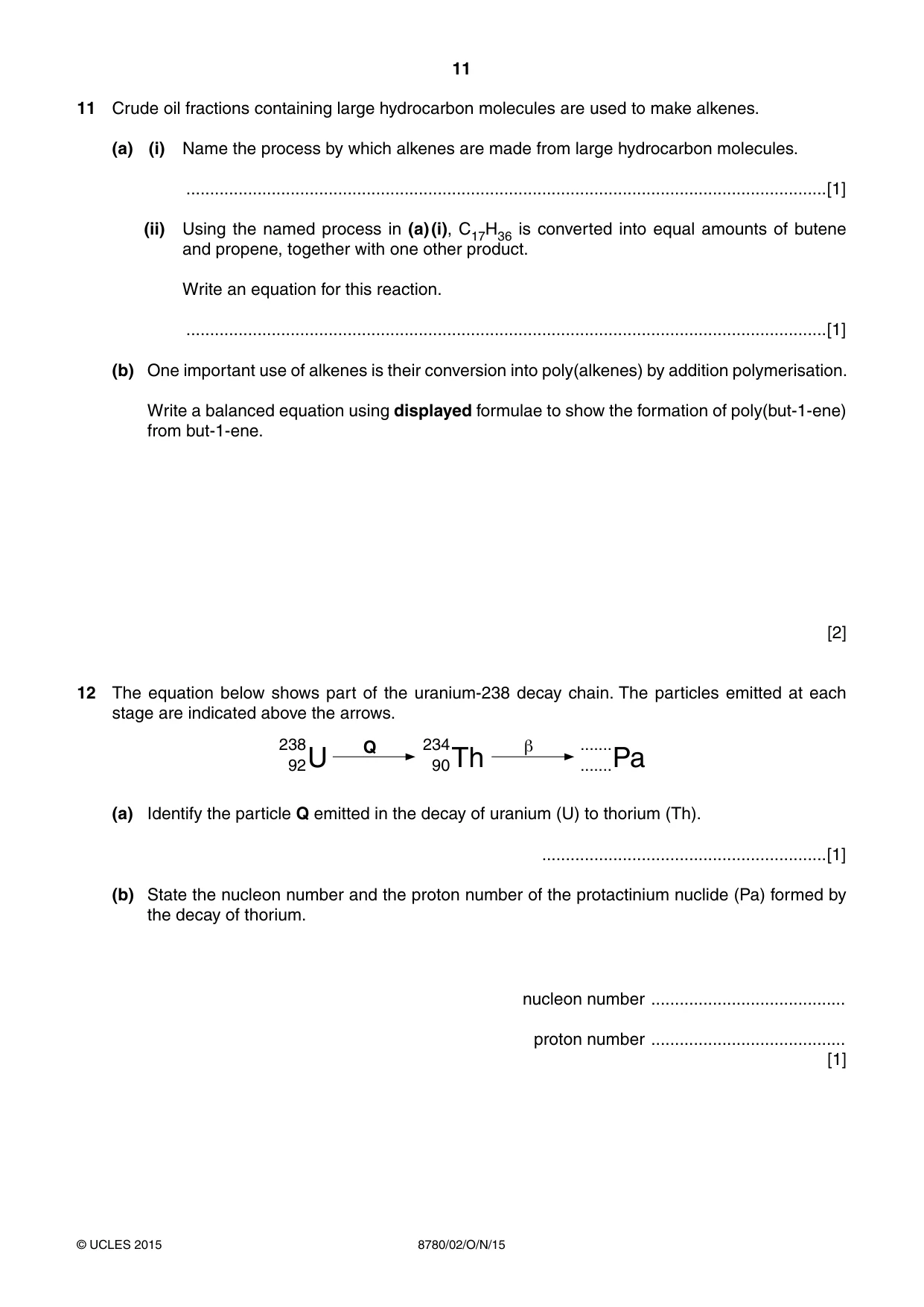
11 8780/02/O/N/15 © UCLES 2015 11 Crude oil fractions containing large hydrocarbon molecules are used to make alkenes. (a) (i) Name the process by which alkenes are made from large hydrocarbon molecules. …[1] (ii) Using the named process in (a) (i), C17H36 is converted into equal amounts of butene and propene, together with one other product. Write an equation for this reaction. …[1] (b) One important use of alkenes is their conversion into poly(alkenes) by addition polymerisation. Write a balanced equation using displayed formulae to show the formation of poly(but-1-ene) from but-1-ene. [2] 12 The equation below shows part of the uranium-238 decay chain. The particles emitted at each stage are indicated above the arrows. U Th Pa 238 92 234 90 … … Q β (a) Identify the particle Q emitted in the decay of uranium (U) to thorium (Th). …[1] (b) State the nucleon number and the proton number of the protactinium nuclide (Pa) formed by the decay of thorium. nucleon number … proton number … [1]
Question paper, page 12
12 8780/02/O/N/15 © UCLES 2015 BLANK PAGE Permission to reproduce items where third-party owned material protected by copyright is included has been sought and cleared where possible. Every reasonable effort has been made by the publisher (UCLES) to trace copyright holders, but if any items requiring clearance have unwittingly been included, the publisher will be pleased to make amends at the earliest possible opportunity. To avoid the issue of disclosure of answer-related information to candidates, all copyright acknowledgements are reproduced online in the Cambridge International Examinations Copyright Acknowledgements Booklet. This is produced for each series of examinations and is freely available to download at www.cie.org.uk after the live examination series. Cambridge International Examinations is part of the Cambridge Assessment Group. Cambridge Assessment is the brand name of University of Cambridge Local Examinations Syndicate (UCLES), which is itself a department of the University of Cambridge.
Mark scheme, page 1
® IGCSE is the registered trademark of Cambridge International Examinations. CAMBRIDGE INTERNATIONAL EXAMINATIONS Cambridge International Advanced Subsidiary Level MARK SCHEME for the October/November 2015 series 8780 PHYSICAL SCIENCE 8780/02 Paper 2 (Short Response), maximum raw mark 30 This mark scheme is published as an aid to teachers and candidates, to indicate the requirements of the examination. It shows the basis on which Examiners were instructed to award marks. It does not indicate the details of the discussions that took place at an Examiners’ meeting before marking began, which would have considered the acceptability of alternative answers. Mark schemes should be read in conjunction with the question paper and the Principal Examiner Report for Teachers. Cambridge will not enter into discussions about these mark schemes. Cambridge is publishing the mark schemes for the October/November 2015 series for most Cambridge IGCSE®, Cambridge International A and AS Level components and some Cambridge O Level components.
Mark scheme, page 2
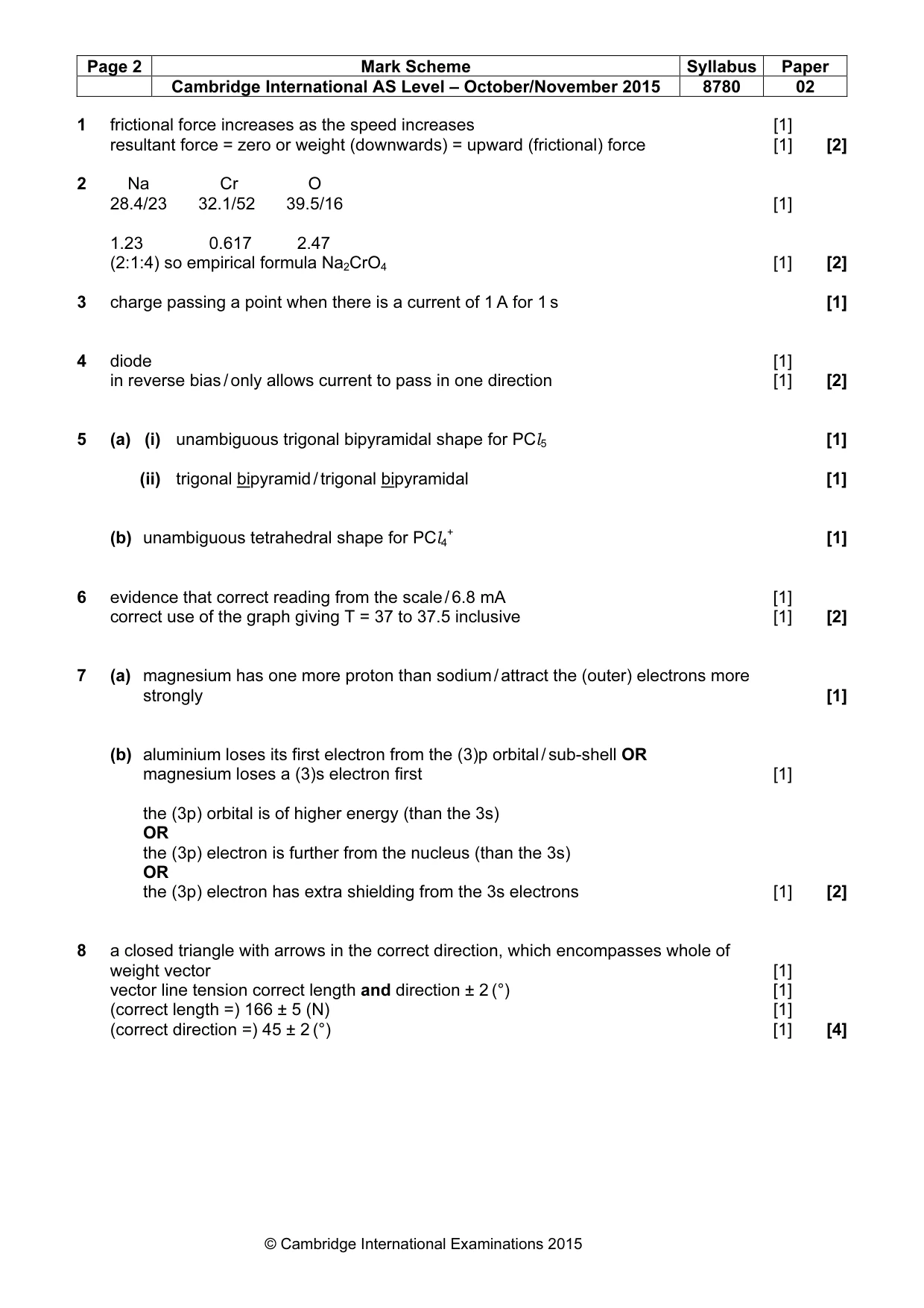
Page 2 Mark Scheme Syllabus Paper Cambridge International AS Level – October/November 2015 8780 02 © Cambridge International Examinations 2015 1 frictional force increases as the speed increases [1] resultant force = zero or weight (downwards) = upward (frictional) force [1] [2] 2 Na Cr O 28.4/23 32.1/52 39.5/16 [1] 1.23 0.617 2.47 (2:1:4) so empirical formula Na2CrO4 [1] [2] 3 charge passing a point when there is a current of 1 A for 1 s [1] 4 diode [1] in reverse bias / only allows current to pass in one direction [1] [2] 5 (a) (i) unambiguous trigonal bipyramidal shape for PCl5 [1] (ii) trigonal bipyramid / trigonal bipyramidal [1] (b) unambiguous tetrahedral shape for PCl4 + [1] 6 evidence that correct reading from the scale / 6.8 mA [1] correct use of the graph giving T = 37 to 37.5 inclusive [1] [2] 7 (a) magnesium has one more proton than sodium / attract the (outer) electrons more strongly [1] (b) aluminium loses its first electron from the (3)p orbital / sub-shell OR magnesium loses a (3)s electron first [1] the (3p) orbital is of higher energy (than the 3s) OR the (3p) electron is further from the nucleus (than the 3s) OR the (3p) electron has extra shielding from the 3s electrons [1] [2] 8 a closed triangle with arrows in the correct direction, which encompasses whole of weight vector [1] vector line tension correct length and direction ± 2 (°) [1] (correct length =) 166 ± 5 (N) [1] (correct direction =) 45 ± 2 (°) [1] [4]
Mark scheme, page 3
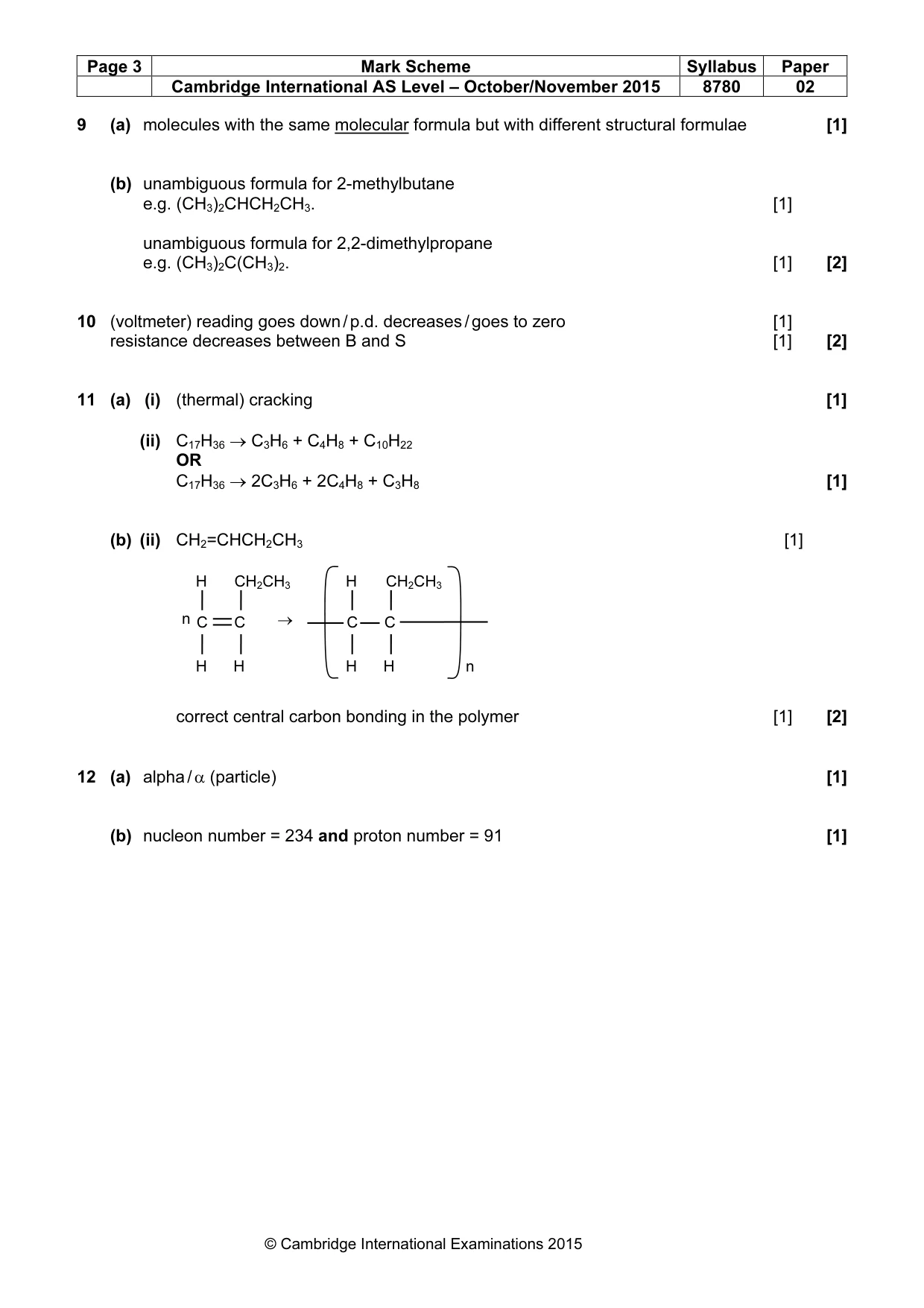
Page 3 Mark Scheme Syllabus Paper Cambridge International AS Level – October/November 2015 8780 02 © Cambridge International Examinations 2015 9 (a) molecules with the same molecular formula but with different structural formulae [1] (b) unambiguous formula for 2-methylbutane e.g. (CH3)2CHCH2CH3. [1] unambiguous formula for 2,2-dimethylpropane e.g. (CH3)2C(CH3)2. [1] [2] 10 (voltmeter) reading goes down / p.d. decreases / goes to zero [1] resistance decreases between B and S [1] [2] 11 (a) (i) (thermal) cracking [1] (ii) C17H36 → C3H6 + C4H8 + C10H22 OR C17H36 → 2C3H6 + 2C4H8 + C3H8 [1] (b) (ii) CH2=CHCH2CH3 [1] correct central carbon bonding in the polymer [1] [2] 12 (a) alpha / α (particle) [1] (b) nucleon number = 234 and proton number = 91 [1] H C C H H CH2CH3 n → H C C H H CH2CH3 n