Cambridge A Level Physical Science 8780 — 2016 Oct/Nov Paper 2 · Variant 1
8780/21/O/N/16 · 11 questions · 30 marks · ≈34 min
The question paper and its mark scheme, free to read here and free to download. This is Cambridge’s own paper, exactly as it was sat.
Question paper8 pages
Mark scheme3 pages
Answers below. Sit the paper first if you are practising.
Questions as text
Q1 · A micrometer screw gauge with its jaws fully closed
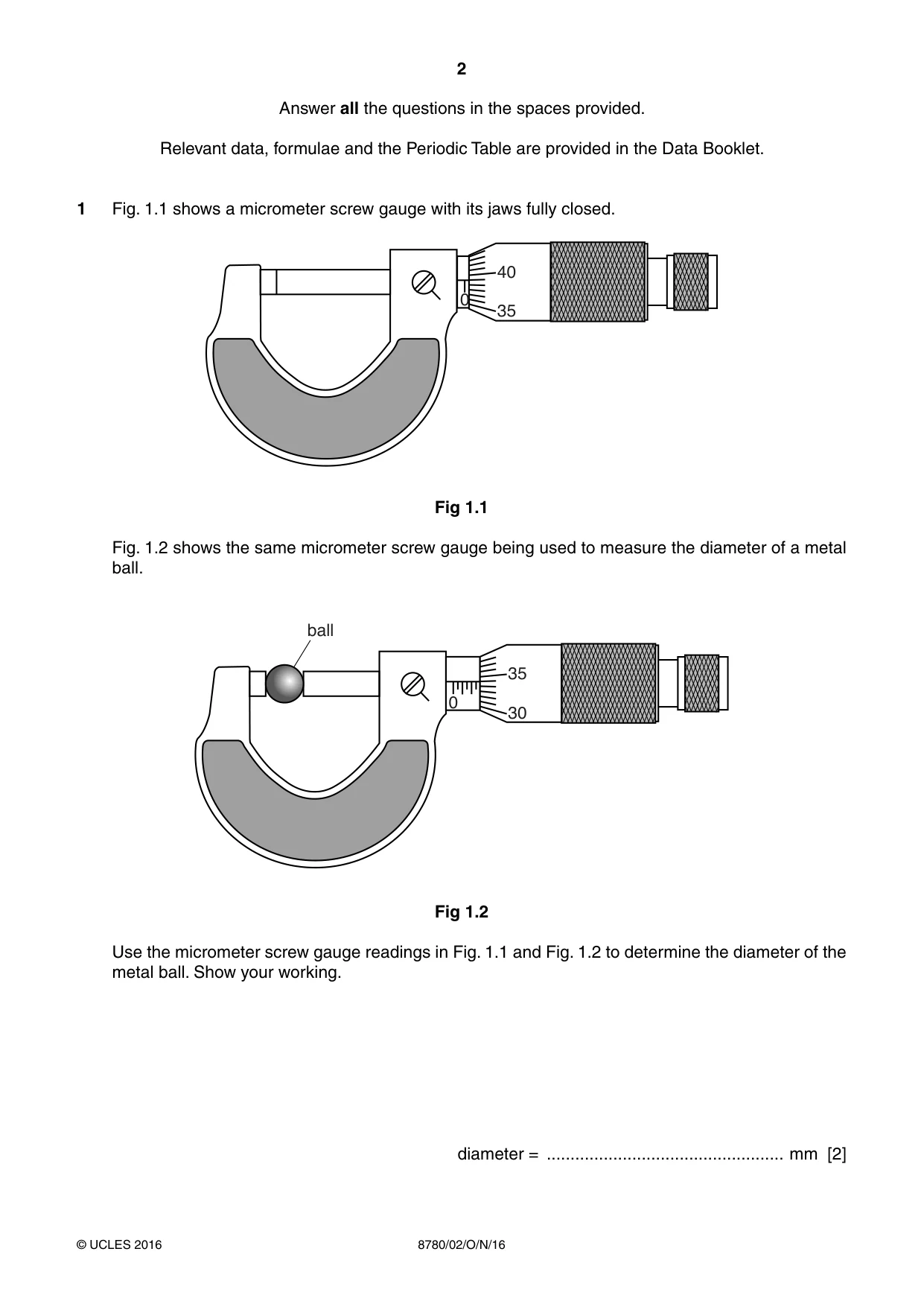
1 Fig. 1.1 shows a micrometer screw gauge with its jaws fully closed. Fig 1.1 Fig. 1.2 shows the same micrometer screw gauge being used to measure the diameter of a metal ball. EDOO Fig 1.2 Use the micrometer screw gauge readings in Fig. 1.1 and Fig. 1.2 to determine the diameter of the metal ball. Show your working. diameter = .................................................. mm [2]
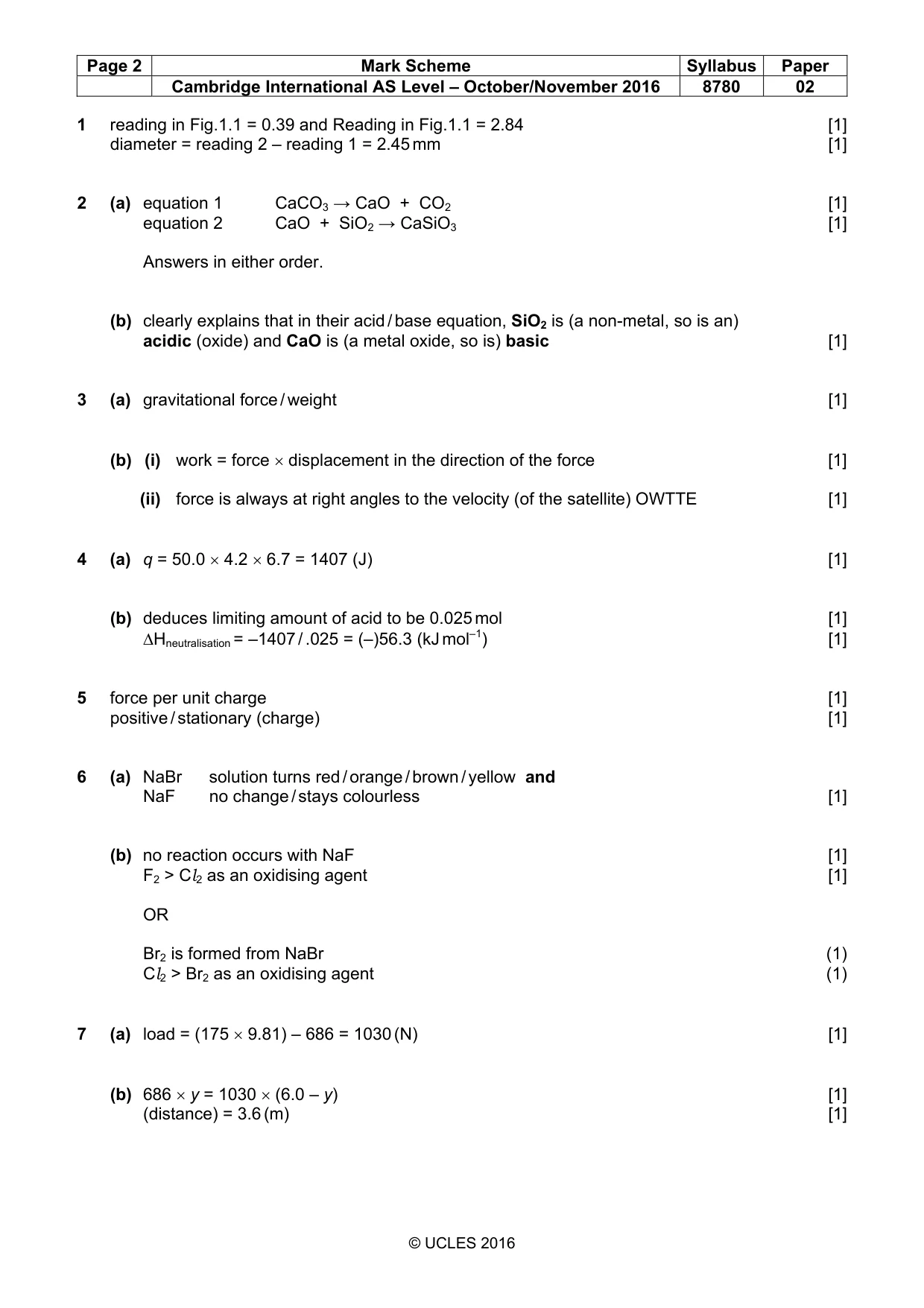
Mark scheme: 1 reading in Fig.1.1 = 0.39 and Reading in Fig.1.1 = 2.84 [1] diameter = reading 2 – reading 1 = 2.45 mm [1]
Q2 · Iron ore (hematite) contains impurities such as sand, SiO2
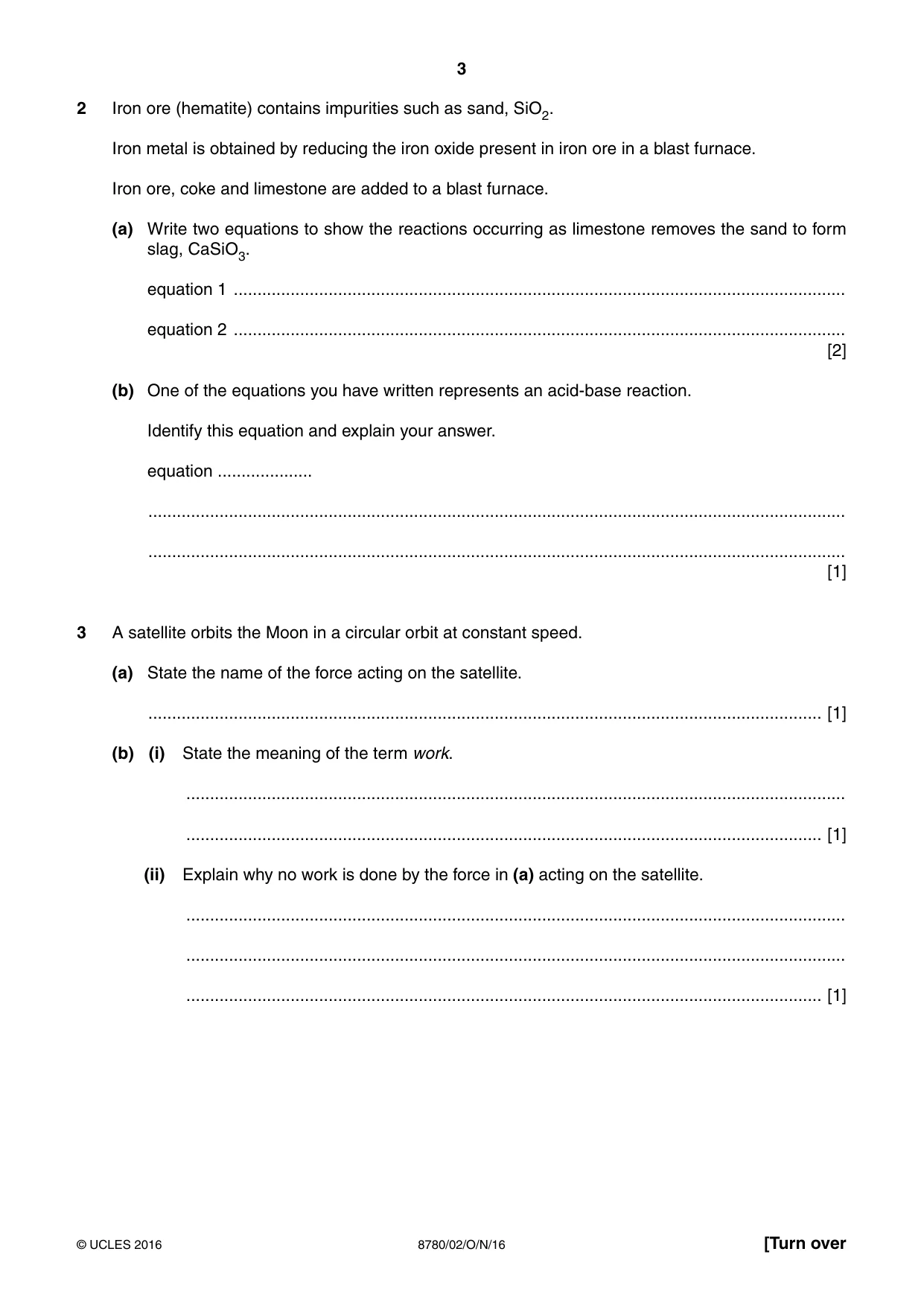
2 Iron ore (hematite) contains impurities such as sand, SiO2. Iron metal is obtained by reducing the iron oxide present in iron ore in a blast furnace. Iron ore, coke and limestone are added to a blast furnace. (a) Write two equations to show the reactions occurring as limestone removes the sand to form slag, CaSiO3. equation 1 ................................................................................................................................. equation 2 ................................................................................................................................. [2] (b) One of the equations you have written represents an acid-base reaction. Identify this equation and explain your answer. equation .................... ................................................................................................................................................... ................................................................................................................................................... [1]
Mark scheme: 2 (a) equation 1 CaCO3 → CaO + CO2 [1] equation 2 CaO + SiO2 → CaSiO3 [1] Answers in either order. (b) clearly explains that in their acid / base equation, SiO2 is (a non-metal, so is an) acidic (oxide) and CaO is (a metal oxide, so is) basic [1]
Q3 · A satellite orbits the Moon in a circular orbit at constant speed
3 A satellite orbits the Moon in a circular orbit at constant speed. (a) State the name of the force acting on the satellite. .............................................................................................................................................. [1] (b) (i) State the meaning of the term work. ........................................................................................................................................... ...................................................................................................................................... [1] (ii) Explain why no work is done by the force in (a) acting on the satellite. ........................................................................................................................................... ........................................................................................................................................... ...................................................................................................................................... [1]
Mark scheme: 3 (a) gravitational force / weight [1] (b) (i) work = force × displacement in the direction of the force [1] (ii) force is always at right angles to the velocity (of the satellite) OWTTE [1]
Q4 · Hydrochloric acid and sodium hydroxide solution react together in a neutralisation…
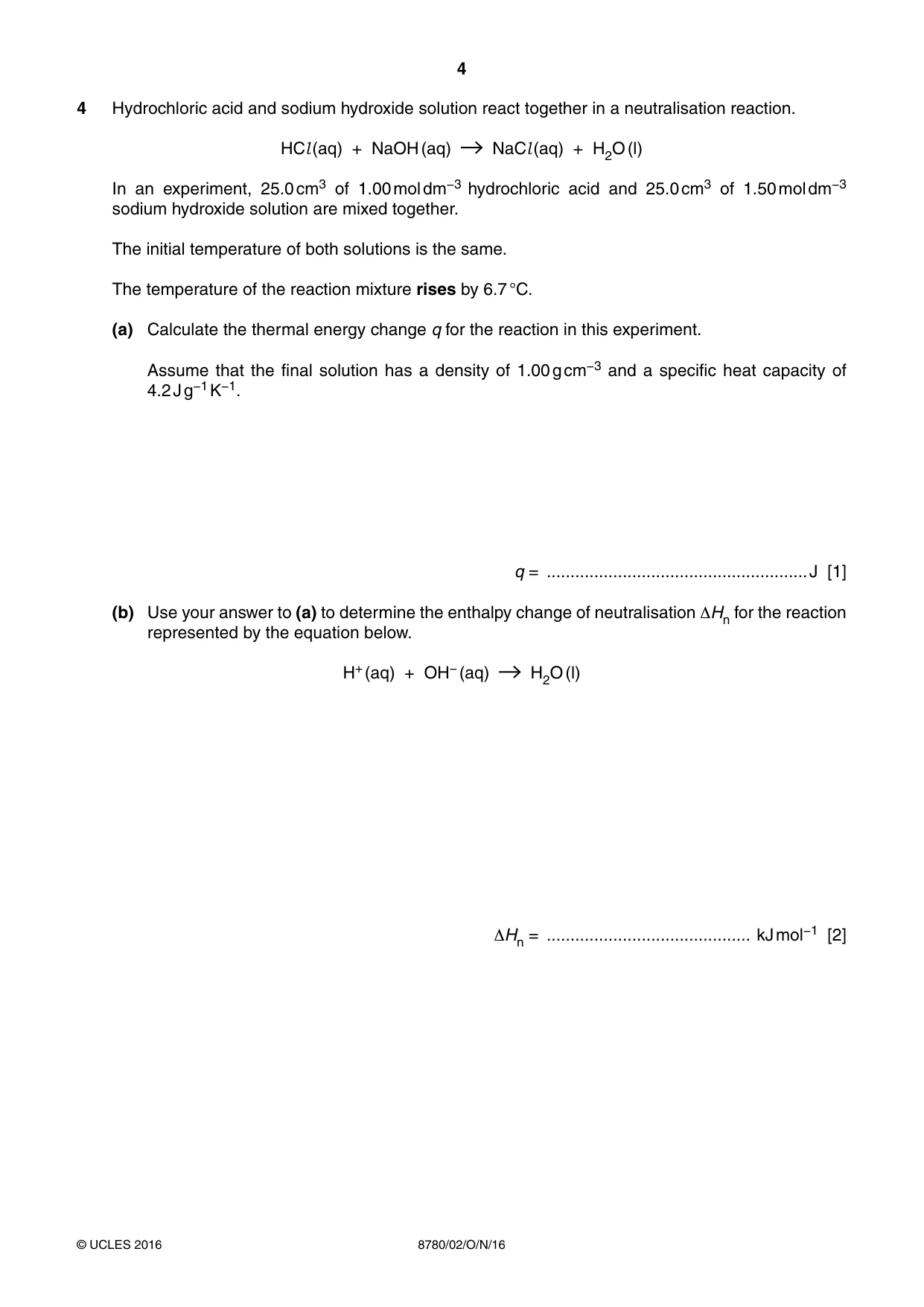
4 Hydrochloric acid and sodium hydroxide solution react together in a neutralisation reaction. HCl (aq) + NaOH (aq) NaCl (aq) + H2O (l) In an experiment, 25.0 cm3 of 1.00 mol dm−3 hydrochloric acid and 25.0 cm3 of 1.50 mol dm−3 sodium hydroxide solution are mixed together. The initial temperature of both solutions is the same. The temperature of the reaction mixture rises by 6.7 °C. (a) Calculate the thermal energy change q for the reaction in this experiment. Assume that the final solution has a density of 1.00 g cm−3 and a specific heat capacity of 4.2 J g−1 K−1. q = ....................................................... J [1] (b) Use your answer to (a) to determine the enthalpy change of neutralisation ΔHn for the reaction represented by the equation below. H+ (aq) + OH− (aq) H2O (l) ΔHn = ........................................... kJ mol−1 [2]
Mark scheme: 4 (a) q = 50.0 × 4.2 × 6.7 = 1407 (J) [1] (b) deduces limiting amount of acid to be 0.025 mol [1] ∆Hneutralisation = –1407 / .025 = (–)56.3 (kJ mol–1) [1]
Q5 · Define the term electric field strength
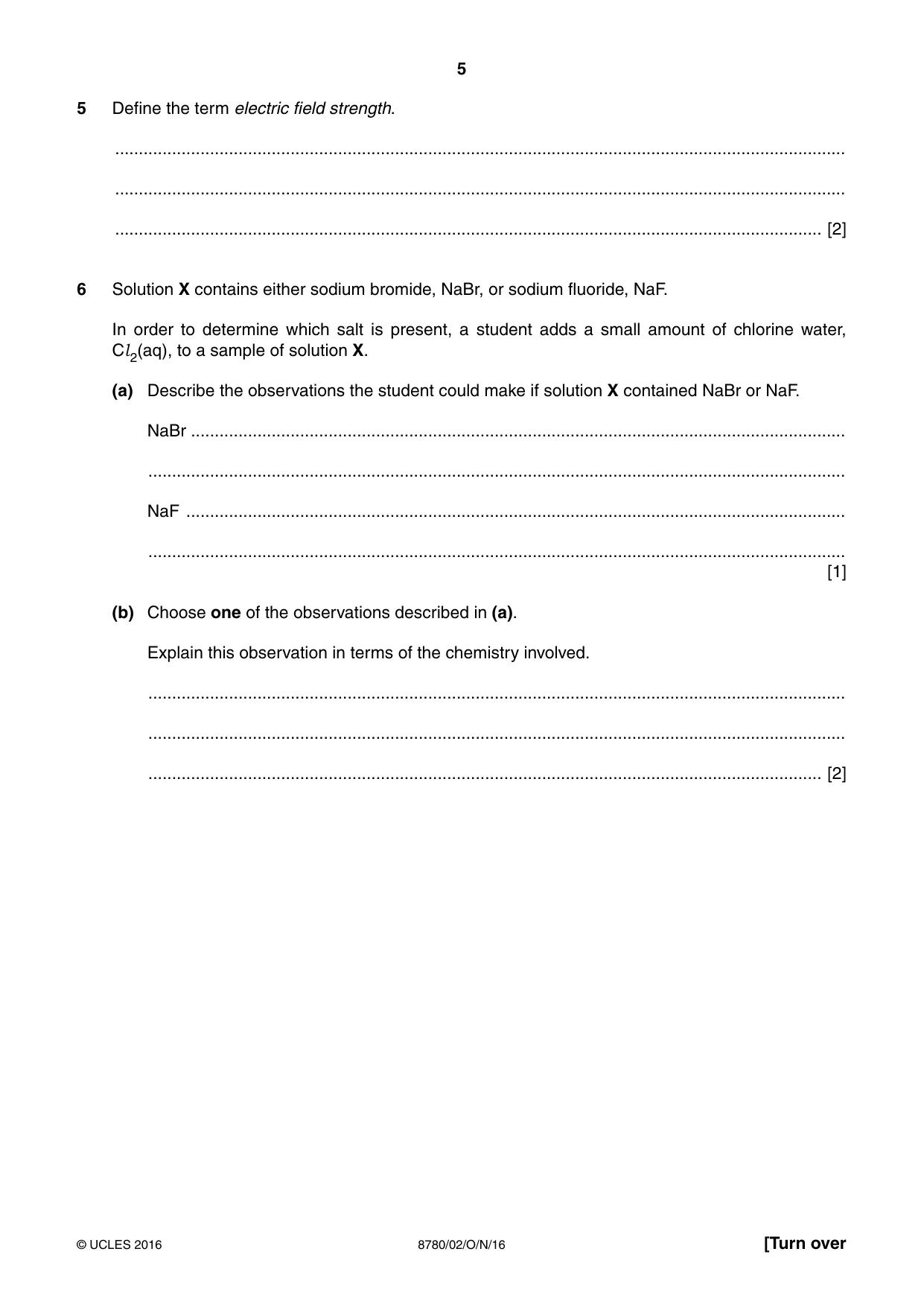
5 Define the term electric field strength. .......................................................................................................................................................... .......................................................................................................................................................... ..................................................................................................................................................... [2]
Mark scheme: 5 force per unit charge [1] positive / stationary (charge) [1]
Q6 · Solution X contains either sodium bromide, NaBr, or sodium fluoride, NaF
6 Solution X contains either sodium bromide, NaBr, or sodium fluoride, NaF. In order to determine which salt is present, a student adds a small amount of chlorine water, Cl2(aq), to a sample of solution X. (a) Describe the observations the student could make if solution X contained NaBr or NaF. NaBr .......................................................................................................................................... ................................................................................................................................................... NaF ........................................................................................................................................... ................................................................................................................................................... [1] (b) Choose one of the observations described in (a). Explain this observation in terms of the chemistry involved. ................................................................................................................................................... ................................................................................................................................................... .............................................................................................................................................. [2]
Mark scheme: 6 (a) NaBr solution turns red / orange / brown / yellow and NaF no change / stays colourless [1] (b) no reaction occurs with NaF [1] F2 > Cl2 as an oxidising agent [1] OR Br2 is formed from NaBr (1) Cl2 > Br2 as an oxidising agent (1)
Q7 · A non-uniform post of mass 175 kg and length 6.00 m
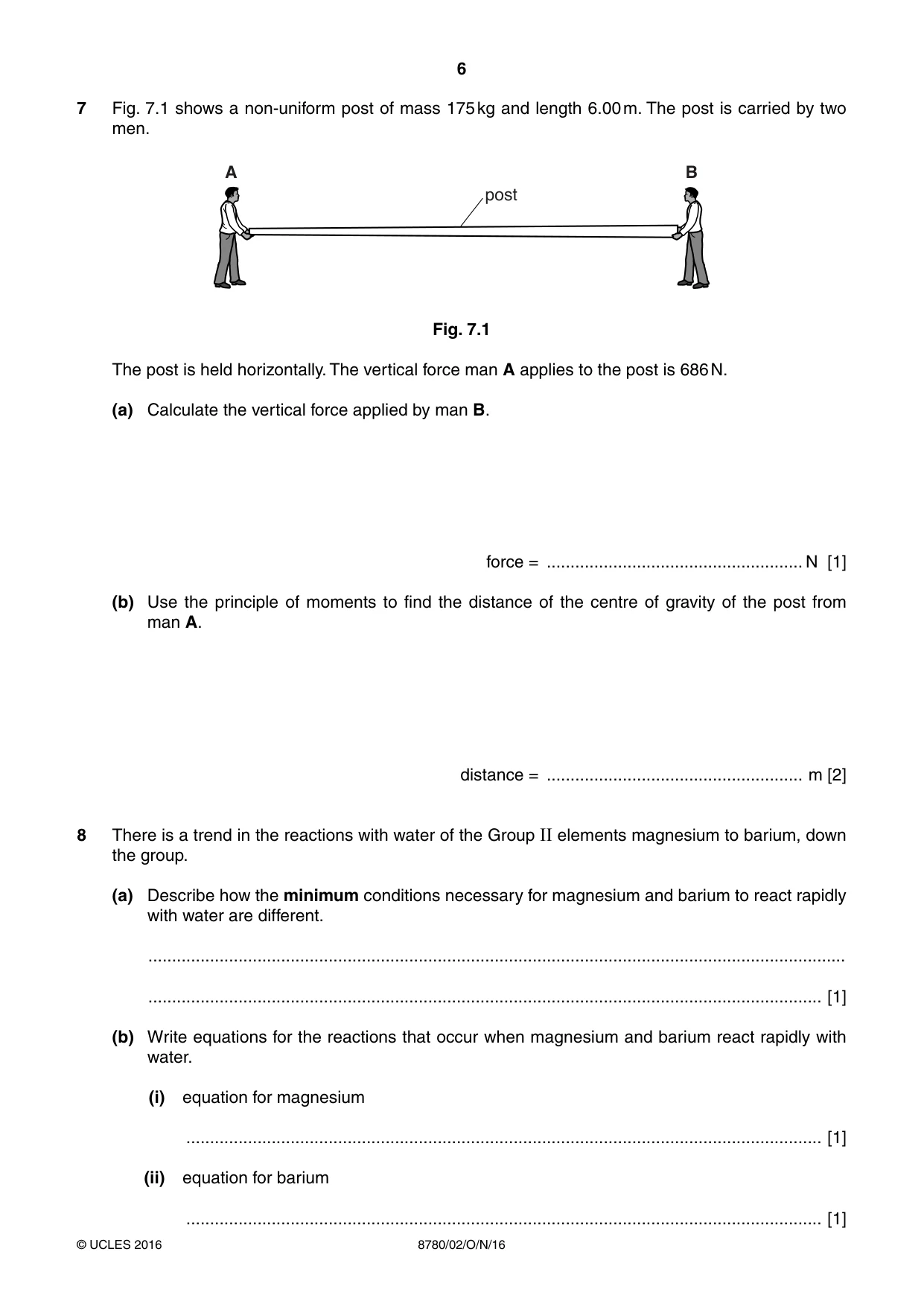
7 Fig. 7.1 shows a non-uniform post of mass 175 kg and length 6.00 m. The post is carried by two men. A B post Fig. 7.1 The post is held horizontally. The vertical force man A applies to the post is 686 N. (a) Calculate the vertical force applied by man B. force = ...................................................... N [1] (b) Use the principle of moments to find the distance of the centre of gravity of the post from man A. distance = ...................................................... m [2]
Mark scheme: 7 (a) load = (175 × 9.81) – 686 = 1030 (N) [1] (b) 686 × y = 1030 × (6.0 – y) [1] (distance) = 3.6 (m) [1]
Q8 · There is a trend in the reactions with water of the Group II elements magnesium to…
8 There is a trend in the reactions with water of the Group II elements magnesium to barium, down the group. (a) Describe how the minimum conditions necessary for magnesium and barium to react rapidly with water are different. ................................................................................................................................................... .............................................................................................................................................. [1] (b) Write equations for the reactions that occur when magnesium and barium react rapidly with water. (i) equation for magnesium ...................................................................................................................................... [1] (ii) equation for barium ...................................................................................................................................... [1]
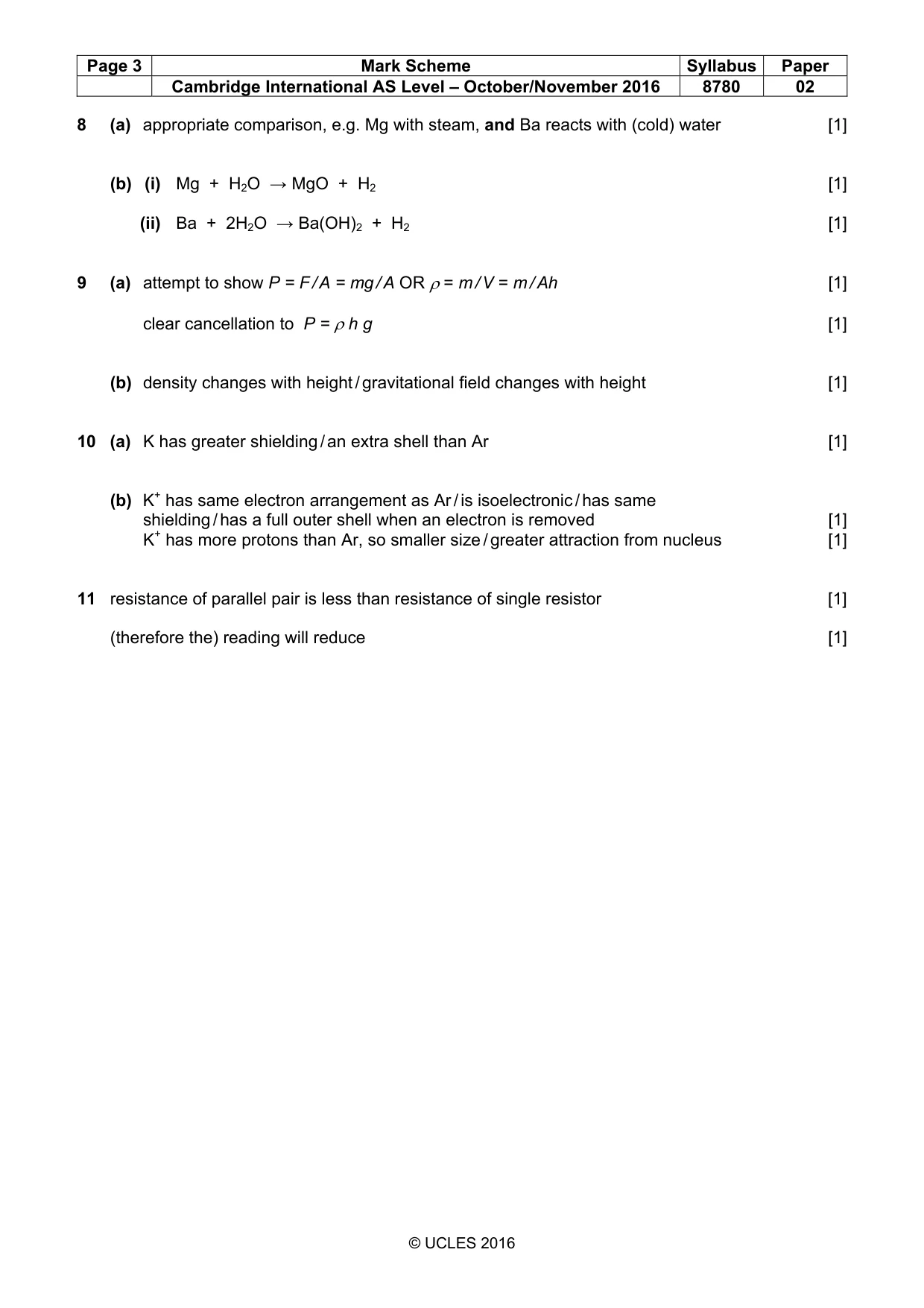
Mark scheme: 8 (a) appropriate comparison, e.g. Mg with steam, and Ba reacts with (cold) water [1] (b) (i) Mg + H2O → MgO + H2 [1] (ii) Ba + 2H2O → Ba(OH)2 + H2 [1]
Q9 · A liquid of density ρ in a container
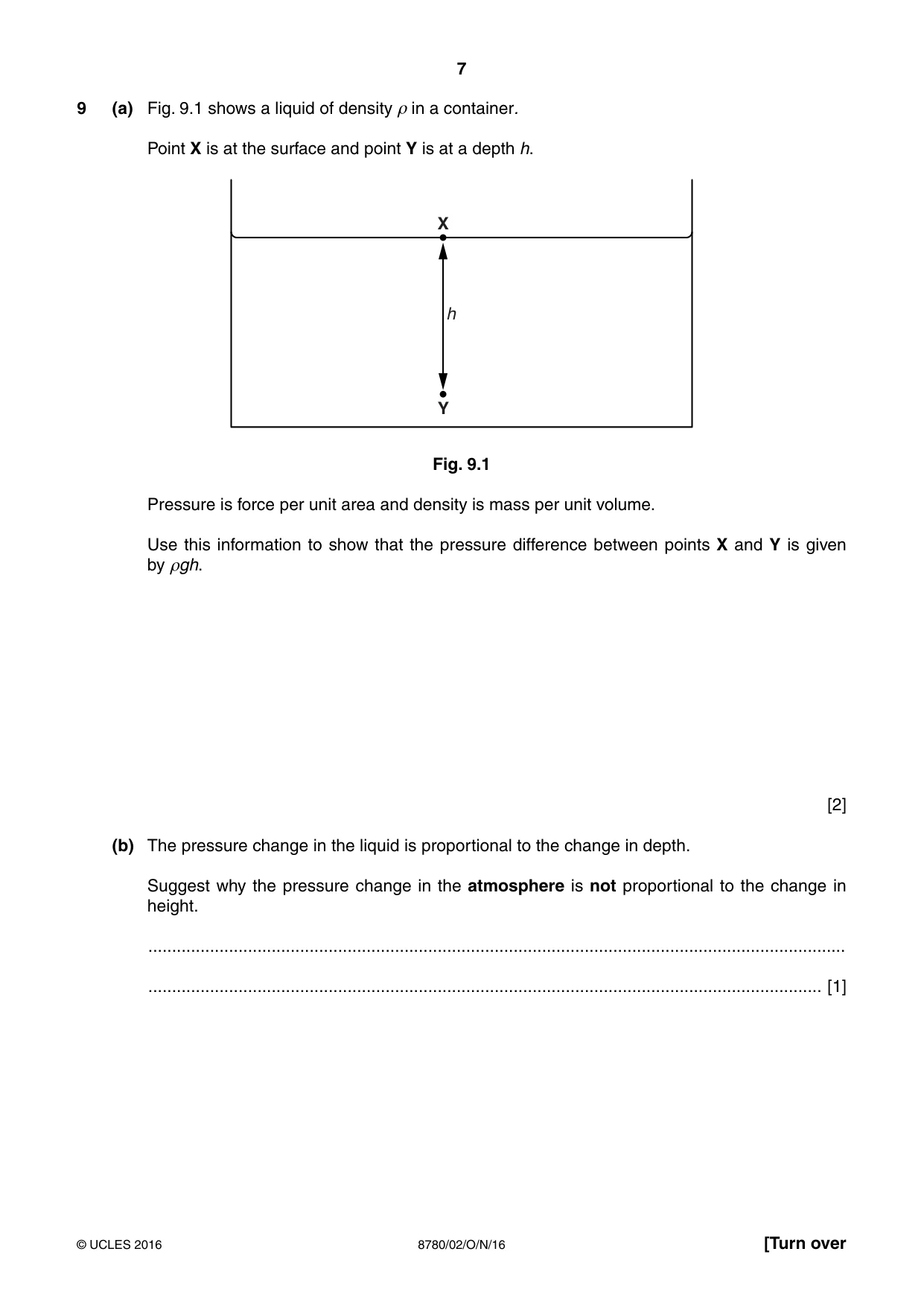
9 (a) Fig. 9.1 shows a liquid of density ρ in a container. Point X is at the surface and point Y is at a depth h. X h Y Fig. 9.1 Pressure is force per unit area and density is mass per unit volume. Use this information to show that the pressure difference between points X and Y is given by ρgh. [2] (b) The pressure change in the liquid is proportional to the change in depth. Suggest why the pressure change in the atmosphere is not proportional to the change in height. ................................................................................................................................................... .............................................................................................................................................. [1]
Mark scheme: 9 (a) attempt to show P = F / A = mg / A OR ρ= m / V = m / Ah [1] clear cancellation to P = ρh g [1] (b) density changes with height / gravitational field changes with height [1]
Q10 · Explain why the first ionisation energy of argon, Ar, is higher than the first ionisation…
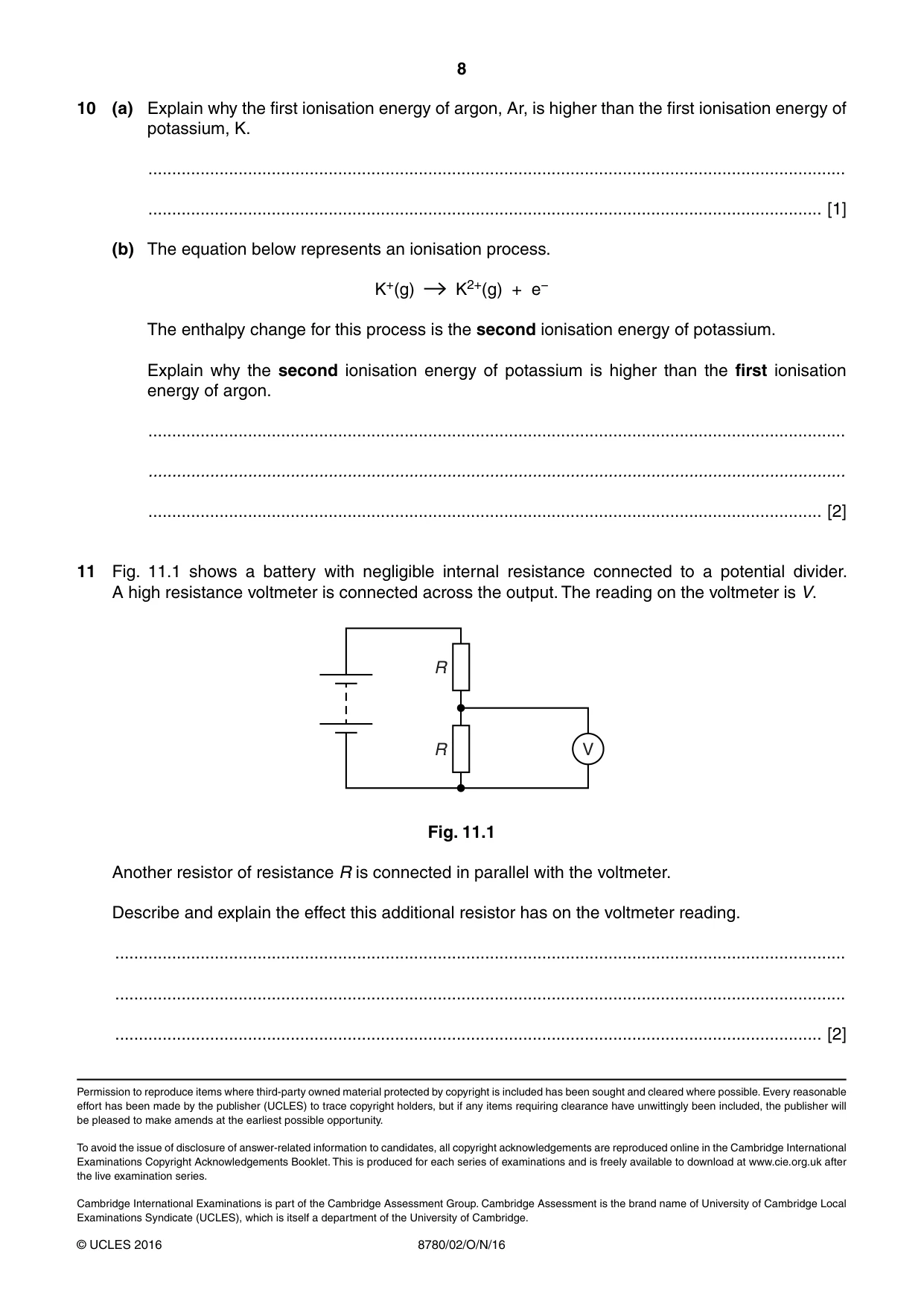
10 (a) Explain why the first ionisation energy of argon, Ar, is higher than the first ionisation energy of potassium, K. ................................................................................................................................................... .............................................................................................................................................. [1] (b) The equation below represents an ionisation process. K+(g) K2+(g) + e− The enthalpy change for this process is the second ionisation energy of potassium. Explain why the second ionisation energy of potassium is higher than the first ionisation energy of argon. ................................................................................................................................................... ................................................................................................................................................... .............................................................................................................................................. [2]
Mark scheme: 10 (a) K has greater shielding / an extra shell than Ar [1] (b) K+ has same electron arrangement as Ar / is isoelectronic / has same shielding / has a full outer shell when an electron is removed [1] K+ has more protons than Ar, so smaller size / greater attraction from nucleus [1]
Q11 · A battery with negligible internal resistance connected to a potential divider
11 Fig. 11.1 shows a battery with negligible internal resistance connected to a potential divider. A high resistance voltmeter is connected across the output. The reading on the voltmeter is V. 5 5 V Fig. 11.1 Another resistor of resistance R is connected in parallel with the voltmeter. Describe and explain the effect this additional resistor has on the voltmeter reading. .......................................................................................................................................................... .......................................................................................................................................................... ..................................................................................................................................................... [2]
Mark scheme: 11 resistance of parallel pair is less than resistance of single resistor [1] (therefore the) reading will reduce [1]
What you needed in this session
Cambridge’s own grade thresholds for 2016 Oct/Nov, Paper 2 · Variant 1. A higher threshold means an easier paper — the bar moves with how the cohort did.