Cambridge A Level Physical Education 9396 — 2018 Oct/Nov Paper 3 · Variant 2
9396/32/O/N/18 · 3 questions · 90 marks · ≈101 min
The question paper and its mark scheme, free to read here and free to download. This is Cambridge’s own paper, exactly as it was sat.
Question paper4 pages
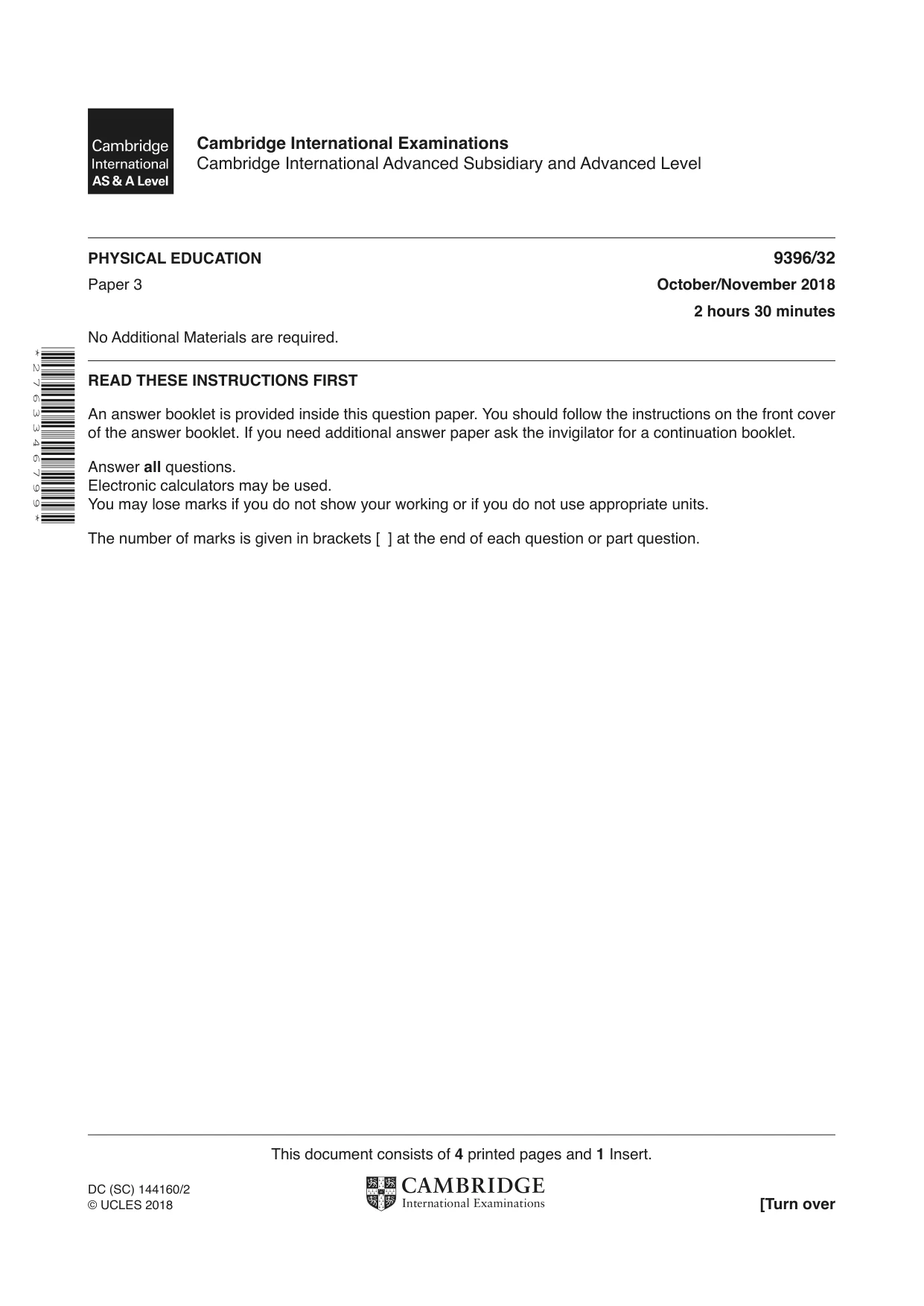
Mark scheme10 pages
Answers below. Sit the paper first if you are practising.
Questions as text
Q1 · The body requires energy for physical activity and power is important in many sports
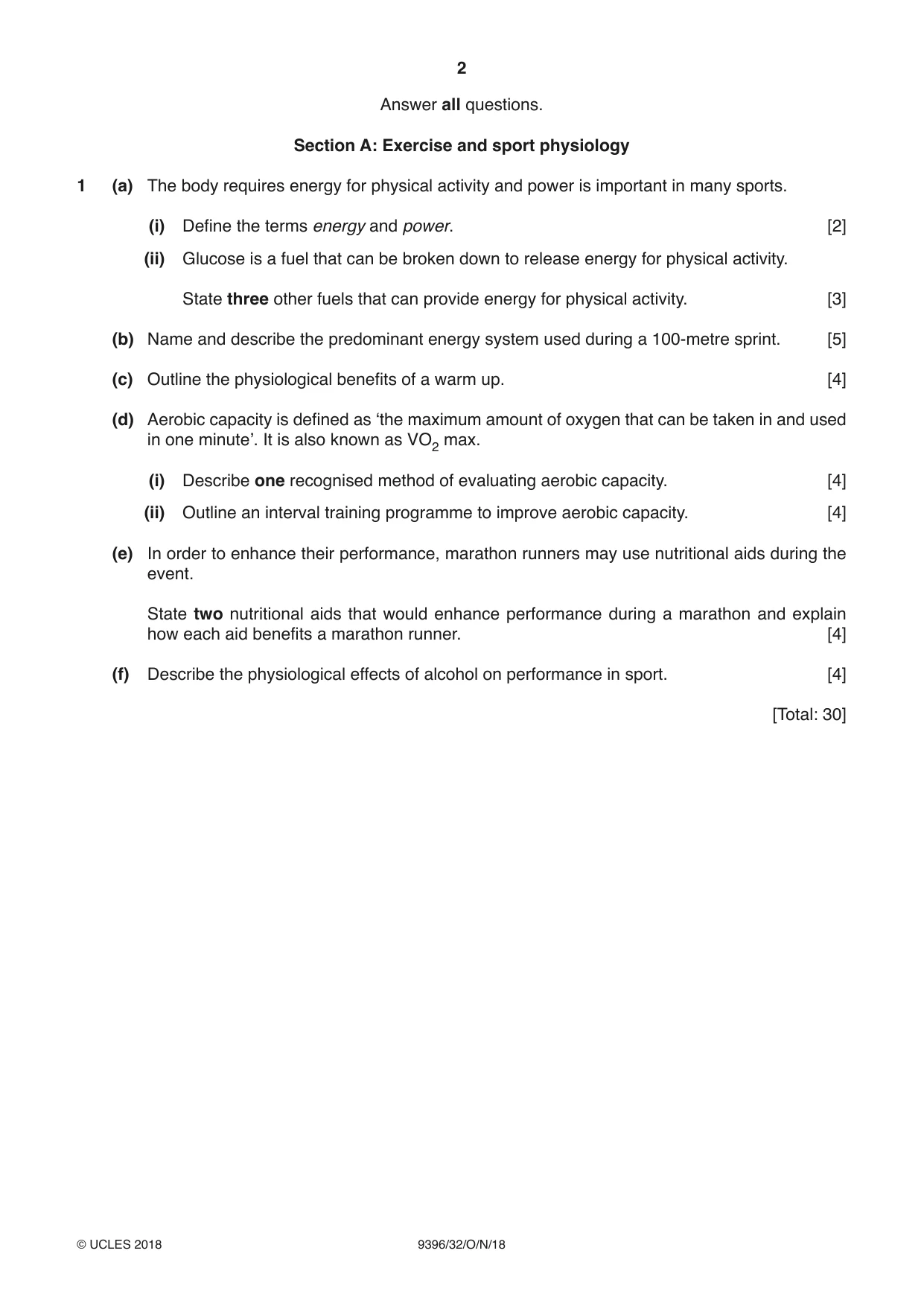
1 (a) The body requires energy for physical activity and power is important in many sports. (i) Define the terms energy and power. [2] (ii) Glucose is a fuel that can be broken down to release energy for physical activity. State three other fuels that can provide energy for physical activity. [3] (b) Name and describe the predominant energy system used during a 100-metre sprint. [5] (c) Outline the physiological benefits of a warm up. [4] (d) Aerobic capacity is defined as ‘the maximum amount of oxygen that can be taken in and used in one minute’. It is also known as VO2 max. (i) Describe one recognised method of evaluating aerobic capacity. [4] (ii) Outline an interval training programme to improve aerobic capacity. [4] (e) In order to enhance their performance, marathon runners may use nutritional aids during the event. State two nutritional aids that would enhance performance during a marathon and explain how each aid benefits a marathon runner. [4] (f) Describe the physiological effects of alcohol on performance in sport. [4] [Total: 30]
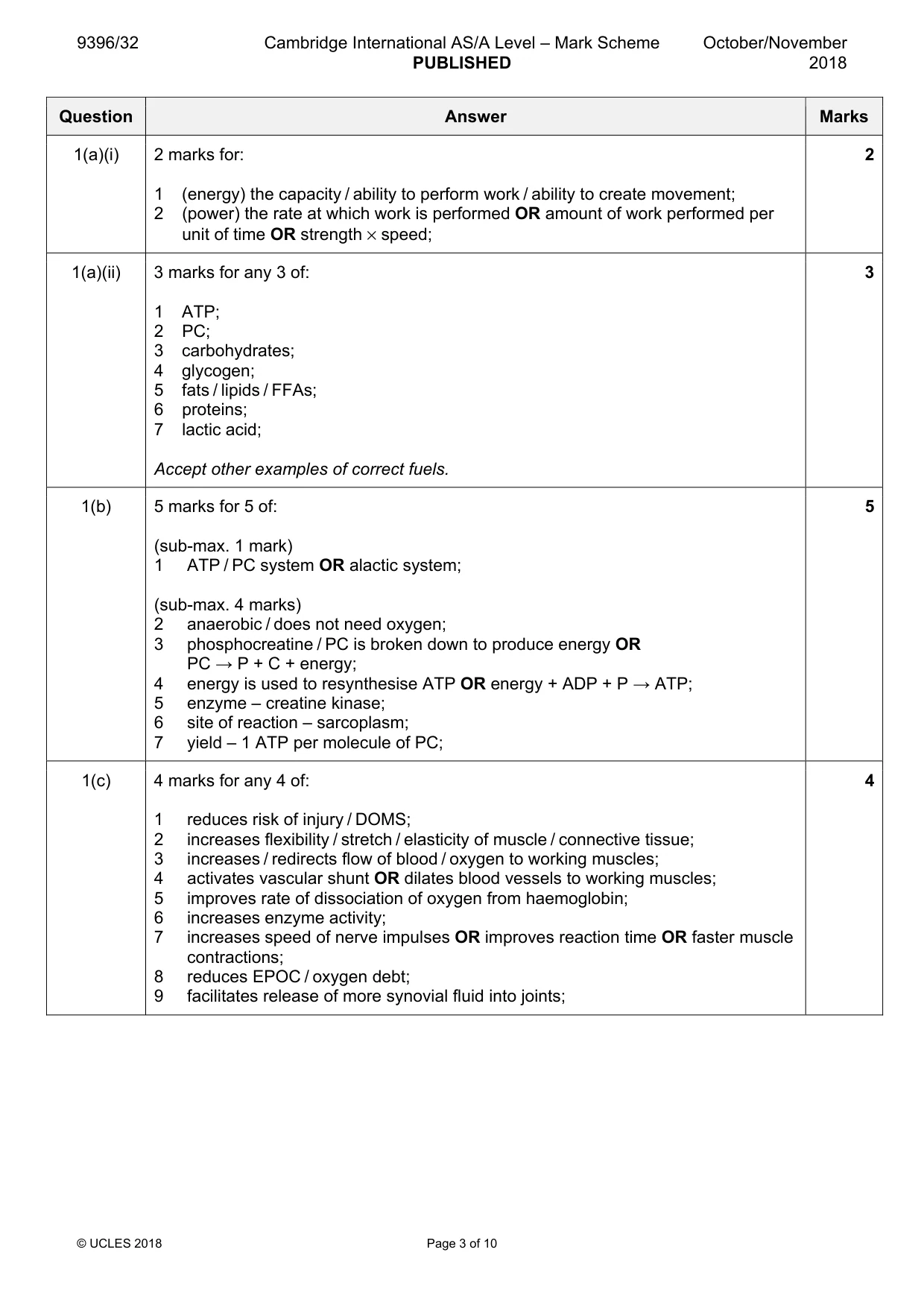
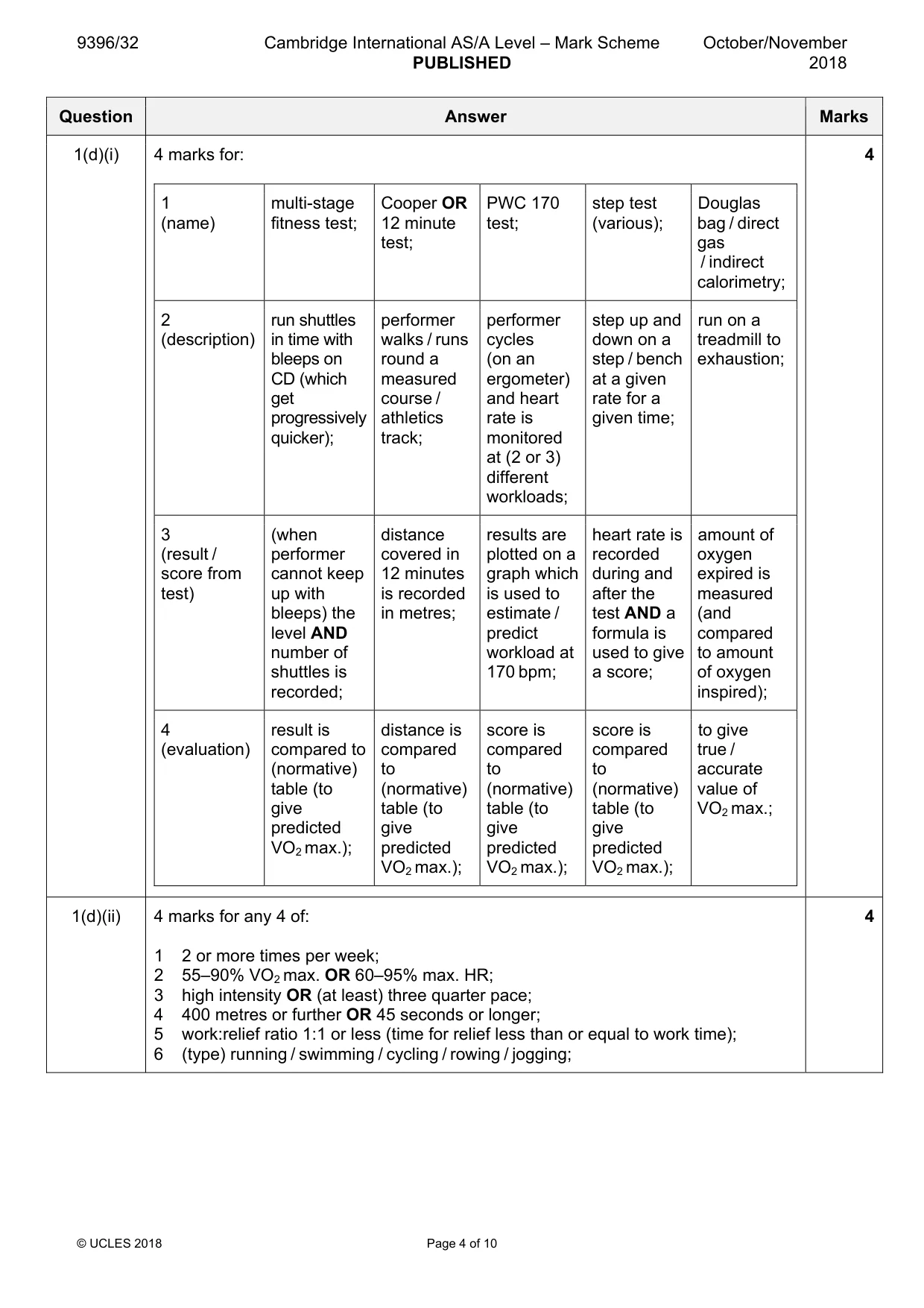
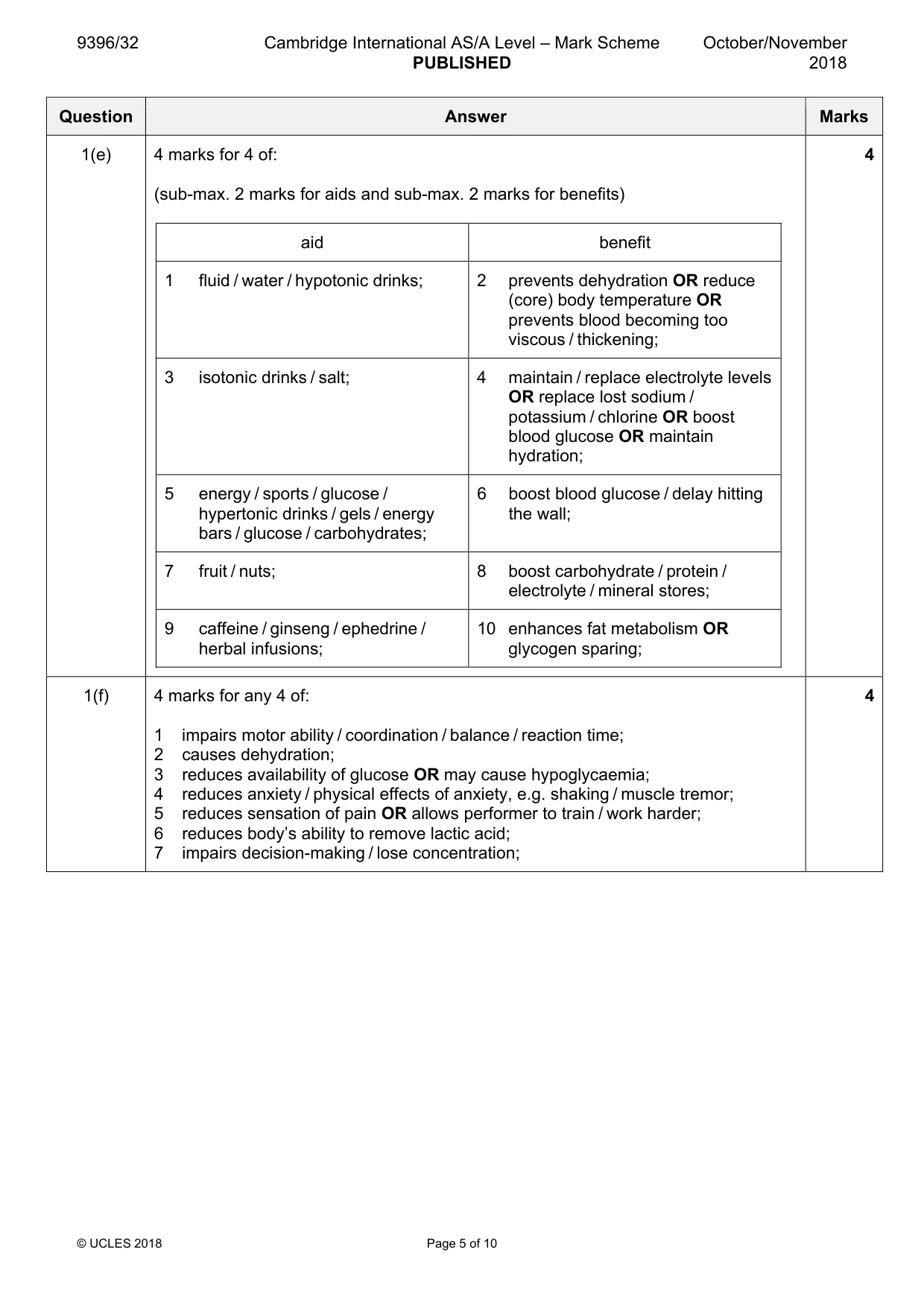
Mark scheme: Question Answer Marks 1(a)(i) 2 marks for: 2 1 (energy) the capacity / ability to perform work / ability to create movement; 2 (power) the rate at which work is performed OR amount of work performed per unit of time OR strength × speed; 1(a)(ii) 3 marks for any 3 of: 3 1 ATP; 2 PC; 3 carbohydrates; 4 glycogen; 5 fats / lipids / FFAs; 6 proteins; 7 lactic acid; Accept other examples of correct fuels. 1(b) 5 marks for 5 of: 5 (sub-max. 1 mark) 1 ATP / PC system OR alactic system; (sub-max. 4 marks) 2 anaerobic / does not need oxygen; 3 phosphocreatine / PC is broken down to produce energy OR PC → P + C + energy; 4 energy is used to resynthesise ATP OR energy + ADP + P → ATP; 5 enzyme – creatine kinase; 6 site of reaction – sarcoplasm; 7 yield – 1 ATP per molecule of PC; 1(c) 4 marks for any 4 of: 4 1 reduces risk of injury / DOMS; 2 increases flexibility / stretch / elasticity of muscle / connective tissue; 3 increases / redirects flow of blood / oxygen to working muscles; 4 activates vascular shunt OR dilates blood vessels to working muscles; 5 improves rate of dissociation of oxygen from haemoglobin; 6 increases enzyme activity; 7 increases speed of nerve impulses OR improves reaction time OR faster muscle contractions; 8 reduces EPOC / oxygen debt; 9 facilitates release of more synovial fluid into joints; 1(d)(i) 4 marks for: 4 1 multi-stage Cooper OR PWC 170 step test Douglas (name) fitness test; 12 minute test; (various); bag / direct test; gas / indirect calorimetry; 2 run shuttles performer performer step up and run on a (description) in time with walks / runs cycles down on a treadmill to bleeps on round a (on an step / bench exhaustion; CD (which measured ergometer) at a given get course / and heart rate for a progressively athletics rate is given time; quicker); track; monitored at (2 or 3) different workloads; 3 (when distance results are heart rate is amount of (result / performer covered in plotted on a recorded oxygen score from cannot keep 12 minutes graph which during and expired is test) up with is recorded is used to after the measured bleeps) the in metres; estimate / test AND a (and level AND predict formula is compared number of workload at used to give to amount shuttles is 170 bpm; a score; of oxygen recorded; inspired); 4 result is distance is score is score is to give (evaluation) compared to compared compared compared true / (normative) to to to accurate table (to (normative) (normative) (normative) value of give table (to table (to table (to VO2 max.; predicted give give give VO2 max.); predicted predicted predicted VO2 max.); VO2 max.); VO2 max.); 1(d)(ii) 4 marks for any 4 of: 4 1 2 or more times per week; 2 55–90% VO2 max. OR 60–95% max. HR; 3 high intensity OR (at least) three quarter pace; 4 400 metres or further OR 45 seconds or longer; 5 work:relief ratio 1:1 or less (time for relief less than or equal to work time); 6 (type) running / swimming / cycling / rowing / jogging; 1(e) 4 marks for 4 of: 4 (sub-max. 2 marks for aids and sub-max. 2 marks for benefits) aid benefit 1 fluid / water / hypotonic drinks; 2 prevents dehydration OR reduce (core) body temperature OR prevents blood becoming too viscous / thickening; 3 isotonic drinks / salt; 4 maintain / replace electrolyte levels OR replace lost sodium / potassium / chlorine OR boost blood glucose OR maintain hydration; 5 energy / sports / glucose / 6 boost blood glucose / delay hitting hypertonic drinks / gels / energy the wall; bars / glucose / carbohydrates; 7 fruit / nuts; 8 boost carbohydrate / protein / electrolyte / mineral stores; 9 caffeine / ginseng / ephedrine / 10 enhances fat metabolism OR herbal infusions; glycogen sparing; 1(f) 4 marks for any 4 of: 4 1 impairs motor ability / coordination / balance / reaction time; 2 causes dehydration; 3 reduces availability of glucose OR may cause hypoglycaemia; 4 reduces anxiety / physical effects of anxiety, e.g. shaking / muscle tremor; 5 reduces sensation of pain OR allows performer to train / work harder; 6 reduces body’s ability to remove lactic acid; 7 impairs decision-making / lose concentration;
Q2 · Goals are set in sport to improve performance
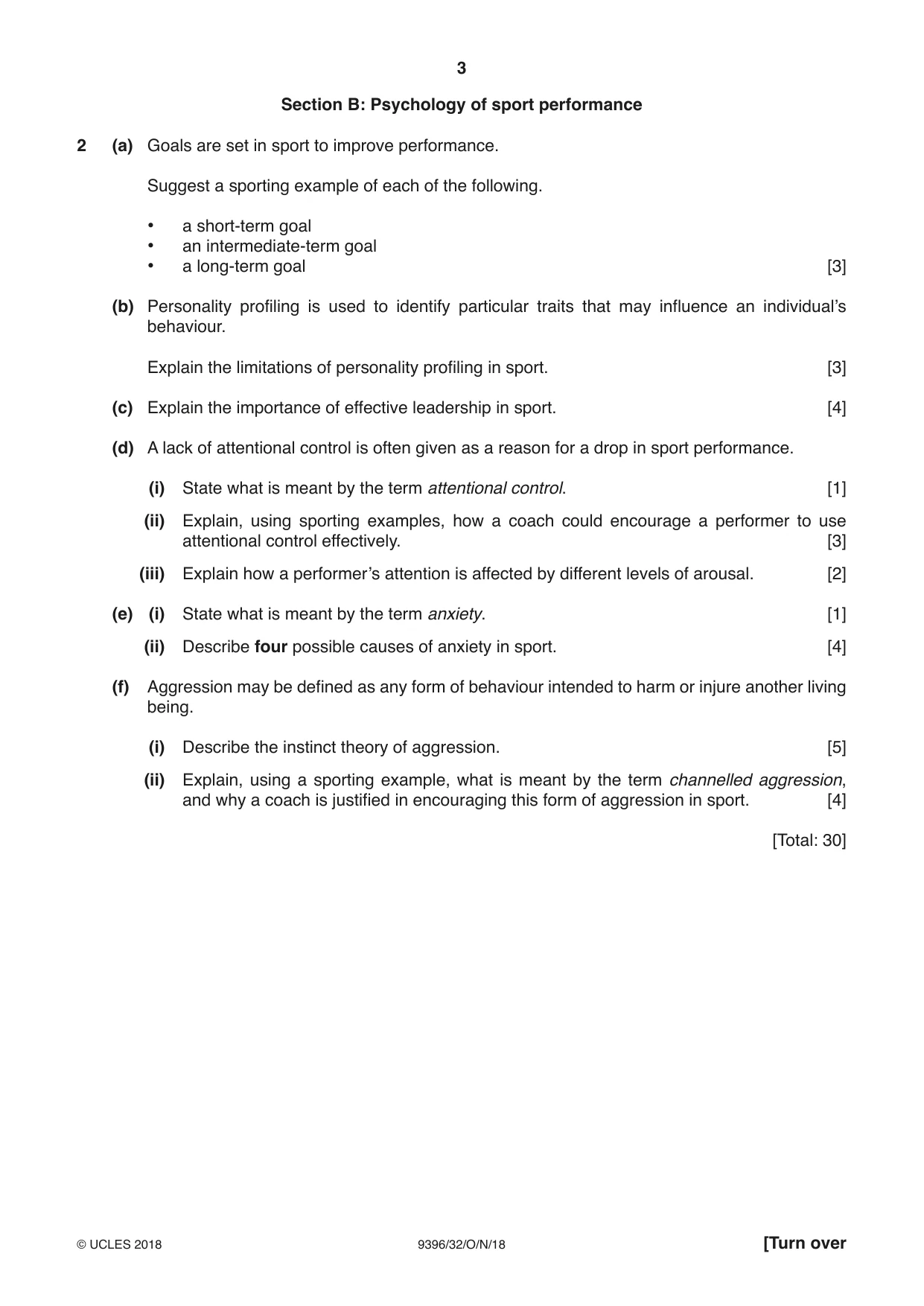
2 (a) Goals are set in sport to improve performance. Suggest a sporting example of each of the following. • a short-term goal • an intermediate-term goal • a long-term goal [3] (b) Personality profiling is used to identify particular traits that may influence an individual’s behaviour. Explain the limitations of personality profiling in sport. [3] (c) Explain the importance of effective leadership in sport. [4] (d) A lack of attentional control is often given as a reason for a drop in sport performance. (i) State what is meant by the term attentional control. [1] (ii) Explain, using sporting examples, how a coach could encourage a performer to use attentional control effectively. [3] (iii) Explain how a performer’s attention is affected by different levels of arousal. [2] (e) (i) State what is meant by the term anxiety. [1] (ii) Describe four possible causes of anxiety in sport. [4] (f) Aggression may be defined as any form of behaviour intended to harm or injure another living being. (i) Describe the instinct theory of aggression. [5] (ii) Explain, using a sporting example, what is meant by the term channelled aggression, and why a coach is justified in encouraging this form of aggression in sport. [4] [Total: 30] Section C: Olympic Games: a global perspective
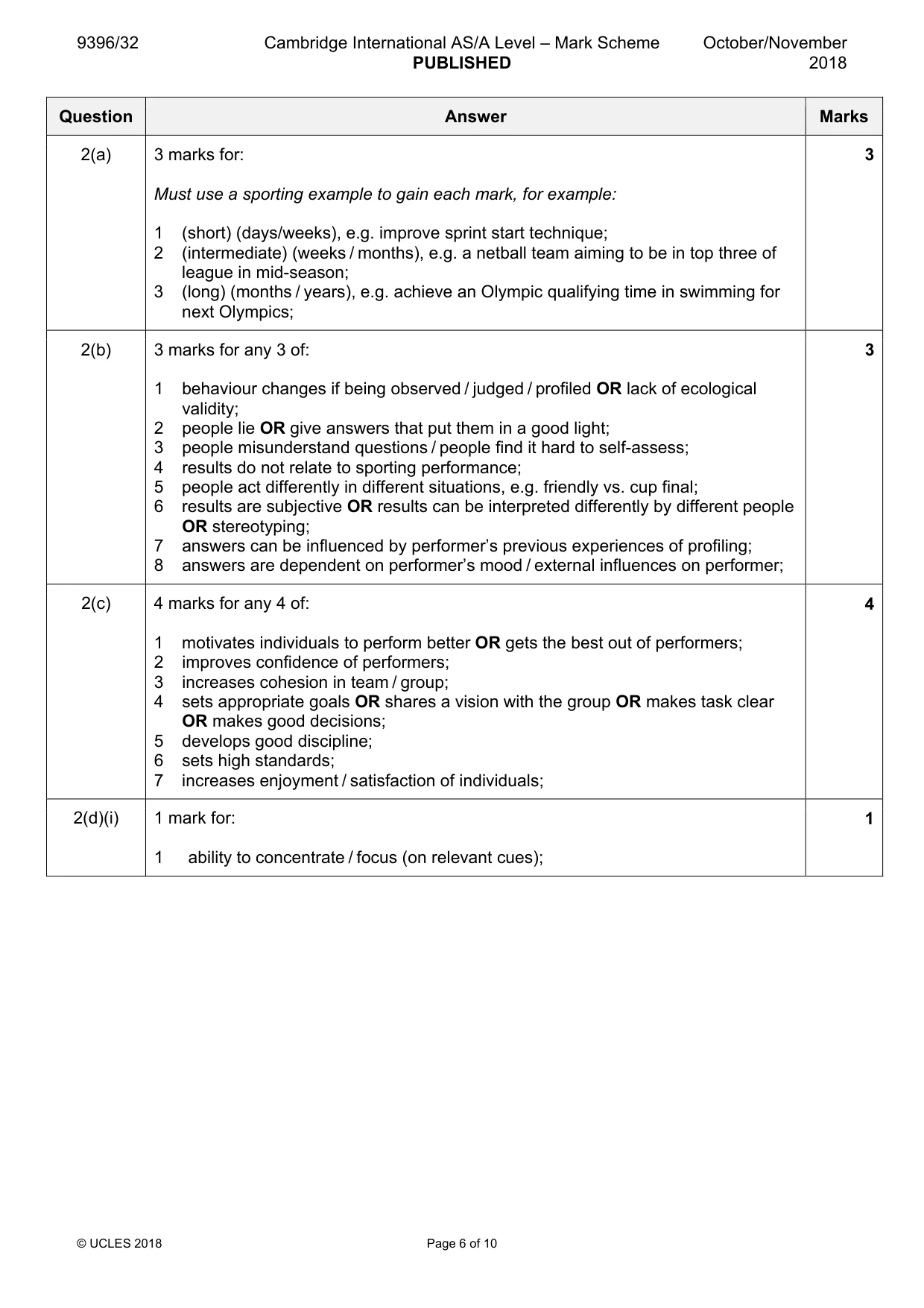
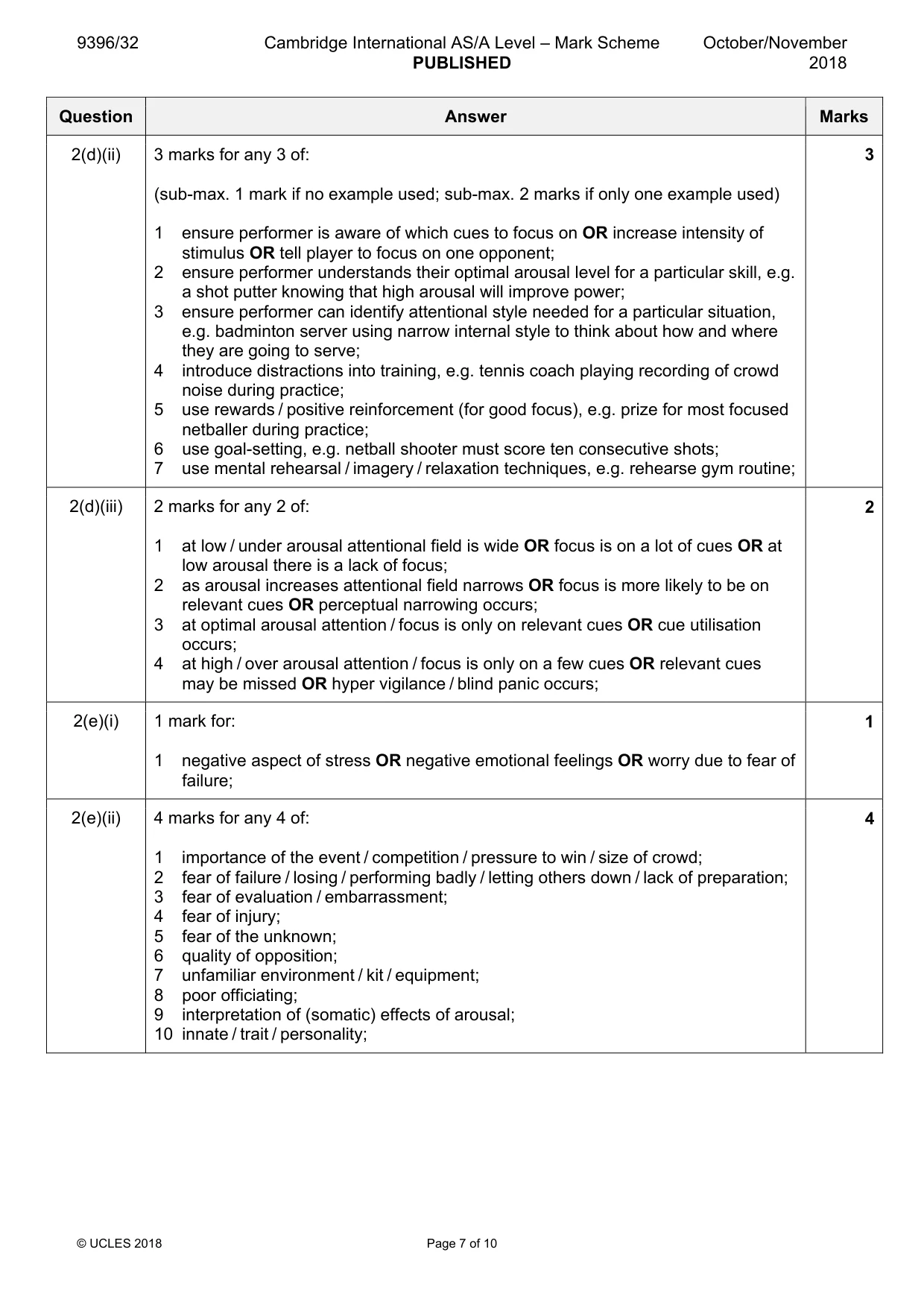
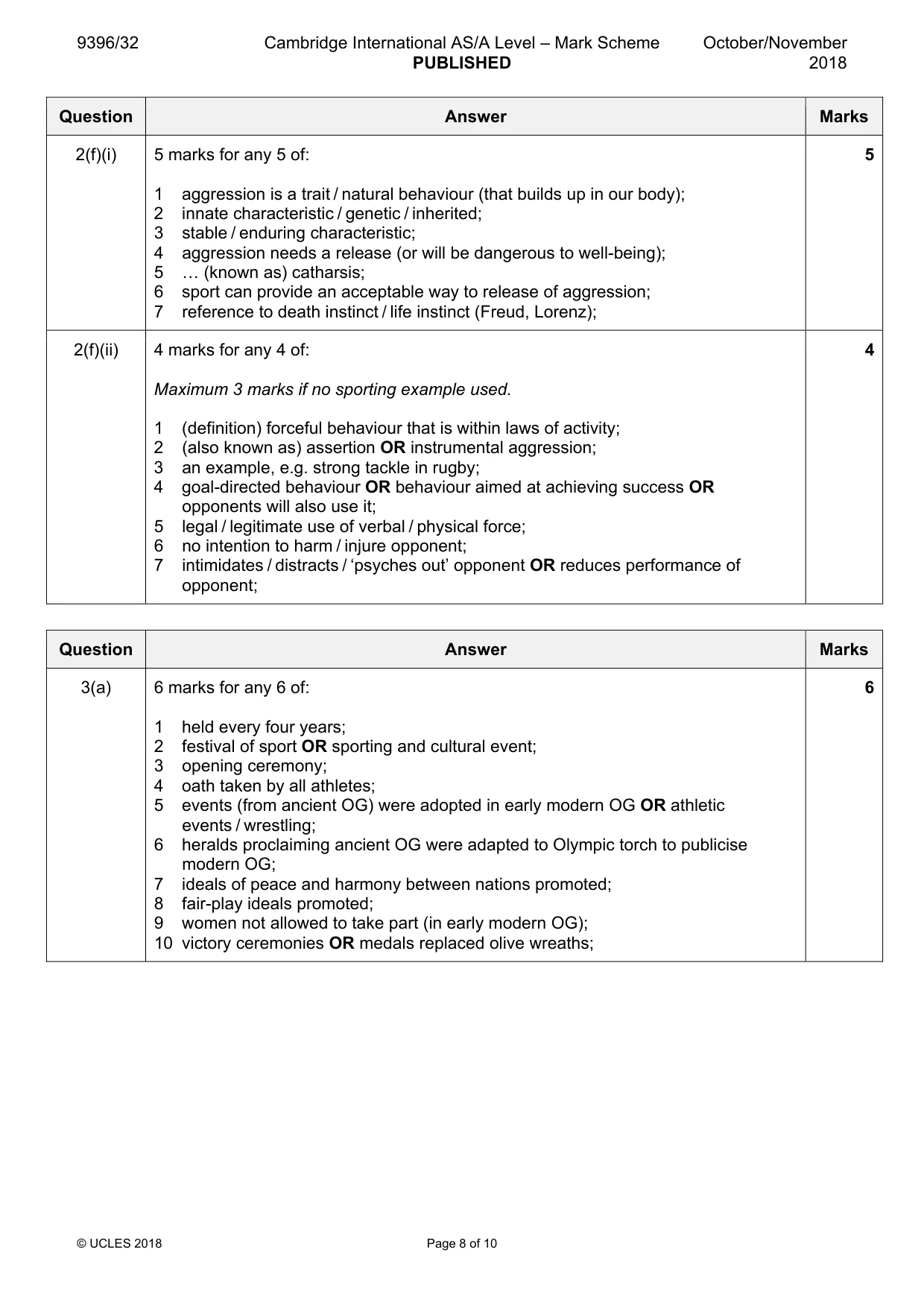
Mark scheme: 2(a) 3 marks for: 3 Must use a sporting example to gain each mark, for example: 1 (short) (days/weeks), e.g. improve sprint start technique; 2 (intermediate) (weeks / months), e.g. a netball team aiming to be in top three of league in mid-season; 3 (long) (months / years), e.g. achieve an Olympic qualifying time in swimming for next Olympics; 2(b) 3 marks for any 3 of: 3 1 behaviour changes if being observed / judged / profiled OR lack of ecological validity; 2 people lie OR give answers that put them in a good light; 3 people misunderstand questions / people find it hard to self-assess; 4 results do not relate to sporting performance; 5 people act differently in different situations, e.g. friendly vs. cup final; 6 results are subjective OR results can be interpreted differently by different people OR stereotyping; 7 answers can be influenced by performer’s previous experiences of profiling; 8 answers are dependent on performer’s mood / external influences on performer; 2(c) 4 marks for any 4 of: 4 1 motivates individuals to perform better OR gets the best out of performers; 2 improves confidence of performers; 3 increases cohesion in team / group; 4 sets appropriate goals OR shares a vision with the group OR makes task clear OR makes good decisions; 5 develops good discipline; 6 sets high standards; 7 increases enjoyment / satisfaction of individuals; 2(d)(i) 1 mark for: 1 1 ability to concentrate / focus (on relevant cues); 2(d)(ii) 3 marks for any 3 of: 3 (sub-max. 1 mark if no example used; sub-max. 2 marks if only one example used) 1 ensure performer is aware of which cues to focus on OR increase intensity of stimulus OR tell player to focus on one opponent; 2 ensure performer understands their optimal arousal level for a particular skill, e.g. a shot putter knowing that high arousal will improve power; 3 ensure performer can identify attentional style needed for a particular situation, e.g. badminton server using narrow internal style to think about how and where they are going to serve; 4 introduce distractions into training, e.g. tennis coach playing recording of crowd noise during practice; 5 use rewards / positive reinforcement (for good focus), e.g. prize for most focused netballer during practice; 6 use goal-setting, e.g. netball shooter must score ten consecutive shots; 7 use mental rehearsal / imagery / relaxation techniques, e.g. rehearse gym routine; 2(d)(iii) 2 marks for any 2 of: 2 1 at low / under arousal attentional field is wide OR focus is on a lot of cues OR at low arousal there is a lack of focus; 2 as arousal increases attentional field narrows OR focus is more likely to be on relevant cues OR perceptual narrowing occurs; 3 at optimal arousal attention / focus is only on relevant cues OR cue utilisation occurs; 4 at high / over arousal attention / focus is only on a few cues OR relevant cues may be missed OR hyper vigilance / blind panic occurs; 2(e)(i) 1 mark for: 1 1 negative aspect of stress OR negative emotional feelings OR worry due to fear of failure; 2(e)(ii) 4 marks for any 4 of: 4 1 importance of the event / competition / pressure to win / size of crowd; 2 fear of failure / losing / performing badly / letting others down / lack of preparation; 3 fear of evaluation / embarrassment; 4 fear of injury; 5 fear of the unknown; 6 quality of opposition; 7 unfamiliar environment / kit / equipment; 8 poor officiating; 9 interpretation of (somatic) effects of arousal; 10 innate / trait / personality; 2(f)(i) 5 marks for any 5 of: 5 1 aggression is a trait / natural behaviour (that builds up in our body); 2 innate characteristic / genetic / inherited; 3 stable / enduring characteristic; 4 aggression needs a release (or will be dangerous to well-being); 5 « (known as) catharsis; 6 sport can provide an acceptable way to release of aggression; 7 reference to death instinct / life instinct (Freud, Lorenz); 2(f)(ii) 4 marks for any 4 of: 4 Maximum 3 marks if no sporting example used. 1 (definition) forceful behaviour that is within laws of activity; 2 (also known as) assertion OR instrumental aggression; 3 an example, e.g. strong tackle in rugby; 4 goal-directed behaviour OR behaviour aimed at achieving success OR opponents will also use it; 5 legal / legitimate use of verbal / physical force; 6 no intention to harm / injure opponent; 7 intimidates / distracts / ‘psyches out’ opponent OR reduces performance of opponent;
Q3 · Describe how the Ancient Olympic Games were used as a blueprint for the Modern Olympic…
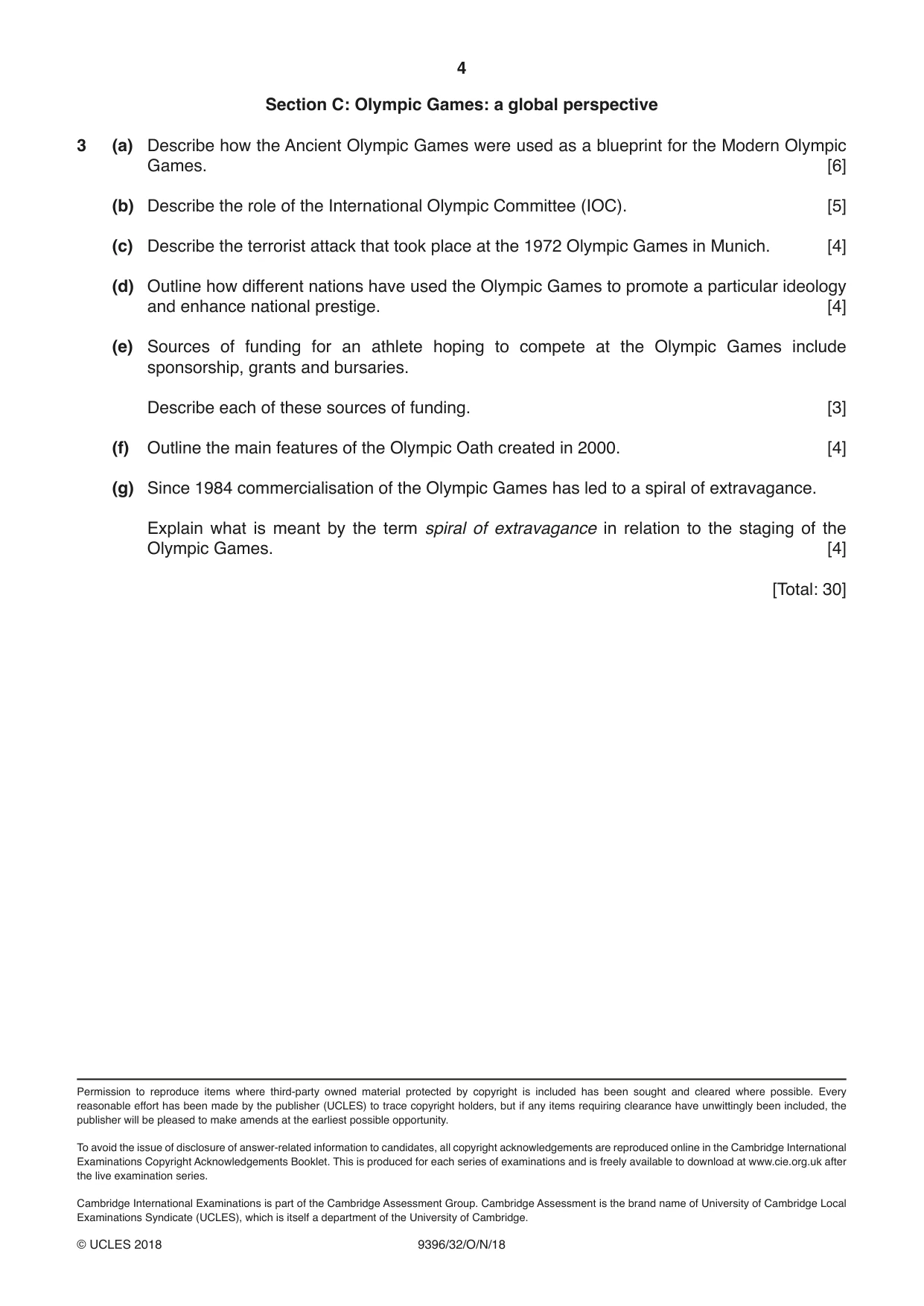
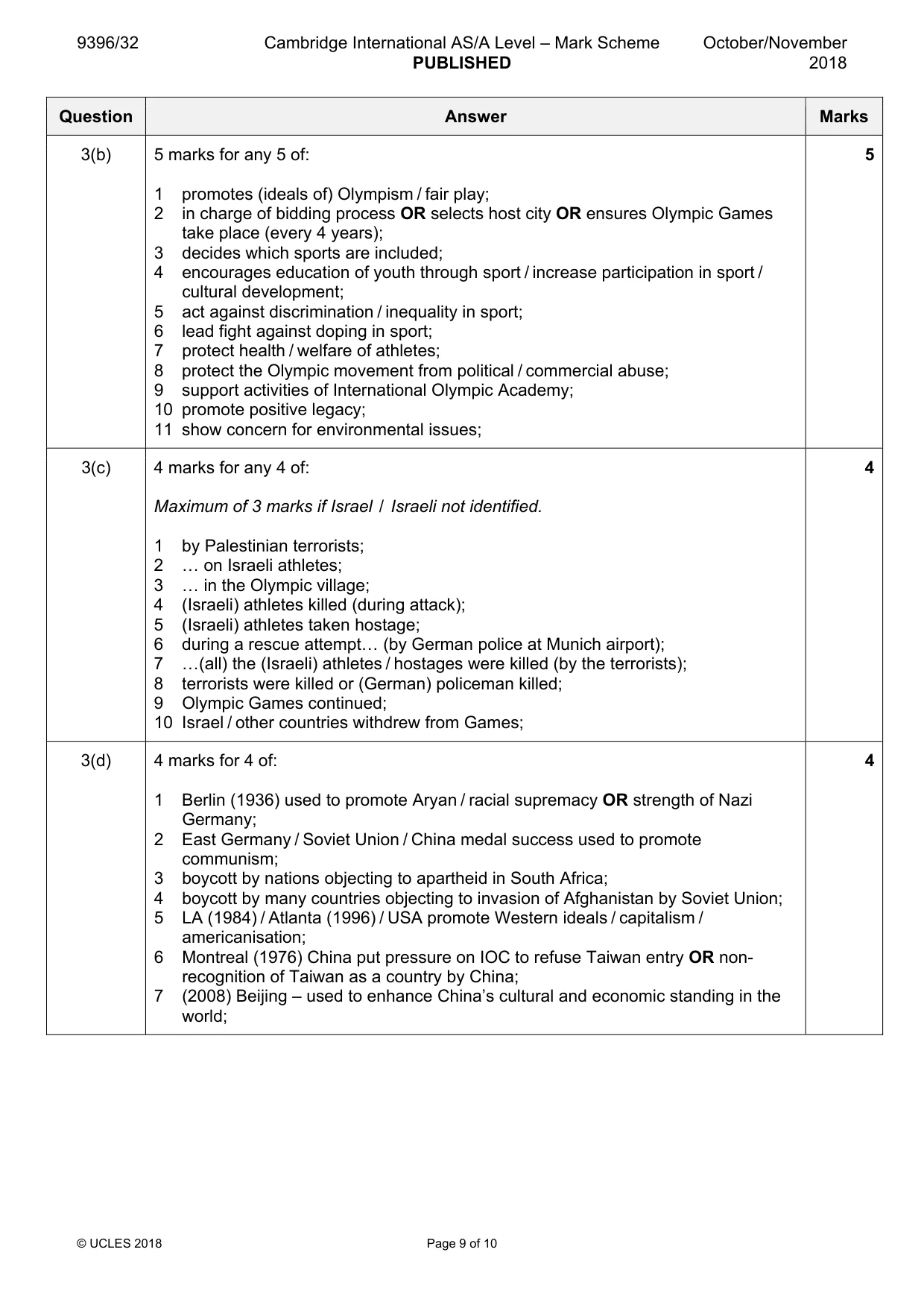
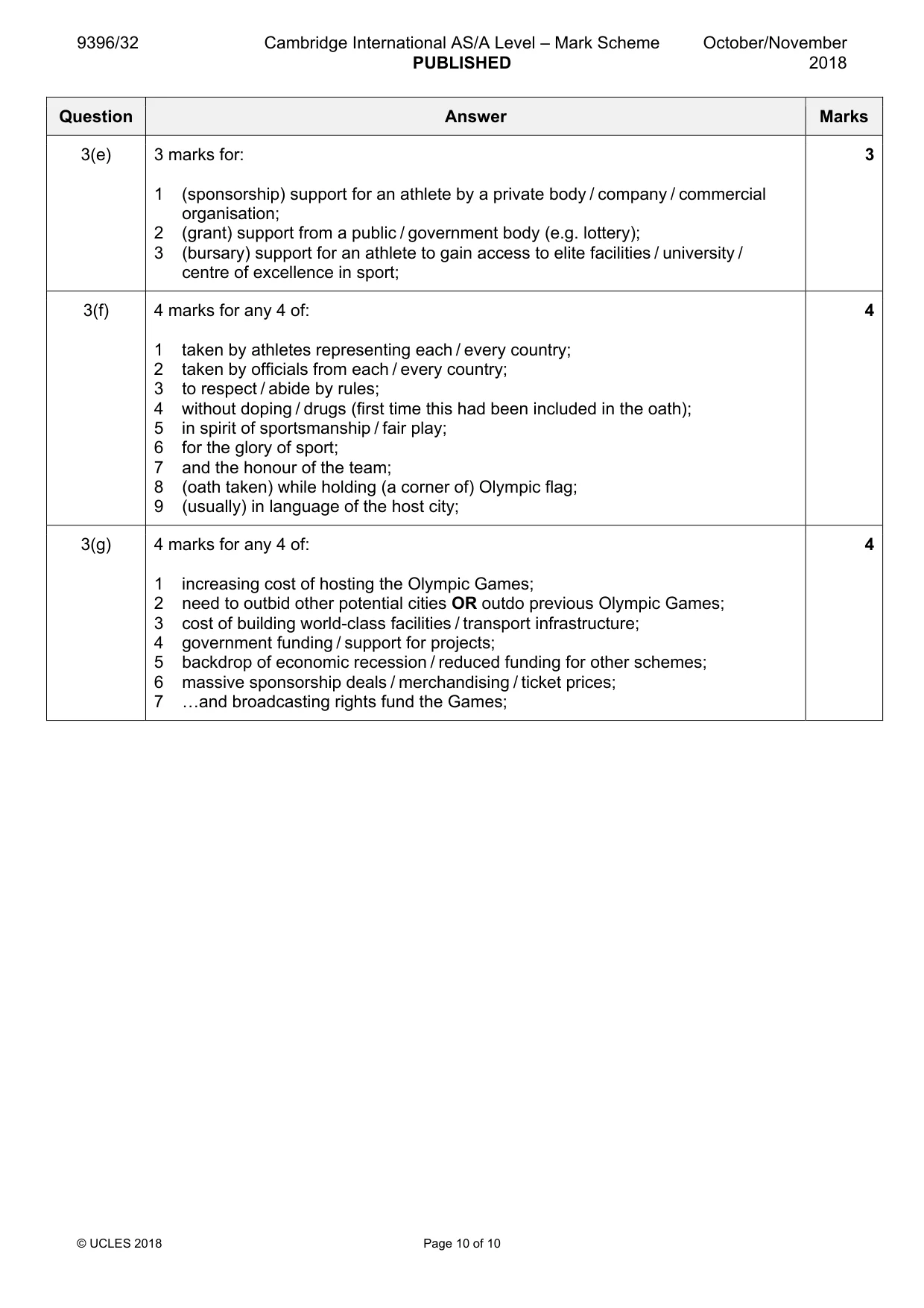
3 (a) Describe how the Ancient Olympic Games were used as a blueprint for the Modern Olympic Games. [6] (b) Describe the role of the International Olympic Committee (IOC). [5] (c) Describe the terrorist attack that took place at the 1972 Olympic Games in Munich. [4] (d) Outline how different nations have used the Olympic Games to promote a particular ideology and enhance national prestige. [4] (e) Sources of funding for an athlete hoping to compete at the Olympic Games include sponsorship, grants and bursaries. Describe each of these sources of funding. [3] (f) Outline the main features of the Olympic Oath created in 2000. [4] (g) Since 1984 commercialisation of the Olympic Games has led to a spiral of extravagance. Explain what is meant by the term spiral of extravagance in relation to the staging of the Olympic Games. [4] [Total: 30]
Mark scheme: 3(a) 6 marks for any 6 of: 6 1 held every four years; 2 festival of sport OR sporting and cultural event; 3 opening ceremony; 4 oath taken by all athletes; 5 events (from ancient OG) were adopted in early modern OG OR athletic events / wrestling; 6 heralds proclaiming ancient OG were adapted to Olympic torch to publicise modern OG; 7 ideals of peace and harmony between nations promoted; 8 fair-play ideals promoted; 9 women not allowed to take part (in early modern OG); 10 victory ceremonies OR medals replaced olive wreaths; 3(b) 5 marks for any 5 of: 5 1 promotes (ideals of) Olympism / fair play; 2 in charge of bidding process OR selects host city OR ensures Olympic Games take place (every 4 years); 3 decides which sports are included; 4 encourages education of youth through sport / increase participation in sport / cultural development; 5 act against discrimination / inequality in sport; 6 lead fight against doping in sport; 7 protect health / welfare of athletes; 8 protect the Olympic movement from political / commercial abuse; 9 support activities of International Olympic Academy; 10 promote positive legacy; 11 show concern for environmental issues; 3(c) 4 marks for any 4 of: 4 Maximum of 3 marks if Israel / Israeli not identified. 1 by Palestinian terrorists; 2 « on Israeli athletes; 3 « in the Olympic village; 4 (Israeli) athletes killed (during attack); 5 (Israeli) athletes taken hostage; 6 during a rescue attempt« (by German police at Munich airport); 7 «(all) the (Israeli) athletes / hostages were killed (by the terrorists); 8 terrorists were killed or (German) policeman killed; 9 Olympic Games continued; 10 Israel / other countries withdrew from Games; 3(d) 4 marks for 4 of: 4 1 Berlin (1936) used to promote Aryan / racial supremacy OR strength of Nazi Germany; 2 East Germany / Soviet Union / China medal success used to promote communism; 3 boycott by nations objecting to apartheid in South Africa; 4 boycott by many countries objecting to invasion of Afghanistan by Soviet Union; 5 LA (1984) / Atlanta (1996) / USA promote Western ideals / capitalism / americanisation; 6 Montreal (1976) China put pressure on IOC to refuse Taiwan entry OR non- recognition of Taiwan as a country by China; 7 (2008) Beijing – used to enhance China’s cultural and economic standing in the world; 3(e) 3 marks for: 3 1 (sponsorship) support for an athlete by a private body / company / commercial organisation; 2 (grant) support from a public / government body (e.g. lottery); 3 (bursary) support for an athlete to gain access to elite facilities / university / centre of excellence in sport; 3(f) 4 marks for any 4 of: 4 1 taken by athletes representing each / every country; 2 taken by officials from each / every country; 3 to respect / abide by rules; 4 without doping / drugs (first time this had been included in the oath); 5 in spirit of sportsmanship / fair play; 6 for the glory of sport; 7 and the honour of the team; 8 (oath taken) while holding (a corner of) Olympic flag; 9 (usually) in language of the host city; 3(g) 4 marks for any 4 of: 4 1 increasing cost of hosting the Olympic Games; 2 need to outbid other potential cities OR outdo previous Olympic Games; 3 cost of building world-class facilities / transport infrastructure; 4 government funding / support for projects; 5 backdrop of economic recession / reduced funding for other schemes; 6 massive sponsorship deals / merchandising / ticket prices; 7 «and broadcasting rights fund the Games;
What you needed in this session
Cambridge’s own grade thresholds for 2018 Oct/Nov, Paper 3 · Variant 2. A higher threshold means an easier paper — the bar moves with how the cohort did.