Cambridge A Level Physical Education 9396 — 2022 May/June Paper 3 · Variant 2
9396/32/M/J/22 · 3 questions · 90 marks · ≈101 min
The question paper and its mark scheme, free to read here and free to download. This is Cambridge’s own paper, exactly as it was sat.
Question paper4 pages
Mark scheme14 pages
Answers below. Sit the paper first if you are practising.
Questions as text
Q1 · Glycolysis is the first stage of the aerobic system and occurs in the sarcoplasm
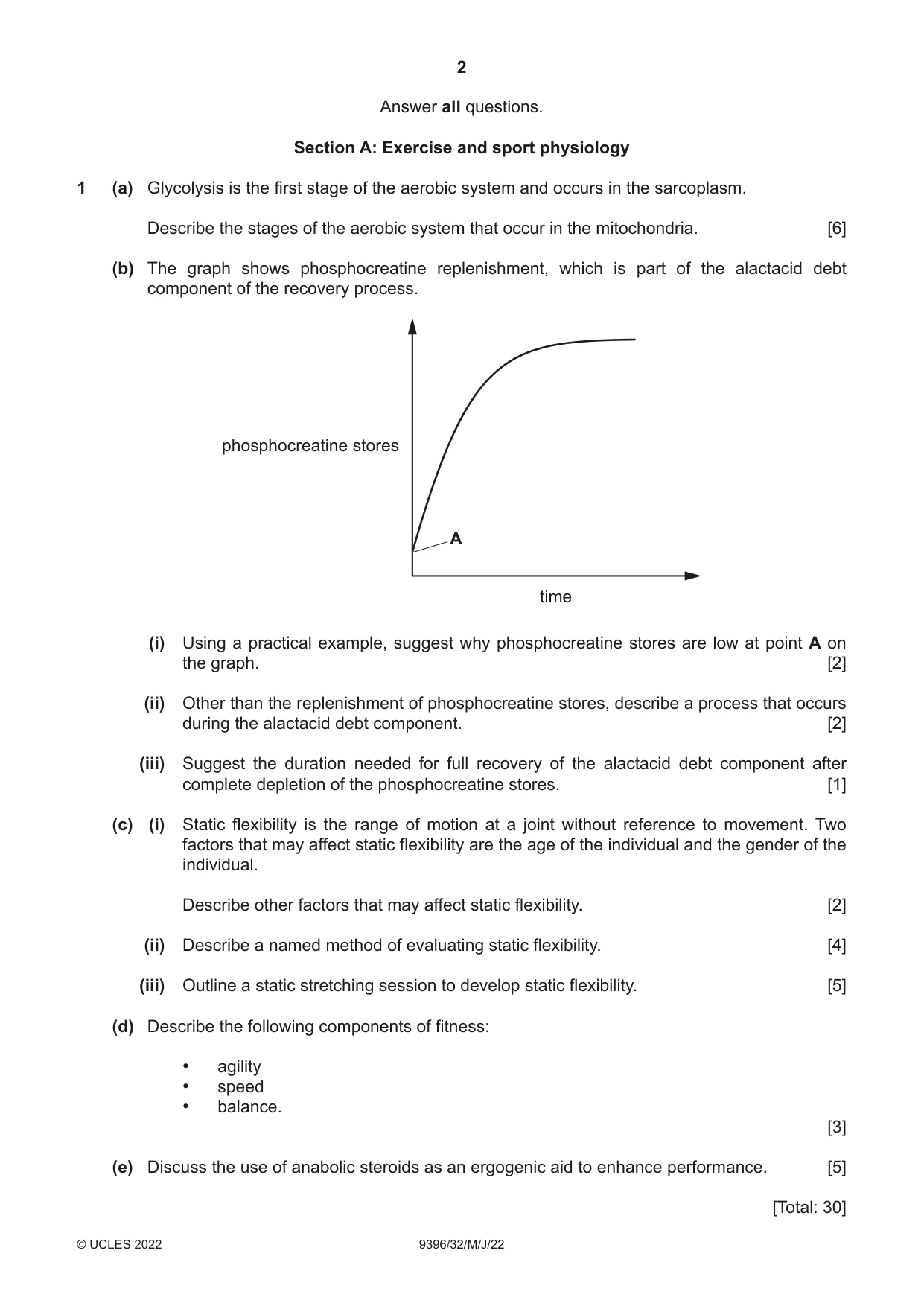
1 (a) Glycolysis is the first stage of the aerobic system and occurs in the sarcoplasm. Describe the stages of the aerobic system that occur in the mitochondria. [6] (b) The graph shows phosphocreatine replenishment, which is part of the alactacid debt component of the recovery process. phosphocreatine stores A time (i) Using a practical example, suggest why phosphocreatine stores are low at point A on the graph. [2] (ii) Other than the replenishment of phosphocreatine stores, describe a process that occurs during the alactacid debt component. [2] (iii) Suggest the duration needed for full recovery of the alactacid debt component after complete depletion of the phosphocreatine stores. [1] (c) (i) Static flexibility is the range of motion at a joint without reference to movement. Two factors that may affect static flexibility are the age of the individual and the gender of the individual. Describe other factors that may affect static flexibility. [2] (ii) Describe a named method of evaluating static flexibility. [4] (iii) Outline a static stretching session to develop static flexibility. [5] (d) Describe the following components of fitness: • agility • speed • balance. [3] (e) Discuss the use of anabolic steroids as an ergogenic aid to enhance performance. [5] [Total: 30]
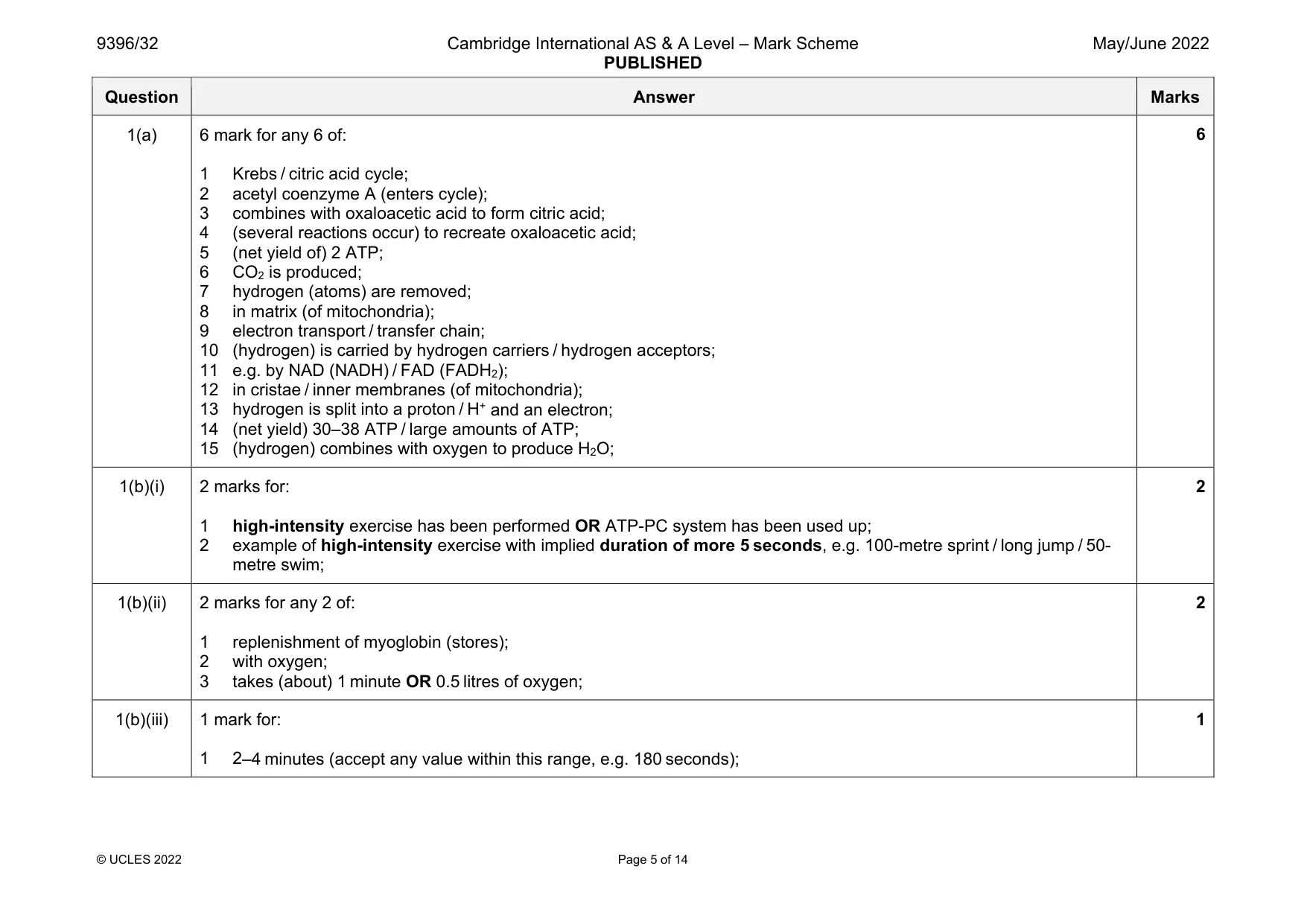
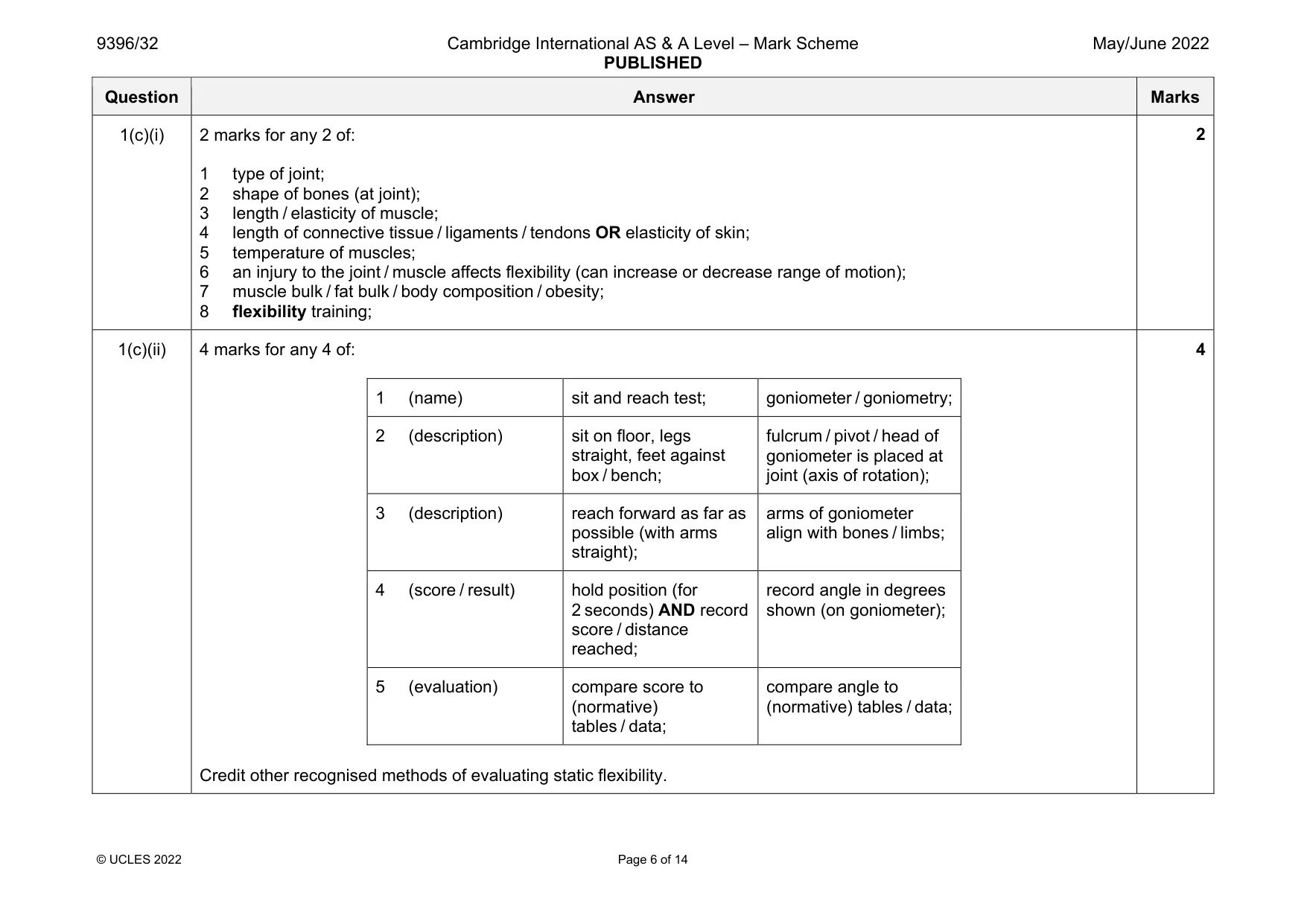
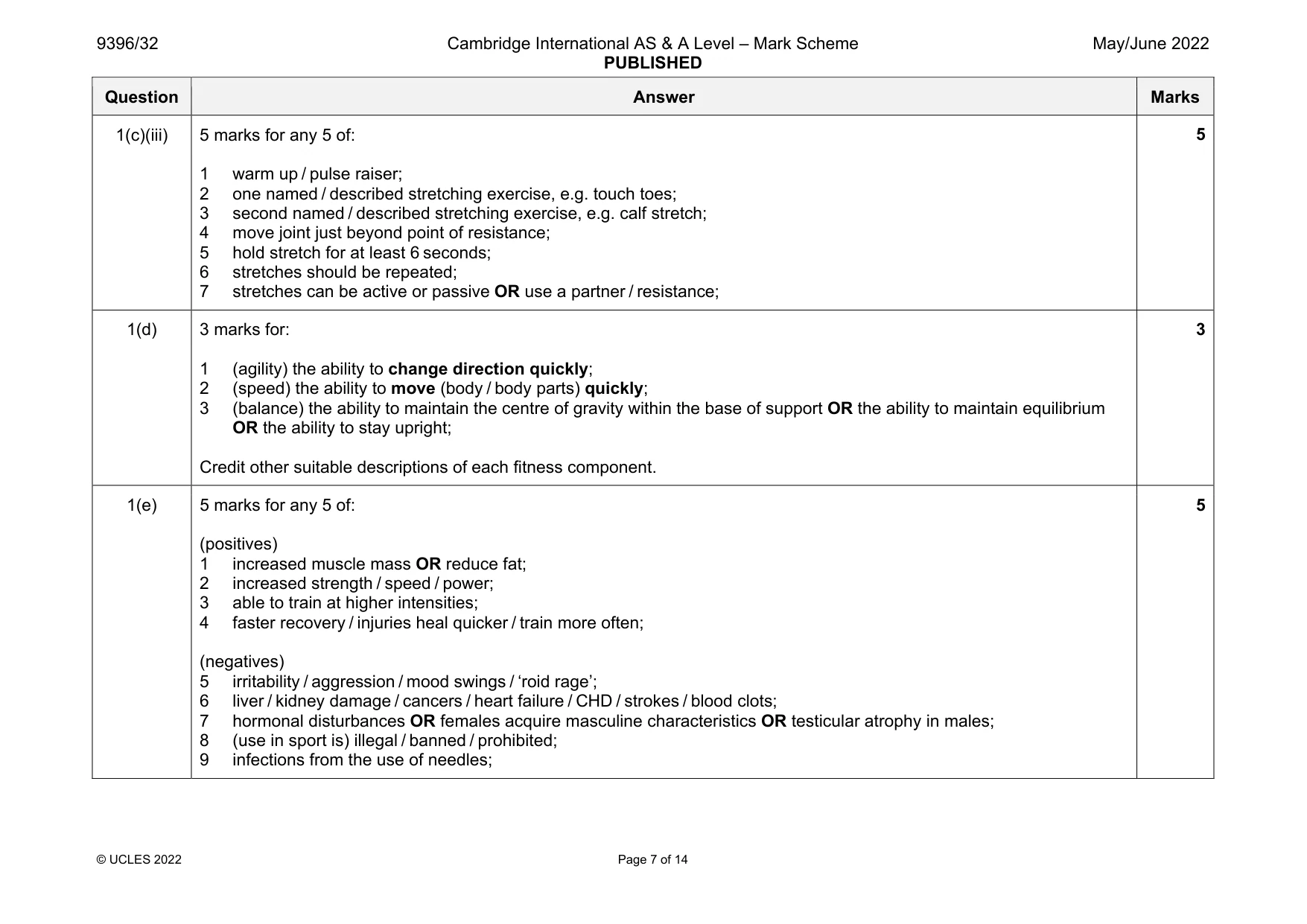
Mark scheme: 1(a) 6 mark for any 6 of: 1 Krebs / citric acid cycle; 2 acetyl coenzyme A (enters cycle); 3 combines with oxaloacetic acid to form citric acid; 4 (several reactions occur) to recreate oxaloacetic acid; 5 (net yield of) 2 ATP; 6 CO2 is produced; 7 hydrogen (atoms) are removed; 8 in matrix (of mitochondria); 9 electron transport / transfer chain; 10 (hydrogen) is carried by hydrogen carriers / hydrogen acceptors; 11 e.g. by NAD (NADH) / FAD (FADH2); 12 in cristae / inner membranes (of mitochondria); 13 hydrogen is split into a proton / H+ and an electron; 14 (net yield) 30–38 ATP / large amounts of ATP; 15 (hydrogen) combines with oxygen to produce H2O; 1(b)(i) 2 marks for: 1 high-intensity exercise has been performed OR ATP-PC system has been used up; 2 example of high-intensity exercise with implied duration of more 5 seconds, e.g. 100-metre sprint / long jump / 50- metre swim; 2 1(b)(ii) 2 marks for any 2 of: 1 replenishment of myoglobin (stores); 2 with oxygen; 3 takes (about) 1 minute OR 0.5 litres of oxygen; 2 1(b)(iii) 1 mark for: 1 2–4 minutes (accept any value within this range, e.g. 180 seconds); 1 Question Answer Marks 1(c)(i) 2 marks for any 2 of: 1 type of joint; 2 shape of bones (at joint); 3 length / elasticity of muscle; 4 length of connective tissue / ligaments / tendons OR elasticity of skin; 5 temperature of muscles; 6 an injury to the joint / muscle affects flexibility (can increase or decrease range of motion); 7 muscle bulk / fat bulk / body composition / obesity; 8 flexibility training; 2 1(c)(ii) 4 marks for any 4 of: 1 (name) sit and reach test; goniometer / goniometry; 2 (description) sit on floor, legs straight, feet against box / bench; fulcrum / pivot / head of goniometer is placed at joint (axis of rotation); 3 (description) reach forward as far as possible (with arms straight); arms of goniometer align with bones / limbs; 4 (score / result) hold position (for 2 seconds) AND record score / distance reached; record angle in degrees shown (on goniometer); 5 (evaluation) compare score to (normative) tables / data; compare angle to (normative) tables / data; Credit other recognised methods of evaluating static flexibility. 4 Question Answer Marks 1(c)(iii) 5 marks for any 5 of: 1 warm up / pulse raiser; 2 one named / described stretching exercise, e.g. touch toes; 3 second named / described stretching exercise, e.g. calf stretch; 4 move joint just beyond point of resistance; 5 hold stretch for at least 6 seconds; 6 stretches should be repeated; 7 stretches can be active or passive OR use a partner / resistance; 5 1(d) 3 marks for: 1 (agility) the ability to change direction quickly; 2 (speed) the ability to move (body / body parts) quickly; 3 (balance) the ability to maintain the centre of gravity within the base of support OR the ability to maintain equilibrium OR the ability to stay upright; Credit other suitable descriptions of each fitness component. 3 1(e) 5 marks for any 5 of: (positives) 1 increased muscle mass OR reduce fat; 2 increased strength / speed / power; 3 able to train at higher intensities; 4 faster recovery / injuries heal quicker / train more often; (negatives) 5 irritability / aggression / mood swings / ‘roid rage’; 6 liver / kidney damage / cancers / heart failure / CHD / strokes / blood clots; 7 hormonal disturbances OR females acquire masculine characteristics OR testicular atrophy in males; 8 (use in sport is) illegal / banned / prohibited; 9 infections from the use of needles; 5
Q2 · There are several theories of personality
2 (a) There are several theories of personality. (i) Describe the theory that personality is made up of stable traits. [3] (ii) Evaluate the use of personality profiling as a guide to sporting success. [4] (b) The productivity of a group can be affected by various factors. Describe, using a practical example for each, what is meant by the following: • social loafing • Ringelmann effect. [4] (c) Describe the social learning theory of leadership. [3] (d) A 100-metre sprinter with a personal best time of 11.20 seconds has been told that they have been set a goal to achieve a time of 10.20 seconds in a 100-metre sprint. Explain why this goal does not meet some of the SMARTER principles of goal setting. [3] (e) Outline two named cognitive techniques to manage anxiety in sport. [6] (f) Discuss possible effects of an audience on arousal and performance in sport. [5] (g) Describe, using a practical example, what is meant by channelled aggression. [2] [Total: 30] Section C: Olympic Games: a global perspective
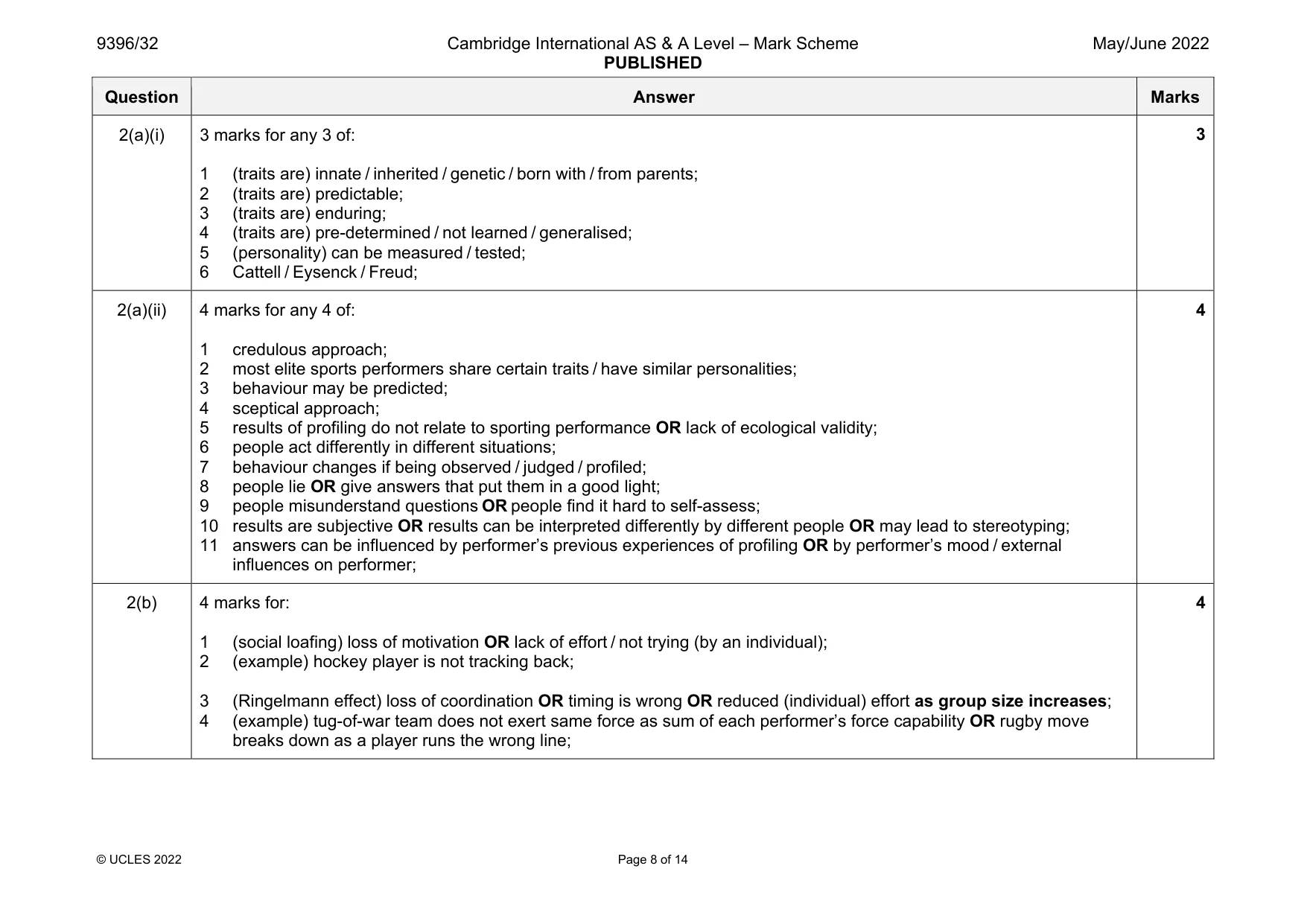
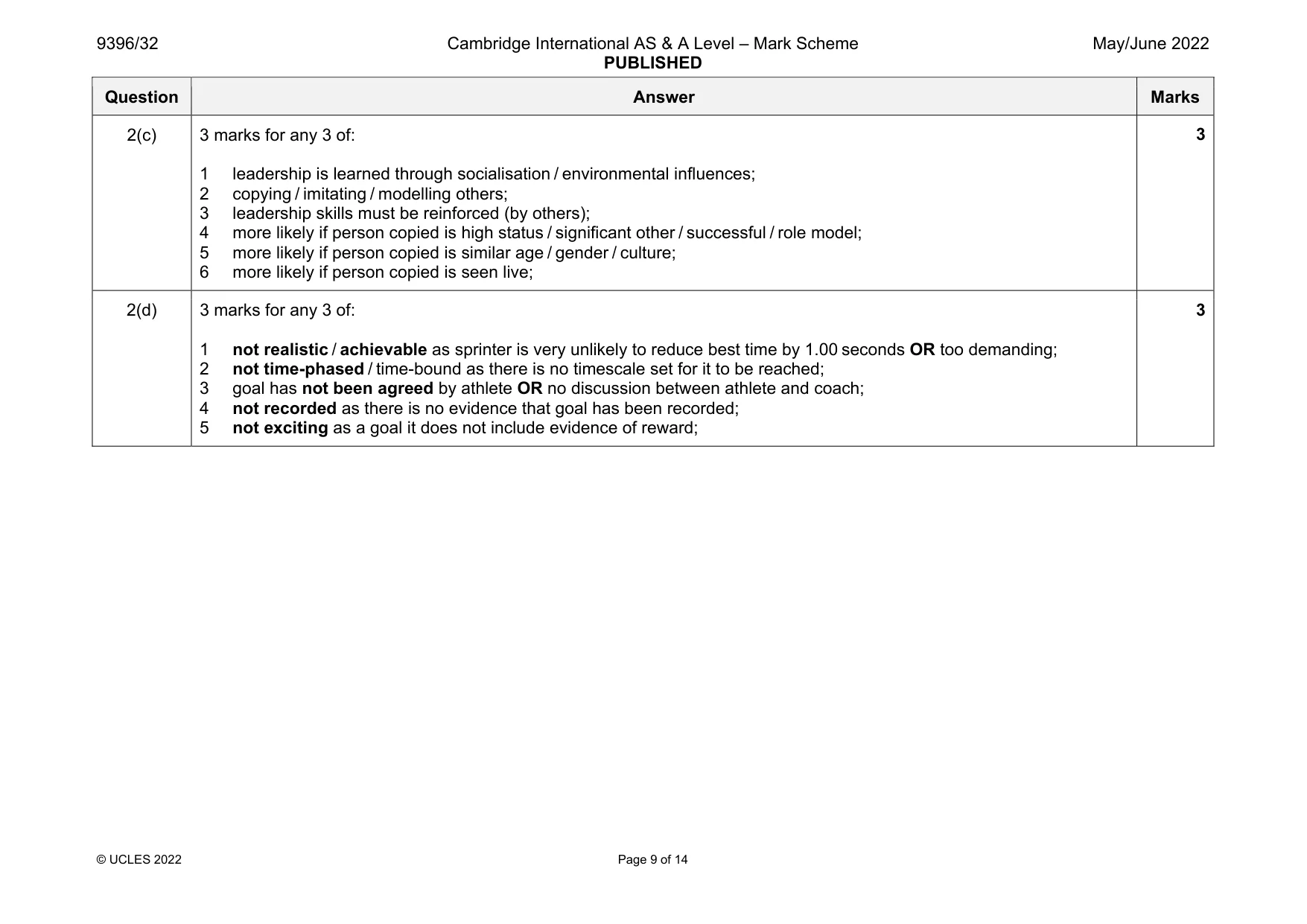
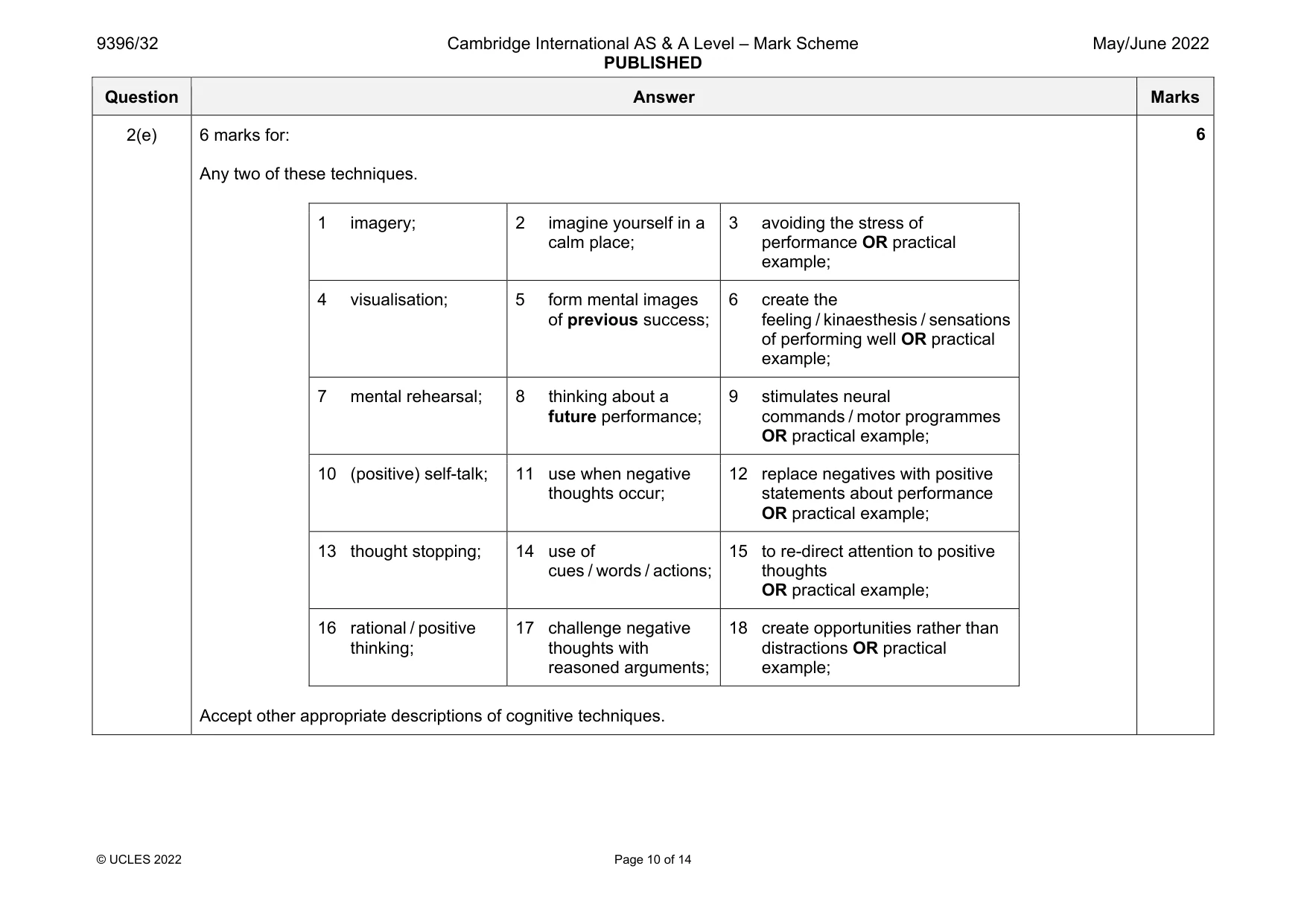
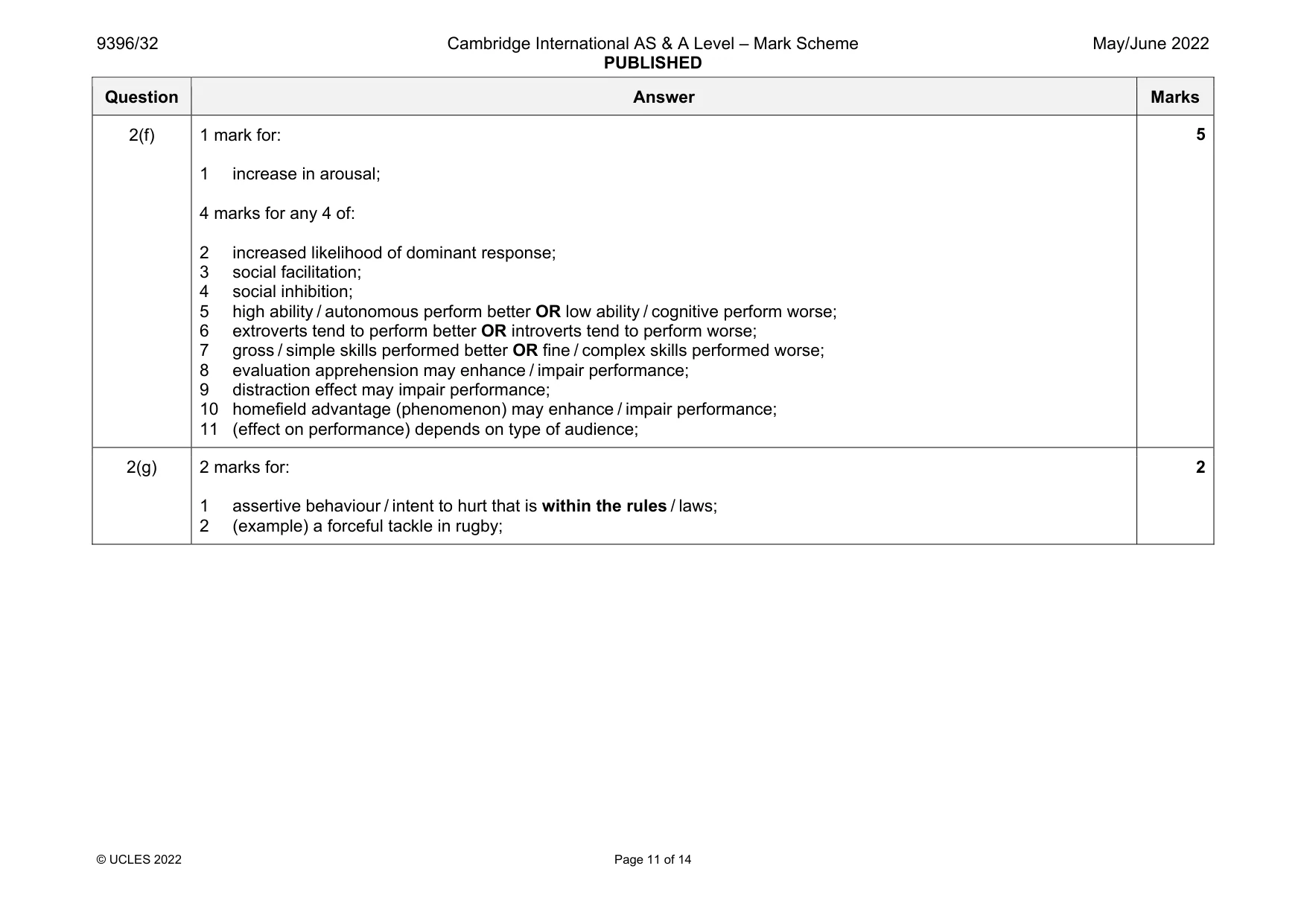
Mark scheme: 2(a)(i) 3 marks for any 3 of: 1 (traits are) innate / inherited / genetic / born with / from parents; 2 (traits are) predictable; 3 (traits are) enduring; 4 (traits are) pre-determined / not learned / generalised; 5 (personality) can be measured / tested; 6 Cattell / Eysenck / Freud; 2(a)(ii) 4 marks for any 4 of: 1 credulous approach; 2 most elite sports performers share certain traits / have similar personalities; 3 behaviour may be predicted; 4 sceptical approach; 5 results of profiling do not relate to sporting performance OR lack of ecological validity; 6 people act differently in different situations; 7 behaviour changes if being observed / judged / profiled; 8 people lie OR give answers that put them in a good light; 9 people misunderstand questions OR people find it hard to self-assess; 10 results are subjective OR results can be interpreted differently by different people OR may lead to stereotyping; 11 answers can be influenced by performer’s previous experiences of profiling OR by performer’s mood / external influences on performer; 4 2(b) 4 marks for: 1 (social loafing) loss of motivation OR lack of effort / not trying (by an individual); 2 (example) hockey player is not tracking back; 3 (Ringelmann effect) loss of coordination OR timing is wrong OR reduced (individual) effort as group size increases; 4 (example) tug-of-war team does not exert same force as sum of each performer’s force capability OR rugby move breaks down as a player runs the wrong line; 4 Question Answer Marks 2(c) 3 marks for any 3 of: 1 leadership is learned through socialisation / environmental influences; 2 copying / imitating / modelling others; 3 leadership skills must be reinforced (by others); 4 more likely if person copied is high status / significant other / successful / role model; 5 more likely if person copied is similar age / gender / culture; 6 more likely if person copied is seen live; 3 2(d) 3 marks for any 3 of: 1 not realistic / achievable as sprinter is very unlikely to reduce best time by 1.00 seconds OR too demanding; 2 not time-phased / time-bound as there is no timescale set for it to be reached; 3 goal has not been agreed by athlete OR no discussion between athlete and coach; 4 not recorded as there is no evidence that goal has been recorded; 5 not exciting as a goal it does not include evidence of reward; 3 Question Answer Marks 2(e) 6 marks for: Any two of these techniques. 1 imagery; 2 imagine yourself in a calm place; 3 avoiding the stress of performance OR practical example; 4 visualisation; 5 form mental images of previous success; 6 create the feeling / kinaesthesis / sensations of performing well OR practical example; 7 mental rehearsal; 8 thinking about a future performance; 9 stimulates neural commands / motor programmes OR practical example; 10 (positive) self-talk; 11 use when negative thoughts occur; 12 replace negatives with positive statements about performance OR practical example; 13 thought stopping; 14 use of cues / words / actions; 15 to re-direct attention to positive thoughts OR practical example; 16 rational / positive thinking; 17 challenge negative thoughts with reasoned arguments; 18 create opportunities rather than distractions OR practical example; Accept other appropriate descriptions of cognitive techniques. 6 Question Answer Marks 2(f) 1 mark for: 1 increase in arousal; 4 marks for any 4 of: 2 increased likelihood of dominant response; 3 social facilitation; 4 social inhibition; 5 high ability / autonomous perform better OR low ability / cognitive perform worse; 6 extroverts tend to perform better OR introverts tend to perform worse; 7 gross / simple skills performed better OR fine / complex skills performed worse; 8 evaluation apprehension may enhance / impair performance; 9 distraction effect may impair performance; 10 homefield advantage (phenomenon) may enhance / impair performance; 11 (effect on performance) depends on type of audience; 5 2(g) 2 marks for: 1 assertive behaviour / intent to hurt that is within the rules / laws; 2 (example) a forceful tackle in rugby; 2
Q3 · The format of the ancient Olympic Games was the model for the first modern Olympic Games
3 (a) The format of the ancient Olympic Games was the model for the first modern Olympic Games. Describe the format of the ancient Olympic Games. [5] (b) Two aims of the International Olympic Committee (IOC) are to promote fair-play ideals and to oppose any political abuse of sport and athletes. Suggest other aims of the IOC. [5] (c) Describe Hitler’s use of the 1936 Berlin Olympic Games to promote his political ideology. [3] (d) Selling tickets to spectators provides money that the host nation can use to pay for staging the Olympic Games. State other sources of funding available to the host nation to cover the costs of staging the Olympic Games. [4] (e) To qualify for the Olympic Games some athletes have large financial costs. Suggest financial costs for these athletes. [4] (f) Explain how a positive legacy from the Olympic Games should support regeneration in a host country. [5] (g) Suggest reasons for the introduction and development of the Paralympics. [4] [Total: 30]
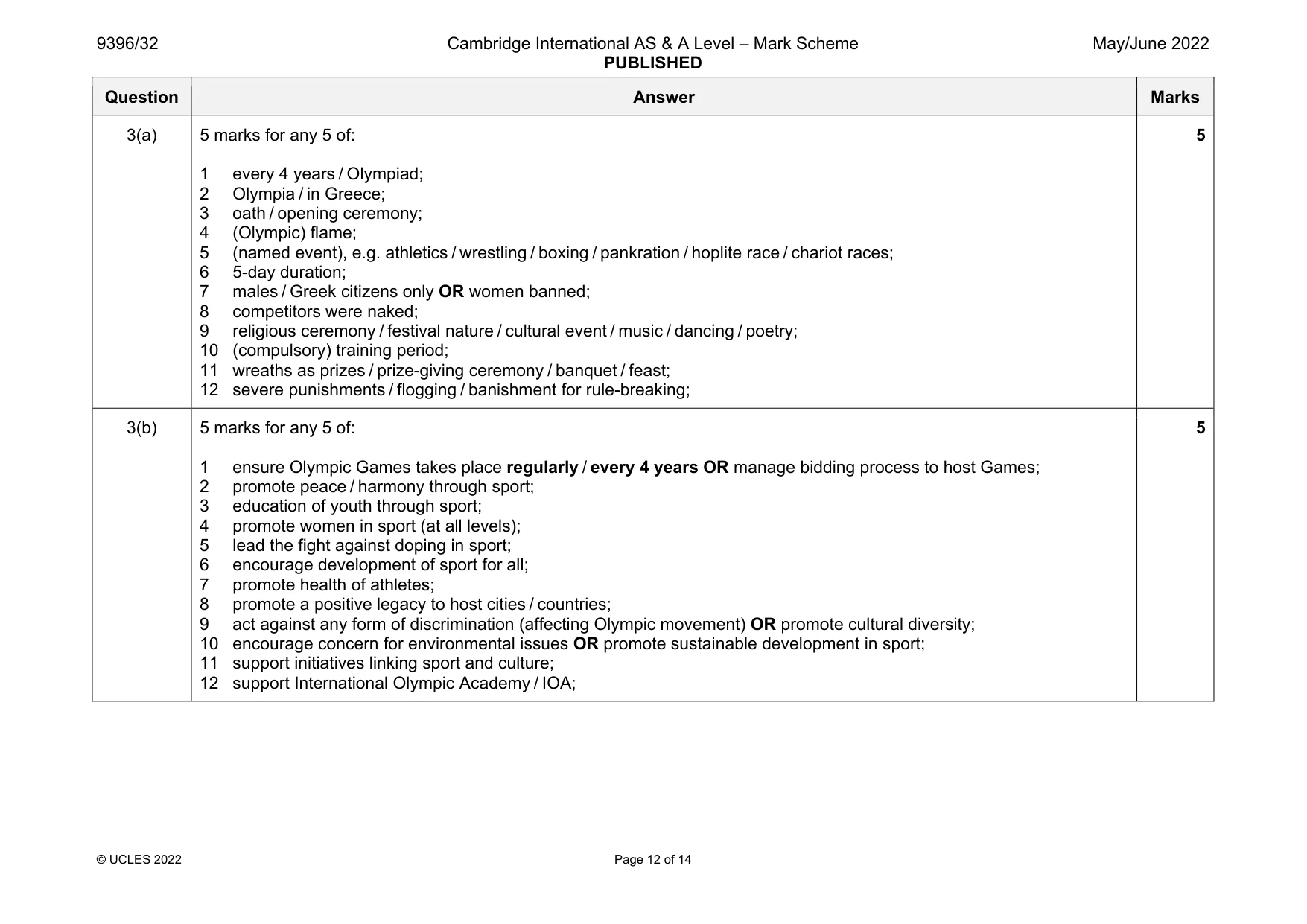
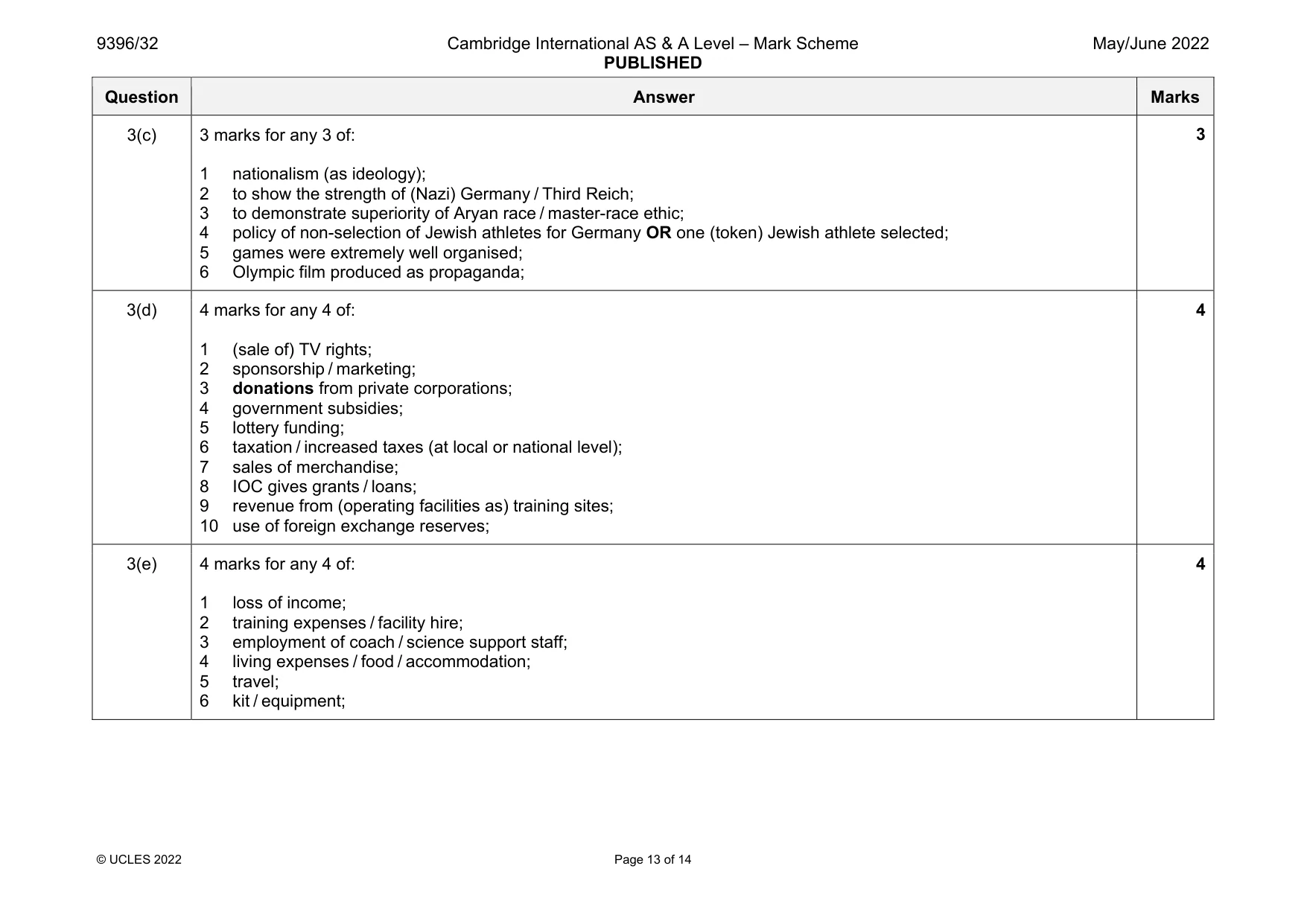
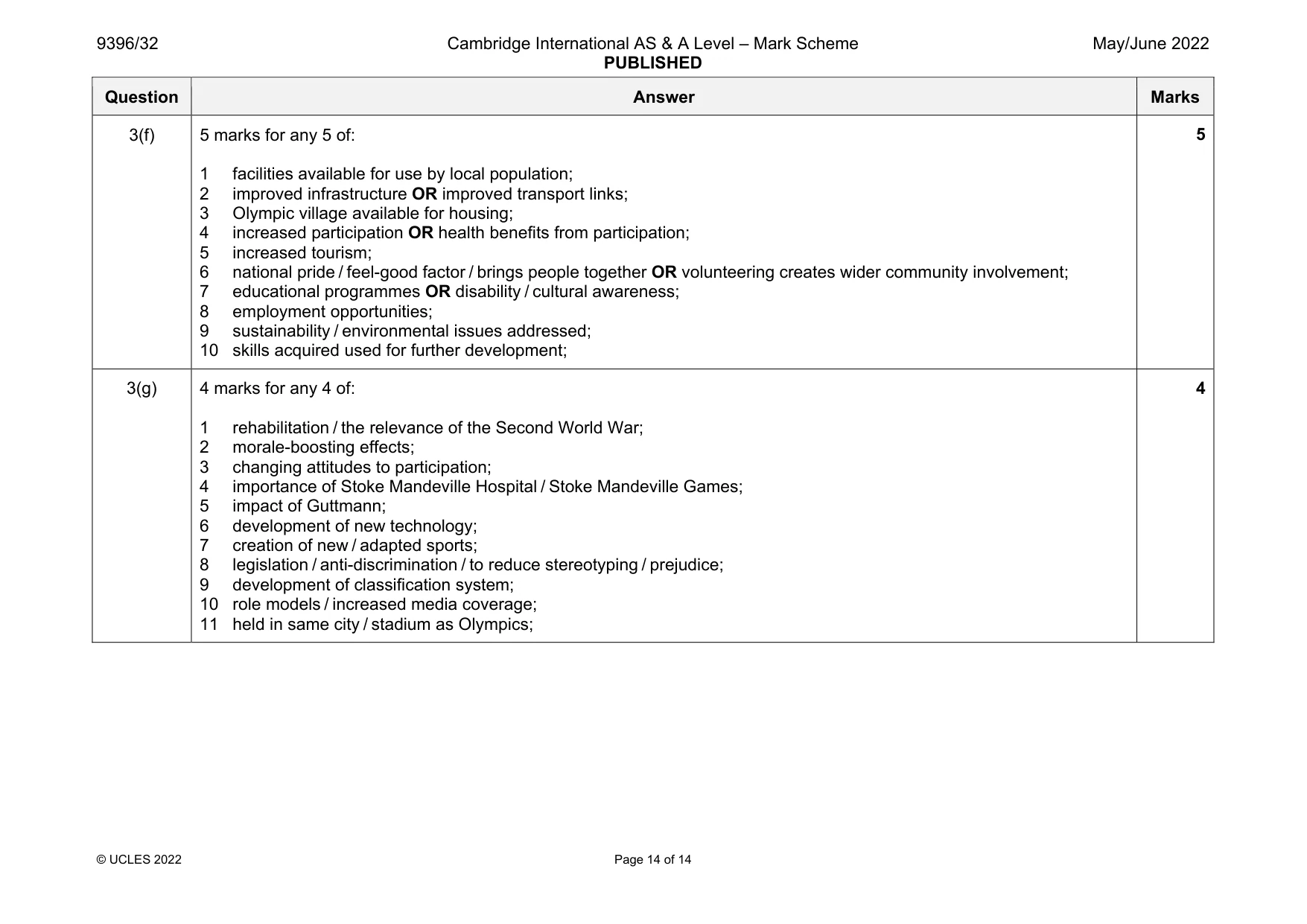
Mark scheme: 3(a) 5 marks for any 5 of: 1 every 4 years / Olympiad; 2 Olympia / in Greece; 3 oath / opening ceremony; 4 (Olympic) flame; 5 (named event), e.g. athletics / wrestling / boxing / pankration / hoplite race / chariot races; 6 5-day duration; 7 males / Greek citizens only OR women banned; 8 competitors were naked; 9 religious ceremony / festival nature / cultural event / music / dancing / poetry; 10 (compulsory) training period; 11 wreaths as prizes / prize-giving ceremony / banquet / feast; 12 severe punishments / flogging / banishment for rule-breaking; 5 3(b) 5 marks for any 5 of: 1 ensure Olympic Games takes place regularly / every 4 years OR manage bidding process to host Games; 2 promote peace / harmony through sport; 3 education of youth through sport; 4 promote women in sport (at all levels); 5 lead the fight against doping in sport; 6 encourage development of sport for all; 7 promote health of athletes; 8 promote a positive legacy to host cities / countries; 9 act against any form of discrimination (affecting Olympic movement) OR promote cultural diversity; 10 encourage concern for environmental issues OR promote sustainable development in sport; 11 support initiatives linking sport and culture; 12 support International Olympic Academy / IOA; 5 Question Answer Marks 3(c) 3 marks for any 3 of: 1 nationalism (as ideology); 2 to show the strength of (Nazi) Germany / Third Reich; 3 to demonstrate superiority of Aryan race / master-race ethic; 4 policy of non-selection of Jewish athletes for Germany OR one (token) Jewish athlete selected; 5 games were extremely well organised; 6 Olympic film produced as propaganda; 3 3(d) 4 marks for any 4 of: 1 (sale of) TV rights; 2 sponsorship / marketing; 3 donations from private corporations; 4 government subsidies; 5 lottery funding; 6 taxation / increased taxes (at local or national level); 7 sales of merchandise; 8 IOC gives grants / loans; 9 revenue from (operating facilities as) training sites; 10 use of foreign exchange reserves; 4 3(e) 4 marks for any 4 of: 1 loss of income; 2 training expenses / facility hire; 3 employment of coach / science support staff; 4 living expenses / food / accommodation; 5 travel; 6 kit / equipment; 4 Question Answer Marks 3(f) 5 marks for any 5 of: 1 facilities available for use by local population; 2 improved infrastructure OR improved transport links; 3 Olympic village available for housing; 4 increased participation OR health benefits from participation; 5 increased tourism; 6 national pride / feel-good factor / brings people together OR volunteering creates wider community involvement; 7 educational programmes OR disability / cultural awareness; 8 employment opportunities; 9 sustainability / environmental issues addressed; 10 skills acquired used for further development; 5 3(g) 4 marks for any 4 of: 1 rehabilitation / the relevance of the Second World War; 2 morale-boosting effects; 3 changing attitudes to participation; 4 importance of Stoke Mandeville Hospital / Stoke Mandeville Games; 5 impact of Guttmann; 6 development of new technology; 7 creation of new / adapted sports; 8 legislation / anti-discrimination / to reduce stereotyping / prejudice; 9 development of classification system; 10 role models / increased media coverage; 11 held in same city / stadium as Olympics; 4
What you needed in this session
Cambridge’s own grade thresholds for 2022 May/June, Paper 3 · Variant 2. A higher threshold means an easier paper — the bar moves with how the cohort did.