Cambridge A Level Physical Education 9396 — 2023 May/June Paper 3 · Variant 2
9396/32/M/J/23 · 3 questions · 90 marks · ≈101 min
The question paper and its mark scheme, free to read here and free to download. This is Cambridge’s own paper, exactly as it was sat.
Question paper4 pages
Mark scheme14 pages
Answers below. Sit the paper first if you are practising.
Questions as text
Q1 · Describe how endothermic reactions and exothermic reactions are used in the breakdown and…
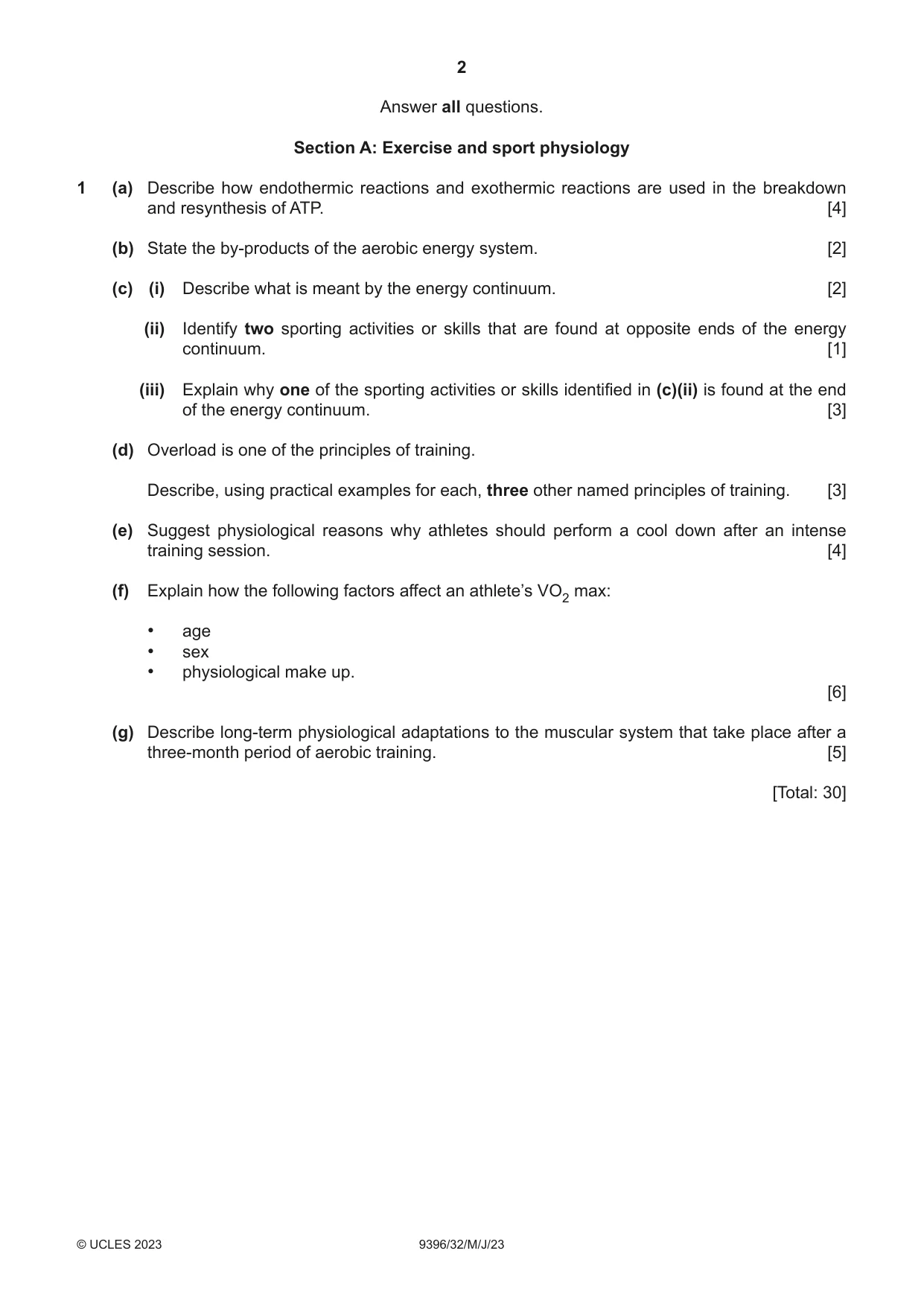
1 (a) Describe how endothermic reactions and exothermic reactions are used in the breakdown and resynthesis of ATP. [4] (b) State the by-products of the aerobic energy system. [2] (c) (i) Describe what is meant by the energy continuum. [2] (ii) Identify two sporting activities or skills that are found at opposite ends of the energy continuum. [1] (iii) Explain why one of the sporting activities or skills identified in (c)(ii) is found at the end of the energy continuum. [3] (d) Overload is one of the principles of training. Describe, using practical examples for each, three other named principles of training. [3] (e) Suggest physiological reasons why athletes should perform a cool down after an intense training session. [4] (f) Explain how the following factors affect an athlete’s VO2 max: • age • sex • physiological make up. [6] (g) Describe long-term physiological adaptations to the muscular system that take place after a three-month period of aerobic training. [5] [Total: 30]
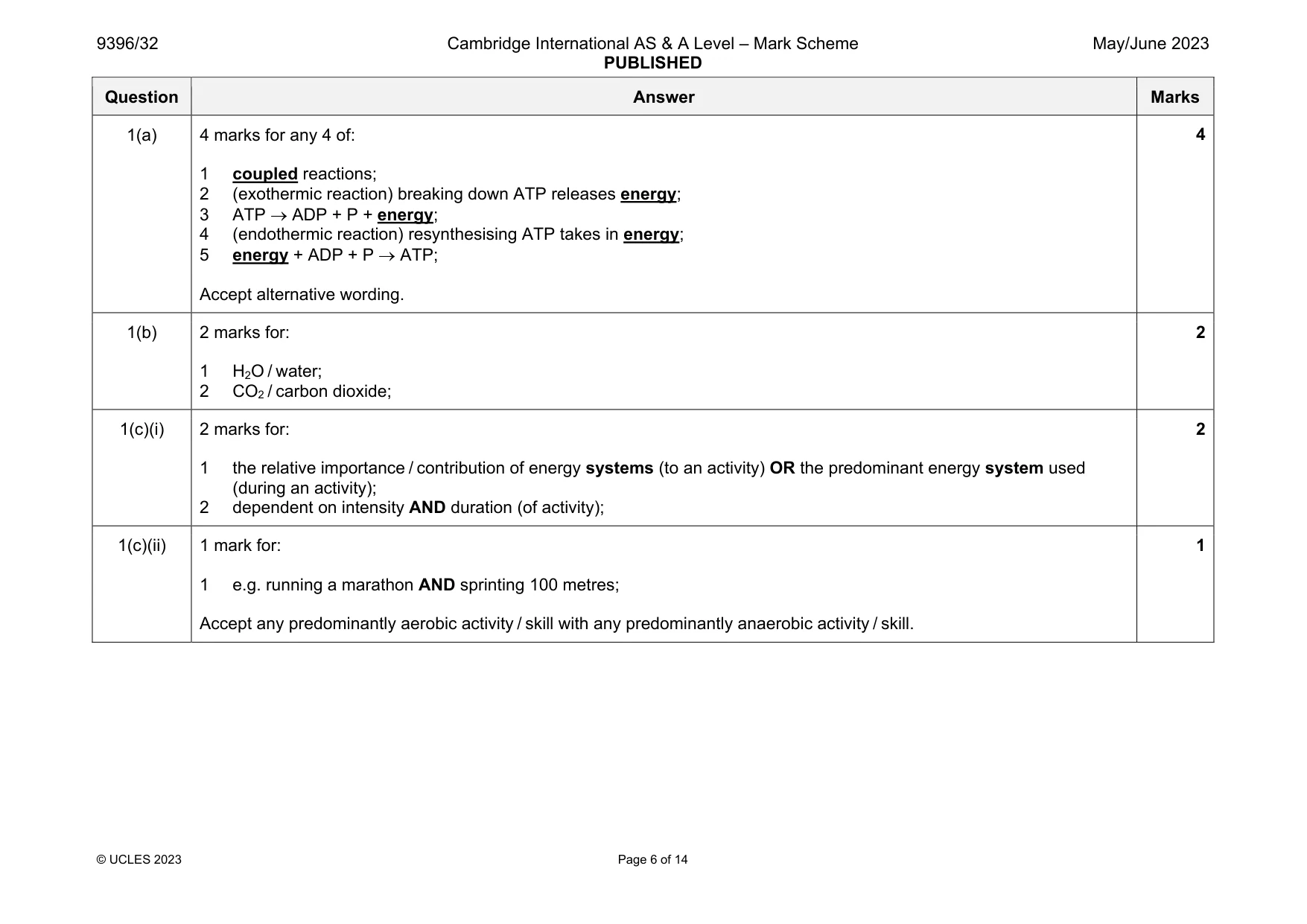
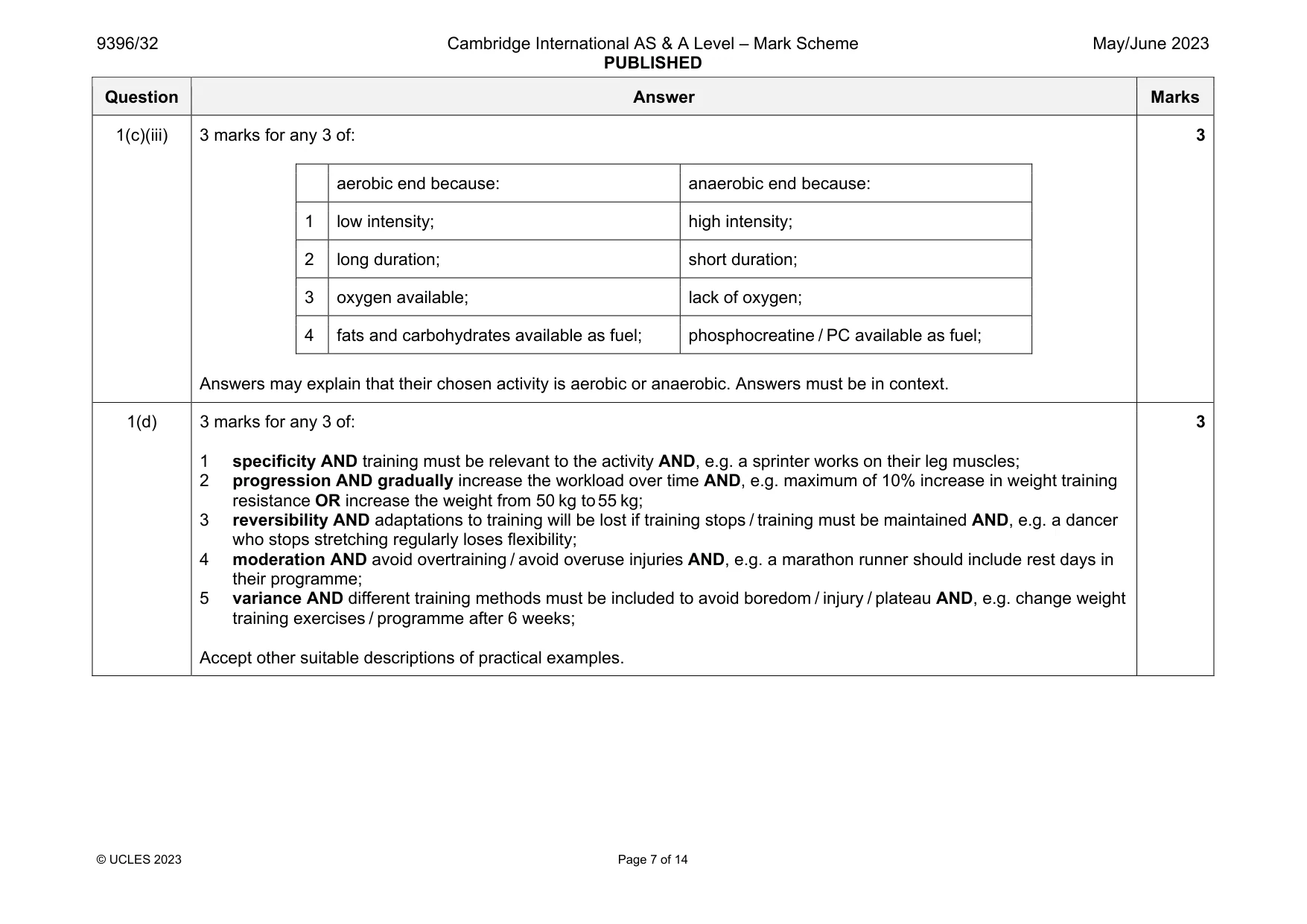
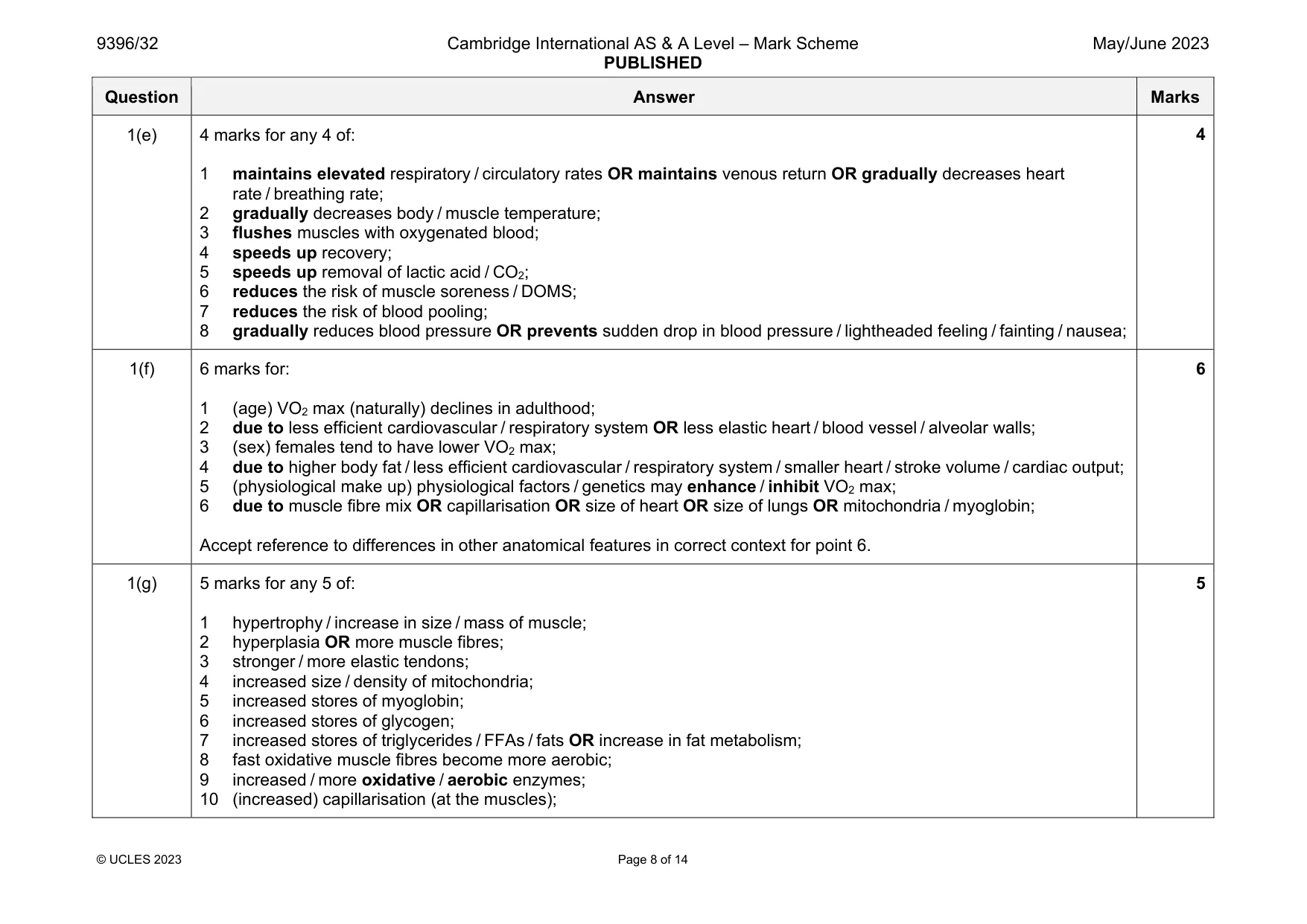
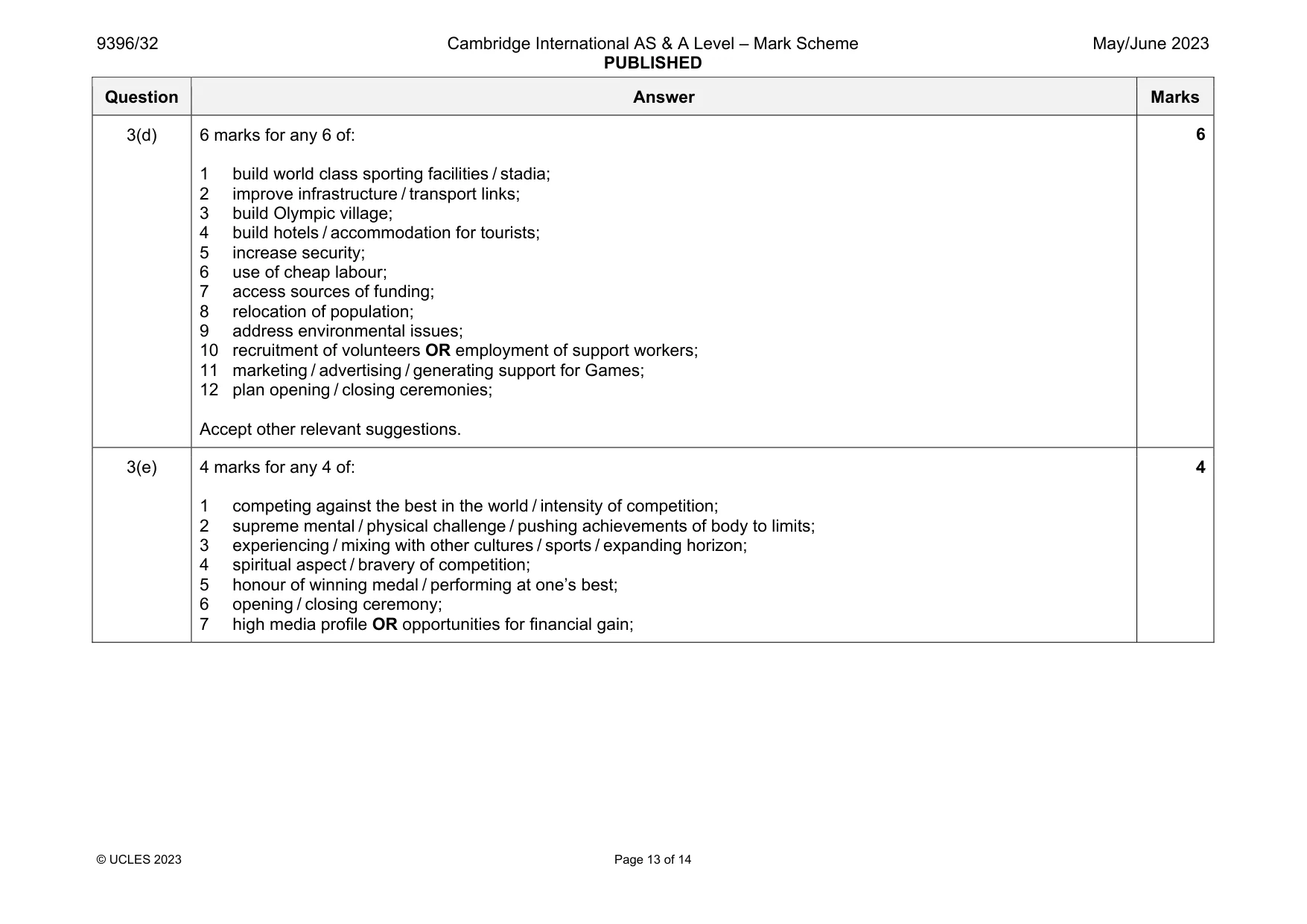
Mark scheme: 1(a) 4 marks for any 4 of: 1 coupled reactions; 2 (exothermic reaction) breaking down ATP releases energy; 3 ATP ADP + P + energy; 4 (endothermic reaction) resynthesising ATP takes in energy; 5 energy + ADP + P ATP; Accept alternative wording. 1(b) 2 marks for: 1 H2O / water; 2 CO2 / carbon dioxide; 2 1(c)(i) 2 marks for: 1 the relative importance / contribution of energy systems (to an activity) OR the predominant energy system used (during an activity); 2 dependent on intensity AND duration (of activity); 2 1(c)(ii) 1 mark for: 1 e.g. running a marathon AND sprinting 100 metres; Accept any predominantly aerobic activity / skill with any predominantly anaerobic activity / skill. 1 Question Answer Marks 1(c)(iii) 3 marks for any 3 of: aerobic end because: anaerobic end because: 1 low intensity; high intensity; 2 long duration; short duration; 3 oxygen available; lack of oxygen; 4 fats and carbohydrates available as fuel; phosphocreatine / PC available as fuel; Answers may explain that their chosen activity is aerobic or anaerobic. Answers must be in context. 3 1(d) 3 marks for any 3 of: 1 specificity AND training must be relevant to the activity AND, e.g. a sprinter works on their leg muscles; 2 progression AND gradually increase the workload over time AND, e.g. maximum of 10% increase in weight training resistance OR increase the weight from 50 kg to 55 kg; 3 reversibility AND adaptations to training will be lost if training stops / training must be maintained AND, e.g. a dancer who stops stretching regularly loses flexibility; 4 moderation AND avoid overtraining / avoid overuse injuries AND, e.g. a marathon runner should include rest days in their programme; 5 variance AND different training methods must be included to avoid boredom / injury / plateau AND, e.g. change weight training exercises / programme after 6 weeks; Accept other suitable descriptions of practical examples. 3 Question Answer Marks 1(e) 4 marks for any 4 of: 1 maintains elevated respiratory / circulatory rates OR maintains venous return OR gradually decreases heart rate / breathing rate; 2 gradually decreases body / muscle temperature; 3 flushes muscles with oxygenated blood; 4 speeds up recovery; 5 speeds up removal of lactic acid / CO2; 6 reduces the risk of muscle soreness / DOMS; 7 reduces the risk of blood pooling; 8 gradually reduces blood pressure OR prevents sudden drop in blood pressure / lightheaded feeling / fainting / nausea; 4 1(f) 6 marks for: 1 (age) VO2 max (naturally) declines in adulthood; 2 due to less efficient cardiovascular / respiratory system OR less elastic heart / blood vessel / alveolar walls; 3 (sex) females tend to have lower VO2 max; 4 due to higher body fat / less efficient cardiovascular / respiratory system / smaller heart / stroke volume / cardiac output; 5 (physiological make up) physiological factors / genetics may enhance / inhibit VO2 max; 6 due to muscle fibre mix OR capillarisation OR size of heart OR size of lungs OR mitochondria / myoglobin; Accept reference to differences in other anatomical features in correct context for point 6. 6 1(g) 5 marks for any 5 of: 1 hypertrophy / increase in size / mass of muscle; 2 hyperplasia OR more muscle fibres; 3 stronger / more elastic tendons; 4 increased size / density of mitochondria; 5 increased stores of myoglobin; 6 increased stores of glycogen; 7 increased stores of triglycerides / FFAs / fats OR increase in fat metabolism; 8 fast oxidative muscle fibres become more aerobic; 9 increased / more oxidative / aerobic enzymes; 10 (increased) capillarisation (at the muscles); 5
Q2 · Outline two named theories of personality
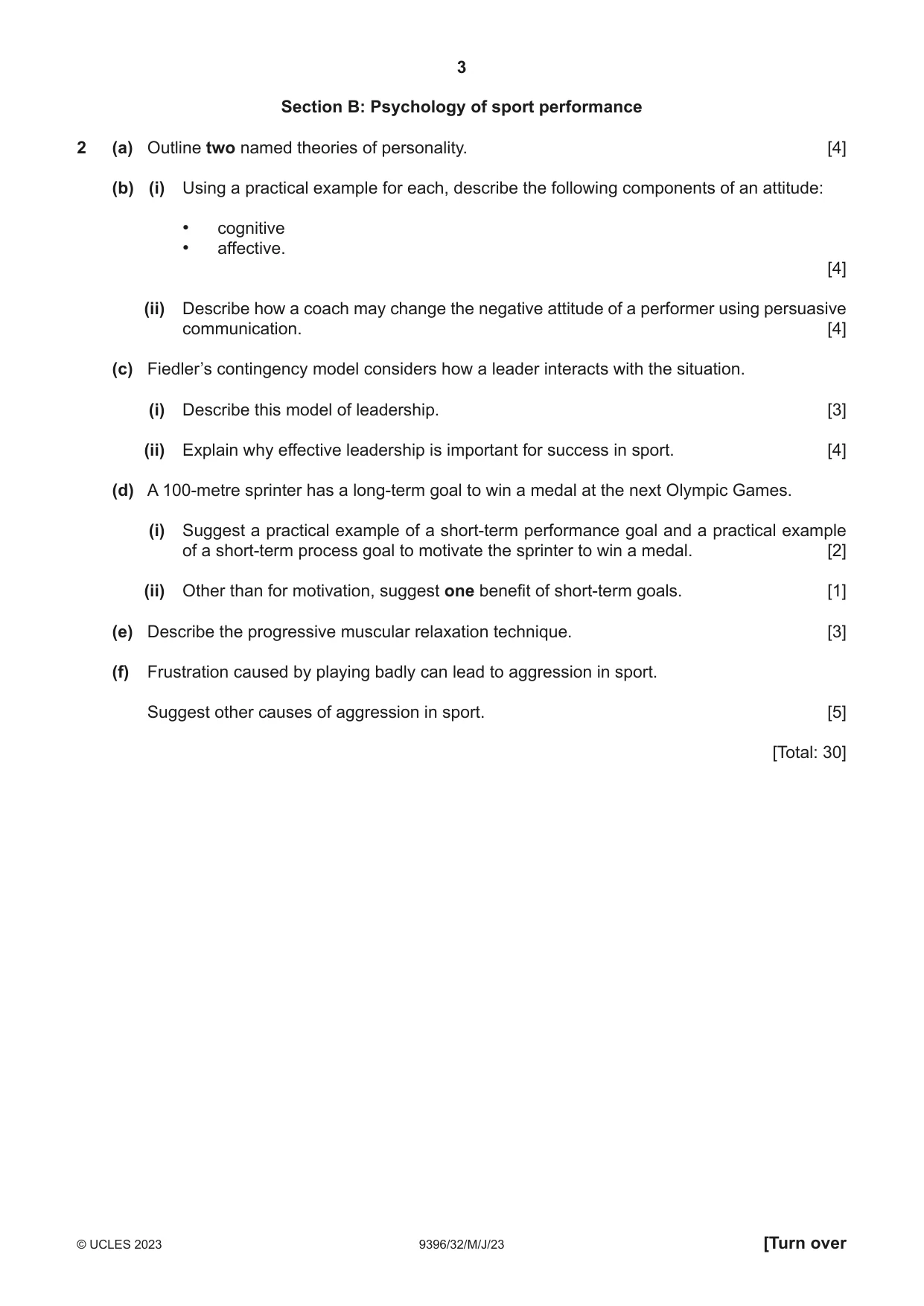
2 (a) Outline two named theories of personality. [4] (b) (i) Using a practical example for each, describe the following components of an attitude: • cognitive • affective. [4] (ii) Describe how a coach may change the negative attitude of a performer using persuasive communication. [4] (c) Fiedler’s contingency model considers how a leader interacts with the situation. (i) Describe this model of leadership. [3] (ii) Explain why effective leadership is important for success in sport. [4] (d) A 100-metre sprinter has a long-term goal to win a medal at the next Olympic Games. (i) Suggest a practical example of a short-term performance goal and a practical example of a short-term process goal to motivate the sprinter to win a medal. [2] (ii) Other than for motivation, suggest one benefit of short-term goals. [1] (e) Describe the progressive muscular relaxation technique. [3] (f) Frustration caused by playing badly can lead to aggression in sport. Suggest other causes of aggression in sport. [5] [Total: 30] Section C: Olympic Games: a global perspective
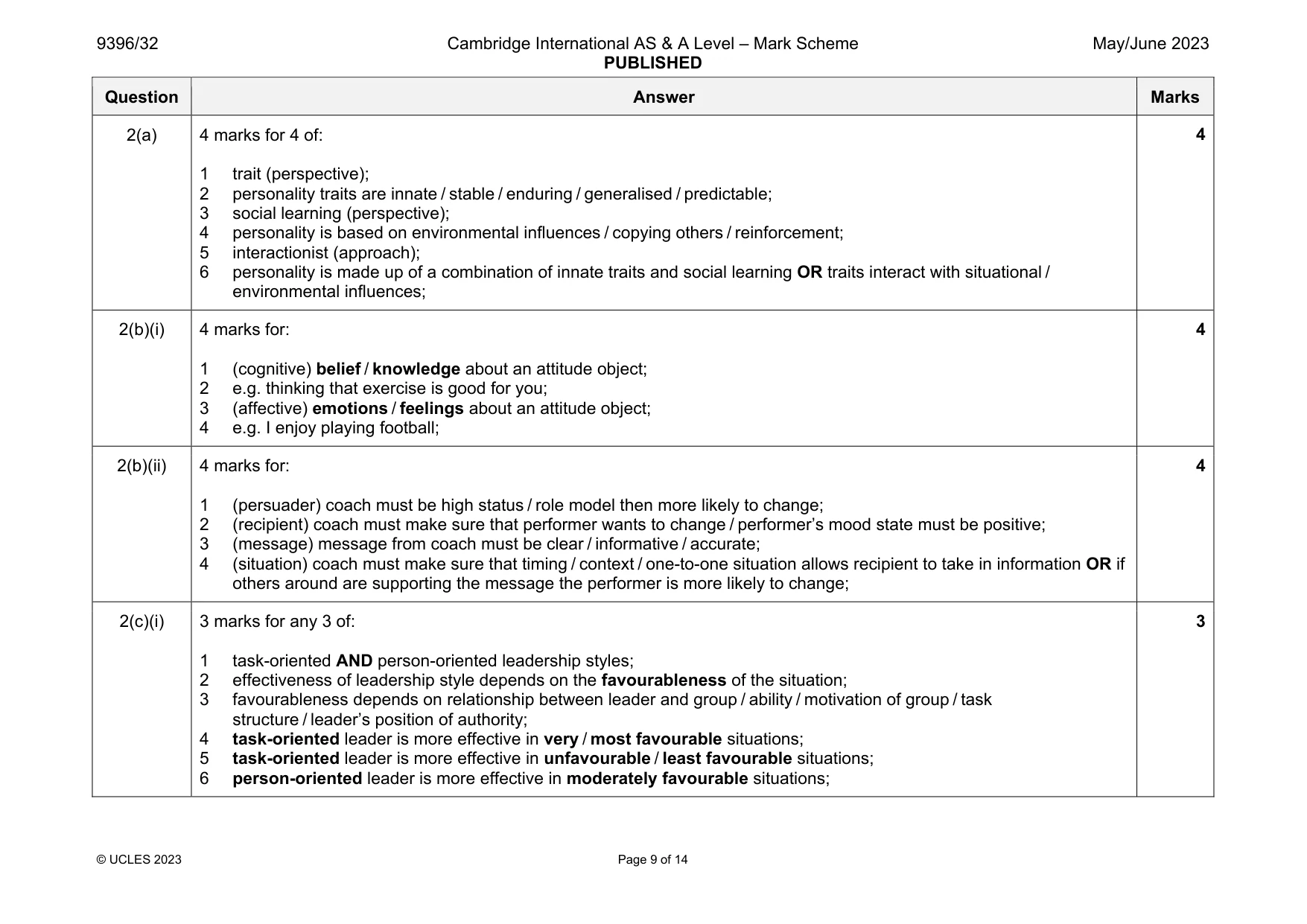
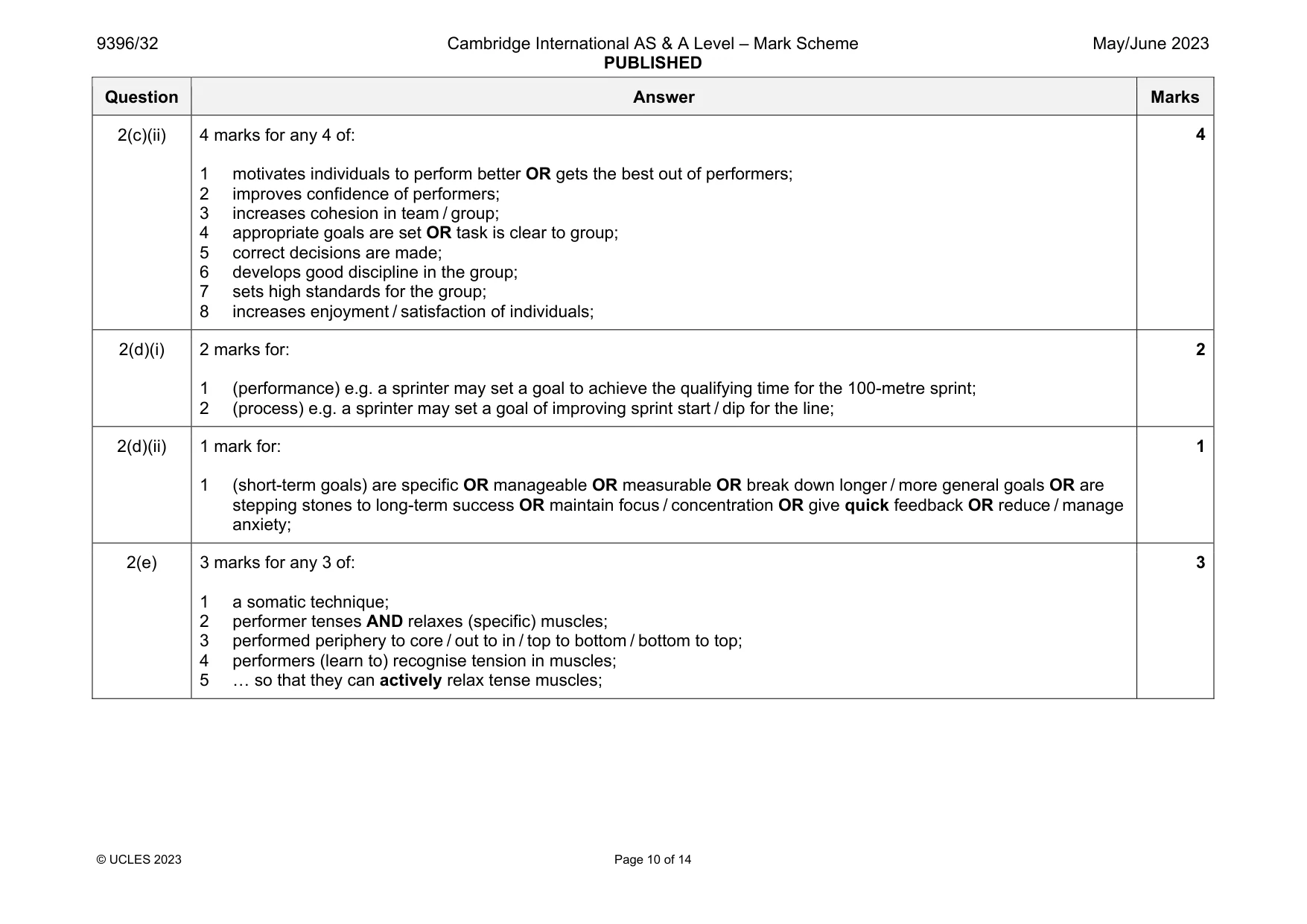
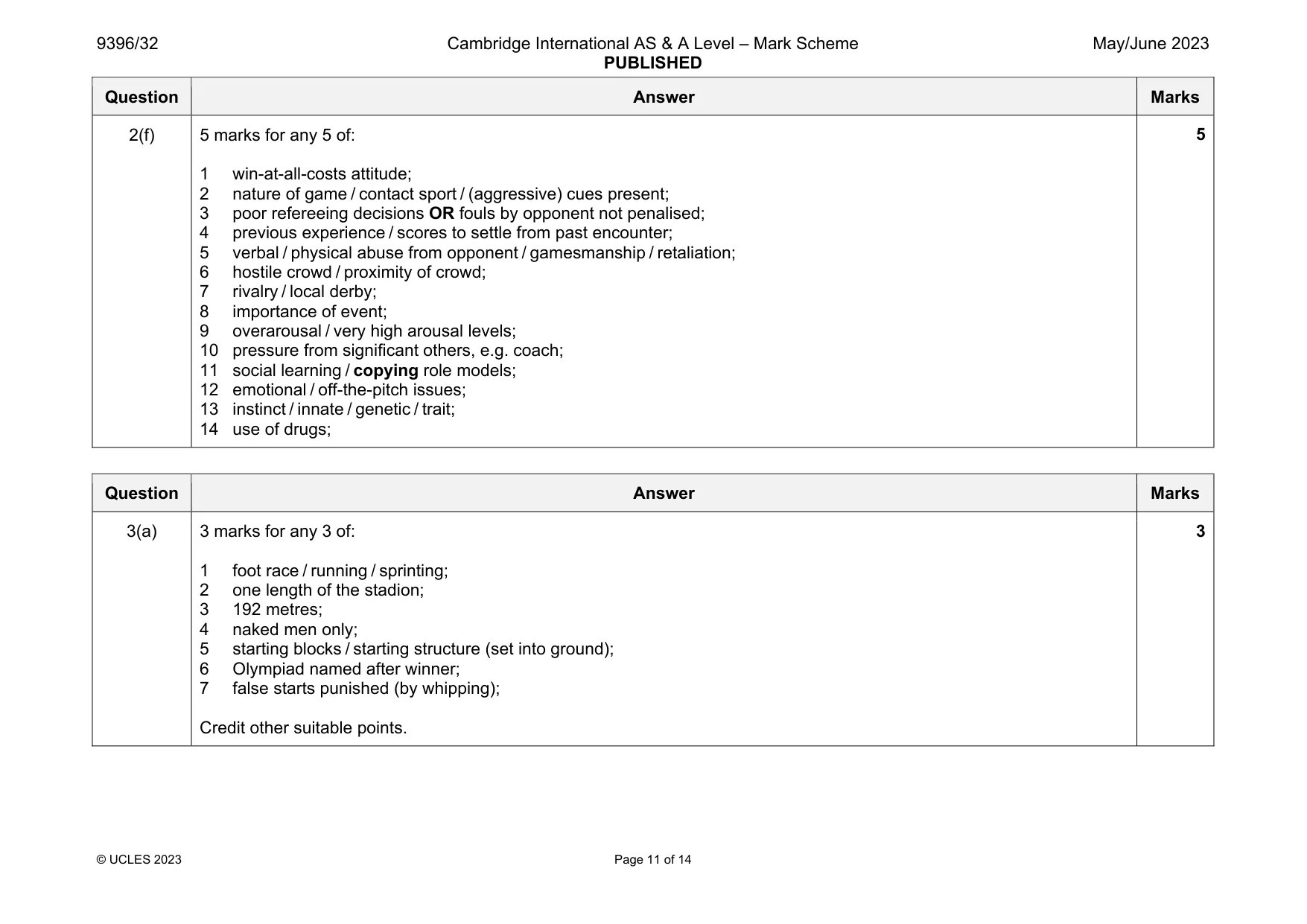
Mark scheme: 2(a) 4 marks for 4 of: 1 trait (perspective); 2 personality traits are innate / stable / enduring / generalised / predictable; 3 social learning (perspective); 4 personality is based on environmental influences / copying others / reinforcement; 5 interactionist (approach); 6 personality is made up of a combination of innate traits and social learning OR traits interact with situational / environmental influences; 2(b)(i) 4 marks for: 1 (cognitive) belief / knowledge about an attitude object; 2 e.g. thinking that exercise is good for you; 3 (affective) emotions / feelings about an attitude object; 4 e.g. I enjoy playing football; 4 2(b)(ii) 4 marks for: 1 (persuader) coach must be high status / role model then more likely to change; 2 (recipient) coach must make sure that performer wants to change / performer’s mood state must be positive; 3 (message) message from coach must be clear / informative / accurate; 4 (situation) coach must make sure that timing / context / one-to-one situation allows recipient to take in information OR if others around are supporting the message the performer is more likely to change; 4 2(c)(i) 3 marks for any 3 of: 1 task-oriented AND person-oriented leadership styles; 2 effectiveness of leadership style depends on the favourableness of the situation; 3 favourableness depends on relationship between leader and group / ability / motivation of group / task structure / leader’s position of authority; 4 task-oriented leader is more effective in very / most favourable situations; 5 task-oriented leader is more effective in unfavourable / least favourable situations; 6 person-oriented leader is more effective in moderately favourable situations; 3 Question Answer Marks 2(c)(ii) 4 marks for any 4 of: 1 motivates individuals to perform better OR gets the best out of performers; 2 improves confidence of performers; 3 increases cohesion in team / group; 4 appropriate goals are set OR task is clear to group; 5 correct decisions are made; 6 develops good discipline in the group; 7 sets high standards for the group; 8 increases enjoyment / satisfaction of individuals; 4 2(d)(i) 2 marks for: 1 (performance) e.g. a sprinter may set a goal to achieve the qualifying time for the 100-metre sprint; 2 (process) e.g. a sprinter may set a goal of improving sprint start / dip for the line; 2 2(d)(ii) 1 mark for: 1 (short-term goals) are specific OR manageable OR measurable OR break down longer / more general goals OR are stepping stones to long-term success OR maintain focus / concentration OR give quick feedback OR reduce / manage anxiety; 1 2(e) 3 marks for any 3 of: 1 a somatic technique; 2 performer tenses AND relaxes (specific) muscles; 3 performed periphery to core / out to in / top to bottom / bottom to top; 4 performers (learn to) recognise tension in muscles; 5 … so that they can actively relax tense muscles; 3 Question Answer Marks 2(f) 5 marks for any 5 of: 1 win-at-all-costs attitude; 2 nature of game / contact sport / (aggressive) cues present; 3 poor refereeing decisions OR fouls by opponent not penalised; 4 previous experience / scores to settle from past encounter; 5 verbal / physical abuse from opponent / gamesmanship / retaliation; 6 hostile crowd / proximity of crowd; 7 rivalry / local derby; 8 importance of event; 9 overarousal / very high arousal levels; 10 pressure from significant others, e.g. coach; 11 social learning / copying role models; 12 emotional / off-the-pitch issues; 13 instinct / innate / genetic / trait; 14 use of drugs; 5
Q3 · One of the events at the ancient Olympic Games was the stade
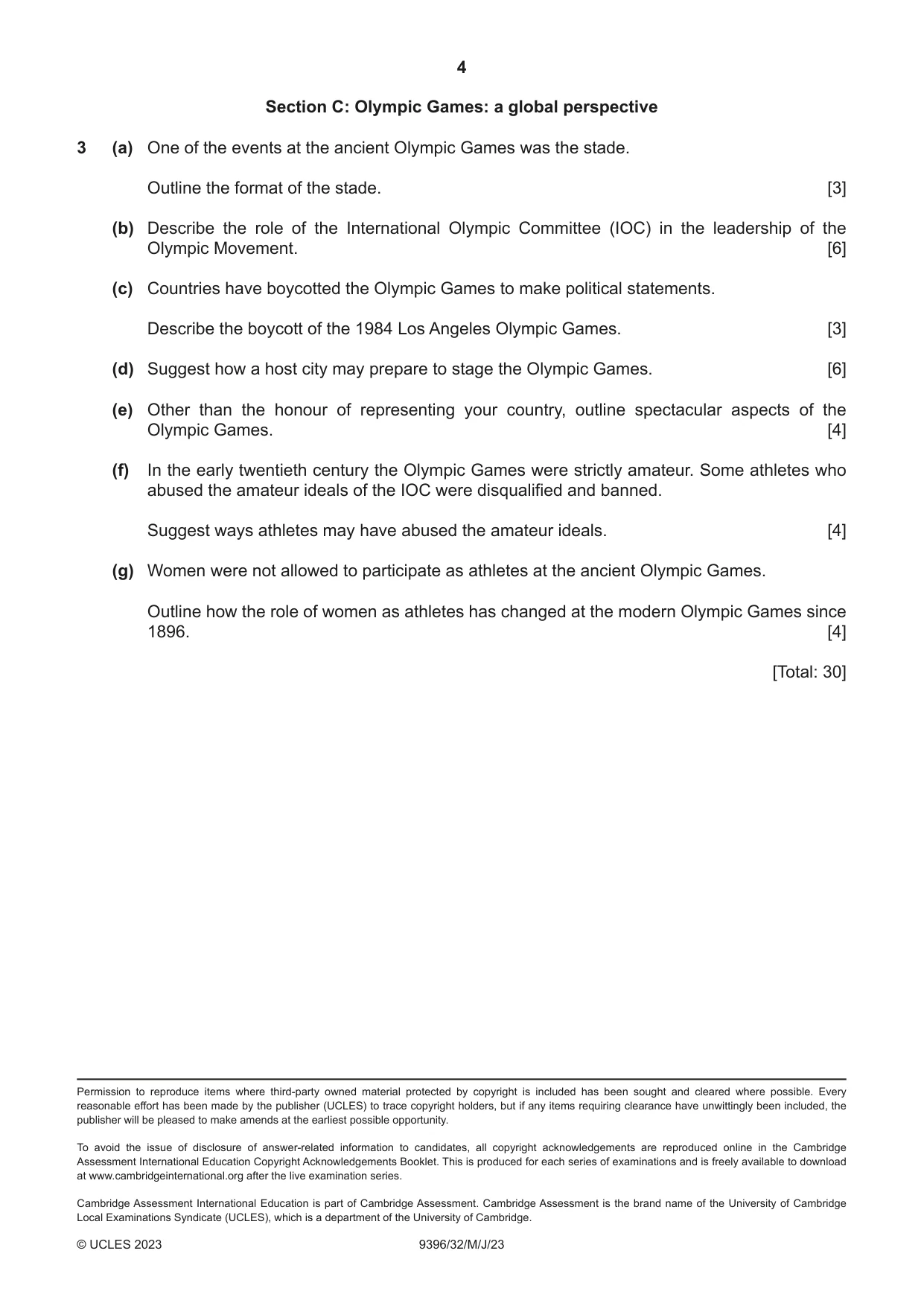
3 (a) One of the events at the ancient Olympic Games was the stade. Outline the format of the stade. [3] (b) Describe the role of the International Olympic Committee (IOC) in the leadership of the Olympic Movement. [6] (c) Countries have boycotted the Olympic Games to make political statements. Describe the boycott of the 1984 Los Angeles Olympic Games. [3] (d) Suggest how a host city may prepare to stage the Olympic Games. [6] (e) Other than the honour of representing your country, outline spectacular aspects of the Olympic Games. [4] (f) In the early twentieth century the Olympic Games were strictly amateur. Some athletes who abused the amateur ideals of the IOC were disqualified and banned. Suggest ways athletes may have abused the amateur ideals. [4] (g) Women were not allowed to participate as athletes at the ancient Olympic Games. Outline how the role of women as athletes has changed at the modern Olympic Games since 1896. [4] [Total: 30]
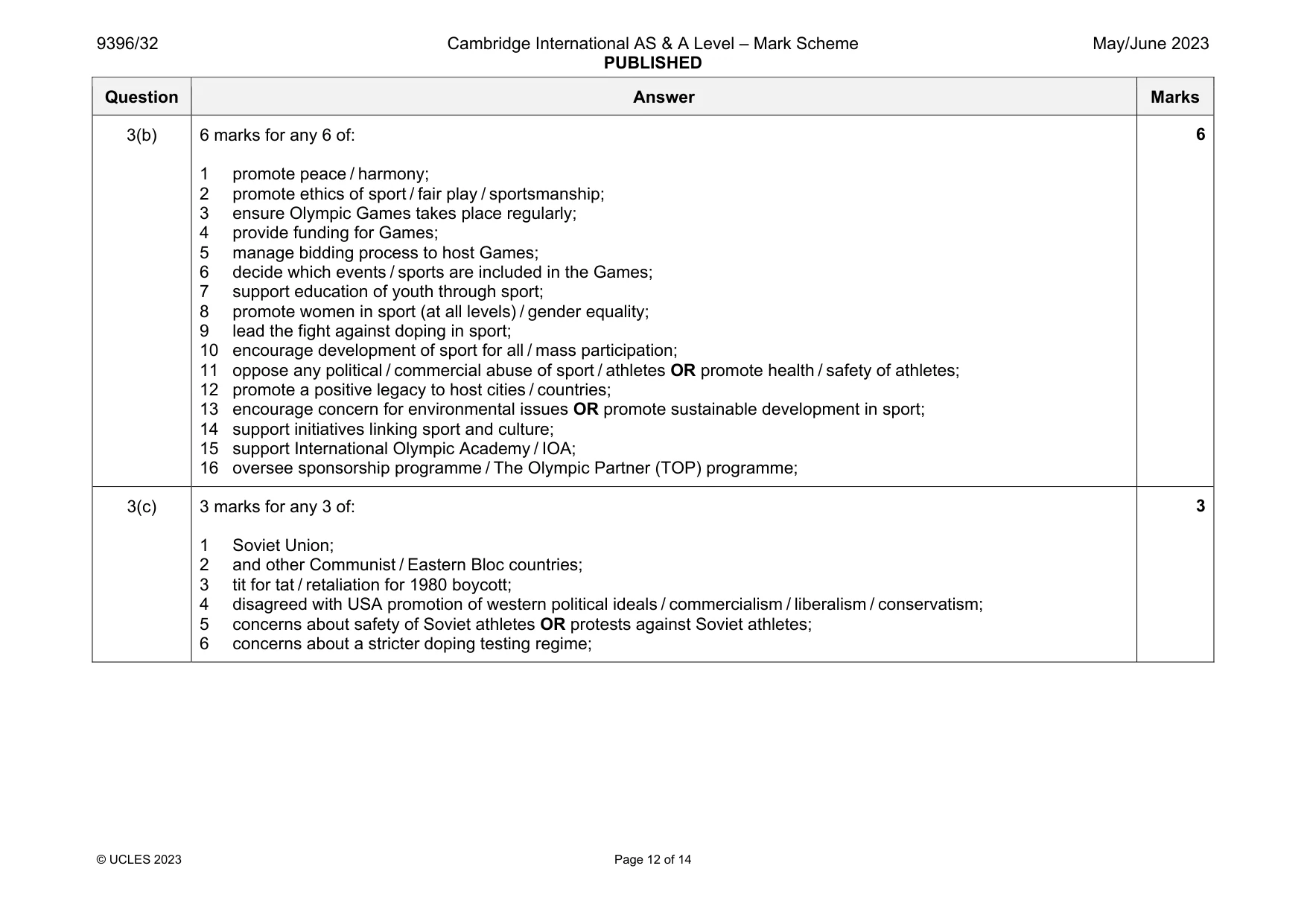
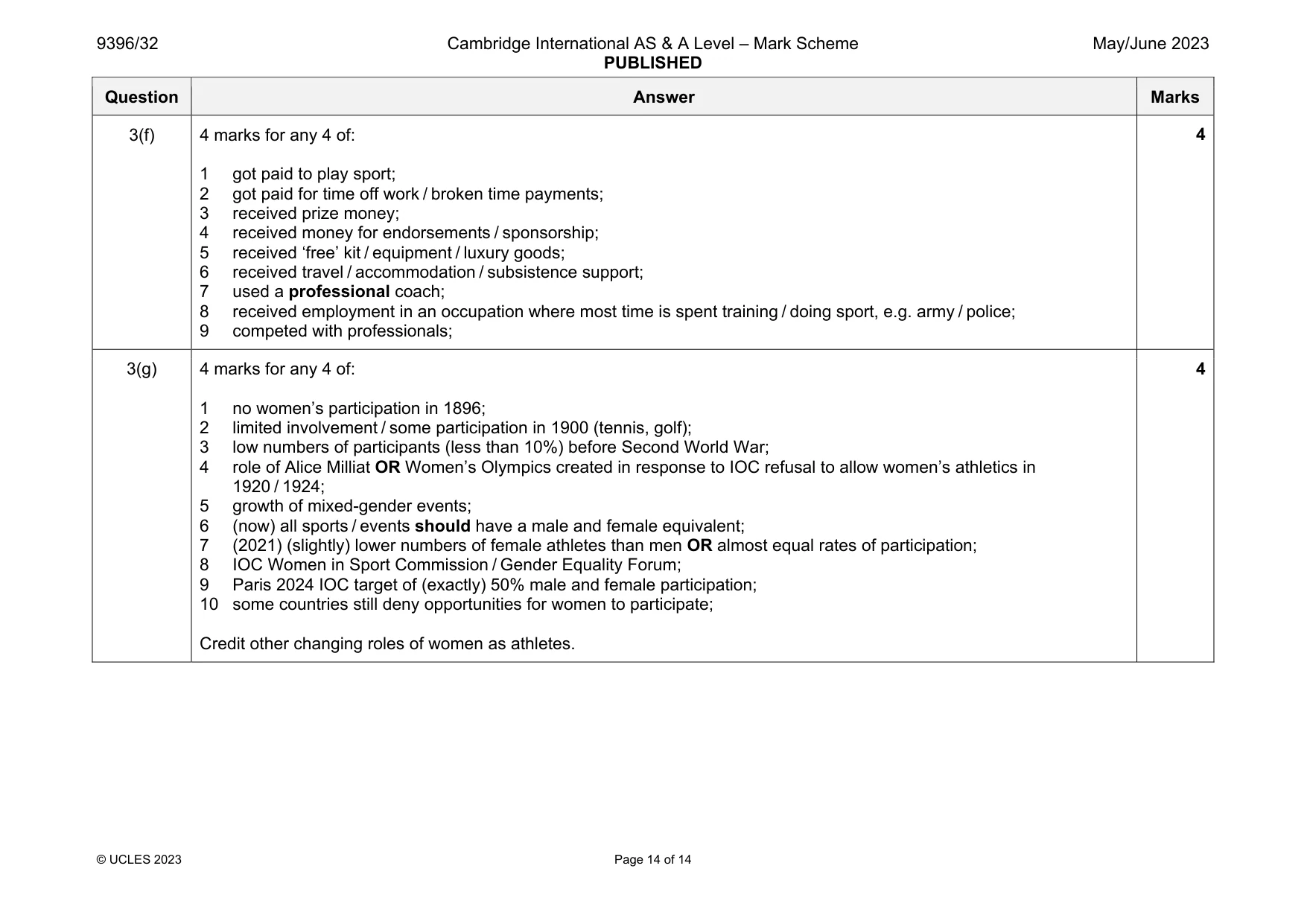
Mark scheme: 3(a) 3 marks for any 3 of: 1 foot race / running / sprinting; 2 one length of the stadion; 3 192 metres; 4 naked men only; 5 starting blocks / starting structure (set into ground); 6 Olympiad named after winner; 7 false starts punished (by whipping); Credit other suitable points. Question Answer Marks 3(b) 6 marks for any 6 of: 1 promote peace / harmony; 2 promote ethics of sport / fair play / sportsmanship; 3 ensure Olympic Games takes place regularly; 4 provide funding for Games; 5 manage bidding process to host Games; 6 decide which events / sports are included in the Games; 7 support education of youth through sport; 8 promote women in sport (at all levels) / gender equality; 9 lead the fight against doping in sport; 10 encourage development of sport for all / mass participation; 11 oppose any political / commercial abuse of sport / athletes OR promote health / safety of athletes; 12 promote a positive legacy to host cities / countries; 13 encourage concern for environmental issues OR promote sustainable development in sport; 14 support initiatives linking sport and culture; 15 support International Olympic Academy / IOA; 16 oversee sponsorship programme / The Olympic Partner (TOP) programme; 6 3(c) 3 marks for any 3 of: 1 Soviet Union; 2 and other Communist / Eastern Bloc countries; 3 tit for tat / retaliation for 1980 boycott; 4 disagreed with USA promotion of western political ideals / commercialism / liberalism / conservatism; 5 concerns about safety of Soviet athletes OR protests against Soviet athletes; 6 concerns about a stricter doping testing regime; 3 Question Answer Marks 3(d) 6 marks for any 6 of: 1 build world class sporting facilities / stadia; 2 improve infrastructure / transport links; 3 build Olympic village; 4 build hotels / accommodation for tourists; 5 increase security; 6 use of cheap labour; 7 access sources of funding; 8 relocation of population; 9 address environmental issues; 10 recruitment of volunteers OR employment of support workers; 11 marketing / advertising / generating support for Games; 12 plan opening / closing ceremonies; Accept other relevant suggestions. 6 3(e) 4 marks for any 4 of: 1 competing against the best in the world / intensity of competition; 2 supreme mental / physical challenge / pushing achievements of body to limits; 3 experiencing / mixing with other cultures / sports / expanding horizon; 4 spiritual aspect / bravery of competition; 5 honour of winning medal / performing at one’s best; 6 opening / closing ceremony; 7 high media profile OR opportunities for financial gain; 4 Question Answer Marks 3(f) 4 marks for any 4 of: 1 got paid to play sport; 2 got paid for time off work / broken time payments; 3 received prize money; 4 received money for endorsements / sponsorship; 5 received ‘free’ kit / equipment / luxury goods; 6 received travel / accommodation / subsistence support; 7 used a professional coach; 8 received employment in an occupation where most time is spent training / doing sport, e.g. army / police; 9 competed with professionals; 4 3(g) 4 marks for any 4 of: 1 no women’s participation in 1896; 2 limited involvement / some participation in 1900 (tennis, golf); 3 low numbers of participants (less than 10%) before Second World War; 4 role of Alice Milliat OR Women’s Olympics created in response to IOC refusal to allow women’s athletics in 1920 / 1924; 5 growth of mixed-gender events; 6 (now) all sports / events should have a male and female equivalent; 7 (2021) (slightly) lower numbers of female athletes than men OR almost equal rates of participation; 8 IOC Women in Sport Commission / Gender Equality Forum; 9 Paris 2024 IOC target of (exactly) 50% male and female participation; 10 some countries still deny opportunities for women to participate; Credit other changing roles of women as athletes. 4
What you needed in this session
Cambridge’s own grade thresholds for 2023 May/June, Paper 3 · Variant 2. A higher threshold means an easier paper — the bar moves with how the cohort did.