Cambridge A Level Physical Education 9396 — 2022 Oct/Nov Paper 3 · Variant 2
9396/32/O/N/22 · 3 questions · 90 marks · ≈101 min
The question paper and its mark scheme, free to read here and free to download. This is Cambridge’s own paper, exactly as it was sat.
Question paper4 pages

Mark scheme13 pages
Answers below. Sit the paper first if you are practising.

Questions as text
Q1 · Describe the role of ATP, including its breakdown and resynthesis
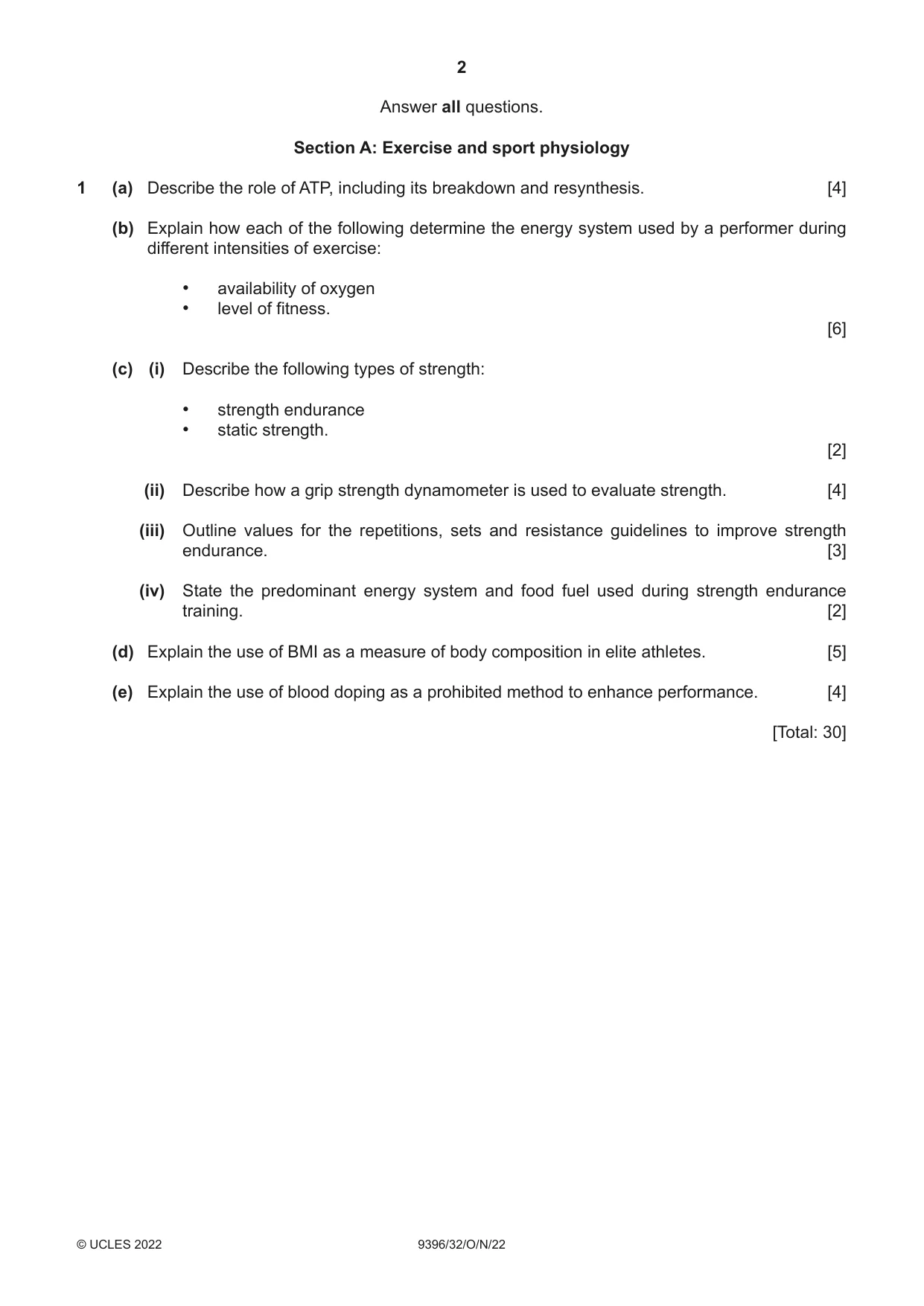
1 (a) Describe the role of ATP, including its breakdown and resynthesis. [4] (b) Explain how each of the following determine the energy system used by a performer during different intensities of exercise: • availability of oxygen • level of fitness. [6] (c) (i) Describe the following types of strength: • strength endurance • static strength. [2] (ii) Describe how a grip strength dynamometer is used to evaluate strength. [4] (iii) Outline values for the repetitions, sets and resistance guidelines to improve strength endurance. [3] (iv) State the predominant energy system and food fuel used during strength endurance training. [2] (d) Explain the use of BMI as a measure of body composition in elite athletes. [5] (e) Explain the use of blood doping as a prohibited method to enhance performance. [4] [Total: 30]
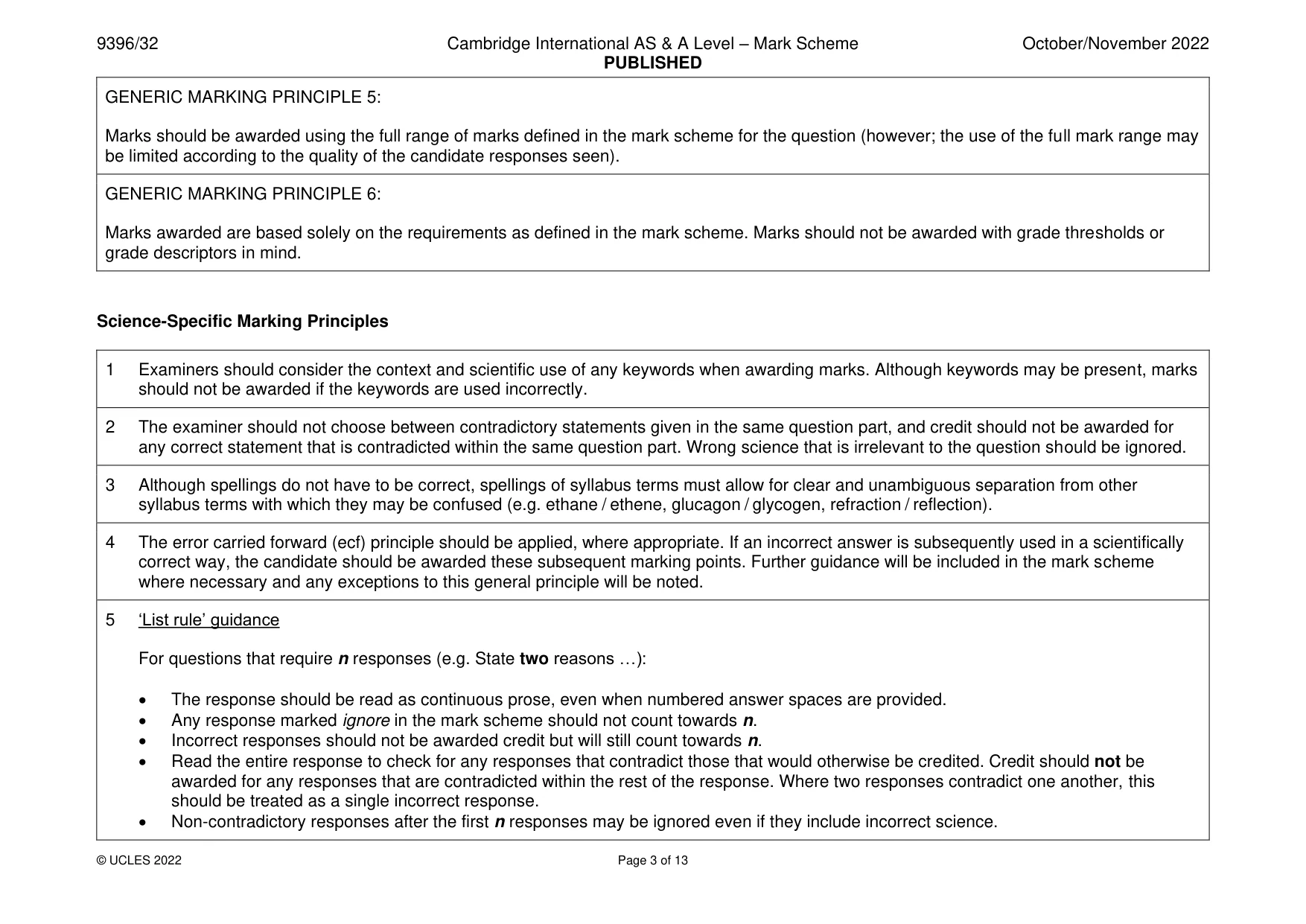
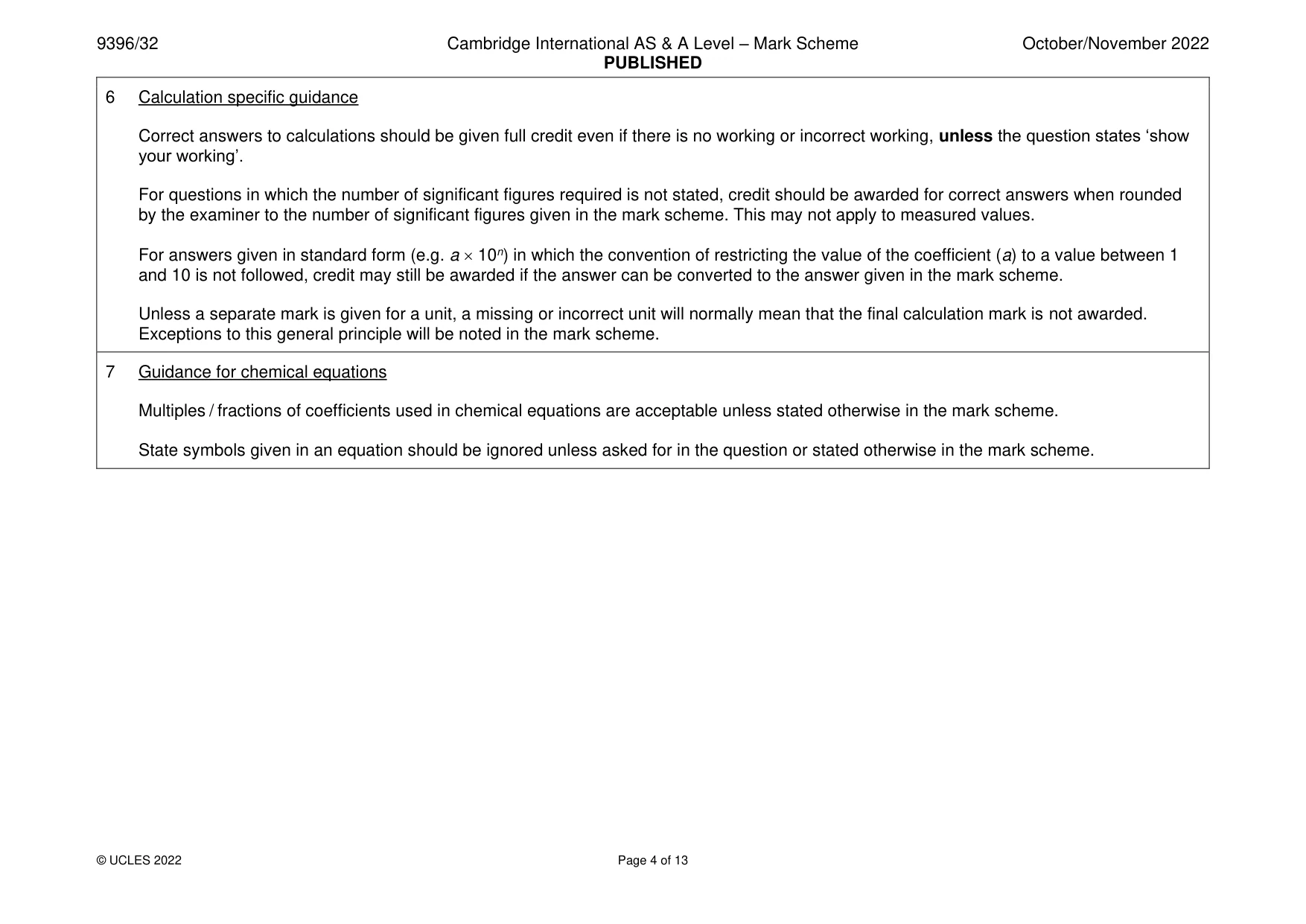
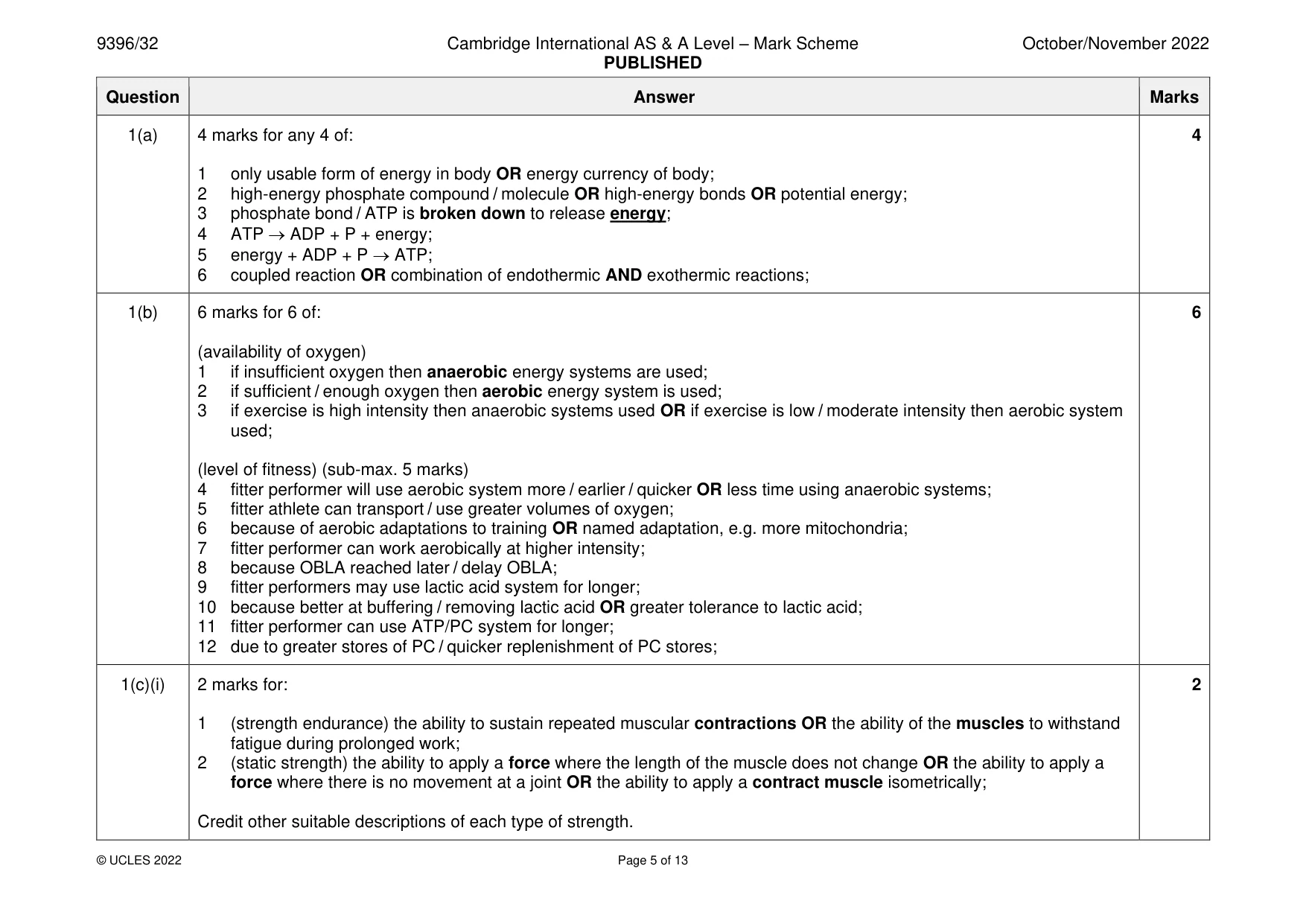
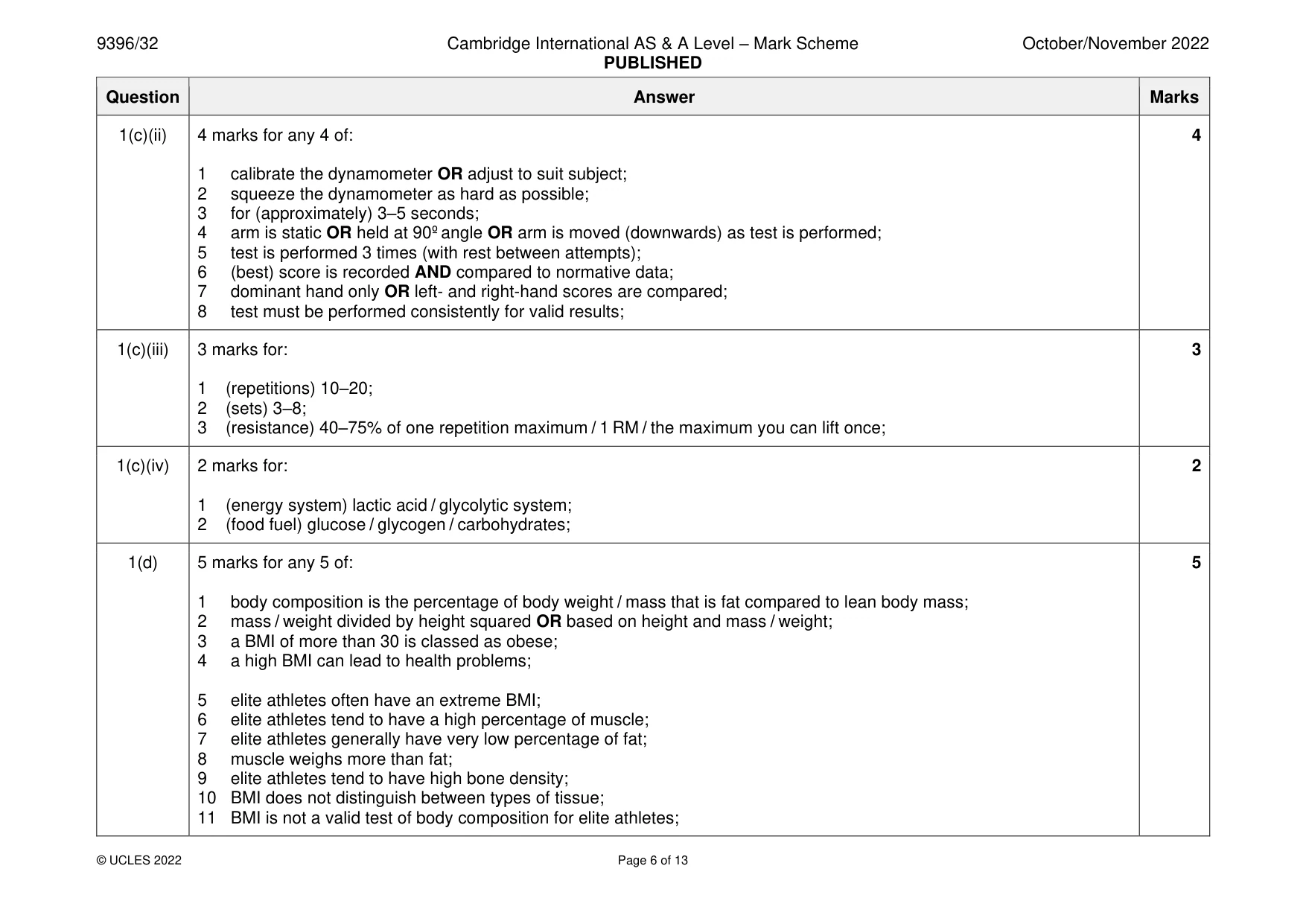
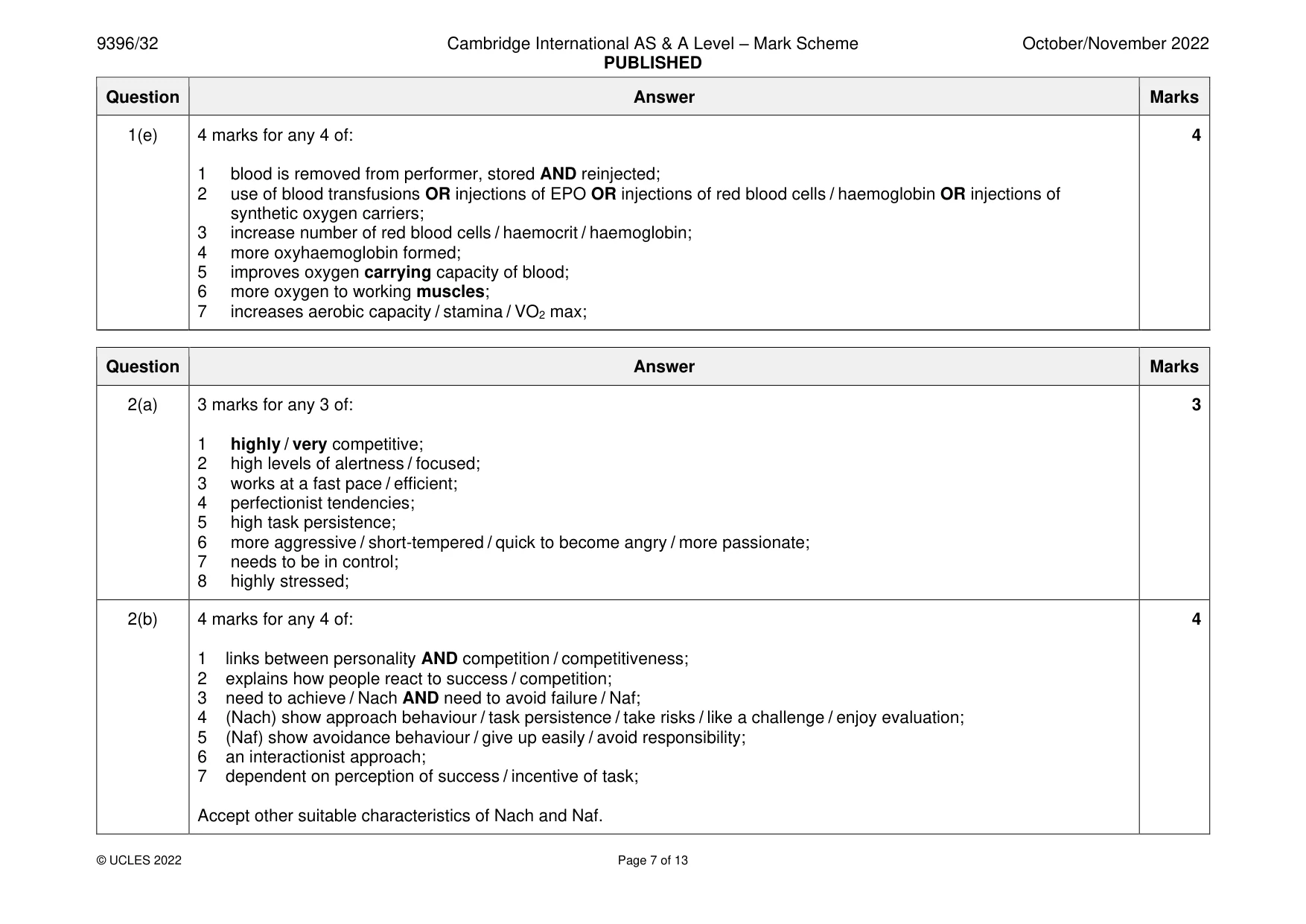
Mark scheme: Question Answer Marks 1(a) 4 marks for any 4 of: 4 1 only usable form of energy in body OR energy currency of body; 2 high-energy phosphate compound / molecule OR high-energy bonds OR potential energy; 3 phosphate bond / ATP is broken down to release energy; 4 ATP → ADP + P + energy; 5 energy + ADP + P → ATP; 6 coupled reaction OR combination of endothermic AND exothermic reactions; 1(b) 6 marks for 6 of: 6 (availability of oxygen) 1 if insufficient oxygen then anaerobic energy systems are used; 2 if sufficient / enough oxygen then aerobic energy system is used; 3 if exercise is high intensity then anaerobic systems used OR if exercise is low / moderate intensity then aerobic system used; (level of fitness) (sub-max. 5 marks) 4 fitter performer will use aerobic system more / earlier / quicker OR less time using anaerobic systems; 5 fitter athlete can transport / use greater volumes of oxygen; 6 because of aerobic adaptations to training OR named adaptation, e.g. more mitochondria; 7 fitter performer can work aerobically at higher intensity; 8 because OBLA reached later / delay OBLA; 9 fitter performers may use lactic acid system for longer; 10 because better at buffering / removing lactic acid OR greater tolerance to lactic acid; 11 fitter performer can use ATP/PC system for longer; 12 due to greater stores of PC / quicker replenishment of PC stores; 1(c)(i) 2 marks for: 2 1 (strength endurance) the ability to sustain repeated muscular contractions OR the ability of the muscles to withstand fatigue during prolonged work; 2 (static strength) the ability to apply a force where the length of the muscle does not change OR the ability to apply a force where there is no movement at a joint OR the ability to apply a contract muscle isometrically; Credit other suitable descriptions of each type of strength. 1(c)(ii) 4 marks for any 4 of: 4 1 calibrate the dynamometer OR adjust to suit subject; 2 squeeze the dynamometer as hard as possible; 3 for (approximately) 3–5 seconds; 4 arm is static OR held at 90º angle OR arm is moved (downwards) as test is performed; 5 test is performed 3 times (with rest between attempts); 6 (best) score is recorded AND compared to normative data; 7 dominant hand only OR left- and right-hand scores are compared; 8 test must be performed consistently for valid results; 1(c)(iii) 3 marks for: 3 1 (repetitions) 10–20; 2 (sets) 3–8; 3 (resistance) 40–75% of one repetition maximum / 1 RM / the maximum you can lift once; 1(c)(iv) 2 marks for: 2 1 (energy system) lactic acid / glycolytic system; 2 (food fuel) glucose / glycogen / carbohydrates; 1(d) 5 marks for any 5 of: 5 1 body composition is the percentage of body weight / mass that is fat compared to lean body mass; 2 mass / weight divided by height squared OR based on height and mass / weight; 3 a BMI of more than 30 is classed as obese; 4 a high BMI can lead to health problems; 5 elite athletes often have an extreme BMI; 6 elite athletes tend to have a high percentage of muscle; 7 elite athletes generally have very low percentage of fat; 8 muscle weighs more than fat; 9 elite athletes tend to have high bone density; 10 BMI does not distinguish between types of tissue; 11 BMI is not a valid test of body composition for elite athletes; 1(e) 4 marks for any 4 of: 4 1 blood is removed from performer, stored AND reinjected; 2 use of blood transfusions OR injections of EPO OR injections of red blood cells / haemoglobin OR injections of synthetic oxygen carriers; 3 increase number of red blood cells / haemocrit / haemoglobin; 4 more oxyhaemoglobin formed; 5 improves oxygen carrying capacity of blood; 6 more oxygen to working muscles; 7 increases aerobic capacity / stamina / VO2 max;
Q2 · State three characteristics of a Type A personality
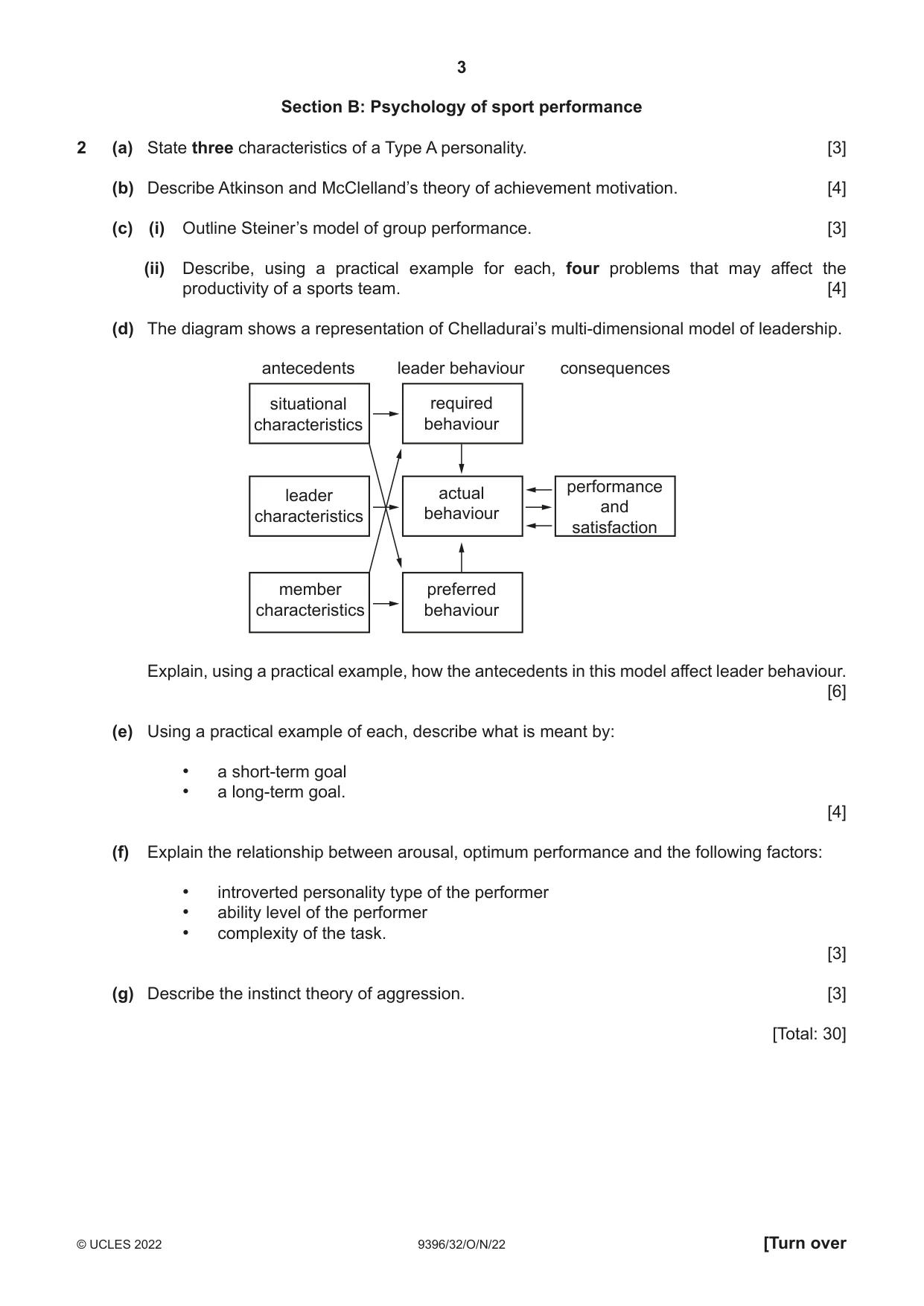
2 (a) State three characteristics of a Type A personality. [3] (b) Describe Atkinson and McClelland’s theory of achievement motivation. [4] (c) (i) Outline Steiner’s model of group performance. [3] (ii) Describe, using a practical example for each, four problems that may affect the productivity of a sports team. [4] (d) The diagram shows a representation of Chelladurai’s multi-dimensional model of leadership. antecedents leader behaviour consequences situational required characteristics behaviour performance leader actual and characteristics behaviour satisfaction member preferred characteristics behaviour Explain, using a practical example, how the antecedents in this model affect leader behaviour. [6] (e) Using a practical example of each, describe what is meant by: • a short-term goal • a long-term goal. [4] (f) Explain the relationship between arousal, optimum performance and the following factors: • introverted personality type of the performer • ability level of the performer • complexity of the task. [3] (g) Describe the instinct theory of aggression. [3] [Total: 30] Section C: Olympic Games: a global perspective
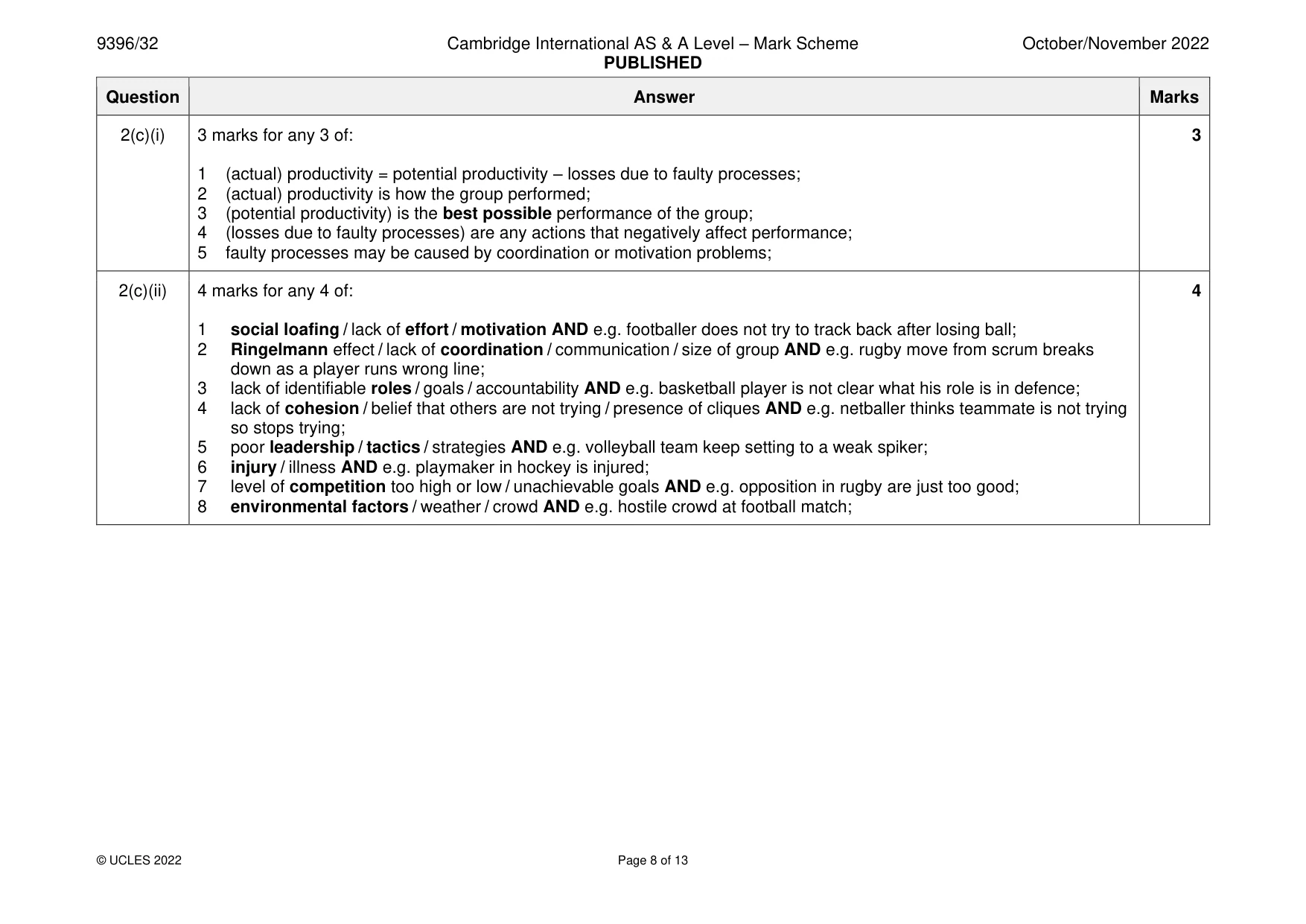
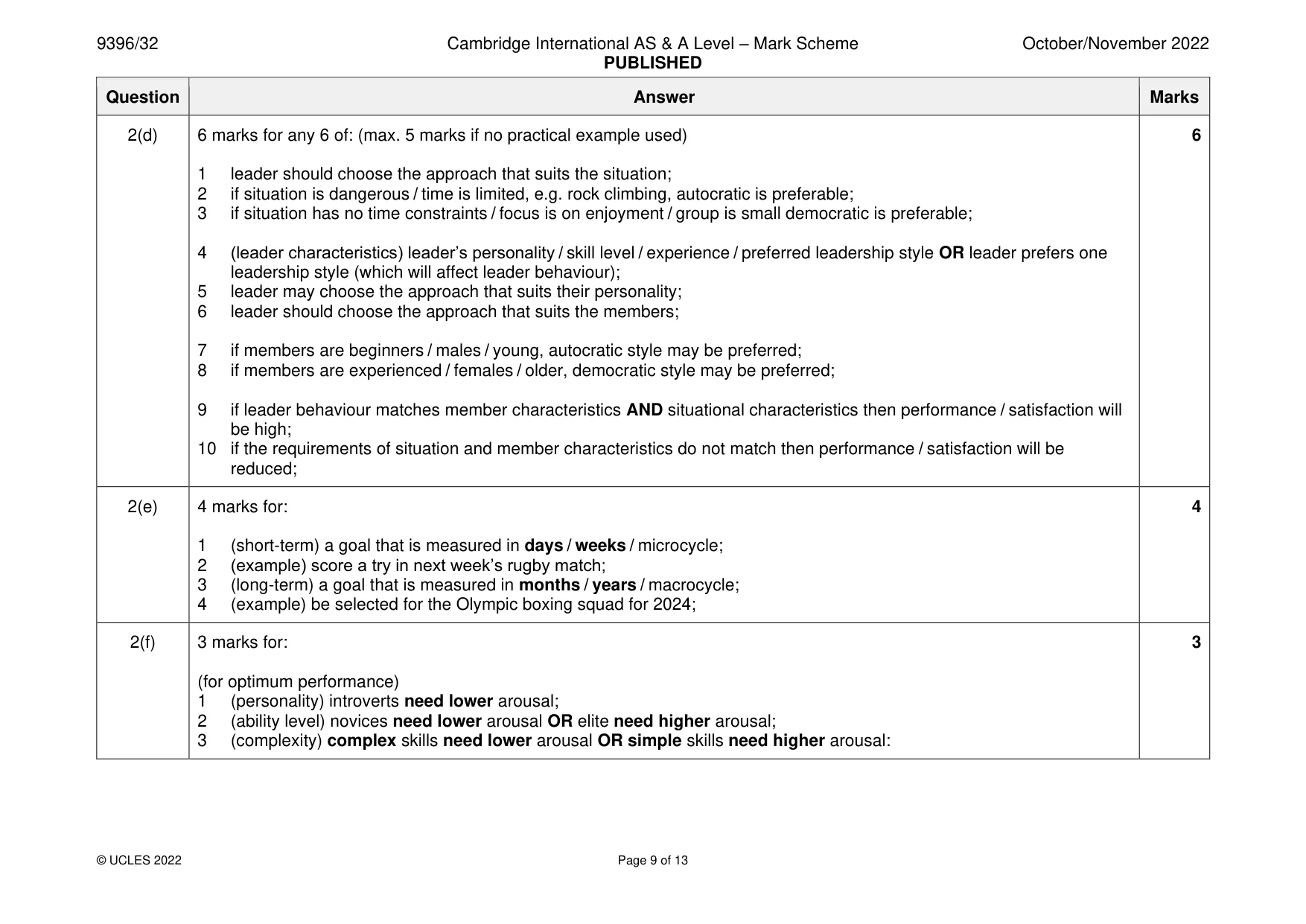
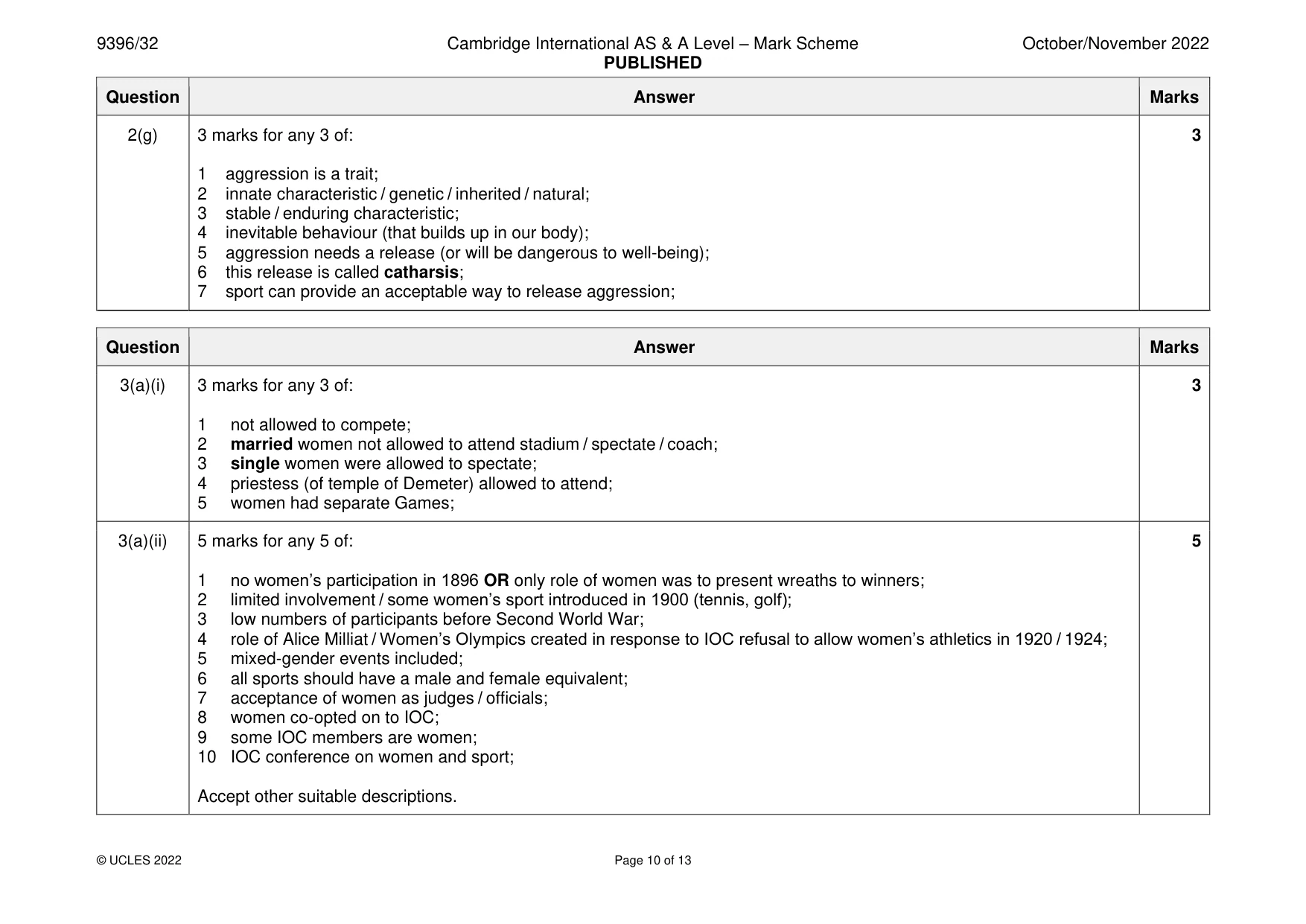
Mark scheme: 2(a) 3 marks for any 3 of: 3 1 highly / very competitive; 2 high levels of alertness / focused; 3 works at a fast pace / efficient; 4 perfectionist tendencies; 5 high task persistence; 6 more aggressive / short-tempered / quick to become angry / more passionate; 7 needs to be in control; 8 highly stressed; 2(b) 4 marks for any 4 of: 4 1 links between personality AND competition / competitiveness; 2 explains how people react to success / competition; 3 need to achieve / Nach AND need to avoid failure / Naf; 4 (Nach) show approach behaviour / task persistence / take risks / like a challenge / enjoy evaluation; 5 (Naf) show avoidance behaviour / give up easily / avoid responsibility; 6 an interactionist approach; 7 dependent on perception of success / incentive of task; Accept other suitable characteristics of Nach and Naf. 2(c)(i) 3 marks for any 3 of: 3 1 (actual) productivity = potential productivity – losses due to faulty processes; 2 (actual) productivity is how the group performed; 3 (potential productivity) is the best possible performance of the group; 4 (losses due to faulty processes) are any actions that negatively affect performance; 5 faulty processes may be caused by coordination or motivation problems; 2(c)(ii) 4 marks for any 4 of: 4 1 social loafing / lack of effort / motivation AND e.g. footballer does not try to track back after losing ball; 2 Ringelmann effect / lack of coordination / communication / size of group AND e.g. rugby move from scrum breaks down as a player runs wrong line; 3 lack of identifiable roles / goals / accountability AND e.g. basketball player is not clear what his role is in defence; 4 lack of cohesion / belief that others are not trying / presence of cliques AND e.g. netballer thinks teammate is not trying so stops trying; 5 poor leadership / tactics / strategies AND e.g. volleyball team keep setting to a weak spiker; 6 injury / illness AND e.g. playmaker in hockey is injured; 7 level of competition too high or low / unachievable goals AND e.g. opposition in rugby are just too good; 8 environmental factors / weather / crowd AND e.g. hostile crowd at football match; 2(d) 6 marks for any 6 of: (max. 5 marks if no practical example used) 6 1 leader should choose the approach that suits the situation; 2 if situation is dangerous / time is limited, e.g. rock climbing, autocratic is preferable; 3 if situation has no time constraints / focus is on enjoyment / group is small democratic is preferable; 4 (leader characteristics) leader’s personality / skill level / experience / preferred leadership style OR leader prefers one leadership style (which will affect leader behaviour); 5 leader may choose the approach that suits their personality; 6 leader should choose the approach that suits the members; 7 if members are beginners / males / young, autocratic style may be preferred; 8 if members are experienced / females / older, democratic style may be preferred; 9 if leader behaviour matches member characteristics AND situational characteristics then performance / satisfaction will be high; 10 if the requirements of situation and member characteristics do not match then performance / satisfaction will be reduced; 2(e) 4 marks for: 4 1 (short-term) a goal that is measured in days / weeks / microcycle; 2 (example) score a try in next week’s rugby match; 3 (long-term) a goal that is measured in months / years / macrocycle; 4 (example) be selected for the Olympic boxing squad for 2024; 2(f) 3 marks for: 3 (for optimum performance) 1 (personality) introverts need lower arousal; 2 (ability level) novices need lower arousal OR elite need higher arousal; 3 (complexity) complex skills need lower arousal OR simple skills need higher arousal: 2(g) 3 marks for any 3 of: 3 1 aggression is a trait; 2 innate characteristic / genetic / inherited / natural; 3 stable / enduring characteristic; 4 inevitable behaviour (that builds up in our body); 5 aggression needs a release (or will be dangerous to well-being); 6 this release is called catharsis; 7 sport can provide an acceptable way to release aggression;
Q3 · Outline the limited role of women at the ancient Olympic Games
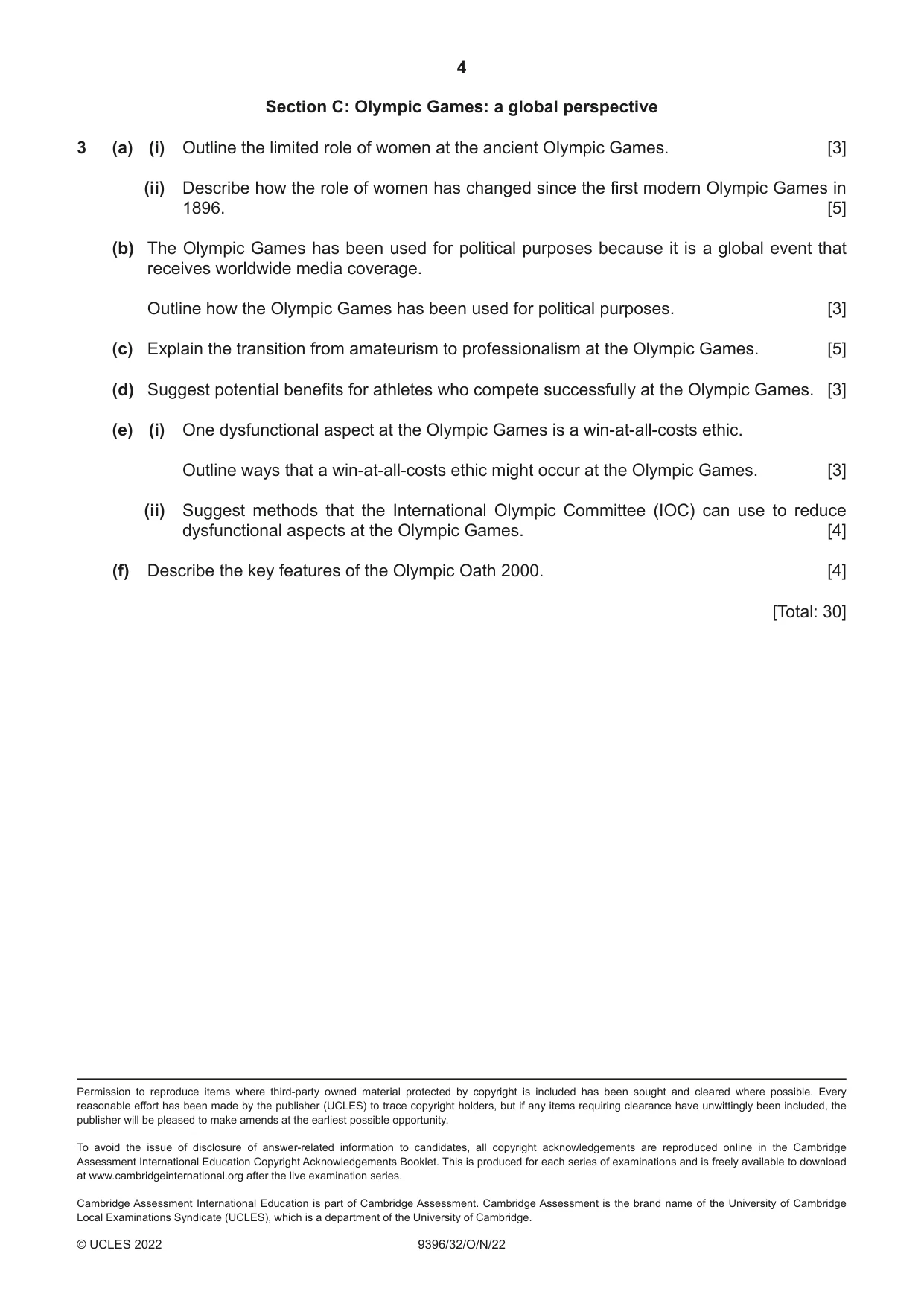
3 (a) (i) Outline the limited role of women at the ancient Olympic Games. [3] (ii) Describe how the role of women has changed since the first modern Olympic Games in 1896. [5] (b) The Olympic Games has been used for political purposes because it is a global event that receives worldwide media coverage. Outline how the Olympic Games has been used for political purposes. [3] (c) Explain the transition from amateurism to professionalism at the Olympic Games. [5] (d) Suggest potential benefits for athletes who compete successfully at the Olympic Games. [3] (e) (i) One dysfunctional aspect at the Olympic Games is a win-at-all-costs ethic. Outline ways that a win-at-all-costs ethic might occur at the Olympic Games. [3] (ii) Suggest methods that the International Olympic Committee (IOC) can use to reduce dysfunctional aspects at the Olympic Games. [4] (f) Describe the key features of the Olympic Oath 2000. [4] [Total: 30]
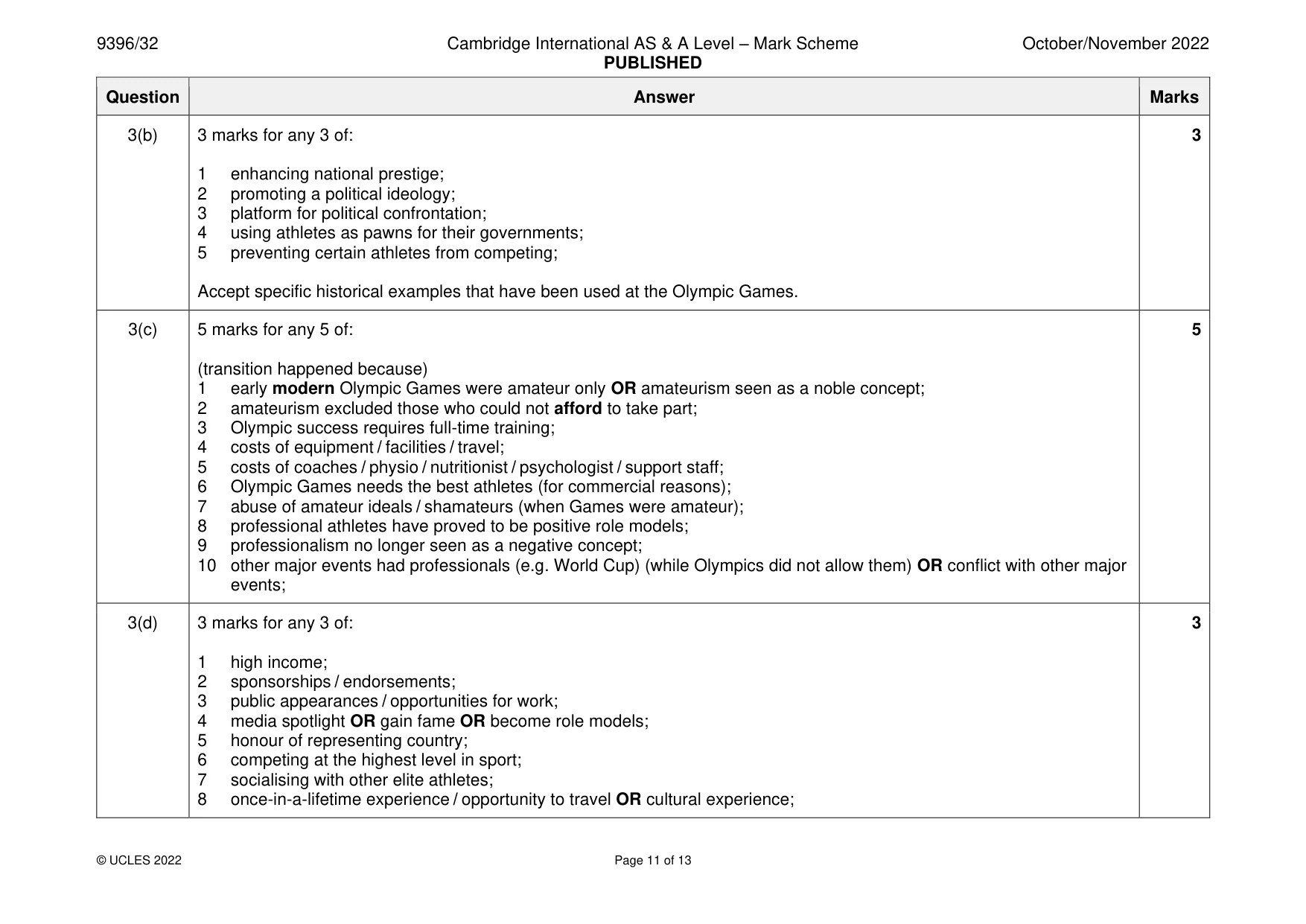
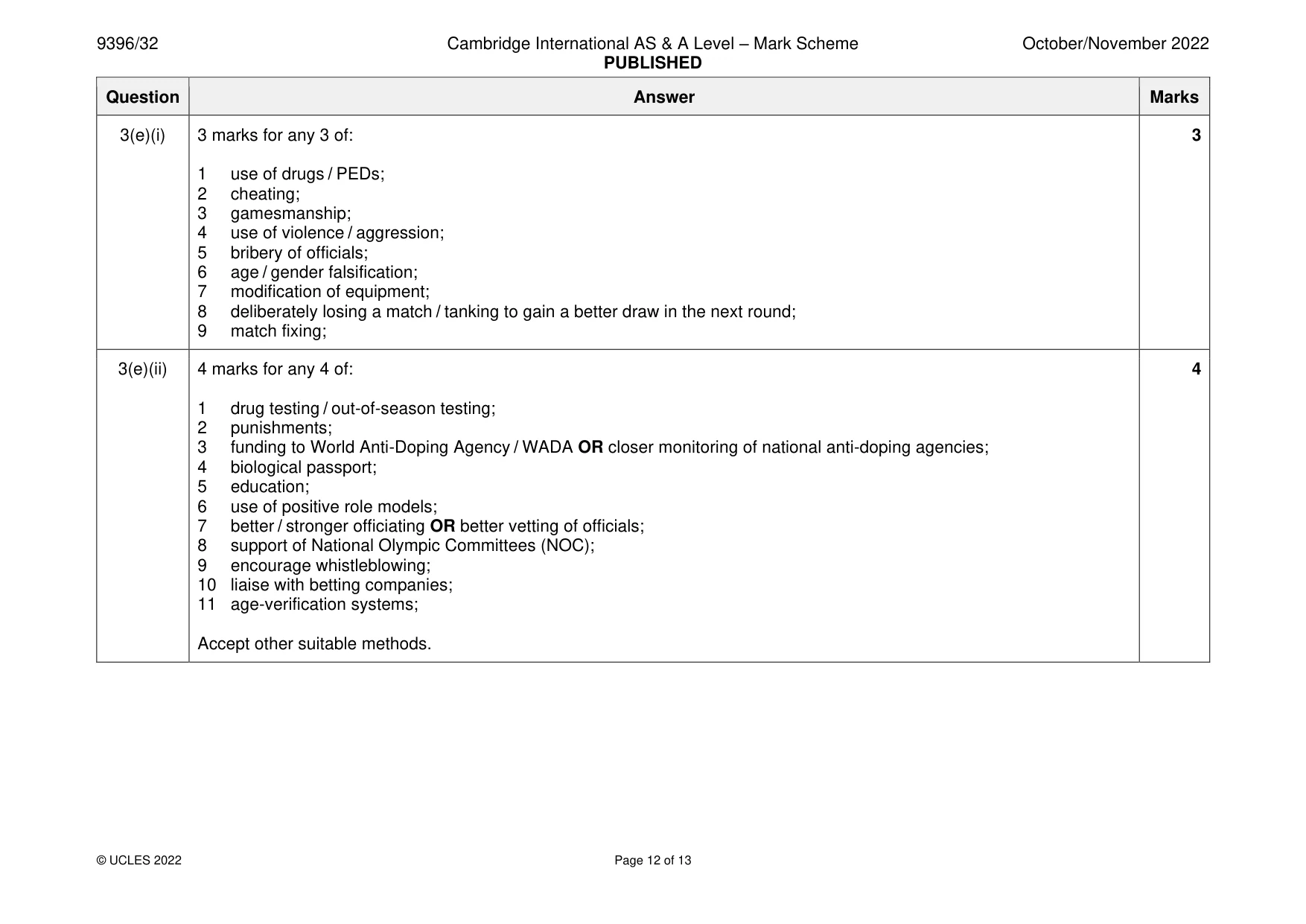
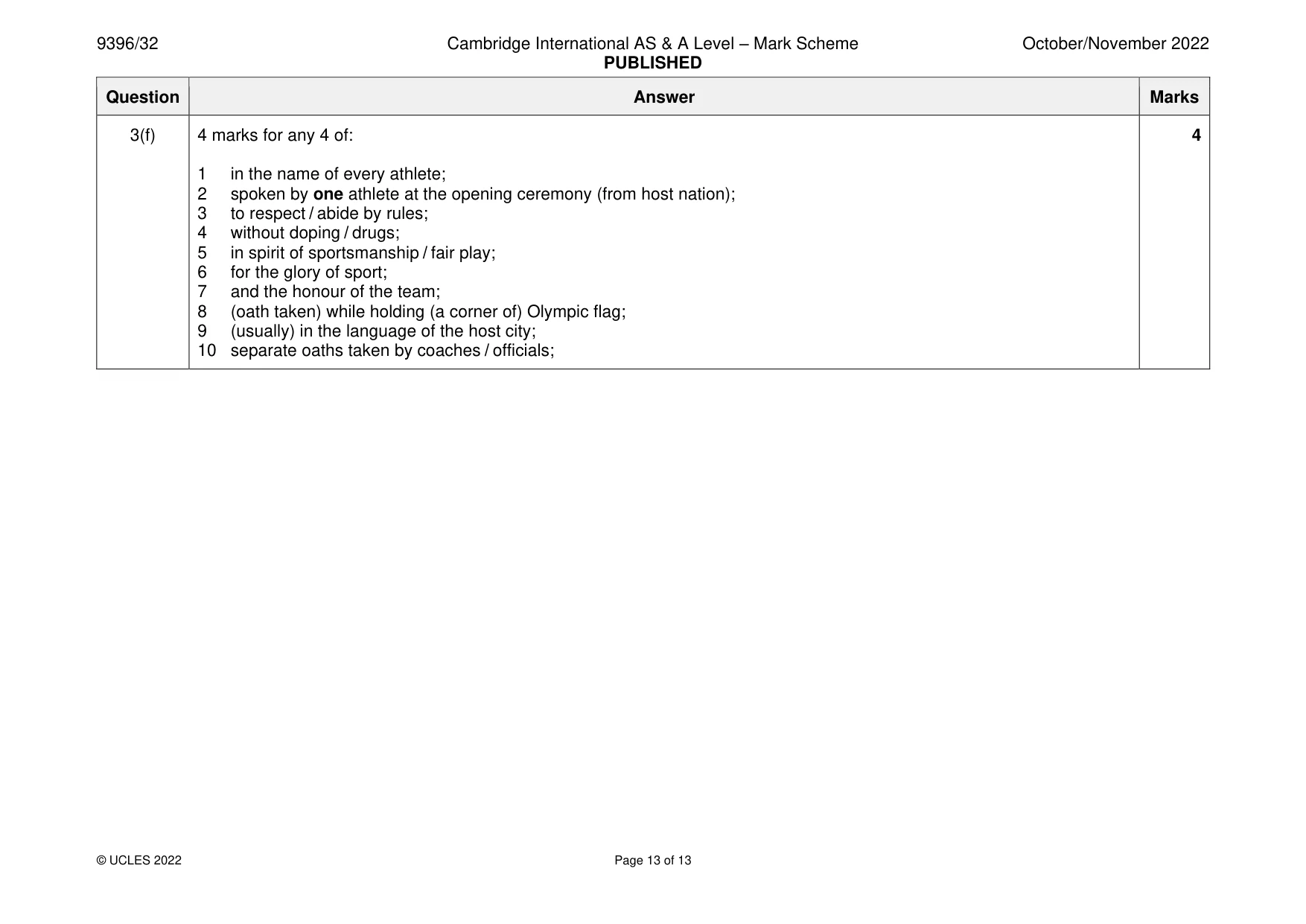
Mark scheme: 3(a)(i) 3 marks for any 3 of: 3 1 not allowed to compete; 2 married women not allowed to attend stadium / spectate / coach; 3 single women were allowed to spectate; 4 priestess (of temple of Demeter) allowed to attend; 5 women had separate Games; 3(a)(ii) 5 marks for any 5 of: 5 1 no women’s participation in 1896 OR only role of women was to present wreaths to winners; 2 limited involvement / some women’s sport introduced in 1900 (tennis, golf); 3 low numbers of participants before Second World War; 4 role of Alice Milliat / Women’s Olympics created in response to IOC refusal to allow women’s athletics in 1920 / 1924; 5 mixed-gender events included; 6 all sports should have a male and female equivalent; 7 acceptance of women as judges / officials; 8 women co-opted on to IOC; 9 some IOC members are women; 10 IOC conference on women and sport; Accept other suitable descriptions. 3(b) 3 marks for any 3 of: 3 1 enhancing national prestige; 2 promoting a political ideology; 3 platform for political confrontation; 4 using athletes as pawns for their governments; 5 preventing certain athletes from competing; Accept specific historical examples that have been used at the Olympic Games. 3(c) 5 marks for any 5 of: 5 (transition happened because) 1 early modern Olympic Games were amateur only OR amateurism seen as a noble concept; 2 amateurism excluded those who could not afford to take part; 3 Olympic success requires full-time training; 4 costs of equipment / facilities / travel; 5 costs of coaches / physio / nutritionist / psychologist / support staff; 6 Olympic Games needs the best athletes (for commercial reasons); 7 abuse of amateur ideals / shamateurs (when Games were amateur); 8 professional athletes have proved to be positive role models; 9 professionalism no longer seen as a negative concept; 10 other major events had professionals (e.g. World Cup) (while Olympics did not allow them) OR conflict with other major events; 3(d) 3 marks for any 3 of: 3 1 high income; 2 sponsorships / endorsements; 3 public appearances / opportunities for work; 4 media spotlight OR gain fame OR become role models; 5 honour of representing country; 6 competing at the highest level in sport; 7 socialising with other elite athletes; 8 once-in-a-lifetime experience / opportunity to travel OR cultural experience; 3(e)(i) 3 marks for any 3 of: 3 1 use of drugs / PEDs; 2 cheating; 3 gamesmanship; 4 use of violence / aggression; 5 bribery of officials; 6 age / gender falsification; 7 modification of equipment; 8 deliberately losing a match / tanking to gain a better draw in the next round; 9 match fixing; 3(e)(ii) 4 marks for any 4 of: 4 1 drug testing / out-of-season testing; 2 punishments; 3 funding to World Anti-Doping Agency / WADA OR closer monitoring of national anti-doping agencies; 4 biological passport; 5 education; 6 use of positive role models; 7 better / stronger officiating OR better vetting of officials; 8 support of National Olympic Committees (NOC); 9 encourage whistleblowing; 10 liaise with betting companies; 11 age-verification systems; Accept other suitable methods. 3(f) 4 marks for any 4 of: 4 1 in the name of every athlete; 2 spoken by one athlete at the opening ceremony (from host nation); 3 to respect / abide by rules; 4 without doping / drugs; 5 in spirit of sportsmanship / fair play; 6 for the glory of sport; 7 and the honour of the team; 8 (oath taken) while holding (a corner of) Olympic flag; 9 (usually) in the language of the host city; 10 separate oaths taken by coaches / officials;
What you needed in this session
Cambridge’s own grade thresholds for 2022 Oct/Nov, Paper 3 · Variant 2. A higher threshold means an easier paper — the bar moves with how the cohort did.