Cambridge A Level Physical Education 9396 — 2018 Oct/Nov Paper 3 · Variant 3
9396/33/O/N/18 · 3 questions · 90 marks · ≈101 min
The question paper and its mark scheme, free to read here and free to download. This is Cambridge’s own paper, exactly as it was sat.
Question paper4 pages
Mark scheme9 pages
Answers below. Sit the paper first if you are practising.
Questions as text
Q1 · The table shows an energy continuum
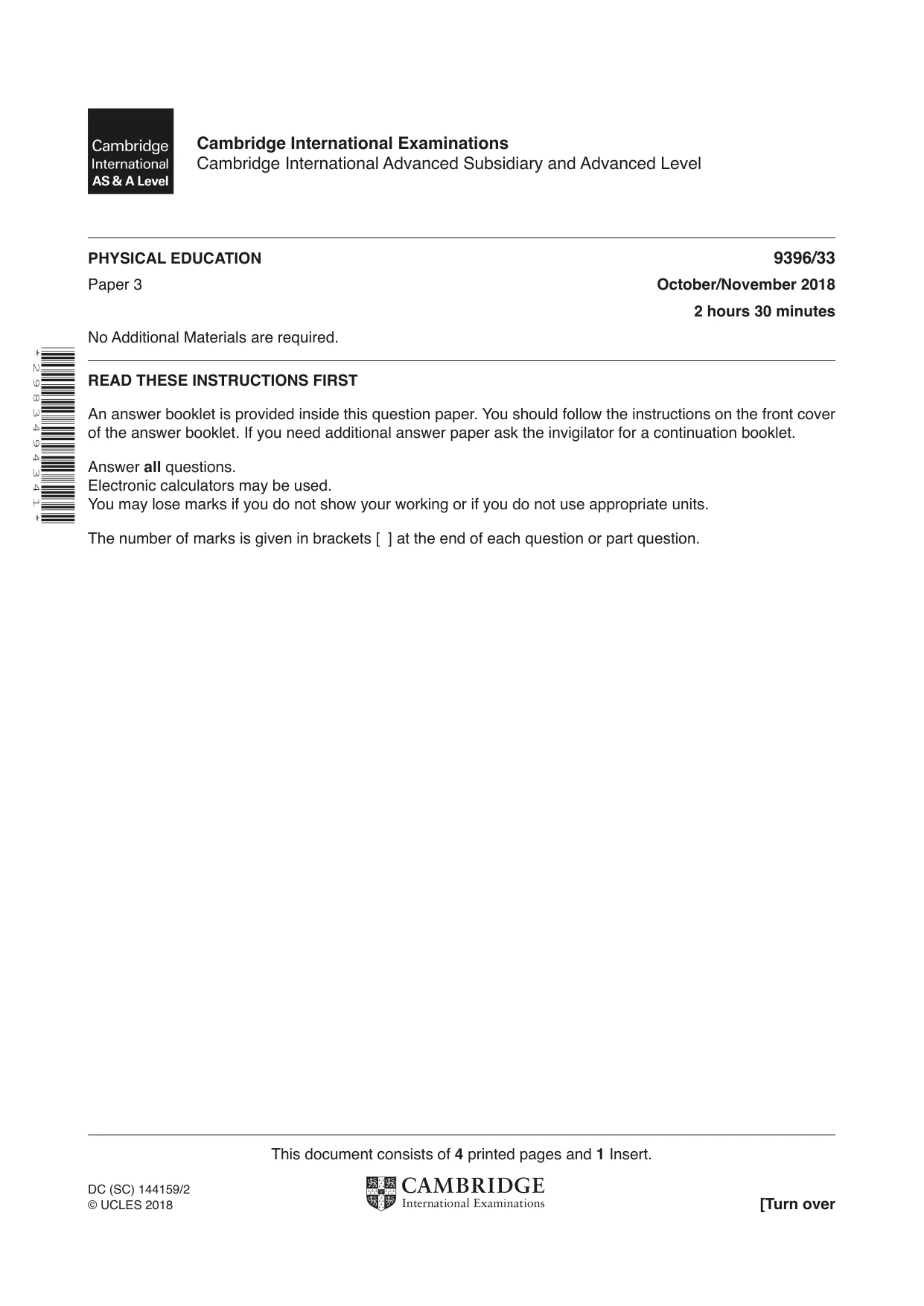
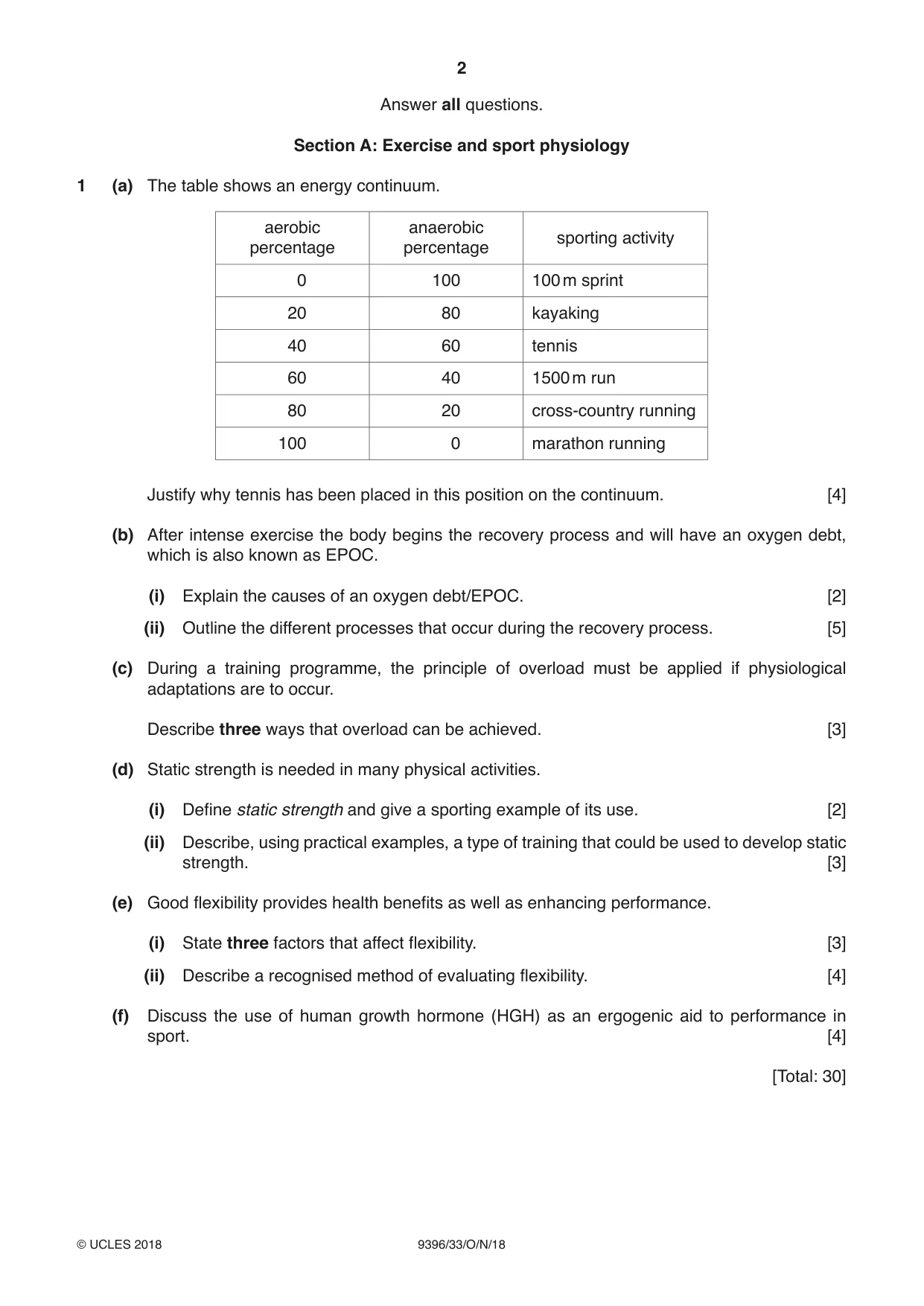
1 (a) The table shows an energy continuum. aerobic anaerobic sporting activity percentage percentage 0 100 100 m sprint 20 80 kayaking 40 60 tennis 60 40 1500 m run 80 20 cross-country running 100 0 marathon running Justify why tennis has been placed in this position on the continuum. [4] (b) After intense exercise the body begins the recovery process and will have an oxygen debt, which is also known as EPOC. (i) Explain the causes of an oxygen debt/EPOC. [2] (ii) Outline the different processes that occur during the recovery process. [5] (c) During a training programme, the principle of overload must be applied if physiological adaptations are to occur. Describe three ways that overload can be achieved. [3] (d) Static strength is needed in many physical activities. (i) Define static strength and give a sporting example of its use. [2] (ii) Describe, using practical examples, a type of training that could be used to develop static strength. [3] (e) Good flexibility provides health benefits as well as enhancing performance. (i) State three factors that affect flexibility. [3] (ii) Describe a recognised method of evaluating flexibility. [4] (f) Discuss the use of human growth hormone (HGH) as an ergogenic aid to performance in sport. [4] [Total: 30]
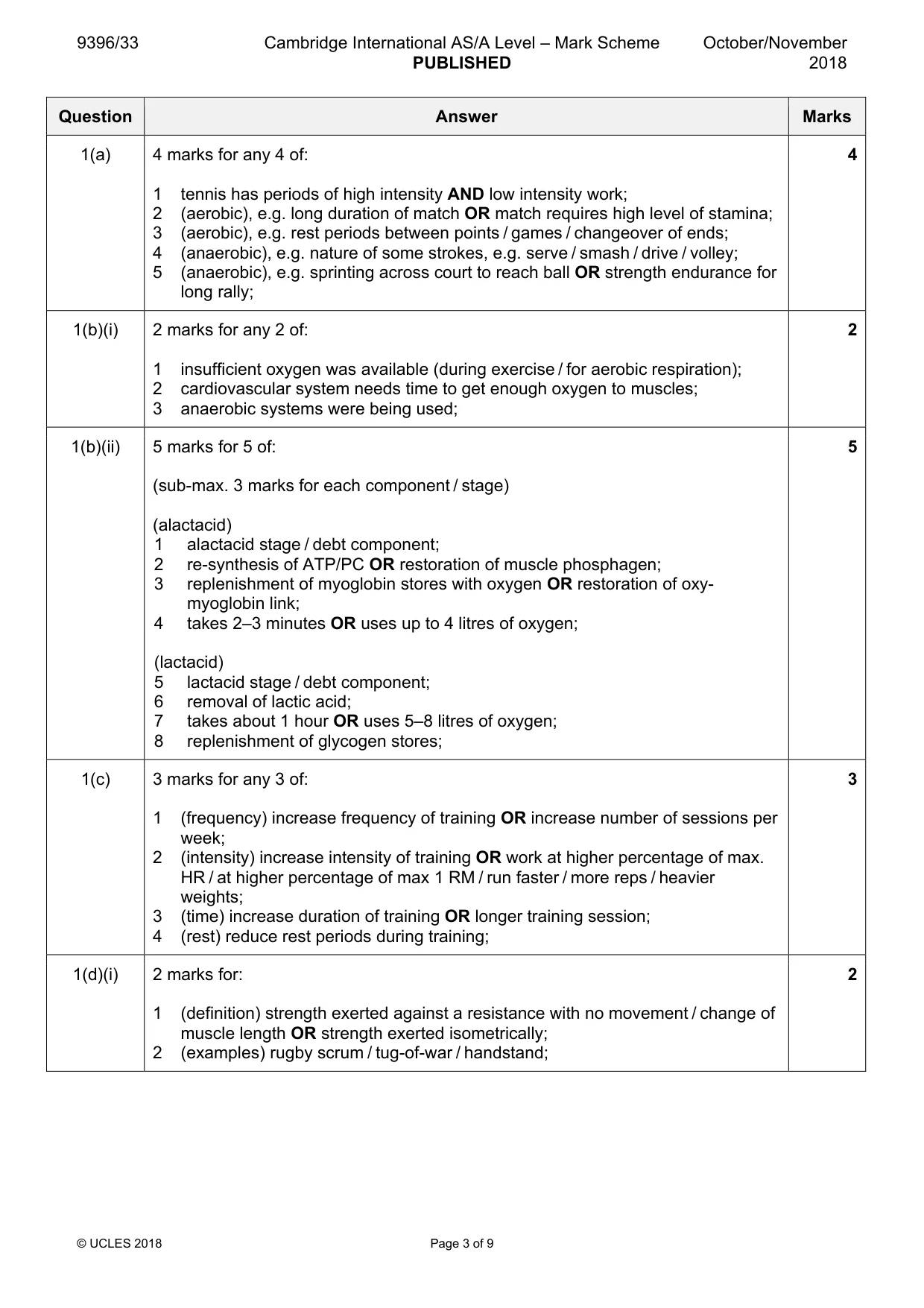
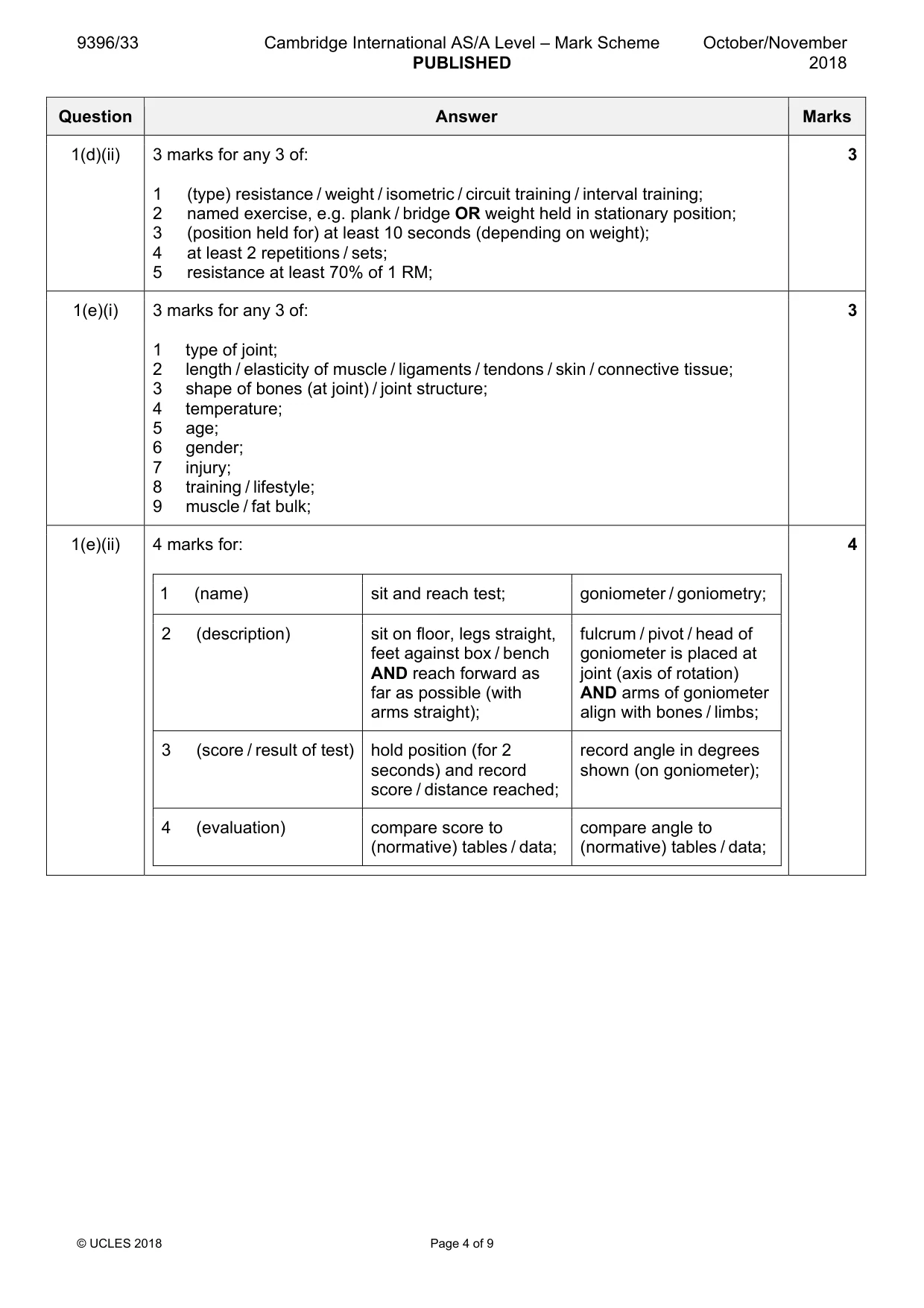
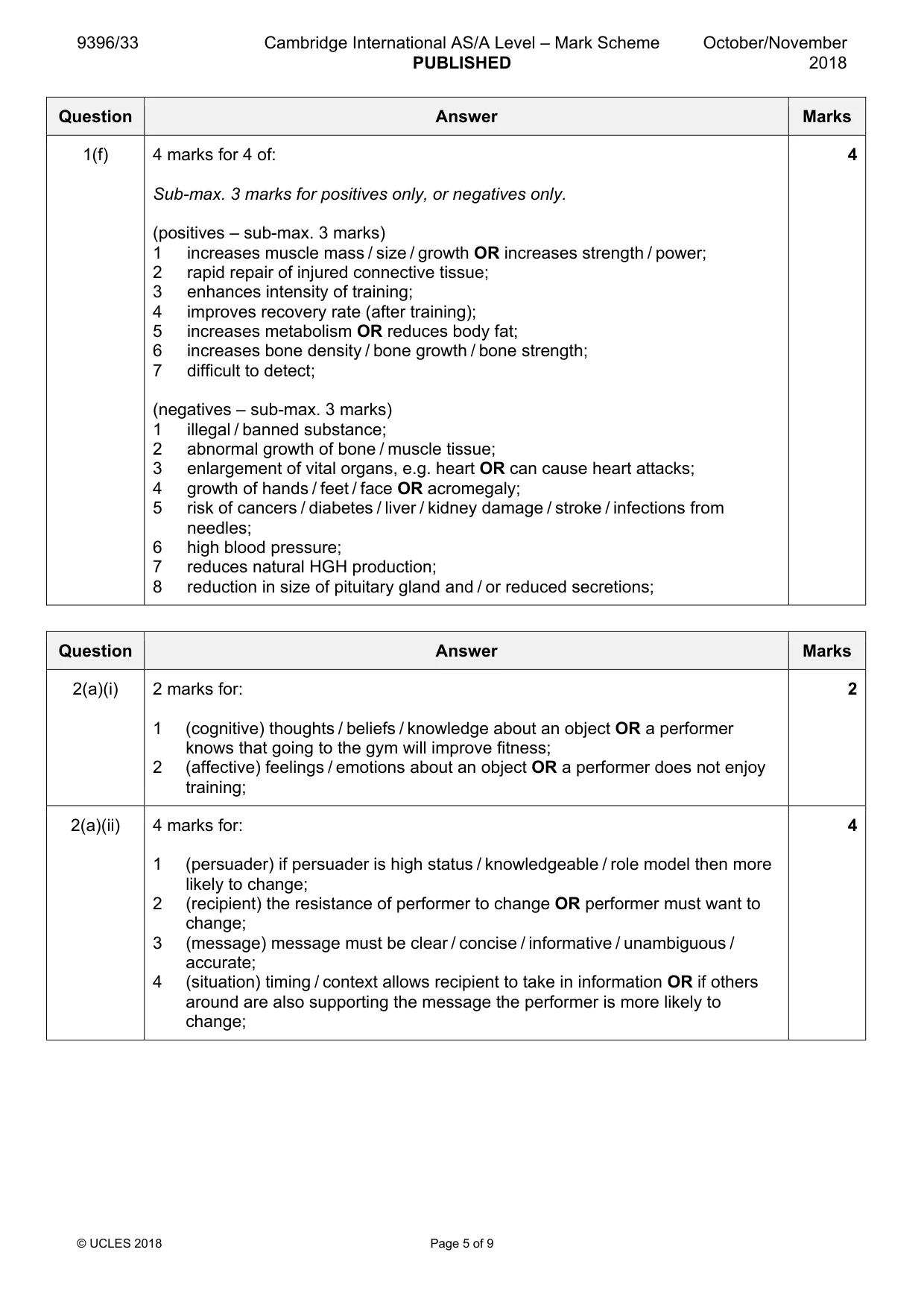
Mark scheme: Question Answer Marks 1(a) 4 marks for any 4 of: 4 1 tennis has periods of high intensity AND low intensity work; 2 (aerobic), e.g. long duration of match OR match requires high level of stamina; 3 (aerobic), e.g. rest periods between points / games / changeover of ends; 4 (anaerobic), e.g. nature of some strokes, e.g. serve / smash / drive / volley; 5 (anaerobic), e.g. sprinting across court to reach ball OR strength endurance for long rally; 1(b)(i) 2 marks for any 2 of: 2 1 insufficient oxygen was available (during exercise / for aerobic respiration); 2 cardiovascular system needs time to get enough oxygen to muscles; 3 anaerobic systems were being used; 1(b)(ii) 5 marks for 5 of: 5 (sub-max. 3 marks for each component / stage) (alactacid) 1 alactacid stage / debt component; 2 re-synthesis of ATP/PC OR restoration of muscle phosphagen; 3 replenishment of myoglobin stores with oxygen OR restoration of oxy- myoglobin link; 4 takes 2–3 minutes OR uses up to 4 litres of oxygen; (lactacid) 5 lactacid stage / debt component; 6 removal of lactic acid; 7 takes about 1 hour OR uses 5–8 litres of oxygen; 8 replenishment of glycogen stores; 1(c) 3 marks for any 3 of: 3 1 (frequency) increase frequency of training OR increase number of sessions per week; 2 (intensity) increase intensity of training OR work at higher percentage of max. HR / at higher percentage of max 1 RM / run faster / more reps / heavier weights; 3 (time) increase duration of training OR longer training session; 4 (rest) reduce rest periods during training; 1(d)(i) 2 marks for: 2 1 (definition) strength exerted against a resistance with no movement / change of muscle length OR strength exerted isometrically; 2 (examples) rugby scrum / tug-of-war / handstand; 1(d)(ii) 3 marks for any 3 of: 3 1 (type) resistance / weight / isometric / circuit training / interval training; 2 named exercise, e.g. plank / bridge OR weight held in stationary position; 3 (position held for) at least 10 seconds (depending on weight); 4 at least 2 repetitions / sets; 5 resistance at least 70% of 1 RM; 1(e)(i) 3 marks for any 3 of: 3 1 type of joint; 2 length / elasticity of muscle / ligaments / tendons / skin / connective tissue; 3 shape of bones (at joint) / joint structure; 4 temperature; 5 age; 6 gender; 7 injury; 8 training / lifestyle; 9 muscle / fat bulk; 1(e)(ii) 4 marks for: 4 1 (name) sit and reach test; goniometer / goniometry; 2 (description) sit on floor, legs straight, fulcrum / pivot / head of feet against box / bench goniometer is placed at AND reach forward as joint (axis of rotation) far as possible (with AND arms of goniometer arms straight); align with bones / limbs; 3 (score / result of test) hold position (for 2 record angle in degrees seconds) and record shown (on goniometer); score / distance reached; 4 (evaluation) compare score to compare angle to (normative) tables / data; (normative) tables / data; 1(f) 4 marks for 4 of: 4 Sub-max. 3 marks for positives only, or negatives only. (positives – sub-max. 3 marks) 1 increases muscle mass / size / growth OR increases strength / power; 2 rapid repair of injured connective tissue; 3 enhances intensity of training; 4 improves recovery rate (after training); 5 increases metabolism OR reduces body fat; 6 increases bone density / bone growth / bone strength; 7 difficult to detect; (negatives – sub-max. 3 marks) 1 illegal / banned substance; 2 abnormal growth of bone / muscle tissue; 3 enlargement of vital organs, e.g. heart OR can cause heart attacks; 4 growth of hands / feet / face OR acromegaly; 5 risk of cancers / diabetes / liver / kidney damage / stroke / infections from needles; 6 high blood pressure; 7 reduces natural HGH production; 8 reduction in size of pituitary gland and / or reduced secretions;
Q2 · Sports psychologists have recognised links between attitudes and behaviour in sporting…
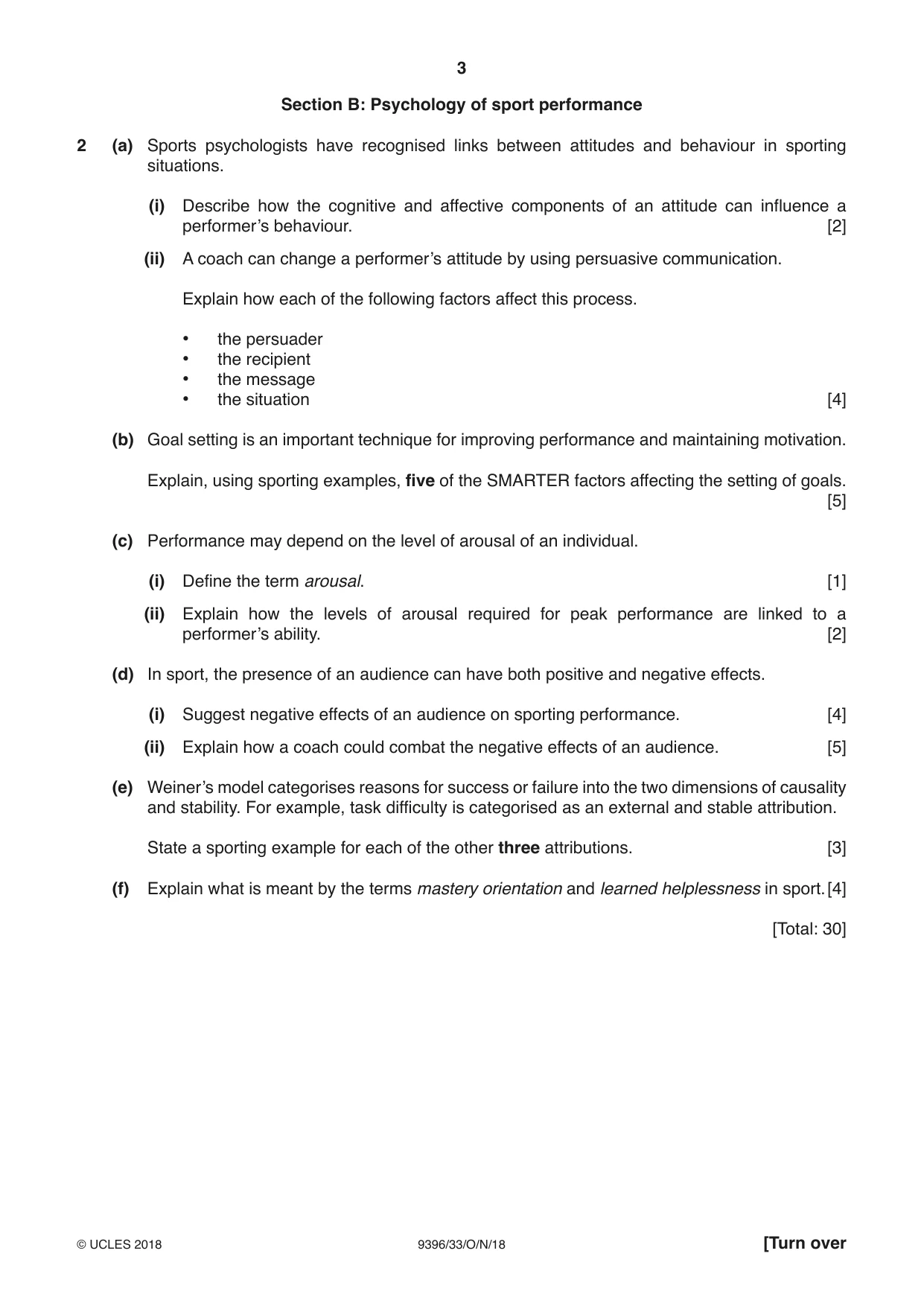
2 (a) Sports psychologists have recognised links between attitudes and behaviour in sporting situations. (i) Describe how the cognitive and affective components of an attitude can influence a performer’s behaviour. [2] (ii) A coach can change a performer’s attitude by using persuasive communication. Explain how each of the following factors affect this process. • the persuader • the recipient • the message • the situation [4] (b) Goal setting is an important technique for improving performance and maintaining motivation. Explain, using sporting examples, five of the SMARTER factors affecting the setting of goals. [5] (c) Performance may depend on the level of arousal of an individual. (i) Define the term arousal. [1] (ii) Explain how the levels of arousal required for peak performance are linked to a performer’s ability. [2] (d) In sport, the presence of an audience can have both positive and negative effects. (i) Suggest negative effects of an audience on sporting performance. [4] (ii) Explain how a coach could combat the negative effects of an audience. [5] (e) Weiner’s model categorises reasons for success or failure into the two dimensions of causality and stability. For example, task difficulty is categorised as an external and stable attribution. State a sporting example for each of the other three attributions. [3] (f) Explain what is meant by the terms mastery orientation and learned helplessness in sport. [4] [Total: 30] Section C: Olympic Games: a global perspective
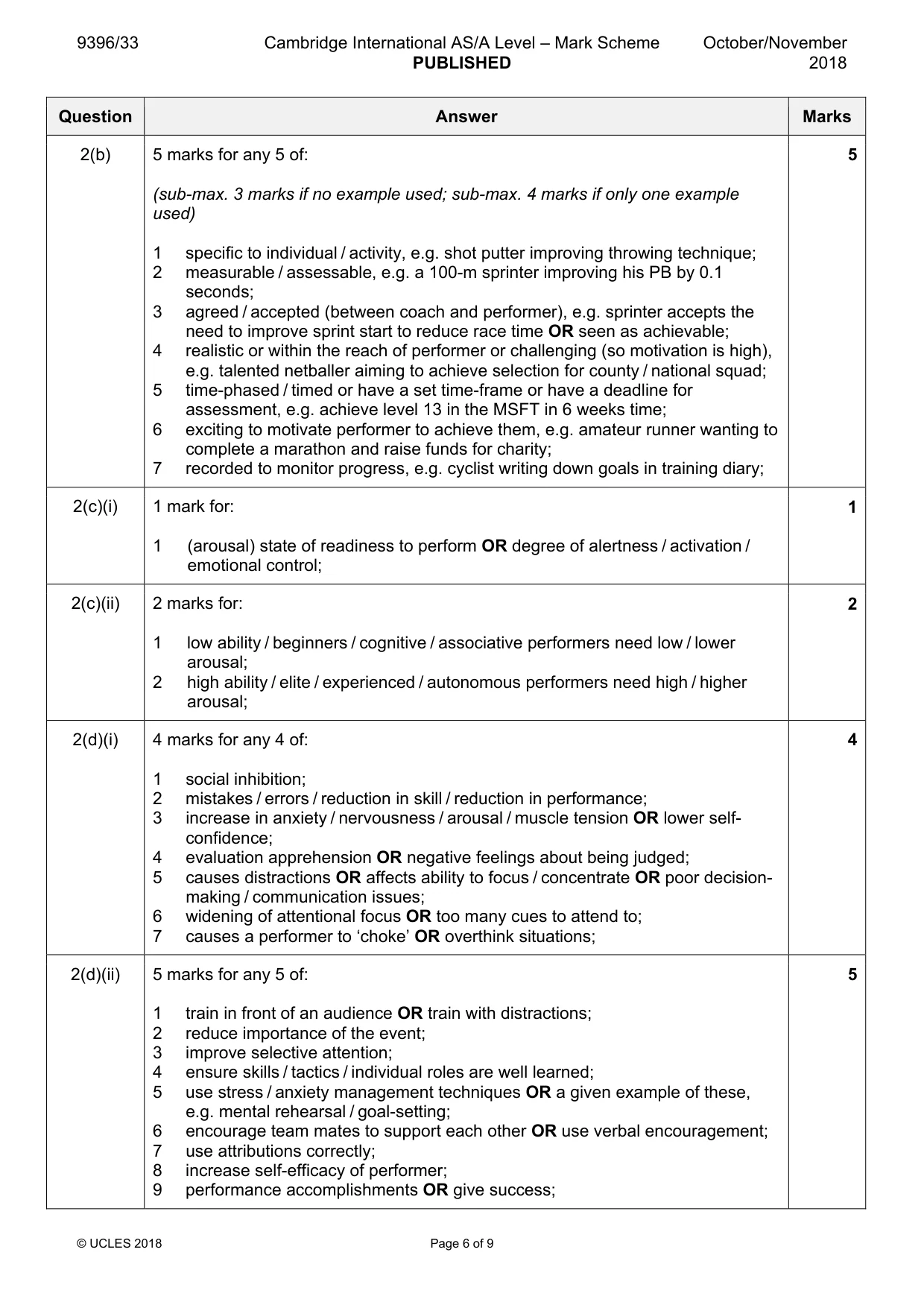
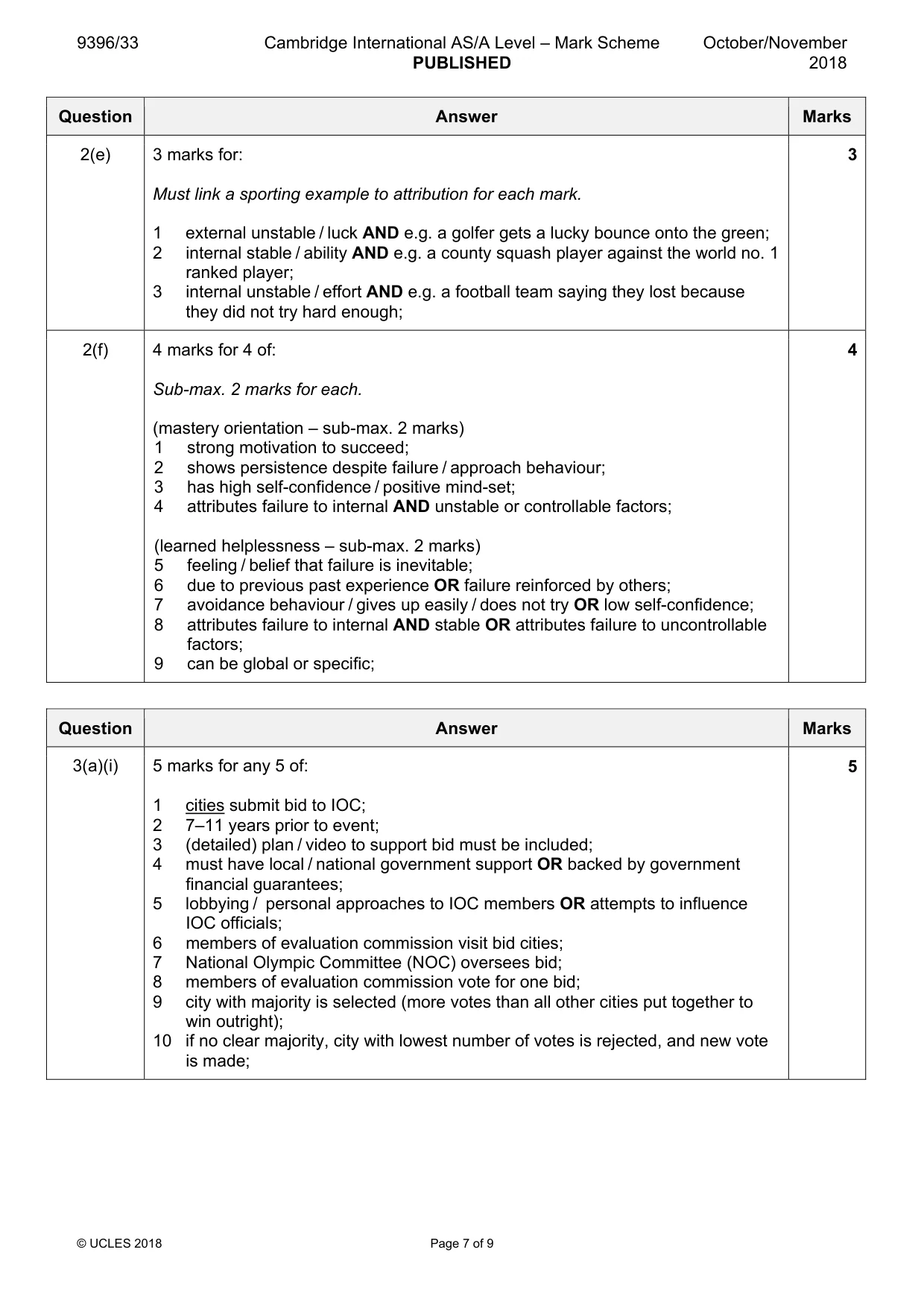
Mark scheme: 2(a)(i) 2 marks for: 2 1 (cognitive) thoughts / beliefs / knowledge about an object OR a performer knows that going to the gym will improve fitness; 2 (affective) feelings / emotions about an object OR a performer does not enjoy training; 2(a)(ii) 4 marks for: 4 1 (persuader) if persuader is high status / knowledgeable / role model then more likely to change; 2 (recipient) the resistance of performer to change OR performer must want to change; 3 (message) message must be clear / concise / informative / unambiguous / accurate; 4 (situation) timing / context allows recipient to take in information OR if others around are also supporting the message the performer is more likely to change; 2(b) 5 marks for any 5 of: 5 (sub-max. 3 marks if no example used; sub-max. 4 marks if only one example used) 1 specific to individual / activity, e.g. shot putter improving throwing technique; 2 measurable / assessable, e.g. a 100-m sprinter improving his PB by 0.1 seconds; 3 agreed / accepted (between coach and performer), e.g. sprinter accepts the need to improve sprint start to reduce race time OR seen as achievable; 4 realistic or within the reach of performer or challenging (so motivation is high), e.g. talented netballer aiming to achieve selection for county / national squad; 5 time-phased / timed or have a set time-frame or have a deadline for assessment, e.g. achieve level 13 in the MSFT in 6 weeks time; 6 exciting to motivate performer to achieve them, e.g. amateur runner wanting to complete a marathon and raise funds for charity; 7 recorded to monitor progress, e.g. cyclist writing down goals in training diary; 2(c)(i) 1 mark for: 1 1 (arousal) state of readiness to perform OR degree of alertness / activation / emotional control; 2(c)(ii) 2 marks for: 2 1 low ability / beginners / cognitive / associative performers need low / lower arousal; 2 high ability / elite / experienced / autonomous performers need high / higher arousal; 2(d)(i) 4 marks for any 4 of: 4 1 social inhibition; 2 mistakes / errors / reduction in skill / reduction in performance; 3 increase in anxiety / nervousness / arousal / muscle tension OR lower self- confidence; 4 evaluation apprehension OR negative feelings about being judged; 5 causes distractions OR affects ability to focus / concentrate OR poor decision- making / communication issues; 6 widening of attentional focus OR too many cues to attend to; 7 causes a performer to ‘choke’ OR overthink situations; 2(d)(ii) 5 marks for any 5 of: 5 1 train in front of an audience OR train with distractions; 2 reduce importance of the event; 3 improve selective attention; 4 ensure skills / tactics / individual roles are well learned; 5 use stress / anxiety management techniques OR a given example of these, e.g. mental rehearsal / goal-setting; 6 encourage team mates to support each other OR use verbal encouragement; 7 use attributions correctly; 8 increase self-efficacy of performer; 9 performance accomplishments OR give success; 2(e) 3 marks for: 3 Must link a sporting example to attribution for each mark. 1 external unstable / luck AND e.g. a golfer gets a lucky bounce onto the green; 2 internal stable / ability AND e.g. a county squash player against the world no. 1 ranked player; 3 internal unstable / effort AND e.g. a football team saying they lost because they did not try hard enough; 2(f) 4 marks for 4 of: 4 Sub-max. 2 marks for each. (mastery orientation – sub-max. 2 marks) 1 strong motivation to succeed; 2 shows persistence despite failure / approach behaviour; 3 has high self-confidence / positive mind-set; 4 attributes failure to internal AND unstable or controllable factors; (learned helplessness – sub-max. 2 marks) 5 feeling / belief that failure is inevitable; 6 due to previous past experience OR failure reinforced by others; 7 avoidance behaviour / gives up easily / does not try OR low self-confidence; 8 attributes failure to internal AND stable OR attributes failure to uncontrollable factors; 9 can be global or specific;
Q3 · Outline the bidding process that a venue, such as Rio, went through in order to be…
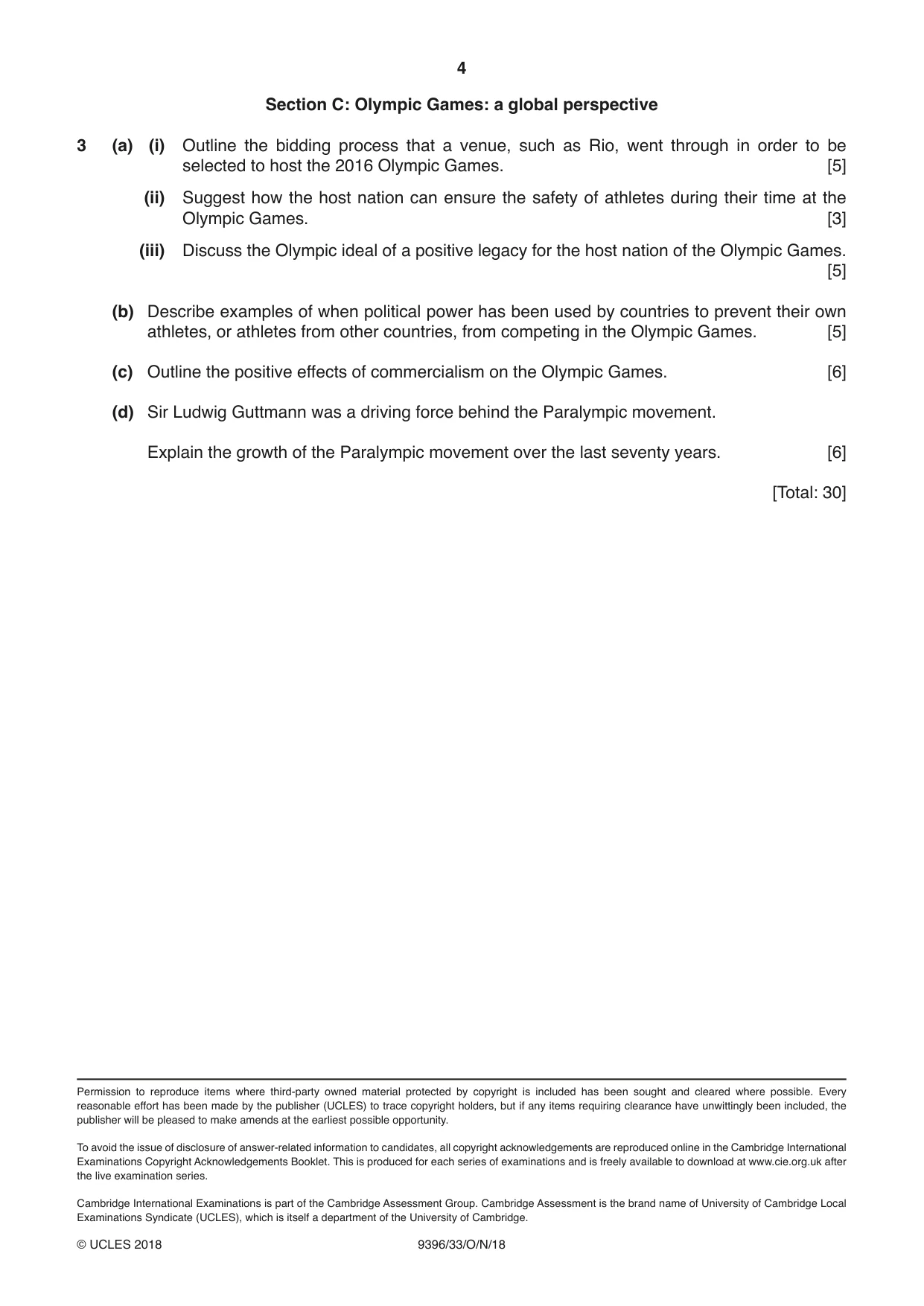
3 (a) (i) Outline the bidding process that a venue, such as Rio, went through in order to be selected to host the 2016 Olympic Games. [5] (ii) Suggest how the host nation can ensure the safety of athletes during their time at the Olympic Games. [3] (iii) Discuss the Olympic ideal of a positive legacy for the host nation of the Olympic Games. [5] (b) Describe examples of when political power has been used by countries to prevent their own athletes, or athletes from other countries, from competing in the Olympic Games. [5] (c) Outline the positive effects of commercialism on the Olympic Games. [6] (d) Sir Ludwig Guttmann was a driving force behind the Paralympic movement. Explain the growth of the Paralympic movement over the last seventy years. [6] [Total: 30]
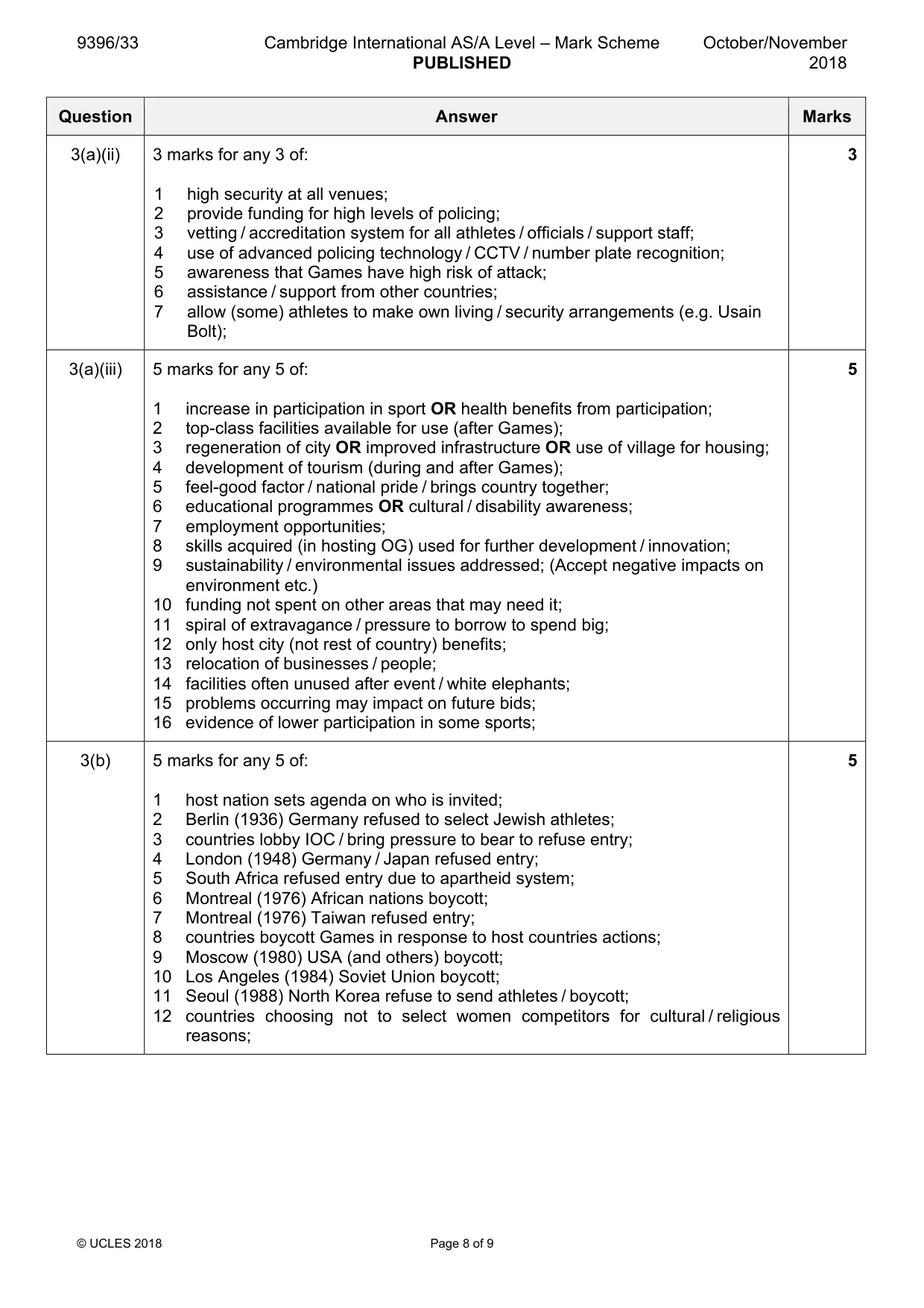
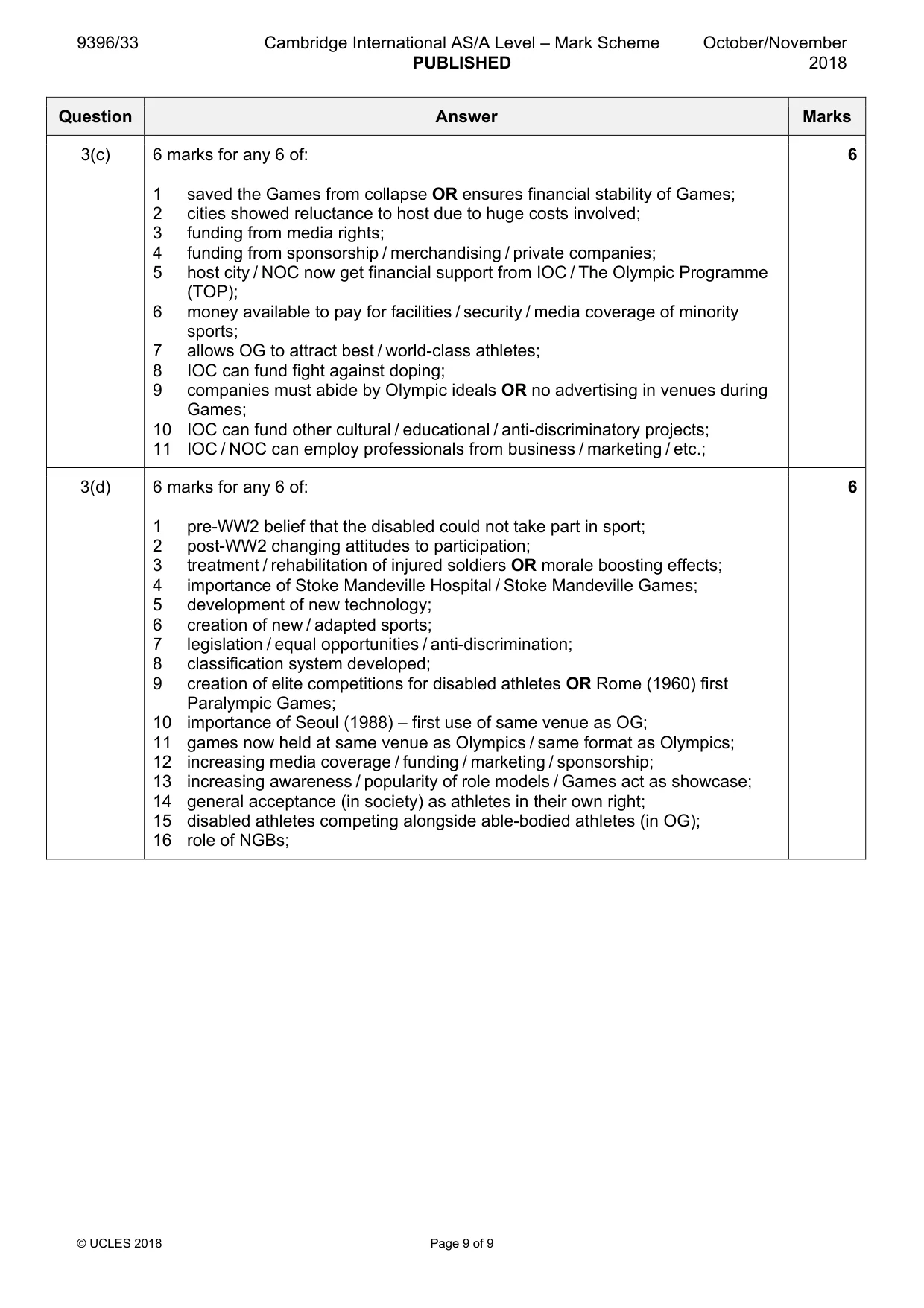
Mark scheme: 3(a)(i) 5 marks for any 5 of: 5 1 cities submit bid to IOC; 2 7–11 years prior to event; 3 (detailed) plan / video to support bid must be included; 4 must have local / national government support OR backed by government financial guarantees; 5 lobbying / personal approaches to IOC members OR attempts to influence IOC officials; 6 members of evaluation commission visit bid cities; 7 National Olympic Committee (NOC) oversees bid; 8 members of evaluation commission vote for one bid; 9 city with majority is selected (more votes than all other cities put together to win outright); 10 if no clear majority, city with lowest number of votes is rejected, and new vote is made; 3(a)(ii) 3 marks for any 3 of: 3 1 high security at all venues; 2 provide funding for high levels of policing; 3 vetting / accreditation system for all athletes / officials / support staff; 4 use of advanced policing technology / CCTV / number plate recognition; 5 awareness that Games have high risk of attack; 6 assistance / support from other countries; 7 allow (some) athletes to make own living / security arrangements (e.g. Usain Bolt); 3(a)(iii) 5 marks for any 5 of: 5 1 increase in participation in sport OR health benefits from participation; 2 top-class facilities available for use (after Games); 3 regeneration of city OR improved infrastructure OR use of village for housing; 4 development of tourism (during and after Games); 5 feel-good factor / national pride / brings country together; 6 educational programmes OR cultural / disability awareness; 7 employment opportunities; 8 skills acquired (in hosting OG) used for further development / innovation; 9 sustainability / environmental issues addressed; (Accept negative impacts on environment etc.) 10 funding not spent on other areas that may need it; 11 spiral of extravagance / pressure to borrow to spend big; 12 only host city (not rest of country) benefits; 13 relocation of businesses / people; 14 facilities often unused after event / white elephants; 15 problems occurring may impact on future bids; 16 evidence of lower participation in some sports; 3(b) 5 marks for any 5 of: 5 1 host nation sets agenda on who is invited; 2 Berlin (1936) Germany refused to select Jewish athletes; 3 countries lobby IOC / bring pressure to bear to refuse entry; 4 London (1948) Germany / Japan refused entry; 5 South Africa refused entry due to apartheid system; 6 Montreal (1976) African nations boycott; 7 Montreal (1976) Taiwan refused entry; 8 countries boycott Games in response to host countries actions; 9 Moscow (1980) USA (and others) boycott; 10 Los Angeles (1984) Soviet Union boycott; 11 Seoul (1988) North Korea refuse to send athletes / boycott; 12 countries choosing not to select women competitors for cultural / religious reasons; 3(c) 6 marks for any 6 of: 6 1 saved the Games from collapse OR ensures financial stability of Games; 2 cities showed reluctance to host due to huge costs involved; 3 funding from media rights; 4 funding from sponsorship / merchandising / private companies; 5 host city / NOC now get financial support from IOC / The Olympic Programme (TOP); 6 money available to pay for facilities / security / media coverage of minority sports; 7 allows OG to attract best / world-class athletes; 8 IOC can fund fight against doping; 9 companies must abide by Olympic ideals OR no advertising in venues during Games; 10 IOC can fund other cultural / educational / anti-discriminatory projects; 11 IOC / NOC can employ professionals from business / marketing / etc.; 3(d) 6 marks for any 6 of: 6 1 pre-WW2 belief that the disabled could not take part in sport; 2 post-WW2 changing attitudes to participation; 3 treatment / rehabilitation of injured soldiers OR morale boosting effects; 4 importance of Stoke Mandeville Hospital / Stoke Mandeville Games; 5 development of new technology; 6 creation of new / adapted sports; 7 legislation / equal opportunities / anti-discrimination; 8 classification system developed; 9 creation of elite competitions for disabled athletes OR Rome (1960) first Paralympic Games; 10 importance of Seoul (1988) – first use of same venue as OG; 11 games now held at same venue as Olympics / same format as Olympics; 12 increasing media coverage / funding / marketing / sponsorship; 13 increasing awareness / popularity of role models / Games act as showcase; 14 general acceptance (in society) as athletes in their own right; 15 disabled athletes competing alongside able-bodied athletes (in OG); 16 role of NGBs;
What you needed in this session
Cambridge’s own grade thresholds for 2018 Oct/Nov, Paper 3 · Variant 3. A higher threshold means an easier paper — the bar moves with how the cohort did.